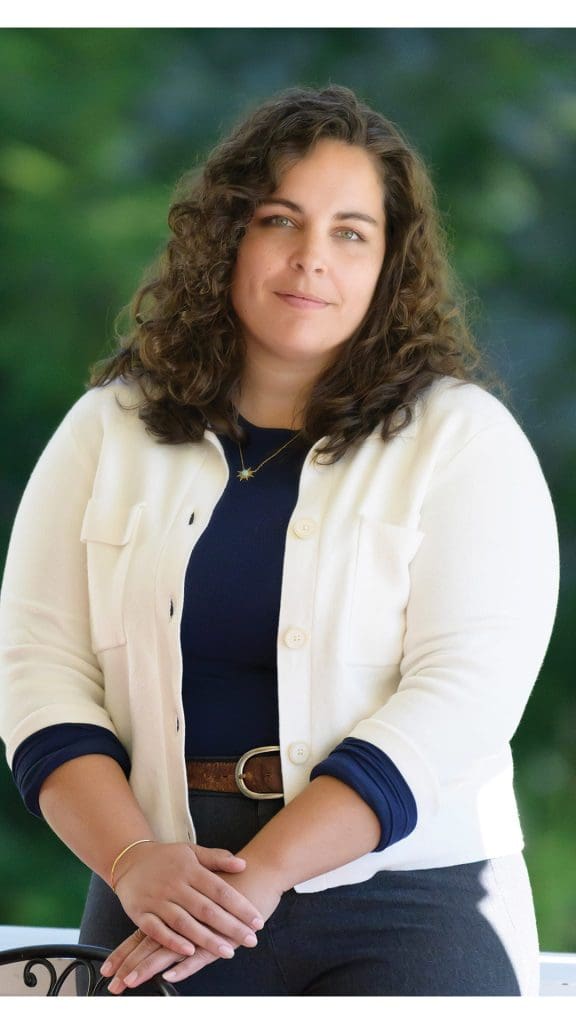
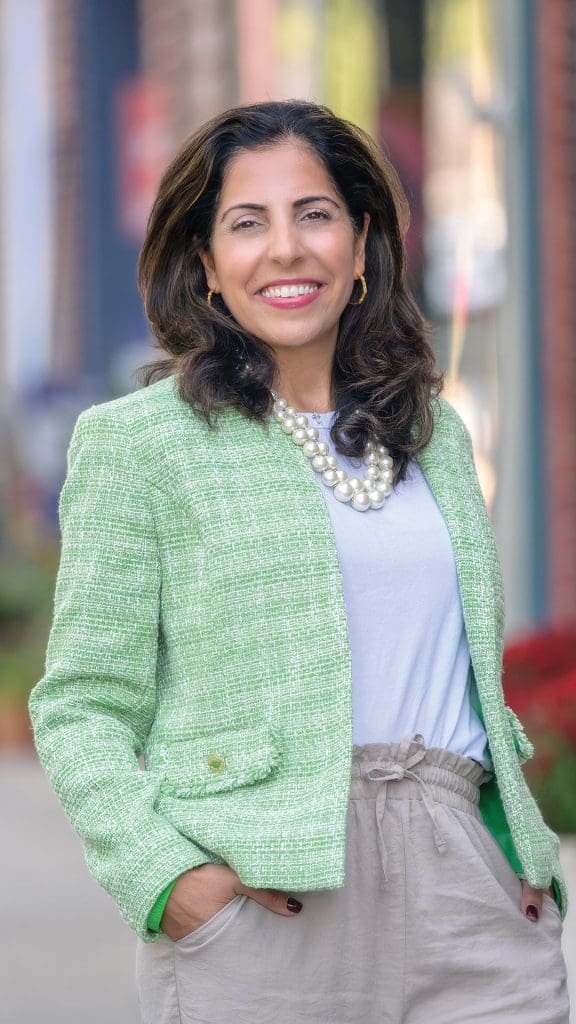
Tara Brewster
Vice president of Business Development and Director of Philanthropy at Greenfield Savings Bank









Vice president of Business Development and Director of Philanthropy at Greenfield Savings Bank


Vice president of Business Development and Director of Philanthropy at Greenfield Savings Bank

Sarah Rose Stack counts several mentors and influencers in her life — from her sister, Theresa, to her husband, Ryan, who has supported her in everything she’s done, to the accountants at the firm she would work for. But she always starts those discussions by referencing two music teachers — one in middle school and the other in high school.
Both inspired a passion for the arts that lives on today and influences virtually every aspect of her life (more on this later), but they did more than that. In short, they helped convince her that her challenging life — being raised by a single mother at or just below the poverty line, and at times homeless — shouldn’t limit her ambitions.
“They started to make me realize that I could be capable of something beyond just surviving,” Stack recalled, adding that they became surrogate parents in some ways, providing her with everything from quiet space in which to study and escape that home life to invaluable lessons on how teachers need to support their students in any way they can — lessons she applies today as a lecturer of Public Relations at UMass Amherst.
“That’s why there’s food here, there’s drinks here … I have a very, very, very open-door policy,” she said while talking with BusinessWest in her office at the Integrated Learning Center. “I have a student who’s not in any of my classes anymore, but she asked me to help her pick an outfit for an interview and do practice questions … that means a lot to me when students reach out to me like that, and I always try to be there for them.”
Stack has taken a circuitous route to her current position, putting aside music and the arts (at least as a profession) after coming up one credit shy of what she needed to graduate from UMass Amherst with a music degree as she tried to balance school and life, and thus being unable to speak at commencement, as she was chosen to do — although she would go back and do it later when she earned that degree.
This otherwise dark moment ultimately helped shape her in a positive way by taking her down a different career path — working first as an executive for the billion-dollar e-commerce company SHOP.COM, then for the Holyoke-based accounting firm Meyers Brothers Kalicka (MBK) and, eventually, UMass.
Today, Stack balances life at home with work (including the Stack Group, the consulting firm she co-owns with Ryan), the arts (on many different levels), and involvement in the community, squeezing every hour out of every day — except Sunday, which is reserved for family.
Indeed, while providing guidance and support to her younger son, Ethan, with college applications and her older son, Jordan, as he pursues a legal studies degree at UMass Amherst, she teaches three courses at the university (four next semester) while also managing several interns.
“They started to make me realize that I could be capable of something beyond just surviving.”
Meanwhile, she’s teaching dance one night a week; choregraphing a production of Sweeney Todd at the Little Theatre of Manchester (Conn.) set for November; preparing to star in a theatrical performance she couldn’t name just yet, opting only for ‘razzle dazzle’; and laying the groundwork for the return of a program she created called Build a Prom, which provides prom dresses, suits, and accessories to those in need. And that’s just a partial list.
She’s also a consultant to MBK on marketing matters and serves as a role model and mentor to students, young professionals, and artists of all kinds. Katrina Arona, her successor at MBK, is one of them.
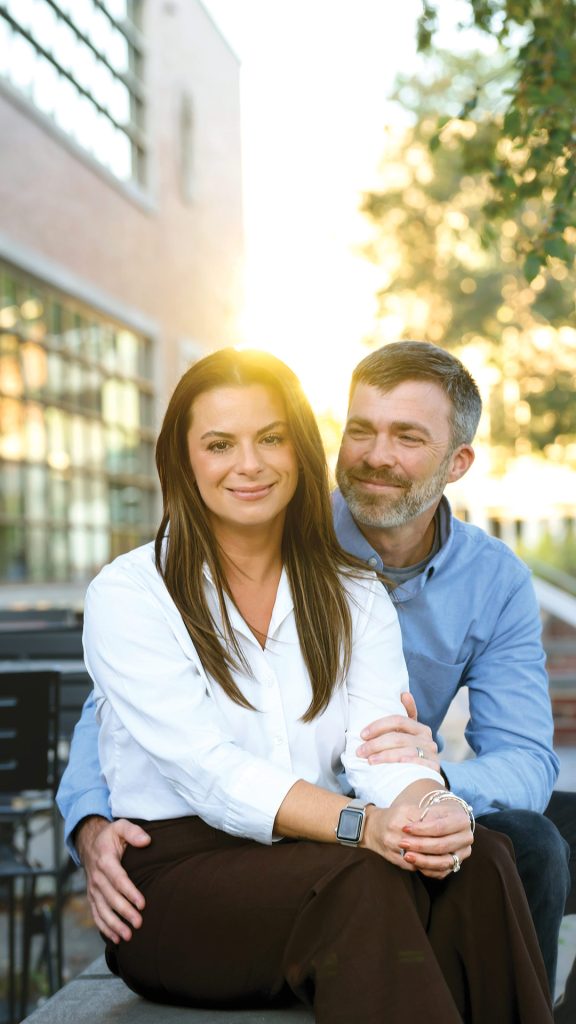
Sarah Rose Stack (pictured with her husband, Ryan) says she strives to be the kind of game-changing teacher she had while studying music in her youth.
Photo by Bob Zemba, Simple Truth Imaging
“She plants the seeds with me, and I sprout from there,” Arona said, adding that advice has come on specific marketing initiatives as well as broad realms of working with people and solving problems. “She’s like that good player on a soccer team that enables everyone around her to play better.”
When Stack says she couldn’t take anything for granted growing up in New Jersey, she means it.
And that includes having a place to live.
“I probably moved more times before I was in high school than most people do in a lifetime,” she recalled. “I Iived in a hotel for a little while, and in a church for a little while, with family, with friends.”
She said her mother worked three jobs to support her three children and, understandably, wasn’t around much.
Which brings her back to her music teachers. One of them, ‘Mr. Lorreti,’ got her started in music and gave her a euphonium, a close cousin of the trombone and tuba, which she would go on to play in several bands and focus on in her college major. Then, in high school, there was a teacher known to all as ‘Mrs. G,’ who helped her manage those difficult years.
“I consider myself an accomplished artist in music and dance, and I got a lot of my fundamentals from my music teachers with regard to technique,” she explained. “But they were there for everything. I remember being so stressed about getting homework done … the house was crazy, and I was allowed to go to the music room and work on things during off periods; she [Mrs. G] would never tell me to leave. I could go there for a quiet moment and work on an English paper.
“Those arts teachers … they give you so much than the lessons,” she went on. “My mother was a single mom raising three kids and working three jobs, so we rarely got to see her. She worked so hard, and she did her best. But it’s interesting how these arts teachers were like second and third parents.”
Stack had a few music scholarship offers, including one to Rutgers, but chose to pay to attend UMass Amherst for its strong faculty and institutions like its marching band, which she never did play in because she was involved in so much else.
She took on school in aggressive fashion, accruing far more credits per semester than the norm, while also meeting Ryan, also a music major. She became pregnant her junior year, took a year off to be with her son, Jordan, and then returned to school to finish, but, as noted earlier, came up one credit shy due to some challenges with balancing life and school.
“Things were different then — people weren’t so accommodating with non-traditional situations,” she explained. “One of my required classes started at 8 a.m., but childcare didn’t open until 8:30. That was problematic. Two times a week, I would drop Jordan off at 8:30, park in the football lot, and sprint to this class 40 minutes late.”
“They really showed me how to set boundaries for myself. They told me that if I don’t take care of my whole person, I’m not going to be a good employee. That was such a shift for me, and it stuck with me.”
She passed the class but, as noted, couldn’t take the final, in-person exam, and thus couldn’t speak at commencement and had to put aside her dream of playing euphonium with the ‘The President’s Own’ United States Marine Band.
“I took some time off, and that was when I just thought … ‘I hate music, I hate everything,’ and I started working for SHOP.COM,” she said, noting that she started in sales and worked her way up to director of Business Integration.
It was a job that took her around the world, and she enjoyed most aspects of it, but as her children grew older, she desired something more grounded. So she took the job at MBK as director of Marketing and Recruiting, thinking it would be the “the most boring job I ever had.”
But it wasn’t. It was another learning experience on many levels, and one where she would gain more confidence and life skills.

Sarah Rose Stack (in the pink cap) leads one of the many dance classes she teaches weekly.
“They really showed me how to set boundaries for myself,” she noted. “They told me that if I don’t take care of my whole person, I’m not going to be a good employee. That was such a shift for me, and it stuck with me.”
Always seeking new challenges professionally, Stack found one in the School of Journalism at UMass Amherst. There she teaches “Writing for PR,” “Research & Analytics,” “Social Media for PR,” and other courses while also trying the follow the lead set by the teachers who were so impactful in her life.
While her career has taken her to the corporate world and then academia, the arts remain a huge part of her life — performing, choreographing, teaching, mentoring, inspiring, and also playing in a few orchestras, including one featured in a recent performance of Shrek.
As noted, she teaches dance — everything from ballet and pointe to ‘Broadway jazz’ — one day a week at Nutmeg’s Dance & Theatre Co. in Southwick, where she’s taught for 20 years.
She also choreographs shows for several area groups, including the Little Theatre of Manchester, the Opera House Players, Renbrook Prep School, High Wire Acts, Seat of Our Pants Productions, and the Massachusetts Academy of Ballet. Specific performances include A Chorus Line, Aladdin, Beauty and the Beast, Grease, The Hunchback of Notre Dame, The Little Mermaid, and many others.
While work and the arts are separate worlds for Stack, they interconnect in many ways, especially with the way in which her training in the arts has made her better in her more recent career roles.
“All of my music and dance training played a huge role in all of my marketing and design choices,” she explained. “When you think about video design or storytelling, writing, or any of that stuff, the cadence of things … where there’s space, where things speed up, where things are longer than they need to be — all of that is very musical to me.
“When I write something, I’ll always read it out loud and say, ‘does this sing? Does it sound monotonous, or does it sing? Are there good pauses? Does it flow nicely?’” she went on. “It’s the same with video design when it comes to how things move, physical space, tempo … all those things play a huge role in how things are visually processed; I do think there are a lot of transferable skills.
“If I were to do a doctorate, this is exactly what my dissertation would be on,” she continued. “Dance and music as a universal language as it relates to behavior change.”
Pausing for a moment, Stack seemed to take that ‘if’ out of the equation, making it sound far more like ‘when,’ as in maybe a few years from now, when there might be a little more time.
That will be the latest challenge for someone who has never shied away from one, and, in fact, always looks for the next one.
That’s just one of the myriad traits that has enabled her to excel on many different stages — both figuratively and literally — and take a bow in December as a Woman of Impact.

Amanda Sanderson says she owes a lot of who she is, what she does, and what drives her personally and professionally to her family, especially her mother.
“She’s a survivor of sexual and domestic violence,” Sanderson explained. “And each time she was in a situation that was unsafe, and her children’s safety was threatened, she had to find this store of extreme resilience to leave, support her children, rebuild her life, and make sure we were all safe.”
Elaborating, Sanderson said she grew up in a blended family with siblings and stepsiblings who had different needs, and she watched as her parents fought for their rights and the various forms of support they needed.
Such experiences — and the desire to help others find within them that same level of resilience her mother and stepfather exhibited — have taken Sanderson to career stops at nonprofits in Birmingham, Ala., Boston, and now Greenfield, where she serves as executive director of the Resilience Center of Franklin County (RCFC), formerly known as the New England Learning Center for Women in Transition (NELCWIT).
That’s a mouthful, and a name that needed to be changed, she said, to reflect that the organization serves survivors of all gender identities and sexual orientation and puts an emphasis on resilience.
And rebranding has been just one of many items on a large to-do list since she arrived nearly two and a half years ago.
Indeed, she has guided the agency — funded through the Department of Public Health and the Massachusetts Office of Victim Assistance — through might be called a period of renewal and transformation, handing internal challenges, enhancing its physical space, and expanding client services (including access to food, emergency assistance funds, and a welcoming visitation center), while also overseeing record-breaking fundraising and increased grant support.
Lainie DeCoursy, a board member with the RCFC who nominated Sanderson to be a Woman of Impact, described her as a “visionary nonprofit leader,” convener, collaborator, and a clear, strong voice when it comes to raising awareness about domestic and sexual violence.
“Amanda has been a key driver of regional coalitions of more than 40 nonprofits, amplifying the collective voice for health and human services across Franklin County and North Quabbin,” she wrote. “She is a strong advocate for the role of community-based organizations in fostering resilience, often emphasizing the ripple effect of nonprofit work — that thriving individuals and families are the foundation of strong communities.
“She combines bold innovation with compassion and authenticity,” DeCoursy went on, crediting Sanderson with providing strong leadership at a time of funding challenges and policy shifts and expanding holistic services to survivors and families by growing access to a basic needs and food pantry, introducing client transportation through a new agency van (helping meet a critical void in the county), and launching several innovative support groups. “A champion of equity, sustainability, and survivor-centered care, she has made services more holistic and more accessible, while engaging hundreds of community supporters.”
“A champion of equity, sustainability, and survivor-centered care, she has made services more holistic and more accessible, while engaging hundreds of community supporters.”
While Sanderson said much has been accomplished over the past few years, she’s looking ahead to the next challenges, both short-term — managing through serious threats to funding at the state and national levels — and long-term, including the need for different types of housing to effectively serve those in transition.
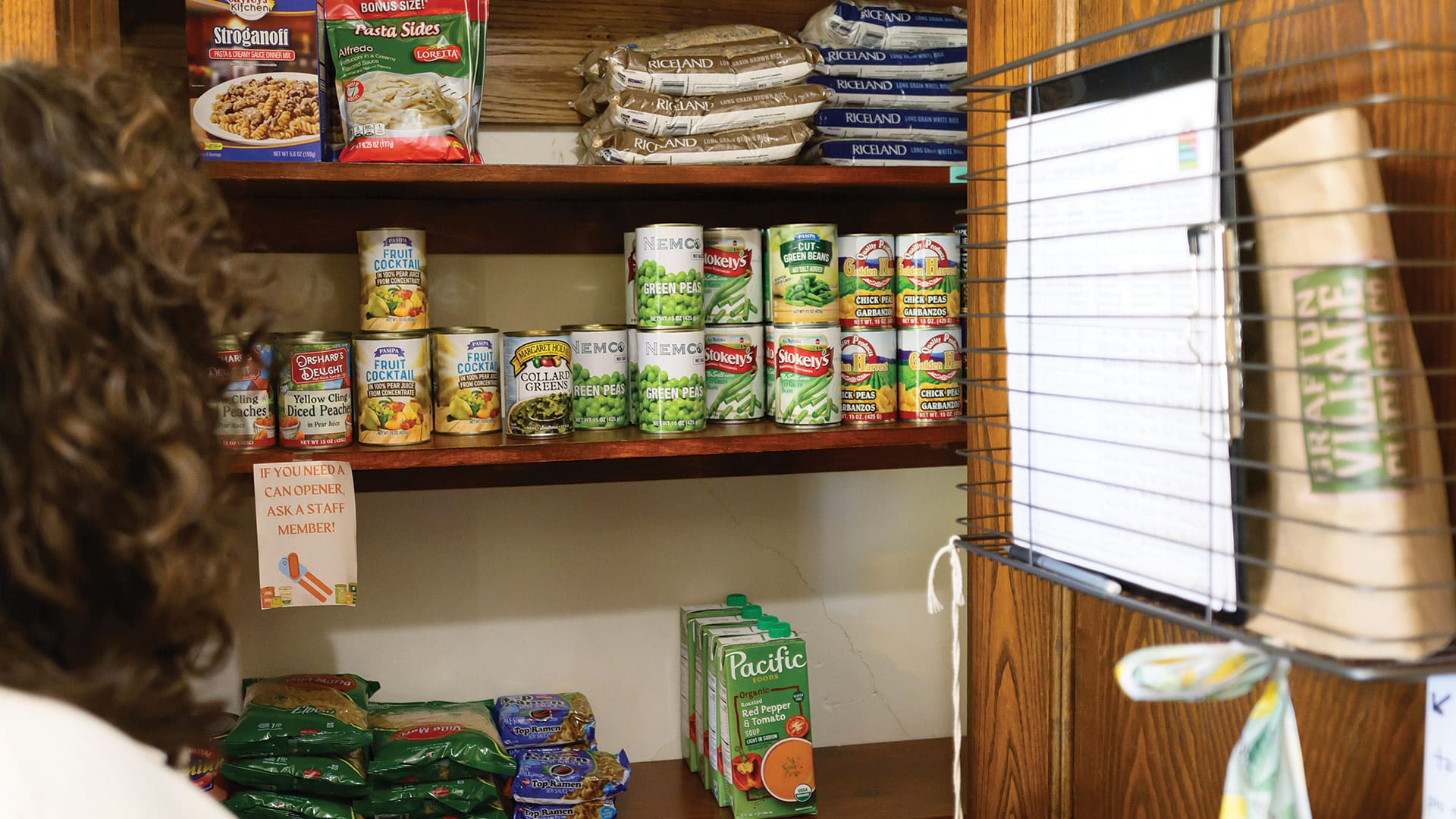
Amanda Sanderson has expanded access to a basic needs and food pantry, as well as other holistic services, at a challenging time for nonprofits.
Photo by Bob Zemba, Simple Truth Imaging
“I think of it as a three-phase problem — we need emergency short-term housing for people who need two, three, four days for the plan that they have to come to fruition; we need transitional housing, which is one to two years, for people who have left the situation they were in and now need a place where they can rebuild; and we need long-term permanent housing options,” she explained, adding that solutions will not come easily and will require collaboration among the region’s nonprofits.
This drive to keep looking ahead at the next challenges and finding needed solutions helps explain why she is a Woman of Impact.
When Sanderson says she grew up in a small town in Northern Vermont, she puts extra emphasis on small.
“The town I grew up in was technically a town only because it had a post office,” she explained. “There were no schools, no general stores … we had to go down the mountain to get to the next town, which had a general store, but no gas station; it was 25 or 30 minutes to the nearest gas station, so you had to plan accordingly.
“And it’s still like that, although we now have a stoplight for the first time; we went from a four-way stop sign to a stoplight in 2019,” she went on, adding that, while such small towns have unique challenges, they share problems with communities of all sizes, and it was this knowledge, coupled with what she saw and experienced growing up, that inspired the career path she chose.
“All of those things that I witnessed or experienced instilled a lot of compassion — and a belief that, with the right support, people can accomplish the things they want to accomplish,” she noted. “And I think nonprofits are the glue, a bridge between what the government should be doing for people and what people want and need.”
After earning a bachelor’s degree in arts, peace, and justice studies at St. Michael’s College in Vermont, she left the Northeast for Birmingham, serving as a AmeriCorps state volunteer for Impact America, working as a middle school debate coach, providing free vision screenings to children enrolled in daycare across 20 Alabama counties, and serving in the IRS’s Volunteer Income Tax Assistance program as a tax preparer and volunteer tax site manager in Selma and Montgomery.
“Through my studies, it became clear that the best way to learn about the world was to see a little bit of it,” she said. “And Birmingham is an excellent place to go if you’re curious about different parts of the country. And what I learned is that the problems are similar pretty much everywhere, and people are the same pretty much everywhere.”
“Everything we do has to be grounded in serving the survivors of sexual and domestic violence, building awareness in the community, and strengthening the quality of the culture here so people can do trauma work and be OK.”
Sanderson would spend four years in the Deep South, eventually serving as program manager for Impact America’s SpeakFirst program, supervising 17 middle and high school debate coaches while directly coaching 24 high school debaters and also expanding college readiness efforts through innovative programming and support initiatives.
In 2018, she joined City Year Inc., a Boston-based nonprofit focused on helping young people stay on track academically and graduate from high school ready for college. There, she managed and coached teams of six to eight AmeriCorps members who work with Greater Boston high school students.
While earning a master’s degree in higher education administration at Boston College, she served as a graduate resident director and also served as a sexual assault network advocate at the Boston College Women’s Center, working on call for its confidential hotline supporting survivors of sexual assault.
After earning that degree, she saw an opening for the co-executive director’s position at NELCWIT and decided this should be her next challenge. The job opportunity was part of it, and being just a few miles from Vermont and her family was another part.
She applied, got the job, and moved to Greenfield the same day she graduated, and was at work the following day.
Almost immediately, there were challenges that needed to be addressed internally, while also focusing on the mission and creating ways to better carry it out.
Indeed, the person hired to be the other co-executive director did not work out, she noted, and within a few weeks of being hired, Sanderson was named acting executive director, while soon also serving as acting program manager as well.
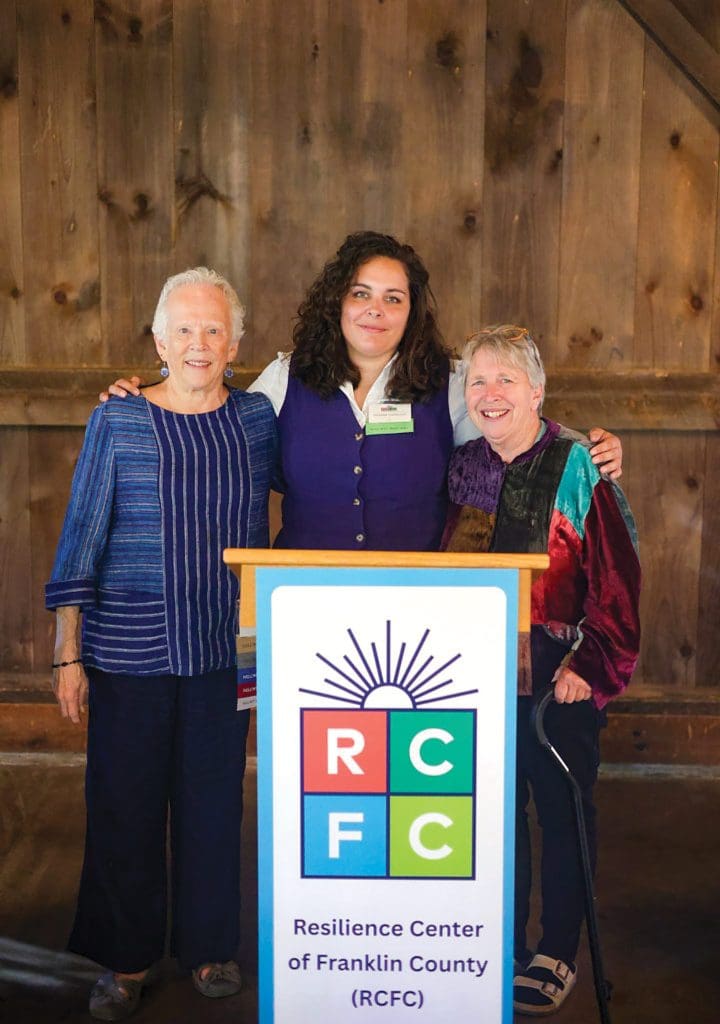
Amanda Sanderson, center, with Joan Featherman, left, one of the founders of the Resilience Center of Franklin County, and Pam Brown, a long-time director, as the agency recently celebrated its 50th anniversary.
“In the first few months, I was just working on understanding what the staff needs were and understanding what our community relations were, where our priorities lay, and what we were doing to serve survivors,” she explained. “After I got that information, I really started to understand where our areas of improvement were.
“I was lucky enough to have someone on the staff I thought would be an incredible program director,” she went on. “I encouraged her to apply, and I started building a team of people that has the same priorities as I do.”
When asked about those priorities, she said it comes down to meeting needs within the community, helping survivors tap that reservoir of resilience she believes is in everyone, and supporting staff members, most of whom are survivors of abuse themselves, in every way possible.
“Everything we do has to be grounded in serving the survivors of sexual and domestic violence, building awareness in the community, and strengthening the quality of the culture here so people can do trauma work and be OK,” she explained. “There was a lot of turnover when I started because people were getting burned out from hearing really difficult things and not having the support they needed.”
Elaborating, she said the agency became more thoughtful about pay, time off, and “making sure, if you come to do this work, that we’re being as supportive a workplace as we possibly can be.”
While doing that, Sanderson has been working to strengthen coalitions and collaborative efforts, knowing that, in rural areas, persistent problems cannot be solved by one agency.
In Franklin County, there are many such problems, including transportation, (or a lack thereof), substance abuse, a shortage of jobs and career opportunities, and, in many cases, a lack of understanding of the problems unique to rural areas on the part of many of the judges who come to serve in the county (most are from the Boston area) and even the state police that provide much of the public safety.
“The size of the communities can create more support for people, but it also makes it harder to fly under the radar and operate with anonymity,” she explained, adding that those who file restraining orders are far more likely to run into their abuser in a town with one grocery store than in a big city. “There are safety concerns that people do not consider if they’re not from a rural area.”
And then, there’s the housing issue.
“We need housing options that suit the area, and I’m looking into how nonprofits can work together to create supportive housing to answer some of that need and demand,” Sanderson told BusinessWest. “I’m not seeing any traditional solutions that meet our pipeline issue, and although there’s some backlash against housing-first policies, we’ve seen a lot of success once someone is rooted to a place — they have a place where they can give an address so they can get a job and enroll their children in school; DCF won’t be involved if they have a home. Those are just some of the aspects to the whole healing process.”
She noted that her mother recently earned a bachelor’s degree through Southern New Hampshire University.
“It’s something she always wanted to do,” Sanderson told BusinessWest, adding that her mother was one of the few in her own family to graduate from high school. “She wants to work with homeless youth because she was, at one time, a homeless youth.”
This new chapter in that story adds more emphasis to Sanderson’s comments earlier about how, if given the right support, people can accomplish what they need to accomplish.
It also helps explain why, when Sanderson thinks about the path she didn’t choose — a career in business, probably in a large urban center like Boston — she doesn’t think about it for long.
She’s quite content with the path she did choose, and what she’s done on that path — become a Woman of Impact.

When Angelina Ramirez went to work at Stavros Center for Independent Living as a secretary in 1990, it was supposed to be a transition plan to something else.
Thirty-five years later, she has certainly done plenty of transitioning, but all of it within this organization dedicated to helping people with disabilities achieve independence — with roles including outreach, special programs, community relations, and development … all the way to CEO in 2019.
As for why she never left, it was a matter of simply connecting with a mission.
“I’m a person with a disability myself, and finding a job when you have a disability can be hard, and trying to get through life can be challenging. So the mission of Stavros really spoke to me because it’s making sure that, whatever your goal is, whatever your initiative in your life is, wherever you want to go, we will be there to support you.”
Whether it’s helping people with disabilities access housing, education, and benefits or helping them access personal care management services necessary to stay in their homes, Stavros has impacted countless clients over the decades. But they’re not just numbers; Ramirez can relate many individual stories.
Like young adults who have secured internships through Stavros. “One of my favorites is this kid whose school kept telling him, ‘no, you’re too disabled; you can’t do auto repairs.’ And we talked with an auto repair shop, and they said, ‘well, if he wants to do an internship, we’ll take him.’ And they ended up hiring him because he was so good at mechanical stuff.”
“The mission of Stavros really spoke to me because it’s making sure that, whatever your goal is, whatever your initiative in your life is, wherever you want to go, we will be there to support you.”
Or another client who arrived at Stavros homeless. “The police brought her in and said, ‘we need you to do something because we don’t know what else to do with her.’ And over the years, we helped her get medication, get the services she needed, get her an apartment, and eventually get a job. And now she’s retirement age. I mean, in 35 years, you see someone’s whole life. And when you see that, you say, ‘yeah, I made a difference.’”
Jason Montgomery, Stavros’ director of Development, repeatedly noted that passion for making a difference when he nominated Ramirez to be a Woman of Impact.
“No one in Western Massachusetts has done more to advance disability rights and equity than Angelina Ramirez,” he wrote. “Her leadership is both visionary and practical, driving systemic change while ensuring immediate, tangible results for people in need. She embodies the independent living movement’s core values: equity, self-determination, and community leadership.”

Angelina Ramirez (center) with some of the team at Stavros.
Photo by Bob Zemba, Simple Truth Imaging
It’s a measurable impact, Montgomery went on. “Under her leadership, Stavros transitioned hundreds of people from institutional living into the community and provided thousands with durable medical equipment and home modifications. For decades, she has championed legislation ensuring equity and independence for all.”
One well-known Stavros program is called Home Sweet Home, Ramirez told BusinessWest. “Every year, we build around 60 to 80 ramps, depending on funds. That is a phenomenal program that has to raise a whole lot of money to be able to get all that done. But it’s thanks to partnerships in the community and a great team of people here that it happens.”
Another example of creative problem solving is a contract Stavros recently secured with the Executive Office of Health and Human Services to repair wheelchairs. “One of the issues that we have seen over and over is that, for people with disabilities, their wheelchairs will not be fixed in a timely manner, so essentially they’re stuck at home,” she said.
“Her leadership is both visionary and practical, driving systemic change while ensuring immediate, tangible results for people in need. She embodies the independent living movement’s core values: equity, self-determination, and community leadership.”
In all, Stavros serves about 10,300 individuals across Franklin, Hampden and Hampshire counties at any given time, currently ranging in age from 4 to 89 — and it’s critical work, Ramirez noted.
“When people don’t know about our services, they end up in nursing facilities. Not to say that nursing facilities are not a good thing for some people, but say you’re 25 and you got into a car accident, and now you use a wheelchair. Do you want to spend rest of your life there? The answer is no.
“So one of the things that we do is help people to make sure that they don’t end up in situations like that. But also, a lot of people with disabilities want to go back to work, and they don’t have the resources or the peer support that they need to do that. So one thing we see over and over again is that, because we’re here, more people go back to college, and more people end up working.”
That’s real impact. And it explains why Ramirez, who has dedicated most of her life to this mission, is being recognized as part of the Women of Impact class of 2025.
Under Ramirez’ leadership, Stavros has become one of the largest and most effective independent living centers in Massachusetts, Montgomery noted. It was named one of the Top 100 Women-Led Businesses in Massachusetts by Boston Globe Magazine in 2022 — the same year the Amherst Area Chamber of Commerce presented Ramirez with its A+ Lifetime Achievement Award.
She is quick to deflect such praise, however. “I feel like I don’t do anything half the time — it’s all the team, and I just get credit for all that they do. But it’s really gratifying.”

Angelina Ramirez says the mission of Stavros has always spoken to her — supporting people with disabilities and helping them succeed in life, no matter what their goals are.
Her impact only continues to grow. In 2024, the year she guided Stavros through its 50th anniversary, she secured a $153,000 grant from the Blue Cross Blue Shield Foundation of Massachusetts to expand community-based mental health support across Hampden, Hampshire, and Franklin counties. And this year, she launched Rock, Roll & Gather, a regional event blending music, art, and activism to celebrate disability pride, while building community support for access initiatives.
About 80% of Stavros’ income comes from contracts with the state, and many of those contracts originate with the federal government, so there is some long-term anxiety about shifting federal priorities — a concern shared by nonprofits across the U.S. — and short-term worries as well, from a government shutdown that had not abated as this issue went to press.
Still, in the Pioneer Valley, “a lot of the nonprofits help each other out,” Ramirez said. “Every year, we do this small breakfast with our legislators, and we bring in other nonprofits to talk about what issues are of concern right now and how we can address them.
“We have good relationships with the Amherst Survival Center and the Northampton Survival Center and other nonprofits in the area,” she went on. “Sometimes we get employees from them, from the people they serve who are looking for jobs, and they end up working here. And at the same time, our consumers go there and get the services and supports that they need.
“That’s one good thing about working here in the Pioneer Valley — even though there is some sense of competition, because there are not a lot of funds out there, there’s also camaraderie, and the main interest is serving people. That’s very different in this area. I talk with other people in other parts of the state that don’t have that.”
Montgomery noted that Ramirez’s leadership has been especially crucial during periods of crisis. Throughout the COVID-19 pandemic, she oversaw the successful transition of more than 140 individuals from nursing facilities into community living and facilitated the construction of more than 100 ramps for accessibility. She also ensured that Stavros offices were kept open for the duration of the pandemic, and, at the height of pandemic shutdowns, facilitated meal deliveries for clients who couldn’t otherwise access them.
At the same time, Montgomery said, Stavros staff — 80% of whom are women — are empowered to lead, innovate, and serve as peer mentors. “She creates a culture where women’s voices are not only heard, but elevated.”
That’s an especially gratifying part of her job, Ramirez said.
“When people don’t know about our services, they end up in nursing facilities. Not to say that nursing facilities are not a good thing for some people, but say you’re 25 and you got into a car accident, and now you use a wheelchair. Do you want to spend rest of your life there? The answer is no.”
“It is a great opportunity to see people succeed, see people that came in like me as a secretary or as a skills trainer and now see them in supervisory positions or management positions. There’s one person in the building who started coming in here with her mom when she was a teenager, and now she is the assistant director of one of our programs. So there is opportunity for mentorship here. You get to do good while you’re doing good for yourself.”
Ramirez also contributes to civic and professional organizations across the state. She serves on the board of Housing Navigator Massachusetts Inc., which works to expand access to affordable housing through user-friendly, publicly available tools. She is also a member of the Health Equity Compact, a coalition of 85 leaders of color dedicated to advancing health equity and dismantling systemic disparities throughout Massachusetts.
“I remember when the Housing Navigator approached me in 2019 — they had an idea to create this nonprofit to identify housing in the whole state and see where the gaps are. I said, ‘well, I want to be part of that.’ So they created a tool, and now we can see that, here in Western Mass., the availability of housing is minimal to nothing.”
It’s a major problem, especially for an organization trying to keep people in their own homes, but Ramirez is no stranger to tackling problems.
“Anyone can look around and see what is happening and what impact they can have, whether it’s health equity, housing, mental health, whatever it is. If there is a crisis, we need to meet it. That’s what I’m passionate about — when you look at what’s going on with the people that you serve and you start formulating plans. That’s what makes this organization and the teams here successful — they’re always looking forward.”
On its website, Stavros explains that, for the past 50-plus years, it “has worked tirelessly to remove barriers to accessibility and provide essential resources that support independent living. From advocating for disability rights and accessible housing to offering peer counseling, skills training, and vocational support, Stavros has been a trusted ally for thousands of individuals across Western Massachusetts and beyond.”
For Ramirez, the throughline across all that work has been identifying barriers people have to living the life they desire — and then identifying solutions to overcome those barriers. That’s a legacy befitting a Woman of Impact, but, again, she always seeks to share the credit.
“Surrounding yourself with a great team of people that can make it happen is the most important part of it because a lot of this stuff, you can’t do by yourself,” she said. “You have to make sure that the people around you are capable of doing it.”

Two decades before Chelsea Kline took the reins at Cancer Connection, her mother was one of its early participants.
“It was such a relief to me that she had supports here at Cancer Connection that I could not provide,” Kline recalled. “I was young, I was a single mom, and she was going through such a terrible time, so I was grateful to have a place where people really understood and had connections to resources and were able to listen deeply and support in a way that that I couldn’t — which I think is the case for many caregivers. It’s hard to watch someone you love be in pain.”
The organization’s impact on Kline’s mother was so profound that her daughter emptied her piggybank on numerous occasions to donate to Cancer Connection because she knew how much
it had benefited her grandmother. And through her time working there, and especially since becoming executive director in 2022, Kline has come to appreciate that impact even more.
“When caregivers and people with a diagnosis come to us, they don’t have to put on a front; they don’t have to smile or brush it off — they can be real here. I saw that with my mom, that she had a place where she could just be real and honest with her fear or her pain or her anger, whatever it is. There are so many emotions that come along with a diagnosis.”
Kline, who earned a bachelor’s degree in religion and biblical literature at Smith College and a master’s degree in theological studies at Harvard Divinity School, spent several years overseeing leadership and organizational studies at Bay Path University before operating Chelsea Sunday Coaching for four years, a consulting business that helped many nonprofits in transition. In between, she ran for Massachusetts State Senate in 2018, garnering 41% of the vote.
But her interest all along was in supporting people who are struggling, and alleviating suffering. She found the perfect outlet for both at Cancer Connection.
During her graduate studies, “that’s where I really dug in with pastoral care and counseling and the whole concept of being present for people in hard times and in transition, and also the whole concept of the third space: we have our home, we have our work, and where’s the third space that we go? Is it a bar? Is it a church? Is it a community center? Is it a barbershop?”
Especially since COVID, she went on, those third spaces have become less robust and well-attended. But Cancer Connection can be a very particular kind of third space for people who need it.
“Our mission is very focused, but it’s a a really important community space where people can come and be held and be heard and feel connected and feel that they belong. And that, to me, is like magic,” Kline said. “That is so beautiful and so important. What could be more important?”
“Our mission is very focused, but it’s a a really important community space where people can come and be held and be heard and feel connected and feel that they belong. And that, to me, is like magic.”
When founders Jackie Walker and Deb Orgera launched the Northampton-based nonprofit in 2000, Kline said, their vision involved a concept known as befriending, which evolved out of the Samaritans model, which is a hotline for people in crisis. Essentially, Cancer Connection is a place to talk to someone, free of expectations or judgment.
Meanwhile, the nonprofit has evolved over the years to include support groups for different types of cancer and aspects of the cancer experience, from caregiving to self-care; integrative therapies like massage, acupuncture, Reiki, and energy balancing to treat cancer symptoms, boost comfort, and relieve stress; and programs that nourish the body, mind, spirit, and creativity, like Qigong yoga, mindfulness in nature, knitting, music and movement, equine therapy, and more.

Chelsea Kline is gratified that so many people find calm and courage during a difficult time in their lives through Cancer Connection.
Photo by Bob Zemba, Simple Truth Imaging
“If people are hurting,” she said, “if people are feeling isolated, if people are feeling scared and alone, we have these open doors and this beautiful space, and we can say, ‘we understand, we want you to feel protected, we want you to feel cared for, and we’ll do our very best.’”
For her role in connecting people in need with a community that cares for them — and cultivating the support of a much larger community outside its doors — Kline can certainly be called a Woman of Impact.
“I can breathe deeper, feel lighter, calmer.”
“The class was exactly what I needed. Being part of a community of other cancer survivors gave me a such a feeling of connection and courage.”
“I met amazing women at various stages of healing. The beauty and grace that each of them expressed helped me realize I am not alone.”
Those are some of the many quotes the team at Cancer Connection have collected from people who have accessed its services. They speak to a sense of calm in the storm, and that’s exactly what Kline intends.
“Every time someone has a massage or an integrative treatment here, we have a form where they fill out — how they’re feeling before and how they’re feeling afterwards. And it’s so moving to see someone who was in pain, they were exhausted, they were scared, they were uncomfortable, they were feeling like a 1 when they got here, really low on the scale, and after they work with the integrative therapist, whether it’s massage or acupuncture or Reiki, they’re feeling at an 8 or a 9. They’re feeling so much better; they say, ‘I’m feeling soothed. I’m feeling more hopeful.’
“And every time I read those forms, I send them out to the staff and I’m like, ‘look at how beautiful this is. Look at how important this work is.’ It keeps us all grounded.”
They’re doing the work with no federal grants — a comforting model at a time when such funds are being threatened across the nonprofit world. Instead, Cancer Connection relies on local corporate sponsors, a monthly giving program for individual donors, and a variety of events, from the annual Harvest Dinner to a Mother’s Day half-marathon that celebrated its 15th year this past spring. A new event, a ladies’ golf tournament, recently raised $20,000.
Other community groups have helped as well, from Crippled Old Busted Bikers putting on a comedy show to raise funds for Cancer Connection to a drag revue called Camilla’s Extravaganza that has taken the nonprofit on as a fundraising beneficiary, to the annual Bed In for Cancer Connection — launched by radio personality Monte Belmonte as Monte’s Camp Out for Cancer Connection, and how hosted by Greenfield Savings Bank’s Tara Brewster, one of this year’s other Women of Impact.
“We’re just lean and scrappy because the point is caring, and that’s counterculture to capitalism. This organization is kind of punk rock, in a way.”
Then there’s the Cancer Connection Thrift Shop on South Street in Northampton, which just celebrated its 10th anniversary.
“I often joke that the thrift shop is the fun part of Cancer Connection. There’s aways great music playing, friendly people, and treasures to be found,” Kline noted, adding that the shop is also in line with her belief in reusing and repurposing in an effort to have a lighter impact on the planet.
“I am profoundly grateful for the visionaries that came before me that dreamt up the shop and worked so hard to bring it life,” she added. “My oldest friends are all amused by the fact that I landed at an organization that has an awesome thrift shop, given that I am a lifelong diehard thrifter.”
In nominating Kline to be a Woman of Impact, Jean Einstein, co-president of Cancer Connection’s board of directors, noted that, “through her leadership and tireless energies in creative fundraising in the community and her talent to recruit talented development staff and board members to expand funding opportunities, Cancer Connection is well-positioned for the next 25 years to continue making a difference in the lives of with those with cancer, their loved ones, and caregivers. Chelsea Kline’s powerfully positive impact on Cancer Connection, and its ability to continue its legacy as a place to find strength, cannot be overstated.”
When Kline hears that, however, she immediately credits so many others who support the work, from staff to board members to volunteers.

Chelsea Kline (right) with Shelley Daughdrill of Florence Bank, which continues to be a sponsor of Cancer Connection’s Harvest Dinner — one of many examples of how the community supports the nonprofit’s work.
“The thrift store alone has about 50 volunteers a year, people of all ages who show up and give their time to help support our mission,” she told BusinessWest. “The staff at the shop serve as amazing mentors for people of all ages in how they listen deeply and with profound compassion when shoppers and donors share their cancer stories.”
She also has an eye firmly on those who will take up the mantle in the future.
“Working in a nonprofit, it’s really important to think about how we’re going to be bringing in new generations of people who are going to be doing this work. Who are the helpers? How can you be a helper? How can you be a professional helper?
“That’s a really important career track,” she went on. “But it’s a counterculture career track for a lot of people because I think, in a capitalist society, it’s like, ‘money, money, money.’ And what’s so cool about Cancer Connection is we’re kind of outside of that; we don’t take insurance, we don’t charge people. We’re just lean and scrappy because the point is caring, and that’s counterculture to capitalism. This organization is kind of punk rock, in a way.”
Kline doesn’t use that term lightly; she was deeply involved in the punk scene in Washington, D.C. back in the ’90s.
“I’d to all the shows that were free in D.C., and I was part of the Beehive Collective and zine publishing, and I had a shaved head. And the sweetest people I ever knew were all the punks at the shows. They would look out for each other. I was totally involved in Food Not Bombs. We would make huge meals from donated foods and give it away in the park,” she recalled.
“A huge part of my punk rock upbringing was, how do you take care of people that are hungry? It’s so basic and so essential, and it’s getting lost, and how can that be? How can we have so many hungry people? How can we have so many lonely people? How do we fix it? It drives me crazy.”
“I want people to see this work and grasp it and appreciate it and respect it and want to be part of it.”
She mentioned all that context to explain her listening choice while driving to the Florence Bank Customers’ Choice grant awards this past spring.
“It’s a bank event, right? Like, I’ve got to be buttoned up, to look like a professional lady, but I’m blasting Fugazi on the way. But there’s so much about the punk rock ethos that really does translate to working in nonprofits. It’s about just doing what you can with what you’ve got and living by your values, and not being fake and not being stuffy and not trying to hurt anybody else or try to take advantage. And I’m a little punk rock at heart.”
That punk ethos, she said, means authenticity, anti-consumerism, and helping others whenever possible, which also relates to being a social justice advocate, with an emphasis on anti-racism and LGBTQ+ rights.
And, of course, helping people through one of the most difficult journeys in life: cancer.
“I want people to see this work and grasp it and appreciate it and respect it and want to be part of it,” she said. “So my work is not work, per se; it’s an honor to be able to use my energy and my enthusiasm to bring people along and say, ‘hey, this is really important. Come and be part of this.’”

When asked about her basic approach to life and work — and, later, about her best advice to young people, and especially women — Rania Kfuri said that, in both cases, it comes down to the same two-word phrase: show up.
By that, she meant being ambitious, giving back, supporting others, effectively balancing work and life in a way that would yield success at both, and always reaching higher.
She also meant following a tradition of community involvement set by several generations of her family — on both sides, and especially the women, something we’ll hear more about in a bit.
And she also meant literally showing up, as she does, at gatherings of all kinds, including BusinessWest’s events. Indeed, Kfuri, a proud former introvert, spoke early and often about the power of networking and connectivity, and how, because of that, she counts many of BusinessWest’s Women of Impact, including several from this year’s class, as friends.
She’s joining their ranks … well, because she does show up, and always has, whether while working for the mayor of Chicago; or as an entrepreneur who developed a unique travel bag for young parents; or while working at Smith College, which she served in several roles; or as a Philanthropy officer for Baystate Health; or as a board member for nonprofits that include the Women’s Fund of Western Massachusetts, Stanley Park, Revitalize CDC, and Girls on the Run.
Or in her current role as vice president of Philanthropy, Sales, and Marketing at the Glenmeadow senior living in facility in Longmeadow.
That’s a broad title with many responsibilities that are all connected and represent some of her passions, especially philanthropy, she explained.
“There’s such an intersectionality between these three areas — I wish more organizations would see it that way,” said Kfuri, a first-generation Lebanese-American whose parents came to this country when her father, a physician, did his residency here, and stayed as war continued to rage in Lebanon. “Collaboration and communication are so important for an organization, and all three of these areas are very closely related.
“Sales, marketing, and philanthropy should all be communicating together, using the same streamlined language, and communicating the same mission,” she went on, adding that it’s her job to make sure they do.
But it’s not so much what she does within that broad job title that makes her a Woman of Impact, but how she does it — and what else she does.
“Her energy and positivity are contagious and help us all to see the benefits of collaboration and connectivity,” wrote Kathy Martin, president and CEO of Glenmeadow as she nominated Kfuri for this award. “She puts community first and is a quiet but impactful leader. From her service to a great many organizations and causes, she is often the nexus of an impressive web of overlapping relationships that, taken as a whole, move Western Mass. forward.”
“She puts community first and is a quiet but impactful leader.”
Dawn Creighton, a community outreach officer with Liberty Bank, who also nominated Kfuri, agreed, calling her an inspiration on many fronts.
“She is a beacon of positivity no matter what is happening in the world,” Creighton wrote. “I admire her tremendous balance of work and family life. Rania embodies engaging her girls in all she does so they understand what being a good steward to the community looks like. She is a walking judgment-free zone and will help anyone without explanation, requiring just a smile of gratitude. I love her passion for family, life, and our community.”
She’s far from alone in that sentiment, and this helps explain why Kfuri has been named a Woman of Impact.
Kfuri says she can thank family members for many of the traits she exhibits today.
Indeed, she said it was her brother, Kerim, a successful entrepreneur, who helped her overcome shyness and eventually become a dynamic networker and collaborator.
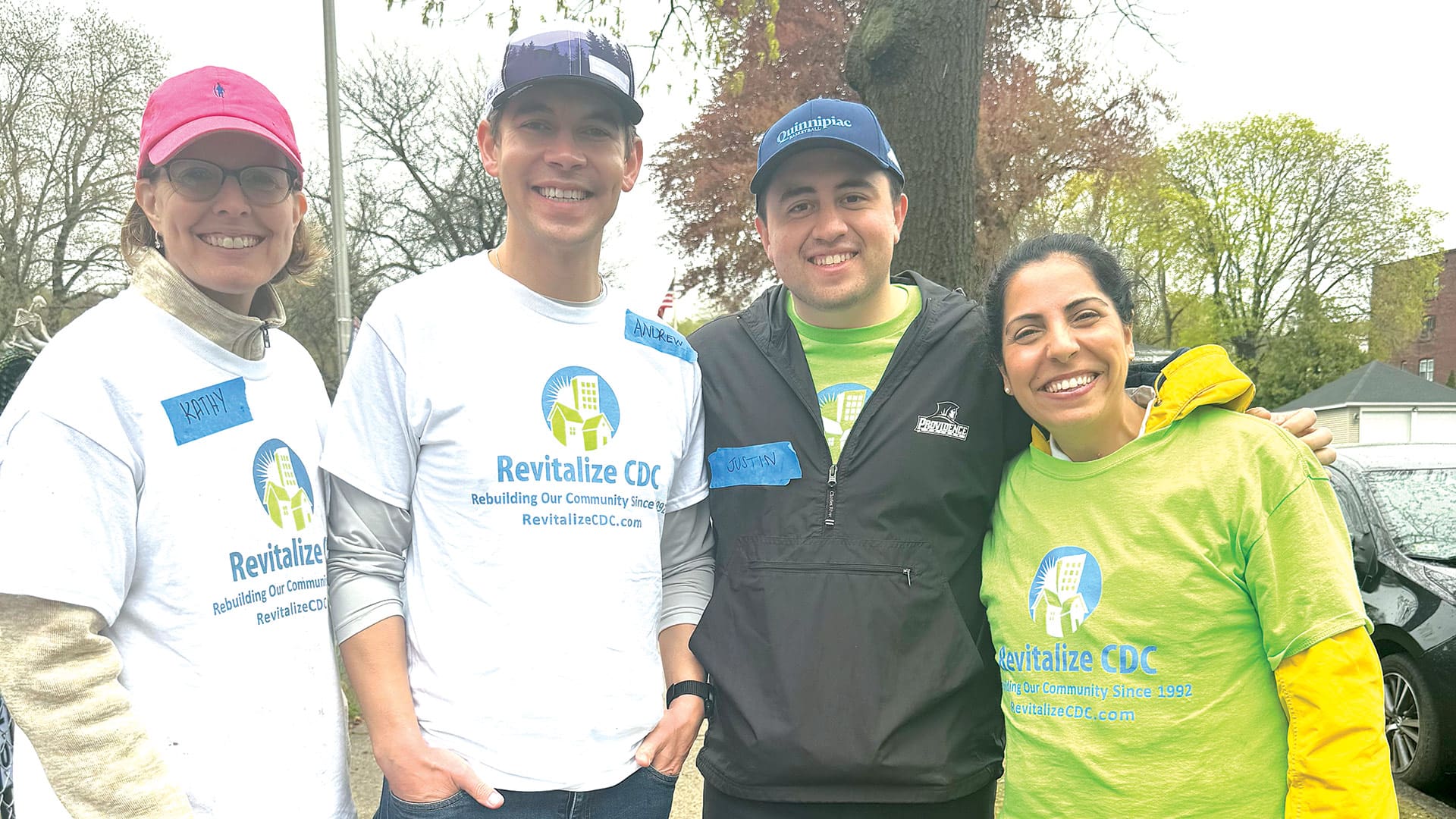
Rania Kfuri, right, counts Revitalize CDC as one of the many area agencies and causes to which she has donated time and talent.
“This is an acquired skill; I was not like this naturally … I was almost afraid of people when I was younger,” she recalled. “And my brother, who’s an extrovert, said, ‘you’re never going to have any fun, you’ve never going to get anything done if you don’t just go talk to people.’ He made me fearless to be social.”
Meanwhile, she said her parents and other members of her extended family going back several generations have served as effective role models when it comes to everything from giving back and helping others to being entrepreneurial.
“My parents’ home became a community hub for people who were also immigrating to the United States from Lebanon,” she explained. “And the nature of my parents being that way is because of the families they were raised by in Lebanon.
“He really instilled in my mom, who instilled it in me, the importance of being present in your community — being a doer.”
“My great-grandmother on my mother’s side was the head of the women’s group of the Greek Orthodox Church in Beirut,” Kfuri went on. “She was a very strong woman, a community-oriented woman who helped a lot of women who were widowed with employment opportunities and things of that nature. And that is how she identified my grandfather, my mom’s dad, who was also a family medicine physician, to be a great partner for my grandmother — because he also really believed in being a participant in community.
“He really instilled in my mom, who instilled it in me, the importance of being present in your community — being a doer,” she continued. “That’s in the fabric of my family, and the same goes for my father’s side, where my grandmother, in her earlier years in Lebanon … if you didn’t have a table to sit at and have dinner at, you were welcome at her table.”
These qualities, which she is now passing down to her children, helped shaped Kfuri as she grew up in Baltimore, and she eventually graduated from American University in Washington, D.C. with a political science degree and dreams of working in the State Department overseas.
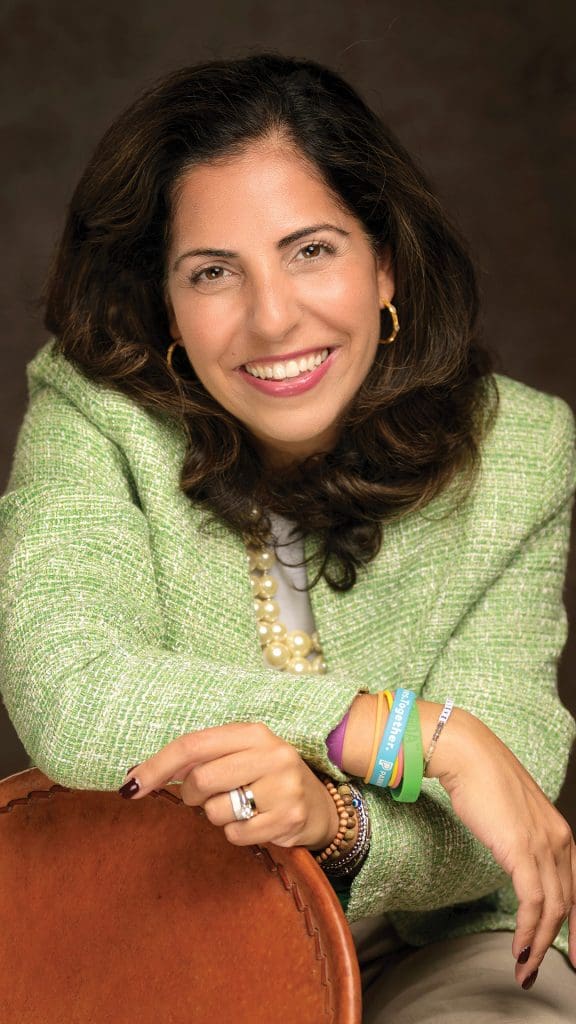
Rania Kfuri continues a long tradition among several generations of her extended family when it comes to getting involved and giving back.
Photo by Bob Zemba, Simple Truth Imaging
She entered law school at Marquette University in Milwaukee, but didn’t enjoy that experience and returned to American University to earn a master’s degree in ethics, peace, and global affairs and forge new dreams of returning to Lebanon and doing peace building.
All that changed when she met her husband, then doing his residency at Cook County Hospital in Chicago, not through a dating website, as she recalled, but a ‘finding your roots in Lebanon’ website.
But that’s another story. Fast-forwarding this one, Rania and her husband eventually came to Western Mass. as he joined Baystate Health (he’s now chief of Gastroenterology there), and she starting writing new chapters in an intriguing career.
One of the first involved entrepreneurship, developing travel bags for parents with young children under the name Free Like Birdie, with Birdie being a nickname for her older daughter. The bags were a huge success — they were sold through Kohl’s, diapers.com, Amazon, and other outlets — but she eventually reached a critical crossroads.
“My younger daughter was about to start preschool five days a week, and my company was in a place where I was talking to QVC, and it either needed to grow, meaning I needed to build out a team, or it should close,” she recalled. “I decided that it had been a lot of fun and I really enjoyed it, but it was the right time to close.”
She then took a part-time position as an administrative assistant at the Solidago Foundation in Northampton and later worked at Smith College, first as assistant director of the Annual Fund and then as assistant director of International Alumni Relations.
She enjoyed her time at Smith, but was drawn to healthcare — many family members work in that broad realm — and took a job as a Philanthropy officer with Baystate Health in 2022.
“I wanted to help support the healthcare system because my dad used to teach public health at Johns Hopkins, and I know that regions can become healthcare deserts, and I don’t want that to happen to Western Mass.,” she said. “I’m always a cheerleader for Baystate.”
Kfuri joined Glenmeadow a year ago, taking on a role that makes each day different and presents myriad opportunities to do what she perhaps does best — promoting and building community in all its forms.
“Community grows here, and in many different ways,” she explained, listing everything from the relationships between residents and staff to community gatherings (she calls them cocktail parties), to regular ‘town hall gatherings’ where residents can ask Martin questions and get answers.
Community also refers to connecting residents to the larger community, she went on, be it through trips to area attractions and institutions — there was one recently to the Bridge of Flowers in Shelburne — to programs with partners such as the Community Music School and Square One. “We’re always looking to create spaces of joy,” she explained.
Reflecting on her approach to life and work, Kfuri summoned a phrase she attributes to an English teacher at the McDonogh School in Maryland: ‘you should care, you should dare, and you should share.’
“She would say that all the time,” Kfuri said. “And it re-emphasized that you shouldn’t be waiting for someone else to do the thing; you should be doing the thing. And that’s such an important part of whom I am as a person. Between my family and school, the culture was, ‘you have to show up.’
She continues to do so, and thus, there are many parts to who Kfuri is, starting with a strong work ethic and drive to succeed, a collaborative approach to her work, and a willingness to get involved in the community.
“In her work at Glenmeadow, she champions a person-centered approach to the functions she oversees and has transformed our organization by the outcomes and approaches to her work,” Martin wrote. “It’s about more than filling apartments; it’s about welcoming new members of our community in ways that honor the lives they’ve lived already and creating pathways for them to continue to thrive. She has made us better on every level.”
In the community, meanwhile, Kfuri has become involved with a wide range of groups and causes, from Revitalize CDC to Girls on the Run to the city of Westfield, where she served on a master plan committee.
But beyond that, she serves as a convener and a motivator, always seeking to broaden and strengthen the core of women leaders in the region. She hosts an annual dinner at her home, inviting those women leaders to gather and discuss ways to be empowered — and utilize that power to better the region.
“I don’t think that calling yourself an ambitious woman is a bad thing — ambition is not a dirty word,” she told BusinessWest. “I do, though, also believe that, as women, we need to support other women, and I would love to see more women genuinely support other women.”
With those efforts, as with other aspects of her life, it all comes back to where she started this conversation — with showing up … and being a Woman of Impact.

Tracy Friedenberg recalls working for a tech consulting company in Holyoke (the ill-fated Data Profit) not long after graduating from UMass Amherst in the mid-’90s, and quickly discovering what she wasn’t doing — and ultimately needed to do — for a living.
She started as a receptionist and very quickly moved to office manager and then executive assistant, and over the course of that rapid advancement, she made a critical discovery.
“I realized in those moments that I really loved business,” said Friedenberg, who had designs (pun intended) on the fashion industry and being a buyer for a major retailer while in college. “But what I loved more was being on the operations side and making sure that, behind the scenes, everything ran smoothly.
“I knew very early on that sales wasn’t necessarily my thing — I wasn’t that person who was going to go out and get the clients,” she went on. “But I wanted to make sure that the organization and the people in the organization had what they needed to be successful, so the people who were practicing whatever they were practicing could do what they needed to do. And that has carried with me through my entire career.”
Indeed, it has, through a series of jobs at MassMutual, a lengthy stint at the Hartford-based law firm Day Pitney, and, since 2023, for the Springfield-based law firm Bacon Wilson.
There, she serves as executive director, a title that comes with a broad range of responsibilities — everything from day-to-day HR duties to working with other firm leaders on long-term matters, from the impact of AI on the legal profession to where the new courthouse in Springfield might go, and what they will mean operationally — and we’ll get into some of that later.
“I knew very early on that sales wasn’t necessarily my thing — I wasn’t that person who was going to go out and get the clients. But I wanted to make sure that the organization and the people in the organization had what they needed to be successful, so the people who were practicing whatever they were practicing could do what they needed to do. And that has carried with me through my entire career.”
But at Bacon Wilson, and her many other career stops, it’s not the lines on her job description that have made her a Woman of Impact, but how she has carried them out, often going what most would consider above and beyond, while also getting involved in the community at the same time.
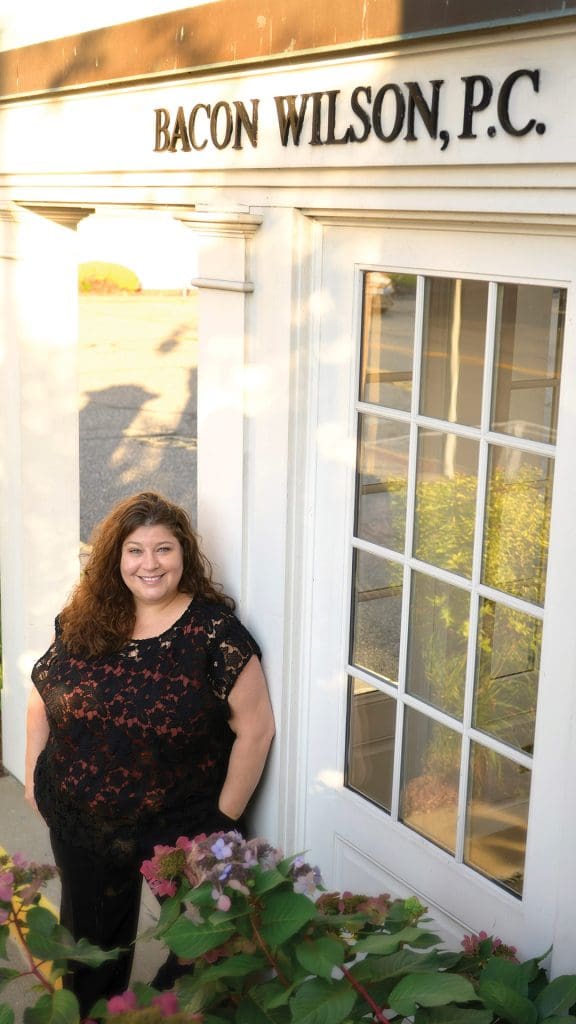
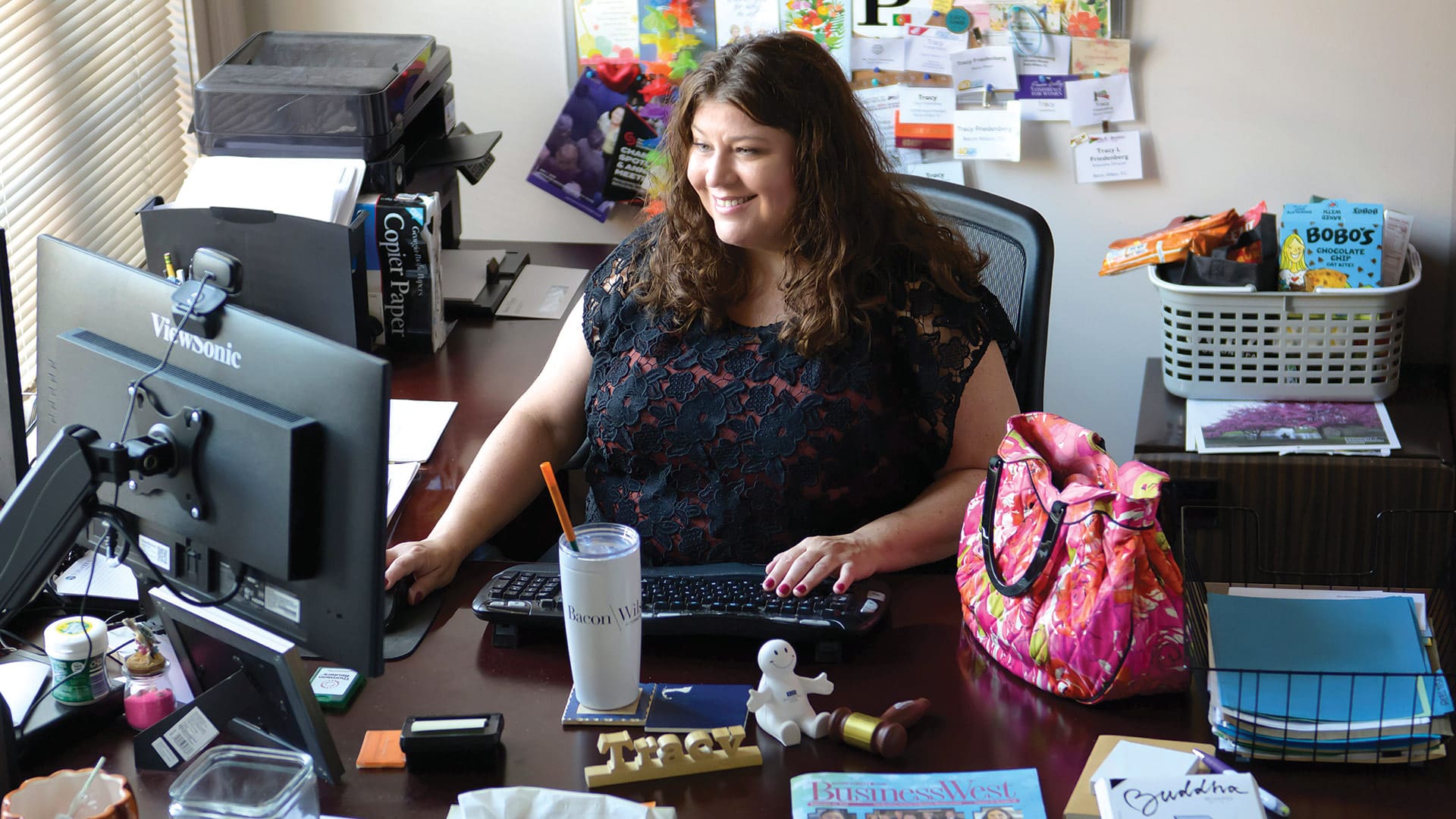
Tracy Friedenberg has been described as a selfless, compassionate leader, one who drives organizational success but also champions the growth and well-being of those around her.
Photo by Bob Zemba, Simple Truth Imaging
“Tracy is the kind of leader who not only drives an organization forward, but also ensures that every individual within it feels seen, valued, and cared for,” said Alayna Anderson, marketing coordinator for Bacon Wilson, who nominated her for this award. “She exemplifies compassion, strength, and service in everything she does. Her heart is always in the right place — committed to making a difference for the people and community she serves.”
Reflecting on what drives her, what she’s been able to accomplish, how she’s been influenced by mentors, and how she now mentors others, Friedenberg credits her parents, Bruce, who passed away last year, and Cecilia, as well as the Springfield school system, for giving her what she’s needed to be successful.
The schools instilled in her a thirst for learning and spawned a passion for everything from business to the Spanish language, with which she can still hold her own, she explained, while her parents, both hard workers, gave her inspiration, a solid foundation, and critical lessons, especially about the need to be accountable for everything one does with and during her life.
“My parents were and are a big part of whom I am,” she told BusinessWest. “They were hard workers. They weren’t necessary knocking it out of the park from a corporate standpoint, but I always learned the value of hard work from them, doing it for yourself, and treating people the way you want to be treated.
“I learned so much from them, and especially my mom,” she went on, echoing what has become a common theme among this year’s honorees. “She made a career out of customer service — she worked for 35 years at Springfield College in the food service department. Watching my mom work and watching her get joy out of serving people and helping them … really resonated with me. She took so much pride in everything she did. It didn’t matter if she was making a coffee or cleaning a counter or counting a cash drawer; having that pride in what she did and doing it well always resonated with me.”
Turning back the clock 30 years to her time at Data Profit, one of many tech companies that rose and fell in the ’90s or early 2000s, Friedenberg said it was a learning experience on many levels.
“I was the executive assistant to the number two and number three individuals in charge, and I was privy to a lot of information,” she recalled. “They had filed Chapter 11 bankruptcy, and then it ended up being Chapter 7, and there were a lot of things going on. I would be in these difficult meetings with the leadership team; they were sitting there, and they literally had names on whiteboards, and they had to figure out who was going to be let go.
“It was at this age of 24 and 25 that I started to recognize some of the things that I knew I didn’t want to do or some of the ways I didn’t want to lead or manage,” she explained, adding that she has been shaped by every career stop and, long before that, her time in the Springfield schools and then UMass Amherst.
Tracing her career steps, Friedenberg said she moved from Data Profit to MassMutual, where she worked for nearly seven years, assuming titles ranging from College Relations manager to director of Corporate Human Resources.
“People are people, and, yes, we have work to do, and people have to be responsible and accountable for that, but we all are human, too. You can’t have people working for you and forget that they’re human beings.”
While at MassMutual, she was influenced by several managers and mentors, including one she served as an executive assistant who surprised her with a question she wasn’t really expecting.
“I had been there a few weeks … he came in one day and said, ‘where are you going to go in the company — what area do we need to move you to?’” she recalled. “I was a taken aback by that at first and said, ‘did I do something wrong?’ He said, ‘no, you have the ability to do more than this role requires, and I hired you for the company, not just this role.’
“Throughout your life, you have things that people say to you that stick with you,” she went on. “And that was one of them; that has resonated with me throughout my career. When I’ve been in a position to hire, I take a look at individuals not just for the role I’m trying to fill, which is important, but for their potential in general.”
In 2007, she began a 14-year stint with Day Pitney, a large firm with 13 offices and more than 600 employees. There, she held a variety of titles and had myriad responsibilities while gaining experience in some new realms, including work helping to manage some acquisitions and facility moves, and managing the IT Department.
Overall, she sharpened her skills when it became to being the person behind the scenes giving those around her the tools they needed to succeed.
After 15 years with the firm, she started to get “a little bored,” she said, and took on a new challenge, becoming chief of staff for Odin, a remote role that she wasn’t in long before she realized it wasn’t the right space for her.
Tracy Friedenberg says she’s long been inspired by the strong work ethic demonstrated by her parents.
Photo by Bob Zemba, Simple Truth Imaging
Ultimately, her position was eliminated, and this led to what she called the “summer of Tracy,” what she described as a period of reflection, taking her time deciding what she wanted to do next, and getting even more engaged in the community — with her daughter’s school as president of its PTO and as president of the Dress for Success Western Massachusetts board.
“I knew I wanted to be in this community again,” she explained. “I was born and raised in Springfield — I’ve lived here my whole life, and I still live here — and working in Hartford all those years, I realized how disconnected I felt from my community.”
And it was in her role as president of Dress for Success, and specifically while leading efforts to secure a new home for the nonprofit after it was evicted from the closing Eastfield Mall, that Friedenberg ultimately started down the path to her latest career stop.
As she tells the story, she needed an attorney to review the lease for the new space on Lyman Street, couldn’t touch base with the attorney the agency had been working with, and wound up calling former Central High School classmate Dan McKellick, a shareholder with Bacon Wilson, to see if he could help. He did, and while doing so, he mentioned that the firm was looking for a new executive director.
“In her nearly two years at Bacon Wilson, Tracy has transformed our organization into the best version of itself.”
She applied, after realizing how much she missed the law firm environment, was hired, and is now, in essence, focusing on the present and future of this firm while applying lessons learned at the various stops in her career.
Perhaps the biggest of these lessons involve communication, managing change — because it is seemingly constant — and always remembering the human element of the workplace.
“People are people, and, yes, we have work to do, and people have to be responsible and accountable for that, but we all are human, too,” she told BusinessWest. “You can’t have people working for you and forget that they’re human beings.”
A story shared by Anderson in her nomination brings home this sentiment.
“I experienced the sudden and tragic loss of my partner — a loss that shook me and my community,” she wrote. “Tracy stepped beyond the role of executive director and became a source of unconditional support. She cooked meals, helped care for my home and my dog, covered my work responsibilities, managed our marketing and communications, and, most importantly, gave me the space and time to grieve.
“In her nearly two years at Bacon Wilson, Tracy has transformed our organization into the best version of itself,” Anderson went on. “She has fostered a culture of inclusivity, diversity, and warmth, reshaping the way our firm is perceived both internally and within the community. Her leadership has not only elevated our operations, but has changed the narrative of what it means to belong at Bacon Wilson.”
Jeff Fialky, the firm’s managing partner, echoed those thoughts.
“Tracy has been instrumental in continuing to shape our firm’s culture and success,” he said. “She leads with empathy, strength, and brilliance, ensuring that every challenge becomes an opportunity for those around her to grow and flourish. Her influence extends well beyond our walls — she uplifts those around her.”
When asked about her work and how it might generate such comments, Friedenberg said it comes down to keeping one eye on today, the other on tomorrow, and, most importantly, being a good listener as she manages a firm, but also a workforce that spans several generations.
“One thing that I feel so grateful for is that lots of people come and talk with me throughout the day,” she said. “They’ll come to me to talk about a concern they might have — maybe it’s with a client, or maybe it’s just something with their own personal situation in their employment or something in their personal life. Or they’ll bounce an idea off me or bring ideas to me. I feel so honored that they let me into their circle of trust.”
Not everyone gets into that circle of trust. It’s reserved for those who not only listen, but respond proactively and compassionately to what they hear.
It’s reserved, in this case, for a Woman of Impact.

Ayanna Crawford, it needs to be said up front, is the model of a Woman of Impact, who has made her mark — and made people’s lives better — in numerous ways: as a public speaker helping young people find their own voice, as a community leader both locally and in legislative circles in Boston, as a media consultant boosting local businesses and nonprofits … the list goes on.
But it’s an honor she finds both gratifying and a bit humbling.
“It’s not something I look for. I’m just humbled by it, and sometimes I feel, is this really for me? Am I worthy enough? Did I do enough? Is there more that I need to do before I get recognized?” she said.
“That’s always in the back of my mind because I think about so many great leaders in our community, in our world, that have gone unnoticed or not been recognized,” she added. “But I’m grateful for the recognition. I’m grateful that someone has seen the work that I’m doing.”
To be sure, many have noticed, including LaTonia Monroe Naylor, a member of the Women of Impact class of 2024, who nominated Crawford for this year’s honor.
“Ayanna doesn’t seek recognition — she builds infrastructure: programs, relationships, and movements,” Naylor wrote. “She mentors emerging leaders, elevates marginalized voices, and constantly returns to the core question, ‘what did I do for someone else today?’”
Naylor knows Crawford well; the two of them co-founded a nonprofit seven years ago called Parent Villages, which connects families, educational institutions, and community partners to enhance learning and support systems for children. It was born from the sobering statistic that 93% of local children aren’t ready to succeed in kindergarten.
“She thought, ‘what could we do to encourage parents and families, and help their children get ready for kindergarten?’” Crawford recalled about the origins of Parent Villages, which Naylor still leads as CEO. “We did meetups and focus groups around the city at different libraries and community centers to talk to parents and families about how can we help children get ready for school.
“It has grown immensely, to the point where we’ve bought a building, we have over a million-dollar budget, we’ve got staff, we have six or seven different types of programs. It’s just flourishing,” said Crawford, who serves on the board.
But that’s only one of the ways she has demonstrated a passion for helping children. Originally interested in a broadcast journalism career, she switched to an education track at Westfield State University and became a teacher, teaching creative writing in middle school and reading and language arts in elementary school over the years.
“Ayanna doesn’t seek recognition — she builds infrastructure: programs, relationships, and movements. She mentors emerging leaders, elevates marginalized voices, and constantly returns to the core question, ‘what did I do for someone else today?’”
It was in the latter setting that she noticed many children were shy about giving presentations — some so shy, they would cry. So she asked her principal if she could conduct a mini-lesson around public speaking — which turned into an afterschool program, which soon drew middle-schoolers as well, and eventually emerged in the broader community as a still-flourishing initiative called Take the Mic.
Backed by a group of interns and volunteers, Crawford has partnered with colleges, especially Springfield Technical Community College, creating a curriculum within its College for Kids summer program, and also conducted programs in the Springfield Public Schools and an afterschool program at the East Springfield branch of Springfield City Library. In all, the program serves young people from ages 6 to 18. She also conducts workshops for adults who want to improve their speaking skills and confidence.

Ayanna Crawford says some of her priorities in her work with state Rep. Orlando Ramos include education, mental health, parks, and the environment.
Photo by Bob Zemba, Simple Truth Imaging
“About 75% of the world’s population is afraid of public speaking,” she said. “Even myself, growing up, I was afraid to as well. But there are strategies, techniques, resources, so many different things that you can use. I’ve done a lot of training myself to make sure that I’m on the cutting edge of the nuances of public speaking and making sure that not only the students have what they need, but the adults, too.”
Helping both children and adults achieve what they need — in these ways and others we’ll talk about — is a hallmark of a life of passion and purpose. It’s the life of a Woman of Impact.
When asked when she developed a passion for young people, Crawford said it’s always been there.
“I remember, when I started teaching, having students from all different socioeconomic statuses and wanting to see all of them flourish and thrive. Then, I was always the one at my schools to either help organize the open house or get the parents together, get them excited about events we had with our school, or go out in the community and talk to families about the work that we do in our school.”
Her teaching career was also the fountain from which her business, AC Consulting and Media Services, sprung. Her principal noticed she was doing a lot of community work, so she became the go-to person for connecting the school with community leaders, elected officials, and the media as well. From there, other businesses and nonprofits started asking her for help with press releases, media invitations, flyers, and other forms of marketing, and the enterprise was born.
“Our mission is to provide media and public relations services and supports to nonprofits and corporate businesses to enhance their brand awareness and client base,” she explained. “We simply are a firm that believes in amplifying the message and awareness of our clients in their communities.”
Her foray into politics, culminating with her current role as chief of staff to state Rep. Orlando Ramos, also began with her volunteer service on school PTOs, neighborhood councils, and, eventually, political campaigns. She later became chair of the Democratic City Committee for Springfield’s Ward 8, worked on Ramos’ campaign for the State House, and then joined him in that work, much of which she’s personally passionate about, especially when it comes to issues that affect young people, like education, healthcare, parks, and the environment.
An advocate for neighborhood safety, Crawford spearheaded a local Stop the Speed initiative, a public safety campaign born out of Springfield residents’ concerns about dangerous driving through residential streets. It was born out of an incident in which a vehicle her daughter was riding in was struck by a speeding car. Another passenger was in the ICU for weeks.

Ayanna Crawford took the stage at the MassMutual Center this past June as co-emcee of BusinessWest’s 40 Under Forty Gala.
Photo by Underwood Photography
“It was very traumatic; it was a very serious accident. So I said, ‘what can I do to help curtail it, to stop it? I knew that the East Springfield community had done some Stop the Speed events … so I started them here in Springfield on Boston Road, particularly.”
With Ramos’ backing, she spearheaded monthly awareness events for about a year, and other legislators and community leaders, in 16 Acres and the North End, picked up the cause as well. “So, through my efforts raising some more advocacy around it, other communities decided to start doing them.”
It’s typical of the impact Crawford can have when she has a goal in mind, Naylor said. “Through this work, she’s not just raising awareness — she’s organizing, coordinating with city officials, and pushing for tangible policy solutions. Her leadership reflects a commitment to safety, accountability, and resident-led change.”
Crawford has long been committed to the revitalization of the Indian Orchard community. To that end, she has organized food truck festivals, promoted small business development, and supported entrepreneurial opportunities, creating accessible platforms for local vendors and artisans to thrive.
She also founded the annual Sylvia Barksdale Wilson Scholarship in Nursing Brunch, a program that provides scholarships for individuals going into the nursing field in honor of her mother, who was a nurse. She also founded the Literacy Champion community event held annually at the Brookings Elementary School to promote literacy and showcase local authors, and she is president of the Springfield Women in Business Club, which highlights and provides support to women entrepreneurs and executive leaders.
“Through this work, she’s not just raising awareness — she’s organizing, coordinating with city officials, and pushing for tangible policy solutions. Her leadership reflects a commitment to safety, accountability, and resident-led change.”
“From the classroom to the Capitol, from Indian Orchard streets to statewide strategy rooms,” Naylor wrote, “Ayanna is not just making an impact — she is building one and deserving of finally being recognized for what she has done to contribute to our region.”
When Crawford takes the stage at the Log Cabin on Dec. 9 to accept the Women of Impact honor, it will cap a busy year of recognition.
This past April, the Springfield Symphony Orchestra chose her as a recipient of its annual Fearless Women Awards, which are given to area women who embody bravery, advocacy, passion, perseverance, and authenticity. And in June, she co-emceed BusinessWest’s 40 Under Forty Gala at the MassMutual Center.
Asked to give some perspective on her many roles in the community, she said, “I never know the extent of what I do and how it is really impacting others. I just do it because it’s important to me.” But she said she’s equally proud of her role as a mentor to her now-grown children.
“We have what we call healthy conversations with my adult children, helping them navigate through life and being an example to them. I want them to see what I’ve done, and I want to see what they can do,” she told BusinessWest. “And I have two grandsons, and I want them to also know that this is a legacy that I’m building for our family, for our community, and for folks that are yet to be born.
“Again, I’m not looking for recognition because I’ll do it regardless. I’ll continue to work to elevate voices, to elevate our community, especially women, but men, too, because I have a daughter and a son. I want men to see me as an example too; I’ve mentored young men in my lifetime as well as young women.”
And she aims to continue to be a leader, in all her different roles and maybe some she hasn’t discovered yet.
“My children keep on telling me, ‘mom, you’re getting a little older now. I think you need to slow down.’ But I’m fine. I feel like I’m just hitting my apex, where I can do this work and know I have the tools and the skill set to do it. I’ve got the training; I’ve got the wherewithal and the tenacity and the capacity.”
And now she’s got the title of Woman of Impact.


Photos by Bob Zemba, Simple Truth Imaging
Tara Brewster has told the story on many occasions about accepting her current job at Greenfield Savings Bank and being asked by John Howland, then then bank’s president, where she wanted her office. She said she didn’t want one.
“I said, ‘I’m good.’ He said, ‘what do you mean you’re good? Everybody has an office.’ And I said, ‘you expect me to be making relationships in the community. You expect me to be having meetings with people. Nobody’s going to want to come into the bank to have a meeting with me in my office. So I’m not planning on being in my office hardly ever because I’m going to be out in the community. And he was like, ‘OK, prove it.’ So for nine years, I’ve never had an office. This is my office.”
By ‘this,’ she meant the restaurant where she sat with BusinessWest for this interview — and not just that establishment, but any number of eateries and other community meeting places where she meets potential clients on financial matters, but also nonprofit leaders, as her title spans the worlds of both business and philanthropy. As does her life.
“We’re not going to fill that gap alone; we’re only one organization. But we need to be intentional and focused about the different times that we’re living in.”
“So many people don’t get out — they work their 9 to 5, they work their desk job, they have their own obligations. I feel privileged that that I’m able to create my own schedule, go where I’m needed, and be really intentional, purposeful, and independent on where I need to go and who needs me. That’s not lost on me.”
She’s especially gratified by her philanthropic role; the bank now gives away about $1 million each year to some 300 nonprofits.

Tara Brewster (center) with four of the valued mentors who have supported her for many years: from left, Chia Collins, Barbara Jones, Sidonia Dalby, and Mark Grumoli
Photo by Bob Zemba, Simple Truth Imaging
“We don’t do the big check presentation. That’s not how we roll. I like to send all the contribution checks to all the branch managers and have them make the connection and go deliver them and say hi, because it’s not about my relationship with the nonprofit; it’s about our relationship.”
Since COVID, Brewster explained, the bank’s philanthropic priorities have included healthcare, human services, housing, food security, safety, and children. “We try to look through that lens and meet the needs where we can.”
It’s especially important, she added, at a time when nonprofit funding, already a challenging landscape, is being threatened on a massive scale by federal cutbacks.
“I would like to have a conversation with senior leadership about, ‘OK, who is really being targeted? How can we allocate a little bit more funding to those groups? How can we step up a little bit more to try to support them and fill in the cracks from holes in federal funding and the decimation of their livelihoods?’ We’re not going to fill that gap alone; we’re only one organization. But we need to be intentional and focused about the different times that we’re living in.
“You know, if we didn’t have nonprofits, we would be screwed,” Brewster added, “because government — even in the best of times, with the best of leaders, who have the heart to do it — could never take care of all of the issues that exist and the needs of all the people. They haven’t figured out how to do that. So it makes the role of institutions like banks, foundations, and individuals so much more important, because they do so much.”
Those who know Brewster understand her passion for supporting the community didn’t start with her current job. She currently serves on four nonprofit boards — Cutchins Programs for Children and Families, Riverside Industries, Downtown Northampton Assoc., and Double Edge Theatre — as well as several local committees, including Community Action of Pioneer Valley, Look Memorial Park, North Star Self-Directed Learning for Teens, the David Ruggles Center, and the Treehouse Foundation.
She is also a top fundraiser for numerous regional events, including the Hot Chocolate Run for Safe Passage, Dancing with the Local Stars for Cutchins, and two annual events — the Mother’s Day Half Marathon and the Bed In fundraiser — for Cancer Connection, whose executive director, Chelsea Kline, is also a Woman of Impact this year; see story on page W19).
“Respected equally by business leaders, nonprofit executives, and grassroots organizers, Tara is a force multiplier for good,” wrote Ira Bryck of Helping Leaders Grow, who nominated her as a Woman of Impact. “She is present in every role she plays — mother, wife, colleague, volunteer — leading with an open heart and strategic mind. Western Massachusetts is better because Tara Brewster calls it home, and her impact continues to ripple outward through every organization, partnership, and person she touches.”
This is Brewster’s third BusinessWest honor; she was part of the 40 Under Forty class of 2009, when she co-owned Jackson & Connor, a men’s clothing store in Northampton, and a Difference Maker in 2022.
Since joining Greenfield Savings Bank in 2016, she has generated over $200 million in deposits, loans, and mortgages while shaping and expanding the bank’s annual philanthropy budget — a success on every level. But the road to her current career was a winding one, marked by early tragedy.
As a teenager, she planned on moving far away from Massachusetts and attending college in Montana, with the goal of becoming a pediatrician. But her mother was diagnosed with stage-4 ovarian cancer when Tara was just 15, a turn of events that would not only alter her plans for college, keeping her close to home, but inspire her to reach higher and serve others more purposefully following her mother’s passing.
She eventually graduated from Smith College, majoring in government and anthropology, and found her way into the men’s clothing business. She started at Taylor Men, which had a store in Thornes Marketplace, while she was at Smith, and would later be regional sales manager for seven stores in the Northeast before moving to Manhattan and working for a men’s wholesale apparel company.
Eventually, Brewster returned to Northampton and opened Jackson & Connor with a business partner; they ran the store for eight years before selling it. It was there, she told BusinessWest, that she began to understand the importance of community connections.
“Respected equally by business leaders, nonprofit executives, and grassroots organizers, Tara is a force multiplier for good.”
“I was like, ‘oh, my success is tied to the community’s success. It’s tied to others. It’s tied to me supporting you and you supporting me, and one hand washes the other.’ It was very clear. Before that, when I worked for these larger companies, in bigger cities, they weren’t very philanthropic, and they didn’t really push us to do a lot of charity work. But when your livelihood is dependent on local customers coming in and supporting you, that’s how you eat. That’s how you pay the bills. It’s how you pay your employees. I really got it then.”
After selling the store, Brewster segued into consulting before Mark Grumoli, senior vice president and commercial loan officer at Greenfield Savings Bank — who, years earlier, had helped the partners secure funding to launch Jackson & Connor when he was with Florence Bank, convinced her to become the new vice president of Business Development.
In addition to her dual role at work and her robust involvement with nonprofits outside of it, she also hosts the Western Mass. Business Show on WHMP, a radio interview program with local business leaders that she inherited from Bryck.
“Tara is a creative spirit, an entrepreneur, media mogul, and supports philanthropy,” wrote Tina Champagne, another nominator. “When there is a community need of any kind, Tara knows who to call and how to help raise funds to support those in need. She is brilliant at luring others in with her passion, care, and positive energy.”
Still, Brewster admits there’s only so much one person can do, especially someone who is widely recognized as a go-to helper.
“It’s not about being in all the rooms anymore. When I first started, I felt like I had to be at all these events, I had to meet this person, I had to go to this, I had to go to that, I had to show up. But really, it’s about being more calculated and smart about how I can actually effect change — who are the people that I need to call in, sit at a table with, connect with, strategize with?”

Sue Monahan (left), creator and director of the Mother’s Day Half Marathon, with Tara Brewster, host of Bed In for Cancer Connection.
Especially, as noted earlier, at a particularly rough time for nonprofits.
“A lot of the meetings and spaces that I’m in, people are talking about ‘how are you taking care of yourself in order to be a freedom fighter and a warrior and someone who shows up and has capacity for other people and the work?’ And ‘how do you choose what’s important?’”
For one thing, Brewster would like to see more conversations between nonprofits whose clients have needs that dovetail.
“If we’re having a meeting about federal funding or food security or another need, let’s not just have it be like a siloed meeting,” she said. “Let’s have it be an integrated meeting — who needs to be in the room, who can do what, and how we can get it done? — rather than just thinking, ‘I’m me, and I have these resources,’ and ‘you’re you, and you have these resources.’ We just need to be more collaborative and more strategic than we’ve ever been going into these times.”
Just as important as who’s making an impact now is who will follow in their footsteps, which is why Brewster values mentorship, both giving and receiving. In fact, she asked to take a photo for this story with four of her mentors, people who have helped shape her path and work.
One of them is Chia Collins, a local small business owner and volunteer. “Tara Brewster is my sister from a different mother, as she has said to me. She is truly a saint in the valley,” Collins said. “I adore moving mountains with her and for her. What nourishes her seems to be her love to connect people and to better the world. Tara is truly a force of nature.”
Brewster, like others honored in this year’s class of Women of Impact, is quick to deflect, or at least share, credit for such accolades, but said the award is still a meaningful one.
“I’m incredibly honored. It’s very humbling, and it makes you want to do more; it makes you want to keep going. To be recognized and acknowledged says, ‘OK, I must be doing something right; I must be helping people, or my impact must be having a ripple effect, so I need to keep doing it,’” she said.
“What are we here for — like, seriously, what are you here for — if not to make a difference, if not to improve someone’s life?” she added. “I want to die having left a mark, having a purpose, helping others, something other than just self-service.”