Home Archive by category Cover Story (Page 12)

Cover Story

Cover Story
Springfield Museums display determination
Cover 10/31/05

Cover 10/31/05

Museums everywhere are struggling to reinvent themselves and appeal to wider audience, while simultaneously coping with tight budgets and overtaxed staff. The Springfield Museums are not immune to those challenges, and face them everyday. But museums director Joe Carvalho is optimistic that the institutions have what it takes to not only survive, but thrive in the national marketplace.

“Have you ever seen a Samurai sword?” That was the question Joe Carvalho, director of the Springfield Museums, posed to a family he ran into recently while rushing off to a meeting on the museum grounds. The family had come to the museums specifically to tour an exhibit on black soldiers who fought in the Civil War, and, having completed their visit (or so they thought), were about to leave.

But Carvalho had other plans for the family, which included two young children whose eyes widened at the prospect of checking out a massive Japanese sword, like the ones they’d seen in movies and video games. Having successfully steered them away from the parking lot and toward the Asian art exhibit, Carvalho headed off to his meeting.

An hour later, he passed the same family, now with handmade Asian kites in their hands that they’d created at the nearby Art Discovery Center, and with plans to visit the science museum before leaving. “Now that,” Carvalho said, with a slap to his knee that was both emphatic and triumphant, “That’s great. That’s what it’s all about.” It was just a snapshot, he said, of the model the Springfield Museums have been cultivating over the past several years.

“Museums used to be purely visual,” he said. “You came to simply see. But we can’t be that anymore … you have to be able to see, do, touch, interact, learn, and have fun. More and more museums are realizing that’s what you have to do to survive, but I think we’re ahead of the curve. I think that’s our magic.” And one statistic would suggest that Carvalho’s optimism is warranted: Springfield Museums have logged record attendance levels over the past three years, bringing in the highest number of visitors in the facilitie’s history.

That’s in the face of financial challenges and staffing cutbacks, among other concerns, not to mention the museums’ central location in the heart of a struggling city. As part of its focus on the region’s travel and tourism sector, BusinessWest looks this issue at some of the initiatives that are working for the museums, and some of the new frontiers Carvalho and his staff hope to cross in the future, as they work to bring an historic quartet of buildings into the 21st century.

Curating the Ills Carvalho said the Springfield Museums aren’t unique when it comes to many of those ongoing concerns he mentioned. Museums nationwide face a common set of challenges, and it’s how those problems are tackled that determines the ultimate level of success. Museums are charged to continuously shake off the dust, sometimes literally, he said, within their halls and to not only change with the times but also translate those changes to the general public. They must update their collections, while maintaining existing ones.

They must appeal to general audiences, while still upholding high academic standards in the areas of archiving and historical or cultural relevance. They must perpetually seek out new funding sources in the form of grants or corporate support in order to maintain services, and must also make do with sparse staff and resources in the face of budget constraints.

“Keeping good people is an issue that all museums deal with,” Carvalho explained. “There is a major misconception that people who work in museums sit on their hands all day, when in fact, we have a team of professionals here that are increasingly called upon to broaden their skill base. “Staffs are getting smaller all the time in all museums,” he continued, noting that when money is tight, staff cutbacks are common.

But as the demands for new types of technology-based, multi-media exhibits and offerings increase, existing employees are often called upon to add a new line to their list of responsibilities. “The technological and cultural literacy required to work in this environment is staggering, and we’re lucky here to have people who have taken that component of ongoing education very seriously. In some cases, their creativity has translated into innovative, cost-saving ideas for us, and they’re constantly stretching their resources. I couldn’t ask them to do more … although I probably will.”

It’s not just creativity in the exhibit halls that leads to greater foot traffic, however. Increasingly, museums must compete with television, radio, and the Internet when recruiting new audiences, and constantly sell themselves to the public in an effort to explain why it’s better to visit a museum to see a given work of art, scientific marvel, or historical relic, instead of Googling the item from a home office desk. “In 1896, when the museum first opened, they didn’t have to worry about the Internet, the TV, and video games,” Carvalho said.

“Now we’re literally competing for people’s time.” He added that those museums that are not recognizing the need to reinvent themselves are those that are struggling the most. “Museums have to build toward the future as much as they have to preserve the past,” he stressed. “Some haven’t, and they blame their downturns on the attitudes of the public, not on their own internal issues. Museums need to recognize that we have to appeal to everyone, not just people with PhDs, to survive.

We have to be different, we have to be engaging, and we have to show people the value of seeing the actual object. That’s our purpose, and we have to do it well.” But that’s admittedly a tall order, said Carvalho, and one that is complicated by the need to woo local visitors to the museums as much as national visitors. He added that “convincing the community to come back” has been at the top of the Springfield Museums’ to-do list over the past decade, and, gradually, they are returning. A Seuss Boost Undoubtedly, one addition to the museums that gave the organization a needed boost was that of the Dr. Seuss National Memorial Sculpture Garden in 2002.

Now the crown jewel of Springfield’s Quadrangle, the bronze statues depicting various characters created by Springfield native Theodore Geisel have brought some national attention to the city, as well as the museums’ four buildings and their collections:

• The George Walter Vincent Smith Museum, which houses the collection of its Victorian namesake, including several pieces of Japanese and Chinese decorative arts;

• The Springfield Science Museum with its African Hall, the Seymour Planetarium, an aquarium and live animal center, and Gee Bee airplane;

• The Connecticut Valley Historical Museum, which exhibits present decorative objects and domestic artifacts highlighting the history of the Connecticut River Valley, and

• The Museum of Fine Arts, featuring 14 galleries of important American and European oil paintings, as well as fine watercolors and other works on paper, sculpture, furniture, and decorative arts.

Carvalho said the sculpture garden has definitely captured the public’s attention, and drew in a new legion of visitors to all of the museums. But he was also quick to note that the museums will not be leaning too heavily on the memorial in the future. It gave the museums a much-needed shot in the arm, he said, but Horton and his friends can’t do it alone.

“It’s a gem,” Carvalho said. “It gave us the national brand we needed and some new recognition as a destination. But what the memorial also gave us was a way to reintroduce the other national collections we have here, something simple to open that door. Now that the momentum has started, we are going to continue to build on it by constantly rethinking how to draw people in.”

That could mean working with area schools to create programs for students, or capitalizing on the new branding of the Pioneer Valley, jump-started by the Greater Springfield Convention and Visitors Bureau, in order to attract more regional visitors to the museums for one and twoday trips. It could also mean revamping existing collections as well as procuring and promoting new galleries and exhibits, as Heather Haskell, director of Art Museums, explained. She said a number of unique art exhibits will be shown throughout the year, ranging from photography to colonial crafts to the realistic, often life-sized sculptures of world-renowned soft sculpture artist Lisa Lichtenfels.

A massive reinstallation of 10 permanent galleries is also currently underway at the museums, which will require months of painstaking work by museum staff. “We’re putting new or different objects in view, and highlighting some recent gifts to the museums,” said Haskell. “The objective is to make the entire museum more accessible to 21st century visitors.” The museums’ next national marketing push will be to promote its expansive collection of Currier & Ives prints, many of which will be unveiled on Nov. 18 in the Museum of Fine Arts.

The exhibit will include 175 of the museum’s 790 hand-colored, original lithographs, which represents the third largest collection in the country next to the Library of Congress and the New York City Museum, and the only permanent museum gallery in the world. What’s more, museum staff has taken to referring to exhibits like the Currier and Ives collection as ‘brands,’ underscoring the economic impact the art collections have on the business climate of the museums as well as the city.

“It’s possible that 10 years from now, we could have the largest exhibit of Currier & Ives prints in the entire world,” said Haskell. “The magnitude of this collection already elevates us to a new level as a museum.” Carvalho added that it will be a goal to continually grow the collection, in hopes of taking advantage of the notoriety, much like the museums did following the dedication of the sculpture garden in 2002. “It benefits everyone,” he said.

“The national attention will draw in more visitors who will stay longer, will raise awareness of the area and allow for increased cross-promotion here and across the valley and into Connecticut. And it’s all in keeping with the spirit of moving forward.” And with such a diverse set of collections on the premises, the Springfield Museums do indeed have the resources to cater to a wide spectrum of visitors, including several niche populations.

That diversity also makes for a complex marketing model, said Carvalho, explaining that the museums must strike a balance between their individual identities and their strength as a whole. “The question is, ‘Do we try to show the public that there’s something for everyone, and market all of the museums together,” he said, “Or do we try to target those audiences who are likely to visit specific exhibits?’ “The answer is yes,” he offered.

“There’s no one right way to get the sense across of what we have to offer. So, we do it all. We develop marketing for the masses and we target niche markets as well. Our strength is, regardless of how we got them here, that we do our best to show them once they are here how much we have. “The bottom line is we are not yesterday’s museum,” he continued. “There are three groups we are very serious about here: contemporary audiences, future audiences, and past audiences. We have a responsibility to all of them.”

Asian Wisdom He hopes that, in many cases, visitors to the museums will represent all three in the years to come. That’s why he and his staff are hard at work planning the next round of exhibits, researching grants and corporate sponsorship opportunities, and occasionally stopping a visitor in his tracks to ask ‘Hey … have you ever seen a Samurai sword?’ ?

Jaclyn Stevenson can be reached at[email protected]

Cover Story
As Gas Prices Soar, Business Owners Feel the Squeeze…
Cover Sept. 19, 2005

Cover Sept. 19, 2005

In this climate of staggering gas prices, businesses across all industries are struggling with both a new set of financial hardships and the crafting of an appropriate response. Most say they are trying to avoid measures that amount to panic, and are instead focused on creative solutions that will enable them to maintain client relationships — and also stay afloat until the storm passes.

Dennis Scibelli sees trouble brewing. His coffee delivery business, Break Time based in Springfield, is feeling the squeeze of gas prices that soared in the wake of Hurricane Katrina and have generally been much higher than they were a year ago. And the price of gas isn’t his only concern.

Indeed, the rising cost of fuel has contributed to hikes in prices for everything from sugar packets to paper cups. To add insult to injury, the price of coffee has climbed as well, as many warehouses and production facilities in Louisiana were decimated by the recent hurricane.

“It’s killing us,” Scibelli lamented. “We’re in the service industry, so how are we supposed to tell a customer that we just can’t deliver? We have to continue on, and we’re doing the best we can to curb our costs.”


Ed Dersarkis is owner of Deluxe Limousine, located in Agawam, Mass.

Scibelli’s plight is in many ways similar to that of business owners across virtually every sector of the economy. There is the immediate challenge of responding to the sharp spike in gas prices after Katrina and the larger issue of how the price at the pump impacts the cost of doing business. In short, everything costs more, from plywood to pizza.

This puts business owners between a rock and a hard place. They need to stay afloat and, hopefully, in the black. At the same time, however, they need to maintain clients and steady business relationships for he long-term.

This is a delicate balancing act, as Ed Dersarkis will tell you. As owner of Deluxe Limousine Service in Agawam, he’s impacted by gas prices in a number of ways, including the many pre-written corporate contracts he has, most of which were penned when gas prices were roughly half what they are currently.

Dersarkis said he plans to honor those contracts until the end of the year, at which time he said he’ll employ surcharges to help close the gap that the gas price explosion created, but will split the difference of any increases with his clients, absorbing 50%. The tactic, he said, is designed to keep prices down and to maintain a reputation of fair pricing, as well as to approach the gasoline crisis more conservatively.

“To increase prices creates the risk of pricing oneself out of the market,” he said. “And the worst thing I could do would be to increase prices across the board based on the cost of fuel. That’s a panic response and you can’t be constantly adjusting your prices to match your costs. It’s much smarter business to remain consistent.”
It’s that fine line between providing consistent service to clients and curbing costs that is undoubtedly the greatest concern for business owners in all industries, and it’s prompting many, like Dersarkis, to get creative in their business plans for the coming fiscal year.

BusinessWest looks this issue at the soaring prices at the pump impact area businesses, and how they respond.

“It’s killing us. We’re in the service industry, so how are we supposed to tell a customer that we just can’t deliver? We have to continue on, and we’re doing the best we can to curb our costs.”

Cost and Effect

Tom Demers, vice president of Finance and Supply Chain at Kleer Lumber in Westfield, a manufacturing company that produces plastic trimboard – an alternative to wood – said soaring oil prices touch every aspect of the business.

“Everything that goes out of here goes out on a flatbed truck,” he explained. “And as the price of oil goes up, so does the price of resin (used to make the plastic lumber Kleer manufactures).”

Those shifts in costs have prompted management at Kleer to look both externally and internally to reduce costs, reevaluate operations and procedures, and keep an even closer eye on competition, to ensure that any adjustments they do make to the company’s structure do not affect competitiveness in the marketplace.

“Everybody is feeling the burn,” Demers explained, noting that raising the cost of the company’s products will likely be part of the response to the gas quandary. “But it’s important to keep an eye on efficiency. We’re monitoring our costs quarterly … we don’t have a doomsday outlook, but we need to continue to examine ways to lower our cost base. That’s just the name of the game today.”

Scibelli concurred. He said small surcharges have been added to all deliveries — a necessary step — but the company’s response is much broader.

“Most people understand that we have to do that,” he said of the surcharges, which have been implemented by businesses ranging from cab fleets to golf courses. “But that doesn’t cover the whole nut. We can’t pass on the total cost, so naturally we have to absorb some, and that means we’re making less of a profit.”

To further address the problem, Scibelli has turned to reducing the number and length of ‘outs,’ or the number of times in a week that delivery trucks will make the rounds to their various customers in Western Mass., and asking clients to place larger orders less frequently in order to achieve that goal. Eventually, he suspects that he’ll also have to reduce his service radius, rather than expanding the business into new markets.

And, like all business owners, he’s being imaginative. “We’re utilizing UPS more than we ever did,” he explained. “That saves more than gas money – it saves the time the trucks are on the road, driver costs … it’s one example of how and why people need to really start to get creative out there.

“We’re doing OK,” he continued, “but it’s a day-to-day battle and a weekly concern. We’re just like the average consumer in that we’re chasing the best gas prices around Western Mass., too – I’m on the phone telling my drivers where to go every morning. You just have to.”

“To increase prices creates the risk of pricing oneself out of the market. And the worst thing I could do would be to increase prices across the board based on the cost of fuel. That’s a panic response and you can’t be constantly adjusting your prices to match your costs. It’s much smarter business to remain consistent.”

Small, delivery-oriented businesses like Break Time aren’t the only ones feeling a direct hit from costs at the pump, however. Those in the transportation industry are probably those feeling the crunch most immediately. Dan Crowley, vice president of Operations for Palmer Dedicated Logistics, which sells dedicated truck services to various businesses to meet their transportation needs, said his entire industry has undoubtedly been affected, although business has remained steady in the face of rising fuel costs.

“Diesel and unleaded fuel have both gone up in price, so that hurts us,” he said. “We’ve had to impose a fuel surcharge of about 45 to 50 cents on every mile run. If we tried to absorb those costs, we’d definitely be in the loss column.

“Consumers are paying those extra charges when they pay for nearly everything,” he continued. “It’s all being passed along. Business can always be better, but we’ve been able to cope … the entire economy is based on moving goods and services, and that’s not going to go away.”

Pumping for Information

Amid the general gloom over the gas-price issue there are some possible silver linings — and even some attempts to seize the moment. Indeed, businesses and organizations are urging local consumers to take advantage of local goods and services, in order to save on fuel costs and support the local economy as it weathers this, its most recent economic storm.

Bob Kaufman, owner of Bob’s Discount Furniture, has taken to the airwaves with his suggestion to local shoppers, in a recent commercial that asks them to avoid high gas prices and instead “Come on down to Bob’s.”

Meanwhile, area tourism leaders say the ugly numbers at the pump may prompt people to take in local attractions rather than hit the road for extended trips. Wayne McCary, president of the Eastern States Exposition, said he is hopeful that attendance will get a boost for this year’s fair, which runs through Oct. 2, as Northeast residents look for entertainment and travel options closer to home.

Dersarkis told BusinessWest that, in some ways, higher fuel costs actually promote more business for limo companies. He said he has seen early indications of continued health due to greater interest in chartered transportation for events both corporate and leisure in nature.

“People are starting to carpool to conventions and seminars or to Red Sox games, and splitting the cost to hire a car service rather than fill up their own gas tank,” he explained.

“It’s a day-to-day battle and a weekly concern. We’re just like the average consumer in that we’re chasing the best gas prices around Western Mass., too – I’m on the phone telling my drivers where to go every morning. You just have to.”

Pride Gasoline Stations, meanwhile, has chosen a unique approach to the issue of gasoline supply and prices in the nation overall. The company has made the proactive move of switching all of its stations over to a 90-10 mixture of traditional gasoline and ethanol, a corn-based bio-fuel. While that has little effect on prices, it does address the more global issues of petroleum supply, demand, and dependence on foreign oil, as well as that of the overall health of the U.S. economy.

“Ethanol is a renewable source of energy,” said Ellen Carra, director of marketing for Pride. “It reduces our dependence on foreign oil because it replaces crude oil, and gives work to U.S. farmers.

“Use of ethanol will cut the U.S. trade deficit by $34 billion by 2012,” Carra continued, noting that Pride is the first chain in the state to convert to a bio-fuel mixture, and 20 states in the nation already require it, including neighboring Connecticut and New York. “Pride has a commitment to fair pricing and responsible energy use and I think the two go hand in hand. As more suppliers begin to focus on changing their own tanks over to a blend, it’s going to create a real win-win for our economy.”

And Carra added that Pride gas stations don’t see themselves as on the other side of the fence of the current gas crisis; all but one of Pride’s stations include a retail component, she explained, and the rising costs of goods delivered to the stores, particularly those supplied by local vendors who cannot absorb costs as easily as larger, national companies, have indeed been felt.

“Those companies are having to tack on anywhere from $1 to $3.50 in surcharges for each delivery, and those costs definitely add up,” she explained. “This is something we’re dealing with on both fronts everyday.”

Crude Estimates

Coping, and waiting for the gas price fever to break, is what most businesses are doing today.

Taking a ‘this, too, shall pass’ attitude helps with the day-to-day struggle, said Scibelli, as does acknowledgement that the current crisis is not going to change how
people live or conduct business.

“People are just not going to stay in their homes and hide until these prices go down,” he said. “I’m a business owner, but I’m a consumer, too. I have an SUV … am I going to cancel my weekend plans? No, because when all is said and done we still need to strive for a quality of life here.”

“So my life really mirrors my business … I can’t increase what I’m doing right now, but I can do the best I can with what I have.”?

Jaclyn Stevenson can be reached at[email protected]

Cover Story
’InterActors’ Blend Stage Savvy With Business Sense
DramaWorks

DramaWorks

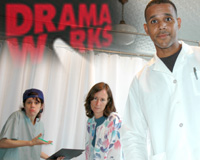
DramaWorks, a Northampton-based consulting company that uses theater to address the many challenges of the business world, has created a national presence for itself in under a decade. While its business model is hard to define, managing partners Tim Holcomb and Erik Mutén explain that because theatrical flair blends so well with the lessons of life, drama in the corporate world does, in fact, work.

In the theater world, acting jobs like those provided by DramaWorks InterActive are called ’corporate gigs.’

That phrase is just one way to describe what the company does, however, as it fails to fit into any one category. Some might call DramaWorks a theater troupe, others a consulting firm, and still others, an educational resource.

Hard as it may be to define the business, though, DramaWorks has created a successful niche by combining the disciplines of theater, psychology, and business management to create a surprisingly cohesive set of services.

DramaWorks InterActive was launched in 1997, under the direction of Erik Mutén, a psychologist and organizational consultant with an MFA in Stage Direction, and Tim Holcomb, founding director of the Hampshire Shakespeare Company in Amherst and a seasoned member of the theater, film, and television industries. The partners wanted to create a company that would take the organizational issues that exist in all types of companies and put them center stage, quite literally, in order to allow managers and employees alike to consider them, examine them, and ultimately, change them for the better.

What they have created is a nationally-known consulting business that provides a unique set of tools for its clients — beginning with the story-telling power of theatrical productions and continuing with facilitated discussion and problem-solving exercises needed to help move an organization forward.

"The core concept of DramaWorks is to help organizations move toward specific goals through action-learning," said Mutén. "A big problem with a lot of trainings is that they often lead to big discussions that eventually fall flat and go nowhere. Our model is much more effective at highlighting what the issues are, and allowing groups of people to gather ideas and work through them."

Setting the Stage

The company addresses a wide range of internal corporate issues, from gender and power dynamics, multi-culturalism, teambuilding, and leadership styles, to more specific issues, such as patient safety and privacy for clients in health care, or succession planning for family businesses. By staging largely improvisational skits, DramaWorks’ ’InterActors,’ as they’re dubbed, call attention to the complex interactions within a given company that can make it work, or detract from productivity, communication, or even the organization’s overall mission.

DramaWorks has collaborated with all types of businesses, and provides a tailored suite of programs for family businesses, health care facilities, and corporations hoping to evaluate their internal culture, sometimes during a time of change. In addition to live performances and workshops, the company also publishes videos for training purposes and soon hopes to add an interactive, online component to its services.

Its current client list includes several prominent names in business, education, and health care, among them IBM, Lucent Technologies, Harvard University, Brigham and Women’s Hospital, and State Farm Insurance. But the concept for a business that would couple theater with theories of psychology and management, and eventually appear at major corporations across the country, grew out of one small production staged locally.

A short play was drafted and performed for the UMass Amherst Family Business Center, dealing with the stresses of family-owned and operated business.

"We improvised a play and held two performances, and we thought that would be it," said Mutén. "But other family business centers across the country began calling and the idea started to take off."

Gradually, he said, DramaWorks expanded to offer improvisational theater pieces for a more- diverse set of businesses. One constant is the examination of what he calls "the human factor" that can often derail an existing or developing business plan or goal — the feelings, emotions, opinions, work habits, or simply the different types of people that must work together in various positions for a business to succeed.

The company typically performs assessments, surveys, and interviews within an organization in order to become more familiar with its structure and background, and stages a production that directly addresses the needs of the client. Sometimes, the skits performed are already part of the DramaWorks repertoire; other times, entirely new scenes are drafted.

In either case, Holcomb explained, the lack of conventional scripts, replaced by ’spines’ — improvisational tools that provide a framework of a story, but no actual lines to memorize — allows InterActors to remain fluid in their words and actions, and ultimately reach their clients on a deeper level while not hitting too close to home.

"We customize everything we do," said Holcomb, "to show the dysfunctional patterns that are holding a given organization back. Typically, a company will approach us with a specific problem, but often discover problems they hadn’t anticipated. We always stay one degree left of center from the company we’re dealing with, in order to remain hypothetical."

That could mean addressing issues at a health care facility through the guise of ’St. Everywhere Hospital,’ for instance. The effect is often one that gets people talking, both within an event and about it.

"Seeing something like a play being staged in the workplace tells people that management is trying something creative and different to address that company’s problems," said Holcomb. "That alone is important right there. It creates a buzz and shows people that their management team is doing Ö something."

Audience Participation

Holcomb was quick to point out, though, that while the dramatic portion of DramaWorks’ services provides its backbone, the additional components of the experience that involve the audience — an organization’s employees — are integral to its purpose.

He explained that each DramaWorks appearance, dubbed a ’learning event,’ attempts to meet the needs and reflect the corporate structure of each client, and thusly the event could last a few hours or a full day.

"We’ve really tried to integrate the consultancy part of the business as much as possible," he said. "We are called DramaWorks InterActive precisely because that interaction with our clients is such a large part of our goal, which is to facilitate and help create the work environments that we would like to see evolve."

Employees are always engaged in the experience following a performance, discussing the scenes they’ve been shown, the various characters, and how they contribute to the overall culture of the ’company’ in which they work.

"Generally, we show them a scenario that attempts to illustrate the things that aren’t working well," Mutén explained. "Then, we have people gather into groups to come up with a different vision of the same scene; a new way it could be played out that would lead to a better result. That scene is actually played out, and people have a chance to comment, again, on what worked and what did not."

The model allows people within an organization to see things from a new perspective, while remaining in a safe, private, and entertaining environment, Mutén said, noting that the ability to see mistakes being made, and later the more effective practices put into place, is another strength of the DramaWorks method.

"Only through action learning can we arrive at better solutions," he said. "Through simulation, people are able to try things out and make mistakes in an environment where it’s OK and even fun to make mistakes. They will play out a number of revisions to the original scenario, and begin to see very quickly what is working and what is not."

Christine Stevens, an InterActor with DramaWorks who has also collaborated on storylines for productions in the past, said gauging a group’s reaction to a performance is another way to begin dialogue among coworkers and move toward the eventual implementation of better work strategies and relationships.

"People are given a chance to share and talk about what they saw," she said, "And we’ll sometimes use sociometrics to reflect how people feel."

A sociometric exercise, Stevens explained, could be asking participants to stand at different points within the room based on how well a production reflects their day-to-day experiences, creating a tangible spectrum.

A health care-based performance, for instance, titled Who Cares? brings to light the many issues surrounding safe, comprehensive health care and the challenges hospitals face daily in order to provide it. As a nurse struggles to care for her patient as well as direct her aide, collaborate with doctors, fill staffing shortages, and learn new equipment (she’s also asked to chair the Nurse Appreciation Banquet Committee in the middle of it all), several characters come and go out of a patient’s room. These include an orderly, a dietary, a doctor, maybe a billing agent — and their interactions are seen by the audience through the eyes of a sick patient. A phlebotomist taking blood, for instance, uses a plunger rather than a needle, exactly how it might feel to a frightened patient.

Following the performance, the audience — typically health care workers themselves — are asked to create that visible spectrum. Stevens said she often stands at the spot where clients who feel they relate most to the scene are asked to move, and nurses usually crowd around her quickly.

"It’s very visceral for the people in the room to see, literally, where people stand," she said.

The 25-minute Who Cares? Performance and the accompanying 2 to 2 1/2-hour interactive session will be staged later this month at the National Patient Safety Seminar held by the Risk Management and Patient Safety Institute in Gaylord, Mich. It’s one of the largest groups DramaWorks will assist with facilitating change this year.

"Hopefully, the CEOs and managers that attend will come out of this seminar ready to promote a new level of communication among their staffs," Holcomb said. "It’s all about changing old paradigms into new ones."

Curtain Call

And although some seasoned theater-folk might smirk and call the performance a ’corporate gig,’ Mutén knows his company rises beyond any label. Further, he suspects his fellow InterActors, as well as their audience, will leave the event with a greater understanding of the wisdom that can be gleaned from groups, rather than individuals working alone.

"Live events like this are so important because working as a group, people can better create resilient, sustainable solutions," he said. "Together, people are smarter."

Jaclyn Stevenson can be reached at[email protected]

Cover Story
Berkshire Brewery Drafts A Success Strategy
Cover 8/1/05

Cover 8/1/05

Berkshire Brewing Company Inc. has been growing by hops and bounds since its inception in 1992. Growth has been so quick and profound that principals Chris Lalli and Gary Bogoff now find themselves at a crossroads. Do they want to remain a local brewer or take that next big step?

Hops, like those climbing the brick walls of Berkshire Brewing Company (BBC) in South Deerfield, are plants essential to creating a great beer. They typically survive for decades, plant deep roots where they grow ‚ and grow rapidly.

The life of a hop vine as a metaphor for their own business isn’t lost on BBC founders Chris Lalli and Gary Bogoff, who grin up at their own decorative hop plants and shake their heads at how fast they spring up the side of the building. Then they turn to look at a recent expansion of their brewery, and do the same.

BBC just completed its third expansion since opening its offices and brewery two years after the business began in 1994. The company also has a satellite warehouse operating in West Boylston, Mass., and is planning a third location in Enfield, Conn., to meet the sales and distribution demand that is steadily expanding its reach across the Northeast.

As Bogoff puts it, the company is currently in a situation where the "tail’s wagging the dog." Sales are healthy, growth has been steady, and local and national respect for BBC’s products ‚ 14 beers, nine of which are produced year-round ‚ has created a momentum so brisk that Bogoff and Lalli have to hustle to keep pace.

Any CEO will tell you that a pressing need for expansion based on growth, rather than in an effort to foster it, is a good problem to have. But the principals of BBC agree, however, that the company’s success has now brought them to a critical crossroads, and they must now decide which way to turn.

"We always wanted to be a local brewery, and we have worked very hard to establish ourselves," said Bogoff. "Now that we have, the big questions is: What’s the next step?"

Never before, he explained, have he and Lalli been in a position to choose how big BBC gets. Now, they must decide whether to graduate from ’local brewery’ and become a ’regional brewer,’ which would necessitate shipping to states outside of the company’s current service area and piercing the national market ‚ essentially, becoming a different kind of business.

"Before, it was a simpler world," Bogoff said, harkening back to the early days, when the duo brewed their first few barrels together in a basement in Springfield. "There was always plenty of room for us to grow. Now, it comes down to a choice. Whatever we do, we want to stay profitable and efficient. But microbrew means small business, and we don’t want to forget that, which is easy to do when you start doing battle in the national marketplace."

Indeed, the national market is not so distant a destination for BBC as it once was. Of the 1,500 microbreweries and pubs brewing their own beer across the country, BBC rates 67th in terms of production volume. Herein lies the quandary that Lalli and Bogoff find themselves mulling more and more often, though, in terms of how large the company’s scope should become: in spite of that stellar rating on the national scale, 99% of the company’s beer is sold within a 60-mile radius of the South Deerfield brewery.

"What we’ve done is based very much on customer service, quality, freshness, and catering to the local market," Lalli said. "We’re very cautious about expanding; we’re respected in this marketplace, and we have established our niche. So, is bigger necessarily better?"

A Stout Following

Still, Lalli and Bogoff concede that the consumer-driven success of their products is an ongoing trend that cannot be ignored. The various strategies they employed to get their company going and to maintain good sales are now what is pushing the co-founders to entertain options for growth and change, starting with a simple business plan and some Yankee ingenuity.

Already, BBC beers can be found on tap or in the coolers of liquor stores across Western Mass. and, increasingly, across the state, as well as in parts of Connecticut, Vermont, and Rhode Island, making them some of the most prominent microbrews in the Northeast. But the partners are quick to point out that microbrews don’t just go head to head with each other to win space behind the bar; they also have to face the behemoths of the beer world ‚ Budweiser is the first name on their tongues ‚ that spend 60% of their revenue on national marketing.

"When we started, we definitely began at the bottom of the learning curve," Bogoff explained. "We were going to do draft business only, forging relationships with local bars, with no marketing budget whatsoever. We didn’t realize how competitive the beer industry actually is. We met with a lot of closed doors."

Lalli and Bogoff were forced into bottling just to make ends meet, and in the process, they stumbled upon a few marketing ploys, reminiscent of the success of Ben & Jerry’s ice cream, that helped create a brand and a hook for the small company.

For example, they put themselves on the labels of their beers, smiling out from 22 oz. bottles with frothy mugs and toothy grins, and coined a number of pithy phrases that now accompany every case and keg they ship, including "Things are looking up!" and the company’s mission statement, "It’s all about the beer."

But in order to compete in what is quite literally a saturated market with sparse marketing dollars, the brewers decided to continue to focus on offering good service and great products, though with a twist: they made a conscious effort to brew an ’American ale,’ a light-bodied drink with mass appeal, that might even impress the Bud drinkers who represent 50% of the market.

The tactic worked ‚ that American ale, BBC’s Steel Rail Extra Pale Ale, was a hit, and eventually spurred the results that the owners had been looking for. Whereas most breweries glean the bulk of their profits from bottling, Lalli explained, BBC is now doing a majority draft business, about 65%.

"Steel Rail is also about 65% of our business," he said, noting that BBC continues to pay attention to the market, offering popular styles of beers such as India pale ales, seasonal brews, or flavor-infused ales. "And our market is the most unique you’ll see anywhere. It crosses all social lines; our fans are new drinkers and they’re old agers, and our beers are in the finest restaurants, and in VFWs."

Local Watering Hole?

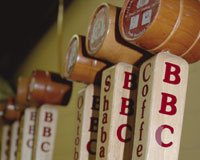
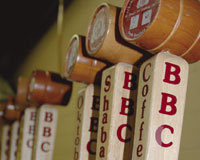
Lalli and Bogoff also attribute BBC’s success to its constant attention to its identity as a locally owned, locally loyal entity. Lalli said it translates into good business to create a following not only through a great product, but a great reputation for partnering with other local businesses and organizations in an effort to support the regional economy. Norse Farms in Whately, for instance, provides the raspberries for BBC’s Raspberry Strong Ale. Dean’s Beans in Orange provides the coffee beans for the Coffeehouse Porter, and 10% of the sales of Shabadoo Black and Tan Ale, named after a friend who passed away, go to help the Western Mass. Food Bank.

"We would be nothing without support," Bogoff said, "so it’s important, but it also makes a whole lot of sense, to give back and keep collaborating with other people."

Other such partnerships have been forged with Franklin County and, specifically, the town of South Deerfield, which played a key role in getting BBC off the ground at its flagship location, a former cigar manufacturing plant on Railroad Street.

The two partners said they were turned away by several communities in the area, and were getting frustrated in their search for a home when South Deerfield "embraced them," as they put it. And that support has remained strong through several expansions of the brewery.

The brewery first included a seven-barrel system and a handful of employees brewing and bottling by hand around the clock. BBC now uses a 20-barrel semi-automated system and employs 24 people, all of whom are dwarfed by the brewery’s massive fermenters, grain silos, conditioning tanks, and other contraptions.

"It used to be brutal, back-breaking work," Lalli said. "Now the new system takes a lot of that grunt work out; we’ve been able to create a comfortable workflow. Without the expansions that we have been allowed to take on, I don’t think our growth would have been nearly as good as it has been."

And over the past decade, the company has yet to see a year that hasn’t produced a healthy increase in sales over the previous year, usually between 8% and 12%. Last year, BBC’s production topped 10,000 barrels for the first time, and that was in the midst of a somewhat disruptive expansion project, Lalli explained.

He and Bogoff expect to sell at least another 1,000 barrels above and beyond that figure this year. That strong history of growth has brought BBC to where it stands today: firmly rooted in Franklin County, but able to enjoy notoriety as one of the most well-known, profitable, and more importantly oft-enjoyed microbrews in New England.

Ale’s Well that Ends Well

The question is, with so many people regularly enjoying a pint or more of BBC brew in their own backyard, how many more people do Lalli and Bogoff want to add to their fan base?

"We’re going to keep doing what we’ve done," Bogoff offered. "We’re going to keep putting products out there that we’re proud of, meeting the demand, and providing the best service we can. We’re customer driven, and the demand is there, so we’ll definitely keep an eye on what is coming down the road. But we’re happy just to be on someone’s ’top five’ list of beers when they sit down at the bar. It’s all about the beer."

Jaclyn Stevenson can be reached at[email protected]
Cover Story
MichaelGolden Wants to Build Brand Equity at Smith & Wesson
’Michael Golden says that when it comes to name recognition, the Smith & Wesson brand is as powerful as Coca Cola or Harley Davidson. But awareness doesn’t necessarily translate into sales, said the company’s new CEO, who wants to take this brand, what he called a ìtremendous assetî and manage it more effectively and profitably.

When asked what brought him to Springfield and the corner office of the historic, but recently troubled, Smith & Wesson company, Michael Golden answered quickly and succinctly.

"It’s the brand," he explained, pausing for a moment — as if to indicate that this might be all needed to say — before elaborating. "It’s one of the most famous brands in the country; it’s a powerful brand, one that I wanted to manage."

Golden, who arrived at Smith & Wesson in early December, knows all about famous brands. He’s helped develop and sell several of them during a 25-year career in business. He started at Proctor and Gamble as a unit sales manager, before moving on to Black & Decker, where he launched the Dewalt Accessory line, and, later Stanley Works and the Kohler Company, makers of kitchen and bathroom fixtures and accessories.

At each of those stops, he helped grow market share by leveraging, or managing, a highly recognizable brand name, and properly positioning it. And he wants to do the same at Smith & Wesson, a company that has battled back in some ways from years of declining sales in the wake of lawsuits against the gun industry and the company’s widely criticized settlement with the federal government, but has historically struggled to take full advantage of its famous name.

Golden, the subject of this month’s BusinessWest CEO Profile, is the publicly held company’s fourth president in the past six years, and the latest to take on the assignment of translating brand recognition into sales and profits. He is addressing that task with a broad strategic plan that includes everything from NASCAR sponsorship to heightened lobbying efforts in Washington and elsewhere designed to help Smith & Wesson capitalize on many post-9/11 global developments, as well as a broad emphasis on security and public safety.

The company’s name now sits on the hood of the # 30 car, driven on NASCAR’s Busch Series by Scott Riggs. It’s there to gain the attention of the sport’s huge fan base, which features demographics that mirror the target audience for the gun industry.

"We think this is going to be a great fit for us," Golden said. "This is an effective way to reach to reach out to a large, very brand-loyal audience."

As be builds visibility for the brand, Golden will also focus on sales, which have been improving — third-quarter numbers were up 12% over the same period a year ago — and will be driven by the company’s ability to penetrate new markets and build better, stronger relationships in existing markets.

Golden has already made several trips to Washington, where he has lobbied decision-makers to consider Smith & Wesson products when arming the 1.8 million servicemen and women across the globe. He has made similar pitches to law enforcement agencies across the country.

And while the Smith & Wesson name is well-known, he explained, it does have its limitations, noting that recent attempts to many sell items with the company’s name — from watches to police bicycles — have had only limited success.

Moving forward, the company will focus its attention on four key areas — safety, security, protection, and sport, he said. "And they provide us with plenty of room to grow."

Golden added that he approaches his latest brand-building assignment with equal doses of confidence and realism. The former is a byproduct of his past success with other top-tier brands, while the latter comes out of recognition that the gun industry is a highly competitive environment, where history and nostalgia only go so far.

Under the Gun

As he talked with BusinessWest about his goals for Smith & Wesson and how he hopes to achieve them, Golden said he wants to borrow from experiences earlier in his career.

At Black & Decker, for example, he was charged with "creating excitement," as he put it, for the company’s new brand of power tools and accessories, Dewalt. At Stanley, meanwhile, he said, he "learned how to manage a company."

And at Kohler, he said he gained experience in "protecting" a brand by taking cost out of the company and properly positioning the cabinet businesses he directed.

Golden actually had two stints at Kohler. The first came in 1996, when he served as vice president of sales, customer service, and distribution of its North American Plumbing Division. There, he grew sales from consistent, low-single-digit increases to double-digit jumps for two consecutive years. He also restructured the sales team, as well as customer service operations, moving from 14 independent sites to one centralized location.

That assignment followed a 15-year stint at Maryland-based Black & Decker, where he started as vice president of the so-called "Home Depot Division," and eventually rose to VP of the Canadian Power Tools Division and then VP of sales and marketing of the North American Accessory Division. During that last stop, he was responsible for sales, product development, and marketing programs for the Dewalt Accessory line, which included drill bits, saw blades, and related products.

In 1998, Golden went to work for Stanley Works, the hardware and tool maker in New Britain, Conn. There, he served as president of its Industrial and Construction Sales division. Specifically, he was responsible for a sales and organizational development of four business units, Stanley Hand Tools, Bostitch Fastening Products, Stanley Hardware, and Petro Mechanics Tools.

During his second stint at Kohler, he served as president of the cabinetry sector, where he was responsible for two separate businesses with combined revenues of $200 million.

Golden said he wasn’t necessarily looking for work — he was doing consulting work for a private equity firm — when he was approached by a recruiter about the Smith & Wesson position. "I wasn’t a shooter, and I admit to not knowing much about the gun industry," he said. "But I was intrigued by the brand, and I’ve learned a lot about leveraging brands."

Since joining the company, he has been actively engaged in learning about the gun business — he’s even fired a few of Smith & Wesson’s products at its shooting facility — and going about the task of more effectively leveraging the brand.

He’s also trying to take a company that has seen some recent turmoil — especially in the CEO’s chair and the Board of Directors— and provide a measure of stability.

Golden succeeds Roy Cuny, who left Smith & Wesson last fall to join Charlotte, N.C.-based stun-gun maker Stinger Systems (Cuny subsequently left that company late last March, citing a difference of opinion with the CEO). Cuny’s stint lasted less than two years, and came after the departure of Robert Scott, the former head of sales and marketing for Smith & Wesson, who assumed the corner office when the Arizona-based company Saf-T-Hammer, which he joined in 1999, completed a fire sale purchase of Smith & Wesson from British giant Thompkins PLC in 2001.

It was Scott who led the company through the public relations — and sales — fallout that accompanied the company’s March 2000 agreement with the federal government that effectively removed from Smith & Wesson from many of the law suits against the gun industry in exchange for several concessions.

Golden acknowledges the rocky recent past, but says his focus is clearly on the future and doing more with a brand he says has been "undermarketed."

"Historically, the company hasn’t done all that it can with its brand," he explained. "I want to change that."

Lock and Load

Discussing his new brand, Golden said that when it comes to name recognition, there are few peers.

Coca Cola, Harley Davidson, and Ford come to mind, he said, adding quickly that those companies, like Smith & Wesson, know that awareness doesn’t always translate into sales.

"Awareness and perception are two different things," he explained. "We don’t want people to simply know about our products, we want them to feel good about our products.

"People hear our name and they know we make guns Ö it doesn’t matter whether you like guns or not, you hear our name and you know what we do," he continued. "That’s something to build on; we have to take that awareness and drive sales."

The methods for achieving that broad goal will be outlined in a new three-year strategic plan that will be rolled out later this month. Golden touched on some of the highlights for BusinessWest.

The plan includes a number of broad and specific strategies for marketing, sales, new product development, and eliminating cost from operations, he said, noting that with many initiatives, the clock started running on Dec. 6, the day he took over.

On the sales side of the ledger, Golden said, the company will target several audiences, especially the three that offer the most growth potential — law enforcement, the federal government, and foreign governments. Smith & Wesson has lost market share in each area over the past several years, and will be aggressive in its efforts to get it back.

"We don’t do a lot of business with the federal government at the moment," he explained. "We want to get more, obviously, and as we lobby for contracts, we’re going to stress both the quality of our products and the fact that doing business us will keep jobs in this country."

Indeed, many government agencies and police departments have given contracts to foreign gunmakers, including Beretta, Glock, and Sig Arms, he said, adding that to get these former clients back, the company must stress more than the ’Made in the USA’ label. "We have to show them that we can compete with anyone," he said, "and I believe we can."

The broad sales strategy involves not only new and existing markets, said Golden, but also core products and new items that fall into those categories he outlined earlier — safety, security, protection, and sport. This list includes everything from handcuffs to safety goggles to hunting knives. It also includes includes development of less-lethal products such as mace and stun guns.

As for marketing, the company wants to reach out to the many different types of customers it has — the constituency groups include end-users, dealers, and distributors — with messages that speak about both specific products (several new pistols are selling well), and tradition.

The NASCAR Busch Series car sponsorship will play a lead role in that mission, he said, noting that the sport’s enormous fan base is young, largely conservative, and outdoor-sports oriented. Golden noted that it may be hard to eventually quantify the results of the car sponsorship — much depends on how well the team does and how much air time Riggs’ Chevrolet gets on TV — but he believes it will prove a sound investment.

"We’re excited about this," he said. "We’re going to get some good exposure that should drive additional sales for us."

Hire Caliber Sales

As he discussed Smith & Wesson and his plans for it, Golden used the word legacy to describe both the company’s workforce and the products it makes.

"Many of our employees are following their fathers and the grandfathers in working for Smith & Wesson, and when you walk through the plant and talk with people, they take pride when they tell you how long they’ve been here," said Golden, adding that, likewise, generations of the same family have put their trust in the company’s products.

His role as CEO is to build on that legacy through greater, more effective leveraging of the brand.

"The question for us is, ’how do we take this incredible asset and use it to grow our company?’" he said.

George O’Brien can be reached at[email protected]