Home Archive by category Cover Story (Page 11)

Cover Story

Cover Story
The Prospects for a Casino in Western Mass.
February 4, 2008 Cover

February 4, 2008 Cover

Many casino proponents say that when it comes to legalized gambling in the Commonwealth, the question isn’t if it will gain the blessing of the Legislature, but when. Some lawmakers may not agree, but there is mounting evidence that the pendulum has swung in support of casinos. While that debate continues, focus turns to the next matter involving this high-stakes issue — where to put them. At the moment, a plan for a hilltop facility in Palmer seems to have considerable momentum.

‘Inevitable’ is one of those words that doesn’t need an accompanying adjective or adverb, but Peter Dragone added one — ‘absolutely’ — just for effect.

He did so when asked about the prospects for legalized gambling in the Bay State, a subject he’s been involved with for roughly three decades, starting with a plan to put a hotel and gaming facility on Mount Greylock in Berkshire County. There have been other initiatives since, ventures that have made Dragone, a Longmeadow resident, real estate appraiser, and consultant on casinos, one of the foremost authorities on that still-controversial subject, and now part of a group trying to place one on a 150-acre parcel it owns just off exit 8 of the Turnpike in Palmer.

Using a tone brimming with confidence, he said he believes that it’s no longer a question of if the legislature will make casino gambling legal, but when — and he thinks the answer is ‘soon,’ perhaps this year. There are many reasons for this, he said, including growing support among state residents for legalized gambling; similar support from institutions like the Boston Globe, which has historically opposed casinos; critical need for new sources of revenues for the state that do not include tax hikes (the governor has actually taken the bold step of including casino revenues in his FY ’09 budget — more on that later); and, perhaps most importantly, the fact that casino gambling is already a fact of life for many living in the Bay State, as evidenced by how many trips they make to Foxwoods, Mohegan Sun, and other Northeast facilities on an annual basis.

Summing things up, Dragone, in a recent interview with BusinessWest, said “there are already casinos in Massachusetts — they just happen to be in Connecticut.

“It’s an industry that’s already here,” he continued. “The problem is, the tax revenue is going elsewhere.”

Changing that equation and developing casinos within the confines of the Commonwealth is a multi-step process that begins with the Legislature, said Dragone, noting that he and many others, while certainly not looking past this hurdle, despite that aforementioned confidence, are already focused on that next step — the matter of where to locate said casinos.

And he’s already rolled the dice in this regard, with a pretty substantial bet.

Indeed, Dragone is lead partner with the Northeast Group, which owns the Palmer property as well as a 35-acre waterfront site in New Bedford also proposed for a casino. The former is considered the casino site with the most momentum at this date and time. It has caught the attention of Mohegan Gambling LLC, operators of Mohegan Sun, who late last month presented preliminary plans for what is being called Mohegan Sun Palmer, a $1 billion entertainment/gaming facility that would feature a 164,000-square-foot casino, a 600-room hotel, 12 restaurants and food venues, and 100,000 square feet of retail space.

Paul Brody, Mohegan Gambling’s vice president of development, gave a lengthy presentation that touched on everything from traffic to table games; employment opportunities (3,000 of them) to the projected impact on area businesses.

Using what’s happened in Connecticut as a predictor of what can happen in Palmer — and with other casinos in the Bay State — Brody said the state can expect good-paying jobs, heavy spending on the part of casinos with locally owned businesses, and a manageable amount of problem gamblers.

All this was outlined in a PowerPoint presentation that noted, among other things, that Connecticut’s two casinos are now among the five largest employers in the state, that last year, the Mohegan tribe provided the state of Connecticut with $223 million in revenue ($4 billion since it opened), and that the planned Palmer casino will create 1,500 construction jobs in addition to the 3,000 permanent jobs, Such numbers will be just part of the equation for making a casino in Palmer a reality. Gov. Deval Patrick’s casino plan calls for three resort-style casinos to be located in a manner that would spread the wealth to all portions of the state, including Western Mass. But, for the purposes of this exercise, the governor is including Worcester County in Western Mass.

The myriad matters impacting the ‘if,’ ‘when,’ ‘how,’ ‘where,’ and other questions concerning casinos has fueled considerable speculation — as well as plenty of work for lobbyists. Bill Cass, with the Boston-based Suffolk Group, is one of them. He told BusinessWest that his assignment is to promote Northeast’s interests, and this includes work to sell the Palmer location as a logical site with benefits for both Western Mass. and the state as a whole.

“I’m confident that if legislation passes, this land would be part of a successful development, due in large part to its attractive location,” he said. “I’m on the Hill to make sure the legislation is fair and that it allows the Northeast Group to compete based on the merits of this site.”

The $64,000 question, however, said Cass, is whether the Legislature will vote on casinos this year or sometime soon and, if so, whether Dragone and others are correct when they use that word ‘inevitable.’

“And if someone tells you with a great degree of certainty that they know what’s going to happen,” he said, “they probably don’t know what’s going to happen, because no one knows.”

Doubling Down

Jeff Ciuffreda has heard the ‘when, not if’ argument with regard to casinos. He puts some stock in it, but certainly isn’t ready to place any odds on whether a casino vote is imminent or how one may wind up.

As vice president of Government Affairs for the Affiliated Chambers of Commerce of Greater Springfield, he keeps his ear to the ground on the matter. He told BusinessWest that casinos have not been a direct subject of most conversations he’s had with legislators, but they have certainly been a background topic and, in many respects, the elephant in the room.

He’s also talked with some developers, whom, he said, are of course interested in coming to the Bay State, but have questions about how many casinos may be developed and what impact these numbers may have on revenues and developers’ ability to recover licensing fees that will run in the hundreds of millions of dollars.

With regard to a vote, he said the outcome will likely be swayed by House and Senate leadership, which still includes proponents and opponents, the latter list including state Rep. Daniel Bosley, a democrat representing the First Berkshire District and current chairman of the Economic Development Committee.

“I think you see a lot of people (legislators) out here who are not really passionate about it one way or the other, and are likely to follow leadership closely,” said Ciuffreda, noting that some in those posts do support gambling, while others don’t, and many are not pleased that the governor went against their wishes and included casino revenues in the budget.

Ciuffreda said there is talk of only a few sites in Western Mass. as potential locations for casinos, and as far as some parcels are concerned, it is simply talk.

Donald Trump is rumored to have some interest in the Holyoke Mall, he said, adding that the facility has been for sale for some time, and that the casino talk is a “stretch” that has probably resulted “from someone putting two and two together,” with regard to location, accessibility, and possible conversion to gaming resort. Meanwhile, Chicopee Mayor Michael Bissonnette is keeping his options open on a 100-acre parcel located between the Turnpike and the end of the runway at Westover Air Reserve Base. That site is landlocked, said Ciuffreda, and has other challenges beyond access, including multiple owners and strong interest from Westover Metropolitan Development Corp.

“From everything I’ve heard thus far,” he said, “Palmer is considered the Western Mass. site.”

The ACCGS has taken no official stance on casinos and probably won’t, at least for the foreseeable future, said Ciuffreda, noting quickly that it has taken part in meetings where questions have been asked about the impact such a facility would have on small businesses, wages, workforce quantity and quality, and other matters.

“There’s still a lot of questions out there, from developers, legislators, and mayors, and a lot of moving parts to this,” he said, adding that when it comes to casinos and their overall impact, “the devil is in the details.”

Some of those details, at least as Mohegan Gambling LLC sees them, were put on the table in Palmer on Jan. 22, when Brody and other representatives of the corporation gave a lengthy presentation before the Palmer Citizen Casino Impact Study Committee.

The well-attended session was significant in that it represented, for the first time in anyone’s knowledge, the first time a casino-development group had actually laid out a plan, with specifics on everything from the number of table games and slot machines (150 and 4,000, respectively) to plans for traffic control, including a flyover that would take vehicles off the Turnpike and directly onto the casino property without clogging local roads.

The package of proposed attractions for the Palmer site — which go well beyond gambling — and the remote location combine to give this plan the look and feel of what is being called the ‘casino in the woods,’ said Dragone, which is emerging as the preferred venue for Massachusetts, especially in the wake of the mostly positive developments in Connecticut and the opposite trend in Atlantic City.

“What occurred there — and a lot of it had to do with the state not doing what it said it was going to do — shaped some opinions about casinos here,” he explained, noting that monies that were supposed to go toward revitalizing Atlantic City went instead to plug budgetary holes elsewhere. “A lot of people saw what was happening — or not happening — in Atlantic City, and envisioned that happening here.”

There have been far fewer problems in Connecticut, he continued, and the familiarity that many Bay State residents have with the casinos there has played a huge role in creating what he called a “sea change” in attitudes about legalized gambling.

“There’s a very positive feeling about the existence of those casinos in the woods,” he explained. “Their impact has been overwhelmingly positive in the state of Connecticut, with regard to everything from jobs to revenue for the state — and this has changed the way many people think about gambling in this state.

“And that’s one of the big reasons why the Palmer location works in the minds and eyes of many decision makers and the people themselves,” he continued. “It embodies the spirit of the ‘casino in the woods.’”

Dicey Situation

There has been interest in the Palmer site as home for a casino for more than a decade now, said Dragone, noting that there have been other plans forwarded that fall into the category of ‘destination’ venue. Bass Pro Shops was interested in the site as a possible location for a large-scale location in the Bay State before it eventually settled on becoming part of a large-scale retail/entertainment complex being created by the Kraft family, owners of the New England Patriots, adjacent to the team’s stadium in Foxboro.

Dragone first toured the Palmer parcel, located on a hill off Route 32, in the mid-’90s, and came away impressed with its potential as a development site for a casino or other venue. He acquired an option on the land in 1996 and, along with several other investors, acquired the property in 2006. (Northeast recently acquired site control of an additional 80 acres adjacent to the proposed site.)

Dragone believes Palmer represents the most logical of the Western Mass. sites for a casino, and perhaps the best option for spreading the gaming wealth to the Pioneer Valley. Peter A. Picknelly, third-generation president of Peter Pan Bus Lines in Springfield, agrees.

A partner in the Northeast Group along with his brother, Paul, he acknowledged that his interest stems in part from the vast potential growth of an already lucrative business taking individuals and groups to and from casinos in the Northeast; he didn’t have a specific number concerning passenger volume to Foxwoods, Mohegan Sun, Turning Stone resort in New York, and other venues, but said it is significant.

But he noted that scores of other businesses across many different sectors would also benefit, and that he is committed to seeing Western Mass. get its slice of any casino pie.

Picknelly told BusinessWest that he and others believe that casinos in the Eastern part of the state would, because of their convenience, draw visitors from that part of the Commonwealth, as well as Rhode Island and Southern New Hampshire. The Palmer facility, meanwhile, would draw residents from the four counties of Western Mass., Northern Conn., Eastern New York, and perhaps from Worcester County.

This traffic pattern holds some theoretical benefits for Springfield and other Pioneer Valley communities, he explained.

“I think restaurants in Springfield will benefit,” he said. “And attractions like the Basketball Hall of Fame will benefit as well. If even a small percentage of those traveling to the casinos get off the highway and visit venues like that, there will be a very real impact.

“I have no doubt that the projects in Palmer and New Bedford will spur economic development and other significant private investments in regions that are currently economically distressed,” he continued, adding that he’s seen it happen in Connecticut, where unemployment rates are so low Peter Pan struggles to find drivers and other employees. “If gaming is legalized, I think Western Mass. ought to be a beneficiary, and I’m convinced that Palmer offers the best site for development.”

Cass, a former legislator with a diverse lobbying portfolio, said he, like Dragone, believes legalized gambling is inevitable in the Bay State, but the ‘when’ part is still a matter of conjecture.

The governor has certainly upped the ante, he said, borrowing a phrase from the industry, by including casino revenues in his budget for the fiscal year that will start on July 1.

“This is a significant development that could play out a number of different ways, and I don’t have a crystal ball,” he said, noting that if the House, which gets the appropriations bill first, takes the casino revenue out of the budget, the Senate could put it back in. The matter would then go to a conference committee, where anything could happen.

Dragone believes the Legislature will legalize gambling, in large part because it can’t afford not to, given the number of players already in business in New York and New England, and the potential for more in the years to come, in the same way that state lotteries have proliferated and enjoyed explosive growth.

“The lottery started in New Hampshire and then spread through New England and westward — it was like a domino effect,” he explained. “And table games and slot machines are following that same path. Today, New Hampshire is making a push to put an installation in Rockingham Park on our northern border; you have a slot casino in Bangor, Maine and other initiatives that will bring it to the south counties of that state; there are casinos and slots on our western frontier, in Saratoga, N.Y., for example, and you have the equivalent of a casino in Newport, R.I., and the world’s two largest gaming reports in Connecticut.

“So there are a number of border wars going on already,” he continued, noting that millions of Masachusetts residents are crossing state lines
o gamble, taking untold revenues with them.

Of Wages and Wagers

Dragone acknowledged that he and his partners have taken a fairly substantial gamble on casinos, and specifically the Palmer site, given the Legislature’s track record on legalized gambling.

But he believes the odds are now heavily stacked in his favor, given not only the growing sentiment in favor of gambling — from the governor to the Globe to state residents — but also the many factors that point toward Palmer as a logical choice for a destination venue.

Time will tell, but in looking at all the cards currently on the table, Dragone thinks he’s made a fairly safe bet.

George O’Brien can be reached at[email protected]

Cover Story
Area banks continue to branch out
January 21, 2008 Cover

January 21, 2008 Cover

It wasn’t too long ago that financial analysts were predicting a serious decline in the number of bank branches nationwide. But electronic banking, while popular, has done little to deter banks from sprouting branches on seemingly every thoroughfare in Western Mass. It’s a national trend, and one that shows little signs of slowing — although some argue that it’s more difficult than ever for a new branch to become profitable.

Drive down any well-traveled, retail-heavy road in the Pioneer Valley, and chances are you’ll have plenty of opportunities to grab some cash at an ATM. Picking up some groceries at Stop & Shop or a pair of pants at Wal-Mart? You can bank there, too.

If ribbon cuttings are starting to feel, well, a little less newsworthy, you’re not imagining it. According to the Mass. Bankers Assoc. (MBA), the number of bank branches in the Bay State has increased 20% over the past 20 years, to more than 2,200 — and rising. The group says banks are the second-leading employer in Massachusetts, behind only health care.

“Some may think, ‘there’s a lot of banks here,’” Bruce Spitzer, a spokesman for the MBA, told the Boston Globe recently. “That’s because there’s a demand.”

Easthampton Savings Bank President William Hogan, whose institution has seven branches in eight communities, said that, from a physical standpoint, Western Mass. has seemingly become overbanked over the last three or four years. “And there are plans for additional branching that have been announced, including the new startup bank in Springfield, Nuvo. On the face of it, you’d have to come to the conclusion that the region has a sufficient number of banks.”

However, he was quick to add, “from a banker’s perspective, there’s a necessity of having a certain number of bricks-and-mortar branches that your customers can find, through which they can do business with you.”

There has definitely been a proliferation of bank branches, nationally and in this region, said David Glidden, regional president of TD Banknorth, which boasts some 30 branches in Western Mass. “And it does affect the competitive landscape and makes it more difficult to differentiate yourself. We all try to do it through extended hours of service, those types of things.”

Some bank presidents have said they sometimes feel pressure to expand their footprint just to keep up with their competitors, but Glidden said there’s always a risk in expansion, because a new branch in such a densely packed field is not the slam-dunk moneymaker it was 20 years ago.

“The real issue is, how do you find profitability? It’s increasingly elusive when you open up a branch, and these branches now opening do not achieve the level of deposits they used to,” he told BusinessWest. “You don’t just build a branch and expect that it’ll quickly turn profitable, when you look across the street and see five other branches.”

That’s why it’s important, he continued, that banks have a strategy for branching out that extends beyond simply having a presence in a new location.

“People don’t change banks easily, and market share shifts more slowly today,” he continued. “You have to offer products and rates on deposits and loans that are maybe more aggressive than other banks, to eat into already-established markets.”

In other words, to think outside the box — while bumping into all the other new boxes. In this issue, BusinessWest examines the overbranching situation, what banks are looking for when they expand, and where the trend might go from here.

National News

It’s not just Massachusetts seeing this increased density. Chicago has witnessed a staggering 50% increase in branches over the past five years, while Manhattan has seen a 41% rise, Washington, D.C. a 20% jump, and Los Angeles a comparatively modest 10% climb. The Washington Post reported that one Chicago alderman became so alarmed by the proliferation that she drafted a law requiring that banks obtain permits to open within 600 feet of one another.

In fact, virtually every major city in the U.S. reports at least some increase in the number of branches, contributing to a total rise of 13% nationally since 2002. It’s not a trend that pleases everyone.

“There’s really nothing less fun or interesting that could populate your retail corridor than a bank branch,” wrote Matthew Yglesias, a popular D.C.-based blogger and Atlantic Monthly staff writer, who added that the underlying dynamics of the branch boom — and particularly reports that customers crave face-to-face contact — escape him, particularly given the expense involved in opening a branch.

“What is the personal contact that people are looking for?” he wrote. “I go into a bank about once a month to deposit rent checks that my roommates write me. Were I not the designated writer of the check that goes to the landlord every month, or had I no roommates, I don’t think I would ever go. My intuition is that the real story here has something to do with the semi-mysterious fact that one almost never sees a bank-affiliated ATM without it being co-located with an actual branch of the bank.”

This tendency toward more locations represents a significant shift in banking. During the 1990s, most larger players were shedding branches, encouraging more use of ATMs and telephone banking, and laying the groundwork for Internet banking, which many analysts felt would ring the death knell on many more branches.

Wade Francis, president of Unicon Financial Services, a Long Beach, Calif.-based banking consultancy, recently told the Los Angeles Business Journal that theories were rife only 10 years ago that electronic banking would contribute to a serious decline in physical branches. “But people still want to go to their local branch, and if you want to be a successful retail banking operation, you’ve got to focus on the branch,” he said.

Part of what has happened is banks recognizing the value of providing one-stop financial services for customers. While checking accounts generate significant fee revenues, banks are prodding their retail customers toward other services, from car and home loans to a range of investment services — all of which is easier to accomplish through a face-to-face relationship.

Plugged In

Still, said Hogan, banks are continuing to develop their electronic-banking services, “because the pace of growth in that arena is far exceeding that in the traditional bank building.”

Hogan said virtually all banks are coming to recognize the increasing importance that customers, particularly younger ones, place on electronic banking. In fact, those with direct deposit of their paychecks and a full range of bill-paying options online might rarely need any services at a physical location beyond an ATM for cash withdrawals, a trend that gives institutions a way to reach customers who might not live or work near an actual branch.

“A lot of what we’re doing is focusing on the alternative opportunities and means by which customers can contact and stay in touch with banks,” he explained. “That’s an area where we’ve seen tremendous growth over the past three years.”

Alice Babcock, vice president of marketing for Westfield Bank, which has 11 branches in seven area communities, concurred. “We’ve found that our customers want both options, and you have to be in a position to offer both,” she said, adding that those in the 18-to-30 age group tend to be most comfortable conducting transactions and paying bills at their computer screens.

Yet, Westfield Bank’s most innovative change recently has also been one of the lowest-tech shifts: Sunday hours at its newest branch on East Main Street in Westfield. James Hagan, the bank’s president, said the change was so successful that the branch wound up opening its doors an hour earlier in the day.

“Young people have become accustomed to doing things in the electronic format, and you have to have that convenience available, but we still have to provide a certain level of service in the bricks-and-mortar branches,” said Babcock. “In both cases, we’re trying to determine what our customers expect in a community bank, and provide that for them.”

Glidden said Banknorth has seen steadily increasing use of electronic banking, “which we’re very pleased about, because it’s been a conscious strategy.” But he pointed to users of Apple products, asking, “who’s more techie than that?” Yet, the computer giant now boasts 180 retail locations that generate $1 billion in revenue per year.

“Although some people think members of Generation Y will never walk into a branch bank, we still find that the branches play a critical role,” he continued. “When the need arises to go into a branch, people will still gravitate toward a convenient, well-placed branch they feel comfortable with, not far from their residence or place of work.”

Past Is Prologue

Unlike a decade ago, hardly anyone today is pointing to the imminent demise of the traditional bank branch.

“These electronic platforms — electronic bill paying, image presentation for checking accounts, all these things beginning to be seen in our market, are very important for the future,” Easthampton’s Hogan said. “But we need a certain amount of that physical presence out there.”

“Convenience is still important to the retail customer,” Westfield’s Hagan added, “and the branch plays a huge part of that.”

But with so little prime territory unmarked by some institution, Glidden reiterated, it’s critical that banks make the right moves, not just any move.

“When you’re opening a branch, you have to ask, what’s my strategy?” he said. “Do you have integrated delivery channels and an effective sales process to make the branch as profitable as possible? A lot of banks have recently converted to mutual banks, to public charter, and have gone out and raised a lot of capital, and this is one way they’re looking to deploy that capital. But the challenge becomes taking what is, on day one, a non-earning asset and turning it into a profitable location for the company.”

Again, Glidden said, a new storefront is “great for the ribbon cutting, but how are you going to make that a profitable asset, with the money it costs in bricks and mortar and human capital? That will ultimately be the great test. The banks that find a unique way to differentiate themselves and distribute their services in a profitable manner will be the survivors of this proliferation.”

Those are words, many agree, you can take to the bank. If only you could decide which one.

Joseph Bednar can be reached at[email protected]

Cover Story Sections Top Entrepreneur
John Maybury : Driven to Succeed
January 7, 2008 Cover

January 7, 2008 Cover

John Maybury was only a few months out of high school when he embarked on what started out as another in a series of odd jobs, but would eventually become a career and very successful entrepreneurial venture. He began selling workbenches, shelving, and industrial stools, but soon partnered with his father to start a diversified business in the competitive field of material handling. Today, the company reflects Maybury’s passion for technology, commitment to excellence, and drive to continuously improve. His success — and methods for achieving it — have earned him BusinessWest’s Top Entrepreneur Award for 2007.

John Maybury says that for him to get involved with something, there usually has to be some element of danger.

He’s an avid snowmobiler and skier, and he’s scuba dived, skydived, and flown planes (he doesn’t so much anymore). “If it has a motor, then I’m interested in it,” he said, noting that he probably had 20 cars before his 18th birthday. The only time you’ll find him on a golf course is for a charity tournament, and he’s taken part in many. He has to drive the cart, and he’ll invariably tinker with it to get it to go faster than the club pro might like.

He approaches all these danger-spiced activities with a philosophy, or thought process: to know and understand the risks, push the envelope — but not too far, and have fun. And this is the approach he takes to business and Maybury Material Handling, a venture he started while attending Western New England College 32 years ago, and trying to figure out just what to do with his life.

He took a cue, of sorts, from his father, who worked for many years as a salesperson then sales manager, specializing in, among other things, items in a field known as material handling — meaning equipment used to move, store, retrieve, and catalog inventory, records, parts, and other items.

The Younger Maybury started off as a free agent, selling various product lines to companies like American Bosch, Moore Drop Forge (later known as Danaher Tool), and other large manufacturers, using mostly contacts from his father to get his foot in those doors. He enjoyed enough early success to inspire his father to take a leave of absence from the company join him a venture that would put the Maybury name on letterhead, if not over the door — they started out as a home-based operation, but quickly outgrew those facilities.

Over the past three decades, Maybury has grown his venture into a highly diversified operation now specializing in sales, service, rentals, and training for equipment ranging from forklifts to work stations; from mezzanines to modular offices. The company has expanded and moved several times, the latest step being construction of a 42,000-square-foot building on Denslow Road in East Longmeadow, not far from where he and his father built the company’s first home on the site of an old tobacco barn.

But it is not merely what Maybury has accomplished that has earned him BusinessWest’s Top Entrepreneur for 2007 award. Rather, it’s also the how that has made him this year’s honoree.

To say that this is a company that reflects the character and drive of its owner would be a real understatement. It is, like Maybury, technology-focused, employing the latest hardware and software to enable employees to do work better, faster, and cheaper. It’s also excellence-driven; it was among the early winners of the Pioneer Valley Excellence Award, and Maybury has his sights set on a Mass Excellence Award, and has the ambitious goal of earning the coveted Malcolm Baldridge award within the next decade.

And this company is people-oriented, with an emphasis on fun. At the 2007 All Associates Year End Gathering, for example, staffers were broken into teams for a spirited contest of ‘Are You Smarter Than a Fifth Grader?’ featuring several special guests from nearby Mapleshade Elementary School.

The teams were formed with the goal of breaking down departmental barriers and inspiring people in different capacities to work together toward a common goal — in this case, triumphing over the other teams and winning some cash ($4,000 was put on the table).

This philosophy of working together is at the heart of the company’s success, said Maybury, noting that he stresses teamwork in every facet of the operation, and it has yielded steady sales growth, cutting-edge continuous-improvement practices, and a workplace that attracts and retains top talent.

In this issue, BusinessWest examines what drives Maybury — literally and figuratively — in his quest for excellence, and why his story of entrepreneurial daring is an uplifting, and ongoing, saga.

A Real Spark Plug

As he gave BusinessWest a tour of the new plant and posed for a few pictures, Maybury displayed some of that passion he has for all things motorized.

He jumped onto one of the newest and most versatile fork truck models, showed all that it can do, and then maneuvered it in out of some tight spaces. “I can handle these better than most people who drive them for a living,” he said, noting that he’s fluent with every piece of equipment on his showroom floor, and needs to be if he is to properly serve his clients.

Maybury got his first practice on a forklift back in the fall of 1975. He was a freshman at WNEC and also working several part-time jobs to help pay his tuition. One of them was at Milton Bradley — now known as Hasbro Games — and its East Longmeadow plant. He worked in what was known then as Department 26, moving around pallets of games like Monopoly, Life, and Chutes and Ladders, for loading onto boxes that would be packed into freight cars for transport on a rail line that no longer exits.

When Maybury returns to Department 26 these days — he’s made several visits over the years and still runs into people he worked with three decades ago — it is to help Hasbro stay on the cutting edge of material-handling equipment and processes. The toy maker is just one name on a long and distinguished client list. Others include regional and national manufacturers, distributors, and retailers including Friendly’s, Big Y, Lenox, J Polep, JCPenney, Macy’s Target, Wal-Mart, and even Foxwoods and Mohegan Sun.

Maybury supplies racks and shelving, conveyors, forklifts, and other equipment to the casinos to move and store money and chips. It also played a lead role in helping Mohegan Sun set a record a few years ago — with an 18-foot-tall, seven-tiered wedding cake weighing 15,032 pounds, or 7.5 tons. Maybury engineers created the huge platforms, or cake separators that the cake rested on (they were supported with steel pipes made by the company and painted to match a frosting sample) and also positioned massive, 30,000-pound-capacity scales in order to give the casino the exact weight.

The current, ever-growing client list and show of diversity and imagination put on display at Mohegan Sun provide evidence of just how far this company has come from its humble beginnings. How Maybury has orchestrated this evolution and progression is a story of entrepreneurial drive, vision, and ample doses of both luck and determination — mostly the latter.

Recalling how things got started, Maybury said that in addition to his forklift adventures at Milton Bradley, he also worked at Big Y, SIS (now TD Banknorth), and other area companies while trying to choose a career path. Instead, one chose him.

Growing up, he recalled, the conversations around the dinner table often revolved around his father’s work in material-handling equipment, and he eventually gravitated toward it himself.

“I grew up with it, and was kind of fascinated by it,” he said, re-emphasizing his childhood interest in all things mechanical, which manifested itself in early exploits in snowmobiling, mini-bike and motorcycle riding, and an endless parade of cars. “I would go into where my father was employed, go out back, and see all that equipment; it was something that really interested me.”

That company was Stanley Handling Equipment Co., later to be called StanLift, in Agawam. It was sold while Maybury’s father was executive vice president, and he then left and did consulting work for a similar venture based in Boston.

“It was at the supper table one night … I asked my father if he thought I could sell the things he used to sell,” Maybury recalled. “He said, ‘let’s give it a try,’ and we did.”

He started as an independent agent of sorts representing dealers trying to penetrate the Western Mass., market, selling workbenches, industrial stools, shelving, pushcarts, and other items needed by manufacturers that didn’t require help with installation, and was helped considerably by some of his father’s contacts.

“I’m 18, 19 years old … these people basically adopted me like a son or a grandson, because I was so young,” he explained. “I would go in, show them the book, show them the prices, tell them how much I needed to make, and they were cutting me orders.

“If I had any questions, I would go and ask my father,” he continued, adding that as the orders started rolling in, the father-and-son team saw a business opportunity unfolding before him. With a $25,000 loan from what was known then as First Bank — “they enjoyed the signature of the 40-year-old father much more than the 19-year-old son,” said Maybury — they were off and running.

Hitting on All Cylinders

Beyond the changes in street address over the years, the company was also in a constant state of change and diversification, said Maybury, patterns that have made it unique in the material-handling sector.

After starting with benching, shelving, and stools, the company moved into larger shelving installations, and two-story installations, including some work for Subaru of America. These installations would require lift trucks, he noted, adding that in the beginning the company would rent such equipment for jobs, but later purchased a fleet of the vehicles to ensure it could get a job done — and on time.

These ‘installs,’ as they were called, were usually done over a weekend, when a plant was shut down, he continued, adding that the mechanics hired to do these jobs often had little to do during the week, so the company started subbing them out to other businesses.

This was the beginning of Maybury’s power equipment division, which sells, leases, and maintains forklifts, scrubbers, sweepers, and other pieces of equipment and accounts for roughly 50% of total revenues.

Maybury remembers when the fleet consisted of one van (he still keeps a picture of it his files) and five hand trucks. Today, it’s 30 vans and more than 300 left trucks serving an area that stretches east to Worcester and south into Northern Conn., but Maybury says the company goes wherever its customers want.

It’s done work in Pennsylvania for Friendly’s, for example, and also in Nebraska, Texas, the Dominican Republic, and elsewhere for other clients.

This constant evolution has yielded a company that Maybury describes as a “solution provider,” and one that has no across-the-board competition.

“Our competitors are silo businesses,” he explained. “We have lift truck competitors, shelving and rack competitors, conveyor competitors, and mezzanine competitors, for example, but there aren’t any real solution providers that can address the full scope of material handling like we do.”

Summing up what his company does, and simplifying matters as he does so, Maybury says his team of 100 employees helps clients become more efficient, thus making them more profitable and competitive in the face of increasingly global competition. And throughout its existence, the company has essentially practiced what it has preached — using technology, processes, and teamwork to simplify and streamline operations and provide new opportunities for growth.

“We’re about as paperless as a company like this can get,” said Maybury, citing just one example of how the company works to take time and waste from its processes, while also serving customers more efficiently. The company has used self-directed work teams, the Kaizen process, and other strategies to reduce process times and reduce errors.

These efforts were rewarded with a Pioneer Valley Excellence Award in 2005, what Maybury calls the first step in an aggressive drive to winning a Baldridge within the next decade. Established in 1988, and named after former Commerce Secretary Malcolm Baldridge, a strong proponent of quality management, the award is given to companies to large and small judged to be outstanding in seven areas: leadership; strategic planning; customer and market focus; measurement, analysis, and knowledge management; human resource focus; process management; and results.

Maybury said that while his goal is on winning the award, his focus is on doing the things necessary to achieve that end, which means not achieving results, but sustaining them, which is the key to not merely filling a lobby with plaques and trophies, but also taking a company to desired heights in terms of efficiency and profits.

And for this, Maybury returns to the subject of teamwork, specifically a team of ‘Level 5 leaders’ as defined by business writer Jim Collins, author Good to Great.

“I have a human resources manager, a controller, a power equipment division manager, a material handling division manager, and a sales and marketing manager, and those positions support our strategy and our goals,” he explained, “and our initiatives and action steps are carried out by that group of people.

“Into everything we do over the course of a year we come up with some critical impact factors that will impact our business either in a positive or negative way, and then we develop strategies and action steps and come up with goals and plans so we deploy a common theme,” he continued. “If it’s self-managed teams, then it’s self-managed teams until we get it; if it’s paperless, it’s paperless until we get it; if it’s proper deployment of technology, it’s that until we get it; we don’t just say ‘let’s do this,’ and then it never happens.”

Gasket Case

There has been considerable deployment of communications technology over the years, said Maybury, adding that the progression of steps, such as the outfitting of service technicians with tablet PCs to eliminate all use of paper, is consumer- and service-driven.

“We don’t have technology just to have technology — we have technology to be the accelerator for our processes,” he said, noting that the use of the tablet PCs and aircards that provide Internet access eliminate the need for everything from paper receipts to repair manuals.

Which is significant, because each technician needs vast amounts of information at his or her disposal to maintain or repair the wide range of equipment sold and serviced by the company.

“With the technology and advancements, our technicians now have the ability to go online,” he said, “and go to the manufacturers’ sites, get their technical service bulletins, get schematics, get parts resources, and communicate by E-mail with the supplier so we can get all the information we need without having any books on the trucks.”

There are countless other examples of putting technology to work to streamline processes, allow people to do more work in less time, and even save a few trees, he continued, noting that technology is just half the equation; the other is the people who use it, and the company is careful to invest heavily in them, as well.

This strong focus on people was on display at the All Associates Year End Gathering, a tradition at Maybury for nearly 20 years now.

As the name implies, everyone who works for the company (and they’re called associates, not employees) is required to attend. In recent years, the date was moved from just before Christmas to the middle of the month to make it easier to fit into the holiday schedule.

As in prior years, this day-long program had a packed agenda, starting with a welcome from Maybury, a quick review of the safety record (169 days without a lost-time accident by Dec. 14), and then a comprehens
ve review of the company’s 401(k) program delivered by Charles Epstein, president of Epstein Financial Services.

“This is a good time to be a having a review,” said Maybury, noting the stock market’s rocky third and fourth quarters and the questions it would generate. “This is a time when people need information about their money and what to do with it to make it grow.”

The agenda continued with reviews of the health and dental plans, a look back at the accomplishments of 2007 and a glance ahead to the goals for ’08, a celebration of anniversaries (there was a 25th and two 20ths, among others) and new associates, a question-and-answer period, and that spirited round of ‘Are You Smarter Than a Fifth Grader.’

The associates’ day, and the specific parts of the program, are reflective of Maybury’s desire to make his a people-oriented company, one focused on helping employees balance work and life.

Finding that balance is something Maybury has had to work at himself, noting that, over the years, he’s managed to make time for his family, community activities, chamber of commerce duties (he was president of the East Longmeadow chamber for two years), work on boards such as the one at Baystate Health he’s a member of, and even some snowmobiling.

“When I balance my family with my business and the community, that makes me feel better,” he said. “I could probably lock myself in here for several more hours a day, but I wouldn’t have the same self-satisfaction. And I like to learn — I’m a constant learner … I don’t think I’ve every stopped.”

Growth Engine

The Maybury company may be essentially paperless, by its president proudly hangs on to an item that could have been recycled years ago.

It’s a placemat from the Fort restaurant in Springfield, on which Maybury scribbled the preliminary business plan for a subsidiary, or sister business, he started with a partner in 2005 called Atlantic Handling Systems. Based in the New Jersey community of Ho-Ho-Kus, it offers entry into a new, large market, and provides new opportunities for growth.

There was and is that requisite amount of danger with the Atlantic venture, he explained, adding quickly that this latest endeavor, called ‘Baby Maybury’ by some, amounts to a calculated risk, one that has worked out very well and holds considerable promise for the future.

And getting it off the ground has been fun, which, like that element of danger, must be part and parcel to everything that intrigues our Top Entrepreneur for 2007.

George O’Brien can be reached at[email protected]

Cover Story
What’s in the Forecast for the Nation and Region?
December 24, 2007

December 24, 2007

As 2007 winds to a close, the talk is about the ‘r-word’ — recession. Some economists say the country will likely be in one by mid-year, but others say the nation and region are due merely for a sluggish year with fairly modest growth. Locally, economic-development leaders are buoyed by a more fiscally stable Springfield and the beginnings of a ‘green’ cluster. But there are concerns, especially about the need to close an alarming skills gap that is preventing many employers from filling job vacancies.

Cover Story
Nadim Kashouh Has More Cafés Lebanon on the Menu
August 20, 2007

August 20, 2007

Nadim Kashouh says he’s always had a “passion” for sales — and also a fondness for the restaurant business. He’s blending both in a growing venture called Café Lebanon, although now he needs to use the plural when referring to his entrepreneurial exploits. He started in downtown Springfield, expanded into Northampton, will open soon in East Longmeadow, and is now eyeing the West Hartford market. Such growth stems from having a good product and knowing how to sell it.

Nadim Kashouh has traveled a long road to get to where he is: status as an up-and-coming restaurateur in the Pioneer Valley.

From a geographic standpoint, the trip has included stops in Monrovia, Liberia in West Africa (where he was born); Bmakkine, Lebanon, to which his family moved in 1974; Roslindale, Mass. (where he lived for a time with his sister, who emigrated a few years before he did); Nashua, N.H.; and a few other communities in Eastern New England before coming to the Pioneer Valley.

Meanwhile, career-wise, he’s logged time, though sometimes not much of it, as a line person in a Jewish deli, short-order cook, car salesman, and jewelry store assistant manager.

In all of those scenarios, he was working for someone else — something Kashouh (pronounced ‘cashew’) ultimately decided he didn’t want to do anymore. That decision came in the spring of 2000, soon after an acquaintance urged him to take a look at the Café Lebanon restaurant on State Street in Springfield, which had just closed its doors because, in Kashouh’s view, its owner couldn’t turn what seemed like vast potential into profits.

He thought he could do better, and his track record to date shows that his judgment was pretty good. After enjoying initial success at the State Street site, he relocated the restaurant to a Main Street address formerly occupied by Tilly’s. In 2005, he opened a second Café Lebanon on Conz Street in Northampton, and later this year he will open a third in the center of East Longmeadow, at the site of the former Wild Apples eatery. And he’s already looking hard at the West Hartford market and opening a restaurant there.

This isn’t a chain, said Kashouh, stressing that, while each facility will have roughly the same menu — dominated by Middle Eastern staples ranging from lamb kabobs to grape leaves — they will have their own identity and target audience.

The Springfield location does better with the lunch crowd, which features both those working downtown and others attending meeting and conventions in the city, he said, while the Northampton location fares better with dinner and those willing to travel to sample that community’s eclectic mix of eateries. The planned East Longmeadow facility will join a growing list of restaurants in that town and target both lunch and dinner crowds from several mostly residential communities.

Kashouh described his first several years as a restaurant owner as an education — one that is certainly ongoing — and acknowledged that there is a learning curve that most not in this business wouldn’t appreciate.

“It is a very tough business,” he said, acknowledging that longevity is hard to achieve because of the level of general competition, swings in the economy, and the fickleness of the dining public. “The key to success is a consistently good product and attention to every detail.”

Out on a Lamb

Kashouh told BusinessWest that while there is a sizable Lebanese population in the region, he’s not relying on it for his livelihood.

“They don’t go to restaurants very much,” he explained with a laugh that speaks of personal experience, “because they’re got a wife or a mother or a grandmother who cooks for them. They’re enjoying home-cooked meals — they don’t need to go to a Lebanese restaurant.”

Apparently there are enough area residents of Middle Eastern or Mediterranean descent, or that enjoy food from those regions, to enable two Café Lebanons to thrive, and for Kashouh to be confident enough to open a third and make preliminary plans for a fourth.

They are drawn by the menu, complete with a number of recipes Kashouh has collected from his mother and other relatives, but also by ambience and special programs, such as belly dancing, comedy, and Arabic music. The Springfield location, for example, features several wall murals, painted freestyle by artist Clint Magoon, that present an Arabian Nights feel, if not exactly an accurate representation of Lebanon.

“We don’t have deserts, and we don’t really have camels — there are some, but they’re for the tourists,” said Kashouh, as he pointed to another feature painted on one wall that is also slightly out of place (although not to him) — his Jack Russell Terrier, aptly named Jack.

All this might have been hard to imagine in 1990, when Kashouh, with but one suitcase and $500 given to him by his uncle, landed in New York and made his way to Roslindale and, soon thereafter, a job at the Jewish deli. No fan of politics, to use his own words, he sought to escape the turmoil that then defined Beirut, only a 20-minute drive from Bmakkine, and considered returning to Liberia. But civil war had broken out there, so he instead sought much higher ground.

After working a few jobs in the restaurant sector, for which he developed a liking and an understanding, Kashouh, who had what he called a passion for sales, sought to indulge it. He thought about opening an import-export business, but couldn’t get that off the ground and instead segued into automobile sales. His first experience was neither fulfilling nor profitable, but theorizing that it might be the dealership and not the business, he tried another, this one in Nashua, N.H.

And he found out it was, at least for him, the business after all.

It was in Nashua that he met Eli Hannoush, one of eight brothers who emigrated with their parents from Zaleh, Lebanon in the late ’70s and would later go on to create one of the largest jewelry store chains in the Northeast. Eli talked him into working for the chain’s Nashua store as an assistant manager, which he did for a year before taking the same role at stores in Saugus and then Peabody, Mass.

Kashouh eventually left the Hannoush jewelry chain and went to work for another, E.B. Horn, in Boston. He spent two years there, but was becoming increasingly determined to scratch his entrepreneurial itch.

“I always wanted to have my own restaurant; I always enjoyed cooking for people and catering to people,” he said. “And I said, ‘maybe I should go into business for myself.’”

He did so with the help of another Hannoush brother, Norman, who first suggested to Kashouh that he look at a building the Hannoushes owned in Salem, N.H, then a Chinese restaurant, as the site for an eatery with his name on it. He looked, but determined the storefront needed more work than his budget could afford.

“That was on a Monday,” said Kashouh, adding that Norman Hannoush quickly moved the conversation to the Café Lebanon in Springfield, opened by Lebanese native Marie Zaide, which had gone out of business the previous Saturday.

After surveying the property and gauging the market, Kashouh decided to take on the challenge — creating Nadim’s Café Lebanon, which would open three months later — with plenty of confidence and some practical experience from which he thought he could build.

“When you have a passion for something, you can learn it,” he said, referring in this case to the restaurant industry, but implying any sector. “And I’m still learning today; it never stops, really.”

Appetizing Proposition

Surveying the local restaurant landscape, Kashouh sees plenty of competition — but little if any in his specific niche, one that he is determined to exploit.

“I think there’s a great market for this kind of restaurant here,” he said. “People can only have so much Chinese or Mexican, or whatever. They’re going to want something different.”

Kashouh provides it with a menu that is Middle Eastern in nature, a cuisine that he describes with two simple words: “fresh and healthy.” The menu includes traditional favorites from that region, including lamb, chicken, and turkey kabobs, grape leaves, tabouli, and rice pilaf, with baklava, rice pudding, and other stalwarts from that part of the world for dessert.

The appetizer list is topped by something called Kibba Naya (for Friday and Saturday dinner only), which is freshly ground raw beef mixed with wheat germ, onions, and Lebanese spices, and topped with olive oil. The list also includes hummus, Baba Ghannouj (roasted eggplant), grape leaves, spinach pie, meat pie, Kibbie Krass (hand-rolled ground meatballs with wheat germ, stuffed with sautéed meat, onions, pine nuts, and spices), and Makanik, Lebanese sausage sautéed with lemon juice.

There are also combo platters named for Middle Eastern cities past and present — Beirut, Tripoli, Sidon, Byblos, and Anjar — and the traditional Lebanese “full maza,” a four-course dinner.

Kashouh had such good success with that menu in Springfield that he opted to open a second location in Northampton two years ago, or roughly the same time he was moving the Springfield facility from State Street to Main Street, where he has more room and is closer to the downtown office towers.

The Northampton location has enjoyed steady if unspectacular growth, he told BusinessWest, while Springfield has done well with its predominantly luncheon business, something he expects will improve if and when new ownership of the neighboring Sovereign Bank building (now known as One Financial Plaza) succeeds in improving on its 40% vacancy rate.

While downtown Springfield is showing signs of improvement, in terms of image and the perception of crime, there are many who are still reluctant to come into the city at night, said Kashouh, adding that this phenomenon is part of the reason why he is opening a third location in East Longmeadow, which is quickly becoming another restaurant mecca.

“East Longmeadow is fast becoming the new Northampton — there’s a lot of new restaurants opening there,” he said, citing a new Spoleto’s, Fusion, and others. Such a proliferation of eateries makes a community a good spot, he said, because although there is plenty of competition, the city or town in question becomes a dining destination.

The third Café Lebanon, due to open this fall, intends to be a big part of that mix, he said, noting that the location provides ample room for dining and other programs — belly dancing has become a permanent fixture in both Springfield and Northampton, and it will in East Longmeadow as well.

As for West Hartford, Kashouh said he has always drawn well from the Northern Conn. area (he tracks the calls for reservations through a dedicated phone number), and, while he believes many from those communities will travel to East Longmeadow, they will be better served, and he will draw more of them, with a restaurant in the Hartford area.

Desserts and Deserts

When asked about the restaurant business in general, Kashouh sounded like someone who had already learned many lessons in seven years.

“Business is up and down, but generally pretty good,” he said. “But you have to work hard all the time. You have to keep yourself above the others, somehow.

“We can’t do that just by offering a Lebanese or Middle Eastern menu that no one else has,” he continued. “It goes well beyond the food; it’s all about making sure the customer is satisfied.”

His success in that regard can be measured in many ways, but mostly by the fact that there are now several Cafés Lebanon with Nadim’s name on them, and more on the drawing board.

George O’Brien can be reached at[email protected]
Cover Story
The Arrival of Skybus is Fueling the Region’s Imagination
August 6, 2007

August 6, 2007

Skybus Airlines began daily flights to and from Westover Metropolitan Airport in Chicopee last month. Tourism and economic development leaders say it will take weeks, perhaps months, to effectively gauge the impact of the service on the local economy, but early evidence shows it could benefit several business sectors while putting the Pioneer Valley on the map.

Columbus, Ohio?

Allan Blair understands that these are usually the words, and the accompanying punctuation, that people utter when they first hear about Skybus, the self-proclaimed “next generation of low-fare airlines,” which uses that city’s airport as its hub, and its recent decision to initiate non-stop flights to and from Westover Metropolitan Airport in Chicopee.

But Columbus — Ohio’s capital, a city of 700,000 people, and home to Ohio State University’s main campus, the largest in the country with 100,000 students — isn’t the story, said Blair, executive director of the Economic Development Council of Western Mass. and director of the Westover Metropolitan Development Corp., who now knows much more about that municipality than he did a few months ago.

Well, it’s part of the story, because some people leaving Westover make that community their destination, he said. But the larger pieces involve where they can get to from there — and for rates that are only a fraction of what other airlines charge — and, even more importantly, the 100 or so people now arriving in Chicopee each night at or around 6:53 p.m.

Skybus now flies from Columbus to smaller airports outside several major cities — Burbank (Los Angeles), Bellingham, Wash. (Seattle and also Vancouver, British Columbia), Portsmouth, N.H. (Boston), and others — and is projected to add many more as it tries to replicate the hugely successful model pioneered by Europe’s Ryanair.

On July 16, Skybus started flying in and out of Westover, which, depending on the marketing material in question, makes the official destination Hartford, Springfield, Chicopee, or some combination thereof, which is a problem Blair is addressing. There were 101 people on the inaugural inbound flight and 86 on the outbound back to Columbus, including Blair and Westover airport director Michael Bolton.

Blair and others involved in economic development and tourism in the Pioneer Valley weren’t sure what all those people were going to do after they arrived in Chicopee that night, but they worked hard to find out. And they will continue to poll passengers as they arrive — and depart from Westover — because that’s how they’ll determine just how much of an impact Skybus and its new service will have on the region and its hospitality-related businesses.
Blair anticipates there will be boosts in hotel stays, restaurant visits, stops at area tourist attractions, and other benefits, because the airline’s ultra-low fares — the first 10 tickets for each flight sell for $10 each — will bring people to the area (at least to start their travels) who may not make it here otherwise.

“You’re going to be having roughly 700 people coming into the area every week,” said Blair, doing some quick math in his head as he talked. “We don’t know how many of them will be needing hotels, but if it’s 20%, which is probably a good estimate, that’s 140 room nights that you wouldn’t have had, which will make an impact.”

Chicopee Mayor Michael Bissonette has been doing some math of his own. Basing his calculations (from some unknown formula) on 80 of the passengers arriving each evening staying an average of three nights each and spending $200 a day, he pegs the potential windfall at a very unscientific $20 million a year. And he expects his city, which has several hotels, restaurants, and car rental agencies within a few miles of the airport, to get a good share of whatever the final number is.

Some quick polling revealed that some who arrived that first night, and on subsequent arrivals, were taking advantage of the low fares to see relatives in the region. Others were using Chicopee as a staging area for visits to Albany, the Boston area, the Cape, or other destinations within 100 miles or so. And still others were intent on exploring Western Mass. and its many attractions.

“This is another gateway into Western Mass., another way to get people here,” said Mary Kay Wydra, executive director of the Greater Springfield Convention and Visitors Bureau (GSCVB), who can’t hide her enthusiasm about the arrival of Skybus. “It’s a great opportunity for this region, and we have to take full advantage of it.”

In this issue, BusinessWest talked with Blair, Wydra, and others about how the Valley intends to do just that.

Flight Plan

Blair told BusinessWest that it will be at least several weeks and probably many months (meaning deep into the new school year at area colleges) before the EDC and the GSCVB have some working data to effectively gauge the economic impact of the Skybus flights, the first commercial activity at Westover in nearly 20 years.

In the meantime, there is some qualitative and anecdotal evidence that the airline is bringing some attention — and visitors — to the area, while also making Columbus and other points near and far from that city more accessible (meaning affordable) to area residents.

Wydra said her office has detected a noticeable uptick in the volume of calls from people inquiring about the region and what they can do here when they arrive. “As soon as this was announced [in the spring], the phone started ringing, and it hasn’t stopped since,” she said, adding that those at the GSCVB are tracking how many of the calls are Skybus-inspired, and it’s a good number.

“We’ve seen a real increase in inquiries coming out of the Columbus area, and lots of E-mails from Ohio, with people looking for visitor information,” she said. “In the beginning, we were getting deluged with calls about how to get transportation while at the airport.

“There were calls from people looking to come and visit family,” she continued, “and even some people who used to live here and are planning to come back because they want to go to the Big E.”

Meanwhile, Wydra, Blair, Bissonnette, and others are already compiling stories from friends, relatives, and area business people who are taking advantage of the Skybus service with scheduled trips to Ohio and elsewhere.

“I know someone who’s flying to Columbus and then heading to Cleveland to watch the Indians play the Red Sox,” said Bissonnette, adding that the excursion will be easier, and probably cheaper, than getting tickets for a game at Fenway. “I know someone else who’s flying out to Columbus to play Jack Nicklaus’s course [in nearby Dublin]; he’s paying much more for the green fees than for the flight, but Skybus is what’s making it doable.”

Such stories are at the heart of what inspired the no-frills airline, which starts with those $10 seats and moves on from there, with the price of tickets getting progressively higher as the date of the flight in question draws closer and the number of available seats dwindles. Overall, fares run roughly 50% of the going rate of other carriers serving the same markets. Already, the lowest price available for most tickets for the Columbus-to-Chicopee run over the next few months is at or more than $70, which area tourism leaders interpret as solid interest in the Pioneer Valley.

On the drawing board since the late ’90s, Skybus takes its cue from Ireland-based RyanAir, which uses smaller airports, modern equipment, outsourced services, fees for everything from luggage service ($5 for the first bag, $50 and more when it gets past two) to pillows and blankets, and placing ads on the side of its planes in order to keep fares low. The 150-seat Airbus 319 that landed at Westover on July 16, painted in the company’s bright orange color, came practically out of the box, as did others in the growing fleet, which helps keep maintenance costs down.

The company’s operations took flight on May 22, with initial service offered to Burbank, Portsmouth, and Kansas City, Mo. Flights to Richmond, Va.; Fort Lauderdale, Fla.; Greensboro/Winston Salem, N.C.; Bellingham; Oakland; and a second flight to Burbank were added over the next month.

The next wave came in mid-July, with Westover, San Diego International Airport, and St. Augustine, Fla. (providing access to Jacksonville and Daytona Beach) added to the mix.

More cities and flights to each destination will be added as the market dictates, said Denis Carvill, vice president of Ground Operations for Skybus. While waiting for the inaugural inbound flight to arrive, he told BusinessWest that the company became attracted to Westover for its location (close to Springfield and Hartford, but also not far from Boston and New York), facilities, infrastructure, runway length — and apparent interest among Columbus-area residents.

“Our research showed that this one of the places to which people wanted to go,” he explained, listing everything from colleges to attractions to family as reasons why.

While the airport was a good fit for the company, much work, following some lengthy negotiations, had to be done to make it ready for the July 16 startup.

Bolton said talks between Westover administrators and Skybus officials started in late 2005. The airline was looking for deals — meaning it wanted everything for free — so the talks never really got off the ground. But there were subsequent rounds of negotiations that eventually led to a deal late last year.

Terms of the agreement between the airport and the airline were not disclosed, but Bolton said a three-year contract was inked that included several of what he called “introductory rates” on such things as landing fees, parking fees, and handling fees. There were many logistics to be worked out over the past several months, including Skybus’s hiring of an outside company called Quickflight to handle ticket counters, baggage handling, and other tasks; a staff of roughly 15 works a three-hour shift each day. Meanwhile, the airport hired additional personnel to handle obviously larger auto parking operations.

New signage, a temporary baggage-claim area on the tarmac, and other additions were made, said Bolton, who told BusinessWest that, with revenues from parking and the assorted fees paid by the airline, the airport should at least break even the first year, with expectations of higher profits down the road.

Beyond the revenue, however, the airport will — after 10,000 paying passengers have filed through it (probably late this year) — qualify for Federal Aviation Administration entitlements that will pay for a new baggage area and new restrooms.

Winging It

In addition to his many duties with Westover and the EDC, Blair has also been monitoring the passenger volume on incoming and outbound Skybus flights, checking rental car business activity, and trying to gauge any increase in hotel room stays.

In time, said Blair, the Skybus service will increase awareness of the Hartford-Springfield area on a national level. “It will put us on the map — that’s what air service does,” he explained, adding that from this there will be benefits to the tourism sector and perhaps broader economic development initiatives. “This can only help this region grow.”

Measuring the direct impact from the visitors will be difficult, said Wydra, noting that it’s much easier to track the spending of convention-goers than it is for people coming in to see friends or family or moving on to other destinations like the Cape.

“When they come for a convention in Springfield, you can see the added number of rooms at the Marriott and the Sheraton,” she explained. “But when they come in to see family or to take in Six Flags, you don’t know where they’re staying — and many are staying with family.”

But over time, and probably not much of it, Wydra believes the Skybus service will have measurable results on several types of businesses, because the low fares will bring travel (or more travel) within reach for more people.

“I think you’ll see more people coming in to the area colleges for parents’ weekends’ and others coming in for homecoming that might otherwise have stayed home,” she said. “There will be more people coming in to visit family members, and others making two visits instead of one. These are the kinds of things those lower fares will do.”

A quick visit to the Skybus Web site reveals that early bookers on flights to Columbus are not thinking too far out — not yet, anyway. While most dates in August had the cheapest seats remaining going for $90 or $110 (there were some with $70 seats available), the November calendar shows many dates with $10 seats still there for the taking, including the days around Thanksgiving; the Christmas season seats seem to be going much faster. As for flights from Columbus to Chicopee, there are only a few dates remaining on the 2007 calendar when $10 seats can be had, and, on most days, the lowest-priced ticket is moving toward $70.

The 7:21 p.m. departure time for the outbound flight has passengers in Columbus by around 9, making it difficult to get connecting flights until the next morning, said Bolton, adding quickly that, even with a hotel stay factored in, Skybus allows travelers to get from Hartford/Springfield to Los Angeles, San Diego, and other destinations for far less than they could on other airlines.

There was no negotiation about the departure time from Westover, he continued, adding that the airport, like most others now hosting Skybus service, is already lobbying for earlier flights and additional flights.

While already enthused about the potential gains from the Skybus flights, area officials know there is work to be done to help maximize the impact.

For starters, Wydra said she’s working with Bolton and others at the airport to place more material about the region in the hands of those arriving from Columbus. Those on the inaugural flight were given gift bags complete with tourism guides to the region, a luggage tag with the Pioneer Valley logo on it, a coupon book, and a map. Budgetary considerations won’t permit all incoming passengers to get the same treatment, but Wydra said racks could be placed at the terminal with some information.

Meanwhile, Wydra is also exploring ways to create greater awareness of the Pioneer Valley in the Greater Columbus area to more effectively leverage the Skybus service to Chicopee. Advertising in Columbus-area media outlets will be expensive given the size of that market, she explained, but she is looking at ways to gain additional funding from the state for such marketing efforts while also exploring possible collaborations — with groups like the Springfield Business Improvement District and area tourist attractions and hospitality facilities — to share those costs.

During his short stay in Columbus, Blair took in some of the sights — “there really is a lot to do there” — while also meeting with Skybus officials to discuss ways to give Western Mass. possibly greater play in marketing of the Chicopee service. The map on the company’s Web site identifying service areas lists the Westover stop as “Hartford,” in a likely nod to current awareness of that city among travelers who use Bradley Airport, while some marketing and press advisories list the stop as “Hartford/Springfield.”

“There is a connection to Hartford, which is understandable,” he said, “but we want there to also be a connection to Springfield and Chicopee.”

Blair says there is also work to be done as far as ground transportation from Westover for arriving passengers. While the demand for rental cars is being met, he told BusinessWest, taxi service could be improved, and public transportation to downtown Springfield or perhaps area colleges would be a good addition.

Flights of Fancy

As the ‘Spirit of Columbus’ taxied to the terminal area at Westover on July 16, water cannons from two fire trucks based at the airport created an arch and a rainbow.

And as passengers disembarked, some in a large crowd gathered nearby started clapping. T
e assembled included elected officials, economic development leaders, press, military personnel from Westover Air Reserve Base, and some who were just curious.

Actually, that word pretty much describes everyone in attendance, as uncertainty and intrigue abound when it comes to this venture and what it will eventually mean for the region and its hospitality-related businesses.
Blair, for one, is certainly confident that the flights will have an impact, that the region will register gains in visibility and tourism-related spending — and that people will soon stop saying, “Columbus, Ohio?”

George O’Brien can be reached at[email protected]
Cover Story
Hotel Northampton’s New Owners Bring Global Appeal to a National Landmark
June 25, 2007

June 25, 2007

When they arrived at the Hotel Northampton as members of the management team assembled by new owners in 1992, Mansour Ghalibaf and Tony Murkett quickly found that the King Street landmark was not as hospitable as they would have hoped. Now the hotel’s owners themselves, the partners, who helped write an inspiring and still-ongoing turnaround story at the 80-year-old facility, have plans to give this local icon some worldwide appeal.

When Tony Murkett, one of the owners of Hotel Northampton, arrived in the U.S. via Great Britain earlier this month, co-owner Mansour Ghalibaf had some news for him.

“He said, ‘I’m sorry, but we’re completely booked — we’ll have to find somewhere else for you to stay,’” said Murkett, who picked up his bags and drove down Route 9 to Hadley, where he checked into the recently opened Courtyard Marriott.

“But that’s good news,” Murkett added quickly. “I think any hotel owner would be just as overjoyed as I was to be booked out of his own place.”

Murkett and Ghalibaf, who collectively bring more than 60 years of experience to their new venture, purchased the 80-year-old landmark for $11.8 million on Oct. 23, 2006. Earlier this month, they held a gala to celebrate the purchase, and to thank their many colleagues, employees, and friends.

But they were also commemorating an already-long history with the hotel, having served as its senior management team for 15 years prior to taking ownership. During that time, the two men played integral roles in rescuing the hotel from Chapter 11 bankruptcy, restoring its historic beauty, and revamping its suite of services to attract the most discerning guests.

As its owners, they are not wont to rest on their laurels, however. There are plenty of plans brewing for the building, which is listed on the Historic Hotels of America roster, and as such, has some considerable cache both locally and nationally.

One of the most pressing orders of business, the partners say, will be to preserve that reputation, and make it even stronger worldwide.

Up Ahead in the Distance

Work to that end began for Ghalibaf and Murkett in the early 1990s. The hotel was purchased from David, Neil, and Steven Rostoff, by Norwegian hospitality mogul Egil Braathen, now in his nineties, who at one time owned a vast array of properties in locations around the globe. At the time, the hotel was in dire financial straits — Steven and David Rostoff were later sentenced to jail after being found guilty of fraud.

Murkett, a hotelier with more than 35 years of experience who was once one of the U.K.’s youngest hotel managers, at the posh Grovener House in London at age 33, said Braathen, a mentor, asked him to look after the property for him.

“He had a huge empire around the world,” said Murkett, “and is a great friend. I felt confident about the opportunity.”

Braathen actually bought Hotel Northampton sight unseen, and oversaw its operation from afar, entrusting Murkett, who served as a liaison between Europe and the States, and Ghalibaf, who first signed on as general manager in 1990 under the Rostoffs’ management, with the details.

Ghalibaf has been a hospitality professional for 28 years, the bulk of that time spent in Boston, in a number of positions within Sheraton and Hilton hotels.

“I started in the front office, and have worked in almost every position since then — food service, housekeeping, accounting, and management,” he said. “Because I gained knowledge in so many departments, I eventually became a sort of trouble-shooter, or internal auditor.”

When he first arrived at Hotel Northampton as its comptroller Ghalibaf had to validate that reputation rather quickly. He said the historic establishment was in Chapter 11, but also had a number of organizational and infrastructure problems. When he took on the position, one of his first tasks was to actually turn on a cobwebbed computer that would track the hotel’s progress — and its budget.

“The place was in disrepair,” he said. “I was hired to essentially create a better management system; in many ways, it was still being run as a sort of mom-and-pop shop. We did everything we could to get it out of bankruptcy — we put things in place to create projections and goals, track finances, and improve the service and care of our clients. We also began renovations at that time.”

Murkett and Ghalibaf, who was soon promoted to general manager, remained Braathen’s trusted advisors, pulling the Hotel Northampton out of the red and also making gradual, yet constant, improvements and repairs to nearly every aspect of the property. Since 1992, the renovations have totaled more than $7 million.

Improvements have included the addition of six new luxury suites on the Gothic Street side of the property dubbed Gothic Gardens, a renovation and redesign of the hotel’s ballroom, and upgrades to both rooms and facilities, including the exterior of the building, its food service area, and Wiggins Tavern, its onsite restaurant.

Curbside appeal was improved, and fencing around the perimeter of the building — for security as well as a better definition of the property — was also added.
“Together, we changed the rules a bit regarding the way the hotel was run,” said Murkett, “and in the process, we developed a rather nice friendship. We’ve been two chaps in it together from day one.”

A Shimmering Light

When Braathen decided to sell the property, he gave Murkett and Ghalibaf right of first refusal, and the two chose to finish what that had started — the preservation of an historic site — but also begin their own small empire.

“My personal plan for this property is to keep the quality consistent and to improve as much as we can,” said Ghalibaf, who noted the deal was financed by Florence Savings Bank. “Taking over its ownership was a very comfortable arrangement; we have a good relationship with the previous owner, and that relationship was very important to the well-being of the hotel. I’m happy to say we’ve done better every year than the last since 1992.”

Ghalibaf continues to oversee day-to-day operations, keeping a close eye on everything from guest relations to ongoing renovations. When he spoke with BusinessWest, he had just finished helping the maintenance staff hang a framed photo of the Dalai Lama, a recent guest, who joins the ranks of famous visitors to the hotel including John F. Kennedy, Bob Dylan, and king of Saudi Arabia.

Attention to detail has led to some prosperous business niches for the hotel, including the banquet sector. Today, the hotel hosts about 100 weddings a year, as well as a large number of corporate events.

“One of the reasons we are very popular for weddings is simply because when the bride leaves the ballroom for the lobby, she doesn’t come face-to-face with another bride,” said Ghalibaf. “And nearly every prestigious company in the Valley has used us for their hospitality needs — the ambiance and the quality we strive to maintain has no match, especially because of its historic nature.”

But that’s not to say there isn’t room for further improvements or changes to the current business model.

“We’d like to add an additional 50 or 60 rooms,” Ghalibaf said, “and if the opportunity to do so presents itself in the future, that will definitely happen.”

Murkett concurred. “At the top of our minds is expansion,” he said, noting that in years past, there have been negotiations to acquire the gas station adjacent to the property with the goal of constructing either additional rooms, a parking garage, or perhaps both.

Those talks fell through, but Murkett said the plans are not dead on the vine.

“We are still minded to do that — we have 108 rooms at the moment and one ballroom, and we’d like to put ourselves in the convention market fairly and squarely,” he said. “To do so, we need more guest rooms and larger ballroom space.”

In addition, renovations both large and small are an everyday reality at the property, and both partners said they see no signs of slowing in that regard.

“We have a constant refurbishment program that never seems to stop, but that has kept us well ahead of the game,” said Murkett. “We’re currently thinking of a new bedroom and bathroom project, and we’re also concentrating our efforts around food and presentation. Our chef (Robert Tessier) is very entrepreneurial, and we let him be so, because that’s how that department flourishes.”

Ghalibaf added that Wiggins Tavern is also slated to receive a slightly new identity.

“There are some plans to reorganize and make the tavern even more of a presence,” he said, “and that’s an example of expanding on good business — it’s doing very well.”

Murkett, who maintains a post at the Sloan Club in London’s upscale section of Chelsea, visits Hotel Northampton six to eight times a year, and, as he’s found out, doesn’t always have a bed waiting for him. That’s a trend he’d like to see continue.

“We’ve seen it rise from a hotel on its knees in the early 1990s,” he said, “so in our minds, anything is possible, and there’s no reason why it shouldn’t go even higher.

“We have an incredible following locally,” he added. “I’m always amazed by how the hotel touches lives. Because of that, we do well as a leisure hotel, and the local community serves as our cornerstones —supporting us, but also lending the flavor that makes us special.”

While optimism abounds, the partners face a number of challenges as they work to expand and continually improve the hotel. Across the hospitality sector, staffing is a pervasive issue, and as the landmark continues to raise its profile, its employees must reflect that same standard of excellence.

“Recruitment is a challenge, as is finding and keeping good people,” said Murkett. “There is a huge demand for service people in this part of America, and there’s a great demand for good people everywhere. It’s one aspect of this business we need to remain mindful of, because it ensures that we’re always competitive — it’s easy to become complacent when business has been good to us over the years.”

Awareness of what other establishments are offering is another part of maintaining that competitive edge, he said, and remaining aware of the wants and needs of various consumer sectors — leisure travelers, but also business and family-stay guests — is a key element of a successful hospitality venture. It ensures that rooms are well-appointed for a variety of clients, and, in turn, that they are easily booked.

Ghalibaf said the partners’ acceptance that their work to improve and promote the hotel will never truly be done is one reason why they have succeeded.

“It all comes down to working continuously within a business plan,” he said, “one that results in clients who are loyal.”

What a Lovely Place

And Murkett, who found no room at his own inn this month, agrees that it’s a wonderful life.

“I love it,” he said. “I’ve been blessed with the opportunity to manage some beautiful properties, and this hotel is one.”

He continues to believe so even from the outside, walking away from Hotel Northampton with his suitcase in hand — happy to let others enjoy the comfort and character that took 15 years to create, and is still in the making.

Jaclyn Stevenson can be reached at[email protected]
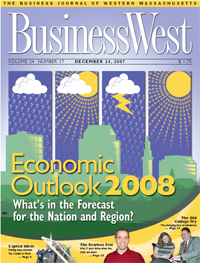
Cover Story
George Condos Wants to Re-energize and Contemporize the Friendly’s Brand
May 28, 2007 Cover

May 28, 2007 Cover

George Condos met his future wife at a Friendly’s restaurant, one he hung out at while growing up in Webster. His parents love the chain, he said, and so do his children. This generational aspect of the Wilbraham-based icon is one of the things that appealed to Condos as he mulled a job opportunity he eventually accepted — president and CEO of the company — as well as a stern challenge: to re-energize a somewhat tired brand.

George Condos was asked for a current copy of Friendly’s lunch/dinner menu for a quick read of its contents.

“Have you got half an hour?” he joked, implying that he wouldn’t put ‘quick’ and this menu together in the same sentence.

Indeed, as he flipped through the menu, and flipped, and flipped, he passed by traditional items like burgers, wraps, baskets, and salads, and eventually reached grilled flounder, steaks, and ‘homestyle meatloaf.’

“This is not what we’re really about — it takes the focus away from what makes Friendly’s great,” he said of those last few items, adding that they are far removed from the company’s core of hand-held food items, the signature Fribble milkshake, and ice cream. They serve largely as a distraction to the customers, but also to managers and kitchen staff who must order and prepare foods that are ordered infrequently at best.

“And this is just one of our menus,” said Condos, fanning out different models for breakfast, desserts, and children. Simplifying and shortening them are just a few facets of a very broad plan that Condos, who took the role of president and CEO at Friendly’s in mid-January, has for re-energizing and contemporizing the 72-year-old chain that has been in the news lately — but for mostly the wrong reasons.

There have been many stories in publications ranging from the Wall Street Journal to the Boston Globe that have chronicled an ongoing proxy fight involving the company’s largest shareholder, lawsuits filed by 93-year-old co-founder S. Prestley Blake against its current chairman alleging self-dealing, and, most recently, the commissioning of Goldman Sachs to explore options for the company moving forward, including a possible sale.

All of the above has become a “distraction” (that’s a word Condos would use often) for the new CEO, who came to Friendly’s after a lengthy stay at Dunkin’ Donuts, where, among other things, he led a repositioning and brand-development effort that more than tripled the number of stores in the Northeast and took sales from $400 million to more than $2 billion.

Just five months into his assignment at Friendly’s, Condos sees several signs of progress. Sales are improving, franchisees are, by his account, expressing more confidence in the chain, and steps are being taken to simplify the menu while adding new products.

These include an Angus beef burger now being tested; iced lattes, with flavors ranging from French vanilla to caramel, which will be private-labeled in most markets, but sold in the Albany area under the name Seattle’s Best Coffee, the company owned by Starbucks; some new cold beverages called tropical chillers to be ready for summer; and a planned new chocolate/chocolate chip ice cream featuring Ghirardelli chocolate.

Co-branding with companies like Ghirardelli and Seattle’s Best is one of the many strategies moving forward, said Condos, adding that marketing efforts will be retooled to reflect the many changes within the chain. They will still emphasize the family aspect of the business, but also focus on the younger audience that is driving many trends in the hospitality sector and society in general.

“We want to increase our relevance with young adults by adding contemporary cold beverages and healthy menu items,” he explained, “and we also intend to improve quality by phasing out low-volume, high-complexity items.”

In this issue, BusinessWest looks at the many things Condos has on his plate as he tries to provide a needed spark for a chain with a glorious past but an uncertain future.

Shaking Things Up

Condos told BusinessWest that he’s probably eating at Friendly’s three or four times a week these days.

He’s now well-known at the restaurant next door to the company’s headquarters on Boston Road in Wilbraham, but, outwardly, just another customer at the many other locations he’s visited. However, he’s not interested in undercover work.

He makes a point of introducing himself and seeking out the manager of every Friendly’s he visits, and comes ready with a long list of questions. These are information-gathering sessions, and to date they’ve been quite eye-opening, with informal reviews running the gamut when it comes to overall grades.

“We have some excellent restaurants, but there is some inconsistency,” he said, adding that bringing all of the chain’s 500 or so restaurants up to the same high level of quality, in terms of food, service, and appearance, would be his broad job description. And this was an assignment that appealed to him when he was approached by a recruiter last fall and asked to consider taking the helm of a chain to which he had both a personal attachment and some professional curiosity.

After all, Condos met his wife, Laurie, at a Friendly’s in the Worcester suburb of Webster. The two were among the many neighborhood teenagers who liked hanging out at the eatery — a tableau repeated in countless communities across the Northeast over the past seven decades.

Indeed, there are now at least four generations that have grown up with Friendly’s. Some of these constituencies have specific needs and tastes, said Condos, adding that the chain’s mission moving forward is to properly address these preferences (lattes, for example) — but without trying to be all things to all people.

This may sound confusing, but for Condos, it’s rather simple. The plan is to focus on core products — ones that appeal to all generations, from those that blog to the one that fought World War II. Meanwhile, he wants to add some new products to the menu that appeal to what he called “young people” without elaborating.
Condos will bring to this assignment some extensive experience with both restaurants and brands. He started acquiring it at Dairy Queen soon after graduating from the University of Vermont with a degree in Business Administration and Management.

“That’s where I learned how to run a restaurant,” he said of his stint with the company, where he eventually assumed the role of regional manager of Operations and Development.

At Dunkin’ Donuts, which he joined in 1986, Condos held a number of positions, including area vice president for the Northeast, U.S., Canada, Europe, and the Middle East, as well as vice president of Marketing, Development, and Operations, and, most recently, brand officer for the chain. In that capacity, he was lead executive for Dunkin’ Donuts in the U.S., and responsible for developing brand strategy and execution for the nearly 5,000 franchised stores, which generated more than $4.3 billion in sales when he left, voluntarily, last year following the second of two ownership changes.

Condos said he wasn’t looking for work — his intention was to begin a career serving on corporate boards — when he was called by the recruiter last fall.
He met several times with the Friendly’s board, and became intrigued with the opportunity to breathe some life into the chain that he knew so well as a customer.

“I believed that Friendly’s had some great opportunity that was not being leveraged,” he said. “I saw a brand that has a unique emotional attachment with its customers that was similar to the two brands I had worked with previously; there are certain brands in the world where the consumer loves the brand, and Friendly’s is one of them.

“As a consumer and an executive within the industry,” he continued, “I saw a number of opportunities where I believed my experience could significantly help the Friendly’s brand.”

The Company’s Bread and Butter

When asked about the board controversy and other matters he lumped in a category of “things beyond my control,” Condos feigned turning off the tape recorder on the table in front of him.

As it continued running, he spoke again of distractions, but how ultimately they weren’t keeping him from his appointed rounds. “It’s a distraction from a time standpoint, but also a distraction for the brand in the marketplace. That said, I was hired to re-energize the brand, and that’s where my primary focus lies.”

Condos said he spoke at length with Prestley Blake — still one of the largest shareholders and one who many say simply can’t let go of the venture he started — soon after he arrived at the company, and talked with him again recently, when the discussion included Blake’s positive review of a visit to a Friendly’s in Florida.
As for the proxy fight, Condos said he can really only watch as matters play themselves out. Texas businessman Sardar Biglari, the largest shareholder with 15% of the stock, asked for a seat on the board of directors last fall, and Friendly’s gave a conditional ‘yes’; it stipulated that he not seek any additional seats. But Biglari refused, and in a letter sent to the board in early March said he and a business partner are running against two incumbents who are seeking re-election at the annual shareholder’s meeting. Billboards calling for the election of Buglari and his partner have gone up in a few locations locally.

And regarding Goldman Sachs’ work, Condos said there are many options that the company will be considering, none of which he cared to discuss in any detail. “We’re not saying that there will be a sale, or that a sale is the only option,” he explained, adding that the review work is expected to be wrapped up by year’s end.

By then, he said, moving on to the many things that are within his control, he expects to be able to qualify and quantify significant progress in his mission to bring more consistency and overall quality to his product — which he described as both the food in the restaurants and the manner in which it is delivered.

This will be a three-pronged approach, focusing on menu choices, service, and the appearance of the restaurants, he said, adding that steps are being taken with regard to each.

On the menu side of the equation, simplification is the order of the day, he said, emphasizing greater focus on handheld items (burgers, melts, wraps, and chicken-strip baskets, for example), cold beverages, including the new iced lattes and tropical chillers, and ice cream. The chain will still offer appetizers, entrée salads, kids meals, and breakfast items, but it will focus its marketing, menu, and operations on the core items.

This approach can be seen with that lengthy lunch/dinner menu, which was actually made one page bigger, with a large insert touting five new burgers, including the tomato pesto provolone and ‘Chicago firehouse’ models. Subsequent inserts will feature other menu staples, said Condos, adding that the new approach is already registering results, with a noticeable increase in sales.

Meatloaf and grilled flounder are still on the menu, but perhaps not for much longer.

“Those are not core to what Friendly’s is, and continuing to expand in that direction is a distraction from the main part of the menu; it makes it more complex and harder to execute,” said Condos, adding that it took years for the Friendly’s menu to get large and complex, and the process of reversing that trend won’t happen overnight.

As for service, the company is introducing something called the ‘Friendly Service Way,’ a model designed to vastly improve the company’s recent poor grades in customer service, at least as measured by Consumer Reports.

“When your brand name is Friendly’s, you absolutely have to be the leader in the industry around what great, friendly service looks like, ands that’s what we intend to do,” he said. “I’ve recognized a big opportunity for us to improve our operating standards within the restaurants.

“My own experience and my own research shows that we have some inconsistent restaurants,” he continued. “We want to significantly improve the guest experience through speed, cleanliness, and friendly service.”

Meanwhile, many of the restaurants will be getting a new, more contemporary look, said Condos, adding that the same can be said of the company’s marketing images.

In the past, the company has focused on families, generations of same, and the great Friendly’s tradition, he explained, adding that while this has been somewhat effective in generating sales, a stronger emphasis on food, including tight, close-up images of specific menu items, will be much more so.

While addressing the menu, service, and the look and feel of the restaurants, Condos is also focusing on the broad and important matter of franchisee-relations, a task that took on even more significance after it was announced that the strategic initiatives to be explored would include a sale.

Condos said he has met with franchisees individually and at district meetings, and believes he’s generating some enthusiasm and support for his plans moving forward.

“They’re supportive of the brand, they love the brand, and they’re looking forward to sales-building initiatives that my team and I are working on, including a stronger focus on the core part of the menu,” he said. “They’re also excited about improvements in our marketing creatives.

“One of my first priorities was to develop a great working relationship with the franchisees,” he continued. “Coming out of 30 years of being in the franchise business, I know how important such a relationship is to re-energizing this brand.”

That’s a Wrap

As he talked with BusinessWest about his plans moving forward, Condos displayed the new rounded tubs, called “squrounds,” that started serving as containers for half gallons of ice cream earlier this spring.

They replace the rectangular cardboard boxes, or bricks, that have been used almost since the company’s beginning. The change wasn’t a slap at tradition, but rather an acknowledgement that the boxes simply weren’t customer-friendly, or at least as much as the new model.

“Have you ever tried to use a round scoop in a square corner?” he asked. “It doesn’t work.”

Neither, apparently, does grilled flounder. At least not at this chain, which is trying to shake things up and simplify them at the same time.

George O’Brien can be reached at[email protected]
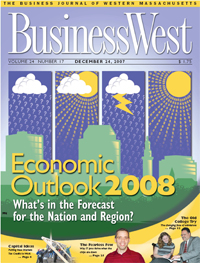
40 Under 40 Class of 2007 Cover Story
Age 39. Vice President of Marketing, Spalding

Dan Touhey was working in marketing for Bayer, specifically on ways to promote Alka-Seltzer Plus Cold Medicine — and, in his words, looking for a way out.
A recruiter called him about a product manager position at Spalding, but did so with a cautionary tone. “He told me I had good experience, but not industry experience, and the company wanted someone who knew the business,” Touhey recalled. “I said, ‘I’ll tell you what … I’m a fanatic about basketball and sports in general; if you get me in the front door, I’ll do the rest.’”

He did, and Touhey has.

Over the past decade, he has played a lead role in rebranding Spalding, developing the tag line True to the Game, and rolling out (literally) many new products, from the Infusion™ line, which puts the inflating pump inside the ball, and the Neverflat™, a name that says it all. In so doing, Touhey has helped Spalding, known primarily as a “golf company” when he arrived, return to its roots as a leading sporting goods manufacturer.

Touhey’s work takes him across the country and around the world, but he still makes time for civic involvement. After a year of hard training, he ran in his first Boston Marathon last month as part of Tedy’s Team (named for New England Patriots linebacker and stroke victim Tedy Bruschi), on behalf of the American Stroke Assoc. That’s a cause he embraced after his father suffered a stroke last year. “I always wanted to run the marathon, but never had the inspiration,” he said. “Now, I have plenty.”

Touhey is also on the advisory board for Good Sports, a group that takes donations from sporting goods manufacturers and gives them to communities and individual schools in need, and started coaching tee-ball this spring, with the older of his two boys taking a roster spot.

A basketball player in high school and also during his last year in college (spent in Ireland), Touhey is a big believer in teamwork. He credits others at Spalding and Lenox-based Winstanley Associates for helping create ‘True to the Game’ and launch products that help the company live up to that slogan.

But he is the leader of the team, and has been since he was able to make his way through Spalding’s front door.

Cover Story
Age 39. Director of Sales, WMAS AM/FM Citadel Broadcasting

Craig Swimm didn’t see it as a step backward.

Well, OK, from an immediate salary standpoint it certainly was, but not, in his mind, from a career development viewpoint or from the perspective of what was best for his family — although he was more than a little worried about what his wife, Sigrun, would say or do when he told her the news: he was leaving a position as a warehouse supervisor, delivering refrigerators for the old Lechmere store in Springfield, to do sales and marketing for radio station WARE.

He recalls her saying, “what have you done?!!” or something to that effect.

By Swimm’s estimations, he was taking a $25,000 pay cut to do something he’d never done before. But he was nothing if not confident — and adventurous. And he never looked back. Nor, apparently, did Sigrun, an Icelander whom Swimm met while stationed at Keflavik Air Force Base during Operation Desert Storm.

The Swimms and their daughter, Sonja, make at least one trip to Iceland a year — Christmas, Easter, or both. This year, it was Easter, a trip Swimm was looking forward to after another hectic year balancing his duties as sales director of WMAS AM and FM and community work that includes work on the boards for FutureWorks and the Salvation Army.

He told BusinessWest that he enjoys sales, and that when it comes to selling media, he gets an education in how businesses across virtually every sector operate, and how advertising helps them get their message across. And in the ‘life-is-ironic’ category, he remembers applying for a job selling vacuum cleaners at Lechmere, but being told that he didn’t have the personality for sales.

When asked about Iceland, Swimm said it’s a place everyone should put on their ‘must-visit-someday’ list. “It’s a wonderful country,” he said. “It’s extremely clean … there’s no pollution, and the people are incredibly friendly.”

That said, he advises visitors to be aware — and maybe wary — of one of that country’s traditions: an offering to a houseguest of a little vodka (from the freezer) and a large bite of shark meat.

“The vodka’s OK,” he said, “but the shark is the most horrible-tasting thing you can possibly imagine.”

40 Under 40 Class of 2007 Cover Story
Age 33. Owner, the Western Mass. Sports Journal

13:50. That’s the time, in hours and minutes, that Tad Tokarz posted in the first Ironman triathlon he raced in two years ago. That’s how long it took him to complete the 1.5-mile swim, 120-mile bike ride, and 26-mile run. Tokarz remembers his time, but it is of no real significance to him. “My goal was to finish, and I did.”

He also remembers the winner’s time — sort of. “It was around 8 1/2 or 9 hours … which is simply incomprehensible.” That’s a word that many might apply to Tokarz’s performance as well, especially when one considers that two years before the race, he couldn’t swim more than two laps in the pool and didn’t own a bicycle. “It was just something I set my sights on, and I accomplished it.”

This is essentially the same approach he’s taken to an intriguing entrepreneurial venture called the Western Mass. Sports Journal, which, as the name implies, provides coverage of sports at a variety of levels, but always with a Pioneer Valley slant. Tokarz, who by day is the assistant principal and director of Athletics at Springfield’s Central High School, thought many of the good stories at his school and many others in the Valley were simply not being told. So he created a forum in which they could.

The Journal, now located in the Scibelli Enterprise Center at Springfield Technical Community College, and grown through the help of administrators there, has become almost another full-time venture for Tokarz, who must still find time to train — he starts each day at 4:30 a.m., is in the gym by 5, and works out twice each day during the summer — and also for community involvement. He’s on the board of the South End Community Center in Springfield, and donates time and energy to the Ludlow Boys and Girls Club and the Jimmy Fund, among other groups.

He told BusinessWest that the strict workout regimen has helped him organize his time and stay focused on goals and strategies to achieve them — both at Central High and the Journal. “Nothing worthwhile ever comes easily — when I trained for the Ironman, that was a year-long endeavor; we used to go on bike rides for eight hours,” he said. “That experience translates directly to the work I do in school and in publishing.”

Cover Story
Age 26. Senior Marketing Manager, Eastfield Mall

While the rest of New England was slogging through a long, cold winter, Jillian Gould was building a beach.

Sure, the 400-square-foot sandbox was inside Eastfield Mall in Springfield, and there weren’t any splashing waves, but that didn’t matter to the children on winter break who got a chance to escape the chill, if only for an afternoon. And if it got their parents into the mall, then Gould — the facility’s senior marketing manager — was pleased about that, too.

“It’s gratifying when we do things for families,” she said. “We really gear many of the events for children, but we involve the whole family, and we love to see the joy the kids have when they come here.” The sandbox, beach toys, dancing, and ice cream-eating contests of February’s nine-day beach blowout fell into that category.

Gould, at 26 one of the youngest members of BusinessWest’s inaugural Forty Under 40 club, has come a long way with Eastfield Mall since interning there in 2001. She was hired as marketing manager in 2004 — “I was looking for a new job, and we had kept in touch” — and promoted to senior marketing manager in 2006, overseeing marketing efforts for both the Boston Road complex and the Eastern Hills Mall in Buffalo, N.Y. And that means keeping track of mall traffic and helping to develop events and campaigns to keep it flowing.

“I like how often this job changes,” Gould said. “Every week, we’re doing something different, so it never gets monotonous. And I like to work with the creative people who put together our print ads and television commercials.”

In fact, working with other business people has become a particular interest for Gould, who co-chairs the Boston Road Business Assoc., in addition to a slate of other activities with the Affiliated Chambers of Commerce of Greater Springfield, the Ad Club, and other networking groups. Starting in March, she headed up the Eastfield Mall team for the ACCGS’ Total Resource Campaign, an annual effort to increase awareness of and membership in the chamber.

Staying that active is no walk in the park. But it’s sometimes a walk on the beach.

“The beach week isn’t something you see every day,” she said. “Kids stayed for hours, while the moms got to talk to other moms” — and spend money in the stores, of course. It’s not all fun and games, after all.

Cover Story
Age 32. Executive Director, Child and Family Services of Pioneer Valley

Securing an executive director’s position at 31 is a feat that requires discipline, drive, and balance.

Michelle Theroux, executive director of Child and Family Services of Pioneer Valley, says she acquired those traits earlier than most, through the rigors of dance practice and performance. Theroux began studying tap, jazz, and ballet at age 5, and added dance instruction to her repertoire when she was 16. Some exciting years followed, when she was asked to tour nationally in a jazz-based children’s show. For five years, Theroux jetted around the country on weekends and during school vacations, while working toward two bachelor’s degrees at Assumption College, in Psychology and Political Science.

She mulled careers in psychology and law before realizing her passion and strengths lay in human services. And while dance remains an important focus, Theroux said life as a professional performer was something she outgrew when her touring years ended.

“Those are experiences I will never be able to replicate,” she said. “But on a full-time basis, living from audition to audition … that part of the life never appealed to me.”

What did appeal to her were the opportunities to see the world and expand her knowledge base in her late teens and early twenties, as well as the strength of will and of mind she acquired. “I think studying the arts in general provides a lot of discipline,” she said, “and when I started to be pulled more into the human services field, I realized that my life experiences were going to help me.”

Theroux has previously worked as a clinical supervisor at the Gandara Center of Springfield, and later with the regional family services agency The Key Program, as a senior manager. Theroux took on her role at Child and Family Services last year. This is a nonprofit agency with many moving parts, offering counseling and assistance for families, people with disabilities, and immigrants and refugees, among other groups.

In addition, she serves as an adjunct professor within the Psychology Department at Springfield College, and continues to teach dance to children.

“Now, dance is sort of my balancing piece,” she said. “It evens out stress. Still, in my life, sleep is optional.”

Cover Story
Age 30. Head of School, Academy Hill School

Jake Giessman has always been a thinker. Now he’s a doer, too.

“I had intended to become a professor of philosophy,” he said, “but I think at some point in my education, I began to feel like I had answered a lot of the questions I had about life and the world, and I wanted to move toward a more practical task.”

Did he ever. When he and his wife moved from Missouri to Western Mass. in 2001, Giessman took a job teaching fifth and sixth grade at Academy Hill School, a Springfield-based facility for gifted children. He eventually spearheaded a campaign to expand upon the elementary-school program by adding a seventh and eighth grade as well, and by last year he had risen to the rank of head of school — all before age 30.

He qualified his use of the word “practical,” however. “Working in this school is not really a daily grind. We’re doing a lot of thinking and questioning, and the kids do that, too. But having this job has been an extraordinary opportunity for me to learn about business, organizational management, communications — things that hadn’t been part of my background. I’ve easily learned more in my time at Academy Hill than in all my formal studies.”

Giessman’s a big believer in private-school education in general, with its small class sizes and freedom from public policy and standardized testing, but especially proud of Academy Hill’s constituency. “We serve kids who are really good at learning and really motivated. It’s a building filled with adults and kids who are excited and skilled at the enterprise of education, and that in itself allows us to achieve more than even other independent schools.”

With degrees in Philosophy and Environmental Studies — the latter emphasizing policy and moral philosophy surrounding environmental issues — Giessman says he wanted an education that shaped his values and way of thinking about the world.

“There are thinkers, and there are doers,” he said. “At a very early age, I felt it was important to do my thinking before I started doing my doing. So many people start down career paths and at some point look back and realize they haven’t answered fundamental questions about their beliefs, goals, and values that drive them in their work life.”

Giessman isn’t saying he has all the answers. But if he needs any, he has plenty of smart kids to ask.

Cover Story
Age 35. Vice President of Resource Development, United Way of the Pioneer Valley

Sarah Tanner was on course for a career as a speech pathologist when a part-time job with a unique, student-run, nonprofit venture at UMass-Amherst started her in a different direction.

It was called the Peoples Market, a grocery store known for its coffee, bagels, fresh fruit, and loud music that could be heard in every corner of the Student Union building, said Tanner, adding quickly that it wasn’t so much what the business did, but rather how it was run that attracted her. “Everything was done by full consensus,” she said. “There were 26 of us in the co-op, and we got a consensus on everything, right down to where we got the apples we sold.”

Inspired by her work at the Peoples Market, Tanner would eventually pursue a graduate degree in Public Administration at the University of Colorado — she relocated to the Rocky Mountain State with her husband, Mark, the other half of the only husband-wife team to make the Forty Under 40 list — and a specific course of study in nonprofit management.

And she’s spent the better part of the past decade in various capacities with four different United Ways — the Mile High facility in Denver, New York City (where Mark served as assistant district attorney), Hampshire County (after the couple returned to Western Mass.), and, currently, the Pioneer Valley chapter. There, she serves as vice president of Resource Development, and oversees all aspects of the organization’s $6 million fundraising campaign.

As her career path would certainly indicate, Tanner is a true believer in the United Way mission. “What I like most is the potential that’s there to really make some systemic change in communities,” she said. “And at each United Way I’ve worked at, they’ve had a unique angle that they take, and it’s always been appealing to me.

“In New York, it was about helping people help themselves — they really pushed self-sufficiency, and it was really gratifying to be part of that,” she continued.

Here, I think we’re still trying to define what our product is because there’s been so much change in the community, and so much need. We need to define what our role is, but the potential is there, and it’s immense.”

Cover Story
Age 36. Owner, Del Padre Visual Productions

Nino Del Padre hasn’t answered a casting call in a while. That’s because most of his time these days is devoted to his business, East Longmeadow-based Del Padre Visual Productions, and the bulk of the rest goes to his family.

But years ago, Del Padre managed to get his name in the credits for several movies, some more memorable than others. He played a witness in Before and After, filmed in Springfield, and could be seen getting in and out of a buggie with his ‘wife’ in Amistad. In Whipped (that’s one of the more forgettable ones), he played both a waiter and an Italian bicyclist.

The bit parts came with perks — he met Steven Spielberg, who directed Amistad — and Del Padre is now the proud owner of a “Bacon number of 2.” Roughly translated, there are but two links between himself and the actor immortalized in the parlor game Six Degrees of Kevin Bacon.

But Del Padre is much better-known for his work behind the camera and at the computer, for a company he started in the walk-in closet of his mother’s apartment when he was 20. The early work was in videotaping and editing weddings, but these days, the client list includes NASA and LEGO, and the work ranges from marketing and presentation items to documentary projects.

Speaking of time, Del Padre says he keeps strange hours — he starts around noon or 1, works till 7 or 8 p.m., naps for an hour, and then works some more until 3 or 4 in the morning — and works almost exclusively at home. “The first time, it was an accident; my wife was sick, so I worked from home. I was so hugely productive that I kept doing it, and now I’m addicted to that productivity.”

He’s making the most of that time, with his business — which is gaining a national and international reputation for cutting-edge work — and within the community, where Del Padre has donated energy and imagination to groups and efforts ranging from the East Longmeadow Chamber of Commerce to the town’s time capsule project.

Looking ahead, he says he wants to do more work on both sides of the camera. Who knows? Maybe someday his Bacon number will be 1.

Cover Story
Age 33. Director of Human Resources, the Princeton Review

Carin Zinter says most people take the SAT (Scholastic Aptitude Test) once, maybe twice, and that’s certainly enough for a lifetime.

“Most say it’s an experience they wouldn’t want to repeat if they could avoid it,” she said, noting quickly that she has to take the test at least once every year as part of the process of staying certified to tutor young people in how to take the SAT and other standardized tests, and to train those who do the tutoring.

And Zinter, director of Human Resources for the Princeton Review, doesn’t seem to mind; you wouldn’t either if you scored 2,390 out of a possible 2,400 on the last go-round.

There are many factors that go into notching a score like that, she said, including an ability to avoid some of the pitfalls that test designers incorporate into their work.

“You have to know a lot about testing strategy,” she explained. “You have to be skilled in knowing how to pace yourself and find the shortcuts that test writers don’t really want you to find in order to answer questions as quickly as possible.”

Zinter has been posting some impressive numbers outside her work as well. Like many other members of the inaugural Forty Under 40 club, she likes running long distances. In her case, it’s triathlons (specifically, half-Ironmans, featuring a 1.5-mile swim, a 56-mile bike ride, and a 13.1-mile run) and ultra-marathons, with 50 miles being the norm for the races she enters.

“You get a lot of alone time during events like that,” she said, adding that she uses it to contemplate her work and her many contributions to the community, including participation with the Women’s Partnership, Dress for Success, and other initiatives — and maybe do some mental studying for the next SATs.

Zinter has a theory about why so many young professionals are being drawn to distance racing and other extreme tests of their mind and body.

“When you’re talking about people who like to dedicate themselves to something like their job or their own business, that type of mindset works out to make for great endurance athletes,” she theorized, “because we like to heap abuse on ourselves for several hours at a time, and it seems to somehow end up as some sort of perverse fun.”

Like taking the SAT every year.

Cover Story
Age 35. Attorney, Egan, Flanagan, and Cohen, P.C.

There are two cases that stand out in Katherine Pacella Costello’s mind as defining moments in her career.

The first came relatively early, just six months after she signed on with the Boston law firm Pepe & Hazard. She was assigned to defend a lawyer accused of malpractice; the client was her boss. “It was my first major deposition, and very stressful,” she said. “Those were some the most grueling arguments ever.”

But when a 48-page decision was returned in her favor, Costello, who said she takes her cases personally enough to lose sleep, was able to rest on her laurels — though not for long. Soon, a second case landed on her desk, this one spanning six years of her career with Pepe & Hazard.

“There were many people involved, but I was the person who was there from beginning to end,” said Costello, now an associate with Egan, Flanagan, and Cohen of Springfield.

That case involved a power plant developer and a contractor, who disagreed — vehemently — regarding the terms of a $217 million construction agreement. After years of hearings, depositions, and mile-high stacks of paper had accumulated, Costello and her colleagues finally won that case, and the decision was affirmed on appeal. She heard the news while on maternity leave, having given birth to her daughter, Alessandra, now 3, in the thick of the proceedings.

Those personal victories validated Costello’s career choice, which she’d decided on by her teenage years, following the example of her father, also a lawyer.
Today, Costello’s career remains fast-paced, but she has a more robust home life, which has created a satisfying, yet delicate, balance. “My daughter is the light of my life,” she said, noting she has another baby on the way, due in June. “Children really change everything, and I wouldn’t trade that for anything in the world.”

She’s thrown herself into motherhood with the same fervor as she has her career, active as an event coordinator for a local mom’s club. She said she’s always been careful to choose employers who value the ability to lead a well-rounded life as much as she does, and that has augmented her success.

“One person cannot create that balance,” she said. “It has to be a group working together: employer, employee, family, community. As long as work and family are treated as equally important, I feel fulfilled.”

40 Under 40 Class of 2007 Cover Story
Age 31. Editor, Turley Publications

Sarah Tsitso has always surrounded herself with words.

She says she can’t imagine a career that doesn’t involve writing, and has a strong respect for and commitment to community journalism. Beyond that, she’s an avid reader who founded a book group for women last year, to serve as an outlet for those looking to delve deeper into literature, or others who needed an audience to share their insights into favorite books (she’s a fan of the Brontë sisters: Emily, Anne, and Charlotte).

An unexpected gesture from her grandfather best puts Tsitso’s love for language into perspective, however. He presented her with a vintage Oxford English Dictionary, a gift that brought her to tears.

“Who cries over a dictionary?” she joked. “I guess it’s because language has always been treated with so much importance in my family. Words are in my blood.”

But building vocabulary isn’t Tsitso’s only interest. She champions a number of causes, including women’s rights (she’s a member of NOW), environmental preservation, and responsible government. And although she completed her coursework toward a bachelor’s degree at Simmons College in four years, she had five majors in that time: Philosophy, Environmental Science, Political Science, Secondary Education, and, finally, American Literature.

“Journalism was my third job out of college, and I fell in love with it,” she said. “There is time to learn, and to tell a story.” She began as a reporter at Turley Publications in Palmer, which owns 15 community newspapers across the region. Soon, Tsitso was promoted to editor, and has worked with three different papers since then, either growing long-held publications or launching a new one.

She’s twice been recognized by the New England Press Assoc. for her work, and continues to study the craft through professional development, having recently attended the American Press Institute’s prestigious management-training program. Tsitso also enjoys teaching, both formally and informally. She leads journalism courses for adults and children, and regularly celebrates words in all their forms with her two-year-old daughter, Vivian.

“Vivian is a huge reader,” she said, noting that while Vivie isn’t ready for Brontë, they’ve started with a different Charlotte — one who lives on a farm with her best friend, a pig named Wilbur.

“We’re doing the chapters together at night,” said Tsitso. “But no matter what time of day it is, there’s always a book in her hand.”

40 Under 40 Class of 2007 Cover Story
Age 37. Vice President of Operations and Facilities Management, Cooley Dickinson Hospital

Richard Corder has spent the past few years leading two major construction projects: a $50 million expansion of Cooley Dickinson Hospital — and a tree fort he is building with his 10-year-old son, Harrison.

He is extremely proud of the fact that, with regard to the former (completed just a few weeks ago), he could consistently report that it was on time and on budget. And he’s equally proud that, when it comes to the latter (still ongoing), he can say neither. “There never was a schedule, and there never was a budget, which is good, because having either would take a lot of the fun out of it.”

Corder has managed to pack several different kinds of fun into his balance of life and work since he came to CDH as director of Guest Services in 2000, and has since been promoted twice. A native of Nottingham, England who immigrated to the U.S. in 1993 and spent many years in the hospitality sector before seguing into health care, Corder likes brewing his own beer, collecting and drinking fine wines, cooking, arranging flowers, and sailing, which is one of his few regrets about relocating to the Northampton area. “I can only do it maybe once or twice a year.”

Being farther away from the ocean than he would like is about the only thing Corder can complain about these days. He’s enjoying every aspect of being a husband and father of two, and has found a great measure of fulfillment in his work at CDH, especially the expansion project, which he called a career milestone.

Actually, he summoned a good number of adjectives to describe the massive addition, planning for which began soon after he arrived at the hospital. “When I look back on my career thus far, it’s probably been one of the most exciting, rewarding, challenging, frustrating, joy-filled, professional endeavors I’ve been involved with.

“To have been permitted this opportunity is something I’ll never forget,” he continued. “I’ve learned a lot personally, and we’ve learned a lot as an organization.”

As for the tree house … “my wife was walking around for a year saying, ‘I could have bought a new couch,’” he joked. No word yet on when it will be completed. As he said, there’s no timetable, and he likes it that way.

40 Under 40 Class of 2007 Cover Story
Age 34. Assistant Vice President

Her maiden name is Liptak, and Amy Caruso has dedicated herself to living up to it.

In the Westfield area, she explained, the name Liptak, with its mere mention, brings large doses of history, tradition — and expectation for service to the community. Indeed, her grandfather, Louis Liptak Sr., was the long-time director of a city landmark, Stanley Park, who also donated time and energy to numerous groups and could be counted on to play Santa Claus every year at gift-distribution programs for needy families. Countless other members of the family have given back in a number of ways, including Caruso’s recently deceased second cousin, Adam Liptak, who was a long-time city councilor, Kiwanian, and, coincidentally (or not), another Santa Claus.

Caruso played the flute at his funeral service in March — she’s been an accomplished flautist for many years — but she’s honored her cousin and her family name in many other ways. Now an assistant vice president in MassMutual’s Financial Products Division, Caruso donates time to several groups and causes, always with the goal of doing what her former boss and mentor, the late Richard Stebbins, longtime president of BayBank, told her to do. When contemplating how to give back to the community, he said to find ways to make an impact.

“He told me I could either do a lot of little things or a few big things that would make a difference,” she explained, adding that she is attempting the latter though involvement with such groups as the Hampden Hampshire Housing Partnership (HAP), which she serves as a Fund Development Committee member.

In her capacity at MassMutual, Caruso is a compliance officer and oversees new product launches. She joined the company in 2000 as a participant in its Executive Development Program, rotating through various marketing, sales support, and operations roles in Retirement Services, Disability Income, the firm’s broker-dealer, and Annuities.

During that progression, and at previous career stops at Baybank and Sovereign Bank, she always found time to get involved with such groups as the Springfield Symphony Orchestra Marketing Committee, the Brightside Angels, the Westfield Community Band, the Western Mass. Chapter of the Hugh O’Brien Youth Foundation, the YMCA of Greater Springfield, and many others.

Needless to say, Louis Liptak Sr. and Dick Stebbins would be proud.

Cover Story
Age 32. Director of Marketing, Fathers & Sons Inc.

She calls it the “convertible bra.”

Kim Cartelli Matthews started conceiving it while attending the Fashion Institute of Design & Merchandising in Los Angeles in the early ’90s. Simply put, it’s a bra with straps that can be adjusted to accommodate a variety of tank top neck designs. There was nothing exactly like it on the market when Cartelli Matthews — who once fashioned bra straps out of mint dental floss to resolve one wardrobe challenge she encountered — first proposed the concept before members of an entrepreneurship class. And there still isn’t, although she’s working on it.

But the drive to bring the bra to market has taken a back seat to Cartelli Matthews’ work with the family business, luxury car dealer Fathers & Sons Inc., for which she serves as marketing director, and also to her extensive community work, which includes service with groups ranging from the United Way to the American Heart Assoc.

Cartelli Matthews appears in many of the dealership’s radio ads, identified as “the daughter at Fathers & Sons.” Those are words she never thought she would utter when she was younger. “People kept asking me if was going to work for the family business,” she recalled. “I always said, ‘hell, no!’”

But when her father, Robert Cartelli, asked if she would help out with marketing and facilitate the company’s move into its new dealership on Memorial Avenue in West Springfield in 2002, the answer was ‘yes.’ And that was the same reply she gave her father a few years later when he made a counterproposal after one of the designers Cartelli Matthews was working with to bring the convertible bra to the marketplace offered her a job in New York.

‘Yes’ has also been the common response when she’s been asked to serve area non-profits. One of her current, and more exciting, assignments has been with the United Way to help it launch the “Young Leaders Society,” which is being created to identify the next generation of business and civic leaders in Western Mass.

Probably the only time Cartelli has said ‘no’ lately was when asked if she had given up on the convertible bra.

“I’m still trying,” she explained. “It was a great idea then, and it’s a great idea now. I just have to make it happen.”

Cover Story
Age 34. Vice President of Marketing and Community Relations, United Bank

Dena Hall describes efforts to meet the many demands of her job, while also making time to give back to the community, root on the UMass men’s hockey team (she and her husband, Eric, have season tickets), and walk the couple’s boxer, Crickett, as the quintessential balancing act.

And it’s one that will soon add another, very challenging dimension: she and Eric are expecting their first child in about four months.

But Hall has always displayed a real talent for multi-tasking (she majored in Journalism and minored in History at UMass) and also for setting and meeting goals. One she put down years ago was to be a senior officer at a major bank. She accomplished it at age 32 when she became vice president of Marketing and Community Relations for United Bank, the federally chartered stock bank based in West Springfield that recently reached a key industry benchmark — $1 billion in assets.

As the title would indicate, there are two distinct aspects to Hall’s duties, and both involve putting the bank’s best face forward. She handles the institution’s marketing budget, and also manages the Investor Relations program for United Bancorp, the holding corporation for the bank. She also serves as president of the United Bank Foundation, which currently awards more than $200,000 annually to area nonprofit agencies and community-based organizations.

Hall is quite familiar with many of them.

She is on the board of directors of the Business Friends of the Arts and the Westfield Boys and Girls Club, while her husband is on the board at the Greater Westfield YMCA, and she’s become involved with that organization. Hall is also a member of the board of directors of the Springfield Chamber of Commerce and the board of trustees of Noble Hospital, and is an active member of the Greater Springfield area Funder’s Forum.

With one key career goal already met, Hall jokes that she has a new one already in the formative stage: to retire in a fashion similar to her predecessor at United, Jack Briggs, now criss-crossing the country with his wife in an RV.

Fortunately for the Pioneer Valley and a host of area nonprofit groups to which she donates time and energy, that day is a ways off.

Cover Story
Age 32. President and Owner, Zasco Productions

Michael Zaskey’s career began at age 11, when his father brought home a camcorder, and Zaskey immediately dove into the box.

After learning his way around the camera, he devoted much of his time to amateur filming, until one of his dad’s co-workers gave Zaskey his first break that same year. He taped her wedding, and later, one of the bridesmaids asked him to tape hers, as well. A business was born.

“By the time I got to high school, I was videotaping about 40 weddings a year,” he said, adding that he and his father officially established Zasco Productions when he was 15.

Many years later, Zaskey hasn’t changed his habits much — he still loves new technology and still takes the time to learn how to use every new piece of equipment he procures. But what has changed are the trappings. Zaskey, who began his enterprise in his parents’ basement, has recently moved from a small office into a new, larger space on McKinstry Avenue in Chicopee.

The business has also shifted, from video production to live events, for which Zasco provides audio-visual, multi-media, and lighting services. The current client list includes Springfield Technical Community College, Baystate Health, Big Y, LEGO, the Sisters of Providence Health System, and dozens of others.

“I love my job even at the most stressful times,” Zaskey said. “It continues to be a hobby for me — if I don’t have anything I have to be doing on a Saturday, there’s still a good chance I’m in the office, playing with equipment.”

That passion has led to some unique business practices, such as weekly training sessions with his employees, and it has earned Zaskey some accolades, including being named the Chicopee Chamber of Commerce’s Business of the Year for 2007.

Moving forward, Zaskey said he’s focused on controlled growth for his company, aiming to progress without losing the ability to take an active role at clients’ events. He also credits his team, some who’ve been with him since the basement days, and his parents, and hopes to give back to friends, family, and community.

He also never wants to lose the joy his job brings. As a child, he said he was more amazed by the lighting displays at Disney World than the characters. Today, he’s an avid concert-goer, but still often looks away from the band — to check out the production pit.

Cover Story
Joseph Pacella

Joseph Pacella has never been at a loss for words. He blames his father.

“My father was a lawyer, and we had spirited dinner-table discussions,” said Pacella, an attorney with Egan, Flanagan and Cohen, P.C. in Springfield. “I always looked up to my father, and I always had an answer for everything — probably to my parents’ chagrin.”

Still, he and two of his siblings followed their father into law, so those household debates had an impact. Today, Pacella tries to have a different kind of impact on the clients he serves — the plaintiffs and defendants in criminal and civil litigation.

“Much of the practice of law is a lot like social work,” he said. “In many criminal cases, you’re getting the defendant to understand what needs to be done in their lives regarding counseling, probation, and so on. Understanding the consequences of your actions can be a powerful thing. Even in a civil case — such as when someone breaches a contract with you — it has to do with managing personalities and helping the client make the best decision, regardless of emotions.”

Pacella said he’s always had a heart to help others — a sensitivity no doubt honed by his work as a domestic violence prosecutor in the late 1990s and his involvement with Big Brothers Big Sisters; he was named Hampden County’s 2003 Big Brother of the Year.

“That program does such a great job of matching people,” he said, recalling a middle-schooler he took under his wing several years ago who recently turned 21. He chuckled at the “psychological battery” the organization put him through during the screening process — “as a former prosecutor, I considered myself a safe choice” — but still admires the way the group tries to fill specific needs, not just rubber-stamp matches. It’s the same kind of care Pacella has given to his other community-service efforts, from serving on the board of Mont Marie Child Care Center to his work with Safe Passage, an organization that helps victims of domestic violence.

“I always had an interest in doing things like that, even in high school and college,” he said. “My parents instilled in us a desire to reach out to people who are less fortunate and do what we can to improve our community.”

We’ll bet he didn’t have an answer for that.

Cover Story
Age 35. Co-owner, Robert Charles Photography

Ed Zemba has one of those mental to-do lists that people take with them through life, and he’s managed to draw lines through many of the items on it — like scuba diving and skydiving.

The latter was a father-son undertaking, and Zemba entered it thinking he wanted to go solo, or as close to that as he could. Most first-timers do what’s called tandem jumping, where they’re essentially strapped to an expert who does most of the work involved. “You’re just along for the ride,” said Zemba, who took a different tack, involving what are known as “spare tires,” experts who hang on to the first-time jumper until the ripcord is successfully pulled and then depart to let the jumper take the trip down alone.

One item not on Zemba’s to-do list, but he did it anyway, was to join the East Longmeadow Rotary Club. He did so before he could legally drink — which was problematic, to be sure — and took large doses of ribbing from club members, who, he said, regarded him almost as a mascot. But he also learned invaluable lessons about life, business, giving back to the community, and being part of a team.

He’s applying all of them as co-owner of Robert Charles Photography in East Longmeadow. Zemba and the other co-owner, brother Robert, purchased the business from their father two years ago after both working at the venture for most of their adult lives. Together, they’re trying to bring consistent, measured growth to a business that focuses on portrait, wedding, and commercial photography.

Both are involved in most aspects of the business, but Ed’s duties are more administrative in nature, while Robert’s are more artistic — he’s one of several who handle the photography for the company, and he’s won a number of awards for his work.

While managing the business, Ed is busy drawing a line through another item on his list — getting a college diploma. He’s enrolled at Western New England College and is making progress toward a business degree. He’s also finding time for his four children; he likes taking each on personalized junkets, and recently took one of them to the New England Air Museum at Bradley Airport.

Hang gliding. That’s still one more thing on that to-do list, and given everything else on Ed Zemba’s plate, it may have to wait a while.

Cover Story
Age 39. Dean of the School of Arts, Humanities and Social Sciences, STCC

Arlene Rodriguez was born 143 years after Daniel Shays died.

But she feels like she knows the Pelham farmer whose name was permanently attached to the insurrection of 1786-87, which stirred fear in Gen. George Washington and gave strong impetus to the Constitutional Convention.

Such familiarity was but one byproduct of a special project she co-organized last fall on Shays’ Rebellion, one important act of which was played out only a few hundred yards from the Springfield Armory. It was that landmark which, upon its closing, was converted into Springfield Technical Community College, where Rodriguez serves as dean of the School of Arts, Humanities, and Social Sciences.

In that capacity, she has been involved in a number of other programs — from a partnership between STCC and the Community Music School to Rosa Parks Day events to organizing activities for Hispanic Heritage Month — that characterize both her community-minded spirit and her belief that learning takes place inside the classroom and out.

And such learning mustn’t end with a college diploma, she told BusinessWest, adding that the Shays program, Reconsidering the Debt: Scholars Revisit Shays’ Rebellion, offered keen insight into the man who led the revolt and the so-called Regulators who fought beside him.

“Scholars came together and talked Shays all weekend; it’s a great story, and it happened right here,” she said. “I think it’s fascinating, this idea of people getting together and voicing their opinion about something and fighting or arguing with the government; that’s a concept that’s truly international.”

Rodriguez taught courses ranging from English Composition to Latino Literature at the college for a number of years before becoming dean in 2005. She credits deans she worked under with instilling an imaginative, outside-the-box approach to education and teaching.

“I had some great deans who never told me ‘no,’” she said. “They were great role models.”

In her spare time, Rodriguez likes to read (she prefers history and fiction and is fond of the works of Japanese author Haruki Murakami) and write — she’s penned several short stories, most about her parents and life in their hometown of Aibonito, Puerto Rico.

As for the story of her career and her involvement in the Greater Springfield community — there are obviously many chapters still left to write.

Cover Story
Age 33. Professor/Tax Manager, UMass Amherst and Meyers Bros. Kalicka

Catherine West recently returned from an intriguing junket to Ireland.

She was there with 23 business students from UMass, where she teaches Accounting, as part of an ambitious program called Business Development and Conflict Resolution — Ireland, a 10-day exercise designed to provide an education in that island nation’s business, culture, and trade.

And that wasn’t the first time West’s passport was put to use this year. In January, she made her fifth trip to the West African nation of Ghana. She was there with 26 UMass business students who taught basic business skills to students during the day, and held seminars on business development at night for residents of the local towns.

In the Ghanian city of Secondi, West has led efforts to create something called the Business and Learning Center, a business school that has taken some time to develop, but is providing her with hard evidence of how a few people can make a big impact.

“It’s very hard to see change and improvement in a developing country because getting funding takes forever,” she explained, referring specifically to efforts to convert an existing school building into the business center. “This year, I was blown away, because the school is almost done. It showed me that a group of people can make a difference in one community, and it reinvigorated me to the point where I’m very excited to keep going back.”

West has been making a difference in a number of ways, through her teaching at UMass and abroad and her work with clients as a CPA, but especially in the community. She’s been a board member at the Academy of Music and Go FIT, is president of the Northampton chapter of Dollars for Scholars, and has served as the primary accountant for several non-profits, including the United Way of Pioneer Valley, Springfield Library and Museums, and the Basketball Hall of Fame.

Summing up her approach to life in general and her community work in particular, West said, “There’s a reason why I’m here, and I need to not waste any of my time.”

Suffice it to say, she hasn’t.

Cover Story
Age 33. President and CEO, The Vann Group, LLC

Michael Vann has a few diverse interests.

He is politically minded, and has a background as an intern for both U.S. Rep. Richard Neal and U.S. Sen. John Kerry. He’s also a history buff, with particular interests in the leaders of the American Revolution and the Civil War. “Every generation has some dominant personalities,” he said. “If you’re looking at Colonial times up to the Civil War, they are the political leaders, and afterward it shifted to business people. I think that’s still the case, but who are business leaders emulating? I think it’s the politicians of years past.”

There was a time when he mulled a career in politics inspired by those leaders he’d read about and admired. But early in his adult life, Vann recognized that his passion was building companies. At 33, he is the president and CEO of The Vann Group, a strategic advisory firm that assists owners and their management teams in establishing, operating, growing, and divesting a business. He joined the company, founded by his father, Kevin Vann, in 1999, after working with a Fortune 500 company doing similar work in Washington, D.C.

“I was tired of the D.C. costs and traffic,” he said, “and I came home for the quality of life.”

Since then, Vann has built a name for himself as a strategic consultant with an international presence. He balances that success with a deep commitment to family (“my dad is one of my closest friends”) and community, which includes coaching a Little League baseball team and serving on the board of the Chicopee Boys and Girls Club.

“I firmly believe that business leaders must be involved individuals, within and beyond their own companies,” he said.

Of his work, Vann said it’s unique because it allows him to work with several different kinds of companies, from those that are growing rapidly to those in crisis to those that have peaked and need a fresh perspective. It’s also a good fit for his tactical mind.

“Even in college, I was always thinking strategically and for the long-term, and I love doing that for clients. In the future, I hope to acquire companies in order to help them build — not on the operational side, but as an advisor, through strategic planning,” he said. “It’s what I’m good at.”

Cover Story
Northwestern Mutual’s Kate Kane Sets an Aggressive Growth Policy
April 16, 2007 Cover

April 16, 2007 Cover

For years, the Northwestern Mutual Financial Network has marketed itself as the “Quiet Company.” It is still that, at least when compared to other giants in this industry, says Kate Kane, who nonetheless plans to make some noise as the new managing director of the company’s Springfield office. She has some ambitious plans for growing that facility and its market share — and possesses a background in talent recruitment and development she believes will help her achieve them.

Kathleen Kane was just looking for something to do between her graduation from Vassar and the projected start of her quest for a doctorate at the University of Chicago, the next step down a path toward a long-planned career teaching English.

That was the thought process as she took a job in 1986 in the Worcester County office of what is now known as the Northwestern Mutual Financial Network. But it only took a few months with the firm for her to adjust her thinking and her career plans and become, in her words, a ‘Northwestern lifer.’

“Ultimately, I decided I would rather be making money than spending more money to become a college professor, which I was no longer sure I wanted to do,” she explained, adding that both her parents were college professors, and early on, she had little doubt she would become an academic. There have been no regrets about not taking that road, she said, describing the academic scene, or the tenure track, as it’s called, as “almost a feudalistic system,” in which time served, and not necessarily performance, are the basis for advancement and reward.

That’s a far cry from the system she now administers as managing director of Northwestern Mutual’s Springfield office, which recently merged with the Hartford facility (more on that later). Here, performance is what matters, and driving agents to reach their top potential (teaching, in plain and simple terms) has been something Kane has been doing for most of her life with the company.

Indeed, after working as an office administrator in Worcester, she was lured to Northwestern’s Springfield office by the man she would eventually succeed, then-Managing Director Paul Steffan, to be his recruiter. The official title would become ‘director of recruitment and training,’ and, later, ‘field director.’

That role involved recruiting, developing, mentoring, coaching, and joint sales work with new agents. She served in it for three years, becoming quite proficient and rather comfortable.

But Steffan, recently promoted to regional vice president for the Midwest Region and now working in Northwestern’s home office in Milwaukee, always had a thing about people becoming too settled.

“He would always say, ‘now that you’re comfortable, let’s see if we can make you uncomfortable and move on to something else,’” Kane recalled. “He would say that someone was either green and growing or ripe and rotting, and he wanted people to keep growing.”

So, at Steffan’s urging, Kane became managing director of the company’s Worcester office, now part of the Boston facility, and quietly grew that branch. But deep down, she desired a return to Springfield, where she had built what she called a “connection,” and seized upon the opportunity to lead the office housed at 1351 Main St. last fall when Steffan moved on and up.

Looking forward — she said she doesn’t waste any time looking back — Kane has ambitious plans to grow the office, in terms of volume and agents. “There’s a lot of room in here,” she said glancing around the former bank headquarters facility now housing the Springfield office. “I can add 10 agents a year for a decade and still not fill the place.”

Securing top talent to fill available office space is obviously Kane’s biggest challenge, but one she approaches with abundant energy and years of experience in both recruiting and training. She approaches her assignment with the philosophy that she’s not looking for people who can merely sell, but individuals who are entrepreneurs in the purest sense of the word.

“And entrepreneurship is hard,” she said, adding that it takes a certain type of individual to succeed in this field. “It takes a special person to bang on doors and talk about things that people just don’t want to talk about.”

Policy Statement

There are a great many things that fall into that category, she continued, starting with life insurance, the product this company and others like it is most associated with, but also such things as long-term care insurance, retirement planning, and other products and realms that are now part of the broad package now offered by Northwestern.

And by Kane’s estimate, probably nine out of 10 individuals — across all income levels — can use help of some kind.

“It’s a common misperception that successful people have their finances all sewn up,” she said. “They don’t … I see it every day. I have many clients who are outwardly very successful. They have a nice house, lots of nice stuff in the house, a very nice income. But when you dig in and look at what they’ve got, where it is, and how it’s doing, nine times out of 10 there’s plenty of room for improvement.

“I have some clients making $500,000 or $700,000 a year and they haven’t paid attention to what they need to pay attention to,” she continued. “They’re living the life, but they’re not thinking about what life in the future is going to look like.”

Helping people realize they need some kind of help, and then effectively providing it, are, in very simplified terms, the keys to success in this industry, said Kane, who was quickly attracted to the business and the life, as she called it, and thus abandoned those plans to teach English Lit.

Instead, she merely went into a different kind of teaching.

Specifically, it was within a company-wide program called RACE — Record Activity, Coach to Expectations — for which she was a coordinator.

“The new reps would come in sit down and talk about how their day before went, what they got accomplished, and what they didn’t get accomplished,” she explained, adding that young agents would often leave her office with steam coming out of their ears. “I would then coach them, or yell at them, about what they did and didn’t accomplish.”

Her RACE work was part of what Kane described as one of the more unusual routes to a managing director’s position with Northwestern — most start and stay in sales — but one she believes has effectively prepared for that role. Elaborating, she said her work as a field director for the Springfield office gave her the direct work in sales that she would need to make the leap to the highly entrepreneurial managing director’s post.

“I knew that if I didn’t take that step and gain that experience, I would never move beyond being someone else’s employee, which I was with Paul, and move into an entrepreneurial role,” she explained, adding that, in effect, managing directors, like top agents, are independent contractors.

Steffan thought she was ready to take that step, and be uncomfortable again, in late 2001. That’s when she was assigned the Worcester County office, in Westboro, a facility that had been doing business since the late 1800s, but was, by most accounts, undeveloped territory.

She managed to achieve some growth there, but when the Springfield managing director’s position became available, she sought a return to that office. Part of the reason was the connection to the business community here — she had served on a number of non-profit groups, including Dress for Success, the Women’s Partnership, the Springfield Mentoring Project, and others — but there was also the entrepreneurial drive that Steffan had helped coax.

“He was good at thinking big for us,” she told BusinessWest, adding that the Springfield office was and is much bigger than Worcester’s and possessed, by her estimation, stronger and more attainable growth potential.

And in the six months she’s been at the helm, she’s been hard at work developing strategies to achieve it.

By the Numbers

Most all of them come back to that art and science known as recruiting, she said, adding that in this business, such activity is constant. “It never ends.”

The reason is because of the difficult nature of the work, she continued, adding that if it was easy everyone would want to do it because the rewards can be considerable.

“But it’s not easy … our type of entrepreneurship is particularly difficult because no one wants to talk about the issues we raise,” she said. “Individuals have to be willing, as I like to tell new reps, to acknowledge that they’ll be constantly dealing with other people’s baggage.

“And you have to learn how to be really good at helping when you can help and leading when you can lead, but also identify when ‘that’s their issue’ and leave it on that side of the table and not get crushed and emotionally battered by that,” she said, adding that sales don’t come easily or quickly, and sometimes they don’t come at all.

Identifying individuals with the personality and talent to handle all this is a challenge for all players in this industry, said Kane, noting that changing demographics, specifically the aging of the Baby Boom generation, is adding additional hurdles. Indeed, the average age of agents in this field is 54, she said, noting that the need to replace top talent prompts many companies to rely on essentially taking it from competitors.

Northwestern, which has a younger demographic (the average age of its agents is 42), is one of the few companies left that will devote the time, money, and energy needed to recruit and development young talent.

“We’ll take green kids and groom them,” said Kane, noting that the company has one of the most extensive, and successful, internship programs in the country.
“That’s our secret weapon,” she said, noting that locally, the program involves UMass-Amherst and Western New England College. By the time individuals graduate, they are licensed to sell and have started a book of business.

The company’s approach is obviously effective, she said, noting that, industry-wide, for every 100 individuals recruited, 11 will be retained five years later. For Northwestern, that number is 20, and 30 when its comes to a field of 100 interns.And as she goes about recruiting and developing her team, Kane says she will take a page or two from Steffan’s playbook, but also adopt some of her own insights into professional development.

“People are their own, unique individual selves, and if you don’t honor that, you’re going to drive them away,” she said. “So it can’t be about making them fit your vision of who they should be; it has to be about helping them discover who it is they want to be and then not letting them be comfortable.”

Both current and future agents should benefit from an office-consolidation initiative ongoing at Northwestern, said Kane, noting that people will often use the word satellite to describe the Springfield office, and also the district offices in Greenfield, which became part of the Albany facility, and the Northampton office, which also became part of West Hartford. But that is a bit of a misnomer.

“That’s the wrong word, because the managing director is an independent, solo practitioner,” she explained, adding that some in the Springfield area mistakenly believe her office lost something in the translation when it was joined with West Hartford. “I make my own decisions, and I can grow this office as big as I want to.”

Agents in all the company’s offices should have healthy markets in which to sell, Kane explained, because the need for such products and services will only continue to grow — even if existing and prospective clients don’t know they need them.

“Our industry is so secure in so many ways because of the fact that people’s need for advice, people’s need for a disembodied but yet still-involved third party to look at what they’re doing and help them make good decisions isn’t going away,” she said. “It’s always going to be there.”

Lessons Learned

Kane never made it to the University of Chicago, or the front of a college classroom.

But in her mind, she’s doing what she thought she’d be doing for a living — teaching. Just not in a feudalistic system.

“I teach every day, I explain things to people every day,” she told BusinessWest. “But I’m doing it in an environment where it is all based on merit, and on what you can accomplish — and here, there is no limit to what you can achieve for yourself.

Especially if you get that needed kick when you start to feel comfortable.

George O’Brien can be reached at[email protected]
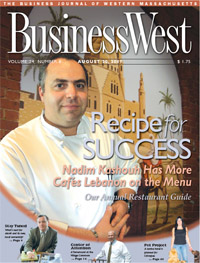
Cover Story
Keller Williams Realty and Its Unique Business Model Find a Home in Western Mass.
April 2, 2007 Cover

April 2, 2007 Cover

When Texas-based Keller Williams Realty launched a franchise in Western Mass., some competitors openly conjectured that the venture wouldn’t last 90 days. Four years later, the KW franchise is moving up in the rankings and is within sight of a very ambitious goal — becoming the number one broker in the area. This explosive growth results from many factors, but especially a unique operating model that places the agents, not the broker, at the center of the home-selling universe.

Laura Stevens says she went, but with the thought that the meeting would be little more than an intelligence-gathering mission on what would inevitably become a new, potentially troublesome competitor.

That’s how she recalls the invite she accepted in March 2003 from officials with Austin, Texas-based Keller Williams Realty to discuss the possibility of a franchise in Western Mass., with her playing a lead role in that venture. Stevens, then an agent with Coldwell Banker, had met representatives of KW, as it’s called, at the annual convention of the National Assoc. of Realtors in New Orleans five months earlier, and told them that when they were ready to make their move into the Greater Springfield market they should give her a call.

They did, and she agreed to talk.

“I basically was only going because I figured, ‘if they’re coming into the market, I need to know everything I can about them,’” she admitted. “I went in essentially to spy; my goal was to find out who they were and what they had to offer the client so that if I had to sell against them I would know what I was up against. But they had me in about five minutes.”

That’s how long it took to explain and sell Stevens on what was then — and is still now — a fairly radical concept in the world of residential real estate: an operating structure in which the agent, not the broker, runs the store.

“I thought, ‘this is the best thing I’ve ever heard in my life,” she told BusinessWest. “They flip the industry upside-down; in the traditional model, it’s the broker as boss, broker as king, the ‘if you’re going to live in my house, you’re going to live by my rules’ way of thinking.

“At Keller Williams, the broker is a subservient leader, and the agents are the boss, and as an agent that appealed to me,” she continued. “I think that agents are in the best position to know what’s best for their business; the people from Keller Williams were essentially reading my mind.”

What took much longer to sell Stevens on, however, was the concept of her becoming the operating principal in Western Mass, or, in essence, the franchisee. She liked the Keller Williams model, but at first, and for some time after being introduced to it, she envisioned herself experiencing it from the agent side of the equation.

But when no one came forward to take the operating principal, or broker role — one that requires a sizable investment — Keller Williams officials pressed Stevens to consider assuming that risk, and opportunity, herself.

She did, and she’s never looked back.

She took the equity she had in two properties she owned, as well as most of her life savings, and, with some financial backing from several partners, took a somewhat daring entrepreneurial gamble, one that is thus far paying off handsomely and surprising many competitors who didn’t share the view that this was a good risk.

Along the way, she’s had to suffer many slings and arrows. In fact, KW’s business model was and is so foreign — and the Keller Williams corporate value statement, ‘God, Family, then Business,’ is so different and religion-oriented — that some competitors have taken to referring to the company as a cult, said Stevens.

“One area manager told people that we pray at our meetings,” she explained, adding quickly that there are no prayers and no Kool-aid. But there is that unique agent-centered view of the home-selling universe that is still difficult to explain and often hard to sell to agents.

But it is gaining results — across the country and especially in the local market. Nationally, the firm is well ahead of goals to have 70,000 agents by then end of this year, and has re-calibrated that number to 90,000. Regionally, the most recent statistics supplied by the Greater Springfield Board of Realtors show that Keller-Williams is growing steadily and gaining ground on the top firms in the market. The Longmeadow office was slotted second (up from third a year earlier) in terms of total sales and dollar volume for the first three months of the year, behind the Longmeadow office of Coldwell Banker, while the Agawam office was eighth, up from 17th a year ago.

There are several other yardsticks for measuring success, including the number of agents now with the local franchise — 130 (it started with 12) — as well as the opening of a second office in Agawam last year, and a third in Northampton last month. Meanwhile, the Longmeadow office will be moving soon to quarters on Dwight Road that are nearly double the current space on Shaker Road.

In this issue, BusinessWest looks at what Keller Williams has been able to accomplish in only four years in this market, and, more importantly, how it has made such a prominent mark.

Going Through the Roof

Stevens used many words and phrases to describe the agent-centered focus at Keller Williams, including some that were rather direct and reflected her many years of experience and frustration in her chosen field.

“They treat agents like intelligent people with ideas, not like idiots,” she said of KW, adding that she views the traditional plight of agents as the real estate business equivalent of taxation without representation. “I can remember once saying, ‘I have a good idea,’ and my broker replying with, ‘why don’t you let us do the thinking, and you just go do the selling.’ That was the attitude; here, the attitude is, ‘if you have a good idea, we’ll hear it; maybe it will help all of us.”

But perhaps her most effective effort to get her point across came when she gave a quick tour of the Longmeadow headquarters facility, starting with her office — such as it is. Small, oddly shaped, and tucked toward the back of what was once a suite of physicians’ offices, it has no windows. It does, however, have a second door — the one people go through to get to the Dumpster.

“I have the smallest and worst office here,” she said without any hint of regret, embarrassment, or indication that this was in any way improper. “And that’s the way it should be — the agents run the show here; our philosophy is that people do business with people, not companies.”

This was the model on which Gary Keller and Joe Williams started the company that bears their last names in 1984, and it has carried them to meteoric growth and a presence in all 50 states since they started franchising in 1993.

Stevens knew only a little about Keller Williams when she ventured to the NAR conference in late 2002. But it was enough to intrigue her and prompt a visit to the KW booth. And what she heard at that initial meeting on a planned Western Mass. franchise piqued her curiosity and eventually triggered her entrepreneurial tendencies.

Stevens, who first started considering a career as a Realtor while still in high school, had spent 15 years in the business and nearly 20 years in sales by then. She started with George & Green Real Estate in 1987, and spent seven years there before moving on to Coldwell Banker. She wasn’t really looking for a new opportunity when she sat down with KW officials, but she was certainly willing to listen.

And so, eventually, were several other agents she worked with at Coldwell Banker. They, too, liked the business model, enough to become agents and partners. Stevens was joined by Denise Vaudrin, Linda Santinello, Bino Wrona, Kathy Neilson, and Donna Taylor. They invested some money to help get the venture off the ground, and considerable effort in making it a force within the market.

But Stevens assumed the lion’s share of the risk, moving, by her estimates, from an annual salary approaching $200,000 to “zero.”
“It was more than a little scary,” she said of the transition from agent to entrepreneur, adding that she was helped in a way by the fact that agents are, by the nature of their work, independent contractors. “Agents are, in essence, entrepreneurs, but this was going a step further; it was a big risk for all of us, but one we felt good about.”

Stevens said area competitors didn’t give her and her team of partners solid odds for survival. “Many people said we wouldn’t last 90 days,” she said. “And when we did, they said we wouldn’t make it through the winter.”

The unique operating model is the primary reason why, she said, summing it up rather concisely: “Our agents are fully empowered to do whatever it takes to sell real estate — within the confines of the law.”

Seller Dwellers

Elaborating, she said the agents have the right to set policy — on everything from the hours of operation at a given office to the commission rates paid to co-brokers.

All this is done through a body known as the Agent Leadership Council, comprised of an office’s top performers, who, says Stevens, have the best business sense. “So they should have the right to run the company.

“At the beginning of each year, the council sits down, and together we figure out how much it’s going to cost to run the company each month,” she continued. “They submit a budget to me, which I then approve, and I hand over the money to them; they can do whatever they want with it. If they don’t pay the bills, we’re going to go out of business.”

While what the Agent Leadership Council does is noteworthy, why this group is in power is what competitors and area agents should come to understand, said Stevens, adding that it comes down to basic common sense. And for agents, it’s also a matter of basic mathematics.

Indeed, to show why agents are better off with the Keller Williams system than the traditional way of doing business, Stevens used her last year with Coldwell Banker as a working example, and said the KW MO would have put roughly an additional $50,000 in her pocket. She arrived at that estimate though a complicated compilation of numbers, including the amounts paid by agents to brokers, the parent company, and others. But the bottom line is, quite literally, the bottom line.

And that’s roughly the same number arrived at by Carol Roy Bright, an agent who joined KW nearly a year ago after working for Coldwell Banker and, before that, owning her own company, Real Estate Solutions. She told BusinessWest she joined Keller Williams because she could add, but there was more to it than that — specifically the fact that KW does more to help agents succeed than companies using more traditional methods.

It offers ongoing education, for example, she said, noting that classes amount to what she called a Ph.D. in home selling. Also, the company takes an approach that brands specific agents, not the company, which is logical because clients essentially do business with an agent, not with a company, she said.

“The Keller Williams model highlights the agent and puts the company in the background, which is as it should be,” she explained. “That’s because it’s the agent who gets hired, not the company. And in realty, it’s the top producers that clients are hiring, and not the firm, so if they stay with a traditional company, they’re not being properly compensated for what they bring to the table.”

Roy Bright says the KW model provides her with something else as well — a voice in how the company is run.

“We have open-book management, so everyone can see what everybody makes, and we can see what the owner is taking; we decide on equipment … we decide on everything,” she said. “I didn’t have a voice like that when I was with a traditional company.”

Yard Sale

Looking back on the franchise’s first year in business, Stevens said sales goals were exceeded by some 50%, a number that reflects some rather conservative projections.

“We didn’t know how to think big back then,” she recalled. “We’ve learned how since.”

Indeed, Stevens and her team have their sights set firmly on becoming number one in this market, and to Stevens’ way of thinking, it’s not a question of if, but when that will happen — a question she won’t answer because she doesn’t want to throw a date out there for the competition to see.

But she expects that it won’t be too long.

“We’re ahead of schedule; we’re currently No. 3 in this market in terms of gross sales, and we’re competing against some major players that have offices that have been established for 15 or 20 years,” she said. “We’re confident about moving up to number one.”

Thinking big at Keller Williams relates mostly to numbers related to unit sales, total sales volume, number of agents, and revenue-sharing payouts, said Stevens, but not necessarily to the number of offices across the region.

The company generally rejects the ‘office on every corner’ mentality that still prevails in some corners of this industry, in part because technology, primarily the cell phone, enables agents to do the bulk of their work from almost anywhere, but also because a large volume of offices creates redundancies that a cost-efficient operation will seek to minimize.

However, most consumers still want and need that office setting, Stevens continued, adding that this phenomenon explains the expansion in Agawam — an office that can help the company better serve Western Hampden County and Northern Conn. — and the most recent push into Northampton, which provides a more visible presence in Hampshire County and the hot spots in that region, including Amherst.

With the territorial expansion comes more work to sell the KW operating model, said Stevens, who admitted that it has been a harder sell in Northampton than she anticipated.

“To some, it sounds like it’s almost too good to be true,” she explained, adding that some individuals need convincing that what they’re hearing is the real deal.

Agents working for traditional brokers are way overpaying for the services that they’re getting from their brokers. Our model is so different that some people have a hard time believing it.

But ultimately, she believes top producers in the Northampton area will do the same math, and come to the same conclusion, that Roy Bright and 130 or so other individuals have.

“People have come to us from as far away as Brimfield and West Hartford,” she explained. “That’s because they recognize that it’s the right business model and they’re willing to travel for it.”

Window of Opportunity

Stevens said she does not yet know specifics on the layout of the Longmeadow office’s future home — to be part of a new office building going up on Dwight Road.

What she does know is that she will still have the smallest, worst office in the place, because while the facility’s mailing address will change, it’s unique approach to doing business will not.

That’s because successful companies don’t attempt to fix what isn’t broken, and KW’s track record for success is hard to argue with.

But maybe Stevens won’t have to contend with a door to the Dumpster.

George O’Brien can be reached at[email protected]
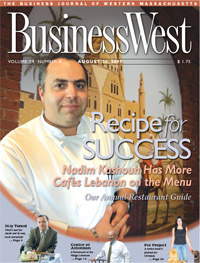
Cover Story
Smith & Wesson’s Aggressive Drive for Growth and Diversity Is on Target
March 5, 2007 Cover

March 5, 2007 Cover

When Mike Golden came to Smith & Wesson in late 2004, he laid out a strategic plan calling for diversification, across-the-board growth in the core product — handguns — and operational improvements to increase margins and profits. Two years later, he and his leadership team have made great strides with all those goals, and as a new fiscal year dawns, this company with the great brand and glorious past has an even brighter future in its sights.

There are many ways to measure the progress recorded at Smith & Wesson since Mike Golden took over as president and CEO just over two years ago.

Start with the stock price. It was about $1.40 then; it’s over $13 now. There’s the 76% growth in sales of the core product (handguns) over the past 24 months, and a 465% rise in operating profits, contributing to roughly 250 additional jobs at the Roosevelt Avenue plant in Springfield. S&W has also regained some of the market it once dominated in handgun sales to state and municipal police departments, and was named Manufacturer of the Year (2005) at the National Rifle Association’s annual convention a year ago.

And then … there’s the magazine covers — 80 of them over the past year at last count, but the number seems to go up virtually every week. These aren’t pictures of Golden, either; rather, it’s a host of new S&W products that are getting face time on some of the shooting and law enforcement realms’ most popular publications.

The January issue of American Rifleman profiled the company’s new Elite Gold shotguns; the latest cover of Guns & Weapons features both S&W’s new M&P (that stands for Military & Police) 5.6mm tactical rifle and the M&P 45 caliber pistol; the January edition of Shooting Illustrated had a close-up of one of the company’s new .44-caliber Magnum revolvers; and the cover of the current issue of American Cop announces an exclusive review of a compact model of the M&P pistol.

And these are just the most recent triumphs at the newsstand; over the past 18 months, the company has won cover stories in countless other publications, from Guns & Ammo to Special Weapons to Shooter’s Bible, the self-described “world’s standard firearms reference book since 1924.”

Spread all these out on a coffee table and they start to convey what has taken place at Smith & Wesson since Golden arrived in the fall of 2004, after 25 years of work with some other famous brands, including Black & Decker.

But new products and more aggressive marketing (those are the basic ingredients to gaining cover pieces in this industry) are only part of the story.

There are also investor relations, hard lobbying of elected officials in Washington that helped win the company its first major order from the U.S. government in more than 15 years, investments in new equipment and margin-improving processes, and diversification into product lines well beyond S&W’s bread and butter — handguns.

All these elements are part of the strategic plan Golden put in place for a company that has always had the name (with an 87% awareness level), but wasn’t, by his account, well managed or marketed when he arrived. There are several prongs to this strategic plan, and all of them essentially involve leveraging that famous brand, and putting the Smith & Wesson name on everything from black powder rifles to leather jackets to the hood of a Busch Series race car.

“Research shows that whether you like guns or don’t like guns, whether you’re male or female, young or old, Democrat or Republican, it doesn’t matter,” he explained. “The perception of the brand is extremely positive. This is a 155-year-old legacy brand that everybody knows and everybody likes, and that gives us the ability to grow the business.”

But brand recognition does not necessarily translate into sales — it didn’t at S&W for many years — so Golden and his management team put the focus on creating new products and lines that could outperform the offerings of companies that had taken market share from Smith & Wesson over the years.

The results are starting to show. The M&P pistols have been turning heads and drawing top marks at so-called T&Es, testing and evaluation periods during which police departments shopping for new weapons test what’s on the market. Those strong performances have netted some new orders from law enforcement agencies, but Golden says the company, now with just over 10% of a $150 million market it once owned lock, stock, and barrel, is just scratching the surface in that sector.

Meanwhile, it is making strong headway in the product category called long guns, which includes everything from shotguns for sport to tactical rifles for SWAT teams. In that latter category, S&W’s M&P models are so popular the company can barely keep up with orders.

In this issue, BusinessWest, in yet another cover story for this 155-year-old company, conducts a wide-ranging interview with Golden, in which he explains why, by aiming high, Smith & Wesson’s quest for a return to its glory days is clearly on target.

Bullet Points

Golden has logged considerable air miles in recent months. He’s spent a lot of time on Wall Street talking with investors and in Washington conversing with elected leaders and federal officials in efforts to bolster both domestic and international sales. In January, he spent a week in Orlando at the SHOT (Shooting, Hunting and Outdoor Trade) Show.

Smith & Wesson had two booths at the event, sponsored by the National Shooting Sports Foundation, and it needed them. The company was displaying a wide array of new products, from its new Elite Gold shotguns to six retro revolvers, including the ‘Model 40 Lemon Squeezer,” so-called because it has a grip safety on the back strap (one has to squeeze the grip in order to fire the gun), to its new M&P pistols. Those displays drew considerable attention that will no doubt lead to more magazine covers: The Army Times selected the M&P 45 as its featured product in ‘Best of Day Two’ at the show.

Beyond the new models, however, what the hordes of shooting industry media noticed from Smith & Wesson was something missing in recent years — energy, said Golden, adding that, overall, instilling some has been his broad assignment.

He’s done it by assembling an effective senior management team, which includes many newcomers as well as several S&W veterans, and by taking several pages from the scripts he helped write for Black & Decker and, after that, for the plumbing fixtures giant Kohler and the hardware and tool maker Stanley Works. These touch on matters ranging from marketing (NASCAR participation included) to dealer relations.

He’s also worked to make the company more visible to the industry and the public at large. He oversaw creation of the Smith & Wesson museum, a small, glass-walled room inside the plant that displays many historical pieces, including the S&W 38, perhaps the most famous handgun ever made; dozens of collector’s items, some valued at more than $500,000, and even some Hollywood memorabilia, such as the .44-caliber Magnum toted by Clint Eastwood in the movie Sudden Impact.

The various steps have been taken to ensure that the company with the glorious past has a real future, said Golden, adding that he believes Smith & Wesson is well-positioned for strong growth for many years to come.

“The past two years have been the most the exciting thing I’ve ever been involved with,” he said. “We’ve grown in every channel that we do business in, and we take great pride in the fact that we’ve done everything we said we were going to do.”

Indeed, when BusinessWest talked with Golden soon after his arrival, he laid out many of the points in a strategic plan for the company. It called for diversification on a number of levels, investments in new technology that would make the company more efficient and improve margins without eliminating jobs, and aggressive pursuit of market share in many domains through new sales and marketing tactics.

There has been progress on virtually all fronts.

Inside the plant, the company has implemented what it calls the Smith & Wesson Operating System, based on the Toyota Production System (TPS), or lean manufacturing. In response to increased demand for its pistol lines, the company invested more than $40 million in new technology in the form of new machining cells that that have reduced the slide-manufacturing process from 15 steps to three, and manufacturing centers that have reduced the barrel-manufacturing process from 13 steps to four.

Meanwhile, the company has made fundamental changes in its approach to sales at the sporting goods level, yielding sharp increases in handgun sales within that market.

“A year ago, we changed our sales strategy,” Golden explained, “from a channel where we used independent reps to represent half the country — salespeople who sell Smith & Wesson but also sell fishing tackle, ammunition, and many other lines — to using all Smith & Wesson factory employees who sell only Smith & Wesson.

“This was chapter right out of the Dewalt (a division of Black & Decker) power tool book,” he continued, “and it’s focused on the independent dealers. This is where the action happens; it’s where the consumer walks into the store and makes their purchasing decision.”

The results have been exactly what the company hoped for, he said, noting that the closer relationship between salesperson and dealer and the singular focus on Smith & Wesson have driven at least 30% growth in sporting goods sales for each of the past several quarters, and 52% in the most recent quarter.

These and other steps have been blueprinted and implemented by a leadership team that blends experience in the gun industry (CFO John Kelly has spent 25 years at Smith & Wesson) with work manufacturing, marketing, selling, and licensing some of the country’s most famous brands.

Tom Taylor, S&W’s vice president of Marketing, spent 24 years with Coca-Cola and Frito-Lay before joining the company two and a half years ago; Tom Fimmen, vice president of Sales, who joined the team a year ago, has logged a quarter-century of experience with such companies as Union Carbide, GE Silicones, and Stanley Works; Ken Chandler, vice president of Operations, has held similar positions with Ingersoll Rand and Autoliv; and Bobbie Hunnicut, vice president of Licensing, has 25 years of experience with Stanley Works, Meridith, and Harley-Davidson.

But while the management team has mapped the plan and executed it, the stars of this show are the new products that have rolled off the assembly line. Collectively, they have enabled the company to penetrate new markets, gain coveted federal contracts, and win back some of the police contracts that made the company a household name — and part of some of some of Hollywood’s more memorable lines.

On the Beat

Along one wall in an area of the massive plant known as the revolver fitting room are several large cork boards covered with the badges of police departments to which Smith & Wesson once sold handguns, principally revolvers. There are thousands of them on this and other displays around the plant, representing small towns, big cities, and every state police department in the country.

“It’s my job to get those people back,” said Golden, motioning to the badges and noting that the company, which once owned roughly 98% of the law enforcement market, lost nearly all of that business. It happened because it didn’t take seriously the threat posed by Austrian gunmaker Glock and its superior pistols, and this complacency cost the company dearly. “One by one, police departments converted their primary service weapon from a revolver to a pistol, and today Glock has 65% of the market.”

Getting all those state and local police forces back in the fold, and not just on the wall, is a simple function of putting out a quality product and effectively selling it, said Golden, adding quickly that law enforcement officers have no room for tradition or nostalgia when choosing weaponry; accuracy and stopping power — the factors measured at T&Es — are what sell guns.

The M&P model pistols, launched in January 2006, are winning over many departments — nearly 150, representing about 20,000 officers, were using S&W guns at last count, he said, noting that the products have a 78% win rate at the T&Es in which they’ve been involved, and that more than 130 of the nation’s 17,000 law enforcement departments are currently testing the products.

“This leaves considerable room for growth,” said Golden, adding that the company intends to achieve it by continually listening to end users (something he said it stopped doing years ago), and making products they like and trust.

But municipal and state police departments constitute just one segment of the handgun market, said Golden, noting that S&W is looking for growth in the other three — retail (for sport and home security), where the company has traditionally fared well, and U.S. government (including the military) and international sales, where, at least recently, it hasn’t.

But through better products (those M&P models), some effective lobbying (the company hired a firm to keep its name front and center), and support from U.S. Rep. Richard Neal and others, Smith & Wesson is getting some consideration — and some new contracts.

In late 2005, the company won $20 million in government business (all four of the contracts awarded for firearms) totaling more than 73,000 pistols for the Afghanistan National Police and Border Patrol, said Golden, noting that more penetration in this sector could be on the horizon. Indeed, there are indications that the U.S. armed forces may be switching from a 9mm pistol (Beretta is near the end of a 20-year contract to produce them) to a 45-caliber model — and Smith & Wesson just launched its M&P 45, as Guns & Weapons and some of those other publications announced.

Details on the new military contract are emerging — specifications are due to be released later this year — but Golden said it may involve nearly 700,000 guns and be worth between $300 million and $500 million. Recognizing the size and scope of that contract led Golden to hire a lobbying firm to state S&W’s case, and he believes the combination of product quality and lobbying will effectively position the company to win that huge contract.

As for international sales, the company is taking several steps to improve market share in that realm. It is increasing its sales force to develop more contacts within police and military outfits in Europe, Latin America, Asia, and the Middle East. Meanwhile, in Washington, it is lobbying for a shortening of the federal export approval timeline and a raising of the $1 million Congressional approval export threshold.

Magazine Racks

As large as the handgun market is (currently about $600 million), the long-gun market is 80% larger ($1.1 billion), said Golden, using that simple statistic to explain why S&W has penetrated many areas within that realm. And it does so with the intention of capitalizing fully on that 87% brand-recognition rate and the apparent across-the-board faith in that brand among Democrats, Republicans, and every other category.

“Our research showed that many people believed Smith & Wesson was already in the shotgun and hunting rifle business,” he explained. “When we asked them about the brands they preferred in those categories, the No. 3 brand they listed was Smith & Wesson, and we weren’t even in those businesses. That’s when we knew there was an opportunity to get into that.”

S&W started its long-gun movement with the production of tactical rifles, the fastest-growing segment in that market, because they are used by many constituencies, including the military, law enforcement, sport hunters, and competitive shooters. The M&P 15 series, introduced in March 2006, is proving popular with all
hose groups, said Golden, noting that the company is being challenged to meet orders.

“The demand has been phenomenal,” he said, noting that in less than a year, sales and orders for the M&P 15 now exceed 10% of the tactical rifle market (now more than $152 million), and 55 law enforcement agencies have ordered the product. “We’ve told our salespeople, ‘don’t aggressively sell it, because we’re selling every piece we can make.”

Penetration into the long-gun market has also manifested itself in a partnership with a company in Southern Turkey to produce the first shotguns to bear the Smith & Wesson name. And late last year, the company announced the acquisition of Rochester, N.H.-based Thompson/Center Arms, a 41-year-old venture that is considered a leading player in black powder and interchangeable firearms, for $102 million.

The Thompson acquisition provides many benefits for Smith & Wesson, said Golden, including immediate entry into hunting rifles, long-gun barrel manufacturing expertise that will help accelerate S&W’s growth in rifle sales, and an expansion and strengthening of distribution channels.

The move into long guns is part of a broader strategy to diversify the company into products across four main categories — safety, security, protection, and sport. “Because this is what the brand stands for,” he said, adding that this includes products beyond firearms, everything from handcuffs to explosion-detection devices; from flashlights to pocket knives.

But through licensing, the company will also puts its name on T-shirts, caps, leather jackets, purses, backpacks, and more, he said, adding that this initiative is part of the same marketing plan that has the Smith & Wesson name on the #30 car on the Busch circuit.

Diversification also comes in the form of specially engraved guns — for which there is a solid market — and commemorative pieces, including two special ones in 2006: the 50th-anniversary edition of the Model 29 .44-caliber Magnum made famous by the Eastwood character character in Dirty Harry, and the 75th anniversary edition of the Walther PPK, made famous by Ian Fleming’s James Bond character.

Add all this up, and it’s more than enough to keep the sporting arms and law enforcement press busy — and Golden eternally optimistic about 2007 and well beyond.

“We think there are great opportunities for growth in handguns, long guns, across the board,” he said. “And we’re solidly positioned to achieve that growth. We’ve moved aggressively, and the pieces are in place.”

Clip Files

In his piece on S&W’s compact M&P, American Cop writer Mark Henten described the gun this way: “It’s definitely a well-thought-out handgun built with the combat demands of today’s cops and soldiers in mind.”

He also said it was a return to “the good old days,” referring, ostensibly, to the time when Smith & Wesson dominated the police market through quality products and its reputation.

This, in a nutshell, is what Golden and his team had in mind when it put together that strategic plan more than two years ago: making the past prologue.

The sales numbers, stock price, NRA awards, and all those magazine covers show that this company’s broad battle plan is certainly on target.v

George O’Brien can be reached at[email protected]
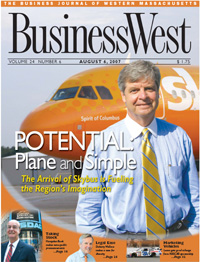
Cover Story
Community Music School Makes Sound Contributions
January 22, 2007 Cover

January 22, 2007 Cover

Coming of age in New York City, Eric Bachrach, founder of the Community Music School of Springfield (CMSS), said he realized the power of music early on, but only later did he realize that not everyone has the means to study the universal language. He set out to change that in the early 1980s, and today, Western Mass. continues to hear the strains of one organization doing its part to change the world.

It was a disaster that would dampen anyone’s resolve.

In 1994, a broken water main on Birnie Avenue caused a 10-million-gallon flood to course through the halls of the Community Music School of Springfield.
Countless sheets of irreplaceable music were lost, the building was uninhabitable, and one of the school’s pianos was drowned under 25 feet of water.

The blow was catastrophic for CMSS, still fragile 10 years after opening its doors with two borrowed pianos and a second-hand drum set held together with masking tape.

But the school lived on, as did the ill-fated piano, which, after some repair, still plays. CMSS Executive Director and Founder Eric Bachrach says that’s an apt metaphor for the entire organization.

“We are famous for rising from the flood, for our resilience,” he said. “We’ve been through the vagaries and trials of any nonprofit, but we’ve always been confident in our importance, and the importance of keeping music a reality for anyone and everyone.”

And that, in essence, is the school’s mission and purpose. Dedicated to music education for children and teenagers across the region, Springfield’s Community Music School has grown from about 80 students in the 1980s to more than 2,000, involved through both on- and off-site programs. Many of those students are receiving their musical education for free, and many others through the benefit of scholarships and financial aid, amounting to more than $250,000 a year.

The goal is a simple one — to offer exposure to music to as many young people as possible, regardless of their social or financial strata. But often, the importance of music and cultural education can be difficult to articulate.

To help him translate the school’s objectives, Bachrach, a violinist, returns to both his own roots and those of community music schools in general, of which there are about 350 across the country. Each school operates independently and in a variety of ways, but all share one common bond: they provide musical opportunities for students who otherwise may never get the chance to simply make a joyful noise.

Bach to Basics

“I grew up in a middle-class family in the Bronx,” Bachrach began. “My mother taught at Julliard, and my father taught psychology at City College of New York. A time came when they decided it was time for me to study music, and I did so privately — never realizing that there are so many people who do not have access to the study of music.”

It wasn’t until he began to study under violinist Ruth Kemper, who helped found the National Guild of Community Music Schools, of which CMSS is a member, that he began to fully grasp that reality.

“She made me realize the importance of equitable and democratic access to the arts,” he said, reaching for a tattered — and water-stained — copy of Music, Youth and Opportunity, a text published in 1926 for the National Federation of Settlement Schools. Kemper presented the book to him, and it became the guide for many of CMSS’s programs.

“The community music school model came from the early settlement schools in this country,” he explained. “They were set up to teach immigrants the basics of life.”

In addition to balancing a budget and negotiating at a public market, the schools also considered music to be basic.

Bachrach taught music in New York City throughout the 1970s, and moved to Massachusetts in the 1980s to pursue a master’s degree in Music at UMass Amherst. In 1983, he made his first and last foray into providing accessible music education, by sending leaflets to about 18,000 Springfield public school children announcing a new music school in the city.

Of those students, less than 1% signed up for classes, but the CMSS never shut its doors after that point.

It has moved a few times — the original CMSS was located on Birnie Avenue until the flood in 1994. At that point, the school was homeless, but not defunct. Bachrach said within a week, classes had resumed in a variety of locations throughout the city, and staff had begun searching for a new home.

“We knew it was going to be in Springfield — we’ve always been in Springfield,” he said. “We knew we needed parking, and we wanted it to be downtown, in a neighborhood that effectively belongs to everyone regardless of ethnicity.”

No Strings Attached

A search committee that included some recognizable names in the Western Mass. business community, among them real estate developers Harold Grinspoon and Tom Henshon, attorney Steve Schatz, and and former SIS president Bill Marshall, began looking for a suitable property, and in 1996, they found it — an historic 1933 Art Deco bank building on State Street with high ceilings and, in turn, fabulous acoustics.

The building had just been acquired by Fleet Bank, along with four other properties downtown, and Bachrach said because there was not a lot of obvious re-use potential in the State Street facility, CMSS was in position to take advantage of an excellent opportunity.

“But we took a risk and held out, because we needed the building and also its adjacent parking garage,” he said, noting that Fleet was prepared to virtually give the building to the school, but was more hesitant to give up prime-location, downtown parking space. “It took a lot of negotiating, but in the end it resulted in a priceless gift.”

The bank building and its adjacent parking were sold to CMSS by Fleet for $1 in 1996. Bachrach said staff moved the school’s music library, instruments, and furniture in over one weekend, and have operated from that location for a decade with no plans to move again. Back rooms were converted into studios and offices spanning four floors, and the Ruth Kemper Music Library was created, housing all of the sheet music, books, and recordings that were salvaged from the Birnie Avenue flood or procured since then.

Development plans have also been brisk in those 10 years, and remain so as CMSS approaches its 25th year.

Bachrach explained that about 700 students study music at the State Street school, while an additional 1,300 or so take part in off-site programs, all of which are free to students. They include the Prelude program, which, through the assistance of a Wallace Foundation grant, provides music and creative movement instruction to Head Start classrooms; and the Presto program, which identifies young, inner-city elementary school students and provides lessons in stringed instruments.

The school also offers musical instruction to incarcerated teens through the Renaissance program and to others through various community organizations, such as Girls Inc. and the YMCA. It has also created a special Saturday program for Somali mothers and their children, through a program that again returns to CMSS’s settlement school beginnings.

“In addition to music, that program also offers arts and craft instruction and English as a Second Language classes,” said Bachrach, “and these mothers have been gathering here for about a year and a half. It’s sort of a home away from home that allows them to create a community amongst themselves, after years of feeling displaced.”

At the school, students take part in private and group lessons with one or more of its 68-person faculty, all professional musicians. Instruction is available for a wide array of instruments, including violin and guitar through the internationally-known Suzuki method, and ranging further from baritone horn to vibraphone and beyond.

Classes include early childhood programs for infants, toddlers, and young school-age children and music therapy classes for those with special needs, in addition to instruction in a variety of instruments and genres. Jazz and classical ensemble programs are also available, as is participation in the CMSS Chamber Orchestra, chorus and choir programs for young singers, and an adult instruction program.

Those programs, as well as improvements to the CMSS building to make them possible and the scholarships that bolster its student roster, are financed largely by grants and private support, including $2.1 million raised through the Focus on the Future campaign in 1999, which financed renovation of studios and the school’s exterior, installation of a handicapped-access elevator, a scholarship endowment, the start of a community partnership program, and other program expansions.

Currently, the school’s annual operating budget is about $1.3 million and its endowment $500,000. Soon, it will embark on a new fundraising campaign to further expand programming and make improvements to the CMSS facility. Less than half of the operating budget is funded through tuition.

A Handel on Things

On top of Bachrach’s to-do list is the creation of a new performance hall at the school, which would provide a more professional space for concerts, now held in the school’s spacious foyer.

“As grand and regal as this space is, it’s really not fitting for us now,” he said, noting that performances are held adjacent to the school’s administrative offices and front door, where ringing phones and visitors are a distraction. “We need to close the world off and form a discreet space.”

Plans to collaborate with Boston’s Berklee College of Music to offer the Pulse program, which will serve 100 middle- and high-school students each week through Web-based, acoustic and electronic instrument instruction are also in the works, as are plans to start an arts-based pre-school at CMSS.

That program would augment existing early education initiatives at the school, and also provide an academic preschool with a focus on music and the arts for area children. Half of those students, Bachrach said, are expected to have their education fully subsidized.

“We’re always looking to raise money for really important work,” said Bachrach. “Our students are high achievers, who come from families that are interested in the important parts of life, but which are often not easily accessible.”

As he continues to tear down those barriers, Bachrach said his hope for CMSS is that it will continue to evolve from a small community music school into a regional center for the arts and arts education. Following the launch of the school’s newest capital campaign, yet to be formally announced, he added that he hopes the creation of a new performance hall and other improvements will also help return State Street, one of downtown’s main thoroughfares, to “boulevard status.”

Flood of Memories

These are lofty goals, Bachrach concedes, but not unachievable.

“It was a real eureka moment for me when I realized that increasing access to music education can change the lives of students, regardless of social strata,” he said. “That’s an idea to which we’ll stay very deeply connected, and we have some very concrete plans for the future.”

Indeed, following the flood, many contend that a new world was born.

Jaclyn Stevenson can be reached at[email protected]
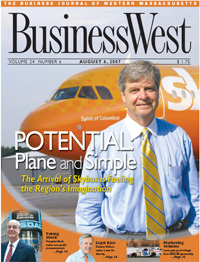
Cover Story
What’s Next for the Pioneer Valley Economy
Cover

Cover

As the calendar turns to 2007, economists see some growth for the Commonwealth, but mostly a continuation of the pattern of unspectacular progress that has defined the past few years. In other words, look for a continuation of the jobless, or nearly jobless, recovery. As for the Pioneer Valley, “it just keeps plugging away,” said one observer, noting that its relative stagnancy is better than some regions have experienced.

It’s been 16 years since a Democrat has been governor of the Bay State, and anyone in business who can clearly remember 1990 and the years that followed … would rather not.

Which is why some apprehension on the part of the business community at the dawn of the Deval Patrick era would be understandable. But there has been little of that to date, according to most observers, who say that, for now at least, Patrick is being given the benefit of the doubt when it comes to business, keeping the costs of conducting it in this state under control, and a host of issues that impact the Commonwealth’s ability to attract and retain jobs.

There are several reasons for this, said Andre Mayer, senior vice president of Communications and Research for the Associated Industries of Mass. (AIM), starting with the fact that the outgoing governor, Republican Mitt Romney, would receive only a mixed report card from many in the business community about containing business costs. There is also the rhetoric Patrick issued during the campaign, especially about education and creating a better-trained workforce — and the promise that it will translate into positive action in the months and years ahead.

“Thus far, I haven’t seen any real alarm about Patrick or a one-party government,” he said, referring to the Democrats’ stranglehold on Beacon Hill. “In fact, the business confidence index rose while Patrick was pulling away in October.

“I think part of the reason he was elected is the feeling that the emphasis will shift from taxes to other issues,” he continued, “and so far, Patrick has been saying all the right things; he doesn’t act like a tax-and-spend Democrat.”

But while Patrick is apparently not a cause of real concern as the calendar turns to 2007 (things may change later), there are some other matters that do warrant apprehension. At the top of the list is the condition of the housing market, especially in the Eastern part of the state. Prices have declined between 10% and 15% over the past year or so, and some analysts say they could fall another 10% before bottom is officially hit.

The falling prices are making the state marginally more affordable for workers, which is good news, said Bob Nakosteen, faculty member of the Isenberg School of Management at UMass and executive editor of Benchmarks, the university’s quarterly report on the state’s economy. But that downturn has certainly impacted consumer spending, while also hurting both the construction sector and the legion of Realtors operating across the Commonwealth.

The broad result is an overall decline in confidence, which is another of the matters to watch closely as the new year unfolds, said Nakosteen, adding that the slow start to the holiday shopping season, a few rough days for the stock market after that first shopping weekend, and talk nationally of inflation and possible interest rate increases to ward it off won’t help boost confidence.

There are other factors to consider, including energy prices — lower for the time being, but always volatile — that have most analysts projecting modest (2.5% to 3%) growth for the year ahead, said Nakosteen.

That would represent a modest decline from recent events, he said, noting that the Massachusetts economy performed better over the past six months (3.6% growth in gross state product) than at any time since the current expansion began in 2003. This growth was prompted by a resurgence in technology markets, especially demand for microchips, he explained, noting quickly that there are signs that things are already slowing down again.

For the longer term, analysts are wondering, as they have for the past several years, where the next surge in jobs for the Bay State and the Pioneer Valley will come from. In a recent article written for Benchmarks (see page 37), Nakosteen chronicled 20 years of relative stagnancy for Western Mass., with questions about if, when, and how it might end.

“The region just keeps plugging along,” he said, noting that, while ‘stagnant’ is generally not a positive economic term, in this case it’s better than some areas of the state, which have witnessed dramatic surges, but equally dramatic declines.

Through the Looking Glass

When asked about what to expect from the Deval Patrick administration, Jeff Ciuffreda, vice president of Government Affairs for the Affiliated Chambers of Commerce of Greater Springfield, said he’s not hearing a lot of negative talk.

Like Mayer, he said Patrick’s campaign and its theme, Together We Can, created generally positive vibes, and the business community is, by and large, withholding judgment until the picture is colored in.

“He seems to at least speak the language of business,” said Ciuffreda, noting that Patrick has served on several corporate boards and would seem to appreciate the needs and concerns of business owners. “How that will translate … we don’t know yet.”

To date, Patrick has been short on specifics with many issues ranging from the the fate of the Finance Control Board — the ACCGS would like it to remain in business — to his first budget. He has been outspoken on public higher education, and recently told an audience at UMass that he would push to increase spending on state schools by $400 million over five to seven years.

As for Western Mass., Patrick, like previous candidates and governors, has pledged support for the region. However, some are already alarmed by how few members of his transition team (7%) are from the Pioneer Valley.

“We may need to keep his feet to the fire on Western Mass.,” said Ciuffreda. “We’ll know a lot more in a year or so.”

That statement applies to many issues and concerns, he said, noting that while waiting to see what Patrick and his team members do in their first year, economy watchers will also be monitoring the housing market, energy prices, the war in Iraq, and the strength of the dollar — or lack thereof.

The softening of the housing market is still largely an Eastern Mass. phenomenon, although sales volume has fallen in the Pioneer Valley and prices has remained steady, said Nakosteen. But the impact is felt statewide because of the broad ripple effect. Consumer spending will continue to decline if the trend does not reverse itself, due to a phenomenon known as the ‘wealth factor.’

As Nakosteen explained, many individuals now view their homes as their principle vehicle for investing (savings rates remain low), and when homeowners see the value of their property diminish, they feel less wealthy and are thus less apt to spend.

“That’s why the housing market is the biggest concern for the year ahead,” he said, adding that economic projections for the next several quarters are muddled because of general uncertainty about housing prices and sales. Debate continues on whether bottom has been hit and, if it hasn’t, when that might occur — the consensus is the second or third quarter of next year.

The Big Picture

The sum of the many factors influencing the economy will determine how much of a surge will be seen — in the overall economy and in jobs.

While current conditions wouldn’t be described as a truly ‘jobless economy,’ the phrase that became popular in ’03 and ’04, there haven’t been significant gains in employment statewide or regionally.

“We set a record for merchandise exports this year,” said Mayer. “We’re making the stuff the world wants, but we’re just not employing a lot of people to make it.

“Hiring is still regarded almost as a last resort for some employers,” he continued, “and the availability of good people is one big reason why. Some companies just can’t find people.”

Overall, the state has seen roughly 1% growth in the number of payroll jobs over the past year, said Nakosteen, noting that the state was registering 2% to 2.5% increases during the early years of the decade. Most recent gains have come in professional and business services (7,100 jobs), education and health services (6,800), and financial services (4,200). In addition, 3,900 jobs were added in construction.

This relative stagnancy on the jobs market has contributed to an ongoing out-migration of state residents, the extent of which is still being debated, said Mayer, noting that the exodus, however large it may be, has some economists worried.

And the trend will continue, he said, until the state creates large numbers of new jobs. When and how that will happen are both $64,000 questions.

There are many theories about where the next large wave of jobs will emerge — from renewable energy to biotechnology to medical instruments manufacturing — but no clear indicators, said Mayer, who doubts that any of those sectors will blossom into large-scale jobs centers.

“I’ve heard that renewable energy could be the next big growth area, but I don’t see it,” he told BusinessWest. “How many people does it take to run a windmill?”

Nakosteen agreed, saying that the next big source of jobs probably hasn’t identified itself yet.

“Massachusetts has a long history of reinventing its economy, and it will do so again,” he explained. “But if there’s a new engine out there that’s going to drive us, it’s not at this point identifiable. And one of the reasons we’re going to see very, very minimal, almost stagnant employment growth over the next few years is because we don’t have this new engine out there.”

That same statement can be applied to Western Mass., which has seen some job growth in biotechnology and medical instruments, but, overall, hasn’t found anything to replace the manufacturing jobs that have given the region its identity. This fact, coupled with the region’s minimal but consistent growth, adds up to remarkable resiliency, he said.

“Over the past century, the Pioneer Valley has lost most of its important employers, especially in manufacturing,” he explained. “If you look at other areas of the country, when they lose their major employers and enter a recession, they go into a death spiral; we just keep plugging away.”

Nakosteen attributes this phenomenon to the region’s employment anchors — UMass, MassMutual, Baystate Health, and others, who have maintained their core strength over the years — and also to new small-business development. “This region is much better off than other areas that have lost their manufacturing bases,” he said, “and I think it’s because of those core businesses.”

Identity Crisis

Can the region break free of the stagnancy that has defined it for the past few decades? Possibly, said Nokosteen, but it probably won’t come from companies leaving Boston for the Valley and its lower cost of doing business.

“The prevailing theory is that if business owners are going to leave the Boston area, they’ll go all the way to the Research Triangle,” he explained. “They won’t stop along the way in Springfield.”

Thus, growth will likely be organic, and Nakosteen isn’t sure where it will come from.

“We don’t have an economic identity, and we don’t have an engine of growth; I don’t see anything coming to the fore,” he told BusinessWest. “But it’s not obvious that anything has to come to the fore; we could be like this forever more.”

George O’Brien can be reached at[email protected]
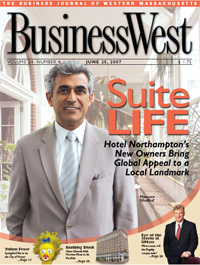
Cover Story
Women to Watch in Higher Education
Cover

Cover

Recently, BusinessWest introduced a new feature called Women to Watch, which, as the name suggests, shines a spotlight on some of the rising stars in the Western Mass. business community. Previous segments have spotlighted those in the legal community, health care, and financial services. This issue, we profile professionals in the world of higher education. Through their stories, which feature tales of pioneering and perseverance, innovation and inspiration, we’ll touch on the many challenges facing those in this sector, and the issues confronting all women in business today.

Cover Story
Online Courses Increase Enrollment and Visibility for Local Colleges
September 18, 2006 Cover

September 18, 2006 Cover

Online courses began as static Web sites and E-mail between students and faculty, but now they’re dynamic, comprehensive, and increasingly popular. As a result, they’re changing the way students learn and the way colleges teach.

At Holyoke Community College, students have the option of taking a number of courses online, from management to meteorological science.

Dr. Colin Cavell teaches U.S. National Government online for HCC, a popular class that has only one hitch: sometimes, his students have to keep the time difference in mind when E-mailing him with a question, at his home office in the Kingdom of Bahrain.

Cavell’s class is a textbook example of the flexibility afforded by online learning.

Online courses, now more commonly referred to as ‘distance learning’ or distance education, are an increasingly prevalent aspect of the American system of higher education. Most students enrolled at traditional four-year and community colleges will take an online course during their college career, or at least take a course that includes online components, such as presentations, study guides, or quizzes.

Distance learning presents many opportunities for students — they take courses at colleges across the country or around the world — and challenges for educators, who are adopting to a new way to teach traditional and non-traditional subjects.

Those closely involved with the evolution of distance learning at colleges and universities say that it’s not likely online courses will ever fully replace traditional classroom settings completely. But they don’t take the numbers of students using online classes to manage, augment, or complete their educations lightly, either.

Brick and Click

Gloria Defillipo, Dean of Distance Education at Holyoke Community College, said about 50% of the college’s total enrollment take advantage of some online component each semester, and that’s not including students in traditional classes who take advantage of so-called ‘Web enhancements.’

“We can’t possibly measure how many classroom courses also use online aspects to enhance the course – that’s too widespread,” she said. “But students can earn their degrees entirely online, or take part in ‘brick and click,’ hybrid courses that have online and classroom components. The numbers of those students is definitely increasing, and there is a big future for distance learning.”

HCC, which introduced its first distance education-based courses in 1999 (“they were basically notes posted online and links to Web sites,” said Defillipo), now offers five degrees and five certificates that can be obtained solely online, as well as 19 degrees that can be earned through a track that is 80% virtual.

Defillipo added that the majority of students enrolled in those courses of study live close to the college, and use distance education to study in a way that meets their learning style better than a classroom environment, or to help juggle an already busy work or family schedule. Some, however, utilize HCC’s online education system from beyond the Pioneer Valley. Students living in different parts of the state, including the Berkshires, Cape Cod, and Boston’s South Shore are currently enrolled, while others continued their education at HCC after a move – one HCC student is earning college credit while on military duty in Iraq.

“It definitely gets our name out there in a way we never could before,” said Defillipo. “But one of the biggest positives about distance learning is that education can continue even after life has moved you.”

Quiet as a Mouse

That could be one reason, she added, for the continued growth of distance learning, as well as the acceptance thereof in the world of higher education. Once relegated to correspondence courses and online schools such as the University of Phoenix, distance learning is now a very real, and very large, part of the American college system. Harvard University, for instance, created its extension school nearly a century ago, to offer continuing education courses for both credit and enrichment; its distance education division is now one of the school’s largest offerings. That shift has some real backing, nationally, too – the United States Distance Learning Association in Boston currently includes 27 state chapters and a number of for-profit sponsors who contribute up to $30,000 each annually to the cause.

Locally, every college has some type of online presence in terms of course offerings. In addition to HCC’s expansive set of programs, American International College, for instance, introduced a blended master’s degree program for its nursing students that takes place largely online.

And UMass is leading the country as well as the area in the field of distance learning. UMassOnline, its distance learning division, saw a 32% increase in program revenue during the 2005-2006 academic year, bringing in $22.9 million, and enrollment increased by 23%.

David Gray, UMassOnline CEO, said he attributes some of that growth to program expansion – 28 new programs were launched this past academic year alone.
“We continue to see impressive growth in online enrollment,” said Gray, “largely due to the quality and diversity of our academic programming. Our faculty and staff are committed to fostering an innovative and rich learning environment.”

Gray explained that the new programs created were a response to consumer demand and a need to fill niche markets. Two graduate-level counseling programs were added, for instance, as well as a masters program in Gerontology, a bachelor of arts completion program, a behavioral intervention in autism certificate program, a forensic criminology certificate program, and a plastics engineering certificate program.

“We are particularly pleased that plastics engineering is now available entirely online,” he said. “The program is one of a kind in the United States; offering it online enables us to serve a niche market, but with a global reach.”

On the Homepage

But distance learning is not just a tool to reach markets far from the bricks and mortar of a college campus. Debbie Bellucci, Dean of the School of Continuing Education and Distance Learning at Springfield Technical Community College, said while the majority of students who take advantage of online offerings at STCC are local, she too sees firsthand the vast growth in the field of distance learning, and the challenges that creates for colleges of all sizes.

“In 1999, we started with three courses, that were mainly lecture notes on a static site,” said Bellucci. “Interaction occurred outside of the course via E-mail.”

But now, STCC offers several courses with a Web component, including a liberal arts degree that can be achieved entirely online. That has created a major focus at STCC to constantly improve the online courses, but also the delivery and accessibility thereof. And that, Bellucci said, must be done within the same framework and set of standards applied to traditional courses.

The prime differences between online offerings at traditional institutions and most universities and schools that function entirely in a virtual environment, said Bellucci, are that colleges like STCC are accredited, often employ existing faculty to administer distance learning courses, and usually offer the course both online and in a classroom, to meet the needs of various students.

“Here, online courses also run a full, regular semester,” she added. “That means the program cannot be as self-paced as some online courses that can be taken outside of traditional academe. Students can complete their work anywhere, anytime within a given week, but after that there are certain parameters. When Saturday comes, that homework, or discussion board post, or quiz has to be posted.”

In addition, Bellucci said many colleges are now being called upon to draft specific policies for their distance learning programs, in order to address issues that may arise as well as further improve the online learning experience.

Discussion boards, for instance, provide an important tool for effective distance learning – they mimic classroom discussions, and consequently student comprehension levels, better than e-mails between student and instructor. But while they provide for multi-faceted conversations, Bellucci said, those conversations are taking place among a faceless audience and a class of students that often haven’t met each other, or their professor.

“The aim with discussion boards is to get students to comment with the instructor serving as a moderator,” she explained. “Instructors can allow students to exchange ideas, while also stopping tracks of discussion that are off-topic and correct misconceptions.

“But sometimes, that can lead to discussion boards becoming complaint boards, or debates get too heated or off-course,” she noted, adding that the problem prompted STCC to instate a ‘civility policy’ for distance education students.

Quizzes and final exams also pose a challenge for online faculty, who must essentially assume that any test administered online is an open-book test.

“Typically, that means instructors have to be more creative about how they set up the exams,” said Bellucci, explaining that true or false questions are given less frequently, while essays and short-answer questions better test a student’s overall comprehension.

Live and Learn

And communication between faculty and students is always encouraged, added Defillipo, who said distance learning allows for equal treatment for all students, whether they are studying in Holyoke or Iraq, or learning from a professor also in the Middle East.

“Learning doesn’t have to stop anymore when things change,” she repeated. “It can just keep going, wherever life takes you.”

Jaclyn Stevenson can be reached at[email protected]
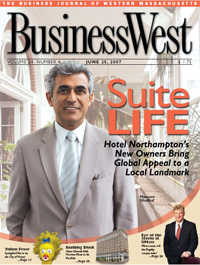
Cover Story
Drive, Imagination Help Answer Catering Challenges
The Main IngredientMocktails for teenage guests. Organic meat stations. Chilean ingredients prepared in Lebanese fashion. Such catering requests are fast becoming the norm, not the exception, and caterers and event planners in Western Mass. are responding accordingly. Handling new and ever-more-demanding client needs is challenging, but those in this industry say it stirs their creative juices, while fueling their entrepreneurial fires.

Caterer Michael Sakey was reminded recently of just how much his industry has changed when a client made this request for her event:

“I want everything flat.”

“Flat?” Sakey said, still questioning the directive long after the event had passed. “I didn’t know what she meant, but she didn’t give me much more than that … just flat.”

Sakey, general manager of Spoleto Catering in Northampton, filled the request successfully by providing large platters for hors d’oeuvres, set side by side instead of tiered. He placed large pieces of slate in the centers of tables, scattered rosebuds in place of floral arrangements, and used stemless glassware for wine and champagne. The client loved it, he said, but the job was not without some anxiety.

“That’s a great example of what caterers face today,” he said. “We’ve seen a huge step back from all things traditional, and people are getting much more creative, if not eccentric. But they also have different expectations in terms of our level of service and expertise.”

Sakey said the new, more rugged demands on caterers are a relatively recent phenomenon – one that comes with its share of challenges, but also with a few perks.

“It’s funny how things change so quickly, because it wasn’t like this five years ago,” he noted, explaining that until recently, most clients played it safe, requesting foods or themes they’d enjoyed elsewhere. “Now, people want us to create an atmosphere that their guests have never experienced before, so more and more problems fall to the caterer. But at the same time, we’re having a ball with it, because this market is ready for creativity.”

Causing a Stir

A number of factors seem to be spurring this new trend in the catering business, among them a proliferation of food and event-planning television shows, magazines, and books that are introducing more-sophisticated themes to a larger audience and blurring the line between creative food preparation and full-on event management.

Kristen Rowell, event manager for the Garden House at Look Park in Northampton, said the only constant she’s seeing in terms of recent catering requests at her facility is a steady stream of clients with big ideas. Each request, however, is vastly different from the one before it.

“People want their events to be personalized,” she said, “to reflect who they are. Because of that, we’re seeing a lot of themed events – but those range from Hawaiian luaus to refined cocktail parties with signature martinis.”

Rowell said specific age groups are also influencing event-planning trends – the younger, 20-something set, for instance, tends to cut costs with a do-it-yourself approach – creating their own music mixes via computer programs, for instance, or having a friend with a good eye – and a great digital camera – take photos. But those money-saving tactics are aiding the catering boom, she explained, rather than taking away business.

“I’ve had a huge influx of events where the clients virtually put every cent they have into the food,”she said.

Similarly, Baby Boomers are also putting some new demands on caterers, looking for sophisticated, unique themes for their parties, although Rowell said this set, many of them celebrating a new found freedom of both time and money as children grow up and move out, are less likely to skimp on the other aspects of a party. Instead, she said, they’re going all out, requesting full-service cooking stations where guests can sample the food, but also learn how to cook it; they’re asking for specific cuisine such as Russian or Brazilian, or for fusion dishes, such as Mediterranean food with a Latin flair.

In short, Rowell said everyone is asking for parties that are absolutely fabulous.

“Clients know what they want and how to get it,” said Rowell, “but when it comes to the food and the presentation, they would still rather have a professional handling it, and that’s at all ages.

“I never expected to cater a prom, but we did recently, for the Pioneer Valley School of Performing Arts,” she continued. “They said, ‘we know you think we’re just kids, but this is what we want.’ And they had a laundry list of requests, which we answered.”

Meat of the Matter

The trend of specific, personalized service has not eluded the corporate set, Sakey added. Rather, corporate events represent some of the most uniquely catered events of late. When Fathers and Sons of West Springfield, for instance, held a launch party for the new Porsche Cayman S, Sakey was called upon to provide food that mirrored the car – European, but with bit of a hot, spicy touch. ‘Caymantinis’ were also concocted at the bar.

“But at the same time,” Sakey said, “corporate events are based around convenience for the client, and that means often, I never even meet my client face-to-face until the day of the event. Sometimes, all I get is a four-line E-mail and an AmEx number. But there’s always an expectation that the food will be of a certain quality. Essentially, they’re paying for me to take on that responsibility.”

Tabitha Mahoney, event manager for the MassMutual Center in Springfield, echoed his comments regarding an increasingly in-the-know public, and the effect that’s having on the catering sector.

“Customers are increasingly savvy,” she said. “They’re creative and well-versed in what is available, and they’re not afraid to ask for new things. More and more, we’re being asked to execute some very unique spreads, and it seems as though this is happening everywhere.”

Indeed, these trends are being seen not only across the region, but across the country as well. Diane Welland, a registered dietitian with the U.S. Food Service, listed several ‘hot trends’ in catering that have emerged in the last decade. Among them unusual starches (farro, quinoa, risotto, black rice, couscous), fusion buffets, homestyle desserts, and soufflés – once seen as passé, she said. Each illustrate the diversity of requests as people strive to create a ‘dining experience’ for their guests.

“In an effort to appease clients, menus have gotten bigger, better, and more sophisticated than ever before,” she said. “Variety and excitement are buzzwords in the industry and creative chef-manned stations and buffets specifically tailored for each event are the norm rather than the exception.

“To attract and keep customers, caterers must not only follow the latest ‘in’ foods in restaurants,” added Welland. “they must also create their own trends.”

Sakey agreed, noting that as demand increases, his job becomes more complex as well. Caterers are also being charged with other tasks that once fell far out of their realm, such as designing banquet space, or not only creating menus, but devising recipes as well.

“One major shift in this industry is that caterers are being asked much more often to be event planners as well,” Sakey said. “Once, I worried only about the food; now I’m worrying about tent rentals, lighting, and disc jockeys. I’ve even been asked to help coordinate wedding processions.”

And along with developing confidence about food choices, clients are also getting more comfortable with non-traditional event spaces as well. Sakey harkened back to an event he catered recently at a venue that began as an empty barn.

“The request was to create a beautiful New York-style cocktail lounge … but in a barn,” he explained, noting that instead of visiting gourmet food-sellers in search of ingredients, on this particular occasion Sakey spent more time at Home Depot than anywhere else. “I have a background in theater that literally saved me. We did some extensive lighting treatments, used contemporary tables and set the stage for the event, and it was beautiful, but it shows how much the media influences people. I know the clients saw something like this on T.V., thought it was great, and decided to execute it.”

Food for Thought

Sakey still marvels at the turn his industry has taken, but repeated that with these new, varied requests has come a new day for caterers and event planners that allows them to flex their creative muscle.

“Everything is breaking away from tradition,” he said. “Maybe it’s a reflection of what the world is like in general right now – people are becoming more worldly, and they’re trying their best to enjoy themselves in new ways.”

And sometimes, that means creating a world that is flat.

Jaclyn Stevenson can be reached at[email protected]
Cover Story
July 10, 2006 Cover

July 10, 2006 Cover

Knowledge Matters is Making Inroads in the Field of Educational Simulation

Knowledge Matters in Northampton could make history as a company that helped make the textbook obsolete in American schools. Indeed, the educational software outfit has changed the way many classrooms operate by introducing simulations that teach everything from profit margins to crowd control — and can actually enable users to rewrite history.

In a small office suite in downtown Northampton, hundreds of Egyptians are harvesting grain in preparation for an impending flood.

That’s not a metaphor for the latest team-building craze in corporate America, and it’s also not an uncommon occurrence at Knowledge Matters Inc. (KM), an educational software developer and publisher. Rather, those intrepid field workers are the subjects of KM’s latest project, which teaches the history of ancient Egypt by placing students — virtually speaking — on the banks of the Nile.

KMI began developing computer-generated simulations (sims) for use as learning tools in 1997, after founder and CEO Peter Jordan, a software developer who previously worked with McGraw-Hill, the text and educational materials publisher, received a grant from the Federal Department of Education to further explore the feasibility of sims as educational models for classrooms across the nation.

Essentially, sims create virtual environments that a user can manipulate to create an unlimited number of end results. The software gained some notoriety in the gaming world in the late 1990s, when computer programs such as ‘SimCity’ and ‘Roller Coaster Tycoon’ first hit the market, however KMI has long been focused on producing purely educational programs, with the goal of proving that a multi-media approach to learning could eventually replace, and not merely supplement, the textbook.

“We’ve found that properly designed simulations are a ‘dominant’ technology in education,” said Jordan. “By that, we mean they surpass the main alternative (textbooks) on every important purchase criterion. They are easier to teach with, increase the amount learned, are more enjoyable for students, and actually cost less.

“We’re 99.9% educational,” he added. “We’re not making games, and we’re not in the ‘edutainment’ industry. We’re very focused on doing one thing and doing it well, and after we introduced our first sim to our first school, we knew we were on to something big.”

Isn’t that Convenient

KM’s first product, Virtual Business – Retailing, released in 1999, was created in response to a growing need for business-related, college preparatory products for high school students, and teaches basic business principles. It puts the student in the role of convenience store manager and maker of all the decisions that would be made in a real environment – from stocking to pricing; hiring to firing – that affect the store’s profitability.

Since that time, the company has expanded the Virtual Business line to include programs centered on management and supervision and sports management (students manage a football franchise). The programs have been used by more than 500,000 students in 3,500 schools around the world, prompting a 50% increase in revenue for KMI last year. They are the subject of national competitions among teams of high school students across the country; students take the management of their virtual environments so seriously, Jordan said, they hold their coats open to shield their ‘trade secrets’ from other teams.

It’s a precaution he can understand. Although KMI has quietly grown to become one of the leading providers of educational software in the country from its small base in downtown Northampton, coupling virtual technology with the education sector – not known for strong or easily navigable funding streams – has been a challenge for the privately-held company and its core staff of six.

“It could cost other companies working in different areas $3 million to $5 million to develop products similar to ours,” he said, “but you’re never going to make that back in education, so early on we had to build completely different cost models.”

That means being very selective about what is included in each program and what hits the cutting room floor, explained Eric Olsson, KM’s vice president, who joined the company shortly after Retailing entered the market. That, along with employing some trade secrets of their own and continually testing the sims within schools – including local high schools, middle schools, and community colleges – has resulted in a suite of computer programs that are steeped in the educational process and very light on frivolity.

Simulated characters may get unruly at sports arenas, or shoplift, but each action eventually affects the bottom line, and very few actions are included for the sake of cool animation.

“We design everything from the bottom up as learning tool,” said Olsson. “We worked through all of the state standards to find common spots, and we work with teachers to understand what is expected of them. There are no gimmicks; we’re focused on translating several concepts, and making sure students understand the connections between them.”

Taught Like an Egyptian

With the goal of further capitalizing on what they firmly believe is the future of education, KMI is about to launch its newest sim line, called Virtual History, tailored to middle school social studies classrooms, with hopes of similar success.

Slated to reach classrooms by September, KM’s first foray into virtual history will tackle the lessons and concepts of ancient Egypt, using the same villagers currently milling about at the KMI offices, baking bread and fending off violent Nubian tribes.

Olsson said Virtual History – Ancient Egypt will be followed by programs centered on early settlements in America, ancient Greece, and westward expansion.

“With the continued development of the company’s original line of business sims,” he said, noting that a personal finance model is currently in the works, “we have a target of 10,000 schools using our programs within the next five years.”

Even with a three-fold increase in use anticipated for the business and history sims, however, Olsson, a former teacher himself, explained that the company’s products are part of a still-fledgling cultural change in the educational sector. Still, he said it’s a movement that is gaining momentum and pointing schools toward more interdisciplinary approaches to teaching and non-traditional teaching tools.

He said schools are being pressed more often to offer lesson plans that touch on multiple disciplines simultaneously, and simulations are helping teachers create comprehensive lesson plans that are also engaging for students.

“Teachers are being pushed through (the federal program) No Child Left Behind to create interdisciplinary lessons, and in some cases our sims are being used as the backbone of the curriculum,” Olsson said, noting that through the ancient Egypt sim, for instance, students in grades five through eight are charged with the task of managing a virtual village by applying knowledge of ancient Egyptian life and culture.

Taught through a series of mini-tutorials within the sim (a student must pass a three-question quiz before moving on), these historical facts touch on economic variables, technological advances, and available resources, among others, and lead to specific benchmarks that must be achieved. Students must successfully farm and refine grain to make bread and consequently feed the village, for example, but must also avoid the destruction of crops and the loss of lives to the annual flood of the Nile. And in the final level of the sim, students can only successfully construct a pyramid after they have secured the necessary manpower, tools, and materials.

“Students can employ different strategies to achieve goals and address problems,” Olsson explained, noting that they can even change history with the right set of decisions. “These programs are more about teaching concepts, and if a student’s decisions lead to an outcome that is different than what really happened, that’s fine – it’s then up to the teacher to underscore that their decisions made happen what could have happened, but didn’t.”

Leveling the Field

That notion of ‘what if’ teaching models is one that is pervasive in all of KM’s products, and is also one that has shown promise as a teaching tool for students who have difficulty with more traditional teaching methods.

“Sims have a very real leveling effect,” said Jordan, likening the work students put in to increase their convenience store’s profits or tame unruly fans at their arena to a game of golf. “It doesn’t matter how pretty you look getting the ball in the hole, as long as it goes in. It’s the same for these kids … it doesn’t matter how they increased their profits, it just matters that they did.

“From our earliest customers on,” he added, “we’ve heard reports of a phenomenon that we never even really planned for. Simulations are a remarkable tool for students who don’t fit the normal school mode.”

This list includes those with attention deficit disorders, those who have become withdrawn from the school experience, and those with behavioral problems, among others.

“There’s no teacher evaluating an essay … it’s just them against the logic and they love the battle,” he said. “You do well with sims when you are able to see how everything fits together and interacts, and the kids who may not be so good at regurgitating ‘knowledge piece number one’ and ‘knowledge piece number two’ seem to be very good at putting the whole picture together.”

Overall though, the most notable phenomenon Jordan and Olsson have recognized within schools using their sims is the ‘flip factor.’

“Because the programs are interactive with students, kids aren’t passive listeners in the classrooms,” said Olsson. “They’re engaged in the program and will work for hours, including on their own time, to move forward in the program. In turn, that flips the teacher role – instead of teachers constantly trying to draw information from the students, the students are starting to draw knowledge out of the teacher.”

Closing the Book

And as roles reverse, Jordan added, the role sims are playing in modern education is expanding.

“Textbooks die hard,” he said, “but it does look pretty ominous for them in the long run. Today, simulations are still largely seen as ‘supplemental’ tools with the textbook as a core, but the trend is toward reversal.

“Sims have proven to be much more engaging, especially when used by reluctant and emerging learners,” he continued.

Indeed, hundreds of tiny Egyptians can’t be wrong.

Jaclyn Stevenson can be reached at[email protected]
Cover Story
Taking Stock of the EDC After a Decade in Business
June 26, 2006 Cover

June 26, 2006 Cover

The Economic Development Council of Western Mass. recently marked 10 years of work to promote the cities and towns of the Pioneer Valley as one economic entity. Its president and CEO, Alan Blair, says the council has achieved its primary mission — making the region more competitive — but much work remains to bring jobs and economic growth to Western Mass.

As he stood at a podium in a meeting room at Chicopee’s Parwick Center a decade ago to announce the formation of the Economic Development Council of Western Mass. (EDC), Alan Blair was asked by BusinessWest how and when he would know if the new venture was a success.

“If we become more competitive as a region,” was the quick response, with much to follow about how he believed the EDC, a new and fairly radical concept in planning and economic development, would enable the counties of Western Mass. to better compete for everything from jobs to the attention of lawmakers in Boston and Washington.

Ten years later, Blair, the EDC’s first and only president and CEO, says he can state with confidence that this basic mission has indeed been accomplished — although he stressed that the work is just getting started.

“We’re definitely in the game now,” he explained, using that phrase to imply that the region is now a larger player in the high-stakes and truly global competition for jobs and economic growth — it even had a site or two reportedly in the mix for the $1.1 billion Bristol-Meyers Squibb manufacturing facility that will be built on the former Fort Devens site. “That doesn’t mean we’re going to win every game, certainly — just that we’re in a lot more than we were before.”

But is the region winning enough?

That is a question Blair knows many people are asking — and also answering with a ‘no.’ And he would be the first one to say that the region could be doing better in its efforts to attract more companies and jobs, and hopefully will in the years to come.

It is handicapped in that assignment by everything from geography to well-financed competition, said Blair, adding quickly that luring large employers to the 413 area code has never been the region’s strong suit — most of the larger companies that call the Valley home grew up here — and it is merely one aspect of that broadly defined term economic development.

Others include job-retention, advocacy, government relations, growth of the tourism sector, and new-business development, and in these realms Blair believes the EDC has enjoyed varying measures of success.

“There are 33,200 more people working in the Pioneer Valley today than there were in 1995; our economy is growing, if it wasn’t, we couldn’t absorb those jobs,” said Blair, noting that while some might question where those people are working — many new jobs have come in the tourism and distribution sectors — that simple statistic shows that the region is growing while others in the Commonwealth are not.

There are other ways to quantify and qualify the relative success of the EDC, said Blair, citing everything from the MassMutual Center, which he says might not have gotten off the ground without the council’s work to rally area legislators around that cause, to the fact that other regions in Massachusetts and other cities, including Hartford, are incorporating the EDC model in one form or another.

Overall, he said the EDC has succeeded in taking an area with nine cities (six when it was first created) and dozens of small towns, which were all slugging it out on their own and competing against one another in the process — ‘Balkanized’ was the word Blair used to describe the Valley’s state — and making it one economic region.

Actually, it has gone further, he said, adding that in 2000, the EDC partnered with officials in Connecticut to create what has become known as the Knowledge Corridor.

A region that stretches from south of Hartford to Northampton, the corridor boasts roughly 1.7 million people, 27 colleges and universities, and perhaps 30,000 college graduates a year. These are numbers that can be sold to site selectors and company owners, said Blair, adding that many people are shocked when they hear them.

Turning that initial shock into growth on both sides (but preferably this side) of the border will be a priority for the EDC as it enters its second decade of work, said Blair, who recently talked with BusinessWest about the council’s first 10 years and what the future will likely hold.

History Lesson

As he traced the history of the EDC and outlined the factors that motivated its creation, Blair flashed back to a conference he attended in 1995 as president of Westmass Area Development Corp. and Westover Metropolitan Development Corp., with the goal of finding prospects for those agencies’ industrial parks.

He doesn’t remember where that show was, but he clearly recalls a conversation he had with another attendee.

“He asked me who I was representing and what I was selling,” said Blair. “I said, ‘Chicopee, Ludlow, Westfield, and other communities where we had parks, and he laughed. He said, ‘where are those places?’

“That helped make it clear to me and other people just how absurd it was for us to sell a single municipality to site selectors and brokers who were looking at broad regions and needed a ton of information in order to make decisions about where to locate,” he continued. “That became a foundation for our regional approach to selling this area.”

The vehicle for doing that selling would be an economic development council, funded by several sources, including contributions, totaling $150,000, from area businesses. The council would have a president and a large board of directors that would reflect the regional nature of the agency by including all the region’s mayors and college presidents.

The council’s operating model would be unique in that it would act as what Blair called a “management company” for its six affiliate economic and business development organizations: Westover, Westmass, the Affiliated Chambers of Commerce of Greater Springfield, the Greater Springfield Convention & Visitors Bureau, the Springfield Business Development Corp., and the Regional Technology Corp., which joined over time.

The cooperation of those affiliates, and the EDC’s unique relationship with them, have been pivotal factors in the overall success of the council, said Blair, adding that the EDC’s architects didn’t want to create a ‘super agency;’ instead they wanted to coordinate the work being done by those organizations.

“This could have been a disaster if the affiliates felt that this was a parent-subordinate relationship, one where we somehow forced them to conduct themselves in a way they weren’t comfortable with,” he said. “That was never the intent, but we knew it was a delicate relationship; every affiliate has found the way to interact as part of the whole, while still maintaining the identity they need to maintain to properly serve their members.”

Working together, the EDC and its affiliates have managed to promote the region as one entity and make it more competitive in the process, said Blair, who, when asked for examples of how the council has accomplished this, started with the Coolidge Bridge.

The structure, which links Northampton with Hadley was badly in need of repair and widening, he said, noting that congestion on the bridge had created legendary traffic tie-ups that in some ways threatened growth of those communities and UMass.

“We were selling the research capability of the university,” he explained,” but people were saying that they couldn’t get there.”

What the EDC did was effectively convert the bridge from an Amherst-Hadley-Northampton issue, which it had been for decades, into a regional priority. Through letters to state transportation officials, talks with area legislators, and efforts to get the region’s mayors to get on board, the EDC helped move the project forward by “taking some of the politics out of the equation.”

“When we got the mayors to support it, that said to state representatives and senators that their backs were covered,” Blair explained. “That hadn’t happened before; someone from Springfield could now advocate for this project in Northampton without fear of having their legs cut out from by the mayor of Springfield.”
The same M.O. has helped with other regional projects, said Blair, listing the MassMutual Center, legislative action to lower the airport user tax (a measure that significantly benefited Westover Municipal and Barnes Airport in Westfield), and an I-91 broadband project now in the works.

The regional approach has also been applied to the task of bringing companies and jobs to Western Mass. and now the larger Knowledge Corridor, he said, adding that before the creation of the EDC, individual cities and towns would compete against each other, often with calamitous results.

The most notable case was the Coke Cola bottling plant that eventually wound up in Northampton in 1995. For several months, Coke played those two communities against one another in a game that resulted in no clear winners.

The EDC now takes large measures of that gamesmanship out of the equation by creating a central entry portal for companies looking to enter the region or expand within it, said Blair. The specific wants and needs of those companies are weighed, and possible sites are forwarded.

The streamlined process has helped bring many companies to the region, said Blair, citing German-based Suddekor LLC as one of the better success stories. The company, a paper-maker, was looking to locate a plant somewhere in the Northeast, and was steered to Western Mass. and eventually the Agawam Regional Industrial Park by the EDC.

The company has steadily grown, and recently opened a second plant in the region in an East Longmeadow industrial park developed by WestMass.

“They’re an example of a company that could have gone anywhere,” said Blair, “but they came here in part because of our regional approach and our ability to put ourselves in the game.

“That’s how we got started with the EDC and why we started — to become more competitive,” he said. “And as soon as we did, we not only got attention statewide, but we got attention from other places, like Northern Connecticut; people were saying, “maybe they’re on to something there, maybe this is the way to go.”

The Jobs at Hand

Despite Blair’s many positive measures of the EDC’s performance in its first decade in business — not to mention the attempts to duplicate the model elsewhere — the council has its critics and skeptics.

Indeed, there are those who have questioned everything from the size (85 members) and makeup (too many old guard members and not enough women or small business owners) of the Board of Directors, to the area’s new marketing image and slogan.

‘Arrive Curious, Leave Inspired’ emerged from a lengthy and somewhat controversial EDC-led process that included the hiring of a Tennessee firm that specializes in destination branding, a move that didn’t sit well with some members of the local creative community.

Meanwhile, some have suggested that the EDC is too Springfield-centric, at the expense of Hampshire and Franklin counties, and still others maintain that it hasn’t done enough to help the struggling city out of its fiscal morass.

But the most consistent criticism of the EDC is that it hasn’t brought large numbers of jobs to the region, despite ongoing efforts to market it as an attractive, lower-cost option to Boston, and hasn’t created much in the way of economic development.

The Chicopee River Business Park, which straddles Chicopee and Springfield, has become the poster child for perceived EDC underachievement. It’s been on the market for nearly a decade, but has just one tenant — laser manufacturer Convergent Prima — although a second deal is said to be nearing completion.

Blair acknowledges the criticism, but bristles at the notion that there hasn’t been any economic development over the past several years. He says it just hasn’t come in the form that most equate with that phrase — companies building new plants and hiring hundreds of people.

There has been some of that, Blair noted, citing Suddekor, the giant Target distribution center that will soon take shape in Westfield, and other companies that have built or expanded in the WestMass and Westover industrial parks over the past 10 years.

But economic development has come in many other ways, some of them less visible, at least from the standpoint of the EDC’s involvement. These include everything from heavy lobbying for the MassMutual Center and the Coolidge bridge widening to creation of the Business Improvement District in Springfield and emerging BIDs in Westfield and other area cities.

And it also includes job-retention, a less-glamorous, often overlooked aspect of economic development, he said.

Citing the decision of Performance Food Group to relocate from Taylor Street in Springfield to the new Memorial II industrial park to be created on land adjacent to Smith & Wesson, Blair said that initiative will bring about 250 new jobs to the region, a number he believes isn’t drawing the proper amount of respect.

“If we were bringing in 250 jobs from outside the region, there would be headlines for three days about how great that was,” he said. “Why don’t we have three days of headlines when we create 250 jobs by keeping a company here?”

New-business development has also been a priority and another relatively successful realm for the EDC, said Blair, adding that through the work of affiliates like the ACCGS and facilities like the Technology Park at STCC, the region is a much more “friendly” place for entrepreneurs.

Tourism has also seen steady growth, he said, noting that several new hotels have been built in the region and occupancy rates remain higher than the state average despite that higher volume.

Moving forward, the EDC will look to improve its track record in efforts to bring more large employers to the region, he said, adding quickly that success will likely not come quickly or easily because the level of competition and the comparatively low level of financial support from the state.

“We didn’t expect to suddenly turn on the spigot just because we printed some brochures and went to a few trade shows and conferences,” he explained. “We knew this would be a long-term effort that would require a lot more resources than we could generate on our own.

“We look to the ‘Research Triangle’ in North Carolina as the model that everyone refers to; they say, ‘look at what they did in the middle of nowhere with a couple of colleges and the state university,’” he continued. “When we investigated that, we found that the brand Research Triangle has been around for more 30 years and that the state has put half-a-million dollars into that brand every year since the beginning. No one had even heard of the triangle until six or seven years after they started.”

It will take more time and resources for the Knowledge Corridor to become a recognized brand, he said, adding quickly that it is already becoming part of the lexicon for brokers, developers, and site selectors.

“We have a cross-border brand that’s only five or six years old,” he told BusinessWest. “We should be looking at a 15-year timeline to see if we can be successful in changing the perception of Western New England by using this brand.”

The Bottom Line

While Blair feels confident that the EDC has met that threshold for success he laid out a decade ago, he’s far from content with what the council has accomplished.
“You never want to leave the impression that you’re ever satisfied with results,” he said. “If you ever feel that way, you might as well get out; there are many things we can be doing better.”

But overall, Blair believes the EDC has had a productive first decade in businesses, and, like the region itself, has built a foundation on which to grow.

George O’Brien can be reached at[email protected]

Cover Story
Jim Mullen Wants The Elms to Branch Out

Cover 12/26/05Since assuming the presidency of tiny Elms College in Chicopee in July, Jim Mullen says he’s spent most of his time listening — to students, faculty, staff, the alumni, and area community and business leaders. This is a key element in his strategy to build new and stronger partnerships in the community and take the school’s mission well beyond its walls.

Jim Mullen calls it “management by walking around.”

That’s how he describes the style he brings to the president’s office at Chicopee’s Elms College, a post he assumed last summer. And there’s more to it than merely patrolling the school’s tiny 21-acre campus.

He makes a point of eating at least one meal a day in the dining commons and sharing a table with students. He’s also been known to join in touch football games in the quad, and he even works out occasionally with members of the school’s baseball team.

“That’s a pretty humbling experience,” he told BusinessWest. “I usually have to peel weights off the bar to handle the repetitions.”

But he says such exercises give him energy — literally and figuratively — and a stronger connection with the campus community.

It’s all part of Mullen’s ongoing efforts to continuously monitor student and faculty thoughts and concerns at the 77-year-old school, which he believes is at a critical juncture in its history. Whether he’s throwing batting practice to those assembled for an impromptu pick-up baseball game or grabbing a quick lunch in the cafeteria, Mullen is also listening.

That’s what I’ve spent a good amount of my time here doing,” he told BusinessWest. “Often, when I’m eating with students, I’ll hardly say a word; I’ll just sit there and listen.”

And by listening to students, faculty, alumni, and the public at large, Mullen is helping to shape a course for the school. It’s not a new course, he stressed repeatedly, but merely an attempt to re-emphasize the school’s mission — educating and inspiring young people committed to serving their community — while also creating some new manifestations of that broad purpose and generating greater awareness of the college.

Which brings him to something called the ‘Elms College Community Spirit Service Day.’

That’s a new program he initiated this fall that addresses all those goals by having students take a day off from the classroom and go out into the community.

Specifically, groups of students ventured to sites ranging from the Chicopee Department of Public Works to the Emergency Food Pantry in Springfield; Girls Inc., to the Open Pantry Teen Living Program.

Duties included everything from helping young people with homework to painting the walls at several area shelters, said Mullen, noting that more than 200 members of the college community participated, a number he expects will grow each year.

Service Day was created to give students a taste of community service and awareness of its importance to quality of life in the region, while also providing the Elms, its students, facility, and staff with greater visibility.

It’s part of Mullen’s enhanced partnership- building initiatives, or work to “connect the dots,” as he put it, within the Western Mass. community.

Such partnerships include a tutoring/mentoring program that involves students of the Holy Name school located across the street from the Elms campus, and an ongoing collaboration in which drama students at the college help students at Holyoke Catholic High School stage productions like the recent Dead Man Walking. There’s also a venture called the Quest Program, which brings area middle school students to the Elms campus each summer.

Doing so introduces them to the school, but, more importantly, it often inspires participants to pursue a college education.

Looking to the future, Mullen said Elms administrators want to build a new science center, a necessary step toward expanding some of the school’s most successful programs, such as Nursing, Chemistry, and Speech and Language Pathology, and also build new athletic facilities to facilitate growth of programs that have helped attract and retain many students.

The more immediate goal, however, is to build more of those partnerships that Mullen believes will take the school to the next level.

“Our mission is not only to provide a great education,” he said, “but also to inspire connections.”

School of Thought

When asked how he arrived at the Elms, one of the smallest schools in New England in terms of both acreage and enrollment, Mullen said it was a case of “as natural a fit as one could ask for.”

Elaborating, he said that, as chancellor of the University of North Carolina at Asheville, a post he assumed in 1999, he would often get calls from a variety of search firms. “The conversations usually started with, ‘would you interested in becoming the president of ….?’ The answer was usually a qualified ‘no,’ he said, adding that he did consider some of the positions. But none as seriously as the Elms, which presented a chance to come home — he was born in Granby and lived in the Greater Springfield area for many years — and raise his family in the environment he enjoyed.

Meanwhile, the Elms presidency presented a chance to work for and within an institution that has played a big role in his life — the Catholic Church — while also giving him the challenge and opportunity of making Elms a stronger, more vital force in Catholic higher education.

“It is a perfect fit for me professionally and personally,” said Mullen, who attended a Catholic college, Holy Cross, and has spent the bulk of his career in higher education, establishing a reputation as a hands-on administrator specializing in building bridges between schools and the communities in which they are located.

At UNC Asheville, for example, Mullen created a program similar to Elms’ service day. Called ‘Bulldog Day,’ it involves freshmen performing thousands of hours of community service.

Meanwhile, at Trinity College in Hartford, where he served in a variety of positions, Mullen was executive director of an initiative called Project 2002, a $300 million public-private revitalization project that has transformed the neighborhood surrounding the college into what is called the “Learning Corridor.”

Mullen wants to continue that pattern at the Elms, a school founded in 1928 by the Sisters of St. Joseph. Located near the Chicopee-Springfield line in a mostly bluecollar neighborhood, the originally allwomen school has historically provided opportunities to those who might not otherwise enjoy a college education.

“Many of our students are the first in their family to attend college, and the vast majority of our students receive some form of financial aid,” Mullen explained. “These are individuals who haven’t had all the opportunities that others have.

“Our goal is to prepare such students for success in their chosen field,” he said, “but also to make them responsible citizens of the world.”

In an effort to diversify and grow its enrollment, the Elms went co-ed in 1999, a move that met with resistance from many students, faculty, and alumnae. Ultimately, the move has proved successful in boosting enrollment, and now roughly one-third of the school’s 1,200 full- and part-time students are male.

The Elms boasts a wide variety of programs — many of them involving service — including Nursing, Education, Social Work, Criminal Justice, and others.

Work in the classroom is complemented with service within the community; students are required to complete a minimum of 30 hours of community service to meet what the school calls its “service-learning requirement.”

Students volunteer time with such groups as the American Red Cross, Habitat for Humanity, the Springfield Library & Museums, and others.

Aggressive Course

Moving forward, Mullen said he wants to increase enrollment, and the broad strategy for doing so is building awareness of the school and its many programs, both in this region, home to the vast majority of current students, and well beyond.

The school has embarked a moreaggressive marketing initiative, one that involves print, radio, and television, but the awareness-building efforts go well beyond advertising, said Mullen.

Indeed, it is grounded in the relationship- building efforts he described and creating greater visibility. Some of the initiatives are small in scope — such as an effort this fall to encourage Chicopee-area businesses to reach out to Elms students and welcome them back for the new semester; the campaign resulted in signs in many storefronts that were not seen in years past. Others, such as the Quest Program are broader.

Quest was designed to introduce young people to the idea of college education — it is still a foreign concept for some population groups, Mullen explained — and then encouraging students to get and stay on that path.

“We would naturally like these people to come to the Elms,” said Mullen. “But the important thing is for them to go to college — any college.”

Quest, the drama partnership with Holyoke Catholic, the tutoring initiative at Holy Name, and other ventures are all part of the ‘connecting-the-dots’ philosophy that Mullen brings to Elms. He told BusinessWest that colleges cannot be islands in their cities and towns, merely taking in students to attend classes.

“Schools can’t be insular, they can’t put up gates and hide behind them,” he said. “Here, we’re about knocking down gates and reaching out.”

By doing so, the school can meet a number of goals — everything from better preparing students for careers in chosen fields, to familiarizing area young people with the Elms — which will naturally help with enrollment.

“All colleges get interested in people when they turn 17,” he told BusinessWest. “Through many of our partnerships, we show that interest much earler, and that helps us create more opportunities for people.”

As for enrollment, Mullen said he does not have a magic number in mind, but would like to see steady increases without impacting one of the school’s better selling points.

Indeed, the small size of the school is one of its strengths, he said, noting class sizes that generally run between 12 and 15 students, and also a close-knit community that isn’t found on many campuses.

“Here, if you’re having a bad day, someone’s going to take notice,” he explained.

“It could be another student, a faculty member … it could be me; and they’re going to ask what’s wrong and offer to help.”

Another of the school’s strengths is its status as the only Catholic college within the Diocese of Springfield. This gives the school a strong base from which to recruit, said Mullen, referring to the many Catholic high schools in the region, including Holyoke Catholic, Cathedral in Springfield, and St. Mary’s in Westfield.

Overall, however, the policy is one of inclusion, he said, noting the school strives to create diversity within the faculty and student body.

Meanwhile, it is working hard to shed its ‘best-kept secret’ status within the higher education education community.

“People will often say that they’ve heard of The Elms, but that they didn’t know all that it does,” he explained. “That’s something we want to change, and to do that, it all comes back to partnerships.”

Class Act

As he talked with BusinessWest in his spacious office in Berchmans Hall, Mullen said he likes his new digs. “But I’m just not in them a lot.”

Instead, he’s taking in one of the drama projects conducted in partnership with Holyoke Catholic, or watching one of the school’s 16 sports teams, or trying to get a curve ball past a student in a pick-up baseball game.

That’s ‘management by walking around,’ and it’s the M.O. that Mullen will employ in his efforts to help the Elms branch out – becoming an increasingly larger, more visible part of the community.

George O’Brien can be reached at[email protected]