
Chrissy Humason
Emerging Leader
Nursing Supervisor and Stroke Coordinator, Noble Hospital
She Helps Close Gaps in Care Through Education, Outreach

Chrissy Humason says she first started thinking about a career in healthcare while she was working on the ski patrol at Otis Ridge — she grew up near it — when she was just 15.
“It was the ability to help people … giving them a boost after they’d fallen or having their wrist splinted before they were taken to the hospital — it was rewarding,” she said of her work on the slopes.
Those feelings stayed with her and created … well, a desire for more, prompting her to join Otis’s volunteer Fire and Rescue Squad when she was 16. And to earn EMT certification by the time she graduated from high school. And to use a sports scholarship to enter an EMS management program at Springfield College, becoming a paramedic upon graduation. And to then earn a nursing degree at Berkshire Community College (BCC). And to join the Westfield Fire Department while working as a nurse at Berkshire Medical Center (BMC), going through several cars because of all the miles she was racking up.
Today, she’s a member of a five-person crew on the Westfield Fire Department’s Engine 3, fighting fires while also responding to medical calls, while also serving as a nursing supervisor at Baystate Noble Hospital, a role that brings a different flavor of rewards and service to the patient population.
“Stepping into that role was definitely a change because it went from being strictly bedside, caring for the patient, to managing and overseeing all that’s happening, the day-to-day operations, the staffing … it was more putting puzzle pieces together,” she explained. “Now, I can be there and help my fellow team members as a leader, help them through when they have questions, and be there and support them. I find that very fulfilling.”
All of this goes a long way toward explaining why Humason has been named a Healthcare Hero in the Emerging Leader category. But there’s still more to this inspiring story.
It comes in the form of her leadership efforts with a stroke education program that brings healthcare directly to the community.
As stroke coordinator at Noble, Humason has led a groundbreaking, grant-funded community stroke initiative across Hampden and Hampshire counties that targets rural areas where access to resources is limited and the need for public health education is high.
“Stepping into that role was definitely a change because it went from being strictly bedside, caring for the patient, to managing and overseeing all that’s happening, the day-to-day operations, the staffing … it was more putting puzzle pieces together.”
And also where an ambulance ride to the nearest hospital might take 30, 40, or more minutes, heightening the need to move quickly and decisively when stroke symptoms may be in evidence.
“Time is brain when it comes to strokes and heart attacks,” said Humason, whose efforts have led to the creation of a detailed community resource brochure loaded not only with information about stroke, but also a healthcare proxy form, a guide to community resources for seniors, and even a File of Life card with key information ranging from emergency contacts to a list of prescriptions that is to be updated every six months.
They have also led to community outreach efforts that have covered nearly 300 square miles and reached more than 1,500 participants. Working with Emergency Department Educator Tami Wescott, Humason has delivered interactive education sessions and health outreach at farmers markets, senior centers, soup kitchens, assisted living facilities, and town events such as the Southwick Rotary Club’s concert series.
And these efforts, she noted, are starting to create positive results.
“We’re finding that people are accessing emergency services a lot sooner by recognizing the symptoms,” she said, listing everything from arm weakness to face drooping. “We have people coming in with the earliest symptoms, and with that, they’re able to receive treatment a lot quicker, and that can help with their symptoms for long-term effects. And that’s our ultimate goal.”
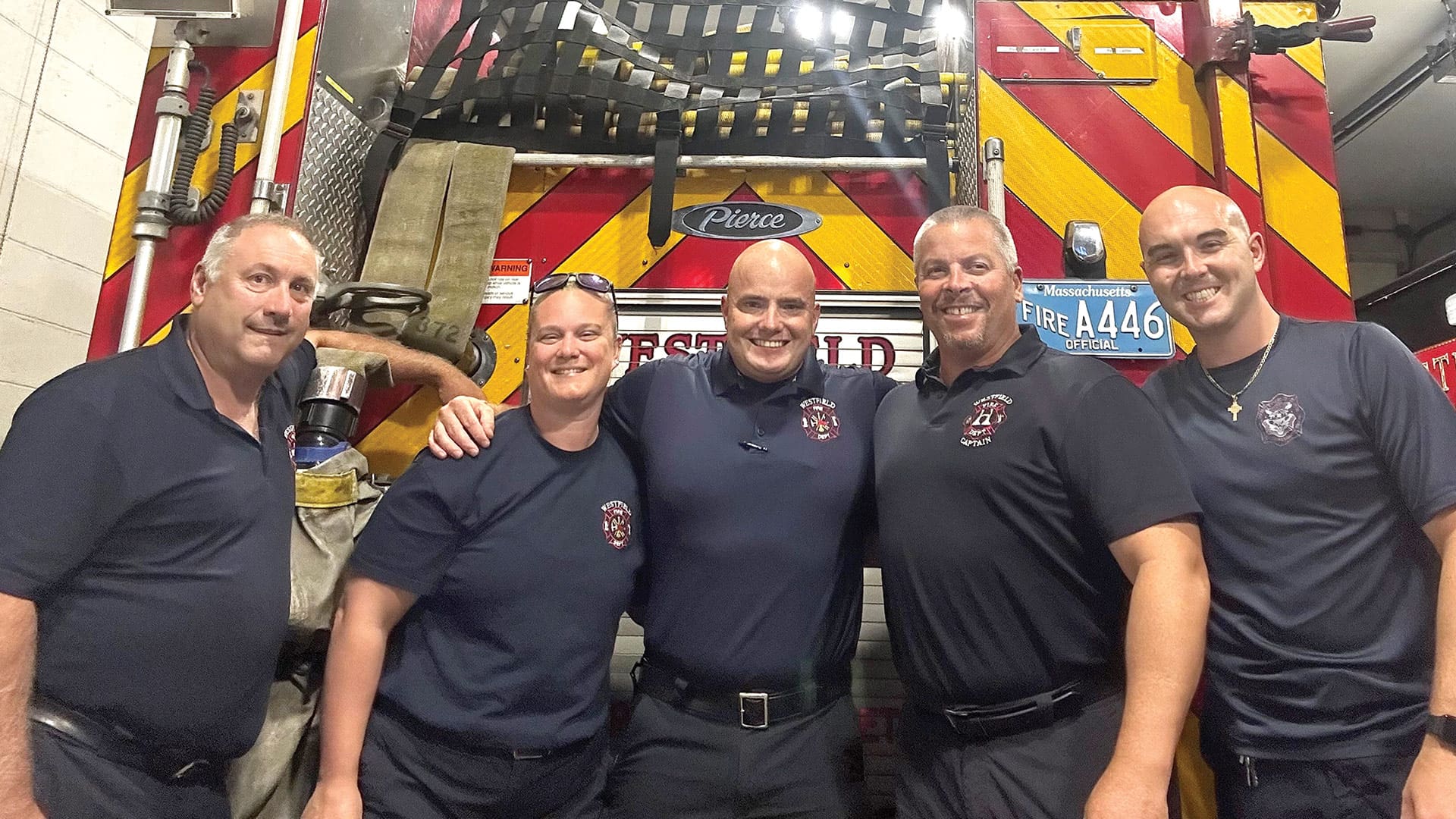
Chrissy Humason with other members of the Westfield Fire Department’s Engine 3.
This early success is both an indicator of the power of outreach, and yet another example of how Humason is collaborating with others to create a healthier, more informed community.
Brandon Okezie, Noble’s president and chief operating officer, summed up Humason’s contributions, and her qualifications for the title Healthcare Hero, in effective fashion.
“She is an excellent emerging leader in healthcare: innovative, empathetic, collaborative, and committed to closing gaps in care through education and outreach,” he wrote in nominating her for the award. “Her work has left a meaningful imprint on the communities served by Baystate Noble and offers a model for how localized, person-centric health education can save lives.”
Slippery Slope
As noted earlier, Humason grew up in Otis and was a member of the Fire and Rescue Squad while still in high school. This was a learning experience on many levels — especially when it came to the challenges facing those living in remote areas and those serving them — and, in many ways, it inspired a career.
“I learned a lot being out there — you don’t have many resources, and you’re quite a distance from any hospital,” she recalled. “There’s a lot to do between there and here, so I learned a lot from that time and decided I wanted to continue and build on that experience.”
Indeed, she attended Springfield College, with the goal of being a firefighter and paramedic, and then moved on to BCC, earning degrees in both nursing and fire science. She joined the Westfield Fire Department in 2006 while also working as a per diem nurse at BMC.
“We needed to figure out how to bring this information into these communities so they would recognize these symptoms a lot quicker and access what needed to be accessed — 911 — to get to the hospital a lot quicker.”
She came to Noble in 2015, cutting some of her commuting time, starting in the ER before eventually becoming a nursing supervisor. After the hospital’s primary stroke coordinator stepped down three years ago, she was approached about becoming stroke and STEMI (heart attack) coordinator and added those responsibilities to an already lengthy list.
Her collective experience, and a desire to find new ways to educate the public and serve rural areas, brought her to the moment when a program administered by Borderland Partners LLC and the Massachusetts Department of Public Health invited institutions to apply for grants that would enable them to bring stroke education to underserved areas.
And Humason seized that moment, first by rallying hospital departments around the concept and then leading the efforts that eventually garnered $15,000 in grant money.
“This was really a team effort,” she explained. “I went around and spoke to everyone in the hospital; I spoke to our case management team, to our ER team, to our physicians, asking them what our patients are lacking when they come to the hospital. Is it education? Is it knowledge of recognizing stroke symptoms? Are they lacking the resources to go back home? What can we do to help them?”
The answers to these questions helped frame an effective grant application — Noble partnered with the Westfield and Southwick fire departments on the initiative — and also helped determine how the grant funds could best be used, Humason went on, adding that the feedback helped inspire an ambitious updating of the community resource brochure.
It is crammed with information for seniors on everything from skilled nursing programs, home care services, and assisted living facilities to senior centers, medical equipment companies, and transportation, as well as the File of Life card — actually two of them, one for the refrigerator and the other for the wallet or purse — and healthcare proxy, a document that too many people are still lacking.
But there is also information on stroke — risk factors, how to spot signs, and why to call 911 immediately, especially in these rural areas.
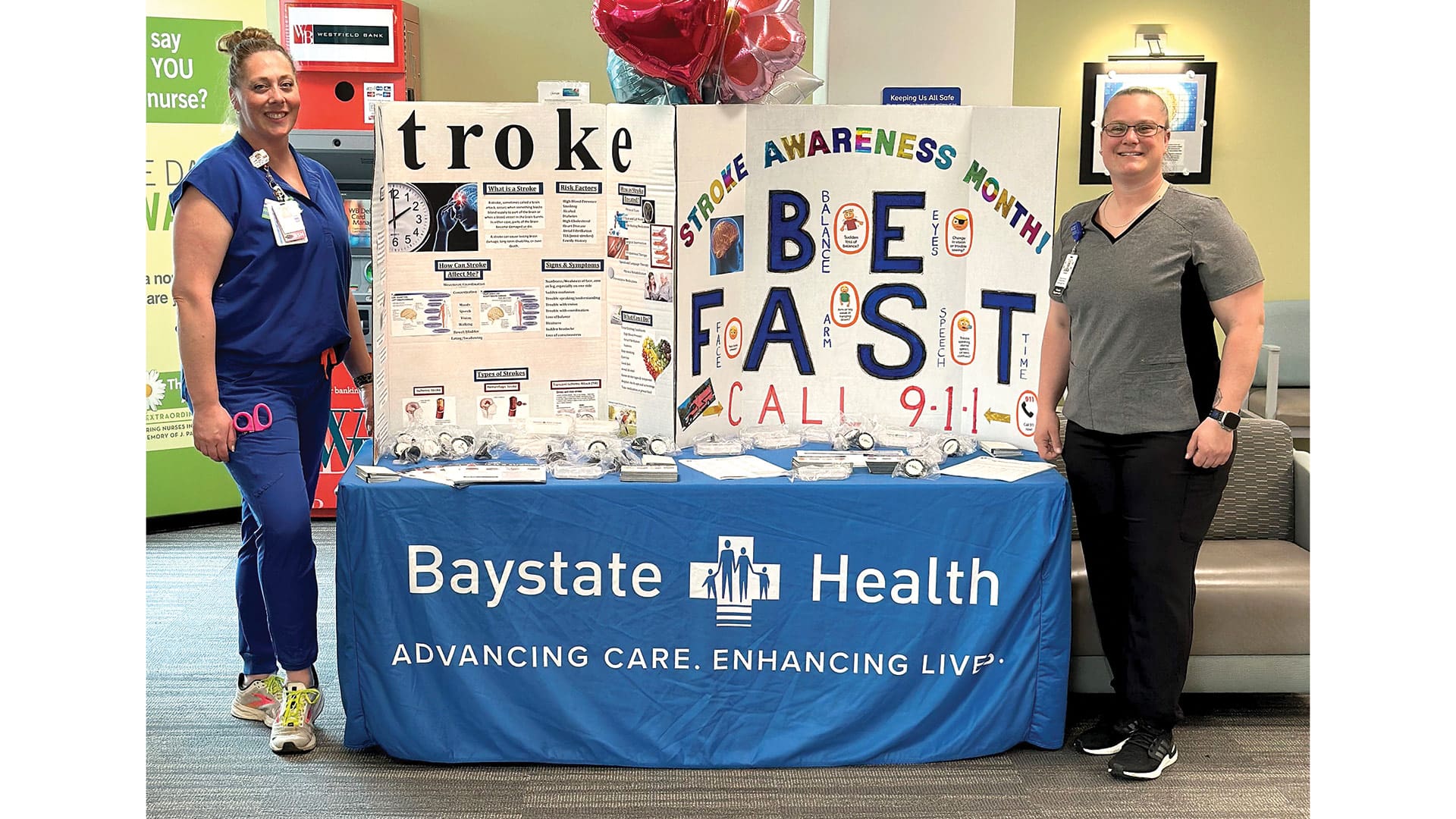
Chrissy Humason (right) with Baystate Noble Hospital Emergency Department Educator Tami Wescott at one of many outreach events to promote stroke awareness..
“We needed to figure out how to bring this information into these communities so they would recognize these symptoms a lot quicker and access what needed to be accessed — 911 — to get to the hospital a lot quicker,” she noted, adding that the program partners modified the traditional stroke-signs acronym FAST (face, arm, speech, and time) to BE FAST, adding balance and eyes (checking for vision loss).
And the phrase is resonating.
Peak Performance
Beyond the brochure, though, is a comprehensive community outreach initiative, one that has been impactful in many ways, from creating a more informed community to giving stoke survivors an opportunity to open up and be part of that education process.
This community outreach, as noted, has covered more than 300 square miles, taking Humason and Wescott to more rural communities such as Otis, Huntington, and Russell, but also Westfield, Agawam, and Southwick.
The sessions have been informative, but also interactive, said Humason, adding that, at several gatherings, stroke survivors felt comfortable enough to share their experiences, informing other attendees, but also inspiring them.
“We had many who spoke highly of coming to Bronson [Rehabilitation Unit at Noble] after a stroke and going from being afraid about never making it home to getting their strength back and going home again,” she recalled, adding that these stories brought a needed personal element to stroke education.
There have been roughly a dozen of these outreach efforts, large and small, to date, she said, adding that more will follow this fall and early winter — in Tolland, at the Westfield Senior Center, and at the Westfield Women’s Club, a gathering expected to draw more than 100 people. And there have been requests to add more to the schedule.
While it’s difficult to quantify the success of this initiative, Humason, who sees results as both a 911 responder and nursing supervisor and stroke coordinator at Noble, can qualify it by noting that people are calling 911 more quickly when they suspect stroke, while EMS responders are finding more File of Life cards on refrigerators.
“Utilizing BE FAST, we’re catching a lot more strokes in different areas of the brain and catching them early, and giving people the resources they need and the interventions they need.”
When asked what it’s been like to be part of this program, Humason said “very fulfilling and heartwarming.” That’s true of all aspects of the initiative, but especially those times when stroke survivors add their experiences and become part of the effort to educate and inspire others.
“For us, that shows that we’re out there making a difference,” she said, adding that this sentiment has motivated her since she was working on the ski patrol, and it has kept her motivated ever since.
“Christine is not just leading change,” Okezie wrote in his nomination. “She’s building a healthier, more informed future for the communities she serves.”
And that explains why she’s an emerging leader and a Healthcare Hero.