Massachusetts Girls in Trades Conference, Career Fair Turns 10
Something to Build On
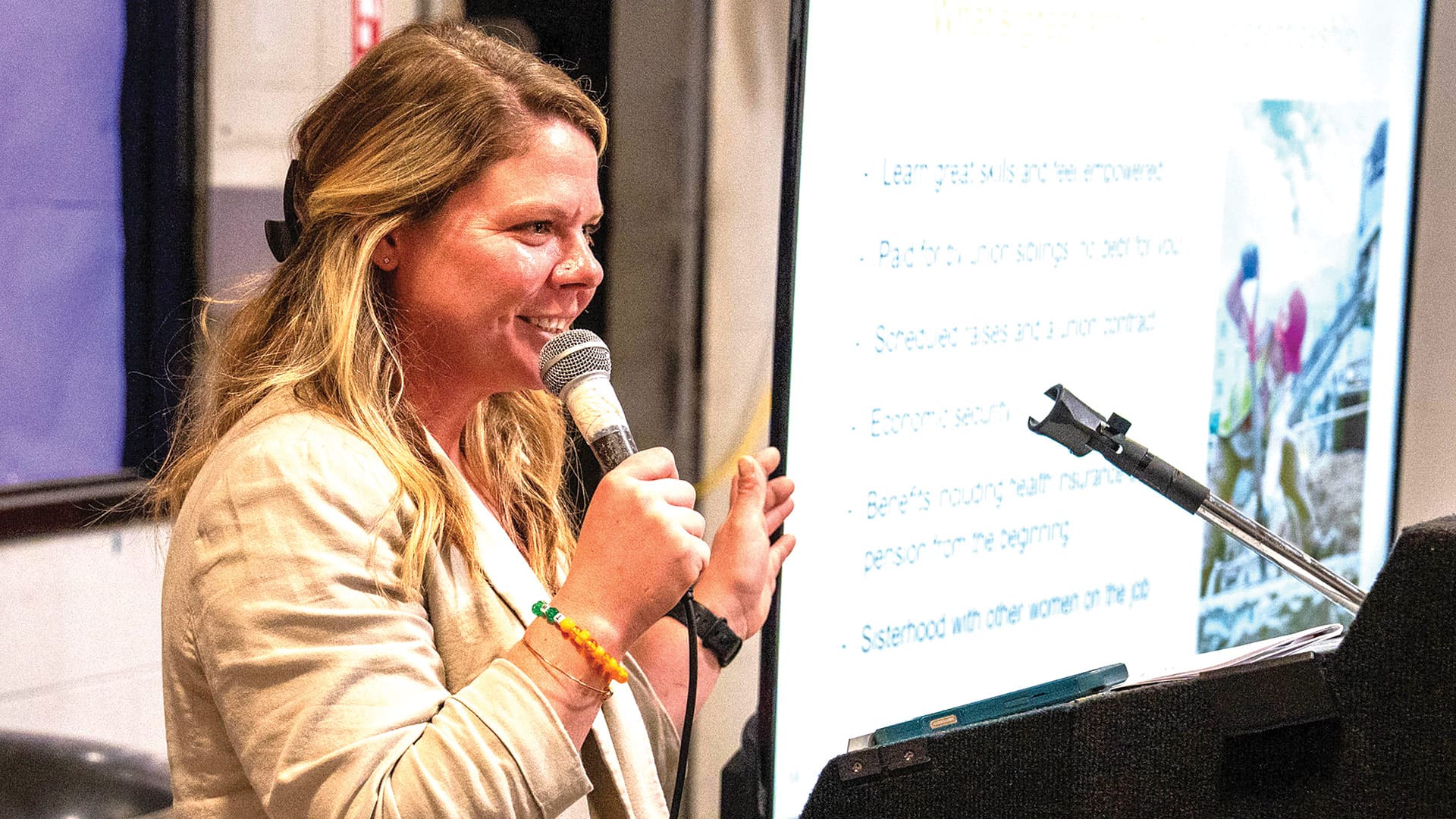
Laborers Local 596 member Chelsea Fenton shares the benefits of union apprenticeship and details her experience with students during a workshop at the recent Girls in Trades Conference.
On Nov. 20, students from 19 schools across Berkshire, Hampden, Hampshire, Franklin, and Worcester counties gathered in Holyoke to explore life-changing opportunities in the union construction industry at the 10th annual Massachusetts Girls in Trades (MA GIT) Conference and Career Fair.
These events are designed to help young women build confidence, gain hands-on knowledge, and envision themselves in careers they may never have considered before.
“Being part of Massachusetts Girls in Trades has changed my outlook completely,” said Kennedy Landers, a Worcester Tech Construction Academy student. “It’s lifted my hopes of being a girl in the trades and given me reassurance that I can do this — and that there are other girls like me.”
Massachusetts building trades unions train the vast majority of the state’s construction apprentices — 74% of all registered apprentices statewide. They also provide opportunities for those historically underrepresented in the trades: 80% of all apprentices of color and 88% of all registered tradeswomen train through union programs. Today, one in 10 union apprentices in Massachusetts is a woman, a number that continues to grow.
In total, 356 students attended this year’s western conference held at Dean Tech High School. This year’s event launched the new MA GIT alumni network, connecting graduates with mentorship and career support as they enter into the trades.
For Jaylene dos Santos, the conference represents the heart of the organization’s mission. “As the chair of the Massachusetts Girls in Trades Student Leadership Council, I have seen the positive change that we make every single day,” she said. “Our resources and support allow students to feel empowered as they enter the construction and construction-related trades. I’m incredibly proud of the work we do to build safe, inclusive spaces for all learners.”
At this year’s event, students heard directly from dos Santos as well as Holyoke Mayor Joshua Garcia and Massachusetts Building Trades Unions President Frank Callahan.
“Union apprenticeship programs are the foundation of an inclusive, world-class construction workforce here in Massachusetts. Women now comprise over 11% of all union building trades apprentices in Massachusetts, tripling the national average and representing a twofold increase since 2012,” Callahan said. “Each year, the union building trades provide a pathway to a rewarding career, with industry-leading wages and benefits, free training and skills development, the highest safety standards, and opportunities for advancement.”
In anticipation of the 2025 conference, Franklin County Technical School student Cameron Jacques said, “I’m really looking forward to this event. It’s a chance to learn not only about my own trade, but also about so many others — and to see how women can continue to thrive in a workforce that’s often male-dominated.”
Her classmate Alison George shared her energy. “I’m excited to explore all the new opportunities this conference will have to offer me,” she said. “It’s inspiring to know there are so many women in these careers, ready to share their experiences.”
The event connects girls enrolled in career and technical education programs with tradeswomen, union apprenticeship programs, and industry leaders. Each year, the conference aims to empower the next generation of tradeswomen, encouraging them to pursue high-paying, debt-free careers that build both communities and futures.
For many of these students, a career in the trades offers a debt-free path to the middle class. With starting wages of $18 to $22 per hour that rise to $35 to $55 per hour over the course of a two- to five-year apprenticeship, event organizers noted, these programs create life-changing opportunities, building skills, stability, and a more inclusive workforce.