
Pittsfield’s Clock Tower Complex Becomes Mixed-use Masterpiece
Hour Town

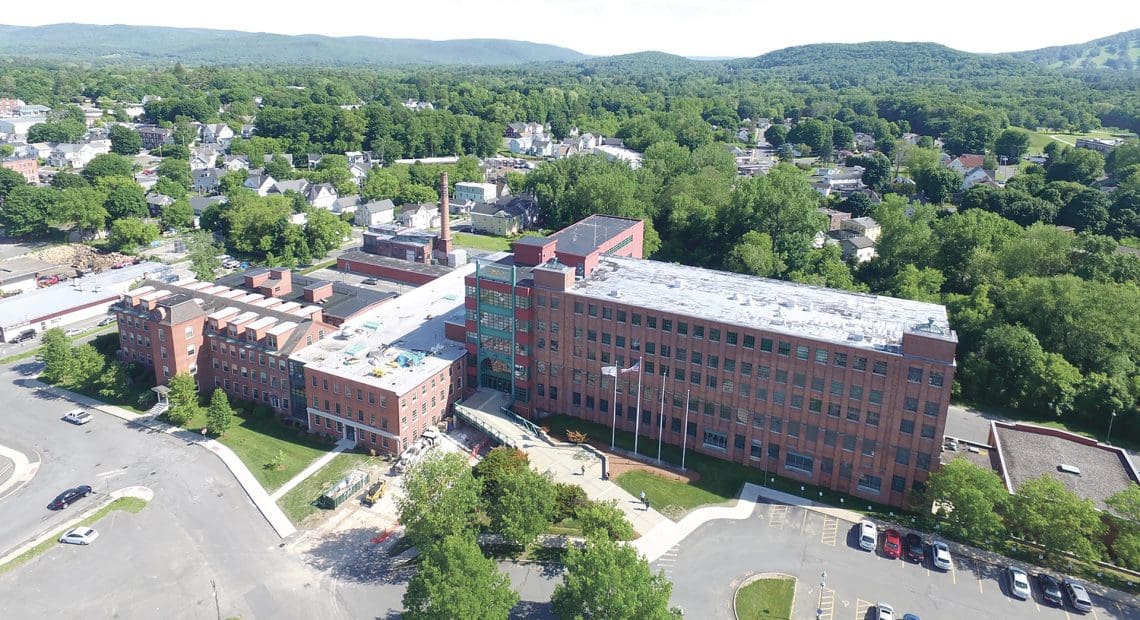
The Clock Tower complex in Pittsfield
Sally Tiska Rice says she grew up in Pittsfield. As a child, and up through her high-school years until the plant started slowing down, she recalls going with her mother to visit aunts and other relatives working at the Sheaffer-Eaton paper mill in town. Later, as she entered the world of work herself, she became a hand-boarding artist working at Crane & Co. in Dalton (noted for making currency), painting stationery.
These chapters in her life help explain why she feels right at home as she continues writing the current chapter, as one of the so-called Clock Tower Artists, a diverse group of artists now renting lofts in part of the Sheafer-Eaton complex, renamed the Clock Tower Business Center because clocks were once made on that site.
“Immediately when I walked into the building, it reminded me of the place I worked at for my career,” said Tiska Rice, who specializes in portraits of homes, people, and pets. “The buildings were very similar — the big windows; the historic, brick New England mill … the whole structure just brought back a lot of memories.”
Beyond the memories, it offered her a north-facing window, what’s known as ‘north light’ — that’s important for artists because they don’t have to cope with the effects of the sun moving through the studio at different angles during the day — and the ability to be part of a community of artists.
“Immediately when I walked into the building, it reminded me of the place I worked at for my career.”
These artists, roughly 20 of them, are just some of the many tenants, large and small — including the Berkshire Eagle, which once owned the whole complex — that now have a South Church Street mailing address. Together, they help make the transformation of the Shaffer-Eaton complex a unique success story, one authored by North Adams-based Scarafoni Associates/CT Management Group, which acquired part of the complex in 2006 and the remainder in 2016. It has reshaped the property into a thriving mixed-use facility featuring residential units, a wide range of commercial tenants, those aforementioned artists, the Eagle and its massive printing presses, and more.

Dave Carver, a principal with CT Management Group/Scarafoni Associates
This is a story of imagination and especially perseverance, said Dave Carver, a partner with Scarafoni Associates/CT Management Group. He noted that the group has had to overcome the departure of major tenant Wayfair (much more on that later), the loss of Berkshire Medical Center offices, and the downsizing of the Eagle, while also enduring the pandemic and its impact on the office market and other stern challenges to lease out almost all the space in the complex.
“We got creative, we worked hard, we knocked on a lot of doors,” said Carver as he talked to BusinessWest in one of the conference rooms once used by Wayfair, now shared by several smaller tenants on one floor in a modified co-work arrangement that is just one of the successful components of this endeavor.
For this issue and its focus on commercial real estate, BusinessWest talked at length with Carver, Tiska Rice, and others about the transformation of the former Sheaffer-Eaton property into one of the more successful mill-conversion undertakings in this region, and how the evolution of this historic complex continues.
Success Stories
Tracing the history of the property, Carver said it dates back to the 1880s, when the Connecticut-based Terry Clock Co. was purchased by a group of investors from Pittsfield who brought the operation to that city and built a three-story building on Church Street.

Sally Tiska Rice, one of the Clock Tower Artists.
The company’s tenure there was short-lived — it failed in the early 1890s — and the property was eventually sold to Arthur Eaton, who moved a paper mill there, later to be known as the Sheaffer-Eaton mill after a merger with Sheaffer Pen. In the late 1980s, the property was sold to the owners of the Berkshire Eagle, which were looking for a new home for the then-thriving daily paper.
The Eagle’s owners undertook a massive renovation of the main building on the property and leased out large sections of it, said Carver, noting that the recession of the mid-’90s hit the Eagle hard, and its operation, and the mill complex it called home, were sold to Media News Group, which eventually put portions of the property on the market.
“Because they had been struggling for so long, there was a lot to do. And we still have a lot to do; it never ends.”
This included roughly 100,000 square feet in some of the smaller buildings, including the original Terry Clock building, which were acquired by Scarafoni Associates/CT Management Group in 2006, and soon transformed into Clock Tower Condominiums.
In 2016, as Media News Group’s struggles escalated and it looked to jettison the remaining 200,000 square feet in the complex, Scarafoni/CT Management stepped in and acquired it, commencing a comprehensive initiative to modernize, retenant, and reimagine the property, which was maybe 50% occupied at the time, said Carver, adding that, over the past eight years, the property has certainly evolved and developed a unique look and feel.

The Clock Tower complex, where clocks and then paper were made, brings the past, present, and future together in an historic setting.
“Because they had been struggling for so long, there was a lot to do,” he told BusinessWest. “And we still have a lot to do; it never ends.”
By that, he meant both upkeep buildings more than a century old, but also the many challenges confronting all those owning, managing, and leasing out office space today.
As an example of all of the above, he referenced what could be called the ‘Wayfair chapter’ of this story.
It started when the owners of the Boston-based home-furnishings company, who are from Pittsfield, commenced a search in 2019 for space in which to create a call center in the western part of the state.
That search focused on Pittsfield, said Carver, noting that several sites were considered before the company eventually zeroed in on the South Church Street property and 35,000 square feet in one of the buildings in the complex.
“We rolled up our sleeves and went to work — we immediately started knocking on doors and networking.”
Negotiations continued for roughly a year, he noted, adding that the company eventually came to terms that included a five-year lease, shorter than is common is such deals, but a needed concession given the size of the company’s investment and “City Hall encouraging us to make the deal.” A rapid buildout followed, the company started moving in that October, and it was ramping up to 200 jobs when the pandemic hit.
“And then, everything shut down, and that was for at least a year, and it could have been two,” Carver said, adding that, when the company finally decided to start bringing employees back, it struggled mightily to do so.
“A lot of employees had drifted away to other jobs, they were experimenting with a work-at-home model, and ultimately that went out, so they decided to close the facility,” he explained, adding that Wayfair opted out of its lease roughly a year ago, leaving a 35,000-square-foot hole at a challenging time for all commercial-property owners.
Art of the Deal
What happened next, Carter said, was that “we rolled up our sleeves and went to work — we immediately started knocking on doors and networking.”
And this hard work has paid off. Elder Services of Berkshire County, marking its 50th anniversary, moved into 19,000 square feet over the first two floors of the building previously occupied by Wayfair, while the third floor, with roughly 15,000 square feet, features smaller tenants with a shared common area; only a few spaces remain to be leased.

Wayfair’s departure has been one of the many challenges overcome by the Clock Tower complex’s owners and managers.
Tenants include Janney Montgomery Scott, a regional financial-services firm that desired a presence in Western Mass.; Teton Management, a real-estate management company; Keiter Builders, a general contractor based in Northampton that also sought a Berkshires location; Insights in Automation; Annie Schwartz Nutrition; and MassHire Berkshire Workforce. Together, they share what amounts to co-working space.
“We decided to leave the kitchen area Wayfair created and the open area,” Carver said. “So even though everyone has their own, independent space, it’s a modified co-working area.”
Its creation is one of the success stories at this historic property. The Clock Tower Artists, located on the third floor of the business center, comprise another.
The collective, or community, now includes more than 20 artists that work in various disciplines and often participate in open-studio events and community arts initiatives.
Tenants include Shanny Porras, a visual sound artist who translates music into abstract paintings; Caroline Kennedy, an abstract artist; Deborah Carter, a multi-media artist who creates upcycled, wearable art; Stefanie Webber, an action-based artist who specializes in dance, movement, and performance; Bruce Laird, a contemporary artist who creates pieces using acrylic, mixed media, and collage; and Linda Petrocine, who specializes in the ancient art of painting using hot wax on wooden panels.
Collectively, these artists bring vibrancy, energy, and people to the Clock Tower complex, said Carver, adding that there is room for more, and he expects the group to grow in the years to come.
Tiska Rice said she was among the first artists to visit and then sign on at the mill. She and others were impressed with everything from the parking to the open common area on the artists’ floor, which doubles as an art gallery; from the large windows, views, and north light to the elevator (Tiska Rice is disabled).
Tiska Rice was also impressed with what Carver and his team were doing with the mill, blending history with imaginative ideas, such as the artists’ floor. And she’s equally impressed with the community of artists that has emerged.
“It’s great to be with all these talented artists — it’s very encouraging,” she told BusinessWest. “Some people will refer to having the notorious artist’s block where you’ve finished your last project and you don’t know where to go from there. There’s so much encouragement here; everyone works with their own style, but it seems like everyone has a way to complement each other and bring out the best in each other.
“An artist’s world has also been described as a very lonely place,” she went on. “We’re a whole group of individuals that come together as a community.”
This community of artists is just one of many reasons why the Clock Tower complex has become a timeless mixed-use masterpiece, one that brings the past, present, and even the future together in stunning fashion.