

Springfield BID Gets Creative in Efforts to Promote Downtown
Pushing the Envelope

Michelle Grout at the ‘Odyssey’ installation at Tower Square Park, one of the BID’s attempts to “push the envelope” in efforts to promote Springfield and bring people to the city.
Michelle Grout says she’s still getting emails and texts and seeing posts on social media platforms regarding the head-turning art installation in Tower Square Park known as “Odyssey,” featuring three seven-foot-tall pigeons and a Campbell’s soup can.
Not as many as when it first appeared a month or so ago, but they’re still coming in, with most of them positive in nature and candid about how nice it is to have something new and different downtown.
Her favorite missive is from a family not living in Springfield — they didn’t say where they were from — that jumped on a new reason to come to the city.
“The very first day, we had a post on social media … a family said, ‘we hadn’t been downtown in three years, but when we saw this, we know we had to come downtown for lunch,’” said Grout, president of the Springfield Business Improvement District (BID), which brought “Odyssey” to the park with support from several member sponsors. “They went to Hot Table and sat under the pigeons and had lunch.
“It’s doing its job — it’s got people talking, and it’s bringing people downtown,” she said of the installation, adding that, for the BID, the project is perhaps the most visible manifestation of ongoing efforts to do things differently when it comes to promoting the downtown and bringing people there, which is, in a nutshell, the agency’s mission.
“If you want the same results, keep doing the same things,” she said. “We don’t want the same results; we really want to try to push the envelope and get people to start thinking about Springfield as a destination again. We want to give people a reason to come.”
“Odyssey” will be on display until Labor Day, she added, and there will be other efforts to spur talk and visits — everything from a planned new mural project to a grilled cheese and tomato soup day at “Odyssey.”
These efforts coincide with new developments downtown, a rise in the number of people living there, and optimism about what’s to come, said Grout, who grew up in the city and remembers taking the bus downtown as a kid and going to the Steiger’s that sat near where those pigeons now do.
“It’s a balance of live, work, and play — it can’t be all people who live here, it can’t be all people who work here, and you can’t solely rely on people who visit here.”
The project at 31 Elm St., conversion of the former hotel into 70 units of market-rate and workforce housing, has been a catalyst for more development, with new initiatives, such as replacement of the Roderick L. Ireland Courthouse — she contends that the new facility needs to be downtown — creating speculation and anticipation.
Meanwhile, the tenants at 31 Elm are making an economic impact, which generates more anticipation about other residential initiatives in the planning stages.
“There are people from that building that we see all the time in their new routines,” she explained. “They go to the farmers market, they get their coffee at Palazzo, they go to Nosh … they’re investing in their new home,” she explained. “That’s one thing that attracts someone to live in a downtown — they have these amenities; we just need to come up with the amenities. It’s a balance of live, work, and play — it can’t be all people who live here, it can’t be all people who work here, and you can’t solely rely on people who visit here.”
There are certainly challenges in the BID district, Grout said, adding that many office buildings have not fully recovered from the aftereffects of COVID on where people work. And some of these properties may now be better suited for housing, although retrofitting them will be expensive. Meanwhile, some properties require extensive investments to host any kind of tenant, given modern standards and changing needs, and the costs are, in many instances, prohibitive.

String lighting, as seen here on Worthington Street, is one of many BID initiatives to beautify downtown Springfield.
But overall, there is energy, optimism, and movement to create that needed balance, she said, adding that it’s a different downtown than the one she grew up with, but one with many strong assets and great potential.
For this issue and its focus on commercial real estate, we talked with Grout about how the BID is getting more creative as it carries out its mission, and ever more diligent in its efforts to put the city’s best foot forward, whether it’s with flowers, string lights, or art in the park.
Optimistic View
The large windows in Grout’s office at 1319 Main St. face south and provide direct views of the MassMutual Center and its marquee.
“I can’t miss what’s going on; I have no excuse to say I didn’t know what’s happening,” she joked, adding that she doesn’t need this view to know what’s going on across Bruce Landon Way — or at any of the other downtown venues downtown.
In fact, it’s her job to know — or at least one small part of her job, one that she arrived at after spending several years in residential real estate and a decade at the BID. She started there as administrative assistant to Director Chris Russell, then Operations director, then interim director when Russell stepped down three years now, and now director.
She’s seen and been through quite a bit over her 12 years with the agency, including what she called the “ebb and flow” of the downtown, a global pandemic and its many impacts, and now, what she describes as a resurgence in development over the past several years.
That resurgence has taken many forms, is both public and private in nature, and has involved several different properties, including 31 Elm St.; ongoing efforts to redevelop the Clocktower Building and adjacent Colonial Block into more housing and ground-floor retail; ambitious work to revitalize several long-vacant or mostly vacant properties on Worthington Street in the city’s entertainment district; the new Convention Center Carpark and the adjoining space, which is being activated for events; renovation of Court Square; the new Hope for Youth & Families Arts Center; and more.
“These investments are very inspirational and, I’m sure all would agree, necessary,” said Grout, adding that these initiatives and others will bring more people and vibrancy to a downtown the BID serves in many different ways — specifically, 221 parcels across an area stretching from West Columbus Avenue to Chestnut Street (but also Mattoon Street and the Quadrangle), and from just south of State Street to the Arch.
These include what Grout called supplemental services beyond what the city provides to keep the downtown clean and safe — from beautification efforts and lighting to broad economic development initiatives.
Indeed, the BID was awarded a $100,000 grant from the state Executive Office of Economic Development to subsidize new businesses and fill vacant storefronts in the district, she explained, adding that 13 ventures took advantage of the program, earning grants ranging from $7,500 to $15,000.
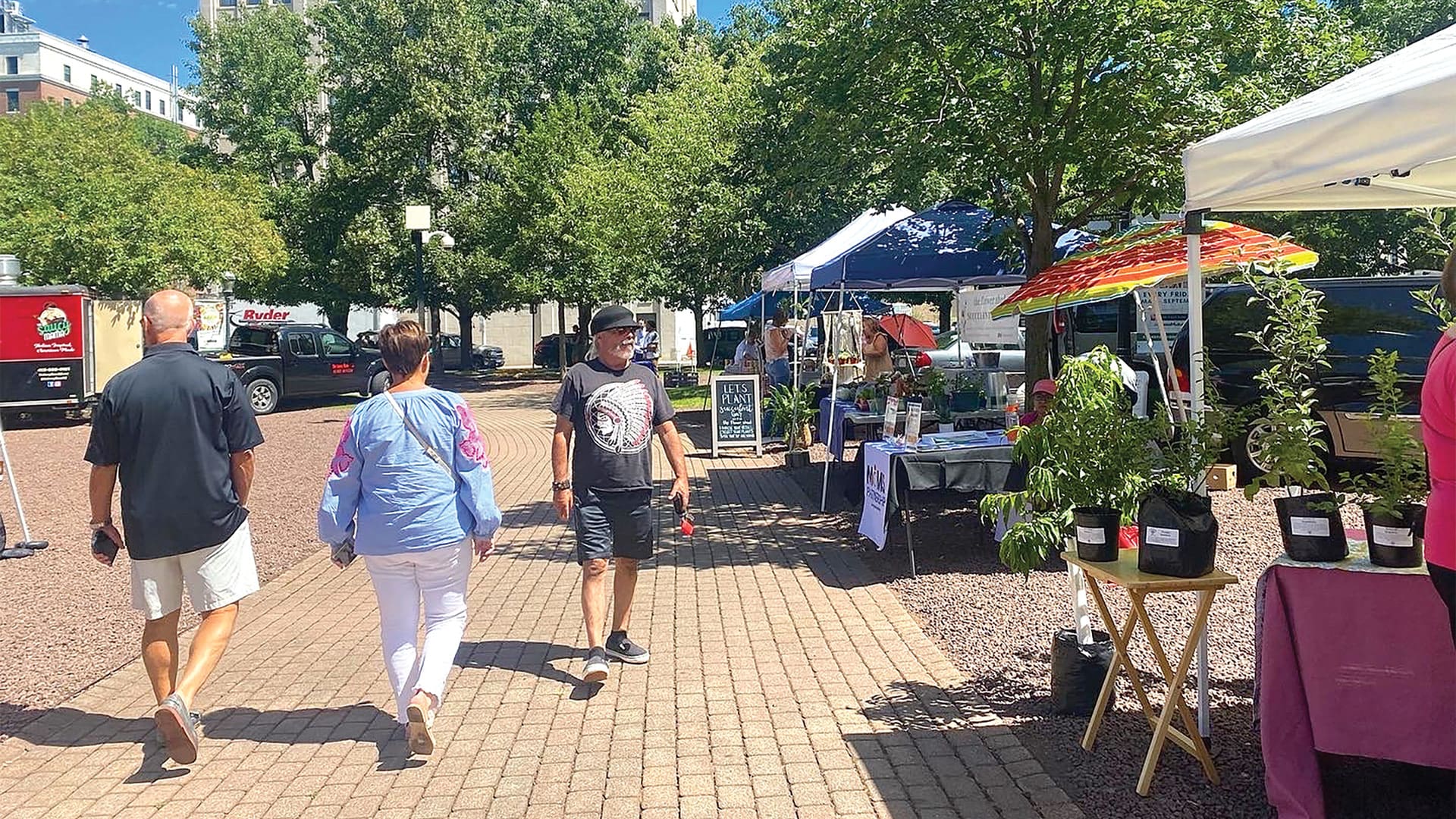
The farmers’ market in Tower Square Park is another BID initiative to activate downtown spaces and bring people to the city.
The BID is also charged with marketing the downtown, an assignment that takes on many forms, from robust programming to a website that that includes a calendar of upcoming events, snapshots of downtown restaurants with links to their websites, and listings of hotels and attractions, including MGM Springfield, Riverfront Park, the Springfield Museums, and the Basketball Hall of Fame.
Meanwhile, with programming, the BID has moved away from outdoor concerts, she explained, and much more toward promoting venues that offer live music, from MGM Springfield to Theodores’ to the Student Prince.
“We’ve pivoted to more destination placement, complimentary support to what’s already happening to grow a broader audience for that,” she said, adding that the “Odyssey” installation falls squarely into the category of marketing and promotion, although it is certainly non-traditional in nature.
As she talked about how it arrived in Springfield, Grout said the Downtown Boston Alliance had worked with a Quebec-based company called EXMURO on its Winteractive, a winter arts exhibition, and introductions were made.
“We saw the success they had in bringing people back to their district for a unique and unexpected experience, and the impact it had,” she explained. “And we thought that, on a Springfield scale, we could find the right piece to do the same thing, and after a few months of consulting, we landed on this piece.”
“Odyssey” has been in display in several cities — it was in Quebec City last fall, for example — but this is its first appearance in the U.S. And, as Grout noted, it has garnered attention and generated talk, which was the goal.
“People would ask, ‘what’s it for, what’s it about?’” she told BusinessWest. “My answer is getting people talking — it’s given people another reason to come down, another block to walk, another sight to see.”
Art and Soul
And there will be more efforts like it — although certainly not exactly like it — to keep creating a buzz, said Grout, noting there will be other art installations in other locations.
Meanwhile, another of her primary goals is to build on existing collaborations with community partners and “work smarter, not harder,” as she put it.
“We want to build efficiencies within everyone’s initiatives,” she explained. “You see a lot of people working at the same thing; if they all work together, it would be more efficient.”
As an example, she cited the relationship between the BID and the MassMutual Center and its marketing team. The two entities started working more closely together two years ago, and since that commitment, both have seen dramatic increases in engagement and followers on social media platforms, with the BID’s rising 18% and the MassMutual Center’s 65%. This surge has coincided with an increase in acts and a schedule that attracts people of all ages, she noted.
Another collaborative effort involves the Springfield Cultural Council, said Grout, adding that the agencies are working on several different initiatives, including a new mural project now in the planning stages and dependent on grant funding, as well as Art on Market Street, a free drop-in art program for young people slated for Saturdays this summer.
The downtown farmers market, meanwhile, has become a Friday tradition in the city. Presented by Country Bank, it runs from June until the end of September and features several local vendors, live music, and family-friendly activities.
Then, there are ongoing efforts to make the downtown clean and safe, which play a huge role in its overall success.
“If it looks good, people feel good, and that makes them want to come back and not be afraid to walk another block, go to another place, and see another site,” she explained, adding that these efforts go well beyond watering plants and picking up trash. “It takes a village.”
Indeed, it does. And in the village of downtown Springfield, there is progress, anticipation, and, yes, talk. And not just about the three pigeons and a Campbell’s soup can.