Home Posts tagged Callaway
Features Special Coverage

Getting a Bounce

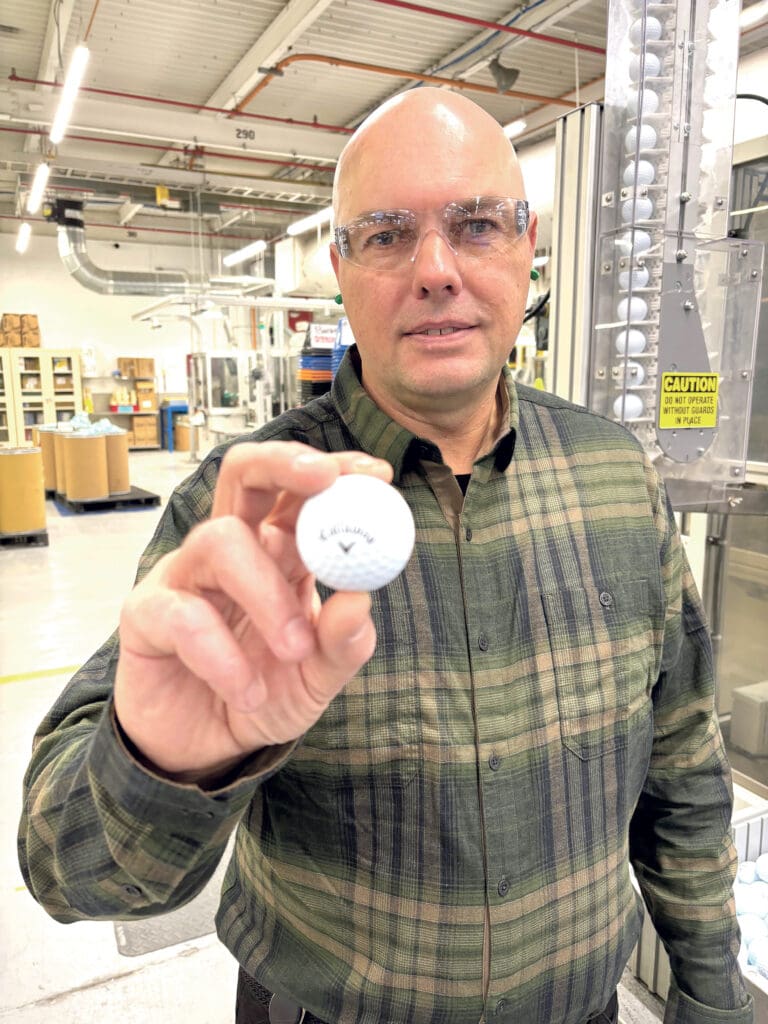
Algis Norkevicius says Callaway is the world’s second-largest golf ball manufacturer, and has its sights set on number one.

Algis Norkevicius says Callaway is the world’s second-largest golf ball manufacturer


Algis Norkevicius says it’s difficult to effectively quantify and qualify the overall impact from all those close-up shots of Callaway golf balls during television broadcasts as the professional golf tournaments wind to their climax on Sunday afternoons.

But he knows it certainly helps when ‘Callaway players’ such Akshay Bhatia storm from behind and win the Arnold Palmer Invitational, as he did earlier this month, or when Xander Schauffle is in contention at the Players Championship — and also at the Arnold Palmer Invitational. Or when Sam Burns is near the top of the leaderboard at the AT&T Pebble Beach Pro-Am.

“It’s great exposure for our products, and it’s fun to watch and follow these players,” said Norkevicius, senior director of Global Golf Ball Manufacturing for Callaway, which has facilities in different corners of the globe, but makes most of its balls in a sprawling facility on Meadow Street in Chicopee that was once home to Spalding.

He said these strong performances from those Callaway players comprise just one of many factors contributing to the company’s rise to number two among golf ball manufacturers, behind Acushnet, maker of Titleist, and on a path to steady growth — in sales, and in the number of balls produced at the Chicopee facility.

Another factor is the continued strong health of the game, which enjoyed a surge during COVID and has, by and large, been able to maintain that momentum since.

“Rounds of play and golf ball sales are directly correlated; statistics show that the average person uses around three golf balls a round,” Norkevicius said. “As rounds of play increase, so do golf ball sales. Last year, the National Golf Foundation released its annual report — golf grew again by 1% over the previous year, which was a record year.”

Then there are new products, such as the company’s recently introduced second generation of the Chrome Tour line, balls that tout greater speed, more consistency, and tighter dispersion, and are expected to be popular with players at all levels.

“We’ve grown our workforce, and we’ve increased our technical staff — all in pursuit of making a better golf ball.”

Norkevicius calls what’s going on at Callaway a “transformation,” one marked by everything from new products and the growing popularity of those products to new efficiencies in the manufacturing processes and, overall, more than $130 million in capital investments inside the facility.

“We took a look at each process and upgraded the equipment,” he said. “It started with our mixing line, and then core molding and injection molding; our printing equipment has been upgraded; and the last thing we’re upgrading is our packaging line, and we’re in the middle of that now.

“We’ve grown our workforce, and we’ve increased our technical staff — all in pursuit of making a better golf ball,” he noted, adding that recent results have shown that these substantial investments are certainly paying off.

Looking forward, he said the company is looking to continually grow its market share — the new Chrome Tour products are certainly expected to help improve those numbers — and eventually become the number-one golf ball maker in the world.

To get there, the company will look to make ever-greater use of technology, including artificial intelligence (AI) to not only produce a better golf gall, but achieve the most important quality in the manufacturing of these products: consistency.
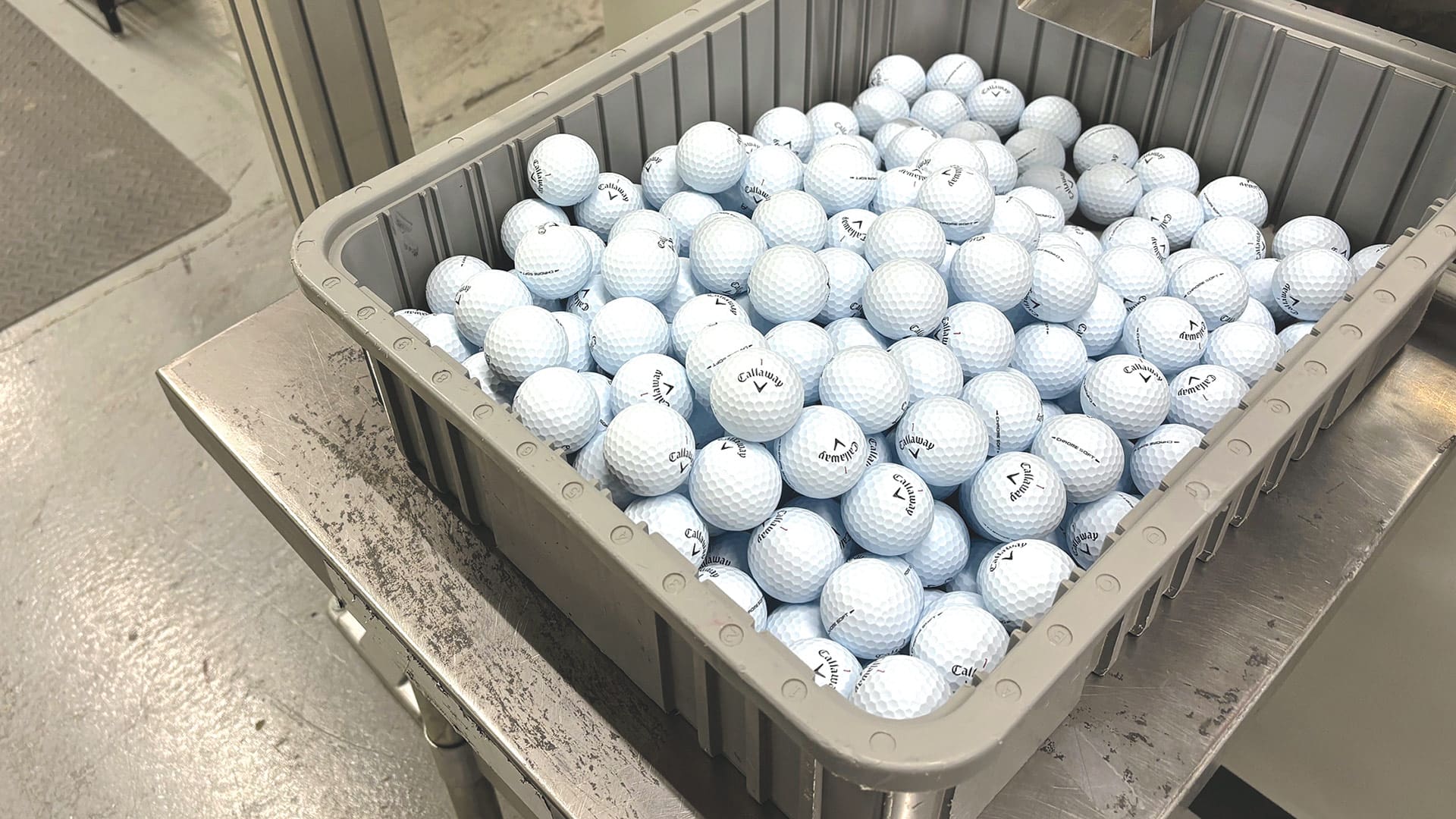
The growing popularity of golf is a boon to manufacturers, as the average player uses about three balls per round.

The growing popularity of golf is a boon to manufacturers, as the average player uses about three balls per round.

For this issue, BusinessWest talked at length with Norkevicius about the golf ball business, the manufacturing of those products, and how Callaway continues on a strong growth trajectory.


Positive Spin

Norkevicius has been involved with golf ball manufacturing for nearly 30 years now. He started at Acushnet, which is both a company and a town in Bristol County where the golf balls are made.

He came to Callaway in 2019 to lead worldwide golf ball manufacturing operations, meaning the facility in Chicopee, but also other plants in Thailand, Taiwan, and Vietnam that produce mostly value and range products. He’ll visit those facilities once a quarter, on average, spending the bulk of his time in Chicopee.

“That knowledge base in how to make a golf ball is one of the key assets we have here.”

Over his time at Callaway, the company’s share of the overall golf ball market has risen from roughly 14% to 22% (Achusnet remains on top, with nearly 50% of the market). He attributes this to products that have captured the attention of players at all levels, such as those within what’s now known as the ‘Chrome family’ — the Chrome Tour, Chrome Tour X, Chrome Tour Triple Diamond, and Chrome Soft — but also other offerings, such as the popular Supersoft, Superfast, and Warbird.

Many of these balls are made in Chicopee, including the Chrome Tour products, as well as the Supersoft and the ERC Soft, he said, adding that the facility will churn out 5 million dozen golf balls a year, or 25,000 dozen a day, with three shifts operating five days a week (there are roughly 450 employees), with overtime on weekends during busy seasons — like this one.

Indeed, the months leading up the start of the golf season in the Sun Belt (March) and then the rest of the country (early- to mid-April) are among the busiest times for the Chicopee facility.

“There’s a seasonality to the business,” Norkevicius explained. “Typically, the summer months are one of the slowest times, and then it will ramp up in September and October in advance of the holidays, and then plateau — and then, around Memorial Day, it starts to get a little lighter.”

Overall, 2025 was another sold year for both the company and the Chicopee plant, he told BusinessWest, adding that the game continues to grow a percentage point or two a year in terms of the number of rounds played; as noted, this translates directly into more balls being used.

“We’ve created what I’d call a quantum data universe; on any given day, we’ll take 150 million data points from our processes, equipment, and our testing, and we load this data into the cloud. And from there, our engineers will use AI to help predict outcomes or potentially get ahead of failures before they occur.”

And this growth pattern is expected to continue in 2026, especially as the company releases the next generation of its Chrome Tour products, first introduced in 2024.

“We changed the ball so significantly that we separated Chrome Tour from Chrome Soft,” he explained. “That marked a leap in technology and performance. And over the past two years, we’ve continually refined the golf ball, working with R&D on some material changes as construction changes to optimize it even more, adding more speed and more distance, and then we were able to decrease our dispersion along the fairway; the ball lands in a tighter spot compared with previous models.”

The Chicopee plant started producing the new Chrome Soft balls last summer, he went on, adding that production has ramped up as the new season draws closer.


Drive to Improve

As he gave BusinessWest a tour of the Chicopee plant, Norkevicius said its best asset is its workforce, which boasts many team members who have been making golf balls for decades — some for a half-century.

“That knowledge base in how to make a golf ball is one of the key assets we have here,” he said, adding that the company has been working to blend this experience with new technology and improved processes to take golf ball manufacturing to the proverbial next level.

This includes the use of AI, which Norkevicius called one of the plant’s more significant advancements over the past several years.

“We’ve created what I’d call a quantum data universe; on any given day, we’ll take 150 million data points from our processes, equipment, and our testing, and we load this data into the cloud,” he explained. “And from there, our engineers will use AI to help predict outcomes or potentially get ahead of failures before they occur.

“They can monitor our processes, and as soon as there’s an indication that a process may be going out of control, they will alert a technician or engineer, and they can address that before we make a bad product,” he went on, adding that, with golf balls, the most important quality — even above distance, which is still important — is consistency.

“With every golf ball you use, you want it to perform the same … and we want to ensure that each ball goes the same distance, has the same dispersion, same flight, same spin,” he said. “And to do that, it’s difficult. Making golf balls is hard, and if we can understand and control all these parameters, we can make it a little easier.”

Elaborating, he said there is much that goes into the making of a golf ball, from its core to its cover; from rubber chemistry to injection molding, and maintaining quality through the many stages of the complex process is as difficult as it is essential.

“It’s not an easy process — it’s very challenging, especially to make things consistent,” Norkevicius told BusinessWest. “We need to have those controls in place, we need to have the knowledge of our processes, and we need to have those tools to help us identify when those processes go out of control — or start to go out of control.”

AI also helps the R&D teams create better products, he added.

“They can create virtual models based on what’s going on here, and then come up with an even better model for the next generation,” he explained. “They can basically do this analysis and future trials, utilizing AI to do that — they can then predict outcomes. Things that would take weeks to do, to test and compile … we can do that in minutes today.”

With this focus on quality and the use of technology to not only make better products but produce them more efficiently and more consistently, Norkevicius believes Callaway is well-positioned to not only continue on its strong growth trajectory, but achieve that ambitious goal of rising to the top among golf ball manufacturers.

“With the investments we’ve made here and the continued improvements to our products and processes, we know we have the foundation in place to increase our market share,” he said, adding that Callaway shares a goal common with golfers of all handicap levels — continuous improvement.
Manufacturing

On a Roll

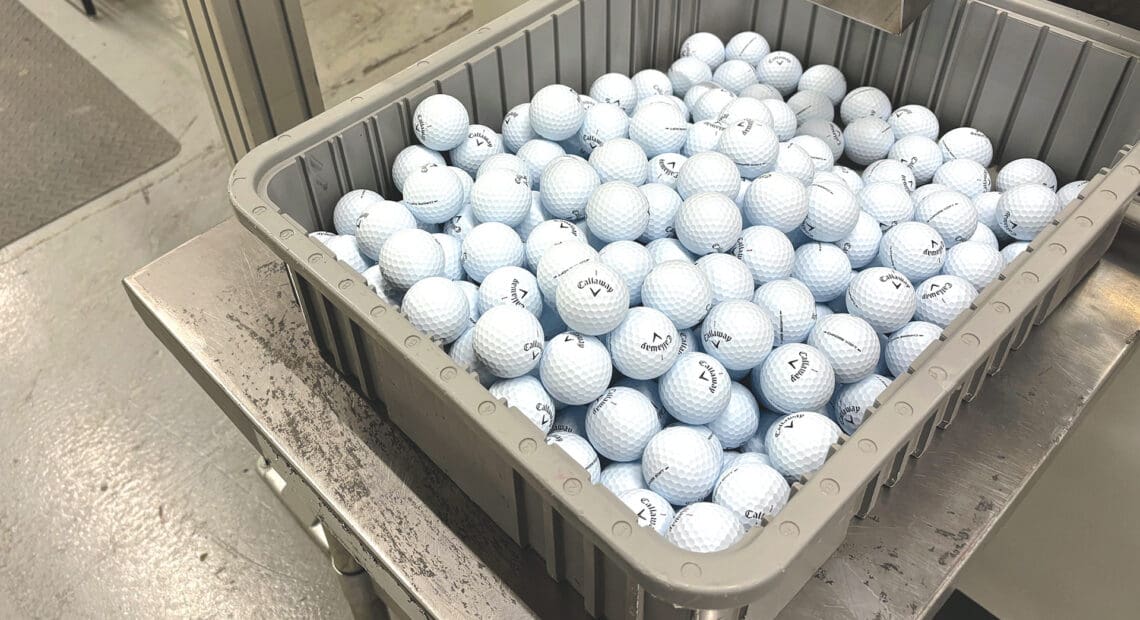
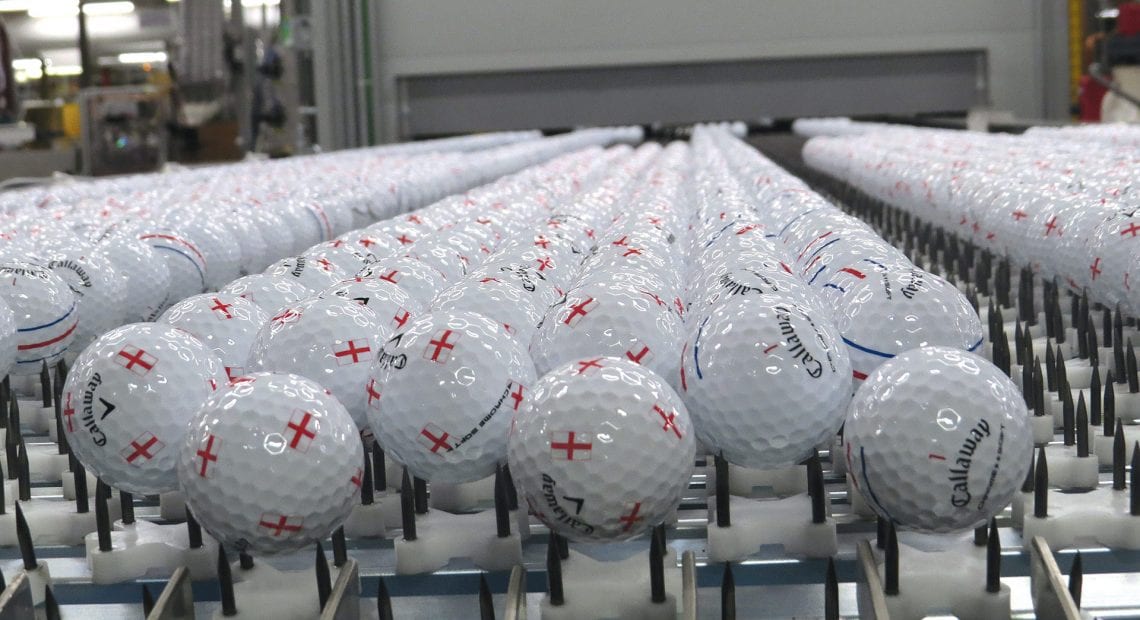
Between 200,000 and 250,000 golf balls roll out of Callaway’s Chicopee plant every day.

Between 200,000 and 250,000 golf balls roll out of Callaway’s Chicopee plant every day.

The Callaway golf-ball-manufacturing facility in Chicopee has borrowed a famous page from the Chicago Cubs’ playbook.

When the Cubs win, a white flag with a large blue ‘W’ is flown atop the legendary hand-operated scoreboard in center field. (Of course, if they lose, a blue flag with a white ‘L’ goes up, but that’s another story.)

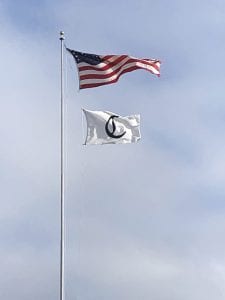
Back to Callaway. When a member of its team — comprised of players on the various professional tours who play Callaway balls and clubs — posts a win, a flag with a large script ‘C’ (the same one used for the Callaway brand) flies underneath the American flag on the pole outside on the facility on Meadow Street.

“The flag goes up the Monday morning after a win, and it flies until Friday that week,” said Vince Simonds, director of Global Golf Ball Operations for Callaway, adding that it’s been flying quite a bit recently.

Indeed, it was up just last week after the best-known member of the team, Phil Mickelson, prevailed at the AT&T Pebble Beach Pro-Am. Meanwhile, Xander Schauffele, a rising star on the PGA tour, has won twice over the past several months; Australian Marc Leishman won last fall, as did Spaniard Sergio Garcia; and Belgians Thomas Peters and Thomas Detry won the ISPS Handa Melbourne World Cup of Golf in late November.

Simonds told BusinessWest that the flag is one of many initiatives designed to raise awareness among those inside the plant about how the products they’re making are generating results at the very highest levels — and generating pride within that workforce as well.

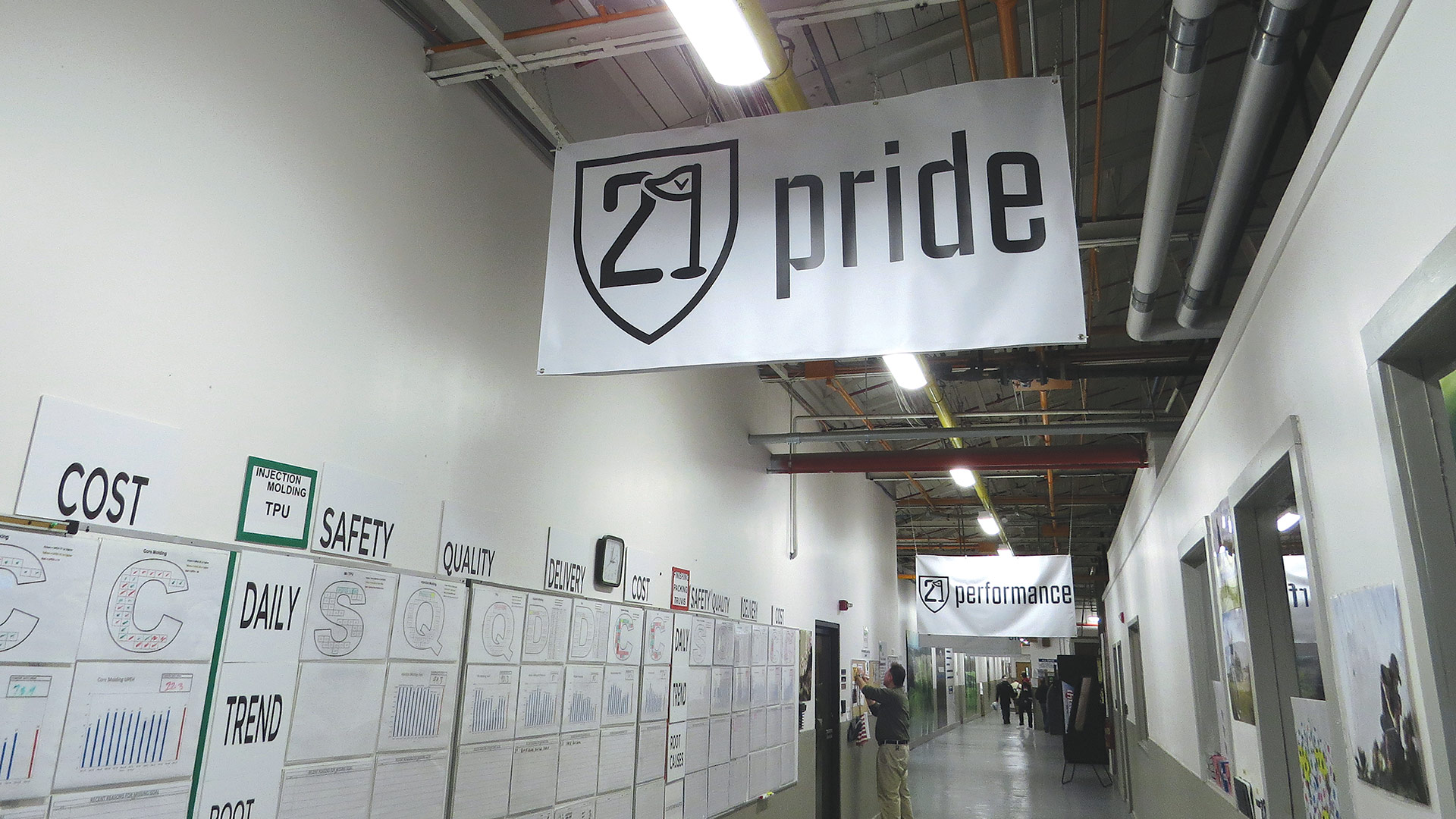
“It’s part of something we call the ‘21 Initiative,’ a multi-year evolution to transform and re-engage as we bring on new machinery and new capacity capabilities,” he said, noting that ‘21’ is short for 2021. “We started putting the flag up because we’ve grown so fast that we need to re-engage with our employees and share our success with them.”

But Callaway also wants to bring attention to what’s going on inside the plant, which is on a winning streak itself.

Indeed, as the Callaway brand has risen to number two in overall sales within the golf-ball market behind Titleist, the Chicopee plant has doubled its workforce over just the past 18 months, from roughly 180 to more than 363 (the highest number in more than a decade), and is expected to surpass 400 later this year, making this one of the better manufacturing success stories to be written locally in recent years.

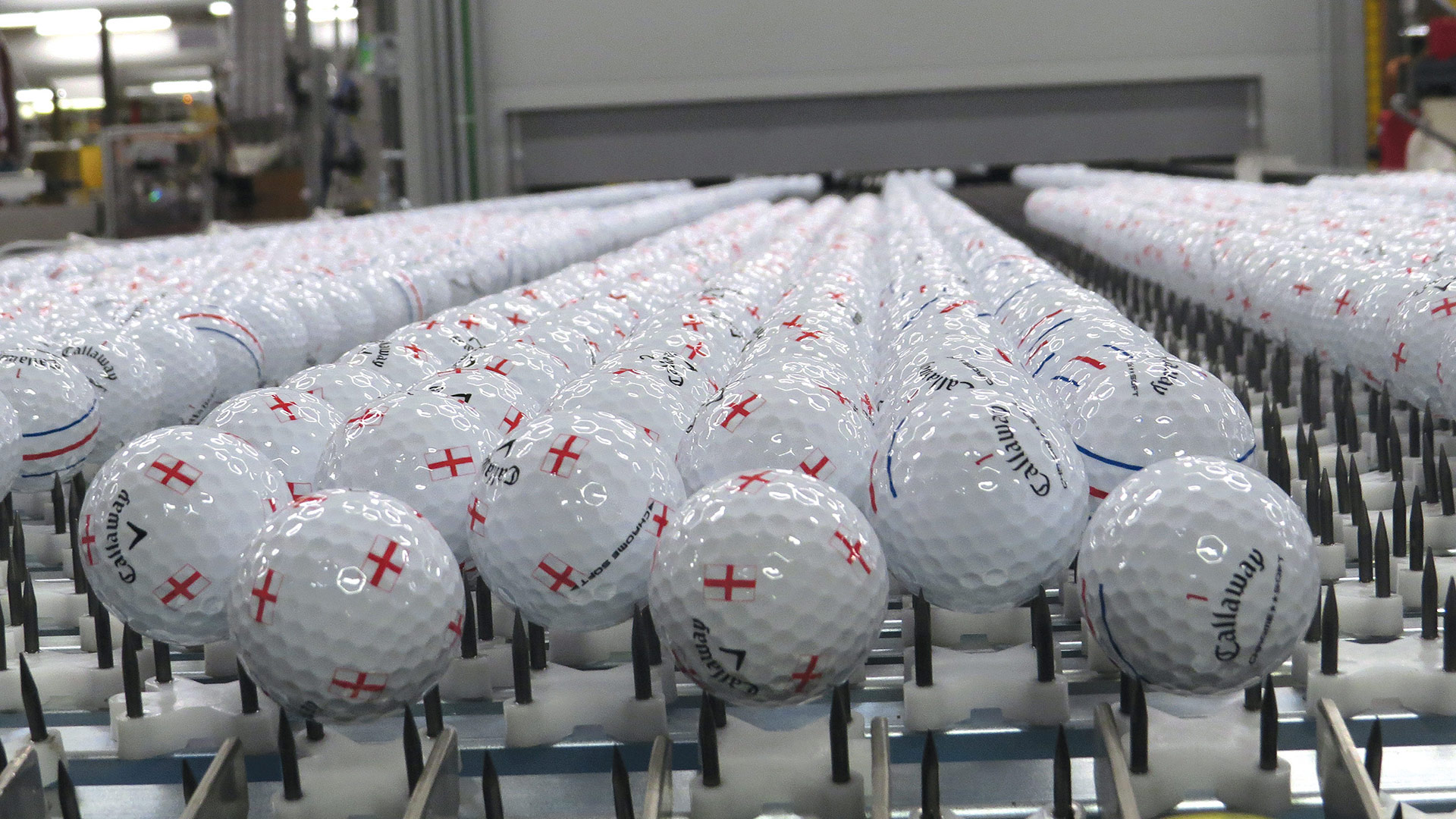
“We’re very bullish on 2019,” said Simonds, adding that this optimism is grounded in the company’s recent surge within the golf-ball market, fueled by the introduction of several new and somewhat groundbreaking products. These include the Tour Soft ball, which has become popular with professionals and amateurs alike. There’s also a version of that ball known as the Truvis, stamped with pentagonal images — and now a host of other options, from shamrocks to butterflies to other custom logos — that give the product a soccer-ball look.

“We started putting the flag up because we’ve grown so fast that we need to re-engage with our employees and share out success with them.”

The ‘win flag’ flies on the pole outside the Callaway plant

The ‘win flag’ flies on the pole outside the Callaway plant. It’s been flying quite regularly these days.

“The Truvis has really taken off; sales are very strong, and we’re booking a lot of business on the custom side of things,” said Simonds, adding that the portfolio of products is poised to grow with the addition of the ERC Soft, with those letters short for Ely Reeves Callaway, founder of the company.

Overall, somewhere between 200,000 to 250,000 balls, including the new ERCs, are rolling off the lines at the Chicopee plant each day, a slight increase from a year ago. More importantly, the mix has changed, said Simonds, noting that, while the plant supplemented its capacity with non-tour, lower-end products in the past, it no longer does that due to demand for the higher-end balls.

And as those numbers continue to increase, so too does the number of people clocking in at a plant that now runs 24/7.

These workers cover a broad spectrum, said Simonds, from engineers who have brought the new products to the assembly line to those on the shop floor to those in working in the warehouse.

Findng and retaining talent has become an issue, as it has for just about every manufacturer in the region, said Simonds, adding that the company is working with Springfield Technical Community College and area vocational high schools to create an adequate pipeline of workers.

For this issue and its focus on manufacturing, BusinessWest returns to the Callaway plant and a company that has been, as they in this sport, flag hunting, and has had a great deal of luck in those endeavors.

Core Products

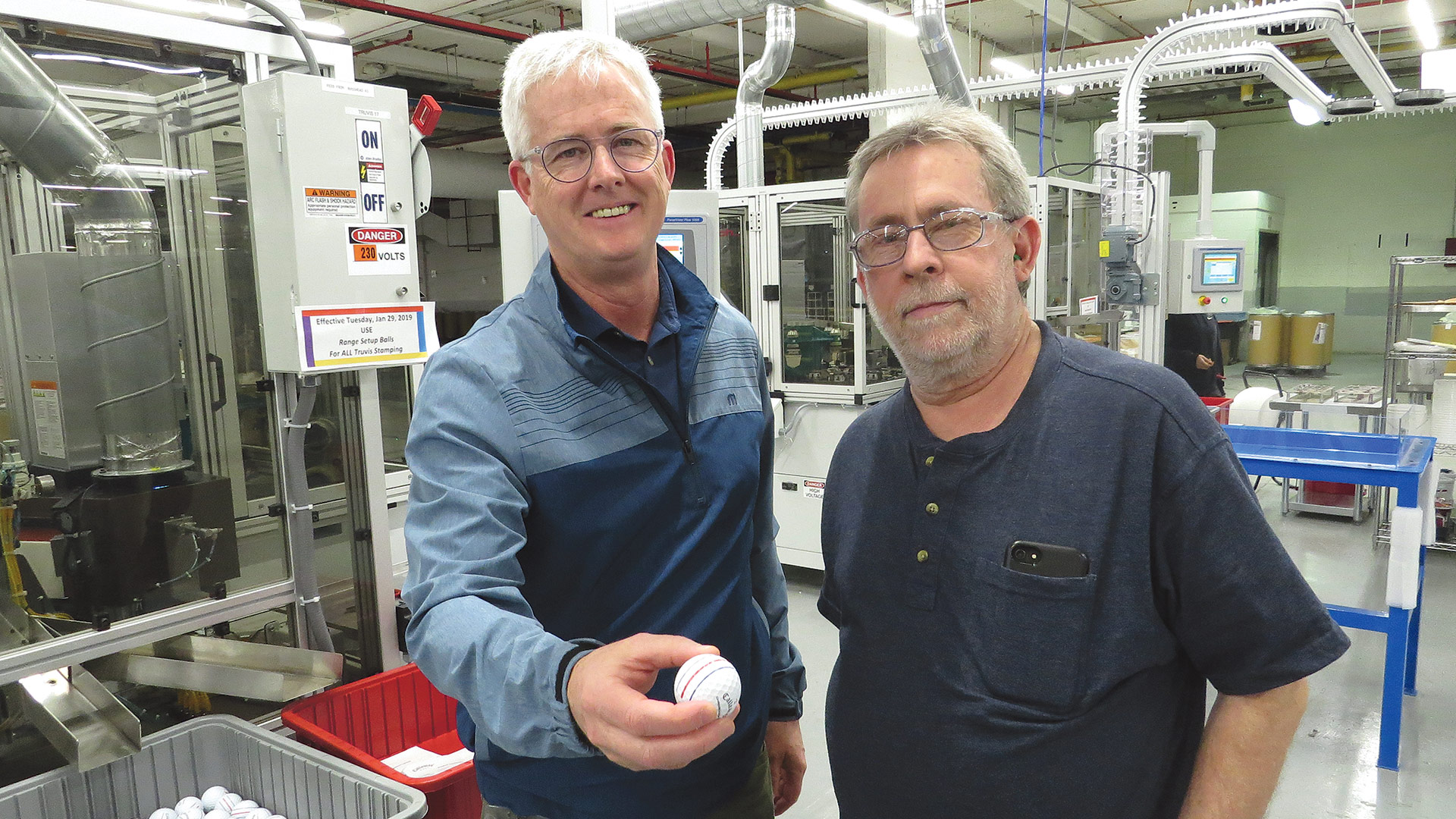
As he offered BusinessWest a quick tour of the Callaway plant and showed off the latest of the new Truvis machines to be added over the past two years, Simonds introduced Les McCray, who’s been working at the Chicopee facility since Gerald Ford was in the White House.

“We try to find people who have the education and technical background, obviously, but also a passion for the game of golf.”

There are still a number of employees with considerable longevity still working at this sprawling plant, but a growing number have been there for months, not years. And while employment has spiked in recent months, it’s been trending upward for several years now, said Simonds.

There have been several milestones along the way that have brought us to this moment, including the introduction of the Chrome Soft, which dramatically altered the trajectory of Callaway’s ball division, and the emergence of the Truvis, which has added a new dimension — metaphorically if not quite literally — to golf-ball design.

Vince Simonds, left, with Les McCray

Vince Simonds, left, with Les McCray, who’s been working at the Callaway plant for more than 40 years.

“There is a functional aspect to this,” he said in reference to the alignment of the pentagons or logos and how it helps people improve their chipping and putting. “But mostly, it’s just a fun and unique way to mark a golf ball. The feedback we get from consumers is that they enjoy it because they can instantly recognize their ball in the foursome.”

The ERC Soft has something approaching that same quality because of a feature called Triple Track Technology — three lines engraved on the ball to help with putting alignment (Mickelson was using a dfferent Callaway ball with the same technology when he won at Pebble Beach). That’s just one innovative aspect to this latest addition to the portfolio, said Simonds, adding that this long but soft ball has a new ‘hybrid’ cover and graphene core and is designed for players with less than tour-level swing speeds.

It’s the latest in a string of advances and new products that have led to a surge in market share, said Simonds, adding that, according to Golf Datatech, which measures sales in pro shops and related outlets, Callaway has a 16% share of the market compared to 7% in 2012. But National Golf Foundation data, which also includes sales at large retail outlets like Dick’s Sporting Goods, gives Callaway a 23% market share based on dollar amount sold.

The Callaway Plant in Chicopee

The Callaway Plant in Chicopee is engaged in what it’s calling the ’21 Initiative,’ (short for 2021) a multi-year process of evolution and transformation as it brings on new machinery and scores of new employees.

This growth has led to more ‘C’ flag-raising ceremonies outside the Callaway plant, and more people working inside it, said Simonds, adding that the company has been adding employees on a regular basis over the past few years.

That’s due in part to a leveling off of production, meaning it’s more steady throughout the year as opposed to being more seasonal as it was years ago, geared toward peak sales at Christmas and especially Father’s Day.

“Our real production season is September to June, with maintenance in July, and then we begin to ramp up for new products in August and begin manufacturing in September and October,” he said. “We support the globe around here.”

And, as he noted, the new arrivals to the plant cross a broad spectrum, from process engineers who design the breakthroughs to skilled, unskilled, and semi-skilled positions on the plant floor. Finding them is, indeed, challenging, said Simonds, adding that, with the engineers and management personnel, the company recruits from where it can.

“We try to find people who have the education and technical background, obviously, but also a passion for the game of golf,” he explained, adding that the last ingredient is a key part of the mix. “We have an R&D team in Carlsbad, California that we work very closely with, but the scale-up and commercialization happens here; we have a team of 12 process engineers and technicians that work hard every day designing systems to make golf balls so people can play better golf. That’s not a bad way to make a living.”

“There is a functional aspect to this. But mostly, it’s just a fun and unique way to mark a golf ball. The feedback we get from consumers is that they enjoy it because they can instantly recognize their ball in the foursome.”

With machinists, Callaway, like most other manufacturers in the region, must compete for a limited number of qualified workers while also dealing with the retirement of Baby Boomers.

“We’re continuing to have dialogue with STCC, and we’re working closely with the trade schools in the area,” he said. “We’ve gotten some really good young people out of Putnam [Vocational-Technical High School] in Springfield — it’s been a really good pipleline for us. But they’re young, and they need training and development, so we’re doing that.”

With so many people coming in recent months, Simonds and his team are grinding, as they say in golf, to keep the growing workforce focused on the mission and the basic tenets, such as safety, quality, and continuous improvement.

“We’ve brought so many people on so fast that the connection with the employee is super important,” he said, referring to the broad 21 Initiative. “So we’re doubling down on our efforts in that regard.”

Banner Year

As noted, the Callaway flag flying after wins on the pro tours is a page taken from the Chicago Cubs’ script.

But in just about every other way, the story being written on Meadow Street in Chicopee is an original. The plot lines are engaging — new products and advances with intriguing names, like Triple Track Technology. And there are a host of stars, from Xander Schauffele and Phil Mickelson to Les McCray.

No one’s quite sure how this story will end, but right now, Callaway and its Chicopee plant are both on a roll, and, like the players on tour who have promoted the flag to fly, they’re winning big.

George O’Brien can be reached at [email protected]