Law and Order

Anthony Gulluni
The ‘young jokes’ have stopped.
Well … there are fewer of them, anyway.
Indeed, Anthony Gulluni is still the youngest person in the room — by maybe 15 years, by his estimate — when the Massachusetts District Attorneys Assoc. gathers for its monthly meetings and an annual conference to discuss “whatever the crisis of the day is,” such as Rule 14, which puts greater burden on prosecutors and police departments to furnish discovery more quickly.
“It’s no fun; it’s not a good thing,” said Gulluni, 44, Hampden County’s DA, who has been the youngest person in that room for a full decade now, a milestone — there’s a handmade sign in his office congratulating him on that anniversary — that presents a time to pause and reflect on his tenure and what he calls its primary, overarching goal, then and now: “to build a safer community in Hampden County.”
This represents work in progress, noted Gulluni, who told BusinessWest that it’s difficult to quantify just how much safer area cities and towns are a decade after he took office. But he can qualify progress on several levels, everything from the ongoing fight against drugs to efforts to solve cold cases, while also stressing a need to continually improve.
“Ten years provides an opportunity to look back, look forward, and say, ‘what can we do better?’” he said. “And that’s a daily pursuit for this office because the work is so important. We’re serving the public, not unlike other public officials, but we’re working with people who have been victimized, people who have experienced some of the worst things imaginable and things they never expected.”
Overall, building a safer community involves a broad spectrum of programs, initiatives, and simply getting tough on crime and criminals, said Gulluni, adding that efforts at education, prevention, and providing second chances — everything from flag football to 3-on-3 basketball; from Stop the Swerve safe-driving events to the Emerging Adult Court of Hope — and imposing harsh sentences on offenders are not mutually exclusive.
“It’s not ‘lock them up and throw away the key,’ or ‘we want to be progressive and rehabilitate everybody.’ We can combine the two, we can be moderate, and we can be in the middle, and we’ve achieved that.”
“What I’ve tried to do is operate on the principle that we can do progressive things in this law-enforcement space and criminal-justice space,” he noted. “And it doesn’t prevent us from also upholding the law and understanding that there are violent people and repeat offenders who hurt people and need to be incarcerated.
“We can do both things,” he said, adding this has been his goal since he first campaigned for the office. “It’s not ‘lock them up and throw away the key,’ or ‘we want to be progressive and rehabilitate everybody.’ We can combine the two, we can be moderate, and we can be in the middle, and we’ve achieved that.”
Elaborating, he said his office has not “run from the enforcement stuff — taking drugs off the street and locking the person up for as long as possible because this person is killing people.”

Anthony Gulluni speaks at a ceremony marking the five-year anniversary of EACH, the Emerging Adult Court of Hope.
But it has also broken new ground with programs like the Commonwealth’s only Emerging Adult Court of Hope (EACH) — a name he came up with — which provides second chances to young offenders and brings graduates into careers, not merely entry-level jobs that most often fail to prevent recidivism.
“Each person matters; each person should have hope,” he told BusinessWest, adding that the program is designed to break the cycle whereby young people become repeat offenders essentially because there is no real alternative. EACH was designed to help such individuals earn a viable alternative.
There are many other initiatives as well, involving everything from preventing dating violence to internet safety to FLOS (Future Lawyers of Springfield), which seeks to identify young students who aspire to be lawyers and guide them into a career in the legal system. In short, his first decade has been guided by a desire to be tough on crime and creative with ways to build community.
For this issue, BusinessWest talked at length with Gulluni, who has been honored by the magazine as a 40 Under Forty honoree and Alumni Achievement Award winner, about what has been accomplished over the past 10 years, and the hard work that remains.
Coming to Terms
As he talked with BusinessWest on the last day of March, Gulluni was coming off a hard week.
Indeed, he was just a few days away from press conferences announcing charges related to a motor-vehicle accident on an I-91 off-ramp in West Springfield that killed three construction workers, and a hit-and-run incident in Springfield where a motorist struck and killed a pedestrian walking his bike across an intersection.
“This was tragic stuff, but this is what we do — it’s really about public safety, helping people be safe, and helping people make good decisions,” he said, adding that incidents like these help emphasize all aspects of his office’s work, from prosecuting offenders to helping to prevent such tragedies in the future.
“One of the points of frustration over my 10 years, and it’s become more acute and frequent, is the results in court.”
Such press conferences are one of the more visible aspects of a job where far more goes on behind the scenes, in offices spaced across four floors of Tower Square — after Gulluni ordered his staff out of the Roderick L. Ireland Courthouse amid growing health concerns — but in many different settings as well.
That move to Tower Square is one of many bold steps taken over the past 10 years, all aimed, in one way or another, at achieving that broad goal of making communities safer.
Others include everything from adding prosecutors (bringing the number from 61 to 90 over the past decade) and staff to bring the Hampden County DA’s office, among the busiest in the state, more in line with others in the Commonwealth, to ‘specializing’ those prosecutors.
“We’ve taken many of our most experienced and most talented prosecutors to work on cases involving children in our special-victims unit, domestic-violence cases, and homicide cases,” he said, adding that this region has led the state in homicides per capita, reflecting the demographics of a region with four gateway cities.
Overall, there have been several important initiatives undertaken over the past decade, said Gulluni, including a focus on cold cases that has brought charges — and, in some cases, resolution — to crimes committed decades ago.
“That was one of my initial focal points and something we talked about during the campaign, something we acted on immediately, and over the past 10 years we’ve had a great deal of success,” he said, citing the recent instance of an arrest involving a double murder on Route 5 in West Springfield 47 years ago.
Elaborating, he said cold cases require time and resources, factors that make it difficult to address them. But he has made such cases a priority.
“It’s all about focus,” he explained. “We’ve tried to, and we have, dedicated people to work on unresolved cases. I created a unit, I have a coordinator, I have an advocate, I have a prosecutor, and I have two, soon to be three, investigators working exclusively on these cases. You can’t throw a 30-year-old case at a prosecutor who has 50 other cases and expect her or him to really dive into that case.”
Court of Opinion
Meanwhile, some initiatives fall more into the category of prevention, community building, promoting healthy lifestyles, and even inspiring young people to join the legal profession.
“We’ve approached our work with a preventive lens — how can we get in front of issues; how can we identify things that metastasize and become worse?” he said, adding that his office devotes considerable time and resources to what it calls its Community Safety and Outreach Program.
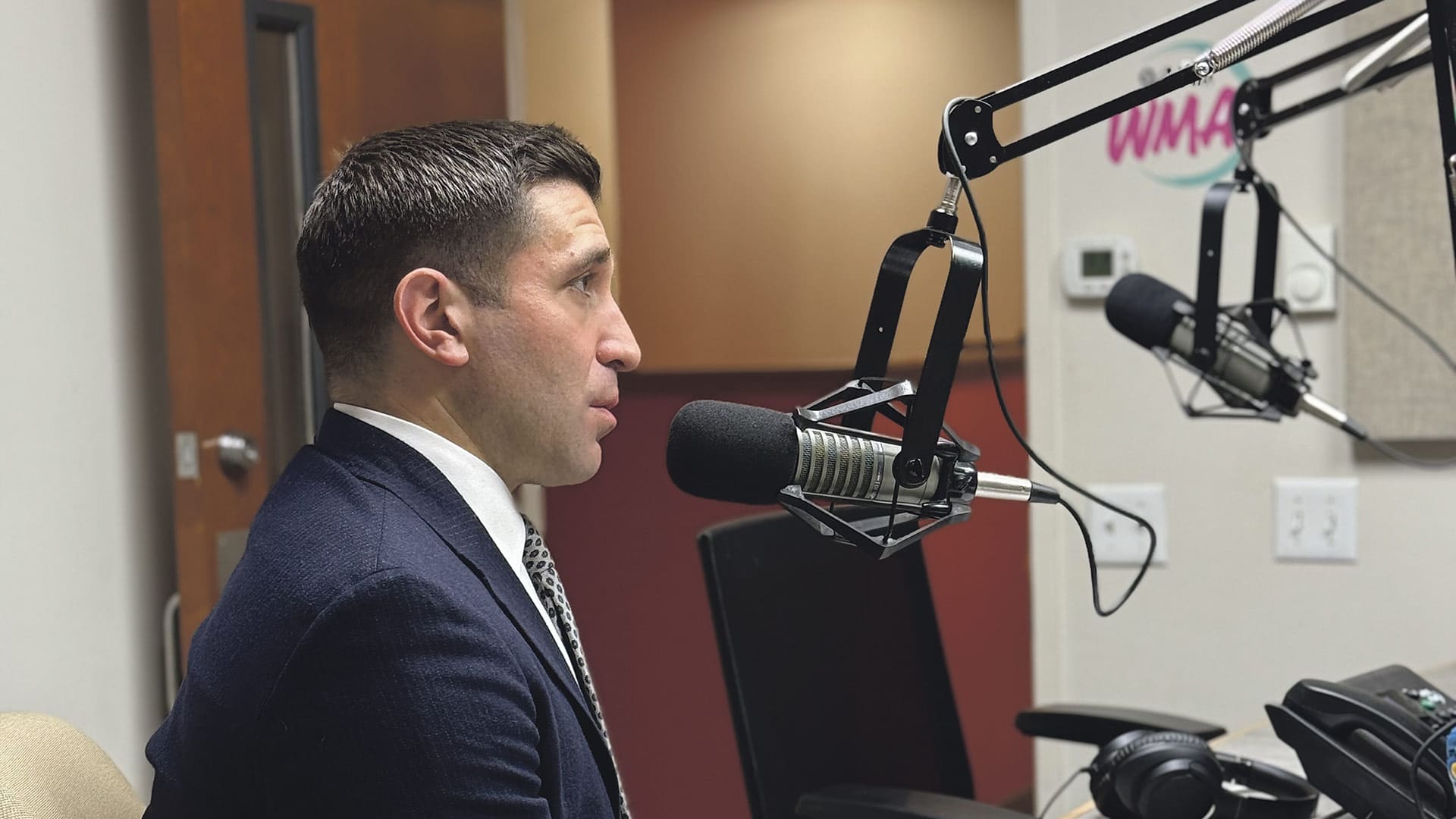
Anthony Gulluni speaks at 94.7 WMAS for its Radiothon for Baystate Children’s Hospital.
It includes more than a dozen initiatives, such as Stop the Swerve, a presentation (the latest staged last month) that addresses the dangers of impaired and distracted driving; Hoop Up Springfield, a 3-on-3 basketball tournament; a Youth Advisory Board consisting of student representatives from high schools across the county who identify issues facing youth today and provide recommendations on how best to address them; and a recent addition, a youth flag-football tournament, staged in partnership with Excel Sports Academy of New England.
The first such tournament was staged last June, and it will return this summer, said Gulluni, adding that, in addition to competition on the gridiron, it features several nutrition and wellness sessions.
Then there’s FLOS. Undertaken in partnership with Western New England University School of Law, it’s designed to inspire young people to enter the legal profession and bring more diversity to the legal community.
“Diversity is important, for our office and for the bar here in Hampden County,” he told BusinessWest. “We thought about how we can encourage and support young people, especially young people of color, to go down the road toward law school and become lawyers.”
As for the Emerging Adult Court of Hope, it is perhaps the most unique and ambitious initiative of Gulluni’s tenure.
Designed for those between ages 18 and 24, it gives individuals a chance to turn an arrest into a positive step forward, he said, adding that participants are carefully screened and, if chosen, assigned a team that includes a judge, service providers, assistant DAs, probation officers, case managers, and case coordinators.
“They come to the court, and it’s entirely different than any other court session anywhere,” he said, noting that the judge, probation department, and ROCA provide resources to make sure participants get needed support.
“Because a lot of these young people started their lives off in a very disadvantaged position — they started their lives off with horrible examples around them, no support, poor parenting, traumatic situations — and they set them adrift, it set them on a bad path.
“Look at the parole hearings … just over the past six months or year, the Parole Board is letting everybody out. There’s a pendulum that swings back and forth, and the pendulum is swinging, and has swung, a little too far, in my view, in the wrong direction.”
“And this is an opportunity for them to accept a hand up, not a handout,” he continued. “It’s not a slap on the wrist, and it’s not a gift; it’s an opportunity to change their lives with their own hard work and their own commitment to themselves.
“I talk to these young people extensively, and on the front end, I’m saying, ‘this court is about you. It’s about giving you an opportunity, but you have to work for it; it comes with a lot of small failures, ups and downs,’” he went on, adding that there have been seven graduates of the program, and another 15 individuals are working their way through it.
Full Sentences
While creating and expanding progressive initiatives in the broad realm of education, prevention, and rehabilitation, Gulluni said he and his staff have also been focused on the other half of that equation he mentioned earlier — upholding the law and punishing those who break it.
And as the discussion entered this area, he didn’t attempt to hide his dissatisfaction with current trends and patterns when it comes to how judges and parole officers are carrying out their work.
“One of the points of frustration over my 10 years, and it’s become more acute and frequent, is the results in court,” he said. “There’s been two or three rounds of criminal-justice reform over my tenure going back to [former Gov.] Deval Patrick early on and recently, over the past few years. The Supreme Judicial Court and other courts have continued to orient toward ‘how is the system wrong, and how can we provide more opportunities for defendants?’
“You look at the parole system, you look at medical parole … systemically, there’s a movement toward defendants’ rights, and that’s extraordinarily important; don’t get me wrong,” he went on. “The system operates rightly on the axiom that it’s better to let 100 guilty men go free than imprison one innocent man — that is the essence of our system, and that’s how it should be.
“But our sentencing practices across our courts, how we’re treating violent offenses, how we’re treating serious drug-trafficking and drug-dealing cases that have poisoned our communities and killed thousands of people through addiction, how we’re treating those who commit crimes against children, domestic-violence abusers, the worst of the worst, has really changed, even in the spectrum I’ve had over the past 10 years.”
The result, he went on, is that violent offenders and repeat offenders are not being held to account.
“That’s a point of great of frustration. Look at the parole hearings … just over the past six months or year, the Parole Board is letting everybody out,” he said, adding that he can’t pinpoint why, but conjectures that it could be everything from overall philosophy to appointments to the board. “There’s a pendulum that swings back and forth, and the pendulum is swinging, and has swung, a little too far, in my view, in the wrong direction.”
Elaborating, he said there are some cases in which those in his office will agree that someone should be granted parole. “But for most of these cases, we’re saying, ‘this person killed someone, took someone away from his or her family, and the sentence is a life sentence, and that’s what it should be.”
Work to help that pendulum swing back the other way is one of many focal points for Gulluni and his team. With this issue and others, it is difficult to measure success, he said, but added that he’s seeing progress on several fronts — and more momentum in the many efforts to build a safer community in Hampden County.