Home Posts tagged Medicare
Senior Planning

The Basics of IRMAA

By Erica Beaudry


I’ve previously written articles about some of the basics of Medicare, like “Navigating the Medicare Maze,” in which I introduced the concept of working with an independent broker such as myself to help guide you through the enrollment process, or “Medigap vs. Medicare Advantage: What’s the Big Deal?” which looked at how both Medigap and Medicare Advantage plans can be fortification tools that help limit the liabilities one is exposed to when covered by Original Medicare (the red, white, and blue card) alone.

Erica Beaudry

Erica Beaudry

“The Social Security Administration determines you owe an income-related monthly adjustment amount, it will send you a notice for the amount of your new premium and the reason for its determination.”

Today, we break down IRMAA, or the income-related monthly adjustment amount, which some folks pay for their Medicare Parts B & D coverage.

IRMAA is a surcharge that is determined by the Social Security Administration and is based on income reported two years prior. The amount is calculated annually, so if your income changes, so might your IRMAA.

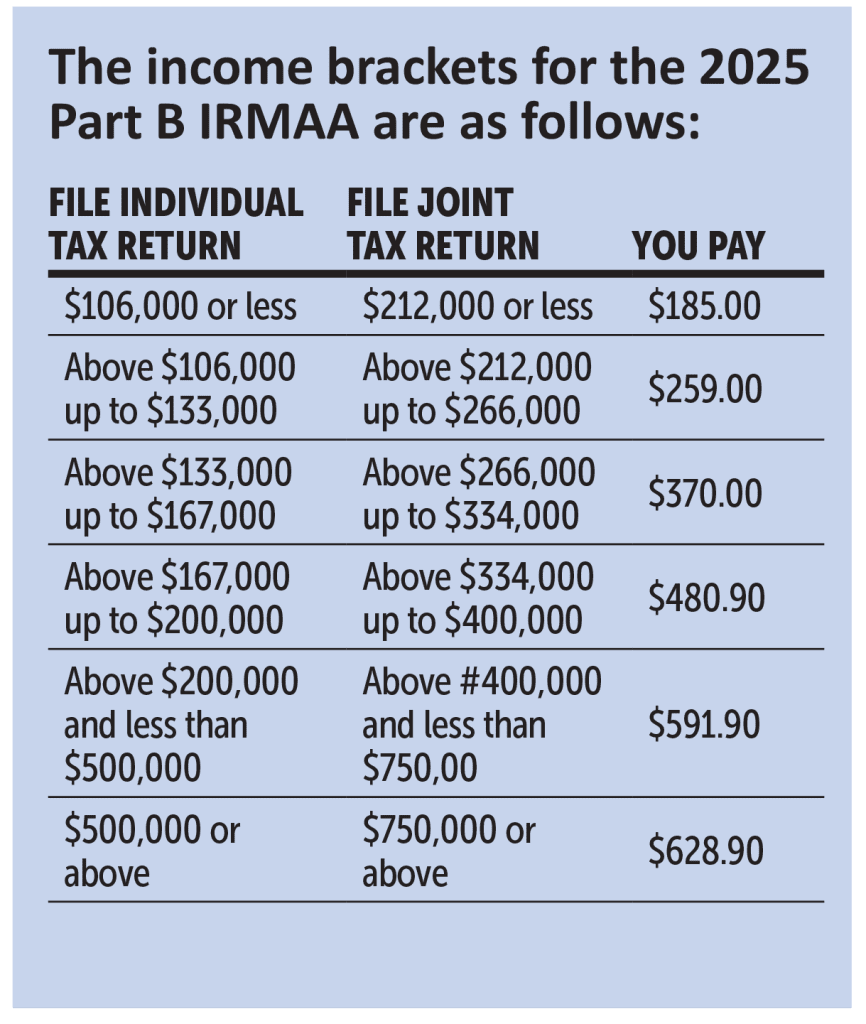
The base rate for Medicare Part B in 2025 is $185. Depending on your modified adjusted gross income as reported on your IRS tax return from two years ago, you may have to pay the standard Part B premium and an income-related monthly adjustment amount.


If the Social Security Administration determines you owe an income-related monthly adjustment amount, it will send you a notice for the amount of your new premium and the reason for its determination. If you disagree with that determination, you have 60 days from the date of notice to appeal. Life changing events such as loss of income, death of a spouse, marriage, or divorce could be grounds for a redetermination, as well as inaccurate or outdated tax information.

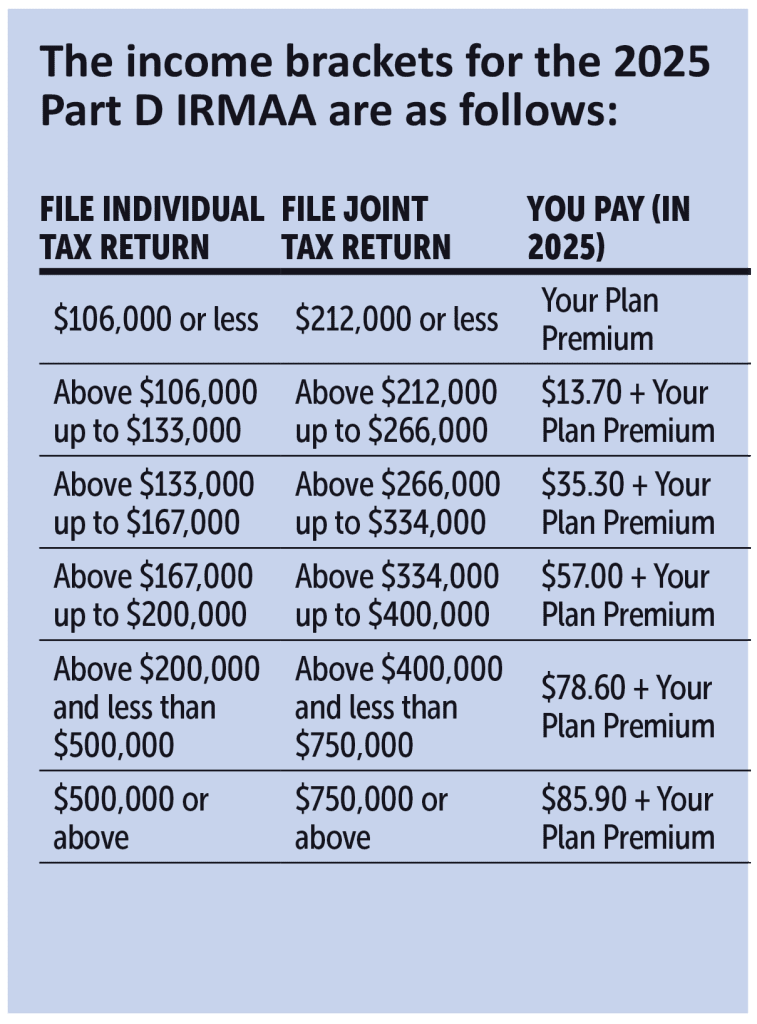
IRMAA also comes into play with your Part D, or drug coverage. The same set of parameters are used to calculate the surcharge for Part D. The important part to remember is that the Part D IRMAA is in addition to any premiums associated with your Part D coverage, but is paid directly to the Social Security Administration the same way you pay for your Part B premiums.


A couple of scenarios worth mentioning that can affect your income-related monthly adjustment amount are the sale of a primary real estate property or winning the lottery. Both life events will increase your income for the year they occur in and may therefore result in an IRMAA surcharge two years later. Both life events are generally not appealable, meaning that you are more likely to lose an appeal filed on the grounds that your income increased in any given year due to these events occurring. With real estate properties, some exceptions are made when the property has been income-producing.

If your head feels like it is spinning after reading this, don’t worry. Take the headache out of understanding Medicare by working with a professional such as myself who will help you sift through all the details that come with enrollment and coverage.

Independent Medicare specialists do not work for the insurance carriers. Instead, we provide an independent, unbiased view of insurance options available to seniors and Medicare recipients at no cost to the people we serve. We focus on Medigap, Medicare Advantage, and prescription drug plans.

Our service to you doesn’t end when you enroll in a plan. We live in your community and are here to answer your questions on bills, drug plans, provider services, extra benefits, and much, much more year-round. 


Erica Beaudry is a local, licensed, independent insurance broker with EA Financial Solutions, focusing on Medicare. She does not work for and is not affiliated with Medicare. She can be reached at [email protected] or (413) 626-9906.

Senior Planning

What to Look for in Medicare, Medicare Advantage Plans

By Sarah Fernandes


Each year, people who are 65 or older make decisions about their Medicare and Medicare Advantage coverage during the Medicare Annual Enrollment Period (also known as Open Enrollment) from Oct. 15 to Dec. 7. Before choosing their plans, Medicare beneficiaries should consider a few things.


Is All Medicare Coverage the Same?

While Original Medicare (Parts A and B), the plan provided by the federal government, covers hospitalizations and most doctors’ services, coverage for other services — like outpatient care, medical supplies, and preventive health care (Parts C and D) — can vary widely. Part C, otherwise known as Medicare Advantage, and Part D (prescription drug coverage) are offered through private insurers, such as Health New England and others.

Sarah Fernandes

Sarah Fernandes

“By focusing on prevention, any potential health issues can be identified early, and you can work to maintain optimal health and prioritize your well-being.”

What Is Medicare Advantage (Part C)?

Medicare Advantage (Part C) plans cover everything Original Medicare (Parts A and B) would cover, but offer additional benefits and services beyond Original Medicare. These added benefits can include prescription drug coverage, vision care, dental services, hearing aids, wellness programs, and more. Medicare Advantage plans provide greater opportunities for beneficiaries to engage in preventive services, such as regular check-ups, screenings, vaccinations, and health education.

By focusing on prevention, any potential health issues can be identified early, and you can work to maintain optimal health and prioritize your well-being. If you do have a chronic condition, a coordinated approach from your Medicare Advantage plan and your providers ensures that you receive the necessary support, education, and interventions to manage your condition effectively, leading to improved quality of life and health outcomes.


How Do I Decide?

To decide what plan is right for you, be sure to review the features of the plan. For instance:

• Make a list of your preferred healthcare providers and see if they are considered in network or out of network for each plan you are considering. Some plans do not cover out-of-network services at all, while some cover them partially.

• Similarly, make a list of your medications and see if they will be covered and how much, if anything, you will need to pay out of pocket (your co-pay).

• If you travel or spend time in other areas of the country, check if the plan allows you to use any Medicare-accepting doctor anywhere in the U.S.

• See if the plan covers dental, vision care, hearing services, and prescription drugs.

• Ask if the plan offers additional healthy benefits such as gym memberships, coverage for acupuncture, activity trackers, and weight management programs.


How Do I Learn More?

Health New England’s Medicare Advantage plans are a popular option for people age 65 and older who are looking to tailor their healthcare coverage to their personal needs. Health New England has many high-quality providers in our network across Western Mass., and we have plans that cover you anywhere you travel in the U.S.

To learn more about choosing the right Medicare or Medicare Advantage plan, you can attend Health New England’s live information sessions, which you can find and register for at healthnewengland.org/medicare/sessions, or visit healthnewengland.org/medicare for details about all we offer. You can also call Health New England at (877) 443-3314 (TTY: 711).

Other resources include SHINE, Massachusetts’ free Medicare advice service; visit online at mass.gov/health-insurance-counseling or call (800) 243-4636. Meawhile, the Medicare website is medicare.gov. n


Sarah Fernandes is the Medicare sales manager at Health New England and been with Health New England for more than 25 years. She and her team spend countless hours educating Medicare beneficiaries in Western Mass. on their Medicare options.

Senior Planning

Two Powerful Tools

By Erica Beaudry


Healthcare costs continue to rise, leaving many individuals worried about how to manage their medical expenses both now and in the future. Two powerful tools in this regard are health savings accounts (HSAs) and Medicare. Understanding how these tools interact can help you make informed decisions about your healthcare and financial well-being.

Erica Beaudry

Erica Beaudry

If you’re still working and have employer-sponsored health insurance after age 65, you can delay enrolling in Medicare without penalty. Your HSA contributions can continue, but once you do enroll in Medicare, coordination between your HSA and Medicare is important to avoid any issues.


What Are the Advantages?

HSAs are tax-advantaged savings accounts that can be used to cover qualified medical expenses. They offer a unique blend of benefits that make them an attractive option for individuals and families.

• Triple tax advantage. One of the standout features of HSAs is their triple tax advantage. Contributions are tax-deductible, meaning you can reduce your taxable income by the amount you contribute. Additionally, the money you contribute grows tax-free, and withdrawals for qualified medical expenses are also tax-free.

• Ownership and portability. Unlike flexible spending accounts, HSAs are not tied to an employer. This means you own the account and can take it with you even if you change jobs or retire.

• Long-term savings. HSAs can be used as a powerful tool for saving for medical expenses in retirement. If you don’t use all the funds in a given year, the money continues to grow and can be tapped into for future healthcare needs.

Eligibility. To open and contribute to an HSA, you must be enrolled in a high deductible health plan, which generally offers lower premiums and higher deductibles compared to traditional health plans.


Making the Most of Both HSAs and Medicare

• Pre-Medicare HSA contributions. Consider maximizing your HSA contributions before you switch to Medicare. Once you’re on any part of Medicare, you can no longer contribute to your HSA, but you can still use the funds for qualified medical expenses.

• Medicare premiums and HSAs. You cannot use HSA funds to pay for Medicare Supplement (Medigap) premiums. However, you can use HSA funds to pay for Medicare Parts A, B, C, and D premiums.

• Social Security and Medicare. If you are receiving Social Security benefits, Medicare Part A enrollment is mandatory. When you elect to collect Social Security benefits after age 65, there is a six-month look-back on your contributions, so planning to stop contributions ahead of time can help avoid tax penalties.

In conclusion, HSAs and Medicare are valuable tools for managing healthcare costs and securing your financial future. Understanding how they work individually and together can help you make informed decisions tailored to your unique circumstances. It’s wise to consult with financial advisors and healthcare insurance experts to create a comprehensive plan that ensures you’re prepared for your healthcare needs during your working years and into retirement.


Erica Beaudry is owner of EA Financial Solutions and a local, licensed, independent insurance agent with a focus on Medicare.

Senior Planning

How to Choose a Medicare or Medicare Advantage Plan

By Sarah Fernandes


In Massachusetts, more than 1.4 million people who are 65 or older will be making decisions about their 2024 Medicare and Medicare Advantage coverage during the Medicare Annual Enrollment Period (open enrollment) from Oct. 15 to Dec. 7. Before choosing their plans, Medicare beneficiaries should consider a few things.

Sarah Fernandes

Sarah Fernandes

“By focusing on prevention, any potential health issues can be identified early, and you can work to maintain optimal health and prioritize your well-being.”

Is All Medicare Coverage the Same?

While Original Medicare (Parts A and B), the plan provided by the federal government, covers hospitalizations and most doctors’ services, coverage for other services like outpatient care, medical supplies, and preventive health care (Parts C and D) can vary widely. Part C, otherwise known as Medicare Advantage, and Part D (prescription drug coverage) are offered through private insurers, such as Health New England and others.


What is Medicare Advantage (Part C)?

Medicare Advantage (Part C) plans cover everything Original Medicare (Parts A and B) would cover, but offer additional benefits and services beyond Original Medicare. These added benefits can include prescription-drug coverage, vision care, dental services, hearing aids, wellness programs, and more. Medicare Advantage plans provide greater opportunities for beneficiaries to engage in preventive services, such as regular checkups, screenings, vaccinations, and health education.

By focusing on prevention, any potential health issues can be identified early, and you can work to maintain optimal health and prioritize your well-being. If you do have a chronic condition, a coordinated approach from your Medicare Advantage plan and your providers ensures that you receive the necessary support, education, and interventions to manage your condition effectively, leading to improved quality of life and health outcomes.


How Do I Decide?

To decide what plan is right for you, be sure to review the features of the plan. For instance:

• Make a list of your preferred healthcare providers and see if they are considered in-network or out-of-network for each plan you are considering. Some plans do not cover out-of-network services at all, while some cover them partially.

• Similarly, make a list of your medications and see if they will be covered and how much, if anything, you will need to pay out-of-pocket (your co-pay).

• If you travel or spend time in other areas of the country, check if the plan allows you to use any Medicare-accepting doctor anywhere in the U.S.

• See if the plan covers dental, vision care, hearing services, and prescription drugs.

• Ask if the plan offers additional healthy benefits such as gym memberships, coverage for acupuncture, activity trackers, and weight-management programs.

How Do I Learn More?

Health New England’s Medicare Advantage plans are a popular option for people aged 65 and older who are looking to tailor their healthcare coverage to their personal needs. As part of Baystate Health, Health New England has many high-quality providers in our network across Western Mass., and we have plans that cover you anywhere you travel in the U.S.

To learn more about choosing the right Medicare or Medicare Advantage plan, you can attend Health New England’s live information sessions, which you can find and register for at healthnewengland.org/medicare/sessions.

For more information about Health New England, visit healthnewengland.org/medicare or call (877) 443-3314 (TTY: 711). SHINE, Massachusetts’ free Medicare advice service, is available online at mass.gov/health-insurance-counseling or by calling (800) 243-4636. For more information about Medicare, visit medicare.gov.


Sarah Fernandes is the Medicare sales manager at Health New England and been with Health New England for more than 23 years. She and her team educate Medicare beneficiaries in Western Mass. on their Medicare options.


Business of Aging

Care Connections

Kathy Burns says Mercy LIFE’s team approach to care has helped seniors maintain and even improve their health.

Celina Conway tells the story of a man who arrived at Mercy LIFE after five years in a nursing home, and was so weak, he couldn’t even hold a cup with both hands. After five years receiving services there, though, he felt stronger than he had in a decade — since before his nursing-home stay, in fact.

“They’re getting stronger,” said Conway, the facility’s director of Enrollment and Marketing. “There are people who came here in wheelchairs and now walk — quite a number, actually. Those are not uncommon stories.”

Mercy LIFE is a PACE (Program of All-inclusive Care for the Elderly) program run by Trinity Health PACE that will celebrate its sixth anniversary on March 1. PACE programs are on the rise in the U.S. because the role they play — providing a range of health programs aimed at keeping seniors out of nursing homes — is becoming more prominent.

“We’re serving people who could be in nursing homes. The model was designed as a place for folks who need some care and need some eyes on them on a more regular basis than an elder living independently,” said Kathy Burns, the center’s executive director. “In fact, everybody who joins us has to be, in the eyes of the state of Massachusetts, clinically nursing-home eligible. And they tend to thrive here because of the intensive care management we do with this big, multi-disciplinary team.”

Indeed, that team includes primary-care doctors, home-care nurses, physical and occupational therapists, dietitians, social workers, among others, all working as a team on each enrollee’s individualized care plan. And it’s not just healthcare; it’s also a place for seniors to socialize, participate in activities, and be generally engaged in life.

“Everything is under one roof, kind of like a nursing home, but nobody lives here; they go home at the end of the day,” Conway said. “When people enroll in the PACE program, they agree to have all their services provided by the staff here, including primary care.”

It’s a managed-care model not far removed from accountable care, the model that has crept into hospitals nationwide, which involves teams of providers being paid by insurers to keep patients well over a period of time, rather than being paid for each treatment, test, and hospital stay.

“It’s actually the precursor to accountable care,” Burns said, noting that, about 40 years ago in San Francisco’s Chinatown neighborhood, families wanted a place for their elders to go instead of a nursing home — a central location where they could bring in health services. Medicare funded a trial run, and the model worked. A second PACE site followed in Boston, and today, 131 PACE programs provide services at 263 centers nationwide, serving about 51,000 participants.

Why? Because the model works, Burns said, giving one example of how such programs keep people healthier while saving money.

“We get a good idea how this person functions, what’s important to them, what their goals are, how we think we can meet their needs. They have the ability to say, ‘I don’t want to do this,’ but typically, once they walk in the door, they’re sold and they do want to enroll.”

“Everybody on the team is equally important in their observations of what’s going on with the elder. Let’s say a driver who’s driven Mrs. Smith here every week for a long time notices, ‘boy she’s really out of sorts today.’ He’s supposed to come in and tell his boss, who will come to the morning meeting and say, ‘Mrs. Smith isn’t right today.’

“So Mrs. Smith is sent right down to the clinic, and we’re going to look at her,” she continued. “And if she’s got, say, a UTI brewing, we’re going to get her on some antibiotics and take care of her right here instead of her going home, where the infection gets worse, and she ends up in the ER with delirium because the infection makes her delirious, and all of a sudden she’s in a psych ward spending Medicare or Medicaid’s money unnecessarily because what she needed was antibiotics, which we can take care of right here.”

Safe Haven

Mercy LIFE currently enrolls more than 300 seniors, about 100 of whom are on site on a typical day.

“We explain to people this is a different way to have your healthcare delivered, and we have conversations to make sure they want care delivered this way,” Conway said. “We want to help them live safely at home.”

If, after being assessed by a nurse, they meet the criteria of needing nursing-home-level care, team members speak further with them and their family members, she went on.

“We get a good idea how this person functions, what’s important to them, what their goals are, how we think we can meet their needs. They have the ability to say, ‘I don’t want to do this,’ but typically, once they walk in the door, they’re sold and they do want to enroll.”

Conway said Mercy LIFE enrollees are assessed and placed into one of four different activity levels, from totally independent to needing more help to memory care, and it’s not uncommon for people to move from one level to another over time. “If people are concerned they won’t find people like them, they will.”

The rehab gym is a popular spot where participants can get stronger, she added. Some sign up for time with a personal trainer, while others might work in small groups or one on one to deal with specific issues, such as balance.

“They always think they’ll get weaker and less mobile as they age, but we’re lifers; we’re planning to be with them for life. So we’re trying to do preventive care, which is less expensive than dealing with a crisis after an episode where somebody falls.”

Occupational therapists on the team also spend time in the home, and are always scoping out issues that could be dangerous, Conway noted.

“We are responsible for everything. So if someone needs a grab bar, or someone needs a toilet set, we are going to order it and deliver it ourselves, which is better than getting a script and going to the medical equipment store. It’s very personalized service. When we work as a team, we prevent so many hospitalizations, emergency-room trips, that sort of thing.”

Burns added that the attention and engagement seniors get at Mercy LIFE brings a richness and measure of security they might not find on their own. “It’s an intensive model of oversight that really keeps them safe at home, happy at home. A lot of folks who come here had spent years at a time just sitting at home watching television. Now they’re doing all kinds of interesting things in our day room, while they’re seen by doctors and therapists.”

And the care plan is different for everybody, Conway said as she walked with BusinessWest past a conference room where an interdisciplinary team was meeting, as they do multiple times each day, to discuss whatever issues may have arisen with some of the people in their charge.

“We’ve helped 550 people over the past six years,” she added. “We don’t discharge people to hospice. We serve people until the end of their life. It’s a beautiful model. To see people when they enrolled and then see the progress and the support they get is very rewarding.”

Burns agreed. “A lot of families have been incredibly grateful for that gift.”

Effective Model

Burns and Conway both came back repeatedly to the financial benefits of preventive care and the value of preventing incidents before they arise. “If you don’t have an ambulance ride, an ER visit, a hospitalization, and a rehab visit, you’re saving a ton of money right there,” Conway said. “I know our interdisciplinary team members work hard to prevent those four key things. Everybody’s happy as a result of that.”

There is no cost to the vast majority of the seniors or their families (there is a private-pay option for a small percentage of participants). Medicare grants the program a flat monthly premium, while MassHealth provides funding as well. However, this year, MassHealth reduced its rate by 2.1%.

“We’re advocating for some of that to be brought back,” Burns said. “The problem for small but effective programs like ours is they’re easy targets for things like that. And we’re really hoping MassHealth will consider pulling back that decrease.”

Those who work at the West Springfield site see that effectiveness every day, Conway said. “This is mission work. I don’t think you’ll find anyone working at Mercy LIFE for the money. They stay here because they enjoy it so much.”

She told BusinessWest she appreciates the chance to tell the Mercy LIFE story because many people still have misconceptions.

“People think it’s home care, they think it’s adult day health, they think it’s a doctor’s office … but it’s all of those things,” she said.

“It sounds too good to be true,” Burns added. “But it just works.”

Joseph Bednar can be reached at [email protected]