Home Posts tagged Solar Energy
Building Trades


Outside the Classroom

What does a career in solar energy actually look like?

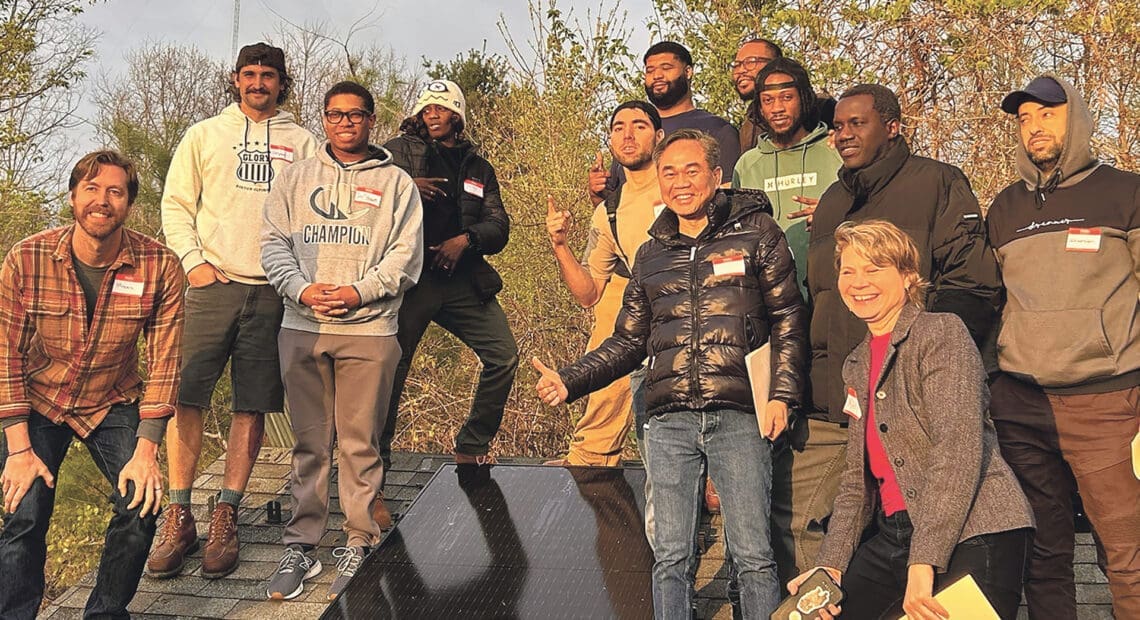
That question moved from abstract to tangible when a group of Holyoke Community College students in HCC’s clean energy training program visited PV Squared Solar’s headquarters and warehouse in Greenfield for an evening of hands-on learning and career exploration in the solar industry.

The visit was designed to give students a practical look at what working in solar actually entails, from installation work and electrical systems to team dynamics and long-term career pathways.
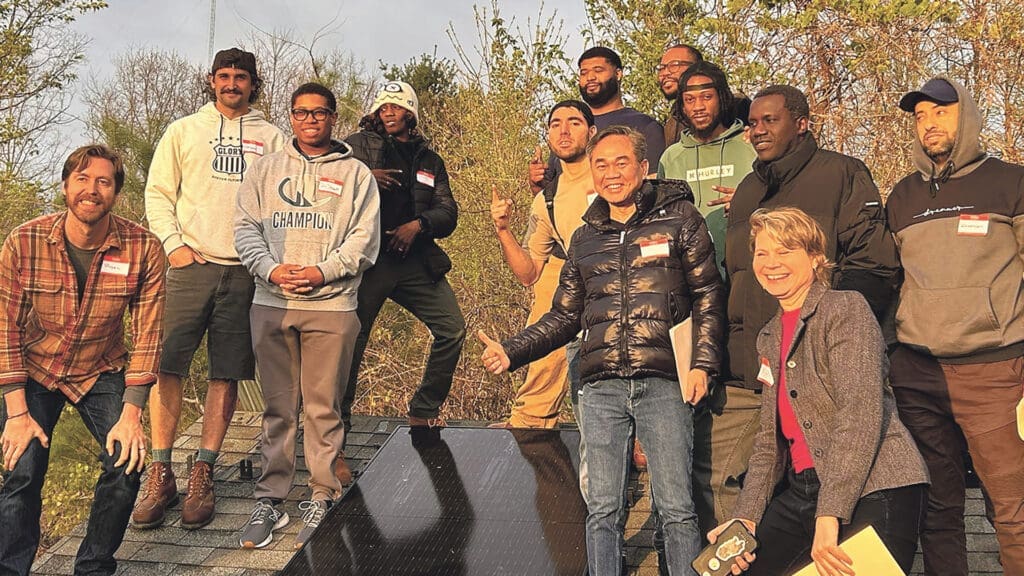
PV Squared offered HCC students exposure to the roof mock-ups used to simulate solar installations.

Students heard from PV Squared team members, including Pablo Revelo, master electrician; Alex Peterkin, president of the board of directors; and Kate Carter, team manager, who shared insights into the skills, training, and mindset needed to build a career in the trades.

“This kind of experience is where everything starts to click,” Carter said. “Students can see the tools, the systems, and the teamwork involved, and begin to picture themselves in those roles.”

The evening’s agenda included a walkthrough of the company’s warehouse and training areas, where students explored electrical training setups and system components, roof mock-ups used to simulate real installations, the tools and equipment used daily by solar crews, and the layout and function of installation trucks and warehouse operations. Demonstrations included safe ladder setup, equipment handling, and a look inside the box trucks that crews rely on in the field.

“This kind of experience is where everything starts to click. Students can see the tools, the systems, and the teamwork involved, and begin to picture themselves in those roles.”

Revelo, who works closely with installation teams, emphasized the importance of connecting technical training with real-world application.

“There’s a lot that goes into a solar installation that people don’t always see,” he said. “It’s physical work, it’s technical work, and it’s collaborative. But it’s also incredibly rewarding to build something that lasts and contributes to clean energy.”

For one evening, the students’ classroom extended into a working environment. Tools, trucks, electrical systems, and team dynamics all became part of the learning experience.

Programs like HCC’s clean energy training initiative are essential to building the future workforce, but classroom learning alone can only go so far, PV Squared’s leaders noted. This visit was designed to bridge that gap.

This visit is part of a growing relationship between PV Squared and Holyoke Community College, focused on creating clear, accessible pathways into the clean energy workforce. As demand for solar continues to grow across Western Mass., workforce development is becoming just as important as project development, Carter said.

“Workforce development doesn’t happen in a classroom alone. It happens when students can step into a real environment, ask questions, and see what the work actually looks like day to day. That’s how confidence is built, and how pathways into the trades become real.”

 “It’s physical work, it’s technical work, and it’s collaborative. But it’s also incredibly rewarding to build something that lasts and contributes to clean energy.”

During the visit, students also learned that careers in clean energy extend beyond installation alone. The solar industry includes a wide range of roles, including electrical and installation trades; system design and engineering; project management and operations; and sales, customer experience, and administrative support. This broader view helps students understand not just how to enter the field, but how to grow within it.
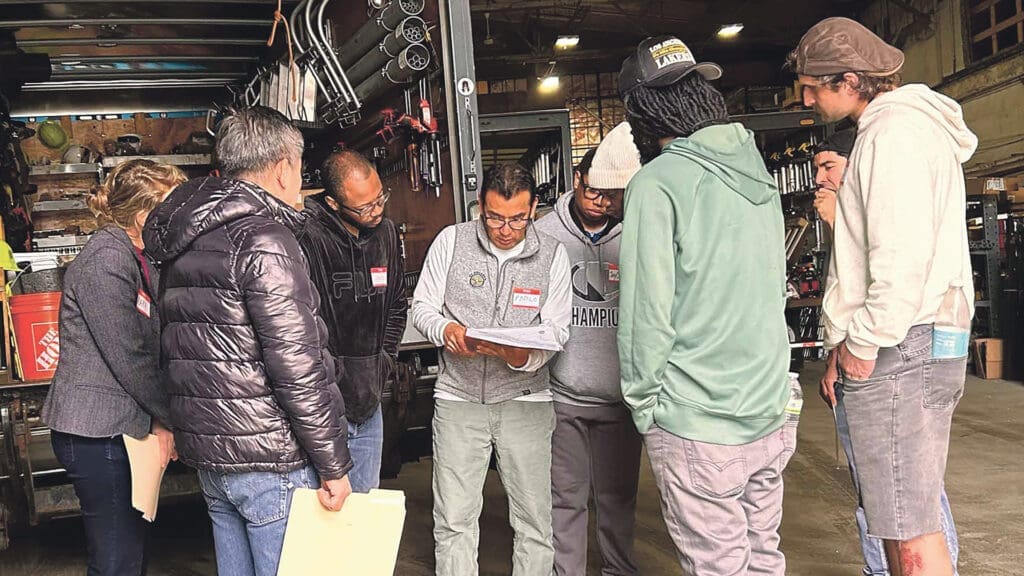
Students explored a wide range of hands-on activities, from equipment to how installation trucks are laid out.

During the visit, students also learned about what PV Squared looks for in employees, including curiosity, reliability, teamwork, and a willingness to learn, as well as the benefits of working within a 100% worker-owned cooperative.


For many students, this was also their first exposure to a structure where ownership is shared among employees, meaning the people designing, installing, and maintaining systems are also invested in the long-term success of the company.

“Worker-owned cooperatives are a powerful force for good in our communities,” Peterkin said. “They create meaningful jobs, build local accountability, and keep the benefits of clean energy rooted right here in the places we live. That’s exactly the kind of foundation we need for the green future we’re working toward.”

He added that, for students considering long-term careers, that structure offers appealing elements, including stability, shared responsibility, and a direct connection between work and impact.

“As the clean energy economy continues to expand, partnerships between educational institutions and local employers are playing an increasingly important role in building a skilled and resilient workforce across Western Massachusetts.”  

Green Business Special Coverage

Power Play

PV Squared workers install solar panels on a house.

PV Squared workers install solar panels on a house.


“I’m frustrated — and, frankly, I’m disgusted.”

Those words open a blog post written recently by Greg Garrison, president of Northeast Solar, about the One Big Beautiful Bill — specifically the provision that ends, on Dec. 31, federal tax incentives for people who have solar energy installed in their homes.

The rest of that post is more measured, and even optimistic when it comes to the future of solar energy, but Garrison’s dismay is real.

“I had written some posts previous to that where I said, ‘you know, this could happen,’” he told BusinessWest during a recent visit to the company’s Hatfield headquarters. “When it actually came about, I was disappointed because that’s real money that the federal government is putting in the hands of local homeowners here, and it stays here.”

But only for a few more months. The only solar tax credits extended by President Trump’s bill are for third-party solar installers, and that goes to a corporate entity, not the homeowner, Garrison noted. “So this one core thing they could have done to make the middle class and American households a little bit stronger in this economy, they took away.”

Indeed, Northeast sells its equipment outright to the customer; some other companies operate under a third-party ownership agreement where the business owns the array and sells the power back to the homeowner; these companies will continue to benefit from federal tax incentives through 2027.

“This one core thing they could have done to make the middle class and American households a little bit stronger in this economy, they took away.”

For homeowners now calling Northeast to take advantage of solar installation before the end of 2025, well, they’re out of luck, as the company is fully booked through the end of the year. But that bad luck extends only to the federal tax incentive; Garrison’s mission now, as it has been all along, is to show people that solar energy carries long-term savings no matter what tax breaks they’re getting.

“The way this legislation cuts the production tax credits instead of incentivizing domestic manufacturing is not great policy, so the One Big Beautiful Bill will make it harder for a domestic renewable energy supply chain to be successful,” said Alex Peterkin, president of PV Squared, a Greenfield-based, worker-owned cooperative solar installation company.

Still, he told BusinessWest, the elimination of the federal solar incentives for customers is a bigger concern nationally than it is in New England, where the cost of electricity is relatively high, particularly in communities that don’t have municipal utilities. In Western Mass., he added, solar power still makes sense, and the long-term savings should still be attractive.

“When you remove the investment tax credit that homeowners were able to access, it doesn’t significantly change the long-term energy saving that they would have access to by installing solar in their homes,” Peterkin said. “It’s still an excellent choice for homeowners and businesses to get solar energy in their homes and in their businesses.”

Greg Garrison says the loss of federal solar incentives, while disheartening, shouldn’t deter homeowners from considering other ways solar energy saves them money in the long term.

Greg Garrison says the loss of federal solar incentives, while disheartening, shouldn’t deter homeowners from considering other ways solar energy saves them money in the long term.

While timetables vary for full payback of the initial investment, homeowners who install solar can typically expect their rate savings to pay for it in six to eight years. Taking away the federal incentives doesn’t change that by more than a couple years, Peterkin explained.

“This equipment is designed to last decades — 30 years, even 40 years for some equipment. A slightly different payback schedule isn’t significant when you’re going to be producing energy for 40 years.”


Watts Happening

Garrison said Northeast Solar has grown from a very small outfit to 24 employees today.

“We don’t grow any faster than our installation capacity — so it’s been nice, steady growth. And I would say a lot of the initial growth was from the incentives that were out there, both on the state and federal sides, with the intention of building more capacity in the state, getting more solar installed, and then making it more competitive and driving down prices.”

That has largely come to pass, he added. “When I first started in solar 15 years ago, [installation] was around $10 a watt. So if you wanted a 10-kilowatt system, it cost you $100,000. There were incentives and rebates to do to help you pay for that, but that’s what it cost. Today, it’s less than $3 a watt. So what used to be $100,000 is now less than $30,000.”

All that means the annual savings solar customers see over other forms of energy have shrunk the payback timetable, which, as noted, is typically around six to eight years.

“We’ve never offered leases. We’ve always offered direct buy, so the money stays here,” Garrison noted. “And as far as the incentives and rebates, like the federal tax credit, I looked at that money as an incentive for communities to develop better solar policies, better permitting policies, to get solar to be something that everyone would want or could afford. So every time that we put a system on someone’s roof and that 30% tax credit came back, that was money that’s going right into the economy.”

Meanwhile, both he and Peterkin said, it’s much easier to install solar capacity than increase fossil fuel generation at a time when the region — and the country — needs more production.

“It’s especially important to build solar energy on your homes or your businesses because then your energy costs are locked in. You’re not subject to increasing rates.”

“The Massachusetts DPU expects energy requirements are going to be much higher in the coming years,” Peterkin said. “And it’s difficult to have new generation created in Massachusetts. The cheapest way to get electrons onto the grid is with solar power. Other energy sources cost a little bit more; some cost quite a bit more. It’s so expensive to build a coal-fired plant. It’s so expensive to build a natural gas plant. But it’s so cheap to build solar power. And it’s frustrating to see that the best option to meet this quickly growing need is being disincentivized.”

Solar power can put downward pressure on everyone’s utility bills, noted Chris Harto, a senior policy analyst at Consumer Reports who specializes in energy and transportation. “Conserving energy is almost always cheaper than building new infrastructure to supply increasing demand,” he noted in a recent article. “Unfortunately, the premature elimination of energy efficiency programs can have the opposite effect, potentially increasing utility bills for all Americans.”

Garrison noted that Massachusetts utility rates are currently around $0.32 per kilowatt hour and rising about 3% annually. But solar costs are around $0.133 per kilowatt over the system’s 25-year lifespan — approximately 58% cheaper than the current utility rate.

“It’s especially important to build solar energy on your homes or your businesses because then your energy costs are locked in,” Peterkin added. “You’re not subject to increasing rates.”

The team at PV Squared, a worker-owned cooperative.

The team at PV Squared, a worker-owned cooperative.

As a workers’ cooperative, he explained, about 30 PV Squared employees own the company together.

“And the mission that we share — which is that we share the success together — has driven us to grow and increase employment priorities in the renewable energy sector and share the success with as many people as possible,” he said, while helping clients ranging from homeowners to factories to nonprofits like the Food Bank of Western Massachusetts, for which it recently completed a major project.

“With this recent legislation and recent treasury guidelines, there are definitely challenges that make it harder for regular people to achieve energy independence,” Peterkin told BusinessWest. “But the core of it is still so strong. We’re optimistic about our business because people need to lower their energy costs, and this is the cheapest and best way to do it. So we see a bright future ahead.”


Shine On

Northeast Solar performs mostly residential work, with a few commercial projects mixed in. And Garrison noted that Massachusetts homeowners can still take advantage of a $1,000 state tax credit.

“The state has also maintained, with the utilities, a net metering policy. That’s where, if you export your power, you get that credit back to your bill. That’s an important part of solar. If you didn’t have that way of storing those energy dollars so you could use them later, solar would be a lot different.”

While incentives have no doubt drawn many customers to the solar side, Garrison said he relies on educating them with the savings figures.

“It’s going to take a while, and we’re going to have to go through that curve of education. But when you put solar on your roof of your home, you are fixing the cost of your electricity going forward. We call it the levelized cost of energy. You don’t have to worry about the fluctuations in energy, and you increase the home value right off the bat by putting solar on it.

“We try to get people to understand that they have an option to control their own energy, and solar is the cheapest form of energy you can buy,” he added before waxing philosophical about the power of the sun.

“It really is a simple technology that people just don’t fully understand. All the energy that we use on this planet, every bit of it, from the oil, gas, and everything else, all of it is derived from the sun. Without that power plant we have out there, we wouldn’t have any of it, because oil was created by the original plants. We’re just cutting out the middle.”