Lee Strives to Be More Than a Gateway
Community Spotlight
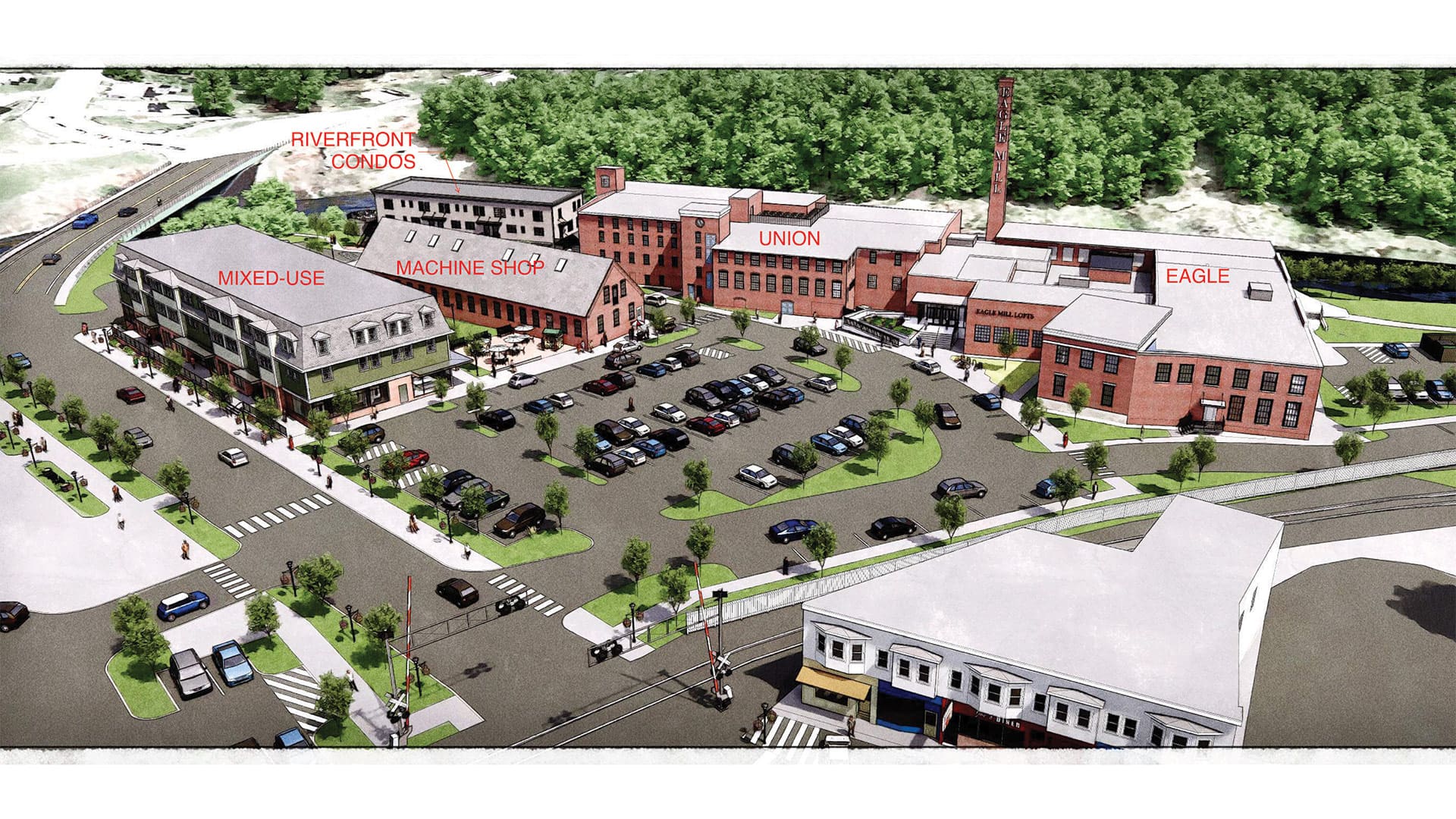
An architect’s rendering shows the various buildings and parcels to be developed at the Eagle Mill complex in Lee.
Jeff Cohen says he was “looking for something to do.”
That was how the long-time developer, lawyer, and one-time police officer casually described how he began what has become a 14-year journey (and counting) to redevelop the Eagle Mill in Lee, one of the oldest paper mills in the country.
It certainly hasn’t been an easy journey — “I have lot more gray hair now than when I started,” Cohen said — but the Eagle Mill canvas, if you will, is filling in, and there is more on the drawing board for this parcel bordering downtown.
Indeed, nearly 60 units of affordable housing are in the process of being leased, and should be occupied next spring. Meanwhile, roughly 150 more units are planned, as well as commercial space, in subsequent phases of the project, including a recently announced plan for 69 units of affordable housing on property across the street from the Eagle Mill.
As these different phases of the project unfold, the impact on Lee, its downtown, its business community, and different constituencies searching for affordable housing will only grow.
Alex Heddinger
“Our walkable downtown is lined with one-of-a-kind shops and restaurants, many family-owned for generations, and there’s a real sense of connection among the people who live and work here.”

“This is going to create a village at the north end of town,” Cohen explained. “As you drive from the Berkshires through Lee along Route 20, there will be a great-looking community, and there will be lots of people on the street. This is going to enable Lee to attract people who want to work in and around the town, it’s going to put more kids in the schools, and it’s going to enhance the businesses in town and probably create opportunities for new ones.”
Redevelopment of the Eagle Mill complex is one of many converging stories in this community of almost 6,000 people. Others include:
• A slight cooling of its housing market, which was one of the hottest in the state just a year or two ago. Town Manager Chris Brittain said the market has returned to something approximating pre-COVID days, before prices exploded amid the surge of remote work and strong interest in rural settings from which to do it;
• Ongoing efforts to encourage development of other mills in Lee, and there are many of them — the community was once home to two dozen mills making more paper than anywhere else in the country;
• Progress toward construction of a new and much-needed public safety complex — groundbreaking is slated for next month — as well as discussion of converting the historic fire station into a community space;
• Continued efforts to make this community, known as the ‘Gateway to the Berkshires,’ more of a place to stop, dine, shop, recreate, and more, rather than being a gateway to other, better-known destinations, including Lenox, Stockbridge, and Pittsfield; and
• Some new restaurants and other small businesses that are certainly helping in these efforts to make Lee more of a destination.
“Our walkable downtown is lined with one-of-a-kind shops and restaurants, many family-owned for generations, and there’s a real sense of connection among the people who live and work here,” said Alex Heddinger, a Lee native who became executive director of its Chamber of Commerce this past spring. “We also have one of the most diverse dining scenes in the area — Mexican, Indian, Peruvian, French, pizza, new American, pub fare, diner classics, and even a Burmese restaurant.
Brooke Healy
“When it comes to affordable housing, many people have preconceived notions about it, but it can really impact everyone — from families to young professionals just starting out in their career like I was.”

“Lee has a way of making visitors feel right at home,” she went on, adding that one of the goals moving forward is to make business owners feel at home as well.
For this latest installment of its Community Spotlight series, BusinessWest takes an in-depth look at Lee and the many intriguing storylines converging there.
Milling About
Cohen told BusinessWest that he and his wife moved to the Berkshires in 2012, and soon thereafter, he became fascinated with the Eagle Mill and the prospects for developing it.
The property had been abandoned since 2008, he said, adding that the various buildings were in poor condition when he acquired them, but still historic. He contracted with an architect and started meeting with various groups in town to get a sense “for what could be attractive to the town and be profitable for me, and that’s how it started.
“I’m not the type of person who buys something and says, ‘here’s what I’m going to do,’ and then present that to whomever is going to approve it,” he explained. “My style is a little different; I try to work with people in the neighborhood, various town officials, and various interested community groups to get a sense for what’s going to pass muster.”
It took several years to identify the preferred use, he said, adding that various uses, including a 100-room hotel and a Faneuil Hall-type retail market, were considered. Overall, it’s been a long, difficult journey, made much more complicated by the pandemic, but pieces to a complicated puzzle are coming together, starting with phase 1 — 56 units of affordable housing in the two original mill buildings, the Union Mill and the Eagle Mill.
Phase 2 includes 44 new apartments at the eastern end of the site; phase 3 is another new building with 35 units of housing and 4,000 square feet of retail, with construction slated for 2028 if all goes as planned; phase 4 involves redevelopment of the historic machine shop building for commercial and retail use, including a restaurant; phase 5 will consist of five condominium townhouses on the Housatonic River; and phase 6 will be 69 more units of affordable housing on the corner of West Center and Canal streets.
Cohen described the sum of these parts as game-changing, and Lee Town Planner Brooke Healy agreed.
“These new units will provide a boost to our downtown business owners and stores,” she said. “You’ll have people walking up and down Main Street — the restaurants are going to get a boost, the stores are going to get a boost … and while some people will work in Lee, others will work in surrounding towns, meaning this will benefit not just Lee, but the Central and Southern Berkshires.
Healy speaks from experience when she said many workers in the Berkshires face lengthy commutes between their jobs and housing they can afford, and the Eagle Mill project will be a difference maker in this regard and make a huge dent in the demand for housing, especially the affordable variety.
“I took this job about a year ago, and it took me a few months to find housing that was less than an hour away; I’m very lucky to live close to downtown Lee,” she told BusinessWest. “When it comes to affordable housing, many people have preconceived notions about it, but it can really impact everyone — from families to young professionals just starting out in their career like I was.”
Meanwhile, there are several other mills that remain vacant or mostly vacant, Healy said, adding that the town is working on revamping zoning bylaws and other strategies for making these mills more “developer-friendly.”
Lee at a Glance
Year Incorporated: 1777
Population: 5,788
Area: 27 square miles
County: Berkshire
Residential Tax Rate: $11.25
Commercial Tax Rate: $11.25
Median Household Income: $41,556
Median Family Income: $49,630
Type of Government: Open Town Meeting
Largest Employers: Lee Premium Outlets; Onyx Specialty Papers; the Landing at Laurel Lake; Oak n’ Spruce Resort in the Berkshires; Big Y
* Latest information available
The town recently collaborated with UConn students to create a site reuse assessment and master plan for three mills — Columbia Mill and Greylock Mill, both on Columbia Street; and Greenwood/Mountain Mill on Forest Street, which was recently sold by the town at auction.
“When a lot of the current bylaws were written, most of these mills were still functioning, and people didn’t really think about the next steps if these mills were to ever go out,” she explained. “Looking forward, we have some mills that are not being used, and there’s been some discussions with the owners of those properties to make sure they know the town has their interests in mind and will help in any way it can.”
Progress Report
Brittain told BusinessWest that Lee’s current fire station, a granite and marble structure built in 1912, was designed for horses, not 21st-century firetrucks.
Which means the town has had to special-order trucks to fit into the doors of this facility. And they just barely fit.
“The last one had five-eighths of an inch clearance on either side,” he said, adding that a few mirrors have been lost over the years.
Wider doors are just one of the myriad design elements to a new, 37,000-square-foot public safety complex, said Brittain, adding that the facility, with a projected price tag of roughly $32 million, will bring the Police, Fire, and Building departments under one roof on the site of the former Bull’s Eye Pub in downtown Lee. And, as noted, the town is in early-stage talks concerning what to do with the current fire station, also downtown.
These developments are just some of the emerging stories in the community’s eclectic downtown, which is just a few miles off Exit 10 of the turnpike, a unique asset that has certainly helped the town’s efforts to promote tourism, while also attracting other types of businesses, such as biotech and enterprises such as Sharp Sterile Manufacturing and Boyd Biomedical, both on Pleasant Street, just off the turnpike exit.
Getting back to the downtown, visitors pass through on their way to Tanglewood and other Lenox attractions, as well as Pittsfield, said all those we spoke with, adding that the goal is to get them to stop along the way — or, better still, make Lee the destination.
There’s a growing list of reasons for doing so, said Heddinger, adding that there is a good mix of restaurants, including some recent additions, such as the Station Gastropub, so named because it’s housed in a former train station.
“Downtown has restaurants, shops, several different kinds of businesses, a park where we stage events, and much more,” she said, adding that this central business district is more than a place to drive through on the way to somewhere else.
Brittain agreed. “We’re seeing a lot more people dining and staying here than we used to, and our hotel and restaurant taxes reflect that,” he said, adding that the growing number of restaurants, and the diversity of those offerings, is a big reason why. “More people are stopping and enjoying the downtown area on their way to Tanglewood or the Norman Rockwell Museum, or whatever.”
Meanwhile, the town is developing strategies for bringing more businesses to the community, such as the “Friend-Lee Approach to Business” marketing campaign, which Healy described as a work in progress, likely to be ready for the new year.
“We’re trying to break down the barriers for developers and residents interested in owning businesses,” she explained. “We want them to able to come in and have conversations face-to-face with various departments and understand what is needed to open a business.
“It can very overwhelming to try to open a new business,” she went on, adding that the campaign will likely ask the question ‘why Lee?’ and then focus on the town’s many attributes — from recreational facilities to that turnpike exit to proximity to other destination communities.
It’s all part of an effort to promote this Gateway to the Berkshires, but also make it much more than that.