Alexa Mignano
Healthcare Administration
Director of School-Based Clinical Services, River Valley Counseling Center
As a Leader, She Makes Sure Team Members Are Heard — and Valued
Alexa Mignano
Like many in healthcare who have traded direct interaction with patients for roles in which they manage others who provide that care, Alexa Mignano found the transition somewhat challenging; stepping away from direct care is never easy.
But to say she has managed and is flourishing in her current role would be a real understatement.
As the director of School-Based Clinical Services (SBS) for River Valley Counseling Center, she now leads a team of more than 85 people. Since taking the helm in 2019, she has expanded the SBS program in dramatic fashion, taking it from two school districts to 11, providing behavioral healthcare to more than 1,600 students in more than 70 schools.
And this growth comes at a critical time.
Indeed, COVID-19 had a significant impact on the behavioral health of society as a whole, and especially young people. It also comes at a time when many young people are experiencing trauma and its many side effects, and when there are simply not enough clinicians, especially in non-school settings, to meet this need.
But behind the numbers, and these sentiments on growing need for behavioral-health services among young people, are the traits that Mignano brings to her role — traits that make her a Healthcare Hero in the Administration category.
“There are really difficult things that we hear about in this work that happen to children. And to be able to create some change and help them heal, and help families heal, is a way to give back to my community.”
These include passion for her work, strong leadership skills, an ability to build teamwork and camaraderie, a willingness to listen and maintain an open mind, and the ability to inspire others to reach higher and deeper as they go about their work and serve this important constituency.
These are traits that come clearly into focus in the thoughts of team members and others who came together to nominate her for the Healthcare Heroes award.
“The SBS is a connected, warm, passionate, and energetic team, which has accomplished amazing things in our school system,” said Elaine Campbell, assistant executive director and clinical director at River Valley. “This team is spread out across Hampden, Hampshire, and Franklin counties, and Alexa brings them together and unifies them as a collaborative unit. Alexa engages the team and brings them together for various events and trainings throughout the year to build support and community amongst the team.”

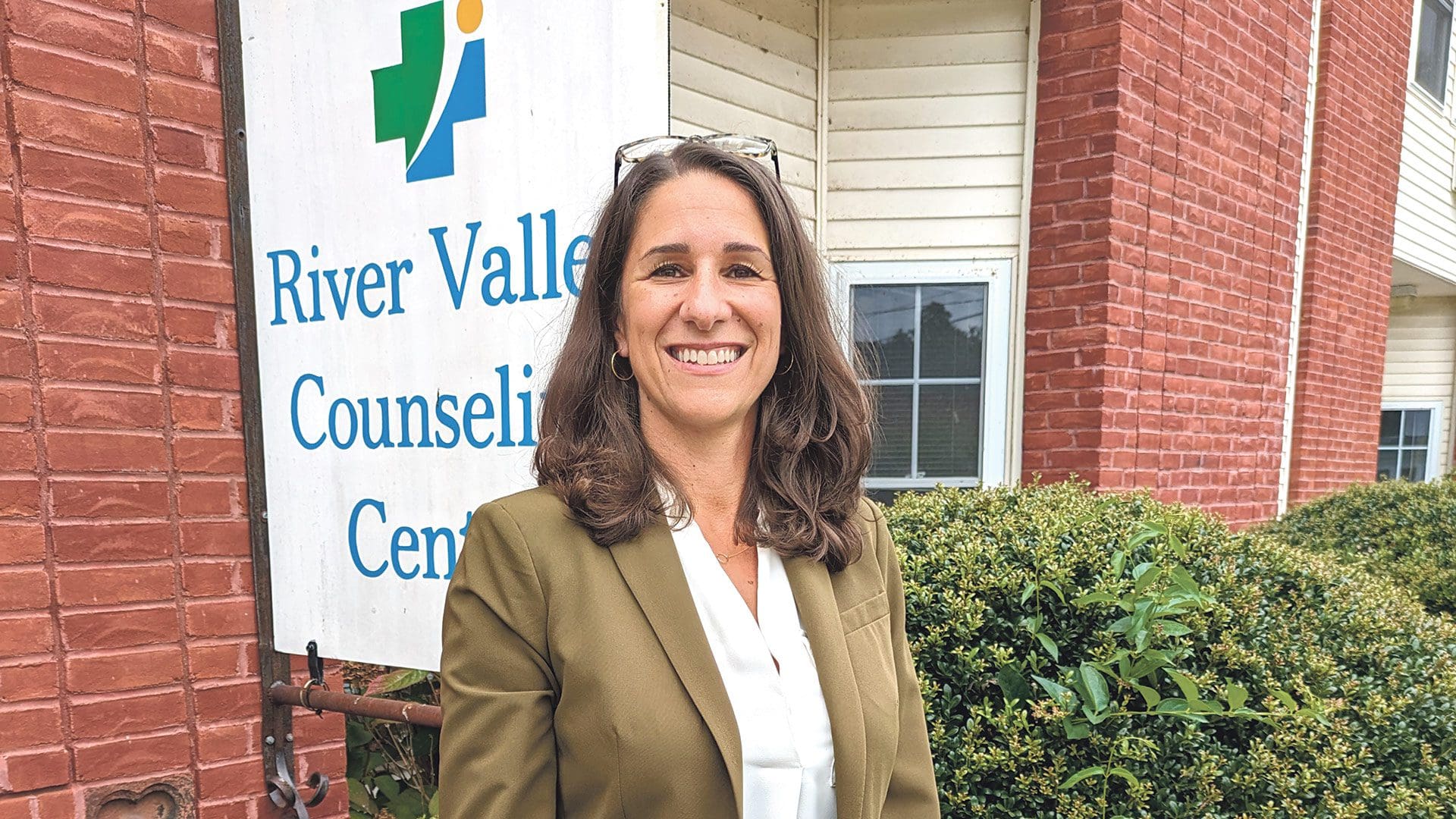
Alexa Mignano says trained clinicians offering care right in the schools provides consistency for the kids, which translates into better care.
Emma Cohen, an SBS clinician, added that “Alexa is — and consistently has been — an amazing leader. She always manages to support our whole team, work hard to help each and every one of us, and make sure we’re providing the best care we can to our clients.
“Alexa truly makes our program great — she is always open to new ideas, makes sure everyone has space to feel heard, and helps us make a large and complex program run smoothly,” she went on. “Alexa is an incredible example of a leader, an advocate for both her employees and the people we serve, and an overall wonderful person to work for.”
If one looks up the definition of ‘leader,’ especially in a healthcare sector, these are the words and phrases that will come up. And that’s what Mignano has become — a true leader.
And while she misses providing direct care to clients, she said that, as a manager, she can actually have a bigger impact and touch the lives of more young people in need of critical help.
“What’s so cool about what we do, the schools that we’re in … the kids know us, therapy’s cool, and more kids want to come see us. They’re not afraid to get help.”
“This is the classic very rewarding job,” she told BusinessWest. “There are really difficult things that we hear about in this work that happen to children. And to be able to create some change and help them heal, and help families heal, is a way to give back to my community.”
Such sentiments explain not only why she loves what she does, but why she’s a Healthcare Hero.
Taking the Lead
Since the Healthcare Heroes recognition program was created in 2017, its Administration category has been perhaps the most competitive.
There are several nominations each year, and to stand out in these crowded fields, one must be more than a manager. He or she must also be a leader, someone who displays those skills and traits mentioned above.
In short, those that prevail in this category, often providers of care themselves at various points in their careers, are able to motivate and, for lack of a better phrase, get all the members of a team to row in the same direction. And their strongest trait might be an ability to not only listen, but make team members understand that they are being heard.
Mignano brings all this and more to a role she’s grown into after taking a somewhat winding road into healthcare and, more specifically, behavioral healthcare.
Indeed, this is a second career for her. She was working at UMass Amherst, doing academic advising and first-year-experience work. She enjoyed that role, but with a young daughter, she needed something that provided more flexibility.
“So I decided to go with what my degree was originally in, which was mental-health counseling,” she said. “And then I fell in love with it.”
That’s another understatement.
Eventually, she started providing therapy to children in schools, was hired by Holyoke-based River Valley Counseling Center, and worked at Holyoke High School and Kelly Elementary School. She ended up going back to school so she could get licensed.
“It was a perfect match for what I wanted,” she went on. “And I felt like I was good at it; I was very interested in how children’s brains change over time, especially when they’ve been exposed to trauma, and how you can heal that and shift that.”
Mignano worked as a counselor for eight years before transitioning into administration, first in a few school districts and, eventually, as director of School-Based Clinical Services.
This is a position with a broad job description that includes everything from overseeing partnerships with school districts and charter schools in the area to hiring, training, and, most importantly, supporting the clinicians that go into schools and provide outpatient therapy to young people coping with a wide array of issues and conditions.
“There’s a lot of trauma,” she noted. “I’d say about 25 to 30% of our cases are focused on trauma. There’s depression, anxiety, ADHD … there’s really a wide range.”
As they help students deal with these issues, the counselors become trusted and accepted, and at a time when students need help, they seem increasingly willing to embrace it.
“I have been in the field for more than 20 years, and Alexa is the most caring, supportive supervisor I have ever had.”
“What’s so cool about what we do, the schools that we’re in … the kids know us, therapy’s cool, and more kids want to come see us,” she told BusinessWest. “They’re not afraid to get help. The stigma is removed quite a bit, especially in the younger grades. When they get to high school, they want to feel a little bit more private, but even there, we’ve become part of the school, and part of what happens at school is that you also get help for your mental-health problems.”
And dissipation of this stigma is an important step forward, she went on.
“Kids are not afraid to say they need support,” she noted. “I mean, I think there’s a lot of emphasis on that in social media — that it’s OK to speak out and say what’s going on and ask for help. But they also get to see it in their school environment, and it gets normalized. It’s not some random place they go to get services and to get support. They do it in a place they’re really familiar with, and I think that helps with breaking down some of the shame or embarrassment that they might feel about getting support; their friends are getting help.”
School of Thought
In short, school-based services are enjoying large levels of success. And thanks to Mignano’s leadership and drive, they are enjoying success in many more ZIP codes.
“I wanted more people to focus in on treating children, so I started supervising and providing support to other clinicians doing the work,” she said, adding that she initiated efforts to coordinate a contract with the Easthampton School District and oversaw the program there before becoming director of all school-based services, with a commitment to continue adding more districts.
“We started with a few, and then I was like … no, we can do more,” she went on. “And the word started to spread, so I started meeting with different superintendents and principals and talking about what we do. And then, a real focus of mine became cultivating a group of therapists that really wanted to be child-focused or adolescent-focused, supporting them in that work. And it’s just a win-win for everybody in terms of how it’s set up.”
As noted earlier, there are now 11 districts in the fold, and Mignano believes there is room for more expansion, especially since the hiring challenges brought on the pandemic are mostly in the rearview mirror.
“I always say we’re done, and then a principal calls,” she said. “I’ve always wanted to expand responsibly; whenever we add a new school district, we add the infrastructure to support the consistency, the supervision, the communication … that’s critical in making these programs work.”
Beyond these expansion efforts, her leadership has brought consistency and steady improvement to existing programs, with the school setting becoming an increasingly effective place for young people to receive therapy because it removes barriers to care.
“I know I’m biased, but I’ve seen it work,” she said. “As a clinician, I’ve seen it work incredibly well, and now I see it at this end. It works for the kids, it works for the schools because they have some added support, and it works for the clinicians who want to focus on kids, but they don’t want to necessarily work every single evening to do that. They get to have a normal schedule too, so it works for everybody.”
And Mignano is committed to making sure it works for everybody.
“As an administrator, I’ve really been focused on how to create a work environment for mental-health professionals that feels really supportive, so they feel challenged, they feel valued, because ultimately that is the foundation of retaining clinicians,” she explained. “Because we get to train them, they get to grow clinically with us, and that translates into consistency for the kids, which translates into better care for the kids. As an administrator, I focus a lot on that — what type of environment are we creating? And people stay with us.”
Which brings us back to some of the team members who nominated her — and why.
“Alexa is an incredible leader, clinician, advocate, and supervisor,” said Catherine Vaughan, assistant director of School-Based Services. “She is truly passionate about the work we do and gives her all in everything that she does. She also encourages her co-workers to go outside their comfort zones with their work, and she is always there supporting and guiding them along the way. I am so grateful to be a part of her team.”
Lisa Smith O’Connor, an SBS clinician, agreed. “I have been in the field for more than 20 years, and Alexa is the most caring, supportive supervisor I have ever had,” she said. “She is an expert in our field, but also an amazing supervisor. I agreed to become a supervisor and commit to this agency long-term due to her caring and thoughtful support and guidance.”
All that certainly helps explain why Mignano has earned another title: Healthcare Hero.