
Auto Dealers Are Finding New, Creative Uses for AI
Driving Change
As he talked about artificial intelligence (AI) and how it’s being used by the auto sales industry, Rob Pion chose to first discuss consumers — and the modern shopping
experience — in general.
“It’s a 24/7 world — we’re an immediate society; people don’t want to wait for the next business day for anything,” noted Pion, president of Bob Pion Buick GMC in Chicopee, the dealership started by his grandfather. “It’s 2 in the morning, you wake up and say, ‘shoot, I forgot to order ‘X,’ you jump on Amazon, order it, and it’s there before you wake up in the morning or the next day.
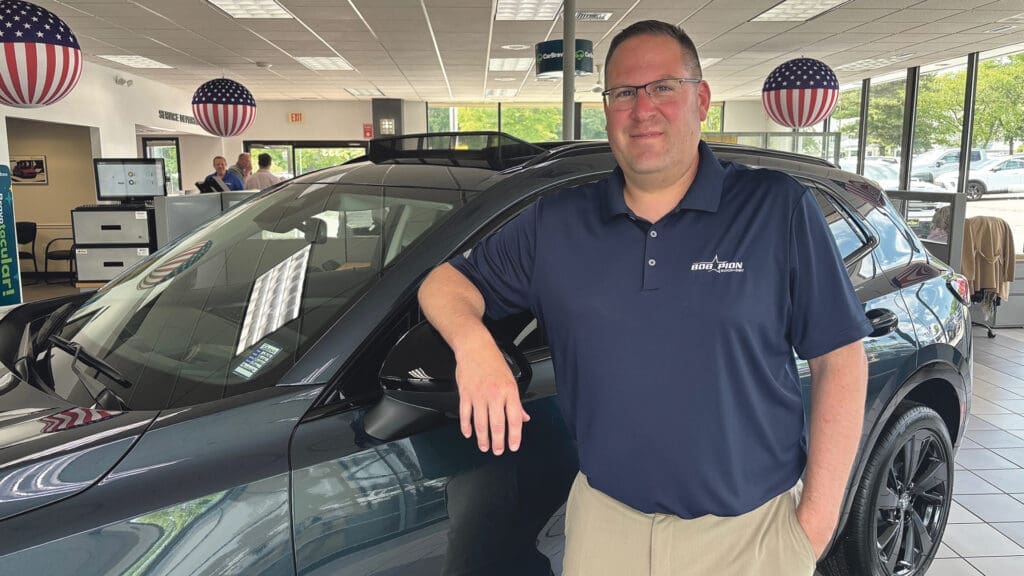
Rob Pion says AI has helped auto dealers better serve customers in a 24/7 world.
“People expect that out of everything,” he went on, adding that this includes cars, trucks, a part, or a service appointment. In short, customers are looking for information and insight — and in many, if not most, cases, they don’t want to wait until the next day for the answers.
And that’s one way dealers are using AI, Pion said — to chat with customers, answer questions, and collect some leads at all hours of the day.
“At least we have someone, or something, responding 24/7 to customer inquiries and concerns,” he explained, choosing those words carefully and then noting that AI is a way for dealers to meet consumers where they are, on their schedule.
But providing answers to questions on lease rates at midnight is just one of the ways auto dealers are putting AI technology to work. Others include everything from finding answers for technicians in the service bay to slicing through the remarks in customer reviews to find common threads, to finding holes in service schedules — and filling them.
“We always read through reviews, but you don’t always catch the themes as they come in,” said Alex Balise, director of Corporate Strategy for Balise Auto Group. “I’ve been using AI to read our reviews for the past three months and tell us key themes so we know what customers appreciate and where we can improve. A one-off review doesn’t necessarily tell you what the real experience is, but, looking at the themes, you can see that wait times have become an issue at this store or they really like the muffins at Balise Subaru in Hadley, so we should keep those. AI can tell us that.”
And it can do many other things, such as providing help with pricing to analyzing inventory to helping make sure the dealerships are carrying the right mixes of vehicles, said Carla Cosenzi, president of TommyCar Auto Group, noting, as others did, that the technology is certainly not intended to replace the human interaction that has marked this industry from the very beginning, or replace people.
“We want to use AI to make us a better resource for the customer and make sure we don’t lose that human interaction that we pride ourselves on here.”

“We use AI a lot,” she explained. “We’re a very customer-centric and community-focused dealer group, so we want to use AI to make us a better resource for the customer and make sure we don’t lose that human interaction that we pride ourselves on here.”
For this issue and its focus on auto sales, we look at the various ways AI is being used today, and how it might be used in the years to come.
Speed Thrills
Like most other industries, the auto sales and service business is really only beginning to tap into AI and its vast potential.
Indeed, those we spoke with said that, while many different uses have been found for the technology, there are many others still in the developmental stages, with testing ongoing. But already, individual dealers and larger groups have been successful in developing strategies for using AI in everything from sales to marketing to service and using the technology for what it was designed to do — creating efficiencies while allowing employees to do what they do better and make more efficient use of their time.
And in many cases, time is what is being saved — for those working at the dealership, and for customers as well.
“AI gives customers really quick, personalized, and smarter responses with transparent pricing, and it gives them a quicker transaction time,” said Cosenzi, citing the example of a customer looking for information online.
“If a customer wanted a price on leasing a Nissan Rogue and sent in a quote to our internet department … before, our internet department would have to go to the sales managers and get information from them to properly quote the vehicle if they wanted a lease or different financing options,” she explained.
“But we have new software and AI that enable us to get right back to a customer in under five minutes and give them a completely transparent quote that gives them all the options they need, whether that’s purchasing, financing, options for different money down, for different financing institutions — all in less than five or 10 minutes. Before AI, it might have been 20 or 30 minutes.”
Balise agreed, and offered another example, this one in the service bay.
“A lot of the manufacturers have added AI support,” she explained. “So when a technician is working on something and has a question, their AI guide can help finish the repair sooner than if they had to call a support line and wait for an answer. That’s been a big help with making a repair time faster; AI can read their whole manual, which could be hundreds of pages, and spit back the specific instruction needed for that repair.”
Using AI to sift through customer reviews also saves time, Balise said, noting that employees would spend hours reading through the responses looking for common themes and issues to address. “AI can do it five minutes and give us action items that can make a real difference in the customer experience.”
Beyond saving time, AI is also helping dealerships be more efficient with everything from how they market their products and services to how they shape their inventories, Cosenzi noted, adding that new uses for the technology are continually being explored.
“It’s a 24/7 world — we’re an immediate society; people don’t want to wait for the next business day for anything.”
“We use it to match the right vehicle to the customer for their situation to help meet their goals and accomplish what they’re looking for, which saves them time,” she said. “We use it to price our vehicles in the market to make sure we’re the most aggressive and our customers are getting transparent, upfront, live-market pricing; we’re using it to help customers schedule appointments with us smarter and faster; and we use it to analyze our inventory so we’re carrying the right mix of what our customers are searching for.”
People Power
The overriding strategy is to put AI to work in ways that will enable employees to save time and put their energies in other directions, not put them out of work, said those we spoke with.
“We’re looking for where AI can make our teams more efficient so they can spend their time doing the human things we need them to do — connecting with customers,” Balise said. “AI should be an extra tool for our team. It’s not replacing people; it’s making them more effective in their jobs.”
Pion agreed. “We’re a ways from AI replacing people, especially in our business,” he said. “It’s a personal experience when you’re spending this kind of money, and people want to deal with people. I see AI as a way to communicate with people overnight, when I can’t expect someone to be doing that on my behalf. But there’s no replacing human interaction in a business such as ours.”
While AI is making its mark in the auto sales industry, those in the business say that, in many ways, dealers are only scratching the surface when it comes to this technology, what it can tell them, and how it can make their operations more efficient.
Right down to the muffins at the Subaru dealership.