
Home Departments Archive by category Opinion (Page 3)

Opinion

Opinion

Opinion

By Jennifer Gilbert and Angelina Ramirez


Massachusetts has a housing crisis. But we’re seeing how the push for solutions is having positive results.

The Massachusetts Legislature recently passed a housing bond bill designed to jump-start housing production and make housing more affordable. With this progress, now is a perfect moment to focus intentionally toward the needs of a population where housing instability can upend every facet of life: people with disabilities.

Turning our attention toward supporting this population is especially important because addressing the housing crisis for this population — about 12% of our Commonwealth’s households — requires distinct attention to distinct needs.

First, Massachusetts has some of the oldest housing stock in the country. We may be right to cherish our triple-deckers. They are, however, not easily converted for people who have mobility issues. Just a single step at an entrance or uneven floor levels can mean someone with a cane or walker or wheelchair cannot be housed. It is also a common reason people need to move: how many of us wonder how long we can climb the stairs?

In the western part of the state, there has been even less new housing production. New multi-family buildings are required to have accessible units, but we just don’t build that many. There is an opportunity with new housing production to address the range of needs of households with disabilities, with potential steps such as:

• Requiring, at the local planning level, that developers go beyond the federal housing requirement of at least 5% accessible units in new buildings;

• Requiring more universal access to address the fuller range of housing needs and aging in place; and

• Integrating processes that ensure people with disabilities are aware of and move into accessible housing once built.

Second, the goal must be both affordability and accessibility. Households with a disabled member are more likely to experience poverty. In line with national numbers, only about one-third of people with disabilities in Massachusetts are employed. Many rely on Supplemental Security Income, which is around $1,100 a month. For comparison, the median rent in Springfield is $1,047.

Stavros serves about 9,500 people a year in this population and helps about 200 new consumers a year find housing that works for them. In June, Housing Navigator Massachusetts released the first data on affordable and accessible housing in our state’s inventory of income-restricted housing — the very housing intended to serve low- and moderate-income households. The simple truth is that there is not much of this critical housing type, and the distribution is even more sparse outside Boston.

Even within the category of housing that is affordable and meets ADA access requirements, much is not affordable for the lowest-income households. This housing crunch is even more true for people who need a home that has two or more bedrooms, either because of a family or the need for an attendant or equipment. In Stavros’s service area, we identified only 950 affordable and accessible units, with only about one-third of those (337 units) serving people needing two or more bedrooms.

The data confirmed what many already knew: we need to build intentionally. We need to match dollars that lower the rent with homes in terms of location, layout, and other modifications that work for people with disabilities. Going forward, we must emphasize — down into the details that make the difference — housing that is both deeply affordable and accessible.

For everyone, a stable home is the foundation for everything we do. Now is the time to focus on housing that is affordable and accessible. These two measures add up to homes where people with disabilities have that same foundation and the opportunity to thrive.


Jennifer Gilbert is the founder and executive director of Housing Navigator Massachusetts, which offers a free online search tool and data about the Commonwealth’s affordable housing. Angelina Ramirez is the CEO of Stavros, a Western Mass. nonprofit that helps people with disabilities take charge of their own lives. She also serves on the Housing Navigator Massachusetts board of directors.

Opinion

Editorial


Let’s talk generations.

About how Zoomers are too focused on work-life balance, dressing down, and taking mental-health days to get anything done in the office.

About how Boomers can’t adapt to a workplace culture that’s more flexible, collaborative, and tech-driven than they’re comfortable with.

How Gen X — oh, wait, no one cares about Gen X.

Now, let’s take the first line of this article and add a comma.

Let’s talk, generations.

That’s better.

For all the (sometimes negative) stereotypes about how four (and often five) generations coexist in the work world, there’s really more that connects us than divides us, as savvy employers and HR managers have learned.

What was striking, when we delved into the topic in the story on page 17, was the emphasis on what communication and openness to new ideas can do for a workplace culture, turning generational differences that might otherwise cause conflict into something positive.

You’ll read about a 29-year-old leader who regularly seeks out the advice and perspective of an older employee whom she manages. And, conversely, how employers have instituted something called reverse mentoring, whereby younger employees share their ideas with older employees, including older executives.

That may be the biggest generational shift of them all, away from a hierarchical, siloed model of management that, if it didn’t actively discourage such exchanges and questioning, at least didn’t encourage it.

But as Millennials and Zoomers continue to comprise a greater and greater share of the workforce, employers, even those from the Boomer and Traditionalist generations, are learning … well, the value of learning from each other, no matter the ages or positions of the people having the conversation.

The consensus seems to be that many benefits and perks favored by the younger cohort, from work-life balance and hybrid schedules to more wellness-focused benefits, are here to stay, benefiting all generations in the workplace, but it’s equally true that they have plenty to gain from the perspectives of business leaders who have been succeeding and adapting for decades.

It all begins with open conversation and trust.

“You want everyone on the team to question everyone else — to question everything, in a good way,” the 29-year-old Operations director told us. “Does this make sense? Is there a better way to do this? Why are we doing this? Why are we still doing this?”

So let’s talk about it.

Opinion

Opinion

By Kathy Martin

Retirement is changing. We are living longer. We are more active. We can continue working — if we want to — well into our retirement years. We can go on adventures, start new hobbies, volunteer, or continue our education. Getting your AARP card is no longer a dreaded milestone, but access to great discounts. Birthdays are celebrations of possibility and opportunity, not a sign that you are over the hill.

One only needs to compare advertising campaigns from the 1980s to today to see that the retirement experience has been entirely reframed by the choices and behaviors of those in retirement now and those expected to retire in the next three to 10 years — the Baby Boomers. Medicare subscribers increase by 10,000 every day, and that number is expected to double by the end of the decade.

You’ve heard that 40 is the new 50? Well, the truth is that 80 is the new 60. In the landmark Age Wave study, the definition of ‘old’ has been pushed back 20 years. In this study, 83% of adults reported they want to be useful in retirement (compared to the 17% that want to be youthful). In that same study, 66% said retirement is a ‘new chapter’ in life, and 97% said it’s important to ‘stay curious’ and be willing to ‘learn new things’ throughout life.

This data reflects what has been called the Third Age — age 60 and up — when the focus is on personal development and reinvention through a lens of growth and purpose. According to Dr. Ken Dychtwald, goals that once seemed cliché and almost mythical — fun, contentment, and happiness — peak during the Third Age.

We arrive in the Third Age during a time of unprecedented medical innovation that leads to longer lifespan, an understanding of the human body and mind that gives us tools to optimize physical and mental health, and a societal openness to self-reflection, centeredness, and peace as worthwhile individual endeavors. The pressure to produce has been replaced with the freedom to choose.

When we started to explore the idea of honoring individuals in their Third Age, it quickly became clear that so many in the 60+ community are embracing this time in their lives. Glenmeadow’s inaugural Age of Excellence Awards were born out of the desire to recognize and celebrate those who serve as models for us all staying open-minded and seeking fresh experiences.

Isn’t that what we are working toward? The opportunity in retirement to embrace self-determination and spend time on things we enjoy — whether that means hiking the Appalachian Trail, traveling the world, starting that business we’d always dreamed of, reading books, or serving the community — the Third Age is a time to put yourself first in a way perhaps you never have before.

In the best of circumstances, though, retirement isn’t just about doing. It’s about being. It’s not about retiring. It’s about contributing. In “The Summer Day,” poet Mary Oliver asked, “what is it you plan to do with your one wild and precious life?” Perhaps now it is relevant to ask, “what is you plan to do with your Third Age?”


Kathy Martin is president and CEO of Glenmeadow, which recently announced seven winners of its inaugural Age of Excellence Awards: Lawrence Akers, Debbie Gardner, Jeffrey Greim, Ethel Griffin, James Lagodich, Maria Roy, and Karen Tetreault. Learn more about them at glenmeadow.org/age-of-excellence-awards.

Opinion

Editorial


For the past several years, Springfield has recorded various forms of progress within its central business district — on or just off Main Street, to be more specific.

Examples range from the $1 billion MGM complex, which dramatically altered the landscape in the South End, to the 31 Elm St. project, which brought market-rate housing to the former Court Square Hotel; from dramatic renovations to Tower Square and its hotel, with the Marriott flag restored, to new, local ownership and a host of improvements to the TD Bank building.

And there’s more on the way, with announced plans to convert the Clocktower Building and Colonial Block just south of State Street into more housing, all or most of it market-rate.

Mostly missing from the equation has been progress north of Bridge Street, the North Blocks area, a stretch dominated by older buildings, many of them vacant or largely vacant. But two recent developments may change that.

The first is the announced sale of what is known to many as the Fort building because the famous restaurant occupies much of its ground floor. The building was sold by the New England Farmworkers Council, at a fraction of its assessed value, to the same group that saved the restaurant from closing back in 2014.

That group is planning some improvements for the restaurant, some streetscape work, and, most importantly, 50 or more condos on the upper floors of the property, which have been mostly vacant for more than 40 years.

The sale by the beleaguered Farmworkers Council to the Fort Street Realty Assoc. will bring much needed stability to an important property and, for the longer term, more housing, and the vibrancy that comes with it, to the neighborhood.

The second development is the upcoming auction of the property housing the Paramount Theater and former Massasoit House Hotel, also owned by the Farmworkers Council. The auction is the last and best hope for council, which has been trying to sell the property for some time, without any luck, and has been desperate to get out from under the taxes and other costs it is burdened with when it comes to this landmark.

It acquired the property years ago with the intention of renovating the theater and reactivating the former hotel space, perhaps for offices or even housing, and invested millions of dollars in a new roof and other improvements. But the development team it was partnering with was never able to get these plans off the drawing board.

The auction provides an opportunity for a new party to come in and breathe some new life into efforts to take this important piece of the city’s past and give it a future. There are myriad challenges, and renovation of the property could still be classified as a long shot, but there might now be some renewed hope that something can be done with this property.

It remains to be seen what will happen with both the Fort building and the Paramount property, but with these developments, there seems to be more stability — and more promise.


Opinion

Editorial


At the top of this issue’s cover story, Ryan Voiland says something striking.

“If I was a smart businessperson, I’d be out of this business.”

Striking, because the casual reader might ask, “then why are you still in it?”

It’s a question he quickly answers as he tells the story of Red Fire Farm in Granby, the fire that ravaged its historic barn in February, and the efforts he and his wife, Sarah, are making to keep the farm running and build a new structure.

The answer is simple and poignant. He does it because he loves it, and because it’s important.

Elaborating, this “labor of love,” as he calls it, is driven by a belief that locally grown food is critical to this region at a time when support for the Community Supported Agriculture model is on the decline.

The story is also a lesson in pivoting — a word everyone got tired of during the pandemic years, but a word that truly does apply to the experiences of so many businesses in myriad sectors, at any time in history.

Take this issue of BusinessWest alone. In the page 15 story, Val Francis goes in-depth on her winding journey to HUB International New England, where she’s vice president of Employee Benefits — a role she achieved without a college education, following a long series of career stops where she kept learning, kept adapting, and kept seizing opportunities. It’s a story well worth reading for anyone who goes to work every day wondering if there’s something better on the horizon — and how they might get there.

In the page 46 story, Ray Berry, owner of White Lion Brewing Co., talks about his original business plan, which included setting up shop in downtown Springfield based on a volume of workers in the office towers that has dramatically shrunk since — and how forging connections through community events has become even more critical.

Even on page 52, where several area auto dealers express optimism about the current state of business, they also talk about a couple years when manufacturing and supply issues emptied their lots of much of their usual inventory.

The point is, almost every story in BusinessWest — you’ll be hard-pressed to find exceptions — touches on challenges and often-sudden economic or personal changes that caused a business owner (or many of them) to doubt themselves, lose a little confidence in that original business plan, even contemplate giving up on their goals or dreams altogether.

There are no direct paths to business success. Everyone struggles. Maybe not with a fire, but with something, and usually something unexpected.

And that’s what makes writing these stories so gratifying — because that struggle is so often followed by perseverance, a few well-timed pivots, and eventual recovery and growth. That’s business. That’s life. And we’ve been relating that idea at BusinessWest for 40 years, in every issue.

The Voilands have a long way to go, and some nagging insurance woes to grapple with as well. But grapple they will on their road to rebuilding at Red Fire Farm.

Why? Because it’s important. And it’s a labor of love.

Opinion

Opinion

By Jessye Deane


A couple weeks ago, I brought my family to the circus. Thanks to our members at North Star in Sunderland, for the first time ever, Circus Smirkus, an award-winning, world-renowned traveling youth circus, made its debut in Franklin County. Those of us who were lucky enough to land underneath the big top are already counting down the days until the troupe returns next summer. 

The performers, ages 11-18, flipped and flew and blew the minds of clown-nosed, popcorn-eating audience members of all ages, my kids especially. Gill’s own 12-year-old Oscar Gradick represented Franklin County well with his unbelievable juggling and made me irrationally proud of him and the rest of the very young, very talented troupe. And while I watched these kids soar and spiral above the crowd, I couldn’t help but think that I really need to start stretching more.

But after that, I was struck by the parallels that can be drawn between performing in the circus and running a business. Let me explain.

As we know, on any given day, managing a business or nonprofit can be a circus in its own right; we’re all performing a constant balancing act, juggling work deadlines and family demands and trying desperately not to let any of the balls drop.

Both the circus and business require an obscene level of flexibility and artistry, forcing everyone involved with the organizations to continually bend and contort themselves in order to meet the unusually high expectations of spectators.

Effective risk management is the foundation of good business and the big top, with business owners and circus-ers both barreling through the ring of fire and walking the ever-present, fine tightrope line between success and fall-on-your-face failure. 

While the argument can be made that clowns can pop up in all industries, ultimately, it’s the showmanship, discipline, and the unspoken, figure-it-out factor that separates successful ringmasters from the rest — and maybe a little bit of magic, too.

All this to say that, as Franklin County business and nonprofit professionals, we don’t often have the luxury of the ‘not my circus, not my monkeys’ mentality, and I hope, if you are feeling the weight of all those standing on your shoulders, that you take this reminder from the circus and remember how talented and truly spectacular you are.

After all, the show must go on!

Let’s all stretch more, too.


Jessye Deane is executive director of the Franklin County Chamber of Commerce.


Opinion

Editorial


Earlier this month, the Berkshire Film & Media Collaborative (BFMC) announced it was awarded a $200,000 Cultural Facilities Fund capital grant from the Massachusetts Cultural Council (MCC) and MassDevelopment.

The collaborative will use this grant to begin build drawings for Kemble Street Studios, a new, international film-education center proposed for the north end of the Elayne Bernstein Theatre complex on the grounds of Shakespeare & Company in Lenox.

“We are thrilled with the continued support we have received from MCC/Cultural Facilities Fund for the project, first for the feasibility study, then for architectural drawings, and now to finish phase 2 of the project and to plan and begin the final renderings of the build drawings,” BFMC Executive Director Diane Pearlman said. “Their support has been significant in garnering interest and contributions from other individuals and organizations.”

Kemble Street Studios will be a mixed-use studio, lab, and classroom environment dedicated to education in the art and craft of filmmaking and media development. The center will offer hands-on learning for area young people interested in training in this burgeoning industry, as well as a resource for local nonprofits and companies to become video-literate and incorporate video in their branding, marketing, social media, and training. To date, BFMC has raised well over $500,000 for this initiative.

It’s just another example of how the creative economy continues to be a key driver across the four counties of Western Mass., not just in the sense of tourism, culture, and recreation — think museums, festivals, concert venues, and the like — but by generating future impacts through training, workforce development, and entrepreneurship.

Everywhere you look (and listen), the vibrancy of the Western Mass. creative and cultural scene is evident, from music events — such as last week’s Springfield Jazz & Roots Festival, the upcoming Northampton Jazz Festival, and a constant stream of concerts at the Iron Horse, the Drake, Academy of Music, Hawks & Reed, and myriad other venues — to a new round of large-scale art going up in Springfield thanks to Common Wealth Murals; from dance and drama at Jacob’s Pillow, Shakespeare & Company, and Double Edge Theatre to the occasional movie filmed in the region, most recently Janet Planet, the film directorial debut of Pulitzer Prize-winning playwright (and Amherst native) Annie Baker.

And that doesn’t even mention all the solo artists and craftspeople creating quietly in their homes and small businesses.

When people talk about quality of life in Western Mass., they often think of outdoor recreation, restaurants, interesting downtowns, and a cost of living that, while still high these days, is less burdensome than in the Boston area.

But they also think about the arts and culture, which continue to thrive in so many ways, as artists, audiences, and the entities that invest in their worthy work continue to generate inspiration and economic impact at a time when both are certainly needed.

Opinion

Opinion

By John Henderson

We’ve all heard the famous quote by Henry Ford, “the only thing worse than training your employees and having them leave is not training them and having them stay.”

When you invest in someone’s professional growth, how do you measure the return on your company’s investment? There are several models that can help you measure return on investment (ROI). One model that many people use is the Kirkpatrick Model of Training Evaluation. In this model, there are four levels to evaluate:

• Level 1: Reaction. This is simply noting how people directly respond to the training. Were they satisfied? You can measure that by evaluation responses.

• Level 2: Learning. What knowledge and skills did the employee acquire due to the training? This can be measured by observing the employee’s performance after the training — was there improvement?

• Level 3: Behavior. How did the employee’s behavior change? Has there been an increase in productivity, motivation, and employee engagement?

• Level 4: Impact. How has the training impacted the goals of the team and/or organization?

While the Kirkpatrick model is widely used, if you are looking for a more mathematical way to measure ROI, you can use a more traditional formula: simply calculate the dollar return (benefit: have sales increased, have efficiencies increased, has retention increased), and divide it by the cost of the investment (training).

Now, with all that said, let’s look at how to effectively get the most return on training investment.

First, determine the skills gap and identify the appropriate training course for the person to attend.

Second, set them up for success by doing the following:

• Explain to the person why you are sending him or her to the training session. I once had a participant during a break tell me he thinks he was sent to the leadership series because he was in trouble. I asked him if he would be comfortable asking his supervisor why he was selected to attend. When he returned to the next class, he proudly proclaimed, “I’m here because they think I have high potential to be a leader.”

• Provide the person with all the logistical information and an overview of what the content of the training will be.

• Provide the trainee’s supervisor with the same information.

• Encourage the trainee and supervisor to meet after the training is completed to discuss what was learned and how the employee intends to use the newly learned skills.

Investing in your employees’ training can bring great ROI if you make sure to follow the four steps outlined above. Don’t spend your learning and development dollars without ensuring that the participant is prepared and ready to learn.


John Henderson is director of Learning and Development at the Employers Assoc. of the NorthEast. This article first appeared on the EANE blog; eane.org

Opinion

Editorial


Gov. Maura Healey’s administration recently announced it is providing $15 million to help extend a Boston program designed to bring more vibrancy downtown by converting underused office buildings to housing.

The money will help Mayor Michelle Wu continue a program that offers property tax breaks for such office-to-residential conversions. Since the program was launched last fall, developers have filed nine proposals to convert office space across 13 buildings that collectively could bring another 412 housing units to Boston’s central business district. With the conversion program, Wu is offering developers as much as 75% off property tax bills for up to 29 years.

With this state money coming, the Wu administration has decided to keep the program going until the end of 2025, instead of ending it on June 30 as initially planned, with the hopes of spurring another 300 to 500 units.

The program is intriguing, and it is our hope that the Healey administration — and the Legislature — will make similar incentives available to other communities, including Springfield and other cities in Western Mass. Indeed, the state aid to Boston comes as the Legislature considers a housing bond bill that could further boost office-residential conversions. A version that recently passed the House would provide $150 million in technical assistance funds for cities and towns while creating tax credits equal to as much as 10% of the project costs to incentivize conversions.

Communities in this region haven’t been hit as hard as Boston when it comes to soaring vacancy rates in office buildings due to the huge pendulum swing toward remote work — and few, if any, signs that the pendulum might actually swing back any time soon. But communities like Springfield, Northampton, and even Greenfield have certainly felt the pinch — and for longer.

In Springfield, there are buildings, such as the property generally known as Harrison Place, once home to Bank of Western Massachusetts, and others along Main Street, that have been vacant or largely vacant since long before COVID. And with the shift toward remote work, there is little hope they can return to that use.

Meanwhile, some properties that were dedicated to office or a mix of office and retail, such as the Clocktower Building and the Colonial Block, are being redeveloped for mostly residential use — and those doing the developing could certainly use some additional pots of money to make these efforts reality.

That’s because conversion from office to residential isn’t easy, and it’s quite expensive.

In Boston, the incentive program was created as a way to bring more vibrancy in the wake of a sharp decline in the number of workers coming to the city on a daily basis; there have been studies to suggest that downtown foot traffic is roughly half of what it was before the pandemic. The theory, and it has a great deal of validity, is that people living in those buildings can provide at least as much, if not more, support to businesses in that area than people working in them.

The same is true for Springfield and other cities in this region.

That’s why we hope the incentives being offered to developers in Boston are made available across the Commonwealth. As we noted, conversions from office to residential are not easy or cheap, but they provide solid hope for bringing more vibrancy to downtown areas, while also helping to alleviate a Commonwealth-wide shortage of housing.

Opinion

Opinion

By Allison Ebner

Over the past several decades, the human-resources position has slowly evolved from a very tactical and compliance-heavy role to a more holistic and thoughtful voice that helps lift an organization to bigger heights.

That slow pace of evolution has had a few Red Bull energy drinks recently and is now moving at the speed of light, threatening to leave behind HR professionals who are not moving to gain new competencies and tools.

The ‘new world of work’ is comprised of a complex ecosystem of operations, technology, and integration of human capital. In short, this symphony sounds perfectly harmonized only if all parts of the orchestra are playing the right notes. Like the meteoric rise in AI technology, the skills we must bring to our organization as the people professionals have taken a giant leap forward.

So, what are these new competencies that HR professionals need to bring to the table today? Let me quote my colleague, Kim Dunn for the simple definition first: “business first, people always.”

Business Acumen: Do you know the financial picture of your entire organization? Can you read a P&L or balance a full budget? Do you follow your industry trade publications or attend events to become more educated? Travel with your sales teams to talk with your customers and clients? It’s only when you have a full understanding of your business operations that you can effectively create a talent plan to support it.

Data Literacy: Does your current HR technology support the needs of your organization? Are you maximizing the tech that you have now? Reporting and metrics tied to your people operations are critical components of your strategic plans and initiatives.

Problem Solving and Critical Thinking: Ready to get uncomfortable? Figure out how to build relationships with people you don’t really like. Why? They probably think differently than you do. And that means they have a perspective that you don’t. As HR people leaders, we need to be able to clearly evaluate all sides of an issue or problem, and we can’t do that in a vacuum. By the way, this also includes building and flexing your negotiation skills.

Creating People-centric Cultures: This one feels closest to home for most HR professionals. But we need to expand our skills around helping our employees build resilience and understand that change and uncertainty are here to stay. They’re part of our daily lives now, and we need to learn to function in a world of VUCA — volatility, uncertainty, complexity, and ambiguity.

Organizational Transformation: This includes skills like refreshing your employer brand for talent development, updating your EVP (employee value proposition), and rebuilding your performance management system — big initiatives that put you at the center of the strategic table in your organization.

You may be feeling very comfortable with some of these competencies and less confident in others. That’s OK. Conduct an honest assessment of where you need to focus your attention and find resources that can help you build those skills.

EANE is here to help you with that initiative. Our HRYOUniversity programs are designed to help you be a well-rounded HR professional with all the talents you need to take your career to the next level. For a discussion about building your own learning pathway, contact me, and I’ll be happy to send you our self-assessment form and a few other resources to get you started.


Allison Ebner is president of the Employers Assoc. of the Northeast. This article first appeared on the EANE blog; eane.org

Opinion

Editorial

Summer is officially here. For college students, it started more than a month ago. And for high-school students, it began just a few days ago.

That means a lot of people are looking for work, and that’s good, because companies across every sector of the economy are looking for help. This juxtaposition of demand and supply is a positive thing because, as we’ve noted many times in the past, summer jobs — often the first jobs for a great many teenagers — are critically important for these individuals, the companies that hire them, and the region’s economy as a whole.

In short, these jobs help introduce people to the world of work, to companies in this area large and small, and, perhaps, to relationships that can last years, decades, or even a lifetime.

Which is why businesses should create such opportunities, if they can. And, in this time of workforce challenges, most of them can — and they are.

No matter where you end up in life — professionally, geographically, or otherwise — you remember your first job. And your second. And your third. But especially your first.

In this market, it might be working the counter at Friendly’s making Fribbles. Or bagging groceries at Big Y. Or working one of the carny games at Six Flags. Or working at one of the farms in Hadley, Hatfield, or East Longmeadow.

In each case, skills are learned, and work habits are developed. Young employees learn about the need to be on time, work beside others, and operate as part of a team. These employees learn not only from their supervisors, but from everyone around them.

The work may not always be fun and exhilarating, but it puts money in one’s pocket and helps keep him or her out of trouble.

As for college students looking to earn some money between semesters, summer jobs can and often do provide more than that. In many cases, jobs or internships can introduce them to careers and companies they can work for in the years to come.

Time and again, we’ve read and heard stories about young people who were undecided about what they wanted to do career-wise and were put on a path — or a different path than the one they were on — because of a summer job or internship at an accounting firm, marketing firm, or even a law firm.

These stories relate the importance of summer jobs — be they first jobs or someone’s fifth or sixth — to creating real opportunities, for both employees and employers.

Summer jobs have always been important, but in this climate, when businesses of all kinds and sizes are often desperate for help, and when many young people are trying to enter the workforce and perhaps start down the path to a career, they are more important than ever.

Opinion

Opinion

By Kim Dunn


Many organizations face the challenge of creating and keeping their workplaces free from conflict and drama. Although drama comes from many places and in many forms, the only sure way to rid your organization of it is to get to its true source.

Identifying the cause or source is where you get to put your detective skills to work. Digging down to the root of the problem starts with asking deep and meaningful questions to draw out what the true issues are that are creating the conflict. To do this, you will need to become an expert fact finder, which is often easier said than done. In many instances, there is not just one issue, but many, and the path to identifying what has created the tension or conflict between employees is murky and blurred with emotions.

It is interesting that there are some organizational cultures that seem to breed drama and others where there is rarely an issue. My research and experience with managing conflict in the workplace has reinforced that failing to address the following items will almost always lead to workplace drama.

• Inauthentic Leadership. A lack of authenticity creates a belief that management is hypocritical and that they only talk the talk, but do not walk the walk. In this environment, employees lose enthusiasm for their jobs, passion for what the company represents, and, most dangerously, they lose trust.

• Lack of Transparency. Misguided attempts at confidentiality can create the sense that everything is a secret. In the face of lacking information, employees will write their own story, which is almost always dangerous. Remember, employees usually know more than you think they know. Old-fashioned though it may sound, it pays to be open with as much information as possible.

• Not Addressing Bad Behavior. Many leaders hope drama will just go away if they ignore it. We know all too well that bad behavior never goes away on its own. The fact that the drama exists must be acknowledged and accepted so that action can be taken to address it. Inconsistency in dealing with conflict not only leads to the erosion of trust, but also increases the chance that it will return for a second act.

What all of these causes have in common is that they lead to a lack of trust in leadership. When employees do not trust and respect leadership, they will quickly become disengaged.

Drama can be created from many sources, and once you have identified the ‘what’ and the ‘why,’ you can begin to take the action necessary to repair the damage or at least stop the bleeding.

If drama is alive and well in your organization, do not wait to take action to uncover and address the issues that are creating or feeding it. Drama impacts the bottom line because it takes up time, and time costs organizations money. That alone is reason enough to make it a top leadership priority.

In taking the steps to address workplace drama, it is important to remember that not all drama is created intentionally. It can be driven by insecurity, fear, or other emotional issues that have not been identified and dealt with. In many organizations, drama is created because people simply do not have the skills to manage conflict. Not many of us wake up in the morning looking forward to managing conflict; however, not having the skills to deal with it can lead to disastrous and expensive drama-filled workplaces.

The culture that you and the leaders are creating and cultivating in your organization must be a priority. By modeling the behaviors of collaboration, support, and customer focus, you will create a foundation where destructive behaviors are quickly identified and corrected. You can even take it a step further and build these behaviors into your performance-management system, which will help reward the best and address the rest.

The one thing we know for sure is that if conflict, aka drama, is not dealt with quickly, thoroughly, and consistently, it will never go away.


Kim Dunn is a Strategic Human Resources consultant at the Employers Assoc. of the Northeast. This article first appeared on the EANE blog; eane.org

Opinion

Editorial


As you likely know, BusinessWest marked its 40th anniversary this month.

Over that time, the magazine has told many intriguing stories involving entrepreneurship, innovation, risk taking, and pioneering.

And one of the best — one that involves all those qualities and more — has been the meteoric rise of the institution now known as Bay Path University.

Roughly 30 years ago, this was a small — make that tiny — two-year school with a reach that barely extended beyond its campus in Longmeadow. Over the course of the past three decades, under the leadership of two presidents, first Carol Leary and now Sandra Doran, the school has taken dramatic strides, adding four-year and then graduate programs, creating new degree programs in areas ranging from cybersecurity to healthcare, launching the annual Women’s Leadership Conference, taking dramatic steps in online education, including creation of the American Women’s College, and much more.

The university now has a reach that is national and even global, and it has achieved this status by being what it encourages its students to be — innovative, bold, and entrepreneurial.

The latest example of all these traits coming together in a powerful way is the school’s recently announced acquisition of Cambridge College (see story on page 26). This bold move speaks not only to Bay Path’s intention to continue its efforts to grow enrollment and expand its reach, but to the trends and challenges in higher education today as well.

Indeed, due to a series of factors, especially heightened competition for enrollment and the rising costs of doing business, many schools have found it difficult to continue their missions. Many, in fact, have looked to merge or partner with other schools.

Meanwhile, Bay Path was developing a growth strategy, one that called for everything from new graduate programs to a broadening of its healthcare offerings; from geographic expansion to profound growth in enrollment among the Hispanic population — the fastest-growing population in the region.

As Doran told BusinessWest, there were several options for achieving these various goals, and one alternative was to nibble at the corners, as she put it. Another was to take a bold step, which was far more likely given the school’s recent track record.

Several acquisition options were considered in several different parts of the country, before Bay Path’s leadership eventually set its sights on Cambridge College, the Boston-based institution created a half-century ago.

This acquisition will essentially double Bay Path’s enrollment and take the institution (and probably the Bay Path name itself, although the specifics still must be worked out) to different markets, including Boston and Puerto Rico, where Cambridge has a campus in San Juan that provides graduate programs in business and technology as well as education and counseling to working professionals.

It will also allow the school to add another 30 graduate programs to its existing portfolio and better serve the growing Hispanic population — Cambridge is ranked among the best colleges and universities for Latinos.

Full integration of Cambridge College into Bay Path will take 18 to 24 months, and it will be interesting to see what the combined schools will look like then.

But we expect that this will be another success story for an institution that has written several of them over the past 30 years.

Opinion

Opinion

By John Henderson

Let’s face it: we are living and working in a socially and politically divisive world that can have a negative impact on a company’s culture. So what can an organization do about this in order to create and sustain a culture of respect in their workplace?

It really comes down to courtesy — being polite and aware of other’s concerns and feelings, and practicing the good manners of saying “hello,” asking “how are you?” and actually waiting for the person to respond rather than continuing to walk by them.

We foster a culture of respect by appreciating everyone for their uniqueness and intrinsic worth as a person — what they bring to the team and organization. We realize that we must create a place where people can be their authentic self at work. We show that we value and support others. And the most important thing is that we accept people for who they are and what they do, but we don’t necessarily need to agree with their opinions or values.

The last one is where many organizations fall short by allowing people’s differences to get in the way of having a productive and positive environment where people feel valued and feel that they belong.

As in real estate, where the most important things are location, location, and location, the things that are most important to creating a respectful workplace are communication, communication, and communication. We must lead by example and communicate openly and constructively.

We must also have embedded in our culture the willingness to effectively address disrespectful behavior, not turn and walk away from it. When communicating, make sure it is clear, specific, and understood by the recipient by asking them to repeat back what they heard and what you agree upon. Most importantly, remember that our non-verbal communication is 70% of what is conveyed.

To foster a culture of respect does not have to be a difficult undertaking. Ensuring that the values and norms of the organization are understood by all is the first step, but living them is the next step that needs to be part of everyday life in your organization.


John Henderson is director of Learning and Development at the Employers Assoc. of the NorthEast. This article first appeared on the EANE blog; eane.org

Opinion

Editorial

The Western Mass. region has a strong tradition of entrepreneurship that goes back more than three centuries.

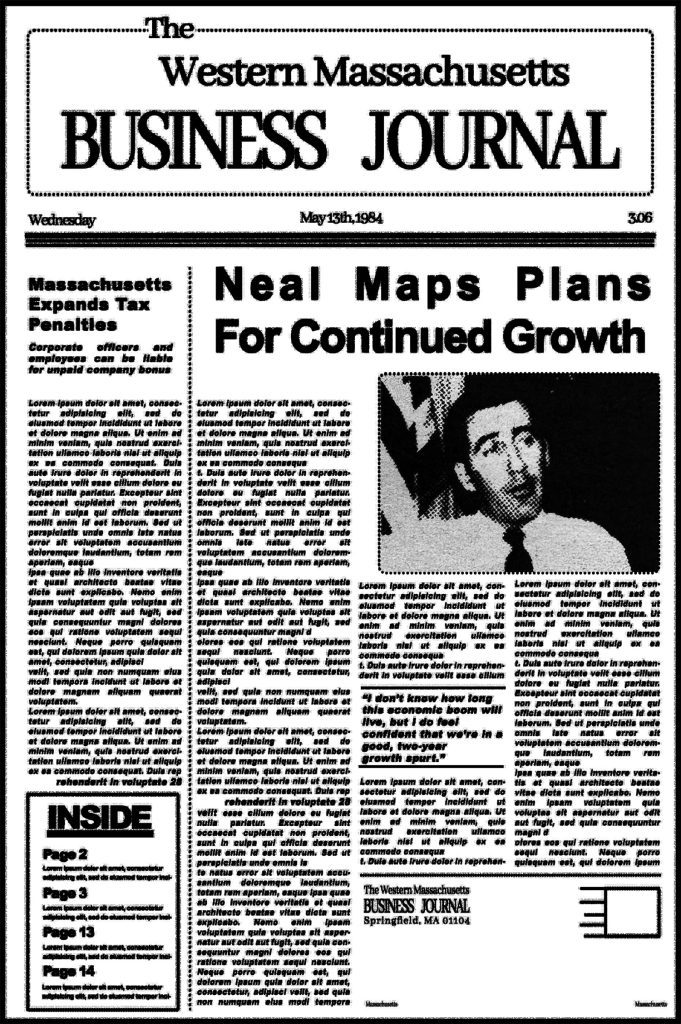
And BusinessWest publisher John Gormally reflects that tradition in many ways. He has owned, or still owns, everything from a billboard company to a television station to a boutique resort hotel in Costa Rica. But his story began 40 years ago with a small, monthly publication he decided to call the Western Massachusetts Business Journal (the first issue is pictured at right).

As he tells the story, he looked around New England and saw that other cities and other regions had publications focused specifically on the many aspects of business. He saw that the Greater Springfield area did not have such a publication, and decided that it should, because, well … there were stories that needed to be told.

Four decades later, there are still stories to be told, and we remain dedicated to telling them. We also remain dedicated to expanding on Gormally’s initial vision of 40 years ago and finding new and better ways to turn a mirror on the region’s business community and provide thought-provoking stories and commentary on what is reflected by that mirror.

A great many changes have come to the region and its economic landscape over the past 40 years, and these are reflected in the stories that start on page 6, each focusing on a specific sector. These developments involve everything from the consolidation of many industries to profound shifts in how work is done, where, when, and by whom (or what, in the emerging AI era).

There are many common threads running through these stories, but the biggest is technology. Those who can recall what the workplace was like 40 years ago remember a time when desks didn’t have computers on them, when people who wanted to contact someone reached for a three-inch-thick phone book, when the fax machine was a wonderous new way to deliver information; when the internet was still a decade away from emerging from government research facilities into millions of homes and businesses, when portable phones were the size of bricks and the only thing you could do with one was call someone.

Now, information is everywhere and instantaneous. People can call or text their lawyer at 3 a.m. — and he or she will answer the phone. Consumers can move their money from one bank to another in a matter of minutes — or get a quote on car insurance or a loan approval just as fast. Manufacturing equipment can and does run all night, with no one to attend to them. Business meetings are often taken by Zoom, saving travel time and expense and allowing people to work from virtually anywhere, while not diminishing the value of in-person collaboration.

There have been many other developments as well. Our business community is different in many ways, but it is especially more diverse, with far more women (29 of whom earned a spot in this year’s 40 Under Forty) and those from traditionally minority populations serving in leadership positions and owning their own businesses. This has been a profound and refreshing change.

Speaking of 40 Under Forty, BusinessWest introduced that recognition program and gala in 2007, and it remains a fiercely coveted honor among the region’s young professionals. We followed that up with other recognition programs and accompanying galas, including Difference Makers in 2009, the 40 Under Forty Alumni Achievement Award in 2015, Healthcare Heroes in 2017, and Women of Impact in 2018. Why? Because so many success stories, both individuals and organizations, deserve to be celebrated, and their stories told.

Those stories and thousands more in the pages of BusinessWest and the Healthcare News, our sister publication introduced in 2000, and on our two websites, businesswest.com and healthcarenews.com, have, over the years, testified to a changing business landscape. So has our use of daily e-newsletters, social media, and weekly podcasts, dynamic business tools that further reflect changes in the way people work, share information, and engage with each other in 2024.

Even the way we produce this magazine is much different today; we went, like other media companies with a long history, from using negatives and paste-up ads in the ’80s and early ’90s to quickly laying out and producing each issue digitally, and immediately sharing stories on our websites and through daily e-news. And we’ve undergone all that change while retaining our culture as a small, independent, local operation with deep roots and a commitment to the communities of Western Mass.

The downtowns of many of those communities, by the way, have been dramatically reshaped by changes that have come to retail and other sectors. Meanwhile, many of the huge manufacturing mills that once gave many communities their character (think Holyoke, Easthampton, Chicopee, Greenfield, Palmer, and Pittsfield) have become housing facilities, spaces for artists, multi-use properties, shared office space, small-business incubators, or cannabis cultivation operations, to name a few.

Yes, cannabis cultivation. That’s another profound development, and one of many that probably could not have been imagined back in 1984.

Indeed, when asked to look ahead and project what will come next, many of those we spoke with said, given the pace of change that has taken place, predicting the future is very difficult, indeed.

As for BusinessWest … we’ll just keep doing what we have been doing: holding up that mirror and putting the spotlight on a business community that is rich, diverse, ever-evolving, and with an endless supply of good stories to tell.

We thank our advertisers, our readers, and the entire Western Mass. business community for your support over the past four decades, and we’re looking forward to the next 40 years of progress, challenge, and unpredictability.


Opinion

Opinion

By Pam Shlemon

In an instance of good intentions gone awry, an effort to hire people because of the skills they possess rather than their college degrees has turned into a concern that certified rehabilitation counselors may not be able to divulge their credentials to clients. That’s not helpful to anyone, especially the clients they serve: people with disabilities.

In January, Massachusetts Gov. Maura Healey signed an executive order requiring the state government to use skill-based hiring practices. That means the state would not ask its job applicants whether they held a college degree, or other advanced certifications, unless it was absolutely necessary for the job, potentially enabling people with relevant experience but not a degree to be hired.

As the leader of a national organization that advocates for people with disabilities, I see the value of skills-based hiring, which would open doors for qualified, motivated workers who may lack a particular degree.

The problem came soon after, with how the Massachusetts Rehabilitation Commission interpreted that order. Commissioner Toni Wolf suggested limitations on how the state’s certified rehabilitation counselors, or CRCs, use and disclose their certification to their clients.

That is a problem. Reducing the emphasis on credentials while hiring is one thing, but trying to erase their importance while performing the job is misguided. CRCs get their credentials from the organization I lead, the Commission on Rehabilitation Counselor Certification. The certification is the national gold standard in the field of rehabilitation counseling for people with disabilities, and it leads to proven better outcomes. Indeed, the Massachusetts Division of Professional Licensure asks for proof of the certification to become a licensed rehabilitation counselor.

Certification for CRCs serves as a quality guarantee, an assurance for a person with a disability that their counselor has the skills, knowledge, and ethical standards to help clients live as fully and independently as possible. A CRC is required by their certification to focus on what the client can and wants to do in their life, and is trained to work toward those goals. The nationally accredited certification is the result of rigorous training, comes with a 50-page code of ethics, and is not lightly granted.

In this field, as in many professions, credentials are important. You trust a certified public accountant, not a bookkeeper, with accounting skills. You bare your soul to a licensed mental-health professional, not someone familiar with some aspects of mental health. When you need surgery, you rely on board-certified surgeons and anesthesiologists, not someone knowledgeable in human anatomy but unlicensed to practice. This is true as well with rehabilitation counseling.

Favoring just skills at the expense of credentials is risky in the field of rehabilitation counseling. The training, the degree, and, most importantly, the certification verify that they know what they are doing. A person hiring a rehabilitation counselor would want to be sure they could do the work, avoid unintentional harm, give accurate information, and not take shortcuts, like referring clients to mediocre employment opportunities misaligned to their skillset or failing to account for their functional limitations. The certification held by a CRC provides that assurance.

A CRC, for example, is committed to helping a person with disabilities find and keep a high-quality job that suits them and bolsters their independence, not just any job. We work with a vulnerable population. The certification is acknowledgement of that and serves as a promise that CRCs never forget their obligations to this population.

Being barred from divulging their credentials hurts the CRCs, too. It’s demoralizing and frustrating to be unable to speak about their qualifications. It’s an erasure of their professional identities.

I have no quarrel with Gov. Healey’s move toward skills-based hiring, which is beneficial to many people in many fields. We at CRCC favor legislation that increases access to certification, including the Tomorrow’s Workforce Coalition, which advocates for workforce-development policies that open up funding for certifications, including the CRC.

Commissioner Wolf’s track record is long and admirable. This is certainly a case of a move made with good intentions and unintended consequences. I hope the commissioner sees that and steps back from this move.


Pam Shlemon is executive director of the Commission on Rehabilitation Counselor Certification (CRCC), the national organization that sets the national standard for certification and advocates both for the profession and individuals with disabilities.


Opinion

Editorial


The numbers are alarming.

Indeed, state tax revenues have fallen below projections for seven consecutive months now, and the shortfall is beginning to put some real pressure on the Commonwealth’s ability to spend what it needs to spend to support vital programs.

Earlier this year, Gov. Maura Healey, citing the lower-than-expected tax-revenue collections — they were running nearly $800 million, or 4%, behind the state’s original projections at the time, and the estimated shortfall for the fiscal year is now pegged at $1 billion — slashed $375 million in spending, cutting hundreds of millions from programs that provide outreach for seniors, behavioral-health supports, and other services.

These cuts hurt, and they may be just the first, with more to come impacting other vital services that communities large and small provide to their residents.

While the numbers are cause for concern, what’s behind them should prompt even more concern. Indeed, while debate on why the revenues continue to decline continues, it seems clear that the state has tipped the pendulum too far in the wrong direction when it comes to taxing businesses and wealthy individuals — especially when it comes to the so-called millionaire’s tax — and, at the same time, it’s spending too much, especially when it comes to housing the thousands of migrants that have made their way to the Commonwealth.

Jay Ash, CEO of Massachusetts Competitive Partnership, a nonprofit, nonpartisan organization, noting that the state ranks 46th in state tax climate, including 44th in personal income tax, recently told a Boston media outlet what that dubious ranking means.

“We’re just losing our competitiveness. We have states around the country that are cleaning our clock. We’re no longer competitive when it comes to taxes. What the pandemic has done is showed us that business can take place away from the bricks and mortar that it was always tied to. So businesses, the people who run those businesses, investment, are all flowing to places where it’s easy to do business, and that’s not Massachusetts’ calling card.”

Places like neighboring New Hampshire, which is considerably more tax-friendly. And it’s not just businesses. Wealthy individuals are leaving the state as well, and the millionaire’s tax, which was enacted by referendum and imposes a 4% surtax on taxable income over $1 million, is likely a big reason why.

While the tax has certainly brought in new revenue — as much as $1.5 billion for 2023, according to some estimates — those gains are being offset by the loss of revenue, talent, and, eventually if not already, jobs. Indeed, the millionaire’s tax will wind up doing much more than keeping desired free agents from joining the Patriots, Red Sox, Celtics, and Bruins. It will contribute to a brain drain that will have a long-lasting impact.

As for spending, the state has long had a spending problem in general, and now it has another one — the steadily rising cost of housing and other services for the migrants pouring into the Commonwealth.

State Sen. John Velis, a Westfield Democrat who was among the National Guard members deployed to buttress the state’s shelter system last fall, told the Boston Globe earlier this year that Healey’s imposed budget cuts were “a warning shot” about the financial pressures wrought by the influx of migrants and the demands it has put on the state.

“A dollar is a dollar. And state money is state money,” Velis said. “I don’t know how I can continue to support more funding for [the shelter system] without some type of notion of where does it end or how are we limiting it?”

The state has to answer those questions, and, overall, it needs to reverse the trends that have brought such serious, and dangerous, reductions in overall revenues and pressure on the state budget.

Opinion

Editorial


When the report surfaced on March 21 that MGM Resorts International is exploring the sale of its casino operations at MGM Springfield and Ohio’s Northfield Park, it should not have come as a shock to anyone.

Indeed, rumors about MGM shedding the Springfield property from its portfolio of casino holding have been floating around since … well, since the facility opened its doors in August 2018.

And they have persisted, primarily because the casino has, to put it mildly, underperformed, at least when it comes to the expectations MGM had when it decided Springfield would be a good entry point for the Massachusetts market.

MGM projected that a Springfield casino could reap $34 million in revenues a month. The reality is, it hasn’t come close to that number, with $26 million the first month it opened being the actual high-water mark.

The casino has had to endure a pandemic and increased competition from several points on the compass — and there was already formidable competition not far away in the form of well-established Connecticut casino complexes.

But from day one, when the long lines that were expected to form outside MGM to check out the shining new attraction failed to materialize, it was clear that this facility was not going to perform as hoped, and it was going to become a drain on the parent company, which invested $1 billion in its creation.

That became clear when Bill Horbuckle, MGM CEO, told reporters after meeting local officials last year, “our original valuation of this market simply was off — full stop.”

So what now?

Talks of a sale are in the preliminary stages, and nothing may come of this. If MGM is intent on selling the property, we hope it will be to a responsible party, and maybe even a local party, that can somehow change the trajectory of the property and at least continue to make it a key contributor to the local economy.

From the start, we have said that MGM Springfield was not going to magically change the landscape and transform the Western Mass. economy. But it would be an important addition to the mix and would bring people to the region.

It has done that, to some extent, but it simply hasn’t performed as MGM Resorts expected it would and needs it to.

“The news of MGM exploring the sale of MGM Springfield is both surprising, as they’ve become a fixture in our community, and unsurprising, as the rumors of their fickleness to the site started even before a shovel was in the ground,” state Sen. Adam Gomez said. Other local elected officials have even stated they won’t be sad if and when MGM leaves town.

Not knowing who or what might come next, we won’t go that far.

But we will say that Springfield and this region could certainly do much worse than what MGM has brought to the 413 — and that anything worse would be a serious setback to the South End, Springfield, and the area’s economy.

Almost from the day the casino opened, people have been asking, “what will happen if MGM sells the property?” We may soon be finding out.

Opinion

Editorial


Springfield will play host to a Division 1 men’s regional hockey final on March 28 and March 30, an event that comes with a degree of risk, but also presents a great opportunity to showcase the region and show that it can host more events like this.

Landing the D1 hockey regional has been a collaborative effort between UMass Amherst and American International College, two local schools with surging hockey programs (UMass won a national title in 2021) and the MassMutual Center, now managed by MGM Springfield. Individually and collectively, these entities saw an opportunity and essentially said, in unison, ‘why not Springfield?’

Why not, indeed? The city has hosted collegiate sporting events before — a D1 basketball regional back in the ’70s, when that tournament was on an exponentially smaller scale than it is now, and, more recently, D2 basketball. It has also staged the old Tip Off Classic for D1 basketball and its current-day counterpart, the Hall of Fame Classic.

Meanwhile, with the emergence of the UMass Amherst and AIC hockey squads, as well as the unqualified success of the Springfield Thunderbirds, the 413 has become a hockey hotbed of sorts — at least as much as, if not more than, Providence, Worcester, Bridgeport, and other cities in New England that have hosted D1 hockey regionals.

And for UMass Amherst, a regular in the tournament the past several years, the event represents a chance to play in its own backyard rather than traveling across this state or to another state in the Northeast, or even the Midwest to play in a regional. (AIC does not have that same opportunity because it plays its home games at the MassMutual Center.)

All of these contributing factors make it simple common sense to bring a regional to Springfield, and now that one is coming, we’ll have a chance to see whether the area will support such an event and what kind of impact it will make.

Expectations are certainly high, but there is risk, especially when it comes to which teams might land here for the games in late March. While the D1 standings are crowded with good teams from the Northeast, one recent projection for the Springfield regional has UMass, Boston University, Cornell, and Denver coming to Springfield. BU and UMass would be great draws. Cornell is a question mark, and Denver is a much bigger question mark.

But quality hockey is assured, close to 1,000 hotel rooms have been blocked off, and thousands of tickets have already been sold, so this has the makings of a great addition to the region’s hospitality landscape, one that brings people to Western Mass. at an otherwise very slow time on the calendar. And already, bids have been submitted for a number of other collegiate sporting events, from hockey and basketball to volleyball and wrestling.

It is our hope — and our expectation — that this will prove to be a risk well worth taking, and the first of many sporting events that will bring more people, more visibility, and more vibrancy to the region.

And as the saying goes — and it applies here — if some is good, more is better.

Opinion

Opinion

By State Rep. Aaron Saunders


I grew up in a home where it was OK to ask if you were OK, mentally or physically, at the dinner table. This was not common during the 1980s, when a stay in a psychiatric ward could be a mark against you for life, but my dad was a psychologist, and my mother, a teacher.

They knew the importance of conversations with their boys about feelings, expectations, and disappointments and not just a skinned knee and how you got it.

I was reminded of this recently during a visit to the newly renovated adolescent unit of MiraVista Behavioral Health Center in Holyoke. Its recent reopening brought back on line 16 much-needed inpatient beds in Western Mass. for youth ages 13 to 17. The redesigned environment enhances delivery of care and healing for this population, in which recent government data estimates that nearly 50% have had a mental-health disorder at some point in their lives.

Massachusetts, with its Roadmap for Behavioral Health Reform, introduced last year a Behavioral Health Line to call 24/7 and network of community behavioral-health centers that provide broader access to mental-health services for those in crisis. The state, too, has added inpatient psychiatric beds to ease Emergency Department boarding that continues for all age groups.

We, as legislators, need to ensure that there is ongoing funding for such services and adequate reimbursement rates for such beds, as well as for addiction-treatment programs. Mental-health and substance-use disorders co-occur frequently, and it is important for both to be treated.

We also need to continue to consider policies that address staffing shortages and issues like educating students and their families on the importance of mental healthcare.

Yet, there is another barrier — stigmatization — around lessening disabling behavioral-health conditions. Massachusetts has a campaign that seeks to educate that addiction is a chronic illness and not a personal choice, but stigma and misinformation continue to prevent individuals with behavioral-health issues from seeking treatment.

You can’t legislative away all stigma. We all need to be better-educated that mental illness can be treated and that there are steps to be taken to prevent poor mental health from progressing to where it interferes with daily life. This is what I reflected on during my recent visit to MiraVista.

I hear from my constituents of the need for services close to home and, in applying the lessons learned from my parents in asking my own three children about their feelings, I get a look into their day in an age when bullying and pressure to engage in unhealthy behavior can come from anywhere.

We all need to be more open to talking with our families, friends, and healthcare providers about our mental health and that of those in our care, as this, too, is part of the roadmap to raising emotionally healthy children and staying emotionally healthy, too.


State Rep. Aaron Saunders represents the 7th Hampden District.

Opinion

Opinion

By Sandra Mauro


As human-resource professionals partner with their organization’s senior leaders to set priorities for 2024, we at the Employers Assoc. of the NorthEast (EANE) can’t help but reflect on the 2023 workplace predictions and ask, how effective were we at deciding where to focus our efforts, and, more importantly, did we move the needle on the critical issues we faced?

In 2023, seven key challenges were forecasted. Number one was quiet hiring, challenging us to look internally and determine if our workforce strengths would meet future organizational needs. Number two was equitable flexibility for frontline workers, an inspirational idea to open up the dialogue for frontline workers to freely express their preferences on how, when, and with whom they work.

Three through six were manager support, pursuing non-traditional talent, coping with stress, and workplace civility. Number seven? Technology and the entrance of AI.

Focusing forward on 2024, two through seven are green workplaces, civil culture, defining the new workplace, psychological safety, learning and upskilling, and career advancement. What a difference a year makes. AI has catapulted to number one.

When we think about AI and ask what will my organization do (or not do) with this new technology, we first need to acknowledge that Gen Z now makes up 23% of our 2024 workforce. This generation literally grew up with technology at their fingertips from the time they could touch it, and will expect nothing less in their workplace. Gen Z is not only tech-savvy, they are highly motivated for change thinking and will quickly move into key positions with great influence over our workplaces.

Yes, the demand for faster information, revolutionary thinking, and finding how and where AI can enhance — or threaten — our workplace will dominate our organizations. And equally important on every generation’s mind are the other six priorities.

There is no question 2023 was filled with turning our organization’s energy from day-to-day survival to blazing our future path. We tiptoed through return to the workplace, fought through scarce candidate pools, and contemplated solutions to quiet quitting and disengagement.

With our sights on what to implement to stay relevant in 2024, we need to collaboratively decide where we are going to focus our resources. Now more than ever, we need to keep our doors open and ask for employee ideas, buy-in, and commitment. Fight not only to align your operational objectives, but to nurture your organizational values, welcome authenticity, and embrace a culture where collaboration across every department is encouraged and celebrated.

And when 2025 is around the corner, let’s reflect back together and ask again, how did we do? After all, what gets measured gets done.


Sandra Mauro is a human resource business partner at the Employers Assoc. of the NorthEast. This article first appeared on the EANE blog; eane.org

Opinion

Editorial


Forty-five years is a long time, and for more than 40 of them, the Iron Horse Music Hall, which opened in 1979, provided not just live entertainment, but countless moments of connection, of joy, of the kind of shared experiences folks tend to remember.

How many young people were inspired by a show there to pick up a guitar and start making their own music? How many solo concertgoers bonded over being seated together at a table, and then carried the conversation to a local bar or café afterward? How many first dates turned into long relationships, marriages, and a whole lot more concerts?

Those moments — and the music itself, of course — have been missed since the legendary College Street storefront in downtown Northampton went dark during the pandemic and, well, never came back. Until now. Or, more accurately, later this spring.

The Iron Horse’s motto for decades has been “music alone shall live.” There’s truth to that — great music does outlast a lot of things. But for a lot of us, live music is about more than the music; it’s about feelings of community, the energy of the give and take between performer and crowd — and, again, a shared, completely unique, ‘you had to be there’ experience.

And, as the story details, you can soon be there again, thanks to the efforts of the Parlor Room Collective, a nonprofit that bought the troubled property from longtime owner Eric Suher and, with the help of many generous donors to an ongoing, $750,000 capital campaign, is renovating and expanding the room.

Chris Freeman and his team certainly want the renovated space to reflect its vibrant past — seating at tables, where a reimagined menu will be served — but they’re also improving what needed improving, from the run-down green room to the famously inadequate bathrooms.

It’s a heartening development, to be sure. We’ve written often about the value of performing-arts institutions to a region, and certainly, venues like Symphony Hall in Springfield, the Drake in Amherst, Hawks & Reed in Greenfield, MASS MoCA in North Adams, and the Parlor Room itself in Northampton continue to deliver plenty of music and good times.

But the Iron Horse always seemed … well, special, with its wild array of styles — both major stars and rising lights from the genres of rock, folk, country, blues, jazz, and a dozen others have graced its stage over the years — its unique setup, and its striking intimacy.

When the Calvin Theatre returns at some point — Suher has been working on a sale of that larger concert hall as well — that will be more great news for a downtown, and region, that could use more music and fewer vacant storefronts.

But no venue has embodied the spirit of ‘music alone shall live’ like the Iron Horse, and we’re hopeful it will rise again to the prominence of its heyday, sending home countless concertgoers with the feeling they’d experienced something truly unique, together.

Opinion

Editorial


Photo by Leah Martin

Fredrika Ballard, founder and owner of Fly Lugu Flight School, one of BusinessWest’s Women of Impact for 2023, was one of three people who died tragically in a plane crash in Leyden, at the Greenfield line, on Jan. 14.

The others killed were William Hampton, a flight instructor, and Chad Davidson, a student pilot.

Their deaths sent shock waves through the region, its business community, and all of us here at BusinessWest, who, in a short time, came to know Ballard as the epitome of the program created by those at the magazine to recognize women who are making a difference in this region.

Ballard, a flyer since her youth and a true entrepreneurial spirit, brought both of those qualities together in Fly Lugu, a name whose origins could be traced to something her father told her about how, when it came to the yoke of a plane, when you look up, you go up — LUGU.

Ballard brought that sentiment not just to flying, but to life in general. To move forward, she said, one had to look up, be positive, and move with confidence.

She did all of that, and she inspired others to do so as well, again, not just with flying, but with their lives and careers.

BusinessWest created its Women of Impact program, and chose that name, not simply to honor successful businesswomen, although several of them have been recognized. It was created to honor women who stand out, women who are true leaders, women who are mentors to others, women who inspire those around them to set a higher bar — in their work and in their lives — and then clear that bar. Women whom others consider powerful forces in their lives.

Ballard was all of these things and more, and this is why she epitomizes that phrase Woman of Impact. She was a success in business and a true entrepreneur, but she was also a teacher, a mentor, and an inspiration.

Opinion

Opinion

By Dr. Negar Beheshti

In a world where the pursuit of perfection can sometimes overshadow the significance of self-compassion, MiraVista Behavioral Health Center emphasizes the need for New Year’s resolutions that prioritize mental health and are both realistic and achievable. This approach aims to reduce the pressure often associated with traditional New Year’s resolutions and promotes a more holistic perspective on personal growth. The key themes are:

Prioritize self-care rituals. Resolve to incorporate daily self-care rituals into your routine. This could include activities like meditation, reading, taking a warm bath, or going for a nature walk.

Establish healthy boundaries. Set clear boundaries in your personal and professional life. Learn to say ‘no’ when necessary and prioritize activities that contribute positively to your well-being.

Cultivate mindfulness and presence. Make a commitment to being more present in the moment. Practice mindfulness through activities like meditation, deep-breathing exercises, or simply taking a moment to appreciate the present.

Nurture positive relationships. Focus on building and strengthening positive relationships. Invest time in meaningful connections with friends and family, fostering a support system that contributes to your emotional well-being.

Limit screen time. Reduce the time spent on electronic devices and social media. Allocate time for activities to promote mental health, such as reading, engaging in hobbies, or spending quality time with loved ones.

Practice gratitude. Start a gratitude journal and make it a habit to reflect on the positive aspects of your life. Regularly expressing gratitude can shift your focus towards positivity.

Engage in regular physical activity. Choose physical activities that you enjoy and make them a regular part of your routine. Exercise has proven benefits for mental health, releasing endorphins that can boost mood and reduce stress.

Seek professional support. Break down the stigma surrounding mental health by committing to seeking professional support when needed. Therapy or counseling can provide valuable tools for managing stress, anxiety, or other mental-health challenges.

Embrace a healthy sleep routine. Prioritize sleep by establishing a consistent sleep routine. Ensure that you are getting enough restorative sleep each night, as it plays a crucial role in mental and emotional well-being.

Learn a new skill or hobby. Engage your mind in positive and creative activities by learning a new skill or picking up a hobby. This can provide a sense of accomplishment and contribute to your overall sense of well-being.


Dr. Negar Beheshti is a board-certified child, adolescent, and adult psychiatrist and chief medical officer for both MiraVista and TaraVista Behavioral Health Centers.

Opinion

Editorial

In the 40 years BusinessWest has been delivering key business news, trends, profiles, and much more to our readers, the economy has swung back and forth many times, from the downturns of the early ’90s and ’00s to the Great Recession of roughly 15 years ago to the recent, hyper-challenging pandemic years — and, of course, the brighter, more robust stretches in between those downturns.

In most cases over those years, business owners could read the signs and pinpoint what kind of economy they were dealing with — good or bad, promising or worrisome.

The current landscape, though, is mixed in an unusual way, with low unemployment and a soaring stock market on one hand and persistent inflation and too-high home prices on the other, just to name a few competing trends. As the Economic Outlook shows, there’s plenty of concern out there, but optimism, too, as we enter a year of global uncertainty, from what promises to be a wild presidential election in the U.S. to serious geopolitical conflicts overseas.

What is more certain is that BusinessWest will continue to reflect these times, these trends, and these stories from a local perspective — that is, through the eyes, minds, and stories of business owners and economic experts throughout the 413.

In our very next issue, we’ll reveal our 28th annual Top Entrepreneur — an intriguing, outside-the-box choice you’ll be excited to read about. One issue after that, we’ll unveil our 16th annual class of Difference Makers, the first of four very popular recognition programs throughout 2024, along with 40 Under Forty in April, Healthcare Heroes in September, and Women of Impact in October. Please note that BusinessWest accepts nominations for all four programs all year long.

We’re also introducing a few regular features to accompany our town-hopping Community Spotlight and the monthly Professional Development story, which focuses on how area colleges and universities are connecting with the business world to help people access better career opportunities.

The new, quarterly offerings in 2024 will include Where Are They Now? — a visit with a past winner of one of the four awards mentioned earlier, detailing how their life and career have evolved since — as well as Nonprofit Spotlight, a quick look at one of the region’s nonprofit organizations and the important work they do, and our Faces of… series, which will offer thoughtful perspectives from leaders in the worlds of construction (in February), education (May), finance (August), and healthcare (November). That’s, of course, on top of our regular coverage of dozens of sectors.

Oh, and did we mention 40 years? We’ll be celebrating that milestone in a big way in our May 13 issue, with a comprehensive look at how several key industries and sectors have evolved since BusinessWest (then known as the Western Mass. Business Journal) first appeared in 1984, and a celebration of the people who made it all happen.

So, as another uncertain year takes shape (and, really, aren’t they all?) we’re excited to bring it all to you — on the page, at our recognition events, and at businesswest.com. Happy New Year.

Opinion

Opinion

By Ben Brubeck


The Biden administration’s final rule, “Federal Acquisition Regulation: Use of Project Labor Agreements for Federal Construction Projects,” implements Executive Order 14063, which requires federal construction contracts of $35 million or more to be subject to controversial project labor agreements (PLAs).

The Biden administration’s burdensome, inflationary, and anti-competitive PLA mandate rule will needlessly raise costs on taxpayer-funded construction projects and steer contracts to unionized contractors and workers. Absent a successful legal challenge, this executive overreach will reward powerful special interests with government construction contracts at the expense of taxpayers and the principles of free enterprise and fair and open competition in government procurement.

When mandated by governments, PLAs increase construction costs to taxpayers by 12% to 20%, reduce opportunities for qualified contractors and their skilled craft professionals, and exacerbate the construction industry’s worker shortage of more than a half-million people in 2023.

Associated Builders and Contractors (ABC) will continue to fight on behalf of quality, experienced contractors harmed by this rule and the 88.3% of America’s construction industry who have made the choice not to belong to a union and want a fair opportunity to participate in federal construction projects, but cannot do so because of PLA schemes.

In addition, ABC condemns Biden administration policies independent of this rulemaking that push PLAs on competitive grant programs administered by federal agencies, affecting nearly $260 billion worth of federally assisted infrastructure projects procured by state and local governments, as well as schemes by the Biden administration to coerce private developers of hundreds of billions of dollars’ worth of clean energy and domestic microchip manufacturing projects to mandate PLAs. Biden’s PLA policies circumvent congressional intent as none of these policies were passed in funding legislation.

Some background: on Aug. 19, 2022, the Federal Acquisition Regulatory Council issued its proposed rule implementing Executive Order 14063. In October 2022, ABC submitted more than 40 pages of comments to the Federal Acquisition Regulatory Council, calling on the Biden administration to withdraw its controversial proposed rule.

ABC’s opposition was shared by more than 50 members of the U.S. Senate and U.S. House of Representatives, 19 Republican governors, and a diverse coalition of construction-industry, small-business, and taxpayer advocates urging the administration to withdraw its proposal and additional policies promoting PLA mandates on federal and federally assisted construction projects.

At least 8,000 stakeholders across the country — including 2,500 ABC member contractors — submitted comments opposed to this proposed rule during the 60-day comment period. In a September 2022 survey of ABC contractor members, 98% opposed this proposed rule, and 97% said a construction contract that required a PLA would be more expensive compared to a contract procured via fair and open competition.

ABC plans to challenge this Biden administration scheme in the courts on behalf of taxpayers and the majority of the construction industry. In the interim, ABC will continue to oppose its special-interest-favoring policy using all tools in our advocacy and legal toolbox while educating stakeholders about the negative impact of government-mandated PLAs on federal and federally assisted projects.


Ben Brubeck is vice president of Regulatory, Labor, and State Affairs at Associated Builders and Contractors.

Opinion

Editorial


The main reason the Food Bank of Western Massachusetts opened a long-awaited distribution center in Chicopee this month is that it distributes millions of pounds of food each month, and more space means doing more of that critical work, and in a more streamlined way, thanks to Chicopee’s proximity to two interstates.

The nonprofit’s new, larger, greener food-distribution center is twice the size of its previous Hatfield location, with an additional 18,000 square feet in the warehouse alone. Floor-to-ceiling warehouse racks and expanded refrigeration and freezer sections enhance efficiencies and enable the Food Bank to store and distribute more healthy food than ever before to 175 member food pantries, meal sites, and emergency shelters of the food-assistance network across all four counties of Western Mass.

The new site also features a dedicated community space with a working kitchen for cooking and nutrition classes and other educational events. Other efficiencies include electric charging stations, an expanded member pick-up area, and ample parking for staff and volunteers. In 2024, the Food Bank will add a solar array on the roof and a canopy over part of its parking, along with backup battery storage that will fully support all electricity needs of the building.

“The Food Bank of Western Massachusetts’ new, state-of-the-art facility will allow their dedicated team to provide greater access to healthy, nutritious foods to thousands more of our neighbors in need and expand service routes to partners throughout the area,” U.S. Rep. Jim McGovern said. “I’m proud of the Food Bank’s 40 years of history serving our community and their continued leadership on the national stage in our movement to end hunger now.”

The Food Bank certainly isn’t alone in those efforts, but the sheer scale of its work to connect food-collection sources through distribution channels to reach people in need is nothing short of remarkable, and its shepherding of tens of millions of dollars to build the new Chicopee location testifies to the firm belief in its work held by individuals, businesses, and government.

“I want to express my gratitude to our incredible community of supporters and donors who made our vision a reality,” Food Bank Executive Director Andrew Morehouse said.

No, thank you.

Opinion

Opinion

By Henry Howard


There is nothing minor about the support the American Legion Department of Massachusetts receives from the Springfield Thunderbirds.

For years the Thunderbirds have supported Massachusetts Legion programs such as Boys State, Junior Law Cadet, American Legion Baseball, and the developing softball program. The hockey team honors a Veteran of the Game and regularly conducts a jersey raffle, with proceeds going to a Legion program.

Department of Massachusetts NECman Jodie Pajak raves about the support. “There’s no question, no feedback, no static when we ask them for anything. There is no hesitation from anybody on their staff. I’ve never been to any establishment where they are that welcoming. They want to be part of the community, and it definitely shows. The relationship is phenomenal.”

The Legion-Thunderbirds partnership was on full display on Dec. 1, the Legion’s Be the One Day. American Legion members set up a booth inside the arena to educate fans about the organization’s primary mission to reduce the number of veteran suicides. Legion family members handed out customized brochures to thousands of fans. Additionally, a special Be the One jersey, signed by the entire team, was revealed. It will be raffled off at the end of the season, with proceeds going to the Veterans & Children Foundation to support Be the One.

The Be the One mission is especially meaningful for Pajak. “Veterans suicide is a cancer that should not be,” she said. “There are way too many resources, way too many programs to help veterans and their families, to help combat these needs and feelings that these veterans develop in their military careers and come across as they try to transition out of service and back to civilian life. You can’t just flip a switch and go from structured to unstructured. You have to have some help. After a few years, you find you just can’t cope. With this program, we hope that they see us and seek us out.”

Be the One was a natural tie-in this season for the Thunderbirds, which have regularly honored veterans. Their nickname, appropriately enough, is related to the Air Force Thunderbirds.

The team “wanted to get more involved with the community, and they are wonderful to work with,” said Pajak, who, along with her husband, Drew, are members of Post 185 in Agawam. “They felt the need, and they did want to help. They have been phenomenal in promoting this as a way to reduce the stigma. We have a partner that loves putting the Legion first.”

The Thunderbirds highlight the American Legion at all 36 home games. The Legion staffs a table inside the arena, promoting timely programs and initiatives. Over the course of a season, that outreach connects the Legion with at least 220,000 fans.

“At this level, specifically, I thought it was crucially important for us to build our business to open our doors to community projects and give it back to a number of programs, specifically the Legion,” said Nathan Costa, Thunderbirds team president. “Part of the vision from the very beginning was how we can do things to make an impact on the community while also trying to do the right thing.”

Ryan Smith, who manages the team’s media, community relations, and broadcasting, said his grandfather served in World War II. “It’s wrenching for me that there are so many of these military folks who come back and, for a variety of reasons, are not able to reacclimate to society,” he said, adding that he is thankful for the freedom he enjoys thanks to generations of veterans.

“This is a chance to thank them for all that they do, because without them, who knows what we could be doing on a day-to-day basis?” he said. “There is no amount of thanks that we can give them for all that they do for us.”

Strong community partners embolden the Be the One mission.

“It should be important to everybody,” Pajak said. “Everybody should be aware. The Thunderbirds are family-oriented and community-oriented. It’s not only veterans; it’s the community itself. It could be your neighbor. It could be your friend. It could be your co-worker that might need some help. They are willing to help us spread the word and make sure that it is known that is it OK to not be OK.”


Henry Howard is deputy director of Media and Communications for the American Legion.

Opinion

Editorial


“Honestly, this was one of our busiest years I can remember.”

“It’s been a very challenging year.”

Those are two quotes from this issue of BusinessWest, one from the world of construction, the other from hospital administration.

And if you asked leaders of other sectors — from education to auto sales; from real estate to insurance — how things are going, you’d probably encounter the same range of answers.

Because these are unusual times. In some ways, the economy is strong, with historically low unemployment, real wages rising, and energy prices falling. But in other ways — indeed, the ways in which people feel it most immediately — things are not getting better: inflation is still too high, housing is increasingly unattainable, and employers are struggling to find talent.

But even by those negative measures, the U.S. has seen improvement over the past year, and in many industries, business is steady. We hope for even more improvement in 2024, of course, and while we do, here are four other developments we wouldn’t mind seeing, both locally and nationally.

• Lower interest rates. Not only has it been a terrible year for banks on that front, but consumers have been struggling with the dual issues of housing availability and higher mortage rates. Now that inflation is easing, mortgage rates are expected to make a slow decline throughout 2024. Realtor.com forecasts that rates will be 6.8% on average for 2024 and 6.5% by the year’s end, following a high of 7.79% earlier this year.

• Movement on east-west rail in Massachusetts. Obviously, any movement here will be painfully slow, but there has been some progress toward connecting Springfield (and even Pittsfield) with Boston. This fall, the federal government awarded a grant of $108 million to Massachusetts for infrastructure upgrades, and Gov. Maura Healey signed off on $12.5 million in DOT funding in the state’s FY 2024 budget toward the effort.

• Federal cannabis decriminalization. Well over half of U.S. citizens live where cannabis is legal in some way statewide, that number is rising every year, and about 60% of Americans want the drug legal for recreational use. But the federal government’s continued categorization of cannabis as a Schedule 1 drug — and the related Section 280E issues in the Internal Revenue Code — continue to hamper the industry in many ways, from banking and taxes to security and transportation. Descheduling marijuana seems to have bipartisan support in Congress, but there has been little movement.

• More momentum in downtown Springfield. The good news is plentiful: MGM posted some of its best-ever months this year. The Thunderbirds generate a $126 million effect on the local economy, according to a UMass Donahue Institute study. The market-rate housing development at the former Court Square Hotel has been taking applications, with the promise of bringing more foot traffic to the area. All the downtown office towers report new tenants or progress toward that goal. Downtown may never attain the energy of its mid-20th-century heyday, but the progress has been encouraging.

Opinion

Opinion

By Kimberley Lee


In the vast landscape of public service, few figures stand as tall and unwavering in their commitment to mental-health advocacy as Rosalynn Carter. The former U.S. first lady carved a legacy defined by compassion, resilience, and an unyielding dedication to destigmatizing mental health. Her journey, spanning decades, has transformed the conversation around mental well-being and left an indelible mark on the global pursuit of mental-health awareness.

Carter’s journey into mental-health advocacy began at a time when discussing mental illnesses was often shrouded in silence and shame. In the 1970s, as the first lady, she fearlessly stepped into the spotlight to challenge societal norms, becoming a powerful voice for those whose struggles were often overlooked. Her early advocacy laid the foundation for a lifelong commitment to breaking down barriers and fostering understanding.

In 1991, she took a monumental step by establishing the Carter Center Mental Health Program. This initiative, born out of a deep sense of empathy, has been a driving force in shaping mental-health policies, conducting groundbreaking research, and providing resources to educate the public. It stands as a testament to Carter’s foresight and determination to create a world where mental health is prioritized.

At the core of Carter’s advocacy was a relentless pursuit of accessibility to mental healthcare. She tirelessly championed policies that recognized mental health on par with physical health, dismantling obstacles that impede individuals from seeking the support they deserve. Her vision extended beyond borders, advocating for a global approach to mental health that transcends cultural boundaries.

A defining aspect of Carter’s impact was her courage in confronting the stigma surrounding mental health. Through personal stories and public discourse, she became a beacon of hope, normalizing conversations that were once deemed uncomfortable. Her ability to connect with people on a personal level inspired others to share their experiences and contribute to the ongoing dialogue.

Beyond the accolades and recognition, Carter’s legacy is one of empathy in action. Her work has not only shifted policies, but has also sown the seeds of understanding and compassion in communities worldwide. In a world where mental health is gaining the recognition it deserves, she stands as a pioneer, a visionary who dedicated much of her life to ensuring that no one feels alone in their mental-health journey.

As we reflect on her profound impact, we are reminded that the journey toward mental-health acceptance is ongoing. Her example serves as both a call to action and a source of inspiration for individuals, communities, and nations to continue the important work of fostering a world where mental health is a priority and compassion knows no bounds.

Our work at MiraVista is very much a reflection of Rosalynn Carter’s significant contributions and commitment as our daily efforts continue with a profound sense of purpose and dedication, directly contributing to improving mental-health awareness and access to services.


Kimberley Lee is chief of Creative Strategy and Development at MiraVista Behavioral Health Center in Holyoke.

Opinion

Editorial


Second Chance Animal Services calls it a “trifecta of challenges that demand immediate attention.”

First, a rising tide of inflation has led to food insecurity for both people and their furry companions, as the cost of pet-care essentials skyrockets. Housing costs, too, are soaring, forcing families to make wrenching decisions about their living situations, often resulting in the surrender of beloved pets.

Second, a veterinary-care crisis persists, with burnout among professionals causing a shortage of crucial services.

Finally, shelters are reaching capacity across the country — and not just in the South, where overpopulation has long been a problem — forcing many to euthanize perfectly adoptable pets when they are out of space.

North Brookfield-based Second Chance, which runs four community veterinary hospitals, never euthanizes for space and is taking in as many transports as it can, but its space is limited as it grapples with an increase in surrenders from local pet owners.

“We are being stretched to our limits, and I am deeply concerned,” Second Chance CEO Sheryl Blancato said recently.

But there’s hope, too, she added, citing her own organization’s efforts to keep pets with their families, from subsidized rates at its hospitals and a pet food pantry to community vaccine clinics and veterinary care at senior-living residences.

But it needs help: more volunteers, more donations, more awareness of the problem.

Meg Talbert feels the same way, as she told BusinessWest in the story that begins on page 4. The executive director of Dakin Humane Society says volunteers and foster families are critical to the nonprofit’s work, but so is financial support.

“A corporate donation or a foundation or individual giving, they really let us do the work. They are that bridge that allows us to go that extra mile for the animals, and to help people out when they’re coming to us,” she said, whether they’re at the point of surrendering an animal or having trouble affording veterinary care.

The goal, in almost every case, for organizations like Dakin and Second Chance is to keep families and their pets together. Not only is it heartbreaking to have to surrender an animal, but every pet back in the shelter system is one more animal adding to an overcrowding problem that is not letting up.

That’s why, Talbert said, every adoption of a dog, cat, or other critter actually saves two lives: the adopted animal’s life, and the animal that adoption makes room for at the shelter. Just as every surrender compounds the problem, every rescue adoption improves it.

We encourage families who want to add a pet to their home to consider adopting first, not only to reduce the overcrowding issue, but to literally save a life worthy of saving — a pet with plenty of love and appreciation to spare.

Speaking of appreciation, Dakin, Second Chance, and other animal-welfare organizations are always grateful for not only financial gifts, but volunteers. As the season of giving commences, that’s something that should give us all paws — er, pause.

Opinion

Editorial


UMass Amherst graduates from a generation or two ago — and there are a great many still living and working in this region — will recall that the food served on campus was largely the subject of derision and ridicule.

Like the football team is now — although that’s another story for another day.

This one is about what has happened to UMass Dining over the past quarter-century or so. It has made the talk of bland, unimaginative food of the ’60s, ’70s, and ’80s the stuff of seemingly ancient history, which it is. And, like the school’s marching band, it has become a symbol of excellence and pride, and an inspiration to other schools and other programs at the state’s flagship university.

As this issue’s cover story notes, UMass Dining is on a winning streak for the ages. The program has made UMass Amherst the top school for campus dining for seven years running in the respected Princeton Review. But the story isn’t about the hardware — it’s about what it takes to win all that hardware.

And that’s a lengthy list — everything from quality food, obviously, to authenticity to comprehensive efforts to not only gather feedback from various constituencies, especially students, but listen and respond to that feedback in ways that yield continuous improvement and, yes, more top rankings in Princeton Review.

As anyone in business, or even professional or college sports, knows, getting to the top is one thing. Staying on top, especially when you’re sharing best practices with anyone who asks — which is what the team at UMass Dining does — is much more difficult.

Speaking of business, those working in just about every sector of the economy can take some invaluable lessons from UMass Dining, about everything from a commitment to excellence to what it means to serve a truly diverse audience and fully respect that diversity, to how to proactively respond to those who are being served.

What they do isn’t rocket science — they prepare and serve meals every day. But the attention to detail, the commitment to excellence, and the level of teamwork that goes into the day-to-day operations is extraordinary.

The dramatic change in operations — and quality — at UMass Amherst began with the arrival of Ken Toong, the executive director of Auxiliary Services at the university, which oversees the dining operation, in the late ’90s. He established a culture of excellence, maintained that culture of excellence, and embedded it into every operation and every meal served there — 8 million annually, by some estimates.

This is a story of teamwork and top-down commitment to doing not just a good job, but the best job possible, every single day.

In that respect, UMass Dining isn’t just a department at the university — one that has been the best in the nation for nearly a decade. It’s a model to be emulated.

Opinion

Opinion

By Judy Herrell, John DiBartolo, James Winston, Jon Reed, and Amy Mager


Save Northampton Main Street has surveyed the Northampton Main Street business district to assess the number of businesses in favor or opposed to the city of Northampton’s redesign. In the media, city officials have touted that 50 businesses on Main Street are in favor of their redesign.

However, our findings clearly show that most downtown businesses are opposed to the current redesign plans by the city of Northampton. Our results show, of 100 businesses surveyed, 69 are opposed, while only two are in favor. Several businesses were not aware of the proposed changes and needed more information, and four businesses were neutral about the changes.

What was the most interesting was how businesses listed on the city’s list that were surveyed by our team were not aware they were on any list, let alone one that was published.

Additionally, Save Northampton read and analyzed the Toole Design report [detailing the Main Street redesign]. John DiBartolo of our group wrote a letter outlining these issues to the City Council in Northampton and the Mayor’s office. Some of these issues are:

• Traffic increase and travel time. This new design will create traffic jams and extended travel time for people traveling down Route 9 through Northampton for any reason. According to the city, the intention of the project is to slow down traffic for safety, and it was never an objective to keep travel time or improve traffic flow.

• Bike safety. This new design will create unsafe bike crossings at intersections without traffic lights and visibility issues with drivers, bikers, and pedestrians. According to the city, the current design’s internal lanes are 40% safer than other designs, including our suggestion of adjacent-to-traffic bike lanes with enhancements.

• Requested public meetings. The city refuses to meet with business owners and residents except individually. They claim to have had many in-person meetings during COVID, which were Zoom meetings. There was no city public hearing on this subject (only one Zoom hearing by the DOT). The city feels that their process was robust and inclusive.

• Comparing Northampton’s redesign to Concord, N.H. While the size of Concord and Northampton are relatively the same, Concord is set up as a grid, which Northampton is not. Northampton has no natural bypass for drivers who wish to bypass the Northampton shopping district. Furthermore, Concord has shared bike and vehicle lanes with no separate bike path and was always a one-lane-in-each-direction road. In Concord, they removed parking to create larger sidewalks and green areas. Concord’s main shopping district is not a state highway. Concord’s city officials conducted 50 meetings in person with concerned businesses and residents before deciding on their plan. Northampton had only 20 Zoom meetings, the last of which was both in-person and over Zoom.

• A new design alternative. Save Northampton has had numerous discussions with residents, businesses, and property owners and is currently working with an architect to provide the city with an alternative plan which can also receive the same funding and might be a bit less expensive.

We continue to hope the city of Northampton will call for a public meeting to access the city’s views on the current design, as our data indicates more residents are opposed than in favor of this design. Our Save Northampton Main Street petition currently has more than 2,000 signatures, mostly from Northampton, Florence, and Leeds residents and business owners.


Judy Herrell, John DiBartolo, James Winston, Jon Reed, and Amy Mager are members of Save Northampton Main Street.

Opinion

Editorial


Almost from the first puck drop back in the fall of 2017, we have been writing about the importance of the Springfield Thunderbirds — not just to the general psyche of the region (it’s good to have a pro sports team to root for) and to the vitality of Springfield’s downtown, but also to the local economy.

We’ve said many times that the team is a powerful force not just for filling bars and restaurants, and the casino on Main Street, but for job creation and supporting jobs elsewhere in the Pioneer Valley.

And now, we can quantify this broad impact.

Indeed, a recently released report details a study undertaken by the UMass Donahue Institute showing that the team’s operations have generated $126 million for the local economy since 2017.

The study included an analysis of team operations data, MassMutual Center concessions figures, a survey of more than 2,000 T-Birds patrons, and interviews with local business owners and other local stakeholders. Among its most critical findings, the study shows that the T-Birds created $76 million in cumulative personal income throughout the region and contributed $10 million to state and local taxes.

Meanwhile, the report shows that the team has doubled the number of jobs created from 112 in 2017 to 236 in 2023, and estimates that income per job created by the T-Birds is approximately $76,000, and that each job created by the Thunderbirds creates or supports 3.3 other jobs elsewhere in the Pioneer Valley.

Overall, the study concludes that the franchise, which has enjoyed success both off the ice and on it, including a run to the Calder Cup finals in 2022, is having a true ripple effect that extends beyond the walls of the MassMutual Center. Indeed, the study found that 78% of T-Birds fans spend money on something other than hockey when they go to a game, including nearly 70% who patronize a bar or restaurant or MGM Springfield. It also found that median spending by fans outside the arena is $40 per person on game nights and that every dollar of T-Birds revenue is estimated to yield $4.09 of additional economic activity in the Pioneer Valley.

We’re not sure, but it’s unlikely that even those business owners who came together to 2016 to save professional hockey in Springfield could have imagined this kind of impact. The numbers clearly show that they did more than bring a franchise here; they put together a team, led by President Nate Costa, that has put a quality product on the ice, marketed it in ways that are the envy of the American Hockey League, and turned that product into an economic engine.

Over the years, Costa and the team’s ownership group have won a number of awards from BusinessWest, everything from a Forty Under 40 plaque and a Difference Makers award for Costa to the Top Entrepreneur recognition for the team’s owners and managers.

Together, those awards speak volumes about what a success story this has been, not just for hockey fans, but for the entire region. But the Donahue Institute report speaks even louder. It puts numbers behind the words and quantifies what can only be called an unqualified success.

Opinion

Editorial 2


It has become somewhat of a tradition at BusinessWest to make Veterans Day a time to put a hard focus on those who have served, and also how veterans have helped shape our region’s business community. And over the years, there have been some great stories to tell.

But there are few better than the one involving a relatively new venture called Easy Company Brewing (see story on page 4).

It involves two veterans, Jeff St. Jean and John DeVoie (the latter of Hot Table Fame), who have come together on a very unique enterprise that blends history, entrepreneurship, some great beer, and an admirable willingness to do something to help those who have served their country.

Easy Company Brewing was created to celebrate the service, and many accomplishments, of the fabled ‘band of brothers’ from the 101st Airborne Division, as captured in the Stephen Ambrose book and HBO miniseries.

DeVoie and St. Jean, who have both served with the 104th Tactical Fighter Group based at Barnes Airport in Westfield (St. Jean still does), have long been enamored with the story of Easy Company, and came up with an idea to brew beers that would honor those men while also raising money to support nonprofits that provide services to veterans.

Indeed, following the model of Newman’s Own, 100% of profits are donated to several different nonprofits that support veterans, such as the Tunnel to the Towers Foundation, which has several programs to support first responders and veterans, including a program to build mortgage-free smart homes for catastrophically injured veterans and first responders, and another to provide mortgage-free homes to surviving spouses with young children.

Meanwhile, and this is the fun part, the beers being developed by the company follow the story of Easy Company, from their training in Georgia to the south of England, where they trained for D-Day; to the Normandy coast in France; and then to the Netherlands, Belgium, and Germany.

The company’s efforts are drawing considerable support from individuals and businesses, as well they should. This is a noble mission, and one that deserves the backing of all those who want to recognize and honor our country’s veterans and do their part to help them.

In a way, Easy Company Brewing is making every day Veterans Day, and that’s an attitude worth emulating — by our businesses, our nonprofits, everyone.

We salute their efforts and encourage them to carry on.

Opinion

Editorial


In 2018, BusinessWest created a new recognition program, one to recognize the contributions of women. We did this … well, because we needed to.

Indeed, while we have other programs that certainly recognize women — 40 Under Forty, Difference Makers, and Healthcare Heroes — a separate program focused exclusively on women and the many contributions they are making to quality of life in this region was clearly necessary.

The reason is that so many of the stories we’ve told since 2018 might not have been told otherwise, and some women worthy of recognition might not have been duly recognized.

We could have called this program ‘Women in Business’ — other business publications have done just that. But we believed this was too limiting. We wanted to recognize all the many ways women can excel and make an impact. Thus, the name Women of Impact was chosen.

And the program has lived up to that title. This tradition of honoring women from across a wide spectrum of professions, pathways, and methods for making an impact continues with the class of 2023.

This class includes business leaders, nonprofit managers, a healthcare provider, an author and public speaker, and even a flight instructor — who is also a business owner.

The stories are all different, but there are many common threads. These women are leaders, they are inspiring, they are mentors to others, and they give back in many different ways.

And there is something else as well. These women all recognize what one of our honorees, Dawn Forbes DiStefano, called the “power of one woman,” especially when it comes to influencing the lives and careers of other women.

And they demonstrate that power, in myriad ways.

Indeed, our honorees have all made it a priority to help empower women and enable them to rise higher, quite literally when it comes to flight instructor and flight-school owner Rika Ballard; or by helping them get into the still-male-dominated auto industry, in the case of Carla Cosenzi; or help them enter (and then persevere in) the financial-advisor industry, in the case of Amy Jamrog; or help them overcome postpartum depression or the trauma of child abuse, as Arlyana Dalce-Bowie and Lisa Zarcone, respectively, are doing; or, in the case of Michelle Theroux, help young people with disabilities thrive in music and in life.

In many ways, our Women of Impact program has become a vehicle for displaying the awesome power of a single woman. Since 2018, our honorees, including those in the class of 2023, have demonstrated the power to lead, inspire, and generate positive change in the lives of not only women, but all those they impact.

It’s a striking, impressive class, and we’re excited to share their stories with you.

Opinion

Editorial


“I think that ship has sailed.”

That’s what JD Chesloff, CEO of the Massachusetts Business Roundtable, said in response to a question from the Boston Globe recently about why companies, even those like Google, Meta, and Amazon, who have made headlines with stringent return-to-the-office policies, are not asking employees to come in five days a week.

He’s right: it has sailed. The hybrid work schedules that so many companies have adopted, not out of choice, but more because they don’t really have a choice, are now the new norm and, from all accounts, will be the norm for at least the foreseeable future.

Indeed, it appears to be time to stop asking when everyone is going to return to the office and realize that not everyone is going to return to the office. And for many reasons.

Most of them have to do with the current labor market and the fact companies remain far too desperate in their efforts to attract and retain talent to make demands on where people can work. In some cases, employees are simply more productive working at home. And in still other cases, companies have been able to dramatically reduce their square footage (and, therefore, their annual costs) by having some or most of their employees working remotely.

Add it all up, and what we’re seeing in the workplace now is what we’re going to be seeing, unless some of those factors above change dramatically in the near term, and we just don’t see that happening. In short, employees who have been given a taste of remote work, like what they’ve tasted, will not want to go back to the office five days a week. And if employers try to force them to, they’ll find a new employer that won’t. Meanwhile, business owners will continue to be reasonable and cost-conscious, traits that, at this moment, don’t lend themselves to forcing people back to the office.

So instead of asking when workers will return the office, employers, managers, property owners, and leasing agents alike need to adjust.

Employers and managers need to find new and creative new ways to build teamwork and employee engagement, such as by requiring all employees to be in certain days of the week and then maximizing that time together.

As for property owners, the adjustment is more difficult. They may have to find other uses for their square footage other than office, a real challenge at a time when retail is also in retreat and conversion to residential is expensive and, in some cases, not realistic.

But adjustment, on the part of all those concerned, is necessary, because Chesloff is right.

That ship has sailed.

Opinion

Opinion


While significant progress has been made in downtown Springfield in recent years, several issues and challenges remain, and many of them come together at the corner of State and Main streets and other properties near that intersection.

Indeed, this is the site of several mostly vacant and underutilized buildings in the shadow of MGM Springfield that were a big part of the city’s past, but have become an eyesore in the present and a huge question mark for the future.

Last week, that future became much brighter when the city named a preferred developer for a project to redevelop the so-called Clock Tower Building at State and Main, the Colonial Block just south on Main Street, and a smaller office building on Stockbridge Street.

McCaffery Interests Inc. plans to create more than 90 market-rate apartments in the three buildings, a $68 million project that, if it comes to fruition, could go a long way toward addressing some of those issues alluded to earlier.

One of them is housing.

At the local, state, and federal levels, this is the word you hear most often, and with good reason. There is a huge need for housing, and especially market-rate housing, in almost every community in Western Mass., especially Springfield. And while an additional 90 units won’t solve the problem, they will certainly be a huge step in the right direction.

Meanwhile, this project will bring new life to properties that stand in stark contrast to the gleaming casino across Main Street and to the progress seen at other addresses, especially Court Square, where another huge mixed-use project focused on housing is taking shape.

As mentioned earlier, these properties have played a big role in the city’s past, as home to both residents and businesses of all kinds, but they have been left behind, if you will, by neglect and huge changes in the office market.

Indeed, there is a now what amounts to a glut of office space in Springfield and questions about what will become of that space. McCaffery Interests has put some ambitious plans on the table to answer that question for at least three properties.

While helping to address the housing crisis and bring new life to these once-proud properties, this project will also bring additional momentum to the efforts to revitalize downtown Springfield and likely trigger efforts to redevelop many other vacant or underutilized properties in that area.

As we’ve written many times, there are several ingredients to the success of any downtown. The first is people. The second is businesses to support and serve those people. And one brings more of the other. More people means more restaurants, retail, and other service businesses, and these businesses, in turn, attract more people.

The ambitious project to redevelop these three properties should help generate this kind of chain reaction of progress.

It’s another big step forward for Springfield.

Opinion

They Help Define ‘Hero’


In 2015, BusinessWest and its sister publication, the Healthcare News, established a new recognition program called Healthcare Heroes. It was created to bring much-needed recognition to individuals, groups, and organizations working within the large and vitally important healthcare sector in our region.

There was much discussion then, and it continues today, about just what makes one a ‘hero.’ Clearly, there is not one overriding definition of that word. If we had to try, we would say a hero is someone who inspires us with their actions and their words, compels others to excel, and makes a real difference in the lives of others.

And this year’s class of honorees certainly lives up that definition, as the stories that begin on Page H6 clearly show. Individually and collectively, they stand out for the way that they have dedicated their careers and their lives to helping others and setting an example that others should follow.

Let’s start with Jody O’Brien, a nurse with the Urology Group of Western New England. She’s 87 and still working two days a week and volunteering the other three. But her desire to work well past full retirement age only begins to explain why she is the hero in the Lifetime Achievement category. Through nearly 70 years in nursing, she has been a provider of care, hope, and especially inspiration.

Dr. Mark Kenton, chief of Emergency Medicine at Mercy Medical Center, has been making a difference on many levels — in his ER, on the national stage by bringing to light the staggering cost of EpiPens and the need to do something about it, and, perhaps most importantly, in the lives of individual patients, by utilizing perhaps his best talent: listening.

Cindy Senk, personal trainer and owner of Movement for All, enables individuals to discover the many benefits of yoga. But more importantly, she inspires them to improve their mobility — and their quality of life while doing so. Her philosophy is to not only educate her clients, but empower them.

Gabriel Mokwuah and Joel Brito are patient safety associates (PSAs) at Holyoke Medical Center, and each one has been credited with saving a life in recent months through their quick actions. And while doing so, these heroes have turned a spotlight on the PSA position at HMC, one that takes the traditional ‘sitter’ or ‘patient observer’ position to new dimensions.

Ashley LeBlanc, practice manager of Thoracic Surgery and nursing director of the Lung Screening Program at Mercy Medical Center, is a nurse and administrator with a strong track record for getting things done, especially a program that now screens 250 people for lung cancer each month, and then setting more ambitious goals.

Ellen Ingraham-Shaw, pediatric emergency nurse at Baystate Medical Center, has brought her passions for behavioral healthcare and compassion for children and their families to her work in a busy ER, enhancing care delivery and inspiring others to look at problems as opportunities, not roadblocks.

Julie Lefer Quick, nurse manager of the VA Central Western Massachusetts Healthcare System, was looking for a career change and found one at the VA, where she devotes herself to the needs of veterans and finding new and innovative ways to care for them.

Finally, Kristina Hallett, a clinical psychologist and associate professor of Graduate Psychology at Bay Path University, has not only helped myriad clients overcome trauma, anxiety, and countless other challenges, but she’s inspiring and helping to cultivate the next generation of behavioral-health professionals.

They’re heroes, every one. We hope you enjoy their stories.

Opinion

Editorial


It’s a significant investment: more than $20 million just for the first year. But it’s an investment that could bring a significant return.

That’s the hope, anyway, of Gov. Maura Healey and other state officials, who officially launched the initiative called MassReconnect with a press conference on Sept. 24 at MassBay Community College in Wellsley.

The program, quite simply, establishes free community college — covering not just tuition and fees, but books and supplies — for academically qualifying students age 25 and older.

The governor laid out the compelling rationale for the program at the event. “MassReconnect will be transformative for thousands of students, for our amazing community colleges, and for our economy,” she said. “It will bolster the role of community colleges as economic drivers in our state and help us better meet the needs of businesses to find qualified, well-trained workers. We can also make progress in breaking cycles of intergenerational poverty by helping residents complete their higher-education credentials so they can attain good jobs and build a career path.”

Let’s consider those points one at a time.

Western Mass., where four of the state’s 15 community colleges — Berkshire Community College, Greenfield Community College, Holyoke Community College, and Springfield Technical Community College — are located, needs them to be strong and vibrant to generate, and maintain, a strong pipeline of workers coming into myriad fields.

Meanwhile, at a time when businesses of all kinds are struggling to attract and retain talent, making it easier for non-traditional students — those who haven’t started in college, or who have started but haven’t completed, for one reason or another — to enter career pipelines could make a real difference in those companies’ growth, and even survival.

Meanwhile, Healey is right: there’s no doubt that education is a key factor in overcoming barriers to economic success; it isn’t hard to imagine that many students taking advantage of this program will represent the first generation of their family to attend college.

Holyoke Community College President George Timmons believes that “MassReconnect will enable our community colleges to do more of what we do best, which is serve students from all ages and all backgrounds and provide them with an exceptional education that leads to employment and, ultimately, a stronger economy and thriving region.”

MassReconnect is expected to support up to 8,000 community-college students in the first year, which could grow to closer to 10,000 students by FY 2025, depending on how many students take advantage of the new opportunity. There are approximately 700,000 Massachusetts residents who have some college credit but no degree. MassReconnect could help bring back these students to finish their degrees, with the additional funding and support they may have lacked the first time around.

Meanwhile, the Commonwealth’s 15 community colleges are a ticket to economic mobility for many residents. Nationally, employees who have earned their associate degree are paid 18% more than workers with only a high-school diploma, according to the Bureau of Labor Statistics. As for those jobs, in July, there were more than 26,000 job postings in Massachusetts that specifically required an associate degree.

The hope is that MassReconnect will harness the power of community colleges by allowing workers to earn the training and education necessary to jump-start their career growth and reinforce a pipeline of skilled professionals entering the workforce. That’s what this is about, and why Healey and other proponents and believe the state’s investment will be more than justified by its return.

“MassReconnect will be a game changer for residents 25 and over in the Pioneer Valley and throughout the Commonwealth,” Greenfield Community College President Michelle Schutt said.

Let’s hope it changes the equation for employers — and the state’s entire economy — as well.