

Commercial Real-estate Market Expected to Pick Up in 2025
There’s a Place for Cautious Optimism

Evan Plotkin stands in the space at 1350 Main now occupied by Tech Foundry, one of many new tenants in the downtown Springfield office tower.
Evan Plotkin has been in the business for more than 40 years now, but he can’t recall a time when he’s filled this much office space (150,000 or so square feet, by his estimate) in such a short time — roughly three years.
The president and CEO of Springfield-based NAI Plotkin has been helped in some ways in his efforts to fill empty spaces at 1350 Main St. in the city’s downtown, from state agencies needing new space to a high school seeking an imaginative new home.
But in other ways, he’s created his own luck by being proactive, proposing outside-the-box uses for traditional office and retail space, like a wellness center on the ground floor and a fitness center, and creating an environment that businesses want to be in.
“We’re creating an experience here,” he said. “The tenant is an emphasis for us, and it is throughout the commercial real-estate market. If you want to get the workforce to come back to the office, you have to create a different kind of experience.”
Plotkin’s success at 1350 Main has been somewhat of an outlier in the commercial real-estate sector, with most others describing 2024 as a mostly slower time and a transitional year, if you will, with many business owners and investors playing wait and see when it came to both the election and the interest-rate environment.
But with the election decided and the likelihood of at least slightly lower interest rates, investors are looking to get back in the game, said Demetrios Panteleakis, a principal with the Springfield-based Macmillan Group.
“My prediction for the next 18 months is that investors are going to come off the sidelines. With optimism comes real-estate investors looking for opportunities, and they create a great deal of volume. I’m starting to get the calls back from my usual clients asking me if I see any opportunities out there.”
“My prediction for the next 18 months is that investors are going to come off the sidelines,” he noted. “With optimism comes real-estate investors looking for opportunities, and they create a great deal of volume. I’m starting to get the calls back from my usual clients asking me if I see any opportunities out there.”
Meanwhile, there is optimism on perhaps the largest issue hanging over this sector — the future of remote work, hybrid schedules, and the impact they will have on individual buildings, downtowns, and communities.
Indeed, many of those we spoke with see the tide turning on remote work, pointing to major employers such as Amazon, Pratt & Whitney, and even the federal government ordering people back to the office — or moving in that direction — as evidence.
“A year ago, I predicted there would be a gradual return of people to the office, and we saw a lot of that in 2024,” said Jack Dill, a principal with Springfield-based Colebrook Realty Services, adding that this movement, if it can be called that, made this past year better than many in the industry expected it would be. It also gave brokers, real-estate management companies, and investors some confidence regarding the office market.
“Overall, we saw a pretty normal year — whatever normal is,” Dill went on, adding that, to him, that means pre-pandemic. “It was a year of a gratifying amount of activity; going into both 2023 and 2024, people were waiting for the recession to hit, and, gratefully, the economy seems to have achieved a soft landing.”
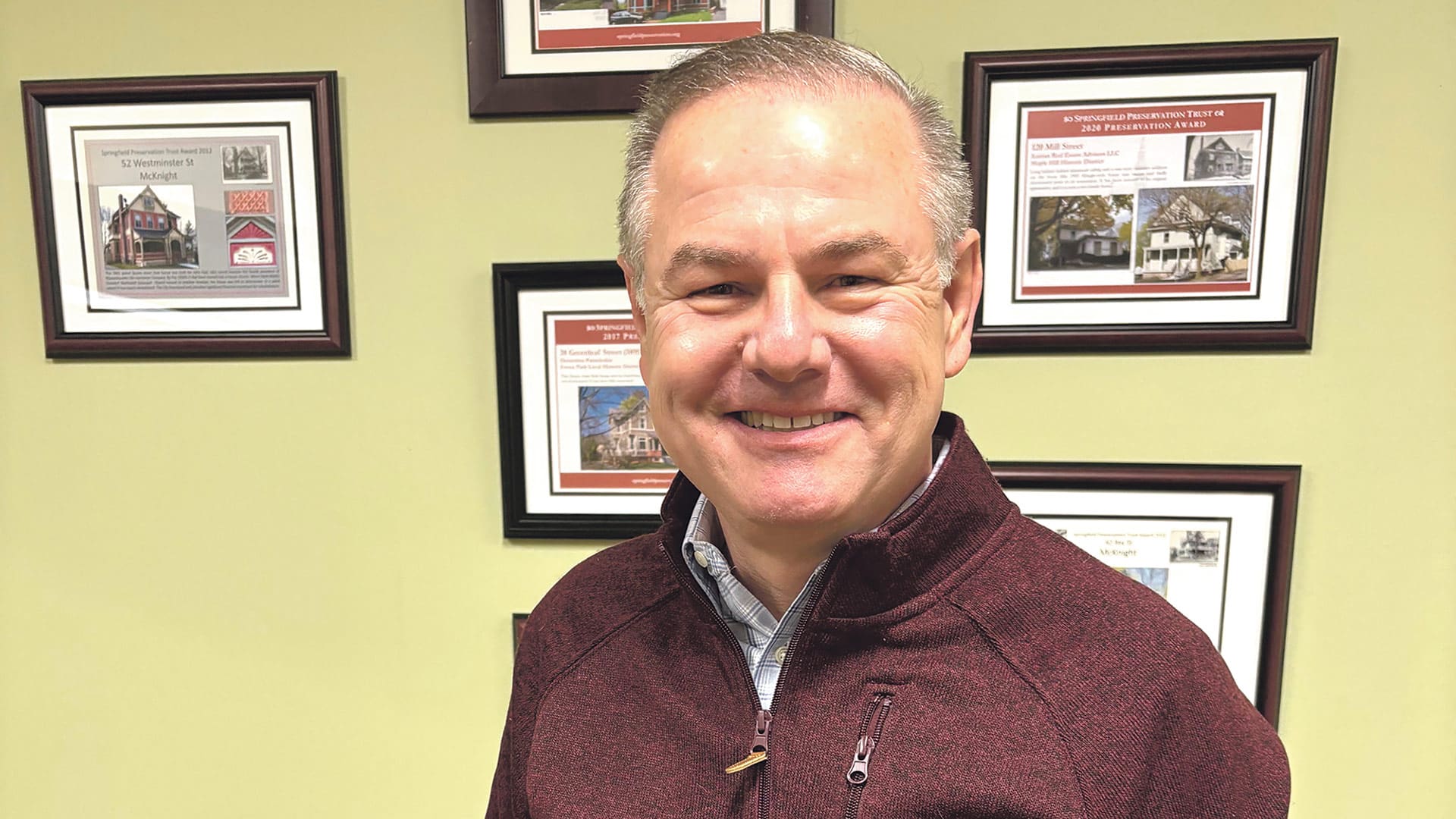
Demetrios Panteleakis says 2024 was a transition year, but expects 2025 to be better, especially as investors come off the sidelines.
Bill Low, president of Longmeadow-based L&P Commercial, agreed. He described 2024 as a “funny year,” one in which a white-hot market for industrial properties cooled substantially, but the office market picked up. “And I think that’s going to continue in 2025; it’s not going to be hugely robust, but it should continue to pick up.”
Meanwhile, there are other reasons for optimism among those in this sector, from progress on what could be the largest development deal this region, or this state, has ever seen — a data-center complex in Westfield (more on that later) — to retiring Baby Boomers putting their businesses, and their real estate, on the market.
Space Exploration
Recapping his success in filling a number of vacant spaces at 1350 Main, Plotkin said there were several factors contributing to those lease deals.
Circumstance was part of it, he noted, adding that Discovery Polytech Early College High School’s quest for a new home in the downtown area eventually prompted discussions that led to an outside-the-box reimagining of the top two floors in the building, once home to BankBoston’s regional headquarters, and a quick — as in 90 days — conversion of that space in time for the start of the school year.
Another factor has been businesses and nonprofits becoming frustrated with other property owners in the downtown and seeking what amounts to higher ground.
“Some properties are losing tenants to 1350; we’re building a better mousetrap,” Plotkin said. “It’s not the kind of growth I like to see in downtown, a kind of musical chairs with tenants, but we’re doing things here that are pretty aggressive, and it’s paying off.”
“It was a year of a gratifying amount of activity; going into both 2023 and 2024, people were waiting for the recession to hit, and, gratefully, the economy seems to have achieved a soft landing.”
Indeed, most of the success at 1350 stems from an effort to be creative and find, in many instances, non-traditional uses for traditional office and retail space. That was the case with the high school, and also with the Shops at 1350 Main, a collection of Hispanic-owned startups now occupying a large block of former retail space in the tower.
And while he’s proud of what’s been accomplished at his office tower, Plotkin said there is much work still be done within the city’s central business district, where he estimates there is at least 500,000 square feet of vacant space, much of it class B or C.
Finding creative reuse for this space is paramount, he noted, adding that housing has emerged as both a need and a possible solution — though it’s not suitable for many office structures — to the glut of space.
That has certainly been the case in Amherst, said Barry Roberts, a developer, property owner, and president of the Roberts Group. He noted that several projects in various stages of development, including his work to redevelop the former Hastings building on South Pleasant Street and the property behind it, involve housing components.
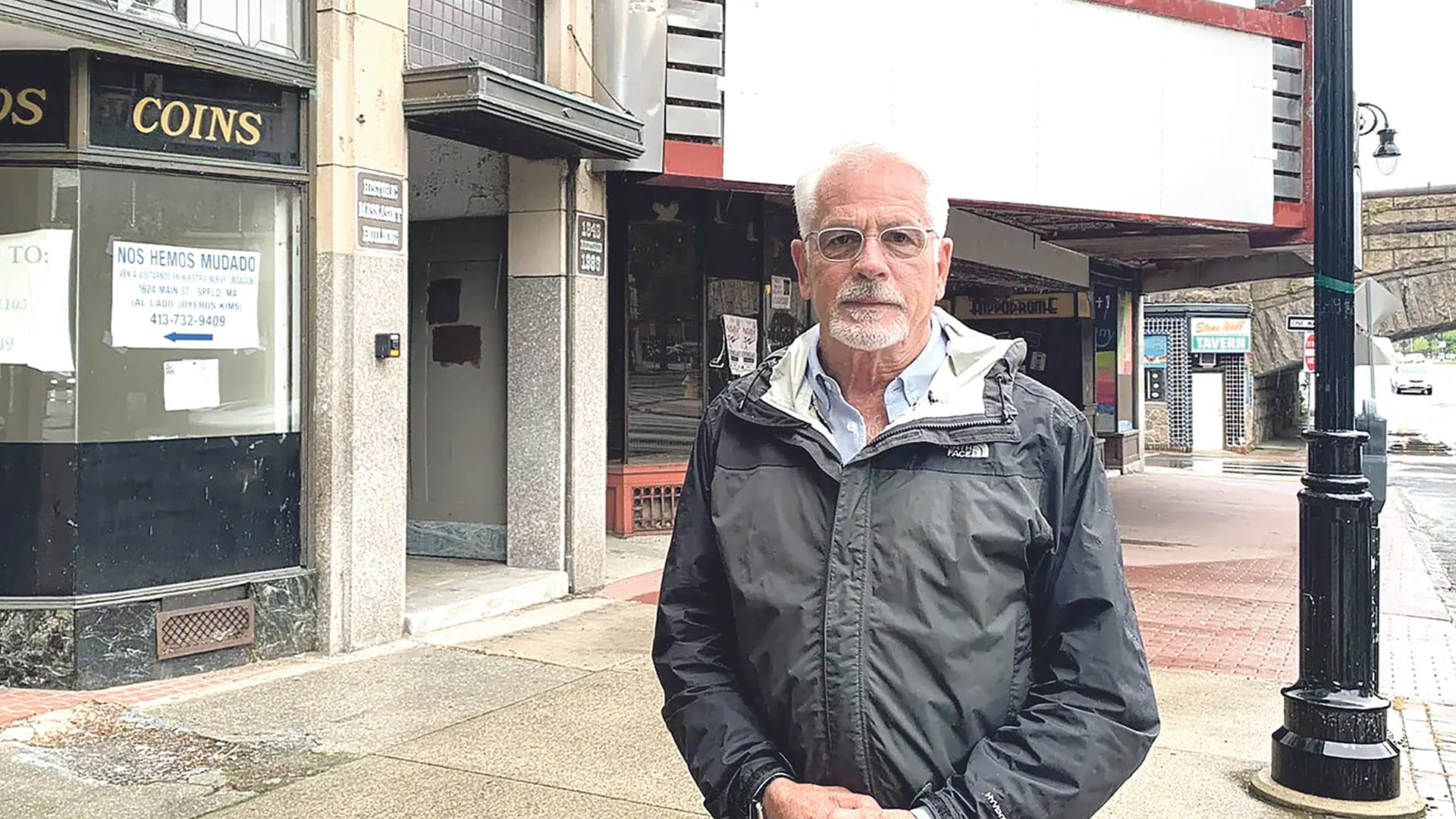
Bill Low says he’s seen an uptick in investor activity, but potential buyers remain cautious, especially amid uncertainty about the future of the office.
Another, much larger project is planned for the former Rafters sports bar property at the corner of University Drive and Amity Street, which will be transformed into 85 units of housing in two five-story buildings, as well as retail and office space.
Roberts believes this will barely make a dent in the town’s overall need for new housing of all kinds, but it’s a start.
Back to Normal?
Looking ahead to 2025 and beyond, those we spoke with there are many reasons for optimism — as well as progress on some important development projects.
At the top of that list is a major project near Barnes Airport in Westfield, which received a much-needed boost late last year when the state Legislature approved a measure that exempts data centers from the state’s sales and use tax.
The measure clears the last of many roadblocks to a development projected to cost more than $3 billion at full buildout — making it one of the largest private-sector projects of any type in the state — and involve major tech players like Microsoft, Amazon, and Alphabet in their never-ending quest for more computing power.
“In a normal environment, this project would have moved much more rapidly. This has now gone on for five years, we got hit by COVID … it’s been arduous to say the least. At times, people’s patience has dwindled — it’s been like herding kittens,” said Panteleakis, citing hurdles ranging from needed tax incentives to environmental issues to a power-purchase agreement.
All systems appear go to finalize the purchase of 10 parcels by the developer, Servistar Realties, he went on, adding that ground could be broken later this year on a project that could lead to other, similar developments in the years to come, especially in communities, like Westfield, served by municipal utilities.
Meanwhile, another project, one that has been much longer in the development stages, took a possible step forward in 2024. Indeed, the Paramount Theater and adjoining Massasoit Hotel in Springfield were acquired by Sacdev Real Estate Development of Suffield, Conn. at a highly anticipated auction last fall, said Low, adding that the acquisition could lead to progress at properties that have been vacant or underutilized for decades.
Overall, those we spoke with are looking at 2025 with optimism born from several factors, from confidence generated by the election results to slightly lower interest rates; from retiring Boomers selling their businesses (and real estate coming on the market) to what appears to be a surging retail sector.
Indeed, Ken Vincunas, president of Agawam-based Development Associates, recently returned from the International Council of Shopping Centers conference in New York, which was humming with activity among mall owners, prospective tenants, brokers, and more.
“They all say that market is on fire,” he told BusinessWest, adding quickly that the descriptive phrase doesn’t fully apply to this region, but he is optimistic, especially as he goes about trying to develop a retail center the company owns in East Granby, Conn., not far from Bradley International Airport.
However, while retail may be on fire — at least in other markets — but other sectors of the market are still struggling, and for different reasons, said Vincunas, noting that the industrial market is being hurt by a lack of inventory, and the office market is still trying to fully recover from COVID and remote work.
Still, more frequent headlines about major corporations ordering their employees back to work for at least three or four days a week are generating momentum. Dill believes the office market may never return to what it was pre-pandemic, but the pendulum is clearly swinging back in that direction.
“After a couple of years on the Zoom and Teams screen, I think a lot of folks are pleased to be back in the office,” he said, noting that this sentiment is reflected in lease renewals and the amount of space leased.
At 1441 Main St., the TD Bank Building, which Colebrook manages and Dill co-owns, several government agencies renewed leases, and some took additional space, while Balise Motor Sales moved its corporate headquarters to the third floor of the building, all of which not only fills square footage, but brings more vibrancy to the downtown.
As for investor activity, Low said his firm has also seen an uptick in that realm, although he noted that, given some lingering uncertainty about the future of the office, many are being more cautious than in years past.
“It’s harder to sell an empty building; people don’t take the same risks they did years ago,” he noted, speaking for everyone in this business, adding that, if interest rates continue to creep down, that will certainly help.
That ‘if,’ and many others, continue to put the caution in cautious optimism — but to those with a stake in this sector, it sure beats pessimism.