
HAI Architecture Focuses on Projects with Impact
Designs on the Future

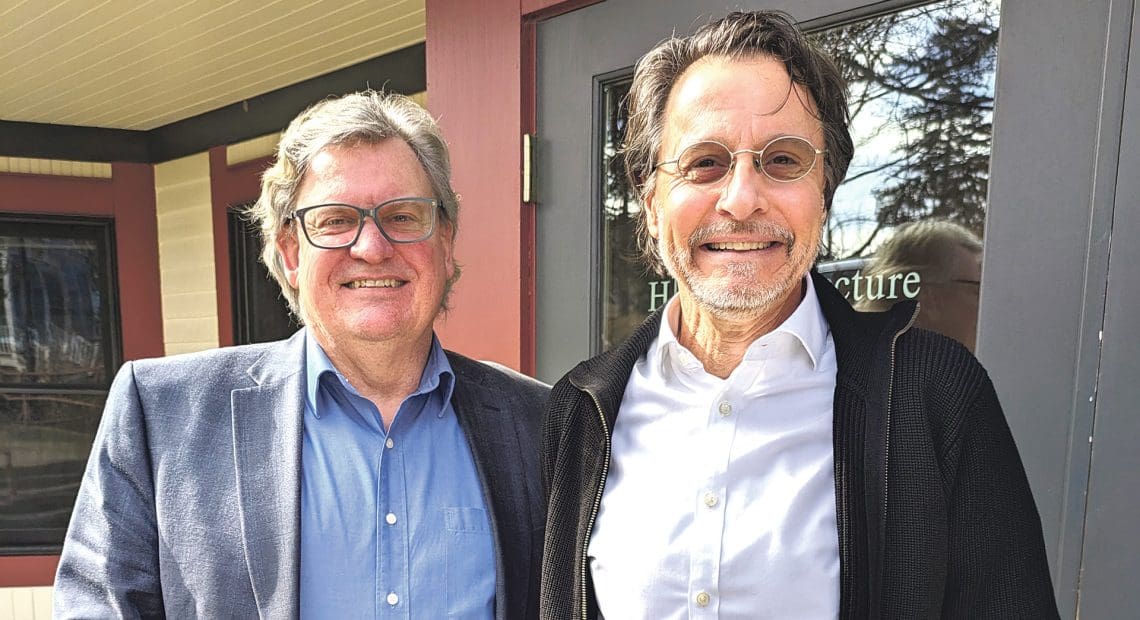
Principals Rick Katsanos (left) and Don Hafner
As the long-time principals at HAI Architecture in Northampton, Don Hafner and Rick Katsanos don’t see the healthcare facilities they design — or any facilities, really — as simply physical spaces.
No, they see the impact on the people who live, work, and play in those spaces, and it’s a gratifying feeling, whether they’re designing an ICU for critical hospital care or a small outdoor stage for Forbes Library in Northampton.
“We don’t value healthcare systemically in this country,” Katsanos said of the former. “It’s more than just having a doctor; it’s more than just having the right medications. It’s about wellness. It’s about having an environment. And it doesn’t have to just be in a hospital. It can be in a clinic; it can be in a doctor’s office.”
As for the stage, which he called “a fun community project, a different thing for us,” there’s an element of wellness there, too.
“It’s mental health for the community. I like going and hearing the children’s choir, and instead of just standing on the muddy grass, there’s going to be a place for them. And I’m not placing an overemphasis on, ‘wow, we’re changing the world.’ But we’re changing a little bit of the world for the positive.
“And that’s all each of us needs to do — change the world a little bit for the positive. And then, cumulatively, great things can happen,” Katsanos went on. “That’s why I feel great about what we do. I’ve never felt like we’ve taken a project just for the money or we’ve taken a project that we weren’t proud of. I’m proud of every single thing this company has done.”
“We’re talking about some of these hospitals losing a hundred million dollars, two hundred million. That’s not insignificant. So that’s been an issue.”
Katsanos and Hafner met as freshmen at Penn State in the early ’80s and were among a group of architecture students who gravitated north after graduation to find work. Katsanos, a Wilbraham native, was hired in 1986 by Ed Jendry, who had launched Architects Inc. in Northampton in 1976. Two years later, Hafner, who had been working in Vermont, joined him at the firm.
In 1993, Katsanos and Hafner bought the business, which had also spun off a sister company, Healthcare Architects, to pursue work in the regional healthcare market — a decision that proved lucrative, as the firm still focuses heavily on designing modern, high-tech spaces for hospitals, health systems, and physician practices across the region.

The dramatic main entrance canopy was part of HAI’s work at Salem Hospital.
Years later, the partners merged Architects Inc. and Healthcare Architects into one company, called HAI Architecture.
“Don and I have known each other for some 40-odd years. We met the first day of freshman year, and then went into business together,” Katsanos said. “We are fairly aligned. We have our differences, like every good relationship. Sometimes it’s like a marriage, sometimes it’s like siblings, sometimes it’s a business relationship. We run the gamut.
“And it’s important that we have differences of opinion; it helps,” he went on. “He’ll see something differently. I’ll say, ‘this is the way I’m going to design this.’ And he’ll go, ‘well, did you ever think that it might work out better this way?’ And that difference of opinion almost always makes it better.”
Healthy Returns
The firm is still heavily invested in healthcare projects, such as a just-completed ICU at UMass Memorial Health – Harrington Hospital in Southbridge and a new lobby addition and registration area at Salem Hospital — both of those long-time clients, as are some of the local hospitals, like Cooley Dickinson, Mercy, and the various Baystate facilities.
At Salem, “we’re doing a lot of radiographic technology stuff at their facilities and a bunch of clinical projects,” Hafner said, “and then also a bunch of infrastructure projects because we’ve always been a service provider in the truest architectural sense. We really love doing interesting architecture, but a lot of the stuff we’ve done with hospitals has always come from facility-based projects that help to support their infrastructure.”
“We have no idea if doors, which largely come from Canada, are going to be one and a half times what they were this time last year. Even stuff that is manufactured here is impacted by things like steel and aluminum prices.”
And those needs don’t stop, not even during the pandemic, when HAI stayed very busy.
“We never, other than maybe two weeks, had a slowdown. Everybody learned how to make sourdough bread, but I did not have that opportunity,” Katsanos said with a laugh. “We were fortunate because the healthcare sector needed to continue. The first project that went back online 10 days after the world shut down was a clinical trials facility — a lab that we were designing and in the middle of building for Baystate — because it was needed. The government told us we’re critical infrastructure.”
That said, healthcare is in a challenging time right now, he noted, with many hospitals and health systems — Baystate, for instance — grappling with serious red ink.
“They’re basically looking at scaling back a lot things that aren’t direct patient care. They have to re-evaluate where they’re going to spend money. We’re talking about some of these hospitals losing a hundred million dollars, two hundred million. That’s not insignificant. So that’s been an issue.”
In addition, Katsanos said, “I think we’re seeing the impact of COVID on healthcare. Like, they kept going and kept going because they needed to. Staffing costs were higher; everything cost more, but they needed to keep going. And I think it’s finally caught up, and there needs to be a little bit of a correction because everybody’s overextended.”
That trend happens to coincide with dramatic proposed federal spending cuts in all areas of life, including healthcare.
“That affects our flow of projects. We have some projects that have been delayed almost immediately because there’s just uncertainty. So, if you don’t have to spend — if it’s not, ‘oh my gosh, that piece of equipment is totally broken, and we need to replace it’ — then clients are scaling back.”

One of HAI’s projects in UMass Memorial Health – Harrington Hospital was this ICU renovation.
The same promises to be true across higher education, he added. “That’s a big one, and it’s been a target as well.”
But economic uncertainty can affect projects of all kinds, Katsanos added. “Even stuff like the stage [at Forbes] — it’s a steel-framed stage. We don’t know if the tariffs are going to actually impact the pricing on that. The prices are locked in, but there’s always a caveat of ‘barring uncontrolled circumstances,’ and certainly a tariff is not necessarily a controlled circumstance. It’s not in place at the time that somebody places a bid, and then, a week later, it is. It’s no way to run an economy, but here we are.”
Branching Out
In addition to its broad roster of healthcare projects, HAI has diversified into many other sectors over the years, from bank branches to work at a number of nonprofits, like Ronald McDonald House and the Northampton Survival Center, to facilities in the education world.
One recent project was the renovation of the Gateway City Arts complex in downtown Holyoke to house LightHouse Holyoke, a non-traditional middle and high school. “Working with those folks was fun and something a little bit different for us,” Katsanos said. “So that was pretty satisfying.”
He added that it’s simply good business practice to diversify, even when times are heady in the healthcare realm.
“You can get very complacent when healthcare is so busy that you can’t keep up with it. But we don’t say no to something that’s out of the ordinary. Sometimes it’s refreshing to work on something that’s just different. Like an outdoor stage for Forbes Library — I would not have targeted that, but it’s a wonderful project.”
He also appreciates the impact of something like creating a family room for Ronald McDonald House at Baystate Children’s Hospital.
“If you have a kid getting cancer treatment at Baystate, you don’t even have to walk two blocks to go to the Ronald McDonald House; you can go to this new family room and get a cup of coffee and check your email and be away from your child’s bedside, but literally 12 seconds away, and that is really cool.”
Hafner said projects like this, with palpable human impact, energize the staff as well. “They understand that we value the community that we live and work in. So it’s very exciting to do those kinds of projects.”
As noted earlier, there’s plenty of concern these days to go along with the highs of today’s architecture industry, stemming from the economic uncertainty of tariffs and funding cuts.
“I think there’s large-scale worry from the contracting area across the board,” Hafner said. “We have no idea if doors, which largely come from Canada, are going to be one and a half times what they were this time last year. Even stuff that is manufactured here is impacted by things like steel and aluminum prices.”
“So I think everybody is really on edge,” he added. “A number of the hospitals that have not signed contracts have put things on hold because they’re not sure if project budgets will hold. I think there’s going to be a wave that happens through the entire construction industry. It’s not going to be limited to any one thing in particular because all those issues impact every single aspect of every single building typology.”
That said, Katsanos told BusinessWest, “we’re positive. We’re optimists … cautiously. It’s not a fun time right now for anybody, on whatever side of the spectrum you are, because uncertainty is always difficult. So I’m not saying I’m not concerned about our industry — I am concerned. But I also am positive. We’ll survive, and we’ll persevere.”
Kindness and Gratitude
Katsanos said he committed to making 2025 a “year of kindness,” inspired by his mother, whom he described as very kind, and who passed away in August.
“It doesn’t have to be huge. We don’t have to be political and change the world. We all have to just do better. Cumulatively, there’s a lot of us, and we can do great things.
“That’s why we like healthcare,” he added. “I’m not a doctor, but I think the healthcare system can be improved, and we try to do it. We are very, very affordable, and we could probably make more money, but we do a lot of work for nonprofits, and those are little margins. And we make that work.”
Hafner agreed. “I’m very thankful for what we’ve been able to accomplish. I am very proud of the projects that we’ve done. They don’t always land on the cover of a magazine or anything like that, but over the period of time that we’ve done this, we’ve made an impact. I think we’ve done a reasonable job of making our community a better place through the work that we’ve done.”