In Monson, Things Are Percolating
Community Spotlight

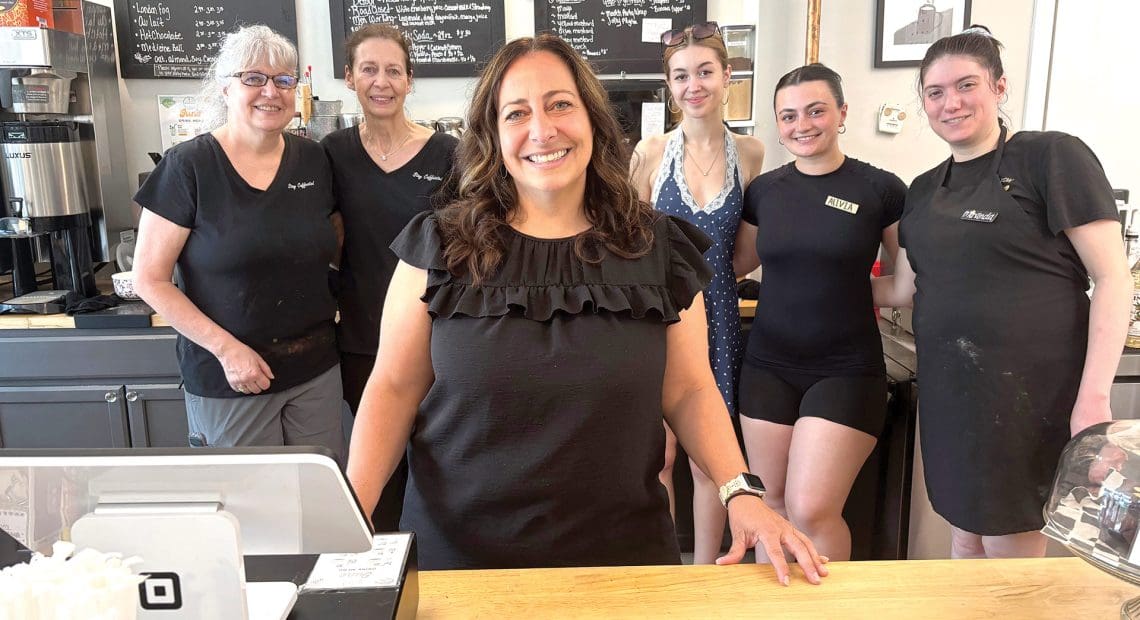
Amanda Roy, center, with several staff members at the Better Bean coffee shop on Main Street in Monson.
Amanda Roy likes to say the devastating ankle injury she suffered in 2021 when she missed the last step at her house didn’t happen to her; it happened for her.
That mishap left her in a wheelchair and facing a lengthy recovery period, which she chose to spend with her parents, in the Monson home where she grew up. And while recovering, she spent a lot of time thinking about what the next chapter in her life would look like and where it would play out.
She ultimately decided it would look somewhat like a previous chapter, when she spent 10 years operating a coffee shop in Plymouth, but with some real changes (more on those later). As for the place … she chose downtown Monson with the thought that this would be a short-term gig.
But things changed, and quickly.
“I thought, ‘I’m going to open a coffee shop, and when I get better, I’m going to sell it, move back to Plymouth, and get on with my life,’” said Roy, who opened the Better Bean in the summer of 2023, when she thought she was recovering from that ankle injury. Instead, she was told she would need a replacement. And while getting it and some subsequent surgeries, she made the decision to get on with her life in her hometown. She’s making the Better Bean one of the more intriguing business stories in this community, while she and her boyfriend build a house there.
These developing stories are just a few of many in this town of just over 8,000 people. Others include:
• Progress with the redevelopment of the sprawling Monson Developmental Center (MDC) site. The board of Westmass Area Development Corp. is expected to vote soon on a proposal to acquire a 100-acre portion of the site with the intention of redeveloping it for housing and related purposes;
• Renovation and expansion of the town’s fire station;
• A town meeting vote to move from three selectmen to five;
• Continued growth of what would be called agritourism, with businesses such as Silver Bell Farms, Echo Hill Orchard, Westview Farms Creamery, and others, which grow and sell everything from apples to Christmas trees to wine to ice cream, and draw people from across the region and beyond; and
• Anticipation and excitement concerning the planned east-west rail station in Palmer, which has the potential to make Monson a more popular place to live for those who work in Greater Boston but can’t afford home prices in the capital area.
“It’s still costs a lot to build a house, but from a value standpoint, this is an opportunity to bring people here, and when individuals move in, now you have an opportunity for another restaurant or two, and then businesses will look at Monson as a vibrant place to move to.”
Westmass President and CEO Jeff Daley said the board is expected to vote by the end of this month on a proposal to acquire a section of the MDC property, on which he envisions a ‘village concept’ for the parcel, which represents a new and intriguing opportunity for the agency.
“What we’ve done in the past has been mostly commercial and industrial-type projects,” he said, noting industrial park projects in cities like Westfield, Agawam, and Chicopee, as well as redevelopment of the massive Ludlow Mills complex in Ludlow, which includes large housing components. “We’ve worked with partners on housing in the past, and housing is definitely a need, and the demographics of Monson have been changing; housing would be a good fit at that location.”
The MDC was among many state-owned properties featured in a recent showcase of parcels available for housing development that hosted the Healey administration, said Jenn Wolowicz, Monson’s town administrator, noting that, while there are several potential future uses, housing, especially affordable and 55-and-over housing, are critical needs.

One of the long-shuttered buildings at the Monson Developmental Center, which is moving closer to redevelopment, with housing as one of the likely new uses.
“As of April 30, our population of seniors is 33% of our overall population,” she explained. “We have a lot of people living in single-family homes, their children are grown, and they’d love to be able to downsize to a townhouse-type unit, and we’ve made sure that this is something that’s being heard by Westmass.”
As for east-west rail, Jim Przypek, CEO of the Quaboag Hills Chamber of Commerce, which serves 15 communities, including Monson, said that service will benefit many of the communities in the Quaboag region simply by making them more accessible.
“The trend of people moving out of Eastern Mass. and migrating farther and farther west will continue and be accelerated by east-west rail,” he said, adding that rail service will make it easier to live in those towns but still work in Boston or Hartford.
For this latest installment of its Community Spotlight series, BusinessWest turns its lens on Monson, the picturesque town roughly halfway between Springfield and Worcester that has established its own identity.
Developing Stories
Mike Rouette grew up in Monson, and it has remained his home. He described it as the “perfect place to raise a family,” and a community where people team up to get things done, right down to planning and executing the Fourth of July parade and fireworks.
“Everyone pitches in and does what needs to be done to keep the town vibrant,” said Rouette, executive vice president and chief operating officer at Monson Savings Bank, who, as he surveys the landscape, sees both challenges and opportunities for the town.
The challenges are similar to those facing other rural communities in that area, including the loss of manufacturing jobs — plants once made everything from hats to toilet seats here — as well as retaining existing businesses and grappling with declining enrollment in local schools stemming from school choice and other contributing factors.
“It’s not easy to access Monson,” he explained. “Sometimes, people tend to look at Monson, from a Springfield standpoint, as if Wilbraham Mountain is almost like a Great Wall of China — it’s ‘over there.’”
As for opportunities, they mostly involve abundant land (although much of it is on hillsides) and still-affordable buildings lots, at least when compared to towns to the west (like Wilbraham, Hampden, and East Longmeadow) and to the east (Sturbridge and Auburn).
“There’s an opportunity there that the town should take advantage of,” Rouette said of lot prices. “It’s still costs a lot to build a house, but from a value standpoint, this is an opportunity to bring people here, and when individuals move in, now you have an opportunity for another restaurant or two, and then businesses will look at Monson as a vibrant place to move to.”
Meanwhile, the MDC site provides a wealth of opportunities — much like the site of the former Belchertown State School has — for creative reuse, everything from housing to commercial sites to Rouette’s vision of a regional high school that would serve Monson and Palmer and help keep students in those communities.
The MDC, which closed in 2012, was spread over more than 650 acres. A large portion of the property will be transferred to the Massachusetts Department of Fish and Game to become a wildlife management area, said Wolowicz, adding that Westmass could become the developer of the remaining 100-acre parcel, where the hospital buildings and other facilities still stand.
“We would be demoing the hospital buildings and doing a mixed-use development with quite a bit of housing,” said Daley of plans that are still being formalized and, of course, contingent on the upcoming vote of the board. “We’re proposing that it would be affordable, market-rate, and workforce, to make sure that people can come into town if they want, or upsize or downsize in the town of Monson, as well as potentially some retail and commercial use to create a village atmosphere, as opposed to just coming in and putting some buildings up.
“We really want to respect the town of Monson and the surrounding communities, and that’s why we’re proposing something with more of a village feel rather than just putting up ranch homes or duplexes,” he went on. “This would be more strategically thought out … a village concept where people could still enjoy that rural farm life, if you will, in Monson, while also creating a new development for housing upgrades for people who want to get out of their homes, as well as workforce housing. This could be a game changer for Monson, Palmer, and the surrounding communities.”
Bean Optimistic
The staff at the Better Bean likes to get creative and theme its specialty drinks and other fare.
Such was the case last fall, with a two-month salute to Gilmore Girls and the small, fictional Connecticut town called Stars Hollow, where the show takes place.
“Stars Hollow looks a lot like Monson,” said Roy, referencing both her coffee shop and Dan Grieve Park, across the street from the shop, and its gazebo, which is very similar to the one in the show.
Monson at a Glance
Year Incorporated: 1775
Population: 8,150
Area: 44.8 square miles
County: Hampden
Residential Tax Rate: $14.87
Commercial Tax Rate: $14.87
Median Household Income: $52,030
Median Family Income: $58,607
Type of Government: Select Board, Open Town Meeting
Latest information available
The park, complete with several Adirondack chairs and benches, is quite popular with Better Bean clients, most of them regulars, said Roy, who chose a grab-and-go format rather than seating, one of many lessons she took from her time in Plymouth, which was split between two locations.
The first was a kiosk inside a Registry of Motor Vehicles office, and the second was a much larger space in the same industrial park, “with seats and a public bathroom and a big menu … and I burned myself right out,” she said, adding that she sold that enterprise six months before COVID arrived.
“Someone was looking out for me big time, because I can’t imagine being that burned out and having to deal with COVID,” she said, adding that her ankle injury brought her back to Monson and, eventually, to a storefront — the same one her father operated a realty office out of when she was young — on Main Street.
Learning her lesson from Plymouth, she created a place that’s not too big or too small, although it’s been cramped since she opened, so she will soon take over the space next door (the former Petal and Wren flower shop, which relocated) and will use the back for storage and the front for a small gift shop, something she said the town needs.
Overall, Roy told BusinessWest, the downtown has lost some storefronts — a cannabis shop closed recently, for example — but it remains an emerging destination.
Wolowicz agreed, but noted that the town’s business community is diverse, with many ventures existing in the agritourism and hospitality spaces.
“We have quite a few people who are being very creative when it comes to what their land is used for, be it what they’re growing or their animals,” she said, adding that one of the priorities for town officials has been to promote the preservation of farmland and, overall, a healthy rural community.
The Monson Agricultural Commission goes about this work in many ways, she said, listing everything from Right to Farm bylaws, which protect farms from noise, odor, and other complaints, to a farmers market event with live music and more than a dozen local vendors, including farms, bakeries, and artisans; the next such event is slated for Sept. 13.
“The town of Monson supports its commercial farms,” Wolowicz said, “and wishes to ensure their continued existence and positive impact on the town economically, ecologically, and socially.”
Przypek, who came to the chamber after a lengthy stint with the Basketball Hall of Fame in marketing and sponsorships, and then several years as general manager of the Three County Fairgrounds, agreed, noting that agritourism has become a large part of Monson’s identity as it transitions away from its manufacturing heritage.
“Businesses like Silver Bell Farms and Echo Hill and Westview Farms Creamery are thriving, and they bring people from all over to Monson,” he said, adding that new businesses downtown, like the Better Bean, do the same.