
Manufacturing Day Brings Industry’s Issues to Lawmakers
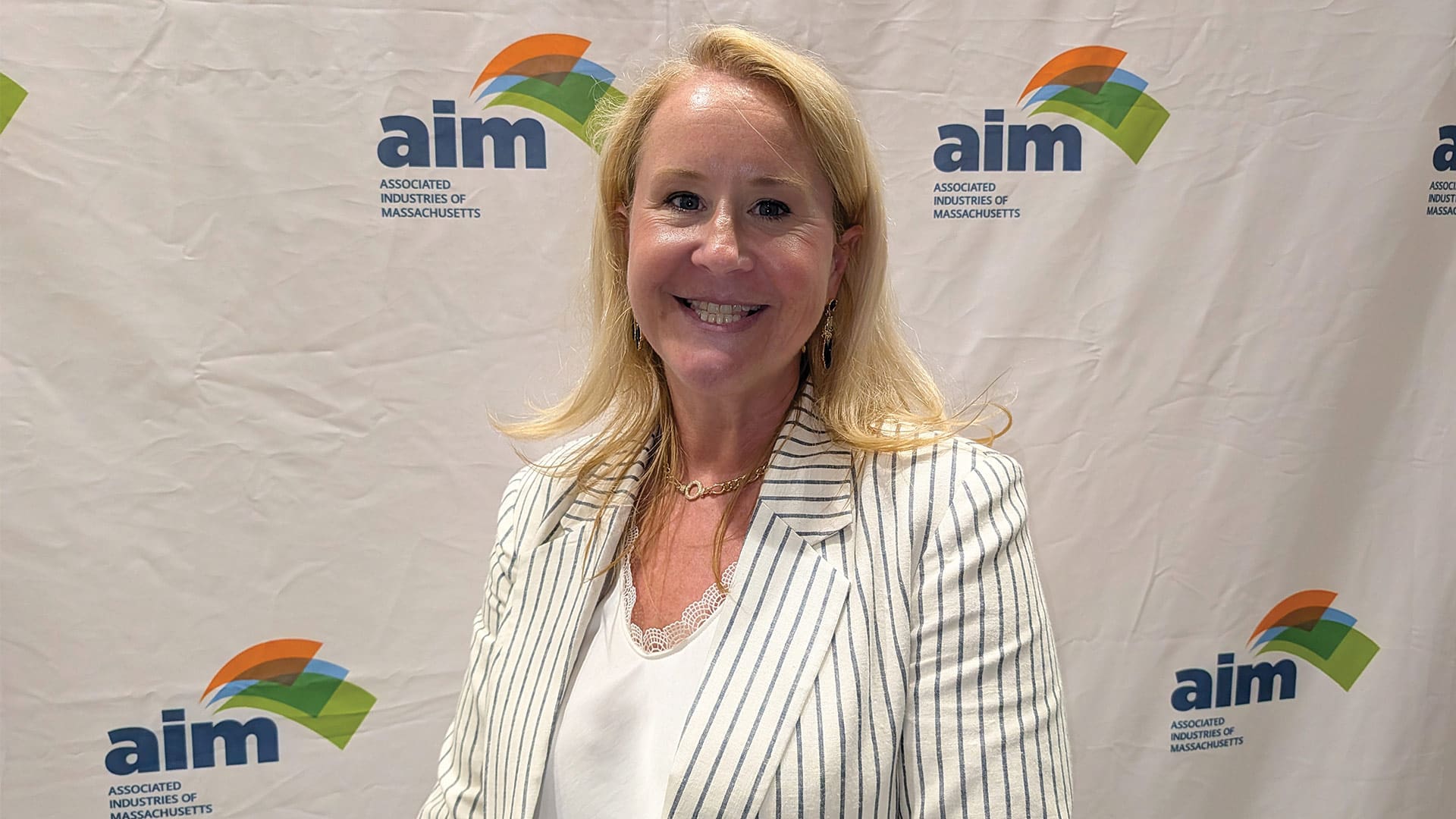
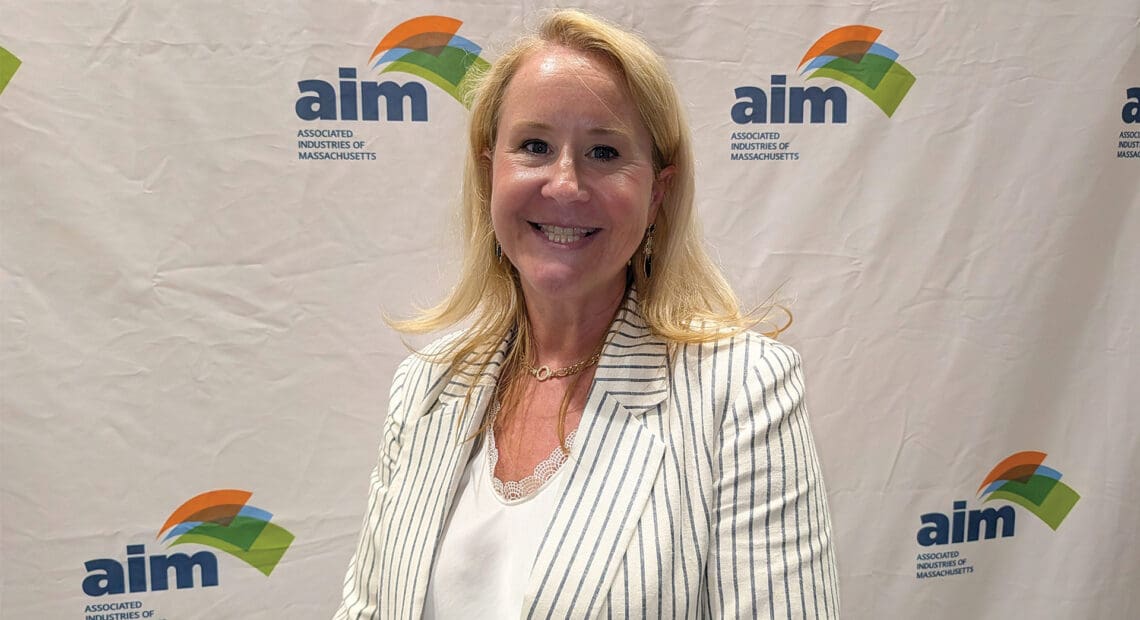
Associated Industries of Massachusetts President and CEO Brooke Thomson
Something to Build On
Brooke Thomson called it “a gathering at the intersection of commerce and public policy” — and a critical conversation to be having in Massachusetts right now.
“We know that, when people think about manufacturing, they picture factory floors and assembly lines, machines producing everything from automobiles to medical devices, but they don’t always think about the intersection with public policy,” said Thomson, president and CEO of Associated Industries of Massachusetts (AIM). “They don’t always picture all the lawmakers, regulations, and government programs that are behind the scenes supporting the industry.
“At first glance, that can seem like two separate worlds, but we know how interconnected we truly are,” she continued. “Every manufacturing decision — where to build a plant, what products to make, how to invest in new technology, and who to hire — is shaped by public policy. At the same time, we know the strength of the manufacturing sector influences our state’s economic growth, its job creation, its security, and its ability to compete in the global economy.”
“Manufacturing faces both exciting opportunities and complex challenges from workforce development, energy supply, supply chain resilience, and managing health insurance premiums.”
With that, Thomson kicked off AIM’s Manufacturing Day on July 8, which drew a large group of manufacturing executives to the State House in Boston to hear from legislators and discuss key issues relating to the state’s manufacturing economy — and what needs to be done to increase its competitiveness.
“Manufacturing faces both exciting opportunities and complex challenges from workforce development, energy supply, supply chain resilience, and managing health insurance premiums,” Thomson told the gathering. “It’s one of the reasons that AIM devotes much of its public policy efforts to supporting our manufacturers.”
Leslie Greis, AIM Manufacturing Community co-chair, noted that the economy has shifted in ways manufacturing could take advantage of, namely with the pace of acceleration in climate tech, defense needs, and AI.
“With a healthy manufacturing ecosystem, we can help achieve the state’s objectives” in these areas, she noted, citing a few ways to make that happen, including expanding access to the vocational school system, expanding funding for the Center for Advanced Manufacturing, encouraging conformity between state and federal tax codes, and expanding capital grants to make equipment more affordable for small manufacturers.
The first point, about vocational schools, was brought up repeatedly throughout the event.
“One of the things in Massachusetts that drives me crazy is, when a school has reached the end of its life cycle, and we say, ‘OK, the community needs to come together and support this regional vocational school,’ they build a brand new, state-of-the-art school, but don’t add any actual seats. That is a problem,” said state Sen. Paul Feeney, who co-chairs the Massachusetts Legislative Manufacturing Caucus with state Rep. Jeff Roy, who also addressed the gathering.
“We need to increase capacity,” Feeney added. “The vocational schools across Massachusetts have a waiting list a mile long right now. And the reason is because they do such a great job of preparing people to actually go out and make money as opposed to coming out with a lifetime of debt.
“Vocational education is not some sort of ‘other way’ to educate people,” he added. “Whatever you thought about vocational education growing up, vocational education in Massachusetts is excellence. It’s a pipeline to family-sustaining, career-sustaining jobs. It gives students the skills to be able to step in on day one into your organizations. We need to invest in it and double down on it.”
Thomson told BusinessWest that there might be ways to get the state’s community colleges — which are now free for Massachusetts residents — more involved in the vocational space to fill gaps that arise from a shortage of capacity or teachers.
“We’ve done a lot of work at AIM to try to connect the community colleges to the manufacturers, not just to get more teachers, but because we’ve got an aging workforce. High school kids can take classes in community college, right? There are opportunities where we can use some of these resources in a more productive way.”
Grit, Precision, and Passion
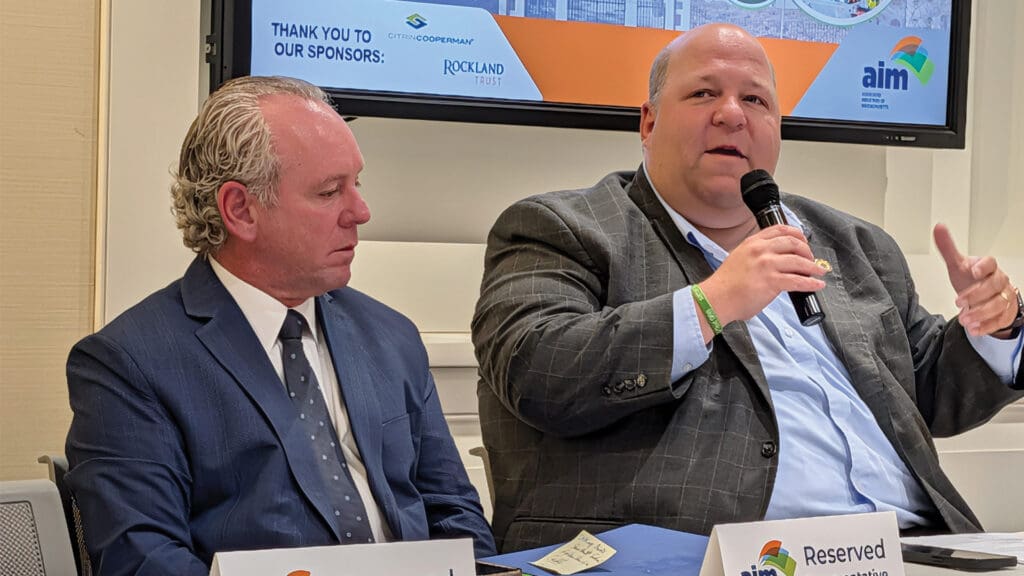
State Rep. Jeff Roy (left) and state Sen. Paul Feeney, who co-chair the Massachusetts Legislative Manufacturing Caucus, addressed a number of issues at the AIM gathering.
Roy began his introductory remarks with praise for the Commonwealth’s manufacturers.
“When people think of Massachusetts, they often think of our incredible universities, our historic cities, and our medical breakthroughs. But what makes those breakthroughs real, what scales them, and what brings them to the world is the grit, the precision, and the passion of Massachusetts manufacturing and their manufacturers,” he said. “We are not a state that just thinks — we are a state that makes.”
He cited some numbers to bolster that point: namely, 228,000 men and women in manufacturing jobs across the Commonwealth. “And their impact is immense. Manufacturing drives a massive 7.9% of the total Massachusetts GDP. And this isn’t just a legacy sector; it’s a vital, living engine of our modern economy.”
Added Feeney, “we have many, many success stories, yet you turn on the news, you read the paper, and all they want to talk about is our challenges. And we get it. We do have an issue where we need to focus on competitiveness.”
He noted efforts like Gov. Maura Healey’s Advisory Council on Competitiveness, which aims to stem outmigration and make Massachusetts a more attractive place to do business.
“But we also need to tell about our successes. We need to share our stories,” Feeney said. “Instead of talking about the ones that are leaving, let’s talk about the ones that are staying and what they’re doing right — the challenges that they’re facing, but also the opportunities that they’re creating. When we tell those stories, it’s compelling. It moves public policy.”
Some of the issues raised at the event are not new — or exclusive to manufacturing — and speak to affordability in Massachusetts in general, like housing and childcare costs that can be barriers to both living and working here. To the latter issue, Feeney brought up the Commonwealth Cares for Children grants that encourage childcare providers to keep more spaces open while keeping costs down.
“The vocational schools across Massachusetts have a waiting list a mile long right now. And the reason is because they do such a great job of preparing people to actually go out and make money as opposed to coming out with a lifetime of debt.”
But Michael Keneally, owner of Accutech Packaging in Mansfield and Foxborough, brought up another issue concerning to manufacturers — an anxious situation right now for immigrants and workers who are losing temporary protective status (TPS) due to a recent U.S. Supreme Court decision.
“We are offering so many programs to help these people,” Roy said. “I am a grandchild of immigrants who came to America and took advantage of the opportunities here to give opportunities to their children and grandchildren — and I think we need to preserve that because that’s what America is all about.”
Feeney agreed. “We get wrapped up in these abstract conversations about what’s right and wrong when it comes to immigration policy without actually understanding that it affects people deep down. It affects your companies,” he said. “So it’s important for us to make sure we are acting as a backstop to provide legal resources to folks … although it’s becoming more and more challenging to do so.”
Other speakers at the event included Greg Batsevitsky, senior vice president at Rockland Trust, who talked about manufacturing financing; and Laura Jenkins, tax partner at Citrin Cooperman, who discussed tax and incentive opportunities stemming from last year’s One Big Beautiful Bill Act.
Continuing the Conversation
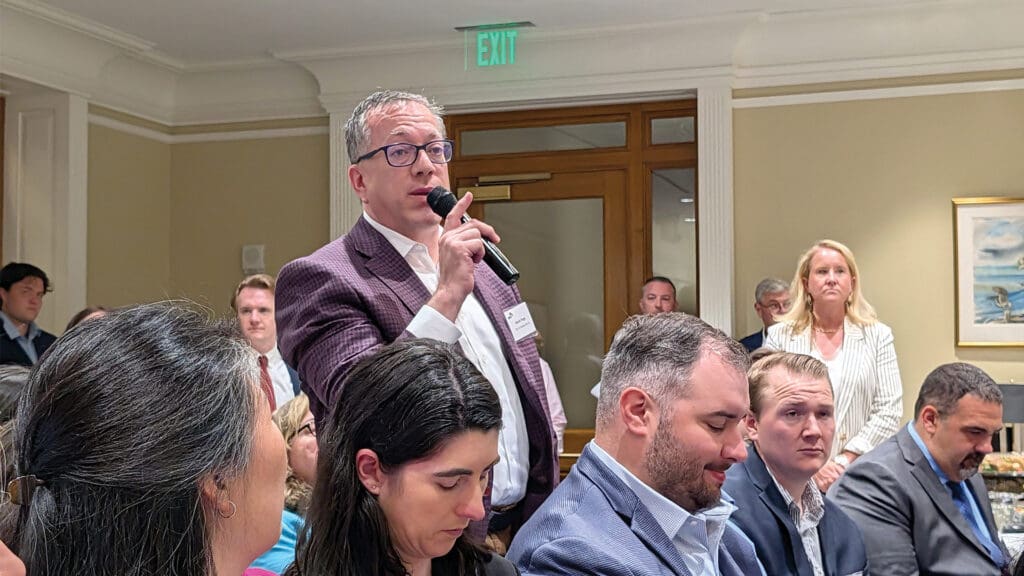
Aaron Vega makes a pitch for Western Mass. as fertile ground for manufacturing at the State House.
Aaron Vega, president and CEO of the Western Massachusetts Economic Development Council (EDC), was on hand as well, taking a moment to address AIM officials and lawmakers with a pitch for manufacturing in Western Mass., where costs can be similar to states where companies from the eastern part of the state have fled.
Afterward, Vega told BusinessWest that the concerns that came up during Manufacturing Day — expanding vocational education, making manufacturing more affordable, and helping potential talent access housing and childcare opportunities that will allow them to keep jobs — reflect what he’s heard from EDC members.
“Workforce is the number one issue — those senior, experienced people in the manufacturing companies retiring, and not being able to backfill those positions,” he noted. “I really think we have a lot of good training programs. It’s getting that marketing out to let people know that you didn’t have to be a mathematician in high school — that there are opportunities in manufacturing for you, opportunities for real careers.
“I think we’ve got a pretty good platform of vocational education in Western Mass., but again, it needs to be bolstered, and it’s that marketing piece again — we need to let people know these are not old-school manufacturing jobs,” Vega added. “I’ve been on today’s manufacturing floors, and they’re clean, and they’re making amazing things.”
After the event, Thomson told BusinessWest that, “since I’ve come into this position as CEO, I travel — I try to visit as many members every month as I can, and a lot of them are manufacturers. Everything that came up today is in line with what we’re doing. It’s workforce at the top of the list, but there are so many issues — housing, transportation, education.
“The exciting thing is, we have a lot of opportunity,” she added. “Manufacturing is alive and well in Massachusetts. There’s a lot of really great opportunity, and I can see that the Legislature is focused on helping support the industry. I think that’s great for the whole Commonwealth — not just Boston, which sometimes gets all the attention.”