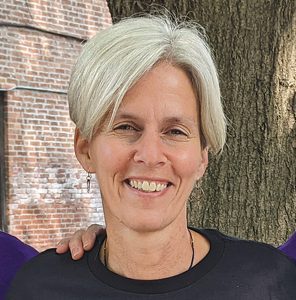
Council Director, Girls on the Run Western Massachusetts
She’s Helping Girls Become More Joyful, Healthy, and Confident

Photo by Focus Ashely Photos
As someone with almost 20 years of experience in the fields of psychology and social work, Alison Berman was no stranger to working with young people. And when she learned about a national organization called Girls on the Run, something clicked.
“I had always wanted to work with kids and families,” she said of her motivation to earn a bachelor’s degree in psychology from Oberlin College and a master’s degree in social work from Smith College, after which she ran therapeutic preschools, worked in outpatient, inpatient, and day treatment; and did a lot of work in schools with trauma-sensitive programs.
Then she learned, through a friend of a friend, about Girls on the Run (GOTR), a physical activity-based, positive youth-development program that uses running games and dynamic discussions to teach life skills to girls in grades 3-8.
“There was no council here at that point. And it kind of fit into everything I was passionate about; I used to do a lot of group work, so the curriculum really spoke to me in the sense of the social-emotional life-skills piece, and integrating a physically active component. I guess I always wanted to do something bigger than just the individual impact I felt like I was making.”
Each Girls on the Run chapter conducts two 10-week seasons per year, in the fall and spring. Each session features a life-skills lesson drawn from a nationally distributed curriculum. Meanwhile, each team tackles a community-impact project to give back to their community. Both seasons each year end with a 5K celebration, with the spring event typically being the larger of the two.
The Western Mass. council of GOTR launched in 2015 with 90 girls on six teams. Now, the chapter boasts 80 different teams — more than 1,800 girls in all — and more than 300 volunteer coaches across Hampden, Hampshire, Franklin, and Berkshire counties. The national Girls on the Run organization was formed in 1996 and has since reached more than 2 million girls, with at least one council in every state; three call Massachusetts home.
The national curriculum gets updated regularly to meet the needs of where girls are right now, Berman told BusinessWest.
“A lot of stuff has evolved around diversity, equity, and inclusion, and in terms of mobility issues, disability, and then just streamlining the curriculum so that it’s easier for coaches also to deliver, but also making sure it’s meeting the needs of kids today,” she said. “We know there’s a mental-health crisis with kids, so they make sure the curriculum deals with issues that are very relevant to what’s going on.
“The overarching goal is to increase confidence and have kids realize that they can do things that they didn’t think were possible,” she added. “So, yes, that’s the 5K at the end, but to me, the overarching goals are, how can I be a better friend? How can I communicate more effectively? How can I stand up for myself and others?”
“The overarching goal is to increase confidence and have kids realize that they can do things that they didn’t think were possible.”
For helping girls answer those questions and become happier, healthier (in all ways), and more confident, Berman is certainly a Woman of Impact.
Running with a Purpose
Girls on the Run claims to make a stronger impact than organized sports and physical-education programs when it comes to teaching life skills such as managing emotions, resolving conflict, helping others, and making intentional decisions. There are separate curriculums for grades 3-5 and 6-8, so the lessons are age-appropriate. And the girls keep journals to track their personal goals and progress.

Girls on the Run Western Massachusetts has now served more than 10,000 young participants.
That sense of personal growth — Girls on the Run describes itself as developing joyful, healthy, and confident girls — is an attractive quality when so many negative factors are weighing on kids’ mental health these days, Berman said. Specifically, the pandemic exacerbated those issues in ways that have not yet totally resolved.
“We know girls are having hospital visits, suicide attempts, having increased numbers of depression and anxiety. And it doesn’t mean it’s not happening with boys as well, but with girls, it has dramatically shot up, whether it’s related to the pandemic or everything else going on in society.”
In addition, by age 9 or 10, confidence among girls tends to decline rapidly, Berman explained. “They tend to drop out of youth sports or organized sports in those years. So I do feel like this piece is really helping bolster kids’ confidence and giving them some skills they can take with them.”
“Schools don’t have time to do the social-emotional piece. So I feel like their kids are really getting it from this curriculum.”
The changes in girls are noticeable, she added, even to their teachers and coaches back at school.
“They talk about how, in the classroom, they see the kids doing these exact things, like standing up for other kids. They say kids who haven’t been speaking in the classroom, who have been essentially mute, go and do Girls on the Run and come out of their shell, and then are back in the classroom taking a bigger role and speaking.
“So we’re really seeing the transfer of those skills,” she went on. “It’s amazing because schools don’t have time to do the social-emotional piece. So I feel like their kids are really getting it from this curriculum.”
Lisa Queenin, Development & Outreach manager for GOTR Western Massachusetts, who nominated Berman as a Woman of Impact, said it’s hard to overstate the mental-health issues among young people right now.
“Over the past decade, mental-health concerns among youth have escalated, with a notable increase in anxiety, stress, feelings of fear, and isolation. This crisis disproportionately affects girls. At the same time, schools were having to cut back on physical education and social-emotional learning,” she wrote. “Girls on the Run works to negate mental-health risk factors among girls.”
And it doesn’t happen in a vacuum, she added, but is the result of purposeful, compassionate leadership.
“Alison has fostered relationships with school principals and staff, who are an integral part of making the program possible,” she went on. “She works closely with coaches to make sure they feel supported and appreciated — they are the backbone of the program. Girls on the Run inspires girls to build lives of purpose and to make a meaningful contribution to society. I can’t think of anyone more capable of modeling this than Alison.”
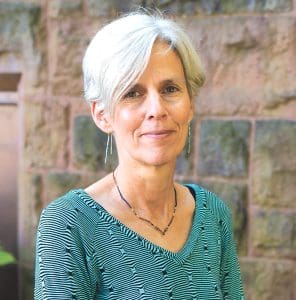
Alison Berman says Girls on the Run is capturing girls at an age when they tend to lose confidence and drop out of organized sports.
Photo by Focus Ashely Photos
At the same time, the program budget has increased to $432,000, derived from a variety of funding sources. In 2023, GOTR Western Massachusetts served 1,800 girls and provided more than $130,000 in need-based scholarships, roughly 30% of its budget.
“Alison makes sure that no girl is turned away from the program based on financial need,” Queenin wrote. “Her enthusiasm and genuine compassion inspire others to get behind the program and invest in its success.”
It’s a program that has certainly caught on and steadily grown nationwide; data from a national spring 2024 end-of-season survey of coaches, participants, and families showed that 95% of girls reported feeling more confident, and 92% of girls said they learned things at GOTR to help deal with strong emotions.
Life Lessons
Teachers have definitely noticed, which may explain why they make up the vast majority of volunteers in the GOTR Western Mass. council.
“They’re doing this volunteering after they’ve spent a long day in the classroom, because, I think, they get to know the kids in a different way and have a different relationship, but also they see the impacts in their own classrooms,” Berman said. “And principals have told us that they see it reshaping the culture of their school as well. Parents are more involved, and attendance goes up with those kids.”
This aspect of the program — that rippling impact, as it were — delights Berman.
“When we started it, we never realized the impact it would have beyond the girls,” she said. “So when we see the impact on families and schools, I’m amazed by that. I see it as like this web that’s spread out around Western Mass., with the impact it’s had on the coaches and parents and schools.”
Communities are impacted as well; as noted earlier, a big piece of the curriculum is a project where each team does something to give back to their community.
“The Humane Society just gave us an award. We have girls giving to animal shelters or cleaning up their schools, planting gardens, writing notes to veterans. It’s up to the kids to decide, and part of that lesson is learning about compromise and figuring out what’s needed in their community. It’s seeing beyond themselves.”
Girls on the Run continues to see further opportunities as well, like a summer camp that essentially adds a third season to the annual programming. “It’s growing slowly, but we had about 40 girls this summer in camp. And they loved it,” Berman said. “Again, our coaches volunteer to come back and do that, which also shows how much they love the program.”
“Girls on the Run inspires girls to build lives of purpose and to make a meaningful contribution to society. I can’t think of anyone more capable of modeling this than Alison.”
Much of this success builds on early efforts by Berman to get the local council going, Queenin noted. “While the mission of Girls on the Run resonated deeply with Alison, starting a nonprofit organization from the ground up is no easy feat. Working for the first year without pay, Alison assembled a board of directors and drew on their expertise and connections to chart a course. She fundraised enough money from interested community members to attend training and secure the requisite license to create a council. She had to learn many new skills, from fundraising and budgeting to training and vetting volunteer coaches, all in real time.”
And now, GOTR Western Massachusetts has served more than 10,000 participants. With many alums now graduating from high school, the council started a scholarship program to support their further education. “That’s exciting, being able to help support kids to keep going,” Berman said. “And when we had teens apply for the scholarship program last year, they talked about the impact that it had on them.”
That impact has extended, in many cases, to continued athletic endeavors in high school and college, she noted. “Many of them talked about the impact of the values that they learned from Girls on the Run about helping others and giving back to their community.”
So it’s about much more than running, she said, but that end-of-season 5K is still inspiring.
“It brings tears to your eyes. It’s not timed; it’s not about who can run fast, and families show up with their entire extended family, sometimes wearing matching shirts, to support their kid. Parents who’ve never walked three miles are out there walking three miles, so it’s a ripple effect of getting families outside as well. That’s awesome.”