
Community Spotlight

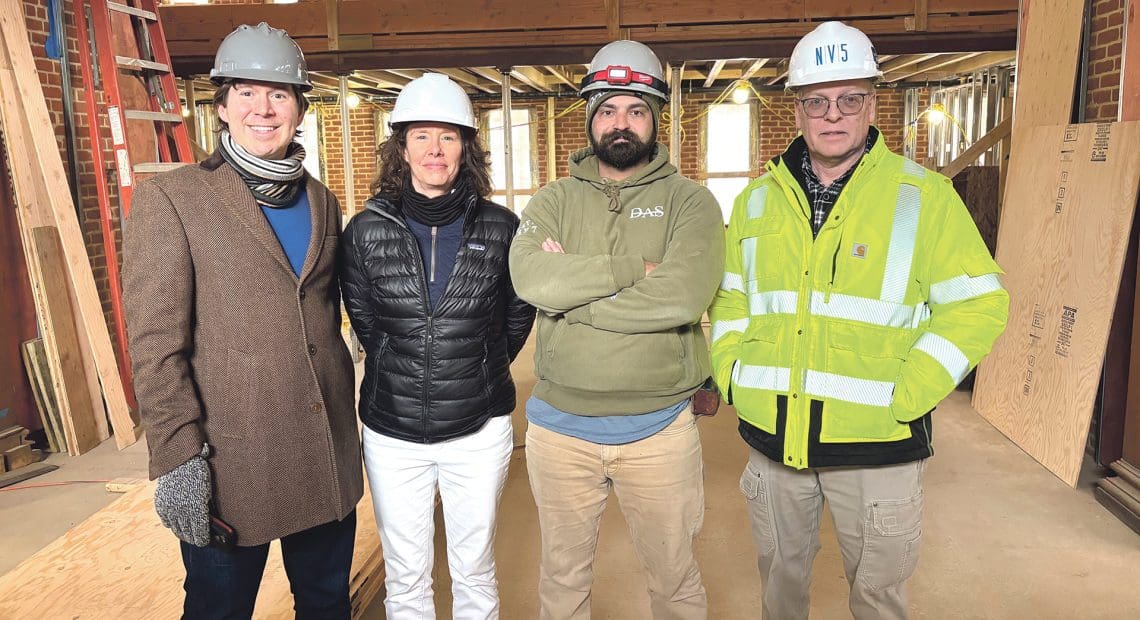
From left, Lee Pouliot, Krista Benoit, Brett Brown, and Bob Alger stand in the main entrance to the former main library in Chicopee, now undergoing historic rehabilitation for use as a community hub.
‘Historic rehabilitation.’
That’s the phrase Lee Pouliot and others used to describe work at Chicopee’s historic City Hall and the neighboring, long-closed main library.
In doing so, they made the distinction between this type of work and historic restoration.
Indeed, the latter returns something to what it once was at a specific point, said Pouliot, director of the city’s Planning Department, adding that this will not be the case with either building.
Indeed, the library, closed since 2004, when a new facility was built, will be renovated for use as a community hub, home for a farmer’s market, and meeting space, said Pouliot, while phase 2 of a project at City Hall and its annex will involve an office-by-office renovation of spaces to suit current needs and technology and make the best use of those spaces.
“One purpose of the project is to right-size some of the office spaces; we have some offices that have too many people crammed into too small a space,” he explained. “Another priority is building security. In working with all the department heads, we identified the offices that get the most visitation on a daily basis and tried to relocate them to the lower floors of the building, so we didn’t have the public accessing areas that they don’t need to.”
The City Hall project, which has been ongoing for a decade, has been slowed by the pandemic, but also a lengthy — as in more than three years — design phase that required large amounts of data collection from city department heads and employees about space requirements and specific needs.
Historic rehabilitation of the two downtown landmarks, work that has been ongoing through four mayoral administrations, is just one of the storylines involving Chicopee, the region’s second-largest city.
“One purpose of the project is to right-size some of the office spaces; we have some offices that have too many people crammed into too small a space.”
Others include everything from ongoing efforts to repurpose several old mills and create sorely needed new housing — projects that dovetail nicely, as we’ll see — to efforts at Elms College to cope with the many issues and challenges in higher education today, especially the so-called demographic cliff, a sharp decline in the number of the number of 18-year-olds entering college. But there are others as well, including the soaring cost of higher education and the need to help students and their parents meet it, as well as free community college, which is both a challenge and an opportunity.
The college is taking steps to help bring that cost down and afford more opportunities for a college education through initiatives such as the recently announced Elms Promise, a financial-aid program designed to provide full tuition coverage for students from families earning less than $85,000 annually.
“The cost of a college education has been on the increase, and families’ income has not increased as fast as the rise in tuition,” Elms College President Harry Dumay said in explaining the genesis of the program, adding that, since its inception, the school has placed an emphasis on being affordable for all types of students.
For this, the latest installment of its Community Spotlight series, we take an in-depth look at Chicopee and how it is building momentum — in all kinds of ways.
History in the Remaking
As they talked with BusinessWest in the former City Council meeting chambers on the fourth floor of City Hall, Pouliot; Krista Benoit, a project manager for Northampton-based D.A. Sullivan & Sons; and Bob Alger, senior project manager for NV5, a Hadley-based engineering firm, noted that the renovation of City Hall, opened in 1871, has been a decade-long project that essentially began when two panes of stained glass fell out of the rose window at the front of the building.
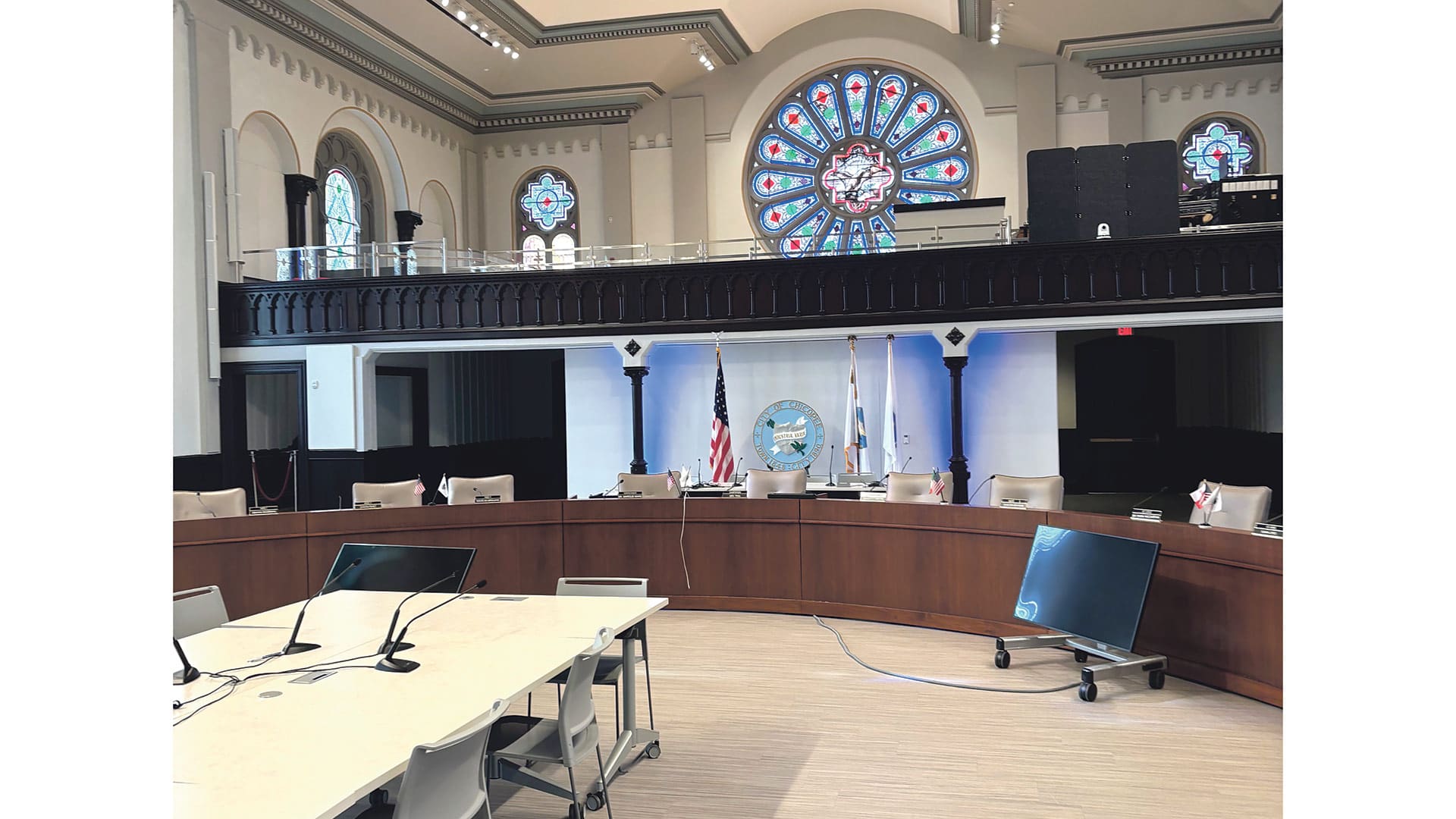
Phase 2 of the ambitious City Hall project will follow recent work like this renovated auditorium.
Then-Mayor Richard Kos asked Pouliot to undertake an emergency stabilization and historic-structure analysis to determine if there were physical deficiencies in the building’s structure. Dietz & Company Architects of Springfield was hired to work on both, and the firm determined that there were a number of significant deficiencies that needed to be addressed in both City Hall and the annex.
Emergency stabilization work included everything from the removal of stones from the clocktower amid fear of them falling to removal of the stained glass throughout the building for protection, Alger said.
Following these initiatives, funding was secured for phase 1 of historic rehabilitation work, which entailed work on the building envelope and the HVAC systems, he went on, adding that this included roof replacement, stone and masonry repair, brick repair, replacement of all the windows in both buildings, and a stunning renovation of the auditorium, a $17 million endeavor overall.
Phase 2, a $16 million project, will involve a three-year schedule of moving through the building, renovating and rightsizing offices, said Benoit, who first became involved in the project while working as a designer for Dietz and Company, and is now on the construction side with D.A. Sullivan, which also handled phase 1.
She noted that D.A. Sullivan has a strong track of work for area municipalities and in the areas of historic restoration and rehabilitation.
“We’ve been around for so long now, 1897, we’re now renovating many of the projects we actually built,” she said, adding that the Chicopee projects involve buildings on the National Register of Historic Places.
Pouliot noted that the contractors will hopscotch through the buildings, renovating a few offices at a time.
“We’re taking two to three office spaces offline at any given time, relocating staff to vacant office space, remodeling those offices, and moving staff back in,” he explained, adding that several departments will be moved to different floors or different areas that better suit their needs and those of the public.
These will be gut remodels, he went on, adding that it will take three to eight months to ready each space for its new occupant.
As for the library, Pouliot said there have been several requests for proposals issued for the city’s old library, and, over the years, a few intriguing uses have been proposed.
There was talk of a brewery that never really got off the ground, he said, adding that the concept that gained the most traction — but not enough to become reality — was to make the landmark home to the largest private collection of Franklin D. Roosevelt memorabilia, some 10,000 pieces, once housed in Worcester. There was even talk of the possible creation of a Roosevelt Study Institute and a collaboration between the museum and Elms College.
The ‘community hub’ concept was ultimately deemed the alternative that made the most sense, said Pouliot, adding that it transforms the library into a different kind of community resource, one that will hopefully bring more people and vibrancy to the Market Square area.
Grade Expectations
While the city works to rehabilitate its landmarks, one of its leading institutions, Elms College, is trying to build a more secure future by taking a proactive approach to the many challenges facing higher ed today, especially smaller, private institutions.
“There’s never a moment to rest,” said Dumay of this challenging time, describing Elms as being “healthy, not wealthy.”
By that, he meant that the school has a small endowment — $12 million, although it’s much larger than it was even a few years ago — but it remains in solid fiscal heath, thanks to steady enrollment in many of its divisions. These including transfers, continuing education, and graduate programs, making up for a decline in enrollment among high-school graduates, something being seen across this region and across the country, a situation exacerbated by what Dumay (and many others) have called the “less than adequate rollout” of Free Application for Federal Student Aid, or FAFSA.
“We had a really good year of students transferring to Elms College, a good year for students completing their degrees through our continuing-education program, and a good year of graduate students,” he explained. ‘Overall, we took in around the usual number of 500 students that we traditionally take in for all categories, despite the fact that, with our first-time freshmen, we didn’t reach the target that we were looking for.”
In this environment, schools need to be aggressive in telling their stories, stress their strengths and values — and the value they provide — and be responsive to those challenged by the high cost of a college education, he said, adding that the Elms Promise was created to help empower those students least likely to afford higher education, and it underscores the school’s affordability.
Chicopee at a Glance
Year Incorporated: 1848
Population: 55,560
Area: 23.9 square miles
County: Hampden
Residential Tax Rate: $15.16
Commercial Tax Rate: $32.62
Median Household Income: $35,672
Median Family Income: $44,136
Type of Government: Mayor; City Council
Largest Employers: Westover Air Reserve Base; J. Polep Distribution Services; Callaway Golf Ball Operations; Dielectrics; MicroTek
* Latest information available
“Having this Elms Promise out there clearly and crisply conveys to students and their families that an Elms College education can be as within their reach as some of the other alternatives available to them,” he explained, adding that this includes MassEducate, the state’s free community-college initiative, which, as noted earlier, is both another challenge and a great opportunity down the road.
“I’ll always be in favor of any initiative that makes college accessible for students,” said Dumay, a first-generation college graduate himself. “And we already know that this has increased enrollment at community colleges significantly, in this area and beyond. And because of the articulation agreements we have with all the area community colleges, and because many of the community-college students transfer to us, we’re expecting the number of students that will transfer to us to increase, and we see that as an opportunity down the road.”
Developing Stories
While Elms copes with its challenges, the city continues its work to put some of its former mills back to productive use while also addressing an urgent need for more housing.
Pouliot said the owners of the last remaining building in the Facemate manufacturing complex, the so-called Baskin parcel, are finalizing the securing of resources from the Commonwealth, and a groundbreaking is expected in the near future on 105 units of housing.
Meanwhile, a developer has been recommended for the four remaining buildings within the massive Uniroyal tire-manufacturing complex, the redevelopment of which has been a more-than-40-year saga, said Pouliot, adding that a mixed-use development that includes housing is being eyed.
These projects are moving slowly, he noted, because of the high cost of rehabilitating former mills of this kind into housing and other uses, as well as the time-consuming process of securing the various forms of financing, often including historic tax credits, needed to make such endeavors viable.
“Slow but steady wins the game when it comes to mill conversion,” he told BusinessWest, adding that the Uniroyal project will most likely develop in phases over several years.
In the case of another huge old mill, Cabotville Industrial Park, formerly home to dozens of various-sized businesses but now mostly vacant, progress has come very slowly, and its fate remains a large question mark.
“There have been a number of owners that have suggested a significant redevelopment project there,” Pouliot said, adding that such talks have been going on for more than 20 years now. “We’ve been stuck in this current round with the current owner, Silverbrick, for two or three years. But it’s a viable project for the right developer with the right experience.”
Housing remains a critical need in the city, he noted, adding that, in addition to the Facemate property and its 105 units, other, smaller projects are advancing, including plans to develop the site of a former Masonic lodge on East Street and the conversion of the former Belcher Elementary School into 24 apartments.
Melissa Breor, executive director of the Chicopee Chamber of Commerce, said redevelopment of Cabotville and other large mills, as well as the smaller projects in and around the downtown area, form one of the keys to continued growth and greater vibrancy in the central business district, which has seen many new businesses open in recent years amid of a spurt of entrepreneurship, which continues today.
She cited the planned redevelopment of a large Victorian home on Grove Street in Chicopee Falls into a mix of housing on the upper floors and a possible wine bar on the first, being undertaken by the owner of nearby Falls Pizza, as an example of this entrepreneurship and the importance of new housing.
“In terms of economic development and workforce development, housing is at the center of all that,” she said. “We have some great developments that are in process and at various stages, and with those housing developments, people are going to need services and places to go. To have a business owner have that vision is really exciting.
“Investments like the one at Falls Pizza show great vision,” she went on, adding that new housing, in general, spurs new business development, which is good news for a city with a rich past and a promising future.