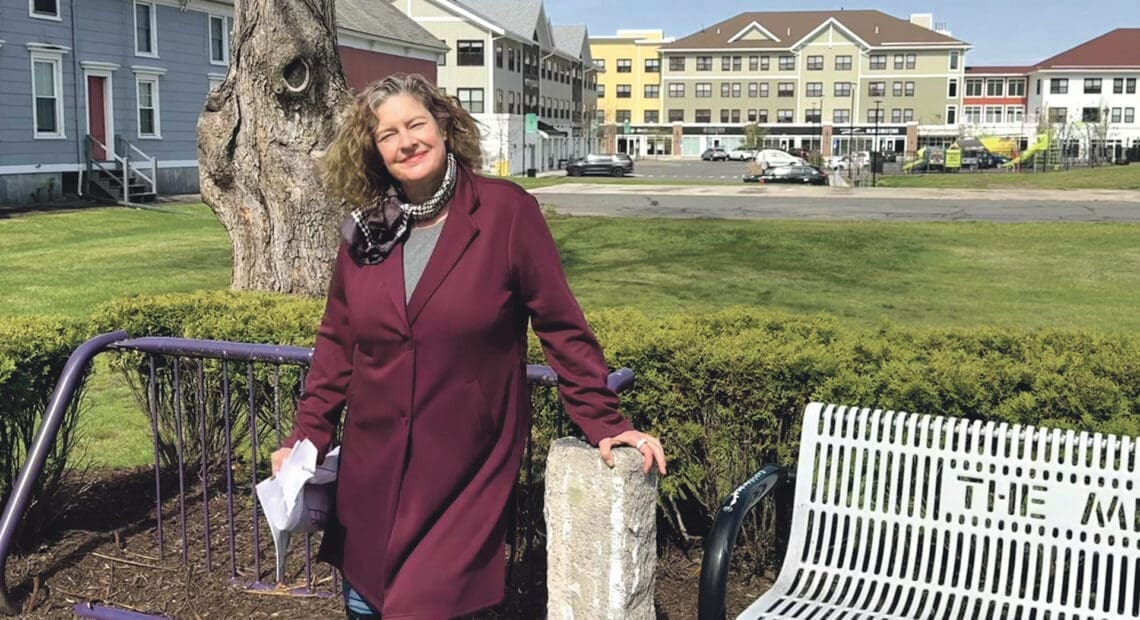
Home Posts tagged Cinda Jones
Cover Story Special Coverage

Creating Community

Cinda Jones, architect of the Mill District

Amy McDonough was working in the renewable energy business when, in her words, she “picked up pinball again” after putting it down following graduate school at the University of Vermont.

“I couldn’t get pinball off my brain, and I started picking up pinball machines here and there,” she told BusinessWest, adding that she would eventually amass a collection of nearly 70 machines. “And then, I was thinking about pinball much more than I was renewable energy.”

This thinking soon became serious in nature, and it led to an entrepreneurial venture called the Tilted Orbit Arcade, with that name borrowing two terms from the pinball world — orbit, which refers to the path for the ball along the outer rim of the game, and tilt, of course is when the machine is tilted or shaken beyond an acceptable level and the game ends.
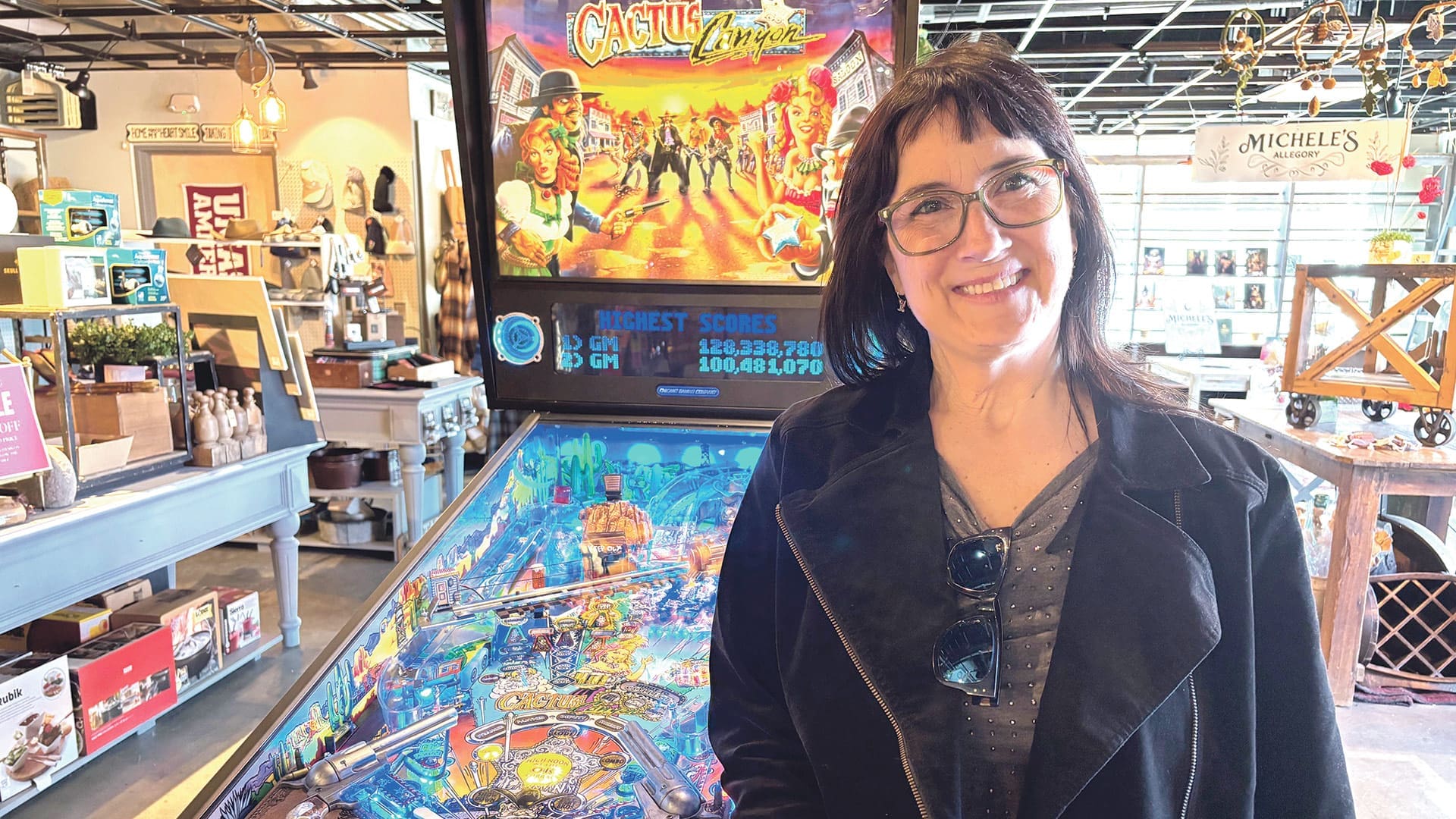
Amy McDonough with one of the more than 70 pinball machines she’s collected.

Due to open in the fall, the arcade will feature many machines from McDonough’s collection, as well as a golf simulator, a few vintage ’80s video games, a kitchen, and bar. It is being designed to attract many different constituencies, including families, area college students, teens, and the Boomers who discovered pinball in the ’60s and ‘70s, and then put it down.

And it is part of the ongoing evolution of the Mill District in North Amherst, a mixed-use facility that features housing, retail, art, and hospitality — a canvas that Cinda Jones, its architect owner, has been filling in over the past 15 years or so.

“We’ll still occasionally hear that people don’t know that the Mill District is here and how shocked they are when they find it.”

Indeed, Tilted Orbit will occupy what’s known as the Cow Barn, which was once home to Provisions, the wine and cheese emporium, which was moved to another building on the property (more on that later), and before that, Atkins, said Jones, adding that other additions and improvements include everything from a new pavilion taking shape on the site of another former barn, a new Herrell’s ice cream parlor (the company has been operating a small, pop-up facility the past few years); from recent additions such as Three Amigos, a restaurant that fuses the flavors of Chile, Mexico, and Puerto Rico and Carefree Cakery, and even some demolition  — of another former barn and a seven-car garage — that will improve visibility and allow travelers on Route 63 to see all that the site has to offer.

“We’ll still occasionally hear that people don’t know that the Mill District is here and how shocked they are when they find it,” said Jones, adding that the broad goal, as it has been from the beginning, has been to create what she called a ‘downtown’ in North Amherst, a mix of shops and amenities that deliver food, fashion, and fun — a true destination, attracting people from across Amherst and nearby Franklin County, but also a much wider circle.

Elaborating, she said current work involves creation of public open space, a ‘town common,’ leading from the highway to the shops. It will include the pavilion, which doesn’t have a formal name yet, although Jones calls it the ‘Manta Ray,’ because the architect has given it something approximating that shape.

It will include a catering kitchen and host a wide array of events, she said, adding that a tent has been erected on the site to hold gatherings such as a recent wine tasting staged by Provisions, with construction of the pavilion set to begin this spring, and due to be completed in time to host events this fall.
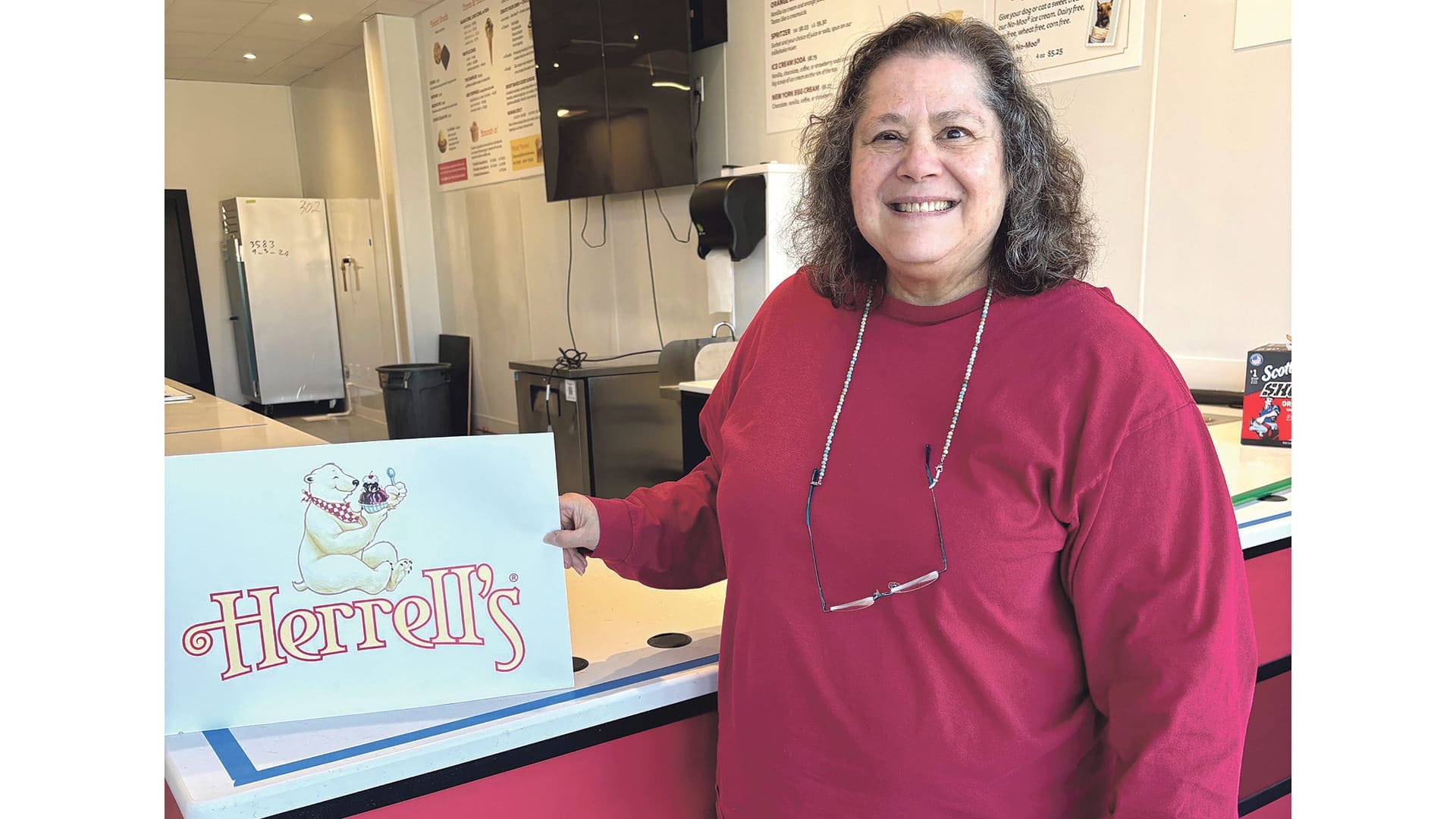
Judy Herrell stands in the almost-finished new location for Herrell’s in the Mill District.

The Tilted Orbit Arcade is one of many new developments at the Mill District, which has been in a seemingly constant state of change since it opened, and

Meanwhile, the location of the Mill District, and the diverse mix of tenants, eventually drew the attention of Judy Herrell, president of Herrell’s, who said the iconic, Northampton-based brand has been searching for a site for a second location, and zeroed in on North Amherst village.

“What we found out is that people didn’t want to venture over the bridge,” she said, referring to the Calvin Coolidge Bridge, which many in the Amherst/Hadley area simply don’t want to cross, even after significant infrastructure changes made it easier to do so. The new location, due to open in several weeks, will make Herrell’s more accessible, she said.

For this issue, BusinessWest talked with Jones and many doing business in the Mill District, or soon to do so, about this evolving concept and the diverse mix of ventures that are drawing visitors from across town and well beyond.


Flipping the Script

McDonough joked that her affection for pinball, developed while she was working toward her master’s degree at the UVM, probably put off her thesis by a year.

“I did a lot of procrastinating playing pinball,” she said, noting that one game in particular, The Addams Family, became especially addictive.
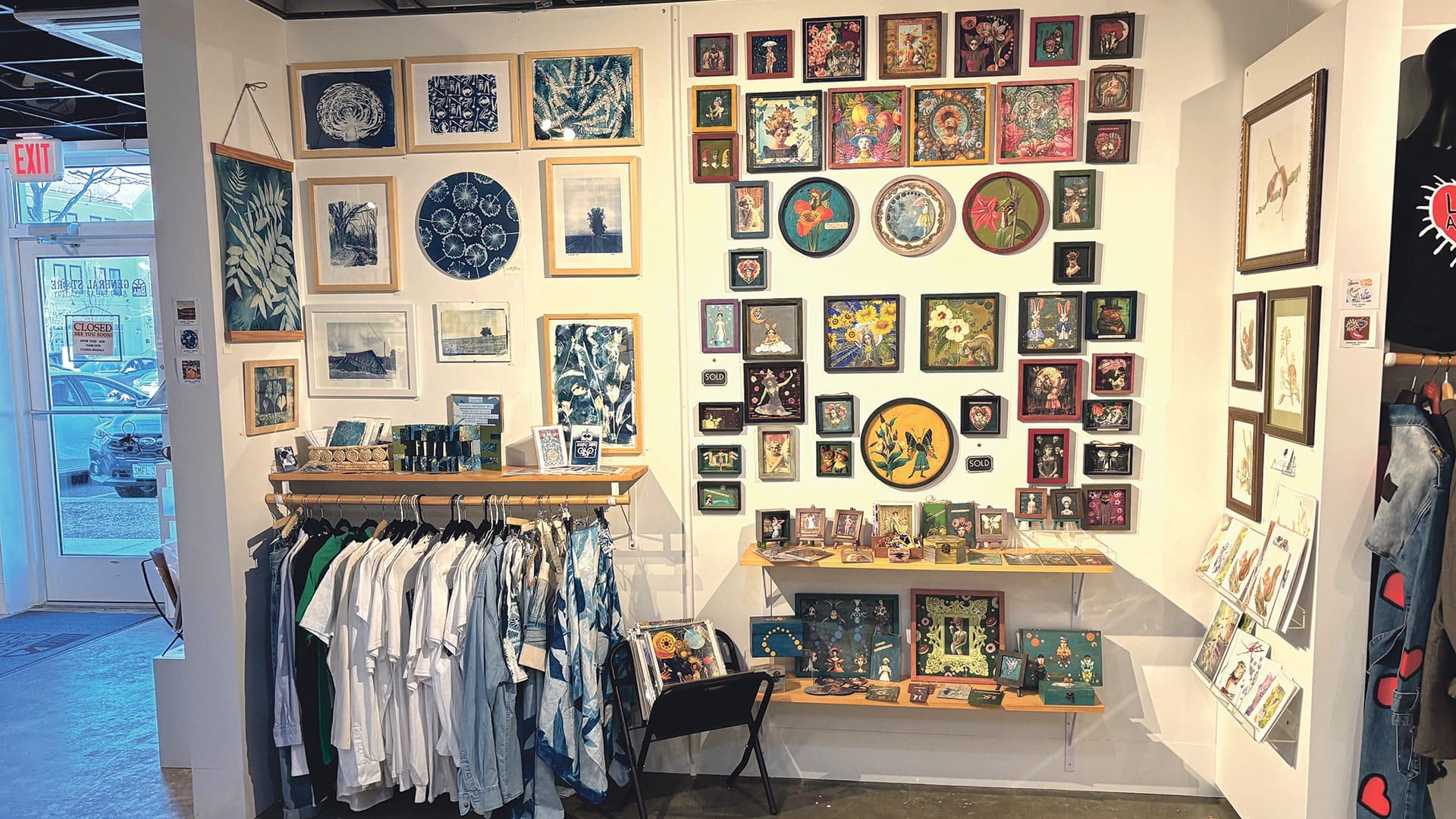
Just some of the local art to be found at the General Store.

It was among the first machines she acquired when she started building her collection, and it will be one of those on the floor at Tilted Orbit Arcade when it opens its doors, she said, adding that, before settling on the Mill District as home for her venture, she considered several other sites, including the Canal Lanes bowling alley in Southampton when it briefly came on the market.

The Mill District site offers what she was looking for, she said, meaning visibility and an opportunity to attract a diverse customer base, and also take advantage of a resurgence for pinball.

“It’s making a comeback; it started during COVID,” she noted. “Right now, pinball is serving mostly the male population, ages 40 to 65, but women are up and coming, and there’s a whole tournament world out there as well as leagues.”

McDonough said she’s looking to attract a wide audience that crosses all age groups, “families, seniors, teen-agers, college students, and adults.” And not just for pinball, but also the golf simulator, some arcade games, and other attractions she will offer, although the overriding goal is to inspire all those groups is to get them introduced to pinball and make them regulars.

“You can’t count on the weather in New England, and this will make it much easier to plan things.”

The Tilted Orbit Arcade is one of many new developments at the Mill District, which has been in a seemingly constant state of change since it opened, and the Cow Barn is where Jones began a detailed tour of the property.

Other stops included the town common area and spot for the new pavilion, which will provide larger, better space for the many types of events held there, and, especially, a roof, which will cut down on the rainouts and other weather problems that occurred with frequency last year or moving events to cramped indoor quarters.

“You can’t count on the weather in New England, and this will make it much easier to plan things,” said Jones, noting that the facility is being designed and built by Hardwick Post and Beam, and she is excited by the possibilities it presents.

“It will be a wonderful place where high school groups could perform, or you could have birthday parties,” she said, adding that performances could include seating in the pavilion and the lawn space outside, much like Tanglewood in Lenox.

And the pavilion is one of many steps being taken to attract more visitors and make the Mill District more of a destination.

“There are roughly 25,000 vehicle trips a day, including buses, that go within a block of the Mill District.”

Jones described the location as the ‘gateway to Franklin County,’ and on the route that many employees and students take to get from homes in communities like Greenfield, Montague, Conway, and Sunderland to jobs at UMass Amherst, nearby Northampton or points to the south. From the beginning, the goal has been to create a community, a village where people can shop, eat, see and buy art, and take in the many cultural events staged by tenants.

“There are roughly 25,000 vehicle trips a day, including buses, that go within a block of the Mill District,” she noted, adding that the goal is provide reasons to pull over and explore, while also creating a tenant mix and calendar of events that would prompt planned visits from across the region.

“My goal is to make this a place where community members, full-time, long-term community members, enjoy connecting with friends and enjoy the spaces and shops we’ve brought together,” she said.

The mix of tenants has changed over the years, said Jones, adding that she has always been looking to improve that mix and provide more to see and do. Most of the space is occupied, or soon to be occupied, she noted, adding that there is roughly 4,500 square feet — with high ceilings — available in the building currently home to Provisions.

“We’re listening to people, hearing what they like, and responding to what they’re saying,” she said, adding that this strategy applies to tenants and visitors alike.

Meanwhile, there are concerted efforts to make the Mill District more visible, literally and figuratively, said Jones, adding these include the creation of the common that will improve sight lines to the shops as well as new signage currently winding its way through the permitting process. 


Food for Thought

As they talked with BusinessWest, Jose Diaz and Matias Martinez, owners of Three Amigos, the next stop on the tour, were gearing up for Cinco de Mayo.

They were putting together a special menu for the occasion and were expecting a strong turnout for what has become a day of celebration for many in the region.

But most days have produced good crowds at this unique eatery, which, as noted earlier, blends dishes from Puerto Rico, Chile, and Mexico, with many offerings inspired by meals prepared by the owners’ mothers.
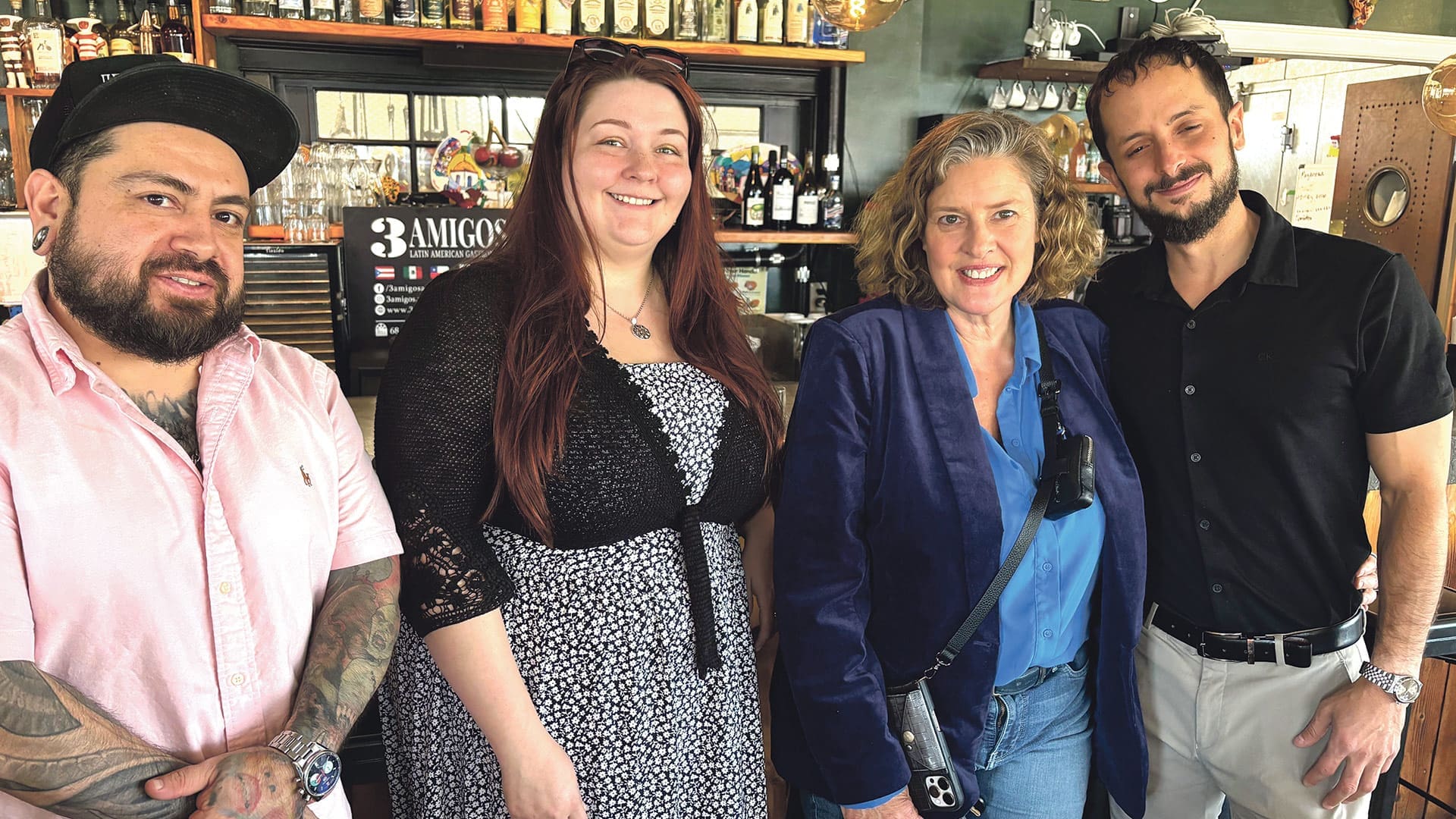
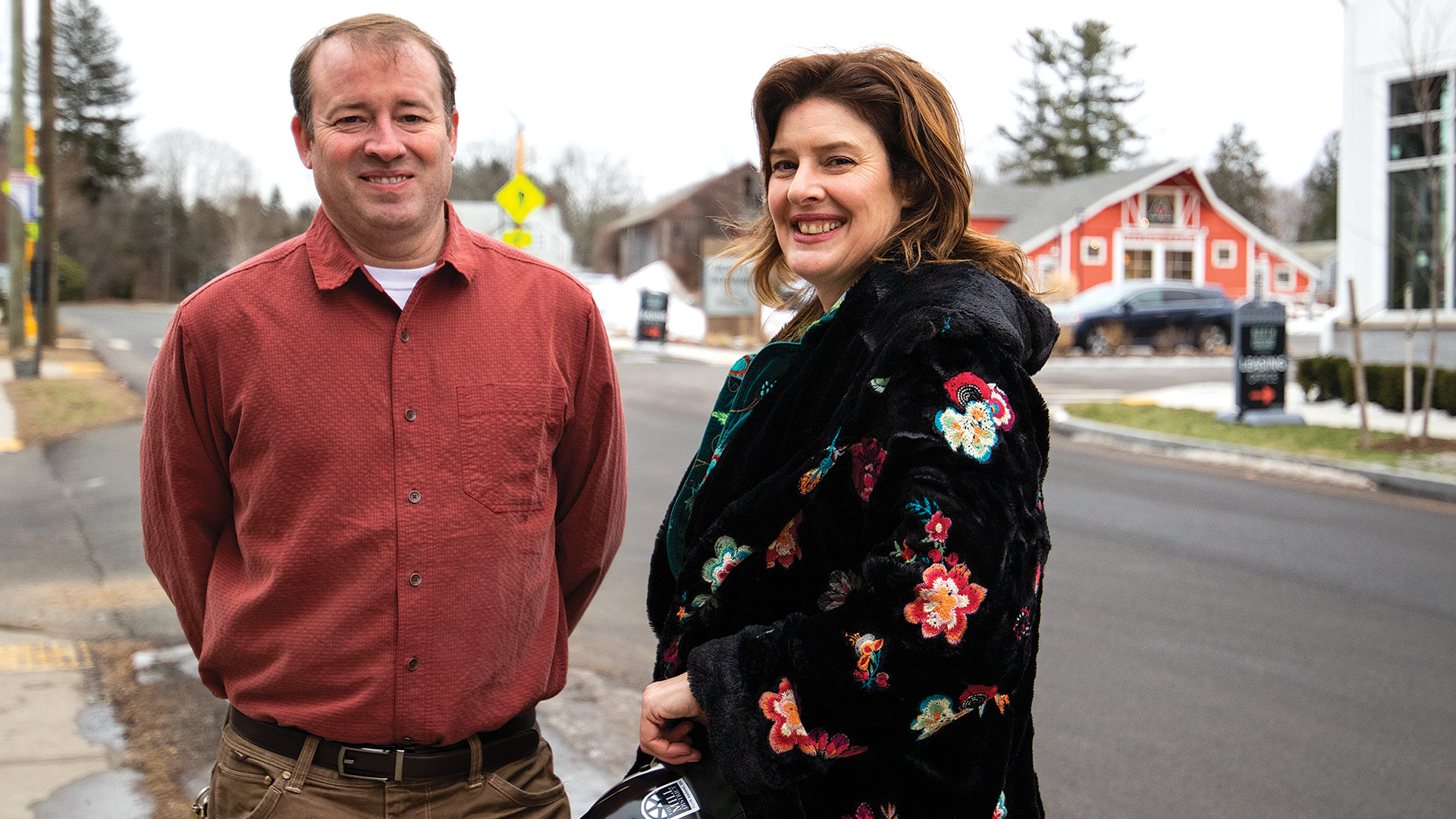
Matias Martinez, left, and Jose Diaz, co-owners of Three Amigos, share a moment with Cinda Jones and Shauna Wallace, project manager of Mill District General Store and Local Art Gallery.

“My mom has some really good recipes, and Jose’s mom has really good recipes from Puerto Rico; we take both and we put together a good menu,” said Martinez, a native of Chile, adding that Diaz also brings knowledge of Mexican cuisine to the table — literally and figuratively.

This knowledge and deep menus will have even more local flavor, said Diaz, adding that the partners are now committed to buying more locally produced vegetables, meats, eggs and more, and are further committed to bringing different kinds of experiences to the venue, such as karaoke nights.

“My mom has some really good recipes, and Jose’s mom has really good recipes from Puerto Rico; we take both and we put together a good menu.”

And, like other business owners in the Mill District, the two partners (there was a third, hence the name, but he is no longer involved) said the location brings a diverse mix of patrons across all age groups.

As Jones’ tour of the Mill District left Three Amigos, it made a quick stop in the vacant space adjacent to Provisions and below housing units. As noted earlier, it has high ceilings and what she considers enormous potential as home to a small grocery store, an indoor play space for kids, or similar that will be compatible with and complementary to everything else that exists on the property.

From there, the tour would continue to several existing and emerging businesses, such as Provisions, Futura Coffee Roasters, Carefree Cakery, Everbloom Salon, the Balanced Birch Studio, the Mill District General Store and the art gallery inside its walls, and the Herrell’s now taking shape.

Not on the tour, but technically part of the Mill District are businesses in a mall on Route 63, including Amherst House of Pizza, Big Guys Liquors, Mindy’s Barber Shop, and the Harp Irish Pub.

Collectively, these businesses provide ample reasons to get off the highway, whether one is heading home from work or planning a day trip, said Jones, adding that the Mill District comes as advertised, with that mix of food, fashion, and fun, including several play areas for children and families.

Herrell’s will make an intriguing addition to the mix, she said, adding that the pop-up facility has attracted solid numbers of visitors, and the larger, permanent space is expected to bring more.

Herrell told BusinessWest that the new location needs to be open by summer, for obvious reasons, and it is on track to do so.

She said the location in the Mill District brings the brand closer to other markets, such as Franklin County, and also closer to UMass Amherst, where she teaches a course — a lab on how to make ice cream “from a chemistry point of view” — and partners with the university on an ice cream competition, which is the final exam, if you will, for the that class, with Herrell’s featuring the winner’s flavors in its stores.

“We try to make all of them if we can, but we definitely make the four top finishers,” she said. “We’ve had some incredibly great, creative ideas from that group, and their lab is one mile from here.”

Beyond that partnership, Herrell’s is looking to tap into a broad base of loyal customers that know the Northampton store and now have something that for many will be more convenient.

And then, there’s the Tilted Orbit Arcade, which will present a novel new use for the Cow Barn, and an interesting addition to the mix.

For McDonough, it’s her first real entrepreneurial venture, which means there’s a mix of excitement and trepidation.

Overall, she’s optimistic that she can make something a little different work out in a big way. And in many respects, that’s been the goal at the Mill District from the very beginning. 
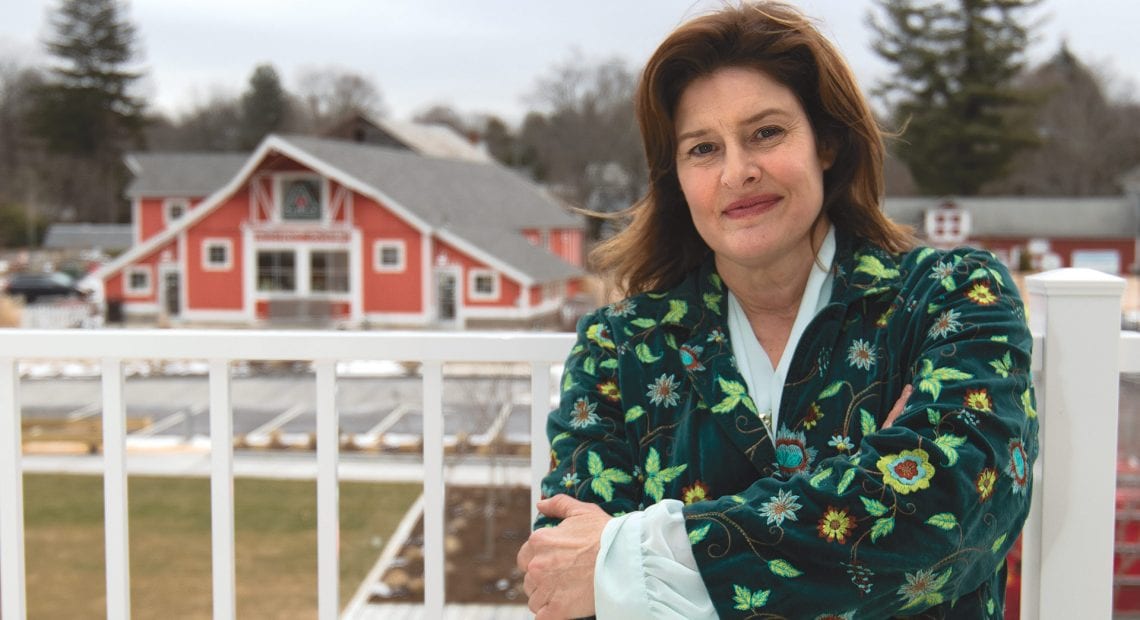
Cover Story

Cinda Jones Is Building a Community — and More — in North Amherst

As the largest private landowner in Massachusetts, with properties in 30 towns, the Cowls family is especially synonymous with North Amherst, where it has made its headquarters — and an enduring legacy in lumber and conservation — for 279 years. These days, Cinda Jones, the ninth-generation president of W.D. Cowls Inc., and her team are doing nothing short of creating a new town center in North Amherst. Why? Because the family has always transformed the land into what was most beneficial and needed. Today, she says, that’s a sense of community.
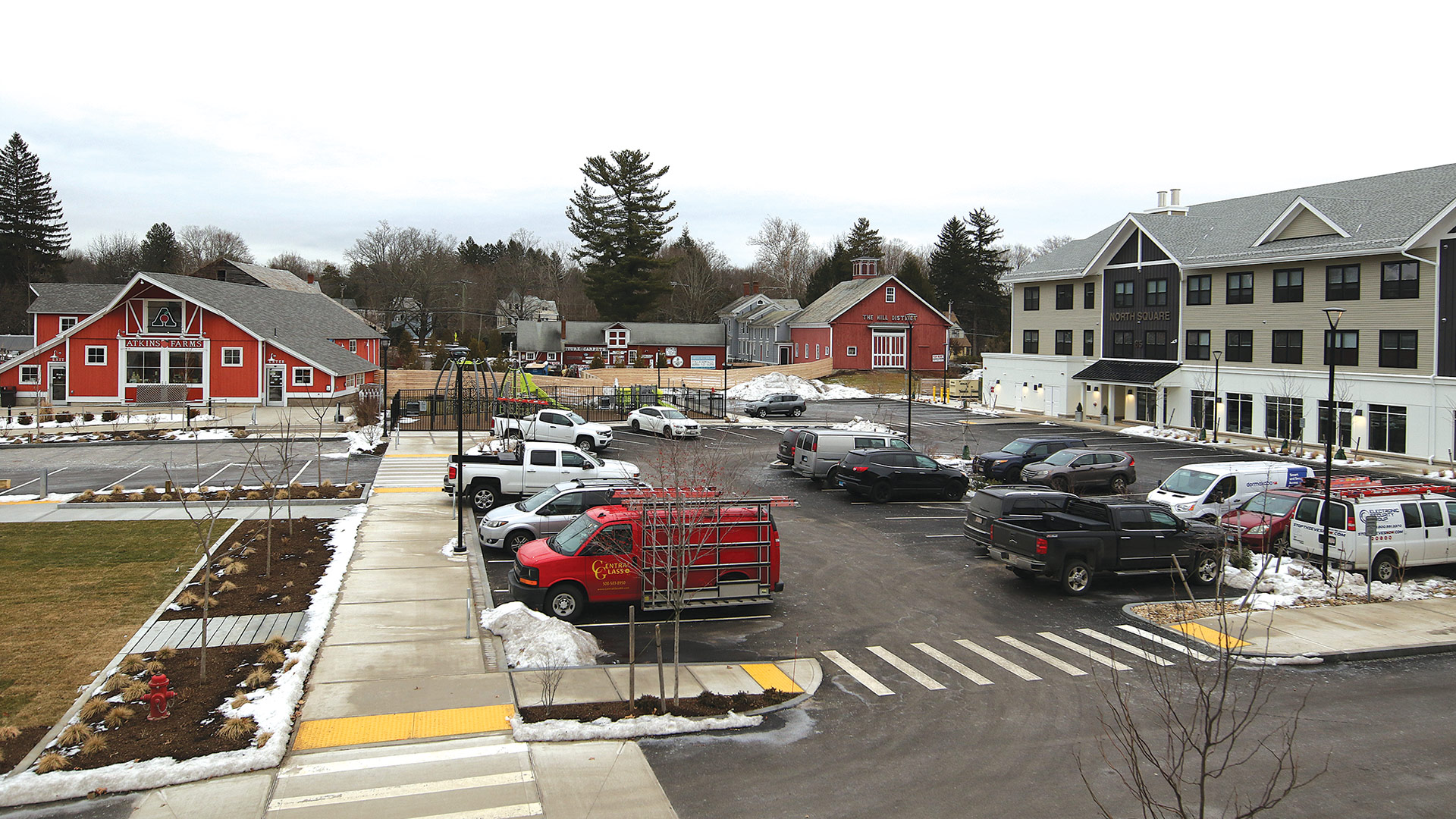
The area of North Amherst known as the Mill District has served many purposes over the nearly 300 years the Cowls family has made its name there.

Early on, for example, the farm produced and distributed onions, tobacco, and dairy products. In the 1800s, in a burst of diversified interests, the Cowls family managed a rock quarry, constructed a street railway system, ran two sawmills, built and operated a building supply store, and managed myriad residential and commercial properties, along with thousands of acres of timberland.

In short, each generation of Cowls descendants discontinued enterprises that had become outdated and reinvented the family business to be more relevant for their time — and more personally inspiring to them.

Cinda Jones, along with her brother, Evan, represents the ninth such generation to take on that challenge — and the mixed-use development now emerging in the Mill District, known as North Square, might represent its most dramatic change yet.

It’s that project, but also a rich, two-decade stewardship of the Cowls legacy, that has earned Cinda Jones, president of W.D. Cowls Inc., recognition as BusinessWest’s Top Entrepreneur for 2019.

“We knew, if we’re creating a new uptown in Amherst, it has to be an experiential place,” Jones told BusinessWest during a lengthy tour of the property earlier this month. “We want retail, and retail doesn’t work unless it’s better than online, and it offers something different. We have 22,000 square feet of retail space around a town square in an already-thriving area, where 45,000 people commute through every day. And that’s going to increase. So we’re really excited about what this can become.”

“We knew, if we’re creating a new uptown in Amherst, it has to be an experiential place. We want retail, and retail doesn’t work unless it’s better than online, and it offers something different.”

In simple terms, Jones envisioned a modern residential community of one-, two-, and three-bedroom units overlooking a commercial center comprised of roughly one-third food establishments (a restaurant and café, Jakes at the Mill, is already thriving there), one-third retail, and one-third “experiential services, like yoga, making your own pottery, things you enjoy doing — not dentists and accountants, because those aren’t so fun,” she explained.

“Everyone wants that,” she went on. “Malls stole our downtowns. Now malls are dying, but the one thing they’re doing to stay alive is to have experiences. That’s the correct thing to do. In addition to making a downtown with a mix of retail, we want to create a place where you want to spend the day.”

At left, the converted barn currently occupied by Atkins Farms. At right, one of the newer buildings housing both commercial and residential space.

Spend a day with Cinda Jones, and the main takeaway is a passion for the many ways land can — and should — be used. And she’s got a lot of land to put to use, and plenty of ideas about what comes next.

Nine Generations

Founded in 1741, W.D. Cowls Inc. is, in fact, Massachusetts’ largest private landowner. In 1741, Jonathan Cowls bought a farm in North Amherst and started the Cowls timber company. His son David built the company’s corporate headquarters in 1768 — in a large house that still serves that purpose today. The land Jonathan began acquiring 279 years ago now includes more than 100 parcels in 30 towns in Hampshire and Franklin counties.

According to the company’s written history, “for the first 100 years, everything the family had was always passed down to the oldest son, who was usually named Jonathan, and the Jonathans didn’t muck it up irreversibly. After that, with a David and a couple Walters in the mix, every generation of the family built what his generation of community needed on the home farm, while continuing to grow Cowls’ timberland base and conduct sustainable forestry operations.”

Jones got her start in the family business at age 10, cutting yellow triangles out of sheets of plastic for foresters to use as boundary markers. She worked her way up by scraping and painting fences and barns, sorting nails, stacking lumber, and helping the company’s administrative assistant.

Hannah Rechtschaffen says young people, in particular, desire the face-to-face culture that mixed-use developments promote.

After graduating from Colby College in 1990 and earning a graduate certificate in business administration from Georgetown University in 1995, she remained in Washington, D.C. for several more years, holding conservation and timber industry-related leadership positions, including marketing director for the Cato Institute, Wood Marketing director for the American Forest & Paper Assoc., vice president of the National Forest Foundation, and Northeast regional director of the National Fish & Wildlife Foundation.

In July 2001, her father joked that she was “so good at managing nonprofit organizations” that she should come home and manage the unprofitable sawmill, timberland, and real-estate divisions of Cowls. She did, and brought a bit of bad fortune with her.

“Within a year, the sawmill burned to the ground when lightning hit it,” she told BusinessWest, adding that she initially balked at plans to rebuild it. “I said, ‘Dad, it loses money. Why are we rebuilding a sawmill? Let’s do something different.’ He said, ‘it’s what we do. People depend on these jobs. It feeds our store. We will rebuild. You don’t know enough to close it down yet. But if it doesn’t work in five years, you can try something different.’”

So it went back up, as a timber-frame specialty mill. “We tried really hard, but it still didn’t work,” Jones said. “So we closed it in 2010.”

“I wanted it to be the Dirty Hands District, but I was told no one would come eat sandwiches in the Dirty Hands District. So I couldn’t name it that.”

She was already starting to envision the next step: developing a new downtown area — actually, uptown — in North Amherst. With her brother, she renovated their great-grandmother’s cow barn, which would house the second site Atkins Market site, and built the Trolley Barn mixed-use building, also on Cowls Road, and partnered with Beacon Communities on the residential components of North Square.

“At first, we tried to market the place — ‘locate here!’ But it was just hard-packed gravel and a closed sawmill,” she recalled. “People were like, ‘there’s no here here. Why would we come to a gravel lot in the middle of North Amherst?’”

Coming up with and marketing the Mill District name helped, although Jones first considered a moniker that had been used in the past for this neighborhood of farms and timberland. “I wanted it to be the Dirty Hands District, but I was told no one would come eat sandwiches in the Dirty Hands District. So I couldn’t name it that. So the Mill District it was.”

The Mill District actually encompasses more than North Square. Riverside Park Stores and Apartments — a former trolley destination that now houses a strip mall and 48 apartments behind it — is part of it, as are Cowls Building Supply and Mill District Depot.

Evan and Cinda Jones represent the ninth generation of leadership in the broad array of Cowls operations.

“We’re building a new uptown in Amherst which is called the Mill District, that incorporates Riverside Park and comes all the way up here,” she explained. “We’re trying to connect the two properties and tell the story of the whole neighborhood. North Square is what we’re doing today, but it’s so much bigger than that.”

Face to Face

Hannah Rechtschaffen grew up in Western Mass. but left more than 17 years ago, most recently attending graduate school and working in the field of urban innovation in Philadelphia. In large cities like that, she said, mixed-use developments are par for the course.

Even outside urban environments, though, after a decade of social media curtailing face-to-face contact, “the pendulum has swung back to wanting to be in person, wanting to live above a coffee shop where you go down in the morning and they know your name,” she told BusinessWest. “At one point, that’s how the world used to be, and now I’m hearing from Millennials that’s what they want. And they don’t just want it, they expect it — to go into a place and not be faceless.”

As director of Placemaking for Cowls, a job she took less than a year ago, part of her job is to create events, art installations, and community programs that bring back personal connections and elevate individual experiences in the neighborhood. To that end, she often reaches out to the community about what they want at North Square.

“Malls stole our downtowns. Now malls are dying, but the one thing they’re doing to stay alive is to have experiences. That’s the correct thing to do. In addition to making a downtown with a mix of retail, we want to create a place where you want to spend the day.”

“We have a clipboard over at Jakes where we say, ‘what do you want to see here? What’s important to you?’ And then we go out and try to find those businesses, ideally locally rooted, so they can come and provide some amenities — because there aren’t a lot of amenities along this corridor to Greenfield. We get a lot of feedback from the community about what they’d like to see, and our hope is that what happens here is in line with their vision and our vision.”

Part of that vision is a focus on the arts and opportunities for artists to connect with the community. One example is an art gallery, which will be connected to a general store and a café, featuring artists who hail from the many communities in which Cowls operates.

Some ideas are cheekier than others; Jones said the general store will feature two “experiential public bathrooms,” one with a jungle theme and the other featuring mirror glass — people can see out, but not in — meaning “you can do your business while you’re watching everyone out here do their business.”

Other tenants of the commercial space might include a distillery and tasting room, a flower and gift shop, and a tea house. Meanwhile, Atkins is moving out in July, but Jones has had interest from other food establishments.

Then there are 130 residential units, 20% of which are classified as affordable housing; residents began moving in back in August. Among the amenities — including a community room, gym, and outdoor play areas — are pet-friendly perks like an outdoor dog park and a mud room where dogs can be hosed off after a muddy time outdoors.

And, of course, a raft of shops, eateries, and experiences a few feet beyond one’s front door, and access to PVTA buses to move about the region without having to drive.

“The Mill District is more than just this one place; it’s touching the entire Valley. We’re trying to set an example of how to live in a community,” Rechtschaffen said. “We have to get creative with the experiential aspect of it. Every potential tenant we are talking to right now, they all have some aspect of their business that’s about teaching workshops, teaching classes, sharing what they do and why they do it with community members. That aspect is just crucial, and it’s fun.”

It’s also critical from an environmental perspective, she added, considering how young people aren’t as keen as previous generations were on long drives to get what they need to go. “There’s a lot more around the climate-change conversation — how we live, how we set our lives up to be able to let go of some of those things that have contributed to climate change, and this is one example.”

Land of Opportunity

As president, Jones oversees the real-estate and timberland and natural-resource management divisions of W.D. Cowls Inc., while her brother, Evan, oversees Cowls Building Supply, the retail store founded by their father, Paul. The Mill District has been a joint effort between the two — and it’s far from the only significant land-use project the company has recently undertaken.

For example, Cinda put an agricultural-preservation restriction on 45 acres of Amherst farmland, and in 2012 dedicated the largest contiguous private conservation project in Massachusetts history, the 3,486-acre Paul C. Jones Working Forest in the towns of Leverett and Shutesbury, which stands, she says, as a legacy to Cowls’ eighth-generation leader and the family’s commitment to sustainable forestry.

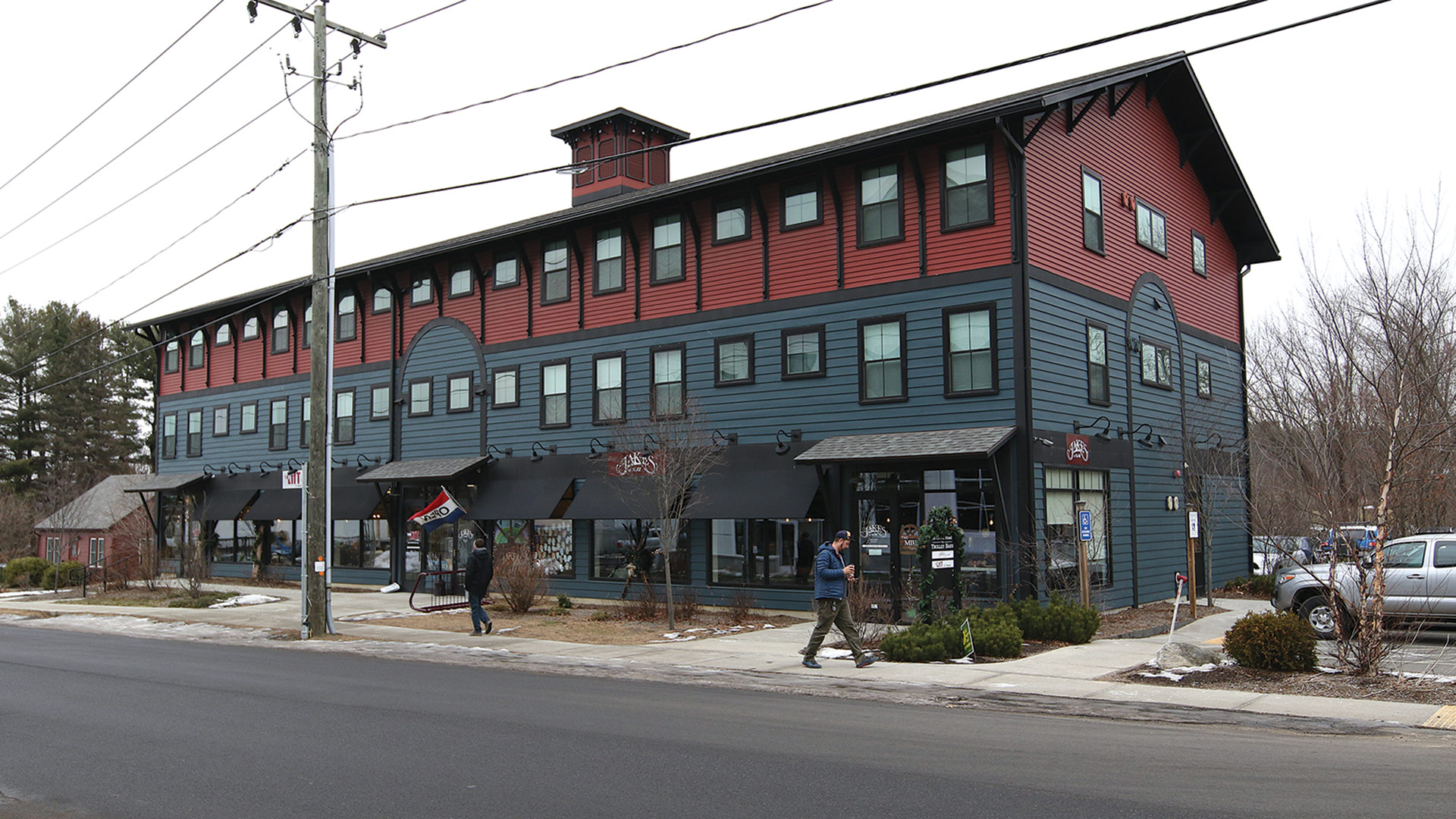
The Trolley Barn building hosts a range of businesses, including a restaurant, Jakes at the Mill.

In 2019, Cowls added an adjacent 2,000-acre conservation project in Leverett, Shutesbury, and Pelham, this one named for her grandfather, Walter Cowls Jones. A series of solar farms in the region have provided other opportunities for environment-friendly development.

She had already achieved some success at Cowls when BusinessWest named her to its inaugural 40 Under Forty class in 2007, and the evolution of her work since then was reflected in her Continuing Excellence Award last year, and now the Top Entrepreneur honor; she is one of only two individuals to have won three of the magazine’s six major awards.

Previous Top Entrepreneurs

• 2018: Antonacci Family, owners of USA Hauling, GreatHorse, and Sonny’s Place
• 2017: Owners and managers of the Springfield Thunderbirds
• 2016: Paul Kozub, founder and president of V-One Vodka
• 2015: The D’Amour Family, founders of Big Y
• 2014: Delcie Bean, president of Paragus Strategic IT
• 2013: Tim Van Epps, president and CEO of Sandri LLC
• 2012: Rick Crews and Jim Brennan, franchisees of Doctors Express
• 2011: Heriberto Flores, director of the New England Farm Workers’ Council and Partners for Community
• 2010: Bob Bolduc, founder and CEO of Pride
• 2009: Holyoke Gas & Electric
• 2008: Arlene Kelly and Kim Sanborn, founders of Human Resource Solutions and Convergent Solutions Inc.
• 2007: John Maybury, president of Maybury Material Handling
• 2006: Rocco, Jim, and Jayson Falcone, principals of Rocky’s Hardware Stores and Falcone Retail Properties
• 2005: James (Jeb) Balise, president of Balise Motor Sales
• 2004: Craig Melin, then-president and CEO of Cooley Dickinson Hospital
• 2003: Tony Dolphin, president of Springboard Technologies
• 2002: Timm Tobin, then-president of Tobin Systems Inc.
• 2001: Dan Kelley, then-president of Equal Access Partners
• 2000: Jim Ross, Doug Brown, and Richard DiGeronimo, then-principals of Concourse Communications
• 1999: Andrew Scibelli, then-president of Springfield Technical Community College
• 1998: Eric Suher, president of E.S. Sports
• 1997: Peter Rosskothen and Larry Perreault, then-co-owners of the Log Cabin Banquet and Meeting House
• 1996: David Epstein, president and co-founder of JavaNet and the JavaNet Café

“Congratulations to Cinda Jones on this recognition as Top Entrepreneur in our region by BusinessWest,” said Claudia Pazmany, president of the Amherst Area Chamber of Commerce. “Cinda tires of status quo and consistently asks what more can be done. Each idea generated is followed by yet another. She then uses her allies and matches them to local resources to make change happen.

“The transformation of North Amherst through her creation of the Mill District over the last 10 years has not only preserved some of her rich family history in agriculture and lumber, but tied it to the future of our great town, creating economic mobility tying old generations to new,” she went on. “I am proud to call Cinda a friend and colleague and cannot wait to support her in her next project — because there will always be a ‘next’ with Cinda.”

North Square at the Mill District has been that big ‘next’ lately, and it’s the product of not only her team’s vision, but inspiration from unexpected places.

For example, next to Atkins is a recreational area of sorts, complete with a covered sandbox containing books and construction-themed toys. It’s called Wonderland — for good reason.

At the start of construction on North Square, some of the property’s historic millstones and large pieces of granite were converted to benches, tables, and art structures, meant to be a gathering place for people who bought ice cream and a signal that Atkins welcomed them during construction.

A woman named Kate posted on Facebook that her son, Sam, thought this humble play area was the most magical place on earth, referring to it as a ‘wonderland.’ When Jones offered to dedicate the space to Sam, his mom said her daughter Abbie also enjoys playing there, and so did her other daughter, Mabel — during the seven short months of her life.

Jones said that story broke her heart, but Mabel also became an inspiration to create more experiential spaces and programs that make the Mill District a special and important place for more families to connect. Today, Wonderland is adorned with a plaque dedicating it to Sam, Abbie, and Mabel.

Most people are familiar with the saying, ‘it takes a village to raise a child,’ Jones told BusinessWest, but in this case, it took a child to lend a large dose of inspiration to the creation of an entire village.

Permanent Reminder

That’s not the first time Jones honored one of her inspirations with an indelible mark. She also tells the story of how Cowls transitioned to its ninth generation of leadership. When Jones, then 34, came home from D.C. in 2001, her dad thought the sawmill workers might go around her new authority to speak with him if he were on site, so he tossed her the keys to the office and left, saying, “I’ll see you for coffee every morning, but they need to know you’re in charge, so I’m going to make myself scarce.”

Ten years — and plenty of leadership experience — later, as her father was dying, the family sat with a lawyer at the same kitchen table the kids grew up around, with the company represented by piles of paper being passed down to the ninth generation. As her father was signing documents, she stuck her arm in the way, and he jokingly signed it.

She didn’t wash it off. Instead, she had the signature permanently tattooed there.

A few months later, as she was about to sign off on the Paul C. Jones Working Forest in honor of her father, she rolled up her sleeves, looked down, and saw the signature, and felt like he was still across the table from her in the same house the family has operated from since 1741.

And with the same philosophy, too — one that constantly asks what’s the best use for the land, and the people who live, work, and play there.

“It’s smart growth when you build near jobs and gas stations and schools and population centers, and when you don’t build where there are critical natural resources,” she said. “And Cowls is in the unique position to be able to decide and build in an intelligent way. We have this existing industrial site in North Amherst that we’ve redeveloped for the ninth time, and it’s a new town center, so people who live here can get everything they need. And we do hope they’ll come live here.”

Joseph Bednar can be reached at [email protected]

Daily News

HOLYOKE — Cinda Jones, president of W.D. Cowls Inc., was awarded BusinessWest’s Continued Excellence Award at the annual 40 Under 40 Gala at the Log Cabin Banquet & Meeting House on Thursday night — See the gallery of photos from the event HERE.

Chosen by three independent judges from among 60 nominations, Jones was honored for her exceptional achievements, including her leadership in growing Cowls’ timberland base by 1,000 acres and being an advocate for conservation. She has also led development of the company’s ambitious project in North Amherst called the Mill District.

BusinessWest’s Continued Excellence Award goes to a previous 40 Under Forty honoree who has continued to build his or her resume of achievement in both business and within the community.

Jones was one of five finalists for the 2019 award. The others were Michael Fenton, Anthony Gleason II, Eric Lesser, and Meghan Rothschild.

Presentation of the Continued Excellence Award was the opening act of the 40 Under Forty celebration, which saw the Class of 2019 join what has become a very prestigious club.

More than 650 people crammed the Log Cabin for the event, which has become one of the region’s best networking events.

Jones held positions in several nonprofits for 10 years in Washington, D.C. before she came home to manage the family business. She was marketing director for the Cato Institute, Wood Marketing director for the American Forest & Paper Association, Vice President of the National Forest Foundation, and Northeast regional director of the National Fish & Wildlife Foundation.

Jones’ focus on increasing acreage of timberland and creating diversity forest-based opportunities with a focus on solar energy have shown through her actions as President of W.D. Cowls. When she saw the sawmill had potential for better economic use, she rebuilt it as the Mill District, acting as a vibrant commerce center for community members, families and visitors. She sold the largest conservation restriction in state history, raising $8.8 million through the 3,486-acre Paul C. Jones Working Forest, named for her father. In 2019, she will add 2,000 more acres, continuing her goal of leading Cowls as a national conservation leader.