Home Posts tagged Clean-energy
Building Trades


Outside the Classroom

What does a career in solar energy actually look like?

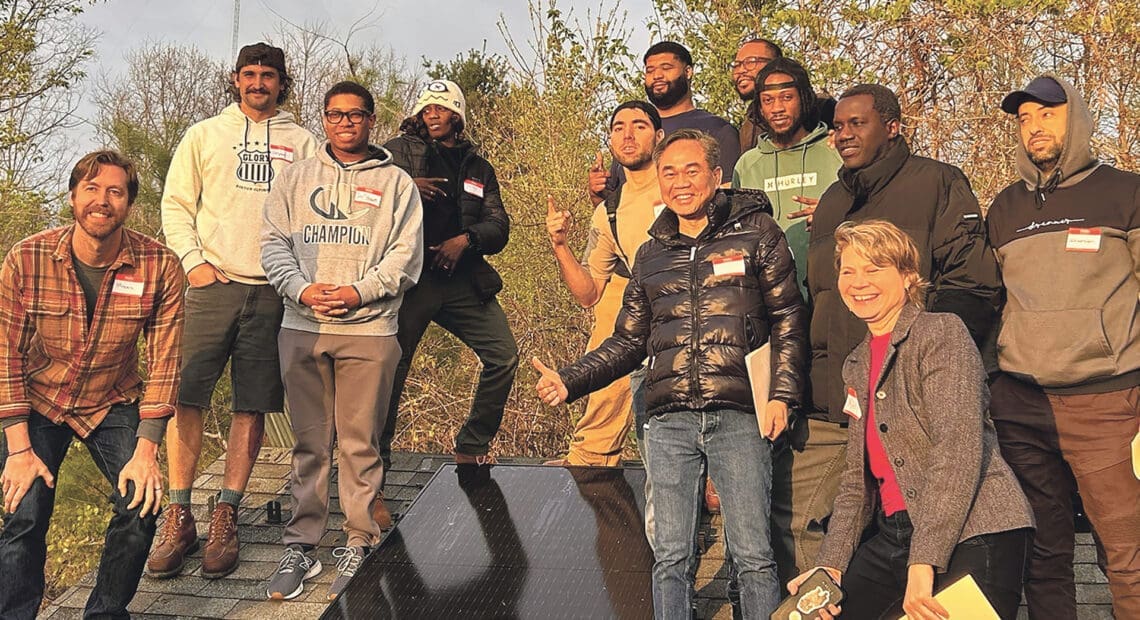
That question moved from abstract to tangible when a group of Holyoke Community College students in HCC’s clean energy training program visited PV Squared Solar’s headquarters and warehouse in Greenfield for an evening of hands-on learning and career exploration in the solar industry.

The visit was designed to give students a practical look at what working in solar actually entails, from installation work and electrical systems to team dynamics and long-term career pathways.
PV Squared offered HCC students exposure to the roof mock-ups used to simulate solar installations.

Students heard from PV Squared team members, including Pablo Revelo, master electrician; Alex Peterkin, president of the board of directors; and Kate Carter, team manager, who shared insights into the skills, training, and mindset needed to build a career in the trades.

“This kind of experience is where everything starts to click,” Carter said. “Students can see the tools, the systems, and the teamwork involved, and begin to picture themselves in those roles.”

The evening’s agenda included a walkthrough of the company’s warehouse and training areas, where students explored electrical training setups and system components, roof mock-ups used to simulate real installations, the tools and equipment used daily by solar crews, and the layout and function of installation trucks and warehouse operations. Demonstrations included safe ladder setup, equipment handling, and a look inside the box trucks that crews rely on in the field.

“This kind of experience is where everything starts to click. Students can see the tools, the systems, and the teamwork involved, and begin to picture themselves in those roles.”

Revelo, who works closely with installation teams, emphasized the importance of connecting technical training with real-world application.

“There’s a lot that goes into a solar installation that people don’t always see,” he said. “It’s physical work, it’s technical work, and it’s collaborative. But it’s also incredibly rewarding to build something that lasts and contributes to clean energy.”

For one evening, the students’ classroom extended into a working environment. Tools, trucks, electrical systems, and team dynamics all became part of the learning experience.

Programs like HCC’s clean energy training initiative are essential to building the future workforce, but classroom learning alone can only go so far, PV Squared’s leaders noted. This visit was designed to bridge that gap.

This visit is part of a growing relationship between PV Squared and Holyoke Community College, focused on creating clear, accessible pathways into the clean energy workforce. As demand for solar continues to grow across Western Mass., workforce development is becoming just as important as project development, Carter said.

“Workforce development doesn’t happen in a classroom alone. It happens when students can step into a real environment, ask questions, and see what the work actually looks like day to day. That’s how confidence is built, and how pathways into the trades become real.”

 “It’s physical work, it’s technical work, and it’s collaborative. But it’s also incredibly rewarding to build something that lasts and contributes to clean energy.”

During the visit, students also learned that careers in clean energy extend beyond installation alone. The solar industry includes a wide range of roles, including electrical and installation trades; system design and engineering; project management and operations; and sales, customer experience, and administrative support. This broader view helps students understand not just how to enter the field, but how to grow within it.
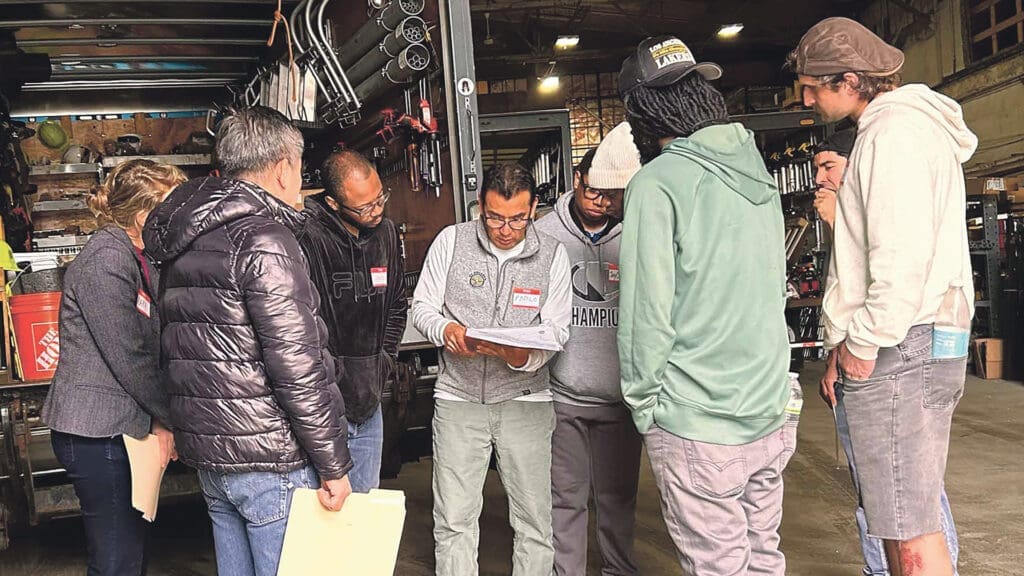
Students explored a wide range of hands-on activities, from equipment to how installation trucks are laid out.

During the visit, students also learned about what PV Squared looks for in employees, including curiosity, reliability, teamwork, and a willingness to learn, as well as the benefits of working within a 100% worker-owned cooperative.


For many students, this was also their first exposure to a structure where ownership is shared among employees, meaning the people designing, installing, and maintaining systems are also invested in the long-term success of the company.

“Worker-owned cooperatives are a powerful force for good in our communities,” Peterkin said. “They create meaningful jobs, build local accountability, and keep the benefits of clean energy rooted right here in the places we live. That’s exactly the kind of foundation we need for the green future we’re working toward.”

He added that, for students considering long-term careers, that structure offers appealing elements, including stability, shared responsibility, and a direct connection between work and impact.

“As the clean energy economy continues to expand, partnerships between educational institutions and local employers are playing an increasingly important role in building a skilled and resilient workforce across Western Massachusetts.”  
Workforce Development

Powering the Future

The Massachusetts Clean Energy Center (MassCEC) recently issued $13.4 million in grants to 13 Massachusetts community colleges to expand career training programs in clean energy fields.

Greenfield Community College (GCC) was awarded $810,000, and Springfield Technical Community College (STCC) received $809,989, both to launch and expand workforce training in HVAC and heat pump technologies, creating new career pathways in the growing clean energy sector.

MassCEC’s latest heat pump and HVAC training grants will benefit students at Greenfield Community College and other institutions.

Meanwhile, Holyoke Community College (HCC) was awarded $455,000 through a different MassCEC grant program to continue and refine its clean energy career training programs. 

“Massachusetts is leading the nation in clean energy and climatetech, and that leadership depends on a strong, skilled workforce,” Gov. Maura Healey said. “These investments will connect residents across the state to good-paying careers while helping employers meet growing demand. We are building a clean energy economy that creates opportunity in every region and real jobs for Massachusetts workers.”

Beyond funding, MassCEC will ensure program quality and consistency through the development of a universal heat pump curriculum, a shared instructional framework, and contextualized English for speakers of other languages (ESOL) resources. Together, these efforts represent a coordinated, statewide push to expand training capacity, improve program quality, and create accessible pathways into clean energy careers for Massachusetts residents.

“We need training that keeps pace with how the energy industry is evolving,” Massachusetts Secretary of Energy and Environmental Affairs Rebecca Tepper said. “These grants give community colleges the tools to deliver hands-on, modern instruction that prepares students for the work happening today and what’s coming next.”

“By pairing funding with a shared approach to curriculum and training, we’re helping to build an integrated system that can better support our workers and a clean energy future.”

MassCEC CEO Ben Downing added that “the Heat Pump and HVAC Training Network is focused on what happens after the investment — more trained workers and closer alignment with employer demand. By pairing funding with a shared approach to curriculum and training, we’re helping to build an integrated system that can better support our workers and a clean energy future.”

Heating Up

Jayshawn Brown, a student in HCC’s solar tech training program, works on a solar panel installation project at Dean Technical High School.

GCC’s grant will provide its division of Workforce Development with funding to train 40 students in HVAC skills. It is anticipated there will be two cohorts of entry-level HVAC training and two cohorts of incumbent worker heat pump training; each cohort will include up to 10 students.

Across the state, this program, supported by the Department of Energy Resources, aims to train 500 additional HVAC workers to meet the Commonwealth’s growing demand for clean heating and cooling systems. Greenfield Community College will use this funding to continue training programs for new HVAC technicians as well as work with local employers to provide heat pump installation and maintenance training for their current workforce.

“This funding allows us to continue to offer a full range of HVAC and heat pump training through our Workforce Development division, creating excellent opportunities for residents to enter and advance in clean energy careers,” said Kristin Cole, vice president of Workforce Development at GCC. “With these programs, we can address the urgent needs of local employers and equip our community with the skills necessary for success in a sector that supports both economic growth and clean energy.”

Since launching the HVAC training program in fall of 2024, GCC has graduated 27 individuals from the program with several industry certifications; 85% of those graduates are currently working in the industry. On May 29, the third cohort of students will graduate and transition into employment or paid internships with local employers. This new grant will fund training for additional students.

“We are building a pathway that supports our community, meets employer needs, and connects workforce training to college and long-term economic growth.”

Meanwhile, STCC’s funding supports a comprehensive clean energy training strategy centered on high-efficiency heating and cooling systems and modern heat pump technologies. 

Through six workforce development programs, STCC will provide Springfield residents and regional workers with free, hands-on training aligned with employer demand, industry certifications, and the Commonwealth’s clean energy goals. Together, these programs prepare both entry-level learners and incumbent workers for employment, advancement, and credential attainment in a rapidly changing workforce.

Gladys Franco, assistant vice president of Workforce Development at STCC, noted that “we are building a pathway that supports our community, meets employer needs, and connects workforce training to college and long-term economic growth.”

The initiative strengthens STCC’s existing HVAC and energy systems programs while creating a flexible workforce training model that helps participants quickly gain skills, credentials, and access to employment opportunities. The program also creates a pathway into STCC’s associate degree programs in energy systems technology and building automation.

MassCEC funding has made it possible for STCC to launch and scale six targeted training programs that would not otherwise be available. Investments in lab upgrades, modern equipment, and instructional delivery are significantly increasing training capacity, expanding access for underrepresented populations and accelerating entry into clean energy careers. Meanwhile, the college is working closely with MassHire, regional employers, and community-based organizations to support recruitment, training, and job placement.

The Next Phase

At HCC, the MassCEC grant will pay for two free training programs for up to 30 individuals: introductory training in construction, electricity, and clean energy systems in the fall of 2026, and a solar installer/electrical pre-apprenticeship program in the spring of 2027.

HCC piloted both programs in 2025 after receiving a $1.42 million grant from the Massachusetts Executive Office of Education for climate-related workforce training initiatives. The new award is part of a $7 million allocation in clean energy and climatech grants announced last month by the Healey-Driscoll administration.

“The first grant was really to design, develop, and essentially figure out what would work in our market,” said Kermit Dunkelberg, HCC’s assistant vice president of Adult Basic Education and Workforce Development. “Now, we’ll not just be continuing, but refining these programs to achieve even stronger outcomes.”

The MassCEC grants will support 17 organizations through four programs: Equity Training Implementation; Climate Critical Training, Equipment, and Infrastructure; Climate Critical Underrepresented Business Support; and Student and Young Adult Career Awareness and Training. They are designed to help local organizations expand inclusive training, career awareness, and business support for jobs such as electricians, solar technicians, HVAC-R technicians, energy auditors, refrigeration technicians, and EV charger technicians.

“Through our programs and partnerships, students are introduced to building trades unions — in particular, the electrical workers union and carpentry union — as well as solar installer and electrical apprenticeship opportunities.”

HCC was the only community college in Massachusetts to receive a dedicated grant, while the Massachusetts Assoc. of Community Colleges, a consortium of all 15 community colleges in the state, received $120,000 to support HVAC programs across the community college system. 

HCC’s key partners in the grant are Holyoke’s Dean Technical High School, where the clean energy training classes meet, and solar industry companies PV Squared and SolaBlock. Other partners include the MassHire Hampden County Workforce Board, the Coalition for Equitable Economy, Springfield Works, Browning the Green Space, and the Entrepreneurship & Business Collaborative.

“Thanks to these grants, we’ve been able to connect students to career pathways that can be very challenging to get into,” said Mary Wagner, HCC’s Workforce and Economic Development training manager. “Through our programs and partnerships, students are introduced to building trades unions — in particular, the electrical workers union and carpentry union — as well as solar installer and electrical apprenticeship opportunities.”

Since 2025, HCC has run the introductory clean energy program three times, the solar tech program once, a weatherization program two times, and recently introduced an Introduction to Manufacturing and Clean Energy Applications pilot program. 

“These programs are creating opportunities for underserved populations,” Dunkelberg said. “It’s not just opening the pathways, but reaching deeply into the community to create the access that’s been missing.”

Daily News

SPRINGFIELD — Springfield Technical Community College has received $809,989 in funding from the Massachusetts Clean Energy Center (MassCEC) to launch and expand workforce training in HVAC and heat pump technologies, creating new career pathways in the growing clean energy sector.

The funding supports a comprehensive clean energy training strategy centered on high-efficiency heating and cooling systems and modern heat pump technologies.

Through six workforce development programs, STCC will provide Springfield residents and regional workers with free, hands-on training aligned with employer demand, industry certifications, and the Commonwealth’s clean energy goals. Together, these programs prepare both entry-level learners and incumbent workers for employment, advancement and credential attainment in a rapidly changing workforce.

“This funding allows us to offer a full range of HVAC and heat pump training out of our Workforce Development division, creating real opportunities for Springfield residents to enter and advance in clean energy careers,” said Gladys Franco, assistant vice president of Workforce Development at STCC. “We’re building a pathway that supports our community, meets employer needs and connects workforce training to college and long-term economic growth.”

The initiative strengthens STCC’s existing HVAC and Energy Systems programs while creating a flexible workforce training model that helps participants quickly gain skills, credentials and access to employment opportunities. The program also creates a pathway into STCC’s associate degree programs in Energy Systems Technology and Building Automation.

MassCEC funding has made it possible for STCC to launch and scale six targeted training programs that would not otherwise be available. Investments in lab upgrades, modern equipment, and instructional delivery are significantly increasing training capacity, expanding access for underrepresented populations and accelerating entry into clean energy careers.

STCC is working closely with MassHire, regional employers, and community-based organizations to support recruitment, training, and job placement.

Offered through the Division of Workforce Development at STCC, the training is free for those who qualify. Participants must be unemployed or underemployed. Programs begin this spring and summer. Visit stcc.edu/wdc to find a link to the form.

Green Business

Changing the Narrative

Holyoke Mayor Joshua Garcia was named a finalist for the Mayor of the Year Award, presented by the Northeast Renewable Energy Coalition (NREC), in recognition of his leadership and innovation in clean energy and community development.

Garcia is the first mayor in Massachusetts to be recognized by the NREC. The award will be presented during Massachusetts Clean Energy Week, taking place from Sept. 29 to Oct. 4.

“I am overwhelmed and honored to receive this recognition on behalf of Holyoke,” Garcia said. “This award is for all of us in Holyoke, not just me — our residents, business owners, and neighborhood and community activists who love our city and work so hard to move us forward in the effort to harness our clean energy resources to continue to bring environmental and economic benefits to our city.”

Holyoke has become a leader in hydroelectric and renewable energy. Through community partnerships and long-term planning, Holyoke Gas & Electric (HG&E) has built a sustainable clean energy portfolio. Its core strategy is to overestimate future demand, an approach that led the utility to upgrade infrastructure and install one of Massachusetts’ largest utility batteries to handle peak demand.

Affordable clean energy has also helped to attract ventures like the Massachusetts Green High Performance Computing Center and Sublime Systems to Holyoke.

In a letter to the mayor, NREC Executive Director Kristin Rode praised Holyoke’s progress and Garcia’s community-centered approach.

Mayor Joshua Garcia

Mayor Joshua Garcia

“This award is for all of us in Holyoke, not just me — our residents, business owners, and neighborhood and community activists who love our city and work so hard to move us forward in the effort to harness our clean energy resources to continue to bring environmental and economic benefits to our city.”

“Your dedication to your community and the innovative solutions you’re implementing make you a natural fit for recognition during Massachusetts Clean Energy Week. Your leadership in Holyoke has caught our attention as truly exceptional,” she wrote.

“We understand that Western Massachusetts is often left out of the spotlight when it comes to statewide recognition, and we want to change that narrative. From what we have learned about your innovative approaches to municipal leadership and community development, you represent exactly the kind of community-centered leadership that deserves to be celebrated and shared with mayors across the Commonwealth.”

Garcia has also negotiated upgrades to Holyoke’s wastewater treatment system, replacing outdated infrastructure with energy-efficient, environmentally sound technology.

One of these separates the existing combined sewer flows within Holyoke’s River Terrace area. By leveraging clean energy savings and working closely with state and federal agencies, his administration secured funding to reduce long-term operating costs and improve water quality. These improvements not only align with Holyoke’s sustainability goals, but also position the city as a model for green municipal operations across Massachusetts.

“I appreciate Kristin’s kind thoughts about our work to change the narrative,” Garcia said. “That is exactly my greatest hope, every day, for Holyoke, for all our people — to change past perceptions and narratives. This industrial city is again being known as a place of so many possibilities.”

Representatives of the Northeast Renewable Energy Coalition visited Holyoke in early August to tour the city and learn more about these projects and initiatives.

“This nomination is an unequivocal testament to every Holyoke resident’s shared commitment to a stronger future,” Garcia said.

Construction

Greener Pastures


Greenfield Community College (GCC) will develop a new HVAC training program that’s focused on improving equity in the green workforce thanks to a grant from the Healey-Driscoll administration.

GCC’s Workforce Development division is developing the HVAC training program with funding from an $18 million grant designed to drive equitable clean-energy workforce development. The awards are being provided by the Massachusetts Clean Energy Center (MassCEC), a state agency dedicated to accelerating the growth of the clean-energy sector to meet the Commonwealth’s clean-energy, climate, and economic-development goals.

“We’re thrilled to partner with MassCEC to bring this high-demand workforce-training program to Greenfield,” said Kristin Cole, vice president of Workforce Development at GCC. “This grant award, rooted in equity, will allow GCC to train unemployed and underemployed individuals for a family-sustaining career in a growing industry. HVAC technicians will become increasingly more in-demand over the next few years to help meet the state’s climate targets for 2030 and 2050.”

michelle Schutt

Michelle Schutt

“Clean-energy jobs are good for the environment and good for family incomes. This is a win-win situation for GCC and our region.”

GCC is receiving $1.1 million to develop and deliver a HVAC training program that includes paid on-the-job training with employers. Trainees will be provided technical skills and career-readiness training, as well as professional certifications, comprehensive student support, and a two-month paid internship.

These efforts aim to provide career-ready individuals for an industry that will need to increase the number of professionals by 17% between now and 2030, according to a recently released needs assessment for the Massachusetts clean-energy workforce.

“Clean-energy jobs are good for the environment and good for family incomes. This is a win-win situation for GCC and our region,” GCC President Michelle Schutt said.

The college and its partners at MassHire Franklin Hampshire Career Center will specifically focus recruitment efforts on historically underrepresented individuals.

“Building and expanding our workforce is a foundational element of the clean-energy transition,” MassCEC CEO Jennifer Daloisio said. “The evolution of MassCEC’s programming in workforce development shows our commitment to inclusive and intentional growth that delivers good-paying jobs to families and clean energy to residents across the Commonwealth. We are grateful for the Healey-Driscoll administration’s continued support, and we look forward to seeing these organizations carry out their promising work.”

Sue Surner, CEO of Surner Heating Co. and a GCC employer partner, added that “this program will be a critical resource to prepare students for an excellent career path in the HVAC industry. We are excited to not only support GCC’s efforts to design a valuable training program with industry-recognized credentials as outcomes, but also to partner with GCC to provide paid internships to the participants coming out of this extensive training program.

“This grant will allow GCC to add 45 newly qualified individuals to our regional HVAC workforce pipeline,” she added, “and with the work ahead of us to move residents across the state off of fossil fuels and into cleaner energy, this couldn’t come at a better time.”