Home Posts tagged Foundation
Cover Story

Work of Arts


As he talks about Hope for Youth & Families (HYF), the foundation he created in 2022 after selling his Pride chain of gas stations and stores, Bob Bolduc will inevitably reference the “three legs of the stool,” as he puts it, meaning its main focus points.

One is literacy, where the family foundation is making progress in efforts to help young people who fall behind in reading proficiency and are in danger of dropping out of school as a result. The initiative, involving interns and peer-to-peer support, has yielded results, with half of those involved moving up a full grade in reading level and another quarter moving up two grades.

Bob and Roberta Bolduc

Bob and Roberta Bolduc.

Students take a guitar lesson during one of the summer programs at Hope Center for the Arts.

Students take a guitar lesson during one of the summer programs at Hope Center for the Arts.

The second stool involves high-achieving students and providing them with avenues to a college education. And the third is participation in the arts, something that is in many ways lacking in Springfield, said Bolduc, due to funding restrictions in the schools.

It is this third leg, the arts, that is … well, taking center stage recently through a massive, ongoing effort to transform the former CityStage in downtown Springfield, dormant for several years now, into an arts hub for Springfield youth.

Called the Hope Center for the Arts, the facility has become a passion project for Bolduc, his wife, Roberta, and his foundation, which acquired the former CityStage for $1 million at auction in 2023 and has since invested roughly $15 million in the center, which will be thoroughly modern in every respect.

“We didn’t spare any expense — it’s all state-of-the-art, from the stage to the security,” said Bolduc, adding that the center, spread across nearly 40,000 square feet over two levels, is designed to provide flexible learning, rehearsal, and performance space that will advance the mission of HYF and several partner organizations focused on both the arts and helping youth and families in Springfield thrive.

Build-out of various spaces continued at a frenetic pace through the winter and spring, leading to the start of free summer programs for middle school and high school students, which began July 7 and will run until Aug. 1. During the school year, there will be after-school programs.

Meanwhile, the city and region will regain a valuable asset in the center’s main stage, which has been retrofitted with sound and lighting equipment that will make it one of the most advanced facilities of its kind in the country, one that will see a full schedule of performances — starting with the Springfield Jazz & Roots Festival earlier this month — by artists that will involve young people involved with the center in some way.

“The arts are not just entertaining and cultural, which we need in this city; they’re also inspiring. Imagine a kid who gets turned on to dance or vocals or an instrument and then goes to a good school on a scholarship … we’ve changed their life.”

As he talked about the main stage, Kyle Homstead, technical director of the center, said the sound will be “three-dimensional” in nature, and the lighting system will enable crews to create virtually any kind of digital landscape, both behind the performers on a large screen and beneath their feet on the stage.

“All this makes this room a multi-media powerhouse,” he explained, one that will draw performers across a broad spectrum to Springfield. “We’ll be able to transform and bring all kinds of imagination to life. Whether it’s a touring performance artist or kids in our program, we’ll be able to take their ideas and all the types of art going on in this facility and really bring it to life.”

While the main stage gets much of the attention, the center focuses on all aspects of the arts and also includes a 110-seat black box theater, two large rehearsal rooms and two smaller ones, practice rooms, a recording studio and media production room, a digital arts classroom, a visual arts studio, a photography studio, childcare space, a teen café and lounge, and a catering kitchen and service counter. There are also plans to convert the former Pizzeria Uno space (currently a hookah lounge at the tail end of its lease) into a student-run coffee shop.

Kyle Homstead (at left) on the main stage at the Hope Center for the Arts.

Kyle Homstead (at left) on the main stage at the Hope Center for the Arts.

Bolduc showed off all of this and more during a detailed tour during which he focused on not just on the facilities being created, but what they mean for young people in the city — and their families.

“The arts are not just entertaining and cultural, which we need in this city; they’re also inspiring,” he explained. “Imagine a kid who gets turned on to dance or vocals or an instrument and then goes to a good school on a scholarship … we’ve changed their life.

“Arts programming can be an important contributor to student success in school, and yet arts programs are often the first to fall victim to budget cuts,” he went on, adding that compounding this is a lack of things do after school. “Unless they play sports, they have nothing to do, and … being kids, some of them are going to get into trouble. Young people who may not be interested in sports deserve just as much opportunity and access to programs that enrich their lives and encourage them to express themselves.”

For this issue, BusinessWest got what we’ll call a backstage look at the Hope Center for the Arts, learning not only how that dormant space has been dramatically and colorfully transformed, but how its various programs may transform young lives.


Filling in the Canvas

Flashing back a few years, Bolduc said he approached the city about possibly renting CityStage for some initiatives to address that third leg of the stool he mentioned.

He said he was told that, while this might be an option, the city would prefer to sell it to him — or anyone else who might be interested.

“We came to realize that we had the potential here to be not just a theater, like it used to be, but to make this a true center for the arts.”

Not many were, and Bolduc prevailed at a public auction. And it was soon thereafter that he and others at the foundation realized that they could and should do much more than revive the main stage — originally known as StageWest and later renamed CityStage — that had hosted a wide variety of plays and other forms of entertainment for more than 35 years.

“We came to realize that we had the potential here to be not just a theater, like it used to be, but to make this a true center for the arts,” he explained. “We created an advisory board and met with just about every nonprofit group in the region and had them all through for tours. And people would say, ‘you can do this,’ and ‘you can do that.’ So it became very clear that we had the potential here to create a center for the arts, something like the Kennedy Center.”

And over the past 18 months or so, this vision has become a stunning reality, he said, adding that the project has involved a wide variety of tradespeople working on everything from HVAC systems to security systems; lighting installations to creation of a toddlers’ room where parents can leave younger children while they watch performances involving older siblings.

And the famously detail-oriented Bolduc has presided over every step in the process, from arrangement of free breakfast and lunch to a program enabling parents to drop off children early for programming — and pick them up late — to accommodate work schedules, to streaming services for parents and grandparents who can’t get to a performance for some reason.

“I’m a perfectionist; we’ve taken care of all those details. Whenever we see a problem, we fix it,” he said, adding that the summer programs alone come with a price tag north of $250,000.

An architect’s rendering of the courtyard area, being renovated by the city, outside the Hope Center for the Arts.

An architect’s rendering of the courtyard area, being renovated by the city, outside the Hope Center for the Arts.

Meanwhile, the facilities are, as noted, state of the art. And nowhere is this more true than in the main stage, which has been reborn, and transformed, in dramatic fashion, as Homstead explained.

“We’re super excited about what this theater is going to bring to Springfield,” he said, adding that, while the team at the foundation drew inspiration from its unique design and construction of the stage and seating areas, the technical systems have been redesigned to make this one of the most advanced theaters in the Northeast — starting with what’s known as a spacial audio system, designed by L-Acoustics, a global leader in speaker manufacturing.

“They’re at the vanguard of audio technology; across the front, instead of the traditional left and right speakers, there’s five hangs of speakers that are part of what we call the main scene, and then we have 26 speakers in surround. What that allows us to do is mix in a whole new way that’s three-dimensional.

“Instead of hearing all the sounds piled on top of one another coming out of two speakers, left and right, we’re spreading all those sounds across the entire sound field to create something that, if you close your eyes, sounds very three-dimensional and very much as if you’re listening to a band spread out on stage,” he went on, adding that this is the second such installation in the country.


The Sound of Progress

The huge investments in the former CityStage space, which include much more than the main stage, paid dividends that were recognizable on day two of the summer program, when Bolduc led another tour, showing young people getting lessons in guitar, vocals, dance, theater, and more.

“This is not a summer camp,” he explained. “Kids can sign up for it, state their preferences, and they’ll be able to go to programs by professional artists to learn and participate in theater, all kinds of chorus, all kinds of dance, all kinds of visual arts, photography, creative writing, and audio-visual media labs that are as good or better than any of the top colleges.”

The summer programs will be a testing ground of sorts, Bolduc noted, adding that they will help shape programming to be conducted during the school year, which will have those twin goals of immersing young people in the arts and perhaps inspiring pursuit of college arts programs and careers in various fields.

The facility even includes recording rooms that young people can utilize to create portfolios of their work that may help them get accepted into a college arts program.

“They need a recording of them singing, playing an instrument, dancing, or whatever — and there’s no place to do that,” he explained. “We have recording studios where they can do it for free.”

Overall, every aspect of the center is similarly designed to not only educate, but provide a leg up for pursuit of further education or employment.

And that extends to the planned coffee shop in the former Pizzeria Uno space, a work in progress on many levels and a program that may not become reality for a few years, but is already stirring the imagination.

“Imagine if this was run by kids so we can teach them business, marketing, finance, and culinary arts, and it was open to the public,” Bolduc said. “And suppose there was a small stage in there with an open mic so that students can go in there and perform for free; they get to shine.”

Allowing young people to shine, and perhaps change the trajectory of their lives in the process, is the overriding mission of the Hope Center for the Arts, which has transformed a once-vacant space and has the power to help transform Springfield’s downtown as well as generations of young people.

It is truly a work of arts.
Daily News

LEELee Bank Foundation has awarded $64,500 to eight Berkshire area organizations in its second-round of 2021 community grant awards. Recipients were awarded grants ranging from $2,000 to $12,500 to support their local programming.

The following organizations received funding from Lee Bank Foundation:

• Berkshire Bounty;

• Berkshire County Historical Society;

• Berkshire South Regional Community Center;

• Elizabeth Freeman Center Inc.;

• Flying Cloud Institute;

• Music in Common;

• New Stage Performing Arts Center Inc.; and

• Volunteers in Medicine Berkshires

To be considered for grant awards, applicants must be a (501)(c)(3) nonprofit organization focused on funding organizations that work to bridge  income and opportunity gaps in our region. The next application deadline is Sept. 1. Funding requests should reflect one or more of Lee Bank Foundation’s primary focus areas:

• Education and literacy;

• Food security and nutrition;

• Economic growth and development;

• Health and human services;

• Mentorship, internship and “school to work” initiatives; and

• Arts and culture

Applicants may submit only one application in a 12-month period.

Online applications and information can be found at

https://www.leebank.com/community-impact/donations-sponsorships.html

Lee Bank Foundation was established in 2021 to support Lee Bank’s longstanding mission of community reinvestment on behalf of organizations working to improve the lives of Berkshire region organizations and the people they serve. In 2020, Lee Bank awarded $179,000 in funding to area nonprofits and for Covid-19 relief efforts. In 2021, the foundation projects awarding $250,000 in grants and the Bank expects to award an additional $70,000 in sponsorships.
Features

Making Courage Contagious

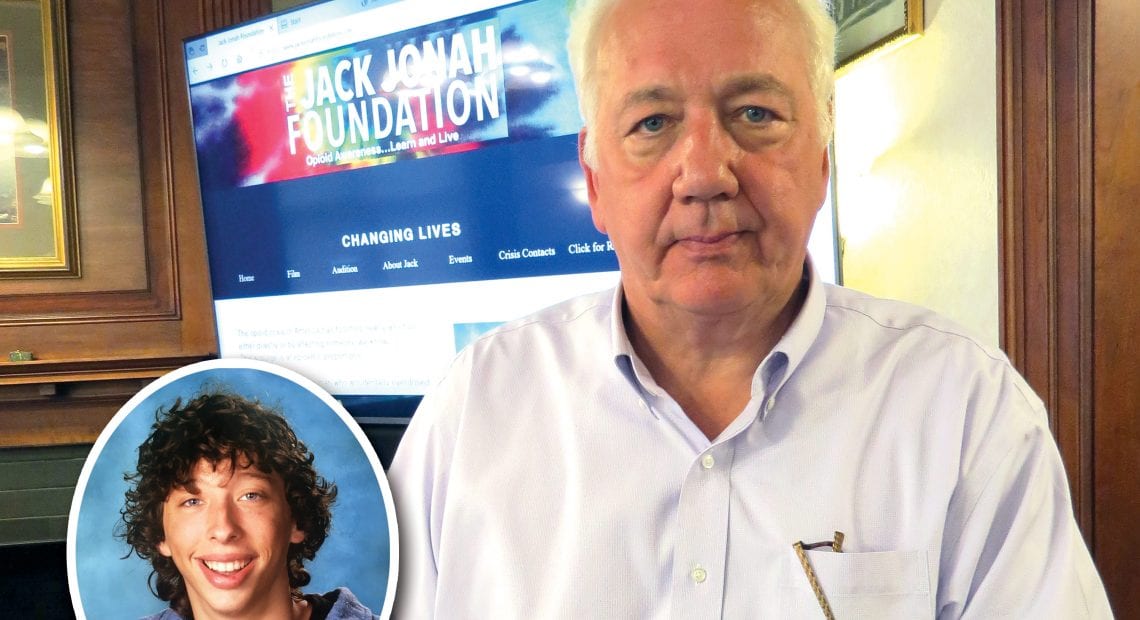
Kirk Jonah has devoted himself to making sure fewer families must suffer the kind of tragedy his did — the death of his son Jack (inset) to a heroin overdose in 2016 at age 19.

Kirk Jonah doesn’t rely on a set script when he gives one of his talks; he’ll vary the message to the setting and the audience.

But generally speaking, he’ll wrap things up the same way, especially when he’s speaking to young people.

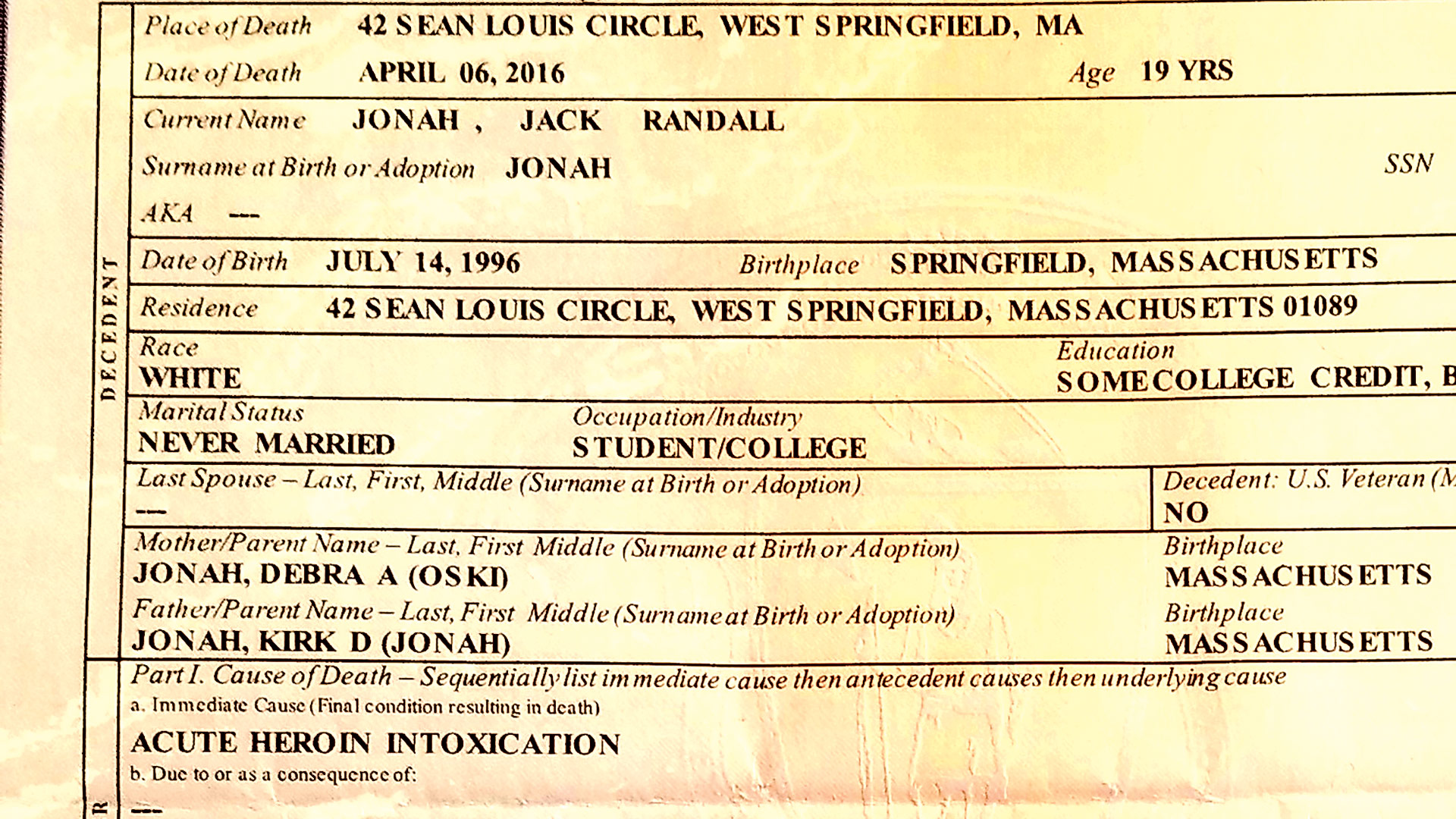
He puts up an image of a form. He’ll usually ask if someone knows what it is, and often, someone will offer that it’s a birth certificate. He focuses in closer with the next PowerPoint slide, and it becomes clear that is instead a death certificate — one for his son, Jack.

Then he focuses in even closer on the ‘cause-of-death’ line and the words ‘acute heroin intoxication.’ “I tell them, ‘this is what you get, as a parent, five or six weeks after you bury your child — a death certificate,’” he told BusinessWest.

And he leaves the image there for a few moments — usually to very dramatic effect.

Jonah started giving these talks not long after Jack died of that overdose in April 2016. He says he probably averages one a month now, although the talks frequently come in spurts. And, as noted, the audience varies. Often, it’s young people, but sometimes it’s parents. And at other times, it’s a mix of both.

He talks about Jack — his life as well as his death — but he also makes a point of talking about survivors, those who are fighting addiction, to show there is a path to a better life.

Overall, he talks about the choices people have to make and the need to make smart ones (much more on this later). There are three themes — honor those who have died, educate people about those choices to be made, and support those who are fighting the fight. Honor, educate, and support.

And if there is an overriding message, it’s that everyone, that’s everyone, has to do all they can to prevent more parents, more families, from being mailed a death certificate like the one sent to the Jonah residence.

Today, he’s presenting this message and those themes on platforms far beyond the podium. Indeed, Jonah and his family — wife Nini, son Dan, and daughter Karlye — have created the Jack Jonah Foundation, which this spring staged its first fundraising walk.

Jack Jonah, far right, with his siblings, Dan and Karlye, and grandmother, Anita Barrett.

It netted more than $70,000 in contributions that will be distributed to nonprofits helping to wage the fight against opioid abuse, but it much more than that. It brought more than 1,000 people together behind a cause that has too often been relegated to the background because of the stigma against drug abuse.

And soon, there will be a movie about the Jonah family and its work, to be undertaken by JCFilms, a maker of family-friendly, faith-based narratives; the working title could also be called the unofficial mission of the recently formed foundation — Jack Jonah: Making Courage Contagious.

Dean Cain (Lois & Clark: The New Adventures of Superman, Out of Time, Rat Race, and, more recently, a host of JCFilms productions) has been cast in the role of Kirk Jonah, and other roles will be filled soon. In fact, a casting call was issued, and auditions were held on July 20 at West Springfield High School. The poster declared there are more than 13 adult roles, more than 25 teenage roles, and 200 background actors.

“This is not a biography; it’s not a chronology,” said Jonah. “It’s about Jack, and it’s about our family, but there will be a lot of moving parts; it’s an opportunity to engage people in fighting this epidemic.”

For this issue, BusinessWest talked at length with Jonah about the film, the foundation, and the sum of his efforts to prevent more tragedies like the one that befell his family.

Bitter Pills

Jonah recalls the short conversation as being somewhat odd.

A friend with the West Springfield police called and told him he needed to get home as quick as he could. But he didn’t say why.

Upon arriving, Jonah, who theorized it might have something to do with his alarm system, was told why. His son had been found dead in his room with hypodermic needles around him. Jonah had to take the police at their word because his room was now a crime scene and he was not allowed in.

“The room was locked off — there were police officers at both stairwells,” he recalled. “I called family, they started coming to the house, and we sat in the kitchen while the coroner came and went up to the room, and then the body was taken out of the house; we were not allowed to see any of it.”

Thus, Jack’s death became the latest in an epidemic of fatal overdoses rocking this region and this nation. This one was a little different, though.

Jack’s family had absolutely no idea he was using heroin. None whatsoever.

Kirk Jonah ends most of his talks by putting his son’s death certificate on the screen and focusing in on the ‘cause of death’ line.

“We didn’t see any signs,” said Jonah. “A lot of people who have come up to me over the years have said that a loved one had been fighting addiction for five years or 10 years and they had gone through a lot of difficult moments. We didn’t have that with Jack — we were completely surprised.”

The basic reason for this surprise was all the good that was going on in Jack’s life in the months and years leading up to this tragedy, none of it really consistent with heroin addiction.

“He was going to HCC [Holyoke Community College] and was dean’s list,” Jonah explained. “He was deciding what he wanted to do, and he had kind of narrowed it down to working with animals — he worked at Boston Road Animal Hospital, where he assisted surgical vets — or the medical field, like nursing.

“He was very artistic,” he went on, adding that Jack created a self-portrait in charcoal that hangs in the family’s living room. “He played guitar, he played the piano, and he was also involved in drama — he did some acting and was involved with other students in writing a play called Labels. He was fiercely loyal to his friends and family, and he was just a great kid and a wonderful young man.”

To this day, Kirk Jonah still doesn’t know when or how his son became hooked on heroin. Since Jack’s death, no one has come forward with any information that might help him solve that puzzle.

But in most all respects, it doesn’t matter. What does is that someone died of a heroin overdose. And Jonah, with the help of his family and a very supportive employer, Holyoke Gas & Electric, has dedicated himself to saving some of the lives that might otherwise be lost to drug addiction and overdoses.

When asked how this work began and why, Jonah started by referencing the many sleepless nights he was experiencing after his son’s death.

“A person said to me, ‘that’s Jack and God speaking to you — listen to them, open up, invite them in,’” he recalled. “So I said, ‘OK.’”

He said he was asked to speak at Holyoke Mall at an event called “Living in Plain Sight,” put on by the CARE (Collaborative Accountability Reaches Everyone) Coalition of West Springfield, and from there, the requests have multiplied.

He’s spoken at events ranging from assemblies at area schools to a gathering at Baystate Noble Hospital to Mercy Medical Center’s annual Caritas Gala; Channel 57 recently made the family’s story the basis of an episode of its Connecting Point show.

“People just kept reaching out to me asking me to speak,” he said, adding that he now gives about a dozen talks a year.

Talking Points

As noted earlier, his presentations vary in their specific talking points, depending on the audience.

When he’s talking to the those who have suffered a loss like his, he has some poignant thoughts on coping, advice handed down from his grief counselor.

“I tell them, ‘you’re going to be sad every day, but don’t make it all day — make it part of your day,’” said Jonah, who can tell you at any moment how many years, months, and days it has been since his son’s death. “I say, ‘manage it as best you can; that’s what I do.’

“I have this imagery vault, and I’m the only one who has a key,” he went on. “I open that vault every day, and I take out that sadness; it’s overwhelming. Sometimes it can last 10 minutes, sometimes it’s 30 minutes, sometimes it’s longer. But then you take this sadness, put it back in the vault, lock it, and say, ‘I’ll see you tomorrow.’”

In all cases, though, Jonah’s talks come back to choices, and the need to make smart ones.

These choices come in all varieties, he went on, from young people deciding whether to pop a few prescription pills while at a friend’s party to adults deciding how to store and dispose of such pills, to the friends of those who are abusing drugs deciding whether to intervene and tell the parents of such an individual.

“In a lot of cases, it starts with prescription medication,” Jonah said of heroin addiction. “It might be at a party, and they took their parents’ prescription pills,” he said. “One person gets addicted, and the other one doesn’t; you don’t know which one you’re going to be, and that’s why you have to make smart decisions.”

He also encourages people to speak up, as difficult as that might be in many situations.

Specifically, he often relates the story of one young person who did speak up and told his parents that his brother had a problem that needed to be addressed.

“This person called his parents, and they said, ‘OK,’ and they started watching for signs,” said Jonah. “When they found their son overdosed, they had Narcan, and they revived him; he’s now been clean for many, many years.

“I say to the kids, ‘how do you think that brother who was doing the heroin felt when his brother spoke up?’” he went on. “They all say, ‘not good.’ I ask, ‘how do you think he feels now?’ They’re best friends.”

He also relates the story of someone who didn’t speak up about an individual who eventually died of an overdose. “And I ask them, ‘which one are you going to be?’”

And, as noted, he finishes with that death certificate.

“I say, ‘when you leave here today, you may remember Mr. Jonah, or you may not; you may remember Jack, or you may not,’” he said. “‘But when you’re out in the world and you’re faced with a challenging decision, think of that death certificate, and hopefully it will give you the strength and confidence to make the right decision.’”

The talks were followed by a website, a logo, a Facebook page, and, eventually, the foundation, a 501(c)(3), all of which came about through the help of a number of supporters, said Jonah, adding that the film, production of which will begin next month, is the latest platform for telling the story.

The short informational piece on the Jack Jonah Foundation website pretty much tells the story about why the film is being made and what those behind it hope to accomplish.

“Jack Jonah was an extraordinary teen with real dreams and a bright future,” it reads. “On April 6, 2016, that ended, and he quickly became a statistic.

“Will you join this project to challenge teens in the community and communities around the country to be courageous in speaking out against drug usage among teens?” it continues. “This is bigger than just a film about Jack’s life; it’s about his voice being echoed throughout this film to save lives.”

In a nutshell, that’s what Kirk Jonah’s talks, the website, the foundation, and everything else are all about.

Inspiration that Lives on

Jonah told BusinessWest that he reaps many rewards from his ongoing work. The most important to him are the comments from those who approach him after one of his talks, at the fundraising walk, or just on the street.

Parents have told him that he has inspired them to become more open about a child’s problem and not be caught up in the stigma of drug abuse. Young people have told him that, because of his words, they have intervened in an effort to help a friend, or plan to.

In short, he believes he is creating some progress in an ongoing war against opioid addiction — progress that will hopefully translate into fewer people getting a death certificate like he did.

And he gives all or most of the credit for this progress to Jack, and the way his story continues to move others.

George O’Brien can be reached at [email protected]