At the Soldiers’ Home, She’s a Nurse, Leader, Mentor, and Role Model
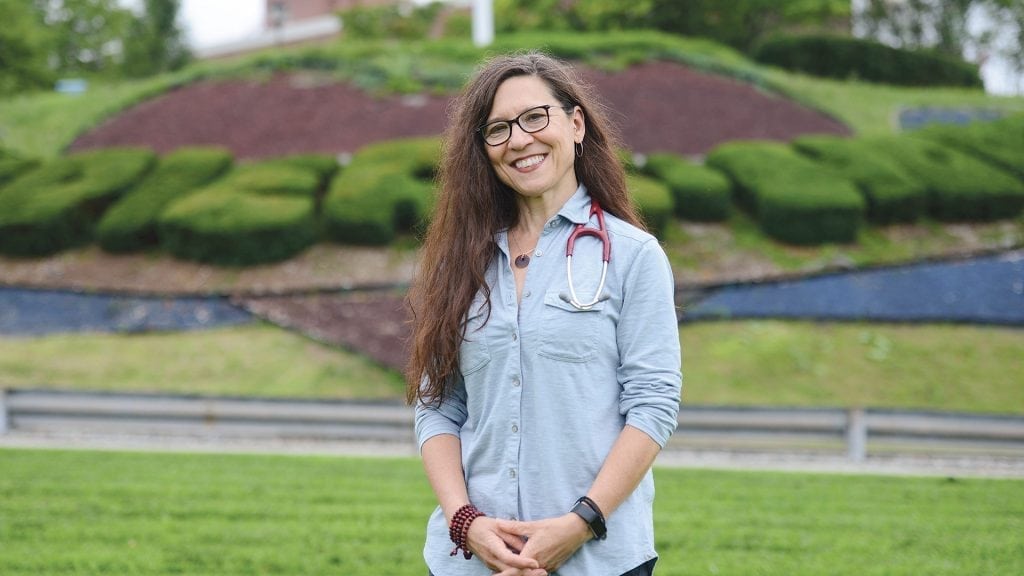
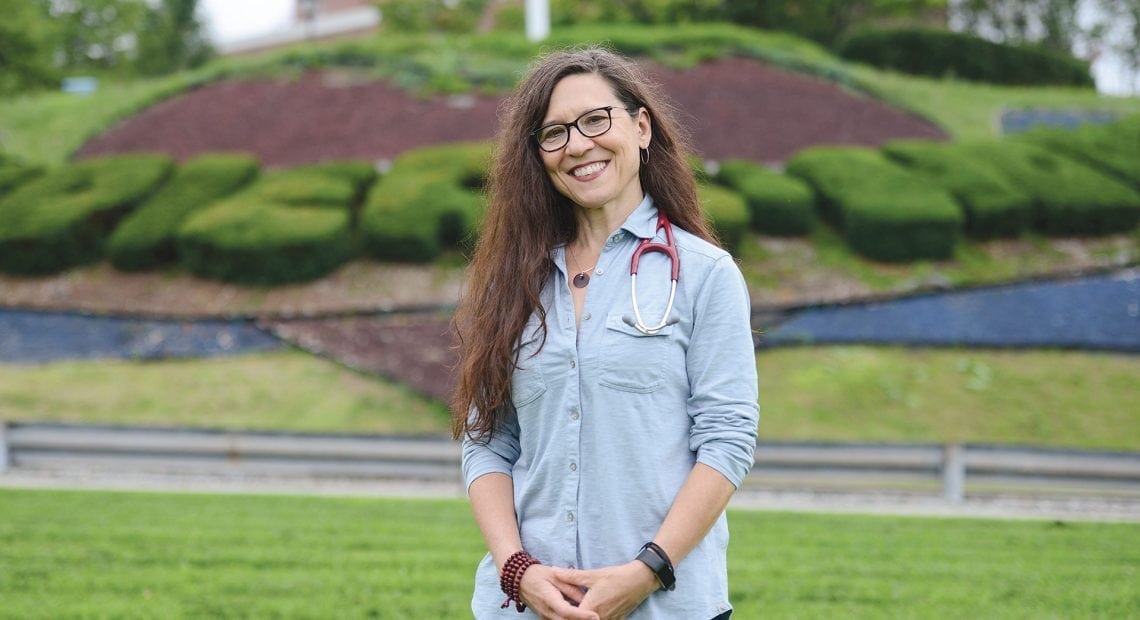
Celeste Surreira
Celeste Surreira was talking about her work, and, more specifically, the unique constituency she serves, when she abruptly stopped in mid-sentence.
Strains of “Anchors Away,” the fight song of the U.S. Naval Academy, had permeated the walls of her office, and she knew exactly what that meant: the Soldiers’ Home in Holyoke was giving a Navy veteran a ‘farewell.’
Rising from her seat quickly, she invited BusinessWest to follow her to what she promised would be a solemn and immensely powerful ceremony. That was an understatement.
In the front lobby of the Soldiers Home sat a casket covered by a quilt, patterned specifically for a Navy veteran, that was made by one of the facility’s nurses. Behind it stood many family members. To the sides were Soldiers’ Home staffers, who, in many respects, are also ‘family’ for this individual — and all other veterans who come there.
Collectively, they assembled, with hands over their hearts, and heard about his life — not just about his service in the Seabees (the U.S. Naval Construction Battalions) during World War II, but about his family (three sons, 13 grand-children, and “eight, soon to be nine” great-grandchildren); the decades he spent as a commercial painter (he and his father helped paint the Soldiers’ Home when it first opened in 1952); his love for Holyoke, his long-time home; his affection for golf; and more.
Then came “Taps.” And many tears.
Walking back to her office, Surreira put the ceremony in its proper context, and in so doing helped explain why she came to the Soldiers’ Home in 2014 and why she is so passionate about the many facets of her work that she was named the Healthcare Hero in arguably the most competitive category — Health/Wellness Adminstrator/Administration.
“They go out the same door they came in — it’s our honor to them,” she said of the servicemen and women being given a farewell. “And that’s very important. When I worked in the hospital, death was something we hid, like it was like a failure; they [deceased patients] went out the back door. Here, death is a celebration of life; there’s no shame. They go out the front door.”
“When I worked in the hospital, death was something we hid, like it was like a failure; they [deceased patients] went out the back door. Here, death is a celebration of life; there’s no shame. They go out the front door.”
Surreira would speak often about the veterans she now serves as she talked about her career and her current work, because the clientele, if you will (they simply call them ‘veterans’ here), is truly unique, and this is reflected in everything from how services are delivered to how these individuals are addressed.
“I thought this was a really interesting population to have the honor to work with,” she said, adding that the Soldiers’ Home, a 265-room, long-term-care facility (which also has outpatient services and a domiciliary), represents a significant career shift for her, with most of her 33 years in nursing having been spent in the emergency room. But in many ways, the issues and challenges facing veterans at the facility and the providers caring for them mirror those of society in general as the population ages and people live longer.
“This is where healthcare is going,” she told BusinessWest. “The population is living longer with chronic diseases. This is the population with which we’re really going to have to make an impact if we’re going to manage the needs of the overall population over the next 30 years.”
In her role as assistant director of Nursing, Surreira has a lengthy job description, and considers herself — and, more to the point, she’s considered by others — to be a care provider, leader, teacher, mentor, and role model.
And she takes each of those responsibilities very seriously, especially the leader and role-model parts.
“Leadership and management are two different things,” she told BusinessWest. “You can manage, which means doing payroll or doing a schedule or telling someone what to do. Or you can lead, which to me means inspiring people to become leaders.
“You can’t lead if you don’t have emotional intelligence,” she went on. “People are just going to see you as the boss. And no one really follows the boss; they’re not inspired by bosses. I’ve always said, if you have to tell someone what your title is in order for them to know you’re the leader, then you’re not really the leader — someone else in the room is the leader.”
One of Surreira’s working definitions of a leader is that of an individual who can work with others to achieve positive change and improve quality of life for those being served, and as we’ll see, there are many examples of how she’s been able to do just that, and thus become a true Healthcare Hero.
Walking the Walk
They call it the ‘Walk Across America.’
This is a walking track of sorts at the Soldiers’ Home, located just outside the facility’s rehab area; 22 laps equals a full mile. There’s a mural covering a few hallways depicting different places across the country, hence the name, said Surreira, and different administrators are actually assigned to certain veterans to walk with them across America on days the veterans choose themselves.
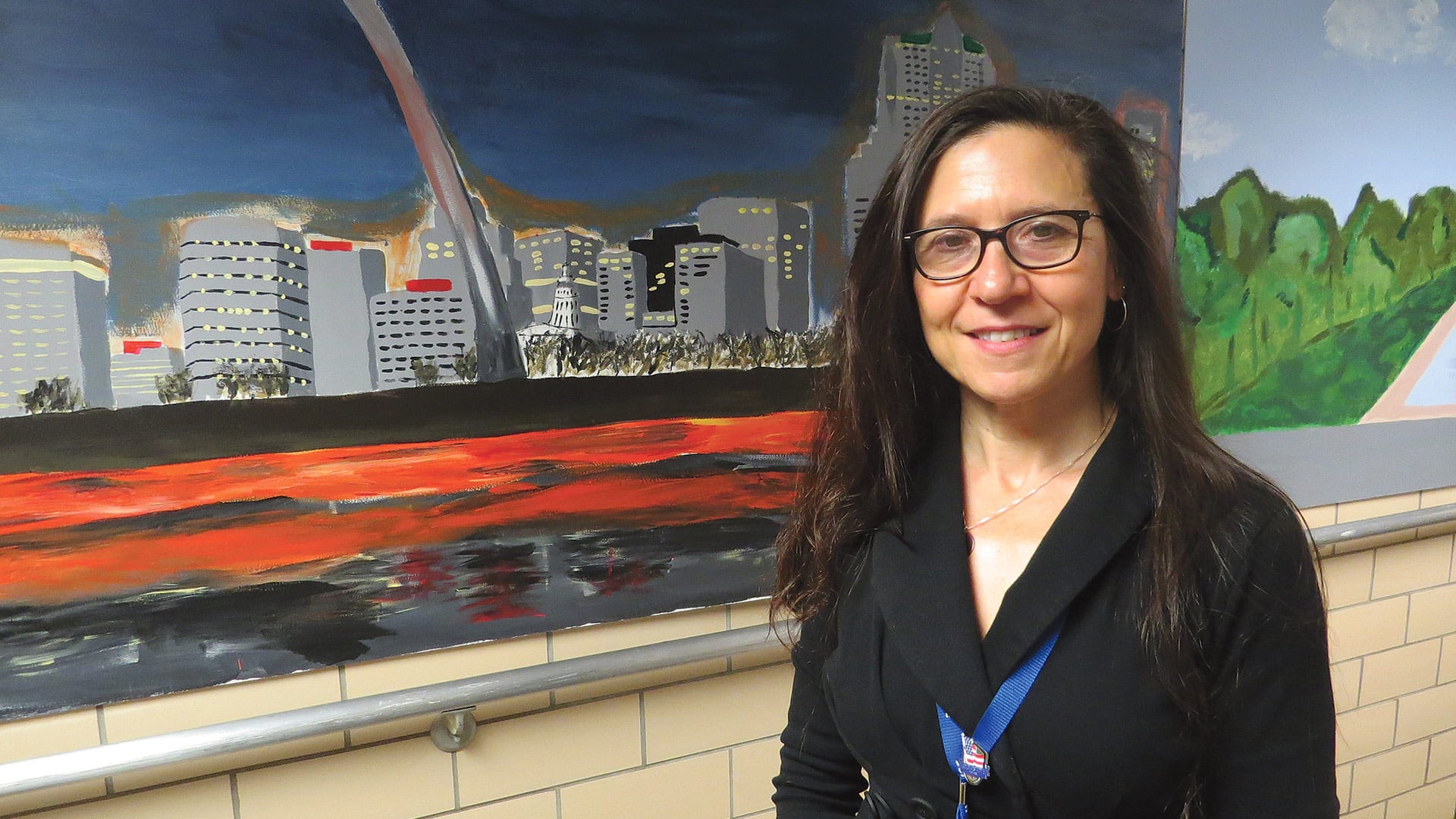
Celeste Surreira says the Walk Across America (that’s the St. Louis panel within the mural behind her) is one of many initiatives aimed at improving the mobility of veterans at the Soldiers’ Home in Holyoke.
The track is one of several ‘places to move,’ as Surreira calls them, that have been created in recent years as part of a broad effort to enhance the mobility of the veterans at the Soldiers’ Home and thus improve quality of life and actually reduce the rate of falls.
As with most all initiatives at this facility, this was (and is, as such work is ongoing) a team effort — actually a team with several smaller teams within it, such as the one assigned the task of creating places to move, she told BusinessWest.
The Walk Across America is just one example of that positive change and improvement in quality of life mentioned earlier that Surreira has helped orchestrate since arriving at the Soldiers’ Home in 2014.
She had been working just outside Atlanta as an interim director of Emergency Services at Rockdale Medical Center, and was looking to return to Western Mass., where she spent much of her career.
Indeed, she started in the emergency department at Ludlow Hospital in 1985, then spent more than two decades at Mercy Medical Center, starting as an staff RN and eventually advancing to manager of the Emergency Department. Earlier this decade, there was a short stint as administrative director of Emergency Services at Cooley Dickinson Hospital.
“I was looking at different positions up here, and I received a call regarding an opportunity at the Soldiers’ Home,” she recalled. “They were looking for a leader, someone who could come in and do some mentoring on leadership, and it sounded very interesting; it was a real change of pace for me to go into long-term care as well as geriatrics, but given my interest in leadership and veteran healthcare, a chance to work clinically, and all those things coming together, I thought that it would be a good opportunity for a change.”
And to work with an older population (most of the veterans are in their 80s and 90s) that, as noted earlier, reflects some of the larger, more complex issues facing all those in healthcare — specifically, not only caring for older individuals, but also helping them maintain independence and a high quality of life.
“Our focus is truly on how to promote a good quality of life for these older veterans,” Surreira explained. “We have 94- and 95-year-olds living very well.”
With this broad goal in mind, Surreira has created, and serves on, a number of process-improvement teams working on such matters as reducing the use of anti-psychotic medications, lowering the rate of falls, improving mobility, medication safety, and many others.
And as these teams address each of these areas, they do so with quality of life in mind, she said, using reduction of falls as an example. This could easily be accomplished by reducing one’s mobility, so he or she doesn’t get into positions where they can fall, Surreira went on. But this doesn’t equate to a high quality of life.
“This is where healthcare is going. The population is living longer with chronic diseases. This is the population with which we’re really going to have to make an impact if we’re going to manage the needs of the overall population over the next 30 years.”
“What we don’t want to do is promote the use of things like restraints and alarms, because they don’t allow people to move and self-propel,” she explained. “So what we try to do is advise them of safety and encourage their mobility; we want people to move, we want to take them for walks, we want to do everything we can to promote mobility while also reducing the risk of getting hurt from that fall if you do fall.”
To accomplish all this, Surreira leads the so-called ‘enhancing mobility team,’ which consists of several departments, including nursing, rehab, social work, facilities, and pharmacy working collaboratively to implement evidence-based interventions that will enhance mobility and reduce falls. This team has implemented a series of policies and procedures, including the introduction of a daily ‘fall huddle,’ interdisciplinary rounding, quarterly mobility screens, individualized care plans that include mobility goals, and regular review of polypharmacy.
As a result, the Soldiers’ Home has seen a confirmed reduction in fall-related injuries and a noticeable increase in the mobility of its population.
Taking the Lead
As noted earlier, Surreira’s position comes with a lengthy job description and list of responsibilities. And only a portion of them actually apply to the veterans being served.
The rest have to do with those other functions (for lack of a better term) that she carries out, including that of being a leader, a mentor, and a role model. Her ability to be all those things is a big reason why she was hired — and her desire to continually build upon those skills and add new layers to already considerable amounts of experience explains why she took it.
As she talked about being a leader, for example, she equated it to parenting.
“You mess up a lot, and then you learn how to be a better parent; it’s the same with being a leader,” she explained. “I think I’m a different leader now than when I started this journey, because it’s very humbling.”
Elaborating, she noted that one of the things she’s learned over the years is the importance of active listening.
“In order to hear the person, you can’t be thinking about your response already,” she said, citing a mindset held by all successful leaders. “You have to be totally focused on what they’re trying to tell you.
“You also need emotional intelligence, which means taking the time to know where that person is coming from and be queued into what they’re trying to communicate to you,” she went on. “Often, I tell people, ‘it’s not what they’re saying, but what they’re not saying; it’s not the words they’re saying, necessarily, but how they’re saying them. They may be saying something, but that’s not what they’re meaning or even intending.”
Surreira said mentoring takes place in many ways and on several different levels in her work at the Soldiers’ Home, including the formal teaching she does on subjects ranging from leadership to role-modeling.
“Mentorship from a leadership perspective takes place in a number of ways,” she explained. “Sometimes it takes place in just day-to-day interactions where you have opportunities to have a conversation with someone, provide someone with feedback … it’s all part of relationship building with those folks. Other times, it is more formal, such as the teaching I do.
As for the role-modeling, well, that part of it can really only happen as one adds layers of hands-on experience to their résumé, learns from previous mistakes, and develops a high degree of that necessary ingredient known as emotional intelligence.
“Even though someone may be handling a situation in a certain way, you can role-model a different way — that’s probably the most powerful thing to do,” she explained.
As an example, she cited a situation where there’s conflict going on and the discussion among individuals is getting quite heated.
“Managing yourself is probably the most important thing in those situations,” she said. “You manage your own reactions — the louder other folks may get, the quieter you get; the faster they talk, the slower you speak.
“Overall, mentoring involves building relationships and inspiring trust,” she went on, adding that ‘leading by example’ isn’t a formal line on her job description, but it’s a duty she carries out every day.
Waves of Emotion
Walking back to her office from the Navy veteran’s farewell, Surreira said the Soldiers’ Home obviously conducts many of these ceremonies. “Sometimes there will be two or three a day, and sometimes we’ll go a week without one,” she said, adding that, like most staff members, she tries not to miss a single one.
That’s because, as she said, at this facility, death isn’t something to be ashamed of; it’s not a failure. It’s part of a life being celebrated.
And improving the overall quality of that life has become the focal point of each individual and each team at the Soldiers’ Home.
Surreira’s leadership, mentoring ability, and passion for being a positive role have not only played a pivotal role in all this, they’ve made her a Healthcare Hero in administration.
George O’Brien can be reached at [email protected]