A Bumper Crop of Perseverance

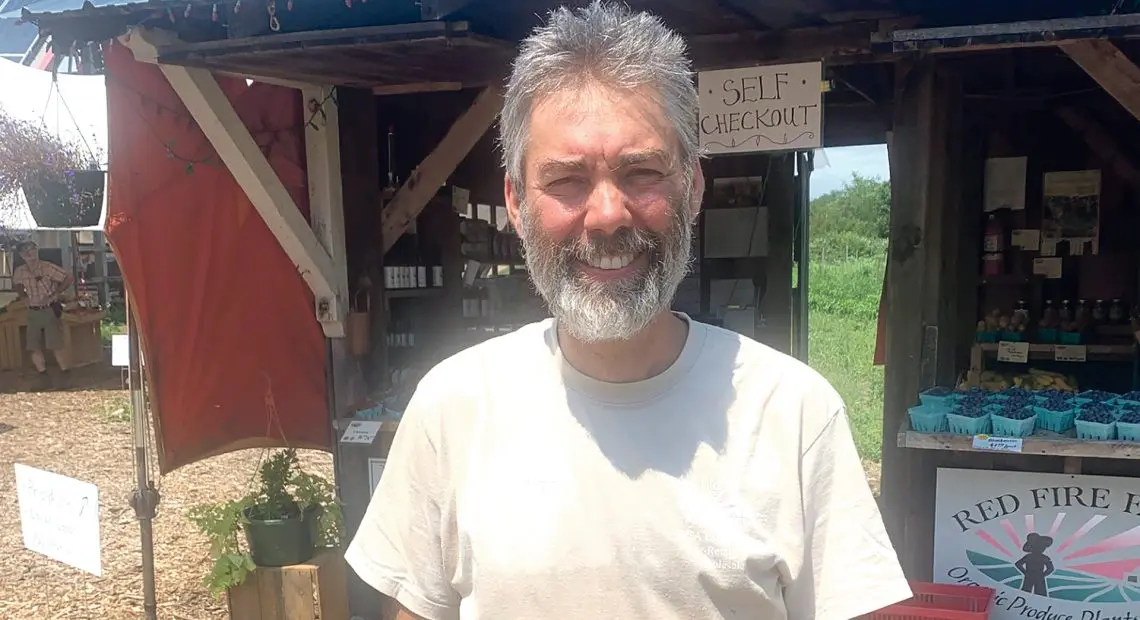
Farm co-owner Ryan Voiland
Ryan Voiland doesn’t mince words when he talks about farming and whether it makes good economic sense to be in this sector.
“If I was a smart businessperson, I’d be out of this business,” he said, referring to agriculture in general but especially community-supported agriculture, which isn’t seeing as much support as it once was. “Most other people you talk to would not put up with the type of financial risk and lack of financial rewards that seem to be opening.”
But he kept going, and in poignant fashion.
“It’s a labor of love. We do it because it’s something that’s really important for the world — having food that’s grown nearby, especially fruits and vegetables. We do it because we want to be part of that solution.”
“If I was a smart businessperson, I’d be out of this business.”
He was saying this a few weeks back, but he’s been talking this way for some time now — and certainly long before the historic barn that served as home to the farm store for the Red Fire Farm’s operation in Granby — there is also a farm in Montague — burned to the ground in February.
The fire, which destroyed much more than the barn and farm store itself (more on that later), was only the latest in a series of challenges that have hit this operation hard. Last summer’s torrential rains, other forms of extreme weather, and the decline in interest in CSA co-ops are also on the list.
The fire was an especially devastating setback, one that prompted some deep introspection and hard talk about actually getting out of this business. But Voiland and his wife, Sarah, decided to stay in because this is, as he said, a labor of love.
Nothing since the fire has been easy — nothing before the fire was easy, either, but there are now new layers of challenge — but the Voilands, with some support from the community, have persevered, and, well … made do, as they say.

The fire that broke out in the morning of Feb. 17 destroyed much more than the Red Fire Farm store.
They have created what they call a temporary farm store comprised of an old farmstand from Montague (the one with which Voiland got his start more than 25 years ago), which was transported to Granby; a new, smaller shed donated by the Massachusetts Federation of Farmers Markets, with two more still to be constructed; and a large tent. And they are making progress with efforts to create something suitable for the fall and winter in a portion of the space under a large solar installation that sits in front of a structure, still under construction, that was designed for the washing and packing of produce and will eventually assume that use.
But the long-term plan calls for building a new, modern farm store just a few hundred yards down Carver Street at the site of a vacant, dilapidated home in a corner of one of the Red Farm fields.
“It’s a labor of love. We do it because it’s something that’s really important for the world — having food that’s grown nearby, especially fruits and vegetables. We do it because we want to be part of that solution.”
Efforts to make these plans reality are complicated by soaring construction costs and insurance settlements that don’t come close to the actual cost of replacing not only the structure that was lost but all that was in it, Voiland said.
So the hopes for reconstruction are contingent upon receiving grants from various sources, he went on, adding that applications have been filed, and the Voilands are now awaiting word.
In what appears to be the best-case scenario, work on a new facility could begin this fall, he said, noting that the farm is dependent on those grants to move ahead and will essentially have to wait for some form of assistance.

Plans to replace the barn (pictured) lost to fire in February has been complicated by rising construction costs and insurance issues.
For this issue, BusinessWest talked at length with Voiland about the fire, the ongoing efforts to recover, the plans for the future, and how this experience has only hardened the resolve of all those at the farm.
Sudden Destruction
Voiland was working at the Montague facility when he got that dreaded phone call mid-morning on Feb. 17.
A staffer in Granby, one of the few working during the slow time of the year, was telling him that the 100-year-old barn that had come to symbolize the property, and the Red Farm operation, was on fire.
It’s a 45-minute ride from Montague to Granby, and by the time Ryan and Sarah arrived, Carver Street, where the farm is located, was blocked off for a third of a mile in both directions.
“By the time we managed to walk to the property, the barn was 75% gone,” said Ryan, adding that there was little they could do but stand, watch fire crews from Granby and several nearby communities fight the blaze, and start to think about the complex process of carrying on and then rebuilding.
And both have been even more complex than they probably could have imagined.
Indeed, as mentioned earlier, the barn was home to much more than the farm store, and its loss impacted every aspect of the operation.
“Most of the building was devoted to retail sales and to our CSA distribution space, but there were also wings in that barn,” he explained. “We had a wing where we cured and stored garlic. We had several spots where we parked tractors, so now all our tractors are homeless. The basement of that barn was used for storing irrigation equipment; we had tools in there, supplies, and machinery, such as a drop spreader for spreading fertilizer and an orchard sprayer.”
Matters have been further complicated by insurance issues, he added.
Slicing through them, and simplifying them as well, Voiland said his carrier has essentially indicated that the property was insured for $300,000, a number he said doesn’t cover the replacement cost of the various forms of equipment and supplies — including hand-painted signs providing directions to those looking to pick their own produce — that were stored in the barn and its cellar, let alone the cost of rebuilding.
Indeed, he said estimates he’s received from several builders have put the cost of building a new, 6,000-square-foot barn and farm store at $1.5 million on the low end, and $3 million on the high end.
“The price of construction has gone up, even since we updated the insurance policy,” he said, noting that this was maybe five or six years ago. “And in that time, COVID happened, and we’ve had all those supply shortages, some of the many reasons why construction costs have gone through the roof.”
Which explains the reliance on grants to rebuild, he said, adding that a GoFundMe campaign started soon after the fire raised more than $200,000, some of which had to be used to immediately replace supplies and equipment so business could be conducted this season.

Red Fire staff members pose in front of the historic barn around Halloween, during decidedly better days.
The rest went into savings, he said, adding that this money, and whatever can be garnered from insurance, will be used to match outside grants needed to fund new construction.
“We hope to be able to put all that together and get a budget for building something new that’s at least $1 million to a million and a half,” he said, adding that he hopes to avoid having to finance a portion of the project.
An application has been filed with the state’s Food Security Infrastructure Grant program, said Voiland, adding that Red Fire has previously received a grant from the program to help fund construction of its packing facility.
Red Fire is also applying to a federal Rural Energy for America program for a grant that would fund construction of a solar-array-topped carport on the site of the destroyed barn, a facility that would provide not only more solar power for various farm operations, but a space under which to park tractors and other equipment.
Lettuce Rebuild
The cellar hole is all that remains of the 6,000-square-foot barn, made of chestnut, and a replacement for a barn that stood on that same site and was destroyed by fire started by a lightning strike in 1922.
Voiland acknowledged that the operation’s name is a double entrende of sorts, a nod to both the 1922 fire and the red fire variety of lettuce he cultivates, one of myriad vegetables and fruits grown in Granby and Montague.
But history will not repeat itself here, he said, adding that, for several reasons, it makes more sense to rebuild down the road, in the corner of a 25-acre field, then it does on the original site.
Doing so would relieve congestion on that site, provide more parking, and separate the farm activity from the farm store, he explained, adding, again, that if all goes well, ground could be broken before the ground freezes.
Plans are being drawn up for a facility that won’t have any of the history or “majesty” of the destroyed structutre, he noted, but will be more practical in many ways, and more efficient.
“It was designed as a hay-storage barn and livestock barn,” he explained. “And we had made a lot of changes and improvements to that barn to make it more suitable as a farm store, but it still had limitations. And if we rebuild, obviously, we want to rebuild for what we do, not what they did 100 years ago.”
In the meantime, the Voilands, Ryan’s father, Paul, and the team of roughly 75 (during the peak summer months) at Red Fire have been carrying on. It’s not business as usual, by any means, but business — in this case, a wide-ranging farm operation — is getting done.
The weather has been, for the most part (and unlike some recent years), cooperative, with generous amounts of rain — “borderline excessive,” as Voiland put it. “It’s been hot, but not excessively so.”
But there have been challenges, such as piecing together the temporary farm store and maintaining it. For example, strong winds toppled the large tent recently, and it took some time to raise it again.
Then there’s the challenge of doing the day-to-day — and there’s obviously a lot of that — while also handling everything that goes into the process of rebuilding, from talks with the insurance company to conceptualizing a new facility to applying for grants.
Finding the requisite hours in the day hasn’t been easy, but Voiland and others have somehow managed.
Yet, there are other, ongoing challenges, including a general decline in support for CSAs over perhaps the past decade or said, he said.
“There’s still an interest in local and organic and CSAs, but, unfortunately, the supermarkets have figured out how to brand things locally in a way that is sort of detrimental to the CSA farms,” he explained. “People think they can just go to the big-box store and get something that’s local, which is not necessarily true. It’s been a harder marketplace, especially the past five to 10 years, putting natural disasters and unexpected barn burnings aside.”
As Voiland said at the top, if he was a smart businessperson, he would probably be out of this business. But overriding his business sense is his passion for agriculture and giving area residents the opportunity to buy local.