Home Posts tagged Workforce Development (Page 6)
Departments

Weight Staff


Mark Archer, right, vice president of Del Padre Visual Productions (DVP) in East Longmeadow, recently experienced the rare thrill of weightlessness aboard G-Force One, a specially outfitted 727 operated by the Zero Gravity Corp. DVP was contributing HD video footage of the event for a documentary for Northrop Grumman’s “Weightless Flights of Discovery” program, in which teachers from around the country get to bring the experience back to their classrooms and promote excitement in science education.


Matthew Reyes, director of Technical Operations for Zero-G, giving Archer a hand in keeping stable while weightless.

Cigars Under the Stars

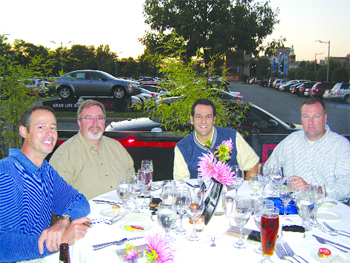
More than 50 cigar aficionados turned out Sept. 18 for a special night at Max’s Tavern called ‘Cigars Under the Stars,’ a name that pretty much tells the story of this event. At top, from left, are Mark Lauria of Rexel CLS, Dirk Kidwell of Kidwell Electric, and Vito Costantiello and Joe Lapuma, both of Rexel CLS. Bottom, from left, are Max Bichler of The Cigar Agency, Michael Lynch of Florence Savings Bank, Jeff Anderson of the Crystal Company, Karin Tranghese, owner of The Cigar Room, Bob Borawski and Dave Malek, both of Borawski Insurance, and Ken Salem, of Salem Board & Beam.

Marketing Vehicle

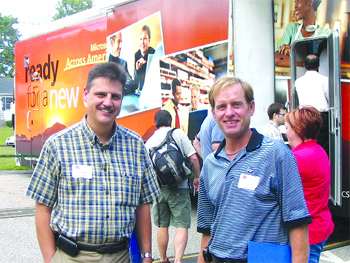
On Sept. 12, Innovative Business Systems Inc. of Easthampton hosted a Technology Showcase featuring many local and national vendors, highlighted by the Microsoft Across America Mobile Event Experience vehicle. Pictured are Joseph Parente, left, and Dan Grenier, both of Grynn & Barrett Studios.

Meeting of the Minds

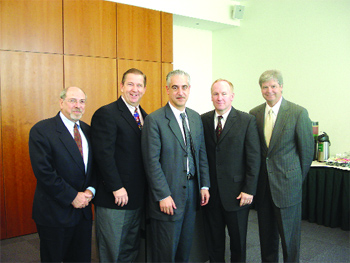
Modeling Change in Urban Communities was the first in a four-part planning series that will be hosted by Holyoke Community College’s Kittredge Center for Business and Workforce Development. At the Sept. 18 installment, urban policy experts James Stergios and Barry Bluestone put a magnifying glass to the struggles and triumphs that frame the experience of older industrial cities like Springfield, Holyoke, and Pittsfield. The two-and-a-half-hour meeting sparked some interesting discussion. From left are Bluestone, Holyoke Mayor Michael Sullivan, Stergios, state Sen. Senator Michael Knapik, and Allan Blair, president/CEO of the Economic Development Council of Western Mass.

Happy 20th

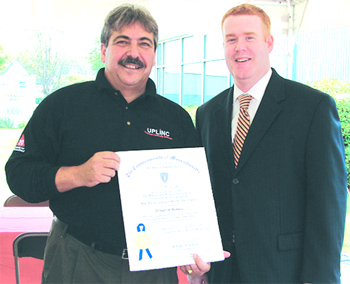
Ronald Marino, left, president of Uplinc, accepts a proclamation from state Rep. James Welch that recognizes the company on its 20th anniversary.

Physically and ‘Fiscally’ Fit Triathletes

More than 50 agents and employees of MassMutual and their families and friends recently participated in the Danskin Women’s Triathlon in Webster. Many triathletes participating in the race, which MassMutual sponsors nationally, raised money through pledges to benefit the Breast Cancer Research Foundation. MassMutual also hosted a pre-race ‘Pearls of Wisdom’ seminar, as it does in each of the triathlon series’ cities, to educate participants about ‘fiscal’ fitness. For each attendee, MassMutual donated $10 to the Breast Cancer Research Foundation. Last year, MassMutual donated more than $7,000 to the foundation as part of its involvement, and expects the total to be even higher this year.


Departments

New Director Chosen for Control Board

SPRINGFIELD — The Springfield Finance Control Board voted last month to appoint Stephen Lisauskas as its executive director, succeeding Philip Puccia, who resigned, effective July 19, to take a job with JP Morgan Securities. Lisauskas had previously served as deputy director under Puccia.

Gov. Patrick Eyes Workforce Priorities for Springfield

SPRINGFIELD — The Patrick Administration recently announced its partnership with the City of Springfield and the Hampden County Regional Employment Board to assess the workforce needs of the city to bring about greater economic opportunity. The workforce assessment will bring together employers as well as local community and business organizations to prepare an inventory of existing workforce development programs and activities to assess what skill sets are needed to fill the jobs of today and in the future. The Patrick administration will also work with city officials to secure funding as part of this assessment process. End goals include addressing the basic literacy of the city’s workforce by increasing public and private resources; establishing growth areas in key sectors, and better aligning economic and workforce development strategies. Administration officials also recently announced that the state’s 16 workforce boards, including the Hampden County Regional Employment Board, will play a stronger role in the approval process of state Workforce Training Fund grant applications.

Investors Hoping for Steady Interest Rate

WASHINGTON — Both food and energy costs nationally retreated in June, which boosted wholesale inflation to better than expected readings, while homebuilders’ confidence dropped to the lowest level in 15 years as the housing slump continued, according to several national reports. All of the positive findings — including industrial production being on the upswing — is good news at the Federal Reserve, since it indicates the recent acceleration in inflation appears to be abating. Investors hope that the economy’s current performance will result in the Federal Reserve staying the course on unchanged interest rates, thus giving borrowers a break until 2008.

Adjustable-rate Mortgages, Predatory Lending Attributing to Foreclosures

SPRINGFIELD — A staggering number of foreclosures across the region are being attributed to a slumping real estate market, adjustable-rate mortgages, and predatory lenders, according to officials from the Hampshire County and Hampden County Registries of Deeds. In Hampden County, foreclosures have doubled, from 278 in fiscal 2006 to 529 in fiscal 2007, while in Hampshire County, foreclosures rose by 78.8% to 59 in the fiscal year that just ended June 30. In Franklin County, officials note that foreclosures have also doubled, from 26 in 2006 to 60 in fiscal 2007. Foreclosure filings noted at the registries of deeds are actual foreclosures in which a lender has repossessed a property.

GSCVB Awarded Grant for Web Site Enhancements

SPRINGFIELD — The Greater Springfield Convention & Visitors Bureau (GSCVB) was recently awarded a $11,000 grant from the Massachusetts Cultural Council to enhance its Web site with additional information about cultural attractions in the region. The funds have been used to create a highly graphic landing page and add an electronic postcard component to the site. The site address is www.valleyvisitor.com.

First Five Floors of One Financial Plaza Sold

SPRINGFIELD — Eastco Realty Co. LCC recently purchased the bottom five floors of 1350 Main St., also known as One Financial Plaza, for $2.4 million, according to documents filed at the Hampden County Registry of Deeds. Daniel M. Eastman of Somers, Conn., is president of Enfield Enterprises, a construction firm based in the city, and is manager of Eastco Realty. The first five floors consist of approximately 103,000 square feet, and half is currently occupied by Sovereign Bank and offices. The top 12 floors were purchased earlier in the year by a group of local investors. The remaining floors comprise approximately 220,000 square feet. Both groups of investors expect to work together to bring in quality tenants.

Sections Supplements
HCC Celebrates 60 Years — and a Tradition of Perseverance and Innovation
David Bartley

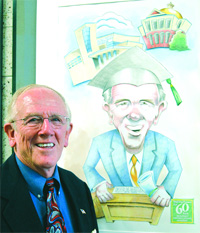
David Bartley, past president of HCC, poses with a caricature of himself, drawn as part of the college’s 60th anniversary celebration.

David Bartley, former president of Holyoke Community College, said the institution’s 60th anniversary, marked this year, has caused him to remember HCC’s past and look to its future, as well as the changes higher education has seen across the country.

“We used to run colleges with chalk and talk,” he said. “Today, there’s $100,000 worth of equipment in a classroom that has to be continuously updated, and that’s not ever going to change.”

It has indeed been a good month for reflection for both Bartley and HCC’s current president, William Messner, who took his post three years ago. The duo represents two-thirds of HCC’s history of leadership; its first president, George Frost, served from 1947 to 1975, then Bartley held that position until 2003.

“It’s a little daunting to be one of only three presidents,” said Messner, “but what I take away from this 60th anniversary is the overwhelming positivity surrounding the institution. Every individual I’ve talked to recently cites the college’s significant effect on their life, and so it is my job to take that legacy to the next level.”

From the Ground Up

Even with only three presidents in six decades, the college has indeed had a colorful run. It was founded in 1946 as Holyoke Graduate School, and in 1947 changed its name to Holyoke Junior College following state-level legislation that permitted municipal higher education programs to do so.

Frost was the college’s only full-time employee for six years, before Ellen Lynch was appointed his secretary. They shared an office in what was once the cloakroom of the old Holyoke High School building. Additional full-time employees — two full-time professors — were not hired for another five years, in 1958.

Frost called students personally with end-of-semester grades and announcements, and the school funded faculty salaries and operating expenses with tuition payments only — which were $6 per credit for Holyoke residents and $7 for non-residents.

In 1961, Holyoke Junior College moved from its temporary home in Holyoke High School to the former Elmwood Elementary School on South Street, where it remained for six years. In 1965, the institution joined the state community college system and changed its name to Holyoke Community College. Four years later, the college moved again to the Holyoke High School building, which by that time had been turned over to HCC following the construction of a new high school.

Less than four months later, however, disaster struck — the building went up in flames (the cause was thought to be a faulty ventilation fan in the attic), leaving nothing but a brick shell. Operations were returned quickly to the Elmwood Elementary School, and students missed only one day of classes. But a new threat soon surfaced.

With the newly opened Springfield Technical College (now STCC) only a few miles away, the Mass. Board of Regional Community Colleges backed a move to relocate HCC’s students to STC and forego building a new home for the former.

Remembering the fire and the precipice on which it placed HCC, Bartley quoted John F. Kennedy.

“Victory has 100 fathers, and defeat has none,” he said. “The fire in 1968 had a lot of people saying we only needed one college in this section of the Valley, and we did a lot of work to point out why we needed two. Now, there are two very successful community colleges in the area, and we believe we had our victory.”

Out of the Frying Pan…

Indeed, a group of Holyoke-based civic leaders, educators, and business owners formed the Friends of Holyoke Community College and lobbied to save HCC. Holyoke’s mayor at the time, William Taupier, and the president of the state senate, Sen. Maurice Donahue, a friend of Frost’s, were among those who supported the cause, and in 1969, a temporary building on the site of the fire had been erected.

Plans for a new campus were unveiled, and the current campus on Homestead Ave. was opened in 1974.

Frost retired soon after his so-called “final task” was completed, and Bartley took the helm, beginning his nearly three-decade-long career as HCC’s president. His first act at the post was to appoint his predecessor as founding director of the alumni association.

All of these stories, and countless others, were on Bartley’s mind this month, when the college celebrated formally with a number of community, civic, and business leaders from across the region.

“I was delighted that we were able to talk about the past, but the real key is the future,” said Bartley. “I think some of the challenges of yesterday are still there — the college has to keep abreast of developing curricula nationwide, and make sure courses are relevant to the industries of today.”

During his tenure, Bartley watched the advent of computer technology take a front-row seat in higher education. He said the adoption of modern modes of telecommunication went relatively smoothly at HCC, but it also marked a cultural shift on college campuses across the country that brought with it some new hurdles to clear.

“People understood it was necessary, or else the students would change and evolve faster than the curriculum,” he said. “We expanded the electronics offerings dramatically, while staying true to the basics.

“The college has always been current, but challenges revolve around funding new programs, and that’s not going to get any cheaper as time goes on,” he added. “Education is a slow and labor-intensive industry, and because its core product is the imparting of knowledge, it will always be that way.”

Messner agreed, noting that he, too, has seen some of those pervasive challenges shaping decisions at HCC, as well as a host of new concerns.

“Fifty percent of the work day is spent on resource development,” he said. “It’s no secret that competition for state dollars is becoming more acute, and we have to fill the gap some way.”

The college recently completed the Gift of Opportunity campaign to help close that gap, raising $5.2 million — $1.2 million beyond its goal. In addition, a number of programs are in place to capitalize on HCC’s existing strengths and address burgeoning challenges.

“We’ve been doing several things over the past few years to ensure that the quality of programming, and the education the institution has been known for, stays solidly in place,” said Messner. “We’ve needed to build the number of full-time faculty since that number eroded, primarily through attrition, between 2001 and 2003, when the state was suffering economically.”

He said that cutting back on faculty during tight financial times is a good short-term economic strategy, but has an adverse effect in the long term. Currently, the faculty has been boosted to represent the same numbers as in 2001, and as enrollment grows, further additions are planned.

“We’re filling about a dozen spots now,” he said, noting that lowering faculty-to-student ratios is just one part of a larger move to improve operations across the campus. “Another thing we’re doing a better job of is assessing how we are doing in general. We’re looking specifically at how new students are treated — we’ve been involved in a nationwide program called Foundations of Excellence, for instance, which provides support to institutions in assessing the freshman experience.”
Those initiatives are just two examples of an ongoing objective at HCC: to stay available to the community at large.

“The demographics in this area are changing dramatically,” said Messner. “Many individuals are coming to the region with a lack of education, or a lack of a tradition of education, both of which are intrinsic to a strong workforce. As the population has changed, we have needed to change our approach in terms of reaching out to these groups that are part of the community.”

Messner said a wide array of initiatives have been put into place to recruit students and enhance their college experience, ranging from an outreach program geared toward the Latino population to college programs for high school students, to introduce them to the campus and allow them to experience higher education early on.

“We’re also working with students who haven’t come through the high school pipeline and instead took the GED, and are looking for the next step,” he said. “We’re using the GED as a new pathway into HCC, and that’s an example of one strategy to make higher education more accessible.”

These initiatives, in turn, have two divergent goals: the provision of quality education for a diverse community, and the creation of a steady stream of both individuals and resources aimed at workforce development in the region.

One of the most notable developments in that regard was the $18 million Kittredge Workforce Development Center, which opened in 2006. The 55,000-square-foot, five-story building is home to the school’s Business Division and HCC’s Community Services Department, which offers many of the programs Messner spoke of, including GED preparation and testing and summer youth programs.

The center also hosts a number of economic-development and workforce-development-related agencies. These include HCC’s Center for Business and Professional Development, which offers a wide range of workforce-development services designed to assess employee skills, identify knowledge gaps, and conduct training to remediate deficiencies; WISER, home to the country’s leading database for international trade statistics, which relocated to HCC from UMass in 2005; and the Western Mass. office of the Mass. Export Center, will offers market research, export training, and international business development resources.

The center also features 4,000 square feet of conference/meeting spaces equipped with high-speed and wireless Internet, videoconferencing, and state-of-the-art lighting and projection. Messner said the center is an excellent example of new technology and modes of thinking taking HCC’s long-held strength in community, career, and resource development to a new, more relevant level.

“Workforce development has been a strength for 60 years,” he said, “and with the new business building, we can expand into a variety of programs that we didn’t have 20 years ago, and there will be even more opportunity for the students to move forward. Workforce development offerings have increased by 20%, and we’re just gearing up.”

Those programs, said Messner, are just one aspect of bringing a long-held mission at HCC forward into fast-changing times. Concurrently, both he and Bartley hope that some strengths at the college stay largely the same, serving as a foundation for further growth in the future.

Blaze of Glory

“I, for one, am appalled by lecture halls holding 500 people,” said Bartley. “No learning takes place, and that’s not what a community college does. It’s certainly not something I ever hope to see at HCC.”

Looking back on 60 years and looking ahead to the next 60, Bartley mused that today’s dynamic, computer-based presentations in the classroom and the cutting-edge technology of the Kittredge Center are developments that were necessary to bring HCC current in a fast-changing world.

But a little chalk-talk can still take an institution a long way — out of the fire, and into the fight.

Jaclyn Stevenson can be reached at[email protected]

Features
Springfield Chamber Leader Promotes Action, Not Talk
Victor Woolridge

Victor Woolridge has seen some inspiring turn-around stories in his travels, and he believes Springfield can be added to that list.

Victor Woolridge was busy gathering up the material he wanted to read on his flight to Buffalo, which was scheduled to leave in a few hours.

“I’ve had a lot of practice at this,” he told BusinessWest, noting that his job as managing director of the Real Estate Finance Group at Babson Capital Management LLC forces him to travel frequently. Name a city and he’s probably been there — often.

And in the course of all that travel, amassed through 27 years of work with MassMutual and its subsidiary, Babson, Woolridge has seen some inspiring turn-around stories.

“I’ve been to a lot of places that people had pretty much given up on,” said the Springfield native, listing sections of New York, Chicago, Baltimore, Washington, D.C., and other, smaller cities. “Years ago, people had nothing good to say or think about Harlem, but now it is the place to be. It’s the same with the inner harbor in Baltimore and on 13th and 14th streets in Washington. Not long ago, you wouldn’t walk down those streets; now, there’s a real renaissance going on there.”

Exposure to such success stories is one of the reasons why Woolridge, the recently elected chairman of the Springfield Chamber of Commerce, is optimistic about the prospect of adding the City of Homes to that list he offered. But he admits that there is much work to be done in a community that is recovering from near-bankruptcy, political scandal, and lots of bad press, and is just starting to see some momentum.

And as he assesses the challenges ahead for Springfield, Woolridge started by telling BusinessWest that he can see some direct parallels between what he does for a living — assessing high-yield investment opportunities for Babson — and his work with the Chamber and other groups trying to achieve progress in Springfield.

“In both cases, it’s about moving the ball forward,” he said, adding that, roughly translated, this means moving beyond the talk and actually getting things done.

“There is such a thing as analysis paralysis,” he said, referring to both the investment opportunities he and other members of the Real Estate Finance Group must weigh — and the many recommended plans of action for Springfield. “If you sit there and analyze all day long, you’re never going to get the deal. You have to get in there and put something on the table and advance the ball.”

And Woolridge says he’s seeing signs of that happening in Springfield.

Indeed, he told BusinessWest that, in recent months, he’s observed a change within both the Chamber and City Hall — a movement from talk to action that he intends to continue and accelerate.

Woolridge referred often to the recently completed Urban Land Institute (ULI) study of the City of Homes. The report lists a number of priorities, including downtown and the Court Square area, the South End neighborhood of the city, and the soon-to-be-vacant federal building on Main Street. As he begins his two-year stint as chairman of the Springfield chamber, Woolridge said one of his priorities is to help ensure that the ULI report becomes much more than good reading.

“Oftentimes, these reports sit on a shelf and gather dust,” he said. “We can’t let that happen in this case; there’s too much at stake for Springfield.”

In a wide-ranging interview, Woolridge talked about the Chamber, Springfield, some of those turn-around stories he’s witnessed, and what it will take to write one in his hometown.

Progress Report

Woolridge recalled one of his first meetings as an officer with the Springfield Chamber, and some comments he made then.

“I said, ‘everyone has obvious sympathy for the leper, but no one is willing to touch him,’” he remembers. “But every physician knows that for the sick patient to get better, someone has to touch him.”

Springfield was in many ways a sick patient at that time, he continued, noting that there was perhaps too much watching on the part of the Chamber and other groups in the city in the past, and not enough direct involvement, or touching. But this is a pattern he’s seen change.

“I’ve seen much more energy when it comes to the matters facing the city — not just talking about it, but strategizing, and saying ‘what do we do about it?’ and becoming a more active force in seeing these things happen,” he said. “On top of that, we’ve been discussing — we’re not there yet — how we can be better stewards or watchdogs over not just implementation of these things, but standards for how things get done so we don’t slide back into the kinds of problems we’re experienced over the past several years.”

Woolridge told BusinessWest that this greater willingness to touch the patient in recent years, an attitudinal change encouraged by his immediate predecessors on the Chamber, Mary Ellen Scott and Carol Baribeau; Mayor Charles Ryan; Economic Development Director David Panagore; and others, bodes well for the city.

That’s because direct action, not talk, is the only way to achieve progress with the many issues facing Springfield, including poverty, homelessness, public safety, economic development, workforce development, zoning, and creating a more business-friendly City Hall.

“We decided it was important to take a look at our zoning and procedures to make sure that they were competitive, streamlined, and that people understood them,” he said, adding that he helped initiate discussions with developers who compared and contrasted Springfield’s model with others to create a qualitative database for action. “Hopefully, at the end of the day, we’ll have a comprehensive set of zoning procedures so that people can track from A to Z how to get a transaction done in the city of Springfield.

“Our process was deemed to be not as friendly as other neighboring communities as well as other cities,” he continued, adding that he and others visited other cities to see how they handled things. “It just makes sense to try to fix the system, because if you save people time and money and make it a pleasant experience, then that gives you an opportunity for more business.”

Streamlining zoning codes and the overall development process is just one example of how city and civic leaders are progressing from talking about the patient to touching him, said Woolridge, adding that the ULI is certainly another.

The process of preparing the report gave people an opportunity to listen, exchange ideas, and, in many cases, vent, he said, adding that with the report in hand, the city and its leaders must do something with it, or else risk losing some of the momentum that’s been achieved.

“Some of the recommendations in that report need to be pursued,” he said, returning to his warnings on overanalysis that can stifle action. “This is an outline, a framework, that provides a direction; the best way to move is to take a step forward, do something, and do your analysis on the way to building a new city.

“You can’t analyze ad nauseum,” he continued. “You have to work the problem and figure it out along the way.”

Agenda Items

Woolridge told BusinessWest that he’s thankful for having two years as chairman at the Chamber; one is simply not enough time to finish some of the work started by others, let alone start and advance new initiatives.

Assessing priorities for the city and the Chamber, he said there are specific and general goals for both. With the Chamber, he wants to increase membership, improve visibility, and make the organization more directly involved with key issues. Also, he wants to continue working with the state Legislature on business-related measures, and with the Finance Control Board on its ongoing efforts to bring fiscal stability to the community.

As for the city, priorities include everything from poverty and homelessness to devising ways to make the community’s great ethnic diversity more of a cultural and economic asset.

“That diversity should be fully embraced and seen as a clear positive for the city,” he said. “Right now, it isn’t.”

Another issue to be addressed, he said, is the preponderance of affordable and subsidized housing in the city, at the expense of market-rate units that could attract more professionals to many neighborhoods and breathe life into the city’s downtown. There has been some quality single-family home construction in outlying areas of the city, he noted, adding that the next step is to continue this trend into the core of the community.

“We have to stabilize our economy by bringing in higher-quality real estate that attracts higher-income people to help lift the entire economic boat of the city,” he said. “If you continue to build poor-quality housing, then ultimately you end up with a city that’s full of poor-quality housing. And how then do you attract people of better means, if you will, into a community like that?

“It’s a domino effect,” he continued. “The tax base gets impaired because you don’t have a good balance between affordable and market rate, and when the tax base gets impaired the infrastructure is impaired, and your school buildings and other municipal facilities can’t get repaired; it’s a spiral downhill because you can’t generate enough tax base.”

Achieving a balance between affordable and market-rate housing is easier said than done, he acknowledged, adding quickly that he’s seen it done — in cities like Boston, New York, Chicago, and also smaller communities like Greenville, S.C. In those cities, developers have created 80/20 mixes that attract professionals (the market-rate component is the ‘80’) but without, in his words, “casting aside” lower-income constituencies.

Housing is one of those areas where there has been mostly talk in Springfield, said Woolridge, adding this isn’t getting the job done.

As with other issues, the city needs to move on the housing dilemma or, as he said many times, move the ball forward.

“We’re never going to know all the answers, and no matter how hard you search, the target keeps moving,” he said. “You have to move with it, and you have to get things done; you learn along the way, you make mistakes along the way, but that’s all part of the process.”

Plane Speaking

As he prepared to shuffle off to Buffalo, Woolridge took a minute to show BusinessWest one of his group’s latest investment gambits — a high-rise office tower in what might be his favorite destination: Chicago.

“It’s a wonderful city, and it’s transformed itself into a European-style city,” he said, adding that by this he meant an attractive mix of arts, green space, and architecture. “What I like most about Chicago is that there’s an overall vision for the city and its neighborhoods.”

And by advancing the ball, that city is turning vision into reality, he said, adding that the same can happen in Springfield if talk can be turned into action.

“There are some who maybe have given up on Springfield,” he continued. “But you never know … this could someday be the place people want to be.”

George O’Brien can be reached at[email protected]

Opinion

Much has been said and written recently about Gov. Deval Patrick’s “commitment to Western Mass.” — whatever that is — and whether he will live up to it.
This happens every time there’s a new occupant of the governor’s office, an individual who, during the campaign for office, continually pledged his or her undying support for the region west of Worcester. There is rampant speculation during the first 100 days or so of the new administration about whether the individual in question will pay much attention to this part of the state, and then close scrutiny of everything said or done in search for clues to what will (or won’t) unfold.

The local media dissects such things as the number of people from the 413 area code placed on transition teams, advisory boards, or commissions; the number of visits to the region; and the general tone used when referring to this area. All this is a byproduct of the inferiority complex so rampant in this region, but also a very real feeling that, as some people have said for years, the Pioneer Valley would be better off if it tried to secede and become part of Vermont.

Usually, the governor-watching ends after the first few months in office, when there are more and better things to do with ink and air time, but sometimes it doesn’t; indeed, the local newspaper made sport of former Gov. Mitt Romney’s continued absence from the Big E years after he was elected.

From our vantage point, commitment to this region does not equate to speeches before area chambers of commerce (Patrick has done a lot of that), placing people from this area in state jobs and positions of authority (he’s trying), or even reopening the so-called Western Statehouse closed down by Romney. Patrick vowed to reopen an office in Springfield if the budget permits him to do so.

No, commitment, in our view, means contributing to real progress with the issues that impact this region most — poverty, high dropout rates in urban high schools, job-training programs needed to secure a better workforce, and, in the case of Springfield, programs and people that will help ensure that the city moves forward from its recent fiscal nightmare and doesn’t slide backward.

These are the things to be watching for, and it’s obviously much too early to formulate any opinion.

In our view, Patrick should be far less concerned about any “commitment” to Western Mass., real or imagined, and more focused on those issues stated above, because they impact every region of the state. Indeed, as much as we’d like to think that our problems are unique, they aren’t. High dropout rates are as much of an issue in Lawrence as they are in Holyoke, and workforce development is as big a concern in Fall River as it is in Springfield or Chicopee.

While being visible is important, and this region likes to feel connected — because in large part, it isn’t — programs and policies, and not public appearances, are what define commitment.

Aside from some effective appointments to the Finance Control Board, Romney didn’t honor his commitment to Western Mass. But, in the larger scheme of things, he didn’t honor his commitment to the state as a whole, and that is the bigger issue.

Moving forward, Patrick shouldn’t dwell on whether he opens offices in Springfield, Pittsfield, or anywhere else in this region — those are mostly symbolic gestures. Instead, he should focus on programs that will improve quality of life across the Commonwealth.

And we don’t really care if he comes to the Big E.-

Opinion

As Gov. Deval Patrick settles into his new job, he finds a rather tall pile in his ‘in’ box.

There are many issues to contend with, starting with the budget — a large deficit is projected — and continuing with energy, healthcare costs, and higher education.

While coping with all this, he must also leave time and energy to address the Massachusetts workforce and its steadily deteriorating state. The reason is obvious: without a qualified workforce, Massa-chusetts simply will not be able to compete in an increasingly global economy. Closer to home, the surge in economic development we’ve all been waiting for will not materialize unless or until we can improve the quality and quantity of workers in the Pioneer Valley.

Before getting into how to address the problem, let’s first state it. The alarming statistics are spelled out in a recent report titled Mass Economy: The Labor Supply and Our Economic Future, compiled by MassINC and the Northeastern University Center for Labor Market Studies. It shows that, from 2003 to 2005, the Commonwealth’s labor force shrank by 1.7%, while the U.S. workforce increased by 3.1%. Part of the reason for this is out-migration — people, especially younger constituencies, are leaving the state, in part because of fewer good job opportunities — but increasingly, the reason people aren’t working is because they’re simply not qualified to handle the work.

This phenomenon is born out in statistics that show that, statewide, there are 171,000 people unemployed, while 74,000 jobs go unfilled. There will always be a skills gap, and therefore what are known as job vacancies, meaning positions that could be filled but are not because skilled help cannot be found. But this glaring disconnect could have serious consequences for the Commonwealth if it isn’t closed.

To narrow the gap, Patrick and his administration must make a real commitment to workforce development, as other states that Massachusetts competes against have made. By ‘real’ commitment we mean funding programs on a permanent line-item basis; historically, studies and pilot programs, such as those ongoing in this region concerning precision machining and nursing, have been supported, but later, when it comes to funding the initiatives identified by those studies, the money has come inconsistently and through a mountain of red tape involving no less than 12 state agencies.

Funding must be more consistent, and the process for disseminating it must be simplified.

Overall, Patrick and his administration must use every resource available to address the workforce issue, starting with early childhood education and continuing with adult basic education initiatives, English as a Second Language programs, and other efforts to enable individuals to be workforce ready.

The state needs to bring together the various parties that are tasked with addressing this problem — employers, career centers, municipal and economic development leaders, educational institutions, and especially the state’s community colleges — and give them the resources needed to get the job done.

What the state doesn’t need is another study. While the extent of the problem can be debated, the basic facts cannot be; the state is losing workers at a time when it needs more of them, and with a greater set of skills than ever before.

There is much at stake for the Commonwealth, and especially for the Pioneer Valley. Without consistent attention to workforce development, the region’s strongest sectors, such as health care, will not be able to grow at the rate they have been. Meanwhile, if more skilled individuals are not put into the pipeline, the region will continue to lose jobs in the manufacturing sector, even among its many highly successful precision machining plants, and sectors like biotech and biotech manufacturing will struggle to get off the ground.

The governor has many priority items to address in the year ahead. They are all important, but the state’s workforce — and efforts to rebuild it — must go at the top of the pile. Without a solid workforce, the state will lose its competitive edge.

Sections Supplements
Entrepreneurial Training Program Kick-starts Small Businesses Across the Valley
Tani Duggar

Tani Dugger, an Entrepreneurial Training Program graduate, hard at work as the primary photographer and owner of her business, Insight Photography.

Tani Dugger, owner of Insight Photography in Belchertown, had this to say about her experience as a student in the Entrepreneurial Training Program administered by the Donahue Institute at UMass:

“They showed me all of the things I didn’t know I needed to know … so now, I know.”

Laughing at her own words, Dugger clarified by saying the program gave her the skills she needed to start her own business and to watch it grow.

“It gave me the time I needed to start my business, and a business plan that I could walk into any bank with, confidently,” she said. “And it gave me the skills I need to move forward knowing that I never have to be on unemployment ever again.”

Dugger is just one of several area business owners who have completed the Donahue Institute’s Entrepreneurial Training Program, or ETP, in hopes of gleaning the necessary know-how to move forward with a comprehensive plan for the future of their careers.

The program operates with assistance from the Massachusetts Division of Career Services (DCS), which currently contracts with six separate vendors across the state to deliver the program. Students who enroll are usually displaced workers with hopes to re-enter the workforce as business owners, and over the course of 20 weeks, they study everything from cash flow to marketing, and draft a complete business plan that is in turn used to guide the students through their first few weeks of self-employment.

The Donahue Institute, itself is a virtual entity that operates on all UMass campuses across the state, is responsible for staging the course in both the Pioneer Valley and Worcester County, just one of a wide variety of tasks the institute takes on each year. It operates a number of research and development, organizational development, training, and technical assistance programs, including MassBenchmarks, a quarterly report that provides high-level economic and policy research and analysis and the Academy for New Legislators, a three-day orientation seminar for new Massachusetts legislators, among several others.

Kathryn Hayes, director of the local program, explained that the entrepreneurial course is just one example of a much more extensive suite of services focused on workforce development. It has also been part of the Donahue Institute’s repertoire since 1997, however at that time it did not operate under the guidance of the DCS and was known as the Pioneer Valley Enterprise Program; that name, due in part to the institute’s work in Worcester County, is being phased out.

“The program was essentially the same as it is now, but we functioned more as a specialized career center with our own site in Easthampton,” Hayes explained, noting however that dwindling funding forced the institute to put the entrepreneurial training program on “hiatus” for about three years, from 2001 to 2004. “Then, we became involved with DCS and made the major change of connecting with area career centers, gaining most of our students through referrals from those centers.”

Hayes explained further that while the course is primarily geared toward dislocated workers, the application process is stringent, and only the most serious of candidates are accepted for a very limited number of slots each session.

“This is an opportunity for people who have lost jobs to create their own career,” she said. “They need to have a very clear idea of what they’re planning, strong skills in their field of choice, and a lot of dedication and passion.

“Applicants also need to do a good amount of market research to ensure that there is indeed a market for their service,” Hayes continued. “The idea of ‘build it and they will come’ doesn’t always work.”

Still, Hayes said there hasn’t been a problem filling the course to capacity, about 15 students, in the last two years.

“Preference goes to dislocated workers,” she said, “though we can tuition people in if need be, and we haven’t had that need. All of the slots are generally filled before we get to that point.”

That, Hayes added, underscores the fact that there is a definite need for programs such as the ETP among those who have lost their jobs, but also speaks to the success of the program in terms of addressing workforce development.

“The fact that we routinely fill the course without looking further than the career centers is proof that there is never any certainty about anybody’s job,” she said, “But I think this program is also economic development in and of itself. We’re not only creating jobs for the person in the class, but eventually for others as well, as their businesses grow. Studies are backing up that small businesses account for the greatest growth in the workforce, especially in Western Mass., so there’s no doubt that the program has value.”

Hayes said she’s noticed a trend in recent years of niche businesses and art-related companies emerging from the ETP, such as Dugger’s photography business that specializes in wedding photography and portraiture. But the companies formed with the assistance of the program are also diverse; recent classes have spawned design firms, cafés, video production companies, grocery stores, and a motorcycle shop, among others.

“Filling a niche is how small businesses survive,” she said, “and many of our graduates have been very successful with that.”

Hayes also noted that, statistically, business owners who have completed an ETP have a better chance of surviving the ups and downs of ownership that those who have not. In addition, some entrepreneurs complete the program only to discover that they have less of an affinity for self-employment than they once thought, and Hayes said those, too, are success stories in their own right.

“Some people realize how much is involved with starting your own business through the program, and in the end, opt to return to working for someone else,” she said. “And what we’ve found is those people are re-entering the workforce as better employees, so they too have gained some valuable skills.”

Still, because of financial constraints similar to those facing career centers such as Holyoke-based CareerPoint and Springfield-based FutureWorks, which both collaborate with the Donahue Institute to offer the entrepreneurial program, it’s becoming harder to offer the service to a wide gamut of people.

“In the last two years, we’ve held the program four times – twice in the Pioneer Valley,” said Hayes. “This year, though, we’ll only be able to hold it once, and it’s not just us being affected, it’s the entire career service sector.”

Hayes said career development programs such as her own are forced to do what they can with what they have, and in the case of the Donahue Institute’s ETP, that means relying heavily on the skills of various instructors, as well as past and present students.

Many students stay in touch after the program has wrapped, she said, and in turn develop a strong network of new business owners helping each other through both support and services. That’s a network she’s seen the positive effects of firsthand, and Hayes said in the future, developing and maintaining strong ties between students entering the business world together will be a primary focus.

“It’s important to belong to a professional group of some sort, because it creates a great network and produces great leads,” she said. “I’ve found that to be true even among groups of disparate businesses, and we’re going to be working on developing a stronger network in the future.”

In the Know

Dugger agreed that the network she became a part of through the class led to some great developments for her business. Fellow graduate Jason Turcotte, owner of Turcotte Design in Belchertown, created Insight Photography’s Web site, and now uses it as one of his ‘signature projects.’ She was also able to procure business cards and other marketing materials from fellow students.

But more important than business cards, Dugger said, were some of the intangible things she took away with her, among them a renewed sense of confidence, enthusiasm, and drive.

“I feel armed with everything I need,” she said. “I can look at my business now and say, yes, this is real. And yes, everything is going to be OK. I know it.”v

Jaclyn Stevenson can be reached at[email protected]

Departments

The Big E

Sept. 15-Oct.1: The 2006 edition of The Big E will present more than $1.7 million in free entertainment, a ticketed Brad Paisley concert, the Miss Latina U.S.™ Pageant, the return of Marriage on the Midway, and BiggiE’s Character Breakfast as well as the Mardi Gras Parade, rides, crafts, good food, animals and the best of the old and new that fairgoers have come to expect and enjoy. The Big E is located on Memorial Avenue in West Springfield.

‘Team Creativity Disney Style’ Workshop

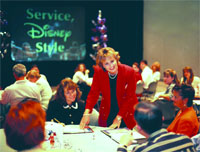
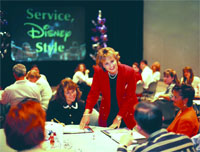
Sept. 26: The Center for Business and Professional Development at Holyoke Community College will sponsor an all-day workshop titled Team Creativity Disney Style from 8 a.m. to 4:30 p.m. at the Kittredge Center for Business and Workforce Development on the HCC campus. The Disney Institute will share with participants the motivational tools that can unleash the creative power of one’s entire organization. The cost is $349 per person which includes continental breakfast, lunch and materials. For more information, contact Maria at (413) 552-2122 or via E—mail at [email protected].

HCC Business Summit

Sept. 27: The Holyoke Community College Center for Business and Professional Development is sponsoring a free workshop for business owners and managers who are looking for more effective ways to train their employees. Titled “Training for the 21st Century,” the workshop is planned from 8:30 a.m. to 12:30 p.m. at HCC’s Kittredge Center for Business and Workforce Development. The workshop will introduce employers to a new training approach that uses real-life scenarios, follow-up sessions, ongoing contact with instructors, and actual homework for participants. For more information, call (413) 538-5817 or (413) 538-5815.

Planning Amherst Together

Oct. 12, 14, 18, 20: Several public meetings are planned in October to help create an Amherst Master Plan titled Planning Amherst Together. The master plan will address goals and policies on land use, housing, transportation, economic development, community facilities, parks and open space, natural and cultural resources, services and facilities and utilities. Meeting dates are Oct. 12, 7 p.m., and Oct. 14, 10 a.m., both at the Amherst Middle School; Oct. 18 at 1 p.m. at the Jones Library, and Oct. 20 at 9 a.m. in Franklin Patterson Hall at Hampshire College. For more information, contact Neils la Cour at (413) 259-3040 or [email protected].

Women in Technology Workshop

Oct. 13-14: Springfield Technical Community College, in conjunction with the National Institute for Women in Trades, Technology and Science, will present a ‘Women in Technology’ workshop for high school and college teachers and guidance counselors in math, science and technology. The two-day workshop uses case studies, lectures, role-playing and interactive video to present solutions that work in recruiting and retaining young women in programs leading to technology careers. For more information, contact Dean Adrienne Smith at [email protected] or visit http://cbt.stcc.edu/descriptions/women _in_technology.html.

Medical Device Seminar

Oct. 16: The Regional Technology Corp. (RTC), in cooperation with the Mass. Medical Device Industry Council (MassMEDIC), will conduct a seminar focused on medical device product development at FDA regulatory approval procedures. Sponsored by the Bank of Western Massachusetts, the event will take place from 4 p.m. to 6 p.m. at the Colony Club, 1500 Main St. in Springfield, and is the opening kick-off to two days of showcasing the life sciences industry in Western Mass. Tom Merle, vice president of Product Innovation at Continuum Inc., and James Wason, executive vice president of Medical Device Consultants Inc. (MDCI) will be guest presenters as experts in medical device product development and FDA regulatory issues. Tom Summer, president of MassMEDIC will also be on hand to discuss any other topics related to medical devices. Advanced registration is required. For more information, contact April Cloutier (413) 755-1314.

‘The Politics of Immigration’

Oct. 26: Un/Welcome Guests: Labor, Law and the Politics of Immigration is the title of a panel discussion in the Gamble Auditorium at Mount Holyoke College in South Hadley, beginning at 7:30 p.m. Legal experts, journalists and activists will discuss the controversial issues of immigration, migrant labor, homeland security, and the U.S. and Mexican border issues. For more information, visit www.mtholyoke.edu/go/wcl. The event is free and open to the public.

Super 60

Oct. 27: The Affiliated Chambers of Commerce of Greater Springfield, Inc. will present its annual “Super 60” program at Chez Josef in Agawam. The event is a salute to the entrepreneurial spirit of the region’s privately owned businesses.

Departments

“Doing Well By Doing Good”

Sept. 12: The Western New England College Law and Business Center for Advancing Entrepreneurship will open its 2006-2007 Entrepreneurship Speaker Series at 5:30 p.m. in the S. Prestley Blake Law Center. Nadine Thompson, chief executive officer and president of the beauty and wellness products company Warm Spirit, will speak on “Doing Well By Doing Good.” Warm Spirit, founded in 1999, is dedicated to socially responsible entrepreneurship and empowering women. The company boasts more than 20,000 direct-sales consultants nationwide. The event is free and open to the public. For more information, call (413) 736-8462 or visit www.law.wnec.edu/lawandbusiness.

Course for Artists, Artisans

Sept. 13-Dec. 13: The Valley Community Development Corporation (Valley CDC), under contract with the City of Easthampton, will present a 13-week course titled Business Planning for Artists on Wednesdays from 6 to 9 p.m. in Plimpton Hall, Railroad Street, Easthampton. The course is designed for qualified artists and artisans who live in town or whose studios are located in Easthampton. Course topics will include small business management, copyright protection, contracts, market research, working with galleries, trade shows, selling to retail customers and financial management. The deadline to register is Aug. 25 in person at the Valley CDC, 116 Pleasant St., Easthampton. For more information and registration forms, call (413) 529-0420.

The Big E

Sept. 15-Oct.1: The 2006 edition of The Big E will present more than $1.7 million in free entertainment, a ticketed Brad Paisley concert, the Miss Latina U.S.™ Pageant, the return of Marriage on the Midway, and BiggiE’s Character Breakfast as well as the Mardi Gras Parade, rides, crafts, good food, animals and the best of the old and new that fairgoers have come to expect and enjoy. The Big E is located on Memorial Avenue in West Springfield. Advance discount tickets and 17-day value passes are available online at www.thebige.com and the Big E Box Office by calling (800) 334-2443, now through Sept. 9. Tickets are also sold at Big Y World Class Markets now through Sept. 13.

‘Team Creativity Disney Style’ Workshop

Sept. 26: The Center for Business and Professional Development at Holyoke Community College will sponsor an all-day workshop titled Team Creativity Disney Style from 8 a.m. to 4:30 p.m. at the Kittredge Center for Business and Workforce Development on the HCC campus. The Disney Institute will share with participants the motivational tools that can unleash the creative power of one’s entire organization. The cost is $349 per person which includes continental breakfast, lunch and materials. For more information, contact Maria at (413) 552-2122 or via e-mail at [email protected].

HCC Business Summit

Sept. 27: The Holyoke Community College Center for Business and Professional Development is sponsoring a free workshop for business owners and managers who are looking for more effective ways to train their employees. Titled “Training for the 21st Century,” the workshop is planned from 8:30 a.m. to 12:30 p.m. at HCC’s Kittredge Center for Business and Workforce Development. The workshop will introduce employers to a new training approach that uses real-life scenarios, follow-up sessions, ongoing contact with instructors, and actual homework for participants. The deadline to register is Sept. 13. For more information, call (413) 538-5817 or (413) 538-5815.

Western Mass. Entrepreneurship Hall of Fame

Oct. 5: The seventh annual induction ceremony for the Western Massachusetts Entrepreneurship Hall of Fall is planned Oct. 5 at the Log Cabin Banquet and Meeting House in Holyoke. The event is sponsored by Springfield Technical Community College. Inductees are include The Fontaine Family (Fontaine Bros. Inc.); Jesse and Barbara Lanier (Springfield Food Systems); Horace Smith and Daniel Baird Wesson (Smith & Wesson); The Balise Family (Balise Motor Sales), and The Grenier Family (Grynn & Barrett.)

Super 60

Oct. 27: The Affiliated Chambers of Commerce of Greater Springfield, Inc. will present its annual “Super 60” program at Chez Josef in Agawam. The event is a salute to the entrepreneurial spirit of the region’s privately owned businesses.

Features
Disney Institute Brings Creativity and Team-building Expertise to Western Mass.

Business owners often wish for a little magic to help them through the tough spots. While the Disney Institute, the professional development arm of the world-famous corporation is quick to note that the company’s success didn’t happen overnight, some Western Mass. companies are hoping the Disney model will be just the thing to help them pull the sword from the stone.

It can still be a challenge for executives at Disney to explain that the global corporation that began as a cartoon studio in the 1920s doesn’t run on pixie dust and wishes on stars.

But undoubtedly, there’s a little more going on behind the scenes than flights of fancy at a company that now includes 10 theme parks, motion picture studios, countless consumer products, and its own television channel and radio station. Since 1986, the Disney suite of services has also included the Disney Institute, a professional development and training entity that has been using Walt Disney World in Orlando, Fla. as a ‘living laboratory,’ examining the effectiveness of day-to-day operations and translating them to businesses and organizations around the globe.

Those everyday practices at Disney recently became the backbone of Team Creativity, the latest Disney Institute offering that brings the Disney method to various groups and businesses. The program, which launched just this year, will be staged at Holyoke Community College’s Kittredge Business Center on Sept. 26. Keith Hensley, executive director of business and workforce development at HCC, said the college reached out to Disney earlier this year, in hopes of bringing a little bit of the company’s magic – but more importantly, its corporate know-how – to Western Mass.

“We’ve had the Disney Institute out twice before,” said Hensley, “for training on two separate topics – customer service and leadership, Disney style. Both were very well-received, and when I found out the institute had come forward with Team Creativity, I thought it was a great thing to offer area businesses.”

Hensley said it’s coincidental that the program will be staged so soon after the Kittredge Center’s opening, but it’s a fortuitous coincidence nevertheless.

“We wanted the institute to come and offer this particular training regardless of the venue, but it’s a great fit with some of the things we’re trying to achieve through the business center,” he said. “It’s getting more and more competitive out there in the business world, and what want we try to do is provide tools companies can use to stay economically viable by improving their competitive edge.

“It’s a two-pronged approach,” Hensley continued, “that focuses on using assets within a company and being able to use sparks of creativity to better position that company.”

Hi-ho, Hi-ho

And that, he said, is where the Disney Institute comes in. The organization uses the Disney corporate model and culture as a springboard for training workshops and seminars, and according to Bruce Jones, programming director for the institute, creative problem-solving and a team-based approach are two major hallmarks of that model.

“Creativity and high performing teams are our tenets at Disney,” he said. “We’re always looking at ways to broaden the definition of ‘team.’ We’ve long had content surrounding teams and creativity, but they’re things that are constantly improved.”

Jones explained that the institute’s first off-site program, Keys for Excellence, touched on the power of team-building through creative channels, but Team Creativity takes it to a new level.

“Keys was the first program created for which we leave property on a scheduled basis,” he said. “That continues to be a strong focus. But recently, participants started asking for more. Keys is more of a presentation, but Team Creativity is a full-day workshop that uses brainstorming and team-building activities to discover effective uses of both.”

Jones added that the institute terms the all-day events workshops rather than seminars, because of the high level of audience participation, modeled after Disney employee trainings.

“We are pretty confident in the program,” he said, “because it’s based on leadership, people, management, service, and loyalty – all things we’ve researched and put into practice at Disney, not to mention our audiences expect Disney to have a story to tell, which is another strength.”

Jones added that the workshop is well-suited for those who do not often find themselves in creative positions.

“This is not necessarily tailored to those who find themselves in the traditionally creative role, but to those who want to examine the strength of creativity in their own jobs and teams,” he said. “We’ll look at the analysis of ideas and the implementation of ideas, take them through activities that explore that team dynamic, and hopefully, they’ll discover the dynamic that exists between relationships and results.”

A Problem-free Philosophy

That link between relationships within the workplace and how they often affect the outcome of a given team-related task is something Hensley said he hopes will resonate within the Western Mass. business community. While they’re often seen as ‘soft skills,’ he said team-building and creative management are two things Team Creativity can offer to give the region that competitive edge he sees as essential.

“As we all know, Disney is a hospitality leader, but we absolutely know that their model works and can be applied to other industries,” he said, noting that some local companies, such as Balise Auto Sales, have already jumped on board. “It’s nice that companies will have the opportunity to experience a model that is known to work and not have to reinvent the wheel. That’s why we reached out to Disney – they have a tried and true system from which we want to learn.”

Ann Holland, director of organization development for Balise, echoed Hensley’s comments, adding that as part of a company that has grown considerably in recent years, participants attending Team Creativity from Balise are hoping to glean some information on how to maintain a cohesive corporate culture.

“Balise is growing by leaps and bounds, and with that kind of growth, gaps can occur within internal branding efforts,” she explained. “Disney has built a culture and built an internal brand to support its external branding, and because of our expansion, we are at a point at which we have a tremendous opportunity to learn from that, and engage our associates.”

Holland added that as Disney has already gone through that process of major growth and expansion, she’s also hopeful that the workshop will provide some insight into corporate growth, and how to best streamline the process.

“As a company gets larger, there are more and more projects happening simultaneously and people running in all different directions,” she said. “The question becomes ‘how do you avoid getting too subdivided?’ Disney has really latched onto the answer.

“One of my number one concerns is to keep our culture healthy and strong, as well as be more efficient, and provide career pathing for our associates, which is another thing Disney does well,” Holland added. “I’m also hoping to get some insights on new ideas, and confirmation of current ideas.”

Makes No Difference Who You Are

Jones said some of Holland’s questions are indeed the type of complex issues Team Creativity aims to address, however he did note that the validity of the Disney model might not be immediately evident to some. Therefore, there are several components of Team Creativity that explain how one industry’s culture can be applied in other sectors.

“We don’t hear a lot of cynicism, but it’s probably there,” said Jones. “Some people can’t get past our product. But we do the work up front to address concerns; we ask people who might not be sure how this will apply to their business to think about a scenario in which Disney is in a completely different business, and ask themselves, ‘could these principles apply elsewhere?’

But beyond that, Jones said there are some specific aspects of the program that were designed to make the key points even more relevant to various industries, in part to answer to skepticism regarding the relevance of corporate culture at, essentially, a theme park.

“We point out that there are many similarities among our business and others,” he said, “and competition – the need to stay on top of our game – is one big piece of that.

“It’s important to understand teams and how they work,” he added. “Teams are units of performance. We’re not teaching creativity for fun, but rather creativity to help deliver results. It helps build effective groups and networks; more ideas are generated, teams are strengthened, and that becomes a powerful tool to move an organization forward.”

Jones also noted that Disney functions in a unionized environment, another similarity to many local businesses.

“All types of organizations benefit from thinking about teams and creativity,” he said. “We have that conversation right up front with the audience – we tell people that we’re going to concentrate on the principles at play in our organization, and we stress that it doesn’t always come easy … we’re not perfect, and we don’t take for granted that people understand our culture. But we’ve evolved to where most big organizations find themselves thinking about things like corporate culture very deliberately.”

Fast Facts:

What:Team Creativity, Disney Style
When:Tuesday, Sept. 26, 8 a.m. to 4:30 p.m.
Where:The Center for Business and Professional Development at Holyoke Community College
Cost:$349/person; teams of three may bring a fourth team member at no cost. Breakfast, lunch, and materials included.
Contact:(413) 552-2122;[email protected]

Bedknobs and Broomsticks (and Business)

That deliberate approach, added Jones, includes sharing the Disney model with other businesses through the institute, as a way to not only share ideas with others, but to hone a culture that has been ingrained at the company since the early 1950s.

“Disney is always working on improving,” he said. “But we have a culture that has been grown organically since the days of Walt – he thought of himself as a bee, pollinating others with ideas that they could take hold of.

“It’s a culture that has grown organically, but now it’s something that we incorporate into virtually everything we do.”

And that’s not magic, though it does make for some animated conversations.

Jaclyn Stevenson can be reached at[email protected]

Departments

Stone Soul Festival

Sept. 1-3: Hampden Bank will continue its title sponsorship for the 18th annual Hampden Bank Stone Soul Festival at Blunt Park in Springfield. One of the largest multicultural events in the Northeast, the festival features fun and educational activities for all ages, as well as prize drawings, great food and live music. Festival hours are Sept. 1, 6 to 10 p.m., Sept. 2, 10 a.m. to 10 p.m., and Sept. 3, 10 a.m. to 6 p.m. Free admission.

The Big E

Sept. 15-Oct. 1: The 2006 edition of The Big E will present more than $1.7 million in free entertainment, a ticketed Brad Paisley concert, the Miss Latina U.S.™ Pageant, the return of Marriage on the Midway, and BiggiE’s Character Breakfast as well as the Mardi Gras Parade, rides, crafts, good food, animals, and the best of the old and new that fairgoers have come to expect and enjoy. The Big E is located on Memorial Avenue in West Springfield. Advance discount tickets and 17-day value passes are available online at www.thebige.com and the Big E Box Office by calling 1-800-334-2443, now through Sept. 9. Tickets are also sold at Big Y World Class Markets now through Sept. 13.

“Generations …”

Sept. 20: At its September professional development meeting, the Women’s Partnership will present “Generations…Working and Living Side by Side.” A representative from Big Y Foods Employee Services department will be presenting material about preparing employees to face the everyday life of managing and working with people of all generations. The meeting will be held at the Best Western Sovereign Hotel and Conference Center in West Springfield. Networking begins at 11:30 a.m., the program and lunch will be begin at noon and end at 1:15 p.m. Tickets are $20 in advance for chamber members, $25 for non-chamber members or payment at the door. To register and purchase a ticket to the meeting, book online at www.myonlinechamber.com or contact Diane Swanson at (413) 755-1313.

‘Team Creativity Disney Style’ Workshop

Sept. 26: The Center for Business and Professional Development at Holyoke Community College will sponsor an all-day workshop titled Team Creativity Disney Style from 8 a.m. to 4:30 p.m. at the Kittredge Center for Business and Workforce Development on the HCC campus. The Disney Institute will share with participants the motivational tools that can unleash the creative power of one’s entire organization. The cost is $349 per person which includes continental breakfast, lunch and materials. For more information, contact Maria at (413) 552-2122 or via E-mail at [email protected].

HCC Business Summit

Sept. 27: The Holyoke Community College Center for Business and Professional Development is sponsoring a free workshop for business owners and managers who are looking for more effective ways to train their employees. Titled Training for the 21st Century, the workshop is planned from 8:30 a.m. to 12:30 p.m. at HCC’s Kittredge Center for Business and Workforce Development. The workshop will introduce employers to a new training approach that uses real-life scenarios, follow-up sessions, ongoing contact with instructors, and actual homework for participants. The deadline to register is Sept. 13. For more information, call (413) 538-5817 or (413) 538-5815.

Western Mass. Entrepreneurship Hall of Fame

Oct. 5: The seventh annual induction ceremony for the Western Massachusetts Entrepreneurship Hall of Fall is planned Oct. 5 at the Log Cabin Banquet and Meeting House in Holyoke. The event is sponsored by Springfield Technical Community College. Event hosts include The Fontaine Family (Fontaine Bros. Inc.); Jesse and Barbara Lanier (Springfield Food Systems); Horace Smith and Daniel Baird Wesson (Smith & Wesson); The Balise Family (Balise Motor Sales), and The Grenier Family (Grynn & Barrett).

Super 60

Oct. 27: The Affiliated Chambers of Commerce of Greater Springfield, Inc. will present its annual ‘Super 60’ program at Chez Josef in Agawam. The event is a salute to the entrepreneurial spirit of the region’s privately owned businesses.

Sections Supplements
Business Center’s Director Forges a Game Plan for Workforce Development
Jeffrey Hayden

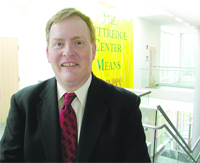
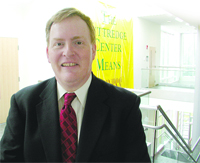
Jeffrey Hayden, director of the Kittredge Business Center

Holyoke Community College’s Kittredge Center for Business opened its doors in June. The $18 million facility will have a broad mission, said its director, former Holyoke planning director Jeff Hayden, but it boils down to expanding and enhancing the role that workforce development plays in economic development.

When he was planning and economic development director for the city of Holyoke, Jeffrey Hayden was one of many civic and business leaders in that community asked for input on plans to create a business center at Holyoke Community College.

Hayden doesn’t recall exactly what he offered as advice on how to shape the center and its focus, but he does remember thinking that it could become a key player in expanding the important role workforce development plays in economic development efforts in Holyoke and across the Pioneer Valley.

And now, he has a front-row seat for that performance.

Actually, as director of the recently opened facility, a post he assumed a month ago, Hayden will be more behind-the-scenes in his work, which he describes as a blend of administration and outreach, planning, and collaboration.

He joked that his first assignment is to shorten his title — ‘vice president for Business and Community Services and executive director of the Kittredge Business Center’ will barely fit on his business card — but the first real items on his to-do list are to create a business plan for the facility and to generate greater awareness of its role and how it will be carried out.

In other words, he wants area business owners and civic officials to know and understand that the center, named after Yankee Candle founder Michael Kittredge is much more than a mailing address for agencies such as the Mass. Export Center of Western Mass. and the World Institute for Strategic Economic Research (WISER). Instead, it is a resource that can, by working with other economic development agencies in the region as well as with UMass and the area’s other public and private colleges, address what he called a “disconnect” between the skills required by area employers and those possessed by many in the region’s workforce.

“We want to address that disconnect and eliminate it through effective outreach and collaboration with a number of agencies,” he said. “Our basic mission here is workforce development.”

Overall, Hayden said the role to be played by the Kittredge Center will be fluid in nature, not static. As the wants and needs of area employers and those in the workforce — and those who want to join it — change, the center will adjust accordingly.

“We want to continually look around the corner for what’s next so we can provide that for businesses, students, and residents,” he said, adding that the Kittredge Center represents the latest step in a broad workforce-development initiative in Holyoke and the college that has been building since the mid-’80s. “What’s the future model going to be? We’ll have to wait and see.”

This issue, BusinessWest talks with Hayden about the broad mission for the Kittredge Center — and also about his own career opportunity.

The Job at Hand

As he talked about that mission, Hayden drew on his own work experience, especially his 12 years in Holyoke City Hall, as an example of just one way in which he hopes the center may boost economic development efforts in the region.

“I’m a great example of what I call cooperative education,” he explained, noting that after a stint selling radio advertising and other jobs in the region, he went back to school (UMass) to pursue work in municipal planning. He first had an unpaid internship in the Holyoke Planning Office, then a paid internship in the Economic Development Office. Upon graduation, he took a full-time job in economic development, and eventually became assistant director and then director — adding the duties of city planner a few years ago.

Thus, he is a poster child of sorts for ongoing efforts on the part of regional economic development leaders to keep area graduates in this region by familiarizing them with job opportunities here and giving them reasons to stay.

“When it comes to this market, if we can get people to try it on, to take it for a test drive, to get a taste for it, then we can get more graduates to stay here,” he told BusinessWest, adding that the test drive analogy works not only for employment opportunities, but for college enrollment as well.

“How is a school like HCC going to continually grow its enrollment unless it develops a number of feeder systems that will bring new students?” he asked, adding that the Kittredge Center will work with a number of agencies to help provide literacy training, adult basic education, and other programs designed to motivate individuals to take the next step — a college education.

Providing these test-drive opportunities, in the form of GED preparation, internships, co-ops, and training programs, was one of the motivations for HCC leaders when they blueprinted the concept of a business center close to a decade ago. The broad vision was for a one-stop facility that would place several agencies under one roof — a green, environmentally friendly roof — thus linking employers, students, and area residents with a host of resources.

“One of the practical considerations of the facility is that it takes a number of programs that were somewhat disconnected because of space and brings them together,” he explained. “Hopefully, that synergy will allow us to do more and build upon what’s been accomplished to date.”

The 55,000-square-foot, five-story Kittredge Center is now home to the school’s Business Division, as well as HCC’s Community Services Department, which offers personal enrichment courses, adult basic education programs, educator professional development credit programs, GED preparation and testing, and youth summer programs.

The center also hosts a number of economic development and workforce development-related agencies, including:

  • HCC’s Center for Business and Professional Development, which offers a wide range of workforce development services designed to assess employee skills, identify knowledge gaps, and conduct training to remediate deficiencies;
  • WISER, home to the country’s leading database for international trade statistics, which relocated to HCC from UMass in 2005; and
  • The Western Mass. office of the Mass. Export Center, will offers market research, export training, and international business development resources.

The center also features 4,000 square feet of conference/meeting spaces — available for reservation by area businesses and organizations — equipped with high-speed and wireless Internet, videoconferencing, and state-of-the-art lighting and projection.

The sum of these various parts could best be described as a “regional asset,” said Hayden, adding that it his job to continually refine that asset and to ensure that the region and its business community are taking full advantage of it.

When asked what motivated him to take on that assignment, Hayden said that he was ready for a new career challenge, and considered the Kittredge Center’s evolving mission to be a new and different type of work in economic development.

“This was a great opportunity for me to stay in Holyoke and continue to work to make this a better, more vibrant community,” he said, noting that his assignments in City Hall were focused on bringing jobs and progress to the city. “Our basic mission is workforce development.”

By that, he meant collaborative efforts to address both the quality and quantity of the region’s workforce, which will need a wide array of skills to succeed in the modern workplace. To make area residents workforce-ready, and to assist business owners in their efforts to make their ventures more competitive, the center will partner with a number of local and regional entities, said Hayden.

These include the college; the city of Holyoke and its planning and economic development leaders; the Holyoke Chamber of Commerce, which has a number of training and job-matching programs; UMass, and other area colleges.

“We’re looking for every opportunity to make a better workforce development system,” he said. “And that can only happen through effective partnerships.”

One important early assignment for Hayden is to create broad awareness of the center, its various components, and the opportunities they provide for area residents and business owners.

This awareness will be generated through targeted marketing, said Hayden, noting that he intends to be quite visible in the community, driving home the point that the center is much more than its four walls. Indeed, it is what he called a bridge — between the college and the community, and between business owners and future employees.

Having built the bridge, said Hayden, the college wants to motivate people to use it.

Course of Action

When asked for a basic job description for his new post, Hayden told BusinessWest that it comes down to “keeping the college — and the region — on the cutting edge of workforce development.”

The school has a great track record in that realm, he continued, and it is now his challenge to not only continue that tradition but enhance it through effective partnerships and more of that ‘looking around the corner,’ as he called it.

By doing so, he believes the center can be a driving force in the biggest overall challenge facing regional economic development leaders — making the Pioneer Valley and its businesses competitive.

While doing all that, Hayden might still find some time to shorten the title on his business card.

George O’Brien can be reached at[email protected]

Sections Supplements
Quaboag Region Population: 69,435

The Quaboag region of Western Mass., or the Quaboag Valley, as it’s also known, is comprised of 12 communities across three counties: Hampden, Hampshire, and Worcester. Those communities – Belchertown, Brimfield, Brookfield, East Brookfield, Holland, Monson, North Brookfield, Palmer, Wales, Ware, Warren, and West Brookfield – have a combined population of nearly 70,000. While each community conducts its own economic development activities, the region is also marketed as a whole, and is promoted primarily through two groups — the Quaboag Valley Chamber of Commerce — (413) 283-2418;www.quaboag.com— and the Quaboag Valley CDC, a Palmer-based group that provides business assistance, business loans, computer skills training, and workforce development; (413) 283-3003;www.qvdc.com.

Tourism is perhaps the largest industry in the Quaboag region, but there are several large employers, including Wing Memorial Hospital in Palmer, Mary Lane Hospital in Ware, and Turley Publications in Palmer.

Community County Population
(2004)
Contact Web Site
Belchertown Hampshire 13,846 (413) 323-0400
Town Clerk’s Office
Click Here
Brimfield Hampden 5,316 (413) 245-4101
Town Hall
no official town
web site
Brookfield Worcester 3,101 (508) 867-2930
Town Hall
Click Here
East Brookfield Worcester 2,121 (508) 867-6769
Town Hall
Click Here
Holland Hampden 2,485 (508) 245-7108
Town Hall
Click Here
Monson Hampden 8,684 (413) 267-4624
Town Hall
Click Here
North Brookfield Worcester 4,815 (508) 867-0203
Town Hall
Click Here
Palmer Hampden 12,902 (413) 283-2603
Town Manager’s
Office
Click Here
Wales Hampden 1,798 (413) 245-7571
Selectman’s Office
Click Here
Ware Hampshire 10,022 (413) 967-9648
Town Hall
Click Here
Warren Worcester 4,979 (413) 436-5702
Town Hall
no official town
web site
West Brookfield Worcester 3,898 (508) 867-1415
Town Clerk’s
Office
Click Here
Uncategorized

Getting the Job Done

Merger of Workforce Training Agencies Will Create New Efficiencies

Bill Ward says discussions about merging Hampden County’s Regional Employment Board and Employment and Training Consortium had been waged for years.
Evidence of overlapping services was mounting, Ward, executive director of the REB, told BusinessWest, adding that the word redundant was being used with increasing frequency as the agencies and their roles were referenced.

What was lacking, he explained, was the political will to fold the consortium, essentially a city department, into the REB, a quasi-public nonprofit corporation. Springfield Mayor Charles Ryan filled that void, said Ward, and, in the process, led the drive to a merger of the entities that will take effect July 1, the start of the new fiscal year.

The merger, or absorption of the consortium into the REB, will result in a direct savings of more than $200,000 annually — through consolidation of the administrative structure, reductions in rent, and other steps — money that will be re-deployed, as Ward put it, to direct services for the REB’s many types of customers in Hampden County.

But there will be other benefits, as well, he continued, noting that the merger creates a single point of contact for funders, vendors, and customers, as well as unified accountability of performance, which will result in a reduction in contracting and payment processing time of at least 75%.
And beyond that, the new agency — and the region as a whole — will gain some respect among government agencies and other funding sources for workforce development initiatives, he told BusinessWest.

“We’ll be showing people that we’ve got our act together,” said Ward, noting that there are 14 other regional employment boards across the Commonwealth, and all or most of them still have redundant public agencies such as the consortium. “We’re going to be more efficient now, and we’re going to be able to serve clients better, and people are going to notice that.”

Hire Ground

As he talked about the merger and how it finally came to be, Ward described the consortium as an agency that had a specific purpose when first formed more than 30 years ago — administration of programs and contracts that were part of the Comprehensive Employment and Training Act (CETA) — but remained in existence long after that need was gone or being addressed by other organizations.

“In business, and especially in government, programs come up and new entities emerge to address the needs of those programs,” he explained. “What happens over the years is that these things just continue to pile on top of one another and you create a situation where nothing ever goes away.
“Some things just get a life of their own,” he continued. “Even in business that happens, and when it does, you have to step back and say ‘where did these structures come from?’ and ‘is this the best way to be organized?’

That’s the conversation that began about five years ago with regard to the REB and the consortium, he said, adding that, in addition to the redundancies in services between the two entities, the consortium was going through a tumultuous period marked by scandal involving top administrators.

The agency’s former director, James Asselin, and its former compliance officer, James Krztofik, were both sentenced to prison terms after pleading guilty to swindling more than $600,000 in bogus consulting fees and travel from a taxpayer-funded, non-workforce-development-related loan fund.

Still a number of factors, but primarily politics, kept matters from moving beyond the discussion stage, said Ward, adding that talks were renewed when Ryan took office in January, 2004. What the new mayor wanted was a sound case for melding the agencies and deciding which should be the surviving entity.

So Ward made one.

In a proposal presented in late March, he petitioned for a restructuring of the workforce development system in Hampden County, one that would create a single administrative entity for workforce development by merging all consortium administrative functions into the REB, which would serve as the consolidated fiscal, planning, and oversight organization for the county.

The plan also called for moving the 25 consortium employees off the city payroll, with 11 transferring to the REB and another 12 to the area’s two one-stop career centers, Future Works and CareerPoint, and leaving two vacant positions unfilled.

Keeping current staffers employed was a key consideration in the proposal, said Ward, noting that an agency focused on workforce development and job retention can’t endorse proposals that put people out of work.

Still, the new entity to result from the merger will be much more efficient than the two-headed monster that will exist for another 10 weeks, he said.

Savings to be derived from the merger, as outlined in a line-item budget comparison include a reduction in total salaries from the current $1.6 million for the two separate entities to $896,506; a reduction in employee benefits from $468,557 to $256,286; a drop in total rent payments from $115,067 to $75,067 (the REB, now located in the Regional Economic Development Center within the TD Banknorth building, will move into larger quarters there, while the consortium’s offices will close); and a reduction in auditing, legal, and insurance costs from $36,000 to $26,000.

Factoring in the additional cost of consortium personnel to be transferred to the career centers ($765,000), as well increases in phone, parking, chamber management fee, and other expenses, the net savings is $200,000, said Ward, adding that this money will still will coming to Hampden County, but will be directed toward services, not salaries and administrative costs.

“There are a lot of things we can do with $200,000,” he explained. “We can train many more people and provide more services; there are some very real benefits to this beyond saving money on rent.”

And the overall gains in efficiency and value from state and federal funding will eventually turn some heads in those circles, he explained.

“We’ll be sending a message across to funders that we’re operating with sound management principles and efficiency,” he continued. “We won’t just be saying, ‘give us more money’; we’ll be saying, ‘give us more money because we know how to spend it in the most efficient manner.’”

Survival of the Fittest

Summing up the merger of the two workforce development entities and the benefits to the region, Ward referenced management guru’s Peter Drucker’s philosophy of ‘organizational abandonment.’

In a nutshell, the management strategy, first introduced in the ’80s and endorsed by GE’s Jack Welch, among others, calls for businesses and non-profit entities to become more efficient — and more profitable — by not trying to be all things to all people. It calls for eliminating, or abandoning, those products or programs that do not move an organization forward, and becoming more efficient by being smaller and more focused.

“That’s what we’re doing here,” said Ward, adding that by essentially abandoning the consortium, or at least the redundant services it provided, Hampden County will receive better, more efficient workforce training services.

Uncategorized

Since Janet Wanczyk arrived at Springfield Technical Community College four years ago and started signing the checks in her capacity as vice president for Administration and chief financial officer, she has been on a mission to reduce the school’s enormous fuel bills.

“We’ve been scouring the Earth looking for ways to cut our expenses,” she told BusinessWest, noting that the campus, housed partly in former Springfield Armory buildings, occupies some 1 million square feet — perhaps three times the space of a more-modern school with similar enrollment — much of it very inefficient when it comes to heating and cooling.

The dire need to reduce fuel and electricity bills, which will reach $2 million for the fiscal year that ends next June 30 (a 33% increase over a year ago) has prompted the school to look at alternatives ranging from co-generation to windmills and to take steps that range from installing more energy-efficient exit signs to shutting down most buildings for two weeks during winter break.

And it also inspired a sequence of events that led to the installation of what is being called the largest photovoltaic (PV), or solar energy system in Western Mass. on one roof in the Technology Park that sits across the street from the STCC campus.

Installed in January and unveiled to the public late last month, the $255,000 system is comprised of 108 PV panels that effectively convert sunlight into electricity — roughly 33,000 kilowatt hours of it per year. That production rate will save the Technology Park, administered by the STCC Assistance Corp. (STCCAC) about $6,000 per year, making only a small dent in the park’s $1 million budget for fuel and electricity in FY ’06.

But the current system, which is expandable, is considered merely a “starting point,” said STCCAC Chairman Brian Corridan, who told BusinessWest that phrase refers to much more than the generation of electricity.

Indeed, he said the PV installation is expected to spark a number of academic initiatives, entrepreneurial ventures, and public-private partnerships in the broad realm of renewable energy. Looking down the road — and not very far down it — Corridan said he envisions developments in PV and other renewable energy products involving virtually every aspect of the college and its technology park.

This includes the training of individuals who will work in this field, the creation of new businesses focused on renewable energy, which could be nurtured in the Scibelli Enterprise Center within the tech park, and the emergence of a renewable energy business cluster, possibly at the tech park. Eventually, the STCC complex may become a teaching and demonstration center for photovoltaic energy in the Northeast.

“I think we’ve just taken the first steps in what will be a long journey,” said Corridan, adding that the ambitious expansion of the park’s focus into renewable energy, building on its base in telecommunications, is a natural progression — literally. “This is the kind of thing that a technology park should be doing.”

BusinessWest looks this issue at how the installation at the tech park came to be, and what it could eventually mean for the college and the region.

Shedding Light on the Subject

Chris Derby Kilfoyle became involved with photovoltaic energy pretty much out of necessity.

He had acquired a cabin in Vermont that was not served by the electric grid, and needed some way to light the place. He turned to what was then a technology still very much in its infancy. Indeed, in the early ’80s solar power was both less efficient and more expensive than it is now, but for some, it is essentially the only option.

Inspired by his own experience, Kilfoyle, a philosophy major in college but knowledgeable in the sciences, attended one of the first conferences on solar power in 1985 and later that year started Berkshire Photo Voltaic Services, which has installed more than 130 solar power systems (most of them residential) over the past 20 years, and was chosen to handle the project in STCC’s tech park.

He said the initiative is an intriguing one not merely for its size and cost-cutting capacity, but also for its ability to generate awareness for photovoltaic energy and to help that industry grow. And it comes at a time when President Bush is challenging the nation to reduce its dependency on foreign oil by expanding the use of alternative sources of energy.

“I get calls all the time from people who want to know about opportunities in this field … they’re excited about getting it, said Kilfoyle. “I believe it has a bright future, and what’s happening at the college is an exciting development.”

And it came about because Wanczyk was at wit’s end in her quest to do something, anything about the college’s staggering fuel and electricity bills.

Those bills and the need to reduce them eventually brought school administrators to the Mass. Technology Collaborative (MTC), a public agency and administrator of the Renewable Energy Trust, in search of grants to study photovoltaic systems and other forms of renewable energy.

The college was turned down in its initial bid for a $50,000 grant three years ago, said Wanczyk, but the tech park (STCCAC) later partnered with Appleton Corp., the management company for the park, and Western Mass. Electric Co., a park tenant) in a grant application that was eventually approved by the MTC.

The $123,000 awarded by the agency was essentially matched by STCCAC, she explained, and the project commenced last fall.

The 108 photovoltaic panels are placed at a 6-degree angle and positioned in rows at the southwest corner of what is known as building 111. Each cell contains 216 silicon semi-crystalline solar cells that produce power with no moving parts.

As Kilfoyl explained, electricity is produced as photons of sunlight penetrate the silicon, bumping electrons into a flow. This photovoltaic effect, as it’s called, produces direct current (DC) electricity, which is converted to alternating current (AC) to match the American standards of AC frequency and voltage.

Over the course of its 35-year lifetime, the PV installation at the tech park will replace the energy equivalent of 150 tons or coal or 31,000 gallons of gasoline, and avoids 756 tons of carbon dioxide emissions. Meanwhile, it will save the park an estimated $5,800 in annual energy costs, and will help WMECO more easily manage peak usage periods in the summer.

Current Events

The installation covers only a small percentage of the roof space at the tech park, noted Kilfoyle, adding that it can be expanded onto both flat and angled sections of roof. The pace of expansion will be determined by economics, the availability of grant money, and a current worldwide shortage of poly-silicon, the main ingredient used in the production of solar cells, and also computer chips.

“That shortage will definitely limit the availability of product,” he said, adding that there are no real estimates on how long the shortage will last.

In the meantime, a small (10 kilowatt) photovoltaic installation is being planned for the college, said Wanczyk, adding that, like the tech park installation, it is environmentally friendly and another step being taken in the effort to reduce dependence on fossil fuels.

And the benefits to the college and the tech park will far exceed cost savings, said STCC President Ira Rubenzahl. He told BusinessWest that the school has plans to revive its Environmental Technology associate degree program, with a focus on clean water or wastewater management, and will likely include options to that program in renewable energy.

Rubenzahl said the college offered an academic program in solar power in the’80s, but at that time, the field was not as technically advanced not as economically feasible for homeowners and smaller scale corporate applications. Now that the energy is more affordable and the technology more efficient, the school will look to take a lead role in the field.

“There are opportunities for initiating workforce development partnerships and training within the renewable energy industry,” he said, noting that the school’s Center for Business and Technology (CBT) is already talking with the North American Board of Certified Energy Practitioners, which offers a certification exam for PV installers. CBT is working with industry experts to develop a certification exam preparation course, which could be offered as early as the fall.

Meanwhile, for the tech park, the PV installation provides a foundation on which to build a renewable energy cluster to complement one in telecommunications that includes such tenants as Choice One Communications, CTC Communications, Northeast Optic Network Inc., WilTel (Williams Communications), Verizon Business, and MAP Internet.

“What we saw was an opportunity to draw companies that are in this field to the tech park,” he said, referring not only to photovoltaic energy, but also wind power, hydro, and other types of renewable energy. “These companies could use the college as a reservoir for talent that they need to grow.

“This would be a first step in that direction,” he continued, adding that as more companies in this broad field locate in the park, the environment will logically create a larger critical mass of businesses. “Telecommunications breeds more telecommunications, and renewable energy will breed more renewable energy.”

Watt’s Happening?

Wanczyk’s fight to reduce the school’s energy bills continues. The photovoltaic installation in the tech park, as well as the one soon to be installed at the college, will bring only minor relief.

But they are, as she and Corridan said, just the start of something bigger, and offer the promise of much more than some help with the bottom line.

They could help the school — and the renewable energy field itself — take steps toward a brighter future.

George O’Brien can be reached at[email protected]

Sections Supplements
Holyoke Community College Gets Down to Business with New Facility
Community college is a two-word phrase. Geoff Little doesn’t want to forget that.
“We’re a community college, which says we have expectations and responsibilities beyond the campus walls to support growth and quality of life in the communities around us,” said Little, acting vice president for business and community affairs at Holyoke Community College.

Little will apply that philosophy as executive director of the college’s $18 million, five-story Kittredge Business Center, set to open to students and area companies in January.

“The intent was not to create a building that’s isolated from the campus,” Little said. “This building and its resources are intended to be accessible to both students on campus and the business community in general. So it serves a number of purposes.”

Indeed, HCC’s vision has been to create a one-stop business center that regional employers could use for workforce development and training, conferences, internships, and support for domestic and international trade – a vital resource, in other words, for current businesses and new ventures alike.

The center’s namesake, Michael Kittredge, who launched the project with a $1 million donation, knows a few things about business ventures. Over a few decades, the HCC alum turned a homemade candle enterprise into Yankee Candle, one of the Pioneer Valley’s most celebrated entrepreneurial success stories.

Little wants to see other stories like that emerge at this new facility near the intersection of Routes 90 and 91 – and at the crossroads of academia and business.

Science and Aesthetics

That physical location, near the juncture of two major highways, is a crucial part of marketing the Kittredge Business Center, said Michael Giampietro, HCC’s vice president for administration and finance. Like Little, he recognizes that the college plays a role in the economic vitality of the entire Knowledge Corridor region, from Hampshire County to Hartford.

“Part of the college’s mission, in addition to educating the region’s youth and people who want to come back for additional degrees, is to educate the incumbent workforce and to provide retraining opportunities for people who are changing careers or simply want to upgrade their skills,” Giampietro said. “The college has been short on space to provide that kind of training, and there is certainly a need for it.”

The Kittredge Business Center answers that space need, providing 55,000 square feet of academic and business resources, including 4,000 square feet of conference and meeting spaces for use by area businesses, all equipped with high-speed Internet connections, videoconferencing, and cutting-edge light and projection.

The building will also house the college’s Center for Business and Professional Development, dedicated to workforce training, as well as a career center that will provide a central location for employers to find interns and recruit new employees.
Two organizations dedicated to helping companies develop wider client bases will also make the business center their home: the World Institute for Strategic Economic Research (WISER), home to the nation’s leading online database for international trade statistics; and the Western Mass. office of the Mass. Export Center, which offers market research, export training, and international business development services.

Resources such as these will benefit not only area companies, Little said, but the school’s business students, who will attend many of their classes in the new facility. Non-business students will still find themselves in the building from time to time, as it was designed with the flow and connectivity of the entire physical campus in mind.

“It’s integrated into the campus nicely,” Little said. “It will draw people through the building who might not otherwise have a reason to be there. So we want this to be a resource for the business community, but also accessible for students.”
Giampietro said two main goals of the project have been to incorporate computer and wireless technology into every facet of the building, and to provide study and meeting areas for students.

“Over the years, as the college has grown, we’ve really consumed much of the informal gathering space for study and social gatherings,” he said. “One goal of this building is to bring that back.”

Another student-oriented feature is the building’s third-floor “green roof,” a 2,500-square-foot space that will be populated with native ground cover, grasses, and plants – a modern design concept that students in the environmental science program may incorporate into their program of study.

Giampietro added that the roof should attract some of the birds and insects native to the area, as well as reducing water runoff from the building and lessening the environmental impact on a neighboring brook.

“We wanted to introduce as many environmentally friendly components to the building as we could, and this is obviously one of them,” he said. “Our campus is very rural and surrounded by woodlands, so the green roof helps to preserve some of that.”

Investing in the Future

At its heart, however, the Kittredge Business Center is meant to grow area businesses and be a bridge between students and those companies.

That’s a relevant goal, considering that more than 80% of HCC’s students stay in Massachusetts after they graduate, and 65% stay within the Pioneer Valley region, said Erica Broman, vice president for institutional development. And those statistics help explain community support for the college; a $4 million capital campaign ($3 million of which is earmarked for the business center) has raised more than $3.6 million to date, including more than $500,000 from alumni.

“When businesses give a gift to a community college, they see a return on it. It’s not like they’re giving a gift to a larger, private institution where graduates might go off to all regions of the country,” Broman said. “Our alumni, by and large, stay nearby and become employees and customers of these corporations. That’s the strategy we’ve used when approaching businesses, and they’ve responded to it.”

Even though the center’s opening is a few months away, Little and other administrators are moving forward with efforts to market its services to area businesses.

“We’re shaping the message and information now, and we’ll be holding some focus groups to start drawing some feedback from the community,” he said. “Out of that, we’ll deliver the message in a way that will best explain to people the reason for the center and the resources within it.”

The goal of making area businesses stronger and more competitive, while giving HCC’s own students an edge as they enter the work world, is a message that resonates, Little said.

“There will be many opportunities for internships and co-ops, and that experiential learning is critical for students,” he explained. “But it can be just as beneficial to businesses. We’re interested in outcomes.”

Bringing together faculty, students, and business people under one roof – and supplying them with state-of-the-art resources – is the first step to bringing about those positive outcomes, he added.

“There’s no definitive map to this – we’re developing it as we go – but we are centering on the idea of collaboration and cooperation. We are looking to be the resource for area businesses that want to expand their customer base.”

That would mean a brighter future for companies throughout the Pioneer Valley. And if the Kittredge name is known for anything, it’s making the world a little brighter.

Opinion
When the topic of discussion is economic development, most people think about jobs.

Specifically, they think about bringing jobs to a region from elsewhere. They think about large manufacturing plants that employ hundreds, if not thousands. They think about new and emerging fields, like bioscience, and the jobs they could create.

All of the above certainly fit the definition of economic development, but there is another component that is often overlooked, but shouldn’t be — workforce development.

Why? Because before you can attract new manufacturers (or keep existing ones) or develop clusters of businesses in new sectors like biotechnology, there must be a workforce in place that can handle those demands.

And at the moment, there are serious questions about whether the Pioneer Valley, and the state as a whole, has the kind of workforce that will be needed to carry out that broad assignment. Many, in fact, see a number of warning signs on the horizon concerning the Baystate’s labor force.

The Workforce Solutions Group, comprised of a number of state business, labor, and higher education agencies, has identified what it calls a "perfect storm" of economic conditions that may imperil the state’s capacity to compete — and prosper. The three crises facing the state, according to the group, are:

– A profound mismatch in labor supply and demand. Two in five employers say there are too few qualified applicants to fill openings, and that training resources are insufficient to prepare workers to meet employer needs;

– A recognized short supply of new, well-paying jobs. The state has a net loss of more than 200,000 jobs since 2001, and only 6,200 jobs have been added since December 2003; and

– The alarming fact that many available workers cannot obtain training and education opportunities. Almost one-third of the state’s workers, 1.1 million, lack the basic skills needed for employability in the new economy. Fully 746,000 workers lack a high school diploma and another 152,000 lack the strong English language skills needed to make them employable.

To address those concerns, the Workforce Solutions Act of 2005 has been filed. It contains a number of budget

and legislative proposals designed to ex-pand lifelong learning opportunities for Massachusetts workers, students, the unemployed, and underemployed. It’s not being referred to as an economic development measure, but it should be.

The bill, as filed, would help fill critical vacancies across the Common-wealth, provide flexible training funds so that businesses can respond better to market dynamics, target health care and other growth industries — where a skilled, ready workforce will allow job growth and curb job loss — and extend the life of the highly successful Workforce Training Fund (due to sunset this year), which has helped train more than 136,000 workers in 1,714 companies since 1998.

As area manufacturers told BusinessWest (see story, page 35) Workforce Training grants have helped offset the huge cost of the training needed to enable companies to remain competitive. And they stressed that the need for such training is ongoing, especially as global competition escalates.

Another highlight of the proposed legislation is a new program that would enable more than 4,000 low-income, under-educated working adults to attend community or state colleges and obtain an associate’s degree or industry recognized credential. Still another proposal would more than triple the current appropriation earmarked to build collaborative training, education, and skills development programs among employers in a given region or industry sector.

None of these initiatives would warrant banner headlines, nor would they would likely come up in discussions about regional economic development efforts. But they are very important components of a broader strategy to help Massachusetts remain competitive on the global stage.

And we hope they become reality.

Features
Recently appointed Holyoke Community College President William Messner is a firm believer in the community college mission of inclusion, not exclusion. But that assignment is becoming increasingly challenging at a time when the commitment to public higher education is waning.

William Messner says it wasn’t that long ago when community colleges were considered schools of last resort.

"If you couldn’t get in anywhere else, or if you didn’t know what to do with yourself, you went to a school like this," said Messner, who recently succeeded long-time Holyoke Community College President David Bartley. He noted that times have changed, however, and today the schools are often a first choice for people looking to enter some fields, and an attractive alternative for individuals and families suffering from sticker-shock when considering private institutions.

But community colleges must still serve those who don’t have the grades or wherewithal to attend most other schools, he explained, and they must also cater to those who need some time to figure out what they want to do professionally. And this is one of the many challenges facing community colleges in this day and age.

"We’re not a selective institution and we shouldn’t be — we’re a community college," he explained. "You can’t be closing the door on half the community and effectively carry out your mission. But being an open-door institution means you’re bringing in students at all levels of the preparedness spectrum, and you’re expected to deal with all those students at all those levels.

"That’s an incredible challenge," he continued. "And it’s made even moreso by the fact that the state has disinvested in the public higher education system over the past several years."

Messner, who has a deep background in public higher education, comes to HCC from the University of Wisconsin Colleges, where he served as chancellor and was responsible for the management of a 13-campus institution that served as the transfer arm of the university system.

He desired to return to a campus setting, however — he was former president of SUNY Orange in Middletown, N.Y. and held other administrative posts at individual schools — and chose HCC, which is at an intriguing time in its 58-year history.

The school remains in an expansion mode — in terms of both enrollment and campus infrastructure — and is currently building an $18 million business center that will bear the name of Yankee Candle founder Michael Kittredge.

As construction of the center continues, Messner is focusing his efforts on making it a true community resource, not a classroom building.

"One of my priorities is to more effectively connect the college to the community … we’ve done a good job of that historically, but much more needs to be done," he said. "And the best example is the business center. Our challenge is to make it a center for the community and not physical structure.

"It should be a manifestation of a programmatic outreach on the part of the college to better serve the needs of the community," he said. "We’re calling it a business center, and while in some respects that’s accurate, it’s a center not just for businesses, but for individuals, groups, and organizations that are about the business of the region."

While he is focused on his new school, Messner said he is also looking at collaborations with other area institutions, especially Springfield Technical Community College (STCC) and Greenfield Community College (GCC), in an effort to maximize the region’s public higher education resources.

The goal, he said, is not to squander any of those facilities’ resources by unnecessarily duplicating programs, especially when two of the schools, HCC and STCC, are only a few miles apart.

BusinessWest wraps up its series of stories on new college presidents in the Pioneer Valley with a wide-ranging discussion with Messner, who has dedicated much of his career to community colleges and fully understands their value to the cities and towns they serve

Grade Expectations

Since arriving in Holyoke, Messner has been "getting around," as he put it, in an effort to gain a full appreciation of the school, the city of Holyoke, the Pioneer Valley, and region’s higher education infrastructure.

He ran down a recent day’s calendar of events to illustrate the variety in his travels.

"I started off at a chamber breakfast, and ate lunch at a homeless shelter in downtown Holyoke," he said. "That night, I was at the 25th anniversary celebration for the Holyoke Mall, followed by an event at Heritage State Park — a poetry reading and the unveiling of a mural that 3- and 4-year-olds had created."

The next day, Messner spent the bulk of his morning at a program dedicated to improvement of workforce-development initiatives in the region. "These are the sorts of things a community college and its president should be involved in," he said. "That’s how we extend ourselves beyond our walls and into the community."

Messner told BusinessWest he enjoys handling the day-to-day challenges at a school, and also being actively involved in the community — elements that were missing from his duties as chancellor at the University of Wisconsin Colleges.

Prior to his work there, he served as vice provost of the State University of New York (SUNY) in Systems Administration. That assignment followed a 10-year stint as president of SUNY Orange, formerly Orange County Community College. There, he led development of a diversity program for the college resulting in a tripling of minority student enrollment and faculty hiring, completed the school’s first capital campaign, and established a marketing office and campaign that resulted in record student enrollments for two consecutive years.

Messner transitioned into college administration after a five-year run as a history instructor at Keystone College in La Plume, Pa. He later served that school as dean of the college and later a vice president before moving to SUNY Orange, where he served as vice president of Academic Affairs before becoming president.

At HCC, he said there are a number of items on his preliminary to-do list — which he described as a work in progress — and that many of them reflect challenges he confronted in New York and Wisconsin. He told BusinessWest that while enrollment at HCC is up, the number of what he called ’new’ students, those starting their college education rather than continuing it, has been fairly stagnant, and he plans to address that concern.

Part of the solution may be continued work to convey the message that HCC is truly a regional school. "I think we still struggle with that in some ways — some people think we’re just an institution for Holyoke," he explained. "We’re not; we attract students from across the region, including many from Springfield."

Another priority for Messner and all state and community college presidents in the Commonwealth is rebuilding the faculty and staff in the wake of cutbacks and early retirement. Like other schools, HCC has been forced to make greater use of adjunct faculty and part-time staff, who simply don’t have the same commitment to the school or its students as their full-time counterparts.

"At some of the schools I’ve worked at, adjuncts were some of our best instructors," he explained. "But what they don’t do, and what you can’t expect them to do, is everything outside the classroom that we expect and have delivered by full-time faculty.

"You also don’t get the continuity in terms of programming from semester to semester that you get from full-time faculty, nor the development of the curriculum that you get from full-time faculty," he continued. "You’re constantly in a mode of getting these adjuncts up to snuff, only to have them walk out the door the following semester or the following year," he continued. "We’re in the process of setting priorities for the school, priorities that will drive the budget. And I’ll be surprised if a commitment to improving the numbers of full-time faculty and staff is not at the top of that priority list."

A Stern Test

Meanwhile, another stated goal is to expand the school’s presence in the city of Holyoke — from both a cultural and economic perspective — and form additional partnerships with the city’s large Hispanic community.

"There’s a perception on the part of some that even though it’s only two miles from the center of Holyoke to our campus, those two miles loom large in some people’s minds relative to their willingness to avail themselves of our services," he said, adding that, conversely, some believe the college is too far from from the city’s center to have any real economic impact. "If you’re a Latino businessman in the center of Holyoke, do you perceive the community college as a resource to be taken advantage of, or do you perceive it to be a cluster of buildings out there on the perifery of town that has little if any relationship to what you’re about on a daily basis?"

To ease these perception problems, many have suggested that the school create a physical presence in the city’s downtown. Messner understands that sentiment, and told BusinessWest there may be some opportunities for the school to be visible and to have that presence, but not necessarily with a satellite campus.

"I believe the college needs to increase its presence in the downtown area of Holyoke, but I am dubious that this would involve a campus in the traditional sense that people use that word," he said. "I have used the term ’educational incubator,’ rather than campus, to describe the type of physical entity with which the college might be involved."

A downtown center could be used for a variety of programs, including adult basic education, high school equivalency test preparation, English as a Second Language (ESL) courses, and others. It would thus become an asset for both the city and the school.

Messner said that such an incubator might involve several institutions offering a variety of programming that would help local residents further their educational goals and subsequently connect to the broader array of programming offered by those educational facilities on their campuses.

One venue for such a facility could be an intermodal transportation center that would be created in a now-abandoned four-story fire station on Maple Street. A number of uses are being considered for the facility, including transportation, retail, and hospitality, said Messner, adding that one of the floors could be used to create classrooms and other learning facilities.

"Since I’ve arrived here, I’ve been impressed with Holyoke in terms of the vibrancy and the spirit of ’we can advance’ — we just need to do it together," he said. "I’m pleased that the college is part of that, but just one part. No group can do it themselves; we really need to do it together."

The Kittredge Center will play a role in this process, he said, adding that he is seeking input from institutions as diverse as the Springfield Urban League and Holyoke Medical Center to gain direction on the center’s function in the Pioneer Valley.

"Having dialogue with groups like that is critical before we decide which programs to pursue and what the overall business plan for the center will be," he said.

Aggressive Course

Like other public school presidents BusinessWest has profiled this fall, Messner has noticed a weakening in the commitment that has been made to public higher education.

At the University of Wisconsin, he said, a budget that was $1 billion a few years ago, has but cut by 25%. "That’s happening across the country," he explained. "Spending on public higher education has been reduced in 49 of the 50 states."

Economics have played a big part in this phenomenon, he said, but there are other factors at play, including a lack of recognition — on a national and regional level — of the importance of public higher education, and the profound impact on communities when a college education is put out of the reach of even small segments of the population.

"What makes public higher education particularly susceptible to the knife is the perception that we have an alternative source of revenue that the highway department or the correctional department doesn’t have — it’s called students and student tuition," he explained. "The state believes it can simply cut its support and pass on its share to the students in the form of higher tuition; every state has done it.

"The only problem is, when you raise tuition, especially in communities like Holyoke and Springfield, where we’re drawing on people at all levels of income, you’re going to price some students out of the market," he continued. "And many states — Wisconsin is one of them — have seen dramatic declines in the numbers of students of color and those who are low-income."

HCC strives to keep tuition as low as possible, he said, but it also committed to quality education, and therein lies a catch-22.

While working to strengthen the commitment to public higher education and thus ensure that community colleges can continue their practice of inclusion, Messner said he will help promote the regional approach taken to economic development and education in the Pioneer Valley.

He said he is encouraged by the new, recently unveiled Plan for Progress, which takes a decidedly regional philosophy and lists as one of its priorities a more-effective leveraging of its 14 colleges and universities.

He said it is unusual to have community colleges as close together geographically as HCC and STCC, a situation he believes poses both challenges and opportunities. He said he has had discussion with new STCC President Ira Rubenzahl and his counterpart at GCC, Robert Pura, about what he called a "regional strategy" that will also involve Westfield State College and UMass.

"The needs in this area are so acute in terms of education, human resource development, workforce development, or whatever label you want," he said. "No single institution can handle all that alone. The challenge is to effectively leverage the resources of our schools and not squander them, not duplicate, and not needlessly compete."

Final Exam

As he surveys the public higher education landscape, Messner can clearly see the progress that community colleges have made in the past few decades — in terms of public perception and the role they play in educating all elements of society.

The task at hand, he said, is to staunchly defend the ground that’s been gained and to make additional progress.

"Community colleges don’t face the same uphill battle they did when I started with them … we’re no longer considered the school of last resort," he said. "We’re more viable now, but we have some new challenges. v

George O’Brien can be reached at[email protected]