
Under New Leadership, Greenfield Savings Bank Forges Ambitious Plans
Time of Transition
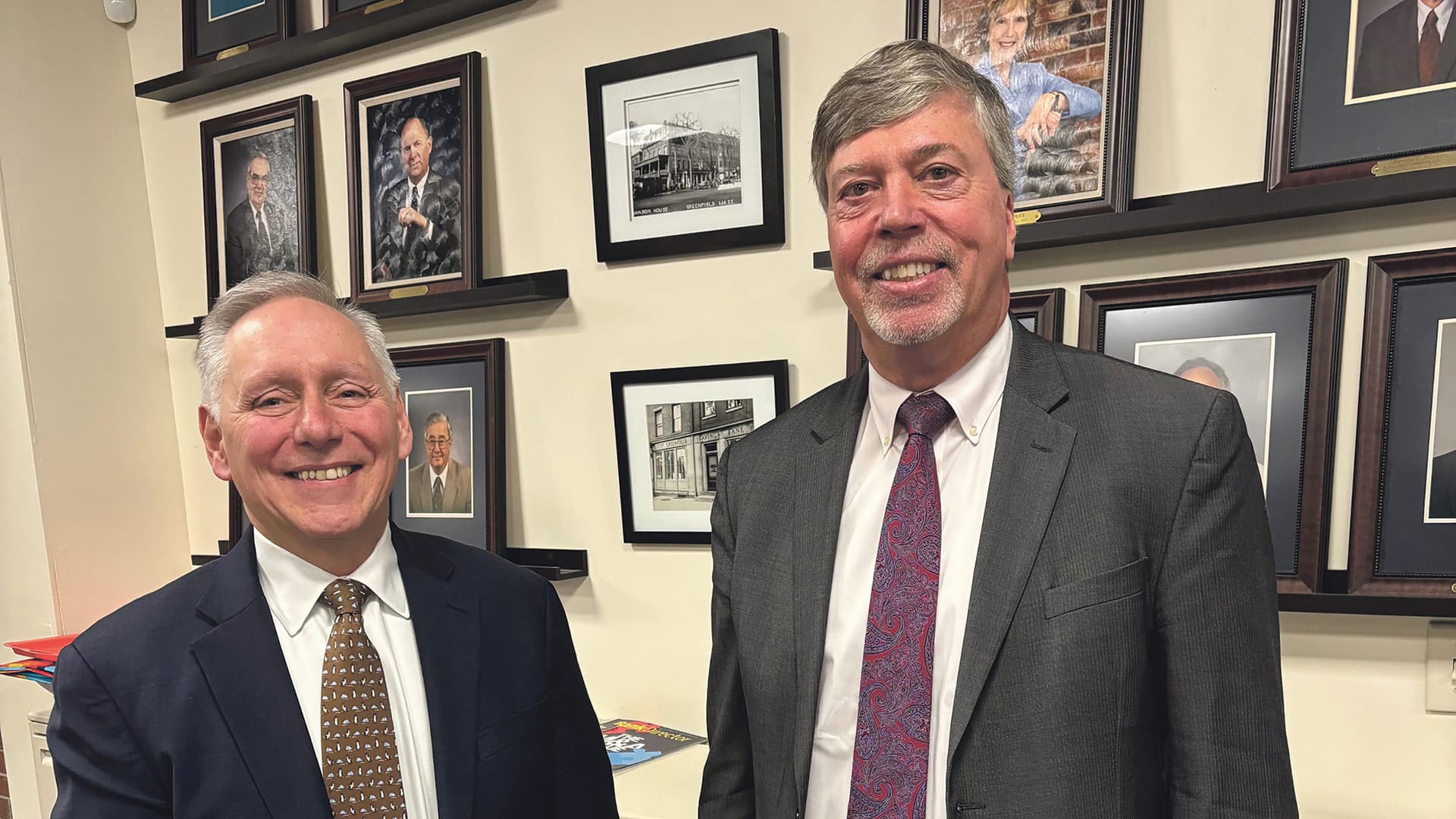
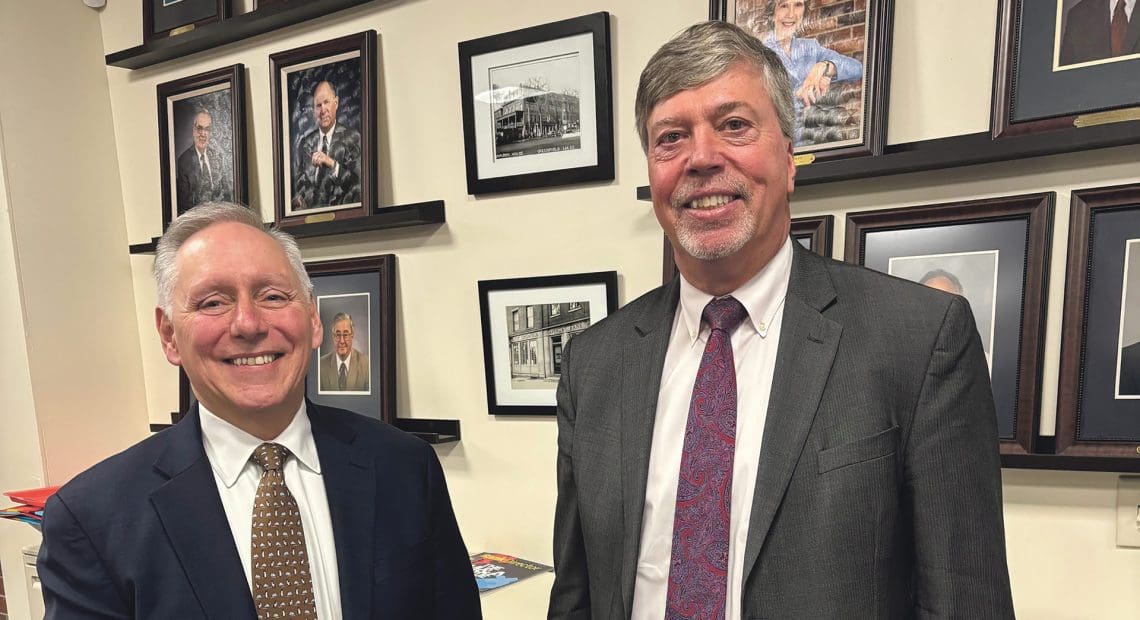
Peter Albero, left, takes the reins from Tom Meshako on April 1.
As Tom Meshako remembers it, by the time he was done interviewing Peter Albero, he was convinced the latter was not only his best candidate to become CFO and treasurer at Greenfield Savings Bank, but also a possible successor when he moved into retirement in a few years.
“I thought we had a lot of similarities — we felt the same way coming from a public institution; we came here for the same reason, the right reason,” said Meshako, noting that, like Albero, he came to GSB to be in a mutual bank setting and in a position to give back to the community it was serving.
Albero, who came to GSB from Salisbury Bank in Connecticut after it was acquired by NBT Bank, added that, “as a community bank, we didn’t do a lot for the community, because we had to pay dividends to shareholders. “I wanted to work at an institution where we could give back to the community instead of giving to shareholders.”
Meshako’s initial thoughts back in the summer of 2023 turned out to be prescient, as Albero prevailed in nationwide search last year for a successor to Meshako, who will retire to Florida in the spring.
Albero, who will take the helm on April 1, does so at an intriguing time in the bank’s history — although he says the banking industry is “always interesting.”
Indeed, the institution is expected to reach $1.5 billion in assets in the first quarter of 2026, an important milestone and another threshold as GSB continues its quest for an all-important commodity in the banking industry — size.
“I wanted to work at an institution where we could give back to the community instead of giving to shareholders.”
“Scale matters, and our goal is to continue to grow our loan book without increasing our head count and become more efficient,” said Albero, noting that much of the bank’s growth has come on the commercial lending side.
Meanwhile, the bank will cut two significant ribbons in the coming weeks. One will be at the renovated Leavitt-Hovey House next door to the bank’s headquarters on Main Street in Greenfield, and the other will be at its latest branch, a key piece in a massive redevelopment project at the site of the former Tasty Top in Easthampton.
The former is a nearly $7 million initiative that will transform the landmark, built in 1797 and home of the city’s public library between 1909 and 2023, into a home for the bank’s trust and wealth management, residential lending, and cash management teams.
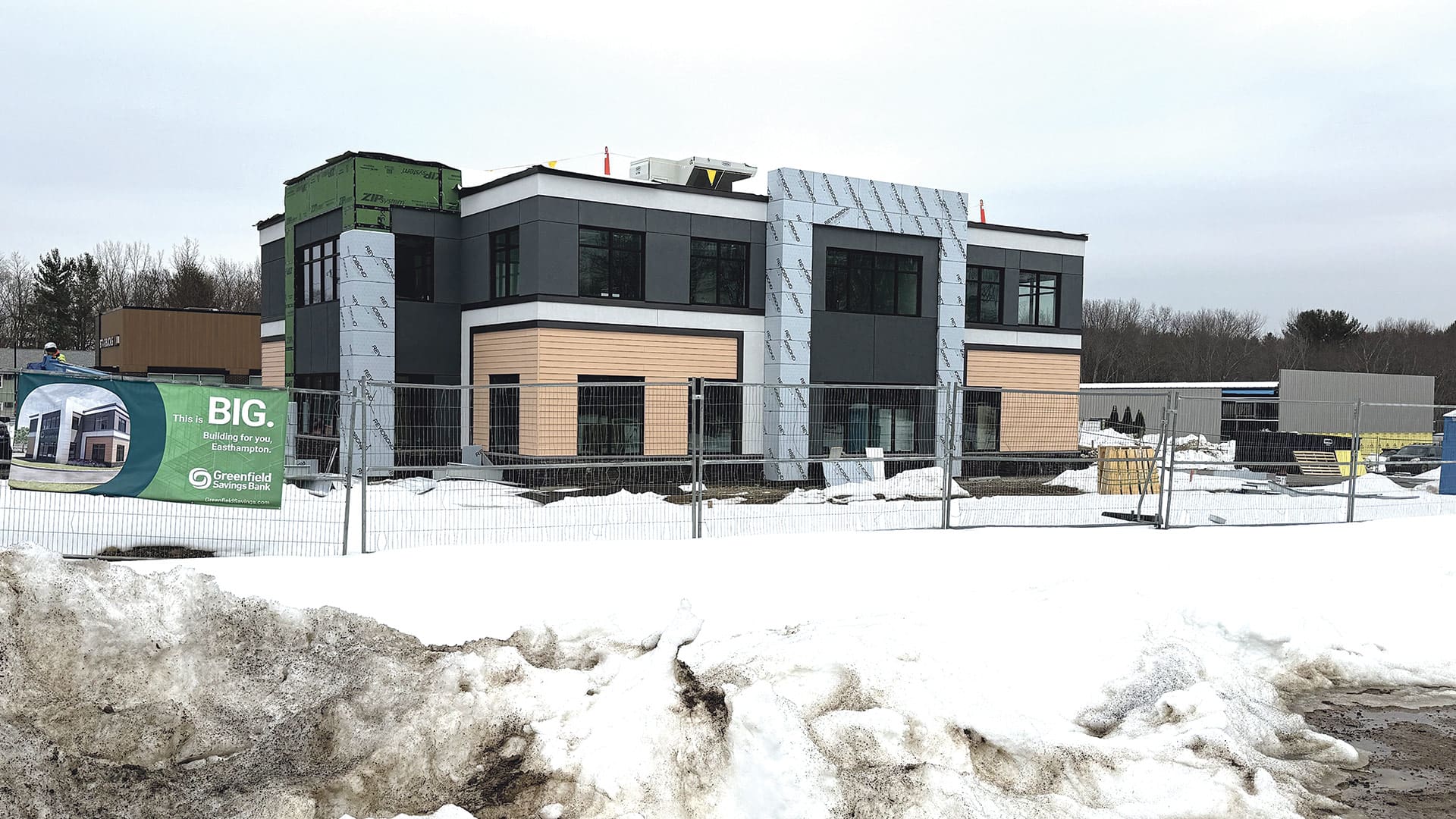
GSB’s ‘southern headquarters’ in Easthampton is slated to open within the next several weeks.
The latter is a $7 million investment that marks the bank’s latest and boldest effort to “move south and east,” as Albero put it, meaning into Hampden and Worcester counties, and beyond the bank’s historic base in Franklin and Hampshire counties.
And as the bank continues this expansion east and south, the ‘community’ it serves has become much larger, noted both Albero and Meshako, adding that GSB has responded accordingly, increasing its charitable giving from $300,000 when Meshako started at the bank a decade ago to $1.2 million last year, with that number expected to move higher as the bank continues to grow.
“Tom and I both agree that, if the bank does better, the communities can do better,” Albero said. “When you move into a community, you have to support that community and its nonprofits.”
For this issue and its focus on banking and financial services, BusinessWest talked with Albero and Meshako about the transition in leadership at GSB and what’s in the broad business plan for this 157-year-old institution.
Purposeful Journey
Albero spent the bulk of his career in a setting far removed from rural Greenfield — New York City.
He spent 26 years in senior roles in the financial controller group at Morgan Stanley and also worked as a risk advisory consultant at PricewaterhouseCoopers. Desiring a change from the Big Apple, he joined Salisbury Bank & Trust in Connecticut as CFO.
He did that for six years before Salisbury was acquired by NBT Bank in 2023, prompting him to seek another significant career change, this time in the mutual bank setting.
“Tom and I both agree that, if the bank does better, the communities can do better.”
“Salisbury Bank was a community bank, but it was public,” he noted. “We found that it was very hard to grow as a public bank, trying to compete with much larger institutions, when you’re focused on growth and earnings quarter over quarter.”
While Albero was chosen as GSB’s new CFO in early in 2023, he stayed with Salisbury until the merger with NBT had been finalized before coming to Greenfield, a wait Meshako was willing to endure.
“I waited nine months for Peter to finish that transaction because I knew he was the person I wanted,” he recalled. “We seemed to be on the same page, and I kind of knew he was the person that would be taking my position when I retired; I knew he’d make a great candidate.”
As he takes the helm, Albero will be focused on keeping the bank on a strong growth trajectory, a pattern that has emerged “organically and safely,” and continued in 2025, with roughly 6% growth.
“Sometimes, when you try to grow your portfolio, you’ll do a little higher risk rating, but we didn’t — we stayed with high-quality customers while also moving more south,” Meshako said, adding that the move to open a branch in Easthampton is the latest and boldest manifestation of this strategy.
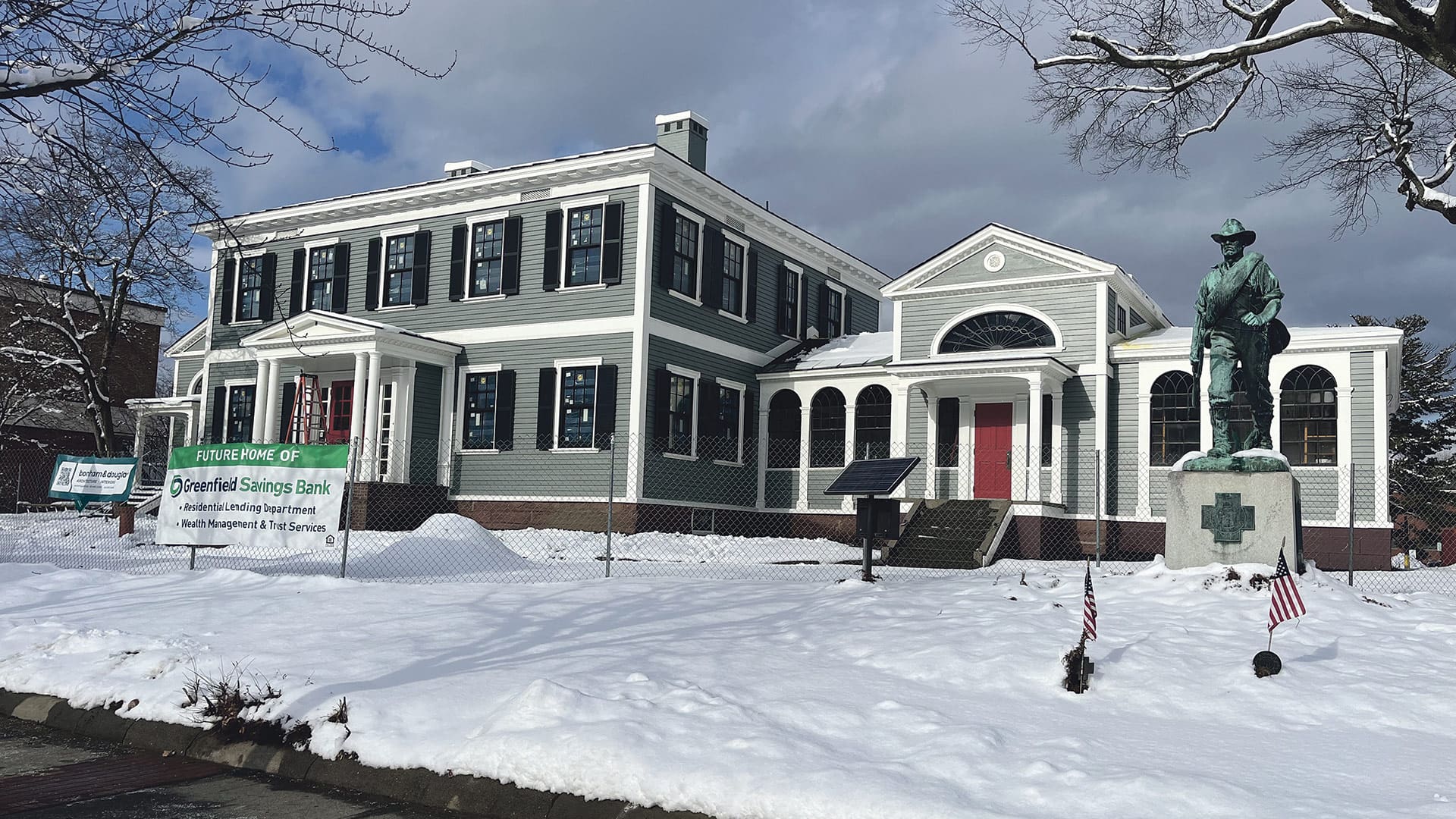
The renovated Leavitt-Hovey House will become home to the bank’s trust and wealth management business, residential lending, and cash management teams.
Actually, this will not be just a branch, Albero said, referring to it instead as the bank’s “southern headquarters.”
Indeed, the facility, due to open its doors later this month or early in April, will include a commercial lender, a wealth management and trust services representative, and a residential lender, as well as the branch, he noted, adding that it will serve as a staging point, if you will, for continued growth in Hampden County, in all facets of banking, but especially commercial lending.
Indeed, where once the bank’s commercial portfolio had 50% to 60% or more of its originations in Franklin County, that number is now less than 25%, a nod to both slow growth in the Greenfield area and the bank’s pursuit of business east and south of its traditional base.
“We have a lot of borrowers in the Springfield market, and they refer other borrowers to the bank because of our ability to get the deals closed,” Albero said. “And we have some other borrowers more toward Worcester, and they refer more borrowers to our commercial team for the same reason.”
Meanwhile, with assets now approaching $1.5 billion, GSB has expanded its sweet spot when it comes to commercial loans, its niche now being the $3 million to $7 million range, where it was once $1 million to $3 million.
“That’s another way that you can grow, not just doing more loans, but larger loans as well,” Meshako said, adding that this higher ceiling creates many more opportunities to do business across the region.
Points of Interest
When asked about plans for further expansion beyond Easthampton and when and where that might take place, Albero said there was nothing on the drawing board yet.
Indeed, the bank is focused on its two large investments — the Easthampton facility and the renovated Leavitt-Hovey House — and assimilating those into the corporate portfolio.
“We have a lot of borrowers in the Springfield market, and they refer other borrowers to the bank because of our ability to get the deals closed.”
“Our plan is to make sure that Easthampton becomes profitable very quickly,” he noted. “We’ll continue to evaluate the markets, but we’re not going to jump in immediately. We have a lot to digest from a cost perspective.”
Renovation of the Leavitt-Hovey House represents a different kind of investment in the community — not a check to a nonprofit, but the restoration and reuse of a city treasure, Meshako said.
“If we didn’t buy it, I think it would have sat in the state that it was in and continue to deteriorate,” he said. “This is something we did to help the city of Greenfield and create some tax revenue. We needed additional space, and we were looking for some place to build or possibly buy, and we thought that renovating the Leavitt-Hovey House would help this whole corner of downtown.
“We’re bringing it back to its original luster,” he went on, referring to the color scheme from the 1950s, when the home was placed on the National Register of Historic Places, adding that the facility is slated to open late this month or early in April.
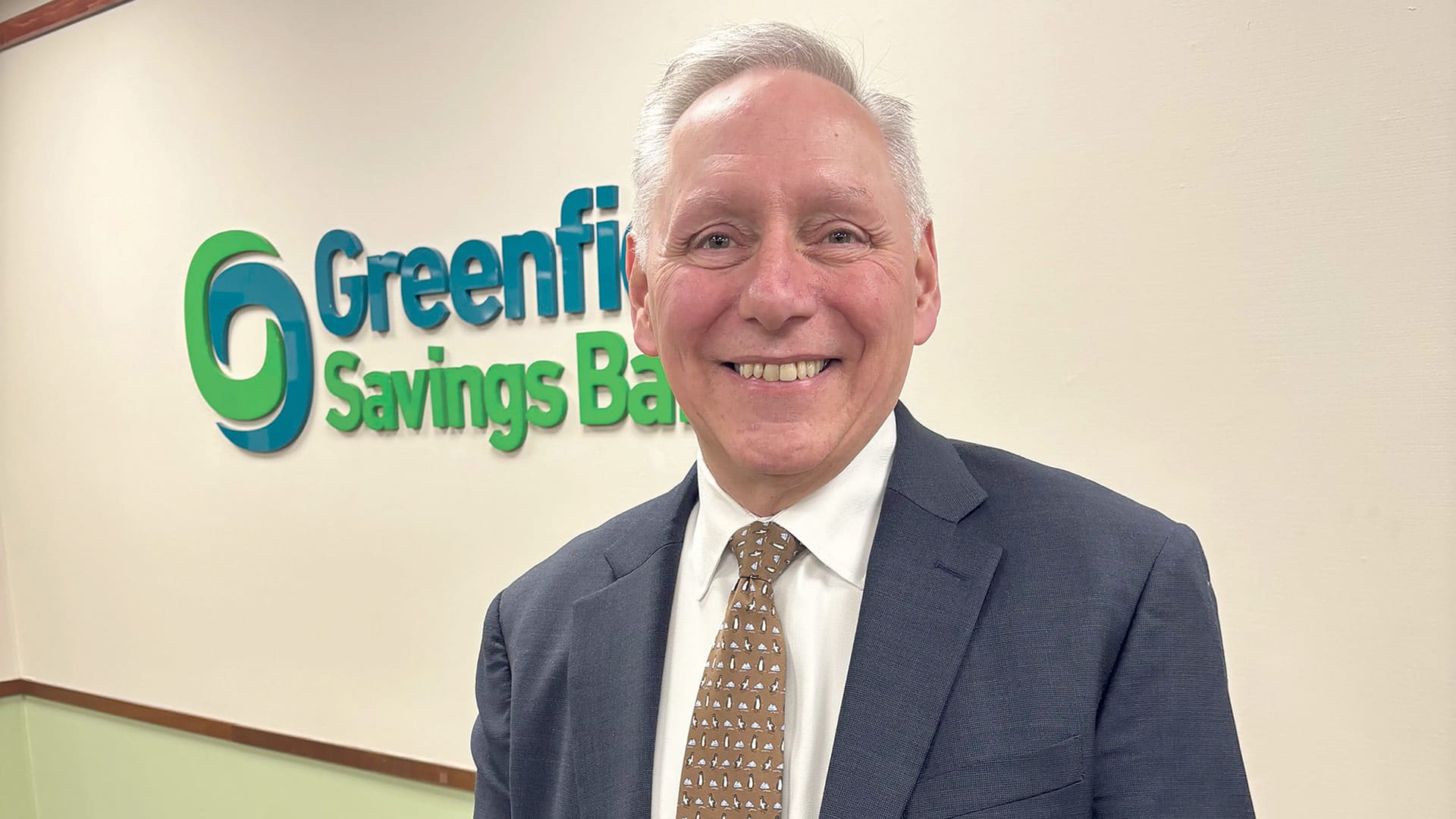
Peter Albero says GSB’s overall growth strategy involves moving “south and east.”
As for Easthampton, the leaders at GSB saw that community as the logical spot for its southern expansion. That city is similar to Greenfield in many ways — a former manufacturing hub that is reinventing itself as a center for the arts and hospitality, especially in renovated mills — but it also neighbors thriving Northampton, a city where the bank already has a presence.
“There’s been quite a resurgence in Easthampton,” Meshako said. “That whole mill district just took off, and it has helped the whole downtown. The city continues to prosper, and we decided that this is where we wanted, and needed, to be.”
As for the former Tasty Top site itself, plans call for a Starbucks, a steak restaurant, housing, and other developments that should bring foot traffic — and additional business — to the bank.
Continued growth is important to GSB, as it is to all banks, said Albero, as the cost of doing business continues to rise on many fronts, and institutions seek economies of scale.
“Technology costs continue to rise, and it’s difficult, also, to attract employees, particularly where we are in Western Massachusetts, so you ending up paying higher salaries to attract individuals,” he explained. “We find that’s it’s challenging. Every time you continue to grow, you can’t just continue to add head count; you must become more efficient, but the technology costs to do that are very expensive.”
And while the bank plans to continue to grow organically and safely, as Meshako mentioned, it will explore options for acquisitions as well.
“We will consider M&A transactions, but we will be the acquirer,” he told BusinessWest. “But our focus over the next three years is on efficiency, increasing our earnings, and boosting our capital so we have a long runway for organic growth. And while we’re doing that, we’ll keep an eye on the M&A market; if the opportunity is there, we’ll take advantage of it.
“We’ll keep our options open,” he went on, adding that this might be considered the overall game plan moving forward for an institution that it is in a time of transition — in many different ways.