A chart of the region’s general contractors
Click here:GeneralContractors BW0911b




Dennis G. Egan
Budget Considerations
While green buildings can result in significant energy efficiency and corresponding cost savings down the road, the upfront cost of green building materials can be significant. While cost is commonly greater in a green building project than the same costs associated with a traditional building project, the average increase is often less than traditionally believed.
For example, one recent study by the U.S. Green Building Council puts the average green building cost premium at slightly less than 2%, or $3 to $5 per square foot. Those on a tight budget might not be able to afford this increase, however, despite the prospect of lower energy costs in the future.
Additionally, it has been found that, with an increase in the number of green building projects, there is a corresponding reduction in the green-building cost premium. Obviously, the green-building cost premium can be, and often is, offset by the increased energy efficiency of green buildings and resulting reduction in energy costs. So you’ll have to pay more upfront to see the payoff later on.
Tax Credits and Financial Incentives
Recently, several tax credits, deductions, and other financial incentives have become available. For example, the Energy Policy Act of 2005 created the Commercial Building Tax Deduction, which provides an accelerated tax deduction aimed at reducing the initial cost of investing in energy-efficient building components. Under this program, owners of commercial buildings (or their tenants, if applicable) can deduct all or a portion of the cost of installing lighting, HVAC and hot-water components, windows, and building shell components in the year in which the new components are placed in service, up to a maximum of $1.80 per square foot.
Alternatively, partial deductions are available (up to a maximum of $0.60 per square foot) for improvements in any one of the energy-efficient components listed above. The deduction can be claimed for all qualifying projects as long as they are completed prior to January 1, 2014.
Additionally, the Energy Improvement and Extension Act of 2008 and the American Recovery and Reinvestment Act of 2009 expanded the business energy investment tax credit, which provides credits equal to 30% (with no maximum credit) of the cost of solar, fuel-cell, and small wind-turbine power systems, and 10% of the cost (with no maximum credit) for micro-turbines, geothermal power, and combined heat and power (CHP) systems. Minimum- and maximum-capacity requirements apply in some cases, so those wanting to take advantage of this credit should consult a professional to determine the project’s eligibility.
Alternatively, eligible taxpayers may receive a grant from the U.S. Treasury Department in lieu of taking a tax credit. Generally, to be eligible for the credit, the original use of the equipment must be made by the taxpayer, or the equipment must be constructed by the taxpayer. In addition, the tax credit is available only if the energy property is operational in the year in which the credit is taken.
For all of the above programs and incentives, you’ll have to shell out the money upfront, but if you can afford to do so, you may receive credits for the work and also enjoy reduced energy costs down the road.
Certification
One of the most recognized certifications that can be attained by builders, developers, building owners, and landlords is Leadership in Environment and Energy Design (LEED) standards set forth by the U.S. Green Building Council, which awards points based on building specifications. LEED certification can be achieved in a number of different areas, including but not limited to existing buildings (operations and maintenance), commercial interiors (leases/tenant improvements), core and shell (design for new core and shell construction), schools (construction of K-12 schools), retail (retail design and construction), and health care (planning, design, and construction for health care facilities).
LEED certifications are being recognized and adopted as the green benchmark in ever-increasing numbers by federal, state, and local governments. As such, many government entities are requiring that government buildings, both new and existing, as well as owned and leased, comply with LEED standards.
LEED-certification programs are pricey, though. A recent check online resulted in several different programs ranging from $595 to $2,500 for specific certifications. In addition, there are registration fees and credential-maintenance programs that can add up significantly. But as LEED certification becomes more mainstream and expected, contractors may find themselves obligated to make the investment to fulfill credentialing requirements.
Another available certification is Energy Star for commercial buildings, which is a government program administered by the U.S. Environmental Protection Agency and the U.S. Department of Energy. This certification differs from LEED certification in that Energy Star’s certification is relative to a building, rather than a person. The goal is to reduce the use of energy through energy efficient practices and products, and Energy Star uses a points-based system that awards points on a scale of 1 to 100.
Buildings must be verified by a professional engineer or registered architect, and associated costs must be paid, then buildings receiving a score of 75 or more receive the Energy Star designation. While there is no direct financial benefit from Energy Star certification, there is an implied status enhancement, and research shows that people generally prefer to do business with companies that are committed to doing their part to help the environment.
Dennis G. Egan Jr. is an associate with Bacon Wilson, P.C., concentrating in special education, business, and corporate law; (413) 781-0560; [email protected]
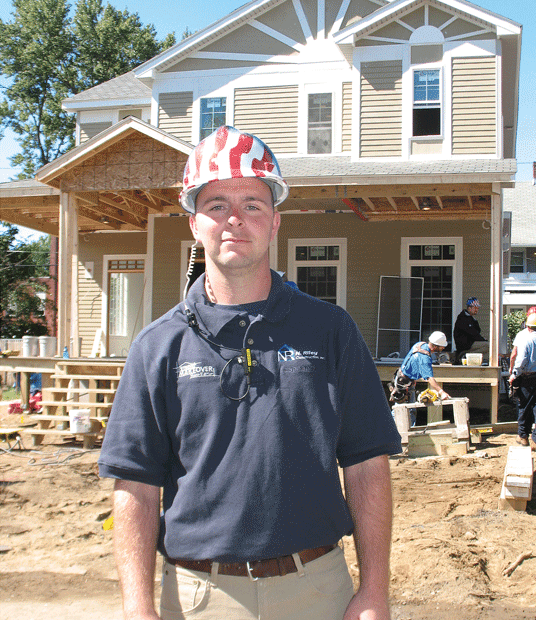

Nick Riley, president of N. Riley Construction, during the build week at Sirdeaner Walker’s home.
Kate Riley said her husband had a few goals when he planned his career — “to have his own business, to have his name get big, and to build houses. This is his first house.”
She — along with several other Riley family members and dozens of area builders and tradespeople, all volunteering their time — stood on Springfield’s Northampton Avenue, absorbing what had happened in the first few days since Ty Pennington and his team of designers from ABC’s Extreme Makeover: Home Edition knocked on the door of Sirdeaner Walker and informed her she would have a new house by the following week.
“The Extreme Makeover producer contacted me about four weeks before we started the project,” said Riley, president of N. Riley Construction in Chicopee, noting that he was recommended by the Home Builders Assoc. of Western Mass. and other contractors. “I ended up meeting with them the day after. I sat down and spoke with them, and they told me the story of this family.
“That’s when I made my decision,” he continued. “Being able to do this for this family … you never get a chance like this, to be able to do a project like this. It’s not too often that you can say you were able to gather an entire community to help one family.”
Walker is no stranger to the spotlight, but it’s a light she never would have asked for, obviously. Her 11-year-old son, Carl Joseph Walker-Hoover, took his own life in 2009 after being incessantly bullied by peers at the New Leadership Charter School in Springfield.
In the months following the tragedy, Walker became a strong advocate against school bullying, successfully pushing for anti-bullying legislation in Massachusetts, meeting with federal lawmakers and President Obama, and establishing a foundation in her son’s name that raises awareness of the bullying issue and scholarships for area students.

Nick Riley’s wife, Kate, and mother, Lisa, were among many family members pitching in with Extreme Makeover.
From the Ground Up
Riley corrected his wife’s first-house assertion to a point, noting that he’s currently building a house in Chicopee, and his company, which he launched about five years ago, has done some major home renovations that were very close to whole-home jobs. But this month’s makeover was, indeed, the first house he has completed from the ground up.
The build week itself was every bit as long and intense as viewers of the show might imagine. “On Sunday, we knocked on the door and surprised the family, and on Monday we ripped the house down. On Tuesday we started the foundation,” Riley said.
By midweek, a newly framed house had gone up in its place, followed by repaving of the driveway, complete landscaping of the yard, and of course, all those personal touches the designers are known for. “On Sunday, they brought the furniture in and surprised the family with their new home.”
The days, not surprisingly, were long. “We had 12-hour shifts set up, but the nighttime shifts started to roll into the daytime shifts,” said Riley. “The demolition of the house went really well, and when we dug out the foundation, that went really well,” he recalled. “Framing went pretty well, too. We had framers there for 40 hours, then we started losing them, and it was a challenge to get people back there.”
Inclement weather, always a concern on these one-week builds, wasn’t a factor; temperatures were mild all week, with a little rain passing through on Wednesday, but nothing to slow down the progress, as the house was weathertight by that point. But the occasional unexpected challenge emerged during construction.
For example, “when we started to set the concrete walls, we noticed that we hit a little bit of water. That caused a bit of a problem; we had to set up a pump and pump out the water while we were setting these concrete walls.”
But any problems encountered during the build paled in comparison to the joy the Walker family felt at receiving so much community support. In addition to the army of volunteers and dozens of companies — in the construction trades, home supplies, marketing, and other fields — who lent their time and resources, Walker had more surprises coming at the reveal. Notably, UMass presented her with four-year scholarships — tuition, room, board, and fees at any of the four campuses — for each of her youngest children, now age 7 and 8.
Details about the home’s interior will have to wait until the show airs, at the request of ABC. But Riley said the designers came up with some special touches to match the work he and his crew did on the house itself.
“Seeing people come together to help other people in such a big way, giving up their days and money to help people they don’t even know, it was an amazing experience,” he told BusinessWest. “It just shows how good people are. And just seeing the faces of the family when they moved that bus — it was a once-in-a-lifetime opportunity.”
He said he was also fortunate to meet many people from different businesses he might not otherwise have met, and the participation of his own family members was another personal highlight.
“I asked a couple people in my family to help me out with the planning process, and before I knew it, the whole family was helping out in some way,” particularly helping at the various support tents set up around the neighborhood. “That was rewarding.”
His wife agreed. “This is unbelievable,” Kate said that afternoon midway through the project. “It’s amazing to be able to help a family like this.”
Making a Name
If Riley’s goal was to make a name for his business, he’s well on his way. He started out in the construction business working for his uncle, Andrew Crane, president of A. Crane Construction in Chicopee.
“I ended up leaving because I wanted to start my own company, and things have been great the whole time,” Riley said. “I haven’t had one minute of downtime — it’s been amazing.”
That’s a striking account of success in what has been a decidedly downbeat atmosphere for builders, many of whom have struggled to keep employees busy during the past few years of recession and sluggish recovery. But Riley, most of whose work is residential, has focused largely on home remodels and renovation work, one of the few sectors of construction that has consistently shown some life.
“Right now, because of the recent disasters, we’ve done a lot of insurance repairs, from the ice damage from the winter to work from the tornadoes and the microburst.”
And he’s looking forward to plenty more work as the economy improves — with the experience of that one-week build under his toolbelt.
Still, “we don’t want to grow too big,” he said. “We want to stay a smaller company and keep it personal, make sure we continue to provide a quality product.
“I like the hands-on work of going into someone’s home and putting a smile on the face of the owners,” Riley continued. “There aren’t a lot of other jobs where you can do that, where you can go in make an impact by changing their homes.”
Or, in extreme cases, their lives.
Joseph Bednar can be reached at [email protected]