Home Sections Archive by category Supplements (Page 13)

Supplements

Sections Supplements
Holly Leonard Inspires Others to Be Fit
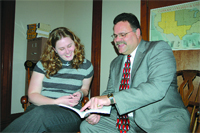
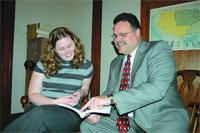
Holly Leonard

Holly Leonard

Holly Leonard decided to take charge of her health and body image as a teenager, but she knows it’s tough for many people to make the same commitment. As a personal trainer and owner of BeFit Health and Wellness Solutions, today she combines her training in exercise science and psychology — and the personal insights gleaned from her own weight-loss experience — to help others overcome their own obstacles to fitness and self-confidence.

In her teen years, Holly Leonard didn’t lack for athletic achievement. In fact, she was the star catcher of a championship softball team. But she was also a frequent binge eater — an experience that has given her keen insights into what millions of Americans struggle with every day.

“That’s actually how it all started,” said Leonard, now a personal trainer and owner of BeFit Health and Wellness Solutions in Hadley. “I had always been active in sports, particularly league softball, that you don’t have to be too athletic to play, and I found myself overweight and not very happy with who I was in terms of confidence and body image.”

The tipping point came when she found she didn’t fit in clothes she had purchased earlier the same day. Something had to change.

“I broke down and said, ‘enough,’” she told BusinessWest. “So I went online and researched how to eat right and exercise. I put together a plan, and though I was never a morning person, I committed to getting up every day and going to the gym before doing anything else. I lost 30 pounds that summer, and my confidence and my whole outlook on life changed because of it.”

Soon after, Leonard was challenging herself by competing and winning awards in natural bodybuilding competitions. She also decided to major in Exercise Science and Psychology at UMass Amherst — “I knew from my own experience that those two things go hand in hand” — and soon after landed a job in the corporate wellness center at Yankee Candle in Deerfield, there earning certification as a trainer and a group instructor.

But Leonard had bigger goals, and in 2006 launched Be Fit in a small studio on Route 9 in Hadley. She remains at that address today, but now her studio occupies three private suites.

Her client list — typically average people who need some direction and motivation to lose weight and, well, be fit — is growing by the week. And all are told on their first consultation that there are no quick fixes.

“Most people want results yesterday, but by the time they meet with me, it’s already past that deadline,” she said. “We don’t take everyone. We work with people who are fully committed to their goals. They have to be willing to put forth the effort, and we help them by giving them the tools, teaching them about exercise and good nutrition.”

Leonard’s goals as an in secure teenager weren’t reached in a day, either. But her efforts to get in shape then — just like her efforts to build a thriving business today — were successful, and continue to inspire others.

Working It Out

Obesity — and a general lack of fitness — are all-too-common problems in America today, given plenty of attention by TV and print media. But they remain tough issues for many to overcome, and Leonard understands some of the obstacles.

“Some people think they need big machines, but I want to show people that they can get a great workout and achieve results with minimal equipment,” she said. “They can work with a trainer here for a couple of months and get the foundation of what they need to achieve results.”

That’s a big deal for many, she said, who worry about going to a gym, where the machines can be intimidating and they might feel — justifiably or not — like the only out-of-shape person in the room. By working with clients one-on-one or in small groups, Leonard helps them overcome large-gym anxieties, and sets them up with programs they can continue at home.

“No matter where you are or what your goals are, you will feel accepted here, and we’re going to help you achieve those goals and give you what you need to maintain them after you’re done working with us,” she told BusinessWest, adding quickly that some clients do stay with her long-term. “There’s a perception that only celebrities go to trainers, or it’s only for rehab. But they’re mostly average people; they just want to firm and tone and lose five or 10 pounds. Wherever people are, we’ll work with them.”

Another major obstacle to getting in shape is simply a lack of motivation, and that’s where a personal trainer can make a big difference.

“The biggest thing is, they don’t have a plan, and they don’t have someone to hold them accountable to that plan,” Leonard said. “It’s easy to say, ‘I’m going to get up every day this week and work out,’ but then Wednesday rolls around, you’re tired, and you decide not to get up. Nobody’s holding you accountable. We set goals with people and set a timeline, and we hold them to it. Because that’s the initial stumbling block — not being held accountable.”

Food for Thought

That applies to food even more than exercise, Leonard said, noting that not only is eating right more important than physical activity, but it’s a more difficult goal to achieve.

“It’s easy to get in three or four workouts a week, but nutrition is 24/7, and there are a lot more places you can slip up,” she said. “Basically, we tell our clients that nutrition is where 90% of the results come from, and about 10% from exercise. As an exercise person, I don’t really like to admit that, but it’s the truth.”

BeFit tries to make nutrition as simple as possible for clients, encouraging five or six small meals per day, at roughly three-hour intervals, featuring lean proteins — such as chicken or eggs — skim dairy products, fruits, vegetables, and starchy carbohydrates such as brown rice, bread, or pasta. For people who can’t prepare that many meals per day, occasionally substituting a snack such as a banana or cottage cheese will suffice.

Clients are also offered supermarket tours where they’re taught how to make intelligent shopping choices.

“We start with a little scavenger hunt where they need to pick five or 10 items they think are part of a healthy nutrition plan,” she said, noting that people are often surprised at what they don’t know about the contents of food. “They think, ‘I’m getting this lowfat yogurt,’ and it’s loaded with sugar or artificial ingredients. We educate people about what’s in products, why they want to choose whole grains over white bread, and the impact of certain foods on their metabolism.”

“Nothing Tastes as Good as Fit Feels” is the headline of one of the many informational sheets Leonard mails out, touting good nutrition habits such as planning a week’s worth of meals at one time and using meal-replacement bars and shakes when on the go.

“We hold people accountable and do regular assessments on them,” she said. “People need to know if they’re progressing, and they sometimes need course corrections. A lot of people out there are stumbling along blindly on their own, without any feedback to keep them from falling off the wagon. We keep repeating all this to our clients until they get to their goals.”

Small Bites

Leonard said BeFit’s small-group sessions — no more than five in a class — are much less expensive than the private-trainer plans, but allow a similarly personalized, encouraging framework for success.

“People receive a great value that way,” she said. “And no matter where they are, a beginner or a pro athlete, the workout is completely scalable. It’s the same workout, but one person might do one set of each exercise, while another does three. Everyone is working toward their own goals.”

The appeal of BeFit is evident, she said, in the range of clients the company boasts, from a 16-year-old girl to a 76-year-old who signed up to combat a persistent knee pain.

“I try to distinguish myself from gyms,” Leonard said. “Not that people shouldn’t go to gyms, but we make it more personalized. We know all our clients, we E-mail them on a weekly basis, we send cards and gifts. We really emphasize the personal component, which is why we’ve had clients stay with us for a long time. It’s something we really strive for.”

And, clearly, Leonard has a history of achieving what she strives for.

Joseph Bednar can be reached at[email protected]

Sections Supplements
Nominees, Please: BusinessWest Readies for Its Second Annual

Entrepreneurs, corporate achievers, community leaders — 40 of the best and brightest young people in Western Mass. came together last year to form BusinessWest’s inaugural Forty Under 40, a group whose collective strength surprised even the winners. We’ll introduce the second Forty Under 40 class this spring — but first we need your help. Nominations are officially open, a panel of judges is being lined up, and we’re looking forward to sharing 40 more inspiring success stories with our readers.

When Erica Walch showed up at last June’s reception to honor BusinessWest’s inaugural Forty Under 40 class, she didn’t know what to expect. But it certainly wasn’t throngs of people gathering to celebrate the best and brightest of the Pioneer Valley’s younger professional set.

“I was amazed to see so many people at the party,” said Walch, the founder of Speak Easy Accent Modification, which helps non-native English speakers achieve more fluent and less heavily accented speech. “I didn’t know it would be such a big deal, and I was shocked to see hundreds of people there.”

But the organizers of the program at BusinessWest weren’t so shocked. The business journal’s editor, George O’Brien, said at the heart of the program is the idea that these are people worth celebrating, and the reception attendance only reinforced that notion.

“We learned that we have a number of bright, young, and talented individuals in Western Mass.,” O’Brien said, “and we learned a lot about these people through interviews that were as enlightening as they were fun.”

BusinessWest is gearing up for more such interviews once the second annual Forty Under 40 class is chosen — a process that begins right now.

Reaching Higher

Walch can testify to the value of being recognized as one of the rising stars on the Western Mass. business scene.

“I got a lot of feedback,” Walch said. “So many people read BusinessWest, and a lot of people told me, ‘I saw you in the Forty Under 40.’ I met a lot of people through that — some of the other winners, and people in the community.”

Sarah Tsitso, another of last year’s honorees, said she felt like she was in “pretty impressive company” when the 2007 list was revealed.

“Even though I’m in that age group, I wasn’t really aware of how many people — and from how many diverse backgrounds — there are in the business community that fit that category,” said Tsitso, who was an editor for Turley Publications at the time.

“Western Mass. is a pretty small world, and there were still so many people I met that I hadn’t known,” she added. “It was a great opportunity to meet many people and learn what kinds of work they do. I was surprised at how many innovative entrepreneurs we have in that age group.”

In fact, the inaugural Forty Under 40 class included men and women from the fields of law, media, finance, education, medicine, retail, and philanthropy, to name a few. A good number started their own companies, using their skills — as in Walch’s and many other cases — to create business opportunities by identifying unmet needs.

“Just to be recognized by the premier business publication in the area was very special, and to attend a first-class reception was something I’ll never forget,” said Tad Tokarz, owner of the Western Mass. Sports Journal and another of the inaugural 40. “It’s nice to see that younger people are starting to take more responsibility and going great things and becoming leaders in the community.”

In fact, all of the 2007 honorees, without exception, are individuals who also serve their communities by sitting on boards, granting time and energy to business groups and nonprofit organizations, or, in a surprising number of cases, working with children. Or perhaps that’s not so surprising, given the caliber of character that typifies these 40 professionals.

That dual success — both in one’s chosen field and in community service — will again be necessary to be considered for the second annual Forty Under 40.

“I think that’s important,” Tokarz said. “These are people who do more than their job; they also give back to Western Mass. and continue to make our community a better place to live.”

Last Year’s 40 under Forty

William M. Bither, III
Atalasoft

Kimberlynn Cartelli
Fathers & Sons

Amy Caruso
MassMutual Financial Group

Denise Cogman
Springfield School Volunteers

Richard Corder
Cooley-Dickinson Hospital

Katherine Pacella Costello
Egan, Flanagan &Cohen, P.C.

A. Rima Dael
Berkshire Bank Foundation of Pioneer Valley

Nino Del Padre
Del Padre Visual Productions

Antonio E. Dos Santos
Robinson Donovan, P.C.

Jake Giessman
Academy Hill School

Jillian Gould
Eastfield Mall

Michael S. Gove
Lyon & Fitzpatrick, LLP

Dena M. Hall
United Bank

James Harrington
Our Town Variety & Liquors

Christy Hedgpeth
Spalding Sports

Francis J. Hoey, III
Tighe & Bond

Amy Jamrog
The Jamrog Group, Northwestern Mutual

Cinda Jones
Cowls Lumber Co.

Paul Kozub
V-1 Vodka

Bob Lowry
Bueno y Sano

G.E. Patrick Leary
Moriarty & Primack, P.C.

Todd Lever
Noble Hospital

Audrey Manring
The Women’s Times

Daniel F. Morrill
Wolf & Company

Joseph M. Pacella
Egan, Flanagan & Cohen, P.C.

Arlene Rodriquez
Springfield Technical Community College-School of Arts

Craig D. Swimm
WMAS 94.7

Sarah Tanner
United Way of Pioneer Valley

Mark A. Tanner
Bacon & Wilson

Michelle Theroux
Child & Family Services of Pioneer Valley Inc.

Tad Tokarz
Western MA Sports Journal

Dan Touhey
Spalding Sports

Sarah Leete Tsitso
Fred Astaire Dance

Michael K. Vann
The Vann Group

Ryan Voiland
Red Fire Farm

Erica Walch
Speak Easy Accent Modification

Catherine West
Meyers Brothers Kalicka, P.C.

Michael W. Zaskey
Zasco Productions, LLC

Edward G. Zemba
Robert Charles Photography

Carin Zinter
The Princeton Review

Learning Experience

O’Brien described last year’s Forty Under 40 compilation as an intense learning experience — on a number of levels. Like the most successful businesses in this region, he said, BusinessWest believes in continuous improvement and constantly looking for better ways to do things.

“We learned a few things about how to stage a program like this,” O’Brien said. “Year one went smoothly, but we knew there were some things that we needed to do better.”

Promotion of the event is one of the items on this list, he explained, adding that the magazine will take some additional steps to ensure that the community is aware of the Forty Under 40 program, and also its mission, timetable, rules, and nuances.

“One thing we learned during year one is that people looking to nominate individuals for this honor have to be thorough and include as much information for the judges as possible,” he said. “Perhaps because this wasn’t thoroughly explained last year, some nomination forms were vague, and others could diplomatically be described as incomplete.”

The roster of judges will also be expanded from three to five, O’Brien said, to handle what will likely be a larger pool of nominations.

“The judges may be aware of some of the people who are being nominated,” he continued, “but they probably don’t know enough to properly weigh their talents and contributions to the community. Those who are nominating individuals can help by including resumes or quick biographical sketches, press clippings, if there are any, and maybe even some testimonials from friends and co-workers.”

Some of the class of 2007 have seen their exposure lead to greater businesses opportunities, while others have moved to completely different challenges. Tsitso, for instance, was recently hired by Fred Astaire Dance Studios as its first national copywriter, working at the company’s Longmeadow headquarters. Forty Under 40, she said, was invaluable in helping her build relationships with people she might not have otherwise met.

Walch agreed, noting that she has seen Speak Easy grow with new contracts, as she also continues her work with groups that promote Springfield as a viable home address for young professionals.

“It’s been a wonderful business networking experience, and I’m very honored to have been a part of it,” said Walch. “And, I already have somebody in mind to nominate when the form comes out.”

That moment has arrived: It’s time to name the next Forty Under 40. Grab a pen.

Joseph Bednar can be reached at[email protected]

Sections Supplements
Often, It’s a Matter of Finding the Passion and Motivation to Do the Job

“I’ll do it tomorrow.”

“There’s really no rush to get this done, so it can wait another week.”

“This task isn’t that important anyway; it’ll get done when I find the time.”

All these statements are signs of procrastination. How many do you find yourself muttering on a regular basis?

While everyone procrastinates from time to time — whether it’s completing a work project or cleaning the garage — too much procrastination in your life can derail even the best-laid plans.

Procrastination occurs for a number of reasons and in varying degrees. The most prevalent reasons for procrastination are: 1) unanswered questions about the task, 2) unresolved fears about doing the task, and 3) insufficient motivation to take on something new. All of these reasons are internal, and really have nothing to do with the task itself; they all relate to something the person has to resolve within himself or herself.

So if you have a few unfinished projects looming over your head and can’t seem to muster the initiative to get them done, put the following procrastination-busting tips into play today.

Find your Passion

If you’re passionate about something, you don’t need an outside motivator to get it done, nor do you fear the task or have unresolved questions about it. So the big question is, how do you find your passion? There are actually two routes to take for identifying your passion: either it’s some aspect of the work you already do, or it’s something close to your heart. Keep in mind that for either of these options, your passion doesn’t have to be something you’re good at; it just has to be something meaningful to you — something that gets you excited to get out of bed in the morning. Once you can unlock the passion for something, you’ll find the procrastination disappears.

But what if you’re stuck in a situation or job you’re not passionate about but fear leaving due to financial or other constraints? How can you beat procrastination under those circumstances? Remember … life is too short to be in a situation you don’t like. First consider talking to your supervisor about new opportunities you can take on within your current position. Chances are, you once found passion in your current job, but maybe your responsibilities have become mundane or repetitive and you have lost some of that passion. Taking on new responsibilities will rejuvenate the passion you once felt. Also, you could consider making a lateral move to remain loyal to your current company, but take on new challenges.

Granted, finances may be a consideration as well. If that’s the case for you, then start looking for reasons why you are in that job or situation to begin with. Something drew you to that position initially. Find out that reason, and you may be able to uncover some aspect of your current situation that you are passionate about and that can motivate you to achieve greater goals.

Choose a Motivational Buddy or Dream Team

Often, other people can motivate you to keep going when you’re suffering from procrastination. Your buddy or team can consist of anyone, such as a spouse, co-worker, boss, or sibling, as long as the people you choose will truly hold you accountable for taking (or not taking) action. Make sure you choose people you feel comfortable talking to about your goals and aspirations. Detail to your team exactly what you want to do and why, as well as how you plan to accomplish the goal. Then, make sure your team can monitor what you’re doing on a regular basis.

Think of this approach like having a workout buddy. Even though you want to go to the gym three times a week and work out for 45 minutes each time, sometimes you need another person to keep you on track and to make sure you actually show up at the gym at 6 a.m. The same holds true for other goals in your life. So assemble your dream team and keep them apprised of your progress. With a little help from outsiders, you can beat procrastination and reach new heights of success.

Get Moving

Newton’s Law of Motion states that objects in motion will stay in motion. That’s why you have to do something, no matter how small, to get going toward your goal and beat procrastination. Every one of us is full of potential energy — energy that has not yet started in motion. But once some sort of motion starts, it will keep going. Therefore, you have to take some step, even a small one sometimes, to start the momentum. Once you do, continuing the activity will be a lot easier.

Have you ever wondered why the most successful people in the world seem to grow even more successful with each passing year? It’s because they don’t stop once they’ve started. They use the momentum and energy they’ve accumulated to reach even higher levels of success. They get the cycle going, and they don’t let it stop.

For example, if you have to write a report for work and keep procrastinating the project, tell yourself that all you have to do is write one paragraph or even just a couple of sentences. Those initial words you write will give you the momentum to keep going, and before you know it you’ll be “in the groove” and will have the entire report done.

Often, small steps are the best way to complete a given task and end procrastination. Consider the Great Wall of China. It’s the largest man-made structure on the planet and an amazing sight to behold. Most people automatically assume that the wall was built using large stones or boulders. In fact, the wall is constructed with many small bricks, not large stones; life is the same way.

Successful people are simply the right combination of small bricks. Therefore, if you can focus on the little things rather than on accomplishing the most major things all in one shot, you’ll eventually have something quite magnificent to behold. Greatness always starts with the little things, and action of any sort will always stop procrastination in its tracks.

Take Action Today

Procrastination is a deadly killer of dreams, goals, careers, and life’s happiness. Don’t allow procrastination to hold you back any longer. By finding your passion, enlisting the help of others, and taking small action steps, you can overcome procrastination and achieve your full potential.

So make the decision today to get out and do something. And remember … nothing meaningful ever happens by accident.

Doug Vermeeren is an author and motivational speaker on goal setting and human performance. As the author of ‘Accelerated Achievement’ and ‘Amazing Success,’ he has interviewed more than 400 top achievers and developed a concrete method for achievement and success;www.douglasvermeeren.com

Sections Supplements
The Jobs Outlook for the Year Ahead
L.S. Starrett Co

Potential applicants for jobs at the L.S. Starrett Co. learn about modern machining on a bus that had been converted into a mobile training center.

The L.S. Starrett Co. in Athol, a maker of precision tools, needed an influx of talented workers. Plenty of folks living in or near the town on the border of Franklin and Worcester counties needed a job — but lacked the necessary skills.

So they hopped a bus to a better future.

Michael Truckey, director of the Franklin Hampshire Career Center in Greenfield, said his agency worked with the Mass. Manufacturing Enterprise Program to set up a training center on wheels — a converted bus, actually — and boarded nine people at a time for two-week training cycles to bring them up to speed on necessary manufacturing skills. The result? After two months, Starrett was able to hire 27 new workers.

“It was about showing people what the opportunities are right there on ground level,” Truckey said. “A lot of machine shops have an aging workforce, so they’re trying to figure out creative ways to meet their employee needs.”

It’s a story being told over and over across the Pioneer Valley: good jobs are available, but job seekers remain plentiful, in part because they lack the skills necessary to take on the work. It explains why many fret over the region’s employment outlook at the same time that others report positive signs.

Consider Manpower Inc., for instance, which recently reported that Springfield-area businesses expect to hire at a bullish rate early in 2008, with 53% of the companies surveyed planning to hire more employees and only 7% looking to reduce payroll. But even those projections come with a caveat.

“It seems positive, but when you dig into the results, it does show that most of these intentions are slight,” said Cathy Paige, a local spokesperson for Manpower. “So I don’t want to put an overly optimistic spin on this, like companies are planning to hire hundreds of people at a time. Some of this is replacement of attrition, not necessarily additional hiring.”

Still, she said, the survey results show a more-positive outlook, particularly in the manufacturing sector, which, while not booming, is showing signs of life.

“Even if it’s one head, I’ll take it, because it’s not a decrease,” Paige told BusinessWest. “Those [in manufacturing] are the best kind of jobs for an economy, because they spin off other jobs, like taking orders, shipping, and receiving. Studies have shown that 100 manufacturing jobs lead to 25 to 40 support jobs, in most cases.”

Mixed Signals

Still, on the ground in Springfield, reports remain mixed. “At the beginning of the year, we started off gangbusters, but it’s not ending the year that way,” said Mary Ellen Scott, president of United Personnel in Springfield, which works with employers to find administrative, warehouse/light industrial, and medical office support workers. “And I would say it’s like that across the board.”

Scott attributed that trend to some anxiety among employers about a possible recession looming. “What I’ve heard is people predicting that 2008 will not be a booming year, and I think the more we hear the ‘r-word,’ the more we talk ourselves into it,” she said. “And any time there’s talk about a business outlook that’s not positive, people get very nervous about what they’re spending, and hiring is one of those things they look at.”

Even strong pockets of hiring aren’t necessarily good news, Paige noted. “Most of the hiring activity has been in the service sector, which is typically not a great sign because service jobs don’t pay as much as, say, durable and non-durable goods.”

But obscured in these trends is the fact that many employers, particularly in manufacturing, want to hire new workers, but continue to grapple with a skills gap in the Pioneer Valley — one that the region’s career centers are trying to close through training and awareness programs.

“After the downsizing that happened in the 1980s and 1990s, when a lot of mass production moved elsewhere, you still have a hub of niche companies that survived — but you don’t just walk in without skills,” Truckey said. “Those companies don’t employ hundreds anymore; they might hire 15 or 50, so their margins are tighter. Their machines do more than they used to, and they need people with technical skills, a background in math, computers, or programming … it’s a specialty thing.”

Truckey said his agency still has “eight or nine pages” of job postings — heavily weighted toward hospitality, service, and health care, but including some solid manufacturing jobs as well — and is working with employers on training programs.

“We want to upgrade the skills of people presently employed, and we’re also looking at ways to train unemployed people for these types of jobs,” he said. “When you had larger machining companies, they used to bring trainers in and had their own apprentice programs. But that doesn’t happen as much now.”

Part of the problem is simply attracting job seekers to the manufacturing field, because many of them hold outdated perceptions of what such jobs are like.

“Machining is a clean industry now, and I don’t think the public knows how clean it is — and you can make some pretty good money working for these companies,” Truckey told BusinessWest. “At a recent legislative breakfast, we talked about trends over the past 25 years like green products and recycling. One owner of a machine company talked about how they used to use oils, and the toxicity of those products, and how it’s totally different today; his oils are of a non-toxic nature now. People don’t know that.”

Rexene Picard, executive director of FutureWorks Career Center in Springfield, said manufacturers are taking the problem seriously.

“Local employers are coming together and forming partnerships, saying, ‘we just can’t keep stealing people from each other; we’ve got to have a pipeline.’ So they’re partnering with trade and vocational schools, as well as offering training for their own incumbent workers to bring them up to the next level.”

Picard noted that 26,000 new jobs were created in Massachusetts over the past year, but at the same time a similar number of job vacancies persist.

“That’s a sign of a chronic skills gap,” she said, noting that FutureWorks plans multiple job fairs to raise awareness of the opportunities available in Western Mass., as well as launching some cross-border initiatives in Northern Conn.

“These jobs have been out there for awhile, and the job seekers are out there too, but they don’t have the necessary skills to close the gap. Still, I’d say there’s more good news than bad.”

Labor Daze

The skills gap isn’t just a regional problem. Gov. Deval Patrick’s administration has made it a focus of its economic development efforts, attempting to get people trained for the most in-demand professions. Of particular interest in Boston is health care, which continues to be the state’s top-employing industry, encompassing 450,000 workers, or 15% of the state’s workforce — a trend not expected to let up in the coming years.

“Closing the skills gap in Massachusetts is our top priority,” asserted Suzanne Bump, secretary of Labor and Workforce Development, in a statement last month. “It is important that we pursue sector training through programs such as the Workforce Competitiveness Trust Fund to bridge that gap. Additionally, we are working with the Board of Higher Education and regional workforce boards to increase post-secondary educational opportunities.”

“Long-term investments in training and education go a long way toward easing the skills gap,” agreed Nancy Snyder, president of the Commonwealth Corp., a statewide workforce-development agency. “A strong economy requires a competitive business community and well-paying jobs for residents; upgrading workers’ skills in coordination with our employers serves both.”

Picard said those goals can’t be met soon enough, with area employers reporting fewer hires at the moment than they did late in 2006, although health care, warehousing, education, government jobs, and — to some extent — manufacturing all show positive signs. FutureWorks has begun working with some larger employers, such as Big Y and the Sisters of Providence Health System, to assess their needs and help them meet their hiring and growth goals.

Meanwhile, by using grant money for education and training programs, “we’re trying to get people to consider skilled manufacturing as a career path,” she said. “But things don’t turn around quickly; they take a little bit of time.”
And sometimes a bus.

Joseph Bednar can be reached at[email protected]

Sections Supplements
Economic-development Leaders Focus on ‘Building Blocks’
Russell Denver

Russell Denver says the region needs a comprehensive strategy to close the skills gap that is leaving many positions unfilled at area companies.

Allan Blair calls it the “rush to the green.”

That was his way of describing a regional and national thrust toward environmentally friendly technologies, products, and practices that made its presence known in Western Mass. in 2007, in terms of some new businesses and jobs, and may be a harbinger of an economic development niche for Western Mass.

“It’s not a tsunami of growth that’s going to hit us, certainly,” said Blair, director of the Economic Development Council of Western Mass., in reference to this green wave. “But it’s a very encouraging segment that happens to have some national momentum around it, some state momentum, and some incentives that are being prepared on the state level to nurture it. And that’s exciting because it’s new, it’s fresh, and we have a chance to grab our share.”

These ‘green’ advances, such as the emergence of SunEthanol, an Amherst-based venture that is trying to revolutionize the production of ethanol through the use of something called the Q-microbe, were some of the highlights of a year that Blair described as mostly “vanilla” from an economic-development standpoint. There were no big “hits,” as he called them, in terms of new employers or relocations, but, conversely, there were no big losses, either.

“The economy is chugging along in medium gear,” he told BusinessWest, “and given some of the things happening nationally, that’s not such a bad thing.”

Absent those large hits, the region essentially worked on what Blair called “building blocks,” the ‘green’ movement being just one of them. Others include ongoing efforts to retain and possibly grow the region’s precision manufacturing base; maintaining and bolstering the strong health care and higher education sectors; and continued progress in efforts to revitalize Springfield.

There was also considerable movement on what would have to be called the transportation front, with a new direct flight from Bradley International Airport to Amsterdam, and the arrival of low-cost airline Skybus at Westover Municipal Airport. The carrier will soon have two arrivals and departures each day, with flights from and then to Columbus, Ohio and Greensboro, N.C.

Taken together, these building-block-bolstering efforts have provided some momentum for 2008, said Russell Denver, president of the Affiliated Chambers of Commerce of Greater Springfield. He told BusinessWest that while the national economic picture might be quite fuzzy, and there are several factors that could impact things locally in terms of job growth, new business development, and continued progress in Springfield, he is optimistic about this region and its prospects for the short and long term.

But cautiously so.

He said that perhaps the biggest of those building blocks to improved economic health and well-being is workforce development, and in Greater Springfield, there is much work to be done in this regard. Specifically, the region has to mount an offensive to close the gap between the skills required by area employers and those possessed by most job seekers and the unemployed, and thus fill an alarmingly high number of vacancies and assure prospective new employers that the region can meet their workforce requirements.

“The fact that we have so many jobs available is a good sign, but the fact that we don’t have enough qualified individuals to fill these jobs is a real negative; the high drop-out rates that we’ve seen recently in Springfield and Holyoke, especially, have come home to roost,” said Denver, who told BusinessWest that an action plan will be prepared early next year to map a strategy for improving the quality of the region’s workforce.

Bill Ward, executive director of the Regional Employment Board of Hampden County, which will draft the report at the request of outgoing Springfield Mayor Charles Ryan, said it will go well beyond drop-out rates and focus on factors — ranging from early childhood education to English as a Second Language; from getting more people into area nursing schools to keeping college graduates in this market — that will eventually yield a better-qualified pool of workers.

“There are some very challenging characteristics to the city of Springfield,” he said, “including a high drop-out rate, a low rate of college graduates within the workforce population, low MCAS scores … these are disturbing trends within the workforce and the population that need to be addressed.”

Beyond these workforce issues, Denver sees many positive developments, from the emergence of greater fiscal stability in Springfield to the availability of permitted land in the city’s Memorial Industrial Park; from continued healthy growth in new small businesses to new opportunities in tourism.

In this, our annual ‘Economic Outlook’ focus, BusinessWest looks at the prospects for 2008 and beyond, and the issues that will determine if, where, and how growth occurs.

How Green Grows the Valley?

Looking toward the year ahead, Blair acknowledged that the regional and national forecasts are punctuated by question marks and growing concern about a recession. Many of the issues that will determine what happens with the economy — from energy prices to the subprime lending crisis and credit crunch; from soaring construction costs to the strength of the dollar (or lack thereof) — are simply beyond this region’s control.

“So we need to focus on the things that we can control,” he said, “and to try and be ready when opportunities do arise.”

This theme of ‘being ready’ is a common thread with many of the region’s economic-development strategies, said Blair, including workforce quality-improvement efforts, readying parcels like the former York Street Jail and Chapman Valve site in Springfield for development, initiatives to put qualified machinists in the pipeline, and even casino gambling.

“Everyone wants to get in that game,” he said, referring to several area communities that have passed referendums supporting casinos or are readying sites for facilities, “and we don’t even know what the game is yet.”

And it is especially relevant with regard to the ‘green’ movement, said Ellen Bemben, director of the Regional Technology Council, which is developing a multi-faceted strategy for cultivating a green-related cluster in the Knowledge Corridor.

Scientists and entrepreneurs will need facilities in which to incubate and grow new ventures, she said, and they will need a workforce that can help take ideas from the lab to the workplace. “Some of those just getting started are being urged to relocate to Worcester and Cambridge,” she said, noting two of the burgeoning centers for biotech-related businesses, “and we’re going to have to work hard to keep those people here in the Valley.”

Bemben told BusinessWest that SunEthanol, which has garnered press across the country and is starting to amass needed capital, is easily the most visible of the green-related ventures taking root in the region. The company looks to use the Q-microbe, discovered in the soils off a hiking trail on the Quabbin Reservoir (hence the name) to create ethanol from a wide range of plant materials, rather than corn, thus speeding and facilitating production of the alternative fuel.

But there are many others flying under the radar screen. And they encompass several different components of what is becoming a broad sector, including photovoltaic (solar power) businesses and installations, fuel-cell makers, alternative-fuel providers, and even windpower operations. And there is apparently great interest in further development.

“We’re getting so many hits on the EDC’s Web site from companies offshore, in Europe, or on the West Coast that want to put something on the ground here, and a lot of it is photovoltaics,” she explained. “I’ve never seen so many inquiries, and there’s so many different ways to go in terms of the products necessary for these installations.”

Both Bemben and Blair tend to group sustainable energy and biotech developments under the same (green) roof with regard to cluster development and jobs, and Bemben believes there may be anywhere from 3,000 to 5,000 people employed in this sector across Massachsetts and into Northern Conn., with vast potential for more, especially in sustainable energy because of a quicker path from the lab to the production plant.

“If you look at biotech and the number of years it takes to come up with new products and delivery systems,” she said, “and compare it to fuel cells, photovoltaics, and biofuels, the latter has a better chance for a quick turnaround.”

Blair agreed, but stressed repeatedly that virtually every region of this state and many other areas around the country are trying to get into this game, and the competition will be steep, meaning that the region has to put its best foot forward and be aggressive — and ready.

Especially if Gov. Deval Patrick’s plan to pump $1 billion into the biosciences effort is passed by the Legislature — and most believe it will — and $100 million a year will be made available to players in that market for research and development.

“This region has to be positioned to get some of that windfall,” said Blair. “As an economic developer, you try to identify trends early, rather than when they’re over; this is one that we should be paying attention to, and we will be paying attention to.”

Getting to Work

The emerging ‘green’ cluster is one of many that will need skilled workers, at a time when many already-developed sectors, including health care, precision machining, and financial services, are struggling mightily to fill vacancies.

“I go on the Web sites of major employers once a week to see what they have for job openings,” said Denver, referring to the hospitals, colleges, and some major manufacturers in Springfield and across the Valley. “I’m hearing the same thing — there are jobs, just not enough qualified and educated people to fill those jobs.”

This trend applies to not only the private sector, but also the public sector, he continued, noting, for example, that area communities have hundreds of openings for teachers every summer, and most struggle to fill them.

“You start to ask the question, ‘where are we going to find all these workers?’ he said. “‘Why are the people we have here now not capable of filling these jobs?’”

Filling existing vacancies and closing the sizable skills gap is of paramount importance to the region and its future, said Ward, and for obvious reasons.

“There’s a very real connection between the ability to grow your labor force and your ability to grow your economy,” he explained. “If you don’t have labor force growth, you can’t get economic growth; so we have to grow some of our own, and we have to do a better job with the people we have here.”

The workforce plan will identify strategies for doing just that, he said, noting that this will be a collaborative effort involving area employers, economic development agencies, colleges, and other groups. “This will be demand-driven — we’ll be focusing on employer needs — and we’ll be seeking additional resources, public and private,” he said. “And the backbone of this plan must involve across-the-board, new, and better ways to address the adult literacy problem, the English-as-a-second-language problem, and the missing soft skills that employers are complaining about.”

When it comes to the precision machining sector, it’s hard skills, or the lack thereof, that is dogging those in that industry.

Larry Maier, owner of Peerless Precision in Westfield and president of the local chapter of the National Machine Tooling Assoc. (NMTA), didn’t raise his name, but implied that shop owners are feeling a little like Sisyphus pushing that rock. Finding enough qualified machinists is certainly an uphill battle.

A recent survey of area shops revealed vacancy numbers that project to somewhere between 400 and 500 job openings in the region, he said. Meanwhile, with a retirement rate of 3% to 4%, there are another 200 or so vacancies each year, and the six area vocational high schools are graduating perhaps 30 or 40 people a year that are qualified for only entry-level jobs.

All this math provides ample evidence of the challenge facing area shops, most of which are either farming out work it can’t handle due to a shortage of workers (Peerless is in this category) or simply turning it down.

“That’s 30 in and 200 out — so there’s a real disconnect,” said Maier. “We’re fighting two battles at the same time; first, we need people to replace retirees, and two, we need people so we can stop turning away work; it’s retention and growth simultaneously.”

There has been some progress made toward putting more bodies in the pipeline, he continued, noting programs involving Springfield Technical Community College, Asnuntuck Community College, and the Mass. Career Development Institute to enhance the training of those already in the field or actively looking to entering it, and the resumption of the Manufacturing Technology program at Putnam Vocational High School in Springfield next month. But the sector must be diligent in pursuit of new avenues for gaining machinists, even if there is a downturn in the economy, because it takes several years for qualified help to come out of the pipeline.

“Take the Putnam program, for example; it will be four years before an entry-level person graduates from it — that’s a long time,” said Maier. “To get a skilled machinist, one who could replace a retiree, that takes another five to 10 years.

“That’s why, when we started this initiative, we said, ‘whatever you do, it will take a minimum of five years to really get the spigot flowing,’” he continued. “So anytime you back off because of a downturn in the economy, it’s going to take you five years to refill the pipeline.”

Courting Growth

Workforce issues comprise one of many challenges still facing Springfield in particular, said Denver, who, like Blair, noted that the city, through the Finance Control Board, has managed to put itself back on more-solid financial footing, and probably has the worst of its public relations problems behind it.

In fact, it has started to pick up some positive press both locally — in the form of a coordinated marketing campaign built around the theme “Springfield’s Back” — and nationally, including a large spread in United Airways Magazine that was seen by an estimated 5 million people.

But while the city is seeing progress in some areas, said Denver, considerable work remains to reduce both crime and fear, improve on those aforementioned drop-out rates, and put some abandoned or underutilized parcels — several of them identified in the Urban Land Institute report on Springfield — back to productive use.

The York Street Jail is slated for demolition early next year, he said, and there is considerable interest in the site, including that of an unnamed developer who has forwarded a proposal to build an indoor basketball court complex that will attract youth tournaments and build on the riverfront’s basketball- and fitness-related development pattern.

The Chapman Valve plant in Indian Orchard is also slated to be razed soon, said Denver, providing several different development prospects, and a request for qualifications will be issued shortly for 31 Elm St. in Court Square, which could be converted into a hotel or market-rate housing.

The broad goal is to make Springfield a more attractive destination for tourists, professionals, and business owners, said Blair, noting that while many area communities are thriving despite Springfield’s recent problems, a healthier City of Homes benefits the region as a whole.

“Springfield is three times larger than any other community in the region — it’s the center for a lot of things that are important to us as a region and define our region,” he said. “So we need to pay attention to the city, and we have to do everything we can to help it recover.”

Airbus can help in this regard, he said, by making the city and its attractions more accessible. The carrier started flying
n and out of Westover in mid-July, and five months later, Blair is still closely monitoring the passenger counts on the inbound and outbound Columbus flights.

“There’s been a few dips, but overall, we’re still seeing about 100 people on the outbound flights and maybe 130 on the inbounds,” he said, noting that the numbers may change following a schedule shift from early evening to midday. Inbound flights now arrive in Chicopee at 11:30 a.m., and the outbound departs an hour later.

“Some people like the change, and other people don’t,” said Blair, noting that some business travelers preferred getting in to Columbus at night, giving them a full day in the city the next day, while others like getting into Ohio earlier in the day and perhaps catching a connecting flight to another destination.

Monitoring passenger volume is a big part of the effort to gauge the economic impact of Skybus, said Blair, noting that the service is providing a boost to several tourism- and hospitality-related businesses. It is hoped that the airline — and continued improvements to Springfield’s image and finances — will bolster the tourist sector and bring more business to the MassMutual Convention Center.

“The arena is doing great, but the convention business is still rather anemic,” he said of the two-year-old facility. “There’s a lot of competition for those conventions, and we’re in there slugging it out. It takes some time to become a player in the market, and we’ll get there because this area has a lot to offer.”

Overall, Blair said he believes Springfield, despite some lingering concerns about education and public safety, has turned some kind of corner.

“I have a feeling of empowerment in Springfield that I didn’t sense two years ago,” he said. “I feel optimistic, and I think we all need to be optimistic — realistic, but optimistic.”

Riding a Cycle

Returning to the subject of the national economy and its impact on the Pioneer Valley, Blair said that even in down times there is “movement,” meaning job growth in the form of new ventures and relocations.

“Looking back, I’d say that some of our better years have come during down cycles,” he said, citing some large-scale developments in the early ’90s, at the height of that recession, and others in the mid-’80s, during another downturn.

If history can repeat itself, maybe the region can enjoy a more exotic flavor when it comes to economic development. Perhaps pistachio — it’s green.

George O’Brien can be reached at[email protected]

Sections Supplements
Colleges Pair Technology and Human Connection to Attract Students
Joe Wagner

Joe Wagner, director of Admissions at Elms College, counsels student Lauren LeBlanc.

For years, college admissions was a fast-paced field that always held a few constants — standardized test scores were commonplace; applications were arduous tasks; and the bulk of the action happened once high school students reached the midpoint of their junior year. All of that has been flipped on its axis, however, as the process becomes more dynamic, and continues to change the world in which admissions professionals work.

Mary DeAngelo, director of undergraduate admissions at Springfield College, defines hers as an ever-changing field.

Joe Wagner, director of admissions at Elms College in Chicopee, says that in the past few years, he’s found himself working in a whole new arena. And Julie Richardson, dean of enrollment management for traditional programs at Bay Path College in Longmeadow, simply calls it a zeitgeist.

“High school students today — the Millennials — are so involved, it’s unprecedented,” she said, noting that a number of factors have converged in recent years to effectively change the face of college admissions.

For years, the process was defined by a sudden frenzy among college-bound students in their junior year; SAT prep frazzled nerves, piles of glossy viewbooks choked mailboxes, and applications were meticulously completed in ballpoint pen, sealed in a manila envelope along with a personal check and a personal essay, and sent off, marking the start of weeks of waiting and nail-biting.

Today, though, those archetypal images have been cast aside in favor of online applications and Web-based research. Students are asking more questions, and asking them earlier.

As for the SATs, they still exist — measuring math and verbal skills in high school cafeterias across the nation. But truth be told, admissions professionals say even standard aptitude isn’t as big a deal as it used to be.

Instead, colleges and universities, especially smaller, private institutions like Springfield, Elms, and Bay Path, are working toward streamlining their operations to cater to an increasingly engaged audience. They’re reaching a greater number of students at various points in their high school careers, and delivering the most relevant information to them at that time. They’re noticing a trend toward more-involved parents, and working toward striking a balance that keeps moms and dads informed, while still underscoring the importance of follow-through by the child.

In the face of dwindling numbers of high school students, especially in New England, schools are performing their due diligence to ensure that every applicant understands the missions of their institutions, to boost not only admission, but also retention.

And admissions departments everywhere are tying this all together with one constant — the power of technology.

Beyond Bricks and Mortar

More than any other starting point, said DeAngelo, an institution’s Web site has become the most important aspect of the college-search process. Many students now use the Web as a virtually exclusive search tool, and that alone is causing a shift in how admissions counselors reach them.

“Certainly, the use of technology has increased dramatically over the past few years, and it’s growing every year,” said DeAngelo. “There has been an increase in visitation of college Web sites, and we find that when students are initiating a search, they’re starting with the Web, so we don’t rely on traditional guidebooks anymore. We’re very conscious that what’s on the site is easy to access and interesting.”

Wagner agreed, adding that about 50% of Elms’ applicants now apply online.

“We still reach students in traditional ways, through high school visits and college fairs, but E-mails, instant messaging, and information on our Web site take the place of mass mailings,” he said. “Students use the Web site more than ever, and it’s easier than ever to stay in touch with them.”

Technology does, however, present a few new challenges for colleges and universities as it matures. Wagner said he’ll soon be taking a look at Elms’ online application process, for instance, which currently requires that the processing fee be mailed separately. That can lead to what are known as ‘ghost applications,’ or students who apply online as a way to test the waters.

“That means it’s actually too easy to fill out an application online, so we have to be cautious about letting that process become more of a glorified inquiry,” he said.

More than a mode of communication, however, Richardson said that incorporating technology-based initiatives into college-admissions practices is a necessary step in streamlining the experience for high school students, who today expect to receive different levels of support from colleges and universities as they move through the process.

“Schools have to incorporate the tech piece to keep up with the students themselves, because they are so tech-savvy,” she said. “But it can’t be all technology. The ideal point is where art meets science, offering better, more sophisticated tools, but holding on to a personal touch.”

One such tool used often by admissions offices is predictive modeling, the often-database-driven process of using information to create a statistical model for future behavior. In the case of college admissions, it’s used to hone in on where students are coming from — their home states, cities, and schools, for instance — and also what channels they’ve used to connect with a college — via the Web, a phone call, or an in-person visit, to name a few avenues.

“There’s so much information about measurement and surveying, and looking at trends,” Richardson said. “But we’re not just relying on anecdotal bits. We’re using our gut instinct, and testing that with measurement tools to make sure we’re headed in the right direction.”

Diving in at the Shallow End

That’s more important than ever, she noted, given the diminishing numbers of high school-aged college applicants.

“National demographics show the high school population beginning to decline, especially in the Northeast,” said Richardson. “We’ve hit the peak, and there’s been a lot of panic about passing it, but the key is to be responsive.”

She said part of that means offering options to students, be they courses, living arrangements, or scheduling choices, and understanding that the term ‘traditional student’ is becoming more archaic every year.

“The challenge is to cater to lifelong learners,” she said. “Students today learn online, at night, through Saturday school, and through traditional options, and those schools that are responsive to what students need and want will be most successful.”

DeAngelo said that to prepare for the eventuality of fewer students applying to college in New England, Springfield College will be spending more time on initiatives to recruit students from outside of the college’s traditional recruiting area.

“We’ll be doing some national college fairs, beginning in the South and in the Southwest,” she said, “and we’ll be looking at ways to engage students to come and visit the campus students from a distance. We have to bring the campus to them early in the process, because typically students at a distance don’t have the opportunity to visit until much later.”

To help make that early connection, DeAngelo said the college has also reached out to its alumni to work more closely with the Admissions Department.

“Springfield College has some great alums all over country, and we’re fortunate to have them working for us. They’re often more able than anyone to identify students who are a good fit for the college.”

Sophomoric Behavior

DeAngelo told BusinessWest that college admissions departments are seeing other changes, including a trend toward serving a pool of potential applicants that is beginning the college search earlier than ever before.

“The process has really accelerated,” she said. “I think this Millennial group of students is one with parents who are college-educated, so it’s been talked about at home early and often.”

As recently as five years ago, most colleges were not dealing with high school sophomores, but now, that’s the norm, she explained.

“Students enter their junior year having been heavily engaged for several months. Clearly, they’re starting earlier, and we need to plan programs as a result to respond to that need.

“It’s really become a year-round process,” she continued, “serving different groups of students at the different times.”

Richardson said she, too, has noticed a diverse set of students in the admissions pipeline at the same time, and added that because the needs of a sophomore are different than a senior or a junior, the onus is on admissions counselors to provide the most appropriate information.

“We start reaching out when they’re sophomores,” she said, “but it’s not a hard sell at that point. It’s more about getting them in the know about judging what will be a good fit for them, the ins and outs of the application process, and financing options.

“That way, they go into the process a little more informed; starting earlier, and with smaller pieces.”

To further assist in that support process, Richardson said informational events are taking on a larger role at Bay Path. Once, open houses on college campuses were relegated to specific weekends or times of year, but no more, she said.

“More than ever, admissions officers are getting to know their students,” she said. “I feel as though we have an event happening every month, and there’s more catering to these students going on. Open houses aren’t just held on Columbus Day weekend anymore, and that, on the whole, makes students feel more comfortable.”

It also makes parents more comfortable, and that’s a more important consideration when dealing with Millennials than it has been in the past.

“Parents are involved more, and I think that’s a big part of what’s going on,” she said. In general, they’re very involved in the lives of this generation. As such, students are making more joint decisions with their parents.”

Wagner said that in some ways that’s a good thing, but not always.

“This is a new, generational thing,” he said. “Parents are very much involved now, and they help us ensure that we’re providing the level of attention to safety and assistance they expect. But at the same time, it’s important that students handle as much of the admissions process themselves as possible. It’s an important step in striking out on their own for the first time.”

To Test or Not to Test

As for decisions on which students are admitted, that process is changing too.

Wagner said that generally, strong school records still carry the most weight, as do patterns of community service and co-curricular involvement — two variables that are indicative, he said, of the ideal student for Elms.

“We have a message and a branding that is important to us as a small, private, Catholic college,” he said. “Often, that message is important to the students who find Elms is their best fit, so we spend a great deal of time matching the strengths of the college with the strengths of our applicants.”

Concerning the SATs, many institutions across the country have gone ‘SAT-optional.’ Cambridge-based FairTest, a non-profit organization that advocates for improvements to student, faculty, and school evaluations, maintains a list of colleges and universities that have chosen to make SAT scores an optional inclusion with an application.

Massachusetts is home to 18 SAT-optional colleges, including Mount Holyoke College, Hampshire College, and Simons Rock College of Bard in Western Mass. Worcester Polytechnic Institute, Stonehill College, Wheaton College, Newbury College, and College of the Holy Cross are also on that list.

They’re still used at Elms, though there’s no set minimum score that applicants must reach, said Wagner, adding that more than anything, they’re used as a supplemental deciding factor for scholarships or within particularly competitive programs, such as nursing.

“Elms still requires the SAT, but only uses the score in evaluation after it’s been determined how strong a school record is,” he said.

Springfield College takes a similar approach to SAT scores, said DeAngelo. “A pattern of achievement is weighed more heavily than the SATs,” she explained. “We use the SATs, but they’re not as significant as in the past. We use several other factors that are more personal in nature.”

Beyond that, said Wagner, there’s no guidebook as to how admissions departments should proceed. Despite the advent of new technology, colleges are largely taking an organic approach to admitting students — reaching them through Web-based channels and supporting them with the latest tools, but also choosing the student population that best reflects the vision of the institution they’ll one day represent.

“There’s no magic to it,” he said. “Providing as much information as possible to the types of students we’re looking for is the only key.”

Jaclyn Stevenson can be reached at[email protected]

Sections Supplements
IBS Charges Ahead with a Unique Management Model Focused on the Future
Innovative Business Systems

The team at Innovative Business Systems; president Dave DelVecchio is fourth from left in the front row.

‘Five Guys.’

That’s how the team at Innovative Business Systems (IBS), an information technology support and sales firm in Easthampton, refers to its owners.

It’s an inauspicious term, perhaps, that is nevertheless part of a democratic culture at IBS that began when a group of employees — Dave DelVecchio, Brian Scanlon, Scott Seifel, Ben Scoble, and Sean Benoit — bought the company from founder Bill Tremblay in August 2003.

It wasn’t a coup — DelVecchio, now the company’s president, said Tremblay’s reign was a benevolent dictatorship. And as the company moves forward, it carries with it Tremblay’s initial mission: to provide a high level of service, from both a technical and a human standpoint.

But DelVecchio added that the structure also allows the owners to bring their collective experience in information technology to the management side of the business.

“It allows us to continue Bill’s vision, with our own unique spin,” he said. “We’ve been a team since the day we signed the papers. The percentages of ownership vary, but only come into play two times a year, at annual meetings.”

It’s also a management style that’s becoming increasingly notable as IBS nears the close of one of its busiest years to date; DelVecchio estimates that the company will end the year with the highest annual gross revenue figure in its 20-year history.

Such growth is tempered by a few trends in the IT industry that can pose challenges — among them shrinking profit margins and a continuing need for appropriately trained staff, as technology changes — but it’s a good indicator, said DelVecchio, of the pace at which IBS is growing and how it’s achieving that growth: through an increased amount of “soup-to-nuts clients,” as he calls them.

“The number of companies who know where they want to go in terms of technology is higher than ever before,” he said. “They’re looking at technology upgrades as an essential task, and budgeting accordingly. Plus, 70% to 80% of those businesses want regular service.

“The writing on the wall is that IT firms can’t just sell products,” he continued, “and as technology continues to march forward with a focus on efficiency and the needs for the future, that beginning-to-end approach is typically smoother for us, and for the end user.”

Strength in Numbers

IBS began as a software-development outfit under Tremblay’s management in 1987, and maintains that aspect of the business. Tremblay, now dubbed ‘president emeritus,’ still serves as a consultant and field representative for the company from South Carolina, where he now lives and where one of IBS’s largest software clients, Carolina Eastern, an agricultural wholesaler, distributor, and retailer, is based.

The firm also handles PC sales, data analysis, networking, hardware and software support, repair, and maintenance services for businesses of all sizes.

DelVecchio said the majority of the small and medium-sized businesses IBS services are located in the 413 area code, while its growing presence in the financial-services sector covers about a three-hour radius, from Cape Cod to Connecticut. Additionally, its software-development arm has a national reach, with clients in New Mexico, Florida, Oklahoma, Illinois, Colorado, and several other states.

About 60% of those annual gross revenues are derived from work with banks and credit unions — both those with their own existing IT departments and those without. DelVecchio explained that, due to the increasing need for a high level of security and well-planned disaster-recovery methods in the banking industry, even those institutions with well-heeled technology departments are seeking outside vendors to offer certain services or to perform audits of existing systems.

“More than ever, banks and credit unions need to outsource because they need redundancies built in to support their environments,” he said.

The remaining 40% of IBS’s client list is made up largely of small-to-medium-sized, privately owned businesses, many of which are not large enough to have their own IT departments but view the need for constantly updated technology as a growing necessity. These companies, both for-profit and nonprofit entities, span a wide range of sectors, from health care to manufacturing.

“IT is the core of many day-to-day functions,” said DelVecchio, “and it’s becoming more cost-effective for even the smallest companies, when as recently as two or three years ago, it was not. These are, essentially, very powerful technologies being implemented behind the scenes that double as small business solutions, often available for companies with five employees or less.”

Data, Data Everywhere

DelVecchio said the biggest issue IBS is addressing of late is that of access to data: from various computers, company locations, or remotely, from virtually anywhere. This could translate into outfitting a financial institution’s loan officers with laptops and scanners, for instance, so they can bring the service directly to a client, or supplying home care nurses with tablet PCs, on which they can access and input up-to-date medical information on a patient.

Data access is also an important consideration in terms of disaster recovery. No longer is it safe to store data in a static office environment; rather, DelVecchio said the trend is toward multiple back-up systems that protect the integrity of information, but also allow for that data to be retrieved from any computer.

“Current technologies ensure access to information, and that a business will not be crippled by the inability to get at it,” he said, noting that this new attention being paid to data recovery resulted in part from lessons learned following 9/11. “There were some major financial institutions in the Twin Towers that never recovered. Some were located in the North Tower, and had their recovery systems located in the South Tower.

“People have heeded that warning.”

In general, said Delvecchio, business owners and managers across the board are recognizing the importance of technology to their daily operations.

“They are asking themselves the big question: can they support their clients, even without a bricks-and-mortar facility,” he said. “People are getting more forward-thinking, even in those sectors that have historically been less proactive about technology for various reasons, such as nonprofits. They understand that they are a business first and a nonprofit second, and technology allows them to focus on what they know, and do it well.”

In response, IBS has entered into a number of new vendor relationships in 2007 to continue addressing the myriad needs of its client base, signing on to sell and service such new industry standards as Citrix Solution Advisor, a secure remote-connectivity platform that can be integrated with virtually any existing IT environment.

The company also became a ‘Symantec SMB (again, small to medium-sized business) Specialization’ partner in October, gaining access to a wide range of benefits including priority and advanced technical support access on behalf of clients, and a Microsoft Gold Certified Partner in August, the technology giant’s highest designation, demonstrating expertise in the installation and support of Windows servers and related technologies.

The increased awareness has also widened the marketplace, and as such made the need for planned growth at IBS more pressing.

“We need to be our own best customer,” said DelVecchio. “We’re expanding our own infrastructure along with our clients, improving remote access, taking care of our internal technology, and making sure the ever-important human aspect is being taken care of.”

Expansions to staff are inevitable, he continued, and network engineers, particularly those with Microsoft certification, are in particular demand.

This growth pattern also calls, however, for a longer look at retention as well as recruitment.

“There is generally a very high burnout ratio connected to IT,” he said. “Technology recycles every five years, self-education is imperative, and clients’ needs are endless. Three years is a normal period of time for a staff member to be with a company — this affects that company, but also its clients, who are forever being transferred to new contacts to handle their issues.”

But DelVecchio said he and his fellow owners have experienced these pressures first-hand, and treat them as a real but curable problem. They’ve put several safety nets in place, including assigning secondary contacts to every job, and approaching benefits packages creatively and in concert with employees when possible.

The ownership team alone provides for a stable base, but half of IBS’ 20-person staff has been with the company for five years or longer. Over the past two years, there’s been no turnover at all.

DelVecchio said that’s probably the best example he can give when explaining the collaborative environment at IBS, and how it is pushing the business through one of the most dynamic times in technological history.

“We transitioned from one owner — a benevolent dictatorship — to an employee group through a careful succession plan,” he said. “With Bill’s vision intact, we’ve become a successful ongoing venture; the technology changes, but the concept stays the same.”

As such, IBS’s mission persists — multiplied by five.

Jaclyn Stevenson can be reached at[email protected]

Sections Supplements
AIC Renews Its International Focus with a Series of Programs Around the World
Roland Holstead

Roland Holstead, vice president for Educational Enterprise at AIC.

The new international focus at American International College is producing some intriguing visuals: Chief Marketing Officer Craig Cote on an Irish hillside; Peter Miller, vice president of Admissions, sitting atop a camel; and Roland Holstead, vice president for Educational Enterprise, posing with a young Italian police officer named Andrew Scibelli, to name a few.

Each image is proof of a new focus at AIC to put greater emphasis on the ‘international’ part of its name. Founded in 1885 with a primary goal of educating immigrants, the private, four-year institution in Springfield is returning to its roots in one sense, but also planting new seeds as it launches a series of new, diverse programs around the globe.

In 2007 alone, AIC unveiled four new international programs, and is formulating plans for more. These initiatives span three continents and are diverse in and of themselves, including an international MBA, a master’s in education for teachers from virtually any country, and two study-abroad programs, one of which could soon morph into a trans-continental exchange.

AIC’s president, Vince Maniaci, said renewing the college’s international presence has long been at the top of his to-do list, and this year’s explosion of activity in that arena is proof that the campus, and the world, is ready for AIC’s return to the global marketplace.

“In today’s world and economy, educational partnerships are more important than ever,” he said. “Since 9/11, many colleges and universities have pulled away from international opportunities, but a number of factors have converged to make our international programming particularly timely.”

These factors include the widely held belief that American colleges remain the best in the world, but also the current weak state of the U.S. dollar, which is making the nation’s higher education offerings even more attractive to residents of other countries.

As such, Holstead, who’s done a fair amount of globetrotting this year and has taken to calling himself the “vice president of new stuff” recently, said he’s noticed a shift on AIC’s campus — a new attitude among faculty, staff, and students as they survey new prospects on the horizon.

“We’re very excited about it,” he said. “We want to expand our regional, national, and international reputation as being a college of opportunity.”

Pyramid Scheme

The first of these opportunities was announced in July of this year: a master’s degree program in Cairo, Egypt. It’s based in an educational compound of sorts, which includes kindergarten through 12th-grade classes and a technical school. AIC has introduced a master’s in International Education to the campus, designed to further the education of teachers hailing from several countries.

Holstead said 21 teachers are currently enrolled in the course track, some from Egypt, but others from the Ukraine, Jordan, Lebanon, Poland, and other countries. He added that they’ll graduate in July of next year, on the occasion of AIC’s 123rd anniversary.

It’s a notable day for the college, and the Egyptian graduation was planned to coincide deliberately, but that’s not the most notable connection the program has to AIC’s Springfield campus.

Rollin Baldwin, a 1944 graduate of AIC, was instrumental in securing a spot for the college in Egypt, having spent the bulk of his career promoting education, including through the creation of new schools.

Baldwin co-founded MEANS, the Middle East Association of National (independent) Schools, in 1995, as a non-profit organization that designs programs for ‘American-style’ schools awarding diplomas. It’s also an approved NGO — non-governmental organization — in Egypt.

“He was connected to the accrediting boards, and met with us to talk about opportunities,” said Holstead. “We each felt it was a natural for us to provide a master’s for teachers, especially those recruited to teach in Egypt.”

Moving forward, there are additional international initiatives on the horizon that are benefiting from Baldwin’s international influence, including plans to offer college courses in Guaynabo, Puerto Rico through the Baldwin School, an English-language, college preparatory institute he also founded.

Across the Pond

On the other side of the Atlantic, however, new international initiatives are rolling out just as briskly.

Following the creation of the master’s track in Cairo, AIC cemented a partnership with the Mountbatten Institute in London, as part of an MBA degree program that is also internationally focused. The institute, a student exchange and business-training organization founded in 1984, has long offered post-graduate study and internship opportunities for international students, each year placing more than 500 graduates in a variety of companies in New York and London.

Through this new relationship, those graduates may now earn their master’s in Business Administration from AIC, by adding in courses designed by AIC and Mountbatten faculty.

Students enrolled in the exchange earn a portion of the credits toward their degree in London, and a portion at the AIC/Mountbatten Graduate Study Center in Bangkok, Thailand, taking courses in global business leadership, Asian political and economic developments, and analysis of Asian company organization and business practices, among others.

The U.K. will soon be host to another AIC offering, as well: a semester-long study-abroad program for stateside AIC students will commence in January, on the Dingle Peninsula of Ireland.

Holstead said this study-abroad opportunity is unique because it forges a connection between Western Mass. and a place with which some residents are familiar; many trace their roots back to the peninsula, located in the west of County Kerry.

“Irish descended from the region are very prevalent in the area,” he said. “I’ve read that more than 6,000 came to this area after World War II.”

Building on that existing connection between Dingle and Springfield, students accepted into the program will complete three courses during their stay examining the social structures and cultural aspects of Ireland, and the politics and economics of the European Union.

“There’s an applied, experiential aspect to these courses,” said Holstead. “The economics course is probably the most formal, but the courses complement each other to create a solid program that increases the students’ global knowledge base.”

Students will travel throughout Ireland as part of the program as well, he said, noting that Galway, Dublin, Limerick, and Belfast are on the itinerary, and students will also make a trip to Brussels, Belgium as part of their study of the E.U.

“There, they’ll be able to sit in on debates and discussions that will be very globally relevant,” said Holstead. “It’s an amazing opportunity.”

International Flavor

Further, the study-abroad program in Ireland will also serve as a precursor to a second European study-abroad initiative, said Holstead, which will take its cue from the heritage of many Springfield residents of Italian descent. Beginning in September of next year, AIC will launch a semester-long program in Salerno, Italy, similar to that taking place on the Dingle Peninsula.

Unlike the Irish program, though, the Italian program is planned to include two phases: a semester-long study-abroad for AIC students, and later an undergraduate degree program for Italian students, who would complete two years of courses in Italy and complete their education in Springfield as upperclassmen.

Maniaci said that raising AIC’s international profile should not be relegated to programs abroad for American students. Rather, he hopes to further strengthen the flagship campus through an influx of students from various countries, backgrounds, and cultures.

“Our name gives us a brand and a visibility advantage that is consistent with our heritage and original mission,” he said. “Our name also creates a comfort level for families concerned that their students may not be welcome in an American institution. It tells them that not only will they receive a welcome at AIC, they should anticipate and expect such an atmosphere.”

And as that atmosphere continues to evolve, AIC’s image — at home and abroad — is increasingly coming into focus.

Jaclyn Stevenson can be reached at[email protected]

Sections Supplements
Health New England Earns National Top-10 Ranking
Peter Straley

Peter Straley says Health New England’s high ranking in U.S. News & World Report reflects the health plan’s ongoing commitment to preventative care and outreach to members.

Health plans are increasingly stressing — and putting a dollar value on — preventative care. Springfield-based Health New England has been touting its programs in that vein for years.

The two trends came together recently in the pages of U.S. News and World Report, which ranked HNE ninth in its annual report on the top 250 health plans in the U.S.

Each year the magazine works with the National Committee for Quality Assurance (NCQA) to determine the rankings. Health plans are rated on a variety of measures, including access to care and service, overall member satisfaction, preventative care, and overall quality.

Peter Straley, president and CEO of Health New England, said this is the highest ranking his company has ever achieved. “This is an example of how a small plan like HNE can have a big impact, even on a national level,” he said.

The experts who assembled the rankings put a premium on preventative health, and the magazine focused its feature article accompanying the listings on programs that support general wellness, from discounted gym memberships and free cholesterol screenings to small perks for quitting smoking, losing weight, or reaching other health goals.

It was in this area that Health New England particularly shone on the U.S. News and World Report ranking, earning the maximum score of 5 in the category of prevention. Within the category, HNE’s programs promoting preventative health for children and adolescents scored the maximum 5 points, as did those for women’s reproductive health. The health plan’s programs for cancer prevention and the timely immunization of children and adolescents both scored 4 out of 5.

“We’re proud to have this independent affirmation of those very things that we believe set us apart,” Straley told Business-West. “And those are the things that touch our members most directly, the way the health plan reaches out and engages our members.”

Specifically, he mentioned the postcards HNE sends to members on their birthdays reminding them of key health screenings people of their age and gender should undergo. “In this busy world, we don’t assume that people remember those things; they have a lot of their plates. So we try to reach out.”

Similarly, “if you or your child has asthma, we’re going to reach out to you with a phone call or letter and suggest ways we can help you manage that condition so you can have the highest quality of life possible given that condition,” Straley added.

Meanwhile, the report also ranked HNE highly in the category of treatment, particularly its coverage of diabetes, heart disease, and behavioral health treatment, all of which scored the maximum 5 points. Straley noted that the health plan employs nurses whose only job is to reach out to members with chronic conditions to help them manage their condition, medications, and other treatment.

“We want to touch our members directly, reach out to them with something that surprises them and says we’re willing to invest in their health,” he said.

Health New England has served Western Mass. since 1985 and now boasts more than 100,000 members and about 5,000 employers in the network. HNE employs more than 200 people at its offices in Springfield and Pittsfield, and its service area covers Franklin, Berkshire, Hampden, Hampshire, and parts of Worcester counties.

The Health New England listing, detailing how the plan scored in every category and subcategory, can be accessed at www.usnews.com/listings/health-plans/ commercial/health_new_england.

New England-based health plans dominated the rankings, placing eight plans on the top 10, with Harvard Pilgrim Health Care topping the list.

Other locals in the top 10 included Tufts Associated HMO (#2), Harvard Pilgrim Health Care of New England (#3), Blue Cross Blue Shield of Mass. (#4), ConnectiCare (#5), HealthNet of Conn. (#6), and Anthem Blue Cross and Blue Shield of Conn. (#10).

Sections Supplements
Acupuncture Therapy Slowly Making Gains in the Mainstream
Debra Rusenko

Debra Rusenko says many Americans don’t understand acupuncture or have anxieties about it, but the treatment is attracting a growing number of satisfied converts.

Chi — the traditional Chinese concept of a life force or energy — isn’t an easy concept to explain. Debra Rusenko needed a growl and a resigned sigh to describe it.

“If you’re driving down the highway and someone cuts you off, you go, ‘grrrrr,’” she said. “And at the end of a long day, you’re tired, you cook dinner, then later you see the dinner dishes and go, ‘uuuhhh.’ You want to balance your ‘grrrrr’ with your ‘uuuhhh.’”

Rusenko, as a licensed acupuncturist with Abundant Wellness Center in Chicopee, helps people do just that. She can discuss the benefits of acupuncture from both the American perspective — how properly inserted needles reduce muscle tension and stress and improve circulation — and from the traditional Chinese perspective.

That philosophy, which might date back as much as 5,000 years, is based on chi, and how sickness and pain are basically imbalances in the flow of the body’s energy. Acupuncture is a way of restoring the balance, making it perhaps the earliest example of a holistic approach to health.

“From an Eastern perspective, acupuncture can be understood as the means of balancing the yin and yang of the body, as well as opening up and balancing the channels that run through the body, and balancing the chi — the life force that flows through the body,” added Jacob Wenger, a licensed acupuncturist who plies his trade at Laprise Chiropractic & Wellness Center in Springfield.

“In a healthy body, chi flows freely and unhindered,” he continued, “but when the body becomes diseased or stressed, the chi is blocked, and this leads to pain and discomfort. The Chinese have a saying: ‘if there’s movement, there’s no pain, and if there’s no movement, there’s pain.’ So acupuncture makes sure that the movement of chi is balanced in the body.”

For a practice that has been around for at least 2,000 years and perhaps as many as 5 millennia, acupuncture has fairly recent roots in America, having been in common use for no more than 40 years. But although it’s still considered an alternative therapy by mainstream medicine, a slow acceptance has emerged in some quarters, particularly on the West Coast and in other progressively minded regions — like Western Mass.

Sharp Focus

Acupuncture is anything but a one-size-fits-all solution to medical problems, Rusenko said.

“Every time someone asks me questions about acupuncture, I tailor my answers to their personal background and what they’re coming in for,” she said, noting that the four most common complaints are body pain, stress, digestive problems, and women’s issues, such as premenstrual syndrome, menopause, and infertility. That’s right — acupuncture, she said, has been shown to increase the success rate of in-vitro fertilization treatments.

There are different forms of acupuncture practiced throughout the world; for example, Chinese acupuncture uses a different type of needle — about the width of a dog whisker — inserted deeper than in the traditional Japanese style. But all recognize the basic set of meridians, or lines of the body, along which needles are inserted.

“Rivers flow in more than one place,” Rusenko said by way of explaining how a needle inserted in a certain place can affect the health of an organ or tissue elsewhere. “Nobody actually knows why or can prove the theory, but there’s plenty of empirically based evidence. As they say, billions of Chinese people can’t all be wrong, even if the modern scientific method of double-blind studies isn’t great at proving or disproving the effects. But lots of studies have demonstrated an excellent effect on specific things, like back pain and migraines.”

“Essentially, every culture gets introduced to the basics of acupuncture, and adds to it,” Wenger said. “In the West, we focus a lot on balancing the nervous system by releasing endorphins, and by releasing trigger-point muscle fibers that are caught in contraction by placing the needle into that trigger.”

Some might be skeptical of a practice which, as Rusenko admitted, is best proven anecdotally. But Wenger isn’t surprised that increasing numbers of people are giving it a try.

“I think people are becoming frustrated with the limitations of Western medicine,” he said. “Western medicine is great for acute situations and for dealing with infectious diseases, but when it comes to chronic conditions and long-term care, it doesn’t work as well as some of the alternative treatments. More and more people are trying acupuncture every day, and it’s becoming more accepted within each state as far as the legality of the practice and insurance coverage.”

Rusenko agreed, noting that “New England has become more aware of alternative therapies, and the West Coast has been doing it for a little longer.”

She noted that closed, Communist societies shut off much of Asian culture from the West for a long time, but starting in the 1960s and 1970s, acupuncture and other practices began to filter across the ocean. “Around the ’70s, relations started to open up, and Asian medicine specifically became a point of interest here, and Americans started studying it,” she said.

Not surprisingly, the biggest barrier for some people considering acupuncture is needle anxiety — and practitioners understand that’s a very natural reaction.

“There’s a common misconception that acupuncture hurts, but it shouldn’t hurt if done properly,” Rusenko said. “It’s common to feel a sensation of dullness, heaviness, tingling, sensations you can’t put your finger on … but there shouldn’t be a burning sensation, and it shouldn’t feel sharp.

“Most of the time, people don’t feel the needle being inserted,” she noted, unwrapping one of the thin, flexible, stainless-steel needles she uses — just once, of course — on patients, “It just feels like a tap on the skin.”

“Many people come in with hypodermic needle fear,” Wenger added, “and there’s definitely a level of anxiety with the first treatment: ‘is this going to hurt?’ ‘It’s strange to have needles all over my body.’ But generally, after the first treatment, people are pretty relaxed, and it makes sense to them.”

Pinning Down the Problem

To Rusenko, it all comes down to what each patient needs.

“I see 10 different headaches in a day, and rarely do I perform the same treatment twice,” she said. “It’s very individualized and tailored for the patient.”

It can also be a complementary therapy for patients also receiving chiropractic care or massage. Rusenko said people can achieve some relief from muscle tension and aches and pains through such modalities, but she believes acupuncture is a less fleeting solution — or, at the very least, a good partner to those other therapies.

“Acupuncture can make the chiropractic treatment last longer,” she said. “It can make the pain relief from massage therapy last longer. The goal is the same — maintenance for body pain — but adding a little acupuncture to the mix has a tendency to reduce discomfort over a longer period of time.”

Wenger agreed that acupuncture treatments are by their nature very individualized. “It’s different than Western medicine in that we’re not just treating the symptom, we’re looking at the whole body and searching for the underlying root of discomfort and disease.”

Rusenko believes acupuncture will become even more effective as it moves further into the mainstream because, right now, it’s typically a patient’s final course of action.

“We’re usually the last stop, which is unfortunate, because the sooner you get the treatment, the faster it will work,” she said. “As a general rule, with someone who has had shoulder pain for 12 years, it will take longer to make an impact than on someone who has had it for 12 days. People tell me, ‘I have surgery scheduled in three months; can you fix me instead?’ Well, yes, but I wish I had seen you 11 1/2 years ago.”

Joseph Bednar can be reached at[email protected]

Sections Supplements
401k Coach Program is a Nationwide Resource for Financial Professionals
Charlie Epstein and 401k Coach Program

The 401k Coach Program team in its Springfield offices.

Charlie Epstein, a financial advisor based in Springfield and owner of the 401k Coach program, isn’t looking for fame (necessarily), but he is selling his message on a national stage.

“I love getting out there and doing a little ‘edutainment,’” he said, noting that in the five years since he launched the 401k Coach program, which works with retirement-planning professionals to help them strengthen their business practices and, ultimately, their bottom lines, he’s traveled around the country sharing a detailed plan of action.

Americans have some real issues with saving money for retirement, he said, and moreover the financial-advising profession is one that is more complex and competitive than ever before, currently handling about $4 trillion in 401(k) assets. But before he gets to the nitty-gritty, Epstein is careful to break the tension with a story or two — he reminds his pupils that Mick Jagger is the new face of retirement, for instance, and at 64, even Jagger is still hard at work.

Epstein’s audiences have included advisors working with Nationwide, ING, MassMutual, and other firms, and the 401k Coach program’s unique approach to explaining often-tough concepts is garnering some great reviews.

Among other accolades, Epstein was recently included in 401k Wire’s list of the 50 top influencers in the industry for 2007. The news service, an affiliate of InvestmentWires, one of the most well-respected financial-services publications in the country, placed Epstein at No. 28 not only for his success as a financial advisor, but for his latest contributions to the sector.

And with a little bit of creativity, Epstein, who has a background in acting as well as financial services, is positioning 401k Coach for further ovations.

Encore Performances

Epstein created the 401k Coach program in 2002 as a means to train financial advisors across the country to optimize their businesses, in turn strengthening the investments and saving habits of their clients.

The program was designed specifically for financial professionals such as insurance agents, brokers, financial planners, CPAs, third-party administrators (TPAs), and plan providers — companies hoping to introduce their own retirement products to new audiences. Participants must commit to at least one year of membership in the three-year program, and sessions occur every 90 days, so key concepts and skills can be repeatedly revisited and reinforced.

Epstein has boiled these tenets down to 10 components he says are critical to building any retirement-planning business. Four of these, plus the 10-point system itself, are trademarked, and include the 401k Business Development Matrix, which deals specifically with pricing services; the 401k Coach Retirement Plan Solution, a six-step sales and service process; and the Quantum Leap, which introduces various management tools and systems aimed at spurring growth within a 401(k) business.

Many of these tools and systems are also trademarked properties of 401k Coach, and are designed to further assist financial professionals in initiating change. But there are other, broader attitudes Epstein tries to instill as well, such as taking the ‘old’ thinking, figuratively and literally, out of the retirement-planning equation. He refers to retirement plans as ‘desirement plans,’ which better reflects why people must save, and how financial advisors can help make the things their clients have worked for in life reality.

The first year of the program focuses on sales, including creation of a marketing system, developing and packaging an advising process, and mastering practice management, while in the second year, members learn to employ ‘repeatable systems’ for leveraging alliances in the marketplace and generating recurring opportunities, among other topics. Finally, in the third year, participants explore ways to create entrepreneurial capital, from branding a practice to acquiring the competition.

Epstein said the genesis of the multi-faceted program was his frustration with the financial advising industry, of which he’s been a part for 26 years.

“There was no one source to which practitioners could go to create success,” he said. “No one was teaching us how to be entrepreneurs, and people, my peers, needed to know their value. Financial professionals give away so much of their knowledge for free, in hopes of one day selling a product. But individuals don’t approach us for products — they approach us to learn from what we know.”

Epstein explained that there are several standards of service that all fiduciaries must adhere to legally and ethically, including disclosing fees, educating plan participants, and monitoring trends, but a financial advisor can meet all of these requirements and still fall behind in terms of business development and assembling a strong base of clients and referrals.

“This is a business in which we’re always asking ‘why?’” he said. “Why should I partner with this company or that? Why should I choose a certain product over another? We have to keep recreating the tools we use and how we assist our clients.”

What’s more, Epstein added, the financial marketplace is more saturated than ever before; entities that were once sources of referrals for fiduciaries, such as banks and credit unions, are now competitors.

“We’ve never had to market ourselves before,” he said. “This industry is being turned inside-out, and there’s $14 trillion in retirement plans out there. That means not only is this profession a full-time specialty, but it’s also one that requires incredible rigor.”

The Biggest Piece of the Pie

But beyond the challenges facing financial professionals today, there’s another, broader issue at hand that Epstein said plays a large role in moving 401k Coach forward, and that is the state of saving in the U.S.

Drawing a pie on a notepad in front of him, Epstein illustrated the problem.

“This here,” he said, carving out a slice, “is what you know.”

Then, carving out a second, similarly sized slice, Epstein pointed out that just as much of that pie is devoted to what people don’t know about financial planning.

“But that still leaves half of the pie, and that half is what we don’t know we don’t know,” he explained. “Therein lies the importance of the financial advisor: the people who are in the trenches, identifying what people don’t know, every day.”

But it’s not just financial professionals who need to step up their game. While Epstein focuses on training his peers through 401k Coach, there’s a marked trickle-down effect to business owners and individuals, who gain a better understanding and appreciation for retirement planning from their advisors.

“There is a huge savings problem in this country right now, and I want to inspire people to save,” he said. “People need to get responsible, and 401k Coach is well-positioned to make an impact. We’ve worked with 500 financial advisors, and I’m just getting started. Our goal is to work with 5,000.”

As the program continues to evolve, Epstein said a sort of master class is being added for members who have completed two years of coaching. The first session will be held in March on a dude ranch in Arizona, and its central theme will prompt financial advising companies to evaluate where their businesses will be, or could be, in three years.

Other opportunities are surfacing as well, as a greater number of industry players get acquainted with the 401k Coach model and approach Epstein with new proposals. These include coaching in more specific arenas, including marketing and hiring.

“I expect that we’re going to keep going in that direction, offering more specific advice and firm consulting,” he said, adding that he’s also working on a book that will help advisors and laymen alike think more deeply about long-term planning.

Fame: I’m Gonna Save Forever

“Maybe then I can be on Oprah!” Epstein joked, adding quickly that, while his primary mission is not to secure his 15 minutes of fame, any extra exposure does plenty to drive the central theme of the 401k Coach program home: that a retirement plan is successful only if it leaves individuals with enough money to actually retire.

Today, said Epstein, this dictum applies to virtually everyone, and requires everyone’s involvement.

“Pension plans are dead — it’s a global economy now, and the 401(k) plan is America’s savings plan,” he said. “But everyone has to take it upon themselves to make it work, and I want to inspire people to save.”

Jaclyn Stevenson can be reached at[email protected]

Sections Supplements
Business Best-sellers and Local Favorites That Are Bound to Please

It’s been a robust year for business titles, examining everything from daily work habits to global economic change. What follows is a list of popular titles available this holiday season, currently featured on amazon.com and the New York Times Best-seller lists:

• The Little Platinum Book of Cha-Ching!: Written by business guru Jeffrey Gitomer, author of the series Jeffrey Gitomer’s Little Books, ‘Cha-Ching’ offers a series of suggestions geared toward improving sales.

• The Age of Turbulence: Adventures in a New World: Currently the top-selling business title at Amazon.com, this retrospective from author Alan Greenspan takes a look at the increasingly global economy through the lens of his own life, including his childhood, his 18-year tenure as chairman of the Federal Reserve Board, and the events on and following Sept. 11, 2001.

• The 4-Hour Workweek: Escape 9-5, Live Anywhere, and Join the New Rich: A popular title this year for obvious reasons, Timothy Ferriss’s ‘4-hour Workweek’ theory was derived from more than five years of research, following successful people who have abandoned the ‘deferred-life’ plan for gaining wealth.

• Ready To Wear: An Expert’s Guide to Choosing and Using Your Wardrobe: A featured speaker at Baypath College’s Annual Women’s Conference this year, author Mary Lou Andre offers tips for matching wardrobe with lifestyle, organizing a closet, and developing an efficient shopping strategy on a budget.

• Giving: How Each of Us Can Change the World: A departure from the usual presidential memoir, this new title by Bill Clinton focuses on philanthropy and the practices corporations, small businesses, and individuals are adding to their daily lives to foster change on both local and global levels.

• Living Longer Working Stronger: Simple Steps for Business Professionals to Capitalize on Better Health: Kevin Fosnocht examines the link between healthy bodies and healthy careers, offering suggestions for more-balanced diets, better sleep habits, and maintaining good health while traveling.

• Made to Stick: Why Some Ideas Survive and Others Die: Written by Chip and Dan Heath and inspired by Malcolm Gladwell’s blockbuster The Tipping Point, ‘Made to Stick’ explains why six tenets — simplicity, unexpectedness, concreteness, credibility, emotions, and stories — make some ideas unforgettable.

…in addition to business titles, we’ve compiled a selection of books, fiction and non-fiction, penned by a few of the region’s many authors:

• Look Me in the Eye: My Life with Asperger’s: A memoir penned by local businessman John Elder Robison, owner of Robison Service in Springfield, ‘Look Me in the Eye’ examines life growing up ‘different,’ overcoming obstacles, finding success, and finally reevaluating strengths and weaknesses after being diagnosed with Asperger’s Syndrome.

• Golfing In New England: The Essential Guide for the New England Golfer: Published by Amherst guidebook publisher New England Cartographics, this guide was written by John Da Silva and edited by Valerie Vaughan, describing more than 600 public, semi-private, and resort courses in the six New England states. Course statistics, greens fees, directions, and other information is provided, as well as detailed listings of other golfing resources in each state such as golf retailers, driving ranges, golf schools, touring clubs, private golf courses, and golf associations. The guide is one of several outdoor activity guides published by New England Cartographics, all of which are available at necartographics.com

• An Execution in the Family: One Son’s Journey: Written by Western New England College professor Robert Meeropol, this memoir recounts his life and experiences following the execution of his birth parents, Julius and Ethel Rosenberg.

• Songs from a Lead-Lined Room: Notes — High and Low — from My Journey through Breast Cancer and Radiation: This memoir from Palmer resident Suzanne Strempek Shea, who usually writes fiction, recounts her experiences with breast cancer and radiation therapy.

• 1940: Now available for pre-order at Amazon.com, this novel by Northampton author Jay Neugeboren begins on the eve of World War II and follows a woman whose father has mysteriously disappeared. The book will be available in April 2008.

Compiled by Jaclyn Stevenson

Sections Supplements
L’uva Strives to Give Customers a Grape Experience
Michael Ratté

Michael Ratté says a large, diverse menu and an impressive wine list keep customers coming back to L’uva.

Michael Ratté operates an award-winning Springfield restaurant, the culmination of almost 30 years in the food-service business.

But the co-owner of L’uva didn’t start anywhere near the top; his first foray into the business was busing tables at Springfield Country Club at age 16.

“I’ve been in fine dining almost exclusively ever since, in many places in this area and elsewhere,” he said. And when it came time to actually own a restaurant, Ratté soon decided he was better off following his own instincts.

“At first, I was with a few other guys with their own concepts, and none of them were in the restaurant business,” he said. “When I pointed out the inadequacies of their ideas, they got afraid. So I bought them all out and did it on my own.”

Well, not quite.

Ratté partnered on the venture with chef Joseph Groth, who remains co-owner and head chef today, and earns credit for the eclectic nature of the expansive and ever-changing menu.

“The idea was fine dining, a big menu, and lots of wines,” said Ratté; indeed, L’uva is a French word for grape, and the wine list features more than 60 selections by the glass, 350 by the bottle, “and there are probably another 75 to 100 that aren’t even on the list.”

In this issue, BusinessWest visits what is quickly becoming a Springfield destination for food fans and wine lovers alike.

Creative Touches

Ratté has described Groth’s food creations as having Asian, French, and Italian influences, but with a distinctly American twist.

There’s an element of adventure in the menu, from a Caesar salad topped with semolina-fried oysters to entrees including maple-crusted scallops and duck with sun-dried cherries. L’uva also offers creative cheese plates, a selection of desserts all made in-house, and petite entrees that leave room for … well, salads, cheese, and desserts.

“My chef is outstanding, and this is a family venture, so everybody involved cares about what we’re doing,” Ratté said. “We’ve all been together for so long, we work really well together.”

Even though Ratté and Groth’s earliest concept, something resembling a sandwich shop, morphed into the fine-dining establishment L’uva is today — “this is a much fancier look than what we were originally going to do,” Ratté said — even then they intended to include plenty of beer and wine selections.

And L’uva has certainly forged a reputation for wine, hosting wine clubs, private wine tastings where people can learn more about different varieties, and even “wine flights” — sample servings of four different wines, offered on their own or with a meal. Just a year after its 2003 opening, L’uva was earning ‘best wine list’ honors in the Valley Advocate’s annual Best-of-Springfield poll — in addition to ‘best restaurant,’ ‘best creative American cuisine,’ and ‘best service and waitstaff.’

That latter honor is no accident; L’uva is staffed by professional waiters, some of them seasoned industry veterans — “not college kids working for extra money,” Ratté said — and customers are greeted with the option of valet parking on Friday and Saturday nights.

Ratté is pleased by the way his restaurant has become a noted part of the downtown dining and entertainment scene. “I don’t think this area is underserved by restaurants,” he said, “but I don’t think many places pay as much attention to detail as we do.”

That attention to detail is evident in the way Ratté restored the brick walls and tin ceiling of L’uva’s 1850s building. “We feature art by local artists on the brick wall on the bar side, and that changes every month, so it changes the look in here and also gives plenty of locals an opportunity to show off their works,” he said.

Forward Thinking

Ratté’s plans to open a second location in Belchertown, at the site of the former state school, fell through last year, but he continues to keep his eyes open for other opportunities to expand. “Many opportunities have arisen, but I’m waiting for the perfect fit for what we want to do.”

In any case, he said, locals who patronize L’uva at its current location don’t have anything to worry about.

“A lot of people heard about Belchertown and thought I’d leave the downtown location completely,” he said. “But that’s not true. We have a following down here, and there’s no reason to leave Springfield.”

In fact, he said, many people don’t believe that a pleasant dining experience can exist in that area of Main Street, close to the Hippodrome and the entertainment district — until they stop by for the first time.

“There’s so much negativity about the downtown, but we’ve never had any problems,” he said. “Things that happen miles away are not what the downtown is like, and any negatives here are things that happen at 2 in the morning, so it’s nothing that affects my customers.”

In fact, Ratté said all the news outside his front window lately has been positive, including the city’s installation of new sidewalks, pavement, and streetlights on Main Street. “A lot of people from the suburbs are afraid to come to downtown Springfield,” he said, “but I don’t think that’s founded.”

Changes are constantly afoot inside L’uva as well, as Groth produces a new menu four times a year, keeping some favorites but always introducing new items.

“It’s a huge menu, but our regular customers still often wind up trying everything, so it’s important to change it for them,” Ratté said. “It also allows us to take advantage of seasonal items, so we get things when they’re at their best. And we’ll go a little heavier in the winter, which is nice.

“Besides,” he added, “I have to vary it for myself. I eat here all the time.”

Joseph Bednar can be reached at[email protected]

Sections Supplements
AM Lithography Expands Its Operations in Holyoke
Jamie Meadows

Jamie Meadows says creating AM Packaging, AM Litho’s sister company, was one of the firm’s best moves.

Print, die-cut, fold, glue.

It’s a fairly simple process, and a set of procedures that is translating into new developments and strong annual growth at AM Lithography and its burgeoning sister company, AM Packaging.

The printing company extended its reach into the packaging industry seven years ago, and this year, that move has necessitated an expansion into a new facility on Winter Street in Holyoke that has the company and the city chalking one up for the team.

AM Lithography (‘AM Litho’ for short), based in Chicopee, was founded in 1985 by Allen Meadows, who remains the company’s president. Over the past 25 years, AM Litho has grown steadily, providing commercial sheet-fed printing services to a wide range of clients across the Northeast, particularly in the financial services and academic fields.

Jamie Meadows, director of sales, said AM Litho was presented with the opportunity to diversify into the packaging market by addressing the needs of an existing customer at the start of the decade, and that request has since led to the creation of AM Packaging.

Meadows said that, above all else, he sees that move as an achievement integral to the company’s identity and success.

“It’s the best thing we’ve ever done,” he said. “We’ve doubled our sales almost every year, and last year, we grew more than 50%.”

That pace signaled the possible need for expansion early on, said Meadows, and as orders continued to increase, the space required for these new products — boxes, folders, and other types of plastic and paper-based packages of all kinds — necessitated a move.

“On the packaging side, we became a company with a national reach very quickly,” he said, noting that while AM Litho prefers to keeps its client list confidential, jobs can include virtually any kind of product packaging for both corporate and retail use.

Like the printing sector in general, it’s a specialty that experiences both ups and downs. But lately, the arrow has been pointing upward at AM Packaging.

“This is a business in which we have peaks and valleys regularly; it’s not uncommon to have a very busy time followed by a slow spot,” said Meadows. “But after launching AM Packaging, we had four or five months in a row when we were just slammed, and we were simply running out of room.”

With plenty of orders lining up on the horizon as well, Meadows said he began touring manufacturing locations across the region, including in Chicopee, Agawam, and Holyoke.

“But as soon as I walked into the Winter Street location, I knew that was home. It was modern and clean, and had everything we were looking for.”

Making a Case

The 59,000-square-foot facility was once owned and occupied by Laminated Paper, which sold the location to AM Litho in July of this year. AM Litho has committed to investing more than $6 million in the building, which includes the purchase price, updates to its infrastructure, new equipment, and staffing costs.

Meadows said the benefits offered by the city of Holyoke were one draw toward the location, and a large aspect of the decision to not only purchase the Winter Street building, but also enter into a collaborative partnership with the city, aimed at fostering economic growth.

“The incentive programs they offered were great,” he said, listing the willingness of the Office of Economic and Industrial Development and Holyoke Gas and Electric to work with the company on various issues, as well as a tax-increment financing, or TIF, arrangement.

Kathleen Anderson, director of Holyoke’s Office of Planning and Industrial Development, said that collaborative approach between the city and AM Litho began very early in the process.

“Originally, I believe they approached the mayor’s office,” she said, “and they wanted to learn more about the incentives that Holyoke could offer.”

The process began, she continued, with a meeting between city officials, AM Litho’s management, and HG&E — and also a question: why Holyoke?

“Whenever someone comes to us from another community, we always ask if they’ve approached their own community first,” she said. “We’re more interested in regionalism and helping all Western Mass. communities across the board, not taking business away from anyone. Others have done the same for us.”

Anderson said AM Packaging’s need to expand necessitated an amount of space that wasn’t readily available in Chicopee, prompting a search in Holyoke. But the conversations also helped to address some of the company’s own questions and concerns, according to John Dyjach, assistant director of the Office of Economic and Industrial Development.

“They wanted to get a feel for the future of the area they were considering,” said Dyjach. “They wanted to know if it was positioned for positive growth, and if the Winter Street corridor was an area that was up and coming in general. They didn’t want to be the only ones there.”

Dyjach said Laminated Paper had taken exceptional care of the property, which was on the market for a little more than two years before AM Lithography completed its purchase.

“It’s a great, modern building, and we had a lot of people interested,” he said, “but it was a particularly good fit for AM Litho’s operations.”

In addition, the industrial section of the city also includes two properties appropriate for rehabilitation, the former Ampad manufacturing facility, and also a few parcels of land that are drawing interest from both local and out-of-state parties.

Employer Benefits

Beyond the potential for new growth on Winter Street, though, Dyjach said the city also offers industrial property owners many different levels of assistance that proved to be attractive to AM Litho.

First, there’s the role of MIDAC, the Mayor’s Industrial Development Advisory Committee, which pairs city officials with business owners to form a group with the sole purpose of attracting and retaining industrial activity. One of MIDAC’s offerings is the opportunity for potential property owners to network with current property owners, and to get answers from objective sources to sometimes-tough questions about doing business in Holyoke.

“People know it’s our job to pitch the city,” said Dyjach, “and fostering conversations with other business owners who aren’t being paid to do that allows for a level of trust to be developed.

“It also allows business owners to network with each other and, hopefully, do business with one another,” he added. “We’re as proactive as we can be to find good matches for the city and its business community.”

And on a more tangible level, the TIF, offered by the city in concert with the Commonwealth, is designed to give new industrial property owners the opportunity to save money in the early years of developing a new business venture.
There is a 100% property tax exemption in the first year of ownership, 75% the following year, 50% the third, and 25% in the fourth year, said attribution. The program spans five years; in the final year, the property owner pays all taxes, but is eligible for additional benefits from the state.

“It’s a substantial savings — tens of thousands of dollars,” said Dyjach, “and in the long run, it helps property owners increase the value of their facilities, by freeing up funds for renovation and other improvements.”

Anderson said the program has been in place for several years, and reflects Holyoke’s standing as a regional economic target area in the state. Chicopee, Westfield, and Easthampton share the same distinction.

“It creates a significant payback for the city by allowing for investments in new jobs and revenue gains,” she said. “The criteria for inclusion is a good-faith effort on the part of the company to hire people from within the city, particularly those in low- to moderate-income brackets.”

Pulp Non-fiction

Meadows said that part of the bargain has been a relatively easy task thus far, given the rapid growth of AM Packaging.

“We’re committed to hiring at least two Holyoke residents in the first three months of operation,” he said. “We’ve been there four months now, and we’ve added eight employees.”

The company, which now employs a total of about 150 employees in Chicopee and Holyoke, is also positioned for what Meadows said he expects will be rapid growth.

“Our short-term, modest goal would be to grow 25% in the next year,” he said. “But that’s a goal we could blow out of the water. AM Packaging is becoming a serious player in the area and a major part of our business.”

That said, Meadows, and also officials in Holyoke, hope the growing company will print, die-cut, fold, and glue its way to greatness — and, in the process, seal a positive fate for the Paper City.

Jaclyn Stevenson can be reached at[email protected]

Sections Supplements

It’s the last workday before Christmas, and there’s a gilt-wrapped package on your desk from a co-worker.

What could it be? Personalized golf balls? A handy letter-opener? The latest best-selling title atamazon.com?

The anticipation can fill many an employee with glee — but others with dread. Gift giving at the office can be a tricky task, and sometimes, a well-intentioned present can backfire.

A few Western Mass. professionals answered the call (anonymously) from BusinessWest to ’fess up about the best and worst holiday gifts they’ve received, and their stories offer some insight into what to give and what to shelve.

For one bank vice president, his favorite gift was also his most lamented. A client presented him with a brand-new set of Callaway golf clubs as a special thank you for a year of good advice; however, the gesture was too extravagant for him to accept.

“They were even left-handed,” said the southpaw, “but as a gift that cost in the thousands, of course I couldn’t take them.”

The clubs did eventually find a good home, though, as a raffle prize raising funds for a local Boys and Girls Club. But the story calls attention to a common error in the arena of corporate gift-giving: before you reward a colleague for a job well-done, make sure your sentiments — and your spending — are in line with their company handbook.

That said, the pendulum shouldn’t swing too far in the other direction, from fabulous to free. A stylist in Hampden recalls a well-traveled client presenting her with a bag of used hotel samples of shampoo and conditioner. “We laughed for weeks over that one,” she said.

An account executive in Springfield said that after many years of graciously accepting the good, the bad, and the ugly, she’s drafted her own short-list of appropriate Yule-tidings.

“One of the worst gifts I received was a ‘boxed’ bread called Panettone,” she began. “It’s supposed to be an Italian treat, but upon taking it out of the packaging, it was dry and spongy and utterly gross. My husband and I played a really awesome game of catch.”

Instead of petrified pastries, she suggests small, crowd-pleasing items for coworkers, such as scratch tickets, movie passes, or gift cards, especially for coffee and gas.

“No plush items, they should only be given to children under the age of eight,” she said. “No items that play Christmas carols, and please, do not re-gift items! It’s so obvious!”

Instead of rewrapping, consider donating unwanted items to a local survival center, she said.

Finally, a business owner in Springfield bravely shared a tale that teaches us to reel in our holiday expectations in the workplace. Every job is different, as she found shortly after finishing college, and even a fruitcake isn’t mandatory.

“After working in restaurants for the many years it took me to complete my college education, I had my first office job working for a non-profit organization,” she recalled. “In restaurants, the holidays were a bountiful time. Not only did we get good food to eat and very generous tips from regular customers, we’d always get gifts of nice bottles of wine or other swag, plus at least a $100 bonus from the owners.

“At the holiday party at my new office job, I was absolutely astonished when our holiday cards were empty, except for a nice note from the executive director of the agency,” she continued. “Flabbergasted, I asked the accounting department if we should expect our bonuses in our paychecks that week. After all, in my conception of ‘office job,’ big Christmas bonuses were the norm. The accountant gently informed me that non-profits had to account for every dime of government funding and couldn’t just give money away. I turned about 12 shades of red and slunk back to my rickety metal desk.”

Sections Supplements
Printers Are Rolling Out More Environmentally Sound Practices
Andy Timmons

Andy Timmons says green printing can provide some effective marketing for companies like John C. Otto.

Starting with a long tradition of streamlined production and strengthened by a number of recent conservation-focused initiatives, printers are emerging at the forefront of the green movement, as they incorporate new programs aimed at keeping the presses running lean, mean, and earth friendly.

Ben Franklin, a printer by trade, may not have seen the green-printing trend coming during his years at the press.

But Andy Timmons, executive vice president at John C. Otto Co. in East Longmeadow, thinks Franklin would have embraced the new, environmentally friendly practice, and seen its worth as a tool to streamline business and bolster the bottom line.

“Printers are some of the most adaptive, technology-driven people in this country,” he said. “We welcome change because it’s necessary to improve the work we do every day. There’s no other industry that spends as much time as we do re-evaluating workflow, and it’s always been that way, since the beginning.”

That sentiment is carrying John C. Otto and other printing companies forward, as the latest major change to their work picks up both speed and attention.

‘Green’ is a ubiquitous term these days, speaking to the practices of all businesses and individuals that reduce negative impact on the environment. There’s a strong focus on recycling, as well as on incorporating organic materials whenever possible, to reduce the use of petroleum-based products.

For printers, this means switching to vegetable-based inks, recycling paper by the ton, and monitoring energy consumption. It means placing recycled paper towels in the bathrooms, turning the heat down during slow production times, and keeping a close eye on direct mailings. Two holiday calendars sent to the same office? Not anymore.

Timmons said that, more than anything else, the devil is in the details when it comes to going green. But increasingly, the printing industry is being seen as one of the leaders of the movement.

The Kings of the Forest

One of the buzz terms prevalent in the printing industry recently is ‘FSC certification,’ a designation granted by the Forest Stewardship Council. It follows a rigorous audit and application process, and essentially verifies that any ‘certified’ product can be traced back to an FSC-certified forest, which has gone through a similar certification process.

According to the FSC Web site, the purpose of the certification effort is to “shift the market to eliminate habitat destruction, water pollution, displacement of indigenous peoples, and violence against people and wildlife that often accompanies logging.” In order to use the FSC logo as an ‘environmental claim’ on paper, the product must have flowed through the FSC ‘Chain of Custody,’ or COC, from a certified forest to a paper manufacturer to a merchant and, finally, to a printer who has obtained certification.

Certified paper producers are becoming the norm, and that’s prompting the next industry in the chain, printers, to join.

“The paper companies really drove this,” said Timmons, noting that John C. Otto obtained its FSC certification last year, along with 68 other companies owned by Consolidated Graphics, its parent company, which mandated the change. “It was a situation in which we felt like we had to get on board or get out of the way.”

Becoming FSC-certified requires an investment, and can be time-consuming, said Timmons, adding that the audit process requires an examination of every part of the printing process, which a company must then record and disclose.

“There’s a substantial fee — thousands of dollars,” he added. “It’s not crushing, but it’s enough to get your attention.”

From that point, the certification process requires that a printer use FSC-certified papers, non-toxic inks, and recyclable plates, and must monitor its paper-recycling efforts closely. If and when a company is approved by the FSC, it is provided with a standard operating procedure for printing an FSC job, which involves everyone from the customer and salesperson to the prepress operator and bindery and shipping personnel.

A series of FSC logos are also provided, which can be placed on a completed product to announce its place in the Chain of Custody, but only after the FSC has reviewed and approved the project and its standing as forestry-friendly.

Power and Process

Certification is still a relatively recent phenomenon in the printing industry; the FSC maintains a directory of certified printers across the country, and as of Nov. 5, there were 614 FSC printers in the nation, including 10 in Connecticut and 18 in Massachusetts. Of those, only two, John C. Otto and Bassette Printers in Springfield, make their home in Western Mass.

Still, the process is becoming the next step for many outfits in their ongoing ‘green’ efforts. June Roy-Martin, communications and business development manager with Quality Printing in Pittsfield, said she first looked into the program a year ago, and at that time was told by industry insiders to hold off because FSC didn’t formally apply to printers yet.

“I made some calls regarding FSC certification because I noticed the trend in the paper companies, and was told that it might be something for us to look into in the future,” she said. “But that was just a year ago, and now it’s definitely something we’re moving forward with.”

Roy-Martin explained that while her company has yet to secure FSC certification, Quality Printing has already instituted a number of environmentally sound practices. She agreed with Timmons that printers are a breed that is accepting of change, and that the industry is, in many ways, at the forefront of the green movement.

“Over the years, we have always tried to listen to what our customers are saying to us in terms of technology and the environment,” said Roy-Martin. “We have had a recycling program for all end-cuts of paper and office paper for many years, as well as a program for aluminum plates. Over the past five years in particular, we have phased into using exclusively soy-based inks and a wide range of recycled papers, and we only deal with paper distributors that are FSC-certified.”

There are other initiatives planned at Quality Printing, among them the incorporation of renewable energy sources, such as solar power.

“Printers in general accrue very high energy costs, and we don’t want to continue to drain the supply,” she said, noting that in light of Gov. Deval Patrick’s focus on renewable energy, she hopes that state or federal assistance could offset the costs associated with installing a solar power system. “We hope to get grant funding for it, but regardless it will be an investment we’ll make, and we’ll make it because we want to.”

Then there’s something called the ‘merge and purge.’ Often overlooked as merely an administrative function, Quality Printing’s practice of reviewing the names on a mailing list and carefully cross-checking names with addresses has allowed the company to eliminate duplicate mailings to one office or home, said Roy-Martin. The little things are more important than ever, she added, because clients are becoming the industry’s watchdogs.

“We failed to merge and purge once, just once, and you can’t imagine the phone calls,” she said, adding that requests for more environmentally friendly practices are frequent, especially among clients in the academic and non-profit fields, and could very well be a deciding factor in an organization’s decision to contract with a given printer.

“The health of our business has become directly related to environmental printing; we have to be aware, or customers aren’t even going to consider us,” she said. “It’s important to our clients to do business with good stewards of our world, and they’re not afraid to tell you how they feel about it.”

Full-court Press

Deanna Gaulin, safety manager and director of Human Resources at Hitchcock Press in Holyoke, a paper converter and printer specializing in film and foil laminations, gravure printing, specialty coating, and embossing, said that while she, too, will soon be embarking on the long, detailed process of FSC certification, many practices that are now seen as ‘green’ have been part of the printing process for some time, and have given the industry an important boost when incorporating new initiatives.

“I think you’re hearing more and more about green printing, but for many printers, things that are seen as environmental now have long been part of the nature of the job,” she said. “Computerized pre-press operations, for example, have reduced the amount of processing chemicals we use, and save water and energy. Communicating by E-mail saves time, but also paper, and labeling waste carefully keeps paper out of the landfill.”

Gaulin noted that, from a price standpoint, the demand for environmental products has made adding new aspects to Hitchcock’s repertoire simpler, too.

“Certainly, an important aspect of green printing is the paper we use, and we utilize recycled paper whenever possible, as well as vegetable-based inks,” she said. “Our customers are absolutely asking for these things more often, and unlike in the past, it’s not more expensive to use now — sometimes it’s cheaper. In making the switch, we’ve had no difficulty whatsoever.”

That, in turn, has allowed Hitchcock to make some of those smaller changes that are contributing to the green movement — the shop uses ecologically sound cleaning supplies, has installed a sensor system for lights to curb electricity use, and sometimes mixes its own inks to avoid ordering multiple colors.

“We also follow all Mass. DEP regulations and obtain a DEP compliance certification yearly, something we don’t have to do, but volunteer do,” said Gaulin. “We find that using environmentally sound measures not only benefits the environment, but protects the bottom line and minimizes waste.”

Green in the Genes

Timmons agreed that embarking on the FSC-certification process was made easier by the cost-saving, conservation-minded measures John C. Otto had already employed.

“We’ve always had a low output of anything harmful to the environment,” he said, “and we passed the FSC test the first time around. Still, it was eye-opening to see how much waste printers create as part of normal business.”

That has led to a new level of environmental stewardship at the company, but also to a new marketing benefit. Timmons said the FSC logo, or any proof of green practices on the part of a printer, not only retains clients who recognize the importance of environmentalism, but can also generate business.

“Initially, we didn’t see business grow directly out of this,” he said, “but as customers gravitate more toward green printing, the FSC logo makes a very powerful statement for us. We’re seeing an increased level of business that is continuing to pick up steam.”

Timmons said about two in 10 print jobs at John C. Otto now carry an FSC logo, and he theorizes that as that pace quickens, green printing will become yet another intervention that leads to an improved workflow.

“Printers must constantly revise the work they do,” he said, echoing one of Ben Franklin’s more famous quotes, first printed on his own press: keep thy shop, and thy shop will keep thee.

“The printing industry is defined by change,” Timmons concluded. “But you know what? We’re used to it.”

Jaclyn Stevenson can be reached at[email protected]

Sections Supplements
At 60, the ‘Pedlar’ Blends Fine Fare with a Large Dose of History
Yankee Pedlar Inn

Yankee Pedlar Inn

The horse and buggy out by the curb have stood the test of time, although not without incident (‘Dobbin,’ as he’s called, has been ‘kidnapped’ and returned several times). He is a fixture in Holyoke, as is the landmark he’s associated with, the Yankee Pedlar Inn. Now marking its 60th year in business, the ‘Pedlar,’ as it’s called, blends history with fine food; tradition with a setting often described as unique.

The Yankee Pedlar Inn turned 60 a few months ago.

Six decades of uninterrupted business is quite a feat in the restaurant/banquet sector, but there haven’t been any real celebrations to mark the occasion, said Kim Clayton-McGrath. She’s sales manager at the ‘Pedlar,’ as it’s called, and daughter of current owners Martin and Rosemary Clayton, who purchased the Holyoke landmark in 1995.

“We’ve just been plugging along day to day, working hard … it’s been that way for the past 60 years,” she said of the definite lack of fanfare with regards to the recent milestone, noting that this industry, which is always challenging, is even more so these days with the economy sagging and soaring gas prices keeping people home. “We’re focused on today and tomorrow.”

And besides, she told BusinessWest, the Pedlar celebrates its history and traditions every day, not on those round-number anniversaries, and it does so in a number of ways.

There are the pictures on the walls of the Holyoke Room — one of several smaller banquet rooms — showing the landmark in its many stages of its development. And one of the other rooms is named Simone’s in honor of a recently deceased employee, Simone Patenaude, who worked there “forever,” said Clayton-McGrath.

There’s also the picture of the Pedlar’s first owners, Eugene and Catherine Tamburi, hanging in one of the hallways. Meanwhile, there’s a mural in the Tavern Bar & Grill, the main restaurant, that offers a time-altered view of life at the Pedlar; it includes personalities from the past (the Tamburis, Patenaude, and Johnny Marion, who played the piano there back in the ’50s and ’60s) sharing the room with some from the present, including the Claytons and waitresses, or “fixtures,” Sandy Mumblow and Carole Mazzu.

And then, there’s Dobbin, the stuffed horse attached to an antique carriage that has stood outside the Pedlar since 1953. Dobbin wasn’t in The Wizard of Oz, but he’s been a horse of many different colors. Now white, he’s been black and also spotted. He was painted green, gold, and white (by parties unknown) for one recent St. Patrick’s Day week (the route for the city’s famous parade winds past the landmark), and has also been hot pink for one recent holiday season.

“Who knows how many different colors you’d see if you scraped all that paint off,” said Clayton-McGrath, adding that the equine’s tail was recently stolen and replaced, for the umpteenth time. “He’s been kidnapped I don’t know how many times, but always returned to us; that horse is a legend around here.”

And like Dobbin, the Pedlar is a survivor, withstanding changes to Holyoke’s downtown and overall character; mounting competition, especially in Holyoke, where there are several banquet and meeting facilities; those higher gasoline prices; and several cycles of the economy. The facility owes its resilience to the fact that it is a landmark, said Clayton-McGrath, one to which individuals, families, businesses, and organizations have remained loyal for decades.

But it also has some features that make it stand out in a crowded marketplace. They include those smaller, and also unique, banquet rooms, something missing at most halls, she said, and also the Pedlar’s Opera House. Added by the Tamburis in 1973, the two-level room has been the site of theatrical performances, charity events, hundreds of weddings, and, until recently, a regular Sunday brunch.

That tradition was halted on the basis of pure economics, said Clayton-McGrath, noting that for some time the weekly brunch was taking in less money than it cost to put it on.

The demise of the brunch — there is some talk of reviving it — is a reminder that businesses, even those as old and storied as the Pedlar, have to balance tradition with good business sense. The ability to do this has given the landmark both a rich past and strong prospects for the future.

Talking Turkey

Clayton-McGrath sat down with BusinessWest just a few days before Thanksgiving.

This is always a busy time at the Pedlar. More than 1,000 people traditionally come through the doors for the holiday buffet, she explained, and there are always a number of gatherings of all sizes, including several high school reunions, scheduled through the long weekend.

Having all those activities go off as planned requires large doses of preparation and attention to detail, she said, noting that the staff at the Pedlar have had plenty of practice. Many of the employees have been with the establishment for years, if not decades. They’ve seen times change, but not the Pedlar’s blend of atmosphere and tradition.

It all started on June 7, 1947, roughly a year after the Tamburis purchased what had long been the home of Judge John Hildredth, who left England in 1871 to settle in Holyoke. The home, situated at the junction of roads known now as Routes 5 and 202, was built in 1875, and its size and location made it ideal for an inn.

Over the years, however, the restaurant, which seated only 25 when the Pedlar first opened, became increasingly popular, requiring the Tamburis and subsequent owners to devote ever-larger amounts of square footage to dining and banquet facilities. Today, only a few of the original guest rooms remain, and they are used as bridal suites.

Those rooms are put to great use, because the Pedlar has long been a very popular site for weddings, said Clayton-McGrath, and the Opera House has much to do with this phenomenon. “A bride feels like a princess in this room,” she said while decending from the Opera House’s balcony. “You can get some incredible pictures in here.”

Capable of seating more than 200, the room features a chandelier from the former New York Metropolitan Opera House, which was torn down in 1963, and a large wooden bar rescued from Kenilworth Castle. This was Holyoke’s version of the famed English castle, a brick-and-stone mansion that was home to E.C. Taft, one of the city’s many prominent mill owners, and torn down in 1959. Many artifacts from the castle, as well as pictures of it, dominate another of the smaller dining areas known as the Kenilworth Room.

In 1977, the Yankee Pedlar was purchased by the Banks, Frank and Claire, who put their own stamp on the facility through nearly two decades of ownership. They added the Garden Room, another popular site for weddings, those of the smaller variety; the Herb Terrace; and Simone’s, a small, French bistro-style restaurant inspired by a trip to Europe.

The Clayton family, which had been in Holyoke for three generations and owned the Martin J. Clayton Insurance Agency, located just down the street from the Pedlar, purchased the landmark in 1995. A year later, they remodeled the former sandwich and pub area known as the Oyster Bar and renamed it the Tavern Bar & Grill.

Food for Thought

How Clayton-McGrath, a former paralegal, came to be sales manager for her parents’ business venture is largely a matter of circumstance. She and her husband, Neil McGrath, a football coach by trade, were living in Maine (he was coaching at the state university), when the Pedlar was acquired. When Neil took a job at UMass in the mid-’90s, the couple relocated to Holyoke, and Clayton-McGrath accepted an invitation to help manage the city landmark.
She started with mother’s hours, but eventually made this a full-time exploit, something she believes her father had in mind from the beginning.

These days, Clayton-McGrath and other members of a management team that includes “Master” Chef Ed Klinger, Banquet Manager Nancy Wheeler, HR Director Abby Leroux, and Martin Clayton (now semi-retired and living in Florida) are leading the Pedlar through a time of change and challenge.

While the restaurant side of the business remains fairly steady, there are simply fewer people going to dinner, lunch, and, yes, brunch, these days, said Clayton-McGrath. There are several reasons for this, including time constraints on business people, a smaller business community in Holyoke, the general economy, and even gas prices.

“When gas hits $3 a gallon, a lot of people just don’t want to move out of their driveways,” she said, noting that she’s seen a drop in business since the most recent climb to that price threshold. “Just about everything affects this business; when people have less money to spend, they just don’t go out to eat as much.”

All this has contributed to a greater emphasis on the banquet and special-event side of the ledger, which, while it’s not recession or gas price-proof, continues to thrive at the Pedlar, despite mounting competition.

This success is due to a blend of flexibility, tradition, a diverse and reasonably priced menu, and strong customer service, she explained, noting that the Pedlar has eight banquet rooms of various sizes, many of which can accommodate groups of 20 or fewer, which helps the landmark stand out.

“The smaller parties add up,” she explained. “And people are very grateful when they can find a small room; we hear so many people say, ‘we can’t get anything anywhere for a party of 20; no one will take us.’”

As she offered a tour of the Pedlar, Clayton-McGrath started in one of those smaller facilities, the Kenilworth Room. She pointed to a stained-glass window that is just one of many artifacts from the mansion.

From the Tavern and its famous mural, Clayton-McGrath proceeded to the Holyoke Room, complete with photos of the Pedlar taken over several decades, as well as pictures of other landmarks, including Mountain Park, its famous carousel, and City Hall.

Other venues include the Pedlar Club, used typically for cocktail and hors d’oeuvres receptions; the Loft, so named because it’s on the second floor; and the Oakdale.

This volume and variety of smaller rooms gives the Pedlar the flexibility to handle functions ranging from small bridal showers to anniversary parties; from bus tours (many originating in Connecticut or New Hampshire stop at the landmark on their way to or from Yankee Candle, the Holyoke Mall, and other tourist stops) to a host of holiday parties.

“We’re booking more Christmas parties than ever before,” said Clayton-McGrath, noting that the Pedlar can handle virtually any-sized get-together. “And we’re doing more in January every year — that’s because everybody’s really busy in December, and we’re all looking for something to do in January.”

And then, there’s the parade.

Planning for the colossal undertaking is essentially a year-round undertaking, she said, noting that the Pedlar plays host to many meetings and events. Parade week is an especially busy time, and for Clayton-McGrath and most others, work on the day of the parade starts well before the sun comes up and ends long after it’s gone down.

“It’s just crazy, crazy here,” she said of parade day, noting that people start setting up chairs outside the Pedlar at 7 a.m. “It’s fun morning, noon, and night — we have the workers’ breakfast at 6 and the after-parade dinner.”

Mane Event

Glancing out her office window in the direction of Dobbin and the ancient buggy, Clayton-McGrath said the latter is overdue for an overhaul.

“It’s very, very old wagon, and we’re constantly putting tape around it and telling people to stay off,” she said, adding that many try to sit in for the parade, and the Pedlar doesn’t want to see anyone hurt. “It needs some work.”

Though it’s weathered, the buggy has stood the test of time — as has the Pedlar. It’s done so through a blend of tradition and atmosphere and more than a little … well, let’s call it horse sense.

George O’Brien can be reached at[email protected]

Sections Supplements
Organizers Are Setting the Stage for the Second Annual ADDYs Competition
Alta Stark and Kate Campiti

Alta Stark, left, and Kate Campiti say they hope to welcome the business community at large to this year’s ADDYs celebration.

It will be a few more months before we know who’s taking home the gold, silver, and bronze, but creative firms across the region are ready to show their mettle.

The Advertising Club of Western Mass. (or Ad Club) is currently gearing up to stage its second annual regional ADDY Awards, a national competition for the advertising and marketing industry, on March 20.

The awards, which honor the best in advertising, marketing, and multimedia design at three levels — regional, district, and national — across the country, made their Western Mass. debut last year, replacing the Creative Merit Awards previously awarded on a local basis only by the Ad Club. The ADDYs are the largest competition within the advertising industry, attracting more than 50,000 entries each year, and their local presence stems from a new partnership with the American Advertising Federation, forged by the Ad Club last year.

The 2007 awards were a milestone for the region, awarding more than 50 trophies to dozens of area ad agencies and marketing firms in categories such as direct marketing, interactive media, radio and television spots, and mixed-media campaigns. The 2007 ADDYs also sent several local gold- and silver-award winners on to the next level of competition, in hopes of garnering a national-level honor.

Alta Stark, president of the Ad Club, said part of the draw of the ADDYs is that potential for national exposure, as well as the opportunity to be judged by a panel of professionals not living or working in the region.

“I think that offering a competition that affords the chance to advance to the next level, and to perhaps be judged on a national scale, has had a huge impact,” said Stark. “Really, at that point you’re looking at the best and brightest of the entire country, and getting to that point is a very real possibility for the enormously talented people working in this area.”

Last year’s success has only fueled more interest in the event, and as planning moves forward, Stark added that many aspects of the 2007 awards will remain the same, while other things will be altered to make the Western Mass. ADDYs even more memorable than their inaugural celebration.

“We are going to change some little things; for instance, there was a concern last year about the need to better label the entries, and that’s important because there are so many diverse entries that are awesome to look at,” she said. “But overall, last year’s event was very well-received, and we’re not planning any sweeping changes.”

The first thing that will be staying the same, said Stark, is the venue — CityStage in downtown Springfield. She said the theater provides an ambiance that gives the ADDYs a professional feel that is not stuffy or staid.

“It offers the perfect place to showcase the work, and a good stage on which we can offer entertainment,” she said, noting that, not unlike the Emmys or Oscars, there will be a performance aspect of the event as well, which is still being determined.

Last year, for example, dancers from the Tyie Thomas Center for the Performing Arts in Springfield performed a routine set to music from the hit soundtrack to Dreamgirls.

In fact, the biggest change Stark said she’d like to see is a greater response from the business community at large.

“I want to invite the entire creative community to join us,” said Stark. “We’re moving along and bringing people together, and there’s a great energy right now.”

Kate Campiti, an Ad Club board member and this year’s ADDY chairman, said that while last year’s ceremony provided a strong base from which to build the annual event, there are some broad aspects of the competition she’d like to see augmented incrementally over the years, the first being the celebration of the region’s top-notch work.

“In the future, we’d like to see our Best in Show winner have the opportunity to showcase their designs the following year, by creating some of the collateral print pieces to promote the ADDYs,” said Campiti.

She agreed with Stark that the venue was a hit last year. “The venue was definitely well-received, and it played into the whole feel of what the ADDYs represent,” she said, adding that she, too, hopes that the business community, not just people in marketing and advertising fields, will turn out in March to support the event.

“The ADDYs are one way that the Ad Club can introduce the marketing industry to other sectors,” said Campiti. “It’s also a larger event than many people first think. The ADDYs welcome entries from not just advertising agencies, but also students, individuals, consultants, and in-house marketing and graphic designers, as well.

“All entries are showcased at the event, not just the winners, so everyone who comes can see what a given business is doing to promote themselves,” she continued. “The creative people who’ve done the work should definitely come, but also the businesses for whom they’ve done the work.”

Campiti added that the effort to boost participation will include revamping the Ad Club’s sponsorship packages for the ADDYs to prompt more businesses to take part and add a little more bang for their buck, too. Last year, the ADDYs were sponsored by one ‘gold’ sponsor — Baystate Medical Center — and four ‘silver’ sponsors: St. Germain Investment Management, Hampden Bank, Zasco Productions, LLC, and Health New England. This year, Campiti said she’ll happily welcome more.

“From what I understand, our sponsors loved it last year, and I want to give them more if we can — I want to highlight them a little more, and add value to the sponsorship.”

All of these efforts, Campiti concluded, are aimed at building stronger relationships between the creatives of the area and the businesses they serve.

“There should be a synergy,” she said, “and that’s what we hope to create, as well as a celebration of our region’s best work.”

Jaclyn Stevenson can be reached at[email protected]

Sections Supplements
Eight Strategies to Hold onto Valued Accounting and Finance Professionals

Competition for the most skilled accounting, finance, and audit professionals is growing at a time when the pool of candidates in many areas is shrinking.

A shortage of talented, experienced workers combined with the retirement of the first wave of Baby Boom-age professionals has business owners and hiring managers worried — and for good reason.

More than half (52%) of hiring managers surveyed by Robert Half International and CareerBuilder.com cited the shortage of qualified workers as the primary recruiting obstacle they face.

But the challenge doesn’t end once companies find and hire good employees. Retaining top performers is also difficult. One-quarter (26%) of employees polled in the same survey said they are looking for new positions, and 44% plan on leaving their current employers within the next three years.

To gather the thoughts of some of the brightest minds in the field, our company recently formed the Robert Half International Financial Leadership Council — a distinguished group assembled to address issues facing the accounting and finance fields, including recruiting, retention, and globalization. The council consists of executives from business and private industry, public accounting, academia, and professional associations. Members discussed issues and offered potential solutions in a number of key areas.

Here are some of their observations and recommendations regarding the retention of peak performers:

‘Re-recruit’ Top Performers

You can bet that if you employ a number of talented and experienced professionals, there are plenty of other companies out there that have taken notice. Before your competitors have a chance to woo those workers away, you must ‘re-recruit’ them yourself. This means ‘selling’ them all over again on the advantages of working for your company, highlighting what’s unique and special about it.

Provide Well-defined Career Paths

While you should avoid making pie-in-the-sky promises, you should be able to help them envision tangible rewards on the horizon — including promotions, raises, performance bonuses, training opportunities, and profit sharing. This applies to both junior staff members as well as to those employees who already have considerable tenure.

While the old-style corporate hierarchies are a relic of the past, you can still create tiers of advancement within your business. In the context of performance reviews, talk to your employees about their aspirations and goals. Using their input as a point of departure, brainstorm ways you might structure job descriptions and positions to accommodate and advance those goals.

Foster Skill Building Through Cross-training

If your company is a small one with limited upward mobility, you may want to offer cross-training as a way to help staff develop new skills and stay motivated and interested in their work. Your employees will value opportunities to gain exposure to roles and projects not necessarily in their job descriptions or current competency areas.

The benefit for your company is that you will have a more versatile group of employees with a better understanding of how all the separate parts come together to make the whole.

Institute Comprehensive Mentoring Programs

In addition to traditional one-on-one mentoring relationships, consider setting up groups of mentors from various areas of the company who will focus on high-potential employees. Each group will meet regularly to brainstorm ways to help a specific top performer build on key strengths and achieve professional goals. To provide employees incentive to serve as a mentor, you might tie compensation and advancement to their success in developing the careers of their mentees.

Offer Alternatives to Full Retirement

Although approaching traditional retirement age, some of your older workers may not be ready to leave altogether, and you may not be ready to lose them. Instead, give them the option of alternative work arrangements, such as project-based roles, phased retirement, or cyclical work periods.

Your company will retain the knowledge and expertise of your most experienced workers, while enabling them to extend their careers and engage in meaningful work.

Explore Flexible Work Arrangements

A strategy best reserved for top performers, flexible work options can help you hold on to valued employees who might otherwise be tempted to leave. While some employers are wary of non-traditional arrangements, it is possible to set up mutually beneficial situations. The key is to tailor the alternative arrangement — whether telecommuting, flex time, or compressed schedule — to the individual employee. It’s also more likely to work if you hold employees accountable for integrating their arrangements into the overall schedule of the company.

Improve and Adjust Compensation

Money isn’t everything, but it still holds considerable importance for most employees. Periodically review your compensation and benefits structure to ensure that you are offering competitive wages and the types of benefits that are most valued by today’s workers. To ensure that all workers are fairly compensated, you may have to make adjustments in the salaries and benefits of your most experienced staff members before you modify starting or junior-level salaries.

Keep in Touch with ‘Alumni’

As you adopt new retention strategies and programs, you may find yourself wishing you’d done it sooner, so that you could have held onto valued former employees. But remember that in today’s job market, ‘good-bye’ doesn’t mean forever. These days, workers may transition in and out of employment over the course of their careers. Why not broaden the idea of retention to include them? Instead of forgetting about workers who have left your company, maintain contact and call these alumni when you have suitable openings.

Employee retention has become one of the critical staffing challenges of our time. Stable employment and lucrative compensation no longer have the influence they once did to keep workers with a company for the long term. When creating or refining your retention program, strive to select a combination of strategies that is affordable, sustainable, and compatible with your broader business goals. Effective retention tactics will enhance your company’s reputation as a desirable place to work — which not only helps you keep valued staff, but also serves as part of your recruitment strategy to attract more high-quality candidates in the future.

William N. Driscoll, New England District president, is based in Robert Half International’s Boston office. He oversees operations for RHI’s 17 offices throughout Massachusetts, New Hampshire, Maine, Connecticut, and Rhode Island.

Sections Supplements
The Alternative Minimum Tax Has Morphed into a Beast; Is Legislative Relief Forthcoming?
Attack of the AMT

Attack of the AMT

The Alternative Minimum Tax, or AMT, as it’s called, was put in place to ensure that wealthy individuals pay a minimum amount of income tax. Over the years, though, the AMT has come to have a growing, often detrimental, impact on taxpayers in many different brackets. Lawmakers are talking about steps to reduce the pain, but when will they come?

The Alternative Minimum Tax (AMT) is a separate federal income tax system that runs parallel to the regular federal income tax system. Although the minimum tax provisions have been amended several times since the concept of a minimum tax was first introduced in the 1969 Tax Reform Act, the underlying purpose of the AMT provisions has always been to ensure that taxpayers with substantial economic income pay a minimum amount of federal income tax.

At the U.S. Senate Finance Committee’s hearings on the Alternative Minimum Tax (AMT), Senate Finance Committee Chair Max Baucus (D-Mont.) underscored the urgency of dealing with the AMT now, stating that “the AMT has morphed into a terrible beast.” He noted that more people making less than $100,000 pay the AMT than people making more than $1 million. In 2005, 3.6 million taxpayers paid the AMT, and 4.2 million are estimated to have paid it in 2006. “Without the patch, the number of Americans affected by the AMT for 2007 will explode from about four million to more than 23 million,” he said. He also noted that most of the 23 million would be middle-class taxpayers earning between $50,000 and $200,000.

AMT normally equals 26% of net alternative minimum taxable income (AMTI) up to $175,000 ($87,500 for married filing separately) and 28% of net AMTI above that amount. AMTI is computed on Form 6251 (Alternative Minimum Tax — Individuals) and is based on regular taxable income adjusted for specific adjustment and preference items and any AMT NOL. However, the regular tax capital gain rates also apply for AMT purposes. Each taxpayer is then allowed an exemption amount to arrive at the taxable amount of AMTI (net AMTI).

The exemption amount is intended to prevent AMT from applying to taxpayers in lower tax brackets or with few adjustments or preference items. The exemption amounts and phase-out ranges are not adjusted for inflation; thus, AMT may affect taxpayers who in the past have not had exposure to AMT if their income is steadily increasing each year (since the regular tax is adjusted for inflation each year). In addition, the exemption amount, combined with the mechanics of the AMT computation, may not prevent certain taxpayers who theoretically should not be subject to AMT from falling into an AMT situation. For example, taxpayers who claim a large number of personal exemptions may be subject to AMT even though they have no AMT preference items.

For tax years beginning after 2006, absent a law change, the AMT exemption amounts will drop from $62,550 to $45,000 for joint filers and surviving spouses, from $42,500 to $33,750 for unmarried individuals, and from $31,275 to $22,500 for married individuals filing separately. In addition, alternative minimum taxable income (AMTI) of married individuals filing separately for tax years beginning after 2006 will be increased by the lesser of $22,500 or 25% of the excess of AMTI (without regard to the exemption reduction) over $165,000; for 2006 it was increased by the lesser of $31,275 or 25% of the excess of AMTI (without regard to the exemption reduction) over $200,100.

While many of the adjustments in calculating AMT apply in only selected situations, certain adjustments and preferences affect most tax filers. For example, individuals are not allowed personal exemptions or the standard deduction. For individuals who itemize their deductions, taxes and most miscellaneous itemized deductions are not allowed. The exclusion of a deduction for taxes is a significant adjustment for residents of Massachusetts who pay state income taxes at a rate of 5.3% and local property taxes on real estate and vehicles. The non-deductibility of miscellaneous itemized deductions for AMT purposes can become a significant problem for taxpayers who have significant employee business expenses or investment-related expenses.

Regular Tax and AMT Computation

In August 2007, John and Sally sold a parcel of land they held for many years, realizing a long-term capital gain of $400,000. Their other sources of 2007 income and the computation of their regular tax and AMT are as follows:

Salary $ 100,000
Interest income $ 12,550
Long-term capital gains $ 400,000
Adjusted gross income $ 512,550
Standard deduction ($ 10,300)
Personal exemptions (after phase-out) ($ 2,200)
Taxable income $ 500,050
Regular tax $ 78,128
   
AMT computation:  
Regular taxable income before personal exemptions $ 502,250
AMT adjustments and preferences $10,300
AMTI before exemption $512,550
AMT exemption (after phase-out)
AMTI $ 512,550
Tentative minimum tax $ 89,263
Regular tax ($ 78,128)
AMT total tax liability $ 89,263

For AMT purposes, medical expenses are allowable as a deduction only to the extent that the expenses exceed 10% of adjusted gross income as computed for regular tax purposes versus the 7.5% threshold used for regular tax purposes. Here’s an example: An individual taxpayer has adjusted gross income of $80,000 and incurs $7,000 in medical expenses. For regular tax purposes, $1,000 of the medical expenses is deductible as an itemized deduction ($7,000 — [$80,000 x 7.5%]). For AMT purposes, none of the expenses are deductible ($7,000 — [$80,000 x 10%]). Thus, the taxpayer must increase AMTI by $1,000.

Although the capital gains provisions are favorable to taxpayers, they complicate the AMT calculation. Further complications occur when calculating the capital gain if an asset’s basis is different for regular tax and AMT purposes. Also, even though net capital gains and qualified dividends are subject to the preferential capital gains tax rates for AMT purposes, they are fully included in AMTI. High AMTI can result in the phase-out, or complete loss, of the AMT exemption. That, coupled with the difference between the lowest tax rates of 10% for regular tax and 26% for AMT, makes it possible for a substantial capital gain to cause a taxpayer to be subject to AMT.

Despite having only one small AMT adjustment or preference item (i.e., the standard deduction), the Frosts are subject to AMT in 2006. Their total 2006 tax liability of $89,263 includes $11,135 of AMT.

The alternative minimum tax (AMT) can affect the year-end planning of taxpayers with large amounts of preference items. If the AMT applies, and the taxpayer’s regular taxable income is relatively small, year-end tax planning may have to be geared more to reducing the AMT than the regular tax.

On Oct. 30, House Ways and Means Chair Charlie Rangel (D-N.Y.) introduced H.R. 3996, the “Temporary Tax Relief Act of 2007.” The bill, which was slated to be taken up by the Ways & Means Committee on Nov. 1, would, among other changes:

• Allow taxpayers for 2007 to use non-refundable personal credits to offset both regular tax and AMT; and
• Increase the AMT exemption amount for 2007 to $66,250 for joint filers and to $44,350 for individuals.

In an Oct. 30 letter to Acting IRS Commissioner Linda Stiff, Rangel, Baucus, Ways & Means Committee ranking member Jim McCrery, and Senate Finance ranking member Charles Grassley committed themselves to enacting legislation that for 2007 would allow taxpayers to use non-refundable personal credits to offset both regular tax and AMT, and increase the AMT exemption amount to $66,250 for joint filers and to $44,350 for individuals. (As a corollary, the AMT exemption for married filing separately would increase to $33,125, half the joint filer amount.)

In effect, the letter urged the IRS to proceed with printing its 2007 tax forms as if these changes had already been enacted. However, the acting commissioner wrote back on Oct. 31, and said the IRS wouldn’t reprogram its systems for the 2007 tax year until the patch is passed and signed into law. In a covering E-mail, an IRS spokesman said the IRS wouldn’t reflect the AMT patch on its 2007 forms until then, either.

As released by Rangel, the bill and accompanying summary do not include provisions that would offset the cost of the AMT patch, the extenders, and the home mortgage debt provisions. Revenue-raising provisions that would offset the cost of the revenue losing provisions — required under the “pay-go” rules the Democratic leaders want to follow — will be added in the chairman’s mark for full committee consideration. Republican leaders are on record as strongly opposing the inclusion of revenue-raising provisions.

So stay tuned to see if the beast will soon be tamed.

Kristina Drzal Houghton, CPA, MST, is partner in charge of Taxation at Meyers Brothers Kalicka; (413) 536-8510.

Sections Supplements
EverythingCU Creates a Community for Credit Unions
Morriss Partee

Morriss Partee, owner of EverythingCU, says his work with credit unions is providing his Holyoke-based company with a national reach.

For Morriss Partee, owner and creator of EverythingCU.com, a multi-faceted resource center and online community for credit unions, people are what it’s all about, and what drives his business forward.

People and gnomes, that is.

Can’t forget the gnomes, the unofficial mascots and a point of pride for EverythingCU and its members, who join to take advantage of products and services designed to make credit union operations smoother, but also to become part of a community that is far removed from preconceived notions of the world of financial institutions.

“Other people want to copy us, but so far no one has,” Partee said. “I think it’s the eBay effect: they’re the best online auction site not because of their technology necessarily, but because that’s where everyone is.”

With 5,620 registered members and counting, EverythingCU.com seems to be positioning itself for a similar reputation.

“We’ve got a formula that is based on three things: education, innovation, and fun,” Partee explained. “These are what attract and inspire people, and also make our members feel like they’re one of the cool kids.”

This philosophy is reflected in several aspects of EverythingCU.com, which began as a strictly marketing-based endeavor in the late ’90s and has since grown to become a more far-reaching information portal for credit unions and their marketing departments across the country.

Understanding Assets

As exhibited by its garden-dwelling poster children, there’s a certain quirkiness about this business. EverythingCU first unearthed the gnomes three years ago, and members, who became honorary gnomes for participating, refused to give up their status after the event. Today, the pointed-cap-wearing, white-bearded mini-members continue to surface in marketing materials, message boards, and in the company’s virtual Gnome Hall of Fame.

But the fun and games are just one part of EverythingCU’s business model, albeit an intrinsic aspect that keeps members coming back for more.

“Just a little bit of personality and character goes a long way,” said Partee, noting that this ‘a-ha moment’ helped to nurture a seed of an idea that began when Partee was a freelance marketing consultant, convinced that the world of financial services didn’t have to be a boring one.

Partee said he first began working with credit unions in 1996, joining forces with the UMass Five College Federal Credit Union in Hadley to offer design work for logos and other materials.

At the start, he was afraid the work was not going to be terribly creative.

“I was envisioning lots of coins and bills and dollar signs,” he said. “I thought it was going to be pretty boring.”

But with the support of the credit union’s then-president, Jon Reske, Partee decided early on to forgo graphics of piggy banks for more creative imagery, ideally depicting people — members — who are intrinsic to the health and longevity of any credit union.

“It was at that time that I truly started to understand that credit unions aren’t all about money, they’re all about the members,” he said.

“And in the sphere of people’s lives, the creative options were endless. We could use images of what credit unions did to make life easier or better, and once we started down that path, everything was a home run.”

The Loan Ranger

Partee maintained a working relationship with Reske and the credit union for three more years, when, in 1999, he began thinking about his next venture. At the same time, the Internet exploded, and he began taking stock of his talents, strengths, opportunities, and interests, to see if he might be able to parlay them into a business with an online component.

“I was trying to think of what I loved and what inspired me,” he said. “I had always enjoyed marketing and business, as well as art, music, computers … by that time, I was working with a few credit unions, but I thought, what do I know about them, besides they all seem to pay me on time? What does the world of CUs look like?”

That was enough to prompt Partee to delve further into that world, though, by creating a ‘discussion site’ online to serve as a sort of idea generator and focus group all in one.

“I thought, I may not know everything about credit unions, but I do know I need more clients like Jon Reske,” he said, noting that he obtained a public directory of credit unions across the country and invited their marketing directors to join the forum he’d created. Not long after, he was welcoming between 15 and 20 new members a day.

“Then after about a year, people started showing up on their own,” he said. “It morphed quickly from a marketing tool to a community of like-minded people.”

A few “environmental factors,” as Partee calls them, also helped spread the word about what would soon be named EverythingCU. Credit union deregulation created a world of new opportunities as well as a new level of competition.

“There was a rush among select-employer-group credit unions to go community, and that got people competing with each other more than ever,” he explained. “All of a sudden, credit unions in the same communities didn’t want to talk to each other anymore. On a national level, though, trading ideas and best practices still felt safe.”

The business began its existence as CUMarketingDept.com, offering marketing, design, and consulting services to the national credit union industry. It operated under that moniker until 2003, when Partee said technology and the need among credit unions for guidance in many different areas of business prompted a name change that would better reflect the diverse services the company offered.

“It’s been a gradual evolution,” said Partee. “We’ve moved away from just marketing to focus more on products that serve credit unions in general, and we’re offering more strategic planning. A lot of our focus is on consulting and helping credit unions adapt to today’s wired world. In essence, we’re helping credit unions find their way.”

The Power of the Product

EverythingCU.com does this through a wide range of technology-based channels. The site is member-based and open only to credit union employees and their dedicated marketing agencies, in order to maintain a level of privacy.

There’s a strong social media aspect — similar to professional networking sites like Facebook and LinkedIn, members post photos and news bits about themselves and their workplaces, create profile pages, and participate in regular discussions regarding everything from holiday hours to promotions to vendors (who, incidentally, are blocked from joining EverythingCU and soliciting its members).

A suite of ‘gadgets,’ online and technology-based tools designed by EverythingCU specifically for use by credit unions, is also available. These items include an online switch kit that streamlines the process of joining a credit union for new members (typically, such kits have been paper-based, until recently). Customized with a given credit union’s name, address, and routing numbers, and tailored to match the look and feel of a Web site, the switch kit creates a complete set of letters and forms as a PDF, while allowing members to type their information into a template only once, and negating the need for a credit union to create such an online option for themselves.

EverythingCU products also include a marketing budget report that allows institutions to compare their own budgets to those of their peers and competitors. The report includes customized Web pages, which show how one marketing budget compares to another using key result metrics such as loan growth, salaries, and expenses.

The report also includes a display of the top credit unions by asset size and membership, as well as those with the largest marketing budgets.

In addition, the site includes a section on branding and what EverythingCU can offer as a marketing firm — brand development, branding workshops, and Web site design are among its specialties.

Meetings of the Mind

Partee said EverythingCU’s break-out product, however, has proven to be its interactive Webinars, or online seminars that facilitate discussion among professionals in credit unions across the nation. The interface was developed in-house and allows members to glean information from a wide variety of guest ‘speakers,’ as well as virtually raise their hands to ask a question on topics such as developing better relationships with select employer groups or determining a marketing budget.

“We’ve tried to make the Webinars as ‘live’ and in-person as possible,” said Partee, “and we’ve realized how cool the credit union discussions can be. The Webinars allow people to share ideas, documents, and what has worked and not worked for them. They create a private place for public institutions.”

The importance of that private place goes back to the trend among credit unions, especially of late, to become isolated as they strive to protect confidential information from their competitors, while at the same time learn new practices in an increasingly competitive climate.

“Essentially, many credit unions are operating in secrecy,” said Partee. “It’s a big problem facing the industry; while they need to find examples of practices that are successful, they need to protect their own ideas and protect themselves from an onslaught of vendors. And as non-profits, their budgets must be closely monitored constantly.”

Regardless of the venue, areas in which credit union professionals can have meaningful discussions that sometimes include proprietary information is a key tenet at EverythingCU. The team, which currently includes six employees, also travels frequently to discuss branding and other marketing initiatives, and in 2005 held its first credit union branding conference with a twist — the Triple B, or Branding, Bonding, and Brew — in Portland, Ore. The following year, a similar conference was held in Baltimore, and Partee said he’s currently planning a third event for 2008, which could be located in the central part of the country, in order to cover all territories.

Gnome-man’s Land

It’s an extremely diverse business model, but one that has created a niche for credit unions that previously did not exist.

“We’ve brought credit unions to the forefront of ‘World 2.0,’ and we’re thrilled with it,” said Partee. “I think we have the best people involved, and we’re working for a mission we can believe in.”

And with a little irreverence for good measure, the company continues to grow its member base and develop new programs and products. At the start of the year, EverythingCU unveiled its latest draw, Stampede! The World’s First Branding Game, starring Tumbleweed the Branding Gnome.

“It’s our way of being authentic, and showing people that we’re real,” said Partee. “It’s what makes us great; it’s what makes us human.”

Jaclyn Stevenson can be reached at[email protected]

Sections Supplements
Bell & Hudson Builds a Legacy on History, Philanthropy, and Forward Thinking
Jim Phaneuf

Jim Phaneuf, owner and president of Bell and Hudson insurance, says streamlined management and philanthropy are two key aspects of the agency’s business model.

The sign on the front of the building says Bell and Hudson Insurance was founded in Belchertown in 1890. But the agency’s president and owner, Jim Phaneuf, estimates that it was a bit earlier.

A history buff and active member of Belchertown’s Historic Society, Phaneuf found a yellowed copy of the Belchertown Sentinel, the town’s local paper, not long after taking ownership of the agency.

In the issue, dated Sept. 1, 1950, George F. Bell spoke with reporters on the occasion of his retirement, and said that in actuality, the agency was formed during the Civil War by Frederick Taylor, a Granby businessman who owned a textile mill and created an insurance arm to protect his own holdings.

The business stayed part of the Taylor family until 1913, when Bell purchased it, taking Byron Hudson on as a partner in the 1930s.

Bell & Hudson, in its current permutation, was officially incorporated in 1940, serving Belchertown and its surrounding communities ever since.

The business was sold in 1950 to the Fuller family, which maintained ownership until 1992, when Phaneuf took the helm after five years of employment with the agency.

He said that as the business continues to grow and change with the times, honoring both history and community remain high on its list of priorities.

“I’ve been the steward of this business for some time now, and I’ve watched the town grow — and along with it, the business,” said Phaneuf. “It’s a great community.”

Blizzards and Benchmarks

Bell & Hudson has a strong philanthropic presence in Belchertown, said Phaneuf, adding that the agency is ‘there’ for the community in myriad ways, from fund-raisers for cancer to disaster preparedness.

“We’re ready to serve our customers in a blizzard,” he said, “because it’s during those times that people need their insurance companies. We’ve made great strides to be ready, with electric generators and other things, and we started that before it was on more people’s minds after Katrina.”

The agency has received high marks for its efforts to streamline various insurance processes and to make them more accessible, including claims-handling and customer service. It has twice received the Mass. Assoc. of Insurance Agents’ Five-star Award of Distinction, given to agencies across the state that, through an extensive, on-site examination performed by the MAIA every three years, prove exemplary performance in a number of key areas, such as customer focus and human resources practices.

Bell & Hudson is currently one of 32 agencies in the state to receive the five-star rating, but Phaneuf said even without the prize, the process of identifying best practices is a valuable one, which the agency uses to continuously improve.

“Agencies must go through a three-day audit. Auditors meet with employees, and look at performance in critical areas,” he said. “They look to see if an agency has a clear mission, and that staff members are well aware of that mission. They look at decision-making, corporate values, technical issues … even if we don’t get the five-star rating, at the end we have a great white paper that shows us what things we need to work on.”

Making the Upgrade

But there’s also a record of what the agency is doing right. Bell & Hudson, which specializes in various types of insurance for both families and businesses — most of its corporate clients are medium- to large-sized outfits with up to 125 employees — excels in technology-based systems that automate standard inquiries, claims, and other communication between the agency and the insurance companies with which it works. Phaneuf said keeping up to date with these systems has allowed the business to grow without necessitating more staff; there are currently 12 employees, a number that has not changed much in the past decade.

“Because we started earlier than most with our computer system upgrades, our number of employees has stayed level,” he said. “The upgrades never end; they are an expense, but it’s something we have to do to maintain a competitive edge and stay ahead of the curve.”

At this point, Phaneuf added, Bell & Hudson’s offices are also close to being paperless, and the systems also help navigate the many different filing practices of the 10 companies with which the agency works.

“Sometimes it’s difficult to support many different companies, but as an independent agency, it’s good for us in the long run because we’re satisfying the needs of our customers, whatever those needs may be,” he said. “Essentially, we sell promises, and a core part of our business is making sure those promises have been fulfilled. Working with insurance carriers can be sticky, and that’s exactly why there’s a need for independent agents. We speak their language.”

To ensure that nothing gets lost in the translation, employees are required to complete mandatory continuing-education courses each year to stay equally current with new trends and practices.

“I keep the staff on a course of continuous improvement,” said Phaneuf, noting that this has also helped him retain qualified personnel over the years. “It’s a challenge finding good people, and our staff members are mostly local people who take pride in their work. We have very low turnover; the average tenure is 10 years.”

This course includes certification and licensing programs that lead to a number of professional designations within the insurance industry, such as C.P.C.U. (Chartered Property & Casualty Underwriter), C.I.C. (Certified Insurance Counselor), and C.I.S.R. (Certified Insurance Service Representative).

A Putt Above

Beyond their career obligations, though, Bell & Hudson employees are also actively involved with the community, often planning large-scale events on their own time.

The agency’s largest philanthropic endeavor is its annual Putt-a-thon, or mini-golf tournament, which raises thousands of dollars each year for the Jimmy Fund and the Dana Farber Cancer Institute. Fighting cancer is a cause that’s dear to many at Bell & Hudson; several employees have been closely affected by the disease.

Dana Farber currently benefits from 150 individual golf tournaments, and Phaneuf said early on, he and his staff wanted to break from tradition and try something different. They devised a mini-golf tournament that the institute at first regarded with some skepticism. But those doubts were quickly erased when residents in the greater Belchertown area flocked to Evergreen Golf three years ago to putt 100 holes, and gather pledge donations for each hole. Local businesses also serve as sponsors. That first year, Bell & Hudson presented a check for $17,000 to Dana Farber, and this year, it raised close to $40,000.

The event, combined with other community assistance initiatives the agency has launched, as well as its strong track record in implementing current technology and processes to augment service, prompted the Quaboag Valley Chamber of Commerce to name Bell & Hudson its business of the year.

“It’s an amazing thing,” said Phaneuf of the putt-a-thon. “The event is still evolving — we’re still working out a kink here and there, and it has rained all three years we’ve had it. But if there’s a need, the people of this community come together. We have welcomed children from age 6 to an 86-year-old woman who came out to support us — and finished all 100 holes.”

Company Policy

What’s more, the event has spurred other communities to begin holding similar putt-a-thons, and Phaneuf said Dana Farber credits Bell & Hudson with devising the model.

“It’s not just about golf,” he said. “Actually, it’s not about golf at all. It’s about people — we might have put it together, but the customers make it happen.”

The agency’s philanthropic work also helps Bell & Hudson foster a level of comfort among clients and in the community that began in the 1800s, when Frederick Taylor sought his own peace of mind by forming what would become one of Belchertown’s longest-held and most successful small businesses.

“People like doing business locally,” Phaneuf said, “and honoring that is what helps us succeed more than anything.”

Jaclyn Stevenson can be reached at[email protected]

Sections Supplements
Take Steps Now to Ensure Lifelong Financial Security

For parents of a grown child with disabilities, the most pressing question is “what will happen to my child when I’m no longer here?” This concern grows more urgent as parents retire or experience a decline in health.

Today, more than 700,000 adults with disabilities live with caregivers over age 60. While this reflects the positive trend of longer life expectancies for the seriously disabled and the general population, it also presents a new challenge for older parents: the need to make plans to preserve their children’s lifelong financial security.

Fortunately, it’s not too late to get started. Partnering with a team of professionals who are knowledgeable about disability issues — including a trusted financial advisor who can look at the impact on your overall financial goals — will help you take the steps necessary to secure a bright future for your child.

Step 1:Create a ‘Life Plan.’ The first step is creating a ‘Letter of Intent’ or ‘Life Plan’ that will serve as a road map for everyone involved in your child’s future care. With the help of a social service representative who specializes in your child’s area of disability, you can write (or record or videotape) your preferences, including where your child will live, what types of enrichment programs they’ll attend (e.g., vocational or adult activity programs), what type of daily care they’ll require, and who will assume a guardianship role.

To help caregivers view your child as a unique individual, it also is important to provide as much detail as possible about the child’s life, including medical and therapeutic history, challenges and triumphs, hobbies and interests.

Step 2:Calculate the Cost. The next step is estimating the cost of your child’s future lifestyle. A financial advisor trained in disability issues can help you do this using a specially designed financial calculator. You can find one by visiting www.totalmerrill.com/specialneeds. Based on information you provide about your child’s anticipated income and expenses — including costs for housing and enrichment programs — and assumptions about inflation and investment returns, the calculator will estimate how much you’ll need to set aside to close any shortfall in monthly needs.

Step 3:Preserve Public Benefits. As you take the next few steps, it will be critical to consider how your actions may impact your child’s eligibility for means-tested public benefits such as Supplemental Security Income (SSI). SSI serves as the gateway to Medicaid and numerous other programs that form the bedrock of support for the seriously disabled. Your child’s uninterrupted eligibility depends on having limited income and no more than $2,000 in assets.

Step 4:Fund Your ‘Special-needs Goal.’ Most parents wish to supplement SSI income to provide their children with a higher quality of life. If you’ve already set aside funds in your child’s name, named your child as beneficiary of policies or accounts, made a bequest through your will, or encouraged relatives to do the same, you’ll need to make some changes — with the help of a financial advisor and attorney — to avoid jeopardizing your child’s eligibility for SSI.

If you plan to fund your child’s needs with retirement plan assets or proceeds from the sale of your home or business, a knowledgeable financial advisor can suggest ways to balance your child’s financial needs with your own. If saving for this goal is out of the question, a financial advisor can help you consider cost-effective alternatives like purchasing a ‘second-to-die’ life insurance policy payable after both parents die.

Step 5:Consider a Special Needs Trust (SNT). However you fund your goal, where you place the assets will be of paramount importance. Generally, the only way to supplement the lifestyle of an individual receiving means-tested public benefits is to place assets in an SNT.

A disability and elder law attorney can help you establish a trust in a manner that supports your overall estate-planning goals.

Step 6:Plan Ahead for Long-term Care Needs. Finally, you’ll need to ensure that your own health care expenses won’t deplete assets set aside for your special-needs child. A long-term care insurance policy is one possible solution. A disability and elder law attorney can help you consider other alternatives, such as placing assets earmarked for your child in a ‘Disability Annuity Trust’ held inside an SNT.

Following an organized plan of action and working in concert with the right professional resources can ensure your child’s future. Partnering with the right financial advisor is essential to this strategy, and can help you assess and attain your most important intergenerational financial goals.

Chris Sullivan is vice president of Special Needs Financial Services at Merrill Lynch.

Sections Supplements
O.C. White’s Success Stems from 113 Years of Bright Ideas
Richard May

O.C. White’s owner, Richard May (left), and his son, Richard, stand near some of the company’s lighting offerings.

Richard May, owner of The O.C. White Company in Thorndike, has a wide array of antique lights and magnifiers adorning his office.

All of them are products made by his company, a lighting, audio, and magnification fixture manufacturer, at the start of its 113th year in business. May hopes to acquire several more, displaying them in a showroom now being devised in the six-story mill building in Thorndike, a village of the town of Palmer, into which he moved the company in March.

“It’s going to be designed as a ‘walk through time,’” May explained, noting that the showroom will have a museum-like feel and display some of O.C. White’s earliest and latest contributions to the industrial world.

Many of the items are collector’s items today, as they’ve been used through the years everywhere from textile mills to battleships. That’s a good thing for the O.C. White name, becoming more recognizable each year among antique dealers, but not for May himself, who, despite owning the company at which they were manufactured, must scour flea markets and online auctions regularly, paying top dollar for each and every piece. He purchased one lamp directly from the Edisonian Museum, a collection of antique electrics.

“There are a great many variations,” said May. “Some I’ve never seen, even after 40 years with the company. I find most of them on eBay, where antique dealers don’t think twice about paying thousands. The original molds stamped that O.C. White name right onto the piece, and that’s what the collectors look for.”

A Business with Bite

O.C. White has an intriguing history that is still being written. The company was founded in Worcester in 1894 by Otis White, a dentist who, after failing to find such an instrument in the marketplace, invented a small reflector — illuminated by a flame — to peer at teeth from all angles.

“Basically, he started this company out of need, but he was quite the inventor,” said May.

Records from those times are sketchy — “in the early years, everything was just spoken, not written down,” May noted — but White is also rumored to have invented the first tilt-back dentistry chair, before moving on to create a long-armed, swiveling light that could be easily moved back and forth from a stand.

This invention is documented, by four awards garnered by White at the 1901 Pan American Exposition, a precursor to the World’s Fair. The awards, a gold, silver, bronze, and honorable mention, hang in May’s office as a reminder of the company’s auspicious roots.

Throughout the next 50 years, O.C. White diversified, and began to create a wide range of industrial-strength lighting fixtures, including some for battleships during World War II.

By the 1950s, the company had also become the nation’s largest machine light supplier, working with nearly all machine builders in the country.

May’s father, Robert May, was working as a sales representative in the lighting industry at that time, and in 1962, he purchased O.C. White from the White family. The machine lighting market had begun to decline by the 1960s as Japanese outfits positioned themselves as the world leaders in that realm, but O.C. White was able to shift with the times, developing and manufacturing new products that catered to the electronics industry — items like draftsman’s lights, spring-armed lights, and other work-oriented products designed for industrial use and abuse.

“Our forte is offering products with a form, function, and fit that is superior to existing products on the market,” said May. “We’re not a retail outfit because we can’t outprice the lights and fixtures you’ll find at retail stores, so we make the best products that aren’t priced for normal, regular use.

“That’s how our company is different – the quality,” May continued. “It’s possible for one of our products to hold up for years and withstand the greatest abuse.”

Brick and Switch

The company moved its headquarters from Worcester to Three Rivers, another village of Palmer, in the 1980s, and recently relocated to its new home — a 92,000-square-foot brick mill building once used by Thorndike Awning, and later by Federal Paperboard, among a handful of other manufacturers. O.C. White will use all but 20,000 square feet of the property, which May said will be leased. In addition, he’s taken on what he estimates will amount to about $600,000 in renovations.

“The building is a great shell, but it needs several upgrades to bring it up to current levels for manufacturing today,” he said, noting that the historic showroom will be one aspect of those improvements, doubling as a conference room for clients and distributors, and a tutoring mechanism for new hires.

The latter will instill the importance of the O.C. White name and story, but also introduce the newest products available to the company’s 250 distributors, and how and why they came to fruition.

Today, the company still specializes in spring-arm light fixtures, as well as a suite of newer products that speak to the outfit’s ability to continuously shift gears along with the economy. It has a medical and life sciences division, for instance, that produces high-power microscopes, video monitors, and high-resolution video screens. Imaging firms such as Olympus and Leica use O.C. White components in their products. May said his company both designs and manufactures such items, sometimes contracting a portion of the manufacturing with other U.S. companies, but often completing every step in-house.

Lights and magnifiers for microscopes have become core products, as have lights for video systems and heavy-duty microphone arms that are considered some of the best in the broadcast industry. The product lines may have diversified, but May said that devising sturdy, long-lasting products is still very much a part of the O.C. White mission.

“Every day, you can see our microphone arms on television,” said May, who designs many of the products he sells himself along with O.C. White’s engineers. “They have the best functionality and hold far more weight, without jiggle or squeak. That means they won’t affect radio and television transmissions, and that’s made them the industry standard.”

Moving ahead, May said LED, or light-emitting diode technology, is the future of the business — especially small fixtures used in detail work to view small items.

LEDs form the numbers on a digital clock, assist in the transmission of data from a remote control, illuminate watches, and signal when a household device is on. They’re essentially tiny light bulbs that fit easily into an electrical circuit, but unlike ordinary incandescent bulbs, don’t have a filament that will burn out, and don’t get especially hot.

“Electronics is dying,” he said, “so the key for us will be designing high-level, better-functioning LEDs.”

Light Duty

In the meantime, he’s on the lookout for a particular model of O.C. White lamps, one that hovered over seamstresses as they hunched over industrial sewing machines in the 19th and early 20th centuries.

Finding one will help complete the showroom May is building, but, more importantly, it will help shed more light on why this company with the rich history has a seemingly bright future.

Jaclyn Stevenson can be reached at[email protected]

Sections Supplements
Providing Care for Aging Parents

When an aging parent needs assistance to live at home, many children opt to provide the care personally. Often, the parent will not agree to hire health care professionals to provide care due to their inability to appreciate the decline in their ability to live independently. Occasionally, the parent has concerns regarding privacy or safety, and the only caregiver they trust is their child.

Regardless of the circumstances, the ‘caretaker child’ arrangement conjures up a variety of legal issues.

A caretaker child arrangement begins when either the parent begins residing with the child in the child’s home or the child begins residing, or continues to reside, in the parent’s home while receiving care similar to that of a facility.

hen the child resides with the parent in a caregiver capacity, it is common for the parent’s home or other assets to be transferred to the child as compensation. When the parent begins residing with the child, normally the parent’s home is sold and the proceeds are used to build additional living space for the parent in the child’s home or given to the child in exchange for the services the child agrees to provide.

In either situation, it is best to establish a care agreement. This is a contract between the parent and the child and possibly the child’s spouse, in which the parent agrees to pay the child (in either a lump sum or on an ongoing basis) or to finance an improvement to the child’s home, and the child agrees to care for the parent until the parent either passes away or is no longer able to perform two of the activities of daily living. These include bathing, eating, dressing, transferring, and toileting.

When establishing a care agreement, value must be associated with the services provided. One approach involves valuing the services as a package like those at a board-and-care facility, and this is only feasible when the services rendered are substantially the same as those rendered by such a facility. In this situation, the average monthly cost of the facility may be used in the agreement as the monthly cost of the care provided by the child.

An alternative approach involves valuing each service individually. This approach should be used when a child is performing only some of the caretaking activities or when there are indications that a non-caretaker child may challenge the agreement. Tasks performed by the child may include, but are not limited to, grocery shopping, meal preparation, accounting services, driving the parent to medical appointments, housecleaning, laundry services, etc. When using the individual pricing method, the child must keep a record of the services performed and receive payment based on the actual amount of service reflected on the time sheet.

In addition to valuing the services provided, there are various other provisions of the care agreement that are equally important. The purpose of the agreement should be clearly stated and should set forth the exact services that the child will provide as well as the location at which they will be provided. The parent’s space, as well as any common areas, should be described in detail. Additionally, the agreement should set forth whether the parent or the child is responsible for paying monthly utility charges, such as gas, water, and electricity, as well as yearly expenses, such as property taxes and homeowner’s insurance.

It is imperative that the parent and child decide under what circumstances the child is willing to care for the elder. The agreement should specifically state the terms and conditions upon which the parent or the child is allowed to cancel the contract. In order to avoid the appearance of an illusory promise on the child’s behalf, the agreement should provide that cancellation shall only occur upon the occurrence of specified conditions, such as when it becomes unsafe to continue to provide care in the home.

The services that the child provides with respect to housekeeping, laundry, meals, and personal assistance should be as detailed as possible. The agreement should detail a schedule for cleaning the parent’s room and establish parameters regarding the parent’s transport to and from medical appointments by the child.

The agreement should also address any property maintenance duties the child will perform, including, but not limited to, ensuring repair of the premises or its mechanical components as needed, mowing the lawn, additional landscaping and snow removal.

In addition, a formula should be provided to determine how increased costs will be calculated whenever anticipated. For example, if the elder pays $50 per month to cover the cost of food, any increase should be tied to the annual consumer price index increase or calculated in some other definable manner so that its application is precise. Without such a provision, a disagreement may arise between the parent and the child, which could, in turn, disrupt the ongoing performance of the agreement.

Any comprehensive care agreement should also address the disposition of the parent’s property upon passing or admission to a nursing home. As the parent’s last will and testament will govern the distribution of any remaining assets, the care agreement should mandate the execution of estate-planning documents by the parent.

The impact of a care agreement with respect to the parent’s long-term care financing options is substantial.

At present, the most common options for financing long-term care include obtaining long term care insurance, privately paying for care, or obtaining Medicaid benefits. When applying for Medicaid benefits, the Division of Medical Assistance will ask whether the applicant has made any gifts during the applicable look-back period. If gifts are found, the Division of Medical Assistance will assess a penalty upon the applicant. This penalty prevents the applicant from obtaining benefits for a certain time period based on the amount of the gift. When assets are transferred to a child as payment for care provided, it may be possible to avoid this penalty as the money was transferred to pay for services provided and was not merely a gift.

Although there are many issues to address when establishing a care agreement, the benefit of such an agreement far outweighs the effort involved in establishing one.

Outlining the responsibilities of each party will prevent most disagreements during the pendency of the agreement. Ultimately, working through the issues raised in a care agreement will lay the framework for a successful arrangement between the parent and the caretaker child.

Gina M. Barry is an associate with the law firm of Bacon & Wilson, P.C. She concentrates her practice in the areas of estate and asset protection planning, probate administration and litigation, guardianships, conservatorships, and residential real estate. She is a member of the National Association of Elder Law Attorneys, the Estate Planning Council, and the Western Mass. Elder Care Professionals Assoc.; (413) 781-0560;[email protected]

Sections Supplements
Misclassifying Construction Employees as Independents Can Lead to Serious Problems

Over the course of the past several years, there has been an upward trend in the misclassification of employees as independent contractors. While such a classification may have benefits to an employer, such as reduced insurance costs and certain tax benefits, it often has adverse affects on the individual that is misclassified, such as the inability to seek unemployment compensation when needed.

Construction companies are especially vulnerable to misclassifying their employees as independent contractors, and this can lead to very serious legal and financial penalties down the road.

To determine whether or not an individual is an employee, Massachusetts General Law states that an individual performing a service shall be considered an employee unless:

  • The individual is free from control and direction in connection with performance of the service, both under his contract for the performance of a service and in fact;
  • The service performed is outside the usual course of business of the employer; and
  • The individual is customarily engaged in an independently established trade, occupation, profession, or business of the same nature as that involved in the service performed.

The presumption that an individual is an employee may be rebutted only if the presumed employer established that it has met each of the above three tests. The employer bears the burden of proving all three conditions.

The Massachusetts Supreme Court has held that an employer’s direction and control of an employee versus an independent contractor follows the common-law analysis of a master-and-servant relationship. If the employer dictates stipulations such as mandatory work hours, place at which work is performed, and job oversight, with threat of discharge as penalty for lack of compliance and employer displeasure, the individual should be classified as an employee.

Although this three-part test seems straightforward, there are some instances where the line between employee and independent contractor becomes blurred. This is commonplace in the construction industry. Most construction projects have a general contractor and several subcontractors or independent contractors. But under what circumstances should these people actually be classified as employees of the general contractor?

By way of example, consider a home remodeling company that installs residential siding. It may be tempting to classify the company’s salesmen as independent contractors to avoid paying workers compensation and taxes. However, if these individuals’ sales appointments are generated and arranged by the remodeler, and the salesmen are required to show up at a predetermined time arranged by the remodeler, it would be a difficult legal argument to prove that the employer doesn’t have control over them. Therefore, the employer would fail the first requirement of the above, control over an employee.

The salesman is selling siding specifically for the remodeler, which would also cause his classification as an independent contractor to fail the second requirement that his business must fall outside the normal course of business of the employer, since selling siding is core to the remodeler’s business. By means of comparison, the marketing and accounting of the remodeling business may be subbed out to independent contractors, as these are completely outside the business of selling and installing siding on peoples’ homes.

In addition, the employer would have to prove in court that the salesman was customarily engaged in an independently established business of the same nature in order to pass part three of the above test. To be classified as an independent contractor, the siding salesman would have to be wearing the hat of his own independent enterprise or also selling products for other companies as well as those of the remodeler.

Continuing with our residential siding example, consider also the classification of siding installers. Those who work only on projects for a particular remodeler, with materials and tools supplied by that remodeler, at a rate set by the remodeler, and in a manner under which the remodeler determines when and how the subcontractor performs, would likely fail all three of the above stipulations classifying an independent contractor. Such conditions transform an independent contractor relationship into an employer/employee relationship.

A good example of the discrepancy between the employee/independent contractor designation centers on a case involving an insurance salesperson. The employer laid down many requirements, but when the salesperson visited clients or perspective clients, no one followed him to direct him as to details. He exercised his own skills and judgment, choosing among a number of allowable ways to present his products, and he closed sales as he judged best for each particular customer. Nonetheless, the court found him to be an employee.

In holding that he was in fact an employee, the court stated that his employer held a significant amount of discretion as to how he performed. For example, he sold only products of the employer, and he did not perform services of the same manner for any other employers. This finding proves that just because one performs services outside of an employer’s office, that does not always make him an independent contractor. The employer can still have a significant amount of control as to how the employee performs.

When a general contractor classifies his workers as independent contractors as opposed to employees, he usually does not provide for worker’s compensation insurance. Should one of those workers become injured, and it is later determined he should have been classified as an employee, the general contractor can be held liable for the worker’s pain and suffering, which is not permitted in a worker’s compensation claim. Similarly, if the general contractor’s workers’ compensation insurer conducts an audit and determines that workers should have been classified as employees and included on the workers’ compensation policy, they can back-charge the employer for the premium he should have paid. This can result in a large amount of money owed immediately.

Any employer, and in particular construction companies, should seriously consider the classification of their workers. Failure to do so correctly can lead to a multitude of problems in the future.

Adam J. Basch, Esq., is an associate with Bacon & Wilson, P.C. He is a member of the Litigation Department with expertise in the areas of construction, employment, and general litigation, as well as personal injury and creditor representation; (413) 781-0560;[email protected].

Sections Supplements
Giclée of New England Is Helping Turn Artists into Business Owners
Nancy Bryant

Nancy Bryant, owner of Giclée of New England, said her trade allows artists to thrive, not starve.

Nancy Bryant snapped her first photo with a digital camera at the start of this decade, and now has become one of the eminent digital artists in the region.

Her work has won awards, including one from the International Assoc. of Panoramic Photographers, and also earned her respect from a growing number of artists.

However, those artists, as well as several business owners, are increasingly seeking out Bryant to take advantage of the unique venture she incorporated in 2003 — Monson-based Giclée of New England, which is using still-emerging technology to lessen the accuracy of the term ‘starving artist,’ one piece of original artwork at a time.

It’s a term that some have trouble pronouncing, but many, especially creatives, hope to learn more about. Giclée (pronounced jee-clay) is an art and photograph reproduction process, which uses digital technology and archival inks, canvas, and papers to create long-lasting, high-quality images.

The process borrows its name from the French verb ‘to spray,’ as inks are sprayed onto paper or canvas by specific, commercial-sized digital printers. The archival nature of the prints the process creates (they last for 100 years or more, instead of just a few), as well as the color management it allows, are what make giclée prints unique, and also some of the best reproductions of artwork available for sale, in terms of resemblance to the original and longevity of the print.

From French to Folk

Giclée has an intriguing history; first developed in the early 1990s, one of its pioneers was Graham Nash, a fine art photographer better known for his musical career with Crosby, Stills, Nash, and Young. His company, Nash Editions, honed the method, and continues to offer it to photographers and artists from around the world.

But Bryant’s story is an interesting one, too, and it began with a yearning to make a living as an artist, one since expanded to help others do the same.

She graduated from Springfield Technical Community College in 1975 with a degree in graphic arts, and immediately began working in that field, pausing after a few years to start a family.

Bryant returned to college in 1988, this time at Westfield State, to complete her bachelor’s degree in fine arts. But upon completing her coursework in 1990, she realized that time and technology had made her previous job as a paste-up artist obsolete.

“My job no longer existed, and I had no computer skills,” she said, adding that she found a job working in the state’s former welfare system, where she stayed for 10 years, while becoming what she calls ‘a weekend artist.’ “It was a good, solid job, and I kept trying to create on my own time, but that’s a very frustrating thing for an artist.”

The tide began to turn, but without Bryant truly realizing it, in 2001, when her son bought her a small digital camera as a gift. The possibilities surrounding the new technology intrigued her, even though this was her first foray into the digital age.

Still, she stuck to family photos and snapshots until another development pushed her further into the digital art world. Her brother became ill, and when she went to visit him, she brought her new camera and began documenting his final days.

These portraits, titled Peter’s Journey, found their way into a local art show, and garnered some praise from other artists. One fan in particular caught Bryant’s attention, though, when he said as beautiful as the portraits were, they would soon fade, because she’d printed them on a standard desktop printer with commonly used inks.

“That’s when I realized that image permanence is an issue,” she said, noting that from that point, her immersion in the digital imaging world became nearly all-encompassing. Just months after receiving her first digital camera, she completed a course in PhotoShop, began researching long-lasting printing methods, and, like Graham Nash before her, stumbled upon giclée.

“I also finally told myself, ‘life is short. If you’re going to do it, do it now,’” she remembers. “So, I mortgaged the house, set up shop, and here I am.”

Art and Parcel

Since its start, Giclée of New England has grown each year and is now, says Bryant, a profitable operation doing a little bit better all the time.

She owns two of the massive giclée printers needed for the process, and has also expanded her services to include framing and large format printing of banners, posters, and signage (up to 44 x 40 feet). She also handles graphic design; business services including logo, letterhead, brochure, and business card design; image capture (creating a digital version of original artwork and photographs); and offers a sales and shipping service for reproduced artwork, used most frequently by working artists who reproduce their original work and sell prints, often limited edition sets, for additional profit.

The business has also grown to include the GoNE Inc. Gallery on Main Street in Monson, which displays a number of both original and giclée prints on a rotating basis.

“There are a lot of things going on,” said Bryant. “It really is a full-service shop, especially for artists. Since we can handle everything from the image capture of a piece of art to its sale, we’re helping artists make a living at what they do.”

What’s more, the very option of reproducing art is a new one for many artists, and that alone is causing business growth at Giclée of New England as the word spreads.

“A lot of artists are just beginning to discover reproduction,” she said, “as well as the idea that they can hold onto their original work longer, selling giclée prints for a few hundred dollars and getting more mileage out of it, while at the same time still being able to sell the original artwork, often for thousands.”

Image is Everything

Bryant said that as an artist herself, she also has a certain sensitivity for staying as close to the original creation as possible. In the early days of giclée, she explained, fading was an issue, but today’s inks, printers, and special canvasses and papers have largely negated that problem.

Later, there was the issue of metamerism, or the effect of various light sources on a print. Sunlight, for instance, could bring the pinks and reds out, while fluorescent lights cast a yellow or green hue. The newer printers, one of which Bryant owns and uses exclusively for artwork and so-called ‘critical jobs,’ have addressed this problem as well. The older printer at Giclée of New England won’t be put out to pasture, though, says Bryant — it’s perfect for banners and other non-critical orders.

But even as technology continues to improve, there is still a very strong human component to quality control at Bryant’s shop. She’s begun to develop a reputation around New England as one of the most accurate fine art reproducers in the region, due to meticulous study of her craft and attention to detail.

“I have spent countless hours learning my trade,” she said, noting that it doesn’t begin with feeding a digital file to a printer and pushing ‘start.’ Rather, Bryant must first capture the image, using a scanner mounted vertically on a hydraulic table. She then reproduces the original artwork, often in sections due to size, and readies the art for printing in PhotoShop. The method is called ‘scan and stitch,’ and amounts, in layman’s terms, to just that — piecing the image together to create a seamless product.

From that point, the image can be printed, but color correction still falls to Bryant’s eyes on many occasions, as she carefully compares the reproduction to the original.

“Sometimes, I get it on the first try. Other times, it can take 50 passes or more to get it right,” she said.

Either way, the finished print is close to indistinguishable from its original, and in the GoNE Gallery, Bryant has taken to noting which pieces are original, and which are giclée prints.

As she moves ahead with the business, Bryant said there are plenty of new plans brewing. She’s currently searching for a new home for the gallery, and is also planning to upgrade some of the equipment that is integral to the shop.
This could mean an investment of upwards of $50,000 — equipment includes digital cameras or camera backs, scanners, copy tables, and copy stands — but Bryant said a faster process will also translate into lower prices for her customers.

A Very Fine Art House

She’s also begun teaching courses, including adult education classes such as ‘how to read your camera manual’ and digital coaching for artists who hope to do some of the work she does on their own.

“I want to keep expanding to help artists market their work,” she said.

And as she does so, she’s helping the arts community thrive, printing her own creations more than ever, and perhaps giving Graham Nash a run for his money.

Jaclyn Stevenson can be reached at[email protected]

Sections Supplements
As the Market Slows, More Firms Are Bidding for Less Work
Kerry Dietz

Architect Kerry Dietz says she seeing and hearing some “hunger” in the construction market.

Many in the construction sector are starting to see more signs that the market is tightening up. There are more companies bidding on projects — no less than 16 firms vied for rights to build the new clubhouse at the Ledges Golf Club in South Hadley, a comparatively small project — and more companies from outside the region are joining the fray. These indicators point toward continuation of a relatively flat period for most builders, but there is considerable optimism that there will be enough work to go around in 2008.

Joe Marois has noticed some bigger crowds lately at the so-called ‘walk-throughs,’ at which construction companies can get a feel for a specific project before deciding whether, and how much, to bid on it.

“At some of them, there’s enough people at the walk-through to do the job,” joked Marois, president of the South Hadley-based construction company that bears his name, noting quickly that this is not a laughing matter for most of the players in this sector.

The big turnouts mean that many companies are looking for work, at least in part because there’s less of it to find, and some of those outfits are coming from outside of this area code. The heightened competition brings the bid prices down, he continued, which is good for the customers, but not necessarily for the company winning the bid, which is ultimately looking at a smaller profit margin or, in some cases, just breaking even.

“We’re working hard to keep the lights on … we’ve had to work twice as hard for about half as much, it seems,” said Marois, exaggerating to make a point — that his firm has been successful in finding plenty of work, although many of the projects are smaller in size than what it usually pursues. He sees an abundance of projects for the balance of ’07 and the looming spring building season, but admits there is some apprehension in the industry about what lies ahead.

‘Flat’ is the term he and others used to describe the current state of the local construction market, and there are concerns for the year ahead about everything from the prices of steel and other building materials to the subprime lending mess and perceptions of same.

“The subprime housing situation hasn’t had an impact on the commercial market,” said Peter Wood, vice president of Sales and Marketing for Associated Builders in Southampton. “But what may impact the commercial segment is the lack of discretionary income after we get through a winter of continually rising commodities prices.”

Wood agreed that there is heightened competition touching many segments of the market, some more than others. There has been less overall impact in Associated’s specialty, design-build work, he noted, adding that the company has remained busy, has a number of projects on the books for next spring, and hasn’t seen a pronounced decline in margins.

“We’re still seeing opportunities to sell our product and without having to discount it,” he said. “That’s because we’re not really in a bid market, we’re in a service market.”

Kerry Dietz, owner of Dietz & Co. Architects, said her sector has also seen a surge in the number of companies bidding on projects, and also some firms from well outside this region vying for work in the 413 area code. There are several factors contributing to this, she said, including some general uncertainty about the economy, which may be prompting some business owners to err on the side of caution when it comes to building projects.

But also, some public initiatives have been slower in developing than many in this sector had expected, she said, noting that state funding of school projects — renewed after several years when the pipeline was closed off — has been slower than anticipated (the new Putnam High School in Springfield is the first project). This has no doubt forced companies specializing in school work to continue looking elsewhere, she continued, adding that funds for another state initiative involving public housing have started to trickle in.

In this issue, BusinessWest examines the state of the construction sector, and what looms ahead for an industry that is often a good predictor of the economy as a whole.

Board Feat

As he talked with BusinessWest about the general state of the building sector, Wood clicked his way to a story in the local paper about the bidding for the contract to erect a new clubhouse at the Ledges Golf Club in South Hadley.

“It says that 16 contractors — that’s a lot, that’s huge — had taken out documents to bid on what will be about a $700,000 project,” he said, noting that the clubhouse work accurately reflects what is happening within the local market, especially the publicly funded projects “Clearly some of those companies are not from around here — that’s what happens when the economy goes south for builders; that’s good for the club because it will get a good price, but it’s not good for the people trying to do business in this area.

“What happens when the market gets tight is that prices get lower in the bid process,” he said. “But you can’t swap a dollar for a dollar to stay in business; you still have to be allowed to make a profit in the business sector.”

The Ledges bidding war provides an effective backdrop for Q4, and may be a harbinger of what’s ahead, said Wood, noting that as 2007 winds down, many in this sector are still doing well, but all players are watching the landscape closely in search of clues for what might happen in the short and long term.

People like Tim Pelletier. “I’m just lying in the weeds watching to see what happens,” said Pelletier, president of Ludlow-based Houle Construction. Like others, he sees the heightened competition for jobs as a clear sign that companies are hungry for work, sometimes just to keep crews busy so they don’t lose valued employees.

“When you see people that you haven’t seen before, and when you see people start to come up from Connecticut, that tells you that things are getting tighter,” he said.

There are several theories as to why. First, the residential market has slowed down (although not as much here as elsewhere), forcing some companies that specialize in that work to veer toward commercial projects until the housing skies brighten, said Pelletier.

Meanwhile, there are more concerns about the economy — again, more nationally than regionally — and other factors that are contributing to some hesitancy in the building market.

“I’m hearing some hunger, and seeing it,” said Dietz, noting that the architectural community is often among the first sectors to note turns or trends in the economy. “Some of the sub-trades haven’t quite felt the pinch yet because they’re still working, so they think there’s plenty of work coming afterwards. They’re not at the beginning of the food chain, they’re more toward the end, so they’re not seeing it as much, but I suspect they will.”

Overall, Dietz expects more flat times ahead before the picture improves.

“I think the beginning of 2008 will be on the slow side for everybody,” she said, “but by the end of the year we’ll see some action as the housing controversy will settle down and people will get over it.”

Dietz said that at the moment, her firm is ‘slammingly’ busy — there were four proposals submitted during one recent week — but, as is typical is this business, she can’t really project more than a few months out.

Like others we spoke with, she said the perception that the economy may be slowing down may be a bigger factor in what happens across this sector than reality. Overall, she said, the problems with the housing market, and the economy in general, are not as bad as many of the headlines make it appear.

“Housing goes up like 80,000%, and then goes down a tiny fraction of that and everyone talks about the burst bubble,” she said. “I think we’ve lost our perspective on the economy in a lot of ways.”

Marois said his firm is also busy, albeit with projects it might not have pursued if times were better.

“We’ve had a lot of small jobs, and we’re going after things we normally wouldn’t go after,” he said. “But I’m noticing that there’s a lot out there to bid on … things are ramping up a little bit, and that’s unusual for this time of year.”

Finishing Work

Summing up the state of the market, Marois said that few if any companies are in panic mode. But these are times when firms must focus on the bottom line, be alert to opportunities, and do what’s necessary to ride out the storm.

“You have to really pay attention to survive right now,” he explained. “You have to watch what you’re doing, stay lean, and just be careful.”

And also expect those large crowds at the bid walk-throughs — at least for the time being.

George O’Brien can be reached at[email protected]

Sections Supplements
It Takes Planning Well in Advance to Make a Good Impression

Impressions can be seen everywhere at a trade show — from booth design and layout to logos and literature; from promotional giveaways to staff etiquette. All of these elements working together can create an overall impression of your company and/or product — good, bad, or indifferent. It takes planning well in advance of the show to ensure that these elements are in place and, when used effectively, will increase the potential for sales.

Many exhibitors do well in planning for some of the elements, but not others. For example, they may have a great product, but exhibit staff are not properly trained. Or the graphics do not tell the company or product story at a glance, causing confusion for the attendees. Over the past 30 years, I’ve had the opportunity to work with many exhibiting organizations on their trade show marketing to effectively tie in all of the elements. It’s usually just a slight adjustment, not major change, that makes the difference.

Done right, the results always add up in sales.

Here are some guidelines, which I believe are critical for successful trade show marketing:

Establish Show Objectives

Your objectives need to be clearly stated for each trade show. Not every exhibitor has the same objectives. Do you expect to be generating leads, maximizing exposure, creating awareness, selling? Maybe your type of product or service allows for multiple objectives.

Will the decision makers or key influencers of your target audience be at the show? How will success be measured after the show? What is the budget?

Pre-show Communication

Plan how to announce your company’s presence. The announcement gives people a reason to stop by. Use your Web site to post your trade show schedule. Develop a creative E-mail campaign to prospects and existing customers or simply make some phone calls.

Design Booth Layout

Select your location, if given the choice. Look at traffic flow, aisles, entrances, show activities, etc. Design your booth graphics so attendees will know what your company is selling at a glance. Create a finished appearance. Order or bring carpet and/or fixtures. Don’t create barriers. Decide what products and information will be displayed.

When using models, entertainment, or games to attract a crowd, you must plan in advance where they will be positioned in your exhibit. Your booth is the lobby or gateway to your company. It must be immediately welcoming and the representative of your organization.

In the Booth

Train your staff ahead of time on both product knowledge and etiquette. Make sure everyone knows the schedule to avoid overcrowding. How your staff behaves can make a lasting impression on your audience.

Decide what to wear, whether it will be business, casual attire, or booth uniform. Allow no eating, drinking, chewing gum, smoking, excessive chatting with other booth workers, cell phones, etc. Your staff should remain standing, ready to receive people at all times.

Stop Traffic

Be cheerful, smile, make eye contact, and be sincere. Ask open-ended, pertinent questions to pre-qualify prospects. Don’t wait for them to stop. Engage them as they pass by or pause to glance at what you are offering.

Document Inquiries and Leads

Choose a mechanism that collects the prospect’s name, company, address, phone number, E-mail, and the type of follow-up required. Make sure the inquiries are handled quickly after the show.

Promotional Literature

Literature should be available, professional, and easy to read and understand. Train your staff on how to use the literature in advance. However, remember, at a trade show literature doesn’t make a sale — it’s all about personal contact.

Use ‘Smart’ Giveaways

Who are the recipients? Will they keep it? Print your logo, phone number, and Web site on the items. Tie the giveaways to your advertising pre-show message.

Raffle Drawings

Raffles are used to collect names and information to add to your company database. Drawings also draw traffic to your booth, and can be part of your pre-show mailing.

Post-show

How you handle the post-show is important to the planning process from the beginning. How will you measure your return on investment of the show? Will it be the number of qualified leads, the number of sales generated, or the number of impressions? Communicate to your audience after the show. Use this as reason to touch your prospects again. Follow up with a letter, postcard, phone call, or E-mail. Give attendees a reason to visit your Web site; for example, post raffle winners on the site, etc.

Remember, there is no other marketing tool as personal as an exhibit. It is the only sales opportunity where hundreds of your prospects will visit you in a given day. No cold calling, trying to get past voice mail, reception, or protective secretaries. Attendees have business needs to be filled, and they are shopping in your booth.

Be prepared, be specific, and be ready to make a lasting impression.

Jack Desroches is the executive producer of Milestone Events in Chicopee;[email protected]

Sections Supplements
The 2007 Super 60 Roster Conveys Strength and Diversity
Star Power

Star Power

A quick glance at this year’s Super 60 list reveals the diversity that defines the Western Mass. economy. There are manufacturers, technology companies, retailers, health care providers, and accounting firms. There’s also a
restaurant, a dictionary publisher, a pharmaceuticals maker, and even a private college. Together, these companies paint an encouraging picture of the local business community and its prospects for the future.

If there is one constant when it comes to the Super 60 — the annual roster of top-performing companies as compiled by the Affiliated Chambers of Commerce of Greater Springfield — it is change.

Each year since 1990, when the unique business-recognition program was launched, there have been new companies in both the ‘Revenue’ and ‘Revenue Growth’ categories. That change is refreshing, and it conveys both movement and diversity in the local economy, said Russell Denver, president of the ACCGS, who told BusinessWest that he enjoys seeing different business owners come to the podium at the annual Super 60 luncheon to accept their awards.
So he should really be looking forward to this year’s event, set for Oct. 26 at Chez Josef in Agawam. That’s because the field for 2007 is dominated by newcomers; 18 of the ‘Growth’ companies are new to that list, and 11 of the businesses on the ‘Revenue’ side are newcomers, said Teddy Woeppel, communications director for the ACCGS.

There are some other numbers of note when it comes to the Class of 2007, said Woeppel, noting that, combined, the 30 ‘Revenue’ companies earned $708 million in 2006, and average revenue for those businesses was $24 million. On the ‘Growth’ side of the ledger, the 30 companies posted average growth of 71% over the past three years, while more than half (57%) posted growth in excess of 50%.

Denver said both lists provide evidence of the strong diversity that is considered one of the strengths of the local economy. The ‘Growth’ list, for example, includes two banquet facilities under the corporate name Delaney Restaurant Inc., two accounting firms, several insurance agencies, a carpet and tile outlet, a law firm, a construction company, a pharmaceuticals maker, and and a medical device manufacturer, among others.

Meanwhile, on the ‘Revenue’ side, the list features a software maker, a private college, a maker of plastic containers, an architectural firm, a recreational boat dealer, a hardware chain, a drug store chain, and a dictionary publisher (Merriam Webster Inc.), among others.

While there were several newcomers in the top 10 for the ‘Revenue’ category, the top three finishers are familiar names when it comes to the Super 60. Springfield College topped the list, while Southwick-based Whalley Computer Associates, a technology-solutions provider, was the runner-up, and Springfield-based Rocky’s Hardware Inc., a chain now boasting 25 locations in Massachusetts, New Hampshire, and Rhode Island, finished third.

On the ‘Growth’ side, there were six newcomers in the top 10, and two in the top three. Leading the class is Kleer Lumber Inc., a Westfield-based producer of PVC trimboard, while Complete Payroll Solutions, a Springfield-based company that provides payroll, tax, benefits, and human resources services was runner-up. Kittridge Equipment Co., a commercial food service equipment dealer that has made several appearances on both Super 60 categories, finished third.

Other newcomers to the ‘Growth’ list, said Woeppel, are: Ace Metal Fabricators Inc., Allen & Burke Construction, Custom Carbide Corp., Delaney Restaurant Inc., Dimauro Carpet & Tile Inc., Egan, Flanagan and Cohen, P.C., Haluch Water Contracting, Innovative Physicians Services, LLC, Insurance Center of New England, M.J. Moran Inc., Moriarty & Primack, P.C., PC Enterprises Inc., R&R Industries Inc., Terrien Transportation Inc., Texcell Inc., and Tunstall Associates Inc.

Fast Facts:

What:The Annual Super 60 Luncheon
When:Oct. 26, starting at 11:30 a.m.
Where:Chez Josef in Agawam
Sponsors:Health New England, Hampden Bank, Sullivan Hayes & Quinn, Sovereign Bank New England, Westfield Bank, and WWLP 22News
Tickets:$45 for ACCGS members, $65 for non-members. Reservations must be made in writing and in advance. Reservation forms were mailed to Chamber members, and are available at the Chamber office, 1441 Main St., Springfield.

On the ‘Revenue’ side, the newcomers are: Atlantic Fasteners Inc., Biolitec, Chandler Architectural Products Inc., Governor America Corp., Kleer Lumber, Plastic Packaging Corp., Quabbin Wire & Cable Co. Inc., Specialty Bolt & Screw Inc., Springfield Spring Corp., and Suddekor, LLC.

Four companies — Kleer Lumber, Specialty Bolt & Screw, Kittredge Equipment Company, and Suddekor — qualified for both lists.

In the pages that follow, BusinessWest provides snapshots of all 60 companies that comprise the Class of ’07.

Sections Supplements
‘Historic Hotels’ Status Offers Marketing Oomph to its Western Mass. Landmarks
Norma Probst

Norma Probst, director of sales and marketing at Cranwell Resort, Spa and Golf Club, said HHA helps brand historic hotels as a group.

From vintage furnishings to modern-day amenities, the region’s historic hotels have much to offer travelers from around the world. However, one thing that’s long been lacking for these mostly privately-owned, single-location establishments has been the marketing machines that power the Hiltons, Westins, and Marriotts of the nation — and by telling their members’ stories, Historic Hotels of America is looking to change that.

The Porches Inn at MassMoCA in North Adams was recently named one of the world’s “coolest hotels” by Condé Nast Traveller, among other honors. It earned the distinction for its wide range of amenities and whimsical style, which includes complimentary breakfast delivered in a vintage lunch pail.

Down the road in Lenox, the Cranwell Resort, Spa and Golf Club recently garnered AAA’s Four Diamond rating for the sixth consecutive year and continues to hone its reputation as one of the best golf resorts in the country.

The Red Lion Inn in Stockbridge has welcomed travelers for more than two centuries, and is now making a new name for itself as a champion of sustainable agriculture in the Berkshires.

And Hotel Northampton in Hampshire County, with its newly renovated rooms and grand ballroom, is positioning itself as the area’s premier spot for luxury accommodations.

Each establishment has its own claims to fame that make it a unique destination in Western Mass. At first glance, the hotels have little in common. But they share one common theme: all are members of the Historic Hotels of America, a national organization that serves historic hotels and the travelers who love them, and, as such, affords a unique set of benefits that calls attention to the properties’ individuality, while at the same time binding them together as part of a whole.

Mary Billingsley, director of public relations for Historic Hotels of America, or HHA, explained that the group is a program of the National Trust of Historic Hotels for Preservation, which was formed in 1989 as a means of reaching out to the traveling public.

“We had certain people in mind,” she said. “Those who may not consider themselves preservationists, but appreciate history, and the experience of staying in a hotel that has a past, a tradition, and a sense of place in its community.”

The organization started with 32 charter members, and today, that number has risen to 213, spread across the contiguous United States, Puerto Rico, and the U.S. Virgin Islands. Porches, the Red Lion, Hotel Northampton, and Cranwell are the region’s only HHA hotels, and four of 15 in the Commonwealth. Others include the Boston Park Plaza and Towers, Chatham Bars Inn on Cape Cod, and the Hawthorne Hotel in Salem.

Billingsley said that to be considered for inclusion, a hotel must be included on the National Register of Historic Places and housed in a building that is at least 50 years old, though many establishments in the network are new uses of older properties, including former apartment buildings, mills, and private homes.

“There is a wide range of properties that have been converted into hotels, from cotton warehouses to bottling plants,” she said, adding that HHA is not a luxury organization; while each property has its own unique draws, HHA hotels fall within a number of price points and welcome all types of travelers. “We’re defined by history, and that’s something we let consumers know,” she said.

The Best of the West

Billingsley noted that the four hotels within Western Mass. are a good representation of HHA’s overall mission and identity as a travel organization.

“Western Mass. as a destination is so desirable,” she said, “and these four hotels showcase the diversity of our group. The Red Lion Inn is so picturesque; Cranwell is an internationally-known resort; Porches is an adapted-use of a property dating back to the 1890s; and Hotel Northampton has a more modern flair.”

Still, Billingsley explained that while the strengths HHA hotels possess — a strong sense of history, a rich collection of stories, and often a unique set of amenities that blend the intrigue of the past with the creature comforts of today — can also be a weakness for such destinations. While these features set them apart from modern-day hotels, she said, they can also isolate them. Most historic hotels are privately owned, and as such don’t have the same marketing strength as larger, corporate-owned outfits.

Addressing this has become the primary goal of HHA; it’s a member-driven marketing association, collecting dues from participating hotels and, in turn, promoting them as part of a group with increasing prestige.

The representatives from the HHA hotels of Western Mass. who spoke with BusinessWest returned frequently to the topic of branding, and how HHA has provided a much-needed shot in the arm in terms of creating a collective identity for a varied set of properties.

Michael Kolesar, director of sales and marketing for Hotel Northampton, took his post at the local landmark just this year, after a long career working within corporate-owned hotels. He said HHA does the work that smaller outfits often cannot, forging an identity for privately owned destinations.

“It’s a wonderful marketing tool, utilizing history, that markets individual properties through a lot of great programs that create brand association,” he said. “They allow us to work with what we have at our own pace, and we gain exposure outside of the local market — something that, as a privately owned establishment, is not easy for us to do.”

Carol Bosco Baumann, director of Communications and Marketing for the Red Lion Inn and the Porches Inn, said the Red Lion, first opened in 1773 to serve as a stagecoach stop, is one of HHA’s charter members, and Porches is still viewed as a relatively new member, having joined in the past decade. From both points of view, Baumann said she’s seen firsthand the growth within the organization.

“The HHA helps establish us as a brand by allowing us to be a part of an umbrella organization,” she said. “It’s an interesting position to be in, having two properties that scream individuality be part of the same brand.

“But it’s all about preservation and historic standards that alone are a benefit,” Baumann continued, “and the HHA publicity efforts only help us more. People understand that when they plan a trip to an HHA hotel, they’re going to feel a genuine sense of place. More than anything else, history provides that.”

Norma Probst, director of Sales and Marketing for the Cranwell Resort and a member of HHA’s national sales committee, said that she anticipates that the organization will only continue to flourish, aiding its member properties all the more.

“Cultural travel is one of the largest-growing segments of the industry,” she said, “and the HHA is doing very well as an organization because of the efforts it has undertaken with regard to public relations. Those have fostered a very willing, active membership base that understands the importance of promoting HHA as well as themselves; I see it becoming more well-known as a group in the future.”

At Any Rate

The various programs sponsored by HHA are developed to be pliable, so member hotels can develop promotions that make sense for them, while at the same time taking advantage of HHA’s international publicity. Members can choose whether or not to participate in a given program, and if they choose to sign on, can do so at virtually any level.

Currently, for instance, the Western Mass. HHA properties are gearing up for the ‘Fall Back in Time’ program, which will offer special rates and packages coinciding with the new, later time change on Nov. 4 (clocks are turned back one hour a week later this year, due to the federal Energy Policy Act of 2005). Sponsored by American Express, the program offers an extra draw for AmEx users, awarding a complimentary one-year membership to the National Trust for Historic Preservation when a trip is booked.

More than 75 packages have been developed by participating hotels across the country, ranging from special rates that reflect the year an establishment was built, to more elaborate promotions.

Kolesar said he’s currently developing a program for Hotel Northampton that will likely include a discounted rate or added-value component, and Cranwell is offering a second-night rate of $18.94 when one night is booked, celebrating the year the Sloane family, the resort’s second owners, built the Gilded-Age Wyndhurst Mansion on the property. Probst said quite a few rooms have already been reserved through that promotion.

Similarly, Baumann has developed ‘Fall Back’ promotions for both the Red Lion and Porches; the former will offer an overnight package including a country breakfast in bed and a commemorative gift for $177.30, while the latter will afford guests with a one-night stay with breakfast for two and a $20 gift certificate to the inn’s eclectic gift shop, all for $189, signifying the 1890s, when the Porches property was first built. Baumann said she tries to participate in HHA programs whenever possible, as they help to boost occupancy during slower times.

“The perception is that the Berkshires are a place for summer travel,” she said, “when in fact there is beauty and things to do year-round.”

Essentially, the affiliation with HHA, and its regularly released press materials and seasonal promotions, allows inns like the Red Lion and Porches to tout their amenities and special events continuously, and Baumann said this also helps translate the reality that not all historic hotels are Spartan in their accommodations. Rather, many have a large cadre of modern draws that, without regular, brisk marketing, can fall under the radar.

In addition to its lunch-pail breakfast service and claw-foot tubs, Porches, for instance, offers an outdoor heated pool, a hot tub, a bonfire pit surrounded by 10,000 different varieties of native plants, rain water shower heads, and outdoor adventure packages such as geocaching trips.

Probst said the HHA’s marketing assistance has been particularly beneficial in promoting the Cranwell’s 35,000-square-foot, $7.5 million spa, which blends well with its historic mansions.

“Promoting the spa through packages allows us to maintain an identity,” she said, “while still translating that we have the modern amenities travelers today are seeking.

“There are a lot of economies of scale one doesn’t have when connected to a large hotel,” she added, “but we’ve been marketing our spa packages rigorously through HHA, and since we began, we have yet to drop below 50% occupancy in the winter.”

Tell Me a Tale

Other benefits of HHA include reservation services, which allow both individuals and groups to book stays though the organization and its Web site, and a comprehensive, annually updated directory. All of the HHA hotels are also listed on the group’s Web site, historichotels.org, which is geared toward consumers with pages detailing various types of trips, from golf outings to spa retreats to business meetings.

The backbone of nearly all of HHA’s marketing programs, however, is story-telling, as it speaks to the personality that distinguishes historic hotels from their modern-day counterparts.

These can be small anecdotes regarding a visit from a celebrity, or a recipe that originated in an establishment’s kitchen, and also grand yarns, detailing how one guest house weathered prohibition, or how another played a part during WWII. The Hotel del Coronado in Coronado, Calif., another HHA member, often touts its distinction as the backdrop for the Marilyn Monroe film Some Like It Hot.

“We try to think about different topics in different areas and have our hotels share their stories,” said Billingsley. “We’ll cover everything from presidents’ visits to ghost stories to recipes and housekeeping tips. We’ve found looking to the past has been very helpful.”

Of all topics, ghost stories tend to draw particular interest. “We promote those on a yearly basis, and we’re on our 14th year,” said Billingsley. “People really like them, and hotels definitely have stories to tell.”

Kolesar noted that, while Hotel Northampton has yet to identify any spectral visitors, it benefits by promoting the stories of Wiggins Tavern, built in 1796 in New Hampshire and moved to the hotel in 1936 as part of a surge in Colonial-revival architecture and design, and by touting its long list of celebrity guests, from Eleanor Roosevelt to Hillary Clinton.

“A lot of people have skeletons in the closet, so to speak, but we really don’t,” he said, looking momentarily crestfallen. “That’s just one example of promoting history on a lighter note, though. We cater more to ‘star-gazers’ who care about who’s been here among the living.”

Travel tips have been another big win for HHA. Periodically, the organization will zero in on a particular topic — how to travel healthier, for instance, or a selection of team-building exercises for corporate travelers — and ask member hotels to contribute an idea.

“There’s great interest, and it allows us to put together fresh stories more frequently,” said Billingsley, adding that the topic doesn’t have to be complicated to generate interest. “Our housekeeping tips release was successful because I think people know how hard housekeepers work, and that the tips they’d have to offer would be real — things people could do themselves that weren’t difficult challenges. One woman, we heard, hung our press release up in her broom closet.”

Check Us Out

It’s a comprehensive marketing model that continues to gain momentum, assisting the historic hotels of the country as they, in turn, bolster the organization.

As for those establishments in the region taking their historical significance to a new level, Probst, standing halfway between Cranwell’s opulent mansion-cum-lobby and its contemporary spa and fitness center, perhaps said it best.

“We’re fortunate to be in Western Mass.,” she said. “It’s a fantastic destination that many people love. But to be placed on a national stage makes a world of difference.”

Jaclyn Stevenson can be reached at[email protected]

Sections Supplements
Commerce Show Organizers Want Some Net Results at the Hall
Gail Sherman and Doris Ransford

Commerce ’07 organizers Gail Sherman, right, president of the Chicopee Chamber of Commerce, and Doris Ransford, president of the Greater Holyoke Chamber.

In 2006, organizers of the Commerce trade show took their game up a notch by relocating the annual fall event to the Basketball Hall of Fame. The change of venue, coupled with some different programs, generated some new excitement for the show. Seizing on that momentum, planners have brought the show back to the Hall, but with some new wrinkles to the game plan designed to bring more value to exhibitors and visitors alike.

‘Elevate Your Game.’

That’s the theme for Commerce 2007, the 17th edition of the annual fall trade show staged by the Chicopee and Greater Holyoke Chambers of Commerce, slated for Nov. 1. It was chosen to draw a strong connection between the event and its new home, the Basketball Hall of Fame, to which the show was first taken last year; the event’s brochure is replete with double entendres covering both sports and business. But it also speaks to business owners about the opportunities that show organizers believe the event offers for companies to take their marketing efforts to a higher plane.

Indeed, there are several new wrinkles to the traditional trade show format designed to give participants more exposure. These include a ‘star exhibitor status’ package, which gives vendors more visibility, both on the show floor and in marketing materials for the event. Meanwhile, companies can also sign on as ‘playmakers,’ an upgraded ‘star status’ product tailored toward companies that plan to offer demonstrations or mini-seminars at their booths.

But ‘elevating the game’ also refers to what show organizers, especially Chicopee Chamber President Gail Sherman and her counterpart in Holyoke, Doris Ransford, have been trying to do with their trade show. The move to the Hall of Fame energized some long-time participants and sparked enough curiosity to attract several newcomers last fall, said Sherman, noting that the chambers want to seize on that momentum and make the show an even more attractive marketing option for business owners.

To that end, they have created the new initiatives aimed at exposure, while also tweaking the show layout and some of the programs — all in an effort to add value. Last year, booths were spread out over several levels of the Hall and many different rooms, which many attendees found inconvenient; this year, all the booths are on one floor, but over a broader area. Last year, breakfast was in the Hall’s auditorium, with people essentially eating out of their laps; this year, a buffet-style restaurant will be staged in Pazzo’s restaurant in the Hall complex.

Meanwhile, show attendees will also be given free entrance to the Hall of Fame’s exhibits, as they were last year, and visitors and exhibitors alike can mix their time at the show with a visit to one of three restaurants located within the complex.

“We think it’s a very attractive package of programs and opportunities for networking,” said Ransford, adding that show organizers are expecting to at least match last year’s turnout, a considerable feat considering an ongoing trend of declining participation in trade shows, coupled with an economic outlook now featuring many question marks.

In this issue, BusinessWest previews Commerce ’07, a show that promises exhibitors some real scoring opportunities.

Hook Shots

Flashing back to 1991, Ransford said the Commerce Show was launched to provide area companies, many of them smaller businesses with limited marketing budgets, a chance to gain some important exposure at a time when they needed it — the start of a prolonged recession — and when most couldn’t afford to market themselves extensively, or thought they couldn’t.

The Western Mass. landscape has changed considerably since then, and the economy is obviously much improved, although there are some concerns about the future and more frequent references to the dreaded ‘R’ word, said Ransford. But the basic mission of this trade show hasn’t changed — it remains an opportunity for companies to gain some cost-effective exposure and gain some potentially valuable leads.

“These days, it seems that there’s far less human interaction when it comes to sales and marketing, and technology has a lot to do with that,” said Ransford. “Today, people use E-mail and voice mail to communicate. But there’s no substitute for face-to-face contact, and the show gives people a chance to reconnect.”

Since the beginning, the challenge has been to keep the show fresh and make it well worth it for business owners and managers to devote a day, some expense, and considerable energy to the event.

“Business owners make a big investment in the show in terms of their time, their employees’ time, and the cost of exhibiting,” said Sherman. “We want to make this a prudent investment for everyone, and we do that by providing a lot of bang for the buck in terms of exposure to decision-makers.”

The Commerce Show has been well-traveled throughout its history. It started out at what is now the Plantation Inn in Chicopee, and later spent a number of years operating out of one of the large hangars at Westover Air Reserve Base. The events of 9/11 made those facilities unavailable, so organizers took the show to the Big E, where it remained until the MassMutual Center opened in the fall of 2005.

That year’s Commerce Show was one of the first events staged at the downtown Springfield facility, and it went well, said Sherman, but there were some glitches. Parking was a problem, either real or perceived, she explained, and there were some other logistical and practical concerns; organizers tried a shuttle bus from downtown parking lots, but it didn’t prove popular.

Weighing the pros and cons of that location, Commerce organizers considered other venues, and gave the Hall of Fame a hard look. The uniqueness of the facility, the potential to collaborate and co-market with the Hall, and acres of free parking made the site an attractive alternative.

What the Hall provided was a clean break from the look and feel provided by the traditional, large exhibition hall, said Sherman, noting that in year one at the Hall of Fame, organizers had booths and tables spread out on each of the shrine’s many levels. Such an arrangement looked good on paper, but didn’t work out as well as hoped, she told BusinessWest, adding that for year 2, the show will be on one level, utilizing the Hall’s Center Court area, the hallway outside it, the food court, and a now vacant Adidas storefront. In the promotional brochure for the event, these areas are called the ‘Front Court,’ ‘Back Court,’ etc., in keeping with the general theme.

Beyond the changes in layout for the show — designed to add convenience while still providing a non-traditional trade show experience — there are some new wrinkles designed to provide more value for exhibitors, said Ransford.
The ‘Star Exhibitor’ designation provides added exposure in several forms, including everything from links on the show’s Web site to mentions in all press releases to passes to the Star Exhibitor luncheon at Pazzo’s. Meanwhile, the so-called Playmakers, get those benefits plus announcements on the loudspeaker system prior to their demonstrations, postings of those demonstration and seminars on the Web site, and even discounts on booth prices.

“Thus far, the new packages are proving to be popular,” said Ransford. “They’re something new, and what we expect will be effective ways for companies to get more exposure and more people to their booths.”

Transition Game

Beyond the many imaginative plays on words now available to those marketing the Commerce Show, its current home provides something else — that different look and feel that organizers have long desired to make their show stand out.

Capitalizing on the venue, but also adding more value whenever and wherever possible is the simple game plan for the ’07 show. Early forecasts project that for this event, exhibitors should expect nothing but net.

George O’Brien can be reached at[email protected]

Sections Supplements
Banquet Halls Keep Options Open for Holiday Events
Ralph Santaniello, Michael present and Jonathan Reeser

Ralph Santaniello, (left), with executive chef Michael present and sous-chef Jonathan Reeser, says party planners at the Federal enjoy putting an out-of-the-ordinary twist on company holiday events.

Festive feelings are afoot among area banquet halls as they anticipate a stronger-than-usual season for company holiday parties. Part of the appeal for businesses booking events is the sheer variety — in food, amenities, and price — to be found across the Pioneer Valley. After all, in a decidedly competitive marketplace, the same old thing often doesn’t cut it.

Old habits may die hard, but apparently — at least when it comes to celebrating the holidays with co-workers — so do recently acquired ones.

That’s what Linda Skole, president of Chez Josef in Agawam, has observed over the past six years. In 2001, the holiday party business took a major hit nationwide when, in the immediate aftermath of 9/11, no one felt much like partying.

That was understandable. The problem was, many of them continued to stay away in succeeding years, whether for economic reasons or plain old apathy about restarting the holiday party tradition. Fortunately, those days seem to be fading, and companies are increasingly rewarding their hard-working employees with a little food and festivity toward year’s end.

“We’re expecting a very busy holiday season,” Skole told BusinessWest. “A few years back, after 9/11, some groups were holding back and doing fewer parties, but this year they’re coming back, and we have more private parties scheduled this year than we’ve seen in a while. I think people realize the positive influence these events have on company morale, that employees really do appreciate it.”

According to Battalia Winston International, an executive search firm that tracks business trends, 94% of U.S. companies celebrated the season with parties in 2006, up from 87% in 2005. Although it’s too early to get accurate national numbers for this year, some area banquet facilities are reporting that this holiday season will be at least as busy as 2006.

“We get a lot of the same businesses every year, people we know are going to book,” said Melissa Kratovil, event coordinator at Hofbrauhaus in West Springfield. “But we’re getting new people interested in Christmas parties, so we’re up a little more than last year.”

In this issue, BusinessWest explores some of the options available to companies that want to take a break from the grind as the holidays approach.

One Size Doesn’t Fit All

Kratovil has spotted some party trends that correspond to a company’s size. “Cocktail parties are a popular thing for larger companies,” she said. “They tend to go for open bars, passed appetizers, things like that. It’s quick and easy. For smaller companies, with under 50 guests, they like sit-down dinners with a prix fixe type of menu.

“We like to let people know we can customize it according to someone’s budget,” she added. “Of course, it can get up there if you have that type of money, but even if you don’t, we want you here as well.”

“Most people want to do stations, or passed hors d’oeuvres, or cocktail parties — something less formal,” said Ralph Santaniello, co-owner of the Federal in Agawam. “Not as many people want to sit down for dinner anymore. Probably about 50% of our parties are still sit-downs, but it’s really starting to change as more people look for less formal events.”

The reasons are varied. “People don’t have to show up at the same time or leave at the same time. They can roll in and roll out, do their own thing,” he said. Such a setup also allows for some flexibility in the food offerings, particularly for a restaurant known for its aperitifs; one of the Federal’s trademarks is hors d’oeuvres on spoons and forks on Thursdays and Fridays in the bar.

“We do that twice a week, and we do it for almost every party, so we have it down pat,” Santaniello said. “We’ve got a huge selection, and we can change up the way we present them — not just spoons and forks. The chefs like coming up with cool ideas, and it’s something we really do well.”

Specifically, he appreciates the opportunity to shift people’s expectations.

“When I talk to people, the first thing out of their mouths is, ‘I don’t want to do the same old Christmas party. I got put in charge of it this year, and I want to do something different,’” Santaniello said. “So they’re looking for new ideas, and we like to help them, whether it’s wine tastings or a murder mystery party. Someone asked to do a Tuscany night, where we paired Italian foods with Italian wines. Someone else wanted to do a Hawaiian-themed island party with a pig roast.

“We’ve seen it all,” he continued, “and we like it when people challenge us to come up with something different. It keeps it fresh for us. We don’t want to be the average restaurant.”

But small companies don’t always equal small parties. About 20 years ago, Chez Josef in Agawam pioneered a concept that’s still a popular option today: allowing several small businesses to share one bash, with all the food and entertainment trappings of a full-scale affair. This year, it has scheduled nine of those dates for between 100 and 200 people each, and is expecting sellout crowds.

“For companies that don’t have enough people to reserve a room, we put many groups together in the ballroom, and we orchestrate the whole event,” Skole said. “That way, these small groups can have a big party with a festive band, dancing, and a full-course dinner with hot hors d’oeuvres. They can have a great time at a lower cost than putting on their own private party, and all they have to do is call us with the number of people, and they don’t have to worry about anything else.”

It’s a particularly valuable option considering that 77% of all company holiday celebrations are held off-site, and 74% are evening events — scenarios in which people often want to dress up and feel like they’re not at work. “The holiday party remains an important tradition at America’s businesses,” said Dale Winston, CEO of Battalia Winston, which produced those statistics.

One Eye on the Wallet

Winston was quick to add, however, that the prevalence of holiday parties and, especially, what employers are willing to spend on them have much to do with the economy and how that company is doing financially. Some local party planners reported similar concerns even with businesses that want to have a holiday event.

“Today, the main thing is price,” said Thomas Sophinos, president of the Oaks in Agawam. “Everyone calls looking for price; they want to know what’s the best deal and what they can get for a certain price. With the economy as it is, that’s the bottom line.

“I think parties have been cut back a little bit, because people just don’t have the money they used to,” he continued. “Some of them, instead of giving company parties, are giving their employees gift certificates or a turkey, something along that line. It’s not like it was years ago — certainly, there are companies that still do it up big, but I believe that’s the exception today.”

Sophinos said banquet facilities that offer plenty of flexibility in food options are best suited to meet wildly varying budgetary demands, and the Oaks is helped there by the fact that 90% of its fare is made from scratch, with a bake shop on the premises.

“This way, we can tailor everything to what people want. If it’s not on the menu, we can make it for them, and we’ll dicker on the price. A few companies spend pretty well every year, but even if you don’t, it doesn’t matter, because we can make up a menu for you.”

Santaniello said the Federal makes everything from scratch as well, so it can cater to any company’s specific needs. “We can work with anybody, taking their ideas and adding our own,” he said. “It doesn’t have to be a cookie-cutter event. We can be flexible.”

Speaking of flexibility, January parties are becoming an increasingly attractive option for companies who have a tough time booking a December date, or whose year-end season is the simply busiest time on the calendar, with no one thinking about after-work festivities.

“We offer a discount if they book anything after the holidays,” said Santaniello, who noted that the first two Fridays and the first two Saturdays in December are typically the most attractive pre-Christmas slots for company parties.

In January, the party business takes a nosedive, so this allows us to book a few things after the season, and a lot of people have other functions during the holidays, or no one has time with work and all the other things that are going on. So it works out for everyone.”

“Christmas in January is a trend we’ve capitalized on,” Kratovil added. “A lot of people don’t have time for a party in December, so we keep the décor up past the holidays in our downstairs room, so people can come and celebrate in January.”

Catching the Spirit

Of course, whether it’s before Santa arrives or after the ball drops on 2008, most facilities have space to fill, particularly this early in the season.

“We’re trying a few different things, like sending out direct-mail marketing pieces, but we haven’t seen the fruits of that yet,” Santaniello said. “All the popular dates are always booked up first, but how the others fill up in the next few weeks, that’s really going to show us how we’ll do this year.”

Early signs, however, have most area party planners feeling decidedly merry.

Joseph Bednar can be reached at[email protected]

Sections Supplements
Going from Practicing Law to Sitting on the Bench Is a Challenging Transition
Kenneth Neiman

Kenneth Neiman says he enjoys the “intellectual challenge” of decision-making.

The transition from practicing law to sitting on the bench, and watching and listening while others practice it, is a big leap, according to those who have experienced it. There is a lengthy learning curve, and a number of trade-offs involving everything from compensation to socialization. Overall, those who don the black robe every day say they’re making a different, and in many ways more rewarding, contribution to society.

Kenneth Neiman remembers walking by himself after lunch one day, several months after being appointed United States magistrate judge, and feeling … well, “physically different.”

That’s one of the many ways the former general practitioner who, among other things, handled some of the copyright work for the creators of the Teenage Mutant Ninja Turtles, described the transition from practicing law to sitting behind the bench and watching and listening, intently, while others practiced it.

“Let’s just say I felt more relaxed,” said Neiman, who was appointed to the District of Massachusetts and its Springfield facility in 1995. That was 14 years after he co-founded a law firm in Northampton and 24 years after he graduated from law school and soon joined the Center on Social Welfare Policy & Law in New York, the first of several career stops that made him familiar with Federal Court and aspire to it.

Elaborating, Neiman told BusinessWest that lawyers and judges take much different roles within the courtroom, and that for him, anyway, the new role was appealing, challenging, but also less stress-inducing — at least after he became acclimated to it.

“The biggest difference for me was switching from being an advocate and one of the adversaries in that system to being a decision maker and resolving disputes,” he explained. “That was almost a startling change; I realized that I was no longer in the midst of an argument — it was their argument, the lawyers’ argument, and my responsibility was to try to resolve it.

“As a lawyer, I had no problem with being an advocate,” he continued, “but in the long run, this role, the one of making decisions, suits me much better.”

Using language that was mostly similar, others who have made the same career transition talked with BusinessWest about why they sought work on the bench (sometimes it seeks them) and what they’ve experienced since donning the black robe.

“For me, it was enormously liberating to be impartial,” said Dina Fein, associate justice in the state Housing Court’s Western Division since 1999, when she left a practice dominated by civil work. “The opportunity to see a dispute impartially was really wonderful. The job description is to come to work every day and use your best judgment to do what you think is right. For me, it’s an enormous privilege to have that define my work.”

William Hadley, a former litigator with the Springfield firm Doherty, Wallace, Pillsbury and Murphy who was appointed a District Court judge two years ago, compared his transition to that of an athlete who moves on to become a referee in the same sport.

“For trial lawyers, it’s a somewhat combative profession — you want to win, and you have to be highly motivated to win,” he explained. “As a judge, you have to back away from really caring about who wins and loses and ensure that the trial is fair and the law is applied properly.”

There might be less stress or tension for most judges, but their work is difficult, often requires long hours and considerable travel, and comes complete with enormous responsibilities.

Which explains why, for the first several months she was on the bench, Fein would come home exhausted, despite working fewer hours than she did while handling mostly civil work for the law firm started by her grandfather and then managed by her father.

“I couldn’t figure out why I was finding the job so exhausting, and then other judges told me they had the same experience,” she recalled. “What I realized was that judges are expected to do so much simultaneously. One has to hear the facts as they’re coming in, understand them as they’re coming in, assess credibility, keep an eye on the courtroom, remember the law, apply it, articulate rulings from the bench, and do all of those things in the public eye. That’s a lot of multi-tasking.

“We spend our days doing active listening,” she continued. “We may not be asking the questions, but there is nothing passive about being a judge. That active listing — listening to what’s said, what isn’t said, and how it’s said … is just challenging, but also very exhilarating.”

In this issue, BusinessWest talked with several individuals who have transitioned to the bench about why they took that route. While explaining their motivations and aspirations, they also shed some light on what happens in their courts and also on the many challenges facing the legal system today.

Honorable Mention

“Moriarty and Wilson.”

That’s how Hampden County Superior Court Judge C.J. Moriarty answered a phone call from BusinessWest recently, invoking the name of the Holyoke-based law firm he founded and worked at for 30 years before being appointed to the bench just over a year ago.

“Old habits die hard,” he said with a chuckle, adding that it had been a while since he’d made that gaffe, but it happened frequently at his new office — and his home — in the months after he left private practice.
There were other old habits that lived on, as well.

Indeed, during one of his first cases as a judge, Moriarty, upon hearing a question from one of the attorneys, blurted out “objection.” There was some laughter, he remembers, adding quickly that most in the courtroom that day had probably seen it happen before. “When I mention that episode to other judges here, they say, ‘I did that, too.’”

Hadley told BusinessWest that, while he doesn’t believe he’s ever actually said ‘objection,’ he’s thought about doing so — or that the opposing lawyer should do so — on myriad occasions. Being able to keep such thoughts to himself was just part of the transition, he said.

As was acknowledging and then understanding that he, like all judges, was now under a microscope.

“People are always watching and wondering why you scratched your chin or moved to your left the way you did,” he explained. “They’re looking for clues to see which way you’re leaning, so you have to be cognizant of almost everything you do or say.”

All this is part of a “serious learning curve,” as Hadley called it, for those who ascend to the bench. There are those aforementioned changes in roles, some emotional swings, those early feelings of exhaustion, and, as in Neiman’s case, even some improvement to one’s overall health and well-being.

Meanwhile, however, the paycheck usually has a smaller number on it, and there are often long stretches during which judges in the federal and state trial systems (most of the latter are getting paid just under $130,000 at present, less than many new associates in New York and Boston) will not see raises or even cost-of-living increases.

Then again, the number is stable, and one doesn’t have to chase work, or pray that it comes through the front door, to earn it.

“Any accomplished lawyer would be taking a pay cut when they become a judge,” said Neiman, adding quickly that no one seeks and accepts such a career change for the money.

Their reasons for doing so vary, but usually revolve around practical considerations as well as a desire to serve society in a different and, in many ways, more fulfilling manner than practicing law.

“I think it’s in my blood,” said Moriarty, whose father was a long-time Superior Court judge. “I thought a lot about following in his footsteps. I’d been trying cases here for a long time, and decided I wanted to try the other side.”

When asked why she pursued the bench, Fein first prefaced her remarks. “This is going to sound corny,” she told BusinessWest, “but this was a way to implement a fundamental belief I have that those of us who are privileged by wealth and great education and wonderful opportunities in life do have an obligation to put those advantages toward the public good. I’d like to think that I brought those values to the practice of law, but it’s clearly easier to live those values in this position.

“As a lawyer in private practice, I always thought I had three responsibilities,” she continued. “I had to win the case; I expected myself to do the right thing; and I had to make money. In my experience, those responsibilities are not always compatible with one another. And if you took those responsibilities as seriously as I did, it would just wear you down, and my friends who are still practicing law tell me it certainly hasn’t gotten any easier.”

Court of Opinion

Hadley told BusinessWest that he thoroughly enjoyed being in court arguing cases while at Doherty Wallace, and that when his practice started to change, with the bulk of his work taking place in his office or that of a mediator, he sought a way to return to the environment he loved, specifically an opening in District Court.

“I took an assessment of what I wanted to do with my life — either stay at a place where I was happy or do something different,” he explained. “At that time in my life, my mid-’40s, I decided it was time to make a change and do something I think is very important, and hopefully make a greater contribution to the community.”

Like others we spoke with, Hadley said there are trade-offs when one goes from practicing law to presiding over a court. On the positive side, the pay is secure, there is no concern about billable hours, and when a judge goes on vacation, someone fills in for him or her; lawyers don’t have that luxury.

On the flip side, however, this is a much lonelier profession — which explains why Neiman was walking alone that day. Judges cannot socialize with lawyers, at least to the extent that they did before they took the bench, to avoid any indication of favoritism, said Hadley. Meanwhile, although judges do socialize amongst each other and share general thoughts on matters, they cannot actually discuss specific cases. “With individual cases, you’re pretty much on your own.”

Those we spoke with all said that there were times, even very early in their careers, when they would think about perhaps becoming a judge. Moving from there to the point of sending in an application for a vacant or soon-to-be-vacant position is a big leap, and a function of timing, feeling comfortable about making the transition — from both career and economic perspectives — and then finding a proper fit.

“Judges tend to find the court they’re best suited for,” said Fein, adding that while she was encouraged by some to apply for District Court positions, she felt that court, with its preponderance of criminal matters, did not match her background in civil work.

For Fein, who also applied for the position eventually given to Neiman, a much better match was Housing Court, which, until late 1998, had been a one-judge court. For many years, that individual was John Greaney, who now sits on the State Supreme Judicial Court, and later William Abrashkin, who still sits in that court.

Fein said she wound up in Housing Court while handling several civil matters during her work with the firm Fein, Pearson, and Edmund, and liked what she saw and heard. “I got to know it, and thought it was a fabulous court.”

When the state Legislature approved a measure to add a second judge to the Housing Court Division’s Western Division in 1998, she jumped at the opportunity.

Neiman told BusinessWest that he didn’t give himself much a chance to win the judge magistrate’s post when he applied, but knew at the time he would regret not seeking a post on a court he first came to know early in his career through work with first the Center on Social Welfare Policy & Law and then Western Massachusetts Legal Services.

“I was a poverty lawyer working for poverty wages,” he quipped, adding that things got better, compensation-wise at least, when he partnered with Fred Fierst to form Fierst & Neiman, which is now Fierst, Pucci, and Kane, with Fierst still handling a wide range of work in the entertainment industry, both locally and nationally.

Neiman handled criminal and civil matters in a number of courts, and enjoyed the work, but became intrigued when then-Magistrate Judge Michael Ponsor was appointed as a district judge. “I had tried a number of cases in federal court, so I was familiar with it,” he said. “I was thinking about applying, and some people thought I could do it, so I went ahead and applied.”

For Moriarty, the decision to seek the bench came down to several factors, including a desire to preside over a court he knew well and that his father served as a judge. But there were also some practical, or economic, issues that played into things.

“Being a lawyer is a very expensive way to make a living,” he said. “And when you’re in this community, most lawyers are depending on what walks in the door.”

Weighing the Evidence

Before sitting down with BusinessWest in her office, Fein first had to climb a short set of steps, go into Courtroom One, and deliver a quick, 10-minute talk she’s now given several hundred times.

It is Thursday, and in Springfield’s Housing Court, Thursday is ‘eviction day.’ (It’s Monday in Hampshire County, Tuesday in Franklin County, and Wednesday in Berkshire County, and Fein travels to all those courts weekly. “Have gavel, will travel,” she said, borrowing a line she attributed to Abrashkin.

Many of those facing eviction, as well as most looking to do some evicting, appear in Housing Court without legal representation, said Fein, noting that there are several volunteer, or pro-bono work, programs designed to help those who must appear in her court. The lack of lawyers in the room explains the need for the talk — which goes over everything from options to ground rules (if the opposing party fails to show up, the other prevails in the dispute) to the need to do one’s math before they sit before the judge or mediator — and it is also one of things Fein likes most about her work.

Indeed, while there are civil matters and some complex litigation that comes before the court — everything from class action cases involving lead paint to slip-and-falls — there are also the landlord-tenant disputes and other summary judgment matters that Fein equates to ‘people’s court.’

“If we do our jobs well, we’re really a problem-solving court,” she explained, noting that most of those facing eviction have issues that contribute to their dilemma, including substance abuse, mental illness, or some combination of both.

“We have the opportunity, if we choose to take it, to deconstruct the presenting dispute, identify the underlying social problem, and try to do something about it,” he said. “And that’s what makes the work of this court so exciting to me. I think we have an opportunity here to get people on the right track in their lives, and that’s enormously gratifying.”

As he talked with BusinessWest, Hadley was heading east on the Turnpike, returning from District Court in Pittsfield. Recently, he’s been spending less time on the road — he was assigned to handle the civil docket in the Springfield court — but still travels regularly, as many judges in that court do.

Hadley is associate justice of the Greenfield District Court, which means that, while he handles matters in that court when the presiding judge is out, he moves from court to court across Western Mass. While the travel can wear one down, it does have certain benefits.

“Every community has different issues,” he said. “Meanwhile, there’s different personnel in each of the courthouses, and you get to meet a lot of lawyers. Overall, I don’t mind the travel.

‘Variety’ was a word Hadley used often to describe his court, which handles a wide array of criminal cases (mostly misdemeanors) and civil matters involving dollar amounts that are usually, but not always, under $25,000. Between the diversity of the cases and she
r volume of them (100 new criminal cases each day, on top of thousands of civil cases moving through the system), judges work full, long days.

And each one represents a learning experience in many respects. “If you really enjoy the law intellectually, you are allowed to become an expert,” Hadley explained. “There’s an academic expansion to this that I really enjoy. I can spend as much time as I need to become an expert in a specific area of the law, and without having to worry about billing someone for my time.”

Coming to Terms

Moriarty took a quick break from his talk with BusinessWest to handle what’s known as a bail review, one of the many types of matters that come before Superior Court judges. The party in question believed bail has been set too high and was requesting that it be lowered.

During the 15-minute hearing on the matter, the attorney for the defense argued that his client, arrested on drug charges, was not a risk to flee. The prosecutor, citing several previous defaults and the serious nature of the charges (possession within close proximity to a school) argued that bail should remain where it was.

Noting that past history is very often a good predictor of future conduct, Moriarty denied the defendant’s request. Later, he acknowledged that, as decisions go, this one was comparatively simple.

Most, however, are not, and all of them, especially those dealing with sentencing and bail (meaning one’s freedom) come with huge doses of responsibility, and consequences for all those involved. But this is the world that judges must operate in — and often with what would be considered very little training or education, at least compared to other fields or professions.

“I was sent to Boston for three days,” said Moriarty. “We were shown how to work a computer, we sat in on one jury impanelment with another judge, and that was essentially it — they said, ‘OK, you’re ready, see you later.’

“I’ve had a lot of on-the-job training, what with 30 years in the business,” he continued, adding that, in the process of making the transition, he has learned that presiding over a court is a world apart from practicing law in one, and the adjustment has been challenging in many ways.

“I remember that on my first day, I had to take a guilty plea,” he recalled for BusinessWest. “Therefore, I had to make sure that the one making the guilty plea knows what he’s doing, knows what rights he’s waiving, and knows what he’s giving up. They handed me the file, and it’s dawning on me for the first time that I’m being asked to sentence this person, and yet I know less about him than anybody involved with this case.

“It was then that I fully grasped the magnitude of the responsibility I had,” he continued. “As a lawyer, I knew everything about my client, and the prosecutor, while he didn’t know as much as me, still knew an awful lot. Here I was, set to sentence someone, and when I walked into the court, I didn’t even know the gentleman’s name.”

For Neiman, while he has enjoyed the transition from advocate to decision maker, he said it hasn’t been without challenges. Overall, he said he enjoys the intellectual aspects of his work, which he described as problem-solving.

“In probably 60% of cases in which you’re faced with a dispute, whatever that dispute is, if you got 10 judges together, or individually, it would probably come out the same way — it’s relatively self-evident as to what the resolution of that particular dispute should be with regard to how the law applies,” he explained. “And then, they get progressively more difficult.

“I enjoy the challenge of figuring out what the law is and applying the facts,” he continued. “Almost always when I go through that process, at some point something will click, and I’ll understand what I believe to be the proper resolution of that dispute given the law and given the facts. I like that exercise, and I hope that I do it with an understanding of the effort that the lawyers have put into it and the plight that the litigants find themselves in.”

Final Arguments

When asked if he ever worried about being wrong with his decisions, Neiman, known for his dry wit, said, “that’s what appeals are for.”

Continuing, he said his rulings have rarely been overturned on appeal, something he takes a good measure of pride in. But how does he feel when judges with the First Circuit Court of Appeals do reverse one of his decisions?
For that he summoned a quote he attributed to the late Frank Freedman, a long-time federal judge in Springfield: “they’re entitled to be wrong.”

Such confidence in his decision-making abilities is just one more product of the transition from lawyer to judge for Neiman. It’s a change that’s made him feel better about himself — and just feel better in general.

George O’Brien can be reached at[email protected]

Sections Supplements
Diet, Lifestyle Decisions Early in Life Can Slow Osteoporosis Later

Mary Pat Roy is tired of hearing people accept what they think is inevitable.

“Everyone thinks osteoporosis happens as you age, which it does, but it doesn’t mean you have to fracture,” said Roy, director of the Center for Healthy Bones in Northampton. “I hear so often, ‘my mother broke her hip, but she’s 82 years old.’ We think of a fracture as something that just happens when we age, but it doesn’t have to.”

It’s important, she said, to distinguish between osteoporosis, which in itself is not a harmful condition, with the fractures it causes in later years — which can be life-threatening, particularly hip fractures.

Osteoporosis, simply stated, is a disease that causes bones to lose mass and become fragile. Some 10 million Americans — 80% of them women — currently have the disease, but another 35 million people over age 50 are estimated to have low bone mass, placing them at risk for the disease later in life.

Regular screenings during the senior years are important, doctors say, because if not prevented or if left untreated, osteoporosis can progress painlessly until a bone fractures, usually in the hip, spine, or wrist.

Hip fractures almost always require hospitalization and major surgery and, depending on the patient, can hinder the ability to walk unassisted and may cause permanent disability or even death. Spinal or vertebral fractures also have serious consequences, including loss of height, severe back pain, and deformity.

The good news, said Roy when she sat down to speak with BusinessWest, is that, while osteoporosis may be a too-common threat, people can take steps in their diet and lifestyle while they’re younger to live fracture-free down the road — steps as simple as getting a little more fresh air.

The bad news is that fewer Americans than ever are taking those necessary steps — and that could make it more difficult, later in life, to take any steps at all.

Bad to the Bone

Roy isn’t one to mince words.

“Our kids’ bones are lousy right now,” she said, and it’s causing some alarm in the bone-health community.

“I grew up in a generation where kids drank milk at every meal; now it’s diet soda or even regular soda with every meal,” she said, a habit that can lead to calcium deficiencies. “And they’re not outside playing and getting enough Vitamin D from the sun.” As a result, doctors are starting to recommend much higher daily allowances of D in young people’s diets, 1,000 units a day as opposed to the old standard of 400, to make up for the loss of sun exposure. Supplements can help restore the vitamins, but the old-fashioned way is ideal, she said.

“We’ve got to get kids drinking milk, eating yogurt, forgoing sodas, and getting outside to play. Instead of sitting in front of video games, go play kickball or something.”

It’s not a lifestyle change that people can afford to put off for too long, Roy explained, because by age 30, most people’s bones are as thick as they’re ever going to be. Worse yet, women have built about 98% of their potential bone mass by age 20. After that, bone mass begins a long, slow decline, but people can drastically reduce their chances of fracturing in their later years if they’ve built up as much bone mass as they can early on.

“Most of the bone stuff is common sense,” she said. “Eat a healthy, balanced diet. Take a walk every day. Carrying 150 pounds around for a 30-minute walk is going to build bone, not sitting on your 150-pound butt.”

And young men shouldn’t ignore these guidelines either, Roy said. They comprise only about 20% of osteoporosis cases, but that’s more a matter of demographics than decreased risk factor. Specifically, men run about 10 years behind women when it comes to bone loss and incidence of fractures, with doctors recommending men get screened starting at age 75, and women at age 65. Add to the fact that women live longer lives than men, and it helps explain some of the disparity in numbers. But once osteoporosis does set in for men, the fracture risk is just as serious as it is for women.

Broken Lives

Osteoporotic fractures are serious business. According to the National Osteoporosis Foundation, about 24% of hip-fracture patients age 50 and over die in the year following their fracture. Meanwhile, 20% of those who were ambulatory before their hip fracture require long-term care afterward, and at six months after a hip fracture, only 15% of patients are able to walk across a room unaided.

The foundation estimates the annual direct-care costs related to osteoporotic fractures to be about $18 billion, and it’s rising as people live longer and Baby Boomers enter the prime years for bone disease. That’s partly why the World Health Organization (WHO) plans to release new screening guidelines for osteoporosis later this year.

In the meantime, Roy said, doctors can do their part by always measuring the height of patients who stop in for checkups, as height loss is an indicator of bone disease — an especially helpful gauge considering that osteoporosis tends to be symptom- and pain-free until a fracture occurs.

“It needs to be done every visit,” she stressed. “It’s low-tech, no-cost, and it tells you if something is happening with the bones.”

Roy said the medications used to treat osteoporosis are getting better all the time, but they won’t be maximally effective unless people have taken the steps early in life to build their bone mass and decrease their fracture odds.

“The new WHO guidelines are going to help you figure out your chances of having a fracture, and that’s the bottom line; that’s the only reason we care about osteoporosis,” she said. “We wouldn’t care about blood pressure if not for strokes, and we only care about osteoporosis because it might lead to a fracture. And bone density is a more accurate predictor of a fracture than blood pressure is of a stroke, or cholesterol levels are of a heart attack.”

In other words, pay attention to whatever the new screening guidelines might be.

Oh, and some fresh air wouldn’t hurt.

Joseph Bednar can be reached at[email protected]

Sections Supplements
Making a Case for Effectively Contesting a Will Isn’t Easy

“But it’s just not fair!”

Estate planning lawyers often hear this protest from a potential client who wishes to object to a loved one’s will on the grounds that they were either promised something, the will was supposed to have been rewritten, or the terms are not, in their estimation, fair.

Unfortunately, in most cases, the message in response is, “You are right, but the law in will contests is such that you don’t have a case.”

In will contests in most states, it is fairly clear that a will may be objected to only on certain grounds. The first is ‘undue influence.’ This is proven when (1) the person who wrote the will was susceptible to being unduly influenced, (2) the person who exerted undue influence had the opportunity to do so, and (3) the person exerting this undue influence had enough control over the will signer to cause the will to be drafted in accordance with provisions that were not intended.

Normally the opponent or contestant of the will has the obligation to prove that the will should be overturned, but in some cases, when the person who exerted the influence had a relationship with the will signer that was of a nature and relationship that could be construed to be a fiduciary or more than special relationship, the burden may shift to the proponent of the will to prove that they did not in fact exert undue influence.

An example could be somebody who was living with the decedent, such as a child, a caregiver, or a close neighbor who had control and the opportunity to speak with the decedent sufficiently enough to be able to coerce the person to change their will. It could also be a person who is acting as health care proxy and power of attorney, or someone upon whom the decedent relied sufficiently to either feel dependent or otherwise controlled.

A second opportunity to contest a will is one in which the testator/testatrix was not of ‘sound mind.’ In this situation, it would have to be proven that at the time the will was signed, the testator/testatrix was not able to make decisions with a total soundness of mind such that the will signed changed prior provisions, changed asset distribution proportions, or created an unnatural distribution of assets to people who shouldn’t be included.

The evidence required to establish this mental incapacity is normally determined by a physician who knew the testator/testatrix and can produce medical testimony to conclusively establish the capacity or incapacity of the decedent. This is usually very difficult, since it is highly unlikely that the will was signed on the same day that the physician saw the decedent. Nevertheless, this is the best evidence that may be brought to the court. All medical records, physicians, nurses, and other medical personnel who may have known or had any interaction with the decedent will certainly be required to testify as witnesses for either the opponent or the proponent of the will.

Another opportunity to contest a will is the allegation that fraud upon the decedent was exercised. Examples of this are that the person did not know they were signing a will, or that the document they were asked to sign was purported to be other papers or documents.

Fraud would also be exercised by telling the decedent something that was not true about a potential beneficiary, which in turn caused the decedent to reduce an inheritance left to that person or possibly to eliminate them.

Examples of this would be saying that a child was merely sticking around to gain their inheritance, or a potential beneficiary had intentions of giving money to their spouse, who the decedent may dislike, which may then cause the testator/testatrix to eliminate that person from their will.

A final challenge to a will could be based on the fact that it was not signed properly. In most states, witnesses must be present at the same time of the execution of the will and actually see the decedent sign their will or designate another person to sign it for them.

If the formalities of the signing do not comply with the law, the will may fail as a valid document. In these situations, it is necessary to investigate the will signing by deposing the witnesses and possibly the lawyer or delegated staff who attended to the will execution to conclusively establish whether all parties were in the room and paying attention to the signer when the document was executed.

In many states, a probate judge will hear a will contest as opposed to having a jury determine the validity of a will. In addition, it must be noted that the standard of proof with evidence may also vary in a will contest. In a typical civil suit, the test would normally be a fair preponderance of the evidence. In a criminal case, the determining test is beyond a reasonable doubt. In a will contest, the standard of proof is clear and convincing evidence.

Therefore, this will be a greater test than the civil standard, but less than a criminal standard. The scales of justice will have to be tilted more than just a fraction to nullify a will based on the clear and convincing evidence test.

Of course, there are always exceptions to the evidence rules, standard of proof and other factors which may vary from court to court or state to state. However, before attempting to challenge a will, it should be reviewed to determine whether it contains a so-called “no-contest clause,” which may also eliminate a person’s right to inherit merely by making a challenge against it. In some states, this has been determined to be non-enforceable, but it should be reviewed.

The bottom line is that just because a promise was made, or somebody else got more or less, it does not mean that your challenge to a will is going to be successful, even if the will is “not fair.”

Hyman Darling is the chairman of Bacon & Wilson, P.C.’s Estate Planning and Elder Law Department. His areas of expertise include all areas of estate planning, probate, and elder law; (413) 781-0560;[email protected].

Sections Supplements
BMW’s New West Springfield Facility Will Have Lots of Retail Horsepower
BMW of West Springfield

An architect’s rendering of the new facilities for BMW of West Springfield, which will open next spring.

There’s a sleek, high-performance (500 horses) M-5 model parked just outside George Menard’s office at BMW of West Springfield — just outside it.

In fact, one has to sort of maneuver around it to get to Menard, the dealership’s general manager, who acknowledged that what passes as a showroom at the facility on Riverdale Street is cramped, to say the least. There’s barely room for three cars, which must share space with desks for eight salespeople.

Manipulating cars into the spot by Menard’s door takes a little work. “It’s not as bad as it looks,” he explained. “They swing in pretty easily, though you have to pretty much make a three-point turn and move some chairs around to get it in. Obviously, the smaller the car, the easier it is. We couldn’t get a 7-Series in that spot.”

There will be no such problems at the new dealership being built further north on Riverdale Street for this BMW store, which is part of the Shrewsbury-based Wagner Motors Group and now marking its 12th year in West Springfield. That facility will cover 33,000 square feet, nearly five times the size the current location, a former gas station and later a floor-covering store that has been expanded a few times over the years.

There will be room for seven cars in the new facility’s showroom — “you can walk around them and even open the doors all the way,” said Menard — with a dedicated entrance for getting them in and, eventually, out. Meanwhile, there’s a row of offices for the sales staff and a much larger, obstruction-free office for Menard, who is counting down the days (around 180 of them) until the new dealership opens its doors.

As he talked about it with BusinessWest, he used the phrase ‘state-of-the-art’ early and quite often to describe everything from the service area to the waiting room for customers, which will be equipped with a flat-screen TV, coffee bar, and wireless Internet access.

Overall, this will be a facility worthy of the logo and three letters on the cars being sold and leased, said Menard. He told BusinessWest that a new dealership has been in the planning stages for several years — there have been a number of logistical hurdles to clear — but it will ultimately be well worth the wait for customers, employees, and management alike.

“We have some great customers, who have been very patient with us,” said Menard. “They own the ultimate driving machine, and they deserve a facility worthy of the name. This new dealership will be fitting of the product being sold.

“This is going to be a much better environment for the customer, and for our employees as well,” he continued. “Everything is going to be state-of-the-art.”

But the new facility is about more than additional space for cars and a heated service area. It’s also about business, and doing more of it, said Menard, noting that the Wagner group saw a marked increase in sales volume when it built a new dealership for its Worcester-area BMW store, and expects the same in West Springfield.

Indeed, at present, the dealership is selling 350 to 375 new cars and about 130 used cars per year, he said, adding that forecasts for the first year in the new facility are for between 420 and 450 new vehicles, and more than 250 used.

Driving Force

From the beginning, the goal (more like a mandate) with regard to the new dealership was that it remain on Riverdale Street, said Menard, noting that the thoroughfare is the region’s unofficial, and conveniently located, auto mall, one with many dealerships, including several luxury nameplates.

But finding another location on that street — one big enough to accommodate everything that BMW and the Wagner Group and its principals, Ronald Wagner and his son, Mark want — proved much easier said than done.

“Almost all of the real estate on Riverdale Street was locked up … there were hardly any vacant spaces,” said Menard, recalling the situation about four years ago, when talks about building a new facility heated up again.

But over the past few years, the Wagners have been able to construct a nearly five-acre site by taking a vacant retail site it owned — the former home to an Indian Motocycle dealership (that company has since ceased operations) — and combining it with the site of the former Corral Motel that was acquired and subsequently razed.

The property is sloped, and will have room to park new and used motels at street level, with the dealership and customer parking on the upper level, he continued. Construction and site work, which includes the building of a bridge across a small brook that runs through the property, began in the spring, and is expected to be completed by next March.

When completed, the facility will be the largest single-point luxury car dealership in the Pioneer Valley, said Menard, and one of the jewels in the Wagner Group’s stable, which includes six luxury dealerships (Audi, Mercedes, Land Rover, and Jaguar are the other nameplates) as well as a motorsports dealership and a venture called Body Shop World, all in Massachusetts.

As he talked about the new dealership facilities, Menard couldn’t conceal his enthusiasm about what they mean for his staff and especially his customers.

He said the West Springfield store serves a wide geographic area — essentially everything west of Worcester and from Springfield into southern Vermont — and to handle that client base with the current facilities, as small and dated as they are, has been quite challenging.

With 16 service bays (nine more than at present), including ones dedicated for state inspections and front-end alignments, the new dealership will be able to schedule work in a more timely manner, and get customers in and out more quickly.

“This facility is going to reduce waiting time for service, which has been a concern for us,” Menard explained, adding that modern dealerships, in addition to being much larger than those built years ago, are also being designed to maximize work flow and customer convenience.

The investment in the new dealership goes well beyond bricks and mortar, glass and blacktop, said Menard, noting that when it opens, the new facility will have 45 employees, 10 more than at present, with additions in several departments, including sales. And there will be extensive training of all staff members, he said, adding that recruiting efforts are already ongoing.

But Menard, and obviously the Wagners, believe the sizeable investment will ultimately pay off in higher sales volume and greater customer retention. That confidence results from experience, specifically what the Wagner Group witnessed when it built a new, more-than-40,000-square-foot facility in Shrewsbury for its Worcester-area store.

There, sales rose dramatically in the year after the new building opened, said Menard, who told BusinessWest that there is a direct correlation between the quality of facilities and sales volume.

“Our experience with our Shrewsbury location was that sales more than doubled, for both new cars and used cars,” he said, noting that while the cars themselves do most of the work when it comes to sales volume, having modern, clean facilities certainly helps. “People who have the wherewithal to drive cars like these want to see a facility that’s clean and accommodating — and has some perks.

“Being able to log on to the Internet while waiting for your car to be serviced … that means a lot to some clients,” he continued. “We’re trying to make this a destination facility, rather than a place people don’t want to be.”

Staging a Coupe

Beyond convenience for customers, a new dealership facility is needed simply to properly showcase all of the BMW models, said Menard, noting that new ones are coming out regularly, and several additions are expected in the next few years.

Looking to expand its customer base, the car maker will soon be introducing a ‘1’ series, with models featuring price tags under $30,000, he said. Meanwhile, there will be some diesel models coming out shortly, as well as more all-wheel-drive entries and, eventually, one that will run on both gasoline and hydrogen.

“We generally like to display one of every model,” said Menard. “And at the new facility we might just have a chance to do that.”

And without having to make any three-point turns inside the dealership.

George O’Brien can be reached at[email protected]

Sections Supplements
From Teen Bashes to Retirement Parties, Jx2 Has a Playlist for Everyone
Andrew Jensen

Andrew Jensen, owner of JX2 Productions, in front of his Westfield offices.

Andrew Jensen serves a diverse and demanding clientele ranging from CEOs to 16-year-olds, and he knows he’d better listen well when it comes to both — they’re equally his most promising demographics.

Owner of Jx2, a production company based in Westfield offering disc jockey, sound, and lighting services for a variety of events, Jensen is one of the region’s most inspiring youg entrepreneurs. He has learned that the only constant in his industry is the ever-growing scale of the events he helps create, spurred largely by more accessible technology and the lofty desires of party planners of all types and ages.

Recently, he’s found that the teen scene is where the action is, but that a solid reputation in the corporate arena can create a strong base for growth in an often unpredictable vocation.

The Jx2 Web site, jx2productions.com, speaks to that range. The welcome page features two boxes; click on one, and it leads to a professional, content-rich site with a professional feel.

Click on the other, and a MySpace profile page for the company appears. It’s not a shortcut, but rather the best way to reach the prom committees, student councils, and teens planning birthday bashes and bar mitzvah celebrations that regularly seek his services.

And as Jensen can attest, the means of finding these audiences may differ, but from there, the lines start to blur — corporate events aren’t just sit-down dinners anymore, and birthday parties have come a long way from pin the tail on the donkey.

It’s a Family Affair

Jensen said he first started noticing that trend in his own family, when he and his brother Eric threw a 25th anniversary party for their parents. They bought much of the equipment they’d need to provide entertainment for the event, in order to stage it themselves, and following the party, guests started asking for repeat performances.

That was in 2001, and since then Jx2, named for the Jensen brothers and now owned by Andrew (Eric still DJs occasionally), has grown to provide a wide array of event entertainment services. His father, Paul, is also now an employee.

The business is primarily a disc jockey service, but in today’s multimedia-driven age, that amounts to much more than spinning records. Jx2 offers event management and organizing, lighting and staging, and audio-visual system setup and operation. The company can provide a master of ceremonies if necessary, as well as ‘audience motivators,’ including dancers, and can provide services and equipment for events ranging from karaoke parties to trade shows.

Jensen said the core of his business is still private formal and semi-formal events, such as weddings, school dances, and jack-and-jill parties, but he added that a number of other offerings that are new to his repertoire are helping Jx2 stand out in a saturated market.

“There’s a lot of heavy competition in the area,” said Jensen. “Some are big, well-known companies, and others are small, one-person operations, but everybody takes a piece of the pie.”

In fact, Jensen once counted 26 DJs doing business in Agawam alone, not far from his offices at Shaker Farms Country Club in Westfield.

One Is a Lonely Number

To thrive in that climate, Jensen has worked to diversify his business model in a number of areas. For one, he has branched out with a new endeavor, partnering with fellow event-services provider Mark Ashe of Marx Entertainment in Enfield, Conn., to form JenMark, which focuses on the management and staging of corporate events. Combining the expertise and equipment of both businesses, JenMark puts the two DJ and entertainment companies squarely in the middle of the event-planning arena, offering a suite of services that includes database procurement to help spread the word about a corporate event, such as a conference or trade show; payment processing for events that require a fee; custom Web site development for the event; facility procurement; food procurement; audio-visual services; and on-site management.

JenMark’s first major event, a trade show catering to the sweet 16, 15, and bar and bat mitzvah crowds, will be staged on Oct. 5, and will serve to promote Ashe and Jensen’s own industry, as well as those of many of their partnering vendors.

It’s a market both entrepreneurs have been actively working to cultivate; a strong presence among the teenage crowd, the corporate crowd, and party-planning families creates a sort of perfect storm, leading to what is currently the juggernaut of the event services world — the Super Sweet 16.

It’s Gonna Be a Party, Party

Sixteenth birthday parties for both boys and girls, as well as bar and bat mitzvahs, have received a rocket-fueled boost in recent years, thanks to the success of MTV’s My Super Sweet Sixteen, a reality show geared toward teenagers and pre-teens.

The show created a national trend by following various would-be 16-year-olds in towns and cities across the country as they plan what they hope will be the party of the year for their classmates.

Gone are the days of birthday cake and potato chips, replaced by elaborate themes (a luau, complete with fire jugglers, for instance, or a jungle with live tigers and pumas), nationally touring musical acts, and, usually, a brand new luxury car to top off the evening. Teens who aren’t featured on the show can still flaunt their own parties by joining an online community sponsored by the show, and uploading bulletins, photos, and videos.

Jensen said the events he’s seen in Western Mass. aren’t usually quite so involved as those featured on television — yet, anyway — but they mirror MTV’s over-the-top celebrations in that everyone wants something unique, and seemingly high-end.

“The kids want it to look like a dance club,” he explained, “with music, lighting, and fun extras. The parents want it to be an upscale event. These parties are moving further and further away from anything that resembles a home or family function; now, people want to turn it into a whole production.”

Jensen is also branching out into area high schools, sending out mailings and meeting with prom committees across the region to provide music, lighting, and other variables for high school formals. Those are some of his most demanding clients, he said; every class wants something different, but each one also wants something big and bombastic, no matter how many bake sales it takes.

Even with such a boom underway, however, Jensen is also expanding his services in other areas, targeting other demographic groups in addition to companies and kids.

All Parties, Great and Small

He continues to zero in on the wedding crowd, offering an extensive suite of services to clients to make their events as seamless as possible, and hopefully to spur referrals. For instance, Jx2 will assist in booking other wedding services via a network of Western Mass. professionals, rather than just point a couple in the right direction.

“It helps with pricing, because I can negotiate with vendors to get more bang for the buck,” said Jensen, “but it also allows me to say ‘yes’ more often when a client asks for something. ‘Yes, I can get a movie screen.’ ‘Yes, I can get a popcorn machine.’ I have the connections, and that helps us expand into other areas.”

But Jensen was quick to note that his business has not been built by tacking on extras, but rather by tailoring his services to the needs of his clients. A blanket approach no longer works in his industry, said Jensen — a huge variety of entertainment choices have created a larger set of demands — and new technology allows for a little bit of spectacle at even the smallest functions.

Jx2 has recently started leasing out equipment, for instance, offering tutorials so clients can save money on a DJ by plugging in an iPod filled with favorite music, or setting up an outdoor movie screen and sound system that only requires the customer pop in a DVD.

That means families and businesses alike can plan memorable events at a much lower cost — movie-night packages start at $299. And if a client would prefer that Jx2 handle everything from soup to nuts, Jensen said he and his staff of three are ready to deliver.

The End of the Night

“We do more than come and play music,” he said, noting, for instance, that he’s drafted a 60-page guide for brides, which covers everything from common wedding-reception traditions to frequently asked questions — not just of him, but of photographers, event planners, and caterers, as well. “We try to go the extra step to help. I’m not doing it to be an event planner, but there’s so much that goes into these events that people appreciate the extra guidance.”

That help might also be increasingly necessary, judging by Jensen’s own notes for a coming event. Too many for a notebook or a software program, Jensen had instead resorted to a classroom-sized whiteboard to record his clients’ wishes and the necessary equipment. “I like to have it all in front of me,” he said.

And with both juniors in high school and senior executives to impress, he might soon need a new, even bigger whiteboard to keep things straight.

Jaclyn Stevenson can be reached at[email protected]

Sections Supplements
The Springfield Public Forum Enters Its 72nd Year with a Call to Action
Patricia Canavan

Patricia Canavan, executive director of the Springfield Public Forum, says attendance and awareness are the organization’s most pressing issues.

Patricia Canavan, executive director of the Springfield Public Forum, said one of the primary objectives of the long-running lecture series is to underscore the power of words.

“Words make a difference,” she said, “when people are there to listen.”

Opening ears, and minds, has become a top priority for Canavan and the public forum’s executive committee and directors, largely volunteer, and supporters. Despite a list of past speakers that includes then-former President Richard M. Nixon, Ralph Nader, Maya Angelou, Ken Burns, and many others, the non-profit organization and the presentations it offers the region at no cost, have for many years now remained a well-kept secret.

But the tide is turning, albeit slowly. Canavan, who assumed the executive director’s position at the public forum just over a year ago, said the task now is not merely to continuously improve the roster of speakers, but to also fill seats with audiences that reflect the diversity of this region and create a dialogue on the global issues impacting everyone.

One Man’s Voice

One man seems to be leading that charge, though he may not know it.

This year’s lineup includes Paul Rusesabagina, former manager of the Hotel Rwanda and now an author, humanitarian, and recipient of the Presidential Medal of Freedom. He’ll be at Symphony Hall Oct. 18 to discuss the effects of genocide on his home country of Rwanda, and the lessons, as he says, that are “yet to be learned” from those events.

It seems that Rusesabagina’s appearance, perhaps made more notable by the Academy award-winning film based on his experiences, Hotel Rwanda starring Don Cheadle, has generated excitement in Western Mass. Canavan said phones are already ringing, and that’s momentum the forum will work tirelessly to maintain throughout the coming months.

“We’re seeing a groundswell of anticipation for Paul Rusesabagina’s talk, and that’s something we really haven’t seen for a long time,” she said.

The Springfield Public Forum has presented internationally known personalities ranging from authors to politicians to activists and beyond for nearly three-quarters of a century.

It’s one of the oldest lecture programs in the country, and also one of only a few remaining that still present offerings to the public for free. Speakers are paid through the forum’s operating budget, infused by membership drives, corporate sponsorships, and foundation support, as well as some advertising dollars generated by its seasonal program booklets.

Jonathan Goldsmith, President of the Springfield Public Forum, and an attorney, said the primary challenge the forum faces today is gleaning that support; a number of corporate sponsors and active individual members have remained loyal to the organization through the years, but attracting new blood has been difficult.

“The challenges that the forum has encountered over the last several years are probably no different than other nonprofits,” he said, “and we’ve been very fortunate to have the sponsors who help us, but the pool of potential sponsors has definitely decreased. We have to work that much harder to pull in sponsors, and grants.”

Goldsmith added that while the forum does rely on corporate sponsorships to bring in high-quality speakers, membership is still an intrinsic aspect of its business model.

“Individual support is the bedrock of our organization, and we rely heavily on our members,” he said, noting that to attract new members, the forum must first attract new audiences.

“We’re very much focusing on expanding our audience, and we’ve made inroads this year in particular. We want to fill Symphony Hall, and we can — when Maya Angelou came, there were people on standing on the steps, and we put speakers outside. We’ve had others like that over the years, and now we’re looking to do it again.”

Canavan said that in addition to presenting internationally renowned speakers, preserving free access to the lectures for the public is another important focus for the group.

“To present speakers of our caliber for free is unusual,” said Canavan. “In addition to being free, I think the other greatest asset of the public forum is that, in an age of electronic communication and media, it offers residents of our region the opportunity to discuss important issues of our day, live and in person, with fellow citizens and notable experts.”  

Still, attendance and awareness are ongoing challenges, she said.

“In many ways, the public forum is underappreciated. One challenge we have is readying new audiences; we have a dedicated core, but we need to increase awareness that we do in fact offer something for everyone.”

This year, four speakers will visit the City of Homes, and each reflects the level of quality the forum has become known for.

The season will begin on Sept. 26 with Michael Beschloss, a presidential historian, Emmy Award-winner, and author of eight books, including Presidential Courage: Brave Leaders and How They Changed America, 1789-1989.

Following Beschloss, on Oct. 3, is Robert Shrum, political strategist and author of No Excuses: Confessions of a Serial Campaigner, released this year. Shrum was also senior adviser for the Kerry-Edwards 2004 presidential campaign and the Gore-Leiberman campaign in 2000.

On Oct. 18, Rusesabagina will appear, and finally, on Oct. 24, Robert Satloff, executive director of the Washington Institute for Near East Studies and author of Among the Righteous: Lost Stories of the Holocaust’s Long Reach into Arab Lands, will speak to the Holocaust’s influence on Arab countries.

Canavan said speakers are often chosen to reflect current events around the globe, and this year is no exception. Beschloss and Shrum offer insight into the already-hotly contested 2008 presidential election, while Satloff examines the complexities of the war-torn Middle East.

This is a trend that has grown with the forum since its inception. It was initially created to address a general ‘need to know’ in the midst of the Great Depression, Canavan explained.

It provided an opportunity for area residents to better understand the political, social, and economic issues confronting the nation and the world, while at the same time promoting free speech and open debate — question-and-answer periods close each lecture, and have since the forum’s inception.

“Our mission, initially, was to provide adult education,” said Canavan. “What’s great about that now is the mission has endured, but become so broad. It allows me to do creative things.”

To Think, Perchance to Dream

That creativity helps to keep the forum fresh and relevant in today’s world, but it also helps bolster audience numbers and cultivate new fans.

Rusesabagina and the interest already expressed in his lecture became the kernel of an idea based on this premise, that crowds could be drawn to the forum through a set of new, innovative programs and collaborations.

One of the largest of these is a new initiative titled The City Thinks, a 10-day, citywide program the forum has instituted along with the Springfield Public Library, with grant assistance from the Irene E. and George A. Davis Foundation.

The City Thinks will focus on the issue of genocide in Africa this year, with Rusesabagina’s appearance and his book, An Ordinary Man, as a centerpiece.

Rusesabagina’s experiences mirror the mass murders now occurring in Darfur in many ways, and Canavan said comparisons will be drawn between the two countries as part of the event.

A kick-off reception will be held at the Museum of Fine Arts, for example, featuring Darfur activist and Smith College professor Eric Reeves, on Oct. 7.

In addition, screenings of Hotel Rwanda will be held at the central library and at the Renaissance School on Carew Street, and the documentary Ghosts of Rwanda will be shown at Elms College.

Medical volunteer Sam Grodofsky will lead a discussion at the central library regarding Rwanda’s current situation, as it slowly rebuilds, and book discussions of An Ordinary Man will also be held across the Greater Springfield area.

In keeping with the goal of recruiting lifelong audiences to the forum, children’s programming is also a part of The City Thinks; peace-oriented art projects will be staged, and an essay contest, charging students ages 12 to 21 to pen their thoughts on the patterns of genocide, is now welcoming entries.

Falling on Young Ears

“Symphony Hall should be filled with students,” said Canavan, noting that in the future, the forum’s directors are mulling the addition of more family-appropriate speakers and topics, in order to attract parents and their children.

“Many of the topics we cover are quite serious,” she said. “We want to pick speakers who appeal to different audiences, and it would be great to have at least one lecture a year that is appropriate for younger audiences as well as grown-ups.”

The forum is also targeting college students and young professionals as part of this endeavor to attract new age groups, and that’s an area where Canavan is already seeing promise.

“We’ve started a lot of outreach to area colleges and high schools, and as we strengthen our partnerships with colleges and schools, we’d love to further integrate ourselves into their curriculum.”

She added that ongoing book discussion groups centering on other works of public forum speakers have begun to crop up on area campuses, including Elms College, Western New England College, and American International College, a good sign for future collaborations. The forum is also reaching out to churches, synagogues, and specific ethnic populations in hopes of creating similar partnerships.

“We continue to research what topics will resonate within this population, and we do solicit recommendations,” she said. “It’s important to know who is out there and who is relevant.”

Closing Remarks

The stage is set and ready for those speakers, ready to engage in the “Great Discourse” that the Springfield Public Forum promises each year. It’s a formidable task to bring weighty issues to Symphony Hall, and to fill its seats with people ready to listen.

But Canavan said that, increasingly, the call to action is being answered, and she’ll keep one ear close to the ground until the power of words has created an army.

Jaclyn Stevenson can be reached at[email protected]

Sections Supplements
From iPods to eBooks, Everyday Life is Getting a Technological Shot in the Arm

The summer of the iPhone is all but behind us, but there is more new technology making headlines these days. Myriad new products, from gadgets to professional software to phones and cameras are coming onto the market.

There are trends — everything keeps getting smaller and more versatile — but the bottom line is an emphasis on communication, organization, and simplifying the everyday tasks involving life and work with some style.

In this issue, BusinessWest offers a sampling of what’s new in technology and what the products hitting the market bring to the table.

Ansering the Call


Left to right, iPod Shuffle, iPod Nano, iPod Classic, and iPod Touch

The sleek, touch-screen iPhone is still making news; on Sept. 9, Apple sold its one millionth unit (after reducing its price by about $200). In response to the many iPhone owners upset with the decision to reduce the price from $599 to $399 two months after its debut, Apple CEO Steve Jobs sent an open letter — directly to the phones, of course — awarding all current iPhone users a $100 store credit toward the purchase of any Apple product.

That’s good news for fans of ‘the people’s company,’ since Apple is following up on the success of the iPhone with the sixth generation of the iPod, and the two devices closely resemble each other.

The iPod Touch was formally introduced to the public this month, and boasts many of the same features as the much anticipated iPhone. It includes a touch screen and Wi-Fi capabilities, a Safari Web browser, and connects directly to YouTube, where users can view millions of free videos. The Touch is available in eight- and 16-gigabyte models, now retailing for $299 and $399, and joins the existing suite of iPods — the Shuffle, Nano, and Classic models;apple.com.

Now Hear This


Aurvana Headphones

Apple may be the big newsmaker in the technology race, but many other companies are in the running, vying for the attention and the loyalty of increasingly in-the-know shoppers.

Another audio giant in the marketplace, Creative Labs, which manufactures the Zen series of mp3 players and accessories, has recently devised high-end, noise-canceling headphones called Aurvana, designed to augment the mp3 listening experience.

The headsets use the latest audio technology, X-Fi, or extreme fidelity, as it’s called, to improve the sound quality of an mp3 file; it does this by restoring the details of a file that are lost during compression. Aurvana headphones also feature three switches to optimize listening experiences for not only music files, but while watching television, movies, or playing games as well. The first is a noise-canceling switch, the second a ‘crystalizer’ that enhances mp3 playback, and the third is a CMSS-3D switch that creates a surround-sound effect.

The headsets are expected to be available later this month, retailing for approximately $300;creative.com.

A Picture and Thousands of Words

Just as CDs and stereos are becoming increasingly passé, paperback books, day planners, and photo albums are also gradually becoming things of the past, replaced by more effective and less expensive digital versions of each.
Photophiles in particular can now take more advantage of the digital photo frame craze than ever before, as frames are being designed with more capabilities, better performance, and more memory.


eStarling 2.0 Wi-Fi Photo Frame

The eStarling 2.0 Wi-Fi Photo Frame, for instance, takes the concept of displaying digital photos to the next level, by adding the ability to connect to the Internet wirelessly.

The seven-inch frame will display photos in a slideshow format, and can accommodate most types of camera memory cards, immediately adding any photos on the card directly into the rotation.

However, JPEG photos can also be sent directly to the eStarling via E-mail or through an RSS photo feed, such as those available through the popular photo-sharing Web site Flickr.

This allows frame owners to have photos E-mailed to them by friends or relatives, send photos to the frame via a laptop or mobile phone from virtually anywhere in the world, and also search for specific photos taken by others and posted on public sites online.

Within the Flickr community, these photos can be added to the eStarling by entering ‘tags,’ or keywords, and having them fed directly to the eStarling. The criteria could be as simple as photos of Hawaii, or as detailed as ‘red 1957 Chevys.’

Despite these new attributes, the frame is relatively simple to use. It requires a one-time setup (connecting the frame to a computer by a USB cord), and eStarling software guides the process of creating a free E-mail address to which photos can be sent. Spam blockers are also provided, and the frames retail for approximately $220;estarling.com.

Also striving to improve the leisure side of life is Sony’s PRS500 Portable Reader System, released this month. The tablet offers a space-saving solution for readers on the go in addition to employing the newest technology to alleviate eye-strain and make digital reading a more comfortable experience overall.

Using E Ink Display technology, the screen mimics the look of a paper book, but text can be magnified up to 200%. It also weighs just under nine ounces and is a half-inch thick, with a memory card slot through which books, photos, and mp3s can be uploaded.

E-books can be found online, often for free, and Sony has instituted its own virtual bookstore, the Sony Connect eBookstore. The PRS500 is currently retailing for about $275, and perhaps signals the beginning of the end for traditional, bound volumes. It’s an intriguing shift, but also one that could significantly reduce the world’s paper consumption;sonystyle.com.

The Technology of Ecology

Other products now being introduced also take the environment and energy conservation into account, in addition to technological quality, in this increasingly hooked-in world.

Dataprobe, a leading manufacturer of technology solutions for networking systems, announced last month that its iBoot product, a remote power solution that monitors, manages, and controls both corporate and personal computing devices and electronics, is now compliant with RoHS (restriction of the use of hazardous substances) and WEEE (Waste of Electrical and Electronic Equipment) standards in Europe.

The RoHS and WEEE directives, respectively, ban the sale and import of electronic equipment containing more than approved levels of lead, cadmium, mercury, and other elements, as well as reduce the exposure of hazardous chemicals within recycled materials.

Manufacturers in the U.S., such as Dataprobe, must meet the requirements of both in order to import their products for sale in the European Union market.

Changes to the iBoot to address the EU’s new guidelines augment its already environmentally friendly function. With a single-outlet power switch, the iBoot allows for power control over various types of equipment from anywhere, using an Internet browser. This, in turn, reduces or eliminates the need for on-site technical support, at a cost of about $275;dataprobe.com.

For those hoping to bring a little bit of alternative energy directly into the home, Tamiya Inc. has created a good starting point: the Loopwing Wind Power Generator Set, which catches a breeze and converts it to electricity.

It’s more of an educational tool than anything else, using the energy it generates to power a small rechargeable toy car, which will run for about one to two minutes for every five to 10 minutes of wind-powered charging;tamiya.com
However, the $50 Loopwing is an example of how green energy is being scaled down for more accessible use by consumers. Another product doing the same has been devised by Italian designers Alberto Medo and Francisco Gomez Paz; the duo has created the Solar Bottle, a portable water-purifying system that uses SODIS technology — Solar Water Disinfection.

Each square, stackable, four-liter bottle has one transparent side to collect UV-A rays, which, coupled with increased temperature from solar sources, effectively kill disease-causing pathogens.

A handle makes for easy carrying, and also serves as a stand while being exposed to sunlight. It’s appropriately sized for both private homes and businesses, as well as for outdoor situations such as camping or boating.

The unique design and concept behind the Solar Bottle, which is still in development, also earned Medo and Gomez Paz a 2007 INDEX Award, and could be positioned as a solution for regions of the world with poor-quality drinking water supplies. For more information on the Solar Bottle, visitinhabitat.com.

From Roomba to RoboCop?

The Solar Bottle may still be in prototype mode, but its creation is part of a larger movement of technological marvels that continue to pour into our lives at break-neck speed. According to PCWorld magazine, some of the future technology that researchers and retailers alike are keeping a close eye on are in the areas of biometric security (handprint, fingerprint, and eye-scan access among them), and artificial intelligence.

True to that trend, iRobot (irobot.com) of Burlington, Mass., the firm that gave us the Roomba robot vacuum, has just debuted a tiny “robot cop,” which carries a camera and an electroshock weapon for use by law enforcement and military personnel.

With those kinds of leaps becoming commonplace, the Jetsons’ automated amenities of ready-made meals and flying cars do not seem quite so far off. Still, it’s to be hoped that a Taser-equipped iPhone is light years away.

Jaclyn Stevenson can be reached at[email protected]