
Dr. Shirley Jackson Whitaker
Nephrologist, Artist, and Filmmaker
In More Than One Way, She Draws on History to Help People Heal
Staff photo
“When a patient walks into my room, they expect to have a seat and for me to talk with them about their history, about their journey. I take that information, and I use it to help them heal. I need to look at history. And sometimes patients come in and tell you horror stories, but I can’t discard it because I need it all to help that patient to live.”
Dr. Shirley Jackson Whitaker, a nephrologist by trade — that’s a kidney specialist — shares those thoughts toward the beginning of Ashes to Ashes, a documentary she produced in 2019. And they are apt when juxtaposed against the story she goes on to tell.
The film is actually two intertwined stories, both incredibly powerful. One is related by Winfred Rembert, an avid Star Wars fan and master leatherwork artist.
Clear-eyed but haunted, he relates a life-changing experience in 1967, when he drew the ire of law enforcement in Cuthbert, Ga. because of his work advocating for civil rights. They tossed him in a car trunk, and he emerged to see a noose hanging from a tree. They stripped him, hung him upside down, stabbed him, and made it clear they intended to castrate him, hang him, then burn his body. When one of the men suggested they stop, they moved on, and Rembert, bleeding and deeply traumatized, lived.
“In this country, no one really, genuinely talks about the people who were lynched.”
The other story in Ashes to Ashes concerns the 4,000 people lynched in the U.S. during the Jim Crow era, which, as Rembert painfully reminds us, didn’t end all that long ago. In 2017, Whitaker, a friend of Rembert’s who also grew up in Georgia, organized a funeral in Springfield to honor the many lynching victims who were never buried. As Whitaker explains in the film:
“Sometimes they would lynch people, then put them in the water with weights, so the family would never see them again. Sometimes they would take the bodies and cut them up and sell the pieces. Sometimes they would take the body after they lynched it and burn it up, so the families would not have anything. A lot of these people never got a funeral. It was often too dangerous for the families to retrieve those bodies. And sometimes, there were no bodies to retrieve. It’s not just black history — this is American history.”
At the funeral ceremony, participants read names of many of these unburied individuals, and members of a local theater group read monologues drawn from Whitaker’s historical research. The account of a father forced to choose to die along with his young son or watch the boy drown is especially wrenching.
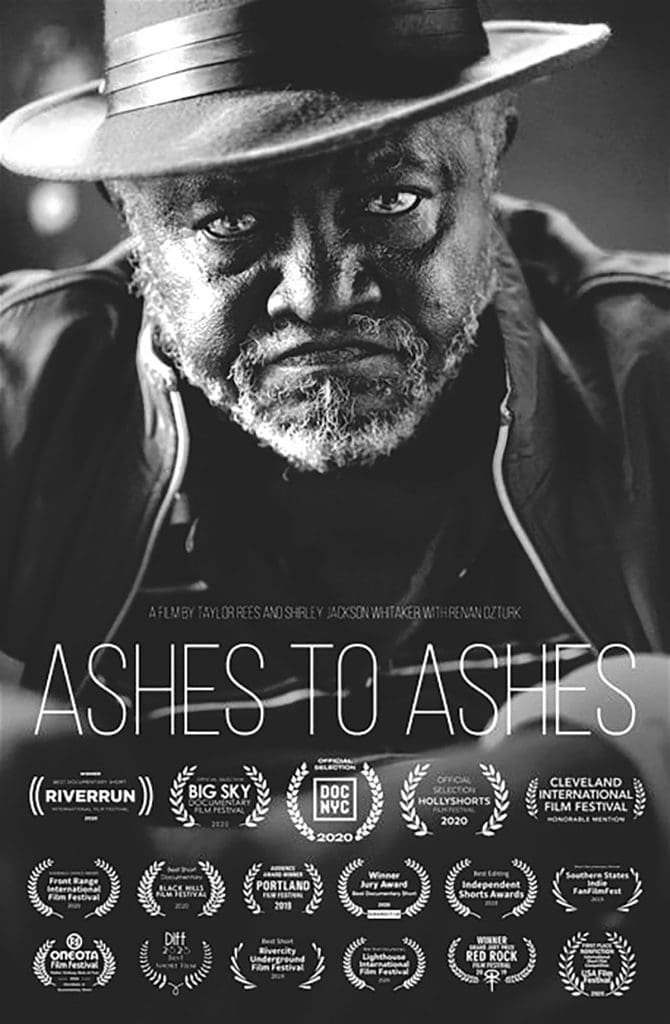
Ashes to Ashes gained acclaim on the festival circuit and was a finalist for Academy Award consideration.
“In this country, no one really, genuinely talks about the people who were lynched,” Whitaker says in the film. Which is why she produced it — to give those people a voice, get people talking about some too-recent history, and, by grappling with that reality, just maybe start the process of healing.
“I decided to have a funeral for the over 4,000 African-Americans who were lynched in the United States to close that chapter and move forward. America has to do the same thing to help heal this country. You’ll get some pushback from people: ‘why do you want to stir that up?’ But it hasn’t been stirred enough. People were saying, ‘ah, that’s so depressing.’ I say, well, if you think this depressing, try hanging from a tree.”
She then asks, “what can I do? I can’t bring them back, but I can give them a prayer.” For doing so much more, Whitaker is an uncommonly powerful Woman of Impact.
Pain and Promise
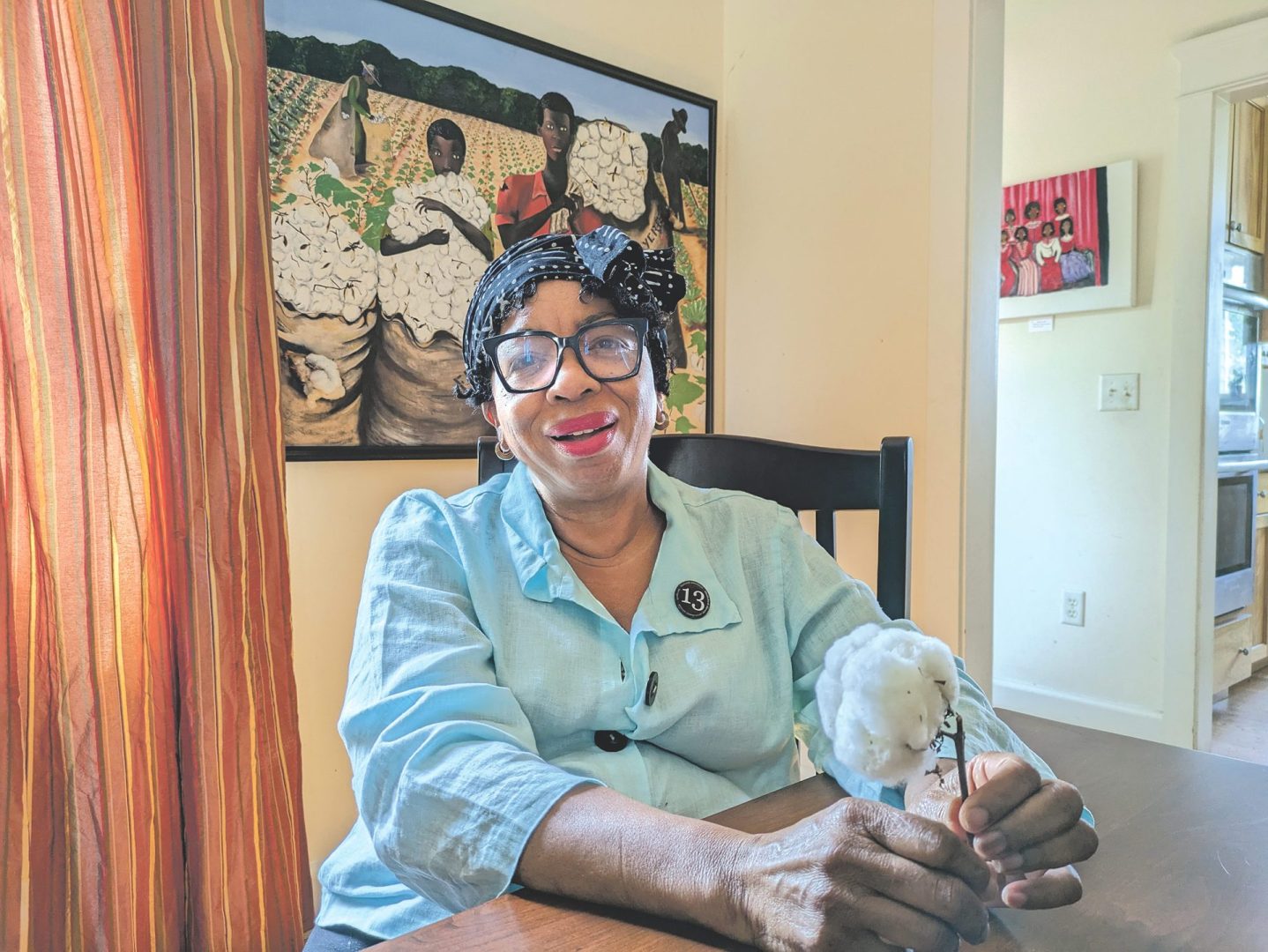
As she spoke with BusinessWest in her Amherst home about her multi-faceted life and career, virtually every wall in every room was covered with her paintings — some traditional in medium, some incorporating mixed media, including fabrics and, in a few cases, unprocessed cotton.
“Cotton has this fluffy appearance to it, but just take your hand and squeeze right there,” she said. “Just squeeze. You feel the seeds? Once Eli Whitney got the seeds out, they had more uses for cotton.”
And the slaves who picked it, as the cotton gin essentially rejuvenated the plantation slavery industry.
“The thing is, when you go to pick this, you’ve got to be careful because this is like knives,” she continued, pointing out the sharp wall surrounding the fluffy cotton. “You learn early how to avoid that.”
Rembert, who passed away in 2021, knew that well; he grew up picking cotton on a plantation, and he understood the dark history of the crop in the South.
Whitaker’s path was somewhat different; the seventh child of Eddie and Charlie Mae Jackson from Waycross, Ga., she attended Clark Atlanta University, graduating with a bachelor’s degree with honors and then earning a public health degree at Yale University School of Medicine and undergoing advanced medical training in internal medicine and nephrology at Emory University School of Medicine, where she was the only Black woman in her class.
After some years on the West Coast, she moved to the Pioneer Valley when her husband was hired at UMass Amherst as a professor of Mathematics. For a decade, she worked at Springfield Southwest Community Health Center, where, in addition to bettering and saving lives, she designed a children’s coloring book advising against drugs, created a community-health newsletter, and produced an imaginative ‘puppet opera’ for young people titled “Monsters Among Us.” In 2006, she went into private practice.
But nephrology wasn’t her only interest; to address her concerns about the academic standing of African-American children in Amherst schools, she established the Academic Initiative for Maximum Success, which resulted in a dramatic increase of Black students in AP math programs.
“In addition to caring for her patients’ health, Shirley brings joy and hope. Her contributions to her community through educational programs have provided many with opportunities that would not have been afforded without her initiatives.”
Whitaker has also continued to paint, authored two children’s books, and produced her award-winning documentary. These days, she continues to practice medicine two days a week at the Northampton VA Medical Center.
“When I look back and I think of all these things, and the ripple effect of it all, I’m pleased with that,” she told BusinessWest, adding that her honest, often hard assessments of patients made a long-term difference. “People to this day come up to me and say, ‘I remember what you said, and it changed my life. I changed my diet; I lost 40 pounds.’”
Stories Worth Sharing
Taylor Rees, director of Ashes to Ashes, will certainly never forget her. “Dr. Shirley is a neighbor of mine who lived on the same street as my family in Massachusetts when I was growing up,” he wrote. “In 2015, she asked for help documenting her memorial, and throughout the year, we worked together to also visit with and listen to the personal and lived experiences of Winfred, her friend. The film evolved over time into an homage to both Shirley and Winfred and their work using art to address racial injustices in America.”
Whitaker has also made a powerful impression on Anika Lopes, who nominated her as a Woman of Impact a year after Lopes, president of the Ancestral Bridges Foundation, earned the same honor from BusinessWest.
“Dr. Whitaker is a woman of impact with every step she takes, a tireless giver, sharing all she has with others,” Lopes wrote. “As a medical doctor, Shirley has and continues to dedicate herself to the wellness of others; she goes far beyond expectation and keeps going. In addition to caring for her patients’ health, Shirley brings joy and hope. Her contributions to her community through educational programs have provided many with opportunities that would not have been afforded without her initiatives.”
Lopes added that Whitaker believes we all have a collective responsibility to create a better future, “and she sure is walking her talk.”
She’s doing so at a time when too many people don’t truly comprehend the horrors of slavery or the more recent legacy of Jim Crow, or are actively trying to erase that history. But she’s also hopeful about the future, currently working on a screenplay called Blanket, noting that “a blanket of hate can never cover the resilience, remembrance, and hope.”
As for Rembert, he spent more than 50 years struggling with sleep issues, stemming partly from the trauma he experienced in 1967, as he describes in Ashes to Ashes.
“Even today, now, it’s dragging me down. I can’t rest. I can’t rest. I lie in my bed, and I can’t rest. I’m running for my life every night. Somebody’s after me, and I don’t know what to do.”
And later in the film:
“I don’t think I can be healed. I think I’ll go to the grave with what I got, holding me down and holding me back. Even though those things were done to me years ago, they’re still holding me back. Can I send the message? Can I change this? I can’t change this world. I know I’m not a big enough man to do that, but I can put a dent in it. But you just keep going, and going, and going, and going.”
Whitaker has kept going as well, maybe not changing the world, but impacting her corner of it in profound ways as a doctor, educator, artist, and filmmaker. And she empathizes with the pain of friends like Rembert and thousands of people she never knew, but wanted to memorialize through a unique funeral service and a story that will live on as people continue to watch it.
“I talked to him like two days before he died,” she said of Rembert, “and he said, ‘I just want to know what it’s like to go to sleep.’”
“We’re looking back in history so this patient can live,” Whitaker said during that 2017 memorial service in Springfield, referring not to a nephrology patient, but to a nation with deep, unhealed wounds. “We’re looking back in history so this patient can thrive. We’re looking back in history so this patient can become very strong. But this patient could only live and get stronger if we’re willing to look back. So tonight, we start.”