

East Longmeadow Is on the Road to Progress
Community Spotlight
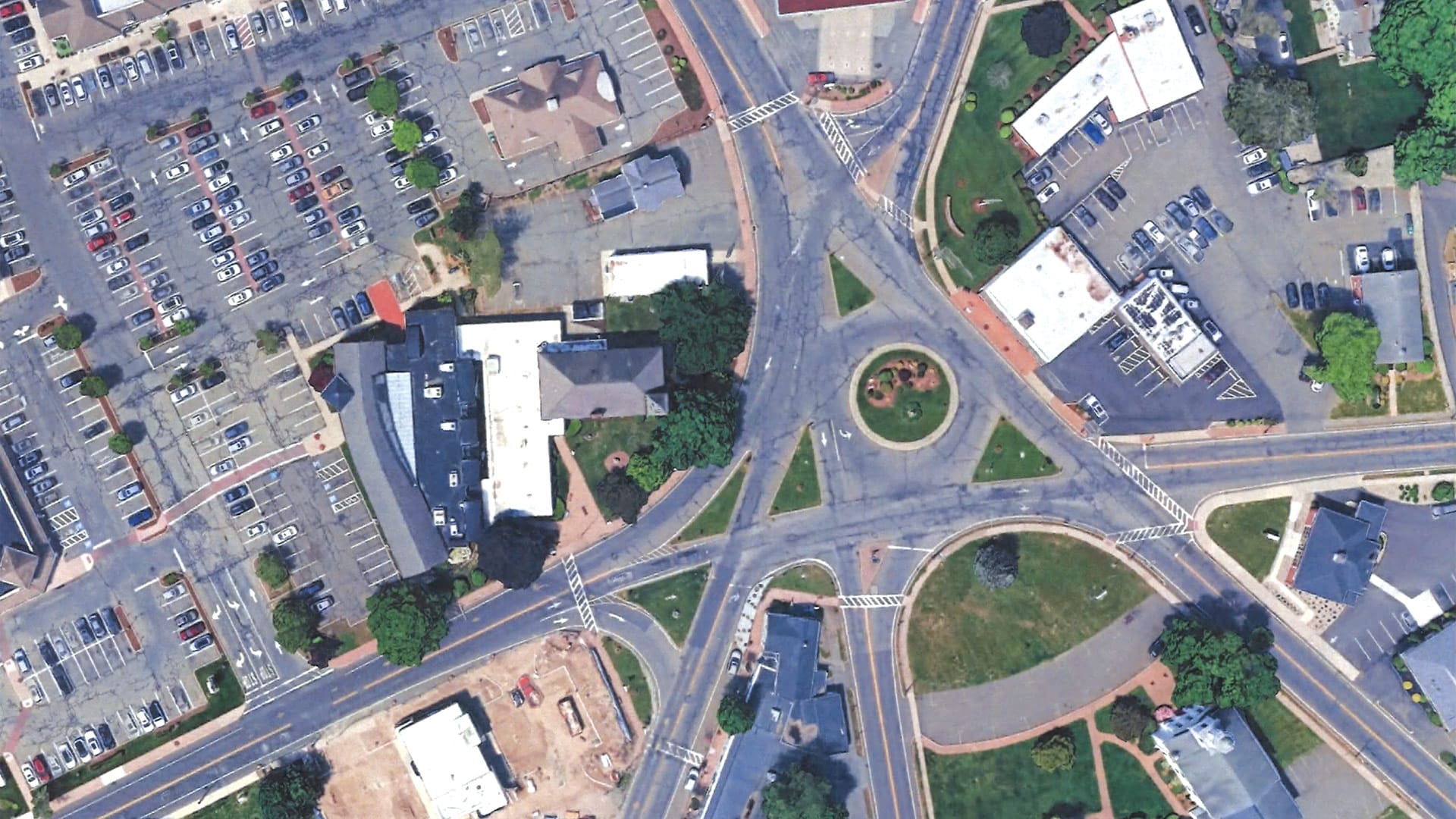
The infamous rotary in East Longmeadow, as seen in this Google Earth image, with its seven converging streets.
Tom Christensen says most East Longmeadow residents have learned to live with — and drive through — the infamous rotary in the center of town.
And some even take a small bit of pride in that it once owned a line in the Guinness Book of World Records for having seven converging streets, several of which carry heavy volumes of traffic, with no traffic lights, making it — unofficially, of course — the most dangerous intersection in the world. The rotary has been featured in Ripley’s Believe It or Not! for the same reason.
“We seem to wear this Ripley’s Believe It or Not! as a badge of honor, but I believe that list is for things that shouldn’t exist in nature,” said Christensen, town manager since 2023 and, before that, deputy director of Public Works. “It’s one of the most inefficient intersections ever devised, and while, at some point, it wasn’t so cumbersome due to the number of cars — and it wasn’t even cars at the beginning — now, with the traffic we have … we need to do something.”
He’s not alone in this thinking, which helps explain why, as the town makes progress on several different fronts — from ongoing construction of a new high school to a new fiber optic network to an emerging blueprint for development in the town’s center — there is renewed interest in trying to fix this seemingly most difficult and stubborn of problems.
Indeed, the rotary has been studied, and studied, and studied some more, said Christensen, adding that there is building momentum for finally finding a practical, affordable solution.
“There’s a lot of logistics and a lot of money, but for the health of the community and the future of the community, we have to do something to make this intersection more efficient.”
It won’t come tomorrow, and will likely take 10 to 15 years, he said, but a fix involving a reduction in the number of streets converging on the rotary — maybe to four — is in the earliest of stages.
“We want to take a look at reimagining this intersection. Obviously, it handles all area traffic, not just East Longmeadow traffic, and we need to figure out how to make it more efficient,” he said. “We have this traffic problem that expands out from the hub, but it all starts in the center, where everything grinds to a halt at least a few times a day.”
As for those other projects mentioned above, most are much further along, especially the high school, which is on track to open for the start of school next September.
The new school and adjoining natatorium (which will be open to the public), with a combined price tag of nearly $200 million, will make one of the region’s more attractive communities to live and own a business even more so, said Tanzi Cannon-Eckerle, who owns two businesses in town, a law firm and a craft brewery.
She noted that a modern high school (the current structure opened in 1960) is one of the few missing pieces in a town that boasts a large industrial park, a strong and diverse business community, attractive neighborhoods, and land for new development.
“If you don’t have a fairly new high school, are you going to lose residents to the next town?” she asked rhetorically. “Maybe, maybe not, but it’s good to keep up with the latest technology; this new high school is a great asset for the community.”

Tom Christensen says that, while a fix for the rotary is 10 to 15 years away, more immediate progress is evident on many fronts in town.
Another missing piece, if you will, is a solution for the eyesore that is the long-dormant site of the former Package Machinery manufacturing plant and warehouse on Chestnut Street.
Developers who had proposed a 560,000-square-foot warehouse, a plan that met with considerable opposition from abutters and was ultimately rejected by the Planning Board, recently submitted new plans calling for four warehouses totaling roughly 450,000 square feet.
That plan is still before the Planning Board, said Christensen, adding that the area in question is considered part of the town’s industrial garden park zone — with that section of Chestnut Street being its northern border — and warehouses are therefore a permitted use.
For this latest installment of its Community Spotlight series, BusinessWest takes an in-depth look at the many storylines that are, like the roads in the center of town, converging.
Round About
As he talked about the town’s rotary, Christensen acknowledged it’s a complicated engineering challenge and a problem that has defied a solution for several generations of residents.
Locals have gotten used to it, but are still put off by it, he said, adding that, for non-locals, it can be harrowing.
“I have people come to visit, and they come to my house, and their face is all white,” he said. “And they’re like … ‘you have to yield in that intersection?’ I tell them that conventional wisdom says they have the right of way, but not in our town.”
“It would be great to have that area cleared up in the form of a new development in any form, and get the property back on the tax rolls for the community. It’s hard to drive by that every day and see a derelict property of that size.”
The problem won’t fix itself, and it will only get worse as the town continues to grow and, hopefully, add more jobs, Christensen noted, adding that advances in intersection and rotary design could yield a solution.
“Many studies have been done over the years, and the design parameters were too excessive — we’d have to do some takings and knock down buildings,” he said, referring to the area around the current rotary and the size of a circle needed to accommodate seven streets. “Now, all over the region, they’re popping in rotaries and intersections that you didn’t think were feasible.
“There would be some combination of reconfiguring to a traditional circle, with only four roads coming into it,” he said of the likely fix. “The latest idea is to sort of dog-ear some of these streets into other streets before they got to the rotary by way of a stop sign; we have to figure out some way to get some of those entrances out of the circle to make it work.”
East Longmeadow at a Glance
Year Incorporated: 1894
Population: 16,430
Area: 13.0 square miles
County: Hampden
Residential Tax Rate: $19.28
Commercial Tax Rate: $19.28
Median Household Income: $62,680
Median Family Income: $70,571
Type of Government: Town Council, Town Manager
Largest Employers: Lenox; Cartamundi; CareOne at Redstone; East Longmeadow Skilled Nursing Center
* Latest information available
As he noted, this will be a lengthy process, and a solution with a steep price tag — at least $10 million, by his estimate.
“It takes a long time to even come up with a schematic; it’s going to take a long time to design, and then to come with the funding for this or for us to get on a list with MassDOT is going to take some time,” he said. “There’s a lot of logistics and a lot of money, but for the health of the community and the future of the community, we have to do something to make this intersection more efficient.”
While that project plays itself out into the next decade, there is progress on other fronts, and potential progress (depending on one’s point of view) with others.
The latter is certainly true with 330 Chestnut St., an address where industrially zoned land and residential neighborhoods abut.
The public hearing process on the newest proposal, which has included questions on everything from traffic volume to noise and pollution to whether trucks can and should navigate nearby intersections, is continuing, said Christensen, adding that the area has been an eyesore for decades now.
“It was a great idea when the town decided to move all of its industry into that corner of town in the form of the industrial garden park, but naturally, there are places it abuts that are residential,” he said. “You have to work hard to make sure that the impact is not great on any of the surrounding areas.
“It would be great to have that area cleared up in the form of a new development in any form, and get the property back on the tax rolls for the community,” he went on. “It’s hard to drive by that every day and see a derelict property of that size.”
New School Thinking
Meanwhile, crews are keeping to an aggressive timetable for the new high school, he noted, adding that the project also includes not only the natatorium, but new athletic fields, tennis courts, and improvements to the football stadium area.
“There’s obvious excitement in the community for the new school — it’s a glorious campus,” said Christensen, who graduated from ELHS in 1997 and brings that perspective to the project. “It’s really exciting on so many levels, obviously for the school system, but also for the community to have this wonderful new space.”
And as that project moves forward, the town is also working toward creating a center town district and bylaws for development in that area.
A $22,000 grant from the Massachusetts Office of Energy and Environmental Affairs will be used to hire a consultant to help with the planning of the district, said Christensen, adding that the Town Council has voted not to create the district under the state’s Chapter 40R regulations, which would make the town eligible for state funding, but also bind it to meet specific requirements for housing, including affordable housing.
“The community decided it didn’t want to be beholden to the state, so we have decided to create our own district with our own guidelines, free of any 40R requirements,” he noted. “Depending on how the final parameters of how our bylaw shake out, it could have the parameters of 40R; it just won’t be eligible for that reimbursement to the developer and/or town, because it won’t carry that designation.”
Elaborating, Christensen said that, with all industry moved to the southwest corner of town, several properties in the town center, including the former Carlin Combustion site on Maple Street, could be redeveloped for other uses, including housing. And the development community has interest in that area for that purpose.
The next step in the process is likely to be Planning Board public hearings on the district, he said, adding that he is expecting “robust conversations in a public setting” about what residents want to see regarding density, building heights, and other matters.
“We’re looking at a comprehensive study on not only what the town can handle, but what developers are willing to build,” he went on. “We want to find that happy medium so the bylaws are feasible for all.”
As that project plays out, the community is proceeding with plans to address the lack of broadband competition by building a town-owned fiber optic project with Whip City Fiber, the rapidly growing broadband arm of Westfield Gas & Electric.
“We have a design done, and we’re working with the utilities to get their make-ready costs so that we can formulate a plan on how to roll out this initiative, which we’re really excited about,” Christensen said. “Currently, the town is only served by Spectrum, and residents have long been calling for some competition in town.
“It’s a long process, and a lot of infrastructure has to be put in place,” he went on, adding that the project gives the town the ability to improve services to residents while also generating revenue, which can be put back into the community.
It’s a community that is business-friendly and does a good job of balancing business growth with quality of life for residents, said Cannon-Eckerle, whose craft brewery, Brew Practitioners, is celebrating 10 years.
“They do a really good job of asking questions and doing all the legwork up front,” she said of the Planning Board, Town Council, and other panels that consider plans from businesses. “But then, they take the time to take in the concerns of the residents; they do a very good job of listening to both sides. East Longmeadow does a good job of doing it by the book.”