Home Posts tagged Agenda (Page 9)
Opinion
Assessing the Job at Hand

The trends and statistics that form the basis of the Regional Employment Board of Hampden County’s latest strategic initiative are not exactly recent phenomena, and together, they would hardly be considered a news flash.
But they are still eye-opening, and comprise a significant challenge for this region moving forward.
Summing up what the report’s authors have noted, or recorded, there remains a significant gap in this region between what many employers are seeking in terms of requisite abilities and skill sets from their workers, and what is apparently available in the region’s workforce as currently comprised. This sobering realization can be drawn from the fact that we still have a rather high unemployment rate in Western Mass. — around 9% according to most estimates, with that number much higher in some metropolitan areas like Springfield and Holyoke — and yet there are many employers in several sectors of the economy, from health care to precision manufacturing, who have vacancies they can’t fill because they can’t find skilled workers.
This is a rather unique problem for this region, historically, and one that constitutes a major economic development agenda item, even if some still don’t understand that the phrases ‘workforce issues’ and ‘economic development’ can and must be put together in the same sentence.
Indeed, while most consider economic development to be luring new businesses to the region, building clusters of companies of specific sectors, such as green energy and biotechnology, and enabling existing companies to expand, none of that can really happen — even if the economic conditions were favorable — unless this area had the workforce to support such growth.
Which is why we’re glad that the REB has not only put a plan down on paper — it’s known officially as the ‘Strategic Workforce Development Plan for Hampden County 2011-2013’ — but has developed a game plan for addressing some of the major issues, and has the ability to keep these matters front and center, where they belong.
In short, the report concludes that closing that gap — the overriding mission beyond the strategic plan — will not be easy and it won’t happen overnight. But it must be done, and it will involve the continuation of several current collaborative efforts, and some new ones, to get the job done.
And the work encompasses many different elements, from promoting pre-school programs and helping young people gain the reading skills they need, to introducing junior high school students to the benefits of a career in precision manufacturing; from working with health care providers and area colleges to ensure that graduates have the skills necessary to succeed in specific careers, to the fostering of mentoring programs that will help curb the high drop-out rates in several areas cities.
For decades now, the REB’s unofficial mission has been to help create employment opportunities, anticipate where the jobs will be for the short and long term, and partner with area institutions to ensure that there is a match between the skills needed for those jobs and the skills possessed by those in the workforce. The mission hasn’t changed, but there is now a greater sense of urgency, because, in very simple terms, that aforementioned gap is getting wider, not narrower.
And unless that trend is reversed, cities and towns across the region will suffer in their efforts to attract new companies and diversify their bases of businesses.
Workforce development certainly would not be considered the glamorous side of economic development, which is reserved for those announcements of new companies or expansions of existing ones involving hundreds of jobs. But those announcements won’t come unless this region has workers of sufficient quantity and quality.
As we’ve said many times, and we’ll keep saying it— workforce development is economic development.

Agenda Departments

Mobile Marketing
April 12: Stevens 470 at 470 Southampton Road, Westfield, will host a coffee hour from 8:30 to 10 a.m. on mobile communication. During the coffee hour, the pros and cons of creating a mobile Web site will be featured, as well as discussion on the technology behind mobile Web sites and different ways to generate a mobile Web site. Stevens 470 Coffee Hours are informal discussions on current marketing-communications and Web-development topics. For more information on the event or to register, contact Tina Stevens at (413) 568-2660 or [email protected]. Seating is limited.

Performance Appraisals Workshop
April 12: Attorney Susan Fentin of Skoler, Abbott & Presser, P.C. of Springfield will present a workshop titled “Performance Appraisals: Rewards and (Yes) the Risks” at the Human Service Forum Nonprofit Risk Management Conference at the Clarion Hotel in Northampton. The daylong event includes breakfast and a keynote address, followed by workshops in which Fentin and participants will analyze the top risks facing human-services and nonprofit organizations. Other workshop topics include “For EDs/CEOs Only: Let’s Talk About Risk,” “Financial Risk Management,” and “Facilities/Property Management.” For more information on the program, visit www.skoler-abbott.com.

Mobile Technology Workshop
April 13: Chris Amato of Knectar Design and Jeff Hobbs of Advanced Internet will lead a workshop on the various critical aspects of the shift to a mobile technology landscape from 9 to 11 a.m. at the Scibelli Enterprise Center, 1 Federal St., Springfield. The workshop is sponsored by the Massachusetts Small Business Development Center Network (MSBDC). Amato and Hobbs will discuss how mobile and smart-phone technology has surpassed expectations to become the leading communications and application-technology platform for users in many market sectors. The cost is $40. For more information, contact the MSBDC at (413) 737-6712 or www.msbdc.org/wmass.

Public Health Lecture Series
April 13: Dr. Leonard Morse will be the keynote speaker as the Desmond Tutu Public Health Lecture Series continues at American International College, 1000
State St., Springfield. The 10 a.m. talk in Griswold Theatre will focus on education to address patterns of behavior that promote and preserve one’s health. The event is free and open to the public. A reception for Morse will follow in the west wing of the Sprague Cultural Arts Center. For more information, call (413) 205-3231.

Royal LLP Open House
April 14: Royal LLP will conduct an open house for the public from 5 to 8 p.m. to celebrate its new offices at 270 Pleasant St., Northampton. Cocktails and hors d’oeuvres will be provided by Side Street Café. For persons planning to attend, RSVP by April 4 at [email protected] or call (413) 586-2288.

Marketing Basics Workshop
April 20: A workshop led by Dianne Doherty of the Mass. Small Business Development Center Network (MSBDC) will focus on the basic disciplines of marketing, beginning with research — primary, secondary, qualitative, and quantitative. Topics will include advertising, public relations, and the importance of developing a marketing plan. Doherty’s presentation is planned from 3 to 5 p.m. at the TD Bank community room, 175 Main St., Northampton. For more information, contact the MSBDC at (413) 737-6712 or www.msbdc.org/wmass.

CPA Workshop
April 26: Timothy Murphy, partner at Skoler, Abbott & Presser, P.C., of Springfield, will present a workshop titled “Continuing Legal Education” to certified public accountants from 3 to 5:40 p.m. at the Kittredge Center at Holyoke Community College. For more details, visit www.skoler-abbott.com.

Not Just Business as Usual
April 26: Al Verrecchia, retired CEO and chairman of the board of Hasbro Inc., will be the keynote speaker for a program titled Not Just Business as Usual, presented by the Springfield Technical Community College (STCC) Foundation. The STCC Foundation will capture the energy and excitement of the college’s past, present, and future at the unique affair that will be staged at the Log Cabin Banquet and Meeting House in Holyoke. In addition, two past Entrepreneurship Hall of Fame inductees, Balise Motor Sales and Smith & Wesson, will be honored for their continued success and contributions to the local community. A cocktail and networking reception is planned from 5:30 to 7 p.m., followed by a dinner program from 7 to 9 p.m. Tickets are $175 each or $1,500 for a table of 10. Proceeds raised from the event will benefit STCC. For more information on the event, visit www.notjustbusinessasusual.net.

Understanding Financial Reports
April 27: Robb Morton of Boisselle, Morton & Associates will lead a workshop from 9 a.m. to noon on how to read financial statements. Following the presentation at the Scibelli Enterprise Center, 1 Federal St., Springfield, a lunch is planned as well as a question-and-answer session. The program is sponsored by the Mass. Small Business Development Center Network (MSBDC). The cost is $40. For more information, contact the MSBDC at (413) 737-6712 or www.msbdc.org/wmass.

Cash-flow Workshop
May 4: Robb Morton of Boisselle, Morton & Associates will present a workshop on the basics of cash flow, how to improve cash flow, the timing of cash inflows and outflows, how cash flow is different from profit, and how to determine your company’s cash flow. The cost is $40. The 9 to 11 a.m. program is planned at the Scibelli Enterprise Center, 1 Federal St., Springfield, and is sponsored by the Mass. Small Business Development Center Network (MSBDC). For more information, contact the MSBDC at (413) 737-6712 or www.msbdc.org/wmass.

ACS Gala
May 7: “The Legends of Hope” is the theme for the American Cancer Society’s 2011 Evening of Hope Gala at the Sheraton Springfield Monarch Place Hotel. This year’s gala will pay special tribute to members of the Sarat family of Agawam, who will receive the annual Omar T. Pace, M.D. Award, a prestigious honor awarded to community leaders who have made a significant difference in the lives of cancer patients and their families throughout Western Mass. The evening will include dinner, a silent auction, celebrity impersonators, and music by the Prime Time Players. For more information about tickets or sponsorship opportunities, contact Regina Pattison at [email protected], or call (802) 257-8908. Details about the Evening of Hope are also available at gala.acsevents.org/eveningofhopegala.
Online Tools Seminar
May 11: From FourSquare to YouTube, Yelp, Groupon, Facebook, Google Places, Twitter, MagCloud, and Issuu, there is an array of low-cost, easy-to-use online tools that allow small-business owners to attract new customers and enhance relationships with existing ones. Larri Cochran of Fresh Table, LLC will present a talk from 9 to 11 a.m. at the Scibelli Enterprise Center, 1 Federal St., Springfield, on who is using which tools so you can identify where your customers are online and which tools fit your business. The seminar goal is to create an integrated marketing strategy that maximizes returns for manageable efforts. The cost is $40. The program is sponsored by the Mass. Small Business Development Center Network (MSBDC). For more information, contact the MSBDC at (413) 737-6712 or www.msbdc.org/wmass.

AIM Annual Meeting
May 13: Gov. Deval Patrick will be the keynote speaker for the 2011 Annual Meeting of the Associated Industries of Mass. (AIM) at the Westin Hotel in Waltham. Highlights of the 10 a.m. to 2 p.m. event also include a panel discussion titled “Health Care Cost Control Solutions.” AIM’s 96th annual meeting will seek solutions to the health-cost crisis that is threatening employers, citizens, and municipalities across the state. For registration information, visit www.aimnet.org.

Springfield 375th Parade
May 14: The Spirit of Springfield is seeking community involvement for the city’s 375th birthday celebration, which will include a parade that represents all that Springfield has to offer, its roots, and its future. If you have a business or group that would like to get involved in the festivities, call (413) 733-3800 or e-mail [email protected].

EASTEC 2011
May 17-19: EASTEC, the East Coast’s largest annual manufacturing event, will once again be staged at the Eastern States Exposition in West Springfield. For exhibition and registration information, call (866) 635-4692 or visit www.easteconline.com.

Using New Media
May 18: Gretchen Siegchrist of Media Shower Productions and Robert Malin of Malin Productions will lead a presentation from 9 to 11 a.m. that will teach participants how they can use new media to grow their social-media reach and influence. After an overview of different types of online videos for businesses, they will look at various platforms for sharing videos online, including YouTube. The cost is $40 for the presentation at the Scibelli Enterprise Center, 1 Federal St., Springfield. The Mass. Small Business Development Center Network (MSBDC) is sponsoring the event. For more information, contact the MSBDC at (413) 737-6712 or www.msbdc.org/wmass.

Taste of the Valley
June 9-12: Restaurants and sponsors are needed for West Side’s Taste of the Valley, which is planned on the West Springfield Town Common. The Rotary Club and the Town of West Springfield are once again presenting the event, along with Chicopee Savings Bank, the title sponsor. The Taste event features local restaurants, as well as two stages for entertainment, rides, games, a petting zoo, a BMX exhibition, a 5K road race, and a “Saturday Cruise” showcase of antique, classic, and special-interest cars. For more information, visit www.westsidetaste.com.

40 Under Forty Gala
June 23: BusinessWest will present its 40 Under Forty Class of 2011 at a not-to-be-missed gala at the Log Cabin Banquet & Meeting House, beginning at 5 p.m. The 40 Under Forty program, initiated in 2007, has become an early-summer tradition in the region. This year’s winners will be announced in the next issue of BusinessWest. For more information on the event or to order tickets ($60 per person, with tables of 10 available), call (413) 781-8600, ext. 10, or visit www.businesswest.com.
Summer Business Summit
June 27-28: The Resort and Conference Center of Hyannis will be the setting for the Summer Business Summit, hosted by the Massachusetts Chamber of Business and Industry of Boston. Nominations are being accepted for the Massachusetts Chamber, Business of the Year, and Employer of Choice awards. The two-day conference will feature educational speakers, presentations by lawmakers, VIP receptions, and more. For more information, visit www.masscbi.com.

Western Mass.
Business Expo
Oct. 18: Businesses from throughout Hampden, Hampshire, Franklin, and Berkshire counties will come together for the premier trade show in the region, the Western Mass. Business Expo. Formerly known as the Market Show. The event, produced by BusinessWest and staged at the MassMutual Center in Springfield, has been revamped and improved to provide exposure and business opportunities for area companies. The cost for a 10-by-10 booth is $700 for members of all area chambers and $750 for non-members; corner booths are $750 for all chamber members and $800 for non-members; and a 10-by-20 booth is $1,200 for all chamber members and $1,250 for non-members. For more information, log onto www.businesswest.com or call (413) 781-8600, ext. 10.

Agenda Departments

‘Web Advertising’ Workshop
March 30: Derek Allard of Gravity Switch will present a workshop titled “Web Advertising” from 9 to 11 a.m. at the Scibelli Enterprise Center, 1 Federal St., Springfield. The morning program is sponsored by the Mass. Small Business Development Center Network (MSBDC). Allard will discuss organic search-engine strategies, paid options to help attract visitors to your Web site, defining relevant keywords to target, the importance of Web-site content, building inbound links to your Web site, and paid advertising with Google AdWords and Facebook. The cost is $40. For more information, call the MSBDC at (413) 737-6712 or visit www.msbdc.org/wmass.

Financial Forum
March 31: Cambridge Credit Counseling Corp. and the Council of Churches of Greater Springfield will host the “Hope, Faith, and Healing Financial Forum” beginning at 6 p.m. at Cambridge’s office at 67 Hunt St., Agawam. Hors d’oeuvres and refreshments will be served. The educational summit will bring together financial experts, public officials, and clergy to discuss the financial challenges facing the region and opportunities to empower area residents. State legislators, lenders, and other community leaders will also be in attendance. For more information or to register, contact Thomas Fox, Cambridge’s community outreach director, at (413) 241-2362 or [email protected]. For more details on Cambridge Credit, visit
www.cambridgecredit.org.

Healthy Back Class
April 2, 9, 16, and 30: The YMCA of Greater Westfield Inc. on Court Street will sponsor a Healthy Back Class on Saturdays during April from 10 to 11 a.m. in the board room. Instructor Paul Warner, owner of Body Wise Physical Therapy, will teach the basics of back care that can make the difference between a healthy back and an aching one. The cost is $35 for YMCA members, $55 for non-members. For more information or to register, contact Charlene Call, member retention/wellness director, at (413) 568-8631, ext. 305.

USO Dinner Dance
April 2: U.S. Senator Scott Brown will be the keynote speaker for a 1940s-themed dinner dance titled “As Time Goes By” as the Pioneer Valley United Service Organization (USO) hosts its first formal event to mark its 70 years of service to local families of the Armed Forces. The event is planned from 6 p.m. to midnight at the Delaney House in Holyoke. Brown will speak at 8:30 p.m. The event for the local USO chapter, which operates out of the Westover Air Force Reserve Base in Chicopee, will also honor Checkwriters Payroll, Clear Channel/KIX 97.9, Big Y World Class Markets, and local heroes from each branch of the U.S. Armed Forces, in addition to the Pioneer Valley USO Volunteer of the Year. The evening will begin with a welcome reception, followed by the dinner and program with Brown and the awards presentation. The evening will end with dancing to 1940s swing, R & B, and music from the era of Motown performed by the O-Tones. For tickets or more information, call Al Tracy at the USO Office, (413) 557-3290, e-mail [email protected], or visit www.pioneervalleyuso.org.

Workshop on Web Sites
April 6: Derek Allard of Gravity Switch will present a workshop titled “Making the Most of Your Web Site” from 9 to 11 a.m. at the Scibelli Enterprise Center, 1 Federal St., Springfield. Allard will discuss defining goals for a Web site, elements of a good home page, writing content to pull people in, measuring success and failure, and common Web site mistakes to avoid. The cost is $40. The Mass. Small Business Development Center Network (MSBDC) is sponsoring the workshop. For more information, contact the MSBDC at (413) 737-6712 or www.msbdc.org/wmass.

Science Hoaxes Lecture
April 6: Richard Sanderson, curator of physical science for the Springfield Science Museum, will present a lecture titled “Believe It or Not: Science in the Age of Misinformation, Hoaxes, Bad Science, and Bad Astronomy” at 10:10 a.m. and again at 11:15 a.m. in Scibelli Hall at Springfield Technical Community College, Armory Square, Springfield. Sanderson’s appearance is presented by the Ovations Series, and the public is welcome to attend.

Chief Scott Roast
April 7: Dr. Bill Cosby will be among the dozen or so ‘inquisitors’ during Holyoke Police Chief Anthony Scott’s Retirement Roast at the MassMutual Center in downtown Springfield. The doors will open at 5:30 p.m., and the dinner begins at 6, with a cash bar. Tickets are $40 per person or $375 for a table of 10. The menu includes salad, chicken breast with sweet sausage apple stuffing, red bliss potatoes, vegetable, dessert, coffee, and tea. For tickets, call Sullivan, Hayes & Quinn at (413) 736-4538, or the Holyoke Police Department, chief’s office, at (413) 322-6901.

Chamber’s ‘Shining Stars’
April 8: The Castle of Knights on Memorial Drive in Chicopee will be the setting for the Chicopee Chamber of Commerce’s annual “Shining Stars” event, which includes recognition of the Business of the Year, Citizen of the Year, and Volunteer of the Year. For more information, call the chamber office at (413) 594-2101.

‘Performance Appraisals’ Workshop
April 12: Attorney Susan Fentin of Skoler, Abbott & Presser, P.C., of Springfield, will present a workshop titled “Performance Appraisals: Rewards and (Yes) the Risks” at the Human Service Forum Nonprofit Risk Management Conference at the Clarion Hotel in Northampton. The daylong event includes breakfast and a keynote address, followed by workshops in which Fentin and participants will analyze the top risks facing human-service and nonprofit organizations. Other workshop topics include “For EDs/CEOs Only: Let’s Talk About Risk,” “Financial Risk Management,” and “Facilities/Property Management.” For more information on the program, visit www.skoler-abbott.com.

Mobile Tech Workshop
April 13: Chris Amato of Knectar Design and Jeff Hobbs of Advanced Internet will lead a workshop on the various critical aspects of the shift to a mobile-technology landscape from 9 to 11 a.m. at the Scibelli Enterprise Center, 1 Federal St., Springfield. The workshop is sponsored by the Mass. Small Business Development Center Network (MSBDC). Amato and Hobbs will discuss how mobile and smart-phone technology has surpassed expectations to become the leading communications and application technology platform for users in many market sectors. The cost is $40. For more information, contact the MSBDC at (413) 737-6712 or www.msbdc.org/wmass.

Public Health Series
April 13: Dr. Leonard Morse will be the keynote speaker as the Desmond Tutu Public Health Lecture Series continues at American International College, 1000
State St., Springfield. The 10 a.m. talk in Griswold Theatre will focus on education to address patterns of behavior that promote and preserve one’s health. The event is free and open to the public. A reception for Morse will follow in the west wing of the Sprague Cultural Arts Center. For more information, call (413) 205-3231.

Royal LLP Open House
April 14: Royal LLP will conduct an open house for the public from 5 to 8 p.m. to celebrate its new offices at 270 Pleasant St., Northampton. Cocktails and hors d’oeuvres will be provided by Side Street Café. Anyone planning to attend should RSVP by April 4 to [email protected] or call (413) 586-2288.

Marketing Basics Workshop
April 20: A workshop led by Dianne Doherty of the Mass. Small Business Development Center Network (MSBDC) will focus on the basic disciplines of marketing, beginning with research — primary, secondary, qualitative, and quantitative. Topics will include advertising, public relations, and the importance of developing a marketing plan. Doherty’s presentation is planned from 3 to 5 p.m. at the TD Bank community room, 175 Main St., Northampton. For more information, contact the MSBDC at (413) 737-6712 or www.msbdc.org/wmass.

Not Just Business as Usual
April 26: Al Verrecchia, retired CEO and chairman of the board of Hasbro Inc., will be the keynote speaker for a program titled Not Just Business as Usual, presented by the Springfield Technical Community College (STCC) Foundation. The STCC Foundation will capture the energy and excitement of the college’s past, present, and future at the unique affair to will be staged at the Log Cabin Banquet and Meeting House in Holyoke. In addition, two past Entrepreneurship Hall of Fame inductees, Balise Motor Sales and Smith & Wesson, will be honored for their continued success and contributions to the local community. A cocktail and networking reception is planned from 5:30 to 7 p.m., followed by a dinner program from 7 to 9 p.m. Tickets are $175 each or $1,500 for a table of 10. Proceeds raised from the event will benefit STCC. For more information, visit www.notjustbusinessasusual.net.

CPA Workshop
April 26: Timothy Murphy, partner at Skoler, Abbott & Presser, P.C., of Springfield, will present a workshop titled “Continuing Legal Education” to certified public accountants from 3 to 5:40 p.m. at the Kittredge Center at Holyoke Community College, Homestead Avenue, Holyoke. For more details, visit www.skoler-abbott.com.

Understanding Financial Reports
April 27: Robb Morton of Boisselle, Morton & Associates will lead a workshop from 9 a.m. to noon on how to read financial statements. Following the presentation at the Scibelli Enterprise Center, 1 Federal St., Springfield, a lunch is planned as well as a question session. The program is sponsored by the Mass. Small Business Development Center Network (MSBDC). The cost is $40. For more information, contact the MSBDC at (413) 737-6712 or www.msbdc.org/wmass.

Cash-flow Workshop
May 4: Robb Morton of Boisselle, Morton & Associates will present a workshop on the basics of cash flow, how to improve cash flow, the timing of cash inflows and outflows, how cash flow is different from profit, and how to determine your company’s cash flow. The cost is $40. The 9 to 11 a.m. program is planned at the Scibelli Enterprise Center, 1 Federal St., Springfield, and is sponsored by the Mass. Small Business Development Center Network (MSBDC). For more information, contact the MSBDC at (413) 737-6712 or www.msbdc.org/wmass.

Online Tools Seminar
May 11: From FourSquare to YouTube, Yelp, Groupon, Facebook, Google Places, Twitter, MagCloud, and Issuu, there is an array of low-cost, easy-to-use online tools that allow small-business owners to attract new customers and enhance relationships with existing ones. Larri Cochran of Fresh Table, LLC will present a talk from 9 to 11 a.m. at the Scibelli Enterprise Center, 1 Federal St., Springfield, on who is using which tools so you can identify where your customers are online and which tools fit your business. The seminar goal is to create an integrated marketing strategy that maximizes returns for manageable efforts. The cost is $40. The program is sponsored by the Mass. Small Business Development Center Network (MSBDC). For more information, contact the MSBDC at (413) 737-6712 or www.msbdc.org/wmass.

Springfield 375th Parade
May 14: The Spirit of Springfield is seeking community involvement for the city’s 375th birthday celebration, which will include a parade that represents all that Springfield has to offer, its roots, and its future. If you have a business or group that would like to get involved in the festivities, call (413) 733-3800 or e-mail [email protected].

EASTEC 2011
May 17-19: EASTEC, the East Coast’s largest annual manufacturing event, will once again be staged at the Eastern States Exposition in West Springfield. For exhibition or registration information, call (866) 635-4692 or visit www.easteconline.com.

Using New Media
May 18: Gretchen Siegchrist of Media Shower Productions and Robert Malin of Malin Productions will lead a presentation from 9 to 11 a.m. that will teach participants how they can use the new media to grow their social-media reach and influence. After an overview of different types of online videos for businesses, they will look at various platforms for sharing videos online, including YouTube. The cost is $40 for the presentation at the Scibelli Enterprise Center, 1 Federal St., Springfield. The Mass. Small Business Development Center Network is sponsoring the event. For more information, contact the MSBDC at (413) 737-6712 or www.msbdc.org/wmass.

40 Under Forty Gala
June 23: BusinessWest will present its 40 Under Forty, Class of 2011, at a not-to-be-missed gala at the Log Cabin Banquet & Meeting House, beginning at 5 p.m. The 40 Under Forty program, initiated in 2007, has become an early-summer tradition in the region. For more information on the event or to order tickets ($60 per person, with tables of 10 available) call (413) 781-8600, ext. 10; or visit www.businesswest.com.

Summer Business Summit
June 27-28: The Resort and Conference Center of Hyannis will be the setting for the Summer Business Summit, hosted by the Mass. Chamber of Business and Industry of Boston. Nominations are being accepted for the Massachusetts Chamber, Business of the Year, and Employer of Choice awards. The two-day conference will feature educational speakers, presentations by lawmakers, VIP receptions, and more. For more information, visit www.masscbi.com.

Western Mass
Business Expo
Oct. 18: Businesses from throughout Hampden, Hampshire, Franklin, and Berkshire counties will come together for the premier trade show in the region, the Western Mass Business Expo. Formerly known as the Market Show, the event, produced by BusinessWest and staged at the MassMutual Center in Springfield, has been revamped and improved to provide exposure and business opportunities for area companies. The cost for a 10-by-10 booth is $700 for members of all area chambers and $750 for non-members; corner booths are $750 for all chamber members and $800 for non-members; and a 10-by-20 booth is $1,200 for all chamber members and $1,250 for non-members. For more information, log onto www.businesswest.com or call (413) 781-8600, ext. 10.

Sections Supplements
WMECO Projects Shine Light on Solar Power’s Potential

Manager William Blanchard; and Director of Business Development Carl Frattini

From left, WMECO President and CEO Peter J. Clarke;Project Manager William Blanchard; and Director of Business Development Carl Frattini stand in the field of solar panels at the company’s Silver Lake solar-power facility in Pittsfield.

On the heels of its first large solar-power installation in Pittsfield, built on land once owned by GE, Western Mass. Electric Co. is ready to build an even-larger facility on the site of a capped landfill on Cottage Street in Springfield. The projects are breaking new ground in terms of the size, scope, and cost-effectiveness of solar power, while also putting brownfield sites to new and productive uses.

Last fall, Western Mass. Electric Co. embarked upon a difficult and ambitious project.
In October, the Springfield-based utility completed the largest solar-energy facility in New England at the William Stanley Business Park on Silver Lake Boulevard in Pittsfield. The photovoltaic system contains 6,500 low-profile solar panels and produces 1.8 megawatts of electricity, or enough to power about 300 homes. And in January, the company announced plans to build an even larger solar-energy facility on a capped landfill on Cottage Street in Springfield. When it is complete, it will contain more than 15,000 panels that will produce up to 4.2 megawatts of solar energy, or enough to power about 700 homes.
Several objectives led WMECO to this huge undertaking, including the question of economy of scale. Not only did the company want to be a leader in the utility industry in terms of solar power, it also wanted to discover whether large installations would prove more cost-effective to build than smaller ones.
“Solar power is one of the more expensive types of green technology,” said Carl Frattini, director of business development for Northeast Utilities. “The price is declining quickly, but it costs considerably more than wind power. It is so new that it has been a riddle to solve how to make it less expensive for the customer. Our bet with these projects was that we could build them for less than in the past. We also wanted to act as a catalyst to the development of solar infrastructure because we are trying to help develop the market. We are very pleased with the progress that has been made.”
The construction of both of WMECO’s solar power facilities has involved a multitude of environmental, business, energy, and technical challenges. “We have developed a new type of project in an area where there was very little activity,” said Frattini. “We did it with a considerable amount of collaboration with the solar industry, the state’s indigeneous technical resources, the administrations and local communities.
“The only way these projects can happen is through an aligning of interests,” he continued. “It is exciting work and really gratifying to see it come together.”
The new project in Springfield will bring $22 million in construction work to the region and is expected to contribute several hundred thousand dollars in annual property-tax revenue to the city.
In this issue, BusinessWest looks at the challenges these projects presented and the impact they will have on future solar installations.

Powerful Arguments
WMECO’s decision to build a large solar-energy facility was groundbreaking, and the first time a project of this size had been built in New England.
“By 2009, 1,200 solar projects had been built in the state. But the majority of them were residential roof-mounted installations or consumer-based systems. There were only 11 on a larger scale and nothing in the utility class,” Frattini said.
WMECO decided to take on the challenge due to a 2008 state initiative.
“Gov. Deval Patrick set a goal of having 250 megawatts of solar power installed by 2017; it is a formidable objective,” Frattini said, explaining that, at the time, the entire country only had 475 megawatts of solar power. The bulk of that was in California, and Massachusetts was producing less than 10 megawatts of solar power.
“The state had a very ambitious agenda for renewable energy. But to help it achieve the goal, the Legislature passed the Green Communities Act, which put policies and mechanisms in place to help with the transition,” Frattini said.
One new provision allowed electric utilities to own up to 50 megawatts of solar generation. Prior to that, they could purchase solar power, but were not allowed to produce it. And in the past, incentives had always been targeted toward small, residential, roof-mounted systems.
The Green Communities Act provided new incentives, tax credits, and zoning provisions for all types of solar-power development.
“Solar is a very expensive renewable technology which is not cost-competitive, so it has to be subsidized,” Frattini explained. “But there was nothing in the utility class, and we figured we could add value by going in where no one had gone before.”
He explained that, since the cost of research and development is built into electric rates, it is utilities’ responsibility to do what they can to reduce their customers’ bills. “So if we can figure out how to lower the cost of solar projects, we will need less in subsidies, which will reduce the burden on our customers,” he said.
In August 2009, WMECO became the first utility in New England to receive approval from the Department of Public Utilities to build solar-energy facilities in the region.
Initially, it began looking at doing rooftop installations on a variety of sites. But as company officials continued to explore options, using remediated brownfield property made more sense.
“The state has more than 490 landfills with 5,000 acres of site potential whose uses are very limited,” Frattini said. And since building a solar-energy facility requires a lot of open space, the company realized it could build large projects that were less expensive on remediated landfills.
The Pittsfield property, which is now owned by WMECO and the Pittsfield Economic Development Authority, seemed like the perfect fit for their needs. The eight-acre site was once owned by General Electric.
The project became a collaborative effort as the Berkshire Economic Development Corp. worked with the city of Pittsfield, WMECO, and the Pittsfield Economic Development Authority to secure the project for Pittsfield.
After obtaining permits and financing to move forward, WMECO put out requests for proposals to the solar industy. “We wanted to use indigenous resources. A lot of the solar equipment wasn’t made in Massachusetts, but we had the technical services already here,” Frattini said, referring to construction equipment, electricians, civil engineering, and legal services.
The utility also wanted to inspire solar firms to develop a new infrastructure. Its work has paid off, and the $9.4 million Silver Lake facility, which was completed last November, proved that large-scale solar projects were less expensive to develop than small projects.
The cost to produce 1.8 kilowatts in the new solar-energy facility was $5,200, said Frattini, adding, “if you build solar into a house, the cost is $6,000 to $8,000 per kilowatt.”
And solar development is continuing.
“In the past year there was more development in Massachusetts than in the total three years before as a result of the new energy policy,” Frattini said. He added that National Grid has two solar projects underway in the eastern part of the state that will produce a total of 5 megawatts of electric power.
“Since we built Pittsfield, we have seen an influx of projects such as these and the one in Amherst,” he said (see related story, page 23).
After completing the Pittsfield project, the question remained as to whether an even larger facility would be even more cost-effective. So, WMECO decided to build again in Springfield. “We are trying to verify if economies of scale are achievable and make the projects worth doing,” Frattini said.
WMECO began looking at the capped Springfield 60-acre landfill in June. And by fall, it decided to move forward. Company leaders were pleased to discover that the solar industry had made advances after the Pittsfield project.
“We were very pleased with the progress we saw in the requests for proposals that were submitted, not just in terms of cost but in their level of preparedness,” said Frattini. “We were trying to help develop the market, and they all came in with viable, actionable proposals. The day we signed the contract, they were ready to go.”

Watt’s Happening?
WMECO is currently in the final stages of formalizing the project, and expects to begin work in April and have the solar facility finished by November. Frattini said it will provide jobs for about 120 union workers.
“It is exciting, and we are verifying our original theory that larger projects can be done in a cost-efficient way. Once it is built, there will be very little maintenance over its 25-year lifetime because there are no moving parts and no fuel costs.
“The excitement is to go where no one else has gone, and do it in a way that resolves a lot of environmental, technical, and business challenges with a variety of stakeholders,” he continued. “In the end, this benefits the community, the people who work in it, the state as a whole, and our customers.”

Agenda Departments

‘Be the Authority’
March 16: Claudia Gere of Claudia Gere & Co. will present a lecture titled “Be the Authority & Attract More Customers” from 9 to 11 a.m. at the Scibelli Enterprise Center, 1 Federal St., Springfield. The lecture is hosted by the Mass. Small Business Development Center. Gere will explain how to create written content to demonstrate your expertise, establish yourself as an authority, and create trust. Templates, formulas, and how-tos will be provided. The fee is $40. For more information, call (413) 737-6712, e-mail [email protected], or visit www.msbdc.org/wmass.

The Price of Presenteeism
March 22: Presenteeism is the lost productivity that occurs when employees come to work but perform below expectations due to illness, low morale, or life-issue distractions. A 1999 study sponsored by the Employers Health Coalition calculated that lost productivity from presenteeism is 7.5 times greater that that from absenteeism. Learn how much presenteeism is costing your company and what you can do to improve employee productivity at a seminar, slated for 8 to 10:30 a.m., sponsored by the Associated Industries of Mass. (AIM) and the Economic Development Council of Western Mass. Panelists will include Patricia Guenette, vice president of Human Resources for Square One; Susan Moore, director of Sales and Marketing for the Loomis Communities; Bob Oldenburg, director of the Baystate Employee Assistance Program; Sandy Reynolds, executive vice president of the Employer’s Resource Group at AIM; and Dawn Creighton, regional membership director for AIM. Registration and a continental breakfast at 8 will be followed by the discussion. For more information or to register for this free event, call (413) 233-9850 e-mail [email protected].

‘High Performance Business Owner
March 23: Westfield Bank on Elm Street, Westfield, will host a lecture, “The High Performance Business Owner,” presented by Gerald Sherman of NorthStar Management Partners. The lecture, sponsored by the Mass. Small Business Development Center Network, is planned from 9 a.m. to noon. The fee is $25. For more information, call (413) 737-6712, e-mail [email protected], or visit www.msbdc.org/wmass.

Naturally 7 at STCC
March 23: Naturally 7 will bring its unique a capella style to Springfield Technical Community College for two free performances in the gymnasium, in Scibelli Hall, at 10 a.m. and 6 p.m. Their voices are not only the melody, but also the ‘instruments.’ The group refers to this style as ‘vocal play,’ which goes well beyond beatboxing to create flute, horns, drums, and more. Naturally 7’s music has been called faith-infused, although it encompasses secular as well as religious melodies, and includes soul music, rap, rock, R&B, jazz, and folk, as well as their own compositions. Free parking for the performances is available in off-campus lots. Parking passes are available on a first-come, first-served basis in the STCC Human Resources office in Garvey Hall, room 249. For more information or to bring a group, contact Myra Smith at (413) 755-4414.

Cloud Computing
March 24: Kostin, Ruffkess & Co., LLC will host a workshop titled “No More Fluff: The Reality of Cloud Computing” from 9 to 11 a.m. in Farmington, Conn. ADNET Technologies, LLC will lead the workshop on cloud computing and will discuss how cloud services can help a firm plan for growth. The workshop is designed for business leaders, IT executives, and IT professionals. A complimentary continental breakfast will be served. Pre-registration is required by March 22. For more information, visit www.goadnet.com.

Difference Makers Gala
March 24: BusinessWest will salute its Difference Makers Class of 2011 at a gala slated to begin at 5 p.m. at the Log Cabin Banquet & Meeting House in Holyoke. Initiated in 2009, the Difference Makers program recognizes individuals and groups making outstanding contributions to the Western Mass. community. You can read more about this event on page 14. For further information on the event or to order tickets ($50 per person, with tables of 10 available), call (413) 781-8600, ext. 10, or visit www.businesswest.com.

Independent Contractor Statute
March 25: Attorney Susan Fentin of Skoler, Abbott & Presser will discuss the amendment to the Mass. Independent Contractor statute in 2004, and how misclassification has caught the attention of the Department of Labor. Fentin will cover the amendment, how it applies to individuals in the workforce, and the steps an employer needs to ensure compliance. The fee is $10. For more information, call (413) 737-6712, e-mail [email protected], or visit www.msbdc.org/wmass.

‘Web Advertising’ Workshop
March 30: Derek Allard of Gravity Switch will present a workshop titled “Web Advertising” from 9 to 11 a.m. at the Scibelli Enterprise Center, 1 Federal St., Springfield. The morning program is sponsored by the Mass. Small Business Development Center Network. Allard will discuss organic search-engine strategies, paid options to help attract visitors to your Web site, defining relevant keywords to target, the importance of Web-site content, building inbound links to your Web site, and paid advertising with Google AdWords and Facebook. The cost is $40. For more information, call (413) 737-6712 or visit www.msbdc.org/wmass.

USO Dinner Dance
April 2: U.S. Sen. Scott Brown will be the keynote speaker for a 1940s-themed dinner dance titled “As Time Goes By” as the Pioneer Valley United Service Organization (USO) hosts its first formal event to mark its 70 years of service to local families of the Armed Forces. The event is planned from 6 p.m. to midnight at the Delaney House in Holyoke. Brown will speak at 8:30 p.m. The event for the local USO chapter, which operates out of the Westover Air Force Reserve Base in Chicopee, will also honor Checkwriters Payroll, Clear Channel/KIX 97.9, Big Y World Class Markets, and local heroes from each branch of the U.S. Armed Forces, in addition to the Pioneer Valley USO Volunteer of the Year. The evening will begin with a welcome reception, followed by the dinner and program with Brown and the awards presentation. The evening will end with dancing to 1940s swing, R&B, and music from the era of Motown performed by the O-Tones. For tickets or more information, call Al Tracy at the USO Office, (413) 557-3290, e-mail [email protected], or visit www.pioneervalleyuso.org.

Workshop on Mobile Technology
April 13: Chris Amato of Knectar Design and Jeff Hobbs of Advanced Internet will lead a workshop on the various critical aspects of the shift to a mobile-technology landscape from 9 to 11 a.m. at the Scibelli Enterprise Center, 1 Federal St., Springfield. The workshop is sponsored by the Mass. Small Business Development Center Network. Amato and Hobbs will discuss how mobile and smart-phone technology has surpassed expectations to become the leading communications and application technology platform for users in many market sectors. The cost is $40. For more information, call (413) 737-6712, or visit www.msbdc.org/wmass.

Marketing Basics Workshop
April 20: A workshop led by Dianne Doherty of the Massachusetts Small Business Development Center Network will focus on the basic disciplines of marketing, beginning with research – primary, secondary, qualitative and quantitative. Topics will include advertising, public relations, and the importance of developing a marketing plan. Doherty’s presentation is planned from 3 to 5 p.m. at the TD Bank community room, 175 Main St., Northampton. For more information, call (413) 737-6712, or visit www.msbdc.org/wmass.

‘Not Just Business as
Usual’
April 26: Al Verrecchia, retired CEO and chairman of the board of Hasbro Inc., will be the keynote speaker for a program titled “Not Just Business As Usual,” presented by the Springfield Technical Community College (STCC) Foundation. The STCC Foundation will capture the energy and excitement of the college’s past, present, and future at the unique affair that will be staged at the Log Cabin Banquet and Meeting House in Holyoke. In addition, two past Entrepreneurship Hall of Fame inductees, Balise Motor Sales and Smith & Wesson, will be honored for their continued success and contributions to the local community. A cocktail and networking reception is planned from 5:30 to 7 p.m., followed by a dinner program from 7 to 9 p.m. Tickets are $175 each or $1500 for a table of 10. Proceeds raised from the event will benefit STCC. For more information, visit www.notjustbusinessasusual.net.
Understanding Financial Reports
April 27: Robb Morton of Boisselle, Morton & Associates will lead a workshop from 9 a.m. to noon on how to read financial statements. Following the presentation at the Scibelli Enterprise Center, 1 Federal St., Springfield, a lunch is planned as well as a question session. The program is sponsored by the Massachusetts Small Business Development Center Network. The cost is $40. For more information, call (413) 737-6712 or visit www.msbdc.org/wmass.

Western Mass.
Business Expo
May 4: Businesses from throughout Hampden, Hampshire, Franklin, and Berkshire counties will come together for the premier trade show in the region, the Western Mass. Business Expo. Formerly known as the Market Show, the event, produced by BusinessWest, and staged at the MassMutual Center in Springfield, has been revamped and improved to provide exposure and business opportunities for area companies. The cost for a 10-by-10 booth is $700 for members of all area chambers and $750 for non-members; corner booths are $750 for all chamber members and $800 for non-members, and a 10-by-20 booth is $1,200 for all chamber members and $1,250 for non-members.
For more information, log onto www.wmbexpo.com or www.businesswest.com, or call (413) 781-8600, ext. 10.

Springfield 375th Parade
May 14: The Spirit of Springfield is seeking community involvement for the city’s 375th birthday celebration, which will include a parade that represents all that Springfield has to offer, its roots, and its future. If you have a business or group that would like to get involved in the festivities, call (413) 733-3800 or e-mail [email protected].

EASTEC 2011
May 17-19: EASTEC, the East Coast’s largest annual manufacturing event, will once again be staged at the Eastern States Exposition in West Springfield. For exhibition or registration details, call (866) 635-4692 or visit www.easteconline.com.

40 Under Forty Gala
June 23: BusinessWest will present its Forty Under 40 class of 2011 at a gala at the Log Cabin Banquet & Meeting House, beginning at 5 p.m. The 40 Under Forty program, initiated in 2007, has become an early-summer tradition in the region. This year’s winners will be announced in April. For more information on the event or to order tickets ($60 per person, with tables of 10 available), call (413) 781-8600, ext. 10, or visit www.businesswest.com.

Using New Media
May 18: Gretchen Siegchrist of Media Shower Productions and Robert Malin of Malin Productions will lead a presentation from 9 to 11 a.m. that will teach participants how they can use the new media to grow their social media reach and influence. After an overview of different types of online videos for businesses, they will look at various platforms for sharing videos online including YouTube. The cost is $40 for the presentation at the Scibelli Enterprise Center, 1 Federal St., Springfield. The Massachusetts Small Business Development Center Network is sponsoring the event. For more information, call (413) 737-6712, or visit www.msbdc.org/wmass.

Summer Business Summit
June 27-28: The Resort and Conference Center of Hyannis will be the setting for the Summer Business Summit, hosted by the Massachusetts Chamber of Business and Industry. Nominations are being accepted for the Massachusetts Chamber, Business of the Year, and Employer of Choice awards. The two-day conference will feature educational speakers, presentations by lawmakers, VIP receptions, and more. For more information, visit www.masscbi.com.

Agenda Departments

Business Plan Basics
March 3: The Mass. Small Business Development Center (MSBDC) Network will host a training session titled “Business Plan Basics” from 10 a.m. to noon at the Franklin County Chamber of Commerce, 395 Main St., Greenfield. Allen Kronick, MSBDC, will present the workshop that focuses on management fundamentals from start-up considerations through business-plan development. Topics include financing, marketing, and business planning. The fee is $35. For more information, call (413) 737-6712, e-mail [email protected], or visit www.msbdc.org/wmass.

Dance Your Way to Wellness
March 4: The Chicopee and Greater Holyoke chambers of commerce will stage a fun night out called “Dance Your Way to Wellness” at the Castle of Knights on Memorial Drive in Chicopee, beginning at 6 p.m. The event will feature open dancing — as well as a dance production featuring award-winning dancers and student chamber members — all to the music of After All. Tickets are $40 per person for dinner and the dance production, and $20 for the production and open dancing (after 8 p.m.). For more information or to purchase tickets, call (413) 594-2101.

Transformational Leadership Forum
March 4: Randy Dobbs, author and protégé of General Electric’s legendary CEO Jack Welch, will be the keynote speaker for a forum titled “Transformational Leadership: a Blueprint for Organizational and Individual Success,” at the Western New England College (WNEC) Law and Business Center for Advancing Entrepreneurship in Springfield. Hosted by WNEC and Springfield-based UnityFirst.com, the 9 a.m. to 1 p.m. event will offer insights on how individuals, organizations, and businesses can drive significant business improvement by adapting to change. Dobbs will share many tested concepts from his book, Transformational Leadership. Also, a panel of thought leaders will offer perspectives on diversity and inclusion in the workplace, marketplace, and community. Registration is required to attend the forum, which includes a copy of Dobbs’ book and lunch. To register, call (413) 221-7931 or e-mail [email protected].

National College Fair
March 6-7: The Eastern States Exposition in West Springfield is the setting for the Springfield National College Fair, slated from 1 to 4 p.m. on March 6 and from 9 a.m. to noon on March 7. Sponsored by the National Assoc. for College Admission Counseling, and hosted by the New England Assoc. for College Admission Counseling, the event is free and open to the public. The fair allows students and parents to meet one-on-one with admissions representatives from a wide range of national and international, public and private, two-year and four-year colleges and universities. Participants will learn about admission requirements, financial aid, course offerings, and campus environment, as well as other information pertinent to the college-selection process. Students can register at www.gotomyncf.com prior to attending the event to receive a printed, bar-coded confirmation to use on-site at the fair as an electronic ID.

Forum on Sales
March 9: The Scibelli Enterprise Center, 1 Federal St., Springfield, will be the setting for a program titled “Prospecting, Cold Calls, and Sales, Oh My!” from 9 to 11 a.m. The program, sponsored by the Mass. Small Business Development Center (MSBDC) Network, will be presented by Sheldon Snodgrass of SteadySales.com. Snodgrass will discuss ways to approach, qualify, and close prospects, as well as how to keep one’s ego and integrity intact. Additionally, Snodgrass will explain how to distinguish between a high- and low-probability prospect, how to get appointments with decision makers, and how to present who you are and what you do. A complete workbook is included. Fee is $40. For more information, call (413) 737-6712, e-mail [email protected], or visit www.msbdc.org/wmass.

The Vision Project
March 10: The Affiliated Chambers of Commerce of Greater Springfield will present “The Vision Project,” an event featuring Richard Freeland, Massachusetts commissioner of Higher Education, who will detail a new public higher-education agenda that has taken that name. The talk is slated for noon to 1:30 p.m. at the Springfield Sheraton. A box lunch will be provided. The master plan unites the work of the state’s community colleges, state universities, and the UMass system, while stressing accountability and aspirations for higher-education leadership. Freeland will detail why he believes Massachusetts needs “the best-educated citizenry and workforce in the nation,” and how the state can aspire to improve educational outcomes even in tough economic times. Tickets are $20 for ACCGS members and $30 for non-members. For more information or to order tickets, call (413) 755-1313 or visit www.myonlinechamber.com.

Be the Authority Lecture
March 16: Claudia Gere of Claudia Gere & Co. will present a lecture titled “Be the Authority and Attract More Customers” from 9 to 11 a.m. at the Scibelli Enterprise Center, 1 Federal St., Springfield. The lecture is hosted by the Mass. Small Business Development Center (MSBDC). Gere will explain how to create written content to demonstrate your expertise, establish yourself as an authority, and create trust. Templates, formulas, and how-tos will be provided. The fee is $40. For more information, call (413) 737-6712, e-mail [email protected], or visit www.msbdc.org/wmass.

U.S. Navy Band
Salutes City
March 18: The U.S. Navy Band will treat Springfield to an early birthday gift — a birthday concert — at 7 p.m. at Springfield Symphony Hall. The City of Springfield turns 375 years in May, and the band concert is just one of several events planned to mark the milestone. As the premier wind ensemble of the U.S. Navy, the band will perform a wide range of marches, patriotic selections, orchestral transcriptions, and modern wind ensemble repertoire. Tickets are free and can be obtained by sending a stamped, self-addressed envelope to the Spirit of Springfield/U.S. Navy Band, 101 State St., Suite 220, Springfield, MA 01103.

Difference Makers
March 24: BusinessWest will salute its Difference Makers Class of 2011 at a gala slated to begin at 5 p.m. at the Log Cabin Banquet & Meeting House in Holyoke. Initiated in 2009, the Difference Makers program recognizes individuals and groups making outstanding contributions to the Western Mass. community. The 2011 winners — Tim Brennan, Lucia Giuggio Carvalho, Don Kozera, Robert Perry, and Anthony Scott — were profiled in the magazine’s Feb. 14 issue. For more information on the event or to order tickets ($50 per person, with tables of 10 available), call (413) 781-8600, ext. 10; or visit www.businesswest.com.

Lecture on Independent Contractor Statute
March 25: Attorney Susan Fentin of Skoler, Abbott & Presser will discuss the amendment to the Mass. Independent Contractor statute in 2004, and how misclassification has caught the attention of the Department of Labor. Fentin will cover the amendment, how it applies to individuals in the workforce, and the steps an employer needs to ensure compliance. The fee is $10. For more information, call (413) 737-6712, e-mail [email protected], or visit www.msbdc.org/wmass.

Not Just Business as Usual
April 26: Al Verrecchia, retired CEO and chairman of the board of Hasbro Inc., will be the keynote speaker for a program titled “Not Just Business as Usual,” presented by the Springfield Technical Community College (STCC) Foundation. The STCC Foundation will capture the energy and excitement of the college’s past, present, and future at the unique affair that will be staged at the Log Cabin Banquet and Meeting House in Holyoke. In addition, two past Entrepreneurship Hall of Fame inductees, Balise Motor Sales and Smith & Wesson, will be honored for their continued success and contributions to the local community. A cocktail and networking reception is planned from 5:30 to 7 p.m., followed by a dinner program from 7 to 9 p.m. Tickets are $175 each or $1,500 for a table of 10. Proceeds raised from the event will benefit STCC. For more information on the event, visit www.notjustbusinessasusual.net.

Western Mass.
Business Expo
May 4: Businesses from throughout Hampden, Hampshire, Franklin, and Berkshire counties will come together for the premier trade show in the region, the Western Mass. Business Expo. Formerly known as the Market Show, the event, produced by BusinessWest, and staged at the MassMutual Center in Springfield, has been revamped and improved to provide exposure and business opportunities for area companies. The cost for a 10-by-10 booth is $700 for members of all area chambers and $750 for non-members; corner booths are $750 for all chamber members and $800 for non-members; and a 10-by-20 booth is $1,200 for all chamber members and $1,250 for non-members. For more information, log onto www.businesswest.com, or call (413) 781-8600, ext. 10.

Springfield 375th Parade
May 14: The Spirit of Springfield is seeking community involvement for the city’s 375th birthday celebration, which will include a parade that represents all that Springfield has to offer, its roots, and its future. If you have a business or group that would like to get involved in the festivities, call (413) 733-3800 or e-mail a message to [email protected].

EASTEC 2011
May 17-19: EASTEC, the East Coast’s largest annual manufacturing event, will once again be staged at the Eastern States Exposition in West Springfield. For exhibition or registration information, call (866) 635-4692 or visit www.easteconline.com.

40 Under Forty Gala
June 23: BusinessWest will present its 40 Under Forty class of 2011 at a not-to-be-missed gala at the Log Cabin Banquet & Meeting House, beginning at 5 p.m. The 40 Under Forty program, initiated in 2007, has become an early-summer tradition in the region. A team of five judges is currently scoring more than 100 nominations, and the winners will be announced in April. For more information on the event or to order tickets ($60 per person, with tables of 10 available), call (413) 781-8600, ext. 10; or visit www.businesswest.com.

Summer Business Summit
June 27-28: The Resort and Conference Center of Hyannis will be the setting for the Summer Business Summit, hosted by the Mass. Chamber of Business and Industry of Boston. Nominations are being accepted for the Massachusetts Chamber, Business of the Year, and Employer of Choice awards. The two-day conference will feature educational speakers, presentations by lawmakers, VIP receptions, and more. For more information, visit www.masscbi.com.

Departments Picture This

Send photos with a caption and contact information to: ‘Picture This’
c/o BusinessWest Magazine, 1441 Main Street, Springfield, MA 01103
or to [email protected]

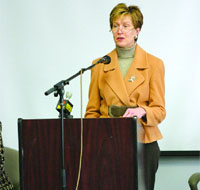
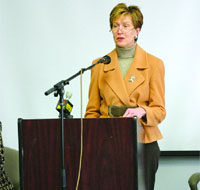
Mary Ellen Scott, president of United Personnel

Mary Ellen Scott, president of United Personnel

U.S. Rep. Richard Neal

U.S. Rep. Richard Neal

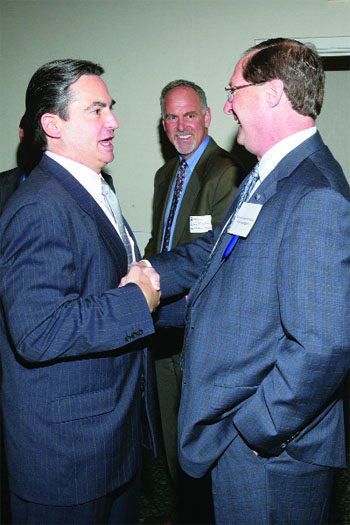
Russell Denver

Russell Denver, right, with PeoplesBank President and CEO Doug Bowen


Outlook 2011
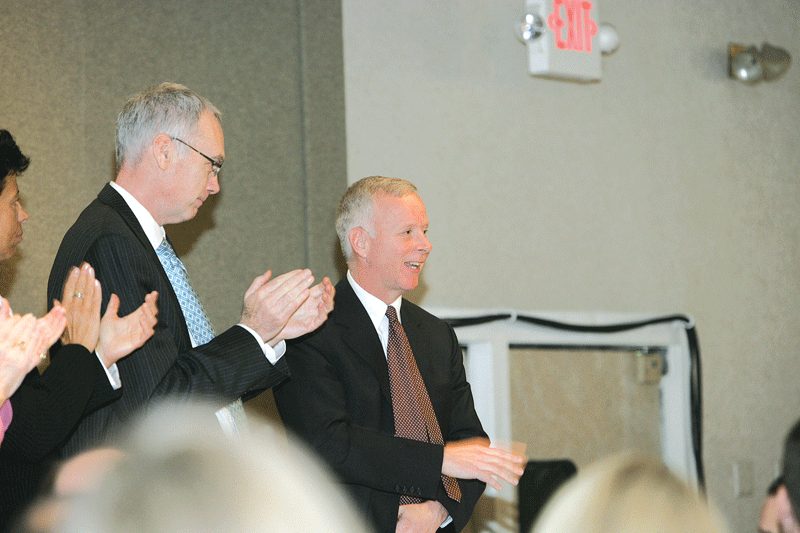
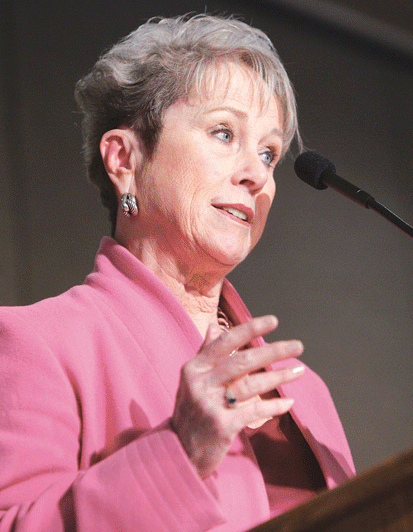
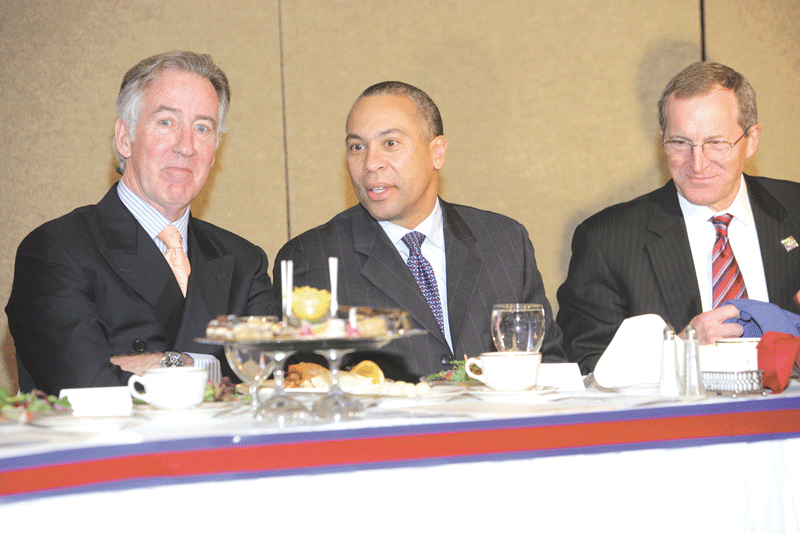
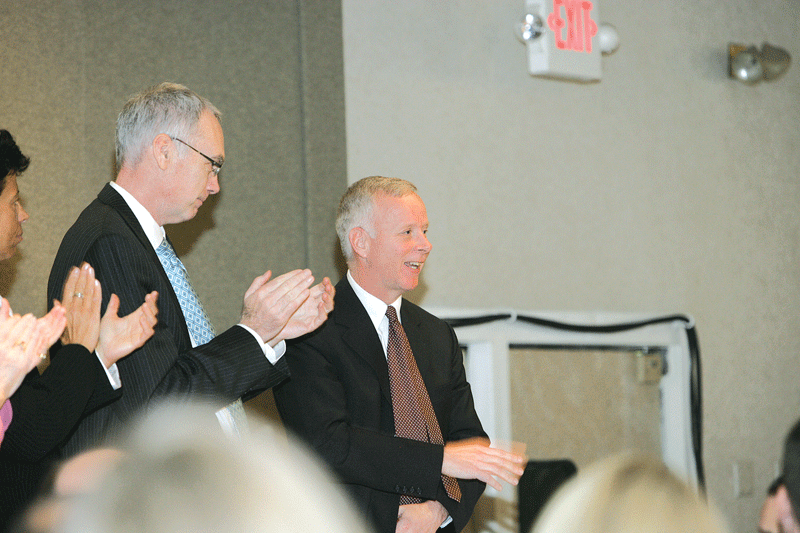
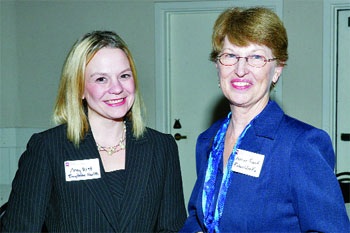
The Affiliated Chambers of Commerce of Greater Springfield staged Outlook 2011 on Feb. 11. The event featured an address from Gov. Deval Patrick, at right, and remarks from U.S. Rep. Richard Neal (top right, with Patrick and Health New England President Peter Straley at the head table). HNE was the presenting sponsor. At top left, Mary Ellen Scott, president of United Personnel, presents the chamber’s legislative agenda. Above, Russell Denver (right, with PeoplesBank President and CEO Doug Bowen) is saluted as he winds up more than 15 years as ACCGS president.

Agenda Departments

‘Transformational Leadership’ Forum
March 4: Randy Dobbs, author and protégé of General Electric’s legendary CEO Jack Welch, will be the keynote speaker for a forum titled “Transformational Leadership: a Blueprint for Organizational and Individual Success,” at the Western New England College Law and Business Center for Advancing Entrepreneurship in Springfield. Hosted by the college and Springfield-based UnityFirst.com, the 9 a.m. to 1 p.m. event will offer insights on how individuals, organizations, and businesses can drive significant business improvement by adapting to change. Dobbs will share many tested concepts from his book on transformational leadership. Also, a panel of thought leaders will offer perspectives on diversity and inclusion in the workplace, marketplace, and community. Registration is required to attend the forum, which includes a copy of Dobbs’ book and lunch. To register, contact (413) 221-7931 or [email protected].

National College Fair
March 6-7: The Eastern States Exposition in West Springfield is the setting for the Springfield National College Fair, slated from 1 to 4 p.m. on March 6, and from 9 a.m. to noon on March 7. Sponsored by the National Assoc. for College Admission Counseling and hosted by the New England Assoc. for College Admission Counseling, the event is free and open to the public. The fair allows students and parents to meet one-on-one with admissions representatives from a wide range of national and international, public and private, two-year and four-year colleges and universities. Participants will learn about admission requirements, financial aid, course offerings, and campus environment, as well as other information pertinent to the college-selection process. Students can register at www.gotomyncf.com prior to attending the event to receive a printed, bar-coded confirmation to use on-site at the fair as an electronic ID.

U.S. Navy Band to Salute Springfield on Birthday
March 18: The U.S. Navy Band will treat Springfield to an early birthday gift — a birthday concert — at 7 p.m. at Springfield Symphony Hall. The city of Springfield turns 375 years old in May, and the band concert is just one of several events planned to mark the milestone. As the premier wind ensemble of the U.S. Navy, the band will perform a wide range of marches, patriotic selections, orchestral transcriptions, and modern wind-ensemble fare. Tickets are free and can be obtained by sending a stamped, self-addressed envelope to the Spirit of Springfield/U.S. Navy Band, 101 State St., Suite 220, Springfield, MA 01103.

Difference Makers Gala
March 24: BusinessWest will salute its Difference Makers Class of 2011 at a gala slated to begin at 5 p.m. at the Log Cabin Banquet & Meeting House in Holyoke. Initiated in 2009, the Difference Makers program recognizes individuals and groups making outstanding contributions to the Western Mass. community. The 2011 winners will be announced in the magazine’s Feb. 14 issue. For more information on the event or to order tickets ($50 per person, with tables of 10 available) call (413) 781-8600, ext. 10; or log on to www.businesswest.com.

Western Mass. Business Expo
May 4: Businesses from throughout Hampden, Hampshire, Franklin, and Berkshire counties will come together for the premier trade show in the region, the Western Mass. Business Expo. Formerly called the Market show, the event, produced by BusinessWest and held at the MassMutual Center in Springfield, has been revamped and improved to better provide exposure and business opportunities to area companies. See the article on page 16 for more information. The cost for a 10-by-10 booth is $700 for chamber members and $750 for non-members; corner booths are $750 and $800, respectively, and a 10-by-20 booth is $1,200 for chamber members and $1,250 for non-members. For more information, log onto www.businesswest.com or www.accgs.com, or call (413) 781-8600, ext. 10.

Springfield 375th Parade
May 14: The Spirit of Springfield is seeking community involvement for the city’s 375th birthday celebration, which will include a parade that represents all that Springfield has to offer, its roots, and its future. If you have a business or group that would like to get involved in the festivities, call (413) 733-3800 or e-mail a message to [email protected].

EASTEC 2011
May 17-19: EASTEC, the East Coast’s largest annual manufacturing event, will once again be staged at the Eastern States Exposition in West Springfield. For exhibition or registration information, call (866) 635-4692 or visit www.easteconline.com.

Fifth Annual BusinessWest
40 Under Forty Gala
June 23: BusinessWest will present its 40 Under Forty Class of 2011 at a not-to-be-missed gala at the Log Cabin Banquet & Meeting House, beginning at 5 p.m. The 40 Under Forty program, initiated in 2007, has become an early summer tradition in the region. Nominations are currently being accepted for this year’s class (see form, page 73), and a team of five judges will complete the scoring of those nominations in late February, with the winners being announced in April. For more information on the event or to order tickets ($60 per person, with tables of 10 available) call (413) 781-8600, ext. 10; or visit www.businesswest.com.

Summer Business Summit
June 27-28: The Massachusetts Chamber of Business & Industry will host its annual two-day business summit at the Resort and Conference Center at Hyannis with a host of educational speakers and presentations by lawmakers. In addition, panel discussions are planned on energy, health care, and taxes and finance. Meanwhile, recognition is planned for Business of the Year, Employer of Choice, and Friend of Business from the local legislature. For more information, call (617) 512-9667.

Agenda Departments

Rick’s Place Benefit
Feb. 5: The third annual Heart to Heart fund-raiser for Rick’s Place is planned from 6:30 to 10 p.m. at the Ludlow Country Club. Established in memory of Rick Thorpe, who died in Tower Two of the World Trade Center on 9/11. Rick’s Place was created to provide a supportive, secure environment where families can remember their loved ones and avoid the sense of isolation that a loss can produce. For ticket information, call Shelly Bathe Lenn at (413) 348-3120 or visit www.ricksplacema.org.

Business Open House
Feb. 9: The Scibelli Enterprise Center at the STCC Technology Park in Springfield will host an open house titled “Growing Successful Small Businesses” from noon to 1 p.m. The event is offered to explain how the Enterprise Center is the regional hub for entrepreneurship for Western Mass. Small-business owners and service providers are encouraged to attend the open house. For more information, call (413) 755-6109 or visit
www.springfieldincubator.com.

Outlook 2011
Feb. 11: The Affiliated Chambers of Commerce of Greater Springfield (ACCGS) will host Outlook 2011 at Chez Josef in Agawam. The program begins at 11:45 a.m. and ends at 1:30 p.m. Outlook 2011 is ACCGS’s largest event of the year, where the annual legislative agenda is announced. The featured speaker will be Congressman Richard E. Neal, who will give the outlook on the federal level. As a senior member of the powerful Ways and Means Committee in the House, and a congressman long-recognized for his ability and willingness to reach across the aisle to work with his Republican colleagues, Neal will discuss the agenda for the 112th Congress, including his unique insights into areas such as health care, federal tax reform, job creation, and Social Security. ACCGS is also working with Gov. Deval Patrick’s office for him to be the keynote speaker on the state level. If for some reason the governor cannot attend, a high-ranking official from the state will be on hand to present the state outlook. Additionally, the chamber’s 2011 legislative agenda will once again be presented. This year, Mary Ellen Scott, president and owner of United Personnel, and a long-time member of the chamber’s legislative steering committee, will talk about how issues on the chamber’s agenda affect a typical business such as hers. Tickets to Outlook 2011 are $50 for chamber members and $70 for non-members. A table of 10 can be purchased for $475 for members and $700 for non-members. To make reservations or for more information, contact Diane Swanson at (413) 755-1313 or
[email protected]

National College Fair
March 6-7: The Eastern States Exposition in West Springfield is the setting for the Springfield National College Fair, slated from 1 to 4 p.m. on March 6 and from 9 a.m. to noon on March 7. Sponsored by the National Assoc. for College Admission Counseling, and hosted by the New England Assoc. for College Admission Counseling, the event is free and open to the public. The fair allows students and parents to meet one-on-one with admissions representatives from a wide range of national and international, public and private, two-year and four-year colleges and universities. Participants will learn about admission requirements, financial aid, course offerings, and campus environment, as well as other information pertinent to the college-selection process. Prior to attending the event, students can register at www.gotomyncf.com to receive a printed bar-coded confirmation to use on-site at the fair as an electronic ID.

Difference Makers Gala
March 24: BusinessWest will salute its Difference Makers Class of 2011 at a gala slated to begin at 5 p.m. at the Log Cabin Banquet & Meeting House in Holyoke. Initiated in 2009, the Difference Makers program recognizes individuals and groups making outstanding contributions to the Western Mass. community. The 2011 winners will be announced in the magazine’s Feb. 14 issue. For more information on the event or to order tickets ($50 per person, with tables of 10 available) call (413) 781-8600, ext. 10, or visit www.businesswest.com.

40 Under Forty Gala
June 23: BusinessWest will present its 40 Under Forty Class of 2011 at a not-to-be-missed gala at the Log Cabin Banquet & Meeting House, beginning at 5 p.m. The 40 Under Forty program, initiated in 2007, has become an early-summer tradition in the region. Nominations are currently being accepted for this year’s class (see form, page 71), and a team of five judges will complete the scoring of those nominations in late February, with the winners being announced in April. For more information on the event or to order tickets ($60 per person, with tables of 10 available), call (413) 781-8600, ext. 10, or visit www.businesswest.com.

Summer Buit
June 27-28: The Resort and Conference Center of Hyannis will be the setting for the Summer Business Summit, hosted by the Mass. Chamber of Business and Industry of Boston. Nominations are being accepted for the Massachusetts Chamber, Business of the Year, and Employer of Choice awards. The two-day conference will feature educational speakers, presentations by lawmakers, VIP receptions and more. For more information, visit www.masscbi.com.

Agenda Departments

Smart Growth Zoning
Jan. 24: Proposed locations for Chapter 40R Smart Growth districts will be presented to Ludlow residents at 6 p.m. at Ludlow Town Hall. Chapter 40R Smart Growth zoning districts encourage a higher concentration of housing and mixed-use developments in areas with existing infrastructure to create a range of housing options and spur community revitalization. Communities that adopt Smart Growth zoning districts are eligible to receive special state funds. The presentation will be facilitated by the town’s Smart Growth Zoning Advisory Committee and the Pioneer Valley Planning Commission.

Clio Awards
Jan. 26: The Ad Club of Western Mass. will showcase the 2010 television/cinema winners from the 2010 Clio Awards, one of the most recognized international advertising, design, and communication competitions, from 11:30 a.m. to 1:30 p.m. at Rivers Memorial, Western New England College, Springfield. Reservations must be made by Jan. 19 by calling (413) 736-2582. The cost is $25 for Ad Club members, $35 for non-members, and $15 for students. For more information, visit www.adclubwm.org.

Visionaries Forum
Jan. 28: The University of Hartford’s Construction Institute will host its second annual Visionaries Forum, part of the A/E/C Issues series, “A Visionary Approach to Design and Construction,” from 8:30 to 11:30 a.m. at the Crowne Plaza Cromwell in Cromwell, Conn. Program registration, continental breakfast, and networking will begin at 7:45 a.m. For more information or to register, visit www.construction.org.

Rick’s Place Benefit
Feb. 5: The third annual Heart to Heart fund-raiser for Rick’s Place is planned from 6:30 to 10 p.m. at the Ludlow Country Club. Established in memory of Rick Thorpe, who died in Tower Two of the World Trade Center on 9/11, Rick’s Place was created to provide a supportive, secure environment where families can remember their loved ones and avoid the sense of isolation that a loss can produce. For ticket information, call Shelly Bathe Lenn at (413) 348-3120 or visit www.ricksplacema.org.

Business Open House
Feb. 9: The Scibelli Enterprise Center at the STCC Technology Park in Springfield will host an open house titled “Growing Successful Small Businesses” from noon to 1 p.m. The event is offered to explain how the Enterprise Center is the regional hub for entrepreneurship for Western Mass. Small-business owners and service providers are encouraged to attend the open house. For more information, call (413) 755-6109 or visit
www.springfieldincubator.com.

National College Fair
March 6-7: The Eastern States Exposition in West Springfield is the setting for the Springfield National College Fair, slated from 1 to 4 p.m. on March 6 and from 9 a.m. to noon on March 7. Sponsored by the National Assoc. for College Admission Counseling and hosted by the New England Association for College Admission Counseling, the event is free and open to the public. The fair allows students and parents to meet one-on-one with admission representatives from a wide range of national and international, public and private, two-year and four-year colleges and universities. Participants will learn about admission requirements, financial aid, course offerings, and campus environment, as well as other information pertinent to the college-selection process. Students can register at www.gotomyncf.com prior to attending the event to receive a printed bar-coded confirmation to use on-site at the fair as an electronic ID.

Summer Business Summit
June 27-28: The Resort and Conference Center of Hyannis will be the setting for the Summer Business Summit, hosted by the Mass. Chamber of Business and Industry of Boston. Nominations are being accepted for the Massachusetts Chamber, Business of the Year, and Employer of Choice awards. The two-day conference will feature educational speakers, presentations by lawmakers, VIP receptions, and more. For more information, visit www.masscbi.com.

Agenda Departments

Business Open Houses
Jan. 12, Feb. 9: The Scibelli Enterprise Center at the STCC Technology Park in Springfield will host two open houses titled “Growing Successful Small Businesses” from noon to 1 p.m. The events are offered to explain how the Enterprise Center is the regional hub for entrepreneurship for Western Mass. Small-business owners and service providers are encouraged to attend the open houses. For more information, call (413) 755-6109 or visit www.springfieldincubator.com.

National College Fair
March 6-7: The Eastern States Exposition in West Springfield is the setting for the Springfield National College Fair, slated from 1 to 4 p.m. on March 6 and from 9 a.m. to noon on March 7. Sponsored by the National Assoc. for College Admission Counseling, and hosted by the New England Assoc. for College Admission Counseling, the event is free and open to the public. The fair allows students and parents to meet one-on-one with admissions representatives from a wide range of national and international, public and private, two-year and four-year colleges and universities. Participants will learn about admission requirements, financial aid, course offerings, and campus environment, as well as other information pertinent to the college-selection process. Students can register at www.gotomyncf.com prior to attending the event to receive a printed, bar-coded confirmation to use on-site at the fair as an electronic ID.

Agenda Departments

Extreme Business Makeover
Dec. 8: Western New England College’s Law and Business Center for Advancing Entrepreneurship will host an Extreme Business Makeover session from noon to 1:30 p.m. in the NUVO Bank community room, 1500 Main St., Springfield. Olive Tree Books-N-Voices will be the featured business that will receive advice from Pamela Aronson, owner of Pam’s Paperbacks “Plus”; Lou Cadorette, CPA, MST; Antonio Dos Santos, Esq., Robinson Donovan, P.C.; Janine Fondon, president and CEO, Unity First Direct Inc.; and John F. White, SVP commercial lending, NUVO Bank & Trust Company. Olive Tree Books-N-Voices is a familyowned bookstore which focuses on African-American books and literature, multicultural books, book accessories, journals, Bibles, religious books, and many more Afro-centric items. The event is free and open to the public. Lunch will be served.

Value Management Seminar
Dec. 9: The Purchasing Management Assoc. of Western New England is sponsoring a breakfast seminar titled “Value Management: Key to a Profitable Company” from 8:15 to 10:15 a.m. at the Yankee Pedlar Inn in Holyoke. Breakfast will be served at 7:30. Joseph F. Otero, CVS of Pratt & Whitney, will discuss how to implement the value- management approach to the purchasing of goods and services. The business objective, according to Otero, is to avoid paying for features and functions that one’s company doesn’t need. The cost is $25 for members and $30 for non-members. The deadline to register is Dec. 6. For more information or to register, visit www.pmawne.com, e-mail [email protected], or call Donna Bitzer at (413) 594-4400.

Nutcracker & Sweets
Dec. 10-12: The Wistariahurst Museum in Holyoke welcomes back the Massachusetts Academy of Ballet and members of the Ballet Educational Training Assoc. for several magical performances with a Skinner twist on a holiday classic. Listed on the National Register of Historic Places, Wistariahurst is the former home of William Skinner, a prominent silk manufacturer. Advance registrations are recommended; seating is limited. Show times are Friday at 7 p.m., Saturday at 1:30 and 4 p.m., and Sunday at 2 p.m. Admission is $10 with children 12 and under admitted free. For more information, call (413) 322-5660. The Wistariahurst is located at 238 Cabot St.
‘Talking with Dolores’
Dec. 15: The Center for Human Development (CHD) will host a one-act play about aging, life, and death choices from 1:30 to 2:30 p.m. at the Majestic Theater, 131 Elm St., West Springfield. The performance celebrates the merger of Hawthorn Services and CHD and introduces a new elder-services division, Hawthorn Elder Care. A reception will follow the play. Tickets are $10 and $7 for seniors. The deadline to make reservations is Dec. 10. For more information, contact Janet Simeone at (413) 439-2106, or visit www.chd.org.

Victorian Crafts Workshop
Dec. 18: Celebrate the holidays by crafting ornaments and gifts from 1 to 3 p.m. in the decorative splendor of the Wistariahurst Museum in Holyoke. Participants of all ages will employ Victorian techniques to make fresh orange pomanders decorated with clove designs, embellished gift boxes, and paper lanterns to hang from ceilings or on trees. The cost is $5 per person. For more information, call (413) 322-5660. The Wistariahurst is located at 238 Cabot St.

Hometown Heroes
Seeks Nominations
March 17: The American Red Cross Pioneer Valley Chapter will present its annual Hometown Heroes breakfast at the MassMutual Center in Springfield. The event honors local individuals (or groups of individuals) who have shown courage, kindness, and unselfish character when a friend, family member, or stranger faced a life-threatening situation, or who have had an extraordinary impact on the community or his or her fellow man. Members of the community are invited to nominate a local hero for consideration. Honorees will be selected by a committee of individuals from our community, including former Hometown Heroes. The chapter welcomes the submission of nominations from throughout Hampden, Hampshire, and Franklin counties. Nomination forms and criteria are available on the chapter Web site at www.redcrosscwm.org. Nominations must be submitted online or postmarked no later than Dec. 30, 2010. Sponsorship opportunities are also available. Hometown Heroes is the chapter’s largest annual fund-raising event, helping to provide the resources necessary to serve its communities. For further information, contact Dawn Leaks at [email protected] or (413) 233-1006.

Agenda Departments

“What’s in Your Dash?”
Nov. 9: Harold T. Epps, president and CEO of PRWT Services Inc., based in Philadelphia, will present “What’s In Your Dash?” at noon as part of the speaker series at the Western New England College Law and Business Center for Advancing Entrepreneurship in Springfield. Epps will discuss how quickly time and a career can go by and the importance of the choices people make as they balance their professional and personal lives. The lecture is free and open to the public. Lunch will be provided. For more information, call (413) 796-2030 or visit www.wnec.edu/lawandbusiness.

‘Secrets of Successful Businesses’
Nov. 9: The next program in the Innovative Thinking & Entrepreneurship Lecture Series features three speakers on “Secrets of Successful Businesses” from 7:30 to 9:30 a.m. in Blake Student Commons at Bay Path College, Longmeadow. Stanley Kowalski III, chairman of the board of FloDesign Inc.; Alaina Hanlon, Ph.D., president and CEO of Phenotype IT; and Anthony Newman, owner and founder of the Barkers Dozen, will be the presenters for the morning session. A continental breakfast will be served from 7:30 to 8:15 a.m. To register, call Briana Sitler at (413) 565-1066 or e-mail [email protected]. Seating is limited.

AIM Energy Summit
Nov. 16: Associated Industries of Massachusetts will host a Western Mass. Energy Summit from 8:30 to 11:30 a.m. at the Mass. Career Development Institute in Springfield. The program will feature a discussion on energy-related tax incentives and capital incentives. Also, networking with representatives from various energy programs and resources is encouraged. Speakers will include Bob Dvorchik, supervisor of commercial and industrial conservation programs, and Dick Oswald, manager, both of WMECO; Jeff Cady, general manager of Chicopee Electric; Paul Trangedi, president of ECS; Gene Giuliano of Columbia Gas of Massachusetts, and Beka Kasanovic of the US-DOE Save Energy Now Program. The event is free; however, registration is required. For more information, contact Dawn Creighton at [email protected].

Forensics Night
Nov. 16: Bay Path College in Longmeadow will host its annual Forensics Night from 5:30 to 8:30 p.m. The program is designed for young women in high school who are considering a forensics-related career path. The keynote speaker will be Northwestern District Attorney Elizabeth D. Scheibel, the first woman district attorney in the history of the Commonwealth. Also, participants and their families will have the opportunity to tour Carr Hall, which houses Bay Path’s new science facility. The program is free; however, space is limited. To register, call (800) 782-7284, ext. 1331, or (413) 565-1331. For more information, visit ww.baypath.edu.

Staying Healthy Program
Nov. 16: Holyoke Medical Center will present a program on helping area residents stay healthy at 6 p.m. in the Auxiliary Conference Center. The program is free as part of the hospital’s community education series Dessert with the Docs. Dr. Garry Bombardier will be the featured speaker, discussing physical exams, blood pressure, cholesterol, smoking, and diet. Refreshments will be served. Pre-registration is required, and seating is limited. For more information, call (413) 534-2789.

Advanced Manufacturing Competition & Conference
Nov. 16: The first highly concentrated, cluster-centric, regional manufacturing conference of its kind will be held at the MassMutual Center in Springfield. The event, called the Advanced Manufacturing and Innovation Competition & Conference (AMICCON), is being staged in response to growing recognition among area manufacturers and supply-chain members that there is an urgent need to find and meet one another. “AMICCON was formed to identify who’s here in manufacturing, expose them to OEMs (original equipment manufacturers) and procurement, and to make these introductions,” said co-founder Ellen Bemben. “The ultimate goal is to be the advanced manufacturing region in the U.S., where exotic manufacturing, such as micro, nano, and precision, meet higher specifications and tighter tolerances, and short runs are the norm.” Industry sectors to be represented at the event will include plastics and advanced materials, precision machining, paper and packaging, electronics, ‘green’/clean technology, and medical devices. Business opportunities in defense and aerospace will also be highlighted at the event. OEMs and their supply chains are being invited personally to participate. For more information, visit www.amiccon.com.

Agenda Departments

NEPM Product Showcase
Oct. 26: NEPM (New England Promotional Marketing) will stage its annual Promotional Product Showcase at Ludlow Country Club. The event will feature products from a number of vendors suitable for holiday gifts, trade-show handouts, or ideas for marketing plans. RSVP is required. For more information or to reserve a seat, call (413) 596-4800.

Developers Conference
Oct. 27: The Naismith Memorial Basketball Hall of Fame in Springfield will be the setting for the 2010 Springfield Developers Conference, sponsored by the City of Springfield. The conference theme is “Innovate, Grow, Create … Make It Happen,” and will feature opportunities for incorporating new technologies and innovative practices in the building, energy, and information-technology industries to improve one’s business. Exhibitor opportunities are still available. For more information, contact Samalid Hogan at (413) 787-6020.

Get on Board!
Oct. 28: OnBoard, a Springfield-based nonprofit, hopes to connect local organizations with individuals looking to increase their involvement in the community, from 5 to 8 p.m. at the Naismith Memorial Basketball Hall of Fame. The event will take place at Center Court, where attendees will meet with as many as eight or more organizations. The meetings will be orchestrated using the ‘speed-dating’ format, with individuals spending a few minutes with an organization of their choice, then, on the sound of the basketball buzzer, moving on to the next. Representatives from each organization will discuss their history, mission, goals, and what it is they are looking for in board members. Interested individuals will have the chance to explain what skills and interests they have to make a potential match. The event is free and open to the public. For more information, call Elizabeth Taras at (413) 687-3144, Brittany Castonguay at (413) 737-1131, or visit www.diversityonboard.org.

EANE Conference
Nov. 4: The Employers Assoc. of the NorthEast will host its annual Employment Law and HR Practices Update Conference from 8:30 a.m. to 4 p.m. at the Publick House in Sturbridge. The conference will be led by professionals in the areas of labor law, safety, employee relations, and unemployment. Conference highlights include up-to-date state and federal employment laws, recent court decisions, agency interpretations and prospective changes, as well as new compensation, safety, and employee-relations practices. For more details, call Karen Cronenberger at (877) 662-6444 or e-mail [email protected].
United in Hope
Nov. 14: New York Times bestselling and two-time Oprah Book Choice author Wally Lamb, will visit Springfield for the second annual United in Hope. He will raise awareness for how reading and writing build voice, and how sharing that voice creates hope for individuals and communities. Lamb will be joined by speakers, performers, and participating organizations and programs that focus on literacy and expression and community engagement. “United in Hope spotlights and models the dedicated efforts of many working together to conquer some of the urban challenges our city faces,” said Springfield Mayor Domenic Sarno. United in Hope will take place from 2 to 4 p.m. at the High School of Commerce at 415 State St. in Springfield. The event will be held in the Auditorium and is sponsored by Hasbro Inc. Immediately following the event, from 4 to 5 p.m., there will be opportunity to meet Lamb, purchase books, and browse community-resource tables. The event is free and open to the public.  For more information, contact Gianna Allentuck at (703) 930-0243 or [email protected].

Advanced Manufacturing Competition & Conference
Nov. 16: The first highly concentrated, cluster-centric, regional manufacturing conference of its kind will be held at the MassMutual Center in Springfield. The event, called the Advanced Manufacturing and Innovation Competition & Conference (AMICCON), is being staged in response to growing recognition among area manufacturers and supply chain members that there is an urgent need to find and meet one another. “AMICCON was formed to identify who’s here in manufacturing, expose them to OEMs (original equipment manufacturers) and procurement, and to make these introductions,” said co-founder Ellen Bemben. “The ultimate goal is to be the advanced manufacturing region in the U.S., where exotic manufacturing, such as micro, nano, and precision, meet higher specifications and tighter tolerances, and short runs are the norm.” Industry sectors to be represented at the event will include plastics and advanced materials, precision machining, paper and packaging, electronics, ‘green’/clean technology, and medical devices. Business opportunities in defense and aerospace will also be highlighted at the event. OEMs and their supply chains are being invited personally to participate. The Mass. Export Center has already produced two programs for AMICCON: an Export Experts Panel, and a seminar, “International Traffic in Arms Regulations for Defense and Aerospace Export.” For more information, visit www.amiccon.com.

Agenda Departments

Talk on Emily Dickinson
Oct. 14: Biographer Lyndall Gordon will discuss her controversial new book, Lives Like Loaded Guns: Emily Dickinson and Her Family’s Feuds, in a talk in Johnson Chapel at Amherst College. Gordon will address the limitations of biography and its risks and gains by focusing on several of the story’s principal players. The 7 p.m. talk is free and open to the public. A book signing and reception will follow Gordon’s lecture. For more details, visit www.emilydickinsonmuseum.org/events.

Witchcraft Lecture
Oct. 25: Witchcraft and its effects on Europe will be the subject of a lecture by Dr. Donald D’Amato, adjunct professor at Springfield Technical Community College, at 6 p.m. at the Wistariahurst Museum, 238 Cabot St., Holyoke. The title of the lecture is “The Unhappy History of Witchcraft.” He’ll discuss how people tend to misinterpret witchcraft by romanticizing its history and making it exciting. Admission is $5 for adults, $3 for students and seniors. For more information, call (413) 322-5660 or visit www.wistariahurst.org.

NEPM Product Showcase
Oct. 26: NEPM (New England Promotional Marketing) will stage its annual Promotional Product Showcase at Ludlow Country Club. The event will feature products from a number of vendors suitable for holiday gifts, trade-show handouts, or ideas for marketing plans. RSVP is required. For more information or to reserve a seat, call (413) 596-4800.

Developers Conference
Oct. 27: The Naismith Memorial Basketball Hall of Fame in Springfield will be the setting for the 2010 Springfield Developers Conference, sponsored by the City of Springfield. The conference theme is “Innovate, Grow, Create … Make It Happen,” and will feature opportunities for incorporating new technologies and innovative practices in the building, energy, and information-technology industries to improve one’s business. Exhibitor opportunities are still available. For more information, contact Samalid Hogan at (413) 787-6020.

Get on Board!
Oct. 28: OnBoard, a Springfield-based nonprofit, hopes to connect local organizations with individuals looking to increase their involvement in the community, from 5 to 8 p.m. at the Naismith Memorial Basketball Hall of Fame. The event will take place at Center Court, where attendees will meet with as many as eight or more organizations. The meetings will be orchestrated using the ‘speed dating’ format, with individuals spending a few minutes with an organization of their choice, and, on the sound of the basketball buzzer, moving on to the next. Representatives from each organization will discuss their history, mission, and goals, and what they are looking for in board members. Interested individuals will have the chance to explain what skills and interests they have to make a potential match. The event is free and open to the public. For more information, call Elizabeth Taras at (413) 687-3144, Brittany Castonguay at (413) 737-1131, or visit www.diversityonboard.org.

EANE Conference
Nov. 4: The Employers Association of the NorthEast will host its annual Employment Law and HR Practices Update Conference from 8:30 a.m. to 4 p.m. at the Publick House in Sturbridge. The conference will be led by professionals in the areas of labor law, safety, employee relations, and unemployment. Conference highlights include up-to-date state and federal employment laws, recent court decisions, agency interpretations, and prospective changes, as well as new compensation, safety, and employee-relations practices. For more details, contact Karen Cronenberger at (877) 662-6444 or [email protected].
Advanced Manufacturing Competition & Conference
Nov. 16: The first highly concentrated, cluster-centric, regional manufacturing conference of its kind will be held at the MassMutual Center in Springfield. The event, called the Advanced Manufacturing and Innovation Competition & Conference (AMICCON), is being staged in response to growing recognition among area manufacturers and supply-chain members that there is an urgent need to find and meet one another. “AMICCON was formed to identify who’s here in manufacturing, expose them to OEMs (original equipment manufacturers) and procurement, and to make these introductions,” said co-founder Ellen Bemben. “The ultimate goal is to be the advanced manufacturing region in the U.S., where exotic manufacturing, such as micro, nano, and precision, meet higher specifications and tighter tolerances, and short runs are the norm.” Industry sectors to be represented at the event will include plastics and advanced materials, precision machining, paper and packaging, electronics, ‘green’/clean technology, and medical devices. Business opportunities in defense and aerospace will also be highlighted at the event. OEMs and their supply chains are being invited personally to participate. “AMICCON is a new consortium on innovation that also delivers manufacturers to innovators and new markets in order to cause new business,” said Gary Gasperack, vice president and general manager (retired) of the Spalding Division of Russell Corp. “We are very excited about introducing it to our region.” The Mass. Export Center has already produced two programs for AMICCON: an Export Experts Panel, and a seminar, “International Traffic in Arms Regulations for Defense and Aerospace Export.” For more information, visit www.amiccon.com.

Agenda Departments

District Attorney Candidates Forum

Sept. 7: Western New England College School of Law will host a forum featuring the candidates for the office of Hampden County District Attorney at 6 p.m. in the Blake Law Center’s J. Gerard Pellegrini Moot Court Room. The event is free and open to the public. The candidates will face questions from a panel including a journalist, a local criminal attorney, and a professor from the School of Law. The forum is scheduled for approximately 90 minutes. WNEC is located at 1215 Wilbraham Road in Springfield.

CORI Board Training

Sept. 14: The Berkshire Area Health Education Center is collaborating with the Mass. Criminal Systems History Board to sponsor training on criminal offender record information (CORI) from 1 to 3 p.m. at Berkshire Hills Country Club in Pittsfield. The training is for staff of agencies who are certified to request CORI information for non-criminal-justice purposes. A $13 fee covers the cost of the venue and refreshments. To register or for more information, visit www.berkshireahec.org   or call (413) 447-2417.

EANE Healthcare Conference

Sept. 16: The Employers Assoc. of the NorthEast will conduct its annual Health Care Conference from 7:30 a.m. to noon at the Publick House in Sturbridge. A panel of experts, representing insurance carriers, brokers, health care providers, and legal professionals, will discuss the challenges of the changing health-care-reform landscape. Attendees will be encouraged to ask questions of the panel. For more information on the conference, contact Karen Cronenberger at (877) 662-6444 or [email protected] .

Mountain Park Memories

Sept. 17: The Holyoke Merry-Go-Round is inviting area residents to take a trip down memory lane with an event called Mountain Park Memories, slated for 6:30 p.m. at the Log Cabin Banquet & Meeting House. The event, a fund-raiser for the Merry-Go-Round, will capture the history and nostalgia of the amusement park located near the base of Mount Tom, which closed in the 1987 after operating for nearly a century. The program will include memorabilia, games, auctions, food stations, and music by Joe Canata & the Memories. Tickets are $45 per person. To order tickets, or for more information, call (413) 538-9838, or visit www.holyokemerrygoround.org .

Financial Pathways at Bay Path

Sept. 19: Intuition, creativity, and empathy are characteristics women can leverage to take control of and build their personal wealth. Bay Path College will continue its Financial Pathways series from 2 to 4 p.m. by examining these traits with A Purse of Your Own author Deborah Owens. Owens will highlight simple approaches to understanding investments and share the seven wealthy habits of successful women. The seminar is planned for the Blake Student Commons on the Longmeadow campus, 588 Longmeadow St. A question-and-answer session and book signing with Owens will follow the presentation. To build on the series’ philanthropic participation, attendees are asked to bring a gently used purse to the workshop as a donation to the college’s Professional Clothing Closet, which provides each undergraduate with one professional outfit as they begin their careers. Registration is required, and light refreshments will be served from 1:30 to 2 p.m. during event registration. Tickets are $10 each or $15 for two when signing up with a friend. To register or for more information, contact Mary Pajak at (413) 565-1115.

Sunday Brunch with Dr. Joy Browne

Sept. 19: Radio psychologist Dr. Joy Browne will be the guest speaker at a program, slated for noon to 3 p.m., sponsored by the UMass Amherst Family Business Center at the Log Cabin Banquet & Meeting House in Holyoke. Browne’s nationally syndicated daily radio show can be heard on the WOR Radio Network weekdays from noon to 3 p.m. A licensed clinical psychologist, Browne will answer questions about family, business, and family business. For more information on the program, contact Ira Bryck at (413) 545-1537, or visit www.umass.edu/fambiz .

Rick’s Place Open House

Sept. 21: Rick’s Place recently moved into a new facility at Kids Village, 35 Post Office Park, Suite 3514, Wilbraham, and an open house is planned from 3:30 to 5:30 p.m. to introduce its services to the public. Established in memory of Rick Thorpe, who died in Tower Two of the World Trade Center on 9/11, Rick’s Place provides a supportive and secure environment for grieving families. Scheduled two weeks before grand opening day, the open house will raise awareness of the work being done by staff and volunteers. For more information, visit www.ricksplacema.org .

Springfield Developers Conference

Oct. 27: The Naismith Memorial Basketball Hall of Fame in Springfield will be the setting for the 2010 Springfield Developers Conference, sponsored by the City of Springfield. The conference theme is “Innovate, Grow, Create … Make It Happen,” and will highlight opportunities to incorporate new technologies and innovative practices in the building, energy, and information-technology industries to improve one’s business. Exhibitor and sponsorship opportunities are still available. For more information, contact Samalid Hogan at (413) 787-6020.

Get on Board

Oct. 28: OnBoard, a Springfield-based nonprofit, hopes to connect local organizations with individuals looking to increase their involvement in the community, from 5 to 8 p.m. at the Naismith Memorial Basketball Hall of Fame. The event will take place at Center Court, where attendees will meet with as many as eight or more organizations. The meetings will be orchestrated using the ‘speed-dating’ format, with individuals spending a few minutes with an organization of their choice and, on the sound of the basketball buzzer, moving to the next. Representatives from each organization will discuss their history, mission, and goals, and what it is they are looking for in board members. Interested individuals will have the chance to explain what skills and interests they have to make a potential match. The event is free and open to the public. For more information, call Elizabeth Taras at (413) 687-3144 or Brittany Castonguay at (413) 737-1131, or visit www.diversityonboard.org .

Advanced Manufacturing Competition & Conference

Nov. 16: The first highly concentrated, cluster-centric, regional manufacturing conference of its kind will be held at the MassMutual Center in Springfield. The event, called the Advanced Manufacturing and Innovation Competition & Conference (AMICCON), is being staged in response to growing recognition among area manufacturers and supply chain members that there is an urgent need to find and meet one another. “AMICCON was formed to identify who’s here in manufacturing, expose them to OEMs (original equipment manufacturers) and procurement, and to make these introductions,” said co-founder Ellen Bemben. “The ultimate goal is to be the advanced manufacturing region in the U.S., where exotic manufacturing, such as micro, nano, and precision, meet higher specifications and tighter tolerances, and short runs are the norm.” Industry sectors to be represented at the event will include plastics and advanced materials, precision machining, paper and packaging, electronics, ‘green’/clean technology, and medical devices. Business opportunities in defense and aerospace will also be highlighted at the event. OEMs and their supply chains are being invited personally to participate. “AMICCON is a new consortium on innovation that also delivers manufacturers to innovators and new markets in order to cause new business,” said Gary Gasperack, vice president and general manager (retired) of the Spalding Division of Russell Corp. “We are very excited about introducing it to our region.” The Mass. Export Center has already produced two programs for AMICCON: an Export Experts Panel, and a seminar, “International Traffic in Arms Regulations for Defense and Aerospace Export.” For more information, visit www.amiccon.com .

Agenda Departments

40 Under Forty Gala
June 24: BusinessWest will celebrate its 40 Under Forty Class of 2010 at the Log Cabin Banquet & Meeting House with a gala to begin at 5 p.m. The event, which has become a spring tradition in Western Mass., will feature fine food, entertainment, and special presentations of the Class of 2010. Tickets for the event are $60. To order tickets or for more information, call (413) 781-8600, ext. 10, or e-mail [email protected].

The Coming Demographic Storm
June 30: The 2010 census statistics will prove it out over the next few years, but Kenneth W. Gronbach already knows what the stats will mean to America. A demographic storm of epic proportions is upon us, and if America’s businesses, regardless of size, are ready, they can plan for amazing success. But if they are not ready, they could be washed away in the giant generational wave. Gronbach, a gifted public speaker and a nationally recognized expert in the field of demography and generational marketing, will be the keynote speaker at the noon luncheon for the Advertising Club of Western Mass. at Longmeadow Country Club. Gronbach makes the science of the census results and shifting demography come alive with real-life examples that make it relevant to today’s culture, business climate, and economy. His presentation is based on the effects of shifting demography. He is an accomplished author with a new, bestselling book, The Age Curve: How to Profit from the Coming Demographic Storm. The demographic landscape in the U.S. is made up a series of waves that are about 20 years in duration. It would follow that business will rise and fall according to the critical mass of customers heading toward it. What is different about this wave is the extraordinary amount of population it includes compared to the past two generations. Businesses will enjoy extraordinary success if they are prepared and in front of the wave. Ad Club members are invited to bring a business associate and join the Ad Club for this presentation and network with the top advertising, marketing, and design talents in Western Mass. To make a luncheon reservation, contact the Ad Club at (413) 736-2582, or online at www.adclubwm.org. The cost for the luncheon is $25 for members, $35 for future members, and $15 for students.

Construction Course
July 14: The Home Builders & Remodelers Assoc. of Western Mass. will sponsor a six-session course starting July 14 to help individuals prepare for the Massachusetts Construction Supervisor’s Licensing Exam. Sessions are planned at the Home Builders & Remodelers Assoc. headquarters at 240 Cadwell Dr. in Springfield for six Wednesdays from 5:30 to 8:30 p.m. The exam is authorized by the State Board of Building Regulations and Standards and administered by Thomson Prometric. Registration forms to enroll for the exam will be distributed at the first session of the program. The fee is $250 for members of the Home Builders Assoc. of Western Mass. and $350 for non-members. All course participants must bring the 7th edition of the One & Two Family Dwelling Building Code book and the 7th edition of the Basic Building Code book to each class and to the open-book examination. There is an additional charge to order the code books through the association. For more information or to register, contact Sandra Doucette at (413) 733-3126.

Advanced Manufacturing Competition & Conference
Sept. 23: The first highly concentrated, cluster-centric, regional manufacturing conference of its kind will be held at the MassMutual Center in Springfield. The event, called the Advanced Manufacturing and Innovation Competition & Conference (AMICCON), is being staged in response to growing recognition among area manufacturers and supply-chain members that there is an urgent need to find and meet one another. “AMICCON was formed to identify who’s here in manufacturing, expose them to OEMs (original equipment manufacturers) and procurement, and to make these introductions,” said co-founder Ellen Bemben. “The ultimate goal is to be the advanced-manufacturing region in the U.S., where exotic manufacturing, such as micro, nano, and precision, meet higher specifications and tighter tolerances, and short runs are the norm.” Industry sectors to be represented at the event will include plastics and advanced materials, precision machining, paper and packaging, electronics, ‘green’/clean technology, and medical devices. Business opportunities in defense and aerospace will also be highlighted at the event. OEMs and their supply chains are being invited personally to participate. “AMICCON is also a new consortium on innovation that also delivers manufacturers to innovators and new markets in order to cause new business,” said Gary Gasperack, vice president and general manager (retired) of the Spalding Division of Russell Corp. “We are very excited about introducing it to our region.” The Mass. Export Center has already produced two programs for AMICCON: an “Export Experts Panel,” and a seminar, “International Traffic in Arms Regulations for Defense and Aerospace Export.”

Agenda Departments

Deliver Perfect Pitch

May 12: Learn concrete and easy-to-master tools to help you in every sales situation no matter what the environment or what you sell during “Deliver the Perfect Pitch,” 9 to 11 a.m., at the Scibelli Enterprise Center, 1 Federal St., Springfield. Sheldon Snodgrass of www.steadysales.com in Williamsburg will be the presenter. The program is sponsored by the Mass. Small Business Development Center Network. Cost is $40. For more information, call (413) 737-6712 or visit www.msbdc.org/wmass.

AIM Annual Meeting

May 14: John Ratzenberger, best known for his role as Cliff in the television comedy Cheers, will deliver the luncheon address at the Associated Industries of Massachusetts’ 95th annual meeting at the Westin Hotel in Waltham. Ratzenberger is a passionate advocate for the future of American manufacturing and the need to teach young people to work with their hands. He will discuss the foundation he started to help young people learn the rewards of fixing things themselves, building something useful, and inventing products that create economic opportunity. AIM’s annual meeting is planned from 10 a.m. to 2 p.m. and will bring together some of the brightest business and academic minds in Massachusetts to answer the pressing economic questions of the day. For more information, visit www.aimnet.org.

Wine Tasting and Auction

May 14: The Chicopee Chamber of Commerce will host its annual beer/wine tasting and auction at the Castle of Knights on Memorial Avenue in Chicopee from 6 to 9 p.m. The event, a fund-raiser to support the chamber and its many initiatives, is being sponsored by Chicopee Savings Bank. The event will feature fine food, a large variety of wines and beers to sample, and myriad auction items to bid on. Back by popular demand is the Collectibles Road Show. Representatives from Antiques Roadshow will be on hand to appraise attendees’ valuables. Those with items such as old coins, jewelry, or collectibles are encouraged to bring them to the show. Tickets are $20 each. To reserve tickets, call (413) 594-2101, or visit www.chicopeechamber.org.

Pancake Breakfast

May 15: The Spirit of Springfield will once again serve up what is reputed to the world’s largest pancake breakfast from 8 to 11 a.m. on Main Street in downtown Springfield. The event, marking Springfield’s 374th birthday, is the 25th edition of the annual pancake breakfast. It will also feature entertainment and activities. Tickets are $3 for adults and $1 for children. For more information, call (413) 733-3800 or visit www.spiritofspringfield.com.

13th Annual Rays of Hope Survivors’ Day

May 15: Breast-cancer survivors and their friends are invited to attend the 13th annual Rays of Hope Breast Cancer Survivors’ Day, from 8:30 a.m. to 2 p.m. at the Sheraton Monarch Place Hotel, One Monarch Place, Springfield. Breast cancer activist Geralyn Lucas, author of Why I Wore Lipstick to My Mastectomy, will serve as keynote speaker at the annual event, sponsored by the Comprehensive Breast Center at Baystate Medical Center and Rays of Hope. Lucas will discuss what it was like being diagnosed with breast cancer at the age of 27 just after landing her dream job as an editorial producer with ABC television’s 20/20 news program. A graduate of Columbia University School of Journalism, she later became director of public affairs at Lifetime Television and left the network in 2008 to work on the screenplay for Why I Wore Lipstick.  The television movie premiered on Lifetime in October, starring Sarah Chalke of the hit TV show Scrubs. In addition to the keynote address, participants will be able to select from two workshops on a number of topics, including ‘The Fat Factor,’ ‘Yoga and Healing,’ ‘Breast Cancer Therapy and the Heart,’ ‘Oncoplastic Surgery,’ ‘Fashion Do’s and Don’ts,’ ‘A Good Night’s Sleep,’ ‘Hooping Harmony,’ and ‘Acupuncture and Oncology.’  There will also be a special Creative Coping Art Workshop offered only in Spanish. Rays of Hope founder Lucy Giuggio-Carvalho and Dr. James Stewart, chief of the Division of Hematology/Oncology at Baystate Medical Center, who co-authored the recently published The Everything Guide to Living with Breast Cancer, will be on hand to sign their book, which will also be available for purchase at the event. Throughout the day, participants can visit with several exhibitors who will sell a variety of breast-related products, as well as vendors selling arts and crafts. A continental breakfast and buffet luncheon will be served. Registration is required. The cost is $25 per person, with the remaining cost underwritten by Rays of Hope. For those unable to afford the fee, scholarships are available through Sandy Hubbard at the Rays of Hope Community Outreach Office at (413) 794-2828. Parking will be validated. For more information or to request a registration form, call (413) 794-9556 or visit www.baystatehealth.org/raysofhope.

Business Plan Basics

May 20: The Mass. Small Business Development Center Network will host “Business Plan Basics” from 9:30 a.m. to 12:30 p.m. at the Amherst Town Hall, first-floor meeting room, 4 Boltwood Walk, Amherst. The workshop will focus on management fundamentals from start-up considerations through business-plan development. Topics will include financing, marketing, and business planning. The cost is $35. For more information, call (413) 737-6712 or visit www.msbdc.org/wmass.  

Food for Thought

May 25: Learn how social-media marketing can help grow a business at the next Food for Thought luncheon, sponsored by BusinessWest and The Healthcare News. The event will be held at Samuel’s at the Basketball Hall of Fame from 11:30 a.m. to 1 p.m. John Garvey, president of Garvey Communications Associates, and Mary Fallon, the agency’s media director, will present a talk about “Online Impact and Social Media for Small Business.” The $20 cost includes lunch. RSVP by May 21 with Melissa Hallock at (413) 781-8600, ext. 10, or [email protected].

Joomla! Workshop

May 26: Tamar Schanfeld of TnR Global Joomla! Services of Greenfield will present a daylong boot camp on creating an interactive Web site for small businesses. The workshop is planned from 9 a.m. to 4:30 p.m. at the Scibelli Enterprise Center, 1 Federal St., Springfield. Attendees will learn to plan a site, enter and edit content and menus, and install extensions. Comfort with Microsoft Word and an Internet browser is required. The workshop does not include e-commerce or shopping-cart features. Cost is $75. For more information, call (413) 737-6712 or visit www.msbdc.org/wmass.  

Green Remediation Conference

June 15-17: The Environmental Institute at UMass Amherst, the U.S. EPA Office of Superfund Remediation and Technology Innovation, U.S. EPA New England, and the Mass. Department of Environmental Protection will host the International Conference on Green Remediation: Environment – Energy – Economics, in the UMass Campus Center. The conference will address the full range of environmental, energy, and economic aspects of green and sustainable remediation, taking into account the energy requirements of treatment systems, air emissions, water-use requirements and impacts on water resources, land and ecosystem use and impacts, energy use and renewables, material composition, reuse, and waste generation. The conference is expected to attract more than 400 attendees, including a wide variety of representation from state and federal agencies, academia, various industries and utilities, and the environmental, engineering, and consulting community. Booths cost $1,000, and tables are $600. For more information or to register online, visit: www.teiconferences.com/greenremediation  ,  or call (413) 545-2842.

Hot Topics in Philanthropy

June 18: “Convergence: How Five Trends Will Reshape the Social Sector” is the focus of the upcoming Hot Topics in Philanthropy Breakfast hosted by Bay Path College. Nonprofit professionals are invited to attend the free event, which will examine a recently published study by La Piana Consulting, a national firm dedicated to strengthening nonprofits and foundations. The breakfast will be held in the Blake Student Commons from 7:30 to 10 a.m. From generational and other demographic shifts to the rise and impact of social media, there are several trends driving the future of the nonprofit sector. La Piana Consulting examined these various developments as part of its research initiative NonprofitNext, funded by the James Irvine Foundation. Written by Alex Hildebrand, David La Piana, Melissa Lendes Campos, and Heather Gowdy, the report describes the growing importance of networking as a means for effecting change, as well as the role of volunteerism and civic engagement in society, among other movements, and their impact on the nonprofit industry. The first to bring La Piana Consulting’s report to the region, Bay Path will feature Gowdy as the keynote speaker. A panel discussion will follow her address. The breakfast is free, but registration is required. To register, visit www.baypath.edu  or call (800) 782-7284, ext. 1056. The event is co-sponsored by the Graduate School at Bay Path College’s master’s in Nonprofit Management and Philanthropy program and its graduate certificate program in Fundraising Management and Nonprofit Management.

40 Under Forty Gala

June 24: BusinessWest will celebrate its 40 Under Forty Class of 2010 at the Log Cabin Banquet & Meeting House with a gala to begin at 5 p.m. The event, which has become a spring tradition in Western Mass., will feature fine food, entertainment, and special presentations of the Class of 2010. Tickets for the event are $60. To order tickets or for more information, call (413) 781-8600, ext. 10, or e-mail [email protected] .

Agenda Departments

Architecture Exhibition

Through May 9: For the first time in the region, a landmark exhibition on sustainable, contemporary architecture and environmentally sensitive building practices will take place at the University Gallery, Fine Arts Center, UMass Amherst. The exhibition is designed to deepen the public’s understanding and use of ‘green’ design, while demonstrating that the key elements of sustainability can be accessible to all. Through models, photographs, and virtual tours, the exhibition unites diverse works from large-scale science buildings to private residences, low-income housing, and intimate gardens of natural inspiration. For more information, visit www.umass.edu/fac/universitygallery .

Deliver Perfect Pitch

May 12: Learn concrete and easy-to-master tools to help you in every sales situation no matter what the environment or what you sell during “Deliver the Perfect Pitch,” 9 to 11 a.m., at the Scibelli Enterprise Center, 1 Federal St., Springfield. Sheldon Snodgrass of www.steadysales.com in Williamsburg will be the presenter. The program is sponsored by the Mass. Small Business Development Center Network. Cost is $40. For more information, call (413) 737-6712 or visit www.msbdc.org/wmass .

AIM Annual Meeting

May 14: Actor John Ratzenberger, best known for his role as Cliff in the television comedy Cheers, will deliver the luncheon address at the Associated Industries of Massachusetts’ 95th annual meeting at the Westin Hotel in Waltham. Ratzenberger is a passionate advocate for the future of American manufacturing and the need to teach young people to work with their hands. He will discuss the foundation he started to help young people learn the rewards of fixing things themselves, building something useful, and inventing products that create economic opportunity. AIM’s annual meeting is planned from 10 a.m. to 2 p.m. For more information, visit www.aimnet.org .

Business Plan Basics

May 20: The Massachusetts Small Business Development Center Network will host “Business Plan Basics” from 9:30 to 12:30 p.m. at the Amherst Town Hall, 1st floor meeting room, 4 Boltwood Walk, Amherst. The workshop will focus on management fundamentals from start-up considerations through business plan development. Topics will include financing, marketing and business planning. The cost is $35. For more information, call (413) 737-6712 or visit www.msbdc.org/wmass .

Joomla! Workshop

May 26: Tamar Schanfeld of TnR Global Joomla! Services of Greenfield will present a daylong boot camp on creating an interactive Web site for small businesses. The workshop is planned from 9 a.m. to 4:30 p.m. at the Scibelli Enterprise Center, 1 Federal St., Springfield. Topics: learn to plan your site, enter and edit content and menus, and install extensions. Comfort with Microsoft Word and Internet browser required. The workshop does not include e-commerce or shopping cart features. Cost is $75. For more information, call (413) 737-6712 or visit www.msbdc.org/wmass .

Agenda Departments

Social Media Plan

April 15: “The Small Business Experience/Creating a Social Media Plan” is the theme of a morning workshop hosted by the Mass. Small Business Development Center Network. The workshop will be presented by Derek Allard of Gravity Switch in Northampton and Shalini Bahl of IAM Business Consulting of Amherst, and is planned from 9 a.m. to noon at the Scibelli Enterprise Center, 1 Federal St., Springfield. Highlights of the day include developing a social-media plan based on one’s business purpose, social-media purpose, target audience, and resources. The cost is $40. For more information, call (413) 737-6712 or visit www.msbdc.org/wmass .  

WNEC Speaker Series

April 15: Katharine G. Baker, Ph.D., Principal of Family Therapy and Consulting Associates in Northampton, will present “Leading a Business in Anxious Times” at noon as part of Western New England College’s Law and Business Center for Advancing Entrepreneurship Speaker Series. Baker is an experienced business consultant who has worked with family enterprises and closely held firms, providing executive and leadership coaching, strategic planning, organizational learning services, and time-management seminars. She currently is an independent scholar and executive coach with a solo consultation practice that serves national and international clients. She will present an approach to understanding business leadership that is grounded in Bowen theory, a well-tested theory of human behavior. She will show how the patterns of behavior learned in the family can have a profound impact on every business’ success. Baker will illustrate the power and effectiveness of this way of understanding leadership. She will also discuss executive coaching as an application of her approach. For more information on the free lecture at the Law School Commons on Wilbraham Road in Springfield, call (413) 796-2030 or e-mail [email protected] . Lunch will be provided.

Twitter & Blogs

April 22: Derek Allard of Gravity Switch in Northampton will present a workshop titled “Twitter & Blogs” from 9 to 11 a.m. at the Scibelli Enterprise Center, 1 Federal St., Springfield. Allard will discuss the basics — what they are, why to use them, and how to get started. The cost is $40. For more information, call (413) 737-6712 or visit www.msbdc.org/wmass .

LinkedIn & Facebook

April 29: Derek Allard of Gravity Switch in Northampton will present a workshop titled “LinkedIn & Facebook” from 9 to 11 a.m. at the Scibelli Enterprise Center, 1 Federal St., Springfield. Allard will discuss the basics — what they are, why to use them, and how to get started. The cost is $40. For more information, call (413) 737-6712 or visit www.msbdc.org/wmass .

Women’s Professional Development Conference

April 30: Bay Path College will host its 15th annual Women’s Professional Development Conference at the MassMutual Center in downtown Springfield from 7:30 a.m. to 4:30 p.m.  For more information, call (413) 565-1000 or visit www.baypath.edu .

Deliver Perfect Pitch

May 12: Learn concrete and easy-to-master tools to help you in every sales situation, no matter what the environment or what you sell, during “Deliver the Perfect Pitch,” 9 to 11 a.m., at the Scibelli Enterprise Center, 1 Federal St., Springfield. Sheldon Snodgrass of www.steadysales.com in Williamsburg will be the presenter. The program is sponsored by the Mass. Small Business Development Center Network. Cost is $40. For more information, call (413) 737-6712 or visit www.msbdc.org/wmass .

Business Plan Basics

May 20: The Massachusetts Small Business Development Center Network will host “Business Plan Basics” from 9:30 a.m. to 12:30 p.m. at Amherst Town Hall, first-floor meeting room, 4 Boltwood Walk, Amherst. The workshop will focus on management fundamentals from start-up considerations through business-plan development. Topics will include financing, marketing, and business planning. The cost is $35. For more information, call (413) 737-6712 or visit www.msbdc.org/wmass .

Joomla! Workshop

May 26: Tamar Schanfeld of TnR Global Joomla! Services of Greenfield will present a daylong boot camp on creating an interactive Web site for small businesses. The workshop is planned from 9 a.m. to 4:30 p.m. at the Scibelli Enterprise Center, 1 Federal St., Springfield. Topics: learn to plan your site, enter and edit content and menus, and install extensions. Comfort with Microsoft Word and Internet browser required. The workshop does not include e-commerce or shopping cart features. Cost is $75. For more information, call (413) 737-6712 or visit www.msbdc.org/wmass .

Features
Is the Time Finally Right for Springfield?s Union Station?
Train of Thought

John Judge says that, given the priority status attached to commuter rail regionally and nationally, Union Station may be able to turn back the clock and thrive.

The hands on the large clock in the main lobby of Springfield’s Union Station haven’t moved in nearly 40 years. For this landmark built in 1926 by the Boston and Albany Railroad, time has stood still — literally. But time hasn’t run out, insist those now working to advance yet another redevelopment plan for the station, one they say is unlike previous concepts, because it is grounded in market realities.

John Judge understands that, when he says he’s “hopeful and “optimistic” about the prospects for Union Station, he’s echoing the comments of myriad Springfield officials, Pioneer Valley Transit Authority administrators, and area economic-development leaders, some of whom have watched the landmark sit idle and deteriorate for almost 40 years.

When he says he believes the timing is right for the station to soon end its long hibernation, he knows that others have been saying words to that effect since Ronald Reagan was in the White House.

Judge has been Springfield’s chief development officer for only 11 months now, but he knows all about Union Station’s long and recently quite sad history. So he understands why so many are skeptical about something positive ever happening there.

“I can’t blame them. They have every right to be skeptical; one thing after another has created roadblocks for this property, and the years have turned into decades,” said Judge, who was enthusiastic but also quite realistic as he talked about the latest in a series of plans — some formal, some just idle talk — for reuse of the station on Frank B Murray Street. This one is far more grounded than the ones that have come before it, said Judge, noting that previous incarnations have included everything from a hotel to an IMAX theater that have never come close to seeing the light of day.

This version, called Union Station II by some and ‘Option One’ by the consulting firm that drafted the plan, is based mostly on transportation-related components, including a 23-bay bus terminal, and comes at a time when the nation and the region are making commuter rail a priority matter, said Judge. He expressed the hope, but also the expectation, that Springfield could become a hub of commuter-rail service running from Southern Vermont to New Haven, Conn. and, ultimately, New York.

The plan has other components, including plans for a day-care center, what is called ‘transit-related retail’ (kiosks, newsstands, coffee shops, and fast-food operations), and what the consultants call ‘opportunity space’ for other retail.

It’s a nice picture, and variations of it have been painted before, many times, which explains why so much skepticism remains about Union Station. And those doubts are just one hurdle to be overcome. The economy is another, as is a sluggish commercial real-estate market that has property owners of all kinds, from private developers to Springfield Community College and its assistance corporation, vying for the same small pool of office tenants.

And then, there’s Worcester’s Union Station, which was renovated a decade ago and has sat mostly empty since then, becoming a poster child for historic train-station redevelopment gone awry — or gone nowhere — thus casting further doubt on Springfield’s efforts.

Judge is optimistic that 2010 will yield the first real, visible signs of progress at Union Station in many years, which he says could start to erase some doubts. He expects there might be movement to solidify some of the transportation components, especially the PVTA’s eventual move from its headquarters on Main Street to the train station, and also some of the other pieces to this puzzle, such as a day-care center, a senior center, and that transportation-related retail. And he anticipates that work to begin razing the so-called ‘baggage building’ adjacent to the station could begin late this year or early next, providing some tangible evidence that redevelopment is happening.

The economy is still quite soft now, which is actually good, from a timing perspective, for this project, in that those working to redevelop Union Station can position it for the day — not far off — when times are better and the appetite for commuter rail will be much greater.

“We’re in a unique time in history in that we have an administration that’s committed to high-speed commuter rail, and we also have a society that’s embracing the idea of regionalism and how important that is,” he explained. “If gas goes to $4 a gallon again, people are going to have few if any options in terms of commuting. What we want to do is reposition Union Station as not simply an intermodal facility for Springfield, but as a hub for the Pioneer Valley.”

For this issue, BusinessWest takes a look at the latest plans for Union Station and their prospects for becoming reality.

On the Right Track

Judge calls it the “Union Station task force.”

That’s the name he’s given to a small working group that now gathers around the conference table in his office on Tapley Street every Tuesday morning starting at 8:30. The group began meeting a few months ago, he told BusinessWest, and he intends to stay with the weekly schedule for the foreseeable future to keep this latest Union Station project on the front burner, where he says it belongs.

“We want this to be a priority,” he said, “and when you meet every month or every other month, it’s not a priority.”

Recent meetings have had a number of agenda items, but especially the steps — legal, financial, and technical — needed to make the Springfield Redevelopment Authority the lead agency on this project (a memorandum of understanding between the SRA and PVTA was signed last summer making them partners in this initiative) and the entity that would be the direct designee for the close to $60 million in state and federal funds that have been awarded for Union Station redevelopment.

The money is in place, technically speaking, and has been for many years, said Judge, adding that the individual earmarks must be “re-energized.”

In general, discussion among task force members, who include Judge, Kevin Kennedy, senior aide to U.S. Rep. Richard Neal, a strong advocate for re-development of the station; Maureen Hayes, president of Hayes Development and a consultant to the city on this project; and others, centers around a redevelopment plan crafted in late 2008 by the Nebraska-based consulting firm HDR.

As they talked about the plan, Judge and Kennedy echoed what HDR said in its executive summary of the latest redevelopment initiative:

“Past efforts to redevelop this facility were not successful due to a variety of reasons, but the common denominator was that the plans were not based on market realty,” said the report’s authors in reference to such concepts as the hotel, IMAX theater, upscale restaurants, and other components of previous plans. “This redevelopment plan takes a grounded approach based on well-defined objectives, available funding, economic viability, and the realities of the real-estate market.”

At the heart of HDR’s redevelopment plan is something the consultants call simply ‘Option One,’ or the best of several scenarios for revitalization of the Union Station complex.

Option One has several components, including:

  • Restoration of the terminal building, with approximately 33,000 square feet for PVTA, Amtrak, commuter rail, and intercity bus operating facilities; 58,000 square feet of transit-related retail and office space, including day care, PVTA administrative offices, and a transportation conference center; and 30,000 square feet of commercial ‘opportunity space’ for future economic development;
  • Removal of the baggage building and construction of a new, 139,000-square-foot bus terminal with 23 bays;
  • Construction of a 400-space, two-level parking garage connected to the terminal building to accommodate transit and public parking above the new bus terminal; and
  • Reopening of a passenger tunnel, providing a safe, walkable connection from the terminal building to the Amtrak station and platforms, and Lyman Street.
  • Funding is essentially in place for these various components, say the report’s authors, adding that $4 million would still be needed to complete the build-out of the opportunity space, which could be financed by a loan or “obtained through some other funding source.”

    The HDR report also lays out budgetary projections:

    “A fully occupied Option One is expected to generate an annual revenue of budget of approximately $1.9 million, of which $1.5 million is associated with the transit-related operations and $400,000 from the opportunity space. The total annual operating cost is estimated at approximately $1.5 million. A net balance of about $400,000 would generate enough cash flow to cover the debt service of the financing needed to build out opportunity space.”

    Getting Everyone On Board

    All this looks good on paper, but there are many questions involving whether the plan can become reality. They concern everything from whether Peter Pan Bus Lines will be a player in this new plan (and if the project can go ahead if it’s not) to whether there will be any interest in that aforementioned opportunity space.

    Judge and Kennedy said those questions will be answered over time, but both expressed optimism that the plan can come together as HDR has outlined it.

    “With a lot of projects of this magnitude, it comes down to timing and circumstance,” said Kennedy, who has a long history with Union Station — he was an aide to then-Mayor Neal when the city took possession of the landmark. “Looking to the future and what will be a greater emphasis on rail, I think Springfield is positioned to be a hub of a commuter rail line and also positioned for an economic-development project in the north of its downtown blocks.

    “To do nothing with Union Station would be a bad idea,” he continued, “and I think we have a much better chance for success now, because this plan is based on market realities.”

    As for specific components for a revitalized Union Station, Judge said some discussions have taken place with administrators at Square One, the Springfield-based day-care provider, and there is some interest in possibly creating a new facility in the station, which would be a natural location if it were to become an intermodal transit center. And such an operation would help create additional vibrancy in the station, something that would be needed to attract other forms of retail.

    A senior center would provide similar benefits, said Judge, adding that he can visualize a facility that seniors could reach via mass transit and stay at during the day.

    “We have to look at what we can do to make this a vibrant, 24/7-like spot for the city,” he explained, “and not a situation where a train pulls in, people walk through, and you’re missing that added vibrancy.

    “Having Square One there would be critical,” he continued, “and another thing I’d like to have, and I think it would be innovative, would be a senior center. There would be some inter-generational opportunities, and a place where seniors can go to do a power walk, grab a bite to eat, use wifi, and maybe volunteer some time with the kids.”

    Another possibility, he said, is creation of facilities, such as conference rooms and other amenities, that could be used by businesses and individuals with virtual offices. “The region doesn’t have anything like that, and it needs one.”

    But to achieve real success with this project, Springfield, and Union Station, would need to become the hub of much more extensive commuter-rail service, said Judge, who firmly believes that day is coming.

    “The scenario works out this way … you live in Sixteen Acres, take a PVTA bus to Union Station, walk through the station, get your coffee and your bagel and your ticket, and then get on a train to New Haven, and from there you can go to New York,” he said, adding that many business executives currently drive to New Haven and take a train to Gotham.

    This scene that Judge lays out is similar to the way things were decades ago, before air travel and the interstate highway system crippled the railroads — and dozens of once-proud facilities like Union Station. A return to those days, and a commuter-rail system approaching what is seen in most European countries, could enable Springfield’s landmark to come full-circle.

    Last Stop

    As he talked about moving plans for Union Station off the drawing board and to reality, Judge said he has an excellent team in place for that assignment (his task force), that the timing is right, with the state and region due to emerge from the recession at about the same time the project heats up, and that the latest plan is realistic and doable.

    As he spoke those words, he realized that many before him, in various governmental capacities, have said essentially the same things.

    Time will tell if things go differently with this plan for the landmark that time forgot, meaning that things will go right. But Judge firmly believes that soon — a relative term if ever there was one — people will talk about Union Station using something other than the past tense.

    George O’Brien can be reached at[email protected]

    Uncategorized
    New Economy, Old Economy, and Business Costs

    Policymakers in Boston and Washington love to paint new-economy jobs as an economic panacea, immune to high taxes, staggering electricity costs, and bureaucratic regulation. They tout — and often subsidize — ‘industries of the future,’ while raising costs for the industries of the present that employ the majority of Massachusetts residents. But the new-economy myth exploded in 2009 as companies that have been poster children for innovation-based economic development in Massachusetts announced major expansion projects in Michigan, the Carolinas, and China.

    A recent UMass study found that 70% of technology executives believe Massachusetts must address the cost of doing business, corporate taxes, unemployment insurance, and workers’ compensation. Business costs matter just as much in the new economy as they did in the old.

    High-technology, biotechnology, and clean-technology jobs respond to the same economic influences that determine whether any job will provide economic opportunity to citizens of Massachusetts — or to citizens of Michigan or citizens of China. Innovation remains critical to economic growth, but government must also commit to supporting commercialization and the employment opportunities it will create.

    Our economic future depends upon the ability of the Commonwealth to create a favorable business environment across all industries. The alternative is an ‘invented here, made elsewhere’ economy that provides opportunity for doctoral-level researchers, but leaves other citizens out in the cold.

    That understanding is the foundation of the public-policy agenda of Associated Industries of Massachusetts, which continues to advocate on behalf of employers as Massachusetts enters a new decade struggling to emerge from a protracted economic downturn.

    The document calls for an economic policy that balances key public investments with a competitive cost structure that keeps jobs in Massachusetts; a predictable, responsible, and long-term state fiscal policy; uniformly favorable environment for business development across all industries; leadership from business executives to help government resolve important issues; well-conceived and collaborative regulation policies that create measurable benefits; an environment that values contributions made by employers to operate successful businesses that employ state residents; a nimble, world-class education system that provides opportunity for all Massachusetts citizens and the knowledge base for economic growth; and the need for business and government to more fully collaborate in order to ensure mutual success.

    Massachusetts employers, even ‘new-economy’ companies, have cause to worry as 2010 begins. They face an immediate 28% increase in unemployment insurance taxes and $44 million in new assessments for the Medical Security Trust Fund, as well as the Legislature’s failure to address flaws in last year’s $192 million Combined Reporting corporate tax increase that has put Massachusetts at the bottom of CFO magazine’s list of places to do business.

    A better business climate — not higher business costs — is the key to rebuilding our economy and solving the budget crisis that threatens the ability of state and local government to deliver the services that citizens expect.

    Richard C. Lord is president and CEO of Associated Industries of Massachusetts.

    Uncategorized
    An Inspiring Class of Difference Makers

    When BusinessWest launched its Difference Makers program a year ago, it did so with many goals in mind. The first, of course, was to recognize people and institutions making important contributions to the health and well-being of this region. Beyond that, through the telling of their stories, we wanted to inspire others to make a difference as well.

    The Class of 2009 made that second goal easily reachable, and the Class of 2010 (introduced in a special section starting on page 37) will do at least as well. Indeed, if there is one word that sums up this class, it is inspirational.

    Let’s start with the Davis Foundation. Over the past 40 years or so, it has awarded grants to countless local nonprofit agencies, helping them do everything from constructing new buildings to launching new programs to simply meeting the confines of a budget. These acts of philanthropy alone are enough to make the foundation a Difference Maker. But in recent years, the organization has gone far beyond the act of donating money.

    Perhaps its most important role now is to act as a convening power, bringing groups and individuals together to address issues like education and literacy. The word agenda often has a negative connotation to it, but not in this case. The Davis Foundation has a clear agenda — to focus energy, imagination, and, yes, money on the critical matter of young people, this region’s future.

    Serving on boards and committees doesn’t necessarily make one a Difference Maker. But going well beyond the monthly or weekly meetings and compelling those involved with various groups to reach higher and work harder, well, that would put someone in that category.

    And this pretty much sums up Ellen Freyman’s approach to her work. She’s not only tutoring and mentoring members of a Somali family, she’s working with Springfield school officials to improve their chances of succeeding in the classroom. She’s also starting to work with others to find new ways to bring more adult-literacy programs online, not merely to help the Somalis, but also the countless others who need such services. She’s even put a soccer team together for Somalis and arranged for donations of equipment.

    All this shows creativity and the ability to think outside the box — just some of the traits that make her a Difference Maker.

    Jim Goodwin has been at the helm of the Center of Human Development for more than 30 years now, and in that time he has helped create and expand dozens of programs that improve quality of life for society’s most challenged constituencies.

    These include the mentally and physically challenged, children with developmental issues, seniors, those with substance-abuse problems, those who have been incarcerated, and others. He’s a Difference Maker not simply because he works with those groups, but because he’s created an organization — and a team — committed to the CHD mission.

    Carol Katz, meanwhile, is also a Difference Maker on many levels. First, as CEO of Loomis Communities, she has orchestrated strong growth of that organization while also transforming the way in which care to seniors is provided.

    She also gives back to the community, and by setting that example, and that tone, she has created a culture of community involvement in each of the Loomis properties.

    Finally, UMass Amherst and its chancellor, Robert Holub, are making a difference in many ways, especially in Springfield, through a number of economic-development programs. Efforts include establishing a physical presence in downtown Springfield, partnering with area agencies to transfer technology from the university to area precision manufacturers, research projects, the Pioneer Valley Life Sciences Institute, work to create the High Performance Computing Center in Holyoke, and much more.

    This is an exceptional class of Difference Makers, individuals and institutions that can inspire positive change while also inspiring others to follow their lead.

    Kate Campiti is associate publisher and advertising manager of BusinessWest.

    Opinion
    Decision Looms for ‘Death Tax’

    I know you’re eager to return to those thrilling days of yesteryear — the Bush presidency — and there’s a pressing matter from that era on the national agenda: what to do about the estate tax. We have until New Year’s Day to settle this question, a small window on our values as a country. The background: on the charge that the ‘death tax’ was a punishing money grab from small businessmen and women — coming while they grieved a lost loved one, no less — opponents in 2001 succeeded in increasing the exemption; the tax currently kicks in on inheritances above $3.5 million rather than the old tax’s $1 million. The maximum tax rate, then 55%, was dropped to 45%.

    When the Times Square ball rings in 2010, the tax will vanish altogether. Your ticket to the great beyond is tax-free next year. But not if you survive into 2011: because of deficit concerns, opponents had to agree that the tax would return that year, with a rate and exemption at their 2001 levels. This fiscal sleight-of-hand, disdained by all sides, has produced a yuletide debate. Should we repeal next year’s repeal to contain federal red ink, and if so, what should the rate and exemption be? Or do we just kill the tax permanently, as opponents have always urged? President Obama proposes threading the needle by keeping the tax next year but making permanent its current lowered rate and higher exemption. Boston College law professor Ray D. Madoff counters that that would cost the Treasury more in the coming decade than doing nothing. She proposes shielding family businesses under $10 million from the tax but preserving it at some level otherwise.

    Both points are spot-on. The case against the death tax (opponents’ term) has always been daffy. Aug. 24, 2000 has passed into political lore as the day that Montana rancher Lynn Cornwell hopped atop a tractor to deliver a repeal plea to President Clinton at the White House. That same day, then-Republican House Speaker Dennis Hastert declared that the tax “is so steep that sometimes the deceased owner’s children must break up a farm or sell a business just to cover the tax.’’ But the tractor drive was a stunt. Far from being a victim of the tax man’s greed, Cornwell has benefited from taxpayer largesse. In the years after his ride, he pocketed $400,000 in federal farm subsidies and fed his herd on federal land at below-market rates, according to William H. Gates Sr. and Chuck Collins, two well-off men who wrote a book supporting retention of the tax.

    And Hastert’s point? You could fertilize Montana with what the speaker was shoveling. In 2001, the New York Times asked the American Farm Bureau Federation, a repeal advocate, for examples of families that had to give up their farms because they couldn’t afford the estate tax. The federation found exactly zero victims. Five years later, the Times reported that just 50,000 families will be subject to the tax in 2011. They’re in a tax bracket that means they’ll be able to pay the IRS without having to miss the mortgage payment, turn off the electricity, or eat cat food.

    Won’t killing the tax help during a recession? Tax cuts for average people who need to spend their money on necessities would indeed be smart in a downturn. But with the estate tax, we’re talking about the wealthiest Americans, people more likely to save their windfall, not spend it. As for arguments that the tax smothers job growth, President Clinton left the tax alone during the 1990s. Job growth sure was slumming it then, wasn’t it? Keeping taxes low and simple is sound policy. It is perfectly compatible with an estate tax.

    Many of the same politicians who oppose the tax bray out of the other side of their mouths about swelling deficits. Meanwhile, a writer for the Weekly Standard made the conservative case for the tax: success in America should come from hard work and talent, not from being one of the “undeserving winners of the sperm lottery.’’

    Rich Barlow is a freelance writer in Cambridge.

    Sections Supplements
    The Economy Is Improving, but Where Are the Jobs?
    Suzanne Bump

    Suzanne Bump says a recent, slight drop in unemployment in Massachusetts bodes well for the Bay State.

    Just before President Obama hopped aboard Air Force One en route to China earlier this month, he announced a December ‘jobs summit’ to address a big question facing his administration — will this be a jobless recovery, as many experts are predicting?

    And the focus of the summit will be on preventing, or minimizing, such an eventuality.

    Nationally, unemployment has crept over the 10% mark, and there are signs that many companies that have made do with fewer employees in an effort to ride out the downturn are still cautious about hiring again. This has prompted questions, both regionally and nationally, about what kind of recovery can be expected if there is no real surge in employment — and if such a development could even be called a recovery.

    Gerald Epstein, a professor at the Political Economy Research Institute (PERI) at UMass Amherst, doesn’t believe that term applies to what he’s seeing.

    “If you have an unemployment rate that is measuring 10.2%, that doesn’t take into consideration discouraged workers, or part-time workers who want to work full-time, because then it’s upwards of 17%, and for certain demographic categories, like young people, it’s over 20%,” he explained. “Statistics like that are not those of a recovery.”

    Elaborating, he said the current surge on Wall Street, which has seen a more-than-50% climb since March, cannot be expected to continue unless or until there is substantial job growth.

    “The stock markets can’t continue to go up if the underlying basis of the economy, people’s ability to work and spend and consume, isn’t supported,” he said. “Any growth will just be a bubble, and an unsustainable one at that.”

    Here in the Bay State, the numbers look a little better, jobs-wise, at least according to the state Office of Labor and Workforce Development, which announced last month that unemployment had actually dropped from 9.3% to 8.9%. LAWD Secretary Suzanne Bump told BusinessWest that such news is not only encouraging — in that things are not getting any worse — but also heralds signs of the Commonwealth’s climb onward and upward.

    However, she added that job loss is a significant concern for the Patrick administration, and that while the state has seen some growth in key sectors — health care, professional, scientific,and business services — there are still some residual effects from past recessions.

    “Coming out of this recession, we will be regaining some jobs,” said Bump. “But it has taken us a long time to regain those past job losses. In fact, I’m not sure that we did regain all of the jobs that we lost during the last recession of 2001-02.”

    For its Economic Outlook 2010, BusinessWest looks at the recession from the lens of employment, both regionally and nationally. Epstein and some his colleagues at PERI discuss the likelihood of a jobless recovery, but also about ways in which job growth can be stimulated.

    Help Wanted

    On the day the latest unemployment figures were released in the Bay State, Bump told BusinessWest that such numbers bode well for the state’s economic health.

    “We are as surprised as anyone by the magnitude of the drop in unemployment,” she said. “It is evidence that this particular recession continues to defy economic predictions.”

    The construction sector continues to be hard-hit, she noted, adding quickly that while this is bad news for the overall health of the state’s economy, that particular sector isn’t as dominant an economic force as it is in other states. However, key sectors that are “growth engines,” as she called them, for the Bay State’s economy are gaining stability.

    “Looking at health care,” she offered as one example, “we’ve maybe missed one beat over the past year, and in general they have been in an upward trend. I think that, literally, there was one month that we saw a contraction in health care and social assistance.”

    The sectors that are seeing growth in Massachusetts are those that require advanced skills or education, said Bump, adding that, consequently, the Patrick administration has ambitious goals for its education-reform agenda. Citing training that leads to credentials, certifications, and post-secondary degrees as key areas of necessary spending, she said that, “if we are going to grow our economy, that’s what we have to focus on. Job training is not just about putting someone through a simple computer class, or giving them advanced manufacturing training.”

    But while Bump sees reason for optimism, Epstein and others at PERI sound far more somber notes, and on many aspects of the employment scene.

    According to Jeannette Wicks-Lim, an assistant research professor at PERI and author of several books on wages and employment in the U.S., while many are understandably focused on the number of jobs lost and the potential for gains, it is also important to bracket that with the quality of existing employment nationwide.

    “When you don’t have job growth, there is slack in the labor market, and jobs don’t get wage gains,” she explained. “It’s great that you do have a job, but if your pay is stagnating over time, then it becomes harder and harder to meet your budget’s needs.”

    Meanwhile, Epstein, Wicks-Limm, and and Robert Pollin, co-director at PERI, say the forces, or tools, of recovery are simply not strong enough for them to express much optimism for at least the short term.

    Two main tools the government has been employing to help shore up the nation’s stability are stimulus funding and low interest rates, which these days hover close to zero. However, some ask, if that low-interest money doesn’t get into the right hands, then what is the benefit?

    “It’s not generating real loans to small businesses, to businesses that want to borrow to invest to hire new workers,” said Epstein. “A lot of the money that is available right now is going into speculation that’s driving up stock prices, or it’s going overseas and driving up the value of other currencies, but it’s not going into generating new jobs.”

    Work in Progress

    Pollin said that such untapped reserves could offer a very real possibility of an immediate boost to the nation’s business sector — those very entities who can and would contribute to increased job creation.

    “There’s about $700 billion sitting in bank reserves that wasn’t there a year ago,” he explained. “Banks received all this bailout money, and now they’re sitting on it in cash; they’re not putting it out. There’s no reason to lower interest rates if the banks are just going to sit on that money.”

    Incentivizing the distribution of such money into the economy wouldn’t cost taxpayers a single penny, he added, and loan guarantees would encourage lenders to loosen their grasp on the funds.

    “The government needs to create ways for loan guarantees, with other kinds of benefits, for those banks to get the money out,” he said. “Yes, loan guarantees have gotten a bad reputation because of TARP, but at the same time, we have massive loan guarantees in the economy, about $300 billion per year in student loans, small-business loans, agricultural loans … we do have a reasonably effective system.

    “The way you create jobs,” he continued, “is to spend money.”

    Increased spending on jobs could very easily occur, all three professors agree, in sectors that would not migrate overseas. Echoing a sentiment often heard lately in this region, Wicks-Lim said that “we know we could invest our resources in a green economy, and a lot of jobs could be created by focusing our energies there.”

    Pollin said a recent idea put forth by both former President Clinton and venture capitalist John Doerr has both great potential and a great name: Cash for Caulkers. Money could, and should, be invested in energy-saving building retrofits, from the highest echelons of the federal government on down to the simplest of home renovations. But, it is up to Washington, Pollin said, to lead the way.

    “The Pentagon itself owns 55,000 buildings in the U.S.,” he said. “If the government just put out a procurement for those buildings, that would be an enormous stimulus, and it saves money down the line.”

    Pollin said he has long been an advocate of ideas like Cash for Caulkers. “I’ve been in debates where the questions are, ‘is the return on investment 30%, 20%, 35%, 40%?’ Nobody questions that you get your money back in five years at the most. So, why aren’t we doing it?”

    He explained that the market for such large-scale retrofitting is still immature, acknowledging that it is a financial outlay for homeowners at a time when their priorities are on money coming in, not going out.

    “Someone once told me, we need to get to the point where we have a McDonald’s for retrofits,” Pollin said. “You call someone, and it’s easy. But the only way it’s going to happen fast is if the government begins this massive spending on retrofits. You hire the 2 million construction workers who have been laid off in the last two years, and that will mature the market and create momentum and publicity for the private market. This could be a major undergirding for a recovery for the next few years.”

    Meanwhile, Epstein told BusinessWest that funds must be diverted directly to the states more effectively than has been the case. “Otherwise, we’re going to start seeing large numbers of teachers, firefighters, and other jobs like that joining the unemployment rates,” he said.

    Pollin added that these jobs funded by the states are not only desirable, but non-exportable.

    “Just think of this — reducing classroom sizes, hiring more teachers,” he said. “This has been a goal for 50 years, raising the quality of education. If the average size of classrooms was 25 students, what if we lowered it to 20? That would increase the number of teachers by 20%.”

    The Job at Hand

    These are all ideas that will come up during Obama’s jobs summit, said Epstein. But a comprehensive situation still needs to be addressed that will focus on employment and green initiatives, something other countries have already started doing.

    “Unless we pursue a green agenda,” said Epstein, “when we start recovering, instead of manufacturing in these kinds of products and having the R&D here, we’re going to end up importing it from abroad. And that’s neither sustainable nor going to create jobs.”

    Overall, Epstein and others said the recovery, in whatever shape it takes, doesn’t have to be jobless — and, for the long-term health and well-being of the country, steps have to be taken to ensure that it isn’t.

    Departments

    Legislative Reception

    The Affiliated Chambers of Commerce of Greater Springfield staged their annual Legislative Reception on Nov. 19 at the Carriage House at Storrowton Tavern. Hundreds of area business leaders networked with local and state elected leaders. Clockwise, from right: Springfield Mayor Domenic Sarno talks with West Springfield Mayor Edward Gibson, while in the background is Evan Plotkin, president of NAI Samuel D. Plotkin & Associates; Rodney Scott of Sovereign Bank and chair of the ACCGS Legislative Steering Committee shares the ACCGS legislative agenda with attendees; Amy Rist, left, project coordinator at Baystate Health, chats with Rexene Picard, director of FutureWorks, a one-stop career center in Springfield.


    Pynchon Dinner

    The Advertising Club of Western Mass. staged its annual Pynchon Awards Dinner on Nov. 19, recognizing individuals who have given back to the community. Above are the three winners for 2009, from left, Marie Stebbins, Gary Fialky, and Susan Jaye-Kaplan. At right, guests network prior to the dinner.


    Having a Ball

    More than 450 people turned out at the Log Cabin Banquet & Meeting House recently for the annual Noble Ball. The event raised more than $125,000 to benefit the hospital’s Emergency Department renovation project. Clockwise from below right: Dr. Craig Schacher, an emergency room physician at Noble, with his mother, Diana; from left, Barbara and Joe Trant, and Lisa McMahon, executive director of the Westfield Business Improvement District, share a moment; Al Ferst (seated), a philanthropist and loyal friend of the hospital, chats with Noble’s interim President and CEO, Robert Perry, and his wife, Karen; event chairs Dena and Eric Hall (on right end) take a break and pose for pictures with Dena’s parents, Frank and Margaret Petrangelo, and sister, Danielle Petrangelo.

    Cover Story
    Computing Center Fuels Speculation, Optimism in Holyoke
    Cover 11/23/09

    Cover

    The high-performance computing center planned for downtown Holyoke will apparently become reality in the next 12 to 18 months. While details of that venture — to involve UMass, MIT, and many other institutions — are starting to emerge, speculation has begun in earnest about what kinds of economic-development opportunities will follow such a project. Those involved in a task force to develop something to be called the “Innovation District” in the heart of the city say much depends on the research agenda that will emerge at the center. But all signs point to an enormous opportunity for this former paper and textiles hub, and the goal moving forward is to fully leverage this asset.

    Jeff Hayden was recalling some of the Holyoke history he’s known since he was a child.

    “When the dam was first built, there were no mills — this was an agrarian community with about 3,000 people,” said Hayden, vice president of Business and Community Services at Holyoke Community College and former director of economic development for the city, as he referenced the engineering project that enabled what was then a small town to take full advantage of a 57-foot drop in the Connecticut River. “Some 35 years later, there were 36 mills, probably close to 40,000 people living here, and an industrial complex that could rival anything in the country. That’s incredible growth in a very short time.”

    He cited the chapter in Holyoke history written between 1850 and 1880 as he discussed the high-performance computing center that will now apparently become reality in the Paper City — and, perhaps more importantly, what could follow that facility in terms of economic-development potential.

    Hayden is not predicting that history will repeat itself with such profound growth, but then again, he’s certainly not ruling it out.

    Such is the power of imagination, and speculation, when it comes to the computing center, a concept that most people in this region, including many of those most-closely involved with it, are struggling to get both hands around. But optimism abounds, and there is widespread sentiment that the $50 million facility could change the landscape in this city that has been trying to reinvent itself since most of the mills closed decades ago.

    What is known is that UMass, MIT, Boston University, CISCO, EMC, and several other partners will come together and build a facility somewhere along the canals in downtown Holyoke. This much was announced at a packed press conference in late October that featured Gov. Deval Patrick. What is also known is that the computing center will be a nonprofit venture that will not pay taxes to Holyoke and will create perhaps only a few dozen jobs to start, by most early estimates.

    What isn’t known is what kind of economic development can follow such a facility. There are other so-called super-computing centers around the country, but most have been in existence only a short time, so there is no real body of evidence to show what can happen in Holyoke.

    But there is widespread speculation that government agencies, private businesses, support services, and perhaps (or probably) all of the above will want to locate around the computing center, said Kathy Anderson, director of the Holyoke Office of Planning and Development. She, like others, said that much will depend on the research agenda that emerges at the center. But there are some common denominators.

    “There is a pattern developing about the kinds of businesses that want to be located near these centers,” she said, noting that her office is conducting research on the subject. And there is ample reason to believe that many companies and institutions will want to be around this particular center, she continued, because of its uniqueness with regard to how it will be powered.

    Indeed, inexpensive hydropower will be the primary source of energy to drive and cool the computers, said Anderson, adding quickly that this is an attractive drawing card at a time when many businesses and institutions want to portray themselves as environmentally conscious. “It’s clean, it’s green, and it’s comparatively cheap,” she noted.

    Anderson will be one of the co-chairs of a task force charged with exploring development opportunities in what will be called the “Innovation District” in downtown Holyoke, where the center will be built, although the exact location isn’t known. She said the group will likely begin meeting next month, and while its specific charge hasn’t been put down on paper, it amounts to devising strategies to help enable Holyoke to leverage, and thus take full advantage of, an incredible opportunity.

    Tim Brennan, director of the Pioneer Valley Planning Commission and the other co-chair of the task force, put things a different way.

    “We’re essentially coming up with a re-use plan for a city,” he explained. “Holyoke was the first planned industrial city; now it could become the first re-planned industrial city.”

    For this issue, BusinessWest talked with many who will be directly involved with this Innovation District about what the computing center could mean for Holyoke, and how the city can capitalize on this enormous asset.

    Breaking New Ground

    Brennan acknowledged that, like many who now have ‘high-performance computing center’ as part of their vocabulary, he’s still trying to grasp the concept.

    There’s much that he doesn’t know about these facilities and the economic development that they could spur. What he does know is that nothing will happen overnight, and also that there is no clear model to follow, or anything approaching same.

    “You can’t run to the library and get books on this,” he explained. “There just aren’t any. This is brand-new territory.”

    Therefore, mapping out strategies will be challenging, but also rather exciting, he said, noting that a $50 million facility built by some of the top research institutions in the world is going to be dropped into the middle of an urban center, specifically a low-income community still struggling to gain a new identity after much of its paper and textiles mills closed down or moved south.

    That makes this still-unnamed facility rather unique and potentially attractive, said Anderson, noting that most of the existing super-computing centers are located on or near college campuses (such as Ohio State University, the University of California at San Diego, and the University of Hawaii), or in rural areas such as Rio Rancho, N.M., Fitchburg, Wis., and Butte, Mont.

    Research into existing centers reveals that most have affiliations with both universities and federal agencies or departments, she continued. The Advanced Biomedical Computing Center in Frederick, Md., for example, is affiliated with the National Cancer Institute and the National Institute of Health. The Maui High Performance Computing Center, meanwhile, has affiliations with the U.S. Air Force and the Department of Defense, and Research Triangle Park in Raleigh-Durham, N.C., has one with the Environmental Protection Agency.

    Such affiliations are usually determined by the types of research being conducted at the centers, said Anderson, noting that it is far too early in the process to determine what the institutions involved in the Holyoke project will be focused on. The possibilities are seemingly endless, and include everything from work in climate change to new developments in so-called ‘cloud computing,’ or the delivery of hosted services over the Internet, or the ‘cloud.’

    But the likely scenario, no matter the research agenda, is that government agencies will follow the computing center, and then private-sector firms doing business in (or trying to break into) the research areas that develop. There will also be support businesses to provide services to all those constituencies, as well as other businesses that want or need to locate near such a center.

    “Our goal is to essentially create a campus,” Anderson explained. “We’ll see other businesses that are not even related to a high-performance computing center that would like to be around this.

    “As the research agenda unfolds, we’ll see other researchers that will want to be around this,” she continued, “and we’ve already had calls from businesses that are not related to this kind of center but want to be near one.”

    Hayden agreed, and used research and development of cloud computing as one example of what might emerge at Holyoke’s computing center, and how such work might attract businesses and jobs.

    “One of the things they’ve talked about with this center is studying cloud computing itself and how it can be made more efficient, and green, and how it can best be utilized,” he explained. “That also incorporates things like security; if everything’s out there on the cloud, how do you keep it secure and how do you keep it proprietary?

    “There are all kinds of complex computations that will be done in terms of how to do cloud computing in a way that’s effective for business,” he continued, adding that many private businesses could potentially be involved in this research, with the goal of bringing new products to the marketplace — products that could be produced in Holyoke.

    Such scenarios echo Holyoke’s proud past, said Anderson, noting that, in many respects, history will indeed be repeating itself. It was abundant, inexpensive hydropower and an infrastructure to support large manufacturing operations that put Holyoke on the map 150 years ago, she noted, and it is these assets that are collectively bringing the computing center to the city — and fueling speculation about what will follow it.

    Plenty of Dam Attributes

    Indeed, while there are many unknowns when it comes to the computing center and the economic development it may generate, those who spoke with BusinessWest were in general agreement that Holyoke will certainly be well-positioned to capitalize on such opportunities.

    “There are a lot of things happening in this city right now that are going to make it an attractive place for businesses to want to be,” said Anderson, adding that the computing center could be the catalyst that compels business owners, federal agencies, and college presidents to look in Holyoke’s direction.

    Listing attributes and signs of progress, Anderson noted everything from the start of work on Holyoke’s Canal Walk to a large supply of former mill space that can be retrofitted to a number of uses; from an attractive location on or near several major highways to one of the lowest electric rates in the Northeast; from fast-track permitting to a strong fiber-optic backbone.

    All of this and more is captured in a recently released video designed to promote the city as an attractive home for businesses, especially those of the green variety.

    It features several players in business, industry, and economic development, including Anderson, Holyoke G&E General Manager James Lavelle, Universal Plastics President Joe Peters, and Brendan Ciecko, the 22-year-old entrepreneur who has made downtown Holyoke the home for his Web site design business Ten Minute Media.

    “It’s a great strategic location for any business,” Ciecko says in the video. “Being within two hours of New York City and being an hour and a half from Boston is very advantageous for my business. I have the majority of my clients located in New York, so if I want to meet with Mick Jagger, for instance, I can be there in two hours.”

    Summing up the content in the video and the many initiatives involving her office, Anderson said Holyoke has the wherewithal, and the creativity, needed to effectively leverage an asset like the computing center, making this city the proverbial right place at the right time for businesses in many sectors.

    “A lot of things are coming together at the right time,” she told BusinessWest, noting everything from transportation facilities — a new intermodal transportation center downtown and the potential for commuter rail — to fast-track permitting that will expedite the process of bring a business to the city. “The pieces are coming into place for Holyoke to stand out in the market, and the state has recognized that.”

    But perhaps the biggest asset is abundant, green energy, said Lavelle, noting that Holyoke’s hydropower is part of an attractive package, which also includes high-speed fiber-optic services, that is turning heads in the business community and elsewhere.

    It obviously caught the attention of those at UMass, MIT, Boston University, and other colleges, who recognized the need for a high-performance computing center, but also the need to place it a community where the huge amounts of electricity needed for such a facility would be comparatively inexpensive — and green.

    Lavelle noted that the electricity his utility would provide to a large commercial customer like the computing center (which is protected to need anywhere from six to 12 megawatts for its first phase) would currently cost about 8.4 cents per kilowatt. That’s roughly one-third lower than the rates currently charged by Western Mass Electric Co., he said, and about half what large businesses in Cambridge, home to MIT, are paying at present.

    But it’s not just the rates that are attractive, he noted, adding that roughly two-thirds of the power supplied by HG&E is from renewable sources, mostly hydropower, and the utility is currently exploring ways to increase that percentage and also provide ample ‘green’ power for all those who might want to come to Holyoke.

    “More than 80% of our power produces no carbon footprint, and that’s really attractive to entities looking to manage their growth and their carbon footprint at the same time,” said Lavelle. “And that’s not unique to high-tech and education; we’re seeing it across the board. Our challenge is going to be to scale and increase our renewable content with this growth so that we don’t dilute it.

    “We’re trying to build our renewable portfolio so that our carbon footprint is continually declining,” he continued. “We’re looking at the possibility of wind generation on Mount Tom, we’re always looking at the hydro component to get more generation out of that plant, and we’ll look at other renewable sources.”

    But the words ‘green’ and ‘renewable’ refer to more than just energy, said Anderson, referring to Holyoke’s vast inventory of old mill space and, in the larger scheme of things, its downtown as a whole.

    Just as companies and institutions may want to reduce their carbon footprint, she explained, they may also desire to be part of an effort to revitalize and reuse some of the old mills, putting them back to work for economic development.

    “I think a lot of entities would be intrigued by the possibility if reutilizing the existing resources we have here,” she explained, “taking old buildings built for manufacturing, looking at them in a different way and reusing them. That’s part of the whole green initiative, and it could be a real advantage for Holyoke.”

    Powerful Arguments

    Hayden, a Holyoke native, said the high-performance computing center is the hot topic of conversation seemingly everywhere in Holyoke, from HCC, which is already exploring creation of programs to train people who would work at the center, to the Stop & Shop, to the Dam Café on Northampton Street.

    “There’s excitement and a level of energy I’ve never seen before,” he explained. “This has captured the imagination of an entire city.”

    And it has drawn a number of references to Holyoke’s past and its meteoric rise as a manufacturing center, said Hayden, who, like Brennan and others, offered a cautionary note about the progress that could follow the computing center.

    “Things won’t happen overnight,” he said. “It will take m
    ny years for things to come into place.”

    But as he recalled Holyoke’s profound growth after the dam and canal system were constructed, Hayden said, “30 years can go by in the blink of an eye.”

    George O’Brien can be reached

    at[email protected]

    Opinion

    Question 1 on the election ballot in Springfield this fall asks voters if they want to lengthen the term of the mayor from two to four years. That’s the official wording, more or less.

    But the question could very easily be phrased in other ways. Such as ‘do you want to bring more continuity to the management of the largest community in Western Mass.?’ or ‘do you want to facilitate economic-development efforts in the city?’ or ‘do you want to make it easier to recruit top talent to important positions in city government?’

    The answer to all those questions is ‘yes, obviously.’ And that should be how people respond to Question 1 as well.

    This ballot initiative, which would take effect beginning with the 2011 regular city election, is essentially a no-brainer, and we urge voters to strongly support it. It is simply hard to find a downside to giving future mayors a four-year term in office. In fact, we hope that other communities across the region that have mayors will look to do the same, and soon.

    Why? There are several reasons, starting with the fact that cities like Springfield can’t afford to have their mayors running for office every two years. Such frequency means that corner-office holders spend one year governing the city and the next year running for re-election and raising money. It’s hard to govern and run an election campaign at the same time.

    In fact, it would be fair to say that two-year office holders are constantly running for re-election, and this certainly impacts the way they govern. If an individual is always staring at another election, he or she is almost certain to be far less willing to take the kinds of risks that are often necessary to achieve real progress, especially in a city like Springfield, an older industrial city that must in many ways reinvent itself.

    As for newly elected mayors, two years is simply not enough time to put together an agenda and even begin the process of carrying it out. Before an individual has had a chance to do much of anything regarding economic development, schools, public safety, and other matters, he or she must go back to the stump and get re-elected.

    There are other reasons to support Question 1, including the broad subject of continuity when it comes to how a community is governed. Developers look for it when they consider where and what to build, and it’s hard to achieve continuity when mayors — and the professionals they choose to help manage their communities — are constantly changing.

    There is also the simple matter of recruitment. Many top office holders in a city, including the director of economic development and, to a lesser extent, the school superintendent, serve at the whim of the mayor. Would talented individuals want to put themselves in the position of taking a job they might be able to keep for only two years? Probably not.

    Recognizing all of this, many cities in the Bay State have lengthened the mayor’s term in office from two to four years. That list includes Boston, Lawrence, Lynn, Newton, Malden, Melrose, and others, and Springfield should join it, as soon as possible.

    This ballot question isn’t about the current mayor, or who might be mayor in January 2012. Instead, it’s about all future mayors and giving them more of a chance to govern the city effectively. It’s about continuity and stability and time to get things done and done the right way.

    Question 1 makes good sense for Springfield, and voters should give it their support.

    Sections Supplements
    Employee Free Choice Act Opens Fresh Dialogue on the Future of Labor Unions
    Meredith Wise

    Meredith Wise says employers are making a mistake if they underestimate unions.

    As Congress gets set to re-open debate on a bill that will streamline the process by which employees unionize — a measure opposed by many businesses but supported by elected leaders in this time of economic turmoil — there is new discussion about organized labor and the role it will play in the years to come.

    Later this year, a bill to be voted on in Congress will have a significant effect upon the American workforce.

    The Employee Free Choice Act (EFCA) was originally introduced in February 2007 and gained momentum, but a Republican filibuster kept the bill effectively squashed. In March of this year, Sen. Edward Kennedy and Rep. George Miller of California re-introduced the provision to the 111th Congress.

    EFCA’s role in the workplace is to streamline the process by which employees unionize their workplace. Key proponents of the bill see this as necessary for workers in a time of financial turmoil. However, businesses from Home Depot to FedEx have reacted strongly against the pending legislation.

    While supporters lobby to get some form of the bill passed through Congress, larger questions arise. With such powerful federal assistance to organized labor in America, is it time to re-evaluate the role unions play in the contemporary workforce?

    “Basically union membership has been declining overall for the past 10 to 15 years,” said Meredith Wise, president of the Employers Assoc. of the NorthEast, a membership organization that strives to improve employer-employee relations. “One of the reasons why the unions have declined is because their agenda has been legislated.”

    But Tom Juravich, a professor of Labor Studies at UMass Amherst and former director of the school’s Labor Center, disagrees with that basic premise. “I think it’s important to draw the distinction between how unions operate, and the role unions play in this country, with the workforce of Western Europe,” he explained.

    In contrast with that workforce, which is largely granted much of its benefits and social stability through citizenship, said Juravich, “in many ways, the only opportunity an American worker has is through a union card.”

    With historic change possibly on the docket in Congress, BusinessWest opens a dialogue on what role unions have for the nation’s workforce, what EFCA will mean, and what the future might hold for organized labor.

    The Times They Are a-Changing

    Wise said that with all the attention placed on EFCA these days, “companies, as well as unions, are focusing more on what role unions play in the workplace and whether they’re going to grow or continue to diminish in membership.”

    What seems to be happening, she said, is that both companies and unions are in a holding pattern, basically seeing how the legislation fares. “The sense had been that, until the EFCA passed or was totally shot down, that the unions wouldn’t get active. They wouldn’t do more than they typically do, as far as outreach or trying to unionize workplaces, and a lot of employers I think kind of put the urgency to look at their employee relations on the back burner.

    “The economy being what it is,” she continued, “business might be saying, ‘my plate’s full; I just can’t worry about the possibility of unionization unless something happens with EFCA. Unions can’t come after me anyway, because there’s just no money to give increases, people are being laid off … unions don’t have a platform.’”

    However, quite the opposite of that logic is what appears to be underway. Wise said that over the past several weeks, she sees unions in Western Mass. and Northern Conn. not pulling back, but getting much more active in reaching out to workers. “They don’t appear to be saying, ‘the economy’s not good; we shouldn’t push,’” she said.

    Rather, unions are reaching out to increasing numbers of workers, but aren’t filing petition cards with the National Labor Relations Board, said Wise, adding that she is left with questions concerning their intent. “Part of what we as an employers association, and what businesses are wondering, is whether the unions are getting active to gather signature cards, and then sit on them for a while with the thought that EFCA is going to pass, or some version of it passes, and then they can present these cards and be recognized? Or are they gathering them and they just haven’t gotten to enough of a point yet to get an election?”

    While speculation swirls about EFCA and its fate, there is broader discussion about just how much power unions still possess and what it can or should do with that influence.

    While manufacturing has been the traditional base for organized labor, Wise noted that unions have branched out into many different sectors. The public sector, from the federal government on down to town municipalities, represents fully one-third of the organized workforce in the nation, she noted, adding that growth is significant in both human services such as health care and also finance.

    The big difference for unions these days, she told BusinessWest, is that goals have changed with the times. “I think that one of the main reasons is that, 10 to 15 years ago, unions did a really great job of pushing their agenda into the political arena,” said Wise. “So there had been a lot of laws and regulations that used to be part of union contracts, but now they are regulated.

    “These include things like family and medical leave,” she continued. “At one point in time, something that would have been a big part of the union platform is that you can go out on leave and have your job protected. Well, now that is federally legislated. That’s going to happen regardless if you are union or not.”

    The Americans with Disabilities Act of 1990 is another example of union success for the workplace at large. “I think that the unions have done a pretty good job over time of getting their agendas politicized and put across for all employers to have to do without being unionized.”

    Juravich agreed that union’s message has successfully become part of the American worker’s rights, union or not. However, he noted that there is still work for unions to do. “I still think that what we’re given by law is minimal when contrasted with other industrial societies,” he explained. “For example, there is no federally or state mandated right to a lunch hour. So I think that unions still can provide a lot.”

    EFCA Marks the Spot

    Votes for unionization currently take place when 30% of the workers for a given employer agree to sign authorization cards. Those cards are then filed with the NLRB, which then organizes an election for them.

    Generally within 60 to 90 days there is a secret-ballot election, where the employees that have been identified as a unit have an opportunity to vote ‘yes’ or ‘no.’ Those who originally signed those authorization cards may stick with their original vote of pro-union, or they can decide against it.

    If EFCA passes as currently written, there would be no secret-ballot election. If the union voices could get 50% plus one of the workforce originally, the potential bargaining unit that gathered these election cards would present them to both the employer and the NLRB and then they’re in — no further election.

    EFCA, essentially, seeks to safeguard the jobs of employees seeking to organize their workplace. Juravich explained some of the clear and present dangers with the current process and why the legislation has been filed.

    “The problem is that, during the days leading up to the election process, what we know is that they are not very democratic,” he explained. “Employers can do a variety of things to impede the elections. For example, they can bring workers in and meet with them individually for five minutes to three hours to try to dissuade them from voting positively in the election.

    “There is a statistic that in one out of every three union elections, workers are fired illegally for trying to organize,” he continued. “That has an incredibly chilling impact, even though those employees might later be hired back.”

    The possibility for compromise with the EFCA as currently written seems likely, said Wise and Juravich. One of the key revisions already discussed is that the secret-ballot election wouldn’t be abolished; it would just take place with an expedited timeline. Instead of the current waiting period of 60 to 90 days, balloting would have to happen within 10 days. Or, if the election were to take place within 10 to 15 days, there are certain things management can or cannot do regarding campaigning against the union.

    Labor Daze

    While helping employers understand EFCA and potential ramifications, Wise also has some advice for business owners about organized labor in general: Don’t underestimate it.

    She said the card unions are playing today involves respect, or, more to the point, the lack of it being shown to workers during this economic downturn.

    “Businesses are very involved right now in keeping themselves afloat, making it through another payday, making it through the year, and they are neglecting to a large extent those employee-relations pieces,” she continued. “It’s an important thing not to say to an employee, ‘you’re lucky to have a job,’ or, ‘no I don’t have time to listen to your complaint today, and remember, you have a paycheck. You’re not like the other 10% of the workforce that is unemployed.’”

    Wise noted that unions are a business, and are utilizing sound business models these days. “Over the last five to 10 years, the unions have been working so hard at restructuring themselves and re-educating themselves because the workforce that they were accustomed to organizing is no longer the workforce that’s out there,” she said.

    “Now, unions are poised to kind of come back,” she continued, “because they have more technology. They’ve worked really hard at rebuilding their Web sites, updating their methods of communication, and frankly probably done a better job of that than their employers as far as recognizing how tech-savvy a lot of the younger people are, and working that into their campaigns and their outreach.”

    For Juravich, his contrast with the industrialized societies of Western Europe highlights the discrepancies between the two workforces. “As part of the rights one receives there with citizenship, one has the right to earn a living wage, to have health care and pension benefits. Those are their citizenship rights.

    “In this country,” he continued, “the laws provide us with minimum wage, no access to health care, no access to pension programs, with the exception of Social Security. Unions are in many ways for American workers to be a part of a society, to have what workers around the world are offered by law.”

    Speculation on Capitol Hill is that health care is presently on the front burner of Congressional voting, and that EFCA cannot realistically be addressed until at least later this month. Passage of the bill would prove to be a significant victory for organized labor in the U.S., and Wise wants employers to understand the consequences of current actions.

    “My message is that companies need to open their eyes,” she said, “and if they don’t want that union intervention, they need to stop and look at what their employee relations are.

    “That’s what’s going to help them achieve their corporate goals and expectations,” she continued. “Unions have played a role in the economy and environment, but I think that businesses can do a better job of achieving their goals of working with their employees without third-party intervention.”

    Juravich thinks this is a pivotal time for unions. “This is without a doubt the most difficult time that workers will face in over three generations, because of the economy. But also this is the most challenging time for unions to be facing in that same time period.

    “In the industrial sector,” he continued, “unions have not been able to hold onto their workers. In the auto industry, they are struggling and saying to themselves, ‘how can we still make a difference?’ Unions have always been about wages, pensions, and health care. But they have also always been about more than just that. In these difficult times it’s important to remember that unions are also preserving the larger issues of justice and dignity in the workplace.”

    Uncategorized

    The Economic Development Council of Western Mass., working in conjunction with area young professionals’ societies and something called the Senior HR Roundtable, has developed a DVD called It’s Your Move to show young people with career options why they should make the Pioneer Valley one of those options. The DVD is part of a much broader focus on recruitment and retention designed to make the region more competitive now, and especially in the future, when competition for top talent will be only be heightened.

    Chris Fedina has made a career out of recruiting talent to the Pioneer Valley.

    He started with the local office of the executive search firm J. Morrissey & Co., before moving on to serve MassMutual as director of recruitment and staffing, a position he now holds with another of the region’s largest employers: Baystate Health. In that capacity, he’s responsible for essentially handling all recruiting other than that of physicians, and that means dozens of positions each month.

    Over the years, he’s talked almost endlessly about the virtues of Western Mass. — from its cultural and sporting attractions to its affordability to its easy commutes — and he’s been helped in those efforts in recent years by some visual effects via the Internet. But he’s always desired more vehicles for showing people the Valley and not merely telling them about it.

    And now, Fedina and those who have similar titles on their business cards and name badges have something with which to work.

    It’s a fast-paced, four-minute DVD called It’s Your Move, which was created this spring and is now available to area companies looking to show possible recruits all that the region has to offer. It came about through a partnership between the Economic Development Council of Western Mass., two area young professionals’ organizations, and the Senior Human Resources Roundtable, which Fedina currently serves as chair.

    “We’ve been talking for some time about the issue of young people, and how to attract and retain them,” said Fedina, who noted that members of his group, which includes HR professionals from many larger companies, including Big Y, Peter Pan, and area colleges, have expressed interest in a DVD or similar promotional vehicle for some time now.

    Their new product features comments from perhaps a dozen members of the Young Professionals Society of Greater Springfield and the Northampton Area Young Professionals (including several members of BusinessWest’s 40 Under Forty Class of 2009). There was no script, insisted Fedina and others involved with the project, but those seen on film hit on points that area recruiters have been making for years.

    Some of the lines to be heard include: “Your American dream is right here,” a reference to the region’s affordability; “I can be a big fish in a little pond”; “you can add more hours to the day,” a nod to the relatively easy commutes in this area; and “there’s a little bit of something for everybody.”

    The commentary is interspersed with footage of the region borrowed from a host of sources, from area TV stations to the Greater Springfield Convention & Visitors Bureau, and the DVD features music from the local rock band Gone by Daylight.

    It’s Your Move is part of a broader effort focused on work to attract, retain, and develop young talent, said Dan Prestegaard, chair of something called the Talent Development Subcommittee of the EDC, which he now chairs and that represents another component of that larger initiative.

    The panel was created to underscore the EDC’s commitment — or recommitment — to the tasks of attracting and retaining young professionals, and to keep attention focused on what has been identified as a key economic-development strategy.

    He believes much of the work will be focused on building awareness of the region and its amenities, and addressing some of the misperceptions concerning the Valley and the career opportunities it provides.

    “Not everyone realizes the opportunities that are here,” said Prestegaard, a principal with Agawam-based Financial Partners Inc., a technology provider in the farm-credit industry. “We have a good story to tell; we just want to develop some strategies to make sure more people know it.”

    In this issue, BusinessWest looks at how the EDC, in concert with such groups as the young professionals’ societies and the HR Rountable, are working to make the region more competitive now — and especially in that day, coming soon, when competition for top talent will escalate as companies scramble to replace retiring Baby Boomers and meet new, self-imposed standards for diversity.

    Lights, Camera, Action

    It’s Your Move, which was produced by two local companies, Horgan Associates and New York Sound and Motion Productions, made its debut several weeks ago at a well-attended event at the MassMutual Center. The DVD was played on a few big screens, and a host of officials, including EDC President Allan Blair, talked about how and why it was produced.

    Essentially, it was created to help sell the region, said Fedina, who has considerable experience with that assignment and has found that if you can show the region to potential recruits — or get them to come here — as opposed to just telling them about it on the phone, the sales job becomes that much easier.

    “People at many companies based here will say that, once you get people to make the trip here, they’ll typically fall in love with the area,” he explained. “We wanted something that would put our best foot forward: what are the benefits of coming here and staying here? And now, they can see and hear it — not from HR people, but from young people living and working here.

    “We really wanted to make sure people understand all that Springfield has to offer,” he continued, referring to several different constituencies, including young people who may intern in this area but attend colleges in other regions. “We’re now losing some of that talent; how do we convince them to stay here? We needed a way to show them all that we have.”

    A number of cities and regions, including Hartford, now have promotional DVDs, said Fedina, adding that they have become effective recruiting vehicles, especially when backed up with other initiatives, such as the HR Roundtable, which he described as a support network for HR professionals facing the increasingly challenging task of bringing talent to the region and keeping it here.

    “We talk about what’s happening in the Springfield area in terms of staffing and agenda items, and about how we can partner together,” he explained. “For example, we all are looking to attract people here, but what about trailing spouses and family members? We’ve established a network that will share résumés of anyone in those situations, and includes most of the larger employers in the region.

    “We do a lot of sharing of information and strategic initiatives on matters such as diversity,” he continued. “We talk about how we can support each other for the common good of Springfield; instead of being in competition with other for talent, which we all are, there’s the bigger picture of maintaining the vibrancy of this region.”

    So the DVD is just part of a renewed focus on recruitment and retention, said Ann Burke, vice president of the EDC, who told BusinessWest that the council is ramping up in this realm because recruitment professionals saw, and continue to see, a need, and informally asked the EDC to help meet it.

    “We saw that this was something we could do and should do,” she explained, adding that area companies have expressed a need for help and the EDC has long understood the importance of workforce development to the general health of the region.

    It responded by realigning some of its subcommittees and creating the talent-development panel, said Burke, adding that the group hasn’t met formally, but will do so soon and commence work across a broad canvas.

    A mission statement for the subcommittee is being developed, said Prestegaard, but its assignment will essentially break down into two main components: first, recruitment — devising strategies, like the DVD, to help attract young talent to the region — and retention, or shaping methods to will keep that talent in the 413 area code.

    The DVD will be a key part of the former, but it will only be one of the ways in which the region’s story will be spread, he said, noting that a video alone probably won’t be enough to sell someone on the area. But it can be a vehicle for introducing people to the region and whetting their appetites for more information and perhaps a visit.

    The video and its many selling points have to be backed up with other efforts that will prompt people to want to come here, and also make it easier to so, he continued, citing, as just one example, current work by the HR Roundtable and others to help find jobs for candidates’ spouses.

    As for retention, strategies for this part of the assignment will also be developed, he said, noting that networking and leadership-development efforts are part of this equation, as well as work to make young professionals aware of the opportunities they have to make a difference in this market, as opposed to a larger metropolitan area.

    Blair agreed.

    “We want to ramp up our leadership-development efforts and really get people engaged,” he explained. “When they’re engaged, they develop a sense of pride and ownership, and if we can get more people to take ownership stakes, that will help with retention.”

    All of these efforts will involve collaborations with the young professionals’ groups, the HR Roundtable, and other components of the EDC, Blair continued. “It’s going to take a team effort, but we’ve got a number of players who can contribute.”

    Rolling the Credits

    Summing up the importance of the DVD, Fedina put it this way: “as recruiters in this area, we speak the things that you can now see visually.

    “When I tell someone it’s a beautiful area and it’s close to the beaches and the mountains, and that it’s easy to commute here, the surrounding towns are wonderful, we’ve got sports downtown, and arts and theater, they say, ‘oh, OK, that’s nice,’” he continued. “Now, I can say, ‘take four and a half minutes and look at this video.’”

    That four-plus minutes could eventually lead to someone coming here and staying here for years, decades, or most of a lifetime, he continued, adding that the sum of the video and other component parts of this focus on recruitment and retention will bring many benefits to the region.

    It’s not just a talent search, he continued, but talent development — and a big part of economic development in the region.

    George O’Brien can be reached at[email protected]

    Uncategorized

    Some Sound Advice on How to Protect Your Business from Libel Suits

    “Truth is generally the best vindication against slander.”

    — Abraham Lincoln

    “Truth is rarely pure and never simple.”

    — Oscar Wilde

    It is usually assumed by both non-lawyers and lawyers alike that truth is an absolute defense to a defamation claim. But it now appears that Honest Abe had it wrong — at least according to a recent opinion from the U.S. Court of Appeals for the First Circuit in Boston.

    In the case of Noonan v. Staples, the Circuit Court permitted a former Staples employee, Alan Noonan, to pursue a libel claim against Staples based on statements made about him in a companywide E-mail even though they were true.

    It has been traditionally understood that under Massachusetts law, a plaintiff alleging libel (defamation based on a writing) must prove five elements in order to succeed on his or her claim, namely: (1) that the defendant published a written statement (2) of and concerning the plaintiff that was both (3) defamatory (harmed the plaintiff’s reputation) and (4) false, and (5) caused economic loss or other demonstrable injury.

    The Noonan case stemmed from a mass E-mail (or broadcast E-mail) sent by a Staples executive to the company’s 1,500 North American employees. In the E-mail, the executive noted that Alan Noonan, a Staples sales director, had been terminated for falsifying expense reports. Noonan had, in fact, been recently terminated for cause after an internal investigation uncovered his wrongdoing. The E-mail stated:

    “It is with sincere regret that I must inform you of the termination of Alan Noonan’s employment with Staples. A thorough investigation determined that Alan was not in compliance with our travel and expense policies. As always, our policies are consistently applied to everyone and compliance is mandatory on everyone’s part.”

    Although the Circuit Court acknowledged that the statements in the E-mail were indeed true, it ruled that Noonan could nevertheless pursue his libel claim against Staples. In allowing the case to proceed to a jury trial, the Circuit Court applied an often-overlooked Massachusetts statute, G.L. c. 231, Section 92, which states that truth is a justification for libel unless “actual malice is proved.” The Circuit Court found that there was sufficient evidence for Noonan to be able to prove to a jury that the truthful statements in the E-mail were made with “actual malice.”

    The court found two critical pieces of evidence to be significant. First, in similar E-mails, the Staples executive had never before mentioned a terminated employee by name. Second, the E-mail was addressed to hundreds of employees who were not even subject to Staples’ travel policies. If, based on this evidence, Mr. Noonan is able to convince a jury at trial that Staples sent the E-mail with “dislike, hatred, or ill will,” he could ultimately prevail on his libel claim if he can also prove that his reputation was damaged as a result.

    The statute cited by the Circuit Court was thought to have been overturned by Massachusetts’ Supreme Judicial Court in Shaari v. Harvard Student Agencies Inc. In that case, the court applied the U.S. Supreme Court’s ruling in New York Times v. Sullivan, which dealt with the libel claims of an Alabama sheriff, to the Massachusetts statute. However, the Circuit Court in the Noonan case held that the Supreme Judicial Court overturned the statute only as to claims brought by so-called ‘public figures,’ like the sheriff, as opposed to private parties, such as Noonan.

    The Noonan case is an important one for employers throughout the Commonwealth because it establishes that even a truthful statement can be the subject of a libel claim if it concerns a private person and is made with actual malice. In this new paradigm of Massachusetts libel law, how can employers protect themselves from libel suits? Here are a few simple rules:

    1. Make sure that your company has a consistently applied, written policy governing the content of all internal communications. As a general rule, your policy should clearly prohibit including the name of an employee in any E-mails involving disciplinary or private matters if those E-mails are addressed to persons other than the employee involved or other select company personnel with a need to know — for example, the employee’s supervisor or the human resources manager. It is unnecessary to broadcast the actions of an individual in one department to the entire company. If the E-mail is sent only to those parties who are truly involved, it will be more difficult for the plaintiff to argue that the sender of the E-mail was acting with a hidden agenda.

    2. If you feel that you must communicate the departure of an employee to the entire company, have an impartial party draft the message. Even if you have a well-established policy in place, if a direct supervisor harbors negative feelings toward the employee, those feelings may inadvertently find expression in a broadcast E-mail. An impartial person, such as an HR officer who was not directly involved in the employee’s termination, is generally better able to communicate objectively.

    3. Any information involving an employee’s private life should be excluded. In Noonan v. Staples, it was the executive’s inconsistent application of his own personal policy of not including the names and personal information of employees in broadcast E-mails that got the company in trouble. At a minimum, such inconsistency may suggest an ulterior motive.

    4. If you cannot verify a fact about someone, don’t include it in any internal communication. Even if you don’t believe a fact to be defamatory, a false statement made about an individual and published to a third party can lead to a libel suit.

    5. Use common sense. It may sound silly, but before sending out that broadcast E-mail, even if its contents are entirely true, ask yourself a simple question: if that E-mail was about you, would you mind if your mother read it on the front page of the New York Times? If there is even a sliver of doubt in your mind, don’t send the E-mail. It is important to remember that any E-mail can always be retrieved, even if it is “deleted,” and may someday be offered as evidence in a court of law. n

    Keith Minoff is an attorney with the Springfield-based law firm Robinson Donovan, P.C., specializing in business litigation and employment law; (413) 732-2301.

    Opinion
    Why Manufacturing Still Matters

    On May 13, ‘Manufacturing Day in Holyoke,’ the Greater Holyoke Chamber of Commerce, the mayor’s Industrial Advisory Committee, and Associated Industries of Massachusetts recognized nine local manufacturers, each more than 100 years old. This celebration is a reminder that manufacturing remains a pillar of our economy and a vital step on the ladder of social mobility.

    Manufacturing does matter — for Holyoke, for Massachusetts, and for the nation. Manufacturing is evolving, and despite fierce competition both domestically and abroad (and often a lack of appreciation by government at all levels), the state’s manufacturing sector is competitive, and in some sectors growing.

    The Mass. Manufacturing Extension Partnership (MassMEP) notes that Census Bureau figures reveal a startling change: for the first time in the state’s history, small manufacturing enterprises (SMEs) are employing more people than the larger firms of more than 500 employees. In 2002, manufacturing establishments operated by companies employing 500 or more had 167,433 employees in Massachusetts, while SMEs employed 162,917; by 2006, employment by larger manufacturers declined 24% to 127,364, while employment by SMEs declined by less than 10% to 147,816.

    The numbers of establishments tell the same story: large employers declined from 738 in 2002 to 624 in 2006, but SMEs remained steady at just under 7,000. As a recent report from Northeastern University, Staying Power: The Future of Manufacturing in Massachusetts, notes, “it is remarkable, given the situation facing manufacturing across the U.S., that Massachusetts still sustains a manufacturing base that employs nearly 300,000 people.”

    So much has public opinion lost sight of the contributions made by manufacturers, however, that few in government, education, or the population at large are aware that the manufacturing sector is the largest contributor to the Massachusetts Gross State Product (GSP). As the financial-services bubble deflates, we should understand that making products produces real wealth, and recognize that we still manufacture many things in the Bay State.

    In 2007, the manufacturing sector in Massachusetts contributed $42 billion to the GSP (13.7%), as compared to real estate, rental, leasing ($40 billion), professional and technical services ($35 billion), finance and insurance ($34 billion), and health care and services ($25 billion).

    Manufacturing, moreover, has a large multiplier effect, creating economic activity and jobs in other segments of the economy. Without manufacturing, the Massachusetts economy would be about 40% smaller, we would all be poorer, and many of us would be out of jobs — or out of the state.

    We all know about the problems of the automobile industry, and the current economic downturn has hit most industries hard, but some manufacturing sectors are actually growing in Massachusetts, including pharmaceuticals with 2008 gross sales of $5.9 billion, navigation measuring and control instruments at $8.8 billion, and medical equipment and supplies at $3.6 billion. And since 2001, there has been growth in several other sectors, including food manufacturing, beverages, plastics, and machinery.

    Massachusetts SMEs have remained vibrant and competitive although our state ranks in the bottom 10 in perceived economic climate, according to the Gallup Poll, and fourth-worst in cost of doing business, in the Milken Institute’s index.

    Some of our economic disadvantages are natural; many are self-imposed. To put Massachusetts in a position to generate new jobs when the current recession abates, lawmakers should review every single Massachusetts-only cost of doing business, law, or regulation. They should focus on advancing not only new industries and emerging technologies, but established ones as well. And they should shape policy to encourage graduation from research and development to full-scale manufacturing here in our state. Such an agenda will help ensure the Commonwealth’s economic future for all of our residents.

    Meanwhile, let’s tip our hats and congratulate the nine Holyoke manufacturers who have made it in Massachusetts for more than 100 years! v

    John Regan is executive vice president of government affairs at Associated Industries of Massachusetts, an employer association of 6,500 Bay State employers. Doris Ransford is president of the Greater Holyoke Chamber of Commerce.

    Features
    Just Where Is All That Money Going?
    Tim Brennan

    Tim Brennan says the primary motivation for stimulus spending is job creation, but there could be some other benefits for the region, including improved rail service.

    It’s been a couple months in the making, but the federal stimulus program is starting to come to fruition. You’ve already seen the benefits on your tax return, but as the spring construction season commences, people on the front lines of stimulus funding have high hopes for 2009. While there are different subjects on which to focus — from infrastructure to rail lines; from schools to ‘green’ initiatives — the primary concern is job creation.

    Historic times call for historic measures.

    By all accounts, the current state of the world’s economy has precipitated the largest financial rescue effort in history. Prior to President Obama’s federal stimulus program, 2008 saw Washington doling out $700 billion to failing banks, more than $500 billion to collapsing money-market managers, $150 billion to insurance giant AIG, and the list goes on. It has led one economist to wonder if we are using greenbacks or Monopoly money.

    The hue and cry across the nation at the use of taxpayer dollars to bail out the villains of the financial collapse is apparently yesterday’s news. Looking into 2009, the real story is not a whodunit, but rather, who is going to get it? — as in stimulus money. And the good news is that the answer to that question is communities across the nation, via the Obama administration’s stimulus package.

    Stimulus: by now the term has become woven into the national lexicon, and in 2009 it will continue to be the watchword. The first waves of the $789 billion federal stimulus package have been rolling out since Obama’s inauguration, and almost immediately Gov. Deval Patrick and a host of local officials began working hard win slices of that enormous pie.

    In addition to money for long-overdue projects in public education, workforce development, and social services, at the beginning of the year, cities and towns across Massachusetts pulled together their shovel-ready infrastructure projects for the first wave of stimulus funds.

    Chicopee Mayor Mike Bissonnette filed nearly $200 million in requests, with school renovation, senior centers, and industrial redevelopment the top priorities. Springfield sent off $1 billion dollars in proposals, nearly half of that targeted to the city’s schools. With such an invoice to the stimulus pool of funds, Mayor Domenic Sarno told the press in January that “we threw everything against the wall to see what sticks.”

    Almost every community in the Commonwealth has done essentially the same thing.

    Massachusetts expects to receive close to $600 million in the first round of funds, for projects that need to be started within 120 days of the January passing of the stimulus plan. And, as might be expected, the administrative facet to the federal stimulus program is enormous. To streamline the process by which funds are disbursed, the state has gone with existing systems: regional planning boards to be the umbrella organizations to serve the towns under their jurisdiction.

    In this region, the Pioneer Valley Planning Commission is the designated body to oversee stimulus funds, and PVPC Executive Director Tim Brennan called the project “enormous.”

    But with so much funding for so many different programs, be they focused on energy, transportation, education, or tax relief, the prevailing mindset is that with such an unprecedented need also comes an unprecedented opportunity, and the obligation to take full advantage of that opportunity.

    “There’s two ways to think about the solutions,” said Robert Pollin, a professor of Economics at UMass Amherst who is a more-than-interested observer when it comes to the stimulus process. “One is in terms of the short run. If the economy is in a ditch, like we are now, what is the best way to get out of the ditch? And the longer-run question is, if we’re going to be spending huge amounts of money to help us get out of the ditch, maybe it should also help ward off future ditches.”

    For this issue, BusinessWest takes an indepth look at all things stimulus, and what the sum of the various parts means for this region.

    Local Dirt

    Looking at the anticipated breakdown of stimulus money for Massachusetts, the total amount in the first round of funds adds up to about $600 million, with the lion’s share projected for the Boston area’s Metropolitan Area Planning Council, with projects totaling $309 million.

    However, among the state’s 12 other regional planning boards, the PVPC is estimated to garner the third-largest appropriation, about 6% of the total, amounting to $35.4 million.

    According to the PVPC’s status reports, the majority of presently green-lighted projects are roadwork, with Route 9 from Belchertown to Ware designated for $6 million; another $4.5 million for Routes 5 and 10 in the communities of Easthampton, Northampton, Southampton, and West-field; and just over $4.5 million to connect two rail-trail bicycle and pedestrian byways in Northampton and Easthampton.

    As the planning body for Hampden and Hampshire counties, the PVPC is not a federal or state organization, but, in its words, “a consortium of local governments that have banded together under the provisions of state law to address problems and opportunities that are regional in scope.”

    Brennan was instrumental in the early days of both Patrick’s and Lt. Gov. Murray’s task forces to speed aid to Mass. communities. He described that process as “unprecedented in scope.”

    Commenting on the first round of submissions from the communities across the state, he said, “One thing that I think that has to be underscored here, is that the shovel ready-ness of a project is a much more daunting situation than people might understand.”

    Elaborating, Brennan said that, given the nature of the bill, to stimulate employment, “in order for a stimulus to have an effect it has to come out quickly. The bottom line is that it’s a jobs bill. So, many projects came in, but realistically speaking were not shovel-ready.”

    An unprecedented aspect to the 120-day expedited timeline, he mentioned, was the speed from proposal to plan. “As the bids are open, contractors are asked to sign the contract for the winning bid on the spot. That’s unheard of, but that gives you an impression of the speed that things are envisioned. No state, including ours, wants to leave any funds on the table. If you don’t spend the dollars within the timeline, it goes back into the pool and gets redistributed to other states.”

    But Brennan’s job isn’t just about getting the checks out on time.

    Key areas of interest for the PVPC in 2009 include, among other things, climate change, energy, economic development, infrastructure investment, and transportation. As executive director, Brennan sees these as points of focus when looking at the stimulus funding.

    He said that building the area’s infrastructure is an excellent opportunity for the overall stimulus plan, both in this first round, with its focus on highway and road work, and in the planning stages for the second round of funds.

    Commenting on the big news of the day, that many construction bids were coming in well under estimate, he said, “that’s because the cost of materials has dropped dramatically. Asphalt is way down from a year ago, and petroleum has come down too, but also contractors are hungry. Overall, this is good. We can get more projects out there. There is a backlog of projects, also, so that if any one falters, there could easily be another to move in its place so that no Commonwealth dollars are left behind.”

    But for Brennan, the big story isn’t what’s in the news … yet.

    On the Right Track

    Indeed, commenting on a recent groundbreaking in Greenfield for a multi-modal transportation center, he mentioned that the city had provisioned for that building’s inclusion in a potential rail connection from Springfield due north to Vermont, the Connecticut River Line.

    Currently, Amtrak passenger rail enters Springfield, then takes a circuitous route out to Palmer before eventually linking to the Green Mountain State. The existing north-south rail lines are so outdated that only freight trains traveling at a very low speed can use them.

    A big hope for stimulus money in the subsequent round of funding is to completely repair the track along the population centers of the Connecticut River Valley, bringing commuter possibilities, expanded tourism options, and ultimately big opportunities for some communities that could use the support. Mayor Mike Sullivan has spoken in the past of his hopes for a rail stop in Holyoke, and Brennan noted that Chicopee, Northampton, Greenfield, and other cities and towns could easily envision themselves as within commuting distance for all points along the rail, even as far south as New York.

    “This as an excellent example of how you can make a stimulus investment,” said Brennan, “and get large amounts of economic activity spinning off because of it.”

    Ultimately, the goal for further stimulus money is to have a brick-and-mortar application, rather than as tax credits, said Brennan. “Out of the $789 billion stimulus bill, almost half of it went to tax relief, $800 for a family and $400 for an individual,” Brennan said. “That’s nice, but that doesn’t go far in the way of creating new jobs.

    “You get more jobs out of infrastructure creation than you do out of tax relief — they’ve put actual concrete numbers to this,” he continued, citing the work of the Political Economy Research Institute (PERI) at UMass Amherst (which Pollin co-directs) as having identified distinct benefits to spending over tax breaks.

    A Green Recovery

    Some of these benefits are spelled out in Green Recovery: A Program to Create Good Jobs & Start Building a Low-Carbon Economy, a report that Pollin co-authored and released last fall.

    “As the nation debates its energy future, this report shows that the U.S. can create 2 million jobs by investing in a rapid, green economic-recovery program,” states the study’s abstract, “which will strengthen the economy, increase energy independence, and fight global warming.”

    Pollin modestly states that he had little to do with the creation and design of the Obama administration’s stimulus plan. He does admit, however, “I’ve heard that Green Recovery was heavily used, and in the final measure which passed, the green component to it, pretty closely reflects what we published.”

    Talking to BusinessWest recently, Pollin set out the importance of his study’s focus, and its application to the stimulus plan. From his perspective, a focus on a green application to any stimulus planning is the right thing to do for the environment, but also for the employment rate.

    “I think it’s fair to say that the green-investment agenda, as well as the broadening infrastructure, will be effective on both counts, on the short term and the long term,” he said. “Here’s the reason for it. Over the short term, spending on the green agenda, or public infrastructure, has a bigger short-term positive job impact.

    “It is about 25% to 30% bigger,” he continued. “So, if you spend $1 million on a green agenda, or an infrastructure agenda, you’re going to get about 17 jobs created. If you do the same thing for tax cuts, at maximum you’re going to get about 14 jobs. And I do stress the maximum. You’re probably going to get less, and the reason is, many of us are in bad shape financially.

    “When we get our stimulus checks, it’s not necessarily that we’re going to go out and spend it. Some of us may, but some of us are going to save, or pay off debts. On the other hand, when the government says, ‘we’re going to start retrofitting a building,’ or ‘we’re going to start constructing a bridge,’ you know the money is going to get spent for that, because that’s what the money is meant to do.”

    Continuing with his thoughts on how the stimulus funding should proceed, Pollin said that over the long term, we need to make this transition to a clean-energy economy — even former President Bush paid lip service to that toward the end. We’ve got to start, and it’s got to be some time. If we’re going to spend $1 trillion in the next couple of years, why not invest in things that are going to help us over the long term?”

    As to how Western Mass. could benefit from such a program, Pollin merely shrugged and said, “most of the job creation from the green agenda comes through construction projects and retrofits. Every community has buildings that could be retrofitted, and we also certainly need to improve our infrastructure grid.”

    In citing the study’s numbers, Pollin mentioned six areas that could both have that green agenda, and also create a maximum of employment. They included the building retrofitting and rail and mass transit, but also work on ‘smart grid’ technology systems, wind power, solar power, and advanced biofuels.

    Within all of these sectors, according to the report, “the vast majority of jobs are in the same areas of employment that people already work in today, in every region and state of the country.”

    On-the-money Analysis

    Ultimately, time will tell what the stimulus will indeed stimulate, be it tax dollars returning to people’s wallets on up to larger social systems. The ideas are big, but even those framing the complexities are hammering down the edges. Pollin himself is working with the Department of Energy on its own funding programs.

    “There are the really big issues,” he said expansively, but then, there are the regularly big issues, like making what has been funded work properly.

    “So how do we get the money out the right way, and how would we need to make mid-term corrections if there are things that aren’t going right with job creation?” he asked. “Because, above all else, it’s important to create jobs.”

    Opinion
    2009 Agenda Links Economic Stimulus and Health Care Reform

    With the nation and the world watching, President Barack Obama and the 111th Congress have an incredible opportunity, and a formidable challenge: to enact comprehensive health care reform. While the economy will unquestionably dominate the early days of the 111th Congress, a compelling case is being made that health care is a key economic issue.

    Late in 2008, the presidential transition team worked to craft an economic stimulus package. Last month, Congress passed — and Obama signed into law — the $787 billion bill, which dedicates some money to help states with growing and underfunded Medicaid programs, and also funds to help physicians purchase health information technology.

    In late December, the Congressional Budget Office (CBO) released a cost-benefit analysis of 15 health care reform options. While the general finding was that most of the options would place significant cost burdens on the government, the CBO predicted that fostering the use of health information technology (including electronic medical records) would save the federal government $7 billion over the first 5 years and nearly $35 billion over 10 years, primarily through reductions in medical errors, lower health insurance premiums, and avoiding unnecessary tests and procedures.

    Another health-reform option predicted to positively impact the budget if enacted is a requirement (similar to that in the Massachusetts Health Reform Law) that all but the smallest employers who fail to provide health insurance to their employees pay a fee. The CBO estimates that this would result in $47 billion in new revenues.

    The Massachusetts law continues to serve as a possible framework for national health care reform.

    Both the Senate Finance Committee’s proposal and President Obama’s stated health care positions support an ‘incremental universalism’ approach that includes Massachusetts-style elements such as ‘play or pay’ provisions for employers, expansions of Medicaid eligibility and other public programs, and some form of ‘connector’ to help people purchase more affordable health insurance.

    U.S. Sen. Edward Kennedy continues to lead efforts in the Senate to develop a comprehensive proposal that would work at the national level. Kennedy recognizes that, while the principles of the Massachusetts plan are applicable nationally, there are significant differences between the state and national markets.

    This year considerable attention will also focus on efforts to change the Medicare physician payment formula. While a solution is far from clear, there is no question that Congress wants to move away from using volume as a basis for physician payment and toward a still-undefined measurement of value and cost- effectiveness. The Mass. Medical Society continues to work with the Massachusetts congressional delegation and the American Medical Society to forge meaningful national health care reform.-

    Alex. Calcagno is director of Federal Relations for the Mass. Medical Society. She is responsible for advocating the MMS positions before the Massachusetts congressional delegation, federal agencies, and the executive office. Calcagno has over 20 years experience lobbying in Washington, D.C. Before coming to Massachusetts she was assistant director of the Washington office for a national medical association and worked on Capitol Hill for a member of Congress.

    Departments

    Breakfast Club

    March 4: The Springfield Marriott at Two Boland Way will be the setting for the Breakfast Club meeting of the Affiliated Chambers of Commerce of Greater Springfield (ACCGS), starting at 7:15 a.m. The breakfast will salute Convergent Solutions Inc. for winning BusinessWest’s Top Entrepreneurs award for 2008, and Roberts & Sons Printing Inc. for a new generation of ownership. The March of Dimes is the nonprofit salute for the month. William F. Dowling, Esq., president and managing partner of the New Britain Rock Cats Baseball Club, will speak on “From the Paper City to the Hardware City: A Baseball Odyssey.” Reservations must be made in writing and in advance. Tickets are $20 for ACCGS members and $25 for non-members. Reservations may be made through Diane Swanson, events manager, ACCGS, 1441 Main St., Suite 136, Springfield, MA 01103-1449, by fax to (413) 755-1322, or via E-mail to [email protected] or by visiting www.myonlinechamber.com.
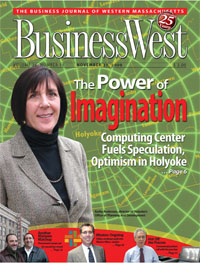
    Brown Bag Luncheon

    March 4: Nate Winstanley of Winstanley Associates will present “Branding Your Business: Be Brave or Be Gone” from noon to 1 p.m. as part of the Berkshire Chamber of Commerce’s Brown Bag Series. The lunchtime workshop is designed to help area business owners and managers with marketing strategies during tough economic times. The workshop is free to all Berkshire chamber members, and attendees are invited to bring a brown-bag lunch. The chamber office is located at 75 North St., Suite 360, in Pittsfield. To register, visit www.berkshirechamber.com, or call (413) 499-4000, ext. 26.

    Ann Hood Lecture

    March 5: Bestselling, New England-based author Ann Hood will present a free lecture at 7 p.m. in Empsall Hall at Bay Path College in Longmeadow as part of its Kaleidoscope series. Winner of the Best American Spiritual Writing Award, her last two novels (Comfort and The Knitting Circle) have received wide acclaim. For more information, call (413) 565-1066 or visit www.baypath.edu.

    Innovative Voices Conference

    March 10: The MassMutual Center in downtown Springfield will be the setting for a capacity-building conference, co-presented by the Women’s Fund of Western Mass. and Bay Path College. Titled “Innovative Voices: Crafting a New Agenda for Leadership,” the daylong conference will feature guest speakers Sara Laschever and comedienne René Hicks. Workshop topics offered throughout the day will include: “New Faces in Leadership I: Generations & Cultures,” “New Faces in Leadership II: Strategies for Change,” “Wikis, Twitter, and Blogs – Oh My!” “Learning to Ask: Negotiation Basics,” “The Art of Politics: Navigating the Political Waters,” and “Making Yourself Memorable: Personal Branding from the First Handshake.” Workshops will also include “Expanding our Capacity: Energizing Our Spirit,” “Balancing Mission and Money: How Nonprofits Can Do Both,” and “Finding Your Voice and Changing the World: Passion, Emotion, and Leadership.” Registration is $70 for the first organizational attendee and $60 for each additional organizational attendee. The deadline to register is March 2. For more information, visit www.womensfund.net.

    Brown Bag Luncheon

    March 11: “Recession-proof Stress Management” will be presented by Richard Fabozzi of Richard Fabozzi Presents from noon to 1 p.m. as part of the Berkshire Chamber of Commerce’s Brown Bag Series. The lunchtime workshop is designed to help area business owners and managers with stress-management strategies during tough economic times. The workshop is free to all Berkshire chamber members, and attendees are invited to bring a brown-bag lunch. The chamber office is located at 75 North St., Suite 360, in Pittsfield. To register for the workshop, visit www.berkshirechamber.com, or call (413) 499-4000, ext. 26.

    Casino Royale Fundraiser

    March 14: Anyone who enjoys gambling for a great cause is invited to check out Casino Royale, CityStage’s annual fund-raiser, at the Sheraton Hotel in Springfield. Highlights of the affair include hors d’oeuvres, a cash bar, live entertainment, prizes, a live auction, a 50/50 raffle, and a mystery raffle. Single tickets are $100, which includes $400 in gaming money. There are also special groups of 10 rates available, as well as VIP tickets for $150 each. Casino Royale begins at 7:30 p.m. For more information, call (413) 788-7646. Pit Boss sponsors are Berkshire Bank, Hampden Bank, MassMutual Financial Group, Mercy Medical Center, and United Bank.

    Get Beyond ‘Hello’

    March 18: Steven Valenti of Steven Valenti Clothing for Men will present “Get Beyond ‘Hello’ — Delivering Exceptional Customer Service” from noon to 1 p.m. as part of the Berkshire Chamber of Commerce’s Brown Bag Series. The lunchtime workshop is designed to help area business owners and managers with customer-service strategies during tough economic times. The workshop is free to all Berkshire chamber members, and attendees are invited to bring a brown-bag lunch. The chamber office is located at 75 North St., Suite 360, in Pittsfield. To register for the workshop, visit www.berkshirechamber.com, or call (413) 499-4000, ext. 26.

    Employer Outreach Breakfast

    March 27: The Regional Employment Board of Hampden County Inc. (REB) is gearing up to place young people in summer jobs, and encourages businesses to attend an employer-outreach breakfast to learn more about the program. The breakfast is planned from 7:30 to 9 a.m. at Big Y Foods Inc.’s corporate headquarters at 2145 Roosevelt Ave., Springfield. There are three ways that businesses can help the REB: hire a youth, donate money, or become a worksite. All aspects of the program will be reviewed by REB representatives. Anyone planning on attending the event should RSVP to Kathryn Kirby at [email protected] or call (413) 755-1359.
    Rock ‘n’ Roll & Management Styles

    April 15: “Everything I Learned About Management, I Learned From Rock ‘n’ Roll” will be presented by James M. Wilson III, Ph.D., assistant professor of Business at Bay Path College; and Gregory Jones, director of Cannes Associates Production Management. Wilson and Jones have been conducting research for three years on the production of live concerts featuring Metallica, Green Day, Red Hot Chili Peppers, Bob Dylan, and Willie Nelson, among others, with a focus on how event management contributes to organizational theory. The free lecture at 7 p.m. will take place in Breck Suite in Wright Hall at Bay Path College in Longmeadow. The event is part of the Kaleidoscope lecture series. For more information, call (413) 565-1066 or visit www.baypath.edu.

    Women’s Professional Development Conference

    April 30: Bay Path College in Longmeadow will host the 14th annual Women’s Professional Development Conference from 7:30 a.m. to 4:30 p.m. at the MassMutual Center in downtown Springfield. For more information, call (413) 565-1293 or visit www.baypath.edu.

    Departments

    Boston Wine Festival

    Thru April 3: Hosted by the Boston Harbor Hotel on Rowes Wharf, the Boston Wine Festival offers more than 50 wine and food pairing events. The schedule of events includes a variety of evening receptions, wine seminars, dinners and themed Sunday brunches. For details on the festival, visit www.bostonwinefesival.net.

    Managing Customer Satisfaction

    Feb. 24: The New England Performance Excellence Initiative will present “Managing Customer Satisfaction Performance” from 11:45 a.m. to 1:15 p.m. at the Scibelli Enterprise Center, 1 Federal St., Springfield. The lunchtime workshop will acquaint participants with Enterprise Performance Management, a unifying management approach that drives one’s business to the next level. In addition, the workshop will provide focus and context to all customer-satisfaction initiatives across one’s organization. The event is co-sponsored by the Springfield Business Incubator at Springfield Technical Community College. Participants will also be able to take the Performance Self Analysis Scorecard free of cost and find out the score in less than five minutes. A registration fee of $5 includes a bag lunch. To register, call (413) 737-6712.

    Women and Retirement

    Feb. 26: Shelly Colville, a registered representative of the National Planning Corp., will present a lecture titled “Women and Retirement: Are You Saving Wisely?” as part of the Kaleidoscope lecture series at Bay Path College in Longmeadow. Colville will lead women and men of all ages in an Oppenheimer Funds workshop to guide them to a better understanding of planning for the future. The free event is open to the public and will be conducted in Breck Suite in Wright Hall. For more information, call (413) 565-1066 or visit www.baypath.edu.

    Ann Hood Lecture

    March 5: Bestselling, New England-based author Ann Hood will present a free lecture at 7 p.m. in Empsall Hall at Bay Path College in Longmeadow as part of its Kaleidoscope series. Winner of the Best American Spiritual Writing Award, her last two novels (Comfort and The Knitting Circle) have received wide acclaim. For more information, call (413) 565-1066 or visit www.baypath.edu.

    Innovative Voices

    March 10: The MassMutual Center in downtown Springfield will be the setting for a capacity-building conference, co-presented by the Women’s Fund of Western Mass. and Bay Path College. Titled “Innovative Voices: Crafting a New Agenda for Leadership,” the daylong conference will feature guest speakers Sara Laschever and comedienne René Hicks. Workshop topics offered throughout the day will include: “New Faces in Leadership I: Generations & Cultures,” “New Faces in Leadership II: Strategies for Change,” “Wikis, Twitter, and Blogs – Oh My!,” “Learning to Ask: Negotiation Basics,” “The Art of Politics: Navigating the Political Waters,” and “Making Yourself Memorable: Personal Branding from the First Handshake.” Workshops will also include “Expanding Our Capacity: Energizing Our Spirit,” “Balancing Mission and Money: How Nonprofits Can Do Both,” and “Finding Your Voice and Changing the World: Passion, Emotion, and Leadership.” Registration is $70 for the first organizational attendee, and $60 for each additional organizational attendee. The deadline to register is March 2, with early bird registration closing on Feb. 13. For more information, visit www.womensfund.net.

    Casino Royale Fundraiser

    March 14: For persons who enjoy gambling for a great cause, consider CityStage’s annual fundraiser, Casino Royale, at the Sheraton Hotel in Springfield. Highlights of the affair include hors d’oeuvres, a cash bar, live entertainment, prizes, a live auction, a 50/50 raffle, and a mystery raffle. Single tickets are $100, which includes $400 in gaming money. There are also special rates for groups of 10 or more, as well as VIP tickets for $150 each. Casino Royale begins at 7:30 p.m. For more information, call (413) 788-7646. Pit Boss sponsors are Berkshire Bank, Hampden Bank, MassMutual Financial Group, Mercy Medical Center, and United Bank.

    Rock ‘n’ Roll & Management Styles

    April 15: “Everything I Learned About Management, I Learned From Rock ‘n’ Roll” will be presented by James M. Wilson, III, Ph.D., assistant professor of Business at Bay Path College; and Gregory Jones, director of Cannes Associates Production Management. Wilson and Jones have been conducting research for three years on the production of live rock ‘n’ roll concerts featuring Metallica, Green Day, Red Hot Chili Peppers, Bob Dylan and Willie Nelson, among others, with a focus on how event management contributes to organizational theory. The free lecture at 7 p.m. will take place in the Breck Suite in Wright Hall at Bay Path College in Longmeadow. The event is part of the Kaleidoscope lecture series. For more information, call (413) 565-1066 or visit www.baypath.edu.

    Women’s Professional Development

    April 30: Bay Path College in Longmeadow will host the 14th annual Women’s Professional Development Conference from 7:30 a.m. to 4:30 p.m. at the MassMutual Center in downtown Springfield. For more information, call (413) 565-1293 or visit www.baypath.edu.

    Departments

    Boston Wine Festival

    Through April 3: Hosted by the Boston Harbor Hotel on Rowes Wharf, the Boston Wine Festival offers more than 50 wine and food pairing events. The schedule of events includes a variety of evening receptions, wine seminars, dinners, and themed Sunday brunches. For details on the festival, visit www.bostonwinefesival.net.

    ACCGS Breakfast Club

    February 4: Stephen Sanzone, vice president, GRC Solutions, Crafty Systems Inc., will be the guest speaker for the 7:15 a.m. Affiliated Chambers of Commerce of Greater Springfield’s Breakfast Club at the Sheraton Springfield Hotel at One Monarch Place in Springfield. Sanzone’s lecture topic is “Identity Theft and Its Impact on Business.” James Morton, president and CEO of the YMCA of Greater Springfield, will serve as chief greeter. Businesses scheduled to be saluted include Fran Johnson’s Golf & Tennis for its new location, Health New England for achieving the highest rating in customer service, and Nuvo Bank as a new bank. HAP Inc., is the nonprofit salute, celebrating its 35th anniversary. Tickets are $20 for ACCGS members and $25 for nonmembers, and reservations must be made in writing and in advance. Reservations may be made through Diane Swanson, events manager, Affiliated Chambers of Commerce of Greater Springfield Inc., 1441 Main St., Suite 136, Springfield, MA 01103-1449, or via E-mail to [email protected] or at the ACCGS Web site, www.myonlinechamber.com.
    The Aging Brain

    Feb. 5: A lecture titled “The Aging Brain: The Agile Mind” will be presented by Posit Science of San Francisco, Calif., as part of the Kaleidoscope lecture series at Bay Path College in Longmeadow. The lecture, beginning at 7 p.m., includes a post-discussion demonstration of a ‘brain exercise’ to learn how to make the aging brain more agile. The free event is open to the public and will be conducted in Breck Suite in Wright Hall. For more information, call (413) 565-1066 or visit www.baypath.edu.

    Rick’s Place Benefit

    Feb. 7: “Heart to Heart,” the first fund-raising event to benefit Rick’s Place Inc., is planned from 5 to 7 p.m. at the Kids’ Village at 35 Post Office Park in Wilbraham. Rick’s Place Inc. provides support groups for children ages 5 to 18, including a suicide survivor group, support groups for parents, and community outreach. Established in memory of Rick Thorpe, who died in the World Trade Center in 2001, Rick’s Place Inc. was created to provide a supportive, secure environment where families can remember their loved ones and avoid the sense of isolation that loss can produce. The event is open to the public. Tickets are $40 per person and include appetizers, spirits, and chocolate. Door-prize tickets are $50 each. For more information about tickets, donations, or becoming a sponsor, contact Shelly Bathe Lenn at (413) 348-3120, or visit www.ricksplacema.org.

    Biological Illustration

    Feb. 9: Biological and medical illustration is back in vogue as electronic graphic information is critical to the health and science fields. Colleen Champ, BS, CLSp, a local scientific artist and owner of Concise Image Studios and MicroscopicClassics.com, will share her current portfolio and discuss her international award-winning art, at 7 p.m. in Breck Suite in Wright Hall at Bay Path College in Longmeadow. The free lecture is open to the public and is part of the college’s Kaleidoscope lecture series. For more information, call (413) 565-1066 or visit www.baypath.edu.

    Women and Retirement

    Feb. 26: Shelly Colville, a registered representative of the National Planning Corp., will present a lecture titled “Women and Retirement: Are You Saving Wisely?” as part of the Kaleidoscope lecture series at Bay Path College in Longmeadow. Colville will lead women and men of all ages in an Oppenheimer Funds workshop to guide them to a better understanding of planning for the future. The free event is open to the public and will be conducted in Breck Suite in Wright Hall. For more information, call (413) 565-1066 or visit www.baypath.edu.

    Innovative Voices Conference

    March 10: The MassMutual Center in downtown Springfield will be the setting for a capacity-building conference, co-presented by the Women’s Fund of Western Mass. and Bay Path College. Titled “Innovative Voices: Crafting a New Agenda for Leadership,” the daylong conference will feature guest speakers Sara Laschever and comedienne René Hicks. Workshop topics offered throughout the day will include: “New Faces in Leadership I: Generations & Cultures,” “New Faces in Leadership II: Strategies for Change,” “Wikis, Twitter and Blogs — Oh My!,” “Learning to Ask: Negotiation Basics,” “The Art of Politics: Navigating the Political Waters,” and “Making Yourself Memorable: Personal Branding from the First Handshake.” Workshops will also include “Expanding Our Capacity: Energizing Our Spirit,” “Balancing Mission and Money: How Nonprofits Can Do Both,” and “Finding Your Voice and Changing the World: Passion, Emotion and Leadership.” Registration is $70 for the first organizational attendee, and $60 for each additional organizational attendee. The deadline to register is March 2, with early-bird registration closing on Feb. 13. For more information, visit www.womensfund.net.

    Rock ‘n’ Roll & Management Styles

    April 15: “Everything I Learned About Management, I Learned From Rock ‘n’ Roll” will be presented by James M. Wilson III, Ph.D., assistant professor of Business at Bay Path College; and Gregory Jones, director of Cannes Associates Production Management. Wilson and Jones have been conducting research for three years on the production of live concerts featuring Metallica, Green Day, Red Hot Chili Peppers, Bob Dylan, and Willie Nelson, among others, with a focus on how event management contributes to organizational theory. The free lecture at 7 p.m. will take place in Breck Suite in Wright Hall at Bay Path College in Longmeadow. The event is part of the Kaleidoscope lecture series. For more information, call (413) 565-1066 or visit www.baypath.edu.

    Women’s Professional Development Conference

    April 30: Bay Path College in Longmeadow will host the 14th annual Women’s Professional Development Conference from 7:30 a.m. to 4:30 p.m. at the MassMutual Center in downtown Springfield. For more information, call (413) 565-1293 or visit www.baypath.edu.

    Uncategorized

    With his Cabinet in place, President-elect Obama will turn his attention to the agencies and the countless appointments that will complete his new government. Although some appointments will be virtually unnoticed, they are no less instrumental in fulfilling his agenda of change. For example, who will replace Dana Gioia as chairman of the National Endowment for the Arts? And what is the NEA again?

    That Gioia’s agency is little known is partially a reflection of the agency’s modest allocation. The Endowment’s annual budget is less than the Pentagon’s cost for a single fighter plane. And for every per-capita dollar the NEA spends, France’s Ministry of Culture spends more than $13,000.

    Gioia was once asked why the U.S. government doesn’t support the arts the way Europe does. “The U.S. provides more funding for the arts than any other country in the world,” Giolia replied. “It’s called the tax deduction.”

    A tax deduction is not an arts policy.

    Under the federal tax code, deductions are allowed for contributions made to charitable organizations. Individual and corporate support for the arts, incentivized by these tax deductions, will likely slow in a chilling economy. Arts organizations will compete for shrinking funds, insufficient to sustain them all. An opera company might skate by, relying on its endowment and longstanding donors, while a small Latino theater troupe or an inner-city music school would be forced into extinction.

    But funding isn’t the only problem. For 20 years the NEA has been in hibernation.

    In the late 1980s and early 1990s, a handful of artists were accused of subverting American culture, and social conservatives and fiscal watchdogs joined forces in an offensive against the arts. Their battle cry: art was responsible for the decay of American values, and why should American tax dollars pay for it? The agency survived but retreated, leaving American artists to fend for themselves.

    The Endowment has stirred again during Gioia’s tenure, having secured its first significant funding increase since 1984. “American Masterpiece” was awarded $18 million to bring American classics to the far-reaching corners of 50 states as well as military bases. “Shakespeare in American Communities” was another Gioia initiative, and this year he launched “The Big Read,” a $2.8 million nation-wide Oprah-style reading club.

    But a reading club is not an arts policy, and Gioia’s programs stop short in bringing the NEA back to life. These programs do not reflect the arts as a vital and dynamic expression of American culture. They do not reflect the diverse face of America. These programs do not fuel the economic engine of American communities large and small. In this financial climate, that’s an issue that deserves attention.

    President Franklin Delano Roosevelt recognized the combined power of American productivity and creativity. Between 1935 and 1943, his Works Progress Administration put 8 million Americans to work. Under the same umbrella, construction workers and engineers built the nation’s physical infrastructure, while writers, painters, and performers constructed the nation’s cultural foundations. Buildings and bridges, murals and sculptures sprung up in public places around the nation.

    John F. Kennedy’s commitment to the arts paved the way for the formation of the NEA. Kennedy’s vision of an America in which ingenuity was championed above all else was not reserved to space travel alone. The arts were included too. “If art is to nourish the roots of our culture,” he said, “society must set the artist free to follow his vision wherever it takes him.”

    Obama’s campaign planted the seeds of change. As he builds his administration, he should follow in the footsteps of Roosevelt and Kennedy, considering the unique and historic role that the arts have always played in cultivating change. He should select a new chairperson who will lead the NEA with a commitment to the ways in which the arts can nourish the nation’s economy and its imagination.-

    Thor Steingraber is an opera director and Harvard University’s Hauser Center fellow for arts, culture, and media.

    Opinion
    Fostering the Development of a ‘Smart Grid’

    New England states have laid out an ambitious agenda to slow the growth in electricity use, reduce greenhouse gas emissions, develop renewable resources, maintain power-system reliability, and lower costs. The sometimes-conflicting nature of these goals makes it difficult to align them.

    Indeed, this is a critical juncture for New England. For decades, the region has faced formidable energy challenges, from a lack of indigenous fuel sources to historically high costs, a weak transmission system, and growing consumer demand. The introduction of competitive electricity markets a decade ago has provided a solid foundation for progress: almost $10 billion in private investment in new power plants has boosted supply by more than 30%, and $3 billion of long-overdue transmission investment with about $5 billion more being planned will result in a more-efficient flow of power throughout the region.

    The next steps can be achieved by developing solutions that accommodate and harness recent technological innovations to improve the efficiency of the power grid — in other words, to foster the development of a ‘smart grid.’

    This ‘smart grid’ means far more than the use of technology. It means establishing ‘smart’ policies that will bring new technology to all corners of the power system to optimize supply, transmission, and conservation. It also means being smart about resource choices in the long term, so that the region can diversify its fuel sources and lessen its reliance on natural gas and oil to produce electricity.

    On the regional level, smart-grid technology has been incorporated into New England’s power system operations so that grid conditions both inside and outside the region can be monitored. Moreover, ISO New England is committing funds for the development of an ‘Advanced Grid Simulator’ that will help determine how the grid will operate with the addition of intermittent alternative energy resources such as wind.

    New electricity markets were recently implemented to expand the types of resources used to meet consumer demand. New England’s markets now procure in advance not just traditional supply such as power plants, but also conservation resources that reduce electricity use and have never been included in the marketplace before.

    This fall, the ISO began a pilot program designed to test alternative energy resources, including energy storage, as a way to instantaneously balance electricity supply and demand. At the state level, policies are being implemented that will maximize the potential of these innovations and encourage their continued development. The state recently enacted the Green Communities Act that promotes the development of renewable resources and energy-efficiency programs.

    Meanwhile, the state of Connecticut passed energy legislation that promotes conservation and reduced demand to limit the growth in electricity use. Connecticut has become a leader in demand response, which provides financial incentives for customers to lower their electricity use during tight supply periods. And energy efficiency programs are giving consumers tools to better manage their energy use.

    Some New England states are either considering the adoption of smart meters or have already introduced pilot programs. Such technologies would provide consumers with real-time price information to enable them to better manage their use and lower their bills.

    The goals that have been set for renewable resources, conservation, and reductions in greenhouse gas emissions are ambitious, but feasible if industry and government continue to build on progress. Technology transformed the region’s economy in the 1980s and ’90s, and fostered improvements in productivity and efficiency in industries around the world. New England can be at the center of another technological revolution in power delivery and use — automating the system to make it more efficient and bringing the economic, environmental, and energy needs of the region into closer alignment.-

    Gordon van Welie is president and CEO of Holyoke-based ISO New England Inc.

    Uncategorized

    David Panagore is now the former chief development officer for Springfield.

    After nearly three years in that post, he has left to take roughly the same job, if not the same title, in Hartford, leaving the City of Homes with a critically important executive search to conduct.

    Before getting to that, we’ll say that, while Panagore’s job performance is not the focus of this discussion, it should be noted that we believe he did a very capable job of giving Springfield something it hasn’t had in a long time — a real agenda when it comes to progress and economic development.

    While the Urban Land Institute report gave the city a blueprint of sorts for moving forward — identifying several development priorities, including Court Square, the South End neighborhood, the now-vacant federal building, and others — it was Panagore, who arrived at about the same time as the Finance Control Board, who got everyone on the same page and, for the most part, kept them there.

    He moved at sometimes-dizzying speeds and had a no-nonsense style that didn’t agree with everyone, but he succeeded in creating some forward momentum for Springfield — with regard to everything from its image to its marketing — and under some often-trying conditions.

    But as we said, this isn’t about the person who had the job; it’s about who’s going to have it next.

    That’s because, as Panagore said in what amounts to an exit interview with BusinessWest, Springfield is at a crossroads of sorts with regard to economic development. After years of talking about projects like the York Street Jail, Union Station, Court Square, the South End, Chapman Valve, and the downtown as a whole, there seems to be real progress toward action with all or most of them.

    What the city needs now is a successor who won’t simply bring these projects home, but also continue the fight to woo the development community to a city that is primed and ready, but needs the economy to cooperate and people to step forward and make some investments here.

    And that’s why this can’t be a political appointment — which it has been at times in the past — or one of those proverbial ‘national’ searches that always seem to end with the local good ol’ boy who needs a job or a better job. And there have been a few of those, too.

    Outside of the school superintendent’s position, this development post is perhaps the most important job in the city right now — or at any time, for that matter — and Mayor Sarno has to approach it with that mindset and, practically speaking, an appropriate salary range.

    In other words, cities get what they pay for in these situations, and in this case, the city can’t be penny-wise and pound-foolish. An attractive package will be needed to bring someone who is equal parts visionary, facilitator, effective administrator, and leader.

    There may be someone in this city or this region who fits that job description and is ready, willing, and able to take on the challenge. We would suggest, however, that the city look hard (but not exclusively) at someone who might need an on-board navigation system to find Springfield City Hall. Such a person would have a learning curve, but wouldn’t be beholden to anyone or any group, and probably wouldn’t be swayed by past history and the negativism it often creates.

    As Panagore told BusinessWest, the projects on or near the drawing board in Springfield, aren’t simple, and each one has a long way to go. But with regard to these initiatives and economic development in general in the City of Homes, there is far more talk about what the city can do than what it can’t, more discussion about what could happen here than about what will probably never happen — which is refreshing.

    The city needs a development leader who can take all this and go somewhere with it. And that’s why this is a critical talent search.-