Home Posts tagged Agenda (Page 10)
Opinion
Fostering the Development of a ‘Smart Grid’

New England states have laid out an ambitious agenda to slow the growth in electricity use, reduce greenhouse gas emissions, develop renewable resources, maintain power-system reliability, and lower costs. The sometimes-conflicting nature of these goals makes it difficult to align them.

Indeed, this is a critical juncture for New England. For decades, the region has faced formidable energy challenges, from a lack of indigenous fuel sources to historically high costs, a weak transmission system, and growing consumer demand. The introduction of competitive electricity markets a decade ago has provided a solid foundation for progress: almost $10 billion in private investment in new power plants has boosted supply by more than 30%, and $3 billion of long-overdue transmission investment with about $5 billion more being planned will result in a more-efficient flow of power throughout the region.

The next steps can be achieved by developing solutions that accommodate and harness recent technological innovations to improve the efficiency of the power grid — in other words, to foster the development of a ‘smart grid.’

This ‘smart grid’ means far more than the use of technology. It means establishing ‘smart’ policies that will bring new technology to all corners of the power system to optimize supply, transmission, and conservation. It also means being smart about resource choices in the long term, so that the region can diversify its fuel sources and lessen its reliance on natural gas and oil to produce electricity.

On the regional level, smart-grid technology has been incorporated into New England’s power system operations so that grid conditions both inside and outside the region can be monitored. Moreover, ISO New England is committing funds for the development of an ‘Advanced Grid Simulator’ that will help determine how the grid will operate with the addition of intermittent alternative energy resources such as wind.

New electricity markets were recently implemented to expand the types of resources used to meet consumer demand. New England’s markets now procure in advance not just traditional supply such as power plants, but also conservation resources that reduce electricity use and have never been included in the marketplace before.

This fall, the ISO began a pilot program designed to test alternative energy resources, including energy storage, as a way to instantaneously balance electricity supply and demand. At the state level, policies are being implemented that will maximize the potential of these innovations and encourage their continued development. The state recently enacted the Green Communities Act that promotes the development of renewable resources and energy-efficiency programs.

Meanwhile, the state of Connecticut passed energy legislation that promotes conservation and reduced demand to limit the growth in electricity use. Connecticut has become a leader in demand response, which provides financial incentives for customers to lower their electricity use during tight supply periods. And energy efficiency programs are giving consumers tools to better manage their energy use.

Some New England states are either considering the adoption of smart meters or have already introduced pilot programs. Such technologies would provide consumers with real-time price information to enable them to better manage their use and lower their bills.

The goals that have been set for renewable resources, conservation, and reductions in greenhouse gas emissions are ambitious, but feasible if industry and government continue to build on progress. Technology transformed the region’s economy in the 1980s and ’90s, and fostered improvements in productivity and efficiency in industries around the world. New England can be at the center of another technological revolution in power delivery and use — automating the system to make it more efficient and bringing the economic, environmental, and energy needs of the region into closer alignment.-

Gordon van Welie is president and CEO of Holyoke-based ISO New England Inc.

Sections Supplements
Women’s Leadership Network Gains Momentum, Welcomes New Members

Carla Oleska and Susan Jaye-Kaplan say the idea for a new women’s network in Western Mass. was born over dinner in New York City. Dining with a number of professional women from across the country, the two friends kept hearing a consistent theme within various conversations.

“Many people were talking and sharing ideas and stories,” said Kaplan, “but we kept hearing the same thing; women, especially young women, were saying, ‘we need something … some sort of network that can help us make things happen.’”

From there, it took little more than a shared glance between Kaplan and Oleska to make that hope a reality.

A year ago, they launched the Women’s Leadership Network (WLN), and in that time membership has risen to more than 100 women from across the region, representing a wide array of ages, careers, and influences.

Kaplan and Oleska are quick to point out that, while they started the venture, they’re already looking forward to passing the torch and watching the network grow and change on its own. Already, a group of women have signed on to serve as the WLN’s core, representing several different types of industries. This group includes Karen Woltjen Hines, owner of Woltjen Hines Marketing; Valerie Bonatakis, Maguire Center manager for Elms College; Brenda Olesuk, firm administrator with Meyers Brothers Kalicka; Lindsay Porter of Big Y Foods; Kathy Cardinale, owner of Cardinale Design; and Lynn Ostrowski, director of Health Programs and Com-munity Relations at Health New England.

“We said we’d get it started so the idea wouldn’t get lost,” said Kaplan. “We work quickly, and we have the connections to make things happen. But we want this to be owned by the next generation — these are the women who will give it shape and take the network where they feel it will have the greatest impact.”

Indeed, the two are not strangers to women’s causes and organizations. Kaplan is the founder of GoFit, a nonprofit that works with women and children to improve their health, fitness, and awareness of the importance of both; and of the Pioneer Valley Women’s Running Club. Oleska is the executive director of the Women’s Fund of Western Mass. (WFWM), an advocacy and grant-making entity based in Easthampton, and one of hundreds of similar women’s funds across the country.

The pair’s latest venture is one focused on networking, mentoring, education, philanthropy, and the overall advancement of women and women’s causes through these means.

“We’re not trying to duplicate any organization that already exists in the area, but complement them,” said Kaplan. “This is a network of all types of women, and a way for them to find each other.”

Giving Back

That said, the network has joined forces with the WFWM in a philanthropic sense. Just two months ago, the Giving Circle was created, welcoming members to join (though they’re not required to) through a $100 buy-in. When the network reaches $5,000 in contributions, the WFWM will make a one-time match of that amount, and work in concert with network members to identify a beneficiary.

Giving circles are seen across the country, and often work in tandem with women’s funds (there’s a Berkshire-based group that also collaborates with the WFWM), and Oleska added that, together, they provide a strong sense of value to one’s philanthropic efforts.

“The Women’s Fund will administer and distribute these funds, but the giving circle will let us know which area of giving is most interesting to them,” she said. “We’ll help them secure information and access to education and answer their questions, and when they’re ready to administer the funds, they can choose to fund a specific grant or fill a gap. There are a lot of ways to do both.”

Because giving circles make the final decisions as to where grants and gifts go, funding is available for a wide array of projects. Kaplan added that she hopes this broad availability of funds, as well as networking and mentoring opportunities, will continue to spread as the Women’s Leadership Network evolves.

“We have the ability to reach more groups in the community,” she said. “We want to support the Women’s Fund as well as others — we want to sit at a table with all types of women in Western Mass.”

Kaplan was quick to note that she and Oleska are also working toward achieving greater diversity within the network, by welcoming not just professional organizations to that table, but cultural groups as well.

“We should all be working together and bridging gaps,” she said. “When a job opening arises, it’s open to everybody, not just specific circles.”

To that end, part of the network’s mission is to raise the profile of its members within the business community through a number of educational and mentorship opportunities. The group now meets quarterly, combining a social aspect with guest speakers or panel discussions on specific topics. A recent talk, for instance, was led by Dr. Maria Sirois, a pediatric psychologist who has worked extensively with children and families facing terminal illnesses. Sirois is also the author of Every Day Counts: Lessons in Love, Faith, and Resilience from Children Facing Illness.

The meetings are held in various locales across the region, and Kaplan said this nomadic aspect of the network is intentional, to foster a feeling of ownership across the four counties of Western Mass. and to recruit new members.

“We want to create a sense of community,” she said. “The group is so new and young that it’s exciting to see it introduced to larger circles. I see the need for women to unite in Western Mass., and the bottom line is that I want my friends to see that need, too.”

Oleska concurred.

“Making an organization work to its fullest potential really is all about the connections,” she said. “It’s about making connections and sustaining them, and the result is stronger and better communities — and not just communities of women. When a change is made among groups of women, the effects reach their families, friends, co-workers, and employers.”

Strong Beginnings

So far, women across the region seem to be embracing the network with real enthusiasm. Kaplan said that when the group’s first meeting was scheduled, 50 women received an E-mail with a time, place, and a caution that there was no agenda. Despite that nebulous schedule, though, all but three of those invited came — and created their own agenda through conversations about education, charitable giving, career advancement, and, as Kaplan puts it, “the issues of our day.”

“The informal structure allows us to look at how many different things affect women and families,” she said, “and it helps us create a crossover between the networking piece, the mentoring piece, and the funding entity. Women generally don’t want to just write a check — they want to get involved, and have learning experiences as they give back.”

As the WLN continues to evolve, Kaplan and Oleska said the conversation will continue, as the organization gradually takes on an identity of its own.

“This is what the women in this area want,” said Kaplan. “And once a group of women are off and running, I truly believe that there’s no stopping them.”

Features
Domenic Sarno Wants to Change the Perception of a Beleaguered City
Domenic Sarno

Domenic Sarno’s goals for economic development in Springfield include the fostering of what he called a “new Armory.”

Domenic Sarno is certainly no stranger to the mayor’s office in Springfield.

Nearly two decades ago he served as an assistant to Mary Hurley when she occupied the corner office, and handled a wide variety of administrative and public relations-oriented duties. “I sat right out there,” he said, motioning with his hand to the outer office complex, as he sat where Hurley once did — the reward for pulling off what most (but not Sarno) would consider an upset in last fall’s contest against incumbent Charles Ryan.

His former and current desks are only about 30 feet and a wall apart, but there is of course a world of difference in terms of responsibility. “The buck stops with me, and I mean that,” said Sarno, who used that well-worn phrase despite the presence of the Finance Control Board, which, for all intents and purposes, is still running the city. And he used it for a reason.

Indeed, Sarno told BusinessWest that he views his triumph over Ryan, who was elected to two terms and served all but his first six months in the large shadow of the Control Board, as a mandate of sorts, or a call to action, despite the presence of the board, which will be in place for at least another year.

“While I was out talking to people last year, I sensed that people appreciated what Mayor Ryan did … many thought he was the right person at the right time,” said Sarno, referring to the early days of the Control Board. “But I also sensed that people were looking at the next horizon for Springfield, and looking for the attitude, the vision, and the drive to make things happen.”

Sarno will take what he called a “Springfield first” attitude with him as he goes to work on a laundry list of issues and problems, from public safety, which he has identified as priority one because of its influence on so many constituencies, including the business community, to economic stability — gaining an extension on the loan given to the city by the state is a top priority there — to the broad subject of economic development and his goal to create “a new Armory.”

By that he meant not only a new and large source of high-paying jobs — the Springfield Armory, which closed four decades ago, traditionally employed thousands, and about 14,000 at peak production during World War II — but also something that will provide the city with an identity, again, as the Armory did with the Springfield Rifle and a precision machining base that emerged from that complex.

Sarno says this new identity and job source may well come in the form of a blend of ‘green’ businesses, meaning those involved with renewable energy and other environmentally friendly pursuits, and the broad category known as ‘the arts.’

“When you look across the nation, the first sign of revitalization, or renaissance, in a downtrodden area has an artistic flair to it,” he said, noting that there is much involved with accomplishing this melding of ‘green’ and the arts, everything from funding to get startups off the ground, to an infrastructure and workforce that will enable them to grow. But he believes Springfield has the potential to put the pieces in place.

Meanwhile, as for the Control Board, Sarno, who served on that body as president of the City Council, says the transition back to self-governance in Springfield is already underway, starting with work on the fiscal 2008 budget, and his administration is focused on making that transition go as smoothly, but also as quickly, as possible.

“I want to get this city back to self-governance,” he said. “But in the meantime, I have an agenda I want to drive.”

In a wide-ranging interview, Sarno talked about why he wants to be mayor of Springfield, and why now. He called this a critical juncture for the city, a time when it can — if people work together toward common goals — regain fiscal autonomy, a sense of civic pride, and perhaps a new economic identity.

No Pane, No Gain

Sarno calls it the “broken-window strategy,” a philosophy of municipal management that he loosely attributes to former New York Mayor Rudy Gulianni.

“When you see a broken window, that’s usually the first sign of trouble,” he said, referring to an abandoned building and the further deterioration that can and usually does follow. “So when you see that broken window, you do something, you get on top of it; if you don’t, things are only going to get worse.”

There are many of those figurative broken windows in Springfield, he said, listing everything from public safety to education; poverty to jobless rates; troubled neighborhoods to the Springfield Falcons, the AHL franchise that needs some support, in the form of season ticket sales, if it’s going to remain in the City of Homes.

He plans to address them with the outlook of an optimist — at least as defined by Winston Churchill — who said such individuals see opportunity in every difficulty.

Sarno borrowed that line for his inauguration speech two months ago, at which time he said he is “energized by the numerous opportunities before us.”

At the top of that list, he said, is the chance to radically change the perception of Springfield — the one held by both its citizens and people across the Commonwealth and beyond — of a city long past its prime and in a hole from which it can’t recover.

“People say things like, ‘what do you expect? It’s Springfield,’” said Sarno. “I want to hear, ‘why not Springfield?’”

The new mayor acknowledges that changing current perception — or, more to the point, doing all that will be necessary to affect such a change — constitutes a very tall order.

He’ll approach it through his broken-window theory of the universe, an intense focus on quality-of-life issues, and, in general, work toward bringing back the far better times he remembers — “that was back when politicians were revered because they helped people and helped families” — while hanging around his father’s barber shop on Dickinson Street, which is still there, with the elder Sarno still cutting hair and dispensing advice.

Sarno told BusinessWest that his working-class upbringing — his mother opened and still operates a seamstress shop — helps him relate to the challenges facing many in the city, and also understand the importance of small businesses to families and neighborhoods. “They’re the backbone of any community.”

He also draws on his previous work experiences, most of which fall under the category of public service. In addition to his work for the Hurley administration, Sarno also worked in the office of Hampden County District Attorney William Bennett, and later as executive director of the South End Community Center.

While Sarno intends to wage his fight to revitalize Springfield on several fronts, he’ll put heavy emphasis on public safety, education, and economic development, which are all intertwined. And on the subject of crime, he plans what he called a “frontal assault.”

Flexing His Imagination

Such an initiative is needed, he said, because reducing crime and fear are prerequisites to successfully achieving other goals — everything from attracting new businesses to creating a stronger residential component in the city’s downtown.

“Let’s face it … perception plus attitude equals reality,” he told BusinessWest. “We can spend thousands, or even millions, of dollars marketing Springfield, but if you don’t have that grassroots feeling among residents that this city is clean, safe, and worth investing in, then we’re not going to get anywhere.”

The frontal assault on crime and public safety will take a number of forms, he continued, from the difficult work on the root causes of crime, including poverty and high dropout rates at city high schools, to a new focus by the Sarno administration of so-called quality-of-life issues.

This is a broad category that includes everything from barking dogs to zoning code violations; speeding cars on residential streets to derelect property, and it will fall under the auspices of something Sarno is calling the Quality of Life Flex Squad. It will involve both the mayor’s office, where aide Tom Walsh will head up activities, and the Police Department, which will respond when and if needed, said the mayor, adding that the word ‘flex’ is used to indicate that this unit will be working at all hours of the day. “Crime doesn’t happen only between 8 a.m. and 4 p.m.”

As for education, Sarno said the city’s first priority is a superintendent search that he hopes and expects will produce an individual who can “revolutionize the system.”

Both public safety and education have obvious connections to economic development, said Sarno, who noted that the city needs a safe environment and an attractive workforce to attract new businesses and retain current ones. But it also needs a spark or two to trigger job growth and a needed dose of vitality.

Which brings him back to ‘green’ development and the arts.

He told BusinessWest that there is certainly need worldwide for renewable energy sources, and the potential exists for Springfield and the Pioneer Valley to be a center for such ventures.

“The stars are aligned for growth of such businesses,” he said, referring to both need and a commitment from Gov. Deval Patrick and the Legislature to prime the pump. “Why can’t Springfield be a hub for ‘green’ companies?”

As for the arts, they could represent a way to breathe some life into the downtown area, he said, noting that artists can spark both residential and commercial growth. And, overall, they could contribute to an enhanced quality of life that might draw empty-nesters and Baby Boomers looking to downsize into Springfield’s downtown and properties like the complex of buildings in Court Square.

A request for qualifications was recently issued for the site, dominated by the long-vacant, six-story building at 13-31 Elm St., and several came in, including proposals to convert the property into market-rate housing or a boutique hotel.

The Elm Street complex is part of what Sarno called the “spine” of the city, referring to the stretch from the riverfront up State Street. There are signs of progress at several points, including the new federal courthouse, which, said the mayor, has potential to inspire other improvements and developments, and several possible sparks, including an expansion of basketball-themed development seen on the riverfront.

Referencing Cooperstown, N.Y., the Baseball Hall of Fame there, and the adjacent baseball diamonds that have been called the ‘Field of Dreams,’ Sarno said he envisions something similar in the City of Homes, with families and teams traveling here to play on courts and in tournaments near the Hall.

“We could have the Court of Dreams here,” he told BusinessWest. “That’s the kind of thing the city needs to bring people here and inject some pride in our community.”

First Things First

As he talked about his plans moving forward, Sarno mentioned some of things he doesn’t need.

‘Yes people’ are on that list — “I want constructive criticism, I want to hear the pros and cons; yes people just move on the next person,” he explained — as are studies, specifically those related to economic development. “We’ve had enough of those — now we need to get going.”

What he does need is a little optimism — well, more than a little — and a broad ‘Springfield-first’ focus that might help him make some inroads toward progress.

The buck might stop at his desk, he said, but the work to restore pride and stability to Springfield starts with everyone moving in the same direction.

George O’Brien can be reached at[email protected]

Sections Supplements
Teen Mini Medical School Introduces High-schoolers to Medical Careers
Ben Rodriguez

Ben Rodriguez says the Teen Mini Medical School is part of a grow-your-own-workforce strategy at Baystate Health.

Henry Figueredo is the executive director of the Parent Information Center for Springfield Public Schools, and a former elementary school principal in the city.

From his beginnings as a physical education teacher, he has spent a successful 32 years in the Springfield system. Yet he wonders whether his career path would have been different if he had attended something like the Teen Mini Medical School at Baystate Medical Center.

“If these roots had been sown, if I’d had the opportunity to see the medical field, maybe that’s something I would have taken advantage of,” said Figueredo, who now sits on the board of the Baystate program, which introduces area high-school students to the workings of health care in a hospital setting.

The five-day program is offered twice per year, in the fall and spring, and most of the 30 students chosen are from Springfield. Baystate works with the city’s school system, and those of surrounding communities, to choose each semester’s class, based on students’ expressed interest in a health care career.

“This is for students who might be interested in a career in a health care field, but aren’t sure, or who might not be that familiar with Baystate,” said Ben Rodriguez, coordinator of the Baystate Springfield Educational Partnership (BSEP), noting that this year’s class is comprised largely of local students who were wait-listed last fall, reflecting the limited capacity of the program.

It’s also intended to have a positive impact on Baystate years down the line.

“This is part of a grow-your-own strategy,” Rodriguez said. “Baystate is working to expand a number of areas of the hospital, and this is one piece of the overall efforts that have been developed to address the issue of positions going unfilled. We know that this is a problem across the country.

“We have a strong pool of students from this area, and we need to help introduce them to these careers and foster them through the process,” he explained, noting that the Teen Mini Medical School is one small part of BSEP, a series of programs aimed at elementary, middle-school, and high-school students.

“That’s a lot of what BSEP does. We know that many of these students have gone on to other steps in BSEP, which is why we call it a pipeline model. In fact, a lot of kids come into our program through the Mini Medical School.”

For the Younger Set

Baystate has long offered a Mini Medical School for adults, a series of classes attended mainly by people with no medical career aspirations, but simply a desire to learn more about health care practices.

The teen version is modeled after the adult classes in some ways, but is geared toward the experience and maturity of high-school sophomores, said Rodriguez.

On the first night, the students are split up into small groups and taken on tours of different areas of Baystate, including the Wesson Women and Infants Unit, the Chestnut Surgery Center, and the Pathology Laboratory.

“I love to see the kids see an actual brain or lung that has a cancer spot on it, things like that,” Figueredo said of the lab tour. “I never get bored touring with the kids.”

In the days that follow, the students participate in a series of lectures and panel discussions on various areas of care, moderated by Baystate physicians. Last fall’s session featured programs on cardiology, neurology, pediatric diabetes, hospitalist care, and infectious diseases, among others. The agenda for the spring semester, scheduled for April, was still being formulated at press time.

“We assume that some of these students will be interested in the health field and want to pursue one of the avenues we can provide,” which include job shadowing, mentoring, and internships, said Rodriguez.

“This also provides one-on-one opportunities where they can speak directly to a neurosurgeon or a cardiologist. They can spend time in a hospital without coming for a broken leg or illness. It’s a more comfortable setting to learn about what goes on.”

At the final session, the students’ families may attend to see them receive certificates of completion and participate in a panel discussion with human resources officials, talking about job opportunities, workforce needs, and what they look for in prospective employees.

“Sometimes the parents end up asking more questions than the teens,” said Rodriguez. “It’s great to see that kind of support.”

Jean Jackson, vice president of workforce planning for Baystate Health, said the experience can be an eye-opener for teenagers, even those who already have health care in mind as a potential career.

“People think of doctors and nurses when they think of hospitals,” said Jackson. “Kids aren’t always familiar with other aspects of health care unless they have family that work in medical settings.”

That’s why it’s good, she said, that the teens in the program get some information about what classes they should be taking well before their college years. “In many of these jobs, math and science are critical skills.”

The Bottom Line

And that’s the idea, said Rodriguez — not only to show teenagers what’s available to them, but help them understand what they need to do now to prepare for such a career.

“This is our future workforce,” Jackson said of area high-schoolers. “How can we help them be successful in finding opportunities in health care?”

Clearly, the Teen Mini Medical School is a good start.

Joseph Bednar can be reached at

[email protected]

Departments

Business Confidence Index Drops Off Sharply

BOSTON — The Business Confidence Index measured by the Associated Industries of Mass. (AIM) dropped 2.9 points in January to 50.6, its lowest reading since October 2003, as a sharp slowdown in economic activity brought the state to the edge of recession. “The Commerce Department’s figures for national growth and the reported loss of jobs nationally in January, as well as MassBenchmarks’ indices for the state economy, all point to the end of expansion,” said Raymond G. Torto, Ph.D., global chief economist at CB Richard Ellis Group Inc. and chair of AIM’s Board of Economic Advisors. “The AIM Index shows that while Massachusetts employers may not be resigned to a contraction, they certainly believe that the situation is precarious.” While the overall confidence level was still barely positive, above 50 on the 100-point scale, Massachusetts employers rated current business conditions negatively, and conditions in the state slightly worse than those prevailing nationally. “The Index had weakened in the second half of last year, but within a seven-point band [60.2-53.2] where it had been through 2005, 2006, and 2007,” Torto added. “January’s decline, the fifth in six months, dropped it more than two points below that range, and more than six points below its 17-year average.” Commenting on the January Business Confidence Index, Richard C. Lord, AIM’s president and CEO, said, “I’m not ready to call this a recession — and neither are our members — but the danger is there, and a drastic slowdown is certainly at hand. Business conditions in Massachusetts have been rated negatively for four of the past five months, and employers report essentially no job growth, and weakening sales.” The monthly Business Confidence Index, initiated by AIM’s Board of Economic Advisors in July 1991, is based on a survey of AIM member companies across Massachusetts, asking questions about current and prospective business conditions in the state and nation, as well as for respondents’ own operations. On the index’s 100-point scale, a reading above 50 indicates that the state’s employer community is predominantly optimistic, while a reading below 50 points to a negative assessment of business conditions. A number of component sub-indices are derived by analyzing responses to selected questions or those of particular groups of respondents.

ACCGS Unveils 2008 Legislative Agenda

SPRINGFIELD — The Affiliated Chambers of Commerce of Greater Springfield (ACCGS) Inc. recently unveiled its legislative agenda for 2008 as part of its annual Outlook program. The issues are all in keeping with the board of directors’ continuing efforts to ensure that the cost of doing business in Massachusetts is reasonable and to ensure that chamber member businesses are economically competitive in today’s marketplace. Legislative Steering Committee members note that with an ’09 state budget based on a growth rate of 3.8%, a need for key new investments is in order to grow the economy. Areas that should be looked at include infrastructure, local aid, higher education/job training, and health care. Members feel strongly that investments in these areas would encourage economic growth and enable employers to compete in today’s market. Additionally, members feel that unemployment insurance reforms still need to be made, as well as the passage of the Truth in Hiring legislation. On health care, the ACCGS supported Massachusetts’ new health care reform legislation and will continue to be at the forefront of influencing its implementation. The chamber also continues to support affordable health care products and plans that will shift the cost of cross-subsidization of the uninsured away from employers and employees. Also, the chamber will continue to oppose the Nurse-to-Patient Ratio Bill. Members feel the bill proposes rigid and unrealistic levels of hospital nurse staffing in order to appease only one segment of hospital care providers. On Springfield’s financial situation, the ACCGS will continue to monitor issues specific to the city, from the Control Board’s makeup to specific economic-development projects. The Legislative Steering Committee is comprised of 31 business professionals who are members of the ACCGS. The committee has four subcommittees that perform in-depth research on specific issues. The committees are Budget, Workplace Issues, Health Care, and Outreach.

Samuel’s Sports Bar & Tavern Slates Second Outlet at Hoop Hall

SPRINGFIELD — Samuel’s Sports Bar & Tavern will open a second Samuel’s this summer at the Naismith Memorial Basketball Hall of Fame. Citing record growth at the 1019 Main St. location over the past four years, owner and president Edward J. Grimaldi felt the opportunity and timing was right to expand Samuel’s Tavern into the redeveloping riverfront area. Grimaldi expects to use the 6,000-square-foot space that was formerly occupied by a McDonald’s.

Patrick Administration Releases Defense Sector Report

BOSTON — The Executive Office of Housing and Economic Development (EOHED) and MassDevelopment recently released an economic impact study of federal defense spending in Massachusetts. Conducted for MassDevelopment by the University of Massachusetts Donahue Institute, the report pegs the state’s defense economy at $14.7 billion. According to the report, 2,435 Massachusetts companies received federal contracts for defense-related goods and services in FY 2005. The contracts supported 32,240 direct jobs, while defense-related activity generated an additional 39,187 jobs statewide. The dollar value of the contracts plus salaries paid to in-state military personnel and retirees was $9.2 billion and generated an additional $5.5 billion in related economic activity, for a total of $14.7 billion in direct and indirect spending. The defense sector is a significant economic driver for Massachusetts, according to Secretary of Housing and Economic Development Daniel O’Connell, adding, the state must protect its position in this important arena, and nurture its growth. As a result, Gov. Deval Patrick has directed the Mass. Office of Business Development and MassDevelopment to work with the state’s Congressional delegation, institutions, and industry leaders to preserve and expand programming at military bases in the state, redevelop closed facilities, support cost-saving efficiencies at operating installations, and support businesses seeking defense contract work in Massachusetts. The MassDevelopment/Donahue Institute study, “The Massachusetts Defense Industry: Characteristics and Economic Impact,” tracked and analyzed the scale and value of defense and security contracts awarded to Massachusetts companies; identified key subsectors, products, and services; compiled employment and payroll data; and investigated research and development awards to in-state firms and institutions. The full study is available at www.massdevelopment.com/massachusettsdefenseindustry.pdf

MassMutual Research: Myths Exist about Retirement Confidence

SPRINGFIELD — New research recently released by MassMutual Financial Group reveals a surprising contrast in consumers’ confidence about retirement preparedness and their actual savings behavior that could help shape the next generation of retirement savings solutions. The research study, conducted by Massachusetts Mutual Life Insurance Company (MassMutual), included responses from more than 17,000 individuals participating in some 2,300 employer-sponsored retirement savings plans administered by MassMutual’s Retirement Services Division. In examining the relationship between savings confidence and actual savings behavior, the study found that individuals who save more and are more active in managing their retirement savings actually are less confident in their retirement security and the retirement decisions they make compared to individuals with lower savings rates. A key finding showed that those who are more active in managing their retirement savings (79%) are also more eager for help and information about investments and investing vs. those who are less active (47%). The study was conducted by participants visiting the MassMutual Retirement Services Division Web site in September and October 2007.

Survey: Recruiting Remains Top Concern

MENLO PARK, Calif. — Recruiting experienced professionals remains a concern for many companies, a nationwide survey shows. One in five (20%) chief financial officers (CFOs) polled recently said finding skilled staff will be their greatest challenge in the next 12 months, up three points from a similar poll in 2003. Meeting customer needs was the second-biggest concern, cited by 16% of respondents. With the national unemployment rate for college-educated professionals approximately half that of the general population, competition for skilled financial talent remains strong, according to Paul McDonald, executive director of Robert Half Management Resources, developer of the survey. To attract top performers, businesses are making recruiting a year-round priority, he added. McDonald cautions, however, against automatically filling an open position without first evaluating strategic personnel requirements. By conducting an in-depth workload analysis, hiring managers can determine if there is an ongoing need that requires a full-time employee or if the work could more efficiently be performed by an interim professional or outsourced to an accounting or consulting firm, said McDonald. The survey also revealed a decrease in the number of CFOs who saw government regulation as their biggest challenge. McDonald noted that since the initial requirements of the Sarbanes-Oxley Act have been met, corporate-governance policies are more established, and the focus is on repeatable processes that ensure internal control over financial reporting. The survey included responses from 1,400 CFOs from a stratified random sample of U.S. companies with 20 or more employees.

Employees Say It’s OK to Share Political Views

MENLO PARK, Calif. — Talking politics has long been considered taboo at the office, but a new survey shows most workers aren’t afraid to play pundit at work — 67% of respondents said engaging in political debate is acceptable, within reason; another 14% actually invite these conversations. Nearly four in 10 workers polled said discussing political campaigns and candidates is common practice. With the presidential election drawing near, it’s only natural for politics to be a topic of interest, according to Diane Domeyer, executive director of OfficeTeam, developers of the survey. However, employees should be careful to not allow discussions of the election to become a divisive issue, she added.

Cover Story Sections Top Entrepreneur
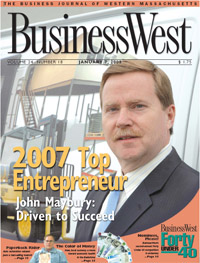
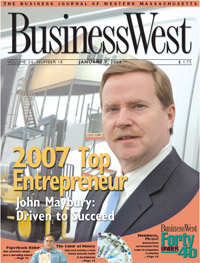
John Maybury : Driven to Succeed
January 7, 2008 Cover

January 7, 2008 Cover

John Maybury was only a few months out of high school when he embarked on what started out as another in a series of odd jobs, but would eventually become a career and very successful entrepreneurial venture. He began selling workbenches, shelving, and industrial stools, but soon partnered with his father to start a diversified business in the competitive field of material handling. Today, the company reflects Maybury’s passion for technology, commitment to excellence, and drive to continuously improve. His success — and methods for achieving it — have earned him BusinessWest’s Top Entrepreneur Award for 2007.

John Maybury says that for him to get involved with something, there usually has to be some element of danger.

He’s an avid snowmobiler and skier, and he’s scuba dived, skydived, and flown planes (he doesn’t so much anymore). “If it has a motor, then I’m interested in it,” he said, noting that he probably had 20 cars before his 18th birthday. The only time you’ll find him on a golf course is for a charity tournament, and he’s taken part in many. He has to drive the cart, and he’ll invariably tinker with it to get it to go faster than the club pro might like.

He approaches all these danger-spiced activities with a philosophy, or thought process: to know and understand the risks, push the envelope — but not too far, and have fun. And this is the approach he takes to business and Maybury Material Handling, a venture he started while attending Western New England College 32 years ago, and trying to figure out just what to do with his life.

He took a cue, of sorts, from his father, who worked for many years as a salesperson then sales manager, specializing in, among other things, items in a field known as material handling — meaning equipment used to move, store, retrieve, and catalog inventory, records, parts, and other items.

The Younger Maybury started off as a free agent, selling various product lines to companies like American Bosch, Moore Drop Forge (later known as Danaher Tool), and other large manufacturers, using mostly contacts from his father to get his foot in those doors. He enjoyed enough early success to inspire his father to take a leave of absence from the company join him a venture that would put the Maybury name on letterhead, if not over the door — they started out as a home-based operation, but quickly outgrew those facilities.

Over the past three decades, Maybury has grown his venture into a highly diversified operation now specializing in sales, service, rentals, and training for equipment ranging from forklifts to work stations; from mezzanines to modular offices. The company has expanded and moved several times, the latest step being construction of a 42,000-square-foot building on Denslow Road in East Longmeadow, not far from where he and his father built the company’s first home on the site of an old tobacco barn.

But it is not merely what Maybury has accomplished that has earned him BusinessWest’s Top Entrepreneur for 2007 award. Rather, it’s also the how that has made him this year’s honoree.

To say that this is a company that reflects the character and drive of its owner would be a real understatement. It is, like Maybury, technology-focused, employing the latest hardware and software to enable employees to do work better, faster, and cheaper. It’s also excellence-driven; it was among the early winners of the Pioneer Valley Excellence Award, and Maybury has his sights set on a Mass Excellence Award, and has the ambitious goal of earning the coveted Malcolm Baldridge award within the next decade.

And this company is people-oriented, with an emphasis on fun. At the 2007 All Associates Year End Gathering, for example, staffers were broken into teams for a spirited contest of ‘Are You Smarter Than a Fifth Grader?’ featuring several special guests from nearby Mapleshade Elementary School.

The teams were formed with the goal of breaking down departmental barriers and inspiring people in different capacities to work together toward a common goal — in this case, triumphing over the other teams and winning some cash ($4,000 was put on the table).

This philosophy of working together is at the heart of the company’s success, said Maybury, noting that he stresses teamwork in every facet of the operation, and it has yielded steady sales growth, cutting-edge continuous-improvement practices, and a workplace that attracts and retains top talent.

In this issue, BusinessWest examines what drives Maybury — literally and figuratively — in his quest for excellence, and why his story of entrepreneurial daring is an uplifting, and ongoing, saga.

A Real Spark Plug

As he gave BusinessWest a tour of the new plant and posed for a few pictures, Maybury displayed some of that passion he has for all things motorized.

He jumped onto one of the newest and most versatile fork truck models, showed all that it can do, and then maneuvered it in out of some tight spaces. “I can handle these better than most people who drive them for a living,” he said, noting that he’s fluent with every piece of equipment on his showroom floor, and needs to be if he is to properly serve his clients.

Maybury got his first practice on a forklift back in the fall of 1975. He was a freshman at WNEC and also working several part-time jobs to help pay his tuition. One of them was at Milton Bradley — now known as Hasbro Games — and its East Longmeadow plant. He worked in what was known then as Department 26, moving around pallets of games like Monopoly, Life, and Chutes and Ladders, for loading onto boxes that would be packed into freight cars for transport on a rail line that no longer exits.

When Maybury returns to Department 26 these days — he’s made several visits over the years and still runs into people he worked with three decades ago — it is to help Hasbro stay on the cutting edge of material-handling equipment and processes. The toy maker is just one name on a long and distinguished client list. Others include regional and national manufacturers, distributors, and retailers including Friendly’s, Big Y, Lenox, J Polep, JCPenney, Macy’s Target, Wal-Mart, and even Foxwoods and Mohegan Sun.

Maybury supplies racks and shelving, conveyors, forklifts, and other equipment to the casinos to move and store money and chips. It also played a lead role in helping Mohegan Sun set a record a few years ago — with an 18-foot-tall, seven-tiered wedding cake weighing 15,032 pounds, or 7.5 tons. Maybury engineers created the huge platforms, or cake separators that the cake rested on (they were supported with steel pipes made by the company and painted to match a frosting sample) and also positioned massive, 30,000-pound-capacity scales in order to give the casino the exact weight.

The current, ever-growing client list and show of diversity and imagination put on display at Mohegan Sun provide evidence of just how far this company has come from its humble beginnings. How Maybury has orchestrated this evolution and progression is a story of entrepreneurial drive, vision, and ample doses of both luck and determination — mostly the latter.

Recalling how things got started, Maybury said that in addition to his forklift adventures at Milton Bradley, he also worked at Big Y, SIS (now TD Banknorth), and other area companies while trying to choose a career path. Instead, one chose him.

Growing up, he recalled, the conversations around the dinner table often revolved around his father’s work in material-handling equipment, and he eventually gravitated toward it himself.

“I grew up with it, and was kind of fascinated by it,” he said, re-emphasizing his childhood interest in all things mechanical, which manifested itself in early exploits in snowmobiling, mini-bike and motorcycle riding, and an endless parade of cars. “I would go into where my father was employed, go out back, and see all that equipment; it was something that really interested me.”

That company was Stanley Handling Equipment Co., later to be called StanLift, in Agawam. It was sold while Maybury’s father was executive vice president, and he then left and did consulting work for a similar venture based in Boston.

“It was at the supper table one night … I asked my father if he thought I could sell the things he used to sell,” Maybury recalled. “He said, ‘let’s give it a try,’ and we did.”

He started as an independent agent of sorts representing dealers trying to penetrate the Western Mass., market, selling workbenches, industrial stools, shelving, pushcarts, and other items needed by manufacturers that didn’t require help with installation, and was helped considerably by some of his father’s contacts.

“I’m 18, 19 years old … these people basically adopted me like a son or a grandson, because I was so young,” he explained. “I would go in, show them the book, show them the prices, tell them how much I needed to make, and they were cutting me orders.

“If I had any questions, I would go and ask my father,” he continued, adding that as the orders started rolling in, the father-and-son team saw a business opportunity unfolding before him. With a $25,000 loan from what was known then as First Bank — “they enjoyed the signature of the 40-year-old father much more than the 19-year-old son,” said Maybury — they were off and running.

Hitting on All Cylinders

Beyond the changes in street address over the years, the company was also in a constant state of change and diversification, said Maybury, patterns that have made it unique in the material-handling sector.

After starting with benching, shelving, and stools, the company moved into larger shelving installations, and two-story installations, including some work for Subaru of America. These installations would require lift trucks, he noted, adding that in the beginning the company would rent such equipment for jobs, but later purchased a fleet of the vehicles to ensure it could get a job done — and on time.

These ‘installs,’ as they were called, were usually done over a weekend, when a plant was shut down, he continued, adding that the mechanics hired to do these jobs often had little to do during the week, so the company started subbing them out to other businesses.

This was the beginning of Maybury’s power equipment division, which sells, leases, and maintains forklifts, scrubbers, sweepers, and other pieces of equipment and accounts for roughly 50% of total revenues.

Maybury remembers when the fleet consisted of one van (he still keeps a picture of it his files) and five hand trucks. Today, it’s 30 vans and more than 300 left trucks serving an area that stretches east to Worcester and south into Northern Conn., but Maybury says the company goes wherever its customers want.

It’s done work in Pennsylvania for Friendly’s, for example, and also in Nebraska, Texas, the Dominican Republic, and elsewhere for other clients.

This constant evolution has yielded a company that Maybury describes as a “solution provider,” and one that has no across-the-board competition.

“Our competitors are silo businesses,” he explained. “We have lift truck competitors, shelving and rack competitors, conveyor competitors, and mezzanine competitors, for example, but there aren’t any real solution providers that can address the full scope of material handling like we do.”

Summing up what his company does, and simplifying matters as he does so, Maybury says his team of 100 employees helps clients become more efficient, thus making them more profitable and competitive in the face of increasingly global competition. And throughout its existence, the company has essentially practiced what it has preached — using technology, processes, and teamwork to simplify and streamline operations and provide new opportunities for growth.

“We’re about as paperless as a company like this can get,” said Maybury, citing just one example of how the company works to take time and waste from its processes, while also serving customers more efficiently. The company has used self-directed work teams, the Kaizen process, and other strategies to reduce process times and reduce errors.

These efforts were rewarded with a Pioneer Valley Excellence Award in 2005, what Maybury calls the first step in an aggressive drive to winning a Baldridge within the next decade. Established in 1988, and named after former Commerce Secretary Malcolm Baldridge, a strong proponent of quality management, the award is given to companies to large and small judged to be outstanding in seven areas: leadership; strategic planning; customer and market focus; measurement, analysis, and knowledge management; human resource focus; process management; and results.

Maybury said that while his goal is on winning the award, his focus is on doing the things necessary to achieve that end, which means not achieving results, but sustaining them, which is the key to not merely filling a lobby with plaques and trophies, but also taking a company to desired heights in terms of efficiency and profits.

And for this, Maybury returns to the subject of teamwork, specifically a team of ‘Level 5 leaders’ as defined by business writer Jim Collins, author Good to Great.

“I have a human resources manager, a controller, a power equipment division manager, a material handling division manager, and a sales and marketing manager, and those positions support our strategy and our goals,” he explained, “and our initiatives and action steps are carried out by that group of people.

“Into everything we do over the course of a year we come up with some critical impact factors that will impact our business either in a positive or negative way, and then we develop strategies and action steps and come up with goals and plans so we deploy a common theme,” he continued. “If it’s self-managed teams, then it’s self-managed teams until we get it; if it’s paperless, it’s paperless until we get it; if it’s proper deployment of technology, it’s that until we get it; we don’t just say ‘let’s do this,’ and then it never happens.”

Gasket Case

There has been considerable deployment of communications technology over the years, said Maybury, adding that the progression of steps, such as the outfitting of service technicians with tablet PCs to eliminate all use of paper, is consumer- and service-driven.

“We don’t have technology just to have technology — we have technology to be the accelerator for our processes,” he said, noting that the use of the tablet PCs and aircards that provide Internet access eliminate the need for everything from paper receipts to repair manuals.

Which is significant, because each technician needs vast amounts of information at his or her disposal to maintain or repair the wide range of equipment sold and serviced by the company.

“With the technology and advancements, our technicians now have the ability to go online,” he said, “and go to the manufacturers’ sites, get their technical service bulletins, get schematics, get parts resources, and communicate by E-mail with the supplier so we can get all the information we need without having any books on the trucks.”

There are countless other examples of putting technology to work to streamline processes, allow people to do more work in less time, and even save a few trees, he continued, noting that technology is just half the equation; the other is the people who use it, and the company is careful to invest heavily in them, as well.

This strong focus on people was on display at the All Associates Year End Gathering, a tradition at Maybury for nearly 20 years now.

As the name implies, everyone who works for the company (and they’re called associates, not employees) is required to attend. In recent years, the date was moved from just before Christmas to the middle of the month to make it easier to fit into the holiday schedule.

As in prior years, this day-long program had a packed agenda, starting with a welcome from Maybury, a quick review of the safety record (169 days without a lost-time accident by Dec. 14), and then a comprehens
ve review of the company’s 401(k) program delivered by Charles Epstein, president of Epstein Financial Services.

“This is a good time to be a having a review,” said Maybury, noting the stock market’s rocky third and fourth quarters and the questions it would generate. “This is a time when people need information about their money and what to do with it to make it grow.”

The agenda continued with reviews of the health and dental plans, a look back at the accomplishments of 2007 and a glance ahead to the goals for ’08, a celebration of anniversaries (there was a 25th and two 20ths, among others) and new associates, a question-and-answer period, and that spirited round of ‘Are You Smarter Than a Fifth Grader.’

The associates’ day, and the specific parts of the program, are reflective of Maybury’s desire to make his a people-oriented company, one focused on helping employees balance work and life.

Finding that balance is something Maybury has had to work at himself, noting that, over the years, he’s managed to make time for his family, community activities, chamber of commerce duties (he was president of the East Longmeadow chamber for two years), work on boards such as the one at Baystate Health he’s a member of, and even some snowmobiling.

“When I balance my family with my business and the community, that makes me feel better,” he said. “I could probably lock myself in here for several more hours a day, but I wouldn’t have the same self-satisfaction. And I like to learn — I’m a constant learner … I don’t think I’ve every stopped.”

Growth Engine

The Maybury company may be essentially paperless, by its president proudly hangs on to an item that could have been recycled years ago.

It’s a placemat from the Fort restaurant in Springfield, on which Maybury scribbled the preliminary business plan for a subsidiary, or sister business, he started with a partner in 2005 called Atlantic Handling Systems. Based in the New Jersey community of Ho-Ho-Kus, it offers entry into a new, large market, and provides new opportunities for growth.

There was and is that requisite amount of danger with the Atlantic venture, he explained, adding quickly that this latest endeavor, called ‘Baby Maybury’ by some, amounts to a calculated risk, one that has worked out very well and holds considerable promise for the future.

And getting it off the ground has been fun, which, like that element of danger, must be part and parcel to everything that intrigues our Top Entrepreneur for 2007.

George O’Brien can be reached at[email protected]

Features
Report Urges Action on Job Creation in the Commonwealth

Dana Ansel says Massachusetts simply can’t be expected to be one of the leading states when it comes to job creation — and for several reasons.

First, the Commonwealth has an older economy, and most of its square mileage has been developed, especially in the Eastern part of the state, thus limiting commercial and residential development. Meanwhile, businesses across many sectors, but especially manufacturing, are discovering how to do more with fewer or the same number of people — leading to strong gains in productivity, but not employment — and many other parts of this country and other nations are becoming more competitive in several of the fields that have generated job growth in the Bay State.

“So it would be unrealistic to think that Massachusetts would be at or near the top of the chart,” said Ansel, research director for the Mass. Institute for a New Commonwealth, or MassINC, who added a quick ‘but…’
“We can do better than 49th.”

That’s exactly where the state sits, behind only Michigan, which has been devastated by ongoing cutbacks within the auto industry, in terms of jobs gained since the peak of the last economic boom in early 2001.

The Bay State’s relatively poor showing in this statistical category is at the heart of a new MassINC report, undertaken in concert with the Center for Labor Market Studies at Northeastern University, titled “Mass. Jobs: Meeting the Challenges of a Shifting Economy.”

This shift is toward something those at MassINC are calling a “boutique economy,” one that, according to MassINC President Gregory Torres, “rewards well-educated and skilled workers in knowledge-based sectors, but offers fewer options for everyone else.”

Michael Meeropol, an Economics professor at Western New England College, calls it something else — the ‘winner-take-all economy.’

“Instead of a solid middle class, we have a sliver of a very wealthy group driving the economy,” he said. “There has been an unbelievable skewing of income distribution and wealth.”

Regardless of what it’s called, this shift has played a big part in the state’s sluggish job-growth performance, and MassINC officials are imploring civic and business leaders to recognize that the landscape has changed and make needed adjustments — and soon. That’s because, if the state stays on this track, revenues will be constrained, and out-migration will likely increase as residents seek opportunities elsewhere.

Ansel told BusinessWest that MassINC issued the 110-page ‘Mass. Jobs’ report with the goals of drawing attention to the Commonwealth’s job-creation problem, prompting dialogue and then action to generate some improvement in that realm, and also providing a mix of opportunities for all workers.

“There are two levels of jobs — there are quality jobs, and then there are just ‘jobs,’ and they’re both important, here and in any state,” she said. “We’ve done well, for the most part, on the quality side, but we still need plain old jobs; such jobs are a key piece of driving revenue for the state.”

The report suggests several steps, including everything from growing the number of so-called export-based jobs, which bring dollars into Massachusetts, to filling the estimated 90,000 existing job vacancies in the state, which cross several sectors, to improving the business climate in the Bay State.

In this issue, BusinessWest takes an indepth look at the report and what its findings mean for the long-term health of the Commonwealth.

Work in Progress

For the record, the top five states in the nation for job growth over the past six years, or since the peak before the last recession, are Nevada (a 27% gain), Arizona (17.9%), Wyoming (15.1%), Idaho (14%), and Florida (12.6%). Massachusetts (-3.7%), behind only Michigan (-6.3%), shouldn’t really be compared to most of those at the top, which are seeing huge growth in development and spikes in population, said Ansel.

But it can be compared to other New England states and 10 so-called ‘competitor states’ — these include New York, New Jersey, Virginia, North Carolina, California, Texas, Colorado, Minnesota, and Florida — and it doesn’t compare well.

Four New England states have added jobs over the past six years, while New Jersey has seen 2.3% growth, and New York has “just about broken even,” said Ansel, noting that the Bay State is one of only six states that have not recovered all those jobs lost during the last recession, when employment plunged more than 6%. In fact, Massachusetts remains 100,000 jobs below its peak employment level of 3.3 million in early 2001.

There are several reasons for this, said Ansel, noting that when the recession hit, Massachusetts had a large number of jobs in the technology sector, which was extremely hard-hit by that downturn and has yet to fully recover.

“At the peak of the boom in 2001, the Massachusetts economy was more dependent on high-tech jobs than most other states,” she said. “The recession wiped out high tech jobs here and everywhere; we had built a lot of our economic success on an industry that suffered some of the greatest losses.”

But there were other factors as well, including a nationwide decline in manufacturing jobs, as well as mounting competition for jobs in the knowledge industries. Indeed, the Bay State’s share of high-tech jobs nationwide has declined, from 4.2% in 2000 to 3.9% in 2005, showing clearly that other states are becoming more competitive. Also, the high cost of doing business in the Commonwealth — when compared with other states and other nations — no doubt has played a role in the low rate of job growth, she said.

Despite a net job loss, some sectors have added new positions, said Ansel, thus changing the composition of the state’s economy toward that ‘boutique’ characterization, manifested by a shift toward knowledge-based sectors, such as health care and biotech, that often require highly specialized employees who hold at least a bachelor’s degree.

While suffering losses in manufacturing and high-tech, Massachusetts doubled the national rate in adding biotech jobs (15% vs. 7%) between 2000 and 2005. In that period, Massachusetts added 10,000 new biotech jobs, bringing the sector to about 75,000 jobs in Massachusetts, or 2.4% of the state’s payroll jobs. By comparison, manufacturing, despite large job losses, still accounts for about 9% of Massachusetts jobs, including some biotech manufacturing positions.

And while Massachusetts trailed the nation in job creation, it was among the leaders in productivity, an important measure of economic health. The state’s level of labor productivity ranks seventh-highest, and since 2001, it has grown faster than the nation’s (11.5% versus 10.6%). In 2005, the productivity level of an employee in Massachusetts was $94,150 in real output per worker, compared with $83,920 nationally.

These statistics and others point to a shift toward a ‘boutique economy,’ said Ansel, noting that this term was contrived by the report’s authors to describe what’s happening within the Commonwealth’s borders.

“It captures a significant shift in the economy toward knowledge industries,” she explained. “While we do have an overall record of job loss, we are still creating jobs in some sectors; where we’re creating jobs and where we’re losing them is not the same place, and as a consequence, the economy is shifting.”

Laboring State

The MassINC report lays out four principles that could form an economic vision and agenda to be shared by the administration, Legislature, business community, and labor community, said Ansel, adding that the report recommends a long-term strategy that includes creation of export jobs, better workforce training to fill current vacancies, improvements to the business climate, and a regional approach to meet varying needs across the state.

The report’s four main recommendations are:

  • Setting a target goal for the number of new export-based jobs created. “Because export jobs — those linked to selling goods and services out-of-state — bring revenue into the state and generally offer higher pay to workers, they embody the characteristics of ‘good jobs’ in the economy, said the report’s authors. “Export-based jobs and not specific sectors should be the emphasis of a long-term strategy.”
  • Filling the existing vacancies. A Massachusetts job vacancy survey in late 2006 revealed more than 90,000 openings. The vacancies indicate a willingness of employers to hire more workers, said Ansel, but may also show the need to better educate and train a workforce that has the required skills to fill the slots.
  • Creating a more favorable business climate that streamlines permitting for business expansion across Massachusetts and addresses expenses, such as energy costs and unemployment benefits and policies. “Economic policy should encourage and assist Massachusetts companies looking to grow here,” said the report’s authors.
  • Taking a regional approach. “Because economic conditions and needs vary across the state, efforts to develop strategies must focus on regional strengths,” the report concluded. “The specific strengths will determine what growth opportunities are best suited for a region. State leaders should also develop an urban strategy for cities outside Greater Boston that are lagging the rest of the state in job creation.”

Ansel called the 90,000 job openings in the state “low-hanging fruit,” comparatively, because it is generally considered easier to fill positions that companies have open and desire to fill than to create new jobs.

But the fact that the jobs remain open at a time when unemployment is relatively high indicates a mismatch between the skills needed for those positions and what the available labor market possesses. Thus, closing that gap is a priority for the state, said Ansel.

“That number (90,000) is the highest since the state started doing the job-vacancy survey in 2002,” she said, adding that there were 75,000 openings reported in the previous survey, undertaken in 2006. “It’s significant, and it sends a mixed message in the sense that there is some appetite on the part of employers to hire people, which is good. But at the same time, if they’re not able to fill those positions, that’s a real problem; vacancies are increasing across the country, but the implications are greater here because of how slow our job creation has been.”

Many of the openings are in health care and related sectors, said Ansel, and perhaps half of them could be handled with a year of college education. The challenge ahead, she said, is to create the right programs and motivate people to enter them.

Ira Rubenzahl, president of Springfield Technical Community College, agreed. He said his school doing its part by focusing on health and technology programs, designed to assist area employers with vacancies they’re struggling to fill — and also on improving access to higher education.

“This report clearly indicates that education is the key to the new economy,” he said, adding that he considers the findings sobering, but not at all surprising. “Our economy has shifted, it is knowledge-based, and we have to properly prepare people if they’re going to succeed in that economy.”

Meerepol, while acknowledging that Massachusetts is struggling with job creation, said the problem exists nationwide, and it needs to be addressed. He said the trend toward greater productivity brings benefits to individual companies, but not to the country or individual states.

“Over time, even in good times, really efficient companies are shedding workers like crazy, and when things pick up, they learn to produce more with the same number of people,” he said, noting reports showing that nationwide, there are fewer job losses and fewer gains. “One of the reasons why job growth is so slow in Massachusetts is because of this surge in productivity, and that’s also why we’re seeing the loss of so many manufacturing jobs across the country.

“You want that growth in productivity, but you want it to benefit many people in terms of income; when that happens, you get the mass-market increases that lead to job growth,” he continued. “The reason why the economy experienced some significant job growth in the late 1990s was that, for the first time in 20 years, lower-income people were enjoying rather significant gains in income.”

Solutions to the job-growth problem won’t come easily, said Meeropol, especially if elected officials resist what he fully understands is political kryptonite — raising taxes and putting the proceeds to work creating jobs, a strategy that has worked during several periods in the nation’s history, including World War II, the late ’60s, and the Reagan years.

“There have been several times when we’ve seen a rise in total government revenue, a rise in taxes, and the percentage of total government spending rose, which is a rise in spending, and the economy boomed like crazy,” he said.

It’s an obvious thing, but no one is willing to go that route; it’s good economics, but terrible politics.”

Bust with No Boom

Compounding matters for the Bay State is the national economy, and the very real possibility of another recession, said Ansel, noting that the state simply won’t recover all the jobs it lost during the last downturn before entering another one.

This scenario puts even more emphasis on forging new and better job-creation strategies, she continued, because jobs are critical, and the competition for them is mounting.

And this is just a part of life in a boutique economy.

George O’Brien can be reached at[email protected]

Opinion
Transparency at Our Hospitals

Ten years ago, the idea of tying Medicare or Medicaid reimbursements to hospitals’ performance on specific clinical measures would have been unthinkable. Today, not doing it is unthinkable.

Having worked in the hospital and health care industries for decades and in many states, we have seen firsthand how others approach quality-improvement efforts. What business leaders, opinion makers, and patients in Massachusetts need to know is that — far and away — hospitals here are leading the nation when it comes to taking on quality improvement. The type of work underway to improve patient safety through increased transparency and public reporting is unlike anything going on around the country. And it is all voluntary.

Well before federal Medicare officials announced their recent plan to no longer pay for certain preventable hospital errors, including falls and pressure ulcers (or bedsores), Bay State hospitals were collecting data in these very areas. Recently, Massachusetts hospitals, using a consumer-friendly Web site, started reporting data on falls to the public and will unveil bedsore data later this year.

Also, while the Institute for Healthcare Improvement is urging hospitals nationwide to get trustees more involved in the quality and safety agenda, Massachusetts hospitals, through a grant from the Blue Cross Blue Shield Foundation, are developing a model trustee curriculum that is being piloted around the state.

This is not just a sampling of health care facilities; 100% of Massachusetts hospitals are reporting their numbers, sharing best practices with one another, and implementing new clinical protocols. We are finding that transparency and openness breed new conversations, a heightened focus on correcting problem areas, and, ultimately, improved care.

It is not just the federal government looking at ways that payments can move the needle on hospital quality. In August, the Medicaid program in Massachusetts also introduced plans to make the payment-quality connection. Unlike the federal government’s plan to withhold payment for hospital errors, the state, in partnership with Massachusetts hospitals, developed a ‘pay for performance’ initiative, which in effect gives hospitals an added bonus for a job well done in certain areas.

Under the plan, Massachusetts hospitals can earn bonuses totaling $20 million for more effectively managing such concerns as pediatric asthma, pneumonia, surgical infections, and racial and ethnic health disparities.

For years, hospitals — particularly those in urban areas — have been retooling their delivery systems to meet the changing needs of a diverse patient population. Interpreters and disease-prevention programs aimed at curbing illnesses more prevalent among certain minority populations have been the norm for hospitals in Massachusetts. Under the new Medicaid regulations, all hospitals will have an added incentive to look more closely at the issue and will be rewarded for a job well done.

Why have Massachusetts hospitals placed such an emphasis on being open with the public? The single most important reason is that we owe it to our patients. Having a loved one hospitalized can be a heart-wrenching and stressful time. Reducing the number of questions around health care quality can inform and ease the minds of our patients. Also, as transparency efforts become the standard in Massachusetts, the industry will take the lead in managing health care costs, a goal we can all support.

Virtually anywhere you look, you can find easily accessible performance information in many different industries. An airline’s on-time arrival performance or your local school’s standardized test results are two good examples. It is only common sense that information on how well your local hospital treats certain illnesses should be there for you to look at as well.

Lynn Nicholas is president and chief executive of the Mass. Hospital Assoc. Robert Norton is president and chief executive of North Shore Medical Center. This article first appeared in the Boston Globe.

Features
Use Them to Solve Problems, Not Track Performance

It’s yet another weekly management meeting. Everyone shows up, sits down, and takes their turn in reporting progress on assigned projects. At first glance this looks like a great way to ensure accountability for performance, but could it be sabotaging your company’s future success?

How can this be? Surely something as simple as meeting to track performance is basic MBA 101 on how to run a company, right? Well, some CEOs disagree. By challenging the assumption about these types of meetings they’ve found something remarkable — competitive advantage.

It’s not that tracking performance is wrong, but there are other ways to issue status reports on projects more efficiently. E-mail, intranets, and old-fashioned paper can allow data to be absorbed more quickly than verbal presentations at meetings. Why not use the invaluable time in management meetings for what we wish we had more time for — solving problems?

This sounds great except for one snag — the problem is we don’t like revealing problems! We’d rather reveal our “great performance.” Divulging our problems could make us look weak or incompetent, or diminish our demonstration of “brilliance” to those who could promote us. Moreso, it could open us up for retaliation or manipulation!

Of course there are organizations where these could be real fears, but cultures like these have deeper problems than ineffective use of management meetings. For the rest of us, using meetings to share and solve problems versus displaying our ‘great performance’ may offer a better opportunity to improve such performance.

Examples of organizational successes using this methodology are buried in the literature, from examples of ‘skunk-works’ projects to the recent success of Toyota. For example, one manager at the Toyota Georgetown plant used his time in management meetings to demonstrate his good performance on projects he was assigned until plant manager Fujio Cho (now the chairman of Toyota worldwide) said to him, “we all know you are a good manager, otherwise we would not have hired you. But please talk to us about your problems so we can all work on them together.” Of course, the rest is history now that Toyota has surpassed GM. Could it be that Toyota’s meetings were different than GM’s?

Problems Versus Performance

Meetings that focus on problem-solving versus reporting on good performance seem to offer companies key benefits, such as:

More efficient use of time. Time is scarce and getting moreso. Companies that use face-to-face time for problem-solving exploit the power of human dialogue versus wasting it on monologues. They create solutions and address decisions on the issues that matter. Project status reports are important, but this one-way data can be transferred using other more efficient means. Time is money. Where do you want to spend it?

Higher motivation. Solving problems generates more positive energy than status reports do. Celebration and acknowledgement of good performance should be done, but in more meaningful ways then self-proclamation in short slots of meeting agendas. When a strong staff is free to expose real issues and work on them, it pulls the team together and lessens the effect of demoralizing egos on the organizational agenda.

Profits. It doesn’t take a rocket scientist to figure out how Toyota got to the top. Continuously seeking improvements by finding and resolving problems enhances competitive advantage in any market. Tolerating a culture that avoids this in order to ‘look good’ or satisfy personal interests guarantees a dramatic financial failure. This has toppled the largest of companies, some whose executives are now facing prison time.

Make It Happen

Shifting your company’s culture to embrace problem-solving meetings can be tough. It takes more than an E-mail announcement or a speech. Some ideas include:

  • Assess management meetings you are now attending and determine if they really are necessary. If not, distribute data or information from those meetings using other methods.
  • If the meeting is important, shift the agenda from focusing on performance accolades to sharing and solving problems.
  • Challenge those who “don’t have problems.” Are they playing hard enough? Are they holding their cards too close to the vest?
  • Notice the level of defensiveness in the culture. Are people coachable? Can they disclose issues easily? Can they take feedback without it seeming so personal?
  • Start leading by example. Surface your problems first! This last idea could be difficult, but it shows you are serious. And it allows you to start challenging the group.
  • Start asking questions like: “Even though we are performing well, what’s not working or can be improved in your department?” “What is your greatest personal challenge or concern we should be talking about today?” “Where in your area are you having the most problems?”

This doesn’t mean that project performance status shouldn’t be on the agenda. A few accolades can be appropriate, but surfacing and focusing on problems and projects which are off-course so that the group can work together on resolving them is critical for sustaining competitive advantage and profits.

Is this something that everyone is ready for? No. It requires a strong, confident staff. Only solid teams thrive in an open and supporting culture. On the other hand, weak teams don’t have the courage to disclose their issues and accept help. But then, if that’s the case, perhaps you have another problem.

Don Schmincke is a business consultant and author of the CEO bestseller, ‘The Code of the Executive.’ He has worked with the U.S. Navy Fleet Readiness, DuPont, IBM, Miller Brewing, and other organizations;www.sagaleadership.com

Opinion

You have to give Gov. Deval Patrick some credit. He’s been thinking big lately. Make that very big.

Universal preschool. All-day kindergarten. Free community college tuition and fees. A longer school day and year. A $1 billion life sciences commitment. Extension of a commuter rail line to New Bedford. Property tax breaks for low- to moderate-income homeowners. And perhaps as many as 1,000 new police officers. These are all things he’s put on the table over the past several weeks.

And in doing so, he’s drawn loud applause from educators, the tech sector, public safety administrators, and other constituencies. He’s also spawned some serious skepticism among legislators, conservative think tanks, and political analysts who are wondering out loud just how in the world he’s going to pay for all this.

Indeed, the growing consensus seems to be that Patrick will get only a few, if any, of these proposals funded at a time when there is still a budget deficit, and the chances of the Legislature raising taxes are slim and none.

So it seems to many that Patrick is simply getting people’s hopes up for things that won’t be funded, thus setting himself up for a big political fall when he fails to convert on any of these commitments to the Commonwealth.

Maybe, maybe not.

It is our hope that the doubts — as well-founded as they may be — do not stifle the needed serious discussions on these matters that may eventually lead to some of them becoming reality. That’s because many of these proposals make a good deal of sense.

Start with universal preschool. This has long been touted as a necessary ingredient in the daunting task of re-energizing struggling urban centers in the state, including Springfield and Holyoke, and local economic development leaders have put early childhood education at the top of their priority list for the region. Study after study has shown that when children are exposed to a regimented learning environment early on, they are less likely to drop out of school later in life. These statistics are contrasted against the state’s dramatic drop in the rankings concerning the number of children enrolled in pre-kindergarten; the Commonwealth has slipped to roughly 10% of its 4-year-olds in pre-K, which is about half the national average.

The problem is, universal preschool is expensive — a projected $600 million annually. Also expensive is lengthening the school day and year — $1.3 billion per year, according to some estimates — and free tuition at community colleges, nearly $200 million annually.

But both steps would certainly help Massachusetts remain competitive with other states and other countries at a time of intense fighting for those good jobs at good wages that every municipal leader wants. Community colleges have long been touted as one of the state’s most effective economic development resources because they provide skills that are needed in a modern, technology-driven economy, and graduating students tend to stay in the market in which they were educated.

Community colleges are relatively inexpensive — only a few thousand dollars per semester — but they are still out of the reach of some people of limited means. Free tuition would provide access to a college education for greater numbers of Bay State residents, and thus create skilled employees for companies screaming for qualified help.

Other components of the Patrick agenda are equally worthwhile, especially the investment in life sciences, which many believe will be the proverbial ‘next big thing’ for the state’s economy. But all of them come with steep price tags, and lawmakers show no inclination to raise taxes or create new sources of revenue, such as legalized casino gambling.

Not long after Patrick unveiled his 10-year vision for education in the Commonwealth, something he called “cradle to career,” he likened skeptics of his plan to those who challenged President John F. Kennedy’s mission to put a man on the moon by the end of the 1960s.

But the federal government backed up that bold pledge with what amounted to a blank check for NASA. Patrick won’t get a blank check, and he may not get any kind of check. But that shouldn’t stop him from thinking big — preferably, very big.-

Opinion

It wasn’t exactly breaking news, but it was eye-opening.

A recently released report, written by the Mass. Institute for a New Commonwealth (MassINC) in conjunction with the Brookings Institution’s Metropolitan Policy Program, reveals that that knowledge-based jobs in the Commonwealth are clustered in Greater Boston, and that 11 so-called Gateway cities, including Springfield and Holyoke, and Pittsfield in Western Mass., are, by and large, not sharing in the wealth of the technology sector.

We knew that already.

What we didn’t know — or hadn’t seen spelled out in detail until this report — are the many costs associated with this phenomenon. In short, say the report’s authors, unless this pattern is reversed or mitigated, the gateway cities will fall into a deeper fiscal funk, urban sprawl will accelerate, and the pressures placed on Greater Boston, especially the costs of living and doing business, will continue to escalate, forcing people and businesses to leave the state.

In other words, and to paraphrase the report’s conclusion, spreading the wealth isn’t merely the democratic thing to do, it’s the right thing to do, and for many reasons.

The report calls on elected and appointed leaders to take steps to address this problem. They range from enhancing infrastructure and transportation to improving public education to create a better workforce in a state that is losing population. We suggest the Patrick administration and the state Legislature heed the suggestions in the report, titled Reconnecting Massachusetts Gateway Cities: Lessons Learned and an Agenda for Renewal — because these problems will not fix themselves.

The most important word in the report’s title is reconnecting. At the moment, those gateway cities — Brockton, Fall River, Fitchburg, Haverhill, Lawrence, Lowell, New Bedford, and Worcester are the others — are far less connected than they once were. They are more isolated and, in many ways, more vulnerable.

Why? Because the manufacturing bases that allowed them all to once thrive — precision machining in Springfield, paper in Holyoke, textiles in Lowell and Lawrence, shoes in Brockton, fishing in New Bedford — are all in various states of decline and with little or no hope of regaining past glory.

Each of those cities is searching for something to replace what’s been lost, but most have found only frustration. Some have benefited from simple geography — being close to Greater Boston has yielded some opportunities, especially in housing; Lowell’s old mills, for example, have been converted into high-end condos that constitute affordable housing to those priced out of the Boston market. But geography does not help Springfield, Holyoke, or Pittsfield.

What will help are steps to enable them to compete for knowledge-based jobs by compelling existing businesses and those in the formative stages to look beyond the Route 128 beltway. At the moment, most businesses don’t because they don’t see enough reason to; Boston has made the adjustment from an industrial to a knowledge-based economy, and other cities, especially those in the 413 area code, are still working on it and have much left to do.

Demographics plays a key role in these struggles; cities like Springfield have 30% or more of their populations living below the poverty line. Many of these individuals lack the skills needed to hold jobs in a knowledge-based economy. Meanwhile, as the name ‘gateway’ implies, these cities are home to many immigrants who lack the language skills to make it in today’s economy.

To make the gateway cities more competitive, there must be a local and statewide focus on everything from transportation to improving public education to better utilizing assets, especially state and community colleges, to spark economic development.

The solutions to the problems of the gateway cities won’t come easily, and the report’s authors say as much. But if steps aren’t taken to accelerate their transition to a knowledge-based economy, there will be some long-term consequences for the Commonwealth.

Let the process of reconnecting these cities commence.

Features
Five Easy Steps to Pain-free, Productive Meetings

Do you think all meetings are painful, time-wasting, poorly run and unproductive torture sessions? If you hate meetings, you’re not alone. Practically everyone does, and although businesses have to run meetings, very often, meetings run businesses. More than just a drag, bad meetings can have a tremendous negative impact on productivity and the bottom line.

You may think that the only thing worse than sitting through meetings is having to lead them. After all, you don’t want all that wrath and boredom directed at you, right? Rather than dreading running meetings, though, you can embrace the opportunity to polish up and show off your leadership skills. The style in which you lead a meeting will establish its tone and influence the meeting culture. People will take their cues from you, adopting your good practices.

Different types of meetings require different approaches. You must be flexible and adapt to the purpose and participants in a meeting. While there are different meeting styles, some practices and policies make all meetings better. These simple steps will enable you to lead great meetings:

Determine Purpose and Prepare for Productivity

As the meeting leader, you must determine why the meeting is taking place in order to know who to invite, what to put on the agenda, how long to discuss each item and even what methods to use to come to a decision.

Productive meetings begin with good pre-meeting communication. Several days or even weeks in advance of the meeting, call, E-mail or speak in person with influential people. Identify which issues will need to be addressed. This checking-in process will help you to deal with objections and build consensus.

Write an Agenda and Stick to It Without an agenda, participants cannot prepare, so time is lost while people read or catch up. Missions fall by the wayside as people talk about whatever is on their minds instead. As the meeting wanders, some may start up whispering side conversations and anyone dominant enough can easily hijack the meeting.

Agenda-less meetings often must end before decisions are made, or decisions are made after key people have to leave. Sound familiar?

Realize that you can’t solve all the problems of the world in one meeting. If you decide to spend 10 minutes on something, and the 10 minutes is up, it’s your responsibility to move on. You may be amazed to find what a difference just starting and ending the meeting on time and keeping it clipping along will make in participants’ morale and willingness to participate now and in future meetings.

Encourage Discussion and Participation

Your most valuable resource is the collective knowledge of others in the organization. A good leader encourages participation in order to harness others’ creative power. Everyone will benefit when you make the atmosphere safe and easy for everyone — even the shy ones — to get involved.

Take note of those who remain silent, and make it a point to ask them what they think. You don’t want those who disagree with you or with the group’s decisions to not say anything, and then leave the meeting and attempt to undermine the decisions later.

Encourage participation by saying:
• “Stan, you shook your head just now. What else do we need to consider?”
• “I would like to hear from Amanda on this.”
• “Jack, you and I talked about something before the meeting. Would you share it?”
• “Do we have all the issues on the table?

Listen Actively

Listening well and being able to provide a brief but accurate review of what has been said sets great leaders apart from the rest. To summarize effectively, you must hear everything that is said, and even more important, notice what is not said.

Take notes or listen in “note-taking” mindset to key words and phrases. Put ideas you hear into the context of the whole discussion, and you will find that this creates accountability. Ask questions and then truly listen to the answers.

Questions that will yield valuable insights might begin with:
• “What’s your reaction to…?”
• “What’s your view on…?”
• “What led you to…?” and
• “How could we…?”

Manage Conflict and Deal with Difficult People

As a meeting leader, if you ask good questions and make it safe to disagree, participants will debate issues on the merits. You can’t allow discussions to get personal or let issues go unresolved; otherwise, you risk damage to the whole organization, not just the individuals involved. Meeting leaders must promote positive conflict while avoiding personal attacks.

While debate is usually healthy for organizations, some people in the group will test the limits. Because they are angry or feel ignored, they will argue miniscule points, be unable to see others’ views, or fail to recognize the value of compromise. They may be poor listeners or have hidden agendas. Most of the time, difficult people are unaware of how they affect others, or what a serious impact they have on their own careers as well as on the effectiveness of their teams.

To keep difficult people from derailing your meeting, intervene in advance. Speak with them one-on-one so that they can vent or discuss what’s on their minds outside of the meeting context. During the meeting, allow them to have their say, and even ask a few questions, and then move on. Remember, your role as a leader is to enforce time limits.

Learning Meeting Skills Leads to Great Opportunities

Good meeting leadership is not as common as it should be. Few people have the skills, and even fewer are taught how to lead meetings effectively. Rather, like most of us, they sit through many bad meetings, develop a lot of terrible habits, and then, when it’s their turn to step up and lead, they just don’t have the skills to do it.

Your ability to run meetings well is a direct reflection of your leadership skills. Your staff, your peers, and the people you report to will all judge how you lead meetings and, in turn, whether your meetings accomplish results. In other words, your leadership skills will have a direct impact on the organization’s bottom line because the meeting is not an end in itself; it is a vehicle to accomplish the work of the organization.

By following these five steps, you can learn how to lead productive, pain-free meetings, demonstrate that you have these leadership qualities, and position yourself for promotions and advancement in your organization.

Suzanne Bates is an executive coach and communications consultant. She is the President and CEO of Bates Communications, which helps executives and professionals develop a unique and authentic communication style;www.bates-communications.com.

Features
Stuart Reese Leads a Cultural Change at MassMutual

Stuart Reese, who was thrust into the role of president and CEO at MassMutual in the wake of the scandal that took down his predecessor, Robert O’Connell, recently completed his first year at the helm. This has been a time of transition, he said, noting that in some ways — especially with regard to individual businesses and their performance, as well as community involvement — it has been seamless. But with others, most notably the corporate culture he’s instilling and a strategic plan he’s shaping, it’s been anything but.

Stuart Reese remembers the phone call. It would be a hard one to forget.

It was from board member James Birle (now chairman) and it came on June 2, 2005, around lunch time. He was calling to say that, amid a series of allegations of improper conduct, Robert O’Connell was out as president and CEO of MassMutual, the largest company in Massachusetts and a Fortune 100 stalwart, and that Reese, then the company’s executive vice president and chief investment officer, was in.

Asked to recall his immediate reaction to that news, Reese struggled somewhat, saying that the ensuing minutes, hours, and days were in some ways a blur, with he and many others at the company “going 24/7,” as he put it.

“It was a difficult moment conceptually and logistically, because there were so many issues that had to be dealt with very, very quickly, and so few people who knew what was going on,” he remembered, adding that he had to address regulators, rating agencies, the press, the board, and employees, all of whom were looking for answers.

“We had to engage a lot of people to get many things done quickly, and these people weren’t exactly sitting around waiting for this to happen; they were doing other things,” he continued. “The mindset at the time was that we knew there were so many good people at the company running the businesses; we said ‘let’s engage them and let them know what’s going on and rely on them to run the business while we deal with these other issues.’”

Thus began what has been an intriguing transition process, said Reese, one that is in many ways still ongoing. In some respects, that transition has been seamless in nature, he said, especially with regard to individual businesses and their performance — year-end 2005 and first-quarter ’06 numbers show strong gains in many areas — but definitely not in some others.

That was certainly the case with corporate culture, said Reese, who sat down with BusinessWest recently to talk about his first year at the controls of the company and his focus moving forward.

“We had to make a very clear statement internally and externally that there was a change in culture and that things were going to be different in some ways,” he explained. “There were some things that had been done wrong, and they were not going to be done that way any more. In that regard, the transition was intentionally not seamless in some ways.”

Elaborating, Reese said that since last June, he, the board, and the leadership team he’s assembled have promoted a culture defined by transparency — a word he would use often — as well as meritocracy and open lines of communication, all traits he believes were missing during the O’Connell years.

But the cultural shift involves more than improved communications and open doors, said Reese, noting that the company intends to be more customer-driven in the development and refinement of products and services.

“We need to be more of an outside-in driven organization, and less of an inside-out driven organization,” he explained. “We need to have a higher percentage of our employees closer to the customer and responding to the customer, so what’s taking place within the company is driven more by the customer than by internal processes.”

BusinessWest looks this issue at Reese’s first year of work guiding the financial services giant, and about how he’s spreading a new culture among its nearly 6,000 employees.

Mutual Respect

Reese says his primary goals for his first 12 months at the helm were to have a strategic plan in place and a team assembled that is “second to none.”

He’s just about there. “There are some ‘i’s to do be dotted and ‘t’s to be crossed, and we’ll do that by the June board meeting,” he told BusinessWest. “But those primary goals of having the team in place, as well as the strategy and the vision, have been accomplished.

“We still have some work to do communicating our plan to the company, and we’ll do that — there are many methods for communication,” he continued. “What I’ve learned is that people need to hear these things many times, so we’ve got lots of repetition ahead of us and helping people understand exactly what it all means; we’re just beginning execution.”

Reese uses the third-person plural quite regularly as he discusses the company, its present, and future. He’s spent the past year assembling his leadership team — there are a few holdovers from the O’Connell era, some from within the company in new positions, and several newcomers to MassMutual — and is a strong proponent of teamwork.

“I want people who are team players,” he said. “This isn’t about me, it’s about the company and moving it forward.”

The concept of ‘team’ is a recurring theme for Reese, who first came to MassMutual in 1993 and has served in a number of roles since.

A graduate of Gettysburg College in his native Pennsylvania, Reese majored in biology and had designs on a career in veterinary medicine. Such thoughts subsided when he actually started working for a local vet.

“I realized rather quickly that this wasn’t what I wanted to do with the rest of my life,” he told BusinessWest, adding that he took a few business courses, found the subject matter intriguing, and eventually earned an MBA at the Amos Tuck School of Business Administration at Dartmouth College.

He mulled several job offers before taking one from Aetna in 1979. There, he served in several capacities, most involving investments. He eventually rose to the rank of vice president and managing director of Capital Markets, overseeing the management of all external funds.

A search firm hired to identify candidates for positions in asset-management at MassMutual contacted him, thus beginning a dialogue that brought him to Springfield in early 1993. Over the years, he held various leadership positions at several MassMutual subsidiaries, serving as chairman and CEO of Babson Capital Management LLC, chairman of Cornerstone Real Estate Advisors LLC, and as a member of the Board of Directors for Oppenheimer Acquisition Corp.

As executive vice president and chief administrative officer, he was responsible for the management of the company’s general account and served as a key advisor on overall business strategy.

He was handling those duties and others when MassMutual and its State Street headquarters became ground zero for a highly public and controversial change of command, one that played itself out on the front pages of the Boston Globe and Wall Street Journal at the top of the local news broadcasts.

Details of the firing emerged, and specific allegations against O’Connell — all of which he denied — ran the gamut from improper use of company planes and helicopters to nepotism; controversial real estate transactions to questionable handling of a ‘shadow’ account.

Reese was reluctant to revisit the events of June ’05 — and the weeks and months that preceded them — other than to praise the board for addressing the matter, not covering it up, and also the team of leaders that effectively moved the company forward from that fateful phone call.

“Instinct plays some role in that process, but I think instinct is somewhat overstated,” he explained. “Basically, I had to rely on the existing management team, trust them to do the right things, and just grind through it. And that’s what we did.”

Policy-maker

While the O’Connell firing is not exactly behind the company — several investigations are still ongoing and arbitration requested by O’Connell is still pending — MassMutual has, in most respects, put that ugly chapter in its 154-year-history, in the rear-view mirror, said Reese.

Indeed, in areas ranging from community involvement to the Q1 numbers posted by the company and its subsidiaries, life has been seemingly unchanged, he told BusinessWest.

And if there has been change on the business end, it has mostly been for the better.

First-quarters numbers show strong gains: total assets under management for the company and its subsidiaries rose to $418 billion, a $23 billion, or 6%, gain from the end of ’05. That projects to a 24% increase for the year, slightly better than the already solid 22% registered in ’05. Life company assets climbed to $116.5 billion in Q1, up 7% from the same quarter a year earlier, while net income soared to $143 million for the period that ended March 31, up 55% from the $92 million posted in that same period a year earlier.

As for individual subsidiaries, most had strong performances in ’05. Oppenheimer Funds Inc. was recently named the ‘best large overall fund family’ and ‘best large fixed-income fund family’ at the 2006 Lipper Fund Awards in New York, said Reese. In addition to those top honors, three Oppenheimer mutual funds — Oppenheimer AMT-Free Municipals, Oppenheimer California Municipal Fund, and Oppenheimer Rochester National Municipals, were recognized for their individual achievements within their respective Lipper classifications.

Other subsidiaries, including Babson Capital Management LLC, Baring Asset Management Limited, Cornerstone Real Estate Advisers LLC, MassMutual International Inc., which has operations in Chile, Hong Kong, Japan, Luxemburg, Macau, and Taiwan, also had solid gains in 2005, said Reese.

“We had a fabulous year.” And while individual businesses have put up good numbers, the company has expanded its physical presence. It opened a 66-acre office complex (the former Phoenix headquarters) in Enfield last fall, and recently completed a $45 million renovation to the State Street headquarters. That project included construction of an 80,000-square-foot document-management building and renovation of a major building wing, including a complete overhaul and expansion of its employee cafeteria.

Progress in these areas, as well as continued strong involvement in the community — to the tune of $5.9 million in total corporate donations in 2005, a $2 million increase over ’04 — constitute the seamless elements of the transition, as Reese described them.

But there have been other changes for which that adjective would not apply, said Reese, referring to a new management team he assembled, an emerging strategic plan, and that broad cultural change he mentioned and its focus on transparency.

Open to Discussion

When asked what that word meant to him, Reese said it comes down to making all matters of the company visible to all constituencies, including the board, rating agencies, and employees.

Change, in the form of greater visibility, was needed, he said, because in the O’Connell years, the management style could be described as exclusive, not inclusive, with managers aware only of their specific piece of the company.

Reese used the term ‘hub and spoke’ to describe it.

“There was a relatively small group, maybe two or three people, that knew everything about what was happening,” he explained. “You had Bob and one or two other people at the center of the hub and everyone else on the outside, knowing only their small piece of what was going on.

“To me, this ‘you can focus on your piece and don’t bother with the rest of it, I’ll take care of it’ style is not an effective management strategy,” he continued. “I want a management team that’s involved in managing the entirety of the corporation; I lead the team, but every member of that team should have a clear understanding of what’s going on with the company.”

Which brings him to the strategic planning activities that have been ongoing since last June, and undertaken with the help of a consulting firm. Reese offered few real specifics on the plan’s contents, other than to say that this is a mutual insurance company owned by its policyholders and it will remain that way; there are no plans to take it public. Also, he said MassMutual will refocus on its core business — protection, especially the life insurance business.

Reese said the company will look for opportunities to grow its international business — China and India are two logical areas for expansion — and will also be exploring new acquisition opportunities, looking, as always, for ventures that make sense for the company and fit into its evolving strategy.

Overall, Reese said that more important than the strategic plan’s specific contents is the fact that employers and board members must know and understand the basic goals and how to achieve them.

And this is another change from the O’Connell administration, he continued.

“To the extent that there was a strategy for the company before, it was probably only known to a few people,” he said, referring to the hub-and-spoke nature that existed. “We want to clearly communicate our strategy to everyone.”

When asked how he intends to spread his new culture and explain his strategic plans to 6,000 employees, Reese acknowledged that this is certainly a challenge.
The process involves many methods, he said, including a trickle-down theory that involves individual businesses and departments and successive layers of leadership. But Reese will also work to get the message out personally.

He has staged several ‘all-employee meetings’ and recently initiated a series of what amount to ‘lunches with the president,’ involving small groups of employees covering all rungs on the ladder. The first installment was considered a success.

“From my vantage point it was great … there’s no agenda; you just pick up a pizza and talk about the company,” he explained, noting that he has staged such sessions in prior jobs and with measurable results. “It’s a chance for them to talk to me and for me to hear from them about what’s on their minds.”

The Bottom Line

The small gatherings are just one component of a much larger culture of openness and communication, said Reese, noting that such a change in a large company doesn’t come quickly or easily.

And it comes through teamwork, he stressed repeatedly, as well as a management philosophy in which there is no real hub or a few spokes. Instead, there’s a system of mutual understanding — both literally and figuratively.

George O’Brien can be reached at[email protected]

Uncategorized

Some might look at the price tag and says it’s way too much for a city on the brink of receivership, a community where hard-working municipal employees have-n’t had raises in years.

But the $120,000 that Springfield will soon commit to an economic development study to be undertaken by a panel from the Urban Land Institute might be the best money this struggling city has spent in years.

The institute, or ULI as it’s called, has undertaken hundreds of similar studies through its Advisory Services department in cities in every region of the country. In the Northeast, they’ve been conducted in Lowell, Mass., Bridgeport, Conn., and others. These communities are, in many ways, like Springfield, and sought help from the ULI to gain some fresh perspective on how to move forward, attract jobs, and improve quality of life.

What they were given was a sense of direction on subjects broad and specific, and a road map for achieving progress.

Springfield could definitely use one of those.

Indeed, while there some business success stories to record and signs of encouragement in the Control Board’s efforts to pull the city back from the economic abyss, the economic development picture looks chaotic at best.

Despite claims to the contrary, it would seem that the city has no real plan (or plans) for economic development. Instead, its leaders have goals.

They want to expand development of the riverfront area, for example. They also want to find a new use for the York Street Jail, determine the best way to utilize the industrial park to be built near Smith & Wesson to attract new jobs to the city, and turn long-vacant Union Station into some kind of transportation/retail center.

pringfield also wants a downtown hotel to complement the recently opened Mass-Mutual Center, and it desires some way to turn the tide downtown and develop market rate housing that will balance, or replace, the thousands of subsidized units there.

But there is no real plan for doing any or all this, or even affirmation that these are the directions in which the city should be moving.

There are many voices — this magazine among them — who believe the city is wasting precious time, money, and energy trying to convert Union Station into something it can’t be — a destination. Meanwhile, the ‘Jail for Sale’ sign facing I-91 has become a permanent part of the downtown landscape, and there seems little hope for re-using the landmark. The downtown hotel project is stalled, and efforts to make Springfield into a telecommunications or biotechnology hub have yet to get off the ground.
For all these reasons, some assistance from the ULI couldn’t hurt — and it may very well help.

From what BusinessWest has gathered from Urban Land Institute spokespeople and officials in Lowell, the ULI process is not a master plan or a vision plan. Rather, it is an intense, week-long effort to gain perspective on where a community is and where it could, and should, go.

Springfield’s leaders will be able to set the agenda for the ULI panel and pinpoint specific areas of concern and opportunity. Volunteer panels, staffed with professionals across a broad spectrum of land use and development disciplines, will generate a dialogue about Springfield and, hopefully, create a consensus for how best to move forward.

Some in Springfield are undoubtedly worried that the Control Board is spending $120,000 that the city doesn’t have to hear a group of experts tell people here some things they already know. Meanwhile, others are concerned that the ULI report will become yet another document to gather dust on shelves in the Planning Department office.

While these are legitimate fears, we will take the optimistic view that the study process will yield some positive benefits that will take the city and its development leaders out of neutral and into a higher gear.

The ULI has a proven track record for success, and the city should take full advantage of this opportunity.

Uncategorized

Some might look at the price tag and says it’s way too much for a city on the brink of receivership, a community where hard-working municipal employees have-n’t had raises in years.

But the $120,000 that Springfield will soon commit to an economic development study to be undertaken by a panel from the Urban Land Institute might be the best money this struggling city has spent in years.

The institute, or ULI as it’s called, has undertaken hundreds of similar studies through its Advisory Services department in cities in every region of the country. In the Northeast, they’ve been conducted in Lowell, Mass., Bridgeport, Conn., and others. These communities are, in many ways, like Springfield, and sought help from the ULI to gain some fresh perspective on how to move forward, attract jobs, and improve quality of life.

What they were given was a sense of direction on subjects broad and specific, and a road map for achieving progress.

Springfield could definitely use one of those.

Indeed, while there some business success stories to record and signs of encouragement in the Control Board’s efforts to pull the city back from the economic abyss, the economic development picture looks chaotic at best.

Despite claims to the contrary, it would seem that the city has no real plan (or plans) for economic development. Instead, its leaders have goals.

They want to expand development of the riverfront area, for example. They also want to find a new use for the York Street Jail, determine the best way to utilize the industrial park to be built near Smith & Wesson to attract new jobs to the city, and turn long-vacant Union Station into some kind of transportation/retail center.

pringfield also wants a downtown hotel to complement the recently opened Mass-Mutual Center, and it desires some way to turn the tide downtown and develop market rate housing that will balance, or replace, the thousands of subsidized units there.

But there is no real plan for doing any or all this, or even affirmation that these are the directions in which the city should be moving.

There are many voices — this magazine among them — who believe the city is wasting precious time, money, and energy trying to convert Union Station into something it can’t be — a destination. Meanwhile, the ‘Jail for Sale’ sign facing I-91 has become a permanent part of the downtown landscape, and there seems little hope for re-using the landmark. The downtown hotel project is stalled, and efforts to make Springfield into a telecommunications or biotechnology hub have yet to get off the ground.
For all these reasons, some assistance from the ULI couldn’t hurt — and it may very well help.

From what BusinessWest has gathered from Urban Land Institute spokespeople and officials in Lowell, the ULI process is not a master plan or a vision plan. Rather, it is an intense, week-long effort to gain perspective on where a community is and where it could, and should, go.

Springfield’s leaders will be able to set the agenda for the ULI panel and pinpoint specific areas of concern and opportunity. Volunteer panels, staffed with professionals across a broad spectrum of land use and development disciplines, will generate a dialogue about Springfield and, hopefully, create a consensus for how best to move forward.

Some in Springfield are undoubtedly worried that the Control Board is spending $120,000 that the city doesn’t have to hear a group of experts tell people here some things they already know. Meanwhile, others are concerned that the ULI report will become yet another document to gather dust on shelves in the Planning Department office.

While these are legitimate fears, we will take the optimistic view that the study process will yield some positive benefits that will take the city and its development leaders out of neutral and into a higher gear.

The ULI has a proven track record for success, and the city should take full advantage of this opportunity.

Uncategorized

Industry Leaders Work to Put More Machinists in the Pipeline

An ongoing, well-documented shortage of qualified machinists is stunting the growth of many area shops and leaving business owners in that sector greatly concerned about the future. To address the problem, industry leaders are coming together to forge a multi-faceted strategy to improve the image of precision manufacturing and create better awareness of the job opportunities now available.

Al Nickerson calls it the ‘sweet spot.’ That’s a phrase he applied to the workforce at Berkshire Industries in Westfield and, specifically, its demographic profile.
The average age of those comprising the 160-person corps of machinists is approximately 47, said Nickerson, the company’s vice president of Finance, which means the workers are experienced, many with more than 20 years in the business, but still several years from retirement.

That’s the good news, he told BusinessWest, noting quickly that it is the size of the staff that concerns him — it would be considerably larger if Berkshire’s management team could find more qualified help — and the fact that he is focused on the future, when the workforce will be well out of the sweet spot.
And he’s hardly alone.

Indeed, shop owners across the region and the country are facing a shortage of machinists that can only be described as critical. At a time when the aerospace industry is booming, with Boeing and Airbus taking record numbers of orders for new planes and replacement parts, area shops like Berkshire that serve that sector are turning down work because they don’t have the capacity to fill the orders.

“I’ve turned down several jobs,” said Mark Dilorenzo, president of Tell Tool, another Westfield-based maker of parts for the aerospace industry. “It’s because we don’t have the bodies. We have to do something, anything, to get more people into the pipeline.”

To increase the flow, area manufacturers are working collaboratively in an effort aimed at improving the image of machining and, ultimately, providing a steady workforce for years to come.

They know this will be a tall order, in large part because public perception holds that manufacturing, especially in the Northeast, is in sharp decline and that in time — and not much of it — most of the work being done in the Pioneer Valley will move offshore. And manufacturers themselves have done little to dispel this notion.

“I remember one shop owner addressing a group of people and saying he was in a dying industry,” said Larry Maier, president of Westfield-based Peerless Precision, another supplier to the aerospace industry. “How are you going to attract young people to the business when you say things like that?”

To wage an effective fight, the Western Mass. Chapter of the National Tooling and Machining Assoc. (NTMA) is partnering with the Hampden County Regional Employment Board (REB) and area legislators in an organized, multi-faceted effort to not merely state the problem but do something about it.

The NTMA and REB have jointly applied for a $150,000, two-year grant from the John Adams Innovation Institute, a division of the Mass. Technology Collaborative. Called Regional Networks, or RENEW, the project outlined in the grant request calls for the hiring of a sectoral market manager to coordinate capacity-building efforts within the high technology precision machining industry in Western Mass.

These efforts will include everything from public relations-oriented steps des-igned to generate positive attitudes about the sector to lobbying state and federal officials for funds needed to expand high school and college programs that will train the next generation of machinists.

Word on the grant request should be received soon, said REB executive director William Ward, who told BusinessWest that he is encouraged by the level of organization displayed by local NTMA leaders and their commitment to finding long-term solutions to their labor problems.

“There is a solid core of leadership addressing these issues, and that is something new and different,” he said. “They see the threats to their industry down the road, and they’re responding in a proactive way.”

BusinessWest looks this issue at the scope of the labor challenges facing the precision manufacturing sector, and how companies intend to work together to fill the pipeline.

Not the Usual Drill

They call it “lights-out manufacturing.”

That’s an industry term used to describe production that is, to one degree or another, automated, or hands-off. It’s often done at night or on weekends, when a plant is otherwise shut down — hence the name.

Dilorenzo says his firm has turned to lights-out manufacturing for a few hours each weekend, mostly out of necessity. Price is one of the motivations, he told BusinessWest, noting that, with foreign competition mounting, his 40-year-old company must be thorough and imaginative in its approach to minimizing the cost of production.

But there is another, more ominous reason for letting machines do the work, he said — there simply aren’t enough qualified machinists to work those shifts.
Lights-out manufacturing has become part of the landscape in precision manufacturing — most area firms have implemented it to at least some degree — but machines will never be able to do it alone, said Dilorenzo. Acknowledgement of this fact has led a group of area manufacturers to come together in what is considered an unprecedented display of unity and determination to craft a game plan.

The urgency is real because the problem is certainly real, said Nickerson, who referred BusinessWest to a report conducted in 2005 to lay the groundwork for something called the President’s High Growth Job Training Initiative in the Aerospace Industry. The document lists a number of workforce challenges, ranging from an aging workforce to the failure of the nation’s K-12 education system to properly equip students with the math, science, and technological skills needed to advance the U.S. aerospace industry.

“The industry is confronted with a graying workforce in science, engineering, and manufacturing, with an estimated 26% of industry employees available for retirement within the next five years,” the report states, noting that the average production worker is 53 years of age and the average engineer is 54.

Those numbers keep trending up, said Maier, in part because employees are working longer — some don’t want to retire, and others can’t afford to — and because there are fewer people entering the field at a young age, meaning right out of high school or college.

This is not a recent phenomenon, but certainly a trend moving in the wrong direction for the precision manufacturing sector, he said, noting that there are other challenges beyond the aging of the workforce. These include the outmigration of individuals from Massachusetts, ongoing image problems and concerns about the future of manufacturing in the Northeast, and state budget cutbacks that have limited the growth potential of area vocational high schools while also forcing the closure three years ago of the Western Mass. Precision Institute.

Meanwhile, press coverage of plant closings and layoffs creates the perception that manufacturing is declining and that this is a field to be avoided, said Maier, when, in reality, most of those displaced workers find other opportunities in the sector quickly.

These factors have collided to create a situation that must be addressed by a coalition of industry leaders, legislators, and educators, said Maier, who was one of several area machine shop owners in attendance at the NTMA’s March meeting, staged at the Enterprise Center at Springfield Technical Community College. The agenda included an overview of a new Mechanical Engineering Technology CNC Machining certificate program the college will roll out in the fall (more on that later) as well as a general discussion of the state of the industry and its workforce challenges.

There have been many similar meetings in recent months, staged at area colleges, vocational high schools, and machine shops, said Maier, adding that they serve to provide a forum in which concerns can be addressed, solutions proposed, and assistance solicited in what will ultimately be a very broad initiative to attract more people into the industry.

At the March NTMA meeting, attendees focused on several common concerns, including the need to expose more people to the precision manufacturing sector and its job opportunities, while also working to dispel notions about the industry, its past, and its future.

Some proposed steps to address the situation include more job fairs at both area schools and machine shops; a television commercial that could correct misperceptions about modern precision manufacturing, its pay scales, and prospects for the future; and vehicles for changing the opinions held on manufacturing by parents, teachers, and guidance counselors.

“We have to educate the educators,” said Maier, who told BusinessWest that he has heard several anecdotal stories about guidance counselors steering young people away from manufacturing for reasons that he and others in this sector consider invalid.

The Die Is Cast

Educating the educators will likely be one of many duties that would be assigned to the sectoral market manager, said Ward. He told BusinessWest that this individual will have the broad assignment of facilitating industry efforts to tell its story.

And this is one of the keys to increasing capacity, he said, because it’s a story that needs to be told — to young students (starting in middle school if not before), and also to parents, educators, and legislators.

All those constituencies need to be told (or reminded) that the precision manufacturing sector is still an important economic engine in the Bay State, especially Western Mass., with its high concentration of shops. And they need to be told that today’s manufacturing scene is much different than the one that existed 100 or even 20 years ago.

It is cleaner, safer, and highly computerized, said Nickerson, adding that conditions in most precision shops are worlds removed from the picture of the dirty, noisy manufacturing plants of years ago. And the work is more specialized and imaginative.

Indeed, as he talked with BusinessWest, Nickerson took a quick trip to his car and returned with a part for Boeing’s C-17 Globemaster transport plane. The part, one of six manifolds that, when assembled, control the plane’s flaps, ailerons, and rudders, was created from a solid block of forged aluminum and has more than 5,000 characteristics.

It is typical of the high-end, “top-of-the-food-chain” work being done at Berkshire and other shops, said Nickerson, adding that it’s not work that can be sent overseas, and thus brings a strong sense of stability to the sector — if the right people can be found to produce it.

To recruit more individuals into the sector, said Maier, the NTMA, working in conjunction with the REB and area educators, will work to create awareness about the good jobs at good wages available across the sector — and other benefits that come with jobs in this industry.

Elaborating, he said qualified machinists can earn $15 or more an hour only a few years after graduating from high school, with a chance to earn much more with overtime. That’s a scale that many recent college graduates can’t match, Maier continued, adding that most machinists do not face the stress and long hours that many of those in business now encounter.

Despite what seems to be a great volume of evidence in support of careers in precision manufacturing, those in the industry know it will be difficult to change long-held attitudes about the manufacturing sector.

One study conducted recently in Pennsylvania, for example, revealed that 90% of the 335 students surveyed said they would not want to work in a manufacturing setting. More alarmingly, 79% of the students surveyed who had actually toured a plant said they would not want to work in that plant.

Meanwhile, when students were asked how they would feel if they went back to their 10th high school reunion and were employed in manufacturing, 121 said they would feel unsuccessful, and 93 said they would feel embarrassed.

Overcoming such attitudes will be a stern challenge, said Maier, who noted that one key will be getting people exposed to the environment, its wage scales, and the ability to leave work and not take it home at night.

STCC’s new certificate program may help in that regard, said Gary Masciadrelli, chairman of the school’s Mechanical Engineering Technology Department. He told BusinessWest that the program is geared toward individuals looking for a career change and is designed to provide skills needed to land some entry-level positions at area shops.

While doing so, however, it will hopefully expose more people to the machining industry and perhaps inspire them to pursue STCC’s two-year degree program in Mechanical Engineering Technology or other avenues to more specialized work in the industry.

“Overall, this sector needs to be more visible to the public,” said Masciadrelli, adding that if the region can provide exposure — through job fairs, television commercials, informational CDs, Web sites, and other vehicles — it will attract more individuals to the industry.

The second part of the equation, of course, is having the infrastructure to train those people, and this is where additional support from state and federal officials is needed.

Plane Speaking

Looking forward, Nickerson says there is reason for optimism.

There are programs in place in other parts of the country — Pittsburgh’s Manufacturing 2000 program, for example, is training upwards of 250 entry-level machinists and welders annually — that provide glimmers of hope for all regions confronted by the shortage of qualified help.

By working together, area shop owners and educators believe they can change the current equation in the precision machining sector and create a large, stable workforce.

And that will keep the staff at Berkshire Industries in the sweet spot.

George O’Brien can be reached at[email protected]
Uncategorized

In the past four years Massachusetts has lost more than 200,000 jobs. If the state wants to keep its share of technology-based industries, such as biotech, it has a lot to learn from places like North Carolina, which does a better job of incubating a skilled workforce.

Two proposed programs under the Workforce Solutions Act, which is part of the economic stimulus bill in the Massachusetts House, are a good beginning. But what they leave out is more instructive than what they include. The proposed $11 million Workforce Competitiveness Trust Fund would match employer investment in worker training and build partnerships of employers, the workforce development system, community organizations, and unions to support business needs for particular skills in short supply. The $3 million Education Rewards program would provide assistance to workers attending community colleges or state universities to obtain a certificate or degree that allows them to advance in their occupation. But even with these combined programs, Massachusetts has a lot of catching up to do.

The state’s two major competitors in biotechnology — North Carolina and California — have corporate headquarters and research facilities, just like here. All three states hope to use this strength to expand bio-manufacturing. But Mass-achusetts has not made the strategic investments that those states have in training bio-manufacturing workers.

For starters, too much of the state’s focus is on providing incentives for firms to locate here rather than investing in the workforce that will keep them here once they go into manufacturing. In 2003, Governor Mitt Romney launched the ‘Massachusetts, It’s All Here’ marketing campaign, whose first phase was to attract bio-manufacturing and medical device producers. Another Romney economic development initiative set aside $125 million in subsidies to attract bio-pharmaceutical and medical device companies that create manufacturing jobs. These initiatives are important, but ignore workforce development.

The missing link in the economic development agenda is a community college system that responds to the needs of the labor market. While community college systems in North Carolina and California are collaborating with employers and universities throughout their states to develop bio-manufacturing certificate and degree programs, Massachusetts has few degrees and only tried a pilot certificate program in 2001. The pilot, Building Essential Skills Training, created a short-term bio-manufacturing certificate for the state’s community colleges, which a couple of colleges, including Springfield Technical Community College, still offer. But last year only 13 associate degrees and seven certificates in biotechnology were awarded by Massachusetts community colleges. In contrast, 874 people were enrolled in 17 associate degree programs in biotechnology in North Carolina’s community colleges and 559 completed a one-semester technician certificate in 2005.

Furthermore, the Golden LEAF Foundation, North Carolina’s tobacco settlement fund, put up $60 million in 2002 to improve biotechnology programs at the community college and the university level. This human-capital approach to attracting biotechnology companies should have other payoffs as well. Even if workers do not get jobs in biotechnology, they are building skills that can be used in other high-tech industries.

North Carolina shows what a state can do when it links its community college system to its economic development agenda. CommCorp, primary workforce development agency in Massachusetts, tried to make such a link with initiatives like the Building Essential Skills Training program, but it cannot provide the funding that the state’s higher education system could.

The Workforce Solutions Act is needed, but if the Commonwealth hopes to convert its leadership in research and entrepreneurship into good manufacturing jobs, it has to be better integrated with higher education.

Joan Fitzgerald is director of the graduate program in Law, Policy & Society at Northeastern University.

Uncategorized

Pedro Caceres says today’s businesses are — or should be — in a constant state of transformation.

“There is no time to rest,” said Caceres, vice president of Operations for East Longmeadow-based Hasbro Games. “That’s because the competition doesn’t just come from the company across town, but from companies around the world.”

This state of heightened competition, and the need for companies to respond to it, provided ample motivation for Caceres to step forward and assume a lead role with what is being called the Division of Business Excellence within the Affiliated Chambers of Commerce of Greater Springfield.

The DOBE, as it’s also called, is a mostly volunteer-led agency and the successor group to a membership-based organization known as the Springfield Area Council for Excellence. SPACE, as it was called, operated for more than a dozen years before ceasing operations last spring in favor of the new model for a business excellence division.

The ensuing months have been spent putting together a product and an operating strategy, said DOBE Executive Director and ACCGS Vice President Deb Boronski, who told BusinessWest that the group will roll out its ambitious plans at the chamber’s annual spring trade show on April 5 at the MassMutual Center.

Offering a preview, Boronski, Caceres, DOBE’s chairman, and other members of the group’s advisory board, said the new business excellence division will endeavor to fill the large void left by the demise of SPACE and, in so doing, help companies effectively compete in an increasingly global marketplace.

“There is a definite need for an organization that will promote business excellence and provide resources for area companies,” said Jeff Glaze, president of Westfield-based Decorated Products, who will lead the DOBE’s Business Process Improvement Team. “That’s why we came together … to address that need.”

John Maybury, president of East Longmeadow-based Maybury Material Handling and leader of DOBE’s Business Transformation team, agreed. He told BusinessWest that SPACE was created to help area businesses — and the region as a whole — remain competitive. It carried out that assignment through roundtables, assistance with implementation of specific excellence programs such as Kaizen, Six Sigma, and others, and creation of the Business Excellence Award, which provided a platform from which to promote excellence and show how area companies were achieving it.

The DOBE wants to do all that, said Maybury, but in a different format, one designed to reach a much broader audience.

Indeed, while SPACE tended mostly to its members — which numbered over 100 at its height — the DOBE will provide services and referrals for every company in the region, he said.

“We need to figure out how the Pioneer Valley and the Northeast as a region can stay competitive as we face wage issues, insurance issues, energy issues, and pressure from competition around the world,” he said. “We can do that by collaborating and working together to solve common problems.”

BusinessWest looks this issue at how the DOBE will carry out that challenging assignment.

Business Plan

Caceres told BusinessWest that after he attended an early meeting staged to outline what the new business excellence division would do and how it would do it, he came away impressed with the chamber’s intentions and desire to continue the work carried out by SPACE.

But he thought the DOBE lacked needed structure, and he set out to provide some. He was joined by Maybury and Glaze, also long-term SPACE members, and, working with Boronski, they have spent the past several months setting a tone and an agenda for the division.

The first step was creation of an advisory board, which includes several area business leaders. That group then went about generating a portfolio of events and activities that would enable the DOBE to meet its primary goal — becoming an effective resource for business owners who recognize the need for continuous improvement and need help to achieve it.

The DOBE will provide that help on a number of levels, said Maybury. First, it will conduct informational programs on specific issues and products in the broad realm of continuous improvement. It will also work to create an environment in which companies can share knowledge and experience in ways that make the region as a whole more competitive. The excellence division will also link business owners with consultants who will provide assistance on a fee-for-service basis.

Prospective consultants were being interviewed by the advisory board earlier this month, said Boronski, noting that a list of “excellence associates,” as they will be called, will soon be finalized. These individuals will provide direct support for implementation of a number of business excellence strategies, including lean manufacturing, Kaizen, the Japanese continuous improvement model, Six Sigma, various customer-satisfaction-improvement efforts, and others.

Lastly, the group will work to reintroduce and reinvigorate the Pioneer Valley Business Excellence Award, which was last awarded in 2004. Maybury, whose company won in the manufacturing category in 2002, described the process of applying for the award as a valuable learning experience.

“It helped make us a better company because we learned a lot about ourselves,” he said, referring to the review process carried out by a team of judges. “It was an awesome experience for everyone involved. We want more companies to benefit as we did.”

Entries for the award had dwindled in recent years, perhaps because of the time-consuming nature of the process, said Boronski, adding that organizers will seek to simplify it in an effort to prompt greater participation.

Re-establishing the PVBEA will be one of the duties assigned to the DOBE’s Business Transformation unit. That branch will have a number of sub-teams, including ones focused on small businesses, research, development, and innovation, and strategic sales and marketing. The Business Improvement Unit, meanwhile, will have teams focusing on lean enterprise, quality systems, “people development,” and top management.

The broad mission for all the teams is to promote the sharing of resources, said Glaze, noting that this is a key ingredient in efforts to enable the region to remain competitive.

“Sharing experiences and collective knowledge is important — that’s how all of us can get better at what we do, whether we’re in manufacturing or the service industry,” he explained. “The whole, in this case our combined knowledge, is truly greater than the sum of the parts.”

A long-time SPACE member, Glaze said that group was instrumental in helping his company, which produces nameplates, decals, and other promotional products, to incorporate continuous improvement programs and thus more effectively compete with competitors in China and elsewhere. But he said the membership fees charged by the group often served as a barrier, especially for small companies.

“What we’re doing is removing that barrier,’ he said, “and, in the process, creating opportunities to make programs available to all chamber members.”

Getting in Gear

Reflecting on the work performed by SPACE, Caceres said it was invaluable in helping companies operate in that state of continuous transformation he described.

“SPACE may be gone, but the need is still there and it’s real,” he said, explaining his commitment to the DOBE. “Comp-anies are in permanent need to re-examine how to improve, and it’s our mission to help them do it.”

For information on the Division of Business Excellence, contact Boronski at (413) 755-1309, or[email protected]

George O’Brien can be reached at[email protected]
Features
The Construction Institute at the University of Hartford is technically a networking group for those in the building trades — and also businesses with facilities management issues and concerns. But its directors say its mission goes well beyond the pressing of flesh and, as the name suggests, focuses on education.

Bob Gonyeau draws a clear distinction between education and intelligence.
“Education is learning how to do something,” he told BusinessWest. “Intelligence is learning about things that you need to know about, getting the information you need to do your business better.”

Both processes are at the heart of the mission of the 31-year-old Construction Institute, which Gonyeau serves as assistant executive director. Based at the University of Hartford, but now serving a membership base that stretches from New York City to Boston, the institute was created to serve businesses in what is known as the ‘built environment.’

This means general contractors, architects, and engineering firms, obviously, said Gonyeau, but it also includes companies — like MassMutual, Baystate Health, area colleges, and other businesses — that have vast operational facilities and need to know how to manage them efficiently and cost-effectively.

And, in a broad sense, it includes virtually any business that will be impacted by skyrocketing energy prices this winter and wants to develop strategies to minimize those costs.

“It appears that these higher energy costs will be here for a while — they’re becoming a fact of life,” he said. “In that environment, it just makes sense to build smart and find ways to conserve energy and control your costs; we want to help people understand how to do that.”

This is what Gonyeau means by intelligence, and he says the institute provides it through a number of formal and informal gatherings — meetings of the minds, as he called them, involving people from across the broad spectrum of the built environment.

Such programs include the ‘North-Central Conn. & Western Mass. Construction Forecast,’ set for Jan. 26 at the Basketball Hall of Fame. Titled Bridging the Borders … There’s Work for Everyone!, the program will explore the challenges and opportunities for design and construction in North Central Connecticut and Western Mass., or the I-91 corridor, as it’s called, said Gonyeau, noting that it is one of many regional forecasts staged by the institute to inform members and potential members of opportunities within both the public and private sectors and to provide a sense of what the future holds for the construction sector.

The forecasts are just some of the institute’s many attempts at outreach, said Gonyeau, noting that the most significant of such efforts is the upcoming, two-day ConstruCT 2006, the 9th Annual New England Construction & Facilities Management Conference & Exhibition. Set for March 21st and 22nd at the recently opened Connecticut Convention Center, the event will feature a number of educational sessions to, as organizers put it, “improve the process of construction.”

Such process-improvement efforts are at the very heart of the institute’s mission, said Gonyeau, adding that beyond its basic goal of bringing a diverse set of professionals together to discuss common issues and concerns, the institute wants to help enable those in this sector to do what they do better.

“When that happens, everyone benefits,” he said, noting that ConstruCT 2006 and the annual construction forecasts represent just some of the many ways the Construction Institute moves beyond the realm of the traditional networking group.

Another example is its extensive educational component, which includes continuing education programs in the form of half-day workshops offered by the University of Hartford. Workshops are conducted on a wide range of subjects, from construction management to building codes and regulations.

Designed to fill educational gaps within the industry, the workshops help individuals earn certificates and advance within the industry. It’s all part of the institute’s global efforts to inform, enlighten, and develop business leaders.

In two words, Gonyeau told BusinessWest, the institute is all about building relationships.

Solid Foundation

A look at the agenda for ConstruCT 2006 reveals both some of the issues facing the ‘built community’ and the overall mission of the institute.
Individual educational sessions are slated in such topics as:

  • Energy management, conservation, and sustainable design;
  • Emergency preparedness, safety, and critical response;
  • Design and construction issues in higher education, municipalities, and public schools;
  • Marketing, business development, and customer satisfaction;
  • Successful negotiations, construction claims, and dispute resolution; and
  • “How to Succeed in the Connecticut DPW Design and Construction Process.”

The last of those items is a nod to one of the institute’s original charges said Gonyeau — helping firms across the construction sector understand the rules of the road in the Nutmeg State and successfully attain business there. The others? Well, they speak to the seemingly constant change that defines the built environment, and how the institute has continuously evolved in response.

“The industry is constantly changing, and we want to help people keep pace,” he explained. “You can’t be stagnant in this business — if you do, you’ll be left behind.”

The institute was created in the mid-’70s, said Gonyeau, in response to an emerging need for a forum, in which people in businesses across the construction industry could share experiences and knowledge, stimulate growth within the industry, and, in many ways, create opportunities through relationship-building.

This is the essence of any networking group, he said, adding that the mission has grown and evolved over the years, and the institute, while still Connecticut-based and, in many ways, Connecticut-focused, has broadened its geographical reach.

The institute was created at a time of turmoil and challenge for the Connecticut construction community, said Gonyeau, noting that in the mid-’70s, the industry was fragmented and many projects became bogged down by logistical problems and tangled lines of communication. The institute, a non-profit, non-partisan professional organization and one of the few organizations of its kind in the country, was seen as a mechanism for streamlining and strengthening what was then an industry in disarray.

Within a few years of the institute’s creation, there was a deadly collapse of a section of highway bridge in Southern Connecticut and the nearly tragic collapse of the Hartford Civic Center’s roof, said Gonyeau, noting that these events and others helped inspire the many educational components of the institute.

“Those events helped give the institute a sense of purpose — and some credibility,” he explained. “They provided a sense of urgency within the industry to focus attention on issues and improving communication.”

In other words, the institute helped create a dialogue among professionals within the construction community that simply didn’t exist before. Today, that dialogue continues, shaped by emerging trends, economic conditions, and factors that impact builders and end-users alike.

Things like energy costs.

“They touch everyone who owns a building or is thinking about building one,” said Gonyeau, noting that the institute recently staged a seminar, in conjunction with Northeast Utilities, on soaring energy costs and what can be done about them.

“We addressed it from a design standpoint, a construction standpoint, and an operational standpoint,” he explained, “and discussed what people can do, from materials for building, sensible design, and sustainable building.

“When you make a capital investment in a property you intend on keeping, the life-cycle costing is very important,” he continued. “You need to address matters such as where your windows face, how well the building is insulated, how your connections are made in the construction process so you don’t have a lot of air loss; these are all issues to be considered.”

Shedding light on such issues is part of the institute’s broad efforts to educate and disseminate information, said Gonyeau, noting that the educational component continues to grow. Indeed, several hundred students enroll each year in the workshops, administered by the University of Hartford’s Office of Continuing & Professional Education.

Workshop subjects are designed to address specific industry needs, he explained, and involve a hands-on, learn-by-doing style of training. The list of offerings includes subjects that are broad — “Environmental Health and Safety for Facility Managers” is one example — and also quite specific — “Construction on Contaminated Land: How to Prepare and How to Respond.”

Concrete Examples

And while the institute strives to widen the scope of its educational and informational initiatives, it is also working to broaden its audience.

The institute now boasts roughly 375 members, which represent every facet of the built environment. More than two-thirds of those members are from Connecticut, said Gonyeau, but the number of those from out-of-state has grown steadily in recent years.

A number of firms based in Western Mass. or with regional offices there have joined, including Holyoke-based Daniel O’Connell’s Sons Inc., the Mount Vernon Group, a Chicopee-based architectural firm, Tighe & Bond, an environmental engineering firm with headquarters in Westfield, and B-G Mechanical Contractors, also in Chicopee.

Efforts to recruit more companies in this region continue on both a formal and informal basis, said Gonyeau, noting that the institute stages a number of programs over the course of the year during which attendees can learn about the many benefits it offers.

New members have been recruited from New York and Rhode Island, he said, but the natural direction for expansion is north, to the Pioneer Valley. This initiative parallels other efforts, such as the creation of the Hartford-Springfield Economic Partner-ship, to bridge the border between the states — or effectively erase it.

The economic partnership is a now five-year-old effort designed to market the region from Amherst to Storrs, Conn. as one economic region. By combining the demographics of the two major cities and the region between them, organizers believe they can create more economic development opportunities for businesses and residents in both states.

Gonyeau added that the institute takes has adopted a similar philosophy, noting that development in Connecticut could yield opportunities for construction-related businesses in Massachusetts, and vice versa.

“There will always be some measure of territoriality,” he explained, noting that construction and architecture firms in some cities and regions aren’t enamored with the thought of companies from other area codes taking work that could go to them. “But, as the name of our forecast suggests, we really believe there is enough work for everyone.”

Attendees at the Jan. 26 North-Central Conn. & Western Mass. Construction Forecast can find out about some of that work, said Gonyeau, adding that they will hear about opportunities on both sides of the border.

Indeed, among the speakers will be Oz Griebel, president & CEO of the MetroHartford Alliance, and Sandra Johnson, vice president of Business Development for the alliance. They will address current revitalization efforts in Hartford, including the broad Andrien’s Landing initiative on the riverfront.

Meanwhile, Peter Pappas, an East Longmeadow-based real estate developer, one of two partners who have forwarded a $9 million proposal to renovate and expand the old Basketball of Fame Hall building into an integrated sports, fitness, and entertainment complex, is scheduled to talk about that specific project and also the broad subject of riverfront development in Springfield.

Also on the agenda is Westfield Community Development Director James Boardman, who will detail a series of public (a new bridge over the Westfield River, for example) and private construction projects slated in that community.

The institute stages a number of regional forecasts each year, said Gonyeau, all designed to keep members and potential members informed about what’s happening, and also foster the relationship-building efforts that make the group successful.

Hard Hat Area

As he talked about the construction sector, Gonyeau said that large projects, and even smaller initiatives, are marvels of coordination and communication.

Fast Facts

Agency:The Construction Institute

Address:University of Hartford, 312 Bloomfield Ave., West Hartford, Conn. 06117

Phone:(860) 768-4459

Web Site:www.construction.org

Bringing a project to successful completion requires organization and a step-by-step approach to getting the job done, he explained. “It can be very complex … one hand has to know what the other is doing.”

Bringing together elements of the built environment can be equally complicated, he continued, but such efforts are vital to moving that sector forward and creating opportunities for companies and individuals.

The Construction Institute is succeeding in that mission because it has created a solid foundation and continues to build on it.

George O’Brien can be reached at[email protected]
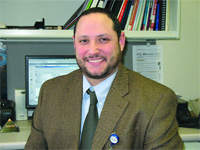
Opinion
Last issue, BusinessWest offered a strong endorsement to Springfield Mayor Charles Ryan’s bid for a second term. Given the many stern challenges the city faces, Ryan’s strong leadership skills will be needed if the city is to make a full rebound from its current fiscal and public relations woes.

But Springfield is merely part of a region that continues to see strong growth in many areas, including health care, higher education, retail, distribution, and other sectors. Indeed, while Springfield has in many ways been stagnant, other cities, such as Holyoke, Northampton, Easthampton, Westfield, and Chicopee, and smaller communities like Belchertown, East Longmeadow, South Hadley, and others, have enjoyed strong commercial and residential growth.

The common denominators in each of those communities are vision and strong leadership. And with municipal elections only a few days away, we encourage area residents and business leaders to exercise sound judgment in the voting booth and support those individuals who will move their communities — and this region as a whole — forward.

People like Westfield’s Rick Sullivan. The city’s five-term mayor is running unopposed this November, but he deserves some recognition for his decade-long dedication to his community. Sullivan has guided the city through a period of change and challenge, and enabled it to take more and better advantage of its many resources, from ample developable land to its airport. Sullivan should be mayor for as long as he wants the job.

Likewise for another leader named Sullivan — Mike. Since becoming mayor of Holyoke in 1999, he has helped orchestrate a notable turnaround in that historic city. This is still a work in progress, but Holyoke has seen an exciting mix of new development and rehabilitation of many of its old mills. A proposal for a minor league baseball team has the potential to bring even greater diversity to an economic base already supported by manufacturing, health care, and retail.

Sullivan, a former business owner, has sought to make city government operate more like a business — meaning a higher level of accountability and, for lack of a better term, customer service. His efforts have brought positive results, and we look for more of them.

Broader diversity is a common goal across the Valley, and Easthampton is another community to make great strides in that area. Mike Tautznik, the city’s first and only mayor, has brought vision and determination to the community’s ongoing efforts to create new business opportunities, particularly in arts-related areas, and deserves the full support of residents.

Perhaps the most intriguing race this fall is in Chicopee, where incumbent Richard Goyette is seeking a second term. Goyette has been challenged by many factors in his first two years in office — from an uncooperative Board of Aldermen to a protracted (and controversial) school superintendent search, to a political campaign this fall that has focused more on personalities and mud slinging than on the issues.

Chicopee is facing a number of business and development concerns — from the redevelopment of the former American Bosch property to downtown revitalization efforts; ongoing growth along Memorial Drive to a reshaping of the Cabotville Industrial park, now under new ownership.

Tackling these issues, as well as others involving education, public safety, and fiscal management, requires real leadership.

The city won’t find any in Mike Bissonnnette, who has a made a career out of running for public office but not winning it. We admire his persistence, but not his resume.

Goyette has some work to do building the kinds of partnerships needed to move any agenda forward, but we believe that he is the best the answer for Chicopee. He is not the lesser of two evils, as some have suggested, but the community’s best hope for real leadership.

Like the mayors of Holyoke, Westfield, Easthampton, and other area cities, Goyette has the requisite vision to take his city forward. Voters should give him at least two more years to carry on that assignment.

John Gormally, BusinessWest Publisher

Uncategorized

A mill town once driven by the steady hum of factory work is now creating a different kind of buzz in Western Mass.; Easthampton is being seen as the region’s most promising community for artists of all types, and it’s the artists themselves, and the support of the city, that are making that happen.

Eric Snyder, president of the Greater Easthampton Chamber of Com-merce, said the best thing about the city’s recent turnaround is that it is tangible.

"Anyone who drives through can see what’s happening here," said Snyder, adding that the proof can be as large as a former mill now bustling with activity — everything from diners eating lunch at the Apollo Grill to people renewing their driver’s licenses at the local RMV office — or as small as an artful clay pot, a set of hand-crafted wind chimes, or a child practicing her violin on the front lawn.

The arts, in all forms, have become the primary economic driver pushing the city of Easthampton forward in recent years, transforming the former mill town into a haven for arts, entertainment, and culture, and revitalizing the city’s overall economic picture in the process.

"There has been a lot of talk about a renaissance in Easthampton," Snyder said. "The arts and crafts community definitely plays a big part in that. There are more people coming into the town because of the arts, and the artists are really marketing themselves, and that’s good for them and for the town."

Although many artists have resided in Easthampton for years, only recently have formal partnerships been forged between groups of artists, and, perhaps more notably, between those artists and city government, the Chamber, and other businesses.

Most artists work out of studio space located in one of three former mill buildings Eastworks, the Paragon building, and One Cottage Street once the hub of Easthampton’s economy and now becoming so again, though in a much different way.

Now, the buildings house potters, painters, jewelers, sculptors, and many other artists working in all types of media. They arrived to take advantage of large studio space, a convenient location, and attractive lease rates, and have since created a creative community unto themselves.

In addition, other businesses are also capitalizing on those low rents as well as the climate created by those artists, especially in the past year. Among them are restaurants like the Apollo Grill in the Eastworks building and Tucson and Savannah’s at One Cottage Street, niche businesses like Valley Women’s Martial Arts Inc. and In Touch Massage Therapy, and a Registry of Motor Vehicles branch office. Those businesses are not only benefiting from the location, but adding to the artists’ visibility, too; that has in turn provided for greater recognition of Easthampton in Western Mass., which is beginning to regard the city as the region’s next great cultural mecca.

"The word is getting out," said Lynn Latimer, an artist who works in fused glass out of the Cottage Street building. "We have a very large community of people who are enormously talented, but it’s recently that we feel a more solid sense of our arts community and the ways it benefits the whole city."

Canvassing the Area

One way the word is getting out is through the marketing efforts of Arts Easthampton, a collaborative organization of artists. The group began informally with a handful of artists in the One Cottage Street mill building, but has since expanded, especially in the last four years following the addition of the ’Arts Easthampton’ name and logo. The collective now includes artists working in the Eastworks and Paragon buildings, individual artists, businesses, and galleries and schools, such as the Guild Studio School, and the Pioneer Arts Center of Easthampton. The city’s own arts council is also very involved.

"It has only been in the last four years that we have all really started getting together," said Evelyn Snyder, owner of Kaleidoscope Pottery in the One Cottage Street building. Snyder explained that Arts Easthampton has gradually grown over the years. Two annual sales are still held now accommodating thousands of visitors to all three mill buildings and a smattering of individual studios, businesses, restaurants, and other venues but Arts Easthampton is becoming much more of a brand than a catchy name for an art show.

"We adhere to a mission statement and to strong rules of governance," said Justin Brown, an artist in the Eastworks building. "We make a real effort to meet and get groundwork laid down about five months before any event, and then we meet as needed until the date of the show. It’s only getting busier for us now."

Brown added that Arts Easthampton also created a common ground for a varied group of artists some production artists, completing large orders of their craft for customers, and others creating smaller quantities or single originals of work for sale. Brown is just such an artist, filling his studio with elaborate, personalized wall-hangings and sculptures. Snyder, although her work is no less unique, produces thousands of handmade plates, bowls, platters, and other items in her pottery studio. She agreed with Brown that Arts Easthampton created a bridge between all types of artists with different work, but common goals for success.

"It only made sense to pull all of the pieces together," Snyder said. "There was already some momentum that we could capitalize on; we had thousands of names on our mailing list, but now that has doubled, and we notice that there are definitely more people aware of and coming to our shows."

The visual arts aren’t the only artistic component of the city, however. Elizabeth Caine, president of the board for Pioneer Valley Summer Theater, located in Easthampton, said she too has noticed audiences increasing steadily over the theater’s three years in existence.

"What’s nice about Easthampton is that it is a city that’s actively looking for economic growth," said Caine. "We get great support, and in turn, our companies support the local economy by shopping, dining, and so on. In the long run, the relationship will make a huge difference in the community because of that mutual support."

And in response to that mounting success, the city has taken a broad interest in cultivating Easthampton’s arts community as an economic tool. It has secured grants for artistic programming and the improvement thereof, and fostering communication and further development of citywide initiatives either spotlighting or merely including the arts community, which includes a wide range of visual artists, musicians, writers, actors, and others working in cultural fields, often in conjunction with Arts Easthampton.

Ellen Koteen, grants coordinator for the city, explained that the first such grant was the John and Abigail Adams Grant, awarded to Easthampton by the Mass. Cultural Council in the amount of $12,500, which, as a condition of the grant, required the city to produce matching funds.

"We wanted to establish a formal arts and economic agenda, and the John and Abigail Adams grant was the first activity with that in mind," Koteen said, noting that the funds will be used to establish a new Web site for Arts Easthampton and to create a brochure and directory of the arts scene in the city.

She added that the matching component of the grant did more than add to the amount of funds available to the cultivation of arts programming — it also underscored the increasing faith the community has in its arts sector.

"The funds came through in February, requiring us to immediately search for funds for that one-to-one match," said Koteen. "We asked businesses to commit money and, in a short period of time, local companies kicked in almost $12,000. It demonstrated to the artists that the city recognizes their contribution, and there is a commitment to work with them."

Eric Snyder added that the arts also create a unique economic driver for the city, which he thinks Easthampton is ready to embrace. As most arts-based businesses are small, even consisting of just one or two people, there are dozens of independent businesses peppered across Easthampton, and that creates a different economic climate than a manufacturing plant or large retailer that could set up shop in the city and offer jobs to 100 or 200 people at once.

He noted that the city, once dominated by manufacturing, still has a few mainstays in the manufacturing sector among them Tubed Products, National Nonwovens, The October Company, and Stevens Urethane, which together employ about 1,200 people. The Williston Northampton School and Easthampton Public Schools round out the city’s major employers, adding another 500 employees to the tally. Viably, expansion of the manufacturing sector could benefit the town economically, and the city could have easily chosen to focus on that aspect if its financial picture, given its rich history.

But Snyder said the arts community has already proven in the last three to four years that its impact is just as important to Easthampton’s revitalization as any one employer could be.

"The chamber is open to this type of economic development," he said. "It is slower than the economic impact that could be generated by a large company, but the arts community has made our city much more rounded.

"It’s all about quality of life," he added. "Now, we still have our small town flavor, but we are also developing a metropolitan feel that is encouraging."

Artistic Integrity

The city has also planned ’visioning sessions,’ one in September of last year and the second just this month, designed to provide a platform for the city’s artists, government, business leaders, and other concerned citizens, specifically on the topic of cultivating and expanding artistic endeavors in Easthampton.

"It also studies the specific impact of the arts on the town," said Koteen, adding that part of that commitment the city has made includes hearing and addressing the concerns of the city’s artists.

"We have signed on to address the needs they have identified and how to best capitalize on and enhance their role in the city’s development," she said.

The need that is of the greatest concern to Easthampton’s artists is that of retaining affordable studio space. It’s a trait of many artists of all kinds that they will move to a community where affordable space can accommodate their work, contribute to diverse, healthy commerce in the area, and eventually be priced out of the studios for which they helped create a demand.

"The artists talk all the time of moving into affordable space, revitalizing the community, and getting priced out and moving on to a new, developing community," said Koteen, theorizing that Easthampton’s rapid improvement due to the art-based businesses is calling added attention to the nomadic nature of many full-time artisans, musicians, actors, and others working in cultural fields. "We have three old mills filled with artists. So far, the space is still affordable, and yet it takes years for a community to address such an issue, and then to implement whatever changes they see fit, so it’s definitely a concern."

Evelyn Snyder agreed. "It is a worry," she said. "But there is still more opportunity here for artists than in Northampton, which doesn’t have very many big, empty buildings, and that’s what brought us here, in addition to the low rent."

What is driving the Easthampton arts scene forward now is not just affordable workspace, though, she said; it’s the partnerships that have evolved between the artists in the community and local businesses, city government, and residents at large that are creating a sort of staying power, which is also unique within the world of art and artisans.

"All of us are excited about educating the public on the fact that you can make money as an artist," said Snyder, "and it’s nice to be in a strong group situation. It helps us to see the trends within the art world and to capitalize on good times and get through bad times."

Latimer added that getting a lot of different artists together on a project of this magnitude is no easy feat.

"It’s a bit like herding cats," she joked. "But this revitalization has come out of a lot of people pulling together in a grassroots sort of movement, and we’re seeing positive results that keep us going. The added notoriety of Easthampton as a thriving arts community is ultimately helping our businesses, and the added attention is making the city happy overall."

Brown said as the arts scene grows in the city, another challenge is how to best capitalize on the increased traffic, and the partnerships with the city’s government are helping to guide that process as well.

"The city has some great ideas and they’re getting more involved," he said. "They know why Easthampton is getting busier; now to keep it that way they’re helping us with the how."

Creating a Masterpiece

The annual Open Studio Sale held earlier this month by Arts Easthampton marked the city’s busiest weekend of the year, rivaled only by the Holiday Sale held in December. Throughout Saturday and Sunday, artists were busy wrapping pieces, businesses held sidewalk sales to capitalize on the traffic, and there was a bit of a wait for a table at the Apollo Grill. But Latimer said the signs of a community rising from the ashes are not best gauged on a busy weekend, but rather on the quieter days, when even then there is a marked change in the city.

"There’s definitely more life out there on the streets," she said.

Jaclyn Stevenson can be reached at[email protected]
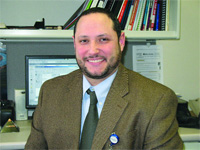
Opinion
Richard Goyette was sworn into office as Chicopee mayor in January after surviving a close (350-vote) race with former mayor Joseph Chessey. He assumes the corner office at a time when Chicopee remains in an expansion mode, with a new high school nearing completion, a new city library set to open, and Wal-Mart planning to come to Memorial Drive. These are all projects set in motion during the administration of Richard Kos, who is credited with taking Chicopee, the region’s second-largest city, out of the doldrums and putting it on the road to sound fiscal health and economic vitality. Goyette, who served on the Board of Aldermen during the Kos years, says his predecessor built a solid foundation. Now, he wants to build a house on top of it. BusinessWest talked with the new mayor about his goals for the city, his strategies for reaching them, and his thoughts on everything from Wal-Mart to a planned women’s prison.

BusinessWest:Before we get into a deep discussion about business, economic development, and your vision for Chicopee, tell us why you wanted this job, and at this time in your life and career.

Goyette:"This is something I’ve always had an interest in. I told my wife this, and when Mayor Kos announced that he was not going to run, she and I sat down and had a long talk about it. I didn’t want to look back 20 years from now and say, ’would’ve, could’ve, should’ve.’ Being mayor is something I always wanted to do, and this was my opportunity."

BusinessWest:You’re following Kos, a man who is credited with having not only vision, but the ability to make that vision reality. Is he a hard act to follow?

Goyette:"He is. He did a wonderful job for the city. He built a wonderful foundation — not only with the city’s finances but with a number of projects across the city — and now I’m hoping to build a house on top of that foundation."

BusinessWest:What did you do in the private sector, and do you believe any of those experiences will help you handle the duties of being mayor?

Goyette:"I was sales manager at the Springfield Sheraton for a few years, and before that I was in the aerospace industry; I was in charge of manufacturing at a company called Fountain Plating in West Springfield. After Sept. 11, things in the aerospace industry took a real nosedive, so I took a career change. And I really think my job as a sales manager will help me here. When you’re in the hospitality industry, customer service is important — you have to deal with people on a one-to-one basis. It’s very similar when you’re mayor; I’m basically the salesman for the city.

BusinessWest:How else would you define your responsibilities in this position? Give us your job description.

Goyette:"The mayor is the chief executive officer, so obviously, you have to make a number of financial decisions. Beyond that, though, the mayor sets the agenda and tries to move forward with a vision for the city and what it should be. I’ve lived in Chicopee most of my life — I’m the fourth generation of my family living in the same house in Aldenville — and I have a vested interest in this city. I want businesses to locate here, I want to see investment in my community, and I’m the point person for that."

BusinessWest:Speaking of moving agendas forward, what are your priorities when it comes to economic development in Chicopee?

Goyette:"Like every community in the area, we want to attract companies that are going to bring good-paying jobs. We’ve had some good success stories in the past few years — Channel 22, Williams Distributing, MassMutual’s conference center, and some businesses in the Westover industrial parks. We want to build on that. We have an attractive location, and we have some places for companies to go. There are some lots left in the Westover parks, and we have the Chicopee River Technology Park, as well.

"In addition to attracting new, larger companies, we want to take in some smaller companies and give them the space to get to that next stage. There is room in Cabotville for this type of development. I know Springfield has been successful with very small businesses in the STCC incubator; we’re looking at trying to market Cabotville and some of our other old mills as the place to take the next step — when a company outgrows its space in a smaller facility, we want it to think about Chicopee."

BusinessWest:Wal-Mart is coming to town in the former Fairfield Mall complex. What does this mean for Chicopee and for Memorial Drive?

Goyette:"I think this is going to work out very well for this city. One of the biggest complaints that I hear from people is that they live in the second-largest city in the region, but they have to go to Holyoke or Springfield to do their shopping. There are no major stores here. Wal-Mart is just going to be the start. There is room at the site for six small boxes, and I think you’ll see a lot of interest on the part of major retailers — our first national chain, the Ninety Nine, is going into the spot in front of the old mall.

"This development is also going to bring more people into Chicopee; it’s going to be a huge boost for the businesses currently there. Because of its location just off the Turnpike, it’s very accessible, and people will be coming to Memorial Drive who haven’t come that way in the past. I think this will develop the same way Riverdale Road did — first you had Home Depot, and then Costco, and it took off. Now, you have Chili’s, an Outback, and a lot of other restaurants. We’re expecting similar things.

BusinessWest:Is that good or bad? Can Memorial Drive handle the kind of development that’s being talked about? Are there fears that you could have traffic problems similar to those seen on Riverdale Road?

Goyette:"I think it’s good. People want to spend their dollars in their own community. As far as the traffic goes, I think we have a better arrangement than Riverdale Road — there’s better access and better traffic flow. Once Wal-Mart is in place and those box stores fill up, things are really going to take off; it will be great for our tax base and great for our residents, and it will provide jobs.

BusinessWest:Chicopee is an industrial city that has many large employers. But is fast running out of developable land. What does this mean, and how can the city continue to attract jobs with this apparent handicap?

Goyette:"As our land gets filled up, we’re going to look at redevelopment of existing buildings and underutilized parcels. One site we’re looking at for the long term is the former Uniroyal complex and the adjacent Facemate property (see related story, page 22). There are some environmental concerns, but down the road, this will become space that we can utilize."

BusinessWest:Plans to build a women’s prison at the site of the former canine control center are now on hold due to the state’s budget problems. Most people don’t think of a prison as economic development, but you and your predecessor both believe this is an opportunity for Chicopee. Why?

Goyette:"It does represent economic development — it’s going to bring jobs, probably 100 or more, into the city. And that project brings a number of infrastructure improvements with it. There are plans for a major reconstruction of Center Street from the Springfield line to downtown. That project is on a separate track from the jail, but, realistically, it won’t happen until the jail does."

BusinessWest:Is there a new timetable for the jail?

Goyette:"Not that I’m aware of. The state is currently conducting a needs assessment of its correctional facilities, and doesn’t want to spend money on projects like this if it doesn’t have to. Obviously, we’re hoping this project gets back on track."

BusinessWest:Unlike many cities and town in this region, and especially Springfield, Chicopee is in good fiscal health. How did it get that way, and how will you keep the city on that course?

Goyette:"Four or five years ago, the mayor and the Board of Aldermen worked on a lot of things, and while many communities were just handing out things and creating new jobs — like Springfield adding 100 new police officers — we were tightening our belts and looking at the situation and saying, ’the good times aren’t going to last forever — we need to save for a rainy day and put some money away.’

"When I took office as an alderman, the stabilization fund had $5,000 in it. Now, it’s got $10.5 million. Obviously, we worked very hard to do that, and now that times are tougher, we may not be able to save a lot of money. We may have to continue to scale back, but at least we have that cushion."

BusinessWest:What else do you have on your to-do list?

Goyette:"One of the projects in front of us is redevelopment of the old (current) Chicopee High School. When we move into the new one this fall, we’re going to have a very large, vacant building on our hands. We’re looking at combining some city departments in there, or perhaps a senior center, or even moving the school administration offices in there. There’s a lot of consolidation that can take place, and a lot of options for us to look at.

"Ultimately, I think we’re looking at mixed uses for that building, and there are a lot of things we have to take a look at. That’s why the city is paying to have a facilities study done of all city buildings, including the schools, City Hall, any municipal building. Once we get that back, then we can determine what our options and priorities are, and decide where and how to spend money on these buildings. To this point, we’ve never had something like this; we’ve traditionally waited until something is broken and then found the money to fix it."

BusinessWest:You’re wrapping up those proverbial ’first 100 days in office.’ What has the experience been like? Is being mayor about what you expected when you decided to run for the seat?

Goyette:"It was a real advantage to me to be on the Board of Aldermen for six years, two years as president. I had a chance to work with a lot of the department heads and cope with the issues the city was confronted with; I was part of the process, and as a result I had a pretty good handle on things.

"That said, there’s a lot to do, and much of it is things that people don’t see or fully appreciate. People don’t see the nights, the weekends, and the events you’re expected to attend — the Boy Scouts, the banquets, the church services … there’s so much, and people expect to see the mayor there; it’s part of the job, and an important part.

BusinessWest:How long do you think you want to do this?

Goyette:"I just got here, so it’s really hard to say how long I might want to keep this job. I hope it’s a while. I very much enjoy the job, but it puts some constraints on how much time I can spend with my wife and family — I have two children and five stepchildren. We’ve tried to make this experience fun for the kids. During the campaign, they would come out and hold signs … it was a learning experience for them in how government works; it’s one thing to go in the classroom and talk about how people get elected, but it’s another thing to be part of the process."

BusinessWest:One more question: You’re one of the very few Republican mayors in this state. Is that going to help you or the city in any way?

Goyette:"The governor and I are on a first-name basis, but I’m not sure being a Republican is going to be a big help. But at the moment, it doesn’t hurt, either."

Opinion

Since taking the reins at the United Way of the Pioneer Valley early this year, Jim Horne has been working hard to make the agency more visible in the communities it serves. His broad goal is to see the institution evolve from an organization that merely raises money and then distributes it, into one that helps communities identify needs, establish priorities, and set agendas.
Jim Horne says that, historically, the United Way has been an organization known for raising money and then allocating it. It’s also been known as a group that is anywhere and everywhere during the annual fall campaign, but then goes into hibernation when it’s over.

Since he became president and CEO of the United Way of the Pioneer Valley (UWPV) in January, Horne has been working overtime to change both of those long-held perceptions.

He wants the United Way to be known as group that doesn’t just ask for money every September. Rather, he wants it understood that this is an organization actively involved in the cities and towns it serves — one that takes a leadership role in determining where and how investments should be made in area communities.

In other words, he wants the organization to be part of the agenda-setting process in those communities it serves.

Meanwhile, he’s been working to significantly raise the United Way’s profile in those communities, with the goal of familiarizing people with its purpose, and letting people know that when they take part in a YMCA program or join the Girl Scouts, they’re benefiting from United Way-funded agencies, or partners, as they’re now known.

In his first nine months at the helm, Horne, 43, has made visibility a priority — for himself and the United Way as a whole. He’s spoken to every Rotary Club in the region and has been a regular on the chamber of commerce breakfast circuit. But he’s also gone much further in his efforts to get to know the cities and towns in the area and the issues that impact them.

"I want to establish relationships," he explained. "To do that, you have to really know a community, its leaders, and its issues. I’ve spent a lot of time in Holyoke, Chicopee, Westfield, Palmer, Monson, and all the other communities we serve; I’m doing a lot of listening, and I’m showing them the face of the United Way."

Horne, who came to Western Mass. after a stint as vice president and COO of the Akron, Ohio-area United Way, told BusinessWest that United Ways across the country are facing a number of challenges today.

For starters, he noted that, while Baby Boomers and those who preceded them generally understand the United Way and the reasons for its existence, the younger generations do not, and they need to be convinced there is still a place for it. "It’s not enough to say we’ve been around since 1918 — that’s not going to cut it," he said. "We need to show people that through our work, we can make the community stronger."

Meanwhile, the business landscape has changed across this region and the entire country. The large corporations that facilitated fundraising efforts for United Way chapters are disappearing from the landscape, replaced by smaller businesses whose employees and managers are much more difficult to reach.

Locally, Horne said, there is a perception that the United Way is a Springfield organization, leaving many in area suburbs with questions about if and how the organization benefits them. At the same time, the local business community’s involvement in the UWPV has declined over the past decade or so, he said, adding that he wants to "re-engage" many business leaders.

Since arriving in January, Horne has been addressing all these issues simultaneously. His first priority has been to make the United Way more visible — 12 months of the year — but he is also working to make sure the organization is heard, not just seen, and that, more importantly, it listens.

The Job at Hand

"Upside potential."

That’s the phrase Horne used to describe the UWPV, and the reason why he chose that organization over a United Way in Michigan that was also vying for his services.

While he didn’t actually use the term, Horne implied that the local organization has been underachieving in recent years — from a fundraising perspective and several others — and he saw an opportunity to achieve profound growth.

"I like challenges," he said, noting that, while the UWPV has been successful in raising millions for the dozens of groups it supports, it lags statistically compared to other United Ways nationwide. For example, the UWPV has 12 ’major gift’ donors ($10,000 and above), while other groups its size average between 30 and 50. Meanwhile, the UWPV has 600 gifts in the $1,000-to-$9,000 range (the group known locally as the "Pillar Society"), while others its size have 800 to 900.

Overall, the UWPV has a rate of participation (those who donate) of about 26%, while the national average is closer to 35%. Over the past several years, fundraising has been flat (at or around the $6 million mark), Horne said, noting that there have been several factors contributing to this, including the sluggishness of the economy, a sharp decline in the number of major employers, and some campaign strategies that haven’t been effective in getting the message out.

Beyond the dollars raised, however, the UWPV has some work to do to become more involved in the communities it serves, he said, and move beyond the roles of fundraiser and check-writer.

"I looked at the two geographic areas that I was considering and what their needs were, and became intrigued by the possibilities in the Springfield area," he said. "I wanted to be part of raising the profile of this United Way."

Horne has been involved with the United Way since 1994, but he likes to say that the relationship began much earlier, when, as a 10-year-old growing up in Bridgeport, Conn., he would venture to the city’s Boys & Girls Club after school while his mother, a single parent, worked.

The club was a beneficiary of United Way funding, but he didn’t know it at the time. He would find that out nearly two decades later, when, as a production analyst for Sikorsky Aircraft, he became a loaned executive for the United Way of Eastern Fairfield County.

Active in the Bridgeport community — he was on the school board for three terms — Horne enjoyed the work as a loaned executive so much he decided in 1994 to make a career change and join the organization. He described it as a difficult decision, but one he has never regretted.

"I loved the work I did at Sikorsky … I enjoyed my assignments there, which included product support for the presidential fleet and being involved with some experimental projects," he said. "When the offer was put in front of me and I was trying to decide which way to go, my vice president at Sikorsky, who was also board chair for the United Way, sat me down and asked me where my passion was, and where I saw myself being the most productive in the future.

"I really enjoyed helping people see the value of supporting the community through philanthropy," he continued. "It was my experience then that a lot of folks didn’t understand fully the work that the United Way was involved with and how that work improved the community. I realized that there was enormous potential to engage the business community and potential donors to support the United Way."

He started in Bridgeport as a campaign division manager, and in two years became executive vice president of that United Way. He left in April 2000 to become vice president of the United Way of Summit County, Ohio, and eventually assumed the title of chief operating officer there.

Summit County is what’s known as a metro-1 United Way — one that exceeds $10 million in fundraising — and Horne was enjoying his work there, but he desired to direct his own United Way. Late last year, he became one of 70 candidates vying for the opportunity to succeed long-time UWPV director Ty Joubert.

Horne has spent his first several months in the region getting to know the communities served by the UWPV, and also setting a course for expanding the organization’s role in the region.

The Buck Stops Here

When asked how to go about improving the UWPV’s fundraising numbers, Horne said that assignment has a number of components. Generally, however, it comes down to two factors: access and education. In other words, the organization needs to get in front of more people, and when it does, it needs to present a strong case for the United Way and its partner organizations.

The first task becomes more complicated in today’s business community, one dominated by small companies rather than large corporations, he said. In years past, the United Way could visit those large employers and make a presentation that would reach hundreds, if not thousands, of people. Today, there are only a handful of companies in that category, while the numbers of sole proprietorships, home businesses, and telecommuters are on the rise.

And in many smaller businesses, time-strapped managers don’t have the hours in the day to offer a lengthy program highlighting the reasons why someone should give generously to the local United Way.

To reach the managers and employees of smaller companies, as well as professionals such as lawyers, doctors, and dentists, the UWPV will rely on modern tools like the Internet and direct mail, said Horne, and it will also make more and better use of volunteers who have connections to those in hard-to-reach groups and can provide access.

"What we know is that people give to people," he continued. "And people give to causes — good causes."

Which brings Horne to the second part of the equation — education. "Once we get access, I feel we have a compelling message," he said. "We can show people that, when they contribute to the United Way, they can make their community stronger."

Horne was hesitant to set hard goals for the UWPV, but he believes the organization can reach the $8 million-to-$10 million mark within the next decade.

"If all things remain constant, I think we can get to that level," he said, adding quickly that he will likely need more support from the business community to get there.

"There are a number of community leaders and business leaders who are actively engaged in improving the quality of life in the Pioneer Valley," Horne told BusinessWest. "One of my goals is to find ways to increase their involvement with the United Way’s agenda and have them become a greater part of our work."

"Looking back at the ’70s and ’80s, we had more involvement from the business community," he continued. "While things have improved somewhat in recent years, we still have a number of opportunities to re-engage."

While working to improve fundraising totals, Horne said he also wants the United Way to play a much larger role in setting priorities for how the funds that are raised are allocated — and he said the two initiatives are in many ways intertwined.

"When we increase the visibility of the United Way, and people see us as a true community partner," he said, "I believe people will donate more and they’ll donate more often."

Horne said the goal for the UWPV is to be part of the agenda-setting process, which is somewhat of a departure from its historical mission, but a necessary evolutionary step if the organization wants younger generations to fully understand its purpose and importance to the community.

"Our current process is to raise money in the campaign and then talk with our community agencies to understand better what programs they’d like for us to invest in," he said. "Part of our new strategy is to continue conversations with those member agencies, but also expand them to other service providers and potential programming partners so that we’re better understanding how to maximize our resources."

Ultimately, the goal is to create partnerships with a broader range of non-profit groups, said Horne, who told BusinessWest the shift is part of a nationwide trend toward moving well beyond fund allocation.

Part of the process of partnering with communities is convincing area residents and business leaders that the UWPV is not a Springfield organization, he said, and to that end, the chapter this year staged five campaign kickoff events, instead of the one program traditionally held in Springfield.

"That’s one of the ways we’re making the campaign more personal," he explained, adding that the UWPV is also encouraging its employees to become more involved in their communities by joining civic and fraternal groups and taking roles with neighborhood organizations, human services agencies, and economic development bodies.

"The more people are involved, the better they can help assess the needs of a community and find ways to address those needs," he said. "That’s part of the process of becoming better partners."

United Front

Horne said it wasn’t until he became a loaned executive that he realized that, as a youth, he was benefiting from programs supported by the United Way.

He told BusinessWest that he doesn’t want people to recognize 20 years after the fact that their lives have been improved thanks in part to the United Way.

Through awareness, visibility, and active involvement in area communities, Horne wants to raise the United Way’s profile. By doing so, he knows he can also raise a few more dollars.

Features

The mayoral race in Springfield is over, and Charles Ryan has emerged as the city’s next leader. He won a position it seemed that no one else wanted, and in the weeks and months ahead, he’ll come to fully understand why the field was so slim.

This will be a very challenging time for the city — and especially the person in the corner office. The city is currently in very shaky financial condition, and, by most estimates, things are going to get worse before they get any better.

The budget will be the first priority for Ryan, and he has already given an indication of some strategies he will use to improve the bottom line. These include more conservative spending policies (which are certainly necessary) and also more aggressive pursuit of delinquent property taxes and a campaign to compel the state to fund more of its obligations to cities and towns, including Springfield.

Getting more money from the state — not to mention tax deadbeats — will be very difficult, and we wish him luck with these assignments.

While going to work on the city’s finances, Ryan will have some other challenges, many related directly to the vitality of the city’s business community. At the top of this list, we believe, is restoring a sense of confidence and respect in City Hall. Both of these have been lost in the last term of the Albano administration, and it falls upon Ryan to restore a sense of integrity to the city.

Most members of the Albano administration would disagree, but we believe that the recent undercurrent of corruption and favoritism in City Hall has hurt Springfield’s efforts with economic development. Employers and entrepreneurs looking for places to start or expand a business have many options — locally and across the region — and we sense that many are looking elsewhere, and will continue to do so unless or until they can view Springfield as a business-friendly community where leadership is not pushed and pulled by influence peddlers.

There are other matters on Ryan’s to-do list, however.

For starters, there will be some key appointments, starting with leadership of the Community Development Depart-ment and the Law Department, two posts that are vital for the health and well-being of the city’s business community. Finding good talent will be a challenge, but we believe Ryan can find people committed to Springfield who are willing to serve.

Meanwhile, there is the matter of the city’s Building Department, which is certainly broken and in need of fixing.

As we said several months ago, the Building Department has no real leadership — there is no head of that department at present — and this fact has led to a frustrating backlog of work that has slowed many companies’ plans for development and expansion.

Ryan said many times during the campaign that bulking up the Building Department and giving it the resources to do its job will be one of his priorities. We hope he follows through with this promise and makes an appointment based on qualifications, not politics.

Lastly, we believe Ryan needs to listen and give the business community a stronger voice. Recently, it seems, many policy decisions have been made without clear input from business leaders.

Ryan will have a good opportunity to listen at a business summit set for Dec. 4. Organized by the Springfield Chamber of Commerce and the Springfield Business Development Corp. and sponsored by Banknorth, the summit will provide area business leaders with a chance to set an agenda.

We urge Springfield business owners and managers to take part in that summit and become part of the process. And we encourage the Ryan administration to take what comes from that meeting as a good starting point for his economic development strategy.

There will be no shortage of challenges ahead for Ryan and the team he assembles to lead Springfield. But with every challenge comes an opportunity, and we look upon this new administration as a vehicle for moving Springfield forward.

Sections Supplements

In response to alarming statistics concerning the health and well-being of Springfield’s children, the Irene E. and George A. Davis Foundation has launched its Cherish Every Child Initiative. The multi-faceted effort is a proactive attempt on the part of the foundation to secure a better future for Springfield, and the business community is being urged to get involved because the effort is as much about economic development as it is quality of life.

John Davis likes to relay the story he heard about a traditional greeting among the people of one village in Africa that translates into ’how are the children?’

"It’s not ’hi,’ or ’how are you?,’ or ’what’s happening?’" said Davis. "But, ’how are the children?’ That’s poignant, because that’s how any culture should gauge how healthy it is — by how well the children are doing."

It is with this mindset that Davis, former president of American Saw & Mfg. In East Longmeadow, and the Irene E. & George A. Davis Foundation, the philanthropic organization he serves as a trustee, launched an ambitious campaign called the "Cherish Every Child Initiative." The program, as the name would indicate, turns the spotlight on Springfield’s children — who are not nearly as healthy (figuratively and literally) as anyone would like.

Launched in 2000, the Cherish Every Child Initiative was designed to pinpoint the needs of the children in the state’s third-largest city — most of which are obvious — and to identify ways to address these needs, which are anything but obvious.

Davis — who refers to the initiative as a Springfield endeavor, not a Davis Foundation endeavor — described it as a proactive effort to improve the quality of life for Springfield’s children, and as such it represents a departure from the role of this and most other foundations.

"A lot of our gifts over the years have gone to children’s agencies, and much of that gifting was in reaction to someone coming to us with a need or a problem," he said. "We decided to take a different approach and say, ’what are the needs? … what can we do about them in a proactive manner to stem some of the problems?’"

Through a series of meetings involving government leaders, educators, human services officials, health care providers, and members of the business community, the initiative has identified several targets in an overarching plan for the delivery of integrated, high-quality services to young children and their families. The recommendations include plans to:

• Strengthen and coordinate services to families;

• Ensure early education and care for all children age 5 and under;

• Strengthen the early childhood workforce;

• Promote and sustain programs to optimize the health and well-being of young children and their families;

• Raise incomes for the families of young children;

• Encourage recreational and cultural enrichment;

• Establish quality of life indicators for Springfield’s young children and collect and disseminate reliable data on their status; and

• Develop a community awareness campaign.

Working groups have been addressing each of these recommendations, said Mary Walachy, executive director of the Davis Foundation, who told BusinessWest that a status report is due later this month. When it comes out, the groups that have been working on the initiative will have a better road map for reaching their destination, she said, but the bumps in that road will be many.

"All of the recommendations we’ve identified come with challenges," she said. "There won’t be any quick fixes to these problems, but together we can do things to provide a better future for these children."

Walachy said that one of the initiative’s major thrusts has been early education, and support of an endeavor called Early Education for All, which would provide free pre-school programs for every child in the state. The legislation now working its way through Beacon Hill is exemplary of the type of public policy the initiative is backing to improve the quality of life for Springfield children — and provide a better-educated workforce for the future in the process, she said.

Margaret Blood, who is heading the Early Education of All initiative, is also a consultant to the Cherish Every Child Initiative, and conducted interviews that helped identify the eight target recommendations. She called the effort unique in many ways and also a possible model for communities and states across the country.

"What the initiative has done is convene the community to address the issue of Springfield’s children," she said. "That’s important because that’s how these problems can be solved — with everyone pulling in the same direction." Blood told BusinessWest that the region’s business community must lend its support to the initiative, in part because it has the resources and the clout to influence decision-makers on public policy affecting children and families. But it is also a matter of self-preservation; healthier, better-educated children will create a stronger, more versatile workforce down the road, she said.

Davis concurred. "The business community has to look at its contributions to this initiative, whatever they are — time, money, energy — as investments," he said. "They won’t see any return on those investments in a day or a year, but they will be there in the long run."

Not Child’s Play

Davis told BusinessWest that as he and others first started tossing around the idea of rallying a city around a program to improve the lives of Springfield’s children, the concept seemed like pie in the sky. But he said the sobering statistics kept driving home the necessity of such a campaign.

Those numbers paint a grim picture:

• 39% of the children under 18 (about 2,624 individuals) live in poverty, as defined by the federal government — a three-member household earning $14,630 or less;

• Approximately 18% of Springfield’s households with children are headed by a single parent;

• Almost 63% of children under age 5 who are living in a female-headed household are poor;

• Amost 20% of the 2,000 babies born to Springfield women each year are born to mothers under the age of 20;

• Approximately 38% of these babies are born to mothers who receive inadequate prenatal care;

• 10% of babies are born with low birth weights, and each year, approximately 20 of these babies die before their first birthday;

• Approximately 8% of Springfield’s young children are not covered by health insurance, and there is an extreme lack of routine dental care among thousands of children.

The Cherish Every Child Initiative is working to pull various constituencies — including the business community — together to do something about these statistics, said Walachy. She noted that the foundation, with its clout in the region, especially among non-profit groups vying for donations, has the ability to tear down many of the silos that segregate the groups working on various social issues, and get people in a room.

Once in that room, the goal is to get those groups together to identify needs and collect the hard data required to effect public policy and bring about change, said Walachy, placing emphasis on the need to qualify and quantify the challenges facing children and their families.

"We need to look at what the data is telling us about the children of Springfield," she said. "And then we need to look at what the research is telling us about we ought to be doing about the data we’ve collected, and then from there we have to look at what roles we and everyone else can play."

The enormity of the assignment has prompted many to question where and how to start, said Walachy, who told BusinessWest that all eight recommendations are being addressed at once, and the broad goal is to development a strategic plan of action.

"We start at ’A,’ and eventually we’ll get to ’Z,’" she said, adding that the process with each of the recommendations begins with an understanding of current conditions, and then moves on to setting realistic goals and devising specific methods for achieving them.

She and Davis both stressed that hard data is the key is to not only understanding the issues, but creating real change.

"You need data to make scientific decisions," said Davis. "Anyone can say, ’I think this,’ or ’I think that.’ But we don’t want to guess — we want to know what we’re up against."

One of the key elements of the initiative is public policy, said Walachy, noting that the problems facing Springfield’s children and their families cannot be solved by one foundation, despite its resources and its clout.

"The Davis Foundation isn’t going to end poverty for the children of Springfield, and it isn’t going to increase the pay scales, respect, and educational opportunities for our early childhood workforce," she said. "So a critical component of this work is in the public policy arena and the setting of an agenda that will address these areas we’ve identified."

School of Thought

To illustrate the initiative’s purpose — as well as the many layers of challenges awaiting those involved with this effort — Davis, Wallachy, and Blood focused on one of the recommendations, early childhood education, and a bill before the Legislature to spend $1.2 billion a year for voluntary half-day programs for all children ages 3 and 4 and for full-day kindergarten for 5-year-olds, regardless of their family’s income.

The plan is ambitious, said Blood, who told BusinessWest that the initiative has the backing of a number of business and labor groups — including AIM, the Mass High Tech Council, the AFL-CIO, and the United Auto Workers — that rarely come together on issues of this nature. The concept is also backed by statistics showing that, when children get a quality early education, they have fewer problems later on.

"The research is clear — a child who has a quality early childhood education does better in life," she said, citing data showing that the most critical learning period for humans is from birth to age 5. "They are more successful, they stay out of jail; quality early education cuts down on welfare, it cuts down on special education — there is a huge return on investment."

Those supporting the bill are stressing its long-term economic benefits, not its feel-good elements, and a $300,000 media campaign that began last month has been driving those points home.

But despite the statistical evidence, the "unusual constellation of supporters for the bill," as Blood called it, and the intense lobbying effort, the legislation is facing long odds for funding— at least for the immediate future.

With the state staring at an estimated $2 billion deficit and many popular programs facing cutbacks, both state Senate President Robert Travaglini and House Speaker Thomas Finneran say it will be difficult to fund the bill this year.

And if and when it is funded, there are other issues that will emerge, said Blood, noting that the Commonwealth currently has no statewide vision on how to attract and train the teachers necessary to provide all that early education.

Pay scales in Boston for such positions are about $8 to $10 per hour, she noted, and even worse elsewhere. Unless there is a profound change in how early education teachers are valued — and compensated — there will be problems finding adequate numbers of teachers.

But Blood views the early education campaign — one she has poured three years of her life into — as a marathon, and she says the Cherish Every Child Initiative looks upon its work in the same way.

"We’re looking at this for the long haul — Springfield has the third-highest child poverty rate in the state, and Cherish Every Child is not going to make a huge dent in that tomorrow," said Walachy, who told BusinessWest that the immediate goal is for the community to take ownership of children’s issues and not view them as someone else’s problems.

For the business community, this means coming to understand that investments in children today will generate a stronger workforce tomorrow. Beyond that, however, steps to curb poverty and make children healthier will leave the community with fewer financial burdens, said Davis.

"Most business owners are long-term thinkers — they don’t invest in a new machine and look for the payback the next day," he said. "We want them to understand that the same works when you invest in children; the payback isn’t immediate, but there is a return on investment."

Young Ideas

Summing up the Cherish Every Child Initiative, Davis said it is "a process, not a lightning bolt."

By that, he meant that this is an initiative with no quick fixes, a campaign that will have hard-earned results that may not be seen for many years.

And it’s a process that would move more quickly and more effectively if more people would ask the question, ’how are the children?’