Home Posts tagged Construction (Page 50)
Sections Supplements
The Many Benefits of Business Interruption Insurance

You don’t have to go far to hear disturbing news of a disaster crippling a local business – a fire, an explosion, etc. All systems are down, and day-to-day business operations come to a standstill.

Then the resilient business owner announces, to the delight of everyone, that the company will continue to pay its bills and salaries until it gets back on its feet – leaving many on the sidelines questioning, ‘How are they doing that?’ The answer: A well-advised business manager included business-interruption insurance in the company’s risk management program.

A properly designed insurance program will financially protect the business owner from events it would otherwise not be able to afford to recover from. These events could include a lawsuit stemming from the actions of one of its employees. It would most certainly include a fire that destroys the building, machines, and tools used every day to conduct business.

Most business people feel they are acting wisely in purchasing just such an insurance program, one that will financially protect the business from these crippling types of events. Unfortunately, this is a critical element of the insurance coverage that is often overlooked.

Your property policy will cover just that, the property of your business. It truly is a great relief to have the financial security to rebuild your building or replace the equipment that is vital to the functioning of your business. That is what comes most often to mind when people consider these types of events.

However, new construction of a building can take months. While equipment can be replaced relatively quickly, it will still take some time before a suitable replacement location can be found, if one can be found at all. In the meantime, the bills continue to come in, your employees can’t afford to be out of work, so they find new jobs, and your customers turn to your competitors to take care of their needs.

How does a business recover from that scenario?

An insurance program that includes a business-interruption policy could provide the resources for a business to survive such a scenario. In its simplest description, a business-interruption policy is designed to pay for the net income that would have been generated if the business were not shut down. It will also provide the funds to pay for expenses – including payroll – that will continue while the business is not operating. It could be tailored to compensate the business for additional expenses that result from efforts to keep operations going or reduce the length of the interruption. The policy could also be structured to extend beyond reopening of the business to allow the clientele to be re-established.

The key coverages of a business-interruption policy are business income and extra expense. These can be purchased as one policy or each separately. Business-income coverage is the portion of the policy that will respond to provide the policyholder the funds to pay for ongoing expenses and will provide replacement of net income. The interesting point here is that it is not necessary for the business to be making an actual profit. In this instance, the policy will provide for the portion of the ongoing expenses that the operation of the business was contributing. The extra-expense portion of the policy will provide reimbursement of above-normal expenses for the business to continue operations. It will also reimburse necessary expenses to get the business to normal operations as soon as possible.

By their nature, some businesses won’t actually have a suspension of operations. However, they would have significant additional costs to remain running. These types of businesses could purchase the extra-expense policy without including the business income section.

When reviewing a business-interruption policy there are several things to consider. First are the causes of loss that are covered on your property policy. The business interruption policy will respond if the loss occurs as a result of a covered cause of loss on the property policy. So business owners need to make sure they review these policies together.

A second important element is the deductible. Unlike most insurance policies that have a monetary deductible, the business income section of the policy has a time deductible; typically, the wait period is 72 hours. A third critical element of the policy is in selecting the limit of insurance. It is important to consider your past financial performance, the co-insurance clause on the policy, and your actual potential loss. If the limit of insurance that is purchased does not equal the co-insurance percentage of the actual potential exposure, a reduction in the settlement could result. Fortunately, there are optional coverages that could be included that will negate the co-insurance clause.

This policy can be customized in many different ways. There are several additional and optional coverages that can be incorporated into this policy. It is important that you and your independent insurance agent spend the time necessary to conduct the proper analysis to develop the right limits and structure of a policy that will financially protect your business from a crippling disaster.

Corey Murphy is a certified insurance counselor and vice president of First American Insurance Agency in Chicopee; (413) 592-8118;[email protected]
Sections Supplements
Construction Company Quickly Builds a Portfolio in the Pioneer Valley
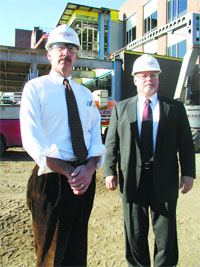
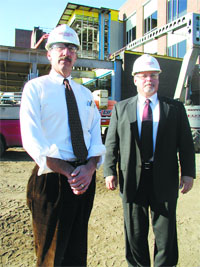
Bill Aquadro, left, and Steve Killian stand in the shadow of Cooley Dickinson Hospital’s $40 million expansion project.

Bill Aquadro, left, and Steve Killian stand in the shadow of Cooley Dickinson Hospital’s $40 million expansion project.

New York-based Barr & Barr Inc., which counts many elements of Rockefeller Center among its first projects, has, over the past 80 years, compiled a solid reputation in the health care and institutional fields of construction. It made its entry into the Western Mass. area several years ago with work at Williams and Amherst Colleges and, later, Holyoke Medical Center. With that beachhead secure, the company has aggressively gained market share, and has some ambitious plans for the future.

Interaction.

That was the initial, one-word response offered by Steve Killian when asked what distinguishes construction work for the health care industry from, say, that for a college dormitory, parking garage, or office building.

“It’s the give and take between the builder, the architect, the client and the subcontractors to make sure the user knows exactly what their getting, and it’s what they want,” said Killian, senior vice president of Barr & Barr Inc., the 80-year-old New York-based firm that has planted roots in Western Mass. and has built its reputation on, among other things, expansions and new construction for health care providers.

This give and take, as Killian called it, is merely part of an operating model known in the industry as ‘construction management at risk,’ or CM at risk. The CM designation differentiates Barr & Barr from general contractors, or GCs, he explained, and ‘at-risk’ denotes, as the phrase implies, that the builder is assuming some degree of risk.

Specifically, that risk involves the price bid for the project in question, Killian continued, adding that this bid becomes a guarantee of sorts that the price for the work will not exceed that number. And if it comes in lower — something that actually happens in this industry when most, or everything, goes right — then the difference is returned to the client, unless it wants to put it back into the project.

“It’s a model that’s worked very well for us, and it is fairly unique,” he said, noting that there are several versions of the CM delivery method that provide varying levels of risk for construction firms. “It makes us partners with the client, the architect, and subcontractors, and that’s why it’s such an effective method.”

The CM-at-risk operating platform, used for about 90% of its projects, coupled with the company’s reputation — it has handled work ranging from renovations of Radio City Music Hall to hundreds of millions of dollars worth of projects for New England Medical Center in Boston — has enabled Barr & Barr to make a large and rather immediate impact on the Western Mass. market.

It started five years ago when the company successfully landed projects at Amherst College (some new dormitories) and Williams College (its new $50 million Center for Theatre and Dance, and the push into the Pioneer Valley gathered steam when Barr & Barr was chosen to handle a $12 million expansion at Holyoke Medical Center.

After establishing an office in an area on Hampden Street in Springfield, the company soon added to its Western Mass. portfolio. In 2004, the company was awarded a $40 million expansion at Cooley Dickinson Hospital, the largest single project in the hospital’s history, and, more recently, was chosen for a $14 million expansion at Mercy Medical Center, a $12 million renovation/addition at Franklin Medical Center in Greenfield, and the $9 million parking garage built at Baystate Health’s corporate offices in downtown Springfield.

“When we first looked at this market, we saw some real potential, and we’re seeing that potential realized, ” said Killian, who joined Senior Project Manager Bill Aquadro at the CDH construction site recently to discuss the company’s entry into the Western Mass. market and its outlook on the future. “Our plans now are simply to continue to grow within our identified niche areas — health care and institutional work.”

Building Momentum

As he led BusinessWest on one of the countless tours he has given of the new CDH facilities, now roughly six months from completion, Aquadro stopped in what will soon become one of the hospital’s new operating rooms and pointed to the ceiling, specifically to the mounts that will support lighting and other equipment.

“Technology has changed so quickly and so profoundly,” he started. “Today’s operating rooms have to reflect that. They need to be much bigger, because the technology is bigger, and they have to be built with the understanding that technology will continue to improve.”

This is part of that interaction process that Killian described, said Aquadro, who joined Barr & Barr recently after working for many years in his family’s business, Aquadro & Cerruti. The dialogue begins long before a shovel is put in the ground and continues until the client turns the key in its new facility, he continued, noting that the design of the one of the new patient rooms at CDH was altered recently after a nursing supervisor noted that the location of the nurse-call box wasn’t ideal.

“She said it should be moved,” said Aquadro, “and we moved it; we listened to what we were being told and made some adjustments.”

This ability to listen and respond has helped Barr & Barr build a huge portfolio of institutional and health care-related projects across the Northeast. Current health care projects include those at New York Hospital Medical Center in Queens (a $100 million modernization project), Memorial Sloan Kittering Hospital in New Jersey (a $41 million cancer center), Maimonides Medical Center in New York (a $73 million modernization), among dozens of others.

On the institutional/academic side of the ledger, current projects include work at the Massachusetts Institute of Technology, Yale University, Syracuse University, Colgate University, and Mount Saint Mary College in New York, among many others.

The client list (dominated with repeat customers, 80% of the total volume of work) and the geographic reach — from Northern New England to Southern New Jersey — has been eight decades in the making, said Killian, noting that the company was started in New York in 1927 by Joseph Barr. The company was first known as Barr & Lane, and later became Barr & Barr when Joseph’s brother, Donald, joined him.

Early work for the company, awarded by Nelson Rockefeller Sr., included the Time Life Building and Rockefeller Center’s Promenade, Garden, Center Theater, and its British and French Buildings.

The company continued to expand and diversify over the next several decades. Starting in the early ’50s, by which time the venture had passed to the next generation of the Barr family, it began to develop its reputation for work in the medical and education fields. It also expanded geographically, with a strong push into the Boston area — rich in both colleges and medical centers — and also Connecticut and, eventually, Northern and Western New York, Vermont, Maine, and the Pioneer Valley. The Philadelphia area is the next target, said Killian.

Barr & Barr’s list of offices speaks to its territorial expansion; locations include Springfield, Framingham, and Williams-town, Mass., New Haven, Conn., Syracuse, N.Y., Brunswick, Me., New York City, and Franklin Lakes, N.J.

Laying the Groundwork

The company had long eyed the Western Mass, market, also deep in medical, higher education, and cultural institutions, said Killian, and made its first foray into the region’s health care sector with the Holyoke Medical Center project, an initiative that included a new surgical suite, cardiac cath lab, and several renovations.
With that foothold, the company later added projects at several area institutions, and, as its reputation and referrals grew, so did the portfolio.

“Our expansion in this market is similar to what we did in the Syracuse area, Vermont, and Princeton, N.J.,” he explained. “You start with a project or two, like we did at Syracuse University, which led to more work at Colgate, Hamilton College, and other institutions, and keep building on that base.”

It was the strong potential for growth in the Western Mass. market that prompted Killian, who has been with Barr & Barr for 14 years, and was working at its Middlebury, Vt. office to relocate to the Pioneer Valley and essentially set up shop for the company here.

He attributes its quick success — more than $100 million in contracts over the past five years — to the company’s strong reputation, but also the CM at risk model, still rare within the construction industry, and especially the Western Mass. market. That operating style essentially makes the company partners with its clients, he explained. It applies a contractor’s perspective and input to planning and design decisions, and has the ability to fast-track early components of construction.

“By making the construction manager-at-risk a key member of the project team, responsibility for construction is centralized under a single contract,” he explained, adding that Barr & Barr’s project-delivery method has no doubt played some role in winning the projects at CDH, Baystate, and, most recently, Mercy Medical Center, institutions that have often used other area builders.

Describing the expansion project at Mercy, James Fanale, chief medical officer for the Sisters of Providence Health System, said it involves new and more modern facilities for the intensive care unit (ICU) and ambulatory services unit (ASU) and speaks to the many changes that are taking place in health care today.

“The people we have working in our ICU are terrific, they’re very talented, caring individuals,” he explained. “But the space … well, it just doesn’t work; the quarters are small and non-private — it’s the way things were done 40 years ago.”

Work to bring the hospital up-to-date and create space that does work has been ongoing for more than a year now, said Fanale, and in recent months has included discourse between the architects, Newton-based TRO Jung-Brannen, Barr & Barr, and both administrators and eventual end-users at Mercy.

The discussions involve everything from the size of the rooms to the colors on the walls to the amount of direct and indirect lighting.

“It’s all very scientific,” he explained. “There is a lot of detail that goes into how these facilities are going to feel and fit.”

The process has been similar at CDH, said Aquadro, noting that the company has been involved in all phases of this project, from the securing of new parking facilities — the addition swallowed up many existing spots — to the location of nurse-call boxes.

The interaction with hospital administrators and front-line employees starts early and is essentially constant, he explained, adding that, in the case of the new operating rooms (half again the size of the current facilities), Barr & Barr and the project’s architects built what he called mock-ups to determine how the rooms would look and what equipment goes where.

“They know what they want, and by doing these mock-ups, they know what they’re going to be getting,” he explained. “That way, there are no surprises.

“It all starts with a vision,” he continued, “for a healing, caring environment. A lot goes into that vision, from the amount of light in the room to access to nurses.”

Material World

Walking through what will be the new central sterile area in CDH’s ‘surgical tower,’ Aquadro said the codebooks that dictate how such facilities are to be built and operated are several inches thick.

This is another factor that separates construction in the health care realm from other types of building. “Those projects have codes that must be followed, too, he explained, “but it’s nothing like this.”

Helping clients meet all those codes, and turn vision into reality, is one of the traits that has enabled Barr & Barr to secure its reputation — and make an already significant impact on the Western Mass. market.

The challenge now is to build on that portfolio.

George O’Brien can be reached at[email protected]

Sections Supplements
As the Climate Changes for Credit Unions, They’re Turning Up the Heat
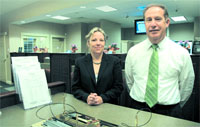
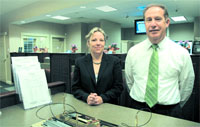
Sue Boniface and Jim Nagy

Sue Boniface and Jim Nagy of ValleyStone Credit Union

As more and more credit unions change their charter to a community base and increase their books of business, the number of challenges is also rising, from upgrading technology to improving marketing techniques and even employee professionalism. But as challenges arise, so do new opportunities.

Gary Fishlock, president and CEO of STCU Credit Union (formerly the Springfield Teachers Credit Union), said that three years ago, the institution didn’t even have its own Web site. But now, the credit union that once served only employees within Springfield’s public school system has opened its doors to a wider audience, and with the change has added that all-important online presence.

Now, STCU’s Web site gets about 9,000 visitors a month, and its new site for Spanish-speaking customers is gaining speed, as are STCU’s eStatements and online lending programs.

The technological additions and upgrades are one manifestation, says Fishlock, of the significant changes STCU has gone through since switching its charter from ‘single select,’ serving one specific employer or group, to a community charter, essentially opening its services to those who live and work in Hampden, Hampshire, or Franklin counties.

“We had to rewrite the playbook to a degree,” said Fishlock, “and adding new technology to our existing repertoire was necessary to creating a strong posture for ourselves.”

And STCU is certainly not alone. Indeed, many credit unions in the area are at the start of a new culture and operating environment, as an increasing number abandon their identity as a single-employer credit union to serve the general population.

For many, it’s a necessary change, brought on in part by shrinking employee numbers in the industrial sector as technology advances or companies downsize, and by an aging population of members who save more than they borrow, throwing many credit unions off balance.

The switch among credit unions to a community charter is being seen across the nation, but in Massachusetts, where U.S. credit unions got their start, the changes are particularly notable. Many credit unions, especially in industrial centers like Springfield, have been in business for 60, 70, or 80 years, and are, in general terms, changing the way they do business for the first time.

“Credit unions are operating in a new climate,” said Rob Kimmett, senior vice president of Marketing and Public Relations for the Mass. Credit Union League Inc. “They’re offering services to a wider number of members, and there is a movement toward taking the lid off and being more visible.”

As credit unions switch their charters, a number of challenges in the areas of technology, marketing, and member services arise, but as many professionals in the credit union sector agree, it’s also creating some new opportunities.

A Delicate Balance

“It has definitely been a learning experience for us,” said Jim Nagy, president and CEO of ValleyStone Credit Union, formerly the Monsanto Employees Credit Union. “We were in a friendly, rather insulated environment, and now we’re part of a major corridor in the Valley that is filled with competition.”

That has created some new focus points for ValleyStone, which changed its name in 2005 after obtaining approval for a community charter in 2000. Nagy said service, technology, and marketing issues are three areas in which all rechartered credit unions struggle to a degree, and other concerns are not as obvious as others, like appropriate safety and professionalism training for employees who are no longer working in a small, informal environment, but rather in a much more public, corporate world.

It’s an apt parallel for the vast changes that occur as a credit union switches its charter, and the time it takes for an institution to grow into its new role. ValleyStone relocated its offices to Boston Road in Wilbraham, a stretch of road already populated with a number of banks, as part of that change, and also opened a branch inside Chicopee’s Wal-Mart, a partnership that recently dissolved.

“I think that was the right decision,” Nagy said of ending the relationship with Wal-Mart, a chain that is entering the financial services arena on its own and calling attention to the mounting competition both credit unions and banks face. “In the last few years, I think we’ve progressed to become a reputable facility. We rank 29th in the nation in terms of assets, and we’ve adapted pretty well. But now, we need to use that capital to grow and expand further, to stay competitive and maintain an edge.”

Kimmett agreed that credit unions have a tough road ahead in terms of forging a road for themselves.

“There is a ton of competition in the financial services sector — from mutual funds to the strong box under the bed,” he said. “In terms of loans, it’s the same thing.

All lenders compete, locally and nationally. Because of that, it’s not necessarily a wise thing to focus solely on local competition.”

A Strong Statement

But in the name of balance, credit unions must still look at local trends and adapt accordingly. Kimmett said that’s creating some marketing challenges for credit unions, but again, creativity is paving the way toward new opportunities. One trend he said he’s noticed is a very targeted approach to advertising that is geared toward recruiting new members from various walks of life.

“Any good marketer understands how to market individually, and to meet the needs of particular demographics,” Kimmett said. “Any marketing campaign that appears to be geared to one group or another is likely an effort to achieve a balance. Women, for instance, make a tremendous amount of financial decisions, so we’re seeing a lot of marketing toward women among credit unions. And older members deposit more, and younger members borrow more, so we need people on both sides of the fence.”

Suzanne Boniface, marketing and business development officer for ValleyStone, added that to focus its strengths serving employer groups by reaching out to area businesses, ValleyStone has been providing informational sessions and setting up account sets for employees. That provides a no-cost benefit for the employer, and also grows ValleyStone’s member base more quickly than if the credit union focused solely on recruiting individuals.

“Those efforts have been well-received,” she said. “It sounds simple, but it’s a good practice for us to be neighborly, because historically, that’s what we’ve been about. That’s what we do.”

Transfer of Power

Fishlock agreed that growth in all areas of business, from lending capacity to the recruitment of a larger, more diverse set of members, is key as many credit unions redefine themselves. But the real challenges present themselves, he added, when credit unions recognize the many ways they need to function differently within this larger environment.

It’s a matter of striking that balance to which many professionals in the credit union sector refer – maintaining the historical tenets of service common to all credit unions, such as catering to the working class, offering low or no fees, and continuing to serve specific employer groups, while moving forward with new ideas and concepts.

The first area that divide is seen, Fishlock said, is among members. Credit unions may retain current members while recruiting others following rechartering, but must also be careful not to alienate those members, or fail to translate their strengths and services to people outside of that core group.

“By no means are we cutting off the educational group,” said Fishlock of STCU’s former member base. “We existed for 75 years solely because of the educational professionals of the Pioneer Valley. But now, we need to balance the new with the old.”

Fishlock said STCU is leaning heavily on the technology piece of its business to help achieve that balance, using its new Web site and other Web-based tools to recruit new members without alienating its current membership. The Web allows for widespread marketing and a new suite of services, said Fishlock, but it sidesteps the bells and whistles created by other marketing campaigns.

“We’re seeing an increase each month in our membership,” he said, “and there is so much more we can do on the technological end. It also helps us to compete while still providing cost efficiencies.”

Fishlock said STCU has also created a larger footprint in the region, opening a second branch in Westfield, and has recently unveiled a new service aimed at growing the institution’s overall book of business, becoming an equity investor of CU Business Capital LLC, a credit union service organization (CUSO) that focuses on business services.

Through the partnership, STCU is able to offer business loans, business deposit products, business checking, and other services, all brand-new offerings for the credit union. It’s a great example, said Fishlock, of the many ways credit unions are using the uncharted territory in which they find themselves to their advantage, getting creative with new business ventures and with getting the new message out to new audiences.

“Credit unions are primarily for consumers, but this sets us apart – it’s new and unusual to offer business services, and we think it’s the right way to go,” he said. “but it also didn’t make any sense to try and set those services up internally, at great expense. Joining a CUSO was the ideal method to harness the expertise and the capital we needed to offer high-level, quality services.

Similarly, ValleyStone has introduced shared branching, a phenomenon that is virtually unheard of in the banking sector, but is rapidly spreading throughout that of credit unions.

Shared branching allows members of a given credit union to make deposits and withdrawals, loan payments, and loan applications, as well as open sub-accounts and other services, through a different credit union that has entered into a shared branching agreement with their institution. In turn, credit unions that offer the benefit can grow in terms of branch profitability while reducing facility construction expenses, passing those savings on to members. In 2003, there were 436,000 shared branching transactions in Massachusetts and New Hampshire combined, according to ValleyStone’s figures; in 2004, there were 818,000.

“It’s all done through technology,” said Boniface. “It’s an exciting trend that’s spreading nationally; it allows for added convenience for members. They don’t necessarily need to close out their accounts when they move; 7-Eleven [convenience stores] signed on recently to offer service kiosks in their stores.”

Kimmett agreed that shared branching is a good example of the creative steps credit unions are taking to raise their profiles.

“Shared branching has existed for maybe about 10 years,” Kimmett explained. “It started small and is a very uncommon concept among banks, but it’s typical of credit unions and their focus on providing high-quality service and making sure the member is well-served. As counter-intuitive as it might be to suggest making transactions at a different facility, it’s a convenience tool that is so powerful among members that any real shred of a competitive issue goes out the window.”

Bonds and Trust

It’s also a way to increase a credit union’s profile on a national level. While credit unions are typically smaller than banks and serve a smaller, local population, that world is rapidly changing.

“There are some challenges, but in the end I think the consumer will benefit,” he said. “There are people who still haven’t heard the word and don’t understand that they can belong. But members tend to be devoted, and credit unions have always been focused on what members need and want. They just haven’t devoted as much energy to that in the past. Now, they need to.”

Jaclyn Stevenson can be reached at[email protected]

Departments

The following building permits were issued during the month of October 2006.

Agawam

Nick’s Affordable Home Remodel
430 Main Street
$14,600 — Strip and replace roof

Easthampton

D & R Management Company
D & R Management for Dietz Construction
7 Industrial Parkway
$544,000 — Construction of new
building; office and shop

East Longmeadow

Premier Source Credit Union
232 North Main Street
$1,440,000 — Two-story office

Greenfield

LPL LLC
487-489 Bernardston Road
$55,000 — Commercial office
renovation

Ludlow

East Street School
508 East Street
$245,000 — New roof

Ludlow High School
500 Chapin Street
$245,000 — New roof


Springfield

Eastfield Mall Association
1655 Boston Road
$7,700 — Renovate space for
family restaurant

Hampden Savings Bank
19 Harrison Ave.
$10,000 — Interior renovation

Picknelly Family LLC
1414 Main Street (Monarch Place)
$107,615 — Build out of offices

WGGB
1302 Liberty Street
$190,000 — Replacement of existing tower

Yukon Group LLC
95 Fisk Avenue
$500,000 — Renovation of existing
warehouse for new armored car tenant

West Springfield

Rein’s Deli
25 Park Ave.
$10,000 — Repair damage
done by automobile

Sections Supplements
Some Ground-breaking Developments Signal a New Era at Springfield College
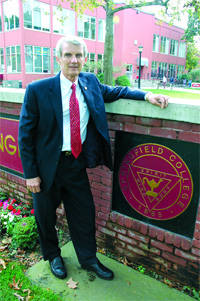
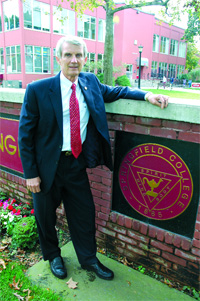
Richard Flynn

Richard Flynn, president of Springfield College, said moving forward with various improvement projects has sparked some new life on campus.

When it comes to facilities planning, Springfield College President Richard Flynn wrote the book on the subject.

Actually, he’s written four of them.

That’s just one line on the resume Flynn brought with him to Western Mass., after living and working in Omaha, Neb. for most of his life, serving as a dean at the University of Nebraska and an interim president at Peru State College. But it’s a line he’s been asked, repeatedly, to prove out at Springfield, and judging by the mounds of dirt created by recently broken ground on campus, he’s doing just that.

Flynn took his post in March of 1999, and shortly thereafter launched an extensive strategic plan for the college that included 10 broad goals, such as maintaining financial integrity and enhancing academic programs.

“What we wanted to do was create an action plan that was aimed at where we aspired to be and the objectives we needed to reach to get there,” he said. “We started with 10 fairly general goals, with specific steps within each of them. Not all of the areas we addressed were matters we were behind on, but rather areas we needed to maintain, to retain our vibrancy, reputation, and image.”

The general nature of those goals has allowed the strategic planning process to remain fluid, added Flynn, and has provided for a clear direction while also allowing for constant tweaking.

“These are living goals,” he said. “The specific strategies change year in and year out, and we have a lot of great discussions because of that. But we also track our progress each spring and detail it in the annual report, and each year we’re looking to see that each financial measure we’ve employed has improved.”

One such measure has been the capital campaign, The Leadership Campaign for the 21st Century, which began in 2002 and is funding many of these new and ongoing developments. It has a goal of raising $40 million, and has about $27.5 million, and two years, to go.

“It’s an aggressive goal for us,” said Flynn. “Up to this point, the college hadn’t had a major campaign in 35 years, and this is an international campaign that is drawing on the support of alumni, the business community, foundations, and friends.”

Building Blocks

That campaign has already made a number of visible improvements to the campus possible, including the renovation of the Brennan Center, home to the School of Social Work, and Wilbraham Hall, once used for storage and now home to several academic departmental offices.

And in addition to those renovations, the college has also broken ground on Schoo Hall, the Bemis Science Center, a new residence hall and suites, the Cheney dining hall, and new athletic fields that include 4 1/2 acres of synthetic, all-weather turf.

“We’ve also added green space,” said Flynn, referring to new lawn areas and quads scattered across the campus. “We know students have a need for green space, so not to feel restrained by boundaries.

“There are many other small things that people don’t readily notice,” he added, continuing the long list of recent improvements and additions to the Springfield College campus. “We’ve done a lot of things to improve the classrooms, and the residence halls have new bathrooms. Those are examples of the things we’re adding to improve the overall quality of life on campus.”

As the campaign continues, a new field house will be constructed, as will a new wellness center, a renovated beverage hall, and a new college union.

“There’s a ripple effect,” Flynn said. “When all is said and done, very few parts of this campus will be left untouched.”

The physical improvements are just one of many initiatives designed to raise the profile of the college, and judging by the school’s recent financial success (which landed it on the Affiliated Chambers’ Super 60 list this year) that profile is already inching up.

With so many construction projects recently completed, underway, or on the drawing board, it’s hard to imagine that the college would be moving forward in the black, but Flynn, returning to his facility-planning roots, said he’s not surprised.

“One of the most important things to remember about facilities planning is that facilities facilitate programs,” he stressed. “A lot of time has been spent on building infrastructure. And as we start to cultivate that, we are afforded a chance to take a closer look at every part of an organization … how things are done, and how much of yesterday will still be relevant tomorrow.”

Revisit, Repair, and Retain

As those improvements continue, Flynn said the college has also kept a close eye on tuition rates, in an effort to keep them as low as possible. To date, the college has seen gradual increases, like nearly all colleges, but has remained about 10% below the national average for private colleges.

“When I arrived, we had 180 empty beds,” said Flynn. “Now, those beds are filled, and we’ve added 205 additional beds. Since each year, a major stimulus for us is to fill those beds, that’s an excellent benchmark for success.”

What’s more, Flynn said the physical improvements on campus as well as the addition of several new academic programs and majors over the past seven years, including a new school of Health Sciences and a doctorate in Physical Therapy, have made Springfield College an institution of choice for many students, further augmenting marketing efforts and graduation and retention rates.

“About 80% of our first-year students report that this was their first choice of college, and it’s easier to keep them here if this is where they wanted to be in the first place,” said Flynn.

Outreach 101

Another facet in retaining students, however, has taken shape as a series of ‘community engagement’ initiatives, also detailed in an annual report by the college.
Each year, the program allocates five professional staffers to work exclusively on community outreach programs, to the tune of $229,000 in annual salaries and benefits. It also stipulates that Springfield College regularly donate the use of many of its facilities to nonprofit organizations such as the American Cancer Society and the Senior Games, and serves as the umbrella program for the PROHill Initiative, dedicated to renewing the Old Hill neighborhood and rehabilitating 100 homes over the next five years. Artistic and athletic-based community outreach programs are also part of the project.

It’s one of Flynn’s favorite projects, and a forward-thinking endeavor, he said, which is focused not only on development of the college but of its namesake city, too.

“I’ve done a lot of work with community-school initiatives,” he said, referring to another line, and list of publication credits, on his resume. “We can’t improve the community without everyone contributing, and if the city gets bad publicity, it hurts the college too.

“But beyond that, it’s difficult to imagine the city of Springfield without its colleges,” he continued. “I’m not sure the colleges are fully appreciated for the vibrancy and vitality they add to a city, and each one in Springfield is doing its share.”

Mission: Control

The further cultivation of that vitality is one of those 10 broad goals that Flynn set out for the college and himself in 1999, and as the final two years of the Leadership campaign approach, accounting for every dollar raised will be just as important as accounting for every reason why those contributions are necessary.

“We have a passion for excellence, but at the same time, a compassion for others,” Flynn said of himself and the college community. “This had been my mission since day one, and I’m proud to say that everyone here knows what that mission is: to add a sense of community, good morale, and great partnerships.”

And while he may not have time for writing these days, Flynn is indeed helping to author a new chapter in Springfield College’s proud history.

Jaclyn Stevenson can be reached at[email protected]

Departments

The following Business Certificates and Trade Names were issued or renewed during the month of October 2006.

Affordable Cleaning Service
7 Williams St.
Kseniya Kiforishina

Marie P. Grady
69 North Alhambra Circle
Marie P. Grady

Amherst

The Art of Basketball
59B Boltwood Walk
Warren Esty Lett

Jack Radner, LAC
86 Heney St.
Jack Radner

Chicopee

Conroy Construction
28 Simone Road
John J. Conroy

Joe T Handyman Service
40 Slate Road
Joseph James Taliceo

MV Transportation Inc.
451 Center St.
Edward F. Overn

Easthampton

Hometown Painting & Home Repair
17 Harrison Ave.
Karlene M. Foster

Tidal Rock
116 Pleasant St. – Suite 244
Peter Martin

East Longmeadow

Jewelry Of Hope
48 Hillside Dr.
Beth-Ann Latsko

Quality Building Product
100 Shaker Road
Kathleen T. Devins

Springfield Area Driving
483 Parker St.
Peter S. Avdoulos

Greenfield

Cherie’s
58 Petty Plain Road
Cherie A. Rowland

Peggy’s Beauty Shoppe
46 Pierce St.
Margaret A Sears

Holyoke

ABC Gifts
50 Holyoke St.
Jaishri J. Singh

Holyoke Auto Body
41 No. Summer St.
Juan Pedrosa

Longmeadow

Michelle Murray MA LMHC
1200 Converse St.
Michelle Murray

Ludlow

Turkish Soccer Club
305 East St.
Nehmet Citlak

Northampton

Main St. GIS
107 North St.
William Tingle

Sushi City
228 King St.
Soe Naing

Ventures Field Associates
36 Service Center
Robert J. Walker
Stephen D. Ross


Palmer

Kitchen Table Tax Service
65 Jim Ashe Road
David E. Whitney
Mary L. Carrol

Yankee Fields
1162 Ware St.
Nancy Ruth Kerigan
Rosemary H. Rugg

South Hadley

Western Mass. Concrete Service
54 Bolton St.
Donald Wilkens
Richard Labarre

Southwick

Beacon Home Mortgage
15 Sunnside Road
Kenine Shea

Springfield

Boston Road Gulf
429 Boston Road
Ahmed M. AlsaHori

Glitterz Nail Salon
795 Liberty St.
James E. Dixon

Heavenly Grooming
1648 Carew St.
Norberto Crespo

King-of-Clean
294 Oakland St.
Darrell King

L&R Remodeling & Weatherizing
2994 Main St.
Luis O. Rivera

Restore Home Improvement Center
250 Albany St.
John Majercak

S-Cel-O Construction Co.
666 State St.
Ellen S. Boynton

Tim’s Internet & Cleaning Services
174 Main St.
Valentin Porfirio

Westfield

AD UP
110 Airport Road
George R. Munson

Menus New England
1037 Shaker Road
Michael Burris

St. Pierre’s Brothers Drywall
18 St. Pierre Lane
Troy St. Pierre

Tanner Tile
34 South Maple St.
Timothy A. Levasseur

West Springfield

BMIL Computer Services
64 E. Goosberry Road
Bryan Miller

Jimmy Larochelle Finishing Carpentry
104 Lower Beverly Hills
Jimmy Larochelle

Jungle Landscaping
29 James Ave.
Frank Teece II

Sections Supplements
Bradley International Airport Moves Forward with the Hum of a Major Economic Engine
Bradley International Airport

Passengers make their way through checkpoints at Bradley International Airport. The airport aims to add 12 new gates through a massive expansion.

Barry Pallanck, airport administrator at Bradley International Airport, can confidently list some of the things Bradley does well: ample parking is one major plus, as is quick passenger-processing rates, solid security, and a low rate of airport closures and delays due to weather.

He does admit that the baggage claim sometimes sees a bit of a back-up.

“We’re a good-sized airport with a small-airport feel, and that reduces the stress of traveling for people significantly,” he said. “But sometimes, I think the walk from the plane to the baggage claim is too quick, and they end up waiting. We’re working on that.”

While many travelers will forgive a few minutes at the baggage carousel these days, Pallanck said it’s one example of ongoing attention to what he calls “the Bradley experience,” which puts ‘ensuring ease of travel’ at the top of the to-do list.

But it’s certainly not the only concern. Indeed, the Windsor Locks landmark is now in the midst of a $200 million expansion and renovation, designed to allow for needed growth at Bradley without losing that streamlined feel, accommodate a growing number of travelers, elevate the airport’s presence in terms of domestic air travel, and extend its reach further beyond U.S. borders, becoming a greater player in the global market.

Pilot Programs

It’s the word ‘International’ in the airport’s title that many people often forget, or even deny. But Bradley has long delivered passengers to Canada, welcomes international charter flights, and routinely sees brisk cargo business that delivers all over the globe.

Further, one of the airport’s primary objectives within the next two years is to establish new international passenger routes and ‘long-haul’ domestic routes, in keeping with growing numbers of business travelers as the global economy broadens (business travelers represent a little more than half of Bradley’s total customers), as well as a steady stream of leisure travelers.

Both groups fly into and out of Bradley to take advantage of its accessibility, including easy access from I-91, close proximity to several points in New England, and, often, to avoid the long lines and parking hassles that can add stress to a trip that begins at a major hub such as Logan or JFK.

To better accommodate those travelers and the airlines that carry them, Bradley is undergoing a metamorphosis of sorts, as new amenities are added and terminals are renovated. The terminal improvement project (funded by airport revenues, passenger facility charges, and federal grants) began in 2002 and will continue until 2011, in stages so not to disrupt regular passenger traffic.

The improvement project will add 12 new gates, and an extension to the airport’s Terminal A has already been completed. New eateries were added in response to repeated requests from travelers for a greater number of convenience-based amenities at the airport, as were a sundries shop and a Brooks Brothers clothing retailer.

Renovation is now underway in Terminals B and C as well, and expected to be completed next year.

Kiran Jain, director of marketing and route development for Bradley, said the growth is in response to healthy business at the airport. There have been some challenges, she said, such as the climb back to normalcy that all airports have had to make following 9/11, and fuel prices that have an adverse effect on the airlines’ bottom lines, and therefore that of the airports, as well. But Bradley is now wrapping up its best year in terms of passenger volume, with 7.5 million passengers, and has also seen an increase in cargo business, handling 159,848 tons of freight in 2005. In June of this year, JD Power named Bradley International Airport one of the 10 best medium-sized airports in the country.

“Our domestic business is doing extremely well,” said Jain, “but we still have high aspirations. There are areas we would like to extend our service to domestically, such as the Bay Area, and we will continue to focus on creating a viable international market, as well, to better serve our customers’ needs.”

Jain agreed with Pallanck that, in addition to the expansions and changes that are accommodating greater numbers of travelers and helping to woo new carriers to the airport, the aesthetic and convenience-based improvements within the terminals are also creating positive results at Bradley.

“We can’t put a value on it, but easing the experience as people come through Bradley is definitely creating a competitive edge,” she said. “It’s important to make a good first impression, and it’s important to have the amenities and services that people are coming to expect from regional airports.”

But Pallanck was quick to note that aesthetics also come into play when addressing the recent renewed interest in the facility on the part of major carriers.

“These aren’t expansions that are happening just because we want them to,” said Pallanck. “They’re happening because they have to. We used to invite airlines to come and take a look at us as part of our normal plans for growth. Now, they’re inviting us to take a look at them. Bradley is definitely becoming a name within the industry.”

Air Apparent

Even before the expansion project was launched, the airport had long been larger and busier than many people realized. Built in 1940 and enabling its first commercial flight seven years later, Bradley has already more than quadrupled its size in the past 50 years. It’s not considered a small airport by national standards, but rather a medium-sized, regional airport that records the same numbers of passengers as many mid-sized airports in close proximity to popular tourist destinations, such as Fort Myers (Florida) Airport and Buffalo Niagara International.

Bradley also has an on-site Sheraton hotel, two firehouses, a UPS distribution facility, and hosts units from the Army National Guard and Air National Guard. Twenty-three airlines routinely fly in and out, offering about 300 daily passenger flights, with 36 non-stop destinations. Bradley’s largest carrier is Delta, representing 27% of all flights, followed by low-cost Southwest (17.8%).

Bradley also has a complicated business model. It operates under the auspices of the Conn. Department of Transportation, and although it generates its own revenue and has its own enterprise fund, Jain said that doesn’t negate the presence of a “shadow of a government agency.”

“Processes can be extremely tiring,” said Jain. “There are times when we’d like to have a decision made quickly, but there is no quick turnaround, and sometimes opportunities can be lost due to reaction time.

“But, the fact remains that we are our own economic engine,” she added. “We don’t use tax dollars, and we make a profit.”

The ongoing growth at Bradley has become central to its marketing message, said Jain, who added that the airport is stringent with its marketing dollars, due in part to the need to reach two very different audiences through its marketing efforts: the airlines, who ultimately spur growth at the airport by increasing their numbers of available destinations, and the public.

“People often think a business like an airport is going to have a large, expendable marketing budget, but it’s actually extremely tight,” said Jain. “Our marketing is totally driven by the types of services we bring in; we’re not so much branding the airport as we are promoting specific services, showing both the airlines and our customers how we can benefit them.”

Pallanck added that airlines look at the economic health of the region an airport serves as well, and he said promoting the Springfield-Hartford corridor as well as surrounding areas is also helping bolster Bradley’s name in the airline sector.

“This area, from Fairfield County to Western Mass., is growing, and if the area grows, we grow,” he said, noting, however that it’s not just growth that makes a region attractive to an airline – there are other more specific factors, such as the presence of large, well-heeled corporate entities. Hartford has its share, but Pallanck said the airport doesn’t downplay the effect of the Western Mass., market, either.

“There are some solid companies in Springfield, and airlines see that,” he said. “Not only does that give viability to our marketing message, but employees at larger companies generally get paid well, and go on trips frequently, business and otherwise.

“And, well-established companies hold a sort of guarantee that younger companies don’t,” Pallanck continued. “They suggest to the airlines that they’re not going to pull the rug out from under them, that they’re going to remain a force in the region.”

Terminal Velocity

While the airport is largely consumed by the current expansion project, Pallanck said other plans for both regional and airport growth are already beginning to pop up on his radar screen, including the possibility of rail service adjacent to Bradley, further increasing its accessibility to travelers.

“There is a lot that has to happen first,” he said, “but the excitement, the necessary alliances, and the opportunities are definitely there.”

In the meantime, Pallanck said he’s busy overseeing construction within the terminals (now approaching ‘phase two,’) serving as a bridge between the airport and the DOT, and walking the length of the terminal from arrivals to the baggage claim, carefully timing the wait between when he arrives, and when his bag does.
In time, he said he’s confident he’ll get that timing just right … the talent comes with experience.

Jaclyn Stevenson can be reached at[email protected]

Features
Lupazoo Educates — and Inspires
Henry Lupa

Henry Lupa made his vision for a zoo become a reality.

In its literature, Ludlow’s Lupazoo is described as “a conservation and education institution demonstrating the value, beauty, and interdependence of all living things.” In simpler terms, the game farm opened four years ago is a promise kept by Henry Lupa, a Polish émigré who told his young children nearly 30 years ago that when he had the resources he would build a park with animals to enrich and educate the community. It took considerable patience, hard work, and research to make the dream reality, but Lupa was true to his word.

Henry Lupa has a soft spot for the white-tailed deer.

There are many reasons why, but primarily because it is with one of these docile animals that the remarkable story of the zoo that bears his name really began.

Lupa, a Polish émigré who had long desired to create a zoo (more on that later), began dabbling in the early ’70s with a small, backyard collection of animals that started with a deer called Betsy. One incident involving her has stayed with him for more than three decades and hits squarely at what exactly it is that motivates him.

“I had a little enclosure for the deer, and one day I was coming home from work to feed the deer, and I saw a car near the pen. I saw a woman and a young boy, who was screaming and crying,” Lupa recalled, using heavily accented English. “The woman told me that the boy was abused by her husband, that he was 4 years old. He was shaking and did not speak. She told me she did not have money to take him to a doctor to cure him.

“Someone had told her that animals would help kids,” he continued, “and she asked if the boy could come to the pen and maybe pet the deer. I said yes, and when the boy came over, Betsy ran all the way across and started licking his face. He stopped crying and started smiling.”

The boy returned on several occasions to the Lupa property off Nash Hill Road in Ludlow, getting better over time. His progress helped steel Lupa’s resolve to build a zoo, a promise he made to his own children not long after arriving in Western Mass. from his native Krakow in 1965. It took more than 30 years to make the dream reality — with hurdles including everything from the financial commitment to the laborious process of obtaining a license from the U.S. Dept. of Agriculture (USDA) in 2002.

Looking back, Lupa said that at times he became frustrated with the slow pace of progress and the sheer volume of oversight, but it has all been worth it.

Indeed, the level of pride is palpable as he conducts a tour of the facility, which is literally in his backyard — his residence abuts the 56-acre parcel he purchased for his park. Lupa knows each animal by name (both common and proper) and reputation. He also talks at length about the living quarters, diet, and any special needs, habits, or behavioral traits of the resident in question.

Pointing to a row of wooden poles inside the large home for the North American elk, Lupa said the male in the group will aggressively butt them during mating season, which started a few weeks ago. “He destroys everything,” said Lupa with a laugh. “He loves to show off.”

So too does the Guenon monkey, which is somewhat of a ladies man, said Lupa, who doesn’t worry about being politically correct. “He likes the young, pretty women; you can see it in the way he acts.”

Lupa has plenty of time to observe the monkey and the hundreds of other zoo residents. He is essentially retired from the construction company he started a few years after arriving in this country and devotes most of his time to the zoo. This is a family business, he explained, noting that his son Stanley and daughter-in-law Carla manage the venture known as Lupa Game Farm Inc. — one of the few nonprofit, privately owned zoos in New England.

It receives some support in the form of donations from individuals and businesses, but most of the funding comes from the Lupa family, which keeps admission costs low ($5 for adults) and admits children under 12 and all those with handicaps free of charge. This is just part of the zoo’s broad mission to educate, said Lupa, noting that to do this it must continue to expand its offerings — and its population.

Only 15 of the 56 acres Lupa acquired years ago are now being utilized, meaning there is ample room to grow. For the immediate future, Lupa said he would like to add some exotic cats, perhaps some ocelots or bobcats, and is seeking corporate help to make that happen.

“We ask people what they want to see, and a lot of them say they want cats,” he explained. “So we’ll try; we’ll do our best.”

This issue, BusinessWest looks at how, by trying — and doing — his best, Lupa has created a truly unique center for learning.

The Buck Stops Here

Pausing at an area set aside for large, flightless birds, Lupa offered a quick dissertation on the ostrich, and a slightly painful one at that.

“He could kill a lion,” Lupa said of the six-foot-tall bird now pecking at his hand through a wire fence nearly as tall as the animal. “Not with his mouth, but with his leg; he can kick, and he’s very powerful.

“He doesn’t really bite,” Lupa continued, although he emerged from this encounter with a small cut on his hand from the incessant nibbling. “At least, not like other things around here can bite.”

That list would include a few young alligators, some of the other birds on the premesis, and something called the ‘African jungle cat,’ a close cousin of the domestic feline but one that has spent many more hours in the gym.

Lupa has acquired these and the hundreds of other animals from a variety of sources; some come from other zoos that are closing, downsizing, or selling some newborns. Others come from auctions of exotic animals — Lupa attends two such events in Ohio each year and brought home an albino skunk from his most recent visit. Harvard University donated 10 monkeys of the common marmoset variety, and one of the alligators came from a local college after it confiscated the reptile from a student.

But while the question of how the zoo’s population – which now includes Himalayan bears, yaks, kangaroos, 20 species of monkeys, and more than 300 varities of birds – has been assembled is intriguing, the why is what makes this story so fascinating.

A television reporter recently asked Lupa that very question — why a zoo, and why in Ludlow? Paraphrasing his answer, Lupa said he replied, essentially, with ‘why not?’

“We deserve a zoo here, too,” he told BusinessWest. “They have them in New York and other big cities; we’re not second-class citizens. We should have a zoo.”

Lupa’s specific motivation was to create a facility that would give young people, especially those with handicaps or from poorer families, a place to go. He vowed to his wife and three sons that when he had the financial wherewithal to do so, he would create a zoo.

The educational and healing qualities of a zoo were demonstrated in that chance encounter between Betsy and the young boy.

“That really touched my heart,” said Lupa. “The boy came back many times, and each time he became more confident. His mother told me that after coming back a few times, he started calling out ‘Betsy, Betsy.’”

Lupa eventually acquired the needed resources through the growth of his entrepreneurial venture, N. L. Construction, which specializes in commercial projects, including schools, fire stations, and other municipal buildings. That background in construction has helped Lupa as he’s gone about the task of creating living quarters for the zoo’s population — work he describes as a labor of love — and he has used left-over building materials and some donated labor from his employees, many of whom are from Europe, to build those customized homes.

“Without that help that was volunteered, we could never have built this,” he said. “It would have been too expensive for us.”

Bear Necessities

When asked about the assorted logistics of creating a zoo and the business aspects of this venture, Lupa said it takes much more than mere love of animals to make such a facility work. It takes research, patience, hard work — and some capital.

As an example, he cited the current going rates for giraffes: $40,000 for a male and maybe double that amount for a female. “That’s why we have two males,” he said of what are perhaps the zoo’s most popular residents. “We can’t really afford a female.”

Obtaining a zoo license is a long, complex process, Lupa explained, noting that it took him 15 years to get his. The USDA is very strict when it comes to facilities for the animals, diet, and medical care, he said. “They’re watchdogs; they make sure everything is done properly.”

Lupa said he started with a small petting zoo, with Betsy and a few other animals. He was advised to move on to goats and other farm animals to show that he could effectively care for a small, diverse collection. Upon passing that test, he graduated to exotic birds and different species of animals, building a portfolio, as well as the trust of the USDA, in the process.

“There were many times when I got upset,” he said of the heavy oversight and the slow pace of progress before achieving his license in 2002. “But now, I realize why they are so strict. They have to know, definitely, positively, that if you have animals you know what you’re doing; they need to know that the animals aren’t abused, and they’re not bored, that there’s enrichment.”

When designing and building facilities for the zoo’s residents, Lupa works to create enrichment for those on both sides of the fence, or glass. For example, the giraffes’ home includes a set of stairs and a landing, enabling visitors to attain the same height as the animals, and to actually reach out, feed them, and touch them.
“You won’t see anything like this at any other zoo, maybe in the whole country,” he said after luring the animals over to him with a bag of treats. “You can’t get this close anywhere else.”

Visitors can get even closer to a pot-bellied pig named Daisy, who can be found, usually sound asleep, on the floor in a building that houses monkeys, reptiles, and other assorted residents. “She’ll probably live forever,” joked Lupa, as he tried, unsuccessfully, to rouse the animal from slumber, “because her heart probably beats twice a day.

“But she’s everybody’s favorite,” he continued. “Everyone wants to meet Daisy.”

And such introductions are a vital part of the zoo’s two-part mission — to entertain and, especially, to educate, said Lupa. He noted that the facility has a theater for educational programs, a highly interactive Web site, and several initiatives to promote awareness on conservation, the environment, and even alternative fuels; the zoo runs on bio-diesel.

“We want to help people learn,” Lupa explained. “And the best way to do that is to make learning fun. That’s what we’re trying to do here.”

Fun learning would also describe Lupa’s long journey from conceptualizing a zoo to making his a reality. He told BusinessWest that he has visited dozens of zoos and has brought home concepts and inspiration from each of them.

“Wherever I visit, the first place I want to go is the zoo,” he said. “From them, I get ideas, and I make those ideas my own.”

Poignant Paws

As he offered the giraffes another bag of treats, Lupa recalled the story of an elderly woman from a local nursing home.

“All her life she wanted to go to Africa and see a giraffe,” he recalled, “but she never got there. On her 100th birthday, some people from the nursing home brought her here. We took her over, and she got a chance to feed them. She said that since her dream had come true, she could die in peace.”

Many similar, if less emotional stories have been scripted thanks to this visionary’s generosity and determination to create a center for learning and, in many cases, healing.

To make a long and truly wonderful story short … Henry Lupa kept his promise.

George O’Brien can be reached at[email protected]
Sections Supplements
Magic Wings Butterfly Conservatory Stays Grounded
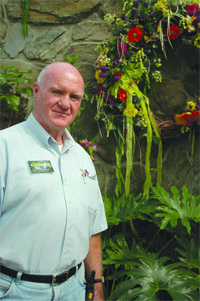
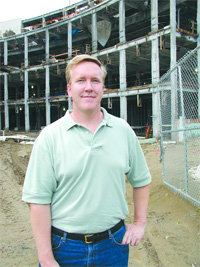
George Miller

George Miller, owner of Magic Wings Butterfly Conservatory

After six years in business, Magic Wings in South Deerfield is still growing. The business model is complicated and diverse, but the conservatory is also unique enough to attract thousands of visitors every year. And while the green walkways of Magic Wings are a far cry from owner George Miller’s native streets of Brooklyn, he says he feels right at home among the bugs and bushes.

George Miller has to keep a close eye on his inventory. If he doesn’t, it might fly – or creep, or hop, or slither – away.

Miller is the owner of Magic Wings Butterfly Conservatory in South Deerfield, home to hundreds of species of butterflies and moths, as well as a wide variety of other creatures such as finches, frogs, hissing cockroaches, and prickly devils. And in six short years, Magic Wings has become one of the busiest tourist attractions in Western Mass., welcoming visitors from near and far to walk through an impressive mix of flora and fauna.

He’s not a biologist – Miller has a background in construction, and grew up in Brooklyn, where butterflies are scarce. But he knew a good business venture when he saw it, and today is grateful he didn’t let it fly on by.

Miller explained that there are about 50 butterfly conservatories like Magic Wings around the world, and only a dozen of those are independent and privately owned. That rarity alone makes butterfly farms an attraction, but Miller added that there is a “build-it-and-they-will-come” nature to the business, as well. That was the first quality of the notion of a butterfly farm that intrigued him, as a builder; in fact, his former partner, Alan Rulewich, originally approached Miller merely to build the conservatory, but the relationship soon grew into something larger.

“He saw a similar business outside of Boulder, Colo., and knew immediately that it would be a great draw,” said Miller, noting that Rulewich left the business two years ago. “I felt it was best to strike while the iron was hot, but I knew to succeed it needed a great location.”

Miller and Rulewich found that location on Routes 5 and 10 in South Deerfield, a stretch that is quickly becoming a hub of tourist attractions. Six years ago, the plot of land was home to an established mom and pop restaurant, the Candlelight, which closed in 1999, at the same time the duo was searching for a location to build. The timing was perfect, and building began almost immediately.

The attraction has enjoyed steady growth, but Miller says running a company at which thousands of living things are the main product is one that is more complex and varied than even he could have ever imagined. Magic Wings opened on Veterans Day in 2000, after more than a year of planning, building, and securing a wide array of permits from various state, local, and federal agencies.

“The hardest part was figuring out who we needed to go to for approval for certain things,” he said. “But pretty soon, we realized we needed clearance from everyone, from the USDA to U.S. customs, zoning boards, the board of health … every agency you can think of. The only one that didn’t come knocking was the Department of Defense.”

New Heights

The paperwork hasn’t ceased, either. Six years ago, the conservatory consisted of one butterfly room and a waiting area that also carried gifts and garden supplies, but today, additions and improvements have vastly broadened the venture’s services as well as its size, and with every new development comes a corresponding onslaught of rules and regulations for this unique business.

Magic Wings now includes a full-service restaurant, Monarchs; a gift shop, which will soon be renovated; the indoor conservatory, which doubled in size two years ago; an ancillary educational exhibit room adjacent to the conservatory; an outdoor butterfly garden; and a casual food court and seating area, where plants and flowers that can be found in the conservatory are routinely sold.

The conservatory also accommodates weddings and special events, providing use of the conservatory and catering, photography, and a justice of the peace when necessary. To keep every task in line, Magic Wings employs up to 50 staff members, full-time, part-time, and seasonal. Those employees have titles that range from head lepidopterist, curator, and master gardener to chef, store clerk, and hostess.

All of these features draw about 200,000 visitors through Magic Wings’ doors each year, with about 20% of that represented by school groups. Bus tours are another major player; Miller said he has attended the last three annual meetings of the American Bus Assoc., and has tried to tailor his expansion decisions to what the association says its members and customers are looking for – package deals that include a meal, and something new to see each trip.

“Every year, we try to add some new attraction,” said Miller. “Sometimes, it’s huge; the conservatory expansion was particularly big, and we’ve added new support greenhouses. This year, our focus has been on the restaurant, because that was a hole that needed to be filled.”

Warming Trends

Those expansions alone keeps Magic Wings humming throughout the year, but any business with so many facets also faces its share of challenges, and Miller said Magic Wings is no exception. Some hurdles are similar to those many businesses are facing, such as fuel costs.

“Gas prices have kept our attendance numbers down some this year,” he explained. “People are conscious now of how much of their money is going into the gas tank, and they’re traveling less. If they do come, they’re spending less once they get here.”

Others, however, won’t be seen anywhere else but in a butterfly conservatory. Utility costs are sky-high across the board at Magic Wings, due to the careful temperature control that is necessary in the main room, as well as the full-service kitchen on-site, and the need to keep the entire building comfortable year-round for visitors.

“We’re going through 25,000 to 30,000 gallons of heating oil a month,” he said, noting that the buildings are heated by both gas and oil.
In addition, the butterflies need to be expertly and carefully bred and handled. Caterpillars of varying species must be fed a variety of food, which necessitates storing and growing several types of plants onsite.

“Nectar sources for butterflies are pretty universal,” said Miller. “They don’t need much more than sugar and water. But caterpillars are a different story … every one of them eats something specific, like passion vine. Some butterflies are imported for cost effectiveness, but many are bred right here, and that can get expensive and complicated.”

Various species of butterflies and moths can only be bred during the months they would normally flourish in the wild, Miller explained. If the life cycle is manipulated, the insects can easily contract and spread viruses. Any contagions that spread to the rest of the population could, in a worst-case scenario, wipe out the conservatory’s entire inventory.

All told, Miller said the cost of building and expanding the conservatory is in the millions, and the process has been constant since the venture’s inception, and therefore the pricetag is hard to pinpoint.

In addition, daily operating costs are a major concern that he hopes to address by employing some time-tested practices, like good-old elbow grease, and some uncommon measures, such as converting to corn-based fuel.

“All of our plants in the conservatory are hand-watered, because it’s more effective and far less expensive than installing irrigation and sprinkler systems,” he said. “And we’re sitting on a corn field. Putting in a corn burner could cut our fuel costs by 40% immediately. The trouble is, I don’t know who to turn to to get that approved; again, I’m investigating which government agency I need to speak with.”

Of those 50 butterfly farms scattered around the globe, Miller said he’s visited seven, and will continue to do so in search of better business practices and new ideas. But it’s still the smaller metamorphoses that impress him most, as construction continues and Monarchs Restaurant begins to attract a new set of regulars.

Winging It

Just recently, for instance, some new residents moved into the conservatory – Sugar and Spice, two horned lizards, have taken a small enclosed space in the rear of the farm, while Akbar, a Senegal parrot, stands guard as a family of Chinese button quails scuttle from one small garden to the next.

As he rounds the corner, Akbar whistles a hello to Miller, signaling that even with his Brooklyn roots, he’s part of the jungle now.

Jaclyn Stevenson can be reached at[email protected]
Departments

ACCGS Announces ‘Super 60’ Winners

SPRINGFIELD — Business is alive and well in the region as this year’s Affiliated Chambers of Commerce of Greater Springfield Inc. (ACCGS) Super 60 revenue winners combined for almost $1.2 billion in the past fiscal year with average revenue for the top 30 exceeding $31 million and 50% exceeding $20 million. Now in its 17th year, the ACCGS award honors the fastest growing, privately held companies in the region for their significant contributions to strength of the regional economy. Companies eligible for the award must be independent, privately owned businesses, be based in either Hampden or Hampshire counties or be a member of the ACCGS, be in business for at least three full years and produce revenues of at least $1 million in the last fiscal year. Seventeen companies are new to the revenue category this year. Four companies on the revenue list also qualify for the growth category, with two companies in the top 10 qualifying for both lists. In addition, four companies new to the category this year are also new to the top-10 revenue winners list. In the growth category, the average growth among the winners was more than 57% with companies needing to have had at least 23% growth in order to be included in the category. Twenty-six of the companies reported growth in excess of 30%, with 18 companies exceeding 40% growth. Winners will be honored at the Super 60 Luncheon and Recognition Program on Oct. 27 from 11:30 a.m. to 1:30 p.m. at Chez Josef in Agawam. Steven Rothschild, CEO and chairman of bulbs.com, an online specialized lighting distributor, will deliver the keynote address, sharing insights on how to achieve rapid rates of growth in business.

Survey: Single Resume Typo Can Ruin Job Prospects

MENLO PARK, Calif. — The adage “It’s not what you say, but how you say it” holds particular weight when it comes to resumes, a recent survey shows. More than eight in 10 executives polled (84%) said it takes just one or two typographical errors in a resume to remove a candidate from consideration for a job opening; 47% said a single typo can be the deciding factor. The survey was developed by OfficeTeam and includes responses from 150 senior executives at the nation’s 1,000 largest companies. Resumes often are a job seeker’s first contact with prospective employers, according to Diane Domeyer, executive director of OfficeTeam. Domeyer stressed that candidates who submit application materials with typographical or grammatical errors may be seen as lacking professionalism and attention to detail, and thus spoil their chances for an interview or further consideration.

Former State Hospital Project Receives Funding

NORTHAMPTON — Gov. W. Mitt Romney recently signed a bill to provide $7 million in state aid to finish the demolition of the former Northampton State Hospital. The funds were part of a larger bill to assist infrastructure improvements for large private development projects. The House and the Senate passed the bill Aug. 31. Billed as The Village at Hospital Hill, the redevelopment plans include a mix of residential and commercial uses at the site. When completed, the development project will feature 476,000 square feet of office, retail and light industrial space, as well as 207 units of housing, according to the Mass. Development Finance Agency.

Director Named for Embattled PVTA

SPRINGFIELD — Worcester Transit Authority Director Mary L. MacInnes was recently chosen as the new administrator for the Pioneer Valley Transit Authority (PVTA) by its advisory board members. Pittsfield Transit Authority Director Charles M. MacNeil was the other finalist who also received strong support from the advisory board, however, it was Springfield Mayor Charles V. Ryan who cast the deciding vote. Both candidates had indicated their experience in the transit industry would be a benefit to leading the PVTA out of its current crisis of an ongoing federal probe. In other news, board members announced it will terminate its contract with auditing firm KPMG since the firm refused to complete its audit until the PVTA expands its own investigation into possible mishandling of the agency’s finances.

1,000 Jobs Lost Across State in August

BOSTON — The state’s total jobs capped at 3.207 million in August as the unemployment rate climbed to 4.9%, according to the state Department of Workforce Development. Due to a statistical revision to July’s estimated jobs total, Massachusetts lost 1,000 jobs in August. The agency noted the loss of 1,000 jobs was in part due to a new estimate of the state’s jobs gain in July, based on a survey of state employers. The state revised its original estimate of 4,000 jobs gained in July to 4,600. Jobs in education and health care had the greatest gains during the summer, while the financial and manufacturing sectors lost some ground. Overall, the state has added 21,600 jobs since January, and had 29,000 more jobs in August compared with August of 2005.

Unemployment Rate Up Across Valley

The unemployment rate for the Pioneer Valley reached 5.2% in August, according to the state Division of Unemployment Assistance. Job postings in August at FutureWorks, a one-stop career center in Springfield, were down by 31% to 508 listings, while the number of job seekers was up 24%, to 2,390. Of the jobs posted in August, the biggest proportion was in the retail sector, followed by administrative support. Sectors losing jobs included financial activities, information, and government, while the construction and manufacturing sectors remained flat over the year. FutureWorks representatives noted that area residents who are employed don’t appear to be seeking out new job opportunities. Approximately 95% of the job seekers who use the services at FutureWorks are currently unemployed

Departments

The following building permits were issued during the month of September 2006.

Amherst

Bank of America
75 East Pleasant St.
N/A — Install temporary banking trailer
with ramp and two temporary ATM
kiosks for one year (existing building burned)

Easthampton

D & R Management Company
7 Industrial Parkway
$544,000 — Construction of new building,
office, and shop

East Longmeadow

Benton Professional Partners
265 Benton Drive
$2,762,192 — New building

Premier Source Credit Union
232 North Main St.
$1,440,000 — Two-story Office

Greenfield

First Baptist Church Society
118 Federal St.
$69,174 — Access ramp

Greenfield Co-op Bank
63 Federal St.
$52,724 — Replace drive-up tube
system with drive-up ATM

Ludlow

Baird Middle School
109 Sportsmen Road
$245,000 — New roof

Chapin St. School
766 Chapin St.
$245,000 — New roof


Palmer

Charlene Cavanaugh Hair Salon
1418 Main St.
$5,000 — Interior renovations

Southwick

Gristmill Shopping Center
610 College Highway
$28,000 — Renovate video store into a bakery

Springfield

Bryant Robinson LR
233 Tinkham Road
$1,800,000 — Construction of Church

Diocese of Springfield
65 Elliot St.
$280,000 — Add elevator to church

Mercy Medical Center
271 Carew St.
$104,038 — Renovation to fifth floor nursing station

Westfield

City of Westfield
Westfield Vocational Technical High School
$223,000 — playground

Cargill Inc.
163 Union St.
$375,000 — Build salt-storage building

West Springfield

Waterworks Car Wash
61 Franklin St.
$250,000 — Construct two-bay car wash

Departments

Bank Opens Loan Office in West Springfield

FLORENCE — Florence Savings Bank (FSB) is increasing its commitment to small businesses with two new initiatives – a new loan office in West Springfield and an increased commitment of $100 million in loan funds. The new loan office, located at 117 Park Ave., will feature a team of commercial loan officers and will expand the bank’s reach into Hampden County. The new office will be staffed by James Montemayor who has more than 21 years in banking, and Michael Whitman with more than 12 years in banking. Both were recently named vice presidents of FSB.

MassMutual Recognized for Web Sites; Captures InformationWeek 500 Ranking

SPRINGFIELD — Massachusetts Mutual Life Insurance Company (MassMutual) has garnered the top spot in DALBAR’s latest WebMonitor rankings of the best Web sites in the life insurance and annuity industry. FieldNet ®, the Web site for financial professionals produced by MassMutual, received an “Excellent” designation for the ninth straight quarter and has earned first place for six of those quarters. WebMonitor tracks Web site improvements and innovations across the financial services industry and identifies the industry’s best sites. In other company news, MassMutual Retirement Services has been awarded the No. 1 ranking in this year’s InformationWeek 500 “Wireless Innovation” category for its e4 (SM) wireless enrollment technology. MassMutual pioneered the patent-pending e4 technology, short for Electronic Enhanced Enrollment Experience, to help American workers take an active role in planning for retirement by simplifying participation in company sponsored 401(k) plans.

Monson Savings Offers New Online Banking Service

MONSON — Monson Savings Bank recently introduced a new service, Enhanced Login Security, which adds another layer of protection against unauthorized access to online banking accounts. The service not only recognizes passwords but also the customer’s computer. Additionally, the bank is taking steps to educate its customers about identity fraud and Internet security by handing out a comprehensive Q+A package at its branches and by making the information available online at www.monsonsavings.com. The measures are in response to the Federal Financial Institutions Examination Council which requires financial institutions to conduct a risk assessment of its Internet banking service.

WNEC Enters Public Phase of $20M Campaign

SPRINGFIELD — Western New England College has embarked on the most ambitious fund-raising campaign in its history, a $20 million effort that will enable the college to advance its mission of helping students achieve their educational and career goals. Titled “Transformations: The Campaign for Western New England College,” it is the first time the college has undertaken a comprehensive campaign with multiple priorities. Since the launch of its leadership phase in July 2003, the campaign has raised more than $15 million from a select group of individuals, foundations, and corporations. The public phase of the campaign, which began Sept. 19, is expected to last through December 2007. Gifts to the campaign will support initiatives and programs in four areas: academic quality, $8.45 million; student enrichment, $4.05 million; financial aid endowment, $5 million, and The Fund for WNEC, $2.5 million. Persons interested in becoming involved in the campaign can contact the Advancement Division at (413) 782-1335 or toll-free at (800) 325-1122. Campaign-related news and information is available by visiting www.wnec.edu/campaign.

Greenfield Savings Names New CEO/President

GREENFIELD — Rebecca “Becky” Caplice, currently chief operating officer at Greenfield Savings Bank, will become president and CEO of the bank and its holding company, GSB, MHC, on Jan. 1. Caplice currently directs and supervises all bank operations and administrative departments as COO. Current president and CEO Joseph Poirier will stay with GSB as a member of its business development team. The bank’s governing body recently approved the leadership change at its quarterly trustee meeting. Caplice says she will build on the strong foundation that Poirier has contributed to during his 18 years at the bank. Her tenure with GSB began in 1991 as a senior vice president. In 1999, she was elected to GSB’s Board of Trustees and then promoted to executive vice president. In 2004, Caplice was promoted to COO. A resident of Shelburne, Caplice has been an active member of the Franklin County community since 1977. She is particularly interested in local economic development and Greenfield’s downtown revitalization.

Peter Pan’s Hall of Fame Bus Unveiled

SPRINGFIELD — Peter Pan Bus Lines recently unveiled its newly decorated Basketball Hall of Fame bus, complete with “HoopHall.Com” graphics and a basketball appearing on the front section of the bus. The bus is a regular Peter Pan line-run, 55-passenger motorcoach that travels the northeast corridor between Boston and Washington, D.C. The graphics promoting the Hall of Fame were the idea of Peter A. Picknelly, president of Peter Pan, who also serves on the Hall of Fame board, as a way to increase recognition of the Hall. The bus was wrapped in the new graphics by a Peter Pan affiliate, Coach Builders, which operates out of the Trolley Barn on Main Street.

Nursery Launches Parenting Services

SPRINGFIELD — Springfield Day Nursery has launched a parenting program to assist families in gaining self-sufficiency, acquiring better parenting skills, and becoming more involved in their child’s education, thanks in part to its new Under Five Initiative and funding from the Community Foundation of Western Massachusetts. Joni Beck Brewer, LICSW, will serve as the new vice president of parent services, and will be responsible for designing, developing, and implementing parent education and support services. In addition, Brewer will supervise Springfield College School of Social Work interns who will offer intensive case management, including child and family assessments and home visits to teach and model parenting skills. Brewer will also oversee the creation of a parent advisory council. For more information on services, call (413) 858-3108.

Spalding Takes Never Flat Success to Soccer Field

SPRINGFIELD — Spalding is now bringing its industry leading innovation – NEVER FLAT technology – to the soccer fields. The Spalding NEVER FLAT soccer ball line, centered around similar technologies found in its NEVER FLAT basketballs, are the first-ever soccer balls with proprietary pressure-retention technologies and are guaranteed to stay inflated 10 times longer than traditional soccer balls. All products within Spalding’s NEVER FLAT soccer line use patent pending, exclusive full-ball construction technologies, a first within the inflated sports category, to dramatically increase pressure retention. The soccer ball line will reach sporting goods store in early November and will feature three product levels – the NF-5000, the NF-3000, and the NF-1500.

Third Generation Taking Over Furniture Business

SPRINGFIELD — Hampden Furniture’s inventory is currently being liquidated and new owners are hoping to reopen the business as a Broyhill furniture gallery in a neighboring town by early 2007. Owner Eugene Z. Baker is retiring from the business and his children, Ira and Carol Baker, will take over daily operations when the new location is determined. Hampden Furniture occupies 45,000 square feet in downtown Springfield, but the future site is expected to only accommodate Broyhill’s new store format that is much smaller. The liquidation sale will continue until all inventory is sold, according to Eugene Baker.

UMass Amherst Wins $1 Million Grant to Support Doctoral Program in Nursing

AMHERST – The School of Nursing at UMass Amherst has been awarded a three-year, $1 million grant from the U.S. Department of Health and Human Services to support its new doctorate in nursing practice and the related Your Life Matters Program (LIFEMAP), a health-risk assessment, health and lifestyle management initiative. In May, the UMass Board of Trustees approved the doctorate in nursing practice (DNP), making UMass Amherst the first school in the state to offer the advanced degree. The DNP, a four-year post-baccalaureate degree, focuses on preparing advanced practice nurses for functioning at the highest level of nursing practice. The grant provides funding for implementation of the new doctoral program. The grant proposal was written by School of Nursing faculty in cooperation with the UMass Amherst School of Public Health and Health Sciences (SPHHS).

Zasco Productions Moves into New Quarters

CHICOPEE — Zasco Productions, a multi-media, event-production company, has moved into new quarters at 340 McKinstry Ave. In Chicopee. The 5,100-square-foot facility enables the company, this year celebrating its 20th anniversary, to bring office, production, and warehouse operations under one roof.

Departments

The following Business Certificates and Trade Names were issued or renewed during the month of September 2006.

Agawam

J & J and Sons
P. O. Box 185
Joseph Herbert

L. B. Construction
670 Main St.
Christopher Leblanc

Amherst

A Taste of Brooklyn
233 North Pleasant St.
Crystal Richardson, Edna L. Richardson

Aubinwood Cavaliers
471 Bay Road
Joan & Obediah Gibson

Chicopee

Donald J. Sauvageau Building & Remodeling
48 Glendale St.
Donald J. Sauvageau

Techniques of Art
333 Front St.
Diane M. Myscinski

The Nurses Station
922 Chicopee St.
Sammy Rodriguez

Easthampton

Horderlings
116 Pleasant Street
Joshua Benard

Pioneer Valley Lactation Consulting
14 Pinebrook Dr.
Mary J. Carey

East Longmeadow

Portamedic
200 North Main St.
Mark and Christopher R. Parent

Porter Road Pet Care
141 Porter Road
Warner M. Cross

R&M Construction
P.O. Box 389
Michael Molinari
Robert Rama

Greenfield

Abe’s Sunoco
155 Main St.
Abdulamir Altael

Fein Construction – Creative Concepts
26 Sunrise Ave.
Peter F. Fein

Holyoke

Anita Coll Attorney at Law
4 Open Square – Suite 130
Anita Coll

Nailtique
50 Holyoke St.
Mai T. Hoang

Longmeadow

Virtual Business Services
41 Benedict Terrace
Christina Dimeo

Ludlow

All State Stone
148 Amherst St.
Ben Duchesne

KB Carpentry
38 Lyon St.
Kenneth Butts

Northampton

Judgment Recovery Services
111 Oak St.
Eric Sales


L.R.J. Landscaping
491 Bridge Road
Raul Collazo
Lisette Reyes

Palmer

Alli-Kat Toys
15 Cedarhill St.
Dawn Melanie Henry

Country Manor Apts.
29 Lariviere St.
Marek Kozabal

South Hadley

Therapies
19 Pleasant St.
Charles Eliopoulos, Ralph Pearsall

Southwick

Mapit
160 Point Grove Road 93
Annette Patterson

Springfield

Atlas Convenience Store
411-417 St. James Ave.
Aziz Ahmed

Balise Buick Pontiac GMC
683 East Columbus Ave.
James Balise

Balise Hyundai
881 East Columbus Ave.
Steven Mitus

Betty’s Show-Off
658 Page Blvd.
Betty Seieles

B&G Window Tinting
1174 Parker St.
Bryan Lora

Brathwaite Transportation
513 Armory St.
Milagros C. Brathwaite

Bryce Contractor Company
3 Dorchester St.
Damon Anthony Bryce

Civic Center Convenience
1369 Main St.
Nafees A. Chaudhary

Dalita’s Creations
94 Hickory St.
Migdalia Santiago

Dollar Tree 3541
1101 Boston Road
John Cote

Kiddo’s Transportation
3 Norfolk St.
Rony Pena

Westfield

Millwrite Design
579 Southampton Road
Robert F. Valcourt

NRF Consulting & Bookkeeping
144 Elm Street
Nadeen Frank

Optimium Health Therapeutic Massage, LLC
120 Elm St.
Maureen Belliveau

Smoke-N-Pepper
11 Deer Path Lane
Eric Hoff

West Springfield

TVS Communications
124 Myron St.
Gregory A. Sienko

Westside Signs
993 Main St.
Edward O. Hubbard

Sections Supplements
Historic Office Facility in Belchertown is Attracting New Ventures
Joan Stoia, Shahrzad Moshiri, and Deborah Robes

Joan Stoia, Shahrzad Moshiri, and Deborah Robes stand in the foyer of the Carriage Towne Commons, where their offices are located.

There was a small celebration taking place on Main Street Belchertown early this month, as tenants of the Carriage Towne Commons professional offices gathered to watch the building’s new sign being erected. It was proof that the building and the businesses inside had arrived, and, moreover, that they planned to stay.

The Carriage Towne Commons is the brainchild of Steve and Joan Stoia, who purchased the historic Jonathan Grout House on Belchertown’s town common nine years ago to open a bed and breakfast that was open for seven years. The Stoias later bought a larger B&B in Northfield, the Centennial House, which they still operate. They held on to the Main Street property, though, in part due to its distinct colonial-era architecture and proximity to Belchertown’s increasingly busy town center.

“The town is coming to life, and at the same time, new life is happening here too,” said Joan Stoia. “We feel this town is on the rise. Belchertown is one of the only towns in Western Mass. that has seen an increase in both population and annual income, and we’re also seeing growth in high-end homes. All of the indicators are good.”

In addition to residential growth, Belchertown will also welcome a new district courthouse, slated for completion in April 2007, and plans are being blueprinted to convert the former Belchertown State School complex into a health- and fitness-focused resort complex. Stoia said she and her husband wanted to capitalize on that growth while at the same time moving away from the hospitality sector at the Carriage Towne property.

Designs on Women

With those goals in mind, the couple moved forward with plans to convert the building into office space and to recruit a diverse set of tenants, particularly in the legal and health and wellness fields. The result is a unique setting for business – an historic, home-like environment in a prime location, one that sees roughly 13,000 cars pass by each day, according to a recent traffic study.

“It’s already zoned for commercial use, so why not take advantage of that?” Stoia said. “The legal and health care communities will likely be rising with the construction of the courthouse and the resort spa, so we felt those were the people we should reach out to first.”

But the Stoias also wanted to create a space that would be ideal for newer, smaller businesses, including sole proprietorships.

“People who have an affinity and a respect for this house as soon as they walk in are the perfect candidates,” Stoia said, noting that they began “vigorously marketing” the property in 2005, and secured their first tenant, Shahrzad Moshiri, CPA, owner of SJM Accounting and Financial Services in December of that year.

“This property is unique,” said Moshiri of her decision to relocate. “You see the seasons change from your windows, you work in comfortable light … the house provides an excellent environment in which to work, and that has definitely grown on me.”

Soon after Moshiri set up shop in the Carriage Towne building, a trend began to emerge – the majority of interested tenants not only owned and operated unique, niche businesses, but were also almost entirely women.

Today, all of the property’s professional tenants are women, representing a wide range of fields. Moshiri runs her business from a second-floor office that once served as a bedroom suite, and downstairs, she’s been joined by Caro Lambert, a speech and language therapist, and Debbie Robes, an attorney who specializes in estate planning, real estate, and special education advocacy.

“I’ll be right next to the courthouse, which is great,” said Robes, “but the primary reason I came to look at the property was because I love old houses. The idea grabbed me, and the space sold me.”

Stoia, who also operates a career development practice, Cold Spring Career Associates, at the location, said Robes’ reasons for coming to Carriage Towne Commons have been voiced several times by interested business owners.

“Initially, we had a suspicion that women were going to be more attracted to this space than men,” Stoia explained. “It’s more home-like and artistic, and we offer amenities that women appreciate. Men tend to look for the high-tech bells and whistles.”

While high-speed DSL is among the amenities Carriage Towne offers, the house also provides for a shared reception area and a community meeting space for the tenants’ clients, cleaning services, and soon, a shared kitchen space as well.

A Living Legacy

But the property also has a history that makes it an appropriate incubator for women-owned businesses. Stoia explained that it has been owned and, in many cases, occupied by women since 1770, including during the Civil War, and has also long supported a variety of businesses, among them a doctor’s practice, an antique shop, a boarding house, and a carriage manufacturer.

“I still get goosebumps when I think about all the serendipity that surrounds this house,” she said. “It has always housed women, and has also frequently housed small businesses. I think now it’s moving forward into a new era with its own inertia.”

When the property is fully leased – there’s one suite still vacant – Stoia said she hopes to further enhance those in-house services, and perhaps involve the tenants in cooperative marketing strategies.

“Once everyone is in and settled, we want to offer as many in-house services as we can provide,” she said, noting that she and Steve have been careful to select tenants who complement one another’s businesses, and have also involved existing tenants in choosing the final company to join the Carriage Towne group.

We’re waiting to hear that ‘click;’ that moment when the final tenant moves in, and everything falls into place.”

Sign of the Times

For now, hearing the sound of a fully-occupied professional suite hitting its stride is dependent on filling that final, blank space on the Carriage Towne Commons’ signage. Stoia said men aren’t barred from applying, by any means, but small, entrepreneurial businesses will continue to receive preference, as well as those that could thrive within the Commons’ historic, colonial-inspired offices.

And Stoia looks forward to the day when she and that business owner quietly stand on Main Street … watching those new signs of life.

Jaclyn Stevenson can be reached at[email protected]

Sections Supplements
Moriarty & Primack Remains Focused on Addition
Jay Primack, Bob Suprenant, Doug Theobald, and Patrick Leary

From left, Jay Primack, Bob Suprenant, Doug Theobald, and Patrick Leary.

Bob Suprenant likes to borrow and amend that old adage from baseball — the one about how you can never have enough pitching.

“You can never have enough tax knowledge,” Suprenant, a CPA and director of special tax services for Moriarty & Primack, told BusinessWest. He was referring to how the Springfield-based accounting firm uses teamwork to resolve complicated tax matters and other issues for its large and growing roster of clients. “Tax work is all about saving people money.”

Success in the tax arena is just one of many factors that have enabled Moriarty & Primack to achieve growth that would be described as strong and rapid — it was formed only 13 years ago — and thus gain a firm footing in a highly competitive Western Mass. market.

“The primary goal for us, or any firm, is to build credibility, and we’ve done a good job of doing that in a comparatively short time; we’re still the baby on the block in some respects,” said Jay Primack, who founded the company with Richard Moriarty, who passed away two years ago.

The two were long-time employees of Coopers & Lybrand when they decided to put their own names over the door, and they used their own experience and some effective recruiting of talented CPAs and support staff to make their firm one of the standouts in the local accounting community.

The company’s broad operating philosophy, said G.E. Patrick Leary, who became a partner two years ago, is to ensure that none of its services be they tax matters, audit work, or technical assistance, ever become a mere commodity.

“That’s the approach we take — we’re not going to simply hand someone their financials, and say ‘see you next year,’” he explained, referring specifically to audit work. “We want the client to walk out of that meeting with a laundry list of ideas and opportunities to strengthen internal controls, improve cash flow, and help the bottom line.”

This operating philosophy helps explain double-digit growth over the past several years, including a 20% boost over the past year, and regular inclusion on the Affiliated Chamber’s Super 60 list for revenue-growth.

Looking forward, Primack said the firm’s growth strategy essentially calls for the company to practice what it preaches while advising business owners on how to manage their ventures and keep them fiscally sound. These steps include everything from solid customer service to succession planning; smart growth to smart hiring.

Through a mix of organic growth and potential acquisitions — it completed one merger with a local firm just over a year ago — the company intends to expand its already sizable footprint in Western Mass., and perhaps well beyond.

Round Numbers

Primack has his own phraseology for describing the firm’s teamwork-oriented approach and efforts to pool resources and personnel to assist clients. He calls it “circling the wagons.”

The circle, and the number of wagons in it, has grown steadily since Primack and Moriarty opted to quit life with what was then one of the so-called Big Eight accounting firms (Moriarty first and Primack soon thereafter) and start their own venture.

Actually, they had seen the handwriting on the wall — Coopers & Lybrand and other members of the Big Eight had been closing many of their offices in smaller, second- or third-tier markets, and it appeared to the two men that the Springfield location’s days were numbered.

They were right; it eventually closed in 1998.

By then, the two were in the midst of another in a series of office expansions necessitated by continuous growth and absorption of market share.

The two partners took most of their clients from Coopers & Lybrand with them — a common occurance in accounting, law, and other professions — and set about building on that portfolio. The methodology has been simple and straightforward, said Primack, and is grounded in quality products and services and a reputation for dependability and consistency. These are two traits that are critical ingredients in any accounting firm’s success formula, because they lead to the referrals from existing clients that are the lifeblood of all players in this changing and increasingly challenging industry.

Primack and Moriarty started, by themselves, in a 1,000-square-foot office in what is now known as the Sovereign Bank Building. They continually expanded that footprint before moving one block down Main Street to Monarch Place in 2001. Today, the firm has 12 certified public accountants, two partners, and 25 employees, a growth rate achieved through a combination of factors, said Leary.

These include a diversity of services, the ability to attract and retain both clients and employees, several niches, or industry groups that have become specialty areas, including construction, manufacturing, distribution, and others, and continuity of services, he said, adding that the operative word is value, and the ability to deliver it.

Teamwork certainly helps with this assignment, said Douglas Theobald, CPA, the firm’s tax director and one of its most recent additions. He told BusinessWest that, by bringing many minds to the table, the firm has been able to tackle some complex cases and often improve on the results generated by other firms taking on the same problem.

Primack agreed. “It’s very much a team approach in this office,” he explained. “If we have an issue or problem where someone thinks they see an opportunity to save dollars or create a better business approach to something, we’ll sit down spontaneously and bring together in that room a number of people whose combined experience might be several hundred years.”

In one case, that approach turned a local retailer’s tax liability of nearly $300,000 into a refund, said Suprenant, adding that there are several similar examples of postive outcomes to complex, often ominous problems.

Taxing Situation

The teamwork approach is applied to a number of products and services, said Leary, listing tax and audit services, estate and financial planning, business valuations, and litigation support, among others.

The firm also has two affiliated entities: MP Financial Services, directed by Primack, provides fee-based retirement, financial and estate planning, portfolio and asset management services; securities such as stocks, bonds, and mutual funds; and insurance products including annuities, life, disability, and long-term care. Meanwhile, New Technology Consultants, LLP (NETC), directed by Donald Smith, CPA, is focused on helping organizations of all sizes expand their technology capabilities. Assistance comes in many forms, including software selection, training, implementation, and project direction.

This broad portfolio enables the company to provide an umbrella of services that often makes it a one-stop source for individuals and businesses, said Leary, adding that this is one of many ingredients in the company’s success formula.

Another, said Theobald, is its ability to recruit and retain talented CPAs and support personnel. It has achieved this largely by creating an attractive work atmosphere, one that blends a dose of freedom with recognition of the need to balance work and life.

“It’s a good place to work, there’s a great environment,” he explained, noting that this was one of the reasons he returned to Western Mass. after a stint with Price Waterhouse Coopers as a tax partner. “This was the only firm I really looked at, because of the quality of the people and the work atmosphere.”

Primack agreed. He told BusinessWest that it often isn’t easy to attract top talent to Western Mass. and then keep it here — other markets offer higher wages and more cultural attractions and nightlife — but Moriarty & Primack has enjoyed some success in part because of its culture and opportunities to grow professionally.

This effective recruiting, part of a succession-planning initiative undertaken by both original partners, and which has drawn Leary, Suprenant, Theobald, and others, will help secure long-term stability for the company through continuity of service, Primack explained.

“This is a people business, and we looked for talented people who might have the prospect of becoming future leaders of the firm,” he continued. “We looked for people who could succeed us so that our clients would not experience any immediate or rapid change in process, attitude, or philosophy; our clients will enjoy the comfort of consistency.”

Looking forward, Primack said the company’s leadership intends to continue a pattern of mostly organic growth, using referrals and targeted marketing to gain a larger piece of the local accounting and tax planning pie. But it will also consider acquisitions and mergers.

A year ago, Moriarty & Primack merged with the Holyoke-based firm of Joseph S. Casden (formerly Casden & Casden), bringing three new CPAs to the company. There are ample additional acquisition opportunities expected in the years ahead, Primack explained, noting new challenges that make it more difficult for many smaller firms and sole proprietorships to succeed, and the firm will be carefully considering them.

“There’s a lot of small firms out there that haven’t done any real succession planning and don’t have an exit strategy,” Leary explained. “We’ve looked at a number of those, both locally and in other areas, and we’ll continue to do that, because there are some great opportunities for us.

“In many cases, clients have been served by one or two individuals for 20 or 30 years,” he continued. “Those people have done a great job for them, and we can now step into their shoes and bring those clients over to our firm.”

Playing the Numbers

The bottom line when considering any potential acquisition is a requisite match of philosophy, or business culture, said Primack.

“There has to be a meshing of ideas, personalities, and chemistry,” he explained. “You need a similar approach to doing business and treating customers.”

At Moriarty & Primack, that approach is to bring value to each of the services provided — and to always look for ways to find more tax knowledge.

George O’Brien can be reached at[email protected]

Departments

Modest Job Market Expected for Springfield

SPRINGFIELD — Area employers expect to hire at a conservative pace during the fourth quarter of 2006, according to the Manpower Employment Outlook Survey. From October to December, 20% of the companies interviewed plan to hire more employees, while 17% expect to reduce their payrolls, according to Manpower spokesperson Cathy Paige. Another 30% expect to maintain their current staff levels and 33% are not certain of their hiring plans. “Springfield area employers have softer hiring intentions than in the third quarter when 32% of the companies interviewed intended to add staff, and 21% planned to reduce headcount,” said Paige. “Employers have significantly more modest hiring intentions than they did a year ago when 43% of companies surveyed thought employment increases were likely and 17% intended to cut back.” For the coming quarter, job prospects appear best in Services. Employers in non-durable goods manufacturing and transportation/public utilities plan to reduce staffing levels, while those in durable goods manufacturing and wholesale/retail trade voice mixed hiring intentions. Employers in Public Administration are unsure of their staffing plans. Hiring in construction, finance/insurance/real estate and education is expected to remain unchanged.

Business Confidence Index Up in August

BOSTON — The Associated Industries of Massachusetts (A.I.M.) Business Confidence Index rose 1.7 points in August to 57.1, continuing its long-term fluctuation within a narrow, slightly positive range. The Index was down nine-tenths of a point compared to August 2005, and off 4.4 points from August 2004, but up over three and four years. Massachusetts employers reported stronger sales and hiring in August than in recent surveys, but did not foresee significant changes in conditions or results over the six months ahead, according to Raymond G. Torto, Co-Chair of A.I.M.’s Board of Economic Advisors and a Principal with CBRE Torto Wheaton. Confidence fell slightly in August among manufacturers and rose strongly among other employers. Confidence levels remained closely balanced statewide with Greater Boston moving above the rest of the state. Larger employers were markedly more positive than smaller ones on most survey questions, including those about sales and employment. The monthly index is based on a survey of A.I.M. member companies across the state, asking questions about current and prospective business conditions in the state and nation, as well as for their respective organizations. Readings above 50 on the 100-point scale indicate that the state’s employer community is generally optimistic, while a reading below 50 reflects a negative assessment of business conditions.

Asselins, Sotorian Plead Guilty to Variety of Charges

SPRINGFIELD — Several guilty pleas have been entered recently in a scandal at the Springfield Housing Authority. Raymond B. Asselin, former executive director of the authority and one of 13 defendants in a federal corruption case, recently pleaded guilty to racketeering, conspiracy, and tax evasion in U.S. District Court in Springfield. Other charges were dismissed in exchange for the pleas. He faces 11 to 14 years in prison and agreed to sign over his assets to the government to avert a forfeiture process. Meanwhile, his son, former state Rep. Christopher Asselin, pleaded guity to conspiracy to commit theft against the government and mail fraud, and will serve between 18 and 24 months in prison. Raymond Asselin’s assets include a BMW, a speed boat, $244,000 in cash, a $3.1 million home in Chatham and the equivalent of half the market value of his Mayfair Avenue residence. Asselin admitted to fleecing the housing authority for millions of dollars to decorate his homes and those of his children. Richard Asselin’s wife, Janet, also pleaded guilty to conspiracy to commit theft and tax evasion, and another son, James W. Asselin, also entered a guilty plea to conspiracy to commit federal bribery, conspiracy to commit theft against the government and mail fraud. Janet Asselin faces 10 to 16 months in prison under her plea agreement while James Asselin could receive 12 to 18 months in prison. Another former top official at the authority, Arthur Sortorian, agreed to forfeit his two homes and serve up to 14 years in prison for helping to embezzle more than $2.5 million from the authority.

Former Facemate Owner To Repay Retirement Fund

CHICOPEE — Walter F. Mrozinski, former chairman of the defunct Facemate Corp. on West Main Street, agreed to repay more than $13,000 into the company’s retirement fund. The judgment was recently settled in a suit filed in U.S. District Court in Springfield by the U.S. Department of Labor which charged him with failing to put money withheld from employee paychecks in 2002 and 2003 into the firm’s retirement fund. The retirement plan covers 39 participants, most of them former employees, according to the U.S. Department of Labor. Facemate made specialty textiles used in shirt collars until it shut down in November of 2003.

Survey: Lack of Company Knowledge Biggest Interview Mistake

MENLO PARK, Calif. — They say job-hunting success is all about who you know. But how much you know about prospective employers plays a crucial role too, a new survey confirms. Nearly half (47%) of executives recently polled said that having little or no knowledge of the company is the most common mistake job seekers make during interviews. The national survey, developed by Accountemps, includes responses from 150 senior executives with the nation’s 1,000 largest companies. Candidates should learn as much as they can about a company before meeting a prospective employer, according to Max Messmer, chairman of Accountemps. He added that the most successful applicants will have a beyond-the-basics understanding of the firm, including its history, chief competitors and business objectives. Armed with this knowledge, job hopefuls should be able to describe how their skills and experience can help the business reach its goals.

Departments

The following building permits were issued during the month of September 2006.

AMHERST

Amherst Associates
378-384 Northampton Road
$9,900 — Remove and replace decks

Green Tree Family LTD Partnership
797 Main St.
$13,500 — Replace roof

Hampshire College
893 West St (Building C, Prescott House)
$133,750 — Replace exterior
envelope and water damaged walls

Hampshire College
893 West St. (Emily Dickinson Hall)
$53,998 — Re-side building and
install new roof

Johnson Chapel (Amherst College)
11 Quadrangle
$15,491 — Renovations

Perry Apartments
85 Amity St.
$6,500 — Roof repairs

CHICOPEE

Riverbend Medical Group
444 Montgomery St.
$131,100 – Erect partitions to create
offices and examination rooms

Valley Opportunity Council
198-200 N. Chicopee St.
$13,532 – Install vinyl siding

East Longmeadow

Benton Professional Partners
265 Benton Dr.
$2,762,192 — New Construction

East Longmeadow Center Village
32-48 Center Square
$1,622,304 — Construct new building

Premier Source Credit Union
232 North Main St.
$1,440,000 — New Construction

Hadley

Chamisa Corporation
31 Campus Plaza Road
780-square-foot addition

Pro Con Inc.
423-425 Russell St.
In-ground hotel pool

Town of Hadley
131 Russell St. (Hopkins Academy)
Installation of cooling units

Holyoke

Holyoke Revolver Club Inc.
431 West Cherry St.
$7,000 — Construct new pavilion

Holyoke Mall Company,
L.P. C/o Pyramid
50 Holyoke St.
$55,000 — Remodel existing store

Holyoke Mall Company, L.P. C/o Pyramid
50 Holyoke St.
$17,500 — Demolish existing store

Holyoke Medical Center
575 Beech St. (South Building)
$83,939 — Second Floor renovations

Ralph Thompson C/o Acorn Properties
245 Cabot St.
$55,000 — Install new roof

Sisters of Providence
1233 Main St.
$30,000 — Construct temporary entrance

Sisters of Providence
1233 Main St.
$30,000 — Construct temporary loading dock

Sisters of Providence
1233 Main St.
$30,000 — Construct temporary egress


Steibel Properties Inc.
155 Nonotuck St.
$1,598,700 — Construct 10-unit
apartment building

Ludlow

Paul Chaves
146 East St.
$4,000 — Commercial alterations

John P. DaCruz
119 Winsor St.
$10,000 — Commercial alterations

Town of Ludlow-Ludlow Public
High School
500Chapin St.
$3,200 — Repair roof

Northampton

Chamisa Corporation
31 Main Street
$4,500 — Install drywall and
new suspension ceiling

City of Northampton
100 Bridge Road
$93,500 — Installation of photovoltaic
array and associated mounting hardware

Pumpkin Hollow Farm Inc.
102 Main Street
$21,600 — Remodel storefront &
relocate ATM

Seven Bravo Two, LLC
152 Cross Path Rd (160 Old Ferry Rd)
$192,000.00 — Construct 2-unit
storage hanger

Smith College
126 West Street
$300,000 — Remove existing coal
handling equipment

Smith College
36 Bedford Terrace
$5,000 — Interior demolition

Thorne’s Marketplace, LLC
150 Main Street
$8,000 — Construct partition to
second-floor offices

South Hadley

Mt. Holyoke College
7-9 Bridgeman St.
$2,200 — Roof repairs
3 Stanton Ave.
$1,950 — Roof repairs

Red Cliff Canoe
Canal St.
$7,900 — New roof

Southwick

Southwick Town Library
Feeding Hills Road
$3,375 — Replace windows

Springfield

American International College
963-983 State St. (Pouch Hall)
$25,000 — Replace columns & balustrade

FPS Inc.
400 Cooley St.
$340,000 — Construction of
new restaurant

Pioneer Valley Nephro
300 Stafford St., Suite 161
$85,000 — Interior office renovations

West Springfield

Pearson’s Property Management
Park St.
$6,200 – Interior renovations to
office space

West Springfield Housing Authority
37 Oxford Place
$285,000 — Replace windows

Departments

The following Business Certificates and Trade Names were issued or renewed during the month of September 2006.

Agawam

E & M General Cleaning Service
55 Royal Lane
Edward G. Filkoski

Gerry’s Painting
38 Pheasant Hill Road
Gerald Auby

Jay’s Barber/Styling
Dba Shear Illusions
497 Springfield St.
John Contrino

Karrah Creations
43 Beekman Dr.
Karen Rahilly

R & K Marketing
350 Meadow St., 28
Kim Parent, Richard Parent

Rock Daddy Cycles
830 Springfield St.
Rocco Basile Jr.

Sara’s Beauty Salon
28 Southwick St.
Sara Torres

X-Fusion Products
702 Barry St.
Nicholas D. Tassone

Amherst

Business Alliance Services
1278 Bay Road
Legrand Hines Jr.

Cherewatti Farm
575 Northeast St.
Ilona Cherrewatti

John B. Erskine Podiatry, PC
Dba Pioneer Valley Podiatry
20 Gatehouse Road
John Erskine

Leonard Farm
150 Sunderland Road
Scott A. Leonard , Marilyn Leonard

MHP-Massachusetts Housing
Partnership Fund Board
462 Main St.
MHP-Massachusetts Housing
Partnership Fund Board

Nails with Kocut
233 North Pleasant St.
Elaine Lanoue

East Longmeadow

4C property Services
91 Pease Road
Carl H. Otto III, Mary E. Otto

A-M Styles
2 North Main St.
Emanuela Hernandez

Bach Towing Inc.
174 Shaker Road
James Lawrence

Banner Residential Remodeling Co.
4 Elmcrest St.
Ralph Butler

Colson & Colson General
Contractors Inc.
714 Parker St.
Colson & Colson General
Contractors, Inc.

Curves
632 North Main St.
Susan Kozlik

Dan Chrisis
84 Oak Brook Dr.
Dan Chrisis

Douglas White Electrical
Services
245 C Shaker Road
Mario A. Cardinale

Facial Cosmetic & Maxillo
Facial Surgery, P.C.
382 North Main St., Suite 202
Dr. Richard J. Fraziero

House & Grounds Care
426 Porter Road
Gregory M. Thompson

Landmark Partners Inc.
60 North Main St.
Thomas Avezzie

Latulippe Construction
151 North Main St.
Yvon Latulippe

Newbury Associates
264 North Main St., Suite 9
Dorothy A. Patrakis, Michael P. S. Patrakis

Realistic Physiques
P.O. Box 623
Heather M. Sanford

Texcel LLC
55 Deer Park Dr.
Deborah Parys

Wingate at East Longmeadow
32 Chestnut St.
SRC East Longmeadow, Inc.
c/o Scott Schuster

Yummy Dough Inc.
53 North Main St.
Mike Change

Easthampton

Circle of Angels
13H Northampton St.
Kathy S. Grey

CWC/Hedgepeth Group
20 Kingsberry Way
Royster C. Hedgepeth

DEJ Custom Plastics
8B Orchard St.
Douglas E. Dionne

Hampshire Colon Hydrotherapy
25C Holyoke St.
Linda Whitford

Thomas E. Kelley, EA
184 Northampton St., Suite J
Thomas E. Kelley

Pioneer Valley Roofing
30 Garfield Ave.
Vincent Tortoriello

Pop Designer
26 Spring St.
Lynzi Williams

Roots Without End
13H Northampton St.
Kathy S. Grey

Sea-Scape Designs
116 Pleasant St., Suite 450
Brian Michael Hale

Valley Elder Care Management, LLC
359 Main St., Suite 27B
Patricia A. Knightly

Hadley

Designers
127 East St.
Chester E. Abel Jr.

Robert M. Burke
4 Bay Road, Building B
Robert M. Burke

Sibley Mechanical
3 Birch Meadow Dr.
John T. Sibley

Silverleaf Tyre Inc.
dba Hadley Tire
44 Russell St.
Stephan W. Gochinski

Workhorse Painting & Construction
115 River Dr.
Rebbecca Susan Woods

Holyoke

ABC Mini Storage
621 South Canal St.
Robert J. Celi

Andy Ramos Electric
52 Beacon Ave.
Andy Ramos

Atlas Automotive
8 Lynwood Ave.
Anthony Santiago

Carlex Inc.
D/B/A Auto Express
933 Main St.
James E. Balise Jr.

Dairy Mark
160-162 Lyman St.
Amir M. Paracha

Dairy Market
1552 Dwight St.
Amir M. Paracha

Dairy Market
96 Maple St.
Sagheer Nawaqz

Dillon & Edward F. Day
Funeral Home
124 Chestnut St.
Donald Shewchuk

Dollar Plus Home Décor
116 High St.
Muhammad Sabi

Fashion Nails
293 High St.
Tai Di Do

Forever 21 Retail
50 Holyoke St., Suite C333
Do Won Chang, President

Freshly Dipped
345 High St.
Shawn Marsh

M & H Construction
635 Homestead Ave.
Mark Haradon

Ngoc Minh Thi Le
D/B/A Subway
50 Holyoke St.
Ngoc Minh Thi Le

Shoeland Plus
166 High St.
Anthony Vazquez


The Barber Pole
117 High St.
William J. Kowal

LONGMEADOW

Golden Dragon Star, LLC
D/B/A Longmeadow Package Store
400 Longmeadow St.

Joanna H. Rosenthal
D/B/A London Theatre Tour
111 Woodsley Road

LUDLOW

AJ Electric
109 Lavoie Ave.
Nidal Abeid

Bay State Duct Manufacturing
26 Kirkland Ave.
Michael Gaudreau

Gillespie Car Care
407 West St.
Brian Gillespie

Port USA Entertainment
81 East St.
Maria F. Mendes

Scott’s Sprinkler Service
58 Duke St.
Scott Fortin

United Wireless
65 East St.
Jamie Kalagher

Westside Pizza
103 West St.
Vedat Kan

NORTHAMPTON

Lee Tower Real Estate
37 Averebrook Dr., Florence
Robert T. Doyle

New Outlook Construction Inc.
44 Massasoit Street
Peter G. Post

SOUTH HADLEY

AFC Improvements
23A High St.
Jason Patruno

Bloo Solutions
92 Lyman St.
Jeremiah Beaudry

Daniel Stebbins Bed & Breakfast
25 Woodbridge St.
Jean Foley

IB Cleaning & Sandblasting
315 Hadley St.
Irena Binczyk

Legowski Landscaping
49 Westbrook Road
Renata Legowski

Lewinski Lawn Care
197 Mosier St.
Craig Lewinski

Wendy Urban
470 Newton St.
Wendy Urban

Whitman Properties
29 Cariden St.
Anthony Whitman

SOUTHWICK

Berry Construction
73 Will Palmer Road
David W. Berry

Bonnie View Antiques & Collectibles
6 Bonnie View Road
Edward J. Deveno

Curves
320 College Highway
R. Craig Samuelson

Good Morning Building & Repair
6 Two States Ave.
Glen Gresham

LP Document Services
71 Berkshire Ave.
James E. Phelps, Laurie Phelps

Skilled Home Services
12 Secluded Ridge
Rick L. Bengston

SPRINGFIELD

A Basket to Remember
2058 Wilbraham Road
Julie Fiore

AD a Pt Publishing
456 Canon Circle
Andrea D. Piits

Auto Discounters
109 A Mill St.
Yehuda Schecter

Baez Property Services
558 Newbury St.
Jesus Baez

Boston Realty
489 Worthingon St.
Ritesh Patel

Builders Home Remodelers
185 Mill St.
Vincent Guiel

Charter Oak Insurance &
Financial Services
1500 Main St.
Peter S. Novak

Colon’s Touch of Elegance
154 1/2 Main St.
Lisandra Colon

Crosse Custom Graphics
34-40 Front St.
Corey R. La Crosse

Daddsyboy Music
164 St. James Ave.
John P. Morgan Jr.

Dave’s Express
41 Lancaster St.
David Lamarche

Direct-Tech
105 Jefferson Ave.
Bertrand Favier & Frantz Edouard Laporte

Excellent Cuts
538 Page Blvd
Willie A. Evans

Faith Unlimited Institute Inc.
39 Oakland St.
Edith Kaye

Ferrari Auto Sales
79 Carver St.
Francis K. Njorge

Finishmasters
102 Burn Ave.
Manuel Silva

GMCA Inc
D/B/A Finnegan’s Tavern
751-755 Liberty St.
Christopher Arillotta

Handy Man
71 Thompson St.
Jose A. Lopez

Jolie & Associates
130 Glenmore St.
Jacobs Olotu, Leah Kimani

WEST SPRINGFIELD

Allied Pest Control
380 Union St.
Walter Misialek

Attailus Delivery
1241 Elm St.
Collin Abebrese

Caring Solutions, LLC
632 Westfield St.
Patricia Lee Baskin

El Bohio Store & Deli
204 Balwin St.
Miguel A. Martinez

Intelistaff Healthcare Inc.
39 Van Deene Ave.
Tanya Clark

Kay Bee Marketing Resources
104 Brookline Ave.
Karen F. Blinderman

Kuhnel’s Auto Repair
2309 Westfield St.
Barry L. Kuhnel

Lampro Racing
2017 Riverdale St.
John J. Lampro Sr.

Mayimbe’s Auto Repair
55 Exposition terrace
Luis H. Martinez

Phiber Com
83 York St.
John W. Bryant

Red Light Lounge
125 Capital Dr.
Capital Liquors Incorporated

S.A. Processing
148 Chilson Road
Steve Fiske Ansara

Star Pizza
707 Main St.
Kenan Turkmen

WESTFIELD

A & M Small Engine Repair
77 Mill St., Suite 118

Brian Millette
5 Pequot Point Road

Millrite Design Inc.
579 Southampton Road

Onsite Computer Repair
of Westfield
66 Janis Road

Pete’s Renovations & Restorations
43 Washingon St., Apt. 4

Departments

The following business incorporations were recorded in Hampden and Hampshire counties and are the latest available. They are listed by community.

AGAWAM

Amtheeben Inc., 36 Yarmouth Dr.,
Agawam 01001. Dinesh Patel, same.
Retail/ convenience store.

Azon Liquors Inc.,
384 Walnut St. Ext., Agawam 01001.
Michael William Beaudry Sr., 87 Country Road,
Agawam 01001. Liquor store operations and sales.

BELCHERTOWN

Ryan & Company Builders Inc.,
163 Munsell St., Belchertown 01007.
Floyd J. Ryan, III, same.
Contracting business.

The Cambodian Assistance and
Cultural Preservation Project Inc.,
228 Stebbins St., Belchertown 01007.
Paul H. Normando, same. (Nonprofit)
To provide food and clothing and the subsidizing
of children’s educational and medical expenses
for poor Cambodian families, following traditional
Cambodian Buddhist cultural practices, etc.

CHICOPEE

Luke Consulting Inc.,
36 Dowds Lane, Chicopee 01020.
John M. Luke, same.
Consulting services in program evaluation,
school evaluation, research support, etc.

Nucedar Mills Inc.,
1000 Sheridan St., Chicopee 01022.
Thomas Loper, same.
(Foreign corp; DE)
Manufacturing lumber products.

EASTHAMPTON

New City Scenic & Display Inc.,
116 Pleasant St., Suite 410,
Easthampton 01027. Amy Davis, same.
Design, engineering and construction of
displays and theatrical scenery.

EAST LONGMEADOW

Destination Delivery Solutions Inc.,
143 Shaker Road, Bldg. E, East Longmeadow.
Amylia Joy Fedor, 17 Barbara Jean St.,
Grafton, president, treasurer and secretary.
Mail consolidation/sorting/
forwarding/brokering.

Jenny’s Nail Salon Inc.,
424 North Main St., East Longmeadow 01028.
Yu Sun Sim, 35 Webber St., Springfield 01108.
To provide nail services.

N.J.C. Enterprises Inc.,
70 John St., East Longmeadow 01028.
Nicholus J. Chiusano, same.
Plumbing, heating and air conditioning.

FEEDING HILLS

Russo Real Estate Associates Inc.,
142 Tobacco Farm Road, Feeding Hills 01030.
Fernando Russo, same. Real estate brokerage.

GOSHEN

Cahoondie Inc.,
31 Main St., Goshen 01032.
Judi Christine Morin, same.
Real estate management and rental.

HADLEY

HelpingHomes.org Inc.,
206 Russell St., Hadley 01035.
Steven Marcil, same.
(Nonprofit) The preservation, restoration
and rehabilitation of existing housing stock for
the benefit of eligible low-income legal residents
of Mass., etc.

HOLYOKE

Liquid Sun Inc.,
22 Myrtle Ave., Holyoke 01040.
Thomas Spencer, same.
Retail and wholesale sales of
gardening products.


New England Chapter of Metals
Service Center Institute Inc.,
68 Jackson St., Holyoke 01040. Dave Shaw,
195 Feldspar Ridge, Glastonbury, CT 06033;
William Sullivan Jr.,
14 Eastwood Dr., Southampton 01073,
treasurer and clerk. (Nonprofit) To promote the
distribution of metal products, collect and disseminate
useful statistics and information, etc.

Passport Holyoke Inc.,
444 Dwight St., c/o Children’s Museum at Holyoke,
Holyoke 01040. Carol Constant,
100 Morgan St., South Hadley.
(Nonprofit) To collaborate to provide educational,
historic, cultural and recreational public programming
in Holyoke, etc.

LUDLOW

Quadraflo Inc.,
8 Stoney Brook St., Ludlow.
Fernando Ubidia, same.
To manufacture parts for soft drink fountains.

NORHTHAMPTON

JNK Enterprises Inc.,
73 Barrett St., #5147,
Northampton 01060.
Jin Hee Lee, same. Retail-restaurant.

SOUTHAMPTON

Brewmasters Tavern Ltd.,
2 Geryk Ct., Southampton 01073.
Efthimios Rizos,12 Geryk Ct.,
Southampton 01073. Restaurant.

SPRINGFIELD

BKA Inc.,
110 Treetop Ave.,
Springfield 01118. Kristin A. Wampler, same.
Distributor of protective packaging.

Greater Springfield Business Foundation Inc.,
1441 Main St., Suite 136,
Springfield 01103. Russell F. Denver,
2 Lester St., East Longmeadow 01028.
(Nonprofit) To enhance the overall business,
cultural, environmental, and civic environment in
Western Massachusetts.

KSK Machine & Gear Inc.,
785 Page Blvd., Springfield 01104.
Susan Kasa, 11 Nicole Circle,
Southampton 01073. Machine shop.

Our Sister’s Corp.,
6 Wesson St., Springfield 01108.
Michael Borecki, same.
(Nonprofit) To have a golf tournament to raise
money for the Jimmy Fund and Dana Farber Institute.

WESTFIELD

New Westfield Financial Inc.,
141 Elm St., Westfield 01085.
Donald A. Williams, same.
To deal in securities and operate as a holding company.

WILBRAHAM

GML Construction Inc.,
20 Cottage Road, Wilbraham 01095.
Victor R. O’Brien Jr., same.
General contracting, excavation, trucking, paving.

WEST SPRINGFIELD

Gagne Brothers Inc.,
638 Rogers Ave., West Springfield 01089.
Brett R. Gagne, same. Home improvement.

Glenwood Thoroughbreds Inc.,
318 Woodmont St., West Springfield 01089.
Edward D. Croken, same. Horse breeding and racing.

M. Jags Inc.,
120 Interstate Dr., West Springfield 01089.
Martin T. Jagodowski, Pine Hill Road,
South Hadley 01075. Sales and repairs of commercial
and residential septic pumps and lawn equipment.

Sections Supplements
Community Foundation Makes Philanthropy Its Business
Katie Allan Zobel, Kent Faerber, Dawn LaPierre, Nancy Reiche, Michael Riley, and Mary Jenewin-Caplin

Katie Allan Zobel, Kent Faerber, Dawn LaPierre, Nancy Reiche, Michael Riley, and Mary Jenewin-Caplin of the Community Foundation.

A fiddlehead is a small, green plant with a curved top, like the scroll of a violin.

Indigenous to the Pioneer Valley, fiddleheads start out very small, but are hearty, growing incrementally from year to year and able to withstand the change of the seasons.

These characteristics have made the plant the symbol for the Community Foundation of Western Mass., and the fiddlehead is emblazoned on all of the organization’s printed materials. Based in Springfield, the foundation collects and manages large sums for distribution to various charitable causes. And like the unique plant, the foundation started very small, and has gradually, quietly grown in Western Mass. to become a multi-faceted philanthropic entity.

Formed in 1991, the Community Foundation provides grants, scholarships, and other charitable aid through a flexible pool of funds. A diverse set of contributors, both organizations and individuals, donate gifts, and those contributions are in turn managed and disseminated by the foundation, which makes awards in three cycles each year.

A total of 450 different funds are used to address needs within the community. Some are unrestricted, but many come with designated uses attached, or allow for the benefactor or an appointed board to advise the Community Foundation on its end use.

All told, there are seven different types of funds managed by the foundation: unrestricted; field of interest, which allows a donor to specify a cause to be served; donor-designated, which specifies one or more charitable organizations for endowment; donor-advised, which involves the donor directly in the grant-making process; scholarship, which allows for gifts to college-bound students; agency endowment, which allows nonprofit organizations to build their own endowment under the foundation’s direction, and agency-advised funds, which directly involves a nonprofit in the distribution process to other charitable organizations.

Planting Roots

Last fiscal year (from April 2004 to March 2005), the Community Foundation returned $5.9 million to the region, funding everything from restoration of Springfield’s Symphony Hall to four separate land preservation projects; dental screenings for Springfield children to training programs for parents of children with autism.

To cover operating costs, the foundation charges a fee on each fund it administers on another’s behalf, ranging from six-tenths of a percentage point to 1.5%, based on the fund. A small fundraising campaign raises about $50,000 annually, bringing the total operating budget up to about $1 million.

While an effective model for pooling and managing funds for philanthropic distribution, the Community Foundation of Western Mass. is one of only 600 such organizations, each independently operated, in the country. It’s also one of the younger outfits, but as the foundation’s president Kent Faerber explained, it’s also growing in both size and scope.

“We’ve become a major resource for the nonprofit sector,” said Faerber. “We take in about $6 million a year and give nearly all of that away. We tell people that they should be interested in that because the non-profit sector is a major part of our economy in Western Mass. — it’s about 7% of the national GDP, and I suspect it’s slightly more in our region.”

Several businesses in the area use the foundation to assist them in their philanthropic efforts. MassMutual, for instance, contributes about $700,000 each year that the foundation then disseminates across the region.

“We help businesses and individuals in the region support that sector in ways that they couldn’t otherwise,” said Faerber. “Giving money away is easy. It’s deciding who to give it to and how much that is hard, and that’s our expertise.”

Locally Grown

The foundation also keeps all of the funds contributed by area businesses and individuals in Western Mass., an attractive draw for potential contributors.
“We help local donors fund local causes,” Faerber added. “We’re trying to make local philanthropy more efficiently deployed, and that also makes us appealing to the business community because we are careful and deliberate.”

While the foundation’s core staff is relatively small, with 11 employees, it draws on the talents of an large cadre of volunteers who help distribute funding three times a year, based on grant and scholarship applications submitted by area nonprofits, students planning for college, and others. Those volunteers are experts in a variety of fields, from financial planning to higher education.

The work is long, arduous, and involved, but Faerber said there’s no cap to how many funds the foundation can or will administer.

“Every year, we welcome new people and new funds,” he said. “We have a set of procedures in place that can support many more … that’s not a problem.”

This year, the foundation has completed one cycle of funding, awarding thousands of dollars to 62 different organizations, including:

  • The American Foundation for Suicide Prevention, to finance two survivor conferences in Massachusetts this year;
  • The Amherst Writers and Artists Press, to finance writing and singing classes for up to 25 pregnant or parenting teens in Holyoke;
  • The Pioneer Valley Habitat for Humanity, to purchase construction materials for a duplex to be built in Northampton;
  • The Center for New Americans, to establish an ongoing employment assistance program; and
  • The Pioneer Valley Council of the Boy Scouts of America, to recruit low-income and high-risk boys and girls living in urban areas.

Seed Money

In addition, the foundation recently announced the dissemination of $2.2 million in scholarships for college-bound students, an annual component of the foundation’s funding structure. Thanks to that assistance, derived from 95 specially earmarked education funds, 740 students (the majority from Hampden County) will attend college across the country; however, those attending local colleges received the largest portion of funding.

Generally, the Community Foundation’s three funding cycles allow for awards to a diverse set of students and organizations. Mary Jenewin-Caplin, program officer, said rarely will the foundation reserve funds for specific uses, other than those directives made by contributors when individual funds are set up.

“Typically, we let the donor decide,” she said, “because essentially, that amounts to the community deciding its own fate.”

This year, however, the foundation has taken a turn, reserving one-third of its annual funding for a new initiative, the Five and Under Initiative, which will operate for at least the next three years.

As Jenewin-Caplin explained, it was not a decision that was entered into lightly, and resulted from three years of careful analysis of pressing needs in the Pioneer Valley. Working with the Pioneer Valley Planning Commission, the foundation was able to identify areas in which the Valley is unfavorably rated, compared to the rest of the state and the country.

One such area was child poverty, and Jenewin-Caplin said the need was pressing enough to prompt the foundation to move forward with a plan to use contributed dollars to address the issue.

“The decision was the result of our findings that the 10,000 children living in poverty age five years old and younger are one of the most vulnerable groups in the Valley,” she explained, noting that the number of children under age five living in the area hovers around 22% — more than twice the national average. “The impacts of that vary from disparities in school readiness to higher rates of hospital admissions. This initiative will be accomplished through grant-making that will address the root causes of poverty.”

The grants expected to be awarded will not stray from the foundation’s traditional model of funding a wide variety of programs, however. The Five and Under Initiative is expected to assist GED and ESL programs, home visit outfits, early childhood education, and child health programs, among others.

Fertile Ground

And as the foundation’s new initiative gets off the ground, Faerber said its staff is also gearing up for a new round of grant application reviews and visits (every applicant is evaluated on site by a foundation staff member), the recruitment of new fund contributors, and some new marketing efforts designed to put the Community Foundation on the map. As with fiddleheads, many people in the Pioneer Valley still aren’t familiar with the organization, or the strong, steady growth it has seen over the last 15 years.

“We’re sort of a stealth organization in that way,” he said. “We probably raise more money than any other area organization, with the exception of the larger colleges. But many people still don’t know that we’re here, or the extent to which we work in the field of giving.

“Over the next few years, we’re most interested in being more efficient and intelligent with our giving,” Faerber added. “The way we see it, we can function quickly, or we can function well. And in our view, smart is better.”

Jaclyn Stevenson can be reached at[email protected]
Sections Supplements
Initiative Looks to RENEW Faith in the Region’s Precision Manufacturing Sector
Dave Cruise and Jack Mitchell

Dave Cruise, left, and Jack Mitchell, say the precision machining sector has a good story to tell. The challenge ahead is to communicate it.

Faced with a shortage of qualified machinists that is hindering their growth and endangering their future, area precision machine shop owners are coming together in a unified effort to put more workers in the pipeline. Called RENEW (Regional NetWorks), the 18-month project that began late this spring is designed to build the capacity and profile of that sector, making it a workforce development and economic development initiative

Jack Mitchell finds it hard to comprehend why the precision manufacturing industry has an image problem, one that makes it a relatively hard sell to today’s career seekers.

Actually, he knows the reason. Simply put, people — meaning young students, their parents, many high school guidance counselors, and even some in the business and economic development community — can’t see what he sees.

As owner of Mitchell Machine in Springfield, a third-generation business that manufactures machines used to make everything from saw blades to semi conductors, he sees his 35 employees engaged in challenging, exciting work that is different from week to week if not day to day. The wages and benefits are good, the working conditions are as clean as some restaurants’, and the long-term future remains bright; the work being done at Mitchell’s Hancock Street facilities cannot be sent offshore because the standards for quality are too high, and that scenario won’t change anytime soon.

The story is the same in many of the precision shops in Western Mass., said Mitchell, noting quickly that the problem for this sector is making people know and understand these things and ultimately believe in this industry and its future.

And that’s one of the reasons why Mitchell and others in this sector pushed hard for a $150,00 grant from the John Adams Innovation Institute, which was awarded jointly this past spring to the Hampden County Regional Employment Board (REB) and the local chapter of the National Tooling and Machining Assoc. (NTMA).

The charge is quite specific: develop strategies to put more individuals in the machining pipeline, and the grant calls for the hiring of a sectoral manager to oversee a project called RENEW, an acronym for Regional NetWorks, which addresses that issue.

That job belongs to David Cruise, former human resources director for the Springfield public school system who has taken on other projects for the REB since his retirement from that post. He started his latest assignment by doing large amounts of looking and listening.

Indeed, he’s visited nearly 30 area shops of various sizes, as well as vocational schools and community colleges, to gain some perspective of the scope of the problem and ways to attack it. While compiling data, Cruise is also crafting strategies for creating additional capacity within the precision machining sector.

A Web site is being developed, and an informational DVD will be created and sent to area schools. Open houses at area companies and vocational schools will be scheduled, and a machine tool technology fair is being blueprinted. These tactics and more will be utilized to increase enrollment at area tech schools, improve graduation rates, and, ultimately bring more qualified machinists to the market.

A comprehensive, multi-pronged approach will be necessary, said Cruise, because statistics show both promise for the industry and general indifference toward it on the part of young people and their parents. This translates into a broad disconnect.

To eliminate it, RENEW, an 18-month initiative, will create what its name suggests — a network that will work to create a stronger workforce, a “sustainable pipeline,” as Cruise called it, for the short and long term.

Shop Talk

As he talked with BusinessWest about conditions within his sector, and especially at his shop, Mitchell stopped at a 100-foot-long machine being built to exacting specifications for a Holyoke company that produces disposable blood pressure cuffs.

“This is what we do here,” he said, sweeping his arm across the full breadth of the machine to show the various steps — and technology — involved with turning raw materials into a medical device. “We take a client’s concept, and its problems, and come up with solutions.”

The highly specialized work has kept the doors open at Mitchell for 85 years, he said, and there would seem to be little on the horizon that would prevent them from staying open or hinder the company’s growth potential — except what is now described as an acute shortage of qualified machinists in this market and others.

“It’s always been very difficult to find qualified people to do the work we want to do here,” he explained, adding that the company conducts considerable training designed to “turn machinists into machine builders,” and has benefited greatly from state Workforce Training grants received in recent years.

But merely finding people the company can train is becoming a stern challenge, said Mitchell, noting that he and others in the NTMA are looking for ways to build awareness and enthusiasm for the sector — and they know it’s a tall order.

That’s why the group enthusiastically pursued the John Adams grant, and why Mitchell and others pushed the REB to hire Cruise, a workforce development veteran, for the sectoral manager’s position.

“Good people are the lifeblood of this industry,” said Mitchell. “If we don’t have people in the pipeline, we can’t exist.”

To “develop a series of programs and systems that will enable educators, parents, and students to recognize the viability of high technology precision machining as a career-directed, financially rewarding profession.”

That’s what it says in a revised draft, dated July 26, of the scope of work for the Regional Networks’ education and awareness program. In other words, said Cruise, the task at hand is to build the profile and capacity of the precision industry in the Pioneer Valley.

The tactics to be employed for this assignment include various methods of delivering the message, including the Web site, DVD, and open houses. But the main vehicle for getting the job done will be partnerships — between employers and educators, elected officials, guidance counselors, and chamber of commerce directors. Through such partnerships, a story in need of telling can be effectively told.

Cruise cited recent survey results showing that, despite widespread doubts about the future of manufacturing in the Pioneer Valley and across the country, there is reason for optimism. Indeed, 43% of the local companies queried said they’re experiencing increasing sales, while 37% have increased their market share, 40% have national and international markets, and 69% plan to invest in expansion and new equipment.

At the same time, however, 80% of these companies expressed concern about an aging workforce and lack of a pipeline for new employees, while 69% reported recruitment problems for both skilled and unskilled labor, with a particular focus on skilled machinists and engineers, and 24% reported unfilled positions and growing employment needs.

On the surface, the responses to the second set of questions make little sense given the answers to the first, said Cruise, adding that this phenomenon would clearly indicate that he and the NTMA must do much more than throw a lot of numbers about the precision machining sector at seventh and graders and their parents and invite them to an open house.

This sentiment is verified by enrollment statistics for the machine tool technology programs at the region’s four vocational/technical high schools — Dean Technical, Pathfinder, Westfield Voc/Tech, and Chicopee Comprehensive (a fifth program at Putnam Vocational in Springfield is temporarily closed. The operating programs have total capacity of 230, but enrollment in 2006 was merely 162, while projected enrollment is 203 for this fall, better but still more than 10% under capacity. Meanwhile, those schools graduated only 28 students this spring, indicating a problematic dropout rate.

Developing strategies for putting more students in the classrooms and behind the machines — and keeping them in school — will be one of RENEW’s many goals.

Showing Their Metal

Cruise brings a diverse background in human resources, education, workforce development, and consulting to his current assignment. His most recent work came as a consultant to the REB for the Literacy Works of Hampden County initiative. Prior to that, he did some consulting work for the National Assoc. for Community College Entrepreneurship (NACCE) located at the Andrew M. Scibelli Enterprise Center at STCC.

He retired from the Springfield school system after 18 years and several different titles, including director of Human Resources, chief operations officer, director of Personnel, and director of Occupational Education. Prior to that, he served as director of the Mass. Career Development Institute for six years. Among his many responsibilities there, he directed program operations for career development and employment retraining, and also worked with employers to identify market demands and develop training programs to respond to them.

He will call on much of that experience as he goes about building the linkages considered vital to the overall success of RENEW. These linkages will take place at several points in the educational continuum and will involve students, parents, players in the industry, and administrators at area middle and high schools and community colleges.

The goal is to link students and parents with technology programs in area schools through various communication vehicles, and also to link precision machining companies and educational institutions along the Knowledge Corridor to develop what Cruise calls a “coordinated regional workforce development system” that responds to the changing technological demands of the industry by creating a sustainable pipeline of future workers in that sector.

Cruise said his work with RENEW will be similar in some ways to the REB’s literacy initiative. “There, we focused on creating awareness of the issue,” he said, “looking at existing programs and identifying strengths, weaknesses, gaps, and responses to the gaps.”

With regard to the precision machining sector, the obvious strength is the sectors itself, its depth, and its worldwide reputation. Weaknesses and gaps include limited awareness of the cluster and its seemingly bright future as well as an apparent shortage of programs to train individuals for work in the field.

Indeed, while the area schools are not running at full capacity, if they did, perhaps only another few dozen individuals would graduate each spring.

“That’s not going to be enough, certainly,” said Mitchell, “but 60 is a lot better than 28.”

Thus, Cruise has two immediate challenges — creating more slots at area schools and generating enthusiasm among young people to earn one of them.

Concerning the former, he had talks with Springfield school officials about restarting the program at Putnam — it closed a year ago, and state regulations stipulate that once a program shuts down it cannot reopen for two years. At the very least, Cruise and NTMA members want to make sure that a machine tool technical program is part of plans for a new Putnam, construction of which is slated to start in a few years.

As for drawing people to these programs, Cruise and Mitchell said the message must be sent early — to people in seventh or eighth grade or even earlier — and sent often. An effective Web site focused on the NTMA will be an integral part of this effort, they said, noting that the site now in the development stage will include information, a comprehensive section on career opportunities, and links to area companies and schools.

“We want the Web site to be a destination for parents, students, and educators,” said Cruise. “It’s going to be a big part of our work to make sure the story is told.”

Part and Parcel

Looking down the road about 15 months, Cruise told BusinessWest he’s not sure how many measurable signs of progress there will be when it comes to RENEW’s goals and basic mission. After all, it will take years, perhaps a decade or more before there will be a considerably larger flow of workers in the pipeline.

He expects that there will be some noticeable improvement in the enrollment numbers at area technical high schools, perhaps some progress in reopening the closed program at Putnam, and many new methods of communicating with individuals about the promise of the precision machining industry.

All these steps are keys to securing a long-term future for this sector — a process that begins by enabling more people to see what Jack Mitchell sees.

George O’Brien can be reached at[email protected]
Departments

The following building permits were issued during the month of August 2006.

Chicopee

Chicopee Savings Bank
95 Cabot St.
$33,500 – Demolish building

Chicopee Savings Bank
103 Cabot St.
$33,500 – Demolish building

McDonald’s Corp.
1460 Memorial Drive
$650,000 – Build fast-food restaurant with drive-up window and interior dining

Oxford Investment LLC
711 East Main St.
$998,700 – Build addition for commercial building used for storage and assembly of industrial lasers

Northampton

Clarke School for the Deaf
46 Round Hill Road
$50,000 — Conversion of childcare area to dorms

The Coca Cola Company
45 Industrial Drive
$5,100,000 — Construct 9,140-square-foot addition

Florence Savings Bank
176 King Street
$2,500 — Replace small section of siding

Cooley Dickinson Hospital Inc.
30 Locust Street
$26,500 — Build out new exam room, office, and reception waiting area

Cooley Dickinson Hospital Inc.
30 Locust Street
$395,00.00 — Construction of wood-fired heating plant

Kollmorgen Corporation
347 King Street
$171,500 — Re-roofing w/PVC

Kollmorgen Corporation
374 King Street
$65,000 — Reinforce steel columns


Springfield

Roman Cathlic Bishop
1023 Parker St.
$488,200 — Roof repairs

Kayrouz Realty
685 Sumner Ave.
$500,000 — Demolish fuel island, replace fueling pipes, erect new canopy

American International College
963-983 State St. (Magna Hall)
$20,000 — Replace concrete steps

West Springfield

Waterworks Care Wash Inc.
d/b/a Friendly Car Wash
61 Franklin St.
$10,000 — Demolish brick structure

Theory Properties
306 Westfield St.
$25,000 — Renovations to retail store

Dick’s Sporting Goods
1081 Riverdale St.
$40,000 — Renovations to stockroom

Peter Soule
184 Union St.
$40,000 — Addition to commercial building

Westfield

Westfield Pike North, LLC
184 Southampton Road
$90,000 — New construction-United Bank

Westfield Bank
98 Southwick Road
$31,900 — Construct new ATM

Departments

The following business incorporations were recorded in Hampden and Hampshire counties and are the latest available. They are listed by community.

AGAWAM

Derek Pelley Memorial Fund Inc.,
404 Silver St., Agawam 01001.
Deborah A. Pelley, same. (Nonprofit)
To raise funds to support treatment and educational programs for drug addicts, etc.

AMHERST

YJ Pho Inc.,
41 Boltwood Walk, Amherst 01002.
Yong Je Sung, 11 North Pleasant St., Amherst 01002.
To cook, serve Pho Noodle Restaurant.

Younger USA Science & Technology Corp.,
7 Dayton Lane, Amherst 01002. Yue Xu, same.
To sell and export scientific equipment to measure changes in living cells, provide related consulting services, etc.

BELCHERTOWN

Commonground Enterprises Inc.,
6 Shaw St., Belchertown 01007. Daniel J. Shafer, same.
Adapted children’s books and educational consultation.

The Foundation for Justice and Charity Inc.
222 Green Ave., Belchertown 01007. K.Y. Buckley-Brawner, same. (Nonprofit) To spread the concepts of Catholic Social Teachings.

CHICOPEE

Daughter For A Day Inc.,
47 Lauzier Terrace, Chicopee 01020.
Rebecca Kingston, same.
To provide household services to mothers, families and the elderly.

Engineered Polymers Industries Inc.,
2255 Westover Road, Chicopee 01022.
James O. Dwyer, 367 Wallingford Road,
Cheshire, CT 06410. Corporation Service Co.,
84 State St., Boston 02109, registered agent.
Compounding and dealing in plastic raw materials, chemicals, etc.

Odeh Corp.,
398 Front St., Chicopee 01013. Ziad A.
Odeh, same.
To own and operate one or more food markets or supermarkets.

EASTHAMPTON

Carl’s Pizza Inc.,
19 Morin Dr., Easthampton 01027.
Anthony Favata, 5 Alice St.,
Westfield 01085. Pizza and deli.

Madhaus Physical Theater Inc.,
10 Gaston St., Easthampton 01027.
Mark Allan Davis, same. (Nonprofit)
The production and promotion of dance and theater works, etc.

New England Metal Processing Inc.,
6 Industrial Parkway, Easthampton 01027.
Michael W. Hogan, 157 Main St., Hatfield 01038.
Metal processing.

The Good Dog Spot Inc.,
5 Lincoln St., Easthampton 01027.
Elizabeth B. Powers, same.
Dog daycare and grooming.

GRANBY

Green Ambulance Simulator Inc.,
52 Ferry Hill Road, Granby 01033.
Ralph J. Genella, same. Medical training.

Superior Oxygen Systems Inc.,
360 Batchelor St., Granby 01033.
Daryl Wallace Dumala, same.
Distributor of medical equipment paper work only.

HADLEY

Budget Equipment Rentals Inc.,
195 Russell St., Hadley 01035.
Herbert J. Michelson, 18 Grand Oak, Hadley 01035.
Equipment rentals.

HOLYOKE

A.F.W Wholesalers Inc.,
642 South Summer St., Holyoke 01040.
Adolfo C. Bruno, 953 South Westfield St.,
Feeding Hills 01030. The purchase and sale of wholesale consumer goods.

Applied QED Solutions Inc.,
64 Nonotuck St., Holyoke 01040.
Joseph C. Ledoux, 21 Fred Jackson Road,
Southwick 01077. To develop and market software.

Friends of H.R.A. Inc.,
13 Lakeridge Dr., Holland 01521.
Mrs. Christine McCooe, same. (Nonprofit)
To raise funds for the maintenance and preservation of Hamilton Reservoir in Holland, etc.

LONGMEADOW

Hobe Heights Inc.,
73 Inverness Lane, Longmeadow 01106. |
Charles Kittredge, same. Real estate acquisition and management.

LUDLOW

Micro-Tech Inc.,
52 Emma Way, Ludlow 01056.
Richard J. Hoey, same.
Purchase/sales/repairs of appliances including microwave ovens.

Pioneer Education Manager Inc.,
44 Sewall St., Ludlow 01056.
Gary Camp, 100 South Dr., Suite 215,
East Haven, CT 06512. Corporation Service Co.,
84 State St., Boston 02109, registered agent.
(Foreign corp: DE) To act as general manager of Pioneer Education. LLC.

Zen Peacemaker Circles Inc.,
241 Crescent St., Northampton 01060.
Marguerite Gregory, same. (Nonprofit)
To promote the principles and practices of the Zen Peacemaker Circles Inc., etc.


MONSON

Scent King Outdoors Inc.,
175 Main St., Monson. Justin Pelissier,
16B Ayers Road, Monson 01057.
To market and manufacture outdoor accessories.

NORTHAMPTON

Ariston International Inc.,
73 Barrett St., #5147, Northampton 01060.
Jaeyoung Lee, same. Education service.

Growles Enterprises Inc.,
12 Henry St., Northampton 01060.
Adrian Grace, same. Photography and pottery making.

Northampton Dermatology Associates,
P.C., 76 Columbus Ave., Northampton 01060.
Bruce M. Goldstein, same. To engage in the practice of medicine.

PG Group Inc.,
143 King St., Northampton 01060.
Pedro Ramalho, 886 Poole St., Ludlow 01056.
An auto repair shop.

SOUTH HADLEY

Chios Village Inc., 16 Main St., South Hadley 01075. Maria G. Kaitis, 143 Sesame Dr., Chicopee 01020. Commercial store.

SPRINGFIELD

Del Caribe Enterprises Inc., 135 Avocado St., Springfield 01107. Marta M. Rojas, 36 Pleasant St., Southbridge 01550. Wholesale foods and products.

The Epiphany Development Corp. 145 State St., Springfield 01103. Timothy Paul Baymon, 57 Thompson St., Springfield 01109. (Nonprofit) To pursue economic development initiatives to lift the burden of the poor in New England, etc.

Forest Park Commons Inc., 1398 Plumtree Road, Springfield 01119. John Yazel, same. Real estate development.

Gaudino Inc., 99 Union St., Springfield 01105. Charles Pasquale Gaudino, 15 Cataumet Lane, West Springfield 01089. Data outsourcing/processing.

JAM Roc Inc., 61 Keith St., Springfield 01108. Denroy A. Morgan, Jr., same. To promote, record and provide management representation for local musical groups, etc.

GlobalVentures Inc., 56 Narragansett St., Springfield 01104. Ms. Huriya Bakr, same. Sale of heavy equipment.

JABP Realty Corp., 454 Boston Road, Springfield 01109. Patrick K. Gregorius, same. To deal in real estate.

Renaissance Automotive Services Inc., 921 Roosevelt Ave., Springfield 01109. Joseph Lyas, same. Automotive services.

Rock Steady Construction Inc., 77 Green Lane, Springfield 01107. Kevin Miranda, same. Drywalling, ceiling, framing and carpentry.

Segunda Iglesia el Escudo de La Fe, 98 Fort Pleasant Ave., Springfield 01108. Luz M. Figueroa, 22 Spruceland Road, Enfield, CT 06082. Marlls A. Jiminez, 116 Larkspur St., Springfield 01108, officer/vocal. To promote the teachings of the Gospel of God, establishing places of worship, radio ministries, etc.

Stillstanding Inc., 306 Pasco Road, Springfield 01151. George Zantouliadis, 11 K St., Turners Falls 01736. Diner/restaurant.

Wilbraham Builders Inc., 48 Seymour Ave., Springfield 01109. Roger Trombly, same. To deal in real estate.

WARE

The Pioneer Valley Breastfeeding Task Force Inc., 9 Belmont St., Ware 01082. Ruth Stevens, MA, IBCLC, same. Support breastfeeding families in the community, promote breastfeeding, etc.

WESTFIELD

Lords Way Inc., 11 Princeton St., Westfield 01085. Ralph E. Thresher, same. (Nonprofit) To provide food donations, clothing, chores around the house and yard to persons in need of assistance.

NPN Foods Inc., 433 East Main St., Westfield 01085. Nikolaos P. Soillis, 187 Boutin St., Chicopee 01020. Restaurant fast food service.

P. J. Healy Company Inc., 9 Belden Dr., Westfield 01085. Patrick J. Healy, Sr., same. Cleaning business.

Waterwood Corp., 549 Russell Road, #4A, Westfield 01085. Jack Chak-Ki Fu, same. Manufacturer of pasta and other food products.

WEST SPRINGFIELD

Balise HY Inc., 122 Doty Circle, West Springfield 01089. James E. Balise, Jr., 950 Prospect Ave., West Springfield 01089. To deal in automobiles, sales, new and used, repairs, service, etc.

Balise PBG Inc., 122 Doty Circle, West Springfield 01089. James E. Balise, Jr., 950 Prospect Ave., West Springfield 01089. To deal in automobiles, sales, new and used, repairs, service, etc.

Capital Liquors Inc., 125 Capital Dr., West Springfield 01089. Barry Tabb, 195 Maynard Road, Wilbraham 01095. Bar.

Physician Care West, PC, 274 Westfield St., West Springfield 01089. Reda H. Ishak, M.D., same. To engage in the practice of medicine.

Red Hot Business Solutions Inc., 372 Park St., Suite 2, West Springfield 01089. Mark Patel, same. Information technology consulting services to businesses.

Departments

Philanthropy — to the Max

Max’s Tavern in Springfield recently staged the Max’s Classic golf tournament, an event, now in its third year, that raised more than $150,000 for Baystate Children’s Hospital. Staged over two courses, The Ranch in Southwick and Crestview Country Club in Agawam, the tournament drew hundreds of golfers, with teams from many of the area’s largest businesses.


The Max’s team; from left, featured Mark Conley, Rich Rosenthal, owner of the Max’s Restaurant Group, Ed Hoberman, and Marshall Ruben.


The Barr & Barr Construction team; from left, Peter Garvey, Donald Barr, Sean Gouvin, and Steve Killian.


The Lenox/American Saw team; from left, Craig Vogel, Jim Welch, Don Quinn, and Jim Karalekas.


The Williams Distributing team (two foursomes); from left, Al Colonna, Jace Sadowsky, Dave Madsen, Scott Sadowsky, Anthony Frasco, Jerry Shanahan, Stu Smith, and Rob Benoit.

Sections Supplements
Once Boarded-up and Abandoned, the Stately Temple House Has Been Resurrected
Attorney Raipher Pellegrino

Attorney Raipher Pellegrino in front of his new offices at 265 State St.

At first, attorney Raipher Pellegrino wasn’t thrilled with the pale green paint suggested for his main conference room.

Wrinkling his nose at the memory of the bright paint sample, he said that though he knew the color was an historically accurate example of shades used in the 1800s, when the Stately Temple House – the building that now serves as his local offices – was built, he just didn’t see it working.

“Turns out I was wrong,” he said, glancing around the recently completed conference room, with its striking green walls. “Once the color went up, I knew authentic colors were the way to go … they pull all of the rooms together and creates a flow that I don’t think we would have otherwise.”

That’s an effect he’d also like to see extend to other buildings in the area, too. Located at 265 State Street just across from the new federal courthouse, currently under construction, the Stately Temple House was purchased by Pellegrino in 2002, and, after months of renovation, celebrated its grand opening as the law offices of Denner Pellegrino LLP last month. The location now serves as one of four Denner Pellegrino offices, following the merger of Pellegrino’s firm with the Boston-based Denner Associates earlier this year.

The property was also recently honored with the Preservation Trust Award for restoration of an historic structure by the Springfield Preservation Trust, a member of Preservation Coalition of Massachusetts. The award is proof of the historic standards that were adhered to during renovation of the building and its accompanying carriage house, but it also underscores the resurrection of a property that had been written off by most.

A Vestige of the Past

The property (which straddles both State and Temple streets) has a rich history, but of late was best known as one of Springfield’s most dangerous eyesores.

The home was construcuted over a period of several years, with its first section completed in 1883. An addition was constructed in 1898. The carriage house at the rear of the property was also built during this time, and later in the 1900s, a final rear section of the main house was added. Its pre-Victorian style is similar to several other buildings in the Lower Maple Historic District where it’s located, featuring Ionic columns and tympanums (architectural panels), all of which were preserved during the recent renovation.

The 22-room house was used as a residence until the 1940s, when it was converted briefly into a theater and later used for offices. Similarly, the carriage house – one of only a handful still standing in Springfield – was used by the Wesmas Candy Corp. for candy making and packaging in the 1940s, and as an office building as well.

Until recently, however, both buildings sat vacant for years, serving as little more than magnets for crime. Pellegrino said he saw potential in the buildings due in part to their proximity to other historic structures in the city, including the Quadrangle, but added that, similar to the span of years in which the Stately Temple House was built, its rebirth also took a winding road.

Nailing it Down

He said he placed his first bid on the property in 1999, and was actually the only bidder when the deadline for requests for proposals was reached.

“But we had originally planned to tear down the carriage house for parking,” Pellegrino explained, noting that the idea didn’t jibe with the Planning Board and Historical Commission, which wanted the carriage house preserved and, ultimately, restored.

He said the property was returned to the market, and went out to bid again two years later, at which time he was again the only bidder. He purchased the front home and carriage house for $10,000, and in 2004 began major renovation projects on the two buildings.

Both were in a serious state of disrepair. The roof, second floor, and back wall of the carriage house had almost completely caved in due to neglect, and walls and flooring in the main house were damaged in all of its rooms. In addition, nearly all of the house’s mantles, wood paneling, and plumbing fixtures had been stolen.

Pellegrino explained that renovations included rerouting of all electrical wiring; rebuilds of several walls and ceilings; installation of walkways, fencing, parking areas, and a patio; rehabilitation of hardwood floors; construction of five new bathrooms and three new kitchens; landscaping, and the creation of handicapped-accessible entrances, as well as extensive shingling, beam replacement, and door and window replacement.

Rooms were also restored using standards of the ‘gilded age’ of the late 1800s, including those authentic colors – lilacs, yellows, and greens in particular – which were new offerings at the time due to the advent of blue pigments, and often featured in the homes of the wealthy.

A $25,000 community development block grant helped defray some of the costs of environmental clean-up, Pellegrino said, but the bulk of the improvements made to the property were privately financed; he would say only that the monetary investment was “substantial.”

“But I see it primarily as an investment back into the community,” he said. “No one wanted this property when it was falling apart and there was no federal courthouse being erected across the street, but this entire neighborhood has some amazing properties that would sell for millions in Boston, and we’ve just shown what can become of them.”

Indeed, the Springfield Preservation Trust was quick to recognize the renovation. Founded in 1972 by a group of homeowners living in the Quadrangle-Mattoon Street Historic District, the trust works to preserve the city’s historic districts and historically significant buildings through education and advocacy, honoring restorative projects and hosting several tours of historic homes each year.  The award given to the Stately Temple House is the second Pellegrino has accepted; the first was for restoration of his own home – dubbed Derby Dingle – in the Atwater Park section of the city.

But beyond accolades, the renovations to the property have allowed two businesses to maintain offices in Springfield. In addition to Denner Pellegrino, the carriage house has been converted into an open-space, multi-use building with a lofted ceiling and a patio, and soon after its completion, Hawthorne Services Inc., an adult day health provider, moved in. Pellegrino said the partnership fit well into his overall community-oriented goals for the property.

“The timing worked, it worked for Hawthorne geographically, and it’s a good fit to have a service for the elderly in this area,” he said.

Green with Envy

The renovation also created a Springfield foothold for the 30-attorney firm of Denner Pellegrino, which also maintains offices in Boston, Providence, R.I., and New York, N.Y.

“Our other offices are cool,” Pellegrino joked, “but this one is like no other. And because it’s owner-occupied, we take a lot of pride in what we’ve done, and the maintenance of those improvements, too.”

Jaclyn Stevenson can be reached at[email protected]

Departments

The following is a compilation of recent lawsuits involving area businesses and organizations. These are strictly allegations that have yet to be proven in a court of law. Readers are advised to contact the parties listed, or the court, for more information concerning the individual claims.

NORTHAMPTON DISTRICT COURT
Sofco Inc. v. Northampton Nursing Home
Allegation: Breach of contract — Failure to pay for goods sold and delivered: $3,011.72
Date Filed: July 20

SPRINGFIELD DISTRICT COURT
Quality Building Products Inc. v. American Home Construction Services Inc. a/k/a N.E. Fine Homebuilding Inc. a/k/a N.E. Fine Homes
Allegation: Breach of contract — Failure to pay for goods sold and delivered: $19,900.69
Date Filed: July 10

Masco Contractors Servies East Inc. d/b/a Quality Building Products v. Brain Rourke d/b/a Rourke Builders
Allegation: Breach of contract — Failure to pay for goods sold and delivered: $4,300.92
Date Filed: July 11

Marker Volkl USA Inc. d/b/a Marker USA v. Ski d/b/a Ski Haus and Melissa Houston
Allegation: Breach of contract — Failure to pay for goods sold and delivered: $4,232.96
Date Filed: July 11

Dynasty International Models & Talent Agency Inc. v. Atwater Studios Inc.
Allegation: Breach of contract — Failure to pay for services: $3,120
Date Filed: July 11

Transit information Products & Division of Webb & Associates Inc. v. W.S. Sign Design Corp.
Allegation: Breach of contract — Failure to pay for goods sold and delivered: $9,814.41
Date Filed: July 17

Liberty Mutual Insurance Co. v. Tufts Transportation, LLC
Allegation: Failure to pay workman’s compensation insurance policy: $9,327
Date Filed: July 18

Liberty Mutual Insurance Co. v. Summit Homes Inc.
Allegation: Failure to pay workman’s compensation insurance policy: $5,560
Date Filed: July 18

Liberty Mutual Insurance Co. v. Hamel Contracting Inc.
Allegation: Failure to pay workman’s compensation insurance policy: $5,819
Date Filed: July 18

HAMPDEN SUPERIOR COURT
Land Air Express of N.E. LTD. v. Billings Transportation Group Inc.
Allegation: Failure to pay for goods sold and delivered: $67,302.98
Date Filed: July 21

Departments

Chicopee Savings Begins Life as Publicly Traded Company

CHICOPEE — Chicopee Savings Bank made its debut on the Nasdaq Global Market on July 19, and got off to a solid start as a publicly traded company — 1.4 million shares were traded. The stock opened at $14.25 and hit a high of $15.29 during the day. The bank sold 6.8 million shares in its subscription offering, and proceeds from that offering came in at $68.9 million, with net proceeds of $67.1 million. Bank President William Wagner said the institution, with nearly $400 million in assets, will proceed with its plan to build one new branch a year for the next four years. The bank currently has seven branches in Chicopee, West Springfield, and Ludlow.

United Financial Reports Solid Second-quarter Results

WEST SPRINGFIELD — United Financial Bancorp Inc., the holding company for United Bank, reported net income of $1.3 million for the second quarter of 2006, or $0.08 per diluted share, compared to $1.6 million for the same period in 2005. The company earned $2.6 million, or $0.16 per diluted share, for the six months ended June 30, compared to $3 million for the 2005 period. The 2006 results were largely affected by growth in average earning assets, net interest-margin contraction, and an incrtease in on-interest expenses. The company also announced a quarterly cash dividend of $0.05 per share payable on August 22 to shareholders of record as of August 6. Total assets increased $55.3 million, or 6.1%, to $961.8 million on June 30, up from $906.5 million at Dec. 31, 2005. Total loans grew $59.4 million, or 9.3%, to $695.2 million. Loan growth was solid in all categories, including residential (4%), commercial mortgages (8.8%), construction (41.8%), commercial (8.2%), and home equity (16.3%).

Whalley Computer Ranks 276th on VARBusiness Top 500

SOUTHWICK — Whalley Computer Associates (WCA) was recently ranked by VARBusiness Magazine as the 276th largest computer reseller in North America. The ranking places WCA in the top one-third of 1% of the more than 120,000 VARs throughout North America, according to Paul Whalley, vice president, WCA. Whalley added that the company reported $73,400,000 in revenues in 2005, which represents an increase of 9.25% from the previous year. In other company news, WCA has received the IBM Chairman’s Award for Customer Service, which recognizes the company’s outstanding customer service during the past five years.

New England Financial Moves to East Longmeadow

EAST LONGMEADOW — In a strategic move by managing partners James Marlor and Christopher Gent, New England Financial (NEF) recently moved to 200 North Main St., Suite 17. Serving local individuals and small business owners, NEF has offices across Western Mass., as well as in Connecticut and Rhode Island. NEF, a Metlife company, made the move to allow easier access for clients to walk in after the rollout of their new investment and mortgage services through MetBank.

Winstanley Associates Teams Up with Spalding to Design New NBA Game Ball

LENOX — The National Basketball Assoc. and Spalding have announced the adoption of a new official NBA game ball. The new ball, a result of years of research and development, was designed by Winstanley Associates in Lenox, in cooperation with Spalding’s R&D group. Featuring Cross Traxxion™ technology, the ball delivers enhanced grip, feel and consistency, and features an interlocking two-panel design with a patented Cross Traxxion™ microfiber composite material that provides moisture management throughout the course of a game. Beginning with the 2006-07 season, the game ball will be the only basketball used during all NBA games, practices and events. The ball will also be available for sale on Oct. 31 at major sporting goods outlets as well as the NBA Store and NBAStore.com.

Smith & Wesson Move to Nasdaq

SPRINGFIELD — Seeking a larger exchange to do business, the Smith & Wesson Holding Corp. recently moved to the Nasdaq’s new Global Select Market from the American Stock Exchange. The company’s stock ticker changed from SWB to SWHC. Company officials hope the move to the Nasdaq will provide more visibility to the financial world, as well as greater recognition to the company and increased liquidity to shareholders.

ReStore Announces Home Improvement Workshops

SPRINGFIELD — ReStore Home Improvement Center has announced a new workshop series beginning this month, which will run throughout the year. “We are offering educational, economical, and eco-friendly workshops to teach do-it-yourself home repairs with an emphasis on used and surplus materials,” said John Grossman, ReStore Manager. August Workshops Include Tile Installation on Saturday, August 5, 2006, 11 a.m. to 12:30 p.m., and Community Economy in The City, a presentation by Kristin Brennan and Daniel Staub, as heard on NPR, on Saturday, August 19, 2006, 11 a.m. to 12:30 p.m. All ReStore workshops are free and open to the public. Please call Mary Wiseman, Marketing & Outreach Coordinator at 413-788-6900 to reserve a seat.

Ianello Legal Associates Expands

SPRINGFIELD — Richard Ianello, principal of Ianello Legal Associates, recently announced the opening of a second satellite office at 48 Elm St., Suite 5, in Westfield. Ianello operates the main office out of 55 State St., Suite 201 in Springfield, with a satellite office at 10 Center St., Suite 200, in Chicopee. The firm represents clients in the areas of personal injury and criminal defense. Attorney Ianello’s associate is Attorney Mark Brittain, who has extensive experience from his previous work with the Clerk Magistrate’s office in the Springfield District Court.

STCC Offers Pharmacy Tech Program

SPRINGFIELD — The Center for Business and Technology at Springfield Technical Community College will offer a Professional Pharmacy Technician Program beginning this fall. The 75-hour program is designed to teach students the fundamentals of being a pharmacy technician, as well as how to effectively assist in pharmaceutical preparations and complete daily required tasks in any pharmacy environment. For more information, call (413) 755-4502 or (413) 755-4225.

Princeton Rejoins MMWEC Membership

LUDLOW — The Princeton Municipal Light Department is returning to membership in the Mass. Municipal Wholesale Electric Company (MMWEC), bringing to 26 the number of state municipal utilities that are members of the MMWEC organization. Princeton, which serves approximately 1,800 customers with a peak load of about 4.5 megawatts in Central Mass. voted to rejoin the MMWEC membership in May. MMWEC is a nonprofit, public corporation and political subdivision of the Commonwealth of Massachusetts that provides a wide range of power supply, financial and other services to the state’s consumer-owned, municipal electric utilities.

Berkshire Hills Bancorp Declares Dividend

PITTSFIELD — Berkshire Hills Bancorp Inc. has declared a quarterly cash dividend of $0.14 per share, payable on Aug. 24, to the stockholders of record at the close of business on Aug. 10. Berkshire Hills Bancorp is the holding company for Berkshire Bank.

Springfield College, STCC Sign Admission Agreement

SPRINGFIELD — Springfield Technical Community College (STCC) students may be admitted jointly into bachelor’s degree programs at Springfield College (SC), thanks to a recent admission agreement between the institutions. The plan encourages transfer between the two colleges in certain programs for students who meet the qualifications. The agreement includes significant financial incentives, as high as $10,000 per year, for STCC students accepted into certain SC programs, who maintain a specified grade point average and who have exhibited special leadership skills.

MassMutual Web Site Focuses on Women’s Financial Needs

SPRINGFIELD — MassMutual Financial Group recently unveiled a new addition to its Web site that focuses on the financial needs of women, enabling them to educate and empower themselves to help build a more secure financial future. The new section, available at www.massmutual.com/women, contains a wide range of financial content of interest to women, including articles that outline the important elements of a sound financial strategy, financial calculators, and a calendar of events that are of interest to professional women.

Departments

The following is a compilation of recent lawsuits involving area businesses and organizations. These are strictly allegations that have yet to be proven in a court of law. Readers are advised to contact the parties listed, or the court, for more information concerning the individual claims.

NORTHAMPTON DISTRICT COURT
American Express Centurion Bank v. Milton Gooding a/k/a d/b/a Milton P. Gooding
Allegation: Breach of contract — Failure to pay for goods sold and delivered: $$3,945.95
Date Filed: June 1

SPRINGFIELD DISTRICT COURT
Hale Trailer Brake & Wheel Inc. v. Cipolla Transport Co. LLC
Allegation: Breach of contract — Failure to pay for rental services: $4,038.53
Date Filed: June 7

USA Hauling & Recycling Inc. v. Spruce Hill Property Service Inc.
Allegation: Breach of contract — Failure to pay for services: $20,332.56
Date Filed: June 8

Granite State Insurance Co. v. Jackson Fernandes d/b/a Excel Construction and Renato DaSilva d/b/a Excel Construction
Allegation: Breach of contract — Failure to pay workmen’s comp insurance: $26,654.86
Date Filed: June 9

Lambert Plumbing & Heating Inc. v. Lussier Industries Inc.
Allegation: Breach of contract — Failure to pay for goods and services: $11,753.57
Date Filed: June 13

Select Energy Inc. v. Orlando Alban, Jr. d/b/a Mason Food Mart
Allegation: Suit on judgment: $7,804.60
Date Filed: June 14

HAMPDEN SUPERIOR COURT
Select Portfolio Servicing Inc. v. Sears Roebuck & Co., Irene Trench, Charles Morrissey
Allegation: Interpleaded action to deposit with court net surplus from prior foreclosure action: $20,403.70
Date Filed: June 27

Sections Supplements
New Program at STCC Expected to Yield More Construction Managers
Ted Sussmann

Ted Sussmann says STCC’s new program in Construction Management should help ease a shortage of qualified help now challenging the industry.

The bulletin board outside the Civil Engineering Technology office at Springfield Technical Community College tells the story — or at least a good part of it.

It is nearly covered with letters from construction companies — the letterheads reveal some of the best-known firms in the region — all looking for help. The specific needs vary, but most operations are looking for individuals versed in what is known as construction management — the art and science of coordinating the various aspects of a specific project, from scheduling to tracking equipment rentals.

There is a consistent shortage of such individuals, said Joe Marois, president of South Hadley-based Marois Construction — one of the firms now posting job openings on that bulletin board — and for a number of reasons. Chief among them is a discernable shift in opinion about construction as a career, he said, adding that more young men and women are looking instead at the technology and health care sectors, among others.

“People are migrating to the less-physical fields,” said Marois, adding that, by doing so, individuals may be overlooking some fairly attractive career options in construction, ones with starting salaries of $40,000, $50,000, or more. The process of changing perceptions and attracting more people to the field requires exposure to the industry and an understanding of the opportunities it presents, said Marois, who is among those expressing optimism about a recently launched program at STCC that is expected do all that and thus put more talent in the construction pipeline.

An associate’s degree option in Construction Management completed its first semester of operation in May. There are just a handful of students in that program at present, said Ted Sussmann, chair of the school’s Civil Engineering and Architectural Technology program. But that number could grow to 20 or more in the future, and if it does, more matches can be found for the jobs posted on the bulletin board.

“Right now, there are about twice as many jobs as people to fill them,” he explained. “Look at the board — just about every construction company in the area is on there; everyone is looking for help, and right now I have to tell people, ‘sorry, everyone’s placed.’”

This issue, BusinessWest looks at what is becoming a fairly acute shortage of construction managers in the region, and how the STCC program may help close the gap.

Hammering out the Details

A quick look at the some of the required courses in the Construction Management program — ‘Business Law,’ ‘Principles of Management,’ and ‘Organizational Behavior’ have been added to such staples as ‘Construction Estimating’ and ‘Reinforced Concrete Analysis’ — reveal both the nature of the work such individuals now handle and also how construction has changed in recent decades.

“Everything is much more complex now; there is much more regulation of the business and a lot more paperwork,” said Marois. “It takes a talented individual to keep a job flowing properly.”

Jim Whalen, chief engineer for Daniel O’Connell’s Sons in Holyoke agreed. And in addition to the mounting paperwork, employment-law matters, and other bureaucratic issues, he said, construction itself is becoming increasingly elaborate and complex in terms of design and materials.

Citing the new federal courthouse taking shape on State Street in Springfield, an O’Connell project, as one example, he said the facility is curved, built almost in a semi-circle, posing a host of challenges for sub-contractors and the construction managers and project supervisors who coordinate their work.

“Everyone is using computers to make buildings much more complex, and not only in aesthetics and structure,” said Whalen, adding that while the courthouse is an extreme case, construction at all levels is more complicated and technology-driven, making it more difficult to attain the skills required of a project manager through merely on-job-training, as was possible years ago.

And this phenomenon coincides with that shift among young people toward less-physical careers, as Marois described them.

This confluence of challenges was part of the motivation for the Construction Management program, said Sussmann, adding that it was a blend of needs — construction companies looking for help and area residents seeking new career opportunities — that accelerated the process.

Sussmann said graduates of the new program will likely move on to four-year degrees in Construction Management, a step that is nearly a pre-requisite for employment with firms like O’Connell, which handles mostly large, complex projects. But the new option is not merely preparation for a baccalaureate degree.

Indeed, the advisory board that gauged need for the program and offered insight on its scope and direction, insisted that it provide “employable skills,” said Sussmann. “These graduates will be workforce-ready.”

And graduates of the two-year program should find ample job opportunities in this region and beyond, said Whalen. He noted that while most project managers at O’Connell have four-year degrees, the company has, when need and supply have dictated it, hired those with an associate’s. Meanwhile, each project the firm handles has ‘assistant managers,’ a job for which most STCC graduates would be qualified, and many smaller firms in this region are hiring individuals with two years of schooling — usually in civil engineering — for managers’ positions.

“There’s a need for project managers at all the various levels of construction,” he said. “Programs like this are valuable because they expose people to the construction industry, and they can see that, while this is demanding work, it’s also very rewarding.”

Exposure to the field is one of the main goals for the new degree program, said Sussmann, who, like Whalen and Marois, believes more young people would pursue work in construction if they fully understood the number and variety of opportunities now available.

To shed some light on the subject, Whalen and others at O’Connell hosted a series of visits to the courthouse site late last winter and spring. The visits, which featured discourse on the various stages of the project and the challenges involved with keeping the $55 million venture on time and on budget, was required of Construction Management and Civil Engineering Technology students, but some were also attended by others at the college.

The initial courthouse visit and the press it generated produced spikes in both interest and applications for the program, said Sussmann, noting that through such events, some advertising in construction industry journals, and news stories about the construction field and job opportunities in it, he expects steady enrollment in the Construction Management option.

Which is good, because both Marois and Whalen see no quick or easy resolution to the current need for qualified people.

“Looking down the road, I don’t see this problem solving itself,” said Marois. “In all the trades, it’s getting harder and harder to find people.”

Paving the Way

As he pulled one posting off the top of the bulletin board outside his office, Sussmann said the company requesting help hasn’t stopped with that letter.

“They’ve called at least three times … they really need someone,” he said, adding that he would like to help the firm but currently can’t connect it with a graduate or current student — they all either have a job or need more education to meet the need.

If the Construction Management program succeeds in putting more talent into the pipeline, as its organizers and area construction company owners hope and expect, then the phone may eventually ring less often.

But for now and the foreseeable future, need will outstrip supply — and that adds up to both challenge and opportunity for the region and its construction community.

George O’Brien can be reached at[email protected]

Features
The Majestic Theatre Marks 10 Years of Running Lines and Renovation

The ongoing success of the Majestic Theatre in West Springfield certainly wasn’t scripted. Instead, it’s been the product of determination, dedication, and imagination exhibited by a team of managers who understand that, in the theater industry, there is no such thing as business as usual.

It’s the climactic scene of the second act of the musical Miss Saigon.

A helicopter — or something approximating one — is lowered to the stage and then raised again as the last Americans are evacuated from the roof of the U.S. Embassy as the city falls to the Vietcong in 1975.

Large theater houses often struggle with the logistics of the demanding scene, and management at the Majestic Theatre in West Springfield, a small but popular venue, certainly had their doubts about whether they could pull it off. But like many of the other fears and concerns raised during the Majestic’s first decade of operation, this one proved unwarranted.

Indeed, the helicopter scene went off without a hitch, and Miss Saigon, staged just last season, would go on to become the theater’s highest-grossing show to date, pulling in more than $190,000 after extending its run for a week to meet audience demand.

“There hasn’t been a season when we haven’t wondered about a particular show or decision,” said Todd Kadis, the Majestic’s treasurer. “But it seems as though we’re always wrong; shows we’re not sure about always find an audience, and that helps us build our base.”

Like the shows it stages, the Majestic’s history is a compelling story, one with many plot twists and intriguing characters, including the theater’s founder, Danny Eaton. An actor, director, playwright, and entrepreneur, Eaton formed a theater troupe, known as The Theater Project, in 1993.

It began staging shows at the Church of the Good Shepherd in West Springfield, just down the street from its current home, the former Majestic Theater movie house, which the troupe moved to in 1997, adopting that name in the process. After first renting the 78-year-old landmark, The Theater Project (still the formal name for the non-profit corporation) purchased the property from United Bank in 2003 for $400,000.

Eaton said the venture’s first decade has been filled with challenges, triumphs, a hugely successful classic car raffle fundraiser — and plenty of sweat equity.
“It would be nice to have just one typical, standard year,” he said, “But we haven’t had one yet.”

The Play’s the Thing…

Indeed, the theater industry is one that requires constant upgrades in terms of technology and infrastructure, as well as diligent attention to cultural trends and audience preferences, to ensure that seats remain filled.

Marie Susen, the Majestic’s company manager, said a number of elements contribute to theater experience, and the devil is in the details.

“There are so many factors,” she said. “Everything factors into whether or not a ticket is purchased for the first time and into whether or not a person comes back — how they’re treated on the phone, if they are greeted at the door, the service at the cafe, the ambience … people are predisposed before they ever see anything on stage.”

Eaton agreed that all aspects of the Majestic, from the ticket price to the freshness of the popcorn, create the overall experience that the theater is trying to sell to a public that, unlike other regions, doesn’t already have a strong cultural undercurrent.

“Finding new audiences is tough,” said Eaton. “Western Mass. doesn’t have a cultural tradition like Boston or New York. We have to first sell people on the fact that theater isn’t necessarily a departure from the rest of their lifestyle. Then, it’s on to choosing shows that will appeal to wide audiences, while not requiring technical aspects that we can’t handle.”

The Majestic has already proven, through the helicopter scene in Miss Saigon, that it can clear logistical hurdles that some may have originally thought beyond its reach. But Eaton said the focus is always on the next challenges, not those in the past tense.

“I certainly recall when we first opened, how many people commented on how our dreams had just come true,” said Eaton. “But that suggests that we had reached the end of a long road, when in actuality, opening a theater is the easy part. Keeping it open is the real challenge.”

The Majestic has several plot points in its history that speak to that concern and its ability to address it through proactive steps designed to boost revenues and keep the venture financially sound.

Shortly after the Elm Street property was purchased, a cafe was added to the space for use during shows and to rent for private functions. And in addition to its current venue, Eaton said The Theater Project also purchased a second property on Baldwin Street in 2004 for use as a set shop, rehearsal space, and living quarters for actors.

The theater has also seen its share of renovations and upgrades each year, all geared toward continuous improvement of the space and the theater experience.
Kadis said most of those improvements come with large price tags.

A new sound system, for instance, recently cost the theater $60,000. The current challenge facing the Majestic is the installation of a new sprinkler system, mandated by the state, which has necessitated major construction on site at a price tag that is expected to exceed $115,000 when completed.

It’s not just these larger expenses that add up, however; regular operation of the theater and staging of its five shows each season also necessitates a number of expenses. These include rental fees for scripts and music scores, and salaries for actors and stage hands — all of the Majestic’s staff members are paid, Eaton said. And in the case of equity actors (those who are unionized), a minimum salary of about $380 each week is required for each, as is health insurance and living quarters.

“There are all of those things to take into account, as well as the prevailing goal of producing top quality theater,” said Kadis. “To offset costs, ticket sales are number one.” The theater’s season subscribers number approximately 3,800, and individual ticket sales usually fall between 22,000 and 25,000 annually. But Eaton added that box office sales alone aren’t nearly enough to cover expenses, and although sales have remained mostly steady for the Majestic, they are a source of revenue for all theaters that never holds a guarantee.

“The line-up is the line-up,” he said, “and we’re not going to win over every single audience with every play we do; people have different tastes and preferences. People’s time is worth so much more than that $26 ticket, and if we ever get to the point where people feel their time is being wasted, we’re in trouble, and we’re very conscious of that.”

Rewriting the Script

The theater actively seeks corporate sponsors each season, offering advertising in programs and on billboards throughout the year. However, it’s the theater’s largest fundraiser, a classic car raffle that began 11 years ago, that does the most to keep the Majestic in the black.

Each year, Kadis explained, raffle tickets are sold for a chance to win one of two classic cars or motorcycles, which are purchased by the theater from a variety of sources — from private sellers as close to home as Springfield or from dealers as far away as El Paso, Texas.

“Originally, the raffle was tied into the first show we held at this location — The Buddy Holly Story,” said Kadis. “We were selling tickets before the theater had even opened. It was such a hit, that we kept going. The raffle gave us the cash flow to open the Majestic, and now it helps us grow consistently every year.”

And that growth has allowed the Majestic to take some important creative leaps in the last few years. While its distinction as a professional theater (as opposed to an amateur operation) has its downsides, such as increased fees for script use based on box office revenue, it also holds some cache in the theater world, and sets the Majestic apart from other venues in the area — few hold such a distinction and employ largely local talent, as the Majestic does.

In turn, that reputation for quality has allowed the theater to stage some original shows without sacrificing audience turnout. Eaton has written three plays — titled Winds of Fashioning Time, inspired by the letters of Ethel Rosenberg; The Ride, which details a cross-country motorcycle trip of Vietnam veterans, traveling to the Washington, D.C. memorial; and Anthem, a musical co-written with Kadis.

Eaton would like to stage more of these original shows, perhaps by rehabbing a portion of the Baldwin Street property in the future to serve as a studio theater, or black box, space for additional performances. “That would make for more flexibility,” he said.

Such an endeavor would necessitate more grunt work for Majestic staff. There would be more concrete to pour, more cement blocks to place, and twice as many sets to paint. But a smaller venue would likely negate the need to cable a helicopter to the ceiling.

Maybe.

Jaclyn Stevenson can be reached at[email protected]

Sections Supplements
Balancing Risk with Caution has Carried Forish Construction through 60 Years
Eric Forish

Eric Forish at the site of the Amelia Park Children’s Museum in Westfield

Forish Construction in Westfield has blended perseverance, diversity, and some calculated risk-taking to script a 60-year success story. As it moves forward from that milestone, it will continue to seek new business opportunities — real estate development may be the next frontier — while expanding its geographic reach.

Eric Forish and his father, Leonard, are risk takers.

Both decorate their offices at Forish Construction in Westfield with mementos from their unusual hobbies – extreme skiing and aviation, respectively – in addition to photos of completed projects and plaques given in recognition of community service.

In some ways, those pastimes are reflective of the passion and drive it takes to run a successful business. But in other ways, they are a departure from the solid presence Forish Construction maintains in this, its 60th year in business.

The younger Forish, who spoke recently with BusinessWest, said even with daredevil streaks running in the family, consistency and longevity are two mainstays at Forish Construction. His father, 86, is proof, Forish added: he still reports to work every day, rain, sleet, or snow.

“Our personal lives have elements of risk and managing risk,” he said, “but running a construction business is all about minimizing that risk, in terms of project management, safety, and finances, and maintaining a reputation for reliability.”

Building Moguls

Forish Construction emerged in Western Mass. in 1946, after Leonard Forish returned from WWII a decorated Marine. He began building homes, and continued to do so until the early 1960s when he spearheaded a shift to the commercial market.

Eric Forish explained that the transition was successful due in part to his father’s attention to diversifying techniques as well as customers.

“Dad always had the latest and greatest tools for his time,” he explained, “and for a long time, servicing the paper industry was a mainstay for the company. But as paper companies like Strathmore and Southworth began to close, the diversity of our skills and clients helped us move onto other things without feeling a major hit.”

Forish has been involved with the company since the age of 16, when, at his mother’s request, he began working summers with his father.

“My mom suggested – insisted – that I go to work for my dad during the summer,” he said, noting that his mother’s foresight paid off; after two summers in the trenches, Forish decided to pursue construction as a career.

Today, Forish Construction specializes in a mix of commercial and industrial construction projects, both public and private. Its offices are located in the same place they have been since the ’60s, on Mainline Drive in Westfield, but over time, the company has extended its reach within about a 60-mile radius.

“Western Mass. is a highly competitive marketplace,” said Forish. “We had to look at creating a larger geographic base. Our main presence is still Western Mass. and Connecticut’s capitol district, but we’re always focused on maintaining a variety.”

An Uphill Battle

He explained further that to achieve that diversity, the company must also maintain high levels of customer service and employee retention, and constantly reinvest in new equipment and technology to remain current and competitive.

“There’s always going to be room for growth in this industry,” he said, “but companies only survive if they meet the challenges that constantly arise.”

One of those challenges is the rapid pace at which the very tools of the construction trade are changing.

“The ruler and tape aren’t necessary anymore,” said Forish. “Now we’re investing in GPS systems, digital measurement tools, and lasers. It allows us to transfer information from the office to the job site more readily, and allows us to work from virtually anywhere.”

But new equipment is expensive, Forish countered, adding that the easiest mistake any construction company can make is to overspend. To flourish, outfits such as Forish Construction must “run lean and mean,” he said.

“Regarding growth, we are conservative Yankees at heart,” he said, returning to the idea of avoiding unnecessary risk. “We like to minimize risk and manage our projects successfully, and we have a series of checks and balances in place to ensure that we’re staying within the costs of the projects.

“Purchases are made based on long-term plans and needs,” he added. Those capital items include heavy equipment – bulldozers, payloaders, backhoes, and trucks. The other items include the software and hardware that are upgraded on a continual basis.”

That’s the balance, Forish said, that is essential to controlled growth in a competitive marketplace, adding that both consistency and acceptance of new ideas and technology are crucial to surviving in the industry.

“One of my dad’s favorite sayings is ‘watch the pennies, and the dollars will follow,’” he said. “Reinvestment in new technology is really key, but proceeding with caution is just as important.”

Plowing Through

That’s not exactly the case when Forish is climbing an icy ledge atop France’s Mont Blanc, strapped to five other people, each wearing clunky ski boots in search of a new, exciting trail. It’s the careful management of his business, though, that he said has allowed him to leave the comforts of Westfield behind, just for a few days, in exchange for a zoom down some of the world’s most treacherous peaks.

More importantly, however, with six job superintendents on the payroll, the company also needs to maintain at least that many projects simultaneously at all times, and also stay busy enough to keep every employee (there are about 40) working. A conservative approach has also helped in that endeavor, as has filling slow months with whatever work is necessary to keep the company’s momentum strong. Sometimes, that means taking on ancillary jobs, such as snowplowing – a service that remains part of the Forish repertoire.

With a quick glance out the window though, Forish said that, thankfully, all of the company’s vehicles are not in the parking lot, but out on construction sites.

Those projects are proof of a diverse mix of clients; right around the corner from Forish’s offices, the company is completing work on the new Amelia Park Children’s Museum (formerly the Westfield Children’s Museum), while across the region in Wales and Holland, construction of two senior centers is underway, and in Ludlow, work has begun on a facility owned by Pods, a storage company that blends the capacity of self-storage with the mobility of a moving service, providing ground-level storage containers to customers and then offering a transportation service of the ‘pods’ to anywhere in the U.S.

“Our typical jobs vary from $1 million to $5 million, but we are glad to do smaller or larger projects if it makes sense,” he said. “We’ve also done buildings for several car dealerships,” he said, adding that healthcare and light manufacturing are also current strong spots.

The company’s next direction, said Forish, will likely be real estate development in the industrial and warehousing sectors, within the next four years.

Snow Doubt …

Other than that, Forish said he’s focused on maintaining a strong presence in existing areas of expertise within Western Mass. and Connecticut, and with 60th anniversary celebrations still underway, he also has another date rattling in his mind.

“If I can get to the same age as my dad and still be working here,” he joked, “I’ll be around for our 100th anniversary. Imagine that.”

That’s contingent, of course, upon Forish’s prowess on the slopes as well as behind the desk.

Jaclyn Stevenson can be reached at[email protected]

Departments

Steady Job Market Anticipated for Springfield Area

SPRINGFIELD — Springfield-area employers expect to hire at a respectable pace during the third quarter of 2006, according to a new Manpower Employment Outlook Survey. From July to September, 32% of the companies interviewed plan to hire more employees, while 21% expect to reduce their payrolls, according to Manpower spokesperson Cathy Paige from the Springfield office. Another 22% expect to maintain their current staff levels and 25% are not certain of their hiring plans, added Paige. For the coming quarter, job prospects appear best in non-durable goods manufacturing, finance, insurance and real estate, education, services, and public administration. Employers in construction, durable goods manufacturing, and transportation/public utilities plan to reduce staffing levels, while those in wholesale/retail trade voice mixed hiring intentions. According to the national seasonally adjusted results of the survey, U.S. employers still won’t budge on hiring plans for the third quarter of 2006. Of the 16,000 U.S. employers surveyed, 31% expect to add to their payrolls during the third quarter, while 6% expect to reduce staff levels. Fifty-seven percent expect no change in the hiring pace, while 6% are undecided about their July-September hiring plans.

Westfield State President Resigns

WESTFIELD — Vicky L. Carwein, the first woman president at Westfield State College (WSC), recently announced her resignation to accept the chancellor position at Washington State University. Carwein said that the opportunity was too good to pass up since her husband also has a new position in the same area. Carwein will continue to serve as president at WSC through the summer and will assume her new position in the fall. The college’s Board of Trustees will soon embark on a national search for a successor to Carwein.

Hayden Tapped For Kittredge Center Post

HOLYOKE — Holyoke Community College (HCC) President William F. Messner has recommended the appointment of Jeffrey P. Hayden to vice president for business and community services and executive director of the Kittredge Center. Hayden’s nomination must be formally approved by the college’s Board of Trustees, which next meets on June 27. If approved, Hayden will begin the position in early July. Hayden has worked in the Office of Economic and Industrial Development for Holyoke for 12 years, and most recently as its director. Hayden was one of 38 candidates for the position, which was left vacant last summer when long-time HCC administrator Paul Raverta assumed the interim presidency of Berkshire Community College. Named after Yankee Candle founder and HCC alum Michael Kittredge, the Kittredge Center for Business and Workforce Development houses the college’s academic and community focused business services. The $18 million complex is home to the WISER (World Institute for Economic Research) Center, as well as the Center for Business and Professional Development.

Springfield Has Pros, Cons to Economic Profile

SPRINGFIELD — Twelve cities recently participated in a study by the Northeastern University Center for Urban and Regional Policy, with Springfield ranking in the middle of the pack. Springfield has been the only city to publicly release its information about the comparison, according to Donald Walsh, a senior fellow at Northeastern University, who also supervised the survey project. The participating cities answered 194 questions relating to the economic profile and municipal infrastructure, and then a survey of 4,000 site selectors, industrial and commercial real estate brokers, and developers ranked the importance of various measures of community performance. Springfield scored well on several issues ranging from modest traffic and the proximity of higher education to relatively low rental rates. Areas that ranked poorly in Springfield included limited parking near development sites, crime rates that are higher than average, and scores on standardized tests of students are lower than average. Mayor Charles Ryan noted that the city has been diligently working to improve results in several of the key areas cited in the survey. Other cities that participated in the survey were Attleboro, Brockton, Chelsea, Fitchburg, Haverhill, Holyoke, Lawrence, Pittsfield, New Bedford, Revere, and Worcester. The cities were chosen because they elected to pay the costs of participating, according to Walsh. The survey was co-sponsored by the National Assoc. of Industrial and Office Properties, the Mass. Executive Office of Environmental Affairs, the Pioneer Valley Planning Commission, the Merrimack Valley Planning Commission, and electric utility NSTAR.

Departments

The following Business Certificates and Trade Names were issued or renewed during the month of June 2006.
     

AGAWAM

Champagne & Rinaldi
Electrical
41 Jade Lane
Lawrence Rinaldi

Cinron
1815 Main St.
Ronald Boudreau

Coyote Landscaping
144 Coyote Circle
Kevin Rowe

Design-a-Scape
706 Main St.
Christopher Romano

Joanne Szymanski at
Rosemarie’s Salon
351 Main St.
Joan Szmanski

On The Way
308 Suffield St.
Amandeep Singh

Pleasant Valley Lawn Care
1327 Main St.
Todd Beddow

Win Restaurant
846 Suffield St.
Shi Jong Zhang

WRB Auto Sales
170 Coyote Circle
Dominic Candido

AMHERST

Amherst Family Practice PC
29C Cottage St.
Anne Weaver

Elwood’s Cleaning Service
1039 North Pleasant St.
Elwood Shular

Footage Films
171 Gray St.
Benjamin Nathan

HCM Enterprises
170 East Hadley Road
Hughia Magnus

Pat Mount Real Estate
71 Mt. Holyoke Dr.
Patricia Mount

Trainer’s Spectrum
98 Spring St.
Alexander Hiam

CHICOPEE

Camelot Paintball
610 Lombard Road
Chad Faraham

Country Scentsabilities
31 Christopher St.
Amy Bedore

Full Spectrum Ascension
514 Lafleur Dr.
Michael Golmane

Internet Resource Solutions
29 Elliot St.
Kevin Pirnie

Salon Temps
40 Montcalm St.
Kirsten Ritter

Yaniri’s Perfume
41 Norman St.
Ines Bisono

EAST LONGMEADOW

D & D Enterprises
27 Bunker Circle
David Preste

MAK Construction
124 Kibbe Road
Kricor Melkian

The Nail Lounge
217 Shaker Road
Jennifer Mancuso

Quality Building Products
100 Shaker Road
Builders Services Group Inc.

Shapes A Salon
219 Shaker Road
Tracey Meara

HADLEY

Edible Arrangements
41 Russell St.
Louise & Robert Beaucnemin

HOLYOKE

B & M Fashions
22J Maplecrest Circle
Bradley and Monika Jordan

Homewood Suites
370 Whitney Ave.
Holyoke Lodging Associates

Mill Vallley Hall
26B Hadley Mills Road
Mike Rigali

Your Place Caf}
254 Maple St.
Gregory Schwartz

NORTHAMPTON

Chen’s Northeast Inc.
18 Main St.
Tong Fang Chen, Wei Yun
Chen, Kung Huan Chen

Dust Dancer
42 Fruit St.
Patricia Trant

The Firefly Salon
122 Main St.
Kay Gregory

Joel Russell Associates
25 Kensington Ave.
Joel Russell

Peri’s Line
46 Crosby St.
Oded Peri

Route 9 Design & Build
104 North Elm St.
John Landry

Soul Touch Massage Therapy
16 Center St.
Leigh Newton

  SPRINGFIELD

Big Nick’s Cleaning Service
95 Quincy St.
Albert Caudle

C & M Decorative Concrete
27 Palm St.
Donald Hyland

Dinner, Dancing, Dates
48 Bryant St.
Felicia Manthe

Dynasty Restaurant
5 Locust St.
Rong Jin LLC

The Final Touch Barber
821 State St.
Clarence Smith III

Ghost Music Records
837 State St.
Michael Jones

Hollywood Video
1365 Liberty St.
Mark Moreland

How U Want It Cleaning
120 Sylvan St.
Sandra Lowe

Jay’s Construction & Remodeling
1532 Bay St.
Jasen Mindt

Motto Express
300 Locust St.
Victor Jimenez

Process Management
Associates
91 Mulberry St.
James Duquette

R & R Auto Repair
337 Walnut St.
Roman Rivera

Retamar’s Home
Improvement
39 Commonwealth Ave.
Angel Retamar

Robichaud Home
Improvement
61 St. James Ave.
Richard Robichaud

SPI Distribution
300 Albany St.
Michael Rogers

T & C Auto Service
1304 Dwight St.
Francisco Rodriguez

WEST SPRINGFIELD

Affordable Solutions Online
12 Royce Court
Dwayne Henderson

Bob’s Court
2071 Riverdale St.
Badui Chidiac

Boston Billiard Club
855 Riverdale St.
Kurt Mathias

C & N Carpentry Services
59 Woodmont St.
Jon Yarsley

Direct Power Sports
409 Main St.
Gilbert Perez

Elite Floor Covering
104 Kings Hwy.
Reynaldo Mendez

Five Star Roofing and Home
Remodeling
39 Maple St.
Anatoly Kukharchuk

Greenwood Electric A10926
1649 Westfield St.
James Greenwood

K & M Auto Sales
697 Union St.
Kyle Shoemaker

Liquori’s Pizza & Restaurant
Inc.
659 Westfield St.
Antonio Liquori

Mingle’s
1547 Riverdale St.
CDR Inc.

Needle and Scissors
29 Worthen St.
Marina Dragun

Segway Central Massachusetts LLC
33 Sylvan St.
George Condon

Siciliano Salon
2260Westfield St.
Michael and Brenda Siciliano

Stevens Jewelers Inc.
2068 Riverdale St.
Joseph Stevens

Valerie Franz @ Mind, Body
& Skin
117 River St.
Valerie Franz

West Side Roofing
166 Memorial Ave.
Juan Hernandez

WESTFIELD

The Auction House
1029 North Road
Mark LaValley

Dan Allie Designs
38 Union St.
Dan Allie

Home D}cor
1012 Russell Road
Kendra Kearing

Westfield Furniture
Clearinghouse
130 Park Dr.
Edwin Pembertan

Departments

The following business incorporations were recorded in Hampden and Hampshire counties and are the latest available. They are listed by community.
     

AMHERST

Kiln Works Inc.,
460 West
St., Suite 1, Amherst 01002.
James A. Jemison, 33
Kellogg Ave., Apt. 69,
Amherst 01002. (Nonprofit)
To promote the arts,
especially ceramic arts
through educational space
and a co-operative
atmosphere to learn and
pursue creative ideas.

BELCHERTOWN

The Belvedere Restaurant
and Cafe Inc.,
9 North Main
St., Belchertown 01007.
Dennis A. Graham, 4 Jon
Dr., Belchertown 01007. To
operate a restaurant and cafe.

CHICOPEE

Chicopee Festofall Inc.,
89
Bell St., Chicopee 01013.
Robert Liswell, same.
(Nonprofit) To promote the
civic well-being for all
citizens and business in the
greater Chicopee area.

Kung Fu Academy Inc.,
551
East St., Chicopee 01020.
Mark A. Ostrander, 360
Osborne Ter., Springfield
01104. Operation of a martial
arts school.

Polish Legion of American
Veteran USA Western MA
Post 193 Inc.,
6 Roosevelt Ave., Chicopee 01013.
Edward J. Kaplita, 615 West
Main St., Plainfield 01070.
(Nonprofit) To preserve the
true spirit of fraternity and
patriotism arising from the
sacrifices in the wars and
conflicts of the USA, etc.

Steve Beshara Inc.,
42 Robin Ridge Road, Chicopee 01022.
Steve Beshara, same. Copy
shop, printing and related
activities.

Westfield Auto and Truck
Center Inc.,
31 Cecile Dr., Chicopee 01020. Nicolas K.
Korny, same. Repair,
servicing, maintenance and
inspection of autos and trucks.

EASTHAMPTON

Bacis Properties Inc.,
67
Division St., Easthampton
01027. Thomas M. Bacis,
same. Home construction and
land development.

Summit Ridge Builders
Inc.,
110 Union St., Easthampton 01027.
Matthew B. Gawle, 36 Holly
Circle, Easthampton 01027.
Construction of homes and
land development.

EAST LONGMEADOW

Holistic Retreat Inc.,
280 North Main St., Suite 7, East
Longmeadow 01028. Alice
Shabunin, 168 Mountainview
Road, East Longmeadow
01028. Holistic health care.

NLB Appraisal Services Inc.,
2 Athens St., East Longmeadow 01028.
Christopher Bertelli, same.
Real estate appraisals.

GOSHEN

Goshen General Store Inc.,
31 Main St., Goshen 01032.Judi Christine Morin, same.
Retail sales of groceries and
general merchandise.

HADLEY

South Middle Street Inc.,
31 Campus Plaza Road, Hadley
01035. Douglas A. Kohl, 59
Summer St., Northampton
01060. Real estate
development.

South Middle Street Inc.,
31 Campus Plaza Road, Hadley
01035. Douglas A. Kohl, 59
Summer St., Northampton
01060. Real estate development.

HAMPDEN

GTech Manufacturing Inc.,
95D Commercial Dr., Hampden
01036. Gary L. Lombardo,
same. General machine shop.


HOLYOKE

Fragrance Source
International Inc.,
88 Winter St., Holyoke 01040.
David L. Peskin, 25 Warwick St.,
Longmeadow 01106. To
manufacture, market and sell
perfumed plastic beads, etc.

Maki of Japan Holyoke Inc.,
50 Holyoke St., Ste. #CS1,
Holyoke 01040. Bi Qiu Wu,
507 Bryant Place, Riverdale,
NJ 07675. Bi Qiu Wu, 50
Holyoke St., Ste. #CS1, Holyoke,
registered agent. To own and
operate a restaurant business.

LUDLOW

CS Landscaping Design and
Construction Inc.,
14 Salli Circle, Ludlow 01056. Lee H.
Corbert, same. Landscaping
and design.

NORTHAMPTON

Turnkey Imaging Consultants Inc.,
161 Crescent St., Northampton
01060. William Orr,
Consulting to and equipping
the photo imaging trade.

PALMER

Doyle’s At Forest Lake Inc.,
702 River St., Palmer 01069.
William J. Doyle, 23
Fieldstone Dr., Palmer 01069.
Operation of restaurant/bar.

Doyle’s Realty Holdings Inc.,
702 River St., Palmer 01069.
William J. Doyle, 23
Fieldstone Dr., Palmer 01069.
To deal in real estate.

Sweet Dreams Anesthesia
Corp., 119 Boston Road,
Palmer 01069. Tammy
Rackliffe, same. To provide
nurse aesthesis services to
various hospitals.

PELHAM

Gary Hyman Consulting Inc.,
49A Gulf Road, Pelham
01002. Gary Hyman,
same.Consulting.

SOUTH HADLEY

Stadium Renovation
Initiative Inc.,
153 Newton St., South Hadley 01075. Mark
Dubois, 4 Scott Hollow Dr.,
South Hadley 01085. (Nonprofit)
To renovate, construct, operate
various public recreational
facilities and public works
within South Hadley, etc.

C.S.O.R.K. Inc.,
27-81 Crooked
Ledge Road, Southampton
01073. Constanza S. Ontaneda,
same. Importing of finished
goods for sale in the US.

SPRINGFIELD

Debra’s Beauty Solutions Inc.,
64 Boston Road, Springfield 01109. Debra L.
Watson, same. Retail sale of
beauty supplies.

Greenleaf Pest Management Inc.,
177 Shawmut St., Springfield 01108. Enoi
Chonmany, same. Pest
management and control.

Manjlee Inc.,
1624 Main St., Springfield 01103. Young Kil
Lee, 10 Chestnut St., Apt.
#3408, Springfield 01103. To
operate a jewelry sale and
repair shop(s), etc.

Wak Services Inc.,
125 Liberty St., Suite 406, Springfield 01103. Kiyoko Ogoke, 116
Hunters Green Circle,
Agawam 01001. Management
of health care practices and offices.

WESTFIELD

Marvon Construction &
Development Inc.,
396 Prospect St. Ext., Westfield
01085. Lori Ann Kurtz, same.
Construction and real estate
development.

Sections Supplements
JGS Continues to Adapt as the Tide Turns in Elder Care
Resident James Moberg and Director of Case Management Lucy Giuggio

Resident James Moberg and Director of Case Management Lucy Giuggio share a moment outside of the JGS campus.

With its 100-year anniversary fast approaching, Jewish Geriatric Services is a mainstay in the Western Mass. landscape with which many people are familiar. However, what people often do not realize is the breadth of JGS services – from home care to comprehensive health and wellness management to day programs. Through them, the organization is redefining the very process of aging for many seniors.

Lucy Giuggio RN, director of case management for Longmeadow-based Jewish Geriatric Services, often compares the organization to a ship; and the seniors the organization serves, she says, are the captains.

“There are a sea of options for seniors today,” she said, continuing the metaphor. “The challenge is identifying what the best option is for each person, and recognizing that changes … what’s good today may not be suitable tomorrow.”

To that end, JGS, which began in 1912 as a nursing home in Springfield called that Daughters of Zion Home for the Aged, has grown in its 95-year history to not only meet the needs of area elders, but also to predict those changes on the horizon.

“I spend a lot of time answering questions,” said Giuggio, “from seniors as well as their families and caregivers. When need arises, the first thing that comes to mind for most people is a nursing home. But part of my job is explaining that there is a continuum of care today to be utilized.”

 Homeward Bound

Indeed, many people still equate JGS only with its nursing facility, the Julian J. Leavitt Family Jewish Nursing Home (JNH), a 200-bed facility that serves as the flagship for JGS at its Converse Street location. However, the JGS footprint is much larger than that, including several aspects of that continuum of care, a staff of more than 400, and an operating budget of $25 million.

In addition to JNH, the non-profit also operates Ruth’s House, a 76-bed assisted living facility; Genesis House, a 109-unit independent living facility; Spectrum Home Health Care, which offers home-based nursing and assistance services to residents in 10 towns, and the Wernick Adult Day Health Care Center, which provides daily acitivities and health assistance to seniors still living in their own homes.

Alan Rosenfeld, president and CEO of JGS, said keeping people in their own homes will be a driving force behind several new initiatives within the organization in the coming years, as JGS embarks on a new strategic planning phase this year.

“We’re looking very closely at home-based care and trying to create more opportunities for people that will allow them to stay in their own homes,” said Rosenfeld. “It goes back to our mission. We started as a nursing home, but our mission is much broader — to serve the elderly. We have no desire to bring people into a nursing home that do not need to be.”

The growing need for comprehensive care that caters to a wide range of seniors at various levels of independence and health is indeed a major focus for Rosenfeld and his team as JGS moves forward. Baby Boomers are aging, and that means all elder care facilities will be facing capacity issues in the next 20 to 30 years.
But more pressing, Rosenfeld said, is the WWII generation, which although markedly smaller than the Boomers, represents the population with the greatest need.

“The older Boomers are currently turning 60,” he explained. “But the generation that went through World War II — they’re turning 85. That’s the highest-demand population, although it is one that is shrinking.”

The strategy moving forward, then, becomes two-fold, added Rosenfeld — maintaining the quality of the nursing home as enrollment numbers dip, and refocusing attention on home and community services, in order to enter the next decade with a strong care model.

“Baby Boomers will begin turning 85 in 2030,” he told BusinessWest. “And this idea of entering a nursing facility as one’s health declines, I don’t think they’re going to go for that.”

Diane Mintz, executive vice president for Spectrum Home Health Care, agreed with Rosenfeld that in terms of the broad makeup of care at JGS, Spectrum’s services will be very much at the forefront of new planning initiatives, because the home health agency often represents the entry point for seniors seeking assistance. That in turn can lead to a long-standing relationship with the organization as an elder’s needs change.

“Spectrum launched in 1994,” she explained, “which makes us relatively young — many visiting nurse services in the area are more than 130 years old. But in terms of our relationship to the entire campus, we represent a big part of the team. Our clinicians are seeing about 80 people a day, offering specific services including nursing care and rehab.

“And if extended care is necessary due to an acute illness or a fall, for instance,” added Mintz, “there are other services readily available within the same system. I think it’s comforting for people to know that everything is all right here.”

More importantly, though, Rosenfeld noted that Spectrum allows JGS to extend its services and its mission to a larger audience.

“We need to be able to address the needs of the aging population while at the same time keeping them independent longer, and we’re making progress in this area.”

Staying on Course

The work is multi-faceted — in addition to some program additions and enhancement, Rosenfeld said JGS’ new strategic plan, currently still on the drawing board, is expected to include the creation of a privately operated Hospice program. Also planned are an expansion of home health services, a revamped approach to treatment services, particularly of chronic ailments such as Alzheimer’s Disease and diabetes, and an ongoing effort to streamline the many service aspects at JGS, so they work together as seamlessly as possible.

The new directions are an extension of similar initiatives taken on in recent years at JGS to address the varied needs of seniors. These include the addition of telemedicine to home health care services, free-standing digital health diagnostic centers in every building on the JGS campus (residents swipe an ID card and can immediately check blood pressure, weight, and other variables), and a remodeling effort at Genesis House two years ago that added 29 units, new elevators, and a community kitchen and meeting room.

Prior to that project, though, was the notable construction of Ruth’s House assisted living eight years ago, and a renovation of JNH that made the facility more home-like.

Susan Halpern, director of development at JGS, said those projects were funded largely by a capital fundraising campaign called ReGeneration, which took place from 1995 to 1997 and raised more than $7 million.

“The ability to meet the changing needs of the elderly and to be able to adjust to a changing health care community were the driving forces behind that campaign,” she said, noting that as JGS embarks on new projects, the mission will remain largely the same.

The organization conducts an annual fundraising campaign, but also an annual donors’ night, complete with entertainment, and the Kinsler Classic, a bridge, tennis, and golf tournament, among other endeavors. Halpern said the events as well as the annual appeal allow JGS to maintain services and to develop new ones, but in the coming years she expects a greater focus on major gifts and planned giving, in preparation for new additions to the JGS suite of services.

“Part of my job is to educate the public on the challenges of providing quality care for elders,” she explained. “The task is very taxing on our system, because essentially we are being called upon more and more each year to provide more costly health care with fewer dollars.

“We are very blessed with a supportive community of donors who understand and embrace our mission,” she continued, “but there is a growing gap between funding and services, and the question becomes ‘where do we look to fill that gap?’”

Halpern said some of the options she’s experimented with have been some new media initiatives — billboards and other marketing tools that the organization had not used before. She also said JGS recognizes contributors whenever possible through events and inclusion in the community, and through a number of educational projects, meant to better translate the JGS mission to a greater number of people. Naming opportunities — from bricks in the walkway to entire builings on the JGS campus — remain a strong fundraising tool as well.

“We continually establish new budgets and try to reach new goals time and time again, in terms of major gifts and growing our endowment,” Halpern said of JGS’ fundraising objectives (the endowment currently stands at approximately $22 million). “What got us here today was our ability to remain fluid in terms of fundraising, but also in terms of the entire health care picture.”

Sailing Away    

Giuggio agreed.
“We are a long-term care system that offers most levels of care that people need,” she said, “and that allows us to help others balance care with quality of life.

“I use the analogy of the sea a lot because of the many options we provide for the elderly,” she continued, “but also because we provide a sort of telescope for them … the ability to sail through those options, and find the best possible outcome.”

Jaclyn Stevenson can be reached at[email protected]

Opinion

Tim Brennan was talking about the bike path that winds its way along the east bank of the Connecticut River. But he might as well have been talking about the city of Springfield as a whole.

Brennan, director of the Pioneer Valley Planning Commission, which coordinated construction of the 3.7-mile Connecticut River Walk and Bikeway, told the local press recently that the path is considered underutilized — roughly 150 users on weekdays and just over half that number on weekends — because of doubts about safety.

And there will certainly be more of those now following the stabbing death of one the path’s few users earlier this month, the city’s sixth homicide of the year, which is slightly below the record pace (18 for the year) set in 2005.

Like the bike path, many of Springfield’s neighborhoods, institutions, and, yes, businesses, are being hurt (or underutilized) because of crime and, equally important, the perception of it. The city has other issues, to be sure, including its fiscal woes and overall image problem, but crime has taken center stage.

It is a factor impacting everything from where people live, work, shop, eat, and go to college, to whether they use the bike path along the river. And in many ways, it is stifling economic development in the area, because, as much as anything else, Springfield is now synonymous with crime.

Some local officials would like to blame the press and its ‘if it bleeds, it leads’ operating strategy for this phenomenon, but when a city this size has five shootings in one night, as was recorded early in May, the problem is not the press.

Rather, it’s the apparent inability to gain any sense of momentum in the fight against crime. Some officials would have you believe there is some, and use easily pliable statistics to back up those claims. But the real measure of progress is public opinion (and traffic counts on the bikeway), and at the moment the public remains skeptical — and, in many ways, afraid.

Recently named Police Commissioner Edward Flynn has taken the fight to the neighborhoods and the city’s housing projects. He is imploring residents to get involved and be part of the solution, not part of the problem by protecting criminals. He’s been very visible — one can see him on the streets and hear him on the radio — and he’s made the word ‘snitch’ part of the local lexicon.

We can only hope that increased patrols and the appointment of area commanders to oversee neighborhood coverage will succeed not only in bringing the crime rate down, but in making people feel better about Springfield in the same way that many residents of Holyoke feel better about their community.

Overall, we believe the city needs additional resources, and that Gov. Mitt Romney should make a stronger commitment to keeping the streets safe in the state’s third-largest city.

When the bike path was put on the drawing board more than a decade ago, it was envisioned as a way to make the city’s riverfront vibrant and more relevant. It was viewed as a way to bring people back into the city for recreation, to create images like those we’ve seen of people walking, running, biking, and roller-blading in Washington, D.C., Cambridge, San Diego, and other cities.

Very little of that has happened, and safety is the reason. And so many other things aren’t happening in Springfield for the very same reason.

The bike path is not just the scene of a fatal stabbing; it’s a symbol of what could be, and isn’t, in Springfield, largely because of public safety concerns. Maybe it can serve as additional motivation in the effort to make this the City of Homes, not the City of Crime, once again.-

Sections Supplements
$13 Million Facelift Will Change the Look — and Character — of State
Courthouse

The $13 million improvement project for State Street is being touted as an effective way to leverage the $67 million federal courthouse now under construction.

Kevin Kennedy calls State Street in Springfield an ‘educational corridor’ — there are three high schools with that mailing address and two colleges, AIC and STCC, border it.

But it’s also a religious corridor, said Kennedy, senior aide to U.S. Rep. Richard Neal, noting that several churches and the headquarters for the Archdiocese of Greater Springfield are on or just off the road. And it’s a business corridor — MassMutual’s sprawling headquarters lie near its east end — as well as an historical corridor; Shays’ Rebellion was waged near the Springfield Armory, now home to the STCC campus, and the street is considered part of the famous Boston Post Road.

“It’s a very important road that thousands of people use every day; it winds its way through several neighborhoods in this city,” said Kennedy, noting that for these reasons and more — specifically, a $67 million federal courthouse now taking shape near the former Technical High School — State Street is getting a facelift.
It’s a $13 million set of upgrades, to be more specific, with work slated to begin early next year and end, hopefully, around the time the new courthouse opens its doors in late 2007.

Kennedy, who is coordinating many aspects of the project for Neal, who helped to secure $11 million in federal transportation funds for it (the state is providing the rest), told BusinessWest that the improvement initiative is one effective way to leverage the courthouse project, seize the momentum generated by it, and broaden its overall impact.

Elaborating, he said that while the work will make the road more attractive, safer, and easier to navigate — plans call for 600 new trees, 250 new street lights, 125,000 square yards of asphalt, 44,000 linear feet of curbing, sidewalks, crosswalks, and some reconfigured intersections — it will also spur economic development.

“It is everyone’s hope that this project will encourage people to invest in their own property,” he said, adding that there is a mix of privately and publicly owned property in need of re-investment. He listed the remaining portion of the former Tech High School (most of the structure was demolished to make way for the courthouse), the old fire station at Mason Square, and some shuttered businesses, such as the former Byron Funeral Home, as landmarks that may see new life from the improvement project.

David Panagore, the city’s economic development director, agreed.

He told BusinessWest that investments in such things as lighting, sidewalks, and intersections do, indeed, spur private investment. He’s seen it happen locally, in Turners Falls, and in Boston, where improvements made to Washington to Shawmut Streets generated increases in property values and investments to protect those assets.

“If you look at downtown Turners Falls, the investments in the streetscape have had a big impact,” he explained. “Projects like that raise the level of expectation in the public space.

“With State Street, the outcome is going to be tremendous in terms of changing the character and tenor of that area and bringing it out,” he continued. “Our goal is not to create a greater sense of place.”

BusinessWest looks this issue at how the ambitious project — a blend of engineering and economic development — will do just that.

Concrete Examples

As John Bechard worked his way through a PowerPoint program outlining specific aspects of the State Street project, he stopped at slides 18 and 19.

The former is a photograph of a stretch of the road near the west end of the STCC campus, while the latter is a computer-generated rendering of what that same block will look like after a median, complete with new trees, is added to State Street between Spring Street and Federal Street.

The median and its trees will make the road more aesthetically pleasing, said Bechard, managing director of Transportation Engineering for Watertown-based Vanasse Hangen Brustlin Inc. (VHB), the firm hired to design the State Street improvments. He noted that specific species of trees have yet to be chosen, but they will provide several months of color. But the median will also make the road safer and improve traffic flow, he continued, adding that it will prohibit motorists traveling west from making turns onto Byers Street, thus preventing tie-ups.

There are similar dual benefits to many of the other specific aspects of the so-called State Street Corridor Improvement Project. Bechard said other initiatives, including new entrance patterns for Wilbraham Road and steps aimed at improving the tangled intersection of State Street, Magazine Street, and St. James Avenue, will blend aesthetics with traffic and safety enhancements.

“Our basic goal is to improve travel for pedestrians, bicycles, and vehicles alike,” said Bechard. “We’ve received a lot of feedback from people, and while not everyone is happy with all the changes, we feel we have a plan that will make the road safer and provide better traffic flow.

Bechard told BusinessWest that the project has been in the planning stages for more than two years. The process of finalizing specific improvements and the designs for each has involved everything from pedestrian and traffic counts (roughly 17,000 to 25,000 cars per day) to a series of neighborhood meetings, at which project coordinators have sought to identify both “opportunities and constraints.”

While the city does not have a financial commitment for the project, said Bechard, it will have the responsibility of making sure the improvements are implemented as designed, and that public input is gathered and weighed before those designs are finalized. These tasks require a high level of organization and the cooperation of departments ranging from the DPW to the Historical Commission; parks to housing.

What has emerged to date is a multi-faceted plan, to be administered by the Mass. Highway Dept., that involves roughly four miles of road between East Columbus Avenue and Berkshire Avenue. This stretch passes through several neighborhoods, including McKnight, Six Corners, Old Hill, Upper Hill, and Pine Point.

Nine intersections will be modified, improved, and beautified, said Bechard, adding that traffic signals will be upgraded to improve synchronicity. Sidewalks will also be reconstructed, with many sections to feature brick inlays. Work will also include the removal of cobblestones and decaying trolley tracks that lie under many sections of the street.

The project will unfold in three phases,said Bechard; the first will be stretch from East Columbus Avenue to Federal Street, while the second will wind from there to Roosevelt Avenue, and the third, including the section by MassMutual, ending at Berkshire Avenue. There is no set timetable for the order in which the work will be undertaken.

Main elements to the plan include the median, the intersection at Magazine Street and St. James Avenue, and a new entrance for Wilbraham Road and enlarging the park at that intersection near Mason Square.

Motorists traveling east on State Street have simply veered right onto Wilbraham Road, he explained. When the intersection is redesigned, they will continue on State Street to Catherine Street and take a right-hand turn there. The adjacent park will be lengthened and widened, with additional trees planted.

Beyond the engineering elements to the plan, however, there is an economic development component to the project, said Kennedy. He told BusinessWest that the enhancements could and should prompt additional investments (MassMutual has already put $45 million into renovations at its building) and help move some stalled projects forward.

Panagore agreed, and said the state is currently studying the Tech High School site as the possible location of a data center, similar to the one the Commonwealth built in Chelsea (another fiscally challenged city) several years ago.

Meanwhile, the city is looking at undertaking work to make the old fire station more ready for development, he said. The long-shuttered landmark, challenged by a lack of parking, is in an advanced state of disrepair, Panagore said, adding that with some investment in the property the city could generate some interest in a request for proposals.

As for private investment, Panagore said city officials will seek to assemble financing vehicles to help property owners with façade work and other improvements. Officials will make use of federal Community Development Block Grant (CDBG) money, while also trying to create a loan, or mortgage, pool.

“We’ll look to focus the resources we do have on buildings that are outdated or vacant, and work with owners on bringing them back on line,” he said, adding that discussions are taking place on a loan pool. “We want to work with business owners to help them build on the momentum that will be created by the project.”

Exit Strategy

By doing so, city will indeed, be changing State Street’s look and character, said Panagore, noting that many neighborhoods will be touched by what he calls an ‘impact project.’

“We don’t consider this to be $13 million worth of macadam and work to tear up old cobblestones,” he explained. “This is $13 million worth of important investments in many sections of this city.

“We’re not just putting in pavement,” he continued. “We’re making a capital investment that will spur private investment.”

George O’Brien can be reached at[email protected]

Sections Supplements
Keystone Woods in Springfield Scripts a Success Story as Construction Continues
Joe Roche

Joe Roche, in front of Grayson House at Keystone Woods, said unit reservations are well above the national average.

Joe Roche, the local managing partner of the new 17-acre assisted and independent living facility Keystone Woods in Springfield, is particularly fond of the development’s theater-style movie rooms, complete with over-sized, flat screen televisions, leather arm chairs, and popcorn machines.

“The residents love them, and I’m unaware of any other facility such as ours that includes theaters like these,” he said.

But beyond being an extra perk for residents at Keystone Woods, those cinemas also serve as an apt metaphor for Roche and his work in the elder care sector. It’s a career that has seen a lot of action for several years, but now, Roche is in the midst of what is likely his biggest blockbuster.

Roche, president of Roche Associates, LLC of Wilbraham, and his wife Joan, a nursing professor at UMass Amherst, are the largest shareholders of Keystone Woods, which opened its independent living facility last year and recently opened an assisted living building (construction continues at both buildings to further expand services as well as the number of units). They’re also the only local owners, and have been involved in the senior living industry on a national level for more than 25 years, primarily in the areas of market research.

In terms of Roche’s career in the field, the Keystone Woods development has been a long time coming; despite his involvement with successful projects in other parts of the country, he said he first eyed senior living development opportunities in Western Mass. a decade ago, when some market research suggested a strong consumer base for such services in his own backyard.

Through perseverance and imagination, he has taken his initial vision to reality.

Survey Says …

Roche told BusinessWest that he was first involved in a potential development project at the former Springfield Technical High School property off State Street, but that development never got off the ground.

“However, at the time we conducted a study that showed us that 75% of the seniors in the area had lived here for 50 years or more, and what that told us was they weren’t going to be quick to leave,” he continued, adding that the immediate challenge was finding a suitable site on which to build.

Roche’s research of the market 10 years ago has thus far proven accurate — today, 71 of the facility’s 97 rentable units are occupied, and most of Keystone’s residents previously lived within a seven to 10-mile radius of the facility.

“The majority of our residents are coming from the Forest Park and Sixteen Acres neighborhoods of Springfield, but we’re also seeing many people from East Longmeadow, Longmeadow, and Wilbraham,” Roche explained. “I think people like the concept of a senior living community that has been created specifically to serve their needs and reflect the region.”

Keystone Woods is managed by Keystone Senior Management Services, based in Indianapolis. Roche said 10 similar properties have been developed by the company across the country; Roche served as a market consultant for Keystone projects in Iowa and Kentucky. When he independently secured an option to purchase land in the Sixteen Acres section of Springfield, his associates at Keystone were open to the idea of managing a new property in Western Mass.

“They weren’t actively seeking an opportunity in this area,” Roche explained, “but once they visited the site, their interest was piqued. They liked the fact that the property would be located within a city, but would feel like it was in the suburbs. They liked the overall residential appeal of the city.”

Armed with a plot of land and a positive outlook, the Roches entered into a partnership with three other players at Keystone — Dave Kingen, Tim Eldredge, and Tony Mullen — to begin construction of phase one of the Keystone Woods development, 58 independent living units grouped under the name The Gardens, in the fall of 2004. That aspect of the development was completed about one year later, and phase two, which added 39 more units, was completed last month.

Similarly, phase one of the facility’s assisted living apartments, dubbed Grayson House and located adjacent to The Gardens, was completed in February, and phase two of the development, which will add 18 units dedicated specifically to the care of residents with memory-related disorders and issues, is expected to be completed by the end of this month.

The total pricetag on the project to date is $22 million — no small figure in the City of Homes, which has seen few such investments in recent years. But beyond the scope of the actual development, Roche said he and his partners have remained focused on creating a viable suite of services for local residents, one that not only represents the latest in elder care advancements, but also caters to the diverse populations of seniors within the city, particularly from a socio-economic standpoint.

The People in the Neighborhood

“This is a high-end development, but one that houses seniors spanning the entire economic spectrum,” he said, noting that Keystone’s size and existing capital has translated into lower rates for residents. Roche characterized those rates — about $2,000 a month for a single- occupancy residence at The Gardens and between $2,000 and $4,000 for a unit at Grayson House — as competitive with similar communities in New England. And beyond an initial rental deposit, residents aren’t asked for large lump sums of money or entrance fees up front.

“The partnership with Keystone created an extremely good construction value,” he said. “A building of this magnitude under different circumstances could have cost us 20% to 25% more, but with the Keystone partnership, we’ve been able to control our costs that much more. Keystone has some exemplary operating systems.”

In addition, management has developed a ‘step-down’ option for residents facing dwindling resources for any number of reasons — due to the large number of double-occupancy apartments, residents in single units may opt to take on a roommate for added savings. Similarly, Grayson House welcomes elders enrolled in the state’s group adult foster care system, which provides subsidies for assisted living for qualified residents.

“Both are ways for us to provide assisted living packages to people in all income brackets,” said Roche, “and to allow people to stay longer.”

He added that rentals have been brisk in both buildings.

“It’s been a very exciting time for us. We’re filling The Gardens at a rate of twice the national average, netting more than 10 new rentals per month. The national average for assisted living placements is 2.2 a month, and we’re currently hovering around six.

“I truly believe that the reason is that we have developed a better product than the norm,” Roche continued, listing some of the services he and his partners chose to incorporate as standard offerings at Keystone. “The standard personal care plan for an assisted living facility is 30 to 40 minutes per day, and we provide an hour and a half. Apartments are fully-loaded, and I like to think we have the best line-up of activities here — everything from health screenings to swing dancing. The overall mission is to ensure that people’s lives are enhanced.”

Curtain Call

To that end, Roche remains an active part of all aspects of planning and development at Keystone Woods, from marketing and advertising initiatives to activity direction. He’s a frequent flyer at The Gardens’ Friday night cocktail hours, and has recruited his own daughter to teach swing dance lessons to residents.

And he personally bought the chicken wings for a recent event held in the movie room at The Gardens. He heard many of his residents had yet to try them, and he bought a box of 150.

They were gone by intermission.

Jaclyn Stevenson can be reached at[email protected]
Features
Stuart Reese Leads a Cultural Change at MassMutual

Stuart Reese, who was thrust into the role of president and CEO at MassMutual in the wake of the scandal that took down his predecessor, Robert O’Connell, recently completed his first year at the helm. This has been a time of transition, he said, noting that in some ways — especially with regard to individual businesses and their performance, as well as community involvement — it has been seamless. But with others, most notably the corporate culture he’s instilling and a strategic plan he’s shaping, it’s been anything but.

Stuart Reese remembers the phone call. It would be a hard one to forget.

It was from board member James Birle (now chairman) and it came on June 2, 2005, around lunch time. He was calling to say that, amid a series of allegations of improper conduct, Robert O’Connell was out as president and CEO of MassMutual, the largest company in Massachusetts and a Fortune 100 stalwart, and that Reese, then the company’s executive vice president and chief investment officer, was in.

Asked to recall his immediate reaction to that news, Reese struggled somewhat, saying that the ensuing minutes, hours, and days were in some ways a blur, with he and many others at the company “going 24/7,” as he put it.

“It was a difficult moment conceptually and logistically, because there were so many issues that had to be dealt with very, very quickly, and so few people who knew what was going on,” he remembered, adding that he had to address regulators, rating agencies, the press, the board, and employees, all of whom were looking for answers.

“We had to engage a lot of people to get many things done quickly, and these people weren’t exactly sitting around waiting for this to happen; they were doing other things,” he continued. “The mindset at the time was that we knew there were so many good people at the company running the businesses; we said ‘let’s engage them and let them know what’s going on and rely on them to run the business while we deal with these other issues.’”

Thus began what has been an intriguing transition process, said Reese, one that is in many ways still ongoing. In some respects, that transition has been seamless in nature, he said, especially with regard to individual businesses and their performance — year-end 2005 and first-quarter ’06 numbers show strong gains in many areas — but definitely not in some others.

That was certainly the case with corporate culture, said Reese, who sat down with BusinessWest recently to talk about his first year at the controls of the company and his focus moving forward.

“We had to make a very clear statement internally and externally that there was a change in culture and that things were going to be different in some ways,” he explained. “There were some things that had been done wrong, and they were not going to be done that way any more. In that regard, the transition was intentionally not seamless in some ways.”

Elaborating, Reese said that since last June, he, the board, and the leadership team he’s assembled have promoted a culture defined by transparency — a word he would use often — as well as meritocracy and open lines of communication, all traits he believes were missing during the O’Connell years.

But the cultural shift involves more than improved communications and open doors, said Reese, noting that the company intends to be more customer-driven in the development and refinement of products and services.

“We need to be more of an outside-in driven organization, and less of an inside-out driven organization,” he explained. “We need to have a higher percentage of our employees closer to the customer and responding to the customer, so what’s taking place within the company is driven more by the customer than by internal processes.”

BusinessWest looks this issue at Reese’s first year of work guiding the financial services giant, and about how he’s spreading a new culture among its nearly 6,000 employees.

Mutual Respect

Reese says his primary goals for his first 12 months at the helm were to have a strategic plan in place and a team assembled that is “second to none.”

He’s just about there. “There are some ‘i’s to do be dotted and ‘t’s to be crossed, and we’ll do that by the June board meeting,” he told BusinessWest. “But those primary goals of having the team in place, as well as the strategy and the vision, have been accomplished.

“We still have some work to do communicating our plan to the company, and we’ll do that — there are many methods for communication,” he continued. “What I’ve learned is that people need to hear these things many times, so we’ve got lots of repetition ahead of us and helping people understand exactly what it all means; we’re just beginning execution.”

Reese uses the third-person plural quite regularly as he discusses the company, its present, and future. He’s spent the past year assembling his leadership team — there are a few holdovers from the O’Connell era, some from within the company in new positions, and several newcomers to MassMutual — and is a strong proponent of teamwork.

“I want people who are team players,” he said. “This isn’t about me, it’s about the company and moving it forward.”

The concept of ‘team’ is a recurring theme for Reese, who first came to MassMutual in 1993 and has served in a number of roles since.

A graduate of Gettysburg College in his native Pennsylvania, Reese majored in biology and had designs on a career in veterinary medicine. Such thoughts subsided when he actually started working for a local vet.

“I realized rather quickly that this wasn’t what I wanted to do with the rest of my life,” he told BusinessWest, adding that he took a few business courses, found the subject matter intriguing, and eventually earned an MBA at the Amos Tuck School of Business Administration at Dartmouth College.

He mulled several job offers before taking one from Aetna in 1979. There, he served in several capacities, most involving investments. He eventually rose to the rank of vice president and managing director of Capital Markets, overseeing the management of all external funds.

A search firm hired to identify candidates for positions in asset-management at MassMutual contacted him, thus beginning a dialogue that brought him to Springfield in early 1993. Over the years, he held various leadership positions at several MassMutual subsidiaries, serving as chairman and CEO of Babson Capital Management LLC, chairman of Cornerstone Real Estate Advisors LLC, and as a member of the Board of Directors for Oppenheimer Acquisition Corp.

As executive vice president and chief administrative officer, he was responsible for the management of the company’s general account and served as a key advisor on overall business strategy.

He was handling those duties and others when MassMutual and its State Street headquarters became ground zero for a highly public and controversial change of command, one that played itself out on the front pages of the Boston Globe and Wall Street Journal at the top of the local news broadcasts.

Details of the firing emerged, and specific allegations against O’Connell — all of which he denied — ran the gamut from improper use of company planes and helicopters to nepotism; controversial real estate transactions to questionable handling of a ‘shadow’ account.

Reese was reluctant to revisit the events of June ’05 — and the weeks and months that preceded them — other than to praise the board for addressing the matter, not covering it up, and also the team of leaders that effectively moved the company forward from that fateful phone call.

“Instinct plays some role in that process, but I think instinct is somewhat overstated,” he explained. “Basically, I had to rely on the existing management team, trust them to do the right things, and just grind through it. And that’s what we did.”

Policy-maker

While the O’Connell firing is not exactly behind the company — several investigations are still ongoing and arbitration requested by O’Connell is still pending — MassMutual has, in most respects, put that ugly chapter in its 154-year-history, in the rear-view mirror, said Reese.

Indeed, in areas ranging from community involvement to the Q1 numbers posted by the company and its subsidiaries, life has been seemingly unchanged, he told BusinessWest.

And if there has been change on the business end, it has mostly been for the better.

First-quarters numbers show strong gains: total assets under management for the company and its subsidiaries rose to $418 billion, a $23 billion, or 6%, gain from the end of ’05. That projects to a 24% increase for the year, slightly better than the already solid 22% registered in ’05. Life company assets climbed to $116.5 billion in Q1, up 7% from the same quarter a year earlier, while net income soared to $143 million for the period that ended March 31, up 55% from the $92 million posted in that same period a year earlier.

As for individual subsidiaries, most had strong performances in ’05. Oppenheimer Funds Inc. was recently named the ‘best large overall fund family’ and ‘best large fixed-income fund family’ at the 2006 Lipper Fund Awards in New York, said Reese. In addition to those top honors, three Oppenheimer mutual funds — Oppenheimer AMT-Free Municipals, Oppenheimer California Municipal Fund, and Oppenheimer Rochester National Municipals, were recognized for their individual achievements within their respective Lipper classifications.

Other subsidiaries, including Babson Capital Management LLC, Baring Asset Management Limited, Cornerstone Real Estate Advisers LLC, MassMutual International Inc., which has operations in Chile, Hong Kong, Japan, Luxemburg, Macau, and Taiwan, also had solid gains in 2005, said Reese.

“We had a fabulous year.” And while individual businesses have put up good numbers, the company has expanded its physical presence. It opened a 66-acre office complex (the former Phoenix headquarters) in Enfield last fall, and recently completed a $45 million renovation to the State Street headquarters. That project included construction of an 80,000-square-foot document-management building and renovation of a major building wing, including a complete overhaul and expansion of its employee cafeteria.

Progress in these areas, as well as continued strong involvement in the community — to the tune of $5.9 million in total corporate donations in 2005, a $2 million increase over ’04 — constitute the seamless elements of the transition, as Reese described them.

But there have been other changes for which that adjective would not apply, said Reese, referring to a new management team he assembled, an emerging strategic plan, and that broad cultural change he mentioned and its focus on transparency.

Open to Discussion

When asked what that word meant to him, Reese said it comes down to making all matters of the company visible to all constituencies, including the board, rating agencies, and employees.

Change, in the form of greater visibility, was needed, he said, because in the O’Connell years, the management style could be described as exclusive, not inclusive, with managers aware only of their specific piece of the company.

Reese used the term ‘hub and spoke’ to describe it.

“There was a relatively small group, maybe two or three people, that knew everything about what was happening,” he explained. “You had Bob and one or two other people at the center of the hub and everyone else on the outside, knowing only their small piece of what was going on.

“To me, this ‘you can focus on your piece and don’t bother with the rest of it, I’ll take care of it’ style is not an effective management strategy,” he continued. “I want a management team that’s involved in managing the entirety of the corporation; I lead the team, but every member of that team should have a clear understanding of what’s going on with the company.”

Which brings him to the strategic planning activities that have been ongoing since last June, and undertaken with the help of a consulting firm. Reese offered few real specifics on the plan’s contents, other than to say that this is a mutual insurance company owned by its policyholders and it will remain that way; there are no plans to take it public. Also, he said MassMutual will refocus on its core business — protection, especially the life insurance business.

Reese said the company will look for opportunities to grow its international business — China and India are two logical areas for expansion — and will also be exploring new acquisition opportunities, looking, as always, for ventures that make sense for the company and fit into its evolving strategy.

Overall, Reese said that more important than the strategic plan’s specific contents is the fact that employers and board members must know and understand the basic goals and how to achieve them.

And this is another change from the O’Connell administration, he continued.

“To the extent that there was a strategy for the company before, it was probably only known to a few people,” he said, referring to the hub-and-spoke nature that existed. “We want to clearly communicate our strategy to everyone.”

When asked how he intends to spread his new culture and explain his strategic plans to 6,000 employees, Reese acknowledged that this is certainly a challenge.
The process involves many methods, he said, including a trickle-down theory that involves individual businesses and departments and successive layers of leadership. But Reese will also work to get the message out personally.

He has staged several ‘all-employee meetings’ and recently initiated a series of what amount to ‘lunches with the president,’ involving small groups of employees covering all rungs on the ladder. The first installment was considered a success.

“From my vantage point it was great … there’s no agenda; you just pick up a pizza and talk about the company,” he explained, noting that he has staged such sessions in prior jobs and with measurable results. “It’s a chance for them to talk to me and for me to hear from them about what’s on their minds.”

The Bottom Line

The small gatherings are just one component of a much larger culture of openness and communication, said Reese, noting that such a change in a large company doesn’t come quickly or easily.

And it comes through teamwork, he stressed repeatedly, as well as a management philosophy in which there is no real hub or a few spokes. Instead, there’s a system of mutual understanding — both literally and figuratively.

George O’Brien can be reached at[email protected]

Sections Supplements
UMass Central Heating Plant Will Fuel the Campus — and the Imagination
John Mathews

John Mathews says the new CHP at UMass will bring what he calls “net gains” for the environment.

Ground was broken last month for a new, $118 million central heating plant at UMass Amherst. The facility will replace a 1950s-vintage coal-burning plant that has been obsolete for decades, and will be environmentally friendly in every way — from its unique exterior design to equipment that will significantly reduce emissions of greenhouse gases.

John Mathews now keeps a pair of binoculars near the window in his cubicle on the third floor of the Physical Plant Building at UMass Amherst.

He’ll use them to help chart the progress of the $118 million central heating plant, or CHP as it’s called, now taking shape roughly 500 yards to the west.

athews, assistant director of Campus Projects, Facilities & Campus Planning, has a decent view of the construction site, which lies just beyond the Mullins Center, and the early-stage work being done (ground was broken May 12).

But he’ll be doing most of his monitoring efforts up close and personal.

Indeed, Mathews has been working on the effort to build a replacement for the university’s World War II-era, coal-burning heating plant for about a decade now, and, as this initiative’s project manager, he is responsible for making sure the facility is built according to specifications.

Those would be the specs laid out in the foot-thick stack of books and hundreds of diagrams that also occupy Mathew’s work space and represent nearly seven years of work to finalize designs for the plant, scheduled to go on line in the spring of 2008.

As he talked about those designs and specific features of the 14-megawatt plant, Mathews used the terms unique and state of the art early and often. And he applied them to describe everything from the facility’s look — more like a field house than a co-generation plant — to its operations room, complete with something called a “circular cockpit.”

But the most significant features of the plant will be its efficiency and environmentally friendly nature, said Mathews, who is coordinating the planning, design, and construction of a number of projects on campus. He noted that the facility will generate more energy per pound of fuel burned than the current plant, despite the fact that the fuels to be used — oil and natural gas — are much more expensive than coal.

Meanwhile, the plant will use advanced combustion turbine burners and other equipment that will significantly reduce emissions of greenhouse gases, and will recycle municipal wastewater plant effluent for boiler make-up water, reducing the demand on the public drinking water system in Amherst by nearly 200,000 gallons daily.

“There will be net gains for the environment,” said Mathews, noting that some of the steam-turbine technology and pollution-control equipment included in the plant’s design have rarely, if ever, been used in combination before. “We’ll be using less fuel to create more energy and we’re recycling wastewater for the plant’s primary source of water.

“Massachusetts DEP (Department of Environmental Protection) has one of most stringent air-quality standards in the country, next to Southern California,” he continued. “We’ve been told by our consultants, who permit these facilities across the nation, that, for this-size facility, we’ll have one of the cleanest-burning plants in the United States.”

BusinessWest looks this issue at how this important project came together, and why the new plant is fueling the imagination — in more ways than one.

Letting off Steam

Mathews told BusinessWest that the plant currently heating the university’s 200 buildings and roughly 10 million square feet of space has been essentially obsolete since the late ’70s.

The oldest remaining components of the plant date back to the early 20th century, he explained, adding that while there have been some additions and upgrades over the years as the campus has witnessed exponential growth, most equipment has been in place since the Truman administration.

“The control board should go to the Smithsonian when it’s retired,” he joked. “That’s how old and outdated it is; it goes back to the 1930s. This plant was good in its day … but technology has changed significantly over the past 50 years.”

Economics and logistics have been the primary hurdles to building a replacement and fully utilizing advanced technology, Mathews noted, adding that both have been cleared over the past few years, with progress essentially mandated by a state order to cease all coal-burning operations by 2008.

The UMass Building Authority is bonding for the CHP project — and others now in various stages of completion around campus, said Mathews, adding that the $118 million price tag covers design, construction, project management, permitting, new steam lines, and demolition of the existing plant. Meanwhile, after a lengthy search, a site was found in the northwest corner of the university, on land that actually sits in the town of Hadley, only a few hundred yards from Amherst’s wastewater treatment facility.

The diversion of 180,000 gallons of that wastewater (roughly 11% of the daily volume) to the new plant, where it will be treated to drinking-level quality, is merely one of the facility’s many environmentally friendly characteristics, said Mathews, noting that there are many.

Others include selective catalytic reduction, or SCR, technology to control the emissions of nitrous oxide (the precursor to ozone), and oxidation catalysts to control carbon monoxide emissions. The plant will also employ what are known as low-NOx burners in its 10-megawatt gas turbine to further reduce nitrous oxide emissions.

The pollution-control technology is but one aspect of the plant that could be characterized as state-of-the-art, said Mathews, who told BusinessWest that some of the equipment included in the plant’s design is being put to use for the first time in this country.

“We permitted technology back in 2002 that did not exist, that was not commercially available,” he said. “When this plant goes on line with its gas turbine with its advanced burner design, it will be one of the first times it’s ever been used.”

Work on the design and specifications of the new CHP began in 1999, said Mathews, adding that project leaders hired Boston-based R.G. Vanderweil Engineers, a leading designer of heating plant facilities, to help blueprint the new facility.

The assembled team looked at a number of existing plants around the country and also studied emerging technology, he explained, with the goal of designing the most efficient system possible for the generation of steam and electricity with the same pound of fuel.

The new plant, roughly one-tenth the size of the Mount Tom Power Plant in Holyoke, a 150-megawatt facility, will feature a combustion gas turbine, similar to a jet engine, capable of producing 10 million watts of electricity, said Mathews. Steam generated by a heat recovery boiler that captures the hot (900º) exhaust from the gas turbine is then sent to a steam turbine generator, which creates another four megawatts of electricity.

The 14-megawatt total covers roughly 80% of the campus-wide electrical need, with the rest purchased from other suppliers. It would not be cost-effective to build a plant to meet 100% of the electricity needs, Mathews explained, adding that the peak usage occurs in only a few weeks of the year.

The steam generator and three auxiliary ‘package boilers,’ as they’re called, will produce 450,000 pounds of steam per hour for on-campus consumption, meeting 100% of demand. Two 20-inch main steam-transmission lines will connect the plant to the existing campus steam-distribution system and its 30 miles of pipes, while new lines are being constructed to take steam to a new dormitory complex in the northeast corner of the campus.

All facets of construction are being led by lead construction manager, O & G Industries, said Mathews, adding that the Torrington-Conn.-based company has recently built new central heating plants for the University of Connecticut and the University of New Hampshire.

Sound Advice

While project leaders set out to build a plant that was ultra modern, efficient, and environmentally friendly, they also wanted to create a facility that would effectively co-exist with the university and the surrounding neighborhoods.

And this meant paying close attention to everything from aesthetics (exterior design) to noise control, said Mathews.

For the former, project leaders turned to Cambridge Seven Associates, the architectural firm that designed the Mullins Center and drew inspiration from that arena for the CHP. The company eventually came up with a field-house-like design that features a large sloping roof covering both the 45,000-square-foot plant and the adjacent fuel farm.

Meanwhile, the front of the plant will feature a glass wall, permitting passersby to see the equipment and operations taking place inside.

“It’s designed to fit into a campus setting,” said Mathews. “It’s a beautiful structure.”

As for noise, Mathews said it was a subject of much discussion among project managers, neighbors, and campus officials. The new plant will sit roughly 1,400 feet from the nearest residence, and will be near the Mullins Center, the school’s baseball stadium, and a number of playing fields used for intramural sports. Project leaders didn’t want any of those constituencies bothered by noise.

“This was a very big issue for us; we didn’t want to impact neighborhoods or the playing fields,” he said. “We’ve gone to great lengths to control noise both inside the plant and what might be emitted from the plant.”

These include everything from silencers in duct work and on louvers that penetrate the building wall, to the design and thickness of windows, he said, adding that several noise models were created to help ensure that increases in noise would be barely perceptible, if at all.

Considerable time and effort were also spent on the design of the control room on the plant’s second floor, what Mathews called the “heart and soul” of the facility. He said operators can see 360 degrees around the plant and, through the use of video technology, “layer down,” as he put it, to see specific operations and the equipment used for them.

“We designed it ergometrically so that an operator, with computer screens in a circle around him, can see the entire plant at once,” he explained, applying the term ‘circular cockpit’ to describe the work space. “He can see the plant through the floor-to-ceiling windows, and with the computer screens he can drill down to four levels of controls.

“There’s a lot of engineering and technology at his or her fingertips,” he continued. “And that will enable the operator to make sure the plant is running at peak efficiency at all times.”

The carefully choreographed timetable for plant construction and start-up calls for the installation of process equipment, including the control room, starting in the spring of 2007, with the first firing of the boilers to come that fall. To follow will be roughly six months of commissioning and acceptance testing.

If all goes as planned, the new plant will be fully operational, and demolition will commence on the current facility, in the spring of 2008.

Taking the Heat

By then, Mathews can put away the binoculars. They’ve seen limited use thus far — work since ground breaking has been confined to foundation-pouring and other preliminary work.

He’ll no doubt use them more when steel is erected — it’s due to arrive later this month — and for other steps in the construction process.

And with them, he’ll not only get a look at a construction site, but a view to the future of heating plant technology.

George O’Brien can be reached at[email protected]