Home Posts tagged Elm Electrical
Special Coverage Technology

Armed with Automation

A robotic palletizer tackles a load of boxes.

A robotic palletizer tackles a load of boxes.


No one likes loading boxes onto a pallet. But machines don’t seem to mind.

Mike Holmberg noted as much as he pointed to a neatly palletized pile of boxes from a liquor distributor. In a non-automated facility, he said, someone would be loading those by hand.

“They’re making the different spirits, and then they put them in a bottle, put the bottle inside a case, then the case comes down a conveyor, and some person is picking up each one of these, and they’re stacking it in this stack, all day long. It’s not a fun job,” said Holmberg, senior vice president at Elm Electrical in Westfield.

“So we developed a solution for a robotic palletizer,” he said, pointing to the robotic arm and related equipment on Elm’s engineering floor. “It will now take the box as it’s coming off the conveyor, pick it up, and build this pallet. That’s called robotic palletizing.

“It’s a huge labor saver. And it’s about safety, too. It’s backbreaking. And it’s also work that people don’t want, so they don’t last. And in today’s day and age, it’s hard to find employees,” he went on. “Customers, manufacturers in particular, are having difficulty keeping those kinds of jobs filled. You’ve got to train them, they have to go through all the safety protocols, and then they come in and work for a few days and go, ‘hey, I don’t want to do this,’ and they’re out of here. Now you have to start over.”

On this recent afternoon, Holmberg led BusinessWest on a tour of the floor where it builds, programs, tests, and demonstrates robotic equipment in a growing automation division that serves clients in a number of fields.

“We essentially procure robotic arms from them, and then we integrate them. We do the programming, and we come up with the end-of-arm tool, which is like the robot’s hand. We develop that solution, and then we teach the robot to do whatever task it needs to do.”

Elm Electrical’s journey into automation was gradual, he explained, as the company originally specialized in electrical contracting and eventually moved into programmable logic controller (PLC) systems, which automate and control electromechanical processes, becoming a Rockwell Automation integrator.

“We integrated their product, and we use their product to develop solutions. And over the years, we’ve morphed into supporting different market segments, whether it’s water or wastewater, food and beverage, machining, material handling. And as automation started to grow, we started to get involved in robotics,” Holmberg explained.

To that end, Elm is an authorized FANUC robotics integrator, partnering with FANUC, a global leader in robotics and automation products.

“They make the robotic arms — that’s an arm that’s programmed to pick and place and move things. So we essentially procure robotic arms from them, and then we integrate them. We do the programming, and we come up with the end-of-arm tool, which is like the robot’s hand. We develop that solution, and then we teach the robot to do whatever task it needs to do.”

This FANUC robotic arm is set up to demonstrate its capabilities for an Elm Electrical client that makes wine racks.

This FANUC robotic arm is set up to demonstrate its capabilities for an Elm Electrical client that makes wine racks.

One arm on display was being used to nail together components of a wine rack. “The wood gets put down in this fixture, and now the robot holding the nail gun can go and build this for them,” Holmberg said. “And so you can rotate this on a table, rotate the next one in, build the next one. That frees the operator up from doing this tedious task all day to focus on quality control or doing some other portion of the business — more high-value tasks.”


Behind the Scenes

Holmberg noted that he brings that arm to trade shows to demonstrate opportunities for robotics.

“Behind the scenes, there’s a controller, which is essentially a computer that’s controlling that robot, telling it what to do,” he said, pointing out the physical capabilities of the arm and potential tools that can be attached to it. “There’s a motor in each one of those, and it can move in six different directions — it can spin, or it can move forward and backward. And those little motors have to be controlled.

“So we build control panels to hold all those controls, and we give the operator a touchscreen interface to make it easier to operate. Behind the scenes, here at Elm, we wire this; we put in all the technology to make that robot run. We design the control panel, we’ll connect it to the robot, then our engineers will program it to make it work.”

The robots can also be “set up for vision,” as he explained by using a set of multi-colored dice, which the arm can sort.

“Let’s say I want all the blue colors to be picked up. Well, it’ll roll them until it sees a blue color, and then it’ll pick it up and put the blue over here. That’s to show that, in the world of automation, there are times where random parts are coming down a conveyor, and I need to pick those random parts up. That illustrates to a customer that we can do vision-guided robotics. There are industries that would support.”

Whatever the capability, Holmberg continued, “we do all the programming, we do all the testing here, and then we take it to their site, install it, and then train their operators. We do the whole thing.”

While there has always been negative talk about robots replacing workers, Holmberg said this technology can be a positive for both employers and employees.

“Automation sometimes can be a taboo thing because people say, ‘well, it’s eliminating jobs.’ But in some cases, it’s creating opportunities for clients that can’t find laborers to do the work anymore. So in some instances, without automation, they’re not going to survive because they can’t do the work. This allows companies to be able to differentiate themselves and do things less expensively because they can do things faster. This doesn’t take a break, doesn’t go home sick, it doesn’t do any of that stuff because it’s running all the time.

“But I also look at it as an advancement for the employee,” he went on. “If I’m the employee that was doing that tedious task of picking something up and placing the round peg in the round hole all day long, now I get to operate the robot that’s doing that. And maybe I’m operating several robots. So I’m able to achieve a higher value at a job by learning the robotics, learning those skills, and now I have a much different career.

“I envision it as creating opportunities for people in the technology space. If they’re operating the robots, they get a little higher-tech job, and it’s much easier than the backbreaking work they were doing before.”

“So I envision it as creating opportunities for people in the technology space,” he added. “If they’re operating the robots, they get a little higher-tech job, and it’s much easier than the backbreaking work they were doing before.”


Complete Package

Holmberg explained that Elm Electrical has long operated as a four-legged stool, so to speak — its construction division (the main business, which launched the company), an automation group, a service group that provides 24/7 support service for companies, and its control panel business.

“So, ideally, we like to sell a solution that has all four of the legs in the stool. If we can sell an automation solution where we get the after-market support service, that’s great. If we can do our installation, our construction group can install it and put it in place. And if it has control panels in it, now we’ve sold all four legs of the stool. That’s what we try to do.”

Most electrical contractors don’t offer all four niches, he added. “Typically, they would have the service business unit and the contracting division, but they don’t have a panel shop where they build the control panels; they would typically farm that work out. And most integrators doing the automation work like we do, that’s all they do, and they would hire an electrical contractor to do the installation. So it’s rare to find somebody that has all four legs and be able to supply that complete turnkey solution.”

While automation is a growth industry, he added, it also requires significant investment up front, which can be a challenge for potential clients.

“There’s not a manufacturing facility that can’t leverage automation. They want to do something to make their job easier and to make their products faster. They want to open up capacity. They want to make it higher-quality. Now, whether or not they can afford to do that is the next question. Do they have the capital to do that? That’s an investment.”

He acknowledged that further growth is complicated by uncertainty in manufacturing around the economy, tariff impacts, and other factors, but the overall potential remains.

“I feel like automation is a place to be. Think about it — today, everybody wants something now, they want it tomorrow, they don’t want to wait. You can order something on Amazon, and it’s delivered that day,” Holmberg said. “That mindset means you’ve got to build it faster, you’ve got to have it ready faster — and all that is going to take automation.”

At the end of the day, he told BusinessWest, “we want to help customers solve their problems. That’s what we hope to do. We want to develop solutions. That’s the business we’re in — developing solutions and helping customers solve a problem.”

And those customers aren’t choosing from pre-designed models, he added. “Everything we do is custom. We develop it for you. It ends up being your solution for your project. So we like to be a partner with our clients. That’s how we get more work — by doing good things for good people.”

Daily News

SPRINGFIELD — Elm Electrical announced its summer program designed for students interested in exploring the electrical field. Dubbed Elm Futures, this initiative invites prospective co-op students to participate in a free, four-day training seminar aimed at honing their skills and showcasing their talents.

From Monday through Wednesday, participants will receive comprehensive instruction and hands-on training at Elm University’s state-of-the-art multimedia classrooms and labs. The seminar culminates on Thursday with Challenge Day, where students will apply their newfound knowledge in a project-board challenge. Elm project managers will be on hand to evaluate their work, offer feedback, and get to know the students.

“This is a fantastic opportunity to highlight our training facility and introduce young minds to the electrical field,” said Paul Asselin, an Elm instructor. “We’re excited to see if students follow our strict safety protocols, ask questions, collaborate well with others, and exhibit a positive attitude. This program gives us a snapshot of their potential as future co-op students.”

Asselin emphasized the value of the program for students from traditional high schools who might not have considered a trade career. “Often, these students think it’s too late to enter a trade. We ensure they know that pursuing a career in the electrical field is still very much an option.”

The third session of the program started July 29 and runs through Thursday, Aug. 1, with the final session scheduled a couple of weeks later. “We’ve had two great sessions so far, and I’m looking forward to getting to know a new group of students this week,” Asselin added.

Elm University serves as Elm Electrical’s in-house training facility year-round. Employees aiming to become licensed electricians can enroll in a four-year apprentice program, working their regular jobs Monday through Thursday and attending school at Elm U every other Friday at no cost. This eliminates the need for night school and prepares students to sit for their electrician licensing exam after four years.

“Integrating our Futures program with Elm U allows us to develop our future workforce from the ground up,” Asselin said, noting that, in a couple of weeks, Elm Electrical will celebrate the signing of three of last year’s co-op students to full-time employment. “The fact that we can confidently offer full-time positions to last year’s co-op students speaks volumes about the success of this program.”

Building Trades Special Coverage

Making the Circuit


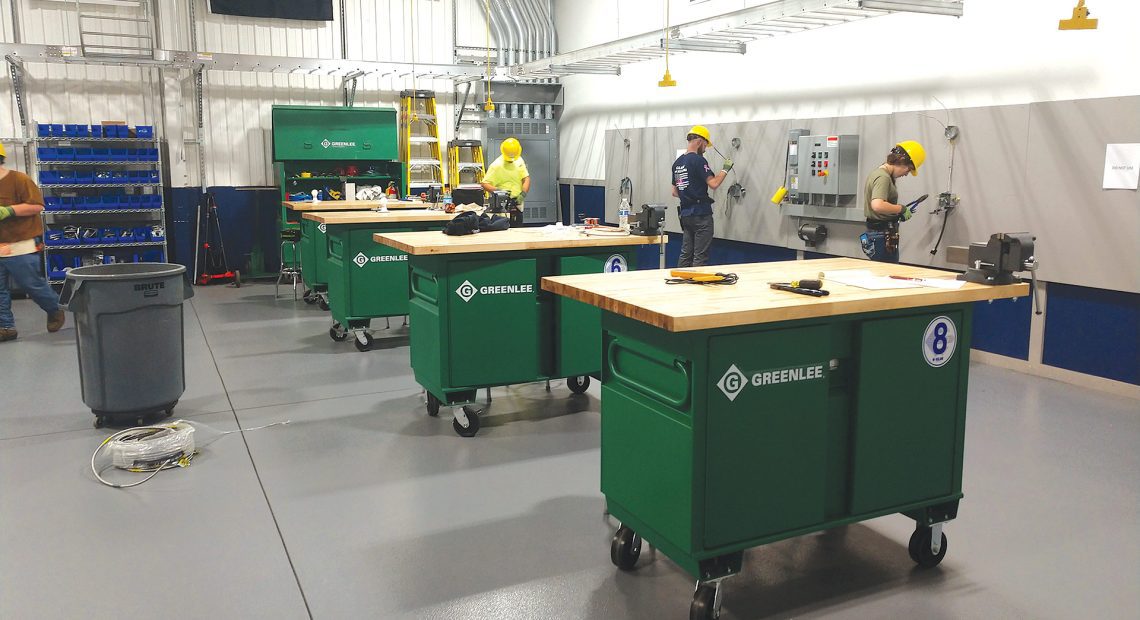
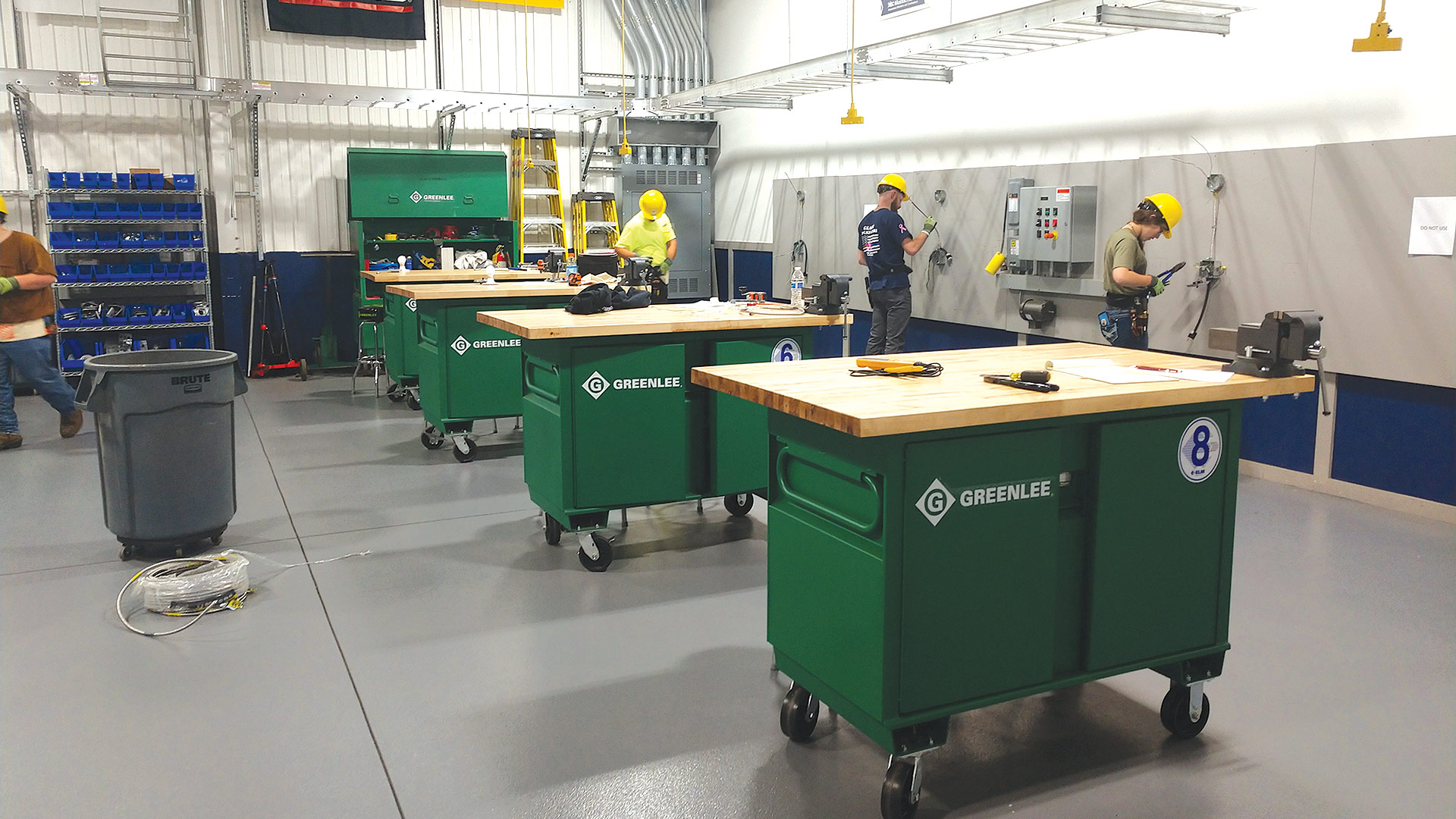
High-school students train at Elm Electrical as part of its summer First Step Futures program.

High-school students train at Elm Electrical as part of its summer First Step Futures program.


Over the summer, three cohorts of high-school students attended four-day training seminars, two in June and one in August, at Elm Electrical in Westfield.

Monday through Wednesday, the students received instruction and training in the state-of-the-art Elm University multi-media classrooms and hands-on lab. Thursday, the final day, was Challenge Day, when students applied what they learned and completed a project board challenge. Elm project managers evaluated their work, offered feedback, and got to know the students.

It was, no doubt, an enriching experience for many. But First Steps Futures, as Elm calls it, is more than a summer camp. It’s a program, to be repeated each summer, with an eye firmly on the future of the electrical industry.

“This is a great opportunity to showcase and utilize our training facility, expose kids to the electrical field, as well as instruct our current and future workforce,” instructor Paul Asselin said. “At the same time, we can get them excited about the field and see what the kids can do. Do they follow our strict safety protocols? Do they ask questions? Do they work well with others? Is their work accurate? Do they have a positive attitude? This gives us a snapshot of what they’d look like as potential co-op students on the job.”

The students, in grades 10-12, were recommended by their teachers or Elm employees to attend the free training seminar. Some were, indeed, invited back as co-op students, to get a better look at the field, and give Elm a better look at what they can do.

“This program also gives kids who don’t attend a technical school the chance to see if the electrical field is something they may be interested in pursuing,” Asselin added. “Oftentimes, students who go to a traditional high school think it’s too late to go into a trade. We make sure they know there is still an opportunity to pursue a career in the field.”

“Oftentimes, students who go to a traditional high school think it’s too late to go into a trade. We make sure they know there is still an opportunity to pursue a career in the field.”

The Elm University classrooms and lab weren’t created with young people in mind, however; they’re used year-round as Elm’s in-house training facility. Employees who want to become licensed electricians can opt into the company’s four-year apprentice program, working their jobs Monday through Thursday and then, every other Friday, attending school at Elm University for free, as an alternative to night school.

“We started our own training because we weren’t happy with the training we were getting, the conventional way of going two nights a week, three hours a night; most of these night classes are in a classroom setting and don’t have a hands-on component. They get what they need to pass the test, of course, but the hands-on component makes a big difference because that’s what their supervisors see out in the field. That’s what they need out in the field.”

In short, Elm has created a way to cultivate a pipeline of young talent at a time when older electrical workers are leaving the trade faster than they can be replaced. It’s a trend being observed in all construction trades, in fact, and it sometimes requires innovative solutions.

“We can complain like everyone else or do something about it, and we’ve chosen to do something about it,” Asselin said, noting that the effort and financial investment are paying back in the quality of workers the company is putting into the field. “It’s apparent it’s working.”

Jean Pierre Crevier, co-owner of M.L. Schmitt Inc., a 99-year-old electrical contractor based in Springfield, agrees that companies need to stay connected to the potential pipeline of young talent. He does so by participating in the interviewing process of the Joint Apprentice Training Committee of the Local 7 International Brotherhood of Electrical Workers, bringing new students into apprenticeship programs. “I was pleased with this year’s turnout — we had a lot of great candidates to choose from this year.”
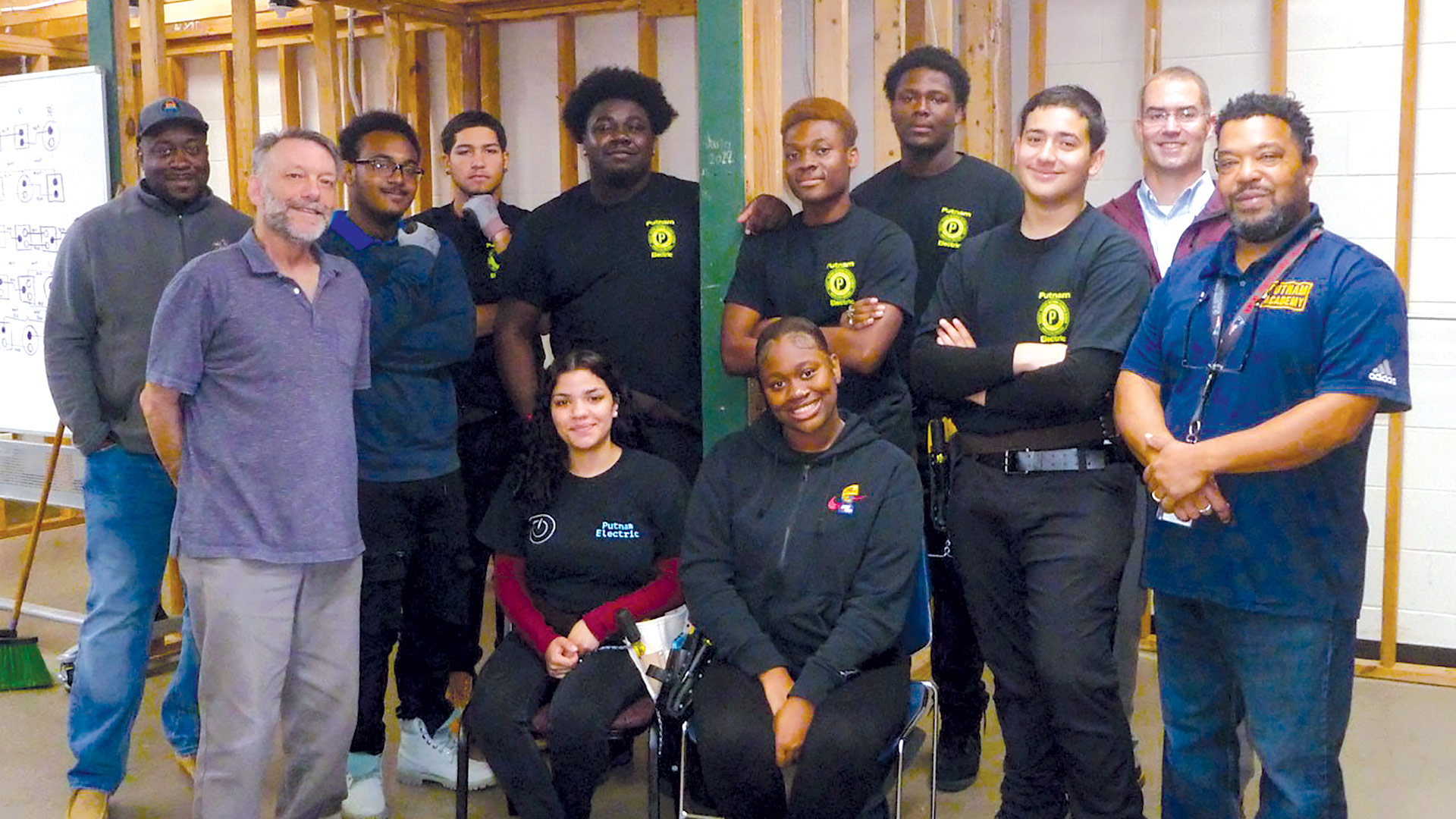
Putnam Vocational Technical Academy teachers

Putnam Vocational Technical Academy teachers Michael Poole (far left) and Charley Jackson (far right) and senior students are joined in the electrical shop by M.L. Schmitt’s Bobby Williams (back left) and Pete Coppez (back right).

But he also does so with efforts like a recent partnership between M.L. Schmitt, Exposure, and two local electrical manufacturers, Legrand and Fidelux Lighting, to provide donations to the Putnam Electrical Shop at Putnam Vocational Technical Academy in Springfield.

The Putnam Electrical Shop works on a fixed budget, and donations like this give them additional supplies and equipment for student lessons, said teacher and master electrician Charley Jackson. “I share my work experience and testimony with my students, and it really helps them with their desire to learn. Our recent visit from M.L. Schmitt and donation of supplies really encouraged our students to keep pushing.”

The materials that the school received include low-voltage and line-voltage training kits, a variety of light fixtures, blueprints, surface raceways, disconnect switches and more. More donations are expected to take place this fall, and M.L. Schmitt has hired many Putnam graduates over the years.

“We’ve been conditioned to think you have to have a college degree to have a successful career after high school,” Crevier said. “But a lot of people struggling with college and looking at alternate solutions can make really good money in the trades. I know borderline geniuses who don’t have a really strong formal education behind them, but they can use their hands, and they’re virtual artists, interpreting visual drawings to see what the designer’s intent is. It’s a great career path.”


Mind the Gap

The workforce issue isn’t unique to electricians. A recent survey by Associated General Contractors of America (AGCA) found that, overall, construction firms are still struggling to recruit employees. Ninety-three percent of respondents say they have open positions that they’re trying to fill, and 91% indicate they are struggling to fill at least some of these roles. This issue is particularly pronounced among craft positions, which make up the bulk of construction work on job sites.

At the same time, AGCA reported, more companies are waking up to the fact that the future of the construction industry lies in youth, which is why firms are increasingly taking steps to engage younger generations. Fifty-one percent of survey respondents say they’ve gotten involved in career-building programs at the high school, college, and technical-school level in order to encourage students to consider a career in construction.

Jean Pierre Crevier

Jean Pierre Crevier

“But a lot of people struggling with college and looking at alternate solutions can make really good money in the trades. I know borderline geniuses who don’t have a really strong formal education behind them.”

It’s a task facing serious headwinds. Tallo, an employment and scholarship platform geared toward younger workers, issued a report in the spring analyzing survey responses from more than 29,000 high-school and college students about the brands, industries, and career paths they desire. In a ranking of 22 industries, construction attracted the interest of just 16.7% of respondents; only forestry ranked lower. In contrast, 76.5% want to work in technology.

What those who are looking at the trades are finding, however, is opportunity. According to the U.S. Bureau of Labor Statistics, electrician jobs are expected to grow by 9.1% from 2020 to 2030, higher than the 7.7% growth rate projected for all occupations. The increase in demand is largely driven by an increase in devices, buildings, and vehicles that rely on electricity; from 2021 to 2022 alone, total electricity consumption in the U.S. is expected to grow by 1.4%. Meanwhile, as noted earlier, Baby Boomers are retiring at a faster rate than members of Gen Z are choosing careers in the trades.

“I was one of those people who went to a private high school, four-year college, got a bachelor’s degree in marketing, sat behind a desk every day, and decided it wasn’t for me and turned to the trades,” Crevier told BusinessWest. “I decided I was one of those visual people; I like to work with my hands, see my accomplishments at the end of the day, and be proud of what I did.”

One of his pitches to young people is that, particularly for those who enter a union apprentice program, they’ll get paid to learn a career path, rather than go into debt. “Instead of investing tens of thousands, hundreds of thousands, into an education, you’re actually getting paid to learn, paid in the field, as you go to night school, at least on the union side.”

Bobby Williams, a purchasing officer at M.L. Schmitt, graduated from Putnam and is gratified to see more of its students become the future of his field. “Without our young, upcoming electricians, we won’t have a future workforce of skilled tradesmen and women.”

Which is why Jackson is gratified by the continued connection betweeen Putnam and area businesses. “These donations and visits from M.L. Schmitt let our students know they’re included,” he said. “It certainly motivates and keeps them encouraged about entering the trade.”

Michael Poole, who chairs the Electrical Department at Putnam, added that the donation gives students an opportunity to see and work with specialty items that they would otherwise not be able to afford. “It also shows them that the community cares about their future success in the electrical trade. I am grateful, and I know that our students are as well.”


First Steps on a Rewarding Path

Still, Asselin noted, with the manpower shortage, vocational schools can only put out so many students, which is why programs like Elm’s First Steps Futures, is so important, as the company brings in young talent who might otherwise have never thought electrical work was something for them.

“I’ve got them for four days, so I get a pretty good idea what kind of student and what kind of employee they may be. It was really eye-opening for us to see the quality of some of the students out there,” he said. “Some kids who go to a traditional high school or some other alternative school think they can’t go into a trade because they didn’t go to trade school. That’s not the case. Companies like ours will train them both in the classroom and hands-on. We have that ability to get them up to the same level as, say, a vocational student that went through a three-year vocational program.”

Moving forward, Asselin said Elm might open the week-long program to veterans looking to get into a trade. “It’s a different way to approach the problem.”

But Elm University itself, where current employees skill up for better career opportunities, has been a crucial element, he added. “This is what we should have done a long time ago. We kind of had our hand forced because certain jobs require traveling, guys are out of town for a week, and it’s hard to be in school during the week and also be at work. Now, they can travel during the week and get back for class.

“This is a great option for those who don’t want to have to go to night school,” he added. “In four years, students will be ready to sit for their exam to be licensed electricians. Adding our First Steps Futures program to our Elm U program really allows us to groom our future workforce from the very beginning.”

Offering young people pathways into a career is important, but so is showing them how much satisfaction can be found in the work.

“Really, it’s a tangible thing. I tell students, there is a tangible output from what you do,” Crevier said, adding that he tells students about area jobs his company has worked on, from Union Station to the light and visual displays at Thunderbirds games to hospitals, which rely on electrical networks to save lives. “These things might last decades or hundreds of years, and people will always see the product of what you did. Kids today have never thought about that aspect before.

“We can all find people,” he added. “It’s a matter of finding qualified candidates who have the initiative, the drive, and the desire to differentiate themselves and be leaders. Too many people in the workforce today are complacent to show up and participate and don’t want to do more.”

But Schmitt, a company that’s been around for 99 years and doesn’t plan on going anywhere, won’t always have Crevier and his team at the helm, so a job there, as at many companies, is a chance to grow into higher roles.

“We’re not going to be here for 30 years, but we’re looking at the next 30, 40, 50 years, and even beyond that,” he said. “There’s always an opportunity for the right individual.”

At a time when electrical and all other building trades are scrambling to find talent and restock an aging workforce, it’s just one more factor that might draw a Gen-Z student to a career he or she might never have considered before.


Joseph Bednar can be reached at [email protected]

Daily News

WESTFIELD — Elm Electrical has created a new program for high-school students interested in the electrical field. The students, in grades 10-12, were recommended by their teachers or Elm employees to attend this free, four-day training seminar. These prospective co-op students, or Elm Futures, were then invited to join Elm educators learn new skills as well as showcase their own talents at the First Steps Training Seminar.

Monday through Wednesday, students receive instruction and training in the state-of-the-art Elm University multi-media classrooms and hands-on lab. Thursday, the final day, is Challenge Day, when students apply what they’ve learned and complete a project board challenge. Elm project managers are invited to evaluate their work, offer feedback, and get to know the students.

“This is a great opportunity to showcase and utilize our training facility, expose kids to the electrical field, as well as instruct our current and future workforce,” instructor Paul Asselin said. “At the same time, we can get them excited about the field and see what the kids can do. Do they follow our strict safety protocols? Do they ask questions? Do they work well with others? Is their work accurate? Do they have a positive attitude? This gives us a snapshot of what they’d look like as potential co-op students on the job.

“This program also gives kids who don’t attend a technical school the chance to see if the electrical field is something they may be interested in pursuing,” he added. “Oftentimes students who go to a traditional high school think it’s too late to go into a trade. We make sure they know there is still an opportunity to pursue a career in the field.”

Two sessions were held in late June. Session 3 is taking place this week. “We had a great first two sessions, and I’m looking forward to getting to know a new group of kids this week,” Asselin said.

The Elm University classrooms and lab are used year-round as Elm’s in-house training facility. Employees who want to become licensed electricians can opt into the company’s four-year apprentice program. They can work their jobs Monday through Thursday and then, every other Friday, attend school at Elm University for free.

“This is a great option for those who don’t want to have to go to night school. In four years, students will be ready to sit for their exam to be licensed electricians,” Asselin said. “Adding our First Steps Futures program to our Elm U program really allows us to groom our future workforce from the very beginning.”