Home Posts tagged Features (Page 15)
Features
Wing Memorial Hospital Opens New, $26.5 Million Building

The new intensive care unit at Wing Memorial Hospital in Palmer, one of the departments overhauled in a just-completed, $26.5 million expansion project, will soon be equipped with something called the VISICU system.

That’s a network that uses computer monitors to make each patient’s vital signs — among them blood pressure, oxygen saturation, and heart rate — viewable in real time by critical-care specialists at UMass Medical Center in Worcester, Wing’s parent hospital. Those same doctors can also monitor other patient information, such as current medications and recent test results.

Proponents of such ‘telemedicine’ technology note that even the slightest change in a patient’s condition can cause potentially serious effects, and the ability to alert doctors to such changes instantly — doctors who, in turn, can immediately notify on-site staff in the Wing ICU — ensures that patients get urgent care when necessary.

Compared to the manner in which hospital care was delivered only 10 or 20 years ago, that’s a long way for vital information to travel quickly. But Wing has come a long way in many other aspects, too, as evidenced by this week’s opening of the new, 58,000-square-foot Country Bank Pavilion on its campus.

The addition, named for the Ware-based bank that donated $750,000 to the $26.5 million project, replaces the former operating rooms, intensive care unit, ambulatory surgery unit, and inpatient unit. The original hospital building has been renamed the Paul C. Michalski Pavilion after a former CFO at Wing who was a key player in the hospital’s previous growth, said Wing’s president and CEO, Dr. Charles E. Cavagnaro III.

Investing in Tomorrow

The new operating rooms will help Wing more effectively deliver general and laparoscopic surgical services including surgeries of the colon and rectum, gynecology, neurosurgery, orthopedics, ophthalmology, podiatry, urology, and ear, nose, and throat, as well as thoracic surgery and cosmetic and reconstructive procedures.

The new medical/surgical inpatient unit features 18 private rooms and 11 semi-private units, with all beds featuring an unobstructed view out the window and the private rooms including recliners for family members to stay overnight.

The mix of private and double rooms “makes it much easier for the staff to put people where they need to be to get the best care possible,” said Edward Noonan, chairman of Wing’s board of directors, at last week’s ribbon-cutting ceremony attended by hundreds of hospital employees, dignitaries, and local residents. “Even though the total number of rooms hasn’t changed dramatically, it extends our ability to take people into the hospital. And with telemedicine capabilities, doctors can look in on patients directly from UMass.

“These are state-of-the-art operating rooms that no one imagined we would have here in Palmer,” Noonan added. “It’s spacious, and it’s your home when you or a loved one needs help.”

State Sen. Stephen Brewer said the expansion is one example of the type of health care investment needed to create jobs and keep Massachusetts on the cutting edge of the industry, another being the life sciences bill recently passed by the state Legislature to provide $1 billion over 10 years for what could potentially be an $8 billion sector.

“That’s a good economic multiplier and job creator, but more important was the person I met recently in Boston — a handsome young man in a wheelchair with Lou Gehrig’s disease.” The man had battled the disease for two years and didn’t have long to live, Brewer said. “I hung my head all the way back to my office thinking about the loss of this beautiful, talented individual. What we do for life sciences, how your tax dollars are invested for life sciences, is about alleviating the pain and suffering of your fellow citizens, and obviously we take it very seriously.”

Likewise, any public or private investment in health care of all kinds, including Wing’s expansion, continues to benefit society, Brewer said, noting that the average life expectancy in Massachusetts, which stood at 52 a century ago, has now surpassed 78. “I think increasing life expectancy and the quality of life for our citizens happens because of the work that happens here.”

At the same time, many of the speakers assembled for the ribbon-cutting ceremony on a rainy Monday morning spoke not just to the hospital’s technological advancements, but to a tradition of compassionate care.

State Rep. Todd Smola, who has four living grandparents, was one of those who touched on the human side of Wing, recalling various occasions when they were admitted to the hospital. “Nobody’s more grateful to the care here than the person standing here,” the Palmer resident said. “Whenever we came to the hospital to visit my grandfather or grandmother, the doctors and nurses took the time to ask how we were doing, not just the people they were caring for.”

State Rep. Anne Gobi noted that the hospital has made important strides in end-of-life care, including not only hospice care for the dying but bereavement counseling for families, among other services.

Now and Then

Wing’s expansion has cleared some space in the old, 111,400-square-foot building, and Wing administrators must still make decisions on the best use of that square footage. But at a time when Massachusetts residents are living longer, all the ceremony attendees said it’s important for Wing to remain in a growth mode.

“At a time when community hospitals are struggling to stay open, Wing is building and growing,” said James Phaneuf, vice chairman of Wing’s board of directors, noting that the hospital employs 600 people and has benefited from its membership in the UMass Memorial Health Care system beginning in 1999. “We couldn’t have reached this point without the close support of UMass Memorial.”

That system employs 13,000 people and treats some 3,000 to 4,000 patients per day, said John O’Brien, president and CEO of the health network. “In our system, some of the very best people we have work inside the walls of this hospital,” he said. “This has been a wonderful effort by this hospital to serve all who need help, and I am particularly thankful to this staff that does such an extraordinary job every day providing health care to everyone who comes through these doors.”

Paul Scully, president of Country Bank, resorted to a little humor in recounting the bank’s decision to financially support the expansion project. “When I started to write a check for $750,000, my hand started to shake, but then a voice said this is the right thing to do,” he said, then turned to Cavagnaro. “Thanks, Charlie, for helping me to finish signing the check.”

U.S. Rep. Richard Neal wasn’t able to attend the gathering, but his aide, Kevin Kennedy, promised additional federal funding for regional health care endeavors down the road.

“The critical nature of health care in Massachusetts and all around the country is not something that I have to explain to any of you,” Kennedy said. “Looking at this magnificent structure, you deserve to be congratulated.”

Departments

Jackson & Connor Opens

NORTHAMPTON — Jackson & Connor, a new men’s apparel store, recently opened on the second floor of Thornes Marketplace. Set in a retail atmosphere that recalls a men’s club with rich, dark, painted walls and wood furniture, Jackson & Connor features several lines including Jhane Barnes, Donald Pliner, John Varvatos, and Edun. The 1,100-square-foot store also features casual and up-tailored men’s clothing and a large selection of accessories.

Paul Robbins Associates Wins Award

WILBRAHAM — Paul Robbins Associates Inc. is a “Silver” winner in the 2008 Summit Creative Awards competition for its creative work for HAP Inc., the region’s housing partnership. The award is for a video, titled “Home,” which was produced by Paul Robbins and shown during HAP’s annual dinner and is used for development purposes by the organization. “Home” highlights HAP’s groundbreaking collaboration of new-home construction and community reinvestment in the Old Hill neighborhood of Springfield. The Summit Creative Awards recognizes and celebrates the creative accomplishments of small and medium-sized advertising agencies and other creative groups with annual billings of $30 million or less. Paul Robbins Associates at Post Office Park is a consultancy providing a wide range of communications services related to public-affairs and marketing strategy and execution.

Big Y Participates in ‘Be Food Safe’ Campaign

SPRINGFIELD — Big Y Foods Inc. has joined food retailers from across the country in a cooperative government, industry, and consumer-group effort to reach millions of consumers with important food safety information on the basic food handling practices of “clean, separate, cook, and chill.” Be Food Safe, originally launched by the U.S. Department of Agriculture and the U.S. Partnership for Food Safety Education, encourages retailers to display food-safety messages and visual reminders in front of customers through in-store promotions, brochures, flyers, packaging, circular ads, Web sites, and other forms of customer outreach. Nearly 40 retailers, representing approximately 6,000 supermarkets and an estimated 81 million consumers, have volunteered to implement Be Food Safe through their in-store and external customer-communications programs. While the overall rate of foodborne illness has been declining, the Centers for Disease Control and Prevention indicate that an estimated one in four Americans suffers from food borne illness each year. Consumers can download and print their own Be Food Safe brochure at www. befoodsafe.org.

Caring Health Center Opens Third WIC Office

SPRINGFIELD — Caring Health Center recently opened its third WIC office at 860 Boston Road to provide health education and nutrition services to area women, infants, and children. WIC programs are funded by federal grants that are administered through the Mass. Department of Health. Caring Health Center provides WIC services at its other city locations — Springfield South, 1139 Main St.; and Forest Park, 523 Sumner Ave. Caring Health Center’s WIC programs served more than 3,900 participants in Springfield, Longmeadow, East Longmeadow, and Hampden before the expansion to Pine Point, according to Anne S. Awad, president and CEO of Caring Health Center. For more information on services, visit www.caringhealth.org.

STCC Foundation Closes Major Gifts Campaign

SPRINGFIELD — The Springfield Technical Community College Foundation concluded its first major gifts campaign, “The Best Return On Your Investment,” on May 13 with a victory celebration. The year-long campaign raised more $4.5 million, which will support technology-based educational programs and allied-health programs, in addition to providing need-based scholarships for students. The initiative was established to maintain STCC’s role as a leader in technology and innovation, according to Ira Rubenzahl, president of STCC.

Hampden Bank Awards Grant to Library in Indian Orchard

SPRINGFIELD — The Hampden Bank Charitable Foundation recently donated a $15,000 grant to create after-school art programs for young people in the neighborhood of Indian Orchard. The funds will pay for a series of art programs in collaboration with the Artists’ Mill at Indian Orchard for children ages 8 to 17 in the Indian Orchard branch of the Springfield Library. The project begins this summer and continues into the school year with Saturday and evening classes.

Sections Supplements
Entrepreneurship Hall of Fame Announces Inductees
Harry Samble

Harry Samble, founder of Belmont Laundry, making some deliveries.

When asked about his grandfather, Robert Samble Jr. started by pointing.

“That’s him,” he said, gesturing toward a framed photograph sitting on a shelf in his crowded office. Somewhat faded by time, the image is of a man sitting behind the wheel of a delivery truck bearing the name Belmont Laundry, circa 1915. “That’s Harry Samble … he started all this with grandma.

“That’s her there,” he continued, pointing to another picture, this one on a higher shelf. “She ran it for years with my father after grandpa died.

“And that’s my father there,” he went on, pointing to a picture of a man in uniform standing next to a P-47 Thunderbolt fighter plane. “That’s from his days in the Army Air Corps during World War II.”

When businesses stay in the same family for several generations, there are usually lots of old photographs on walls, atop credenzas, or in desk drawers, and so it is with the Western Mass. Entrepreneurship Hall of Fame’s Class of 2008. And as the saying goes, they speak a thousand words.

Barbara Meunier has a favorite picture of her father, Rupprecht Scherff, who ran the Fort restaurant in downtown Springfield for more than 40 years until his death in 1996. The picture in question shows him in one of the dining rooms, where one would usually find him, shaking up some cherries jubilee tableside.

“He was always working … always,” said Meunier, who now manages the Fort, known to some as the Student Prince, along with her brothers, Rudi and Peter Scherff. And there is now a third generation at work, she noted, adding that her son, Michael, is kitchen manager, and Rudi’s son (also named Rudi) recently took home his first paycheck for work in the deli.

There is a fourth generation now working at Belmont Laundry — Samble’s sons, Matt and Derek, have lead roles — and a fifth generation continues to market Absorbine liniment and other products at W.F. Young, which was started by Wilbur Fenton Young in 1892. The company, and the Young family, have several pictures of the founder, including one with his signature followed by the letters P, D, and F. Apparently, Wilbur’s father, Charles, didn’t think much of his son’s decision to start a company making liniment for horses and, later, humans. As a condition for granting a $500 loan to help finance an expansion of the venture, the elder Young stipulated that his son pronounce himself in all advertising as “Pa’s Darn Fool.”

Long-surviving family businesses, old photos, and the stories behind them may be the dominant theme for the Class of 2008, but there are other intriguing stories in this roster of inductees, the ninth to be enshrined.

Baystate Health is being inducted to recognize an entrepreneurial spirit that has manifested itself in many ways, said Tom Goodrow, vice president of Economic and Business Development at Springfield Technical Community College, which created the Hall of Fame. These include many new ventures in recent years, including the D’Amour Center for Cancer Care, one of many new developments on the north end of Main Street, and a $239 million expansion, dubbed the ‘Hospital of Tomorrow,’ due to be started this fall.

There are also the entrepreneurial exploits of Art Jacobson — who founded Olympic Manufacturing Group in Agawam, now called OMG Inc., and later founded Mr. Shower Door — and the individuals now at the helm at OMG.

The Class of 2008 was introduced at a reception staged May 22 at the Colony Club, and the new inductees will be honored at the annual Hall of Fame dinner on Oct. 2 at the Log Cabin Banquet and Meeting House.

Proceeds from that event will benefit the many entrepreneurship programs at STCC’s Andrew M. Scibelli Enterprise Center (SEC), said Goodrow. These include the YES (Young Entrepreneurial Scholars) program, which serves more than 1,000 young men and women in two dozen area high schools, as well as the Community Foundation of Western Mass. student business incubator in the SEC, which hosts up to nine fledgling businesses.

Here’s a look at the Class of 2008.

Belmont Laundry (the Samble Family)

Before moving on to that truck, Harry Samble picked up and dropped off laundry on his bicycle and, later, a horse and buggy.

In those days, his service was called ‘wet wash,’ said Robert Samble, noting that his grandparents would pick up laundry, wash it, and bring it back to the customer wet, to be dried on a line outside. This line of work has evolved considerably over the years, he continued, adding that Belmont now has a fleet of trucks and more than 50 employees, and handles more than 1,000 commercial accounts in a service area stretching from Newport, R.I. to Pittsfield.

How it arrived at this state is a story of perseverance, vision, and dedication to customer service, he explained. To emphasize this point, he stopped at a pair of recently cleaned uniform pants soon to be returned to a commercial client. Turning the waist back, he revealed a radio frequency identification (RFID) tag implanted within. Each item has one, said Samble, to ensure that every shirt, pair of pants, physician’s coat, or commercial floor mat goes where it’s supposed to go.

“The big outfits don’t do this, because it’s expensive and they don’t want to spend that kind of money on customer service,” he said, adding that Belmont has been taking such steps since Harry and Corrine Samble set up shop in 1907 in a barn on the location where the headquarters building still stands today.

Harry Samble died when his son, Robert, was only 14, pressing the second generation of the family into a large role within the business at an early age. For many years, Robert Samble and his mother ran the business, along with one of Harry Samble’s brothers, who was later bought out.

Robert Samble Jr. is a little sketchy on some of the history, because he never met his grandfather and his father died in 1967, when Robert was just 14. It was then that Robert’s mother, Dorothy, who had not been involved in the business at all while her husband was alive, essentially took over and kept the doors open.

“If it wasn’t for her, we wouldn’t be here today,” said Robert, adding that, in 1973, his mother was able to convince him to change careers (he had been a refractory mason) and join the family business.

Since then, he has orchestrated significant growth — the company has added locations in Agawam, West Springfield, Longmeadow, and a second store in Springfield — and diversification. He’s been joined in the business by sons Matthew, now project manager, and Derek, the dry-cleaning division manager, and stepdaughter April Caruso, who is supervisor of counter staff.

Commercial work, which now accounts for roughly 75% of Belmont’s business, remains strong, said Samble, but the retail side of the ledger has been soft in recent years, a trend he attributes to more-casual dress in the workplace, among other factors.

“People aren’t dressing up like they used to,” he explained, adding quickly that the company will persevere, whether that trend changes or not. It has endured for 101 years because it’s been able to add new wrinkles — or iron them out, as the case may be.

The Fort Restaurant

There are a few pictures of Rupprecht Scherff on the walls of the Fort, providing a continuing presence for the individual credited with making the restaurant a Springfield institution and popular stop for the business community.

But it is the work of two generations, and now a third, that has enabled the venue to persevere for 73 years, a very rare feat in the challenging restaurant business.

The Fort is known for many things, including its two names — ‘Student Prince,’ taken from a Sigmund Romberg operetta about student life in Heidelberg, and ‘the Fort,’ the name given the main dining room, in recognition of the fort John Pynchon built on the site in 1660 — and also an extensive collection of beer steins, its veal shank, scrod, and Roquefort salad dressing.

It all started back in 1935 with Paul Schroeder, a native of Germany and cigar maker by trade. After working at several area cigar factories, he took a job as the housemaster of the Springfield Turnverein, a German club that continued to serve its members libations during Prohibition. After repeal of the Eighteeth Amendment in 1933, Schroeder saw an opportunity to start his own business, and did so, partnering with Erna Sievers in the Student Prince restaurant on Fort Street.

Rupprecht Sherff would eventually take a job there in 1949. He came to the U.S. from Germany years earlier, at the behest of Robert Jarhling, owner of the Highland Hotel in Springfield, whom Scherff had impressed while he waited on Jarhling and his wife when they were visiting Bremen. Scherff worked at the Highland for many years and later fought in World War II before coming to the Student Prince. He started in the kitchen and was eventually asked to manage the restaurant. When Sievers died in 1961, she left the establishment to Scherff and another employee, Tante Grete, whom Scherff bought out in 1971 to assume sole ownership.

Barbara Meunier said she and her brothers practically grew up in the restaurant, eventually handling every job in it. Rudi started when he was 8, and was officially on the payroll at age 12. Barbara, meanwhile, started at 14. Neither thought they would make the Fort their career, but after trying other pursuits — Rudi practiced law in Springfield for several years — they gravitated back to Fort Street.

Today, they split the various responsibilities involved with day-to-day operations — Meunier handles most office duties; Peter, who has an MBA, handles most financial aspects of the business; and Rudi takes care of the kitchen and the menu — and continue many traditions started by their father, such as Octoberfest, Mayfest, a wild game festival, and elaborate decorations for the holidays.

They’ve also brought the third generation into the business, which, says Meunier, has the same work ethic as the man in all the pictures.

Baystate Health

Andrew Scibelli, president emeritus of STCC and chair of the steering committee for this year’s induction ceremonies, acknowledged that Baystate Health is a different kind of selection for the Hall of Fame.

Rather than acknowledging one individual or several members or generations of one family, the selection of Baystate constitutes recognition of an entrepreneurial philosophy that pervades the system and its more than 10,000 employees, said Scibelli.

“They’re not just running a hospital there,” he continued. “They’re being entrepreneurial in every aspect of that word; they’re looking for opportunities, they’re taking risks in some cases, and they’re taking steps that will benefit themselves and the community they serve.”

Elaborating, he said there have been many examples of this over the years, and especially the past decade or so. Endeavors include a number of ventures on Main Street, several blocks from Baystate Medical Center, with most of them involving former mill complexes that were either rehabbed or replaced with new construction.

These include the D’Amour Center for Cancer Care, the region’s only free-standing, multi-disciplinary cancer treatment facility, opened in 2002, and the Pioneer Valley Life Sciences Institute, a joint venture between Baystate Health and UMass Amherst that was created in 2004 to develop new approaches for the diagnosis and treatment of disease.

Other examples include the expansion of the health system to include Baystate Franklin Medical Center and Baystate Mary Lane Hospital, and the system’s involvement in the creation of the for-profit health maintenance organization Health New England, in which it still owns a majority interest.

The most recent, and soon to be most visible, example of Baystate’s entrepreneurial drive is a $239 million expansion project, the ‘Hospital of the Future,’ a nearly 600,000-square-foot complex that will replace some of the hospital’s older facilities with new, state-of-the-art patient-care areas that administrators say will directly address the needs of an aging population.

The expansion is perhaps the largest in the history of the system, which can trace its roots back to 1883 and the opening of Springfield Hospital. In 1974, what was then known as Springfield Hospital Medical Center merged with its neighbor, Wesson Women’s Hospital, to create the 672-bed Medical Center of Western Mass. In 1976, this entity merged with Wesson Memorial Hospital, located about two miles away. The merger established Baystate Medical Center, then the second-largest hospital in New England, with 1,036 beds.

In 1983, Baystate Medical Center was reorganized into three separate corporations: Baystate Health Systems, the parent corporation now renamed Baystate Health; Baystate Medical Center; and a for-profit corporation known as Baystate Diversified Health Services.

The Baystate Health family has grown significantly since its inception. In 1986, Baystate Franklin Medical Center in Greenfield joined Baystate Health; in 1991, Baystate Mary Lane Hospital in Ware joined the health system. In 1996, the Visiting Nurse Association & Hospice of Pioneer Valley, now renamed the Baystate Visiting Nurse Association & Hospice, also became a member of Baystate Health.

Through all the additions and name changes, the system has been consistently entrepreneurial in its approach to doing business and serving the community, said Baystate President and CEO Mark Tolosky.

“In the fast and ever-changing health care environment, we must be nimble and responsive to the needs of our patients and our communities, and assure them that we are stewards of all of our resources, and with that comes the need to be visionaries and risk takers,” he said. “One example of our entrepreneurial spirit at Baystate Health aligned with vision and risk relates to North Main Street in Springfield.

“Just over 10 years ago, the land sat silent, with vast, empty buildings — once home to robust manufacturers of hand tools and much more,” he continued. “The leadership of Baystate Health saw opportunity, and we invested $125 million to develop this Northern Edge Medical campus. Our lead role has led to significant private investment in the area. Now, we see a vibrant complex — with health care at its core — and with other businesses benefiting from the spin-off effects of this development.

“The vision we had became a reality and there’s more to come.”

W.F. Young

Wilbur Young was selling pianos in the early 1890s, and doing rather well at it, when he started looking for a different, more entrepreneurial career opportunity.

He found one through his love of horses — and some encouragement from his new bride, Mary Ida. The product that Wilbur developed, and that the couple made in a tub in their farmhouse kitchen, would come to be called Absorbine Veterinary Liniment. A blend of herbs and essential oils, the liniment would keep a horse from going lame while gently reducing swelling and stiffness.

More than 116 years later, the liniment remains the flagship brand marketed by W. F. Young Inc., a company credited with coining the phrase ‘athlete’s foot’ and, over the years, developing a wide array of health care products. Today, the company, which, after spending most of its existence in downtown Springfield, moved to East Longmeadow in 2000, is a global marketer of products for humans and animals.

The company, which started small, really began to grow when farmers discovered that Absorbine Liniment worked on humans, as well, said Tyler Young, its CEO, president, and fourth-generation manager. Using the original formula as a basis with some changes and
efinements, Wilbur created a liquid for human use, called it Absorbine Jr. Antiseptic Liniment, and brought it to the marketplace in 1903.

As demand increased, the original manufacturing operation in Meriden, Conn. proved insufficient, said Tyler Young, adding that his great-grandfather went to his great-great-grandfather and secured a loan — and its unusual condition. The company grew steadily over the years, adding some celebrity spokespeople — Hall of Fame pitcher Walter Johnson and Triple Crown champion Secretariat’s trainer, Lucien Lauren — while also adding ‘athlete’s foot’ to the lexicon in the 1930s.

The company typically introduces between five to 10 new products a year, said Tyler Young, adding that recent additions include DuraGuard® and Bug Block® insect repellents for horses, the innovative Stall Safe® brand disinfectant and sanitizer for stables and stalls, and Myoplast®, an amino-acid supplement which helps provide strength and stamina in horses while supporting lean muscles.

More than a decade ago, the company transitioned out of manufacturing and now bills itself as a virtual marketing company, Young continued. Production of the entire network of brands is outsourced throughout the U.S.; the operations department manages production from the company’s East Longmeadow headquarters. After 80-plus years in Springfield, the company moved to its new offices in the East Longmeadow Industrial Park in 2000.

Art Jacobson and OMG Inc.

He called it the “roofle.”

That’s the name Art Jacobson came up with for a new product he contrived back in 1981 to suit the needs of one of his clients.

At the time, Jacobson was a manufacturer’s representative for companies that made bolts, rivets, and screw-machine parts, among other things, and selling to companies like Hamilton Standard, Pratt & Whitney, and Electric Boat. He was calling on a client that made commercial roofing systems when a discussion ensued that would eventually lead to what Jacobson called a “fluke of a business,” and what has become one of the region’s most intriguing entrepreneurial success stories.

“I was selling him long screws to fasten his roofing down to concrete decks,” Jacobson recalled. “He said that if I came up with a different kind of fastener, like a long toggle bolt, he could use it to fasten roofing down to lightweight concrete decks where a screw wouldn’t work.”

One of the companies Jacobson represented made long bolts that he sold to a wooden-rail manufacturer. He borrowed some, took them to a hardware store in Springfield, and put toggle wings and large washers on them. He then took them back to his roofing-industry client, who pronounced them exactly what he was looking for.

Thus, the Olympic Manufacturing Group was born, only it would be several more years before it would be called that — and before it did any manufacturing.

After securing a patent for his roof toggle, or ‘roofle,’ Jacobson took out an ad in a national roofing trade publication which touted the product and its potential. And calls started coming in. Still at his sales job and with no inventory on hand, Jacobson started having the roofle made for him to fill those orders, and, in so doing, moving more quickly than most entrepreneurs would in taking a venture off the ground.

“I found myself getting into a business I really knew nothing about,” he explained. “Most entrepreneurs will investigate to the hilt or work on a product for six months or a year before deciding whether to take it to the market. Not me; I sort of fell into it.”

Fast-forwarding somewhat, Jacobson said he would have long bolts shipped to him, add the toggles and other features that converted them into roofles, and run back and forth to Bradley International Airport to ship them out. Eventually, he and his wife, Esther, rented out 250 square feet of space to operate the venture, and by late 1982, they had decided to go into business together.

Within a few more years, Olympic would become a manufacturer of roofing fasteners, and by 1985 it would be No. 1 in the industry.

Jacobson said the key to the company’s steady growth within the Agawam Industrial Park was hiring the right people, individuals such as Hugh McGovern, who would later become president of Olympic (later to be called OMG), after Jacobson sold it; Dan Murphy, who eventually would become president of a succession of larger owners of OMG; and Tom Wagner, OMG’s senior vice president.

“We succeeded because I surrounded myself with people better than me,” he explained. “They took the company to places I couldn’t.”

Jacobson described his sale of Olympic in 1994 as the “quintessential win-win,” and both parties would go on to write more success stories.

After “chasing the grandkids around for several years,” as he put it, Jacobson started Mr. Shower Door in 2005. He’s tripled sales since them, and now has three locations.

Meanwhile, OMG continues to grow, organically and through acquisition. The most recent example was the purchase and assimilation of Illinois Tool Works (ITW), Buildex’s roofing business segment, which is now known as OMG West.

Today, total sales are approaching $150 million. Not bad for a “fluke of a business.”

George O’Brien can be reached at[email protected]

Departments

Comfort Inn Opens in Hadley

HADLEY — The Comfort Inn at 237 Russell St., franchised by Choice Hotels International Inc., is now open. Formerly a Quality Inn, the hotel underwent renovations to convert to a Comfort Inn hotel, including updating bed linens, a deluxe continental breakfast, and the lobby area. Owned and operated by Parmar & Sons of Hadley, the Comfort Inn features 86 guest rooms and one meeting room that can accommodate up to 40 people. The hotel also offers free high-speed Internet access, free in-room Comfort Sunshine Roast coffee, complimentary USA Today, and an indoor heated pool.

Yiddish Book Center Caps $32M Campaign with Groundbreaking

AMHERST — The National Yiddish Book Center has completed a six-year fund-raising campaign that brought in $32 million, and, to mark the occasion, conducted a groundbreaking ceremony on May 4 on a $7 million construction and renovation project that will double the size of its facility. The campaign has allowed the center to eliminate organizational debt, increase its endowment from $600,000 to $5.8 million, proceed with expansion plans, and significantly strengthen its donor base. Funds raised will also benefit educational and public programs. Built in 1997, the center’s current, architecturally distinctive headquarters offers exhibitions, galleries, open stacks of Yiddish books, a reading library, a bookstore, and public gardens. With the 21,000-square-foot expansion, the structure will include a state-of-the-art book repository for 500,000 of the center’s most important Yiddish volumes; a Yiddish Education Center with classrooms, a distance-learning center, and a student center; a 4,000-square-foot multipurpose space with a stage, professional lighting and projection equipment, and flexible seating for 275; a large kosher kitchen for conferences and other events; expansive galleries for traveling exhibitions and permanent installations; and offices for faculty and program staff. For more information about the center, visit www.yiddishbookcenter.org.

J. Polep Acquires Lesco Distributors

CHICOPEE — J. Polep Distribution Services recently announced the acquisition of Lesco Distributors in Mattapoisette. The sale adds $40 to $50 million to J. Polep’s annual sales, according to Jeff Polep, president and treasurer. Polep noted he will be employing 10 of Lesco’s sales representatives. J. Polep is a wholesale candy, tobacco, cigarette, grocery, and food-service distributor.

AIC Formalizes International Student Agreement

SPRINGFIELD — American International College (AIC) took a step toward becoming an international college recently by formalizing an agreement to bring undergraduate and graduate international students to campus. The college entered a partnership with Global Systems Management of Australia that could result in up to 100 new undergraduate students and even more graduate students. Global Campus Management Pty Ltd., headquartered in Australia, develops programs for students who may or may not speak English as their first language and who desire to study in the United States, United Kingdom, Australia, Canada, or New Zealand. As part of the agreement, Global Campus Management will recruit, process admission files, and manage student services for international students. AIC is the only college partner on the East Coast working with Global Campus Management. AIC President Vince Maniaci noted that the new agreement is an “excellent opportunity” for AIC to exercise its historic sensibilities. Maniaci said AIC was founded as a school for immigrants in the 1800s, and this is one way to get back to its roots.

MassMutual Participates in Pro-bono Housing Court Project

SPRINGFIELD — MassMutual Financial Group recently announced its participation in a local pro bono program in which attorneys in its Law Division offer free legal services to income-eligible tenants and landlords in Hampden County Housing Court. The program was founded by local members of the Mass. Women’s Bar Foundation, which provides free legal services for litigants who are facing either eviction or loss of their home and who do not have the financial means to retain the services of an attorney. In addition to this project, MassMutual attorneys are also doing pro-bono work for the Volunteer Income Tax Assistance Program in the Springfield area, which offers free tax-preparation help to low- and moderate-income individuals. If area attorneys are interested in participating in the Housing Court program, contact Suzanne Garrow at (413) 739-7094.

NewAlliance Sees 18.3% Increase In Earnings

NEW HAVEN, Conn. — NewAlliance Bancshares Inc., the holding company for NewAlliance Bank, recently announced net income of $12.9 million for the first quarter of 2008, compared to $10.9 million for the fourth quarter of 2007 and $9.3 million for the first quarter of 2007. The company also voted to increase the quarterly dividend to $.07 per share from $0.65 per share, payable on May 16 to shareholders of record on May 6. The dividend is up 8% from the prior quarter. First-quarter highlights included average loan balances increasing by $376.5 million, or 8.6%, and the net interest margin increasing six basis points to 2.56%, compared to 2.50% for the first quarter of 2007. On March 31, NewAlliance Bancshares had $8.18 billion in assets with 89 banking offices in Connecticut and Massachusetts.

Chicopee Bancorp Reports Income Drop

CHICOPEE — Chicopee Bancorp Inc., the holding company for Chicopee Savings Bank, recently announced net income for the three months ended Dec. 31, 2007 was $107,000 compared to $369,000 for the same period in 2006. The decrease in net income for the quarter is primarily due to an increase in salaries and employee benefits expense relating to expenses associated with the 2007 Equity Incentive Plan, according to bank officials. The company’s assets increased by $13.4 million or 3.0%, from $450.0 million at Dec. 31, 2006 to $463.4 million at Dec. 31, 2007, primarily as a result of an increase in loans of $10.9 million, short-term investments of $8.1 million, as well as federal funds sold of $7.5 million. The loan growth was offset by maturities of securities held-to-maturity of $10.1 million. In other news, the company reported a net income for the first three months of 2008 of $188,000, compared with $555,000 in income for the first quarter of 2007.

Big Y Plans Mother’s Day Promotion

SPRINGFIELD — Big Y Foods Inc. is donating 5 cents for every package of Big Y-branded products purchased during the Mother’s Day week sale through May 14 to the fight against breast cancer. Funds raised will benefit the Massachusetts and Connecticut affiliates of Susan G. Komen for the Cure.

O & P Labs Acquired

SPRINGFIELD — James Haas, CO, and Blaine Drysdale, CP, recently purchased Orthotics & Prosthetics Laboratories Inc., with offices in Springfield, Northampton, and Pittsfield. Haas, of Easthampton, is a certified orthotist at the facility with more than 16 years of experience, and Drysdale, of Northampton, is a below-knee amputee who has been a certified prosthetist at the company for more than seven years. Drysdale is also a licensed physical therapist specializing in amputee gait analysis. Both Haas and Drysdale look forward to a continued relationship with Salvatore LaBella, who founded the O & P Labs in 1984.

Whalley Computer Adds Course for Teachers

SOUTHWICK — Whalley Computer Associates recently announced “Integrating Technology in the Classroom” courseware to its eLearning Training Program for Educators. The program focuses on using the knowledge gained from learning computer programs such as Microsoft Office and incorporating it into daily lessons to enhance the students’ learning environment. The courseware consists of more than 28 chapters and will earn the educator 24 Professional Development Points. For more details, visit www.wca.com.

Easthampton Savings Sees Assets Rise

EASTHAMPTON — Easthampton Savings Bank President William S. Hogan Jr. recently announced that bank assets were more than $764 million at the end of the first quarter. The bank’s total assets were up $48 million from a year ago, an increase of 7%. In other news, the loan department reported loans now at more than $575 million, with a total loan portfolio that has increased by more than $39 million, and the bank’s deposit growth was $47 million, or up 9% from this time last year. Total deposits now exceed $544 million. During its annual meeting, the following elections took place: Richard A. Perras, clerk of the corporation, for one year; Thomas W. Brown, corporator, re-elected for a 10-year term; David K. Bridgman, William S. Hogan Jr., and Carol A. Perman, trustees, re-elected for three-year terms; and Thomas V. Giles, Carol A. Perman, and Stanley Paulauskas, elected to the Audit Committee for one-year terms.

River Valley Market Opens

NORTHAMPTON — The 15,000-square-foot River Valley Market recently opened its doors featuring large fresh produce, meat, and seafood sections; a deli seating area; beer and wine, bulk foods; cheese; dairy; grocery; and more. The community food store — specializing in fresh, organic, and locally grown foods — is unique in its concept as a member-owner investment. Membership at $150 is still available, and the co-op currently consists of more than 2,500 founding member-owners. Benefits to membership include savings on hundreds of specials and discounts on case purchases, and rebates on purchases when the co-op becomes profitable.

pton Inn Voted No. 1

HADLEY — The Hampton Inn Hadley-Amherst was recently named the number one Hampton Inn among the more than 1,400 Hampton Inn and Hampton Inn Suites hotels in the United States, Canada and Latin America for the first quarter of 2008. The Hampton Inn Hadley-Amherst was recognized for quality, guest satisfaction and business performance.

Goff Media Receives Addy Award

NORTHAMPTON — Goff Media recently received a Gold Addy Award for its ad campaign for Providence Auto Body to distinguish themselves from insurance affiliated auto body shops. The campaign features an insurance executive whom undergoes a lie detector test for installing cheap and inexpensive repair items in a vehicle in an effort to save money. Goff Media entered the 60-second radio ad, titled “Lie Detector,” in the radio category for the 2008 Addy Awards. Gold is the highest achievement in the regional competition, and the entry will now move onto the finals. The Addy Awards are the advertising industries version of the Grammies. For more information, visit www.goffmedia.com.

Chicopee Bancorp Reports Income Drop

CHICOPEE — Chicopee Bancorp Inc., the holding company for Chicopee Savings Bank, recently announced net income for the three months ended Dec. 31, 2007 was $107,000 compared to $369,000 for the same period in 2006. The decrease in net income for the quarter is primarily due to an increase in salaries and employee benefits expense relating to expenses associated with the 2007 Equity Incentive Plan, according to bank officials. The company’s assets increased by $13.4 million or 3.0%, from $450.0 million at Dec. 31, 2006 to $463.4 million at Dec. 31, 2007, primarily as a result of an increase in loans of $10.9 million, short-term investments of $8.1 million, as well as federal funds sold of $7.5 million. The loan growth was offset by maturities of securities held-to-maturity of $10.1 million. In other news, the company reported a net income for the first three months of 2008 of $188,000, compared with $555,000 in income for the first quarter of 2007.

MassMutual Graduates Special Care Planners

SPRINGFIELD — MassMutual recently graduated more than 110 Special Care Planners, strengthening the company’s ability to provide help to families with special needs. The agents received advanced training in estate and tax-planning concepts, special-needs trusts, government programs, and the emotional dynamics of working with people with disabilities and other special needs and their families, among other topics. The Special Care Planner certificate program is offered by the American College in Bryn Mawr, Pa., exclusively for MassMutual financial professionals. All agents also take an Emotional Intelligence Assessment to help them determine if they have the kind of emotional resiliency and personality that make them well-suited for this type of work. For more information, visit www.massmutual.com/specialcare.

Noble Hospital Earns High Grades for Patient Care

The Centers for Medicare & Medicaid Services (CMS), part of the U.S. Department of Health and Human Services, recently posted new survey information at the Hospital Compare consumer web site offering consumers more insight about the hospitals in their communities. In addition to adding the new information about Medicare patients about their hospital stays, CMS has added information about the number of certain elective hospital procedures provided to those patients and what Medicare pays for those services. For the first time, consumers have the three critical elements – quality information, patient satisfaction survey information and pricing information for specific procedures – they need to make effective decisions about the quality and value of the health care available to them through local hospitals. The updated information is part of the public health effort to strengthen consumer choice and create incentives to motivate providers to provide better care for all Americans. Five hospitals across Western Massachusetts were among the more than 2,500 hospitals in the country that participated in the patient satisfaction survey from October 2006 through June 2007. Local hospitals participating in the survey which was optional were Noble Hospital, Mercy Medical Center, Holyoke Medical Center, Cooley Dickinson Hospital, and Wing Memorial Hospital and Medical Centers. Noble Hospital in Westfield ranked tops among the regional hospitals in nine of the 10 categories in the patient satisfaction survey. Patient survey questions ranged from “nurses communicated well,” “doctors communicated well,” “received help as soon as wanted,” and “pain was well controlled,” to “staff explained medicines before giving,” “room and bathroom clean,” “room was quite at night,” “received home recovery information,” “hospital ranks 9 or 10 on scale from 0 to 10,” and “definitely recommend the hospital.” For more information, visit www.hospitalcompare.hhs.gov.

Features
Comcast Brings a New Bundle to the Small-business Marketplace

Doug Guthrie

Doug Guthrie says Comcast Small Business Voice addresses the direct needs of what has been an underserved constituency.

Doug Guthrie says small businesses have traditionally been overlooked, or “underserved,” as he put it, when it comes to voice services, which is ironic, because they dominate the economic scene in most regions, including the Pioneer Valley.

“Small businesses have pretty much had to take a back seat to bigger companies when it comes to phone service,” said Guthrie, vice president of Comcast’s so-called Connecticut-West Region, which encompasses the Valley. He told BusinessWest that his company is hard at work on remedying that situation with a new product rolled out earlier this year. It’s called Comcast Business Class Voice, part of a ‘Business Class’ bundle of voice, data, and television services that is similar in many ways to the company’s Triple Play package of those three services for residential customers. The new offering should help businesses operate more effectively, said Guthrie, while also saving money in the process through monthly charges as low as $99.

Business Class Voice includes unlimited local and long-distance calling for one price, as well as features ranging from auto attendant to a host of caller ID services to three-way calling. The new product brings a number of benefits to small businesses, said Guthrie, starting with choice, meaning a viable option to the phone company. But it also offers an effective bundle, those aforementioned cost savings, and the ability for smaller companies (those with under 20 employees) to operate as much larger entities.

“The idea behind this product is to make the small-business guy feel like the big-business guy,” he explained, adding that this concept is captured in Comcast’s materials to market the new product, which feature the tag line, ‘turn your office on.’ “We’re providing power to the business people.”

Meanwhile, for Comcast, which does business in 39 states, Business Class Voice and the new bundle provide what Guthrie and others expect will be an effective vehicle for capturing a larger share of the small business market within its substantial footprint, which is pegged at $12 billion to $15 billion nationally, by most estimates.

The immediate mission, or challenge, for the company, Guthrie acknowledged, is to convince would-be customers that a cable giant that has also gained a solid footing in the business of providing reliable, high-speed Internet service can also provide a quality voice service.

He believes the product quality will speak for itself, literally and figuratively, and that Comcast can build on the track record it has compiled within the residential market.

“We have a considerable amount of experience providing voice services to residential customers,” he explained. “We want to take that know-how to the small-business market, where there is enormous potential for growth.”

Voice of Reason

Anthony Facchini says his law firm was quick to be among the first to sign on for Business Class Voice and the Comcast business bundle.

Springfield-based Facchini & Facchini has three lawyers (brothers Anthony, Richard, and Michael), 10 employees, and seven phone lines, said Fracchini, and saw in the Comcast package an opportunity to pay one bill instead of two or three, reduce some expanses, and gain better quality, reliability, and service response.

Three months after signing on, he’s reporting all of the above.

“Our bill used to be about $450 a month, and we’ve probably cut that in half,” he said. “Our Internet is much faster and more reliable, and the phone service is good; there have been just a few hiccups with it, but the service has been tremendous.”

Facchini & Facchini represents the kind of customer, and the type of response, that Comcast had in mind when it spent the bulk of 2007 putting together its new product — one that would give it the opportunity to compete against AT&T’s package of phone and Internet service that runs for $90 per month, or closer to $130 when mobile phone service is added to the mix — while also building the sales and service team that would bring it to the market.

Such small businesses have traditionally had few, if any, choices besides AT&T for land-line services, said Guthrie, adding that he believes Comcast’s business bundle will compete effectively, garner significant market share — perhaps 20% — and meet or exceed the company’s goal to create a $2.5 billion business by 2011.

He bases that estimate on the quality of the package, the quantity of specific features and services, and, perhaps most importantly, the opportunity the Comcast bundle provides for businesses in terms of cost savings and greater efficiency.

These are the selling points being stressed by a sales force amassed by Ed Gallagher, a 20-year veteran of the communications industry recruited by Comcast to become vice president and general manager of Buisness Services for Comcast’s NorthCentral Division, which encompasses all of New England. Gallagher was given the task of putting what Guthrie called the “building blocks” in place for the new business venture.

Assignments included the hiring and training of a sales force for all regions, he said, adding that, by the end of 2007, Comcast had more than 2,000 employees across the country dedicated to the small- and medium-sized business efforts, including about 750 business salespeople and 1,400 technicians.

They’ve been busy of late, said Guthrie, adding that early response to the bundle has been positive, and no doubt helped by a softened economy that has business owners thinking about costs and how to reduce them.

“All companies are looking to trim their expenses and become more efficient,” he explained. “This is the right product at the right time.”

And Western Mass. has the demographics to be the right place, he continued, adding that small businesses dominate the landscape in the 35 area communities to which the company provides service. These include Springfield, Holyoke, Westfield, Northampton, Greenfield, Longmeadow, and West Springfield.

“We see Western Mass. as a strong growth area for us,” he explained, adding that many businesspeople in the area are familiar with Comcast through their residential cable, Internet service, or even cable advertising. Such relationships, coupled with the new voice product and the “business Triple Play,” as he called it, all add up to opportunities to take market share.

Guthrie told BusinessWest that, while Business Class Voice is a new product, and it is part of a new small-business bundle, the company is bringing a significant amount of experience to this initiative that makes ‘new’ a bit of a misnomer.

For starters, Comcast is the fourth-largest residential phone provider in the nation, so it brings voice experience to the table, he explained, and it has been offering its Triple Play — cable, Internet, and voice — to residential customers for years.

“Comcast already delivers reliable voice service to thousands of business owners where they live,” said Gallagher. “These business owners now have the option of choosing Comcast for all their communications needs where they work.”

Answering the Call

“Comcast means business.”

That’s another of the marketing slogans being used for the rollout of the new small-business bundle, and it has meaning on a number of levels, said Guthrie.

First, it speaks to the company’s focus on bringing better services to small-business owners. But it also reflects the company’s aggressive plans to take market share in an increasingly popular small-business sector, which, as he said, offers vast potential.

Whether Comcast will meet its ambitious goals remains to be seen, but the company’s intentions are as clear as a bell — or a strong dial tone.v

George O’Brien can be reached at [email protected]

Sections Supplements
Springfield’s Newest Destination Boosts City’s Curb Appeal
Peter Pappas

Peter Pappas stands in front of the nearly completed River’s Landing, as landscaping and exterior lighting are completed.

For years, what is now known as the old Basketball Hall of Fame stood vacant, and early in 2006, people were only cautiously optimistic about a big change to the property proposed by two developers who trace their roots back to Springfield. Two years later, the landscaping is being finished and the signage is going up at River’s Landing, and gradually, the city’s riverfront is becoming the place to be, both night and day

In the main kitchen at Onyx Fusion Bar and Restaurant, executive chef Isaac Bancaco is devising a number of dishes that pair international flavors with the traditional ingredients of New England fare.

“It’s tradition with a twist,” said the Hawaiian, recruited by Onyx to bring his unique flair to Western Mass. “Contemporary cuisine using local ingredients is going to be one of our trademarks. It celebrates what’s already here, and brings something new to the table, too.”

This is an apt description of the ‘east-meets-west’ menu at Onyx; fusion, after all, is the calling card of the restaurant. But it’s also an effective metaphor to describe what’s happening at the larger complex in which it operates: River’s Landing, the reincarnation of the former Naismith Basketball Hall of Fame, and Springfield’s newest destination.

Located adjacent to the new Hall of Fame, next to the Connecticut River, and flanked by I-91, River’s Landing is the brainchild of Peter Pappas and Michael Spagnoli. The two Springfield natives submitted their proposal for a day-into-night entertainment venue centered on health, fitness, and upscale dining to the Springfield Riverfront Development Corp. (SRDC), the private real-estate entity that owns the land, in late 2005.

The partners are dually located on the East and West coasts; Pappas is an East Longmeadow-based real estate developer and importer/exporter, and Spagnoli, a chiropractor, owns a number of medical offices scattered across the country, including several in California, where he now resides.

At the time of the request for proposals, Pappas and Spagnoli, doing business as River’s Landing LLC, were competing against a wide range of proposals for the ‘old hall,’ including a hotel and a public market. But at the end of the day, the duo’s vision won the bid based in part on the upscale yet cohesive feel it aimed to create on the still-expanding stretch of the riverfront that includes not just the Hall of Fame, but also a Hilton Garden Inn and four popular eateries — Max’s Tavern, Coldstone Creamery, Pazzo, and Pizzeria Uno (a fifth, Sam’s Sports Bar, will open in the Hall later this spring).

“It’s a perfect fit with the Hall of Fame and the restaurants that are already doing well here,” said Pappas. “There’s a theme developing that we’re really excited about.”

David Panagore, chief development officer for the city, agreed. He said the look and feel of the riverfront is one that is evolving with the Hall of Fame at its center, augmented by other sports- and fitness-related activities and a good measure of dining and hospitality options.

“There’s a theme here of physical activity that means there’s much more to do along this stretch that eat,” he said, noting that, as development talks continue, the city will be looking to broaden this theme. “We’re looking closely at ‘event commercial’ opportunities that are semi-public, if not public. Five single-family homes, for instance, aren’t even in the realm of possibility. We need something to drive visitors.”

He said the consistency of the River’s Landing project — few major changes have been made to the original proposal — is also an important aspect, because it has helped maintain faith in the riverfront’s future, and has also helped to create a strong base from which to spur further growth.

“It’s about follow-through and keeping promises,” he said of the undertaking by Pappas and Spagnoli. “That’s what’s happened here.”

Going with the Flow

Pappas said he hopes River’s Landing will serve as a model for future projects, adding that, indeed, most of the original plans have stayed intact throughout the planning and construction process, now nearing completion.

L.A. Fitness, a national health club chain, expressed interest in the property early on, and is now putting the finishing touches on a three-story facility that will be the company’s second-largest location in the country, encompassing 60,000 of the 75,000 available square feet on the property. It’s expected to open for business on May 1.

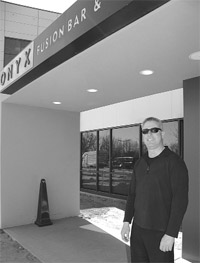
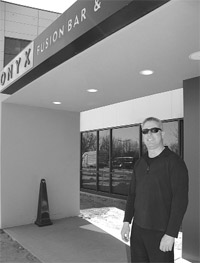
Onyx, also three stories tall, covers 12,000 square feet, and opened for dinner and cocktails last month, the same week the city hosted the Division II college basketball tournament. Development of the remaining 3,000 square feet of the building’s footprint is being completed now, in order to house a Boston-based physical-therapy and sports-medicine outfit.

At the project’s start, Pappas and Spagnoli pledged $9 million in private funds to the endeavor. In 2006, when the partners first spoke with BusinessWest, they noted that this figure could rise to $13 million.

To date, Pappas said they have actually invested $14 million into the project, but lean more heavily on the fact that, as River’s Landing enters its first month as a fully functioning entity, the property is completely occupied, and improvements such as landscaping and exterior lighting, all geared toward making the building attractive and visible from the highway, are moving toward their completion on schedule.

“Action breeds action,” he said. “When people see what’s going on here, they’ll feel more comfortable with coming to the riverfront to use it. I can’t wait to see people walking along the river again.”

Walking through the building, Pappas, who’s added ‘restaurateur’ to his list of titles, said attention has been paid to spurring that action inside and outside of its walls, as well as to the city’s legacy, especially as the birthplace of basketball.

This attention can be seen in its design and in the roster of firms involved with the project; several are local businesses, while some were pulled from other regions to add a metropolitan flavor to River’s Landing.

“The basic structure of the building is the same,” said Pappas, noting, however, that it has received a considerable facelift. “The windows have been replaced, but they still offer views of the river, the Hall of Fame, the highway, and downtown, on different sides. Not only can people inside see out, but others can see in and take note that there’s a new level of activity here, and feel safer because there are eyes on them.”

Current Events

A bright gold now adorns much of the exterior, and the familiar row of multiple, vertical signs that stretch across the side of the building facing the highway, once carrying illustrations of famous Hall of Fame inductees, remains, but is now being redesigned to match the new décor.

Onyx, owned and operated by Pappas and Spagnoli, has essentially become the facility’s showpiece. The Amherst-based architectural firm Kuhn Riddle handled much of the design, while California-based interior designer Julia Wong, whose work recently appeared on E! Entertainment Television, was brought in to create a cohesive visual flow throughout the 300-seat establishment.

“We’ve incorporated the ideas of imagination, elegance, and a journey,” said Pappas, weaving from the lobby, which features a glass ‘water wall,’ into the bar and lounge area, with its multi-screen video wall and amber onyx bar.

“The design is also ‘green,’ including low-flow water systems in the bathrooms and bamboo flooring,” he noted, adding that Onyx also offers free wireless access for patrons and will soon add an outdoor patio dining area.

Onyx opened for lunch recently, and the final addition to its repertoire, a coffee and smoothie bar during morning hours, will commence in conjunction with the grand opening of L.A. Fitness, in order to better integrate the two businesses.

The club includes an Olympic-sized pool, a full basketball court on the second floor overlooking the Hall of Fame, and multiple exercise, weight, and cardio rooms. Pappas said the club’s management has been pre-selling memberships for three months, and expects to welcome thousands of members.

All of this activity is a positive sign for Springfield, said Panagore, adding, however, that there’s still a long road ahead with regard to riverfront development.

“The project is going well, and with the hotel on one end and River’s Landing on the other, this is becoming a destination site in Springfield,” he said. “In terms of moving forward, we continue to have discussions about alternative uses for the visitors center — the original study talked about co-locating it within the Hall of Fame. We’re investigating how to better position that resource, so we can drive more visitors there.”

With the York Street Jail now razed, there is another major development opportunity on the riverfront that Panagore said the city is monitoring closely.

“We’re focusing on ensuring that anything happening at the site proceeds properly. We don’t want to be getting ourselves in a snarl, or tripping over ourselves,” he said. “ We’ll clear the site and start looking for development opportunities that complement those that are already down there.”

Panagore added that the riverfront offers what he calls “curb appeal” as seen from I-91, and to be truly successful, the area must not only attract new traffic but send that traffic farther down the road.

“The riverfront projects are initially important,” said Panagore, emphasizing the word ‘initially,’ “because they help bring people to Springfield and turn around the image of the city. People who would not otherwise come to Springfield now have a reason. But we really need to move some of that energy into the downtown, so our focus is on the entire core of the city.”

There are some challenges, however, in the move to better connect the riverfront to downtown, said Panagore. While he said the city is in the middle of “ongoing discussions” regarding the maintenance and renovation of the riverside walkway that runs parallel to the Connecticut River and extends from River’s Landing to the Memorial Bridge, there are some physical impediments.

“The state has a little less than $1 million earmarked to spruce up the walkway,” he said, “But Route 91 is always going to be a constriction. The underpasses between the riverfront and the downtown are also an issue, as is the railroad. Physical barriers naturally deter visitors from taking that route; we will try to put as good a face on it as possible.”

Still, many of these conversations relate to what Panagore said is over the next hill for Springfield, while other hurdles, the largest of which is the ‘old hall’ and what to do with it, have been cleared.

“Right now, we’re working on current successes,” he said. “There are always larger conversations about Springfield’s vision, but the work is well underway, and we’re getting up on our feet.”

Going Swimmingly

A diverse mix of activity on the waterfront, long a distant hope, is now becoming a reality for the City of Homes, and it has also provided a new venue for cuisine like Bancaco’s, which draws from his own traditions and is colored by those he’s learning more about in New England.

One of his favorites is the hazelnut mahi-mahi with Maine lobster hash, and he said he’s hoping to introduce even more of these ‘east-meets-west’-inspired creations to diners at the newly opened eatery.

“Pairing traditional ingredients and techniques with those that are modern is the best definition of the word ‘fusion,’” he said.

Watching servers and prep cooks bustle in a kitchen located where he once came to learn more about some of basketball’s greats, Pappas nodded in agreement.

Jaclyn Stevenson can be reached at[email protected]

Departments

Care Center Annual Dinner

April 29: The Care Center on Cabot Street in Holyoke will celebrate its students and staff at its annual dinner from 6 to 8 p.m. at the Log Cabin, also in Holyoke. The event features performances and presentations by Care Center students, including ballroom dancing. The Care Center provides services to pregnant and parenting teen mothers and their children. The celebration is being sponsored by Weiss Consulting, PeoplesBank, and the Northwestern Mutual Financial Network. Dinner and dancing are free, and guests will be invited to make a meaningful gift at the event. For more information, call (413) 532-2900, ext. 128. For details on the Care Center, visit www.carecenterholyoke.org.

Marketing Program

April 30: Anne West, founder and president of the Atlanta-based consulting firm Strategic Communication Counsel, will present “Remarketing Marketing … Creatively” at the Log Cabin Banquet and Meeting House in Holyoke. West offers a down-to-earth look at some common strategies and tactics that marketers overlook. The morning event is sponsored by the Ad Club of Western Mass. Registration begins at 7:30 a.m., with the seminar slated from 8 a.m. to noon. Registration includes a continental breakfast, seminar, and handouts. The cost is $75 for Ad Club members, $85 for non-members, and $50 for students. To register online, visit www.adclubwm.org.

Financial, Estate-planning Workshops

April 30, May 14, May 21: Applewood at Amherst, a part of the Loomis Communities, will host a free public series of financial and estate-planning talks, all beginning at 7:30 p.m. On April 30, Peter Ziomek, J.D., of Ziomek & Ziomek, will discuss wills, durable powers of attorney, health care proxies, and trusts. On May 14, Eva Thomson of Thomson Financial Management will share methods of maximizing one’s assets for a fulfilling retirement and beyond. The series concludes on May 21 with Hyman Darling, J.D., of Bacon and Wilson, P.C., reviewing ways to personalize one’s legacy through ethical wills, pet trusts, charitable bequests, gift annuities, or specific burial instructions. All talks will be conducted in the meeting room at Applewood at Amherst, One Spencer Dr., Amherst. Reservations are encouraged and may be made by calling Kelley Murphy at (413) 253-9833.

Women’s Professional Development Conference

May 1: Bay Path College in Longmeadow will host its 13th annual Women’s Professional Development Conference at the MassMutual Center in Springfield. Actress Jane Fonda will be the keynote speaker for the affair, which is planned from 7:30 a.m. to 4:30 p.m. For a complete list of workshops and speakers, visit www.baypath.edu. Tickets are $250 for the general public and $225 for Bay Path alumni, with an early-bird registration deadline of April 17. A vendor fair is also planned throughout the day.

RTC Digital Marketing Series

May 2: “Using Social Networks as Marketing Tools” will be offered by the Regional Technology Corp. (RTC) from 8:30 to 10:30 a.m. in the tele-classroom at the Springfield Technical Community College Technology Park in Springfield. This is the second seminar in RTC’s Digital Marketing Series, and will offer guidance on developing new relationships with clients, partners, and other key players in one’s industry. Presenters at the seminar will include Mark Firehammer, co-founder of Rumetagro Relationship Technologies, and Morriss Partee, the founder of EverythingCU.com. The class is free to RTC members and costs $50 for non-members. Advance registration is required. For more information or to register, contact Suzanne Parker at (413) 755-1301 or via E-mail at [email protected].

Business Market Show

May 7: The Affiliated Chambers of Commerce of Greater Springfield Inc. will host its 2008 Business Market Show from 7 a.m. to 5 p.m. at the MassMutual Center in Springfield. The show will feature more than 225 booths offering products and services to help, enhance, and grow one’s business. Attendance is free with a business card, and no registration is required. For a complete schedule of workshops throughout the day, as well as exhibitor listings and parking locations, visit www.businessmarketshow.com.

Customer-service Seminar

May 8: Marty Clarke, president of Martin Productions and author of Communication Land Mines: 18 Communication Catastrophes and How to Avoid Them, will present a seminar titled “Customer Service Land Mines and How to Avoid Them” from 8:30 to 11:30 a.m. at the Clarion Hotel in West Springfield. Clarke’s program will lay out a road map of how one can avoid common and damaging customer-service land mines, and begin to set a company apart in the most powerful way possible. Clarke will offer an encore seminar titled “Leadership Land Mines: 8 Managerial Catastrophes and How to Avoid Them” from 1 to 4 p.m. The presentations are presented by the Employers Assoc. of the NorthEast (EANE). The cost for either the morning or afternoon session is $179 for EANE members or $229 for non-members. The cost for the full day is $279 for both sessions for EANE members, and $329 for non-members. For registration information, visit www.eane.org.

Wine Tasting and Auction

May 9: The Chicopee Chamber of Commerce will host a wine tasting and silent auction at the Castle of Knights on Memorial Drive. Proceeds raised from the event will be used to fund chamber events. For more information on the event, visit www.chicopeechamber.org.

‘Defining the Goals’

May 20: Agawam High School is hosting a “Defining the Goals” expo from 8 to 10 a.m. Companies are invited to share products or services, as well as employment needs for the future. The event will be an opportunity to showcase a company and enlighten students regarding its operations and the educational requirements necessary to secure employment in various industries. The event is being sponsored by Engineering Projects in Community Service, Life Science Career Development grants, and MassLive. The event will include a coffee reception, scheduled presentations, and a question-and-answer session. For more information or to RSVP, E-mail [email protected].

Woman of the Year Banquet

May 21: The Women’s Partnership of the Affiliated Chambers of Commerce of Greater Springfield will honor Kristina Drzal Houghton as its Woman of the Year at its annual banquet planned at Chez Josef in Agawam. The award represents the recognition of extraordinary achievement by a woman in the Greater Springfield community whose efforts exemplify the leadership, community involvement, and professional goals of the Women’s Partnership. A reception begins at 5 p.m., followed by dinner at 6:15. Tickets are $35 each, and the deadline to register is May 9. For more information, visit www.myonlinechamber.com.

Torch Awards

May 12: The Better Business Bureau of Central New England Inc. (BBB) will stage its anual Torch Awards & Breakfast at the Orchards Golf Club in South Hadley, starting at 7:30 a.m. At the event, the BBB will honor American Pest Solutions Inc. of Springfield with its prestigious “Torch Award. It will also extend its Honorable Mention distinction to another local company, Moving/Odd Job Unlimited of Chicopee. “The purpose of this award is to recognize businesses that operate with integrity, trust, and marketplace ethics in their approach to commerce,” said Ray Frias, president of the BBB. “The Better Business Bureau is aware that there are businesses that maintain good business ethics and work every day to assure the public of their commitment to fair and honest business practices, and this award was established to focus attention on those good companies.” Also, BBB Student Ethics Award winner Evan Coleman from Amherst Regional High School will be presented with a $500 scholarship. This prestigious award recognizes students who live up to and inspire others with their commitment to ethical living. Individual seats at the event cost $20. Those interested in registering for the event may do so by visiting www.central-westernma.bbb.org/torch  or calling (413) 594-2163, ext. 105

Departments

Big Y Named Outstanding Recycler of the Year

SPRINGFIELD — The Springfield Materials Recycling Facility (SMRF) Advisory Board has named Big Y Foods Inc. “Outstanding Recycler of the Year.” The award was created to recognize individuals and organizations that have made contributions toward increasing recycling within their community or region. Big Y was nominated for the award by the Center for Ecological Technology (CET), a local nonprofit organization that helped Big Y increase its recycling efforts. Big Y has been composting food waste at several locations and recycling cardboard at all locations for many years. In 2007, Big Y worked with CET to expand composting and recycling efforts. Seven additional locations started diverting food waste, wood, wax cardboard, and floral waste for composting. In the spring and summer of last year, Big Y started collecting film plastics for recycling at all locations. Shrink wrap from pallet loads and case plastics are collected in the back of the store, and consumer bags are collected in the front. All film plastics are baled and marketed to Trex for use in plastic lumber manufacturing. Big Y’s expanded composting program, new film plastics recycling, and cardboard recycling efforts account for more than 13,750 tons of material diverted from landfills last year. Big Y is also a member of the Mass. Department of Environmental Protection Supermarket Certification Program. In addition, Big Y has been promoting canvas shopping bags which are becoming more popular with shoppers. The SMRF accepts and processes residential recyclables from 78 communities in the four western counties of the state. The SMRF Advisory Board recognizes outstanding individuals, departments, and organizations for their efforts to increase and promote recycling in the region through the Recycler of the Year Awards.

Russell Biomass Receives Final Environmental Certification

RUSSELL — The 50-megawatt Russell Biomass project recently received a certificate approving the Final Environmental Impact Report (FEIR) by Ian Bowles, state Secretary of the Executive Office of Energy and Environmental Affairs. Bowles issued a statement that Russell Biomass has adequately and properly complied with the Mass. Environmental Policy Act and with its implementing regulations. Russell Biomass expects its wood-fueled power plant will provide Western Mass. with electricity equivalent to an oil-fired plant that burns 480,000 barrels of oil per year. Russell Biomass notes on its Web site that it expects to generate its power by burning wood chips, a byproduct of the forest-management and wood-product industries. With Bowles’ approval, Russell Biomass can now complete the process of having its 20 permit applications reviewed by state agencies. Russell Biomass anticipates a construction start date of this fall if all applications are approved. The facility will be built on the site of the Westfield River Paper Co. that has been closed since 1994.

Food Bank Goes Green

HATFIELD — April’s celebration of Earth Day was especially meaningful for the Food Bank of Western Mass. The Food Bank received its certification from the U.S. Green Building Council through the LEED (Leadership for Energy and Environmental Design) rating system earlier this year. LEED is the internationally recognized standard for environmentally sustainable, or ‘green,’ building. With a Gold rating — the second-highest level possible — the Food Bank’s Hatfield facility becomes one of a growing number of businesses and organizations around the world that are doing their part to minimize the environmental impact of their operations. When the Food Bank began planning the renovation of its warehouse and office space a few years ago, making the building green took high priority, not only to help the environment, but also because there is a cost savings associated with energy efficient design. With lead grants from the Kresge Foundation and the Mass. Technology Collaborative, as well as generous community support, the Food Bank completed the construction of its new building in 2006 and began the process of applying for LEED certification. Dozens of green features made the building eligible for LEED, such as water and energy efficiency, sustainable materials, green cleaning and maintenance products, and recycling. The Gold-level certification that the Food Bank received in 2008 represents above-average compliance and innovation in these areas. Some highlights of the Food Bank’s environmentally designed facility include a 30-kilowatt photovoltaic solar panel system on the roof of the building that supplies about 10-12% of the organization’s electricity; energy-efficient lighting, heating/cooling, and refrigeration systems that have reduced energy use by 35% per square foot despite a building that is twice its previous size; green cleaning products, recycled paper products, and low-toxicity paints and sealants; an employee carpooling program that saves at least 10,000 commuter miles each year; outdoor landscaping that emphasizes native plants and minimizes runoff and erosion; and the 60-acre Food Bank Farm in Hadley that preserves natural riverside habitat and produces dozens of crops each year without pesticides, chemical fertilizers, or herbicides.

NewAlliance Increases Dividend

NEW HAVEN, Conn. — NewAlliance Bancshares Inc. recently staged its fourth annual meeting of shareholders, and voting results supported management’s recommendations on all items. Four members of the board of directors were voted in for three-year terms: Douglas K. Anderson, former president and COO, Savings Bank of Manchester; Roxanne J. Coady, founder, president, and CEO of R.J. Julia Booksellers, Ltd.; John F. Croweak, former chairman and CEO of Anthem Blue Cross and Blue Shield of Connecticut; and Sheila B. Flanagan, executive director of SBM Charitable Foundation Inc. Each was elected to a term expiring at the annual meeting of shareholders in 2011. Shareholders also voted to approve the NewAlliance Bank Executive Incentive Plan. The plan is a carryover from one that was in place before the bank’s conversion. However, to allow payments under the plan to be eligible for tax deductibility, shareholder approval of the plan is required periodically. In addition, shareholders voted to ratify PricewaterhouseCoopers, LLP as the independent auditor for 2008. In a separate meeting prior to the annual shareholders’ meeting, the board of directors voted to increase the company’s quarterly dividend from 6.5 cents to 7.0 cents per share, a 7.7% increase. The dividend will be paid on May 16 to shareholders of record on May 6. NewAlliance Bancshares is the parent company of NewAlliance Bank, headquartered in New Haven, with $8.2 billion in assets and a network of 89 branches in Connecticut and Western Mass.

STCC Receives $150,000 Grant for Photovoltaic Practitioner Training Program

SPRINGFIELD — Taking another step in a statewide push to promote growth in sustainable energy, or the ‘green’-technology sector, the Mass. Technology Collaborative (MTC) has awarded a $150,000 grant to Springfield Technical Community College (STCC) for development of a photovoltaic (PV) practitioner training program in Western Mass. Photovoltaic, or solar-panel, installations are becoming an increasingly popular strategic initiative for businesses and institutions looking to control and reduce energy costs, according to Thomas Goodrow, vice president for Economic and Business Development at STCC, and the grant will advance efforts to foster job growth and economic-development opportunities in this sector. Elaborating, Goodrow said the focus of the two-year grant is to provide training and practical experience in PV design and installation for licensed electricians, individuals involved in a journeyman electrician-training program, architects, engineers, and general contractors. The project plan includes developing coursework in PV design and system installation, and seeking ISPQ (Institute for Sustainable Power Quality) accreditation for training and continuing education. The program is slated to begin this fall, with a 3- to 4-month certificate course of study that will provide students with hands-on experience in a field that is expected to offer significant growth opportunities. Individuals completing the program will be prepared to sit for the industry certification exam. The PV Practitioner Training program will be conducted by STCC’s Center for Business and Technology (CBT), in partnership with the George W. Gould Construction Institute; the Solar Energy Business Association of New England, a business association of solar-energy companies based or doing business in New England; the STCC Assistance Corporation; and renewable energy companies in Massachusetts, Connecticut, and Vermont. Grant funds will be used, said Goodrow, to support curriculum development efforts that are already underway, to purchase equipment and materials that will allow students opportunities for hands-on experience, to gain national accreditation for the program, and to establish internship opportunities for students at solar-energy companies based in New England. The project team consists of STCC Assistant Vice President Mary Breeding, who directs CBT; Peter Vangel, professor and co-chair of the Laser Electro-Optics Department at STCC, who will serve as curriculum developer; Michael Kocsmiersky, vice president for Research and Development at Solar-Wrights Inc.; and Bill Stillinger, general manager of Pioneer Valley Photovoltaics Cooperative (PV Squared), a PV practitioner with many years of teaching, training, and installation experience in the field. Individuals who are interested in applying for the program should contact CBT at (413) 755-4502 or (413) 755-4225.

Bradley and Delta Celebrate Cancun Service

Windsor Locks, Conn. — Bradley International Airport (BDL) and Delta Airlines recently announced the launch of the airport’s first-ever nonstop scheduled service to Cancun, Mexico. The seasonal service to Cancun, which started April 12, operates on Saturdays between BDL and Cancun International Airport (CUN). Delta Air Lines Flight DL497 will depart Bradley at 10:40 a.m. and arrive in Cancun at 1:47 p.m. Delta Air Lines Flight DL498 will depart Cancun at 2:40 p.m. and arrive at Bradley at 7:33 p.m. Delta will operate this service using a Boeing 737-800 aircraft configured with 16 business-class seats and 144 seats in coach class. Customers should visit Delta’s Web site, delta.com, or call Delta Reservations at (800) 221-1212 for the latest flights.

40 Under 40 Class of 2008
Age 39: President and CEO, FloDesign Inc.

It’s called ‘disruptive technology,’ or ‘disruptive innovation.’

That’s a marketing term, first coined by Harvard Business professor and author Clayton Christensen, and now widely used to describe a product or service that essentially disrupts, or overturns, the status quo in a given market.

Examples include the telephone, which displaced telegraphy; minicomputers, which did the same for mainframes; and digital photography, which has supplanted chemical photography.

Stanley Kowalski III used to read about disruptive technology, and he witnessed the incredible rise of digital photography first-hand as an engineer with a local film-processing company. He was at a trade show back in 1995 and saw a booth for a small company, SanDisk, displaying digital photo technology. “I remember looking at this stuff and saying, ‘that will never work,’” he said, recalling that the equipment was expensive and the quality wasn’t very good.

History, quite obviously, has proven him — and many others — dead wrong.

Today, Kowalski is creating new examples of disruption at Wilbraham-based FloDesign Inc., a company that he purchased just over a year ago, and that certainly bears watching over the coming years. Indeed, FloDesign has garnered 19 patents over the past year and has licensed 16 of them to various organizations. Kowalski, who prefers ‘inventor’ over ‘business owner,’ is hiring top talent to continue and accelerate this pattern, and has plans to take a spinoff company, FloDesign Wind Turbine Corp., public. “We’re going to make this a billion-dollar company.”

The list of inventions, or innovations, credited to FloDesign engineers is impressive, and includes technology involving everything from silicone breast implants to non-lethal weapons. The company is working at solving problems, or making game-changing developments, across four sectors — aerospace, defense, ‘green technology,’ and biomedical — and has ongoing projects in each realm.

Each initiative employs what Kowalski calls “aerospace methodology” — one of the company’s slogans is ‘Aerospace Technologies Everywhere’ — which centers around creating radical improvements in both performance and cost, which is at the heart of disruptive innovation. The wind turbine is an example, he said, noting that new design features enable the product to essentially extract more energy from the wind.

Though he didn’t actually use the phrase, Kowalski said his current career ambition is plain and simple: to be a disruptive force. In many ways, he already is one.

George O’Brien

Sections Supplements
Swing Analyzer Helps Players Iron Out Equipment Decisions
Jason Fiddler

Jason Fiddler, here juxtaposed against some of the data being analyzed by Swing Labs Performance Fitting, says the system helps players find the right equipment for their game.

Jason Fiddler sees it every day — many times a day, in fact — and it frustrates him to no end.

The problem? It’s people trying to fit their golf game to the equipment residing in their bag. It should be the other way around, said Fiddler, store manager for Fran Johnson’s Golf & Tennis in West Springfield, especially when equipment makers are becoming increasingly innovative — and the innovations come with steep price tags.

“Your equipment should be working for you … you shouldn’t be working for your equipment,” he said, adding that Fran Johnson’s has added a new service that will help most players find the right clubs and even the right ball to suit their swing.

It’s called Swing Labs Performance Fitting, a software program that works with launch-monitoring equipment to analyze a player’s swing and performance, and then recommend options for equipment that will help them get the most out of their abilities — and thus enjoy the game more.

“I see far too many people try to make the club fit their game,” he said, adding that people will do things to add loft, like tee the ball higher, or de-loft clubs, for example. “Instead, they should be getting equipment that really does fit their game, and this system will help them do that.”

Swing Labs is part of a broad strategic initiative to take Fran Johnson’s, which opened 33 years ago, in new directions and to new places — literally and figuratively. While adding the swing-analysis component and reconfiguring the storefront on Riverdale Street in West Springfield to accommodate it, the company is also opening a second retail outlet at the Western Mass. Family Golf Center on Route 9 in Hadley.

That facility features a driving range and miniature golf course, said Cindy Johnson, owner and president of the company, adding that the 1,200-square-foot retail store will be a perfect fit and a natural expansion for the venture started by her father in the basement of the family home.

“This is a great facility that draws people from all over that area,” she said of the golf center. “We’re going to fit in nicely there … it’s a great opportunity for us to gain more exposure for the Fran Johnson’s name.”

Swing Shift

Swing Labs measures such things as ball speed, total distance and carry distance, launch angle, backspin, sidespin, and much more, said Fiddler, former director of golf operations at the Ranch in Southwick, who took up Johnson on her offer to join her company. “It dissects the swing in more ways than any human being needs to know.”

It then crunches those numbers, and rates which equipment options — from balls to clubs to shafts — would be best for the player in question, he said, adding that the software was developed in California, but the system was first introduced in Florida a few years ago and is becoming increasingly popular at golf shops across the country.

Fran Johnson’s acquired the software early last year, and spent several months getting kinks out of both the technology and the setup for the testing area. The company eventually determined that the original site was too cramped and lacked privacy, so a separate room was carved out of what had been retail space, and racks for clubs and balls were relocated.

The Swing Labs technology isn’t for everyone, Fiddler admits, but it can help most players. The system essentially picks up patterns in an individual’s performance, and some high handicappers are so inconsistent that that they don’t really have patterns, meaning that Swing Labs isn’t appropriate for them.

“They go left, and then they go right … they go high and then they go low,” he said of such players. “We could help them, but generally speaking, the better the player, the more this system can benefit them.”

Meanwhile, the system has a flaw, if one could or should call it that: It can only analyze what the launch monitor sees, meaning the swing that the player in question brings to the facility that day.

“It can’t analyze what you did last summer,” Fiddler explained, noting that, while the system is ready and able, and the appointment calendar is filling up fast, players would be advised to wait until their swing is grooved for the season before heading to the test mat.

Sessions take perhaps 45 minutes to an hour, and players are advised to arrive 15 or 20 minutes before their appointment to warm up, and thus maximize the benefit they’ll derive from the analysis. Players generally take 10 to 15 swings, and are given a full readout on their performance, as well as a ranking of several options. Individuals can be tested for irons ($50), the driver ($50), or both ($80).

And while the focus is obviously on clubs, their dimensions, loft, and other specifications, attention is also paid to shafts and which ball a player should be using, said Fiddler, adding that there are myriad options regarding both, and picking the right one can make a big difference in one’s score.

“A lot of people don’t realize that 90% is all about the shaft now,” he said. “The way ball flight can be manipulated now by changing shafts is unbelievable; we’ve had a ton of testimonials … people saying they’ve added 20 or 30 yards because of a new shaft.”

The same is true for balls, he said, using the Titleist Pro V1, a very popular choice among touring professionals and low handicappers, as one example.

“The majority of people playing that ball shouldn’t be playing it,” he said, adding quickly that this situation exists despite a high sticker price. “They’re hurting their swing; performance golf balls like the Pro V1 are designed for someone who really goes after the ball, swinging really hard and putting a lot of spin on the ball. Maybe 90% of the players out there can’t make a Pro V1 do what it was designed to do.”

Fiddler told BusinessWest that early indications are that the Swing Labs system will be a popular service, and with good reason — golf equipment today is engineered to help players improve their games, but they must make intelligent choices about clubs and balls, and not make judgments based on TV commercials or how others in the regular Saturday foursome fare with what’s in their bags.

“If you’re going to spend $400 or a driver or $1,000 on a set of irons,” he said, “you’d better get the right equipment.”

The Swing Labs system is a natural extension of the services at Fran Johnson’s, said its owner, as is the Hadley location, a move that has been pondered for several years now, but the timing and conditions were finally right to take the leap.

The expansion, she continued, gives Fran Johnson’s a presence in Hampshire County — something it has never had before and has coveted — and with relatively little risk, or exposure, for the company. The lease is short-term, with the expectation that it will be lengthened, and the rates are favorable.

“This provides an opportunity to expand our brand, and it wasn’t cost-prohibitive,” she explained.

The new location will compete against a Dick’s Sporting Goods location on the other side of Route 9, a situation that mirrors conditions in West Springfield, but Johnson believes there are opportunities to both attract Dick’s customers and better serve loyal Fran Johnson’s customers from Hampshire County with another, much more convenient location.

Addressing the Problem

The facility will be small, but it will have “a little of everything,” said Johnson, as will the pro shop at Cherry Hill Golf Club, a municipal track in Amherst, which Fran Johnson’s will now stock with equipment.

The corporate name will be prominently displayed in that shop, she continued, adding that the venture, like the Hadley facility and the Swing Labs system, are relatively low-risk, high-reward opportunities for the company to be even more of a driving force in the local golfing community.

George O’Brien can be reached at[email protected]

Sections Supplements
The Movement Is Helping a Local Hand-dryer Manufacturer Make New Inroads
Denis Gagnon

Denis Gagnon says the ‘green’ movement has helped boost sales of his hand dryer, but its performance is what ultimately prompts businesses and institutions to ditch paper towels.

There are a number of factors that separate success from failure in business, and no entrepreneur would dare understate the importance of timing in that mix.

Not the owners of Skybus, and certainly not Denis Gagnon.

He launched what many observers consider to be a breakthrough product, the Xlerator, in the challenged but potential-laden hand-dryer market — only about 10% of the estimated 22 million public restrooms in this country are outfitted with such devices — and he did so at just about the time the nation and the business community were starting to toss around the phrase ‘going green.’

The potent combination of a product that is changing perceptions of the long-hated hand dryer and a growing desire to be more environmentally sensitive has fueled a 700% rise in sales for East Longmeadow-based Excel Dryer — the company Gagnon purchased in 1999 — since the Xlerator first hit the market in late 2001.

But he stressed repeatedly that the ‘green’ phenomenon is simply part of the equation, and that businesses and institutions need much more than green ambitions to ultimately remove the paper-towel dispenser. First, the hand dryer has to work in a way that it hasn’t historically (meaning it has to work, period) — and the Xlerator has that covered, as anyone who has used the facilities at the Basketball Hall of Fame can attest. Meanwhile, the numbers, meaning those referring to energy savings and overall cost reduction, also have to work.

And they do; the Xlerator, says Gagnon, is three times faster than competitors’ products, and it uses 80% less energy.

“I don’t think ‘green’ has changed people’s attitudes about hand dryers — the Xlerator has changed those attitudes,” he told BusinessWest. “A hand dryer that works can stay on the wall by itself, because people don’t mind using it.”

This combination of factors, as well as a weak U.S. dollar, have helped put the Xlerator in facilities like Heathrow Airport (there are some 800 of them in place there) and the new Wembley Stadium, both in London. It has also made it necessary for Gagnon to expand his plant in East Longmeadow — a 10,000-square-foot addition used for warehousing and distribution was recently christened — and also expand his workforce from roughly 30 to 42.

Add all this up, and it provides an effective lesson in the importance of timing, and equals one of the more intriguing and inspiring manufacturing-sector success stories being written in the Pioneer Valley.

“This goes to show that manufacturing can thrive in this region,” said Gagnon, “if you stay ahead of the curve. We invented the perfect product in the hand-dryer industry for the green movement; we’re now the standard.”

In this issue, BusinessWest reviews the latest chapters in the Excel story, complete with triumphs and some growing pains, and what is likely to come next for a company that is helping end-users ‘throw in the towel.’

Helping Hands

That phrase is one of many the company uses in its marketing, which is one realm that has been considerably altered by the ‘green’ movement, said Gagnon. Where once the focus was squarely on performance (and in many ways, it still is), there are some new pages to the script — several of them, in fact — focused on the environment and the prevalence of green building and design.

They detail all of the memberships, certifications, and testimonials that Excel and the Xlerator can now put on the resume. Here are some examples:

  • The Xlerator can help facilities earn coveted LEED (Leadership in Energy and Environmental Design) credits, as set by the U.S. Green Building Council, in two categories — ‘minimum energy performance’ and ‘optimizing energy performance.’ Gagnon noted that the council will be putting Xlerators in its new corporate headquarters building in Washington, and Excel will work to maximize exposure from that contract;
  • The dryer was voted one of the top 10 products of 2002 by the editors of Environmental Building News, a leading newsletter on environmentally responsible design and construction;
  • The Xlerator is endorsed by the Green Restaurant Assoc. as the best environmental solution in the hand dryer category for the restaurant industry;
  • Excel Dryer is an ally member and approved vendor of the Green Hotels Assoc., and the Xlerator is the recommended hand dryer for green hotels;
  • Excel is a registered supporter of the Green Building Initiative, which has as its mission the goal of accelerating the adoption of business practices that result in energy-efficient, healthier, and environmentally sustainable buildings, and is also a member of the Sustainable Buildings Industry Council, a national leader in defining the whole-building approach to design; and
  • The company also prints some statistics giving prospective clients and green- leaning businesses some food for thought. For example, 17 trees are consumed to make one ton of paper; one ton of paper production pollutes 20,000 gallons of water; and one ton of paper consumes three cubic yards of landfill.
  • Add up all those numbers, and it’s clear that Excel dryer has the right product at the right time — when businesses large and small are realizing that going green isn’t just the right thing to do, but is also becoming increasingly necessary to earn some clients’ business.

    Gagnon acknowledges that his company is in a good place, and that things are most likely to improve, because the ‘green’ wave will only grow in size and importance to business owners. But despite all this, the hand dryer remains a comparatively hard sell — it still fares best in facilities like airports, schools, stadiums, and schools, where there isn’t a premium on customer service — and there is considerable work for his company to do moving forward in this changing environment.

    This work comes in several areas, from physical expansion and new production strategies designed to reduce lead times and cycle times to ever-more-aggressive marketing; from continued R&D to make the Exelerator even faster, more germ-free, and perhaps even less noisy (although that’s proving to be an extreme challenge) to sales strategies aimed at positioning the company for new building projects and renovations. Excel is also expanding the product line by customizing models to match an institution’s color or include its logo.

    Gagnon is addressing all these issues simultaneously. He told BusinessWest that one of his growing pains was reducing a lead time (eight weeks) that was costing him some new customers down to three weeks, and he’s done it through his addition and some Kaizen projects that have brought some new efficiencies to the production process.

    Meanwhile, he has stepped up his marketing efforts and continues to find new ways to put the Xlerator front and center. The latest is a two-minute piece shot at the Hall of Fame that will be part of a series on environmentally friendly products that will be shown on public television this spring.

    The spot features Hall of Fame President John Doleva talking about how the shrine was focused on environmentally friendly building products and practices as it was preparing to open its new facility in 2003, and made the Xlerator part of that mix, said Gagnon, adding that he expects the message to resonate with institutions planning new construction or renovations.

    And while pursuing new and existing markets in the U.S., the company is also looking abroad, and the timing is right in that regard as well. The weakened U.S. dollar has helped most companies that export products, and Excel is no exception. The Wembley Stadium and Heathrow contracts, the latter of which includes the new T-5 terminal, have put export volume at roughly 30% of total sales, and Gagnon says that number could go higher still because ‘green’ building is an increasingly global phenomenon.

    “Our export business has grown dramatically,” said Gagnon, adding that the weakening dollar has been one of many converging factors that have produced 50% sales increases the past four years.

    As for customizing the Xlerator, Gagnon says the company can match a PMS color or a swatch to suit a college’s or corporation’s color schemes, and it can also put a company logo on dryers, as it has for Office Depot.

    Overall, Gagnon expects that his company probably can’t sustain its blistering pace of growth, but he does foresee continued improvement in sales figures here and abroad as the green movement swells, and also as more people come to like a product they have traditionally disdained.

    High and Dry

    As he surveys the situation, Gagnon sees a number of signs of success. The new addition is perhaps the most visible, but there’s also the growing sales numbers, press accounts that include such outlets as the Wall Street Journal, network television news, the Learning Channel, and more, and even a patent-infringement lawsuit against a company that produced knockoffs of the Xlerator.

    “They say imitation is the greatest form of flattery,” said Gagnon. “There’s a sure sign we’re doing something right.”

    Excel is doing a lot of things right, but challenges remain. There’s a reason why only 10% of the public bathrooms in this country don’t have hand dryers — many people still aren’t sold on them.

    The ‘green’ wave will help sell them, and that phenomenon is only part of the reason why — for Gagnon, Excel, and the Xlerator — the timing was perfect.

    George O’Brien can be reached at[email protected]

    Sections Supplements
    Private Clubs Have to Work Harder to Sell the Lifestyle
    Chris Tsandilas

    Chris Tsandilas, general manager of Crestview Country Club in Agawam, says people need a reason, or reasons, to join to a private club.

    “Closing the gap.”

    That’s a phrase you hear at most all private country clubs these days — and it gets right to the heart of the matter.

    The gap, in this case, is the differential between what a club wants its membership number to be and what it happens to be. And while the size of the gap varies — from a few members to a few dozen or more — all clubs have one, and this phenomenon is part of a changing dynamic in the private-club realm.

    Indeed, while declines in membership are nothing new — they always accompany downturns in the economy — the current gaps are different because closing them represents a sterner challenge than in the past, and it will be this way for the foreseeable future.

    That’s because times are changing, said Chris Tsandilas, general manager at Crestview Country Club in Agawam. He told BusinessWest that, while country club memberships never really sold themselves, today they are in many ways a harder sell. There are many reasons for this, but primarily, people today, especially members of younger generations, have many alternatives for spending their time — and their money — and a country club membership doesn’t move near the top of the list as easily as it once did.

    “Today, people think long and hard before they join a private club,” said Tsandilas. “You have to create a reason or reasons to join … you have to create an atmosphere.”

    For most clubs, this means working harder on selling themselves, and in some cases, this involves old-fashioned marketing — if the bylaws and tax code permit.

    Crestview, which has a current gap of about 20 members, is one of those clubs doing such marketing, and its messages and their presentation speak to those comments about ‘reasons.’ In one print ad, the phrases “championship golf course,” “no tee times,” “practice facilities,” “family recreation,” and others are in a bigger, bolder typeface because they speak to the benefits that golfers and families can realize from membership.

    Meanwhile, another ad references a “home away from home” atmosphere, which, said Tsandilas, is what many families are looking for in the post-9/11 era — a safe place for children and a relaxing atmosphere for adults that doesn’t require getting on an airplane.

    Jody Cunningham agreed. She’s the first woman president in Springfield Country Club’s 110-year history, which makes it one of the oldest clubs in the country. She presides at a time when the membership capacity is 400 and the current gap is about 50. Some members would prefer that SCC not close that gap (the course would be less crowded), but club officers want at least a smaller number to ensure that an institution on solid financial ground remains that way.

    And to do that, it is putting heavy emphasis on families, said Cunningham, adding that this is a national trend to which SCC and all other clubs must respond.

    While focusing on families, clubs are also trying other strategic initiatives aimed at adding value to the equation. Twin Hills Country Club in Longmeadow, for example, has lowered its fees by roughly 20% (it is even publishing its rates, which is almost unheard of in this industry — but there’s a reason), while adding such amenities as on-site therapeutic massage, new stand-alone junior memberships, and a dining membership.

    The club, which has survived a battle to turn its acreage into a housing development, had what current President Bob Bonsall called a make-or-break year in ’07, and made it. Golf membership, which was at an anemic 160 to start last year, is currently at 215, still well below the 240 Bonsall and others have set as the goal for this year, and it could ultimately go as high as 300. If it does, the club will have gone a long way toward ending what has historically been underutilization of the course and many of its facilities.

    Like others we spoke with, Bonsall said that joining a club is an investment, and clubs have to be diligent and imaginative in finding ways to convince people that these are investments worth making.

    In this issue, BusinessWest looks at the changing landscape for private clubs, and how they’re all working to close those gaps.

    Dues and Don’ts

    Hubert deRenzy says it feels like he’s been membership chair at SCC “forever.” It’s been several years, anyway, and he’s been a member at the club since the early ’80s. He’s seen a number of changes, especially in recent years, regarding demographics — no longer are club memberships dominated by specific ethnic or religious groups; ‘diversified membership’ and ‘melting pot’ are the phrases heard today — and overall image.

    “It’s no longer the cigar-smoking, card-playing, old boy’s network,” he explained. “Those people are getting older … there are still card games, but no cigar smoking, obviously. Today, it’s about women and young families.”

    To attract them, Springfield, like other clubs, is becoming somewhat less formal, although some clothing policies remain, while creating more programs that families can enjoy together. This is what members of Generation X, who are starting to join clubs, are looking for, said Cunningham.

    “They’re forgoing the vacations where they’re going away,” she said of that constituency, citing personal experience and anecdotal evidence. “They want places where they can have structured and non-structured activities, where they can drop the kids off and know they’re safe. We’re noticing that with a lot of our social memberships.”

    The club is responding with initiatives like the so-called Camp for Champions, a summer program that involves both children and their parents.

    “They can do tennis, golf, swimming, arts and crafts, even family bingo out by the pool,” said Cunningham. “There are teen pool parties, where they can float in an innertube and watch a movie; it’s all about the family … what can we provide for their kids, and what can we provide as a family unit.”

    By responding with family-oriented programming, the club is broadening its appeal — and its audience, said Cunningham, noting that this is the challenge facing all clubs in the current environment.

    Tracing recent history at Crestview, Tsandilas said membership had been steady until earlier this decade, when it started trending down, for reasons that are now considered part and parcel to national patterns. Eventually, club officers decided to “get serious,” as he put it, about shoring things up.

    A number of strategic initiatives have been or are still being discussed, he told BusinessWest. These include everything from opening the dining room to the public — a step that was rejected — to establishing a real-estate component that would create what Tsandilas called “instant members” (an option that is still on the table, but considered impractical at this moment) to marketing efforts.

    The club had never marketed itself before, and that step was certainly not commonplace in this region when it was first discussed a few years ago, said Tsandilas. But it was becoming more prevalent in other regions of the country, he continued, and when members brought back magazines and newspapers from other regions that had ads for private clubs, talks escalated, and Crestview eventually decided to “take the leap.”

    Working with Stevens Design Studio in Westfield, the club has put together a marketing campaign that features print and radio ads that center on the benefits to golfers that are not to be found on public courses (no waits for tee times) and that ‘home away from home’ theme.

    “This can be your second home, instead of a trip to the Cape,” he said. “You can vacation here.”

    Efforts to get serious have reduced the gap in recent years, said Tsandilas, noting that there is still work to be done. “Twenty members makes a difference,” he explained, noting that, by his estimates, each member spends roughly $10,000 with the club each year. “That’s money we could definitely use to provide our members with the atmosphere and services they deserve.”

    Food for Thought

    SCC’s tax status doesn’t permit advertising, said deRenzy, adding that the prevailing strategy at that club is to make all members feel as if they are part of the membership committee and share responsibility for gap-closing duties. And they’re given incentives, such as pro shop credits, for doing so, a tactic being repeated at many other clubs.

    While looking for new members, those at Springfield are also debriefing those who are leaving, to track the reasons why and see if there are patterns that the club can address. Meanwhile, SCC is reaching out to some who have left, he continued, with the hope of bringing them back on some level, perhaps as dining members.

    Twin Hills has had good success with a dining membership featuring no food minimums that it introduced last year as one of many steps to stabilize and increase membership, said Bonsall. Other initiatives included a business membership that did not fare as well, and an overall reduction in fees aimed at convincing prospective members that a club traditionally viewed as expensive is in fact within their price range.

    Overall, Bonsall explained, Twin Hills has been underutilized, a condition that resulted from bylaws, since revised, that capped golf membership at 250. The course can handle many more, and so can the dining room, he said, adding that the dining membership is targeted at residents of Longmeadow and nearby Enfield — which boasts many over-55 housing developments — who don’t have a wealth of dining options.

    “Longmeadow doesn’t have many restaurants, and many people are looking for a reliable place with a quiet, relaxed atmosphere,” he said, noting that Twin Hills sold about 90 dining memberships last year, and would like to get that number to 200 or beyond.

    “Historically, we’ve been underutilized, and underutilizing your facilities doesn’t make much economic sense,” said Bonsall. “It doesn’t make any sense to have the dining room just sitting there and the banquet facility just sitting there, and the golf course there with no one using it, so we’re just emphasizing ways to increase utilization.

    “We recognize that, nationally, the demand for the game of golf and for the country-club lifestyle is way off from what it was five to 10 years ago — that’s a phenomenon that affects everyone,” he continued. “So in effect, we’re competing for a smaller pool of potential members; in our view, that means we have to figure out how to appeal to a broader segment of the population, and we’re doing that by repositioning the club.”

    Ludlow Country Club already appeals to a fairly broad audience, said current Vice President Peter Karalekas, noting that membership traditionally hovers around 520, much higher than most other private facilities. It’s currently at 490 or so, and many members like that number because it represents opportunities to get better tee times on weekends.

    But, like Tsandelis, Karalekas said a few dozen memberships adds up, especially at a time when fuel prices and many other expenditures are soaring.

    “I could live with this number [490] if the membership demonstrates a willingness to pay higher rates, but at the moment, I haven’t exactly seen any such willingness,” he said, noting quickly that dues numbers lower than those at many other clubs (and that haven’t increased in three years) have created that larger membership.

    Besides, higher fees probably would not offset additional losses in membership or other losses in revenues, he said, leaving LCC in the same boat as other clubs — closing the gap.

    He’s confident Ludlow can do that, perhaps with a simple push on junior memberships, but he’s concerned about the bigger, longer-term picture. LCC’s membership is aging, and he wonders out loud whether there will be enough members of the younger generations to fill the void.

    “Everyone’s essentially fishing in the same, smaller pond,” he said. “I’m not sure we’re there yet, but soon we’ll be oversupplied when it comes to clubs in this area.”

    Join the Club — Please

    Just before talking with BusinessWest, Tsandilas sold another membership, closing the gap to that 20 figure.

    Like most before it, this sale was several weeks in the making, he said, adding that this is an indication that few, if any, are rushing to join clubs today. Prospective members are being deliberate and weighing all their options, meaning not just other clubs, but also other uses for dues and other expenses.

    In these changing times, he stressed again, people are thinking long and hard before signing on the dotted line, and they need good reasons to do so.

    George O’Brien can be reached at[email protected]
    Sections Supplements
    Lime Rock Park Launches a Series of Improvements to Rev the Economic Engine
    Skip Barber

    Skip Barber, owner of Lime Rock Park, is currently focused on improvements to the track that will bring in new audiences.

    Fifty years ago, a racetrack opened in Northern Conn. on what was once a potato farm. Today, Lime Rock Park remains one of the most uncommon tracks in the country, but as audiences change and competition mounts, this historic destination is gearing up for a series of improvements and new programs to keep the spectators coming back.

    Maria Jannace, chief marketing officer for Lime Rock Park, says that running a racetrack is a detail-oriented venture.

    There are gourmet hot dogs to secure, for one. Jannace said Lime Rock, an historic facility set in the foothills of the Berkshires in Lakeville, Conn., is no “Oscar Meyer racetrack.” The iced tea, Harney’s, has some cache, too — it’s the official tea of Buckingham Palace.

    Beyond concessions, there are races to plan, sponsors to secure, town noise ordinances to abide, and dozens of one-day events to coordinate.

    “The details are important to every single aspect of running this track,” said Jannace, adding that she started coming to Lime Rock as a child with her “racehead” dad.

    As a lifelong fan-turned-professional, Jannace said she believes that many people don’t have a true understanding of the business of racing, because it’s such a beloved pastime.

    “The racetrack business is unusual,” she explained. “People don’t think about what it takes to plan these kinds of events because, to them, it’s a fun day outside.”

    But the fans are also an extremely loyal bunch — to the track and its sponsors — if not a fickle one as well. Jannace said their opinions color every decision at Lime Rock, and work continues behind the scenes to preserve that carefree feel among visitors.

    “We take people into consideration with everything we do,” she said. “Many of them are attached to this place.”

    And, she hopes, many more soon will be, through a series of ongoing developments at the track aimed at increasing attendance, bolstering an already rich legacy, and diversifying the Lime Rock experience.

    The Rubber Meets the Road

    The park’s owner, Skip Barber, is keeping an eye on one of the larger projects. Barber became a household name in 1975 when he started Skip Barber Racing Schools (he sold the business five years ago, but it remains headquartered at Lime Rock Park, and it is the track’s best customer). Since then, Barber has gone on to lend his name to an entry-level race series, a national championship, and a master’s national championship for drivers over the age of 40.

    On hand opening day in the park’s clubhouse, Barber was busy watching cars that were part of a BMW racing club run the course, and also surveying the newly-seeded lawn.

    He’s a stickler for perfect grass.

    By June, the park will be looking much different, as a series of upgrades to the track itself, some of its buildings, and the surrounding grounds were launched this month. Roughly $5 million has already been appropriated for the projects, a figure that’s likely to cover the start of repairs, but not all of them.

    First, said Barber, frostheaves will be addressed, and the underground causes remedied. The track, already unique in shape, will retain its course, but will be repaved, and a number of ‘optional corners’ are being added to diversify the route.

    “Much of this is a safety issue,” he added. “Cars are getting faster and better.”

    Finally, renovations are being made now to various buildings on the property, including the Club at Lime Rock, a members-only hospitality area Barber hopes to expand. Currently, there are about 100 members, who can take advantage of not only amenities on race days, but reserved ‘club days’ squeezed into the park’s already tight schedule of events.

    “We’ve carved out a chunk of time for the club, because otherwise the track would be full,” Barber said. “We’re in the process of building our membership, and I hope to eventually reach 300 people.”

    Members Only

    Club membership, similar to a country-club or golf-club model, is one way Lime Rock is taking steps to attract new, younger constituencies.

    “We’re looking to develop a new core audience,” said Jannace. “We face an interesting problem here in the foothills; people drive right through. Once we get them here, we know we can get them to come back, but first we need to let people know that this corner of Connecticut is not empty.”

    So far, the promotions, events, and activities at the track, both race-related and otherwise, are doing their job to bring in crowds; Jannace said ticket sales increased by 37% in 2007 over the previous year.

    The track hosts four major events for the public each year: the Grand-Am GT Classic on Memorial Day weekend, which features races as well as an exotic car show; the American Le Mans Northeast Grand Prix in July; the Mohegan Sun NASCAR Camping World 200 in August; and the Rolex Vintage Festival on Labor Day weekend, featuring a collection of historic cars.

    Throughout the track’s season, which begins in April and generally extends through October if weather permits, Lime Rock hosts several types of organizations that rent the course on a daily basis. These include racing and driving schools conducting classes, car clubs, and corporate clients, who can take part in race car-centered team-building activities or simply conduct meetings or hold parties on the expansive grounds.

    For children, there’s a bounce house, a kid’s club, and games, while adults can take advantage of an outdoor market called Locals on the Green, which welcomes area vendors of all types of wares to the track for recurring shopping fairs.

    Several New England-based companies serve as sponsors at the track, and Jannace said she hopes to cultivate that model as well to create a sort of showcase for regional businesses.

    “We’re not looking for mega-brands as much as ‘special attention’ brands,” she said. “Motorsports fans are loyal to sponsors because they understand the expense of the sport. Without sponsors, they realize that there is no operation.

    “It’s a viable way to get a brand’s name out there, and we offer an incredible avenue for people to expose their products to a captive audience,” she added.

    That attention to detail that Jannace says is so integral to running the racetrack is part of the sponsorship process, too. Just as it’s not an ‘Oscar Meyer’ racetrack, it’s not a Budweiser track, either — its official beer is Boston-made Harpoon. Big Y supermarkets sponsors the kids’ club, a Mohegan Sun car can be seen at some races, and while Coca-Cola is a major sponsor and beverage provider, the park has a clause in its agreement to sell Crystal Rock bottled water, another New England outfit, alongside Coke products.

    A Day at the Park

    Jannace said Lime Rock is a unique track for these reasons and many others. While Sunday is considered ‘racing day’ by most enthusiasts, for instance, the park never holds a race on a Sunday, in order to comply with Lakeville’s noise restrictions.

    Physically, the track is also unique in that it doesn’t offer the typical oval-shaped course, nor does it include grandstand seating.

    “It feels like a park — hence the name,” she said. “It’s also the only track in America that has an open hillside for seating instead of grandstands. It creates a very family-friendly atmosphere; often, we see kids flying kites, families spread out with lawn chairs … it really is a day at the park, and we work to maintain that.”

    In fact, the family feel created by the open (if not well-manicured) hillside of Lime Rock Park is just one aspect of a larger effort on the part of park staff to position the track as a destination and a entertainment option in an increasingly competitive market.

    “This is not the healthiest time for sports car racing, and there are a lot of options out there today. People have a lot of choices,” said Jannace. “We compete with other entertainment venues as well as other sports, but even in good economic times we market ourselves as an entertainment venue.”

    These tough economic times are signaling a potential drop in ticket sales this year, but Jannace added that she hopes to counteract this trend through several initiatives aimed at further broadening Lime Rock’s appeal.

    She’s actively promoting the track to European travelers, who are expected to take advantage of the weak dollar during key travel periods, and ramping up promotions. Several sponsors have donated prizes for raffles, such as overnight stays at Mohegan Sun, a set of tires, or a two-day driving class offered by BMW, and the track now has a presence on MySpace to cater to younger fans.

    Landmark Decisions

    Jannace is also looking closely at the arena of historical tourism as another avenue to increase Lime Rock’s visibility. One project she’s particularly excited about is the track’s pending application for inclusion on the National Register of Historic Landmarks. It would be an intriguing addition; presently, there’s only one racetrack listed, the famed Indianapolis Motor Speedway.

    “I think we have a good chance of getting it,” she said. “We’ve been running nonstop for 50 years, and not many tracks can say that.”

    In addition, Lime Rock hosted a race in 1959 that has become one of the most famous events in the sport’s history. Called the Formula Libre, the event marked the first time cars of all different types met on the start line. Jannace said it was a radical concept in racing at the time. “Different types of cars don’t usually mix,” she said.

    Foreign sports cars like Ferraris and Maseratis were matched against sprint cars — high-speed, lightweight vehicles designed to run short distances. Rodger Ward, a driver racing in an 11-year-old Kurtis Midget, made history by winning the race, overtaking an Astin Martin. Ward also won the Indianapolis 500 the same year.

    There are other notable aspects of the track and its history, too, including its ownership. In addition to Barber’s contributions to the sport, Lime Rock’s first owner, John Fitch, made a name for himself developing safety equipment and systems for both racetracks and traditional streets and highways.

    “It’s neat to have had all of those things start here, and they also fit the criteria for a national landmark,” said Jannace.

    Far from the Finish

    She’ll know if Lime Rock made the cut by October, but in the process of culling the many stories of the track — and every last detail — Jannace said she learned enough about its past to build a lengthy list of facts, strengths, and opportunities that will help guide the racetrack through choppy economic waters and beyond.

    “It’s not just about asphalt,” she said. “It’s about creating a sense of place, and the more we learn about the track, the more we realize how varied the reasons are why people love it.”

    Barber, still keeping one eye on the grounds and scanning for brown spots on his prized lawn, agreed that it’s a special spot for many race fans, but added a wrinkle.

    “People say racing is part of a lifestyle,” he mused. “But I think it’s part of life.”

    Jaclyn Stevenson can be reached at

    [email protected]

    Departments

    Comcast Launches FOX 6 Springfield

    SPRINGFIELD — Comcast recently announced its launch of the region’s newest television station, FOX 6 Springfield, and the channel’s HD simulcast. The launches of FOX 6 Springfield and FOX 6 Springfield in HD, available on Channels 6 and 861, respectively, provide Comcast customers with some of the network’s most popular shows, from American Idol to 24 and House, along with matchups from NASCAR, Major League Baseball, and the National Football League. With more than 300 HD choices, Comcast plans to significantly expand the number of HD choices to 1,000 by the end of this year. FOX 6 Springfield and FOX 6 Springfield in HD are now available in Agawam, Amherst, Bernardston, Buckland, Chester, Conway, Deerfield, Erving, Gill, Granby, Granville, Greenfield, Hatfield, Holyoke, Huntington, Longmeadow, Monson, Montague, Northampton, Northfield, Palmer, Pelham, Shelburne, South Hadley, Southwick, Springfield, Sunderland, West Springfield, Ware, Westfield, Westhampton, Whately, and Williamsburg. Local Connecticut news, weather, and programming are still available on WTIC Fox 61 on Channel 292 for Comcast basic cable customers with a digital box. In addition to traditional television viewing, Comcast’s HD on Demand platform allows digital-cable customers with an HDTV and HD-capable cable box to choose from a variety of HD selections each month. Comcast’s New England regions serve 2.6 million customers in Massachusetts, New Hampshire, Vermont, Maine, Connecticut, and New York.

    Berkshire Service Experts to Give Away Programmable Thermostats

    WEST SPRINGFIELD — As the 28th annual Earth Day approaches (April 22), Service Experts Inc., and its full-service heating and air conditioning center in the Valley, Berkshire Service Experts, will help customers in the Springfield area recognize they truly can make a difference. Service Experts will install a free programmable thermostat in every U.S. and Canadian household that schedules a heating or cooling system tune-up during the month of April. Service Experts’ Earth Day program will create the same environmental effect as planting 330 trees for every single homeowner who makes one small household change. Thermostat manufacturers such as Lennox that are providing thermostats for the special Earth Day campaign estimate that up to 75% of North American homes do not have programmable thermostats. Most homes between 15 and 25 years old still use the original mercury-based models, which are toxic if not disposed of properly. Service Experts will remove the home’s old thermostat, and properly dispose of and recycle it at no charge.

    Work Opportunity Center Receives Grant

    AGAWAM — The Work Opportunity Center Inc. in Agawam has received a $2,500 grant from the NewAlliance Foundation, which will help purchase a passenger van for the agency. The private, nonprofit organization provides developmentally disabled individuals with vocational training and employment opportunities. Currently, the center serves 110 individuals in three work programs within the Greater Springfield area.

    MassMutual Launches Recruiting Web Site

    SPRINGFIELD — Building on several years of successful efforts to recruit and retain top financial services professionals, Massachusetts Mutual Life Insurance Co. (MassMutual) recently unveiled a Web site that introduces career changers, industry veterans, and college graduates to a career with the company through the eyes and words of its agents. The Web site, one of several initiatives the company has undertaken to grow its ranks of successful professionals, features a MassMutual agency manager, sales team manager, experienced agent, career changer, new agent, and intern who describe their careers and experiences in their own words. Visitors to www.massmutual.com/mycareer hear and see agents describe the company’s entrepreneurial business model, training and support services, and the meaningfulness of their work. The online introduction and other efforts by the company are succeeding, as the number of new agents and the company’s rate of retention have both risen significantly, according to Scott Rich, vice president, Net Field Force Growth. Rich added that, during the past two years, MassMutual has increased its net field force by 10%.

    Capuano Care Moves to New Corporate Location

    EAST LONGMEADOW — Capuano Care is moving into its new corporate headquarters on April 14. The larger office at 265 Benton Dr., Suite 201, will allow the firm to better serve its rapidly growing client base as well as its professional in-home health care staff, according to Fannie Y. Lin, president and CEO. Lin noted that the company has been growing so much in the last two years that it needed a larger and more efficient space to accommodate additional support staff. Capuano Care is a full-service, Medicare/Medicaid-certified, and private home health care business serving clients throughout Hampden and Hampshire counties. For more information, visit www.capuanocare.com

    Sections Supplements
    Auto Insurance Gets Competitive in Massachusetts

    The last time Massachusetts introduced market competition to auto insurance, the experiment lasted only 12 months. Now, 30 years later, the state has once again shifted away from its fully regulated system into something called ‘managed competition.’ The state insurance commissioner vows to steer clear of past mistakes and promises rate reductions for many drivers. But motorists with not-so-clean records may be surprised to see their costs going up — while insurance agencies help consumers navigate an often-confusing maze of new options.

    Is the Bay State’s switch to competitive auto insurance rates cause for celebration or concern? The answer might just depend on your driving record.
    “The new, managed-competition system penalizes people with bad driving records, and rates are going to be higher for operators who are considered higher-risk, which includes youthful drivers,” said Diana Paris, personal lines manager for the Insurance Center of New England in West Springfield. “At the same time, good drivers are seeing big savings, and that’s a good thing.”
    “Based on what we’re seeing, a lot of people are going to save money — primarily the best drivers,” meaning those with the fewest accidents and citations on their record, noted James Phaneuf, owner of Bell and Hudson Insurance Agency in Belchertown. “Early indications seem to be that less-experienced drivers may pay slightly more for their insurance, so not everyone will save money under this system.”

    For much of the past century, all rates for automobile insurance in Massachusetts have been set by the state Division of Insurance — until this month, the only such regulated system among the 50 states. Anyone who requested a premium quote for a certain level of coverage would receive the same price from any number of companies, unless they were eligible for a group discount.

    Managed competition, which began on April 1, allows insurance companies to offer their own rates. Although these rates may vary, they must still be approved by the Division of Insurance — hence the term ‘managed.’ For the first time since a disastrous attempt at changing the system 30 years ago, Massachusetts drivers may now compare the different rates, benefits, and services offered by the 19 insurance companies competing for their business in the Commonwealth.

    Many are busy doing just that, and — if the agencies interviewed by BusinessWest are any indication — actively seeking professional help to navigate the sudden plethora of options.

    “There are some fairly subtle pricing differences between companies — and some significant ones,” said William Grinnell, president of Webber and Grinnell Insurance in Northampton. “The good thing about being an independent agent is that we represent several different insurance companies and are able to shop them to consumers. So we’re getting a lot of calls asking, ‘what’s my premium going to do?’ ‘Can I do better with another company?’”

    The verdict is still out on how many motorists will actually wind up paying less, but consumers and agents alike have been generally receptive to the change, which is also bringing new business into the Bay State; Progressive Insurance will begin selling insurance to drivers here in May, bringing the total number of competitors to 20.

    In this issue, BusinessWest examines the benefits of managed competition, as well as some the possible pitfalls, as insurance options open up like a six-lane highway.

    Engine Stall

    Under the prior, regulated system, insurance providers were required to apply specific surcharges for certain accidents and traffic violations, a program known as the Safe Driver Insurance Plan (SDIP). Now, insurance companies will be permitted to develop their own rules, subject to state approval, for imposing surcharges for at-fault accidents and traffic violations. They may also use the state-established SDIP in setting their rates.

    The last time Massachusetts waded into managed competition was three decades ago, and the result was not exactly what state leaders had intended. Consumers weren’t given much time to prepare for the change in early 1977, and premiums shot up more than 25% for some motorists. Lawmakers quickly passed a law capping increases at 25% over 1976 levels, and in 1978, amid widespread discontent, Massachusetts reverted to a fully regulated system yet again.

    In 2005, then-Gov. Mitt Romney once again called for a more-competitive system, and in 2006, Gov. Deval Patrick promised during his campaign to increase competition to lower insurance rates. Last year, state Insurance Commissioner Nonnie Burnes, a Patrick appointee, began doing just that.

    To avoid the rate-spike problems of 1977, she capped any increase at 10% for the worst drivers, as well as forbidding insurance companies from using certain socioeconomic factors, including credit scores, in setting rates.

    The decision hasn’t been without controversy. Martha Coakley, the state’s attorney general, has called the new system “confusing” and frets that some drivers, even many with clean records, could face rate increases. But competition also opens up a world of price incentives that allow drivers to shop for the plan that best suits their own circumstances. Among them are:

    • Accident forgiveness. “One difference is the disappearing deductible,” said Grinnell. “If you’ve been with a company for a certain number of years, if you have an accident with a $500 deductible, certain companies will forgive that deductible. And if you’ve owned a car for 10 months and it’s totaled, they might buy you a brand-new car, rather than one that’s depreciated by 10 months. Those little built-in bells and whistles are nice additions, but they’re not necessarily across the board.”

    • Elimination of ‘short-rate values.’ These are fees that insurers typically charge for early cancellation of a policy. But under the new system, some customers will not have to wait for their policies to expire to rework them or change companies altogether. “One way insurers are competing for your business under managed competition is by offering to waive or credit short-rate values. Others are rewarding customers who stay with them,” said Burnes. “You should check with your insurance agent to determine the insurance choices that are in your best interest.”

    • Discounts when someone insures both their house and vehicle with the same company. Not all insurers offer this incentive, and even when they do, there’s an important caveat. “Insurance companies can’t use your credit as an underwriting tool on auto insurance, but they can and do use it on home insurance,” said Phaneuf. “So, while it generally makes more sense now to have your home and auto insurance with the same company, it’s not always easy to place them with the same carrier if there’s an issue of bad credit.”

    In general, he added, “it’s more complicated now. You need an agency with a trained staff to guide you through the maze.” For that reason, area insurance agencies generally agree that the change to managed competition will be good for their business, because a more complex landscape should funnel more customers to them for help.

    “Is it going to be more confusing? Yes,” said Phaneuf. “Every company has different rates, policy features, and benefits. More than ever, people are going to need an independent agent to go to work for them.” At the same time, however, auto insurance has become more complicated for the agencies, too, meaning they’ll have to work to earn the extra business.

    “It’s going to make the agent’s job tougher than it was previously,” he continued. “In the past, there was one state-set rate, and we competed in areas other than rate — such as being local, having a professional, trained staff, and being involved in the community. Those are still critical areas, but we realize that price is important to customers.”

    Paris noted that motorists won’t always get all the information they need from advertisements and Web sites. “It is confusing, and the hype and advertising on television don’t tell the whole story,” she said. “They tell the good parts, but not the bad parts. Someone who had two accidents roll onto their driving record last year might call us, saying, ‘I can save all kinds of money,’ but the price actually went up.”

    Road Conditions

    Coakley has argued that the average auto insurance rate would have declined this year without managed competition, an assertion with which Phaneuf agreed. “So, whether managed competition is a good thing will take a couple of years to figure out,” he said. “Personally, I think a less-regulated market will be a good thing, particularly for good, responsible drivers.”

    Indeed, Burnes said drivers with clean records should see a 10% savings, on average, in the coming year, perhaps more if they shop around. The Division of Insurance is helping consumers do just that with a Web site (www.mass.gov/autorates) on which users can answer a few questions and generate a list of sample premiums being offered by the state’s 19 insurers (Progressive will increase that number to 20 next month).

    “When consumers use our site, they are struck by the huge variations in prices and discounts being offered by different companies, and it really motivates them to get serious about calling their agent and starting to comparison-shop,” Burnes said.  “The savings for good drivers has the potential to be significant, so it’s worth it for all consumers to do a little legwork.”

    BusinessWest has heard reports of confusion with the Web site, with some customers complaining that the rates quoted on the site don’t jibe with those quoted by an agent. Paris said agents expect questions and even some confusion, but they also see the value in giving consumers a choice.

    “It’s more complicated, and people who want to save money have to do a little homework,” said Grinnell. “But I think competition is a good thing, not just for consumers but for agents, too, because competition makes all of us better.”

    Sections Supplements
    Springfield Developer Bucks Current Trends with Unique, Retro-inspired Project

    Leslie Clement has always had a creative mind.
    She graduated from Indiana University with a Liberal Arts degree, having studied dance, music, art, and culture for many years of her life. But eventually, she said, she had a revelation.

    “I realized my degree prepared me for absolutely nothing,” said Clement, who soon started searching for more practical applications for her far-reaching creative interests. She recalled one of her favorite hobbies as a child — her father would often channel Clement’s flair for thinking outside of the box into small building projects — and took a dramatic leap onto a new career path, studying to be a carpenter’s apprentice in the late 1970s.
    The apprenticeship, completed with the Springfield Carpenters Union Local 108, required four years of working construction, as well as specialty skills such as draftsmanship, finish carpentry, surveying, and estimating.

    A number of intriguing jobs followed, including work on a series of bridges for Interstate 391 and a downtown highrise, but the more views of the city she saw, the more changes Clement wanted to make.

    “In Springfield, I saw a city that needed a lot,” she said, “but more than anything, it needed help with its poor self-image.”

    So she set out to do something about it.

    Raise the Rafters

    Clement’s first solo project in the housing sector was a home restoration in the historic Maple Hill section of the city, which later led to the renovation of 14 additional National Historic Register properties in concert with a team of tradespeople (funding for these projects included financing from limited partnerships, private funding, loans, and grants). 

    “These were incredible, historic homes, and a number of the projects had strict criteria for renovation,” she said, noting that, upon completion of that suite of projects, she’d developed an interest in and respect for historical design, as well as the city’s assets.

    Soon though, it was on to new endeavors, including a condominium conversion in a Victorian mansion in Holyoke, the Wyndhurst Condominiums overlooking the Connecticut River on Crescent Hill in Springfield, and nine homes on a parcel of land abutting Lake Massasoit in the East Forest Park section of the city. The latter ultimately sold for a total of $1.05 million over the course of 18 months.

    By that time, the early 1990s, Clement had also become a real estate broker as well as a developer, and this began to further shape her home-building goals.

    “I began to see home sales from a reverse perspective,” she explained. “Instead of only saying, ‘if I build it, they will come,’ I started saying, ‘if I build it, there’s still a chance they won’t come.’”

    Stepping back to take a broader look at the home-building landscape, Clement said she saw a huge disconnect between the labors of love required to restore an old home to its former glory and what was happening in the new-home market.

    At that time, she told BusinessWest, few developers were building homes in urban areas based on consumer wants or demands.

    She added that without something interesting to draw buyers into — or keep them within — an urban area like Springfield, those with the means to purchase new, moderate- to high-end homes soon flee to new areas or suburbs.

    “Nobody was building what people wanted,” Clement said. “There was a lot of cookie-cutter activity going on, and I saw a huge opportunity being missed — to give people some beautiful, interesting homes that they were instantly attracted to.”

    The Forest Through the Trees

    Thus, her latest project, now being developed under the company name Forest Park Fine Homes, is one answer to the question of how to retain these homeowners.

    “This community has a ton of urban professionals,” said Clement. “That’s a lot of money that’s going unnoticed in this city, and people are leaving for other places or not even considering Springfield as a destination.

    “But often, these are people who are looking for interesting properties,” she continued, “something with great architecture that doesn’t look like everything else — and the goal here is to reach those untapped markets.”

    Located off of Tiffany Street not far from the Longmeadow town line, the new neighborhood Clement is now in the process of developing abuts the southern end of Forest Park and is about a half-mile away from Franconia Golf Course.

    Today, Clement’s varied experiences lend a number of additional titles to her business card, including general contractor, designer, and listing agent. All of these skills are being put into play in creating her new niche neighborhood in the City of Homes, and Clement estimates they also save her about $5,000 per property in general development costs.

    She purchased the 12-acre parcel from a private owner in 2004, again with the help of private investors and financing through United Bank, and from that parcel has created 37 individual lots with the assistance of Springfield-based architect Phil Burdick.

    “He suggested we created little clusters of homes on small streets that branch off of the main road, which is Brentwood,” said Clement, adding that this idea was also in line with the historic-inspired type of homes she wanted to build.

    Until 1943, when the town line was moved, she explained, this area was actually part of Longmeadow, and was dubbed ‘Franconia Village’ on some historical maps.

    She added that when constructing new homes on the previously undeveloped land, she wanted to honor the area’s heyday, and modeled some of her plans after the 1920s-era ‘craftsman style,’ the originals of which can still be seen in historic parts of the Forest Park section of Springfield and in Longmeadow.

    June Gets Her Way

    These homes typically have large front porches and use natural materials when available, including wood shingles, stone walls woven throughout the landscaping, and detached garages that Clement said “make for a friendlier-looking street.”

    The lots are spaced out across five roadways. Grace Street represents what will be the final phase of the project, including 18 lots that have yet to be developed. Also in process are home plans on Craig and Bassing streets, which will accommodate houses in the $300,000 to $390,000 range, and on South Park Avenue, building is now in process on 11 homes in the $290,000 to $340,000 range, slated for completion in or around spring 2008.

    But the current jewel of Clement’s project is June’s Way, named for her daughter and including six lots on a private cul-de-sac. Four homes, each unique in design and ranging in price from $330,000 to $390,000, have already been completed, while two lots remain for construction.

    The finished homes on June’s Way are geared, Clement said, toward empty-nesters and urban professionals. In contrast to the retro feel of the houses’ exteriors, the floor plans inside are more modern and informal, with a ‘bungalow’ feel. They feature bedrooms on both the first and second floors, most with adjoining private bathrooms, which can accommodate ‘aging-in-place’ living for older Americans planning to stay in the home or living with elderly parents.

    The homes also have a relatively small footprint, between 2,200 and 2,600 square feet per lot, but the wide-open floor plans inside are meant to maximize space.

    All of these features, Clement said, work together to create a quality product that is in keeping with her goal to offer something new and yet solid to Springfield’s real-estate market.

    “People move for real needs,” she said. “The need for more space, proximity to schools, etc. This development offers these things, and with slightly better design and better buyer targeting, we’re attracting the right people.”

    National Staging

    The project is attracting some positive press for Springfield, too. It was recently featured in Builder magazine as one of five “bright spots” across the nation that have taken “design’s high road” and reached some positive benchmarks.

    Builder identified Clement’s project along with others in Las Vegas, Portland, Ore., Los Angeles, and Fowler, Mich. (a stretch between Detroit and Lansing). While sales volume isn’t the best indicator of the Forest Park lots’ success — seven homes have been built and sold since construction began — the magazine took particular note of the going rates for these homes. New, single-family properties in Springfield typically sell for between $275,000 and $315,000, but Clement’s properties are averaging $75,000 above that or more, and prices haven’t slid in the four years since the project started, regardless of the tepid state of the current housing market.

    “I think that’s proof that details make the difference, and people appreciate quality,” said Clement, wiping a speck of dust off of the bay window seat and flicking the ambient lights off in the kitchen.

    It would also seem she’s found an outlet for a lifetime of creative thinking.

    Sections Supplements
    Firms Look at Office Design with New Eyes to Reduce Stress, Increase Efficiency

    Earthy colors, a selection of fine teas, water sculptures bubbling quietly in a corner, and whimsical images of butterflies hidden in various nooks and crannies.

    A description of the newest trendy café in Northampton? Not quite.

    This is the scene upon walking into Dr. Sue Keller’s dental office, Strong and Healthy Smiles, in Florence. Keller moved into her new offices in April of last year, leasing space in the former Florence Sewing Machine building.

    Before she opened her doors to patients, however, she hired an architect to help her maximize the space’s historical strengths. She also hired a color consultant, a feng shui expert, a marketing and branding firm, and a ‘design and ergonomics specialist’ with experience in the dental industry.

    The result is anything but clinical. Subdued shades of peach and amber adorn the walls, with a little magenta here and there to add some personality. The reception area isn’t furnished with straight-back chairs, but rather with full recliners, and the hallway to treatment rooms is lined with seashell-inspired sconces emitting diffused light.

    Keller said it has long been her goal to create such an environment — one that alleviates stress for patients who otherwise would often want to be anywhere but at the dentist.

    “I had a feeling for what I wanted: something soft and gentle with no hard edges, inspired by nature,” she said. “The result is something that doesn’t look like a medical office at all.”

    Amy Jamrog, a financial planner with the Jamrog Group, part of the Northwestern Mutual Financial Network, also does business out of an historical space — the former National Felt Building in Northampton. And she, too, has transformed her offices into a modern mecca of peace and tranquility, for reasons that are similar to Keller’s.

    “Having a financial conversation is already uncomfortable,” said Jamrog. “The last thing people need is to walk into a stuffy atmosphere.”

    That said, visitors to her offices will notice a blend of lime green, blue, and turquoise as they enter the Jamrog Group. In the lobby, magazines that all-too-often announce the bad news of the month have been replaced with inspirational books and other light reading.

    In Jamrog’s own office, the absence of a traditional desk is notable, and across the hall in the conference room, a bright red, the color of prosperity, has been used in the décor, including two paintings of cranes (they also signify good fortune).

    “Everything was by design, to make this as friendly and welcoming a space as possible,” Jamrog said of her office’s unique color schemes and layout. “I know it will be a great appointment when a client walks in for the first time and says, ‘this is not what I expected.’”

    Taking the Leap

    Keller and Jamrog are two business owners who’ve created new office environments using the various, diverse tenets of a trend that’s gathering steam across the country.

    The notion of modern office design to create various outcomes — greater productivity and reduced stress among them — is one being seen across many different industries in both urban and more rural areas, and, in many cases, can lead to major cultural shifts within companies of all sizes.

    It draws from various disciplines, including architecture, organizational development, and interior design, and is being used to affect more than just an office’s look and appeal. Rather, modern office design practices are also being utilized to improve the bottom line.

    Alonzo Canada, directing associate at Jump Associates — a unique firm with a national reach that creates growth strategies for clients, including through office design — has seen the effects of this trend first-hand. Headquartered in San Mateo, Calif., with additional offices in New York City, Canada said Jump works with companies of various sizes in a wide range of industries across the country, from financial giants to retail outfits, and increasingly, a wide range of businesses are looking for ways they can foster change within their four walls.

    “Typically, companies approach us when they’re ready to enter new markets or explore new offerings — and usually, they’ve tried a couple of things already that didn’t produce the results they wanted,” said Canada. “Ultimately, we help them achieve their objectives through equal parts social research — who they are, who their clients are, and what both need — as well as engineering and design, and business planning. We help companies become more innovative, and to define what types of culture are needed to build broadly within specific business units.

    “That’s where the space design component comes in most often, because that’s where we affect culture and behavior.”

    In the past, Jump has designed office, product, and strategy overhauls as part of broader efforts to affect future growth and a company’s overall identity. Clients include Nike, Target, Procter & Gamble, and Hewlett Packard (HP), among many others. Perhaps the best example of design as a way to affect culture, however, can be seen in Jump’s own offices, dubbed JumpSpace.

    The property is made up not of departments, for instance, but ‘neighborhoods,’ which allow staff within various disciplines to work together. The company also has an extensive library, ‘front porches’ where teams can post ideas and images relevant to specific projects (thus prompting feedback from passersby), and zen rooms, where employees can work alone quietly or even relax with a cup of tea or a quick siesta.

    The building didn’t feature a staircase before Jump Associates moved in, but Canada said stairs and escalators have been proven to have such a profound effect on idea generation that a set of stairs, painted bright orange, was quickly installed.

    There are other aspects of JumpSpace that serve as a showcase of ideas for other firms to consider, said Canada, listing glass partitions in project rooms to allow natural light to filter in, ‘enclaves’ for impromptu meetings or group work, and two outdoor patios.

    One of Canada’s favorite features at JumpSpace is the Traincar Café, a space modeled after the dining cars on locomotives that doesn’t offer food, but instead an intimate space in which to work, hold informal meetings, and generate new ideas — which are scrawled on the provided napkins at each table.

    “I’m proud of the Traincar Café,” he said. “It’s modeled after the typical art-deco diner tables and booths of the 1950s, although the furniture is contemporary. It’s familiar and cozy, and oddly enough, it’s one of the most-used spaces at Jump. People naturally gravitate there, and start working there.”

    Canada added that these types of environments are a prime example of how design can be used to reach goals and benchmarks.

    “Ultimately, they help a company to achieve a strategic objective,” he said. “Often in today’s modern workplace, facilities managers think about space with the wrong frame of mind, pitting economical, efficient use of space against productivity, and those two get in the way of each other. Progressive companies see that it’s OK to take a hit in areas such as adding square footage or amenities, because they know they will make that loss up in the work produced by happy, healthy employees.”

    All Projects Great and Small

    The changes need not always be major undertakings — Jamrog has injected a bit of fun into her office environment by allowing each staff member to add their own playlists to a community iPod that plays throughout the day.

    “No Muzak here,” she said. “It’s all funky, fun, and light.”

    Adding to that injection of fun in the workplace are brimming bowls of chocolate candies and a gong near the conference room, which new clients are encouraged to ring when they sign on, and staff are likely to tap when certain successes have been achieved.

    “It might take some clients aback at first, but it’s just one way that we’ve made celebration a normal part of the workplace,” Jamrog said.

    For Keller, who had comfort in the front of her mind when planning her dental office, the intrigue of a gong is replaced with home- or hotel-grade sinks for patients and staff — striking glass bowls with elegant gold fixtures and the same nature theme that permeates the space — accompanied by neat pyramids of rolled hand towels.

    Instead of candy jars, Keller fills the office with fresh flowers, and urges patients to pick a bloom to take home at the end of their appointment.

    And less noticeable but no less important, she said, are the ‘pocket doors’ built into work areas, which slide closed, creating a sort of false wall and sound barrier when a staff member is using various pieces of equipment.

    “Good design doesn’t always equal high cost,” she said, noting that while she did make some considerable investments in the space early on, including ‘floating ceilings’ in treatment rooms to create a more sterile environment without altering the mill building’s historic charm, and a floor plan that incorporates natural lines and curves at every turn, she has some further ideas for small changes with the patient in mind.

    “We’re sensitive to where people’s gaze falls in a medical office such as this,” she said. “Color and rounded shapes are important to us; we use color-corrected lightbulbs to soften glare, and the treatment rooms are designed to keep all equipment behind the patient.”

    Her next move won’t be so involved, but nonetheless she still smiles when she thinks about it.

    “I want to have an artist come in and paint a long branch that people can follow with their eyes,” she said. “It will be small and subtle, with a caterpillar crawling across.

    “And at the end of the branch,” she concluded, “the caterpillar will turn into an awesome butterfly.”

    Departments

    MMWEC, Evergreen Solar Announce Project

    LUDLOW — The Mass. Municipal Wholesale Electric Company (MMWEC) recently announced it is working with Evergreen Solar Inc. to advance solar-power opportunities for customers of Massachusetts municipal utilities. MMWEC and Evergreen Solar are installing pilot photovoltaic (PV) systems on schools, municipal buildings, and other high-profile sites in communities served by municipal utilities. These installations will serve to promote renewable energy and as a visual statement of MMWEC’s commitment to solar power in conjunction with Gov. Deval Patrick’s “Commonwealth Solar” program. Additionally, MMWEC plans to work with Evergreen Solar to develop a municipal program that will provide incentives for municipal utility customers to purchase solar systems for both residential and commercial installations.

    Berkshire Chamber Redesigns Web Site

    PITTSFIELD — The Berkshire Chamber of Commerce has redesigned its Web site with a new site interface, enhanced navigation, and site map reorganization. The new site will also allow the Chamber to update important information including networking events, newsletters, event photo galleries, and up-to-date member business information. A searchable online directory of member businesses has also been enhanced through the implementation of new Web-based software created especially for membership organizations such as chambers of commerce. In addition, members will access an improved members-only subsection through a secure user name and password assigned by the chamber. The members-only area will allow users to update company and individual information, and post news releases and events to provide increased exposure for member businesses. The Web site also features event registration enhancements, allowing registrants to register other employees from their company through a few simple clicks. The new site is located at www.berkshirechamber.com

    Baystate Tax Service Expands

    AMHERST — Richard Holbrook of Baystate Tax Service has recently added offices in Bernardston and Amherst. Baystate Tax Service specializes in small-business and individual tax compliance, and also offers bookkeeping and payroll services in addition to consulting. Holbrook is a 20-year veteran of offering public accounting, tax compliance, and consulting services.

    MassMutual Offers Elite Advisor Program

    SPRINGFIELD — MassMutual’s Retirement Services Division is introducing a new Elite Advisor Program that recognizes loyal retirement-plan advisors who consistently strive to provide outstanding service to MassMutual retirement plans. Charter members of MassMutual’s new program who have already met the criteria will be notified of their qualification over the next several weeks. For more information, call MassMutual at (866) 444-2601.

    Merrill Lynch Supports Falcons

    SPRINGFIELD — Merrill Lynch has purchased a major season-ticket package to help the Springfield Falcons launch its season-ticket drive, according to Bruce Landon, Falcons president. Merrill Lynch has committed to 50 Falcons youth full-season ticket packages and 10 adult full-season ticket packages for the 2008-09 season. Landon noted that Merrill Lynch’s commitment to the team is the type of corporate involvement the Falcons need for its ticket drive to “get off on the right foot.” The ticket packages will be used as part of the Falcons Friends Program, an initiative that will provide local youth groups throughout the Pioneer Valley and northern Conn. with tickets to Falcons’ home games throughout the 2008-09 campaign. The goal of the Falcons’ current season-ticket-package campaign is 500 new packages by June 1. For more information on the program, call (413) 739-3344.

    Have Computer Stress? Need a Massage?

    NORTHAMPTON — From now through mid-summer, TechCavalry Inc. will be giving away free 30-minute massages to clients with the most stressful computer issues. During daily door-to-door services for both small businesses and the home user, TechCavalry technicians will be on the lookout for the most stressed-out clients who could benefit from a massage. TechCavalry has teamed up with Karen LeTourneau Massage to revitalize not only one’s technology but also one’s mental well-being. TechCavalry services include server installations, PC and Mac hardware and software installation, operating system upgrades, Internet set-up and assistance, security checks, networking, data cleaning, PC and Mac tune-ups, training, virus detection, digital camera set-up, accessory installation, printer troubleshooting, and childproofing. For more information, visit www.techcavalry.com or call (413) 586-7070.

    Sections Supplements
    New Technology Park Chairman Wants to Build Awareness of a ‘Gem’
    Paul Adornato

    Paul Adornato says one of his priorities is to raise the profile of the STCC Technology Park.

    Paul Adornato admits that he didn’t know much about the Technology Park at STCC before he was asked to lead the board that oversees operations there and conducts long-term strategic planning for the facility.

    “I knew it existed, but didn’t know any of the history,” he explained, adding that he understood that it had assumed space, several hundred thousand square feet of it, across Federal Street from the campus, once occupied by Digital Equipment Corp., but not much else.

    What he knew of the Andrew M. Scibelli Enterprise Center at the tech park, which features two small-business incubators, was all that he could gather (again, not much) during a brief visit when he accompanied his daughter, who was at that time in the process of starting her own business, to a seminar on how to get such ventures off the ground.

    Suffice it to say that Adornato has been given a crash course on the 12-year-old park since he was asked to chair the STCC Assistance Corp. (STCCAC), the body created by a special act of the state Legislature in 1996 to manage what has become an award-winning, unique facility. But while getting that education, he has been reflecting on his own prior ignorance concerning the park’s mission and operations — and quickly realizing that he certainly wasn’t alone.

    Indeed, if Adornato, a retired senior vice president at MassMutual and an individual who, in his own words, is “committed to Springfield,” didn’t know how or why the park was formed and that it now houses companies employing close to 900 workers, then many others are likely still in the dark.

    Thus, shedding some light on the situation and creating more awareness of the park and its reason for being are priority one for Adornato, who succeeds Brian Corridan, the original chairman of the STCCAC, who stepped down from that post late last fall. Such awareness is key, said Ardornato, because it is the foundation on which a stronger, financially healthier tech park can be built.

    “I was thinking about how much I didn’t know about the tech park,” he told BusinessWest, referring to the conversations he had late last fall with Corridan, STCC President Ira Rubenzahl, and others that effectively brought him up to speed. “In talking to some of my peers, I found that they didn’t really know much about this gem, either.

    “And that’s what excites me about this opportunity,” he said of his new assignment. “We have a chance to educate a lot of people about what we have here.”

    As part of a broad strategy to get the word out, and thus draw more technology-related tenants to the park, Adornato said he’ll work with his board and college officials to correct many of the misconceptions about the facility. “There are several,” he said, starting with the common belief that it is occupied mostly or entirely by state agencies.

    There are a few — the Mass. Department of Revenue’s Child Support Division is in the park, as is the Mass. Rehab Commission — but the facility is filled mostly with technology-related private and publicly held businesses.

    That list includes Western Mass. Electric Co., Fibertech Networks, Crocker Communications, One Communications, MAP Internet, MCI Worldcom, Northeast Optic Network, Springboard Technology, Wiltel Communications, and others. There are also several startups, such as Mindwing Concepts, which creates reading and literacy aids for the classroom, and Magellan Works, a staffing agency; a few non-profits, such as Valley Radio Reading Service; FutureWorks, the one-stop career center; and some established companies such as the engineering firm Vanasse Hangen Brustlin (VHB).

    Other misconceptions, said Adornato, include the belief that the entire park is an incubator, that tenants are subsidized by the state, and that the park itself does not pay city taxes.

    “There are a lot of negatives out there concerning the park,” he explained. “If we can get the real story out about how the park works and the value it brings to the area, people will see that this as probably a key to the future economic vitality of this region.”

    Adornato told BusinessWest that one strategy he may pursue is staging receptions at the park for players in target markets — specifically companies in technology-related sectors, but also business groups and even state legislators — to build awareness and possibly recruit tenants for the immediate future and also further down the road.

    “This method has worked for me with other things I’ve done during my career,” he explained. “You start by identifying your customers, reaching out to them, and then bringing them together. If you can show them something they’re not fully aware of, it’s an education for them, something that can help them.”

    Looking forward, Adornato said he wants to build more synergy not only between the park and STCC, but between the facility and other institutions, especially UMass Amherst.

    Elaborating, he said he would like to attract businesses that would complement existing programs at STCC and other schools or perhaps inspire new ones in ways that would start building new job bases, in areas such as sustainable energy or biotechnology, and also secure adequate workforces to grow those new or emerging clusters.

    “We should be able to do a much better job of tying in to UMass and the technology that’s emerging there,” he said. “We should also be tying in more to what’s happening here at STCC. With the infrastructure we have at the tech park and the technical community college across the street, we should be able to provide an attractive workforce to help this region grow.”

    The tech park is still a player in the state’s quest to locate a data center in Springfield, he said, noting that the former Technical High School is also a candidate. While continuing to pursue that prize, the STCCAC will also explore other means to fill remaining space (the facility is about 80% occupied) and thus put the park, the first of its kind in the country and probably the world, on more-secure financial ground.

    For starters, though, Adornato wants to focus on awareness-building efforts, because after 12 years in business, the Technology Park shouldn’t be a mystery to anyone in the Pioneer Valley.

    — George O’Brien

    Autos Sections
    The Pion Family Has Long Been a Driving Force in the Industry

    Don Pion has been around cars and car dealerships for pretty much all of his 52 years.

    He has fond memories of cleaning snow off rows of vehicles at a Chevrolet dealership his father worked at in the mid-’60s, and lasting recollections of those intrigue-filled days each fall when the new models would be rolled out.

    “The cars would come covered, and the windows to the dealership would be papered over so people couldn’t see inside,” he told BusinessWest, adding that car makers would use such tactics to build curiosity and essentially compel people to visit the dealerships.

    Today, of course, there is somewhat less fanfare and much less mystery involved with new models — people can see and read all about them on the Internet, for example — but the basic challenge facing dealers is the same today as it was 35 or 75 years ago, when Pion’s grandfather was selling Mercuries on Memorial Avenue in West Springfield: simply getting people into the showrooms.

    And that’s especially true for today’s domestic dealers, said Pion, who is one of them, as the name of the venture that still bears his father’s name — Bob Pion Pontiac, Buick, GMAC — clearly indicates. That’s because those Detroit-based makers, like others, have lost considerable ground to foreign manufacturers in recent years, in large part because they didn’t make cars that could readily capture the attention of increasingly savvy and demanding consumers.

    Pion is careful to use the past tense as he makes such comments. Indeed, he believes domestic makers, including Buick and Pontiac, are taking back some of that lost market share through better cars, better warranties, effective marketing, some incentives (0% financing is still available), and especially hard, often fruitful work to simply convince motorists to give domestic nameplates a good look.

    Tiger Woods has helped. The sports world’s biggest superstar and perhaps its most prolific pitchman has been associated with Buick for nearly a decade, and he’s succeeded, said Pion, in making a noticeable dent in the long-held perception that Buick is an older person’s car.

    “He’s having an impact — people come in and say, ‘I want to see the car that Tiger’s touting,’” said Pion, noting quickly that old perceptions die hard, and it’s still a challenge to get younger audiences to consider Buick.

    Meanwhile, Pontiac has come out with some new nameplates like the Solstice (a roadster) and G6, a convertible, that are helping turn back the clock to the ’60s and ’70s, said Pion, when the company made some of the sportiest, most unique, and most popular models on the road — like the GTO, Firebird, and Lemans.

    “General Motors is trying to give each franchise its own individual flavor,” he explained, noting that for too long, domestics makers, especially the various lines in the GM stable, mirrored each other’s offerings, creating confusion as well as boredom, which prompted many to consider and then purchase foreign options. “If we can get people into our dealership and they try the products we have — then we’re in the game.”

    The task of managing all the change and challenge in auto sales today is now the work of three generations of the Pion family. Bob, now 80, comes to the dealership several days each week. He handles some banking chores, still conducts a sale or two, especially to long-time clients (he recently completed another transaction with a customer he’s been serving since the ’50s), and he remains the face of the company.

    Two of Don’s sons (who both call Bob “Gramps”) have leadership roles: Rob is general manager, and Tom is Internet manager/used car manager, and works to ensure that the company’s Web site is accessible, informative, and effective.

    In this issue, BusinessWest looks at how the Pion family name has endured for more than eight decades, and why it will be a fixture for years to come. This glimpse into a successful family venture provides an indepth look into the challenges facing all dealers today, and especially those selling domestic models.

    Shifting Gears

    As he traced the history of the family’s involvement in the auto business — with some help from his father — Don Pion put his memory to the test, recalling the names and locations of many former dealerships, while also tracing family trees and listing a number of makes and models that have vanished from the landscape.

    It all started with Bob’s father, Francis X. Pion, who was a partner in a venture called Pynchon Motors, which sold Ford, Mercury, and Zepher models. Francis Pion died when Bob was only 10, but the latter had already acquired a taste for the business (he handled a number of chores around the dealership, much as Don did a generation later) and would eventually make it his career.

    Starting in the early ’50s, he sold a number of nameplates, from Chevrolet to Subaru, from GM to MG. In the late ’60s, Pion partnered with Joe Gentile in a venture called Allan Imports in Springfield, which sold MG, Renault, and Subaru. They later sold that venture and eventually opened Hampden Dodge on State Street in Springfield.

    In 1977, the partnership dissolved, with Gentile keeping Hampden Dodge and Pion acquiring a struggling Pontiac dealership on Front Street in Chicopee and putting his name on the sign outside. In 1985, he acquired a GMC Truck dealership in Springfield, and eventually took that larger venture to the current location on the corner of Fuller Road and Memorial Drive. In 1995, the business acquired Mathis Olds Buick, and brought the Pontiac, GMC, and Buick franchises under one roof, a channeling method preferred by GM.

    Bob Pion, who first sold cars at Hampden Dodge and joined his father at the Front Street location in the late ’70s, later went on to be the dealer at Suburban Chevrolet in Southwick in the late ’80s before selling that venture and rejoining the family business in 1989 and becoming dealer in 1992, not long after it relocated.

    The company has put down firm roots on Memorial Drive, which may not be in the same category as Riverdale Road in West Springfield as an ‘auto mile,’ or car shopper’s destination, but is an attractive, accessible location, said Pion, that has seen a wave of development over the past several years, with more on the way.

    The former Fairfield Mall site, located directly across the off ramp of Turnpike exit 5, has been retrofitted into a home for Wal-Mart, Home Depot, and other retail giants, and there are signs (literally — a large one recently went up on the property) of additional development on a large open tract adjacent to the Parwick Center.

    But vehicle traffic is only part of the success formula for dealers, said Pion, adding quickly that facilities must have the cars that consumers want. This is Auto Sales 101, and the reason why domestic makers lost considerable ground to foreign manufactures, from Audi to Toyota; BMW to Volkswagen, over the past 20 years or so.

    “GM got into such bland cars,” Pion said of a trend that began in the late ’80s and prevailed, by and large, until recently. “They did everything by consumer groups; they tried to come up with cars that would appeal to the largest numbers of people, but instead they often ended up with cars that didn’t appeal to anyone.”

    General Motors is gaining some of that ground back by focusing on quality as well as style, said Pion, and restoring a unique identity to each of the franchises. In the case of Buick, it has reduced the number of nameplates to just three — the Enclave (a crossover SUV), and two sedans, the LaCrosse and Lucerne. The shift from quantity to quality and making cars that can cross generational gaps is making a difference, he said, adding that Buick, makers of what are considered “low-profile luxury cars,” is attracting looks from some who have been driving foreign models.

    The same is true for Pontiac, a nameplate steeped in innovation that is returning to those roots with the Solstice, G6, and a G8 model that is in the pipleline.

    “I think the pendulum is swinging back the other way,” Pion said of the apparent momentum achieved by some domestic makers. “We are seeing more people driving into the lot in imports who are looking at what we have.”

    And this looking is critical, he said, because not too long ago, many people were far less inclined to look because of the gap in quality between imports and domestics. That gap was real for many years, and it is still perceived by many, said Bob Pion.

    “Once you lose people to imports, it’s hard to win them back,” he told BusinessWest. “You can’t just tell them your product is as good or better than the others; you have to prove it to them.”

    Economic Engine

    As he talked about auto sales in the 21st century, Pion began with a discourse on the Internet and what it has — and hasn’t — done.

    Specifically, it hasn’t spelled doom for individual dealers, as many predicted it would by putting so much information in consumers’ hands, because most people still want to see and drive a car before they buy it, he said.

    But it has made consumers more knowledgeable when they walk in the doors, he continued, noting that most people know essentially what they want and how much they should be expected to pay when they get to the dealership. This phenomenon, coupled with reduced flexibility on price and, recently at least, less to differentiate models on the market, leaves dealers forced to find new ways to stand out.

    In general, it comes down to making the buying or leasing experience as simple and painless as possible.

    “There are no real lemons out there anymore that are just horrible cars; for manufacturers to be in business today, they have to build something that’s competitive in the marketplace, or they have no shot,” he said, noting that this phenomenon has changed the landscape for all dealers. “Today, so much of it comes down to the experience; we have to make it as non-stressful and as enjoyable for the customer as we can make it.

    “Most people equate it to going to the dentist,” he said of the car-shopping experience. “They just don’t like to do it. And it shouldn’t be that way; it should be a fun thing to go pick out a new car. It’s exciting, you’re going to spend a lot of money … you should get something you like.”

    Efforts at Pion to make visits to the dealership less painful and stressful center on a team effort, he continued, adding that it starts with the initial contact in the showroom and continues long after the purchase is completed, through interaction with those in service, parts, and other departments.

    “People are the biggest thing in any business, but certainly in the automobile business — it truly is a people business,” he explained. “You can have a good product and be in a good location, but if the person you come into contact with when you first walk into the dealership turns you off, everything we’ve done to get you here has gone away; it doesn’t matter anymore.”

    Meanwhile, dealers must make maximum use of the Internet, he said, noting that this means making sites as accessible, informative, and user-friendly as possible. To that end, the company is constantly updating its site, adding new features, and linking with online entities such as Vehix and AutoTrader.

    Looking back at 2007 and ahead to the balance of 2008, Pion said the former was a good year (better than ’06) and for all those reasons listed above. Maintaining such momentum will be challenging, in part because of the economy but also non-stop press coverage, much of it speculative in nature, that is sowing doubt and caution among consumers.

    “Industry-wide, as far as our manufacturers are concerned, the product is better, and if all things were equal, we’d see an uptick in business,” he said, “but the big concern is the economy.

    “You can’t turn on the TV or open the newspaper without reading about whether we’re in a recession or whether we’re heading toward a recession, and all that takes a toll,” he said, noting that talk of a downturn often becomes a self-fulfilling prophecy. “We’re in an area where unemployment is still good, and conditions are better than they are in many other areas. Still, our business is one where people have to feel comfortable about today and the future, because they’re paying over time. And many don’t feel as comfortable as they once did.”

    Drive Time

    Standing in his showroom amidst SUVs, hard-top convertibles, and sales desks dominated by computers, Don Pion noted that much has changed in this industry since he started selling cars — not to mention when his father and grandfather began their careers.

    But the more things change, the more they stay the same, he said, noting that it’s still all about getting people into the showroom, be it through paper over the windows, the time-honored newspaper ad, an engaging Web site, or a TV ad featuring Tiger Woods.

    After that, it comes down to the art and science of the sale — an experience that has driven four generations of the Pion family to succeed.v

    George O’Brien can be reached at [email protected]

    Holiday Gift Guide Sections
    Retailers Say Shoppers Are Mixing It Up This Valentine’s Day

    Red Sox fans have a special place in their hearts for Neil Diamond’s “Sweet Caroline,” played at home games to remind us that good times never seemed so good.
    In the deep freeze of the off-season, however, what’s a bleacher creature to do?
    The Pioneer Valley Chordsmen might have the answer. A network of barbershop quartets in the region that dates back to the 1950s, the Chordsmen devised their version of a Valentine’s Day serenade nearly a decade ago. Every Feb. 14, up to six quartets are dispatched to offices, homes, schools, hospitals, and other locales to surprise recipients of their unique sweetheart’s special: two songs, a box of chocolates, and a rose.
    One of their most popular offerings is an adaptation of the Fenway classic:
    “Hands touching hands — reaching out, touchin’ me, touchin’ yoouu … Sweet Valentine! (da, da, da!)”
    Richard Bourbeau, a spokesman for the Pioneer Valley Chordsmen, said he’s performed for teachers, bartenders, administrative assistants, and even dialysis patients, singing such classics as “I Love You Truly” and “Let Me Call You Sweetheart.”
    “Every year, we put an ad in the papers and print some brochures and flyers,” he said. “Then, we create an itinerary for the day from the orders we receive. It’s a lot of fun, and a very unexpected way to deliver flowers and candy.”
    Bourbeau estimates that last year, the Chordsmen sang in four-part harmony for close to 100 people, for $40 a performance. Their service is one way to score a home run on Valentine’s Day without hitting a foul, and retailers across the region can also offer a few assists.

    All That Glitters
    Sending along a barbershop quartet is one way to make a gift more unique, but in addition, there are several trends adding some oomph to the most popular Valentine’s Day offerings.
    When shopping for foodies and sweet-tooths, for instance, some consumers are avoiding candy all together and opting for more interesting or health-conscious fare. Kate Gourde, owner of Cooper’s Gifts in Agawam and Cooper’s Cottage in Holyoke, said her gourmet food items such as those made by Stonewall Kitchen are proving to be a good alternative to sugary sweets.
    “We’ve had a run on some of their items like Red Pepper Jelly and Raspberry Peach Champagne Jam. They’re still Valentine’s-like, but with a creative twist,” she said, adding that tried and true chocolate lovers need not fear this trend away from heart-shaped boxes of treats. “The Barefoot Contessa division of Stonewall Kitchen has delicious gift ideas for the chocoholic, like Outrageous Brownie Mix and Decadent Hot Fudge Sauce.”
    Edible Arrangements, based in Wallingford, Conn. with locations in Hadley, West Springfield, and Wilbraham, unveiled its ‘Dipped-Fruit Bouquet’ this year, which includes chocolate-covered strawberries, pineapple, oranges, apples, and grapes. Fresh-fruit bouquets sans the fudge drizzle are also available, and both signal a trend that’s being seen in many different sectors: no longer is red the only color of love.
    George Sarkis Jr., owner of Springfield Diamond and Jewelry Exchange, said diamonds never go out of style and are still one of the most-requested gift items for Valentine’s Day in his store. Further, they are available in a rainbow of colors and styles suited for every taste. Walking from case to case, Sarkis pointed out countless studs, rings, bracelets, and necklaces featuring diamonds ranging in shade from the palest pink to canary yellow.
    There are popular diamond styles and settings, too, each with a little bit of flair. These include journey pendants — generally three-stone diamond necklaces with a curved design — eternity bands, which feature diamonds around the entire circumference of the ring, and settings featuring one large stone encircled by several smaller stones or chips.
    “These are called micro-pavé settings,” said Sarkis. “The smaller diamonds are actually set with a microscope to enhance the bigger stone.”
    Sarkis said shoppers are taking a greater interest in techniques like these of late, as well as in the overall quality of a stone as opposed to its size.
    “People have really been investigating ideal-cut diamonds,” he said, explaining that the term refers to a mathematical formula for cutting diamonds to precise angles and proportions, to gain the optimum reflection and refraction of light — i.e., sparkle.
    Beyond a girl’s best friend, though, there are other jewels in a range of colors, including green amethyst and lemon quartz. Many are placed in vintage-style settings, as the chunky, vibrant styles of the 1950s and 1960s re-enter the scene.
    “Designs from the old days are definitely making a comeback,” Sarkis said, “and a lot of these styles are very romantic, and therefore great for Valentine’s Day. But across the board, people aren’t coming in looking only for red or pink stones. The decisions are more personal.”
    Some are economic, too. Sarkis said that as the price of gold skyrockets, fewer people are buying gold pieces at his shop than are selling them.
    “We’re in the middle of a gold rush, so selling and trading gold jewelry has been huge,” he said. “In terms of buying new pieces, many people are looking for new alternatives, such as silver or blends of different metals. This makes sense economically, but often, it also adds substance — people are making their jewelry their own.”
    Mary Gancarz, district manager for Hannoush Jewelers, added that while this is her company’s first year selling the popular Pandora jewelry line, which features interchangeable beads and charms, she has high hopes for the item this month.
    “If even just half of the purchasers who bought Pandora at Christmastime return to add on a bead or two, we will have a phenomenal response,” she said. “What is especially great about Pandora is that it’s totally ‘in’ right now, and just about everyone can afford it.”
    In addition, Gancarz said she’s identified a few pieces that typically sell well at Hannoush this time of year, including diamond studs, gold earrings and chains, and heart motif jewelry.
    “Generally speaking, the diamond jewelry is usually purchased by husbands or boyfriends for their significant others, especially if they have established, long-term relationships,” she noted. “The ‘gold route’ is definitely a stronger option if the relationship is just starting out.”

    Petal Mettle
    One of the most sought-after gifts for V-Day, however, remains fresh flowers, and there are a number of options in this arena in addition to the old standby of a dozen red roses.
    Heather Sullivan, manager of DuRocher Florist in West Springfield, said she’s noticed a trend toward more customized arrangements that reflect the recipient’s personality.
    “Many people are choosing to put something together that is more meaningful,” she said. “They’re starting to ask for more help and ideas, because they want to do something different.
    “Roses are not going out of style,” she added, “and they’re a great gift. But there are many ways of presenting them, and I also think there’s more acceptance now of paying the same price for a mix of wildflowers or brightly colored blooms. Hot pink and orange are both big right now.”
    Sullivan said more customers than ever are also asking for their sweetheart’s favorite flowers, including spring and summer varieties such as Gerbera daisies and sunflowers. In addition, there’s also a greater demand for keepsake items such as vases or bowls that add to the longevity of a floral gift.
    “We’re doing some great things with arrangements in martini glasses, or champagne flutes,” she said, noting that online browsing and ordering makes giving more personalized gifts easier. “People can order from us 24 hours a day, and we’ve already begun preparing for Valentine’s Day, so we’re ready for it.”
    Brad Parker, owner of Longmeadow Flowers and Gifts, agreed with Sullivan that different colors are being ordered more often than in previous years, when red, pink, and white blooms were the norm.
    “Pink is big, but lavender does well, too,” he said. “In addition, many of the spring flowers are becoming more popular, such as tulips. We’re expecting to order thousands of tulips this year.”
    Conversely, Parker said potted plants have yet to receive the same kind of attention, but there are a few inroads being made in this area, too.
    “It’s a weak holiday for plants,” he said, “but orchids, which we sell in four different colors, are more in demand.”
    With performance, presentation, and bold color schemes defining this year’s Valentine’s Day offerings, it seems a little bit of fun and whimsy has become the trend of the year… and it’s so good. (So good! So good!)

    Opinion

    When it comes to casino gambling in the Bay State these days, the phrase you hear with increasingly regularity is ‘when, not if.’

    To many, the pendulum has swung, from a belief that the state couldn’t afford to approve casinos (from a social standpoint, at least) to the opinion that it can’t afford not to — from a budgetary standpoint. The growing consensus is that gambling is part of our society and that if people are going to go Connecticut, New York, or Rhode Island to do so, they may as well stay within the confines of the Commonwealth and generate much-needed revenue that can go toward schoolbooks and bridges; highways and health clinics.

    We’re not exactly sold on this ‘when, not if’ theory — the arguments supporting casinos are based on common sense, and the Legislature doesn’t usually apply that to its decision-making — but let’s assume for the minute that it’s accurate, but that ‘when’ may still be a few years away. The next consideration for the state and its leaders is the all-important question of where?

    And this gets complicated. There are several areas of the state that want a piece of the action, many politicians with power (real or imagined) who will try to influence matters, and some conflicting definitions of just what constitutes ‘Western’ and ‘Central’ Mass. as talk continues about how to divide up the pie.

    And then, there’s the very powerful argument that casinos will go only where the developers willing to pony up hundreds of millions of dollars to create them want them to go.

    Considering all of these factors, we believe the resort-style facility being proposed for a site just off Turnpike exit 8 in Palmer, perhaps the casino plan with the most momentum at the moment, makes a good deal of sense, and we hope the Legislature and whichever body picks the eventual winning locations agrees.

    There are other proposed sites in what would inarguably be considered Western Mass., including a challenged parcel in Chicopee that Mayor Michael Bissonnette has floated as a consideration. It’s landlocked, has wetlands and multiple owners, and so far no one in the casino development community has expressed any interest in it. But other than that, it’s perfectly viable. Then there’s the Holyoke Mall, which, rumor has it, has caught the eye of Donald Trump. This location actually makes some sense. It’s visible, highly accessible, has ample parking, and could easily be retrofitted into a casino and all its accompanying features, including an entertainment venue, restaurants, and shops (the site already has plenty of those).

    But Holyoke is not in the woods, and the ‘casino in the woods’ seems to be the preferred model at the moment.

    This is the Foxwoods/Mohegan Sun model, the destination area that offers much more than gambling and isn’t in the middle of a major urban area. This means that, by and large, the resort, or destination, casino breathes life into an area instead of sucking life out of it, which is essentially what happened in Atlantic City and what many Bay State leaders fear could happen here.

    The Palmer site apparently works for at least one developer — Mohegan Gaming LLC is interested and last month presented a conceptual plan to a packed room of officials and residents — and we think it makes sense for the state and this region. It gives Western Mass. a piece of the pie, and, with its location well to the east of Springfield, Holyoke, Northampton, and Amherst, presents the opportunity for casino visitors to possibly (that’s possibly) stop in those communities on their way to Palmer from Eastern New York and Berkshire County.

    The Palmer site has its share of challenges, and a casino on that site would certainly impact workforce quantity and quality in Western Mass. — where would 3,000 workers come from, and what impact would an employer of that size have on wages for service sector jobs?

    But from most points of view, the Palmer location does, indeed, make the most sense.

    Should the ‘when, not if’ theory of the casino universe be accurate, we would hope that a facility in Palmer would be in the cards for Western Mass.

    Departments

    TD Banknorth Makes Donation to Square One

    SPRINGFIELD — TD Banknorth recently awarded a $15,000 grant to Square One to be used for its professional training programming. The funded program will professionally train Square One staff and family home care providers on the so-called Creative Curriculum — a development continuum of best practices teaching and learning — and will provide the teaching materials needed to consistently apply research-based curricula and student assessment as tools to instruct and relate to children developmentally, allowing for individual differences, independent learning, and individual need.

    Springfield College Receives High Honor

    SPRINGFIELD — Springfield College is one of the “15 Most Influential Sports Education ‘Teams’ in America,” according to a new report by The Institute for International Sport. The institute identifies people and organizations that have had a profound impact on individuals and society by effectively using sports as a means to educate. Springfield College is the only institution of higher education among the teams named in the report. The institute cited the college, with Richard B. Flynn, president, as “team captain,” for its “international reputation for developing coaches, athletic trainers, physical education instructors, team managers, sports psychologists, and athletes who make a positive impact on millions of people in the world through sport.” Springfield College developed its niche expertise in physical education shortly after its founding in 1885 as an educator of YMCA leaders. Today, in addition to its programs in sports and movement studies and education, it is known for education in the health sciences, human and social services, and the arts and sciences.

    UMass Launches New Podcast Series

    AMHERST — UMass Amherst launched a new podcast series in January that features the breakthrough discoveries of campus researchers, showcasing partnerships that create new commercial ventures with the potential to reshape everyday life. “TechCast at UMass” made its debut with an episode on microbiologist Susan Leschine, whose recent discoveries have made possible an ethanol venture that could transform the fuel used in cars. Each month a new episode will be created and posted at www.umasstechcast.org, where it can be downloaded to a computer or portable audio player. Visitors to the site also can subscribe to automatically receive new episodes of the podcast. TechCast at UMass is produced under the direction of the Office of News and Information at UMass Amherst, in conjunction with the office of Commercial Ventures and Intellectual Property. The program host is Francesca Rheannon, an award-winning producer whose work has been heard on National Public Radio, including WFCR in Amherst.

    Berkshire Hills Bankcorp Reports Solid 2007

    PITTSFIELD — Berkshire Hills Bancorp, parent of Berkshire Bank, reported record net income of $13.5 million ($1.44 per share) in the year 2007, an increase of 20% over $11.3 million ($1.29 per share) for the prior year, and an increase of 12% on a per-share basis. Results for 2007 included a $2.5 million fourth-quarter loan-loss provision ($0.16 per share after tax) related to one commercial loan involving borrower fraud. Core earnings per share in 2007 before that charge were $2.06, 3% higher than the 2006 core earnings of $2.00. Including that loan charge, 2007 core earnings per share were $1.90. Berkshire produced these results while also absorbing higher expenses related to its strategic initiatives for de novo branch growth and for rebranding as “America’s Most Exciting Bank.”

    Earnings results in both years also included non-core charges related primarily to restructurings and acquisitions. Fourth quarter 2007 core earnings per share were $0.36 including the loan charge ($0.14 per share after tax in the quarter). Fourth quarter results included net non-core charges of $0.07 per share in 2007 and $0.01 per share in 2006. Non-core charges in 2007 included merger integration charges following the acquisition of Factory Point Bancorp in September 2007, and other restructuring charges. After these charges, Berkshire’s fourth quarter GAAP net income was $3.1 million ($0.29 per share) in 2007 compared to $4.1 million ($0.47 per share) in 2006.

    Sections Supplements
    This Is the Primary Challenge Involving Modern Philanthropy

    I keep a sign on my desk that says:

    “Giving away money is easy. Deciding to whom to give it, how much, when, and how, is not.”

    While the attribution of this is unclear, it is certainly a revelation to those who are much more familiar with the difficulties of raising money for their favorite causes, or who envy those with much more to give away. Those same people, however, are often the first to join the rising chorus of complaints about too many dinner-hour telephone solicitations, direct-mail appeals, and, finally, just too darn many nonprofits.

    Indeed, the flood of compelling appeals is unsettling even for the most affluent.

    Whether by necessity or the kind of restless desire for improvement that is part of the American psyche, one of the unique features of modern philanthropy has become a quest to do it better — to get, in that quintessential American parlance, a bigger bang for the buck. And this observation applies across the board — from the smallest school child who is learning to give away $1 of the proceeds from the lemonade stand, to the multi-billionaires of our modern economy.

    Much of the impetus for this has come from the ‘new’ wealth of the past 25 years, built on the success of new ways of creating that wealth, primarily in the financial-services and technology industries — new ways represented not just by new goods and services, but new ways of doing business, such as flatter organizations, more rigorous accountability, and a host of other nostrums that have spawned an entire genre of management publications. If they worked to create the wealth to give away, why wouldn’t they work to deploy that wealth as it was given away?

    “Venture philanthropy,” complete with the kind of roll-up-the-sleeves, serve-on-the board, help-the-CEO involvement of the venture capital world, became the cause du jour.

    Because the results were mixed, however, cooler heads began to prevail, and, in yet one more example of the extraordinary way in which a vigorous, free, educated, and pluralistic society can continuously tackle its important features, American philanthropy has begun to explore, and become much more self-conscious about, how it goes about its business. In countless periodicals, listserves, governmental, and other public forums, the exchanges are lively and the debates are raging, with champions for all kinds of perspectives always ready to jump in.

    At the center, however, remains the premise that some giving is better than others, that choices must be made, and with that necessity comes a responsibility for making the better choice. If you give to one cause, you can’t give to another, and you’d better make sure you make the right choice. The very notion that there are ‘better’ choices, however, is coming under scrutiny as some theorists point out that the giving decision, unlike the venture-investing decision, involves some value judgments that are intensely personal and might be difficult to justify logically. Those who support the handicapped over the hungry might be hard-pressed to justify that decision logically. What that uncertainty does to accountability is conceptually unclear.

    It is clear, however, that there are plenty of ways to differentiate that don’t depend on personal preference, and they usually start with data.

    In the information age, and with computing power everywhere at hand, we know a lot more than ever before. We can know, for example, that, as recently revealed, child poverty is much more acute in Springfield and Holyoke than elsewhere, or that open space is disappearing in Massachusetts at the rate of 40 acres per day. On a micro level, we can, at least in theory, learn that, of $100 given to one organization, only $50 ends up in the hands of service recipients, whereas the comparable amount at another is $90; or that $100 feeds 50 people at one organization, and 75 at another.

    The proliferation of ‘benchmarking’ for communities, and the financial analysis of organizational effectiveness, is unmistakeable. The mass dissemination of this kind of information over the Internet appears to hold both extraordinary promise and danger, empowering millions with information previously only available to a few, but risking its misuse as well.

    ‘Lies, damned lies, and statistics’ are just as prevalent on the Internet as on the printed page. In particular, skepticism about the use of “one-size-fits-all” measurement templates for organizations continues to grow apace.

    It is also becoming clear that measurable accountability for the results of philanthropy is a different animal than its counterpart in the for-profit sector. For one, the results may not be known for years, as, for example, with intervention in early-childhood education. And sometimes, the results are just impossible to know. How would you measure the impact of a campaign to restore Symphony Hall, or the establishment of a community garden in Holyoke, or an energy conservation education program in a school district?

    One important element of the philanthropy scene today is scale. Change for the better is thought to be more likely with $25 million than with $25. Whether many $25 donors pool their money in a capital campaign for their local church, or the 10 largest foundations in a community pool their funds to end homelessness, collaboration is generally thought to be a good thing. Those of us who have tried to get a family to make a collective charitable gift, however, know just how difficult that can be. Collaboration always exacts a price, which may be too high for some participants.

    And the diversity of American philanthropy is also one of its defining features. The best evidence is that 80% of all American families make at least one charitable gift over a five-year period to one of the more than 1 million organizations determined to be tax-exempt by the Internal Revenue Service. The size of that vast sea of transactions keeps America from putting all (or too many) of its eggs into one silly basket.

    The surprising resilience of such a vast market survives most of the passing trends of the day. Even the instant-gratification nature of modern society does not seem to dent the desire for long-term results that is an important component of American philanthropy. Larger charities (particularly the educational institutions) seem to have little difficulty continuing to mount their campaigns for endowments or large capital projects.

    If size is a defining feature of the recipients of such gifts, perhaps that is just a reflection of the trust that must be reposed in an organization by a donor who makes a gift that will be used long after the donor can take any pleasure in or possibly influence that use. The desire to leave a lasting legacy, to help succeeding generations with an act of faith of the kind that previous generations have left to ours, seems just as strong as ever.

    If our government is currently under a cloud worldwide, the American traditions of philanthropy are still the envy of the rest of the world. That its practitioners are seeking to make it even better is surely remarkable. But that’s the American way.

    Kent Faerber is the executive director of the Community Foundation of Western Mass.; (413) 732-2858;www.communityfoundation.org.

    Sections Supplements

    Shopping for Valentine’s Day have you red in the face? Here are some innovative gift ideas on the market now:

    PajamaGram –Ranging in price from $20 to about $50, PajamaGrams are unique, comfy sets of sleepwear for men, women, children, families, couples, or even the family dog. PajamaGram is the sister company of the Vermont Teddy Bear Company, and delivers each gift to the recipient’s door in a keepsake package such as a hat box for women, a travel case for men, or a small doghouse with a plush puppy for children; pajamagram.com

    Love Tribute Album –For a more personal touch, Red Envelope offers a customizable photo album with pre-printed ‘tributettes’ such as ‘You are perfect for me because…’ that can be placed inside and used as prompts for personal memories. Each album can also be personalized with a small silver plaque for an extra charge, comes in red or ivory, and is printed on recycled paper; $68, redenvelope.com

    Couples Massage –Ocean’s Dream Massage and Bodywork in Chicopee offers side-by-side massages for 45, 60, or 90 minutes for two, for the duo that wants to relax together; $100 to $150, oceans-dream.com

    Wine Club membership –Table & Vine of West Springfield’s Connoisseurs Club is a unique gift for wine lovers, and the timing is perfect; deliveries of six bottles of selected wines arrive on a recipient’s doorstep around the 15th of the month. Generally, Table & Vine’s wine-selection team will choose three bottles of red and three bottles of white, which are delivered on a bimonthly basis for $99 per shipment; tableandvine.com

    Spread the Love –CharityChoice.com offers gift cards for various occasions including Valentine’s Day, and allows gift givers to choose from more than 100 nonprofit and charity organizations, to which a donation in any amount can be made in the recipient’s name. These range from environmental protection entities to disaster relief efforts, educational endeavors, and health care and disease awareness advocacy groups all over the world; charitygiftcertificates.org

    V-cast for V-day —The Samsung FlipShot in red from Verizon Wireless features a 180-degree rotating display that transforms into a 3.0 megapixel camera; the ‘TVout’ option, which allows photos and videos to be displayed on a television; and a V CAST mp3 music system. Most importantly, the FlipShot comes ready for Valentine’s Day gift giving with its striking candy-apple red finish; $150, verizonwireless.com

    Preserved Roses –Give a traditional gift some extra shelf life by opting for preserved roses over fresh blooms. Preserved roses are created by replacing water in their stems with glycerin, and they retain their soft texture for months – and can be kept and displayed for years. At everrose.com, 20 preserved red roses are about $70, and individual stems or flower heads can also be purchased.

    Nostalgia Candy –Less expected than a heart-shaped box of chocolates, nostalgia candy is one way to spark childhood memories. Blaircandy.com offers a wide selection of ‘vintage’ favorites and penny candy, including Big Hunk candy bars, Bit O Honey, and Sugar Daddies; $1 and up.

    Tickled Pink –For the shopper who has no budget constraints, Katie Cochran at the Springfield Diamond and Jewelry Exchange recommends an ideal-cut pink diamond in the setting of one’s choice. These stones are available at a number of price points, up to about $65,000.

    Rome, If You Want To – A similar ‘sky’s the limit’ gift could be a trip to Rome, Italy, to visit St. Valentine’s hometown and the Via Flaminia, a winding road on which the martyr is believed to have been buried. Several feasts and festivals honoring St. Valentine take place in Italy in both February and June; visit frommers.com for more information.

    Sections Supplements
    A Guide to Effective Contract Administration

    In the ordinary course of business, a company will enter into many contracts. If the company is not careful, some of the commitments made in its contracts may expose it to unexpected liability. Unfortunately, there are many cases where an organization inadvertently has been forced to incur great expense or become subject to competitive disadvantage because of its failure to pay attention to the details in its contracts.

    Such contracts arise in various ways. Contractual commitments are made when a company’s products or services are sold, directly or through sales networks, or when supplies and services are purchased. Contracts can be verbal or written. There are some types of agreements that can be repeatedly encountered by a company, such as nondisclosure agreements, that are intended to protect proprietary information owned by the company or by others with whom it does business, purchase orders, quotes and sales forms, and agreements with key employees. There are also non-routine contracts such as leases of commercial space; agreements for the purchase, leasing, or licensing of significant business assets; collective bargaining agreements; and insurance and financing agreements.

    Contract administration is a form of risk control, no less important to a company than having appropriate insurance coverage. Companies that protect themselves through disciplined contract-management programs can also position themselves to take advantage of valuable opportunities. There are several goals of an effective contract-administration program:

    • First, a company should avoid undertaking responsibility for inappropriate risks;
    • Second, it should ensure that its internal policies are consistently reflected in its contracts. Some examples of this include maintaining consistent warranties, or warranty limitations, on products or services sold; maintaining consistent protection of trade secrets and other intellectual property; and having contractual provisions that support a company’s revenue-recognition policies and goals;
    • Third, a company should avoid entering into conflicting contractual commitments. Examples include inconsistent exclusivity commitments in licenses, distributor or sales representative agreements, or commitments that conflict with covenants previously made in institutional financing documents;
    • Fourth, a company should monitor its contracts as part of its internal controls over risk and corporate reporting; and
    • Finally, management should have easy access — for reporting, transactional, and other purposes — to information concerning currently effective contracts and the contents of those contracts.

    The first step is to identify, within the organization, where and by whom contractual commitments are made, and then to develop appropriate controls. In a typical organization, for example, the purchasing department may issue purchase orders or accept quotes from vendors. Sales personnel may accept purchase orders or otherwise enter into contracts to sell, lease, or license the company’s products and services, and may enter into contracts to sell through various distribution channels.

    The human resources department may enter into agreements with employees. Throughout the company, managers may be asked by third parties to sign, or ask others to sign, nondisclosure agreements for various purposes.
    Effective controls include:

    • Identifying those significant contracts that must be reviewed and approved by persons familiar with important company policies. This may include legal review of contracts presented to the company, which may create special risk;
    • Making sure that those managers in each department, who sign off on contracts, are familiar with the company’s policies affecting contractual matters and watch for inappropriate risks;
    • Limiting signature authority to certain officers;
    • Developing standard forms to use for routine agreements (for example, sale agreements, quotes, purchase orders) that contain terms that are friendly to the organization;
    • Developing an approach to identify contract issues that need special attention, and a process to quickly resolve those issues. This is probably one of the most difficult parts of the management process because it usually requires prompt response by various team members, including legal advisors, and a constructive approach to getting to a final agreement, in order to avoid a slowdown in operations; and
    • Finally, effective contract management includes keeping readily accessible records of all the organization’s contracts, and implementing a system to monitor key contract dates and other features. These dates may include deadlines to exercise options such as extension or renewal options, options for price increases, or reminders to begin renegotiations for new contracts (e.g., real estate leases) where significant work is required in advance of the contract expiration date.

    What follows are some common types of contracts, and areas of concern where a company should be careful in managing such contracts:

    Nondisclosure Agreements

    Most organizations have trade secrets and other sensitive information to protect, whether it consists of customer details, formulae, pricing information, designs, or other intellectual property. It is important, especially in order to preserve the trade secret status of such information, for an organization to have a form of nondisclosure agreement that can be used with vendors, business partners, employees, and others who would be given access to such information.

    The company’s attorney can help develop an appropriate form. If a company manager is presented with a nondisclosure agreement from a third party with whom the company does business, the manager should be sensitive to avoid signing any agreement that is overly broad in identifying what information must be restricted or that contains non-competition, non-solicitation, or other restrictions that are excessive, inappropriate, or irrelevant to the purpose of the nondisclosure agreement.

    Agreements with Employees

    Many organizations enter into employment agreements with key management and sales personnel, not only to avoid misunderstandings about duties, compensation, benefits, and other terms of employment, but also to protect against misuse of important company information to which the employee would have access, or to ensure that the company gets the benefit of any intellectual property developed by the employee.

    Agreements with employees to consider in this regard include, where appropriate, agreements:

    • not to disclose or misuse company confidential or proprietary information, or such information received from others with whom the company does business;
    • not to solicit a company’s customers or employees, or not to compete; and
    • to assign to the company any intellectual property created during the course of employment.

    Under Massachusetts law, covenants not to compete are recognized to the extent they are necessary to protect legitimate company interests such as trade secrets. If an employee in Massachusetts has a covenant not to compete, it is important to consider executing a new non-competition agreement if the employee is promoted or changes job functions.

    Note that the laws of other states, regarding covenants not to compete, are not always the same as in Massachusetts. In some states, noncompetition agreements with employees are unenforceable, or are enforceable only under certain conditions that need to be considered in preparing the agreement. Therefore, it is worth checking the status of the applicable laws for employees outside of Massachusetts.

    Agreements for the Sale and Purchase of Products and Services

    These agreements frequently arise from an exchange of preprinted forms such as requests for quotation, quotations, purchase orders and acknowledgments of purchase orders. These forms may be exchanged when an organization sells, leases, or licenses its products and services, or when it purchases products or services from vendors.

    The documents that are exchanged often are not signed, contain conflicting terms between the seller’s document and the purchaser’s document, or are not reviewed by the receiving party before the contract is performed.

    Under the Uniform Commercial Code provisions that have been enacted in Massachusetts and in other states, a contract for the sale or purchase of products can arise even if the forms exchanged by the parties differ from one another. What terms becomes part of the contract depends on timing and the language of the parties’ respective forms. Problems can arise, for example, when goods or services are not timely delivered, are defective, or cause injury or damage.

    This is an area where an organization can be proactive and develop the most advantageous forms, and impose process controls, to ensure that its terms become part of the final contract. In significant situations, it may be better to have a master sale agreement, signed by both parties, that applies to all sales to an important customer, or purchases from an important vendor, over a particular term. Such an agreement would address price, delivery, volume commitment, warranty, liability limitation, intellectual property, and other sale issues.

    Warranties

    Well-drawn warranties, and related limitations on a seller’s obligations for claims relating to defective products and services, will help control the company’s exposure to potentially unlimited consequences from the sale of its products or services.

    The matters that must be included in a warranty, those persons who have the benefit of the warranty, and the extent to which a seller can limit its liabilities are largely addressed by various state and federal laws. In particular, these include the Uniform Commercial Code provisions in effect in Massachusetts and other states, and the Federal Magnuson-Moss Warranty Act, which governs the contents of consumer product warranties.

    Product Distribution

    Companies that contract to use distribution and sales networks may have several sales representative and distributor agreements in place, some of which may offer exclusivity arrangements to representatives or distributors. Any exclusivity commitments should be well-defined and consistent with the company’s plans to sell its products or services directly or through all sales channels. There are also limits imposed by the antitrust and other laws that affect permissible arrangements that can be made relating to exclusivity and pricing.

    Many states, including Massachusetts, also have statutes that address agreements with sales representatives and their termination. Many countries outside of the U.S. have strict dealer protection laws that make it more difficult or expensive to terminate a dealer or distributor than might be the case in the U.S., even if the contract provides otherwise. Experienced business counsel can advise about the applicable limitations in any particular situation.

    Conclusion

    In conclusion, an effective contract administration program will minimize the risk of expensive and inadvertent contractual commitments. Such a program can ensure that a company’s policies and best interests are consistently reflected in its contractual positions, and that unusual risks are considered and addressed before a contract is signed.

    David Parke is a partner with the law firm of Bulkley, Richardson and Gelinas, LLP, specializing in business and corporate matters; (413) 781-2820.

    Sections Supplements
    Green Building Can Benefit the Environment and the Bottom Line
    The photovoltaic roof on the new Food Bank of Western Mass. is already producing significant energy savings over a traditional roof.

    The photovoltaic roof on the new Food Bank of Western Mass. is already producing significant energy savings over a traditional roof.

    It’s called ‘green,’ or ‘sustainable,’ building, the practice of incorporating environmentally friendly concepts into design and materials. It’s not exactly a recent phenomenon, but it’s gaining greater acceptance as home and business owners and developers realize that the practice is not simply the right thing to do — it can also help on the bottom line.

    A recent expansion of the Food Bank of Western Mass. doubled the space at the Hatfield facility from 17,000 to 35,000 square feet. The facility, which once could store 2 million to 3 million pounds of food at any given time, can now stockpile up to 9 million pounds.

    It’s a recipe for electric bill sticker shock, right? Well, not exactly.

    Thanks to a new photovoltaic roof, which features panels that harness solar power, the Food Bank saves some $5,000 in electricity costs annually; in fact, the cutting-edge roof generates some 10% of the building’s total energy.

    “This way, we’re able to experience a 35%-per-square-foot reduction in energy costs,” said Andrew Morehouse, executive director of the Food Bank. “So while our total energy costs have increased because of the new space and new freezers, our per-square-foot energy costs have been greatly reduced.”

    Morehouse said the Food Bank’s interest in incorporating what is known as ‘green’ or ‘sustainable’ design in its expansion project eventually led to a $250,000 grant from the Kresge Foundation to install the energy-saving roof. Recently, the U.S. Green Building Council awarded the facility its gold certification, one step below the highest level, platinum, for its efforts.

    “We’re a food bank; we rescue food from the food industry and are able to turn that around with very little waste,” Morehouse explained. “The way we look at it is, if we minimize our overhead costs, that plays right into our mission, helps us be stewards of the environment, and sets an example for other businesses in the Pioneer Valley.”

    It’s an example that others are already taking seriously. In this issue, BusinessWest examines why a combination of cost savings and environmental stewardship is convincing state agencies and construction leaders that sustainable design has a clear future in the Bay State.

    Crunching the Numbers

    In 2005, the Mass. Sustainable Design Roundtable, a public-private partnership of more than 70 professionals involved in design and construction of buildings in Massachusetts, was convened under the direction of the Executive Office of Environmental Affairs (EOEA) and the Division of Capital Asset Management (DCAM), and funded by the Mass. Technology Collaborative.

    The group examined sustainable-design concepts — which consider site selection, waste minimization, energy efficiency, water conservation, indoor environmental quality, and other environmental and health factors in construction — with the goal of fostering dialogue about green-building issues among public and private design and construction professionals and other experts.

    The roundtable also examined barriers to sustainable design and discussed ways to promote widespread incorporation of sustainable design practices and technologies into all state government construction. It eventually determined that, like the Food Bank found, the initial investment in such practices is often followed by long-term cost savings.

    “Across the country, initial experience with both public- and private-sector buildings that incorporate sustainable design principles is demonstrating that operating-cost savings provided by green buildings are considerably greater than any additional upfront or ‘first’ costs,” wrote Robert Golledge Jr., secretary of the EOEA, and David Perini, commissioner of the DCAM. “First-cost premiums, if present, generally do not exceed 4% and commonly have simple payback periods of as little as three or four years.”

    In fact, the roundtable cited one comprehensive study of green buildings claiming that an average cost premium of $3 to $5 per square foot produced direct operational savings of about $15 per square foot over 20 years. Recent efforts to use such practices on Massachusetts public schools showed an even greater rate of return, the Roundtable claimed, with average cost premiums of 3% to 4% resulting in long-term savings of at least six times that amount.

    “Although the most advanced green buildings have been operational for only a short period of time, initial evidence of their improved performance is highly compelling, most notably energy cost savings of at least 20% and up to 50% compared to baseline,” Golledge and Perini reported. “At a time when energy costs are high and getting higher, the ability to reduce energy consumption and gain significant financial savings is perhaps the single most significant benefit that green buildings provide” — savings that offset the extra up-front costs that green building often requires.

    Green buildings also help to protect and conserve water resources, they continued, as well as providing a market for recycled and environmentally preferable products, and creating improved working and learning environments for building occupants.

    None of that surprises Jeff Hayden, executive director of the Kittredge Business Center at Holyoke Community College, which opened in 2006 with a ‘green roof’ covering 2,500 square feet of its fourth-floor roof.

    “A portion of the fourth-floor roof is a green roof,” Hayden said. “It essentially takes care of itself in that there’s very limited maintenance that needs to be done on it. That was part of the design — the fact that it would operate on its own. Essentially, it’s the first public building in the Commonwealth to have a green roof, and it’s part of our effort to look at these issues.”

    The roof has been populated with native ground cover, grasses, and plants — a modern design concept that students in the environmental science program may eventually incorporate into their program of study. HCC officials intended for the roof to attract some of the birds and insects native to the area, as well as reducing water runoff from the building and lessening the environmental impact on a neighboring brook — one way the campus could preserve some of the rural, woodland feel of its surroundings.

    “As a matter of fact, one of our college priorities for the coming year is to add a plan around sustainable development here on campus,” Hayden noted. “We’re looking at education in relation to the carbon footprint that we make, and to implement green policies that will help with more environmentally sensitive development of the college as we go forward.”

    Easy Being Green?

    That, in a nutshell, is why green building has become an attractive option for some developers; they see it as a crossroads of two desirable outcomes, cost savings and environmental impact. In a state as progressive as Massachusetts, these are no small concerns.

    Take the Food Bank, for instance, which didn’t stop at the photovoltaic roof; it also replaced its inefficient diesel refrigeration units with ozone-friendly refrigerators and freezers, and used more natural light in its offices to cut down on fluorescent lighting.

    “The features of this building are low-ozone-generating and low-toxicity,” Morehouse said, adding that any unusable food is donated to local farms as animal feed, and all paper products are recycled to generate additional revenue.

    “To receive this top-of-the-line green building certification is an extremely difficult and complicated road,” said Peter Wood, vice president of sales and marketing at Associated Builders in South Hadley, which worked with the Food Bank on the project. “It’s called sustainable building because it’s developed from a green concept but is also sustainable in the business market.”

    The U.S. Green Building Council certified the Food Bank through its Leadership in Energy and Environmental Design (LEED) rating system, which provides a set of standards for environmentally sustainable construction.

    Most recent and current LEED-certified projects in Massachusetts are located in the eastern part of the state, but there are several in Western Mass., including the Mount Holyoke College Science Center in South Hadley, as well as an addition and renovation to the college’s Blanchard Campus Center; the Koch Center at Deerfield Academy; and the North Adams Public Library.

    The roundtable, for its part, has called for the adoption of minimum green building standards for all new construction and major renovation projects overseen by designated state agencies — standards that take into account both environmental impact and long-term operating costs.

    Considering that buildings in the U.S. account for 40% of total energy consumption and 70% of total electricity consumption, according to the federal Energy Information Administration, as well as using more than 12% of fresh-water supplies and generating 25% of all solid waste, these are no small goals.

    “Buildings have a significant impact on our budgets,” said Golledge and Perini. “The Commonwealth already commits more than $1 billion of public money each year to building construction and renovation projects. The state constructs a range of buildings for a variety of uses, from schools, hospitals, offices, and courthouses to colleges, prisons, park facilities, and affordable housing.”

    But public-sector activity isn’t enough, Morehouse said, which is why the economic benefits of sustainable design must be effectively communicated. “The bottom line,” he asserted, “is that it’s going to take government support to convince the private sector to invest in green technologies to reduce costs for businesses and households alike. This is common in other countries; we’re behind the curve.”

    As for Holyoke Community College, “I think it’s very important for us to do what we can to maintain and enhance our environment, especially since we are a community campus and have a lot of people driving cars here,” said Hayden. “We need to provide an example to our students and the community.”

    It’s an example some are shouting from the rooftops — be they shingled, covered with grass, or powered by the sun.

    Joseph Bednar can be reached at[email protected]
    Sections Supplements
    Norman Rockwell Museum Introduces the Art of Illustration to a New World
    Norman Rockwell's Studio

    Norman Rockwell’s studio on the Norman Rockwell Museum grounds.

    The images are painstakingly rendered portraits of iconic moments: two teenagers at a soda fountain. A family gathered for a holiday meal. A soldier, returning from war.

    By documenting life, Norman Rockwell created a collection of work that remains vital today. And through the work at the Norman Rockwell Museum in Stockbridge, the legendary illustrator’s iconic images are reaching a greater number of people than ever before.

    The museum, founded in 1969, serves to showcase the illustrations of one of the nation’s most recognizable and prolific artists. It has plenty to draw from; the Norman Rockwell personal collection is just one part of a massive store of paintings, reproductions, and other artifacts, and includes 367 pieces alone.

    Through a comprehensive suite of programs, ranging from traveling exhibitions to several types of educational initiatives, the museum’s collections are living on in myriad ways, as Rockwell’s art enters a new, digital age.

    But in addition, there’s more going on at the Norman Rockwell Museum than exhibits of its namesake’s work, and that is creating an even greater presence for the hidden museum, being felt across the country.

    Laurie Norton Moffatt, director of the Norman Rockwell Museum, said the collection is one that is steeped in history on both general and artistic levels, and therefore it resonates within a large, diverse audience.

    “These are pieces of artwork that also documented historic events, values, and moments that are timeless,” she said. “It’s a wonderful collection to work with.”

    The museum’s challenge of late, according to Norton Moffatt, has been to use new technology to deliver Rockwell’s art to new audiences, as well as use his importance in the medium of art and illustration to move the entire discipline forward.

    “Rockwell painted for 70 years and came of age when magazine publishing was booming, and his talents and industry capability made for a great mix. It is our mission is to present this broad form of illustration,” she said. “There are a lot of exciting new programs happening here that are aimed at preserving the centuries, and keeping artists’ work relevant and tied to the times.”

    Have Art, Will Travel

    For instance, the traveling exhibits the museum develops and maintains have become a staple of the Rockwell Museum’s repertoire. The initiative includes exhibits of varying size, often designed to be accessible to small or medium-sized museums, and move around the country for an extended period of time.

    This year, there are more than 10 NRM exhibitions in circulation. Norton Moffatt said the demand for Rockwell artwork is high in the U.S., and the traveling exhibit model allows many people to see original pieces of his work in various venues, rather than copies — even those as famous as Rockwell’s many Saturday Evening Post covers.

    “This is how we reach new audiences,” she said. “Upwards of one million people see these exhibitions, and most are illustration shows.”

    There is a major Rockwell exhibit traveling now, called American Chronicles: The Art of Norman Rockwell, featuring 41 original oil paintings. Norton Moffatt said the exhibit will return to Stockbridge this autumn, but until then will allow thousands of viewers to see Rockwell’s work up close and in full color.

    “It’s a big undertaking; we have a lot of staff overseeing the movement of art across the country,” she said, adding that the impetus behind staging such an extensive collection for traveling exhibits stems from Rockwell’s sheer popularity as a contemporary American artist.

    “Rockwell is the favorite illustrator of this country, and in turn, he was influenced by other great American illustrators including Andrew Wyeth and Maxfield Parrish. He continues that tradition for new illustrators who are influenced by him, and as such, illustration art is important to us in general.”

    To that end, it’s not just Rockwell who appears in NRM exhibits, but a number of illustrators working in various media. Another traveling show, titled Picturing Health, features a collection of advertising marquees designed for use by the Pfizer corp., using some of the famous ‘doctor and patient’ Rockwell paintings. The show also includes the work of 15 additional artists, however, who use various media to portray issues that are relevant to contemporary health care. That exhibit is now traveling in the U.S., and will make a stop at the Atlanta Center for Disease Control.

    At the Stockbridge museum, that focus on illustration is also prominent. LitGraphic: The World of the Graphic Novel opened at the museum last month, and represents a move toward showcasing the new illustrators — graphic novelists — who create the more mature, developed version of comic books.

    “We’re so excited about this exhibition,” said Norton Moffatt. “To the best of our knowledge, this is the most indepth treatment of the art of the graphic novel in any museum.”

    The show includes the work of 20 artists and includes both new and recognizable works such as Maus: A Survivor’s Tale, a Holocaust memoir rendered with both words and pictures by Art Spiegelman.

    “This is a field that is growing by leaps and bounds, which requires the talents of both an artist and a storyteller. It is an art form with a long tradition, but that is experiencing a real renaissance right now, and appealing to people in their teens and twenties, who are very visual,” Norton Moffatt said. “It covers a wide variety of topics, from the funny to the fantastical — there are a lot of modes of expression, and we’re seeing tremendous interest in our exhibition in the blogosphere.”

    The New Media

    That virtual attention is both the cause and effect of the museum’s concerted effort recently to move the Rockwell collection and mission into the digital age.

    Norton Moffatt said the museum will unveil what is called ‘Project Norman’ in 2009, digitizing not just the collection but also Rockwell’s archives, which include sketches, art ephemera tear sheets, photos, personal and professional correspondence, audio recordings, and other effects from Rockwell’s studio, which is also part of the museum’s grounds.

    “All of our materials are being digitized, and that has received tremendous support,” she said of the museum’s fundraising efforts. “We have been very successful in gaining support, and that has been the result of continued dialogue with patrons. It’s also an important testament to Rockwell and how many people believe in his collections.”

    The museum has several new educational programs that are also rooted in visual and interactive learning. NRM already reaches more than 10,000 students a year through onsite programs, and is now using emerging technology to take its mission further.

    “We’re working to make online programs more interactive,” Norton Moffatt said. “This is a new area for many museums, but we feel we are extremely well-suited. As an illustrator, Rockwell’s work was intended for reproduction.”

    And in another vein, NRM is also launching the Rockwell Scholars initiative, which has been designed to better prepare high-level academics for technology’s effect on the art world. The program is expected to begin in 2009 along with Project Norman.

    “The Rockwell Scholars are people who are working in visual studies; graduate students, PhD candidates, curators, and others,” said Norton Moffatt. “These are the people who are shaping culture and doing scholarly work in the field of American illustration.”

    Life Imitating Art

    A number of these programs are funded through foundation grants small and large, such as those provided by the National Endowment for the Arts. The remainder of funding comes from memberships and admissions and program fees, as well as corporate sponsorships, which can be applied to exhibits in the Stockbridge museum, traveling shows, and programs for children, adults, and educators.

    “In an ideal world one always hopes for major sponsorships,” Norton Moffatt said. “We depend on philanthropy for a third of our budget, and we have a full national educational curriculum that sponsorship makes possible. We have some wonderful supporters, who believe in the importance of our mission.”

    That, she said, speaks to that vitality of Rockwell’s art that keeps it moving forward.

    “It’s an extremely vital collection, and one that keeps on living,” she said. “We work to keep it visible, to give it a longer life. It’s wonderful to have it live on.”

    Jaclyn Stevenson can be reached at[email protected]

    Departments

    Booming Job Market Expected for Region

    SPRINGFIELD — Springfield-area employers expect to hire at a bullish pace during the first quarter of 2008, according to the latest Manpower Employment Outlook Survey. Among survey participants, the region’s employment outlook is expected to be the 10th strongest in the nation. From January to March, 53% of the companies interviewed plan to hire more employees, while 7% expect to reduce their payrolls, according to Manpower spokesperson Cathy Paige of the Springfield office. Another 40% expect to maintain their current staff levels. For the coming quarter, job prospects appear best in non-durable goods manufacturing, wholesale/retail trade, finance/insurance/ real estate, services, and public administration. Employers in durable goods manufacturing voice mixed hiring intentions, while hiring in construction, transportation/public utilities, and education is expected to remain unchanged. After seasonal adjustments have been applied to the survey results, U.S. employers foresee a solid start to 2008 and expect to maintain a steady hiring pace. Of the 14,000 U.S. employers surveyed, 22% expect to add to their payrolls during the first quarter of 2008, while 12% expect to reduce staff levels. Another 60% expect no change in the hiring pace, and 6% are undecided about their January-March hiring plans.

    People’s Virtual Magazine Features Bright Nights

    SPRINGFIELD — Bright Nights at Forest Park is being showcased alongside nine other holiday attractions from across the country on www.people.com/holidayfun. Attractions also included on the Web site include Radio City Music Hall in New York City, Disney World in Orlando, Fla., the Fountains of the Bellagio in Las Vegas, and the Christmas Boat Parade in Newport Beach, Calif. There is also Colonial Williamsburg, Chicago’s holiday tree, San Antonio’s Paseo Del Rio Holiday Festival, and the River of Lights in Albuquerque, N.M. Under the Springfield icon, there is an image of the Seuss Land arch and a short video. Bright Nights was selected by researchers at People magazine when they discovered the holiday lighting experience via the Internet. For more information on Bright Nights, visit www.brightnights.org or call the Spirit of Springfield at (413) 733-3800.

    AIM’s Business Confidence Index Off in November

    BOSTON — The Associated Industries of Massachusetts (AIM) Business Confidence Index dropped 1.6 points in November to 53.6 as concern grew among state employers that a spreading financial crisis and declining home prices could signal a significant economic slowdown if not an outright economic recession. Survey respondents’ ratings of business conditions in Massachusetts and nationally tipped to marginally negative from marginally positive in October, although assessments of their own companies’ situations remained more favorable, according to Raymond G. Torto, co-chair of AIM’s Board of Economic Advisors and principal, Torto Wheaton. The decline, he noted, is the third in four months and leaves the index at its lowest point since June 2006, and 5.9 points below its level of last November. The monthly Index is based on a survey of AIM-member companies across the state, asking questions about current and prospective business conditions in the state and the nation, as well as for their respective organizations.

    Survey: Corporate Support Consistent For Social Responsibility Programs

    MENLO PARK, Calif. — Corporate social responsibility programs have been in the public spotlight in recent years, but a new survey suggests these initiatives have long been popular with companies. Almost three-quarters (73%) of chief financial officers recently polled said programs that support charitable giving or community involvement are important to their organizations. The results mirror a similar survey conducted in 2002. Even though businesses have long recognized the importance of giving back to the communities they serve, growing interest in corporate responsibility efforts may be prompting firms to become more sophisticated at communicating their good works to employees and the larger business community, according to Paul McDonald, executive director of Robert Half Management Resources, developer of the survey. McDonald added that charitable initiatives help businesses attract and retain an engaged workforce by establishing an emotional tie between employees and the company. Active social responsibility programs enhance a firm’s reputation among clients, customers, and community partners, noted McDonald.

    Chamber’s Tap Program Grants Assist Small Businesses

    SPRINGFIELD — The Affiliated Chambers of Commerce of Greater Springfield Inc. (ACCGS) has announced the availability of state grant funds through two programs that are targeted to assist small businesses in the city. The first program for technology assistance provides grants of up to $2,500 to qualified applicants to improve their knowledge on Quick Books, inventory control programs and/or the creation of Web sites to promote their businesses. The second program provides grants of up to $5,000 for certain service costs incurred when a business moves into a vacant storefront in the city. For details on eligibility, applicants should contact Russell Denver, president, ACCGS, at (413) 755-1304 or via e-mail at [email protected].

    Existing-home Sales to Trend Up in 2008

    WASHINGTON — Existing-home sales are projected to trend up in 2008, with pending home sales showing a slight near-term rise, according to the latest forecast by the National Association of Realtors®.  However, a recovery for new-home sales is unlikely before 2009. Lawrence Yun, NAR chief economist, said the worst part of the credit crunch has already worked its way through the data.  “The unusual mortgage disruptions that peaked in August were clearly seen in lower home sales that were finalized in September and October, so the market was underperforming,” he said.  “Now that mortgage conditions have improved, some postponed activity should turn up in existing-home sales over the next couple of months, and I expect sales at fairly stable to slightly higher levels.” The Pending Home Sales Index (PHSI), a forward-looking indicator based on contracts signed in October, increased 0.6% to an index of 87.2 from an upwardly revised reading of 86.7 in September.  It was the second consecutive monthly gain, but remained 18.4% below the October 2006 index of 106.8. “The broad trend over the coming year will be a gradual rise in existing-home sales, but because sales are exceptionally low in the final months of 2007, total sales for 2008 will be only modestly higher than 2007,” Yun said. The PHSI in the Northeast jumped 16.0% in October to 80.6 but is 11.1% below a year ago.  In the West, the index rose 8.4% to 87.3 but is 16.9% lower than October 2006.  The index in the Midwest slipped 1.4% in October to 85.5 and is 11.7% below a year ago.  In the South, the index dropped 7.8% in October to 91.6 and is 25.3% below October 2006. Existing-home sales are likely to total 5.67 million this year, the fifth highest on record, rising to 5.70 million in 2008, in contrast with 6.48 million in 2006.  Existing-home prices should be down 1.9% to a median of $217,600 for all of 2007, and then rise 0.3% to $218,300 in 2008. New-home sales are forecast at 788,000 this year and 693,000 in 2008, down from 1.05 million 2006; no sustained improvement is seen for new homes until 2009.  The 30-year fixed-rate mortgage is estimated to rise slowly to the 6.4% range by the end of 2008, with additional cuts in the Fed funds rate lowering short-term interest rates.

    Departments

    United Financial Completes Second-step Conversion

    WEST SPRINGFIELD — United Financial Bancorp Inc., the proposed Maryland holding company for United Bank and the successor company for United Financial Bancorp Inc., recently completed the syndicated offering portion of its second-step conversion. Orders for a total of 6,464,968 shares at a purchase price of $10 per share have been accepted in the syndicated offering, for which Keefe, Bruyette & Woods Inc. acted as lead manager. The company also received orders for 3,097,532 shares in the subscription offering and the community offering portion of its second-step conversion, including 753,834 shares to be issued to the employee stock ownership plan. As a result, the company anticipates that 9,562,500 shares will be sold in the subscription offering, community offering, and syndicated offering combined. In addition, upon the completion of the conversion and stock offering, each public stockholder of United Financial-Federal will receive 1.04056 shares of the company’s common stock in exchange for each of his or her shares of United Financial-Federal common stock. The company has also received the regulatory, stockholder, and depositor approvals necessary to complete the second-step conversion. The transaction is scheduled to close Dec. 3, at which time United Mutual Holding Company will cease to exist.

    Hasbro Launches Annual Children’s Giving Tree Program

    EAST LONGMEADOW — Hasbro Inc. recently launched its 23rd annual Hasbro Children’s Giving Tree, providing toys and games, as well as food over the holidays, to underprivileged children in the Springfield area. The initiative runs through Dec. 14 and is located at the Eastfield Mall in Springfield. As part of the program, Hasbro will donate toys and games through the United Way of Pioneer Valley and the Salvation Army of the Greater Springfield area. Hasbro officials encourage community members to donate nonperishable food items at the Eastfield Mall, which will be distributed to Rachel’s Table in Springfield. Food donations can be dropped off Mondays through Saturdays from 10 a.m. to 7 p.m. and on Sundays from noon to 6 p.m. In addition, area residents are welcome to display ‘Acts of Kindness’ messages, which will be displayed on the Giving Tree through the duration of the program. ‘Acts of Kindness’ forms are available at www.hasbro.org under ‘special programs,’ and on site at the Giving Tree.

    Falcons Charities Tops $400,000 Mark in Giving

    SPRINGFIELD — The Springfield Falcons Hockey Club and its related charitable organization, Springfield Falcons Charities, recently announced it has donated $400,000 over 12 years throughout the Pioneer Valley and also Northern Conn. Organizations that have benefited from the charitable program over the years include Shriners Hospital for Children in Springfield, the Springfield Sliders Sled Hockey Program, the Springfield School Volunteers – Time Out for Reading Program, the New England Junior Falcons Hockey Program, the YMCA, Greater Springfield Habitat for Humanity, and the Baystate Health Foundation. For more information on Springfield Falcons Charities, contact Carole Appleton, vice president of Falcons Charities, at (413) 739-3344, ext. 112.

    Warfield House Inn Undergoing Renovations

    CHARLEMONT — John Warfield Glaze, owner of the Warfield House Inn at Valley View Farm, has several changes in store for his restaurant business. In October, he closed the Warfield House Restaurant and will reopen it in the spring as a full-service banquet facility, catering to group tours, weddings, and special events. The restaurant originally opened in 1997 with one service bar and two small dining rooms, and over the years a pub was added for additional seating. The banquet facility will seat 130 guests and will boast a bridal suite. In addition, the pavilion, which seats 200 guests, also features a bridal suite. Glaze also noted that the 12-room bed and breakfast will remain open throughout the year and will feature a fresh new look for the spring. For more information, visit www.warfieldhouseinn.com.

    HRU Honors Businesses, Supporters

    SPRINGFIELD — Human Resources Unlimited (HRU) recently recognized three area businesses and one outstanding volunteer during its third annual Stakeholders Meeting. HRU awarded its prestigious Sheldon B. Brooks Award to Papa Gino’s on Boston Road in Springfield. The award, named after a longtime HRU board member, is given to a company that has a track record of employing individuals with disabilities for at least 10 years. The Rookie of the Year Award was presented to the Springfield Public Library. This award is given to a business partner that has worked with HRU for less than a year and a half and that demonstrates a commitment to hiring individuals with disabilities. Also, the Employer of the Year Award was presented to the Newman Center Cafeteria at UMass Amherst. The award is given to a company that has worked with a HRU program for more than one year and that shows a strong commitment to employing individuals with disabilities. Lastly, HRU presented the Armand Tourangeau Volunteer of the Year Award to Betty Lou Shepard for her volunteer services in support of HRU’s Forum House in Westfield. She was nominated due to her advocacy on behalf of those with mental illness.

    Peebles Opens in Southampton

    SOUTHAMPTON — Stage Stores Inc. recently brought its brand-name apparel, accessories, cosmetics, and footwear for the entire family to town. The company operates under the Peebles name throughout New England, as well as the Mid-Atlantic, Southeastern, and Midwestern regions, and under the Bealls, Palais Royal, and Stage names throughout the South Central states. The company touts its unique retailing concept and niche by offering a broad range of nationally recognized brand-name merchandise with a high level of customer service. The local store employs approximately 18 people and is located at 10 College Highway. The company opened 47 stores this year, and expects to open 70 in 2008.

    UMass To Host National Fuel Cell Research Center

    AMHERST — The UMass Amherst will create a new research center focused on the cutting edge of hydrogen fuel cell science, the National Science Foundation (NSF) recently announced, awarding a three-year, $1.5 million grant to the Fueling the Future Chemical Bonding Center. The center is one of only three in the nation funded through the NSF’s chemistry program that focuses on renewable energy, providing UMass Amherst a prominent role in the effort to reduce the country’s dependence on fossil fuels. The award also positions the campus to garner $30 million in additional funding, according to the NSF. The initial $1.5 million award is for a three-year period; centers that demonstrate “high potential” then will be eligible for $15 million in additional funding over five years, and another $15 million after that. The center will also have extensive education and outreach at all levels, playing a key role in addressing the human resources needed for the rapidly growing area of renewable energy technology. The center will also have a Web-based interactive network that acts as a public portal where educators, students, and the public can get accurate information on chemical energy topics.

    FDIC Relocating Regional Office

    SPRINGFIELD — The Federal Deposit Insurance Corporation (FDIC) will move its regional field office to 1350 Main St. on Dec. 15, citing the need to meet federal government code requirements. For 15 years, the FDIC’s offices have been located at 489 Whitney Ave., Holyoke, but the current building does not meet the federal government’s seismic requirements. The new office space, for 32 staffers, will feature 6,000 square feet in the Sovereign Bank building.

    Physician Opens Venture Focused on Memory Disorders

    SPRINGFIELD — Emily Grandey, MD recently opened a venture, called Memory Wellness, that is a specialized psychiatry practice for patients with memory disorders. Grandey will offer consultation and follow-up for patients who have memory problems ranging from mild impairments in daily functioning to all stages of Alzheimer’s Disease and other dementias. She will offer complete differential diagnostic evaluations of such patients, along with the most current interventions available to slow down or stop the progression of these illnesses.

    Departments

    Present and Accounted For

    Michael Niziolek of Hasbro Games applauds after Jacob Colson, a student at the Montessori School of West Springfield, hangs his ‘Act of Kindness’ slip on the Hasbro Children’s Giving Tree at the Eastfield Mall, and then shares his ‘act’ with audience members and bystanders by talking about it over the microphone. In the foreground are some of the toys and games that will be donated by Hasbro to underprivileged children in the Springfield area through the Giving Tree program.


    In Good Company

    Human Resources Unlimited recently recognized several area businesses and one outstanding volunteer during its third annual Stakeholders Meeting. HRU awarded its prestigious Sheldon B. Brooks Award, given to a company that has a track record of employing individuals with disabilities for at least 10 years, to Papa Gino’s on Boston Road in Springfield. At below, Papa Gino’s District Manager Ted David accepts the award.

    Above, a baseball bat, symbolizing the HRU Rookie of the Year Award, is accepted by Judy C’Mero, manager of Borrowers Services at the Springfield Public Library, in recognition of her organization’s support of employment for individuals with disabilities.


    Steps in the Right Direction

    Crew members from Kurtz Construction in Westfield pause briefly during recent work rebuilding stairs at Holyoke Community College: front row, from left, Tito Cruz, Joe Stryker, Gene Kurtz, Mikhail Mokan, and Max Fletcher; back row, from left, Vitaly Denisyuk, Pat Martin, Ralph Mastello, and Ivan Biley.


    Pychon Winners Celebrated

    The Advertising Club of Western Mass. recently staged its annual Pynchon Awards dinner at Chez Josef in Agawam. At right are this year’s recipients: from left, Dan Roulier, president of Dan Roulier & Associates; Carol Leary, president of Bay Path College; and Al Zippin, of the Springfield School Department. At left, Leary accepts her award from Ad Club President Alta Stark and Joel Morse, a member of this year’s selection committee.


    The $250 Martini

    Hannoush Jewelers and Max’s Tavern are partnering with the YMCA of Greater Springfield in a unique fund-raising venture for the Y. It’s called the Pandora Martini, which was unveiled on Nov. 21. This martini sells for $250, but it comes with a Pandora charm bracelet (retail value $170), that features three sterling-silver charms and two Murano beads. Hannoush is donating the Y charm, and Max’s is donating the martini, enabling the YMCA to receive $100 from each martini sold. These donations will be used to help the Y in its efforts to provide financial assistance to hundreds of children and families in need of affordable before- and after-school programs, summer camp, youth and teen drop-in centers, and youth fitness centers. At the Nov. 21 event are, from left, Mary Gancarz, district manager for Hannoush; James Morton, president and CEO of the Y; AnnMarie Harding, director of Public Relations for Max’s; and John Thomas, general manager of Max’s.

    Sections Supplements
    L’uva Strives to Give Customers a Grape Experience
    Michael Ratté

    Michael Ratté says a large, diverse menu and an impressive wine list keep customers coming back to L’uva.

    Michael Ratté operates an award-winning Springfield restaurant, the culmination of almost 30 years in the food-service business.

    But the co-owner of L’uva didn’t start anywhere near the top; his first foray into the business was busing tables at Springfield Country Club at age 16.

    “I’ve been in fine dining almost exclusively ever since, in many places in this area and elsewhere,” he said. And when it came time to actually own a restaurant, Ratté soon decided he was better off following his own instincts.

    “At first, I was with a few other guys with their own concepts, and none of them were in the restaurant business,” he said. “When I pointed out the inadequacies of their ideas, they got afraid. So I bought them all out and did it on my own.”

    Well, not quite.

    Ratté partnered on the venture with chef Joseph Groth, who remains co-owner and head chef today, and earns credit for the eclectic nature of the expansive and ever-changing menu.

    “The idea was fine dining, a big menu, and lots of wines,” said Ratté; indeed, L’uva is a French word for grape, and the wine list features more than 60 selections by the glass, 350 by the bottle, “and there are probably another 75 to 100 that aren’t even on the list.”

    In this issue, BusinessWest visits what is quickly becoming a Springfield destination for food fans and wine lovers alike.

    Creative Touches

    Ratté has described Groth’s food creations as having Asian, French, and Italian influences, but with a distinctly American twist.

    There’s an element of adventure in the menu, from a Caesar salad topped with semolina-fried oysters to entrees including maple-crusted scallops and duck with sun-dried cherries. L’uva also offers creative cheese plates, a selection of desserts all made in-house, and petite entrees that leave room for … well, salads, cheese, and desserts.

    “My chef is outstanding, and this is a family venture, so everybody involved cares about what we’re doing,” Ratté said. “We’ve all been together for so long, we work really well together.”

    Even though Ratté and Groth’s earliest concept, something resembling a sandwich shop, morphed into the fine-dining establishment L’uva is today — “this is a much fancier look than what we were originally going to do,” Ratté said — even then they intended to include plenty of beer and wine selections.

    And L’uva has certainly forged a reputation for wine, hosting wine clubs, private wine tastings where people can learn more about different varieties, and even “wine flights” — sample servings of four different wines, offered on their own or with a meal. Just a year after its 2003 opening, L’uva was earning ‘best wine list’ honors in the Valley Advocate’s annual Best-of-Springfield poll — in addition to ‘best restaurant,’ ‘best creative American cuisine,’ and ‘best service and waitstaff.’

    That latter honor is no accident; L’uva is staffed by professional waiters, some of them seasoned industry veterans — “not college kids working for extra money,” Ratté said — and customers are greeted with the option of valet parking on Friday and Saturday nights.

    Ratté is pleased by the way his restaurant has become a noted part of the downtown dining and entertainment scene. “I don’t think this area is underserved by restaurants,” he said, “but I don’t think many places pay as much attention to detail as we do.”

    That attention to detail is evident in the way Ratté restored the brick walls and tin ceiling of L’uva’s 1850s building. “We feature art by local artists on the brick wall on the bar side, and that changes every month, so it changes the look in here and also gives plenty of locals an opportunity to show off their works,” he said.

    Forward Thinking

    Ratté’s plans to open a second location in Belchertown, at the site of the former state school, fell through last year, but he continues to keep his eyes open for other opportunities to expand. “Many opportunities have arisen, but I’m waiting for the perfect fit for what we want to do.”

    In any case, he said, locals who patronize L’uva at its current location don’t have anything to worry about.

    “A lot of people heard about Belchertown and thought I’d leave the downtown location completely,” he said. “But that’s not true. We have a following down here, and there’s no reason to leave Springfield.”

    In fact, he said, many people don’t believe that a pleasant dining experience can exist in that area of Main Street, close to the Hippodrome and the entertainment district — until they stop by for the first time.

    “There’s so much negativity about the downtown, but we’ve never had any problems,” he said. “Things that happen miles away are not what the downtown is like, and any negatives here are things that happen at 2 in the morning, so it’s nothing that affects my customers.”

    In fact, Ratté said all the news outside his front window lately has been positive, including the city’s installation of new sidewalks, pavement, and streetlights on Main Street. “A lot of people from the suburbs are afraid to come to downtown Springfield,” he said, “but I don’t think that’s founded.”

    Changes are constantly afoot inside L’uva as well, as Groth produces a new menu four times a year, keeping some favorites but always introducing new items.

    “It’s a huge menu, but our regular customers still often wind up trying everything, so it’s important to change it for them,” Ratté said. “It also allows us to take advantage of seasonal items, so we get things when they’re at their best. And we’ll go a little heavier in the winter, which is nice.

    “Besides,” he added, “I have to vary it for myself. I eat here all the time.”

    Joseph Bednar can be reached at[email protected]
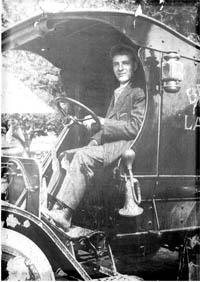
    Sections Supplements
    At 60, the ‘Pedlar’ Blends Fine Fare with a Large Dose of History
    Yankee Pedlar Inn

    Yankee Pedlar Inn

    The horse and buggy out by the curb have stood the test of time, although not without incident (‘Dobbin,’ as he’s called, has been ‘kidnapped’ and returned several times). He is a fixture in Holyoke, as is the landmark he’s associated with, the Yankee Pedlar Inn. Now marking its 60th year in business, the ‘Pedlar,’ as it’s called, blends history with fine food; tradition with a setting often described as unique.

    The Yankee Pedlar Inn turned 60 a few months ago.

    Six decades of uninterrupted business is quite a feat in the restaurant/banquet sector, but there haven’t been any real celebrations to mark the occasion, said Kim Clayton-McGrath. She’s sales manager at the ‘Pedlar,’ as it’s called, and daughter of current owners Martin and Rosemary Clayton, who purchased the Holyoke landmark in 1995.

    “We’ve just been plugging along day to day, working hard … it’s been that way for the past 60 years,” she said of the definite lack of fanfare with regards to the recent milestone, noting that this industry, which is always challenging, is even more so these days with the economy sagging and soaring gas prices keeping people home. “We’re focused on today and tomorrow.”

    And besides, she told BusinessWest, the Pedlar celebrates its history and traditions every day, not on those round-number anniversaries, and it does so in a number of ways.

    There are the pictures on the walls of the Holyoke Room — one of several smaller banquet rooms — showing the landmark in its many stages of its development. And one of the other rooms is named Simone’s in honor of a recently deceased employee, Simone Patenaude, who worked there “forever,” said Clayton-McGrath.

    There’s also the picture of the Pedlar’s first owners, Eugene and Catherine Tamburi, hanging in one of the hallways. Meanwhile, there’s a mural in the Tavern Bar & Grill, the main restaurant, that offers a time-altered view of life at the Pedlar; it includes personalities from the past (the Tamburis, Patenaude, and Johnny Marion, who played the piano there back in the ’50s and ’60s) sharing the room with some from the present, including the Claytons and waitresses, or “fixtures,” Sandy Mumblow and Carole Mazzu.

    And then, there’s Dobbin, the stuffed horse attached to an antique carriage that has stood outside the Pedlar since 1953. Dobbin wasn’t in The Wizard of Oz, but he’s been a horse of many different colors. Now white, he’s been black and also spotted. He was painted green, gold, and white (by parties unknown) for one recent St. Patrick’s Day week (the route for the city’s famous parade winds past the landmark), and has also been hot pink for one recent holiday season.

    “Who knows how many different colors you’d see if you scraped all that paint off,” said Clayton-McGrath, adding that the equine’s tail was recently stolen and replaced, for the umpteenth time. “He’s been kidnapped I don’t know how many times, but always returned to us; that horse is a legend around here.”

    And like Dobbin, the Pedlar is a survivor, withstanding changes to Holyoke’s downtown and overall character; mounting competition, especially in Holyoke, where there are several banquet and meeting facilities; those higher gasoline prices; and several cycles of the economy. The facility owes its resilience to the fact that it is a landmark, said Clayton-McGrath, one to which individuals, families, businesses, and organizations have remained loyal for decades.

    But it also has some features that make it stand out in a crowded marketplace. They include those smaller, and also unique, banquet rooms, something missing at most halls, she said, and also the Pedlar’s Opera House. Added by the Tamburis in 1973, the two-level room has been the site of theatrical performances, charity events, hundreds of weddings, and, until recently, a regular Sunday brunch.

    That tradition was halted on the basis of pure economics, said Clayton-McGrath, noting that for some time the weekly brunch was taking in less money than it cost to put it on.

    The demise of the brunch — there is some talk of reviving it — is a reminder that businesses, even those as old and storied as the Pedlar, have to balance tradition with good business sense. The ability to do this has given the landmark both a rich past and strong prospects for the future.

    Talking Turkey

    Clayton-McGrath sat down with BusinessWest just a few days before Thanksgiving.

    This is always a busy time at the Pedlar. More than 1,000 people traditionally come through the doors for the holiday buffet, she explained, and there are always a number of gatherings of all sizes, including several high school reunions, scheduled through the long weekend.

    Having all those activities go off as planned requires large doses of preparation and attention to detail, she said, noting that the staff at the Pedlar have had plenty of practice. Many of the employees have been with the establishment for years, if not decades. They’ve seen times change, but not the Pedlar’s blend of atmosphere and tradition.

    It all started on June 7, 1947, roughly a year after the Tamburis purchased what had long been the home of Judge John Hildredth, who left England in 1871 to settle in Holyoke. The home, situated at the junction of roads known now as Routes 5 and 202, was built in 1875, and its size and location made it ideal for an inn.

    Over the years, however, the restaurant, which seated only 25 when the Pedlar first opened, became increasingly popular, requiring the Tamburis and subsequent owners to devote ever-larger amounts of square footage to dining and banquet facilities. Today, only a few of the original guest rooms remain, and they are used as bridal suites.

    Those rooms are put to great use, because the Pedlar has long been a very popular site for weddings, said Clayton-McGrath, and the Opera House has much to do with this phenomenon. “A bride feels like a princess in this room,” she said while decending from the Opera House’s balcony. “You can get some incredible pictures in here.”

    Capable of seating more than 200, the room features a chandelier from the former New York Metropolitan Opera House, which was torn down in 1963, and a large wooden bar rescued from Kenilworth Castle. This was Holyoke’s version of the famed English castle, a brick-and-stone mansion that was home to E.C. Taft, one of the city’s many prominent mill owners, and torn down in 1959. Many artifacts from the castle, as well as pictures of it, dominate another of the smaller dining areas known as the Kenilworth Room.

    In 1977, the Yankee Pedlar was purchased by the Banks, Frank and Claire, who put their own stamp on the facility through nearly two decades of ownership. They added the Garden Room, another popular site for weddings, those of the smaller variety; the Herb Terrace; and Simone’s, a small, French bistro-style restaurant inspired by a trip to Europe.

    The Clayton family, which had been in Holyoke for three generations and owned the Martin J. Clayton Insurance Agency, located just down the street from the Pedlar, purchased the landmark in 1995. A year later, they remodeled the former sandwich and pub area known as the Oyster Bar and renamed it the Tavern Bar & Grill.

    Food for Thought

    How Clayton-McGrath, a former paralegal, came to be sales manager for her parents’ business venture is largely a matter of circumstance. She and her husband, Neil McGrath, a football coach by trade, were living in Maine (he was coaching at the state university), when the Pedlar was acquired. When Neil took a job at UMass in the mid-’90s, the couple relocated to Holyoke, and Clayton-McGrath accepted an invitation to help manage the city landmark.
    She started with mother’s hours, but eventually made this a full-time exploit, something she believes her father had in mind from the beginning.

    These days, Clayton-McGrath and other members of a management team that includes “Master” Chef Ed Klinger, Banquet Manager Nancy Wheeler, HR Director Abby Leroux, and Martin Clayton (now semi-retired and living in Florida) are leading the Pedlar through a time of change and challenge.

    While the restaurant side of the business remains fairly steady, there are simply fewer people going to dinner, lunch, and, yes, brunch, these days, said Clayton-McGrath. There are several reasons for this, including time constraints on business people, a smaller business community in Holyoke, the general economy, and even gas prices.

    “When gas hits $3 a gallon, a lot of people just don’t want to move out of their driveways,” she said, noting that she’s seen a drop in business since the most recent climb to that price threshold. “Just about everything affects this business; when people have less money to spend, they just don’t go out to eat as much.”

    All this has contributed to a greater emphasis on the banquet and special-event side of the ledger, which, while it’s not recession or gas price-proof, continues to thrive at the Pedlar, despite mounting competition.

    This success is due to a blend of flexibility, tradition, a diverse and reasonably priced menu, and strong customer service, she explained, noting that the Pedlar has eight banquet rooms of various sizes, many of which can accommodate groups of 20 or fewer, which helps the landmark stand out.

    “The smaller parties add up,” she explained. “And people are very grateful when they can find a small room; we hear so many people say, ‘we can’t get anything anywhere for a party of 20; no one will take us.’”

    As she offered a tour of the Pedlar, Clayton-McGrath started in one of those smaller facilities, the Kenilworth Room. She pointed to a stained-glass window that is just one of many artifacts from the mansion.

    From the Tavern and its famous mural, Clayton-McGrath proceeded to the Holyoke Room, complete with photos of the Pedlar taken over several decades, as well as pictures of other landmarks, including Mountain Park, its famous carousel, and City Hall.

    Other venues include the Pedlar Club, used typically for cocktail and hors d’oeuvres receptions; the Loft, so named because it’s on the second floor; and the Oakdale.

    This volume and variety of smaller rooms gives the Pedlar the flexibility to handle functions ranging from small bridal showers to anniversary parties; from bus tours (many originating in Connecticut or New Hampshire stop at the landmark on their way to or from Yankee Candle, the Holyoke Mall, and other tourist stops) to a host of holiday parties.

    “We’re booking more Christmas parties than ever before,” said Clayton-McGrath, noting that the Pedlar can handle virtually any-sized get-together. “And we’re doing more in January every year — that’s because everybody’s really busy in December, and we’re all looking for something to do in January.”

    And then, there’s the parade.

    Planning for the colossal undertaking is essentially a year-round undertaking, she said, noting that the Pedlar plays host to many meetings and events. Parade week is an especially busy time, and for Clayton-McGrath and most others, work on the day of the parade starts well before the sun comes up and ends long after it’s gone down.

    “It’s just crazy, crazy here,” she said of parade day, noting that people start setting up chairs outside the Pedlar at 7 a.m. “It’s fun morning, noon, and night — we have the workers’ breakfast at 6 and the after-parade dinner.”

    Mane Event

    Glancing out her office window in the direction of Dobbin and the ancient buggy, Clayton-McGrath said the latter is overdue for an overhaul.

    “It’s very, very old wagon, and we’re constantly putting tape around it and telling people to stay off,” she said, adding that many try to sit in for the parade, and the Pedlar doesn’t want to see anyone hurt. “It needs some work.”

    Though it’s weathered, the buggy has stood the test of time — as has the Pedlar. It’s done so through a blend of tradition and atmosphere and more than a little … well, let’s call it horse sense.

    George O’Brien can be reached at[email protected]
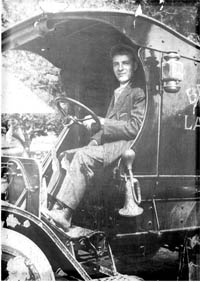
    Departments

    Museum Marks Fifth Anniversary

    October-Jan. 27 & Nov. 15-March 9: The Eric Carle Museum of Picture Book Art in Amherst recently launched a full slate of fall programs in celebration of its fifth anniversary, including two special exhibitions. “Spiderwick: From Page to Screen,” opened Sept. 22 and runs through Jan. 27. The show explores the art of Tony DiTerlizzi and Holly Black’s The Spiderwick Chronicles, and follows the story’s translation to the big screen (coming Feb. 15, 2008). The second exhibition, “Children Should Be Seen: The Image of the Child in American Picture Book Art,” opens Nov. 15 and runs through March 9. The show features the work of 84 artists in a comprehensive survey of the best American picture book art of the last decade.

    Money Smart Program

    Oct. 30-Nov. 27: The Holyoke Credit Union will once again offer its free award-winning financial education program titled Money Smart, which covers a multitude of personal banking and finance subjects. The course will be conducted on Tuesdays from 6 to 8 p.m. for five consecutive weeks at the Holyoke Credit Union’s main branch at 490 Westfield Road, Holyoke. The program is free to the public, however, pre-registration is required. Registration may be made at any branch location or by calling (413) 532-7007.

    Women Business Owners Conference

    Oct. 31: The 14th Women Business Owners Conference, hosted by the Mass. Small Business Development Center Network, is planned from 8 a.m. to noon, followed by an optional lunch. The theme is “Succession Planning: Transition & Transformation.” Among the highlights of the morning will be a panel discussion on the legal and financial considerations that are paramount to sound succession planning. Registration is planned from 8 to 8:30 a.m. in Willits-Hallowell Center at Mount Holyoke College, South Hadley. For fees and more information, call (413) 737-6712 or visit www.msbdc.org/wmass.

    CPA Tech Day

    Nov. 2: Uplinc Inc. will host a CPA Technology Day at the Clarion Hotel and Conference Center in West Springfield, complete with breakfast, a vendor technology fair, lunch, and seminars on topics ranging from “Product and Document Management” to “Disaster Recovery.” Vendors participating in the daylong event include Xerox, Barracuda, AmeriVault, Hewlett Packard, and Cisco. The event concludes with a full open-bar social. Reservations are limited. For more information, call (413) 693-0700, ext. 221, or visit www.uplinc.com

    Entrepreneurship Summit

    Nov. 5: Bay Path College in Longmeadow will host its next Innovative Thinking & Entrepreneurship Summit at 4:15 p.m., featuring breakout sessions and a lecture by keynote speaker Nadine Thompson. Thompson is the co-founder of Warm Spirit, and co-author of Values Sell: Transforming Purpose Into Profit. Breakout session topics will include ‘Coach Me Into Greatness!,’ ‘Making the Leap,’ ‘Best Practices for New Business Launch,’ and ‘Creating a Guide for a Life You Love.’ The program is free; however, pre-registration is required. To register or for more information, visit www.baypath.edu. For questions, call Kellie Lavoie at (413) 565-1054 or E-mail her at [email protected]

    Guerrilla Marketing

    Nov. 7: Inspired by a guerrilla-marketing philosophy, this workshop will condense an MBA curriculum’s worth of marketing planning fundamentals to seven essential sentences. Participants will leave the workshop with an actionable document designed to focus on 30-, 60-, and 90-day marketing action items relating to the only four profit-boosting methods that exist for any business. The 9-to-11 a.m. session is planned at the Andrew M. Scibelli Enterprise Center, 1 Federal St., Springfield. The cost is $35. For more information, call (413) 737-6712 or visit www.msbdc.org/wmass

    BayPath Lecture Series

    Nov. 9: William A. Burke III, president of LENOX of East Longmeadow, will be the featured speaker for Bay Path College’s Innovative Thinking & Entrepreneurship Lecture Series in the Blake Student Commons on the Longmeadow campus. A continental breakfast will be served from 7:30 to 8:15 a.m., followed by Burke’s presentation on innovative thinking and entrepreneurship. LENOX employs more than 700 people and markets band saw blades, hand tools, and power-tool accessories in more than 70 countries. Seeking to capitalize on the brand equity of its linear-edge products and its efficiency on the factory floor, Burke initiated a strategy calling for aggressive growth. This growth was driven by new product development, imaginative marketing, and new sales strategies. Seating is limited, and registration is required. For more information, call Briana Sitler at (413) 565-1066 or E-mail her at [email protected]

    Six Flags CEO To Address A.I.M.

    Nov. 9: Marc Shapiro, president and CEO of Six Flags Inc., will outline his managing style for overseeing the world’s largest regional theme park company during the Associated Industries of Massachusetts Executive Forum meeting at the Westin Hotel, 70 Third Ave., Waltham. Registration begins at 7:45 a.m., followed by the program from 8 to 9:15 a.m. For registration information, call Julie Fazio at (617) 262-1180 or Chris Geehern at (617) 834-4414, or visit www.aimnet.org

    Advertising Seminar

    Nov. 9: Smart Moves Advertising will offer a free interactive advertising seminar from 9:30 a.m. to noon at the Clarion Hotel and Conference Center in West Springfield to all members of the Women’s Partnership and members of the Affiliated Chambers of Commerce of Greater Springfield. Speakers will be Janet Casey of Smart Moves Advertising, Joan Letendre of Letendre Advertising, and David Horgan of Horgan Associates. Attendance is limited. For more information, e-mail Janet Casey at [email protected]

    Internet Marketing 102

    Nov. 13: Level the playing field by learning best practices in advertising and how to better target your customers with keyword-triggered advertising on the big search engines. Additionally, participants will learn the pay-per-click advertising that works on Google and Yahoo. The 1 to 4 p.m. workshop is planned at the Andrew M. Scibelli Enterprise Center, 1 Federal St., Springfield. The cost is $40. For more information, call (413) 737-6712 or visit www.msbdc.org/wmass

    WNEC Workshop

    Nov. 13: Dr. Fran Harris, inspirational speaker and former professional basketball player, will present a workshop titled “Student Entrepreneurship” as part of a workshop series sponsored by the Law and Business Center for Advancing Entrepreneurship at Western New England College in Springfield. For more information, visit www.law.wnec.edu/lawandbusiness

    SCORE Workshop

    Nov. 16: Dave Wentworth, a SCORE counselor and businessman, will present ‘What Is the Future of Your Non-profit?’ from 9 a.m. to noon at the Scibelli Enterprise Center, One Federal St., Springfield. Wentworth notes that much of the workshop content was developed by the national SCORE organization under a Kellogg Foundation grant. A fee of $25 covers the cost of materials. For additional attendees from the same organization, the fee is $5. For more information and to register, call (413) 785-0314.

    Bright Nights

    Nov. 21-Jan. 1: Bright Nights at Forest Park in Springfield opens Nov. 21 and runs Wednesdays through Sundays until Dec. 9. Bright Nights will then be open nightly from Dec. 12 through Jan. 1. Buses run nightly from 5 to 6 p.m., and cars from 6 to 9 p.m. Sunday through Thursday, and from 6 to 9 p.m. on Fridays, Saturdays, and holidays. For more information on admission, call (413) 733-3800 or visit www.brightnights.org

    Sections Supplements
    ‘Historic Hotels’ Status Offers Marketing Oomph to its Western Mass. Landmarks
    Norma Probst

    Norma Probst, director of sales and marketing at Cranwell Resort, Spa and Golf Club, said HHA helps brand historic hotels as a group.

    From vintage furnishings to modern-day amenities, the region’s historic hotels have much to offer travelers from around the world. However, one thing that’s long been lacking for these mostly privately-owned, single-location establishments has been the marketing machines that power the Hiltons, Westins, and Marriotts of the nation — and by telling their members’ stories, Historic Hotels of America is looking to change that.

    The Porches Inn at MassMoCA in North Adams was recently named one of the world’s “coolest hotels” by Condé Nast Traveller, among other honors. It earned the distinction for its wide range of amenities and whimsical style, which includes complimentary breakfast delivered in a vintage lunch pail.

    Down the road in Lenox, the Cranwell Resort, Spa and Golf Club recently garnered AAA’s Four Diamond rating for the sixth consecutive year and continues to hone its reputation as one of the best golf resorts in the country.

    The Red Lion Inn in Stockbridge has welcomed travelers for more than two centuries, and is now making a new name for itself as a champion of sustainable agriculture in the Berkshires.

    And Hotel Northampton in Hampshire County, with its newly renovated rooms and grand ballroom, is positioning itself as the area’s premier spot for luxury accommodations.

    Each establishment has its own claims to fame that make it a unique destination in Western Mass. At first glance, the hotels have little in common. But they share one common theme: all are members of the Historic Hotels of America, a national organization that serves historic hotels and the travelers who love them, and, as such, affords a unique set of benefits that calls attention to the properties’ individuality, while at the same time binding them together as part of a whole.

    Mary Billingsley, director of public relations for Historic Hotels of America, or HHA, explained that the group is a program of the National Trust of Historic Hotels for Preservation, which was formed in 1989 as a means of reaching out to the traveling public.

    “We had certain people in mind,” she said. “Those who may not consider themselves preservationists, but appreciate history, and the experience of staying in a hotel that has a past, a tradition, and a sense of place in its community.”

    The organization started with 32 charter members, and today, that number has risen to 213, spread across the contiguous United States, Puerto Rico, and the U.S. Virgin Islands. Porches, the Red Lion, Hotel Northampton, and Cranwell are the region’s only HHA hotels, and four of 15 in the Commonwealth. Others include the Boston Park Plaza and Towers, Chatham Bars Inn on Cape Cod, and the Hawthorne Hotel in Salem.

    Billingsley said that to be considered for inclusion, a hotel must be included on the National Register of Historic Places and housed in a building that is at least 50 years old, though many establishments in the network are new uses of older properties, including former apartment buildings, mills, and private homes.

    “There is a wide range of properties that have been converted into hotels, from cotton warehouses to bottling plants,” she said, adding that HHA is not a luxury organization; while each property has its own unique draws, HHA hotels fall within a number of price points and welcome all types of travelers. “We’re defined by history, and that’s something we let consumers know,” she said.

    The Best of the West

    Billingsley noted that the four hotels within Western Mass. are a good representation of HHA’s overall mission and identity as a travel organization.

    “Western Mass. as a destination is so desirable,” she said, “and these four hotels showcase the diversity of our group. The Red Lion Inn is so picturesque; Cranwell is an internationally-known resort; Porches is an adapted-use of a property dating back to the 1890s; and Hotel Northampton has a more modern flair.”

    Still, Billingsley explained that while the strengths HHA hotels possess — a strong sense of history, a rich collection of stories, and often a unique set of amenities that blend the intrigue of the past with the creature comforts of today — can also be a weakness for such destinations. While these features set them apart from modern-day hotels, she said, they can also isolate them. Most historic hotels are privately owned, and as such don’t have the same marketing strength as larger, corporate-owned outfits.

    Addressing this has become the primary goal of HHA; it’s a member-driven marketing association, collecting dues from participating hotels and, in turn, promoting them as part of a group with increasing prestige.

    The representatives from the HHA hotels of Western Mass. who spoke with BusinessWest returned frequently to the topic of branding, and how HHA has provided a much-needed shot in the arm in terms of creating a collective identity for a varied set of properties.

    Michael Kolesar, director of sales and marketing for Hotel Northampton, took his post at the local landmark just this year, after a long career working within corporate-owned hotels. He said HHA does the work that smaller outfits often cannot, forging an identity for privately owned destinations.

    “It’s a wonderful marketing tool, utilizing history, that markets individual properties through a lot of great programs that create brand association,” he said. “They allow us to work with what we have at our own pace, and we gain exposure outside of the local market — something that, as a privately owned establishment, is not easy for us to do.”

    Carol Bosco Baumann, director of Communications and Marketing for the Red Lion Inn and the Porches Inn, said the Red Lion, first opened in 1773 to serve as a stagecoach stop, is one of HHA’s charter members, and Porches is still viewed as a relatively new member, having joined in the past decade. From both points of view, Baumann said she’s seen firsthand the growth within the organization.

    “The HHA helps establish us as a brand by allowing us to be a part of an umbrella organization,” she said. “It’s an interesting position to be in, having two properties that scream individuality be part of the same brand.

    “But it’s all about preservation and historic standards that alone are a benefit,” Baumann continued, “and the HHA publicity efforts only help us more. People understand that when they plan a trip to an HHA hotel, they’re going to feel a genuine sense of place. More than anything else, history provides that.”

    Norma Probst, director of Sales and Marketing for the Cranwell Resort and a member of HHA’s national sales committee, said that she anticipates that the organization will only continue to flourish, aiding its member properties all the more.

    “Cultural travel is one of the largest-growing segments of the industry,” she said, “and the HHA is doing very well as an organization because of the efforts it has undertaken with regard to public relations. Those have fostered a very willing, active membership base that understands the importance of promoting HHA as well as themselves; I see it becoming more well-known as a group in the future.”

    At Any Rate

    The various programs sponsored by HHA are developed to be pliable, so member hotels can develop promotions that make sense for them, while at the same time taking advantage of HHA’s international publicity. Members can choose whether or not to participate in a given program, and if they choose to sign on, can do so at virtually any level.

    Currently, for instance, the Western Mass. HHA properties are gearing up for the ‘Fall Back in Time’ program, which will offer special rates and packages coinciding with the new, later time change on Nov. 4 (clocks are turned back one hour a week later this year, due to the federal Energy Policy Act of 2005). Sponsored by American Express, the program offers an extra draw for AmEx users, awarding a complimentary one-year membership to the National Trust for Historic Preservation when a trip is booked.

    More than 75 packages have been developed by participating hotels across the country, ranging from special rates that reflect the year an establishment was built, to more elaborate promotions.

    Kolesar said he’s currently developing a program for Hotel Northampton that will likely include a discounted rate or added-value component, and Cranwell is offering a second-night rate of $18.94 when one night is booked, celebrating the year the Sloane family, the resort’s second owners, built the Gilded-Age Wyndhurst Mansion on the property. Probst said quite a few rooms have already been reserved through that promotion.

    Similarly, Baumann has developed ‘Fall Back’ promotions for both the Red Lion and Porches; the former will offer an overnight package including a country breakfast in bed and a commemorative gift for $177.30, while the latter will afford guests with a one-night stay with breakfast for two and a $20 gift certificate to the inn’s eclectic gift shop, all for $189, signifying the 1890s, when the Porches property was first built. Baumann said she tries to participate in HHA programs whenever possible, as they help to boost occupancy during slower times.

    “The perception is that the Berkshires are a place for summer travel,” she said, “when in fact there is beauty and things to do year-round.”

    Essentially, the affiliation with HHA, and its regularly released press materials and seasonal promotions, allows inns like the Red Lion and Porches to tout their amenities and special events continuously, and Baumann said this also helps translate the reality that not all historic hotels are Spartan in their accommodations. Rather, many have a large cadre of modern draws that, without regular, brisk marketing, can fall under the radar.

    In addition to its lunch-pail breakfast service and claw-foot tubs, Porches, for instance, offers an outdoor heated pool, a hot tub, a bonfire pit surrounded by 10,000 different varieties of native plants, rain water shower heads, and outdoor adventure packages such as geocaching trips.

    Probst said the HHA’s marketing assistance has been particularly beneficial in promoting the Cranwell’s 35,000-square-foot, $7.5 million spa, which blends well with its historic mansions.

    “Promoting the spa through packages allows us to maintain an identity,” she said, “while still translating that we have the modern amenities travelers today are seeking.

    “There are a lot of economies of scale one doesn’t have when connected to a large hotel,” she added, “but we’ve been marketing our spa packages rigorously through HHA, and since we began, we have yet to drop below 50% occupancy in the winter.”

    Tell Me a Tale

    Other benefits of HHA include reservation services, which allow both individuals and groups to book stays though the organization and its Web site, and a comprehensive, annually updated directory. All of the HHA hotels are also listed on the group’s Web site, historichotels.org, which is geared toward consumers with pages detailing various types of trips, from golf outings to spa retreats to business meetings.

    The backbone of nearly all of HHA’s marketing programs, however, is story-telling, as it speaks to the personality that distinguishes historic hotels from their modern-day counterparts.

    These can be small anecdotes regarding a visit from a celebrity, or a recipe that originated in an establishment’s kitchen, and also grand yarns, detailing how one guest house weathered prohibition, or how another played a part during WWII. The Hotel del Coronado in Coronado, Calif., another HHA member, often touts its distinction as the backdrop for the Marilyn Monroe film Some Like It Hot.

    “We try to think about different topics in different areas and have our hotels share their stories,” said Billingsley. “We’ll cover everything from presidents’ visits to ghost stories to recipes and housekeeping tips. We’ve found looking to the past has been very helpful.”

    Of all topics, ghost stories tend to draw particular interest. “We promote those on a yearly basis, and we’re on our 14th year,” said Billingsley. “People really like them, and hotels definitely have stories to tell.”

    Kolesar noted that, while Hotel Northampton has yet to identify any spectral visitors, it benefits by promoting the stories of Wiggins Tavern, built in 1796 in New Hampshire and moved to the hotel in 1936 as part of a surge in Colonial-revival architecture and design, and by touting its long list of celebrity guests, from Eleanor Roosevelt to Hillary Clinton.

    “A lot of people have skeletons in the closet, so to speak, but we really don’t,” he said, looking momentarily crestfallen. “That’s just one example of promoting history on a lighter note, though. We cater more to ‘star-gazers’ who care about who’s been here among the living.”

    Travel tips have been another big win for HHA. Periodically, the organization will zero in on a particular topic — how to travel healthier, for instance, or a selection of team-building exercises for corporate travelers — and ask member hotels to contribute an idea.

    “There’s great interest, and it allows us to put together fresh stories more frequently,” said Billingsley, adding that the topic doesn’t have to be complicated to generate interest. “Our housekeeping tips release was successful because I think people know how hard housekeepers work, and that the tips they’d have to offer would be real — things people could do themselves that weren’t difficult challenges. One woman, we heard, hung our press release up in her broom closet.”

    Check Us Out

    It’s a comprehensive marketing model that continues to gain momentum, assisting the historic hotels of the country as they, in turn, bolster the organization.

    As for those establishments in the region taking their historical significance to a new level, Probst, standing halfway between Cranwell’s opulent mansion-cum-lobby and its contemporary spa and fitness center, perhaps said it best.

    “We’re fortunate to be in Western Mass.,” she said. “It’s a fantastic destination that many people love. But to be placed on a national stage makes a world of difference.”

    Jaclyn Stevenson can be reached at[email protected]

    Departments

    Museum Marks 5th Anniversary

    October-Jan. 27 & Nov. 15-March 9: The Eric Carle Museum of Picture Book Art in Amherst recently launched a full slate of fall programs in celebration of its fifth anniversary, including two special exhibitions. “Spiderwick: From Page to Screen,” opened Sept. 22 and runs through Jan. 27. The show explores the art of Tony DiTerlizzi and Holly Black’s The Spiderwick Chronicles, and follows the story’s translation to the big screen (coming February 15, 2008). The second exhibition, “Children Should Be Seen: The Image of the Child in American Picture Book Art,” opens Nov. 15 and runs through March 9. The show features the work of 84 artists in a comprehensive survey of the best American picture book art of the last decade.

    Furniture Art& Craft 2007

    Through Oct. 28: Danish Inspirations in West Hatfield will host Furniture Art & Craft 2007, a regional furniture makers’ exhibit, with a reception for the artists on Sept. 22 from 3 to 5 p.m. The theme of the second annual show is “Extending the Boundaries of Quality.” For more information, contact Peter Knapp at Danish Inspirations, (413) 247-5681, Bill Sheckels at (413) 773-8244, or visit www.danishinspirations.biz/FAAC2007.html.

    University Without Walls Information Sessions

    Oct. 18, 24, 27, 30: The University Without Walls (UWW) at UMass Amherst will conduct small group information sessions with a UWW representative who will review all the key features of the program and answer prospective students’ questions. UWW is an adult bachelor’s degree completion program that offers extensive business-related course offerings. In addition, students design their own degrees and earn credit for the learning and experience they have done “outside the walls” of UMass Amherst. Sessions are slated for Oct. 18, 5:30 p.m.; Oct. 24, 5:30 p.m.; Oct. 27, 10 a.m., and Oct. 30, 5:30 p.m. Sessions are approximately 90 minutes each and are held at the UWW office at 100 Venture Way, Suite 200, Hadley. Anyone interested in attending a session can sign up online at www.umass.edu/ uww.info_sessions/small_group.html, or call (413) 545-1378.

    Gottlieb Exhibition

    Through Oct. 26: R. Michelson Galleries on Main Street in Northampton will host Paula Gottlieb’s new show titled The Road Home — Recent Landscapes. “The stunning beauty of the land and my concern for its disappearance through development and degradation are the inspiration for this new series of local landscape paintings,” said Gottlieb, who has been painting and teaching for 40 years, and has lived in the Pioneer Valley since 1979. For more information, visit www.RMichelson.com or call (413) 586-3964.

    CHD Conference

    Oct. 23: The Center for Human Development will present its third annual conference titled Through Her Eyes, the Experience of Girls and the Juvenile Justice System, from 8 a.m. to 4:30 p.m. at the Clarion Hotel in West Springfield. The theme is “Relationships for Success: Critical Pathways for Supporting Young Women.” The conference will feature 12 workshops, with special emphasis on relationships, empowerment, and mentoring. The closing panel discussion will provide perspectives of women who have been in the criminal justice system and opportunities to relate their experiences to concepts presented throughout the workshops and addresses. Through their stories of challenges and successes, the women will give conference attendees an opportunity to experience the system through their eyes. Keynote speakers include Dr. Stephanie Covington, Ph.D., L.C.S.W., and Andrea Johnston, J.D. Dr. Covington founded the Center for Gender and Justice and the Institute for Relational Development. Johnston co-founded with Gloria Steinem the Girls Speak Out Foundation, and recently launched “The Caged Bird Sings Project” that empowers girls isolated in extreme circumstances in the United States and Africa. For reservations and more information, contact Ruth Dudley-Carr at (413) 737-2679, or register online at www.throughhereyes.org.

    Money Smart Program

    Oct. 30-Nov. 27: The Holyoke Credit Union will once again offer its free award-winning financial education program titled Money Smart this fall which covers a multitude of personal banking and finance subjects. The course will be conducted on Tuesdays from 6 to 8 p.m. for five consecutive weeks at the Holyoke Credit Union’s main branch at 490 Westfield Road, Holyoke. The program is free to the public, however, pre-registration is required. Registration may be made at any branch location or by calling (413) 532-7007.

    Women Business Owners Conference

    Oct. 31: The 14th Women Business Owners Conference, hosted by the Mass. Small Business Development Center Network, is planned from 8 to noon, followed by an optional lunch. The theme is ‘Succession Planning: Transition & Transformation.’ Among the highlights of the morning will be a panel discussion on the legal and financial considerations which are paramount to sound succession planning. Registration is planned from 8 to 8:30 a.m. in Willits-Hallowell Center at Mount Holyoke College, South Hadley. For fees and more information, call (413) 737-6712 or visit www.msbdc.org/wmass.

    Guerrilla Marketing

    Nov. 7: Inspired by a Guerrilla Marketing philosophy, this workshop will condense an MBA curriculum’s worth of marketing planning fundamentals to seven essential sentences. Participants will leave the workshop with an actionable document designed to focus on 30-, 60-, and 90-day marketing action items relating to the only four profit-boosting methods that exist for any business. The 9 to 11 a.m. session is planned at the Andrew M. Scibelli Enterprise Center, 1 Federal St., Springfield. The cost is $35. For more information, call (413) 737-6712 or visit www.msbdc.org/wmass.

    Six Flags CEO To Address A.I.M.

    Nov. 9: Marc Shapiro, president and CEO of Six Flags Inc., will outline his managing style for overseeing the world’s largest regional theme park company during the Associated Industries of Mass. Executive Forum meeting at the Westin Hotel, 70 Third Ave., Waltham. Registration begins at 7:45 a.m., followed by the program from 8 to 9:15 a.m. For registration information, call Julie Fazio at (617) 262-1180 or Chris Geehern at (617) 834-4414, or visit www.aimnet.org.

    Internet Marketing 102

    Nov. 13: Level the playing field by learning best practices in advertising and how to better target your customers with keyword-triggered advertising on the big search engines. Additionally, participants will learn the Pay-Per-Click advertising that works on Google and Yahoo. The 1 to 4 p.m. workshop is planned at the Andrew M. Scibelli Enterprise Center, 1 Federal St., Springfield. The cost is $40. For more information, call (413) 737-6712 or visit www.msbdc.org/wmass.

    Departments

    MassMutual Named A Working Mother 100 Best Company

    SPRINGFIELD — Working Mother magazine recently named MassMutual a ‘2007 Working Mother Best Company.’ Leading a significant and ongoing culture shift, MassMutual officials note they are using company-wide benefits and programs to help ensure the retention and advancement of working mothers. MassMutual provides a number of options to help employees achieve a strong work/life balance, including flexible schedules, on-site and near-site child care facilities, an on-site credit union, convenience store with a full-service pharmacy, dry cleaner, tailor, jewelry and shoe repair, a barbershop, and a hair salon. MassMutual also has a strong commitment to employee health, offering state-of-the-art wellness activity centers, employee health service centers that offer such amenities as personal health assessments, on-site physical therapy, and flu vaccinations, as well as an employee-assistance program. In other news, the company has been awarded the No. 1 ranking in this year’s InformationWeek 500 “Information Security/Privacy” category for its proprietary information security management system. MassMutual’s award is one of only five “Leaders in Innovation” category awards identified by InformationWeek, namely, Productivity, Information Security, Supply Chain Innovation, Emerging Technology and Customer Intimacy.

    Daly Honored At Baystate Dedication

    SPRINGFIELD — Recognizing his strategic vision and his inspirational leadership of the organization for 22 years, Baystate Health recently honored Michael J. Daly during a dedication ceremony of the Daly Building, formerly the Centennial Building, at the stystem’s Springfield campus. Baystate’s Board of Trustees officially renamed and dedicated the medical center to honor Daly, who served as chief executive officer from 1981 to 2003. An unveiling of a special plaque in his honor was among the festivities during the dedication ceremony on Oct. 2.

    Spalding Introduces ‘The Beast’

    SPRINGFIELD — Spalding is bringing an NBA in-arena style experience to a new portable outdoor system. By introducing The Beast, Spalding now offers the first ever 60-inch glass portable backboard system in the market. The Spalding Beast’s glass board provides increased benefits to players, highlighted by a 37% truer rebound than achieved with acrylic systems, according to company officials. The Beast also boasts an aluminum-trimmed unit which features a heavy duty steel frame, Z-arm board mounts that provide increased stability, and a heavy duty Pro Image® breakaway rim. In addition, an institutional style lift provides infinite height adjustment from 7.5’ to 10’, a portable, multi-wheel with castors base provides ease of movement, and a four-strut pole/base mount provides superior system rigidity.

    North Amherst Company Wins National Award

    NORTH AMHERST — Cowls Land and Lumber Company has been awarded the Assoc. of Fish and Wildlife Agencies’ prestigious Landowner Stewardship Award. The award is presented annually to landowners who make a significant and positive conservation impact on a large area of privately owned land. The award was recently presented to Cinda Jones and her husband, Chuck Walker, of the Cowls Companies at the annual meeting of the Association of Fish and Wildlife Agencies in Louisville, Ky. Over the past 265 years, the family’s Western Mass. forest land has been devoted to sustainable timber production, while providing public recreational access and improved wildlife habitat. Cowls was one of the original tree farms to embrace and meet the requirements to be certified as a sustainable producer of trees in the United States. Cowls employs professionally trained foresters in the management of its land and incorporates multiple uses into its land-management plans. Cowls management plans are long-term and set the goal of achieving a sustained yield while retaining diversity of fish and wildlife, habitats, and ecosystems function. This year’s award represents the first time recognition has been given to a sustainable forest-based enterprise (in the past only farmers and ranchers have been recipients) and the first time for a Northeastern state. For more information on the award program, visit www.fishwildlife.org.

    Big Y Promo Supports Breast Cancer Research

    SPRINGFIELD — Big Y Supermarkets will be donating proceeds from its produce department as well as additional select products in October to the local Susan G. Komen for the Cure, Massachusetts and Connecticut Affiliates, to raise awareness and funds for breast cancer. The month-long initiative is titled “Partners of Hope,” and Big Y has partnered with many manufacturers to procure hundreds of thousands of pick-labeled products with funding toward breast cancer research and awareness. Big Y will be selling pink T-shirts, pink-frosted cupcakes, pink travel mugs and water bottles, pink bouquets and more. Pink paper ribbons will also be available for a $1 donation and will be posted in each market. Internally, Big Y’s Wellness Team will be hosting several programs this month to highlight breast cancer awareness to the employee family.

    TD Banknorth Grant Supports Museum Programs

    SPRINGFIELD — The Springfield Museums have received a $10,000 grant from the TD Banknorth Charitable Foundation for its Weekend Family Fun series of educational programs. Weekend Family Fun programs highlight holidays, special exhibits, cultures from around the world, and popular topics like dinosaurs and Dr. Seuss. Each program includes a performance, art demonstrations, science activities, and hands-on craft workshops. The four Springfield Museums and the Dr. Seuss National Memorial Sculpture Garden are located on the Quadrangle at 21 Edwards St.

    Springfield Falcons Partner with Big Y, WNEC

    SPRINGFIELD — The Springfield Falcons recently signed a two-year corporate partnership agreement with Big Y Foods that once again offers fans a discount ticket for select nights when they present their Big Y Savings Card at the MassMutual Center Box Office. Big Y Foods will also receive maximum exposure as part of its partnership with their logo appearing on signage on the MassMutual Center center-hung video board, and also on dasherboard signage inside of the MassMutual Center. The Falcons also recently partnered with Western New England College for the 2007-08 season to develop the Falcons’ new multimedia section located on Falconsahl.com. The new feature will consist of both audio and video clips involving Falcons players and coaches, as well as game highlights. WNEC officials noted they are proud to provide support and assistance for this ambitious web marketing enterprise, known as the Western New England College multimedia section of the Springfield Falcons’ website, where fans will be able to enjoy a more interactive experience with the organization.

    Avada’s Blulink Offers Wireless Hearing

    SPRINGFIELD — Avada Hearing Care Centers recently introduced Blulink™, its first wireless communication system that tackles challenges for those with hearing loss — providing ultimate sound quality that is delivered in sync with the listening environment and offering hands-free connectivity to Bluetooth-enabled cell phones and other wireless electronic devices. Unlike traditional hearing instruments, Blulink’s high speed wireless digital technology creates a wireless ‘bubble’ around the user, allowing a pair of Blulink hearing devices to communicate together to process sounds similar to the way the human brain receives and interprets sounds. For more information, visit www.avada.com.

    Hampden Bank to Continue Energy Relief Program

    SPRINGFIELD — There is still uncertainty about how much it will cost homeowners to stay warm this heating season. However, many people are already beginning to wonder, and worry, about how they are going to pay their heating bills this winter. In response to what could be some very tough situations for local residents, Hampden Bank has decided to once again continue it’s Energy Relief Program introduced two years ago. The program is designed to give mortgage customers the option to make a smaller, ‘interest only’ payments on their mortgage for the duration of the heating season. “We are reacting to the needs of our customers,” said Senior Vice President Robert Michel. “While fuel prices have come down, filling up your car or paying the heating bill is still painful. With this program, we allow our borrowers to make an interest-only payment. They’ll be able to use the savings each month to apply toward their heating costs.” Michel added. The program is simple, but the savings can be profound. For example, a $150,000 loan balance with a 20-year remaining term at an average 6.5% interest rate would yield a savings of almost $250 per month.

    Sections Supplements
    The 2007 Super 60 Roster Conveys Strength and Diversity
    Star Power

    Star Power

    A quick glance at this year’s Super 60 list reveals the diversity that defines the Western Mass. economy. There are manufacturers, technology companies, retailers, health care providers, and accounting firms. There’s also a
    restaurant, a dictionary publisher, a pharmaceuticals maker, and even a private college. Together, these companies paint an encouraging picture of the local business community and its prospects for the future.

    If there is one constant when it comes to the Super 60 — the annual roster of top-performing companies as compiled by the Affiliated Chambers of Commerce of Greater Springfield — it is change.

    Each year since 1990, when the unique business-recognition program was launched, there have been new companies in both the ‘Revenue’ and ‘Revenue Growth’ categories. That change is refreshing, and it conveys both movement and diversity in the local economy, said Russell Denver, president of the ACCGS, who told BusinessWest that he enjoys seeing different business owners come to the podium at the annual Super 60 luncheon to accept their awards.
    So he should really be looking forward to this year’s event, set for Oct. 26 at Chez Josef in Agawam. That’s because the field for 2007 is dominated by newcomers; 18 of the ‘Growth’ companies are new to that list, and 11 of the businesses on the ‘Revenue’ side are newcomers, said Teddy Woeppel, communications director for the ACCGS.

    There are some other numbers of note when it comes to the Class of 2007, said Woeppel, noting that, combined, the 30 ‘Revenue’ companies earned $708 million in 2006, and average revenue for those businesses was $24 million. On the ‘Growth’ side of the ledger, the 30 companies posted average growth of 71% over the past three years, while more than half (57%) posted growth in excess of 50%.

    Denver said both lists provide evidence of the strong diversity that is considered one of the strengths of the local economy. The ‘Growth’ list, for example, includes two banquet facilities under the corporate name Delaney Restaurant Inc., two accounting firms, several insurance agencies, a carpet and tile outlet, a law firm, a construction company, a pharmaceuticals maker, and and a medical device manufacturer, among others.

    Meanwhile, on the ‘Revenue’ side, the list features a software maker, a private college, a maker of plastic containers, an architectural firm, a recreational boat dealer, a hardware chain, a drug store chain, and a dictionary publisher (Merriam Webster Inc.), among others.

    While there were several newcomers in the top 10 for the ‘Revenue’ category, the top three finishers are familiar names when it comes to the Super 60. Springfield College topped the list, while Southwick-based Whalley Computer Associates, a technology-solutions provider, was the runner-up, and Springfield-based Rocky’s Hardware Inc., a chain now boasting 25 locations in Massachusetts, New Hampshire, and Rhode Island, finished third.

    On the ‘Growth’ side, there were six newcomers in the top 10, and two in the top three. Leading the class is Kleer Lumber Inc., a Westfield-based producer of PVC trimboard, while Complete Payroll Solutions, a Springfield-based company that provides payroll, tax, benefits, and human resources services was runner-up. Kittridge Equipment Co., a commercial food service equipment dealer that has made several appearances on both Super 60 categories, finished third.

    Other newcomers to the ‘Growth’ list, said Woeppel, are: Ace Metal Fabricators Inc., Allen & Burke Construction, Custom Carbide Corp., Delaney Restaurant Inc., Dimauro Carpet & Tile Inc., Egan, Flanagan and Cohen, P.C., Haluch Water Contracting, Innovative Physicians Services, LLC, Insurance Center of New England, M.J. Moran Inc., Moriarty & Primack, P.C., PC Enterprises Inc., R&R Industries Inc., Terrien Transportation Inc., Texcell Inc., and Tunstall Associates Inc.

    Fast Facts:

    What:The Annual Super 60 Luncheon
    When:Oct. 26, starting at 11:30 a.m.
    Where:Chez Josef in Agawam
    Sponsors:Health New England, Hampden Bank, Sullivan Hayes & Quinn, Sovereign Bank New England, Westfield Bank, and WWLP 22News
    Tickets:$45 for ACCGS members, $65 for non-members. Reservations must be made in writing and in advance. Reservation forms were mailed to Chamber members, and are available at the Chamber office, 1441 Main St., Springfield.

    On the ‘Revenue’ side, the newcomers are: Atlantic Fasteners Inc., Biolitec, Chandler Architectural Products Inc., Governor America Corp., Kleer Lumber, Plastic Packaging Corp., Quabbin Wire & Cable Co. Inc., Specialty Bolt & Screw Inc., Springfield Spring Corp., and Suddekor, LLC.

    Four companies — Kleer Lumber, Specialty Bolt & Screw, Kittredge Equipment Company, and Suddekor — qualified for both lists.

    In the pages that follow, BusinessWest provides snapshots of all 60 companies that comprise the Class of ’07.

    Departments

    Museum Marks 5th Anniversary

    Sept. 22-Jan. 27 & Nov. 15-March 9: The Eric Carle Museum of Picture Book Art in Amherst recently launched a full slate of fall programs in celebration of its fifth anniversary, including two special exhibitions. “Spiderwick: From Page to Screen,” runs through Jan. 27. The show explores the art of Tony DiTerlizzi and Holly Black’s The Spiderwick Chronicles, and follows the story’s translation to the big screen (coming Feb. 15, 2008). The second exhibition, “Children Should Be Seen: The Image of the Child in American Picture Book Art,” opens Nov. 15 and runs through March 9. The show features the work of 84 artists in a comprehensive survey of the best American picture book art of the last decade.

    Furniture Art & Craft 2007

    Through Oct. 28: Danish Inspirations in West Hatfield will host Furniture Art & Craft 2007, a regional furniture makers’ exhibit. The theme of the second annual show is “Extending the Boundaries of Quality.” For more information, contact Peter Knapp at Danish Inspirations, (413) 247-5681, Bill Sheckels at (413) 773-8244, or visit www.danishinspirations.biz/FAAC2007.html.

    University Without Walls Info Sessions

    Oct. 2, 13, 18, 24, 27, 30: The University Without Walls (UWW) at UMass Amherst will conduct small group information sessions with a UWW representative who will review all the key features of the program and answer prospective students’ questions. UWW is an adult bachelor’s degree completion program that offers extensive business-related course offerings. In addition, students design their own degrees and earn credit for the learning and experience they have done “outside the walls” of UMass Amherst. Sessions are slated Oct. 2, 5:30 p.m.; Oct. 13, 10 a.m.; Oct. 18, 5:30 p.m.; Oct. 24, 5:30 p.m.; Oct. 27, 10 a.m., and Oct. 30, 5:30 p.m. Sessions are approximately 90 minutes each and are held at the UWW office at 100 Venture Way, Suite 200, Hadley. Anyone interested in attending a session can sign up online at http://www.umass.edu/uww.info_sessions/small_group.html, or call (413) 545-1378.

    SCORE Workshop

    Oct. 5: A workshop, Tips on Commercializing Your Innovation, sponsored by the Western Massachusetts chapter of SCORE, will be conducted from 9 a.m. to noon at the Scibelli Enterprise Center, One Federal St., Springfield. The workshop is specifically directed to the business innovator/inventor. Dave Wentworth, a SCORE counselor and businessman, will be the facilitator. The cost is $25 and pre-registration is required. For more information, call (413) 785-0314 to leave your name and phone number.

    Fall Shopping Fair

    Oct. 11: A ‘Fall Shopping Fair’ will be staged at Ludlow Country Club to benefit the Rays of Hope Foundation. The event, which kicks off at 5 p.m., will feature a number of local vendors displaying apparel, floral items, jewelry, culinary products, skin care items, and more. There is no entrance fee, but donations to benefit Rays of Hope will be accepted. For more information, call (413) 583-3434, ext. 2.

    Menopause Lecture

    Oct. 16: “Bio-Identical Hormones: What’s It All About?” will be presented at 6:30 p.m. at the Quantum Life Management Center, 30 Westwood Ave., East Longmeadow. Bio-identical hormones are an alternative to traditional hormone replacement therapy for the symptoms of menopause. Jenifer Fleming of The Counseling & Gynecology Group in East Longmeadow is the presenter. There is no charge for the informational session.

    Education & Trade Fair Show

    Oct. 17: The Realtor® Association of Pioneer Valley, Inc. will sponsor its 14th annual Education and Trade Fair Show from 7:30 a.m. to 5 p.m. at the Springfield Sheraton. The event combines educational opportunities and a trade show for realtors and affiliates. Highlights will include keynote speaker Darryl Davis, a real estate trainer and motivational speaker; a continental breakfast and lunch for attendees, and a wine and cheese party at the culmination of the day’s festivities.

    CHD Conference

    Oct. 23: The Center for Human Development will present its third annual conference titled “Through Her Eyes, the Experience of Girls and the Juvenile Justice System,” from 8 a.m. to 4:30 p.m. at the Clarion Hotel in West Springfield. The theme is “Relationships for Success: Critical Pathways for Supporting Young Women.” The conference will feature 12 workshops, with special emphasis on relationships, empowerment, and mentoring. The closing panel discussion will provide perspectives of women who have been in the criminal justice system and opportunities to relate their experiences to concepts presented throughout the workshops and addresses. Through their stories of challenges and successes, the women will give conference attendees an opportunity to experience the system through their eyes. Keynote speakers include Dr. Stephanie Covington, Ph.D., L.C.S.W., and Andrea Johnston, J.D. Dr. Covington founded the Center for Gender and Justice and the Institute for Relational Development. Johnston co-founded with Gloria Steinem the Girls Speak Out Foundation, and recently launched “The Caged Bird Sings Project” that empowers girls isolated in extreme circumstances in the United States and Africa. For reservations and more information, contact Ruth Dudley-Carr at (413) 737-2679, or register online at www.throughhereyes.org.

    Chefs for Healthy Babies

    Nov. 5: Signature chefs from across Western Mass. will present a culinary extravaganza during the annual March of Dimes “Chefs for Healthy Babies” fundraiser that begins at 5:30 p.m. at The Log Cabin in Holyoke. Highlights of the evening affair also include a wine tasting and silent and live auctions. For additional information and online registration, visit www.marchofdimes.com/ma or call the Chapter office at (508) 329-2800.

    Six Flags CEO To Address A.I.M.

    Nov. 9: Marc Shapiro, president and CEO of Six Flags, Inc., will outline his managing style for overseeing the world’s largest regional theme park company during the Associated Industries of Massachusetts Executive Forum meeting at the Westin Hotel, 70 Third Ave., Waltham. Registration begins at 7:45 a.m., followed by the program from 8 to 9:15 a.m. For registration information, call Julie Fazio at (617) 262-1180 or Chris Geehern at (617) 834-4414, or visit www.aimnet.org.

    ‘Selling Products Globally’

    Nov. 15: Holland & Bonzagni, P.C., registered patent attorneys based in Longmeadow, will present an informative workshop from noon to 4:30 p.m. on how to sell products in today’s global market. The event is planned at the Crowne Plaza Hotel, 100 Berlin Road, Cromwell, Conn. Speakers include Carl R. Jacobsen and Sharon Bongiovanni, both of the Middletown U.S. Export Assistance Center; Stephen Sarro of A.N. Deringer, Inc.; Joseph H. Bartozzi, Esq., of O. F. Mossberg & Sons, Inc., and Donald S. Holland, Esq., of Holland & Bonzagni, P.C. The cost is $50, which includes a buffet luncheon. For more information, call (413) 567-2076 or register online at www.hblaw.org.

    Bright Nights Ball

    Nov. 17: East Longmeadow-based Hasbro Games will be the sponsor of the 2007 City of Bright Nights Ball, which will take on a Monopoly® theme. The event, the major fundraiser for the Spririt of Springfield, which puts on the annual holiday display in Forest Park known as Bright Nights, will take place in the ballroom of the Sheraton Springfield at Monarch Place. The black-tie event features a gourmet dinner, dancing and the opportunity to win and purchase some fabulous items. Guests will be able to purchase Monopoly deeds, everything from Baltic Avenue to Boardwalk, and redeem them for prizes. Bidding on five showcase items will begin on-line in early November and be completed the evening of the gala. Other premium items will be sold in an on-line auction. Auction items will be announced at a later date. In addition to Hasbro Games, the City of Bright Nights Ball is being supported by Bay State Health, Health New England, MassMutual Financial Group, and Sheraton Springfield. Tickets to the 12th annual City of Bright Nights Ball are $500 per couple. Tables of 10 are available for $2,500. For more information, contact the Spirit of Springfield at (413) 733-3800.

    Money Smart Program

    Oct. 30-Nov. 27: The Holyoke Credit Union will once again offer its free award-winning financial education program titled Money Smart this fall which covers a multitude of personal banking and finance subjects. The course will be conducted on Tuesdays from 6 to 8 p.m. for five consecutive weeks at the Holyoke Credit Union’s main branch at 490 Westfield Road, Holyoke. The program is free to the public, however, pre-registration is required. Registration may be made at any branch location or by calling (413) 532-7007.

    Departments

    Webster Bank Plans More Branches

    LONGMEADOW — By the end of the year, Webster Bank will expand its presence by adding a branch in town and one in East Longmeadow. Currently, Webster Bank has locations in Springfield, West Springfield, and Westfield. Officials from the Waterbury, Conn.-based bank noted that adding branches is a continuing extension of growth in the I-91 corridor between Hartford and Springfield. In town, the branch at 408 Longmeadow St. is expected to be open by mid-October. The East Longmeadow branch will be located at the Center Village shops and is scheduled for a December opening.

    Hulmes Transportation Services Wins PVTA Contract

    SPRINGFIELD — Hulmes Transportation Services of Belchertown recently received a three-year, $15 million contract to provide dial-a-ride shuttle services in Hampden and Hampshire counties for the Pioneer Valley Transit Authority (PVTA). Almost two years ago, Hulmes was among the offices raided when the FBI probed into suspected bid-rigging by former PVTA Administrator Gary A. Shepard. Hulmes emerged from that criminal investigation unscathed.

    Microtest Labs Is Finalist for Economic Impact Award

    AGAWAM — Microtest Laboratories of Agawam has been named as a finalist for the 2007 Team Massachusetts Economic Impact Award by the Massachusetts Alliance For Economic Development (MAED). The Awards honor the companies that have made the strongest contributions over the past year to the Massachusetts economy through job creation and business expansion. Microtest is being considered for its impact and contributions in Western Mass. Microtest, a leader in testing services and contract manufacturing for the medical device, pharmaceutical, and biotechnology industries, employs more than 100 in Agawam. The company recently completed a $7.5 million expansion to its headquarters, adding new state-of-the art pharmaceutical testing laboratories and new aseptic fill/finish manufacturing facilities – along with new professional staff. The company has working partnerships with economic and business organizations throughout Western Mass. — and deep relationships with the region’s educational institutions. “Everyone at Microtest is extremely proud” of being named a finalist by MAED, said Steven Richter, Ph. D., President and Scientific Founder of Microtest. “Our mission is to become a long term economic driver in the valley.” MAED is a private, non-profit partnership of business, industry leaders, and government dedicated to the economic growth of Massachusetts. MAED will announce its 2007 Team Massachusetts Economic Impact Award winners during a special luncheon on Nov. 20. For more information, visit www.massecon.com.

    Mary E. Davis ICU Opens at Mercy Medical Center

    SPRINGFIELD — Mercy Medical Center has completed the first phase of an extensive construction and renovation project to improve patient care services and operational efficiency in both its Intensive Care Unit (ICU) and the Ambulatory Services Unit. A dedication and ribbon-cutting ceremony for the new Mary E. Davis Intensive Care Unit was staged Sept. 24. The program also featured a blessing by the Most Rev. Timothy A. McDonnell, Bishop of the Roman Catholic Diocese of Springfield. The new ICU, located on the third floor of Mercy Medical Center, features private rooms for each patient, direct access to windows or natural light, and 280 square feet of space within each room. Family members and visitors will also find additional space inside patient rooms and in common areas. With the completion of the ICU, construction efforts will now concentrate on renovations of the Ambulatory Services Unit, also located on the third floor. Plans call for the construction of separate pre-operative and post-operative areas, the addition of private recovery rooms, and the modification of walls to increase staff visibility to patients. Hospital operations will continue uninterrupted during the second phase of construction. The $16 million project is scheduled for completion during the summer of 2008.

    Berriman & Associates Inc. Changes Name

    EAST LONGMEADOW — Berriman & Associates, Inc., a local wealth management and retirement consulting firm, became ONE Source Financial Group Inc., effective Oct. 1. The firm has been serving the needs of local companies and investors for 20 years, and its new name reflects the growth of the company and the services offered, according to company officials.

    Vann Group Company Announces New Affiliation

    SPRINGFIELD — Client First Associates, a city based organizational development firm and a Vann Group company, announced a new affiliation with Ann Holland, currently an adjunct professor at Bay Path College in Longmeadow. The firm specializes in organizational conflict resolution, leadership development, strategic facilitation, organizational assessment and design, team building, hiring models, training and employee development, and compensation systems. Holland has an extensive business background in operations, marketing, training and development. She holds a Master’s degree in Organizational Management and has received her certification as a business and life coach through IPEC and the International Coaching Federation. Client First Associates is owned by the Vann Group, a Springfield-based business advisory firm specializing in helping companies in transition.