Home Posts tagged Features (Page 16)
Sections Supplements
From Teen Bashes to Retirement Parties, Jx2 Has a Playlist for Everyone
Andrew Jensen

Andrew Jensen, owner of JX2 Productions, in front of his Westfield offices.

Andrew Jensen serves a diverse and demanding clientele ranging from CEOs to 16-year-olds, and he knows he’d better listen well when it comes to both — they’re equally his most promising demographics.

Owner of Jx2, a production company based in Westfield offering disc jockey, sound, and lighting services for a variety of events, Jensen is one of the region’s most inspiring youg entrepreneurs. He has learned that the only constant in his industry is the ever-growing scale of the events he helps create, spurred largely by more accessible technology and the lofty desires of party planners of all types and ages.

Recently, he’s found that the teen scene is where the action is, but that a solid reputation in the corporate arena can create a strong base for growth in an often unpredictable vocation.

The Jx2 Web site, jx2productions.com, speaks to that range. The welcome page features two boxes; click on one, and it leads to a professional, content-rich site with a professional feel.

Click on the other, and a MySpace profile page for the company appears. It’s not a shortcut, but rather the best way to reach the prom committees, student councils, and teens planning birthday bashes and bar mitzvah celebrations that regularly seek his services.

And as Jensen can attest, the means of finding these audiences may differ, but from there, the lines start to blur — corporate events aren’t just sit-down dinners anymore, and birthday parties have come a long way from pin the tail on the donkey.

It’s a Family Affair

Jensen said he first started noticing that trend in his own family, when he and his brother Eric threw a 25th anniversary party for their parents. They bought much of the equipment they’d need to provide entertainment for the event, in order to stage it themselves, and following the party, guests started asking for repeat performances.

That was in 2001, and since then Jx2, named for the Jensen brothers and now owned by Andrew (Eric still DJs occasionally), has grown to provide a wide array of event entertainment services. His father, Paul, is also now an employee.

The business is primarily a disc jockey service, but in today’s multimedia-driven age, that amounts to much more than spinning records. Jx2 offers event management and organizing, lighting and staging, and audio-visual system setup and operation. The company can provide a master of ceremonies if necessary, as well as ‘audience motivators,’ including dancers, and can provide services and equipment for events ranging from karaoke parties to trade shows.

Jensen said the core of his business is still private formal and semi-formal events, such as weddings, school dances, and jack-and-jill parties, but he added that a number of other offerings that are new to his repertoire are helping Jx2 stand out in a saturated market.

“There’s a lot of heavy competition in the area,” said Jensen. “Some are big, well-known companies, and others are small, one-person operations, but everybody takes a piece of the pie.”

In fact, Jensen once counted 26 DJs doing business in Agawam alone, not far from his offices at Shaker Farms Country Club in Westfield.

One Is a Lonely Number

To thrive in that climate, Jensen has worked to diversify his business model in a number of areas. For one, he has branched out with a new endeavor, partnering with fellow event-services provider Mark Ashe of Marx Entertainment in Enfield, Conn., to form JenMark, which focuses on the management and staging of corporate events. Combining the expertise and equipment of both businesses, JenMark puts the two DJ and entertainment companies squarely in the middle of the event-planning arena, offering a suite of services that includes database procurement to help spread the word about a corporate event, such as a conference or trade show; payment processing for events that require a fee; custom Web site development for the event; facility procurement; food procurement; audio-visual services; and on-site management.

JenMark’s first major event, a trade show catering to the sweet 16, 15, and bar and bat mitzvah crowds, will be staged on Oct. 5, and will serve to promote Ashe and Jensen’s own industry, as well as those of many of their partnering vendors.

It’s a market both entrepreneurs have been actively working to cultivate; a strong presence among the teenage crowd, the corporate crowd, and party-planning families creates a sort of perfect storm, leading to what is currently the juggernaut of the event services world — the Super Sweet 16.

It’s Gonna Be a Party, Party

Sixteenth birthday parties for both boys and girls, as well as bar and bat mitzvahs, have received a rocket-fueled boost in recent years, thanks to the success of MTV’s My Super Sweet Sixteen, a reality show geared toward teenagers and pre-teens.

The show created a national trend by following various would-be 16-year-olds in towns and cities across the country as they plan what they hope will be the party of the year for their classmates.

Gone are the days of birthday cake and potato chips, replaced by elaborate themes (a luau, complete with fire jugglers, for instance, or a jungle with live tigers and pumas), nationally touring musical acts, and, usually, a brand new luxury car to top off the evening. Teens who aren’t featured on the show can still flaunt their own parties by joining an online community sponsored by the show, and uploading bulletins, photos, and videos.

Jensen said the events he’s seen in Western Mass. aren’t usually quite so involved as those featured on television — yet, anyway — but they mirror MTV’s over-the-top celebrations in that everyone wants something unique, and seemingly high-end.

“The kids want it to look like a dance club,” he explained, “with music, lighting, and fun extras. The parents want it to be an upscale event. These parties are moving further and further away from anything that resembles a home or family function; now, people want to turn it into a whole production.”

Jensen is also branching out into area high schools, sending out mailings and meeting with prom committees across the region to provide music, lighting, and other variables for high school formals. Those are some of his most demanding clients, he said; every class wants something different, but each one also wants something big and bombastic, no matter how many bake sales it takes.

Even with such a boom underway, however, Jensen is also expanding his services in other areas, targeting other demographic groups in addition to companies and kids.

All Parties, Great and Small

He continues to zero in on the wedding crowd, offering an extensive suite of services to clients to make their events as seamless as possible, and hopefully to spur referrals. For instance, Jx2 will assist in booking other wedding services via a network of Western Mass. professionals, rather than just point a couple in the right direction.

“It helps with pricing, because I can negotiate with vendors to get more bang for the buck,” said Jensen, “but it also allows me to say ‘yes’ more often when a client asks for something. ‘Yes, I can get a movie screen.’ ‘Yes, I can get a popcorn machine.’ I have the connections, and that helps us expand into other areas.”

But Jensen was quick to note that his business has not been built by tacking on extras, but rather by tailoring his services to the needs of his clients. A blanket approach no longer works in his industry, said Jensen — a huge variety of entertainment choices have created a larger set of demands — and new technology allows for a little bit of spectacle at even the smallest functions.

Jx2 has recently started leasing out equipment, for instance, offering tutorials so clients can save money on a DJ by plugging in an iPod filled with favorite music, or setting up an outdoor movie screen and sound system that only requires the customer pop in a DVD.

That means families and businesses alike can plan memorable events at a much lower cost — movie-night packages start at $299. And if a client would prefer that Jx2 handle everything from soup to nuts, Jensen said he and his staff of three are ready to deliver.

The End of the Night

“We do more than come and play music,” he said, noting, for instance, that he’s drafted a 60-page guide for brides, which covers everything from common wedding-reception traditions to frequently asked questions — not just of him, but of photographers, event planners, and caterers, as well. “We try to go the extra step to help. I’m not doing it to be an event planner, but there’s so much that goes into these events that people appreciate the extra guidance.”

That help might also be increasingly necessary, judging by Jensen’s own notes for a coming event. Too many for a notebook or a software program, Jensen had instead resorted to a classroom-sized whiteboard to record his clients’ wishes and the necessary equipment. “I like to have it all in front of me,” he said.

And with both juniors in high school and senior executives to impress, he might soon need a new, even bigger whiteboard to keep things straight.

Jaclyn Stevenson can be reached at[email protected]

Sections Supplements
From iPods to eBooks, Everyday Life is Getting a Technological Shot in the Arm

The summer of the iPhone is all but behind us, but there is more new technology making headlines these days. Myriad new products, from gadgets to professional software to phones and cameras are coming onto the market.

There are trends — everything keeps getting smaller and more versatile — but the bottom line is an emphasis on communication, organization, and simplifying the everyday tasks involving life and work with some style.

In this issue, BusinessWest offers a sampling of what’s new in technology and what the products hitting the market bring to the table.

Ansering the Call


Left to right, iPod Shuffle, iPod Nano, iPod Classic, and iPod Touch

The sleek, touch-screen iPhone is still making news; on Sept. 9, Apple sold its one millionth unit (after reducing its price by about $200). In response to the many iPhone owners upset with the decision to reduce the price from $599 to $399 two months after its debut, Apple CEO Steve Jobs sent an open letter — directly to the phones, of course — awarding all current iPhone users a $100 store credit toward the purchase of any Apple product.

That’s good news for fans of ‘the people’s company,’ since Apple is following up on the success of the iPhone with the sixth generation of the iPod, and the two devices closely resemble each other.

The iPod Touch was formally introduced to the public this month, and boasts many of the same features as the much anticipated iPhone. It includes a touch screen and Wi-Fi capabilities, a Safari Web browser, and connects directly to YouTube, where users can view millions of free videos. The Touch is available in eight- and 16-gigabyte models, now retailing for $299 and $399, and joins the existing suite of iPods — the Shuffle, Nano, and Classic models;apple.com.

Now Hear This


Aurvana Headphones

Apple may be the big newsmaker in the technology race, but many other companies are in the running, vying for the attention and the loyalty of increasingly in-the-know shoppers.

Another audio giant in the marketplace, Creative Labs, which manufactures the Zen series of mp3 players and accessories, has recently devised high-end, noise-canceling headphones called Aurvana, designed to augment the mp3 listening experience.

The headsets use the latest audio technology, X-Fi, or extreme fidelity, as it’s called, to improve the sound quality of an mp3 file; it does this by restoring the details of a file that are lost during compression. Aurvana headphones also feature three switches to optimize listening experiences for not only music files, but while watching television, movies, or playing games as well. The first is a noise-canceling switch, the second a ‘crystalizer’ that enhances mp3 playback, and the third is a CMSS-3D switch that creates a surround-sound effect.

The headsets are expected to be available later this month, retailing for approximately $300;creative.com.

A Picture and Thousands of Words

Just as CDs and stereos are becoming increasingly passé, paperback books, day planners, and photo albums are also gradually becoming things of the past, replaced by more effective and less expensive digital versions of each.
Photophiles in particular can now take more advantage of the digital photo frame craze than ever before, as frames are being designed with more capabilities, better performance, and more memory.


eStarling 2.0 Wi-Fi Photo Frame

The eStarling 2.0 Wi-Fi Photo Frame, for instance, takes the concept of displaying digital photos to the next level, by adding the ability to connect to the Internet wirelessly.

The seven-inch frame will display photos in a slideshow format, and can accommodate most types of camera memory cards, immediately adding any photos on the card directly into the rotation.

However, JPEG photos can also be sent directly to the eStarling via E-mail or through an RSS photo feed, such as those available through the popular photo-sharing Web site Flickr.

This allows frame owners to have photos E-mailed to them by friends or relatives, send photos to the frame via a laptop or mobile phone from virtually anywhere in the world, and also search for specific photos taken by others and posted on public sites online.

Within the Flickr community, these photos can be added to the eStarling by entering ‘tags,’ or keywords, and having them fed directly to the eStarling. The criteria could be as simple as photos of Hawaii, or as detailed as ‘red 1957 Chevys.’

Despite these new attributes, the frame is relatively simple to use. It requires a one-time setup (connecting the frame to a computer by a USB cord), and eStarling software guides the process of creating a free E-mail address to which photos can be sent. Spam blockers are also provided, and the frames retail for approximately $220;estarling.com.

Also striving to improve the leisure side of life is Sony’s PRS500 Portable Reader System, released this month. The tablet offers a space-saving solution for readers on the go in addition to employing the newest technology to alleviate eye-strain and make digital reading a more comfortable experience overall.

Using E Ink Display technology, the screen mimics the look of a paper book, but text can be magnified up to 200%. It also weighs just under nine ounces and is a half-inch thick, with a memory card slot through which books, photos, and mp3s can be uploaded.

E-books can be found online, often for free, and Sony has instituted its own virtual bookstore, the Sony Connect eBookstore. The PRS500 is currently retailing for about $275, and perhaps signals the beginning of the end for traditional, bound volumes. It’s an intriguing shift, but also one that could significantly reduce the world’s paper consumption;sonystyle.com.

The Technology of Ecology

Other products now being introduced also take the environment and energy conservation into account, in addition to technological quality, in this increasingly hooked-in world.

Dataprobe, a leading manufacturer of technology solutions for networking systems, announced last month that its iBoot product, a remote power solution that monitors, manages, and controls both corporate and personal computing devices and electronics, is now compliant with RoHS (restriction of the use of hazardous substances) and WEEE (Waste of Electrical and Electronic Equipment) standards in Europe.

The RoHS and WEEE directives, respectively, ban the sale and import of electronic equipment containing more than approved levels of lead, cadmium, mercury, and other elements, as well as reduce the exposure of hazardous chemicals within recycled materials.

Manufacturers in the U.S., such as Dataprobe, must meet the requirements of both in order to import their products for sale in the European Union market.

Changes to the iBoot to address the EU’s new guidelines augment its already environmentally friendly function. With a single-outlet power switch, the iBoot allows for power control over various types of equipment from anywhere, using an Internet browser. This, in turn, reduces or eliminates the need for on-site technical support, at a cost of about $275;dataprobe.com.

For those hoping to bring a little bit of alternative energy directly into the home, Tamiya Inc. has created a good starting point: the Loopwing Wind Power Generator Set, which catches a breeze and converts it to electricity.

It’s more of an educational tool than anything else, using the energy it generates to power a small rechargeable toy car, which will run for about one to two minutes for every five to 10 minutes of wind-powered charging;tamiya.com
However, the $50 Loopwing is an example of how green energy is being scaled down for more accessible use by consumers. Another product doing the same has been devised by Italian designers Alberto Medo and Francisco Gomez Paz; the duo has created the Solar Bottle, a portable water-purifying system that uses SODIS technology — Solar Water Disinfection.

Each square, stackable, four-liter bottle has one transparent side to collect UV-A rays, which, coupled with increased temperature from solar sources, effectively kill disease-causing pathogens.

A handle makes for easy carrying, and also serves as a stand while being exposed to sunlight. It’s appropriately sized for both private homes and businesses, as well as for outdoor situations such as camping or boating.

The unique design and concept behind the Solar Bottle, which is still in development, also earned Medo and Gomez Paz a 2007 INDEX Award, and could be positioned as a solution for regions of the world with poor-quality drinking water supplies. For more information on the Solar Bottle, visitinhabitat.com.

From Roomba to RoboCop?

The Solar Bottle may still be in prototype mode, but its creation is part of a larger movement of technological marvels that continue to pour into our lives at break-neck speed. According to PCWorld magazine, some of the future technology that researchers and retailers alike are keeping a close eye on are in the areas of biometric security (handprint, fingerprint, and eye-scan access among them), and artificial intelligence.

True to that trend, iRobot (irobot.com) of Burlington, Mass., the firm that gave us the Roomba robot vacuum, has just debuted a tiny “robot cop,” which carries a camera and an electroshock weapon for use by law enforcement and military personnel.

With those kinds of leaps becoming commonplace, the Jetsons’ automated amenities of ready-made meals and flying cars do not seem quite so far off. Still, it’s to be hoped that a Taser-equipped iPhone is light years away.

Jaclyn Stevenson can be reached at[email protected]

Sections Supplements
WNEC Communications Students Make Community and Career Inroads
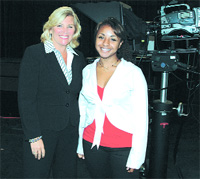
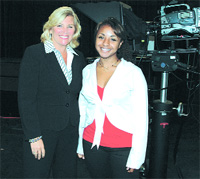
Brenda Garton-Sjoberg and Talehia Traverso

Brenda Garton-Sjoberg, left, director of the Institute for Media and Nonprofit Communication at WNEC, and Talehia Traverso, a junior majoring in communications, in the college’s television studio.

Talehia Traverso, a junior from New Jersey majoring in communications at Western New England College, plans to spend much of this semester poring over video footage, perfecting her on-air delivery, and conducting interviews with Broadway star Mamie Duncan-Gibbs.

Duncan-Gibbs, who has starred in such productions as Jelly’s Last Jam with Savion Glover and Gregory Hines, in addition to television and nationally touring stage appearances, has enlisted Traverso’s help in publicizing another endeavor, Youth Theatre Interactions (YTI) in Yonkers, N.Y., for which she serves as executive and artistic director.

“It’s an amazing program that teaches creativity, leadership, and the idea that hard work pays off,” said Traverso, who began her work with YTI this summer and expects to complete her project by this spring.

She’ll be producing a promotional video for the organization as part of an independent study at WNEC, and the scope of the project isn’t lost on her. She quickly lists several specific hurdles she has to clear in order to complete the piece: “I’m still shooting,” she said, counting off the tasks with her fingers. “Framing can be difficult, and writing and editing the story line … I had to learn how to focus the cameras well — and getting good head shots, that’s a big one.”

Initially, Traverso showed an interest due to the program’s close proximity to her hometown; Duncan-Gibbs, interestingly enough, is a Springfield native.

But the connection she’s made with the actress runs deeper than that. The project is also part of a burgeoning program at the college that is growing quickly, and garnering national attention for its work with not-for-profit organizations and agencies, as well as the experience it affords students.

Passion to Product

Led by Brenda Garton-Sjoberg, communications professor and former news anchor for WWLP 22, the program is an option for communications students, and charges them with the creation of a five-minute spot that features and promotes a nonprofit business.

Students must write their own scripts, film their own footage, conduct interviews, edit, and produce their projects from start to finish, and Garton said the process usually spans an entire semester, if not longer.

“This is an extensive, months-long project,” she said. “Essentially, these students must live their project for weeks on end. But this allows them to graduate with a professional product to show employers — a product they are proud of, and frankly, so are we.”

Garton said serving the students’ professional needs through the project is as important as producing a quality marketing piece for nonprofit businesses, most of which are local. The dual focus ensures that the educational needs of the participants are met, she said, as well as the promotional needs of the agencies with which they work.

“It has to be a learning experience for the student as well as the nonprofit,” said Garton. “We match students with particular nonprofits, because there needs to be an interest and a passion on the part of the student. We know there is a need in the nonprofit arena, because we are inundated with calls.”

Tale of the Tape

The initiative began in 2003, with one student and a self-defense course for children, radKIDS, which has been held on the WNEC campus for several years.

Garton, at the time serving as the school’s director of College Relations and Community Outreach, became involved with the program as a volunteer and a mother, even becoming a certified radKIDS instructor.

Her news roots never far from the surface, however, Garton said she recognized a need for more publicity for the program. At the same time, a communications student, Michael DeFilipi of Agawam, was looking for an independent study project to round out his education in broadcasting.

A video was produced featuring Ed and Lois Smart, parents of Elizabeth Smart, who was abducted from (and subsequently returned to) her home in June, 2002. The Smarts were strong proponents of the radKIDS program, and not long after DeFilipi produced his video, Ed Smart appeared on Good Morning America to discuss kidnapping prevention.

In search of ancillary materials that would help explain what programs like radKIDS teach, producers at GMA reached out to WNEC and DeFilipi, airing portions of his project on air.

“After clips of Mike’s video appeared on national television, the program started to grow from there,” said Garton, listing several agencies that have since benefited from the students’ work, as well as several students who have seen their careers leap into high gear as a result.

Career and Community

Over the past five years, students have produced spots for organizations such as the Springfield Urban League, the Boy Scouts of America, GoFIT, the Williamstown Theatre Festival, and the Willie Ross School for the Deaf. Many agencies include the videos in marketing materials, fundraising packages, and on their Web sites, and conversely, the professional benefits for students have already been seen.

In addition to DeFilipi’s national exposure on Good Morning America, two WNEC graduates — Lacey Girard, who was also honored by the Associated Press for her work with the Willie Ross School for the Deaf, and Bill Rinaldi, who met with high-level management at Reebok for his video on GoFIT, a Springfield-based fitness program for women and children — landed jobs at WGGB abc40 as a direct result of their projects.

“We focus on each student’s strengths,” said Garton, “so even though they’re managing the entire project, their talents shine through.”

Traverso, who hopes to forge a career in broadcast journalism, plans to serve as on-air talent for the piece on YTI, though she added that beyond her professional aspirations, she too has seen the crossover from school project to community involvement.

“YTI is so culturally mixed, and its instructors are pros in their field,” she said. “I have a brother who’s 8, and he’s never been interested in theater or performance. But when I told him about this program, he just wanted to know more. I thought, ‘imagine what it’s like for the kids, especially inner-city kids, who are really passionate about it?’”

The Final Cut

In addition to realizations like that, a new entity has been created at WNEC. It’s called the Institute for Media and Non-profit Communication, and Garton, who now serves as its director, believes the new, formalized program will provide a better stage from which to grow.

“WNEC is becoming well-known for this,” she said, “and the opportunities for students as well as nonprofits are endless. The institute adds some extra oomph to the work our students are doing; it’s our hope that soon, having their names associated with the Institute for Media and Non-profit Communication will mean something in and of itself.”

Jaclyn Stevenson can be reached at[email protected]

Departments

Holyoke Chamber Breakfast

Sept. 18: A regional business audience will hear about the latest economic research for cities across the state from 7:45 to 10:30 a.m. at the Kittredge Center of Holyoke Community College (HCC), hosted by the Greater Holyoke Chamber of Commerce. The breakfast event, titled ‘Modeling Change for Urban Communities,’ will feature guest speakers James Stergios, executive director of the Pioneer Institute, and Barry Bluestone, dean of the School of Social Science, Urban Affairs, and Public Policy, and director of the Center for Urban and Regional Policy at Northeastern University. The event is the first in a series of economic forecasting programs, and will feature two leaders in economic research and public policy. Tickets are $20 each, and reservations must be made in advance by calling the Holyoke Chamber at (413) 534-3376.

Casino Debate

Sept. 18: Will Massachusetts roll the dice on casino gambling? What are the implications if it does or doesn’t? A provocative discussion on the topic with proponents, opponents, and experts is planned from 8:15 to 10 a.m. at the Omni Parker House Hotel, Press Room, in Boston, hosted by members of the Mass. Institute for a New Commonwealth (MassINC). Panel members will include state Rep. Dan Bosley (D-North Adams) and Richard McGowan of Boston College, author of Government and the Transformation of the Gaming Industry and The Gambling Debate, due out in November. For more information, call (617) 742-6800, ext. 120.

Chamber Courses

Sept. 25/Oct. 2: The Greater Westfield Chamber of Commerce will sponsor two courses this fall to help businesses plan for both startup and growth. The first course, Strategic Planning, will be conducted Sept. 25, while the second, Business Plan Instruction, is planned Oct. 2, both from 7:30 to 9 a.m. Both courses will be held at the STCU office at 453 East Main St., Westfield (Westfield Shops Plaza), sponsors of the program. Norman Halls from the Holbrook Company will lead the courses. When individuals complete the course, free counseling will be available from the University of Mass. Small Business Development Center. The cost for both programs is $35 per person for any chamber member or $50 for nonmembers. For reservations and more information, contact Lynn Boscher at (413) 568-1618 or via E-mail at [email protected].

AIM Executive Forum

Sept. 28: The Associated Industries of Mass. Executive Forum will host Massachusetts House Speaker Salvatore DiMasi for a discussion of critical business issues facing the Legislature during the fourth quarter of 2007 at its breakfast and networking meeting. Registration, breakfast and networking begins at 8 a.m. at the Westin Hotel, 70 Third Ave., Waltham. Speaker DiMasi’s presentation starts at 8:30. For registration information, call Julie Fazio at (617) 262-1180 or Chris Geehern at (617) 834-4414, or visit www.aimnet.org.

Entrepreneurial Hall of Fame Dinner

Oct. 4: The Western Mass. Entrepreneurial Hall of Fame will honor its Class of 2007 at its Eighth Annual Induction and Banquet at the Log Cabin Banquet and Meeting House. The event, one of the region’s largest networking events, will start with a reception at 5:30 and dinner at 7. This year’s inductees are: the Bassett family (Bassett Boat Company); the Falcone family (Rocky’s Ace Hardware); Theodore Geisel (Dr. Seuss); the Gordenstein family (Broadway Office Interiors); Charles & Merriam Webster (Merriam-Webster Inc.); and the Roberts family (F.L. Roberts). Tickets are $150 per person; tables of 10, $1,500. For more information or to order tockets, call (413) 730-6157.

SCORE Workshop

Oct. 5: A workshop, Tips on Commercializing Your Innovation, sponsored by the Western Massachusetts chapter of SCORE, will be conducted from 9 a.m. to noon at the Scibelli Enterprise Center, One Federal St., Springfield. The workshop is specifically directed to the business innovator/inventor. Dave Wentworth, a SCORE counselor and businessman, will be the facilitator. The cost is $25 and pre-registration is required. For more information, call (413) 785-0314 to leave your name and phone number.

Fall Shopping Fair

Oct. 11: A ‘Fall Shopping Fair’ will be staged at Ludlow Country Club to benefit the Rays of Hope Foundation. The event, which kicks off at 5 p.m., will feature a number of local vendors displaying apparel, floral items, jewelry, culinary products, skin care items, and more. There is no entrance fee, but donations to benefit Rays of Hope will be accepted. For more information, call (413) 583-3434, ext. 2.

Education and Trade Fair Show

Oct. 17: The Realtor Association of Pioneer Valley, Inc. will sponsor its 14th annual Education and Trade Fair Show from 7:30 a.m. to 5 p.m. at the Springfield Sheraton. The event combines educational opportunities and a trade show for realtors and affiliates. Highlights will include keynote speaker Darryl Davis, a real estate trainer and motivational speaker; a continental breakfast and lunch for attendees, and a wine and cheese party at the culmination of the day’s festivities.

Money Smart Program

Oct. 30-Nov. 27: The Holyoke Credit Union will once again offer its free award-winning financial education program titled Money Smart this fall which covers a multitude of personal banking and finance subjects. The course will be conducted on Tuesdays from 6 to 8 p.m. for five consecutive weeks at the Holyoke Credit Union’s main branch at 490 Westfield Road, Holyoke. The program is free to the public, however, pre-registration is required. Registration may be made at any branch location or by calling (413) 532-7007.

Chefs for Healthy Babies

Nov. 5: Signature chefs from across Western Mass. will present a culinary extravaganza during the annual March of Dimes “Chefs for Healthy Babies” fundraiser that begins at 5:30 p.m. at The Log Cabin in Holyoke. Highlights of the evening affair also include a wine tasting and silent and live auctions. For additional information and online registration, visit www.marchofdimes.com/ma or call the Chapter office at (508) 329-2800.

Six Flags CEO To Address A.I.M.

Nov. 9: Marc Shapiro, president and CEO of Six Flags Inc., will outline his managing style for overseeing the world’s largest regional theme park company during the Associated Industries of Massachusetts Executive Forum meeting at the Westin Hotel, 70 Third Ave., Waltham. Registration begins at 7:45 a.m., followed by the program from 8 to 9:15 a.m. For registration information, call Julie Fazio at (617) 262-1180 or Chris Geehern at (617) 834-4414, or visit www.aimnet.org.

‘Selling Products Globally’

Nov. 15: Holland & Bonzagni, P.C., registered patent attorneys based in Longmeadow, will present an informative workshop from noon to 4:30 p.m. on how to sell products in today’s global market. The event is planned at the Crowne Plaza Hotel, 100 Berlin Road, Cromwell, Conn. Speakers include Carl R. Jacobsen and Sharon Bongiovanni, both of the Middletown U.S. Export Assistance Center; Stephen Sarro of A.N. Deringer, Inc.; Joseph H. Bartozzi, Esq., of O. F. Mossberg & Sons, Inc., and Donald S. Holland, Esq., of Holland & Bonzagni, P.C. The cost is $50, which includes a buffet luncheon. For more information, call (413) 567-2076 or register online at www.hblaw.org.

Bright Nights Ball

Nov. 17: East Longmeadow-based Hasbro Games will be the sponsor of the 2007 City of Bright Nights Ball, which will take on a Monopoly® theme. The event, the major fundraiser for the Spririt of Springfield, which puts on the annual holiday display in Forest Park known as Bright Nights, will take place in the ballroom of the Sheraton Springfield at Monarch Place. The black-tie event features a gourmet dinner, dancing and the opportunity to win and purchase some fabulous items. Guests will be able to purchase Monopoly deeds, everything from Baltic Avenue to Boardwalk, and redeem them for prizes. Bidding on five showcase items will begin on-line in early November and be completed the evening of the gala. Other premium items will be sold in an on-line auction. Auction items will be announced at a later date. In addition to Hasbro Games, the City of Bright Nights Ball is being supported by Bay State Health, Health New England, MassMutual Financial Group, and Sheraton Springfield. Tickets to the 12th annual City of Bright Nights Ball are $500 per couple. Tables of 10 are available for $2,500. For more information, contact the Spirit of Springfield at (413) 733-3800.

Departments

Grant-writing Workshop

Sept. 6: The Employers Assoc. of the NorthEast will present a free workshop titled ‘Writing a Successful Workforce Training Grant’ from 8:30 to 11:30 a.m. The program is designed for individuals who have never written a grant. To register or for more information, contact Sue Miller, Director of Training & Development, at (877) 662-6444, ext. 313, or visit www.eane.org. The Employers Association of the NorthEast is located at 67 Hunt St., Agawam.

Money Smart Program

Sept. 11-Oct. 9, Oct. 30-Nov. 27: The Holyoke Credit Union will once again offer its free award-winning financial education program titled Money Smart this fall. The course, which which covers a multitude of personal banking and finance subjects, will be conducted on Tuesdays from 6 to 8 p.m. for five consecutive weeks at the Holyoke Credit Union’s main branch at 490 Westfield Road, Holyoke. The program is free to the public, however, pre-registration is required. Registration may be made at any branch location or by calling (413) 532-7007.

Hispanic Marketing Workshop

Sept. 12: Hector Bauza, president of Bauza & Associates Hispanic Marketing will lead a workshop titled ‘How to Effectively Market to Hispanics’ from 8 to 9:30 a.m. at the Hotel Northampton in Northampton. Bauza will discuss how to avoid pitfalls in marketing to Hispanics and what companies need to know to effectively market to this growing population. The program is part of the UMass Fine Arts Center Sponsor Summit which provides thought-provoking presentations on current trends and one-on-one networking. The summits are conducted bi-annually as an exclusive benefit for sponsors, business partners, and board members. For more information, call (413-545-3671) by Sept. 7.

Artist’s Reception

Sept. 14: Pioneer Valley artist Nancy Hill will exhibit her latest work titled “Sweet Things” at the R. Michelson Galleries, 132 Main St., Northampton, from Sept. 14-30. A reception for Hill is planned Sept. 14 from 6 to 8 p.m. in conjunction with the Northampton Art Walk. Hill says her new paintings are closer to traditional still life with subjects of nature’s bounty and various sweet edibles of the culinary arts. For more information on the show, call (413) 586-3964.

Casino Debate

Sept. 18: Will Massachusetts roll the dice on casino gambling? What are the implications if it does or doesn’t? A provocative discussion on the topic with proponents, opponents, and experts is planned from 8:15 to 10 a.m. at the Omni Parker House Hotel, Press Room, in Boston, hosted by members of the Mass. Institute for a New Commonwealth (MassINC). Panel members will include state Rep. Dan Bosley (D-North Adams) and Richard McGowan of Boston College, author of Government and the Transformation of the Gaming Industry and The Gambling Debate, due out in November. For more information and to register, call (617) 742-6800, ext. 120.

Family Business Program

Sept. 20: Greg McCann, author of When Your Parents Sign Your Paycheck, will be the guest speaker at a dinner forum hosted by the UMass Family Business Center, from 5 to 8:30 p.m. at the Clarion Hotel & Conference Center. McCann works with family businesses in the areas of succession, communication, conflict resolution, gender issues, and development of the next generation. He will speak on what family business owners should be saying to the next generation about the company and their possible future with it — and when and how they should be saying it. To register, or for more information, contact Ira Bryck at (413) 545-1537; fax: (413) 545-3351.

Chamber Courses

Sept. 25/Oct. 2: The Greater Westfield Chamber of Commerce will sponsor two courses this fall to help businesses plan for both startup and growth. The first course, ‘Strategic Planning,’ will be conducted Sept. 25, while the second, ‘Business Plan Instruction,’ is planned Oct. 2, both from 7:30 to 9 a.m. Both courses will be held at the STCU office at 453 East Main St., Westfield (Westfield Shops Plaza), sponsors of the program. Norman Halls from the Holbrook Company will lead the courses. When individuals complete the course, free counseling will be available from the UMass Small Business Development Center. The cost for both programs is $35 per person for any Chamber of Commerce member or $50 for nonmembers. For reservations and more information, contact Lynn Boscher at (413) 568-1618 or via E-mail at [email protected].

AIM Executive Forum

Sept. 28: The Associated Industries of Mass. Executive Forum will host Massachusetts House Speaker Salvatore F. DiMasi for a lively discussion of critical business issues facing the Legislature during the fourth quarter of 2007 at its breakfast and networking meeting. Registration, breakfast and networking begins at 8 a.m. at the Westin Hotel, 70 Third Ave., Waltham. Speaker DiMasi’s presentation starts at 8:30. For registration information, call Julie Fazio at (617) 262-1180 or Chris Geehern at (617) 834-4414, or visit www.aimnet.org.

Entrepreneurial Hall of Fame Dinner

Oct. 4: The Western Mass. Entrepreneurial Hall of Fame will honor its Class of 2007 at its Eighth Annual Induction and Banquet at the Log Cabin Banquet and Meeting House. The event, one of the region’s largest networking events, will start with a reception at 5:30 and dinner at 7. This year’s inductees are: the Bassett family (Bassett Boat Company); the Falcone family (Rocky’s Ace Hardware); Theodore Geisel (Dr. Seuss); the Gordenstein family (Broadway Office Interiors); Charles and Merriam Webster (Merriam-Webster Inc.); and the Roberts family (F.L. Roberts). Tickets are $150 per person; tables of 10, $1,500. For more information or to order tockets, call (413) 730-6157.

Bright Nights Ball

Nov. 17: East Longmeadow-based Hasbro Games will be the sponsor of the 2007 City of Bright Nights Ball, which will take on a Monopoly® theme. The event, the major fundraiser for the Spririt of Springfield, which puts on the annual holiday display in Forest Park known as Bright Nights, will take place in the ballroom of the Sheraton Springfield at Monarch Place. The black-tie event features a gourmet dinner, dancing, and the opportunity to win and purchase some fabulous items. Guests will be able to purchase Monopoly deeds, everything from Baltic Avenue to Boardwalk, and redeem them for prizes. Bidding on five showcase items will begin on-line in early November and be completed the evening of the gala. Other premium items will be sold in an on-line auction. Auction items will be announced at a later date. In addition to Hasbro Games, the City of Bright Nights Ball is being supported by Bay State Health, Health New England, MassMutual Financial Group, and Sheraton Springfield. Tickets to the 12th annual City of Bright Nights Ball are $500 per couple. Tables of 10 are available for $2,500. For more information, contact the Spirit of Springfield at (413) 733-3800.

Opinion
The Arts Mean Business

Every day, the nearly 100,000 nonprofit arts and culture organizations that populate the nation’s cities and towns are making their communities more desirable places to live and work. They provide inspiration and enjoyment to residents, beautify shared public places, and strengthen the social fabric. New research by Americans for the Arts provides further evidence that the nonprofit arts and culture industry is an economic driver in those communities — a growth industry that supports jobs, generates government revenue, and is a cornerstone of tourism.

Arts & Economic Prosperity III, the largest study of its kind ever conducted, shows that, nationally, the nonprofit arts and culture industry generates $166.2 billion in economic activity annually, a 24% increase over just the past five years. The economic benefits of this spending are significant. It supports 5.7 million full-time U.S. jobs, an increase of 850,000 jobs since the 2002 study. Furthermore, because arts and culture organizations are locally based, employing locally, purchasing locally, and generating local spending, these are jobs that necessarily remain local and are unlikely to be outsourced.

The industry also generates nearly $30 billion in revenue to local, state, and federal governments every year. By comparison, the three levels of government collectively spend less than $4 billion annually to support arts and culture — a remarkable 7:1 return on investment.

Arts & Economic Prosperity III features findings from 156 study regions (116 cities and counties, 35 multicounty regions, and 5 statewide studies). Data was collected from 6,080 nonprofit arts and culture organizations and 94,478 of their attendees across all 50 states and the District of Columbia. The study uses four economic measures to define economic impact: employment, resident household income, and revenue generated to state and local governments. The study focuses solely on nonprofit organizations and their audiences. It does not include individual artists for the for-profit and entertainment sector. As a result, it is extremely conservative in how it measures the economic impact of the arts.

Nonprofit arts and culture organizations are active contributors to their business community. They are employers, producers, consumers, and members of the chamber of commerce as well as key partners in the marketing and promotion of their cities and regions. In 2005, their estimated total spending was $63.1 billion. This output supports 2.6 million U.S. jobs, provides $57.3 billion in household income, and generates $13.2 billion in total government revenue.

Arts and culture, unlike most industries, leverages a significant amount of event-related spending by its audiences. For example, when patrons attend an arts event, they may pay to park their car in a garage, purchase dinner at a restaurant, eat dessert after the show, and return home to pay the babysitter. This generates related commerce for local businesses such as restaurants, parking garages, hotels, and retail stores. Total event-related spending by nonprofit arts and culture audiences was $103.1 billion in 2005. This spending supports 3.1 million full-time jobs in the U.S., provides $46.9 billion in household income, and generates $16.4 billion in government revenue.

In addition to spending data, researchers asked each of the 94,478 survey respondents to provide their home zip codes. This enabled an analysis of event-related spending by local and nonlocal attendees. Previous economic and tourism research has shown that non-local attendees spend more than their local counterparts do. This study reflects those findings. Nationally, 39% of the respondents were non-local — evidence that arts and culture is a magnet that will draw people to your community.

Arts & Economic Prosperity III is great news for those whose daily task is to strengthen the economy and enrich quality of life. It lays to rest a common misconception: that communities support arts and culture at the expense of local economic development. In fact, they are investing in an industry that supports jobs, generates government revenue, and is a cornerstone of tourism, and our local and national economies. This report shows what most of those in the know already understood — that the arts mean business.

Randy Cohen is vice president of Policy and Research for Americans for the Arts.

Sections Supplements
Sisters of St. Joseph Break Ground on Elderly Apartments
Jill Keough and Sr. Denise Granger

Jill Keough and Sr. Denise Granger say the 49-unit development will meet demonstrated needs within their congregation and in Greater Holyoke.

The Sisters of St. Joseph of Springfield are committed to taking care of their own — and others as well. That’s why they say a new elderly-housing complex in Holyoke makes sense.

The SSJ — whose sprawling, 52-acre campus off Lower Westfield Road already encompasses a 300-member congregation of women, a skilled nursing home, and a child-care center — broke ground last month on 49 units of low-income housing for the elderly, which is being converted from the former Mont Marie Conference Center, which had fallen into disuse.

The apartments, which will be available to women and men age 62 and older who earn less than 50% of the area’s median income, are scheduled to open in July 2008.

“Responding to the emerging needs of our community is always at the heart of who we are as Sisters of St. Joseph,” said Sr. Mary Quinn, the congregation’s president. “We’re responding to this need for affordable housing, and we look forward to welcoming new neighbors to Mont Marie.”

At the same time, however, discussions about senior housing at the site — which began four years ago — centered around the needs of the congregation’s senior sisters, said Sr. Denise Granger, a member of the leadership team overseeing the project.

“The retired sisters live upstairs, and their accommodations are not elder-friendly to say the least,” added Jill Keough, director of operations at the Sisters of St. Joseph. “We want to provide better housing for them, but also be consistent with our mission of working side-by-side with our neighbors and the marginalized in the community. This seemed to be a good fit, something that would be open to sisters but also people from the greater community.”

Closed for Meetings

The other trend that made the $8.9 million project feasible was the flagging nature of the community’s conference business. “It wasn’t cost-effective for the congregation to keep operating that center,” Keough said, with bookings dropping about 65% in recent years. Granger said many of the groups — traditionally non-profit and religious organizations — that had used the center on a regular basis had seen funds for their seminars and workshops dry up over the years.

Meanwhile, the need for affordable elderly housing has only increased, particularly at a time when the average age of the population is on the rise, and with the relatively high numbers of economically poor residents in Holyoke and Springfield.

“The need for affordable housing, and in particular affordable senior housing, is well-documented,” said Paul Stelzer, president of Appleton Corp. in Holyoke, which will manage the property. Appleton manages several such buildings in Holyoke and surrounding cities, all with extensive waiting lists.

“This development is a thoughtful and practical use of the congregation’s physical assets and demonstrates their passion for working with those in need in our communities,” Stelzer added.

The one-bedroom, 540-square-foot units have been designed specifically for the elderly, with features such as grab bars in the bathtubs, emergency pull cords, and countertops at manageable heights. Any apartment can be fitted with handicapped-accessible features whenever a resident needs them.

Keough said the congregation has worked closely with Mercy Housing, a national provider of affordable housing with 18,000 units nationwide, to get the necessary details right. The architect for the project, Studio One Inc. of Springfield, has worked on numerous HUD projects throughout the state, while Appleton Corp. of Holyoke was chosen to manage the property, partly because of its extensive experience with affordable elderly housing in Holyoke.

“There are lots of other amenities within the building, like an interior courtyard where residents can sit and enjoy the outdoors,” Keough said. “We’re hoping to have raised gardening beds, an exercise room, a community room, and a meditation room. One of the nice things is how much community space will be available; we’ll have a community kitchen and a large dining area as well.” The building will also feature a library with computers Internet access.

The project, which is being built by Western Builders of Granby, was funded in part by a $6.2 million capital advance from the federal Section 202 Supportive Housing for the Elderly program, an arm of the Department of Housing and Urban Development (HUD), which is also providing rental assistance for five years. The SSJ has also secured funding from local, state, and federal affordable-housing agencies, as well as the National Religious Retirement Office and the Holyoke Gas & Electric Co.

The Next Phase

The congregation isn’t taking applications for the 49 units yet, but are accepting letters of interest. And once the units are filled, the SSJ will set its sights on another phase of development on the property, this one encompassing 30 units for residents who need a higher level of service — not unlike assisted living, although the complex will not be officially categorized as such.

“Our overall goal is to create a continuum of care so that people can age in place, whether in their apartment or somewhere on the campus,” said Keough, who envisions the 30-unit center as a bridge between the 49 independent-living apartments and the skilled nursing facility, the Mont Marie Health Care Center.

“Our next piece will be smaller units, but more service-enriched for people who need daily living help,” with tasks such as bathing, grooming, and medication monitoring, she explained. “Some people may qualify for housekeeping or laundry service as well.”

It all comes back to meeting needs, said Granger, who said the community recognized the need for affordable senior housing in Holyoke and strongly supports the project.

“The congregation has historically worked to meet the needs of our neighbors,” she said, noting that the SSJ uses the term “dear neighbor” to refer not only to people in Greater Holyoke, but also those whom have been impacted by the sisters’ ministry in places as far away as Louisiana and Africa.

“Along with our own need to take care of the sisters, we’re looking beyond ourselves to see if we can help with other people’s needs,” Granger concluded. “It’s a dual motivation.”

And one that’s creating a larger extended family at Mont Marie than ever before.

Joseph Bednar can be reached at[email protected]

Sections Supplements
Unique Consulting Strategy Gives Business Owners Some Working Knowledge
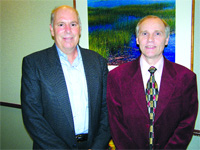
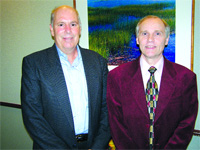
Harry Gilligan and Roy Smalley

Harry Gilligan, left, and Roy Smalley say their breakthrough executive boards have helped small business owners cope with a wide array of issues impacting the bottom line.

Harry Gilligan doesn’t like the word roundtable, and doesn’t want to see it used to describe a unique concept he’s created with business partner Ray Smalley called the “breakthrough executive board.” Comprised of eight business owners and managers recruited by the two consultants, the executive boards provide a forum for not merely sharing war stories and discussing common issues — but for providing the kind of support and accountability needed to take a company to the next level.

Bill Grinnell says it’s a little like group therapy for business owners.

That was his colorful description for something called the “Breakthrough Executive Board,” the creation of two area business consultants, Harry Gilligan and Ray Smalley, who decided to partner in a somewhat unique business venture two years ago. The executive board is a value-added product, one of many provided by Springfield-based Breakthrough Business Advisors, said Gilligan, and thoughtfully designed to give business owners who don’t have boards of directors a forum in which they discuss common problems and issues and simply bounce ideas off the wall.

During one of the monthly sessions, Grinnell, principal and co-founder of the Webber & Grinnell Insurance Agency in Northampton, sought out some advice on marketing, specifically ways to make his agency stand out among many businesses delivering mostly similar messages and products. “No one had any magic pills,” said Grinnell, “but there was a lot of good feedback — people gave me some things to think about.”

That’s just one of the primary goals of the executive boards, which have been in session for roughly two years now, said Smalley, who added quickly that food for thought is just part of the equation. Results are the real goal of this program, which puts up to eight owners or managers of small to mid-sized business owners in a room for four hours each month.

And they’re achieved because the panels act just as a board of directors would, with respect to follow-up and accountability, said Smalley, adding that they go far beyond the typical business roundtable.

“Everyone learns from one another,” he said, noting that subject matter ranges from compensation policies to valuing a specific business to succession planning. “We’ve structured this process so that members can think things through, and determine where they want to take their business and how to get there.”

Members for the boards are recruited, said Gilligan, from groups attending monthly half-day briefings on business-related topics sponsored by TD Banknorth and staged in the auditorium in its downtown Springfield headquarters. Those invited to join are told to bring with them a commitment to get to that proverbial next level, a willingness to listen to others and share ideas, and, perhaps most importantly, an open mind.

In this issue, BusinessWest looks at how these boards, and the environment they create, have helped Gilligan and Smalley grow their venture, while providing many different kinds of value to all those gathered around the table.

Meeting of the Minds

Andy Myers knows his software.

Well, he knows his broadcast industry software. He started and grew a venture called Myers Information Systems, now based in Northampton, that produces ProTrack, versions of which are used by used by television and radio stations for traffic, program scheduling, content management, and sales.

What Myers didn’t know, and what he asked those gathered at an executive board meeting several months ago, was what software package would help him more effectively manage his own business. He got some good feedback from those in attendance, commissioned Smalley to do hard research and make a recommendation, and today is the proud owner of a program that he says is helping his operation run more smoothly and cost-effectively.

There are many similar stories about how the executive board sessions, facilitated by Gilligan and Smalley and often followed up with direct consulting services from them, have been able to help business owners and managers move their ventures forward and avoid costly mistakes by providing a forum conducive to sharing common problems and crafting solutions.

How the boards came into existence is a story of imagination and forward thinking on the part of two consultants who took two completely paths to arrive at the same place.

Smalley took what would be considered a fairly conventional route to a second career as a business consultant. He worked as a general manager for several different technology-related businesses in the Toronto area, experienced a falling out at his last stop, took some time off, handled a few consulting assignments, and then decided he liked working for himself and would make consulting a full-time venture.

As for Gilligan, well, his was certainly the road less traveled.

After earning bachelor’s and master’s degrees in Communications, he went into sports broadcasting and later sales in the Midwest. He went on to work in college sports as an assistant athletic director, before coming to Springfield in 1985 to start a women’s professional basketball team.

His Springfield Fame — and the U.S. Basketball League of which it was a part — failed to capture the imagination of fans over its first two seasons and then folded. Gilligan decided to stay in the Pioneer Valley and, eventually, started day seminars and training programs on such subjects as communications, time management, and stress reduction. He eventually went into more formal business consulting work and crossed paths with Smalley, who had relocated to the Pioneer Valley, in early 2005.

The two identified a niche within the local market — specifically a need for consulting services to help small-business owners do what they do better — and eventually teamed up to create Breakthrough Business Advisers. That’s a name chosen to highlight what the two partners believe they can help business owners do — break through to the next level of success and profitability.

While this service/promise is certainly not unique among business consultants, whose ranks are growing as Baby Boomers reach retirement age, one of their methods for trying to deliver it — the executive board — would be worthy of that adjective.

Talking the Talk

A “safe haven” is how Gilligan chose to describe the boards. Elaborating, he said, they offer a comfortable place for business owners and executives to discuss problems and issues among peers.

Such a comfort zone generally doesn’t exist in the workplace itself, he said, noting that managers usually feel uncomfortable talking with people within their own organizations about their concerns, goals, and ambitions, and there are few networking or business groups that can offer the same combination of privacy, business know-how, and climate for problem-solving.

“Most business owners don’t have someone to report to,” said Gilligan, noting, again, that many ventures are too small to have a formal board of directors. “This structure provides that someone.”

A look at the current list of executive board members reveals a high level of diversity, said Smalley, noting that there is a mix of manufacturers, service companies, and even a technology venture — Myers’. Meanwhile, membership, while stable, also changes over the course of time as some business owners move on, usually after a year or more of participation, and others join.

This diversity and state of flux are just two of the benefits the boards bring to the table, he said, also listing camaraderie, the ability to share best practices, and that aforementioned level of accountability that is, or should be, part and parcel to an actual board of directors.

Grinnell, who spent more than a year on an executive board before yielding his seat, recalls discussions and problem-solving efforts on topics ranging from finances to handling problem employees; from marketing to long-range planning.

“There were a lot of discussions on financial reporting, which were eye-opening for many of the members,” he said. “There was also a lot of talk about personality fits, and employees giving owners and managers a hard time. We’d try to get to the root of why there were problems and then develop strategies to solve those problems.”

Sessions are broken down into several different components. Each one starts with a quick review of topics to be discussed that day, and move on to something called the ‘hot topic,’ chosen to help members benefit from a strategic review of their company.

Each meeting also features a ‘spotlight company,’ a member who gives a detailed presentation about an issue or opportunity facing their business. Afterward, members provide feedback and advice from their own experience. There is then a lengthy ‘sounding board,’ during which members have the opportunity to put issues on the table and get immediate feedback from others in attendance.

Myers has been a board member for nearly two years now. He says he’s part of what he called the “second wave” of participants, and noted that a third is gradually assuming more of the seats in the room. Like Grinnell, he said it’s helpful to hear from others who are in the same boat and realize that he is not alone in facing what are often stern challenges to continued growth.

“It’s been a very interesting process,” he said. “We act essentially as each other’s board members. We discuss what our goals are and, more importantly, how we’ve made progress toward meeting those goals from session to session.”

Indeed, while issues are discussed, the board meetings are goal-oriented, he continued, with issues brought up and debated in the context of how they impact efforts to meet or exceed stated goals.

In Closing …

Smalley told BusinessWest that, for many small business owners, the word consultant might as well have four letters in it.

That’s because they’ve had a bad experience with one or more, meaning, usually, that they didn’t get what they would consider full value for the money spent, and didn’t get a specific problem or issue resolved.

The executive board was created to provide an additional option, or that value-added that is often missing from the equation.

The sessions have certainly helped Smalley and Gilligan grow their business, but they have also helped members in a number of different ways by opening their minds to ideas and ways of doing business — and then, for lack of a better term, helping them to ‘get better.’

And that’s really what group therapy is all about.

George O’Brien can be reached at[email protected]

Departments

Grant Writing Workshop

Sept. 6: The Employers Assoc. of the NorthEast will present a free workshop titled Writing a Successful Workforce Training Grant from 8:30 to 11:30 a.m. The workshop is designed for individuals who have never written a grant. To register or for more information, contact Sue Miller, director of Training and Development, at (877) 662-6444, ext. 313, or visit www.eane.org. The Employers Association of the NorthEast is located at 67 Hunt St., Agawam.

Family Business Program

Sept. 20: Greg McCann, author of When Your Parents Sign Your Paycheck, will be the guest speaker at a dinner forum hosted by the UMass Family Business Center, from 5 to 8:30 p.m. at the Clarion Hotel & Conference Center in Northampton. McCann works with family businesses in the areas of succession, communication, conflict resolution, gender issues, and development of the next generation. He will speak on what family business owners should be saying to the next generation about the company and their possible future with it — and when and how they should be saying it. To register, or for more information, contact Ira Bryck at the center; (413) 545-1537.

AIM Executive Forum

Sept. 28: The Associated Industries of Mass. Executive Forum will host Massachusetts House Speaker Salvatore F. DiMasi for a lively discussion of critical business issues facing the Legislature during the fourth quarter of 2007 at its breakfast and networking meeting. Registration, breakfast, and networking begins at 8 a.m. at the Westin Hotel, 70 Third Ave., Waltham. Speaker DiMasi’s presentation starts at 8:30. For registration information, call Julie Fazio at (617) 262-1180 or Chris Geehern at (617) 834-4414, or visit www.aimnet.org

Entrepreneurial Hall of Fame Dinner

Oct. 4: The Western Mass. Entrepreneurial Hall of Fame will honor its Class of 2007 at its Eighth Annual Induction and Banquet at the Log Cabin Banquet and Meeting House. The event, one of the region’s largest networking events, will start with a reception at 5:30 p.m. and dinner at 7. This year’s inductees are: the Bassett family (Bassett Boat Company), the Falcone family (Rocky’s Ace Hardware), Theodore Geisel (Dr. Seuss), the Gordenstein family (Broadway Office Interiors), Charles and Merriam Webster, and Noah Webster (Merriam-Webster Inc.), and the Roberts family (F.L. Roberts). Tickets are $150 per person; tables of 10 are $1,500. For more information or to order tickets, call (413) 730-6157.

Six Flags CEO to Address AIM

Nov. 9: Marc Shapiro, president and CEO of Six Flags Inc., will outline his managing style for overseeing the world’s largest regional theme park company during the Associated Industries of Mass. Executive Forum meeting at the Westin Hotel, 70 Third Ave., Waltham. Registration begins at 7:45 a.m., followed by the program from 8 to 9:15. For registration information, call Julie Fazio at (617) 262-1180 or Chris Geehern at (617) 834-4414, or visit www.aimnet.org

Bright Nights Ball

Nov. 17: East Longmeadow-based Hasbro Games will be the sponsor of the 2007 City of Bright Nights Ball, which will take on a Monopoly theme. The event, the major fundraiser for the Spririt of Springfield, which puts on the annual holiday display in Forest Park known as Bright Nights, will take place in the ballroom of the Sheraton Springfield at Monarch Place. The black-tie event features a gourmet dinner, dancing, and the opportunity to win and purchase some fabulous items. Guests will be able to purchase Monopoly deeds, everything from Baltic Avenue to Boardwalk, and redeem them for prizes. Bidding on five showcase items will begin online in early November and be completed the evening of the gala. Other premium items will be sold in an online auction. Auction items will be announced at a later date. In addition to Hasbro Games, the City of Bright Nights Ball is being supported by Baystate Health, Health New England, MassMutual Financial Group, and Sheraton Springfield. Tickets to the 12th annual City of Bright Nights Ball are $500 per couple. Tables of 10 are available for $2,500. For more information, contact the Spirit of Springfield at (413) 733-3800.

Departments

Seven Proposals Received for Union Station

SPRINGFIELD — The Pioneer Valley Transit Authority (PVTA) has received seven proposals for transportation and redevelopment planning for Union Station, according to Mary MacInnes, PVTA administrator. MacInnes said the proposals show that the Union Station project “is back on track.” The next step in the process is a due diligence review by the Selection Committee to ensure submitted responses contain the information required from the request for qualifications (RFQ). The committee will review the proposals, rank them, and select at least three finalists who then may be interviewed, according to MacInnes. The finalists will be ranked in order of qualification, and the committee will present the ranking to MacInnes. Members of the selection committee include industry and business professionals from Amtrak, Greyhound, the New England Black Chamber of Commerce, the Springfield Redevelopment Authority, the Pioneer Valley Planning Commission, and the PVTA. MacInnes expects the award to be made by the end of September. Firms submitting proposals were Lozano, Baskins & Associates, Watertown; HDR Architecture Inc., Boston; Finegold Alexander, Boston; SEA Consultants Inc., Cambridge; STV Inc., Boston; Nelson/ Nygard Consulting Associates, San Francisco, Calif.; and HR&A Advisors Inc., New York.

Near-term Home Sales Hold in Modest Range

WASHINGTON — The housing market will probably hold close to present levels in the months ahead, according to the latest forecast by the National Assoc. of Realtors. Existing-home sales are forecast at 6.04 million in 2007 and 6.38 million next year, below the 6.48 million recorded in 2006. New-home sales are expected to total 852,000 this year and 848,000 in 2008, down from 1.05 million in 2006. Housing starts, including multi-family units, are likely to total 1.43 million in 2007 and 1.40 million next year, below the 1.8 million units started in 2006. The 30-year fixed-rate mortgage is forecast to average 6.7% in the fourth quarter and then ease to the 6.5% range next year. The National Assoc. of Realtors represents more than 1.3 million members involved in all aspects of the residential and commercial real estate industries.

AIM’s Confidence Index Back Up in July

BOSTON — The Associated Industries of Massachusetts (AIM) Business Confidence Index rose 3.4 points in July to 57.6, more than recouping June’s decline, according to Raymond G. Torto, co-chair of AIM’s Board of Economic Advisors, and principal CBRE Torto Wheaton. Since April, the Index has followed an up-down-up pattern, with June’s loss virtually cancelling out May’s gain, and July’s rise returning to the higher level — above a year before (55.4), and close to the reading of July 2005 (57.8). However, the July survey was conducted before the new wave of uncertainties, particularly around the mortgage situation, that produced sharp drops in the equity markets, added Torto. Confidence levels were virtually identical in July among manufacturers (57.5, up 3.3) and non-manufacturers (57.8, up 3.6), with manufacturers more positive than others about conditions for their own firms and sales trends, but less so about recent hiring. A strong gain in confidence outside Greater Boston (+5.2) and a lesser rise within the metro area (+1.9) similarly left that split close to even (57.4-57.7). Larger firms were more optimistic than small and medium-sized employers.

Nominations Sought for ‘Super 60’

SPRINGFIELD — The Affiliated Chambers of Commerce of Greater Springfield Inc. is seeking nominations for its annual Super 60 awards program. The aim of the program is to celebrate the success of the fastest-growing privately owned businesses in the region which continue to make significant contributions to the strength of the regional economy. Nomination forms are available at the Chamber offices, 1441 Main St., Suite 136. Completed nomination forms must be received at the Chamber offices by Aug. 31. The Super 60 awards will be presented at the annual luncheon and recognition program on Oct. 26 at Chez Josef in Agawam. For more information on the nomination process, call the chamber at (413) 787-1555.

Eatery Closes Downtown Location

SPRINGFIELD — Gus & Paul’s restaurant recently closed its doors after 10 years at Tower Square, while the original Gus & Paul’s Delicatessen and Bakery on Sumner Avenue remains open. Lee L. Weissman, a co-owner of the downtown eatery, expressed his regret in having to close the restaurant in a letter to the city, and noted he hoped to sell the business. Weissman added he has begun a new career as a professional fundraiser and found it difficult to also oversee the restaurant operations. More than 20 employees lost their jobs in the closing; however, Weissman said with his family’s connections in the restaurant business, he is anticipating helping most or all of them find new jobs. Fred G. Christensen, senior property manager of Tower Square for CB Richard Ellis, said he is optimistic a new tenant can be found in the near future to take over the Gus & Paul’s site.

Study: More Employees Working Remotely Today Than Five Years Ago

MENLO PARK, Calif. — The proliferation of wireless technologies and feature-rich Internet applications is making it easier for information technology (IT) professionals to work outside of the office. A new study by Robert Half Technology shows that telecommuting is becoming more commonplace among IT professionals. Nearly half (44%) of chief information officers (CIOs) surveyed said their companies’ IT workforce is telecommuting at a rate that is the same or higher than five years ago; only 3% said IT staff work remotely less frequently today than five years ago. Improved retention and morale and increased productivity were cited as the greatest benefits among firms that allow telecommuting. While telecommuting can benefit employers and employees alike, it’s important that companies have the appropriate infrastructure in place to facilitate staff working remotely. For example, nearly a third of CIO’s (31%) surveyed felt that telecommuting employees generate too many security risks because they need to access elements such as corporate networks, systems, and intellectual property off-site. The national poll includes responses from more than 1,400 CIOs from a stratified random sample of U.S. companies with 100 or more employees.

Ivanhoe Restaurant Closes

WEST SPRINGFIELD — Steve and Ron Abdow, owners of the Ivanhoe, recently announced the closing of the landmark restaurant on Riverdale Street. According to the Abdows, a recent decision by their abutter to no longer lease parking spaces to the Ivanhoe was the catalyst in the decision to close. Since its inception, the Ivanhoe had 113 parking spaces at its disposal; however, 62 spaces would soon no longer be available as the abutter plans for future development of its site. The Ivanhoe was opened in 1967, and the theme was based on the time of Sir Ivanhoe and the Knights of the Round Table, with gothic arches and features reflective of that period.

Small Business Applications Sought for Law and Business Clinic

SPRINGFIELD — The Western New England College Law and Business Center for Advancing Entrepreneurship is now accepting applications from entrepreneurs seeking law or graduate business students to serve as consultants for their business during the fall semester. The opportunity for this free service is limited to those businesses that need consultation regarding a discrete topic. This service does not include litigation needs. For more information, contact Aimee Munnings at the Law and Business Center for Advancing Entrepreneurship at (413) 736-8462, or E-mail [email protected]

Survey: Companies Ineffective at Rewarding Good Performance

MENLO PARK, Calif. — Workers who feel their good work often goes unnoticed may have a case. More than one-third (35%) of professionals polled recently said businesses are ineffective at rewarding their employees’ strong performance. Meanwhile, 30% of managers surveyed agreed. Businesses need to make retention an ongoing priority, according to Diane Domeyer, executive director of Office Team. Rewarding employees for their accomplishments enhances productivity, reinforces positive behavior, and builds staff morale and loyalty, she added. Domeyer noted that firms that fail to reward great work risk losing employees to businesses that do invest in recognition programs. The surveys were developed by Office Team and reflect responses from 150 senior executives at the nation’s 1,000 largest companies, and 534 full- or part-time workers 18 years of age or older and employed in office environments.

Cover Story
Nadim Kashouh Has More Cafés Lebanon on the Menu
August 20, 2007

August 20, 2007

Nadim Kashouh says he’s always had a “passion” for sales — and also a fondness for the restaurant business. He’s blending both in a growing venture called Café Lebanon, although now he needs to use the plural when referring to his entrepreneurial exploits. He started in downtown Springfield, expanded into Northampton, will open soon in East Longmeadow, and is now eyeing the West Hartford market. Such growth stems from having a good product and knowing how to sell it.

Nadim Kashouh has traveled a long road to get to where he is: status as an up-and-coming restaurateur in the Pioneer Valley.

From a geographic standpoint, the trip has included stops in Monrovia, Liberia in West Africa (where he was born); Bmakkine, Lebanon, to which his family moved in 1974; Roslindale, Mass. (where he lived for a time with his sister, who emigrated a few years before he did); Nashua, N.H.; and a few other communities in Eastern New England before coming to the Pioneer Valley.

Meanwhile, career-wise, he’s logged time, though sometimes not much of it, as a line person in a Jewish deli, short-order cook, car salesman, and jewelry store assistant manager.

In all of those scenarios, he was working for someone else — something Kashouh (pronounced ‘cashew’) ultimately decided he didn’t want to do anymore. That decision came in the spring of 2000, soon after an acquaintance urged him to take a look at the Café Lebanon restaurant on State Street in Springfield, which had just closed its doors because, in Kashouh’s view, its owner couldn’t turn what seemed like vast potential into profits.

He thought he could do better, and his track record to date shows that his judgment was pretty good. After enjoying initial success at the State Street site, he relocated the restaurant to a Main Street address formerly occupied by Tilly’s. In 2005, he opened a second Café Lebanon on Conz Street in Northampton, and later this year he will open a third in the center of East Longmeadow, at the site of the former Wild Apples eatery. And he’s already looking hard at the West Hartford market and opening a restaurant there.

This isn’t a chain, said Kashouh, stressing that, while each facility will have roughly the same menu — dominated by Middle Eastern staples ranging from lamb kabobs to grape leaves — they will have their own identity and target audience.

The Springfield location does better with the lunch crowd, which features both those working downtown and others attending meeting and conventions in the city, he said, while the Northampton location fares better with dinner and those willing to travel to sample that community’s eclectic mix of eateries. The planned East Longmeadow facility will join a growing list of restaurants in that town and target both lunch and dinner crowds from several mostly residential communities.

Kashouh described his first several years as a restaurant owner as an education — one that is certainly ongoing — and acknowledged that there is a learning curve that most not in this business wouldn’t appreciate.

“It is a very tough business,” he said, acknowledging that longevity is hard to achieve because of the level of general competition, swings in the economy, and the fickleness of the dining public. “The key to success is a consistently good product and attention to every detail.”

Out on a Lamb

Kashouh told BusinessWest that while there is a sizable Lebanese population in the region, he’s not relying on it for his livelihood.

“They don’t go to restaurants very much,” he explained with a laugh that speaks of personal experience, “because they’re got a wife or a mother or a grandmother who cooks for them. They’re enjoying home-cooked meals — they don’t need to go to a Lebanese restaurant.”

Apparently there are enough area residents of Middle Eastern or Mediterranean descent, or that enjoy food from those regions, to enable two Café Lebanons to thrive, and for Kashouh to be confident enough to open a third and make preliminary plans for a fourth.

They are drawn by the menu, complete with a number of recipes Kashouh has collected from his mother and other relatives, but also by ambience and special programs, such as belly dancing, comedy, and Arabic music. The Springfield location, for example, features several wall murals, painted freestyle by artist Clint Magoon, that present an Arabian Nights feel, if not exactly an accurate representation of Lebanon.

“We don’t have deserts, and we don’t really have camels — there are some, but they’re for the tourists,” said Kashouh, as he pointed to another feature painted on one wall that is also slightly out of place (although not to him) — his Jack Russell Terrier, aptly named Jack.

All this might have been hard to imagine in 1990, when Kashouh, with but one suitcase and $500 given to him by his uncle, landed in New York and made his way to Roslindale and, soon thereafter, a job at the Jewish deli. No fan of politics, to use his own words, he sought to escape the turmoil that then defined Beirut, only a 20-minute drive from Bmakkine, and considered returning to Liberia. But civil war had broken out there, so he instead sought much higher ground.

After working a few jobs in the restaurant sector, for which he developed a liking and an understanding, Kashouh, who had what he called a passion for sales, sought to indulge it. He thought about opening an import-export business, but couldn’t get that off the ground and instead segued into automobile sales. His first experience was neither fulfilling nor profitable, but theorizing that it might be the dealership and not the business, he tried another, this one in Nashua, N.H.

And he found out it was, at least for him, the business after all.

It was in Nashua that he met Eli Hannoush, one of eight brothers who emigrated with their parents from Zaleh, Lebanon in the late ’70s and would later go on to create one of the largest jewelry store chains in the Northeast. Eli talked him into working for the chain’s Nashua store as an assistant manager, which he did for a year before taking the same role at stores in Saugus and then Peabody, Mass.

Kashouh eventually left the Hannoush jewelry chain and went to work for another, E.B. Horn, in Boston. He spent two years there, but was becoming increasingly determined to scratch his entrepreneurial itch.

“I always wanted to have my own restaurant; I always enjoyed cooking for people and catering to people,” he said. “And I said, ‘maybe I should go into business for myself.’”

He did so with the help of another Hannoush brother, Norman, who first suggested to Kashouh that he look at a building the Hannoushes owned in Salem, N.H, then a Chinese restaurant, as the site for an eatery with his name on it. He looked, but determined the storefront needed more work than his budget could afford.

“That was on a Monday,” said Kashouh, adding that Norman Hannoush quickly moved the conversation to the Café Lebanon in Springfield, opened by Lebanese native Marie Zaide, which had gone out of business the previous Saturday.

After surveying the property and gauging the market, Kashouh decided to take on the challenge — creating Nadim’s Café Lebanon, which would open three months later — with plenty of confidence and some practical experience from which he thought he could build.

“When you have a passion for something, you can learn it,” he said, referring in this case to the restaurant industry, but implying any sector. “And I’m still learning today; it never stops, really.”

Appetizing Proposition

Surveying the local restaurant landscape, Kashouh sees plenty of competition — but little if any in his specific niche, one that he is determined to exploit.

“I think there’s a great market for this kind of restaurant here,” he said. “People can only have so much Chinese or Mexican, or whatever. They’re going to want something different.”

Kashouh provides it with a menu that is Middle Eastern in nature, a cuisine that he describes with two simple words: “fresh and healthy.” The menu includes traditional favorites from that region, including lamb, chicken, and turkey kabobs, grape leaves, tabouli, and rice pilaf, with baklava, rice pudding, and other stalwarts from that part of the world for dessert.

The appetizer list is topped by something called Kibba Naya (for Friday and Saturday dinner only), which is freshly ground raw beef mixed with wheat germ, onions, and Lebanese spices, and topped with olive oil. The list also includes hummus, Baba Ghannouj (roasted eggplant), grape leaves, spinach pie, meat pie, Kibbie Krass (hand-rolled ground meatballs with wheat germ, stuffed with sautéed meat, onions, pine nuts, and spices), and Makanik, Lebanese sausage sautéed with lemon juice.

There are also combo platters named for Middle Eastern cities past and present — Beirut, Tripoli, Sidon, Byblos, and Anjar — and the traditional Lebanese “full maza,” a four-course dinner.

Kashouh had such good success with that menu in Springfield that he opted to open a second location in Northampton two years ago, or roughly the same time he was moving the Springfield facility from State Street to Main Street, where he has more room and is closer to the downtown office towers.

The Northampton location has enjoyed steady if unspectacular growth, he told BusinessWest, while Springfield has done well with its predominantly luncheon business, something he expects will improve if and when new ownership of the neighboring Sovereign Bank building (now known as One Financial Plaza) succeeds in improving on its 40% vacancy rate.

While downtown Springfield is showing signs of improvement, in terms of image and the perception of crime, there are many who are still reluctant to come into the city at night, said Kashouh, adding that this phenomenon is part of the reason why he is opening a third location in East Longmeadow, which is quickly becoming another restaurant mecca.

“East Longmeadow is fast becoming the new Northampton — there’s a lot of new restaurants opening there,” he said, citing a new Spoleto’s, Fusion, and others. Such a proliferation of eateries makes a community a good spot, he said, because although there is plenty of competition, the city or town in question becomes a dining destination.

The third Café Lebanon, due to open this fall, intends to be a big part of that mix, he said, noting that the location provides ample room for dining and other programs — belly dancing has become a permanent fixture in both Springfield and Northampton, and it will in East Longmeadow as well.

As for West Hartford, Kashouh said he has always drawn well from the Northern Conn. area (he tracks the calls for reservations through a dedicated phone number), and, while he believes many from those communities will travel to East Longmeadow, they will be better served, and he will draw more of them, with a restaurant in the Hartford area.

Desserts and Deserts

When asked about the restaurant business in general, Kashouh sounded like someone who had already learned many lessons in seven years.

“Business is up and down, but generally pretty good,” he said. “But you have to work hard all the time. You have to keep yourself above the others, somehow.

“We can’t do that just by offering a Lebanese or Middle Eastern menu that no one else has,” he continued. “It goes well beyond the food; it’s all about making sure the customer is satisfied.”

His success in that regard can be measured in many ways, but mostly by the fact that there are now several Cafés Lebanon with Nadim’s name on them, and more on the drawing board.

George O’Brien can be reached at[email protected]

Sections Supplements
Some Groundbreaking Developments for WNEC’s Law School
Anthony Caprio and Arthur Gaudio

WNEC President Anthony Caprio, left, and Arthur Gaudio, dean of the law school, say the addition and planned renovations will modernize the school and more thoroughly integrate it with the rest of the college.

Arthur Gaudio took his pen and started tapping on features showcased in an architectural rendering of the $5.5 million, 10,500-square-foot addition and accompanying renovations to the Western New England College School of Law, which he serves as dean.

He started with the front entrance, which is rather unremarkable as front entrances go, except for the direction it faces — toward the rest of the Wilbraham Road campus. Since the law school was incorporated onto that campus in 1978 after operating out of offices in downtown Springfield, Gaudio explained, it has faced Bradley Road, giving the school a touch of separation that was never really appropriate, and is far less so today.

Indeed, the new entrance and its configuration is a small but significant bullet point with regard to the expansion, the first since the 100,000-square-foot S. Prestley Blake Law Center opened its doors. It is a symbolic gesture, designed to show how the law school is collaborating with other departments within the college, said Gaudio, building synergies for the betterment of both institutions.

“These include the Law and Business Center for Advancing Entrepreneurship, a joint Juris Doctor/MBA degree, a Biomedical Engineering/JD degree, and other initiatives,” he said, adding that, moving forward, more programs at the college will link with the law school in some way. “From a figurative standpoint, our new front door shows greater integration with the college.”

All other features of the expansion and renovation are rooted in 21st-century legal education, or, more specifically, how it is different than the 20th- or 19th-century models. While the subject matter being taught is in many ways the same as it was years ago, the methods for teaching it are not. Modern classrooms must be equipped with the latest telecommunications technology, Gaudio explained, and the renovation efforts will enable the law school to accommodate both current innovations — and the next generation of them as well.

The law school project is the most ambitious capital project undertaken as part of Transformations: The Campaign for Western New England College, the largest fund-raising effort in the college’s history, said long-time WNEC President Anthony Caprio, noting that the campaign is more than $18 million toward its $20 million goal.

Thus, the start of construction at the Blake Center is just one of many ground-breaking developments at the college, he said.

Digging for Evidence

Tracing the history of the law school, Gaudio said it opened in 1919 as part of the Springfield division of Northeastern University. Classes were small, some with as few as three people, he explained, and they were held in several locations downtown, including the old YMCA.

Incorporated as the Western New England College School of Law in 1951, the institution remained downtown for the next 20 years. In the early ’70s, school leaders decided to bring the law school to the Wilbraham Road campus and launched a capital campaign for the facilities. The school operated out of a building on Tinkham Road in the years before the Blake center opened its doors.

Talk about expansion of that facility began seven years ago, said Caprio, and centered mostly on the library and the need to make it a larger, more efficient facility. In more recent years, he explained, it became clear that other components, especially classrooms, needed to be modernized.

As he talked about the expansion and renovations, Gaudio stressed repeatedly that the school itself isn’t getting bigger — meaning from the standpoint of enrollment.

He said the college placed caps on enrollment several years ago — although there has been a surge in applications over the past five years even as numbers have dipped at other institutions — in an effort to maintain high standards for the school, which recently earned top marks at its most recent accreditation.

In fact, it was re-accredited unconditionally, which is rare, said Gaudio, and no doubt a reflection of both programmatic changes that have been made in recent years and blueprints for a larger law center.

Elaborating, he said the project, which will essentially add a floor to the Blake building, is designed to better serve students, give faculty members better and more modern facilities in which to teach and mentor students, and give several facilities and programs an opportunity to grow and better serve those utilizing them.

At the top of this list is the law school library, which will be expanded to become what Gaudio called a “fully integrated information center” that would serve current students, faculty, and the community as a whole. More than 60% of the lawyers working in Hampden County are graduates of WNEC law, he said, and many make use of the school’s law library.

The planned renovations will expand the library’s footprint, said Gaudio, noting that all administrative offices, including admissions, will be relocated into the addition, providing several thousand more square feet for the library. But, in essence, the project will remove the library’s walls, from a physical standpoint, and make the Blake building as a whole a learning and research center.

“The edge of the library is no longer the edge of the library — it’s the edge of the building,” he said, adding that, through wireless technology, students will be able to access information digitally. “We’re expanding the places where you can receive library information and materials, thus allowing people the opportunity to advance their education.”

Beyond the expansion and streamlining of library facilities and operations, the law school project, designed by Tessier & Associates, with Fontaine Brothers serving as general contractor, will also focus on classrooms, said Gaudio, and specifically the school’s commitment to small, 50-student teaching sections and the new era of information technology in which learning takes place.

This means that some of the current classrooms will be refurbished and made smaller, while others will undergo similar modernization and made larger.

“When this building opened, professors used the standard whiteboard at the front of the room; they talked, and students took notes,” Gaudio explained. “We’re moving from notebook paper and pen to notebook computer and mouse, and we are accommodating all the technology that people use to teach now — from PowerPoint to online materials.

“We’re coming up to date,” he continued, “but we’re doing more than that — we’re looking down the road and anticipating what we’ll need to stay on the cutting edge in legal education.”

The renovated Law Center will also house the College’s Law and Business Center for Advancing Entrepreneurship, a joint effort of the college’s law school and School of Business that has been housed at the Scibelli Enterprise Center at Springfield Technical Community College since it opened in 2005.

The entrepreneurship center works with area small business owners by linking them with law and business students who act as unpaid consultants, providing assistance with everything from choosing a business entity to writing a business plan.

The larger facilities, located right on campus, will enable the center to serve more start-up and small businesses, said Caprio. “It will help furnish the best foundation to sustain their companies,” he said, “while developing them into thriving commercial enterprises, and contribute to a new era of economic and social prosperity for the region.”

Case Summation

As he looked closely at the architectural rendering, Gaudio noticed that someone had somehow placed his face on one of the ‘people’ who appear in the drawing.
Laughing off this development, sort of, he said he doesn’t mind being the face of the law school’s expansion and renovation.

The real face, however, is the new front door, which has the law school looking in a new direction — literally and figuratively.

George O’Brien can be reached at[email protected]

Sections Supplements
HCC Celebrates 60 Years — and a Tradition of Perseverance and Innovation
David Bartley

David Bartley, past president of HCC, poses with a caricature of himself, drawn as part of the college’s 60th anniversary celebration.

David Bartley, former president of Holyoke Community College, said the institution’s 60th anniversary, marked this year, has caused him to remember HCC’s past and look to its future, as well as the changes higher education has seen across the country.

“We used to run colleges with chalk and talk,” he said. “Today, there’s $100,000 worth of equipment in a classroom that has to be continuously updated, and that’s not ever going to change.”

It has indeed been a good month for reflection for both Bartley and HCC’s current president, William Messner, who took his post three years ago. The duo represents two-thirds of HCC’s history of leadership; its first president, George Frost, served from 1947 to 1975, then Bartley held that position until 2003.

“It’s a little daunting to be one of only three presidents,” said Messner, “but what I take away from this 60th anniversary is the overwhelming positivity surrounding the institution. Every individual I’ve talked to recently cites the college’s significant effect on their life, and so it is my job to take that legacy to the next level.”

From the Ground Up

Even with only three presidents in six decades, the college has indeed had a colorful run. It was founded in 1946 as Holyoke Graduate School, and in 1947 changed its name to Holyoke Junior College following state-level legislation that permitted municipal higher education programs to do so.

Frost was the college’s only full-time employee for six years, before Ellen Lynch was appointed his secretary. They shared an office in what was once the cloakroom of the old Holyoke High School building. Additional full-time employees — two full-time professors — were not hired for another five years, in 1958.

Frost called students personally with end-of-semester grades and announcements, and the school funded faculty salaries and operating expenses with tuition payments only — which were $6 per credit for Holyoke residents and $7 for non-residents.

In 1961, Holyoke Junior College moved from its temporary home in Holyoke High School to the former Elmwood Elementary School on South Street, where it remained for six years. In 1965, the institution joined the state community college system and changed its name to Holyoke Community College. Four years later, the college moved again to the Holyoke High School building, which by that time had been turned over to HCC following the construction of a new high school.

Less than four months later, however, disaster struck — the building went up in flames (the cause was thought to be a faulty ventilation fan in the attic), leaving nothing but a brick shell. Operations were returned quickly to the Elmwood Elementary School, and students missed only one day of classes. But a new threat soon surfaced.

With the newly opened Springfield Technical College (now STCC) only a few miles away, the Mass. Board of Regional Community Colleges backed a move to relocate HCC’s students to STC and forego building a new home for the former.

Remembering the fire and the precipice on which it placed HCC, Bartley quoted John F. Kennedy.

“Victory has 100 fathers, and defeat has none,” he said. “The fire in 1968 had a lot of people saying we only needed one college in this section of the Valley, and we did a lot of work to point out why we needed two. Now, there are two very successful community colleges in the area, and we believe we had our victory.”

Out of the Frying Pan…

Indeed, a group of Holyoke-based civic leaders, educators, and business owners formed the Friends of Holyoke Community College and lobbied to save HCC. Holyoke’s mayor at the time, William Taupier, and the president of the state senate, Sen. Maurice Donahue, a friend of Frost’s, were among those who supported the cause, and in 1969, a temporary building on the site of the fire had been erected.

Plans for a new campus were unveiled, and the current campus on Homestead Ave. was opened in 1974.

Frost retired soon after his so-called “final task” was completed, and Bartley took the helm, beginning his nearly three-decade-long career as HCC’s president. His first act at the post was to appoint his predecessor as founding director of the alumni association.

All of these stories, and countless others, were on Bartley’s mind this month, when the college celebrated formally with a number of community, civic, and business leaders from across the region.

“I was delighted that we were able to talk about the past, but the real key is the future,” said Bartley. “I think some of the challenges of yesterday are still there — the college has to keep abreast of developing curricula nationwide, and make sure courses are relevant to the industries of today.”

During his tenure, Bartley watched the advent of computer technology take a front-row seat in higher education. He said the adoption of modern modes of telecommunication went relatively smoothly at HCC, but it also marked a cultural shift on college campuses across the country that brought with it some new hurdles to clear.

“People understood it was necessary, or else the students would change and evolve faster than the curriculum,” he said. “We expanded the electronics offerings dramatically, while staying true to the basics.

“The college has always been current, but challenges revolve around funding new programs, and that’s not going to get any cheaper as time goes on,” he added. “Education is a slow and labor-intensive industry, and because its core product is the imparting of knowledge, it will always be that way.”

Messner agreed, noting that he, too, has seen some of those pervasive challenges shaping decisions at HCC, as well as a host of new concerns.

“Fifty percent of the work day is spent on resource development,” he said. “It’s no secret that competition for state dollars is becoming more acute, and we have to fill the gap some way.”

The college recently completed the Gift of Opportunity campaign to help close that gap, raising $5.2 million — $1.2 million beyond its goal. In addition, a number of programs are in place to capitalize on HCC’s existing strengths and address burgeoning challenges.

“We’ve been doing several things over the past few years to ensure that the quality of programming, and the education the institution has been known for, stays solidly in place,” said Messner. “We’ve needed to build the number of full-time faculty since that number eroded, primarily through attrition, between 2001 and 2003, when the state was suffering economically.”

He said that cutting back on faculty during tight financial times is a good short-term economic strategy, but has an adverse effect in the long term. Currently, the faculty has been boosted to represent the same numbers as in 2001, and as enrollment grows, further additions are planned.

“We’re filling about a dozen spots now,” he said, noting that lowering faculty-to-student ratios is just one part of a larger move to improve operations across the campus. “Another thing we’re doing a better job of is assessing how we are doing in general. We’re looking specifically at how new students are treated — we’ve been involved in a nationwide program called Foundations of Excellence, for instance, which provides support to institutions in assessing the freshman experience.”
Those initiatives are just two examples of an ongoing objective at HCC: to stay available to the community at large.

“The demographics in this area are changing dramatically,” said Messner. “Many individuals are coming to the region with a lack of education, or a lack of a tradition of education, both of which are intrinsic to a strong workforce. As the population has changed, we have needed to change our approach in terms of reaching out to these groups that are part of the community.”

Messner said a wide array of initiatives have been put into place to recruit students and enhance their college experience, ranging from an outreach program geared toward the Latino population to college programs for high school students, to introduce them to the campus and allow them to experience higher education early on.

“We’re also working with students who haven’t come through the high school pipeline and instead took the GED, and are looking for the next step,” he said. “We’re using the GED as a new pathway into HCC, and that’s an example of one strategy to make higher education more accessible.”

These initiatives, in turn, have two divergent goals: the provision of quality education for a diverse community, and the creation of a steady stream of both individuals and resources aimed at workforce development in the region.

One of the most notable developments in that regard was the $18 million Kittredge Workforce Development Center, which opened in 2006. The 55,000-square-foot, five-story building is home to the school’s Business Division and HCC’s Community Services Department, which offers many of the programs Messner spoke of, including GED preparation and testing and summer youth programs.

The center also hosts a number of economic-development and workforce-development-related agencies. These include HCC’s Center for Business and Professional Development, which offers a wide range of workforce-development services designed to assess employee skills, identify knowledge gaps, and conduct training to remediate deficiencies; WISER, home to the country’s leading database for international trade statistics, which relocated to HCC from UMass in 2005; and the Western Mass. office of the Mass. Export Center, will offers market research, export training, and international business development resources.

The center also features 4,000 square feet of conference/meeting spaces equipped with high-speed and wireless Internet, videoconferencing, and state-of-the-art lighting and projection. Messner said the center is an excellent example of new technology and modes of thinking taking HCC’s long-held strength in community, career, and resource development to a new, more relevant level.

“Workforce development has been a strength for 60 years,” he said, “and with the new business building, we can expand into a variety of programs that we didn’t have 20 years ago, and there will be even more opportunity for the students to move forward. Workforce development offerings have increased by 20%, and we’re just gearing up.”

Those programs, said Messner, are just one aspect of bringing a long-held mission at HCC forward into fast-changing times. Concurrently, both he and Bartley hope that some strengths at the college stay largely the same, serving as a foundation for further growth in the future.

Blaze of Glory

“I, for one, am appalled by lecture halls holding 500 people,” said Bartley. “No learning takes place, and that’s not what a community college does. It’s certainly not something I ever hope to see at HCC.”

Looking back on 60 years and looking ahead to the next 60, Bartley mused that today’s dynamic, computer-based presentations in the classroom and the cutting-edge technology of the Kittredge Center are developments that were necessary to bring HCC current in a fast-changing world.

But a little chalk-talk can still take an institution a long way — out of the fire, and into the fight.

Jaclyn Stevenson can be reached at[email protected]

Sections Supplements
Candlewood Suites Takes Aim at the Extended-stay Market
Ray Desai

Ray Desai was looking for an established, well-respected hotel brand to bring to his property on Riverdale Street in West Springfield — and found one in Candlewood Suites.

“Consider us home.”

That’s the marketing pitch used by the Candlewood Suites chain of hotels, and Ray Desai believes that phrase sums up perfectly what his latest entrepreneurial venture provides. Specifically, a home away from home for those who are going to be on the road — or out of their own home — for an extended period.

This constituency includes consultants, contract nurses, construction managers on out-of-town assignments, doctors recently hired by area hospitals, executives settling into new jobs before they settle into the area, and people remodeling their houses or condos. Each of these groups is represented on the current guest list at the 71-room Candlewood Suites facility that Desai constructed on the site of the former Roadway Inn he owned for several years on Riverdale Street in West Springfield.

An immigrant from Gujarat, India, Desai segued into the hospitality business following a stint working for the Conn. Department of Health as a chemist. He cut his teeth in the hotel business working beside his brother, who came to the U.S. about a decade before Desai did and eventually came to own a string of hotels in the Northeast.

Desai started with the Roadway Inn, originally an independent operation known as the Knoll Motel, and later acquired the Econo Lodge on Elm Street in West Springfield. He wanted a new, more modern venture for the Roadway property, however, and waited patiently for the right franchise opportunity, one that would give him a somewhat unique niche in the region’s highly competitive hospitality sector.

He found one in Candlewood Suites, which be believes is the leader in the so-called extended-stay category within the hotel sector, status achieved through a sharp focus on replicating ‘home’ in every way possible, from a pool and fully equipped gym to flat-screen televisions, kitchens with full sets of appliances, and a gazebo and barbecue grill outside.

“It’s home for people who can’t be at home,” said Desai, who invested $6.5 million in the venture, which he expects will not be his last in this region. He told BusinessWest that he is looking at several sites in Western Mass., and will likely add to his portfolio in the years ahead.

For now, though most of his concentration is focused on Candlewood, and gaining a large share of the expanding extended-stay market in the Pioneer Valley.

Staying Power

It is Wednesday, and the ‘cupboard’ is, well, almost bare — but not for long.

That’s the name of a small grocery store, for lack of a better term, located just off the front lobby that is a feature at all Candlewood Suites facilities. Stocked with items ranging from ice cream bars to microwavable dinners to bagels, the cupboard is a popular stop for those on extended stays who don’t want to travel to area restaurants, and also for those who choose the hotel for a weekend stay while visiting Six Flags or any of the region’s other tourist attractions.

There were many such guests that week, which explained why the cupboard needed to be restocked, said Susan Daley, the facility’s general manager, adding that the store is one of many amenities that has helped the hotel get off to a fast start since it opened last Christmas.

Winter is a relatively slow period in the local hotel industry, she explained, but a good time to open a new facility because it gives staff an opportunity to work out any kinks and fine-tune efforts in the broad realm of customer service. This is important, she said, because a hotel’s ability to approximate ‘home’ comes not only with amenities and a look — but also with a feel.

“And here, people do feel that they are at home,” she explained. “They feel comfortable, and because many are here for extended stays, they almost become family.

“You come to know everyone by their first names because you see them every day; you don’t get that experience at other hotels.”

These were the tangibles and intangibles that appealed to Desai as he was looking for a brand he could bring to the Roadway Inn site. This was a quest complicated by the fact that most major chains are well-represented in the area, and most of the familiar names in the industry already have sites on Riverdale Street.

One brand that hadn’t penetrated the market was Candlewood Suites, a member of the Intercontinental Hotels Group, which also includes Holiday Inn and Holiday Inn Express, Crowne Plaza Hotels and Resorts, Hotel Indigo, and Staybridge Suites. There are now more than 100 Candlewood Suites locations across the country, including three in Massachusetts (the others are in Braintree and Burlington), and two in Connecticut — in Meriden and a recently opened facility near Bradley International Airport.

Thorough research and market analysis provided Desai with the supporting evidence needed to convince the International Hotels Group that there was, indeed, room for another extended-stay facility in the Greater Springfield area — there are already several in the region. That research concluded that the Valley’s many colleges, hospitals, and other major employers would provide an adequate base for room occupancy. Meanwhile, the region’s strong tourism base and location off major highways would provide additional support.

The Roadway Inn was razed in late 2005, with construction of the Candlewood Suites, which would take roughly a year to complete, started soon thereafter.
Desai said the chain has strict standards with regard to room size and amenities — which he met — but he also built in several features that would not be considered standard equipment. These include the pool and Jacuzzi, located in the basement, which have become popular with both families and health-conscious professionals alike, said Daley.

Another non-standard feature is the gazebo, complete with a gas grill, which has become a popular option for cooking, eating, and relaxing during the summer months.

Sixteen of the 71 rooms are larger, two-room suites, popular with those staying several weeks or months, while the rest are comprised of one larger room. All rooms come complete with a full kitchen, the aforementioned flat-screen TV, DVD player, Internet access, and other features.

To date, business has been steady and improving, said Daley, with occupancy rates near 60% on weekdays and higher on weekends, especially since Six Flags opened. To build on that solid start, the management team, which also includes sales director Tina Lenke, is working to build relationships with area companies that make use of extended-stay facilities, while also building awareness of a brand that is well-known in other parts of the country, but not necessarily in the Pioneer Valley.

“Experienced travelers know that name, and some look for it wherever they go — they want to stay at a Candlewood,” said Daley. “Our job is to make acquaintances with those who don’t know the name.”

Checking Out

As she offered a tour of the facilities, Daley stopped at one of the suites. Among the items she pointed out was a laundry basket placed at the bottom of the closet.
Each room comes with one, and the laundry facilities in the basement are offered free of charge. It’s a small but rather unique service within the industry, Daley said, noting that at most hotels, guests are scrambling to find quarters.

“It’s just another way we try to make feel comfortable, like they’re at home,” she said. “This isn’t really home …. but it’s close.”

Sections Supplements
That’s the Idea Behind This Nuvo Concept,/h6>
Jim Gardner and Jeff Sattler

Jim Gardner, left, and Jeff Sattler believe there is plenty of room for another bank in the region, and that the need will be even greater in the future with more anticipated mergers and acquisitions.

While conventional wisdom holds that the Pioneer Valley is already overbanked, with intense competition driving the yield curve to razor-thin margins, two area financial services veterans believe there is plenty of room for another player in the market. If all goes according to plan, Nuvo Bank & Trust Co. will open its doors in Tower Square this fall. The principals are sketchy with details, but they promise a bank that is customer-focused, progressive, and fun.

Jim Gardner believes he’s in the right place at the right time with the right concept.

But he also understands that some people in the banking industry would substitute the word wrong in each case. And he thinks they’re wrong.

“We heard it all while we were kicking the tires on this … how this region is already overbanked, and there’s so much competition, very little growth, and how the area simply doesn’t need another bank right now,” he told BusinessWest. “Well, this isn’t just another bank; it’s something new.”

That’s what the name of this venture, Nuvo Bank & Trust Co., would certainly indicate. It was conceptualized by Gardner, a former bank president and, most recently, president of the Polish National Credit Union in Chicopee; and Jeff Sattler, former senior vice president at TD Banknorth, who believe there is plenty of room for another bank in the Pioneer Valley. Especially one with the model they’re shaping — which puts the customer first.

“We’ve designed this bank to be inspired by the soul of the customer, which makes it different right out of the gate,” said Gardner, now serving as Nuvo’s chairman and chief executive officer. “We’re essentially re-inventing the bank.”

How?

Well, for now, the two entrepreneurs will say only that their bank — to be physically located in the long-vacant bank branch within Tower Square — will be different, with its rough outline to be essentially colored in by customers, both commercial and retail. The institution won’t try to be all things to all people, but it will attempt to serve all generations and mindsets — from those who still enjoy going to the bank every week to those who haven’t stood in a teller’s line for years.

“Technology is driving the consumers’ options, and it’s allowing them to do their banking when they want to do it,” said Sattler, president and COO of the venture, who left a senior management position at a bank he greatly respects to take Nuvo to the marketplace. “We’re going to allow our customers to take full advantage of that technology.”

This facility, which now exists largely on paper in the partners’ collective imagination, is scheduled to open this fall. Much has to happen between now and then for the doors to open as planned, especially the raising of $15 million to $20 million needed to get the venture off the ground; a prospectus is due to be issued within a few weeks.

But Gardner and Sattler are confident not only that they will raise the money, but that their venture will be a colorful and successful addition to the region’s banking landscape — today, and especially years down the road.

That’s because they anticipate that more of the region’s community banks that have gone public or are in the process of doing so — that list includes United Bank, Chicopee Savings, and Hampden Bank, among others — will be acquired by or merged into out-of-town or out-of-state institutions.

This phenomenon will take the total of area branches controlled by non-local entities, currently 75% by the partners’ estimates, still higher, and, theoretically, spur a need for a decidedly local bank. Sattler and Gardner say they’ll be well-positioned to meet that demand.

“We’ve spent a considerable amount of time and a lot of effort to really focus on what customers think about their banks,” said Gardner. “We wanted to know their emotional thinking, their rational thinking about their banks; from their conclusions, we’ve designed a bank that will address those concerns.

“So whatever you don’t like about your present bank,” he continued, “you’ll love about Nuvo.”

In this issue, BusinessWest takes an indepth look at Nuvo Bank & Trust Co. and the people working to making that name part of the local business lexicon. Gardner and Sattler know there are doubters who say there’s no room for another bank, but they intend to make room.

Banking on It

The fax arrived April 27.

It was several pages in length, but Gardner and Sattler started celebrating (quietly) with the first sheet. It was from the state Board of Bank Incorporation, and was a simple acknowledgement, a certificate of “public convenience and advantage,” or a ruling that the proposed Nuvo Bank would serve a purpose in the community.

The two partners had worked for exactly a year to earn that piece of that paper, which was essentially an OK to move forward with the next, and more daunting, set of challenges. But its arrival also provided a moment to reflect on what the two were doing.

“Very few people in the world get a chance to do something like this,” said Gardner, noting that’s been 20 years since Tim Crimmins, Frank Fitzgerald, and a team of partners formed Bank of Western Mass., the last new bank to be opened in the region. “It’s incredibly exciting to take a concept like this and make it real.”

This story starts with the Chicopee Rotary Club and, more specifically, with events it staged within the community. They gave Gardner, a member of the club and then leader of the credit union, a chance to meet and get to know Sattler, a long-time commercial lender who was the banker for many Chicopee-based businesses.

It was Sattler whom Gardner approached when he started tossing around the idea of creating a new bank in Western Mass. The thought process was actually triggered by a recruiter from California-based De Novo Formations, which has developed a blueprint for new community bank creation and serves as a consultant to those who decide to embark on that complex process, defined by strict state and federal regulations and voluminous paperwork.

The recruiter came armed with a proposition to lead the formation of a new bank in Connecticut, but Gardner decided that if he was going to undertake such a venture, he would do so a market he knew well. And he asked Sattler, who knew it even better and had a huge number of contacts in the Pioneer Valley, to join him.

Before embarking on their venture, the two first decided to do some research — lots of it — to ensure that the concept was viable and worthy of what will likely be the balance of their careers in the banking industry. The two assembled what they would later call a focus group to examine the market, the partners’ proposition, and the extent to which there was a fit.

“I didn’t go into this blindly … I wasn’t about to drag anyone down this path without doing my homework — there was simply too much risk a year ago,” said Gardner. “I needed to know I was on the right track; I thought I was, but I needed other voices to confirm what I thought I knew.”

The partners heard from those already within the sector that, while the De Novo blueprint was being employed successfully in many regions of the country, Massachusetts — and specifically the Pioneer Valley — wouldn’t be a likely addition to that list. That’s because of the immense competition, the slow rate of growth, and the arrival of several powerful newcomers to the market, including Connecticut-based institutions New-Alliance and Webster.

All that competition has compressed the so-called yield curve — the difference between what banks can charge for interest on loans and what they’re compelled to pay in interest on savings — to razor-thin margins.

“We heard all that,” said Gardner. “We heard that this wasn’t the right time to be opening a new bank and it wasn’t the right place. But the more we talked to people, meaning customers of area banks, the better we felt about what we were doing. People were telling us there was a real need for this.”

Such need was confirmed, at least in the partners’ eyes, but the willingness of many area residents and business leaders, some of whom served on the focus group, to become partners, or organizers (that’s the industry term), in the venture.

The list of 27 people who invested, on average, $100,000 in the venture includes Donald D’Amour, chairman of Big Y Foods Inc.; Joseph Peters, president of Universal Plastics in Chicopee; Charles Epstein, president of Epstein Financial Services; Raymond Catuogno, president of Catuogno Court Reporting & StenTel Transcription Services in Springfield; Dawn Carrignan Thomas, president of Instrument Technologies Inc. in Westfield; and Michael Hanson, a principal of Hanson Associates and former commissioner of the Mass. Division of Banks.

“These are very successful, very talented people who obviously believe in what we’re doing,” said Gardner. “That support speaks volumes about our concept and whether it’s needed here.”

Taking Stock

Sattler opened the box carefully, and then started unraveling a thick covering of bubble-wrap.

Finally, he reached a small statue of sorts that is serving as a model for the company’s marketing logo. It features two glass stick figures with their arms stretched to form a semi-circle. The two half-circles nearly come together to form an ‘O,’ in this case the ‘O’ in Nuvo Bank.

But the artwork also conveys how the new institution intends to operate, said Sattler, noting that the two figures represent the bank and the customer, and how they can and will work in unison at the new venture.

The statue and marketing materials are still works in progress, as is the model for the new bank itself. While raising the capital to move their venture forward — the organization is offering to the public a maximum of 2,500,000 shares of its common stock at $10 per share (minimum purchase 1,000 shares) — the partners will simultaneously refine their business plan, develop a marketing strategy, and finalize an operating philosophy.

And the bank’s eventual customers will play lead roles in all that, said Sattler, who was short on real specifics, but said the bank will be non-traditional in as many ways as the partners can make it. He used other words not often employed to describe banking operations — like progressive and fun.

How they intend to do that remains to be seen, although the two partners returned repeatedly to the name Nuvo and what they believe it means: the very latest thing in banking.

“We’ve gone to great extremes to differentiate this bank,” said Gardner. “We’ve been from one end of this country to the other, looking for and challenging ourselves to find new and different things to do.

“And this will be a continual, perpetual effort to re-invent this bank,” he continued. “We won’t ever rest; we’ll never say, ‘we’ve got all these things, these bells and whistles, and now we’re done.”

Both Gardner and Sattler expect that this non-traditional approach will be welcome in the Pioneer Valley if, as expected, there is additional consolidation and acquisition of local institutions by larger, out-of-town entities. But they believe the need exists now.

“Banking is changing, and the players just keep getting bigger,” said Sattler, noting that Bank of America and TD Banknorth now hold more than 40% of the deposits in the region and are focused mostly on the larger commercial loans. “This leaves plenty of room for a community-oriented bank with local decision-making.”

Elaborating, he said the Nuvo Bank & Trust concept appealed to him because he and Gardner share what he called a “fundamental community philosophy,” and can apply it to two different disciplines — Gardner on the retail side of the ledger and Sattler on the commercial side.

“I thought that if we could put those disciplines together, with a relationship-focused approach, we would have a winning concept,” said Sattler, noting that the bank will make full use of advancing information technology to serve both retail and commercial customers.

And on the commercial side of the equation, Sattler believes the bank’s small size and community approach will serve it well. “The banks keep getting bigger, and they’re credit-scoring deals under a half-million,” he said. “Where’s the relationship? How are these banks going to help companies that are starting out and trying to get bigger?”

Extensive renovations are currently ongoing at the cavernous former bank branch in Tower Square, which has served several other roles in recent years, including home to the Pioneer Valley Photo Center. The space will be made considerably warmer and inviting, said Gardner, adding that, while the facility will be an enjoyable place to visit, he’s not sure how many future customers will actually go there.

Indeed, while many individuals still prefer going to the bank, a growing number are opting for online services — everything from bill-paying to loan applications. This trend will enable the bank to service all of the Pioneer Valley from one branch, said Sattler, adding that there are no real discussions about future additions of bricks and mortar.

“How many people in the Y generation are going into a bank anymore?” he asked. “We’re not an Internet bank by any means, but we are going to be capable of providing personalized, empowered service from our employees to customers, whether they want to come into the bank or not.”

Making a Statement

For now, the partners are focused on the Springfield site and quickly proving that the risks they are assuming were well worth taking.

Time will tell if the partners can actually re-invent the bank, as they claim, but Gardner and Sattler do not lack in confidence.

“We think this is absolutely the right time and the right place for this,” said Gardner. “That’s because we’re looking at banking differently than the people who are doing it now.”

George O’Brien can be reached at[email protected]

40 Under 40 Class of 2007
Age 39. President, Cowls Lumber Co.

Today, Cinda Jones heads up the oldest family business in Western Mass. — but she didn’t exactly begin at the top.

“I started in the family business at age 10, cutting plastic yellow triangles for foresters to use as boundary markers,” said the ninth-generation president of Cowls Lumber Co. in North Amherst. Not surprisingly, that wasn’t enough experience for Jones, who went on to hold natural resource non-profit management positions in Maine and Washington, D.C. for a decade after college, before returning home to take the reins at Cowls. “The family insisted I get useful before coming back,” she said.

Now, as president, Jones oversees natural resource management on the company’s timberland in 31 towns in Hampshire and Franklin counties. She also manages the company’s real estate division, as well as its sawmill and planing mill that manufacture up to 3 million board feet of pine, oak, and hemlock annually.

In addition, this often blunt-spoken libertarian — well-known these days for her efforts to protect private timberland from federal government regulation — is helping other business owners by trying to make Amherst a more, well, useful resource for businesses. As the current president of the board of directors of the Amherst Area Chamber of Commerce, she’s working to help local companies be more competitive with Internet and big-box competition, and to jump-start a “buy local” campaign. 

“It’s really not a hard sell,” she said, “because local folks are really dedicated to protecting our local flavor. They know if big boxes put their downtowns out of business, they won’t like the look or feel of what’s left.”

Her favorite cause, however, is promoting the availability of “workforce-attainable housing” in the Pioneer Valley, noting that “it’s unbelievable to me that people who protect and teach our families can’t afford to live here.”

Jones herself won’t be chased away, not even by the lightning strike and fire that burned Cowls’ old sawmill in 2002. She and her brother and business partner, Evan, have since built a new mill, turning what she calls “my most awful experience since returning home” into a positive. Features in the new mill include interpretive panels about sustainable forestry and lumber manufacturing, and an observation deck from which visitors can watch logs turn into lumber.

As for Jones, she’s come a long way from turning sheets of plastic into triangles.

Joseph Bednar

Departments

Former Springfield Official Indicted On Tax Fraud Charges

SPRINGFIELD — Joseph McDowell, a former deputy director at the city’s Facilities Management Department, was recently indicted on five counts of tax evasion triggered by a multi-agency public corruption probe. A federal grand jury found McDowell guilty of failing to report almost $180,000 in outside income from his construction business to the Internal Revenue Service. His arraignment was scheduled for the week of April 23. If McDowell is convicted, he could face up to three years in prison.

Lowe’s Named as Major Tenant of Westfield Complex

WESTFIELD — A Lowe’s Home Improvement Center has been named as the first major tenant for a proposed $70 million retail complex planned on the North Side. National Realty and Development Corp. is the developer for the 812,900-square-foot Westfield Pavilion project. In addition to retail chains, the complex is also expected to include restaurants, a cinema, and 4,700 parking spaces. Traffic issues still need to be revisited by the developer and city planners.

GSCVB Produces 2007-2008 Tourism Guide

SPRINGFIELD — The Greater Springfield Convention and Visitors Bureau is making its 2007-2008 Guide to Massachusetts’ Pioneer Valley available free to potential visitors to the region. The four-color, 84-page, glossy, magazine-size publication features some of the region’s top attractions, accommodations, and restaurants, all of which are GSCVB members. The guide’s specific segments include “arts and entertainment,” “shopping,” “outdoor activities,” “nightlife,” and “what’s new.” To request a free copy of the guide, call (413) 755-1351 or E-mail [email protected].

Inflation Remains Stable

WASHINGTON, D.C. — The Consumer Price Index (CPI) was up 0.6% in March, the largest jump in 11 months, according to the Labor Department. Energy prices surged in March; however, other consumer costs eased, which provided relief from worries that inflation was spiraling out of hand. The Labor Department noted that the March increase was driven by a 5.9% spike in energy costs, with gasoline prices shooting up 10.6% and another big increase expected in April. Besides gasoline and other energy products, inflation was well-contained in March, according to the CPI report. Additionally, the CPI report noted that prices for the first three months of 2007 are rising at an annual rate of 4.7%, far above the 2.5% price increase for all of 2006, with the increase coming in large part from big gains in energy costs.

Site Selectors Can Benefit from New Database

HOLYOKE — The Connecticut Economic Research Center recently demonstrated the capabilities of EDDI, a program providing economic development data and general information about Western Mass. and Connecticut, to a group of local business leaders. The online database has 26 categories, ranging from demographics of the largest employers to contact names. Staff members of the research center, based in Rocky Hill, Conn., have been working alongside the Pioneer Valley Planning Commission to enter data for Franklin, Hampden, and Hampshire counties. The goal of the software is to let site selectors compare communities when trying to locate the ideal location for a client.

Survey: Ability to Organize, Communicate Beats Technical Talent

MENLO PARK, Calif. — When hiring administrative staff, it’s tempting to focus on the technical expertise needed for the position, but a new survey shows that less tangible “soft” skills often are valued more. Nearly 70% of human resources managers recently polled by OfficeTeam, HR.com, and the International Association of Administrative Professionals (IAAP), said they would hire an applicant with strong soft skills whose technical abilities were lacking; only 9% would hire someone who had strong technical expertise but weak interpersonal skills. The overwhelming majority — 93% — of HR managers felt technical skills are easier to teach than soft skills. More than 300 administrative professionals and 400 HR managers took part in the study, which was released to coincide with Administrative Professionals Week, April 22-28. The full survey results are reported in Fitting In, Standing Out, and Building Remarkable Work Teams, a resource guide available from OfficeTeam. Diane Domeyer, executive director of OfficeTeam, pointed out that, while administrative professionals frequently focus on building technical expertise to advance their careers, they also should look at how well they work with others. Domeyer stressed that the ability to collaborate and build consensus on projects distinguishes top performers. When asked which soft skills they would like to improve, IAAP members surveyed ranked analytical skills, verbal communication, negotiation, and problem-solving skills above others.

Sections Supplements
Federal Courthouse Project Throws Some Curves at Those Building It
Joe Cocco

Senior Project Manager Joe Cocco

Designed by Moshe Safdie, the new, $55 million federal courthouse building taking shape on State Street will be a stunning addition to the landscape in downtown Springfield. For Daniel O’Connell’s Sons, the Holyoke-based firm that is managing construction of the 265,000-square-foot facility, the project presents an intriguing set of challenges and a worthy addition to a portfolio that includes Boston’s Rowes Wharf, Monarch Place, and Springfield’s Memorial Bridge.

They call it the “tree fort.”

That’s the name given by workers at Daniel O’Connell’s Sons to a small, glass-walled room, or enclosure, that will sit at the end of a winding staircase within the new, $53 million federal courthouse taking shape on State Street in Springfield. One of many unique architectural twists to the 265,000 facility, the balcony (that’s its formal name) will sit about 45 feet in the air and offer stunning views of the surrounding area, including two century-old trees that have in many ways helped shape this latest addition to Springfield’s skyline — literally and figuratively.

Indeed, the trees, said to be among the oldest in the city, are almost cradled within the exterior of the building, which is shaped somewhat like a script ‘C.’ Maneuvering around the trees — there were three, but one was determined to be diseased and taken down — has been one of many challenges facing O’Connell and the subcontractors that have handled specific aspects of the work, said Joe Cocco, senior project manager.

Others include the curvature of the building, something most subcontractors do not have much experience with; sometimes-unique design specifications, including areas that must be blast-proof or “ballistic resistant” (and there are degrees of both); the federal government’s use of metric measurements; and building U.S. District Court Judge Michael Ponsor’s courtroom, and its many sightlines, to his specifications.

Overall, the courthouse assignment has been an intriguing addition to the O’Connell, or DOC, portfolio, said Cocco, noting that the project is large and quite visible, but not so big that it becomes difficult to manage.

“This is the perfect size project for O’Connell,” he explained. “It’s a big job, but it’s not one of those mammoth projects that’s impossible to control.”

As he gave BusinessWest a hardhat tour of the courthouse — due to be completed late this fall — Cocco talked about its many unique characteristics and how they make the building special … and somewhat difficult to take from blueprints to reality.

Round Numbers

When the tour reached Ponsor’s courtroom, one of three in the facility, Cocco referenced lines drawn on the floor to indicate where the judge’s bench will sit. He then pointed to the spot on one wall where the jury box will be located, and also to where the witness stand and other components of the room, now being fabricated for assembly later this year, will be placed. All this was done with considerable input from the judge.

“He’s been here on an almost weekly basis and has had input on many levels,” said Cocco. “We’ve done a number of mock-ups for him for sightline verification; he wants to be sure that, when he’s sitting at his bench, his line of sight to the jury and the witness box are right.”

There is similar attention to detail at every level of this project, which has been nearly a decade in the making, and will house the federal court and several other tenants, including U.S. Marshals, the U.S. Attorney’s office, and U.S. Rep. Richard Neal, who secured funding for the initiative.

The project actually consists of several components — the sweeping, glass-walled façade; the main courthouse building, which includes offices for several tenants, including Neal; and the so-called Chamber Building (connected to the main structure by glass walkways), which will house offices for the judges and other court personnel, and the U.S. Marshals.

Fashioned from Indiana limestone and pre-cast concrete (some 9,000 cubic yards of it), the courthouse complex is the latest landmark project for the 129-year-old O’Connell company, started by Daniel J. O’Connell the day after he was fired from his job as superintendent of streets in Holyoke for refusing to replace workers with the mayor’s hand-picked crew. The largest construction company in Western Mass., O’Connell has built several commercial and institutional buildings in the region and well beyond, and has also handled infrastructure work ranging from bridges and dams to a portion of the Big Dig.

The list of local projects includes Monarch Place, Tower Square, the Yankee Candle corporate headquarters in South Deerfield, Village Commons in South Hadley, the Massachusetts Venture Center in Hadley, and the 330 Whitney Ave. office park in Holyoke. Outside Western Mass., perhaps the company’s best-known work is Rowes Wharf, the 665,000-square-foot mixed-use development built largely on piles in Boston Harbor. O’Connell worked with Beacon Construction on the joint-venture project, which was honored with the prestigious Build America award by the Associated General Contractors of America.

The company won a second Build America award for its work in the early ’90s to reconstruct the Memorial Bridge — a structure the company helped build 70 years earlier. The lengthy project was made exceedingly challenging by a demanding schedule, logistical constraints, officials’ insistence that the bridge had to remain open, brutal winters, and even flood waters.

The courthouse project hasn’t been nearly as daunting, said Cocco, who played a lead role on the bridge work, but it has posed some challenges for O’Connell and the 20-odd subcontractors that have worked on the initiative. The trees — a Copper Beech and a Linden — have presented more than a few hurdles, for example. Perhaps the biggest was the need to redesign a portion of the basement and move some mechanical equipment to the roof because the trees’ root structures would have made the process of excavation for that section of basement cost-prohibitive.

But most of the challenges have come simply from meeting demanding specifications set down by Moshe Safdie, the Canadian-born architect perhaps best known for his award-winning work on Habitat ’67, the striking housing complex located on the St. Lawrence River in Montreal that was based on Safdie’s master’s thesis at McGill University and built as part of Expo ’67. The once-affordable housing — the architectural cachet has since made the units quite expensive — is a complex of modular, interlocking concrete forms.

Some of the Springfield courthouse’s unique design features were incorporated for security reasons, said Cocco, noting that the building has blast protection designed into it, for example, and the structural steel has been designed using progressive-collapse analysis, meaning that if one of the perimeter columns fails, those surrounding it would absorb the load. Also, the U.S. Marshals have some exacting requirements with regard to the ballistic-resistant qualities of their offices.
But many of the design challenges are aesthetic in nature, he told BusinessWest, using the words ‘clean’ and ‘flush’ to describe how the structure’s various parts come together.

“The real challenge with this building is the intricacy of the design,” he said. “The architect’s standard design details are very difficult; it requires a tremendous amount of effort on our part to coordinate all the parts and pieces so they fit together the way the architect intends.

“Some of these details are not what would be considered standard, and many of the subcontractors are not used to doing things this way,” he continued.

Typically, we build what the architect draws, but in this case, because the details are so difficult, it requires quite a bit more intervention on our part to make sure everything fits right.”

As examples, he cited the windows and skylights, which appear flush with the walls and ceilings around them, almost without interruption, in the form of frames or, in the case of the windows, the aluminum mullions.

“This architect likes everything flush,” he explained. “If you look at the roof surface, the glass and the skylights are flush with that roof surface. It’s the same with the windows; you don’t see the mullions — they’re hidden behind those structural elements, so you get a very clean look.”

“Even with the wood trim inside the building, everything is flush,” he continued. “Those details are challenging — in terms of the sequence of how pieces come together, but also for the tradespeople who have to make sure everything is aligned properly.”

The curvature of the building itself poses other challenges, especially for the tradespeople working on the job, said Cocco, noting that the radius of the front façade is 34,025 millimeters, or 112’8” — at DOC’s request, the architect is using both metric and English measurements.

“They’re used to pulling out a tape measure and putting it between two places … when it’s on a curve, they can’t do that,” he explained. “So our engineering staff has done more layout on this job than it would do ordinarily to maintain proper control of location of walls and other components to make sure it all comes together properly.”

Courting History

Thus far, everything has come together as Safdie and his company have intended, including the tree fort, said Cocco.

Much work remains, but most of the serious challenges have been met and overcome. And the trees — protected by a chain link fence — have survived the rigors of construction.

That was just one of the many priorities on a project that has been demanding on several levels — and has thrown DOC and its subcontractors a number of curves.

George O’Brien can be reached at[email protected]

Sections Supplements
Convenient, Durable, and Secure, Mobile Technology is at Hand

Here’s a question:

How many text messages could just one wireless carrier – say, Verizon Wireless – record in a three-month period?

The answer: 17.7 billion.

That was how many fast-flying fingers sent or replied to a text-based message from their Verizon cell phones during the company’s fourth quarter last year, and it’s just one example of the preponderance of mobile access and connectivity that is becoming commonplace among cell phone and laptop users across the country.

And according to Mike Murphy, public relations manager for Verizon Wireless’ New England region, that’s nearly everyone.

“Certainly, one trend that we are seeing is the rise in data usage of our subscribers,” he said. “Up to half of our subscriber base uses data – about 35 million customers – and that proves phones are not for voice anymore.”

Murphy said Verizon, like all major cellular and wireless carriers, continues to roll out new products that can take advantage of improving connectivity and ease in data transfer, including nine PDAs and about six different wireless access cards that plug into a laptop.

“If you look at people’s ability to move files around, it’s clear that the convenience and the efficiency are there,” said Murphy. “Now, upload speeds are anywhere from 600 to 1.4 kilobytes per second – that means a one MB picture, or a Powerpoint file, for instance, will download in about eight seconds and upload in 13. Speed relates to efficiency, and now more folks can take advantage of it.”

Murphy added that, from year to year, the growth is a result of continued expansion of broadband access and other connectivity options, such as EVDO – short for Evolution Data Only, or Evolution Data Optimized.

In short, EVDO provides fast wireless broadband Internet service directly to a laptop without the need for a ‘wireless hot spot,’ or permanent access within a home, business, or public venue.

“As we expand high-speed networks into more markets, we can offer more of these services … and it just keeps getting bigger and bigger,” he said.

It’s a world in which wireless connectivity affords the ability to access people, files, or information from virtually anywhere. What’s more, the processes are more convenient, the networks more secure, and the hardware more durable, in response to increasingly constant use.

From Cops to Coffee Shops

Jason Turcotte, owner and president of Turcotte Data and Design in Belchertown, specializes in network implementation, including on the mobile front.

Turcotte works extensively with the law enforcement community, and has an interesting perspective on the mobile technology boom. He’s actually been working with many of the popular applications for some time, and says that in some ways, police departments have been the pioneers with regard to several trends.

“They were the ones who started the whole trend of mobile laptops and wireless access,” he said, referencing the units present in most police cruisers. “They’ve been using that technology for years, and now it’s only getting more robust.”

Turcotte said many other businesses are beginning to see the benefits of such technology, once reserved for specific vocations. He said his own business is getting busier, and he’s adding a greater number of private clients each month.

“What I’m trying to get other businesses to understand is that they can have the same technology,” he said, noting that as the gap between computer and cellular technology narrows, having information at one’s fingertips anytime and anywhere is becoming less a luxury than it is a necessity.

“All major cellular carriers have wireless data cards available for laptops, and programs to access a computer file through a phone. As long as there is a cellular signal, we can be anywhere we need to be, with all the information we need.”

Turcotte went on to add that as technology improves, wireless access is becoming vital to businesses of all sizes, in order to keep pace with the competition.

“We’re hearing a lot about remote desktop capability and VPN (virtual private network) access to files on a company’s server,” he said. “It goes back to that same idea of being able to locate files from anywhere.

“There is an initial investment in hardware to take into account, but now more than ever that investment is going to save businesses, especially small businesses, money overall.”

Many companies have already acknowledged that reality, and have put new wireless and remote access systems into place as part of their own operations.
Steve Holt, director of sales and marketing at Uplinc in West Springfield, said wireless hot spots are popping up everywhere – once reserved for airports or hotels, now wireless users can network in other locales, such as doctor’s offices, and the service is being offered increasingly as an amenity in such places.

“Overall, there’s just a need for wireless connectivity developing,” he said. “The demand is hitting Western Mass. just like everywhere else, and as the need increases, we will probably see even more devices related to mobile computing.”

Holt said Uplinc techs are all traveling with wireless broadband cards now, to get access to information such as directions to their service calls, or even to submit time cards.

“It makes them more productive,” he said. “They’re out doing their jobs instead of checking back in the office each day to do so-called ‘busy work.’”

He added that tablets – small units with computer functions and connectivity options, as well as the added convenience of note-taking ability directly on the screen with a stylus – are also being used at Uplinc, and within many of the businesses the company serves.

“They’re already big in health care, but we’re seeing them elsewhere,” he said. “They fit in a coat pocket, and can eliminate the need for a larger computer or even a day planner. Everything happens in one spot.”

A Sense of Security

However, with new technology coming at businesses of all sizes fast and furious, security issues are moving to the forefront with equal speed, as owners and managers scramble to stay ahead of the learning curve.

Many tablets, for instance, now come equipped with thumbprint readers for added security. But in general terms, Holt said his company is seeing growing interest in mobile security devices and applications across the board.

“We have a product called the TZ190, made by SonicWall, a manufacturer that offers spam filter and firewall appliances,” he began, noting that Uplinc is a re-seller of the product. “It’s already being used by some Western Mass. businesses, and it’s a great fit for them because it offers a wireless connection as well as the added security.”

Holt explained that the TZ190, which retails for about $500, is the size of a paperback book and accommodates a wireless access card, normally plugged into a laptop for access to additional computers or the Internet.

In this case, the unit allows for a secure wireless environment across a larger area, such as at a construction site, or within a company’s branch office, if business class access is not already available.

“It sits on your desk, you plug a wireless card into it, and boom, you have wireless across a job site,” said Holt. “It offers broadband connectivity via a high-speed wireless network, such as Verizon, Cingular, or Sprint … and that opens up a world of opportunities.”

Rough and Tumble

The product is also an example of the increased number of offerings geared toward various businesses and lifestyles.

Murphy said that with convenience and security must also come added durability and ease of use, as wireless users are now taking their phones and laptops just about everywhere.

In March, for instance, he said a new line of handsets were introduced by Verizon, which included a number of changes and improvements to accommodate increased use.

“If you look at our product offerings five years ago, you’d be able to count about 12 handsets,” he said. “Now, we have 40 to 50 available at one time. Many have QWERTY keyboards, to make text messaging and E-mailing easier.”

Murphy said one new model in particular, the G’zOne, is getting a lot of attention from outdoor workers such as builders, as well as sports enthusiasts. It’s water, dust, shock, and wind resistant, with a full complement of wireless features.

“It can do anything and perform in tough conditions,” he said, “and it speaks to how many people are dependent on the data in, and accessible from, their handsets.

“Folks need to feel safe,” he concluded.

Indeed, with data – and billions of text messages – being exchanged and the number only growing, the question is not how will mobile technology become as widely used as the television or phone. Rather, the question is when – and the answer does not seem so far off.

Jaclyn Stevenson can be reached at[email protected]

Sections Supplements
Deb Boronski

Deb Boronski said the Business Market Show received a needed boost of energy from its move last year to the MassMutual Center.

Business Market Event Has a (New) Date with Destiny

Organizers of the Business Market Show moved the event to the MassMutual Center last year, one of several steps taken to give the show a shot of adrenaline. The various strategies have succeeded in creating a new look and feel for Market, which should get another boost with an early May date and a number of new features.

Deb Boronski says the decision to move the date for this year’s Business Market Show from its traditional early April to May 2 was strictly a matter of dollars and cents — specifically, those recorded on the tax forms filled out by CPAs.

Area accounting firms have struggled the past several years to do clients’ taxes and the trade show at the same time, explained Boronski, vice president of the Affiliated Chambers of Commerce of Greater Springfield and long-time organizer of the annual trade show.

Many stopped trying, leaving some well-known names from the accounting sector as no-shows for the Market event.

“Something had to give,” said Boronski, joking that, since the Internal Revenue Service wasn’t going to change the filing deadline, the ACCGS would have to make some adjustments. And it did.

Actually, there are several good reasons for moving the date of the show back several weeks — from warmer weather that provides incentives for people to leave their offices for part of the day, to giving people more time to prepare their companies for the show. But the desire to accommodate CPAs was the initial motivation, and a quick glance at the exhibitor list shows it was a wise move.

“We have a lot of accounting firms coming,” Boronski said, “including some that haven’t been here for some time.”

These additions provide more evidence that the trade show remains relevant for the Western Mass. business community and that it has a real future, said Boronski, adding that, in recent years, there were questions about whether it did. Participation had been declining — and not just because of the conflict for accounting firms — and organizers needed to gauge whether that trend could be reversed.

“Last year’s show was the big test,” said Boronski, noting that the event had been moved to the MassMutual Center after more than a decade at the Big E, and many new features were added in an attempt to breathe some new life into the show. “And it passed that test with flying colors.”

In other words, the show stopped losing ground in terms of exhibitor participation, and the needle has started moving in the other direction. And judging by early response this year — only a few booths remained unsold at press time — the show is clearly headed in the right direction.

“Had we not done as well as we did last year, we would have been having a discussion about the future of the show,” she said. “Now, the future looks secure.”

Market Forces

“Back by popular demand.”

That’s a phrase Boronski used a number of times as she talked about what’s in store for the 2007 show. She borrowed it in reference to the venue, many of the breakout sessions staged during the day (although there are some new additions to that list), the so-called ‘Taste of the Market Show’ conducted late in the afternoon, and many other aspects of this event, now in its 19th year.

“We didn’t fix anything that wasn’t broken,” she said, starting with the location.

Indeed, while parking was an issue for some, the MassMutual Center gave the event a new look and new feel, said Boronski, adding that its facilities led to some improvements and refinements with regard to many aspects of the show.

They start with the general atmosphere, she said, adding that the room at the MassMutual Center offers a more intimate environment, in many ways more conducive to effective business-to-business networking than the cavernous Better Living Center at the Big E.

Also, the many smaller, well-appointed meeting rooms provided better accommodations — and acoustics — for the breakout sessions, most of which were well-attended, she said.

While many elements of the 2007 show are back — again, by popular demand — there are many new twists, which show organizers say are necessary to keep the event fresh.

They start with the breakfast speaker, Wes Moss, a certified financial planner, author, and entrepreneur who gained more than his 15 minutes of fame in the fall 2004 season of The Apprentice. He was the 12th person to hear those infamous, often parodied words ‘you’re fired,’ but his experiences with the show — and in business — should provide for an entertaining morning keynote address, said Boronski.

Other additions for this year include a microbrew tasting — participants can sample three craft beers distributed by Chicopee-based Williams Distributing — and a luncheon staged by the Better Business Bureau’s regional office, which will use the occasion to present its Torch Awards for marketplace ethics. The luncheon speaker will be Dr. Steve Sobel, a noted motivational speaker and humorist.

As for the seminars, Boronski said there is a good mix of return engagements from last year and several new offerings, registration for which can be done online at www.businessmarketshow.cm/seminars. The schedule looks this way:

10-10:45 a.m.

  • Creating a Work-life Balance = Healthier Business, led by Anne-Marie Szmyt, director of WorkLife Strategies at Baystate Health;
  • Golf and Learn: Leadership and Team Building on the Green, Lynn Turner and Ravi Kulkarni of Clear Vision Alliance;
  • Effective E-Commerce, Justin Friend and Fred Bliss, Stevens Design Studio; and
  • Think Like an Entrepreneur: Any Time, Any Place, Any One, Dr. Jan Ruder, Dr. Sandi Coyne-Westerkamp, Professor Lauren Way, and Dr. James Wilson III, the Graduate School at Bay Path College.

11-11:45 a.m.

  • New Ways to Meet Your Workforce Hiring and Training Needs, Kevin Lynn, manager of Business Services at FutureWorks Career Center, and Charles Bodhi, director of Employer Services at the Regional Employment Board of Hampden County;
  • The Secret Life of Your Information, Elizabeth A. Rivet, Ph.D., director of Graduate Studies in Communications and Information Management and assistant professor of Information Technology at Bay Path College;
  • Taking the Lead: Manage with Style, Carol Bevan-Bogart, Cambridge College; and
  • Multichannel Marketing, Tina Stevens, Stevens Design Studio.

2-2:45 p.m.

  • Effectively Reaching the Hispanic Market, Hector Bauza, president, Bauza & Associates;
  • The Implications of Aging Parents: How to Help Your Employees, Joanne Peterson, program development manager, Baystate Visiting Nurse Assoc. & Hospice; and
  • Seven Steps to Improve Your Web Site’s Performance, Dave Flaherty, president, Ashton Services.

While packing the schedule with interesting programs, show organizers have taken several steps to ensure an attractive quantity and quality of visitors to the show, thus fueling better opportunities for exhibitors. One such step involves parking; the vendors will be instructed to park under I-91, said Boronski, noting that the walk is only a few minutes, thus leaving more spaces in downtown lots for attendees.

Booth Presents

There will many smaller new twists and turns for the show, said Boronski, listing everything from an appearance by the Fred Astaire Dancers at lunch to a DiGrigoli Salons booth that will be cutting and shaping hair during the day.

Such additions are part of the process of making the show stronger for today — and for tomorrow, she said, adding, again, that the future of the Market show certainly looks bright.

Fast Facts

What:The Business Market Show 2007
When:Wednesday, May 2
Hours:Breakfast starts at 7:15 a.m., with the show floor opening at 9; the event runs until 5 p.m.
Highlights:Several breakout sessions, the Taste of the Market Show (3 to 5 p.m.), a lunch sponsored by the Better Business Bureau, a microbrew tasting.
For More Info:Call (413) 787-1555, or visitwww.myonlinechamber.com

Sections Supplements
Attic Conversions Lead to New, Innovative Living Spaces
Cecil Jacobs

Cecil Jacobs stands in an attic now undergoing renovation.

Sarah Moore says it was quite a sight to see her mattress hoisted into her new master bedroom via a crane parked in her driveway.

But an even better sight was that of the bedroom itself, finished and decorated with her and her husband’s own furniture, and located where holiday decorations and old sporting goods once collected dust.

Moore’s new bedroom suite, complete with a full bathroom, is the product of an attic conversion, a popular and unique way to create new living space within a home by building up, not out.

The process is seen most often in older homes, like Moore’s in Northampton, and in locales where new building lots are scarce, like much of New England.
But beyond that, attic conversions are also a study in some of the most innovative building practices today, utilizing existing features within an attic to create a room unlike any others below it.

Moore refers to her own bedroom suite as a sanctuary. Created by the design, build, and remodeling firm Barron and Jacobs in Northampton, the room was specially planned to accommodate Moore’s bedroom set, which didn’t fit anywhere else in the house.

“It was a relatively painless process,” she said. “It’s a huge space, and we really love it.”

From Storage to Safe Haven

Moore said she was impressed by the many innovative ways Barron and Jacobs addressed the unique challenges of converting an attic into a master bedroom.

“They measured our furniture and designed the room to fit particular pieces,” she said. “Now the headboard of the bed and dresser, for example, fit like hand-in-glove.”

But there were other concerns besides space planning. Heating and plumbing pipes needed to be fed upstairs, and windows needed to be replaced to provide the proper insulation. But again, Moore said the room seemed to lend itself to new ideas.

“They used the existing chimney that was used to vent the furnace as a straight conduit for electricity and pipes,” she offered as an example, noting that the furnace was replaced and fitted with a side vent. “The original attic steps are steep and narrow, so they added a railing around them, and replaced two windows and a dormer with large windows — that’s where the mattress came in.”

Cecil Jacobs, president of Barron and Jacobs, said the project at Moore’s house was indicative of both the common challenges and benefits of creating new living space on a home’s top floor.

“If the attic space is adequate, it’s really an obvious choice,” he said.

Jacobs explained that attic conversions are usually performed in older homes that have a large amount of space on the top floor, but that space is often geometrically tricky, presenting an array of challenges.

As humidity rises, for instance, proper ventilation must be installed, as well as new insulation that necessitates expanding rafters and replacing windows.

“But the big payoff is the significant increase in a home’s usable space,” said Jacobs. “An attic conversion can easily increase a house’s square footage from 2,000 to 3,000 square feet, or from a three-bedroom home to a four-bedroom home. In New England, we simply don’t have the space to build out; the existing inventory of a house has much greater value today.”

Raise the Rafters

Mary Kraus, one of two principal architects with Kraus-Fitch Architects in Amherst, said her firm has also handled or consulted on attic conversion projects, and agreed that while the jobs have their share of hurdles to clear, the end result is often a well-designed, one-of-a-kind space that increases the overall value of a home, not to mention its comfort level for its owners.

“The main issue is headroom, or a lack of it,” she began. “Existing attics often have 2×8 rafters, and subsequently, it’s a challenge to get enough insulation in and keep enough headroom at the same time,” said Kraus. “Attics often have some very nice, cozy spaces within them, but with those interesting angles can come some structural issues.

“We need to take into account the stairs to the attic, if any, and whether they are legal for residential purposes,” she noted. “If there isn’t a staircase, the questions become, ‘how do we design one, and how will that affect the space below it?’”

Kraus said she typically asks a client what their main goals are for the space and what their budget might be, and from there, she can better judge if the plan is workable, and moreover how much construction might be necessary.

“We might need to put a full dormer in the suite upstairs, or we might need to raise the roof, or rebuild the entire structure,” she said. “It depends on the individual situation.”

In keeping with that individual approach, attic conversions are also an attractive renovation choice for many because of the unique design aspects, as well as the various uses to which the space can be suited.

Kraus explained that many houses include dormers in their attics, often for aesthetic purposes on the exterior of a home, and they can be added if they don’t exist. In terms of an attic-conversion project, those dormers serve a new purpose — increasing the overall usable space and natural light in an attic and making the space ideal for both work and relaxation.

“Over the years, a number of people have approached me with ideas for attic renovations,” said Kraus. “Some are looking to create loft-type spaces, meditation rooms, exercise rooms, or writing studios.”

Upstairs, Downstairs

Attics also often have well-preserved hardwood floors and trim that sometimes differ from the wood in the rest of the home; Jacobs explained that in New England’s earlier years, attics sometimes served as living quarters for staff, and subsequently, less expensive wood like fir was sometimes used. Such natural wood is now in greater demand and harder to find at an excellent quality.

“The wood structure of an attic is quite magnificent to look at,” Jacobs said. “We try to leave some of the natural wood exposed, because it defines the lines of the room.”

In the Moore bedroom, for instance, a simple wire brush was used to clean the original wood, but little else was changed.

It’s those defined lines and versatile materials that also set attic renovations apart from other expansion projects within a home, Jacobs said, explaining that when it comes to reusing space within a home, many owners opt to renovate or finish basement space. But Jacobs said he wouldn’t compare basement renovations to attic conversions in a home, calling them two very different projects that often have a different end use.

“What generally drives people down to the basement is economics,” he said. “A basement can become an area for the kids to use, and a finished basement does increase the value of a home.

“What drives people up is often space. Attics are more appealing because they’re not below ground, there are often existing stairs to the space, and, in most cases, the space is being turned into a new bedroom or master suite.”

In Their Corner of the World

  Such was the case in Moore’s home, which is now used an example of attic conversion on the Barron and Jacobs Web site. Architectural and construction concerns aside, however, Moore said the finished product is proof enough that her renovation choice was a good one.

“The room is closed off from the rest of the house, so it’s really quiet and peaceful,” she said. “It’s as though instead of closing the door to the rest of the house, we’re able to close off the rest of the world.”

Jaclyn Stevenson can be reached at[email protected]

Sections Supplements
Chris Willenborg

Chris Willenborg, administrator for Barnes Municipal Airport, said all of the developments at the airfield are aimed at long-term growth.

Barnes Municipal Airport Sees Blue Skies Ahead

There are a number of improvement projects on deck at Barnes Municipal Airport, ranging from building renovations and replacements to ongoing plans for increased traffic. The goal is to create a bustling aviation and business center in Westfield, and, as the airport’s administrator points out, activity is already more brisk than many people realize.

Chris Willenborg has to remember a lot of names and numbers as part of his job as airport administrator at Barnes Municipal Airport in Westfield.
There are aircraft models to memorize and wind gusts to track, dollar figures to record as part of ongoing capital improvement campaigns, and runway lengths and taxiway widths to remember when planning renovations.

Willenborg also has to recall, in the middle of budget planning, marketing initiatives, and infrastructure development, that there are two endangered species populating the airport — the vesper sparrow and the upland sandpiper.

“They like the sandy terrain that surrounds us,” he said, as two of the Air National Guard’s A-10 Thunderbolts prepared for landing on Runway 15-33, the shorter of the airport’s two at 5,000 feet.

While the vesper sparrow and the upland sandpiper are two lesser-known inhabitants of Barnes, the A-10 Warthogs are certainly recognizable in Westfield’s skies — they’ve been part of the landscape at the airport for nearly 30 years. However, Willenborg said that between wildlife and military jets lies a much bigger pocket of activity than most realize, and it’s in this area that he hopes to see the greatest improvement in both services and perception in the coming years.

“People often associate the airport with its military presence, but in actuality Barnes is home to about 700 employees,” he said, adding that the airport is a center for economic development in the purest sense of the word.

Air Apparent

Those employees work within a number of privately-owned businesses, both aviation-related and otherwise.

Four aircraft maintenance companies do business at Barnes: AirFlyte, General Dynamics Aviation Services, Aero Design, and Five Star Jet Center, which also offers charter flights, as do Air Fleet Management, the Aviation Management Group, and Charis Air.

Charis and the Five Star Flight Academy offer both flight instruction and programs directed by Holyoke Community College, Westfield State College, and J.P. Adams, a private firm that also provides aerial photography. In addition, the two tenants, along with ADUP, also offer aircraft for rent. Meanwhile, aerial advertising (banners) is offered by ADUP and Airborne Ads, Midwest ATC provides air traffic control services, and various hangar operators provide aircraft storage.

In terms of non-aviation businesses, limousine and taxi services are based on the Barnes property, and the Whip City Race Track is located on its grounds, as is the Pioneer Valley Military and Transportation Museum.

Barnes Airport itself employs eight people, six of whom are full time. It’s a lean operation, said Willenborg, especially in a workplace that encompasses 1,200 acres of land and can accommodate planes as large as a C-5 military craft or a commercial Boeing 47.

But the airport is currently seeing some activity aimed at growth, Willenborg explained, which is breathing new life into its facilities.

A new administration building is being constructed to replace an outdated facility, built in 1939. Willenborg said talk of replacing the building began more than 30 years ago, but when the project finally began to take shape in 2002, the process was kicked into high gear.

“We’re looking forward to being in the new building by May 1,” he said, noting that the $6.3 million project was financed largely by a state grant from the Mass. Aeronautics Commission, secured in 2005 with the help of state Sen. Michael Knapik.

Beyond replacing a building that has “outlived its useful life,” as Willenborg put it, the new administration building, along with other improvements, will help Barnes handle an increasing number of operations on the field — in layman’s terms, the number of takeoffs and landings at the airport.

“We see about 65,000 to 70,000 operations a year,” he said, “both military and civilian — but 86% are civilian. We had a 12% increase in traffic from 2005 to 2006, and we’re also seeing an increase in corporate traffic, which is industry-wide.”

However, when those planes land, Willenborg said their first view is currentlyof the old, worn-out administration building, which he feels affects overall confidence in the airport.

“When a corporate plane lands and its management steps off, we don’t want the first thing they see to be this ugly little building,” he said.

But soon, the view will improve. The new administration building, nearing completion, features glass and brick architecture similar to many newer buildings in Westfield, and is also double the size of the former offices, at 17,000 square feet.

The building will house airport management and a number of private businesses that will lease space, as well as lounge space and new showers and locker rooms for pilots. A new restaurant, to be announced, will also be added to replace the existing Flight Deck, which will be closed by its owners.

Development is also taking place in other areas of the airport, including a 20,000-square-foot hangar expansion taken on by AirFlyte, along with the construction of a new fueling station.

And on the military side of things, the two units housed at Barnes — the Air Guard’s 104th Tactical Fighter Group, and the MA Army National Guard Aviation Support Facility #2, a fleet of helicopters – will be undergoing some changes as part of the recent base realignment and closure initiative spearheaded by the U.S. government.

“There’s an aircraft transition going on — the 104th’s A-10s will be replaced by F-15s, and their missions are changing,” said Willenborg.

On the Fly

Even with these expansions now underway, however, Willenborg added that there is plenty of room for continued growth at Barnes. There are several developable lots on its acreage, and the airport also has an extensive master plan in place, which is guiding it through a long series of improvements and additions.

“It’s a pretty aggressive capital improvement plan,” he said, noting that improvements are separated into three categories: short-term, mid-term, and long-term, and represent a 20-year bracket of time, from 2002, when improvements began, to 2022, when the last projects are slated for completion.

The estimated cost for all of the projects, which range from security and safety measures to new hangar construction, environmental safeguarding, and general maintenance, is about $59 million, with 90% of that figure is expected to be covered by federal assistance, and the remainder through state (about $10 million) and local funding (about $2 million).

“A big part of that will be runway construction,” said Willenborg.

According to the master plan’s list of capital improvements, the airport’s two runways — 15-33 and 2-20, 5,000 and 9,000 feet in length, respectively — will be rehabbed, including a $34,000 re-marking project to begin soon. New taxiways will be constructed to augment the current taxiways — which just underwent a $4 million renovation — and aprons reconstructed. Hazard beacons will be replaced, new T-hangars constructed (the most common type of storage space for aircraft with wingspan up to about 40 feet), and fuel storage expanded, among other projects.

All of the initiatives are geared toward one goal, said Willenborg: to make Barnes as self-sufficient as possible. Currently, the city of Westfield contributes between $60,000 and $70,000 a year to the airport’s operation, down from $120,000 when he took his post in 1999.

“We’re chipping away at it,” Willenborg said of the cost to the city, adding that through capital improvements, new development, and some existing initiatives in place to generate revenue, he hopes to whittle that number down to zero within the next three to five years.

Revenue-producing ventures already in place at Barnes include a stretch of self-storage units for rent on the property, and billboards that stand on the outskirts of the field. Those billboards are owned by Barnes Airport and leased regularly to the tune of about $32,000 a year.

Willenborg said that, in the coming years, he’d like to see a few specific types of businesses recruited to Barnes, such as a firm specializing in avionics (aviation electronics). He said he’d also like to see a greater number of corporate jets housed on-site; costs at Barnes are less than at similar airports in New York, New Jersey, or Connecticut, for example, but the distance to major destinations is still minimal.

Willenborg is also focusing attention on the tourism market, promoting the airport as a hub adjacent to a number of destinations, including the Berkshires, Northampton, and the Basketball Hall of Fame, and as a stopping-point on the way to other popular tourist spots, such as Cape Cod and the Islands.

“People don’t realize the level of air activity that exists,” said Willenborg. “There are a lot of people flying, for business, tourism, or recreation, and we want to show that this airport is an excellent stop for them, whether they’re visiting Western Mass. or passing through.”

Touching Down

But even with those matters weighing heavily on his mind, Willenborg said environmental issues are still a concern. About $900,000 is allotted for environmental filings and compliance processes in the Barnes master plan, which take into account the safety of the wetlands on which the airport sits.

The filings were also necessary due in part to some of the planned construction, such as a safety area around runway 15-33.

“We’re looking to grow revenue, but also to remain environmentally conscious,” he said. “We are located on top of the aquafer, and we have endangered species living here in addition to the wetlands.”

Indeed, the key to survival and success at the airport, he said, is keeping all of the birds in the air — large and small.

Jaclyn Stevenson can be reached at[email protected]

Sections Supplements
Crocker Communications Adds VoIP to Answer the Call
Matt Crocker

Matt Crocker says VoIP should yield a burst of growth for the family-owned company similar to the one generated by DSL.

There has been only one major snowstorm in this mostly non-winter of 2006-07, but the mixture of snow, sleet, and freezing rain that visited the region on Valentine’s Day was messy enough to keep many people from making it into the office.

Matt Crocker was one of them.

But his decision not to test the elements resulted in little inconvenience for him or anyone trying to do business with him, because those who dialed his work number would have reached him at the desk in his home. “No one knew I wasn’t in the office,” said Crocker, president of Crocker Communications, explaining one of the many benefits of VoIP, or Voice over Internet Protocol technology, as it’s called.

The service made possible by that technology has many names — IP telephony, Internet telephony, Broadband telephony, Broadband phone, and Voice over Broadband. They all describe essentially the same thing: the routing of voice conversations over the Internet or through any other IP-based network. In a nutshell, VoIP allows people to take their phone number (not just their phone) with them wherever they go.

This adds up to a wide range of benefits for business owners, companies with multiple locations, traveling salesmen, snowbirds who can now have what amounts to a 413 phone number in Florida or Arizona, companies facing disaster recovery issues, and many other constituencies, said Crocker. He added that the technology also represents a huge business opportunity for this family-owned company, which last year celebrated its 50th year in business.

It all started as Barrett’s Answering Service in Greenfield, a venture purchased by Crocker’s grandmother, Marie MacNeil, in 1963.

“Back then, phone service was really localized; just making a call out of town was a laborious process,” said Crocker, noting that the company still provides answering services to hundreds of clients across the Pioneer Valley.

But over the years, it has evolved into an Internet service provider (ISP), although Crocker’s mother (who took over the business in the ’70s) was at first hesitant, and needed convincing that computers were the wave of the future. Later, the company morphed into a competing local exchange carrier (CLEC), or phone company.

This potent combination of voice and data services has enabled Crocker to enjoy steady growth over the past several years, and remain competitive in a field that has seen consolidation, price pressures, and declining margins.

The addition of VoIP is the latest step in an evolutionary process that has been defined by commitment to using technology and customer service to most-effectively meet client needs, said Crocker. The company has invested close to $1 million in an 18-month ramp-up and the flipping of what is called a VoIP soft switch. In layman’s terms, this is the technology that enabled Crocker’s clients to dial his work number and find him at home on that snow day.

It’s also the technology that allows people to dial a vendor in New York and reach him while he’s on his a business trip to China, and allows a company hit by fire, flood, or other disaster to get back on its feet in a matter of minutes, not days or weeks.

In this issue, BusinessWest examines VoIP and what it means for a company that got its start with rows of phones on a table, and is now helping people make and answer calls in ways that might not have been imagined in 1956.

Ringing True

Crocker told BusinessWest he recently completed the purchase of a new home. As it is for everyone, this process proved to be exciting, but also frustrating and time-consuming. And it provided Crocker a perfect example of the ways in which VoIP can be used to improve customer service, among other things.

“My Realtor was making a big commission off me, but here I was having to dial a bunch of numbers trying to find him; he made me go through hoops,” Crocker recalled, adding quickly that if this Realtor had been outfitted with something called ‘Find Me/Follow Me,’ one of the features of the hosted VoIP system Crocker is now marketing, he could have been found anywhere by pushing one button in speed dial.

This, in simple terms, is what VoIP provides. The technology isn’t exactly new, but it is finding greater acceptance in business and in the home, because it can facilitate operations that may be more difficult to achieve using traditional networks.

For example, incoming calls can be automatically routed to one’s VoIP phone, regardless of where they are connected to the network. Meanwhile, call center agents using VoIP phones can work from anywhere with a sufficiently fast, stable Internet connection.

“Right now, your phone number is on your phone line, the physical wire that your phone company runs to you, and any phone you plug into that line inherits that number,” he explained. “With VoIP, the phone number is assigned to the phone, and anywhere that phone is the phone number will follow; it’s not the line that matters anymore, it’s the phone.

“As an example, my mother has a VoIP phone in Greenfield; when she goes to Florida for three or four months in the winter, she takes her phone with her,” he continued. “She has a Greenfield phone number while she’s sitting in Florida.”

The move to VoIP is the latest nod to emerging technology at Crocker, a company that has expanded and diversified with two goals in mind — serving client needs and adding revenue streams; VoIP accomplishes both.

Diversification efforts started in the ’70s, when the company, seeing only minimal growth in the answering service business, morphed into a private dispatch center, summoning police, fire, and ambulances in the days before 911. It later expanded its answering service operations to all of Western Mass. through a facility in Northampton. From there, the Crocker family entered the Internet business in the mid-’90s, after Matt convinced his mother that hers was a communications business and that the Internet was the next wave of communications.

And over the past decade, the company has been at the forefront of change within Internet service, specifically the shift from dial-up to DSL, or digital subscriber lines, starting in the late ’90s. It has done so through operations in Greenfield and a data center located in the Technology Park at Springfield Technical Community College. In 2000, the company launched Crocker Telecommunications and its CLEC operations.

Ramping up the VoIP service has been a three-year process from conception to going live, said Crocker, one that has included several “curve balls” from the Federal Communications Commission regarding 911, wiretapping, and other security issues. The company cleared all those hurdles, and went online with VoIP earlier this year.

The VoIP soft switch, the so-called ‘next generation switch,’ amounts to a carrier-grade software package that runs on a series of seven computers that can handle roughly a million phones and provides all the traditional phone features — including dial tone, voicemail, call forwarding, and call waiting — but does so over the Internet.

A few customers have switched over from DSL — the process usually takes about a week, and is what Crocker described as “detailed, not complicated” — with many more expected to do so in the coming weeks and months.

The business plan moving forward is to focus first on the company’s 1,100 or so DSL customers and 150 T-1 customers and convince them to convert, then quickly move on to adding new clients, said Crocker, adding that the target market is the 413 area code, specifically the Pioneer Valley and the I-91 corridor from Connecticut to Vermont. He believes that the product can almost sell itself — if people can come to understand the technology, all that it can do, and probable cost-savings.

“VoIP is a technology that we use to provide hosted IP telephony — it’s what you do with that technology that makes the difference,” he said, noting that there are many providers currently providing cheap VoIP capability, but few features.

These include Find Me/Follow Me, which enables users to route incoming calls, according to some pre-defined criteria, and to a specific destination. For example, the system can be programmed to reroute calls to one or several pre-configured telephone numbers, If the individual is not available at the first number, the system automatically tries the second number, and so on. If the system is unable to locate the individual ay any number, the call is transferred to voicemail.

This feature would obviously improve customer service, said Crocker, while also enabling managers to reach employees and salespeople more easily.
But VoIP has other, more practical benefits for business owners, managers, employees, and customers.

One is the broad, and increasingly important, subject of disaster recovery. With VoIP, a company that might have been crippled by a fire or flood can recover more quickly because it doesn’t need a new phone system installed.

There are also a number of benefits for companies with multiple locations, call centers, and business people who travel frequently.

“In the traditional environment, if you had a company with three offices, they would have three PBXs, or private branch exchanges (phone systems),” he explained. “With hosted IP telephony, we provide a virtual PBX on the Internet, and the phones can be anywhere. So now, these three offices can all be on one PBX, sharing the same voicemail, transferring calls back and forth between offices as if they were on the same phone switch, because they are.”

From a business standpoint, VoIP enables Crocker to layer more services for its customers, thus generating more revenue from each — a key consideration in a relatively no-growth market, and also at a time when many smaller ISPs are finding it more difficult to compete with the giants in the industry.

VoIP gives the company needed doses of diversity and flexibility, he continued. “We’re really excited about this; we think it’s going to provide strong growth for us.”

Weather or Not

As the calendar turns to March, Crocker has less concern about snow days, for this season at least.

But the ability to work at home without any real convenience to clients is simply one of the many practical and economic benefits of VoIP, which is both the technology of the future (and today) and the voice of reason — literally.

George O’Brien can be reached at[email protected]

Cover Story
Smith & Wesson’s Aggressive Drive for Growth and Diversity Is on Target
March 5, 2007 Cover

March 5, 2007 Cover

When Mike Golden came to Smith & Wesson in late 2004, he laid out a strategic plan calling for diversification, across-the-board growth in the core product — handguns — and operational improvements to increase margins and profits. Two years later, he and his leadership team have made great strides with all those goals, and as a new fiscal year dawns, this company with the great brand and glorious past has an even brighter future in its sights.

There are many ways to measure the progress recorded at Smith & Wesson since Mike Golden took over as president and CEO just over two years ago.

Start with the stock price. It was about $1.40 then; it’s over $13 now. There’s the 76% growth in sales of the core product (handguns) over the past 24 months, and a 465% rise in operating profits, contributing to roughly 250 additional jobs at the Roosevelt Avenue plant in Springfield. S&W has also regained some of the market it once dominated in handgun sales to state and municipal police departments, and was named Manufacturer of the Year (2005) at the National Rifle Association’s annual convention a year ago.

And then … there’s the magazine covers — 80 of them over the past year at last count, but the number seems to go up virtually every week. These aren’t pictures of Golden, either; rather, it’s a host of new S&W products that are getting face time on some of the shooting and law enforcement realms’ most popular publications.

The January issue of American Rifleman profiled the company’s new Elite Gold shotguns; the latest cover of Guns & Weapons features both S&W’s new M&P (that stands for Military & Police) 5.6mm tactical rifle and the M&P 45 caliber pistol; the January edition of Shooting Illustrated had a close-up of one of the company’s new .44-caliber Magnum revolvers; and the cover of the current issue of American Cop announces an exclusive review of a compact model of the M&P pistol.

And these are just the most recent triumphs at the newsstand; over the past 18 months, the company has won cover stories in countless other publications, from Guns & Ammo to Special Weapons to Shooter’s Bible, the self-described “world’s standard firearms reference book since 1924.”

Spread all these out on a coffee table and they start to convey what has taken place at Smith & Wesson since Golden arrived in the fall of 2004, after 25 years of work with some other famous brands, including Black & Decker.

But new products and more aggressive marketing (those are the basic ingredients to gaining cover pieces in this industry) are only part of the story.

There are also investor relations, hard lobbying of elected officials in Washington that helped win the company its first major order from the U.S. government in more than 15 years, investments in new equipment and margin-improving processes, and diversification into product lines well beyond S&W’s bread and butter — handguns.

All these elements are part of the strategic plan Golden put in place for a company that has always had the name (with an 87% awareness level), but wasn’t, by his account, well managed or marketed when he arrived. There are several prongs to this strategic plan, and all of them essentially involve leveraging that famous brand, and putting the Smith & Wesson name on everything from black powder rifles to leather jackets to the hood of a Busch Series race car.

“Research shows that whether you like guns or don’t like guns, whether you’re male or female, young or old, Democrat or Republican, it doesn’t matter,” he explained. “The perception of the brand is extremely positive. This is a 155-year-old legacy brand that everybody knows and everybody likes, and that gives us the ability to grow the business.”

But brand recognition does not necessarily translate into sales — it didn’t at S&W for many years — so Golden and his management team put the focus on creating new products and lines that could outperform the offerings of companies that had taken market share from Smith & Wesson over the years.

The results are starting to show. The M&P pistols have been turning heads and drawing top marks at so-called T&Es, testing and evaluation periods during which police departments shopping for new weapons test what’s on the market. Those strong performances have netted some new orders from law enforcement agencies, but Golden says the company, now with just over 10% of a $150 million market it once owned lock, stock, and barrel, is just scratching the surface in that sector.

Meanwhile, it is making strong headway in the product category called long guns, which includes everything from shotguns for sport to tactical rifles for SWAT teams. In that latter category, S&W’s M&P models are so popular the company can barely keep up with orders.

In this issue, BusinessWest, in yet another cover story for this 155-year-old company, conducts a wide-ranging interview with Golden, in which he explains why, by aiming high, Smith & Wesson’s quest for a return to its glory days is clearly on target.

Bullet Points

Golden has logged considerable air miles in recent months. He’s spent a lot of time on Wall Street talking with investors and in Washington conversing with elected leaders and federal officials in efforts to bolster both domestic and international sales. In January, he spent a week in Orlando at the SHOT (Shooting, Hunting and Outdoor Trade) Show.

Smith & Wesson had two booths at the event, sponsored by the National Shooting Sports Foundation, and it needed them. The company was displaying a wide array of new products, from its new Elite Gold shotguns to six retro revolvers, including the ‘Model 40 Lemon Squeezer,” so-called because it has a grip safety on the back strap (one has to squeeze the grip in order to fire the gun), to its new M&P pistols. Those displays drew considerable attention that will no doubt lead to more magazine covers: The Army Times selected the M&P 45 as its featured product in ‘Best of Day Two’ at the show.

Beyond the new models, however, what the hordes of shooting industry media noticed from Smith & Wesson was something missing in recent years — energy, said Golden, adding that, overall, instilling some has been his broad assignment.

He’s done it by assembling an effective senior management team, which includes many newcomers as well as several S&W veterans, and by taking several pages from the scripts he helped write for Black & Decker and, after that, for the plumbing fixtures giant Kohler and the hardware and tool maker Stanley Works. These touch on matters ranging from marketing (NASCAR participation included) to dealer relations.

He’s also worked to make the company more visible to the industry and the public at large. He oversaw creation of the Smith & Wesson museum, a small, glass-walled room inside the plant that displays many historical pieces, including the S&W 38, perhaps the most famous handgun ever made; dozens of collector’s items, some valued at more than $500,000, and even some Hollywood memorabilia, such as the .44-caliber Magnum toted by Clint Eastwood in the movie Sudden Impact.

The various steps have been taken to ensure that the company with the glorious past has a real future, said Golden, adding that he believes Smith & Wesson is well-positioned for strong growth for many years to come.

“The past two years have been the most the exciting thing I’ve ever been involved with,” he said. “We’ve grown in every channel that we do business in, and we take great pride in the fact that we’ve done everything we said we were going to do.”

Indeed, when BusinessWest talked with Golden soon after his arrival, he laid out many of the points in a strategic plan for the company. It called for diversification on a number of levels, investments in new technology that would make the company more efficient and improve margins without eliminating jobs, and aggressive pursuit of market share in many domains through new sales and marketing tactics.

There has been progress on virtually all fronts.

Inside the plant, the company has implemented what it calls the Smith & Wesson Operating System, based on the Toyota Production System (TPS), or lean manufacturing. In response to increased demand for its pistol lines, the company invested more than $40 million in new technology in the form of new machining cells that that have reduced the slide-manufacturing process from 15 steps to three, and manufacturing centers that have reduced the barrel-manufacturing process from 13 steps to four.

Meanwhile, the company has made fundamental changes in its approach to sales at the sporting goods level, yielding sharp increases in handgun sales within that market.

“A year ago, we changed our sales strategy,” Golden explained, “from a channel where we used independent reps to represent half the country — salespeople who sell Smith & Wesson but also sell fishing tackle, ammunition, and many other lines — to using all Smith & Wesson factory employees who sell only Smith & Wesson.

“This was chapter right out of the Dewalt (a division of Black & Decker) power tool book,” he continued, “and it’s focused on the independent dealers. This is where the action happens; it’s where the consumer walks into the store and makes their purchasing decision.”

The results have been exactly what the company hoped for, he said, noting that the closer relationship between salesperson and dealer and the singular focus on Smith & Wesson have driven at least 30% growth in sporting goods sales for each of the past several quarters, and 52% in the most recent quarter.

These and other steps have been blueprinted and implemented by a leadership team that blends experience in the gun industry (CFO John Kelly has spent 25 years at Smith & Wesson) with work manufacturing, marketing, selling, and licensing some of the country’s most famous brands.

Tom Taylor, S&W’s vice president of Marketing, spent 24 years with Coca-Cola and Frito-Lay before joining the company two and a half years ago; Tom Fimmen, vice president of Sales, who joined the team a year ago, has logged a quarter-century of experience with such companies as Union Carbide, GE Silicones, and Stanley Works; Ken Chandler, vice president of Operations, has held similar positions with Ingersoll Rand and Autoliv; and Bobbie Hunnicut, vice president of Licensing, has 25 years of experience with Stanley Works, Meridith, and Harley-Davidson.

But while the management team has mapped the plan and executed it, the stars of this show are the new products that have rolled off the assembly line. Collectively, they have enabled the company to penetrate new markets, gain coveted federal contracts, and win back some of the police contracts that made the company a household name — and part of some of some of Hollywood’s more memorable lines.

On the Beat

Along one wall in an area of the massive plant known as the revolver fitting room are several large cork boards covered with the badges of police departments to which Smith & Wesson once sold handguns, principally revolvers. There are thousands of them on this and other displays around the plant, representing small towns, big cities, and every state police department in the country.

“It’s my job to get those people back,” said Golden, motioning to the badges and noting that the company, which once owned roughly 98% of the law enforcement market, lost nearly all of that business. It happened because it didn’t take seriously the threat posed by Austrian gunmaker Glock and its superior pistols, and this complacency cost the company dearly. “One by one, police departments converted their primary service weapon from a revolver to a pistol, and today Glock has 65% of the market.”

Getting all those state and local police forces back in the fold, and not just on the wall, is a simple function of putting out a quality product and effectively selling it, said Golden, adding quickly that law enforcement officers have no room for tradition or nostalgia when choosing weaponry; accuracy and stopping power — the factors measured at T&Es — are what sell guns.

The M&P model pistols, launched in January 2006, are winning over many departments — nearly 150, representing about 20,000 officers, were using S&W guns at last count, he said, noting that the products have a 78% win rate at the T&Es in which they’ve been involved, and that more than 130 of the nation’s 17,000 law enforcement departments are currently testing the products.

“This leaves considerable room for growth,” said Golden, adding that the company intends to achieve it by continually listening to end users (something he said it stopped doing years ago), and making products they like and trust.

But municipal and state police departments constitute just one segment of the handgun market, said Golden, noting that S&W is looking for growth in the other three — retail (for sport and home security), where the company has traditionally fared well, and U.S. government (including the military) and international sales, where, at least recently, it hasn’t.

But through better products (those M&P models), some effective lobbying (the company hired a firm to keep its name front and center), and support from U.S. Rep. Richard Neal and others, Smith & Wesson is getting some consideration — and some new contracts.

In late 2005, the company won $20 million in government business (all four of the contracts awarded for firearms) totaling more than 73,000 pistols for the Afghanistan National Police and Border Patrol, said Golden, noting that more penetration in this sector could be on the horizon. Indeed, there are indications that the U.S. armed forces may be switching from a 9mm pistol (Beretta is near the end of a 20-year contract to produce them) to a 45-caliber model — and Smith & Wesson just launched its M&P 45, as Guns & Weapons and some of those other publications announced.

Details on the new military contract are emerging — specifications are due to be released later this year — but Golden said it may involve nearly 700,000 guns and be worth between $300 million and $500 million. Recognizing the size and scope of that contract led Golden to hire a lobbying firm to state S&W’s case, and he believes the combination of product quality and lobbying will effectively position the company to win that huge contract.

As for international sales, the company is taking several steps to improve market share in that realm. It is increasing its sales force to develop more contacts within police and military outfits in Europe, Latin America, Asia, and the Middle East. Meanwhile, in Washington, it is lobbying for a shortening of the federal export approval timeline and a raising of the $1 million Congressional approval export threshold.

Magazine Racks

As large as the handgun market is (currently about $600 million), the long-gun market is 80% larger ($1.1 billion), said Golden, using that simple statistic to explain why S&W has penetrated many areas within that realm. And it does so with the intention of capitalizing fully on that 87% brand-recognition rate and the apparent across-the-board faith in that brand among Democrats, Republicans, and every other category.

“Our research showed that many people believed Smith & Wesson was already in the shotgun and hunting rifle business,” he explained. “When we asked them about the brands they preferred in those categories, the No. 3 brand they listed was Smith & Wesson, and we weren’t even in those businesses. That’s when we knew there was an opportunity to get into that.”

S&W started its long-gun movement with the production of tactical rifles, the fastest-growing segment in that market, because they are used by many constituencies, including the military, law enforcement, sport hunters, and competitive shooters. The M&P 15 series, introduced in March 2006, is proving popular with all
hose groups, said Golden, noting that the company is being challenged to meet orders.

“The demand has been phenomenal,” he said, noting that in less than a year, sales and orders for the M&P 15 now exceed 10% of the tactical rifle market (now more than $152 million), and 55 law enforcement agencies have ordered the product. “We’ve told our salespeople, ‘don’t aggressively sell it, because we’re selling every piece we can make.”

Penetration into the long-gun market has also manifested itself in a partnership with a company in Southern Turkey to produce the first shotguns to bear the Smith & Wesson name. And late last year, the company announced the acquisition of Rochester, N.H.-based Thompson/Center Arms, a 41-year-old venture that is considered a leading player in black powder and interchangeable firearms, for $102 million.

The Thompson acquisition provides many benefits for Smith & Wesson, said Golden, including immediate entry into hunting rifles, long-gun barrel manufacturing expertise that will help accelerate S&W’s growth in rifle sales, and an expansion and strengthening of distribution channels.

The move into long guns is part of a broader strategy to diversify the company into products across four main categories — safety, security, protection, and sport. “Because this is what the brand stands for,” he said, adding that this includes products beyond firearms, everything from handcuffs to explosion-detection devices; from flashlights to pocket knives.

But through licensing, the company will also puts its name on T-shirts, caps, leather jackets, purses, backpacks, and more, he said, adding that this initiative is part of the same marketing plan that has the Smith & Wesson name on the #30 car on the Busch circuit.

Diversification also comes in the form of specially engraved guns — for which there is a solid market — and commemorative pieces, including two special ones in 2006: the 50th-anniversary edition of the Model 29 .44-caliber Magnum made famous by the Eastwood character character in Dirty Harry, and the 75th anniversary edition of the Walther PPK, made famous by Ian Fleming’s James Bond character.

Add all this up, and it’s more than enough to keep the sporting arms and law enforcement press busy — and Golden eternally optimistic about 2007 and well beyond.

“We think there are great opportunities for growth in handguns, long guns, across the board,” he said. “And we’re solidly positioned to achieve that growth. We’ve moved aggressively, and the pieces are in place.”

Clip Files

In his piece on S&W’s compact M&P, American Cop writer Mark Henten described the gun this way: “It’s definitely a well-thought-out handgun built with the combat demands of today’s cops and soldiers in mind.”

He also said it was a return to “the good old days,” referring, ostensibly, to the time when Smith & Wesson dominated the police market through quality products and its reputation.

This, in a nutshell, is what Golden and his team had in mind when it put together that strategic plan more than two years ago: making the past prologue.

The sales numbers, stock price, NRA awards, and all those magazine covers show that this company’s broad battle plan is certainly on target.v

George O’Brien can be reached at[email protected]

Departments

“Customer Loyalty Best Practices”

March 14: Do you know what your customers are saying about you? The Mass. Small Business Development Center Network will sponsor this workshop that features interesting feedback from area visitors presented by the Berkshire Visitors Bureau. In addition, a discussion of best practices for developing customer loyalty is planned. The class will be conducted from 9 to 11 a.m. at the Berkshire Chamber of Commerce, 75 North St., Suite 360, Pittsfield. The cost is $30. For more information, call (413) 737-6712.

eWomen Network

March 20: The next eWomen Network meeting is planned from 6 to 8:30 p.m. at the Log Cabin in Holyoke. Abundance Intelligence expert Kim George will be the guest speaker for the evening. Her lecture is titled Getting Out Of Your Own Way: How Scarcity Sabotages Business Growth. Tickets are $35 for members, $45 for guests. For more information, contact Shana Ferrigan Bourcier at (413) 566-8443.

Women’s Partnership Luncheon

March 21: The Women’s Partnership luncheon at the Best Western Sovereign Hotel and Conference Center in West Springfield will feature speakers Carla Oleska, Ph.D., executive director of Women’s Fund of Western Mass., and Aimee Griffin Munnings, executive director of the New England Black Chamber of Commerce and director of the Law and Business Center for Advancing Entrepreneurship at Western New England College. Oleska will discuss the power of women to galvanize their energies across all boundaries when it comes to creating a better and stronger community, and Munnings will speak on building capacity through collaboration. Preceding the speakers will be the Reaching Goals graduation recognizing the mentees from the Mass. Career Development Institute. Networking is planned from 11:30 a.m. to noon and the program will run from 12 to 1:15. Tickets are $20 for Chamber members and $25 for non-Chamber members. For more information, contact Diane Swanson at (413) 755-1313 or via E-mail at [email protected].

Blogging Basics Workshop

March 22: The Regional Technology Corporation’s (RTC) Technology Enterprise Council network will present Blogs, Podcasts and Webinars, Oh My! from 8:30 to 10 a.m. in the teleclassroom at Springfield Technical Community College’s Technology Park in Springfield. Mike Taber, founder and president of Moon River Software Inc., and Bill Bither, founder and president of Atalasoft Inc., are the presenters. A representative from Nicolai Law Group will also present possible legal issues involving podcasting, blogging, and digital marketing. The event is free to RTC members and $40 to nonmembers. Advanced registration is required. For more information, contact April Cloutier at [email protected].

“Guerrilla Marketing”

March 28: Inspired by a Guerrilla Marketing philosophy, this workshop by the Mass. Small Business Development Center Network will distill an MBA curriculum’s worth of marketing planning fundamentals to seven essential sentences. Also, learn the four key principles upon which all success rests. The session is planned from 8:30 to 10:30 a.m. at the Scibelli Enterprise Center, 1 Federal St., Springfield. The cost is $30. For more information, call (413) 737-6712.

“Ordinary People Make a Difference”

March 28: Elenore Long, Ph.D., will discuss a five-point model that describes how ordinary people develop public voices that allow them to make the world a better place as part of the Kaleidoscope series at Bay Path College in Longmeadow. Her lecture is planned at 7 p.m. in Blake Student Commons and is free. Based upon analysis of not-for-profit community organizations, the model contributes to rhetoric studies and community informatics, and aids the growing commitment across college campuses to support its students, educators, and community as moral agents in their own lives. For more information, call (413) 565-1293 or visit www.baypath.edu.

Academic Conference

March 30: The second annual Academic Conference titled Current Issues in Community Economic Development is planned from 8:30 a.m. to 5 p.m. at Western New England College in Springfield. The conference, hosted by the Law and Business Center for Advancing Entrepreneurship, will feature legal and business scholars, industry representatives, and policy makers exploring issues relating to entrepreneurship and community development. Panel topics will include ‘Set-Asides and Affirmative Action,’ ‘Public-Private Partnerships,’ ‘Urban Entrepreneurship,’ and ‘Fringe Bankers.’ Andrea Silbert, co-founder and former CEO of the Center for Women & Enterprise, will be the keynote speaker during the luncheon. For more information, call (413) 736-8462 or E-mail to [email protected].

Improving Your Web Site

April 4: This Mass. Small Business Development Center Network workshop will focus on designing or redesigning your web site to work better once you’ve got your customers there. The 9 a.m. to noon session is planned at the Scibelli Enterprise Center, 1 Federal St., Springfield. The cost is $35. For more information, call (413) 737-6712.

Creating Healthy Conversations

April 18: Guillermo Cuellar, Ed.D., MBA faculty member, and MBA students, discuss why it is so difficult to create and sustain genuine collaborative healthy conversations, even among people who have similar goals, as part of the Kaleidoscope series at Bay Path College in Longmeadow. The lecture is planned at 7 p.m. in Blake Student Commons and is free. The audience and facilitators will discuss opportunities to create a culture of collaboration, beginning with how mental models or strategies for behavior determine the process of our conversations. For more information, call (413) 565-1293 or visit www.baypath.edu.

Sections Supplements
Convention and Visitors Bureau Gives Its Web Site a Facelift
The Convention and Visitors Bureau’s Web site

The Convention and Visitors Bureau’s Web site has been overhauled to make it more user-friendly.

When administrators with the Greater Springfield Convention and Visitors Bureau launched a strategic planning initiative last spring, it engaged the services of a consultant versed in both tourism and the intricacies of agencies charged with promoting it.

When the discussions turned to the subject of marketing, the consultant, Bill Geist of Madison, Wis., gave the GSCVB consistently high marks for its various programs, with one significant exception — the Web site.

“He said it needed complete revamping,” said GSCVB Director Mary Kay Wydra, adding quickly that the remarks didn’t constitute a news flash. “We weren’t surprised … we knew we had some work to do.”

Since the site had been created in 1996, making Springfield’s one of the first of the state’s tourism bureaus to have a Web presence, it had been consistently updated, said Wydra, adding that, over the years, it had become an effective marketing vehicle for the GSCVB’s diverse membership, comprised of tourist attractions, restaurants, hotels, and meeting facilities. But it was less effective in meeting the needs of a bigger, more important constituency — potential visitors.
So the bureau’s staff went about rectifying that situation.

The end product, unveiled late last month at a presentation at the Basketball Hall of Fame, is a higher-octane www.valleyvisitor.com, one that is more informative and user-friendly, said Wydra. It features an improved search engine, better navigation, a streaming video highlighting the Pioneer Valley’s many attractions, a calendar of events in the region, and a large image of the region’s tourism brand: a logo and the words, ‘Massachusetts’ Pioneer Valley — Arrive Curious, Leave Inspired.’

The net result is a site that makes it easier to discover the Valley and plan a trip to the region, said Wydra, or, to put it another way, “put heads in beds,” which is the stated mission of the bureau.

“The Web is a very important marketing tool when promoting a region,” she explained. “It will never replace a guide, because people want something in their hands. But it’s an entry point, and we need to make it friendly and informative.”

Site for Sore Eyes

As she demonstrated the new and improved Web site at last month’s kickoff, Wydra went to the search function on the home page and typed in Basketball.
More than two dozen listings came up, ranging from the Hall of Fame to the NCAA Elite Eight Men’s Division II Basketball Championship (coming up in March) to an item called ‘Pioneer Valley Fun Facts, Firsts, & Claims to Fame.’

“If you had put in Basketball 10 years ago, when we first created our site, there would have been two listings,” Wydra told BusinessWest, “the Hall of Fame and the old Tavern restaurant on the riverfront, which, smartly, used that word to help market itself.”

This bit of comparing and contrasting was designed to show how the Web site has been retooled to better serve the three recognized target groups for the PVCVB — leisure travelers, group tours, and meeting planners. In the case of basketball, all three constituencies can now use the Web site to do much more than learn about the Hall of Fame, its exhibits, and its hours of operation, although they can still do all that. Visitors can now plan a trip around that theme, or more easily discover what else there is to do in the region.

This is the broad goal of the bureau, said Wydra, noting that while the region certainly wants to encourage day-trippers, its real mission is to make the Valley a destination, one with enough attractions to keep a family, tour group, or professional organization having its annual meeting busy and entertained for several days.

Extended stays have been the thrust of recent marketing efforts, Wydra continued, and it was clear to Geist and GSCVB officials that the Web site needed an overhaul to play a key role in that strategy.

The bureau issued a request for proposals, and ultimately hired the New Hampshire-based firm The Glen Group to revamp the site, with the goal of making it a more effective tool for the region.

Key changes and additions include the two-minute video, which spotlights attractions, shopping centers, restaurants, hotels, and meeting facilities. There are also news items, such as Six Flags’ newest addition, Wiggles World, an area devoted to families with young children; the latest exhibits at the Springfield Museums, including the Dinosaurs and Ice Age Mammals program at the Science Museum this spring; and the upcoming men’s and women’s (Division III) collegiate basketball championships.

Another enhanced feature, funded by a grant from the Massachusetts Cultural Council, will highlight GSCVB member cultural and heritage attractions through text and photos, and enable the Web site visitor to send an electronic postcard from one of many area attractions.

Overall, the site was retooled to make it easier for visitors to learn about the region, become intrigued with its many offerings, and then plan a trip or meeting, said Wydra, adding that the site provides benefits for both members — who can post calendar items and news — and visitors.

“We lost sight of our customer with our old site,” she explained. “It was a great site if you were a member of the GSCVB, but that’s not really the audience we want to reach; we want to reach our three target groups. We were failing in that area, so we knew we needed to make changes.”

To ultimately succeed, however, the GSCVB knows it’s not enough to merely improve the site, she continued. It must also take steps to bring people to that page.
“We’re not taking an ‘if we build it, they will come’ attitude with this site,” she explained. “We’re allocating dollars to this project and stressing search engine optimization. We want to move up on those search engines; that’s how people are going to find this region.”

The work to update and improve the Web site will be ongoing, said Wydra, adding that sometime soon she would like to include floor plans for area meeting facilities and other bits of information designed to help people make informed decisions about the Valley and its facilities.

“I’m really big on making it easy for people,” she explained. “That was our real goal — to make this more user-friendly.”

The Valley’s Greatest Hits

The Web site revamping efforts represented a significant investment for the bureau, said Wydra, noting that the agency, an affiliate of the Economic Development Council of Western Mass., spent more than $70,000 on the initiative.

But it will ultimately prove to be money well-spent, she continued, adding that the Web site plays many roles, from revenue generation through ads and calendar listings to branding — generating greater awareness of the region’s logo and tag line.

Still, its most important function is attracting visitors to the Valley, and Wydra believes the new features and improved navigation will give the region’s tourism sector what it really needs: staying power.

George O’Brien can be reached at[email protected]

Departments

“Who’s Driving the Bus?”

Feb. 21: The Mass. Small Business Development Center Network will host this workshop geared toward anyone looking to bring an energetic attitude into the environment of a start-up or existing business. The class is planned from 11:30 a.m. to 1:30 p.m. at the Scibelli Enterprise Center, 1 Federal St., Springfield. Cost is $35. For more information, call (413) 737-6712.

Photographs in Courage

Feb. 27: Anja Niedringhaus, an Associated Press photographer and Nieman Fellow, Harvard University, will discuss her work in war torn places including Albania, Bosnia, Croatia, Kosovo, Israel, Kuwait, Turkey and Iraq, as part of the Kaleidoscope series at Bay Path College in Longmeadow. Her lecture is planned at 7 p.m. in Blake Student Commons and is free. In 2005, she was a recipient of the International Women’s Media Foundation’s Courage Award, honoring women journalists who have shown extraordinary strength of character and integrity while reporting under dangerous or difficult circumstances. For more information, call (413) 565-1293 or visit www.baypath.edu.

LEAD Program

March 2, 9, 16, 23, 30: Western New England College in Springfield and the Employers Association of the Northeast are accepting registrations for its Leadership Enhancement and Development (LEAD) certificate program. The intensive, five-day program is designed for businesspeople looking to move up within their organization. Topics include leadership, communication, managing change, preparing financial statements and budgets, human resource management and strategic planning. Classes are planned on five consecutive Fridays in March from 8:30 a.m. to 4:30 p.m. For more information, call WNEC at (413) 782-1473, or online at www.wnec.edu/gsce/ps.

Research Tools Seminar
March 7: The Mass. Small Business Development Center Network will host this free workshop that will introduce entrepreneurs and small business owners to the print and electronic resources available at their local library. Participants will learn to search selected databases and publications, create search strategies, and locate information to start or grow a business. The class is planned from 9:30 to 11:30 a.m. at the Springfield City Library, 220 State St., Springfield. For more information, call (413) 737-6712.

Toyota Way

March 8: The UMass Family Business Center (FBC) will present a dinner forum based on the 14 principles of Toyota known as the “Toyota Way” from 5 to 8:30 p.m. at Chez Josef in Agawam. Twelve FBC members will describe Toyota’s business practices of manufacturing high-quality products and services. Presenters include: Michael Francouer, Joining Technologies; Jeff Glaze, Decorated Products; Larry Grenier, The Greniers Family of Photographers; Cindy Johnson, Fran Johnson’s Golf and Racquet Headquarters; Scott MacKenzie, MacKenzie Vaults; Jason Mark, Gravity Switch; Curio Nataloni, Kitchens by Curio; Jim Sagalyn, Holyoke Machine; Michael Schaefer, October Company; Joanne Goding, Moss Nutrition; David Rothenberg, Bottaro Skolnick Interiors, and Bill Dempsey, HL Dempsey Co. For more information or reservations, visit www.umass.edu/fambiz, or call Ira Bryck, FBC’s Continuing & Professional Education, at (413) 545-1537.

“Customer Loyalty Best Practices”

March 14: Do you know what your customers are saying about you? The Mass. Small Business Development Center Network will sponsor this workshop that features interesting feedback from area visitors presented by the Berkshire Visitors Bureau. In addition, a discussion of best practices for developing customer loyalty is planned. The class will be conducted from 9 to 11 a.m. at the Berkshire Chamber of Commerce, 75 North St., Suite 360, Pittsfield. The cost is $30. For more information, call (413) 737-6712.

“Guerrilla Marketing”

March 28: Inspired by a Guerrilla Marketing philosophy, this workshop by the Mass. Small Business Development Center Network will distill an MBA curriculum’s worth of marketing planning fundamentals to seven essential sentences. Also, learn the four key principles upon which all success rests. The session is planned from 8:30 to 10:30 a.m. at the Scibelli Enterprise Center, 1 Federal St., Springfield. The cost is $30. For more information, call (413) 737-6712.

“Ordinary People Make a Difference”

March 28: Elenore Long, Ph.D., will discuss a five-point model that describes how ordinary people develop public voices that allow them to make the world a better place as part of the Kaleidoscope series at Bay Path College in Longmeadow. Her lecture is planned at 7 p.m. in Blake Student Commons and is free. Based upon analysis of not-for-profit community organizations, the model contributes to rhetoric studies and community informatics, and aids the growing commitment across college campuses to support its students, educators, and community as moral agents in their own lives. For more information, call (413) 565-1293 or visit www.baypath.edu.

Academic Conference

March 30: The second annual Academic Conference titled “Current Issues in Community Economic Development” is planned from 8:30 a.m. to 5 p.m. at Western New England College in Springfield. The conference, hosted by the Law and Business Center for Advancing Entrepreneurship, will feature legal and business scholars, industry representatives, and policy makers exploring issues relating to entrepreneurship and community development. Panel topics will include “Set-Asides and Affirmative Action,” “Public-Private Partnerships,” “Urban Entrepreneurship,” and “Fringe Bankers.” Andrea Silbert, co-founder and former CEO of the Center for Women & Enterprise, will be the keynote speaker during the luncheon. For more information, call (413) 736-8462 or e-mail to [email protected].

Improving Your Web Site

April 4: This Mass. Small Business Development Center Network workshop will focus on designing or redesigning your web site to work better once you’ve got your customers there. The 9 a.m. to noon session is planned at the Scibelli Enterprise Center, 1 Federal St., Springfield. The cost is $35. For more information, call (413) 737-6712.

Creating Healthy Conversations

April 18: Guillermo Cuellar, Ed.D., MBA faculty member, and MBA students, discuss why it is so difficult to create and sustain genuine collaborative healthy conversations, even among people who have similar goals, as part of the Kaleidoscope series at Bay Path College in Longmeadow. The lecture is planned at 7 p.m. in Blake Student Commons and is free. The audience and facilitators will discuss opportunities to create a culture of collaboration, beginning with how mental models or strategies for behavior determine the process of our conversations. For more information, call (413) 565-1293 or visit www.baypath.edu.

Departments

‘Who’s Driving the Bus?’

Feb. 21: The Mass. Small Business Development Center Network will host this workshop geared toward anyone looking to bring an energetic attitude into the environment of a start-up or an existing business. The class is planned from 11:30 a.m. to 1:30 p.m. at the Scibelli Enterprise Center, 1 Federal St., Springfield. The cost is $35. For more information, call (413) 737-6712.

LEAD Program

March 2, 9, 16, 23, 30: Western New England College in Springfield and the Employers Association of the Northeast are accepting registrations for its Leadership Enhancement and Development (LEAD) certificate program. The intensive, five-day program is designed for businesspeople looking to move up within their organization. Topics include leadership, communication, managing change, preparing financial statements and budgets, human resource management, and strategic planning. Classes are planned on five consecutive Fridays in March from 8:30 a.m. to 4:30 p.m. For more information, call WNEC at (413) 782-1473, or online at www.wnec.edu/gsce/ps.

Research Tools Seminar

March 7: The Mass. Small Business Development Center Network will host this free workshop that will introduce entrepreneurs and small business owners to the print and electronic resources available at their local library. Participants will learn to search selected databases and publications, create search strategies, and locate information to start or grow a business. The class is planned from 9:30 to 11:30 a.m. at the Springfield City Library, 220 State St., Springfield. For more information, call (413) 737-6712.

The Toyota Way

March 8: The UMass Family Business Center (FBC) will present a dinner forum based on the 14 principles of Toyota known as the “Toyota Way” from 5 to 8:30 p.m. at Chez Josef in Agawam. Twelve FBC members will describe Toyota’s business practices of manufacturing high-quality products and services. Presenters include: Michael Francouer, Joining Technologies; Jeff Glaze, Decorated Products; Larry Grenier, The Greniers Family of Photographers; Cindy Johnson, Fran Johnson’s Golf and Racquet Headquarters; Scott MacKenzie, MacKenzie Vaults; Jason Mark, Gravity Switch; Curio Nataloni, Kitchens by Curio; Jim Sagalyn, Holyoke Machine; Michael Schaefer, October Company; Joanne Goding, Moss Nutrition; David Rothenberg, Bottaro Skolnick Interiors, and Bill Dempsey, HL Dempsey Co. For more information or reservations, visit www.umass.edu/fambiz, or call Ira Bryck, FBC’s Continuing & Professional Education, at (413) 545-1537.

Customer Loyalty Best Practices

March 14: Do you know what your customers are saying about you? The Mass. Small Business Development Center Network will sponsor this workshop that features interesting feedback from area visitors presented by the Berkshire Visitors Bureau. In addition, a discussion of best practices for developing customer loyalty is planned. The class will be conducted from 9 to 11 a.m. at the Berkshire Chamber of Commerce, 75 North St., Suite 360, Pittsfield. The cost is $30. For more information, call (413) 737-6712.

Guerrilla Marketing

March 28: Inspired by a Guerrilla Marketing philosophy, this workshop led by the Mass. Small Business Development Center Network will distill an MBA curriculum’s worth of marketing planning fundamentals to seven essential sentences. Also, learn the four key principles upon which all success rests. The session is planned from 8:30 to 10:30 a.m. at the Scibelli Enterprise Center, 1 Federal St., Springfield. The cost is $30. For more information, call (413) 737-6712.

Academic Conference

March 30: The second annual Academic Conference titled ‘Current Issues in Community Economic Development’ is planned from 8:30 a.m. to 5 p.m. at Western New England College in Springfield. The conference, hosted by the Law and Business Center for Advancing Entrepreneurship, will feature legal and business scholars, industry representatives, and policy makers exploring issues relating to entrepreneurship and community development. Panel topics will include ‘Set-Asides and Affirmative Action,’ ‘Public-Private Partnerships,’ ‘Urban Entrepreneurship,’ and ‘Fringe Bankers.’ Andrea Silbert, co-founder and former CEO of the Center for Women & Enterprise, will be the keynote speaker during the luncheon. For more information, call (413) 736-8462 or E-mail to [email protected].

Sections Supplements
Unique Niches Have Helped Dietz & Co. Draft a Blueprint for Success
Kerry Dietz, Lynne Wallace, Marc Sternick

Kerry Dietz, flanked by Lynne Wallace, vice president of operations, and Marc Sternick, vice president and senior project architect.

Kerry Dietz likes to refer to her team of architects and support staff as “interpreters.” They listen to what clients tell them, she says, and translate their wants and needs into facilities that carefully blend form with function. These talents have enabled the Springfield-based company to enjoy steady growth through its 21 years of business, and flexibility that provides layers of protection against economic downturns.

Kerry Dietz remembers the days, weeks, and months after 9/11.

It was a difficult time for all business owners, but it was particularly hard for those in construction-related ventures, such as the architecture firm, Dietz & Co., she started in 1985.

“It was like watching dominoes fall,” she recalled, referring to construction projects that were on the drawing board or in the planning stages before Sept. 11, and that went on the back burner, if not onto the scrap heap, soon after it. “September was bad, but October was worse; everything that was in the works simply dried up.”

Coping with what became a traumatic, roughly year-long decline that led to everything from layoffs to salary cuts was one of many things Dietz has encountered in business that they didn’t teach her about in school. “They taught us architecture,” she said. “They didn’t teach us how to do the books, market ourselves, or predict when the economy was going to tank.”

She’s learned most of those things by doing — and doing them well, or at least well enough to survive several economic cycles, the vagaries of state and federal spending, and the totally unpredictable turmoil that resulted from 9/11. Many ingredients have gone into that success formula, but diversity, finding unique niches, and assembling a talented team — the ‘& Co.’ part of the Springfield-based firm’s name — have played big roles.

Indeed, while looking over the company’s portfolio, Dietz referenced public housing projects, the first phase of the battered women’s shelter the firm designed for the YWCA, and a homeless shelter it is currently blueprinting for the city of Springfield, as examples of work that would definitely fall outside the realm of typical.

The full range of work includes components of the Churchill Park affordable housing project in Holyoke, renovations to buildings at Smith College in Northampton, the battered women’s shelter, renovations to Springfield’s Sumner Avenue School, some of the housing components of the massive re-use initiative at the Northampton State Hospital complex, and interior design work at the Banknorth Center.

This mix of public and private work certainly doesn’t make the company recession-proof, said Dietz, adding quickly that no construction-related business can ever truly be that. But the flexibility does help smooth out some of the bumps in the economy.

And it has enabled Dietz to become one of the largest architecture firms in the region, now with 19 employees and seven licensed architects.

This team is now using some of the latest software on the market to turn client wants and needs into reality. The technology, coupled with more aggressive marketing efforts, and several highly visible projects, should position the company for continued growth.

This issue, BusinessWest looks at how this regional success story was drafted, and how many new developments are taking shape at the firm.

Space Exploration

As she talked about the battered women’s shelter, or the YWCA Campus of Hope, as it’s called, Dietz, who has been involved with the project for nearly a decade, said it is a facility that is “hard to build fiscally and physically.”

By that, she meant that raising funds for its various phases has certainly been challenging, because it’s not a cause that easily captures the attention of individuals or corporations, despite obvious need, and designing one is difficult because it is a structure that very few architects and builders have in their portfolios.

“Everyone’s done a bank, and everyone’s done an office building, but not everyone’s done one of these,” she said, referring to the campus’s first phase, a $5.9 million, 60,000-square-foot building that houses administrative offices, meeting rooms, 12 rooms of on-site shelter, and two classrooms for women and their children who are fleeing domestic abuse.

Elaborating to the extent that she could, Dietz said the shelter’s first phase involves many layers of security, and design features that have materialized only through a deep understanding of the individuals who will use the shelter — and the issues and emotions they will face.

“For one thing, they need a lot of room to put things,” Dietz explained, “because in most cases they grabbed whatever they could and ran out the door.”

There are also such matters as dignity and privacy, she said, but also providing staff members with the ability to keep a close eye on the women and their children.

“You want it to be comfortable and cozy,” Dietz continued, referring to the overall feel of the facility, “but not too much, because they’re not going to be there forever; this is not their home.”

Putting these various components together is a good example of how Dietz & Co. has thrived by successfully gauging client needs, and then delivering a product that meets or exceeds them.

“We are interpreters … we take a client’s ideas about a particular space, apply our craft, and make something livable, usable, and memorable,” said Dietz, adding that, while some firms have what she called a ‘signature look,’ hers does not. “We work to create a unique design solution for each client. We view ourselves as conduits of the design process.”

Dietz and her steadily growing staff have been sharpening their interpreting skills for more than 20 years now. It was in 1985 — a good time for the economy and the construction industry — when she decided to go into business for herself.

She made that leap after eight years of work with Architects Inc. in Northampton, the firm she joined after earning a degree in a subject she warmed to while taking in her parents’ work to build a new home while she was growing up in Ohio.

“I liked biology and German in high school; it’s a stretch to get to architecture from there,” she said. “It’s hard to get career counseling in this field … people don’t know how to talk to you.”

Over the years, Dietz said she has managed to learn things about business she wasn’t taught in college and, by assembling a talented team and achieving a high degree of diversity, she has managed to survive several downturns in the economy, including that prolonged recession of the early ’90s that claimed many architecture firms.

While the company has always handled work across several sectors of the economy, including education, health care, retail, and government offices, the development of specialty niches has been a key to its success.

One such niche is public housing, especially affordable housing projects. The company has handled several in Western Mass., and was recently awarded a contract for an ambitious initiative in the Charter Oak section of Hartford.

Affordable housing work is fairly steady, said Dietz, and there is little competition for it among local firms, although some companies from Boston bid on projects in this area. But there are some challenges, including the often-lengthy period between when a venture is conceptualized and when it’s actually funded.

The company has recently expanded its reach in the public housing realm, adding market-rate projects to the mix. It may sound like a minor difference, but the latter is actually a separate specialty, with its own host of competitors, she said.

The Shape of Things to Come

Dietz can’t accurately predict when the market will soften, as much as she’d like to, but she does watch the building sector closely for signs — good or bad.
When she noticed that a large number of area general contractors, including some large players, bid for a work on a bank branch, a relatively small project, she interpreted it as signal that some of those firms are struggling to find work. And that’s usually a precursor to challenging times for her profession.

“The market will slow down,” she said, adding quickly that, for now, her firm is busy. Make that “astonishingly busy.”

“In my business, when you have a backlog of six months, that’s great,” she explained. “We have about a year’s worth.”

Projects in various stages of completion include the homeless shelter, to be built on Worthington Street; the home-ownership phase of the Hartford housing project known as Dutch Point; phase II of the Campus of Hope, which involves construction of transitional housing for women and children coming out of the shelter facility (ground is due to be broken later this year); design of townhouses for phase II of the Northampton State Hospital project, known as the Village at Hospital Hill, among others.

To stay busy, the company is making many different kinds of investments. For example, it has hired its first marketing director, Debbie Whitney, who will be charged with building visibility for the firm through a variety of initiatives, and closely scanning the market looking for opportunities.

This is one of many duties that Dietz has performed over the years, and still handles to some extent. But in recent years she has effectively delegated, handing most office functions to Lynne Wallace, vice president of Operations, and many design responsibilities to Marc Sternick, vice president and senior project architect. Doing so enables her to focus on short- and long-term strategic planning for the company, and providing staff members with the tools, meaning training and resources, to carry out the objectives of those plans.

“We function as a team,” said Dietz, “and the reason we function effectively is that everyone on the team is focused on the same thing — creating value for the client.”

Providing that value was the primary motivation for a major investment in new technology, specifically new software known as Archicad 3D, which takes design work to a different dimension — literally, and new hardware needed to drive it.

Asked to describe it, Dietz struggled a little because she, like everyone else at the firm, is still learning it. In a nutshell, she said it is a cutting-edge product that effectively simulates the way a real building is constructed.

“It enables you to build the building as you’re drawing it,” she explained. “It’s a new way of doing things; before you would draw something and then figure out how to it later. Now, you’re building as your drawing.

“It allows us to understand what we’re doing a lot faster, and understand where we might have problems, with a roof, for example,” she continued, using the battered women’s shelter to illustrate her point. “The roof there was a very complex system to figure out, and it took building a physical model to figure out what was happening. If we had done it on Archicad, we would have figured it out much faster.”

There are many benefits for the client, as well, she said, noting that with the new software, the company can let a client see, experience, and refine their building during the design stage.

The new homeless shelter has presented opportunities to show what the product can do.

“This is a very difficult building to explain to people,” she said. “Using the 3-D software, we’ve been able to sit people down and walk them through the building; we can say, ‘here you are at the reception desk,’ ‘here you are in the day room,’ ‘here you are in the shelter itself,’ ‘this is what you’ll see when you walk in the front door.’ Before, you would have to use hand sketches — lots of them, and they don’t really tell the story.”

Window of Opportunity

When asked if her company’s work on the homeless shelter might lead to another specialty niche, Dietz spoke as a concerned citizen, not as a business owner.
“I really hope not,” she told BusinessWest. “We don’t want to be building more homeless shelters.”

But there should be plenty of other kinds of work for this company that has its stamp, if not its name, on many of the region’s landmarks and public housing facilities.

The depth and diversity of its portfolio have seen it through all kinds of business challenges — even those dark days after 9/11.

George O’Brien can be reached at[email protected]

Departments

Law Firm Opens Northampton Office

NORTHAMPTON — Representatives of the Springfield-based firm Doherty, Wallace, Pillsbury and Murphy, P.C. recently celebrated the opening of a Hampshire County office at 60 State St. in Northampton. Thomas M. Growhoski, Esq. has joined the practice. The firm offers a wide range of legal services including litigation, corporate, probate, real estate, taxation, estate planning, and intellectual property law.

Museum Launches New Web Site

AMHERST — The Eric Carle Museum of Picture Book Art has launched a new Web site that features a new design, a greatly expanded online shop with more than 1,000 items, and improved educational resources for teachers and parents. The Web site, www.picturebookart.org, is now in its first phase of a three-phase program aimed at reaching out to new audiences and offering online visitors a more informative and dynamic Web experience. The site provides general museum information, an event calendar, a schedule of exhibitions, and information on fundraising initiatives, including membership. The museum determined as part of an extensive and ongoing strategic planning exercise, funded in part by a grant from the Institute for Museum and Library Services, that investing in the development of the museum’s Web presence would allow the museum to transcend geographical boundaries and provide enhanced access to its unique resources. Second and third phases of the project include the addition of special password-protected pages for members and other key constituents, as well as greater interactivity for children and families.

STCC Offers GIS Program

SPRINGFIELD — City planners, construction engineers, and real estate agents are among the many professionals who now use Geographic Information Systems (GIS) to create new information related to specific geographic locations, according to Dr. Ted Sussmann, chair of the Civil Engineering Technology Department at Springfield Technical Community College (STCC). In the spring, the college will launch a certificate program in GIS that will be offered through the School of Business and Information Technologies. The one-year program will prepare students for entry-level positions from technicians to data analysts and project managers. Sussmann and Nina Laurie, an associate for the National Center for Telecommunications Technologies at STCC as well as an adjunct faculty member, successfully applied for a $15,000 Mentor Links grant from the American Association of Community Colleges in 2005 to develop the GIS program. The grant program linked STCC with faculty mentors from Lake Land College in Illinois and the Kentucky Community and Technical College System, which have recently instituted GIS programs, to pass on their experience in curriculum development.

Red Cross Honors Easthampton Savings

EASTHAMPTON — The Hampshire County chapter of the American Red Cross recently presented Easthampton Savings Bank with its 2006 Philos Award. The award recognizes an individual or business that best exemplifies the spirit of charitable giving. The Red Cross cited several examples of the bank’s generosity, ranging from its donations over the years to many projects to sponsoring ads to enhance public responses to Red Cross events and fundraisers. In addition, the bank was cited for featuring Red Cross first aid information and products for sale in their lobbies in December.

Mercy’s ED Leads Survey in Patient Satisfaction

SPRINGFIELD — The Emergency Department (ED) at Mercy Medical Center has undergone several dramatic changes in recent months, and the hard work is paying off, with its selection as the best emergency room in a recent patient survey. Patient satisfaction is a top priority for Mercy’s ED, and the most recent survey ranks the ED first in patient satisfaction among the 33 acute-care Catholic Health East member hospitals. This recognition follows a recent renovation project in the ED that placed an emphasis on delivering the best medical care possible, as quickly as possible, using the latest available technology. Specifically, these changes included the adoption of a new triage system, improvements to the “Fast Track” system for minor injuries, and greater assistance from patient advocates. “Mercy’s ED often serves as a ‘front door’ to our facility, and we are grateful for the staff’s commitment and dedication to delivering treatment quickly and compassionately,” said James E. Fanale, M.D., chief operating officer of Mercy Medical Center.

Departments

The following business incorporations were recorded in Hampden and Hampshire counties and are the latest available. They are listed by community.

AMHERST

International Arthouse Features Inc., 83 Shays St., Amherst 01002. Larry Jackson, same. Film distribution.

BELCHERTOWN

Rushing Rivers Inc., 50 Two Ponds Road, Belchertown 01007. Piotr Parasiewicz, same. Research on rivers.

BRIMFIELD

Sunny Farm Days Inc., 81 Five Bridge Road, Brimfield 01010. Kimberly J. Morse, same. Marketing operations.

EASTHAMPTON

Scheherazade Reportory Theatre Inc., 32 Briggs St., Easthampton 01027. Mark J. Vecchio, same. (Nonprofit) For charitable purposes.

FEEDING HILLS

Family Bike of Agawam Inc., 1325 Springfield St., #4, Feeding Hills 01001. Trevor J. Emond, 67 Cooley Dr., Longmeadow 01106. Bicycle (and other sporting equipment) retail sales and repair.

HOLYOKE

Sacred Slam Inc., 263 Suffolk St., Ian Koebner, Holyoke 01040. Ian Koebner, same. (Nonprofit) To promote the peaceful resolution of conflict and respect for diversity through the arts and education, etc.

LUDLOW

PCD Group Inc., 185 West Ave., Ludlow 01056. Carlos Cortinhas, 34 Jestina Circle, Ludlow 01056. To operate an auto repair shop.

MIDDLEFIELD

New American Castle Museum Inc., 86 Chester Road, Middlefield 01243. Kim Baker, same. (Nonprofit) To operate a museum.

NORTHAMPTON

NoHo Management Inc., 36 King St., Northampton 01060. Mansour Ghalibaf, same, president, treasurer and secretary. Hotel management.

Northampton Swimming and Diving Booster Club Inc., 49 Northern Ave., Northampton 01060. Robert Boyton, 20 Emily Lane, Northampton 01060. (Nonprofit) To promote the sport of swimming and diving in local Hampshire county communities.


Somatics Inc., 32 Mason St., Northampton 01060. Steven Aronstein, same. Somatics and somatic education certification and consulting.

SPRINGFIELD

Korv Inc., 288 Worthington St., Springfield 01103. Orlando Velez, same. To provide a full restaurant/banquet hall service, including takeout and offsite catering.

R.R. Enterprises Inc., 125 Paridon St., Springfield 01118. Ronald Ruell, Sr., 121 Albemarle St., Springfield 01108. Sale of paper, used books, used clothing.

Talk Media Inc., 650 Belmont St., Springfield 01108. Michael Harrison, same. Media production and management.

WEST SPRINGFIELD

B & K Hospitality Management Co., 739 Prospect Ave., West Springfield 01089. Dinesh Patel, same. Hotel management.

Chunida Inc., 739 Prospect Ave., West Springfield 01089. Dinesh Patel, same. Operation of hotel.

Guyette Framing & Home Improvement Inc., 202 High Meadow Dr., West Springfield 01089. Chris P. Guyette, same. Framing and home improvement.

Revaba Inc., 739 Prospect Ave., West Springfield 01089. Dinesh Patel, same. Real estate holding company.

Summerwood Construction Inc., 1027 Amostown Road, West Springfield 01089. Scott C. Harvey, same. General contracting/residential and commercial remodeling.

Sunburst Inc., 739 Prosepct Ave., West Springfield 01089. Dinesh Patel, same. Operation of restaurant and bar.

WESTFIELD

Own your Home Inc., 60 Scenic Road, Westfield 01085. Charles Fortin, same. Providing sources of financing to sell real estate.

St. Pierre Brothers Drywall Inc., 18 St. Pierre Lane, Westfield 01085. Troy M. St. Pierre, same. Drywall work.

WILBRAHAM

Palmer Park Inc., 655 Glendale Road, Wilbraham 01095. Leonard F. Surdyka,
same. Real estate

Sections Supplements
New Owners at Hampden Country Club are Putting a Hidden Gem in the Public Eye
Bill Tragakis, left, and Nick Cardinale.

Bill Tragakis, left, and Nick Cardinale, owners of Hampden Country Club, have plenty of plans teed up for 2007.

Bill Tragakis, co-owner of the Hampden Country Club, calls the last year of his life a Cinderella story.

True, there are no pumpkin coaches or glass slippers — those have been replaced with golf carts and spikes. But Tragakis, who purchased the golf course and club along with Nick Cardinale and Michelle Siniscalchi (as Hampden Realty Partners LLC) just under a year ago, said there are some similarities between the classic tale and his own; he worked for several years behind the scenes before achieving a life-long dream, and now he too has his own ballroom.

Metaphors aside, though, the Hampden Country Club is indeed experiencing a rebirth of late, with its trio of new owners at the helm. Tragakis, who worked with its previous owner, Friel Golf Management, for 20 years (five of those at Hampden) joined forces with Cardinale, a club member with a background in environmental consultancy, and Siniscalchi, a neighbor with an interest in the property, after Friel management announced it was ready to sell.

In January of this year, that sale was finalized at $3.4 million, marking the start of a new venture for its current owners, all three locally based. And for Tragakis, the club’s former head golf pro, it offered a chance to live what he says is every golf pro’s dream — to own and operate a course of his own.

Now approaching the close of its first year in business under new ownership and management, the club that opened in 1973 as a 9-hole course is entering 2007 on terra firma, said Tragakis. He credits a solid first year — one that saw membership numbers more than double and an overall increase in revenue from 2005 — with the public taking notice of varied improvement projects that are ongoing inside and out.

“I think people have seen us putting a lot of money and time into the operation,” he said. “They’ve seen us bring it to a new level, and from there we can continue to grow and reach out to new members and the public.”

Going for the Green

All of those renovations and improvements to the semi-private club and its 295 acres of land are geared, he noted, toward steadily increasing membership, translating the club’s amenities to the public, and creating a competitive golf course in two senses of the word — one that challenges golfers and also attracts new faces to its grounds, on a local, regional, and even national scale.

And in some cases, that meant facing some challenges head on almost immediately after closing the deal, including the club’s reputation as a ‘hidden gem.’

“A lot of people still think we’re a private club and I don’t know why that is. Maybe it’s the long, winding entrance, or maybe it’s because a long time ago, the club was private,” said Tragakis, tracing the history of the club, which opened 18-holes to members two years after opening, and was owned locally until Friel Management took over. “We may be private again, but we want the public to know that we’re here, and right now we’re very much open to them.”

There were other challenges too, such as a championship course that was in need of some repair and a clubhouse with a somewhat dated look. There was also the diverse business model of a country club to take into account — in addition to improving and managing a 150-acre course and its ancillary dining and retail operations, the partners were also charged with maintaining and promoting the club’s 300-person capacity banquet facility.

But Tragakis added that no time has been lost in addressing those hurdles, and moreover capitalizing on the club’s existing strengths, which include an enviable view of the Pioneer Valley, striking architecture, and a challenging course that attracts golfers at all levels.

“We’re suited for both large and small outings and also for large and small events inside the facility,” he said, noting that to increase both types of business, he and his fellow owners have been marketing the club as a premier location for business meetings of all sizes. “We’re perfect for that two-hour meeting, be it a breakfast meeting or a dinner, and a business meeting that breaks in the middle for nine holes of golf is an even better sell. We’re very interested in capitalizing on that.”

In addition, the partners are working to raise the profile of food operations at the club overall, making plans to hold fine wine dinners, themed events, and offer live entertainment in the pub area, as well as expand the dining area to the outside patio during the spring, summer, and fall months. And one of the first changes the new owners made was upstairs in the banquet area, where catering services have been outsourced to Hampden House Banquet catering.

“We’re not experts in the food and beverage business,” said Tragakis, “And we felt it was the better choice to work with people who were. The Hampden House also has a strong reputation in this area.”

But perhaps more visible than those changes to regular operations have been the physical improvements in the club and on its course. To date, the ground floor, which includes the 19th Hole bar and casual dining area, locker rooms, and the pro shop, has been redesigned, and upstairs, the banquet facility has also seen some improvements, including the addition of a bridal suite.

Outside on the 18-hole golf course, maintenance has been stepped up to include more labor and better equipment, as well as more aesthetic landscaping features such as a rose garden with a small terrace that Cardinale is designing himself.

Plans are also being mulled for an upgrade to the course’s irrigation system, creation of an outdoor seating area and outdoor event space, and improvements to the driving range and tee boxes. All of the plans will make for a better course and a better value, said Cardinale, for members who can golf at Hampden for $39 on weekdays and $50 on weekends.

“We have multiple things going on at the same time, and many developments planned for the coming year,” said Cardinale. “The property had been neglected somewhat, and it definitely needs some work. We want to look at all of those things that need improvement and set goals to enhance and upgrade the quality of the entire course, and we also want to add the bells and whistles that a top-notch course requires.”

In terms of long-range plans, some possible developments to the untouched land that surrounds the course are also being discussed, he added.

“There’s a lot of land that, down the road, has great potential for development. We’re taking it one year at a time, though, and focusing on the overall beautification of the course,” Cardinale said. “We’re hoping that people will see us continuously putting a lot of time and work into this property.”

The bottom line, Tragakis added, is to retain those who are currently frequent visitors to the club and to recruit new members, as well as members of the business community.

“It’s a fine balance,” he explained. “We don’t want to book too many outings, or tournaments, because if we’re too full, our members can’t play. We’d like to have enough that we know we have a steady stream lined up, but that our members won’t notice.”

Even with that close attention to balance though, already those outings have quadrupled at the club, with about 70% of them large events.

“We haven’t lost a group,” said Tragakis, “and if we can pick up three or four more each year, that’s great. That’s the steady growth we want.”

Fair Way to Assess Progress

And while he likens the strong showing the club has demonstrated in its first year to a fairy tale, Tragakis said the work toward improvement and the reasons why are very much rooted in reality.

“There’s a lot of competition out there,” he said in summary. “We have to make sure we hit the mark, and that we hit it on our first try.”

Jaclyn Stevenson can be reached at[email protected]

Features
AIC President Vince Maniaci Orchestrates a Stunning Turnaround
AIC President Vince Maniaci

AIC President Vince Maniaci

He barely had his boxes unpacked before AIC president Vince Maniaci realized he had a big problem on his hands – a waning sense of community and pride at the private college that was dwarfed only by a $5.3 million deficit. The 122-year-old institution is now back in the black and its leaders are focused on regaining what was lost – and creating what never was.

Vince Maniaci, president of American International College, has a number of signature phrases he’s coined that are directly related to AIC and the turnaround he’s trying to create.

He says all of the changes on campus are “mission-centric” and “market-smart,” meaning they don’t stray from the institution’s core educational values, and are made with attention to the state of the local economy and the region’s strengths and weaknesses.

He also says he’s trying to “put the international back in American International,” a pledge that is leading to some intriguing global developments at the school.
Finally, he says that AIC will “tolerate excellence, but its goal is perfection.” Of all his quotable quotes, that’s one of Maniaci’s personal favorites, and also probably the loftiest goal he, or any college president, could create for himself.

Indeed, AIC is only now gaining solid footing after standing on shaky ground for some time. Maniaci took the helm in August of last year, after serving as the vice president for institutional advancement at Bellarmine University in Louisville, Ky. He succeeded long-time president Harry Courniotes, who announced his retirement plans in October of 2004.

Maniaci remembers first discovering that the college was in dire straits his fifth day on the job, when a financial review of its books revealed a $5.3 million shortfall in the budget for 2005. The audit also showed the college had consistently come up short for several years, dating back to 1997.

“That made it abundantly clear that we were not financially sound, and it was shocking to me, but more shocking to the Board of Trustees,” he said. “We were in bad shape, and the vultures were starting to circle. We had to focus not on creating a healthy surplus, but just on breaking even.”

To do that, the college entered a deep freeze; $1 million was slashed from AIC’s operating budget — in some cases, the loss was fat, but some pet projects across all departments also had to be sacrificed. A total of 15 positions were eliminated, and the pension fund was frozen and later replaced with a defined contribution plan.

“It was painful,” Maniaci said, “But we did it about as well as we could, and it’s really what began the renaissance here.”

It also pushed Maniaci into the spotlight much sooner than he expected and for less auspicious reasons, but the images that attention created were not always of somber financial reports and layoff announcements.

As freshmen moved into the dorms during AIC’s orientation weekend, for instance, they had help from a man wearing a yellow sweatband that read ‘President.’ He introduced himself to parents as Vince, and made that same promise to “tolerate excellence.”

His unconventional approach persists on campus. He makes an effort to memorize every new student’s name, and they call him Vin, Vinny, and ‘Manach.’ His office is adorned with the standard certificates and diplomas of any college president, as well as one of C.M. Coolidge’s oil renderings of dogs playing poker.

“You have to have a sense of humor,” said Maniaci. “Especially when it comes to survival.”

School of Rock

That positivism adds to an already amplified sense of change at AIC since Maniaci arrived. At 47, he’s a young college president who succeeded one of the country’s oldest, who led AIC for 36 years, and who worked at the college for longer than Maniaci has been alive.

Maniaci has also instituted more changes in a year and a half than the campus saw in the decade prior to his arrival. Positions have been cut and rearranged, titles have been adjusted, programs have been both changed and added, and the doors of some campus buildings have closed while others have opened.

But in the midst of continued upheaval, one thing is certain – the college’s finances are improving, and that can be seen plainly in black and white.

Following that paralyzing financial review in 2005, the college was projected to see an additional shortfall of about $4 million this year. But as the year draws to a close, the books will show a $500,000 surplus on a cash basis. In addition, the school’s retention rates ticked up by 8%. Adding to the positive press was the recent announcement of a new master’s program in nonprofit management, and earlier in the year, the announcement of a new Web-based master’s in nursing.

In fact, new program announcements have become common occurrences at AIC, and Maniaci credits many of them with contributing to the speed at which the institution has returned to health.

“Yes, there were cuts,” he said, “yes, there were layoffs. But there has also been a lot of reallocation of resources, a brand new marketing plan has been put into place – we weren’t marketing globally before, now that’s very much a focus – and several new programs have been instituted, so far with very good success rates.”

“We won’t grow through austerity,” he said. “We will grow through recruitment and by creating an identity that both fits and benefits our students and the city we’re in.”

The first new development came just three months after Maniaci arrived, when dual admissions agreements were signed between AIC, Springfield Technical Community College, and Holyoke Community College in October 2005. The agreement, which allows students to transfer automatically to AIC after successful completion of coursework at one of the two-year schools and also provides $4,000 scholarships, created a new pipeline of students and marked the first such arrangement with a private, four-year college in the area. Since that initial agreement was signed, Greenfield Community College, Berkshire Community College, Capitol Community College in Connecticut, and Bermuda College have entered into similar agreements with the college.

A month later, the AIC’s ‘Community Engagement Initiative’ was unveiled, which awards $10,000, four-year, renewable scholarships to Springfield homeowners and their children. The program was initially opened to the 4,000 residents of the city’s Bay Area, including portions of State Street, Tapley Street, Roosevelt Avenue, and Mason Square. Now, it is being expanded to other areas.

The Web-based nursing degree, a master’s in Nursing Education, was announced in May of this year, augmenting the master’s in nursing program that itself is only two years old, but was added to enhance what is currently AIC’s largest major with 350 students. That announcement was followed in September with the unveiling of the Nursing Workforce Diversity Collaborative Project, designed to introduce health-related careers to disadvantaged high school students, with the help of a $1.1 million grant from the Department of Health and Human Services.

And the newest addition to the curriculum, the master’s in nonprofit management, was created, Maniaci said, to fill a need within the nonprofit and human services sector of Western Mass.

“There are thousands of people who are underserved in this area, and that creates a defined need and a demand for expertise,” he said, “and we are the ideal institution for this program.”

There are other changes that garnered fewer headlines; a set of satellite campuses have been created across the Commonwealth in high schools, community colleges, and other locales, offering a master’s in education in the Greater Boston area. The high hedges that once weaved through the campus quad were leveled, picnic tables were added outside of the dining hall, and an international student lounge has been created in Sokolowski Tower, a building that, previously, was the subject of a joke among many students at the small college who never knew what it was for.

News, Views, and Brews

New additions, academic and otherwise, are a long-term answer to the college’s ills, said Maniaci, and foster continued growth rather than reinforcing the status quo. He added that the creation of new initiatives is not as damaging to the bottom line during troubled times as many might suspect.

“The effect on the bottom line is not bad,” he said. “People forget that new initiatives, especially scholarship programs, bring in students who in turn bring with them a certain amount of state and federal money.

“And the fact of the matter is, our budget is balanced, and now we can begin reinvesting.”

Moving forward, activity is not slowing down at AIC. In an effort to increase its international reputation, Maniaci is working to create satellite campuses in global markets such as Cairo and Bermuda, where a joint admissions agreement already exists with Bermuda College. He said he’s looking primarily at secondary markets – not China or other locales in high demand for American ventures, but rather smaller, promising markets such as Ireland and The Netherlands.

Stateside, plans are being mulled for an MBA with a global focus and, more locally, for a degree program tailored for paraprofessionals in education, to address the need for qualified teachers in the Greater Springfield area.

And in terms of physical development, a new pub is being added to the campus that will serve coffee during the week and beer and wine on the weekends. It’s an interesting addition, as many schools across the country close their on-site bars to ‘go dry.’ What’s more, the pub – The Stinger – will occupy what was once the faculty dining room, an amenity that Maniaci permanently removed.

“I am not advocating underage drinking or excessive drinking at all,” he said, “but let’s be real: there is no such thing as a dry campus in this entire country. And I also have no enthusiasm for students driving downtown to drink. What this is about is establishing a sense of community on campus.”

That sense of community is one of the intangible qualities Maniaci is trying to foster in tandem with cold, hard business improvement. He said he sees it happening – he receives reports that classroom behavior has improved, registration numbers for the spring semester are healthy, and interest in the college newspaper The Yellow Jacket has been revived after a few stagnant years. The most recent edition features a cover photo of Maniaci, with a New York Post-like headline that simply reads ‘The Man.’

A Man with a Plan

Maniaci is quick to accept the compliment, and just as quick to accept that not every decision he’s made has been popular.

“Transition is hard, and it’s particularly hard in an institution of higher learning,” he said. “We are largely a group of open-minded thinkers, but there’s an irony there, because we also have a tendency to harken back to the past.

“A lot of change was necessary,” he added, “and even I had no idea how deep the cultural shift was going to go. But we have a noble mission, and to achieve our goals we need to stay centered on that mission, run this place like a business, and make difficult decisions.”

The challenges will persist, he said, among them a loss of a sense of urgency among AIC’s administration, now that the college is no longer floundering in a sea of red.

“We have escaped imminent doom,” said Maniaci. “My worry is we could lose our edge, and we absolutely can’t afford to lose our edge. Still, we are stable, and that in turn makes a good base for creating excellence.”

And from excellence, there is the possibility of perfection.

Jaclyn Stevenson can be reached at[email protected]

Departments

Verizon Extends Broadband Network

WOBURN — Continuing to build on its strategy to provide voice and data networks to businesses and mobile professionals across the country, Verizon Wireless recently announced the expansion of wide-area wireless broadband services to the Springfield, Northampton, and Amherst areas through its BroadbandAccess and V CAST offerings. The expansion, based on the company’s Evolution-Data Optimized network technology, creates coverage along Interstate 91 traveling from the Connecticut border to the college towns in and surrounding Amherst and up to Hatfield. BroadBandAccess coverage is being expanded in Springfield, West Springfield, Amherst, Hatfield, Northampton, Hadley, Holyoke, Chicopee, Ludlow, Palmer, Wilbraham, Longmeadow, and Agawam. For more information, visit www.verizonwireless.com.

AIM’s Confidence Index up in October

BOSTON — The Associated Industries of Massachusetts (AIM) Business Confidence Index gained 2.9 points in October to 59.9, its highest reading in 20 months. The rise moved the Index above a narrow range in which it had fluctuated for most of the past two years, according to Raymond G. Torto, chair of AIM’s Board of Economic Advisors and Principal, CBRE Torto Wheaton. Massachusetts employers were significantly more positive about national economic conditions, reflecting rising stocks, falling energy prices, and favorable news on interest rates, added Torto. Survey respondents also reported stronger sales and an increase in hiring. The Index is based on a survey of AIM member companies across the state, asking questions about current and prospective business conditions in the state and nation, as well as for their respective organizations. For more information, visit www.aimnet.org.

Bay Path Seeks Sponsors for Women’s Conference

LONGMEADOW — ‘Resilience’ is the theme for the 12th annual Bay Path College Women’s Professional Development Conference on April 27 at the MassMutual Center in Springfield, and keynote speakers have been secured to address that subject. They are: Valerie Plame, the CIA operative whose identity was disclosed by the media, resulting in an unwelcome end to her career; Lynn Donohue, a high-school dropout who became a millionaire by starting her own bricklaying company; and poet and author Maya Angelou. Businesses interested in marketing opportunities during the conference should contact Kary Lewis, director of Special Programs, at (413) 565-1293 or via e-mail at [email protected].

Bright Nights Features New Area

SPRINGFIELD — Santa’s Cottage is a new display that will be featured at Bright Nights at Forest Park this holiday season, sponsored by the Spirit of Springfield and the Springfield Parks Division. The display will be the first opportunity for visitors to get out of their vehicles and walk among the lights leading the way to Santa’s Cottage. United Bank is the sponsor of the new area. Inside Santa’s Cottage, a cozy atmosphere will be created for Santa to greet visitors, pose for photographs, and listen to holiday wish lists. Bright Nights at Forest Park will open for its 12th season on Nov. 22 and operate Wednesday through Sunday until Dec. 10. Beginning Dec. 13, the lights will be lit nightly. For more information on Bright Nights, visit www.brightnights.org or call (413) 733-3800.

Region Expected to Trail Growth Nationally

BOSTON — The New England Economic Partnership expects New England to lag behind the nation in economic growth through 2010. The forecast group also noted that its twice-yearly predictions are speculative given the uncertainty about the current housing slump. The group also noted that employment in New England is expected to grow at an average rate of 0.8% a year through 2010, below the 1.3% forecasted each year across the nation.

Sections Supplements
Dinn Bros. Marks 50 Years of Awards — and Rewards
The brothers Dinn: Bill, Paul, and Michael.

The brothers Dinn: Bill, Paul, and Michael.

Dinn Bros. Trophies was founded in 1956, and 50 years later it continues to evolve and change with the times. Change is constant in a business that may seem simple, but features immense competition and never-ending deadlines, and requires investments in new technology and strong relationship-building capabilities. By meeting all these challenges, Dinn Bros. has etched its name in Pioneer Valley business lore.

Bill Dinn remembers how it all started.

It was the summer of 1956, and one of Springfield’s amateur baseball leagues was in trouble and looking for help. The company it had hired to create trophies for that season’s top finishers failed to deliver, and at the 11th hour the league turned to Dinn’s brother Paul, an engraver, to fill the order. Bill stepped in to help, and a company was born.

A half-century later, many things have changed. The technology used to create plaques, trophies, and recognition items has improved exponentially; where once the company created three pieces a day using a hand engraver, it now completes three a minute with state-of-the-art computer systems and laser engravers. Meanwhile, orders are now taken via the Internet and a Web site that is enabling the company to expand its reach across the country and into Canada.

But many things haven’t changed.

Most orders still come in at the 11th hour, if not later, and the company’s specific promise to its many types of clients remains the same: “We won’t embarrass you,” said Bill Dinn, who is now retired but remains a visible force at the company, after years of serving as its head salesman.

“We had a particularly good showing in a pickle,” Dinn said of the company’s first order, adding that while that idea of avoiding embarrassment may seem strange, it has always been the crux of good business at a firm that manufactures and sells awards of all types.

“Imagine you’re at a banquet, everyone is there, you’re giving a speech, and you have to give an award to an important person … and the plaque isn’t there,” he explained. “That’s a big deal.”

He went on to note that, in many cases, the award — the actual hardware used to recognize the accomplishments of another — is the last thing people think of when planning a ceremony of any size.

“We’re always working against time,” he said, adding that it’s not uncommon for a large order due for a weekend event to come in on Thursday evening.

But tapping his forefinger definitively on the table before him, Dinn said no job is too big or too small. “It doesn’t matter if it’s one trophy for $6.95 or an order for 900 plaques that will cost thousands … it will be there.”

The Gold Standard

That guarantee is echoed by Dinn Bros. current senior management, Dinn’s three sons — Bill Jr., Paul, and Michael — who say that as a niche business, the company meets with a number of unique challenges, as well as many that all companies, especially those with both retail and manufacturing components, face.

Dinn Bros. offers plaques, trophies, medals, ribbons, pins, and other awards for various sporting organizations and events, as well as a wide array of corporate awards and other tokens of appreciation, such as desk sets and engraveable bowls and trays. All products are assembled and engraved on site at the company’s West Springfield headquarters, and sold via the Internet and through three showrooms in West Springfield, New Haven, Conn., and Stoneham, Mass.

Sports awards have remained the largest single product line offered by Dinn Bros., representing about 70% of sales, though corporate business is growing, in part due to a concerted effort on the part of the company.

And with the sports market comes a number of challenges that few not in this business could appreciate, according to Paul Dinn, president.

“Retention of contracts is a big challenge,” he said. “It’s not like we’re a paper company dealing with a business. In that case, if we were doing a good job and our prices were competitive, the company we were serving would probably stick with us.”

But sports programs and teams, especially those for children, often have a new person handling awards ceremonies each year, said Dinn, and tournaments, road races, and other charity events are hard to track; many are not established enough to have a Web site, or even a formal mailing address, let alone a contact person.

“There are a lot of volunteers and a lot of turnover,” he explained. “The Internet helps us with research, and every business has to build relationships. But we have to build them over and over again.”

In addition to the matter of maintaining repeat business under those conditions, educating the public about its products is another challenge, said Bill Dinn Jr., who oversees production at the company.

“Showing people just how to use the products is a bigger concern than many might think,” he said. “That’s because it’s not an everyday type of thing, ordering and giving an award. You don’t think about it until you have to do it. It’s up to us to educate the consumer on everything from appropriate wording to how to work awards into tight budgets.”

Its also a business with both peaks and valleys in terms of volume, and those busy periods don’t fall during what might be considered traditional peak periods. The holidays, for instance, are deadly quiet, while the spring months usually necessitate adding seasonal employees to the firm’s core of 100 employees.

Certificate of Participation

But to address those challenges, Dinn Bros. has moved ahead aggressively with a wide set of recent initiatives, all aimed at streamlining the manufacturing process, expanding the company’s reach both nationally and internationally, and upgrading technology in order to stay competitive against similar outfits, Internet-based companies, and sporting goods stores that create trophy subsidiaries.

Many of those changes have been instituted or highlighted this year, as the company celebrates its 50th year in business. Its Web site was redesigned, new catalogs were created to boost corporate business, and several new laser engravers were purchased and installed to expedite and streamline the assembly and personalization processes.

“We’re adapting to the modern age in order to drive business,” said Michael Dinn, vice president of sales and marketing. “Electronically, we’re better than ever, and that helps streamline the process and allows us to prep as much as we can for orders that have yet to come in.”

He noted that the company’s Web site, which pulls in roughly a third of all business and is still growing, once lagged behind the firm’s phone center, which employs customer service representatives to take orders from across the country. But over the past year in particular, Web-based sales have eclipsed phone transactions and have pulled in business from new areas, including the mid-Atlantic states, Alaska, and, most recently, Canada, where the company is making its first earnest foray into the international market.

“Our site allows for convenience in ordering, but it also assures people that we’re not a fly by night operation, or a little rinky-dink trophy shop,” said Dinn, who added that Internet sales have also been augmented by offering live assistance online for customers, a service that was put in place two years ago. Customers can send instant messages to a Dinn Bros. representative during specified times to ask questions, and are also notified when a product order is received and shipped, along with a tracking number. “That way, we’re never out of reach.”

Web sales have also helped in promoting corporate-recognition products, as has a new catalog devoted solely to those lines, in response to a growing business-to-business market.

“Many people think this is a business that stays the same year after year, but the industry does change,” said Paul Dinn, “and one change of late has been our role in the increase of corporate recognition programs. People are holding more organized events and seeing recognition as an important tool for morale and retention.”

Many of the services offered through some new technological upgrades are geared toward that burgeoning market, allowing for the etching or four-color printing of company logos and for products that best serve the corporate sector, such as desk sets and retirement gifts.

An Amazing Race

But Dinn added that while Internet sales allow for quicker processing and a smaller margin of error on all orders — all copy to be engraved can now be downloaded directly to a central computer system — awards of all types still intrinsically have ‘last-minute’ components at the assembly level.

Engraving recipients’ names is the most obvious, but figureheads for trophies — everything from the traditional runner, golfer, or bowler to a gold-plated foot, used as a gag during staged productions of the Monty Python-inspired Broadway play Spamalot — are attached to the base as orders are received, and customers sometimes have special requests for logo engraving or printing that differ from order to order.

“No matter how efficiently we take the order, we must still identify the deadline and work backwards,” he said. “To that end, we’ve invested in the equipment we need to keep us on the cutting edge, and the technology makes our work much easier than it ever has been before. Every year, we keep investing in better technology — our equipment parallels the personal computer market, in that it becomes obsolete easily.”

Those investments include state-of-the-art computer systems and laser engravers, such as the six Xenetech machines that now do the work that a large, bulky hand engraver did years ago.

Still, even with all of the changes at Dinn Bros., some things remain the same as they did 50 years ago. That heavy hand engraver sits in the main production area, right next to one of the new laser stations, serving as a reminder of how much the times have changed.

That amateur baseball league that reached out to Paul Dinn 50 years ago is no more, but it’s likely that some of the Dinn trophies awarded to players still exist, somewhere.

Like the company that produced them, they’ve managed to stand the test of time.

Jaclyn Stevenson can be reached at[email protected]

Sections Supplements
What Sets Cars Apart Today Is Not the Total Package, but the Surprises Inside
The VW Jetta GTI with its accompanying First Act guitar.

The VW Jetta GTI with its accompanying First Act guitar.

From cars with guitars to luxury models that park themselves, the auto industry is introducing new amenities and gadgets that could only have been imagined a generation ago. Some experts say if it’s trendy in the home, soon it will be seen in vehicles of all sizes and price points. And this has many speculating about what’s around the bend.

Mark Thompson, a sales consultant for Balise Lexus in West Springfield, recently spoke with BusinessWest from his car, on the way to a seminar in Boston.

Thompson didn’t need his cell phone to make the call, though. He used only his voice to dial the number, spoke freely while driving, and never took his hands off the wheel. Essentially, technology had allowed him to use his vehicle as a $60,000 phone booth — just one of the conveniences afforded him and the rest of the driving public through new advances in creating ‘networked’ cars.

The new amenities are varied, but the trend is clear: cars are rolling off the assembly line already equipped with a wide range of high-tech bells and whistles aimed at convenience, personalization, and the creation of a certain wow factor.

Auto manufacturers have historically engaged in one-upsmanship to keep their cars viable in a demanding market, but until this decade many of those improvements were geared toward safety concerns — things like anti-lock breaks, airbags, and automatic seatbelts — all of which are now commonplace.

Thompson said that competition raised the bar for all manufacturers, and today, all new cars meet high safety standards.

“Cars have never been safer than they are now,” he said. “And there’s only so much you can do realistically. There is a dollar value connected to new developments, and there comes a point where it’s not worth it to try to invent some new mechanism.”

Those strides in vehicle safety are notable, but the plateau manufacturers across the globe reached also left them with a new challenge.

“The industry needed a new wow factor,” said Thompson, “and everybody likes toys.”

And for many new offerings, ‘toys’ is a good description.

Not all technologically advanced features are necessary for better driving, or even for a more comfortable ride; Volkswagen’s newest promotion, for instance, is a selection of 2007 models outfitted with a jack, into which a First Act GarageMaster electric guitar can be plugged and played through the car’s audio system. The Jetta, Jetta GLI, GTI, Rabbit, New Beetle, and New Beetle Convertible are all compatible with the guitars, which were produced exclusively for the promotion. They’re also the only axes that will play through the car, via a special pre-amp built into the instrument, which also includes the same VIN number as the car it comes with.

Damon Cartelli, general manager of Fathers and Sons, said the ploy is bringing in a good number of curious shoppers, and is indicative of Volkswagen’s unique approach to marketing.

“VW is very progressive, and always has been,” said Cartelli, “and with this promotion they’ve really wrapped their hands around their audience.”

Staging a Coupe

While the guitar promotion, which will run until the end of the year, is more a savvy advertising campaign than an application of new technology to create a better driving experience, Cartelli said it also underscores how affordable and accessible new technology is becoming.

“The guitars are available on cars priced from $14,900 or so and up,” he said. “New technology isn’t just for luxury models anymore. Cars across the board are coming equipped with things like GPS systems, adaptive cruise control — you don’t need to use the brake, sensors tell the car when to slow down — and Bluetooth capability.

“People are coming in to see the VWs with the guitars,” he said, “because that’s truly unique. But as they take a closer look they’re realizing that they can afford to have practical amenities too.”

Nick Twork, public affairs manager for Ford Motor Company’s technology division, said the preponderance of those practical features is not relegated to foreign models — Ford has unveiled a long list of new features that will come standard in several 2007 Ford, Lincoln, and Mercury models and will be added or made available in several existing models including the Ford Explorer, Lincoln Navigator, Ford Mustang, Mercury Milan, and Ford Fusion.

Those product highlights include power-fold mirrors, rear-seat entertainment systems, reverse sensors, cooled seats, navigation systems, and SIRIUS satellite radio, added to 14 different cars this year.

“Navigation systems are probably the biggest addition to our cars,” he said, “and auxiliary jacks for mp3 capability. But new technology is rolling out fast and furious, and there is much more to come in the near future. All I can say is ‘stay tuned.’”

The influx of vehicles at all price points equipped with things like GPS navigation systems and Bluetooth is still a relatively new phenomenon, despite its breadth. Cartelli said that, as recently as four years ago, only a handful of makes included GPS systems, and even then, they were more expensive and less reliable than they are now.

“New technology is so much more cost-effective that features once seen only in luxury models are being added to all types of cars,” he said, listing among them rain- sensitive windshield wipers, back-end camera systems, and built-in, voice-controlled phones and radios. “Soon, every car will be Bluetooth-ready. It’s not an expensive technology, and as manufacturers recognize the need to compete, they’re looking to make anything standard in their cars that’s going to give them the edge.”

Thompson agreed, saying it’s all about creating and preserving brand identity in this new climate.

“The reason why we’re seeing this distinct personalizing of cars is because if you look at cars on the road, you’ll see the same aerodynamics, the same fenders, the same hood … the bumper might be a little different, but everything else in the outer design is geared toward fuel efficiency. It’s harder then ever to tell one make from another — what sets cars apart from others now is the items on the inside.”

Sound Advice

And again, in the interest of personalization, some of those items are little more than fun extras, like electric guitar jacks or built-in hard disk drives that have 13.9 gigabytes of storage and can play up to 2,000 mp3 files without the use of an outside music player. But others are geared toward road warriors and other professionals, in the interest of making vehicles more conducive places in which to work.

Increasingly, cars are equipped with Internet-ready computer systems and screens for browsing or checking e-mail, and Bluetooth capability, which allows for a number of networked functions that are prompted by simple voice commands in many instances.

“Calls can be made from the car without taking your hands off the steering wheel — no phone, no ear buds, no dialing,” said Thompson, who spoke with BusinessWest using just such a system. “I can also check my E-mail and listen to anything from my music library.

“These things were unheard of 10 years ago, but we’re a commuter society,” he said, “and it’s a necessity now, not a right, to drive a car. Manufacturers are trying to make them as homelike as possible.”

In fact, auto manufacturers seem to be taking their cues from the home and garden market, where technologically advanced entertainment, convenience, and Internet-based products already abound.

“What you see in homes now is what we will see in cars in the future,” said Thompson, noting that DVD players, Internet access, and in-car coolers or mini-refrigerators are currently widespread. “I think gaming systems will be next.”

Beyond those home-like features, though, are some new convenience-based advances that are unique to the automotive market. Some are simple and useful, like push-button power folding seats or keyless entry systems that detect when a set of keys, even those buried in a purse or pocket, are approaching the vehicle. Others are more dazzling, like the new self-parking Lexus that is creating a buzz within the luxury car market. Thompson said the car is an answer to a problem for many drivers — the onus of parallel parking — and also further proof of the evolution of automotive technology.

“A lot of people have trouble parallel parking, and in this car, you really do just hit the button and sensors guide you into the spot,” he explained, noting that the feature also lessens the added difficulty in parking due to two safety items already present on the car — larger headrests, which can create new blind spots, and more streamlined aerodynamics, which make it hard to see out of the back of the car. “This system lets the driver guide the car until it gives the green light, literally, at which point they can take their hands off the steering wheel and the car does the rest.”

Business Turnaround

That notion of letting the car do much of the work is a major driver in the race to offer the most current technology. Where the line will be drawn is still unclear, but Thompson said there are a few things on his own personal wish list.

“I’m still waiting for someone to come up with a car-ready microwave and blender,” he said.

Jaclyn Stevenson can be reached at[email protected]

Sections Supplements
New Leadership Charts a Course for Estate Settlement Solutions Company
From left, Greg Caldicott, Tom Murphy, and Bill Zierolf, the new leadership team at EstateWorks.

From left, Greg Caldicott, Tom Murphy, and Bill Zierolf, the new leadership team at EstateWorks.

Greg Caldicott has developed a strong track record for taking emerging products, introducing them to the marketplace, and building strong sales organizations around them.

He did it at Wellesley-based XFormx, a Web conferencing and collaboration company, where he led the launch of an entry-level product built on an innovative, low-cost ‘desktop-to-browser’ architecture; it was eventually named PC Magazine’s best new product of 2004.

He handled a similar assignment at Boston-based Radio Active Media Partners (now Next Radio Solutions), where he was recruited by the chief executive officer to lead the growth of the company, considered a pioneer in Internet radio services, to portal partners like Bellsouth and Barnes & Noble. He quickly increased the number of monthly listener hours from 150,000 to 1 million by signing new affiliate partners and improving the quality of service.

It was numbers like these that prompted local attorney Tom Murphy to tab Caldicott for the assignment that will form the next line on his resume — taking the company Murphy started, EstateWorks Inc., developer of a Web-based on-demand estate settlement and planning product, to the proverbial next level in terms of sales and market expansion.

Actually, Caldicott represents one half of a new leadership team assembled for EstateWorks, a Maynard-based company backed with investments from several Western Mass. business leaders. The other half is Bill Zierolf, who brings with him to the job of ‘executive chairman’ more than 25 years of experience with information services, software, and Internet companies.

His most recent stop, for example, was at Southboro, Mass.-based True Advantage, a maker of on-demand lead-generation software. There, he directed a successful turnaround, during which he led the roll-out of new software and database products, restructured the organization, hired a new management team, improved renewals from 20% to 70%, and closed deals with several new customers, including IBM, Yahoo, and Herman Miller.

Together, Caldicott and Zierolf are tasked with taking a venture that has always looked good on paper — its products streamline and simplify the often-complex estate settlement and estate planning processes, issues that touch millions of individuals and the professionals handling their affairs — but has thus far not seen the results expected from Murphy and its primary investors.

“I think we’re just barely scratching the surface in terms of this market,” said Caldicott. “We have some great, very prestigious customers, we just need more of them; we’re at the point now where the product is developed and it’s time to gear up sales and marketing, and we have pretty high expectations for growth.”

Zierolf agreed, and said those expectations are based on the size and potential of the market, as well as some quick and effective steps planned to address several matters, including focused marketing and efforts to raise the value proposition for a product that is already in demand.

“This product has a very focused market; we’re in a defined space, and we know exactly who we’re selling to — estate and settlement attorneys and banks,” he said. “One problem some companies have is that they build a mousetrap and then they search for a market. It’s hard to create a market, and we didn’t have to; it’s there.”

Taxing Situation

As he talked about the challenge ahead for himself and Zierolf, Caldicott found himself referencing a recent Monday Night Football game — the one during which the Arizona Cardinals blew a huge third-quarter lead through a series of blunders and wound up losing to the Chicago Bears.

That staggering collapse is not in any way comparable to what has happened at EstateWorks, he said, but it does hit upon one of the clear parallels between sport and business.

“More than 80% of games are won on execution, not the game plan,” he explained, noting that the Cardinals obviously had a good game plan, as evidenced by the large, early lead, but didn’t execute well, or did but not for the entire game. “Usually, it’s not how you draw it up, but how you execute.”

EstateWorks has been drawn up very well, he continued, adding that better execution is at the heart of Murphy’s efforts to assemble a new leadership team and undertake what would be a third round of financing. Both were designed to provide the resources needed to take the company and its product to its next projected phase of significant market explansion.

EstateWorks has already established itself as a leader in Web-based estate-settlement matters for law firms and financial services companies, said Murphy, and it has amassed a star-studded client list that includes Bank of America, Merrill Lynch, Branch Banking & Trust Co., Ropes & Gray, and the law firm Choate, Hall & Stewart. The next step is to become a major force in the trusts and estates market, thus moving the venture from startup to growth company.

Caldicott was hired this summer in a consulting capacity to help shape the strategy for meeting that goal, and saw enough potential in the product and its future to become a candidate when Murphy launched an intense, five-month-long search for a new CEO last spring. Zierolf also became a candidate, and Murphy was impressed enough to add the new position of executive chairman and make him part of the team.

What Caldicott saw was a product already in demand, but one to be much more so as the Baby Boom generation, which has created and inherited great amounts of wealth, moves to retirement and beyond.

“We’re talking about a product that focuses on death and taxes, two of the constants in life,” he said. “They aren’t going anywhere; the market for this is huge, and it will only grow as the Baby Boomers age.”

It was this potentially vast market that Murphy, a partner with the Springfield-based law firm Murphy, McCoubrey & Auth LLP, envisioned when, in 2001, he laid the groundwork for the venture that would eventually become EstateWorks.

He was actually inspired in some ways when he encountered the complexities and frustrations of estate settlement after the death of his father. After discovering that many important documents were missing and difficult to assemble, he started thinking about a system that streamlined the process and put the important information and documents where people could get their hands on them. The resulting product was something called FamilyFiles

The initial target audience was individuals, said Murphy, adding that he and his investment partners soon switched their focus to the accounting firms, banks, law firms, and other institutions that handle estate planning and estate settlement.

Web of Intrigue

After years of R&D, the company created a Web-based product grounded in risk-reduction and greater efficiency. Among other things, it can:

  • Store client data, including contracts, documents, and assets;
  • Automate routine, manual data processes;
  • Provide detailed checklists, customized to a particular bank, law firm, or accounting firm;
  • Track due dates to ensure timely completion of tasks; and
  • Facilitate data sharing in documents, forms, and external systems.

The product was introduced at a convention of estate-planning and settlement professionals in late 2002, and soon thereafter, the company got a call from Goldman-Sachs and its New York office, which validated the EstateWorks solution and value proposition after a Web demonstration conducted from Maynard. The client list soon included several smaller law firms, but also national and international financial services giants such as Bank of America and Merrill Lynch.

The mission for Caldicott and Zierolf, which they’ve decided to accept, is to take the apparently strong demand for the EstateWorks product, as well as its solid foundation of clients, and build on them. In other words, they want to match the current quality of customers with far greater quantity.

Which brings Caldicott back to that word execution.

He considers it one of the many legs to the table supporting such a business venture, with others including a quality product, strong value proposition, capital, market (demand), and leadership. “We have all the pieces in place,” he said. “Now we have to go execute; and that’s why we’re really excited about this company and where we can take it.”

Specific tasks for the months ahead include bulking up and energizing the sales staff, creating stronger market-wide awareness of the product and its many benefits, and enhancing that product to create more value for customers, said Zierolf, who has experience with many of these assignments in his various turn-around projects.

“We want to enhance the product with more features and functions, and adding more professional services to our offering,” he said. “By doing so, we’re not just selling software, we’re selling a solution that can be implemented and add value right away.

“One of the worst things about the software industry 10 or 20 years ago is that people would just sell software; they’d sell a CD, and the client would have to install it,” he continued. “On-demand software is a service, it’s a completely different model; we help them get trained on the software and get it loaded. The key is that we’re not selling software licenses; we’re selling solutions.

Caldicott told BusinessWest that he, Zierolf, and other members of the leadership team are preparing a strategic plan and identifying financial goals. Specific revenue numbers were not revealed, but the leadership team does anticipate that 30% to 40% annual growth is certainly achievable.

The reason? The amount of the market that remains untapped.

“We have about 50 customers,” he explained. “There are 8,000 banks in the U.S. and several thousand law firms out there. That’s why we think we’re barely touching the surface.”

Going on Offense

Caldicott was wary about drawing too many parallels between business and sports — and specifically that bizarre MNF tilt.

But there are some similarities, he continued, including teamwork, leadership, having the right game plan, and, of course, execution.

That’s what he wants to help bring to this company that would appear to have all the other ingredients in place to go where Murphy wants it to go.

In short, he has no intention of losing this third-quarter lead.

George O’Brien can be reached at[email protected]

Sections Supplements
And Build a Stronger Brand

Many business leaders think their logo is their brand. Actually, that’s just one element of it. You can easily purchase a new logo and stationery package, but a new graphic look, unsupported by an understanding of your market niche, is just artwork. A new look alone is really a waste of money. Your brand is so much more than that.

Ultimately, your brand is the way people feel about you — good, bad or indifferent. Since it is the summation of your customers’ total experience with your company and/or product, unless you are creating a new company, product, or service from the ground up, you can’t just wave a magic wand and create a brand.

It is the indelible mark imprinted in your customers’ minds. Your logo just happens to be the symbol representing it.

Think of your favorite sports team. Its logo represents a lot of emotion. Another logo can just as easily conjure up feelings of dislike, yet they are both just symbols. A logo is the visual equivalent of Pavlov’s bell. It incites a memory of an experience and a feeling, and it helps to condition your customers.

The primary marketing aspect to be concerned with is positioning. Your brand’s position in the market is the basis of your identity and value proposition, and it helps to define your niche. Your positioning becomes the very heart of what is communicated to your target audience because it demonstrates your advantage over your competition. It focuses your advertising on the benefits that your customers actually get from your product. When you fully understand your customers, you can create an image that represents your product as a direct reflection of what they want.

Apple was brilliant in positioning the iPod as the MP3 player of choice. It’s not a unique product. There are many competitive MP3 players on the market that work just as well, with similar features. Apple was smart, though. It came up with a sleek design, positioned it as the cream of the crop, and created a desire among a specific market niche, discriminating potential MP3 player users. Apple created the perception that the iPod was the MP3 player of choice. It was so successful in branding it through its positioning that iPod is now a status symbol and the MP3 player wanted by millions. In fact, people are starting to refer to all MP3 players as iPods regardless of the brand, like calling a bandage a Band-Aid or a tissue a Kleenex. Now that’s branding!

One trap that many business owners fall into is believing that their brand is what they think about their product, when in fact that’s not necessarily true. Your opinion is not nearly as important as your customers’ impressions about your product or service.

It is possible for you to guide customer perception of your product, however. Positioning is all about determining who your customers are, what is appealing to them and what they want and need, then determining why you are their best source for your product. Positioning turns your business focus to the only people who matter, your customers. It creates a customer-centric culture and is the first step toward creating your brand.

Positioning shows you where your niche is. You need to reach a critical mass of your target demographic with your message, so no matter how hard a salesperson pressures you to try his media, if your customers don’t pay attention to it, it’s a waste of money. If your positioning is done properly, you will know your customers so well that poor, money-wasting choices will be eliminated.

There is a way for your company to create a unique position in a crowded marketplace. Consider the following coffee industry example. After everybody copied its flavored coffees, Dunkin’ Donuts chose to develop specialized products. They went after a market looking for tantalizing cold drinks. Their Coolatas remain a hugely popular warm-weather treat with average, everyday Americans, and their Smoothies are another blockbuster success. Dunkin’ Donuts is careful about creating messages that appeal to everyday folks.

Starbucks went to market differently. The average-Joe appeal position was taken by Dunkin’, so rather than being a wannabe or a me-too, they chose to capture the attention of a different kind of customer. For these customers who don’t mind higher prices, the Starbucks appeal is as much about the cup as what’s inside. They consider themselves Starbucks drinkers, and this actually becomes a part of their identity.

Dunkin’ Donuts and Starbucks are both powerful brands that got that way through consistent and diligent positioning strategies. The common denominator is that the customers of both want beverages, but the companies went after different segments of the population. They thoroughly know their customers, and they create and market only products that appeal to these folks. They don’t try to be all things to all people, but rather stick to their own niches.

So, what is your niche? Have you clearly identified your customers and positioned your product to appeal specifically to them? Remember that your perception is irrelevant; so as long as you understand the demographics and psychographics of your customers, you can create a brand that is relevant and holds appeal to them. Once you do that, you can grow.

Christine L. Pilch is a principal with Your Brand Partnership who helps businesses position and brand themselves for accelerated growth;yourbrandpartnership.com; (413) 537-2474.

Sections Supplements
New Technology Deters Crime with Cutting-edge Trickery
John Angelica

John Angelica shows off Lutron’s unobtrusive wall panels, which can be programmed and engraved in any way the homeowner desires.

Light timers – a way to deter burglars when a house is empty for days on end – are nothing new. The Lutron system takes them to the next level, creating a complex illusion of home occupancy. As officials with Angelica Brothers – a local electrical contractor and Lutron installer – told BusinessWest, that’s just one feature of this lighting system that home and business owners praise for its convenience and aesthetics as much as its security.

Home alarm systems are meant to protect property. If that property doesn’t belong to you, however, they can be annoying.

That’s why municipalities have laws to limit the amount of time an alarm may sound before it’s automatically turned off. Burglars know this — and if no one responds to an alarm in, say, the 15 minutes before it shuts down, they may just be bold enough to proceed with the burglary.

That’s Brett Purchas’ take as he describes the Lutron system, which is, at its core, a lighting product —but one that can also protect houses and businesses from trespassers without making a sound.

Purchas, a programming engineer with Angelica Brothers Electrical Contracting in Holyoke, explained that Lutron keeps an internal record of what lights were used in a house during the previous two weeks, and for how long, and essentially replays the pattern when a family goes on vacation —a major step up from traditional light timers.

“It takes what you’ve done for the past 14 days and plays that over and over, just as it occurred,” Purchas said. “So if you went from the kitchen through the bedroom into the bathroom, it runs the same pattern, but with slight variations, so you could never stand outside the house with a stopwatch and say, ‘that’s a security system.’”

A subtle security system is exactly what some people are looking for at a time when houses are becoming more elaborate and property crime is as prevalent as ever, said John Angelica, president of Angelica Brothers, one of the few contractors to sell the Lutron product locally.

According to the FBI, a burglary takes place in the U.S. once every 15 seconds. Most occur during the day, but a large percentage involve homes and businesses that are unoccupied —and obviously so — at night.

“Interior lighting is necessary to show signs of life and activity inside a residence at night,” writes Chris McGoey, an expert on crime vulnerability and security systems, on his Web site, www.crimedoctor.com. “A darkened home night after night sends the message to burglars that you are away on a trip. Light timers are inexpensive and can be found everywhere. They should be used on a daily basis, not just when you’re away.”

However, many light timers are simply unconvincing, Purchas told BusinessWest. Indeed, McGoey argues that timer patterns should simulate actual occupancy and include televisions or radios, not just lights. Lutron accomplishes all of that, with a precision unequaled in the marketplace. Purchas said.

This issue, BusinessWest examines how one product offers homeowners and business owners control, convenience, energy savings … and security.

Lights, Action

At its heart, Lutron is a system of lighting that promotes both convenience and energy-efficiency — and the more rooms a homeowner has to light, the more appealing it is, Angelica said.

“Nowadays, people are building bigger and bigger houses, and they’re into interior design,” he said — and that means aesthetic appeal.

To demonstrate, as he spoke with BusinessWest, Angelica held up a wall switchplate that featured about six switches and dimmers. “It’s too long to put it in your kitchen. And to put it like this,” he said, turning it vertically, “it just doesn’t look good.”

“These houses are becoming more sophisticated — we call them ‘layers of lighting,’” Purchas said. “And instead of having a bank of seven standard toggle switches to turn on and off, we have these keypads that get rid of that wall clutter, while keeping the same functionality in the controls. Lutron gives you multiple layers of light in a room with a single keypad.”

The key to Lutron is deciding what kind of lighting fits several specific situations, and then programming the lights — in several different rooms, if appropriate — for each scenario. These combinations are then accessed on keypads marked with customized buttons reading “welcome,” “bedtime,” “entertain,” or any one-word description the homeowner chooses.

In other words, do you like just bathroom and undercounter lights on at night? Check. Do you want certain lights on when cooking and another combination of lights — perhaps dimmed for mood — when eating? Check, and check. Do you want to see just the kitchen, hallway, and landscape lights upon pulling up the driveway? Again, check, thanks to a remote-control feature. Lutron even offers a system of programmable, electronic window shades.

“We’re creatures of habit,” Angelica said. “You might come home from work every day at 5 and go to bed at 9. You can program your lighting to your lifestyle.” Purchas added that the system is programmed to know when the sun rises and sets and adjusts accordingly, so it doesn’t need to be reset for seasonal reasons.

Lutron boasts plenty of other features as well, Angelica noted. For starters, every light switch in the house can be wired into the system, so that a family can turn off all the lights when they leave — including the one in the 8-year-old’s closet that he may have forgotten to turn off. And the system is fully upgradable so that a homeowner who installs it for just a portion of the house’s lights can easily expand it to other lights later on.

“We have systems for 1,500-square-foot houses and 5,000-square-foot houses, systems for every budget,” Purchas said. “But at no point in time do I have to say to a customer, ‘you installed your system already, and that’s it.’ We can always upgrade.”

Some features brought a smile to Angelica’s face as he demonstrated them to BusinessWest — for example, the way that Lutron can serve as a passive monitoring system. For example, the wall plate in a homeowner’s bedroom can be programmed to indicate, with small lights, that a child’s lights are on past bedtime.

One customer even used it to notice that his basement media room had gone dark while his son watched a movie with his girlfriend. He kept bringing the lights up remotely until his son emerged upstairs to ask what was causing the electrical problem.

Safety Dance

Shining a spotlight on teenage temptation is just a bonus, of course. What makes Lutron truly a security system, Angelica said, is the way it interacts with other wired products in a home, including traditional alarm systems.

Specifically, Lutron can be programmed so that a tripped alarm will turn on every light inside and outside the house — making some of them flash, if so desired — and simultaneously lock out the lighting controls so they can’t be turned off.

That’s an attractive feature, he said, recognizing that homeowners hope it won’t be necessary, and that the illusion of occupancy created by the timed lighting patterns will be enough to deter breakins. After all, convincing would-be burglars to choose another target is most of the battle — which explains the value of stickering an alarm company’s name to the front door, or owning barking dogs, for that matter.

But Lutron goes further than traditional light timers, Angelica said. “What’s great about it is that it doesn’t turn on a light at the same time each day,” even if the homeowner does, he explained. “There’s a half-hour differential built in, so one day it might be 7:05, the next 7:19 or 7:12.”

Purchas said even a skeptical criminal doesn’t want to chance a confrontation when other houses are clearly unoccupied. “If you’re outside seeing lights go on and off — now the bedroom light is on, now he’s going downstairs, there goes the light in the bathroom — you’re saying, ‘I’m not breaking into this house; someone’s home.’”

But it’s not only the combination of lights that can be preset, Angelica said; the intensity of the bulb can be adjusted as well. That translates to energy savings for anyone, but it’s especially important to businesses with multiple locations and lights that stay on all night — in parking lots or warehouses, for instance.

“Businesses that want a product like this are sensitive to energy savings,” Purchas said, noting that the difference between 100% and 90% brightness is undetectable to the naked eye, but a bulb running at 90% will extend the life of a bulb considerably. “That’s one reason for commercial installations — it lowers electric costs considerably.”

The programmable nature of Lutron can save money in other ways as well. For example, Angelica timed the lights in his own laundry room to stay on only five minutes — longer than the average time a person would spend loading or switching the laundry — ensuring that those lights don’t stay on for hours on end during laundry day.

Of course, Angelica admitted, not everyone will program their lights with such detail — they’re happy as long as burglars aren’t taking them to the cleaners.

Joseph Bednar can be reached at[email protected]

Sections Supplements
Magic Wings Butterfly Conservatory Stays Grounded
George Miller

George Miller, owner of Magic Wings Butterfly Conservatory

After six years in business, Magic Wings in South Deerfield is still growing. The business model is complicated and diverse, but the conservatory is also unique enough to attract thousands of visitors every year. And while the green walkways of Magic Wings are a far cry from owner George Miller’s native streets of Brooklyn, he says he feels right at home among the bugs and bushes.

George Miller has to keep a close eye on his inventory. If he doesn’t, it might fly – or creep, or hop, or slither – away.

Miller is the owner of Magic Wings Butterfly Conservatory in South Deerfield, home to hundreds of species of butterflies and moths, as well as a wide variety of other creatures such as finches, frogs, hissing cockroaches, and prickly devils. And in six short years, Magic Wings has become one of the busiest tourist attractions in Western Mass., welcoming visitors from near and far to walk through an impressive mix of flora and fauna.

He’s not a biologist – Miller has a background in construction, and grew up in Brooklyn, where butterflies are scarce. But he knew a good business venture when he saw it, and today is grateful he didn’t let it fly on by.

Miller explained that there are about 50 butterfly conservatories like Magic Wings around the world, and only a dozen of those are independent and privately owned. That rarity alone makes butterfly farms an attraction, but Miller added that there is a “build-it-and-they-will-come” nature to the business, as well. That was the first quality of the notion of a butterfly farm that intrigued him, as a builder; in fact, his former partner, Alan Rulewich, originally approached Miller merely to build the conservatory, but the relationship soon grew into something larger.

“He saw a similar business outside of Boulder, Colo., and knew immediately that it would be a great draw,” said Miller, noting that Rulewich left the business two years ago. “I felt it was best to strike while the iron was hot, but I knew to succeed it needed a great location.”

Miller and Rulewich found that location on Routes 5 and 10 in South Deerfield, a stretch that is quickly becoming a hub of tourist attractions. Six years ago, the plot of land was home to an established mom and pop restaurant, the Candlelight, which closed in 1999, at the same time the duo was searching for a location to build. The timing was perfect, and building began almost immediately.

The attraction has enjoyed steady growth, but Miller says running a company at which thousands of living things are the main product is one that is more complex and varied than even he could have ever imagined. Magic Wings opened on Veterans Day in 2000, after more than a year of planning, building, and securing a wide array of permits from various state, local, and federal agencies.

“The hardest part was figuring out who we needed to go to for approval for certain things,” he said. “But pretty soon, we realized we needed clearance from everyone, from the USDA to U.S. customs, zoning boards, the board of health … every agency you can think of. The only one that didn’t come knocking was the Department of Defense.”

New Heights

The paperwork hasn’t ceased, either. Six years ago, the conservatory consisted of one butterfly room and a waiting area that also carried gifts and garden supplies, but today, additions and improvements have vastly broadened the venture’s services as well as its size, and with every new development comes a corresponding onslaught of rules and regulations for this unique business.

Magic Wings now includes a full-service restaurant, Monarchs; a gift shop, which will soon be renovated; the indoor conservatory, which doubled in size two years ago; an ancillary educational exhibit room adjacent to the conservatory; an outdoor butterfly garden; and a casual food court and seating area, where plants and flowers that can be found in the conservatory are routinely sold.

The conservatory also accommodates weddings and special events, providing use of the conservatory and catering, photography, and a justice of the peace when necessary. To keep every task in line, Magic Wings employs up to 50 staff members, full-time, part-time, and seasonal. Those employees have titles that range from head lepidopterist, curator, and master gardener to chef, store clerk, and hostess.

All of these features draw about 200,000 visitors through Magic Wings’ doors each year, with about 20% of that represented by school groups. Bus tours are another major player; Miller said he has attended the last three annual meetings of the American Bus Assoc., and has tried to tailor his expansion decisions to what the association says its members and customers are looking for – package deals that include a meal, and something new to see each trip.

“Every year, we try to add some new attraction,” said Miller. “Sometimes, it’s huge; the conservatory expansion was particularly big, and we’ve added new support greenhouses. This year, our focus has been on the restaurant, because that was a hole that needed to be filled.”

Warming Trends

Those expansions alone keeps Magic Wings humming throughout the year, but any business with so many facets also faces its share of challenges, and Miller said Magic Wings is no exception. Some hurdles are similar to those many businesses are facing, such as fuel costs.

“Gas prices have kept our attendance numbers down some this year,” he explained. “People are conscious now of how much of their money is going into the gas tank, and they’re traveling less. If they do come, they’re spending less once they get here.”

Others, however, won’t be seen anywhere else but in a butterfly conservatory. Utility costs are sky-high across the board at Magic Wings, due to the careful temperature control that is necessary in the main room, as well as the full-service kitchen on-site, and the need to keep the entire building comfortable year-round for visitors.

“We’re going through 25,000 to 30,000 gallons of heating oil a month,” he said, noting that the buildings are heated by both gas and oil.
In addition, the butterflies need to be expertly and carefully bred and handled. Caterpillars of varying species must be fed a variety of food, which necessitates storing and growing several types of plants onsite.

“Nectar sources for butterflies are pretty universal,” said Miller. “They don’t need much more than sugar and water. But caterpillars are a different story … every one of them eats something specific, like passion vine. Some butterflies are imported for cost effectiveness, but many are bred right here, and that can get expensive and complicated.”

Various species of butterflies and moths can only be bred during the months they would normally flourish in the wild, Miller explained. If the life cycle is manipulated, the insects can easily contract and spread viruses. Any contagions that spread to the rest of the population could, in a worst-case scenario, wipe out the conservatory’s entire inventory.

All told, Miller said the cost of building and expanding the conservatory is in the millions, and the process has been constant since the venture’s inception, and therefore the pricetag is hard to pinpoint.

In addition, daily operating costs are a major concern that he hopes to address by employing some time-tested practices, like good-old elbow grease, and some uncommon measures, such as converting to corn-based fuel.

“All of our plants in the conservatory are hand-watered, because it’s more effective and far less expensive than installing irrigation and sprinkler systems,” he said. “And we’re sitting on a corn field. Putting in a corn burner could cut our fuel costs by 40% immediately. The trouble is, I don’t know who to turn to to get that approved; again, I’m investigating which government agency I need to speak with.”

Of those 50 butterfly farms scattered around the globe, Miller said he’s visited seven, and will continue to do so in search of better business practices and new ideas. But it’s still the smaller metamorphoses that impress him most, as construction continues and Monarchs Restaurant begins to attract a new set of regulars.

Winging It

Just recently, for instance, some new residents moved into the conservatory – Sugar and Spice, two horned lizards, have taken a small enclosed space in the rear of the farm, while Akbar, a Senegal parrot, stands guard as a family of Chinese button quails scuttle from one small garden to the next.

As he rounds the corner, Akbar whistles a hello to Miller, signaling that even with his Brooklyn roots, he’s part of the jungle now.

Jaclyn Stevenson can be reached at[email protected]