

Balancing School and Life

Amy Woody stands in the new Marieb Adult Learner Success Center.
Amy Woody knows something about adult learners — students who enroll in college later in life than the typical 18-year-old high-school graduate — because she was one.
When she started at Holyoke Community College in her 20s, she had a 1-year-old son, so she also knows what it’s like to be a student and parent at the same time. So it’s been personally gratifying for her to see the development of a new support program for adult learners and student parents at HCC, which opened last month.
The Marieb Adult Learner Success Center and the Parent Learning Center are funded through a $1 million gift from the Elaine Nicpon Marieb Foundation, established by the late Elaine Marieb, an HCC alum and long-time member of its biology faculty who went on to become a bestselling author of anatomy and physiology textbooks.
“In her generosity and love of lifelong learning, she earmarked this money for the adult-learner and student-parent community,” said Anne Medina, HCC’s associate director of Enrollment and Recruitment. “She herself was an adult learner and understood the unique challenges adult learners face as older students. She firmly believed that they needed dedicated programs and spaces on campus to be successful in their studies.”
Woody agrees. As coordinator of the Marieb Adult Learner Success Center, she told BusinessWest that, as the college began to see an influx of adult learners coming in from MassReconnect — a state program launched in 2023 offering free community-college tuition to students over age 25 — one of the things it was missing was a space where students could be on campus with their children. The Parent Learning Center fills that need.
“She herself was an adult learner and understood the unique challenges adult learners face as older students. She firmly believed that they needed dedicated programs and spaces on campus to be successful in their studies.”
“We were finding they had gaps in their schedules, and they just wanted some place where they could go be with their kids and study,” Woody said. “So we realized this could be a valuable place for students to be on campus, include their children in a family-oriented space, and not feel as though they’re distracting others, or that their kids don’t have a place here. We really believe that education is a family affair, so we’re trying to create spaces and programming that bring the whole family in and not just the student.”
Meanwhile, the Marieb Adult Learner Success Center is for older students in general, not just parents, she added. It’s a more quiet space where students can study, have coffee and snacks in the kitchen, but also access academic advising and workshops to support both academic and life skills.
“It’s not just about turning your work in on time, but how do you manage that with your entire life, your kids and your family and your cooking and your cleaning and all of that fun stuff?” Woody said. “So we try to do programming that honors the adult learner as an entire person and not just a student.”
The Marieb Adult Learner Success Center is a small lounge and study area with adjoining staff offices, while the Parent Learning Center, just across the hall, is a much larger space that contains a desk with a secure play or napping area for small children, as well as a pack and play, changing station, large-screen TV, conference table, art easel, and learning corner with children’s books and toys.
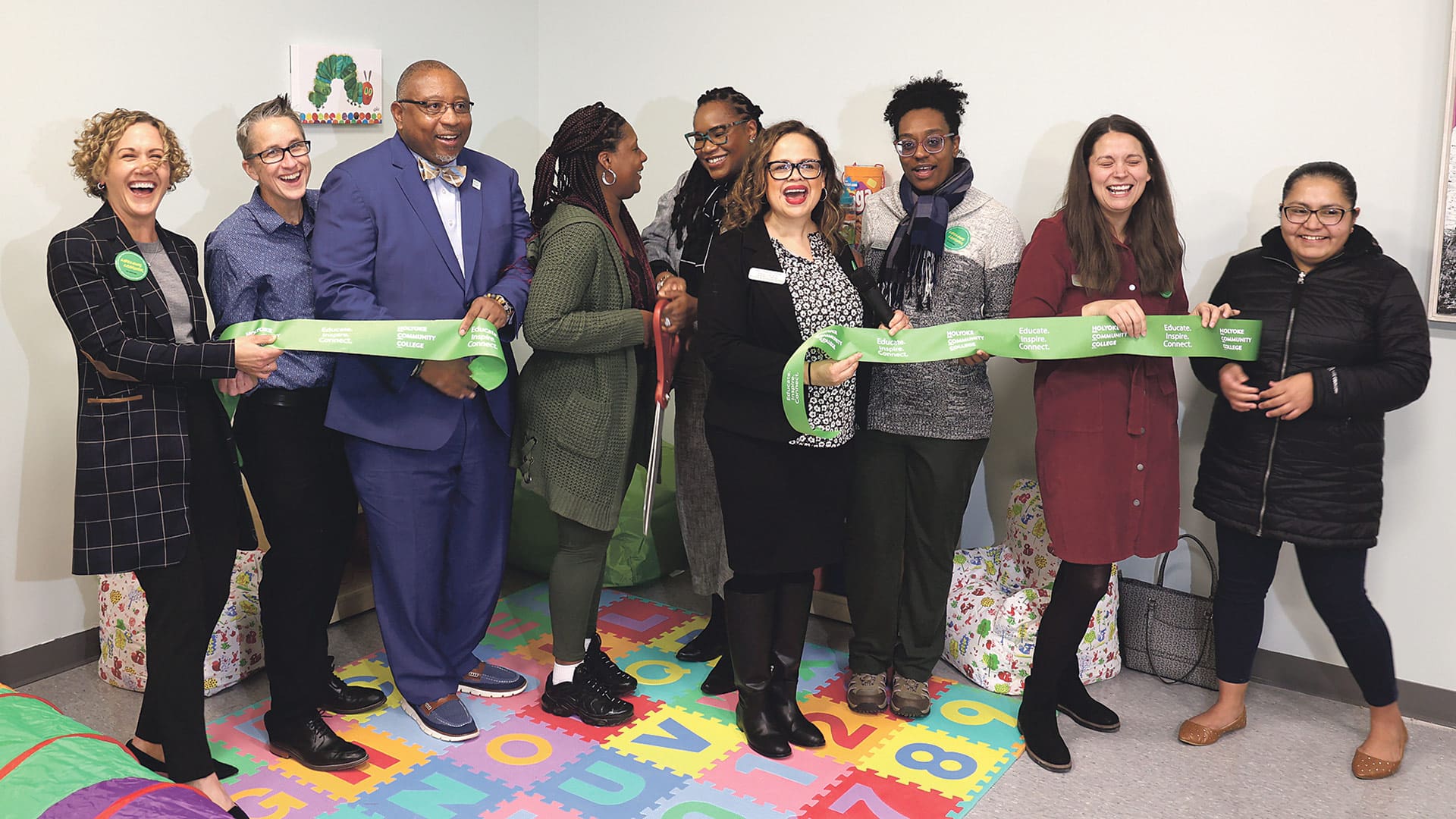
HCC President George Timmons (third from left) helps celebrate the grand opening with a ribbon-cutting ceremony on Dec. 11.
“The Parent Learning Center is a workspace where students can bring their laptops, sit and work on group projects, or just kick back and relax for a while, where they can have their kids with them and feel safe and welcome,” Medina said.
Evolving Effort
Before the Marieb Adult Learning Success Center, HCC housed a program in that space called New Directions for Adult Learners, as well as its Pathways program, which is a transfer program mostly focused on adult women learners.
“The New Directions program was relatively small — it was just one academic advisor who was really running that whole program,” Woody said. “Now we have three full-time staff members, and we’ve been able to scale up the program significantly. When the New Directions program ended, there were between 60 and 80 students, and now, in our first year, we have about 200 enrolled in this program.”
More students have expressed interest as well, she added. “so we were able to take a model that was working — offering this extra, holistic support to adult learners — but scale that up to a much bigger level so that we can serve more students.”
Woody feels that having such a resource could encourage adult students to enroll while helping them stay successful on their academic journey.
“That’s one of the big things — can we make it any easier for them? We recognize that they’re sacrificing a lot of time away from their families, so that’s one of the reasons why we wanted to give back with these spaces where the whole family can be involved.
“A big part of our program is recognizing that being an adult learner is just one aspect of their identity, and there are so many other things going on in their lives,” she added. “So offering programming in the evenings, or by Zoom, or just doing little things that make us more accessible to them in their busy lives, is really helpful. So is that holistic advising piece, having a person you can call up with whatever issue you’re having, and they can help you troubleshoot and walk you through it and just remind you that you belong here at HCC, no matter what’s going on.”
Generational Impact
The ceremonial check from Elaine Marieb still hangs in the center named after her, for two reasons, Woody said.
“First of all, her generosity is what made all of this possible, and I think that’s amazing. But also, she’s a wonderful example of an adult learner, somebody who came to HCC as an adult, pursuing a nursing career.”
She noted that about 70% of students in HCC’s nursing program would be classified as adult learners, so that demographic is helping to fill persistent shortages of talent in the field, which lends another layer of importance to efforts to support them on their academic journey.
“And I was an adult learner here at HCC,” said Woody, who used her associate degree there as a springboard to a bachelor’s degree at Westfield State University. Meanwhile, her son is now 18; he’ll graduate from high school this spring and just completed his first psychology class at HCC.
“So, when I say it’s a family thing, I really believe that,” she went on. “I think seeing me here was a big push for him to say, ‘I can do this.’ It’s made a big impact on how he approaches his education.”
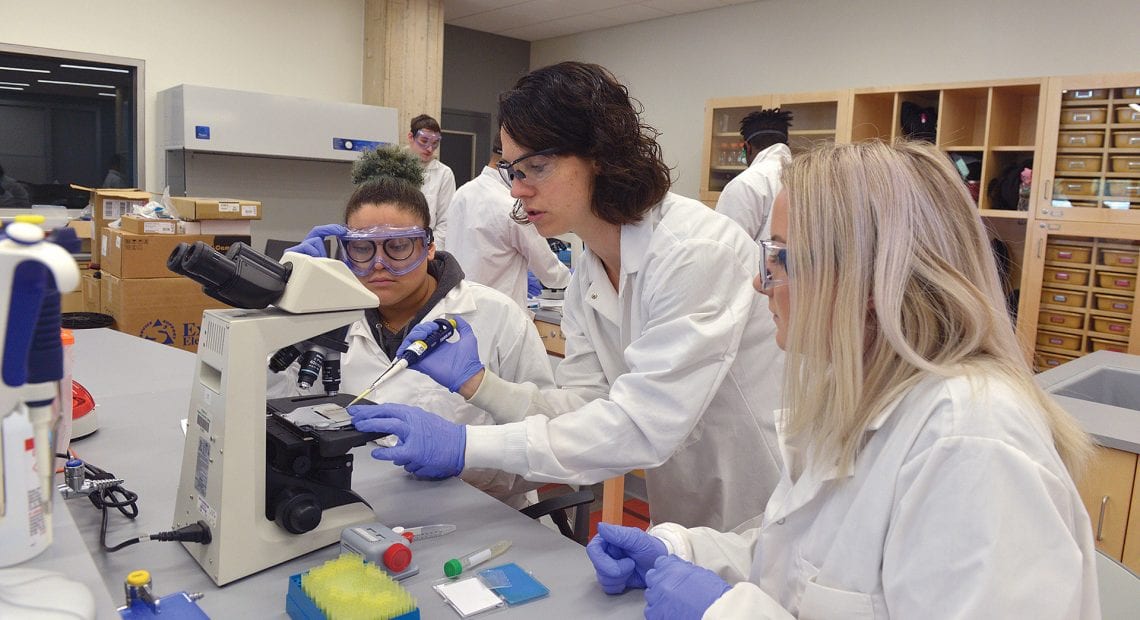
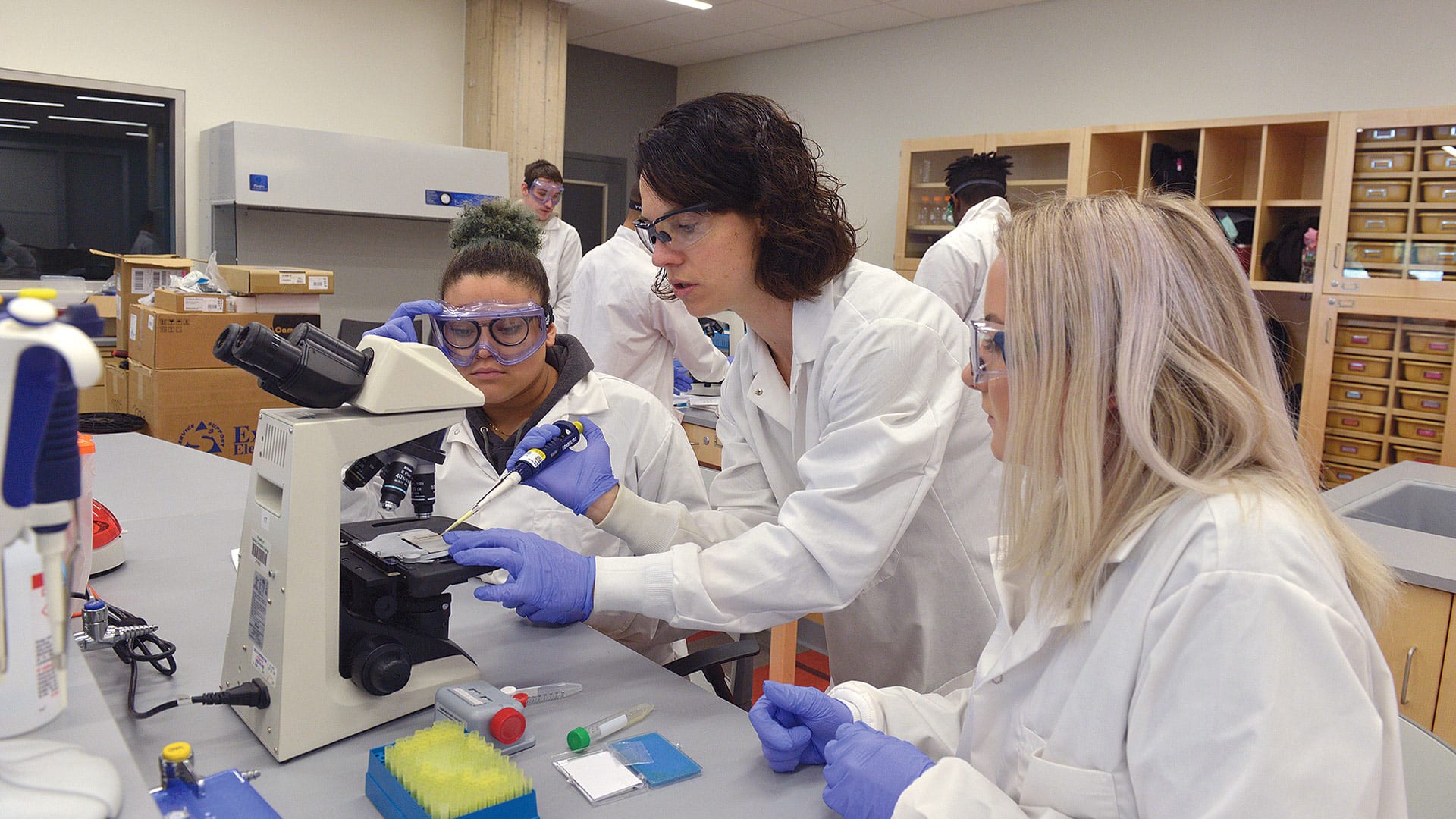
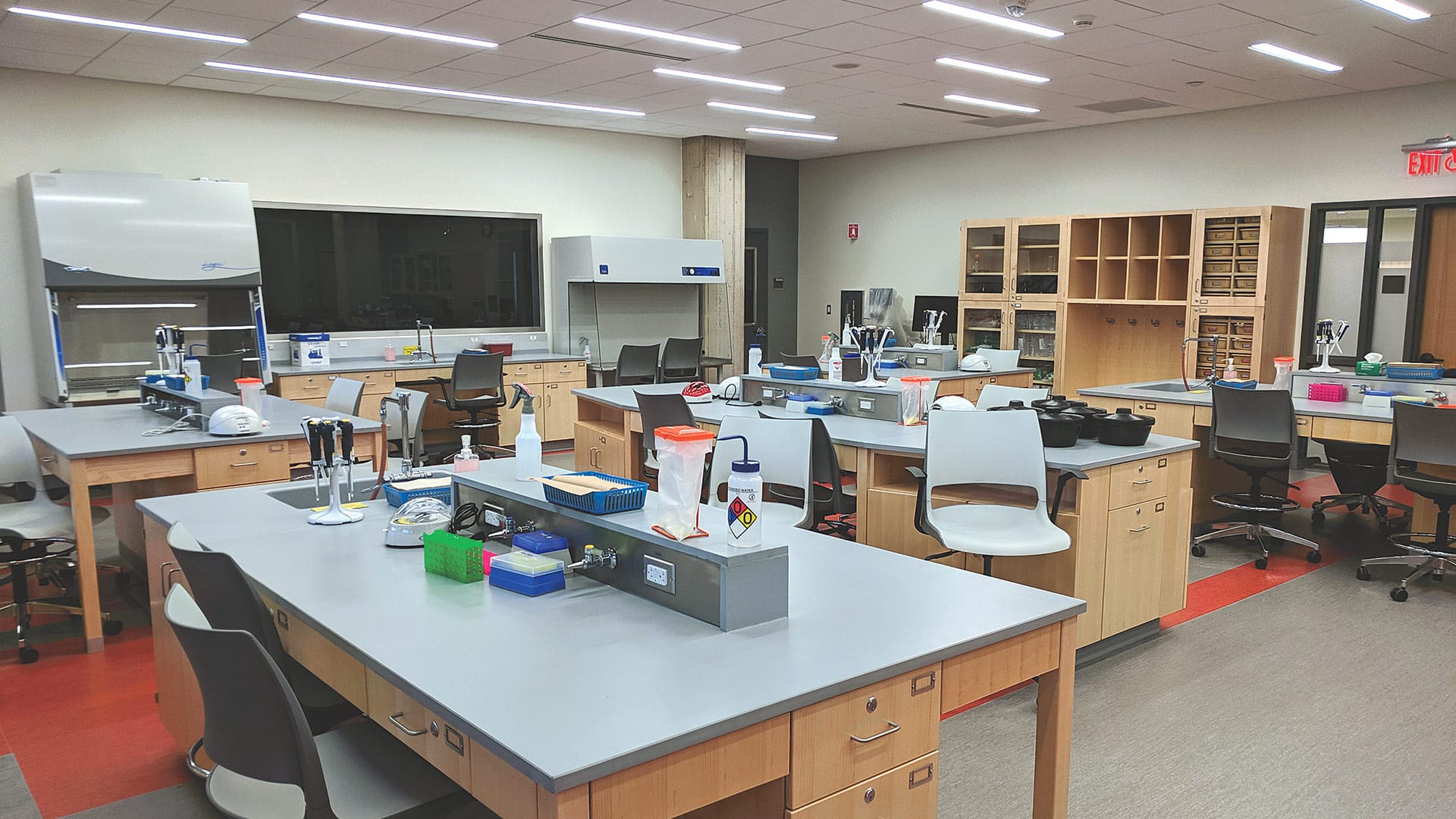 Grant funds and donations also paid for new equipment, including a high-end, research-grade fluorescent microscope, like those used in the pharmaceutical industry; a micro volume spectrophotometer, used to measure small amounts of genetic material; and an electroporator, for genetic engineering. Meanwhile, a cutting-edge thermocycler can take a small sample of DNA and make billions of copies in an hour.