Daily News

SPRINGFIELD — Local law firm Shatz, Schwartz and Fentin announced that eight of its attorneys were listed in Best Lawyers in America 2023.

• Steven Schwartz was named a Lawyer of the Year in the field of business organizations. He was also selected for inclusion in Best Lawyers in America in the fields of bankruptcy and creditor debtor rights/insolvency and reorganization law, business organizations (including LLCs and partnerships), closely held companies and family business law, and corporate law.

• Michele Feinstein was named a Lawyer of the Year in the field of trusts and estates and was also selected for inclusion in Best Lawyers in America in the fields of litigation: trusts and estates, elder law, and trusts and estates.

• Mark Esposito was named One to Watch by Best Lawyers in the field of litigation: labor and employment.

The other attorneys selected by their peers for inclusion in Best Lawyers in America 2023 are:

• Gary Fentin, who was recognized in the fields of banking and finance law and commercial transactions/uniform commercial code (UCC) law;

• Carol Cioe Klyman, selected in the fields of elder law and trusts and estates;

• Managing Partner Timothy Mulhern, recognized in the fields of corporate law and tax law;

• James Sheils, recognized in the field of commercial transactions/UCC law; and

• Steven Weiss, selected in the fields of bankruptcy and creditor debtor rights/insolvency and reorganization law.

Daily News

SPRINGFIELD — American International College (AIC) announced Arlen Carballo as a new member of the board of trustees and long-time board member E. David Wilson as trustee emeritus.

Carballo is the executive director of Finance for MGM Springfield, overseeing all aspects of finance operations for both gaming and non-gaming areas. She has been part of the MGM Springfield team since the property opened in 2018, serving as the resort’s first director of Financial Planning.

Prior to MGM Springfield, Carballo was part of the opening team for MGM National Harbor in Maryland. She is a graduate of the MGM Resorts Management Associate Program and has held leadership roles across both finance and operations at MGM’s Bellagio and Mandalay Bay properties in Las Vegas. She holds a bachelor’s degree in hotel and restaurant management from Northern Arizona University and is a graduate of the HACR 2022 Young Hispanic Corporate Achievers program.

Wilson joined the AIC board of trustees in 1991, while serving as president of Milton Bradley. A graduate of the Harvard Advanced Management Program, he was vice president of Parker Brothers before joining Milton Bradley as manager in the game division in 1980. He was later promoted to senior vice president of Sales by Hasbro Industries, the parent company, before being named president, a title he held until his retirement in 2005.

In June 2021, following 30 years of service to the institution, Wilson retired from the AIC board of trustees.

“Beyond the generosity of their philanthropy,” AIC President Hubert Benitez said, “the commitment, dedication, and service to the institution of our trustees are immeasurably important as we look toward a future that allows AIC to be a college of choice for students seeking a sense of belonging, innovative education, and profound student experiences.”

Daily News

SPRINGFIELD — Springfield WORKS, a community-wide initiative with the Western Massachusetts Economic Development Council (EDC) announced in May they had received a $400,000 Community Empowerment and Reinvestment Grant that will help facilitate systemic socioeconomic changes in the city of Springfield. The goal is to mitigate the negative impacts of incarceration.

Part of the process of implementing the program was administering surveys, collecting that data, and determining how the seven subgrantees will become better situated to aid in the necessary changes. The results from those surveys are in. “As we continue to examine the data collected, we want you to know that the information gathered from local community members is truly staggering,” Springfield WORKS announced. “It shows the work that needs to be done, and more importantly, it emphasizes the need to help the families of those who are justice-involved.”

The seven subgrantees include Children’s Study Home, Home City Development, HCS Head Start, Springfield School Volunteers, Square One, MassHire Springfield Career Center, and Holyoke Community College.

As the data is analyzed, more information will be provided in the weeks to come on the key takeaways and learnings. The purpose of this effort is to hear directly from the community about barriers and obstacles that are experienced due to the negative impacts of incarceration and identify effective, sustainable, and long-term solutions to support neighbors who are most at risk.

Close to three-quarters of Springfield residents identify as Black/African American, Latino/Hispanic, and other people of color. Communities of color are disproportionately affected by incarceration due to systemic inequalities rooted in policies and practices that affect the likelihood of being arrested, convicted, and incarcerated. The majority of racially diverse residents live in communities with historic patterns of segregation and disinvestment in Springfield, which have effectively blocked opportunities for many residents.

“Over half of the survey respondents were previously jailed or incarcerated, and more than 90% had at least one family member justice-involved,” said Anne Kandilis, director of Springfield WORKS. “They reported myriad financial, employment, housing, and mental-health challenges suffered. Our goal is to work together with families, connecting resources to support economic and family well-being.”

When someone is incarcerated, their family suffers, and they lose out on basic needs others take for granted. That’s where Springfield WORKS and the Western Massachusetts EDC, along with the seven subgrantees, will come together.

After the data is analyzed, Springfield WORKS will lead the design of an action plan in collaboration with the subgrantees and other partners to begin impacting real change to promote a holistic approach to working with families. The focus will be on increasing cross-sector collaboration to break down barriers to program engagement, financial stability, and quality jobs. Springfield has a long history of innovation, and solving old problems in new ways is critical to helping Western Mass. adapt to new circumstances and become economically resilient.

Daily News

EAST LONGMEADOW — ArchitectureEL Inc. (AEL) recently welcomed Rose Geist to its team as a project designer.

AEL provides professional design services on a wide range of projects, from renovating existing buildings to designing new ones. The firm has significant experience in accessibility, historic preservation, educational, and commercial design, as well as extensive experience in both private and multi-family residential development. Having been with the firm for a few months, Geist has already proved herself as a valuable asset to the team. She has taken on a variety of responsibilities since she started at AEL and is constantly communicating and collaborating with project managers, clients, and co-workers.

“Joining ArchitectureEL has allowed me the opportunity to utilize and grow my skill set while getting to know the local community. I’m very grateful to be a part of the team,” Geist said.

Owner and Principal Architect Kevin Rothschild-Shea added that “we are pleased to have Rose as a new member of the team. Our work locally and across the state continues to grow, and having Rose as part of our team will help us meet the needs of our clients and provide the high-quality design services AEL is known for.”

Commercial Real Estate Special Coverage

Urban Pioneers

Colin D’Amour says the planned downtown store is unlike anything Big Y has created before

Colin D’Amour says the planned downtown store is unlike anything Big Y has created before and is, in many respects, a pioneering endeavor.


Big Y Foods will soon begin the process of transforming the former CVS location in Tower Square into its latest market. The chain has been operating for nearly 80 years now and has expanded its footprint well beyond its roots at that now-famous intersection in Chicopee where the converging roads formed a ‘Y.’ But this venture is something completely different in terms of scale — and just about everything else.


In many respects, the new store that Big Y is planning for the space in Tower Square formerly occupied by CVS constitutes pioneering — for the company and the city.

Indeed, what is proposed, a scaled-down version of a Big Y supermarket in an urban setting — the heart of downtown Springfield — hasn’t been tried before, as far as anyone knows. And it certainly hasn’t been tried by Big Y, the chain of supermarkets started by brothers Paul and Gerry D’Amour in 1936.

“To the outside observer, they see us operating supermarkets and say, ‘this is just a smaller format,’” said Colin D’Amour, senior director of Big Y Express and point person on this project. “But it’s really a completely new venture for us, everything from distribution to operations to trucking … we’ve never operated a downtown, urban-format market before, so there are a whole lot of unknowns for us.”

So while there is a great deal of anticipation and excitement about the company’s plans — downtown Springfield has been a food desert for decades now, and the need for a supermarket in that area has long been a recognized need — there is also a great deal of uncertainty about just how this will all play out.

So much so that determining just what constitutes ‘success’ at this new and decidedly different location is a difficult assignment.

“We are flying the plane as we build it in many respects,” D’Amour explained. “We know how to operate a supermarket, and we’re constantly tweaking that model, but when we open a new store, we have a very good idea of what success in that store will look like and what we need to do to achieve it. With this model, we’re trying to be a lot more flexible, even from our design standpoint.

“To the outside observer, they see us operating supermarkets and say, ‘this is just a smaller format.’ But it’s really a completely new venture for us, everything from distribution to operations to trucking … we’ve never operated a downtown, urban-format market before, so there are a whole lot of unknowns for us.”

“We don’t fully know what our lunch business is going to be like in the area; we don’t fully know what our after-work, prime-time, rush-on-the-way-home-from-work business is going to be like,” he went on. “We’re trying to build in some flexibility that’s going to allow us to adapt, once we do open, to what the customers’ needs are.”

Overall, this story is an intriguing one on a number of levels. For starters, there is the obvious need for a grocery store being filled. Meanwhile, the recruitment of Big Y marks another imaginative reuse of space in Tower Square by owners Vid Mitta and Dinesh Patel, who previously landed the YMCA of Greater Springfield and White Lion Brewery, among others, as tenants. And this new development was made possible by federal COVID-relief funds, making this is an example of how those monies have been put to work by the city to improve specific neighborhoods, including downtown (more on that later).

For now, the plan is to have the store open by next spring, said D’Amour, adding that there are some challenges to meeting that timeline, including supply-chain issues that make getting needing materials and equipment, like shelving, somewhat of an adventure.
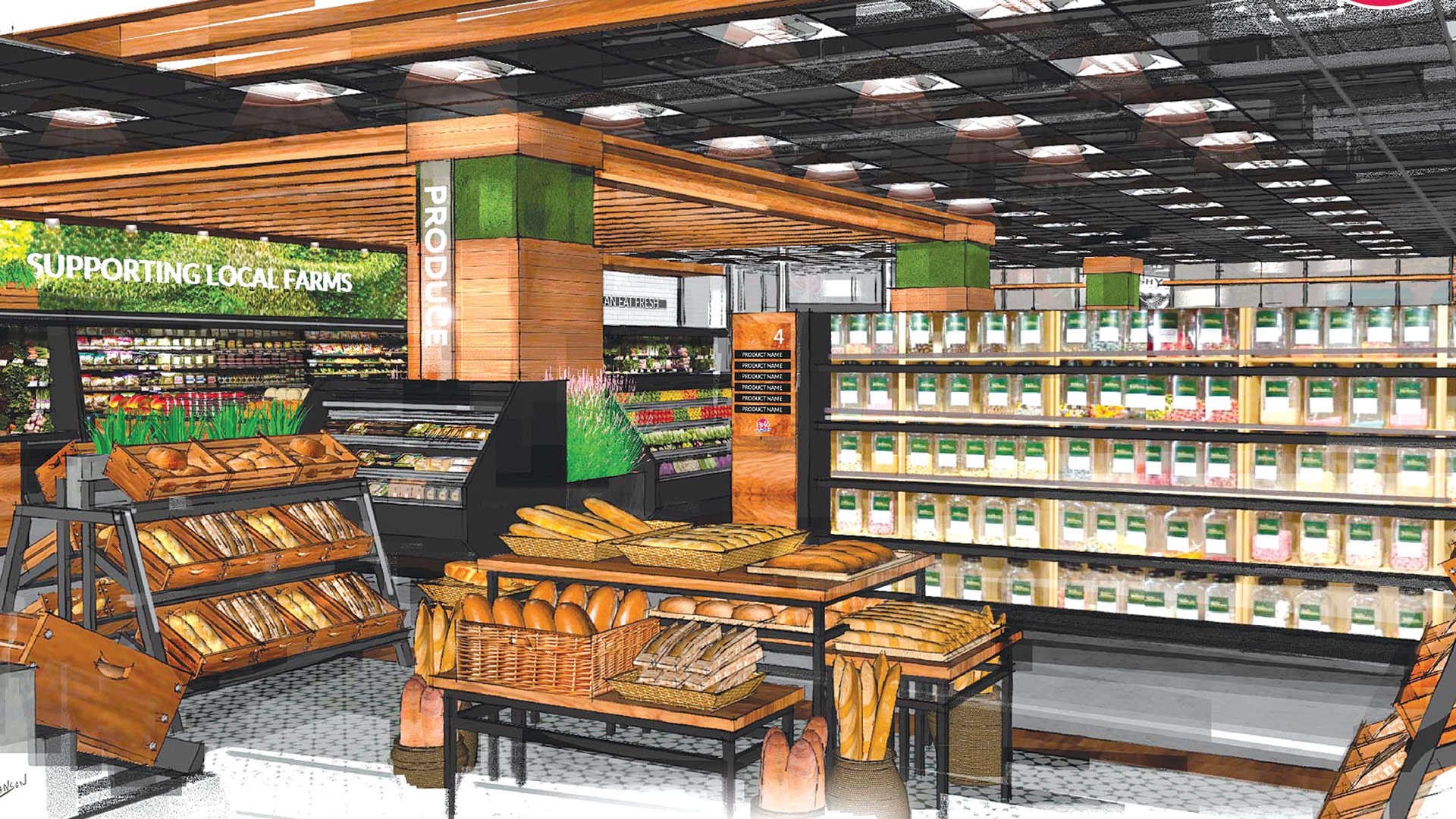
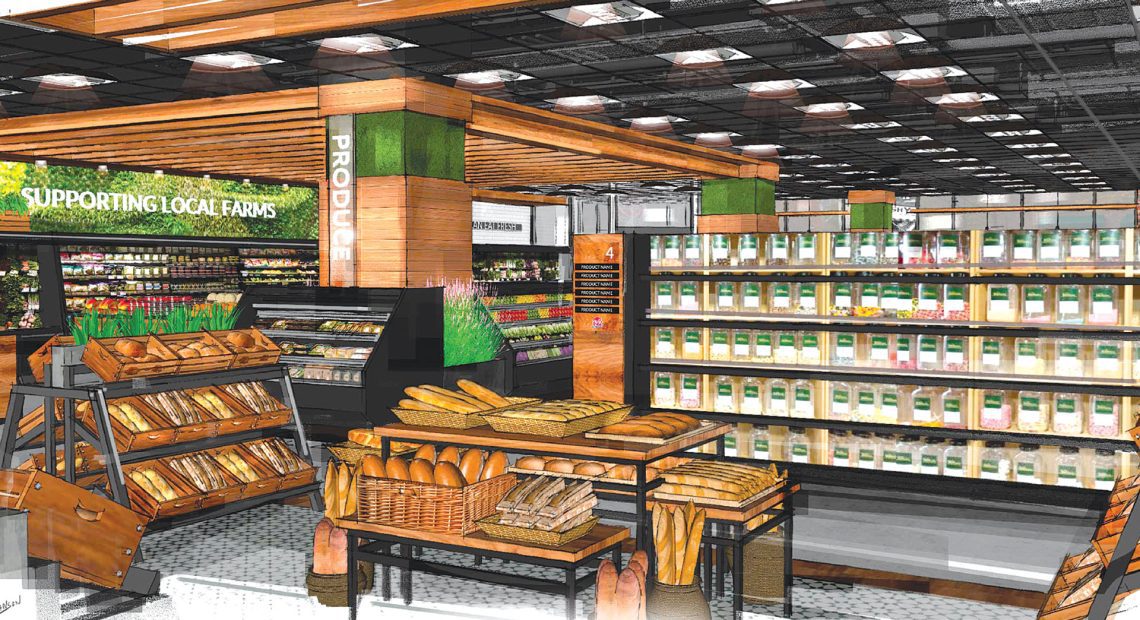
An architect’s rendering of the planned new  Big Y market in Tower Square.

An architect’s rendering of the planned new
Big Y market in Tower Square.

As for the store itself, it will feature most of the same departments as a typical Big Y World Class Market (there will not be a pharmacy), but, obviously, a smaller volume of items.

As for customers, Big Y believes it will draw from several different constituencies, including those living downtown, those working in both Tower Square and other surrounding office buildings, those coming to Tower Square on other business, such as daycare services at the Big Y, and others.

“We think there’s going to be a good mix,” he noted. “Tower Square is a pretty robust facility, and there are a lot of people who work there who may be living in Springfield or commuting from outside the city who may be looking to grab something after work for dinner or grab something to help fill the fridge, and it saves them a trip to a traditional supermarket. There’s also a good number of residents that live right downtown as well. We think there will be a healthy mix.”

For this issue and its focus on commercial real estate, BusinessWest talked at length with D’Amour about how this concept came together and why the initiative represents pioneering on a number of levels.


Location, Location, Location

D’Amour said Big Y has been looking at downtown Springfield with an eye toward possibly opening some type of store there for some time now.

“It’s fair to say that it’s been decades,” he noted, adding quickly that, while the company hasn’t been actively pursuing something all that time, it has long understood that there is both need and opportunity involved with such an undertaking.

“We’ve had a very long, positive relationship with the city of Springfield, being headquartered here, and we’ve got a great relationship with the mayor’s office,” he went on. “So there’s just been a constant dialogue about what opportunities are there.”

“We’ve tried to take little bits of what we like from some different markets out there. But we think downtown Springfield is a bit unique, and we think that we understand the Western Mass. customer and the Springfield customer, and we’re trying to blend our brand with what we’ve seen other folks do in other environments and come up with something we think will work in this setting.”

Matters moved beyond the dialogue stage thanks to a number of puzzle pieces coming together, he went on, noting that the first was the location that became available when CVS vacated its longtime home in Tower Square for a location about a half-mile south on Main Street.

“The new owners of Tower Square came to us with this opportunity — everything just came together at the right time,” said D’Amour, noting that the company not only recognized an opportunity, it was prepared to take full advantage of it. “We were able to pull it together and make it work.”

Prepared, yes, but still moving into what would be uncharted territory for this company — and many supermarket chains, for that matter. Indeed, the location would be in the middle of the city’s downtown, with no on-site parking and certainly no loading dock.
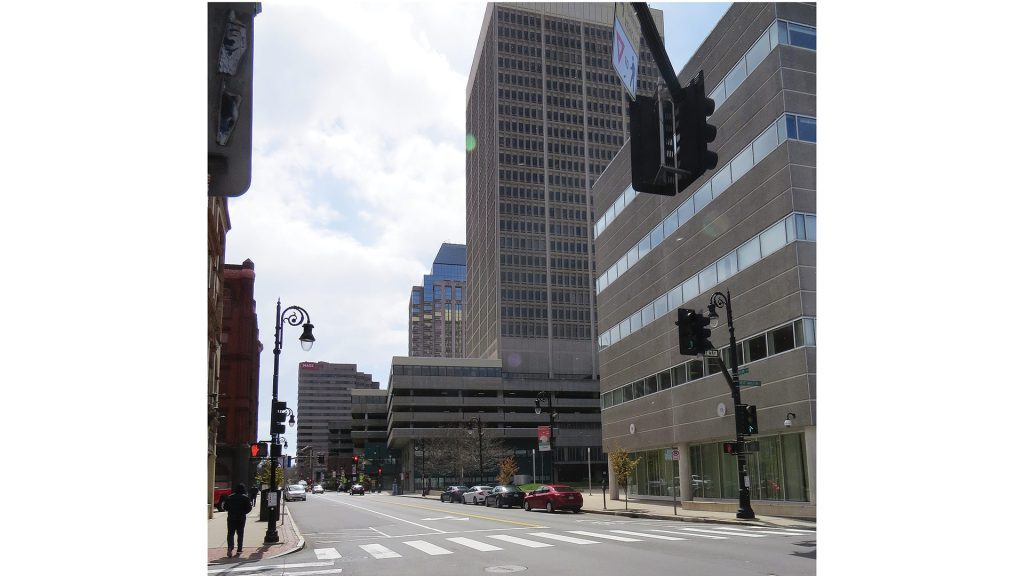
The new market will serve people who work in the office towers

The new market will serve people who work in the office towers, as well as residents who live downtown.

These unknowns, along with uncertainty about just how much traffic this site will generate, made it enough of a risk that the project required an investment from the city, said D’Amour, adding that this investment has come in the form of $1 million in federal COVID CARES Act funding.

“That funding allowed us to answer some of those unknowns,” he said. “It solved some unsolvable challenges around distribution and issues like that, and it allowed us to see a pathway to a financially viable market in this location. I don’t think we would have been able to get there — what with rising construction costs and trying to figure out an entirely new model — without that federal money.”

Elaborating, he said the traditional Big Y model, one seen across this region and now far beyond, into Connecticut, Central Mass., and now Eastern Mass., is the suburban World Class Market, usually in a larger shopping center, with acres of parking; the company just unveiled its latest plans to build a store in Middletown, Conn. The Tower Square store is a much different model, one that, as noted, comes with a large supply of unknowns.

“There’s nothing close to this in terms of the urban setting, and there’s nothing close to this in terms of size,” he said. “This is maybe one-fifth the size of one of our traditional supermarkets. Obviously, all of our stores are unique in size and layout, but this is certainly an outlier.”

Thus, the team at Big Y has looked at models that would be considered similar in other urban markets, including New York and Boston, as well as some smaller cities in upstate New York, he said, adding that the chain is essentially creating its own model with this initiative.

“We’re having supply-chain challenges everywhere, and we’re working through them as best we can, and we think we’re doing a pretty good job with it.”

“We’ve tried to take little bits of what we like from some different markets out there,” he explained. “But we think downtown Springfield is a bit unique, and we think that we understand the Western Mass. customer and the Springfield customer, and we’re trying to blend our brand with what we’ve seen other folks do in other environments and come up with something we think will work in this setting.”

The plan, as noted, is to offer most of what would be found in a traditional Big Y market, he said, adding that patrons can do what he called a “full shop” at the downtown location, with fresh meats, bread, produce, and other items, just not in the variety to be found in the larger-model store.

Work has yet to begin on site, he said, but the plan is to open the store late in the first quarter of next year, and he believes that timetable can be met, despite those aforementioned challenges, including construction lead times and simply getting needed materials and equipment.

“Supply chain continues to be a challenge, both from a construction standpoint as well as from a product standpoint,” D’Amour explained. “But it’s nothing we’re not tackling, like everyone else in this late-pandemic, post-pandemic world, whatever we’re calling it these days. We’re just continuing to try to find innovative ways around it and fill our stores.

“With respect to this Tower Square downtown location, it’s really no different than what we’re tacking in all of our stores,” he went on. “We’re having supply-chain challenges everywhere, and we’re working through them as best we can, and we think we’re doing a pretty good job with it.”


Food for Thought

As D’Amour noted, it is difficult to make projections for the planned new market, and equally difficult to get a firm grasp on just what will constitute success.

But in an area that has been devoid of anything like this for as long as anyone can remember, there are great expectations and high hopes that the new store will be an important addition to the mix in Tower Square and the central business district as a whole.

In short, there is a good deal of anticipation about what’s in store for this location — figuratively, but also quite literally.


George O’Brien can be reached at [email protected]

Architecture

People with Plans


The big story in the construction and renovation world is the high cost of … well, everything. But Kerry Bartini says that isn’t deterring people from pursuing her architectural services.

“Business has been super strong, especially in the Berkshires. During the pandemic, we had people calling from all over the U.S. wanting to relocate to the Berkshires. That was a big trend for us,” said Bartini, principal with Berkshire Design Inc. in Pittsfield.

She typically works on a range of single-family residences, commercial sites, and cultural institutions, but as people retreated indoors starting in 2020, specific residential trends were in play. “Second homeowners wanted new homes; we had families who had been here 30 years and wanted to renovate; a lot of locals were homebound, who were working from home and had kids attending school from home, so they did a lot of renovations — not necessarily making the space bigger, though we had that, too, but adapting the space to fit their new needs.”

Once the initial surge of that trend began to recede and inflation and supply-chain issues hit the construction world hard, one would expect architecture work to slow as well, but that hasn’t been the case, Bartini said.

“Business is still the same — we have tons and tons or work. We have a wait list: ‘yes, we can take on that job, but we can’t start for two or three months.’ But contractors are scheduling two years out, so people understand we’re really, really busy, and they’re trying to be patient.

“Even though building prices are volatile,” she added, “people are still moving toward spending more time at home. Even with the high prices, building is still moving forward, even if they have to cut a little bit of square footage in exchange for custom floors and windows, or make other changes to fit the budget.”

Curtis Edgin, a principal at Caolo & Bieniek in Chicopee, said the scale of the firm’s projects — which include a wide range of commercial projects in addition to public work like schools, colleges, libraries, senior centers, public safety, and municipal buildings — may be a bit more modest right now, but the pipeline is still strong, in some cases buoyed by federal and state stimulus money to communities.

“We’re working with several school districts, some in relation to COVID money they received, and are making improvements to facilities based on that,” he said. “We’re fairly diversified in our projects, which is good. We also have some private clients. Though, with interest rates going up now, we’ll see how that shakes out.”

Architecture, engineering, and construction (AEC) executives are generally optimistic about where the market is headed as 2022 progresses. The Engineering News-Record’s Construction Industry Confidence Index, which measures AEC executive sentiment about the market outlook, held steady in the first quarter after rising slightly from the fourth quarter of 2021. In contrast, the index declined in the middle two quarters of 2021, so optimism is definitely up this year.

Meanwhile, the latest Construction Financial Management Assoc. Confindex is up more than 19% over last year. The federal Infrastructure Investment and Jobs Act certainly gave it a boost, with states and communities receiving a new surge of funding to invest in infrastructure and building projects. That, combined with movement on a glut of backlogged projects from 2021, is raising optimism, as the first-quarter Confindex survey showed 64% of respondent firms reported a greater backlog of revenue relative to a year ago.


From the Ground Up

Jim Hanifan, another principal at Caolo & Bieniek, said the firm’s diversity of projects has been a hedge against economic cycles, but so has its expanding geographic diversity, with recent projects spanning the entire state, from Richmond to Marshfield. “It’s nice — we do quality work in our immediate area, and it starts to grow, and people further out appreciate it.”

The past couple years saw a slight slowdown in the pace of projects, he added, but things have picked up since.

“We definitely saw some supply-chain issues; lead times for a lot of equipment, especially electrical and metal, mechanical units, things like that, used to be one or two months, and now it’s six months and even a year on some components.

“That’s forced everyone to look at schedules,” he went on. “The public schools now have to think way ahead. They’re not planning for this summer; they’re planning for the following one. You can’t get the product this summer, so you have to push it off to the following year. With questions about budgeting and cost estimates, where will it be 12 months from now? That’s a challenge.”

There’s no good answer to when — or whether — the more complicated equipment needed to build projects once architectural designs are complete will start to become more accessible, Hanifan added, and keep projects from being pushed off too far. “No one knows whether this will be the new normal.”

While the pace of business can cycle, so do design trends, said Bartini, whose firm collaborates with Bradley Architects Inc., led by principal Robert Harrison, under the combined name of Berkshire Bradley.

For example, in the residential realm, “it used to be that, in the primary bathroom, everyone wanted a tub and shower separate. Now, nobody wants the bathtub — as long as there’s a bathtub somewhere in the house, nobody wants a bathtub in the primary bathroom, which gives us greater flexibility of space.”

In kitchens, walk-in pantries and oversized working islands are in, while waterfall countertops are on the wane. Task lighting is popular throughout the home as well. On the exterior of the home, black windows are in, black and white color schemes dominate, and modern farmhouse design continues to be hugely popular in the region.

“For siding, for a lot of people, board and batten is back, and people are mixing up horizontal and vertical siding on the same house,” Bartini said, “which is a really smart thing to do as it gives the house a little character without breaking the budget.”

And, of course, “more clients are coming to us looking for their homes to be green. Unfortunately, though, that’s usually the first thing that gets cut when you start talking numbers. When building prices are through the roof, they might not do the $40,000 solar panels. They’re getting savvy thinking about sustainability, but we’re not at a place in the market where those items always make it through to construction.”

Edgin agreed, reporting the same conflict between growing interest in sustainability in commercial and public properties and the realities of budgeting.

“The sustainable aspect is a given these days. The question is, how far do they want to go with that? How much are they willing to invest?”

Clients should consider the long-term cost savings of sustainable systems, he added, but they don’t always act on that.

“There are a number of things people can do that are more expensive initially, but over the life cycle, the cost savings are great,” Edgin said. “But if they’re only budgeting based on bid day and the construction period, they want to keep it as low as possible. That’s not a long-term view, and it’s not as good for the environment. So they have to decide: are they committed to spending a little more money now to go all in? Or do they just want to talk that way?”

Maintenance budget is another factor when considering sustainable building and systems, Hanifan added.

“These are very elaborate and energy-efficient systems, but if you’re a small town and don’t have a large maintance staff, you’re not going to be able to keep up with the systems, where a larger city has a facilities department that can expand and keep up with more numerous and complex systems,” he noted. “It may show great payback and be worth the capital investment, but if you have to bring in outside people every time for general maintenance and repair, the savings can get depleted really fast.”


Through the Roof

Despite the uncertainty about project scheduling these days, Edgin said, clients still want the design work done now. But fluctuating material costs over the life of a project remain a daunting factor.

“If you talked about something a year ago and you’re now bidding it, and you haven’t updated your budget, there is risk there unless there is sufficient contingency money,” he added. “Some materials went through the roof and then tapered back closer to their original norms, but are not quite there yet. Lumber went through the roof but came back down — but not all the way down. Better than it was six months ago, but certainly not what it was two years ago. Steel, same thing.”

Despite the economic challenges, Bartini said, it’s full speed ahead at Berkshire Design, particularly on the residential side.

“We’re always pretty busy, and we still have the same kind of mix — maybe three new houses go up a year, and the rest is additions, renovations, or a combination of both. We’ve had a lot of new construction despite the fact that building prices are through the roof.”


Joseph Bednar can be reached at [email protected]