Daily News

SPRINGFIELD — Surrounded by Square One staff and preschool children, leaders from Florence Bank recently pledged the latest gift to Square One’s “Back to Square One” capital campaign.

The announcement of Florence Bank’s $100,000 gift came on Oct. 10 as Square One works to build a $15.5 million center at the location where its building was destroyed by a tornado in 2011. Slated to open in the spring of 2025, the new, 26,000-square-foot facility will include four preschool classrooms, an outdoor learning and play area, a full-service family support center, and administrative offices.

“We are proud to be a good neighbor to organizations in the communities we serve,” Florence Bank President and CEO Matt Garrity said. “Square One offers a broad range of unique programs and services that benefit every family served, and we are honored to be able to help the organization advance its campaign to fund a new building that will allow it to enhance the learning and enrichment of so many young lives.”

Florence Bank is a mutual savings bank that serves the Pioneer Valley through 12 full-service branch locations in Hampshire and Hampden counties.

“We are overwhelmed by Florence Bank’s very generous support for this important project,” said Dawn DiStefano, Square One’s president and CEO. “It truly takes a village to provide our community’s children with all the tools, resources, and nurturing they need to be successful. We are immensely grateful to Florence Bank and all of the wonderful supporters who share in our mission and vision for a bright future for all children.”

Currently, the campaign is approximately $2 million shy of its $15.5 million goal. Most recently, the MassMutual Foundation announced a $1 million gift to the initiative. In June, Balise Auto, another organization with deep roots in Springfield’s South End neighborhood, announced a $1 million gift to the project.

Early support for Square One’s project came from the Davis Foundation, PeoplesBank, the city of Springfield, and the state of Massachusetts. Springfield Mayor Domenic Sarno awarded nearly $1 million in funding, while state Rep. Carlos Gonzalez and state Sen. Adam Gomez sponsored and secured a $2 million earmark in the state budget to support Square One’s expansion of services.

These gifts, paired with a $6 million bond issued by MassDevelopment and the cash equivalent of $4 million in new market tax credits, have positioned the campaign for success.

Daily News

Brett Carroll

CHICOPEE — Elms College has named higher-education executive Brett Carroll the college’s new vice president of Finance and Administration. Reporting directly to the president, Carroll is responsible for the strategic oversight and management of the college’s finance and administrative office. His appointment was effective October 1.

“I am excited to welcome Brett to Elms College,” President Harry Dumay said. “His experience in finance administration will be a welcome addition to Elms, and I look forward to working with him on the strategic direction of the college.”

Carroll joins Elms from Mercy University in Dobbs Ferry, N.Y., where he recently served as vice president for Finance and chief financial officer, overseeing all financial operations of the university. Prior to that, he was associate vice president and treasurer at the University of Hartford.

In his new position, Carroll is responsible for providing leadership, management, and supervision to the Business, Facilities, Human Resources, Information Technology, and Public Safety departments. He is also a member of the president’s cabinet.

Carroll has more than 25 years of professional experience, 14 of which have been in higher education. In addition to being a certified public accountant, he holds a master’s degree in management from the University of Hartford and a bachelor’s degree in accounting from the University of Connecticut.

“I look forward to the opportunity of working with Dr. Dumay and the entire Elms community as we guide the college through the current higher-education landscape,” Carroll said.

Daily News

Matt Donovan

GREENFIELD — Greenfield Cooperative Bank announced the promotion of Matt Donovan to commercial associate lender. He brings a wealth of experience to this newly created role.

In this position, Donovan will work closely with experienced commercial lenders to gain valuable skills in deal origination, structuring, negotiation, and underwriting. Through mentorship and hands-on experience, he will develop the expertise necessary to support commercial-lending activities and contribute to the growth of the bank.

“We are thrilled to have Matt take on this important role,” said Mike Buckmaster, senior vice president of Commercial Lending. “His expertise in commercial credit analysis, combined with his strong work ethic and dedication to customer service, will be a valuable asset to our commercial-lending team.”

Daily News

HADLEY — UMassFive College Federal Credit Union is running a winter coat and cold-weather clothing drive in its Hadley, Northampton, UMass Amherst, Springfield, and Worcester branches throughout October.

Donations from this drive, held annually, will be distributed in partnership with the Amherst Survival Center, Gray House in Springfield, and Net of Compassion in Worcester.

“We know that our neighbors in need have come to count on the coats and warm clothing our members donate during this drive,” said Cait Murray, UMassFive’s Community Outreach manager. “We are so grateful to partner with the great local organizations that can ensure donations are directed where they can have a significant impact.”

UMassFive thankfully accepts any clean, new, or gently used coats, gloves, scarves, hats, sweaters, snow gear, and boots. Donations should be placed in a bag and may be dropped off during business hours to the Hadley branch at 200 Westgate Center Dr., the Northampton branch at 225 King St., the UMass Amherst Campus Center branch (Room 224), the Springfield branch at 233 Carew St. (Mercy Medical Center Rehabilitation Building, Room 110), or the Worcester branch (UMass Chan Medical School, Room S1-820).

Community Spotlight

Community Spotlight

Laurie Lammare

Laurie Lammare says the reopening of North Adams Regional Hospital will bring convenience to local residents.

For Laurie Lammare, the reopening of North Adams Regional Hospital (NARH) is a story that touches her professionally and personally.

Professionally … she is now system vice president and COO of NARH, now part of Berkshire Health Systems, moving from an administrative role at BHS to leading the 130-year-old hospital through the next chapter in its intriguing history.

And personally … well, she was born at NARH, her children were born there, and she fully understands the importance of this institution, on many different levels, to the North County communities it serves.

“Being able to offer such services to so many people was exciting work,” said Lammare, a North Adams native, of the long road to reopening the hospital and restoring inpatient service, noting that it was a crushing blow to the community when NARH was closed by its previous owner in 2014 after years of financial struggles and bankruptcies.

Its reopening in March, a decade to the day after it closed as an acute-care hospital, and its subsequent designation as a Critical Access Hospital (CAH) in July, brings new levels of convenience and accessibility to care for people who previously had to travel to Pittsfield for such care — or to visit those who were receiving care.

The reopening of NARH is one of the better stories involving this community of roughly 13,000 people, the second-largest in Berkshire County. But there are others, many of them involving the other major institution in the city — Massachusetts College of Liberal Arts (MCLA).

Indeed, the school, formerly known as North Adams State College, recently earned the sixth spot on U.S. News & World Report’s list of Top Public Liberal Arts Schools in the nation, after earning the seventh spot for the previous three years. The college’s continued commitment to affordable education and economic prosperity is reflected in additional 2025 U.S. News rankings: the fifth-highest performer on social mobility for liberal-arts colleges in Massachusetts and second-highest performer on social mobility for public liberal-arts colleges in the country (more on what that means later).

“Part of re-establishing the inpatient beds at North Adams was really a strategic step in expanding access and reducing the healthcare barriers that the community may have found in traveling down to Pittsfield.”

“It’s always nice to go up, in this case, from 7 to 6,” MCLA President James Birge said of the public liberal-arts ranking, which puts MCLA just behind the service academies and a few other schools. “But the more compelling information is that this is the 10th consecutive year we’ve been in the top 10 nationally, and we’re really proud of that.”

Meanwhile, MCLA continues to add new programs. In 2022, it was radiological technology, and in 2023, it was nursing. This year, it’s a music, industry & production major that drew 60 applications.

James Birge

James Birge says MCLA’s rise in the rankings speaks to its broad mission and its success in carrying it out.

This new program will help students contribute to a changing economy in the Berkshires and North Adams, one that has shifted from manufacturing to the arts, and is perhaps best captured by the conversion of the former Sprague Electric complex into MASSMoCA, the largest modern-art museum in the world.

For this, the latest installment of its Community Spotlight series, BusinessWest takes an in-depth look at North Adams and the many forms of progress there.


Turning Back the Clock

Tracing the history of North Adams Regional Hospital, Michael Leary, director of Media Relations for BHS, said its creation was inspired by a horrific rail accident in 1886 — roughly a decade after the opening of the Hoosac Tunnel — known locally as the train wreck at Bardswell Ferry.

The Eastern Express, traveling east toward Greenfield, came off its rails and plunged down a rocky embankment to the Deerfield River, south of Bardswell Ferry. Ten people were killed, and another 31 injured.

“North Adams was a pretty significant city in Massachusetts at that time, but it didn’t have a hospital,” Leary said. “As a result of that catastrophe, some community members got together and formed what came to be known as North Adams Regional Hospital.”

NARH operated for more than 100 years, under an organization known as Northern Berkshire Health Systems, but by the start of this century, it was struggling mightily, he explained.

“They ran into significant reimbursement and financial issues and could not sustain the hospital. They declared bankruptcy at least twice, maybe three times, in the 2000s, and when push came to shove, they could no longer make a go of it. Cash flow had significantly decreased, they were unable to pay their vendors, and they declared bankruptcy in 2014 a final time and closed just days later.”

“We went from a long weekend to 10 days where we helped students adjust to college life — with coursework, social adjustments, connecting to other people on campus who are first-year students.”

State officials and the Department of Public Health asked BHS to step in and at least reopen emergency services, Leary said, adding that the system did this and subsequently purchased the property through bankruptcy proceedings, naming it the North Adams Campus of Berkshire Medical Center and opening several outpatient services there, including imaging, wound care, surgical services, laboratory services, and orthopedics.

In 2023, following changes in the law regarding eligibility for CAH designation — which is granted by the federal government and limited to small, rural facilities that meet certain criteria to qualify for federal support in maintaining services that would otherwise not be financially and/or operationally viable — such status was attained, and BHS moved to reopen the facility under its original name, North Adams Regional Hospital.

The importance of the hospital to the region was summed up by U.S. Rep. Richard Neal in comments made at the ribbon-cutting ceremony for the reopened NARH.

“Throughout my career in public life, I have stood by the notion that legislation changes lives. Today’s announcement is a living example of that belief, as the reopening of North Adams Regional Hospital will have a profound impact on communities throughout North County for years to come,” Neal said. “There are stark inequities in rural and underserved communities as it relates to our nation’s health system. That is why I have long advocated for changes that will address health equity and allow everyone to have a fair and just opportunity to achieve their highest level of health, regardless of who they are or where they live.”

Lammare, who had been with BHS in various capacities for 34 years before being chosen to lead NARH, concurred.

North Adams Regional Hospital reopened in March

North Adams Regional Hospital reopened in March a decade to the day after closing as an acute-care hospital in 2014.

“Part of re-establishing the inpatient beds at North Adams was really a strategic step in expanding access and reducing the healthcare barriers that the community may have found in traveling down to Pittsfield — and to better serve the Berkshire County community members in a coordinated effort through the larger healthcare system,” she said, adding that the hospital reopened with 18 beds and can expand to 25 given guidelines regulating CAHs. The current census is only about five patients a day, but that number is expected to rise with the start of flu season.


School of Thought

Birge told BusinessWest that the latest U.S. News & World Report rankings help convey MCLA’s broad mission — and its success in carrying it out, especially over the past several years.

North Adams at a glance

Year Incorporated: 1878
Population: 12,961
Area: 20.6 square miles
County: Berkshire
Residential Tax Rate: $17.14
Commercial Tax Rate: $36.34
Median Household Income: $35,020
Family Household Income: $57,522
Type of government: Mayor; City Council
Largest Employers: BFAIR Inc.; Massachusetts College of Liberal Arts; North Adams Regional Hospital
* Latest information available

Indeed, in addition to providing a quality liberal-arts education, the school has also been a prime mover in that category known as social mobility; the college has been acknowledged on the list of national liberal-arts colleges for social mobility since that ranking was established in 2019.

Specifically, social mobility measures how well institutions graduate students who receive federal Pell Grants, typically awarded to students whose families make less than $50,000, said Birge, noting that most Pell Grant money goes to families with income below $20,000. More than 41% of MCLA undergraduate students receive Pell Grants, and 49% are the first in their families to go to college. Overall, 95% of MCLA students receive some kind of financial aid.

Beyond these rankings, MCLA is seeing other forms of momentum despite slower enrollment this fall, in part due to well-documented problems with federal financial-aid applications, but also due to MassEducate, the state’s free community-college program, which has resulted in fewer transfers to MCLA and other state colleges and universities. (For the long term, Birge noted, free community college will benefit such schools because it will put more students in the transfer pipeline.)

This momentum includes the highest retention rates in more than a decade, which has made up for some of the first-year students the college lost for those reasons stated above. This improvement in retention came about due to some new initiatives at the school, starting with a transition from a traditional first-year student orientation to a 10-day onboarding process.

“We went from a long weekend to 10 days where we helped students adjust to college life — with coursework, social adjustments, connecting to other people on campus who are first-year students,” Birge noted. “Additionally, we invested in more academic advisors on campus a year ago, and as a result, not only did students have a major advisor among their faculty, they had a success coach who walked them through things throughout the year, like how to deal with homesickness, adjusting to college, and time-management skills. In addition to academic advising, they also had personal-life advising.”

The reopening of NARH is also a benefit for MCLA because students in its health programs can now do clinicals at that facility rather than driving to Pittsfield, said Birge, adding that the school also partners, on many levels, with MASSMoCA, where a number of students find internships or employment.

And then, there’s the new major in music, industry & production, which Birge said has “struck a chord” locally.

“The Berkshires have kind of a music vibe,” he explained. “There’s Tanglewood; there’s a world-class recording studio just down the street, Studio 9 at Porches Inn; and we have some faculty members that excel at music theory and performance, and they put together this neat little program.”

It’s one of many developments of note — both literally and figuratively — in this community that continues the process of transitioning and evolving.

Construction

Know Your Ratios

By Matthew Nash, CPA

The construction industry is unique and complex, with its own set of financial challenges and opportunities. Understanding the financial health of a construction company is crucial to making informed business decisions. Financial ratios are powerful tools that provide valuable insights into profitability, liquidity, solvency, efficiency, and project performance.

Ratios are resources to more than just investors, shareholders, and management teams. They are also used by lenders and creditors to evaluate credit risk, by contractors and subcontractors to gauge the financial health of potential partners and ensure the ability to meet obligations, and by regulatory agencies to ensure compliance with industry standards and regulations.

This article highlights key financial ratios tailored specifically to construction companies, which are used to analyze a construction company’s stability and operational efficiency.


Profitability Ratios

Gross profit margin indicates how efficiently a construction company is managing its direct costs associated with projects. A higher gross profit margin suggests that the company is effective in controlling project costs and pricing. Calculation: gross profit margin = gross profit divided by revenue multiplied by 100.

Operating profit margin measures the percentage of revenue that remains after covering operating expenses, excluding interest and taxes. The operating profit margin reflects how well and how efficiently a company manages its core business operations. Calculation: operating profit margin = operating income divided by revenue multiplied by 100.

Matthew Nash

Matthew Nash

“Ratios are resources to more than just investors, shareholders, and management teams. They are also used by lenders and creditors to evaluate credit risk, by contractors and subcontractors to gauge the financial health of potential partners and ensure the ability to meet obligations, and by regulatory agencies to ensure compliance with industry standards and regulations.”

Net profit margin shows the percentage of revenue that remains as profit after all expenses, including interest and taxes, have been deducted. A strong net profit margin indicates overall profitability and effective management of both operational and non-operational expenses. Calculation: net profit margin = net income divided by revenue multiplied by 100.


Liquidity Ratios

Current ratio assesses a company’s ability to meet its short-term liabilities with its short-term assets. For construction companies, which often deal with significant short-term obligations due to project timelines and payment cycles, maintaining a current ratio above 1.0 indicates that the company could pay off its liabilities if they become immediately due. Calculation: current ratio = current assets divided by current liabilities.

Quick ratio, or acid-test ratio, provides a stricter measure of liquidity by excluding inventory from current assets. Given that construction companies may have substantial inventory tied up in ongoing projects, the quick ratio offers a clearer picture of the company’s ability to cover immediate obligations. Similar to the current ratio, a good quick ratio should be higher than 1.0. Calculation: quick ratio = current assets minus inventory divided by current liabilities.


Solvency Ratios

Debt-to-equity ratio indicates the proportion of debt used to finance the company’s assets relative to shareholders’ equity. A high ratio suggests greater financial leverage and risk, while a lower ratio indicates a more conservative approach to financing. For construction companies, which often rely on substantial borrowing for project financing, monitoring this ratio is critical. Ratios higher than 2.0 can indicate that a company has taken on too much debt. Calculation: debt-to-equity ratio = total liabilities divided by equity.

Interest coverage ratio measures a company’s ability to pay interest on its debt with its earnings before interest and taxes (EBIT). A higher ratio indicates that the company comfortably covers its interest payments, reducing financial risk. For construction firms, which may have fluctuating income based on project timelines, this ratio helps assess debt sustainability. Calculation: interest coverage ratio = EBIT divided by interest expense.


Efficiency Ratios

Working capital turnover ratio reflects how efficiently a company uses its capital to support sales and company growth. The ratio provides a company with an understanding of revenue generated for every dollar of working capital used. A high ratio indicates that the company is efficient in using its assets and liabilities to support sales, with lower ratios indicating less efficiency. However, a ratio above 30.0 could signal that a company may need more working capital to continue to grow in the future. Calculation: working capital turnover ratio = total construction sales divided by working capital. (Working capital = current assets minus current liabilities.)

Equity turnover ratio, similar to working capital turnover ratio, reflects how efficiently a company uses its value — in this case, equity — to drive construction revenue. A ratio above 15.0 may signal that a company will have trouble growing in the future. Calculation: equity turnover ratio = revenue divided by equity.


Project-specific Ratios

Work-in-progress (WIP) ratio assesses the proportion of work completed relative to the total contract value. This ratio helps gauge project progress and can indicate potential issues with project execution or financial planning. Calculation: WIP ratio = work completed to date divided by total contract value.

Contract profitability ratio evaluates the profitability of individual contracts. This ratio provides insights into how well each project contributes to overall profitability, helping in assessing project management and pricing strategies. Calculation: contract profitability ratio = contract profit divided by contract revenue multiplied by 100.


Conclusion

Financial ratios are indispensable tools for understanding the financial health of construction companies. No single ratio will provide an overall picture for the health of a construction company. However, looking at several key financial ratios can help investors, shareholders, and management teams make informed decisions, identify potential risks, and implement strategies to enhance financial and operation stability, both now and in the future.

For construction companies, maintaining a balanced approach to managing these financial metrics is pivotal to sustaining long-term success in a competitive and often unpredictable industry.


Matthew Nash, CPA is a partner with Meyers Brothers Kalicka, P.C.

Healthcare News

More Than a Safe Space


Chelsea Kline

Chelsea Kline says Cancer Connection is a needed ‘third space’ away from home and work for people facing a cancer diagnosis.

It began with a simple goal: to give people diagnosed with cancer — people facing perhaps the most difficult challenge of their life — someone to talk to.

Now, in its 25th year, Cancer Connection is so much more.

But thinking back to 2000, when founders Jackie Walker and Deb Orgera launched the Northampton-based nonprofit, “their vision was really to make a place for people to come and talk, if they had been diagnosed, or if they were a caregiver,” Executive Director Chelsea Kline said.

That service was called — and still is called — ‘befriending,’ she noted. “That actually evolved out of the Samaritans model, which is a hotline for people in crisis, people that are contemplating ending their lives. That’s where the initial inspiration came from — to have this hotline service for people who were newly diagnosed, who were scared, who were alone and needed some support.

“And now we’re building on our befriender training,” she added. “We’re going to be boosting that and bringing on more befrienders, which we’re really excited about.”

Meanwhile, Cancer Connection has evolved over the years to include support groups for different types of cancer and aspects of the cancer experience, from caregiving to self-care; integrative therapies like massage, acupuncture, reiki, and energy balancing to treat cancer symptoms, boost comfort, and relieve stress; and programs that nourish the body, mind, spirit, and creativity, like Qigong yoga, mindfulness in nature, knitting, music and movement, equine therapy, and more.

And, as noted, these services are available to caregivers in addition to those with a cancer diagnosis, Kline said.

“That’s one of the beautiful things about this organization — they thought about not only the person with the diagnosis, but also their support people. That’s important because there’s a tremendous amount of stress and pressure and worry — so many emotions that come along with being a caregiver for someone. And there are not many resources that are available to them outside of Cancer Connection.”

But it all starts with befriending — letting people know they have someone to talk to, either on the phone or in person.

“Cancer is a scary topic, and it’s not a topic that you can just bring up casually on the playground when you’re picking up your child, or after work, or wherever. So we are that third space for a lot of people.”

“This is a place where they can be understood and speak freely and not worry that someone doesn’t get it or someone doesn’t understand them,” Kline said. “That’s what this place is all about — we really do understand, and we are a place to find strength.”


Maintaining the Mission

All Cancer Connection services are free of charge, Kline told BusinessWest. “That has been the case from the get-go, and we have doggedly maintained that vision.”

The nonprofit is supported through donors, sponsors, and a series of fundraising events, from the annual Harvest Dinner — taking place this week, on Oct. 17 — and a Mother’s Day half-marathon coming up on its 15th year next May.

Support groups in the ‘living room’ at Cancer Connection

Support groups in the ‘living room’ at Cancer Connection draw both in-person and remote attendees.

Then there’s the Cancer Connection Thrift Shop on South Street in Northampton, open to the public Wednesday through Saturday. “We have an incredibly generous community — people bring handbags and jewelry and art and clothing and all kinds of amazing things. And then people will show up and purchase these beautiful things. So that’s a huge part of our funding.”

The shop has become more than a fundraising operation, though; it’s also, in many cases, an emotional support for donors.

“We had the managers of the thrift store go through our befriending training because, so often, we have people that are coming with donations that have a lot of emotional connections,” Kline said. “If someone passed away or they’re downsizing, whatever the case, there are a lot of emotions that come with these things, and people want to share their stories, or they have this object and want to take a moment to honor that item when they bring it in.

“I would say that what we offer is filling so many cracks in our community. And I shudder to think what would happen if we weren’t here to offer those things.”

“So our thrift-store managers are really skilled at having those conversations and just being present in some of those hard moments and having that deep compassion,” she added. “That’s really the main thread that flows through everything here at Cancer Connection — a deep and present compassion. It’s remarkable.”

She said part of her job is spreading the message about what happens at Cancer Connection and why it’s an important resource in the community, and the message has been received in myriad ways.
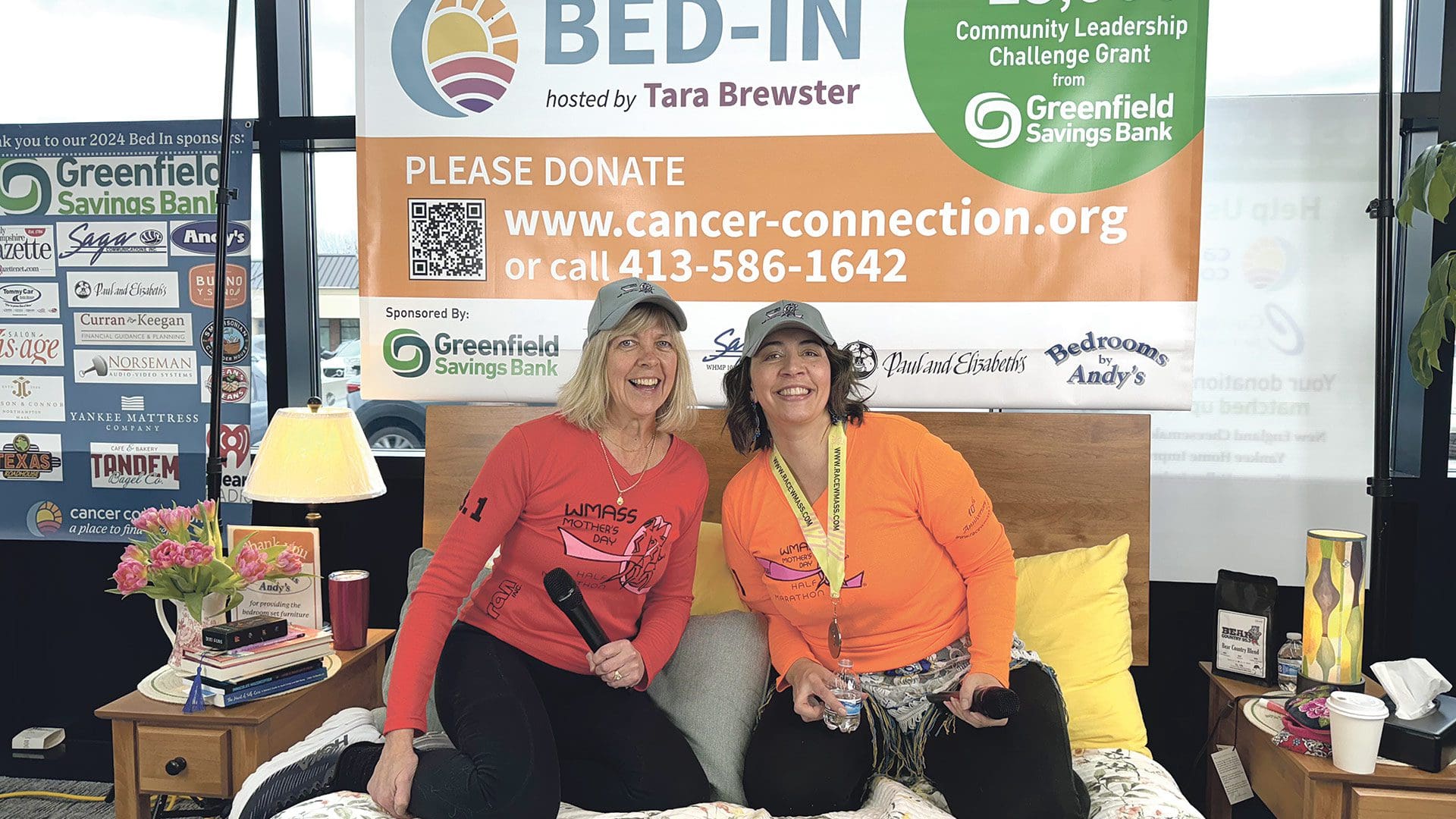
Sue Monahan (left), creator and director of the Mother’s Day Half Marathon, with Tara Brewster, host of Bed In for Cancer Connection.

Sue Monahan (left), creator and director of the Mother’s Day Half Marathon, with Tara Brewster, host of Bed In for Cancer Connection.

“I’ve noticed how many people in the community come up with creative ideas of supporting Cancer Connection. Like, we have a fifth-grade class at the Hartsbrook School that created and sold little crafts and other items for their school store, and they raised money for Cancer Connection. The whole class came and presented us with a check and toured the center.”

Meanwhile, an organization called Crippled Old Busted Bikers put on a comedy show to raise funds for Cancer Connection, a drag revue called Camilla’s Extravaganza has taken the nonprofit on as a fundraising beneficiary, and Bed In for Cancer Connection — launched by radio personality Monte Belmonte as Monte’s Camp Out for Cancer Connection, and how hosted by Greenfield Savings Bank’s Tara Brewster — has become a popular annual fundraiser.

Kline is deeply grateful for all that support.

“It’s almost impossible to put into words the impact this organization is having on so many individuals, even if they’re coming just for a support group, and they may not know anybody, and they find they’re able to sit with a group of people and now have friends and connections in the community that they didn’t have before, and they’re not feeling so lonely.”

“I think it would be an incredible hardship on the community if Cancer Connection didn’t exist,” she said. “Massages are expensive. Acupuncture is expensive. And having a place where you can unfurl and not have to watch what you say when you’re in pain, you’re scared, and you’re feeling alone … when we think about the dwindling numbers of church attendance, when belonging to a YMCA costs money, and many of our community centers don’t have as robust attendance as they used to, there are fewer places to share community.

“Cancer is a scary topic, and it’s not a topic that you can just bring up casually on the playground when you’re picking up your child, or after work, or wherever,” she added. “So we are that third space for a lot of people, and that’s really valuable to combat isolation, to build communities, to help people just alleviate the symptoms of their treatment and feel a sense of calm and relaxation and feel that they’re understood. There’s not many places that do what we do.”
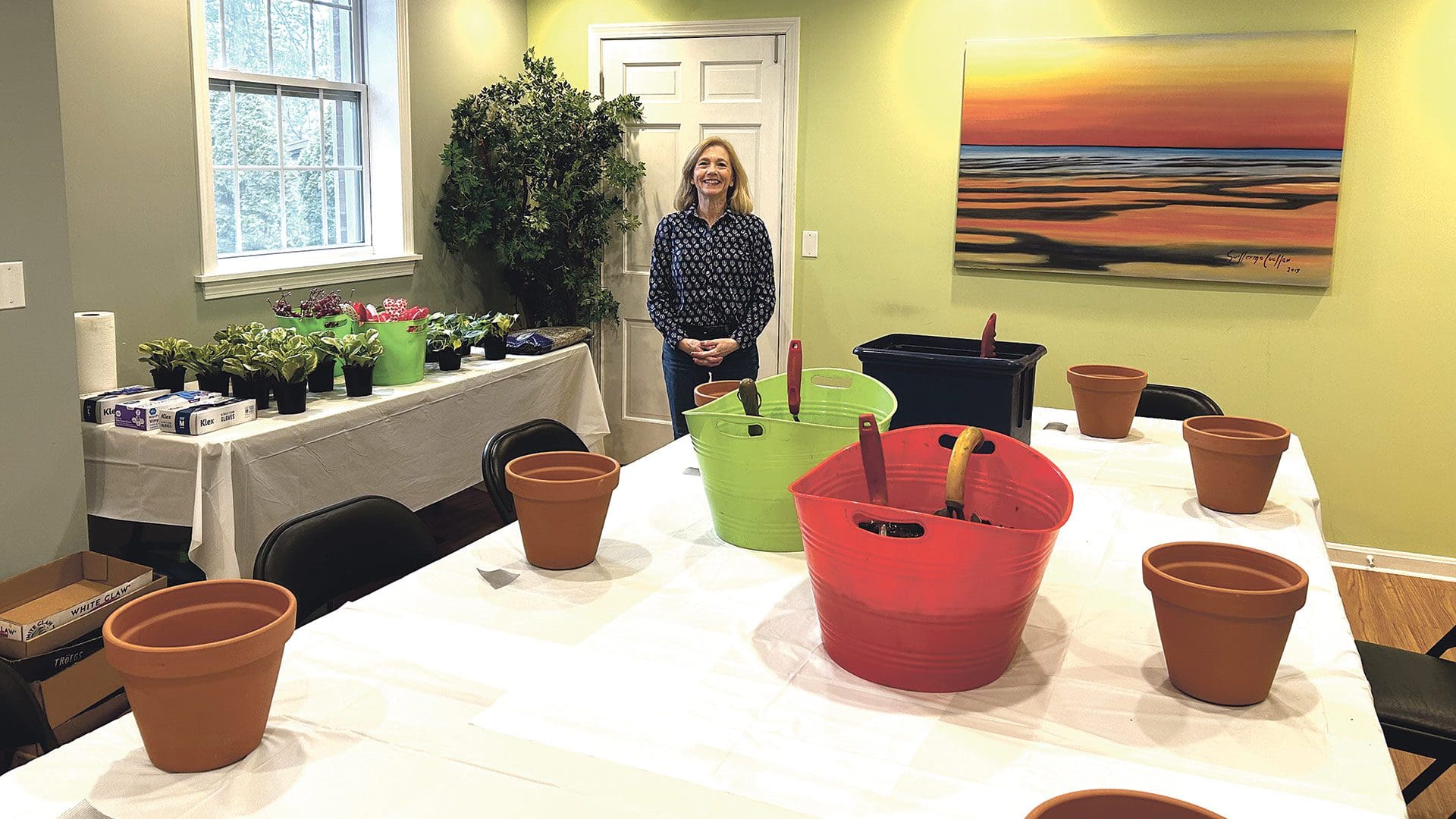
Priscilla Touhey

Priscilla Touhey prepares to lead a container gardening workshop at Cancer Connection.

Those services even extend to the free wigs Cancer Connection offers, thanks to donations from Visage Salon in downtown salon. “They do a lot of things for people experiencing hair loss, and they donate a lot of beautiful, brand-new wigs to us, for which we’re so grateful,” Kline noted. “We get a lot of donated wigs from other places as well, but they’re one of our main conduits. And it goes such a long way for someone’s self-esteem and confidence if they need to go back to work, or just go to the market, to have a hairstyle that feels comfortable to them.

“So I would say that what we offer is filling so many cracks in our community,” she went on. “And I shudder to think what would happen if we weren’t here to offer those things.”


Personal Connection

Kline’s own connection with the organization dates back about 20 years, when her mother was a participant.

“I was her caregiver at the time, and I was also a single mom. I remember being so relieved that she had a place that she could talk freely and not worry about scaring me or stressing me out or overwhelming me; she could be in a community with other people who really understood.

“My mother, thank God, is still with us,” she added. “She now volunteers at Cancer Connection.”

Kline, who earned a bachelor’s degree in religion and biblical literature at Smith College and a master’s degree in theological studies at Harvard Divinity School, spent several years overseeing leadership and organizational studies at Bay Path University before operating Chelsea Sunday Coaching for four years, a consulting business that helped many nonprofits in transition. In between, she ran for Massachusetts State Senate in 2018, garnering 41% of the vote.

But her interest all along, she said, was in supporting people who are struggling, and alleviating suffering. She found the perfect outlet for both at Cancer Connection.

“We had someone come in for a massage the other day, and we have a little form that they fill out before the treatment and after the treatment,” she explained. “They rated their level of pain, and at the end of it, they felt so much calmer, so much more relaxed, and they felt like their pain had decreased. And that’s just one person. We have maybe six or seven appointments a day over here, just from massage alone.

“So it’s almost impossible to put into words the impact this organization is having on so many individuals, even if they’re coming just for a support group, and they may not know anybody, and they find they’re able to sit with a group of people and now have friends and connections in the community that they didn’t have before, and they’re not feeling so lonely.”

Kline’s only disappointment is not being able to help more people.

“We got a call from someone in Alaska recently, and they said, ‘oh, where’s the Cancer Connection near me?’ And we had to say, ‘sorry, I don’t think there is anything. But you can join us remotely.’

“It kills me that we can’t help everybody,” she went on. “But for what we are doing, I am so grateful to our founders and so grateful to the staff and the board that saw us through COVID, that kept us going. There are so many hands that have kept this organization viable and really stayed true to the mission, helping us offer all these good things. I feel very, very lucky that I get to be a tiny part of it. It’s an awesome place.”


Law

A Regulatory Minefield

By Jason Ortiz, Esq. and Elaine Reall, Esq.


Jason Ortiz

Jason Ortiz

Elaine Reall

Elaine Reall

Marijuana, cannabis, weed, or whatever you want to call it is a growth industry. We know it’s still an illegal Schedule 1 drug under federal law; so how is it that we can grow, sell, or buy it in Massachusetts? And what effect does the regulatory minefield have on employers and the workplace?

Today’s article will explore the legal ins and outs of cannabis relative to Massachusetts workplaces. In addition, it will provide a brief overview of the current federal and state regulatory scheme.


Federal Stance and Future Legislation

Cannabis is still considered a Schedule 1 illicit substance under federal law. Most simply stated, this means that if one is found in possession of marijuana by a federal officer or border official, you’re in trouble. However, a growing number of states, like Massachusetts, have chosen to move forward and allow the sales and distribution of cannabis, either for medical or recreational use, within state borders. In fact, 24 states have legalized marijuana.

There have been several proposed bills in Congress to help move cannabis from its Schedule 1 classification (covering the most addictive and destructive substances, such as heroin) to Schedule 3 (defined as drugs with a moderate to low potential for physical or psychological dependence, such as anabolic steroids). See, for example, the Marijuana 1 to 3 Act of 2023.

“Other than the obvious relaxation of legal impediments to cannabis use, the proposed federal bills have some amazing tax benefits for the cannabis industry as a whole.”

Other than the obvious relaxation of legal impediments to cannabis use, the proposed federal bills have some amazing tax benefits for the cannabis industry as a whole. For starters, IRS enforcement action would be one less problem to worry about. Currently, cannabis businesses do not enjoy the same tax deductions as the average mom-and-pop or Fortune 500 company. This is due to Internal Revenue Code Section 280E, which does not allow certain standard business deductions due to the legal risks associated with the illegal ‘trafficking’ of a Schedule 1 drug. Cannabis businesses also face higher income-tax rates as a result of their business. Most of the proposed federal laws would remove those tax obstacles and categorize cannabis as just another product sold by just another business.

Additionally, placing cannabis into a Schedule 3 classification would allow for this industry to become regulated like any other Schedule 3 drug provider. While striving for more federal regulations may sound counterintuitive for a business, the current patchwork quilt of state regulations has not served consumers well.

As noted recently in the Boston Globe, the quality of lab test results relative to marijuana mold contamination and THC levels has raised consumer concerns in Massachusetts and may have negative repercussions relative to state cannabis businesses. More specifically, state cannabis businesses have been accused of circumventing health regulations by ‘shopping’ for laboratories with loose (or non-existent) standards in order to obtain favorable testing scores.

“A straightforward, no-nonsense standard for regulation and testing, like the one the U.S. Food and Drug Administration has for Schedule 3 drugs, would give consumers confidence that the products they are purchasing are both safe for consumption and contain the product described on the label.”

A straightforward, no-nonsense standard for regulation and testing, like the one the U.S. Food and Drug Administration has for Schedule 3 drugs, would give consumers confidence that the products they are purchasing are both safe for consumption and contain the product described on the label.

There are other pending bills that would favorably affect the cannabis industry. One of the eagerly watched bills is the SAFE Banking Act, which was meant to make banking services accessible to state-regulated cannabis businesses without the fear of federal penalties. Specifically, its provisions would allow for the profit from a state-regulated cannabis business to be considered just that, and not proceeds from an unlawful activity.

The banking industry is traditionally quite conservative when it comes to risk taking in the area of emerging or ‘unlawful’ industries. Without such banking legislation, it remains very difficult, if not impossible, for state-regulated cannabis businesses to get routine business loans and/or building or mortgage commitments. Insurance companies, also conservative entities, have begun to craft specific policies for the cannabis industry; however, much of such coverage is prohibitively expensive.

The States Reform Act is a pending bipartisan effort to change cannabis regulation by creating a permitting process on the federal level for cannabis-based businesses. This would allow federal oversight on products that cross state lines, thus allowing lawful interstate commerce.

Under current law, the states and federal government disagree on the legality of cannabis use, thus making its transportation across state lines a legally precarious task. Such product movement currently requires ‘creative’ transportation routes. Typically, it’s the smaller companies who suffer and lose out on increasing their business if they lack the resources to come up with those creative solutions.

The framework this act would establish would create federal regulations on interstate cannabis-based activities. The act would also impose a 3% federal cannabis excise-tax structure with a 10-year moratorium on increases to said tax. With the perennial federal budget shortages, this excise tax would be a welcome addition to the federal tax coffers.


Cannabis and the Massachusetts Workplace

A big question that arises regarding cannabis in the workplace is “how is drug testing affected by employee use of medical and/or recreational cannabis?” It is important to note that, if you require your applicants or employees to be drug-tested, you should have a company-wide policy that details specific scenarios that would require drug testing. After that, enforcement becomes a management issue.

A rule of thumb to follow is that employers should generally require their employees to refrain from using alcohol and/or other drugs while on the clock. Reporting for work while intoxicated, or under the influence of mind-altering drugs, should also be addressed.

The follow-up question that is often asked is “what if an employee uses marijuana for a medical purpose?” Medicinal use of marijuana is a very real and effective remedy for several conditions and must be treated seriously in the workplace to avoid any violations of the Americans with Disabilities Act.

It is not a business owner’s responsibility to probe every employee to see who has a disability and how they cope with it; they also are not required (as of yet) to accommodate the use of medical marijuana in the workplace. Employers are, however, required to have an interactive conversation with an employee to determine whether a reasonable accommodation is possible for an employee who uses medical marijuana to treat a disability.

Given the legal complexities, such situations need to be addressed on a case-by-case basis, and consulting with a business or employment lawyer well-versed in cannabis regulation is advisable.


Elaine Reall and Jason Ortiz are attorneys who specialize in labor and employment-law matters at the Royal Law Firm LLP, a woman-owned, women-managed corporate law firm that is certified as a women’s business enterprise with the Massachusetts Supplier Diversity Office, the National Assoc. of Minority and Women Owned Law Firms, and the Women’s Business Enterprise National Council. Reall was a featured panelist on a panel providing insights into the legal and regulatory status of the cannabis industry at the 2024 annual meeting of the National Assoc. of Minority and Women Owned Law Firms, which took place Sept. 15-18.

Technology

From Lab to Fab


UMass Amherst recently announced it is receiving more than $7 million from the Northeast Microelectronics Coalition (NEMC) Hub through U.S. CHIPS and Science Act funding under the Microelectronics Commons program, executed through the Naval Surface Warfare Center Crane Division and the National Security Technology Accelerator.

This award funds the first year of the project, with future funding for the entire four-year project (with a budget of $23 million) contingent on the satisfactory delivery of the milestones and the availability of funds.

The award funds collaboration between UMass Amherst and TetraMem Inc., NY CREATES, GlobalFoundries, the University of Southern California, Raytheon, BAE Systems, and Berkshire Community College, in support of efforts to accelerate domestic prototyping and expand the nation’s global leadership in microelectronics. This is one of six projects awarded to the NEMC Hub, led by the Massachusetts Technology Collaborative (MassTech) under the Microelectronics Commons Program.

“We need close collaboration across academia, small business, major semiconductor companies, and defense contractors,” said Qiangfei Xia, principal investigator of this project and the Dev and Linda Gupta professor of Electrical and Computer Engineering at UMass Amherst. “This project is a good example of that, in the spirit of transferring technology from the research lab to industry fab.”

Xia added that “the project’s objective is to transfer the CMOS memristor technology to U.S. semiconductor manufacturers, so that we can make power-efficient AI hardware for edge intelligence, with both military and civilian applications.”

Qiangfei Xia

Qiangfei Xia

“We need close collaboration across academia, small business, major semiconductor companies, and defense contractors.”

Hardware created with memristors will be able to process data locally in a time-sensitive manner while also using very little energy, as has been demonstrated by over a decade’s research by Xia and collaborators, as well as development from industrial players such as TetraMem.

The project will also offer a microelectronic fabrication course to local community colleges, such as Berkshire Community College in Pittsfield, to bridge the large supply-demand gap in the semiconductor industry. Xia, who has been teaching this course for over 10 years at UMass Amherst, says the hands-on experience of building and testing integrated circuits has prepared students well for securing competitive employment.

“We are proud to bring our revolutionary, low-power analog computing technology to this important collaboration, which will advance the U.S. semiconductor industry, educate its future workforce, and benefit the economy of the Commonwealth and the region,” said Sanjay Raman, dean of the UMass Amherst College of Engineering.

MassTech CEO Carolyn Kirk added that “this award highlights the ingenuity and expertise that exists across the Northeast when it comes to microelectronics and semiconductors. The technology development and transition partnerships being fostered by the NEMC Hub will have an enduring impact on our national and economic security.”

The NEMC Hub is a network of more than 200 organizations, including commercial and defense companies, leading academic institutions, federally funded research and development centers, and startups concentrated in eight Northeast states. Established in 2023, it is one of eight such regional hubs working to expand the nation’s global leadership in microelectronics and accelerate domestic semiconductor prototyping. It aims to foster a vibrant, connected microelectronics ecosystem to provide sustainable lab-to-fab enablement, boost education and workforce development, and spur new jobs.

“This award is a testament to the hard work, collaboration, and leadership the NEMC Hub and its members have demonstrated during the first year of the Microelectronics Commons,” NEMC Hub Director Mark Halfman said. “We have a tremendous opportunity to grow microelectronics lab-to-fab capabilities and spur the growth of game-changing technologies in this sector.”