Daily News

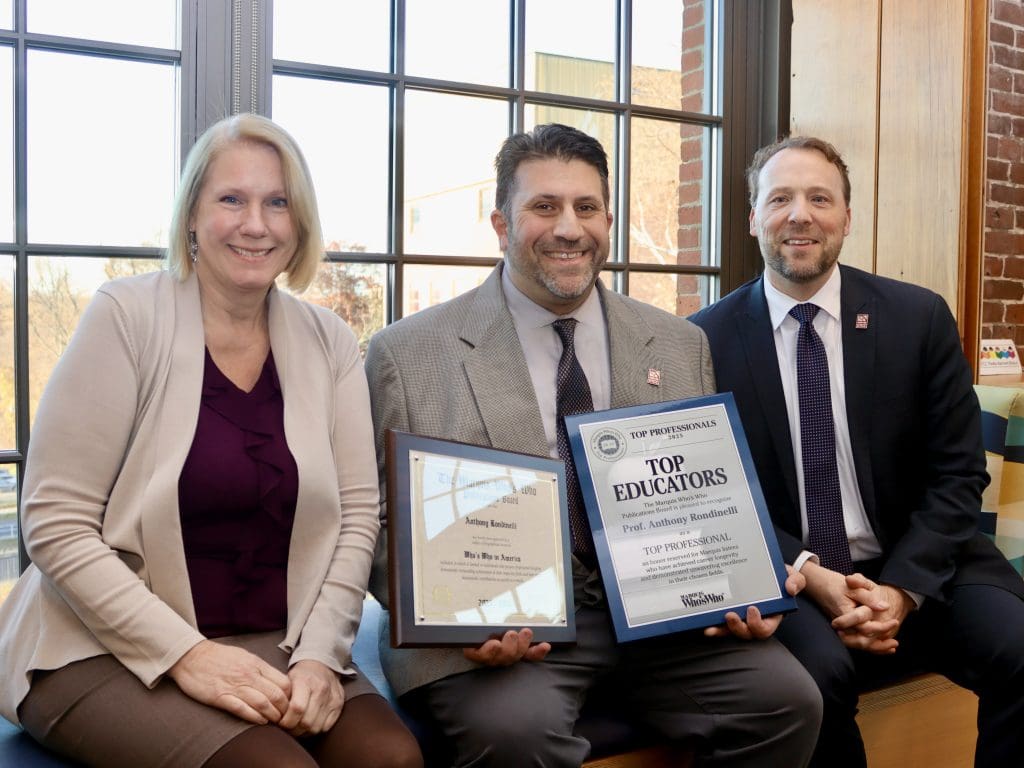
From left: STCC’s Mary Lou Vrendenburg, dean of Liberal and Professional Studies; Anthony Rondinelli, professor of Business; and President John Cook.

SPRINGFIELD — Springfield Technical Community College (STCC) Professor of Business Anthony Rondinelli has been recognized by Marquis Who’s Who Top Educators for his dedication, achievements, and leadership in accounting and education.

The national recognition highlights Rondinelli’s more than three decades of professional experience and his commitment to both his students and the community.

“When Marquis contacted me, I was completely floored,” Rondinelli said. “It’s a real honor.”

Raised in Springfield, Rondinelli attended STCC after graduating from Cathedral High School (now Pope Francis Preparatory School), saying affordability and opportunity made the decision clear.

“STCC was a great fit for me because I could balance my work life with my studies,” said Rondinelli, a 1992 graduate. “Affordability was very important. With my dad passing away when I was 8 years old, our family didn’t have a lot of financial means.”

He graduated from STCC with an associate degree in business administration and finance and was recognized in the National Dean’s List for academic achievement. He went on to earn a bachelor’s degree from Westfield State University and two master’s degrees in management and accountancy from Western New England University, graduating summa cum laude.

Before joining STCC, Rondinelli built a wide-ranging career in business and finance, serving as a district sales and marketing manager for Stop & Shop supermarkets and later holding senior consulting and accounting positions with MassMutual Financial Group, Lincoln Financial Group, GE Financial Assurance, and Corbin & Tapases, P.C.

In 2013, after several years teaching part-time at local colleges, Rondinelli returned to STCC as an adjunct professor and then became a full-time faculty member in 2014.

“STCC’s been so important to my career and my own self-development over the years,” he said. “Without STCC, I don’t know if I would have ever come back and entered teaching, a career that I really love.”

Today, he is a full professor of Business and a respected leader on campus. He teaches a range of courses in accounting, personal income tax, finance, marketing, and management, and advises students in STCC’s Business Club. Known for his compassion and creativity in the classroom, he once learned to read Braille to support a blind student enrolled in his course.

STCC President John Cook congratulated Rondinelli and described him as the embodiment of the community college mission. “First and foremost, Anthony is a wonderful human being. Knowing as well that he is deeply committed to student success is part of the special formula that makes community colleges, and STCC specifically, a place for transformation. We are proud to see him recognized for his commitment to teaching and service.”

In addition to his teaching, Rondinelli is the president of Anthony Rondinelli Tax and Accounting Services LLC, which provides tax and accounting support for individuals, small businesses, and nonprofits. His courses in personal income tax preparation have helped STCC students secure jobs with Liberty Tax, H&R Block, and Jackson Hewitt immediately after completing the class.

Rondinelli also contributes regularly to online personal finance platforms, including wallethub.com, and serves on numerous campus committees and the STCC Foundation board.

Looking ahead, he hopes to pursue a doctoral degree in accounting while continuing to mentor students and strengthen STCC’s connection to the regional business community.

“To me, when I see that light go off in the mind of a student, that’s very fulfilling,” he said. “It’s been the most rewarding thing I’ve ever done professionally.”

Daily News

Brett Brbovic

NORTH ADAMS — MountainOne announced the appointment of Brett Brbovic as senior vice president and chief financial officer of MountainOne Financial, MHC and its subsidiary, MountainOne Bank. Brbovic will join the leadership team operating from the company’s headquarters in North Adams.

In his capacity as chief financial officer, Brbovic oversees MountainOne’s financial strategy, operational efficiency, and balance sheet risk management. Reporting directly to President and CEO Robert Fraser, he works closely with other senior leaders to align financial and operational goals with the organization’s strategic vision.

Brbovic joins MountainOne with more than 18 years of experience in the financial services industry. A graduate of Western New England University with a master’s degree in accounting, his career spans leadership roles in accounting, financial strategy, and executive management, most recently serving as executive vice president and chief financial officer of Berkshire Bank and its parent company, Berkshire Hills Bancorp.

He succeeds Steve Owens, who announced his retirement from MountainOne following a 14-year tenure as chief financial officer, chief operating officer, and chief information officer. Owens’s departure coincides with the recently announced parent company merger between MountainOne Financial, MHC, and Mechanics Bancorp, MHC, slated for completion on Jan. 1, 2026. Owens will continue in his roles as COO and CIO through completion of the merger.

“We’re thrilled to welcome Brett to MountainOne,” Fraser said. “His depth of experience and presence in the Berkshire community make him an ideal fit for our organization. His previous experience will be tremendously helpful as MountainOne Financial becomes the parent company of MountainOne Bank and Mechanics Cooperative Bank as of January 1, 2026.”

Added Brbovic, “joining MountainOne at such a pivotal time in its growth is an exciting opportunity. I look forward to working with Bob Fraser and the leadership team to advance MountainOne’s strategic goals and support its continued success.”

Daily News

NORTH BROOKFIELD — Stone & Lime Historic Restoration Services, a landmark restoration specialist, announced it has hired Justin Billings to join its leadership team as vice president of Operations. Billings will oversee historically sensitive and landmark restoration projects across the Stone & Lime portfolio, which includes significant preservation programs among both public and private clients.

Billings joins Stone & Lime after two decades in construction management with one of the region’s largest general contractors, managing both new construction and renovation projects. His passion for preservation makes him a natural fit for the Stone & Lime leadership team, and he has overseen notable projects like the restoration of the Trinity College Long Walk, multiple renovation and restoration projects at Wadsworth Atheneum Museum of Art, and repairs and updates to the Travelers Tower, all in Hartford, Conn. In addition to his deep project management experience, Billings is also a LEED-certified professional.

As Stone & Lime continues to expand its portfolio of work both in terms of geography and complexity, it was necessary to add a seasoned professional like Billings to its ranks. His experience will play a significant role in supporting ongoing restoration projects, including National Parks Service-managed sites like the Cape Lookout Lighthouse in North Carolina’s Outer Banks and Fort Jefferson at the Dry Tortugas National Park in the Florida Keys.

“We are in the fortunate position of being awarded new and exciting restoration projects around the country and, as such, saw an opportunity to add a respected industry leader to our team,” said Chris Dabek, vice president of Stone & Lime. “In addition to a sterling track record for client service and having the ability to balance passion and practicality when it comes to landmark restoration work, he will also serve as a resource for our project managers who can tap into his experience working for recognized institutions across the Northeast.”

Billings holds bachelor’s and master’s degrees in civil engineering from Worcester Polytechnic Institute.

Daily News

SPRINGFIELD — Rocky’s Ace Hardware announced the results of its annual Round Up for Pets fundraiser. Customers at participating Rocky’s stores in Western Mass. helped raise a total of $7,663.06, while stores nationwide collected a combined $45,646.45. These donations will go directly to care for rescued and surrendered animals, ensuring their needs are met as they wait for their forever homes.

“We are so grateful to our customers for their generosity,” Rocky’s Ace Hardware President and CEO Rocco Falcone II said. “This fundraiser makes a real difference for the shelters and the animals they care for. Every dollar helps provide food, medical care, and comfort to pets who are waiting for loving families.”

Participating Rocky’s locations included the stores on Island Pond Road and Liberty Street in Springfield and the stores in Agawam, East Longmeadow, Ludlow, Palmer, South Hadley, and Westfield.

Local shelters benefiting from the year’s round-up include the Thomas J. O’Connor Animal Control & Adoption Center and Dakin Pioneer Valley Humane Society in Springfield, Second Chance Animal Services in East Brookfield, and Westfield Animal Control and Shelter.

“Pets are family,” Falcone added, “and we’re proud to offer our customers an easy way to make a positive impact in the lives of animals in need.”

Daily News

SPRINGFIELD — The Entrepreneurial & Business Collaborative (E&BC), a Springfield-based, community-rooted organization, was recently selected to serve as the Pioneer Valley regional hub by the Massachusetts Clean Energy Center (MassCEC) and will receive four grants totaling up to $1,195,000. E&BC will be one of only two regional hubs selected in the state of Massachusetts to receive the Climate-Critical Underrepresented Business Support (CUBS) grant alongside BECMA.

The first two grants include a $600,000 CUBS grant designed to expand the clean energy workforce pathways for individuals, entrepreneurs, training providers, and business support partners throughout Western Mass., which will also help reduce barriers for minority- and women-owned businesses (MWBE); and a regional spoke award, ensuring strategic integration of spoke procurement with the award funding up to $135,000.

MassCEC launched the clean energy business support initiative to address a major statewide challenge: MWBEs are underrepresented in the clean energy sector and face barriers to accessing technical assistance, procurement opportunities, and capital. This award arrives at a critical moment, as the region works to strengthen and reconnect the systems that support business development, clean energy participation, and economic mobility across the Pioneer Valley.

E&BC was also selected by MassCEC for two additional awards:

• An Equity Workforce Training Implementation Grant. E&BC will receive a $335,000 grant award to implement its Clean Energy Electrical Training Program with a dual training track: one for individuals with prior electrical training and/or electrical trainees who have not yet completed the 600 classroom hours for licensure, and one for licensed journeyman electricians seeking specialized clean energy skills. The Healey-Driscoll administration recently announced these grants through MassCEC to grow the state’s clean energy and climatetech workforce; and

• A Climate-Critical Workforce Training, Equipment, and Infrastructure Grant. These awards support E&BC’s Clean Energy Electrical Training Program, delivered in partnership with Grounded Services, an early participant in its Consolidated Accelerator Program that now serves as a technical training partner.

While these grants build essential training capacity, they function as a spoke within a much larger system. The hub is the primary structure that ensures this training connects to real business outcomes: procurement readiness, MWBE business development, certification pathways, and coordinated access to capital. In other words, the awards strengthen the workforce piece, but the hub turns that training into long-term economic opportunity.

“These grants validate the work we have been building for years to create pathways for people and businesses historically excluded from opportunity,” said  Ron Molina-Brantley, E&BC’s co-founder and managing partner. “It also positions E&BC as an anchor institution for clean-energy access in Western Mass. while strengthening our ability to connect talent, businesses, and partners in a coordinated system built to last.”

This partnership with MassCEC strengthens E&BC’s community-based research model and reinforces its core belief that MWBEs deserve coordinated, accessible pathways into the future economy. As this hub model grows, it is designed to support workers, entrepreneurs, and MWBEs through every stage of growth, aligning workforce pathways, entrepreneurial readiness, and clean-energy participation into one ecosystem.

Daily News

HOLYOKE — Today, Nov. 25, at 3 p.m., community volunteers will visit the HCC MGM Culinary Arts Institute to pick up 150 cooked turkeys, along with assorted sides (mashed potatoes and sweet potatoes) prepared by Holyoke Community College culinary arts students to help feed hungry people this holiday season.

Their efforts are on behalf of the Compassion Project, founded by Areliz Barbosa, to deliver meals to hungry people on Thanksgiving. This marks the 23rd year of Barbosa’s initiative.

Last year, the HCC culinary arts crew helped the Compassion Project give out 1,000 hot meals for Thanksgiving. This year, Chef Tracy Carter, chair of the HCC culinary arts program, integrated the cooking of turkeys and Thanksgiving sides into the culinary arts curriculum to help meet the agency’s goal of delivering 2,000 hot meals.

Carter said the students and staff have been in production in the culinary arts institute kitchen all day today, getting the food ready for the 3 p.m. pickup. The HCC MGM Culinary Arts Institute is located at 164 Race St., in Holyoke.

The food will be taken to Gran Cocina on High Street in Holyoke, where hot meals will be available for pickup or sit down on Thanksgiving Day.

HCC culinary arts students also prepared grab-and-go bag lunches for people participating in the 16th annual March for the Food Bank, as marchers, led by radio host and march leader Monte Belmonte, passed the Culinary Arts Institute on Monday on the Holyoke leg of their two-day, 43-mile trek from Springfield to Greenfield.

Daily News

GREENFIELD — At its November meeting, the Greenfield Community College (GCC) Foundation celebrated new leadership and fresh perspectives on its board of directors while honoring four members who completed their six-year terms of service.

Departing members Deb Berryere (president), Ann Barker (vice president), Jacqui Zuzgo, and Savitri Rambissoon were recognized for their commitment to the college and the foundation’s mission of supporting student success. Under their leadership, the foundation strengthened its scholarships, endowment, and community partnerships, advancing opportunities for students across the region.

Succeeding them in leadership, the board elected James Fitzgerald as president and Jane Wolfe as vice president. Fitzgerald and Wolfe both joined the foundation board in 2023 and bring experience in business and community service.

The foundation also welcomed four new members whose expertise reflects the diverse strengths of Franklin County and Western Mass:

• Tim Grader, a real estate investor, broker, and property manager, is the owner of Cohn & Co. Real Estate and Stillwater Real Estate Services. A GCC alumnus, he brings a deep commitment to regional revitalization, historic preservation, and lifelong learning.

• Colleen Kucinski, executive director of the Literacy Project, has spent more than 25 years advancing educational access through leadership in higher education and philanthropy, including 18 years at GCC and eight years at the Community Foundation of Western Massachusetts.

• Hannah Rechtschaffen, executive director of the Greenfield Business Assoc., is a leader in creative placemaking and community development. Her background includes strategic roles with W.D. Cowls and the Lindy Institute for Urban Innovation, where she built partnerships that drive local economic growth.

• Mary Siano, a social worker and civic leader, has dedicated her career to community service and advocacy. She has served on local boards and committees including the Greenfield School Committee, the Community Health Center of Franklin County, the Literacy Project, and the League of Women Voters of the Greenfield Area. A longtime GCC volunteer and annual campaign co-chair, she continues to strengthen community engagement across Franklin County.

“Each of our new board members brings a unique perspective and a deep commitment to education, equity, and community well-being,” said Alexis Page, executive director of the GCC Foundation. “Together, we’re building on decades of local generosity and ensuring that GCC students have the support they need to thrive.”

Features Restaurants

Morning Glory

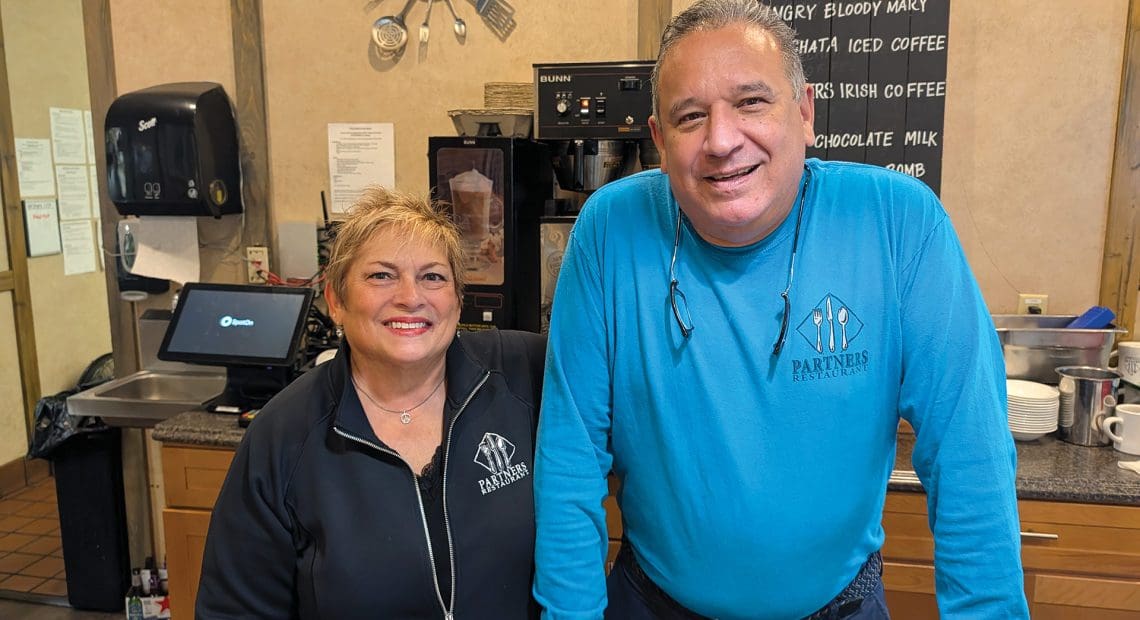
Sue and Mark Tansey are partners in both business and life.

Sue and Mark Tansey are partners in both business and life.

Mark Tansey didn’t exactly plan his path into the culinary world.

“My brother kind of pushed me into the business,” he recalled. “My mother died when I was 15, and I had to cook at home. I wanted to go to college, and he goes, ‘why don’t you go to cooking school?’ So I ended up going to Johnson & Wales.”

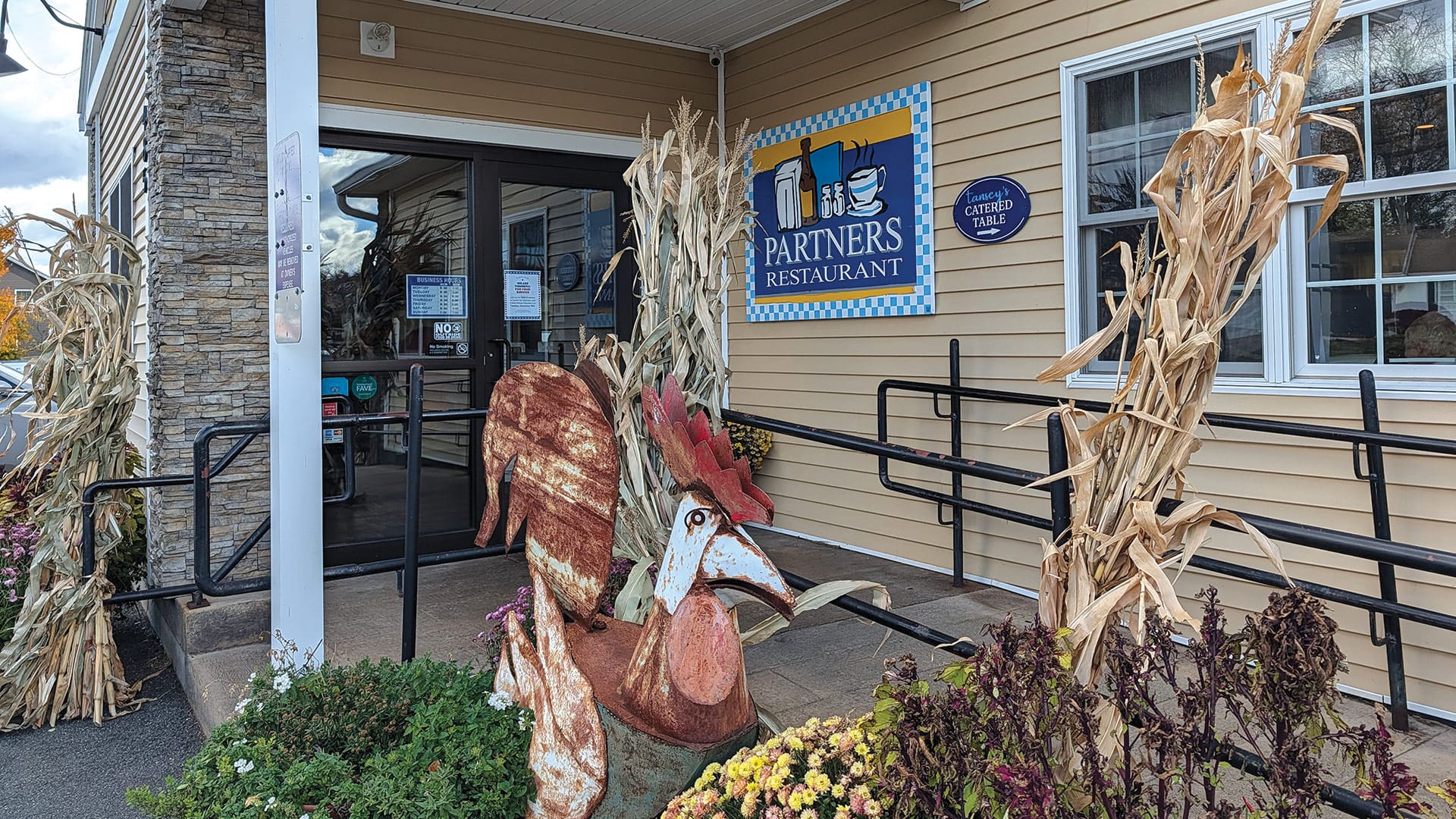
In addition to completing that two-year program, Tansey worked at the Monte Carlo in West Springfield, and later at Hillbrook House in Westfield, then Springfield Country Club. The first two of those establishments are long gone, but his next venture — Partners Restaurant & Catering in Agawam — is still going strong, more than 40 years later.

“A woman came to me and said, ‘I have this little breakfast-lunch place in Agawam, Mark, if you want to think about it,’” he recalled. That was 1984, and Partners had been open just a couple of years when its then-owner wanted to unload it. Tansey, then just 24 years old, liked what he saw, secured a $45,000 loan from Westbank, and started crafting a plan, both culinary and financial.

“I had to learn how to write the financials, how to figure out, ‘well, if I have one dishwasher and a cook and a server, how much do I need?’ But then I realized, for the first couple of years, I was the dishwasher and the cook.”

His first marriage would end in those early years, and he wound up bonding with his current wife (and business partner) of 33 years, Sue, over food; her family owned Angy’s Tortellini at the time, and she ran a small catering business.

And now, they’re celebrating four decades running a restaurant and catering business that has outlasted challenges ranging from a devastating fire in 2014 to the COVID-19 pandemic (more on both later), emerging from it all with a loyal clientele, about 50 employees, and even a succession plan (the Tanseys’ daughter, Siena, is deeply involved in the business).

In short, there’s plenty to celebrate, which they did on Nov. 22 with an admittedly late 40th anniversary event (the actual milestone was last year) at the restaurant, where they expected about 400 people to show up.

“We have a lot of repeat business, and we have people that say, ‘I can’t wait until they put out those specials because I want to see what I’m going to have this weekend.’”

The clientele has been multi-generational, Sue said, but so has the staff.

“We’ve had multiple third-generation family members working for us. We’ve had the mother, then their daughter, and now the granddaughter working for us — I’d say a good five families like that. It’s so cool.”

Both Tanseys attribute much of the restaurant’s success to its staff. In the early days, Sue said, “if we came home on a Sunday and we were over $1,000, we’d be like, ‘oh my God.’ Now, we serve 400, 500 people on a Sunday.” And they appreciate those putting in all the work to make that happen.

“Everybody makes fair money; I pay them well. I don’t chintz around. And if we do have a great week, they get extra,” Mark said. “How is that money going to enhance my life? I could use it, but in the long run, by giving everybody 50 bucks, it works out better, because they’re going to stay, we have less turnover, less training. I didn’t know that in the first five years of business, but after a while, we did.”

The result is clear in the waitstaff’s hustle and demeanor, he added. “That’s how we want it. I want people to feel fun and not have a grumpy person greeting them.”


Serving Up Challenges

Sept. 3, 2014 was not one of those fun days.

That’s the night the Tanseys were summoned to the restaurant, which had suffered a major electrical fire caused by degraded conduits across the street.

“If you looked in the window, you wouldn’t think we had a fire, but it was all electrical damage; everything was permeated with smoke,” Sue said. “They ended up having to take the building down.”

Thankfully, an insurance policy allowed them to operate at another spot, and they opened Partners at the Cup on Route 20 in West Springfield the following June. Before that, however, “we still had catering to do,” Mark said. “Because I had a rapport with Six Flags, they had a kitchen out in the back. It was winter, and they weren’t using their stoves and ovens, and they didn’t charge us at all.”
First Baptist Church of Agawam also allowed the couple to cater from there, so they paid rent to the church to do that for a while. “We had people come out of the woodwork to help us rebuild,” Mark said.

Partners reopened in December 2015, and the couple ran both locations until 2020, when the Cup closed for good.

As difficult as the fire was, however, COVID may have been worse. “I think I still have PTSD,” Sue told BusinessWest. “It was difficult to figure out the PPP, but we rallied, and we came up with menus. We had family dinners. We did takeout. We had a few employees that weren’t afraid, and we ran a skeleton crew.”

That was when Siena came home from Boston, where she had she studied hospitality and was working at the Omni Parker House until it closed, and started a new career at Partners.

“We also fed our employees; we would have employee dinners.” Sue recalled. “It was very hard work. We did fish and chips Friday night, and people would pre-order. We had a little side window that worked out perfectly, so people didn’t have to come in.

“But every Monday, we waited for [then-Gov.] Charlie Baker to drop another hammer. Every Monday, there was another restriction on us. It was awful. But then we were able to open outside, and we put up a big tent. Eventually, we ended up coming back inside, though we had to go from 80 seats down to 40, with barriers between them. But we still had our loyal employees.”

“Thank God for them,” Mark quickly added. “Especially during COVID. We were not surprised, but taken aback by how much support we got.”

It’s not just the restaurant that has succeeded, but a catering business that has taken many forms and operated in many settings over the decades, and now includes an event space that opened two years ago right on the Partners property, which can accommodate parties of more than 400 people.

On both sides of the business, Mark said, they use as much locally sourced, fresh food as possible, from produce to breads — no canned vegetables anywhere. And patrons look forward to the ever-changing specials board, which benefits not only their taste buds, but the bottom line.

“You can get bacon and eggs anywhere at $6, $7, $8. But I want to get a higher check average because I have a good payroll,” he explained. “So I’ll try to do dinner entrees for breakfast specials. Like, this weekend we have beef brisket. And now, instead of getting steak and eggs for $14.95, you can get smoked beef brisket for $16.95.

“We have a lot of repeat business,” he added, “and we have people that say, ‘I can’t wait until they put out those specials because I want to see what I’m going to have this weekend.’”


Off the Air

Mark has taken his passion for cooking to the airwaves in past decades, hosting a local cooking TV show, Continental Cuisine, and a talk radio show, The Latest Dish, as well as participating in cooking demos and seminars for the Big E, Angy’s Tortellini, Big Y Foods, and various clubs and organizations.

“At that time, people wanted quick meals they could make at home,” he told BusinessWest. “People can go to a restaurant and get chicken parm; I would show them how to do a chicken parm or something simple. Speed scratch cooking — that’s kind of what I did. And then I did some more upscale stuff, because I have some background in that too. But I wanted the people to know that you can do this at home.”

Sue thinks her husband could have become nationally known.

“Food Network was just starting to come out, Emeril was getting popular, and I remember thinking I should send in a tape for Mark,” she said. “And I never did it.”

“I could have been famous,” he said, then flashed a warm smile at his partner. “But look at our life.”

Education

Challenging the Assumptions

Physicists have long believed that black holes explode at the end of their lives, and that such explosions happen — at most — only once every 100,000 years. But new research published in Physical Review Letters by physicists at UMass Amherst has found a more than 90% probability that one of these black hole explosions might be seen within the decade, and that, if we are prepared, our current fleet of space and earthbound telescopes could witness the event.

Such an explosion would be strong evidence of a theorized but never observed kind of black hole, called a ‘primordial black hole,’ that could have formed less than a second after the Big Bang occurred, 13.8 billion years ago. Furthermore, the explosion would provide a definitive catalog of all the subatomic particles in existence, including the ones science has observed, such as electrons, quarks, and Higgs bosons; the ones so far only hypothesized, like dark matter particles; as well as everything else that is, so far, entirely unknown to science.

Andrea Thamm

Andrea Thamm

“The lighter a black hole is, the hotter it should be, and the more particles it will emit. As PBHs evaporate, they become ever lighter, and so hotter, emitting even more radiation in a runaway process until explosion. It’s that Hawking radiation that our telescopes can detect.”

This catalog would finally answer one of humankind’s oldest questions: from where did everything in existence come?

Science knows that black holes exist and has a good understanding of their life cycle: an old, large star runs out of fuel, implodes in a massively powerful supernova, and leaves behind an area of spacetime with such intense gravity that nothing, not even light, can escape. These black holes are incredibly heavy and essentially stable.

But, as physicist Stephen Hawking pointed out in 1970, another kind of black hole — a primordial black hole (PBH), could be created not by the collapse of a star, but from the universe’s primordial conditions shortly after the Big Bang.

PBHs, like the standard black holes, are so massively dense that almost nothing can escape them — which is what makes them ‘black.’ However, despite their density, PBHs could be much lighter than the black holes so far observed. Furthermore, Hawking also showed that black holes have a temperature and could, in theory, slowly emit particles via what is now known as ‘Hawking radiation’ if they got hot enough.

“The lighter a black hole is, the hotter it should be, and the more particles it will emit. As PBHs evaporate, they become ever lighter, and so hotter, emitting even more radiation in a runaway process until explosion. It’s that Hawking radiation that our telescopes can detect,” said Andrea Thamm, co-author and assistant professor of Physics at UMass Amherst.

Yet, while we should be able to, no one has ever directly observed a PBH.

“We know how to observe this Hawking radiation,” said Joaquim Iguaz Juan, a postdoctoral researcher in physics at UMass Amherst. “We can see it with our current crop of telescopes, and because the only black holes that can explode today or in the near future are these PBHs, we know that, if we see Hawking radiation, we are seeing an exploding PBH.”


Asking the Right Questions

Though physicists since Hawking’s time have thought that the chances of seeing an exploding PBH are infinitesimally slight, Iguaz Juan noted that “our job as physicists is to question the received assumptions, to ask better questions, and come up with more precise hypotheses.”

The team’s new hypothesis? Get ready now to see the explosion. “We believe that there is up to a 90% chance of witnessing an exploding PBH in the next 10 years,” says Aidan Symons, one of the paper’s co-authors and a graduate student in physics at UMass Amherst.

In its work, the team explores a ‘dark-QED toy model.’ This is essentially a copy of the usual electric force as known, but which includes a very heavy, hypothesized version of the electron, which the team calls a ‘dark electron.’

The team then reconsidered long-held assumptions about the electrical charge of black holes. Standard black holes have no charge, and it was assumed that PBHs are likewise electrically neutral.

“We make a different assumption,” said Michael Baker, co-author and an assistant professor of Physics at UMass Amherst. “We show that, if a primordial black hole is formed with a small, dark electric charge, then the toy model predicts that it should be temporarily stabilized before finally exploding.”

Taking all known experimental data into account, the team found that a PBH explosion could potentially be observed not once every 100,000 years, as previously thought, but once every 10 years.

“We’re not claiming that it’s absolutely going to happen this decade, but there could be a 90% chance that it does,” Baker said. “Since we already have the technology to observe these explosions, we should be ready.”

Added Iguaz Juan, “this would be the first-ever direct observation of both Hawking radiation and a PBH. We would also get a definitive record of every particle that makes up everything in the universe. It would completely revolutionize physics and help us rewrite the history of the universe.”

Wealth Management

Finding a Way Home

By Jeffrey Liguori

In many ways, the U.S. economy is still dealing with the effects of the global financial crisis of almost two decades ago. It was a massive reset of our entire financial system, with one segment, residential real estate, still evolving from that disruption.

The boom of housing and real estate prices, exacerbated by exotic derivative investment vehicles tied to mortgages of borrowers with poor credit, led to an historic bust in the real estate industry. Following the crash, banks significantly tightened up their lending standards, and home building, illustrated by housing starts, collapsed as demand for new homes evaporated.

Consider this: the number of new housing units rose from roughly 1.65 million to a peak of 2 million per year from 1999 to 2005 before contracting to fewer than 500,000 in 2009. By contrast, the number of 20- to 30-year-olds in the country, the typical first-time homebuyer, which drives much of the market, increased from 72 million to 78 million from 1990 to 2000. And while that is a modest increase of about 8% over a decade, the growth in that cohort of the population grew by nearly 40% in the prior decade, from 1980 to 1990.

Jeffrey Liguori

Jeffrey Liguori

“When the Fed raised rates to fight inflation from 2022 to 2024, mortgage costs climbed rapidly, and higher rates reduced the number of homeowners willing to sell or upgrade. Contrary to economic theory, supply shrank while demand stayed high, putting home ownership out of reach for many.”

The combination of population growth and a booming economy prior to 2007 worsened the housing availability issue, which was already running short of demand. The economic downturn simply put that supply and demand imbalance on hold. Until COVID.

Today, housing affordability remains a significant problem. COVID stimulus and the shift to remote work caused demand to surge, driving up prices. When the Fed raised rates to fight inflation from 2022 to 2024, mortgage costs climbed rapidly, and higher rates reduced the number of homeowners willing to sell or upgrade. Contrary to economic theory, supply shrank while demand stayed high, putting home ownership out of reach for many.

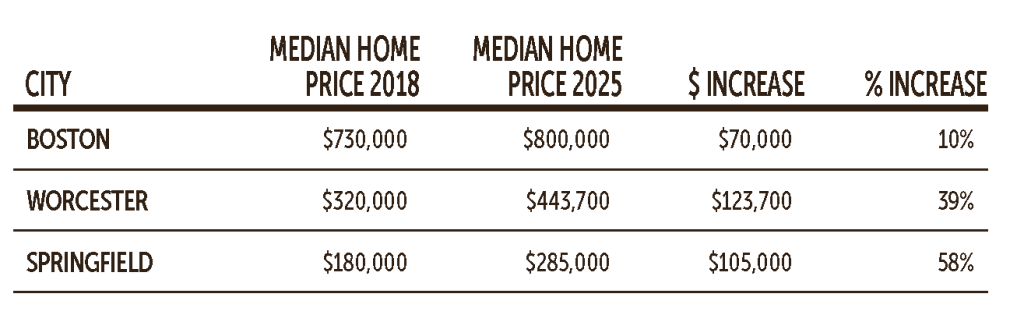
Individuals and families at the lower end of the economic scale are at a greater disadvantage, consistent with our bifurcated economy, as illustrated here:

Recently, President Trump proposed the idea of a 50-year mortgage as a solution to the housing affordability problem. The concept may have originated from Bill Pulte, director of the Federal Housing Finance Agency (FHFA), who has strong ties to the homebuilding industry. Pulte’s grandfather, William Pulte, founded Pulte Homes, now the third-largest home builder in the U.S., with annual sales exceeding $17 billion.

The FHFA is central to residential real estate as an overseer of the mortgage market and conservator of Fannie Mae and Freddie Mac, which protects taxpayers and maintains the stability of the housing finance system. The FHFA, with its access to valuable data and policy tools, is in a unique position to help alleviate the issue.

Extending the term of a mortgage from 30 to 50 years means lower monthly payments for the borrower. To put affordability in perspective, prior to the pandemic, the median home price in the U.S. stood at approximately $260,000, with a 30-year fixed mortgage rate averaging 3.8% and 20% down, resulting in monthly payments near $1,200. Currently, the median price has risen to about $420,000, while mortgage rates have increased to around 6.4%, pushing monthly payments above $2,100.

This means the cost of purchasing a typical home today is more than double what it was before the pandemic and requires significantly more cash down. The cost has put buyers on the sidelines. But the persistent shortage of supply has kept prices stable at historically high levels. J.P. Morgan estimates there is a shortage of almost 3 million homes, which could take a decade to resolve.

The chief economist for the National Assoc. of Realtors, Lawrence Yun, says the “small savings” on monthly payments for a 50-year mortgage has tradeoffs. For one thing, building equity in one’s home, often the largest asset to most families, would take considerably longer.

According to Yun, “it would also take almost 40 years to pay off half the balance, meaning most borrowers would not begin building meaningful equity until the final decade.” Which simply reinforces the current problem of existing homeowners not trading up because financing costs are too high. It is unlikely that someone would use their current equity and take on a loan for another 50 years just to be able buy a nicer home at the same monthly cost.

And what if this type of mortgage sparks demand for homebuyers? Without greater supply, it will undoubtedly drive up prices, thus not solving the affordability problem at all.

Analysts say that, to implement a 50-year mortgage, Trump would need Congress to repeal the law that prohibits government-backed loans with terms longer than 30 years. Some believe regulators have the executive authority to create this type of loan.

Jim Millstein, who served as the Treasury Department’s chief restructuring officer from 2009 to 2011, noted that “a lot of so-called innovations occurred to make mortgages more affordable prior to the financial crisis. It proved to be a disaster.”

Time will tell if this is a crisis in the making or the start of a solution to the housing problem.


Jeffrey Liguori is executive vice president of Bradley Foster & Sargent Inc.