Daily News

SPRINGFIELD — MassMutual announced it has elected Michael Rollings to the company’s board of directors.

“With his extensive leadership experience at financial services companies that have a proven track record of growth and market leadership, Mike is an excellent addition to our board of directors,” said Roger Crandall, chairman, president and CEO of MassMutual. “Along with his deep financial and operational background in both insurance and asset management, Mike has an exceptional understanding of how companies can best deliver long-term value to their customers. His insights and perspectives will greatly benefit both MassMutual and our policyowners.”

Rollings most recently served as chief financial officer and managing director of Finance at the Vanguard Group, a position he held from 2016 until his retirement this past June. In that role, he led financial strategy and planning for the global asset investment manager with more than $11 trillion in assets under management and oversaw more than 1,800 people across corporate financial functions, including treasury, financial planning and analysis, accounting operations, and fund financial services. During his tenure, he served as a strategic advisor to Vanguard’s CEO, board of directors, and other key stakeholders, while also leading a transformation of the company’s corporate and fund financial operations to best support investment and shareholder return.

Prior to his time at Vanguard, Rollings held leadership roles at MassMutual for 15 years, including leading the company’s Capital Markets and Treasury Operations team and serving as chief financial officer from 2006 to 2016.

“I’m deeply appreciative of the opportunity to join the board of directors at a purpose-driven company like MassMutual, which has continued to grow, thrive, and deliver value for its policyowners and customers for nearly 175 years,” Rollings said. “I look forward to offering strategic counsel and insights in my new role, ultimately helping the company continue to fulfill its purpose of helping people secure their future and protect the ones they love.”

Rollings has served on several boards throughout his career, including the Financial Accounting Foundation, the Naismith Memorial Basketball Hall of Fame, Springfield Museums, and the Georgetown University board of regents. He earned a bachelor’s degree in business administration from Georgetown University and a master’s degree in business from Northwestern University’s J.L. Kellogg School of Management.

Daily News

BOSTON — The Executive Office of Labor and Workforce Development (EOLWD) released Massachusetts unemployment and job estimates for September, with data indicating 1,200 fewer Massachusetts residents were employed, including individuals in private and nonprofit jobs plus self-employed individuals and entrepreneurs, while payroll jobs decreased by 11,100. Additionally, the unemployment rate (4.7%) and labor force participation rate (66.8%) both decreased. The labor force decreased in September as well by 2,700 for a total of approximately 3,961,000.

October state employment and unemployment news releases will not be published due to the recent federal government shutdown. November unemployment and job estimates have not been scheduled by the U.S. Department of Labor’s Bureau of Labor Statistics (BLS).

Despite a net loss in payroll jobs in September, there was some positive growth in BLS categories, including leisure and hospitality, information, and financial activities. In addition to payroll data, BLS also reports data indicating that 1,200 fewer Massachusetts residents were employed in September and 20,000 more were employed over the year. Unlike payroll data, employed residents data includes individuals who are self-employed (such as contractors, physicians, and drivers) and is not captured in payroll job data.

“The data released today tells us less about what’s happening now and more about what was happening a few months ago,” said Mark Rembert, chief economist for EOLWD’s Department of Economic Research. “The good news is that the key labor market indicators that we do have for October and November have been stable. Seasonally adjusted initial unemployment insurance claims remain relatively flat, and job posting activity has been steady.”

Daily News

SPRINGFIELD — The Foundation for TJO Animals and the Thomas J. O’Connor Animal Control and Adoption Center (TJO) are celebrating a record-breaking Giving Tuesday, marked by exceptional community support, a highly successful adoption event, and an outpouring of generosity that far exceeded expectations.

To kick off the campaign, the foundation hosted a two-day adoption event in which all adoption fees were waived thanks to a $2,000 sponsorship from longtime supporters Ted and Barbara Hebert. Over the course of just 48 hours, 18 animals were adopted into new, loving homes.

“The adoption center was buzzing with people who wanted to support TJO and open their homes to animals in need. It was incredible to see,” said Janna Brown, executive director of the Foundation for TJO Animals.

The foundation initially set a Giving Tuesday fundraising goal of $20,000, with every dollar matched by supporters Jan and Bernadette Piepul. As donations surged, the goal was increased to $25,000 — and the Piepuls matched that as well. By the morning after Giving Tuesday, total donations had climbed to more than $57,000, making this one of the foundation’s most successful campaigns to date.

A significant portion of the funds came from Monarch Fore Charities, whose contribution exceeded $10,000 and helped propel the campaign to new heights.

“Our main goal for Giving Tuesday this year was to spread awareness about TJO — who we are and what we do for animals in the Pioneer Valley,” Brown said. “Money raised will go directly toward medical care for the never-ending influx of animals coming into TJO, as well as clinic supplies and a much-needed new washer and dryer — you wouldn’t believe the amount of laundry.”

The Foundation for TJO Animals extends its deepest gratitude to its donors, supporters, volunteers, and the community for rallying behind local animals in need. The funds raised will provide vital medical treatment, support adoption efforts, and enhance the overall well-being of animals throughout the region.

Daily News

SPRINGFIELD — The Springfield Thunderbirds established a new franchise record by collecting 8,048 stuffed animals during the 10th annual Teddy Bear Toss presented by Teddy Bear Pools & Spas inside the MassMutual Center. All donated bears will be distributed to underprivileged youth throughout Springfield and Western Mass. ahead of the holiday season.

The avalanche of teddy bears was set in motion by Jakub Stancl’s first goal of the night, part of a three-goal performance that ignited the sellout crowd of 6,793 fans inside the Thunderdome and sent thousands of stuffed animals flying onto the ice in one of the most anticipated traditions of the season.

The celebration will continue off the ice this week as Thunderbirds players, mascot Boomer, and team staff take part in the second phase of the Teddy Bear Toss. Over the course of multiple visits, the organization will deliver bears directly to more than 15 local youth-focused nonprofits, including CHD, the Boys & Girls Club of Springfield, Martin Luther King, Jr. Family Services, the Boys & Girls Club Family Center, the Springfield YMCA, Square One, the Chicopee Boys & Girls Club, and the Ronald McDonald House of Springfield, ensuring smiles reach children and families across the region ahead of the holidays.

“Seeing how the Teddy Bear Toss has grown over the past 10 years has been incredibly meaningful for our organization,” Thunderbirds President Nathan Costa said. “What started as a simple idea in our inaugural season has become one of the most impactful traditions in our community. This time of year always brings out the generosity of our fans, and few things mean more than knowing these bears will create smiles and memories for thousands of children throughout Western Massachusetts. It’s the perfect example of what this decade of Thunderbirds hockey is all about.”

First introduced during the Thunderbirds’ inaugural season in 2016, the Teddy Bear Toss has now provided more than 40,000 stuffed animals to local charities, remaining one of the organization’s signature community initiatives and one of the most beloved holiday traditions in the Greater Springfield area.

“As a fan, sponsor, and owner of a hockey team over the years, I’ve experienced a lot of special moments, but this one truly stands out,” said Ted Hebert, Thunderbirds minority owner and founder of Teddy Bear Pools & Spas. “From the energy in the building to the perfect timing of the goal that set it all off, everything about the night reflected what the Teddy Bear Toss has become over the last decade. Watching thousands of bears hit the ice — and knowing where they’re going afterward — is incredibly powerful. We’re proud to be part of a tradition that continues to make such a lasting difference in this community.”

Charitable organizations interested in receiving teddy bears may contact the Thunderbirds by calling (413) 739-4625.

Daily News

WESTFIELD — Westfield Bank announced a $5,000 donation to Revitalize CDC, a Springfield-based nonprofit that works to stabilize homes and strengthen neighborhoods across Western Mass.

“Revitalize CDC does vital work, repairing homes for veterans, older adults, families in need, and those living with disabilities to improve the health and well-being of individuals and families,” said James Hagan, president and CEO of Westfield Bank. “We’re proud to support them in making our communities better by making them healthier, stronger, and more resilient.”

Founded in 1992, Revitalize CDC has served more than 30,000 individuals and invested more than $52 million into critical home repairs, bridging food insecurity gaps through delivery of fresh foods, and providing education and support for chronic health conditions.

“Revitalize CDC is deeply grateful to Westfield Bank for their generous $5,000 contribution. Their continued partnership strengthens our mission and creates meaningful impact in the neighborhoods we serve,” said Colleen Shanley-Loveless, president and CEO of Revitalize CDC. “We especially thank Sherleen Crespo, Westfield Bank Vice president and branch manager, Revitalize CDC board member, and dedicated #GreenNFit Neighborhood Rebuild house captain, for her leadership and unwavering commitment to our work. Her hands-on support truly helps transform homes, lives, and communities,”

The donation from Westfield Bank will help fuel the organization’s efforts in home repairs, accessibility modifications, and energy efficiency upgrades, moving neighborhoods forward and supporting people who otherwise may not have access to such resources.

Daily News

WILBRAHAM — On Friday, Dec. 19, the East of the River Five Town Chamber of Commerce will host a grand opening and ribbon cutting for Daniel Dias of the Magnolia Agency, located at 95 Post Office Park, Suite 9506, in Wilbraham.

“Small businesses are the lifelines of our community, and we are excited to welcome Daniel, who brings a long history in the insurance industry,” the chamber stated. “With his extensive experience in the insurance industry, the community will surely embrace the Magnolia Agency as a valuable resource.”

The Magnolia Agency is a nationally recognized insurance agency specializing in captives, insurance, and surety for construction, manufacturing, retail, and distribution, among other industries.

“I’m excited and humbled to be part of the Magnolia Agency’s opening and managing our new office location at Post Office Park in Wilbraham. They say things happen for a reason, and fortunately, I was lucky enough to meet Rich Varrato and Lou Gold, the founders of the Magnolia Agency,” Dias said. “I began my insurance journey under the wings of my grandfather, Albert Dias. It was then that I realized I had a passion for insurance and truly enjoyed meeting new people and developing long-lasting relationships.” I am excited to bring that legacy to Wilbraham with the Magnolia Agency.”

Daily News

NORTHAMPTON — On Dec. 2, River Valley Co-op announced a contribution of more than $20,000 to support the Northampton Survival Center. This contribution was made through the co-op’s November Change for Change round-up donations at the checkouts in both the Northampton and Easthampton store locations.

This is the most recent and largest of the co-op’s last four monthly Change for Change contributions to local food security focused nonprofits, which totaled more than $62,000. These contributions included $13,745 for the Easthampton Community Center, $14,064 for the Food Bank of Western Massachusetts, $13,915 for Manna Community Kitchen, as well as the November contribution of $20,309 for the Northampton Survival Center.

Each time a customer shops at River Valley Co-op, they are given the opportunity to round up their purchase to the nearest dollar, with the extra cents going into the Change for Change donation fund. That fund is allocated each month to a local nonprofit organization nominated and chosen by co-op member votes.

“This cooperative, community-driven initiative turns small change from thousands of everyday grocery purchases into impactful contributions to support local nonprofits. Food insecurity is especially critical now with our federal government withholding SNAP benefits for several weeks and their announced cuts to this important food security program impacting tens of thousands of vulnerable community members and putting additional demands on our local food pantries to fill the gap,” said Rochelle Prunty, general manager of River Valley Co-op. “This enthusiastic food co-op shopper support shows the power of joining together with small acts of kindness to support each other: when we all give a little, it adds up to making a significant impact.”

The $20,309 raised will enable the Northampton Survival Center to keep up with high levels of increased demand from new and returning clients worried about food insecurity while they navigate threats to SNAP, heating assistance, and general economic instability.

“It’s heartening to know that this community wants to ensure our neighbors are fed,” said Heidi Nortonsmith, executive director of the Northampton Survival Center. “We expect to provide weekly groceries to more than 4,000 clients this year, and these funds help us do that. We encourage folks who are struggling to come to us, secure in knowing that we’ll always have groceries for those who need them. It’s thanks to our community that we’re able to follow through on that promise.”

The success of this campaign underscores River Valley Co-op’s long-standing commitment to supporting local organizations that promote food access, social justice, and community resilience. The Change for Change program has supported dozens of nonprofits across the region by pooling small donations at the register into substantial grants.

River Valley Co-op’s partnership with the Northampton Survival Center began when the store first opened in Northampton in 2008 and began weekly contributions of food. Now with stores in both Northampton and Easthampton, the combined annual contributions of food to the Northampton Survival Center and the Easthampton Community Center total 52 tons annually.

“We are grateful to all our participating shoppers and the great work every day by the staff and volunteers of the Northampton Survival Center, the Easthampton Community Center, the Food Bank of Western Massachusetts, Manna Community Kitchen, and other local organizations and people working to address food insecurity,” Prunty added. “We are so happy to be able to work together with these important nonprofits to help address food insecurity in our community.”

The co-op also offers its low-income shoppers at both stores the opportunity to sign up for its Food for All program to get a 10% discount on grocery purchases; both stores also accept SNAP.

Cover Story Healthcare News

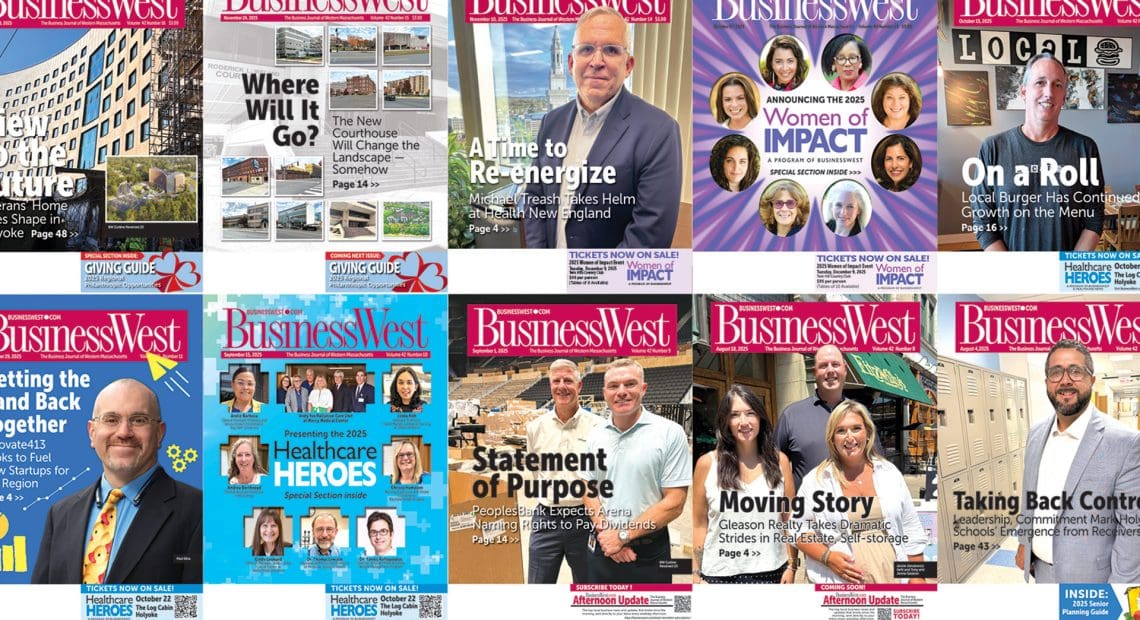
View to the Future

The new Veterans’ Home at Holyoke is slated to welcome its first residents next September.

The new Veterans’ Home at Holyoke is slated to welcome its first residents next September.

An architect’s rendering of the new facility shows its compelling design and ornate gardens.

An architect’s rendering of the new facility shows its compelling design and ornate gardens.

The new Veterans’ Home at Holyoke won’t be welcoming its first residents for another nine months or so, but the gleaming, $500 million structure on a hill overlooking the Paper City has already captured the imagination of the region.

Highly visible to motorists on I-91 and to residents of Holyoke as well, the nine-story, Y-shaped building — a design one of those on the construction team said was inspired by the tricorn hats worn by Revolutionary War soldiers — serves as both a reminder of the tragedy that occurred during the early days of COVID at the structure it will replace, as well as a symbol of the state’s commitment to modernize the facility in the wake of that calamity.

Michael Lazo, executive director of the home, was a member of the National Guard unit that was dispatched to what was then called the Soldiers’ Home in late March 2020 amid a deepening crisis that would eventually take the lives of 76 residents in one of the nation’s worst COVID-19 outbreaks in a long-term care facility.

“I remember first walking in and not knowing what the heck we were walking into,” he recalled, noting that he arrived at the site on March 30, three days after the facility’s leadership made the fateful decision to combine two locked dementia units into a single undersized unit, precipitating the rapid spread of COVID. “Everything looked completely normal; you wouldn’t think anything was going on.”

Lazo would later be offered a full-time COO position at the home and eventually would be named interim director by the board of trustees and then the state. Today, he oversees all operations at the home while also preparing for the opening of the new facility, which will be called the Veterans’ Home, rather than the Soldiers’ Home, in deference to the veterans who served in other branches of the military.

“I think it just came down to money; other priorities probably stepped in and took precedence, so some of the funding this building should have received went elsewhere.”

“Especially the Marines — they’ve never liked Soldiers’ Home,” he joked, adding that he’s also finding time these days to offer tours of the building in progress — to staff, a few elected officials (more of those are scheduled to go through in the days and weeks to come), and a few media members.

BusinessWest was afforded such a tour late last month. As noted, the facility is several months from welcoming its first residents, and only a few floors are even approaching completion. But even at this early stage, it’s apparent that the complex itself is a work of art — one that will integrate the building with the surrounding landscape — and the structure will be state-of-the-art.

Indeed, building systems, designed to LEED Gold certification, include geothermal heating and cooling and facilities that are net-zero energy ready, a high-efficiency exterior envelope with triple-glazed windows, and natural ventilation. The foundation and outdoor retaining wall are made up of Goshen stone. Amenities include a great room, chapel, memory care floor, 40-person adult day health program, dental suite, salon, hobby room, four gardens, and a central kitchen.

Michael Lazo says the new Veterans’ Home at Holyoke emphasizes the privacy and dignity of residents.

Michael Lazo says the new Veterans’ Home at Holyoke emphasizes the privacy and dignity of residents.

Overall, said Lazo, the facility, complete with its curved brick walls, takes the form of three shells that overlap to define three inpatient neighborhoods, each of which benefits from light and views. A typical resident floor will be comprised of three ‘houses’ with 12 beds per house, nursing support, and community spaces, including dining, living, and den. A large garden anchors the complex, and in between wings are smaller, dedicated gardens.

For this issue, BusinessWest takes an early look at what will be one of the biggest stories of 2026, the long-awaited opening of the Veterans’ Home and the start of a new era of service to those who have served their country.


Learning Curves

Lazo said he wasn’t around, so he can only speculate and reflect on what he’s been told over the years.

But he believes that, in the years preceding the COVID tragedy, the state “simply forgot about” the Soldiers’ Home in Holyoke.

One of his predecessors in the director’s role resigned over what amounted to indifference on the state’s part concerning the facility, he said, adding that, in the decades preceding the COVID tragedy, there was little investment in the facility, and little oversight as well — and it showed, especially in the broad realm of preventive maintenance, or the lack thereof.

“I think it just came down to money; other priorities probably stepped in and took precedence, so some of the funding this building should have received went elsewhere,” he said, adding, again, that he was just speculating.

The tragic events in the early days of COVID and the investigations that followed certainly put the facility front of mind, triggering significant reforms to the state’s oversight of its veterans’ homes, he said, adding that what emerged were plans for a new long-term care facility that would serve more veterans and provide them with state-of-the-art amenities.

An architect’s rendering of the new Veterans’ Home at Holyoke.

An architect’s rendering of the new Veterans’ Home at Holyoke.

There was some talk of expanding and modernizing the current facility, he noted, but building new emerged as the more practical option. And while another site may have been considered, the state became committed to keeping the facility at its prominent hilltop location, a popular decision, but one that has presented challenges to the builders of the new facility as they squeezed it onto the site — and will present more to those that will tear down the current home.

Indeed, when finished, one corner of the new home will be just 10 feet from the current facility, which will eventually be used for parking and a garden area.

The new facility will house 234 residents, almost double the current population of 128. There will be 212 single-occupancy bedrooms and 11 double-occupancy bedrooms in those three neighborhoods mentioned earlier: North House, East House, and West House.

These neighborhoods, which will house veterans of several different conflicts (including World War II) and peacetime periods as well, represent substantial improvements over current facilities, said Lazo, especially in the realms of privacy and dignity of residents — each unit has a private bath and showers, while the current facility features common baths — as well as activities and things to do.

“Each veteran has a good-sized room, and there’s plenty of activity space, both on the first floor as well as in each individual unit.”

“The space for veterans is great,” Lazo said. “Each veteran has a good-sized room, and there’s plenty of activity space, both on the first floor as well as in each individual unit. Each floor will have a different activity; we’ll have an exercise bike or some small weights on one floor and arts supplies on the next floor, so veterans will be able to move about the building to do whatever activity they’re interested in at that time.”

And then, there will be the so-called great room, which will host large gatherings such as holiday activities and Super Bowl watch parties, he said, noting that it will be equipped with a 90-inch television.


Tour de Force

As BusinessWest toured the second floor of the new facility and a 30-unit memory care unit under construction there, we were directed to one of the 12- by 16-foot resident rooms, complete with a large window, spacious bath and shower area, space where a 55-inch television will go, built-in storage and shelving units, a desk, and other accommodations.

As the tour continued, Tim Senecal, general supervisor with Commodore Walsh Holyoke, a joint venture comprised of Commodore Builders LLC and Walsh Brothers Inc., referenced common den areas with huge windows and sweeping views of the surrounding area, the facility’s chapel, administrative space, and the location that will become the great room.

A rendering of the planned great room.

A rendering of the planned great room.

“The higher you go, the better the views get, obviously,” said Senecal, who talked as he walked — about everything from those views to the many challenges involved with construction, from excavating for the foundation to the brickwork, made more difficult by the curved nature of the structure, to the Goshen stone retaining wall.

Some of the building’s design elements were borrowed from the new Veterans’ Home at Chelsea, a smaller facility (154 beds) that opened last year, said Lazo, adding that the overall design is distinct, with input from the staff at the current home.

As noted earlier, the first residents will not move into the new home until next September; the first group of 24 will be moved from the fourth floor of the current facility to the third floor of the new one. After that, if all goes well, veterans will move in roughly 20 at a time, with the memory care residents being the last to move. Lazo said his goal is to have all residents moved by February 2027.

That 16-month period will be the most challenging for the staff members at the facility because they will be managing two facilities at the same time, he added, noting that final project completion, including the demolition of the current home, is slated for mid-2028.

As he talked about that teardown and the logistical challenges it will present, Lazo joked that it’s likely that several staff members wouldn’t mind helping with that effort and send the tired, tragedy-scarred property into history.

But that will also be a sad time, he said, noting that several generations from the same families, including his own, lived and died in that home.

The new home, born in many ways from that tragedy of nearly six years ago, will no doubt create its own memories and its own history.

But right now, it’s creating excitement for the next chapter in the story of this fabled property — and with good reason.

Business Talk Podcast Special Coverage

With new episodes airing every other Monday, BusinessTalk features in-depth interviews and discussions with local industry leaders who offer thoughtful perspectives on the Western Massachusetts economy and the many business ventures that keep it running. BusinessTalk is sponsored and presented by Greenfield Cooperative Bank.

Go HERE to view all episodes

Episode 248: December 8, 2025

Joe Bednar talks with Sean O’Brien, Director of Cybersecurity and Computer Science at Bay Path University

Cybersecurity is no longer just a technical discipline: it’s a cornerstone of business, law, and civil society,” Sean OBrien said recently, and businesses of all sizes and sectors are grappling with that new reality. On the next episode of BusinessTalk, Sean, the director of Cybersecurity at Bay Path University, sits down with BusinessWest Editor Joe Bednar for a wide-ranging discussion about how cyberthreats have evolved — with AI being just the latest disruptive wrinkle — but also how defenses are being sharpened with the same technology, as well as how this field will continue to be fertile ground for young people seeking to forge careers in a realm where change is constant and talent is in demand. It’s must listening, so tune into BusinessTalk, a podcast presented by BusinessWest over both audio and video platforms, and sponsored by Greenfield Cooperative Bank.

Sponsored by:

Also Available On

Giving Guide Special Coverage

Regional Philanthropic Opportunities

Leaders of nonprofits across Western Mass. have grappled with a more challenging fiscal climate in the past year — and the need to become more ambitious, creative, and expansive in their fundraising efforts as federal funding shrinks. For the past 15 years, BusinessWest has published its annual Giving Guide to shine a spotlight on local nonprofits, detailing specific community needs and showing you not only how to support them, but exactly what your money and time can accomplish.
 
The profiles of area nonprofit organizations on the following pages — many of them sponsored by businesses that believe in their missions — are just a sampling of the region’s thousands of such organizations. These profiles are intended to educate readers about what these groups are doing to improve quality of life for the people living and working in the 413, but also to inspire them to provide the critical support (which comes in many different forms, from donating to volunteering to advocating) that they and so many others so desperately need.

Presented by:

Features Special Coverage

From AI to the Courthouse Search, the Landscape Is Changing

By George O’Brien and Joseph Bednar
It is December, time to look ahead to what might happen in the new year, but also look back, at what has been an eventful year, to say the least.

For example, Springfield has become engrossed in the search for a site for a new courthouse, the Western Massachusetts Economic Development Council has named a new director, AI is changing the landscape in all kinds of ways, and remote work is becoming more entrenched in the workplace. Then there’s the constantly changing story of tariffs, federal budget cuts that are challenging nonprofits, and an ongoing housing crisis.

As we said, it’s been an eventful year. Here’s a look back at some of the biggest stories of 2025:


A Softening of the Job Market

“Job hugging.”

That was one of the workforce trends to unfold in 2025, a year that saw the pendulum swing from this being an employees’ market to one favoring employers. The phrase refers to people hanging onto their jobs longer amid concerns that the grass isn’t any greener elsewhere, amid forces ranging from AI to severe cutbacks within the federal government.

“People are feeling a sense of volatility and continuous change, and when you feel like that, you look for some personal anchors, and for a lot of people, their job is their personal anchor,” Allison Ebner, president of the Employers Assoc. of the NorthEast, told BusinessWest recently, adding that this is a fairly recent phenomenon dating back to last spring or early summer. “Everything in the world is changing, and they want to keep something consistent, and maybe it’s their job.”

But while people may be hugging their job, they’re still looking around, as evidenced by the strong turnout at the recent job fair staged by the MassHire Springfield Career Center. The turnout was strong on both the job seeker and employer sides of the coin, indicating that, while some sectors are seeing a slowdown, many others, especially healthcare, are still struggling to find qualified help.


Seeking New Sources of Funding

This issue of BusinessWest includes the annual Giving Guide, encouraging readers to support local nonprofits. And it couldn’t come at a better time, at the tail end of a year in which federal funding for nonprofits of all types was significantly slashed.

That has caused frustration, but also a new determination among nonprofit leaders to be more creative and collaborative in meeting the many needs of the community.

“People are reaching out, and not just with appeals for direct funding,” Denise Hurst, vice president of Community Impact and Partnerships with the Community Foundation of Western Massachusetts, told us in May. “They’re asking about opportunities to partner with one another, share ideas, and collaborate in real time to navigate these difficult times.”

Meanwhile, a coalition of local nonprofits working in farming, conservation, food security, health, and environmental justice has come together under the name Resilient Valley to respond to federal funding cuts that have slashed organizational budgets by 25% to 40% or more.

“We realized we were all telling the same story,” said Billy Spitzer, executive director of the Hitchcock Center for the Environment. “Our budgets had been gutted overnight, and the ripple effects were only beginning. We decided we couldn’t face this crisis in isolation. We needed to find strength in each other.”


The Impact of Tariffs

President Trump ran on the promise of new, sweeping tariffs, and he has certainly followed through, announcing ‘Liberation Day’ on April 2, followed by months of trade talks, new deals, deadlines made, deadlines extended, and seemingly never-ending speculation about the impact of tariffs on prices, individual businesses, and entire sectors.

Dave Fontaine, CEO of Fontaine Bros. Inc., told BusinessWest earlier this year that tariffs will certainly impact project costs because tariffs on products, such as steel or copper, are applied not when they are ordered, but when they enter the country.

“I think it’s vitally important to bring this area back — it raises the quality of living for those living downtown, and it provides places for people to go and eat.”

“I would equate it to walking into a store … the sales tax is 6.25%, and then, while you’re purchasing the item, the sales tax gets doubled or tripled,” he explained. “That’s going to impact at the register.”

Uncertainty around tariff decisions also triggered fluctuations in the stock market this past spring — and plenty of client phone calls to investment firms. But Jeffrey Liguori, executive vice president of Bradley Foster & Sargent Inc., was one of several experts who told us it’s wise to take a longer view.

“The data is 100% in your favor. Nothing ever goes straight up. We’ve lived through most of these crises — the housing crisis, the tech bubble, the Great Recession,” he said. “All of those, time and again, have been incredible buying opportunities. It’s almost like, if there’s no pain, there’s no gain.”


The Search for a New Courthouse

The search for a replacement for the troubled Roderick C. Ireland courthouse in Springield entered an intriguing new phase when the state’s Department of Capital Asset Management and Maintenance (DCAMM) decided to let a private developer build and manage the facility and have the state lease it.

An RFP was issued mid-year, and 11 proposals were received involving a wide range of properties, from the park created by the demolition of the former Steiger’s department store to the Republican building; from the current courthouse site itself to the home of the former Mardi Gras strip club.

DCAMM is now weighing those proposals and is expected to have a decision in the first or second quarter of next year, making for a long and agonizing wait to see how the city’s landscape will be changed.


Progress in the Entertainment District

Many of the windows in the storefronts are still boarded up or covered by brown paper, but behind all this, there is some progress in Springfield’s entertainment district.

Noted attorney and developer Raipher Pellegrino, with support from the city in the form of a $2 million grant, is filling in a canvas along a city block of buildings on Worthington Street.

He envisions five restaurants in all, most with doors opening out onto Worthington Street and outdoor dining, in addition to a club and other businesses that will support each other and bring people and energy back to that corridor.

“I think it’s vitally important to bring this area back — it raises the quality of living for those living downtown, and it provides places for people to go and eat,” he told BusinessWest in June, adding that the project is a work in progress. “That was my desire with this, and it’s a much more difficult project than I think anyone envisioned, but I think we’re starting to see it evolve, and we’re seeing a lot of momentum.”


A Work of Arts

Another intriguing story in 2025 was the opening of the Hope Center for the Arts in downtown Springfield. Created in the former CityStage space, the center is the culmination of a long-held dream of Bob Bolduc, former owner of Pride Stations and Stores and founder of the Hope for Youth and Families Foundation.

The center, which opened its doors during the summer, and created at a cost of more than $14 million, is designed as flexible learning, rehearsal, and performance space that will advance the mission of the foundation and several partner organizations focused on the arts and helping youth and families in Springfield thrive.

Bolduc said the facility is designed to educate young people, immerse them in the arts, and perhaps inspire careers in that realm.

“The arts are not just entertaining and cultural, which we need in this city; they’re also inspiring,” he told BusinessWest. “Imagine a kid who gets turned on to dance or vocals or an instrument and then goes to a good school on a scholarship … we’ve changed their life.”


AI Has Become a Force

Wherever artificial intelligence takes us, we’ll look back at 2025 as the year it firmly established itself as a force to be reckoned with. Businesses in sectors ranging from law to accounting to healthcare are finding new ways to utilize AI to create new efficiencies and, in some cases, trim their workforce expense.

Meanwhile, for those in the workforce, as well as those looking to enter it, the ability to use AI has rapidly become a skill they must have.

Indeed, Ebner told us, “the phrase you hear now is, ‘AI won’t replace all the people, but it will replace people who don’t have AI skills.’”

Nicole Polite, CEO and founder of the East Longmeadow-based MH Group, agreed, telling BusinessWest that employers are becoming more skills-focused in their hiring.

“I often talk to people during the interview process and ask them what training they’ve had in terms of AI and make sure they stay in front of it,” she noted, “because AI is here for the long haul, so we have to adjust to it.”


Remote Work Is Here to Stay

Also seemingly here for good is remote work, as 2025 saw remote and hybrid models becoming more entrenched, regionally and nationally, even as some major employers were scaling back on the practice, if not cutting it out.

Indeed, while business leaders such as J.P. Morgan CEO Jamie Dimon enforced return-to-office policies, requiring most employees to work in person five days a week — arguing “you can’t learn working from your basement” — most businesses locally have preferred to stay with hybrid schedules as a way to retain valued talent — and attract new talent.

And while the practice seems to work for most businesses and their employees, it is definitely having an impact on businesses in central business districts in cities regionally and across the country — as well as the commercial real estate owners who rely on them, not to mention the restaurants and retailers who count on people working nearby and stopping in.


The Housing Crisis Continues

An ongoing story in 2025 was the housing crisis that has enveloped the county and this region. As BusinessWest continued its Community Spotlight series, leaders in cities and towns across the 413 spoke of the need for more housing of all kinds, especially the affordable variety.

Housing is needed for many reasons, they said, from helping seniors stay in their hometowns as the cost of homes skyrockets to enabling those in the workforce to afford to live in or close to the communities where they work, a problem that is especially acute in the Berkshires, where home prices have soared.

And while new housing projects are underway or planned in several area communities, from Pittsfield and Lee to Springfield and Chicopee, in many cases, the new units will only scratch the surface when it comes to what is needed.


A New Effort to Spark Entrepreneurship

They’re calling it VVM 2.0, and that’s a poignant name.

VVM is an acronym for Valley Venture Mentors, the nonprofit started to inspire entrepreneurship and provide fledging businesses with the mentorship and technical support needed to get to the next stage. The agency thrived for several years, but essentially didn’t survive the pandemic and other challenges to its existence.

Paul Silva, one of VVM’s founders, with support from the Davis Foundation and the MassMutual Foundation, recently launched a new initiative called Innovate413 that is designed to spark new tech-based startups in the region.

When asked how it would work, Silva said the initiative will provide startups with what he called “an unfair advantage,” in the form of access to potential customers, meaning large, regional employers that will talk about problems facing them and all those in their industries, and access to the latest artificial intelligence and product development techniques.

“When you’re in Silicon Valley or in Boston, you have access to that stuff, but the vast majority of the country doesn’t,” he told BusinessWest.


Aaron Vega Chosen to Lead the EDC

Rick Sullivan, president of the Western Massachusetts Economic Development Council (EDC), announced his retirement early in the year, and soon thereafter, a nationwide search for a successor commenced.

It ended this fall with the announcement that Aaron Vega, director of the Office of Planning and Economic Development in Holyoke, would assume that high-profile position in January. Vega brings a diverse résumé to his new job. Indeed, he worked for many years as a freelance film editor and also owned his own yoga studio before becoming a city councilor in Holyoke and then a state representative.

Vega told BusinessWest that his first order of business is to conduct a lengthy listening tour. Longer-term, he wants to build on progress made with developing new business sectors, such as food science, clean energy, and cybersecurity, while also being more aggressive with efforts to promote the region and tell its story.


Hub of Progress

Speaking of the EDC, it recently celebrated a major milestone for the innovation economy, with Western Mass. being designated as both a Quantum Technology TechHub and a Food Science TechHub through the Massachusetts Technology Collaborative. In addition to the two designations, funding in the form of $1 million to advance a feasibility and design study of a quantum supply chain accelerator (QSCA) was awarded to Springfield Technical Community College.

“Western Massachusetts is the only region in the Commonwealth to receive two TechHub designations, which is a testament to the strength of our innovation ecosystem and the collaboration that defines it.”

The QSCA will build on the foundation established in Holyoke at the Massachusetts Green High Performance Computing Center and the state’s first quantum computing complex launched with QuEra Computing Inc. The accelerator, which will be the first regional facility of its kind to drive commercialization, support startups, and strengthen advanced manufacturing supply chains across the Pioneer Valley, will be located at the Springfield Technology Park.

“Western Massachusetts is the only region in the Commonwealth to receive two TechHub designations, which is a testament to the strength of our innovation ecosystem and the collaboration that defines it,” said Rick Sullivan, outgoing president and CEO of the EDC. “These designations, and the $1 million dollar investment in the quantum supply chain accelerator, represent years of hard work and vision from our regional partners.”


A New Chapter for the Monson Developmental Center

Housing is one of the many potential new uses for the Monson Developmental Center, which is an intriguing new addition to the large portfolio of Westmass Area Development Corp.

Indeed, in July, the Commonwealth officially transferred the sprawling campus to Westmass, touting the transaction as part of ongoing efforts to utilize existing properties to build more housing in the state.

And with that transfer, Westmass, in partnership with DCAMM, will commence work to create what will be known as the Village at Sawmill Brook, named for the brook that runs through the property, which closed in the ’90s. This village will take shape over the next 10 to 20 years, said Westmass President and CEO Jeff Daley, adding that this is a large and difficult undertaking for the agency, but one laden with potential.

“It’s an imposing site, and there’s a ton of work that has to be done,” he told BusinessWest. “And there’s a lot of money that has to be invested just to make the site developable again.”


Something to Sink Your Teeth Into

BusinessWest continued a 30-year tradition by honoring its Top Entrepreneur in 2025, with the award going to John and Chris DeVoie, founders of the Hot Table chain of panini restaurants.

Launched in 2007, the chain has grown to 13 locations and well beyond its roots at the Brightwood Plaza — to several communities in the 413 and also Central Mass. and into Connecticut.

The past few years have been extremely busy, with the opening of five new restaurants — in Westfield, Chicopee, West Springfield, and Franklin, as well as Manchester, Conn., a time that has been followed by a period of absorbing such rapid and profound growth. Further expansion is possible, but the high costs of building has prompted the partners to hit pause while they continue to search for new opportunities.

“We always want to be nimble — the market changes quickly; that’s one of the things COVID taught us,” Chris said. “We always have our eyes open and our ears to the ground, watch what’s happening in other cities and with trends, and not chase every shiny object, especially when it comes to the menu — do what you do, and do it well.”


Building Trades Special Coverage

Sustainable by Design

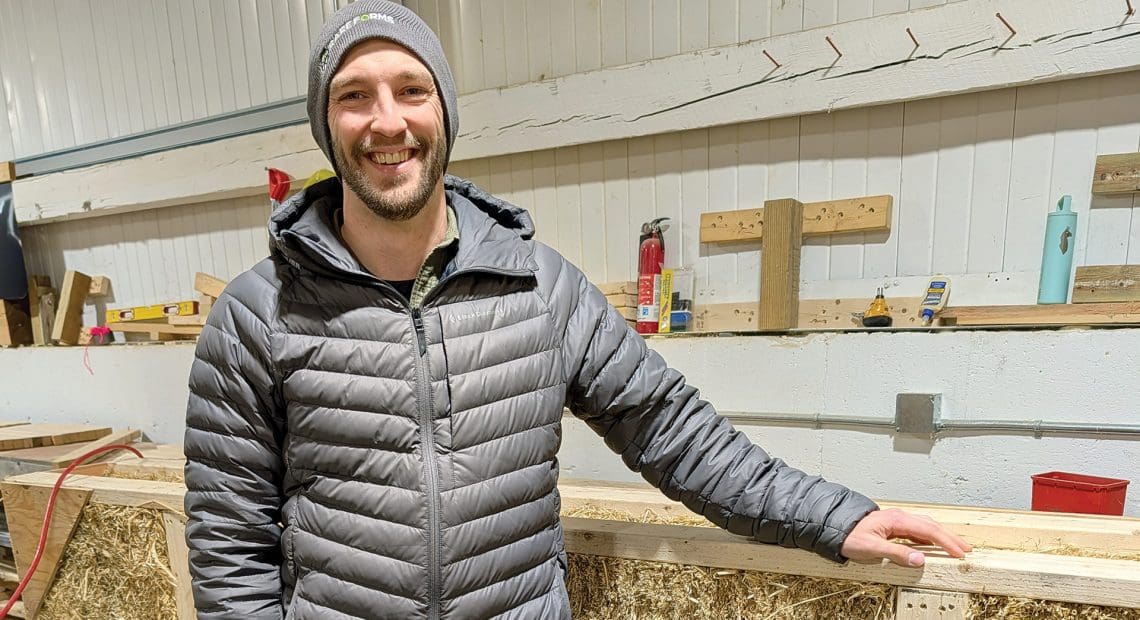
President Greg Bossie

President Greg Bossie


Greg Bossie jokes that negative ideas around building with straw starts in childhood.

“We all grew up with the Three Little Pigs,” he said. “So people have a lot of misconceptions about the viability of straw as a building component.”

But no one’s huffing, puffing, and blowing houses down that are constructed or renovated by Rare Forms, a unique, mission-driven construction company that Bossie launched in 2020.

At the heart of the business model are what’s known as seed straw panels, which are assembled to form the exterior of a house or business.

“I really felt that I wanted to push further into a values- and mission-based structure, particularly around the use of bio-based building materials and internal structure.”

“We build a wood frame, so they are structural. We build it in a steel jig table, and then the straw gets compressed with a pneumatic press,” he explained. “So there’s no binder, there’s no lime or cement or anything like that in it. It’s just compressed straw, which performs really well in terms of the comfort and insulation of a structure.”

And straw is not hay, he added, knocking down another one of those misconceptions. “Straw is just the woody stalk of the grain plant, which could be wheat, rye, oat, rice, any grain that has a woody stalk. We use rye from Plainville Farm in Hadley.”

He explained that the hard, compressed straw, wrapped in a sealed panel, has the same base molecular structure as wood, and is not prone to decomposition, partly because of the way it’s airtight, yet ‘vapor-open,’ allowing any water entering the structure to exit quickly, preventing moisture damage.

The straw panels are also fire-resistant, whereas foam insulation is flammable, he added.

“Lots of people worry about fire, justifiably. But compressed straw, when compressed in a panel, behaves like timber, which means that, when exposed to fire, it chars on the outside and protects its inner core. With a straw panel, we can get a one- or two-hour fire rating, so it’s actually far less fire-prone than, say, any fluffy insulation that allows air movement, because you need oxygen movement to fuel fire, and when you’ve got this incredibly compressed structure that doesn’t allow any air movement through it, it’s really fire-resistant.

“Straw-based building systems have been used for millennia,” Bossie noted. “But actually encasing straw — compressing straw into a wood frame and panelizing it in this way — is really an innovation of the last maybe 12 years or so. It’s a combination of two well-worn building technologies — wood frame and straw bale building combined into one system.

Compressed straw panels, like those in this home under construction, are both structural and insulating.

Compressed straw panels, like those in this home under construction, are both structural and insulating.

“That allows us to utilize the advantages of off-site construction methodology, meaning that we can do all of this in a climate-controlled environment,” he went on, while walking BusinessWest through the shop where bales of hay are stacked, ready to be compressed and panelized.

“One of the risks of traditional straw bale building, particularly in our climate, is that, during construction, it can be exposed to a lot of moisture. Straw panels allow us to work in a controlled environment,” he noted. “We can compress the straw into these wood panels, wrap those panels in weather-resistant barriers, and then install them on site in a relatively short period of time, so that we can limit any potential water exposure during that time. Roof panels tend to take a little bit longer than wall panels, but we can basically assemble this high-performance envelope very quickly.”


Building a Passion

Bossie went to school for architecture and worked in that field for a number of years, but when he moved to Massachusetts from California in 2011, he ended up co-owning a company called Stone Soup Concrete, which specializes in concrete countertops. Later, he was project manager for a design-build company working in the residential sector.

“That got me into building science and high-performance building. But I really felt that I wanted to push further into a values- and mission-based structure, particularly around the use of bio-based building materials and internal structure.”

That idea became Rare Forms, which was just Bossie at first, actually doing the construction before the company started to grow; it now totals about a dozen employees.

“Operational carbon is really important; it adds up over the lifetime of a building. But all of that embodied carbon happens now.”

“We were doing residential design-build, primarily retrofit and addition work to start, and then got into doing some new construction homes,” he explained. “And then, a year and a half ago, we actively pushed into the straw panel aspect of things, which had been my goal for quite a while.

“Straw panels allow us to build homes and additions that actually store more embodied carbon than they emit in the construction process,” he went on. “The construction industry has been focused on what we call operational carbon for a long time, which is energy usage — and trying to reduce our energy usage — and we’ve made incredible strides with that over the last 30 years or so.

Greg Bossie says it was important to him to launch a mission- and values-driven company.

Greg Bossie says his company’s values extend to environmental impact, homeowner health, community support, and more..

“But in the last 10 years — really, the last five to seven years — people started to seriously look at embodied carbon and realize that, in the current state of climate crisis, operational carbon is really important; it adds up over the lifetime of a building. But all of that embodied carbon happens now. And lots of buildings get built in such a way that they have an incredibly high embodied carbon footprint.”

What Rare Forms does, Bossie explained, is use bio-based building materials to substantially reduce or even invert the embodied carbon aspect of building, while also maintaining high building performance and the low energy usage. Another motivation is better indoor air quality, meaning greater comfort and health for building occupants.

“There’s a lot of asthma issues that are caused by building materials from all the foams, so we’re trying to build with completely foam-free assemblies wherever possible, which, in new construction is very achievable; with retrofits, it can be a little bit more difficult with older structures.”

While the straw to create the wall panels is sourced from Hadley, the company’s roof panels are insulated with a product called TimberHP, a wood fiber insulation product manufactured in Madison, Maine, from waste timber from that state’s sprawling timber industry.

In short, “we think about sustainability pretty holistically,” Bossie told BusinessWest. “There’s the materials side of things, which is choosing what you build the house out of. There’s also the waste management, doing as much selective deconstruction as possible, meaning saving fixtures, finishes, any building materials you can, keeping as much out of the landfill to begin with as possible, either saving materials for use in the project or donating those materials.”

Meanwhile, the company works with local sawyers to source timber locally, and also strives to reduce transportation emissions. For example, while Rare Forms mainly works in the 413, it’s currently working on a project in Peru, Vt., and has come up with a way to lessen travel impact on the environment.

“Our team meets here at the shop, and they carpool in one vehicle up there. They stay overnight during the week and then drive back so that we don’t have a team of four people each taking individual vehicles two hours each way every day,” he explained. “Trucking building materials is an incredibly high emissions aspect of building.”


Mission Driven

The seed panel system was designed by New Frameworks in Essex Junction, Vt., one of three founding member companies — Rare Forms and Building Integrity in Columbia, Mo. are the others — in the Seed Collaborative, a partnership that aims to create a broad network of companies using local materials to build carbon-positive systems.

“The function of buildings is to provide shelter for people. Ultimately, I think that how we relate to other human beings is what defines our lives. How we take care of each other is what defines the value of a society. How we shelter people defines our culture of care.”

“We share the methodology of manufacturing straw panels, as well as other shared services — we’re sharing marketing services and business consulting services, and trying to consolidate a lot of the infrastructure of each individual business to make this endeavor more accessible from a business perspective, and also to help make the kits and panels themselves more affordable, so these homes can be more accessible to middle-class homeowners,” Bossie explained, adding that the Seed Collaborative will continue to expand across the U.S., starting with the next set of partners in Colorado, Maryland, and Washington.

Rare Forms has also carved out a niche in prefabricated accessory dwelling units (ADUs), tiny homes that blend efficiency, sustainability, and aesthetics. The company recently won an award in an ADU design competition staged by the North Adams Partnership and AARP.

Greg Bossie says Rare Forms essentially combines two well-worn building technologies, wood frame and straw bale building, in innovative new ways.

Greg Bossie says Rare Forms essentially combines two well-worn building technologies, wood frame and straw bale building, in innovative new ways.

“The state is really inclined to push ADU expansion right now; it’s one way that we can increase housing density and available housing units,” he noted. “We have a housing affordability and availability crisis, and ADUs are one way that we can increase housing density in existing neighborhoods without substantially impacting the character of those neighborhoods.

“It is, unfortunately, a really expensive way to do that,” he admitted. “The cost per housing unit for ADUs is high because you’re taking essentially all of the infrastructure that you need for a 1,500- or 3,000-square-foot house and compacting it into, say, a 600- or 900-square-foot house. You’ve still got all the utilities, all the electricity, all your mechanicals and plumbing and kitchen and bath. So the cost per square foot for an ADU tends to be substantially higher than for a larger house. But we’re working hard to find ways to make them accessible to middle-class homeowners.”

The company’s values extend beyond building materials and environmental impact; they include work in the community as well. Rare Forms donates 1% of all its revenue each year to nonprofit organizations, including the Hitchcock Center for the Environment, the Connecticut River Valley Conservancy, Leave No Trace, the Venture Out Project, and Community Involved in Sustaining Agriculture.

“We focus on both donating monetarily to local organizations and also using our space to help build communities,” he noted, which includes hosting events focused on everything from building science to promoting women and people of color in the trades.

From a broader perspective, “it’s about people,” Bossie said. “The function of buildings is to provide shelter for people. Ultimately, I think that how we relate to other human beings is what defines our lives. How we take care of each other is what defines the value of a society. How we shelter people defines our culture of care.

“And I wanted to — both personally and from a business perspective — really invest in building something that can care for people, both in terms of what we build and how we build it and how we build the business as well, making sure that we are investing all of our resources back into the people that are here, employees of Rare Forms, but also our trade partners, our clients.”

So when Bossie calls Rare Forms a mission- and values-based business, he’s got a lot on his mind.

“I like people,” he said. “I also have three daughters, and, while I don’t spend a lot of time thinking about legacy, the way that I want to define the success of my own life is — like a lot of people, I think — can I leave the world a little bit better for my kids than I found it?”

Cybersecurity Special Coverage

Evolving Threats

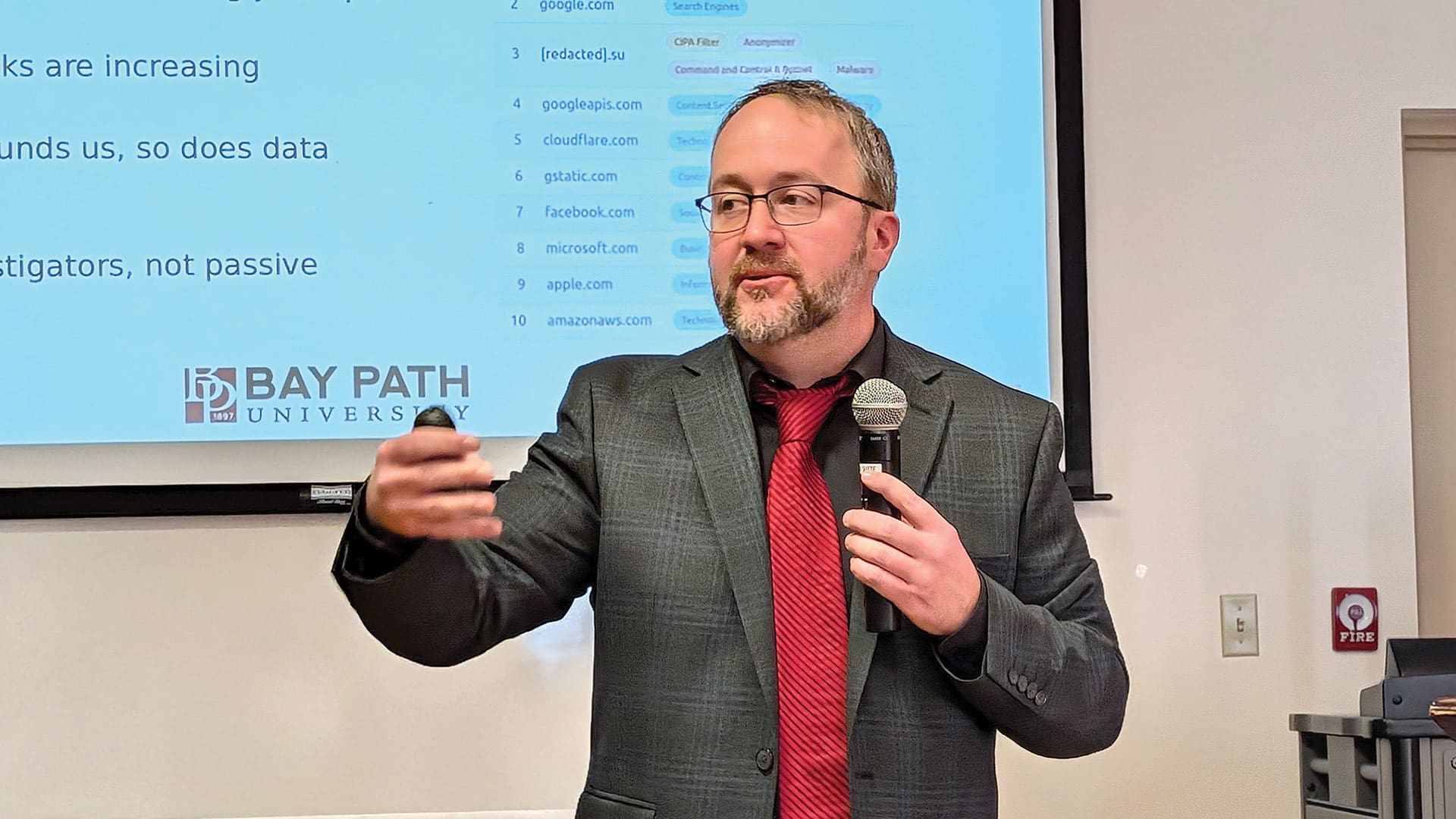
Sean O’Brien says cybersecurity used to be seen as a niche issue

Sean O’Brien says cybersecurity used to be seen as a niche issue in many business sectors, but has become a central concern.

As high-tech businesses grapple with the implications of artificial intelligence (AI) — and workers worry what that might mean for their job security — those who work in cybersecurity may have reason for optimism, Sean O’Brien said.

“Even though we’ve seen a shift, certainly, in IT careers around AI — folks getting laid off and so on — cybersecurity is still humming along. It’s one of the hot industries, essentially,” O’Brien, director of Cybersecurity at Bay Path University, recently told BusinessWest.

A few days earlier, O’Brien had led Bay Path’s 13th annual Cybersecurity Summit, where he and other experts discussed how artificial intelligence is reshaping cybersecurity, education, and workforce development, and what all that means for career paths in this quickly evolving field.

Some young people might be scared off by what they perceive as the highly technical nature of cybersecurity, but he emphasized that the field, and the work being done within it, is strikingly diverse.

“One of the reasons I keep emphasizing the non-technical nature of cybersecurity is because I think that tech can scare people,” he said. “First off, we’re talking about things that are actually scary — things that keep me up at night. But also, people don’t want to feel like they’re going to be a code monkey, so to speak, sitting at a keyboard all day. So I try to emphasize the more exciting cases, the sort of weird and interesting stuff that we can do in cybersecurity.

“Cybersecurity is wide-ranging. There are people who analyze malware — they look at what’s in our software and how it spies on people and breaks their stuff and steals their info, or even drains their Bitcoin wallet, those kinds of things. There are folks who do digital forensics work — they may be looking at evidence and preparing it for a court case or even just an investigation or an audit of an organization.”

Then there are people who work at security operations centers like the one now located at the Richard E. Neal Cybersecurity Center of Excellence in Springfield, which help organizations detect, prevent, and respond to threats.

“When people talk about AI being a threat, what they really mean is generative AI being a threat, large language models being a threat. And just like AI had been used for defensive good purposes before, we can still take generative AI and use it for good purposes as well.”

“That’s a burgeoning field, being the individual who looks at a dashboard, sees all the information coming in, and makes conclusions and reports and even post-mortem analysis,” O’Brien explained. “Even after something has gone wrong, you need the individual who’s going to say, ‘well, here’s how it went wrong,’ and provide that report to the C-suite in an organization.”

Then there are individuals moving to cybersecurity from other fields — or vice versa — and incorporating it into other disciplines.

“I want to have folks who are managers, essentially, who are able to take all of this information, come up with security plans and risk management scenarios, and talk about security architecture and those kinds of things, because those don’t change no matter what goes on with the technology,” O’Brien told BusinessWest. “In my time — and I’ve been doing this since I was a kid, essentially — I have seen technology shift so much, but the fundamentals don’t change.”

In short, it’s a field broad enough to welcome people from any discipline or interest, and that, combined with the fact that it’s certain to remain important, makes cybersecurity an attractive career option.

“You’ve got to have the hunger for it, certainly,” he added. “That’s why it’s always fun to be around other cyber folks, because they’re always energetic.”


Future Shock

The keynote address at the Cybersecurity Summit was delivered by Scott Shapiro, a professor at Yale Law School. O’Brien met him years ago when he worked there, and the two of them co-founded a cybersecurity lab for Yale law students.

“We took folks who are non-technical, primarily — great legal minds, certainly, but not technical people — and we got them to use the command line. We got them to do hacks on their own,” O’Brien said. “We would say, ‘here’s why strong passwords are important. By the way, here’s how to crack a weak password.’”

Now in charge of Bay Path’s cybersecurity program, O’Brien is passionate about sparking that interest in young people.

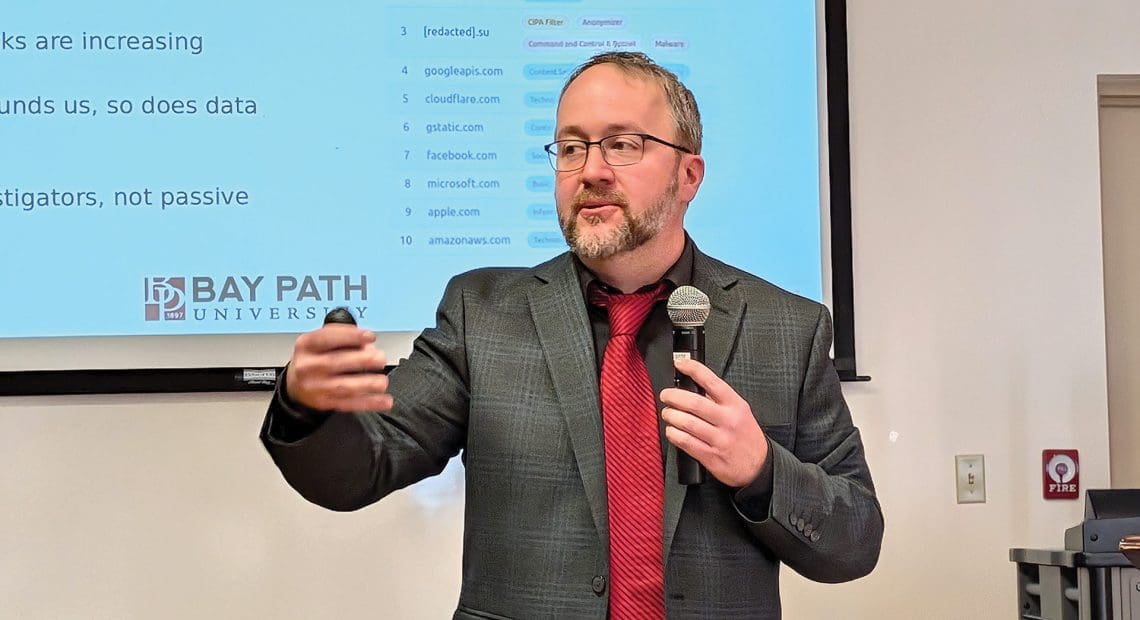
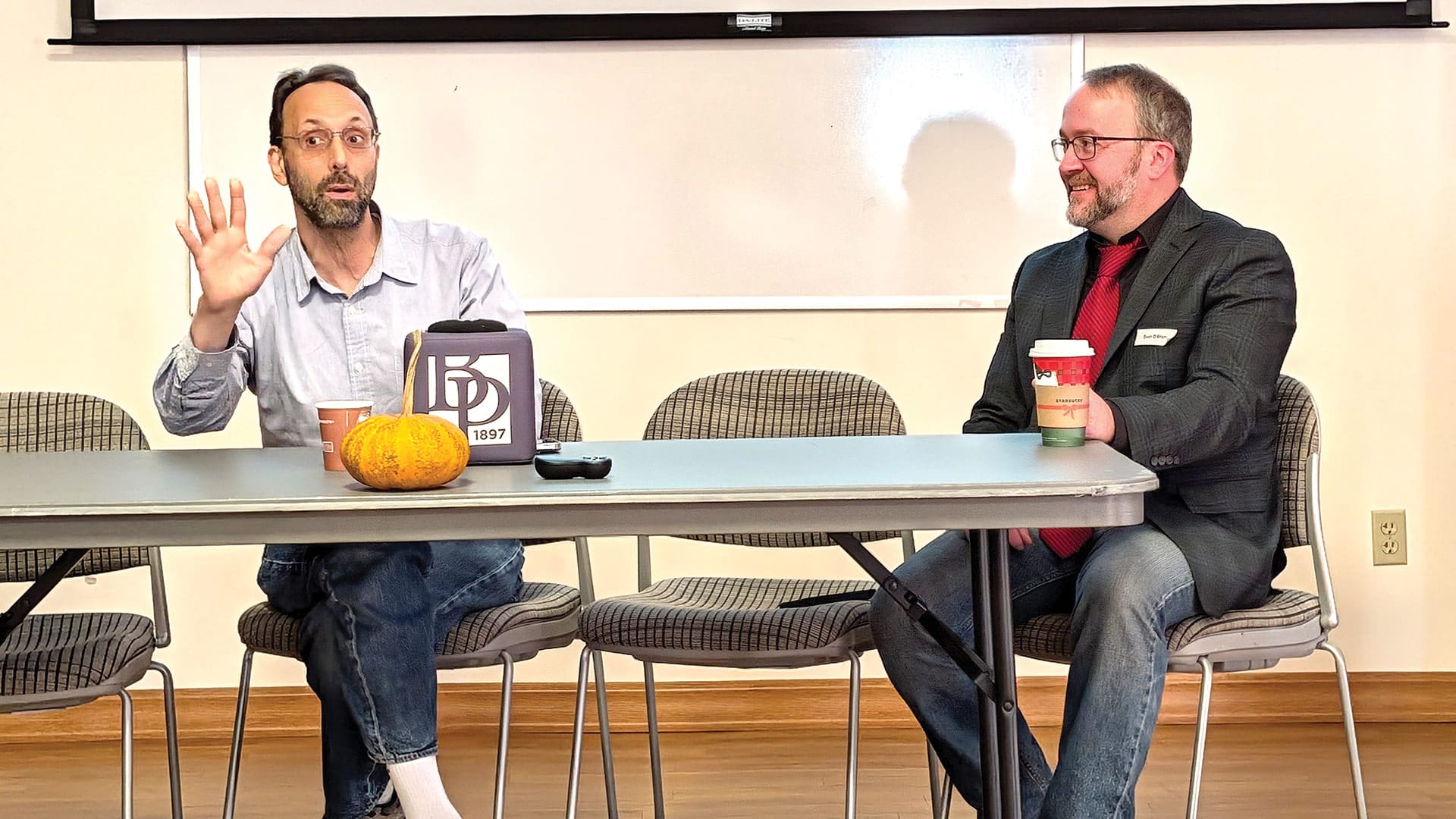
Sean O’Brien (right) conducts a ‘fireside chat’ with Yale Law School Professor Scott Shapiro about advances in cybersecurity and AI during the recent Cybersecurity Summit.

Sean O’Brien (right) conducts a ‘fireside chat’ with Yale Law School Professor Scott Shapiro about advances in cybersecurity and AI during the recent Cybersecurity Summit.

“Bay Path, an amazing program, really has an innovative approach, which is one of the reasons they recruited me,” he told BusinessWest. “They said, ‘hey, you’re doing some cool and interesting things with cybersecurity, we’re doing cool and interesting things with cybersecurity, so let’s hang out.’”

Shapiro’s address — and ‘fireside chat’ discussion with O’Brien — touched numerous times on the role of AI in cybersecurity, and why it’s not all bad news.

“The first thing is to recognize that every tool can be used for good or for bad. A gun can be used either to defend yourself and your family in your home or to hold up a convenience store. And encryption — we love encryption when it protects our private communication; we hate it when it’s called ransomware,” said Shapiro, who is also the author of Fancy Bear Goes Phishing: The Dark History of the Information Age in Five Extraordinary Hacks.

He applied the same message to AI, after a quick history lesson explaining the difference between classical AI and generative AI, which is a much more recent phenomenon.

“AI has been part of cybersecurity for such a long time. You had very basic symbolic systems that helped detect for intrusions and exploitations. In the 2010s, you could not walk through a trade show without people telling you about their AI that protects everyone, and that was machine learning that tried to correlate usage with time, with location, and try to figure out the markers of a threat.

“Now, when people talk about AI being a threat, what they really mean is generative AI being a threat, large language models being a threat. And just like AI had been used for defensive good purposes before, we can still take generative AI and use it for good purposes as well.”

The bad purposes are plenty, Shapiro said, from deepfakes to malware. But in many ways, AI is simply sharpening the sort of threats that already existed.

On the traditional internet, O’Brien told BusinessWest, “we had things called botnets. These are automated computers that are being controlled by a command and control computer somewhere. So your grandmother’s TV set or set-top box or router can be controlled by some adversary somewhere on the other side of the world. You get enough of these machines talking together, they can attack websites; they can break stuff down. Those kinds of threats have been going on for a very long time.

“I would say what’s going on right now is AI is an accelerating force,” he went on. “We still have these threats; everything old is new again. But because AI is able to sort of think on its feet, it’s able to probabilistically change direction and try certain things very easily.”

During the Cybersecurity Summit, O’Brien talked about a botnet called Aisuru that was the most highly trafficked domain in the world during November — more than Google, Yahoo, Facebook, you name it — because of the ease with which it insinuated itself into everything from routers to cameras to gaming platforms. Its goal? Distributed denial of service attacks trying to take down websites.

That sort of threat takes cybersecurity out of the business realm and makes it everyone’s concern.

“Now that everybody’s online constantly, we have devices in our pockets which are basically supercomputers. We’re surrounded by devices, cameras, thermostats, all the stuff that’s connected to the internet. Cybersecurity is now a central topic. It’s encompassed so many aspects of our life,” he explained. “Chat GPT was released to the public a few years ago, and there is a real revolution in computing, and people are starting to see how these algorithms can do incredibly useful stuff, but also incredibly dangerous stuff.”

But AI can also be a strong weapon against those dangers.

“I remember old-style viruses. We had some Macs in our elementary school that got a virus, and everything went down. But then we started having virus detection engines — they look for signatures, and they react. AI is very good at this sort of signature detection and being very agile, being able to look at some things and say, ‘this looks like activity that shouldn’t be happening in the network.’

“So those detection tools, this ability to read through long logs of text, which is what people use ChatGPT and these types of technologies for anyway, are security tools that are speeding up the pace of action and analysis and giving cybersecurity analysts a lot more detailed information a lot more quickly.”


Always Watching

One reason O’Brien likes being an educator is seeing what students are actually interested in, and the way they think of new threats and new applications.

“The students are coming to us with scenarios that are interesting, their own ideas about unique hacks that could be happening. I had a student, for example, demonstrate for me a hack of a Roomba. I hadn’t thought much about a Roomba, but you think about a Roomba, it moves around, and it actually has a lot of data about the physical space,” he said.

“Having that surprise at this point in my life, after I’ve thought I’ve seen everything, is a really big part of this. I’m excited to see where things go.”

And that constant learning is yet another reason why cybersecurity careers will remain attractive — and why shepherding a new generation into that work is so important.

“I think it’s going to be hard to eliminate the need for cybersecurity folks, no matter what comes around the corner technologically,” O’Brien told BusinessWest. “We’ve got to stay on our feet. We’ve got to lock our things up.”