Daily News

SPRINGFIELD — Anticipation is rising for the eighth annual Women of Impact awards gala, hosted by BusinessWest. The sold-out event will take place tonight, Dec. 9, from 5:30 to 9 p.m. at Twin Hills Country Club in Longmeadow.

Profiles of the Women of Impact class of 2025 can be read in the Oct. 27 issue of BusinessWest and at businesswest.com. This year’s honorees are:

• Tara Brewster, vice president of Business Development and Director of Philanthropy at Greenfield Savings Bank;

• Ayanna Crawford, president of AC Consulting and Media Services;

• Tracy Friedenberg, executive director of Bacon Wilson, P.C.;

• Rania Kfuri, vice president for Philanthropy, Sales, and Marketing at Glenmeadow;

• Chelsea Kline, executive director of Cancer Connection;

• Angelina Ramirez, CEO of Stavros Center for Independent Living;

• Amanda Sanderson, executive director of Resilience Center of Franklin County; and

• Sarah Rose Stack, lecturer of Public Relations at UMass Amherst.

The event emcees are Dina McMahon, morning show co-host for the Kellogg Krew on 94.7fm WMAS; and LaTonia Monroe Naylor, chief business educator at Monroe Naylor Consulting, LLC, president and CEO of Parent Villages, and a 2024 BusinessWest Woman of Impact.

The eighth annual Women of Impact program is presented by Country Bank and TommyCar Auto Group, sponsored by Bacon Wilson, P.C., and supported by Feel Good Shop Local and 94.7fm WMAS.

Daily News

Brent Bean

WESTFIELD — James Hagan, president and CEO of Westfield Bank, announced the appointment of Brent Bean as vice president and Business Development officer.

Bean, who previously served as assistant vice president, Business Development officer, will continue to establish relationships with new and existing customers, focusing on commercial credit needs throughout Massachusetts and Connecticut.

“Brent brings a valuable mix of experience, market knowledge, and a genuine commitment to helping our region’s businesses achieve their financial goals,” said Allen Miles, executive vice president and chief Lending officer at Westfield Bank. “He works with businesses across Massachusetts and Connecticut, bringing the full power of the bank’s commercial lending capabilities to current and future customers.”

Bean joined the Bank’s Business & Government Deposit Services department in 2020 before moving to the Commercial Lending department. Prior to that, he spent many years as director of Corporate and Government Relations at Westfield State University.

He holds a bachelor of business administration degree from American International College and a master of public administration degree from Westfield State University. Active within the local community, he is currently a member of Westfield State University’s fundraising committee and has been an at-large city councilor for the city of Westfield since 2002.

Daily News

Peter Duckett

NORTH ADAMS — MountainOne Bank announced the promotion of Peter Duckett to assistant vice president, Commercial Loan officer, recognizing his contributions to the growth of the bank’s commercial lending portfolio and his commitment to clients across the region.

In this role, Duckett supports commercial lending activities through loan origination, portfolio management, financial analysis, and client relationship development. He works closely with local businesses to help them access financing that supports growth and strengthens the regional economy, reflecting MountainOne’s ongoing commitment to community and customer success.

Before joining MountainOne as a portfolio manager in February 2024, he spent a decade at Brookline Bank, where he held several positions, most recently as portfolio manager.

Duckett holds a degree in economics and business management from Assumption University. He has also completed multiple professional development programs through the Risk Management Assoc., earning certificates in lending decision process, financial statement analysis, commercial credit for lenders, and small business lending decision process. He serves on MountainOne’s communications committee, contributing to internal engagement and outreach initiatives.

“Peter’s promotion reflects his strong leadership, professionalism, and the trust he has earned from both clients and colleagues,” said Dick Kelly, senior vice president, senior Commercial Risk officer at MountainOne. “He consistently demonstrates sound judgment, attention to detail, and a true dedication to our clients’ success.”

Duckett added that “I’m proud to continue growing my career with MountainOne. This role gives me the opportunity to work directly with business owners and real estate developers to help strengthen our local economy and support long-term community growth.”

Features

Recent Tax Legislation Complicates Matters as 2026 Approaches

By Kristina Drzal Houghton, CPA, MST


The end of the year is often an optimal time for tax planning for both individuals and small business owners. Traditionally, the conventional tax wisdom is to accelerate tax deductions into the current year and defer taxable income until the next year. However, new tax legislation enacted in 2025 significantly complicates matters.

The One Big Beautiful Bill Act (OBBBA) — signed on the Fourth of July — is a follow-up to the Tax Cuts and Jobs Act (TCJA) enacted during President Trump’s first term. Many of the provisions included in the TCJA, particularly those affecting individuals and families, went into effect in 2018 and were scheduled to expire after 2025. The OBBBA extends most of those tax provisions, with certain modifications, and often makes them a permanent part of the tax code.

Kristina Drzal Houghton“The tax law allows you to deduct charitable donations within generous limits. However, the OBBBA adds several tax complications.”

In addition, the new law creates brand-new tax-saving opportunities, while also posing potential tax pitfalls for the unwary. In some cases, the OBBBA provisions are effective in 2025, but others do not kick in until 2026 or a later date.

This article is divided into two sections: Individual Tax Planning and Business Tax Planning.


INDIVIDUAL TAX PLANNING

Itemized Deductions

The TCJA suspended several itemized deductions for 2018 through 2025 while boosting the standard deduction. The OBBBA generally extends these rules with some modifications.

If you expect to itemize deductions on your 2025 tax return, take advantage of several key deductions that can lower your tax bill. Consider the following:

• Donate cash or property to a qualified charitable organization (see more below).

• Pay deductible mortgage interest if it makes sense for your situation. This includes interest on acquisition debt up to $750,000 for your principal residence and one other home.

• Make state and local tax (SALT) payments up to the annual deduction limit. Under the OBBBA, the SALT cap is quadrupled from $10,000 to $40,000 for 2025, subject to a phase-out for high-income taxpayers. The cap increases by 1% annually through 2029 before expiring.


Charitable Donations

The tax law allows you to deduct charitable donations within generous limits. However, the OBBBA adds several tax complications.

For the first time ever, the OBBBA imposes a floor of 0.5% of adjusted gross income (AGI) before you can claim any charitable deduction, effective in 2026. This new rule may be especially important if you are planning to donate appreciated long-term-gain property, such as stock, that would qualify for a deduction equal to the property’s fair market value. The deduction for property is limited to 30% of AGI, but any excess may be carried over for up to five years.

The OBBBA also allows a deduction of up to $1,000 for non-itemizers, beginning in 2026. The maximum deduction is doubled to $2,000 on a joint return.

Consider bunching charitable donations in a year in which you expect to itemize. For instance, if you are itemizing in 2025, you may step up charitable gift giving before Jan. 1. As long as you make a donation this year, it is deductible in 2025 — even if you charge it in December 2025 and pay it in 2026.


Home Energy Credits

If you own your principal residence, you may benefit from two types of home energy tax credits on your 2025 return.

Make energy-saving installations before the end of the year to secure credits for qualified improvements. Under the OBBBA, both credits will expire after 2025 and are not expected to be renewed.

The two credits still available before 2026 are as follows:

• Energy Efficient Home Improvement Credit: This is a 30% credit for qualified expenses like insulation, central air conditioners, water heaters, furnaces, heat pumps, biomass stoves and boilers, and home energy audits, up to a maximum of $3,200.

• Residential Clean Energy Credit: This is a 30% credit for the cost of new qualified clean energy property like solar electric panels, solar water heaters, wind turbines, geothermal heat pumps, fuel cells, and battery storage technology.


401(k) Plan Savings

Contributions to a 401(k) plan are made by employees on a pre-tax basis and can earn tax-deferred income until withdrawals are made. Plus, your company may provide matching contributions based on a percentage of salary.

For 2025, the regular contribution limit is $23,500, but if you are 50 or older, you can add a ‘catch contribution’ of $7,500 for a total of $31,000. Even better: under SECURE 2.0, those ages 60-63 can make a ‘super catch-up contribution’ of $11,250 for a total of $34,750.

Beginning in 2026, if individuals age 50 and over earned more than $145,000 in the prior year, any of their 401(k) catch-up contributions must be made to a Roth-type account. The Roth version of the 401(k) imposes tax on amounts contributed in 2025, but future payments are generally exempt from tax.


Required Minimum Distributions

Generally, you must begin taking required minimum distributions (RMDs) from qualified retirement plans, like 401(k) plans, and IRAs after a specified age. Under SECURE 2.0, the age threshold has been raised to 73 (scheduled to increase to 75 in 2033). The amount of the RMD is based on IRS life expectancy tables and your account balance at the end of last year.

Assess your obligations. If you can postpone RMDs longer, you can continue to benefit from tax-deferred growth. Otherwise, make arrangements to receive RMDs before Jan. 1, 2026 to avoid any penalties.


Family Tax Breaks

If you are a parent with young children, you may be entitled to several tax breaks designed to reduce your family’s tax burden.

For 2025, parents may claim a Child Tax Credit (CTC) of $2,200 for each qualifying child, subject to a phase-out beginning at $200,000 for single filers and $400,000 for joint filers.

The dependent care credit is enhanced for certain taxpayers with a modified adjusted gross income (MAGI) below specified levels. For high-income taxpayers, the maximum credit remains $600 for one child and $1,200 for two or more children.

Under the TCJA, parents could withdraw up to $10,000 tax-free from a Section 529 plan for higher education to pay a child’s tuition at a qualified elementary or secondary school. The OBBBA doubles the cap to $20,000, beginning in 2026.


Other Tax Breaks

Under the new law, employees can annually deduct part of overtime pay, up to $12,500 for single filers and $25,000 for joint filers, retroactive to Jan. 1, 2025. But the deduction is available only for the ‘premium’ of part overtime pay based on the time-and-a-half rate mandated by the Fair Labor Standards Act.

In addition, the deduction is phased out based on MAGI. The phase-out begins at $150,000 of MAGI for single filers and $300,000 for joint filers.

Similarly, the OBBBA creates a new deduction for up to $25,000 of tips received by an employee in a service industry from 2025 through 2028, subject to a phase-out above $150,000 of MAGI for single filers and $300,000 for joint filers.


BUSINESS TAX PLANNING

Depreciation-based Deductions

A business may benefit from one of two depreciation-related tax breaks, or both, for qualified property placed in service. The OBBBA enhances those tax breaks, beginning in 2025.

Ensure that qualified property is placed in service before the end of the year. Otherwise, your business does not qualify for either tax break on its 2025 return.

• Section 179 deduction: Section 179 allows a business to currently deduct the cost of qualified property up to an annual limit, subject to a phase-out. The OBBBA permanently hikes the limit to $2.5 million and the phase-out threshold to $4 million in 2025, with future indexing.

• First-year bonus depreciation: the TCJA authorized 100% first-year bonus depreciation subject to a phase-out over a five-year period. The applicable percentage for 2025 was scheduled to be only 40%, but the OBBBA permanently restores the 100% deduction, retroactive to Jan. 20, 2025.

Regular depreciation deductions may be elected. As always, special rules may apply, such as a separate set of limits on vehicles.


Research and Experimental Expenses

Previously, the tax law permitted a company to fully deduct domestic R&E expenses in the year in which they were incurred. But the TCJA required costs incurred after 2021 to be capitalized and amortized over 60 months.

Now, the new law reinstates the prior rules, retroactive to Jan. 1, 2025. Alternatively, a business can still elect to amortize the expenses over 60 months. Due to special transitional rules for expenses incurred in 2022 through 2024, it may be beneficial to file amended returns for these years. Note: the amortization period for foreign R&E expenses remains at 15 years.


Miscellaneous

Stock up on routine supplies (especially if you expect prices to rise soon). If you buy the supplies in 2025, they are deductible this year even if they are not used until 2026.

The OBBBA imposes a 1% floor on deductions for charitable donations by C corporations, beginning in 2026. A corporation may increase its donations late in 2025 to avoid the upcoming floor on deductions.

Owners of pass-through business entities like S corporations and partnerships may adopt SALT ‘workarounds’ to qualify for state deductions or credits. The entities make the payments, and then tax benefits are passed through to individuals on their personal tax returns.

Maximize the qualified business income deduction of up to 20% for pass-through entities and self-employed individuals. Note that special rules apply if you are in a specified service trade or business. The OBBBA extends this tax break and makes it permanent.


Bottom Line

This year-end tax-planning article is based on the prevailing federal tax laws, rules, and regulations. Of course, it is subject to change, especially if additional tax legislation is enacted by Congress before the end of the year.

Finally, remember that this article is intended to serve only as a general guideline. Your personal circumstances will likely require careful examination. You should schedule a meeting with your adviser to assist with all your tax planning needs.


Kristina Drzal Houghton, CPA, MST is a partner at the Holyoke-based accounting firm Meyers Brothers Kalicka, P.C.

Community Spotlight

Community Spotlight

An architect’s rendering of the planned Longmeadow Middle School. Construction is slated to start in the fall of 2026.

An architect’s rendering of the planned Longmeadow Middle School. Construction is slated to start in the fall of 2026.

Marty O’Shea says officials in Longmeadow have been discussing what to do with the town’s two middle schools — Williams and Glenbrook — for nearly 20 years now.

The former was opened in 1959 and the latter in 1968, he noted, adding that, beyond their advancing years, the schools were designed to serve a different model of education than the district currently requires.

Charting a course for the school properties and securing funding from the Massachusetts School Building Authority (MSBA) has been a long journey with many twists and turns, said O’Shea, Longmeadow’s school superintendent, adding that, 18 years after the town first submitted both schools to the MSBA for consideration for renovation or replacement, construction is slated to begin in the fall of 2026 on a new, $151 million facility that will replace both schools.

It will be called Longmeadow Middle School, and it will provide the community not only with a state-of-the-art facility — to be built on the Williams Middle School campus — but a unique development opportunity on the Glenbrook site.

“Our education plan calls for more space that will give kids the opportunities to be involved with project-based learning and give us more opportunities to expand science, technology, and engineering opportunities for kids,” O’Shea explained, adding that the design also prioritizes supporting special education students and the arts, both the performing and fine arts.

“Our education plan calls for more space that will give kids the opportunities to be involved with project-based learning and give us more opportunities to expand science, technology, and engineering opportunities for kids.”

As for the Glenbook site, “we’ll start looking at what to do there soon, so that we don’t wait until the property is vacant to begin that process. We won’t start any construction or final plans, but we will start the community discussion,” said Town Manager Lyn Simmons, adding that the 20-acre campus could have several potential uses, including housing in a community where there are few, if any, available building lots.

Resolution of the middle school question and conjecture about the future of the Glenbrook site are just two of the many converging stories in this residential community of almost 16,000 people. Others include:

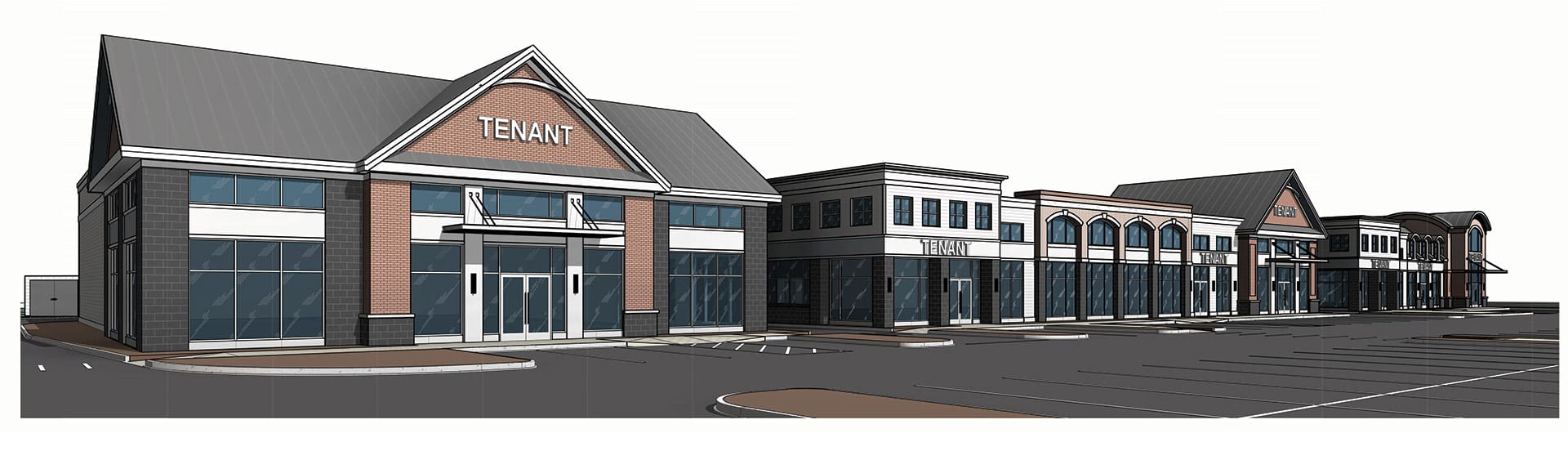
• A pending Planning Board vote in early December on a proposal to redevelop the site of a closed Church of Christ, Scientist on Williams Street, abutting the Longmeadow Shops. Plans call for demolishing the church and constructing three buildings to house retail tenants, a bank with a drive-thru, and a coffee shop with a drive-thru — a complex that would, in many ways, serve as an extension of the shops;

An architect’s rendering of a proposed new retail facility, to be built on the site of a closed church on Williams Street.

An architect’s rendering of a proposed new retail facility, to be built on the site of a closed church on Williams Street.

• Work to design improvements to the busy intersection at Williams Street, Redfern Drive, and Frank Smith Road, a project inspired by the project on the church property and made possible by a $287,000 MassWorks grant;

• Ongoing work to decide the best uses for three other town landmarks — the Community House, formerly home to some town offices and now used primarily as a polling place; Town Hall, mostly vacant since town offices were moved to the former Greenwood Park Elementary School off Maple Street; and ‘Old Town Hall’ on Longmeadow Street, vacant for many years. Simmons said a task force will be appointed to consider options for each site and determine the best course of action;

• Early-stage work to replace aging water and sewer lines (60% of which are more than 100 years old), beginning with a water line replacement project, approved at town meeting last month, that will begin with Western Drive. These initiatives have been accompanied by 40% increases in water and sewer rates, which were comparatively low and are still lower than many in the region, Simmons noted;

• A growing stable of eateries — a sushi restaurant and one specializing in Indian cuisine are two of the latest additions — that has made the town a dining destination; and

• Continued growth of a small but eclectic business community, one that is based mostly in retail and hospitality.

That list includes Twin Hills Country Club, which has enjoyed a very strong year, both on the course and with its event business, said Laura Chipouras, club manager.

She told BusinessWest that, in addition to tournaments, weddings, and showers, the club has seen a surge in business-related gatherings, everything from annual retreats to sales strategy sessions.

“We’re seeing lots of retreats, and I think that’s probably due to people returning to the office after COVID and feeling that they need to get together,” she explained, adding that, overall, business has brisk — well ahead of last year’s pace — and the bookings for 2026 have been solid.

For this latest installment in its Community Spotlight series, we take an in-depth look at Longmeadow, and some landmark decisions being made there — literally and figuratively.


School of Thought

Reflecting on the middle school project, O’Shea — who has been superintendent for nine years now — noted that, while discussions on the two facilities began nearly two decades ago, the town had other priorities to address, such as a new high school, senior center, and DPW facility.

With those resolved, the middle school discussions resumed, with consolidation emerging as the best option over time, as capital needs grew and enrollment in each of the schools fell to roughly 300 in recent years.

That puts them on the smaller end for middle schools, he said, adding that other communities and districts of similar size, such as neighboring East Longmeadow and the Hampden-Wilbraham School District, which he served as an administrator, have one middle school.

“We did a citizens’ survey just to find out what people wanted to see happen there, and those results were interesting. There was a lot of attachment to Community House, a moderate attachment to Town Hall, and very little attachment to Old Town Hall.”

And there are several advantages to be gained through consolidation, he noted, both on the educational side and the operations side.

“On the educational side, in a single setting, I think we’ll be able to assign staff in ways that are more efficient and also better for us educationally,” he explained. “Right now, we have staff that are, in many cases, stretched across two buildings, such as in the areas of music and oral language, library, and special education.

“We think that having all our educators under one roof will put us in a better position to serve students,” he went on, “and we’ll be able to expand programming.”

Meanwhile, the town should see substantial savings from staffing and operating one larger school rather than two older structures that are now well beyond their expected useful life and in many ways inefficient, he went on, noting that the new, 134,735-square-foot facility will be fossil fuel-free, rely on a ground-source heat exchange system for heating and cooling, and be net-zero ready, meaning it will produce as much energy as it consumes.

“You’re maintaining one campus instead of two, you’re maintaining and repairing one campus instead of two, food service — you’re running a single operation instead of two,” he explained. “On the operations side, there are some opportunities where we could see come savings.”

O’Shea and other administrators and staff have visited several communities that have constructed middle schools recently, including several built by Springfield-based Fontaine Bros., recently chosen as the general contractor for the Longmeadow project, and they’ll visit more as the design process continues and the focus shifts to furniture, fixtures, flooring, lighting, and materials used.

Longmeadow at a glance

Year Incorporated: 1783
Population: 15,853
Area: 9.7 square miles
County: Hampden
Residential Tax Rate: $21.12
Commercial Tax Rate: $21.12
Median Household Income: $109,586
Median Family Income: $115,578
Type of Government: Open Town Meeting; Town Manager; Select Board
Largest Employers: Bay Path University; JGS Lifecare; Glenmeadow
* Latest information available

While that project moves forward, the attention of many town residents is also fixed on the church redevelopment initiative.

Simmons noted that the review process has been slowed by the need to conduct a traffic study and undertake it while school is in session. There have been several Planning Board hearings on the matter, with questions on everything from traffic to storm drainage, she said, adding that a decision is expected soon — perhaps early this month.

The project and the increase in traffic it is likely to produce will necessitate work on the traffic corridor in the area near the site, where several roads converge, said Simmons, adding that, when designs for improvements are finalized, the town will apply for a MassWorks grant round to fund construction.


Past Is Prologue

While the middle school and church redevelopment projects move forward, another initiative enters its next phase.

This would be the ongoing work to determine the best possible uses for three unused or underutilized municipal facilities — the Community House, built in 1920; Town Hall, dating from 1939; and Old Town Hall, originally a one-room schoolhouse, built in 1855.

As noted earlier, a task force will be created to consider various options and perhaps suggest an action plan, said Simmons, noting that property condition reports on the three historic structures, submitted by the Springfield-based engineering firm Fuss & O’Neill in September, have unveiled lengthy lists of work needed at all three.

At the Community House, for example, the report concluded that several million dollars in repairs and upgrades are needed — everything from repointing brick to prevent further deterioration and water intrusion to an elevator for access to the second floor, to regrading and repaving the parking area to improve drainage.

There are similar lists for the other properties, she said, adding that, when summing up public sentiment on the landmarks, there are varying degrees of appetite for investment and eventual redevelopment.

“We did a citizens’ survey just to find out what people wanted to see happen there, and those results were interesting,” she told BusinessWest. “There was a lot of attachment to Community House, a moderate attachment to Town Hall, and very little attachment to Old Town Hall.”

Some possible uses were floated in that survey, she went on, adding that there was little sentiment for housing in any of the structures, with most residents preferring an arts and cultural center, a restaurant or café, or recreational programs at all three, with moderate enthusiasm for other uses, ranging from retail to co-working space to a museum.

Ultimately, much will depend on the development community, she said, adding that applications for the task force are being sought, and it is hoped that the panel can wrap up its work in a year.

As for the business community, it continues to grow, especially within the retail and hospitality sectors, said Simmons, adding that the town’s location — it’s convenient to East Longmeadow, Springfield, and Northern Conn. — has made it a retail and dining destination.

That same location has benefited the event business at Twin Hills, said Chipouras, adding that the club has several different event rooms, including a ballroom that can host up to 400, and they’re being booked for a wide range of functions — including BusinessWest’s eighth annual Women of Impact gala on Dec. 9. As noted earlier, business is up across the board, but she is especially encouraged by a rise in corporate outings.

On the day Chipouras talked with BusinessWest, for example, two of the smaller banquet rooms were being used for corporate retreats, which certainly took a back seat during COVID, and there have been several days like that over the course of the past year.

“Later this week, we have an accounting firm coming in to do a class on new tax laws, and we have a bank that’s doing a very large retreat, a learning session,” she noted. “They start early in the morning, and at the end of the day, they do cocktails and hors d’oeuvres.”

Meanwhile, there has also been a surge in proms, weddings, and holiday parties, another tradition that took a hit during the pandemic and the years that followed.

“I’m seeing them come back,” said Chipouras, adding that, while the club sees a large amount of repeat business with clients, it has added new clients to the portfolio as well.

In short, she sees positive momentum — and in this mostly residential town with a small but growing business community, she’s not the only one.

Building Trades

Something to Build On

Laborers Local 596 member Chelsea Fenton

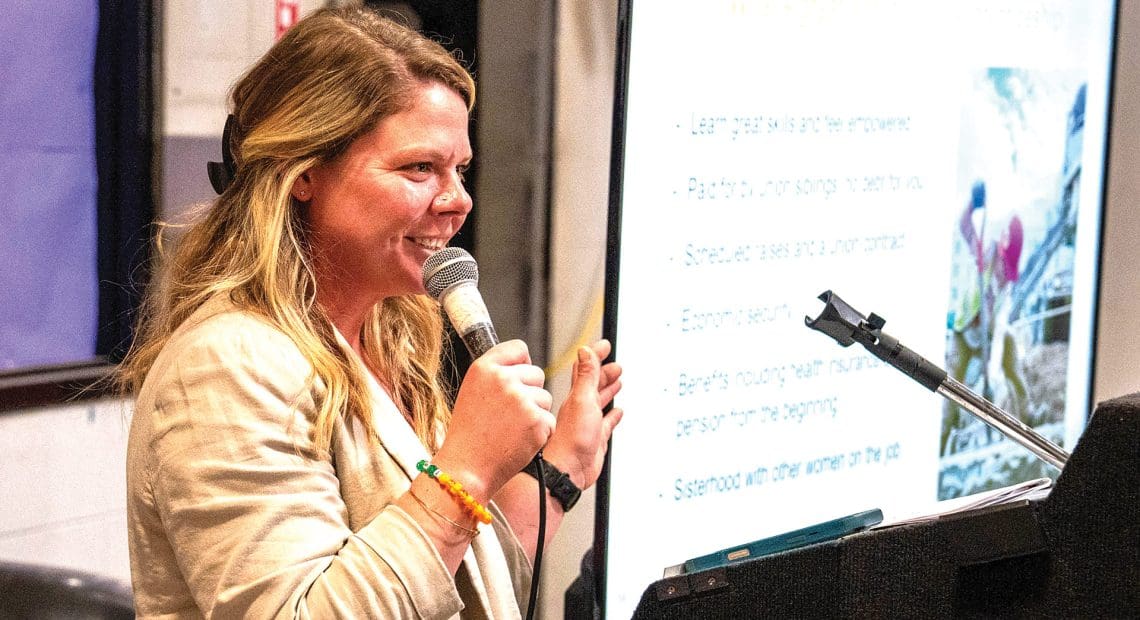
Laborers Local 596 member Chelsea Fenton shares the benefits of union apprenticeship and details her experience with students during a workshop at the recent Girls in Trades Conference.


On Nov. 20, students from 19 schools across Berkshire, Hampden, Hampshire, Franklin, and Worcester counties gathered in Holyoke to explore life-changing opportunities in the union construction industry at the 10th annual Massachusetts Girls in Trades (MA GIT) Conference and Career Fair.

These events are designed to help young women build confidence, gain hands-on knowledge, and envision themselves in careers they may never have considered before.

“Being part of Massachusetts Girls in Trades has changed my outlook completely,” said Kennedy Landers, a Worcester Tech Construction Academy student. “It’s lifted my hopes of being a girl in the trades and given me reassurance that I can do this — and that there are other girls like me.”

Massachusetts building trades unions train the vast majority of the state’s construction apprentices — 74% of all registered apprentices statewide. They also provide opportunities for those historically underrepresented in the trades: 80% of all apprentices of color and 88% of all registered tradeswomen train through union programs. Today, one in 10 union apprentices in Massachusetts is a woman, a number that continues to grow.

In total, 356 students attended this year’s western conference held at Dean Tech High School. This year’s event launched the new MA GIT alumni network, connecting graduates with mentorship and career support as they enter into the trades.

For Jaylene dos Santos, the conference represents the heart of the organization’s mission. “As the chair of the Massachusetts Girls in Trades Student Leadership Council, I have seen the positive change that we make every single day,” she said. “Our resources and support allow students to feel empowered as they enter the construction and construction-related trades. I’m incredibly proud of the work we do to build safe, inclusive spaces for all learners.”

At this year’s event, students heard directly from dos Santos as well as Holyoke Mayor Joshua Garcia and Massachusetts Building Trades Unions President Frank Callahan.

“Union apprenticeship programs are the foundation of an inclusive, world-class construction workforce here in Massachusetts. Women now comprise over 11% of all union building trades apprentices in Massachusetts, tripling the national average and representing a twofold increase since 2012,” Callahan said. “Each year, the union building trades provide a pathway to a rewarding career, with industry-leading wages and benefits, free training and skills development, the highest safety standards, and opportunities for advancement.”

In anticipation of the 2025 conference, Franklin County Technical School student Cameron Jacques said, “I’m really looking forward to this event. It’s a chance to learn not only about my own trade, but also about so many others — and to see how women can continue to thrive in a workforce that’s often male-dominated.”

Her classmate Alison George shared her energy. “I’m excited to explore all the new opportunities this conference will have to offer me,” she said. “It’s inspiring to know there are so many women in these careers, ready to share their experiences.”

The event connects girls enrolled in career and technical education programs with tradeswomen, union apprenticeship programs, and industry leaders. Each year, the conference aims to empower the next generation of tradeswomen, encouraging them to pursue high-paying, debt-free careers that build both communities and futures.

For many of these students, a career in the trades offers a debt-free path to the middle class. With starting wages of $18 to $22 per hour that rise to $35 to $55 per hour over the course of a two- to five-year apprenticeship, event organizers noted, these programs create life-changing opportunities, building skills, stability, and a more inclusive workforce.

Healthcare News

Gauging the Ripple Effects

When he came to Holyoke Medical Center as its new president and CEO in 2013, Spiros Hatiras considered it the proverbial best-kept secret.

By most all accounts, it isn’t that any longer.

“It took us a decade or so, but we’re no longer a secret,” he said, meaning that healthcare professionals have found the facility and helped make it a workplace of choice, and area residents have as well, making it their hospital of choice. “We’re in a growth mentality.”

This emergence, if you will, and lost status as a best-kept secret, has helped HMC grow in several ways over the past several years — and remain in a growth mode, even as several colliding forces have created an ultra-challenging environment for all hospitals, one that is projected to be much more daunting in 2026.

Spiros Hatiras

Spiros Hatiras

“It took us a decade or so, but we’re no longer a secret. We’re in a growth mentality.”

Indeed, HMC’s strong performance stands as an outlier in a year that saw continued cutbacks and layoffs within the four-hospital Baystate Health system, including, most recently, an offer of buyouts to some 1,300 employees to cut costs; apparent ongoing discussions that could result in a merger of Baystate Health and Mercy Medical Center; and, most recently, Mercy’s announcement that it is temporarily suspending maternity and newborn services at its Family Life Center, effective Dec. 8, due to what the administration there calls “significant provider and nurse staffing constraints.”

These headlines have mixed with those concerning the One Big Beautiful Bill Act (OBBBA), signed into law last summer, which is expected to have a significant negative effect, financially and operationally, on hospitals, primarily through more than $1 trillion in federal healthcare spending cuts.

Overall, the law is projected to increase the number of uninsured individuals, leading to a surge in uncompensated care costs for providers and a growing number of individuals putting off preventive care, as they did during COVID, with detrimental results that are still being felt. Meanwhile, reimbursement for the care provided to those who are insured, especially by Medicaid and Medicare, is expected to decrease and fall even further behind the continually rising cost of providing that care.

Dr. Robert Roose, president of Community Hospitals for Trinity Health Of New England, put things in perspective and talked at length about ripple effects from these cuts.

“The federal changes are going to directly impact people who get coverage through Medicaid and/or any state-based health insurance exchanges, and that impact is going to be profound for those people and their families,” he explained. “The ripple effects will be felt by all of us … the health systems and the communities we serve will feel the effects in other ways. There could be reductions in access and services, longer wait times, and potential impacts in delivering care.”

Kevin Whitney, who became president and chief operating officer of Cooley Dickinson Hospital in Northampton, a member of Mass General Brigham, last March, agreed.

“We’re concerned about the rising cost of care, especially since COVID,” said Whitney, a registered paramedic and registered nurse who was serving as vice president of Community Operations for the Mass General Brigham Community Division, as well as interim vice president of Patient Care Services and chief nursing officer for CDH, when he was chosen to be its next president and COO. “We always cite a chart showing costs rising at a much higher rate than what we’re receiving for reimbursement, and reimbursement is flat if not decreasing, especially with Medicaid within the Big Beautiful Bill.”

Elaborating, he said that, for a variety of reasons, including the aging of the population, hospitals of all sizes are seeing the percentage of patients covered by commercial payers decrease, with a corresponding rise in those covered by Medicare and Medicaid.

Dr. Robert Roose

Dr. Robert Roose

“The ripple effects will be felt by all of us … the health systems and the communities we serve will feel the effects in other ways. There could be reductions in access and services, longer wait times, and potential impacts in delivering care.”

“What we get reimbursed by public payers really doesn’t cover the cost of delivering care,” he went on. “And traditionally, organizations have relied on commercial payers to help offset those losses and enable us to reinvest in our organization and our people.”

Quantifying the matter, he said the OBBA’s total projected impact on Mass General Brigham, when fully phased in, will be between $120 million to $300 million, with $100 million to $200 million from work requirements, and another $20 million to $100 million from Affordable Care Act cuts.

Those are big numbers, and they are expected to generate a strong ripple effect that will impact hospitals in many different ways, said those we spoke with.

For this issue, BusinessWest takes an in-depth look at the many challenges facing hospitals today — and the forecast for the year ahead.


Numbers Game

Hatiras told BusinessWest that, while many hospitals struggled in 2025, HMC did not.

“It’s been a great year for us. We’ve grown our business, revenue is strong, we’ve done well with our workforce — it’s going to be a very strong year for us,” he told BusinessWest, noting that HMC’s fiscal year ended in September, and he didn’t have hard numbers yet.

Breaking down the year and the hospital’s performance, he said there were several factors that went into it, including redesign of the state’s waiver system — which he credited to the Executive Office of Health and Human Services and MassHealth officials — which directed more federal money to providers across the Commonwealth.

“Everyone benefited from this, some hospitals more than others,” he said, adding that HMC’s strong fiscal 2025 was also attributable to growth in primary care and outpatient services, with an expansion of the hospital’s overall footprint with new locations, as well as staff retention and the accompanying reduction in the high costs of turnover.

“If you’re struggling with staffing and temporary staffing, that’s a big hit,” Hatiras noted. “We had less of an issue with that than perhaps others did, and that’s just one of the many factors that contributed to a solid 2025.”

Maybe the biggest factor is that lost status as a best-kept secret, he went on, adding that, while area residents are finding the facility, so too are healthcare professionals.

“We see a lot of people from other surrounding facilities, knocking on our door and saying, ‘do you have any openings? We heard it’s a great place to work,’” he said, adding that, years ago, it was rare to see professionals come to HMC from competing hospitals.

Kevin Whitney

Kevin Whitney

“We have to be as proactive as we can to prepare for and manage the impacts of the Big Beautiful Bill, in particular.”

“Now, it happens on a routine basis,” Hatiras said. “And it’s because of our culture; we’ve built a great culture, and people are taking note.”

Overall, while 2025 was a year of coping with challenges at area hospitals, it was also a time to move forward with several new initiatives in the broad realms of patient care and patient experience, said Whitney, listing, at CDH, everything from new, state-of-the-art MRI imaging services as its Amherst location, which opened last month, to expansion of the Emergency Department, to the resumption of no-cost shuttle service, which takes patients from CDH to Mass General Brigham destination hospitals — Mass General, Brigham & Women’s, and Mass Eye and Ear.

The eight-passenger shuttle departs promptly from the hospital’s Atwood location at 6:30 a.m., leaves the Boston hospitals at 3 p.m., and returns to Northampton around 5 p.m., Whitney noted, adding that this popular service is one of many efforts to improve convenience and overall quality of care.

As for the emergency room expansion, it includes a full imaging suite, which brings benefits for patients and staff alike.

“There’s a new CT machine that’s immediately available to our ED patients, and it’s a great support for our team because it’s right there in the department, as well as ultrasound and diagnostic imaging. So it’s a full imaging suite right there in the department, which makes it more accessible but also more efficient for patients and the team,” he explained. “Before, every patient who needed a CT scan, for example, needed to be transported, with an ED staffer, to the imaging department, which is quite a distance away.”

Such initiatives will help position CDH to better handle what could be additional headwinds in the ED, said Whitney, who, like others we spoke with, said hospitals must do what they can to prepare for what is to come and become more resilient in the wake of those forces.

“We have to be as proactive as we can to prepare for and manage the impacts of the Big Beautiful Bill, in particular. It’s about continuing to be the best of the best in quality, safety, and experience,” he said, citing the overriding goal at CDH, “and also making sure that we’re creating the best environment in which to practice, deliver care, and work and staff appropriately. The more we can retain folks, it will create more of a sense of community, but it will also help us reduce the expenses of turnover, for example.”


Looking Ahead

Roose agreed, returning to the subject of potential — even probable — ripple effects from the federal cuts, and their widespread impact.

“The emergency room is one example,” he said. “When people don’t have coverage, like Medicaid or a similar insurance product, they often can’t go to their primary care provider, so they turn to the emergency room for routine care, which can result in more crowding in emergency departments, delays, and staffing challenges that impact others.

“So that can have a ripple effect in other areas, including even cost, including the cost for those with private insurance because the system isn’t as efficient and now needs to provide care for many people who don’t have coverage,” he went on. “And that can have a ripple effect that can influence operations and staffing and finances.”

It might be several months into 2026 before the full impact of the federal legislation — many pieces of which won’t take effect in April — and those ripple effects are known, but they could be substantial, he continued, adding that it is incumbent upon health systems to prepare as best they can for what is to come.

“The impact is not insignificant, and it’s something we’re actively planning around,” Roose said. “And we won’t know the true impact until it fully plays itself out — it will be well into 2026 until we fully understand the impact.”

Meanwhile, there are many different kinds of headwinds facing hospitals and health systems, some obvious to the public and some less so, said Hatiras, citing, as one example, the state’s Paid Family and Medical Leave (PFML) program, which is certainly impacting his hospital — and, from what’s he’s heard anecdotally, others as well.

“We’re pretty good at spotting icebergs. We’re not like the Titanic; we have people out front looking at icebergs, and we’ve spotted a few in the time that I’ve been here, and this is the next big iceberg coming down — for hospitals and other large employers as well,” he warned, adding that the system has, in his view, become abused.

In the case of hospitals, it leaves them forced to fill staffing voids, often with little notice, and, in the case of nurses and other professionals, with usually expensive options.

“Prior to the PFML being enacted, on average, we had about 20,000 to 25,000 hours of leave that people would take in a year, and that was a little less than 1% of our total work hours,” he said. “Last year, we approached 500,000 hours, a 20-fold increase, amounting to 13% of our total work hours, or the equivalent of more than 230 FTEs.

“Try to wrap your brain around that number … this is out of control,” Hatiras went on, adding that this is not an HMC problem, but an industry problem, one that now has the attention of the Massachusetts Health & Hospital Assoc., which is surveying hospitals to gather information.

Elaborating, he said that, in addition to the leave being used for long-term health matters, it is being used intermittently, maybe a few days a week, for problems such as stress.

“That leaves us in the lurch,” he explained, adding that, with some positions, such as nursing, it leaves the hospital few options other than overtime or agency personnel, which increases costs significantly.

Whether it’s the many expected ripple effects from the OBBBA or growing detrimental repercussions from PFML, 2026 seems certain to be a year of intrigue and challenge for area hospitals — and the full impact of these forces and other headwinds may not be known for several months.

Cybersecurity

Strong Defenses

By Terra Carnrike-Granata and Andrew Frisbie


The ever-evolving digital world we operate in each day offers infinite opportunities for business growth and development, but it also presents many risks.

On the positive side, the artificial intelligence (AI) boom provides businesses of all sizes ways to streamline processes and operations, reduce costs, and generate revenue. On the other hand, the explosion of AI technology has created new pathways for sophisticated cybercriminal enterprises to attack.

According to a recent study from Massachusetts IT Sloan Cybersecurity and Safe Security, 80% of ransomware attacks are powered by AI-generated malware, phishing campaigns, and deepfake-driven social engineering. The study asserts that “AI has made ransomware attacks faster, more efficient, and harder to detect.”

In today’s threat landscape, hacking is a business. Sophisticated organizations operate like legitimate businesses, and their primary goal is usually financial gain through theft, extortion, and exploitation. These fraudsters have legitimate businesses of all sizes in their crosshairs.

According to a survey from Mastercard of more than 5,000 small and medium-sized business owners, 46% have experienced a cyberattack on their current business, and nearly one in five that suffered an attack later filed for bankruptcy or closed their business. Smaller businesses often do not budget for adequate cybersecurity protection and have fewer internal resources dedicated to cybersecurity, and criminals know it.

Terra Carnrike-Granata

Terra Carnrike-Granata

Andrew Frisbie

Andrew Frisbie

“Educate your employees. A robust security program, combined with awareness of warning signs, safe practices, and responses to takeover, are crucial for protecting your company and customers.”

But even small or medium-sized businesses with limited cybersecurity budgets and resources can use these strategies to protect their assets from cyberattacks:

• Require multi-factor authentication (MFA). If your business does not require MFA, you are taking an unnecessary risk by leaving accounts and personal information unprotected and vulnerable to attack.

• Ensure all employees use strong, unique passwords, or consider passwordless options for improved security. The most important characteristic of a strong password is length, with between 12 and 21 characters recommended. Good passwords also avoid predictable patterns (such as 123456 and qwerty), and should not include personal information like birthdays, addresses, or phone numbers. Passwords should also be unique for every login. Passwordless options use passkeys or biometric identifiers in place of passwords and can be very strong if implemented properly.

• Install antivirus software on all company devices. Antivirus software protects devices from known and even suspected malware, which can steal your data, encrypt it so you cannot access it, or even erase it completely.

• Keep all device software patched and up to date. Patching is fundamental to security because fraudsters exploit known vulnerabilities. By keeping software up to date, devices receive regular security patches, which makes it much harder for hackers to exploit.

• Educate your employees. A robust security program, combined with awareness of warning signs, safe practices, and responses to takeover, are crucial for protecting your company and customers.

• Invest in third-party cybersecurity expertise. Getting outside eyes on your company’s security environment is critical to a well-rounded security posture. In most cases, the cost of an outside security consultant is reasonable when compared with the cost of a breach, including business downtime, reputational damage, a potential ransom payment, and data loss.

• Invest in adequate cyber insurance, which helps mitigate the financial impact of cyberattacks and data breaches by covering costs related to incident response, data recovery, legal fees, business interruption, and other potential liabilities.

The rise in AI usage has also spurred an increase in high-quality email impersonation attacks and business email compromise. With higher quality phishing and social engineering tactics, scam emails look more realistic, so it is important to remind employees to pause and evaluate before responding, clicking on links, or downloading attachments. Encourage employees to report suspicious emails to the network administrator to be checked for signs of trouble.

Financial institutions will never ask for personal information or account credentials in an email or text message, so it is good practice to call your bank directly if a suspicious email, phone call, or text raises concerns about your business bank accounts.

It is important to note that, even with processes and protections in place, businesses can experience cybersecurity incidents and should be prepared to respond immediately. In the event of a cyber incident, businesses should cease all activity on the network or system, contact their bank(s), and change online banking passwords. Depending on the level and seriousness of the incident, businesses may also need to file reports with local police and the FBI’s Internet Crime Complaint Center.

It is also critical to keep meticulous records of events around the incident to aid in the recovery process. NBT Bank’s Business Fraud Information Center provides a full range of resources and information as well as up-to-date fraud information and alerts to help protect your business from becoming one of the thousands victimized by scammers each year.


Terra Carnrike-Granata is senior director of Information Security at NBT Bank, where she designs and implements sophisticated controls to prevent loss and mitigate risk, while also developing innovative ways to educate consumers and businesses on cyberthreats. Andrew Frisbie is vice president and director of Information Security at NBT Bank, where he provides strategic leadership to and operational oversight of the Information Security, Cyber Operations, Third-party Risk Management, and Insider Risk Management programs.