Sweater Weather
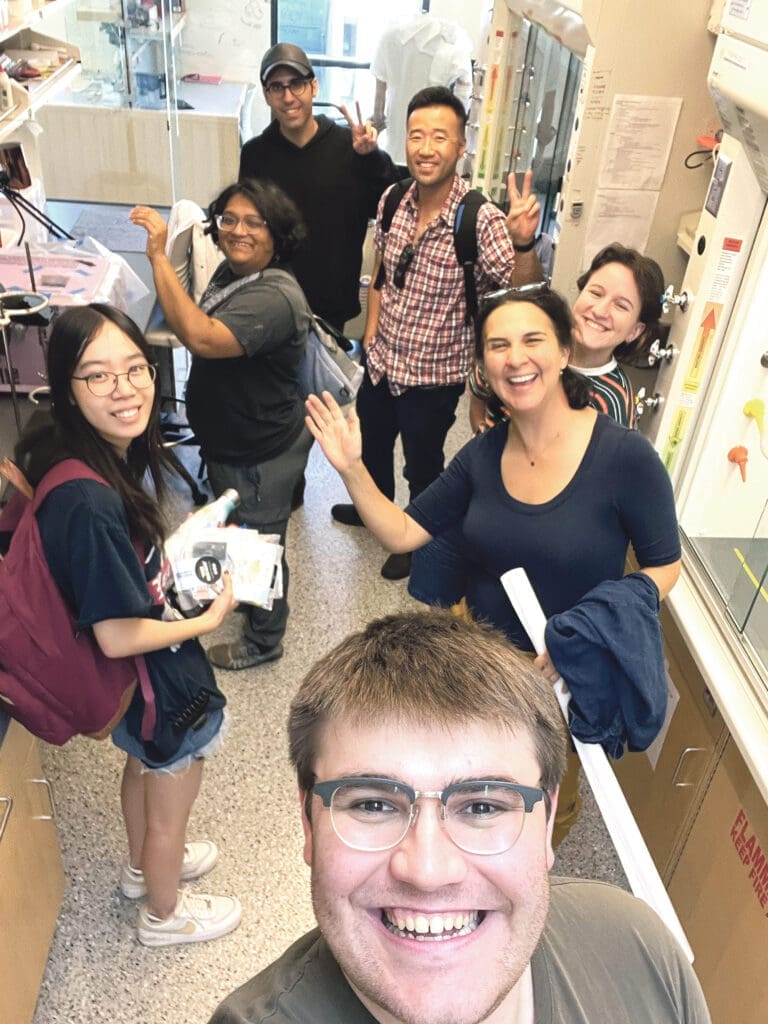
Trisha Andrew (left) and Carolina Aragón (second from right) with their research team members. (Photo by UMass Amherst)
Researchers at UMass Amherst recently unveiled a tool to combat climate change, fossil-fuel dependency, skyrocketing home heating bills, and gentrification all at once — a simple fabric treated with a photothermal dye that, when placed on outside walls, can help keep a home almost 9 degrees warmer over the course of a day.
“Sometimes, a simple solution works best,” said Trisha Andrew, professor of Chemistry at UMass Amherst, and one of the paper’s senior authors, along with Carolina Aragón, associate professor of Landscape Architecture, and Ho-Sung Kim, senior lecturer in Building and Construction Technology.
“When you’re cold, you put on a sweater,” Aragón added, “so we started thinking: what would you do if you’re a building?”
Heating buildings is a huge driver of fossil-fuel consumption, greenhouse gas emissions, and energy insecurity. More than 33 million homeowners in the U.S. report trouble keeping their houses warm, and more than 24 million people — often renters — report skipping food or rationing energy in order to pay for heat. Meanwhile, according to the U.S. Energy Information Administration, residential and commercial buildings account for 39.1% of the primary energy used in the U.S. Reducing heating costs also translates into an enormous reduction in CO2 emissions.
The typical way to address an inefficient home is to tighten it up: new windows and doors, more and better insulation, etc. But renters don’t necessarily have these options open to them. Worse is the phenomenon of ‘reno-viction,’ where a landlord upgrades a property and then raises rents beyond what’s affordable for current tenants. “Too many people have to choose whether they heat or eat,” Aragón said.
But what if keeping a house snug were as easy and affordable as putting on a sweater?
Andrew, whose specialties include inventing high-tech fabrics that can mimic animals adapted to extreme cold — like polar bears — and Aragón, who has long worked at the community scale to tell the story of climate change, teamed with Kim, who is an expert in modeling architectural designs for energy usage.
The team initially thought of a building blanket, but ultimately what they designed and tested looks much more like jewelry: a series of removable tiles or panels that can be hung on any surface, which not only conduct the sun’s warmth, but insulate the building.
The key is a photothermal dye that Andrew invented. “We can put this dye on anything,” she said. “It doesn’t have to be on an expensive fabric. We chose to test it on umbrella fabric — something that was rugged and robust but still affordable.”
When they modeled their design, the results were eye-popping. “We saw up to a 15% decrease in energy costs for a residential building in a northern climate, like Massachusetts,” Andrew noted, “and up to 23% reduction in a large, 16-story apartment building.”
By comparison, a well-done traditional home renovation might yield a 2% reduction in energy costs.
“When you’re cold, you put on a sweater, so we started thinking: what would you do if you’re a building?”
These panels could even be sold as do-it-yourself projects that any renter could complete. The team imagines a scenario where people head to their local hardware store, buy a roll of the fabric and a few 2x4s, and, in an afternoon, have a cheap and effective way of helping to heat their homes.
“Because the heart of this technology is a dye, we can use it to make panels that are beautiful and blend in with the specific culture and aesthetics of an area,” Aragón said. “It’s important to get the architectural and aesthetic part of this right, in addition to the science.”
But before consumers rush out to ask for the miracle fabric, the team needs to conduct additional, real-world testing. Though they’ve proven the concept in the lab, they need more data and field tests with life-sized prototypes.
“This could have an enormously beneficial societal impact,” Andrew said, and Aragón agreed, noting, “there’s a role for anything that is empowering at the individual scale.”
The research appears in the journal ACS Applied Engineering Materials.












 “MAHA’s STASH program has a demonstrated record of giving homebuyers the financial and educational support they need to navigate the purchase process and begin building equity for long-term wealth./We are pleased to help make it possible for STASH to expand and enhance homeownership opportunities for families throughout Massachusetts.”