Daily News

‘Game changer’ is loosely defined as event, person, or product that fundamentally alters an existing situation, strategy, or industry.

As the Massachusetts Division of Capital Asset Management and Maintenance (DCAMM) and the Trial Court went about reviewing proposals for a new regional justice center, Springfield Mayor Domenic Sarno urged them to pick a game changer. When the decision came down last week, many observers quickly concluded that they didn’t.

But we’ll get back to that later. Let’s start by noting it might be unrealistic to look upon any courthouse as a game changer. One can be a nice addition to the landscape and an architectural gem, such as Boston’s John Joseph Moakley United States Courthouse, or even Springfield’s federal courthouse. But it would a stretch to say that a courthouse, by itself, could be a game changer.

What a courthouse can (and should) do is support the local business community and perhaps be a catalyst for some new business development, such as with restaurants and after-work gathering spots. And we’re not sure the selected site chosen by DCAMM and the Trial Court — 125 Liberty St. and adjoining properties — can even do that.

The site is, to borrow a phrase, on the wrong side of the railroad tracks. It is just 300 yards from another proposed site, the former W.F. Young building and adjoining properties off Dwight Street, and 350 yards from still another proposed site, the former Mardi Gras building. But it’s separated from those sites and the rest of downtown by the railroad bridge, which has proven to be a barrier historically. Can a new courthouse prompt people to cross that barrier? Maybe, but that’s being optimistic.

Meanwhile, the Liberty Junction Team is comprised of FD Stonewater, a Virginia-based boutique development, brokerage, and asset management firm; Co-Jo Partners, a development team that includes John Barros, head of the Massachusetts Convention Center Authority; and Boston-based Suffolk Construction. In choosing that project, DCAMM overlooked several local developers who have made significant commitments to this region and have serious skin in the game.

People like Peter Picknelly, who was part of the team that transformed the former Court Square Hotel into market rate and workforce housing. And Jeb Balise, president of the Balise Auto Group; co-owner of 1441 Main St., an increasingly significant player in commercial real estate development in the region; and someone who has given back to the community — for example, with sizable contributions to Square One. It would have been good to see the state give this contract to someone local, someone who would likely have more investments in the city and more philanthropic contributions.

Overall, it appears the state went with the cheapest proposal, and the one that could arguably have the least positive impact on the city.

That’s not to say there won’t be some benefits and some trickle down. There will be hundreds of construction jobs created, obviously. Also, Union Station, which is across Dwight Street from the site, could certainly benefit and might see some additional development and office rentals, meaning it might become more self-sustaining and less reliant on public subsidies. Meanwhile, Baystate Health benefits from selling its headquarters at 280 Chestnut St. and adjoining parking garage to the developers, a sale that comes at a time of real financial hardship and need to consolidate.

But these benefits pale in comparison to the impact of a courthouse in or much closer to a downtown that is being hurt by remote work and is desperate for a spark that might accelerate developments, like the new restaurants open, or soon to open, on Worthington Street.

Meanwhile, something to watch is what happens with Baystate’s headquarters building; if it is intended for office use — meaning lawyers who would frequent the courthouse — this will only create more vacancies downtown and more hardship for property owners there.

Optimists might look at the selection of the Liberty Junction proposal and note that the city could get two, three, or perhaps four or more development projects in sites not chosen for the courthouse, such as the former W.F. Young property, Tower Square Park, the existing courthouse, the Mardi Gras building, and the riverfront site in the North End.

Perhaps, but these sites had gone undeveloped for years, or decades in some cases, for a reason — it’s very difficult to develop them. Housing is certainly needed, but it’s a stern challenge to make a housing project pencil in this part of the state as construction costs continue to rise. New office space? There’s already plenty of vacant space downtown, and there will be more as the trend toward remote work and hybrid schedules accelerates. Retail? That sector is being clobbered by Amazon and likely won’t be making any kind of comeback.

Realistically, the only way those properties were going to be developed was with a can’t-miss, 40-year contract from the state for a new courthouse that would generate hundreds of millions of dollars in revenue over the life of that contract.

Assuming negotiations go smoothly, that contract will go to the Liberty Junction Team, which is not local and doesn’t seem have the best site from the standpoint of potential impact. But it has the cheapest proposal, and that’s apparently what the state is most interested in.

Time will tell, but this proposal doesn’t look like a game changer, or anything approaching one.

Daily News

PITTSFIELD — The Berkshire Regional Transit Authority (BRTA) recently announced it has hired Keolis Commuter Services, an international firm with a strong presence in Massachusetts, to manage its transportation services. A new sub corporation specific to BRTA called Keolis Berkshire Transit Services was created, and all transit employees have been folded under that umbrella.

Even before the July 1 start, the new firm had hired a general manager with over 15 years of experience and recruited four driver candidates currently in certification class.

The move comes in a year when BRTA saw its highest ridership ever, at more than 700,000 by the end of the fiscal year on June 30.

Keolis provides public transit services — including bus, rail, microtransit, and paratransit — across the country, and its North American sector is headquartered in Boston. The addition of BRTA to its portfolio has the firm serving 203 cities and towns in Massachusetts; BRTA is the first transit authority Keolis has contracted with in Western Mass.

Engaged in a three-year contract, the firm will provide transportation operations services in every facet of the BRTA operation. In the short term, Keolis will focus on more on-time service and consistency and help solve the common challenges in rural transit.

As an example of its capacity, before the transition, Keolis led two job fairs in Lenox, seeking drivers, proactively recruiting to solve a driver shortage, and bringing in four candidates to be trained. Now, the firm will engage in a comprehensive recruitment campaign, advertising through the Keolis careers page; on platforms such as Indeed, ZipRecruiter, and Facebook; and with boots on the ground in the 30 Berkshire communities.

Keolis replaces Transdev, which served the BRTA for 20 years. In coming years, Keolis will work closely with the BRTA administration to provide new intelligent transportation systems and introduce new services such as microtransit.

“We’re excited to have this transition, and it’s providing a better work environment for employees already. We are building a new culture here, and I feel very positive about it,” said Kathleen Lambert, BRTA administrator. “They’ve hired us an extremely strong general manager with a depth of experience we haven’t had here for a long time. We will do a lot of great work together over the next several years. Keolis will really help strengthen what the future looks like and ensure we provide the highest quality services possible to Berkshire residents.”

Daily News

SPRINGFIELD — United Way Pioneer Valley (UWPV) is celebrating the beginning of a new Step Up Springfield season with a kickoff reception at the Community Leadership Connect (CLC) Leaders Lounge. Click here to register.

The event will take place on Thursday, July 9 from 8:30 to 10 a.m. at UWPV’s offices in the TD Bank building, 1441 Main St., Springfield. Speakers will include leadership from United Way of Pioneer Valley and representatives from participating agencies. The event is intended to convene providers and community leaders to learn more about the program’s impact throughout the region, and to identify additional shared resources to enhance service delivery.

The Summer Step Up grant expands access to summer learning in early education across the region. Funded through the Massachusetts Department of Elementary and Secondary Education and administered by United Way of Massachusetts Bay, the grant is supported locally by United Way Pioneer Valley, which provides oversight and resource coordination for participating agencies. In Springfield, grantees include Square One and the Springfield Boys & Girls Club; in Holyoke, grantees include Valley Opportunity Council and Holyoke Public Schools. Together, these local agencies are receiving $300,000 to broaden summer learning opportunities for area children.

This summer’s funding will support approximately 158 youth in six weeks of summer programming across July and August, with transportation provided so that more families can take part, and will fund 541 hours of professional development for early education staff.

Created in the years following the COVID-19 pandemic, the grant helps families with young children access expanded summer education as their children prepare to enter school age and transition into the coming school year. The programming’s earlier success in preparing youth for school led to its continuation and expansion, allowing more children and families to benefit each year. The funding supports increased professional development for early education staff, transportation assistance, and enrollment of children whose families do not have a childcare voucher.

This landmark launch event serves as the cornerstone of UWPV’s CLC Leaders Lounge series, bringing together grantees with the critical community resources identified as essential for family success. The CLC platform focuses on connecting agencies with capacity-building resources that enable them to focus on program delivery. The ceremony will feature direct services from UWPV’s Basic Needs and Financial Wellness programs, alongside regional partners including the Food Bank of Western Massachusetts and 413Cares. By formalizing these connections at the start of the season, UWPV ensures a comprehensive support network for the hundreds of households served weekly through its regional outreach.

Daily News

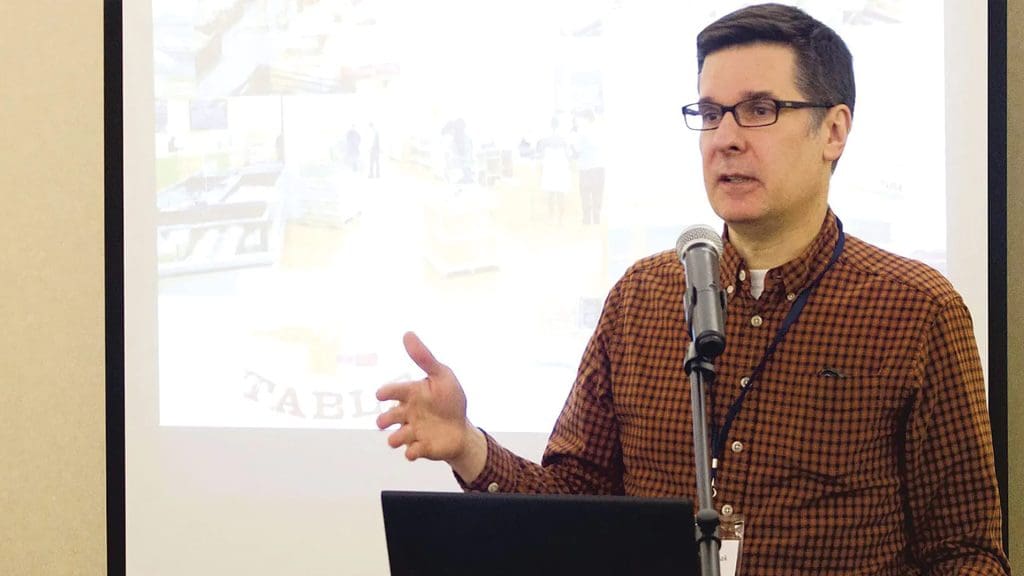
SPRINGFIELD — Rachel’s Table of Western Massachusetts (RTWM), a food rescue and hunger alleviation organization, introduced its new gleaning vehicle to support more long-term and wider distribution of harvested produce from local farms to those in need. At the same time, RTWM is celebrating its move to a new office space at the Springfield Jewish Community Center (JCC).

A gathering for a ribbon cutting will take place on Tuesday, July 7 from 4 to 5 p.m. at the RTWM office at the Springfield JCC.

RTWM is grateful for the opportunity to purchase the new pickup truck that can access more local farm fields to support greater harvest and storage of local produce for distribution. Two major supporters of the new ‘glean machine’ are the Community Foundation of Western Massachusetts and the Max Cares Foundation. Extra in-kind support came from Go Graphix, which wrapped the vehicle.

Gleaning is the practice of harvesting leftover crops from local farms for distribution to partner agencies or informal communal networks that support people who are food-insecure. RTWM works closely with more than 50 local farms, gathering hundreds of people in more than 100 gleans throughout the season, distributing and storing more than 116,000 pounds of farm-fresh food. Gleaning is one of four programs of Rachel’s Table of Western Massachusetts that alleviate hunger, from the most immediate need to longer-term food security solutions. For information about gleaning and to join a glean, visit feedwma.org/gleaning.

Simultaneously, RTWM has grown not only in volunteer size (more than 500) but in staff, both full- and part-time. With just two employees at the beginning of the pandemic, RTWM now employs nine people. This growth has enabled RTWM to deliver nearly 1 million pounds of food annually, reach three counties and beyond, and help people grow their own food through its Growing Gardens program. The new office space accommodates both people and poundage growth.

Hunger has increased in Western Mass. In Hampden County, 54% of households report food insecurity, while in Franklin and Hampshire counties, it is 50%.

Business Talk Podcast Special Coverage

With new episodes airing every other Monday, BusinessTalk features in-depth interviews and discussions with local industry leaders who offer thoughtful perspectives on the Western Massachusetts economy and the many business ventures that keep it running. BusinessTalk is sponsored and presented by Greenfield Cooperative Bank.

Go HERE to view all episodes

Episode 260: July 6, 2026

Joe Bednar talks with Heather Caisse-Roberts, President and CEO, Springfield Symphony Orchestra

Heather-Caisse Roberts came to the Springfield Symphony Orchestra in 2022 and took the reins there last summer, bringing both a background in development and a passion for the SSO’s mission. She says it’s a dream job, but not one without challenges ranging from fundraising to expanding the symphony’s audience for the next generation. On the next episode of BusinessTalk, Heather talks with BusinessWest Editor Joe Bednar about how the SSO continues to blend classic fare with surprisingly modern influences, the importance of its youth programs in building a bridge to the future, and the transporting magic of live music — and why it resonates with all ages. Like the symphony itself, it’s must listening, so tune into BusinessTalk, a podcast presented by BusinessWest over both audio and video platforms, and sponsored by Greenfield Cooperative Bank.

Sponsored by:

Also Available On

Daily News

EAST HARTFORD, Conn. — American Eagle Financial Credit Union, in partnership with ReadyCT and Pathways Academy, honored Andrea Owusu and Kayanna Serrano as recipients of the 2026 NextGen Leaders Scholarship. Each student received a $5,000 scholarship in recognition of their outstanding leadership, creativity, and commitment to promoting financial literacy among their peers.

The second annual NextGen Leaders Scholarship Program challenged high school seniors to bring financial education to life through original social media content focused on financial well-being and community impact. Participants spent a week creating and sharing content designed to engage their peers in meaningful conversations about money management and financial empowerment.

During her campaign, Owusu, a first-generation Ghanaian-American student, highlighted how financial education can empower young people. Her professionalism, creative storytelling, and commitment to helping others make informed financial decisions — along with her “Making Cents” series — distinguished her throughout the program. She will attend the University of Connecticut this fall, where she plans to study business marketing.

Serrano, a recent high school graduate and gifted gymnast, was recognized for creating fun, actionable content that resonated with her followers. A longtime member at American Eagle Financial Credit Union, she is passionate about helping others develop smart money-saving habits. Her “Tips on Budgeting” became the initiative’s top-performing student campaign, exemplifying the power of peer-to-peer education. She plans to attend Southern Connecticut State University to study computer science this fall.

“The NextGen Leaders Scholarship program perfectly reflects American Eagle’s belief that financial well-being should be accessible and relevant to every generation,” said Simeon Chapin, senior vice president, chief community officer at American Eagle Financial Credit Union. “Andrea and Kayanna’s campaigns deftly demonstrated the role financial education plays in building confidence and community. We are proud to support Andrea and Kayanna as they continue their journeys and look forward to seeing the positive impact they continue to make in their schools, workplaces, and neighborhoods.”

The 2026 NextGen Leaders Scholarship campaign generated more than 56,000 views and reached more than 14,000 unique accounts, widely connecting members of the younger generation with relatable financial resources. The initiative was led by American Eagle’s NextGen OneTeam Resource Group in collaboration with ReadyCT and Pathways Academy.

Daily News

SPRINGFIELD — BusinessWest and HealthcareNews.com are now accepting nominations for the 10th annual Healthcare Heroes awards. Nominations for the Healthcare Heroes class of 2026 are due by Monday, July 27, and may be submitted online by clicking here.

The Healthcare Heroes program was created in 2017 to honor the individuals and organizations working across the region’s vast, diverse, and essential healthcare and wellness sector. These leaders, innovators, and collaborators have devoted their careers to improving the quality of individual lives and the health of entire communities.

Since its inception, Healthcare Heroes has more than fulfilled its mission of identifying truly inspirational people and organizations — and sharing their compelling stories. Year after year, the program has highlighted outstanding achievements and contributions from throughout the healthcare and wellness industry.

For more information, contact Heather Leclerc, Marketing and Events director, at (413) 781-8600, ext. 100, or [email protected].

Daily News

SPRINGFIELD — Dakin Humane Society will reduce adoption fees for all cats, kittens, and tiny spirit kittens by 50% from Tuesday, July 7 through Saturday, July 11, according to Executive Director Meg Talbert.

“Summer is always Dakin’s busiest season, and although we’re still early in the season, we’ve seen the number of animals in our care steadily increase over the past several weeks,” Talbert said. “Last year, we welcomed just under 1,500 kittens — the highest number we’ve seen in many years — and all indications suggest we’ll experience another exceptionally busy season. We currently have many cats, kittens, and tiny spirit kittens waiting for loving homes, and by reducing adoption fees, we hope to help more of them find the families they deserve.”

Tiny Spirit Kittens are born outdoors to feral (wild) moms and have had little to no contact with humans. They are shy and fearful of people until they learn to trust. Tiny spirit kittens brought to Dakin are helped by volunteers to become used to the company of people, comfortable with being touched, and able to trust that people are a positive presence in their lives. Each has a different level of comfort and a unique personality. In time, some may become very sweet and outgoing, while others may only ever trust their adopter and no one else. Tiny spirit kittens are usually very comfortable in the presence of other cats.

Cat and kitten adoption fees as listed on Dakin’s website (dakinhumane.org) will be cut in half through July 11. Dakin is open for adopters to visit Tuesdays through Saturdays from 12:30 to 3 p.m., but they are advised to visit the website first to see which animals they are most interested in to help minimize their waiting time onsite.

Feline adoption fees at Dakin include a variety of services and treatments, including a veterinary exam, spay/neuter surgery, age-appropriate vaccinations, microchip and registration, a rabies vaccine (if the pet is over 12 weeks of age), access to behavior support, a free post-adoption veterinary exam at participating clinics, and a food starter pack. Other features include a feline leukemia test, FIV test, flea and ear mite treatment, and deworming treatment. According to Talbert, the pre-adoption cost of care for each adoptable animal that comes to Dakin averages $950.

Banking & Finance Features Special Coverage

Testing the Waters

It’s called Liberty Live.

Dave Glidden, president and CEO of Middletown, Conn.-based Liberty Bank, describes this as a twice-a-year, in-house ‘broadcast’ where team members are updated on what’s happening at the institution, complete with a ‘fireside chat’ element during which he answers questions from employees.

It was during a recent episode of Liberty Live that Glidden addressed the subject of AI in the financial services sector and started by saying, “it’s no longer something that’s coming … it’s here.”

And the fact that it’s here is one of the motivations behind the bank’s creation of what it calls its AI Center for Excellence, a dedicated function designed to bring advanced artificial intelligence to every department of the bank.

“What I’m looking to do with AI is see where we can apply it in use cases to increase our efficiencies,” Glidden said. “And we’re going to follow what I call ‘ethical AI,’ meaning there will always be a human in the loop — there will always be a human making the final decision.”

Dave Glidden recently told his team at Liberty Bank that AI is “no longer something that’s coming … it’s here.”

At present, the bank is using various AI products, with names like Copilot, Salesforce, ABBYY Value, Rabbitt, and Lama, to create efficiencies and save team members time in areas such as document processing, construction loan automation (the bank has a strong niche in the timeshare construction realm), and smaller (for this bank) commercial real estate loans.

Not all banks have a formal center for excellence when it comes to AI, but they are essentially doing the same thing as Liberty — looking at opportunities to use this emerging technology to improve customer service while also shaving hours off the time it takes to do certain things, thus giving employees opportunities to make better use of their time.

And while doing that, they’re also careful to build thick walls between the AI products they’re using and the vast stores of information on customers and employees alike.

The opportunities, risks, and, yes, controversy concerning AI were addressed in a summary statement on the subject from Kathleen Murphy, president and CEO of the Massachusetts Bankers Assoc.

“Artificial intelligence offers significant opportunities to enhance efficiency and the customer experience across the banking industry,” she said.

“As banks explore these technologies, they will continue to apply the same disciplined approach to risk management, oversight, and due diligence that has guided the adoption of new banking technologies for decades.

“While AI can help banks serve customers more effectively, it cannot replace the human judgment, expertise, and relationships that remain fundamental to banking,” she went on. “Maintaining customer trust will continue to be the industry’s highest priority.”

Chuck Leach, president of Lee Bank, concurred with that sentiment, but added quickly that AI is not like the new banking technologies that have emerged over the decades.

“AI is different — it’s a quantum leap forward from other technology advancements that we’ve all experienced in our lifetime,” he told BusinessWest. “I guess all those other technologies might have made employees better or more effective, but this is just a quantum leap forward in terms of amplifying skill sets and enabling bankers to focus on the human interaction because some of the other tasks that are little more menial will be made much more efficient.”

Indeed, this is a rapidly, as in rapidly, changing landscape, one where best practices are a moving target at best, with banks and credit unions creating their own rather than trying to follow others, and return on investment is still difficult to calculate and often measured in hours or minutes of time saved rather than dollars, although those are added up as well, said Drew Weibel, Lee Bank’s chief information technology officer.

“We’re looking at hundreds of hours, easily, saved thus far,” he said. “It’s in small bits and pieces, but it adds up across the board.”
For this issue’s focus on banking and financial services, BusinessWest takes a look at how some institutions are deploying AI and how the technology is changing the industry, and in the course of doing so, we’ll look at the many aspects of rolling out this technology, from determining what products to invest in to how to measure results.

Technically Speaking

As he talked with BusinessWest about the AI Center for Excellence, Glidden described it as an effort to get out front on this technology, rather than be a ‘strategic follower,’ as he originally planned.

He described the initiative, undertaken in strategic partnership with Flare AI, as a hub for AI strategy, governance, and execution, with each of those elements carrying significant and equal weight.

“We have to make sure that we, as a company, from a governance standpoint, are controlling this,” he explained. “We need to have the policy rules in place but, more importantly, the right people around the table that can evaluate these things, whether it’s part of vendor analysis or identifying opportunities to improve efficiency with AI.”

The center will be led by Jeremy Miller, Liberty’s chief operating officer; Paul Young, chief financial officer; and Troy Damboise, chief enterprise risk officer, and co-chaired by David Hadd, Liberty’s head of Business Transformation; and Mike Stevens, senior vice president of Data Management and Enterprise Architecture.

The center is exploring ways to put AI to use to create efficiences with both back-office functions and customer-facing operations, Glidden explained.

“As much advancement as we’ve made here in my tenure, we still have a lot of manual processes and laborious ways of doing things, policies and procedures, and all the rest,” he noted. “So I really see AI for us, in these early stages, as bringing it in and learning how to apply it safely, from an informational protection standpoint, but also taking advantage of huge opportunities to improve our efficiency.

“If you can free up teammates’ time for more valuable tasks, then we can continue to grow and not have to continue throwing headcount at it,” he went on. “I don’t see it from a headcount reduction standpoint; I see it as increased efficiency for our teammates.”

And some current uses are creating such efficiencies, he noted citing Rabbitt and another product called Lama, a model that focuses on smaller commercial real estate transactions.

With the latter, the AI technology is helping to underwrite and monitor loans more quickly and more efficiently, Glidden explained. “We lend in 36 different states across the country, so it’s a big operation and a great business for us. But anytime you’re making loans that large for complicated projects, there’s a lot that goes into monitoring and underwriting them.

“This is an AI module that actually does all that monitoring for you,” he went on. “Instead of me having to put six teammates who are buried in the data of construction advances, progress payments, and all the rest, now they’re freed up because AI does it automatically. What would normally take a teammate maybe six hours … they get it in a better format in about 30 minutes.”

As for Lama, it addresses a gap in what Glidden called the “commercial real estate investor side.”

The bank handles many large transactions, but in Western Mass. and Connecticut, many borrowers are targeting smaller real estate deals, he explained. “It’s hard, when you build a machine for big, big deals, to put a small one through, and vice versa, so this is an AI we brought in that does the underwriting for small-investor commercial real estate.

“It’s not taking the time of credit analysts, portfolio managers, relationship managers, and underwriters that are working on a $25 million or $50 million deal,” he went on. “This automates it — once you get the information from the customer, the AI model reads it, does an underwriting of it, and spits it all out. In a matter of 15 to 30 minutes, there’s a very well-underwritten document that a credit person and a real estate person can make a decision on.”

Change Agents

Leach bristles at the notion that banks must have size to be efficient, a common refrain among institutions in pursuit of scale.

“I consider myself a really innovative CEO and president — I followed technology closely when I was an investment analyst, so it’s always been near and dear to my heart,” he told BusinessWest. “Stack on to that the knock on small banks, that they’re inefficient, that we need to have scale to be more efficient — and I always push back against that — and in the middle of this comes the next phase of AI, and we’ve really just embraced this whole concept of how to apply it at a community bank.”

Leach said the bank is being entrepreneurial, but also spirited, in its approach to AI, with creation of a committee to review opportunities and products, and a competition within the institution to identify new and creative uses for Microsoft Copilot — now being used by most banks to accelerate routine work — and other platforms.

“We’ve game-ified the use of AI and created a use case contest, for lack of a better word,” he noted. “People submit their use cases, tally up the hours, how much time or money they think it’s saved, and we have our AI, or IT steering committee, vet those, and there are prizes for those who have submitted the best use case.

“That’s a good starting point because, out of that, across the organization, we’re seeing some very unique and exciting use cases,” he went on. “Whether it’s in our commercial lending area or collections area or with our foundation and sorting through grant requests — we’re not dehumanizing it, but making it more efficient.”

Meanwhile, the bank has created a dashboard outside this game-ification of AI to tally up all the use cases and the hours saved, he went on, adding, “it’s almost like a national debt clock tracking the ROI with this whole endeavor.”

As for those use cases, they cover several areas of bank operations, from vendor management to the use of agents, such as on the retail side of the operation.

“Our branch staff have an agent that they can pose questions to. Those questions used to mean interrupting the branch manager or calling the operations area and talking to someone there,” he explained. “This agent can guide the human through those steps.”

Leach cited another use case, this one involving annual reviews on company compiled by the chief credit officer.

“It’s like writing up a Harvard Business School case study on a company — there’s a lot of detail, a lot of which can be carried over from the prior year’s writeup, but then, you have to integrate it with whatever new has happened,” he explained. “It’s a tedious process, and there’s a lot of hunting and pecking and going back and forth between documents. There’s a way with AI to speed up that process, helping with writing the narrative, bringing new data in but leaving the correct data from past years in there … it’s a way to craft a new credit memo or annual review on our commercial credits that’s cutting the time down from five hours to one hour.

“AI is doing the heavy lifting around non-knowledge worker stuff, such as transferring data and things like that,” he went on, “while the human, the skilled credit professional, is reviewing that and shaping it for the final product.”

There are many other examples of how is AI is shaving hours off processes and creating time for team members to put their time and energy to better uses, he continued, adding that, at this still-early stage in the work to deploy AI, return on investment is mostly being measured in time, not dollars, although it can be done with the latter as well.

That’s true in the case of hiring outside consultants, said Leach, citing just one example. “We had planned on having some technical consultants come in and assist IT with some upgrades and migrations, and we decided to leverage Copilot instead to guide us through these steps, and we were able to complete a lot of the work on our own without having to engage these consultants.”

Weibel, like Glidden, said there is no shortage of companies pitching new AI products, and the bank is being diligent about reviewing options and deciding which to invest in.

“There are a lot of shiny things in the marketplace at this point,” he told BusinessWest. “We have to see if it’s the right fit for the institution; it’s just like selecting any other system or tool that we would use.”

Leach agreed, but noted that most small and medium-sized banks are beholden to one vendor that is “like the plumber for everything at the bank.”

“And for better or worse, any new AI tool that comes out of left field has to play nice with that vendor and be reasonably priced to sync them up, which often isn’t the case, for us to even get out of the batter’s box and entertain using them.

“We’re less inclined to use AI in forward-facing or client-facing scenarios, and moreso behind the scenes to drive efficiency, and that’s our rallying point,” he added, summarizing the bank’s mindset with the emerging technology. “That, and trying to move beyond experimentation and one-off cases, which everyone has stumbled across, and actually operationalize in a way that really helps the bank.”

Bottom Line

In most respects, banks, like businesses across all sectors, are just getting started when it comes to using AI to change how people work and how they apportion their valuable time.

As noted earlier, the landscape is changing rapidly and constantly, leaving those in the industry to only imagine what things will look like in just a year or two.

As Leach said, AI is not like previous new banking technologies. It is, indeed, a quantum leap forward.


Features Special Coverage

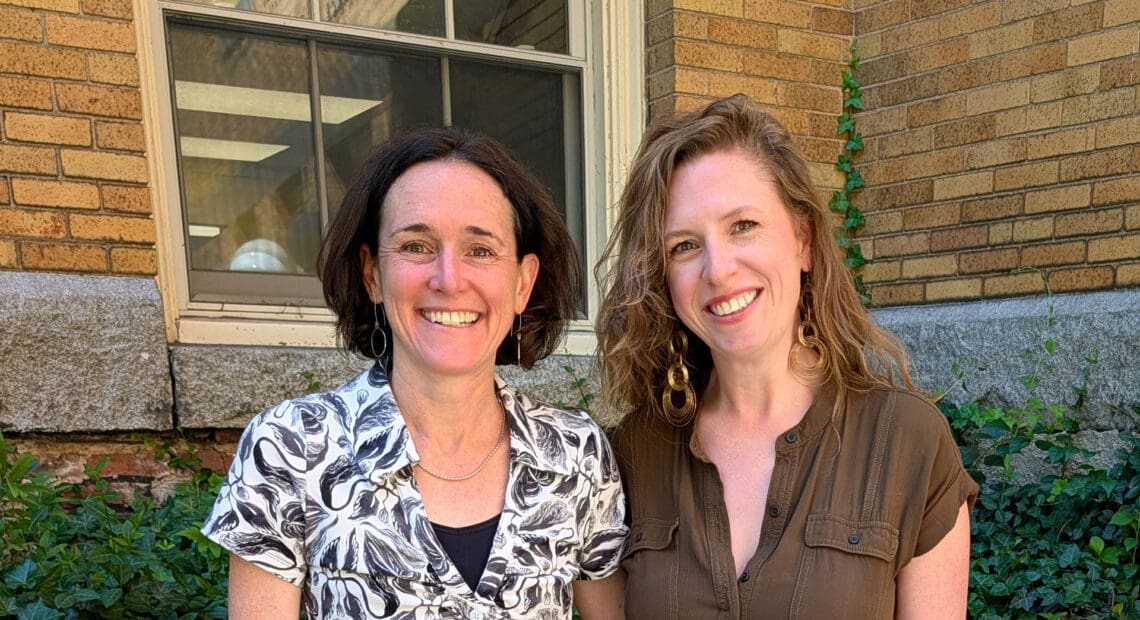
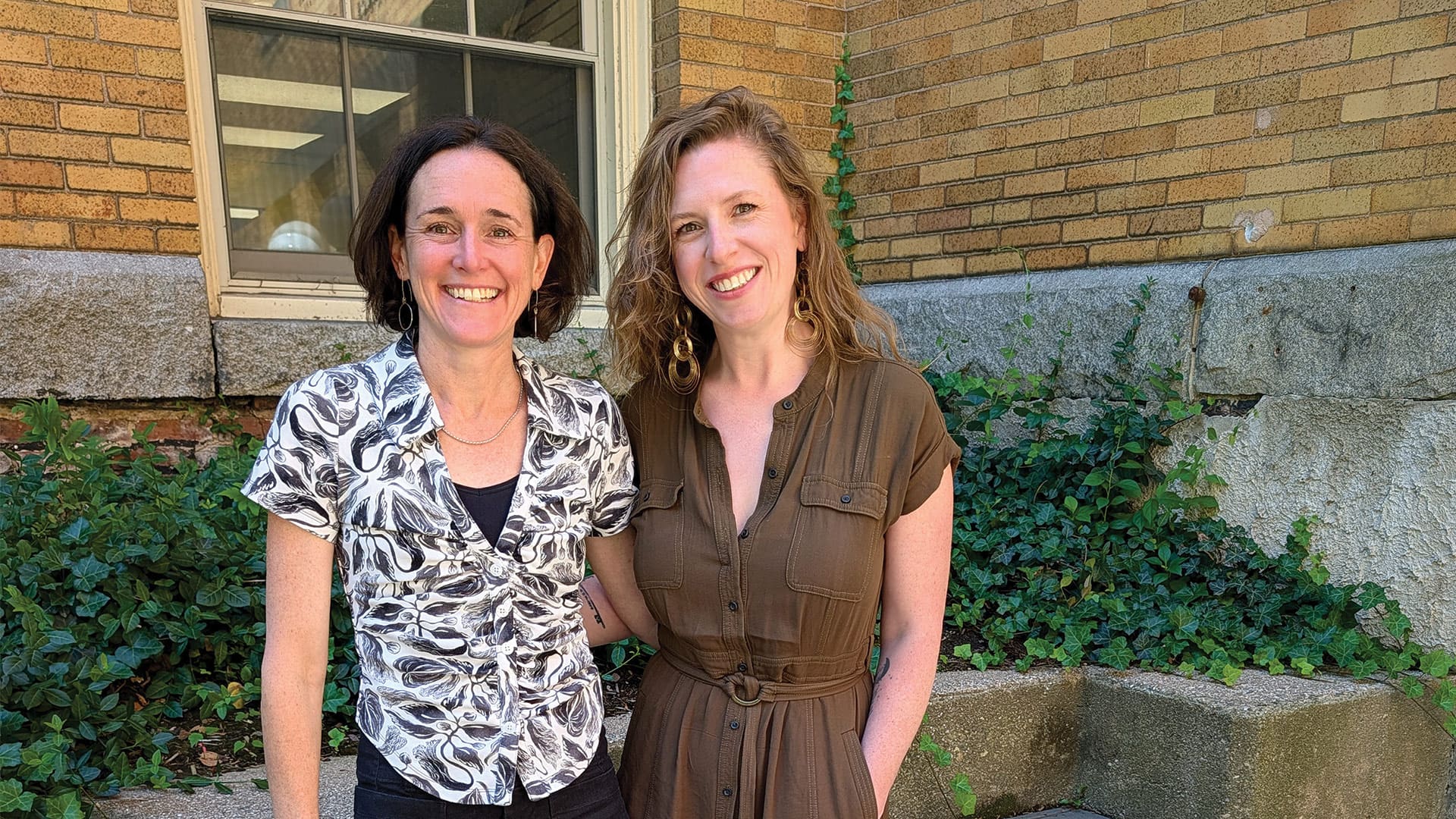
Community Foundation of Western Massachusetts President and CEO Megan Burke

Time of Need

It started with a $1 million donation — that turned out to be not nearly enough.

But the Community Foundation of Western Massachusetts was deeply appreciative of the gift — and how it not only met many needs, but highlighted so many more, President and CEO Megan Burke said.

“We were really fortunate to receive this big, anonymous donation from a donor who has been following all of the federal policy changes and impacts and recognized that nonprofits are struggling, and wanted to make some funding available to us to grant out to nonprofits,” she told BusinessWest. “Essentially, the ask was, ‘can you distribute a million dollars in a couple of months?’ And we were like, ‘yeah, we would love to do that. That’s what we’re made for.’”

So the foundation opened an application process in April for what it called a Community Resilience Grant to distribute the $1 million.

Megan Burke (left) visits Wales Community Pantry, a recent grant recipient, and its board chair, Annette Farrington.

“We shared what it was for. We made a very simple application that said, ‘if you’ve been impacted by federal funding cuts, or maybe federal policy changes have created more demand for your services, and you don’t necessarily have the funding — so there’s either less funding coming in or more demand — let us know what the impact is.’ And that’s how we worked to distribute that million dollars.”

The problem was, the foundation received $7 million in requests, Burke went on. “So for every single dollar we had to give away, we could have given away seven. And we did our best with the community reviewers who were part of the process to figure out where the greatest needs were, and try to meet those needs.”

That’s a daunting challenge to be sure, but it also highlighted the need for a new partnership between the Community Foundation of Western Massachusetts, Berkshire Taconic Community Foundation, and New England Public Media (NEPM), called 413 Gives.

“We decided it would be great to work collaboratively to inspire folks to support one another in this community,” she explained, noting that the central thrust was a day of giving on June 11, with plans to make it an annual event, although people can give to the effort at any time. NEPM collected $63,000 on the event day, but donations afterward have brought the total close to $100,000, and organizers hope to build awareness and momentum to swell that figure going forward.

“We really wanted to focus on those nonprofits who have been impacted by federal policy changes and federal funding cuts, and call on folks in the community to support their work,” Burke reiterated. “Working with New England Public Media, we kind of spotlighted some nonprofits in the community that have been impacted by those changes. So, in addition to raising money, we also had the opportunity to raise visibility about the work that nonprofits do and the strains they’re under. I personally have heard from lots of nonprofits in the community that thought it was really useful, and they were able to get more attention for the work they’re doing.”

Eighty percent of the money raised by 413 Gives will be distributed to nonprofits in Hampden, Hampshire, and Franklin counties, with the rest earmarked for Berkshire County.

The money will be distributed proportionally based on population, with 20% of the funds raised going to the Berkshires and 80% going to the Community Foundation of Western Massachusetts to impact Hampden, Hampshire, and Franklin counties. NEPM is not keeping any of the money, essentially donating its efforts on behalf of the two foundations and the nonprofits they support.
“It’s rare that someone says, ‘we just want to do this, and we’re not going to keep a penny of it,’” Burke said. “But with public media, they saw how their own funding was impacted last year, and how the community stepped up and helped them out. And they had a big platform to be able to ask for that help. So they wanted to pay it forward to other nonprofits who haven’t necessarily had the opportunity to get that support.”

Wave of Requests

The recent $1 million round of Community Resilience Grants were distributed to Alianza DV Services, All Farmers, Amherst Community Connections, Amherst Mobile Market, Amherst Survival Center, Franklin County Community Meals Program, Franklin County Dial-Self, Gardening the Community, the Gray House, Greater Springfield Senior Services, Grow Food Northampton, Hilltown Community Development Corp., Hilltown Youth Performing Arts Program, Holyoke Food and Equity Collective, It Takes A Village, Jewish Family Service of Western Massachusetts, Just Roots, Lorraine’s Soup Kitchen and Pantry, Manna Community Kitchen, Massachusetts Fair Housing Center, Northampton Survival Center, OneHolyoke Community Development Corp., the Praxis Project/Pequoig Farm, Rachel’s Table of Western Massachusetts., Revitalize Community Development Corp., Safe Passage, Stone Soup Cafe, Transhealth, and Wales Community Pantry.

Last September, nearly half of the 250 nonprofit organizations that applied for the Community Foundation of Western Massachusetts’ Flexible Funding Grant reported they had experienced the ripple effects of cuts to intermediary agencies, loss of multi-year support, equity retrenchment, and rising administrative loads. Of the 178 organizations that applied for this spring’s Community Resilience Grant, 147 reported that the impacts of federal funding cuts had already arrived, disrupted services, and strained budgets, while 41 indicated that significant impacts were still on the horizon.

“This $50,000 grant is not just funding; it is a lifeline at a moment when we needed one most,” said Nancy Boyle, interim associate director for the Franklin County Community Meals Program, which provides more than 25,000 free meals annually and serves more than 2,800 households in Franklin County across its meal sites and pantry. “This grant arrives as we are doing the hard, necessary work of strengthening our organization with skilled leadership, tightened systems, and a renewed commitment to the communities we serve.”

With only 29 recipients out of 178 applicants, “we had to let the rest of the folks who applied know that we couldn’t fund their requests,” Burke said. “But with 413 Gives Day, we’re going to be using the funds that we get from New England Public Media to go back to that list and say, ‘who else who already applied was next on that list, that, if only we had more money, we would have given them some funds as well?’ And we’ll essentially reach out to them; they won’t have to apply again or do any additional work. That will allow us to get that money out pretty quickly.”
No date has been set for next year’s 413 Gives event, although she said one possibility is April 13, playing off the 413 theme.

“We definitely would love to have this be an opportunity where the community comes together every year, and we can think of different ways to support nonprofits through that,” Burke added, noting that there’s a wide variety of applicants, in terms of the work they do. “We’re working hard to distribute funds in each of the three counties, and across a wide range of issues. So many different sectors have been impacted by the federal policy changes and the funding cuts.

“So while we could have gone even broader, we’re really thinking about food security issues, housing challenges, and at least a couple of grants for organizations that serve immigrants who may need legal assistance or other kinds of services. Some organizations are having additional costs related to security issues — for example, the LGBTQ community — and trying to make sure that their folks are safe,” she went on. “So it’s a whole gamut of essential needs that we’re trying to cover, in addition to thinking about the geographic distribution.”

Rising Frustration

Burke said she shares the frustration of nonprofits who have been dealing with a wave of funding cuts over the past year and a half, noting, again, that the majority of grant applicants have either had felt an impact are anticipating one.

“We were really concerned that we would see a number of nonprofits closing and not being able to continue. And while there’s been a little bit of that, I think what we’ve seen more of is particular programs or project areas having to close because they’re no longer funded, or maybe grants that nonprofits were expecting from the federal government aren’t coming through, so they’re not able to add on something that they were going to add on.”

But Western Mass. has a certain built-in resiliency, she added, as the majority of nonprofits in the 413 are on the small side, and those tend to rely less on federal funding than larger nonprofits.

On the larger side, she explained, “the Public Health Institute of Western Massachusetts — an amazing organization that does incredible work — secured a really significant federal grant with the city of Springfield to do a whole range of different things to improve health in Springfield, and that funding didn’t come through. So they had all these program areas they were planning to work on, and some they’d even started because they’d already signed a contract, and then the money didn’t come through, which is terrible,” she explained.

“But I think, for the smaller nonprofits in the region, it’s not necessarily so much that they were expecting federal funding and it didn’t come through, but they’re seeing folks whose SNAP benefits have been impacted, or eligibility requirements are changing, and the food pantries are seeing an increase in folks.”

Burke mentioned a recent visit to Wales Community Pantry, which, she learned, has experienced a significant spike in families needing assistance. “So some of this is actual cuts, but a lot of it, I think, is just nonprofits trying to figure out how to meet rising demand.”
Equally important, though, is the work of raising awareness — and that’s a crucial element of 413 Gives.

“It’s really important, I think, for folks to make sure our government knows there’s an impact happening. And if this isn’t what people want to see happening, people have to get involved and speak up,” she said.

“I’m not saying anything partisan here — I’m just saying being engaged and speaking up is really, really important,” she went on. “Because we can’t fill all the holes. The anonymous donors out there who are super generous — they’re incredibly important, and it certainly helps people in the here and now. But in the long run, there are things that our government needs to take care of.”

Cover Story Environment and Engineering

President and CEO Ashley Muspratt (left) and Director of Communications and Market Evolution Emily Gaylord

Renewed Energy

She calls it “radical ease.”

That’s the term CET President and CEO Ashley Muspratt used to describe how the nonprofit — originally called the Center for EcoTechnology, and celebrating its 50th anniversary this year — aims to make positive environmental impact easier for clients.
That starts with the initial assessment of a home or business.

“We send one of our waste reduction consultants or our energy consultants to the building to determine, ‘what’s the state of this building? What’s the state of their waste management practices?’ We need to understand their existing systems in order to help them prioritize the steps that they’re going to take, but also make sure, when it comes to behavior change, that we’re looking at ways to seamlessly integrate any new solutions into their existing practices because that’s the only way they’ll be sustained for the long term. That’s the radical ease piece,” said Muspratt, who has been at CET since 2017 and at the helm since 2020.

That assessment is typically followed by a discussion of budget, priorities (perhaps climate concern, staff comfort, or long-term energy savings), available state and federal incentives, and how to connect with contractors to achieve goals ranging from weatherization to composting.
“Coming back to this radical ease concept, we try to remove the friction, remove the barriers, and take the work out of climate action for people,” Muspratt said. “So we do all the research and the heavy lifting to get people to their goals.

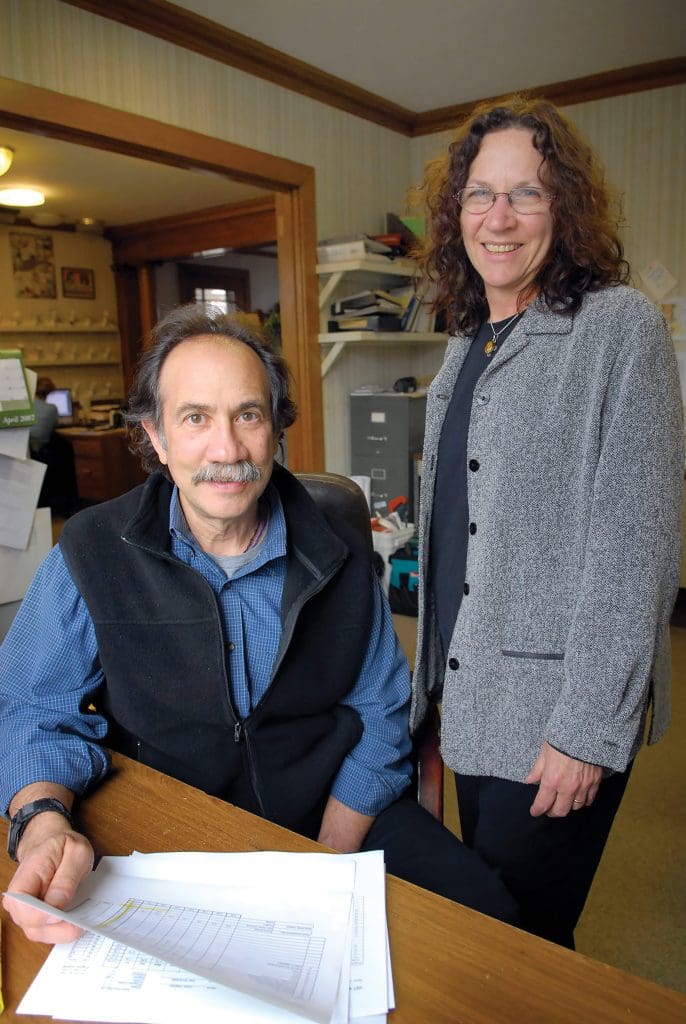
Alan Silverstein and Laura Dubester, former CET executive directors. The Alan Silverstein and Laura Dubester Award for Community Environmental Leadership was created in their honor.

Once we do the site assessment, it’s a very tailored service that we provide, based on what we find and what the customer is interested in. And we try to see them through all the way to implementation.”
That involves the administration of about 60 different programs for state agencies and utilities — quite the evolution from CET’s beginnings in 1976, when it focused mostly on energy audits, an innovative concept for the time.

“These climate solutions exist — we know what they are — but for most people, you have a life, you have a job, you have kids, you have to go to the baseball game, you have a dentist appointment,” added Emily Gaylord, director of Communications and Market Evolution. “So what CET offers is helping people and businesses find a way for climate solutions to make sense in their day-to-day life in a way that doesn’t feel like yet another thing to do.

“I always say with climate solutions, pick your co-benefit,” she added. “Like, weatherization reduces emissions, but it also makes you more comfortable and can save you money. If you reduce your food waste, not only are you reducing methane, but you might be feeding people who really need it. There are so many opportunities where we can take climate action from daunting to doable.”

Amid all the change and evolution at CET, Gaylord is impressed with what has stayed the same — namely, the mission. “The heartbeat of what we do — making it possible for people to participate in these programs, making it feel easy, like a no-brainer, and finding all of those co-benefits — has been consistent. From the beginning, we’ve been working with small businesses and low-income homeowners and farms and folks that are often left out of climate conversations.”

Innovative Start

In many ways, the 1970s was the birth of the modern environmental movement. The decade saw the first Earth Day, the creation of the Environmental Protection Agency, and legislation in the form of the Clean Air Act, the Clean Water Act, and the National Energy Act. It was also the decade of the oil crisis, when many Americans wondered if they would run out of gas.

Former CET Executive Director John Majercak, seen here leading a staff meeting during his tenure.

CET’s founders had an idea: to examine technologies and practices that could improve energy efficiency for businesses and reduce their environmental impact, all while increasing profits and raising quality of life. At first, they focused on energy conservation, in particular partnering with utility companies on the relatively new concept of energy audits, whereby a consultant visits a home or business to talk about ways in which their building or operation could be revamped to save on energy costs.
Other early initiatives included the development of a passive solar greenhouse at Berkshire Botanical Garden and a program that taught solar energy, energy conservation theory, and carpentry to unemployed people, who then installed 31 solar space-heating systems in low-income households.

CET still conducts energy audits, helping homeowners and businesses understand the value of sustainable systems and educating them on the incentives available to make changes. But the organization, which now employs about 85 people, has become much more, expanding its mission into 18 states and a host of new opportunities, from composting and food waste reduction to a national train-the-trainer program and a partnership between utilities and customers called inclusive utility investments (more on those later).

“Our official mission is to innovate, implement, and scale the environmental solutions that communities need to thrive,” Muspratt told BusinessWest. “Our work as an organization is to mitigate CO2 emissions and other greenhouse gas emissions to prevent the worst, most catastrophic impacts of climate change, slow that down.
“The work that we do to weatherize buildings and transition them off of fossil fuels, these are all technology solutions that are also very good for a changing climate,” she added. “Another big component of our work is waste reduction, as waste, particularly food waste, is another major driver of greenhouse gas emissions, specifically methane.”

Gaylord said clients welcome the opportunity to achieve win-wins that benefit both the planet and their own business.

“No one understands the value of food more than somebody in food service who interacts with it every day. A contractor understands building materials more than anybody else. A facilities manager knows exactly how much they’re spending on their energy costs. So this idea that people are doing nothing, or they’re not doing enough, is not a helpful place for people to start,” she said. “It’s better to acknowledge how much is already happening and then build on that momentum and allow the customer to feel really proud of the work they’ve already been doing and the ways they’ve been participating in climate action without even realizing it — and then help foster these other ways to work on it.”
Muspratt agreed, again reiterating the ancillary benefits of CET’s work.

“These days, it’s become more normalized to talk about climate as one of the many reasons you might take action. But certainly, for businesses and households, economics is the number-one thing — that tends to be a big driver. And then, for certain programs, it’s the public health piece, particularly when we’re working with lower-income customers in really challenging housing situations where there might be moisture and mold issues that we’re helping to mitigate before weatherizing the building — issues that contribute to chronic respiratory disease and all kinds of compounding health challenges like asthma.”

With CET’s train-the-trainer program, the nonprofit is helping to accelerate the conservation learning curve for organizations across the country, particularly with food waste, in settings like restaurants, hotels, hospitals, and colleges.

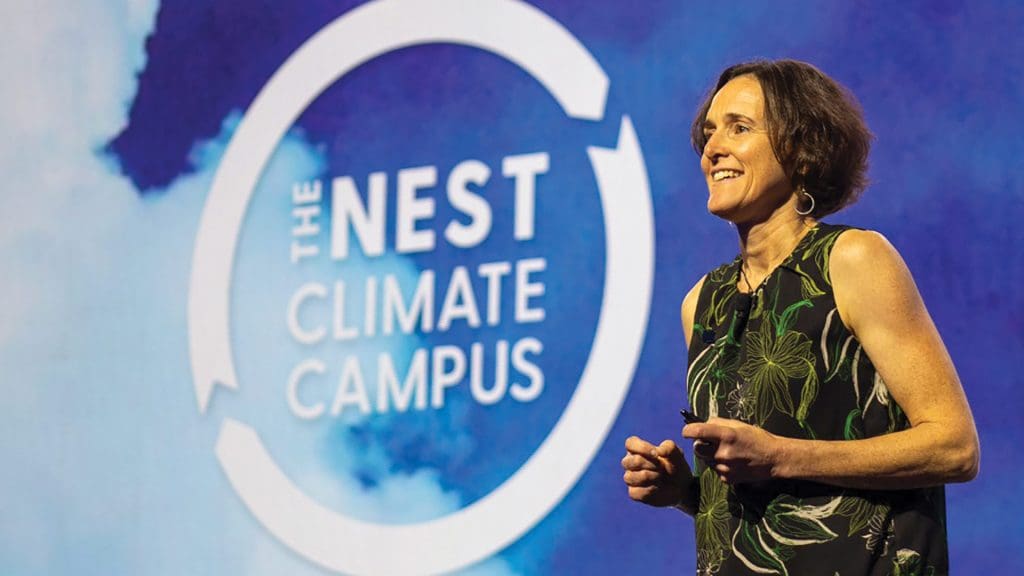
Ashley Muspratt delivers an address from the main stage at New York Climate Week.

“We deliver these trainings first remotely, and then we actually send our techs to their cities or towns to deliver technical assistance while they shadow us,” she explained. “And then we turn the tables, and they deliver the technical assistance while our techs shadow them and give them feedback and coaching. And then we set them free, and we’re already seeing some of them fly.”

As for those inclusive utility investments, that’s a mechanism CET promotes whereby utilities are making the investment in upgrades to people’s homes — weatherization, heat pumps, renewable energy, etc. — and recover that investment through a tariff tied to the building meter.
“That’s a really important distinction from on-bill financing, which is a loan, effectively, to the individual occupant of the house. You’re taking on personal debt, and before you do that, you need to go through a credit check, and you need to be in your home long enough to get a positive return on that investment,” Muspratt noted. “With inclusive utility investment, by tying the payback to the meter, you eliminate the consumer debt and the credit check, and there’s a guarantee to the occupants of the building that, as they start paying that tariff, their total energy costs are actually going down.”

CET has been working for several years to get this concept launched at scale in Massachusetts, including working with municipal utilities in Ipswich and Peabody. And now, the energy affordability bill being discussed in the Massachusetts Legislature will likely include an inclusive utility investment mandate.

“That would mean the rest of the utilities, the Eversources, the National Grids, would be required to offer this kind of financing mechanism to their customers,” Muspratt said. “So it could have a huge impact on the pace of deployment of climate solutions for the residential sector.”

Collaborative Effort

Muspratt explained that more than 95% of CET’s revenue comes from contracts to run its many programs, with philanthropy covering the rest.
“We have had the best partners and clients and customers,” Gaylord added. “There is just no way CET could have existed for 50 years — and will continue to exist — if we didn’t have such incredible partners throughout the state that equally believe in this work.”

Innovative ideas abound in these partnerships, she added, such as a Community Climate Fund that was seeded by Williams College, which tackles ‘barrier mitigation.’

“So if a customer is ready to go, but has a mold or moisture issue, we’re still able to pursue that project because of philanthropy,” Gaylord said. “There are times when philanthropy might make the like the difference in terms of it being something that’s solvable. So it’s a small percent of the budget, but it’s a really critical part of the budget in terms of what it can unlock for customers.”

And most people recognize the importance of this work and want to find ways to accomplish it, Muspratt said — even if the federal government has pulled away from such work.

“We had a huge increase in funding and attention on climate change under the Biden administration, and then that all kind of disappeared pretty quickly. So over the past year, we’ve had to do a lot of restructuring and pivoting because we had taken on a lot of federal funding that then disappeared,” she told BusinessWest. “So my hope is that, in the next 10 years, we start to get back to the place we were a few years ago in terms of focus and attention on climate change, taking it seriously.”

She cited a study by the Yale Program on Climate Change Communication showing that most Americans believe climate change is real and want to do something about it, Muspratt added. “The challenge is where to begin and how, and coming back to the role that CET is playing in that. I think there’s a disconnect right now between our government and what most Americans really want.”

Meanwhile, it’s important to help people see the value of individual decisions, Gaylord added.

“You may be wondering, ‘why would I start composting? Why would I get an energy audit? I have a million other things to do, and it’s not even going to make a dent.’ But even though it’s incremental, that whole body of action is making not just a dent, but a chasm — it’s really pushing forward CO2 reduction and methane reduction, while making the places we live and work healthier and more affordable and more pleasant to be in.

“I think that’s sometimes missed in the conversation right now — that, yes, it is going to take all of us, and that’s not necessarily convenient, but it’s really powerful.”

And that’s why it’s important to keep explaining — and demonstrating — radical ease.

“We’re just trying to just remove the barriers so people can take action,” Muspratt said. “There are a lot of competing interests these days, a lot of things that people are rightfully worried about. So, if we can help them, we’re here to help.”

Alumni Achievement Award Features Special Coverage

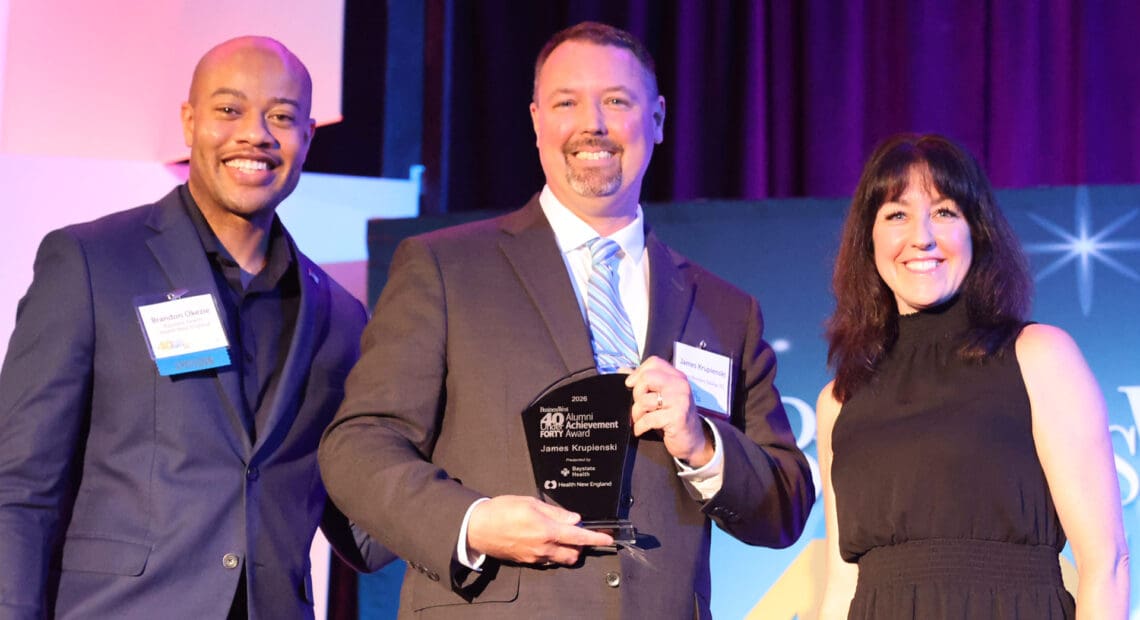
James Krupienski receives his AAA trophy from Brandon Okezie, president and COO of Baystate Noble Hospital, and BusinessWest Associate Publisher Kate Campiti.

All A’s

James Krupienski calls it “paying it forward.”

That’s his way of describing his mindset of paying homage to those who mentored and counseled him early in his career by doing the same with the next generation of young accountants at Meyers Brothers Kalicka, P.C. (MBK), where he’s a partner.

“I had a lot of mentoring at different levels — it started with a professor in college, and then a tax attorney that I’m still friends with, and then at PWC [PricewaterhouseCoopers], where I started, and then at MBK; there were some great partners I had as resources,” he told BusinessWest. “There were a lot of great people to surround myself with, and I made a point to reach out to them, ask questions, and get their advice.

“And over time, I look at the younger staff here, and I see a group of great people; I see a lot of people who remind me of me when I was that age,” he went on. “And I want to do as much to help them as people helped me.”

This desire to pay it forward is one many reasons why Krupienski was chosen by a panel of judges to be the latest recipient of BusinessWest’s Alumni Achievement Award, sponsored by Baystate Health and Health New England and presented annually to the 40 Under Forty honoree who has, in those judges’ eyes, most embellished his or her track record of success in their chosen field and with giving back to the community.

He was presented with the award at the 40 Under Forty gala on June 11, after being introduced along with fellow finalists Modesto Montero-Forman, founder of Libertas Academy Charter School; Adam Quenneville, owner of Adam Quenneville Roofing and Siding; and Ciara Speller, anchor for WWLP-22 News and founder of the Jeffrey Speller Foundation ‘4 Change.’

Krupienski’s nomination for the award spells out continued success and advancement in his career — he’s risen from CPA manager in the Health Care and Pension Audit divisions to partner at the firm — and continued work within the community, both in his hometown of Westfield and across the region.

Indeed, the day after he took home his AAA plaque, he was one of a few dozen employees at MBK and PeoplesBank (both businesses are located in the same office tower in Holyoke) taking part in a build-a-bed initiative for the nonprofit A Bed for Every Child.

“It was exciting — there were at least 15 people from each organization, and they built about 20 beds,” said Krupienski, adding that another of his priorities is to continue and build on a culture of giving back at the firm.

But his work to pay it forward and be a mentor is another big reason why he is now a AAA recipient.

When asked what he tries to impart on younger team members, he paused a minute and then said he encourages them not to be afraid to fail — “because that’s how you learn. It’s going to happen — it happens to everyone — and you want to do it in a way that’s constructive and you’re getting something out of it.

“Whether it’s a manager reviewing a first year’s work or me as a partner reviewing a manager’s work … we’re going to find things; that’s why we review everything here,” he went on. “But that’s also how that new hire learns and can grow to the manager level, and also how the manager can learn, see things from a different perspective, and grow to the partner level down the road.”

As a partner, he acknowledged that he’s busy, but makes the time to spend time with younger team members at different levels, from those interning at the firm — his son, Jimmy, was one of them this past year — to those working their way up. And he does so in different settings, from a charity golf tournament (he invited an audit manager to play with him at an upcoming event) to Krupienski’s Korner, a gathering spot in the break room at MBK that he created to help team members get a reprieve from the pressures of tax season on Friday afternoons after 5.

It’s all part of those collective efforts to pay it forward — work that helps explain why Krupienski has joined a rather exclusive club: Alumni Achievement Award winners.

—George O’Brien

Daily News

HOLYOKE — OneHolyoke Community Development Corp. (CDC) recently hosted its second annual Building & Sustaining Livable Communities event, which featured a keynote address by Lt. Gov. Kim Driscoll.

The organization used the occasion of the event to announce that Nayroby Rosa, chief operating officer for OneHolyoke CDC, has been elevated to the position of executive director. The announcement was made by outgoing Executive Director Michael Moriarty, who has been at the helm of the organization since 2013. Moriarty, who is a lawyer, will continue to serve OneHolyoke as legal counsel going forward.

Rosa, who has been at OneHolyoke since 2018, previously served as director of Community Engagement and Resident Services and, most recently, as chief operating officer for the organization. A longtime community leader and advocate, she brings more than 15 years of experience in nonprofit leadership, community engagement, and organizational development. Her promotion reflects OneHolyoke CDC’s commitment to developing strong internal leadership and investing in leaders who are deeply rooted in the community.

The symposium, held on June 29 at Wyckoff Country Club, centered around innovations in public safety and convened local leaders, public safety officials, and community members to explore collaborative approaches to safer, stronger neighborhoods. Holyoke Mayor Joshua Garcia welcomed attendees, and stat Sen. John Velis was also present, along with Holyoke City Council members.

OneHolyoke CDC kicked off the event with a video that shared the organization’s vision for a safer and revitalized Churchill neighborhood in Holyoke. Driscoll recognized Moriarty for his years of service to OneHolyoke and as a leader in early literacy advocacy with a citation from Gov. Maura Healey.

The symposium also featured a presentation by Matt Perkins and James Stark from the Local Initiatives Support Corp., home to recognized experts on crime prevention through environmental design (CPTED). The representatives shared their expertise on community engagements and improvement planning, as well as their upcoming work with OneHolyoke CDC to develop a neighborhood blueprint based on CPTED principles.

Ed Caisse was also recognized for his impact through the Holyoke Safe Neighborhood Initiative (HSNI), and OneHolyoke announced that one of its residential properties, located at 589-591 South Bridge St., next to Morgan School in South Holyoke, is now named in his honor. Caisse retired earlier this year after more than three decades with the Hampden County Sheriff’s Department and HSNI.

The event also featured a presentation by First Assistant District Attorney Jennifer Fitzgerald on the Hampden County District Attorney’s Emerging Adult Court of Hope program, a specialized, collaborative program launched in partnership with Roca Inc. and designed to give young adults ages 18-24 facing serious criminal charges a second chance through intensive support and judicial oversight.

Prior to serving as executive director of OneHolyoke CDC, Moriarty attended law school and taught in Holyoke for five years, teaching Latin, English, and social studies. As an attorney, he has also taught at Middlesex and Holyoke community colleges. A lifelong resident of Holyoke, he also served for 13 years on the school committee and was instrumental in the formation of the Holyoke Early Literacy Initiative. He has also been a vocal advocate for arts education.

Moriarty also served on the Massachusetts State Board of Education for 10 years, during which time he chaired the state’s early literacy subcommittee and was a member of the budget subcommittee and commissioner evaluation committee. He was also an active member of the National Assoc. of State Boards of Education’s early literacy working group.

Daily News

EASTHAMPTON — bankESB served as a $10,000 top sponsor of the city of Easthampton’s Millside Summer Series, a vibrant community celebration that brought residents and visitors together through world-class soccer, live entertainment, local artisans, and family-friendly activities at Millside Park.

The summer-series featured a FIFA World Cup watch party experience with four match screenings at Millside Park. Community members gathered to cheer on their favorite teams while enjoying a festive atmosphere that showcased the spirit and diversity of Easthampton.

In addition to the World Cup watch parties, the Millside Summer Series included live music performances and an artisan marketplace featuring local makers, artists, and small businesses, creating a welcoming destination for residents of all ages.

As a community bank committed to strengthening the region it serves, bankESB’s sponsorship reflects its mission to help individuals, families, businesses, and communities unlock potential.

“Events like the Millside Summer Series bring people together, celebrate community pride, and create meaningful experiences for residents and visitors alike,” said Matthew Sosik, president and CEO of bankESB. “We are proud to support the city of Easthampton and invest in opportunities that enhance quality of life, foster community connections, and help unlock the potential that exists throughout our region.”

The sponsorship also aligns with bankESB’s longstanding commitment to charitable giving through its Giving Tree program. Through the Giving Tree, bankESB supports hundreds of nonprofit organizations, community initiatives, educational programs, and local events each year, helping strengthen the neighborhoods and communities it serves across Western Mass.

“The Millside Summer Series demonstrates the power of partnership and community engagement,” Sosik added. “Whether it’s supporting local nonprofits through our Giving Tree program or sponsoring events that bring people together, bankESB remains dedicated to making a positive impact throughout the region.”

Daily News

WESTFIELD — Residents from Armbrook Village Assisted Living recently visited Westfield High School for their third annual Past Meets Present initiative. This intergenerational program allows today’s seniors and students to connect and learn from one another’s experiences.

The Past Meets Present Initiative took off in 2024, when Armbrook Village partnered with Westfield High’s AP history class, taught by Nicole Hamel, to bring its dementia-friendly training to younger generations. In an effort to promote understanding and compassion toward those living with Alzheimer’s disease and dementia, Armbrook Village worked to make Westfield the first dementia-friendly city on the East Coast in 2014 and since then has hosted numerous trainings for students, healthcare workers, and the general public.

With a focus on historical artifacts that are important to seniors’ lives, this year’s take on Past Meets Present encouraged residents to share important objects that hold meaning to their life experiences. Between World War I books and keepsakes from the 1994 Paris Olympic Games, Westfield students were deeply drawn to not only which items each senior brought in, but also the personal stories they held.

After learning from Armbrook residents about the meaning behind their items, students got their chance to present to seniors, faculty, and family. In a museum-style exhibit, each student shared what they learned from their conversations with the seniors. Not only were students given the opportunity to enhance their history knowledge, but seniors also were able to learn about their neighbors’ past experiences, contributing to Armbrook Village’s goal of building connection and community.

“The Past Meets Present project cultivates a sense of purpose within our residents,” Armbrook Village Director of Community Relations Jayda Handzel said. “Not only does it positively affect our residents, but it also has a lasting impact on the students, teaching them empathy, patience, and a deeper understanding of how the things that they learn about in textbooks actually were real-life experiences.”

This entire project allows young students to apply their conversations with each senior to their history lessons and teaches them the value of connecting with older generations.

Daily News

LONGMEADOW — Glenmeadow, a nonprofit senior living organization with more than 140 years of service to Western Mass., announced the appointment of Elizabeth (Liz) Marquis as vice president for Sales and Marketing.

Marquis brings more than a decade of senior living sales and marketing experience to Glenmeadow. She previously served as director of Marketing and Sales at McLean Life Plan Community and Health Care Center. She also founded Aging Well CT, an organization that assists older adults and their families navigate the senior living landscape. With experience in direct sales and marketing, financing major expansions, and communicating the strengths of nonprofit senior living, Marquis is well-positioned to make an immediate impact at Glenmeadow.

“Glenmeadow has a proud history, a powerful mission, and a bright future, and Liz is the right leader to help us tell that story,” said Kathy Martin, president and CEO of Glenmeadow. “Her experience, insight, and genuine commitment to older adults will expand our reach and continue serving older adults well into our next chapter.”

In her new role, Marquis will lead Glenmeadow’s sales and marketing efforts, furthering the organization’s commitment to providing an exemplary, wellness-based lifestyle for older adults.

“From my first visit, I knew Glenmeadow was special. The welcoming residents, friendly staff, and the leadership’s vision for the future created an energy that was positively buzzing,” she said. “But it’s not only the environment that drew me in. Glenmeadow has a long legacy of dutifully serving residents and families in this area, and I am excited to be joining the team and help carry that commitment forward.”

Marquis’s appointment reflects Glenmeadow’s continued commitment to meeting older adults and families with warmth, clarity, and support as they explore the possibilities of life in a welcoming, mission-driven community.