Home Articles posted by George O'Brien (Page 11)
40 Under 40 Class of 2023

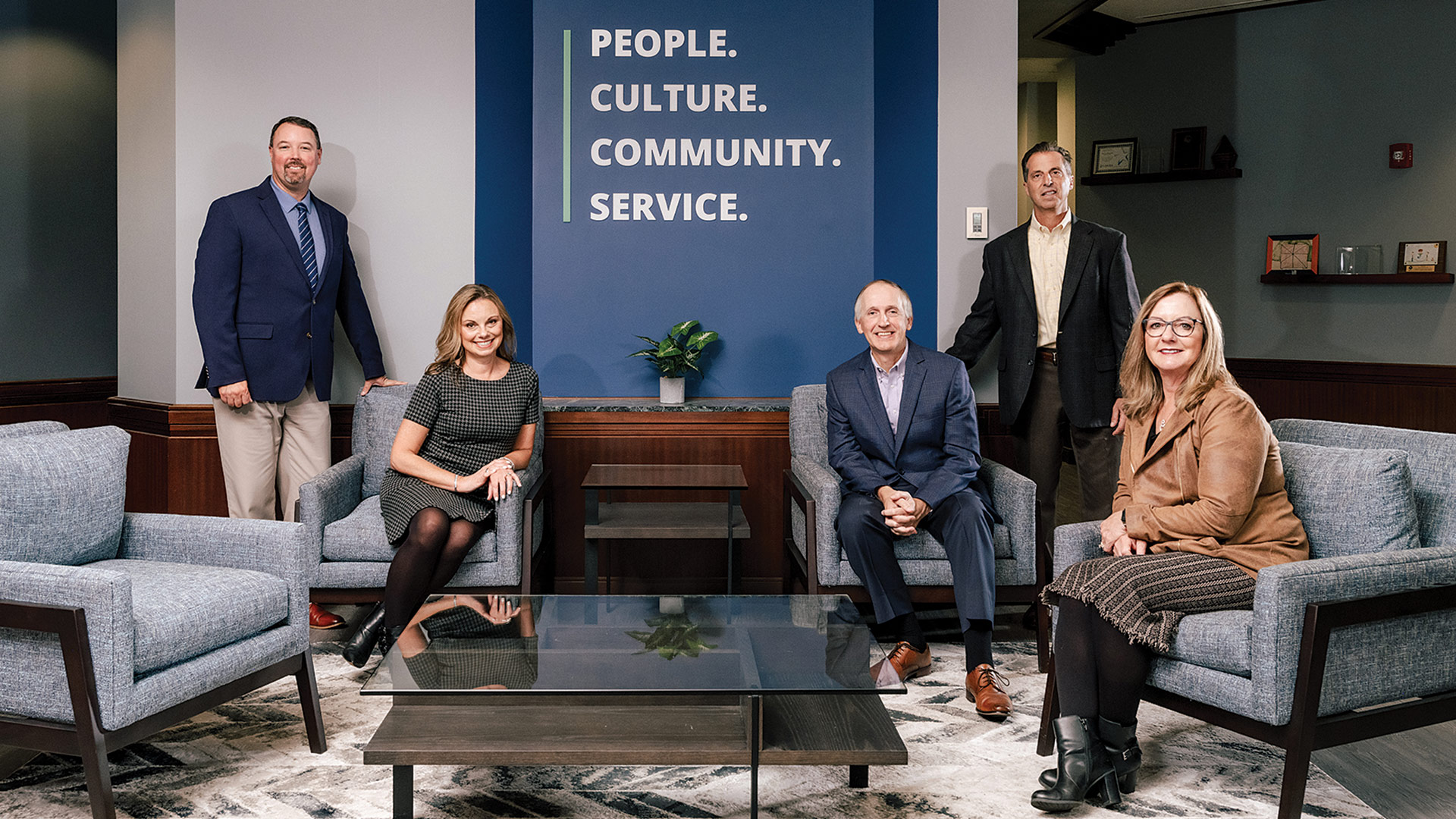
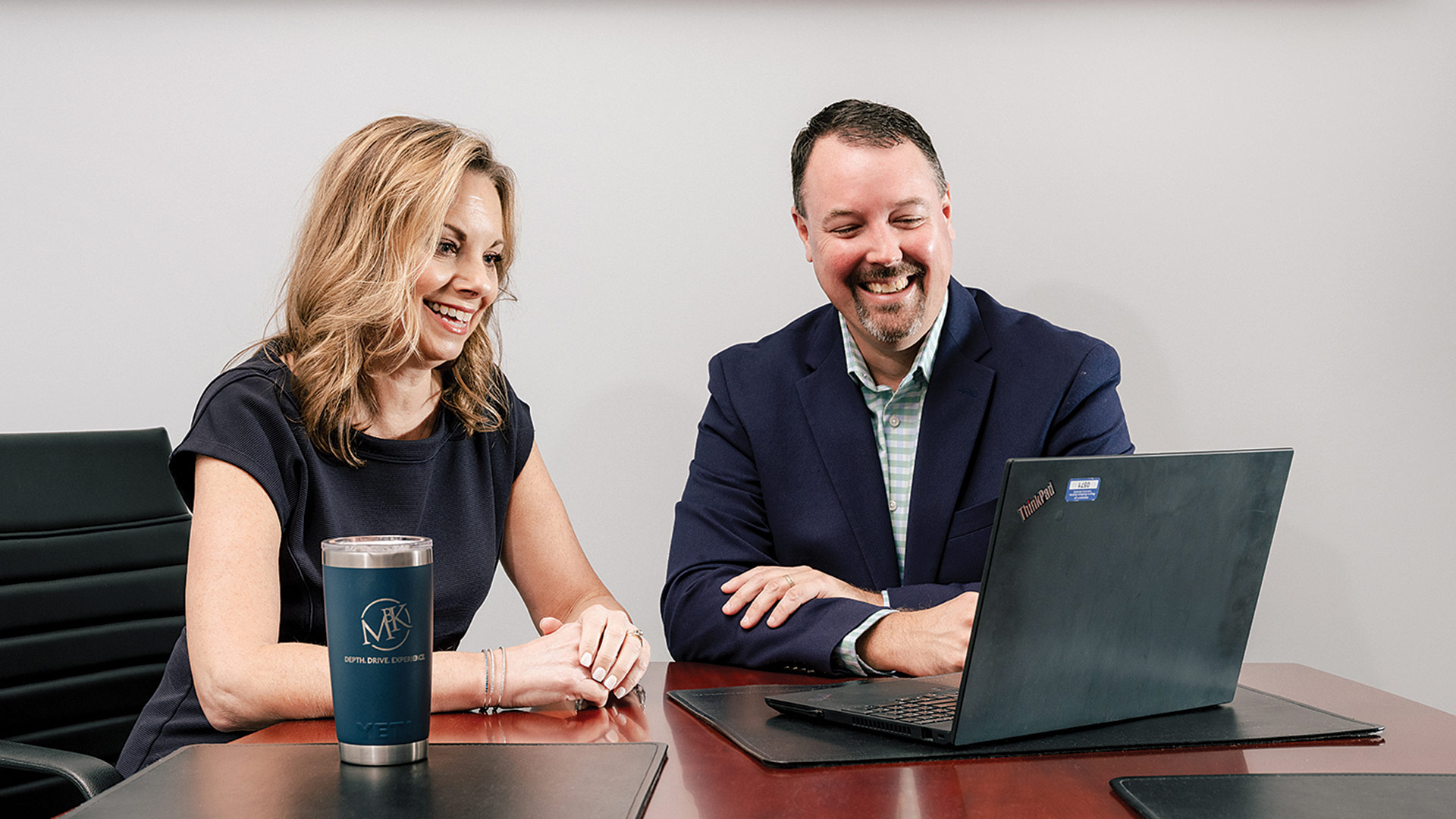
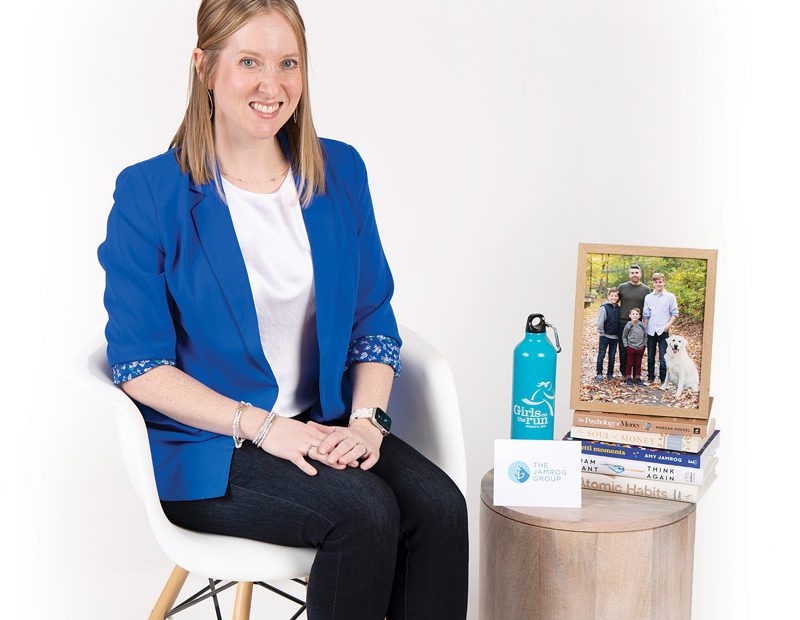
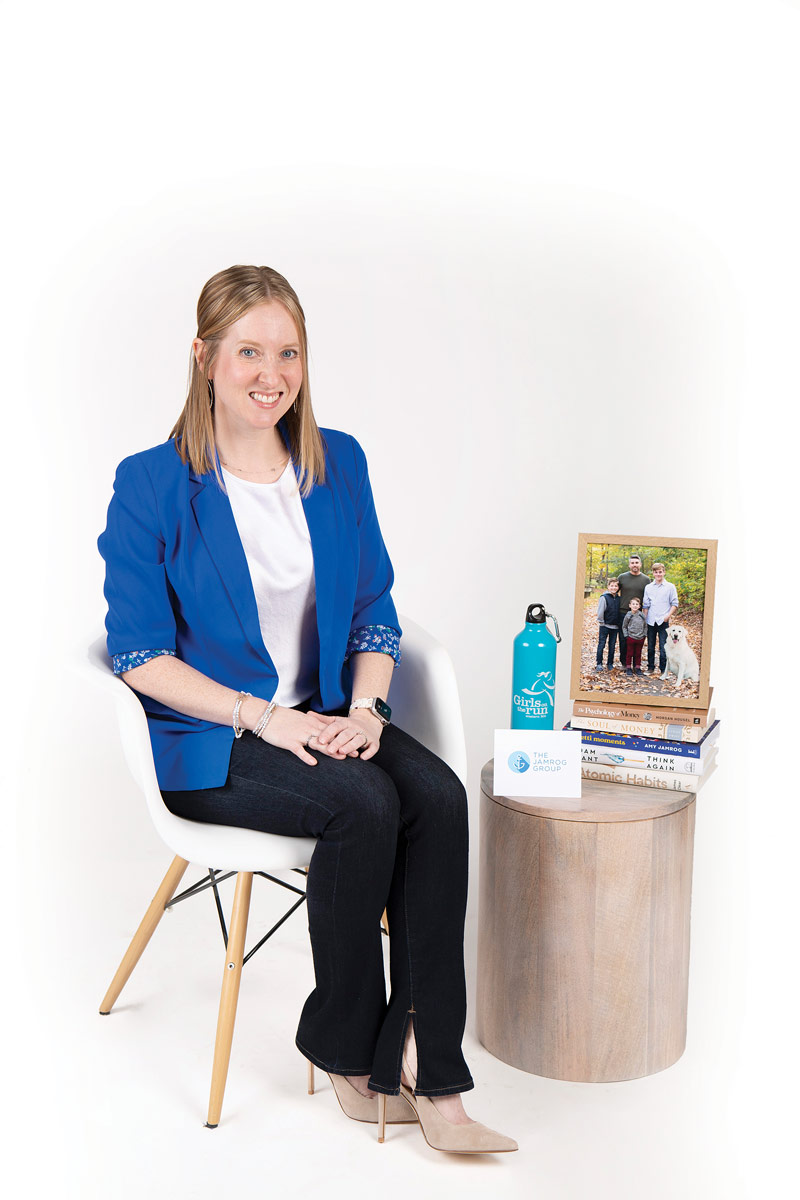
Chief Operations Officer, the Jamrog Group: Age 38

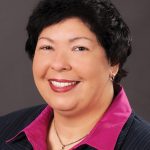
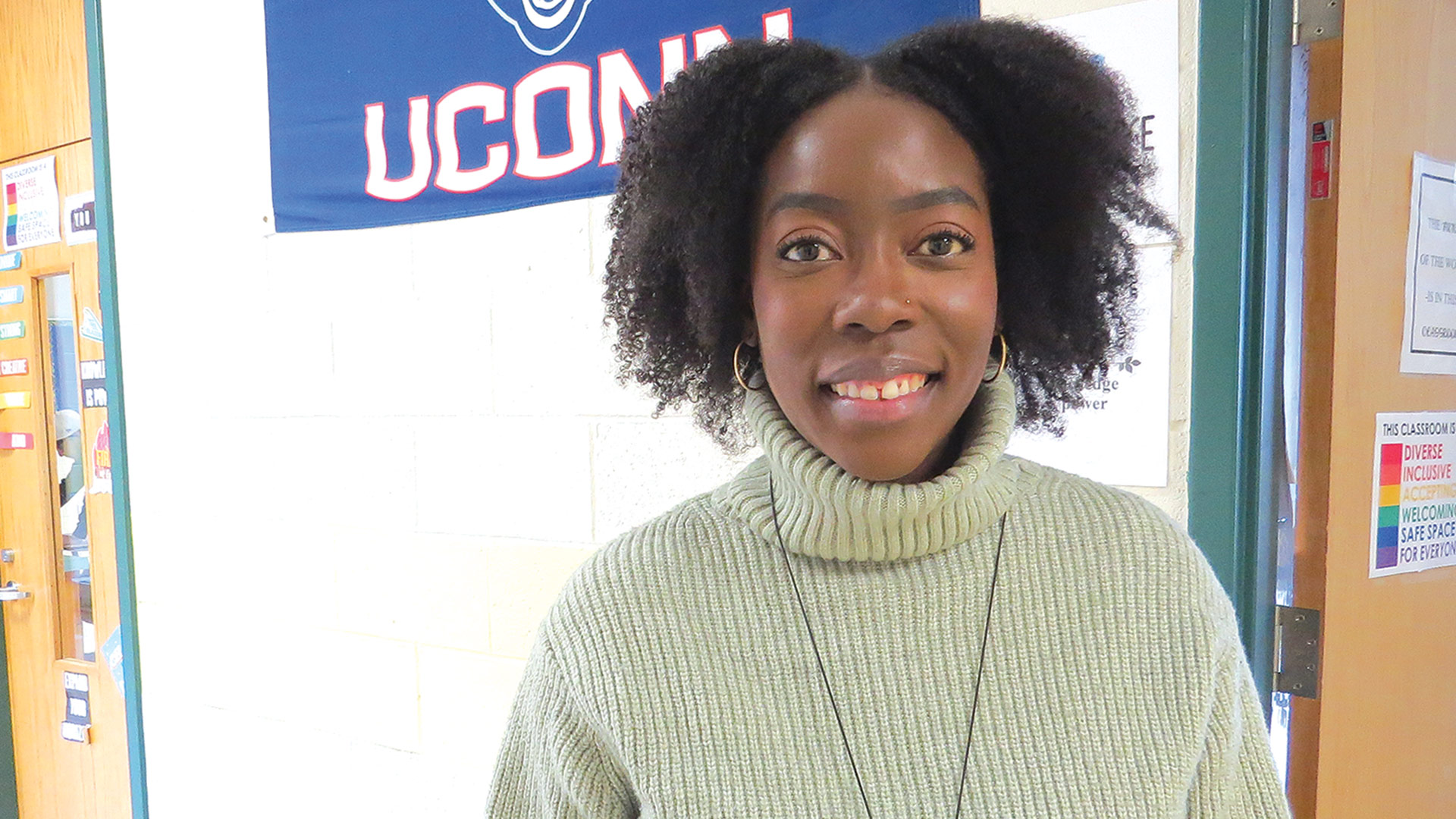
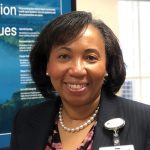
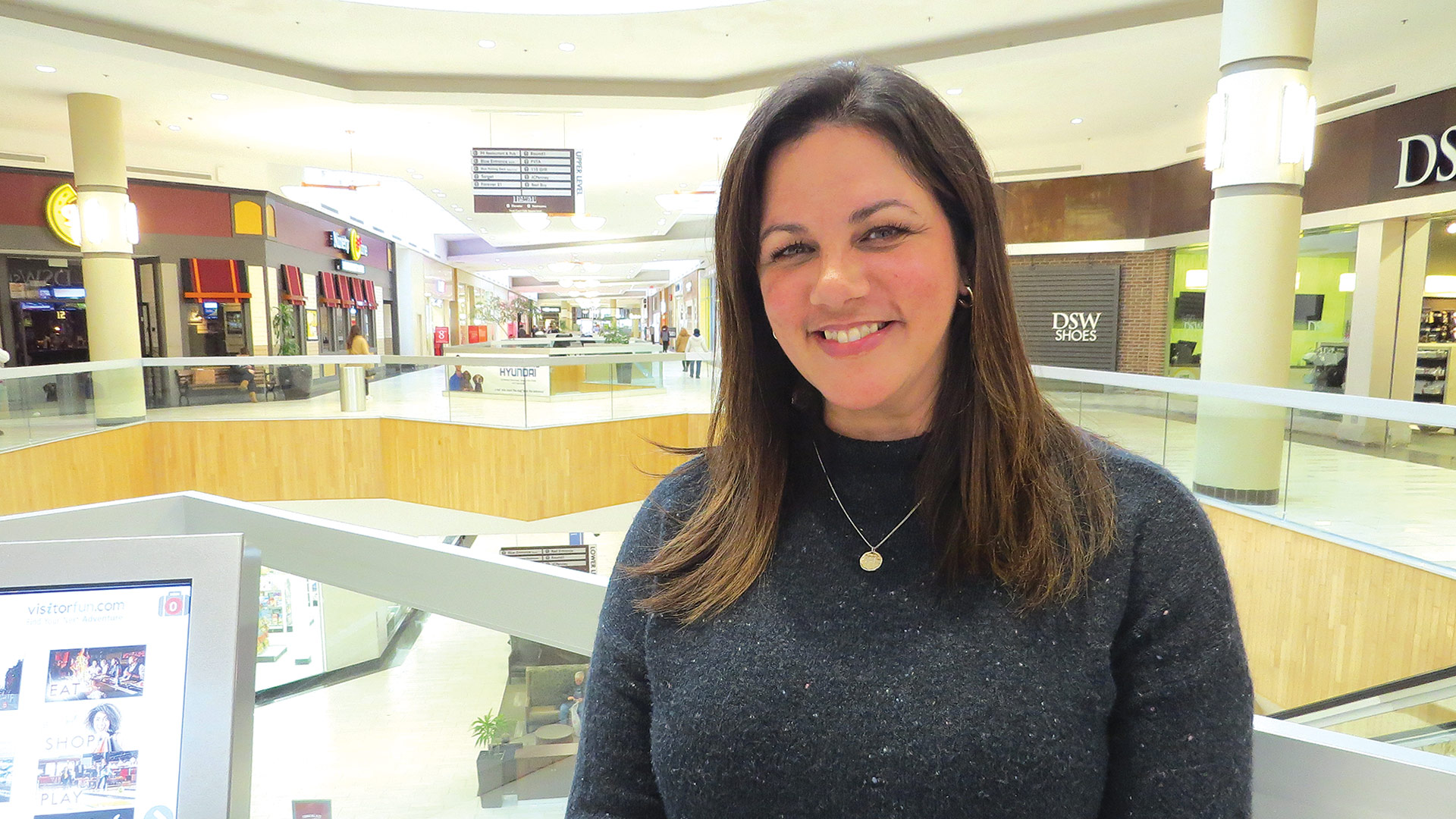
Jessica HollowayGrowing up, Jessica Holloway wasn’t exactly sure what she wanted to do for a living.

While earning a degree in finance at the Isenberg School of Management at UMass Amherst, she came to understand two things — she liked helping people, and she was good at math. And she desired a career that would marry those two attributes.

So, following an eye-opening internship at Northwestern Mutual that became a learning experience on many levels, she put herself on a path to a career in financial services … and her current role as chief operations officer for the Holyoke-based Jamrog Group. (Amy Jamrog is the founder and CEO of the company, and also Holloway’s mentor.)

While the business card says COO, Holloway says she’s primarily a financial planner, a role in which she can use her math skills (a little) and that ‘helping people’ trait to a much larger degree.

“What I really love about it is helping clients start to view money as a tool instead of a stressor,” she explained. “A lot of the work I do is helping clients get really tuned into what matters to them — who and what — and then aligning the money accordingly.”

As COO, she has a broad role, one that includes everything from building systems, processes, and workflows (work that has helped the company triple its revenue) to coaching and development of employees, to integrating health and wellness into the group’s culture, leading outside ‘walks and talks’ with staff, and even hosting Zoom Peloton rides with team members.

“As financial planners, we spend a lot of time at our computers, crunching numbers. So we started to integrate a lot more movement, just to encourage both ourselves but also our team members to get up and move during the day,” said Holloway, who, in her spare time, is a board member for the nonprofit Girls on the Run.

Jamrog, a 40 Under Forty honoree herself (in the inaugural class of 2007), nominated Holloway for the same honor.

“As my business partner over the past nine years, Jessica has shown extraordinary growth in her business acumen, leadership among our team, and financial planning expertise,” she said in that nomination. “She has done all this while raising three young boys, volunteering for her kids’ schools, volunteering for board work, and hosting an exchange student from Spain. She is generous, has unbelievable capacity to manage her home, work, and community, and is an overall rock star of a human being.”


—George O’Brien

40 Under 40 Class of 2023

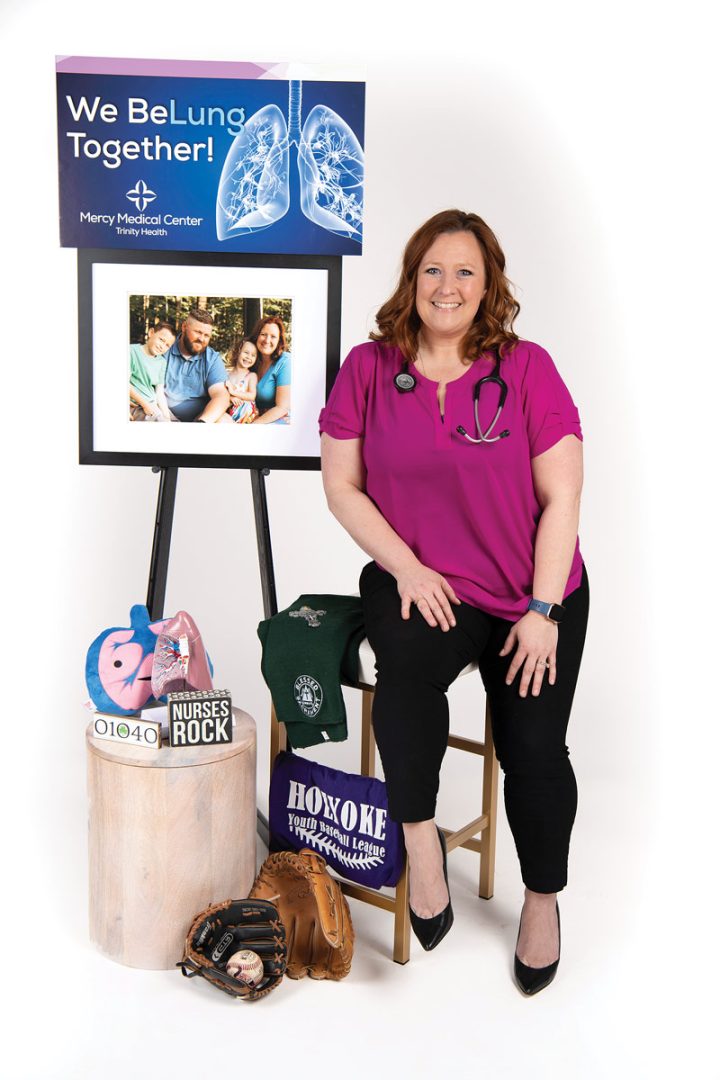
Nurse Practice Manager of Thoracic Surgery and Nursing Director of the Lung Cancer Screening Program, Mercy Medical Center: Age 38

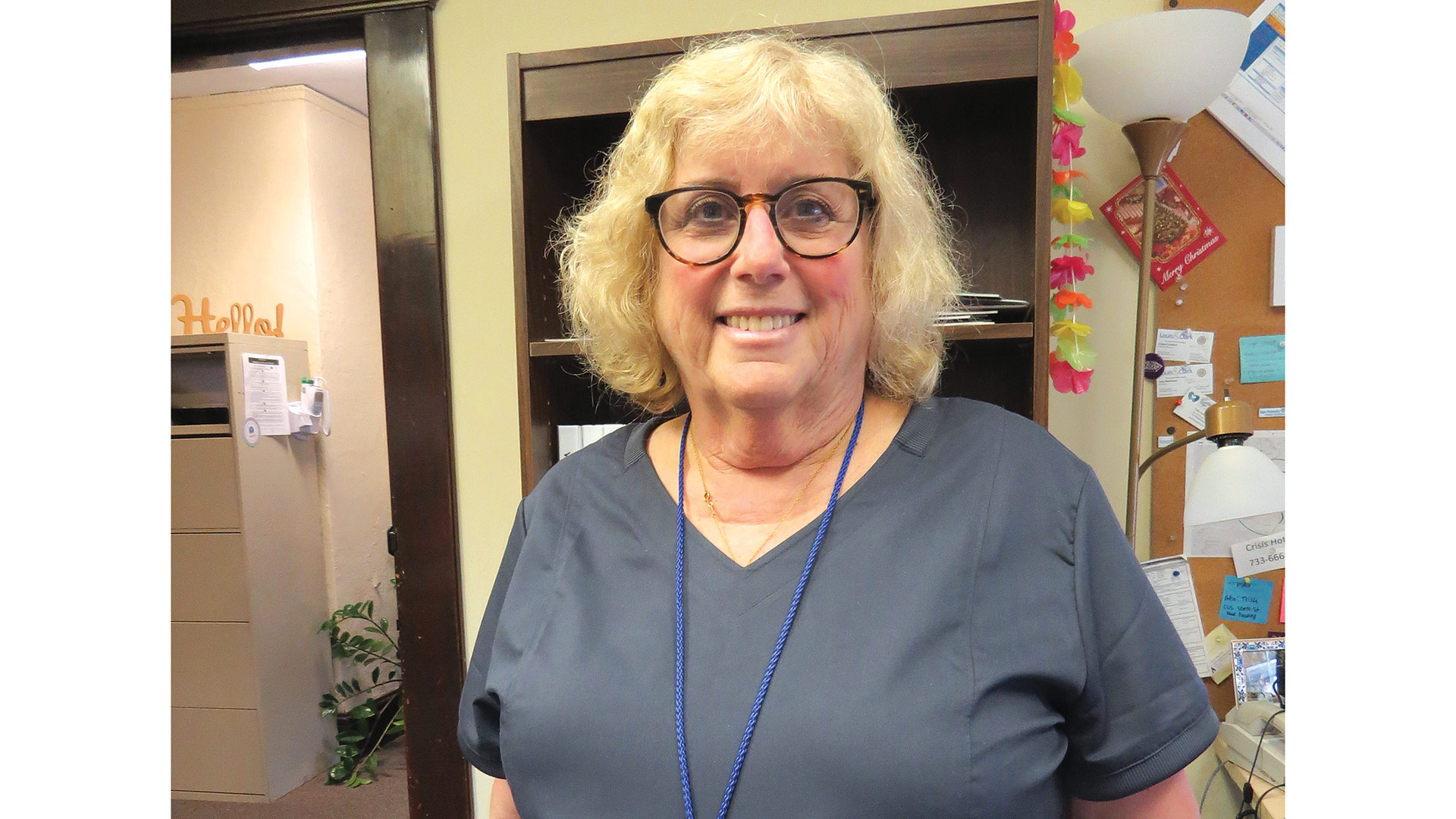
Ashley LeBlancAshley LeBlanc says it’s “weird to be happy when you find cancer.”

But that’s certainly one of the emotions she experiences when a patient screened for lung cancer is given that heavy dose of bad news.

That’s because, quite often, that cancer is found early, in stage 1 or 2, when it is much more survivable than when found later. Indeed, lung cancer is the deadliest cancer, and finding it early is critical to winning one’s battle against it.

And LeBlanc certainly knows that. She has lost four relatives to lung cancer, several of whom would have qualified for screening had it been available at the time of their diagnosis.

“That’s why this work is so rewarding,” said LeBlanc, who earned associate degrees in both health sciences and criminal justice at Holyoke Community College, but eventually chose a career in healthcare; she has earned an associate degree in nursing from Springfield Technical Community College and a bachelor’s degree from Westfield State University, and is currently working on her master’s in executive nursing leadership at Chamberlain University.

“I’ve loved every second of it,” she said of her work in nursing, adding that she was eventually recruited by physicians in the Thoracic Surgery unit, where she now serves in her dual role. In addition to overseeing the department, she has been instrumental in creating a Lung Cancer Screening Program (LCSP) that has been designated a Screening Center of Excellence.

That program has screened more than 12,000 people since it was created in 2016, and identified cancer in more than 200 of them. In two-thirds of those cases, it was found in stage 1 or 2, which takes us back to where we started — that sensation of being happy to find cancer.

LeBlanc’s passion for lung-cancer treatment and screening is evidenced by her extensive work in the community. She has served as the nurse planner for the American Lung Association’s annual LUNG FORCE education events in Springfield and East Hartford, and spearheaded the creation of the first Springfield LUNG FORCE event after learning there were few lung-cancer continuing-education opportunities for local providers. Prior to the pandemic, she coordinated an annual fundraiser for Mercy’s LCSP to provide ‘scholarships’ for individuals who could not afford a screening.

“It’s so fulfilling to know that others may be spared the heartache of that loss through early detection and a wider variety of treatment options,” she said of her work. “It’s what keeps me going.”


—George O’Brien

40 Under 40 Class of 2023

Executive Vice President and Chief Operating Officer, the Markens Group Inc.: Age 36

Emily Leonczyk

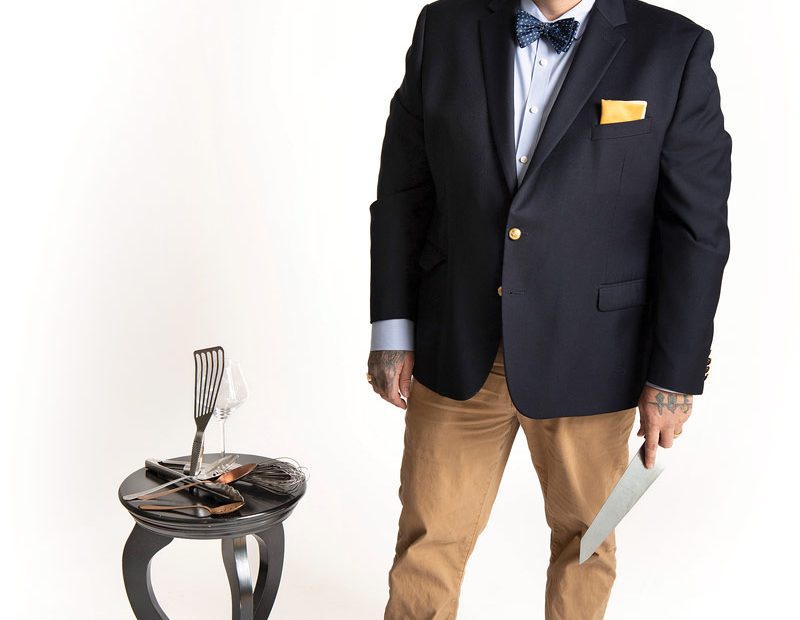
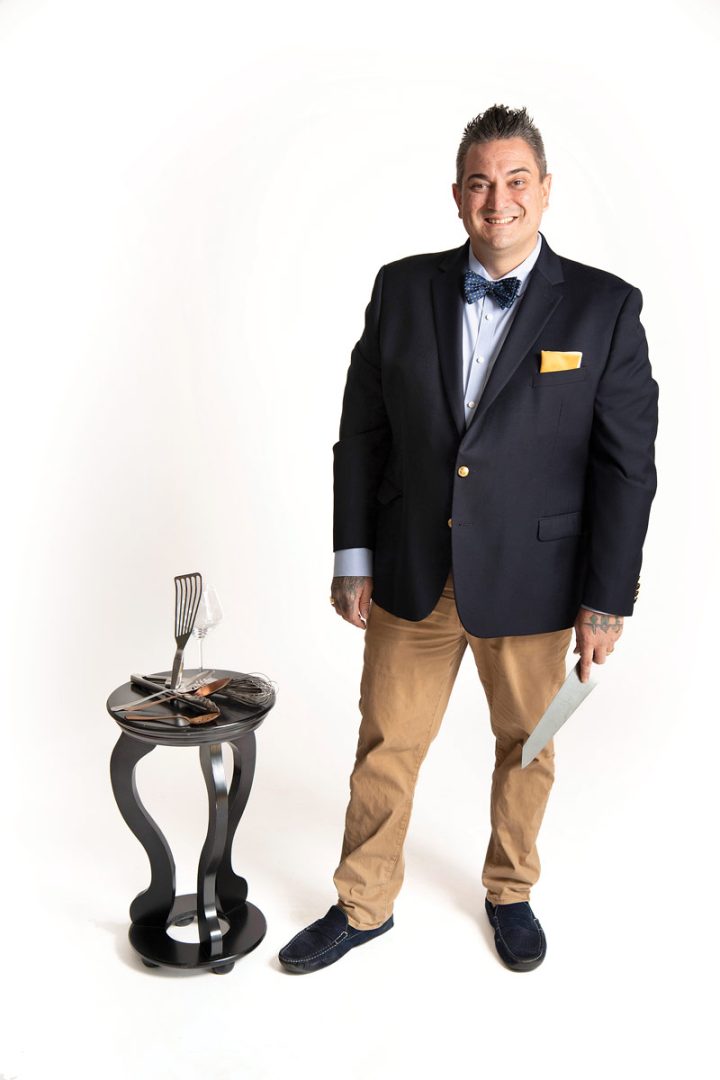
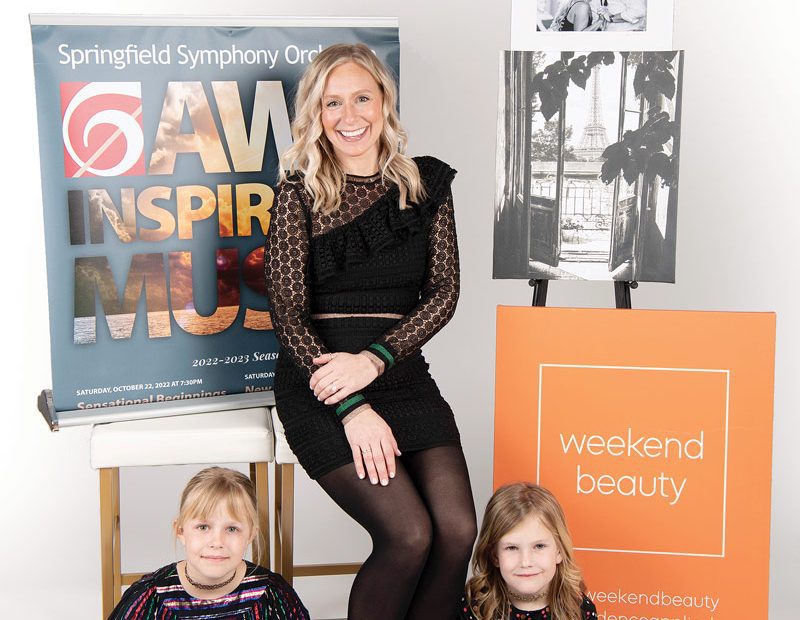
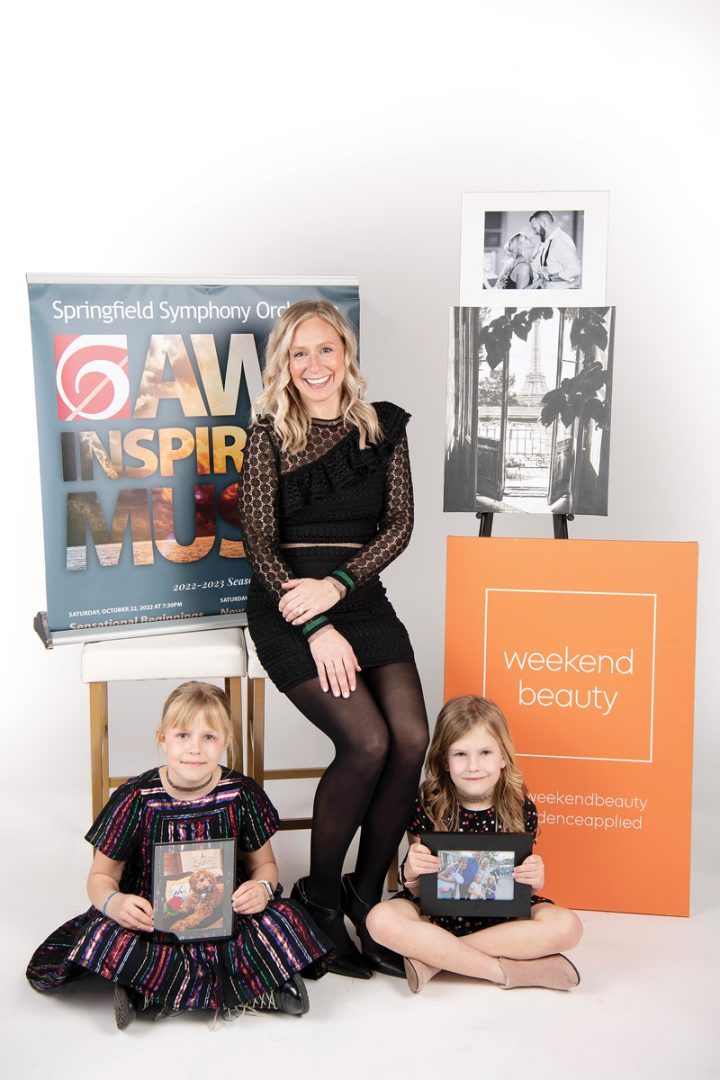
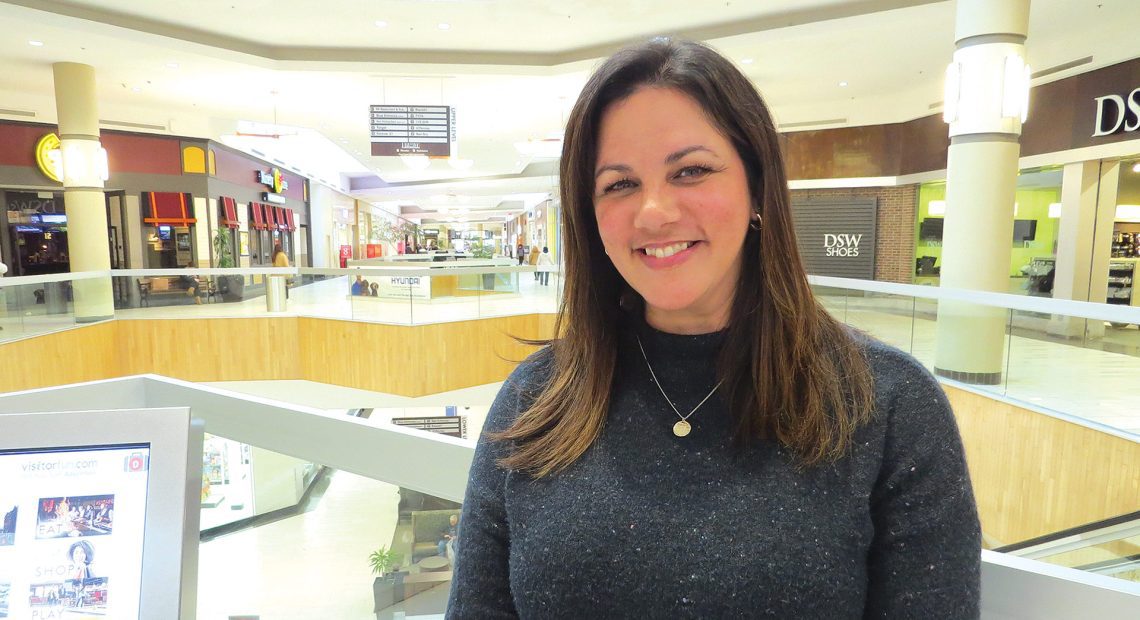
Emily Leonczyk brought a lot of stuff to her Forty Under 40 photo shoot.

She said she needed it all because the various items convey what’s important to her and …well, what makes her tick. Together, they really help tell her story.

You can start almost anywhere, but let’s go with the coffee cup.

“Coffee is really important to me; I run on coffee,” she joked, referencing the mug, which says ‘Mama Bird’ on it, which is a good segue to another item she brought with her, a photo of her blended family, which includes her daughter, Sienna, life partner, Todd, and his two children.

Leonczyk said family is very important to her, and so is getting together with family, friends, colleagues, and neighbors, usually over food … which explains why she also brought to the photo shoot a block quote attributed to Emily Dickinson: “I Tasted Life.”

Then there’s the elephant, which needs some explaining.

“I started a marketing and business-development business called Off the Tusk,” she noted. “The elephant has become quite the symbol for me, and I’ve carried it through my life. It represents the fact that this gigantic animal is so caring and loving. In the wild, they express joy and live for family; it’s a symbol I tie and connect through all I do and everywhere I go.”

Then there’s the computer with the Markens Group logo on it, representing the current stage of her career. She serves as executive vice president and COO of the Springfield-based agency, where she has helped grow sales by 56% since she came on board in 2019.

She has also helped the firm secure its first international client, the International Molded Fiber Assoc., while also leading a team of 20 in its use of EOS (entrepreneurial operating system) to increase efficiency and clear higher bars when it comes to revenue and profit.

Not in the picture (at least not literally) is the nonprofit known as the Willpower Foundation, the namesake of William Michael Burke, who has born with a rare brain malformation. The agency, named one of BusinessWest’s Difference Makers in 2018, provides grants to help families and children with special needs in the Western Mass. region. Leonczyk has been heavily involved with Willpower, serving as executive director and a board member since 2018.

They say a picture’s worth a thousand words. Leonczyk’s 40 Under Forty portrait certainly is.


—George O’Brien

40 Under 40 Class of 2023

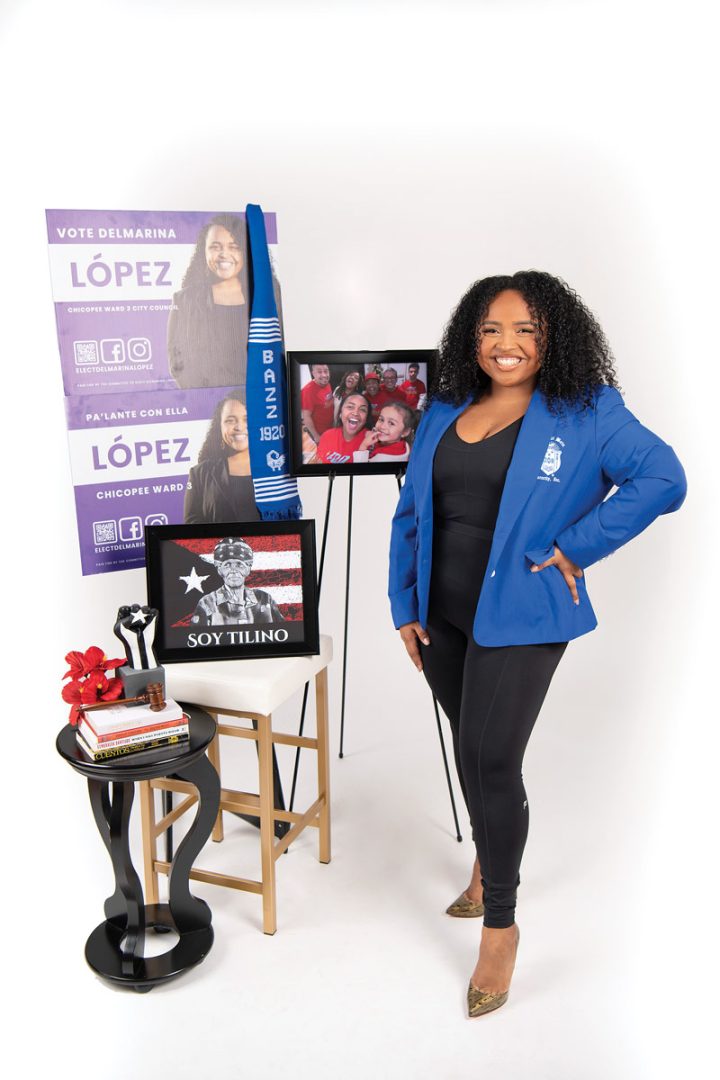
Attorney; CEO, Delmarina López Consulting; Chicopee City Councilor: Age 27

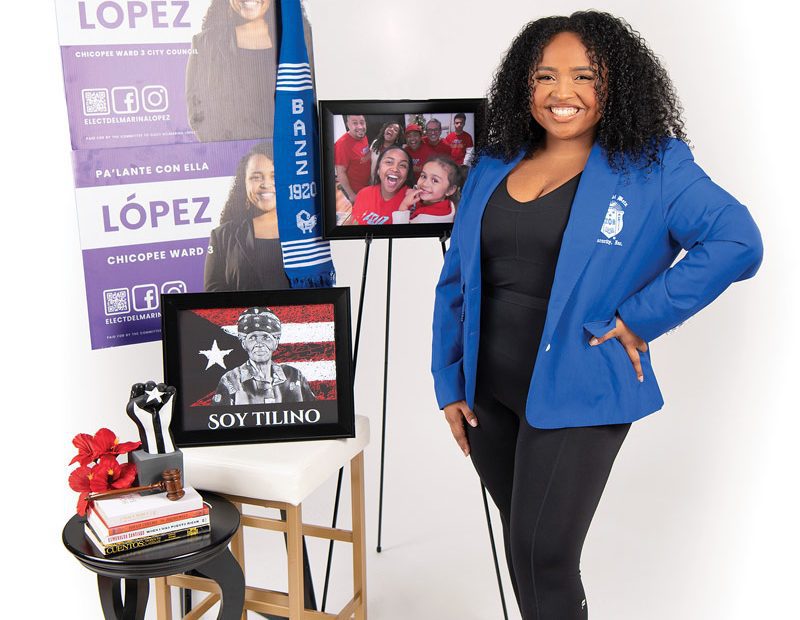
Delmarina LópezDelmarina López aspired to be a lawyer — and did, indeed, practice law for a while after earning her juris doctorate at Western New England University School of Law. But she soon found that her passions — and there are several of them — also lay elsewhere.

Starting with her commitment to public service. She has long been active in the city of Chicopee, where she grew up, and in politics in general, and in 2021, she took that involvement to a higher level and ran for the Ward 3 seat on the City Council. She prevailed in that race — becoming the first Afro-Latina elected to any office in Chicopee — and currently serves on several committees, everything from water resources to education to zoning, while also focusing on public safety and working diligently to improve transparency in city government.

“Transparency is lacking; a lot of decisions get made, and people don’t realize why they’re being made or how we got there,” she said, adding that she considers herself an advocate for her constituents, and therefore she often winds up on the opposite side of the majority on many issues.

Meanwhile, another of her passions is helping small-business owners, which is why she is chief consultant for Delmarina López Consulting, an agency she founded in 2021. This venture supports small to mid-sized businesses with all aspects of formation; organizational structure; compliance; operational structure and processes; human resource; diversity, equity, and inclusion efforts and strategies; branding; and more.

“I’m a firm believer that what you’re good at, you’re good at, and you bring onto your team what are not your strengths,” she said, adding that she helps business owners fill in those gaps.

She is also a board member of the YWCA of Western Massachusetts, a former member of the Center for Human Development’s human rights committee, and a member of the paralegal advisory committee at Bay Path University, where she earned a degree in criminal justice studies.

All this explains why López needed a box to carry everything she wanted to bring to her photo shoot. Indeed, she arrived with everything from a gavel to a photo of her grandmother, who inspired her in many ways, especially when it comes to civic engagement, and passed away recently; from a sign from her campaign to some books that mean something to her, and much more.

Those items speak volumes about someone who has always been committed to giving back and getting involved — not just with city government, but in her community.


—George O’Brien

40 Under 40 Class of 2023

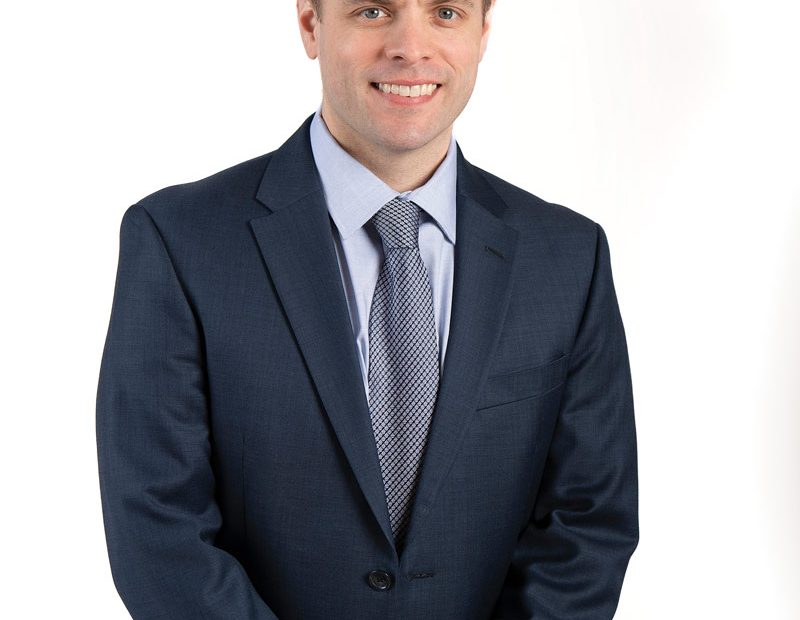
President, Marcotte Ford: Age 39

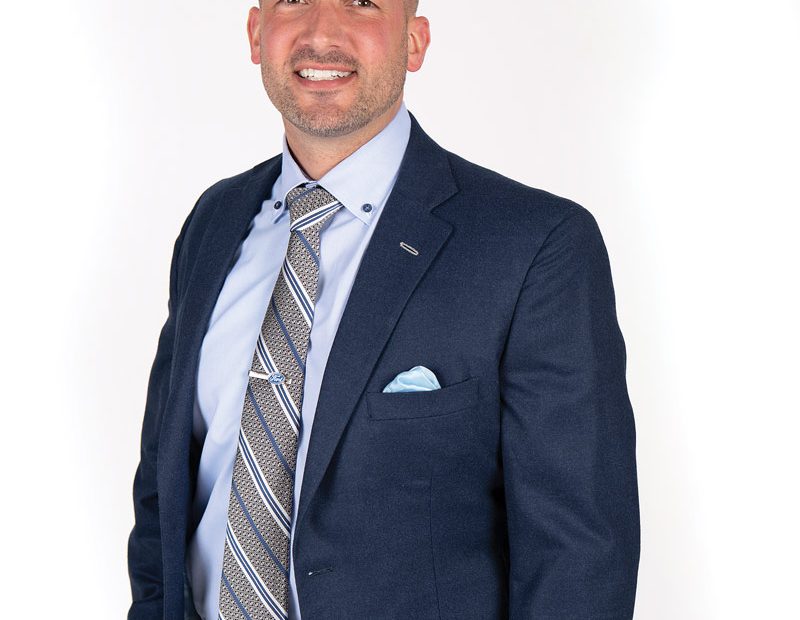
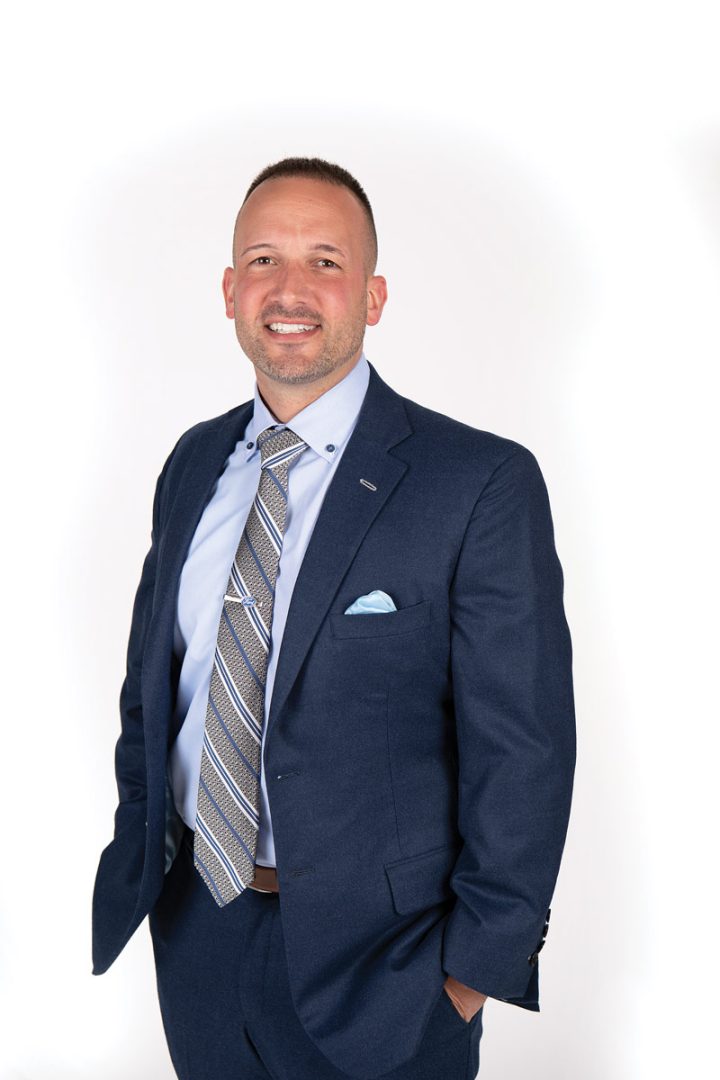
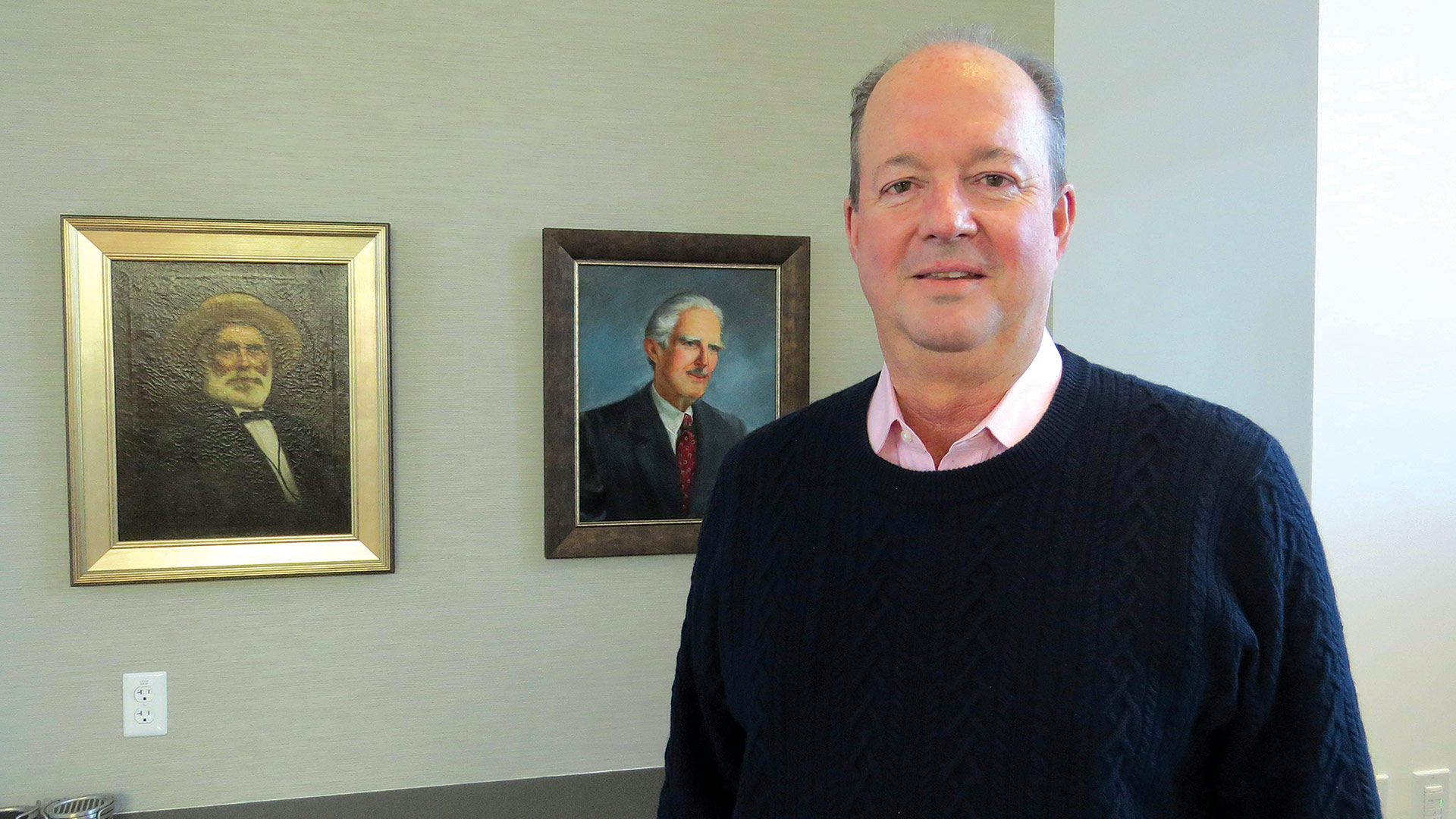
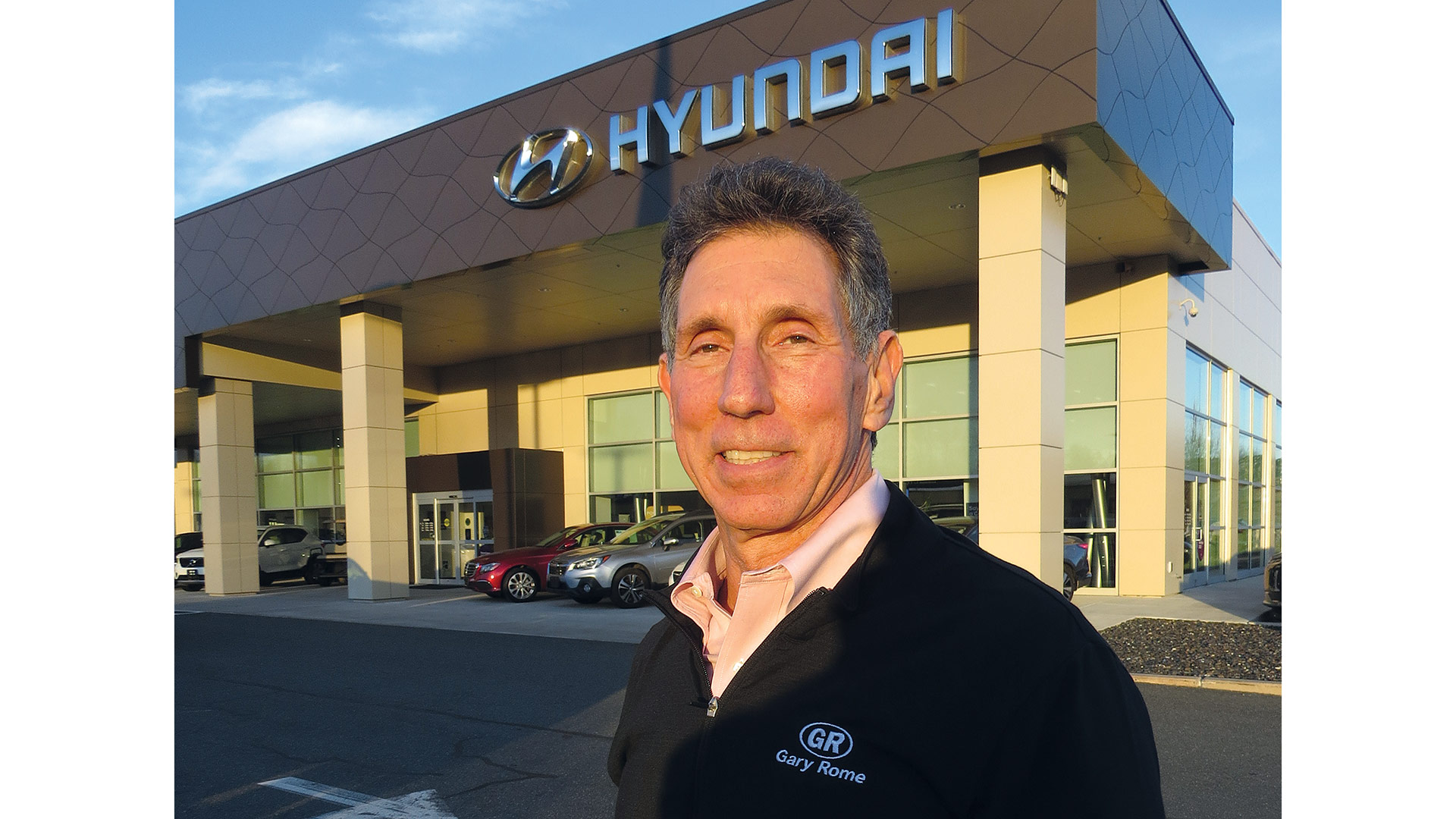
Mike MarcotteHe calls it the ‘Marcotte Ford campus,’ and that name certainly works.

Indeed, where there was once a Marcotte Ford dealership on Main Street in Holyoke, started by his grandfather, Al, and expanded by his father, Bryan, there are now several businesses, including a new, larger dealership, complete with a popular café inside; a commercial truck center; and even a car wash.

Mike Marcotte, the third-generation president of this family business, has been instrumental in its expansion, and in many ways, he is continuing family traditions — of entrepreneurship, success in business, and getting involved in the community.

Like most in family-owned auto dealerships and groups, Marcotte said he “grew up in the business,” learning all aspects of it, from parts to service, as he was being groomed to take a leadership role. His favorite, though, was sales.

Al Marcotte

Al Marcotte

Bryan Marcotte

Bryan Marcotte

“It’s a joy, an experience — a ‘wow’ moment,” he said. “I enjoy seeing people be really happy as they drive away with their new or pre-owned vehicle.”

There have been many ‘wow’ moments for the dealership as well, including those new facilities mentioned above. The café inside the new dealership, called LugNutz, has become a popular eatery in the city, and it has hosted a number of community events for local organizations.

Marcotte is continuing this series of expansion efforts by winning designation as a Model E Certified Elite store, making the dealership one of the first Ford stores in the area to sell electric Ford vehicles. The company will also be investing $1 million in charging infrastructure.

Meanwhile, and as mentioned earlier, Marcotte is continuing and building upon not only a tradition of entrepreneurship, but a tradition of involvement in the community.

That includes everything everything from work at Chicopee Comprehensive High School, where Marcotte established a program where the company mentors, trains, and hires technicians who work at the school, to Holyoke Medical Center, where he serves as vice chair of the board; from the Holyoke Boys & Girls Club — another family tradition; the basketball courts there were recently named in honor of his father, who was on the board for many years — to support of Providence Ministries and especially Kate’s Kitchen, which provides more than 200 meals a day to those in need.

“The city has been so good to us, and we try to be good to the city and give back in every way we can,” he said. “And it’s not just me, but the whole staff.”


—George O’Brien

40 Under 40 Class of 2023

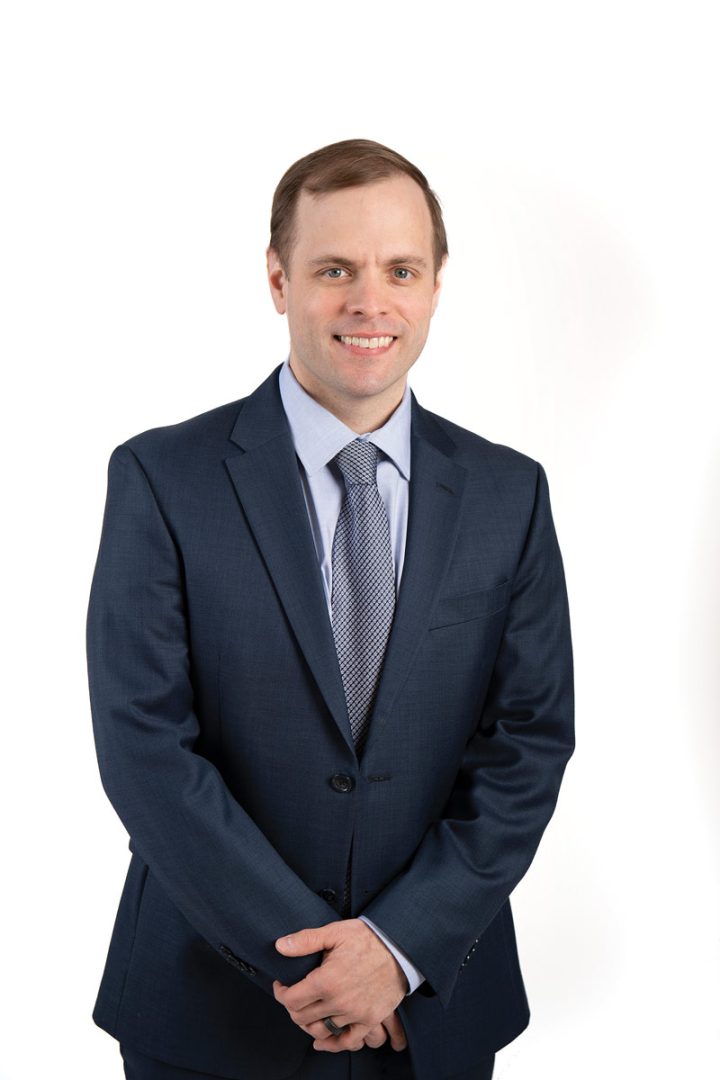
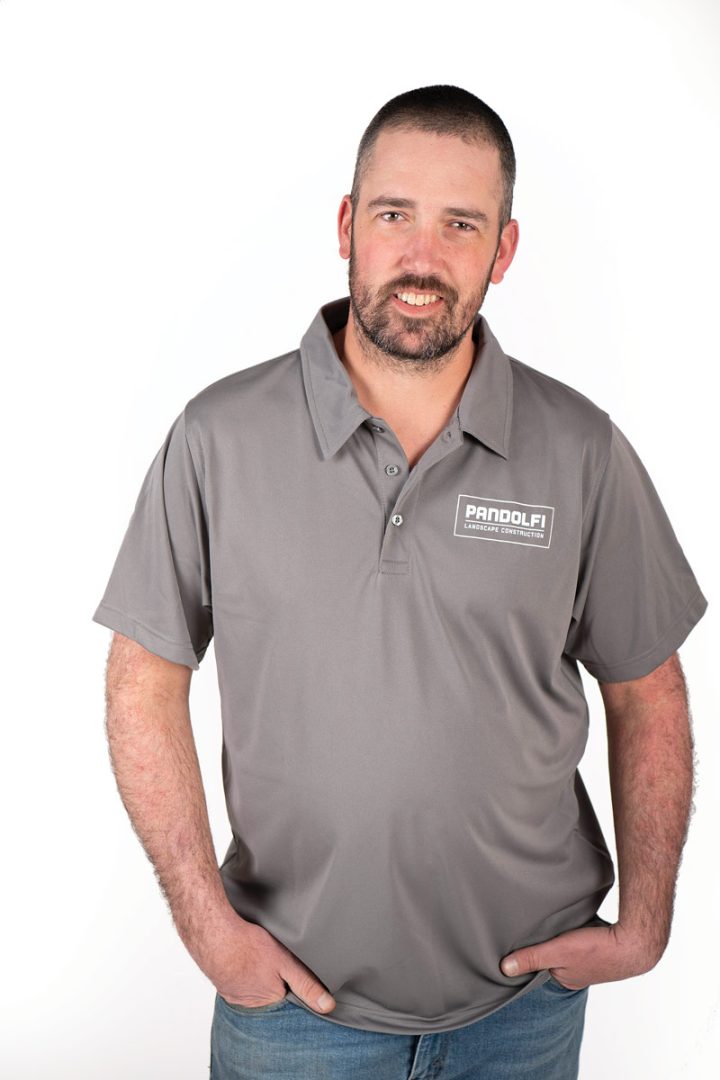
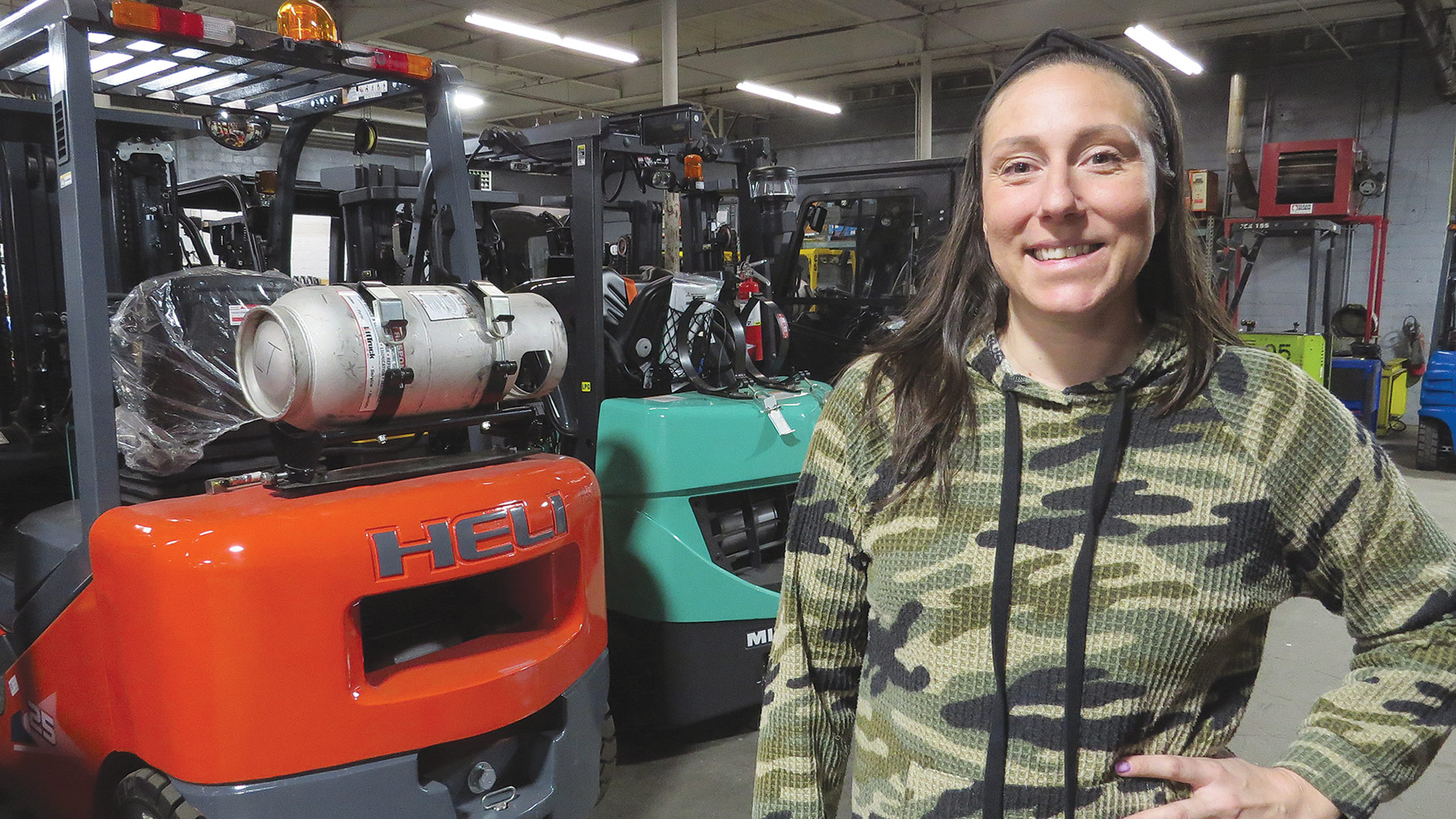
Owner, Pandolfi Landscape Construction: Age 37

Nick PandolfiBy the summer of 2017, Nick Pandolfi was at a crossroads in his life and career.

He had a day job — working for the state as groundskeeper for the Massachusetts Veterans Memorial Cemetery in Agawam. But he had a side hustle, if you will, on nights and weekends, doing hardscape installation work such as patios, retaining walls, sidewalks, and more.

He was developing a solid reputation with the latter, and it was starting to take up more and more of his free time — to the point where, eventually, he had to decide between one or the other.

So he took the route of an entrepreneur and made Pandolfi Landscape Construction his sole focus — and his passion.

He started with a small crew, some old equipment, and determination to make sure his life decision was the right one.

“We just started getting out there, working hard … word of mouth traveled quickly,” Pandolfi recalled. “We found ourselves hiring more people very quickly and just growing from there.”

The company soon expanded its portfolio of work to a full range of backyard renovations, including firepits, outdoor kitchens, and plunge pools. And it was certainly helped by the pandemic, which canceled vacations and gave people the time, and inclination, to make investments in their homes and backyards.

“That whole outdoor living experience has really taken off,” he said, adding that, three years after the start of the pandemic, business continues to be robust, and these kinds of investments continue. “And seeing that look on people’s faces when a project is done, and making them happy at the end of the day — that’s very rewarding.”

When not working, Pandolfi is usually in his own backyard enjoying time with his family — his wife, Taryn, and children Brody, Luke, and Gwendolyn — and attending the many sporting events involving his children.

He’s also active in the community. He served for several years on the Planning Board in Agawam, and currently donates time, energy, and talent to New Day Church in Enfield, Conn., the West Springfield Police Club, and Shriners Children’s New England. He said giving back is important, and certainly did so when he learned that a local school’s playground toys had been vandalized. That same day, he ordered new equipment, then assembled and delivered it when it arrived.

He did that quietly, just as he’s grown his business into a thriving venture.


—George O’Brien

40 Under 40 Class of 2023

Executive Director, Springfield Redevelopment Authority: Age 36

Amanda PhamAmanda Pham joined the Springfield Redevelopment Authority in 2010, at what would have to be called a watershed moment — for the city, the SRA, and her own career.

Indeed, the long-waited project to redevelop and re-imagine Springfield’s Union Station, built in 1929 but dormant and mostly vacant since the early ’80s, was entering a critical new stage. The pieces — most of them, anyway — were falling in place, and construction was set to commence.

Over the next several years, the clock was essentially turned back at the historic station, and it was returned to not only its former glory, but its former role — as a transportation hub and center of activity for the city.

And Pham, who has bachelor’s and master’s degrees in accounting from Western New England University and American International College, respectively, played a critical role in this $94 million project, coordinating 13 federal, state, and local grants for the project, while also handling lease negotiations and creation of standard operating procedures.

“That was such a big part of my life at the SRA prior to my role as executive director,” said Pham, who has worked for the city of Springfield for 16 years, starting in the School Department and then the Community Development Department. “I got exposure to all the different levels of government; there was managing, tracking, and reporting — relationship building and connecting the dots. I got my first taste of Amtrak, MassDOT, and all those other agencies … it was a great learning experience, and it was great to be part of it.”

The work on the Union Station project not only provided invaluable experience, but it afforded Pham the confidence that ultimately led Mayor Domenic Sarno to appoint her executive director of the SRA in 2021.

She is the first woman to serve in that role, and presides over the agency at a critical time for it and the city, with the SRA taking on a number of important projects, including the redevelopment of several properties directly across Main Street from MGM Springfield, part of the Court Square Urban Renewal Plan, which covers most of the downtown.

Speaking about that project, and the state of the city overall, Pham said, “I felt such great energy before COVID, but then the pandemic pulled everything back. I’m looking to see much more activation. We have so much culture and so much pride in our city; we just need some resources to get back to where we were before COVID.”


—George O’Brien

40 Under 40 Class of 2023

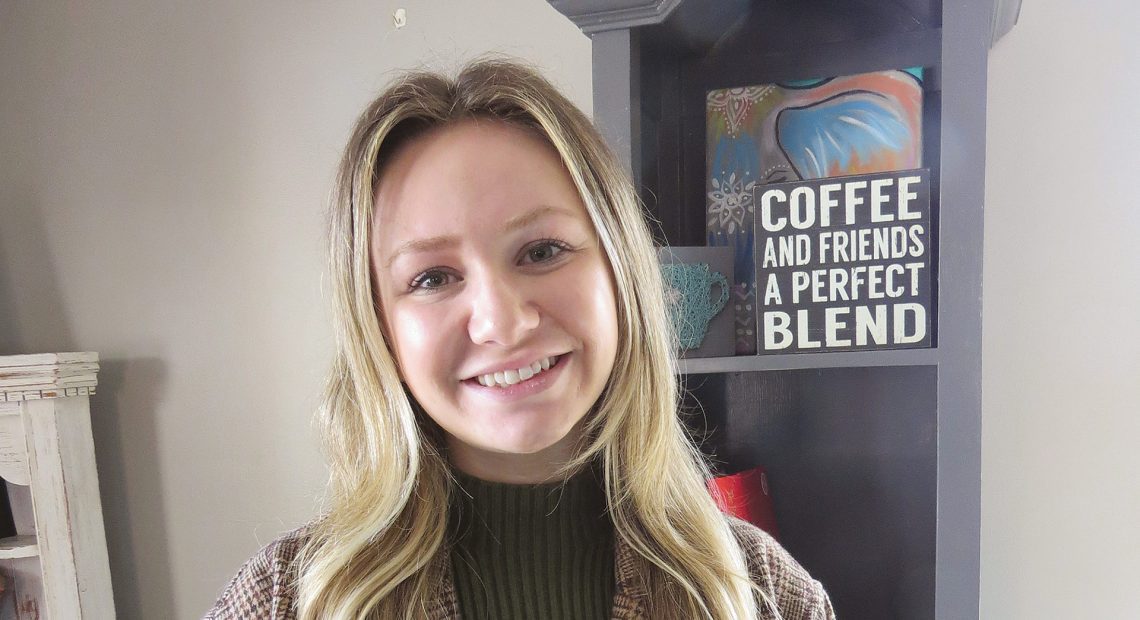
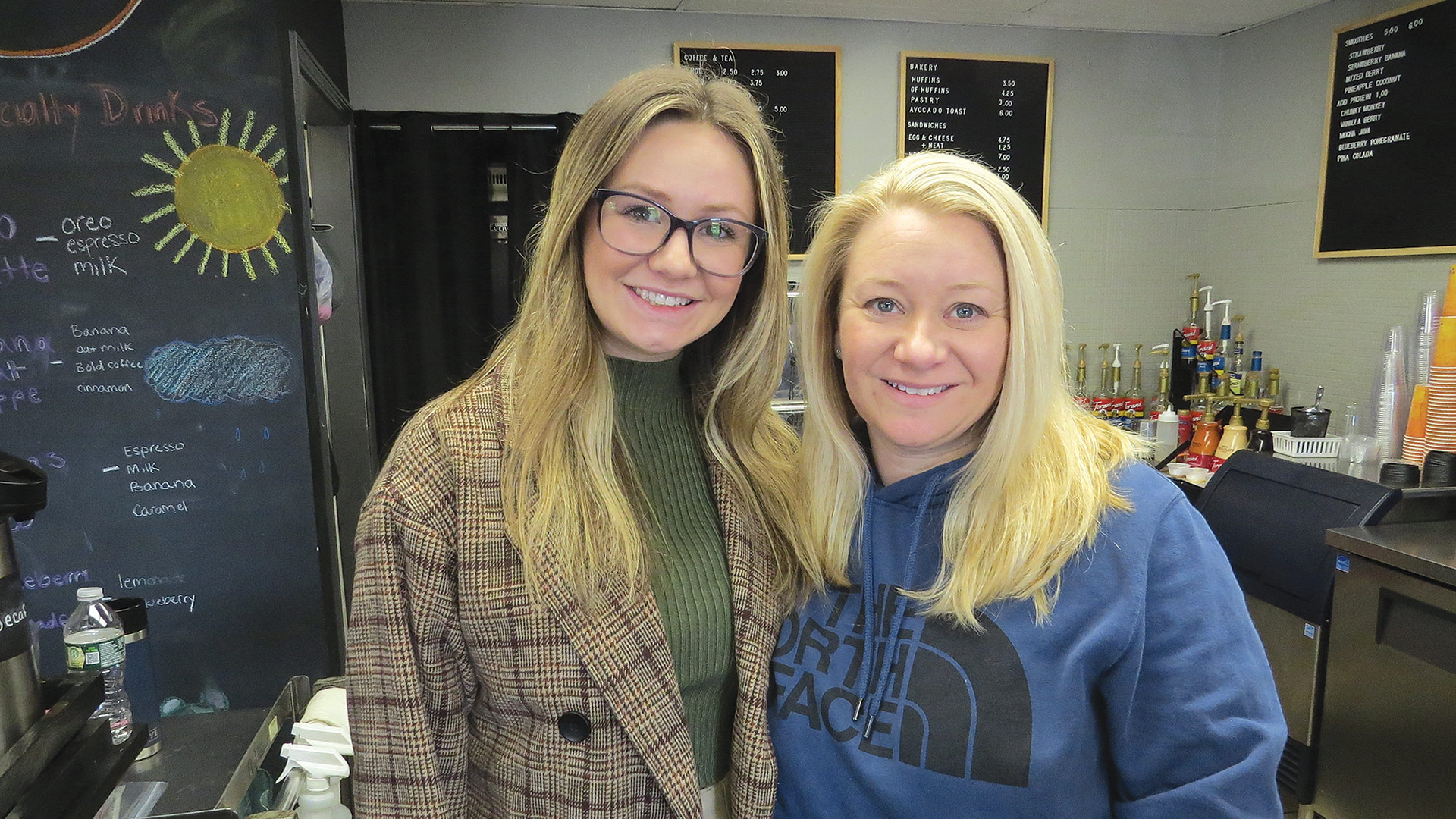
Manager/CPA, Meyers Brothers Kalicka, P.C.; Age 29

Chelsea Russell“There’s never a dull moment.”

That’s not a phrase anyone not in accounting and auditing would probably use to describe that profession. But Chelsea Russell, who has chosen that field, means it when she says it.

“There’s a lot of variety, a lot of excitement — you can do the grind of the work, but you can also go out and meet people in the community and other business owners,” Russell said as she talked about the sum (that’s an industry term) of everything that goes into her career, especially the networking and relationship building, in addition to the number crunching.

Russell was trending toward business management while at Westfield State University, became inspired by one of her accounting professors to focus her career in that direction, and became further inspired by a talk delivered by Jim Krupienski, now a partner at Meyers Brothers Kalicka, on “a day in the life of an accountant.”

She pursued an internship at MBK, one that led — as these opportunities so often do — to a job at the firm. She currently serves as a manager in the Audit and Assurance Department, where she handles large audits in the not-for-profit, commercial, and employment-benefit-plan arenas.

She has become an emerging leader at the firm, serving as co-leader of the Not-for-profit Division, a member of the mission and vision committee, an internal trainer for the Audit and Assurance Department, a member of the Business Development team, and a mentor to audit and accounting associates.

But maybe her most noteworthy contribution at the firm, one she’s passionate about, is her work to develop its Community Outreach program, through which she has established monthly charitable opportunities for the firm to participate in. She has coordinated drives, awareness campaigns, and service for a wide range of organizations in Western Mass., including Square One, Dakin Humane Society, Greater Springfield Habitat for Humanity, the Opera House Players, Friends of the Homeless, Rachel’s Table, and many others.

“It’s become a staple of who we are,” she said of the program. “I always wanted something to make my work more meaningful. I love what I do, and I love my clients … but there was more that we could do with the resources that we have. We’re in Western Mass., and there’s so much need in the community.”

When not working or coordinating support for nonprofits, Russell is engaging in outdoor activities — camping, hiking, kayaking, fishing, and more — with her husband, Tyler, and 8-month-old lab, Copper.


—George O’Brien

40 Under 40 Class of 2023

Evening Anchor, WWLP-22 News: Age 30

Ciara SpellerCiara Speller says she’s always been a storyteller.

At first, and for many years, she told stories through dance, something’s she’s still passionate about today.

“Through the arts, I was always able to tell a story,” she said, but along the way, she found there were other ways to communicate stories — through poetry, the student newspaper in high school, and other vehicles.

“I was moved to see that my words could touch other people and bring their stories to light,” she said, adding that this passion for telling stories, coupled with a long-held interest in watching the news, often with her grandmother, put her on path to broadcast journalism and, eventually, WWLP-22 News, where she currently serves as evening anchor.

She started as a reporter in 2017, arriving in Springfield soon before the story of serial killer Stewart Weldon broke, a case that brought national media to the area and provided Speller with both exposure and learning experiences on many levels.

She joined the anchor desk less than a year later, and there were other big stories to follow — COVID-19, the tragedy at the Soldiers’ Home in Holyoke, Jan. 6, and many others. But it’s the day-to-day work of keeping area residents informed that Speller likes most about her work.

She told BusinessWest that she always pictured herself on the anchor desk, noting that there are many responsibilities there beyond reading the news, including writing, editing, deploying crews, proofreading, answering calls, making beat calls to police and fire departments, and, in general, setting the tone for that night’s broadcasts.

“I want to make sure that I’m delivering stories that are important to our community … I don’t want to let my community down,” she said. “They welcome me into their homes at night, and I always want to give it my best.

“I want to be like a conversation,” she went on. “I want it to come off as just having a chat — what’s going on — with my friends.”

Speller’s ultimate goal is to sit behind the anchor desk in a much larger market, but while she’s working in Greater Springfield, she has committed herself to getting involved in the community and making a difference there.

Indeed, she currently serves on the board of directors for Girls Inc. of the Valley, is a corporator for Monson Savings Bank, and has volunteered with the nonprofit I Found Light Against All Odds, which assists at-risk youths and their families through numerous charitable events.


—George O’Brien

40 Under 40 Class of 2023

Owner, The Tatted Professionals; Director, Jill Ker Conway Innovation & Entrepreneurship Center, Smith College: Age 36

Andrea St. LouisAndrea St. Louis has a number of titles and many different … let’s call them jobs, although some of them are more like passions.

She was just named director of the Jill Ker Conway Innovation & Entrepreneurship Center at Smith College. She is also the owner of a business called the Tatted Professionals, through which she takes many different titles — executive coach, writer, business coach, educator, and public speaker.

She’s also the author of the book 40 Days Lighter: A Devotional Journey for Women Determined to Live Free, an adjunct professor, book-club host, and TEDxSpringfield speech coach and emcee. She’s also an ordained minister at the All Nations Church in Springfield, as well as a youth leader and board member at the church. She has also been a board member for the Children’s Chorus of Springfield and a mentor with the Pass the Torch for Women Foundation. She’s also a mother of two.

That’s a lot of ‘alsos.’

But we need them to accurately convey all that St. Louis does professionally and in her community.

In her role at Smith, which recently expanded from entrepreneur in residence to director, she has developed and taught courses on entrepreneurship and facilitated workshops on entrepreneurship, innovation, ideation, effective pitching, and more.

And through her business, the Tatted Professionals, she is an executive coach, writer, business consultant, educator, and speaker who is committed to helping women leaders own their gifts and effectively tell their story.

She is a frequent speaker, having given a talk at the recent Women in Business Summit in Springfield, and also at the Women Business Owners Alliance Social Media Bootcamp, the On the Move Forum for Women Intergenerational Panel, and the 2021 Wellness for the Culture Saturday Wellness Workshop.

St. Louis said there is general theme or tone to her talks.

“I’m often talking about authenticity, what it means to show up authentically, and professionalism,” she explained, adding that these talking points refer back to the name she has given her business. “For me, tattoos are a symbol of how we bring ourselves to wherever we’re going. Tattoos are permanent; I know some people get them removed, but to me they are a permanent reminder to bring all of myself to the work that I do.”

She said she also helps clients, mostly women of color, tell their stories, step out of their comfort zone, and work through challenges. She’s speaking from personal experience, having done all that herself, and that’s why her voice, and her message, resonates.


—George O’Brien

Cover Story

What’s in Store?

Brian Kaplan, vice president

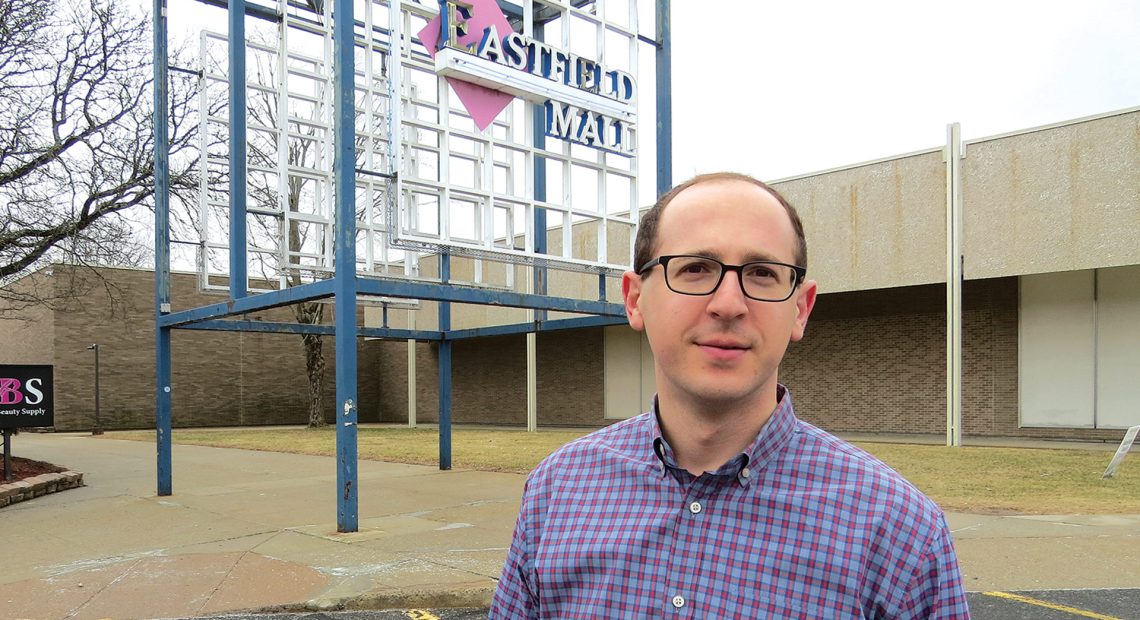
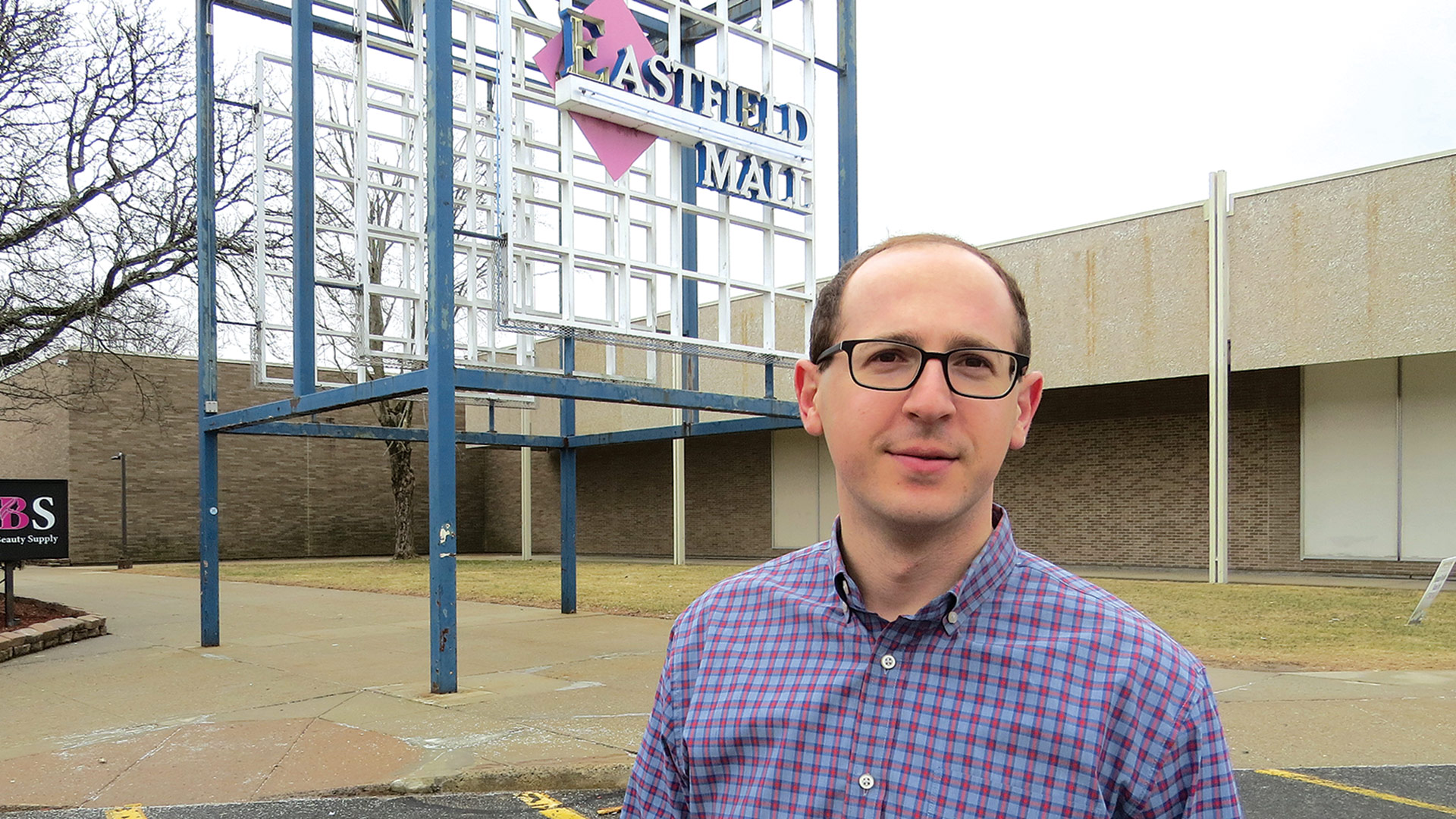
Brian Kaplan, vice president of Development for Onyx Partners


When Dennis Smith Jr. says the old 99 Restaurant location in the Eastfield Mall is the ideal space for the Empowerment Center operated by the Massachusetts Military Support Foundation, a facility that provides veterans with everything from food to clothing to referrals for legal help, he means ideal.

Indeed, the site, which became available after the restaurant ultimately failed to regain its footing after the pandemic, boasts plenty of space, a lobby area for greeting vets and presenting them with information, freezers and refrigerators for storage of food, ample parking, location on a major thoroughfare (Boston Road), a stop on a bus route … there’s even warehouse space that’s been made available to the foundation at the Ocean State Job Lot across the street.

As ideal as all this was, Smith, who became the center’s director last July, knew it was only temporary. The mall, opened in 1968 and the first facility of its kind in Greater Springfield, has been targeted for redevelopment for close to a decade now and will officially close its doors in July. The question concerning demolition of the landmark (yes, it can be called that) was always when, not if, said Smith.

So, almost from the day he started at the center, he has been exploring where the facility can go next, and he’s looking for a spot that can check as many boxes as the current site as possible, knowing it is unlikely he will find something quite so ideal.

“Nothing has been finalized as to our exact plan. It could consist of primarily retail, but also other uses such as residential, storage, medical office, restaurants — we’re still looking at a few of those options.”

“I’m looking at a number of sites right now,” he said, noting that he recently toured a former Walgreens location on St. James Avenue in Springfield. “It’s going to be very hard to match what we have here, but we’ll try.”

Where the center and the 40-odd other businesses at the mall eventually land — and most are expected to land somewhere — and when are just a few of the many subplots to a broad and intriguing story that could change the landscape on Boston Road and elsewhere in a number of ways.

Others obviously include the reimagining of the mall itself. This has been an ongoing story, but one that will become real when demolition begins later this year, said Brian Kaplan, vice president of Development with Needham-based Onyx Partners, which is remaking the site into what he expects will be a mixed-use facility featuring retail, restaurants, and other, still-to-be determined businesses and residential uses.

“Nothing has been finalized as to our exact plan,” he told BusinessWest. “It could consist of primarily retail, but also other uses such as residential, storage, medical office, restaurants — we’re still looking at a few of those options.”

Dennis Smith Jr.

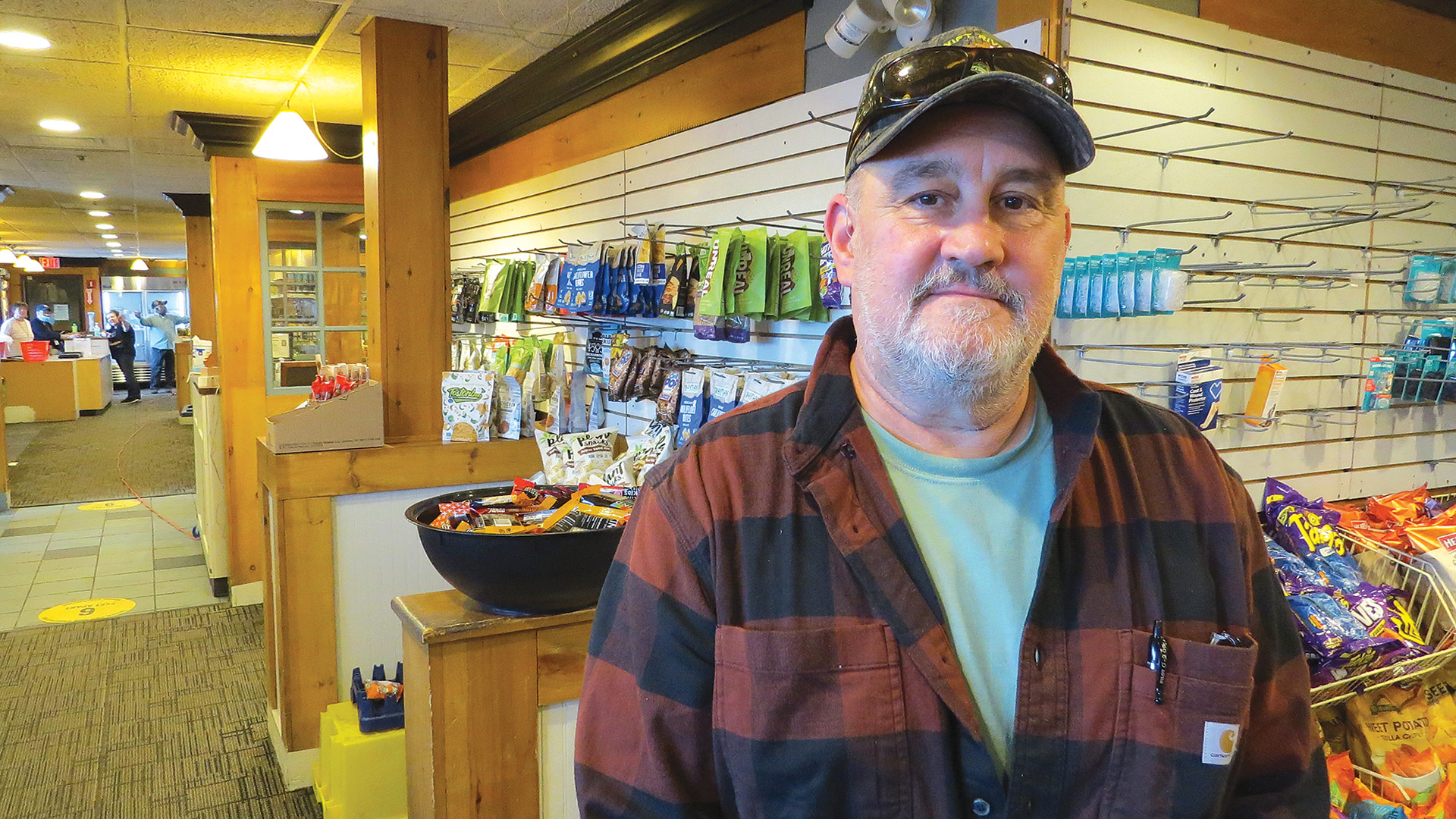
Dennis Smith Jr. has been looking for a new home for the Empowerment Center operated by the Massachusetts Military Support Foundation almost since the day he arrived, knowing Eastfield Mall’s days were numbered.

Another aspect to the story is the potential impact of the relocation of the tenants on specific retail areas and communities. Indeed, the retail sector has been struggling in general, and especially since COVID. Officials with the Western Massachusetts Economic Development Council (EDC), which is coordinating the relocation process for tenants, said the evictions might provide a boost for specific properties and business districts.

The region hasn’t seen many mass relocations like this one, with the most recent one coming when MGM Springfield purchased 95 State St. in Springfield for its own use, displacing a few dozen law firms that found space in several different office buildings within a mile or so of the Hampden County Courthouse.

This process will be different, and for some tenants, it may prove to be challenging, said Xiomara DeLobato, chief of staff of the EDC, adding that many have had very favorable lease rates at the mall and may experience a form of sticker shock as they explore other options.

The EDC is working with Springfield-based Homes Logic Real Estate to create customized solutions for each tenant, she noted. “Our intent is to make sure that we’re providing one-on-one support for each step in the process as they look for vacancies or potential locations to set them up for success.”

For this issue, BusinessWest looks at the many aspects of the Eastfield Mall redevelopment story and what they might mean for the region and its real-estate sector.


End of an Era

There is a quiet, eerie feeling at the mall these days.

The massive parking lot off Boston Road is all but empty. Inside, most of the smaller businesses are still open, but there is little foot traffic as the end nears. This sits in stark contrast to the mall’s better days, and there were many of them, when several anchors, including Sears and JCPenney, were thriving; a multiplex theater was operating; and the mall was still a destination.

“Our intent is to make sure that we’re providing one-on-one support for each step in the process as they look for vacancies or potential locations to set them up for success.”

It hasn’t been that for some time, as the anchors and then the theaters closed, mirroring what was happening at malls across the country as consumers increasingly did their buying online and major retailers, like Sears, all but vanished from the landscape.

Today, the mall is experiencing a slow, painful death that comes amid great expectation about what can and ultimately will happen at this site, and a wide range of emotions concerning existing tenants — who will be free of rent and utility charges for these last few months — and what will happen with them.

Let’s start with what’s next for the mall. Kaplan said Onyx often builds new, but it has worked on projects similar to the Eastfield Mall redevelopment initiative in other regions of Massachusetts, Southern New Hampshire, and several other states.

He said the Eastfield Mall project was presented to the company last fall, and after extensive due diligence, the decision was made to move forward and acquire the property, with work ratcheting up in recent months on everything from meetings with tenants to filings with the city.

He believes demolition will begin sometime later this year, after local approvals are secured, with a 12- to 18-month construction process to follow.

Redevelopment will take place in stages, he noted, adding that phase one will, in all likelihood, be retail, restaurants, and services, with a mix of national brands and local ventures, similar in some respects to what exists now, but in a far more modern, 21st-century facility.

Eastfield Mall, which will be redeveloped

The clock is winding down on Eastfield Mall, which will be redeveloped into a modern mixed-use facility.

What will follow will be a function of demand and feasibility, Kaplan noted, adding that the canvas will likely be filled in over several years. Residential development is likely to follow, with more businesses to provide services to those living nearby.

The project could include some of the current tenants at Eastfield, he said, adding that it is possible that some will choose to find a temporary home and ultimately return. The others, which include a broad mix of national retailers and local businesses, will settle elsewhere.

Onyx is collaborating with the EDC and working with other stakeholders, including local and state agencies, to come up with a plan for each tenant, he said, adding that each case is different, obviously, and will require a personalized solution.

Rick Sullivan, president and CEO of the EDC, said the agency’s mission is broad, and includes work to bring new businesses to the region and also retain existing businesses and jobs. Finding new homes for displaced Eastfield Mall tenants is a somewhat unique assignment, but it fits the EDC’s job description, if you will.

“It fits in with a focus that we have moving forward, which is on small businesses in terms of having them grow and flourish in the region,” he explained. “This is an opportunity where there are about 40 businesses that have been in operation for some time, and in some cases, they’re original tenants.”

The national tenants, and they include Old Navy, LensCrafters, Kay Jewelers, T-Mobile, and a host of others, have the resources and staffs to handle relocation efforts, if they choose to move those outlets, said Sullivan, adding that the EDC’s primary focus is the local tenants, ranging from the Mall Barber to Donovan’s Irish Pub to Mykonos, a Greek restaurant that has been at the mall since the very beginning.

Many will choose to try to stay in Springfield, he went on, adding that others are willing to look outside the city and the Boston Road area, which presents opportunities for retail areas that were impacted by the pandemic and the general shifting tide of retail — and there are many of them.

Some would prefer to stay in a mall-like setting, he went on, while others might opt to find their own space. Most are looking to lease space, but some are considering the purchase of real estate, which could bring its own benefits.

“Some are willing to look at downtown Springfield or downtown Holyoke,” Sullivan said. “They may not necessarily need to be in a mall setting or Boston Road — although some of them need to be there because that’s where their client base is.”


Up from the Ashes

The demise of the mall certainly has the attention of property owners and real-estate brokers in the region, especially those that specialize in retail spaces.

Evan Plotkin, president of NAI Plotkin, has several retail properties in the portfolio, as well as 1350 Main St., the office tower in downtown Springfield that has a significant amount of ground-floor retail space, much if it vacant since the departure of Santander Bank several years ago.

As he walked BusinessWest through that space, Plotkin said it would be an ideal landing spot for some of the Eastfield businesses.

“There are a lot of people who still work downtown or come here for events or to do business,” he said, noting that 1350 Main will soon be welcoming some new office tenants that could generate additional foot traffic. “Some of those mall businesses could do well here.”

Tower Square is another potential landing spot, and Demetrious Panteleakis, a principal with the Macmillan Group, the leasing agent for the office and retail complex, said he has talked with some of the mall tenants about making a move downtown and all that is involved with that decision.

“There’s a potential positive economic spin that goes beyond just the mall investment.”

“We’re very different as it pertains to such things as parking,” he explained, listing just one of the issues being discussed. “Although we have plenty of parking, it’s not typical retail parking; we’re tower parking.”

Overall, he said Tower Square ownership is focused on finding new tenants that can provide needed products and services to tenants of that tower and perhaps those surrounding it. The planned new Big Y market, a scaled-down version of its supermarkets that will go into space once occupied by CVS, is a good example, as are existing tenants, ranging from White Lion Brewing Co. to Dunkin’ Donuts to SkinCatering, a salon and spa. And some of the mall tenants might fit that description.

“We have a spa and hairdresser, a bar, our food court … businesses that support people who work here and don’t want to leave the building,” Panteleakis said, adding that additional hospitality-related businesses that don’t compete directly with existing businesses might be good fits.

As for Smith and his search for a new home for the Empowerment Center, he said there is some “intense work” going on as he tries to find a space that is affordable and checks at least most of the boxes that the old 99 Restaurant does.

“I have a number of great locations that I’d like to go to,” he told BusinessWest. “It comes down to what can be negotiated with the local property owners — that will determine where we go; we’ll just take it step by step.”

Summing up what’s happening on Boston Road, Sullivan said that, while the demise of the mall is regrettable in some ways, there are several bright spots to this ongoing story.

For starters, there is a national developer, Onyx, that has committed to redeveloping the site into something that speaks to the present and future, and not the past, when it comes to retail. Meanwhile, the relocation of the many existing tenants could provide a spark for some communities and their downtowns.

“There’s a potential positive economic spin that goes beyond just the mall investment, and that’s why the EDC is involved,” he told BusinessWest. “There’s potential to grow and amplify that investment in the region.”

Time will tell just how much that investment will be amplified, but the parties involved in this developing story say there are many intriguing chapters still to come.

Commercial Real Estate Special Coverage

Turning Back the Clock

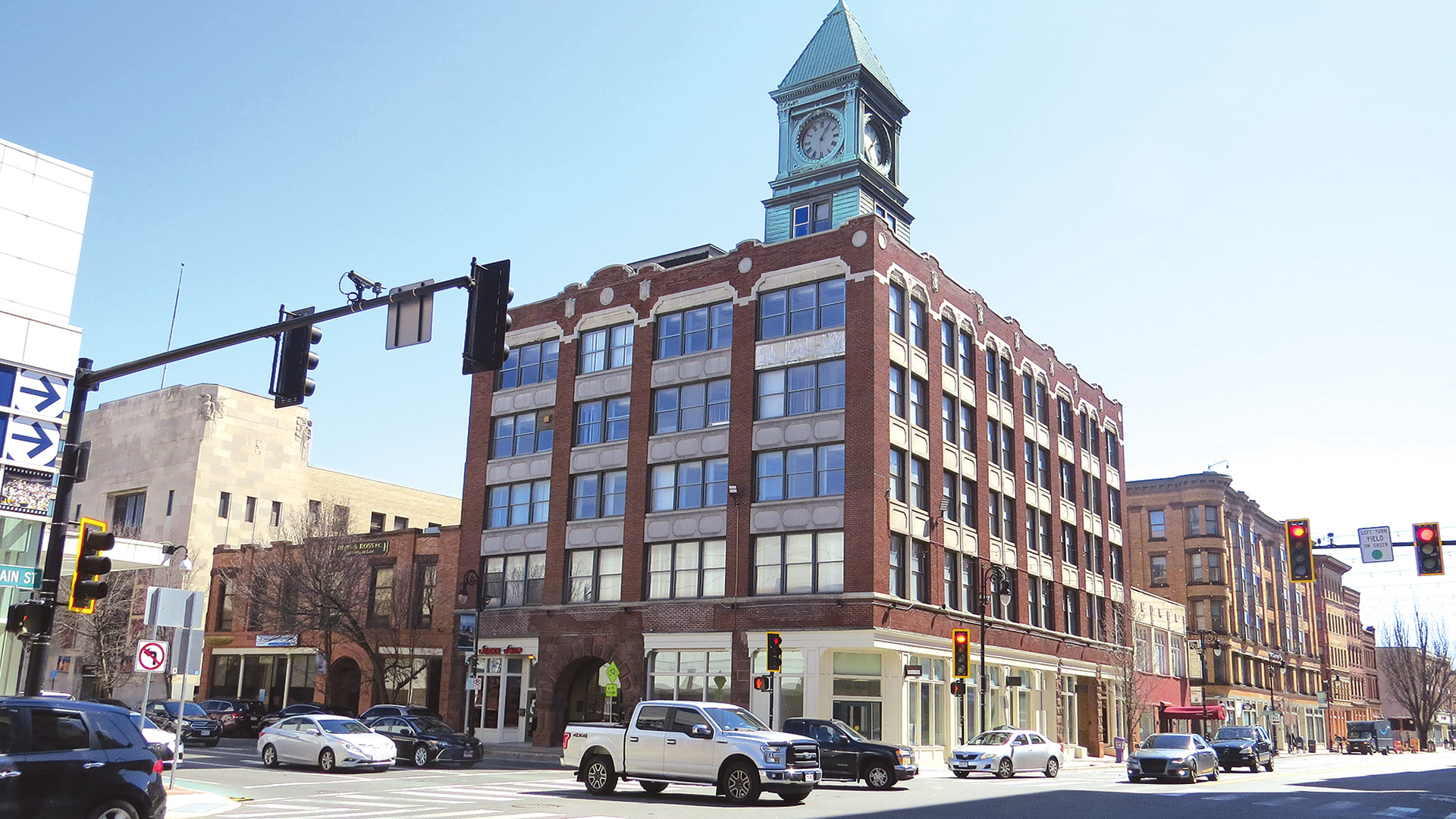
Clocktower Building

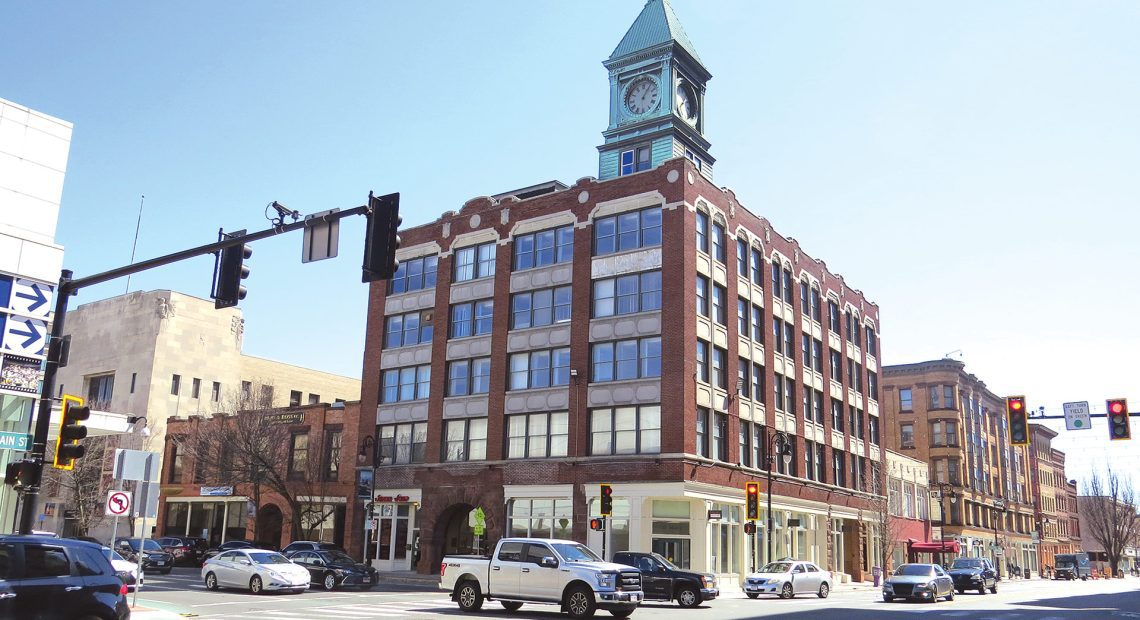
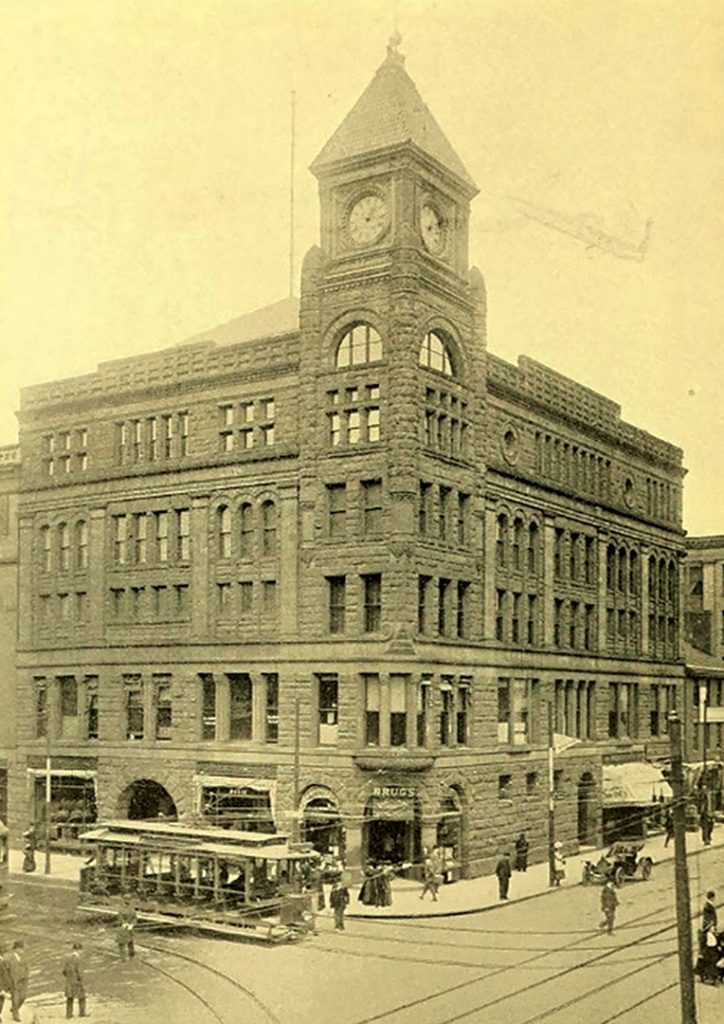
The Clocktower Building, above, was home to Masonic Temple more than a century ago (right).

At other times in Springfield’s history, the properties at 113 State St. and 1155 Main St. were prominent players in the vibrancy, culture, and overall tenor of the City of Homes.

The former — long known, for obvious reasons, as the Clocktower Building — was home to the Masonic Temple when it opened in 1893, before a new, much larger facility was built further east on State Street. The latter, the Colonial Block, which opened in 1903, was one of the city’s first real mixed-use facilities, noted Tim Sheehan, Springfield’s chief Development officer, featuring a blend of office and retail space on the lower floors and residential units on the upper floors.

Until fairly recently, meaning before the pandemic, the two properties had still been somewhat vibrant, featuring a wide array of tenants, including nonprofits, small businesses, a bank (at 113 State St.), and a number of various-sized law firms taking advantage of the buildings’ proximity to the Hampden County Courthouse just down State Street. These days, though, they are almost entirely vacant and stand in stark contrast to the progress seen around them, most notably across Main Street at MGM Springfield and across State Street at the MassMutual Center.

City officials have been looking to change that picture, obviously, and are moving forward with a plan to return these buildings, and also 11-21 Stockbridge St., a smaller, better-occupied office property in that same area, to their former status and make them part of the city’s resurgence. After acquiring them as a package in 2021 for $2.75 million, the Springfield Redevelopment Authority (SRA) has invited the development community to step up and submit proposals for the properties, separately or perhaps collectively.

Responses to this request for qualifications (RFQ) are due later this month — the deadline was originally late March — and Sheehan and SRA Executive Director Amanda Pham are expecting some imaginative proposals because that’s what will be needed to turn back the clock and make them key players again.

“This will require a responsive, creative developer, someone who has a vision for preservation of these buildings,” Pham said. “They have great potential.”

Sheehan and Pham are expecting proposals that will likely blend office and/or retail with a residential component, noting that what emerges for one, two, or all three properties will likely require a public-private partnership, similar to what was needed to finally move the needle and create a new use — a mix of residential and retail — for the former Court Square Hotel, just a block or so from the three properties in the RFQ.

Finding a preferred developer is a two-step process, said Pham, adding that, after responses to the request for qualifications are received and reviewed, three finalists will move on to a request for proposals.

If all goes well, a preferred developer is expected to be named by June, they said, adding that it may not be long after that when people start talking about these landmarks using mostly the present and future tenses, and not the past.


Building Momentum

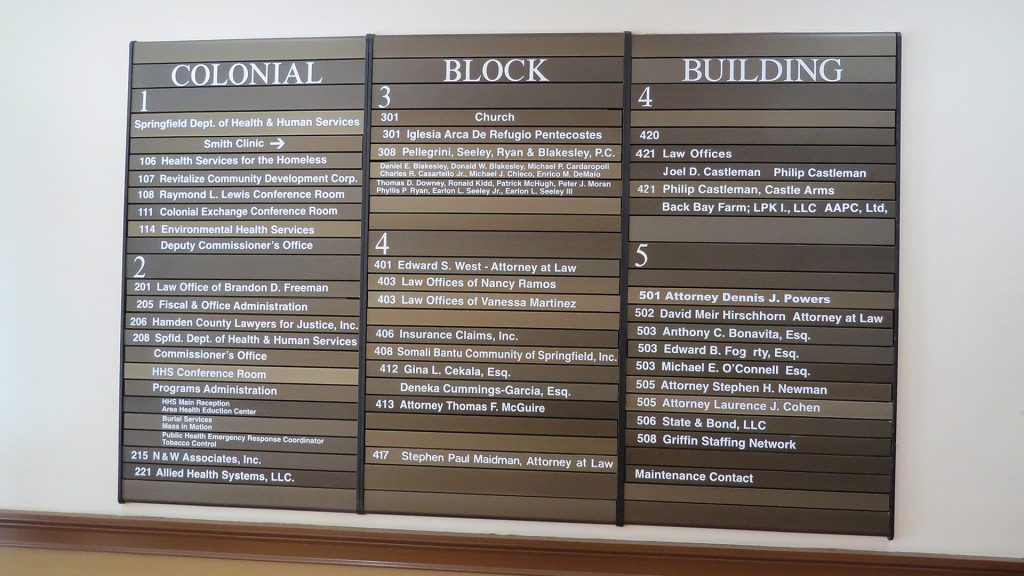
As she gave BusinessWest a tour of 1155 Main St., Pham referenced some reminders of, well … what it once was, starting with the large directory on a wall in the lobby listing tenants and their suite numbers.

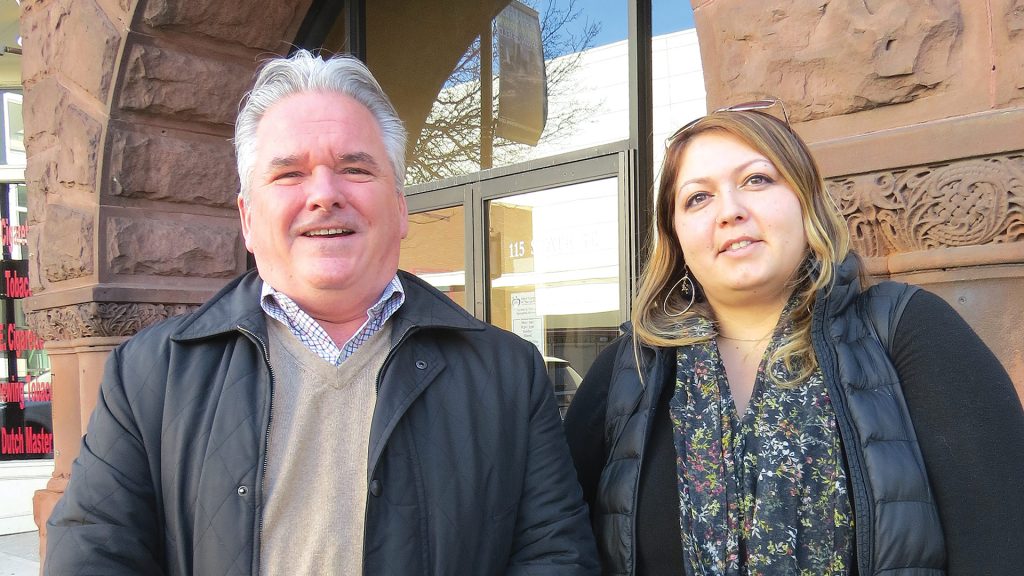
Tim Sheehan and Amanda Pham stand outside the historic structure.

Tim Sheehan and Amanda Pham stand outside the historic structure.

The board still includes the names of dozens of tenants that are no longer there — from the law firm Pellegrini Seeley, Ryan and Blakesley, which once took much of the space on the third floor before moving to the Basketball Hall of Fame complex, to Revitalize Community Development Corp., which occupied a large suite on the second floor. In fact, the 82,000-square-foot property is currently only about 12% occupied.

Later, she pointed to a large bookcase full of law books left behind by one of the departing law firms.

“We have a lot of law books,” she said, adding that, apparently, many of the departing firms located in various-sized offices on the maze-like floors had no use for the books in this age of the internet and simply left them behind.

Thus, these law volumes become part of the dialogue concerning what this property used to be, said Pham, who took the helm at the SRA in 2021, adding that, increasingly, the focus is on what they can be moving forward.

The SRA has taken the matter from the discussion phase to what could be called the discovery phase with the request for qualifications. It includes a link to a six-minute video that features comments from Pham, Sheehan, Mayor Domenic Sarno, MGM President and CEO Chris Kelley, Peter Picknelly, chairman of Peter Pan Bus Lines and a key player in the Court Square project, and others, all inviting developers to take advantage of this “Main Street and Convention District development opportunity.”

“This will require a responsive, creative developer, someone who has a vision for preservation of these buildings. They have great potential.”

Together, they talk about the progress made downtown and the progress still to come, with projects like the $74 million parking garage and event space that will replace the facility torn down last fall. They also discuss how much of this progress was the result of public-private partnerships.

“This development behind me never would have happened if not for the cooperation of City Hall and the state of Massachusetts,” said Picknelly as he stood in front of the Court Square property.

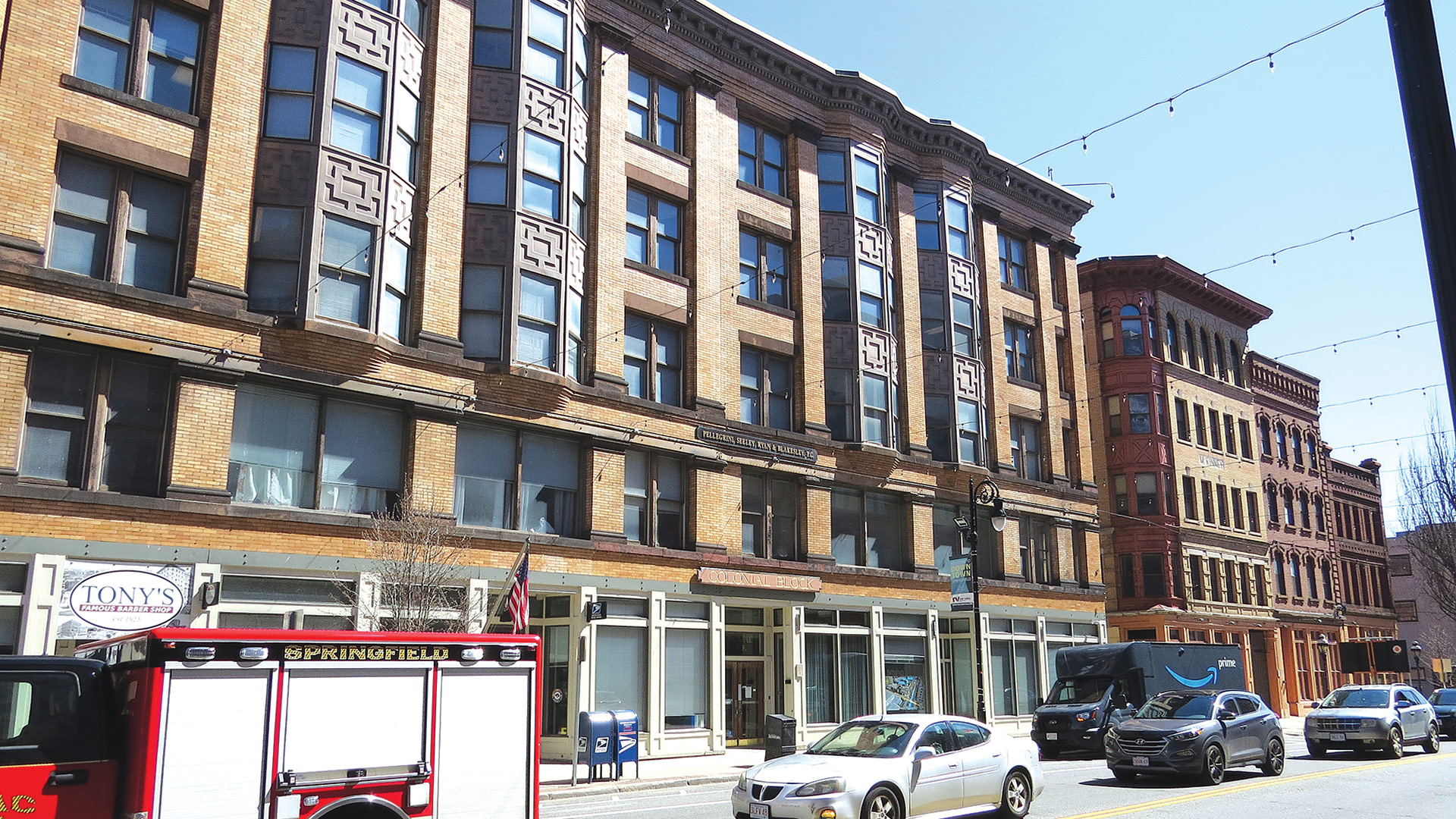
The Colonial Block

The Colonial Block was one of the first mixed-use buildings in Springfield, with retail and residential space. It may see a similar blend in the future.

A number of developers, both with local ties and from outside the region, have expressed interest in the properties, said both Sheehan and Pham, noting that the city acquired the properties to move beyond the ongoing speculative nature of previous ownership and take redevelopment to a higher plane.

“We wanted the buildings situated so their redevelopment would ultimately fit the city’s overall planning as it relates to the Main Street Convention Center District Plan,” said Sheehan, adding that this plan, in general terms, calls for building on existing momentum and creating a true destination in the downtown, a place where people can live, work, and (especially with MGM and the MassMutual Center right next door) play.

A developers’ tour conducted several weeks ago attracted several parties, many in person, but some virtually, said Pham, adding that Springfield has managed, through its recent spate of progress, to put itself on the map with regard to regional and national developers looking to expand their portfolios.

There were site tours of the properties and the surrounding area as well, she went on, adding that firms brought full teams with them, including architects, engineers, and planners, to gauge future uses for the landmarks.

Given the current glut of office space, Sheehan said, especially the class B and class C variety that these properties have featured, future redevelopment will likely not focus on that use entirely, although it could be part of the equation.

“There is an overabundance of class B and C space in the office sector, so we’re really encouraging people to look at adaptive reuse to … something else,” he noted. “Developers may want to reduce the amount of office, but not completely eliminate it, either.”

A much larger part of the equation will likely be market-rate housing and activation of the ground floors with retail and hospitality-related businesses that will give downtown visitors more things to do and more opportunities to stay, he went on.

Colonial Block

Above, the directory inside the Colonial Block is quite dated, as most of those tenants have moved out. At right, one of the unique spaces in the building.

“Our planning ultimately calls for extensive ground-floor activation,” he explained. “You have two very strong anchors, in MGM and the MassMutual Center, adjacent to these properties, and we really think there is the ability to activate the ground floors so that it encourages people who want to come to the MassMutual Center or MGM to want to linger and stay in the area.”

As for housing, Sheehan said a recent study identified the need for 1,500 units of additional housing of this type in and around downtown.

And while conversion of such properties to housing is often difficult and expensive, developers need only look a few hundred yards to the south for inspiration, to the massive Stockbridge Court apartment complex, created more than 40 years ago and perhaps the city’s best market-rate-housing success story.

“Stockbridge Court is certainly an example of what can be done,” he said, adding quickly that any residential projects in these properties will likely require a public-private partnership to not only renovate the buildings in question but improve the overall area and its connection to Main Street.

“We’ll need to enhance the infrastructure to make it a much more walkable environment — and a pleasant walkable environment — if we’re going to attract that scale of residential development in this area.”


Right Time and Place

Overall, there are some building blocks coming together that could make development of these properties a more attractive and more viable opportunity, said both Sheehan and Pham, noting that leasing activity will start soon at Court Square, and construction is set to commence on the new parking garage. Meanwhile, a new entrance is planned at the southwest corner of the MassMutual Center.

Meanwhile, the two leaders are looking at adaptive reuse of these properties as just part of a larger effort in the city’s downtown.

“We’re looking at these as the first step in the redevelopment of the area,” said Sheehan, noting that that there are several other vacant or underutilized spaces, including the neighboring 1260 Main St., several surface parking lots, and other properties.

As he referenced a photo of the Clocktower Building, from the days before its stone exterior was mostly stripped away — it remains in some places as a reminder of what was — Sheehan waxed nostalgic on its place in city history.

“For a long time, this building has certainly played a major role in downtown Springfield in terms of being a major corner and a huge presence,” he told BusinessWest, adding that the hope is that this property, as well as the Colonial Block — and other properties in that area — can attain that status again.

Time will tell, of course, when and how soon that happens, but this is certainly a developing story — in every sense of that phrase.
Education

A Potential Game Changer

John Cook says that, while the cost of a community-college education (roughly $7,000 per year) isn’t high, at least when compared with that of a four-year institution, public or private, it can be, and often is, a barrier that some cannot overcome, even with financial aid.

And for others, it’s enough of an obstacle for them to think twice about college — or not at all.

“Like anything in our lives, we can’t just separate this cost or isolate it from all the other considerations for a human being; it’s one more thing, one more cost in the lives of so many … this is why we see students drop out, or say ‘now is not the time,’” said Cook, president of Springfield Technical Community College (STCC). “Any way to get a whole lot of people, frankly, to take this second look is a good thing.”

With that, Cook added his voice to many others who are praising Gov. Maura Healey’s inclusion in the budget of something she calls MassReconnect, which would fund free community-college certificates and degrees to the Commonwealth’s residents who are age 25 and older and have not yet earned a college degree.

“This is a group of adults, many of whom have college credits, that we really want to encourage to come and take another look at college.”

John Cook

John Cook

According to some statistics released by the state, roughly 2 million residents would be eligible for the program — individuals who have a high-school diploma but not a college degree — and perhaps 700,000 of these individuals already have some college credits.

MassReconnect, which is actually one of two ‘free’ community-college programs that have been proposed (Senate President Karen Spilka has proposed free community college for all students), would provide both incentive and the means for many people to return to college and get the degree or certificate that might open a door to not just a job, but a career, said Christina Royal, president of Holyoke Community College (HCC).

“This is a potential game changer,” she told BusinessWest, adding that MassReconnect targets what she called the “emerging space of adult learners,” individuals who want a college education, but are held back by competing demands on their life, including family and work.

“The governor’s MassReconnect proposal is a great starting point that increases access for adult learners who don’t already have a college credential,” she went on. “It’s designed to help them finish that stretch so they can get a college credential.”

Michelle Schutt, president of Greenfield Community College, concurred. She said GCC ran some numbers and determined that nearly 200 of the roughly 1,400 students currently enrolled would qualify for the program. “That’s not insignificant,” she said, adding that many more in the community who are not enrolled who might be inspired to connect, or ‘reconnect,’ as the case may be.

“I’m incredibly excited about this,” she added. “Reconnecting with those people who have some college but no degree and letting them know that there’s a new opportunity here has great potential for the community colleges and GCC specifically.”

Rick Sullivan, president and CEO of the Western Massachusetts Economic Development Council, agreed.

Using similar language, he said MassReconnect could have broad and powerful impact over time, providing benefits for the region, its employers, and both community colleges and the four-year institutions for which they are feeders.

“Reconnecting with those people who have some college but no degree and letting them know that there’s a new opportunity here has great potential for the community colleges and GCC specifically.”

michelle Schutt

Michelle Schutt

Based on initiatives in Michigan and Tennessee, the MassReconnect proposal actually goes further than those programs by covering more than just tuition; it also covers mandatory fees, books, and various support services. It is designed to remove barriers to getting the college degree that is needed to succeed in most jobs today, and it holds significant promise to just that, said those we spoke with.

Cook told BusinessWest that the average age of a student at STCC is 26, a statistic that might surprise some, but certainly helps explain the thinking behind MassReconnect and its potential impact.

“This idea is right in our wheelhouse,” he noted. “This is a group of adults, many of whom have college credits, that we really want to encourage to come and take another look at college.”

Indeed, he went on, for many individuals over age 25, there are now many competing forces when it comes to the weekly budget, and for a good number of them, higher education is something that doesn’t make the cut. MassReconnect, as he noted earlier, provides people an opportunity to rethink college education.

“There are many students who might just have the perception that they are priced out,” he said. “And when we give them a chance to look at this, they might realize, ‘OK, that business degree is not out or my reach,’ or ‘maybe a manufacturing program isn’t going to be too big a lift for me.’”


Ripple Effects

Royal concurred, and noted that MassReconnect will bring more attention to the state’s community colleges — and the careers that individuals can access with two years (or less) of college education.

“Massachusetts, as a state, needs to move beyond the notion that everything requires a bachelor’s degree,” she told BusinessWest. “There are many jobs where an associate degree would either elevate their wages or help them gain a footing toward a career change or a particular job.”

Cook agreed, and said he considers MassReconnect to be an investment in the state’s community colleges and a huge opportunity to introduce more individuals to the value of the education provided by these schools and their ability to help open doors.

“At this price point, and with our class sizes, you won’t find a better deal,” he told BusinessWest.

“Massachusetts, as a state, needs to move beyond the notion that everything requires a bachelor’s degree.”

Christina Royal

Christina Royal

Schutt noted that these arguments and others have been born out in other states where the notion of free community college has become reality, especially Michigan, which adopted a model on which MassReconnect is based and has had it in place for three years now. She said that state has measured its success in many ways.

“From the number of people who came to the college to the number earning better wages, and more, this model has proven successful,” she said. “Those schools recognize that these are students they wouldn’t have otherwise.”

As he assesses MassReconnect and the broad concept of free community college, Sullivan said there will be a broad trickle-down resulting from making these schools more accessible.

For starters, the community colleges themselves will benefit, he said, noting they have been hit hard by sharp declines in enrollment over the past decade, a trend only exacerbated by the pandemic.

Cook qualified this decline by pointing out that STCC’s enrollment — just over 3,600 — is down a full 50% from the school’s peak in 2012 of roughly 7,000, numbers that reflect everything from smaller high-school graduating classes to a still-robust economy featuring low unemployment — the conditions that don’t spur enrollment at community colleges.

But enrollent has become a challenge at most all public and private institutions, Sullivan noted, adding that, over time, this concept of free community college could provide a boost for the large and important ‘Eds’ component of the region’s economy.

“Western Mass. is really lucky … obviously, we have four community colleges [STCC, HCC, Greenfield Community College, and Berkshire Community College] that are well-respected and do a great job,” he said. “But they are also feeders into our four-year colleges and universities, and we’re fortunate that we’ve got such a high-end cohort of four-year and community colleges in this region, and it is an important part of our economy.

“Most all of these schools are looking to bring in more students to be able to grow,” he went on. “So it shouldn’t be lost on people that, in many cases, the community colleges are the start of the training and retraining of that workforce.”

Elaborating, he said that while the higher-ed sector will benefit from free community college, the broader impact will be on the region’s employers, which have been struggling with workforce issues, to one degree or another, for the past several years.

“Workforce is the issue that every single employer is facing right now, and it’s probably the biggest barrier to growth; it doesn’t matter what sector you’re in,” Sullivan said. “This opportunity to bring it back — or, to use the governor’s phrase, ‘reconnect’ — is a good one for our region.”

Cook agreed, and noted that while sectors — and college programs — may not be greatly impacted by MassReconnect (many healthcare programs, such as nursing, already boast strong enrollment), there are others that will, because the assistance from the state might act to remove a barrier to exploring certain fields.

He mentioned manufacturing as one of them, noting that, while this sector features well-paying jobs and attractive opportunities, it still manages to elude the attention of many job seekers.

“I would love for us to continue to demystify manufacturing, to see people realize it’s very much a high-tech, high-end, laboratory type of setting for so many of the professionals working in this field,” he said, adding that MassReconnect, if it becomes reality (and it has the support of many in the State House), could help achieve that.


Bottom Line

Overall, and combining MassReconnect with the elimination of COVID vaccine requirements and proposed fee-stabilization initiatives, Cook can envision a lift in enrollment for this fall’s semester — perhaps a 2%, 3%, or 4% gain, this on top of a 4% improvement registered this spring.

Just how big a lift remains to be seen, obviously, but any improvement would be a step in the right direction, he said, and hopefully the first of many such steps.

Cover Story Education

Taking Themselves More Seriously

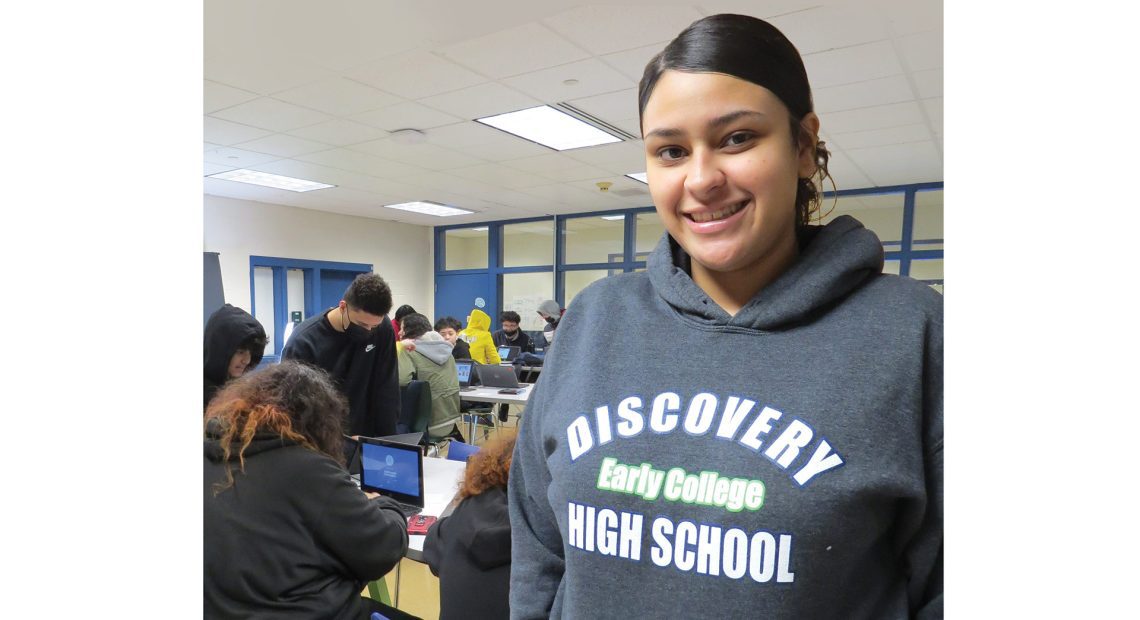
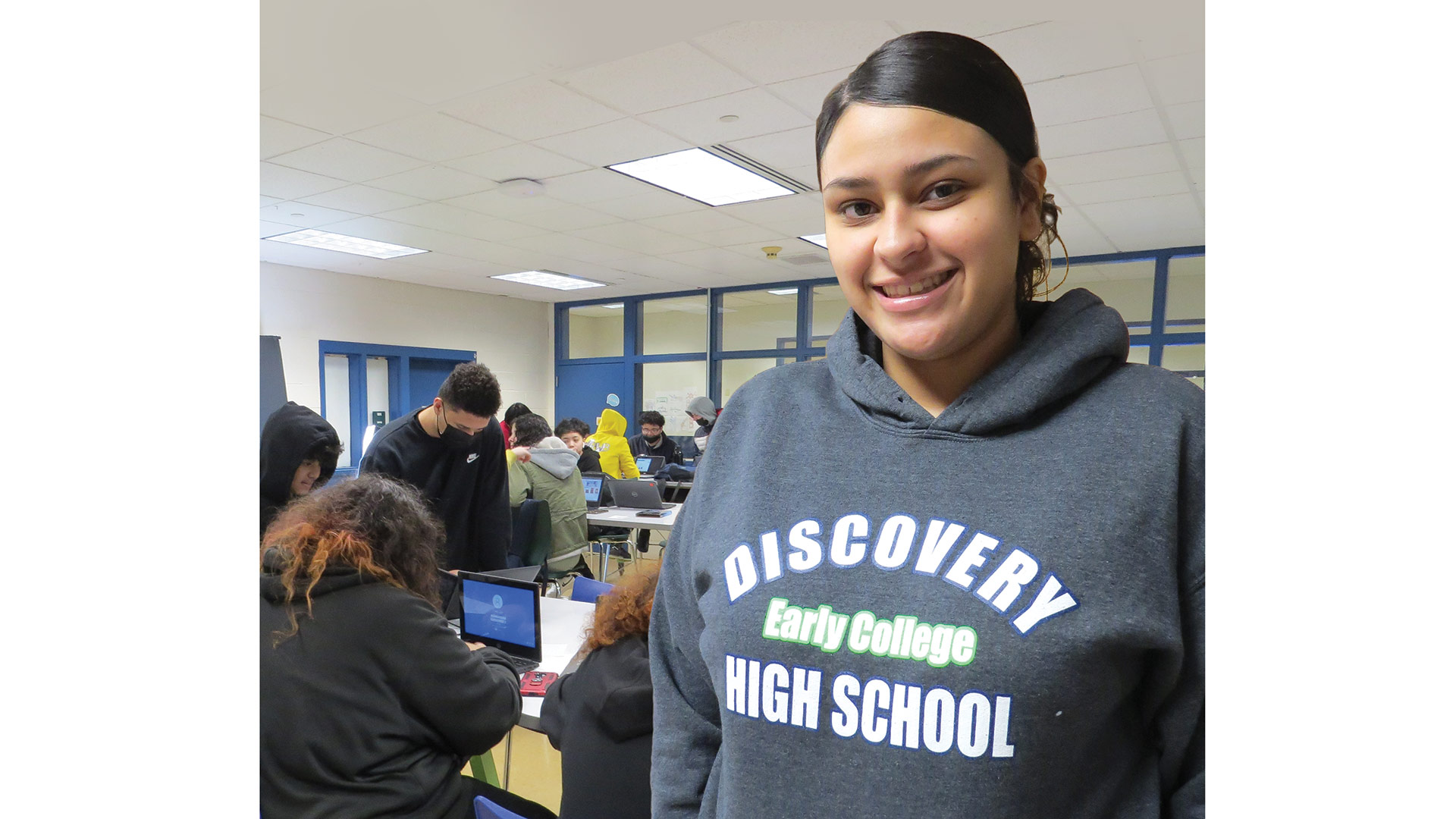
Izabella Martinez

Izabella Martinez

At first, Izabella Martinez said, she was somewhat intimidated by the prospect of taking college courses when she was only a freshman in high school.

But then, when she got into it, that apprehension soon melted away and was replaced by a host of emotions and feelings, but mostly pride in accomplishment in taking, and doing well in, courses such as Introduction to Computer Technology, English 101, Art, Philosophy, Public Speaking, and what she considers her favorite thus far — College Writing.

“The teacher gave us a lot of freedom to write about what we felt passionate about,” said Martinez, a student at Discovery Early College High School in Springfield, a unique learning center that opened its doors in 2021. “I was able to improve my writing skills while also having creative freedom.”

Martinez believes she’ll have at least 24 college credits by the end of her sophomore year at Discovery. But she’ll have much more than that. She’ll have a higher level of confidence and perhaps something even more important — higher aspirations when it comes to her career and what’s doable, and the wherewithal to get to where she wants to go.

“One thing that we continued to struggle with was the number of people attending college and who were on a path to a living wage. The usual marker for success is graduation, and we were ringing that bell. But we weren’t seeing students entering into high-paying positions right after college, or who were pursuing college, in the way we wanted.”

And this, is a nutshell, is what Discovery High School (DHS), part of the Springfield Empowerment Zone Partnership (SEZP) — an independently governed nonprofit established in 2015 as a collaboration between Springfield Public Schools, the Massachusetts Department of Elementary and Secondary Education, and the Springfield Education Assoc. — is all about.

It uses what’s called a ‘wall-to-wall’ model to build viable future career pathways for students by enabling them to take college classes while in high school — and perhaps even earn an associate degree by the time they graduate — without having to pay for the college courses.

As he talked about the school, why it was created, and its overall mission, Matt Brunell, co-executive director of the SEZP, said the inspiration came in the form of statistics showing that, while Springfield’s high-school graduation rates were improving, the number of students going to college, and succeeding there, were not growing.

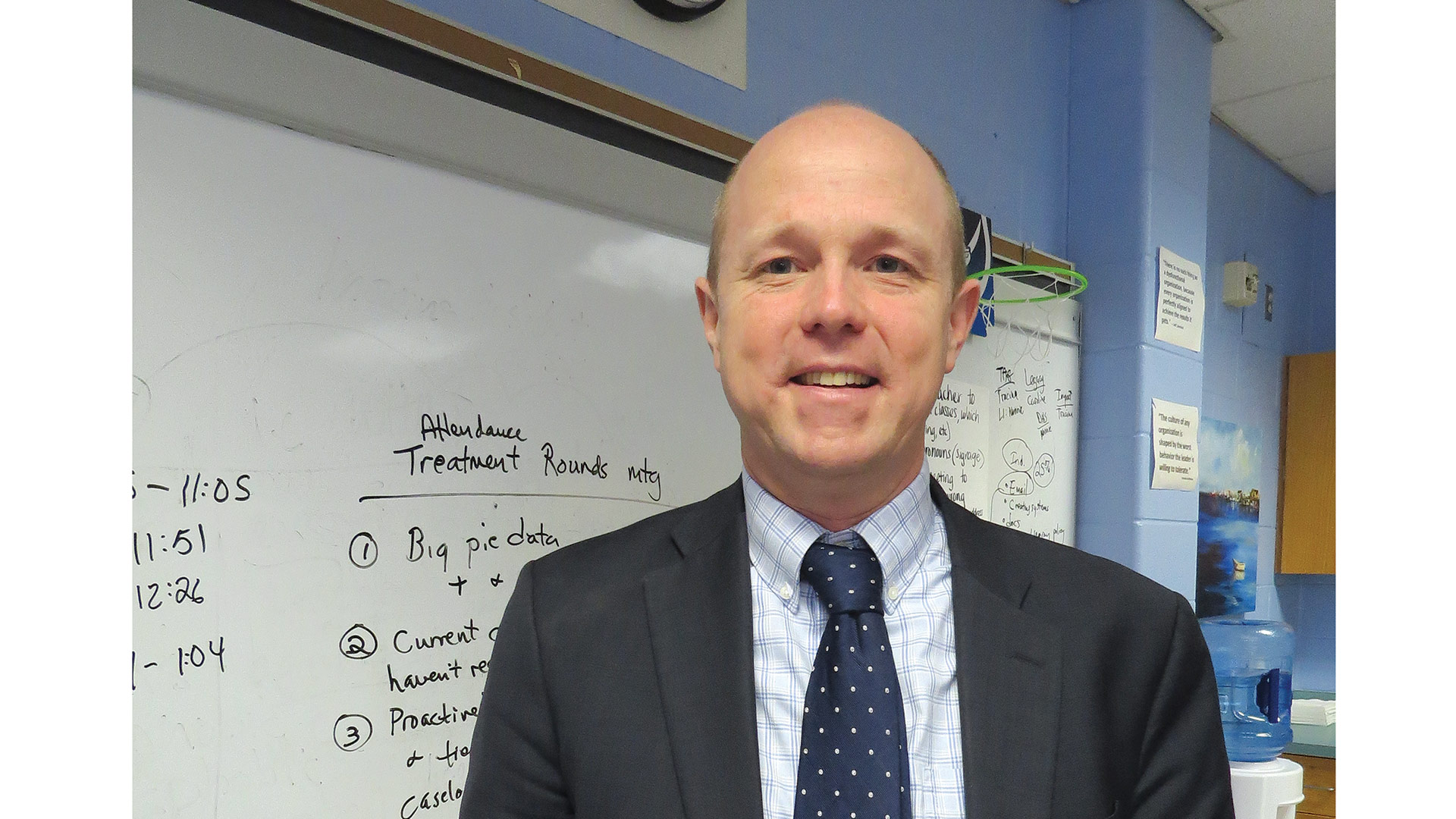
Matt Brunell

Matt Brunell says Discovery High School was designed to propel students to achieve a living wage within four years of graduation.

“One thing that we continued to struggle with was the number of people attending college and who were on a path to a living wage,” he explained. “The usual marker for success is graduation, and we were ringing that bell. But we weren’t seeing students entering into high-paying positions right after college, or who were pursuing college, in the way we wanted.”

“Three years ago, we took a hard look at industry and labor trends in the area, and we looked at which businesses were going to be growing over the course of the next several years,” he went on. “And we thought differently about a high-school model that would project and send students on that path to a living wage.”

Elaborating, he noted that DHS was designed to propel students to achieve a living wage within four years of high-school graduation. It does this by providing academic pathways that focus on high-demand careers in technology, computer science, engineering, and teaching.

But mostly it does this by inspiring students to “take themselves seriously.”

There are quotation marks around those words because all those we spoke with at DHS used them early and often.

“What she’s developed is an identity around college, and it’s really sticky.”

Especially Declan O’Connor, executive principal of Discovery, who referenced one student who will have amassed 24 college credits by the end of her sophomore year.

“What she’s developed is an identity around college, and it’s really sticky,” he told BusinessWest. “Kids are just starting to understand that this is real, and they’re looking toward their future, and they’re taking themselves seriously.”

Farrika Turner, assistant principal at Discovery, agreed.

“We’re really excited to see our Black and Brown students not be afraid of college, for their families not to be afraid of college and whether it will be attainable for them, to see parents become interested in returning to college and maybe take some of the classes that their children are taking,” she said. “And to have students see themselves as a college student, not as a high-school student that’s taking a course or two here and there that doesn’t add up to anything — they’re working toward the degree they’re interested in after high school.”

Farrika Turner

Farrika Turner says students at Discovery High are taking themselves, and their prospects for future employment, more seriously.

It will be another two years before DHS graduates a class of students. And it will be several years before those involved can compile real data on the outcome of students. But those we talked with said the early-college model is demonstrating promising results in many settings. Meanwhile, they say it is not too early to say it is succeeding at Discovery — at least when it comes to the very unofficial mission of getting students to take themselves more seriously.


Course of Action

As he led BusinessWest on a tour of DHS, O’Connor stopped in one classroom where students were learning how to create a circuit and, ultimately, a very small-scale solar panel, and in another, an Introduction to Digital Media class was ongoing where students were getting their pictures taken and compiling information to create their ‘digital brand.’

As inspiration, they were using a brand created by Ruth Carter, the costume designer from Springfield who has won two Oscars for her work on the Black Panther film franchise.

These are not college courses, he explained, but they are solid examples of how students at the school learn by doing, work together, and gain resolve by creating solutions and solving problems.

And this is what Brunell and others had in mind when they conceptualized this relatively new kind of high school.

“We’re really excited to see our Black and Brown students not be afraid of college, for their families not to be afraid of college and whether it will be attainable for them, to see parents become interested in returning to college and maybe take some of the classes that their children are taking.”

“We wanted to create a very small high school where kids were known, where they were cared for and loved during their time here, and where they could get really personalized attention and see themselves in careers that have been under-represented by Black and Brown folks in this community,” he said.

“Discovery High School is our attempt to take a really critical look at the STEM industries and to get students on a stronger pathway to those jobs,” he went on, adding that the Empowerment Zone board ultimately authorized the school in the spring of 2021, and it opened its doors that fall.

The school has open enrollment and is open to all students, said O’Connor, adding that there is no selection process. Overall, the school boasts a diverse population and draws from across the city. These students represent all levels of academic achievement as well.

“The child who chooses us … they know we are and what we’re about,” he explained. “They choose us mostly because they’re invested in our STEM pathways; they like to game, they like computers, they’re interested in engineering — or at least they think they are — and a lot of our students are those who traditionally didn’t do well in school, but have a big curiosity about technology.”

Now boasting 120 students, with plans to expand to 90 students per grade, DHS, as noted earlier, operates under the Early College model, which, as that name suggests, introduces students to college classes while they are high school. This not only gives them a solid head start when they get to college, said Declan, but it gives them that confidence and pride in accomplishment that Martinez spoke of.

Declan O’Connor

Declan O’Connor, principal of Discovery High School, says students there “gain an identity” by taking college classes.

O’Connor said every student at the school can take college classes, and most of them do, with DHS working in partnership with Holyoke Community College, Springfield Technical Community College, Worcester State University, and Quinsigamond Community College in Worcester. Classes take place at Discovery, online, and on the Quinsigamond campus.

As they take them, they are provided with plenty of support, he noted, adding this is an essential ingredient in this success formula, because they are real college classes, something he needed to be assured about himself.

“When I first started this and as I was learning about early college, I asked, ‘are these real college classes, or are they watered-down college classes that are a version for high-school kids?’” he recalled. “And Worcester State sternly said, ‘these are the same college classes.’ So the expectations didn’t change, but what had to be put in place was just a lot of supports for students.”

And what he’s learned over the past 20 months or so is that the students can handle these classes, academically; it’s the other aspects of that challenge, as they are for actual college students, that prove to be the bigger hurdle.

“These students didn’t have trouble doing the work,” he explained. “The challenge was more just ‘teenager stuff’ — following through, doing your homework, and submitting your assignments. Some of the students will say some of the classes they will take in the colleges are easier than 10th-grade English class.

“It’s really cool to see the shift from when they entered high school — to go from being scared and wondering, ‘what am I going to do with my life?’ to start future-planning and talking about their future in ways that make sense, and the feeling ‘I’m going to make some good money.’”

“A lot of it was just executive functioning,” he went on. “But when it came to the actual content of the classes, they were just fine because what we know about all of our kids is that, cognitively, they all have the capacity to learn.”


Learning Experiences

The learning at DHS has a stated purpose, said all those we spoke with — to put students on a path to not just a high-school diploma, but that living wage Brunell spoke of.

And this goes back to that notion of the students taking themselves seriously, an undertaking that comes with that confidence gained from taking those college classes, thus making students more ready not only for their actual college experience, but what can come after it.

“Early college for these students is an identity thing,” he explained. “They develop an identity around going to college, and there’s a lot of demystifying of going to college that happens along the way — they no longer have to wonder what college is like. Maybe they’re the first generation in their family to go to college, and in their freshman year, they can break down that psychological barrier of going to college.”

This ability to establish such an identity is one of the ways the faculty and administrators at Discovery are measuring success, more than two full years before anyone is handed a diploma or earns enrollment at a college or university.

Students at Discovery High

Students at Discovery High participate in a project to create a circuit, one of many examples of hands-on learning at the school.

“When the Empowerment Zone surveyed the schools in the entire country that were getting the strongest results for kids, the most predictive quality of the schools that were propelling kids to earn a living wage was whether or not kids were taking college classes in high school,” Brunell said. “It is far more predictive of college matriculation, of college success, of college achievement, of getting the diploma. If they can, during their high school years, actually spend the time in college-level classes and see themselves as being able to take those classes … this is the biggest element for us.”

Brunell said the state recently started compiling data on the salaries earned by the graduates of specific high schools. Looking out five years or so, he projects this data will show that DHS students are faring better than those in high school with more traditional models.

“We see this as the benchmark for whether or not the school is a success,” he said. “When we look at the average number of college credits earned by freshman and sophomores at Discovery High School, we’re incredibly enthused — this is a leading indicator that the school is on the right track.”

Elaborating, he said there will be several ‘winners’ to emerge from the creation of DHS and schools like it, starting with the students, who can earn up to 60 college credits and, as noted, perhaps even a degree in high school, without having to go into debt (those costs are absorbed by the school’s general-fund budget or philanthropy from groups such as the Barr Foundation and New Schools Venture Fund, as well as, locally, the Davis Foundation).

Other winners are the participating colleges, who gain enrollment, revenue, and, in some cases, future students, as well as area employers, especially those in technology-related fields, who are struggling, as other sectors are, to attract and retain qualified talent.

Another indicator of early success at DHS is the level of confidence exuded by students like Izabella Martinez, said Turner, noting that she and others can see this confidence build and reflect itself in how students see themselves and talk about the future.

“It’s really cool to see the shift from when they entered high school — to go from being scared and wondering, ‘what am I going to do with my life?’ to start future-planning and talking about their future in ways that make sense, and the feeling ‘I’m going to make some good money.’

“We see students come in and say, ‘I just want to graduate from high school, get a job, and help my family,’” she went on. “Now they’re understanding that they don’t have get a job at Geek Squad at Best Buy — ‘I can be a programmer; I can use my skills to go in the military and work in cybersecurity.’ It’s really cool to see that change, that mind shift.”

That’s what happens when young people start to take themselves, and their futures, more seriously.

Features Golf Preview Special Coverage

Staying the Course

Ted Perez

Ted Perez, long-time pro at East Mountain Country Club

When Ted Perez Jr. talks about the 2023 golf season, he uses the present tense — and even the past tense on occasion.

Indeed, Perez, the pro and co-owner of East Mountain Country Club in Westfield, said the season — for his course, anyway — began in January, as it sometimes does; this family-owned club is famous for being open whenever there is no snow on the ground.

But this January was different from just about any other that came before it, said Perez, who said the course was probably open for play all but a few days that month. And it was open most every day the first three weeks in February as well.

March wasn’t as kind, with the course closed several days by snow and play reduced to a trickle on many others, he said, but overall, it’s been a phenomenal start to 2023.

“I’ll call this a non-winter,” said Perez, whose father, Ted Perez Sr., built this course, located just a long par 5 from the runways at Barnes Municipal Airport, 60 years ago. “I wish every winter could have been like this one.”

Elaborating, he said winter golf of this kind is a real boon for the course because the revenue generated isn’t offset by the expenses encumbered most of the rest of the year, everything from cutting the grass to overseeding the fairways to paying the people to perform those tasks. “My father used to say, ‘it’s like finding money on the street.’”

As the 2023 season begins for most courses in the region — a few others were open for play through during stretches of the winter — they are hoping that their springs, summers, and falls are as good, relatively speaking, as Perez’s winter was.

“My father used to say, ‘it’s like finding money on the street.’”

Actually, they’ll settle, if that’s the right word, for what they’ve seen the past few years, a recognized surge in play that started during the summer of 2020, the height of the pandemic, when there was little else for people to do — they couldn’t even play tennis due to restrictions imposed by the state.

That surge continued into 2021 and then 2022, said Jesse Menachem, executive director and CEO of the Massachusetts Golf Assoc., noting that the numbers were down slightly in 2022 from 2021, but still better than the years leading up to the pandemic.

“We saw levels jump considerably in 2020 and into 2021,” he told BusinessWest. “In 2022, we were able to sustain levels and continue to grow. Overall, we’ve been able to retain the new golfers and the golfers who were brought back into the game by the pandemic. Our facilities, our operators, and our organizations are doing a great job of keeping the game sticky, keeping it relevant.”

The questions on everyone’s mind going into the new year are … will this surge continue?, and to what extent? As with the weather — always the biggest question mark heading into a new year — no one really knows the answers, but those we spoke with project another solid year for the local golf industry.

EJ Altobello

EJ Altobello, head pro at Springfield Country Club, is among those projecting the recent surge in the region’s golf industry will continue in 2023.

EJ Altobello, head pro at Springfield Country Club, a private club, said most all signs point to a continuation of current trends (his club now has a healthy waiting list for membership), and he points to Florida, where the first three months of the year have been on par (yes, that’s an industry term) with the past few seasons, as evidence.

“They’re off to a great start,” he noted. “Golf retail is off to a great start, golf rounds are off to a great start, and I think things will go the same way up here — there’s no reason to believe otherwise.”

Steve Elkins, chair of the board at Amherst Golf Club, a nine-hole track owned by Amherst College and managed by the board members, agreed. He said the past few years have been solid, and revenues have helped put the course on more solid ground than it has been in some time.

“We’re in good shape … we’re in as a good a shape as we’ve been in a very long time,” he said, adding quickly that courses have to be careful and smart with their spending to stay in solid shape financially.

On the downside, if it can be considered that, it is somewhat more difficult to get a tee time at some courses, said Menachem, and there are now waiting lists at many private clubs. So accessibility is certainly not what it was in the pre-pandemic years.

But for those in this unpredictable business, those are definitely good problems to have.


Green Lights

It’s called Good Friday, Bad Golf.

That’s the name of the first organized golf outing of the year at East Mountain Country Club, and, as that name suggests, it’s played every year on Good Friday, which means that some years, it isn’t played at all due to inclement weather, especially when Easter comes earlier rather than later.

This year, it’s set for April 7, and Perez is hoping his luck with the weather in 2023 holds, because there are 140 signed up for golf and the dinner to follow it. Meanwhile, April 7, or thereabouts, is when most courses in the area project to be open, if not a week or more earlier — a solid head start over most years.

“We saw levels jump considerably in 2020 and into 2021. In 2022, we were able to sustain levels and continue to grow. Overall, we’ve been able to retain the new golfers and the golfers who were brought back into the game by the pandemic.”

Jesse Menachem

Jesse Menachem

And as they open, they’re expecting to see roughly what they’ve seen for nearly the past three seasons — more business than they were seeing in the years leading up to the pandemic. In most cases, much more.

Indeed, through the end of the 2010s, golf was in the doldrums, continuing a downward trajectory that started in the early 2000s. For many, and especially the younger generations, the game was too time-consuming and too expensive, and they were putting their time and money elsewhere.

Public courses struggled to get daily play, often despite attractive specials, and private clubs, many of which had been historically full and boasted waiting lists, had plenty of spots available and were marketing themselves far more aggressively than ever before to bring in new members — and much-needed revenue.

The downward spiral was punctuated by the closing of several courses in the area, including Hickory Ridge in Amherst, Pine Grove in Northampton, and Southwick Country Club. Despite this thinning of the herd, many area courses continued to struggle.

Then, the pandemic came.

Golf was still slow and still comparatively expensive, but suddenly, people didn’t seem to care, or care as much. People of all ages and other demographic categories were looking for things to do, ways to keep active as they were eating and drinking more, and opportunities to socialize — and golf could check all those boxes, to one extent or another.

Then-Gov. Charlie Baker lifted tight restrictions on golf in early May 2020, and for the rest of the year, clubs saw surges in play, memberships, and retail sales.

Elkins said Amherst Golf Club (AGC) received a huge boost from students, most of them from UMass, who were still living in the area but not attending classes in person. Looking for things to do with their time, maybe 30 bought attractively priced memberships at AGC, a semi-private course.

Amherst Golf Club

Amherst Golf Club, a 9-hole track with a long history, has seen an increase in memberships and overall play since the start of the pandemic.

“We got a huge COVID bounce from students who couldn’t attend classes in person,” he said. “It was a one- or two-year bump, and now it’s gone away.”

Still, membership remains solid — it’s currently at about 265, down from the peak but certainly up from the pre-COVID years — and daily play (there’s a $32, play-all-day rate) has been stable as well and certainly helped by the closing of Hickory Ridge (just a mile or so down the road) a few years ago.


Different Strokes

The surge in play — and spending at local clubs — continued, and even accelerated, in 2021, despite the loss of maybe two dozen days of play to seemingly non-stop rain.

The skies brightened in 2022 — when obsessive heat was the bigger problem — and those trends continued. Indeed, almost everyone we spoke with said 2022 was down slightly from the year before, but still quite solid and better than pre-pandemic.

“Last year wasn’t quite as good, but right in that same ballpark,” said Altobello, using total rounds and membership, which is at a 15-year high, and his main measuring sticks. He noted that the difference might have been as simple as more people returning the office last year, making it somewhat more difficult to “sneak out for an afternoon round,” as he put it.

Overall, though, the numbers were quite good, and they provided ample evidence that those who picked up the game during the pandemic, or picked it up again after putting it down, were, indeed, staying with it, said Altobello, adding that these increases were across the board, and especially encouraging when it comes to women and young people, two demographic groups that many feel hold the key to the long-term success of the industry.

“The indicators are that they are still here,” he said. “How long they stay … that’s to be determined. But as of right now, they’re still out there playing. We’re seeing more and more women in the game, more and more men in the game, and we’ve had a great increase in our youth programs as well.”

As play picked up over the past few years, there were some changes to the landscape, ones that reflect concerns about the cost of the game and the time it consumes, said those we spoke with. Indeed, the nine-hole outing, or ones that are even shorter, became far more common, and more accepted, than perhaps ever before.

“In many cases, people only have time for nine holes. That’s roughly two and a half hours on a full course, and that’s all the time many people have.”

“Ten or 15 years ago, that wasn’t even a thought,” Menachem said of a nine- or maybe six-hole round. “It was either 18 holes or nothing; now, nine holes is a far more realistic and accepted option for those with families, for those with shorter windows of time to play before work or after work. That is definitely a positive.”

Dave Twohig, the head pro at Amherst Golf Club for more than 40 years, agreed. “In many cases, people only have time for nine holes,” he said. “That’s roughly two and a half hours on a full course, and that’s all the time many people have.”

Amherst actually has two “loops,” as he called them, holes 1-5 and 6-9 — both wind up back at the clubhouse — that people can play if they have just an hour or so and want to get a little play in, and many do just that.


Round Numbers

Looking ahead, or at what’s right in front of them, in the case of East Mountain and other courses that have been open for play in Q1, those we spoke with said the outlook for 2023 is colored by optimism.

And the head start many courses were able to get will certainly help, said Menachem.

Indeed, he said that, for tracks like East Mountain and many others, especially in Eastern Mass. and on the Cape (maybe 20% of the state’s courses), the robust first quarter provides needed cash flow, as Perez noted, when there are few, if any, offsetting expenses.

“It’s like found money,” said Menachem. “You’re running on a thin operation, and you’re allowing access to the golf course in the condition that it’s in without much preparation on the maintenance front; it’s not too much of a heavy lift, and the revenue you’re able to derive should completely outweigh the expenses.”

Also, the early, solid start provides a buffer against possible headwinds, such as heavy rain and excessive heat, later in the year, he went on.

Meanwhile, almost all courses should be able to open earlier than what would be considered normal, said Menachem, who, as he spoke with BusinessWest a few weeks back, said 60 to 70 were already open.

Despite all the optimism that prevails within the industry, there are still challenges to be overcome.

Indeed, the ongoing workforce crisis is still making it more difficult to attract and retain help than it has been historically.

“Labor is still a huge issue, especially on the maintenance and operations side of the game,” Menachem said. “It’s not always been attractive to get up early and set up a golf course, and we want to make sure we can support the next generation of staff and make sure wages are competitive with other industries. Meanwhile, being a seasonal sport also has its challenges.”

Elkins agreed, noting that Amherst Golf Club has increased pay rates to remain competitive and hire and retain not only young people, but also some retirees looking to work and stay active.

Meanwhile, the higher cost of … well, just about everything poses stern challenges for clubs, most of which are operating on rather thin margins and without huge reserves to fall back on. In a word, clubs need to be careful, said Elkins, adding that this certainly the case at AGC.

“Making sure that we manage our cash is really important,” he noted. “Like a lot of courses, we’re in good shape, but we’re not going to spend a ton of money on something that’s not core to the course, because it’s risky. We want to make sure we have a good capital reserve and that we spend our money wisely.”

Perez agreed, noting that, despite his great start to 2023, he knows things can change quickly, and he’s learned to reserve judgment until he’s added up all the numbers in December.

“I don’t get too caught up in all the numbers until the end of the year,” he said. “I’ve been doing this a long time, and I know better than to get too excited in March. But it is good to have a non-winter like this one; it beats the alternative.”


Staying on a Roll

With the non-winter of 2023 now in the rear view, the region’s golf industry looks forward to the next three seasons.

They do with a spring in their step — figuratively but also quite literally, and optimism that the recent surge the game has enjoyed will continue.

Time will tell if they are right, but all signs indicate that area operators will be able to stay the course — in all kinds of ways.


Cover Story

Survival Stories

Joan Grenier, owner of Odyssey Bookshop in South Hadley

Joan Grenier, owner of Odyssey Bookshop in South Hadley

Joan Grenier called it “GoFundMe before there was GoFundMe.”

She was referring to a letter she sent out to friends in the South Hadley area almost 30 years ago. She couldn’t find a copy — although she believes she has one somewhere — but remembers the gist.

“I simply said, “I’m in trouble and I need your help,’” said Grenier, the second-generation owner of the Odyssey Bookshop in the Village Commons, noting that the missive was sent at a time when just about all small, independent bookstores were in pretty much the same boat she was.

The large chains were beginning to take over the book world and squeeze out their smaller competitors with their huge volumes of books, lower prices, and a maybe a latte to go with all that. Grenier — and she was certainly not alone in this exercise, to be sure — put out a call for help, asking people to support Odyssey and send money if they could.

She raised about $150,000, as she recalls, and it went a long way toward helping her navigate that whitewater and write new chapters in a story started by her father, Romeo Grenier, in 1963.

Then, in the early months of COVID, when bookstores — and most other stores as well — were forced to close their doors, Grenier launched an actual GoFundMe campaign to raise money to take the store through that time of extreme challenge and to a point where it can now celebrate its 60th anniversary.

So did Matt Tannenbaum, owner, for nearly 50 years now, of the Bookstore in Lenox, an institution that got its start in the mid-’60s in the living room of a small, rented house behind an alley that housed a café that came to be known as Alice’s Restaurant.

Tannenbaum raised more than $120,000 in a campaign that became subject material for a documentary, called Hello Bookstore, which is now streaming on Apple and Amazon Prime, and has been praised by critics as one of the best documentaries of 2022.

It tells Tannenbaum’s story, but it also tells the story of all owners of small bookstores across the country who have fought — for decades now — to keep the doors open.

“It’s a place that isn’t home and isn’t work. It’s a place where you can go and be. People come here to sit and read, they come to sit and work, students come here, professors come here to grade papers; a lot of books are written here.”

“It’s a lovely portrait of what we do here — that’s the best way to describe it,” said Tannenbaum, adding that the film portrays the bond that can, and should, exist between a community and its bookstore.

As the documentary chronicles, independent bookstores, including those in this area, have faced a continuing wave of challenges. And many have not survived, including institutions (that’s the only word for it) such as Johnson’s and Edwards in downtown Springfield, and, more recently, Big Bear Used Books and Café in Easthampton.

But overall, and to paraphrase one of the authors whose classics are sold in these landmarks, the death of the independent bookstore has been at least somewhat exaggerated.

The Bookmill in Montague

The Bookmill in Montague operates under the slogan “books you don’t need in a place you can’t find.”

Indeed, many in this region are still … well, doing business. ‘Thriving’ might be too strong a word, but then again, most of these stores never really thrived, as Grenier and others will tell you.

But they have provided a decent living, while also providing an important service, one that is still relevant, to one extent or another, at a time when one can have the latest Louise Penny thriller delivered to their home a day after executing a few simple keystrokes.

They have survived, they said, by providing more than books on shelves — although that’s certainly a big part of it. They also provide, in many cases, a relaxing experience, an opportunity to meet authors, maybe a chance to sample a bottle of wine.

For the owners of these stores, they say what they do isn’t work as much as it is a passion, something that found them as much as they found it.

It was that way for Susan Shilliday, owner of the Bookmill in Montague, which specializes in used books and operates under the slogan “books you don’t need in a place you can’t find.”

She said she had no real intention of buying thus landmark, but then…

“It was a total, crazy fluke,” said Shilliday, who was a screenwriter before she took this gambit — Thirtysomething and Legends of the Fall are among her credits. “It was a joke with my daughters that all I really wanted in life was to come here one day and see a ‘for sale’ sign in front of the Bookmill.”

Instead of a sign, then-owner David Lovelace sent out an email in 2007 to a number of people letting them know that it was time for him to move on. One thing led to another, and Shilliday is now behind the cash register, carrying on a tradition.

For this issue, BusinessWest talked with these independent bookstore owners about the state of their business. And in the process, we get to tell some stories that are very intriguing in their own right.


It’s Not Home, and It’s Not Work

Shilliday told BusinessWest that, when she received that aforementioned email, she didn’t really know what to do with it at first.

She said she knew a lot about books, but very little, if anything, about retail or running a business. She ultimately decided that this was enough.

“It was the craziest thing I’ve ever done,” she said. “But it turned out to be one of those crazy things that turned out to be just the right thing.”

Elaborating, she said her daughter attended Hampshire College, and, following just a few trips to visit, she fell in love with the region and eventually moved here. One of her favorite things to do was visit the Bookmill, search for things to read, and, usually, settle into one of the comfortable reading chairs on site and read for a while. Make that a long while.

Susan Shilliday, owner of the Bookmill in Montague

Susan Shilliday, owner of the Bookmill in Montague, says her store — and those like it — are an escape for people.

It was a desire to let others enjoy that experience that prompted her take the plunge, despite her lack of experience.

As businesses go, this one has a pretty simple model, she noted; it takes in books from those who don’t want or need them anymore (by appointment only), and then it sells them. Retiring professors from the Five Colleges, all within a few dozen miles or so from the store, are among the best providers of titles for the shelves, she said, adding that, on average, there are roughly 30,000 to 35,000 books on the shelves.

While most bookstores focusing on new titles have had their struggles in recent years, the Bookmill has been able to stay on a generally smoother path, said Shilliday, noting quickly that the pandemic certainly presented a number of challenges, and customers were “thrilled” when the doors were able to open again.

Overall, there are steady streams of customers to the landmark, located in an old grist mill and, later, a machine shop that, among other things, would stamp the handles of Louisville Slugger bats.

Many patrons are students or professors from the area colleges or residents of area communities, but many tourists also find the store, despite what it says in that logo that adorns bookmarks, T-shirts, book bags, and other items.

“People from this area seek it out,” she said. “And we have a lot of tourists who come in, a lot of book lovers who come in … people drive up from New York, Boston, all over; there are a lot of people who make an effort to come here.”

And perusing the shelves for books is just one of the reasons they come, she said, and this explains why the Bookmill has been able to survive and thrive over the years, and why many other stores have as well.

Indeed, she said the pandemic might have helped reinforce the importance of not only books, but bookstores as well.

“People like the community aspect of this … meeting people, discussing books with other people. That’s what we can offer people.”

“It’s a place that isn’t home and isn’t work,” she said of bookstores in general. “It’s a place where you can go and be. People come here to sit and read, they come to sit and work, students come here, professors come here to grade papers; a lot of books are written here. And that was part of the model for the Bookmill from the very beginning; it would be a place where people could come and spend time.”

Elaborating, she said that most bookstores today have other things for people to do; many have a café — the Bookmill has a small café next door, a separate operation — or another value-added proposition that makes a visit to the store an experience, or even more of an experience, as the case may be.


Buy the Book

Grenier said she has also long understood the importance of creating an experience, and not just shelves with the latest titles.

That’s why Odyssey stages several events a week, ranging from book-club meetings to regular author appearances, including the “Evening with Bernie Sanders” event staged March 13, at which he talked about, and signed copies of, his new offering It’s OK to be Angry About Capitalism.

These events are ways to bring people to the store and generate interest in books and those who write them, said Grenier, adding that it has been this way pretty much from the start, and certainly since she assumed ownership from her father in the early ’90s, after the store was destroyed by arson for the second time in two years.

She remembers what he said as he was passing the torch: “I’m not sure if I’m giving you anything more than headaches, but if you want the insurance money, we can try again.”

She decided to accept that challenge, but the intention of doing it for “a little while.”

That little while has turned into a 37-year journey that has taken the store through those myriad challenges mentioned earlier.

“There’s been a lot of change and a lot of challenge,” she said of that time, adding that the store has been reinventing itself throughout that period, and especially during the COVID years, when people couldn’t come to the store for several months and instead ordered books from the store’s website.

Matt Tannenbaum

Matt Tannenbaum’s story became the subject of a highly acclaimed documentary film called Hello, Bookstore.

Much of this reinvention involves events, Grenier said, adding that they come in many varieties. There are several book clubs, she noted, including the Signed Editions Club, which has more than 200 members, and the Gift of Reading Club for children, as well as regular author appearances; overall, there are maybe 125 events a year.

Meanwhile, the store has become the outlet for Mount Holyoke College merchandise of all kinds, from apparel to drinkware to stationary. (Years ago, the store sold textbooks to Mount Holyoke students, but that business has changed dramatically, and it is no longer part of the equation.)

Such changes, and such evolution, are necessary, she said, because the landscape has changed, and it is harder for independent bookstores to be successful — not that it has ever really been easy.

The pandemic simply added new layers of challenge because people couldn’t come to the store, and, thus, there were no events for many months, she recalled. “The events went virtual, but it’s pretty hard to sell books at a virtual event.” What’s more, the college was closed, further reducing foot traffic. Through that GoFundMe campaign, federal assistance, and sheer perseverance, the store was able to make it through.

“If it wasn’t for the federal government, we wouldn’t be here,” she said, adding that, moving forward, the store will continue to innovate, evolve, and give people reasons to come through its doors.

“I’m very optimistic — I had to be optimistic to get through COVID,” she told BusinessWest. “People like the community aspect of this … meeting people, discussing books with other people. That’s what we can offer people.”


A Real Page Turner

Tannenbaum is equally optimistic, but then again, he always has been.

He said his store has long enjoyed what he called a “loyalty factor” that has enabled him to push through the many changes and challenges that have come to this sector.

Indeed, he recalls that, when a Barnes & Noble opened in the Berkshire Mall in Lanesborough (which closed in 2019), many of his customers responded by saying they simply wouldn’t shop there.

But he acknowledged that many in this sector have not been as fortunate because they haven’t had that same level of community support.

“We did have people who used to come in and say, ‘we used to have a bookstore like this in our town, but it closed,’” he told BusinessWest. “And we would have to bite our tongue because we knew that they did not support it, and that’s why it closed.”

He believes that community support stems from his ability to provide something other than just books. When asked to describe it, he said it’s an experience, a friendly atmosphere … something that consumers just can’t get when they order books online or when they visit the national chains.

“I like to say that Barnes & Noble sells books, but they’re not really a bookstore,” said Tannenbaum, who cut his teeth at the famous (and now-closed) Gotham Book Mart in Manhattan, adding that facilities that do fall into that category, like his, provide value in many different ways.

There are tangibles and intangibles, all of which come out in the documentary, and also in BusinessWest’s talk with Tannenbaum, during which he said nothing pleases him more than being able to connect a customer with a book.

He is still able to do that because of a GoFundMe campaign, which not only gave him the capital to remain open and actually expand his business, but generated more material for that documentary, which was originally inspired by Tannenbaum’s book My Years at the Gotham Book Mart.

Indeed, filming for that production continued all through the spring and summer of 2020, the height of the pandemic, he said, adding that it captures not just the struggles of trying to do business at that time, but the connection he had created between his store and the community — and that community’s refusal (that’s the best word to describe it) to let the story end there.

He added that the film has been good for business in many respects, but especially because it has put his store on the map.

“After the movie came out, I’ve had people visiting from all over the country,” he said. “I’m on the list of places to go; you come to the Berkshires, you go to the Norman Rockwell Museum; you come to New England, you have to go the Bookstore in Lenox, because they’re the ones they made the movie about.”


The Last Word

As she talked with BusinessWest, Grenier repeatedly flipped through a few file folders full of materials on the history of the Odyssey Bookshop — photos, newspaper clippings, and other archival material, including, she believes, a copy of that letter she sent out all those years ago — GoFundMe before GoFundMe.

She’s pulling all this together for 60th-anniversary celebrations that will begin around commencement time at Mount Holyoke and continue for the rest of the year.

There were many times during its history when a 60th anniversary seemed a long shot, and at times, maybe a really long shot.

But the store, which has certainly lived up to its name, has preserved, through fires, new and daunting competition, technology, and, yes, a pandemic.

When asked why hers wasn’t one of those bookstores that closed in the ’90s, or even more recently, Grenier said simply, “because my community supported me — people wanted a bookstore here.”

And it is this simple formula that will determine how many of these landmark facilities get to write new chapters in their intriguing stories.

Banking and Financial Services Special Coverage

Forward-looking Statements

Matt Garrity

Matt Garrity


Matt Garrity says it was a few years ago, when he was established in his role as executive vice president and chief lending officer at Premier Financial Corp. in Ohio, that he determined that the next logical career step would be to preside over his own bank.

As time went on, and the calls from recruiters started multiplying, the major questions to be answered concerning this ambition were … where, and what?

The ‘where’ involved geographic regions, and Garrity had his preferences, especially the Northeast — he grew up in Lee. As for the what … he desired to be at a bank with a long history, a solid track record, a strong growth pattern, and a plan to continue along that path.

Not long after being encouraged to consider succeeding Kevin Day as president and CEO of Florence Bank, he concluded that all of those boxes could be checked — with authority.

“It’s a perfect fit — this is such a great bank, and it’s got a terrific board,” said Garrity, adding that there many things that stood out about the institution. “From a financial standpoint, this is a very strong and well-positioned bank, and what also came across loud and clear in my conversations with the board was what a great culture this organization has; this is a very customer-focused, community-minded culture that we have here, and a very engaged workforce.”

Garrity, who arrived at the bank in January, takes the helm at a very intriguing time in its history. Indeed, the institution will celebrate its 150th anniversary this year — May 6 is the actual anniversary date. It will mark the occasion in a number of ways and over the course of the year, he said, adding that the planning process is well underway, and details will emerge in the coming weeks.

“We’ll look to continue to grow the bank in Western Massachusetts, looking for opportunities to grow not only in Hampden County, where the bank has started to grow in recent years — we’ll look to continue that strategy — but also with our commercial business within the bank.”

Meanwhile, the institution that started as Florence Savings Bank to serve that growing village has moved well beyond its roots, most recently with a push into Hampden County. Where the next steps in that progression will take place have yet to be determined, but they will likely be in that corner of Western Mass., said Garrity, adding that, like most institutions, Florence is eying controlled, orderly growth, not growth for growth’s sake.

“We’ll want to continue that growth pattern in Hampden County,” he said, noting that branches opened the past several years in Springfield, West Springfield, and, most recently, Chicopee. “That’s certainly on the drawing board for us.”

For this issue and its focus on banking and financial services, BusinessWest talked at length with Garrity about his new assignment and his vision — still very much in the formative stages — for the next 150 years for this Western Mass. institution.


Points of Interest

Garrity said he’s spent his entire career in financial services, most of it focused on the commercial-banking side of the spectrum. It was at Premier Financial Corp. that he started taking on additional responsibilities and work in areas “other than the one I grew in,” as he put it, which put him on a path to the corner office at Florence Savings.

Among these areas was residential lending, he said, adding that gaining traction in this and other realms created learning experiences on a number of levels, not just adding lines to a résumé.

“That was a real step in my career,” he said. “Being able to work effectively and work with the team and run that business successfully was something that was really important in my career development.

Florence Bank’s branch on Allen Street

Florence Bank’s branch on Allen Street in Springfield is one of three in Hampden County, where additional expansion is expected in the coming years.

“As careers go on their paths like they do, and your responsibilities begin to grow and you get exposed to new businesses that maybe you weren’t the subject-matter expert in, and you begin to show your ability to effectively manage those businesses and work with the people in those businesses, that’s when you start to think that you can do this on a broader level,” he said, adding that it was several years ago that he considered himself both ready and willing to consider those calls from recruiters asking him to consider bank-presidency positions.

And there were many of them in recent years, Garrity noted, adding that he was, in a word, selective about which ones to pursue.

“Not every bank CEO position was in a part of the country that my wife and I would be comfortable going to, or you really wanted to go to, since we had optionality,” he told BusinessWest. “We were somewhat selective about the ‘where,’ the ‘what,’ and the ‘who’ we would be working with.”

As noted earlier, Florence, now with $2 billion in total assets, checked many of the boxes on his list, especially financial strength, corporate culture, and a long history of service to, and involvement in, the community.

In recent years, that word ‘community’ has come to mean much more than Florence, he said, and its definition will continue to broaden in years to come.

As he talked about the bank’s growth strategy and the next steps in that plan, Garrity acknowledged that there is a great deal of competition in the region, and it comes with institutions of all sizes, from smaller community banks — Florence is still in that category — to very large regional and national banks, like Chase, which just opened a branch in downtown Springfield and will soon open another in Northampton (see story on page 18). But he also acknowledged that banks like Florence need to continue growing at a time when size certainly does matter.

Florence Bank’s branch on Allen Street in Springfield is one of three in Hampden County, where additional expansion is expected in the coming years.

“We’ll look to continue to grow the bank in Western Massachusetts, looking for opportunities to grow not only in Hampden County, where the bank has started to grow in recent years — we’ll look to continue that strategy — but also with our commercial business within the bank.”


Taking Things into Account

Florence currently has 12 branches, nine in Hampshire County and those three in Hampden County. Future growth will likely be within that footprint, Garrity said, adding that, while several area banks have ventured into Northern Connecticut, Florence has no immediate plans to follow suit.

“As we look to continue to build the franchise, we’ll be strategic about that and determine what makes the most sense for us, and where the Florence Bank story makes the most sense for the community and for the bank.”

Despite advances in technology and the ability of consumers to do much of their banking remotely, he added, there is still a place for brick-and-mortar branches, for reasons that include everything from quality of service to marketing.

“Branches are more than deposit-taking propositions,” Garrity noted. “Not only do they represent the bank out of the market, it’s a place for outbound activity, for a bank to get out in the community and to make its presence felt.

“I think branch banking is really evolving,” he went on. “For us, that doesn’t mean we need a branch in each and every town and on every corner — that wouldn’t be our model — but we’ll need more in Hampden County to get the most out of our network.”

Within this very crowded banking marketplace, Florence has what Garrity describes as some competitive advantages.

“It gets down to people,” he explained. “As we look at what our strategic advantages are as we compete in these markets, we have terrific people, and that’s always a big strength that we’re going to have. We’re also very locally focused; the deposit dollars that we take in from Hampshire County and Hampden County are being redeployed in Hampshire County and Hampden County, and from a philanthropic perspective, this organization is focused on these communities as well.

Florence Bank’s branch in Chicopee

Florence Bank’s branch in Chicopee is the latest addition to the portfolio.

“Over the past five years, this organization has donated to charitable causes in this region close to $3 million,” he went on. “So there’s a significant commitment that we have, and this is part of what helps us continue to be relevant over these past 150 years. One of the founding principles of the bank back in 1873 was ‘neighbors helping neighbors,’ and that’s as important to us today as it was back then.”

People, meaning the team at the bank, are also a key component in the growth strategy for the commercial-lending side of the ledger, said Garrity, adding that there is no shortage of competition in this realm, either.

“It’s the people that help you stand out, people and the ability to bring solutions. The advantage of working with a bank such as Florence Bank, given our size and what I’ll call our flat structure and local decision making, is we can get the right people around a table to make a good, common-sense answer for our client — a custom solution. That is a distinct advantage that we would have over some of our larger competitors that are more decentralized and a little more pigeonholed from a policy perspective.”

He noted that the commercial market was strong in 2022 because many businesses that were on the fence decided to move ahead before interest rates went up. They did rise, considerably, and these increases, coupled with uncertainty concerning the economy and other headwinds, has slowed the commercial market in recent months, he went on, adding that this is a nationwide phenomenon and one that bears watching in the coming months.

The same can be said for the residential market, which has slowed dramatically in recent months — a 28-year low nationwide, in fact — as a result of rising interest rates and low inventory.


Bottom Line

Garrity said he’s spent his first few months at Florence engaging with his team at the bank, looking for opportunities to engage in the community, and “learning the bank,” as he put it.

“I’m asking a lot of questions and listening for the answers,” he noted, adding that what he’s heard so far is that this institution is well-positioned to take advantage of the opportunities that will present themselves in the months and years to come.

“We have a great team, and we have a really good bank in a very good position,” he said. “And we’ll plenty of opportunity to continue to do great things here and great things for our customers, so I’m excited; 150 years is a great accomplishment for this organization — and for this community that has supported us. We have more than 50,000 customers that support this bank in the communities we serve, and we want to continue to serve them for another 150 years.”


Commercial Real Estate Special Coverage

Art of the Matter

Evan Plotkin in the 1350 Conference Center.

Evan Plotkin in the 1350 Conference Center.

Evan Plotkin says he decided to call it the ‘Springfield Room.’

That’s because … most all of the paintings on the walls, courtesy of artist John Simpson and his students, depict well-known personalities who either live in the city or have strong connections to it.

It’s a diverse group that includes Herbie Flores, the long-time director of the New England Farm Workers’ Council, as well as philanthropist Lyman Wood, White Lion Brewery founder Ray Berry, and even Plotkin himself, who has become well-known for his work in recent years to being more people — and more vibrancy — to the city’s downtown.

The paintings, all of which are for sale, are just one of the selling points of this facility, part of what is now known as the 1350 Conference Center, one of Plotkin’s latest efforts to re-envision, and repurpose, the property at 1350 Main St., which he co-owns.

The center is located on the ninth floor, in space that had served as what Plotkin called “an informal art gallery and event space” that was used occasionally for fundraisers and other gatherings. It was not marketed or really open to the public, he said, adding that it has been given a facelift to bring another amenity to existing tenants, hopefully attract others, and bring new meeting space to downtown Springfield.

And Plotkin believes the timing is right for such an undertaking. After more than two years of COVID, he noted, gatherings of all sizes and types are becoming more prevalent as the region continues to move beyond the pandemic, even at a time when most meetings have at least some type of remote component.

“The artwork in here is spectacular, and combining an event space with a gallery made a whole lot of sense.”

“Most meetings are hybrid now,” he noted. “You have people who can attend the meeting live, and there’s an opportunity to bring in others via Zoom. With such formats, your meetings tend to be better-attended, but most groups are gathering in-person again.”

Plotkin acknowledged that there are several meeting spaces in the region, including others in downtown Springfield, but nothing quite like the one he has created.

Indeed, it is different because of the art, he said, but also the location, in the center of downtown, and the amenities, including state-of-the-art equipment and new furniture.

“The artwork in here is spectacular, and combining an event space with a gallery made a whole lot of sense,” he noted. “And the response I’m getting from social media and the tenants who have been up here has been very positive; people are excited about it.”

Meanwhile, the new conference center is not the only intriguing development at 1350 Main St.

Indeed, Plotkin said he has several new tenants coming in that will turn on the lights on floors that have been dark, or mostly dark, for several years.

art adorning the Springfield Room

Just some of the art adorning the Springfield Room at the 1350 Conference Center.

The long-vacant sixth floor is now home to lawyers and support staff with the Committee for Public Counsel Services. Meanwhile, the Department of Children and Families is poised to sign a lease to take the seventh and eighth floors and part of the 15th. In all, roughly 60,000 additional square feet will be under lease by the summer, he said, adding that these new additions should help bring more foot traffic to downtown businesses and help them make a full recovery from COVID.

For this issue and its focus on commercial real estate, BusinessWest talked with Plotkin about the new conference center and other developments, literally and figuratively, at 1350 Main St.


Drawing Interest

Plotkin told BusinessWest that he recently took a prospective tenant through the building for a detailed look-see. The last stop on the tour was the re-envisioned ninth floor.

“After going through, they said, ‘where do we sign?’” he recalled, adding that the business in question stages training programs on a regular basis and needs such a facility.

A desire to solicit such responses was one of the motivating factors for renovating the space, said Plotkin, adding that, overall, he believes there is room for additional meeting and event space in the region, especially something that falls into the category of ‘different.’

The art makes it so, he said, adding that the works currently on display are mostly from Simpson, a self-described painter, sculptor, muralist, and teacher, whose works can also be found throughout downtown Springfield, on museum and office-building walls and adorning the sides of buildings as well.

But new works from various artists will be rotated in and, hopefully, sold, said Plotkin, adding that the art gives the space a unique, always-changing look.

There are three rooms in the 1350 Conference Center, he said, listing a larger room ideal for presentations and meetings of up to 200 people, and two smaller rooms, including the Springfield Room, that are designed for smaller gatherings, training sessions, team meetings, and more.

“We’re still just moving the pieces around. We need to get some net gains in the downtown, and the region as a whole.”

The space can be used for a variety of different uses, including fundraising events, annual meetings, and even holiday parties, he went on, adding that he only recently opened the space to the public — the sign outside the entrance went up late last month — and has already had a number of inquiries.

“I’m ready now to get the word out to the public and offer it to organizations across the region as another option; I think it’s going to really take off,” he said, adding that the space will be free to tenants of the building, while there will a fee charged to for-profit businesses and a lower fee to nonprofits.

He expects interest to spread through word of mouth, and noted that the space is just one of several intriguing developments at 1350 Main St.

As noted earlier, three long-vacant floors — six, seven, and eight — will have new tenants. The Committee for Public Counsel Services, which includes the Public Defender division, Children and Family Law, and the Youth Advocacy division, will bring close to 100 people to the building. Meanwhile, the Department of Children and Families will bring an additional 200 people to that address.

As they do so, they will do more than activate some long-vacant space, said Plotkin, adding that these additions should help many downtown businesses that have been impacted by the pandemic and the accompanying trend toward remote and hybrid work schedules.

“We’re bringing 320 people downtown — that should make the restaurants happy,” he said, adding that history has shown the importance of the downtown office towers — especially when vacancy rates are low — to the surrounding business community.

With these new additions, 1350 will approach 70% occupancy, said Plotkin, adding that he is exploring all options for the remaining spaces, which include the 16th and 17th floors (the ‘penthouse’), which were occupied by Disability Management Services until last June, and several retail spaces on the ground floor, including the large space last occupied by Santander Bank.

As he goes about trying to fill those spaces, he reiterated his contention that what the city — and the region — need are positive momentum when it comes to absorption, and less movement by existing businesses from building to building.

“We’re still just moving the pieces around,” he said. “We need to get some net gains in the downtown, and the region as a whole.”


Imaginative Stroke

Talking in general terms about Springfield, the region, and its business community, Plotkin said there is an ongoing need to be creative and do more to bring people to Springfield and its downtown.

With the new 1350 Conference Center, he believes he’s doing both.

He considers this an exciting new addition to the landscape, event space that is a work of art. Time will tell if it generates the interest he expects it will, but this is certainly shaping up to be an intriguing brush stroke as he fills in the canvas that is 1350 Main.


Features Special Coverage

Getting a Leg Up

Pedro Arroyo

Pedro Arroyo says the LEDC mini-grant helped him and his sister, Elizabeth Arroyo, secure better signage for their business.


Tony Bermudez started his digital-media venture just before the pandemic hit.

And like just about everyone else who was in business at the time, he lost considerable momentum — and opportunities — when the state essentially shut itself down.

Indeed, his business has many components, but specially event video work, and for the first year or more of the pandemic … there were no events, or very few of them, anyway.

Bermudez, again, like many others, slogged his way through to the other side of COVID. But money has always been tight, and that’s why he considers himself fortunate to receive, and is very appreciate of, a mini-grant from the Latino Economic Development Corp. He is one of several to get one of the grants in a first round issued late last year, with another nine grants awarded in a second round just a month or so ago. Another round of grants will be awarded later in March.

‘Mini,’ in his case, means $1,100. But Bermudez was able to use it to secure software and some new equipment, specifically a lighting kit, that will help him take his business, Tony Digital Music & Media, to a higher level.

Beyond the small grant, though, Bermudez has been able to secure invaluable coaching from the LEDC, and through it he has been able to make important connections, including one with Mercy Medical Center that enabled him to secure work to create a video to help address the stigma attached to opioid addiction; work is expected to behind on that production soon.

Bermudez’s story is one of many that help bring to life the work going on at the LEDC, a new agency that BusinessWest profiled last year. Its mission, in simple terms, is to help employees become employers, said Andrew Melendez, director of Operations for the LEDC, and enable small businesses to take the next step.

It does this through a unique model focused on everything from these mini-grants to training programs offered by those coaches that will focus on everything from how to qualify for a business loan to workforce training to mental wellness, and much more.

“Capital infusions — putting money into the hands of small business owners — even if it’s only $1,000 or $2,000, can often make a huge impact, whether it’s a new business or even an existing business.”

As for the grants, they are indeed small, with amounts varying from $1,000 to $3,000 in the first few rounds. But small businesses just getting off the ground can use such funds to take important steps forward, Melendez said.

“Capital infusions — putting money into the hands of small business owners — even if it’s only $1,000 or $2,000, can often make a huge impact, whether it’s a new business or even an existing business,” he explained, adding that the grants are funded through $450,000 in overall support awarded to the LEDC by the state. “They can put that money to use in many different and important ways.”

Such was the case with Pedro Arroyo, who used his $2,500 grant to secure new and better signage for his business, Juguitos Healthy Grab & Go, at its new home on State Street in Springfield.

Arroyo and his sister, Elizabeth, saw a unmet need in Springfield for a place where people could get healthy foods in a hurry and moved forward to meet it, despite the pandemic, which was descending on the area just as they were getting started.

Jason Vásquez

Jason Vásquez envisions his business growing and someday being run by his son, Nazareh.

“We saw an opportunity to provide something that wasn’t really available anywhere in the city,” he noted. “We came together, took a chance and said, ‘let’s try this.’

The stories behind these businesses, and people taking chances — and the grants they’ve obtained — help shed important light on the important work being done by the LEDC, and how it is changing the business landscape in all kinds of ways.


Progress Report

It’s called the unrestricted construction supervisor’s license.

Jason Vásquez, owner of Nas Small Repairs, which specializes in small construction projects and repairs to homes and businesses, needs one to take his venture, and his career, to the next level. And he’s using his $1,000 mini-grant to buy the code and regulations books and other materials to help him attain that license.

“I want to enable my small business to grow, and in the future, I’d like to have a program for young people and women to learn about construction and maybe move into the field,” he explained. “And to do that, I need this license and the right personnel behind me.”

Vasquez’s use of his mini-grant is exemplary of the many ways they are being put to use and how important they are to small businesses who need them to gain some momentum with whatever might be written into their business plan.

And the names on the businesses that have received such grants in the most recent round show just how varied these business plans are. That list includes Faded Barber Lounge, Thomas’ Cleaning, 50-50 Food Truck, Agudelo Apiary, Burgos & Son Trucking LLC, and Top-Flight Nutrition.

It also includes Juguitos Healthy Grab & Go, a name that tells you all you need to know (or almost all you need to know), and a venture inspired by personal need.

As Arroyo tells the story, he and his sister, Elizabeth, were both looking to shed some weight and “take back their health,” as he put it, starting with their respective diets.

“It was difficult because I was a videographer, and I was on the road all the time — I didn’t have the time to make prepared meals, and would eat out a lot,” he went on, adding that he and Elizabeth set out to address their own needs, and those of countless others, by creating a business focused on smoothies, juices, soups, sandwiches, and other healthy offerings that, as the sign says, people can grab and go.

The venture started off at 112 State St., a small location that was hindered further by a lack of parking, Pedro said, adding that the business was nonetheless able to thrive at that location, and thanks to $75,000 in ARPA funding secured from the city, he and Elizabeth were able to move into needed larger quarters just up the road, at 133 State St.

The LEDC has provided assistance at many critical junctures, he said, including direction on how to secure ARPA funding from the city of Springfield.

This work in progress is just one of many that the LEDC has become involved with, through technical assistance and coaching, a mini-grant, or both. And it’s just one example of how this agency is trying to change Main Street, or State Street, in this case, by helping more people get into business and put their signs on buildings.

Bermudez isn’t there yet, but he’s moving in the right direction, thanks to many different kinds of support from the LEDC.

As noted earlier, he received a grant that he used to buy equipment that made an immediate impact on his venture, which specializes in video promotion, business presentations and advertising, animation, event photography, and more.

“We saw an opportunity to provide something that wasn’t really available anywhere in the city. We came together, took a chance and said, ‘let’s try this.”

But it has been the coaching, and the connections the LEDC has helped him make, that have been even more impactful, he went on, citing not only the Mercy project, but also a contract in Holyoke to teach video production to young people as just a few examples of how the LEDC has been able to help him seize opportunities.

“They have a great team there, and a forward-looking attitude to help Latino small businesses,” he said, adding that that are dozens of coaches, each with a specific niche, that can help individuals like himself not only create a business plan, but execute it.

Gilberto Amador

Gilberto Amador finds it rewarding to coach small-business owners to greater success.

Gilberto Amador, president and CEO of the Mass 2 Miami Consulting Group, is one of those coaches. He told BusinessWest he and other coaches at the LEDC act as a support network for new and emerging businesses.

He said the process starts with an hour-long meeting at which a game plan is developed for creating momentum and forward progress.

“They leave that meeting knowing what we need to work on,” Amador said, stressing the ‘we’ part of that equation, while emphasizing that the business owner needs to take ownership of the next steps and is held accountable for staying on the set course. “Maybe it’s a business plan, because many people are working on their business but they don’t have a business plan, or it could be marketing … whatever needs to be worked on.

“Sometimes it’s cash flow,” he went on. “You talk to them about cash flow and how their business functions, how they have to pay themselves from their business finances of their business, how to separate business from personal … these are things that a lot of business owners are not aware of or they haven’t been doing, and it’s very important for us to shed some light on these kinds of things so that these become more productive, and successful, businesses in our community.”


Bright Ideas

Amador described this work as very rewarding, especially as he sees small-business owners, such as Bermudez, Vasquez, and the Arroyos, take important steps forward and put their ventures on more solid footing.

“Part of being a business coach is really seeing the success of some of the businesses that are coming in,” he said. “They work so hard every day to do what they have to do … and we help them articulate what it is that they want to do and lay out the steps to get there. That’s where the rubber meets the road, and I love working with them because you get to see those lightbulbs go on.”

Turning on more of these lightbulbs is the unofficial mission at the LEDC, which has been busy handing out grants in recent weeks and will continue to do through the course of the year.

But that’s just part of the story. The other, much bigger part is helping these individuals get on a path to success, and stay on that path.

Law Special Coverage

Change at the Top

Jeff Fialky

Jeff Fialky

It’s called Service at the Pleasure of My Partners: Advice to the New Firm Leader.

And as that title might suggest, this book by Patrick McKenna and Brian Burke is intended for those lawyers who have, or soon will have, the title ‘managing partner’ affixed to their business card.

Jeff Fialky, a partner at Springfield-based Bacon Wilson, bought a copy of the book, which presents content built around real-life issues and questions, several weeks ago, after initial talks with Ken Albano, longtime managing partner at the firm, about passing the torch.

He said he’s read it, marked several passages, and dog-eared several of the pages, an exercise he described as just part of the transition process at the firm, one that should be completed by the spring.

“It’s a good resource to hear from other managing shareholders about coping with some of their challenges — what they encountered and what they had to overcome,” he said of the book.

As he takes the helm at Bacon Wilson, Fialky said he believes the firm is well-positioned for the future. It has what all firms this size — roughly 40 lawyers — are looking for in a solid mix of young lawyers, those at the mid-career stage, and several older, veteran lawyers. It also has an established presence in the region through its main office in Springfield and smaller locations in Westfield, Amherst, Northampton, and Hadley.

“The firm is in a phenomenal place,” he said. “We’ve been here for 135 years, and we have a solid foundation for the firm to succeed well on into the future — for another 135 years.”

There are challenges, though, especially when it comes to hiring young lawyers and maintaining that mix of talent. Indeed, there are fewer people graduating from law schools, and the competition for those who do is considerable and becoming more intense with each passing year.

“I felt the time was right for some new leadership, some younger leadership. Jeff is respected by everyone in the firm, and he’s the one that take the firm to the next level.”

“We’ve had significant challenges in retaining and identifying new talent,” he said. “The past few years have been really difficult to find people; it’s been very competitive, with all forms of employees, be it staff members, legal secretaries, administrative assistants, and lawyers. It’s all about supply and demand.”

Fialky said he is looking forward to leading the firm through these intriguing times and continuing a pattern of strong leadership that has enabled Bacon Wilson to continue to grow and expand its presence over the past few decades.

“I’m really excited for the opportunity,” he said. “My first reaction was just humility and comprehending the enormity of the responsibility and feeling really honored and humbled by it. When I came back to Springfield to Bacon Wilson, I was a mid-career transfer; I’d been practicing for a number of years at that point. I was so fortunate to be given an opportunity to start a career, and to think that, all these years later, I’d be in this position is something I would never have contemplated.

“But now that I’m here, I’m really appreciative for the level of responsibility that’s been given to me by my partners and my colleagues,” he went on. “And it’s something I take very seriously, but also with great energy and enthusiasm; I’m really excited.”

For this issue and its focus on law, BusinessWest talked at length with Fialky about his new role and what comes next for one of the most venerable firms in the region.


Firm Resolve

As he talked about his practice and large case load, his work in the community, the additional burdens that come with managing partner, and how he will manage it all, Fialky summoned that time-honored axiom ‘if you want to get something done, ask a busy person, and they’ll get it done.’

He has certainly been busy in recent years as chair of the firm’s corporate and commercial department, and also a member of the municipal department. He has also been involved in the firm’s governance and was one of the founders of its executive committee.

Overall, he specializes in sophisticated business, financing, and commercial real-estate transactions, representing the interests of business owners and lending institutions, as well as municipalities and landowners.

A BusinessWest Forty Under 40 honoree in 2008 and consistent finalist for the Alumni Achievement Award established several years later, Fialky joined Bacon Wilson in 2006 after nearly a decade in Eastern Mass., where he held senior attorney positions with some of the country’s most prominent Fortune 100 telecommunications and cable-TV companies. Prior to that, he served as an assistant district attorney in Hampden County after earning juris doctor at Western New England School of Law in 1994.

Albano told BusinessWest that, after six years as managing partner, including the three long and very challenging years defined by the pandemic, he felt it was time for a change at the helm. And he considers Fialky to be a logical and well-qualified successor.

“I felt the time was right for some new leadership, some younger leadership,” he explained. “Jeff is respected by everyone in the firm, and he’s the one that will take the firm to the next level.”

Fialky acknowledged that he takes the helm at an intriguing and challenging time for law firms, which are coping with everything from a difficult hiring market to transitioning to new ways of doing work in the wake of the pandemic, to new technology that tempts consumers to find their legal answers online instead of from a trained attorney.

“Technology, as it pertains to the law, is really interesting and difficult to predict,” he noted. “The legal industry is a trailing indicator of technology; we’re never at the forefront of innovation. The next big question is what happens with artificial intelligence down the road. There’s been quite a bit of recent press of artificial intelligence and service professions like the law and accounting. What’s so interesting about the law is that technology is a platform to accomplish the outcome, and how personal the law is relative to an attorney-client relationship.

“With so many of our clients … while they can pick up the phone, while we can Zoom from 15 miles away, they want to come in, they want to sit down, and they want to talk to their attorney,” he went on. “These are relationships that last decades, throughout people’s lives … you can’t replace that with technology.”

When asked about the management style he will take as he addresses these and other issues, Fialky said it will be one grounded in collaboration.

“That’s how I’ve engaged in our commercial department, where we ask for many opinions before we make a decision,” he explained. “But then, when decisions need to be made, we make a decision and stand by it. That’s how I intend to manage.”


Case in Point

Getting back to that book he’s been reading, Fialky said it’s a collection of thoughts from managing partners on subjects ranging from following a successful leader to keeping up morale when a firm is under duress; from creating performance standards to managing one’s time.

Soon, he won’t be reading about such matters, but coping with them in real time.

It’s a challenge he’s looking forward to, one he’s spent a career preparing for, and he knows he will take it on not by himself, but in collaboration with others.

Health Care Special Coverage

Critical Condition


An “inflection point.” 

That’s what Dr. Robert Roose says hospitals have reached when it comes to their bottom lines and the ongoing challenge of making ends meet at a time when revenues continue to fall and expenses continue to rise. 

Hospitals have perpetually struggled from a fiscal standpoint amid continually rising prices, the need to constantly upgrade technology and innovate, and reimbursement rates from payers that have historically been below 80 cents on the dollar, Roose said. But trends and conditions that existed before the pandemic have only been exacerbated over the past three years, and now, hospitals are at a critical, and extremely challenging, crossroads. 

“There’s no way to sugarcoat it — hospitals and health systems across Massachusetts, and across the majority of the country, are finding themselves struggling in many regards, and at an inflection point where there are going to need to be continued efforts to support hospitals, or there will continue to be systems and hospitals that remain in distress,” said Roose, chief administrative officer at Mercy Medical Center in Springfield, part of Trinity Health Of New England. 

He quantified the situation by noting that Mercy is on a path to lose roughly $25 million for the fiscal year that will end in June, about the same amount as last year. 

“There’s no way to sugarcoat it — hospitals and health systems across Massachusetts, and across the majority of the country, are finding themselves struggling in many regards, and at an inflection point where there are going to need to be continued efforts to support hospitals, or there will continue to be systems and hospitals that remain in distress.”

Dr. Robert Roose

Dr. Robert Roose

“It will be challenging to persist with the current models that are in place in the same ways that we have in the past,” Roose went on. There are a multitude of reasons for that, but the challenges remain significant, and the pathways forward are going to require multiple initiatives and ongoing support from a variety of different angles. 

Dr. Lynette Watkins, president and CEO of Cooley Dickinson Hospital, an affiliate of Mass General Brigham, agreed, noting that COVID put the challenges that all hospitals are facing under a brighter spotlight. 

“The past three years have been particularly challenging,” she said, citing everything from staffing issues to the aging of the population and the pressures they put on hospitals. “What COVID laid bare is that all of these issues are there, and that it’s incumbent on us to be creative, accelerate the solutions, and leverage a lot of the tools that we were in many ways reticent to use, such as telehealth and virtual visits. 

“While this situation has challenged us, it has also provided us with an opportunity to think differently, to treat patients differently, to engage differently — with our patients and with the community,” Watkins went on, adding that she and her team at CDH are working to taking full advantage of that opportunity. 

Spiras Hatiras, president and CEO on Holyoke Medical Center (HMC), concurred. In remarks made to BusinessWest for its annual Economic Outlook, he spoke of both challenge and opportunity, on several fronts, but especially when it comes to workforce issues. 

The ongoing workforce crisis, while it has impacted all sectors, has put healthcare providers, and especially hospitals, at an extreme disadvantage, especially when it comes to nursing and the need to fill vacancies with contract or ‘travel’ nurses, which can cost two or three times what a staff nurse might, Hatiras noted. 

“In healthcare, there is a great deal of concern, and the most concerning part is the continuing shortage of personnel, which has created this market for temporary staffing at rates that are truly outrageous,” he said. “To put things in perspective, we have about 20 nurses on temporary staff that we get through agencies. Those 20 nurses, on an annual basis, cost us $5 million; each nurse costs us $250,000 because the rates are exorbitant — the nurses get a lot of money, but there’s also a middleman that makes untold amounts of money from this crisis. 

“As a nation, the federal government is doing a lot of things — they did some things with railroad workers, they’re helping Ukraine, they’re talking about a lot of things. They should have stepped in and regulated this and said, ‘the pandemic created a tremendous amount of shortage; we cannot allow private companies to go out and profit from that shortage of staffing and bring hospitals to their knees.’ With all this, it’s going to be very difficult for hospitals to cope, and that’s why all our strategy centers around finding a way to attract nurses here.” 

For this issue, BusinessWest takes an in-depth look at the fiscal challenges facing hospitals today, and what must happen for these institutions to weather this severe storm. 


Dollars and Sense 

When asked how hospitals arrived at this inflection point, as he called it, Roose said it was a combination of factors, but, as he and others noted earlier, it comes down to an exacerbation of, to borrow an industry term, some pre-existing conditions. 

These include a trend toward outpatient, rather than inpatient, care, which certainly impacts overall revenues, and also shortages on the workforce front, which increase the cost of doing business in many ways, and sharp rises in prices of … well, just about everything, from medications to PPE. 

“What COVID laid bare is that all of these issues are there, and that it’s incumbent on us to be creative, accelerate the solutions, and leverage a lot of the tools that we were in many ways reticent to use, such as telehealth and virtual visits.”

Dr. Lynette Watkins

Dr. Lynette Watkins

“We’ve been dealing with the aftershocks of one of the most significant public-health crises of our time,” Roose explained. “And it occurred at a point where many shifts in healthcare were already underway, including a shift from inpatient care toward the delivery of care in a lower-cost outpatient, ambulatory setting where the trends of consumers, our patients, were beginning to change, but where the reimbursement for those services had not been able to keep up with those changes. This was layered on top of an existing healthcare-workforce shortage. 

“So, the pandemic caused a significant challenge amidst what was already several headwinds that were providing stiff challenges for smaller hospitals across the country to overcome,” he went on, “forcing them to transform, to look differently, to meet those challenges and the needs of our community.” 

Elaborating, he turned the clock back to late 2019 for perspective. He said that there was already significant movement in how healthcare was being delivered. More services were being provided in settings outside hospitals, he explained, with surgeries taking place in outpatient, ambulatory settings. Meanwhile, insurance companies were adjusting as well, covering certain types of procedures, such as joint replacements, only if they took place in those lower-cost settings. 

“With that, inpatient volume was beginning to decline by a few percentage points,” Roose said, adding that those shifts were beginning to accelerate when the pandemic hit. Overall, there has been movement away from the fee-for-service model that had dominated healthcare delivery for decades and a shift toward promoting wellness, he explained, but not enough movement to shelter hospitals, especially smaller community hospitals, from those headwinds he described earlier. 

“It has certainly not kept pace with the dramatic impact on volume and the lack of reimbursement for fee-for-service care that has occurred to make up that gap,” he went on, adding that staffing shortages already existed before the pandemic, but they, too, were exacerbated by COVID and its many side effects. 

Watkins agreed, and, like others we spoke with, she said revenues have certainly improved since the depths of the pandemic, but they are still not at pre-COVID levels. 

And there are many other forces at play that are challenging hospitals, she added, including a shortage of workers at post-acute facilities such as nursing homes, which often leaves patients who are otherwise ready for discharge with no place to go, putting more pressure on hospitals. 

“We have two, three, or sometimes more patients who are ready for medical discharge, but when we don’t have a place to send those patients, so they stay with us,” Watkins said. “And that means that some patients who need to in an acute-care facility are in the emergency room or cannot get in; that’s been a huge, huge challenge.” 


Work in Progress 

One of the factors greatly impacting hospital finances is the ongoing workforce crisis, which has certainly increased the cost of providing care. Roose told BusinessWest that, while Mercy’s overall workforce is down perhaps 20%, due to a variety of factors, its workforce costs are still 7% to 8% higher than before the pandemic. 

Indeed, with many positions, not just nurses, hospitals have had to rely on contract employees, which are considerably more expensive than those on staff. 

“In healthcare, there is a great deal of concern, and the most concerning part is the continuing shortage of personnel, which has created this market for temporary staffing at rates that are truly outrageous.”

Spiros Hatiras

Spiros Hatiras

But there are other factors as well, said Watkins, including additional overtime, bonuses needed to attract job candidates, shift bonuses, and more. 

“It’s a huge challenge, and it significantly affected our financial performance, as well as that of other systems in the Commonwealth and across the country,” she said. “And we have to make sure that we are staffed to take care of the patients here that are sicker and that are staying longer.” 

Elaborating, she explained that Cooley Dickinson used very few contract nurses prior to the pandemic, but the need for such personnel has risen dramatically due to retirements, burnout, and individuals simply leaving the profession to do something else. 

These forces have left hospitals to fill the gaps as best they can and, for the long term, focus energies — or even more energies, as the case may be — on attracting and retaining personnel across the board. 

Indeed, Hatiras told BusinessWest that closing the staffing gap is critical because it will bring down the overall cost of doing business and help hospitals cope with lower amounts of COVID relief and revenue levels still below those from before the pandemic. 

“With ARPA funds drying up, we’re going to have pull ourselves up by our bootstraps. So our emphasis is on closing the staffing gap,” he said. “If we can do that, and not bleed money on the expense side, I think we’ll be OK; I think we’re poised to have a good year, as long as we’re able to attract nurses here.” 

Elaborating, he said closing this gap involves making HMC a preferred place to work, one where applicants with choices will want to go — and hopefully stay, thus reducing the high cost of continually filling vacancies. 

“We’re doing OK because we had to respond to what was going on in the market by creating even more attractive reasons for coming here — we raised our rates, we’re enhancing benefits, and at the same time, we’re looking at economic assistance for the lower-earning employees,” he said. “Where it’s more difficult is with the professionals because the dollars are significantly more, so competing just on price is difficult. The key for success — what keeps people here and makes them come here — is the culture of the place, so we put a tremendous amount of effort in the 10 years I’ve been here on creating a good culture. Now, it’s become a differentiator, and we’re pushing it even more. We’re an employer that listens to employees, responds to their needs, and cares. That’s what people want.” 

Roose concurred, and told BusinessWest that the recent challenges that hospitals have faced have put even more emphasis on the importance of people in the overriding task of providing quality care to patients — and the overall success of a provider. 

“Never has it been more apparent, and critical, to realize that people are the vehicles through which we deliver healthcare,” he said. “We do not deliver services that can be provided by machines; we’re reliant upon the great skills of care providers — and we don’t take that lightly.” 


Bottom Line 

Moving forward, Roose said, as hospitals cope with these various challenges — and, again, there are many of them — state and federal governments need to step up and continue to provide needed support. 

“The ARPA funding and other sources of relief through the pandemic and beyond, which is greatly appreciated, is not enough to close the gap from the challenges that we have encountered,” he noted. “The cost structure for delivering care has increased so dramatically, the models for fee-for-service care have not shifted quick enough, and the rates from commercial and other payers has not kept up with inflation. 

“So even with all that support, hospitals like Mercy Medical Center are expected to lose about $25 million this year, which is very similar to what it was the year before, and Trinity Health Of New England lost $65 million in fiscal 2022 from operations,” he went on. “And that puts incredible stress on hospitals.” 

Indeed, it does, and these losses, and the forces behind them, explain why hospitals are at an inflection point, and why change is needed if they are to move from critical condition fiscally to something far more sustainable.

Features

Pride and Promise

Jim Sullivan

Jim Sullivan says Holyokers, like himself, share a deep sense of pride in their community.

Jim Sullivan says he’s not really sure where it comes from. Like most people from Holyoke, he’s just taken it for granted.

He was referring to the immense pride people take in being from this city and, in a great many cases, still living in it.

“There’s been a lot of change over the years, but what hasn’t changed is the spirit of the people,” said Sullivan, president of the O’Connell Companies, which was started in Holyoke and is almost as old as the city itself (it will mark its own sesquicentennial in six years). “There is a very proud heritage in the city of Holyoke, and it still exists today. Even with the youth today — and I like to spend some time with them at the Boys & Girls Club, where I’m a trustee — you get a sense of pride with the folks that you talk to.”

This pride is something that’s almost palpable as you talk with people from this city, and it was referenced by just about everyone we talked with for this special section — in one way or another.

“There’s a saying … as Holyokers, we can talk bad about Holyoke, but you can’t talk bad about Holyoke,” said Gary Rome, owner of Gary Rome Auto Group, another Holyoke native, and someone with a huge presence in the city. “People here are very committed and passionate about their city.”

Beyond this omnipresent pride, Rome, Sullivan, and other business leaders we spoke with see many other qualities in Holyoke — history, tradition, diversity, economic progress, collaboration, energetic new leadership, new businesses, new business sectors (including cannabis and green energy), and something they’ve always seen: opportunities.

As in opportunities for entrepreneurs, for individuals looking for work or a career, for professionals looking for an affordable place to live, and for people aspiring to work for themselves instead of for someone else.

“There’s a lot of entrepreneurial spirit really coming alive in the city,” said Lynn Gray, general manager of the Holyoke Mall, which opened 44 years ago, changing the landscape in the community in many ways. “And that’s exciting because it benefits the city; it benefits everyone in and around the mall, having that entrepreneurial spirit. Moving forward, it’s a great path to be on.”

Meg Sanders, one of those entrepreneurs — she opened Canna Provisions on Dwight Street, part of a wave of cannabis-related businesses in Holyoke — agreed. She said she sees a great deal of vibrancy and entrepreneurial energy in the city, not just in cannabis, but also in the arts, hospitality, retail, and more.

“There’s a lot happening here — Holyoke is a great city that has so much to offer,” she said, adding that downtown is becoming more vibrant and, with many new types of arts and hospitality businesses opening, becoming much more of a destination.

Matt Bannister, senior vice president of Marketing and Corporate Responsibility at PeoplesBank, another Holyoke institution nearly as old as the city (it was founded by silk-mill owner William Skinner in 1885), concurred.

Steve Grande (left) and his son, Ben

Steve Grande (left) and his son, Ben, have engineered a transformation at Meridian Industrial Group.

He cited Gateway City Arts on Race Street, a live-entertainment venue, as an example of a relatively recent arts-fueled resurgence in the city, one that displays the trickle-down effect of such businesses and their ability to spur more development.

“Gateway is an example of the kind of anchor that you can build around,” he explained. “You get some nightlife, and the next thing you know, you have entrepreneurs and food trucks and all that. What’s happened down at Gateway, and what’s happening on Main Street, is that there’s some nice enthusiasm and energy.

“Overall, there is a good core of solid businesses, and there is a government in place that understands the importance of business development — we have smart people with a good vision,” Bannister went on, adding that the current wave of entrepreneurial energy coupled with large amounts of state and federal stimulus money make this a unique and potentially powerful moment in the city’s history.

For this special 150th-anniversary celebration edition, BusinessWest talked with a number of business owners about what they see today in Holyoke — and what they expect to see down the road.


Making Progress

There’s a manhole cover embedded in the floor just inside the main entrance to the property at 529 South East St., near the lower canal in Holyoke.

It bears the name J.W. Jolly, the company that made manhole covers for cities across the country and around the globe at that site more than 140 years ago.

There’s a mat now covering the one in the lobby here because more than a few people tripped over it, said Steve Grande, a former Springfield police officer who bought the business that was operating there, Central Massachusetts Machine, in 2009 and eventually changed the name to Meridian Industrial Group to reflect a broader customer base and product portfolio.

Indeed, this cutting-edge machine shop that he manages with his son, Ben, now specializes in very large parts (up to 30,000 pounds), including components for missiles, submarines, and even NASA’s DART (Double Asteroid Redirection Test) program that famously knocked a meteorite off its orbit a few months back.

Meridian is an example, and there are many of them in this city, where the past, present, and future come together at the same mailing address. And this is one of the many things being celebrated as the city turns 150.

It’s like that at the Canna Provisions facility on Dwight Street, where a dispensary designed to look like an art gallery has been created in an old mill where Yankee Candle once leased space and began its meteoric rise.

It’s like that at the Gary Rome Hyundai dealership on Whiting Farms Road, where a combination car wash and dog wash is taking shape on property that also boasts a solar array and, in his office, pictures of Rome’s father, who started selling cars in Holyoke more than 60 years ago.

It’s like that the O’Connell Companies’ gleaming new headquarters building on Kelly Way, which includes photos of the company’s founder, Daniel J. O’Connell, and his descendants, as well as construction projects undertaken decades ago — specifically the Memorial Bridge reconstruction project and the Rowes Wharf initiative in Boston, that won Build America awards from Associated General Contractors of America.

And it’s like that PeoplesBank’s banking center at 1866 Northampton St., site of the former Yankee Pedlar, a popular restaurant and gathering spot for generations of city residents.

Yes, the past, present, and future come together seamlessly in this city, where change is as constant as tradition.

Lynn Gray, general manager of the Holyoke Mall

Lynn Gray, general manager of the Holyoke Mall, says there a great deal of “entrepreneurial spirit” coming alive in the city.

This change can been seen everywhere — on High Street, where many new businesses have opened in recent years (see related story on page XX); at the mall, where many of the traditional retail stores have been replaced with entertainment-related businesses, such as a trampoline center and a bowling alley; in the countless mills, many of them now occupied by cannabis-related ventures; on Race Street, where Gateway City Arts and other arts- and hospitality-related businesses are now operating; at the historic Cubit Building, now home to apartments and the HCC MGM Culinary Arts Institute, and elsewhere.

What hasn’t changed is the great pride that people take in their city, and the spirit of entrepreneurship that built the community and is fueling its resurgence today. In fact, what business leaders see when they look at the city today is continued progress and revitalization.

Bannister, like others we spoke with, credited Joshua Garcia, the city’s first Hispanic mayor, and Aaron Vega, former state representative and now director of Planning and Economic Development in Holyoke, for creating a business-friendly environment in the city and generating real momentum on several fronts.

“They’re tilling a lot of soil in order to make things happen,” Bannister said. “When you throw a lot of seeds out, you’re never sure which ones are going to take and which ones aren’t, but you’re creating opportunities for things to happen.”


No Place Like Home

Those we spoke with said they consider it important not to just do business in Holyoke, but to be actively involved in the community and especially with efforts involving the next generations of Holyoke leaders.

Rome said his family has been doing business in Holyoke for almost a century. His grandfather started with a drugstore, he believes, and then opened a haberdashery. As Rome tells the story, money was so tight that his grandfather’s store and the neighboring shoe store would share a telephone.

Matt Bannister

Matt Bannister credits Holyoke Mayor Joshua Garcia and his administration for creating a business-friendly environment and fueling a surge in entrepreneurship.

“They had a hole in the wall, and they would pass the telephone back and forth through the wall,” he said, adding that things have certainly changed, for both his family and the city. What hasn’t changed is the family’s commitment to the city.

Indeed, Rome, was recently named one of BusinessWest’s Difference Makers for 2023, not only for his success in business — he was recently named TIME magazine’s Dealer of the Year — but for his work within the community, and especially Holyoke. He is a member of the foundation board at Holyoke Community College, and has donated his time, energy, and talent to countless nonprofits, while getting his company involved with them as well.

“When I look at Holyoke today, I see a lot of hope, a lot of passion,” he said. “And I see a strong initiative to let people know about all the good things that are happening in the city, and you can see that first-hand with our mayor and our economic-development team.”

Sullivan, who has been involved with the Boys & Girls Club for more than a decade now, said O’Connell supports a number of organizations and initiatives, from Girls Inc., which found a new home in the O’Connell Companies’ former headquarters on Hampden Street, to Providence Ministries for the Needy.

Gary Rome

Gary Rome, one of BusinessWest’s Difference Makers for 2023, is one of many Holyoke business leaders actively involved in the community.

PeoplesBank, meanwhile, has always been heavily involved in the community — supporting its nonprofits, being the main sponsor to the city’s famous St. Patrick’s Day Parade, and backing the many efforts at EforAll, the chamber, and other agencies to promote entrepreneurship and help others launch their own ventures, a key to the city’s continued progress.

“There’s an awful lot bubbling up,” Bannister said. “You have to wait and see which ones take root and which ones don’t, but we work with the Holyoke EforAll group to drive entrepreneurship because that’s how the next generation of businesses will come up; it won’t be a giant company that you lure here with tax incentives — it will be a whole lot of small businesses that will take off. It’s entrepreneurs at the street level that will drive growth.”

Even some of the relative newcomers to the scene in Holyoke said they realized early on the importance of getting involved, collaborating with others to generate more positive energy in the city, or just choosing the city as a landing spot.

Indeed, Sanders said there were many reasons why Canna Provisions put down roots in Holyoke, literally. Business-friendly bylaws and attractive space were among them, but there was also a desire to positively impact a city that was negatively impacted by the war against drugs and has, as she put it, “such good bones.”

“For us, Holyoke was a perfect canvas to do good,” she explained, adding that, in addition to bringing jobs and a new storefront to the city, the venture is also sparking other new business. Meanwhile, Sanders herself is getting involved with several initiatives, from the 150th-anniversary celebrations to the parade committee.

“Holyoke is an amazing city with so much potential, and bringing awareness to downtown and making sure everyone knows about all the cool things that are happening is very important,” she said. “Downtowns don’t turn around overnight, but it’s helpful if a community gets behind it — we see things turn around faster when everyone gets behind those efforts.”

Grande agreed, noting that he’s seeing progress in the community and is getting involved himself, with everything from workforce-development issues in manufacturing (he’s involved at Dean Tech and, specifically, an ongoing project to market its manufacturing programs) to his work as vice president of the Holyoke Taxpayers Assoc.

“I don’t want to sit on the sidelines and let other people do the heavy lifting,” he said. “We see improvements and excitement; this administration is bringing city officials together, and the real push from the business community is to make the city more attractive to potential new businesses by streamlining the permitting process, addressing crime, and much more. There’s an upward trajectory, but Holyoke has not been an easy sell.”


Passion Play

Flashing back more than a half-century to his youth, Sullivan said he and his friends thought Holyoke was “the center of the universe.”

It was only when they got older that their perspective changed — but only somewhat.

For many, it’s still the center of their lives, if not the universe, and the home of their businesses. It’s a unique and special place where the past, even the events of 150 years ago, are never far away and the future seems increasingly bright.

Features

Getting Down to Business

Brothers Juan (left) and Gilberto Uribe

Brothers Juan (left) and Gilberto Uribe are co-owners of El Paraiso Colombiano restaurant, a true family affair that has found a home on High Street.

Juan Uribe calls it a “family dream.”

He was referring to El Paraiso Colombiano restaurant, an entrepreneurial gambit that is truly a family affair.

Indeed, Juan and his brother, Gilberto, are co-owners and also cook and tend bar. Their father is head chef, and their sister is a waitress. Together, they created and now operate what they believe to be the only Colombian restaurant between here and Hartford, one that opened in the middle of the pandemic, but quickly found its stride nonetheless.

“On grand-opening day, there was a line outside to the corner,” said Juan, adding that, while there have been plenty of challenges with this venture, it has been a huge success to date, drawing patrons from around the block but also across the region and even beyond. “We thought people would come out and support something new, and they have.”

Juan, Gilberto, and other members of the Uribe family are now part of a changing scene on High Street, one of several ‘main’ streets in this city, and also part of an ongoing surge in entrepreneurship that is changing the face of the local business community.

Indeed, where once this city was dominated by large mills that covered several blocks of real estate, it is now marked increasingly by smaller ventures that occupy a storefront or even a desk or cubicle in the incubator space at the EforAll offices, also on High Street.

Jeff Cattell and Joseph Charles are also part of this changing scene. Business and life partners, they launched Paper City Fabrics, a supplier of a wide variety of fine fabrics, in September 2021, and have taken it from an online operation to a storefront on High Street that was most recently home to a law firm. They are completing renovations now and expect to open in the spring.

“Our goal has always been to open a brick-and-mortar storefront,” said Cattell, adding that he and Charles moved to the city four years ago and, after considering several business options, settled on a thrift-store model in what he called the “fiber-arts realm.”

Elaborating, he said the store will accept donations of fabric, everything from cotton to silk, as well as sewing machines and other goods and equipment, and sell them at steep discounts, thus bringing another unique concept to downtown Holyoke and one that speaks to its storied past in many respects.

Paper City Fabrics, El Paraiso Colombiano, and many other new businesses on High Street and beyond, from City Sports Bar to the Artery, a pop-up shop, to Star Dancers Unity (see story on page 50), are, indeed, part of a wave of entrepreneurship in the city, said Jordan Hart, executive director of the Greater Holyoke Chamber of Commerce.

“There’s a lot of old players in Holyoke — there are many established businesses in many sectors, including manufacturing, which has traditionally been our foundation,” she explained. “But we’re seeing a lot of young, new faces as well, people who are investing in our downtown.”

Tessa Murphy-Romboletti, executive director of EforAll Holyoke and its Spanish equivalent, EparaTodos — an agency that is fueling this wave through accelerator programs, pitch contests, virtual workshops, co-working space, and more — agreed.

She said that the chamber, EforAll, and programs like the Transformative District Initiative, which are funneling dollars into storefront-improvement efforts and other programs, are helping people launch new businesses and then weather the many challenges they will face.

Tessa Murphy-Romboletti (left) and Jordan Hart

Tessa Murphy-Romboletti (left) and Jordan Hart say a surge in entrepreneurship has helped Holyoke’s business community become as diverse as the city itself.

These efforts are also making Holyoke’s business community much more diverse, said both Jordan and Murphy-Romboletti, noting that it looks much like the city itself, with many Hispanics and other minority groups taking on risks and putting their names (figuratively and, in some cases, literally) over the door of buildings on High Street and many other roads.

“Holyoke is such a diverse community, and I think we’re both trying to make sure that our business community reflects our community at large,” said Murphy-Romboletti, who is also an at-large city councilor in Holyoke. “That’s one of the great things about the Holyoke chamber now — you go to one of its monthly networking events, and it looks like the community of Holyoke; it’s very diverse, and Jordan has created a very welcoming environment.”


Food for Thought

Juan Uribe was driving a truck when he and other members of his family decided to pool their talents and resources and open El Paraiso Colombiano.

And he still drives a truck in the morning and sometimes during the day depending on how business it is at the restaurant, because … well, because he needs two jobs at this stage in his life, especially as the restaurant continues to emerge and build its brand.

But, like other members of his family, Uribe desired to be in business for himself, and with some encouragement and learning while doing from EforAll, the dream became a reality.

Like many such ventures, it started with a passion that would become a business.

“We were born and raised here in Holyoke, and friends would come around; we’d have little events — my grandmother would make empanadas, and my father would cook, my mother would cook, everyone would just love to be in our house,” he recalled. “So we decided to make it a business; we all love to cook, and this is a family business.”

A restaurant operating at 351 High St. had to shut down because of COVID, he went on, adding that, while the timing may not have been perfect for launching a new eatery, the family took the plunge.

Joseph Charles, left, and Jeff Cattell

Joseph Charles, left, and Jeff Cattell, owners of Paper City Fabrics, are part of a changing scene on High Street.
Staff Photos

“We knew we had a good idea going, so we decided to take everything we had and move ahead,” he said. “We knew that, even though there was a pandemic, people still had to eat, and we thought they would come out and support something new.”

That’s the quick version of the story, he said, adding that many pieces to the puzzle had to come together, obviously, as well as a business plan for bringing that ‘something new’ — authentic Colombian cuisine — to Holyoke and the region.

And the learning while doing continues, he said, adding that working for himself is “a lot of work, but it’s something that I love, something that my brother loves. It’s challenging, and it’s hard, but it doesn’t get any better than this.”

Cattell and Charles offered similar sentiments and similar excitement when it comes to being part of the scene on High Street, which is the logical next step for their venture.

“Shopping for fabric is a tactile experience,” Charles said. “Touching and seeing the colors in person and the textures of the fabric is an important part of the buying process.”

The two had been looking for a storefront for more than a year and eventually settled on 330 High St., across the road from El Paraiso Colombiano, a location that affords them the space they need for their retail operation as well as to process donations and create a classroom for sewing lessons. The space has some history — it was once a popular lunch counter — and some intriguing features, such as tin ceilings and a mosaic tile floor that was hidden by carpeting.

“It’s really cool to be able to restore some of that historical perspective,” said Cattell, adding that it’s also cool to be part of a changing dynamic in downtown Holyoke, which is seeing new businesses across many sectors.

Meanwhile, the chamber, EforAll, and other agencies, such as Nuestras Raices, a grassroots urban-agriculture organization, are working collectively to not only create a pipeline of new businesses like these, but help those businesses survive, thrive, and get to the proverbial next level.

For example, EforAll has, in addition to accelerator programs, a number of virtual programs it calls Deep Dives.

In recent months, such dives have been taken into subjects ranging from “Making It in the Food Business” to “Are You Getting All You Can Out of QuickBooks?” to “How to Use LinkedIn to Grow Your Small Business.”

Meanwhile, the chamber, through its many networking programs, is enabling these new small businesses to make the connections they need to grow their portfolios, while also learning from others facing the same challenges.

Indeed, Jordan told BusinessWest that the chamber has an attractive rate for solopreneurs and small businesses, enabling these ventures to be part of a full slate of events that provide invaluable opportunities to not only hand out business cards but also be an active part of a growing, more diverse business community.

Murphy-Romboletti agreed.

“The chamber has created a very welcoming environment, especially for my entrepreneurs who are not familiar with networking and are often so focused on being in the business and not necessarily working on the business,” she explained. “I think the chamber creates this environment where people can step away from the cash register or step away from the kitchen and connect with the community and build those relationships so they can be successful and really be part of the community; that’s been really valuable.”

In addition to helping individuals start a business and move it to the next level, agencies like the chamber and EforAll are working to get them involved in the community and take ownership of efforts to revitalize High Street and, overall, improve the landscape for business in the city.

“Whether it’s a new business or a business that’s been around for decades, we want them to feel like they have the ability to make change and advocate for what they want,” Murphy-Romboletti said. “We’re really being intentional about creating these spaces for them.”

Uribe said that getting involved in the community has been not just part of the business plan, but something important for the family.

Indeed, they are part of the many festivals that place in the city, and Uribe is the founder of the Paper City Food Festival, which staged its second edition last fall on the section of High Street between Appleton and Dwight streets, attracting more than 20 of the city’s restaurants.

“It’s a way for people to come out and see all that this city has to offer,” he told BusinessWest, adding that he engaged the chamber and started the festival to uplift local businesses and celebrate the community’s heritage and diversity.


Bottom Line

There was much to celebrate at last October’s food festival, and, similarly, there is much to celebrate with this city’s business community as it turns 150.

There is diversity. There is change. There is vibrancy. And, overall, there is a wider pipeline of new businesses, entrepreneurs like the Uribe family and Jeff Cattell and Joseph Charles.

Together, they are not just filling storefronts on High Street. They are energizing a city and writing an intriguing new chapter in its long and distinguished business history.


Features

A Portrait of Resilience

Mayor Joshua Garcia

Mayor Joshua Garcia says Holyokers need to take the long view when it comes to their city and its future.

As he talked about his city and its outlook moving forward, Holyoke Mayor Joshua Garcia first turned the clock back nearly 150 years and did what amounts to a ‘what if?’ exercise.

He was referring to Holyoke’s ubiquitous canals, which were, when they were conceived, no small bit of engineering — and financial — daring.

“It was a risk,” said Garcia, the city’s first Hispanic mayor, who took office in late 2021. “When folks built the canal system … I think about what that conversation might have been like, the divide that might have been going on in this community. You had some who probably said, ‘yes, we need to be proactive and build this system,’ and others who likely said, ‘this is too much money; our taxes are going to go up if we do that, and besides, I’ll be gone in 30 years.’”

Fortunately, those in that first category prevailed, he went on, adding that the canals helped fuel decades of prosperity, jobs, and an enviable quality of life, and they put the city on the map. And as he looks ahead, Garcia believes Holyokers must have that same willingness to take reasonable risks — to be daring, if that’s the right word — and make the necessary investments to continue, and bring to a higher level, an ongoing renaissance in a city that was among the nation’s wealthiest and a model of innovation and manufacturing excellence.

“I’m trying to get people to not think short-term — the investments we make today are not just for next month or next year, but 20 to 30 years out,” he said. “We want to build a middle school, for example, something that would benefit this city for generations to come.”

Long-term thinking is one of necessary ingredients for continued progress in this city, said Garcia and many others we spoke with for this special section commemorating Holyoke’s 150th anniversary. Overall, they said many of the other needed ingredients are already in place, everything from a focus on entrepreneurship to inexpensive and reliable green energy; from a solid, diverse workforce to spaces in which new businesses can get started and eventually grow.

Jeff Hayden, currently vice president of Business and Community Services at Holyoke Community College, previously served in several economic-development posts in the city, including as director of Planning and Economic Development. Nearly a half-century ago, he worked part-time at a Dairy Mart on Dwight Street managed by his father.

He has seen a lot of change over that half-century, and, more recently, a good deal of progress as Holyoke has diversified a business community once dominated by manufacturing, especially paper and textile making.

In the ’90s, manufacturing was still a pillar of the local economy, along with healthcare — there are several facilities providing everything from acute care to behavioral-health services to care to veterans, he noted, adding that, in recent years, diversification has included more retail (the city already boasts the Holyoke Mall), cannabis businesses, and strong growth in the arts and entertainment sectors.

And this diversification has strengthened the economy and made it more resilient, he said, adding that current efforts have been focused on creating opportunities across the board — meaning both jobs and opening the door to entrepreneurship.

Holyoke’s St. Patrick’s Day Parade

Holyoke’s St. Patrick’s Day Parade, this year celebrating its 70th edition, is a great tradition for the city and the many organizations, schools, and clubs that march.

“When I look at where Holyoke is today and where it’s going, it’s clear that its leaders are focused on providing economic opportunity for all, whether they be entrepreneurs who perhaps identify as Latinx or established businesses that have been here for a long time,” he said. “The hope is to help everyone grow, and grow together.”

Aaron Vega, the former state representative who is now serving as director of Planning and Economic Development, agreed.

“Like a lot of cities, we’re at a crossroads,” he said, noting that, while manufacturing has declined in recent years and decades, other sectors have emerged, such as cannabis, IT, and clean energy. One of the keys moving forward, said Vega and many others we spoke with, is that focus on entrepreneurship and helping new small businesses take root, in some cases literally.

“It’s very hard these days to start a small business, but we have a lot of supports for that, like EforAll and the chambers, and people now realize, especially here in Western Mass., that it’s the downtown businesses that create the character in a community,” he said. “So we’re really trying to focus on that; we’re really trying to empower people who live here already to open up their own business.”


Something to Celebrate

Like many others we spoke with for this special section, Garcia said the 150th anniversary is a time of reflection, an opportunity to look back at the city’s proud history and ahead to what the next chapters might be.

It’s also an opportunity to celebrate all that Holyoke is — a proud city with a rich history, rich traditions, a diverse population, a legacy of innovation, and other enviable qualities, he said, noting that perhaps the greatest of these is resilience.

Indeed, the city has always displayed the ability to withstand adversity and move on — whether it was the many challenges of becoming the nation’s first planned industrial city or reinventing itself and diversifying its economy when much of the manufacturing moved south or overseas, or, most recently, persevering through the COVID pandemic and its many side effects.

“It’s a celebration of resiliency,” he said, adding that the city will mark the occasion in a number of ways, including a gala, an ‘Eat, Drink, and Be Holyoke’ event, a time capsule that will be placed in City Hall and opened at the 200th anniversary, ‘150th’ merchandise (hats, key chains, etc.), commemorative beers made by local brewers, and much more. “It’s a celebration of everything Holyoke.”

Vega agreed, and noted that one of the driving forces behind the city’s ongoing resurgence is a focus on the arts and culture. He cited businesses such as Gateway City Arts, a live-performance venue, and organizations such as Beyond Walls, which partnered with Nueva Esperanza Inc., a community-development and social-services agency, to honor Holyoke’s designation as a Puerto Rican Cultural District, as well as the city’s rich history and diversity, with the installation of five large-scale outdoor murals.

“When you celebrate culture, people feel more connected to their community, more connected to their neighbors,” he explained. “And when you have the ability to celebrate art, it’s about bringing people into your community, with initiatives like Beyond Walls, the events at Wistariahurst, Gateway City Arts — it’s a celebration of music and arts that invites everyone to come join.”

Aaron Vega

Aaron Vega says Holyoke has many outstanding traits, especially its long history of resilience.
Staff Photo

Beyond the arts, Holyoke is seeing a surge in new businesses on High Street; a strong wave of cannabis businesses of all kinds, including large cultivation facilities; and an influx of data centers, including the Massachusetts Green High Performance Computing Center. And in many cases, the city’s ability to provide lower-cost, green energy is a big reason why many of those businesses found Holyoke.

“Anyone who is looking for cheap electricity and green energy will knock on our door — we’re the first call they’ll make,” said Jim Lavelle, general manager of Holyoke Gas & Electric (HG&E), which can trace its roots to 1902. “It’s an interesting time, to be sure, and we’re getting a lot of inquiries; people like the story of the low-carbon, cheap electricity.”

Interest is across the board, he said, adding that it comes from data centers and cannabis cultivators (both huge consumers of electricity), but also from business owners who want to minimize their carbon footprint, he said, adding that HG&E is working with city officials to help make the most of this asset and many others the city can boast.

Another asset is Holyoke Community College, said Hayden, adding that, historically, significant numbers of city residents have been unable to take full advantage of the employment opportunities in the city because they were qualified for those jobs.

The college has long worked to change that equation through programs that will ready individuals for jobs, be they as nurses, medical assistants, chefs, or, most recently, workers in the cannabis industry. HCC also has a strong track record of students transferring students to four-year institutions.

“I like to say that we help people get a job, get a better job, or help them do their job better,” he said.


Traditions Old and New

Getting back to those planned celebrations … the 150th will be just one of a growing number of events in Holyoke this year, said the mayor, noting everything from the famous St. Patrick’s Day Parade later this month to the Fiestas Patronales, which debuted last August — a four-day celebration of the city and region’s Puerto Rican culture and heritage and billed as the largest Latino event in Western Mass.

Jeff Hayden

Jeff Hayden says Holyoke has diversified its business community, strengthening it in the process.

These celebrations, old and new, capture the city’s past, present, and future, he said, adding that they reflect the city, its history, and especially its people.

That’s especially true of the St. Patrick’s Day Parade, which this year will mark its 70th edition, said Karen Casey, president of this year’s event. The 69th parade was three years in the making because of COVID, she said, a tiring, very frustrating experience on many levels.

What the pandemic years did was make those in Holyoke and beyond — this is, after all, a regional event — appreciate the tradition even more, if that’s possible.

“After having gone through what we all went through a few years ago, you saw just how much this meant to everyone,” she explained, referring to everyone from parade committee members to those who watch each year along the parade route. “Everyone just has a greater appreciation for how important this is.

“This is the third-oldest parade in the country, and we work very hard to maintain high standards,” she went on. “Anyone from around Holyoke is very proud of it; they brag about it … it’s a great tradition.”

While the buildup to the St. Patrick’s Day Parade continues, so too does planning for the 150th anniversary, said the mayor, adding that one of the intriguing tasks — and big challenges — ahead is deciding what should go in the time capsule.

Organizers are already thinking about items like one of the Super Bowl programs created by Hazen Paper, a Holyoke High School yearbook, T-shirts, a history of the city, and much more. It may take the shape of a volleyball with a large box inside.

The task of deciding what goes in the limited space in the time capsule is made more complicated by the many aspects of the city’s history and the many objects — recent and more than a century old — needed to tell the story. In many ways, it’s a good problem to have.

But getting back to that matter of resiliency, Vega said that trait is at the heart of the 150th celebration. And it is one shared by the community and the people who have lived here over the past few centuries.

“People talk about Boston Strong in the wake of the marathon bombing, but there’s also Holyoke Strong; it’s about resiliency, and it’s about history,” he said. “People have always come to Holyoke who have been migrants and have had nothing — and they built a life here. That’s what we need to keep remembering. This has always been a place where people come, get that grit, and find a path.

“This is what we’re celebrating as the city turns 150,” he went on, adding, again, that there is so much to celebrate.

Workforce Development

Learning Experience


Aundrea Paulk

Aundrea Paulk says no one should think they know everything about leadership.

Aundrea Paulk says many of her friends and colleagues call her a “sponge.” And she likes to use that phrase herself.

She believes it conveys what she considers to be a real and almost unquenchable thirst for knowledge and insight into how she can be a better leader, a better entrepreneur — and a better person.

“I like to learn … and I don’t think anyone gets to, or should get to, a place where they get comfortable and think they know it all when it comes to leadership,” said Paulk, director of Marketing & Communications for Caring Health Center in Springfield and owner of her own event-planning business called Soiree Mi. “Leadership is so expansive, and not only here at the Caring Health Center, but with my own business, I want to make sure that I’m constantly filling my well with knowledge so that, as a leader, I can show up in my best capacity, but also give those nuggets, as they call them, to others that are looking to grow their own leadership skills.”

It was this ongoing quest for knowledge — and desire to pass on those ‘nuggets’ — that prompted Paulk to put her name into consideration last fall when BusinessWest was gifting a slot at the two-day, immersive Dulye Leadership Experience (DLE) in the Berkshires.

Her self-nomination was one of many received by the magazine, and it certainly resonated with those deciding who would partake in this program of intense learning, networking, and professional development.

Paulk, a member of BusinessWest’s Forty Under 40 class of 2022, said she made the very most of her experience and came away with nuggets to share, a better appreciation of the need to sell herself and not just her company — or companies, in this case — and, overall, some solid takeaways on how to be a better, more effective leader.

“After completing the Dulye Leadership Experience immersion training, I learned how to better lead my department and, more importantly, how to recognize the strengths that I already have and better utilize them,” she said. “As the owner of Soiree Mi, it is important that I tap into those strengths to grow my business to develop relationships and gain partnerships that will enhance the overall community. These partnerships have allowed Soiree Mi to move from its infancy stage into an established, successful entity.”

Elaborating, Paulk said she and her staff recently conducted their own day-long retreat at Caring Health Center, and a good portion of the agenda focused on topics that were brought up at the DLE immersion training, including well-being, improved communication, and “networking with a purpose.”


Dive Right In

The DLE, as noted earlier, is a two-day, immersive program. It was conceived by Linda Dulye, founder of Dulye & Co., which helps leaders and their organizations cultivate magnetic cultures where employees want to stay and grow. During a painfully slow period for the company in the fall of 2008, their height of the Great Recession, she created the DLE, a nonprofit organization, to help recent college graduates be more workforce-ready and able to form relationships and sell themselves.

Over the years, the DLE evolved, and programming shifted to attract, develop, and retain young professionals in the Berkshires. The descriptions of the programs offered during the immersion provide real insight into how it helps attendees grow professionally and thrive in the modern workplace.

“The workplace has become more diverse, dispersed, digital, and dynamic,” reads the summation for a program titled “Create Connections for Differences.” “These changes create opportunities for growth, learning, and creativity, but they also cause disconnection. This session reveals strategies for working across and with differences to increase effectiveness, belongingness, creativity, and communication.”

A program called “(Re)train Your Communication Muscle” was described this way: “The pandemic has atrophied our social muscles — so much so that many find it difficult to interact with others. We have to retrain ourselves to work better. Fortunately, these muscles are resilient.”

The session was led by Marc Williams, communications coach and author of the books Beyond Limitations and The Rules of Engagement for Public Speaking. Paulk said she found the session helpful, and Williams even more so, especially when it came to the broad assignment of branding herself and building that brand.

She said one assignment attendees were given was to evaluate and update their professional LinkedIn page, and to fully understand its importance when it comes to their ‘brand.’

“We had to assess what we thought other people did without asking them, by just looking at their profile,” she explained while recalling the exercise. “What we found is that most of us don’t use our LinkedIn pages unless we’re looking for a job — that’s the only time people really go in and update it.

“That’s not what we should be doing,” she went on. “We should be making sure our professional and personal brand are on point. He [Williams] assessed and provided great feedback and evaluation of my page and how I can improve it.”

But the session she found most compelling, and the one that probably yielded the most ‘nuggets,’ she said, was one titled “Create a Culture of Well-being Within Your Team,” led by Andrea Lein, a self-described “positive psychology expert.”

“More employees are citing well-being as a key factor in deciding where and how they choose to work,” reads the brief description. “Experts believe we are transitioning to the next global crisis: a mental-health pandemic. Are you and your organization ready?”

Paulk said the session gave her plenty to think about when it comes to being ready, and it is prompting her to be more proactive on this issue.

“I always thought of well-being as self-care and the physical side of the equation,” she told BusinessWest. “I forgot about the importance of social well-being, communication as well-being, how we talk to one another; is it positive?”

Elaborating, she said that, while she still asks her staff members how their weekend went, she now looks to go deeper and find out how people are doing with their physical health, their financial health, their mental health, and how they are faring as they try to balance life and work.


Knowledge Is Power

Overall, Paulk said her willingness to take part in the leadership immersion program is a logical expression of her desire to continue learning and refine and build upon her leadership skills, something she believes all young professionals — and even those not quite so young — should be doing.

“The importance of continuing to develop your skills is critical to you as a human being and to what you want to put out in the world, the legacy you want to leave behind,” she explained. “If I stay stuck in a way of thinking or in the way I show up, I’m doing a disservice to myself; I’m doing a disservice to those I’m supposed to be in charge of and help grow.

“That’s why I continue to learn,” she went on. “I feel like there’s never a time in my life — I don’t care if I’m 100 — that I want to stop learning, and learning in different ways.”

That’s why she wanted to be at the Dulye Leadership Experience in November, and that’s why she’s a sponge, always looking to fill her well with knowledge.

Features Special Coverage

A Journey Continues

Suzanne Parker, left, and Yadillete Rivera-Colón

Suzanne Parker, left, and Yadillete Rivera-Colón in the new home of Girls Inc. of the Valley on Hampden Street in Holyoke.

An adventure.

A struggle.

An experience.

A journey.

Suzanne Parker used all those terms and others that would be considered synonyms, usually with more than a hint of understatement in her voice, to describe the process of taking Girls Inc. of the Valley to the doorstep of opening its new headquarters facility in Holyoke.

The journey, adventure, or whatever she wants to call it is far from over. In fact, construction is still in what would be considered phase 1. But most of the really hard work — and there has been a mountain of it — is now behind Parker, executive director of this nonprofit, and countless others who have been involved.

Thus, they can focus even more of their energies on making this facility all that they hoped it could be when people first started thinking about a new home more than seven years ago.

Indeed, Parker noted that the ceremonial ‘thermometer’ erected on a sign just outside the property on Hampden Street needs to be adjusted to reflect that 92% of the stated $5 million fundraising goal has now been met. Meanwhile, work continues inside on the various spaces that will define this facility, from a community room to a maker space to a teen lounge.

The work to create a new space for Girls Inc. began in earnest out of necessity — specifically, the knowledge that a 40-year lease on property the nonprofit was leasing in downtown Holyoke was expiring and would not be renewed — and brought Parker and other leaders of Girls Inc. to countless properties in or near downtown Holyoke in search of the perfect fit, knowing that such a thing probably didn’t exist.

But they found something close in the former headquarters of the O’Connell Companies on Hampden Street, a building, or at least portions of it, that date back to the late 19th century.

“Throughout this journey, we have gained a great deal of visibility, and people have been able to learn about who we are, what we do, and why Girls Inc. is so important to this region. It’s been a great opportunity to tell our story and get people involved.”

Retrofitting the multi-level structure, complete with many unique spaces, has become a labor of love for those involved with Girls Inc. — and so much more.

Indeed, for many of the girls who are members, it has been a unique, hands-on learning experience, with real-life lessons in everything from marketing to fundraising to architecture. In fact, several girls worked directly with lead architect Kuhn Riddle to design one of the spaces in the new home.

The ‘thermometer’ measuring donations to the Girls Inc. campaign needs to be updated to reflect that more than 90% of the needed $5 million has been raised.

The ‘thermometer’ measuring donations to the Girls Inc. campaign needs to be updated to reflect that more than 90% of the needed $5 million has been raised.

Meanwhile, this quest for, and the building of, a new home has been a tremendous opportunity for Girls Inc. to gain exposure, make new connections, and strengthen existing ones, said Parker, adding that this work is ongoing as the nonprofit works to raise that remaining 8% of the funds needed.

“Throughout this journey, we have gained a great deal of visibility, and people have been able to learn about who we are, what we do, and why Girls Inc. is so important to this region,” she said. “It’s been a great opportunity to tell our story and get people involved.”

And, in many ways, the project has been a means to celebrate and promote women in all kinds of businesses who have been involved in this endeavor. That list includes those working in fundraising, finance, law, architecture, and construction, as we’ll see.

This has also been a study in perseverance, said Yadilette Rivera-Colón, an assistant professor of Biology at Bay Path University, BusinessWest Forty Under 40 winner, and current Girls Inc. board chair, noting that the many inherent challenges in a project like this were magnified greatly by the pandemic, which made every aspect of the work more difficult.

Summing it all up, Parker said that, while there is much to do, a celebration of all that has been accomplished — and learned — is in order. And Girls Inc. will do that in March as it marks the passing of the 90% milestone in fundraising, as well as the completion of the first phase of construction. There will be tours and an opportunity to make more connections and more friends.

It will be an occasion to celebrate what’s been done and what this new home will be — and there is much in both categories.


Home Work

As she talked about the search for a new home and the many properties she and others toured during that lengthy process, Parker paused, glanced skyward, and let out a heavy sigh, body language that pretty much told the story.

“There was a four-year period where I was visiting nearly every building in the city of Holyoke,” she told BusinessWest, adding that, while many were attractive in some respects, none could really check all the boxes she wanted to check.

One was seemingly perfect in most ways, but had little if any parking, she said. Other property makeovers into a permanent home for the agency were simply out of the agency’s price range. And a great number simply needed way too much work to fit the bill.

Eventually, some properties graduated beyond the tour stage and into the exploration, or feasibility, stage, and that further consideration meant investments in time, energy, and sometimes money, she explained. And as the vetting process continued, there were often hard decisions about if and when to let go and move on to something else.

“To have to decide not to go ahead with it is a big decision,” she explained. “You’ve invested time and energy and resources into that, but you have to make a decision … that this is not the one. But you don’t know if the one is out there. There were lots of hard decisions to make.”

The property on Hampden Street didn’t exactly check all the boxes, either. Indeed, its front door is literally a five-foot sidewalk away from a very busy street, said Parker, adding that there were infrastructure issues as well.

But those few shortcomings were all but lost in everything else the building provided — from ample parking at a lot just a few hundred feet away to a backyard; from easy access to a nearby public park to 16,000 square feet of intriguing space Parker described as a “blank canvas” that would enable Girls Inc. to accomplish its primary goal of bringing all of its staff and programing under one large roof.

The property became available somewhat unexpectedly in 2020, at the height of the pandemic, and in many respects because of it — its owners had decided it would not be viable as office space moving forward with the advent of remote work. After some due diligence, those at Girls Inc. decided their search was over.

Some of the new and innovative spaces at the new home of Girls Inc

Some of the new and innovative spaces at the new home of Girls Inc. of the Valley include a teen lounge (seen here), a maker space, and a community room.

But the laundry list of challenges certainly wasn’t, especially with the way the pandemic slowed many aspects of this broad endeavor or prompted a full pause.

First, let’s back up a bit.

Our story starts back in 2016, with the knowledge that a new home was needed, said Parker, adding that an initial fundraising campaign, with a goal of $3 million, was launched in 2018 — long before a suitable space had been found. And the campaign got off to a great start, with gifts from the Kendeda Fund and the Elaine Nicpon Marieb Charitable Foundation.

“We were doing well,” said Parker. “And then, the pandemic hit, and we had to take a pause from the campaign. But the campaign steering committee continued to meet regularly throughout that time; we figured out how to use Zoom, we met virtually, and they kept meeting month after month.

“I think some people might have pulled the plug on a campaign,” she went on. “But we kept working.”

And this work enabled Girls Inc. to push ahead after all its due diligence on the Hampden Street property and eventually commence work in the spring of 2022, bringing a long-held dream that much closer to reality.

Cynthia Medina Carson, an executive recruiter, talent consultant, and leadership coach now living in New York, is one the campaign co-chairs and a Girls Inc. alumna who grew up not far from its original home. She remembers walking into what was then a new space for Girls Inc. back in the early ’80s.

“The approach has been, ‘we’re not going to make this for you without you.’ Every part of the process involves the stakeholders; they have to be part of it, so that, in the end, this will be a building we will all be proud of.”

She also remembers thinking that setting aside space for girls was somewhat radical at the time — but very important. It gave girls a place to go, things to do, and opportunities to learn. She said that space — and the programs staged in it — was so important to her development that she signed on to get involved in finding and creating a new home.

“I know there’s a lot of afterschool programs and online stuff, but having the actual physical space where people can congregate and be who they need to be around people who advocate for them and champion them is a very unique thing to have for women,” she said. “So it was very important for me to get involved in this project.”

And like the others we spoke with, she said this has been a challenging journey, but an invaluable learning experience as well.

“It was hard and crazy, and it wasn’t the journey everyone thought it would be,” she noted. “We ended up where we needed to be, but it was hard; it was intense.”


Designs on Growth

As Parker and Rivera-Colón led BusinessWest on a tour of the facilities, they stopped in a number of the emerging spaces. In each one, they talked about how they would enable Girls Inc. to serve more girls and expand its mission.

The renovations were scheduled to enable significant amounts of program space to be ready this summer, said Parker, adding that, given the property’s prior uses as a home to lawyers, engineers, and other professionals, minimal work will be needed to prepare the space for the agency’s staff and administration.

These emerging spaces include:

• A community room, a large space suitable for both small- and large-group activities. It will be the site of healthy-living programming, including dance, active games, yoga, and meditation;

• Maker space, which will be the cornerstone of the Eureka! program, where eighth-grade girls begin a five-year journey toward possible careers in STEM fields. The space will be educational and fun, with hands-on activities; and

• A teen lounge, a space for teen girls to call their own. A relaxed and empowering environment, it will be loaded with college-readiness resources and will host a diverse range of teen-centered programs.

The renovation work at the agency’s new home — and many stages of the process that came before it — have, as noted earlier, provided learning experiences for girls involved with the agency, said Parker, noting that teens gave tours to donors and potential donors.

The red hard hats

The red hard hats at the home of Girls Inc. reflect a project that has been an adventure and a learning experience on many levels.

Meanwhile, some of the Eureka! program teens learned about architecture and design from the team at Kuhn Riddle, led by president Aelan Tierney (one of BusinessWest’s Women of Impact for 2022), and actually made one of the design decisions on one of the spaces — a lobby area outside of the teen center.

Overall, nothing about the new home for Girls Inc. has been finalized without the input of they main stakeholders: the girls themselves, said Rivera-Colon, adding that this includes the location of Parker’s office.

“The approach has been, ‘we’re not going to make this for you without you,’” she explained. “Every part of the process involves the stakeholders; they have to be part of it, so that, in the end, this will be a building we will all be proud of. Everyone has had input, from the youngest girls up to Suzanne, which I think is incredible.”

While offering tours and providing input on the new space, girls have also seen women at work on every facet of this project, which was another goal and another part of the learning experience, said Parker, adding that many area women professionals have been integral to this project.

That list includes Tierney at Kuhn Riddle; attorney Rebecca Thibault with Doherty Wallace Pillsbury & Murphy, a former Girls Inc. board member; construction managers D’Lynn Healey and Ta Karra Greene with Western Builders, the general contractor for the project; Vicky Crouse, president of Commercial Lending at PeoplesBank; and Julie Cowan, vice president of Lending for MassDevelopment.

These professionals serve as role models, said Parker, adding that, from the start, this project was to be women-led and girl-focused.

“It’s been incredible the number of women involved in leadership roles on this project,” Rivera-Colón said. “And it wasn’t by accident.”

Summing up the feelings of most people involved with this project, she added that “we’ve been so long in planning and executing all this that it doesn’t seem real that we’re finally here. But we are.”


Bottom Line

Given the words used by Parker and others to describe this long and difficult process, one can see why those involved would certainly not want to do this any time soon.

The good news is they won’t have to; the property on Hampden Street will suit the needs of Girls Inc. for decades to come.

While acknowledging that fact, all those involved also recognize that, as challenging as this journey has been, it has also been rewarding on countless levels. And it encapsulates all that this thriving agency is all about: enabling girls to learn, grow, and reach their full potential — together.

Considering all that, this has certainly been an exercise in building momentum for Girls Inc. — figuratively but also quite literally.


Class of 2023

This Nonprofit Helps Young People Get in the Game

Leah Martin Photography

Leah Martin Photography

James Gee grew up in Springfield, in a single-parent household.

He remembers his mother having to hold down several jobs and work very long hours — 70, maybe 80 a week by his count. He also remembers sports, and especially basketball, being … well, much more than a game at that critical time in his life.

Sports were something to look forward to at a time when there wasn’t much in his life that fell into that category, he told BusinessWest, and something that provided a number of invaluable life lessons — on everything from the value of teamwork to overcoming adversity; from learning from role models to understanding the importance of working hard to achieve one’s goals.

“I had sports as something to keep me engaged and focused,” said Gee, head coach of the women’s varsity basketball team at Central High School, which won the state championship in 2022; a former player at Central himself; and a history teacher at the school. “I had coaches who would pick me up and drop me off and be there as role models as well. Mom was always there for me and always pushing the importance of academics, but the reality was, she had to go to work to pay the bills. I understood that, but when you have that much time, you can get in trouble and find the wrong friends and the wrong crowds. For me, because I had sports, I didn’t have time to get in trouble; my focus was much different.”

It is this basic understanding of the importance of sports in the development of young people that led to the creation of Springfield Ballers, a nonprofit that got its start with an all-girls basketball team (the Lady Ballers) back in 2006 — and also led to Gee to join the effort, become a pivotal force in its growth and development, and become passionate about its mission.

“I believe that sports correlates with life in so many ways. Everything from just being on time to handling adversity, dealing with different situations, dealing with different individuals, learning how to work through struggle; it’s huge. There are so many lessons that sports provide — and it also gives young people something to look forward to.”

Today, through the leadership of Gee, who now serves as president and CEO of the nonprofit; fellow coach Mike Anderson; and a strong board of directors, the Ballers has expanded its mission in many different ways.

Indeed, there are now 27 basketball teams involving boys and girls of all ages; other sports, including golf, lacrosse, and softball; clinics; competitions; and more. Access to sports and competition is now year-round.

Omar Almodovar, James Gee, and Tim Allen

From left, Omar Almodovar, James Gee, and Tim Allen attend a Biddy Ball practice in Springfield.
Leah Martin Photography

Summing it up, Gee said it’s about making sports affordable and accessible, and thus enabling young people to enjoy the many benefits of sports and competition. But the equation also includes exposure to coaches and other positive role models, support with academics, and much more.

“I believe that sports correlates with life in so many ways,” he explained. “Everything from just being on time to handling adversity, dealing with different situations, dealing with different individuals, learning how to work through struggle; it’s huge. There are so many lessons that sports provide — and it also gives young people something to look forward to.

“With a lot of the coaches, they become a really important figure in the kids’ lives. And they provide a lot more than just coaching them on the court.”

Amy Royal

Amy Royal

“With all the challenges people face today, sports gives them something to distract them, especially children in lower socioeconomic and demographic areas,” he added. “Sports gives them something to look forward to after school; sports teaches you so many lessons.”

Sports also helps break down racial barriers, he noted, adding that, when young people from communities with different demographic characteristics come together to play ball, eyes are opened, preconceived notions melt away, and there are learning experiences, and forms of acceptance, on many levels.

“When they play together, the best relationships are formed,” Gee explained. “It’s just people, kids playing basketball or playing sports together; when they finally interact with other, it knocks down barriers and builds so many great relationships.”

Amy Royal, a principal with the Springfield-based Royal Law Firm, long-time supporter of the Springfield Ballers, and one-time coach of a team, agreed.

“It’s so important in so many ways because the Ballers programming does so many different things in the community,” said Royal, who worked with Gee to create the 501(c)(3) nonprofit entity for the agency. “It’s not just about playing basketball or getting instructional lessons in golf; it’s not just about the sports — it’s about learning to be on a team, be with other kids, getting exposure to a diversified group.

“When they play together, the best relationships are formed. It’s just people, kids playing basketball or playing sports together; when they finally interact with other, it knocks down barriers and builds so many great relationships.”

“Also, the Springfield Ballers do a lot of different camps, providing an opportunity to do something when school is out of session — and do something that’s good and positive and productive,” she went on. “There’s also the mentorship and the mentoring programs, the academics, and beyond; it’s all very essential.”

It certainly is, and that reality goes a long way toward explaining why the Springfield Ballers are part of BusinessWest’s Difference Makers class of 2023.


Nothing but Net

They call it ‘Biddy Ball.’

That’s the name given to the basketball program for the youngest of the young people served by the Springfield Ballers — those in preschool up to grade 2.

They gather for clinics at Kiley Middle School in Springfield on Saturday mornings. Gee, who is on hand himself for these clinics, said some youngsters who took part in Biddy Ball years ago are now playing at Central and other area high schools and even at the college level.

James Gee

James Gee says his life-changing experiences with sports when he was young inspired him to become part of, and now lead, Springfield Ballers.
Leah Martin Photography

This is one example of how the program shapes lives, not for the short term, but for the long term, by not just showing participants how to pass, shoot, rebound, and defend, but also about how to work as a unit, work together to achieve a common goal, and stay on track, as Gee put it. Indeed, when asked to try to at least quantify the impact that involvement with the Ballers has had on participants over the years, Gee said he sees the results very day.

“When kids have a purpose and a reason and a ‘why,’ they start to focus a little better,” he explained. “We’ve had kids that were struggling in middle school … people would think that they didn’t have a shot. But some became college graduates and have their own business.

“I believe involvement has helped reduce teen pregnancy,” he went on. “You have young ladies who are now engaged in sports — they have goals. Young men, the same thing. Participation in sports helps improve attendance and their academic achievement. I’ve seen first-hand how the program has helped.”

This is what organizers had in mind when they started a girls basketball team 17 years ago and gave the initiative the name Springfield Ballers. The program was soon expanded to include girls and boys from across the region, and, eventually, it moved well beyond basketball to those other sports mentioned earlier.

As Gee said, the mission boils down to providing affordable access to sports, and the Ballers program has done that for thousands of young people of all ages and from across the region.

Indeed, many of the participants are from Greater Springfield, but they are also from Greenfield and other points north and west, and the next expansion initiative is into Northern Connecticut, to meet demonstrated need for such a program.

Meeting needs has been the goal from the beginning, said Gee, adding that those needs vary, from financial support to transportation to an introduction to sports such as golf and lacrosse that are expensive, but important in the way they can provide opportunity — to make connections, make friends, and possibly even earn a college scholarship.

The organization, which partners with a number of organizations and institutions, including area YMCAs and Boys and Girls Clubs, American International College, USA Lacrosse, and Dick’s Sporting Goods, does all this mostly through donations from individuals and businesses, but it has applied for and received some grants, said Royal, adding that there is an annual fundraising gala, and this year will include a golf tournament as well. Meanwhile, individual teams stage their own fundraisers.

These funds are used to provide what are called ‘scholarships’ — up to 100% — for those who don’t have the ability to pay the costs associated with playing for various teams, especially those that travel to play teams in other parts of the state and other regions of the country. Funds are also used to provide participants with equipment, especially for the more expensive sports such as lacrosse and golf, she went on, adding that the agency received a grant from Dick’s Sporting Goods for that purpose.

“The money is absolutely needed because we have so many kids, and so many dollars being spent on scholarships,” said Royal, adding that, last year, the Ballers awarded more than $25,000 in scholarships.

Over the years, the agency has continuously looked for ways to broaden its mission and its many forms of assistance to make organized sports even more affordable and accessible, said Gee and Royal. It has done that by adding more sports to the portfolio, and also by extending its geographic reach.

And, moving forward, it will do this by providing more assistance with transportation — to practices, games, events, and even visits to colleges by high-school athletes getting ‘looks’ from recruiters. With the help of some grant money, the Ballers will look to add some vans, said Royal, adding that the need is obviously great.

And it is great in many areas, she went on, adding that sports — and the Springfield Ballers —have the ability to meet many of them.

“It’s not just about putting kids on teams so they can play sports, which obviously is important for exercise, health, well-being, and all of that; there’s so much more to it. A big part of it is forming relationships and connections.

“I know that, with a lot of the coaches, they become a really important figure in the kids’ lives,” she went on. “And they provide a lot more than just coaching them on the court.”


Crunch Time

As he added up all that sports has provided him in life, Gee said that, in addition to all those lessons he mentioned earlier and the manner in which sports helped keep him out of trouble, they have provided him friendships that have endured for many years.

“I was able to have friends in different communities, not just in Springfield, and I have great relationships to this day,” he said, adding that he’s not sure how his life would have turned out if sports hadn’t intervened, but he’s quite sure he wouldn’t be where he is today.

His goal is to have sports intervene in as many young lives as possible. Springfield Ballers exists to do just that, and it has created a formula for winning — in every sense of that phrase.
And that’s what makes this organization a Difference Maker in this region.

Class of 2023

When It Comes to Community Involvement, He Puts the Pedal to the Metal

Gary Rome

Gary Rome
Jeffrey Byrnes Photography

Gary Rome says it was like the Oscars — or at least what he’s seen of the Oscars on TV.

He was referring to the recent ceremonies at which he was named TIME magazine Dealer of the Year.

The Oscars reference was a nod to everything from the size of the crowd gathered for the National Automotive Dealers Assoc. Show at the Kay Bailey Hutchinson Convention Center in Dallas — roughly 3,000 — to the butterflies that were in his stomach when, as one of four finalists for the coveted award (from among 48 nominees), he stood on stage awaiting the announcement of the winner.

“It was very nerve-wracking,” recalled Rome, who can now add being on the cover of TIME (not to mention BusinessWest) and the back of Automotive News to his long list of accomplishments. “My heart rate was like 100; I was really nervous, and then they pulled out that envelope and said, ‘from Holyoke, Massachusetts, our award winner is Gary Rome.’”

With the Dealer of the Year Award now on prominent display at his Hyundai store, Rome now has an even more crowded calendar for the months ahead. Indeed, representatives of TIME and Ally Financal, sponsor of the program, will be coming to Holyoke to celebrate the award, and officials from Hyundai corporate will be coming in from California to mark the occasion as well.

“If it were up to me, I’d give the money to an organization focused on animals, in honor of Jack. But … it’s not up to me. It’s not about me; it’s about my team — that’s who I attribute our success to.”

And he also has a big decision to make — only, he’s quick to note that he won’t make it himself.

The prize comes with a check from Ally Financial for $10,000, to be awarded to the charity of Rome’s choice. But, as a reflection of how he operates his dealerships, Rome will let his team help him decide.

“If it were up to me, I’d give the money to an organization focused on animals, in honor of Jack,” he said, referring to his beloved companion, spokesdog, and customer favorite, who passed away in October. “But … it’s not up to me. It’s not about me; it’s about my team — that’s who I attribute our success to.”

The TIME award was announced just a few weeks after Rome was chosen by BusinessWest to be one of its Difference Makers for 2023. The juxtaposition of the two honors is significant, and he was chosen by two different sets of judges for essentially the same reasons.

They are summed up in comments from Doug Timmerman, president of Ally Financial, who said of Rome — and the other auto dealers nominated — “they go above and beyond for their customers, communities, and employees.”

Gary Rome was recently honored

Gary Rome was recently honored as TIME magazine’s Dealer of the Year.

In Rome’s case, it’s well above and beyond, especially when it comes to communities and his employees.

With the former, Rome is omnipresent, it seems, serving as a foundation board member at Holyoke Community College (HCC); presenting a car annually to a graduating high-school student in Holyoke; carrying on a holiday tradition called the Trees of Hope event, which raises funds for the Ronald McDonald House; and presenting, in collaboration with other Western Mass. Hyundai dealers, an honor called Salute to Heroes, among many other initiatives. The latest such hero, who received a new Hyundai in gratitude for his work in the community, is Bob Charland, a/k/a the Bike Man, who was named a Difference Maker himself in 2018.

With the latter, Rome’s operating philosophy is perhaps best summed up in the company’s core values — excellence, passion, integrity, caring, and especially the last one, ‘we have fun.’

“My involvement with cars started at the age of 9 — I was just enthralled with my father and his business, so I wanted to be around him all the time. My father would go to work, and I would chase him down the hallway at home to make sure he would take me with him. I was very excited about being there, being around him … it got into my blood.”

This is made clear by the monthly calendar for the business, printed out for all employees. It lists birthdays and anniversaries of employment, but also regular raffles staged at the dealership, which coincide with ‘holidays’ such as (in January) ‘Time to get Organized Day’ and ‘National Cuddle Up Day,’ as well as ‘National Peanut Butter and Jelly Lunch Day,’ for which the company provided peanut butter and jelly sandwiches to Providence Ministries — and to employees as well.

That philosophy is also represented in monthly newsletters that profile specific employees in a ‘Get to Know’ section, spotlight employees of the month (and employees of the year in the December issue), as well as collections of photos involving events and company involvement in the community. The December issue included shots from the Mayflower Marathon (Gary Rome Hyundai was a presenting sponsor), Gary and Daisy (another spokesdog) at a Springfield Thunderbirds sponsor-appreciation day, and a Gary Rome Auto Group employee-appreciation party at the Castle of Knights in Chicopee.

Gary Rome, Eastern Region board member for Hyundai Hope on Wheels

Gary Rome, Eastern Region board member for Hyundai Hope on Wheels, Hyundai’s philanthropic initiative to raise funds for research for childhood cancer, presents a $300,000 check to Massachusetts General Hospital last fall.

All this — and it’s just a sample, to be sure — helps explain why Rome is not just Dealer of the Year, but a true Difference Maker.


Model Citizen

Getting back to Jack, he took the title ‘official greeter’ for the Gary Rome Auto Group. That title is still held by Daisy, who has her own business cards and is often sought out by customers (most of whom want photos) as they look over models or come to pick up a vehicle they’ve purchased.

“Some people will say they’re not buying a car until they meet the dog,” Rome said. “When Jack passed away, we put it on social media, and it reached 220,000 people; I received more than 6,000 messages on Facebook, hundreds of cards, letters, flowers, chocolate. We put it on LinkedIn, and it reached almost 60,000 people, and I had almost 2,000 people reach out to me, saying they grew up with Jack, and he was a big part of their life.”

Dogs have been prominent in this business for years, from their barking heard on radio and TV commercials to the company’s marketing slogan — ‘the best doggone place to buy a car’ — and their presence is seen everywhere, from the dealership itself to all those events highlighted in the newsletters. In fact, in addition to a new car wash being planned for the Hyundai store, there will a dog wash as well.

“Why would you put your dirty dog in a clean car?” he asked rhetorically, not waiting for an answer.

And dogs are just part of an intriguing story that most know by now. It starts with a young Gary working odd jobs at his father Jerry’s Datsun (later Nissan) dealership in Holyoke.

“My involvement with cars started at the age of 9 — I was just enthralled with my father and his business, so I wanted to be around him all the time,” he recalled. “My father would go to work, and I would chase him down the hallway at home to make sure he would take me with him. I was very excited about being there, being around him … it got into my blood.”

Gary Rome Hyundai sold a record 306 cars

Gary Rome Hyundai sold a record 306 cars last August, and to celebrate, the staff was treated to lunch, one example of how the company values its employees.

So much so that plans to pursue a law degree were eventually shelved, and he followed his father into the business.

By 1985, he was general manager of Jerry Rome Nissan, which would eventually move to Riverdale Street in West Springfield. In 1997, Gary bought the old dealership in Holyoke and opened Gary Rome Hyundai, at a time when that brand was more of a punchline than the respected name it is today. In 2006, he bought a Kia dealership in Enfield, thus creating the Gary Rome Auto Group.

In 2016, the Hyundai store was moved to its present location on Whiting Farms Road, where it has become one of the most successful Hyundai dealerships in the country — ranking fifth in sales in the Northeast and 28th in the country, out of 820 dealers. It has also become a model for others in the brand, he said, noting that Hyundai’s regional manager recently brought his entire team of 65 to Holyoke for a day in October “so they could see what this dealership looks like, take photos, and show their other dealers what a dealership should look like.”

Those numbers, and those tours (there have been many over the years), help explain how Rome has gone from his humble beginnings to TIME’s Dealer of the Year. His work in the community — make that his team’s work in the community — and the culture he has created at his dealerships are perhaps even bigger reasons.

Let’s start with that culture. It is embodied in those newsletters and that monthly calendar of events. It’s an attitude more than anything else, encapsulated by that core value, ‘we have fun.’

Gary Rome (and Jack) read to fourth-graders at Peck Middle School

Gary Rome (and Jack) read to fourth-graders at Peck Middle School in Holyoke as part of the read-aloud program created by the nonprofit Link to Libraries.

As for his work in the community, he said it takes many forms, from his involvement at Holyoke Community College, which he called a ‘crown jewel’ in the region, to support of Providence Ministries, to the Trees of Hope program for Ronald McDonald House, which this past year raised more than $175,000. On a shelf behind his desk is an array of stuffed dogs that resemble Daisy, Jack, and another predecessor, Buddy. The dealership sells them for $25 each, with proceeds going to the Jimmy Fund; more than $15,000 has been raised to date.

As with the $10,000 check coming his way from being Dealer of the Year, Rome said decisions about community involvement and where to put time, effort, imagination, and money are made as a team.

“We try to find charities that are near and dear to our employees’ hearts because we want them to be invested, and we want to them to participate,” he explained, adding that this strategy, which includes a special emphasis on Holyoke, where the company is a large corporate citizen, has proven itself very effective over the years.

Within the city, he’s on Mayor Joshua Garcia’s transition team, he’s a member of the Holyoke Taxpayers’ Assoc., and he’s on the governmental affairs committee for the Greater Holyoke Chamber of Commerce, among many other forms of involvement.

“When people ask me where I live, I say I live in Holyoke — I just sleep somewhere else,” he explained.


It’s Been Quite a Ride

Rome said his father had a few favorite sayings and words to live by. There are a few that he lives by and will recite quite often.

“He always said that your education is something that no one can take away from you,” he noted, adding that this sentiment helps explain his heavy involvement in education, be it at HCC, the Holyoke public schools, or other initiatives.

Gary Rome presents the keys to a new car to a graduating senior

Gary Rome presents the keys to a new car to a graduating senior at Holyoke High School, one of many initiatives to support education and area young people.

“He also used to say, ‘it doesn’t cost any extra to be nice,’ and he would say it over and over and over again,” Rome went on, adding that this is a mindset he has bought to work, and to the community, every day.

“For 61 years, I heard, ‘Gary, it doesn’t cost any extra to be nice,’” he said. “And that’s why I have an excessively positive outlook on things. If you tell me there’s a 70% chance of rain, I don’t even hear you; I just hear there’s a 30% chance of sun.”

That outlook on life, work, and community explains not only why Rome is TIME’s Dealer of the Year for 2023, but why he’s always been a Difference Maker.

Class of 2023

These Amherst Leaders Work in Partnership to Build a Stronger Community

Leah Martin Photography

Leah Martin Photography

March 13, 2020.

Both Claudia Pazmany and Gabrielle Gould remember that date, and they say they’re not likely to ever forget it.

It was the day when Gould, executive director of the Amherst Business Improvement District (BID) received word that the Downtown Amherst Foundation she created had officially received its 501(c)(3) status. But that long-awaited good news was rendered all but moot by what else was happening that day — the shutting down of the Commonwealth by Gov. Charlie Baker as the COVID-19 pandemic reached the Bay State and the first deaths were being reported.

“I was thinking, ‘I did all this work to create this foundation that was going to do all these amazing things, and now we’re in lockdown, and we’re not going to be doing anything,’” Gould recalled.

She and Pazmany, executive director of the Amherst Area Chamber of Commerce, who share space in the chamber offices on South Pleasant Street in the heart of the community’s downtown, remember walking out the door together that afternoon, turning off the lights, and setting the heat at 56 degrees as they went.

What they were walking into … well, they had no idea, really.

Turns out, they were walking into what would become a deep (or deeper, to be more precise) and quite extraordinary partnership, through which they would help lead a community that was devasted by the pandemic perhaps more than any other in this region, and maybe the entire state, out of that darkness.

A partnership that makes them true Difference Makers in the Greater Amherst area.

Working separately on some initiatives, but hand-in-hand in most all others, they have helped change the landscape in Amherst and its downtown in all kinds of ways, as we’ll see. But they are also being honored for ensuring that the landscape didn’t change more than it did. Indeed, it is through their efforts that many businesses were able to survive that storm.

“It was a devastating time, but from that, we forged this great partnership,” Pazmany said of the early days of the pandemic. “And we put our collective talents and resources together to put information out there and help people and businesses in need. It was remarkable to see how people came together in that time of crisis.”

By Gould’s count, Amherst “lost more than 45,000 people overnight” that fateful day in March 2020. That number includes students at the three colleges that call the community home — UMass Amherst, Hampshire College, and Amherst College — but also thousands of people who came to work at those institutions and other businesses in town. It also includes tourists who wouldn’t be coming, parents of students and alumni who wouldn’t be attending sporting events or anything else, visiting lecturers who wouldn’t be on campus, performing artists who wouldn’t be coming … you get the idea.

“It was a devastating time, but from that, we forged this great partnership. And we put our collective talents and resources together to put information out there and help people and businesses in need. It was remarkable to see how people came together in that time of crisis.”

In the wake of this exodus, businesses were left dazed and looking for some kind of answers — and any kind of help. Pazmany and Gould helped provide both, with everything from PPE (which they delivered themselves) to virtual ‘tip jars’ to help those out of work; from small-business microgrants to grant-application coaching. They bought hundreds of thousands of dollars worth of meals from restaurants and gift cards and other items from businesses to both help them survive and assist families and individuals in need.

With this assistance, and their own sheer will to survive, many businesses have made it through the pandemic and to the other side.

But this story, this partnership, is not just about COVID and helping businesses ride out that storm. Indeed, it’s an ongoing story of bringing new businesses and new vibrancy to downtown Amherst and beyond. Businesses like the live-performance venue known as the Drake, an initiative of the Downtown Amherst Foundation, which, in less than a year, has brought roughly 1,000 performers and more than 15,000 patrons to the community.

Claudia Pazmany arranges meals

Claudia Pazmany arranges meals that were bought from Amherst-area restaurants and given to those in need as part of the Dinner Delights program staged during the height of the pandemic.

This informal partnership’s philosophy is summed up in a branded campaign launched in 2021 and funded by a Massachusetts Office of Travel and Tourism grant, called, appropriately, “What’s Next? Greater Amherst.” It includes a YouTube video and a website — www.greateramherst.com — that highlights the natural beaty, global cuisine, and arts and culture in the community and helps people who are planning a visit.

“Without our collaborative help and willingness to sit in these offices at 7 o’clock at night with business owners with masks on and help them upload their documents and write grants, I think you would have seen a lot more businesses throughout Amherst close.”

Overall, these partners continue to work to make Greater Amherst both a destination and a place to put down business roots. Thanks to them, what’s next is more creative programing, more opportunities for growth, and more vibrancy.

And that makes them true Difference Makers.


The Power of Two

Returning to the dark days of the start of the pandemic — and they were dark … the lights literally went out in downtown Amherst — isn’t exactly easy for Gould and Pazmany.

These were extraordinary and, in many ways, desperate times when business just stopped. There was a great deal of uncertainty about what would happen, they recalled, and for several weeks after the state was shut down, businesses suffered mightily.

But as they looked back, these two partners said that was also a time of what could, in some ways, be called triumph, when people, and a community, reached down deep to find ways to support one another and help them through that darkness.

Stamell Stringed Instruments

Stamell Stringed Instruments was one of dozens of Amherst-area businesses to receive gifts of PPE — free safety posters, gloves, sanitizer, and more — as a part of the #IAMherst campaign, through monies raised through the Downtown Amherst Foundation.

Before we elaborate on that, let’s set the stage by talking about the two organizations and their missions.

Like several other communities in the area, Amherst has both a chamber and a business-improvement district. The former, as most know, exists to promote and support businesses, and it does this through everything from advocacy (at the local, state, regional, and national levels) to education and providing forums for businesses to gather, network, learn, and perhaps do business with one another.

The BID, meanwhile, is charged with everything from cleaning up downtown and watering the plants growing from hanging baskets to handling holiday lighting displays and marketing the community through initiatives such as Destination Amherst.

But it was during the pandemic that the two organizations really came together, pooled their resources, and put their various skills sets to work.

Pazmany and Gould were working remotely at the time — the chamber office, like most businesses, was closed — but they were together often, working long days (and a great many nights) to help businesses. Here are just some examples of what they were able to do together:

• Raise close to a half-million dollars and distribute what became known as Relief and Resiliency microgrants to 67 small businesses throughout Amherst, the lion’s share of the money coming from residents, with donations from $25 to $50,000;

• Buy bulk PPE (masks, gloves, hand sanitizer, and more) at a time when it was difficult for businesses to attain it, and deliver it to businesses;

• Create a virtual tip jar so residents could support the many who were out of work — rom artists to hairdressers to bartenders;

• Launch the Dinner Delights program, through which the two agencies raised more than $100,000 and used those finds to purchase dinners and lunches from area restaurants to keep them in business, and hand out the meals to families in need;

• Provide those same families with gift bags filled with toys, puzzles, and gift cards purchased from a wide array of businesses — from hair salons to convenience stores — to help those small ventures;

• Continue some time-honored traditions, albeit virtually, such as the lighting of the Merry Maple, a maple tree on the North Common, during the holidays;

• Encourage takeout business at a time when the restaurants needed it and when there was some resistance to such efforts from the colleges and elsewhere in the community;

• Register close to 200 individuals within the business community, including many for whom English is their second language, for vaccination; and

• Provide assistance with state and federal grants. Together, by Gould’s estimates, they were able to help businesses secure more than $2.1 million in state and federal grants by sitting down with them and helping them write grants.

“Without our collaborative help and willingness to sit in these offices at 7 o’clock at night with business owners with masks on and help them upload their documents and write grants, I think you would have seen a lot more businesses throughout Amherst close,” Gould said. “While many people were at home staying safe, which they should have been doing, Claudia and I came to work every day; we showed up, we went out in public, we hand-delivered grants.”

Pazmany agreed, noting that both agencies looked beyond their respective missions and beyond the downtown itself to help a decimated community at a time of dire need.

Gabrielle Gould and Claudia Pazmany

Gabrielle Gould and Claudia Pazmany have worked tirelessly to promote Amherst and the surrounding area as a destination.
Leah Martin Photography

“We all had PPE in our cars for two months — and we delivered it door-to-door,” she recalled. “I looked beyond my membership, and she looked beyond the downtown, and together we were able to look at the collective impact of our shared work around the entire town of Amherst.”

As significant as the work during the pandemic was, this partnership, as noted earlier, is about much more than those efforts.

Indeed, it’s about ongoing work to put Greater Amherst on the map and make it even more of a destination for visitors and home for businesses of all kinds. Here again, the agencies have worked independently of one another, but mostly in concert, to get a number of things done.

Things like the Drake, a venue that has brought people from across New England and beyond to downtown Amherst and provides ample proof of the power of the arts as an economic-development engine.

“I truly believe that arts and culture in a community builds economic development,” Pazmany told BusinessWest. “And it builds reasons for people to come to your community and be part of your community, to want to live here and do business here.”


Bottom Line

Looking ahead, Gould said the BID is working on several initiatives, including a spring block party in the downtown with a focus and arts and culture, a summer music series on the Commons, revitalization of the North Common, and creation of more anchors in the downtown.

As for the chamber, Pazmany said a great amount of momentum was generated in 2022 as a number of popular events, from After 5 gatherings to the annual fundraiser Margarita Madness, returned to the calendar. The goal for 2023 is to build on this momentum, generate new membership, and continue to support businesses across Greater Amherst.

“I truly believe that arts and culture in a community builds economic development. And it builds reasons for people to come to your community and be part of your community, to want to live here and do business here.”

“For us, it’s getting back to what we normally do as a chamber,” she explained. “We’re focusing on getting all our events back, making them better than ever, and connecting businesses.”

Gould told BusinessWest that she’s learned that Amherst’s response to the pandemic — the various programs created and carried out by the chamber and the BID — has been hailed as one of the best in the Commonwealth and a model of cooperation and innovation for other communities to follow.

Likewise, the Drake project has become a model itself — of how an organization like the BID can take a concept, raise the money needed, and make it a reality, all in roughly a year’s time.

Pazmany and Gould weren’t thinking about creating models or case studies when they undertook these programs. They were thinking about their community, and how to make it stronger, more resilient, and more of a destination. The fact that they have become models for other towns is testimony to the high levels of imagination, determination, and perseverance these two have brought to their ongoing work.

And that explains why they are Difference Makers.

Class of 2023

From Wrestling to Ice Cream, They’ve Made a Community-wide Impact

Steven and Jean Graham

Steven and Jean Graham
Leah Martin Photography

As he talked about wrestling and how it can help shape young people, Steve Graham offered a wry smile, a cock of the head, and then a look that spoke volumes.

Indeed, it conveyed everything from the many ways the sport helps build character and provides lessons in perseverance, to just how grueling and difficult wrestling practice can be in high school. And Graham, who wrestled in high school and college, has coached the sport on many levels, and helped create the Grit & Gratitude Wrestling Academy in Springfield’s North End, backed up the look with some commentary grounded in those decades of experience.

“The sport is really nice because there are weight classes, so all sizes fit from day one,” he explained. “And that’s unusual. You don’t have to be tall, you don’t have to be big, you don’t have to be anything. But you do have to be tough mentally because wrestling is physically very taxing, and you’re literally fighting with your teammates every single day. And, inevitably, when you start, you’re getting your butt kicked as a freshman and a sophomore by the older kids. Eventually, you become more proficient and stronger and more mature.

“But wrestling also teaches you discipline, and it teaches you control,” he went on. “So when someone does beat you and throws you on your back, you can’t start punching them, you can’t start kicking them, you can’t start actually fighting with them. You have to control yourself, and you have to get back up and face them again.”

Those are great life lessons, and lessons for business as well, he noted, adding that, for anyone in business, there are days when you get knocked down and you must get back up again. And to persevere, one must be mentally tough. He and his wife, Jean, who together started Toner Plastics, now based in East Longmeadow, would know all that, too.

“You don’t have to be tall, you don’t have to be big, you don’t have to be anything. But you do have to be tough mentally because wrestling is physically very taxing, and you’re literally fighting with your teammates every single day.”

In different ways, separately in some cases, but mostly as a team, Steve and Jean Graham have been real difference makers in their community — as an employer, as a wrestling coach and indefatigable promoter of the sport, as supporters of countless nonprofits and education-related causes and organizations, and, yes, as purveyors of ice cream.

Indeed, the Grahams turned an East Longmeadow landmark, the old train depot in the center of town, into an ice-cream shop, but also much more. It has become a gathering spot in the community and a place where children and families can hear music, take in car shows, ride a miniature train, play cornhole, and get a cup or cone of sea-salt caramel. (Much more on that later).

Grit & Gratitude Wrestling Academy

Steve Graham was instrumental in creation of the Grit & Gratitude Wrestling Academy in Springfield’s North End, which introduces young people to a sport that provides many life lessons.

BusinessWest talked with the Grahams about all this, and, well, it wasn’t easy. Both would much prefer to just do what they do than talk about it. Humble and unassuming, they both said, in essence, that they have been simply motivated to help others and improve quality of life in this region.

“We are happy to help out other people if they need it, and we have the means,” Jean said. “It’s nice to help other people out.”


Landmark Decision

The old train depot in the center of East Longmeadow is a small, rather non-descript structure. But it is loaded with history, much of which can now be seen in photos on its renovated walls.

Built in 1876, this was where people gathered to catch two commuter trains each day, back when the train was how people got from here to there — and there to here. One train, which originated from Hartford, left at 10:57 in the morning. The other, which started in Springfield, left the station at 3:21 in the afternoon. Meanwhile, freight trains, which also passed through the station twice a day, carried a wide range of goods in and out of the community, but especially the sandstone and brownstone that came from more than 100 quarries in town and was used to build many historic structures, including Boston’s Trinity Church; the original Waldorf Astoria hotel in New York; buildings at Harvard, Yale, and Princeton; and East Longmeadow Town Hall.

Later, after the last train came through in the late ’60s, the depot was converted into the Community Feed Store, where area residents could buy grain, coal, farming supplies, and more.

Steve and Jean Graham learned or witnessed much of this history after moving to the town in the ’90s, and that’s one of the reasons why they became determined to somehow preserve the station for future generations. Steve told BusinessWest that they decided to buy the depot from a developer who planned to create an apartment complex on the site, not knowing where they would move it if the need arose — and it probably would.

Steve and Jean Graham inside the old train depot

Steve and Jean Graham inside the old train depot they have converted into an ice-cream shop and gathering place for the community.
Leah Martin Photography

“We thought … we’ll move it to our backyard if we have to,” he noted, adding that this wasn’t necessary, as he and Jean eventually bought the property around the station as well, as those development plans failed to materialize. And they created an ice-cream shop that opened in the spring of 2021.

Its called the Depot at Graham Central Station, and has since expanded in several ways, including a café where lunch is now served and a small railroad that runs on a track around a portion of the property.

It’s a moderately successfully business, but turning a profit is not really what motivated the Grahams in this effort to not only rescue the station but transform it into something for the community.

“We wanted to create a place for families,” said Jean, who played a lead role in renovating the station and providing a new, warm, and inviting look. “Communities need places to gather, where people can come together and have a good time. That’s what we wanted to do here.”

Those sentiments effectively sum up what drives the Grahams and the many ways they have been involved in the community. There has always been a desire to help children and families through initiatives that include:

• Work with other parents to launch the East Longmeadow Educational Endowment Fund, which today stands at more $1 million and has donated hundreds of thousands of dollars to the town’s schools. The couple, and especially Jean, helped stage the annual dinner dance that raised money for the fund and raised awareness as well;

• Work building stronger minds and bodies through wrestling. From 2005 to 2015, Steve, who wrestled in high school in New Jersey and then at Princeton, was a volunteer and eventually head coach of the wrestling team for six years at East Longmeadow High School. In 2021, in the middle of the pandemic amid the suspension of interscholastic sports, he worked with other coaches in the area to open (and fund) the nonprofit Grit & Gratitude Wrestling Academy, where they work with young people ages 5 and up;

• The train depot, which has a become a community gathering place, with park benches, live music, and more; and

• Support to a wide range of area nonprofits, from Link to Libraries to the Ronald McDonald House; from the Springfield Jaycees to the National Epilepsy Foundation (Steve’s brother suffered from the disease, so for him it was personal).


One Word: Plastics

Meanwhile, the Grahams have been difference makers as business owners and employers as well, providing opportunities on many levels.

As for their business, Toner Plastics, it started small, as in very small — “we had one sale for $200 the first six months,” Steve noted — but eventually they garnered some regular customers, first the old Woolworth’s department store and then eventually Walmart, Michael’s, Hobby Lobby, and others.

Today, the company manufactures everything from point-of-purchase displays to radiator covers to filament for 3D printing equipment. It is still headquartered in East Longmeadow, but has other locations in Pittsfield, Rhode Island, and Florida. While growing the company, the Grahams have amassed a strong track record of providing not only job opportunities, but opportunities to thrive, personally and professionally, after being hired.

Frank Valazquez, operations manager at Toner Plastics, explains.

“I had never met a man like Steve, with a pure heart, humble, fair, quick to listen, patient, wise, consistent, and willing to help anyone willing to help themselves — and who genuinely enjoys helping others by doing good. And for me, a young kid with no sense of direction, 22 years old at the time from Springfield’s North End, he was a difference maker.

“All I needed was a chance,” Valazquez continued, “an opportunity for someone like Steve Graham to truly listen and say, ‘I believe in you, and I am here to help you through the process as long as you are patient and put in the work.’”

Steve said he and Jean have helped script many similar stories at Toner Plastics, where they provide employees more than a job and a paycheck. Often, there are other forms of support and other types of doors they’ve helped to open.

“We have a program that allows employees to borrow money for any reason without divulging why, and they set the payment schedule,” he noted. “The money is loaned interest-free; in the more than 30 years of business, I can’t recall anyone not paying the money back. We encourage employees to invest their money not just in a 401(k) but in the stock market in a conservative manner, and show them the value of compounding. Most of the people who work for us on the factory floor have been able to buy a home and send their kids to college if they so choose. It is wonderful to see.”

Added Jean, “to me, it’s like a family here. Everyone works very hard, and we appreciate everything they do. And we love to see them progress in their lives.”

As noted earlier, the Grahams don’t like to talk about themselves. They would rather let their actions and deeds do the talking for them. When prodded, Jean noted that they are motivated, primarily, to help children and families and “do the best we can.”

Most would say this is a classic understatement.


Pinning Him Down

While he doesn’t like talking about himself, Steve Graham really enjoys discussing wrestling and all that it can do to help shape the lives of young people.

In short, he said, it teaches them about much more than maneuvers like the single-leg takedown and the front quarter nelson. Indeed, it also provides important lessons in perseverance, teamwork (even though they’re on the mat themselves), and, yes, humility.

“Wrestling is special because you know that the person in the mirror is the only one responsible for success or failure,” he told BusinessWest. “It is special because, no matter how tough you think you are in street clothes, someone is going to beat you on the mat. And getting beat physically and mentally on the mat is very beneficial; it makes you humble, teaches you respect, and makes you tougher mentally.”

Speaking of special, that’s a word you would need to describe the Grahams, although they probably wouldn’t use it themselves. They put their time, their talents, their resources, and their experience to work helping others and building a stronger, better community.

And that certainly makes them Difference Makers.

Class of 2023

For More Than 150 Years, This Agency Has Been Giving Kids a Chance

Leah Martin Photography

Leah Martin Photography

John Pappas doesn’t know exactly when (he’s now somewhat committed to finding out), but he does know that his maternal grandmother served on the board of the Children’s Study Home and, for a time, as its president.

Likewise, his father followed that same pattern. And his paternal grandmother served on the board as well.

And now, he’s making it three generations in a row. He joined the board in 2016, and he became its chair just last year. This tradition of service speaks to just how much this family believes in the mission of the Children’s Study Home, now known as Helix Human Services, following a needed rebranding that we’ll get into later.

“There’s certainly a lot of connection over the years with my family,” he said in a classic bit of understatement. “Things have changed mightily from then to now, but the underlying mission has not.”

But as long as this continual pattern of service to the agency on the part of Pappas and his predecessors might be, it still covers only a small fraction of its long history.

Indeed, this is the oldest social-service agency in Western Mass., tracing its roots back to 1865, when it was known as the Springfield Home for Friendless Women and Children, and its purpose was to provide care, comfort, and healing to destitute women and children orphaned by the Civil War.

And there were many of them, said John Morse, the now-retired president of the Springfield-based dictionary maker Merriam Webster and long-time member of the agency’s board, who noted that Rachel Capem Merriam, wife of the company’s co-founder, was the agency’s first director.

Over the past 157 years, the agency, which has programs in Western Mass., the Berkshires, and Cape Cod, has moved well beyond its original mission, while remaining true to its purpose — providing relief to families and especially children in need.

“We all believe in the mission, which hasn’t changed over all these years,” Pappas said. “You have to give kids a chance — that’s what we’re all about. Your heart has to go out to kids that were born in less-fortunate circumstances; they have the power to create their own path and their own destiny, and you love to see it when they blossom.”

“This is an organization that has always thought outside the box. When you’re doing this kind of care, it really makes a lot of sense to not just take care of the kids and get them in a better place.”

John Pappas

John Pappas

Need comes in many forms, he went on, and so do the programs created to address it. They include:

• The Mill Pond Schools, with locations in Springfield and the Berkshires. These facilities serve students — kindergarten through age 22 — who have social-emotional and/or behavioral challenges, a learning disability, or who may have a diagnosis of high-functioning autism, and they serve the ‘whole child,’ including the child’s family;

• The SHARP residential program, which is designed to support young people who identify with the LGBTQIA+ community. The program supports youth who have experienced trauma, with moderate to severe mental-health and behavioral-health challenges, and may be struggling with their personal identity;

• The Family Wellness Center. A recent addition to the portfolio, the facility, located in Holyoke, offers a wide array of outpatient mental-health services, including individual therapy for anyone over age 5, family therapy, couples therapy, community-based therapy, telehealth, and parent education, among others;

• The Cottage residential program, an inclusive environment designed to support male clients, regardless of how they identify, who have experienced trauma, with moderate to severe mental and behavioral challenges;

• The Family Reunification Support Program (FRSP), which supports Department of Children and Families-involved families whose children are not currently living at home but who are expected to return home within six months; and

• Fathers in Trust (FIT), a parent-education initiative that helps men ages 16 to 60 develop skills central to positive parenting, yielding healthy outcomes for children and families.

Will Dávila, outgoing president and CEO of Helix Human Services

Will Dávila, outgoing president and CEO of Helix Human Services, center, with several staff members. Formerly the Children’s Study Home, the nonprofit is the oldest social-services agency in Western Mass.

Slicing through all that, one reads the words ‘trauma,’ ‘youth,’ and ‘family’ early and quite often, and these are themes that defined this agency from the beginning, and continue to define it more than a century and a half later.

And the agency’s evolution continues even today. Indeed, between the time BusinessWest selected the Children’s Study Home as a Difference Maker for 2023 and this announcement issue, the agency rebranded to Helix Human Services and launched a search for a successor to Executive Director and CEO Will Dávila, who will become president and CEO of Rochester, N.Y.-based Villa of Hope in the spring.

Helix is coping with challenge the same way it has from the beginning, said Pappas — through a focus on the future, innovation, and … giving kids a chance.


A Long History of Service

Resilience.

There are many words than can sum up what it takes to persevere and serve those in need for 157 years, but none do it better than this one.

The Children’s Study Home has shown as much resilience as those it serves, said Pappas, noting that, over the past century and a half, it has endured myriad challenges on the way to delivering it various services.

And the challenges have continued into this century, and this decade, with everything from COVID and its many side effects to leadership changes and struggles with maintaining strong census at its homes and the Mill Pond Schools.

The agency perseveres because of the importance of its mission, said Pappas, adding that an agency doesn’t live to celebrate its sesquicentennial unless it is able to evolve, adapt, and cope with adversity. His grandmother and father could have told him that — and they probably did.

“This is an organization that has always thought outside the box,” he told BusinessWest. “When you’re doing this kind of care, it really makes a lot of sense to not just take care of the kids and get them in a better place, but also take care of the family that they’re going home to, making sure that services are provided there and that the path they were on is not going to be traumatic moving forward.

“As we think of children, we don’t want to be thinking of them in isolation — we have to be thinking of them as being parts of families, parts of communities, parts of systems, and addressing all those aspects of children’s experiences.”

“The mission is to do that for as many people as we can while also providing quality service,” he went on, adding that the process of change, evolution, and focusing on not just children but the family has continued into this century, with new programs and initiatives created to meet emerging needs.

Morse agreed. “Over the years, what the agency has gotten right is making subtle, or sometimes not-so-subtle, shifts to its mission in order to best address the needs of the community,” he said. “If you go back to when they adopted the name Children’s Study Home, I think they were focused on diagnosis and treatment of children with some kind of behavioral or emotional challenge. As admirable as that is, what the agency has been doing steadily since then is broadening its view of ‘how do you best meet the needs of children facing a broad range of challenges for a broad range of reasons?’

“What I see when I look at the Children’s Study Home now is about a dozen different kinds of programs that we’re running that tackle issues facing children and families in a variety of different directions,” he went on. “And I think that’s the right way to be thinking; as we think of children, we don’t want to be thinking of them in isolation — we have to be thinking of them as being parts of families, parts of communities, parts of systems, and addressing all those aspects of children’s experiences.”

As an example, Pappas and Morse both cited the Family Wellness Center in Holyoke. It was established to address the surging need for outpatient mental-health services, a need that was there before COVID but made even more apparent by the pandemic, which strained families and individuals in many different ways.

“This is a walk-in clinic that anyone can use,” Pappas explained, adding that it was a timely and much-needed addition to the portfolio, and part of an overall operating philosophy he described in this simple yet poignant way: “leave people in a better place than when they came to the organization.”

Elaborating, he said this process of leaving people in a better place is never easy. Results come over time, and the road to progress is rarely smooth. The goal is to get them there.

“We’ve always been dynamic when it comes to looking to the future and where we can expand, strategically, not just for the sake of doing so,” he noted. “We know what we do best, and it’s really trauma-informed care. If we can be on the cutting edge of trauma-informed care, that’s where we want to be, with initiatives like the mental-health clinic.

“We don’t want people to be with the Children’s Study Home forever,” he went on. “But we want them to be at the Children’s Study Home for as long as they need to feel like they’re on solid ground again.”


Name of the Game

It was Shakespeare’s Juliet who famously asked the question, “what’s in a name?” and then followed it up with … “a rose by any other name would smell as sweet.”

Perhaps, but when it comes to nonprofits and their need to effectively convey who they are and what they do for a broad range of constituencies, a name carries plenty of weight.

And it is with that perspective that that the need to rebrand the Children’s Study Home was identified during a seven-month strategic planning process involving representatives of the board and the staff.

“Certainly, the agency’s work is known and appreciated by our referral and funding sources, our donors, board members, and sponsors,” Pappas said. “But we recognized there was work to be done to make sure our story and our brand reflects who we are today.”

Elaborating, he said none of the three words in the name — ‘children,’ ‘study,’ and ‘home’ — really work anymore, at least when it comes to shedding light on the agency’ broad mission.

Yes, they work to some extent, he said, noting, for example, that there is still a heavy focus on serving children, but something new and different was needed to get the message across.

“The goal isn’t to erase history, but to build upon it,” he went on. “I think we need to be dynamic; the name Children’s Study Home … while it has history and it had great intentions years and years ago, today it seems quite antiquated.”

By whatever name the agency is called, it will carry on as it has for the past 157 years, said Pappas, adding that there has always been a simple philosophy guiding it: “there’s no such thing as a bad kid — just kids who are brought up in tough circumstances.”

This organization now known as Helix Human Services exists to help change the equation so they are no longer in those circumstances, he went on, and it has been able to do that for several generations of young people.

And this clearly explains why this agency belongs in the category of Difference Makers.

Education

It’s Not Simply Academic

Hubert Benitez

Hubert Benitez says AIC strives to create a sense of belonging for students.

With high-school graduation numbers down in the U.S. and college enrollments following suit, Hubert Benitez says higher-education institutions must take a multi-pronged approach to enrollment management and their “overarching value proposition.”

“The academic portfolio of all our institutions across the region are very strong. So the students have options: wherever they will go, they will receive a sound education,” said Benitez, who began his tenure as president of American International College (AIC) last spring. “So, having said that, what truly differentiates one college from another?”

To answer that question, he pointed to a report called “AIC Reimagined 2022-2027,” which considers how to rethink strategies in six different pillars, including academics; student life, engagement, and support; fiscal growth; internal and external community engagement and development; diversity, equity, inclusion, and belonging, and athletics.

Take the first pillar, academics. “We realized, post-pandemic, that we have to reimagine our academic enterprise and what the collegiate experience is all about,” Benitez told BusinessWest. “We have to rethink how we offer education. Students learn differently, and they want to attend college in a different way. We have a lot of non-traditional students coming back to education, people who, post-pandemic, want to retool themselves for a career change — adult learners, students who have family commitments. If we are to address their needs, we really have to rethink how we offer our academic portfolio.”

Colleges and universities everywhere are having similar conversations about how to attract, and then shepherd to graduation, a smaller pool of potential college students than in past decades, due largely to changing demographics.

“The return-on-investment case has been made over and over again. The economics have been quite clear for a long time: people with a college degree earn over a million dollars more over their lifetime than those who don’t have one.”

According to the National Student Clearinghouse Research Center, undergraduate enrollment at U.S. colleges fell by 1.1% in fall 2022 compared to 2021, a pace of decline that’s nearly returned to pre-pandemic rates. In between was a year, 2020, when enrollment dropped 3.4%, followed by 2.1% in 2021. The net effect of those years is an enrollment total that’s down close to 7% from 2019.

“The trend for higher-education enrollment had been on the decline, but this was certainly exacerbated by the pandemic years,” Elms College President Harry Dumay said. “But things are coming somewhat back to normal these days for us.”

That’s reflected in some healthy numbers for Elms’ various segments, including first-time freshmen, traditional transfer students, and especially graduate students; the only segment that has seen some erosion is transfers from community colleges, which were hit hard by the pandemic.

A stabilization of enrollment makes sense, despite the high cost of college, Dumay said. “The return-on-investment case has been made over and over again. The economics have been quite clear for a long time: people with a college degree earn over a million dollars more over their lifetime than those who don’t have one.”

What Elms and many other schools are now doing is providing more flexibility for adult and non-traditional students, such as stackable, short-term certificates that ease the way to gainful employment and accumulate toward a degree down the line.

However, he noted, beyond the economics, what shouldn’t be undervalued is the formative aspect of college, especially for the shrinking 18-22 age demographic. “Whether you go full-time or part-time, whether residential or commuter, there is something that happens in those years — forming character, learning to think critically — which affects the value.”

Benitez said culture is a key element of AIC’s message to prospective students and their parents.

“One differentiator is how we create a sense of belonging for the students. It’s very important to today’s students,” he explained. “When they arrive on campus, they need to feel like they belong. I truly believe AIC provides that value to any student from any background because we have intentionally created an environment where every single student feels like they belong.”

Once enrolled, he added, “we follow the student along their educational journey, providing support services at every single stage of their academic journey.”

“If any students are struggling for any reason that would keep them from persisting and staying enrolled at college, we have a whole team dedicated to helping them work through that.”

Darcey Kemp

Darcey Kemp

In fact, that’s a key element of one of the six pillars, and it’s important, especially for first-generation college students, to have the peace of mind offered by such supports.

“For a parent who did not have the opportunity to attend college, leaving his or her child in an environment where they don’t know if they’re going to feel right has to be daunting,” Benitez said. “We try to approach parents and students alike, making them understand that’s important to us. I hope they are relieved when they come here and feel the caring environment.”


Support System

Springfield Technical Community College (STCC), whose enrollment figures are up slightly from last spring, is also heavily focused on culture and student support, said Darcey Kemp, vice president of Student Affairs.

“There’s no one-size-fits-all approach,” she added. “Our students are individuals, with individual experiences.”

The support starts early, with outreach to high-school students to help them with applications, placement testing, financial aid, choosing class schedules, and more. “We come to you,” Kemp said, noting that STCC also invites guidance counselors to campus so they can gather information to bring back to their schools.

Aware of the impact the pandemic had on men of color, who dropped out disproportionately during that period, STCC also created the Male Initiative for Leadership and Education (MILE), a program that provides inclusive academic support, mentoring, and community-engagement opportunities to male students, particularly Black and Latino students. Participants connect with professionals who serve as mentors throughout the student’s time at the college, helping them stay on track to reach their degree goals.

That can be a challenge at many institutions. The Education Data Initiative reports that first-time undergraduate freshmen have a 12-month dropout rate of 24%. Among first-time students in bachelor’s-degree programs, almost 26% do not earn their degree; among all undergraduate students, around 40% drop out.

The economic impact can be significant; the same report notes that college dropouts make an average of 33% less income than those who hold bachelor’s degrees, and college dropouts are almost 20% more likely to be unemployed than any degree holder.

That’s why student advisors at STCC work closely with students to make sure they’re taking the classes they need to achieve their degree goals, and why the college regularly looks back five semesters and reaches out to anyone who has paused their education and not returned during those two and a half years, to talk about what supports they might need to continue, and what steps to take to re-enroll.

“We need, in higher education in general, to invest time and energy into resources that help students reach their personal and academic goals,” Kemp said. “It’s an individualized conversation for each student.”

Dumay said 44% of Elms students are Pell-eligible, meaning they come from low-income families, so it’s important that they succeed. “You don’t want to come to Elms and not graduate, whether with debt or without debt, because of the investment of time. It’s really important we help our students graduate.”

With a student graduation rate and a first-year retention rate higher than the national average, that effort has paid off, he added. “There are a variety of things we put in place to ensure we help students be successful, including a physical Center for Student Access, but also supports like coaching.”

Benitez said 50% of AIC’s student body is Pell-eligible, and many are the first in their family to attend college. “We have a number of programs for first-generation college students that include very basic things like time management, how do you learn, how do you study, how to you financially plan? This is often new to them, so helping them navigate their college experience is very important to us.”

STCC’s Center for Access Services helps students tackle issues such as homelessness and food insecurity that could hinder their ability to get an education and climb the economic ladder.

“If any students are struggling for any reason that would keep them from persisting and staying enrolled at college, we have a whole team dedicated to helping them work through that,” said Kemp, adding that the STCC website also has a ‘chat now’ feature for student questions on anything from admissions to financial aid to understanding the Blackboard learning-management system. “It’s another way to demonstrate to students that we will engage with them in any way they want to engage with us.”


Rolling with the Changes

In short, Kemp said, “it’s important that we continue to share with students that there are opportunities to manage all the things they have going on. If a working parent wants to go to college, they can; they don’t have to choose between taking care of the family and obtaining a degree.”

That proposition is easier now, she added, with the program flexibility — in person, hybrid, or fully online — that emerged during the pandemic.

Benitez believes academic institutions today need to serve as engines for workforce development, and in AIC’s case, the impact is local, as most of its students hail from the region, and many stay and work here after graduation.

“We ask our business partners, what do you need in a graduate? What is the skillset, the competency set? And how are we going to revise and reimagine our academic offerings so it’s responsive to the workforce needs of this region?”

Because young people today plan to change jobs many times, one role of colleges is to teach them to be lifetime learners, he added, so they can easily adapt to their changing environment; in some cases, they’re training for jobs that don’t even exist yet. “We should prepare the groundwork for them to learn as they grow,” Benitez said.

Dumay told BusinessWest that the past few years have been a difficult time for all colleges, one in which they’ve had to be prudent financially. But he believes those efforts to tighten up and adapt are worth it.

“We’re providing a tremendous service to the general public — not just Elms, but all colleges like us — by helping the citizenry, both young people and not so young, get a foot on the economic ladder. That benefits all of us,” he said.

“If higher education struggles, the entire economy struggles,” he went on. “We are certainly staying strong, and the help that has been provided by the federal and state government helped a lot of colleges remain strong. But it is still a challenging time for higher education, and we want to remain healthy and strong so we can serve our students.”

To do that, Benitez said, requires a willingness to do things differently — in other words, to reimagine a college education. He believes the alternative, stagnation, is unsustainable.

“Academic institutions must be able to adapt to the current times, to meet the student where they are,” he said. “That’s critically important in these times.”

Cover Story Top Entrepreneur

Benson Hyde and Bruce McAmis Make Provisions a Regional Success Story

Bruce McAmis, left, and Benson Hyde, co-owners of Provisions

Bruce McAmis, left, and Benson Hyde, co-owners of Provisions


Grape Expectations

Benson Hyde was a financial advisor who wasn’t enthralled with the firm he was working for or the direction his career was headed in.

Bruce McAmis was a lawyer who would have preferred to be doing … well, just about anything else.

That was years ago. In the intervening time, let’s just say their paths crossed (we’ll fill in the details later), and they are now co-authoring one of the more intriguing entrepreneurship stories unfolding in the region.

It’s called Provisions, a wine, cheese, and much-more store that now has three locations: in Northampton, where it all started, in Amherst, where the plot thickened, and, most recently, Longmeadow, where it thickened even more, with the opening of a location in the Longmeadow Shops just before the holidays. They would have preferred to open sooner, but … well, that’s part of the story.

Indeed, expansion has come quickly — more quickly than they anticipated when they first drafted a business plan that has been revised several times already — because opportunities have presented themselves. Seizing them hasn’t been easy, but they’re managing to take a promising concept and run with it, even in the middle of a pandemic, as we’ll see.

The concept? Hyde described it in a number of ways, but maybe this one works best: “people like to talk about fine wine; we like to say we’re all about fun wine.”

By that, he and McAmis meant wine that comes with stories, products produced in ways that resonate with a younger audience that is embracing wine perhaps more than generations before them.

“Our focus is on smaller producers with a story,” Hyde said, “and being able to provide service on a personal level — when someone walks in the store and wants a recommendation, or wants to hear about where a wine came from, or wants a pairing suggestion and an idea for what would make a great gift.”

“People like to talk about fine wine; we like to say we’re all about fun wine.”

Of course, this story is about more than wine. It’s also about cheese — or cheeses, to be more precise. It’s also about spirits of all kinds now. It’s also about making connections with customers and the community, and educating people about wine, not just selling it by the bottle or case.

And, of course, it’s about entrepreneurship and two people settling into that role after working for others and not really enjoying it, and desiring something else.

McAmis and Hyde look the part, and they also sound the part, using words and phrases that anyone who has gone into business for themselves — especially over the past several years — would use.

“It’s been quite a ride … high highs and low lows; it’s been an incredible learning experience,” said Hyde as he talked about everything from accelerated expansion to coping with a pandemic that forced them to find new ways of doing business and had both of them venturing out to make deliveries themselves.

McAmis echoed those thoughts as he talked about their venture. He actually uttered the words “it’s been fun,” and then retracted the statement. Well, sort of. He said it’s occasionally been fun, but mostly it’s been a stern challenge, one that has tested them in all kinds of ways.

The Provisions owners aim to satisfy an evolving market

The Provisions owners aim to satisfy an evolving market when it comes to how people buy wine, and who is buying it.

“I love it … I rarely, if ever, take a whole day off, but that’s part of being an entrepreneur, I guess,” he said. “It’s been intense, but rewarding on many levels.”

For their work to make Provisions a regional story, one with many chapters still to be written, Hyde and McAmis have been named BusinessWest’s Top Entrepreneurs for 2022. They continue a tradition of entrepreneurship in this region that goes back more than 300 years, and they join a distinguished list of previous winners of this award.

That list includes a college president, a hospital administrator, a public utility, the founders of several tech startups, many family-owned ventures, and several individuals and partnerships like the one forged by McAmis and Hyde.

For this issue, BusinessWest tells their story and, in the process of doing so, explains why they are more than worthy of this coveted honor.


Vintage Undertaking

They call it the ‘Provisions Dungeon.’

That’s the name affixed to the basement of the Northampton location, on Crafts Avenue.

And the name fits. It’s a large, cavernous space with several rooms of various sizes, all of them now crammed with wine and other products sold upstairs. The main area off the stairs was once a classroom where experts on wine passed on their knowledge to diverse audiences eager to learn more about this far-reaching, truly global subject. Now, that space has been given over to racks holding a wide array of spirits, with the classes held at the Amherst location.

“One of the important traits we’ve shown over the years is being responsive to what we’re facing. Whether it’s having to reshape everything because of the pandemic or with growth, it’s a matter of staying aware and staying flexible, and leaning into opportunities.”

Because the main floor is somewhat cramped, with little if any room for inventory, employees are constantly going back and forth to the basement, McAmis noted.

“We almost need to have extra staff on hand because everything that needs to be restocked is in the basement, and that means a lot of carrying cases of wine up the stairs,” he said, adding that the dungeon, where we talked with the two partners, is just one of the more colorful aspects of this evolving business.

Our story starts roughly 12 years ago, said Hyde, at one of the many dinners he enjoyed with his cousin, Alex Feinstein, founder of GoBerry, the recently closed frozen-yogurt store in downtown Northampton, and his wife.

Bruce McAmis, Benson Hyde, and Hyde’s wife, Toni DeLuca

From left, Bruce McAmis, Benson Hyde, and Hyde’s wife, Toni DeLuca, also the company’s wine and spirits buyer.

“He and I had become very close in the Boston area … he and his wife would cook me dinner, and I would bring the wine,” Hyde recalled. “When they got to Northampton, he called me up and said, ‘they could use a good wine shop downtown.’

“I was working in financial services for a company that I wasn’t thrilled to keep working for, so it was pretty easy to twist my arm and talk me into moving out here,” he went on. “I was inspired by his foray into small business.”

In collaboration with the Feinsteins and two other partners, Gordon Alexander and Nancy Baker, he opened Provisions on Crafts Avenue in November 2011. One of the first wine vendors he worked with was McAmis, who, as noted earlier, had a law degree but decided he didn’t want to make that his career. Instead, he ventured into the liquor-wholesaling business with a venture called Yankee Distribution.

After three years in business, Feinstein and Hyde were the remaining partners in the venture, and in late 2019, McAmis bought out Feinstein and became Hyde’s partner in Provisions.

“I thought that we could really grow the business and take some next steps,” said McAmis, adding that he became intrigued by the possibilities — and by Hyde’s determination to take the venture to the next level and scale up.

Those plans started to materialize quickly, but first — actually, at the same time — the business had to contend with the pandemic, which hit Northampton and its downtown, dominated by restaurants and clubs, extremely hard.

“We stayed open the whole time, but we weren’t open to the public, obviously,” McAmis recalled, adding that, like other ventures of this kind, Provisions relied on pickup and delivery, which constituted new, and expensive, ways of doing business that had to be learned and mastered.

“Main Street was a ghost town,” he said, noting that he was making many deliveries himself, and could see that Provisions, State Street Liquors, and a CVS were essentially the only businesses with lights on in that historically vibrant area.

The new Longmeadow location

The new Longmeadow location came about rather unexpectedly and before the partners were really ready, but they jumped on the opportunity.

Overall, the pandemic was a learning experience and test of the partners’ mettle, said Hyde, adding that, while business was brisk — sales ballooned during the pandemic for many different reasons — business was also much more difficult.

“We had to completely pivot our business model and completely rethink how we worked with customers and how we operated the entire store,” he recalled. “It was intense, and we made a lot of mistakes before we eventually got things ironed out.

“We were really lucky because we had attracted a staff that was really committed,” he went on. “I don’t think we could have done it if we didn’t have such a loyal and committed staff — it was extremely hard.”


Case in Point

But at the same time they were enduring the pandemic and its many challenges, the two partners were still thinking about expansion and that proverbial next level.

And, as noted earlier, that expansion has come about more quickly, and more profoundly, than they had anticipated in any version of that business plan, primarily because opportunities presented themselves, and they were determined to take advantage of them.

Previous Top Entrepreneurs

• 2021: Dinesh Patel and Vid Mitta, owners of Tower Square in Springfield
• 2020: Golden Years Homecare Services
• 2019: Cinda Jones, president of
W.D. Cowls Inc.
• 2018: Antonacci Family, owners of USA Hauling, GreatHorse, and Sonny’s Place
• 2017: Owners and managers of the Springfield Thunderbirds
• 2016: Paul Kozub, founder and president of V-One Vodka
• 2015: The D’Amour Family, founders of Big Y
• 2014: Delcie Bean, president of
Paragus Strategic IT
• 2013: Tim Van Epps, president and
CEO of Sandri LLC
• 2012: Rick Crews and Jim Brennan, franchisees of Doctors Express
• 2011: Heriberto Flores, director of the New England Farm Workers’ Council and Partners for Community
• 2010: Bob Bolduc, founder and CEO of Pride
• 2009: Holyoke Gas & Electric
• 2008: Arlene Kelly and Kim Sanborn, founders of Human Resource Solutions and Convergent Solutions Inc.
• 2007: John Maybury, president of
Maybury Material Handling
• 2006: Rocco, Jim, and Jayson Falcone, principals of Rocky’s Hardware Stores and Falcone Retail Properties
• 2005: James (Jeb) Balise, president of Balise Motor Sales
• 2004: Craig Melin, then-president and CEO of Cooley Dickinson Hospital
• 2003: Tony Dolphin, president of Springboard Technologies
• 2002: Timm Tobin, then-president of
Tobin Systems Inc.
• 2001: Dan Kelley, then-president of
Equal Access Partners
• 2000: Jim Ross, Doug Brown, and Richard DiGeronimo, then-principals of Concourse Communications
• 1999: Andrew Scibelli, then-president
of Springfield Technical Community College
• 1998: Eric Suher, president of E.S. Sports
• 1997: Peter Rosskothen and Larry Perreault, then-co-owners of the Log Cabin Banquet and Meeting House
• 1996: David Epstein, president and co-founder of JavaNet and the JavaNet Café

The first such opportunity came on King Street in North Amherst, with the opening of Bottle-O, what McAmis described as “an easy, in-and-out beer and wine store where you can grab some cheese.”

As for the expansion of Provisions, the two partners had long targeted Amherst and Longmeadow as the most logical communities to take their concept, and they started with the former, primarily because opportunities in Longmeadow are harder to come by.

Specifically, they started in North Amherst and the emerging Mill District, for which Cinda Jones, architect of that ambitious undertaking, became another of BusinessWest’s Top Entrepreneurs three years ago.

When Atkins Farms decided to leave its space in the sprawling mill complex, Jones approached Benson and McAmis about taking that square footage. They did, recognizing an opportunity to take the brand to a new area and a site that is rapidly becoming a destination because of its array of shops and eateries.

The Amherst location opened in November 2020, still the height of the pandemic, and there have been some growing pains due to COVID, the emerging nature of the Mill District, and the fact that the complex is somewhat off the beaten path.

“It’s taken a little bit of time for word to get out that we’re there,” McAmis said. “But we are growing; we’re seeing green shoots.”

Hyde agreed. “We believe in their vision; they have created a really cool space there,” he said, adding that a planned move to another location at the Mill District, amid an emerging ‘food cluster’ at the complex — with a brewpub envisioned for the space they’re currently occupying — will generate even better results.

As for the Longmeadow location, McAmis said it came about through some “dumb luck.”

Indeed, a space in the Longmeadow Shops next to Max’s restaurant became available, and McAmis noticed the listing while doing a random search for space in Longmeadow last spring.

“As soon as we walked in there, we realized that it was well-suited for what we were looking for,” he told BusinessWest, adding that, while the timing was not exactly ideal because of everything else they were dealing with, they decided to press ahead and get it done, knowing that such opportunities — in that town and in that location — do not come about often.

“Longmeadow happened maybe a year or two sooner than it would have in a perfect world,” he said, noting that the partners were still engrossed in making the North Amherst location work. “It just felt like a bit of a rush to us to contemplate that, but we also didn’t think we would get a better opportunity; not only is it in the Longmeadow Shops, it’s right in the heart of it — so we went ahead. And now that it’s open, I’m happy it’s open.”

Hyde agreed. “The consequences of not taking that spot were huge; I don’t think we would ever have found something that ideal,” he said, adding that the location is close to East Longmeadow and Northern Connecticut, providing an opportunity to introduce the Provisons brand to some new customers.


Taste of Success

When asked what might come next for Provisions, Hyde and McAmis looked at each other, laughed, and offered a collective sigh.

The body language and sound effects made it clear that they’re not contemplating additional expansion at this time, and are instead focused on settling in — in every aspect of that phrase.

Elaborating, they said they want to put their new locations on solid ground, build the brand, and, well … keep doing what they’ve been doing all along.

Specifically, this means listening to customers, responding to what they’re saying, and providing an overall product that is in many ways as distinctive as the various bottles and cheeses on the shelves.

“One of the important traits we’ve shown over the years is being responsive to what we’re facing. Whether it’s having to reshape everything because of the pandemic or with growth, it’s a matter of staying aware and staying flexible, and leaning into opportunities,” said Hyde, adding that this operating mindset has served the partners well to date, and it will continue.

“The focus is going to be less on expanding our footprint in the near term, and more on expanding services and making connections within the community,” he went on. “What’s important to both of us is that we not only have a good business, but our business is part of the community; we support our community, and our community supports us.”

Meanwhile, the partners plan to continue with that theme of providing not just fine wine — they do that as well — but also ‘fun’ wine and products with compelling stories.

And while doing so — and this is perhaps the most rewarding part — they’ve earned the trust of customers.

“That’s been a cool thing — developing those relationships, getting to know people’s palates, and building that trust,” Hyde said. “People will call up and say, ‘I trust you … pick out 12 bottles for me, and I’ll come pick it up.”

That’s an example of that flexibility he described, and being responsive to what a changing audience wants and needs in a bottle of wine and the store that will sell it.

“How people shop for wine has changed, and who is shopping for wine has changed,” he expained. “There are more young people interested in wine these days than when we first opened.”

McAmis agreed. “They’re younger, and they’re interested in learning about the products; it doesn’t have to be a lot of money, but there’s an emphasis on quality, not quantity,” he noted. “We have wines that come from family-owned estates and are natural or biodynamic, organic or sustainably grown — these are all important attributes for a lot of these younger consumers.”

Wine tastings, such as this one at the location in the Mill District in North Amherst

Wine tastings, such as this one at the location in the Mill District in North Amherst, are one way the company focuses on education and engaging its customers.

These attributes and others are explained at the wine classes staged at the Amherst store, said Hyde, adding that education remains a big part of the equation at Provisions.

“There’s usually a theme to these classes,” he explained. “We’ll take people to a region, for example; it’s everything from ‘Wine 101’ to how you taste wines, to deep dives on regions or grades or producers.”

Such classes — and tastings — continued through the pandemic via Zoom, he said, noting that producers brought attendees into their operations virtually. “Having that actual producer in their winery talking about the wine is a cool way to experience it,” Hyde said, adding that the partners are looking to add more of these types of presentations in the future.

“Generally, we want to keep our eyes and our ears open to what people are wanting, what spaces we can fill, and how we can keep ourselves different from the bigger package stores,” he went on. “We do have a big selection, but we’re geared more toward service than having a ton of product; we have well-chosen, curated, thoughtful, fun products.”

Such an attitude explains not only why these two are successful, but why they are BusinessWest’s Top Entrepreneurs for 2022.

Features Special Coverage

Opening the Doors Wider

Community Foundation President and CEO Megan Burke

Community Foundation President and CEO Megan Burke

Megan Burke was taking a walk through downtown Springfield on a Sunday morning not quite a year ago, and found herself on Bridge Street, passing by the offices of the Community Foundation of Western Massachusetts (CFWM).

She stopped, looked in, and became immersed in what she was seeing, while also not quite believing her eyes.

“I looked in the conference-room windows, and I saw the papers lining the walls detailing their strategic-planning process and all their priorities for the next year,” she recalled. “And I actually took some photos, sent them to my boss in Hartford, and said, ‘look at how transparent the Community Foundation of Western Mass. is; we need to be more like this.’

“There were no secrets — they just put it right out there,” she went on. “I took pictures, I took notes … I said, ‘hey, they’re moving to the same database system we use, but more importantly, these are things they’re prioritizing for the community.’”

The ‘we,’ in this case, was the Hartford Foundation for Public Giving, which Burke was serving as director of Community Impact Grantmaking. The amazing transparency she observed that morning was and is just one of the things Burke admired about the Community Foundation of Western Mass., and which she had come to respect from afar — or not really that far at all, depending on your take; she’s a resident of West Springfield.

And that helps explain why, when the agency’s long-time president and CEO, Katie Allan Zobel, announced in the spring of 2022 (just a few weeks after Burke’s walk in downtown Springfield) that she would be stepping down at the end of the year, Burke became interested in the position, at the same time she was being recruited for it.

After several rounds of interviews, during which she would see and hear more things that impressed her, Burke was tapped to fill Zobel’s very large shoes, thus beginning an intriguing new chapter in a career marked by more than two decades of work in nonprofit management, philanthropy, fundraising, and advocacy, with a particular focus on equitable access to economic opportunities and human rights.

Her career has included work on issues ranging from advancing LGBTQ+ rights in a Latin American country, Nicaragua, to continuing efforts to ban landmines globally, to the challenge of leveling the playing field between those in urban and suburban communities in Northern Connecticut.

“I looked in the conference-room windows, and I saw the papers lining the walls detailing their strategic-planning process and all their priorities for the next year. And I actually took some photos, sent them to my boss in Hartford, and said, ‘look at how transparent the Community Foundation of Western Mass. is; we need to be more like this.’”

Summing it all up, Burke said it has been invigorating and rewarding work, which she is anxious to take to the 69 communities served by the Community Foundation of Western Massachusetts.

In a wide-ranging interview with BusinessWest just a few days after she began work in those offices on Bridge Street, Burke said her broad goal is to build on all that’s been accomplished over the past several years to take CFWM well past check writing and into a role as convener and catalyst for positive change.

“I really want to spend at least the next three months getting to know the folks who are involved in the Community Foundation and who’s not involved, and opening our doors even wider,” she explained. “And listening to people — I have a lot to learn. I think I bring a lot to the job, but I have a lot to learn from the community about what they think is important and what they believe we should be doing better.”

She said the Hartford Foundation has been able to mobilize resources and support efforts to more equitable economic and social mobility, and one of her goals is to amass similar forces and create momentum on that same front in Western Mass.

“In both Hartford and Springfield, and in pockets of the regions more generally, success for people is often more closely correlated to the zip code in which they were born than their own talents, creativity, and hard work,” she said. “And I think that’s where the experience I have is relevant to thinking about how we can change that together — not just the Community Foundation, not just our nonprofit partners or our donors, but all residents of the region.”


Questions and Answers

Burke recalls that it “almost felt like I was cheating.”

That’s almost.

In the run-up to the first of her interviews with CFWM for the president’s position last September, she noted that Zobel was the most recent guest on BusinessTalk, the weekly podcast hosted by this writer. She listened to the episode, not once but twice, and heard Zobel talk in vague terms about what might come next for her career-wise — and, in far more specific terms, about the many new programs and initiatives she and her staff introduced during her tenure, everything from Valley Gives to Valley Creates.

the windows of the Community Foundation offices on Bridge Street

Megan Burke was amazed by the transparency she witnessed when looking in the windows of the Community Foundation offices on Bridge Street. It’s a tradition she intends to continue.
Staff Photo

“It was such a helpful interview,” she recalled. “I was able to get a sense of what she felt was important and what she thought were some of the great successes here.”

Whether listening to the podcast had any impact on her performance during that interview is a subject for debate (Burke already knew a great deal about the Community Foundation, as we’ll see), but what isn’t — according to those doing the interviewing — is that Burke is a logical successor to Zobel, and this position is a logical next step for someone who has spent a career working to advance diversity, equity, and the inclusion of diverse perspectives.

It’s a career that has taken her from New York to Nicaragua to Hartford, and to remote-working opportunities long before they became the norm.

Our story starts with Burke — who earned her bachelor’s degree in political science at Wellesley and a master’s degree in international relations at Yale — working for the Ford Foundation in New York, where she served as program officer, U.S. Foreign and Security Policy, Governance & Civil Society.

In 2007, she and her family moved to Nicaragua for what she called “a different pace to her work” than what she found in New York. There, she worked first for the nonprofit Centro de Estudios Internacionales, where her efforts supported the emerging LGBTQ+ movement and the development of a nationwide campaign to advance human rights.

“My role was to support various representatives of the movement to create a platform for them to come together and establish some advocacy priorities and to really be a go-between with the funder to make sure of the direction it was moving in, and to really track the impact of the work,” she explained. “For me … I had not worked on that particular issue before; it was incredibly eye-opening. It was very humbling to be working in a second language and be the least articulate person in the room.”

“During my time there, we announced a new strategic focus on dismantling structural racism and promoting more equitable economic and social mobility. And while that work is by no means easy, it’s incredibly important, and I spent the past few years with a great team trying to figure out how to make that happen.”

Burke worked for the group for roughly three years, eventually transitioning to a new role with the Nobel Peace Prize-winning International Campaign to Ban Landmines. She started working as a researcher in Latin America — Nicaragua was a country impacted by landmines from the war in the 1980s — and eventually became executive director of the campaign.

She was still in that position when she returned to Western Mass. nearly a decade ago, eventually to ease herself out of that role — while also downsizing the organization, as more countries addressed the problem of landmines.

“It’s kind of nice to be involved in something where we could see steady progress and say we were working ourselves out of a job; it’s not often that you get to say that,” she noted. “Every year I worked there, the casualty rate declined.”

In some respects, leading a coalition to ban landmines is a world apart from work with a local foundation, she said, but in Burke’s estimation, the work is very similar.

“Sometimes people say, ‘how did you go from this international work focused on advocacy at the U.N. and traveling around the world to working for a local foundation?’” she noted. “My feeling on that is that every issue is a local issue somewhere, and what we were really trying to do at the international level is raise up local issues that were impacting people in mostly post-conflict countries, and get international attention to redistribute resources — not totally unlike what a foundation does to help those with the greatest need.”


Vision Statement

In 2017, Burke joined the Hartford Foundation for Public Giving as senior Community Impact officer, a position with a broad job description, one that included everything from work creating career pathways to efforts promote civic engagement through grants and training to increase voter engagement and participation in the 2020 Census.

In September 2020, she became director of Community Impact Grantmaking, leading the foundation’s strategic grantmaking — there was an annual budget of $25 million to $30 million — to advance equitable economic mobility and address systemic racism in Greater Hartford.

“During my time there, we announced a new strategic focus on dismantling structural racism and promoting more equitable economic and social mobility,” she explained. “And while that work is by no means easy, it’s incredibly important, and I spent the past few years with a great team trying to figure out how to make that happen.”

Not long after Zobel announced that she would be stepping down from her position, Burke received a call from a search firm to gauge her interest in the position.

It was quite high, she said, and for all the reasons she mentioned earlier — from the agency’s transparency with its goals and plans for the future, as evidenced by the uncovered windows facing Bridge Street, to its rapid and highly effective response to COVID, marked by a deep commitment to helping the region’s struggling nonprofits, along with many other successful programs in realms ranging from the arts to education.

Summing it all up, Burke said that, while she loved her work with the Hartford Foundation for Public Giving, the only thing she might like more is a chance to similar work closer to her home, something this opportunity at the Community Foundation provided her.

Still, while those on the other side of the interview table had questions for her, she had some for them, and the answers — especially with regard to a willingness to broaden efforts in the realm of equity — would ultimately determine whether this would be the right fit for her.

“I wasn’t sure where they were in terms of their own strategic vision to promote equity and opportunity,” she explained. “And I know that when you take on work like that, it’s important that everyone has bought in, feels that it’s important, and sees the value in that work.

“You never have a situation where every stakeholder is 100% all in from the very beginning,” she went on. “But from other areas of my work, I’ve seen what happens when there is great resistance, and it makes it really, really hard. I didn’t know if there was resistance, but I also didn’t know how much buy-in there was. So in many of my early conversations, I really tried to get a sense — ‘is there a serious commitment to moving this forward?’ And I got a resounding ‘yes’ from everyone I spoke to.

“It was clear that the commitment runs deep,” she continued. “And that excited me.”

Elaborating, she noted that, while Greater Hartford and Greater Springfield are different in some respects, they are similar in most, especially when it comes to disparities that exist between the urban centers and the more rural and suburban areas, and the manner in which those inequities impact opportunity.

“When everyone has an opportunity to fulfill their own potential, I think everyone wins,” she went on. “When people are held back due to the circumstances of their birth, I think everyone loses.”

Burke started at the Community Foundation on Jan. 18, the day of a scheduled board meeting. She joked that this would be the first and only time she would be at such a meeting with the primary mission of simply watching and listening.

Although she still has a lot of that to do in general, and with a number of different constituencies, she noted that she has already embarked on what she calls a “listening tour.”

Its underlying goal, as she stated earlier, is to enable her to learn about the region and the issues facing those living and working here and to generate some momentum on the broad issue of economic and social mobility and making it more equitable.

“We don’t plan to change our broader strategic vision — I think it’s a great vision,” she said. “And promoting equity and opportunity is not something that’s going to happen overnight; I think there’s a huge commitment to that, and I was brought on to help figure out how to make sure we can operationalize that as effectively as possible.

“I have to listen,” she said in conclusion, “and make sure I’m building on what’s already happening here that’s great.”


Bottom Line

When asked what she likes to do when she’s not working, Burke offered a hearty laugh as she said, “take walks in urban areas.”

She also likes to hike in more rural settings, partake in yoga, be a good ‘dog aunt,’ and keep up with friends scattered across the region and around the world.

What she really likes, though, is to work with others to address what she called “seemingly intractable problems” — meaning everything from inhumane weapons to access to healthcare and education for LGBTQ+ residents of Nicaragua to food insecurity for residents of Greater Hartford.

Throughout her long career, it has been her mission to take doors and open them wider to enable more to pass through. With her latest assignment with CFWM, the setting has changed, but that mission hasn’t.

Education Special Coverage

Looking Back — and Ahead

HCC President Christina Royal

HCC President Christina Royal


Christina Royal wanted to make one thing clear.

Her decision to step down as president of Holyoke Community College (HCC) later this year has nothing whatsoever to do the Great Resignation.

“The Great Resignation, to me, reflected people who were in various stages of unhappiness with their respective roles and looking for a change,” said Royal, the school’s fourth president, who arrived on campus in 2016. “I love this college, and I love my position.”

Elaborating, she said her decision is about finding the space to decide what she wants to do next, and at this point in time, she really doesn’t know what that might be, other than some travel (destinations still to be determined), planning her wedding, and what she calls “voluntary unemployment” until at least the start of 2024.

In a wide-ranging interview during which she looked back as well as ahead, Royal talked at length about the past three years, especially, and what it has been like, personally and professionally, to lead an institution like HCC through the pandemic. She said it was a tremendous, and exhausting, learning experience, one in which she and members of her team had to reach down and find the determination and imagination to see the college and its students, staff, and faculty through an unprecedented crisis, during which the school was mostly closed to the public for more than a year.

Indeed, while talking about the length of her tenure at HCC — which will be close to seven years by the time she steps down this summer — Royal jokingly asked if there is a “multiplier” for the COVID era, a roughly two-and-a-half-year stretch that probably seemed like it was exponentially longer.

She likened that period to another one in the school’s long history, a devastating fire that destroyed its one building in 1968. Royal told BusinessWest that she has read and heard a lot about those days, and she believes they were in many ways similar to what the college and its leadership endured starting that day in March 2020 when the governor shut down the state.

“The Great Resignation, to me, reflected people who were in various stages of unhappiness with their respective roles and looking for a change. I love this college, and I love my position.”

“I never thought that in my lifetime and during my tenure there would be another moment to rival that one, but the global pandemic did,” she said. “And being in a leadership capacity during such uncertain times, you tap all of the skills that you’ve developed over a lifetime to be able to learn and lead in such times.”

While efforts to lead the school through the pandemic have in many ways dominated her tenure, she said there have been many important accomplishments, especially in the broad realms of diversity, equity, and inclusion, as well as addressing student basic needs, ranging from food to housing to childcare.

With the former, she said the school has made significant strides, and on many different levels.

“We have really prioritized equity at all levels within our organization, including at the board level, with a statement on anti-racism, and also with the great work of our facility and staff. We’ve invested financial resources to grow our wrap-around support services for our under-represented students, and we continue to help all of our students be successful regardless of what their starting point is, who they are, and what their background is.”

With the latter, Royal, named a Woman of Impact by BusinessWest in 2020 for her work at the school and within the community (the two often overlap), said there have been some important and innovative steps forward, and several ‘firsts.’

Christina Royal meets with students

Christina Royal meets with students at the HCC MGM Culinary Arts Institute, which opened its doors in 2019.

These include the Homestead Market, at which HCC became the first institution of its kind in the Commonwealth to accept SNAP benefits.

“This was pretty significant — we had to get federal approval from the USDA to be able to accept SNAP benefits,” she told BusinessWest. “To be able to do that on a college campus is innovative and an example of how we listen to students and respond to what we’re hearing.

“Our students who found themselves food-insecure and receiving SNAP benefits said, in essence, ‘why can’t I use my benefits on campus?’” she went on. “And we said, ‘good question.’”

As for her own future and what the next chapter might be professionally, Royal said that is … still to be determined. And it may not be determined for a while yet. Indeed, while she has already received some invitations to look at opportunities, she is determined to take her time — and take at least the balance of 2023 off — and find the right fit.

In the meantime, she is focused on the remainder of her tenure at HCC, continuing the work that has been done there and preparing the school for a successful transition in leadership.


Court of Opinion

As she talked about what she and her administration have been able to accomplish over the past several years, Royal made sure she didn’t leave out pickleball.

Indeed, under her direction, and in response to the meteoric rise in popularity of the game — a combination of tennis, badminton, and ping pong — the college created several pickleball courts in the Bartley Athletic Center on campus.

“I was looking for something to burn off stress, and as a former tennis player, I really enjoyed the racket sports, and this is something that’s a little easier on my knees,” she said, adding that a former trustee of HCC turned her on to the sport. “We have seven courts here now, and the response from the community has been tremendous; people are calling and asking if we can expand the hours. I think we’ve really tapped into an outlet that people are looking for.”

Beyond pickleball, Royal can provide a long list of accomplishments and milestones that have happened during her tenure. It includes the college’s 75th-anniversary celebration in 2022— put off for one year because of the pandemic — as well as the 50th anniversary of the HCC Foundation; the opening of a new life-sciences building and the HCC MGM Culinary Arts Institute, located in a renovated mill in the city’s downtown; and extensive renovations to the Campus Center, which reopened just a few weeks before the pandemic forced it to go dark once again.

Beyond infrastructure and new academic programming, Royal said the biggest strides made at HCC have come in the areas of diversity, equity, and inclusion, and meeting those basic needs of students that she mentioned earlier.

As for meeting students’ basic needs, Royal said there have been many steps forward, perhaps none as significant, and symbolic, as the Homestead Market and the acceptance of SNAP benefits.

Today, other schools and other institutions are looking to follow suit, she said, and they are looking at HCC as a leader in what Royal called “hunger-free college campuses.”

“We’ve used this as an opportunity to be responsive to students, and also to be able to further our work with basic student needs,” she noted, adding that there was a prime motivating force behind the school’s perseverance in this matter: “it’s hard to educate a hungry student.”

“This has been an incredible journey … I think about how much I’ve grown in this role. I never imagined leading through such uncertain times, with a pandemic that few saw coming and for which there was no playbook.”

As noted earlier, meeting student needs goes well beyond food, said Royal, who has been at the forefront of many such efforts, from housing and internet service to an important recent addition to the portfolio: the President’s Emergency Fund, which is … well, just what it sounds like, a fund to help students in emergency situations.

They can apply quickly and easily, said Royal, and they get a response within 24 hours.

“We cut a check immediately,” she said, noting that funding for the program was set up through the school’s foundation and has grown through the support of alumni and other donors to the college, including faculty and staff. “If you’re experiencing an emergency, that means you don’t have weeks to wait for financial resources to come in. And this fund has made a huge difference.”

Overall, these various programs reflect an operating philosophy at the college that, especially in a community like Holyoke, students need more than the right mix of courses to succeed — however they might define success.

“When we started our strategic plan, we defined our basic needs as encompassing four key priorities — food insecurity, housing insecurity, housing, and childcare,” she explained. “And in the process of addressing those, we had a few others emerge over time, including mental-health support and digital literacy.

“We knew that, in order to really support students, not only through wrap-around services but particularly with other barriers to them successfully completing, we had to address these other basic needs,” she went on. “The public at large tends to think of colleges as needing to focus on academics and the curriculum in order to set up students for success, and that is certainly a key priority — we’re focused on having the academic rigor that can allow for students to transfer successfully to our four-year colleges and universities. And in doing so, we needed to set students up outside of the classroom for success, and that is helping to address the other barriers that sometimes hinder their ability to stay continuously enrolled.”


Forward Thinking

The decision to move on from this work and to the next stage of her career came at a time of great change and reflection in her life, said Royal, who turned 50 last summer, traveled to Bali with her partner for an extended vacation, got engaged, and, amid all that, started to think about what’s next.

“I didn’t necessarily want to leave HCC … it was more about creating space for me to expand and engage in some creative projects and simply have some space,” she noted. “This job is an intense job, and I wanted to give it its due respect. And as I turned 50, I thought, ‘here is an opportunity for the next chapter.’ But first, I wanted to have some space to figure out what that might look like. So I didn’t want to rush into something; if I wanted to move into another presidency or another CEO position, I could have easily done that, but I wanted to focus on HCC.

“I’ve had a lot of opportunities come my way, but it felt too soon to commit myself to something else because I wanted to take a break,” she went on. “And that’s very important to me; I’ve been running hard for a number of years.”

Indeed, she has, with the pandemic years, especially, testing her in ways she could not have imagined. And they have left her reflecting on how those years have changed education, the world, and, yes, what she wants to do next.

“I’m a very intentional and reflective leader, so I make this shift with a great deal of intention around creating space for reflecting on this extremely unique and significant period in our lifetime — at least in my lifetime,” she said. “This has been an incredible journey … I think about how much I’ve grown in this role. I never imagined leading through such uncertain times, with a pandemic that few saw coming and for which there was no playbook.”

With that, Royal returned to 1968 and that fire that forever changed the college, and drew some direct comparisons to how the two disasters, more than 50 years apart, forced leaders to challenge themselves — and others — to find answers to complex problems.

Indeed, there were large amounts of learning and leading over the past three years or so, she went on, regarding everything from teaching from a distance — and supporting students at a distance — to simply reopening the college when the conditions allowed.

“It made me a better leader, and it certainly took a lot out of me,” she said of that period, adding that such experiences help explain why a large number of college presidents have moved on from their jobs in recent months, and more have announced intentions to do so.

For Royal, the pandemic provided large doses of perspective on what she could do next — and should do next.

“I feel excited for the next chapter, I feel excited about the possibilities, and perhaps something the pandemic did for me was invite me to expand those possibilities in my imagination of what can come next,” she said. “It was one of the most palatable reminders of just how short life is, and that in the blink of an eye, we’re dealing with an international crisis and health threats that were unprecedented in my lifetime.

“All that had a significant impact in shifting my perspective on what I want to do with the second half of my life,” she went on, adding that she won’t get around to figuring that out for a while.

After all, she still has a college to lead.

Banking and Financial Services

Taking Flight

Amy Jamrog

Amy Jamrog says she started Four Wings and wrote her book Confetti Moments to broaden her impact as a coach and consultant.

Amy Jamrog says the past few years have certainly been a rough ride for investors — and anyone looking for financial advice.

Indeed, between the pandemic and its many side effects, wild swings — and serious dips — on the stock market, copious amounts of uncertainty, and non-stop talk about inflation and recession, people have been looking for a calm voice, someone who can help them make sense of all this, someone who can help them cope.

Meanwhile … those doing the financial advising have been looking for all of those same things. And this certainly helps explain the rapid growth and intriguing staying power of a relatively new resource for these financial advisors called Four Wings Consulting. That name, and the accompanying logo, have some real significance.

“The dragonfly is the only insect that can fly forward, backward, up, down, and side to side,” Jamrog, a 25-year veteran of the financial advising sector, told BusinessWest. “And so, my coaching is about helping people figure out which direction they’re currently flying in and getting them moving in a forward direction.”

Elaborating, she said the coaching service was designed to help financial planners come up with relevant content, innovative solutions, and new ideas month after month — and pass on what they learn (often about subjects other than money) to their clients. At the same time, they were getting needed support themselves.

“The dragonfly is the only insect that can fly forward, backward, up, down, and side to side. And so, my coaching is about helping people figure out which direction they’re currently flying in and getting them moving in a forward direction.”

“During the pandemic, I was finding that so many financial advisors were working really hard to help their clients, and not having any support for themselves and feeling really isolated,” she said. “I just put out this idea of creating a community of advisors and coaching them as a group.”

Initially she thought maybe 20 or 25 of her colleagues might be interested in being part of such a group. But to her surprise, 130 signed up for it, and most of them continue to join each week.


Light in the Darkness

For Jamrog, Four Wings has become one way to share and spread ideas and inspiration. Another is the book she recently wrote called Confetti Moments: 52 Vignettes to Spark Conversation, Connect Deeply & Celebrate the Ordinary, a title that really says it all.

The book, finished in August and launched in November, is now a Wall Street Journal and USA Today bestseller, popular with CEOs, team managers, and even families.

Confetti Moments is a collection of entries to a blog Jamrog started near the start of the pandemic called Wednesday Wisdom, which was started to bring some light to some very dark times. To explain, she turned back to when the world shut down.

“I wanted to bring something positive to our clients in the wake of such uncertainty and depressing information everywhere,” she explained. “So I started blogging weekly with uplifting stories that I thought would be a nice diversion for my clients.

Amy Jamrog book

“I did it every week for two years during COVID, and I came to find out that thousands and thousands of people were reading it and forwarding it to their entire companies or their departments,” she went on. “I heard from people who said, ‘my boss sends me this every Wednesday, and I love your stories.’ And the feedback from my readers was ‘I wish you could package all these stories into a book — I would read the whole book again.’”

She did, and they are.

The 52 chapters in Confetti Moments take titles that include “Sometimes We Need a Wider Lens,” “You Can’t Take It With You,” “Stay in Your Lane,” “Lower Your Expectations,” “What Our Scars Say,” and “When Eight Oars Are In Sync.” Collectively, they are designed to provoke thought and inspire positive change, said Jamrog, who is doing all this in addition to her day job as a financial consultant with MassMutual.

“There are opportunities to impact one client at a time — that’s a fine career, and many people do really well with that. I got to a point, maybe five or six years ago, where I really wanted to have a bigger impact on my industry.”

As she talked about both Four Wings and Confetti Moments, she said they were both born from a desire to broaden her impact as both a financial consultant and coach.

“There are opportunities to impact one client at a time — that’s a fine career, and many people do really well with that,” she told BusinessWest. “I got to a point, maybe five or six years ago, where I really wanted to have a bigger impact on my industry. I knew that the work my team and I do as financial advisers is very, very good and very different than the average advisor, and I wanted to teach that.”

This was the start of Four Wings, through which she now coaches roughly 100 financial advisors, who take part in monthly Zoom sessions. This consulting work started a few years before the pandemic, she noted, but it really picked up steam during the early months of the pandemic, when, as she noted earlier, advisors were isolated, their clients were looking for answers, and many were just searching for a guiding voice.

“It started with financial advisors feeling isolated, trying to help their clients financially, and being resourceful for them,” she said. “But they were realizing that many of their clients were just stuck; they couldn’t make financial decisions, or they [the advisors] didn’t know how to move them forward in the wake of such uncertainty and panic for most people.”

Three years later, the community of advisors she created, who pay a monthly subscription fee to take part, continue to meet, with participants from across the 413 and also across the country, all of whom are still helping clients cope with a volatile market, uncertainty, and growing fears about recession and what might come next.

“Advisors want to be resourceful and bring a positive message to the clients,” Jamrog said. “But at the same time, they also need an outlet, someone to vent to, someone to present their worries and concerns to and get some great feedback. The biggest challenge in being a financial advisor is that we give advice and guidance all day long, but sometimes it’s nice to actually get some advice and guidance; that’s what I provide, and that’s what these groups provide.”


Sparking Change

As for Confetti Moments, she said she’s already sold several thousand copies of the book, which is comprised of what she considers the 52 “best” of her Wednesday Wisdom blog entries.

Each chapter has the blog post, followed by some “Ideas to Spark, Connect & Create This Week,” and a page to write down some notes.

In the chapter titled “Stay in Your Lane,” Jamrog writes: Safety features on cars are designed specifically to keep the drivers safe. Too bad we as humans don’t come equipped with those warnings too. Wouldn’t be great if we came programmed with a little sensor that reminded us periodically to stay in our lane? How often do we take on things that are not our business? Do you find yourself straying into other people’s areas with good intentions — probably even genuinely meaning to help them — but then realize that staying in your own lane is the better, safer place? For everyone?

For those ideas to spark, connect, and create, or ‘prompts,’ as she calls them, she has these:

• Look around at different areas in your life. Where are you drifting out of your lane?

• In an effort to be ‘helpful,’ have you drifted into someone else’s lane? Do you owe them an apology and a promise to stay out of their way in the future?

• What is your lane? Take some time to define this for yourself since it can change over the years. Once you identify the area(s) you excel and thrive, you’ll be happy to spend more time in those lanes.

“The prompts ask you to change something in your life over the next seven days,” she explained. “And then you do it again next week.”

Elaborating, Jamrog said the book is inspiring people to “celebrate the ordinary,” and in the few months since the book came out, readers, many of them business owners and managers, are heeding that advice and encouraging others to do the same.

“I have five appointments this week for corporations who want to book me for corporate speaking engagements because companies want to bring more Confetti Moments to their employees,” she said, adding that this was a typical week.

Summing things up, she said that all aspects of her work, including her day job, are about creating such Confetti Moments. That’s what she meant by broadening her impact.

And if the volume of book sales, as well as the number of advisors attending her weekly Zoom meetings, are any indication, then she is certainly succeeding with that goal.

Commercial Real Estate

Building Momentum

Michael Martin, left, and Nick LaPier

Michael Martin, left, and Nick LaPier have acquired 333 Elm St. in West Springfield and made it home to their businesses.

In many respects, Nick LaPier is back where he started. Or at least back to where he started his own accounting firm in 2003.

That would be the office building at 333 Elm St. in West Springfield.

Back then, he took a tiny office (600 square feet) on the first floor. There, with his mother, Elaine, serving as an office manager, he quickly grew his firm and eventually moved out and up.

Today, he is co-owner of the property where he first put his name on the door, along with Michael Martin, managing partner of Paladin Wealth Partners, which will soon be expanding with a second office at 333 Elm, sharing the property with LaPier Dillon & Associates (LaPier partnered with Brian Dillon several years ago); New Valley Bank, which moved in last August; and tenants that will occupy roughly 1,500 square feet of space currently being built out.

Together, they’re filling the parking lot and bringing new vibrancy to the property known to many in the community as the ‘Checkwriters Building’ (the payroll company occupied most of the property before outgrowing the space and moving to Northampton in 2021) and, before that, as the home to a dental practice — Dr. James Sady built the property in 1975 — and other tenants.

It was also home years ago to Multi Bank, where LaPier and his wife, Kathy, secured their first car loan.

So LaPier has a long history with the property, and he and Martin intend to write more chapters, starting with the relocation of their businesses to that site, thus becoming part of the revitalization of West Springfield’s downtown, a work in progress that includes the redevelopment of the former United Bank property, 95 Elm St., just a few blocks to the south; some new restaurants; and planned traffic improvements, including a rotary at the intersection of Elm Street and Route 20 (more on that later).

“The hope with this move is that, as we continue to grow, we will have the space available to accommodate that growth.”

LaPier, Dillon, and the accounting firm’s other employees finished moving in just after the new year. Meanwhile, Martin and others from Paladin Wealth Partners are set to move in later this month. While the property was acquired last summer, the two partners have invested heavily in renovating its spaces.

“We essentially gutted it and designed it from the ground to function as a full-service CPA firm,” LaPier said of his firm’s 6,500 square feet, adding that the company now has 16 employees. “We designed it to be the most efficient operation format for a CPA firm, but, at the same time, designed for 2023.”

With both LaPier, Dillon & Associates and Paladin Wealth Partners, the acquisition of 333 Elm started with the realization that they had outgrown their existing homes. For the accounting firm, that meant space roughly a mile away at 71 Park Ave., and for Paladin, space in Tower Square.

“The hope with this move is that, as we continue to grow, we will have the space available to accommodate that growth,” LaPier said.

Martin said his firm, which he launched with partner Pat Donnelly in 2018, has seen steady growth over the past several years. Having outgrown the space in Tower Square, the logical decision was made to expand with a second office.

“We have 2,500 square feet in Tower Square, and we were full,” he told BusinessWest, adding that, at the advice of his son, Ryan, who once worked in sales at Checkwriters (and now works at Paladin Wealth Partners), he took a close look at the 333 Elm St. property. Later, he would partner with LaPier, his long-time accountant, to acquire it for $1.9 million.

But there were other considerations for this acquisition beyond the need for more space.

Both LaPier and Martin were looking for real-estate investment opportunities, and when the property came on the market in 2021, they gave it a close look and decided that, in addition to a storied past, it had a solid future, given its location, parking, and other amenities.

Nick LaPier, left, and Brian Dillon

Nick LaPier, left, and Brian Dillon in their renovated space at 333 Elm St. in West Springfield.

Soon after taking ownership, they signed New Valley Bank, an emerging player in the region’s financial-services sector, to a long-term lease for what is now its third location. A solid tenant, the bank also brings potential new customers to both LaPier, Dillon & Associates and Paladin Wealth Partners, he said, as well as needed foot traffic in the city’s emerging downtown — a story both partners wanted to be part of.

“Elm Street’s a growing area; that’s another reason to invest here,” LaPier said. “There’s been positive growth on the street for the past 10 years, and it appears that the city wants to continue developing it as a business corridor; we want to be part of that story.”

West Springfield Mayor William Reichelt confirmed those aspirations. He said there has been significant progress made in making Elm Street more of a destination in recent years, especially through the redevelopment of the former United Bank Building, which is now home to several tenants, including Tandem Bagel Company, Future Health, Kindred at Home, and several others.

Having 333 Elm vibrant again, especially with service businesses that will have employees but also bring people to that location, will certainly bring more momentum to that central business district.

“Just to have more bodies in the downtown is good overall,” Reichelt said, referring to employees working at that location. “There are now more people who are going to go eat at Tandem, the Celery Stalk, or the other restaurants in the area. They’re going to bring customers and more foot traffic down here, and that’s what our downtown is going to thrive on.

“That building being vacant really hurt us — all those employees who weren’t there anymore,” he went on, adding that the property had been largely vacant for roughly two years.

The parking lot is filling back up again, a positive sign for the city and the start of another intriguing chapter in the story of a property with an already-rich business history.

Features Special Coverage

Going the Extra Mile

AST

AST President Billy Kingston, center, with his sons, Chris, left, vice president of International Services, and Tim, vice president of Domestic Services.

Billy Kingston says the global shipping business has historically been an ultra-challenging, often-misunderstood sector of the economy, one defined by heavy competition, demanding customers, unseen twists and turns, and a landscape that can, and does, change quickly and often.

And that was before COVID and the manner in which it eventually turned the supply chain on its ear, inflation, the war in Ukraine, higher tariffs on many goods, a workforce crisis, soaring fuel prices, remote work, and everything else that has happened over the past few years.

Summing it all up, Kingston, president of All States Transport, better known as AST, said this has certainly been a tumultuous and very difficult time for this industry, one that AST has withstood because of all it can bring to the table, especially (in his case) a half-century of experience, but also a deep, talented core of employees, connections around the globe, and, most importantly, a commitment to delivering for customers and going the extra mile.

Those are both industry terms, sort of, but they help explain why AST, a domestic freight broker and international freight forwarder, terms that are self-explanatory, is able to stand out in a sea of competitors, both domestically and globally, in a business where firms are tasked with getting things from here to there — or there to here — in a timely fashion.

Elaborating, he said the keys to success for any company in this business are flexibility, the ability to move quickly and effectively, establishing trust with customers, and amassing a track record for success in delivering for clients, in every sense of that phrase.
“We arrange for transportation of goods to and from our customers anywhere in the world,” said Kingston, offering a simple explanation for work that is anything but simple. “The domestic side of the business is how we started way back, and that side of it is very active. The international side has been growing over the years and doing well; we move freight internationally by land and water.”

“We have so many great customers … if you’re upfront with them, they’re going to be upfront with you. That way, you can work through things, because transportation is nothing if not problems that have to be worked through.”

“It’s a rugged business with real issues, and we live them,” continued Kingston, who leads a staff of 20 along with his sons, Chris, vice president of International Services, and Tim, vice president of Domestic Services. “Through all of the ups and downs of the economy, fuel issues, and supply-chain woes over the past few years, it has just been very challenging.

“For us as a company, it has been our best period of time, business-wise,” he went on. “But it’s also been the most difficult to operate in.”

In a wide-ranging interview, the Kingstons pulled back the curtain on an industry that few outside really know, one that is settling back into something approaching what was happening before the pandemic, although no one came close to using the word ‘normal.’

To put things in perspective, Billy Kingston said that, before the pandemic, the cost for a shipping container coming in from China was $4,000 to $5,000. At the height of the pandemic, that cost had soared to $25,000 to $30,000.

“The spike was just amazing, and at that price, you were bidding, and hoping, to be able to get a container, and then hoping to get a spot on a ship to come this way,” he said, adding that the impact of the many issues within the shipping industry on inflation and the general economy cannot be understated.


Train of Thought

As he talked about the global shipping business, Chris noted that, like other sectors of the economy, this one has a language all its own, with an alphabet soup of acronyms.

These include TL (truckload), LTL (less than truckload), DAP (delivered at place), DPU (delivered at place unloaded), and myriad others.

Learning this language and helping clients understand it is just one of the many nuances of the global shipping business, said Billy, who got his start in it back in the mid-’70s, working in sales for several different national trucking companies as well as an international freight forwarder.

After working in the business for many years, he decided he knew it well enough, and had enough solid connections, to strike out on his own. He started All States Transport in the basement of his home in the Forest Park section of Springfield in 1985.

The global shipping industry is highly competitive and ever-changing, and the pandemic only added several additional layers of challenge.

For the first year or so, it was a one-person operation that eventually moved into a small office in Market Square in downtown Springfield, adding employees as it continued to grow and expand its portfolio of clients, many of which have stayed with the company through its history.

The company had a few different homes — as well as its own small trucking company, which it operated out of property on Avocado Street in Springfield for several years — before settling into its current location on East Columbus Avenue, the former home to the Leonard Gallery and Sam’s Glass.

For the past 15 years, AST has also operated a small office in Miami. At one time, it also housed a trucking operation there, but that, like the one in Springfield, became difficult to manage. So, in both locations, the company has returned to its roots — and its routes — as a freight broker and forwarder.

“When the pandemic hit, because there was so much uncertainty in the general economy, you saw companies all over the world closing down and canceling orders that had been in place for a long time.”

As he explained the operation, Billy said that, in a nutshell, AST goes about finding global shipping solutions for its many kinds of clients, most of them manufacturers. About 80% of the company customers are based in Western and Central Mass., Northern Connecticut, and Rhode Island, he said, with the rest spread out over the country.

As a broker, AST will work with a client to secure the shipping of goods to or from their business. To do so, it works with trucking outfits across the region and around the country, as well as rail-service providers and sea and air carriers. What separates the many (as in thousands) of competitors in this field is their ability to make and maintain connections with carriers, know and understand the market, move quickly (many clients want same-day service), and deliver on both price and quality of service.

And all this requires an experienced, talented workforce. “You need a staff that is familiar with the marketplace and has all the tools and technology they need to succeed,” Billy explained. “It’s a fast-moving, time-sensitive, rate-conscious industry — that’s what it’s about.

“We have other customers that we’ve done business with for years and years … they don’t ask us for rate on every load,” he went on. “In many cases, we have the ability with those customers to move up or down as we need to, to service their needs and ours. And that only comes from years of good faith and years of trust, built up between us and our customers because they know that if we need to add extra dollars to a rate, there’s a good reason for that. They also know that if we can reduce that rate, we’re going to do that, and we do this as often as we can.”

Beyond rates, successful freight brokers and forwarders need to have a thorough understanding of the players in the shipping field, where they operate, and how, said Tim Kingston, adding that AST works with trucking companies across the country.

“And we need to, because trucking companies, by their nature, and by their history, generally service certain sections of the country,” he explained. “Some will go anywhere, but a lot of them carve out a part of the country that they want to service for their business needs. You learn those, and when you have freight moving to South Carolina, you know where to start.”

Chris agreed, and said one constant for the company through the years has been to apply an established set of values and principles and to effectively partner with clients and communicate with them — another must in this business.

“It’s a super-competitive, time-sensitive, money-sensitive industry that changes on a dime in many cases. You need to have a staff that’s dedicated; you need to have a staff that’s used to hearing the word ‘no,’ because they hear it a lot.”

“If you have good news for a customer, give them good news; if you have bad news, something’s gone wrong, let them know early, communicate that, and try to work through problems,” he said. “We have so many great customers … if you’re upfront with them, they’re going to be upfront with you. That way, you can work through things, because transportation is nothing if not problems that have to be worked through.

“Sure, 60% of your loads are going to go without a hitch,” he went on. “The other 40% … that’s where the real work is, so we try to apply the same values across all our different sectors.”


Plane Speaking

This combination of experience, built-up trust, and ability to adjust to rapidly — and often profoundly — changing conditions, has enabled AST to not only thrive for the past four decades, but also persevere through this recent, and ongoing, period of heavy turbulence.

Indeed, as noted earlier, this challenging business has become more so — make that even more so — over the past several years with the profound changes to the landscape brought on by the pandemic.

At the top of this list were supply-chain issues that could only be described as historic, said all three Kingstons, noting that the industry was seeing explosive surges in prices for shipping containers and backups at ports around the globe. It didn’t happen overnight, but almost.

Billy explained how it all happened. “When the pandemic hit, because there was so much uncertainty in the general economy, you saw companies all over the world closing down and canceling orders that had been in place for a long time,” he said. “Manufacturers then began cutting back, as well as transportation companies — steamship lines parked vessels all over the world because the demand wasn’t there. No one had an idea when it was going to come back, and that really kicked off the fluctuation in the supply chain.”

Chris agreed, and noted that, three or four months into the pandemic, an array of colliding forces made the situation much worse.

“A lot of people were at home, and they weren’t doing the things they always did in terms of discretionary income,” he explained. “People were at home, and they bought many more things than they normally buy. And then, you had the stimulus programs, which gave people more spending money. Then … you had a lot less international shipping capacity, but a giant surge in demand. Meanwhile, you had empty containers in the wrong places that took forever to get repositioned.

All this created a messed-up supply-and-demand curve, which would have resulted in a container coming in from China for $25,000, just for the cost of the container, never mind the tariff,” he went on. “It created a lopsided supply-and-demand curve, which pushed prices out of sight.”

This phenomenon, which has eased considerably in recent months but is still an issue, is just one of many that has contributed to this being what is considered the most volatile period ever for an industry known for volatility.

On top of everything else, the global shipping industry, like virtually every other sector, has been impacted by an ongoing workforce crisis, Billy said, adding, again, that success in this business is directly related to the quality and consistency of the people doing the work.

“It’s a super-competitive, time-sensitive, money-sensitive industry that changes on a dime in many cases,” he told BusinessWest. “You need to have a staff that’s dedicated; you need to have a staff that’s used to hearing the word ‘no,’ because they hear it a lot; you need to have a staff that understands customer needs and understands which customers can be a little more flexible and more reasonable at times, and which customers can’t be because of the nature of their business. They need to be thick-skinned because it’s not always pretty.”

Indeed, many in this business, including AST, are looking for help right now, he went on, adding that, over the past several years, and essentially from the beginning, AST has made itself into what he considers a good place to work — and grow.

“In this environment, especially, we take care of our staff in every possible way,” he said. “We have some benefits that are quite outstanding, especially for a company our size, and we’re proud of that. As a result, generally, our people are with us for a very long time; very few people leave, and we’re proud of that, too.”

Elaborating, he said that, because of tight deadlines and the need to deliver, there is pressure on employees, something the company’s managers work to alleviate as best they can.

“We have some fun every day — at different times, you never know when it’s going to happen,” he went on. “And there are days when the fun doesn’t come very quickly or very often because you’re right to the wall, morning ’til night. But we try to lighten things up when we can and in whatever way we can.”

Commercial Real Estate Special Coverage

Building the Portfolio


Vid Mitta acknowledged that the emergence of remote work and its impact — still to be determined in many respects — on the region’s inventory of office space was certainly a consideration when he and business partner Dinesh Patel were deciding whether to submit a proposal for the purchase of the 1550 Main building in downtown Springfield.

But ultimately, this was just one of many considerations, he told BusinessWest, adding that the others — as well as his firm belief that business owners and managers will always see value in having people working together in one place — convinced the two serial entrepreneurs to move forward and answer the request for proposals sent by the property’s now-former owner, MassDevelopment, early last year.

Mitta and Patel eventually prevailed in the bidding to acquire the property — formerly occupied by the U.S. Federal Court and currently home to tenants ranging from Baystate Health to the Springfield School Department — for $6 million.

As he talked about its prospects for the future, Mitta focused on those other considerations that played into this decision, especially that age-old axiom when it comes to commercial real estate — location, location, location. Beyond that, though, the current tenant mix, the timeline on current leases, and the good overall condition of the building also played a factor in generating a green light.

“These properties are connected, and they are the two best buildings in Springfield’s downtown for class-A space.”

“Remote work is the main thing that comes to anyone’s mind when we talk about office spaces today,” he acknowledged. “But look at the location — this is what we were looking at, as well as the maintenance and good condition of the property. These factors led us to see this as a good investment. When vacancies arise, people have choices, and they’re going to move into the best building possible.”

Thus, another chapter has begun in what would have to be called a developing story, in every sense of that phrase. That would be the expanding portfolio of properties now owned by Mitta and Patel, either individually or collectively.
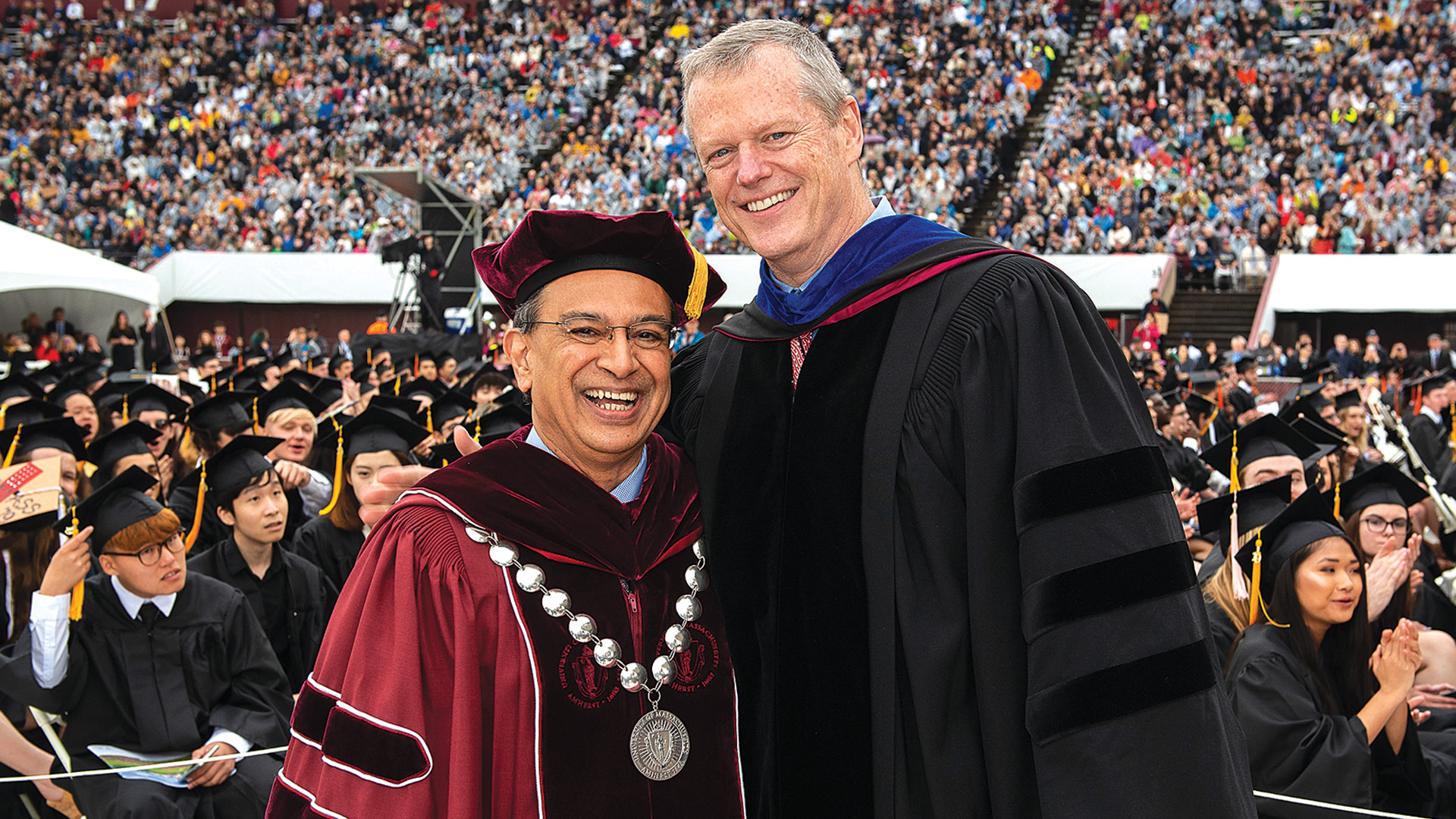
That list includes Tower Square and its recently renovated hotel, which has re-earned the Marriot flag, as well as several other hotels, 99 Restaurant & Pub locations, a Walgreens, three McDonald’s franchises, adult day-care facilities, early-education facilities, and more. These collective investments and entrepreneurial gambits earned Patel and Mitta BusinessWest’s Top Entrepreneur award just a year ago.

Mitta told BusinessWest that 1550 Main St. was a common-sense addition to the portfolio, one that gives the partners a property that is essentially full (97% occupancy), with a stable tenant base that also includes the Internal Revenue Service, U.S. Immigration and Customs Enforcement, regional offices for U.S. Sens. Elizabeth Warren and Ed Markey, the law firm Alekman DiTusa, and an attractive, well-maintained property in the heart of the central business district.

“These properties are connected, and they are the two best buildings in Springfield’s downtown for class-A space,” he said of 1550 Main and Tower Square. “With these properties, we’ll be well-positioned to attract new tenants looking for quality space.”

The property that has come to be known as 1550 Main was acquired by MassDevelopment from the federal government in 2009. At that time, it was roughly 70% occupied, said a spokesperson for MassDevelopment, adding that, after achieving all its stated goals for the property, the agency decided to put the property up for sale through a disposition process to allow it to refocus its efforts on other projects.

Dinesh Patel, left, and Vid Mitta

Dinesh Patel, left, and Vid Mitta, who together orchestrated a stunning turnaround at Tower Square, believe 1550 Main St. is a logical addition to their growing portfolio of commercial real-estate properties.

That includes an initiative in Greenfield, where MassDevelopment is partnering with the city and the Community Builders in the acquisition and redevelopment of the former Wilson’s Department Store property in the heart of the community’s downtown. The redevelopment will create roughly 65 mixed-income rental units and reactivate prominent first-floor and basement retail spaces through the relocation and expansion of Franklin Community Co-ops’s Greenfield store, Green Fields Market.

Referencing 1550 Main, MassDevelopment President and CEO Dan Rivera said, “working with tenants, partners, and the city of Springfield over the years allowed us to cultivate this property to its best and highest use. This type of focused teamwork is how long-lasting redevelopment takes root. It is what makes converting an old federal courthouse into a stunning multi-tenant office building possible.”

The property went on the market in the spring of 2022, and the request for proposals issued by MassDevelopment attracted a number of bids.

Moving forward, Mitta said several of the leases of current tenants will be expiring over the next several years. He expressed optimism for renewals, but also for new tenants looking to take advantage of the property’s location and other amenities.

“Tenancy is not a permanent thing — tenants come and go; we know that,” he said. “Some leases are going to expire over the next few years, but we know how to market, and we have a very strong team here.”

“Even those working at home still go to the office — businesses prefer the hybrid model. They need a place where people can collaborate, meet, greet, that kind of thing. That need is still there, and I don’t know if it will ever go.”

Elaborating, he said this team is hoping to attract some current occupants of class-B space to properties that are not much more expensive but bring a number of amenities that class-B properties do not, including parking garages, lighting safety, and that aforementioned location in the heart of downtown.

The property at 1550 Main differs from its neighbor, Tower Square, to which it is connected by a skybridge, in many respects, said Mitta. He noted that Tower Square required significant investment and “re-imagining,” a word he and Patel use often, such as with new tenants that include the YMCA of Greater Springfield. The newer 1550 Main will not require much of either, he said, which is another of those considerations that prompted interest in the building.

As for the trend toward remote work and hybrid work schedules, Mitta acknowledged that there is likely permanence attached to these trends, but, ultimately, he anticipates that there will still be strong demand for office space, especially in the class-A category.

“Even those working at home still go to the office — businesses prefer the hybrid model,” he explained. “They need a place where people can collaborate, meet, greet, that kind of thing. That need is still there, and I don’t know if it will ever go.”

For evidence of this, Mitta points to Tower Square, where he acknowledged that the number of people in the office tower on any given day may be lower than it was prior to the pandemic. But overall, space needs have not changed to a great degree, and new leases continue to be signed.

“Overall, rent is a comparatively small item on the P&L statement,” he said, adding that, for this reason, he has seen few if any tenants at Tower Square downsizing.

Features Special Coverage

Udderly Innovative

[email protected]

David Barstow and Denise Barstow Manz

David Barstow and Denise Barstow Manz are part of the sixth and seventh generations now carrying on traditions — and creating new ones — at the family farm in Hadley.
Staff Photo

While she grew up on her family’s dairy farm in Hadley and enjoyed that lifestyle, Denise Barstow Manz had no intention of making the 200-year-old operation a career.

“The farm was a place that was fun, and I had a really good time playing with my cousins, being around large animals, and being around nature — it was an amazing way to grow up,” she recalled. “And then, as I got older and I started to see the numbers and realized that the farm was a lot of hard work and not an easy path to wealth, I thought that maybe I should go and do something else.”

She attended the University of New Hampshire — in part because of its renowned dairy program, although she chose a different major — and would later move west and work for the National Park Service, with stints at Yellowstone and Glacier National Park in Montana. And it was while on these assignments that she began to rethink what she would do with her life — and why.

“It finally hit me when I was in Glacier,” she said. “I was a trail guide, and I saw these people donating money to preserve these places. And I thought, ‘if everyone’s giving to places like this, who’s taking care of the places we come from?’ I thought about who was taking care of the place I came from that has been in my family for more than 200 years — and I wanted to be part of that story.”

And with that decision, Barstow Manz would also become part — and she stressed that word part early and quite often, because this is truly a family affair — of one the region’s more intriguing business stories: Barstow’s Longview Farm.

“This is a good place to raise a family in a multi-generational business — everyone can see how life works; the goal has always been to leave something for the next generation.”

It’s a story that includes most of the elements shaping the growth, evolution, and resilience of the local economy today. That list includes entrepreneurship, innovation, technology, clean energy, tourism and hospitality, and sustainable agriculture.

They all come together in an impossibly beautiful, picture-postcard setting, the historic Hockanum Village, framed by the Connecticut River and the Holyoke Range, scenery that belies the myriad and ever-more severe challenges facing dairy farmers — and all those in agriculture — today.

It was these challenges — and especially very trying times roughly two decades ago that prompted the sixth and seventh generations of the Barstow family to take the motto that has defined this business — ‘looking forward since 1806’ — to new dimensions.
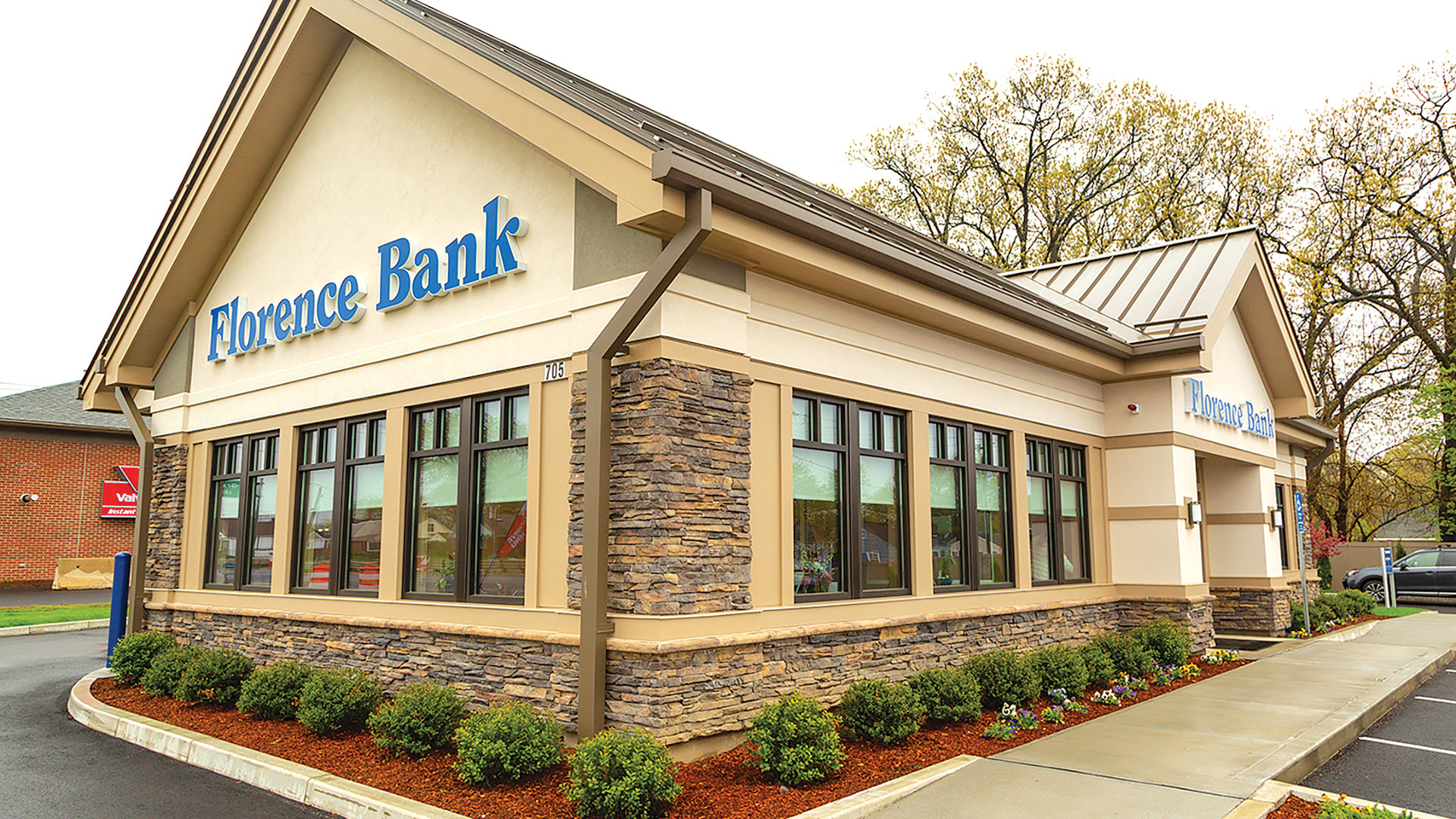
Barstow’s Longview Farm since 1806.

Evolution and diversification have been hallmarks of Barstow’s Longview Farm since 1806.

Indeed, a family that has always embraced change and diversification (much more on that later) has taken some dramatic new turns in recent years, first with Barstow’s Dairy Store and Bakery, and later, through a partnership with Vanguard Renewables to build one of the first farm-powered anaerobic digesters in New England. Meanwhile, the 450-acre dairy farm produces 19,000 pounds of milk daily and is a member of the Cabot Creamery/Agri-Mark Cooperative; almost all of the farm’s milk is supplied to the Cabot/Agri-Mark facility in West Springfield and is made into Cabot butter and other products.

The anaerobic digester (AD), installed in 2013 and expanded in 2016, converts cow manure — the herd at the farm produces some 9,000 tons of it annually — and food waste into electricity, heat, and fertilizer.

It has become an important revenue source for the farm, but it also makes a statement about what the sixth and seventh generations of this family — and those that came before them — stand for.

“The AD speaks to what we believe in as a family — that we need to lower our carbon footprint and play a role in mitigating climate change,” Barstow Manz said, adding that, for this family, sustainability comes in many forms and means many things, including work to ensure that this business will be there for the next generations.
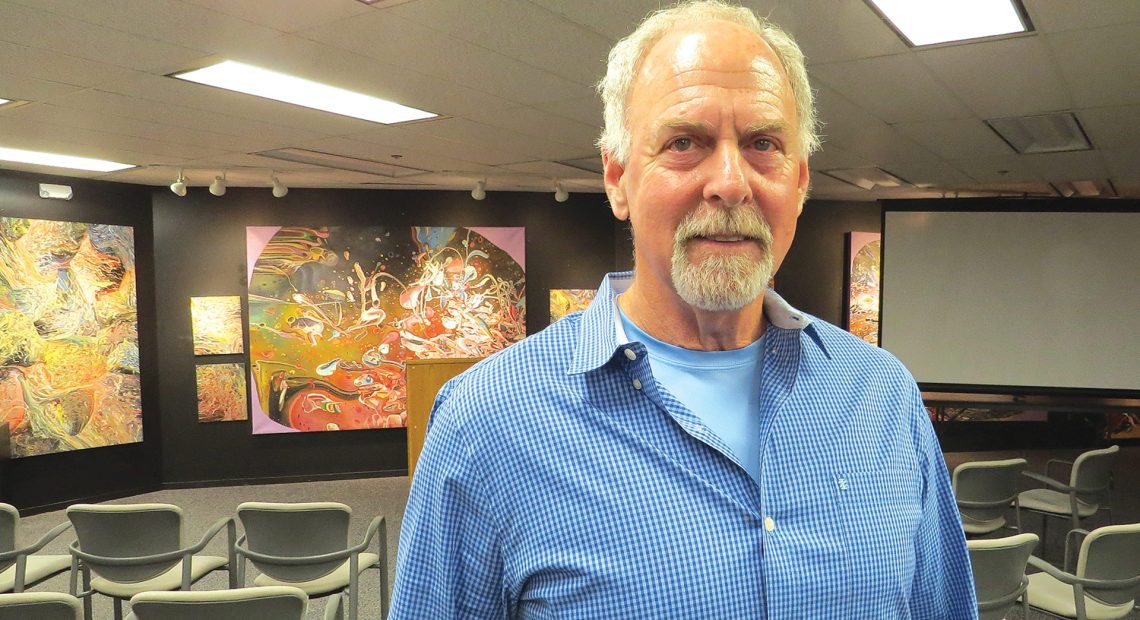
Her father, David Barstow, director of special projects at the farm, agreed. He said that, while many things have changed at this location — in general, but especially during his lifetime — what hasn’t changed is that concept of preserving, and persevering, for those who will continue the tradition.

“My father and grandfather used to talk about working with horses,” he said, adding that change and advancement are constants on the farm; the key is to embrace that change and be at the forefront of it. “This is a good place to raise a family in a multi-generational business — everyone can see how life works; the goal has always been to leave something for the next generation.”

“We got together as a family and decided that we needed to either diversify or get out of farming completely.”

All of the various components of Barstow’s Longview Farm make for an intriguing tour — one that usually includes lunch on site — and Denise and other family members offer many of them, all year long. More than that, these elements collaborate to create an inspiring new chapter to a story that began when Thomas Jefferson was patrolling the White House — and even a century before that, as we’ll see.


Herd It Through the Grapevine

They call it Pasture Day, and it is celebrated the first Saturday in May.

As that name suggests, this is the day when the cows, which have spent the winter in barns, get to head back into the pasture. It’s the unofficial start of spring, and a community event — many visitors, including several families living in the area, will come out, watch the heifers celebrate their first taste of fresh grass, enjoy live music, and have some ice cream.

An aerial view of Barstow’s Longview Farm

An aerial view of Barstow’s Longview Farm in the historic Hockanum Village.

“People kick up their heels and have a good time; they sit on the hill and watch,” said Barstow Manz, who doesn’t have a formal title, but serves as the farm’s marketing director. She also handles the farm tours, manages the dairy store and bakery, handles outreach, and acts as the main grant writer. She used to feed the calves, but the farm now has an automated calf feeder, one of many examples of innovation at this institution.

She said Pasture Day is just one of the many traditions that have lived on at this property since Septimus Barstow, originally from Wethersfield, Conn., acquired the property on the bank of the Connecticut River that was first farmed at least 100 years earlier by the Lyman family.

Originally a crop farm that focused on asparagus, as many farms in Hadley did, as well as squash, corn, tobacco, and other staples, the Barstow’s operation eventually evolved into a dairy farm after the advent of refrigeration, which provided an avenue for selling milk wholesale.

By the 1930s, dairy was the primary focus at the farm, she went on, adding that, with a herd of 300 cows, this is small to mid-sized operation, one that is dwarfed by huge operations in this country and overseas.
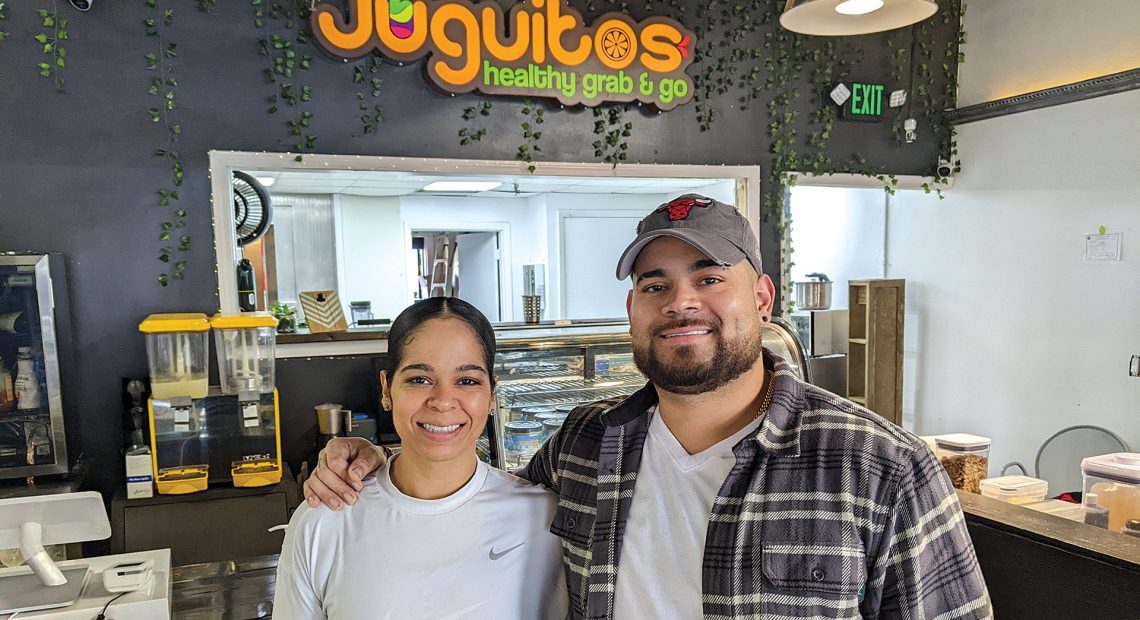
It’s one of a dwindling number of dairy farms both in Massachusetts and across the U.S., she said, citing statistics showing that this country loses five dairy farms every day.
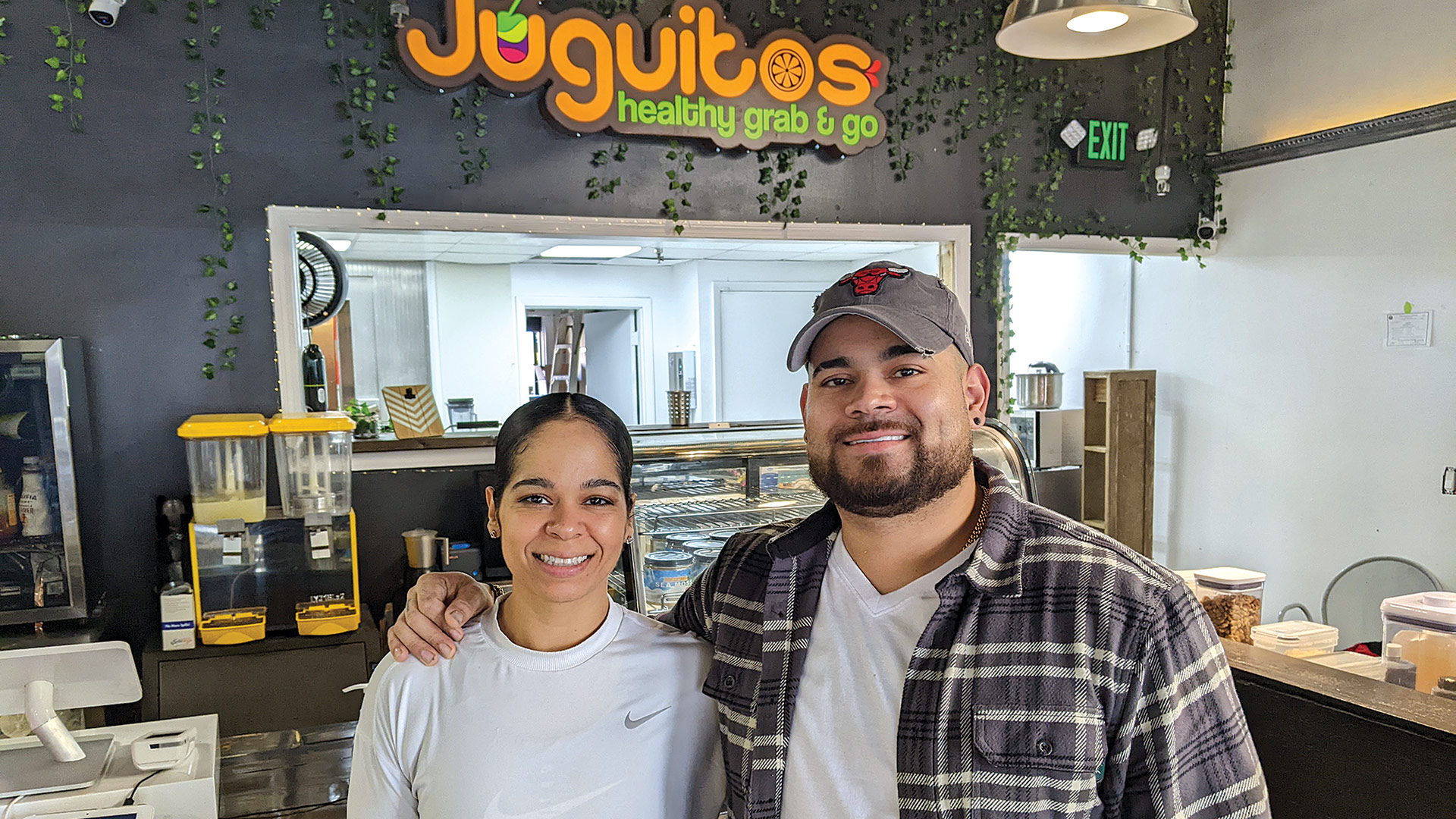
“And when you lose those farms, you’re losing a lot,” she went on. “You’re obviously losing food and food security for that community. But you’re also losing open space, which is good for wildlife habitat, groundwater, climate resilience, and food security. And you’re losing that heritage and that connection to your past.”

The reason for such attrition is simple. This is a very difficult business to be in, she said, adding that the federal government controls milk prices, and margins have historically been paper-thin.

“Even though it’s very perishable, milk is marketed on a global scale, so we’re competing against New Zealand, we’re competing against California … and it’s kind of a broken system,” Barstow Manz explained. “The only real way for dairy farmers to make more money is to make more milk, which doesn’t always line up with demand. And we have no control over the price of the product we produce.”

There are only 115 dairy farms left in the Bay State, and there probably wouldn’t be any were it not for the Massachusetts Dairy Tax Credit, which enables them to remain competitive, she said, adding that there are six operations in Hadley alone, a concentration that testifies to the quality of the soil in that region.

In the early years of this century, the milk market essentially collapsed, primarily because of oversupply, she said, calling this a scary time for the Barstow farm and all the others in this market.

David Barstow

David Barstow says his family lives by the farm’s motto, ‘looking forward since 1806.’

“The milk market crashed like no one had ever seen or felt before in this country; we were getting $12 per hundred pounds of milk, when our break-even was $22,” she explained, adding that it was a critical time in the history of the farm, or another critical time, to be more precise.

“We got together as a family and decided that we needed to either diversify or get out of farming completely,” she recalled. “And that’s when we started talking about how we wanted to diversify and who we wanted to include. And we knew that we wanted to be thoughtful of what the next generation was interested in doing and what our strengths are.”


A Process of Evolution

Over the next several years, diversification would come in several forms, starting with the dairy store and bakery in 2008, an operation inspired in many ways by Denise’s cousin, Shannon Barstow, who does most of the baking. It’s an operation that would transform the farm into a true destination.

“We’re always trying to be mindful and committed to what’s going to be best for our herd, and also for our land, our workforce, our community, and our food system.”

“We understood that people were going to have to drive here if we were going to get the support and the revenue we needed,” she recalled. “So we did lunch, and we started probably too big for our britches. But we’ve definitely settled into who were are, and we have a really supportive community.”

The dairy-store operation and bakery offers both breakfast and lunch as well as a number of prepared foods — and ice cream. The bakery serves up pies, cupcakes, brownies, turnovers, croissants, scones, muffins, breads, and much more. The facility handles private functions, porch parties, and catering. Meanwhile, visitors can buy Barstow’s beef — everything from tenderloin steaks to ground beef — on site. There’s even a drive-thru for those who want or need to grab and go.

The facility draws visitors from around the corner, but also from across the state and beyond, said Barstow Manz, adding that it has become a real destination and a way to take the Barstow name and products well beyond Hadley.

“Most of our regulars are from Hadley and South Hadley,” she explained. “But we have people who come to us from Eastern Mass. because they love our beef, and from the Berkshires because they love our pies; we draw from all over.

Shannon Barstow

Shannon Barstow does most of the baking at the dairy store and bakery, which opened in 2008.

“We opened this place to save the family farm, and it’s had so many other amazing qualities to it that we didn’t really expect,” she told BusinessWest. “It’s become this time capsule for all these family recipes — most of the stuff that’s in the dairy case is Grandma [Marjorie] Barstow’s recipes. And it’s also a neighborhood gathering space — it’s a space where people can work close to home and also be part of a family farm and a local economy on a small scale.”

Indeed, the dairy story and bakery now employs 15 people and has provided many area young people with their first jobs.

The anaerobic-digestion system, launched at a cost of roughly $6 million, is not a supplier of jobs, but it is, as noted earlier, a supplier of electricity, heat, fertilizer — and also pride for a family that has, through its long history, been innovative.

The conversations about installing such a facility began around the same time the family was opening the dairy store and bakery, she said, adding that the system is another important step toward diversification.

Explaining how it works, she said the system takes the energy potential (methane) out of cow manure and food waste and converts it into enough electricity to power 1,600 homes. The food waste comes from local food producers, including Cabot/Agri-Mark, Whole Foods, the Coca-Cola plant in Northampton, and local restaurants.

The food waste and cow manure, both treated and in liquid form, are put into the digester, which Barstow Manz equated to a large stomach, with the gas from the ‘digestion’ process rising to the top of the nine-story facility. That collected gas combusts in an engine and turns a generator, thus creating electricity.

Heat, one of the byproducts of this process, is used to heat that system, provide hot water in the barns, and heat the eight homes on the property, she went on.

“It’s pretty cool that the system has lessened our reliance on fossil fuels as a business, but also on a personal level in our own homes — we don’t have to pay for oil anymore,” she noted. “We’re also getting a chemical-free fertilizer; that’s because most of what we put in we get back; we just need the gas.”

Like the dairy store and bakery, the AD, the second such system in the state and one of the first in the nation, is a reliable revenue stream at a time when such sources of income are needed in the wake of those razor-thin margins in dairy farming, she said, adding that it became reality through partnerships, such as the one with Vanguard Renewables, and grants from several entities, including the Natural Resource Conservation Service, the U.S. Department of Agriculture, the Massachusetts Department of Agricultural Resources, the Center for EcoTechnology, and other entities.


A Butter Alternative

Looking ahead, Barstow Manz said she and others working at the farm have a simple mission — to live up to their motto and continue looking forward.

“We’re always trying to be mindful and committed to what’s going to be best for our herd, and also for our land, our workforce, our community, and our food system,” she said. “Among the dairy farms I’m aware of, we’re been pretty open to accepting new technology and trying new things. We’re always reading and learning and talking to our vets and to our soil agronomists about what we can be doing better.

“I also think it’s cool that the sixth generation has always been focused on the seventh,” she went on, “and the four of us that work here are constantly thinking about what we’re going to leave our kids — what’s in it for the eighth generation.”

If history is any guide, it will be something that can grow and thrive and be sustainable — in every way imaginable.