
Easthampton Grapples with Growing Pains
Community Spotlight
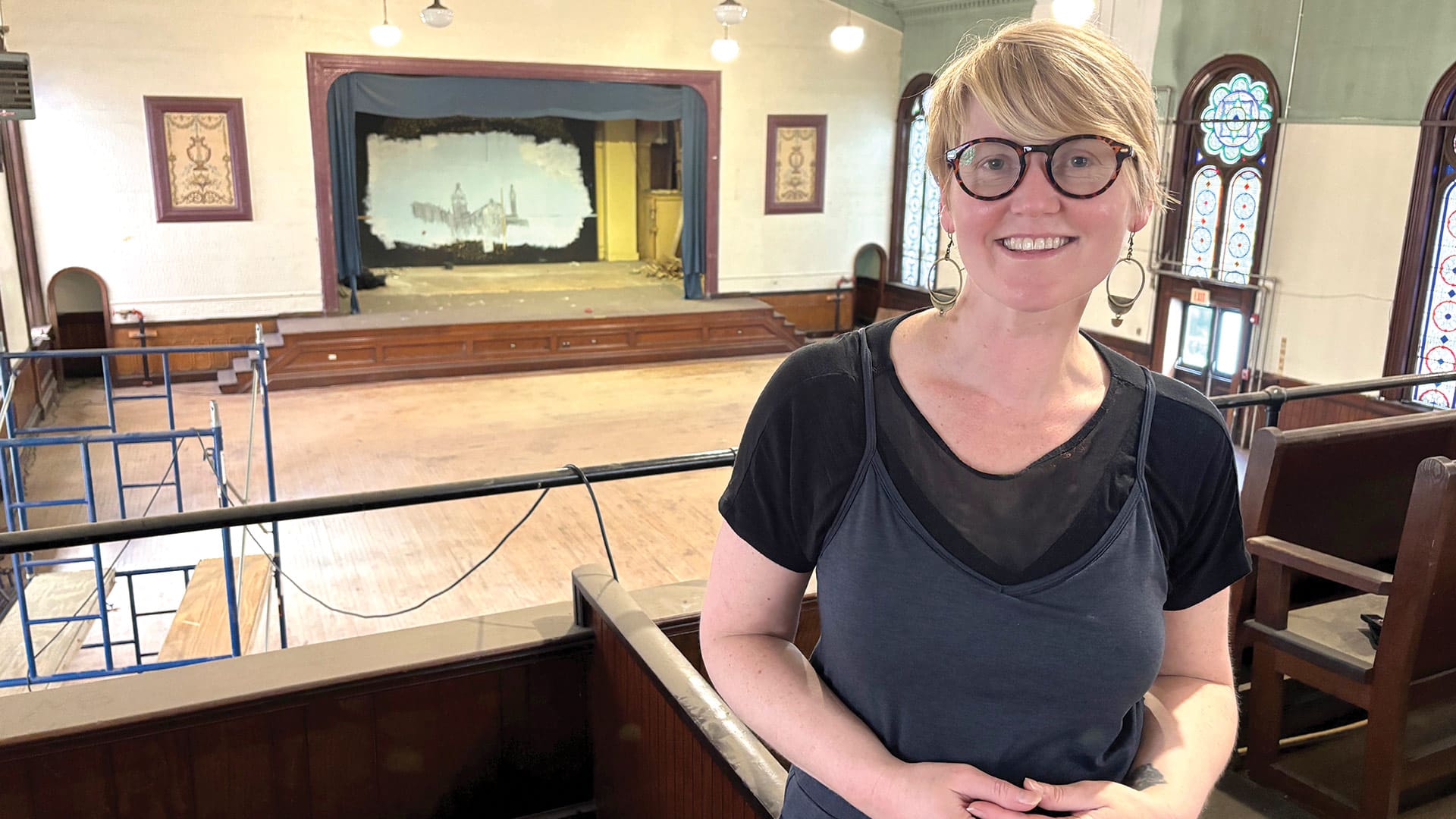
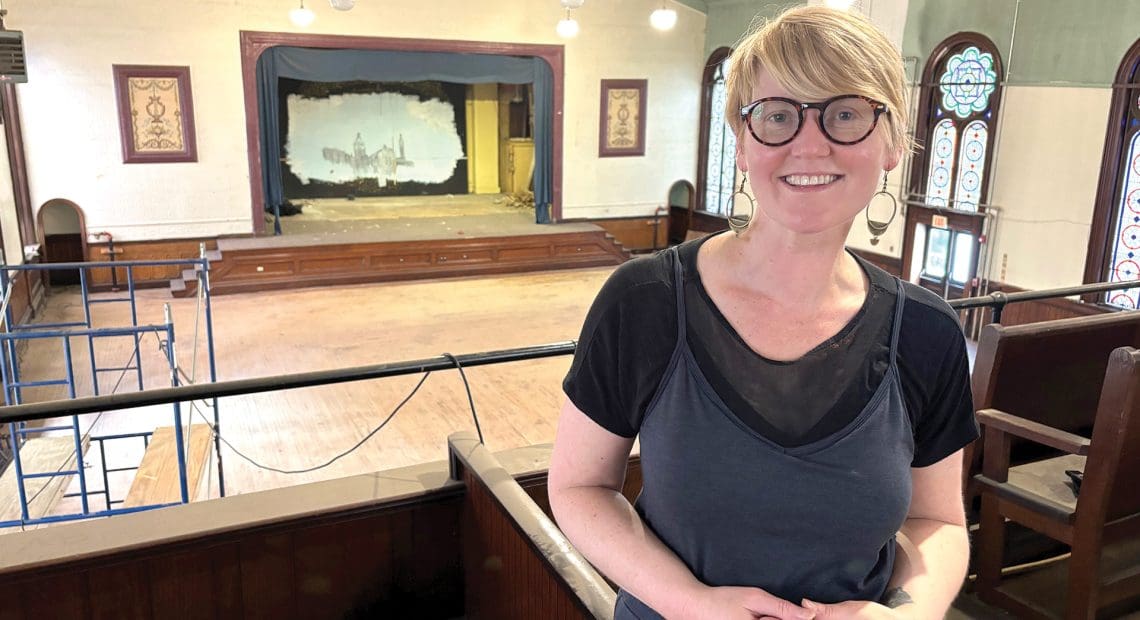
Burns Maxey in the balcony of the second-floor performance space.
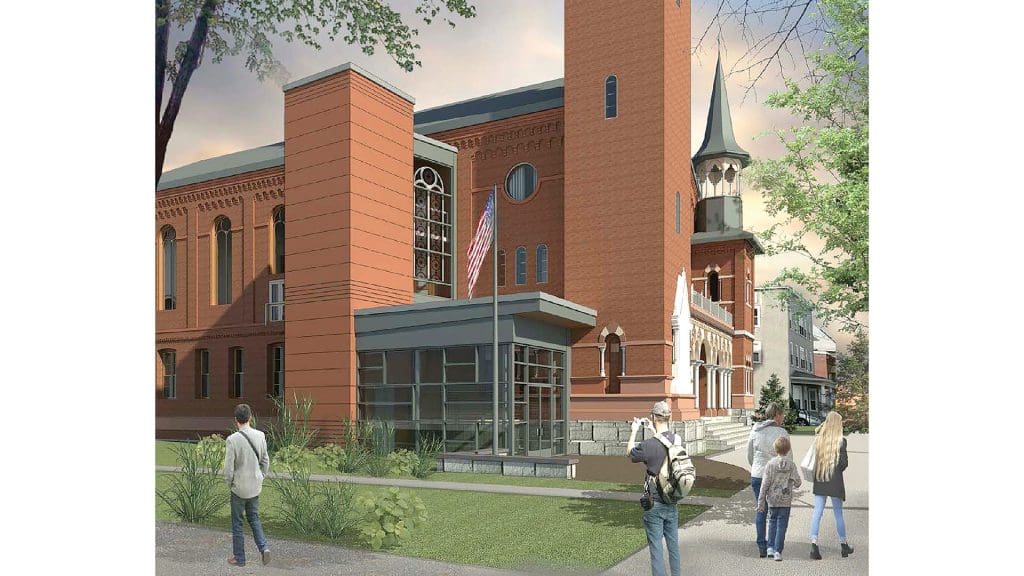
An architect’s rendering of the new entrance and elevator at Old Town Hall, home to CitySpace.
Salem Derby says he certainly didn’t see this coming.
Easthampton’s City Council President was at a meeting with Mayor Nicole LaChapelle, executive assistant Lindsi Sekula, and City Solicitor Mark Tanner, expecting conversation about municipal matters, when LaChapelle informed him that she would leaving to become the state’s Conservation and Recreation commissioner. And he would be serving as interim mayor.
“It was a complete surprise, and it was really quick — she said she’d be leaving in six days,” said Derby, an elementary school teacher, adding that he plans to be in City Hall something approaching full time this summer, but will maneuver around his classroom schedule once school starts, working afternoons, weekends, and in the morning if needed.
He’ll only be in the corner office until the November election (he won’t be a candidate for the job), and over the next four and a half months, he plans to provide stability, keep things running “as drama-free and interference-free as possible,” and, well, keep the ball rolling, if you will.
Indeed, Easthampton is a community in demand, and it has been this way for a while now, a pattern that brings with it some opportunities, but also stern challenges, as Derby, who has been on the council for more than 20 years, well knows.
“Housing is huge — the ability for people to find affordable housing is something I’ve been focused on the entire time I’ve been on the council,” he said, adding that the challenge extends across the housing spectrum, from potential homebuyers facing spiraling prices and limited inventory to renters in some of the bigger complexes — many of which have been sold to larger corporations — encountering increases that are pretty significant.
“There was a large group of renters and tenants outside of City Hall yesterday; they had a meeting and a little bit of a rally,” he explained. “There’s a push for the council to help the Legislature push for rent control.”
This housing crunch, and LaChapelle’s exit for the State House, are just two of the many converging story lines in Easthampton. Others include:
• Several projects in various stages of development to bring more housing on the market. These include, as we’ll see, everything from conversion of three closed elementary schools to the reimagining of more former mills;
• The start of redevelopment of the Tasty Top site on Route 10, a highly anticipated and somewhat controversial project that begins with a new Greenfield Savings Bank branch and also includes a gymnastics center, a daycare facility, retail, and a large residential component;
• The start of the second phase of redevelopment of the old Town Hall into CitySpace, what its leaders call a “thriving arts ecosystem.” This phase includes a new entranceway and elevator that will open the door, quite literally, to phase 3, renovations to the second-floor auditorium for concerts and other performances and events;
• New leadership at the Greater Easthampton Chamber of Commerce. Jon Kostek took the helm almost two months ago, and has established goals to continue growing membership; bring more users to WorkHub on Union, a co-working space at the chamber offices that opened roughly a year ago; and make more and better use of digital platforms to promote the chamber and its services, and, hopefully, engage more young business owners;
• Zoning changes to accommodate short-term rentals, a move that brings the community in line with what most other cities and towns have done and helps meet recognized need; and
• Plans for a new music performance venue at the site of a former massage school, an undertaking being spearheaded by the Heavy Culture Cooperative, a project that will, with the nearby CitySpace, create more vibrancy in the downtown area and serve to connect the downtown with the neighboring mills and the cultural activities taking place there.
For this latest installment of its Community Spotlight series, BusinessWest takes an in-depth look at Easthampton and how it continues to be in demand and cope with its growing pains.
Supply and Demand
Allyson Manuel was drawn to Easthampton by its many selling points — a vibrant arts community, an increasingly eclectic downtown area, a small-city feel, recreation, and more.
Formerly town planner in West Springfield, she and her husband settled here five years ago after considering several potential landing spots, and she became the city’s director of Planning and Community Development last December.
She can attest to spiraling home prices and a shortage of inventory, and how this surge is creating challenges.
“There’s a lot of demand. A lot of people want to be here, which is wonderful; it’s clearly indicative of a good quality of life and quality of place,” she told BusinessWest. “But it does come with challenges. Affordability is an issue for anyone looking to buy a house anywhere right now, but especially in Easthampton and Hampshire County.
“So, we’re reckoning with that and also with making sure we’re not pricing out residents that have been here for many, many years,” she went on. “And for the rental market, there’s been quite a pinch.”
“There’s a lot of demand. A lot of people want to be here, which is wonderful; it’s clearly indicative of a good quality of life and quality of place. But it does come with challenges. Affordability is an issue for anyone looking to buy a house anywhere right now, but especially in Easthampton and Hampshire County.”
Indeed, the housing market in the community is exceedingly tight across the board, and both Manuel and Derby hope and expect that the many projects promising to bring a mix of housing will serve to loosen things up a little.
Projects in various stages of development include Growing Green, a rural project just off Main Street, an initiative slowed by an appeal filed by neighbors but still progressing, with the number of planned units reduced from 87 to the mid-60s, said Manuel, adding that another project involves development of more property within the massive Ferry Street complex, specifically Building 11, where 96 units of housing are planned.
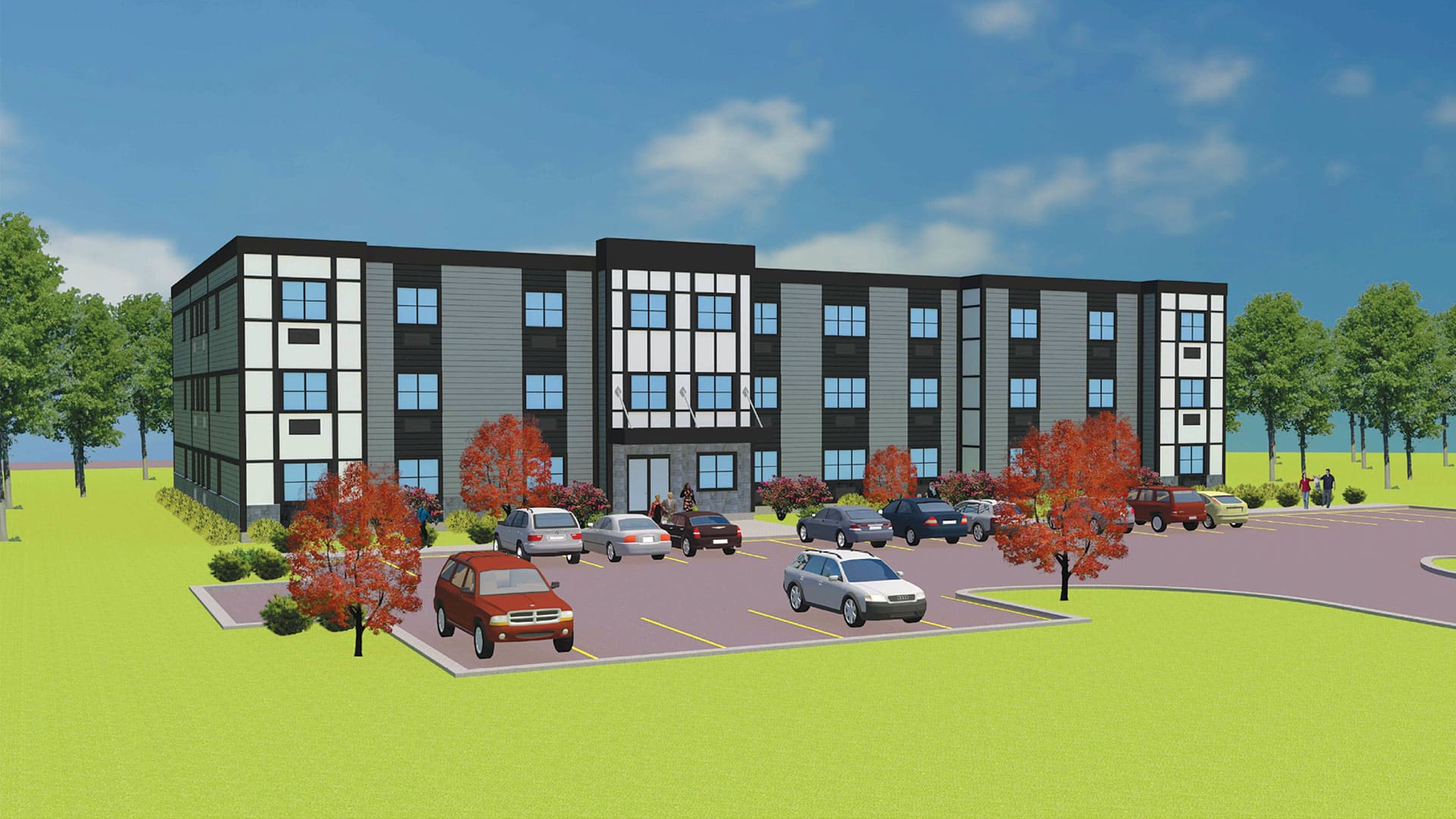
An architect’s rendering of the residential component slated to be built on the site of the former Tasty Top on Route 10.
Another initiative involves redevelopment of the former Notre Dame Church and surrounding properties on Pleasant Street into approximately 42 ‘townhouse’ units, said Manuel, adding that several of these units will be in the church itself.
“I think those will be really cool units when they’re done,” she said, adding that other structures on the property will be razed to make way for new construction.
At the 34-acre Tasty Top site, housing (more than 200 planned apartments, a mix of market rate and affordable) is one of many components to a project being undertaken by developer Frank DeMarinis, said Derby, adding that more than 100 units are expected to be created through redevelopment of the three shuttered elementary schools.
These projects and other smaller initiatives are expected to make a real dent in overall need, he went on, and relieve pressure on existing inventory.
“Once all these are completed, I think the amount of housing in Easthampton will increase so significantly that I’m hoping it will make a real impact on affordability and access to quality housing,” the interim mayor said. “I’m hoping this can potentially be a catalyst for people who need affordable housing and maybe take a little pressure of some of the other units in Easthampton.”
Manuel agreed. “We have some challenges ahead of us, absolutely, but we also have a strong foundation that not all communities have to work from,” she said. “We have a lot of social capital — people that live in the city are very involved, they care about their neighbors, they care about the well-being of the city at large. And that goes a long way toward solving these types of problems. I don’t think it will happen overnight, but the fact that people care enough is a really valuable tool to have in the toolbox.”
Art and Soul
As she walked with BusinessWest up to the balcony of the auditorium in the old Town Hall, Burns Maxey gestured with her hand to the space below.
“You can imagine the possibilities,” she said of this space, which has sat idle for the better part of a decade and a half now.
The key to unlocking its full potential as a resource for the community is accessibility, said Maxey, who was honored by BusinessWest with its Difference Makers award in 2023 for her efforts to transform the landmark, opened in 1869, into CitySpace, adding that such access is at the heart of phase 2 of the ongoing project.
Designed by Amherst-based Kuhn Riddle Architects and construction work being handled by West Springfield-based Keiter, the $3.9 million project to build a new entrance and elevator is expected to take about 18 months, said Maxey, adding that, as this initiative is undertaken, a capital campaign continues to raise funds for the third phase.

Jon Kostek says one of his goals for the Greater Easthampton Chamber is growth of its WorkHub on Union.
Backing up a little, she said phase 1 included infrastructure work and conversion of the ground floor into an arts hub, with performance space (an area called the Blue Room) and several tenants, including Big Red Frame, a gallery, and Easthampton City Arts, the arts organization within the city’s Planning Department.
Phase 2 has been in the planning stages for several years and was delayed somewhat by bids for construction that came in higher than originally anticipated. With additional support in the form of an underutilized properties grant from MassDevelopment, the agency went out to bid again, with Keiter prevailing.
Easthampton at a Glance
Year Incorporated: 1785
Population: 16,211
Area: 13.6 square miles
County: Hampshire
Residential Tax Rate: $13.67
Commercial Tax Rate: $13.67
Median Household Income: $45,185
Median Family Income: $54,312
Type of Government: Mayor, City Council
Largest Employers: Berry Plastics Corp., INSA, Williston Northampton School, National Nonwovens Co.
The new entranceway and elevator have been designed to provide access, but also preserve the architectural and historic integrity of the building, said Maxey, including the staircases at the front of the structure, which is similar in many ways to Chicopee’s City Hall and designed by the same architect, Charles Parker.
As for phase 3, the projected cost is expected to approach $7 million, said Maxey, adding that work covers a wide spectrum, including the ceiling, lighting, sound baffling, asbestos remediation, sprinkler and fire suppression systems, bathroom renovations, creation of a green room and offices, and more.
Fundraising continues, and the stated goal is certainly a challenge, but Maxey is confident that the community will continue to support the initiative.
“We have a ways to go — we’re about halfway there,” she conceded, adding that the overall price tag for the project has soared from roughly $6 million to more than $11 million, mostly due to inflation and rising construction costs.
Once funding is secured, she believes phase 3 can be completed in perhaps 18 months, ushering in the next chapter in the story of CitySpace.
Making Connections
As for next chapters, the Easthampton chamber is writing itself, with Kostek taking the helm after long-time executive director Moe Belliveau stepped down earlier this year.
Kostek said he was looking for a new challenge after his position with the United States Tennis Assoc. New England was eliminated.
He said his work at the USTA, much of it focused program development for young people, is similar to his new role at the chamber in that they both involve relationship building.
“One of the things I liked most about my work with USTA was meeting people and developing relationships, and I think a lot of these same things apply here, at the chamber … meeting with members and discussing with them what the chamber offers and what we can do moving forward.”
Kostek said he’s spent much of the time since his arrival getting to know the community, meeting with his members, and gauging what they like, dislike, and want more of.
In that last category are face-to-face networking opportunities, he said, adding that he plans to add such events, including After-5s and more Coffee and Connections events at the WorkHub, to the calendar.
Also on his to-do list is growing overall membership and especially membership for WorkHub on Union. The facility has attracted only a few regular users to date, he said, adding that he plans to more aggressively market it across multiple platforms to get the word out.
“It’s a great space, and I think there is a real need for facilities like this,” he said, noting that there are several workstations, as well as a shared conference room, kitchen, and other facilities. “And it’s open 24/7.”