
Home Posts tagged Manufacturing (Page 20)
Sections Supplements
Westfield Bank Keeps Its Eye on the Ball

The executive team at Westfield Bank: from left, Leo Sagan, CFO; James Hagan, president and CEO; Allen Miles, executive vice president; and Gerald Ciejka, legal counsel.

The executive team at Westfield Bank: from left, Leo Sagan, CFO; James Hagan, president and CEO; Allen Miles, executive vice president; and Gerald Ciejka, legal counsel.

It’s a story increasingly — and enthusiastically — being told by community banks in the Pioneer Valley. Simply put, while many large, national institutions have become trapped in a credit crisis partly of their own making, Western Mass. banks are well-capitalized and ready to do business. Westfield Bank is no exception, finding new avenues for growth by staying true to its core goals — among them steady and strategic expansion, a continued focus on commercial lending, and service that, as President James Hagan says, takes the bank to the customers.

Westfield Bank, with 11 branches and a steady growth pattern over the past few years, has consistently been one of the region’s positive financial stories — but the opening of a new location is still reason to celebrate.

Especially, bank President James Hagan said, when that new branch is a reflection of the institution’s success in a specific market.

That market is Agawam, where Westfield Bank has seen a swell of retail and commercial business in recent years, which is why a branch will open on Route 57 in Feeding Hills in June.

“Our Agawam branch is at full capacity, and we want to maintain and improve our service in that market,” said Hagan. “We own this land — we bought it decades ago — and we felt this was the right opportunity. It’s a high-visibility area, and we’ll run it similar to the Main Street branch, which is our second-busiest office.”

Alice Babcock, vice president and director of community banking, said the current Agawam branch is one of the company’s oldest, and has long had strong market share. “But the changes in the community have been such that the branch is bursting at the seams. And we’ve found that 30% of those who use the Main Street branch have Feeding Hills zip codes.”

In addition, the bank has several business customers in the Agawam Industrial Park, and the Feeding Hills branch will provide a more convenient site for them as well, she said.

Making business easier for commercial clients, in fact, is a long-time priority for the bank, as evidenced by the rollout of its remote data capture service a few years ago.

Westfield was the first community bank in the region to introduce the technology, which is essentially a device that scans checks at a customer’s place of business and allows him to make deposits remotely, even hours after most branches close. Babcock said the service has been a hit with customers, particularly those in towns without a branch nearby — especially critical when making inroads into Connecticut — and has been a selling point when attracting new commercial business.

That’s important for a bank that has not branched out as quickly or aggressively over the past decade as other regional institutions, instead opting for gradual, deliberate growth in its footprint, and always with a strategy.

Three years ago, that meant moving its downtown Springfield office to Tower Square to increase foot traffic, as well as opening a branch on East Main Street in Westfield with more space and visibility than its longtime Elm Street headquarters. That branch also boasts Sunday hours for customers too busy during the week to do their banking in person. And Saturdays and Sundays, it turns out, are that site’s busiest days.

These advances — strategic new branches, weekend hours, new technology to make business easier — all fit a pattern, said Hagan, of bringing the bank to the customer. And in these trying times for financial institutions, that sort of strategy is more important than ever.

Growth Pattern

Westfield Bank has undeniably been in a growth mode. From its launch more than 150 years ago through the mid-1970s, its assets had grown to about $100 million, but three decades of rapid expansion have brought that total to $1.1 billion.

In fact, total assets increased by $70.5 million last year alone, and net loans jumped by $59.1 million to $414.9 between the start of 2008 and the beginning of 2009 — primarily due to an expansion in commercial, industrial, and commercial real-estate loans, offsetting a slight decrease in residential mortgages.

“We’ve had great success growing our commercial and industrial loans,” which now total $245 million, Hagen said. More important, business in that sector is up 17% over last year, and up 24% in commercial real-estate loans.

At the height of this growth, Westfield Bank has also seen a shift in its administrative structure, with Don Williams, who handed the president’s reins to Hagan four years ago, recently stepping down as CEO, giving Hagan that role as well.

“It gives me a more global perspective,” Hagan said. “Before, it was more day-to-day, new product development, new sales development. Now it’s general management of the bank, how we utilize capital. And we have an awful lot of capital right now. In fact, we’re the third-most well-capitalized bank based in Massachusetts, with about $300 million.”

The Feeding Hills branch is one way that money is being put to use, but so is growth in the bank’s commercial-loan portfolio, which — rather than being hurt by the recent troubles of lending institutions nationwide — has been able to benefit from the crisis in at least one way, Babcock said.

“While the national banks are tending to hold back on new lending commitments to companies, Westfield Bank is still willing to entertain lending requests, and putting new business on the books,” she noted.

“Primarily,” Hagan added, “we’re picking up loans that are now in turmoil at larger national and super-national institutions, those that have had difficulty in either extending credit or adding to their current debt load. But these are well-known, Western Mass.-based companies, and they’re having a positive effect on our balance sheet.

“This didn’t just happen over the past year. It’s been a consistent marketing effort,” he added, noting that the bank has been in contact with some of these companies for a long time. “With some of the bigger accounts $5 million and up, it could take four to five years of consistent calling to finally get the account moved to your institution.”

And the marketing message goes well beyond financial numbers, he added.

“It’s a relationship. People want to know who you are and what your bank is about,” Hagan said. “They want stability, with a large capital base, a strong credit staff, and an excellent branch network. And we’ve been able to position ourselves as that bank and take advantage of other institutions’ problems.”

It’s not just loans; Westfield Bank has seen commercial checking accounts grow by 10% over last year, in addition to 8% growth in retail checking and 35% in consumer savings accounts.

“We haven’t had to put the brakes on at all,” Hagan said. “Lending is healthy, delinquency is low, and we’ve been able to position ourselves as an alternative to the national and regional banks.”

Community Minded

This success speaks, at least in part, to the bank’s growing reputation as a community-minded institution, said Babcock. “What we’re seeing on the consumer and business sides,” she noted, “is that customers are looking for a banker they know and can contact easily if they’re having questions.”

In addition, Hagan said, Westfield Bank continues to take pride in its Future Fund, a vehicle through which it has given about $1 million over the past three years to various charities and nonprofits, particularly those that focus on children and education — hence the word ‘future.’ A Web site has been set up not only to track where the money goes, but also publicize events that benefit those organizations, and hopefully spur more community giving.

The bank is on track to add another $350,000 in donations in 2009, he said, putting it right on track with the past few years. “This is a challenging time for nonprofits,” Babcock said, “and to keep the same level of commitment, we feel good about that.”

Even in the midst of a full-blown national financial crisis, it seems, there’s still good news coming out of Westfield.

“We don’t get the big highs and lows in this region, and our portfolio reflects that,” Hagan said. “Some sectors have dropped, like manufacturing, but other areas are looking pretty good.

“The economy isn’t robust,” he admitted, “but we’ve seen positive signs.”

Joseph Bednar can be reached at

[email protected]

Opinion

It’s been an interesting couple of weeks for the Naismith Memorial Basketball Hall of Fame, which has certainly seen better times, especially from a public-relations standpoint.

First, there was the story in the local press revealing some dire financial straits and accounts of a letter sent to the hall’s trustees several weeks ago informing them that if things didn’t improve, and quickly, the shrine might be forced to sell its memorabilia, file for bankruptcy, or close the doors. Within that same story there were comments from the hall’s director, John Doleva, that things had already improved since that letter and that such dire consequences were not likely, but the news had been broken and the response locally was that the hall was in trouble — again, or still.

There was then the expected follow-up comments from area tourism officials downplaying the grim forecasts and expressing hope, and confidence, for a strong summer season for the hall. But soon, there were calls from columnists to stage campaigns to seek donations from millionaire NBA players and former players to save the hall, and even letters sent by Springfield Mayor Domenic Sarno to state and federal leaders seeking some kind of financial help — aid that Doleva says isn’t needed.

Then there was some criticism in the media that hall officials had lost out on a golden opportunity to bring some badly needed attention to the shrine by refusing to move off a Sept. 11 date for the 2009 induction ceremonies — featuring a very strong class headlined by Michael Jordan — thus likely precluding a visit from President Obama, an avid basketball fan.

Amid these somewhat conflicting reports, it’s hard to gauge just what kind of financial shape the hall is in, but what seems clear is that the facility needs for some good things to happen — soon and for the long haul. It needs to have a very strong summer to stabilize its financial picture and calm the doubters, who are many. Then, it must make the very most of the opportunity presented by the induction of Jordan this fall. He is, in many respects, still the face of the game of basketball, and when he comes to Springfield to be enshrined, the world will be watching.

But the hall needs more than a strong finish to 2009. It needs some long-term stability that can only be gained from attaining a better, higher place in the region’s psyche. The hall has always been a part of the Pioneer Valley’s cultural and business scene, but it has never approached the level of recognition and importance achieved by the baseball and football halls of fame. In fact, in many circumstances people don’t even say ‘Baseball Hall of Fame’; they simply say ‘Cooperstown,’ the town in Upstate New York where that shrine is located.

How does Springfield gain such status, or something approaching it? It will likely take a strong branding, or rebranding, effort to make the city synonymous with basketball. Right now, it’s a long way from that place, in part because of past history and the city’s connection with manufacturing and, especially, the Springfield Armory, but also because of recent history and the city’s many financial and image problems.

Turning things around will take a concerted effort on the part of the hall, city and state tourism officials, elected leaders, and even area residents and business owners who must understand that the hall is not just another tourist attraction.

Local tourism officials have a lot on their plates and many priorities — including an underperforming convention center that has become the focus of a broad, new marketing effort called ‘Springfield First.’ But a stronger focus on Springfield, the Hall of Fame, and the game of basketball is something that’s needed.

In the end, donations from NBA players and emergency support from federal and state sources are not going to put the hall on solid financial footing for the long term. Only a strong, committed effort to permanently and forcefully connect Springfield with basketball can do that.-

Departments

HG&E Purchases Land For Conservation, Renewable Energy

HOLYOKE — Holyoke Gas & Electric (HG&E) recently signed an agreement to purchase 270 acres on the Mt. Tom ridge for conservation and future exploration of a small portion of the land for renewable-energy use. HG&E plans to purchase the land from Springfield Towers, LLC, and the vast majority of the property will be preserved as permanent conservation land, according to HG&E Manager James Lavelle. A small part of the land will be considered for a wind project to provide a clean, renewable source of energy, as well as telecommunications equipment. Lavelle added that HG&E has entered into an agreement with the Mass. Department of Conservation and Recreation and the Massachusetts Technology Collaborative (MTC) to ensure that the majority of the land is held for conservation and to explore the possible use for wind energy and telecommunications. According to that agreement, if HG&E does not develop a wind project within three years, the land will be made available to the Massachusetts Renewable Energy Trust at MTC, or its designee, for the development of wind power. The 270 acres will be immediately protected through a restrictive covenant that will be applied to the property through the agreement with the state. That covenant limits any development to renewable energy and telecommunications, such as the cell tower and telecommunications facilities currently on the site. No development plans have yet been formalized, added Lavelle. HG&E is a municipally owned utility company providing electricity, natural gas, district steam, and fiber-optic Internet services to more than 18,000 customers.

Springfield Eligible For $2M in Loans

SPRINGFIELD — MassDevelopment recently announced four municipally owned properties have been selected for low-cost loans of up to $2 million under the agency’s Brownfields Priority Project Program (P-cubed). The sites are located in Springfield, Boston, Chelmsford, and New Bedford. The P-cubed program designates high-impact parcels to attract developer interest in reuse that would be viable but for environmental contamination. The agency will release the remediation funds after a developer has been identified by the municipality. In Springfield, the city owned, half-acre Indian Motorcycle ‘B’/Mason Square Fire Station site on State Street contains two vacant buildings that once housed a motorcycle-manufacturing plant and a neighborhood fire station. The property is one of seven priority development projects identified by the State Street Alliance, an affiliation of 60 stakeholders located on and around State Street, which could spur near-term market opportunities and new investments if redeveloped. The city previously secured a grant from the Environmental Protection Agency to fund initial assessment work at the site. The city plans to solicit developers this year and convey the site to the selected group in 2010.

Crane & Co. Eliminates 70 Jobs

NORTH ADAMS — Crane & Co., now in its seventh generation of making paper for U.S. currency, recently cut 70 positions in its personalized stationery division due to a drop in demand. Additionally, approximately 200 remaining employees in that division will be taking a 9% pay cut. Fifty employees were employed in the personal-design-services facility in North Adams, and 20 worked in the Dalton factory.

Northeast Consumer Price Index Rises

WASHINGTON — Retail prices in the Northeast region, as measured by the Consumer Price Index for All Urban Consumers, rose 0.6% in February, according to the Bureau of Labor Statistics, part of the U.S. Department of Labor. Denis McSweeney, the bureau’s regional commissioner, noted that while increases in transportation and apparel led the way, six of the eight major categories had higher prices in February; only the food and beverages and the education and communication indexes recorded declines since January. The February level of 226.754 (1982-84 = 100) was 0.7% higher than in February 2008. Over the same period, the core inflation rate, as measured by all items less food and energy index, rose 2.2%. Due almost entirely to higher gasoline prices, the transportation index rose 1.7% in February. Following three straight monthly declines totaling 8.9%, apparel prices rose 5.4% in February. Over the year, apparel prices advanced 2.7%. The housing index rose 0.3% since January, dominated by a 0.6% increase in shelter prices. The shelter index, which includes rent of primary residence, lodging away from home, owners’ equivalent rent of primary residence, and tenants’ and household insurance, rose 1.8% over the year. Nationally, consumer prices rose in February by the largest amount in seven months as gasoline prices surged again and clothing costs jumped the most in nearly two decades.

Unemployment Claims Hit New High

NEW YORK — In the week ending March 14, the advance figure for seasonally adjusted initial claims was 646,000, a decrease of 12,000 from the previous week’s revised figure of 658,000, according to the U.S. Department of Labor. The four-week moving average was 654,750, an increase of 3,750 from the previous week’s revised average of 651,000. The advance seasonally adjusted insured unemployment rate was 4.1% for the week ending March 7, an increase of 0.2 percentage point from the prior week’s revised rate of 3.9%. The advance number for seasonally adjusted insured unemployment during the week ending March 7 was 5,473,000, an increase of 185,000 from the preceding week’s revised level of 5,288,000. The four-week moving average was 5,251,250, an increase of 118,750 from the preceding week’s revised average of 5,132,500. The fiscal year-to-date average for seasonally adjusted insured unemployment for all programs is 4.577 million. The advance number of actual initial claims under state programs, unadjusted, totaled 594,121 in the week ending March 14, a decrease of 58,515 from the previous week. There were 335,917 initial claims in the comparable week in 2008. Extended benefits were available in Alaska, Connecticut, Idaho, Michigan, Nevada, North Carolina, Oregon, Pennsylvania, Puerto Rico, Rhode Island, Washington, and Wisconsin during the week ending Feb. 28.

Features
Springfield’s Hoop Hall Will Host BusinessWest’s 40 Under Forty Gala
The Basketball Hall of Fame will be the site of this year’s 40 Under Forty gala.

The Basketball Hall of Fame will be the site of this year’s 40 Under Forty gala.

Mark the date: June 18.

That’s when BusinessWest will celebrate its third class of 40 Under Forty winners at a gala to be staged at the Basketball Hall of Fame on Springfield’s revitalized riverfront.

Kate Campiti, associate publisher and advertising director for BusinessWest, said the magazine wanted to bring the event to the Hall of Fame in 2009 to showcase some of the exciting developments there and be a part of that revitalization process.

“We’re spotlighting some of the bright, young talent in this region at our festive celebration, which has become a not-to-be-missed event,” she explained. “But we also wanted to turn the spotlight on Springfield, its riverfront, and the Hall of Fame complex. We’re excited to be bringing our event to this great venue.”

The Hall’s Center Court will be the site for the gala, which will honor a diverse class of under-40 leaders, as chosen by a panel of five judges. The scores were tabulated early in March, and the winners were notified a few weeks ago. They will be presented to BusinessWest’s readers in the magazine’s April 27 issue.

To maintain a level of suspense, we’ll reveal only that this group of winners represents sectors ranging from manufacturing to technology; from law to financial services; from retail to construction. Overall, it is a very entrepreneurial group, with many business owners, as well as others who bring a spirit of entrepreneurship to their company or nonprofit agency.

While not all the details of the June 18 event have been hammered out, many things are known, starting with corporate sponsorship of the event. Several companies have agreed to take a lead role in presenting the gala, including Bay Path College, Comcast, Fathers & Sons, Hampden Bank, and Moriarty & Primack.

Tickets to the event, which will feature butlered hors d’oeuvres, lavish food stations, and entertainment, will be $50 each and may be obtained by calling (413) 781-8600, ext. 10, or via E-mail at[email protected].

Sections Supplements
Hard Times Force Businesses to Scale Back Raises
Meredith Wise

Meredith Wise called the current economic conditions a ‘perfect storm’ that is creating anxiety and uncertainty in employers.

According to a survey by the Employers Assoc. of the NorthEast, most area companies planned as late as last summer to give healthy raises to their workers for the upcoming year. A recent followup survey, however, delivered much different news. It seems the deepening recession has employers feeling skittish about increasing salaries, and has forced workers to adjust their expectations from anticipating a heftier paycheck to feeling relieved that they still have a job.

Looking forward to that raise in your paycheck? Right now, the odds say … don’t count on it.

Reflecting both national and statewide trends, Western Mass. employers are largely holding off on giving raises this year — even though a solid majority planned to increase salaries just eight months ago.

The startling turnaround is documented in a survey conducted by the Employers Assoc. of the NorthEast (EANE), and it reflects what appears to be widespread skittishness among employers as to how deep and long-lasting the current economic downturn will be.

“It’s not unexpected, but I’m a little bit surprised that it happened as quickly as it did,” said Meredith Wise, executive director of the EANE.

“When I think back, the most recent downturn before this was after 9/11,” she recalled. “People were not busy; orders were drying up, but we found that, for the most part, companies took it in stride for another 12 to 14 months before they started saying, ‘OK, we can’t ride this out,’ and started looking at cutting out increases, cutting back, doing some of those things.”

This time is different; employer behavior has changed much more rapidly, as the EANE report clearly demonstrates. The survey basically asks four main questions: were you planning in July to give increases to employees, and if so, how much? And are you planning now to give raises, and again, if so, how much? The results are broken into five categories of employees:

Union production, maintenance, and service workers. In July, 19 of 21 respondents in this category were planning to give raises, with an average increase of 2.61%. Now, only 3 of 23 plan to boost salaries — at an average hike of 0.67%.

Non-union production, maintenance, and service workers. Last summer, 87 of 105 companies planned raises, at an average of 3.18%. Now, it’s just 32 of 105, at an average increase of 1.03%.

Non-exempt clerical and technical workers. In July, 114 of 136 companies planned to fatten paychecks, by an average of 3.14%. Now, it’s 41 of 135, at an average of 0.99%.

Exempt supervisory, managerial, and professional workers. Out of 137 companies, 112 planned raises last summer, with an average hike of 3.17%. Now, it’s down to 41 of 134, with an average increase of 1.03%.

Finally, executives. They fare a little better, with 40 of 126 companies planning raises for their top dogs at an average of 1.21%. But that’s still way down from July, when execs at 98 of 128 companies could expect average raises of 3.38%.

Quick on the Draw

Clearly, unlike the post-9/11 slowdown in the economy, employers aren’t waiting to take sometimes-painful action.

“A lot of this started hitting in the summer and fall, so it was a pretty quick reaction,” said Wise. “We’re seeing layoffs, companies not doing increases … the bottom dropped quicker here than in the most recent downturn.”

The regional trend mirrors statewide reports.

Sandra Reynolds, executive vice president of Associated Industries of Mass., said a new employer survey conducted by AIM — crossing all major sectors and companies of all sizes — reports that 55% of employers say they’ve cut out raises for 2009, while others are delaying them by three to six months or more.

Furthermore, 47% of respondents say their company’s performance will be “significantly weaker” due to the downturn, and 38% say it will be “slightly weaker.” Meanwhile, 13% say they don’t expect much change from last year, and only 2% project a stronger year — hard evidence of the anxiety that has contributed to the widespread raise freezes.

“I think it’s surprising that so many have decided not to give an increase at all,” said Reynolds, noting that employers seem to be responding to the economic downturn in the same way that consumers are in delaying purchases: with a lack of confidence.

According to the AIM survey, 46% of employers have either laid off workers recently or are planning a layoff. In addition, 23% have a freeze on new hires, and another 23% will hire only to fill vacated positions. Only 14% of companies said the current conditions have not impacted their staffing plans at all.

“It seems that everyone’s reaction, employers as well as individuals, is to stop spending, which is part of the problem,” Reynolds argued. “I think this reaction is more intense than what we’ve seen in past recessions, and it’s happening more quickly.”

It’s a story being told nationwide, too. According to a survey conducted by human-resources consulting firm Hewitt Associates, a full 50% of U.S. employers are cutting salary increases for 2009. In addition, 35% are laying off workers, and 39% have instituted hiring freezes.

However, Massachusetts seems to lag behind the national average when it comes to the amount of the raise when one is offered. According to a December survey by the nonprofit human-resources organization WorldatWork, employers who are giving raises this year are increasing salaries an average of 3.1% nationwide.

Still, that’s below the 3.8% they anticipated for 2009 when surveyed by WorldatWork last April, and many companies’ plans might have changed further as the recession has deepened in recent weeks. In addition, 17% of executives polled in the survey said they would not grant themselves a raise in 2009.

Why Pay More?

Many companies that do offer raises, even in a recession, say they need to keep their people happy, as well as attract top talent.

“There are a few reasons to give raises,” said Paula Dennison, vice president of Human Resources for Baystate Health, the region’s largest employer, which will be giving pay increases for 2009. “First, we want to acknowledge our employee contributions and recognize our talent, and obviously we want to be able to secure and retain our people. On top of that, we have to remain market-competitive.”

Those are not just empty words in health care, an industry that has struggled with shortages in certain fields — from nursing to radiology to pharmacy — for some time, both locally and nationally.

“We still have openings for sure, and we have a lot of projected labor shortages,” Dennison said. “There are some significant projections around the nursing shortage, and nurses play a key role for us, so we have to be sure we’re competitive with our salary.”

She noted, however, that this year’s raises are, on average, a bit lower than recent years in terms of the overall budget, while still based on performance. “The market has dropped a little bit for some of our positions, so that’s why they’re slightly lower.”

Workers in other industries would no doubt be happy with even a modest raise right about now, said Wise. “But most of the manufacturers are not giving increases. They’ve actually cut pay,” she said.

“The health care organizations are giving increases to their people because they’re still doing pretty well,” she added. “They’re still bringing people in and making money. Financial institutions are also still giving increases. But in manufacturing, they’re seeing their increases drying up.”

Part of the problem, said Wise, is that many business owners recognize the current economic crisis as the result of several systemic failures, which will take time to repair, as opposed to a quirk of history, as the post-9/11 downturn was.

“They’re seeing it as based on more long-term problems, so it’s not something that’s going to pick up right away,” she said. “They know changes need to be made, and there’s not going to be a quick fix.

“But this is also coming on the heels of the gas prices soaring as much as they did last year, which hurt companies with shipping and transportation costs, and businesses with people on the road a lot. That increase really hit their budgets, as well as employee morale when they were paying so much for gas,” she noted. “So it has really been a perfect storm of things happening, and the reaction was a lot faster than in the past.”

That adds up to some short-term pain — hopefully, anyway — for employees around the Pioneer Valley. But with unemployment creeping up each month as well, just holding onto a steady paycheck might be job satisfaction enough.

Joseph Bednar can be reached at
[email protected]

Opinion

Ed Leyden acknowledged that it’s tough not knowing if his hard, time-consuming work will pay off until seven, eight, or maybe 10 years down the road. But what he does know is that he has to keep doing it.

Leyden, president of Ben Franklin Design & Manufacturing in Agawam, was referring to the tours he gives to young people — some in high school, but many even younger — designed to impress upon them the good health of the precision-machining sector in Western Mass. and the many attractive career opportunities it offers.

These tours take a few hours, and, while they’re not exactly heavy lifting, they can be difficult because the subject matter is rather intense, and sometimes it’s difficult to make a connection with the eighth-graders wearing the borrowed safety glasses. That’s why Leyden always takes an extra few minutes to show visitors the cars, trucks, and SUVs that his employees drive. It’s often easier to make an impression that way than with 30 minutes of talk on computer-assisted design.

What Leyden adopts is what amounts to a ‘whatever it takes’ approach when it comes to sparking an interest in his sector, and he’s certainly not alone. Shop owners who are busy trying to attract business and make deadlines for current customer orders are still making time for these tours — given to groups as small as a handful of youngsters — because they know they must if they are going to have a sufficient supply of workers for next year, a decade from now, and two decades from now.

The ‘whatever it takes’ mindset prevails not only among precision manufacturers in this region, but in other sectors as well, such as health care and, to a lesser extent, ‘green’ businesses, environmental science, and the biosciences — and we’re glad this attitude prevails.

That’s because, as we’ve said many times, the region’s economy is, and will always be, only as strong as its workforce, and when it comes to economic development, this is priority one, plain and simple.

Addressing the problem requires diligence, teamwork, and imagination, in equal doses, and we’ve seen some great examples of these qualities come together. One of the latest is a program called Career Explorations — Robotics/Precision Manufacturing, one component of which was Leyden’s latest tour. The initiative is designed to introduce, or reintroduce, young people and, when possible, their parents to the precision-machining sector and, in the process, eliminate some lingering misperceptions about the industry.

In addition to tours of plants like Ben Franklin, students, in this case members of the Boys & Girls Club of Greater Springfield, visit area community colleges and Putnam High School in Springfield to see how one goes about getting on the path to such a career. There is also a series of classes in robotics designed to stir the imagination and provide lessons in teamwork.

The program involves a number of partners, from the Regional Employment Board of Hampden County to Springfield Technical Community College; from the Black Men of Greater Springfield to the National Tooling and Machining Assoc. They all understand the importance of helping young people and their parents make smart decisions about career paths and thus which high school to attend.

Such partnerships, and there are many of them, as we said, hold vast potential to reduce dropout rates and poverty rates, while also helping to ensure that the region, individual sectors of the economy, and specific businesses have the qualified employees they’ll need to keep their ventures going.

The programs have different names and varied missions, but there is a common denominator — that ‘whatever it takes’ attitude that drives Leyden, other shop owners, hospital presidents, and college administrators.

Not all of these people wind up giving tours of the parking lot, but they’re all doing essentially the same thing — making those vital connections.

They are the key to a stronger workforce, and that’s why these groups and individuals must continually look for new and effective ways to make them.-

Sections Supplements
$1.6 Million Grant Will Fund Efforts to Build Awareness of Careers in Health Care
The SIMS Medical Center at Springfield Technical Community College, which uses more than a dozen patient simulators, will be a key component in efforts to raise awareness of opportunities in health care and what’s involved with various careers.

The SIMS Medical Center at Springfield Technical Community College, which uses more than a dozen patient simulators, will be a key component in efforts to raise awareness of opportunities in health care and what’s involved with various careers.

Facing spiraling demand for workers in many health care careers — as well as a recognized lack of awareness concerning the many opportunities in this field — a host of partners will take a $1.6 million federal grant and put it to work in ways designed to put more employees in the pipeline.

Mike Foss says that Springfield Technical Community College tries to do what he calls “exit interviews” with individuals who decide to leave the school’s various health programs before graduating.

“There are several reasons why they might do so,” said Foss, STCC’s dean of the School of Health and Patient Simulation, who told BusinessWest that the college has been charting responses, unofficially at least, for some time now. “Sometimes it’s finances, other times there are personal issues, and they need to drop out. And sometimes they just disappear and don’t give a reason.”

“But many times, people will say that they just had no clue about what they were really getting into,” he continued, adding that often this means they found themselves in over their heads, and other times that they were preparing for work that simply didn’t intrigue or challenge them to the extent they thought it would.

And while dropping out is certainly a setback for the student in question, career-wise and otherwise, he continued, it is for the health care community as well, because it means there will be one fewer person entering a field such as nursing, physical or occupational therapy, or radiology, at a time when the industry is desperate for qualified people in those and many other professions.

Thus, reducing the number of people who might someday say they didn’t know what they were getting into when they enter a health program is one of many outcomes Foss and a host of others will work to achieve through a $1.65 million, three-year grant from the U.S. Labor Department. The grant was given to STCC, but it is intended for what Foss calls an “unprecedented collaboration” involving no fewer than 16 partners.

These range from the three other community colleges in Western Mass. (Holyoke, Berkshire, and Franklin) to several regional employment boards; from major employers, including several area hospitals, to The World Is Our Classroom; from Springfield Public Schools to the Mason Square Veterans Outreach Center.

Together, all those involved with the Community Based Job Training Grant, as it’s called, will work to make people of various age and demographic groups more aware of the many career paths that can be taken in health care, and also the academic preparation needed to get into specific fields and the rigors of the courses of study.

Such insight is necessary, Foss told BusinessWest, because despite widespread focus in the press on shortages of personnel in several health care fields, many people are simply not aware of what opportunities exist beyond becoming a physician or a nurse.

“When people come to us and say, ‘I want to be a fill-in-the-blank,’ usually a nurse,” he explained, noting that by ‘us’ he means area colleges, health care providers, and other constituencies, “we’ll ask, ‘what other fields in health have you considered?’ And they’ll look at you like they don’t know what you’re talking about, because all they know is nurses and doctors.”

Jean Jackson agreed. As vice president of Workforce Planning for Baystate Health, she will be one of those developing strategies for filling an estimated 10,000 positions (new and created through retirement and attrition) over the next 10 years or so, and she knows this will be an extreme challenge in many fields, due in part to that lack of awareness when it comes to options and opportunities in this sector.

“Unless you’re in health care or know someone who works in health care and you’re exposed to it, you’re probably not aware of all the different opportunities that exist,” she said. “Someone can apply to nursing school, not get in, and not be aware that there are many other attractive alternatives.”

Kelly Aiken, project manager with the Regional Employment Board of Hampden County, said there are a number of quantifiable and qualifiable goals with regard to the grant-funded initiatives, including an across-the-board increase in applications for health care programs at area colleges; reaching full capacity for these programs — or getting much closer to that mark; increasing graduation rates in many programs; and, in general, producing graduates that are able to meet the needs of area health care providers.

When asked when the region could or should expect to see progress in these realms, Aiken told BusinessWest that it would be difficult to give a more scientific answer than ‘as soon as possible.’ But she and others certainly hope to see recognizable improvement by 2015. That’s the date many experts have identified as a critical point, when the region and nation will certainly be feeling the impact from a wave of retirements in nursing and other fields, as well as soaring needs for the huge (and aging) baby boom generation.

“It will be a perfect storm of conditions,” she said of that not-so-far-off time. “And we need to be ready for that storm.”

Course of Action

Aiken told BusinessWest that the various initiatives to be spawned through the Community Based Job Training Grant will dovetail with other health care workforce-building efforts created and funded through a host of programs with some serious acronyms.

For example, there’s ‘Collaborating for the Advancement of Nursing: Developing Opportunities,’ or CAN DO, a program funded through the Robert Wood Johnson Foundation that is designed to put more nurses in the pipeline and provide incentives for those in the field to pursue advanced degrees so they can teach the subject and thus help bolster the ranks.

There’s also a broad initiative to put more health care workers in the flow that is part of the region-wide program called Building a Better Workforce — Closing the Skills Gap on the Road to Economic Resurgence. That project is designed to clear pathways for lower-skilled incumbent workers by providing certified nursing assistant (CNA) and acute-care training.

Motivation for these various endeavors is supplied by trends and statistics clearly indicating growing demand for workers in a number of fields across health care — and hard questions about just how all this demand is going to be met. For example, projections from the Bureau of Labor Statistics concerning the fastest-growing jobs between 2006 and 2016 show a list dominated by careers in health care.

Among the top 30 are specialties ranging from personal and home care aides (with projected growth in need of just over 50% by 2016) to physical therapist assistants (32.4%); from pharmacy technicians (32%) to medical assistants (35.4%).

Familiarizing young people (and some who are maybe not so young) with these professions and detailing how one can enter such fields is the broad goal of the Labor Department grant, said Foss, who drew a parallel between this collaborative effort’s mission and a spike in interest in the emergency medical technician (EMT) field, and others, after 9/11.

“There was a lot of press given to EMTs, paramedics, firefighters, and police,” he said of the days, weeks, and months after 9/11. “From what we understand, there was a sudden surge in EMT and paramedic programs across the country; the media was making people aware that this was a career possibility.

“We want to do the same thing with some of these other careers,” he continued, “because if a student doesn’t really know what the opportunities are, it’s very difficult for them to make a reasoned and rational decision like ‘maybe I shouldn’t be in nuclear medicine; maybe I should be a respiratory therapist.’”

But individuals need to know more than what the opportunities are, he said, adding that many current applicants for programs are not aware of what they’ll need in terms of preparatory course work to be accepted into a program. “And that’s extremely frustrating.”

To address all this, the grant has many provisions. They include:

  • Two educational programs to be offered at all four community colleges; one will be a half-day, intense ‘medical encounter’ for high-school students, while the other will be a semester-long course — Introduction to Patient Skills — that will promote understanding of what it’s like to work in health care. The Springfield Public Schools and the regional employment boards will assist in recruiting students for these experiences.
  • One full-time counselor will be hired at each of the colleges to provide targeted, individual counseling to guide the students into academic programs and careers, as well as follow-up assistance. Counselors from each of the colleges and hospital partner sites will receive academic advising training from the National Academic Advising Assoc.; high school guidance counselors will also have an opportunity to attend a medical encounter.
  • Funding will be provided to revamp the existing Web site healthprograms.org, which gives information and contacts for health programs at the four Western Mass. community colleges.
  • Study in Contrasts

    To execute many of these initiatives, especially the ‘medical encounter’ and the semester-long course, STCC will make broad use of its SIMS Medical Center (SMC), which uses more than a dozen patient simulators to closely replicate the medical workforce environment of today, said Foss. The center includes a four-bed acute care unit, trauma room, surgical suite, basic care unit, and the two-bed Berkshire Bank Critical Care Unit.

    “Such exposure will likely eliminate much of the students’ ‘not knowing what they’re getting into,’” said Foss, adding that work with the simulators offers first-hand, almost-real-life experience with what it takes to be a health care provider. “They’d be working on these patients as if they were in charge of them.”

    And the situations that participants will find themselves in should introduce them to a number of different health care professions, he continued. “They get to touch the patients and work with them — change bandages, check vital signs, do documentation, and learn communications skills. And there’ll be some blood and gore as well.”

    All this will hopefully create not only awareness, but interest, said Jackson, noting that, with many health care professions, current supply doesn’t meet demand, and demand is only going to increase.

    She hopes and expects that the ‘medical encounter’ and especially the first-year, semester-long course at each community college will help prompt many students who are undecided about which career path to take — and many freshmen fall into that category — to take a hard look at health care and take that road.

    Direct exposure to specific careers and the work involved could help open people’s eyes in ways that literature or even a Web site cannot, she continued.

    “Instead of just reading or hearing about what a surg-tech (surgical technician) does, people can get a flavor for what the work is really like,” Jackson explained, adding that such direct contact will likely help increase graduation rates in various programs down the road.

    Meanwhile, there must be simultaneous efforts to build awareness among younger people (in high school and even earlier) so that, when they do graduate, they have the prerequisites needed to pursue health careers in college.

    This is where The World Is Our Classroom, which works with area employers to exposes young people to careers in everything from manufacturing to environmental engineering, will play a role, said Aiken, adding that involvement of a host of diverse groups to advance workforce-development strategies is part of a nationwide trend toward what she called “sector-based partnerships.”

    The region is developing several of these partnerships, she told BusinessWest, citing others involving precision manufacturing and early-childhood education, and early-stage work for one in ‘green’ jobs, for example.

    “That’s a workforce-development trend,” she explained, “and one that will help us put our ducks in a row and make us more attractive for more federal funding.”

    Close Encounters

    Summing up the many goals set by the partners involved with the Labor Department grant, Foss said STCC and the other players obviously want to compel more people to explore health care careers and, when the fit is right, pursue one of them.

    But beyond that, he said the ultimate goal is to help those who contemplate such moves to make the “right decisions and be prepared to be a competent and dedicated health care worker.”

    If all goes as planned, he’ll be doing fewer of those exit interviews, and encountering far fewer people who didn’t have a clue about what they were getting into.

    George O’Brien can be reached at[email protected]

    Features
    Easthampton Is ‘Maturing’ as a Center for the Arts
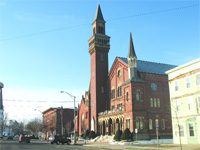
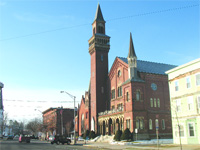
    The conversion of the old town hall into CitySpace is one of many arts-focused initiatives in Easthampton.

    The conversion of the old town hall into CitySpace is one of many arts-focused initiatives in Easthampton.

    Editor’s Note: In this issue, Business-West begins a new series that will provide snapshots of many of the cities and towns in Western Mass. In each issue, a different community will be highlighted in a program intended to inform readers about the issues and challenges facing these cities and towns, while also providing some of the flavor that makes each community different. This series will include communities in the four counties of Western Mass. — Berkshire, Franklin, Hampden, and Hampshire — and begins with the Hampshire County jewel Easthampton, one of the region’s newest cities.

    Michael Tauznik is Easthampton’s first, and still its only, mayor. He was first elected in 1995, giving him tenure surpassed only by North Adams’s long-time corner-office holder, John Barrett III, who has been in his seat since 1984 and is the longest-serving mayor in the Commonwealth.

    Beyond the very unofficial title of ‘dean’ of Springfield-Holyoke-area mayors, Tauznik’s lengthy stint in what can now be called City Hall. has given him a front row seat to an ongoing evolution of this community’s economy. A former mill town where everything from paper to rubber stoppers; from cleaning products to the stretch bands in underwear were produced, Easthampton has become a more arts- and culture-focused community, with much of that old mill space now occupied by painters, sculptors, photographers, upholsterers, furniture makers, and others who find the community an attractive and affordable alternative to Northampton.

    Meanwhile, the community’s old town/city hall is undergoing a transformation that underscores this fiscal evolution. It’s called CitySpace, the name given to the effort to convert the Main Street landmark into a center for the arts and arts-related businesses. The first floor is now occupied by a gallery and frame shop, and there are preliminary plans to take the spacious auditorium on the second floor where town meetings were once staged and convert it to a performance venue.

    And starting this summer, the city will become home to something called the Easthampton Bear Fest. From June through mid-October, the community’s downtown will host an exhibit of life-sized, fiberglass bears (like the cows seen in some communities and the whales that populate Cape Cod) that are creatively painted, decorated, and festooned by artisans from Easthampton and the region and placed in various public spaces within an easy walking tour. A total of 30 bears, 20 life-size and 10 smaller, will be displayed. The bears will be sponsored by businesses and individuals, and will be auctioned off at the end of the festival to benefit Riverside Industries Art Program, Easthampton Public Schools art programs, the artists who decorate them, and Easthampton City Arts.

    That’s quite a change from the days when most everyone who lived in the town worked at one of a dozen major mills.

    But while Easthampton is embracing the arts and the artisans, its manufacturing heritage is not exactly a thing of the past. In many ways, it’s still a thing of the present, said Tauznik, with several major players, including Berry Tubed Products, October Co., Stevens Urethane, and others, employing more than 1,000 people.

    There are far fewer of the major employers that called this community home decades ago, said Eric Snyder, director of the city’s Chamber of Commerce, adding that Easthampton, like most other area cities and towns, now relies on small businesses and diversity to remain vibrant.

    “Easthampton’s progression is still a work in progress,” said Synder, who told BusinessWest that the city is “maturing” as a center of arts and culture and home to small and very small businesses. “We’re still at a point where we’re growing, and there’s greater realization that is what’s happening in Easthampton; people are taking notice of what’s going on here.”

    In this issue, BusinessWest, in the course of profiling Easthampton, will examine this maturation process and what lies ahead for this gem in the shadow of Mount Tom.

    Brush with Fame

    It’s called Art Walk Easthampton.

    That’s the name attached to a program started two years ago and staged on the second Saturday of every month. Residents and visitors are encouraged to walk around the community and, while doing so, visit some of galleries and arts venues and get a sampling of local, regional, and national talent.

    Such venues include the Blue Guitar Gallery, Easthampton City Arts (the non-profit group formed in 2005 to enhance the collaborative efforts of the artist and business communities in the city), the Lathrop Inn Art Gallery, Nashawannuck Gallery, and the Pioneer Arts Center of Easthamp-ton. Each venue is identified by a bright yellow Art Walk banner; there’s even a similarly colored shuttle bus.

    The fact that this community now has a monthly art walk with its own Web site (www.artwalkeasthampton.org) speaks to the changes that have taken place over the past few decades, said Snyder, adding that change is ongoing and constant.

    The transformation began while the community was still actually a town, said Tauznik, noting that, over the past 15-20 years, Easthampton has seen many of its old mills become small-business incubators and homes to hundreds of artisans. The first of these conversions was at One Cottage Street, an old mill that once made elastic bands for undergarments and other uses.

    The property was eventually taken over by Riverside Industries Inc., a nonprofit agency serving the developmentally disabled, which began leasing out some of the cavernous space for use as studios and workshops. By the late ’90s, a cultural community had taken root on the property, one that continues to grow, thrive, and inspire similar ventures today.

    The city’s evolution continued with the biggest of these mill conversions — at the sprawling former home to Stanley Home Products, later Stanhome, on Pleasant Street. The 500,000-square-foot building is home to dozens of businesses and has become both a business address and a destination, with a number of restaurants and shops that bring visitors — and dollars — into Easthampton from outside its borders.

    Today, the tenant list includes everything from a maker of decorative gift baskets to a driving school.

    There have been other, smaller mill conversions, including the one at the former Paragon Rubber Co. plant just down the road from Eastworks (see story, page 39). The sum of these efforts has given the town a solid foundation on which to build and a chamber membership roster at more than 350, and growing.

    “This is really a community of small businesses now,” said Snyder, whose job it is to serve and engage his members. “They’re the backbone of the economy here.”

    The emergence of an arts community has brought attention — and large numbers of visitors — to the city’s downtown, said Tauznik, noting that one challenge for the community is to market itself and thus increase its visibility.

    Art Walk Easthampton has certainly helped in this regard, he said, and the bear festival provides an additional boost to the efforts to move Easthampton off the list of best-kept secrets.

    Like Snyder, Tauznik said Easthampton is in the midst of a maturation process as it grows and promotes its cultural economy. And continued growth will be challenged in the short term by the recession and its impact on town finances.

    Like virtually all communities, Easthampton is facing sharp declines in auto excise tax receipts and other forms of revenue, as well as the threat of cuts in local aid from the Commonwealth. Thus, the city will have to become creative itself as it searches for funding sources for projects like CitySpace.

    “Finding money to do some of the things we want to do will be difficult, but doable,” he said, noting that the community recently secured funds to help the owners of the Paragon building install new windows along Pleasant Street. “We’re going to have to be diligent and imaginative.”

    Not Your Run-of-the-mill Town

    “Connecting the Past with the Future.”

    That’s one of the working slogans used by Eastworks in its promotional efforts, and in many ways it speaks to what the community is trying to do as it continues to evolve and mature.

    It’s not leaving the past behind, said Tauznik, noting, again, that the city embraces its manufacturing heritage and still relies on that sector for needed jobs. But like all communities, it must diversify to remain vibrant.

    It has been made considerable strides in that regard, but, as Snyder and the mayor noted, there’s still work to do with this work in progress.

    George O’Brien can be reached at[email protected]

    Sections Supplements
    For Area General Contractors, It’s Truly Survival of the Fittest
    Eric Forish

    Eric Forish says his company has added services and diversified, making it better-prepared for the rigors of the current downturn.

    The economic downturn has hit a number of sectors hard, but perhaps none more than the construction industry, which has been impacted by everything from the sharp decline on the stock market to the collapse of the auto industry to falling confidence among business owners who might otherwise be looking to build or expand. There is some optimism, though, mostly in the form of hope that an economic-stimulus package will put some projects into the pipeline.

    David Fontaine has seen a lot of things in his three decades in business — but nothing quite like the current spate of challenges facing the construction sector.

    “We are probably at the low point of my 30-year tenure here,” said Fontaine, president of Fontaine Brothers in Springfield, which specializes in public-sector work and built the MassMutual Center, among many other local landmarks. “On average we have about 13 or 14 projects ongoing, and right now we are at four. The public sector bottomed out a few years ago, and in times like that you will typically see the private sector jump in and say, ‘now’s a good time for us.’ It just doesn’t seem like that really happened.”

    Russell Sprague, president of 100-year-old A.R. Green & Son Inc. in Holyoke, noting that his volume is down 50% from a typical year, used similar language. “It’s gloomy out there right now; Public works projects are down, in general, and the sizes of the projects you do see are smaller.”

    His company recently built the new field house at Smith College, but he doesn’t expect to see much more work on that scale anytime soon. “At the colleges, you don’t see the same scope of projects; there’s maintenance work on buildings that might have been deferred, but now they’re doing that work because they have to. Public-school construction has come to a screeching halt. I haven’t seen any of those in bid for the last six months.”

    Other general contractors we spoke with sounded similar notes. Overall, say players in this field, there’s less work and far more competition for what work is available. These converging trends are driving bid prices — and therefore margins — way down.

    Some contractors have been affected more than others, depending on their specialties, but nearly all of them are feeling the pinch, with builders noting downturns across virtually every sector — from higher education to ski resorts — that are impacting construction volume.

    “We do a lot of work up in Vermont, and that area is really slowing down,” said Gene Kurtz, president of Kurtz Construction in Westfield, referring to ski country. “All the resort areas had seen a lot of high-end work, but that was Wall Street money. It’s basically stopped.”

    Steve Killian, senior vice president of Barr & Barr Inc., a New York-based construction management firm with a local office in Springfield, said similar things about the higher-education sector, noting that, while his firm handled some large-scale projects last year at Mount Holyoke, Williams, and Yale, he’s not expecting the same volume in 2009.

    That’s because college endowments were hit hard by the disastrous year on Wall Street, and many schools are re-evaluating some large-scale capital improvements.

    “We’ve had a few projects pulled back or taken off the table,” Killian explained, noting that Yale is still going through with several aspects of a $1 billion capital campaign, but other schools have slowed down their construction activities significantly. “Williams College put the next phase of their 100,000-square-foot Stetson/Sawyer project on hold for about a year, maybe six months, depending upon the market.”

    While most all companies are struggling to some degree, some are faring better than others because they saw this slide coming and prepared accordingly — by getting leaner and meaner, and, when and where possible, diversifying their services.

    Looking forward, most companies say they will try to focus on more than mere survival, and instead position their companies for when the better times arrive, possibly on the wings of an economic stimulus package that might move construction projects into the pipeline and put crews to work.

    Building a Consensus

    But gauging when that day will arrive is difficult, and it has become the $64,000 question.

    Indeed, while most contractors have lived and worked through many economic cycles, this one has some twists and turns that make predicting the future quite difficult.

    “This will be the fourth recession I’ve seen,” said Fontaine. “The other three, you had a pretty good idea of how long they would last. This one here, I don’t think anyone has a grasp of how long it’s going to go on.”

    As for the present, area contractors say they are focused on making the best of a bad situation. And for many, the hope is that planning for the current downturn and effective strategic response will not only get them through, but create some potential growth opportunities.

    Eric Forish, president of Westfield-based Forish Construction, noted that this family business has been operating for more than 60 years, longevity achieved through diversity and flexibility.

    “Because of our conservative, Yankee values, we have tended with time to maintain that philosophy of saving for a rainy day,” he said, “and this is that rainy day.

    “We’ve positioned ourselves appropriately for 2009,” Forish continued. “We’ve maintained a diverse client base — private sector, public sector, institutional work, not just construction, but design services. We have a diverse portfolio of our operation. It’s proven successful for 63 years.”

    Preparation for the recession was key to keeping ahead of the current, Kurtz agreed, noting a period of streamlining that his company undertook earlier in 2008. Coupled with reorganizing the company, he mentioned some other new developments which position his company well.

    “One of the things we’ve done in the last couple of years,” he said, “is to increase the number of services and products we can offer, and that is helping us a great deal. We have a line of Lester buildings (pre-engineered metal structures) for small to mid-sized manufacturing facilities. Those buildings are marketable, affordable, and very popular right now. We’ve got a few of those projects in process.”

    Said Killian, “the recession has been reflected in every aspect of our market. Our response as a company has been that we saw some of this coming, and we started making some reductions in both internal costs and overhead costs early on, in the last two quarters of 2008, which really helped. We prepared ourselves for an ’09 that’s a little more lean than we would like.”

    Overall, though, no amount of preparation could have readied some companies for the severity of the downturn that hit in 2008, as reflected in U.S. Labor Department statistics showing that that the non-residential construction sector lost 6,800 jobs last December, and that for the year, job losses totaled 53,400, the biggest annual decline since 1991, or during the last major recession.

    The fallout resulted from slowdowns, or near halts to building in several sectors, an environment created by factors ranging from the 35% decline on Wall Street, which impacted colleges, health care facilities, and any other institution with an investment portfolio, to a precipitous decline in confidence among business owners of all sizes.

    Pounding the Pavement

    Despite these challenges, there is some work out there, said Carol Campbell, president of Chicopee Industrial Contractors, a firm that specializes in assisting clients, mostly manufacturers, with moving and installing equipment, work that often goes on regardless of the economic conditions.

    “The companies that we’re working with might be dealing with their own layoffs,” said Campbell, “ But these are projects that have been in the pipeline for several years. So, while we are doing a multimillion dollar project, the company itself might be streamlining its own internal organization.”

    CIC has done some streamlining of its own, said Campbell. “We’re a little smaller than we were two years ago — we’re down four employees — but taking that into consideration, we are strong.”

    One of the biggest challenges facing builders is the mounting level of competition for existing work, a climate created by declining volume across the state and the region, which has prompted firms from Worcester, Boston, Connecticut and other points on the compass to vie for work in the 413 area code.

    “Yes, there are opportunities,” said Forish, “but they are getting fewer, and they are drawing more attention — competition is extremely keen. If you look at a public bid list, a few years ago you’d see maybe a half-dozen builders, but now you are seeing two or three times that number.”

    Most everyone agreed that the growing legions of bidders have led to some shocking numbers for profit margins on jobs, with some builders possibly trading a dollar to make a dollar. “I think there are guys out there who didn’t prepare well that are cutting their bids down just to get a cash flow,” said Killian.

    Added Sprague, “a lot of these guys coming from Connecticut or Eastern Mass., quite frankly, I don’t know how they’re doing it, because they are coming in with numbers that I consider to be below my costs. It’s scary.”

    While the current conditions are bleak, there is some optimism concerning 2009, mostly in the form of conjecture concerning the size and scope of an economic stimulus package that many analysts believe will be passed in the next few weeks.

    In its 2009 economic forecast, the Associated Builders and Contractors (ABC) says that while this “looks like a challenging year for the commercial and industrial construction industry, the next federal stimulus package being discussed … may emerge as a countervailing force.”

    Currently, communities across the nation are putting together wish lists for possible federal funding as part of this proposed stimulus package from President Obama. Forish mentioned that builders are watching carefully what public projects might become available from that incentive. “If local communities see some of that funding, that will enable them to go forward with construction projects that they wouldn’t be able to undertake otherwise.”

    In the meantime, those managing firms must be diligent — and imaginative — in their pursuit of opportunities, said Peter Wood, president of Business Development at Associated Builders in South Hadley.

    “There are always opportunities if you expand your marketing and continue to network to find the projects that are out there,” he told BusinessWest, adding that he believes Western Mass. has weathered the financial crisis better than many other parts of the country.

    “Health and service industries, while they are impacted, they do need to keep up their facilities, whether it’s new construction or an upgrade of existing structures. From a construction standpoint, that work still tends to be available.”

    The Real Dirt

    Fontaine isn’t alone in his assessment about these being the worst of times — or the worst that most can remember.

    Most general contractors have been through downturns, and they’ve weathered storms. But this one is different. A confluence of factors has made finding work and keeping crews busy increasingly difficult. This is a time to be a resourceful and creative, say the contractors we spoke with.

    That’s because there is no real margin for error.

    Opinion

    A Boston Globe sports columnist was writing recently from Seattle. He was trying to describe just how bad things are for the sports teams and their fans there, and he summoned this phrase: “reading the sports page here is like reading the business page everywhere else.”

    Ouch.

    That says a lot about how last place has become the mailing address for most teams in that city — but also about how painful it was, and is, to turn to the business section. It has been replete lately with stories about layoffs, failing banks, climbing mortgage-foreclosure rates, stocks tumbling hundreds of points on a regular basis, businesses closing, car dealers posting wretched numbers, and retailers having lousy months, quarters, shopping seasons (take your pick, they all work).

    Locally, residents were treated to all of the above, with specific examples ranging from the collapse of Skybus and the closing of its operation at Westover to the loss of SunEthanol (now Qteros) to the Worcester area, the closing of several car dealerships, and even Springfield’s ranking among the fastest-dying cities in the U.S.

    It wasn’t all bad. It just seemed that way.

    Amid the gloom and doom there were some bright spots, and in an attempt to maybe get 2009 off to a decent start, BusinessWest thought it would recount five of those positive stories. In no particular order:

    • A blueprint on workforce development. Toward the end of 2007, regional economic-development leaders initiated a program to improve the quality and quantity of the region’s workforce for the long term. Called Building a Better Workforce — Closing the Skills Gap on the Road to Economic Resurgence, the endeavor took its first major steps forward in ’08 with programs to put workers in the pipeline for the health care and precision-manufacturing sectors, and also increasing access to preschool. Perhaps more important, the first steps will get a number of businesses and institutions actively engaged in an issue of vital importance to the region’s future
    • The emergence of YPS. That’s the acronym for a group called the Young Professional Society of Greater Springfield, which, while only a few years old, seems to possess enormous potential to not only keep more young people in this region, but also help prepare them to be leaders — in business and the community.
    • New life for an old mill. Westmass Area Development Corp. announced plans to acquire the old Ludlow Manufacturing Associates complex in the center of that community. This is a 20- to 30-year proposition that looks to transform the nearly 1 million square feet of mill space and 79 acres of adjacent undeveloped land into a business and industrial center. At a time when the inventory of traditional greenfields is shrinking, the Ludlow development is an imaginative attempt to give companies more opportunities to move to and grow within the Pioneer Valley.
    • The start of a ‘green’ wave. Yes, the region will lose Qteros, one of the best emerging ‘green’ stories in Western Mass., but there are some other signs of potential growth in the realm of ‘green jobs.’ In Wilbraham, a company called FloDesign is making progress on a prototype that may revolutionalize the design of wind turbines. Meanwhile, in Greenfield, there are the makings of a ‘green’ cluster. And everywhere, there is a commitment to creating jobs in what looks like a sector with enormous promise. Stay tuned.
    • Liberty Mutual brings hundreds of jobs to Springfield. With what seems like a big assist from Gov. Patrick, Liberty Mutual announced that it would locate a call center in the Technology Park at STCC. Cynics will say that these are just call center jobs and that the company would have done the city more good if it had located downtown. The bottom line is that these are new jobs, and decent jobs, coming in a year when there weren’t many gains in that department. Meanwhile, a big part of this good story is the fact that Springfield triumphed over many other job-hungry cities in what became known as Project Evergreen.
    • There were other somewhat uplifting stories from 2008 that, while they didn’t obscure all the bad news, generated some hope for 2009 and well beyond. Let’s see if the region can build on this in the year ahead.

      Sections Supplements
      Fire Tests Country Bank’s Response Systems and Its Mettle
      Paul Scully and Patti Mitchell

      Paul Scully and Patti Mitchell both say that companies in all sectors can take some practical lessons from Country Bank’s disaster-preparation and recovery efforts.

      It was big news, if not exactly a big fire. Indeed, the blaze that broke out in the Country Bank headquarters building in downtown Ware last month was extinguished quickly, with only significant smoke damage. But the fire provided a stern test of the bank’s emergency preparedness and response systems — a test that was passed with high scores and also some important lessons for companies in all sectors

      Paul Scully grabbed his desk calendar, flipped it back a page, and tapped his finger on one of the appointment-filled boxes.

      “November 19th, two days before the fire, we had a fire drill,” said Scully, president and CEO of Ware-based Country Bank. “I remember … it was really cold and quite windy; everyone was miserable standing out there. They were saying, ‘whose idea was this?’”

      A few minutes later, he flipped the calendar back another page, scanned it, and quickly found the notation he was looking for. “October 26th … that’s when we had our annual mock disaster drill,” he noted. “I’d say that if we were going to have a serious emergency, our timing was pretty good.”

      Indeed, but this nearly 160-year-old institution had much more going for it than timing as it responded to what would have to be considered a minor, albeit quite smoky fire late in the afternoon on Nov. 21 at the bank’s headquarters in downtown Ware. It had procedures, preparation, redundancy, excess capacity, and, ultimately, nearly flawless execution that kept the bank open and running, and without the loss of any data stored in its system — or any momentum.

      All these are things that banks plan for and pay a high price for — a byproduct of the Y2K-9/11 double-whammy — but most have never used them for anything approaching a real emergency. And crossing over that line is eye-opening, and also a little bizarre.

      “The surreal part of all this is that, with all the planning and the significant sums of money that are put into disaster-recovery efforts, you just think you’re never going to really need them,” Scully said. “That was the part where you say, ‘wow — not only are we prepared for it, but this really can happen.’”

      The bank also had some extremely high standards set by its so-called Disaster Recovery Team, which had every facility but the main office (due to be closed for several more weeks as the building is cleaned and renovated) handling business as usual at 9 a.m. on the Saturday after the fire, “and wouldn’t have been content with anything less,” said Scully.

      “To say that we could have a fire on Friday night and that it will be OK if we don’t open until Monday morning simply wasn’t — and isn’t — acceptable to this group,” he said. “They’re the ones who said, ‘we don’t want to cause any disruption in services to anyone.’”

      And the institution had what just a few weeks ago would have been considered “luxuries” for most companies, said Scully, who used that term to describe the roughly 44,000 square feet of space in an old ice-skate-manufacturing facility just a few hundred yards from the main office that the bank began leasing a few years ago, as well as dozens of spare computers it happened to have on hand as part of its disaster-recovery plan.

      There are important lessons to be taken from all this, not only for banks, but all companies, said Scully, noting that preparation, planning, and redundancy — to the extent possible — and not good timing were the real keys to successfully handling this incident.

      “This provided a really good lesson for a lot of businesses who probably don’t do this,” said Patti Mitchell, the bank’s longtime director of Marketing. “Things went like clockwork here, and that wasn’t by accident; people knew exactly what to do and when to do it. If we hadn’t planned for something like this, people would have been going in every direction, not knowing what to do.”

      In this issue, BusinessWest recounts the events of Nov. 21, but also explains why what came long before that afternoon is the real story of the fire at Country Bank.

      Taking the Heat

      Scully was just leaving the bank’s East Brookfield office after a meeting with staff there when he got the call.

      “My first response was, ‘define fire,’” he said when recalling his reply to the human-resources administrator who reached him on his cell phone with the news. “I was asking her, ‘is it a big fire, a little fire? What?’”

      The person at the other end didn’t know — she wasn’t on-site, either — but would endeavor to find out. By the time Scully reached downtown Ware, only to be trapped in a massive traffic jam that resulted when the police shut down Main Street, he knew that this wasn’t a fiery blaze — caused, he would learn later, by a malfunction in a small stove in the facility’s basement-level break room — but did produce vast amounts of thick black smoke.

      “The cinderblock walls produced an oven-like effect,” he explained, adding that there was a good amount of heat and smoke that caused damage estimated at anywhere from $500,000 to $1 million.

      When he finally arrived at the landmark building at the corner of Main and Bank streets, Scully could only stand outside, watch, and wait for reports — the most important of which came more than an hour later, when fire officials would confirm that everyone who could have been in the building — employees, contractors, vendors, and anyone else — when the fire broke out was accounted for and uninjured. (The blaze broke out after the bank had closed, so there were no customers inside at the time.)

      The fire was big news in Ware — the local weekly, The Ware River News, devoted its entire front page to the incident — due primarily to the size of the company involved (the bank is one of the largest employers left in the community), the historical nature of the building (it’s been a bank for more than a century), and the commotion it caused. However, the damage was fairly minor, and most customers who don’t live in Ware or read its local paper didn’t even know there was a fire.

      And this, said Scully, is how things should be, and how one can measure just how effective all the planning and response systems ultimately were.

      Elaborating, he returned to the fire scene and his first thoughts after verifying that no one was injured. “I was thinking, “we have to open in 14 hours!” But by the time these thoughts were being processed, people working behind the scenes had already made sure the doors at the institution’s 13 other locations would open as scheduled.

      This feat requires that all computer-operated systems remain functional via a back-up system at a remote location — in this case the leased space in the former American Athletic Shoe complex along the Ware River — and also having the physical space for people to perform their work.

      “You need to have the capacity to accommodate a significant number of additional people,” he explained, “so that not only could we operate all of our satellite operations, but if a facility like the main office was involved, all of those people, all of whom have important work to do, can be doing that work somewhere else.”

      The bank’s disaster-response plan sets down a series of steps to ensure the continuance of operations, said Scully, and there is continual practice carrying out these steps, especially at the annual disaster drill.

      “We identify all the critical tasks,” he explained, “meaning answers to the questions, ‘what has to be in this amount of time?’ ‘What needs to be in 12 hours, or 24 hours?’ And we rehearse all this.”

      Burning Issues

      Such practice pays off, he continued, as evidenced by how coolly and calmly the disaster-recovery team went about its work.

      “Had someone been in the room when we set up the command site, they wouldn’t have had a sense, based on the emotional level in the room, that we were in the middle of a fire — other than the fact that we all smelled of smoke,” Scully explained. “A few of our board members showed up and said that it was obvious that people were in total control, that they knew what their assignments were and they were executing them.”

      As he replayed the events in the hours and days after the fire, Scully said there were a number of factors that contributed to a quick, effective recovery and a tally sheet that the bank’s president described this way: “customer impact: none; staffing impact: none; concerns about any lost business: none, because you were able to accommodate all that.”

      He said the bank’s decision to lease significant space in the former mill and create what it calls an ‘operations center’ was certainly one such factor. That square footage provides the institution with far more space than it needs — or needed until a few weeks ago.

      “We’re using every bit of that space now,” he said, noting that roughly 90% of those who were working in the main office when the fire broke out were behind desks and computers at the operations center on Monday morning — and working.

      And everything is functioning so normally that there is absolutely no rush to reopen the doors of the headquarters building. “We’re looking forward to getting back in,” said Scully, “but the interesting part is that, when we moved into this building, we built it out to accommodate future growth; we just didn’t know the future growth was going to happen overnight.”

      Timing was also a factor, he said, noting those aforementioned drills, and even evolution played a part — as in the evolution of banking and technology. There is far less paper being used in all banks today, he explained, and there’s even less cash in the vault because of the widespread use of debit cards.

      But effective planning was the real key, he continued.

      Scully said he has a number of qualitative and quantitative measures for how well his bank handled its adversity. The number of people who didn’t know about the fire is one he likes to cite. Another is the fact that 25 bank employees were scheduled to show up the Sunday after the fire and help decorate Main Street for the holidays — and all of them made it.

      “That’s an indication of just how much it was back to business as usual,” he explained. “Everyone was there.”

      Not every business can lease 44,000 square feet of mostly extra space sitting in case it’s needed, he said, and not every business can have closets full of spare computers handy in case a smoky blaze prompts the relocation of dozens of workers.

      But there are steps that each and every business can and should take to prepare for an unexpected incident. If one actually occurs, the experience may be surreal, as Scully described, but it won’t be, well, a disaster.

      Banking on It

      When asked what lessons the bank took from its ‘disaster,’ Scully joked that the renovated break room will likely be outfitted with simply a microwave.

      Beyond that, he said, the company can take a good dose of reassurance that the money it has spent on redundancy, disaster preparation, and disaster response — much of it now legislated — is certainly money well-spent.

      Businesses not as tightly regulated can learn from this as well. And the ultimate lesson is that they shouldn’t wait for a disaster to prepare for one.

      George O’Brien can be reached at[email protected]

      Opinion

      The saga of the so-called Q microbe, the micro-organism that could dramatically alter the course of ethanol production, remains one of the most compelling research and development stories in business today.

      The problem is, it will soon be some other region’s story.

      Specifically, Worcester’s. Those developing the Q microbe announced just over a week ago that, while they would love to stay in the area, where the microbe was discovered (near the Quabbin Reservoir, hence the name) and where many researchers live and work, the facilities and workforce are apparently lacking, thus forcing them to go elsewhere for the next phases of this ambitious project.

      This isn’t the first time the region has lost a biotech firm on the rise to the Worcester area, and this announcement made by the principals of Qteros, formerly SunEthanol, could not have been considered a real surprise. But it still hurts.

      Actually, this loss is especially painful.

      Why? First, there was the promise of new jobs as the concept worked its way through the R&D stage. There would also have been exposure for this region, which is much-needed as it attempts to develop new clusters in the broad technology sector and create new sources of jobs to replace those being lost in traditional manufacturing and other sectors.

      But there was also the pride factor, for lack of a better phrase. This is a potentially game-changing development, as they say in research, and it was unfolding right here in the Pioneer Valley. This was going to be a great story for the company, its leaders, UMass (where much of the research is taking place), and the region as a whole.

      It will still be a great story — it just won’t be ours.

      And this has many people saying that economic-development leaders could have — and should have — done more to keep the company in this area code. This is easy to say (one can always do more), but we’re not sure anyone here could have done enough to change this outcome.

      “We needed to move fast, and there really wasn’t a facility here,” Susan Leschine, chief scientist for Qteros, told the local press while explaining the move to Worcester County, juxtaposed against news that the company had received $25 million in next-stage funding.

      Reading between the lines of the statements made by those involved, it seems clear that those at Qteros simply got a better offer — probably a much better offer — to move east, where there are large research facilities and, according to many in the industry, a deeper pool of labor to tap.

      While being disappointed with this news — as economic development leaders say they are — they should also be determined not to let something like this happen again.

      The Worcester area already has an infrastructure in place, as well as a critical mass of companies in this field and talented workers. The Valley? Well, it’s working on all that.

      And the lesson to be learned from all this is to keep working on it, so that the next time a company is in the position Qteros is in now, the region stands a fighting chance of keeping it here.

      New UMass Chancellor Robert Holub told BusinessWest recently that he is committed to taking the university to the “top tier” among the nation’s research universities. To do that, he and others at the school will have to work with area ecomomic-development leaders, area businesses, and other colleges to create that infrastructure and workforce that Western Mass. currently lacks.

      By doing all this, the Valley can not only retain future companies like Qteros, it can possibly attract some from other regions, like Worcester.

      The loss of Qteros will sting for some time, but this setback will be even more profound if area leaders don’t answer the wake-up call and ultimately make the Pioneer Valley better able to compete for such companies.-

      Opinion
      Don’t Limit Access to Higher Education

      By most accounts, we are now entering the worst economic crisis since the Great Depression. Nationally, the signs abound: the loss of home value, the meltdown in the stock market, the rise in unemployment, collapse of the credit markets, and a record $1 trillion federal deficit.

      As these dramatic changes reverberate through the economy, a college education becomes ever-more important to secure a decent paying job and enter a stable career; studies show the link between higher levels of educational attainment and higher average salaries. Furthermore, certain associate degrees such as those in nursing, allied health, computer science, and manufacturing, pay much greater dividends becaue jobs in these fields are in high demand.

      In this environment, individuals are facing hard choices about where to commit to spend their money. Where to go to college and how to pay for higher education ranks among a family’s most important decisions.

      One may choose between public and private colleges, with elite private colleges now costing — without room and board — upwards of $40,000 per year. Within the public sector, there are three options: university campuses, state colleges, and community colleges. In Massachusetts, average student charges per year without room and board for these three segments are:

      • $9,585 for the four UMass campuses;
      • $6,400 for the nine state colleges; and
      • $3,862 for the state’s 15 community colleges.

      Since community colleges are the least expensive, they are becoming more and more popular as a way to stretch a family’s and student’s limited resources. And people are flocking to these local colleges. Fall 2008 figures show community colleges now dominate enrollment in the state with 89,000 students, compared with 46,928 at the four university campuses, and a total of 37,509 at the nine state college campuses.

      This fall, community colleges statewide had an enrollment increase that averaged 5.3%, the largest jump of any segment. Although the Commonwealth’s community colleges offer only the first two years of a baccalaureate degree and a number of two-year career programs, the quality of instruction is superb. Consider that community colleges are teaching institutions with a focus on undergraduate students. Faculty are hired because of their knowledge and their ability to teach, not for research skills.

      Springfield Technical Community College, for example, offers 60-plus career programs in business, health professions, computer science, and engineering technology. In addition, the college has a robust liberal arts curriculum leading to transfer to baccalaureate colleges throughout New England. Local private colleges — AIC, Elms, Bay Path, Western New England, and Springfield College — court STCC graduates through agreements that provide guaranteed scholarships for students with good grades.

      Many STCC students also transfer to the public institutions, most notably UMass Amherst and Westfield State College.

      So, for those worried about the economy and the future, community colleges continue to be the best deal in the state.

      However, the current state budget deficit now threatens the accessibility and affordability of public higher education just when Massachusetts residents most need it.

      Community colleges are the most lean and efficient segment of higher education, educating more students with less funding. They enroll more than half of public higher-education students, yet receive approximately one-quarter of state funding. Consequently, it will be more difficult for these institutions to absorb major funding cuts without affecting the quality of the education and resources so important to students and to our economic future.

      Education is the economic driver for our state, producing the skilled and knowledgeable employees needed by business, schools, and industry — particularly the health care industry.

      While cutting funding for education will save money in the very short term, it will represent a far greater loss for our citizens and our state.

      Ira Rubenzahl is president of Springfield Technical Community College.

      Features
      Marketing Effort Answers the Question About How to Raise Awareness of the Agency
      Joe

      Joe

      His name is ‘Joe.’

      And while he bears some resemblance to a few business owners in the area, there is no one person who inspired this character, said Ann Burke.

      Instead, he represents every business owner in the region, said Burke, vice president of the Western Mass. Economic Development Council, and thus he puts a face on an intriguing new marketing intiative launched earlier by this fall by the agency.

      It’s called ‘Ask the EDC,’ and its primary mission, said Danielle Paine, manager of Communications for the non-profit agency, is to raise awareness of the many ways in which it can be of assistance, especially to small-business owners, through myriad free services offered by a host of organizations affiliated with the EDC.

      Such services — from help with writing a business plan to assistance with crafting an energy-conservation program — are always in some level of demand, said Paine, adding quickly that such interest rises in trying economic times such as these. Which explains the timing of ‘Ask the EDC,’ which, according to some early numbers, is doing precisely what it was designed to do.

      Indeed, while it’s somewhat early to draw in-depth conclusions about the overall success of the initiative, initial response to the campaign has been positive, said Burke, adding that, while the EDC was getting a few random questions a week from area business owners before the campaign started, it is now getting closer to 15. And traffic to the EDC’s Web site is up, unofficially, by about 30%.

      All this is positive news for the region, she told BusinessWest, noting that one of the EDC’s primary missions is to help existing businesses survive, thrive, and, if at all possible, stay in this region. The ‘Ask the EDC’ program, part of a larger effort called HomeField Advantage, has become an important manifestation of that mission, and at a time when many businesses are struggling and looking for some help to get them through to the day when the economic climate improves.

      “Acknowledging that 70% of our growth comes from within, meaning businesses that are already in the region, and the need to better support those businesses in light of these challenging times, we decided to launch this campaign to help make people more aware of the free services available to them,” said Burke. She noted that recent questions reflect the current conditions, and include issues such as replacing lost customers, securing financing, and creating new revenue streams.

      Helping small business owners get the answers to these and other questions was the motivation for ‘Ask the EDC,’ which was officially launched on Oct. 27 and has included print ads, radio spots, a new page (asktheedc.com) on the EDC’s Web site, and a billboard on the southbound lane of Interstate 91 near Longmeadow.

      The campaign was inspired by the nagging perception that, while larger businesses probably know about the EDC, its services, and its affiliations with a host of economic-development agencies and business-support organizations, many smaller venues don’t, or lack a full understanding of the help that’s available. The recent surge in calls, E-mails, and Web hits would seem to verify that notion, said Burke, and offer evidence that the $28,000 expenditure has been a sound investment.

      ‘Ask the EDC’ was designed to build the EDC brand, said Burke, and, in general, educate business owners and managers about the many areas in which support is available. They include:

      • Real estate, or help with finding a new location;
      • Capital access, or assistance with obtaining financial resources, grants, micro-loans, venture funding, and incentive programs;
      • Regional data and drive-time analysis, or access to demographics and statistics needed for relocation and expansion decisions;
      • Peer networking opportunities;
      • Workforce development, or insight into recruiting and training opportunities, internships, and grants to help resolve staffing issues; and
      • Academic institutions, or ways to tap into the resources available at the colleges and universities in the Knowledge Corridor.
      • The questions posed to asktheedc.com have run the gamut, said Burke, as evidenced by one recent print ad. One inquirer wanted some input on whether state funding or other types of grants are available for a solar power installation for his manufacturing plant. Meanwhile, a retailer in what he called a “hidden location” in Springfield wanted to know if there was financing available for some obviously needed marketing.

        “My company currently uses contracted employees, but we are interested in transitioning to direct hire,” wrote a third business owner. “How can we learn about workers’ compensation wage rates and insurance?” Still another, the owner of a small electrical-contracting business, desires to build in the local industrial park and wanted to know where to turn for financing.

        Those with questions are often referred to a veritable alphabet soup of acronyms, said Burke, connoting agencies such as the Western Mass. Enterprise Fund (WMEF), the Small Business Development Center Network (SBDC), SCORE (the Service Corps of Retired Executives), and even the Mass. Office of International Trade & Investment (MOITI).

        Paine told BusinessWest that the new marketing campaign will run through the end of the year, at which time, she, Burke, and others will review goals, results, and strategies for moving forward. Results (in the form of responses to the various marketing vehicles) are being carefully tabulated, she continued, adding that the EDC will likely continue the campaign with those media outlets that are generating the best results.

        For now, ‘Ask the EDC’ seems to be the answer to the ongoing question about how to brand the EDC and make its broad menu of services and affiliations known to more business and owners and managers.

        Just ask ‘Joe.’— George O’Brien

        Sections Supplements
        Companies Develop Unique Plans to Recycle and Reduce Waste
        Sean Anderson

        Sean Anderson says MassMutual’s efforts to go ‘green’ fit in well with cost-cutting plans already in place.

        You may remember a lot of talk about the paperless office back in the ’80s. Personal computers were becoming popular, and ‘paperless’ was a way to describe the office of the future, with data stored in hard drives, not filing cabinets. The hope was that automation would make paper redundant, but that never happened.

        In reality, people used their new, high-speed photocopiers to print even more things on paper. Consequently, the term ‘paperless’ got sent to the archives.

        Now, oddly enough, the term is resurfacing. Only this time it’s accompanied by words like ‘renewable,’ ‘sustainable,’ and ‘recyclable.’

        In fact, if you work in an office where people are talking about being paperness, chances are good you’ll also find recycling bins in the cafeteria and ceramic coffee mugs in the break room. Paperless is once again a part of the office of the future.

        And this trend is just part of a green tidal wave of ideas and strategies that companies are applying toward reducing waste and making work environments a little more healthy for employees. In Western Mass. businesses take their green initiatives seriously; depending on the product it offers, each company has its own unique challenges to consider when developing programs to benefit the environment.

        In this issue, BusinessWest looks at some of the many manifestations of going ‘green,’ and how companies of all types are expressing their concern for the planet and its future.

        Green Badges of Honor

        It’s impossible to talk about ‘green’ business without mentioning the crème-de-la-crème of greenness: LEED certification. LEED stands for Leadership in Energy and Environmental Design. It’s a program run by the U.S. Green Building Council that provides a rating system for environmentally sustainable construction.

        An actual LEED building is a rare thing, because it means tossing out everything and starting from scratch. Only new commercial construction projects and major renovations carry LEED ratings. And right now there are only about 121 LEED-certified commercial buildings in the U.S.

        But for companies that aren’t ready for the wrecking ball, there’s LEED-EB, which is a certification for existing buildings. Instead of design and construction, it focuses on operations and maintenance, addressing things like cleaning solutions, furniture, and recycling programs.

        If you’re not up for a full-on certification, don’t dismay. LEED-EB isn’t the only show in town. ‘Green’ programs are as unique and varied as the businesses that create them. Some programs are more formal than others, and what a company chooses to focus on has much to do with the product or service it offers.

        For MassMutual, LEED-EB certification fits in well with cost-cutting plans already in place. The financial-services giant, which has focused for years on ways to reduce and recycle, is now targeting the coveted certification for its 11-building headquarters in Springfield.

        “Many of our buildings were built in 1927, so they have to meet certain standards to become LEED-EB certified,” said Sean Anderson, associate vice president and director for corporate green initiatives for MassMutual. “We have to qualify for a certain number of points, so we’ve evaluated our campus and targeted what to go after.”

        Just now getting into the year-long process of certification, MassMutual has already done things like implementing more-efficient lighting and switching to low-flow toilets that flush with less water. It’s even installed ‘green’ water chillers, so its drinking fountains are more water-efficient.

        It’s also implementing a host of strategies for boosting energy efficiency in its data centers, which is a big thing for financial services institutions because of the huge amount of data they manage. These include such things as server virtualization, optimized rack design, and better cooling systems.

        The firm has also switched to recycled paper for printers and copiers. And to promote better air quality, it has started using non-toxic cleaning products, opted for recycled carpets, and brought in eco-friendly furniture.

        According to Anderson, the savings add up; in addition to lower electricity bills, the company hopes to save 5 million gallons of water a year as a result of replacing 500 plumbing fixtures in all its buildings.

        If there’s one area where MassMutual shines, it’s employee involvement. Eight months ago, it established ‘Green Teams,’ groups of employees whose job it is to think up new ways to reduce waste. They came up with some good ideas.

        “Green Teams helped us to get rid of Styrofoam mugs in the cafeteria,” said Anderson. “We used to go through 17,000 Styrofoam cups a month. Now we give our employees green mugs. If they use a green mug, they get free refills and a discount on the price of coffee.”

        Green Teams also prompted the company to offer reusable ceramic plates and to recycle plastic water bottles more effectively in the cafeteria.

        According to Anderson, ‘green’ initiatives matter to employees. “People really do care about these issues,” he said, adding that it’s also good for recruitment and business. “Employees have a choice in who they want to work for, and customers make choices, too.”

        As for businesses considering joining the green bandwagon, Anderson offers a bit of advice: “start small, start big, but just start,” he said. “You don’t have to achieve all your objectives in one day. It took us many years to come up with the program we have today.”

        Sawing Away the Excess

        Conserving is a hot-button topic for manufacturing companies. Energy usage and waste tie directly into profits. This is why saw blade maker Lenox in East Longmeadow takes its ‘green’ goals so seriously. And being an engineering-oriented company, it meticulously measures the results of its conservation efforts.

        “We set very clear goals,” explained Pedro Caceres, global vice president of operations for industrial products and services at Lenox. “We want a 5% net reduction in energy per year, with a goal in five years to get a third of all our energy from renewable sources.” The company has set similar goals for reducing waste material.

        So far, it is hitting the marks. This year alone, Lenox reduced its energy consumption by a whopping 8%. It did this by replacing old machining equipment with new, energy-efficient models, and getting employees to do their part. In addition, workers are asked to set machines to ‘idle’ when they’re not being used.

        “It’s the same principle as asking someone to switch off the lights when they leave a room,” explained Caceres. “We use reinforcement to reward good habits. That way, the employee owns it.”

        Another way Lenox reduces energy is by installing motion sensors on lights, so they switch off when rooms go empty. At one point while talking with BusinessWest, Caceres said, “I’m sitting in the dark right now. The light went out because I haven’t moved in 10 minutes.”

        Interestingly, Lenox was the one company BusinessWest spoke to that did have a paperless office. “No paper,” emphasized Caceres; even its reams of training material are stored on computers. “The only thing employees can print is the certificate that says they completed the program successfully.”

        Traditional paperwork is now processed electronically. When it comes to purchasing supplies, Lenox relies on a sophisticated automated workflow system. “Our purchase orders get E-mailed to whomever needs to sign off on them, then they go to our suppliers. The signatures and even the archiving is done digitally,” said Caceres.

        Customer orders are processed digitally as well. Lenox relies on a CPFR (collaborative planning, forecasting, and replenishment) system for supply-chain efficiency. The system even gives them a window into customer inventories so they can anticipate future orders.

        To reduce material waste, Lenox has done things like calculate the ideal length of steel coil it needs to minimize the amount of scrap material when making saw blades.

        Eventually, the company hopes to switch its offices to solar energy. (The manufacturing areas require a lot more electricity to run.) “When you install solar panels, it’s usually a five-year payback, which is out of the range of what most companies consider feasible,” said Caceres. “We’re working to get this to a three-year payback.”

        Caceres feels it’s up to businesses to set an example in conservation. “Companies have to take a leadership role in doing the right thing,” he stressed. “If we don’t use our resources properly, then eventually, we won’t have a sustainable system.”

        Sacking the Plastic

        Grocery stores get stuck with lots of old food and the leftover containers that the food arrives in. Big Y Foods Inc. has a tradition of recycling what it doesn’t use. It’s been composting for more than a decade.

        “We compost things that are too old to donate,” explained Sandy Giancola, facilities maintenance manager at Big Y. “That includes things from our product department and our bakery, along with the waxed cardboard our produce gets delivered in. Our food waste goes to a farmer in Greenfield, who gets stuff from 20 Big Y stores in Massachusetts.”

        Since last year, Big Y has been implementing an innovative plastic shrink-wrap recycling program. Most of its products arrive in large palettes covered in shrink-wrap plastic. Now it sends that plastic to a company in Virginia that recycles it to make composite decks, rails, and fences.

        Big Y is also going green when it comes to bagging groceries. Customers are now allowed to bring in their own bags. Or they can purchase green renewable bags at the store. This helps to eliminate the use of plastic bags that ultimately hurt marine life and clog landfills.

        “We’re working to get as many programs on board as possible,” said Giancola. “We’re trying to stay as proactive as we can and do what’s good for the environment.”

        Whether it’s taking plastic out of the landfills or paper out of the office, clearly, a little resourcefulness is not a bad thing.v

        Departments

        Greta LaMountain has joined the law firm of Bacon Wilson, P.C. of Springfield. LaMountain, a general practitioner with a focus on financial and real estate matters, will work out of the Amherst office.
        •••••

        Peter Knapp recently became the new owner of Danco/Danish Inspirations in West Hatfield.

        •••••

        Pamela Mackenzie, Vice President of Comcast’s Hartford-Springfield area, was recently recognized with the Career Achievement Award by Women in Cable Telecommunications New England at its fourth annual awards ceremony in Boston. The award recognizes an individual who has had a milestone decade, has significantly impacted the cable industry, and is a visionary leader who is highly regarded by her employees and peers. Mackenzie oversees a 500-person team comprising technical operations, finance, human resources, and commercial and residential sales.

        •••••

        Scott Palmer has joined MassMutual’s Retirement Services Division as Vice President, Retirement Systems.

        •••••

        Sunshine Village in Chicopee announced the following:
        • Sandy Duprat has joined the agency as a Marketing Representative, and
        • Nancy Bailey has joined the agency as a Marketing Representative.

        •••••

        Fuss & O’Neill of Manchester, Conn. announced the following:
        • Ted DeSantos, Vice President and Leader of the Transportation and Structures Business Unit, has been promoted to Partner;
        • Chris Ecsedy, Project Director, Facilities and Environmental Services Business Unit, has been promoted to Partner;
        • John Chambers, Project Director, Development Services Business Unit, has been promoted to Partner, and
        • Rob Levandoski, Project Director, Manufacturing Solutions, LLC, has been promoted to Partner.

        •••••

        Dawn Mulvey of Home & Garden Party was recently promoted to Gold Designer with the company. To reach this goal, Mulvey had to have sponsored three team members and have monthly sales of $300 or more.

        •••••

        Meyers Brothers Kalicka, P.C. in Holyoke announced the following:
        • Linda Raimondi has joined the firm as Director of Human Resources. In this role, Raimondi will oversee the recruitment, retention, and professional development of staff, as well as oversee the firm’s daily administrative operations.
        • Brenda Olesuk has been named Director of Marketing. She will provide leadership in the development and execution of the firm’s strategic marketing, advertising, and public-relations plans.

        •••••

        The Pioneer Valley Planning Commission in West Springfield announced the following:
        • Janet E. Cassesse has been named Financial Coordinator in the Community Development section, and
        • Danielle J. Kahn has been named a Land Use and Environmental Planner.

        •••••

        PeoplesBank has appointed Melissa E. Richter Branch Manager at the Sumner Avenue office in Springfield.

        •••••

        Steven A. Davis was the recent recipient of a Nichols College Alumni Achievement Award. Davis is the President of Ventry Industries, a private firm in Springfield that invests in New England businesses.

        •••••

        Dawn Mulvey and Lisa Jarrett recently attended “Back to Basics,” Home & Garden Party’s annual conference rally in Las Vegas.

        •••••

        Northeast Utilities announced the following:
        • James A. Muntz has been promoted to President, Transmission, and
        • Patricia McCullough has been elected President and Executive Director of the Northeast Utilities Foundation. McCullough will continue to serve as a Director in NU’s enterprise planning group, working with NU’s operating companies on energy efficiency and resource management.

        •••••

        The Zonta Club of Quaboag recently honored Nancy Fletcher with its Founder’s Day Award, given annually to a woman who exemplifies the ideals of Zonta. Fletcher is Founder and Executive Director of ACT NOW! Inc., a nonprofit organization dedicated to building character and confidence in youth, particularly girls, through improvisation and movie making.

        •••••

        Robert N. Authier recently received the National Association of Realtors’ top executive award, the William R. Magel Award of Excellence, during its annual conference in Orlando. Authier is Chief Executive Officer of the 21,000-member Mass. Assoc. of Realtors.

        •••••

        Northwestern Mutual announced the following:
        • Dana R. Barrows will receive the company’s Forum Award, and
        • John H. Joyce will receive the company’s Forum Award.
        Barrows and Joyce are with The Zuzolo Financial Group, based in Springfield.

        •••••

        Paul Peter Nicolai, Principal of Nicolai Law Group P.C., has been elected a Fellow of the American Bar Foundation. Nicolai has been named to the Strategic Development Committee of the association’s Center for Professional Responsibility.

        •••••

        Jim Vinick has been named Senior Vice President, Investments, for Moors & Cabot Inc., based in Boston, and will oversee its new office in Springfield at One Financial Plaza, 1350 Main St.

        Cover Story
        Tim Sneed Charts a New, More Entrepreneurial Course at MCDI
        Cover 11/10/08

        Cover 11/10/08

        Earlier this decade, the Mass Career Development Institute and the acronym MCDI became almost synonymous with the mismanagement and corruption that plagued Springfield. Work to stabilize and refocus the institute began with now-former Director James Morton, and it continues with his successor, Tim Sneed, who is also developing a new strategic plan while also building awareness and transitioning the nonprofit workforce-training entity away from its partial subsidy from the city. ‘Transition’ is a word you hear often with regard to this agency, which Sneed is giving a more-entrepreneurial character as it strives to be an even-more-pivotal force in regionwide economic development efforts.

        Tim Sneed was winding up his tour of the many facilities at the Mass. Career Development Institute (MCDI) with a quick stop in the expanded metal shop area. He stopped at a trash barrel in the making, quickly recognizable as the same model seen on many streets in downtown Springfield.

        The unit features several iron rods twisted and welded into a somewhat artistic yet obviously functional shape as part of the training that individuals involved in this particular program gain as they look to enter or re-enter the workforce in one of many sectors that are struggling to find qualified help. As he looked over the nearly finished product, Sneed, MCDI’s executive director since early 2007, mused about an already-existing inventory and opportunities to make and sell more of the units, and said with a chuckle, “I’ve got 20 of these to sell; I want to be the trash barrel vendor of choice in this region.”

        He would use such phraseology early and often as he talked with BusinessWest, and offered the rubbish-receptacle-manufacturing work as one very small but nonetheless significant and symbolic example of what he wants to do at and with MCDI. His mission is to do some shaping of his own — in this case transforming the once-troubled agency that became symbolic of the corruption and mismanagement that plagued Springfield earlier this decade (more on that later) into a major player in the revitalization of the city — and improvement of the economic health and well-being of the region as a whole.

        He wants the nearly 40-year-old institute, now located in a former box-making plant on Wilbraham Avenue, to be a learning and training facility of choice, and he’s already taken some significant strides in that direction.

        Indeed, the former financial management executive at Solutia (formerly Monsanto) and MassMutual, working in concert with a revamped, committed board of directors, is positioning the institute, which provides training in areas ranging from computer programming to culinary arts to that aforementioned welding and machinery, to be an integral player in workforce-development efforts in the region.

        And this commitment comes at a time when workforce development has been identified as the most critical economic-development issue facing the region.

        In many ways, Sneed is continuing the work started by now-former MCDI Director James Morton, who, before moving on to become director of the YMCA of Greater Springfield, commenced the often-difficult work of stabilizing the agency after a scandal involving previous Director Gerry Phillips tarnished its name. But Sneed told BusinessWest that the image-restoration efforts are now mostly in the rear-view mirror.

        The task at hand has several components, he said, starting with awareness-building efforts and development of a new, comprehensive strategic plan that will evaluate specific programs and identify ways to strengthen and grow them. Meanwhile, the nonprofit agency is also transitioning itself away from its partial subsidy from the city in an agreement forged with the Finance Control Board.

        To successfully handle all of the above, MCDI must become, in a word, far more entrepreneurial, said Sneed, noting that this means everything from program development to trash-barrel production and sales.

        In this issue, BusinessWest talks at length with Sneed about his plans for MCDI and how he intends to make that vision reality.

        Work in Progress

        Sneed told BusinessWest that when he first came to Springfield and Monsanto, the expectation would be that the stay would be only a few years in duration, as it had been been with other stops while working for that company.

        But more than two decades later, he’s still working in the region and with several of its nonprofit groups, such as the Martin Luther King Center, where he served as chairman of the board for two terms, and the Community Music School, among others. Such involvement helped create what Sneed called a mid-life crisis of sorts regarding his own career.

        “I always said that if I had the opportunity to become the exec of a nonprofit agency, I’d try to take advantage of that,” he explained. “Lo and behold, a year and a half ago, this position opened up.

        “I didn’t know anything about MCDI at the time,” he continued. “Someone referred my name to (former) Mayor (Charles) Ryan; he called me in, we talked, and three weeks later I was hired. I see this as an opportunity to really contribute directly to the community.”

        Since arriving at MCDI, Sneed said he has focused his energies on improving visibility, especially within the business community, developing a strategic plan, recruiting a strong board of directors to provide better oversight, and instilling that more-entrepreneurial character he talked about. Add it all up, and it translates into work to make MCDI run more like a business itself than the quasi-public entity, or city department, that it has been.

        “There’s probably a notion that MCDI is some sort of social-service organization,” he said. “I am of the notion that I don’t want to be a social-service agency — I want to be a training facility. And that’s the direction we’re taking.”

        Such an attitude will be necessary as MCDI transitions itself away from its city subsidy, which is about 20% of a roughly $5 million annual budget also funded with help from state and federal allocations. Specifically, MCDI receives funding from the federal Department of Housing and Urban development, the federal Workforce Investment Act, the Employment Board of Hampden County, the Department of Labor and Workforce Development, and the Commonwealth Corp., among other sources.

        Separation from the city will occur over the next four years, said Sneed, adding that this period of transition will allow MCDI to cultivate other funding sources and become more-entrepreneurial in its operations. And when asked where and how, he said, “everywhere and with everything.”

        “The obvious challenge for us is to replace that revenue we receive from the city,” he explained, adding that there were plans to begin transitioning MCDI away from city assistance roughly a year ago, but they were pushed back, in part to provide more time to cultivate a strategic plan for moving forward and closing that funding gap.

        Such work boils down essentially to partnership-building, said Sneed, adding that this has been the blueprint for MCDI since its start back in 1970, but these efforts now take on an ever-more-critical nature.

        And they represent a form of ongoing evolution at the institute, which has seen a number of changes since it was founded as the Hampden District Regional Skills Center. Now, as then, the mission has been to work with various challenged constituencies — the homeless, those on transitional assistance (formerly known as welfare), the unemployed and under-employed, those once incarcerated, and youths at risk among other groups, and, “graduate them into the economy,” as Sneed put it.

        Over the years, technology and other changes in the workplace have presented new opportunities and challenges for the institute, which has, generally speaking, responded effectively to demands for both broader skill sets and qualified help in specific sectors of the economy. Since its inception, MCDI has transitioned more than 18,000 people into full-time employment, the majority of them women and minorities.

        But the institute was rocked by scandal earlier this decade, with Phillips eventually removed from his position amid allegations ranging from creation of no-show jobs to inappropriate use of funds to improper relationships with students — sometimes in exchange for those no-show jobs.

        Morton, a former attorney and long-time teacher in Springfield, succeeded in putting the institute back on solid ground, reaffirming its relevance within the region, and even gaining some positive headlines, said Sneed, adding that his role is to build on what’s been done and move MCDI forward through creation of more and better partnerships with area economic-development agencies.

        Training Grounds

        Sneed said MCDI has always been performance-based in its operations, but now, it will be even more so as it becomes more entrepreneurial in nature.

        “The incentive was never to get people in the door, but to get them jobs, and that’s more true today than ever before,” he said, adding that this operating philosophy (and funding provision) dovetails nicely with a new sense of urgency within the community regarding workforce development.

        Indeed, the Regional Employment Board, working in concert with a host of other agencies and institutions, has blueprinted something called Building a Better Workforce — Closing the Skills Gap on the Road to Economic Resurgence, and MCDI is already slated to play a role in one of its first initiatives.

        It’s a project within the health care sector to increase pathways for lower-skilled incumbent workers by providing certified nursing assistant (CNA) and acute-care training. The program will eventually involve both current health care workers and those outside that sector and, essentially, provide an entranceway and then a clearer path to better-paying jobs in that industry, which is struggling to fill vacancies in many areas.

        MCDI will join Springfield Technical Community College and Holyoke Community College in training efforts aimed at making participants ready to work in an acute-care setting.

        Meanwhile, the institute is also playing a part in efforts to help bring more skilled individuals into the manufacturing sector, and, specifically, the precision-machining quadrant, said Sneed, adding that work to secure more contracts of this type will be the real key to closing the funding gap that will result from the transition away from city support.

        And to get them, MCDI must improve its visibility, he explained, but also continuously prove to business owners, groups like the REB, and other partners and potential partners that it can produce results.

        “We have to show people that we can deliver — just like any business must,” he said, adding that, to continuously gain those desired results, the institute must make sure its programs are relevant, up-to-date, and provide graduates with those skills that employers are demanding.

        Thus, the institute uses advisory boards to review the needs of various business sectors and even specific businesses to help make sure the institute is graduating individuals who can meet those needs.

        These include the so-called “soft skills,” he continued, referring to everything from punctuality to communication to proper attire — something the institute helps to address through the Dress for Success venture, which provides graduating women with clothes and shoes for interviews or their first day on the job.

        “It’s always been our mission to have people be job-ready,” he explained. “And that’s why we have conversations with people, starting on day 1, about what it takes to be ready.”

        As for visibility, or marketing, this is something on which MCDI has traditionally not focused much of its time, energy, or budget (as a look at its Web site will reveal), but this philosophy, like many other day-to-day operations, will change with the institute’s more businesslike approach.

        “We have to market ourselves more aggressively, we know that,” said Sneed, who has gone so far as to hire a consultant to assist with such matters. “We have to get our message out; too many people still don’t know who we are, why we’re here, or how we can help them. ”

        And the message to be sent, he said, is that this is no longer a ‘troubled’ agency with a dark cloud hanging over it. “We’ve managed to put that behind us; we’re focused on the future and being a key part in workforce-development efforts here.”

        Moving forward, Sneed said his basic mission is simply to make the institute’s phone ring more often — make that much more often. Calls are traditionally from companies that need help, or a problem solver, he explained, adding that his level of success in making MCDI a thriving, independent entity will ultimately be measured by that volume of phone calls.

        “We want to be this region’s training facility of choice — it’s as simple as that,” he said, using, again, words that he summoned often.

        Trash Talking

        As Sneed gave BusinessWest a tour of the institute’s many programs — stopping in the computer lab, one of the English for Speakers of Other Languages (ESOL) labs, the commercial kitchen, and the Dress for Success shop, among others — he moved quickly and purposefully. He wanted to provide a detailed look at what the institute does and how it does it, but he also had work to do.

        MCDI is entering a new, intriguing, and very challenging phase of its existence, and Sneed is quite busy with the many aspects of partnership-building, strategic planning, and developing new and reliable sources of revenue. If it all sounds like the process of running a business, that’s because that is increasingly what this entity has become.

        And Sneed just might be able to sell a few trash barrels while he’s at it.

        George O’Brien can be reached at[email protected]

        Departments

        Bay Path Receives NSF Awards

        LONGMEADOW — The National Science Foundation (NSF) recently awarded a grant of $505,920 to Bay Path College to support scholarships and activities to attract and retain undergraduate women, in particular minority students, in biology, biotechnology, and forensic science. A primary goal of the grant will be to ensure that academically talented but financially challenged students who wish to pursue a career in the sciences will receive a scholarship and other financial assistance. Scholarship grants of up to $10,000 per year for four years will be available to academically qualified students. Additionally, work-study and research internships in a student’s given field of interest will be funded, allowing her to develop valuable career experience while earning money. Also, a book fund will be established to aid students in purchasing increasingly expensive science textbooks. The college will make its first awards for spring 2009. Bay Path President Carol A. Leary noted that, as part of the college’s five-year plan, focusing on significant investments in science education also coincides with Massachusetts Gov. Deval Patrick taking steps to secure the state a global position in the life sciences and biotechnology industry with a $1 billion, 10-year Life Sciences Bill that has been signed by the state Senate and House. With this grant, Bay Path students will be well-positioned to take advantage of job opportunities as a result of this important initiative for Massachusetts, added Leary.

        Hampden Bancorp Declares Dividend

        SPRINGFIELD — Officials at Hampden Bancorp Inc., the holding company for Hampden Bank, recently announced that net income for the three months ended Sept. 30 was $47,000, as compared to $521,000 for the same period in 2007. The decrease in net income was primarily the result of an increase in the provision for loan losses of $422,000 for the three months ended Sept. 30, compared to the same period in 2007. The increase in the provision for loan losses is due to increases in loan delinquencies, growth in the loan portfolio, and general economic conditions, according to bank officials. The company’s total assets increased by $7.7 million, or 1.4%, from $543.8 million at June 30 to $551.5 million at Sept. 30. Deposits increased $12.1 million, or 3.6%, to $343.5 million at Sept. 30, from $331.4 million at June 30. In other news, the board of directors declared a quarterly cash dividend of $0.03 per common share, payable on Nov. 26 to shareholders of record at the close of business on Nov. 12.

        Seahorse Labware Expands

        CHICOPEE — Seahorse Labware recently leased 3,750 square feet of additional space at its 300 Griffith Road site to accommodate growth, according to company officials. Initially, the additional space will be for warehouse use; however, officials note that the space may be converted for lab or manufacturing processes over time. Seahorse now occupies 30,000 square feet in the multi-tenant facility in Westover Airpark North, managed by Development Associates of Agawam. Seahorse services the life-sciences industry with instruments and consumable labware products for biological research and drug discovery.

        MassMutual Approves $1.35B Dividend

        SPRINGFIELD — Massachusetts Mutual Life Insurance Company recently approved the payment of approximately $1.35 billion in dividends to eligible participating policyholders in 2009. The payout reflects a dividend interest rate of 7.6% on new eligible participating life-insurance policies. MassMutual, as a mutual company, is owned by its policyholders, meaning they share in the ownership of the company. Customers who purchase participating products from MassMutual receive an equitable share of a portion of the company’s divisible surplus in the form of dividends as approved by MassMutual’s Board of Directors each year. Company officials note that MassMutual has consistently paid dividends since the 1860s.

        Peter Pan Celebrates 75th; Driver Saluted

        SPRINGFIELD — Peter Pan Bus Lines driver Everett Anderson, who recently completed his 38th year of accident-free driving, was honored Nov. 5 for his accomplishment at the Affiliated Chambers of Commerce of Greater Springfield breakfast. Peter Pan’s 75th anniversary was also saluted at the morning affair. As a surprise for Anderson, a new model Peter Pan coach was unveiled with a wrap reading “Three Million Miles of Accident-Free Driving — Everett Anderson.” Anderson is one of a handful of motorcoach or commercial truck drivers nationwide to become a 3 million-mile safe driver, according to the National Safety Council. He is the second Peter Pan motorcoach operator to reach this milestone. A city resident, Anderson began driving for Peter Pan in 1970. During his tenture, he has received its highest honor, the Peter C. Picknelly Founder’s Award for excellence and the Mrs. Picknelly Sr. Award – Driver of the Year. Peter Pan serves more than 100 communities throughout the northeast corridor with daily express scheduled service, including Boston, Philadelphia, Baltimore, New York, and Washington, D.C.

        Business Assists Local Families

        HOLYOKE — Employees of Ace Fire and Water Restoration Inc. recently donated toys and books to the local Women, Infants and Children (WIC) program in the city. A wooden activity center, blocks, and Sesame Street books were among the donated items. Ace co-owner Gary Brunelle noted that his company was “very pleased” to present the toys and books to an important resource for local families. “Suffering property damage is especially stressful when young children are involved — this was a no-brainer,” he added.

        Pacesetter Award Winners Named

        HOLYOKE — Winners of the 2008 Pacesetter Awards were recently spotlighted at an awards breakfast, sponsored by the Greater Holyoke Chamber of Commerce. The honorees were CRA Inc. as Small Business of the Year; Conklin Office Furniture, Inc., Pacesetter Award; Square One, Non-Profit Operational Excellence Award; and Western Mass. Enterprise Fund Inc., Business Advocate of the Year. Pacesetter Committee Chair Kathleen Buckley of Holyoke Medical Center noted that Holyoke has an abundance of small companies and nonprofit organizations that are highly successful and meeting challenges daily through ingenuity and outstanding management practices.

        Sunshine Village Relocates

        WESTFIELD — Sunshine Village, a nonprofit organization that cares for individuals with developmental disabilities, recently relocated its day-habilitation program to 74 Franklin St. Donna Erickson, program manager for the satellite location, noted that the new space offers more room for training and activities and is a more convenient location for most of its participants. In addition to its headquarters and worksite in Chicopee as well as the Westfield site, the organization maintains day-hab programs in West Springfield, Holyoke and Three Rivers. As part of its program, participants learn fundamental life skills, participate in self-help activities, and work to build a greater sense of self-worth. An open house is planned during the holiday season to introduce the program to the public.

        Student Prince Is ‘Legendary Restaurant’

        SPRINGFIELD — Each fall for the past 13 years, Gourmet has published a special restaurant issue that explores the newest trends in restaurants. This fall, Gourmet editor-in-chief Ruth Reichl wanted the October edition to be “different.” She noted on the Gourmet Web site that her staff went looking for a few grand American restaurants that have stood the test of time. Of the 20 ‘legendary’ American restaurants that met that criteria — and still serve great food — was the Student Prince. For information on the restaurant, visit www.studentprince.com.

        New Owner at Danco/Danish Inspirations

        WEST HATFIELD — A wide selection of clearance and discontinued items at Danco/Danish Inspirations may be purchased at further reductions in price this holiday season when making a donation to the United Way of Hampshire County, according to new owner Peter Knapp. Knapp noted that, during the holidays, various suppliers of Danish Inspirations will participate with incentives on their items if donations are made. Knapp added that he feels this is a “wonderful opportunity” to make good on his commitment to offer new designs and events to benefit the community. Since 1983, Danish Inspirations at Danco Modern has specialized in contemporary furniture and accessories. For more information, visit www.dancomodern.com.

        ESB Sponsors Town Celebration

        EASTHAMPTON — Easthampton Savings Bank recently contributed $15,000 to the Town of Hadley 350th Committee to help celebrate the town’s 1659 founding. The celebration will kick off in January with a dinner dance and continue with events and programs throughout 2009, including a lecture series, workshops, a picnic, a parade, a block party, a town history day, a fair, and a road race. David Martula, co-chair of the Hadley 350th Committee, noted that without the generosity of businesses and donors, it would have been impossible to plan such a varied and comprehensive list of activities. “Thanks to our donors, our celebration will go down as one of the most memorable in our history,” he said.

        Features
        Now-former Development Leader Says Springfield Is Positioned for Progress
        Dave Panagore

        Dave Panagore says Springfield has come to recognize that it is not Boston, and has only limited sway over the development community.

        Dave Panagore likes to say that he’s been working in the “family business that he never intended to make into a family business.”

        By that, he means the art and inexact science of planning and economic development. His father was urban renewal director for the Eastern Mass. city of Marlboro, and Panagore has followed in his footsteps, sort of, in various positions with Boston and Chelsea, Mass.; San Jose, Calif.; Springfield (which he served as chief development director); and, as of this writing, Hartford, which he now serves as director of Development.

        While he was wrapping up his duties in Springfield, ‘signing off’ on a host of projects, and readying for the Hartford assignment late last month, Panagore spoke with BusinessWest about the City of Homes, what’s happened over the past 30 months that he’s been here, and what the prospects are for the future. And as he did so, he borrowed a line from his father.

        “He always used to say that you can’t stop developers from developing where they want, and you can’t make them develop in places they don’t,” said Panagore, reciting the line as if he’s spoken it many times — and probably has. “The best you can hope to do is shape them and guide them.”

        And this pretty much sums up what he and others have been trying to do for the past few years, while also instilling some confidence and a can-do attitude in this city and putting in place an infrastructure — meaning everything from a development team (now minus its leader, obviously) to a plan of action in the form of the Urban Land Institute (ULI) report — to move things forward.

        In a word, if one term can cover it, the city now has an agenda, or much more of one than it had even a few years ago, Panagore continued, and it has considerably more stability.

        “The reputation of the city — in the state and with the federal government — has been restored,” he explained. “The state views Springfield as a place that’s stable and fairly well-managed currently, has cash reserves, and has policies in place. And our relationship with the federal government, in terms of our ability to spend federal dollars, is restored.

        “The city is stable … the spade work, the baseline work has been undertaken,” he continued. “The ground has been turned, and we’re ready to build on it.”

        All this has positioned Springfield to more ably survive the current economic turbulence facing the region and the nation, he said, adding quickly that had this downturn hit three years ago it would have devastated the city. “With this economy, Springfield is going to take a hit, just like every other city,” he explained. “But it’s much more resilient now; it can take that hit.”

        And these positive developments will help facilitate what are some very difficult development projects.

        Indeed, as he has many times since arriving in Springfield, Panagore told BusinessWest that the specific development initiatives facing the city — from Chapman Valve to the South End revitalization; from the York Street Jail site to Court Square — are not easy. “If they were, they would have been done a long time ago.”

        Looking forward, Panagore, who was recruited by Hartford and took that job in part because of uncertainty about his status here as the Finance Control Board winds up his work, says the current economic slump and general anxiety about the future will certainly impact Springfield’s short-term prospects for growth. But longer-term, he believes the city is, at the very least, better-positioned to achieve progress in the many ways it can be defined.

        Mapping Out a Strategy

        The wall outside Panogore’s now-former office in the municipal complex on Tapley Street is covered with some old panels that comprise an aerial photo of Springfield looking west. The composite includes most of the heart of the central business district and extends to the riverfront.

        Thus, in the top left corner, one can see the preparation of the site of the new Basketball Hall of Fame, giving a strong hint that the photo is about a decade old. More evidence of the date is provided by the fact that the buildings razed to make room for the MassMutual Center are still intact.

        The panels present few real signs of change or progress in Springfield, said Panagore, noting quickly that there have been many such signs outside the confines of this image — farther down the riverfront, at the industrial park at Smith & Wesson, in Indian Orchard, and in the city’s North End.

        Meanwhile, some of the indications of progress, from a planning and management perspective, can’t clearly be seen by the naked eye or the camera’s lens.

        Many of them are administrative and fiscal in nature, he said, adding that Springfield has managed to restore financial stability four years after the arrival of the control board, and, in the planning realm, has put together what he called a “functioning team.”

        Elaborating, he said there is now much more coordination among the various departments within the planning and development sphere — including planning, code enforcement, community development, and economic development — and considerably more communication.

        “When the control board arrived, there was little communication between departments,” he explained. “Now, there’s excellent communication, and a very cooperative spirit between those offices.”

        The city also has at least a short-term road map for progress in the form of the ULI study, said Panagore, noting that officials are aggressively addressing that report’s stated priorities — Court Square, the South End neighborhood, the now-vacant federal building, and the downtown in general.

        Overall, the city has a much more clearly defined agenda than it had even a few years ago, said Panagore, noting that it is one that is grounded in realism and some of those truths that his father professed.

        “Springfield needed to recognize, and it has recognized, that it’s not Boston,” he explained. “Our ability to make demands on the market and tell the market what it will do are far more limited than they would be in a city like Boston. But we’ve been able, with each of the projects that have come along, to shape them by being aggressive.”

        Running down the list of projects that are in various stages of progress, Panagore said most of them are on track, figuratively if not literally, starting with what he considers to be a new and improved plan for Union Station.

        The long-dormant landmark is still slated for restoration, but with a slimmed-down plan — considered more realistic by those who have put it together — that calls for far less retail, an intermodal transportation center, and office space, some of which is already targeted for the Pioneer Valley Planning Commission, the Pioneer Valley Transit Authority, and Square One.

        There is forward movement on other projects that are on the drawing board or soon to be there, he said, listing several, including:

        • The Chapman Valve location in Indian Orchard. The site of the former manufacturing complex where valves were built for the Navy and other customers is now predominantly clear, said Panagore, but the extent of sub-surface contamination is not known. An urban-renewal plan for the torpedo-shaped site is being readied, with acquisition by the city likely and necessary if plans to convert it into a business park — perhaps the most feasible use — are to become reality.
        • A shopping center planned for the old Westinghouse complex on Page Boulevard. Panagore said that, since the day he arrived in Springfield, developers have been trying to piece together a project that will give major retailers an attractive demographic between Enfield and Holyoke. The Packard Development Group has, in his words, “solved the puzzle” with a plan, now in the permitting stage, that will create a large-scale retail destination in that East Springfield neighborhood.
        • The federal building. It is now vacant, and while the city waits for the federal government to transfer ownership, various new uses are being considered.
        • The York Street Jail site. After years of trying to sell the landmark to the development community, the city has razed the building and will now to try to sell the land, said Panagore, adding that there is considerable momentum for a ‘court of dreams’ venture that will bring basketball tournaments — and, hopefully, large audiences — to the city.
        • 31 Elm Street (Court Square). The economic downturn will probably slow the progress of plans to convert the landmark into market-rate housing, said Panagore, but the question now is more when the site will developed than if it will be developed.
        • The South End. Recognized as a top priority by the ULI, revitalization of the challenged neigborhood is on track, said Panagore, with $6 million in improvements (parks, streets, sidewalks, etc.) budgeted, and the Hollywood section being the primary target.
        • Beyond specific projects, the city has been able to assert itself in recent years, said Panagore, meaning that it is not simply settling for what developers want to do, and where they want to do it, but setting high standards on design and construction.

          “We’ve been able to not only guide developers by being an attractive place in which to do business, with a short time period for permitting,” he said, “but also to help shape them and have them work in ways that will help the community fight for and achieve a level of design quality that other communities in the region have.”

          As an example, he cited a project to locate a new CVS on Sumner Avenue.

          “In response to our continual drumbeat of concerns about the façade they were planning, they’ve made changes, and they’re now putting glass in,” he told BusinessWest. “It’s a war of attrition to make continual, incremental improvement in process, results, and standards; Springfield deserves as good a building project as any other city in the region.”

          Puzzle Pieces

          That ‘functioning team’ Panagore says is now in place certainly has its work cut for it. As he said, the projects the city and the ULI report have identified as priorities are complicated, and the economy is one giant question mark that has most developers in a holding pattern.

          But, and this is a big ‘but,’ the city is better-positioned to handle these challenges than it was a few years ago — primarily because of a focus on what Panagore described as the fundamentals of economic development.

          These are some of the things his father learned and passed down — along with those principles of ‘shaping’ and ‘guiding’ — while working in the family business.

          George O’Brien can be reached at[email protected]

          Sections Supplements
          List of Top Performers Showcases Region’s Vibrancy, Diversity

          The region’s economy may be softening, but there is still plenty to celebrate in terms of business growth and diversity, as the Super 60 Class of 2008 reveals. The ‘Revenue’ and ‘Revenue Growth’ lists represent a wide range of business sectors, and include enterprises ranging from a Ford dealership to the Springfield YMCA.

          Russell Denver acknowledged that the region’s economy — like the nation’s — has slowed somewhat in recent months, and that there is some uncertainty about the future, especially in the wake of the turmoil on Wall Street and within the financial services sector.

          But the president of the Affiliated Chambers of Commerce of Greater Springfield said there are many strong signs of continued vibrancy in Western Mass. As evidence, Denver, a lawyer by trade, offered up what he considers exhibit A: the collective companies on the ACCGS’s Super 60 list for 2008.

          The enterprises on the ‘Total Revenue’ and ‘Revenue Growth’ lists, which range from a software maker to a local college; a car dealership to the Springfield YMCA (the nation’s second-oldest Y), were feted at the annual Super 60 luncheon, staged Oct. 24 at Chez Josef. There was much to celebrate, said Denver, noting that this year’s list features wide diversity, as seen above, several repeat winners from last year and beyond, and a number of newcomers.

          All of these characteristics reflect the strength of the local economy, said Denver, who told BusinessWest that the ACCGS started this recognition program 18 years ago — it was called the ‘Fabulous 50’ in the beginning, but it’s been expanded since — to showcase the region’s strength, resiliency, and ability to continuously spawn new ventures.

          “The list for 2008 shows that a number of companies are doing well — they’re thriving,” said Denver. “This area is a successful place to do business. This Super 60 list doesn’t just reflect that; it helps attract other businesses to this area.”

          Some statistics help explain Denver’s bullishness on the local economy. The ‘total revenue’ winners, for example, combined to amass close to $1 billion in the past fiscal year, with average revenue for all participants exceeding $19 million and more than $32 million for the top 30. Meanwhile, in the ‘growth’ category, average growth exceeded 30% for all participants, and topped 51% for the top 30. More than four-fifths (84%) recorded growth in excess of 20%, while nearly half had growth in excess of 60%

          Seven of the ‘revenue’ winners also qualified for the ‘growth’ category, while seven of the ‘growth’ winners also qualified for both lists.

          A look at both categories reveals the diversity — in terms of business sector, size, and geography — that Denver spoke of, as well as good mixes of return companies and newcomers.

          The ‘revenue’ category was topped by Southwick-based Whalley Computer Associates Inc., a veteran of the Super 60 competition and frequent top-five performer. Placing second was Ware-based Berkshire Blanket Inc., while Springfield College, the top finisher in ‘revenue’ in 2007, came in third.

          The ‘revenue’ list also includes several companies in retail: Bassett Boat, Louis & Clark Drug, Rocky’s Hardware, and Marcotte Ford, for example, as well as technology: Rediker Software and Valley Communications; manufacturing: Univer-sal Plastics, University Products, and Astro Chemicals; service: Disability Management Services, Braman Chemical Enterprises, and even the New England Farmworkers Council; and health care: Jewish Geriatric Services and Pioneer Spine & Sports Physicians Inc.

          On the ‘Revenue Growth’ side of the ledger, Springfield-based Complete Payroll Solutions topped the charts, while another Springfield company, R & R Industries, a wholesaler of scrap metal and distributor of truck and automotive parts, finished second, and East Longmeadow-based Biolitec, a maker of medical lasers and fiber-optic medical laser delivery systems, placed third.

          Also appearing on the ‘growth’ category are companies with names indicating that this roster crosses a wide spectrum of business sectors: Dimauro Carpet & Tile, Haluch Water Contracting, Kleet Lumber, McHill Hose & Coupling, Parts Tool & Die, FieldEddy Insurance, Dietz & Co. Architects, and many others.

          In the pages that follow, BusinessWest provides snapshots of all 60 companies. The top three finishers in each category appear in that order, with the rest of the lists running alphabetically.

          Opinion

          They call them ‘soft’ skills.

          That’s the term applied to most non-technical skills associated with employment situations. These include communications, teamwork-building capabilities, listening, even dress and punctuality.

          These are often overlooked at a time when employers are struggling to find people who have the requisite technical skills to run today’s high-tech manufacturing equipment or read an X-ray. But those soft skills are critical in every job and for every business, and like those aforementioned hard skills they are often missing from the equation among those seeking employment in the Pioneer Valley.

          Which is why we’re encouraged by programs like that created by Junior Achievement of Western Mass. Inc. for area high school students, but also the companies that may employ them someday. Called the Workforce Readiness & Career Preparation Project, the initiative (see story, page 35) has a number of different components. Together, they address concerns and issues ranging from awareness of career opportunities at area businesses to the importance of education in seizing those opportunities, to those aforementioned soft skills.

          The program, now in its second year and involving more than 1,300 students at two Springfield high schools, is a good example of how the business community can work together with groups like JA to help improve the quality and quantity of this region’s workforce — and must do so if this all-important economic development issue is to be addressed.

          As we’ve said before, workforce development is a broad, complex, often-frustrating issue that, to be properly addressed, requires some vision and patience — in equal doses. That’s because the answers, and the solutions, don’t some quickly or easily. In some cases, steps taken today may not yield results for five, 10, or even 20 years down the road. But they still have to be taken.

          Which brings us to the JA workforce-readiness program, which continues a tradition that the organizations started nearly 90 years ago to “teach kids how business works.” In years past, this assignment traditionally involved going into a high school and setting up a company making night lights or some other product.

          This exercise would provide lessons in everything from budgeting to marketing; management to sales. JA still conducts such programs within the area, but recently, it was informed that it had more work to do.

          Indeed, after querying area business owners about the problems and issues confronting them — and about how JA might address them — administrators in the Springfield office heard that young (and some not-so-young) people lacked many of those soft skills, some as apparently simple as showing up for work on time.

          Discussions with business owners revealed that these matters were in no way simple, and that some requisite skills and attitudes needed to succeed in business and in life — matters once taken for granted — were now getting lost; the lessons were not being imparted in the home or classroom.

          Using funds amassed through a challenge grant from MassMutual, the JA program is addressing these issues through in-class presentations, board games, and a job-shadowing program that gets young people out of the classroom and into the workplace. Through these initiatives, students learn about everything from credit and how to manage it to what an underwriter does and why one has to stay in school to become one.

          It’s far too early gauge just how successful the JA program will be in addressing the concerns of area business owners. But this much we know already: workforce development is all-encompassing matter for this region, and that the process of improving quality and quantity will require that the business community and groups like JA practice teamwork — and not simply try to teach it.

          This Workforce Readiness & Career Preparation Project provides some momentum to build upon.-

          Departments

          Witalisz & Associates Inc. of Westfield announced the following:
          • Bernadette Bain joins the firm as a Realtor/Consultant;
          • Grace Sullivan joins the firm as a Broker/Realtor, and
          • Barbara Petrucelli joins the firm as a Broker/Realtor.

          •••••

          Gary Gray has joined Morgan Stanley’s Global Wealth Management Group in Springfield as a Financial Advisor.

          •••••

          Suzanne Cappella of Holyoke and Patricia Bray of Monson have received top honors in lia sophia’s Excellent Beginnings Program Achievers program for outstanding sales accomplishments and professionalism.

          •••••

          April M. Beston has been promoted to Branch Manager for Berkshire Bank’s Ludlow branch on Center Street. Beston is responsible for branch sales and operations, new business development, and educating customers on products and services offered by the bank.

          •••••

          Lisa Patenaude has been named Partner at Meyers Brothers Kalicka in Holyoke. In addition to her work in the Health Care Services Division, she also works with clients in the manufacturing, real-estate, retail, construction, and personal-service industries.
          •••••

          Dr. David I. Peck attended the fourth annual International Assoc. of Comprehensive Aesthetics (IACA) conference recently in Orlando. Peck’s aesthetic dental case was recognized at the IACA for case success and was chosen by the Aesthetic Eye of the IACA to be displayed at the conference.

          •••••

          Berkshire Bank of Pittsfield announced the following:
          • Eliot Chartrand has joined the bank as a Mortgage Originator and will work out of the Memorial Drive office in Chicopee, and
          • Michael A. Mirski has been promoted to Vice President and Regional Branch Manager for the Pioneer Valley region. Mirski will be located at the bank’s Court Street, Westfield location.

          •••••

          Bryarly C. Lehmann of Bryarly Consulting LLC has been certified as an owner’s project manager by the Massachusetts School Building Authority after completing the authority’s certification process this June. Lehmann is certified to manage, in accordance with the law, all aspects of school-building renovations and new construction for an owner within the Commonwealth of Massachusetts as funded by the MSBA.

          •••••

          As part of its expansion into contract surety bonding to local construction firms, the FieldEddy Insurance network has hired Bruce Wilson as Account Executive.

          •••••

          Dr. Sean Dacus joins South Deerfield Family Practice and certified family nurse practitioner Gail Blanchard in providing primary-care medicine for infants through seniors.

          •••••

          Florence Savings Bank announced the following:
          • Kimberly L. Baker has been named Assistant Vice President, Commercial Loan Administration Officer;
          • Douglas B. Baker has been elected Vice President and Branch Manager of the Williamsburg branch;
          • Toby L. Daniels has been elected Vice President and Branch Manager of the Hadley branch;
          • Sandra P. Smith has been elected Vice President and Branch Manager of the downtown Northampton branch;
          • Beth M. Carr has been elected Vice President of Operations, and
          • Thomas G. Conner has been elected Vice President and Branch Manager for the Easthampton branch.

          •••••

          Peg McDonough has joined Bank of America as a Reverse Mortgage Equity Loan Officer for Hampden, Hampshire, Franklin, and Berkshire counties. McDonough will specialize in educating seniors on the benefits of a reverse mortgage and help determine if it’s the right financial tool to meet their individual needs.

          •••••

          New Alliance Bank announced the following:
          • Brandon E. Braxton has joined the firm as a Vice President in the bank’s business-banking unit, and will work out of the Park Avenue, West Springfield office, and
          • David A. Chase has joined the firm as a Vice President in the bank’s business unit, also working out of the West Springfield office.

          •••••

          Michelle N. Theroux has been appointed Vice President of Clinical Services for the Center for Human Development.

          •••••

          Dr. John Tsongalis has joined Northampton Family Practice. He provides primary and preventative care to family members of all ages, from newborns to adults.

          •••••

          Jeffrey J. Trant has been named Director of Lighthouse. Trant will be responsible for the operational and strategic management of the program, as well as the promotion of strength-based recovery practices.

          •••••

          Dr. Steven Weinsier, a cardiologist with specialized training in peripheral vascular disease and coronary interventions, has joined Cooley Dickinson Hospital’s medical staff and Northampton Cardiology Associates.

          •••••

          Grace L. Smith has joined Webster Bank as a Residential Mortgage Officer serving the Greater Springfield market.

          •••••

          The National Assoc. of Workforce Development Professionals announced the election of Keith Hensley, Executive Director of Workforce and Economic Development at Holyoke Community College, to its board of directors.

          •••••

          Lisa Christie has been honored for her client service excellence in her work at the branch office of Norm Stafford in South Hadley.

          •••••

          The Scuderi Group of West Springfield has named Bill Wrinn as Director of the company’s global marketing and communications initiatives. Wrinn is responsible for building awareness of the Scuderi Group and the company’s Air-Hybrid Engine to the automobile industry and the investment and business communities worldwide.

          •••••

          Human Resources Unlimited of Springfield has appointed Aimee Bell as Transportation Manager. Bell is a National Safety Council Defensive Driving certified instructor.

          •••••

          Jennifer DeMoe has joined the staff of United Bank as Vice President of Finance.

          •••••

          The Mass. Supreme Judicial Court appointed Jacqueline E. Farrow to a five-year term on the Board of Directors of the Massachusetts Legal Assistance Corp. Farrow is employed by the Stavros Center for Independent Living, where she serves on the Advocacy Committee.

          •••••

          Gerri Hedblom has joined Park Square Realty’s Westfield office as a Sales Associate. Hedblom has more than five years experience in the local real-estate market, specializing in residential listings and sales.

          •••••

          PeoplesBank has announced that Janice Mazzallo, Senior Vice President, Human Resources, has graduated with honors from the American Bankers Association’s National School of Banking at Fairfield University.

          •••••

          Thomas M. Cleary Jr., D.D.S., has joined the dental practice of Thomas M. Cleary, D.M.D., of Easthampton.

          •••••

          Michael and Traci Connors, owners of Sir Speedy at 1441 Main St., Springfield, announced they were recently honored with a Sir Speedy Century Club Award for the second consecutive year. The award recognizes Sir Speedy’s top 100 centers by sales, placing Sir Speedy of Springfield in an elite group of franchises represented worldwide.

          •••••

          Jewish Geriatric Services announced the following:
          • Laurie Lipscomb Alves, RN, Assistant Director of Nursing, was awarded Wound Care Certification granted by the National Alliance of Wound Care;
          • Donna Campbell has been honored as a 2008 Massachusetts Long Term Care Foundation Scholarship recipient;
          • Gina Francis-Wilson has been honored as a 2008 Massachusetts Long Term Care Foundation Scholarship recipient;
          • Diana Thamage-Kibodya has been appointed Resident Service Coordinator at Genesis House – Housing for Independent Seniors, and
          • Moira Chiusano will serve as a Social Worker at the Wernick Adult Day Health Care Center.

          •••••

          Franklin County Home Care has named Terrie Edson, R.N., as its Program Director of the Men’s Health Partnership and Women’s Health Network.

          •••••

          Lisa K. Reilly, APR, Assistant Vice President of Advertising and Public Relations for the Retirement Services Division of MassMutual Financial Group in Springfield, has completed the Examination for Accreditation in Public Relations, allowing her to use the APR professional designation.

          •••••

          Neurosurgeon Dr. Robert Schapiro has joined Baystate Neurology in Springfield. He specializes in the treatment of tumors, spine and pediatric neurosurgery.

          •••••

          Heather Johnson has earned membership with the National Association for College Admission Counseling. She is an educational consultant specializing in boarding school and college guidance. She is a professional member of the Independent Educational Consultants Association and a member of the New England Association of College Admission Counselors.

          •••••

          Primary care physician Dr. Ritika Bhatt has joined Baystate Medical Practices in Springfield.

          Sections Supplements
          The Sky’s the Limit at the New England Air Museum
          Michael Speciale

          The more interactive the New England Air Museum becomes, says Michael Speciale, the more interest it’s able to generate.

          Like other museums devoted to aviation and its history, the New England Air Museum has the ‘wow factor’ covered, with displays that excite and inspire people of all ages. But like other facilities of this type, the air museum understands that it must go beyond static displays of balloons, WWII-vintage bombers and ’60s-era spacesuits. There is a growing education element being developed at the Windsor Locks landmark, designed to augment math and science classes — and perhaps prompt young people to enter the still-vibrant field of aviation.

          It takes about two hours to take in everything the New England Air Museum has to offer, from the Army-green war planes of WWII to the luxury of the Excambian, the last of the so-called ‘flying boats,’ to the NASA moon-man, waving at passersby in the lobby.

          Michael Speciale, the museum’s executive director, says the facility does indeed offer a snapshot of aviation history in the U.S., with particular emphasis on the role played by the state of Connecticut, long known for its strength in aviation-focused manufacturing, at firms such as Sikorsky Aircraft, Pratt & Whitney, Hamilton Sunstrand, and others. Still, he said that times are changing; the world is a busy, fast-paced place, and museums with staid collections available for viewing only are no longer taking off as they once did.

          “In the past, it was enough to hand out tickets and let people discover things on their own, but today our visitors, especially kids, need new, exciting things going on,” said Speciale. “It’s our goal to be a vibrant, active museum.”

          In this issue, BusinessWest takes a look at how Speciale and his staff go about that assignment, through a host of recently developed programs designed to educate people of all ages, while also prompting young students to consider careers in aviation-related fields. These programs are aimed at creating a more-interactive attraction that honors the past, but uses the tools of today to teach and inspire.

          Plane Speaking

          About to enter its 50th year in existence, the New England Air Museum got its start in 1959 as the Connecticut Aeronautics Historic Assoc., an organization focused on preserving the Nutmeg State’s aviation legacy.

          Speciale said it didn’t take long before Connecticut residents, veterans, aviation enthusiasts, and others caught wind of the agency and its mission, and thus began making donations of artifacts of all types and sizes.

          “People started bringing things in as early as 1960, and after just a few years, the association knew it needed to find a place to store them,” he said. Around this time, the Conn. Department of Transportation (DOT), which oversees operations at Bradley International Airport, offered the group two WWII-era buildings on the airport grounds to create the beginnings of an aviation museum. “That’s when the artifacts started to come in a big way.”

          From that day on, the New England Air Museum has grown and relocated a few times, but has never left Bradley. In 1979, a tornado that tore through the state damaged airplanes and hangars at the airport, including the two that housed the museum. That prompted a move in 1981 to where the attraction now stands — on Perimeter Road off Route 75 in Windsor Locks. Speciale said the DOT was again instrumental in erecting the museum, offering 58 acres of land and a no-charge lease.

          Today, the museum operates as a private, non-profit business with a $1.3 million annual operating budget, overseen by a 24-person board of directors. The museum employs a staff of 16 (four are full-time), and works with a large cadre of volunteers numbering more than 200.

          Over the past 30 years, the museum has grown from one exhibition hangar to three, packed with historic artifacts including the oldest surviving U.S. aircraft, the Silas M. Brooks Balloon; a vast collection of WWII-vintage planes and memorabilia, the crown jewel being a Boeing B-29 Superfortress, still being restored by volunteers; and an F-14 Tomcat fighter jet like that used in the 1986 blockbuster Top Gun.

          “We have some outstanding gems,” said Speciale, “but one thing we didn’t want is to be the kind of museum where people walk in, say ‘that’s cool,’ and that’s it.”

          Thus, there are new developments underway at the museum, and many of these initiatives are aimed at boosting attendance and diversifying the business model to ensure the facility’s longevity as a tourist destination. Speciale said this is a challenge for many cultural attractions across the country, which must compete with one another for visitors who have a multitude of options, but less time and money to spend than ever before.

          “We’re very much like other museums,” he said. “As part of a natural evolution, general interest has declined. It’s a very challenging time for museums; people are busy, their kids are busy, and yet there are more opportunities for leisure-time activities.”

          Last year, the museum welcomed about 61,000 visitors, a figure that’s down about 4% from previous years, said Speciale. To combat that drop in attendance, the facility has been making gradual changes to its repertoire. Some of those have been devised to partner more closely with Northern Connecticut’s robust business sectors, such as space rentals for unique banquets or parties among the massive planes, or for smaller business gatherings in the museum’s meeting rooms. But Speciale said the major focus is on education, and the role the museum can play in preparing today’s young people for the jobs of tomorrow.

          “Our core mission is still to protect and preserve the history of aviation in Connecticut,” he noted. “But we’ve also added several programs centered on education, and I believe these will define our present and our future.”

          Flight Plan

          Most of these new, educational programs have been unrolled at the museum over the past five years. The first, and perhaps most intriguing, is ‘Soar for Science,’ which partners the museum with schools and school districts to provide curriculum-based lessons for students at the middle-school level throughout the year.

          Speciale said the initiative was developed in response to two issues: first, a drop in the number of field trips made by schools in Massachusetts and Connecticut, which, in addition to being increasingly cash-strapped, must now adhere to strict, educational frameworks, and thus only schedule trips that fit into this predetermined model and assist students facing standardized tests.

          The second issue, he added, is an overall lag in interest in math- and science-based career paths — including those in aviation — among the country’s middle-school-aged students.

          “Using the collection, we’ve devised a number of science lessons that teach the laws of motion, and also utilize the collection,” said Speciale, noting, however, that this doesn’t amount to just a souped-up field trip.

          In fact, Soar for Science begins as a relationship between a school and the air museum’s education department, which travels to various school districts and works with teachers and administrators to prepare cohesive lesson plans. The capstone of the partnership becomes the students’ visit to the museum, an all-day affair that includes a tour, lesson, lunch, and finally a hands-on experiment to put theories to the test.

          “Kids spend all day here examining the artifacts, collaborating with each other, and comparing notes,” said Speciale. “Then, there’s follow-up in the classroom.”

          Last year, about 150 classrooms, including some from Springfield and Westfield, benefited from Soar for Science. What’s more, the program is offered free of charge to school systems through a unique sponsorship plan. The cost to accommodate one class is $1,250, and the museum works to secure corporate and foundation sponsors for each.

          Entities such as MassMutual, the Davis Foundation, Newman’s Own Foundation, and Northeast Utilities have picked up the cost of multiple local classrooms, and Speciale said demand is rising.

          Another program unveiled recently at the museum, a ‘scientific literacy’ endeavor, has been funded for three years by the Hartford Foundation of Public Giving. The initiative is less formal than Soar for Science, providing for a team of staff members who are not unlike docents, providing impromptu information and activities to children and families throughout the course of their visit. The grant from the Hartford Foundation provides for staffing and publicity of the program, which Speciale said has been added to an already-robust set of special events held throughout the year.

          These include ‘open-cockpit days’ on one of several large aircraft in the exhibition hangars, the LEGO engineering challenge, often held on the museum grounds, and educational workshops for children and adults, ranging from space science to women in aviation.

          Soon, a third initiative will be added to the list of activities: a new career-education attraction for young people that is now under construction.

          Dubbed KidsPort, the new area will be geared toward students in kindergarten through fifth grade, and teach the ins and outs of various aviation-related careers, from customer-service representatives to cargo handlers to engineers, through a set of child-oriented, touch-screen portals. The area is being constructed in partnership with software-development company Catabia, and is slated for completion this fall.

          Wheels Off the Ground

          Speciale said all of these projects have been developed to create a strong, interactive bond between visitors and the museum’s exhibits.

          “Everything is planned to train and inspire people,” he said as he strolled through the collection, pausing now and again to touch a propeller or wipe a speck of dust away with his thumb. “Overall, I think we’re doing very well.”

          Jaclyn Stevenson can be reached at[email protected]

          Departments

          The following building permits were issued during the month of July 2008.

          AGAWAM

          Rick & Joanne Locke
          141 Main St.
          $225,000 — Repair existing structure to include retail deli space

          Tony Cirillo
          1744 Main St.
          $25,000 — Alteration to take-out restaurant

          AMHERST

          Amherst Housing Authority
          9 Chestnut Ct. Building 5
          $17,000 – Kitchen remodel;
          9 Chestnut Ct. Building 4
          $17,000 – Kitchen remodel;
          9 Chestnut Ct. Building 3
          $34,500 – Kitchen remodel;
          9 Chestnut Ct. Building 2
          $34,500 – Kitchen remodel;
          9 Chestnut Ct. Building 1
          $26,000 – Kitchen remodel

          CHICOPEE

          Pioneer Valley Church
          85 Montcalm St.
          $29,000 — Strip and re-roof

          Polish National Credit Union
          244 Exchange St.
          $8,000 — Install drop ceiling and sheetrock

          GREENFIELD

          Alliance Church
          385 Chapman St.
          $6,000 — New roof

          Fiske Family Trust
          75 Oak Hill Road
          $30,000 — Restoration of roof destroyed by microburst

          William F. Martin
          7 Congress St.
          $9,000 — Roof work

          SPRINGFIELD

          American International College
          170-192 Wilbraham Road
          $24,000 — Sub-divide lounge into three dorm rooms

          Balise Automotive Realty
          500 West Columbus Ave.
          $682,000 — Construction of new metal building

          Casale Inc.
          191 Chestnut St.
          $11,000 — Fix car damage to building


          City of Springfield
          200 Trafton Road
          $60,000 — Re-roof and exterior renovations

          Frank Forastiere
          1858 Allen St.
          $139,000 — Interior remodel and addition

          Springfield Label
          430 St. James Ave.
          $20,000 — Construction of humidity controlled room for printing press

          Solutia
          730 Worcester St.
          $600,000 — Construction of new chemical manufacturing building

          TW Realty
          146 Chestnut St.
          $8,500 — Interior renovations

          Urstadt Biddle Properties
          358 Cooley St.
          $8,900 — New steel stud wall to split retail space

          WESTFIELD

          Berkshire Industries
          109 Appremont Way
          $67,000 — Commercial addition

          L&B Trucking
          910 Southampton Road
          $260,000 — Commercial addition

          Our Lady of the Blessed Sacrament
          127 Holyoke Road
          $4,123,000 — Construction of a new church

          WEST SPRINGFIELD

          Lattitudes Restaurant
          1338 Memorial Ave.
          $10,600 — Install kitchen hood system

          Walter Rickus
          244 Elm St.
          $13,200 — Strip and re-roof

          Wendy’s Restaurant
          4288 West Dublin-Granville Road
          $420,000 — Erect 3,244-square-foot restaurant

          Opinion

          Springfield, which had been doing somewhat better in the public-relations department of late, suffered a potentially significant setback recently, when it landed on one of those lists that no city wants to be on.

          In this case, it was a compilation from Forbes.com of the nation’s “fastest-dying cities.” Springfield is right there, along with Buffalo, N.Y., Charleston, W.V., Scranton, Pa., Detroit and Flint, Mich., and no less than four cities from Ohio — Canton, Cleveland, Dayton, and Youngstown. More than 150 cities were supposedly considered for this ‘honor,’ and these are the ones that have “struggled the worst of any areas in the nation in the 21st century, and they face even bleaker futures,” including to the author.

          In its quick summation of why Springfield is on the list, Forbes.com writes, “the Western Mass. home to Massachusetts Mutual Life Insurance and Smith & Wesson has suffered for a long time as the Northeast becomes less and less a destination for manufacturing.” It goes on to note that the city has partnered with Hartford in an effort to stave off further decline.

          There were a number of factors that went into gaining designation as one of the fastest-dying cities, including high unemployment, population loss, comparatively modest GDP, and others. List such as this one are subjective, arbitrary, completely unscientific, and somewhat sensational, but that doesn’t stop publications from Forbes from doing them.

          And now that Springfield’s on the list, it will be interesting to see and hear how it handles this and what the fallout might be.

          Indeed, while the knee-jerk reaction is to discount this list and Springfield’s placement on it, or argue with its basic premise — and that’s what area leaders and some media outlets have done since it came out — those closely involved with crafting Springfield’s future shouldn’t dismiss the main point.

          And that is that most all the cities on this list are once-thriving manufacturing centers — most located in what is still known as the Rust Belt — that have struggled, in some cases mightily, to build post-industrial economies. Springfield is still hard at work with this assignment, with limited progress to date.

          The city’s defenders say there are some positive things happening here — and there are. But a new federal courthouse, Liberty Mutual’s arrival (300 or so jobs), a few new hotels, some progress on the riverfront, and even Baystate Health’s $250 million expansion in the form of the ‘hospital of the future’ do not constitute ‘re-invention,’ and that’s what has to happen if Springfield is to truly get off the deathbed Forbes.com says it’s on.

          Reinvention will come through the development of new sources of good, high-paying jobs (tourism and distribution positions don’t qualify) to replace those lost due to the decline in manufacturing. There is some progress on this front — in areas such as biotechnology, renewable energy, and ‘green’ business development — but still a very long way to go.

          Meanwhile, true reinvention won’t come until Springfield can do something substantial to lower an appalling 50% dropout rate in its high schools, a statistic that speaks volumes about why, with an unemployment rate at or slightly above the national average, many area companies in this region simply can’t find qualified individuals to fill vacancies.

          Does Springfield belong on the fastest-dying cities list? One could debate this question forever, and since this was a subjective exercise and we don’t really know enough about the other 149 cities evaluated, there seems little point in doing so — and that exercise only adds validity to the list.

          A series of mayors from Flint have argued long and loudly that their community does not belong on ‘worst places to live’ or ‘fastest-dying cities’ lists, and it hasn’t done much, if anything, to benefit that community. One year, people there burned copies of the magazine that compiled the ‘worst places to live’ list, as if that would make the problem go away.

          Springfield is on the ‘fastest-dying’ list, and thus the assignment is to get off it. No one likes to hear that their city is dying, but perhaps, in this case, inclusion might just spark an even more vigorous effort to complete that reinvention process.

          It was Mark Twain who said, “the rumors of my death have been greatly exaggerated.” Springfield can’t just say the same; it has to prove it.-

          Sections Supplements
          Westmass Unveils Ambitious Plans for a Ludlow Mill Complex
          Kenneth Delude

          Left, an undated lithograph shows the Ludlow Manufacturing Associates complex nearly a century ago. Below, Kenneth Delude stands near some of the dozens of small stockhouses at the mill complex, which comprise one of many challenges to re-use of the site.

          Westmass Area Development Corp. is finalizing acquisition of the sprawling Ludlow Manufacturing Associates complex, which was once the largest jute-making facility in the world. Westmass administrators say the ambitious initiative, which blends elements of greenfield and brownfield development, could, over the next 15 to 20 years, attract perhaps $300 million in private-sector investments and create more than 2,000 jobs.

          It’s a powerful image — a lithograph (date unknown) th.at depicts the sprawling Ludlow Manufacturing Associates complex that gave the community its identity — both literally and figuratively.

          Indeed, Ludlow has been known throughout most of its 234-year existence as a mill town, and it was known as Jute City — that’s the product (twine) that was made at the complex. Meanwhile, the clock tower on the northwest corner of what was known years ago as Mill No. 8 has become perhaps the town’s most identifiable landmark. It appears on the town seal, the masthead of the local weekly newspaper, the Register, Ludlow High School class rings, and many other places.

          The mill complex along the banks of the Chicopee River, including several buildings that are no longer standing, certainly dominates the lithograph, first published in a 1928 book on the making of jute, but that’s not the only thing that catches Kenneth Delude’s eye.

          “Look at all the housing, on both sides of the river, that was built by the mill and because of the mill,” said Delude, president of Westmass Area Development Corp., who also referenced streets, parks, and the town library as current fixtures that came about as a direct result of the mill complex and its ownership.

          “At one time, there were about 8,000 people living in Ludlow and 4,000 people working at the mill complex,” he said as he moved his hands in a circular motion across the image. “When I look at this picture, I think of the enormous regional impact that this complex had — the jobs it created were part of the economic fabric of the community. And that’s what we hope to do again.”

          Indeed, Delude sees history repeating itself, albeit on a certainly smaller scale, if an ambitious Westmass project currently in the formative stage unfolds as he expects that it will. The agency, part of the Economic Development Council of Western Mass., is in the process of acquiring what remains of the mill complex — some 1.6 million square feet of floor space on a 170-acre parcel, nearly half of it undeveloped — and create a mixed-use complex on the site. Preliminary estimates (and they are very preliminary) indicate that such reuse and new development could create perhaps 2,000 or more new jobs, generate millions of dollars in tax revenue, and spur additional economic development — much of it in the form of businesses that would support those 2,000 workers.

          The business plan for the project, known for the moment as ‘… at River’s Edge’ (more on that later), is still very much a work in progress, said Delude, who used an enlarged version of the lithograph and some aerial photographs of the site to show what could happen there.

          Gesturing toward what is now known as the clock tower building, he said its ground floor could house a bank, a restaurant or two, and other enterprises that would support workers in the redeveloped complex, while its upper floors could house fledgling businesses. Tapping a large, five-story mill building now largely vacant, he said it could be retrofitted into elderly or market-rate housing.

          Meanwhile, a currently undeveloped section of the complex could be put toward development of smaller buildings (10,000 square feet to 50,000 square feet) for growing businesses, he continued, while the 79 acres of undeveloped, wooded land could become an industrial park. Several dozen small stockhouses, used to store raw materials for jute making, could be put to imaginative uses, perhaps as incubator spaces, said Delude, adding that many will likely be razed.

          All these ‘coulds’ will be more thoroughly explored over the next 18 months or so, said Delude, adding that the hope is to retain as many of the current buildings as possible to preserve a sense of character and history, while also creating a business park that will help retain existing companies and attract new ones.

          The Ludlow project, as envisioned, would be the most ambitious project to date for Westmass, which has developed industrial parks in Agawam, Westfield, Hadley, and East Longmeadow (in that order) and its first true brownfield project — meaning development of former industrial space that has environmental issues to be addressed.

          Such brownfield development was deemed a priority by the Westmass board of directors, said Stephen Roberts, that’s body’s president, both out of necessity and a sense of civic responsibility.

          Elaborating, he said the region has many potential brownfield development sites — most of them former mills that produced everything from paper to tires — and Westmass has committed itself to blending that type of development with the more-traditional ‘greenfield’ variety that has defined the agency’s past and present. Meanwhile, there are simply fewer of those greenfields to be developed, making projects like the one in Ludlow more of a necessity than an option.

          In this issue, BusinessWest takes an indepth look at the Ludlow project, as currently conceived, and how this elaborate plan might come together.

          Name of the Game “Project India.”

          That was the first, and quite unofficial, name given to the Ludlow project, said Delude, noting that, like most large-scale commercial real estate initiatives these days, this one involved a high level of discretion and thus needed a code name.

          This one was chosen because the raw materials that went into making jute came from India, he explained, adding quickly that, now that word is out, Project India is more or less obsolete, and those within Westmass have moved on, sort of. The organization wants to use ‘at River’s Edge’ somehow in the name, but hasn’t determined yet what to put before those words — hence the three dots that currently precede them — in large part because the vision of the final product is still being shaped.

          That Project India code name was in use for more than a year, or since the start of talks between Westmass and the current owner of the mill complex, Ludlow Industrial Realties Inc. — negotiations that were brokered by Doug Macmillan, second-generation owner and president of Springfield-based Macmillan & Son Inc., which has been handling some leasing and other real estate-related matters at the mill complex since it was purchased by Arthur Fastenberg in the late ’60s.

          Fastenberg eventually acquired several other commercial properties in the region, including the former Westinghouse plant on Page Boulevard in Springfield, which is slated for conversion into a retail complex, said Macmillan. In Ludlow, Fastenberg arranged a sale-leaseback of the property with Ludlow Manufacturing Associates, thus ensuring a prominent, long-term anchor, and many other tenants, large and small, were added over the years.

          “When I first saw that site back in the ’80s, it was really humming,” said Macmillan, adding that, until perhaps a decade or so ago, the mill complex was 80% occupied, or more. Over the past several years, that percentage has fallen, reflecting a decline in manufacturing across the region, and the continual downsizing of Ludlow Manufacturing, later to be known as Ludlow Textiles, which moved out completely about 18 months ago.

          At or around that time, at the behest of several of Fastenberg’s descendents, who now control Ludlow Industrial Industrial Realties Inc., Macmillan approached Westmass about potential interest in the complex.

          Initial discussions centered around the undeveloped, wooded portion of the property, said Macmillan, but ownership wanted to sell the entire complex, and quickly convinced Westmass to take that course. More formal discussions took place in New York earlier this year, and, over the course of the past several months, a purchase-and-sale agreement was reached, with the price still undisclosed.

          Thus, the Ludlow project becomes what Delude believes is the largest mill-reuse development initiative in New England, and one that will be somewhat unique in that it will focus more on commercial and industrial development than residential, although there will likely be housing components.

          This uniqueness makes it hard to find models to follow, said Delude, but there are some.

          One is the former Digital complex in Maynard, Mass., which is similar to the Ludlow site, right down to the clock tower, which gives it its name — Clock Tower Place. Located along the Assabet River, the 1.1 million-square-foot complex was originally home to the Assabet Manufacturing Co., which made carpets and yarn, and later to DEC, which started as one of many smaller tenants to inhabit the mill in the 1950s, and later occupied the entire complex as Ken Olsen’s enterprise became one of the leading makers of minicomputers.

          But Olsen’s failure to grasp the concept of the personal computer led to DEC’s demise, and by the late ’90s, the mill complex was almost entirely vacant. It has been rejuvenated with new ownership, and is now home to Monster, the Yacobian Group, and many other tenants.

          Another potential model is the Bates Mill Complex in Lewiston, Maine, a 1.2 million-square-foot series of mills that once produced uniforms for the Union army during the Civil War, and is now home to a number of diverse businesses. The list includes the loan-processing operations center for Peoples Heritage Corp., but also dozens of start-up businesses and support services.

          Knots Landing

          Delude, who plans to visit still another potential model in Rhode Island later this month, said Westmass hopes to take lessons and inspiration from these projects as it goes about writing the next chapter in the history of the Ludlow mills.

          “If we don’t have to reinvent the wheel, then we won’t,” he said. “There’s a lot that we can take away from what’s happened before.”

          As he gave BusinessWest a tour of the Ludlow complex, Delude stopped the car at several locations to point out both opportunities and challenges, and there are several of both.

          In the latter category, he referenced a warehouse, circa 1914, that housed finished product and was, in its day, the largest jute warehouse in the world. It is eight stories high, but shorter than the neighboring five-story mill because each level — outfitted with some of the first concrete floors used in this country due to the excessive weight of the twine — is only eight feet high.

          This will limit re-use possibilities, but there are several options, said Delude, who said the building is one of many he would like to preserve if possible.

          The stockhouses present another challenge for reuse, he continued, noting that their size (roughly 6,000 square feet each) and shape do not lend themselves to easy re-use. Meanwhile, they stand between the mill complex and the riverfront, and one of Delude’s goals with this project is to make more and better use of the river.

          “For more than a century now, access to the river has been blocked,” he said as he pulled the car to a spot along the bank. “People can see it, but they can’t get to it; we want to change that.”

          Development opportunities abound at the site, said Delude as he drove down State Street to the large, undeveloped stretch of the mill property, which winds along the river and eventually abuts Ludlow Country Club. The 70-acre site sits across from an attractive residential neighborhood, but Westmass industrial parks have shown they can live in harmony with such areas, he explained.

          This is the case in Agawam, where a business park built on what was once Bowles Municipal Airport abuts several residential streets. “We’ve shown that we can successfully co-exist with neighborhoods like this one.”

          There are more than 60 buildings on the Ludlow site, said Roberts, who told BusinessWest that Westmass will attempt to reuse all those where preservation makes sense. In those cases where it doesn’t, the agency will pursue what he called “deconstruction” — a word he preferred to ‘demolition’ — and reuse the bricks and other building materials in a broad effort to maintain the look and feel of the historic jute-making complex.

          The next steps in the process of making the vision for the site reality are to finalize purchase of the property — which is expected to take place over roughly the next year — and complete what Delude called a “business plan” for the project.

          This involves gauging what is feasible with regard to what he considers to be perhaps five distinct phases, and coordinating a plan for how and when to proceed with each one. “We’re going to spend the next 18 months testing theories and principles,” he explained. “We’re going to determine what we can do, and what we should do to create jobs and opportunities for this region.”

          Overall, Delude said the site’s location — only a few minutes from Turnpike exit 7 in Ludlow — and various amenities add up to an attractive, and sustainable, economic-development initiative that will make the clock tower building as much a part of the town’s present and future as its past.

          “It’s such a significant feature of the town,” he said of the landmark. “But what it meant for the region, not just Ludlow, was vitality and energy, and it can be that again.”

          Not a Run-of-the-mill Project

          As he talked about the Ludlow initiative and how he envisions it progressing, Delude compared it in many ways to the Agawam Industrial Park.

          Although much different in nature, the sites are similar in size, at least with regard to how many square feet of industrial and commercial space each can accommodate. Meanwhile, the Agawam project has taken roughly 20 years to develop and reach near-full occupancy — and roughly the same is expected for the Ludlow site — and both locations necessitate industrial park development in a mostly residential setting.

          The Agawam park now boasts more than 2,000 jobs and contributes millions in tax revenue to the community, said Delude, adding that, if this rate of performance can be matched in Ludlow, Westmass will go a long way toward making an impact that will be on a smaller scale than that made by Ludlow Manufacturing Associates, but perhaps just as significant.

          An image to rival that lithograph will probably be two decades in the making — and that’s if all goes as planned — but if things develop as Delude believes they will, it might be just as powerful.

          George O’Brien can be reached at[email protected]

          Departments

          GSCVB Receives ‘Top Destination’ Award

          SPRINGFIELD — The Greater Springfield Convention & Visitors Bureau (GSCVB) has received a Top Destination Award from Facilities & Destinations (F&D) magazine in its 2008 annual publication. The designation was given to 63 convention and visitors bureaus in the United States, Canada, and Puerto Rico. The GSCVB was the only non-capital-city CVB in New England to receive the honor. F&D polls its readers and association meeting planners annually to select the top CVBs. Criteria include: quality of the convention center, professionalism of the staff, hotel accommodations, on-site management, special promotions and services, accessibility, attractiveness of the destination, and other factors. The is the 14th year the publication has conducted the poll. “This designation is very gratifying for us, and it speaks to the quality of convention amenities in the Pioneer Valley,” said GSCVB President Mary Kay Wydra. “We have a number of advantages to offer to meeting planners and other decision makers, including top facilities, easy access, a range of economic options, and a dedicated group of front-line hospitality-industry professionals who will create a pleasant visitor experience for our guests.”

          Many Area Cities and Towns Have Lost Population Since 2000

          SPRINGFIELD — While there are some notable exceptions — East Longmeadow and Belchertown chief among them — most area cities and towns have held steady in population or seen declines since 2000, according to estimates recently released by the U.S. Census Bureau. Among the losers are Springfield, down 2,100 people, or 1.41%; Chicopee, down 777, or 1.42%; Amherst, down 599, or 1.72%; Greenfield, down 462, or 2.54%, and Northampton, down 567, or 1.96%. Among the big gainers were East Longmeadow, up 1,122, or 7.96%; Southampton, up 575, or 10.67%; Montgomery, up 100, or 15.29%, and Belchertown, up 1,003, or 7.73%.

          Springfield Offered Extended Repayment Period on Loans

          SPRINGFIELD — State legislators and the Patrick administration have agreed on a bill that would give the city 15 years to pay back a $52 million state loan — three more than the governor originally proposed in June. The plan, described as a compromise measure, would save the city roughly $1 million per year in payments on the loan. It is subject to the approval of the state House and Senate, and would require the signature of the governor as well.

          Three Businesses to Receive Workforce- training Grants

          SPRINGIELD — While on a tour of Springfield and its South End recently, Gov. Deval Patrick announced the awarding of workforce-training funds totaling $164,350 to train 116 workers at three area companies. The grants will go to:
          • Hampden Bank ($91,250) to train 79 workers in customer service and sales management;
          • Thorn Industries ($36,500) to train 15 workers in lean manufacturing and inventory-control systems; and
          • Hayden Corp. ($36,600) to train 22 workers in RAPID robotics software.

          Springfield Gets $2.1 Million Grant for Armory Street Work

          SPRINGFIELD — Gov. Deval Patrick has awarded Springfield a $2 million grant to boost business development through a series of road improvements in the Armory Street area. The grant will fund a complete repaving of two miles of Armory Street from the rotary off Interstate 291 south to Federal Street near the Springfield Technical Community College Technology Park. The funds will also pay for new sidewalks and crosswalks; improved signaling to the intersection of Genesee, Taylor, and Worthington streets; and new catch basins. Trees will also be planted. City officials and administrators at the technology park said the planned improvements will make it easier to attract new businesses to that section of Springfield.

          Brownfields Assistance Agreement Inked

          SPRINGFIELD — The Pioneer Valley Planning Commission has signed a cooperative agreement with the U.S. Environmental Protection Agency for $1.62 million to clean up brownfield sites in Springfield. Chicopee, Holyoke, and Westfield. The agreement, dated April 17, is the result of the PVPC’s conversion of its original revolving loan fund to the Small Business Relief Rules for Brownfields. The new assistance agreement will provide funding to the PVPC to capitalize the Pioneer Valley Regional Brownfields Cleanup Revolving Loan Fund. Brownfields are real property, the expansion, development, or reuse of which may be complicated by the presence or potential presence of a hazardous substance, pollutant, or contaminant.

          Sections Supplements
          Enter the ‘Valley of Death’ with Courage and Confidence

          So you’ve decided to build a new business tied to a large growth opportunity that you want to exploit. You’ve spent some of your own money and time (sweat equity), you’ve convinced family and friends to support you, and now you’re getting ready to raise money from people who aren’t related to or friends with you.

          Presumably you’ve gotten comfortable with the risky, uncertain nature of your new venture. One assumes that the excitement of doing your own thing — coupled with the ever-present awareness that it all rests on you to keep it alive — is something with which you have become comfortable. Now you’re getting ready to get on the train that will lead you to growth and a profitable value realization event (exit) or to something shy of that.

          In either case, you’re planning to grow quickly and need to convince others to pry loose some investment capital to support your plans.

          Contrary to the intuition that suggests that serving a fast growth market will deliver positive cash flow (from all those sales), the reality is that young businesses — even those with strong early sales — need to invest ahead of revenue, early and often. These businesses use funding to hire staff needed to develop, market, and sell the product at hand.

          Capital will also be needed to invest in office space, business services, equipment and — subject to the product being developed — prototypes and manufacturing capacity.

          Unfortunately, most banks aren’t all that interested in this stage of your development. So, even with early revenue, you may need to pursue risk-oriented capital to support your capital requirements.

          Venture-capital investors are comfortable with this notion of losses, at least for a defined period, meaning one to three years at a company’s startup, generally speaking. Investors recognize that this is the nature of early-stage, fast-growth startups — investing ahead of the sales curve is part of the process. While investors would naturally prefer to fund companies that throw off lots of cash, it’s a rare startup that fits that profile.

          In contrast to the risk investor, you might not be quite so comfortable with planned, sustained losses. Likely, your optimism tells you that you’ll be profitable after a single year of revenue, but frankly, it doesn’t happen much — at least not with fast-growth startups. On one hand, it likely feels wrong for you to lose money — burn cash — at all. Most of us were raised to be conservative in that way. On the other hand, you need to invest money to make money.

          In presentations we give throughout the New England region, we describe the “valley of death” (see graphic at left), reflecting the cash-negative period that a product-development-oriented company goes through to get to a position of positive cash. The term reflects the statistical reality that many companies never live to see the day that they get to a cash-positive reality — i.e. they ‘die’ — close their doors, sell prematurely, etc. — before they realize that exalted state of self-sufficiency.

          Against that rather grave outlook, you could take the position that you’ll only invest as much money as you have available after paying your expenses. This may work in slow-growth markets but is problematic in fast-growth markets. Why? Well, you can bet that if you see a fast-growth market opportunity, others will see it as well. Those others might have more resources than you or may be more comfortable taking outside capital to support that cash burn than you do.

          So, while the conservative approach may keep you solvent — for now — wait too long, and you’ll see your market opportunity disappear as others who have a greater appetite for risk, losses, and taking on investment partners more aggressively capture market share at your expense.

          So, live bold, be brave, and enter the valley of death (or don’t) with courage and confidence. If you don’t make it out of the valley, you’ll have had an unforgettable experience and will be more experienced — if slightly poorer — for it. If you do make it out, you’ll have done something that will set you apart from couch potatoes and the more conservative among us.v

          Michael Gurau is managing general partner with Clear Venture Partners, a Portland, Maine-based venture-capital fund-in-formation; [email protected]

          Departments

          The following is a compilation of recent lawsuits involving area businesses and organizations. These are strictly allegations that have yet to be proven in a court of law. Readers are advised to contact the parties listed, or the court, for more information concerning the individual claims.

          FRANKLIN SUPERIOR COURT

          David & Erin Beaudet v. Haydenville Woodworking & Design Inc.
          Allegation: Defendant negligently installed a wood-burning stove, causing a fire and severe damages to property:
          $445,689.96
          Filed: 5-27-08

          GREENFIELD DISTRICT COURT

          Ford Motor Credit Company, LLC v. Fox Builders Inc.
          Allegation: Default on a retail installment sales agreement: $4,050.65
          Filed: 5-12-08

          HAMPDEN SUPERIOR COURT

          Donald & Sandra Hicks v. General Motors Corp. and Central Chevrolet Inc.
          Allegation: Breach of warranty and violation of Mass. Consumer Protection Act: $35,000
          Filed: 4-22-08

          Mariela Rivera v. Bertera Chrysler Inc.
          Allegation: Violation of used vehicle lemon law: $17,500
          Filed: 4-22-08

          HAMPSHIRE SUPERIOR COURT

          Diversified Construction Services, LLC v. Modular Space Corporation Inc.
          Allegation: Non-payment on contract for labor and materials: $194,955.02
          Filed: 5-19-08

          HOLYOKE DISTRICT COURT

          Consolidated Container Company, LP v. Glacierware Manufacturing Inc.
          Allegation: Non-payment of merchandise sold and delivered: $13,782
          Filed: 5-28-08

          NORTHAMPTON DISTRICT COURT

          Berkshire Design Group Inc. v. Two Pond Farm LLC
          Allegation: Non-payment of services rendered: $26,208.43
          Filed: 5-15-08

          Rugg Building Solutions v. Equity Builders Realty, LLC
          Allegation: Non-payment of merchandise sold and delivered: $4,331.76
          Filed: 5-19-08

          Patrick E. McDonald v. Atlas Copco Compressors, LLC
          Allegation: Breach of contract to pay severance: $18,038.46
          Filed: 5-19-08

          PALMER DISTRICT COURT

          Beers & Story Inc. v. FX Directors Solutions & Davidson Software Systems Inc.
          Allegation: Breach of contract for Web site design and management services:
          $10,580
          Filed: 4-28-08

          Robert Half International Inc. v. Guidance Pathway Systems Inc.
          Allegation: Breach of contract for services rendered: $11,650
          Filed: 5-02-08

          SPRINGFIELD DISTRICT COURT

          A & A Home Repair Service v. FHRIM Realty Group & Greenspan Realty & Affordable Property Management
          Allegation: Breach of written and oral contracts: $14,401.82
          Filed: 2-26-08

          Richard Laterreur v. G.B.P. Inc.
          Allegation: Unpaid repair and storage of motor vehicle: $7,500
          Filed: 3-31-08

          Yellow Cab v. Advanced Back & Neck Center of Mass., P.C.
          Allegation: Unpaid transportation services and charges: $6,577.95
          Filed: 4-15-08

          WESTFIELD DISTRICT COURT

          Nam King Garden Inc. v. Coyote Realty, LLC
          Allegation: Breach of lease obligation: $70,000
          Filed: 5-14-08

          Departments

          The following business incorporations were recorded in Hampden, Hampshire, and Franklin counties and are the latest available. They are listed by community.

          AGAWAM

          J & Y Trans Inc., 472 Meadow St., Agawam 01001. Yuliya Abramov, same. Transporting goods.

          AMHERST

          Integrated Primary Care Inc., 365 Shays St., Amherst 01002. F. Alexander Blount Jr., same. Product development.

          BELCHERTOWN

          QAR Inc., 4A Eagle Heights, Belchertown 01007. Joseph Bodzinski, same. Auto repair.

          EASTHAMPTON

          Spell Bound for the Spirit Within Inc., 312 Main St., Easthampton 01027. Philip Nartowicz, same. Retail sales of general merchandise.

          EAST LONGMEADOW

          LaEvita Inc., 515 Shaker Road, East Longmeadow 01028. Martin Sabado, same. To deal in certain medical devices.

          FEEDING HILLS

          Macaulay Business Development Inc., 5 Brookside Dr., Feeding Hills 01030. Timothy I. Macaulay, same. Salon and hair cutting business.

          GILL

          GGIC Inc., 23 French King Highway, Gill 01354. Goe Greige, same. To operate a service/gasoline station and convenience store.

          HOLYOKE

          Davinci Scooter Sales Corp., 920 Main St., Holyoke 01040. Michael P. Rigali, same. Sales and service of motorized scooters.

          HUNTINGTON

          Lansing Spatech Presents Inc., 10 Pond Brook Road, Huntington 01050. David Lansing, same. Retail sales of spas and accessories.

          LONGMEADOW

          Dancing For A Difference Inc., 50 Pendleton Lane, Longmeadow 01106. Sowjanya Kilaru, same. (Nonprofit) To provide support for hospitals and other care organizations directed to providing vision rehabilitation services to distressed or underprivileged children with vision disabilities, etc.

          NORTHAMPTON

          KHR Global Inc., 14 Wilson Ave., Northampton 01060. Patrick Curran, same. Nurse recruiter.

          ORANGE

          E-Z Access Storage Inc., 620 East Main St., Orange 01364. William H. Paul, same. Self-storage facility and warehouse.

          PALMER

          Non-Profit Credit Counseling & Debt Management Services Inc., 1024 Park St., Palmer 01069. Francis Lafayette, same. (Nonprofit) To provide financial and budgetary advice and judgments to individuals in connection with a budgetary plan, etc.

          SHELBURNE FALLS

          Sheltering Pine Institute Inc., 106 East Buckland Road, Shelburne Falls 01370. Katherine Schmidt Nickel, same. (Nonprofit) Provide educational programs regarding natural building, publish newsletters, etc.


          SOUTH HADLEY

          QB Inc., 1 Silverwood Terr., South Hadley 01075. Jeffrey A. Simpson, same. Consulting.

          Select Marketing and Distribution Inc., 650 New Ludlow Road, South Hadley 01075. Jayme A. Parro, same. Mfg/distributing thru retail/wholesale channels.

          SPRINGFIELD

          AP Investments Inc., 730 Plumtree Road, Springfield 01118, Daniel A. Jones, 433 Coldspring Ave., West Springfield 01089. Real estate.

          Clionsky Neuro Systems Inc., 155 Maple St., Ste. 203, Springfield 01105. Michael I. Clionsky, same. To own, develop and market companies and ideas in the health care industry.

          Commonwealth Records Inc., 126 Amherst St., Springfield 01109. Cleveland Wilson, same. (Nonprofit) To provide community support to underprivileged children who wish to obtain a career in music record producing.

          Ex Mobile Inc., 364 Belmont Ave., Apt. 4, Springfield 01108. Jeremy Branco, same. (Nonprofit) To provide consulting services about wireless service and alternatives to save money.

          Learn To Skate Inc., 92 School St., Apt. 913, Springfield 01105. Jeffrey Libardi, same. (Nonprofit) Help and teach young children how to skate.

          One Family Services Inc., 849 Belmont Ave., Springfield 01108. Jeffrey S. Hardy, Sr., same. (Nonprofit) To bring about a change for our youth by modeling positive change on our streets, community and city.

          WLHZ La Hora Zero Ministerio Corp., 2147 Main St., Apt. 15, Springfield 01104. Julio Edwards, 454 Carew St., Springfiel 01104. (Nonprofit) Christian broadcasting, Christian ministerio.

          THREE RIVERS

          Coal Stoves & More Inc., 2146 Rear Main St., Three Rivers 01080. Mark M. Bogacz, 51 Ruggles St., Three Rivers 01080. Sale of stoves, grills, furnaces/boilers and fireplace inserts.

          WARE

          Ware Community Center Inc., 2 High Meadow Lane, Ware 01082. Luwanda Mae Cheney, same. (Nonprofit) To offer activities that serve the social, emotional, intellectual and creative needs of the community.

          WILBRAHAM

          Atlantic Woodcraft Inc., 45 Shirley St., Wilbraham 01095. Michael St. Germain, same. Custom woodcraft and millwork manufacturing.

          FloDesign Wind Turbine Corp., 380 Main St., Wilbraham 01095. Stanley Kowalski, III, same. (Foreign corp; DE) Engineering, design, manufacturing, and sale of wind turbines.

          Hampden County Irrigation Co. Inc., 2033 Boston Road, Wilbraham 01095. Jeffrey Merigian, 222 South Monson Road, Hampden 01036. Design, construction and installation of lawn irrigation systems, residential and commercial.

          Rick’s Place Inc., 35 Post Office Park, Unit 3514, Wilbraham 01095. William J. Scatolini, 12 Bittersweet Lane, Wilbraham 01095. (Nonprofit) To provide a comprehensive support program for grieving children having suffered the loss of a family member, etc.

          WEST SPRINGFIELD

          Nealkanth Corp., 560 Riverdale Road, West Springfield 01089. Rajendra R. Patel, 17 Fox St., West Springfield 01089. Hotel/motel ownership and operation.

          Quality Renovations Inc., 136 Riverdale St., West Springfield 01089. Craig McCarthy, same. Home improvement.

          The Fond Memories Foundation Inc., 215 Kings Highway #A2, West Springfield 01089. Joe Khoury, same. (Nonprofit) Providing free professional portrait photography to children and adults facing life-threatening illnesses.

          Uncategorized

          When I graduated from high school in Guilford, Conn., more years ago than I’d like to admit, I wore a yellow rose pinned to my gown that was given to me and all of my classmates by Pinchbeck’s Rose Farm.

          Pinchbeck’s is a wholesale grower of cut roses that has been in business for 80 years. It’s no small operation. They have the largest greenhouse under one roof in the country and sell 3 million roses a year to florists all over Connecticut and New York City. Back when roses were shipped by rail, Pinchbeck roses were also sold in Boston.

          Pinchbeck’s managed to survive the Depression and several wars, but it can’t survive the importation of cheap roses from South America. And yesterday, Pinchbeck’s closed its wholesale business for good.

          Just a few years ago, there were a dozen wholesale rose growers in Connecticut, but according to Tom Pinchbeck, his business is the last of its kind in all of New England. The weak economy and rising energy costs, but mostly the competition from cheaper foreign imports, forced him to shut down.

          Revenue for the company, which employs 30 people, is half of what it was in 1990. Back then, imported roses were only about 5% of the U.S. market. Now more than 90% of all the cut roses sold in the U.S. come from outside our borders, most of them from Colombia, which is the world’s second-largest supplier of cut flowers.

          What’s happening may be inevitable, and it’s a story that is being repeated in other cities and towns around the country. When a well-loved store on Main Street closes its doors or a locally owned manufacturing facility shuts down, the benefits and support it provided to its community can’t be replaced by the economic upside of foreign trade.

          In 2007, the US trade deficit was $700 billion, a sobering number.

          Many people know a business like Pinchbeck’s that has been forced to close and someone who has lost their job because of cheaper foreign labor. The benefits of trade can be less personal and more diffuse — lower cost goods for U.S. consumers and the development of other kinds of businesses that can take advantage of U.S. strengths.

          But it can often be difficult to separate hard economic realities from personal stories when the factory in your town is shuttered and the folks you know are out of a job.

          Sen. John McCain, the presumptive Republican presidential candidate, recently announced a trip to Colombia, undoubtedly to draw attention to the stalled trade agreement with that nation.

          House Speaker Nancy Pelosi and other Democrats have put the brakes on consideration of the Colombia Free Trade Agreement. Pelosi has said domestic economic issues must be addressed before the trade agreement can be taken up, and she maintains that concerns about the effects of past trade agreements on the U.S. economy are driving her decision to go slow.

          The Democrats have also raised concerns about the treatment of trade unionists in Colombia, but mostly this seems like an effort to score political points with voters and organized labor in this country.

          Colombian-produced goods like roses can enter the U.S. duty-free, while American manufactured and agricultural goods exported to that country face stiff tariffs. The agreement under consideration would eliminate the tariffs on most U.S. goods entering Colombia, so ratification of the agreement should be a good thing for U.S. businesses.

          But with the American economy souring and voters in a somber mood, trade seems to be a dirty word.

          Even if it were ratified, the treaty wouldn’t help Pinchbeck’s Rose Farm. Selling roses to Colombia would be like carrying coals to Newcastle.

          Despite what’s happening to his business, Tom Pinchbeck isn’t bitter. “I tend to believe in free trade,” he says philosophically. “Things are going to get produced where they are more efficiently produced. To me it just seems inevitable.”-

          Linda Killian, a professor of Journalism and the director of Boston University’s Washington Journalism Center, is a public-policy scholar at the Woodrow Wilson International Center for Scholars. This article first appeared in the Boston Globe.

          Sections Supplements
          Workforce Conference Will Address Recruitment and Retention Issues

          Considering how many other challenges exist in maintaining a productive workforce, one thing companies don’t need is a bunch of employees staring blankly across a generation gap, confused by what they see.

          “There are two issues for employers,” said Greg Michael, executive director of Human Resources and the Career Center at Western New England College in Springfield. “One is the need to keep older workers, who would otherwise be retiring, engaged in the workforce. The other is managing the Millennials — the young people coming into the workforce who, in many respects, have a different perspective on the world of work than their predecessors.”

          And these two matters are by no means separate issues, Michael stressed. That’s because Baby Boomers (and Gen-Xers, too) find themselves managing Millennials as the latter begin their careers, and those differing perspectives and expectations can easily breed workplace conflict if not handled correctly.

          For example, “many younger workers think nothing of having multiple jobs in one year; that’s not necessarily seen as a negative thing, but rather doing what they see fit to accomplish their personal and professional goals,” he said. “It’s a rather different concept than latching onto one employer and working through the ranks in order to achieve one’s goals.”

          Understanding those differences is one focus of a June 18 conference at WNEC, “Massachusetts In Demand: Accessing a Skilled Workforce in Western Mass.” Organized by the Building a Better Workforce Coalition (BBWC), it follows on the heels of a conference in November that focused on the importance of education in cultivating a talented workforce and, hence, a strong economy in Western Mass.

          At next month’s event, keynote speaker Suzanne Bump, the state’s secretary of Labor and Workforce Development, will join Paul Harrington, an economist with Northeastern University, and several workforce-development specialists and regional business owners in discussing how companies can draw upon existing skills in the region to advance their businesses. In addition, Dr. Alan Robinson, author of Ideas Are Free and an expert in workplace productivity issues, will deliver a luncheon address.

          “We haven’t gotten a hit lately with a huge company moving to town,” said Sally Fuller, project director of the Cherish Every Child initiative at the Irene E. and George A. David Foundation, a conference sponsor. “So what we really need to think about is what to do for our existing workforce, how to give them better skills.”

          Starting Young

          The BBWC was formed partly to emphasize the connections between education and workforce development, and last November’s conference featured Dr. James Heckman, a Nobel laureate in Economics from the University of Chicago, who presented an economic case for investing in young children.

          This was the type of message that appeals to Fuller, whose program emphasizes the value of early-childhood education.

          “People don’t think of early childhood as impacting workforce development,” Fuller said, “but, from research on what happens in a child’s brain, we know it absolutely does. Children learn a whole array of soft skills that carry them on into the future, and early childhood is not too early to begin to cultivate that.”

          In fact, in an op-ed piece in the Wall Street Journal, Heckman argued that investing in disadvantaged young children has a high economic return for any region — specifically, that it raises the quality of the workforce, in addition to reducing crime, teenage pregnancy, and welfare dependency. “Focusing solely on earnings gains,” he said, “returns to dollars invested are as high as 15% to 17%.”

          People don’t typically think about such a connection,” Fuller said. “They think of workforce development as teaching the existing workforce and helping them improve their skills and do better at their jobs — which, obviously, also needs to happen.

          “But we’re saying that early childhood is a great place to start because these people are going to compete in a very different work than the one that exists now, and they’ll need these soft skills to compete in the global economy. So, yes, we need to do the other things with the current workforce, but we also have to start now with this generation of young people.”

          Fuller said Cherish Every Child supports the coalition’s work because it wants to remind area business people that the early-childhood workforce is a significant factor in the region’s economic future. “They do a really important job, so we’re helping to professionalize that workforce, and have it be part of the discussion.”

          While that big-picture thinking may be important, the expected knowledge drain caused by mass retirements of Baby Boomers is arguably a more urgent priority, said Nancy Snyder, president of the Commonwealth Corp., another conference sponsor.

          While members of this older generation typically earn more money than Gen-Xers or Millennials, they also come to work with invaluable years of wisdom and hard-earned experience that companies might have trouble replacing. “How do we retain those older workers? We don’t want to lose their knowledge,” Snyder said.

          The Commonwealth Corp. has prepared studies of 16 regions of the Bay State, including Hampden County, examining the dynamics of each region’s employment picture over the past five years — which industries have added jobs, which have shed jobs, and factors contributing to those trends.

          “The goal is to really look at how we can stimulate more graduates in big-demand occupations,” Snyder said. “What are the demand trends? What are the supply trends? What do we need to do to better align them?

          “The data isn’t completed yet, but there are some fairly persistent needs,” she continued. “Health care and manufacturing are two areas in which it has been difficult to find people.”

          Snyder emphasized, however, that there is no one solution to the region’s disconnect between workforce supply and demand.

          For example, “in nursing, it’s probably a capacity issue: do we have enough seats in nursing schools, enough faculty, enough clinical placements,” she said. “But in a field like precision manufacturing, the question might be, how do we get better information to young people about what today’s manufacturing environment is like, in order to generate more interest in precision machining.”

          Stay Awhile

          The more transitory — Boomers might say fickle — nature of the incoming Millennial workforce just adds another layer to the already-difficult challenge companies face in maintaining a skilled group of employees. In short, it makes retention as significant an issue for employers as recruitment.

          “You have one generation with a mindset focused on longevity and the value of loyalty managing younger people who don’t hold the same values,” Michael said, adding that he sees the issue from both sides; his department oversees WNEC’s employees, most of whom are Boomers or Gen-Xers, while the college is sending out an annual stream of Millennials into the workplace.

          “How do companies fill the vacuum left by older workers while effectively recruiting and retaining younger workforce? We’re seeing both points of view here,” he told BusinessWest. “And we really saw that there was some value in this conference for the area’s employers.”

          Snyder agreed that factors like retaining the knowledge base of older employers while convincing talented graduates of the area’s many colleges to stay in Western Mass. are issues that must be addressed simultaneously by employers, schools, and economic-development agencies.

          “To address some of the supply-and-demand misalignment, we need strategies, and we need to work together with our partners,” she said.

          The Building a Better Workforce Coalition was created with those very needs in mind, and the WNEC conference is just the next step in what promises to be a long-running discussion.

          Departments

          The following business incorporations were recorded in Hampden, Hampshire, and Franklin counties and are the latest available. They are listed by community.

          AGAWAM

          The Liberty Preservation Association of Massachusetts Inc., 111 High St., Agawam 01001. Laura A. Jackson, same. (Nonprofit) Non-connected or ideological political action committee to affect legislation.

          AMHERST

          Association for Environmental Health & Sciences Foundation Inc., 150 Fearing St., Suite 17, Amherst 01002. Paul T. Kostecki, Stillwater Road, South Deerfield 01373. (Nonprofit) To promote the education, training, research and dissemination of information regarding the environment, etc.

          Voter Action Inc., 48 North Pleasant St., Suite 304, Amherst 01002. Holly Jacobson, 2520 34th Ave., South, Seattle WA 98144. John Bonifaz, 30 Harris St., Amherst 01002, treasurer. (Nonprofit) To protect the right to vote, ensuring election integrity, transparent election procedures, etc.

          BELCHERTOWN

          Belchertown Band Boosters Inc., 12 Wilson Road, Belchertown 01007. Susan Clark, same. (Nonprofit) To educate and promote the music program in the Belchertown Public Schools, etc.

          CHICOPEE

          Amvets Riders Chapter 12 Inc., 754 Montgomery St., Chicopee 01020. Maurice V. Marcil, 234 Dale St., Chicopee 01020. (Nonprofit) To provide community service and fellowship, support the goals of the Amvets national organization.

          EASTHAMPTON

          Easthampton Quality Machine Inc., 16 Arthur St., Easthampton 01027. Raymond A. Witherell, same. Tool and machine making.

          EAST LONGMEADOW

          KAYANT Inc., 17 Overbrook Road, East Longmeadows 01028. Ralph A. Giuggio, 3 Mayfair St., East Longmeadow 01028. To own and operate a restaurant business.

          MEC’s Landscaping Inc., 32 Hampden Road, East Longmeadow 01028. Alessandro Meccia, same. Landscaping.

          Pinnacle Performance Inc., 171 Shaker Road, East Longmeadow 01028. Paul W. Koetsch, 43 Treetop Ave., Springfield 01118. Automotive restyling and paint protection.

          GOSHEN

          Good Time Stove Company Inc., 188B Cape St., Goshen 01032. Richard Richardson, same. The renovation and sale of wood stoves and related items.

          GRANBY

          Laduke Electric Inc., 92 Ferry Hill Road, Granby 01033. James E. Laduke, II, same. Electrical service, repair and installation.

          GREENFIELD

          George’s Rocks Inc., 246 Silver St., Greenfield 01301. George P. Marchacos, same. Retail amusements.

          VLS Auto Trade Ltd., 16 Ferrante Ave., Greenfield 01301. Lucia Ivantchev, same. Automobile import and export.

          HAMPDEN

          AMP Consulting Inc., 23 South Ridge Road, Hampden 01036. Andrew H. Persaud, same. Finance and accounting consulting.

          HOLYOKE

          Friends of Holyoke Public Schools Inc., 225 High St., Suite 601, Holyoke 01040. Michael J. Moriarty, 1 Lexington Ave., Holyoke 01040. (Nonprofit) To facilitate the funding of programs to support and celebrate academic achievement and creativity in the Holyoke public schools.

          Merchant Service Center Inc., 15 Main St., Holyoke 01040. Jeffrey P. King, same. (Foreign corp; DE) Merchant service credit card processing.

          Ministerio Evangelistico De Cristo Es La Uncion Y Poder Inc., 10 Center St., Holyoke 01040. Ramon Antonio Crespo, same. (Nonprofit) To help restore the lives of people through outreach work in different communities.

          PH Recordings Inc., 10 Gatehouse Road, Holyoke 01040. Stephen C. Porter, same. To operate a music recording business.

          Source of New York 8 Inc., 354 High St., Holyoke 01040. David Woo M. Park, same. Retail clothing and accessory company.
           

          LONGMEADOW

          Faith In Action of Hampden County Inc., 76 Longfellow St., Longmeadow 01106. Nancy A. Marshall, same. (Nonprofit) To enhance the quality of life for adults of 60+ years who lack an adequate support system, offering the friendship and support of a volunteer, etc.

          MONSON

          Munn Inc., 141 Munn Road, Monson 01057. Ralf Trzeciak, same. Laundromat and ownership of other businesses.

          NORTHAMPTON

          Northampton Community Acupuncture Inc., 160 Main St., Northampton 01060. Melissa Beth Stein, same. Acupuncture and herbal medicine.

          Nolta Inc., 27 Olive St., Northampton 01060. Felix Bonn, same. Manufacturing of motor/pump protection devices.

          SHELBURNE

          Committtee for Responsible Wildlife Management Inc., 2 Reynolds Road, Shelburne 0370. Herbert Bergquist, same. (Nonprofit) To promote science based wildlife management decisions based on fact, not emotion or personal ideology.

          SOUTH DEERFIELD

          The Learning Circle-Deerfield Inc., 150 North Main St., South Deerfield 01373. Jay L. Whitney, 178 Old Vernon Road, Northfield 01360. (Nonprofit) Child care center for ages 6 weeks to 6 years old.

          SOUTH HADLEY

          For The Health of It in Western MA Inc., 17 Spring Meadows, South Hadley 01075. Maureen A. Jagodowski, same. (Nonprofit) To provide information and education relative to suicide prevention.

          River Road Billiards Inc., 320 River Road, South Hadley 01075. Steven Daniel Blaney, same. Billiards and pool leagues.

          SOUTHWICK

          25 Point Grove Realty Inc., 205 Feeding Hills Road, Southwick 01077. Patrick J. Lynch, same. To hold real estate.

          Ranpat Inc., 13 Lauren Lane, Southwick 01077. Randy Rindels, same. Bar/restaurant.

          SPRINGFIELD

          Chico’s Towing Service Inc., 61 Chandler St., Springfield 01104. Cecilio V. Rivera, 25 Bancroft St., Springfield 01107. Towing of commercial and residential vehicles.

          Concilio Pentecostes Ya Es Tiempo De Que Te Levantes Talita Cumi Inc., 246 Walnut St., Springfield 01105. Felix Torres, 56 Montrose St., Springfield 01109. (Nonprofit) To perform Christian services and food services to the needs of our community.

          Harrell Funeral Home Inc., 355 St. James Ave., Springfield 01103. Ronald E. Harrell, same. To operate a funeral home.

          IT & T Systems Inc., 1655 Main St., #501, Springfield 01013. Jeffrey Rm Filamonte, 26 Dayton St., Chicopee 01013. IT systems maintenance and installations.

          R & D Towing & Transport Inc., 36 Jardine St., Springfield 01107. Robert M. Bernier, same. Towing and transport.

          Toby Transportation Inc., 137 Cedar St., Springfield 01105. Tony Ayoade, same. To provide transportation of a wide variety of individuals needing mobility (i.e., medical transportation, wheelchair, etc.)

          WESTFIELD

          Unified Sports Program Inc., 267 Falley Dr., Westfield 01085. Mary Lou Niedzielski, 24 Harlow Clark Road, Huntington 01050. (Nonprofit) To provide recreational and sport activities to children in the Greater Westfield area who have mental and/or physical disabilities, etc.

          WILBRAHAM

          QE Global U.S. Inc., 5 Wandering Meadows Lane, Wilbraham 01095. James Killoren, same. Importing, sales and distribution of energy .

          Spartan Investigations Inc., 408 Springfield St., Wilbraham 01095. Scott Alan Richard, same. Private investigation.

          Sections Supplements
          Berkshire Bank Positions Itself for Continued Growth
          Tom Creed, left, and Michael Oleksak

          Tom Creed, left, and Michael Oleksak are focused on building the Berkshire Bank brand.

          Long-time area banking executive Tom Creed has joined Berkshire Bank as its new senior vice president and regional executive. He will join his predecessor in that role, Michael Oleksak, now executive vice president of Commercial Lending for the bank, in the broad assignment of expanding the bank’s footprint and building its brand. The latter can be a complicated process, said Oleksak, noting that it doesn’t have to be, because it all boils down to focusing on what he calls the “fundamentals.”

          Tom Creed says he’s seen the many nuances of corporate finance from both sides of the loan officer’s desk.

          By that, he was referring to a resume that includes more than 16 years of work in banking, most all of it in commercial lending — and another six working for one of his former clients, OmniGlow, which he served as vice president of corporate development.

          “My time out of banking gives me an additional competitive edge, because I’ve been on the other side of the table,” he explained. “I hope that when I walk into a company and listen to how they’re operating, I can better understand what some of their issues are because I’ve been there doing it. And I can bring that experience to my team.”

          That would be the team at Berkshire Bank, which Creed recently joined as regional executive, serving Western Mass., and senior vice president. He told BusinessWest that the diversity of his job background will help him as he goes about growing the commercial portfilio, and all other aspects of the Pittsfield-based institution.

          Michael Oleksak, Creed’s immediate predecessor in that position, and now executive vice president of commercial lending for the bank, agrees. He said Berkshire took a long time, perhaps six months, to fill the regional executive’s position in an effort to find just the right person. Creed fits that description, said his new boss, because of his background — and how it jibes with the immediate goals and challenges for the institution.

          Elaborating, Oleksak said the overall mission is to continue building the brand at Berkshire Bank — which acquired Woronoco Savings Bank in 2005, and uses that institution’s Westfield facilities as its regional headquarters — and often in areas that are far removed from that far-western Massachusetts county.

          Neither Oleksak nor Creed believe the name is a problem of any sorts, although they acknowledge that it might have been a hurdle as the bank started doing business in Hampden and Hampshire counties three years ago. In this day, age, and competitive atmosphere, customers care less about what a bank is named — or should — and much more about how it takes care of them, they told BusinessWest.

          “What Berkshire lives by is trying to do things the right way,” said Oleksak, adding that this term needs to be defined as it applies to banking institutions, and he did just that. “It starts internally, and it has to do with respect, integrity, and guts, which is a different kind of phrase for a banker to use.

          “And that’s about making the tough decisions,” he continued. “Sometimes, the right answer isn’t ‘yes’ — at times, you do have to say ‘no.’ That’s what ‘guts’ represents.”

          Summing things up, Oleksak borrowed terminology from the sports world, specifically the gridiron.

          “You can do a lot of exotic things to try and build a brand, but I think it comes down to the basics, the fundamentals,” he explained. “This means blocking, tackling, and essentially treating people the way they want to be treated.”

          Berkshire, which has a footprint that extends into New York and Vermont, now has 11 branches in Western Mass., and Oleksak said the bank will look to increase that number in the years ahead. Like other institutions, Berkshire recognizes the value of having a physical presence in as many of the communities it serves as possible, he noted, and will expand in ways, and directions, that ultimately make sense for the company as it goes about building the brand.

          In this issue, BusinessWest talks with the regional leadership team at Berkshire Bank about the current state of the market, and their plans for achieving continued growth and greater market share.

          Generating Interest

          Summing up what’s on his resume, Creed said that at every stop, starting with the first one at Shawmut Bank in downtown Springfield in 1985, it’s been all about building relationships.

          He prefers that word to loans, or loan volume, because he says commercial bankers, and teams of same, do much more than lend money.

          “It’s about relationships, not just writing loans,” he said, returning to his point about experience, and how it is more important than the name on the letterhead when it comes to serving clients and ultimately building a portfolio.

          At Shawmut, Creed started as a trainee, and was eventually promoted to commercial loan officer, and later, assistant vice president and team leader. In that role, he managed a middle-market loan portfolio and supervised three relationship managers and support staff.

          From Shawmut, Creed went to Bank of Boston, where he served as vice president, with his primary responsibility being to develop new corporate relationships into a $100 million Western Mass. loan portfolio, with a focus on companies with more-complex international and cash-management requirements. He then took a similar role at Citizens Bank, where, as a vice president, he was responsible for the development and management of a middle-market commercial-lending portfolio.

          In 1999, Creed shifted gears and went to work for West Springfield-based Omni-glow, a $70 million manufacturer and distributor of chemiluminescent products, such as glow sticks. He had a variety of roles, including everything from negotiations for potential acquisitions of competitors to planning and completion of a contract-manufacturing strategy in China.

          Creed said these various experiences were invaluable to him as he returned in 2006 to banking, and Sovereign, after helping to negotiate the sale of Omniglow, a transition that ultimately left him without a job.

          Creed was a senior vice president and regional executive with Sovereign, at a time when the bank was shifting away from regional management, when he and Oleksak, another veteran of Shawmut’s commercial-lending division, began talking the opportunity at Berkshire.

          “The timing was perfect in that I was concerned about my future with Sovereign, Creed explained, “and the position at Berkshire was exactly what I was looking for, and I was apparently what they were looking for.”

          Summing up his job description, Creed said work to expand the commercial lending portfolio is obviously a big part of it, but there are many other aspects to the job, including being visible within the community and keeping his finger on its pulse.

          “It’s my job to be as visible in and aware of the community as much as possible,” said Creed, who is active with several groups, including the Affiliated Chambers of Commerce of Greater Springfield, the Economic Development Council of Western Mass., and the Regional Employment Board. “I need to understand what’s happening here — good and bad, and how Berkshire can address some of those occurrences for the good of the community and the good of our shareholders.”

          Creed said he eventually accepted the position to take on a new career challenge, but also as an opportunity to put a quarter-century’s worth of lessons learned in banking and in business to work in helping Berkshire Bank expand its footprint and build its brand.

          Banking on It

          This assignment includes a wide variety of initiatives, from marketing to aggressive efforts to build that commercial portfolio; from community involvement to expanding the bank’s already-sizable insurance business; from customer service to providing an environment in which all team members can thrive.

          And they all have to be carried out simultaneously, said Creed, who, as he talked about his new role and how he approaches it, referenced what he called the 3 ‘P’s — “people, products, and persistence.”

          Elaborating, he said the first refers to a strong focus on employees and giving them the training and other tools needed to succeed and grow professionally. The second is another must in this or any other market, he continued. “We can put up another 20 branches, but if our products aren’t state-of-the-art and competitive, we’re not going to go anywhere.”

          As for persistence, he said he refers to matters across the board. “It means persistence with new-product development, persistence in customer service, in community involvement, and persistence in response to customers’ needs … it’s all those things.”

          Focus on these three areas will help the bank stand out at a time when the Western Mass. area is among the most competitive banking regions in the Northeast, if not the country, said Creed and Oleksak.

          “This market is extraordinarily competitive, and part of the reason why is all the new capital that has come into the region with so many banks going public,” said Oleksak, referencing a lost of institutions, including Berkshire, Hampden, Chicopee Savings, and others. “The way you stand out is to have the right people in place, be super-attentive to what customers’ needs are, and be able to offer the ‘product of the day,’ be it from the Internet or a special CD.

          “You can come up with all the gimmicks in the world to get people into your bank,” he continued, “but once they get there, you have to provide service, service, service — that’s what is going to distinguish you.”

          The commercial-lending market has become extremely competitive in recent years, he continued, but despite this fact, Berkshire has doubled its commercial portfolio locally, from $115 million to $240 million over the past two years. He attributes this to the experience of the lending team, and its relationship-building capabilities.

          “We do have a lot of experience, people who have been in this market for years,” he explained. “And that experience is what counts — it’s invaluable.”

          As for physical expansion, Oleksak said Berkshire has a decent presence in the region, with branches located in Westfield (three of them), Southwick, South Hadley, Ludlow, Longmeadow, East Longmeadow, and Chicopee.

          Missing from that list is Springfield, and he acknowledged that the bank is looking hard at establishing a presence in the City of Homes, and elsewhere.

          But while adding branches is obviously a big part of the growth strategy, so do are those fundamentals that Oleksak referenced.

          “There’s no one thing that’s going to make the difference,” he continued. “It the sum of a great many things that is going to make the difference for us.”

          The Bottom Line

          Brand-building has become a rather sophisticated science in recent years — in banking and in most other fields, said Oleksak, noting a variety of emerging strategies involving marketing, imagery, company names and slogans, and more.

          At the end of the day, however, he continued, those ‘fundamentals’ are the most important ingredient.

          “It’s not rocket science,” he said. “It’s about providing service with a smile and taking care of people’s needs. We’ve seen that here, and it works.”

          This is what he means by blocking and tackling, and, in general, executing the proper game plan.

          George O’Brien can be reached at[email protected]

          Sections Supplements
          More Students in All Disciplines are Taking an Entrepreneurial View of the World
          Bob Hyers

          Bob Hyers says that formalizing the entrepreneurial programming at UMass has had a marked effect on the number of students involved.

          More than ever before, entrepreneurial education is in the spotlight on college campuses, both regionally and nationally. There are many reasons for this, but the overall goal is to hone in on the strengths of students in all majors and tap their entrepreneurial drive, in hopes of giving them some career options, while perhaps creating some jobs in the process.

          Lauren Way, director of Entrepreneurial Programming at Bay Path College, has a succinct way of summing up the importance of teaching entrepreneurship at the collegiate level.

          “The next Steve Jobs is probably going to be a computer science major, not a business major,” she says. “But he’s still going to need the characteristics and skills necessary to form the next Apple Computer.”

          That’s why Bay Path and several other colleges and universities across the region and the nation on the whole are ramping up their entrepreneurship programming — in hopes of conveying to all types of students the hard and soft skills necessary to launch new ventures, introduce new products and services, and diversify the economy while filling needs in the marketplace.

          It wouldn’t be bad to have the next Steve Jobs, or Bill Gates, for that matter, as a member of the alumni.

          Indeed, there are a number of trends colliding nationwide to create greater interest in entrepreneurship as a course of study, not just a way of thinking. Today’s students of traditional age, the Millennials, for instance, are a technology-driven, globally minded set who see no limits to what they can achieve.

          Bob Hyers, professor of Engineering and director of the UMass Entrepreneurial Initiative at UMass Amherst, said this group is actually a major driver behind the evolution of entrepreneurial study on college campuses, shaping the discipline with every new idea.

          “Being involved in this with the students on campus has changed how I work,” he said. “I do a lot of research, and I write my proposals differently now. I’ve gotten involved on an entrepreneurial level with two businesses, and I’m not that far ahead of the students in terms of what I’m doing and what I know. I think today’s students look at successful entrepreneurs and say, ‘there’s someone who’s not any smarter than me who’s really successful; I can do that.”

          And Diane Sabato, director of the Entrepreneurial Institute at Springfield Technical Community College, said today’s students at all age points are changing the face of entrepreneurial study purely through their own drive and interests, introducing intriguing concepts and ideas that can literally change the world, in small ways and large.

          “One thing that’s interesting to me is the amount of innovation and invention happening,” she said. “Students are adapting and creating product lines that lead to real entrepreneurial ventures, and that’s a great way to engage people from a lot of different disciplines. We’re drawing people from all areas, and it’s really having an impact on how we teach entrepreneurship.”

          Everyone’s an Entrepreneur

          Those ideas are coming from all corners, too. Way said the national model for entrepreneurship training is gradually becoming a comprehensive one that spreads across all majors and departments on campuses offering such course tracks.

          “The model casts the net wide with programs that are open to everyone,” she said, noting that Bay Path offers an elevator-pitch contest, entrepreneurial summits, a lecture series, and other events that are open to all students. “So many fields play into entrepreneurship; the trend is to introduce it to non-business majors so they can take their skills to new levels and be innovative within their field.”

          Hyers said there are two such all-encompassing programs on the UMass campus that support entrepreneurship: the Isenberg School of Management and the UMass Entrepreneurial Initiative, which grew out of a student organization called the Entre Club.

          The club has been on campus for 10 years, but reorganized last year to serve as a complement to a for-credit course and a series of networking and business-planning activities.

          “The big driver behind that was increasing the level of engagement with the students,” said Hyers. “To strengthen the value proposition of entrepreneurial activities on campus, we went from just a club to a class — offering credit helps the students justify their time. We also set some goals for the students to be more competitive in contests like the Technology Innovation Challenge, and to focus on the early stages of starting a business. It’s very applied, and the businesses are very diverse.”

          Since the evolution of the Entre Club to a more formal entity at UMass, students have returned some impressive results. Two years ago, involved students produced seven active companies; this year, that number has risen to 47. These ventures are nothing to sneeze at, either. One, Condition Engineering, founded by doctoral student Alaina Hanton, introduced an engineering breakthrough that could help alert communities to catastrophes, while another, Brian Mullins Therapeutic Systems, is a vest that offers the equivalent of ‘mechanical hugs’ for children with autism, a technique that allows them to feel more secure and in control.

          “Even though the businesses themselves are so different, the entrepreneurs are finding that they have more in common than not,” said Hyers. “Through the conversations they have, the people with the music magazine are seeing the similarities their company has to the Web startup. All of the students see their businesses as an opportunity to make a difference, and they’re focused on making the world better.”

          Positive Signs

          It can be a formidable task for colleges and universities to create this synthesis across a diverse set of academic departments. “We might need to create not just one umbrella of programs for all students, but multiple umbrellas,” said Way. “It’s about cultivating an entrepreneurial attitude, one that includes honesty, innovation, and an ability to ‘bend’ a company to accommodate the changing needs of the population.”

          But she added that the demand to offer this kind of instruction exists, and is growing due to a number of variables in addition to the entrepreneurial-mindedness of today’s younger set.

          Recent studies of entry-level salary ranges for students who studied entrepreneurship in college, for instance, don’t hurt the discipline’s reputation much.

          “Looking at programs nationwide, the trend is a high average starting salary for entrepreneurship graduates, so that’s a big draw,” she said. “And one of the main reasons it’s becoming such a trend now is that our economy, as we know, is not looking good. The days of staying with one company for security are gone.”

          However, other studies suggest that entrepreneurship — whether it’s inventing, starting a business, offering a service, or merely applying entrepreneurial skills within a larger company — is gaining acceptance for other reasons; among them, a failure to discriminate.

          “There’s a lifespan of ages being represented,” Way began. “There are a lot of different things coming together, and people are coming at it from different sides. Some want new careers, some are looking for new ventures for economic reasons, others want to fill a need and serve humanity.”

          In addition, entrepreneurs of all ethnicities and backgrounds are making their mark on the U.S. business landscape. According to a study performed at Babson College, Black Americans are 50% more likely than others to start a business. The Small Business Advancement National Center (SBANC) reports that Latinos are the fastest-growing entrepreneurial segment, and according to the Center for Women’s Research (CFWR), 40% of all privately held companies are owned or headed by women, and woman-owned businesses are more likely than all others to stay in business for five years or more.

          There’s also no general ‘type’ of person who is more likely to succeed as an entrepreneur, said Way.

          “There are some born entrepreneurs, and others need to be encouraged,” she said. “There are some students who are naturally inclined to ‘just do it,’ and others who want to approach it in a scholarly way.”

          Courses of Action

          There are several things happening on college campuses in the region to cater to this broad group of students, and to promote entrepreneurship in other areas, including high schools.

          Sabato said there’s a movement afoot both nationally and on the STCC campus to create a culture of entrepreneurship that extends to all age groups — beginning with children. The Entrepreneurial Institute actually begins reaching out to futurepreneurs as kindergartners, and starts guiding students through the business-owning process as early as grade school.

          “Developing a lifelong educational model for entrepreneurship is a trend we’re seeing nationally,” she said. “When the program started, we saw the need to raise awareness that entrepreneurship is a legitimate program of study, regardless of the vocational specialty someone is pursuing.”

          Sabato explained that elementary-school students receive entrepreneurial training, such as financial and workplace literacy lessons, through a variety of means, depending on their grade level. Older students take trips to New York City’s wholesale district to learn about purchasing, for example, after they’ve already toured the STCC institute, its business incubator, and its Entrepreneurial Hall of Fame. For the younger students, there’s something called ‘Play-Doh Economics.’

          “High school students start their own actual businesses and run them,” said Sabato, noting that, during the experience, the students are treated much like any business owner, drafting their own business plans and receiving invitations to networking events, for instance. “Essentially, we’re providing entrepreneurial education and experiential learning opportunities early on.”

          Sabato added that STCC’s entrepreneurial programming for high-school students began more than a decade ago as the YES (Young Entrepreneurs Society) program, starting with four area high schools and expanding to work with more than 25 today. She agreed that entrepreneurship is receiving more attention of late than ever before, and having a program in place from which to build is prompting the entrepreneurial institute to keep a close eye on emerging trends, in order to capitalize on that strong base.

          “I think that we’re fortunate to have a seasoned program. We’ve watched it evolve to include more students every year, and we’ve seen awareness increase at all ages,” said Sabato. “The openness to study entrepreneurship has increased as well. There’s always been a strong student demand, but we’re seeing students at all grade levels and in all kinds of circumstances. Some people have been laid off; others just know what they want to be when they grow up.”

          The Power to Fail

          Once they reach college, however, there are a few constants that students can expect in their academic preparation, though the entrepreneurial field is one that is ever-evolving.

          The first is a strong emphasis on practical application. Way said Bay Path offers case studies of local companies, with the participation of its principals, for students studying entrepreneurship — whether as a major of study or as a complement to a different major.

          “Generally, we have business owners, managers, and CEOs come to our students with a problem, so the students can help address their issues,” she explained. “They problem-solve and give a presentation, and in some cases, there’s hard advice to be given.”

          That’s a prime example, Way noted, of having students ‘learn by doing’ on a very real level. There’s the chance, she said, that a business owner might not like the suggestions the students suggest, and ask them to tweak the model or dismiss it altogether.

          It’s a Good Thing

          But in one way, there’s some success in that.

          “We encourage them to move forward with these projects, as well as their own micro-businesses, without knowing everything first, so they see what they don’t know,” said Way. “Things like product development, manufacturing, inventory, accounting — you can’t learn those things in a class in a month. Failure is a big trend in entrepreneurship, and to some it’s even a badge of honor in the field.”

          Way went so far as to muse that, in the future, she may pursue setting her students up to fail to drive this reality home.

          “Learning how to fail is one part of learning how to succeed,” she said. “I would like to find a way to do this now, in the controlled, college environment, to give them a chance to process their own reactions and learn how to bounce back.”

          On that note, Way cited another well-known entrepreneur as a perfect example of one who’s mastered this skill.

          “We all know Martha Stewart had failed once or twice, but no one knows how to make a comeback like her,” she said. “And Martha Stewart didn’t even go to business school.”

          Jaclyn Stevenson can be reached at[email protected]

          Departments

          The following business incorporations were recorded in Hampden, Hampshire, and Franklin counties and are the latest available. They are listed by community.

          AGAWAM

          Majestic Tile & Grout Restoration Inc., 59 Sunnyslope Ave., Agawam 01001. Darren A. Jacobs, 62 Home St., Springfield 01104. Tile & grout restoration.

          AMHERST

          Community Funding Partners Inc., 6 University Dr., Suite 206-239, Amherst 01002. Irvin Rhodes, same. (Foreign corp; DE) Marketing and sales.

          MW Photonics Inc., 433 West St., Amherst 01002. Jeannie E. Williams, 152 Boston Road, Groton 01450. Scientific research in optical technologies.

          BELCHERTOWN

          Bruce Goodrich Cancer Survivor’s Fund Inc., 450 North Washington St., Belchertown 01007. Ken Goodrich, same. (Nonprofit) To promote awareness and raise money to help cancer victims, etc.

          BERNARDSTON

          Z-M Performance Systems Inc., 203 South St., Bernardston 01337. Allan P. Zitta, same. To develop, own, license and otherwise exploit intellectual properties of all kinds.

          CHICOPEE

          Mass Terror Inc., 57 Davenport St., Chicopee 01013. Shaun Foley, same. Retail and wholesale merchandising including manufacturing.

          Westfield Ready Mix Inc., 652 Prospect St., Chicopee 01020. Leo Ouellette, Jr., 15 Easton St., Granby 01033. Sale and processing of concrete, sand, gravel.

          EASTHAMPTON

          Creative Autism Services Inc., 53 Holyoke St., #1, Easthampton 01927. Rebecca C. Belopsky, same. Relationship-based consulting.

          Suzi’s Way Inc., 300 Reservation Road, Easthampton 01027. Suzi Buzzee, 22 Reservation Road, Easthampton 01027. Real estate sales and purchases.

          EAST LONGMEADOW

          Western Massachusetts Institute For Social Research Inc., 4 Oakwood Circle, East Longmeadow 01028. Raymond J. Zucco, same. (Nonprofit) To promote the advancement of social research, help raise public awareness of the contributions and use of sociology to society, etc.

          FEEDING HILLS

          Alycat Inc., 63 Poplar St., Feeding Hills 01030. Robert F. Johnson, III, same. To operate a restaurant.

          D.J. Concessions Inc., 15 Belmont Ave., Feeding Hills 1030. David Jalbert, same. Retail sales.

          FLORENCE

          Freedom Post 28 Inc., 63 Riverside Dr., Florence 01062. Thomas P. Ouimet, same. (Nonprofit) A veterans organization for social and recreational activities.

          HOLYOKE

          Danny’s Electric Inc., 11 Hendel Dr., Holyoke 01040. Luis D. Arroyo, same. Any and all electrical work.

          LONGMEADOW

          V & S Management Co. Inc., 66 Dwight Road, Suite #1, Longmeadow 02206. Raymond G. Stevens, 36 Elm St., East Longmeadow 01028. Real estate development and related activities.


          LUDLOW

          Berkshire Wind Power Cooperative Corp., Moddy St., Ludlow 01056. H. Bradford White, 289 Spring St., Shrewsbury 01545. To acquire property for wind turbines, etc., to produce wind energy in Hancock and known as the “Berkshire Wind Facilities”, etc.

          NEW SALEM

          Stages of Life Inc., 283 Wendell Road, New Salem 01355. Dylan W. Flye, same. (Nonprofit) A performing arts after school and summer program to offer disadvantaged and at risk youth, etc.

          NORTHAMPTON

          Evolve-IBB Inc., 167 South St., #2, Northampton 01060. Elena Tunitsky-Bitton, same. Marketing, sales and business development, advertising.

          SHELBURNE FALLS

          Shelburne Falls Area Women’s Club Inc., 75 Bridge St., Shelburne Falls 01370. Meta Nisbet, 146 Smead Hill Road, Colrain 01340. (Nonprofit) To increase the beauty of the Village of Shelburne Falls, award college scholarships to local area youth, etc.

          SPRINGFIELD

          Alian Consultants Inc., 57 Florence St., Springfield 01105. Darnel Ali, same. (Nonprofit) New business consultation and development.

          Billups World Entertainment Inc., 113 Lyman St., Springfield 01103. Stefan Billups, 3 Silver St., Springfield 01107. Multimedia and print production and distribution.

          Bridgers Property Inc., 73 Cambridge St., Springfield 011089. Cynthia A. Bridgers, same. Real estate ownership.

          Concilio Pentecostes Ya Es Tiempo De Que Te Levantes Talita Cumi Inc., 246 Walnut St., Springfield 01105. Felix Torres, 56 Montrose St., Springfield 01109. (Nonprofit) To perform Christian services and food services to the needs of our community.

          Denise’s Designs Inc., 132 Fort Pleasant Ave., Springfield 01108. Asiala Dickson, same. (Nonprofit) Promote awareness in art and design in fashion ware and culture.

          DJAV Corp., 105 Woodlawn St., Springfield 01108. David J. Virella, Jr., same. Carpentry and construction.

          Elite Consulting Services Inc., 293 Bridge St., Ste. 328, Springfield 01103. Eliezer Serrano, 20 Windermere Dr., Feeding Hills 01030. Consulting services.

          Nuvo Bank & Trust Co., 1500 Main St., Springfield 01115. Jeffrey Sattler, 21 Magnolia Terr., South Hadley 01075. Transacting the business of a trust company.

          Podjockey Inc., 650 Belmont Ave., Springfield 01108. Michael Harrison, 212 Deepwoods Dr., Longmeadow 01106. Media production and delivery services.

          Springfield City Youth Organization Inc., 1350 Main St., 10th Fl., c/o Hare, Stamm & Harris, Springfield 01103. Richard F. Williams, 43 Pearson Dr., Springfield 01119. (Nonprofit) To provide a non-profit community-based athletic program for youth in the City of Springfield.

          VK Transport Inc., 534 Union St., Springfield 01089. Vadim V. Kot, same. Trucking company.

          WESTFIELD

          Pioneer Valley Propane Inc., 389 Southampton Road, Westfield 01085. Jeffrey S. Hunter, 16 Kylene Cirle, Southampton 01073. Distribution and sale of propane fuel and related products.

          Departments

          Pamela Monaco has been named Director of the University Without Walls program at the University of Massachusetts Amherst.

          •••••

          Berkshire Hills Bancorp Inc., the holding company for Berkshire Bank, has named Gary M. LeBlanc as its Branch Manager for the Ludlow location at 431 Center St.

          •••••

          Brenda Cuoco of Wilbraham Coldwell Banker Residential Brokerage has achieved the International Diamond Society award for 2007. Cuoco is ranked the No. 1 agent in Coldwell Banker Residential Brokerage throughout Hampden, Hampshire, and Franklin counties, according to the Greater Springfield Board of Realtors.

          •••••

          Robert S. Wheten has been elected to Assistant Vice President, Commercial Credit, at Easthampton Savings Bank. He was hired by the bank in 2001 as a credit analyst. He was promoted to senior credit analyst in 2005 and to commercial credit officer in 2007. Wheten manages credit quality issues and supervises the underwriting of the bank’s larger commercial loans.



          •••••

          The Greater Springfield Convention and Visitors Bureau announced the following:
          • Erin Tierney has been named a Convention Center Sales Manager, and
          • Caitlin Casali has been named a Convention Center Sales Manager.
          Both women will work with Todd Greenwood, Vice President of Convention Center Sales and Marketing, in selling and marketing the MassMutual Center for citywide convention groups.

          •••••

          Stephen L. Kuhn, Senior Vice President, Secretary, and Deputy General Counsel at Massachusetts Mutual Life Insurance Company in Springfield, has been named to the 2008 In-House Leaders in the Law list published by Massachusetts Lawyers Weekly. This is the second consecutive year that Massachusetts Lawyers Weekly has published the list, which recognizes corporate attorneys throughout New England who serve as either general counsel or staff attorney. Kuhn was one of 15 attorneys throughout New England chosen by five panelists.

          •••••

          Elizabeth Solomon’s wallpaper titled “Lily with Buds” is featured in the April 2008 edition of Real Simple magazine. The article, “Wallpaper Made Easy,” appears in the “Home” section of the magazine. Solomon recently created Elizabeth Solomon Designs, a new and whimsical line of work which celebrates her love of color, pattern, and design. Given Campbell, owner and designer of Given Campbell Design Studio, has licensed many of Solomon’s designs, and is manufacturing and retailing her wallpapers. Samples of Solomon’s wallpaper will be on display in her studio at the spring Cottage Street Open Studios event on June 7-8 in Easthampton.

          •••••

          Lia Sophia recently announced top honors for its Excellent Beginnings Program Achievers for outstanding sales accomplishments and professionalism. Eileen Maunsell was honored for attaining certain sales levels in her first 15 weeks and by sharing Lia Sophia with other new advisors.

          •••••

          Health New England has announced the following:
          • Patricia Scheer has been promoted to Director of Quality Operations;
          • Michelle Sears has been promoted to Accounting Manager;
          • Susan Keser has been promoted to Director of Provider Contracting;
          • Renee Wroth has been promoted to Director of Service Operations, and
          • Barbara Berthiaume has joined the firm as a Director of Health Services.

          •••••

          Ronald X. Johnson recently joined the staff of Springfield School Volunteers as the Program Manager for Employer Outreach.

          •••••

          Patrick J. Willcutts, Vice President-Investments CFP for UBS Financial Services Inc., has earned the Certified Investment Management Analyst license through the Investment Management Consultants Association. Willcutts, who works in the firm’s Springfield office, attained the license following coursework and an examination at the Wharton School at the University of Pennsylvania.

          •••••

          PeoplesBank has announced that Paul E. Hillsburg will serve as Assistant Vice President for PeoplesFinancial and Insurance Services at the Bank’s South Hadley office located at 494 Newton St. As a representative of Infinex Investments Inc., Hillsburg will provide customers with financial planning and investment guidance, including retirement, estate, and college education planning. Hillsburg has served as a Financial Consultant for Infinex Financial Group and as a Financial Advisor for Merrill Lynch. He holds Series 7 and 66 registrations and holds an insurance license with life, health, and variable products.

          •••••

          The Howdy Awards Committee of the Greater Springfield Convention and Visitors Bureau (GSCVB) has selected Bruce Landon, President of the Springfield Falcons Hockey Club, as the recipient of the 2008 Spotlight Award. The Spotlight Award is bestowed at the GSCVB’s annual Howdy Awards for Hospitality Excellence. Unlike the winners in eight Howdy Award categories who are selected by hospitality judges from outside the Pioneer Valley, the recipient of the Spotlight Award is chosen by the committee based on his or her dedication and outstanding contribution to the region’s hospitality industry and the long-term impact their efforts have had on tourism in the Pioneer Valley. Landon has served as general manager for 24 campaigns and as president for 14 seasons with the Springfield Falcons Hockey Club. Originally a player with the Peterborough Petes of the Ontario Hockey League, he was selected in the 1969 amateur draft, then relocated to Springfield in October of that year. After eight seasons of playing professional hockey in Springfield, Hartford, and Providence, he suffered a knee injury that ended his playing days, but not his involvement with the sport. He was soon appointed director of Marketing and Sales for the Springfield Indians and was the color commentator on the team’s radio broadcasts. In 1979, Landon received the Ken McKenzie Award, the American Hockey League’s (AHL) award honoring the individual that best promotes his or her team during the season.  Three years later, he was promoted to general manager, a title he holds to this day. He has overseen two consecutive Calder Cup-winning teams, and was the recipient of the James E. Hendy Award, which honors the league’s top executive, in 1981. In 1994, he made the firm commitment to keep hockey in Springfield. After the city lost its professional hockey team, Landon joined forces with Wayne LaChance to spearhead Pro Friends Inc., an investment group that was awarded an AHL expansion franchise: the Springfield Falcons. Prior to the 2002-03 season, Landon was involved in the creation of a new ownership group, Springfield Pro Hockey, LLC, which purchased the Falcons from Pro Friends Inc. Through the years, Landon has served as a key member of the AHL’s Board of Governors as well as several of its committees. Landon will receive his award on May 20 during the 13th annual Howdy Awards for Hospitality Excellence at the Log Cabin Banquet & Meeting House in Holyoke.

          Departments

          State Adds 2,900 New Jobs in March

          BOSTON — The Executive Office of Labor and Workforce Development recently reported that monthly survey estimates show that 2,900 new jobs were added in Massachusetts in March, its largest monthly increase since November of last year and the sixth consecutive monthly increase in jobs. The state unemployment rate also held steady at 4.4%. Revisions to the February rate, published last month on a preliminary basis at 4.5%, show the rate edging down to 4.4% and an increase of 700 jobs instead of the loss of 700 as originally estimated. The Massachusetts rate continues to outperform the national rate, which increased from 4.8% in February to 5.1% in March. The state rate has been below the U.S. rate since June 2007. Over the year, the Bay State’s unemployment rate dropped two-tenths of a percentage point from 4.6%. The largest job gains in March were recorded in professional, scientific, and business services, as well as leisure and hospitality. New jobs were also added in the trade, transportation and utilities, information, construction, and manufacturing supersectors. Also, education and health-services employment, at 632,600, was off 400 in March. Over the year, this supersector continues to show the strongest job gains at 14,900 and, along with the information supersector, posted the highest annual rate of job increase at 2.4%. Professional, scientific, and business services added 1,000 jobs in March, following a gain of 3,100 the previous month. Most of the 9,700 jobs added over the past year were in professional, scientific, and technical services industries such as computer systems design and scientific research and development. At 488,300, overall employment is up 2.0% from one year ago.

          Financial activities employment was off 200 over the month due to declines in the real-estate and rental and leasing component. At 224,100, financial-activities employment is down 1,600 from one year ago, with real estate and leasing contributing to much of the loss. Trade, transportation, and utilities employment increased by 500 in March, largely due to retail trade posting its first job gain since last November. At 569,100, employment in this supersector is off 1,200 from one year ago. Retail trade lost 2,900 jobs over the year, while wholesale trade and transportation, warehousing, and utilities added 1,400 and 300 jobs, respectively. The leisure and hospitality supersector added 1,200 new jobs, the most jobs added among supersectors in March. At 305,200, jobs in leisure and hospitality have increased by 2,600 over the year. With monthly gains in each of the most recent five-month periods, jobs are up by 4,200 since October 2007. Information employment increased by 200 in March to 89,900. This supersector has added 2,100 jobs over the year and, along with educational and health services, posted the strongest annual growth rate at 2.4%. Manufacturing recorded a 200-job gain in March, its second consecutive monthly increase. At 292,900, employment is still down 4,000 or 1.3% from one year ago. Construction gained 600 jobs in March after having lost jobs over each of the four previous months. At 135,400, employment is off 2,000 or 1.5% from one year ago. The job numbers are the result of a monthly survey that uses U.S. Department of Labor Bureau of Labor Statistics methodology. More than 9,000 Massachusetts employers are surveyed to determine the number of jobs by industry. These estimates are the economic indicator used to gauge employment-growth patterns across the Bay State. The Commonwealth’s labor force increased by 2,300 over the month, as 3,700 more Massachusetts residents were employed and 1,500 less were unemployed. At 3,411,200, the labor force is slightly higher than at this time last year, as 7,500 more residents were employed and 7,000 fewer unemployed. Labor force estimates for Massachusetts, developed using the U.S. Department of Labor Bureau of Labor Statistics model, are based on information on Massachusetts residents’ employment and unemployment status, collected through a small, monthly sample survey of households.

          Easthampton Awards Valley CDC Grant

          EASTHAMPTON — Valley Community Development Corp. (Valley CDC) recently announced it has been awarded a $140,000 grant from the City of Easthampton for the provision of comprehensive business-development technical assistance (TA) to income-qualified Easthampton residents and businesses. Valley CDC is providing TA for a 15-month period that began April 1. The TA services that Valley CDC will provide include one-on-one counseling; business development, marketing, and technical computer workshops and seminars; credit counseling; referral to financial institutions; assistance with applications for financing; referral to professional and other resources for support and services not provided by Valley CDC; and continued outreach to artists and to former mills on Pleasant Street and Cottage Street. The grant also enables Valley CDC to retain its offices in the Eastworks building on Pleasant Street. 

          Departments

          Big Y Named Outstanding Recycler of the Year

          SPRINGFIELD — The Springfield Materials Recycling Facility (SMRF) Advisory Board has named Big Y Foods Inc. “Outstanding Recycler of the Year.” The award was created to recognize individuals and organizations that have made contributions toward increasing recycling within their community or region. Big Y was nominated for the award by the Center for Ecological Technology (CET), a local nonprofit organization that helped Big Y increase its recycling efforts. Big Y has been composting food waste at several locations and recycling cardboard at all locations for many years. In 2007, Big Y worked with CET to expand composting and recycling efforts. Seven additional locations started diverting food waste, wood, wax cardboard, and floral waste for composting. In the spring and summer of last year, Big Y started collecting film plastics for recycling at all locations. Shrink wrap from pallet loads and case plastics are collected in the back of the store, and consumer bags are collected in the front. All film plastics are baled and marketed to Trex for use in plastic lumber manufacturing. Big Y’s expanded composting program, new film plastics recycling, and cardboard recycling efforts account for more than 13,750 tons of material diverted from landfills last year. Big Y is also a member of the Mass. Department of Environmental Protection Supermarket Certification Program. In addition, Big Y has been promoting canvas shopping bags which are becoming more popular with shoppers. The SMRF accepts and processes residential recyclables from 78 communities in the four western counties of the state. The SMRF Advisory Board recognizes outstanding individuals, departments, and organizations for their efforts to increase and promote recycling in the region through the Recycler of the Year Awards.

          Russell Biomass Receives Final Environmental Certification

          RUSSELL — The 50-megawatt Russell Biomass project recently received a certificate approving the Final Environmental Impact Report (FEIR) by Ian Bowles, state Secretary of the Executive Office of Energy and Environmental Affairs. Bowles issued a statement that Russell Biomass has adequately and properly complied with the Mass. Environmental Policy Act and with its implementing regulations. Russell Biomass expects its wood-fueled power plant will provide Western Mass. with electricity equivalent to an oil-fired plant that burns 480,000 barrels of oil per year. Russell Biomass notes on its Web site that it expects to generate its power by burning wood chips, a byproduct of the forest-management and wood-product industries. With Bowles’ approval, Russell Biomass can now complete the process of having its 20 permit applications reviewed by state agencies. Russell Biomass anticipates a construction start date of this fall if all applications are approved. The facility will be built on the site of the Westfield River Paper Co. that has been closed since 1994.

          Food Bank Goes Green

          HATFIELD — April’s celebration of Earth Day was especially meaningful for the Food Bank of Western Mass. The Food Bank received its certification from the U.S. Green Building Council through the LEED (Leadership for Energy and Environmental Design) rating system earlier this year. LEED is the internationally recognized standard for environmentally sustainable, or ‘green,’ building. With a Gold rating — the second-highest level possible — the Food Bank’s Hatfield facility becomes one of a growing number of businesses and organizations around the world that are doing their part to minimize the environmental impact of their operations. When the Food Bank began planning the renovation of its warehouse and office space a few years ago, making the building green took high priority, not only to help the environment, but also because there is a cost savings associated with energy efficient design. With lead grants from the Kresge Foundation and the Mass. Technology Collaborative, as well as generous community support, the Food Bank completed the construction of its new building in 2006 and began the process of applying for LEED certification. Dozens of green features made the building eligible for LEED, such as water and energy efficiency, sustainable materials, green cleaning and maintenance products, and recycling. The Gold-level certification that the Food Bank received in 2008 represents above-average compliance and innovation in these areas. Some highlights of the Food Bank’s environmentally designed facility include a 30-kilowatt photovoltaic solar panel system on the roof of the building that supplies about 10-12% of the organization’s electricity; energy-efficient lighting, heating/cooling, and refrigeration systems that have reduced energy use by 35% per square foot despite a building that is twice its previous size; green cleaning products, recycled paper products, and low-toxicity paints and sealants; an employee carpooling program that saves at least 10,000 commuter miles each year; outdoor landscaping that emphasizes native plants and minimizes runoff and erosion; and the 60-acre Food Bank Farm in Hadley that preserves natural riverside habitat and produces dozens of crops each year without pesticides, chemical fertilizers, or herbicides.

          NewAlliance Increases Dividend

          NEW HAVEN, Conn. — NewAlliance Bancshares Inc. recently staged its fourth annual meeting of shareholders, and voting results supported management’s recommendations on all items. Four members of the board of directors were voted in for three-year terms: Douglas K. Anderson, former president and COO, Savings Bank of Manchester; Roxanne J. Coady, founder, president, and CEO of R.J. Julia Booksellers, Ltd.; John F. Croweak, former chairman and CEO of Anthem Blue Cross and Blue Shield of Connecticut; and Sheila B. Flanagan, executive director of SBM Charitable Foundation Inc. Each was elected to a term expiring at the annual meeting of shareholders in 2011. Shareholders also voted to approve the NewAlliance Bank Executive Incentive Plan. The plan is a carryover from one that was in place before the bank’s conversion. However, to allow payments under the plan to be eligible for tax deductibility, shareholder approval of the plan is required periodically. In addition, shareholders voted to ratify PricewaterhouseCoopers, LLP as the independent auditor for 2008. In a separate meeting prior to the annual shareholders’ meeting, the board of directors voted to increase the company’s quarterly dividend from 6.5 cents to 7.0 cents per share, a 7.7% increase. The dividend will be paid on May 16 to shareholders of record on May 6. NewAlliance Bancshares is the parent company of NewAlliance Bank, headquartered in New Haven, with $8.2 billion in assets and a network of 89 branches in Connecticut and Western Mass.

          STCC Receives $150,000 Grant for Photovoltaic Practitioner Training Program

          SPRINGFIELD — Taking another step in a statewide push to promote growth in sustainable energy, or the ‘green’-technology sector, the Mass. Technology Collaborative (MTC) has awarded a $150,000 grant to Springfield Technical Community College (STCC) for development of a photovoltaic (PV) practitioner training program in Western Mass. Photovoltaic, or solar-panel, installations are becoming an increasingly popular strategic initiative for businesses and institutions looking to control and reduce energy costs, according to Thomas Goodrow, vice president for Economic and Business Development at STCC, and the grant will advance efforts to foster job growth and economic-development opportunities in this sector. Elaborating, Goodrow said the focus of the two-year grant is to provide training and practical experience in PV design and installation for licensed electricians, individuals involved in a journeyman electrician-training program, architects, engineers, and general contractors. The project plan includes developing coursework in PV design and system installation, and seeking ISPQ (Institute for Sustainable Power Quality) accreditation for training and continuing education. The program is slated to begin this fall, with a 3- to 4-month certificate course of study that will provide students with hands-on experience in a field that is expected to offer significant growth opportunities. Individuals completing the program will be prepared to sit for the industry certification exam. The PV Practitioner Training program will be conducted by STCC’s Center for Business and Technology (CBT), in partnership with the George W. Gould Construction Institute; the Solar Energy Business Association of New England, a business association of solar-energy companies based or doing business in New England; the STCC Assistance Corporation; and renewable energy companies in Massachusetts, Connecticut, and Vermont. Grant funds will be used, said Goodrow, to support curriculum development efforts that are already underway, to purchase equipment and materials that will allow students opportunities for hands-on experience, to gain national accreditation for the program, and to establish internship opportunities for students at solar-energy companies based in New England. The project team consists of STCC Assistant Vice President Mary Breeding, who directs CBT; Peter Vangel, professor and co-chair of the Laser Electro-Optics Department at STCC, who will serve as curriculum developer; Michael Kocsmiersky, vice president for Research and Development at Solar-Wrights Inc.; and Bill Stillinger, general manager of Pioneer Valley Photovoltaics Cooperative (PV Squared), a PV practitioner with many years of teaching, training, and installation experience in the field. Individuals who are interested in applying for the program should contact CBT at (413) 755-4502 or (413) 755-4225.

          Bradley and Delta Celebrate Cancun Service

          Windsor Locks, Conn. — Bradley International Airport (BDL) and Delta Airlines recently announced the launch of the airport’s first-ever nonstop scheduled service to Cancun, Mexico. The seasonal service to Cancun, which started April 12, operates on Saturdays between BDL and Cancun International Airport (CUN). Delta Air Lines Flight DL497 will depart Bradley at 10:40 a.m. and arrive in Cancun at 1:47 p.m. Delta Air Lines Flight DL498 will depart Cancun at 2:40 p.m. and arrive at Bradley at 7:33 p.m. Delta will operate this service using a Boeing 737-800 aircraft configured with 16 business-class seats and 144 seats in coach class. Customers should visit Delta’s Web site, delta.com, or call Delta Reservations at (800) 221-1212 for the latest flights.

          Sections Supplements
          Grounded Mobile Training Center Needs to Get Back on the Road

          Western Mass. and the nation are now facing a critical shortage of skilled labor. Concerned groups include the Department of Defense, the Aerospace Industries Assoc., the National Defense Industrial Assoc., and the National Tooling and Machining Assoc., and they are treating this as one of the most critical threats to our national security, our economy, and our way of life.

          This problem covers the entire pipeline, from highly skilled machinists who can operate the high-tech equipment utilized in today’s manufacturing facilities, to degreed engineers. If we do not find and commit to a solution, we will no longer be able to compete on the world stage, both economically and militarily.

          According to a survey of local precision manufacturers conducted by the Western Mass. chapter of the National Tooling and Machining Association (WMNTMA), there are more than 400 openings in the 413 area code at the moment. An aging workforce will add 200 to 300 more per year, even if the economy is flat. Nationally, there are tens of thousands of high-paying jobs, and companies in Western Mass. are turning away work due to an inability to find qualified employees.

          There are a number of factors contributing to these sobering statistics, among them being the ongoing challenge of convincing young people and their parents that manufacturing, specifically precision manufacturing, is alive, well, and has a bright future. Another challenge is to simply inspire young people to want to join this sector, and this can best be done by showing and telling them what it’s all about.

          Unfortunately, one of the more effective vehicles — literally and figuratively — for handling these assignments, a mobile training unit operated by Mass. Manufacturing Extension Partnership (MassMEP), has been grounded due to funding cutbacks.

          This unit must be put back on the road, and recent experiences in Western Mass. involving this important teaching tool will explain why.

          A Front-row Seat

          When members of the WMNTMA visit middle schools and high schools, the comment heard all too often from the workers of the future is, “I thought manufacturing was dead.”

          If those in this industry do not change this perception, it will be.

          We continually hear about layoffs and shutdowns. This is the information on which today’s parents and children base their career decisions. The focus is on unemployment, not openings. According to reports issued by the Mass. Department of Labor, there was approximately one unfilled job for every two unemployed people in the state as of last December, and roughly 7% of the unfilled jobs were in manufacturing.

          Meanwhile, 100% of graduates from manufacturing technology programs at local vocational high schools have jobs, go into the military, or go to college upon graduation. Neither our elected officials nor our educators preach this message, and that’s why those in high-tech, precision manufacturing need to educate teachers, parents, and kids — to balance the message.

          Gov. Deval Patrick and top educators in Massachusetts have identified the need to improve interest and performance in grades K-12 relative to STEM (science, technology, engineering, and math) education. I personally sit on the NDIA’s STEM workforce committee, which is addressing the problem on a national level along with the AIA. Keeping in mind this broad-based focus and awareness, I asked my son, Ethan, a high school junior with an interest in engineering, whether his teachers were relating the STEM subjects to real-world applications and careers. Disappointingly, his answer was “no.”

          If we want students to be excited, to learn, and to retain, then we must relate the raw information covering formulas and technologies to exciting real-world applications. This in turn will provide a vision as to how education prepares them for careers and their future.

          Today’s high technology manufacturing world is the broadest, purest application of STEM. At my company, Westfield-based Peerless Precision Inc., we use metrology, physics, chemistry, computers, robotics, engineering, algebra, trigonometry, and geometry every day. The future of manufacturing is not about cheap labor. It is about using all of the STEM disciplines to improve productivity and develop new technologies. We need to include application into education.

          With all this in mind, I called Jack Healy, president of Worcester-based MassMEP roughly a year ago, and asked if the WMNTMA and the Regional Employment Board (REB) of Hampden County could borrow its Mobile Training Unit (MTU) in an effort to reach out to local middle-school students.

          This vehicle had — that’s past tense — 12 computers, a mini-mill, and a mini-lathe. It was in use by MassMEP to train unemployed people in the Northeast to be machine operators. Healy immediately agreed to let us use it for a two-week period, and even provided personnel to operate the vehicle and act as instructors. David Cruise, manager of Regional Networks (part of the REB), worked with middle-school counselors at four Springfield public schools and arranged for the MTU to visit each.

          The result was that 320 eighth-graders participated in 45-minute educational seminars, during which they learned how STEM is used in the real world. Cruise described the program as “an integrated STEM-related education activity that links mathematics and science with practical applications of CAD (computer-aided design) and observation of the operation of a mini-milling machine and a lathe. In addition, each student was presented with career information and informed of the educational requirements that are needed in today’s high-technology, precision-manufacturing environment. The program was presented in a highly interactive manner that gave students and accompanying faculty valuable information that exposed them to a myriad of career pathways.”

          This was followed by tours of EASTEC by 140 students from six middle schools with funding obtained from the Society of Manufacturing Engineers (SME). At EASTEC, the students had their first exposure to the full scope of today’s high-tech, precision-manufacturing equipment.

          This successful program was expanded in the fall of 2007, when the MTU toured 13 area middle schools. This time, almost 1,000 eighth-graders participated in this STEM career-awareness program, which was was followed by Middle School Precision Machining Career Awareness Day, which teamed each of the 13 schools with a local precision machine shop. Almost 200 students who had expressed interest in manufacturing after the seminars were given tours of local high-tech manufacturing facilities. They saw the clean, well-lit, technology-driven companies that are based in this area.

          And here are some of the comments from school personnel after tours of the mobile lab and local manufacturing facilities:

          • “The lab gave students a view of a concept that was totally alien to their world. Some students were very fascinated and truly interested in pursuing this venture”;
          • “I think it was helpful for them (the students) to see the inside of an actual workplace”;
          • “Each student came back with favorable comments”;
          • Faculty members have repeatedly said how important they think opportunities like this are for our students. I will be delighted to support future collaborative projects”; and
          • “We had a great day with the mobile lab. Students liked it, and teachers appreciated the opportunity. Matt [Healy] was great with the kids.”
          • Buck Upson, president of Pioneer Tool Supply Co. in West Springfield, observed one of the seminars at Van Sickle Middle School in Springfield, and came away impressed with what he saw.

            “I was standing in a position where I could observe two students. Two young boys, silent, with boredom and apathy painted across their faces, entered the bus and slouched down nonchalantly,” he recalled. “Within minutes they were sitting up straight and leaning forward to actively listen to the teacher. Very soon thereafter, they were asked to program a basic part on the computer workstation. Both of them finished the task before the teacher completed the step-by-step instructions. They had grasped the concept without aid. At the end of the session, they left the bus energized and openly enthusiastic, talking about what they had learned and wanting to learn more.”

            Meanwhile, Clem Fucci, chair of the Manufacturing Technology Department at Westfield Vocational Technical High School, had a similar reaction.

            “Several parents approached me to tell me that their sons or daughters had toured the bus,” he said. “I cannot stress enough what impact that bus has had with helping to recruit young people into pursuing a precision manufacturing and engineering career here in its first year. I hope the bus will have a long-term relationship with us to help fill the pipeline for precision machining and engineering.”

            Fueling the Imagination

            In the eyes of all of the business people and educators who were involved, this program has been the single most successful outreach program to middle-school students that they can remember. It motivated and excited students, faculty, and parents. It brought STEM to life. It showed that STEM education is relevant to their future.

            Unfortunately, MassMEP no longer has the Mobile Training Unit because it has lost state funding for its traditional program operations. However, based on the success of this outreach program, WMNTMA members are proposing a new, expanded vision and mission for the mobile training unit.

            They believe this program would be a perfect model for outreach to grades 6-8 throughout the state and throughout the school year. It would bring STEM alive by showing our young people how these skills are used every day in precision manufacturing. And to make things ‘real,’ demonstrations would be followed by tours of high-tech manufacturing facilities near the schools.

            Industry leaders know the program works based on the sample of 1,300 students who have participated thus far. We need to build on this successful, tested model. And we need to find funds, whether in the private or public sector, to make this happen.

            Every day we hear about failures in our education system. This program has been a success. And we need to find a way to resurrect and expand it.v

            Larry A. Maier is president of Peerless Precision Inc. in Westfield;[email protected]