Home Posts tagged Manufacturing (Page 24)
Sections Supplements
Cape Wind Could Provide Momentum for Clean Energy Source
There is as much wind power potential (900,000 megawatts) off our coasts as the current capacity of all power plants in the United States combined, according to a new report entitled, “A Framework for Offshore Wind Energy Development in the United States” (Framework), sponsored by the U.S. Department of Energy, Massachusetts Technology Collaborative, and General Electric.

The Framework finds the greatest wind power potential offshore the highly-populated urban coastal areas of the northeast and it recognizes the roles of Cape Wind and the Long Island offshore wind project in creating the momentum to develop offshore wind power in the United States.

Some points from the report:

• “…the United States is getting started with two serious project proposals located off the coasts of Massachusetts and New York. Sustaining and building on this momentum will require leadership and the collective action of all interested parties…”
• “Most of the total potential offshore wind resources exist relatively close to major urban load centers, where high energy costs prevail and where opportunities for wind development on land are limited. This is especially true in the densely populated Northeast, where nearly one-fifth of that national populations lives on less than 2% of the total land area…”
• “Offshore wind energy is also an attractive option for the Northeast because slightly more than half the country’s offshore wind potential is located off the New England and Mid-Atlantic coasts, where water depths generally deepen gradually with distance from shore. This attribute allows for the initial development of offshore wind in relatively shallow waters followed by a transition to deeper waters further for shore as the technology is advanced.”

Jim Gordon, the President of Cape Wind, was pleased to see the Framework’s recognition of the role that offshore wind can play in addressing key national priorities, “The Framework recognizes that offshore wind can meet a significant share of the energy requirements of the Northeast while helping to diversify our energy sources, protect public health and the environment, create jobs, help stabilize energy prices and make us more energy independent,” he said. “Cape Wind will help to catalyze America’s use of offshore wind to become a major supply of energy for the Northeast.”

The Framework study notes the beneficial role offshore wind can play in supplying needed electricity to New England:

“In January, 2004, New England came dangerously close to experiencing a blackout during a severe cold spell as a result of limited natural gas supplies being diverted away from electricity generating plants to meet demands for home heating. Those in charge of managing New England’s electric grid are uncertain how the region will continue to meet peak demand for electricity beyond the year 2006. Offshore wind is the Northeast’s only local renewable energy source with the potential to address the anticipated unmet demand.”

A prior Department of Energy White Paper titled, Natural Gas in the New England Region: Implications for Offshore Wind Generation and Fuel Diversity, noted that, “During the January 14-16, 2004 period of natural gas shortage, the Cape Wind project, if it had been fully constructed and was online, would have made a significant contribution to the power supply and reliability of the regional grid.”

The Framework study also cites the need for offshore wind in the Northeast for energy diversification and energy price stability:

“Conventional energy prices are expected to climb. Energy supply and price volatility are significant risks as well, if recent experience with oil, gas, and coal is any indication. The Northeast is particularly vulnerable because the region has virtually no indigenous supply of natural gas and oil, which are responsible for a large fraction of the region’s base electric load and the majority of its peaking capability. As the Northeast seeks indigenous alternatives to oil and natural gas, offshore wind is the most or a large fraction of the region’s base electric load and the majority of its peaking capability. As the Northeast seeks indigenous alternatives to oil and natural gas, offshore wind is the most promising option.

“Besides its demonstrated cost competitiveness on-shore, wind is an attractive energy option because it is a clean, indigenous, and non-depletable resource, with long-term environmental and public health benefits,” the report continues. “Once a wind plant is built, the cost of energy is known and not affected by fuel market price volatility. This, along with its economic benefits in terms of employment through manufacturing, construction and operational support, makes wind an attractive technology with which to diversify the nation’s power portfolio and help relieve the pressure on natural gas prices.”

What’s more, the Framework study highlights how offshore wind energy development can improve ocean health:

“Earth’s oceans and atmosphere are both in peril. As recent studies document, our oceans face a greater array of problems than ever before in history. In particular, unprecedented concentrations of carbon dioxide, nitrogen oxide, and other emissions resulting from the combustion of fossil fuels threaten to alter the composition of the atmosphere and undermine the integrity of both aquatic and terrestrial ecosystems. An aggressive push for renewable energy production will start us down a path to reducing these environmental and public health threats.”

The Framework study comes on the heels of the passage of the Energy Bill that has important impacts on the development of offshore wind in the United States. In passing the Energy Bill, the Congress and the President conferred to the Minerals Management Service of the Department of Interior the authority to lease submerged federal lands for commercial offshore wind development. The Congress and the President also included in the Energy Bill a policy objective for the Department of the Interior to approve 10,000 megawatts of renewable energy projects on public lands over the next ten years.

“A Framework for Offshore Wind Energy Development in the United States” is available on the Internet at:http://www.mtpc.org/renewableenergy/press/pr_9_30_05_wind.htm

Cape Wind’s proposal to build America’s first offshore wind farm on Horseshoe Shoal would provide three-quarters of the electricity used on Cape Cod and the Islands from clean, renewable energy – reducing this region’s need to import oil, coal and gas. Cape Wind will create new jobs, lower electric costs, contribute to a healthier environment, increase energy independence and establish Massachusetts as a leader in offshore wind power.

Mark Rodgers is the Communications Director for the Cape Wind Project, the first offshore wind park to be built in the United States. It will be built on Horseshoe Shoal, five miles off the Cape Cod shore in Massachusetts. Cape Wind has offices in Yarmouthport and Boston.


Departments

St. Germain Opens Hartford Office

HARTFORD — St. Germain Investment Management, with offices in Springfield at 1500 Main St., has opened a new office in downtown Hartford. Company president, Paul Valickus, CFA, said a steady increase from Connecticut investors requesting more of St. Germain’s financial management services has prompted the firm to open the new facility at 100 Pearl St. in Hartford.

MicroTest Laboratories To Expand

AGAWAM — MassDevelopment recently announced an $800,000 Emerging Technology Fund loan and a $370,000 mortgage insurance guaranty to MicroTest Laboratories Inc. and MicroTest Properties, LLC for expansion plans. The company, which provides laboratory and environmental testing services to the medical device, pharmaceutical, and biotechnology industries, will use the funds to expand its manufacturing and new virology laboratory facility, upgrade utilities, and purchase equipment to accommodate its growth into the biopharmaceutical product testing and manufacturing business. MicroTest employs 89 and expects to create an additional 49 jobs when the expansion efforts are completed. Administered by MassDevelopment, the state’s $25 million Emerging Technology Fund provides loans and guarantees for facilities and specialized equipment for technology-based companies.

Rocky’s Ace Expands to Norwood

SPRINGFIELD — A new Rocky’s Ace Hardware Store will open in Norwood in November. The new store is part of Rocky’s Ace Hardware’s and Ace Hardware Corp.’s progressive strategy to spark growth and expand customer service by opening additional stores in New England. Since 1999, Rocky’s Ace has grown from eight stores in Western Massachusetts, to 26 stores across New England.

VPT Consulting Opens Springfield Office

SOUTH DEERFIELD — Vincent P. Traina Jr., founder and principal of VPT Consulting, has announced the company’s expansion with new offices at 1441 Main St., TD/Banknorth Center, in downtown Springfield. VPT Consulting offers a full range of marketing, advertising and business development services.

PIP Printing Receives Industry Awards

SOUTH HADLEY — PIP Printing and Document Services recently received a “Top 25” award for sales performance during the PIP Annual Convention in Tampa, Fla. This is the fifth time that owners Dorene and Wendell Pennell and John Bledsoe have received the annual award. Also, PIP Printing has received a “Franchise of the Year” Award by the International Franchise Association. The annual award is given as a symbol of recognition for the brightest and best leaders in franchising.

Berkshire Bank Opens N.Y. Branch

PITTSFIELD — Berkshire Hills Bancorp Inc., the holding company for Berkshire Bank, recently announced the opening of a full-service branch in Shoppers World Plaza in Clifton Park, N.Y. This is the bank’s second branch opened this year in the Albany region and its third in New York.

UMass Amherst Construction Projects Exceed $40M

AMHERST — As students returned to UMass Amherst this month, the campus is sporting some $40 million in new construction projects and improvements. Ongoing projects include the deck replacement at the DuBois Library, which began last year. The $6.35 million state-funded effort involves the installation of a new, waterproof membrane and concrete deck over an underground section of the library. Also taking shape is a $3.1 million athletic track facility, located near the softball and soccer fields at the north end of Stadium Drive. The new Llewellyn Derby Track, which is expected to be ready by the end of September, replaces an outmoded facility on the site of a planned central heating plant for the campus. Several health and safety projects were also completed or are continuing. These include new fire alarm systems in Goessmann Laboratory, Morrill Science Center, Fernald Hall and Goodell at a cost of approximately $3 million. Construction efforts also include security cameras, health and fire safety-related projects, roof replacements and work in residence halls.

Monson Savings Bank Opts For New Structure

MONSON — Monson Savings Bank is in the process of converting to a two-tiered mutual holding company structure that will create Monson Financial Services Mutual Holding Co. and Monson Financial Services Corp. The Monson Financial Services Corp. would be a stock bank owning Monson Savings Bank. The bank has three branches in Hampden, Monson and Wilbraham, with total assets of $177 million.

Cover Story
As Gas Prices Soar, Business Owners Feel the Squeeze…
Cover Sept. 19, 2005

Cover Sept. 19, 2005

In this climate of staggering gas prices, businesses across all industries are struggling with both a new set of financial hardships and the crafting of an appropriate response. Most say they are trying to avoid measures that amount to panic, and are instead focused on creative solutions that will enable them to maintain client relationships — and also stay afloat until the storm passes.

Dennis Scibelli sees trouble brewing. His coffee delivery business, Break Time based in Springfield, is feeling the squeeze of gas prices that soared in the wake of Hurricane Katrina and have generally been much higher than they were a year ago. And the price of gas isn’t his only concern.

Indeed, the rising cost of fuel has contributed to hikes in prices for everything from sugar packets to paper cups. To add insult to injury, the price of coffee has climbed as well, as many warehouses and production facilities in Louisiana were decimated by the recent hurricane.

“It’s killing us,” Scibelli lamented. “We’re in the service industry, so how are we supposed to tell a customer that we just can’t deliver? We have to continue on, and we’re doing the best we can to curb our costs.”


Ed Dersarkis is owner of Deluxe Limousine, located in Agawam, Mass.

Scibelli’s plight is in many ways similar to that of business owners across virtually every sector of the economy. There is the immediate challenge of responding to the sharp spike in gas prices after Katrina and the larger issue of how the price at the pump impacts the cost of doing business. In short, everything costs more, from plywood to pizza.

This puts business owners between a rock and a hard place. They need to stay afloat and, hopefully, in the black. At the same time, however, they need to maintain clients and steady business relationships for he long-term.

This is a delicate balancing act, as Ed Dersarkis will tell you. As owner of Deluxe Limousine Service in Agawam, he’s impacted by gas prices in a number of ways, including the many pre-written corporate contracts he has, most of which were penned when gas prices were roughly half what they are currently.

Dersarkis said he plans to honor those contracts until the end of the year, at which time he said he’ll employ surcharges to help close the gap that the gas price explosion created, but will split the difference of any increases with his clients, absorbing 50%. The tactic, he said, is designed to keep prices down and to maintain a reputation of fair pricing, as well as to approach the gasoline crisis more conservatively.

“To increase prices creates the risk of pricing oneself out of the market,” he said. “And the worst thing I could do would be to increase prices across the board based on the cost of fuel. That’s a panic response and you can’t be constantly adjusting your prices to match your costs. It’s much smarter business to remain consistent.”
It’s that fine line between providing consistent service to clients and curbing costs that is undoubtedly the greatest concern for business owners in all industries, and it’s prompting many, like Dersarkis, to get creative in their business plans for the coming fiscal year.

BusinessWest looks this issue at the soaring prices at the pump impact area businesses, and how they respond.

“It’s killing us. We’re in the service industry, so how are we supposed to tell a customer that we just can’t deliver? We have to continue on, and we’re doing the best we can to curb our costs.”

Cost and Effect

Tom Demers, vice president of Finance and Supply Chain at Kleer Lumber in Westfield, a manufacturing company that produces plastic trimboard – an alternative to wood – said soaring oil prices touch every aspect of the business.

“Everything that goes out of here goes out on a flatbed truck,” he explained. “And as the price of oil goes up, so does the price of resin (used to make the plastic lumber Kleer manufactures).”

Those shifts in costs have prompted management at Kleer to look both externally and internally to reduce costs, reevaluate operations and procedures, and keep an even closer eye on competition, to ensure that any adjustments they do make to the company’s structure do not affect competitiveness in the marketplace.

“Everybody is feeling the burn,” Demers explained, noting that raising the cost of the company’s products will likely be part of the response to the gas quandary. “But it’s important to keep an eye on efficiency. We’re monitoring our costs quarterly … we don’t have a doomsday outlook, but we need to continue to examine ways to lower our cost base. That’s just the name of the game today.”

Scibelli concurred. He said small surcharges have been added to all deliveries — a necessary step — but the company’s response is much broader.

“Most people understand that we have to do that,” he said of the surcharges, which have been implemented by businesses ranging from cab fleets to golf courses. “But that doesn’t cover the whole nut. We can’t pass on the total cost, so naturally we have to absorb some, and that means we’re making less of a profit.”

To further address the problem, Scibelli has turned to reducing the number and length of ‘outs,’ or the number of times in a week that delivery trucks will make the rounds to their various customers in Western Mass., and asking clients to place larger orders less frequently in order to achieve that goal. Eventually, he suspects that he’ll also have to reduce his service radius, rather than expanding the business into new markets.

And, like all business owners, he’s being imaginative. “We’re utilizing UPS more than we ever did,” he explained. “That saves more than gas money – it saves the time the trucks are on the road, driver costs … it’s one example of how and why people need to really start to get creative out there.

“We’re doing OK,” he continued, “but it’s a day-to-day battle and a weekly concern. We’re just like the average consumer in that we’re chasing the best gas prices around Western Mass., too – I’m on the phone telling my drivers where to go every morning. You just have to.”

“To increase prices creates the risk of pricing oneself out of the market. And the worst thing I could do would be to increase prices across the board based on the cost of fuel. That’s a panic response and you can’t be constantly adjusting your prices to match your costs. It’s much smarter business to remain consistent.”

Small, delivery-oriented businesses like Break Time aren’t the only ones feeling a direct hit from costs at the pump, however. Those in the transportation industry are probably those feeling the crunch most immediately. Dan Crowley, vice president of Operations for Palmer Dedicated Logistics, which sells dedicated truck services to various businesses to meet their transportation needs, said his entire industry has undoubtedly been affected, although business has remained steady in the face of rising fuel costs.

“Diesel and unleaded fuel have both gone up in price, so that hurts us,” he said. “We’ve had to impose a fuel surcharge of about 45 to 50 cents on every mile run. If we tried to absorb those costs, we’d definitely be in the loss column.

“Consumers are paying those extra charges when they pay for nearly everything,” he continued. “It’s all being passed along. Business can always be better, but we’ve been able to cope … the entire economy is based on moving goods and services, and that’s not going to go away.”

Pumping for Information

Amid the general gloom over the gas-price issue there are some possible silver linings — and even some attempts to seize the moment. Indeed, businesses and organizations are urging local consumers to take advantage of local goods and services, in order to save on fuel costs and support the local economy as it weathers this, its most recent economic storm.

Bob Kaufman, owner of Bob’s Discount Furniture, has taken to the airwaves with his suggestion to local shoppers, in a recent commercial that asks them to avoid high gas prices and instead “Come on down to Bob’s.”

Meanwhile, area tourism leaders say the ugly numbers at the pump may prompt people to take in local attractions rather than hit the road for extended trips. Wayne McCary, president of the Eastern States Exposition, said he is hopeful that attendance will get a boost for this year’s fair, which runs through Oct. 2, as Northeast residents look for entertainment and travel options closer to home.

Dersarkis told BusinessWest that, in some ways, higher fuel costs actually promote more business for limo companies. He said he has seen early indications of continued health due to greater interest in chartered transportation for events both corporate and leisure in nature.

“People are starting to carpool to conventions and seminars or to Red Sox games, and splitting the cost to hire a car service rather than fill up their own gas tank,” he explained.

“It’s a day-to-day battle and a weekly concern. We’re just like the average consumer in that we’re chasing the best gas prices around Western Mass., too – I’m on the phone telling my drivers where to go every morning. You just have to.”

Pride Gasoline Stations, meanwhile, has chosen a unique approach to the issue of gasoline supply and prices in the nation overall. The company has made the proactive move of switching all of its stations over to a 90-10 mixture of traditional gasoline and ethanol, a corn-based bio-fuel. While that has little effect on prices, it does address the more global issues of petroleum supply, demand, and dependence on foreign oil, as well as that of the overall health of the U.S. economy.

“Ethanol is a renewable source of energy,” said Ellen Carra, director of marketing for Pride. “It reduces our dependence on foreign oil because it replaces crude oil, and gives work to U.S. farmers.

“Use of ethanol will cut the U.S. trade deficit by $34 billion by 2012,” Carra continued, noting that Pride is the first chain in the state to convert to a bio-fuel mixture, and 20 states in the nation already require it, including neighboring Connecticut and New York. “Pride has a commitment to fair pricing and responsible energy use and I think the two go hand in hand. As more suppliers begin to focus on changing their own tanks over to a blend, it’s going to create a real win-win for our economy.”

And Carra added that Pride gas stations don’t see themselves as on the other side of the fence of the current gas crisis; all but one of Pride’s stations include a retail component, she explained, and the rising costs of goods delivered to the stores, particularly those supplied by local vendors who cannot absorb costs as easily as larger, national companies, have indeed been felt.

“Those companies are having to tack on anywhere from $1 to $3.50 in surcharges for each delivery, and those costs definitely add up,” she explained. “This is something we’re dealing with on both fronts everyday.”

Crude Estimates

Coping, and waiting for the gas price fever to break, is what most businesses are doing today.

Taking a ‘this, too, shall pass’ attitude helps with the day-to-day struggle, said Scibelli, as does acknowledgement that the current crisis is not going to change how
people live or conduct business.

“People are just not going to stay in their homes and hide until these prices go down,” he said. “I’m a business owner, but I’m a consumer, too. I have an SUV … am I going to cancel my weekend plans? No, because when all is said and done we still need to strive for a quality of life here.”

“So my life really mirrors my business … I can’t increase what I’m doing right now, but I can do the best I can with what I have.”?

Jaclyn Stevenson can be reached at[email protected]

Sections Supplements
American Saw Sinks its Teeth into Aggressive Growth Strategies
Bill Heisner

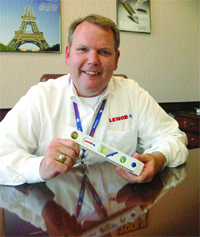
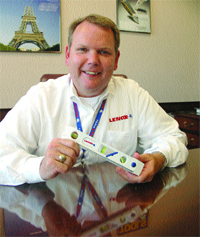
Bill Heisner displays a torpedo level, one of many new products that will carry the Lenox name.

American Saw & Mfg. Co in East Longmeadow is marking its 90th birthday this year. While that milestone — and the company’s proud history — are cause for celebration, new president Bob Heisner has his focus on the future, which promises continued new-product development, expansion into new markets, and ever more aggressive efforts to leverage the company’s well-respected brand: Lenox

Indeed, Lenox American Saw, which already sells products in more than two dozen countries, is looking to increase its presence in Europe and Asia, especially China.
“We’re not looking to make products in China,” said Heisner, noting quickly that the company does, in fact, manufacture some lines there already. “We want to sell products in China.

“They’re cutting a lot of steel there,” he continued, referring to both China’s dizzying growth curve and one of American Saw’s main niches — blades that can cut steel quickly and cost-effectively. “China holds a lot of opportunities for us.”

BusinessWest looks this issue at how the East Longmeadow-based company’s new president will approach the task of capitalizing on those opportunities and thus remain a cut above the competition.

Cutting-edge Developments

Heisner was promoted to his new post from the position of vice president of marketing for American Saw, what he called “the easiest job in the world.”
He was exaggerating, of course, but also making a point about the quality of the company’s products and their reputation within the industry.

“We’ve always said that if we could put our products in people’s hands, then they were sold on them,” he explained, noting that this was true across the company’s three main product lines: band saw blades, power tool accessories, and hand tools. “It was my job to get those products into people’s hands, plain and simple.”

That assignment remains part of his overall job description, but he also has a bigger, broader responsibility — picking up where his predecessor Bill Burke, now head of Rubbermaid’s tool division, left off in the drive toward the company’s stated goal of growing sales (currently around to $250 million) to the $500 million mark by 2008.
Only now, that target has actually moved to a loftier number. “Our CEO is upping the ante,” said Heisner. “He wants us to get to $1 billion.”

To get there, the company will take a multi-faceted approach that includes new-product development, continued improvement to existing products, and cultivation of new markets in which to sell those items.

Leading those efforts will be Heisner, who, like Burke, spent many years developing a competitive admiration for the Lenox brand while working for one of American Saw’s main hand tool rivals — Baltimore-based Black & Decker.

There, he worked in marketing and new-product development for several years. In 2001, he joined Danaher Tool Corp. as vice president of marketing for its Hennessy Tools division, and two years later accepted Burke’s invitation to join the team at American Saw.

Like Burke before him, Heisner told BusinessWest that what attracted Rubbermaid to American Saw (and pay $450 million for the then-family owned company) was the Lenox brand, which has a strong reputation among end users for quality and dependability.

So much so, that, while the name American Saw & Mfg. is still used in Western Mass., where it has considerable equity, outside the area, the company is known as Lenox.

“Here, if you say ‘American Saw’ or simply ‘The Saw,’ everyone knows what you’re talking about,” he said. “Get outside this market, though, and that name means nothing to them. They know the name Lenox.”

And Heisner’s current priority is to put that name on a wider range of products, but without compromising what he says that name means to professionals.

As he talked about new-product development, Heisner reached over to a table next to his desk and picked up a multi-purpose screwdriver, or an ‘all-in-one, as its known. This is an indispensable tool for many of tradesmen, including plumbers, electricians, and HVAC technicians, but a product that never carried the Lenox name and signature wolf logo — until recently.

“We made a promise when we (Rubbermaid) came here that we swore we’d live by,” he explained. “And that was we’d only offer a product that has a demonstrable benefit. If we couldn’t come up with one, then we wouldn’t offer it as a Lenox product.”

By that, he referred to the difference between the Lenox brand and other tool and accessory brands the parent company sells, such as Irwin — a difference he compared to the disparity between a Mercedes and a Chevrolet.

“We could get to $500 million in one year, forget five, if we wanted to make Lenox more of a mass-market product as opposed to a premium product,” he explained. “We didn’t want to do that.

“What we want to do is take this brand and go like this,” he continued, spreading his hands apart, “because there’s a lot of things that plumbers, electricians, and others use that we don’t make but could — if we could create that demonstrable benefit.”

“We’re not looking to make products in China, we want to sell products in China.”

Looking for an Edge

In the case of the all-in-one, that benefit is a thicker wall for the nut-driver, which also doubles as a tube that holds the various screwdriver heads, said Heisner, noting that while conducting the five-gallon-bucket research he spoke of, the company’s R&D team noticed that the nut driver became quickly stripped on competitors’ models because that wall wasn’t thick enough.

“No one had ever done that before, and we’re not sure why,” he said of the seemingly simple innovation. “But that’s our demonstrable difference. And it’s a great example of how we were able to take something that had been out there forever and make it better — to make it good enough to carry the Lenox name.

“We’re maniacs when it comes to user research, and that’s what we did with the all-in-one,” he said. “We didn’t know if there was an opportunity to do something with this particular product; all we knew was that all our users, every single one of them, used one of these.”

The same type of detailed user research has led to other new products, said Heisner, including a torpedo level (another tool that nearly every tradesman carries) with several innovations and a circular saw blade manufactured in conjunction with a Japanese company. It has also spawned improvements to a number of traditional product lines, including band saw and reciprocating saw blades made with a recently developed coating that provides more durability and faster cutting.

Many of the company’s significant innovations move from the band saw blade line — the company’s single largest product segment — into other areas, said Heisner, noting that this was the case with the new coating.

“It’s all about heat — if you can eliminate heat, you can make a much better blade. This coating product dissipates the heat and protects the tooth, so you create a blade that lasts much longer,” he said, noting that the company’s new Armor line of products has been extended from band saw blades to reciprocating saw blades and other lines.

The new-product development initiatives are having a demonstrable difference on American Saw’s bottom line, said Heisner, noting that the company has set several sales records this year and has matched three straight years of double-digit growth — and also in the nature of those sales.

Indeed, while sales of new products (a category reserved for those within three years of initial introduction) have historically accounted for about 5% of total volume, this year, that number is nearly 20%.

“And we want to continue to move that figure higher,” Heisner told BusinessWest. “World class is 30%, and we want to be there within 18 months.”

While working to introduce new products and improve traditional lines, American Saw is also working toward expanding its geographical reach, said Heisner, noting that by this he meant developing new and stronger markets in many of the countries where the company already has a presence.

“Normally, when people talk about China, they’re referring to taking their manufacturing over to China to support the U.S.,” he explained. “We’re doing the opposite; we want to support China with manufacturing here.

“The market in China is exploding, and we have lots of innovative products, starting with band saw blades.” he continued. “That’s half our business — making products that turn big pieces of steel into smaller pieces of steel, and no one is cutting more steel right now than the Chinese.”

The keys to penetrating new markets, and also improving sales in existing markets, are continued R&D, or ‘user research,’ as Heisner called it, and efforts to put the company’s products in front of people and actually in their hands.

Which is why the schedule has become much more crowded for the employee known simply as “Hack Man.”

Lee Breton, a 35-year American Saw employee, started cutting cars in half with reciprocating saws armed with Lenox blades in 1981. He eventually moved on to tanker trucks, airplanes, and anything else that could demonstrate the product’s quality and efficiency. (He recently set a personal best by ripping through a car in less than a minute).

Today, there is something called “Team Hack Man,” said Heisner, noting that Breton now has some help, and will use it to take the schedule of car-cutting events from 20 (the average for the past several years) to more than 200 for 2005.

“That’s quite a show they put on,” Heisner said of the Hack Man team, which appears across the country and overseas. “When you cut in half that fast, you get users to take a look at your products. And once they start using them, they’re sold.”

Drill Formation

Summing up the broad strategy for American Saw in the years to come, Heisner said it comes down to one word: relevance.

By that, he meant that the company and its Lenox brand plan to enter into more product lines — items as simple as an all-in-one screwdriver — and thus greatly expand its reach in terms of visibility and, more importantly, sales.

“We want to move into a bigger room,” he said, noting that the company and its
R&D teams will continually look for ways to bring demonstrable benefits to the people who use blades, hand tools, and power tool accessories.

And for that, they will need more of that five-gallon-bucket research.?

George O’Brien can be reached at[email protected]

Features
Baiging Li played forward for two Chinese professional basketball teams in the late ’80s before he took advantage of a rare opportunity to come to the United States — and Springfield College — to study sport management.

Since graduating, he has become, as he described it, a serial entrepreneur of sorts.

He started by creating a business focused on teaching Tai Chi, a Chinese system of physical exercises designed especially for self-defense and meditation, and has successfully grown that venture, establishing classes in many area clubs, senior centers, and health care facilities. Later, he started another business featuring tours of his native country. Over the past several years, he has led hundreds of people, many of them Tai Chi students, on visits to different areas of China.

His latest venture, one that seems laden is potential, is called ChinaAccess. It specializes in China/U.S. business development, and focuses specifically on helping business owners make connections — and eventual partnerships — with Chinese manufacturers.

As he shaped each of those ventures, Li leaned heavily on the Mass. Small Business Development Center Network (SBDC). A state agency (the only one anyone knows of that is based in Western Mass.), the center provides a wide range of free, one-on-one counseling, training, and capital support to people who want to do everything from start a business to sell one.

"We act as an objective, experienced set of eyes and ears for people who need some help getting started or to the next level," said Diane Fuller Doherty, director of the SBDC’s Western Mass. Regional Office, located in the Andrew M. Scibelli Enterprise Center at Springfield Technical Community College. "We’re there to be a resource for people facing the many challenges of business today."

In Baiging Li’s case, the center helped with everything from business plans to obtaining a green card, said Fuller Doherty, who told BusinessWest that Li has always had entrepreneurial drive — and also many valuable connections in China. What he needed was some help with the details and the hurdles that challenge all small business owners, from initial financing to deciding how much insurance to carry.

Georgianna Parkin, state director of the SBDC, said the agency has become an effective economic development resource over its 25-year existence, as it works to both create and retain jobs. It addresses this goal through a network of offices, or consortium, that includes the Isenberg School of Management at UMass-Amherst (the lead institution) and also Boston College, Clark University, Salem State College, UMass-Dartmouth, UMass-Boston, and the Mass. Export Center.

"The statistics show that small businesses are the backbone of the nation’s economy," she told BusinessWest. "We work to strengthen that backbone."

In recent years, the SBDC, funded by the U.S. Small Business Administration, the state, and UMass and other consortium members, has worked to dispel the notion that it works only with, small mom-and-pop operations, said Parkin. She told BusinessWest that ’small’ is a relative term when it comes to classifying businesses. By some definitions, that word describes those with 500 employers or fewer, and by others, the benchmark is 100 employees, she said, adding that the SBDC has assisted companies in both categories.

Still, the bulk of its work, especially in Western Mass., is with companies with 10 or fewer employees. In many cases, the businesses are sole proprietorships, as is the case with Deliso Financial and Insurance Services.

Jean Deliso, founder, told BusinessWest that after years of working for a large financial services company in Florida, she wanted to return to her native Springfield and start her own business. She went to the center for counseling because, while she was confident in her ability to help individuals make sound investment decisions, she knew she could use help with such matters as marketing her business — and even picking a name for it.

"When you’re a sole proprietor, getting help is important; this is a lonely game," she explained. "I don’t have a board of directors, no business this size does. It’s great to have a resource like this with knowledgeable people who can say, ’yes, you’re doing it right,’ or ’no, you’re not.’"

BusinessWest looks this issue at how the SBDC has counseled business owners like Deliso and Li and, in the process of doing so, become a driving force in job creation has for the region.

Foreign Concepts

In two months, Li plans to lead of small contingent of Western Mass. business owners on a trip to the Shandong region of China. Located between Beijing and Shanghai, it is home to roughly 93 million people and businesses in fields ranging from agricultural manufacturing and production to auto making.

The purpose of the junket — with all or most of the expenses paid for by the Chinese government — is to help forge partnerships between Chinese industry groups and individual companies and U.S. business owners who are being advised, and in some cases told, by major clients to find ways to collaborate with China and other countries where the cost of doing business is considerably lower than it is here.

Keith Stone is one such business owner, and he may well be on the plane in October.

Stone, president of Agawam-based Interstate Manufacturing Company (IMC), and also a relatively new client of the SBDC, told BusinessWest that Hamilton Sundstrand, a division of United Technologies Corp. and one of his largest customers, wants him to partner with companies in India and China, in an effort to secure both high quality and low cost for its parts.

Stone is now working with Li in what promises to be a lengthy process to establish such partnerships. And Stone credits help from the SBDC with putting him in a position where he can take such a bold step.

Indeed, when Stone first visited the Mass. Small Business Development Center (SBDC), his business was a critical crossroads.

IMC was created to make tools and fixtures required for the assembly of parts — primarily for the aerospace industry. Following 9/11, virtually every company that did business in that sector was hit and hit hard, and Interstate was one of them.

The company fought successfully to avoid bankruptcy, and business eventually improved somewhat. But even this past spring, Stone wasn’t sure if his entrepreneurial venture was going to survive.

His visit to the SBDC and one of its advisors, Alan Kronick, was broad in nature, Stone told BusinessWest, adding that he was looking for some advice and direction on how to remain competitive in a changing marketplace. Kronick and other counselors provided assistance in several areas, but especially with the complex process of being positioned to bid for projects with defense contractors.

"Alan understood what I was going through, and he’s helped keep me focused on where I am and where I need to be," said Stone. "It’s great to have a fresh perspective on things on things like cash flow, projections, and different ways to cut expenses; he can see things that I can’t."

Stone’s story is typical of how the SBDC works to help companies get in business and stay in business, thus fueling economic growth in all regions of the state.

"Small businesses are truly the engine driving economic development, especially in Western Mass., said Fuller Doherty. "This is where most of our net new jobs are coming from; entrepreneurs are providing jobs not only for themselves, but many other people."

Over the years, the Western Mass. office of the SBDC has helped hundreds of individuals like Deliso, Stone, and Li. Between Oct. 1, 2003 and Sept. 30, 2004 (the latest statistics available), the office assisted 618 clients, providing more than 2,626.25 hours of counseling.

More than half of those clients sought assistance in the broad category of business startup, said Fuller Doherty, noting that there are many other areas of counseling, ranging from business plan and loan package development to strategic needs assessment and marketing/sales.

In general, the center helps small business owners stay on track, said Deliso, noting that entrepreneurs like herself are versed in their particular area of expertise — in her case, accounting and financial planning — but not necessarily in the many facets of running a business.

"Take marketing for example," she said. "They helped me develop a marketing plan and figure out where and how I should be spending my money. Those are the kinds of things small business owners need help with."

Name of the Game

Richard Green came to the SBDC last spring, when he was entertaining thoughts of opening his own insurance agency. A long-time insurance industry veteran, Green drafted a preliminary business plan earlier this year, and drew some encouraging remarks from his lawyer, who nonetheless advised him to seek a second opinion.

"He told me that I was in the middle of the forest and needed to find a way to see through the trees," Green recalled. "He said I needed another pair of eyes."

Those eyes turned out to be Fuller Doherty’s, and Green recalls that she didn’t sugarcoat anything about the process of getting his venture off the ground.

"They’re not there to pat you on the back, tell you everything’s great, and send you out there," he explained. "They ask the hard questions, starting with whether you have what it takes to be in business for yourself."

An evaluation process revealed that Green did indeed have the requisite desire, talent, and capital to start his own venture. Richard Green Insurance Inc. opened for business on Elm Street in Hampden earlier this summer; a grand opening is set for later this fall.

During the process of getting his business started, Green said he turned to the SBDC for counseling on matters ranging from office furniture — the center provided names of area dealers — to what to name his venture.

"Putting my name on the company wasn’t my first choice," he revealed. "But people at the center told me that I should use my name and then stand behind it."

Deliso said she faced the same dilemma. As she began the process of starting her venture, Deliso said she was wary of putting her family name on it. Her grandfather, Joseph Deliso, was a successful entrepreneur and founder of HBA Cast Products, while her parents started several other ventures, including Tool Craft and Pioneer Tool.

"That name was one of the reasons I left the state," she said. "I didn’t want to be merely my grandfather’s granddaughter; I wanted to do it on my own.

"But people at the center got me to see that this was a name that people associated with success, and it was a name I should utilize," she continued. "That was a real turning point for me; that was the right decision to make and they helped me make it."

The center has helped Li make a number of right decisions in his decade-long association with the agency. While some of his needs and challenges are unique — obtaining citizenship, for example — most are fairly typical.

"The center has been very helpful with all of my businesses," he said. "In the beginning, a lot of things were unclear to me, like how to make a plan, contact people, and follow through; they’re helped with all those things.

"They’re teaching me ways to look at the big picture," he continued. "That’s where my focus needs to be."

As for the October trip to China, Li said he is using the SBDC as a resource to help identify area businesses, such as Stone’s, that might benefit from what he called the ultimate learning experience.

"Through this visit, people will have a clear idea of how Chinese business operates," he said. "That’s important, because partnerships are how companies here and there are going to be successful."

Bottom-line Analysis

Assessing his entrepreneurial exploits to date, Li said that, like all business owners, he is continually reviewing his ventures with an eye toward continued growth and profitability. In other words, he’s not resting on any laurels.

"You can’t do that," he said, adding that the learning process that is part and parcel to being a successful business owner never really ends.

"I still have many things still to learn about business," he told BusinessWest, adding that he considers himself lucky to have a resource like the SBDC. "They’ve kept me going in the right direction."

George O’Brien can be reached at[email protected]

Cover Story
Berkshire Brewery Drafts A Success Strategy
Cover 8/1/05

Cover 8/1/05

Berkshire Brewing Company Inc. has been growing by hops and bounds since its inception in 1992. Growth has been so quick and profound that principals Chris Lalli and Gary Bogoff now find themselves at a crossroads. Do they want to remain a local brewer or take that next big step?

Hops, like those climbing the brick walls of Berkshire Brewing Company (BBC) in South Deerfield, are plants essential to creating a great beer. They typically survive for decades, plant deep roots where they grow ‚ and grow rapidly.

The life of a hop vine as a metaphor for their own business isn’t lost on BBC founders Chris Lalli and Gary Bogoff, who grin up at their own decorative hop plants and shake their heads at how fast they spring up the side of the building. Then they turn to look at a recent expansion of their brewery, and do the same.

BBC just completed its third expansion since opening its offices and brewery two years after the business began in 1994. The company also has a satellite warehouse operating in West Boylston, Mass., and is planning a third location in Enfield, Conn., to meet the sales and distribution demand that is steadily expanding its reach across the Northeast.

As Bogoff puts it, the company is currently in a situation where the "tail’s wagging the dog." Sales are healthy, growth has been steady, and local and national respect for BBC’s products ‚ 14 beers, nine of which are produced year-round ‚ has created a momentum so brisk that Bogoff and Lalli have to hustle to keep pace.

Any CEO will tell you that a pressing need for expansion based on growth, rather than in an effort to foster it, is a good problem to have. But the principals of BBC agree, however, that the company’s success has now brought them to a critical crossroads, and they must now decide which way to turn.

"We always wanted to be a local brewery, and we have worked very hard to establish ourselves," said Bogoff. "Now that we have, the big questions is: What’s the next step?"

Never before, he explained, have he and Lalli been in a position to choose how big BBC gets. Now, they must decide whether to graduate from ’local brewery’ and become a ’regional brewer,’ which would necessitate shipping to states outside of the company’s current service area and piercing the national market ‚ essentially, becoming a different kind of business.

"Before, it was a simpler world," Bogoff said, harkening back to the early days, when the duo brewed their first few barrels together in a basement in Springfield. "There was always plenty of room for us to grow. Now, it comes down to a choice. Whatever we do, we want to stay profitable and efficient. But microbrew means small business, and we don’t want to forget that, which is easy to do when you start doing battle in the national marketplace."

Indeed, the national market is not so distant a destination for BBC as it once was. Of the 1,500 microbreweries and pubs brewing their own beer across the country, BBC rates 67th in terms of production volume. Herein lies the quandary that Lalli and Bogoff find themselves mulling more and more often, though, in terms of how large the company’s scope should become: in spite of that stellar rating on the national scale, 99% of the company’s beer is sold within a 60-mile radius of the South Deerfield brewery.

"What we’ve done is based very much on customer service, quality, freshness, and catering to the local market," Lalli said. "We’re very cautious about expanding; we’re respected in this marketplace, and we have established our niche. So, is bigger necessarily better?"

A Stout Following

Still, Lalli and Bogoff concede that the consumer-driven success of their products is an ongoing trend that cannot be ignored. The various strategies they employed to get their company going and to maintain good sales are now what is pushing the co-founders to entertain options for growth and change, starting with a simple business plan and some Yankee ingenuity.

Already, BBC beers can be found on tap or in the coolers of liquor stores across Western Mass. and, increasingly, across the state, as well as in parts of Connecticut, Vermont, and Rhode Island, making them some of the most prominent microbrews in the Northeast. But the partners are quick to point out that microbrews don’t just go head to head with each other to win space behind the bar; they also have to face the behemoths of the beer world ‚ Budweiser is the first name on their tongues ‚ that spend 60% of their revenue on national marketing.

"When we started, we definitely began at the bottom of the learning curve," Bogoff explained. "We were going to do draft business only, forging relationships with local bars, with no marketing budget whatsoever. We didn’t realize how competitive the beer industry actually is. We met with a lot of closed doors."

Lalli and Bogoff were forced into bottling just to make ends meet, and in the process, they stumbled upon a few marketing ploys, reminiscent of the success of Ben & Jerry’s ice cream, that helped create a brand and a hook for the small company.

For example, they put themselves on the labels of their beers, smiling out from 22 oz. bottles with frothy mugs and toothy grins, and coined a number of pithy phrases that now accompany every case and keg they ship, including "Things are looking up!" and the company’s mission statement, "It’s all about the beer."

But in order to compete in what is quite literally a saturated market with sparse marketing dollars, the brewers decided to continue to focus on offering good service and great products, though with a twist: they made a conscious effort to brew an ’American ale,’ a light-bodied drink with mass appeal, that might even impress the Bud drinkers who represent 50% of the market.

The tactic worked ‚ that American ale, BBC’s Steel Rail Extra Pale Ale, was a hit, and eventually spurred the results that the owners had been looking for. Whereas most breweries glean the bulk of their profits from bottling, Lalli explained, BBC is now doing a majority draft business, about 65%.

"Steel Rail is also about 65% of our business," he said, noting that BBC continues to pay attention to the market, offering popular styles of beers such as India pale ales, seasonal brews, or flavor-infused ales. "And our market is the most unique you’ll see anywhere. It crosses all social lines; our fans are new drinkers and they’re old agers, and our beers are in the finest restaurants, and in VFWs."

Local Watering Hole?

Lalli and Bogoff also attribute BBC’s success to its constant attention to its identity as a locally owned, locally loyal entity. Lalli said it translates into good business to create a following not only through a great product, but a great reputation for partnering with other local businesses and organizations in an effort to support the regional economy. Norse Farms in Whately, for instance, provides the raspberries for BBC’s Raspberry Strong Ale. Dean’s Beans in Orange provides the coffee beans for the Coffeehouse Porter, and 10% of the sales of Shabadoo Black and Tan Ale, named after a friend who passed away, go to help the Western Mass. Food Bank.

"We would be nothing without support," Bogoff said, "so it’s important, but it also makes a whole lot of sense, to give back and keep collaborating with other people."

Other such partnerships have been forged with Franklin County and, specifically, the town of South Deerfield, which played a key role in getting BBC off the ground at its flagship location, a former cigar manufacturing plant on Railroad Street.

The two partners said they were turned away by several communities in the area, and were getting frustrated in their search for a home when South Deerfield "embraced them," as they put it. And that support has remained strong through several expansions of the brewery.

The brewery first included a seven-barrel system and a handful of employees brewing and bottling by hand around the clock. BBC now uses a 20-barrel semi-automated system and employs 24 people, all of whom are dwarfed by the brewery’s massive fermenters, grain silos, conditioning tanks, and other contraptions.

"It used to be brutal, back-breaking work," Lalli said. "Now the new system takes a lot of that grunt work out; we’ve been able to create a comfortable workflow. Without the expansions that we have been allowed to take on, I don’t think our growth would have been nearly as good as it has been."

And over the past decade, the company has yet to see a year that hasn’t produced a healthy increase in sales over the previous year, usually between 8% and 12%. Last year, BBC’s production topped 10,000 barrels for the first time, and that was in the midst of a somewhat disruptive expansion project, Lalli explained.

He and Bogoff expect to sell at least another 1,000 barrels above and beyond that figure this year. That strong history of growth has brought BBC to where it stands today: firmly rooted in Franklin County, but able to enjoy notoriety as one of the most well-known, profitable, and more importantly oft-enjoyed microbrews in New England.

Ale’s Well that Ends Well

The question is, with so many people regularly enjoying a pint or more of BBC brew in their own backyard, how many more people do Lalli and Bogoff want to add to their fan base?

"We’re going to keep doing what we’ve done," Bogoff offered. "We’re going to keep putting products out there that we’re proud of, meeting the demand, and providing the best service we can. We’re customer driven, and the demand is there, so we’ll definitely keep an eye on what is coming down the road. But we’re happy just to be on someone’s ’top five’ list of beers when they sit down at the bar. It’s all about the beer."

Jaclyn Stevenson can be reached at[email protected]

Sections Supplements
A New Plan of Action for The Bosch
American Bosch manufacturing complex

American Bosch manufacturing complex

Months ago, an ownership team was conducting a series of formal and informal studies designed to gauge whether all or some of the sprawling former American Bosch manufacturing complex could be salvaged for future development. All debate was ended by a Dec. 16 blaze that effectively gutted the landmark. Now, as demolition commences, talk is of what might develop at the nine-acre parcel at the Springfield-Chicopee line.

TJim Sullivan was heading back to Holyoke from a meeting in Boston last Dec. 16 when his cell phone rang.

Usually, Sullivan, treasurer of the O’Connell Development Group, can talk and drive at the same time. But after only a few seconds of conversation he decided he’d better pull over.

The Bosch, he was told, was on fire.

That’s the name people have used for decades when referring to the former American Bosch manufacturing complex on Main Street at the Springfield-Chicopee line. O’Connell was, and is, part of an investment group known as MSBB, LLC that owned the sprawling, vacant — and uninsured — buildings, and had been exploring a wide variety of development options for the property.

It was an admittedly long-term project that was about to become exponentially more complicated and expensive.

"It was a quick trip back from Boston," Sullivan told BusinessWest, adding that, when he arrived at the scene around 6 p.m., the buildings were fully engulfed.

"I stayed until around midnight — I didn’t really know what else to do," he said, adding that he found himself joined on that frigid night by several former employees of the German-based company, which manufactured radios and other products at the Western Mass. facility. "People had tears in their eyes Ö many of them were very emotional; they had many fond memories of the years they spent there."

Sullivan didn’t cry that night, but no could have blamed him if he did. The fire, which raged throughout the night, effectively gutted the imposing structure, rendering it unfit for any type of development. And, contrary to popular opinion, the blaze, while it has in some ways accelerated the process of developing that nine acres of real estate, has not facilitated it.

"People have come up to me and said, ’I guess this makes your job much easier,’" said Francesca Maltese, development manager at O’Connell who is also involved in the Bosch project. "In fact, the fire makes everything harder, starting with demolition, and it means we’re spending money, and lots of it, when we’re not taking any in."

Started earlier this summer, the complex demolition process is expected to take at least the next six months. When the parcel is cleaned, the task of developing it will be easier than it is now, said Maltese, noting that it is difficult for many would-be investors to adequately evaluate the site when it is still dominated by a burned out hulk.

Still, ’easier’ is a relative term. While both Sullivan and Maltese say a number of potential uses are being explored, from health care to housing, manufacturing to retail, it is difficult to gauge how much interest there will be in the property.

Sullivan said the so-called Wason section of Springfield has repositioned itself in recent years, from a manufacturing center to a home for health care facilities ranging from physicians’ offices to Baystate Health System’s D’Amour Cancer Center. Whether that trend will continue at the Bosch site isn’t known, he said, adding that, for now, the focus is on preparing the property for development.

BusinessWest looks this issue at how the December fire has changed the equation for The Bosch and what the strategy will be for developing what must be considered a prime piece of real estate.

History Lessons

Maltese told BusinessWest that during one tour of the main four-story manufacturing/administration building at the Bosch complex, she came across some old plans for the structure.

"I decided I better take them before the mice ate them," she said, displaying one drawing, still in good condition, dated 1910. It shows three ornamental medallions, featuring the corporate symbol for the Bosch company, that would grace the exterior of the building.

Those medallions will be carefully extracted during the demolition process and shipped to Bosch headquarters in Stuttgart, she said, leaving this region with only memories of the plant — and there are many of those.

Bob Forrant, a former machinist and business agent for the union at American Bosch in the ’70s and ’80s, and now an unofficial historian of the plant, told BusinessWest that, at its height during World War II, the company employed perhaps as many as 20,000 people. "They ran 24 hours a day, seven days a week."

One of many machining and manufacturing facilities that helped give Springfield its reputation — and its nickname (the City of Homes) — the Bosch was a coveted workplace. "That was the best place to work in the Connecticut River Valley," said Forrant. "They took good care of their people Ö everyone wanted a job there."

Opened just before World War I, the plant was taken over and essentially operated by the U.S. government during that conflict, said Forrant, noting that American leaders considered any German-controlled plant a security risk. After the war, the government gave the plant back to the Germans, who operated it until the second world war, when the government again took it over. After that conflict ended, officials put the plant out to bid, and it was purchased by a group of U.S. investors and became American Bosch.

The Springfield plant was expanded in the early 1940s with the addition of a one-story manufacturing facility. Eventually, the complex grew to more than 500,000 square feet. Over the years, workers produced a wide range of products, including motors for car seats and windshield wipers, and, in its later years, fuel-injection systems for trucks and the M 1 Abrams tank.

American Bosch was purchased by United Technologies Corp. in the mid ’70s. UTC closed the facility in 1986 after years of gradual downsizing, part of a larger movement of manufacturing operations from New England to warmer, less costly areas of the country. The property had several owners and a few uses (most of them warehouse-oriented) over the next several years, said Forrant.

The complex was eventually acquired by a small development group, headed by John Bonavita, creator of Springfield’s Tavern Restaurant, among other projects, that was known as Crossbow, LLC. The O’Connell Group, which has developed a number of buildings and parcels in the region, including the Crossroads business park in Holyoke’s Ingleside area, became partners in the Bosch venture in the spring of 2003.

"We looked at it as a long-term development play," said Sullivan. "Actually, a very long-term development play."

In the months after becoming part of the ownership team, O’Connell explored a number of options for the Bosch property, said Sullivan, adding that the talks included consideration of both rehabbing the buildings on the site and demolition of those facilities and subsequent redevelopment.

"We looked at everything, from soup to nuts," he told BusinessWest. "We explored medical uses, retail, residential development, every option we could think of."

And while no official determination was actually made on whether to rehab or demolish the buildings, he said, the general feeling was that the one-story manufacturing building could not be reused, and that the four-story structure could, with great imagination and determination, be retrofitted.

But the fire last December brought a swift end to any and all debate.

Out of the Ashes

Suspected to be a case of arson, the intense fire leveled the one-story section of the complex, and caused irreparable damage to the main building. In the days following the blaze, many former employees of the Bosch, Forrant among them, drove by the site to survey the damage and reflect. Local historians said the city had lost an important piece of its industrial heritage.

For MSBB, LLC, the fire dramatically altered the course, timeline, and financial dynamics of the already-challenging development venture.

For starters, the blaze and the damage caused by it will greatly increase the cost of demolition, said Sullivan, who declined to give a specific figure but said it will easily exceed seven figures. Razing the structures will be a more risky proposition, he said, because the buildings are less stable than they were before the fire, making the work more time-consuming, and thus raising the price tag.

The high cost of demolition is one of the many factors that make the fire much more of a hindrance than a help when it comes to developing the property, said Maltese, adding that the fire has ultimately robbed the ownership team of flexibility with regard to the cost and timetable of the project, something that many not in this business do not understand.

"The common perception is that the fire solved a problem for us," she said. "It didn’t. In fact, it created more problems for us."

When asked if MSBB can ultimately recover the costs of razing the Bosch property and make this venture profitable, Sullivan offered a conditional ’yes.’ He said much depends on the market, the level of interest in the site, and the intended future use of the property.

Over the past several years, the Wason section has been the site of a wide range of health care and biotech developments. Only a few blocks from Baystate Medical Center, the area is now home to the Biomedical Research Institute, which Baystate has created in conjunction with UMass Amherst. That stretch of Main Street is the site of many health care-related ventures. Baystate has several facilities in that neighborhood, including its cancer center, Pioneer Valley Life Sciences Center, Baystate Rehabilitation Center, and others.

Meanwhile, Atlantic Capital Investors has rehabbed several old manufacturing buildings in the area for health care and related uses. Partners Ben Surner and Mark Benoit have converted a former factory at 3500 Main St. into the new home for the Pioneer Valley Chapter of American Cross and other tenants, while also combining rehab of the former Wason Trolley building with new construction to create a complex that hosts Baystate Reference Laboratories, Novacare Rehabilitation and Physical Therapy, The Hand Center of Western Mass., and other health care businesses.

Surner and Benoit are also moving forward with plans to create the Brightwood Medical Arts & Conference Center in a large manufacturing building that actually abuts the Bosch complex.

"So health care is certainly one possibility for the Bosch property," said Sullivan, adding quickly that there are many options, including retail, residential development, and others.

MSBB is not actively marketing the property at this time, said Maltese, adding quickly there are discussions going on at a number of levels. She told BusinessWest that talk, and marketing efforts, will escalate as the demolition process continues and developers can properly evaluate the real estate.

Forward Thinking

As they talked about the Bosch property and its potential for development, both Sullivan and Maltese struggled with which tense to use with regard to the buildings on the site.

Both the present and past work, said Sullivan, noting that while the landmarks are still there, from a literal standpoint, from a development perspective they are gone, and have been since the night of the fire.

For the most part, though, those at MSBB are focused on the future. What will transpire at that the Bosch site remains to be seen, but there is cautious optimism that a productive new use can be found, one that might ease some of the many loses incurred on that night last December.

George O’Brien can be reached at[email protected]

Uncategorized

A mill town once driven by the steady hum of factory work is now creating a different kind of buzz in Western Mass.; Easthampton is being seen as the region’s most promising community for artists of all types, and it’s the artists themselves, and the support of the city, that are making that happen.

Eric Snyder, president of the Greater Easthampton Chamber of Com-merce, said the best thing about the city’s recent turnaround is that it is tangible.

"Anyone who drives through can see what’s happening here," said Snyder, adding that the proof can be as large as a former mill now bustling with activity — everything from diners eating lunch at the Apollo Grill to people renewing their driver’s licenses at the local RMV office — or as small as an artful clay pot, a set of hand-crafted wind chimes, or a child practicing her violin on the front lawn.

The arts, in all forms, have become the primary economic driver pushing the city of Easthampton forward in recent years, transforming the former mill town into a haven for arts, entertainment, and culture, and revitalizing the city’s overall economic picture in the process.

"There has been a lot of talk about a renaissance in Easthampton," Snyder said. "The arts and crafts community definitely plays a big part in that. There are more people coming into the town because of the arts, and the artists are really marketing themselves, and that’s good for them and for the town."

Although many artists have resided in Easthampton for years, only recently have formal partnerships been forged between groups of artists, and, perhaps more notably, between those artists and city government, the Chamber, and other businesses.

Most artists work out of studio space located in one of three former mill buildings Eastworks, the Paragon building, and One Cottage Street once the hub of Easthampton’s economy and now becoming so again, though in a much different way.

Now, the buildings house potters, painters, jewelers, sculptors, and many other artists working in all types of media. They arrived to take advantage of large studio space, a convenient location, and attractive lease rates, and have since created a creative community unto themselves.

In addition, other businesses are also capitalizing on those low rents as well as the climate created by those artists, especially in the past year. Among them are restaurants like the Apollo Grill in the Eastworks building and Tucson and Savannah’s at One Cottage Street, niche businesses like Valley Women’s Martial Arts Inc. and In Touch Massage Therapy, and a Registry of Motor Vehicles branch office. Those businesses are not only benefiting from the location, but adding to the artists’ visibility, too; that has in turn provided for greater recognition of Easthampton in Western Mass., which is beginning to regard the city as the region’s next great cultural mecca.

"The word is getting out," said Lynn Latimer, an artist who works in fused glass out of the Cottage Street building. "We have a very large community of people who are enormously talented, but it’s recently that we feel a more solid sense of our arts community and the ways it benefits the whole city."

Canvassing the Area

One way the word is getting out is through the marketing efforts of Arts Easthampton, a collaborative organization of artists. The group began informally with a handful of artists in the One Cottage Street mill building, but has since expanded, especially in the last four years following the addition of the ’Arts Easthampton’ name and logo. The collective now includes artists working in the Eastworks and Paragon buildings, individual artists, businesses, and galleries and schools, such as the Guild Studio School, and the Pioneer Arts Center of Easthampton. The city’s own arts council is also very involved.

"It has only been in the last four years that we have all really started getting together," said Evelyn Snyder, owner of Kaleidoscope Pottery in the One Cottage Street building. Snyder explained that Arts Easthampton has gradually grown over the years. Two annual sales are still held now accommodating thousands of visitors to all three mill buildings and a smattering of individual studios, businesses, restaurants, and other venues but Arts Easthampton is becoming much more of a brand than a catchy name for an art show.

"We adhere to a mission statement and to strong rules of governance," said Justin Brown, an artist in the Eastworks building. "We make a real effort to meet and get groundwork laid down about five months before any event, and then we meet as needed until the date of the show. It’s only getting busier for us now."

Brown added that Arts Easthampton also created a common ground for a varied group of artists some production artists, completing large orders of their craft for customers, and others creating smaller quantities or single originals of work for sale. Brown is just such an artist, filling his studio with elaborate, personalized wall-hangings and sculptures. Snyder, although her work is no less unique, produces thousands of handmade plates, bowls, platters, and other items in her pottery studio. She agreed with Brown that Arts Easthampton created a bridge between all types of artists with different work, but common goals for success.

"It only made sense to pull all of the pieces together," Snyder said. "There was already some momentum that we could capitalize on; we had thousands of names on our mailing list, but now that has doubled, and we notice that there are definitely more people aware of and coming to our shows."

The visual arts aren’t the only artistic component of the city, however. Elizabeth Caine, president of the board for Pioneer Valley Summer Theater, located in Easthampton, said she too has noticed audiences increasing steadily over the theater’s three years in existence.

"What’s nice about Easthampton is that it is a city that’s actively looking for economic growth," said Caine. "We get great support, and in turn, our companies support the local economy by shopping, dining, and so on. In the long run, the relationship will make a huge difference in the community because of that mutual support."

And in response to that mounting success, the city has taken a broad interest in cultivating Easthampton’s arts community as an economic tool. It has secured grants for artistic programming and the improvement thereof, and fostering communication and further development of citywide initiatives either spotlighting or merely including the arts community, which includes a wide range of visual artists, musicians, writers, actors, and others working in cultural fields, often in conjunction with Arts Easthampton.

Ellen Koteen, grants coordinator for the city, explained that the first such grant was the John and Abigail Adams Grant, awarded to Easthampton by the Mass. Cultural Council in the amount of $12,500, which, as a condition of the grant, required the city to produce matching funds.

"We wanted to establish a formal arts and economic agenda, and the John and Abigail Adams grant was the first activity with that in mind," Koteen said, noting that the funds will be used to establish a new Web site for Arts Easthampton and to create a brochure and directory of the arts scene in the city.

She added that the matching component of the grant did more than add to the amount of funds available to the cultivation of arts programming — it also underscored the increasing faith the community has in its arts sector.

"The funds came through in February, requiring us to immediately search for funds for that one-to-one match," said Koteen. "We asked businesses to commit money and, in a short period of time, local companies kicked in almost $12,000. It demonstrated to the artists that the city recognizes their contribution, and there is a commitment to work with them."

Eric Snyder added that the arts also create a unique economic driver for the city, which he thinks Easthampton is ready to embrace. As most arts-based businesses are small, even consisting of just one or two people, there are dozens of independent businesses peppered across Easthampton, and that creates a different economic climate than a manufacturing plant or large retailer that could set up shop in the city and offer jobs to 100 or 200 people at once.

He noted that the city, once dominated by manufacturing, still has a few mainstays in the manufacturing sector among them Tubed Products, National Nonwovens, The October Company, and Stevens Urethane, which together employ about 1,200 people. The Williston Northampton School and Easthampton Public Schools round out the city’s major employers, adding another 500 employees to the tally. Viably, expansion of the manufacturing sector could benefit the town economically, and the city could have easily chosen to focus on that aspect if its financial picture, given its rich history.

But Snyder said the arts community has already proven in the last three to four years that its impact is just as important to Easthampton’s revitalization as any one employer could be.

"The chamber is open to this type of economic development," he said. "It is slower than the economic impact that could be generated by a large company, but the arts community has made our city much more rounded.

"It’s all about quality of life," he added. "Now, we still have our small town flavor, but we are also developing a metropolitan feel that is encouraging."

Artistic Integrity

The city has also planned ’visioning sessions,’ one in September of last year and the second just this month, designed to provide a platform for the city’s artists, government, business leaders, and other concerned citizens, specifically on the topic of cultivating and expanding artistic endeavors in Easthampton.

"It also studies the specific impact of the arts on the town," said Koteen, adding that part of that commitment the city has made includes hearing and addressing the concerns of the city’s artists.

"We have signed on to address the needs they have identified and how to best capitalize on and enhance their role in the city’s development," she said.

The need that is of the greatest concern to Easthampton’s artists is that of retaining affordable studio space. It’s a trait of many artists of all kinds that they will move to a community where affordable space can accommodate their work, contribute to diverse, healthy commerce in the area, and eventually be priced out of the studios for which they helped create a demand.

"The artists talk all the time of moving into affordable space, revitalizing the community, and getting priced out and moving on to a new, developing community," said Koteen, theorizing that Easthampton’s rapid improvement due to the art-based businesses is calling added attention to the nomadic nature of many full-time artisans, musicians, actors, and others working in cultural fields. "We have three old mills filled with artists. So far, the space is still affordable, and yet it takes years for a community to address such an issue, and then to implement whatever changes they see fit, so it’s definitely a concern."

Evelyn Snyder agreed. "It is a worry," she said. "But there is still more opportunity here for artists than in Northampton, which doesn’t have very many big, empty buildings, and that’s what brought us here, in addition to the low rent."

What is driving the Easthampton arts scene forward now is not just affordable workspace, though, she said; it’s the partnerships that have evolved between the artists in the community and local businesses, city government, and residents at large that are creating a sort of staying power, which is also unique within the world of art and artisans.

"All of us are excited about educating the public on the fact that you can make money as an artist," said Snyder, "and it’s nice to be in a strong group situation. It helps us to see the trends within the art world and to capitalize on good times and get through bad times."

Latimer added that getting a lot of different artists together on a project of this magnitude is no easy feat.

"It’s a bit like herding cats," she joked. "But this revitalization has come out of a lot of people pulling together in a grassroots sort of movement, and we’re seeing positive results that keep us going. The added notoriety of Easthampton as a thriving arts community is ultimately helping our businesses, and the added attention is making the city happy overall."

Brown said as the arts scene grows in the city, another challenge is how to best capitalize on the increased traffic, and the partnerships with the city’s government are helping to guide that process as well.

"The city has some great ideas and they’re getting more involved," he said. "They know why Easthampton is getting busier; now to keep it that way they’re helping us with the how."

Creating a Masterpiece

The annual Open Studio Sale held earlier this month by Arts Easthampton marked the city’s busiest weekend of the year, rivaled only by the Holiday Sale held in December. Throughout Saturday and Sunday, artists were busy wrapping pieces, businesses held sidewalk sales to capitalize on the traffic, and there was a bit of a wait for a table at the Apollo Grill. But Latimer said the signs of a community rising from the ashes are not best gauged on a busy weekend, but rather on the quieter days, when even then there is a marked change in the city.

"There’s definitely more life out there on the streets," she said.

Jaclyn Stevenson can be reached at[email protected]

Opinion
When the topic of discussion is economic development, most people think about jobs.

Specifically, they think about bringing jobs to a region from elsewhere. They think about large manufacturing plants that employ hundreds, if not thousands. They think about new and emerging fields, like bioscience, and the jobs they could create.

All of the above certainly fit the definition of economic development, but there is another component that is often overlooked, but shouldn’t be — workforce development.

Why? Because before you can attract new manufacturers (or keep existing ones) or develop clusters of businesses in new sectors like biotechnology, there must be a workforce in place that can handle those demands.

And at the moment, there are serious questions about whether the Pioneer Valley, and the state as a whole, has the kind of workforce that will be needed to carry out that broad assignment. Many, in fact, see a number of warning signs on the horizon concerning the Baystate’s labor force.

The Workforce Solutions Group, comprised of a number of state business, labor, and higher education agencies, has identified what it calls a "perfect storm" of economic conditions that may imperil the state’s capacity to compete — and prosper. The three crises facing the state, according to the group, are:

– A profound mismatch in labor supply and demand. Two in five employers say there are too few qualified applicants to fill openings, and that training resources are insufficient to prepare workers to meet employer needs;

– A recognized short supply of new, well-paying jobs. The state has a net loss of more than 200,000 jobs since 2001, and only 6,200 jobs have been added since December 2003; and

– The alarming fact that many available workers cannot obtain training and education opportunities. Almost one-third of the state’s workers, 1.1 million, lack the basic skills needed for employability in the new economy. Fully 746,000 workers lack a high school diploma and another 152,000 lack the strong English language skills needed to make them employable.

To address those concerns, the Workforce Solutions Act of 2005 has been filed. It contains a number of budget

and legislative proposals designed to ex-pand lifelong learning opportunities for Massachusetts workers, students, the unemployed, and underemployed. It’s not being referred to as an economic development measure, but it should be.

The bill, as filed, would help fill critical vacancies across the Common-wealth, provide flexible training funds so that businesses can respond better to market dynamics, target health care and other growth industries — where a skilled, ready workforce will allow job growth and curb job loss — and extend the life of the highly successful Workforce Training Fund (due to sunset this year), which has helped train more than 136,000 workers in 1,714 companies since 1998.

As area manufacturers told BusinessWest (see story, page 35) Workforce Training grants have helped offset the huge cost of the training needed to enable companies to remain competitive. And they stressed that the need for such training is ongoing, especially as global competition escalates.

Another highlight of the proposed legislation is a new program that would enable more than 4,000 low-income, under-educated working adults to attend community or state colleges and obtain an associate’s degree or industry recognized credential. Still another proposal would more than triple the current appropriation earmarked to build collaborative training, education, and skills development programs among employers in a given region or industry sector.

None of these initiatives would warrant banner headlines, nor would they would likely come up in discussions about regional economic development efforts. But they are very important components of a broader strategy to help Massachusetts remain competitive on the global stage.

And we hope they become reality.

Departments

The following incorporations were recorded in Hampden and Hampshire counties between mid-February and mid-March, the latest available. They are listed by community.

AGAWAM

Greenback Management Company Inc., 417 Springfield St., Suite 154, Agawam 01001. John G. Molta, 21 Blairs Hill Road, Agawam 01001. To deal in real estate, etc.

Top Knotch Tree Service Inc., 80 Howard St., Agawam 01001. Marilyn J. Kane, same. To own and operate a tree service business.

AMHERST

Hidden Tech Inc., 2 Teaberry Lane, Amherst 01002. Amy Zuckerman, same. (Nonprofit) To provide networking and educational opportunities for its members, etc.

CHICOPEE

Chessey Inc., 36 Steadman St., Chicopee 01013. Joseph J. Chessey Jr., same. Restaurant.

H & U Corp., 241 Chicopee St., Chicopee 01013. Fouzia Rafiq, same. Convenience store.

New England Aquatic Designs Corp., 297 Broadway St., Chicopee 01020. Mark Johnston, same. Aquarium installation, design work and holding.

EASTHAMPTON

Easthampton Woodworks Inc., 188 Pleasant St., Easthampton 01027. Richard E. Alcorn, 11 Dickinson St., Amherst 01002. Manufacture wooden windows and doors.

EAST LONGMEADOW

Body Tones Spa Inc., 22 Fernwood Dr., East Longmeadow 01028. Amy Impagnatiello, same. A tanning spa and related cosmetology services.

HAMPDEN

Domigi Baking Inc., 19 South Road, Hampden 01036. Lorraine A. Hanley, same. To deal in baked goods.

HOLYOKE

HHC Developer Inc., 230 Maple St., Holyoke. Jay Breines, same. To own and operate real estate.

INDIAN ORCHARD

E. Z. E. L. Inc., 567-569 Main St., Indian Orchard 01151. Norma J. Makol, 698 South West St., Feeding Hills 01030. A restaurant.

LONGMEADOW

SNEH Inc., 641 Converse St., Longmeadow 01106. Satish Kumar, same. To operate a restaurant.

LUDLOW

Buoniconti Company Inc., The, 391 Westerly Circle, Ludlow 01056. Michael A. Buoniconto, same. On-site computer services for businesses and consumers.

Commercial Machine Inc., 305 Moody St., Suite B, Ludlow 01056. Kevin J. Sullivan, 82 West St., Belchertown 01007. Machine and tool shop.

NORTHAMPTON

Angelo’s Golden Harvest Inc., 391 Damon Road, Northampton 02060. William A. Denucci, 110 High Meadow Road, West Springfield 01089. Garden center.

SOUTH HADLEY

Friends of Buttery Brook Park Inc., 15 Westbrook Road, South Hadley 01075. Linda Young, same. (Nonprofit) To improve and promote Buttery Brook Park, etc.

Exclusive Car Service Inc., 27 Hadley St., South Hadley 01075. David P. White, same. Limousine service.

SOUTHAMPTON

Wiseman and Son Transportation Inc., 38 High St., Southampton 01073. Jim Wiseman, same. A trucking company.

SOUTHWICK

Drakeview Sandwich Co. Inc., 327 North Loomis St., Southwick 01077. Nancy R. Cannizzaro, same. Retail food sales.

SPRINGFIELD

Diocesan Cemeteries of the Roman Catholic Diocese of Springfield, Massachusetts Inc., 65 Elliot St., Springfield 01103. Timothy A. McDonnell, 76 Elliot St., Springfield 01103. To promote and ensure the appropriate and respectful committal of the dead in the Springfield Diocese.

HTMD Inc., 494 Central St., Springfield 01105. Hong V. Tran, 469 Page Blvd., Springfield 01104. Liquor package store.

Lawn Sprinkler Company Inc., The, 63 Bridle Path Road, Springfield 01118. Dino T. Frigo, 57 Palmyra St., Springfield 01118. Lawn sprinkler sales and service.

Opportunity Guidance Support Inc., 46 Kent Road, Springfield 01129. Anthony L. Brice, same. (Nonprofit) To engage in charitable activities.

Pioneer Valley Recruiting Inc., 821 North Branch Parkway, Springfield 01119. Juliette Hahn Nguyen, same. Employment agency.

Springfield Multicultural Conservatory of the Arts Inc., 2754 Main St., Springfield 01107. Wilfredo Moreno, 119 Stafford St., Springfield 01104. (Nonprofit) To promote and assist emerging artists through instruction in music, art, etc.

The Keg Room Inc., 87 State St., Springfield 01103. Christopher J.
Kolodziey, 52 Colony Dr., East Longmeadow 01028. To operate a restaurant and food take-out.

WESTFIELD

Blanchard Homes Inc., 147 Eastwood Dr., Westfield 01085. Stephen D. Blanchard, same. To deal in real estate.

D G Manufacturing Inc., 362 Elm St., Westfield 01085. Dallas Grogan, 57 Telephone Road, East Otis 01029. To manufacture plastic products.

Westfield Girls Lacrosse Association Inc., 98 Woodcliff Dr., Westfield 01085. Gary O’Grady, same. (Nonprofit) To support amateur athletes and coaching staff providing a competitive Lacrosse program, etc.

WEST SPRINGFIELD

R & S Package Store Inc., 529 Union St., West Springfield 01089. Richard Lajeunesse, 71 Greentree Lane, Somers, CT 06071. Frank A. Caruso, 127 Mulberry St., Springfield 01105, registered agent. A retail package store.

Features
’Mary Kay Wydra calls herself the Valley’s biggest cheerleader. That’s an oversimplification of her duties as President of the Greater Springfield Convention and Visitors Bureau, but still, the title fits. And while she works to sell the region to travelers, she’s also recruiting residents to root for the home team.

H For Mary Kay Wydra, the Pioneer Valley is home. But it is also her workplace, her passion — and her product.

She’s been selling that product for more than 15 years as part of the team at the Greater Springfield Convention and Visitors Bureau (GSCVB), which she now directs.

Wydra has dubbed herself the definitive cheerleader for Western Mass., though that may be an oversimplification of her day-to-day duties. Responsible for promoting the Pioneer Valley as a year-round destination for everyone from large-scale corporate groups seeking convention and meeting spots to tour groups in search of new sites to visit, not to mention the casual day-tripper, Wydra and her staff must constantly find new ways to market the region as fun, exciting, historic, educational, accessible, and affordable, all on a shoe-string budget.

There are many challenges that come with that assignment, some that are relative to the broad tourism industry, such as seasonal slowdowns and intense competition for tourism and convention dollars.

Others, though, are hurdles specific to Greater Springfield. For starters, there’s the perception that the region is primarily an ëideal pit stop’ for refueling, grabbing a quick bite, and moving on. There’s also the perception that the Valley is too far away (from anywhere) and has little to offer.

Those elements, coupled with the present need to triumph over negative headlines regarding crime, poverty, and fiscal duress, would complicate any cheerleader’s job. To overcome those obstacles, Wydra and her staff are composing a multi-faceted strategy for not only selling the region, but building momentum within it.

BusinessWest looks this month at the components in that strategy, which includes recruiting new players and inspiring the home team.

The Laws of Attraction

Wydra, a Westfield native, has worn many hats at the bureau. She started there in 1988 as a secretary after graduating from Springfield College with a degree in business and a minor in psychology. She later left to pursue a job in public affairs with Big Y.

Soon, though, Wydra came to the realization that tourism was her calling.

"I really missed my industry," she said. So, after 15 months away from the convention and visitors bureau, she returned, this time to stay, rising up the ranks to assume her current position in January, 2001.

The date is notable — just eight months later, the terrorist attacks of Sept. 11 brought the nation to a standstill and the travel industry into a prolonged tailspin. Tourist destinations of all kinds suffered, she said, but major metropolitan areas were especially hard hit.

"People were fearful of traveling to large cities for a long time," she said. "Because of that, more people took notice of our major attractions, and they began to realize that we were a varied, interesting, and accessible place to visit."

So in some ways, 9/11 actually created opportunities for the Pioneer Valley, she said, a situation augmented by the addition of several new attractions; the fact that hotel occupancy rates in the Pioneer Valley have exceeded the state-wide numbers for the past several years are proof of that.

Wydra said steady, improving tourism numbers are the result of a set of marketing and community-based initiatives, designed specifically to keep the Pioneer Valley on the map.

Her approach takes into account both those people unfamiliar with the region and those who live and work here, and is heavily weighted toward positive public relations — an important facet of the bureau’s operations and a key component to putting Greater Springfield’s best face forward.

It’s also one of Wydra’s professional strengths. She handled much of the bureau’s marketing efforts prior to accepting the president’s post, and displays many successful print campaigns of years past in her Main Street, Springfield office.

The current campaign uses materials that showcase the Pioneer Valley to outsiders, including businesses and organizations that may want to hold conventions and meetings in the area, tour groups, and individual travelers, all with a family feel and all underscoring the expansive nature of the region, Wydra explained.

Of course, there is a strong emphasis on major attractions — Six Flags in Agawam, Springfield’s new Basketball Hall of Fame, and the Yankee Candle flagship store in South Deerfield among them. The rise in leisure travelers that began in 2002 can also be attributed to the simultaneous addition of four new attractions — the new Hall, the Dr. Seuss Memorial Sculpture Garden at Springfield Quadrangle, the Eric Carle Museum of Picture Book Art in Amherst, and the Superman — Ride of Steel roller coaster at Six Flags.

"We really pushed the fact that we had four new attractions being added all at the same time, " she said, "and that helped us get the word out about the Pioneer Valley in general."

It also added to the progress being made in the cross-promotion of events and attractions within the three counties that make up the Pioneer Valley, one of the aspects of her job that Wydra finds most gratifying.

Weekend Warriors

"The great progress we’re seeing among people identifying themselves as part of the entire region and not a specific county or town is wonderful," she told BusinessWest. "We are united by a highway and a river, and can offer so many different types of experiences. You can start a trip in a city and experience the urban flavor of the region. Then, you can go a little further west and visit some of the more funky, artsy places like Northampton; go a little further still and you’re in the heart of a beautiful, bucolic area … I think people realize the value of that."

Another phenomenon Wydra has noticed is the evolution of the region’s tourism sector, from what was largely an afterthought in an area dominated by manufacturing, to one of the fastest growing segments of the area’s economy.

She said the tourism industry has created a number of jobs locally, and has spawned the creation or expansion of hospitality management programs at UMass, American International College, and Holyoke Community College.

"Years ago, people found travel and tourism information in the leisure section of the daily newspaper," she said. "That is no longer true. Now, the things we are doing are on the front of the business section. We need to continue to cultivate that to benefit the Valley."

At the same time, area residents need to take a measure of ownership in the region’s tourism sector by becoming part of cheerleading squad, Wydra added. This includes providing recommendations, directions, or travel advice to visitors, while encouraging families and groups exploring convention sites to consider the Pioneer Valley.

In short, Wydra wants to create a greater sense of pride in the region.

She’s doing so through several initiatives, including the Pioneer Valley Pride program, which in part will enlist local individuals to promote Greater Springfield as a possible convention location for regional or national associations they may belong to. Meanwhile, the GSCVB continues to promote the decade-old Howdy Awards, given to residents who work in the hospitality industry annually, to recognize exemplary service.

"These individuals are often overlooked, but they are the people who are giving directions, checking people into hotels, and serving their food," she said.

This year, to augment the program, she has added a wrinkle to the Howdy tradition — ëHowdy U’ — that will take shape in June. The program, designed to give those in the hospitality business a crash course in Pioneer Valley tourism, was developed in part to create career ladder opportunities for people in the service industry, as well as to decrease the high turnover levels that are common to hospitality and tourism-related jobs nationwide.

The two-day course, to be held at Western New England College, will first provide its students with information regarding broad skills such as dealing with angry customers, and later, region-specific information.

"We want people to be knowledgeable about the region — to know about attractions like our museums, live theater, and symphony, and how to direct people to them," she said.

The second day, Howdy U participants will be loaded onto a bus and shuttled around the Pioneer Valley on a guided tour of both visible and hidden gems, in order to develop a working knowledge of their proximity to one another.

"That will allow them to tell people how close different attractions are to one another and help them suggest possible itineraries," she explained.

Howdy U graduates will also be able to illustrate the variety of attractions that exists in the region, which Wydra sees as one of its best assets.

"It’s a big selling point," she said, pointing out that in addition to specific attractions such as the Yankee Candle flagship store or seasonal events like Bright Nights and the Big E, the bureau frequently promotes ëhub and spoke trips’ that allow tourists to stay overnight in one location, but branch out on any number of day trips in surrounding towns and cities.

"We like to point out that there are so many attractions within minutes of each other, that it’s very easy to pick a hotel or a bed and breakfast in one city or town, but experience the entire Valley in a matter of days," she explained. "Overall, we try to pitch the Pioneer Valley as a package. All of these partnerships enhance the work we do, and help us expose what the Valley has to offer."

In addition, Wydra is focusing on attracting new populations to the area, including an increased number of bus tour groups and student travelers, of both high school and college age. The bureau also continues to market heavily to potential convention customers, and is poised to capitalize on the opening of the new MassMutual Convention Center, being built on the Springfield Civic Center site, slated to open in September of this year.

Its very construction is adding to the Pioneer Valley Pride Program, Wydra noted. "People are watching it go up and they’re starting to get excited about what it means for Springfield."

With or without major projects like the new convention center aiding the marketing efforts of the bureau, though, it always maintains a strong concentration on its three major customers — meeting planners, tour operators, and leisure visitors — and has stepped up its collaborative efforts with business partners across the Valley, including some unconventional partners such as area hospitals and banks. The partnerships reflect both the unique and close-knit nature of the region, Wydra said, as well as the growing importance of tourism initiatives to the region’s fiscal picture.

"There needs to be a concerted effort to bring commerce into the region," she said. "It’s important to everyone, and as more people are exposed to what the Valley has to offer, more people will ultimately take advantage of all of our services."

A-list Possibilities

With so many different variables to monitor, Wydra said measuring success has become a detailed process. The occupancy rates at area hotels are constantly monitored, as are the number of bus tours arriving in the Valley and what types of people are aboard. Attendance at major events and attractions is also compared to the previous year’s, down to the last child to pass through the Big E gates, or the last car to exit the Bright Nights tour.

All that data is proof of what Greater Springfield’s improving allure to travelers, Wydra said, thanks to home team hustle.

"The Pioneer Valley has become a destination due to a lot of hard work by a lot of people. My job is to be enthusiastic for the region — which in and of itself is not hard, because I believe in it, I love it, and it is home to me."

Jaclyn Stevenson can be reached at[email protected]

Sections Supplements

A planned industrial city, Holyoke has enjoyed a rich tradition of manufacturing. Today, it continues, but with a different look. Where once the landscape was dominated by large companies, many of them paper and textile makers, the city has recently become home to smaller niche players in search of available, inexpensive space.

When asked if he was surprised by the announcement late last month that the Ampad plant in Holyoke would be closing its doors in the spring, Jeff Hayden said yes — and no.

The Texas-based corporation had made some significant investments in the Appleton Street facility in recent years, said Hayden, the city ’s director of economic development. Such spending doesn ’t often precede a shut-down announcement.

But Holyoke and other area communities have seen a number of incidents in recent years in which national or international corporations closed local facilities and moved operations to other plants, said Hayden. The Ampad announcement merely continues a disturbing trend, he said, citing other defections in Holyoke, including Atlas Copco, Greitag Imaging, and Kodak Polychrome, and some in other communities, especially the well-publicized planned closing of Danaher Tool in Springfield.

"No one thought that a closing was inevitable," Hayden said of Ampad. "But, in many respects, this wasn ’t surprising."

And, partly because of this pattern, the city ’s long, distinguished manufacturing tradition is undergoing a fundamental shift, said Hayden. Where once the city was dominated by larger employers, many of them paper and textile makers, it is now seeing a manufacturing base dominated by smaller niche players, most with local ownership, that are coming to the city for its workforce and ready supply of affordable space.

Companies like International Container.

A maker of solid waste containers (Dumpsters) of all sizes, the company, which started out in Springfield and later relocated to Southwick, came to Holyoke because it desperately needs room to grow.

It found it in a 150,000 square-foot-building on North Canal Street that was formerly home to Atlas Copco, Worthington Compressor, and other industrial tenants. International started with 20,000 square feet, and quickly expanded to 50,000 and then 75,000, an indication of its strong growth pattern — it has doubled sales the past two years and looks to do so again this year — while increasing its workforce to 30.

Bill Searles, who founded the company with his five sons, said the company came to Holyoke because of the price and availability of real estate, and with no real idea of how long the stay would be. But it now appears to have settled in for the long haul; the Searles family expects to close on the property it is currently leasing later this month.

There are many similar stories being written in Holyoke.

C.A.R. Products recently relocated from West Springfield to a 31,000-square-foot building on Beaulieu Street in the Springdale Industrial park. There, it produces and distributes a wide range of auto cleaning products for dealerships, car washes, truck and van fleets, and other businesses in that broad sector.

Company President Bob Goldenberg told BusinessWest that the company came to Holyoke because it offered what he called the "best bang for the buck" when it came to real estate.

"I looked everywhere, and I mean everywhere," he said of a two-year search for space that was accessible and could accommodate office, manufacturing, and distribution operations as well as a small retail space. "Holyoke offered us what was easily the best deal."

Hayden expects the evolution of the city ’s manufacturing base to continue, and he is hopeful that Holyoke will turn the loss of Ampad into an opportunity by taking its 200,000-square-foot facility and two neighboring buildings, formerly home to Laminated Papers, and convert them into a business park that would house more of the smaller, locally owned ventures now dotting the landscape.

"What we want to do is get more of the small companies, family owned or locally owned, with specialty or niche markets and custom approaches," he said. "And let ’s give them the space and the cost-effectiveness they need to be successful."

BusinessWest looks this month at the changing manufacturing landscape in Holyoke and at some of the companies now doing business there.

Roll Players

Hayden said there are many challenges to reshaping a manufacturing base with smaller employers. Real estate is absorbed more slowly, and job growth comes in smaller increments, he explained.

But overall, such a shift brings a somewhat greater sense of stability, he continued, because there is far less reliance on one sector, such as paper, or a few large players. "When a company closes, we lose 10 or 20 jobs, not a few hundred."

Thumbing through a directory of manufacturing operations in Holyoke, a list that includes more than 200 names, Hayden said that the vast majority of the players have fewer than 50 employees, and many have 10 or fewer.

There are still some larger players in the mix — Edaron Inc., a maker of puzzles and gameboards that employs 140; Hampden Papers, (170); Hazen Paper, (185); Sealed Air Corp. (110); Specialty Loose Leaf (135); U.S. Tsubaki ’s roller chain division, (170); and University Products, a maker of archival products, (100) — but the majority of companies are much smaller.

Together, they employ thousands and help fill dozens of old mill buildings with long histories, said Hayden, adding that most of these ventures are surviving in these ultra-challenging times for manufacturers due to their ability to develop niche markets for specialized products.

Universal Plastics, a recent transplant to Holyoke, found one in plastic bus stop signs for New York City.

Joe Peters, the company ’s president, told BusinessWest that some cities and towns have discovered that plastic is an acceptable, less expensive alternative to metal, and the material is recyclable. New York did some research on the subject and thought enough of the concept to order about 15,000 of the signs (a $3.5 million contract) for all five boroughs.

"We would never in a million years have approached New York about bus stop signs, but this just came together for us," said Peters. "We were making kayaks out of recycled materials, and the people of New York were interested in having signs that were recyclable; they called us on a whim."

Universal has several niche products that are providing steady growth for the company, which recently took delivery of a $500,000 piece of equipment — a rotary twin-sheet thermoforming machine — that will enable it to diversify into other product lines, especially those that cannot be mass-produced overseas.

"For most manufacturers today, they have to go out and find niches where their products work," said Peters, "For us, it ’s small-to medium-volume products, things that people wouldn ’t go to China to have manufactured because it would be too expensive."

Universal came to Holyoke last year after spending 38 years in the sprawling Cabotville Industrial Park in Chicopee. There, it took progressively larger amounts of space as its orders grew. Eventually, the company occupied two floors of the former mill complex and had enough space, said Peters, but it was not efficient space.

"We had plenty of space, but it wasn ’t efficient space," he said. "We were moving things from one floor to another Ö that ’s not an efficient way to run a manufacturing operation today."

Clean Slate

Obtaining room to grow was also the primary motivation for C.A.R. Products, said Goldenberg, noting that the acronym stands for Complete Appearance Reconditioning, but the full name is rarely used today.

The company was started in 1969 by Goldenberg ’s father, then a vending machine mechanic looking for a less-stressful career option. It began as a distributor of auto cleaning products, and expanded into R&D and then manufacturing when the younger Goldenberg took over in the early ’80s.

It has grown from a one-person operation to one with 25 employees, and is in the process of becoming a national distributor as it continues battle with more-well-known names like Blue Coral and Simonize.

"We ’re ready to go national," said Goldenberg, noting that while there are several competitors in his field, there are certainly opportunities for strong growth.

To achieve it, Goldenberg knew he needed more space that was more easily accessible — the company was located almost across the street from the Eastern States Exposition and had grown weary of fighting Big E traffic. The search took Goldenberg to nearly every community in the Valley — he was close to finalizing a deal in Springfield before it fell through — before he found the one-story building on Beaulieu Street.

Hayden told BusinessWest that the evolution of Holyoke ’s manufacturing sector and the addition of companies like C.A.R., Universal, and International Container is not a recent phenomenon. For decades, small companies and sole proprietors have taken advantage of the millions of the square feet of mill space that became available when the paper and textile mills moved south. One of the classic examples is E.S. Sports, the tiny silk-screening venture founded by Eric Suher in 1983. The company started with two people, and now has more than 70.

There are dozens of similar stories, said Hayden, who said the exodus of many larger, national or international companies has actually accelerated the process. While Universal took over space vacated by Kodak Polychrome, others are moving into the former Greitag Imaging building — Baystate Health System has several operations there now, but manufacturers have expressed interest in still-available space — while the same is expected for the Atlas Copco property on Lower Westfield Road.

And while a number of scenarios could play out for the property being vacated by Ampad, the multi-story nature of that facility may make it less suitable for one large manufacturer.

This is one of the reasons why Hayden would like to pursue a business park at that location.

"The main plant is relatively modern, and Ampad has made a number of investments in it," said Hayden. "Meanwhile, the Laminated Papers buildings are clean and they ’re in very good shape. Holyoke should look at this event as an opportunity to plan something big for that neighborhood."

All the necessary ingredients would be in place for a business park, said Hayden, listing rail access, high-speed Internet service, and a quality workforce. "This would be the ideal location for a business park that would bring more locally owned and family owned businesses to the city; those are the businesses that represent our future."

Success Stories

Assessing the Ampad announcement and what it means for Holyoke, Hayden said that any time 200 jobs are lost at one time, there is a definite impact on a community.

"This will be a big loss for the city," he said. "But in this loss there could be some opportunity as well."

It will likely take several small companies to absorb the physical space once taken by Ampad and to make up for the jobs that will be lost, Hayden said. But long-term, these smaller, locally owned companies will likely provide more stability — and probably more jobs in the long run.

And they will continue an evolutionary process in this city built to be an industrial center.

George O ’Brien can be reached at[email protected]

Uncategorized

Nan Langowitz says the latest study on women-led businesses in the Commonwealth shows that nearly half the 100 companies at the top of the revenue chart grew by more than 5% over the course of the past year, far exceeding the national expansion rate.

But it wasn’t just the numbers that stood out in the report, said Langowitz, director of the Center for Women’s Leadership at Babson College, one of the organizers of the study; it was also how they were attained.

Indeed, the study, conducted in conjunction with the Commonwealth Institute, a non-profit group founded in 1997 to help women entrepreneurs, CEOs, and corporate executives build successful businesses, revealed that many of the Top-100 companies have flat organizational structures with open and collaborative management styles that play a key role in their strong growth patterns.

What’s more, most of the businesses focus on creating favorable work environments that foster loyalty and productivity. Despite a still-sluggish economy, these companies offer employee incentives such as profit sharing, professional development, and flexible work schedules.

"What this study shows is that these strategies work," said Langowitz, noting quickly that while women-led businesses do not have a monopoly on such operating philosophies, they utilize them in greater numbers. "By taking steps to create a positive work environment, these businesses achieve a higher degree of loyalty and, in many cases, higher productivity, which leads to their success."

That has certainly been the case at Randall’s Farm Inc. in Ludlow, where Karen Randall, the second-generation owner of the family-run business, has expanded the former fruit and vegetable stand into a multi-faceted operation with $6 million in annual revenues, good enough to tie for the 73rd slot in the Top-100.

Randall told BusinessWest that diversity and flexibility have been the keys to the company’s success, but she also underscored the importance of a work environment that helps people balance their jobs and their many other responsibilities.

"I have a lot of high school and college students working here, and I tell them that school and their family are the most important things, and that work comes next," said Randall. "We have flexible schedules and work with people; we’re very accommodating, and that pays off — we don’t have much turnover."

Martha Borawski, president of Pioneer Valley Travel in Northampton, another Western Mass. company on the Top-100 list (No. 90), said similar strategies have helped her company weather a number of changes in the travel industry that have driven many companies out of business.

"We’re had to reinvent ourselves a few times," she said, "and I’d like to think we’ve created an environment where new ideas and creative thinking can flourish."

BusinessWest looks this month at the latest Babson-Commonwealth Institute study — this is the third in what will be an ongoing initiative — and also at what’s behind the numbers and how area businesses are reflective of the trends that are emerging.

Taking the Lead

Langowitz told BusinessWest that Babson initiated the study on women-led businesses in 2000 because Ö well, they had never really been studied before. And as their numbers have grown over the past few decades, it became clear that they should be studied.

"So many studies have focused on businesses that are male-dominated," she explained, adding that she and others involved in the study feel it is important to benchmark what women business leaders are doing. "We wanted to get another perspective and focus on this specific, growing segment of the economy."

As the name implies, the 2003 Women-Led Businesses in Massachusetts study focuses on businesses with women at the helm — both owners and CEOs/presidents. The 237 companies that responded were ranked according to total revenues, not by employment, said Langowitz, noting that she considers this a more scientific statistic concerning overall size, although there is no perfect barometer.

Topping the list were Cumberland Farms Inc. in Canton; Massachusetts Electric Company in Northborough; Western Massachusetts Electric Co. in West Springfield; Domain, a retail home furnishings business, in Norwood; and Granite City Electric Supply Co. in Quincy.

Western Mass. was well represented on the list, with 10 companies. In addition to WMECO, led by CEO Cheryl Grise, other area companies on the list are: Realty World Sawicki (No. 12), an Amherst-based realty company led by Ernestine Sawicki; Bassett Boat Company Inc. (23) in West Springfield, led by President Diane Bassett Zable; Bay State Moving Systems in Chicopee (38), led by President Elizabeth Schofield; The Center for Extended Care in Amherst (61), led by President Bette Skole Kravetz; United Personnel Services Inc. in Springfield (65), led by President Mary Ellen Scott; Randall’s Farm; NEPM in Wilbraham (75), a company specializing in custom imprinted promotional products and business gifts, led by President Kathryn Selvia; Pioneer Valley Travel; and Chicopee-based MicroTek Inc. (90), an electronics manufacturing company led by Anne Paradis.

Langowitz told BusinessWest that the Women’s Institute at Babson, created five years ago to focus on the advancement of women at all stages of professional development, and the Commonwealth Institute decided to conduct regular studies of women-led businesses to watch trends develop over time, rather than gain what she called a "snapshot."

Lois Silverman, founder of the Commonwealth Institute and one of the first women in Massachusetts to take a company public when she was CEO of CRA Managed Care, concurred. She said the 2003 study shows that women-led businesses are becoming an increasingly more powerful economic engine in the Commonwealth.

"Women have demonstrated their success in building companies for long-term growth," she said. "These firms, in business for an average of 19 years, have continued to achieve solid gains despite the ups and downs of numerous business cycles."

The latest findings from the study, which charted revenues from 2003, revealed several trends about women-led businesses. Among them:

• They have more women in top management positions than other businesses. While the percentage of women in senior positions declines in larger firms, it is still higher than in the general business population;

• The companies on the list continue to achieve success. Of the Top-100 companies listed in the 2002 report, 72 of them are on the 2003 list. Meanwhile, total revenues for the No. 100 company in 2002 were $3 million; for 2003, the number was $4.8 million.

• Nearly 80% of the women-led businesses are run by their founding entrepreneurs. The average tenure of these CEOs is 13 years, which is longer than that of businesses run by men;

• Ninety-two percent of businesses surveyed anticipate growth over the next two years, with 62% expecting growth to be greater than 5%. Their strategies to drive growth include new clients or customer accounts, new products, and strategic alliances. The largest companies also rely on acquisitions for expansion;

• While the women-led businesses in the study span a number of industries, the top four were professional services, high-tech, construction, and manufacturing.

Beyond the numbers are the operating strategies that have enabled women-led businesses to achieve solid growth, said Langowitz, referring to flat management structures, rather than a typical hierarchy, and employee-friendly policies.

"I believe there is certainly a connection between their success and the organizational styles and management philosophies being used," she said. "And there are lessons there for all companies."

Borawski, who took the helm at the family run business in 1980, said she has worked to create an atmosphere where employees can be entrepreneurial and where ideas are allowed to take root. Such a climate is needed in an industry where there is constant change — the Internet now allows individuals to do much of the work traditionally handled by travel agents — and companies have to find new business niches if they want to survive.

At Pioneer Valley Travel, for instance, the company has diversified and become more specialized. For example, it specializes in family reunions, world-wide golf vacations, and destination weddings. In addition, Borawski specializes in travel to Australia, and other staff members have become experts on other spots on the globe.

"We’re constantly recreating ourselves — we’re not airline ticket issuers," she said, noting that many companies that haven’t been able to adapt to the changing landscape have gone out of business. "We’ve made a commitment to being the customer’s advocate; that’s what companies like this one have to be in this age."

Borawski credits her staff members with helping Pioneer Travel make its needed transformation, and she works hard to keep them. She implemented a profit-sharing trust in 1985, and has initiated other programs, such as flex time, to help employees manage work and life. She also encourages staffers to travel, and offers additional paid time to those heading for new destinations.

"For a small company, we offer a lot in terms of flexibility and keeping people employed here," she said. "Good help really is hard to find, and we try to hang on to it."

But turnover is a fact of life at a business with many part-time employees and students, noted Randall, who said it is still important to maintain a sense of continuity and to foster a positive work environment.

She has done so with flexible schedules, a number of benefit programs, and a door to her office that is always open — figuratively if not literally.

"And people take advantage of that open door," she said. "I try to make myself accessible to people and I try to work with them; overall, I’m a good listener.

"People don’t make it a career to be in this size retail operation," she continued. "So it has to be satisfying in other ways."

Randall grew up working at the business, started by her father, which began by producing and selling eggs and produce grown at the family’s 80 acres of farmland. She majored in elementary education at UMass, but graduated in 1976 to a glut of teachers in the region. So she rejoined the company, whch eventually expanded with a greenhouse operation and a creamery, and never left.

She took the reins of the business in 1987 after her father passed away, and in 1997 undertook a major expansion that included a retail center, bakery, deli, and other components. "I was 40 at that time, and knew that I either had to get out or take things to the next level," she said, noting that while there were growing pains the first few years — "people liked what we did, but the books said otherwise" — the venture has enjoyed steady growth since.

The company now employees more than 100 people, including Randall’s two sisters, Anna and Tammy. They are part of a flat organizational structure in which most people wear a number of hats and contribute to continued efforts to diversify the company.

"We know that we can’t stand still — a business has to keep growing or it will die," she said, adding that recent additions include entertainment offerings such as hay rides and pumpkin picking. "We’re selling to the next generation of consumers, and that generation likes to be entertained."

The Bottom Line

Adjusting to the changing needs of consumers is just one of the keys to surviving in business today, said Langowitz, who told BusinessWest that the studies on women-led businesses have revealed a pattern of flexibility.

"That’s one of the many trends we’re seeing," she said, noting that the regular studies will continue, with the hope of garnering more quantitative and qualitative analysis of this growing segment of the economy. "There is a lot that the business community can learn for the organizational, financing, and growth strategies of these companies."

George O’Brien can be reached at[email protected]

Departments

The following building permits were issued during the month of November 2004.

AGAWAM

Olympic Manufacturing Group
153 Bowles Road
$4,800,000 — Construct manufacturing warehouse facility

Tennessee Gas Pipeline Co.
1615 Suffield St.
$117,384 — Miscellaneous alterations, heating, electric, doors

AMHERST

Amherst College Trustees
151 College St.
$130,000 — Install wireless telecommunications facility on smokestack of Amherst College

Amherst Housing Authority
32 Chestnut Court
$13,000 — Re-roof

Amherst Pelham Reg. School District
21 Mattoon St.
$10,400 — Install new kitchen hood vent system

Amherst-Pelham Regional School District
21 Mattoon St.
$992,000 — Remove existing roof, add new roofing

Amherst Shopping Center Assoc.
181 University Dr.
$812,500 — 13,500-square-foot addition to Big Y shopping center. Shell construction only

The Brook at Amherst Green
170 East Hadley Road
$19,620 — Remove and replace existing roof

University of Mass Alumni
778 North Pleasant St.
$8,000 — New kitchen

Verizon
20 Fearing St.
$800,000 — Upgrade interior electrical and mechanical systems

CHICOPEE

Mountainview Landscape & Lawncare Inc.
67 Old James St.
$15,000 — Temporary office building

New Beginning Church of God
17 Quarry Ave.
$146,000 — Build church

EAST LONGMEADOW

Chestnut Hill Nursing Home
32 Chestnut St.
$149,000 — Re-roof

Eb Games
436A North Main St.
$14,000 — Interior renovations

HOLYOKE

Bobala Tech Center
55-59 Bobala Dr.
$25,950 — Build out building for American Cancer Society

MAP Development LLC
198-210 High St.
$5,000 — Remove two partitions, repair ceiling

Open Square Inc.
383 Dwight St.
$25,000 — Interior partitions

Pyramid Co. of Holyoke
50 Holyoke St.
$113,100 — Remodel Verizon store

Pyramid Co. of Holyoke
50 Holyoke St.
$61,000 — Remodel Desert Moon

Sunoco Products Co.
200 South Water St.
$6,975 — Install new entrance

SPRINGFIELD

Cathedral High School
260 Surrey Road
$54,125 — Refinish girls locker room

Eastfield Mall
1655 Boston Road
$95,000 — Interior renovations to several stores

Lestal Inc.
44 Rost St.
$6,000 — Interior repair

Marci Webber
18-20 Springfield St.
$200,000 — Convert to bed and breakfast

Mt. Zion Baptist Church
368 Bay St.
$8,000 — Repair handicap ramp

Northgate Center
1985 Main St.
$47,500 — Renovations

Northgate Center
1081 Main St.
$81,000 — Renovations

Pride
1211 East St.
$353,000 — New gas station

Shirley’s Handy Variety
469-475 Boston Road
$25,000 — Interior repairs

Third Baptist Church
148 Walnut St.
$32,800 — New roof

NORTHAMPTON

APC Realty Trust
32 Main St.
$28,519 — Replace roof

B’Nai Isreal Congregational
253 Prospect St.
$2,500 — Construct two walls

Carl and Edith Gutowski
206 King St.
$49,000 — Enclose existing porch for retail space, renovate second-floor apartment

City of Northampton
137 High St.
$10,500 — Strip and shingle roof

Cooley Dickinson Hospital Inc.
30 Locust St.
$8,500 — Remove bathroom and construct walls in admin. building

Dimension Realty LLC
59 Service Center
$39,000 — Install new roof

Kollmorgen Corporation
347 King St.
$120,000 — Interior renovations

Northampton Co-operative Bank
8 Main St.
$1,693,674 — Construct new bank and retail space (foundation only)

Features
MassMutual Chairman Robert O’Connell wasn’t sure he needed a large, formal press conference to announce the company’s $40 million expansion.

As he told the large group assembled for the event late last month, MassMutual’s support for, and confidence in, the city of Springfield isn’t exactly news. After all, the company has long been one of the city’s largest employers, and it has shown its support in ways ranging from the creation of Baystate West (now Tower Square) to the purchase of naming rights for the convention center taking shape on Main Street.

But O’Connell figured that a project of this magnitude deserved a ’celebratory moment,’ as he put it, and that residents and business owners might need to be reminded that, at a time when the headlines are dominated by the city’s fiscal woes, crime, and the many effects of poverty, there are some good things happening here.

The Springfield Chamber of Commerce and the Springfield Business Improvement District came to roughly the same conclusion.

The two agencies are splitting the bill for a radio advertising campaign that compares and contrasts Springfield to the rest of the Commonwealth with regard to several economic statistics. The data shows that, since 2001, the number of new businesses in Springfield is up 32%, compared to 9% for the entire state. Likewise, the number of Springfield residents employed increased 2.6% during that period, while the state as a whole, increased just 0.7%.

People can use statistics to say whatever they want, and these numbers certainly reflect how much the state is lagging behind the country in terms of overall recovery. But the numbers do show progress, a message that Russell Denver, president of the Affiliated Chambers of Commerce of Greater Springfield, did not want lost amid all the negative headlines about Springfield’s control board, $30 million deficits, tax delinquents, and squabbles with city unions over concessions.

The ad campaign, which will cost about $15,000, is unprecedented, says Denver, but it is also quite necessary to let people know that in Springfield, it’s not all gloom and doom.

Quite the contrary, actually.

As BusinessWest’s annual economic outlook (which starts on the next page) shows, there are many indications that the recovery, which has been less than spectacular to date, will become more pronounced in the year ahead.

A look at the jobs picture, for example, shows that the volume of job postings in the Greater Springfield area is up, while the number of people looking for work is down — and the numbers have been trending in this fashion for several months. The employment news is especially positive in the manufacturing sector, which has struggled in recent years amid growing foreign competition. Many local manufacturers have begun adding both part-time and full-time employees, and some are confident enough to move forward with major expansions and new construction.

In East Longmeadow, for example, German-owned papermaker Suddekor is building a 100,000-square-foot plant and Maybury Material Handling is moving ahead with a new, 40,000-square-foot facility.

The new construction is not limited to manufacturing. In Chicopee, the Memorial Drive corridor is growing by leaps and bounds, adding both a Home Depot and Wal-mart in just the past year, with Staples and Marshall’s on the way.

The construction activity is an especially positive sign, because while area hospitals and colleges have been building steadily over the past several years, the most high-profile initiatives have instead been publicly funded projects such as the Basketball Hall of Fame, the new federal courthouse on State Street, Union Station, and the new convention center. Private-sector building is always a strong indicator of confidence in a community’s future.

Not all the news in Springfield is positive, to be sure. The control board will reign over the city’s finances for years to come, and the work to take the community out of the red will be very challenging indeed. Meanwhile, the city’s problems with crime and poverty will not be corrected quickly or easily. These are not the best of times.

But O’Connell and Denver are right to say that the city’s fiscal problems and high murder rate should not overshadow the good things that are happening here and in surrounding communities.

The signs point to a more-robust economy in the year ahead, and MassMutual’s expansion is merely one expression of a growing feeling of confidence that will hopefully translate into many more positive business stories.

Departments

The following business incorporations were recorded in Hampden and Hampshire counties between mid-October and mid-November, the latest available. They are listed by community.

AGAWAM

1813 Main Street Corp., 1813 Main St., Agawam 01001. Carlo P. Bonavita, 68 Old Feeding Hills Road, Westfield 01085. To own and operate a restaurant/bar.

AMHERST

Matthieu J. Massengill, P.C., South East St., Amherst 01002. Matthieu J. Massengill, same. The practice of law.

Valley Arts Project Inc., 129 Glendale Road, Amherst 01002. Michael Brooks, 192 Belchertown Road, Amherst 01002. (Nonprofit) To create performance opportunities to showcase the talents of young artists in the Pioneer Valley, etc.

ZX Inc., 135 Belchertown Road, Amherst 01002. Xiaoda Xiao, same. To sell newly invented Vector Blind Spot Mirrors to completely eliminate blind spots.

BELCHERTOWN

CBA Marketing USA II Inc., One Main St., Belchertown 01007. Irene A. Kane, 684 Ridge Road, Wilbraham 01095. Freight forwarding and freight management.

Uncommon Photography Inc., 145 River St., Belchertown 01007. Robert Wallace, same. Photography.

CHICOPEE

DJDF Real Estate Inc., 40 Nichols Road, Chicopee 01013. David Deslauriers, 82 Lord Terrace, Chicopee 01020. Real estate.

J.M.B.B. Company Inc., 45 Doverbrook Road, Chicopee 01022. Joyce Chapin, same. Consulting for mortgage brokers.

New Tour Corp., 9 Stanley Dr., Chicopee 01020. Si Yuan Tseng, same. Chartered bus.

Two-Putt Inc., 1469 Granby Road, Chicopee 01020. Joseph L. Larrivee, 27 Windpath E., West Springfield 01089. Real estate holding.

EASTHAMPTON

Uncommon Clarity Inc., 3 Payson Ave., Easthampton 01027. Ann Latham, same. Business operations consulting.

FEEDING HILLS

CMBW Inc., 22 Kathy Terrace, Feeding Hills 01030. Robert J. Wierdo, same. Ladies physical fitness.

FLORENCE

NCP and Associates Inc., 60 Platinum Circle (Rear), Florence 01062. Patricia Haynes Nnaji, same. To provide practical advice for individuals undergoing occupational change, financial stress, etc.

HOLYOKE

Appleton Pre-School, Early Learning Center and Childcare Inc., 397 Apppleton St., Holyoke 01040. Sharon Zayas, 18 White Birch Dr., Springfield 01119. To provide pre-school, early learning and childcare services to the public.

T.W.C. Towing Inc., 56 Jackson St., Holyoke 01040. Juan Figueroa, same. Towing, selling automobiles and automobile parts, detailing automobiles.

LONGMEADOW

M.W.C. Construction Inc., 1661 Longmeadow St., Longmeadow 01106. Michael C. DeMarche, 46 Mohawk Dr., Longmeadow 01106. Construction.

R.F.L. Electric Inc., 195 Redfern Dr., Longmeadow 01108. Robert Lipp, same. Electrical contracting.

LUDLOW

Sekoswki Family Inc., 67 Bluebird Circle, Ludlow 01056. Gabriela Sekowski, same. To own and operate a package store.

Your Choice Insurance Agency Inc., 120 East St., Ludlow 01056. Samuel R. Hanmer, 123 Englewood Road, Longmeadow 01106. An insurance agency.

NORTHAMPTON

Healing Across the Divides Inc., 72 Laurel Park., Northampton 01060. Lawrence Lowenthal, American Jewish Committee, 126 High St., Boston, 02110. (Nonprofit) To promote cooperation between Israeli and Palestinian health organizations/individuals, etc.

Pioneer Valley Travel Medicine, P.C., 69 State St., Northampton 01060. Ann K. Markes, 124 Maple Ridge Road, Florence 01062. To engage in the practice of travel medicine.

PALMER

New Millenium Appraisal Inc., 11 Diane St., Palmer 01069. Barry J. Cook, same. To offer real estate appraisal services, develop methods and materials to appraisers of real estate.

SPRINGFIELD

Antique and Specialty Flooring Company Inc., 169 Paridon St., Springfield 01118. Anthony Frogameni, 76 Pembroke Lane, Agawam 01001. Purchase of antique wood and manufacturing and sale of flooring products made therefrom.

Compass Car Rental Inc., 155 Allen Park Road, Springfield 01118. Olga Arnst, 107 Chestnut St., West Springfield 01089. Car rental agency.

Gordies Gourmet Inc., 1209 Sumner Ave., Springfield 01118. Gordon Richard Weissman, 174 Abbott St., Springfield 01118. The manufacturing, packaging and sale of snack food.

J.T. Home Improvements Inc., 38 Jenness St., Springfield 01004. Jeff Lariviere, same, president, treasurer, and secretary. Home improvements and repairs.

Latin Flava Cafe Inc., 1677 Main St., Springfield 01103. Isabel Pellot, same. To provide Spanish food and beverages in a cafe atmosphere.

Law Offices of Brian Shea, P.C., 127 Mulberry St., Springfield 01105. Brian Shea, same. To operate a legal practice.

Law Offices of Frank A. Caruso, P.C., 127 Mulberry St., Springfield 01105. Frank A. Caruso, same. To operate a legal practice.

Orr Chevrolet Inc., 10 Mill St., Springfield 01104. Sterling A. Orr, II, 12 Winterberry Dr., Wilbraham 01095. Automobile dealership.

RGoodridge Inc., 206 Marsden St., Springfield 01109. Winifred Renee Haskins, same. E-commerce retail.

WEST SPRINGFIELD

Canterbury Development Inc., 84 Cedar Woods Glen, West Springfield 01089. Kathleen H. Sweeney, same. To own real property, remodeling, construction, etc.

Carl Yam Inc., 1051 Elm St., Unit 9, West Springfield 01089. Koang Cheu Yam, same. The sale of food.

Rural Lane Inc., 1771 Riverdale Road, West Springfield 01089. Mark S. Lyon, 53 Rural Lane, East Longmeadow 01028. Purchasing for resale or the consignment of household/business furnishings and household-related items.

Sullivan Private Label Inc., 42 Progress Ave., West Springfield 01089. Paul Fortini, 120 Greystone Ave., West Springfield 01089. To design and distribute retail packaging products to major department stores and specialty stores.

Valley Convenience Plus Inc., 242 Cayenne St., West Springfield 01089. Olga Alkattan, same. Convenience store and mini market.

WESTFIELD

Codru Transport Inc., 14 Sycamore St., #22, Westfield 01085. Stepan Foksha, same. A local, interstate and coast-to-coast trucking business.

Crane Marketing Associates Inc., 362 Granville Road, #105, Westfield 01085. Donald F. Hogan, same. The marketing of specialty chemicals and related products.

New England Pizza Restaurant of Westfield Inc., 280 Southampton Road, Westfield 01085. Jose M. Davila, 10 So. Maple St., Enfield, CT 06082. Jose M. Davila, 280 Southampton Road, Westfield 01085, resident agent. Restaurant.

WILBRAHAM

Halon Estates Homeowners Association Inc., 2148 Boston Road, Wilbraham 01095. Jason Sares, 168 Fuller St., Ludlow 01056. (Nonprofit) To maintain the common open space areas and subdivisions of “Halon Estates”.

JLS Architects Inc., 7 Rice Dr., Wilbraham 01095. John L. Strandberg, same. Architectural services.

Taste of Greece, Springfield Inc., 6 Evergreen Circle, Wilbraham 01095. Christine Dourountoudakis, same. To operate a deli and variety store, distribute food supplies to individuals, stores and restaurants.

Uncategorized
Over the past 20 years, Westfield has transformed itself from a once-thriving manufacturing mecca into a distribution hub. Several national retailers and wholesalers have facilities in the city, and now, Minneapolis-based Target Corp. has come forward with a plan to build a 1.6 million-square-foot distribution center in the city’s north side. As the proposal moves forward, there are questions to be answered, specifically: does the city need more trucks — or distribution jobs?The numbers are staggering.The distribution center proposed by the Minneapolis-based retailer Target Corp. would cover 1.6 million square feet. That’s about the size of the Holyoke Mall, which is built over multiple floors. The ’L’-shaped, single-story distribution center would cover 38 acres (or the equivalent of perhaps 80 standard home building lots), while the accompanying parking lot would cover another 83 acres.The facilities would cost $52 million to build, and would generate about $1 million in annual property taxes. The one-time building fees alone would be $600,000, according to current estimates. That’s more than was generated in the city — which has seen a surge in both residential and commercial development — over the past two years combined!The number Westfield officials are most intrigued by, however, is 800. That’s the current estimate on the number of jobs the distribution center would bring to the area, making it the city’s largest non-municipal employer and one of the top 20 in the region. And the jobs come with decent wages and benefits, said Westfield Community Development Director James Boardman, citing a projected range of $15-to-$18 per hour."These are good jobs at good wages," said Boardman, noting that while technically they are not manufacturing jobs, they come close to matching positions in that sector for overall compensation.In just about any other area community, the proposed Target facility would be a virtual slam dunk, a welcome infusion of jobs and tax dollars. But no other area municipality has the available land for such a structure, nor the highway access, and the one that does already has a handful of large distribution centers and more on the way. Which means that in Westfield, there are questions about whether the city wants or needs Target’s massive project.Specifically, some question whether the city should commit such a large tract of land to a facility that will generate distribution jobs, which are generally on a lower wage scale than manufacturing positions. Meanwhile, others wonder whether the city can handle more trucks on its roads.To the first question, Boardman says its been nearly a decade since Digital Equipment Corp. left the city, and more than 20 years since the company hit its high-water mark in the community, when it employed more than 2,000 people in mostly white-collar jobs. In the interim, the city has not seen anyone come to the table with jobs of that quantity or quality — and he doesn’t think it’s fruitful to wait and hope that someone will."You can’t make the possible the enemy of the perfect," Boardman explained. "That school of thought says to hold, hold, hold, and wait for the next DEC to come along. As I look out on the national economy, I don’t see another DEC."As for the trucks, Boardman and Westfield Mayor Richard Sullivan believe the city can handle more — if some steps are taken to minimize their impact. Such steps include set truck routes that take vehicles off residential roads; some infrastructure improvements, especially at the turnpike exit; and possibly creation of a truck park, a facility that would take trucks off city streets and into a designated area.Such a facility would be equipped with devices that would enable drivers to heat and cool their cabs, and also operate a computer or watch a small television set without having to keep the truck idling.Sullivan says the Target proposal faces a long, hard road. It must clear environmental hurdles — part of the parcel lies within an aquifer recharge area — and also strong opposition from neighbors and what will likely be a very close zoning vote in the City Council. But he believes the city would be negligent if it did not give the plan a hard look."Target would become one of our largest employers and the largest taxpayer in the city overnight," said the mayor. "That will take some pressure off our budget and help balance all the residential growth we’ve had and the added municipal expenses that go with it. There are simply too many benefits for us to let this go without giving it our best shot."What’s in Store?Target’s proposed distribution center underscores Westfield’s transformation from a manufacturing town to a distribution hub. The city was once the home to dozens of buggy whip manufacturing companies, and after the invention of the automobile decimated that industry, it hosted bicycle maker Columbia, as well as a host of paper and textile manufacturers and machine shops.Some of that manufacturing base remains — Columbia still exists, although it now focuses on school furniture and employs a fraction of the workforce it did in its heyday, and several machine shops are still operating. But over the past 10-15 years, the city has put its inventory of developable land and its easy access to the Turnpike and I-91 to good use as a home to a number of distribution facilities, with more on the way.In the mid-’90s, C&S Wholesale Grocers built a 500,000-square-foot frozen foods distribution center on a 100-acre parcel that formed roughly half of the Summit Lock Industrial Park. After Digital left the city, a series of national retailers have used the retrofitted former DEC plant for distribution. First, it was Caldor, then Ames. Home Depot began leasing roughly two-thirds of the building’s 600,000 square feet earlier this year, and Yankee Candle is also using a portion of the property. Meanwhile, Lowe’s is poised to break ground on a new distribution facility in the city’s north side. In all, there are currently more than 1,300 distribution-sector jobs in Westfield.With this backdrop, the Target proposal is being viewed as the next major distribution facility in Westfield, and the last, said Boardman, noting that there will be no large, contiguous pieces of land left after this one absorbed, and the city will probably reach its saturation point with trucks if Target goes forward."This would be the last one," he said. "We’ll be getting out of the distribution center business after Target’s project."Target officials were not available for comment on their plans, but Allan Blair, president of the Economic Development Council (EDC) of Western Mass., told BusinessWest that the company, eager to expand in the Northeast, has been looking for a site for a New England-region distribution center for some time, and has been considering options in Western Mass. for more than two years.In keeping with its regional approach to economic development, the EDC considered Target’s plans from a Valley-wide perspective, and worked to find a site that would make the most sense for the company and the region. It didn’t take long to identify Westfield as the only area community that could realistically handle the assignment, said Blair, adding that, eventually, focus turned to an assembled parcel near DEC and Barnes Municipal Airport that is owned by the airport and Equity Industrial Properties.The proposed facility would be similar in size, scope, and design to a Target distribution center in Wilton N.Y., said Boardman, noting that the model in question offers numbers — in terms of jobs, wages, trucks, and square footage — that are in attractive proportions.Elaborating, he said the city has dismissed other distribution center proposals that called for fewer jobs, less-attractive wages, more trucks, or any combination of the above."Target’s proposal has the package we’re looking for," he explained. "This plan calls for more jobs than trucks, while some people were offering more trucks than jobs. It will enable us to have our cake and eat it, too."The more we find out about the Target plan," he continued, "the more we like it."Thinking Outside the Box?When asked whether paving nearly 130 acres of Westfield’s north side was a sound economic development strategy, Blair and Boardman uttered the exact same words; "We need those jobs."Elaborating, both officials said Westfield, and the Valley as a whole, has lost a number of minimum-skilled and semi-skilled jobs in recent years as manufacturers have left the area. Westfield’s recent influx of distribution jobs has helped fill that void, but more jobs in that category are needed, said Blair."This is a good use of that property … maybe not the best use, but certainly a good one," he told BusinessWest. "If this was a highly automated plant of that same size but with few jobs, we wouldn’t be saying that."Boardman acknowledged that some believe the parcel in question should be saved for better-paying, technology oriented jobs. He countered by saying that the city hasn’t received any proposals for such operations in recent years. And if it does, there are many smaller parcels available for such use, including the nearby 120-acre industrial park being developed by Braintree, Mass.-based Campanelli Companies."Looking down the road, I don’t see growth in manufacturing — the trend is clearly toward outsourcing," he said. "Things are not going to be made in this country; that’s not where we’re going with our national economy, and if we think we’re an island and somehow different, I think we’re delusional."Echoing Westfield’s mayor, Blair said that when the benefits from the Target proposal and put in one column, and the drawbacks in another, the first list will be much longer than the second."Think about the spin-offs from this," said Blair, adding that in addition to jobs and tax dollars, the Target facility and its 800 employees will certainly help area businesses and perhaps spur creation of new service companies. "I think this will provide a huge boost for businesses in that area, and become a real asset for Westfield."Road GameSome city residents would probably use other, less-positive words to describe the proposal and its impact. "Now, where I see trees, I’m going to see a monstrosity," said one resident at a recent preliminary hearing on Target’s proposal. "[The city] should have said ’no’ to this a long time ago."The city didn’t say ’no,’ said Sullivan, because there are simply too many benefits — from tax dollars to jobs to all those building fees — to dismiss the proposal without looking at it from all sides."Target would give 700 to 800 people a chance to earn a decent living," he said. "We have an obligation to look closely at this and make a decision that is in the best interests of the largest number of people."Jaclyn Stevenson can be reached at [email protected]
Departments

Acevedo, Elisa
30 Morgan Ave.
Westfield, MA 01085
Chapter: 7
Filing Date: 09/07/04

Acevedo, Manuel
Acevedo, Zenaida
309 Poplar Ave.
West Springfield, MA 01089-2972
Chapter: 7
Filing Date: 08/31/04

Afonso, John J.
19 Ranger St.
South Hadley, MA 01075
Chapter: 13
Filing Date: 08/20/04

Almeida, Lisa A.
53 Elmdale St.
West Springfield, MA 01089
Chapter: 7
Filing Date: 08/20/04

Alshenwah, Ahmed S.
27B Bliss St.
West Springfield, MA 01089
Chapter: 7
Filing Date: 09/08/04

Alvaro, Joseph M.
88 Booth St.
Ludlow, MA 01056
Chapter: 13
Filing Date: 08/20/04

Avila, Ruth M.
99 Barber St.
Springfield, MA 01109
Chapter: 7
Filing Date: 09/13/04

Beaupre, Carrieann L.
46 Calvin St.
West Springfield, MA 01089
Chapter: 7
Filing Date: 09/10/04

Bennett, Treagan
5 Sargeant St.
Chicopee, MA 01020
Chapter: 7
Filing Date: 09/01/04

Benoit, Roger M.
Benoit, Ann Marie
27 Asselin St.
Chicopee, MA 01020
Chapter: 7
Filing Date: 08/30/04

Bessette, Francis Thomas
Bessette, Shirley Adeline
47-B Taylor Ave.
Westfield, MA 01085
Chapter: 7
Filing Date: 09/13/04

Blasotto, David P.
PO Box 33
Hadley, MA 01035
Chapter: 7
Filing Date: 08/20/04

Boardway, Kyle
189 Heywood Ave.
West Springfield, MA 01089
Chapter: 7
Filing Date: 09/03/04

Bolduc, Angela S.
Bolduc, Jamison A.
868 Southampton Road
Westfield, MA 01085
Chapter: 7
Filing Date: 08/23/04

Bonafe, Eddie A.
54 New Bridge St.
W. Springfield, MA 01089
Chapter: 7
Filing Date: 09/14/04

Bowler, Brian P.
1653 Northampton St.
Holyoke, MA 01040
Chapter: 7
Filing Date: 09/02/04

Bozek, John T.
Bozek, Anna M.
23 Abbey St.
Chicopee, MA 01023
Chapter: 7
Filing Date: 09/01/04

Breault, Richard
25 Heritage Dr.
Ludlow, MA 01056
Chapter: 7
Filing Date: 08/20/04

Brown, Mildred A.
37 Stanley St.
Springfield, MA 01104
Chapter: 13
Filing Date: 09/14/04

Browning, Arlene Ann
137 Portulaca Dr.
Springfield, MA 01129
Chapter: 7
Filing Date: 08/23/04

Bruso, John D.
24 Dwight St., Apt 20
Agawam, MA 01001
Chapter: 7
Filing Date: 08/23/04

Bruso, Stacy M.
24 Noble Ave.
Westfield, MA 01085
Chapter: 7
Filing Date: 08/23/04

Burlin, Kimberly A.
386 Hermitage Dr.
Springfield, MA 01129
Chapter: 7
Filing Date: 09/09/04

Burry, Martin E.
Burry, Amanda M.
24 Gaylord St.
Amherst, MA 01002
Chapter: 7
Filing Date: 08/19/04

Bush, Faye Ellen
6 Gardner Road
Chicopee, MA 01013
Chapter: 7
Filing Date: 09/13/04

Campbell, Steven P.
Campbell, Jane A.
64 Clark St., Apt. 2
Easthampton, MA 01027
Chapter: 7
Filing Date: 08/17/04

Capellan, Pilar
3 Barrett St., Apt. 6206
Northampton, MA 01060
Chapter: 7
Filing Date: 08/19/04

Caraballo, Efrain
Caraballo, Lourdes
73 Lynch Dr.
Holyoke, MA 01040
Chapter: 7
Filing Date: 08/18/04

Carey, Andrea K.
32 Leahey Ave.
South Hadley, MA 01075
Chapter: 7
Filing Date: 09/09/04

Carrano, Michelle Lynn
219 East St., Apt. A
Easthampton, MA 01027
Chapter: 7
Filing Date: 09/13/04

Clarke, Thomas C.
623 Parker St.
Springfield, MA 01129
Chapter: 7
Filing Date: 08/17/04

Conroy, Kevin J.
Conroy, Martha E.
17 Central Ave.
Chicopee, MA 01020
Chapter: 7
Filing Date: 09/13/04

Cooper, Ricky R.
93 Charles Ave.
West Springfield, MA 01089
Chapter: 7
Filing Date: 08/26/04

Corriere, Ronald R.
72 Wellington Ave.
Chicopee, MA 01020
Chapter: 7
Filing Date: 08/26/04

Cosgrove, Christopher J.
44 Riverview St.
Springfield, MA 01108
Chapter: 7
Filing Date: 09/10/04

Costigan, Melissa
1723 Northampton St.
Holyoke, MA 01040
Chapter: 7
Filing Date: 08/18/04

Cotter, Anna L.
334 St. James Ave.
Springfield, MA 01109
Chapter: 13
Filing Date: 08/26/04

Cotto, Carmen M.
56C Bay Meadow Rd.
Springfield, MA 01109
Chapter: 7
Filing Date: 09/01/04

Cottrell, Elizabeth F.
60 Stanley Court
Chicopee, MA 01020
Chapter: 7
Filing Date: 09/01/04

Craik, Ian W.
20 Call St.
Chicopee, MA 01013
Chapter: 7
Filing Date: 08/30/04

Craven, Fay D.
20 Pelham St.
Springfield, MA 01109
Chapter: 7
Filing Date: 09/07/04

Cummings, David R.
52 Vadnais St.
Springfield, MA 01104
Chapter: 7
Filing Date: 09/01/04

Cusson, Jay R.
11 Blodgett St.
Springfield, MA 01108
Chapter: 7
Filing Date: 08/25/04

Dacosta, Sonia C.
27 Morgan St., Apt. 1
Holyoke, MA 01040
Chapter: 7
Filing Date: 08/31/04

DeMars, Edward E.
221 Corcoran Blvd.
Springfield, MA 01118
Chapter: 7
Filing Date: 08/30/04

DeMars, Nancy Lee
1111 Westfield St., Ap
West Springfield, MA 01089
Chapter: 7
Filing Date: 08/23/04

Dempsey, James J.
92 Columbia St.
Chicopee, MA 01020
Chapter: 7
Filing Date: 09/07/04

Draper, John P.
43 Washington St.
Westfield, MA 01085
Chapter: 7
Filing Date: 09/02/04

Dubois, Julie A.
4 Sunset Ave.
South Hadley, MA 01075
Chapter: 7
Filing Date: 08/17/04

Eger, Jeffrey R.
395 Rock Valley Road
Holyoke, MA 01040
Chapter: 7
Filing Date: 08/16/04

Ezold, William J.
1163 B-L Elm St.
West Springfield, MA 01089
Chapter: 7
Filing Date: 09/13/04

Felton-Stephenson, Betty
125 John St.
Ludlow, MA 01056
Chapter: 7
Filing Date: 08/17/04

Flynn, Mark E.
25 Pleasant St., Apt. D
Northampton, MA 01060
Chapter: 7
Filing Date: 09/07/04

Forry, Robert J.
137 Root Road
Westfield, MA 01085
Chapter: 13
Filing Date: 08/26/04

Foss, David L.
118 Woodland Road
Springfield, MA 01129
Chapter: 7
Filing Date: 09/14/04

Friedman, Edward
202 Sumner Ave.
Springfield, MA 01108
Chapter: 13
Filing Date: 09/13/04

Garcia, Radames
44 Carver St., Apt. 1
Springfield, MA 01108
Chapter: 7
Filing Date: 08/18/04

Golash, Stanley P.
129 Pleasant St.
Northampton, MA 01060
Chapter: 7
Filing Date: 09/13/04

Gonyea, David P.
153 Atherton St.
Springfield, MA 01104
Chapter: 13
Filing Date: 08/24/04

Gonzalez, Jesus M.
141 Locust St., Apt. 1
Holyoke, MA 01040
Chapter: 7
Filing Date: 09/02/04

Gore, Richard W.
95 Breckwood Blvd.
Springfield, MA 01109
Chapter: 7
Filing Date: 09/10/04

Goshea, John F.
129 Muzzy St.
Chicopee, MA 01020
Chapter: 7
Filing Date: 08/30/04

Grandbois, Roland Joseph
140 Blanchard St.
Chicopee, MA 01020
Chapter: 7
Filing Date: 08/23/04

Granger, Michael F.
Granger, Kathleen
25 Roanake St.
West Springfield, MA 01089
Chapter: 13
Filing Date: 09/08/04

Greaney, Elaine M.
11 Columbus Ave.
Holyoke, MA 01040
Chapter: 7
Filing Date: 08/17/04

Harrington, James E.
Harrington, Michelle D.
9 Perennial Lane
Hampden, MA 01036
Chapter: 7
Filing Date: 09/02/04

Himmelreich, Philip J.
149 Kendall St.
Chicopee, MA 01020
Chapter: 7
Filing Date: 09/09/04

Hogan, Daniel J.
1475 Roosevelt Ave.
Springfield, MA 01109
Chapter: 7
Filing Date: 08/20/04

Hoynoski, Edward R.
Hoynoski, Jane E.
213 Suffield St.
Agawam, MA 01001
Chapter: 7
Filing Date: 08/23/04

Iglesias, Anthony
14 Livingstone Ave.
Westfield, MA 01085
Chapter: 7
Filing Date: 08/31/04

Jalbert, Angela E.
80 Highland Ave.
Easthampton, MA 01027
Chapter: 7
Filing Date: 08/17/04

Jimenez, Margarita
20 Prouty St.
Springfield, MA 01119
Chapter: 7
Filing Date: 08/26/04

Kantor, Marc David
32 Meadowlark Lane
Chicopee, MA 01022
Chapter: 7
Filing Date: 08/23/04

Killeen-Seipel, Margaret M.
63 Pequot Point Road
Westfield, MA 01085
Chapter: 7
Filing Date: 08/24/04

Kissee, Susan C.
3 Palmyra St.
Springfield, MA 01118
Chapter: 7
Filing Date: 08/30/04

Klipstand Manufacturing Co.
288 Union St.
Westfield, MA 01085
Chapter: 7
Filing Date: 08/20/04

Kornilieff, Lorri
1286 Granby Road, Lot 72
Chicopee, MA 01020
Chapter: 7
Filing Date: 09/02/04

Kuzdzal, Joseph P.
Kuzdzal, Deborah A.
20 Stephanie Lane
Westfield, MA 01085
Chapter: 7
Filing Date: 08/24/04

LaCrosse, Norman D.
56 Flint St.
Springfield, MA 01129
Chapter: 13
Filing Date: 09/03/04

LaPointe, Roland E.
81 Polaski Ave.
Chicopee, MA 01013
Chapter: 7
Filing Date: 09/13/04

LeBlanc, Normand P.
49 Montgomery St.
Westfield, MA 01085
Chapter: 7
Filing Date: 08/23/04

Lewis, Stephen D.
309 Main St.
Wilbraham, MA 01095
Chapter: 7
Filing Date: 08/27/04

Lockwood, James Brian
13 Cosgrove Ave.
Agawam, MA 01001
Chapter: 7
Filing Date: 08/24/04

Louder, Sandra S.
100 Lockhouse Road
Westfield, MA 01085
Chapter: 7
Filing Date: 08/27/04

Lowell, Alan R.
Lowell, Karen J.
86 Independence Road
Feeding Hills, MA 01030
Chapter: 7
Filing Date: 09/07/04

MacInnis, Robert J.
959 Berkshire Ave.
Indian Orchard, MA 01151
Chapter: 7
Filing Date: 08/25/04

Mariani, Chad V.
Mariani, Serena M.
395 Cold Spring Ave.
West Springfield, MA 01089
Chapter: 7
Filing Date: 09/01/04

Marquez, Esperanza
485 South St., Apt. 117
Holyoke, MA 01040
Chapter: 7
Filing Date: 09/07/04

Martinez, Lana
28 Larone Ave.
West Springfield, MA 01089
Chapter: 7
Filing Date: 08/23/04

Martino, Lynne A,
29 Bill St.
Chicopee, MA 01013
Chapter: 7
Filing Date: 08/26/04

Maspo, Madge Irene
35 Call St.
Chicopee, MA 01013
Chapter: 7
Filing Date: 08/23/04

McCurdy, Kimberly
51 High St.
Agawam, MA 01001
Chapter: 7
Filing Date: 09/15/04

McDonald, Rose
16 Cosgrove St.
Agawam, MA 01001
Chapter: 7
Filing Date: 08/31/04

McLane, Louis H.
McLane, Phyllis B.
265 New Ludlow Road
Chicopee, MA 01020
Chapter: 7
Filing Date: 08/19/04

Merchant, Michael S.
626 McKinstry St.
Chicopee, MA 01020
Chapter: 13
Filing Date: 09/13/04

Milillo, Katie J.
190 North Westfield St.
Feeding Hills, MA 01030
Chapter: 13
Filing Date: 08/19/04

Milillo, Kenneth J.
190 North Westfield Stree
Feeding Hills, MA 01030
Chapter: 13
Filing Date: 08/19/04

Miller, Michael
Miller, Diane
84 Valley View Dr.
Ludlow, MA 01056
Chapter: 7
Filing Date: 09/02/04

Moore, Dawn
13 Northampton St.
Springfield, MA 01109
Chapter: 13
Filing Date: 08/25/04

Moquin, Sherri L.
32 Malibu Dr.
Springfield, MA 01128
Chapter: 7
Filing Date: 08/25/04

Morgado, Maria M.
5 Connolly St.
Indian Orchard, MA 01151
Chapter: 7
Filing Date: 08/26/04

Mulvenna, Thomas J.
13 Day Ave.
Westfield, MA 01085
Chapter: 7
Filing Date: 08/23/04

Neil, John D.
34 Nantasket St.
Springfield, MA 01129
Chapter: 7
Filing Date: 08/27/04

Nickless, Maureen L.
416 Pleasant St.
Holyoke, MA 01040
Chapter: 13
Filing Date: 09/07/04

Ocasio, Omayra
58 Howes St.
Springfield, MA 01118
Chapter: 13
Filing Date: 08/25/04

Ortiz, Benigno
3 Barrett St., Apt. 6206
Northampton, MA 01060
Chapter: 7
Filing Date: 08/19/04

Ortiz, Jessica Paige
617 Bay St., Apt. C
Springfield, MA 01109
Chapter: 7
Filing Date: 09/02/04

Pagan, Yvette
55 Maple St., Apt. 6
Springfield, MA 01105
Chapter: 7
Filing Date: 08/30/04

Palazzi, Lisa M.
108 Elizabeth Ave.
Westfield, MA 01085
Chapter: 7
Filing Date: 09/13/04

Parenteau, Peter L.
97 Celebration Cir.
Chicopee, MA 01020
Chapter: 7
Filing Date: 09/07/04

Passo, Jillian I.
447 Williams St.
Longmeadow, MA 01106
Chapter: 7
Filing Date: 09/01/04

Paul, Linda A.
111 Blanan Dr.
Chicopee, MA 01020
Chapter: 7
Filing Date: 08/27/04

Pellegrino, Nancy L.
79 Warren St.
West Springfield, MA 01089
Chapter: 7
Filing Date: 08/30/04

Perreault, Roger N.
Perreault, Linda S.
233 Acrebrook Road
Springfield, MA 01129
Chapter: 7
Filing Date: 09/13/04

Poirier, Steven A.
51 George St.
Westfield, MA 01085
Chapter: 7
Filing Date: 09/03/04

Pouliot, Melissa A.
89 Dale St.
Chicopee, MA 01020
Chapter: 7
Filing Date: 08/26/04

Provost, Donald L.
114 Wilno Ave.
Ludlow, MA 01056
Chapter: 13
Filing Date: 09/08/04

Quinones, Samuel
44 Bruce St.
Springfield, MA 01119
Chapter: 13
Filing Date: 08/23/04

Reyes, Mary M.
18 Lawndale St.
Springfield, MA 01108
Chapter: 7
Filing Date: 09/15/04

Riopelle, Lewis George
Riopelle, Raquel
87 Windemere St.
Springfield, MA 01104
Chapter: 7
Filing Date: 09/13/04

Rivera, Eddie
663 Berkshire Ave.
Springfield, MA 01109
Chapter: 7
Filing Date: 09/15/04

Robert, Annette M.
95 George Hannum Road
Belchertown, MA 01007
Chapter: 7
Filing Date: 08/31/04

Sanchez, Benjamin J.
24 E. Silver St.
Westfield, MA 01085
Chapter: 13
Filing Date: 09/06/04

Sanchez, Jovanni A.
30 Morgan Ave.
Westfield, MA 01085
Chapter: 7
Filing Date: 09/07/04

Sawyer, George T.
Sawyer, Annette
243 Linden St.
Holyoke, MA 01040
Chapter: 7
Filing Date: 08/18/04

Seibold, Marshall A.
P.O. Box 2202
Westfield, MA 01086
Chapter: 7
Filing Date: 08/25/04

Seiffert, Gregory J.
Seiffert, Lindsey L.
74 Meadowbrook Road
East Longmeadow, MA 01028
Chapter: 7
Filing Date: 08/23/04

Seipel, Roy B.
63 Pequot Point Road
Westfield, MA 01085
Chapter: 7
Filing Date: 08/24/04

Shields, James S.
12 Wawel St.
Chicopee, MA 01013
Chapter: 7
Filing Date: 09/13/04

Slowik, Theodore A.
Slowik, Martha A.
31 Coronet Road
Holyoke, MA 01040
Chapter: 7
Filing Date: 09/13/04

Smith, Joseph
146 Fair Oak Road
Springfield, MA 01128
Chapter: 13
Filing Date: 08/26/04

Tangredi, Bethany A.
193 Meadow St.
Agawam, MA 01001
Chapter: 7
Filing Date: 09/13/04

Tardy, Arthur William
34 Country Club Dr.
Westfield, MA 01085
Chapter: 7
Filing Date: 08/23/04

Vega, Herodita
141 Locust St., Apt. 1
Holyoke, MA 01040
Chapter: 7
Filing Date: 09/02/04

Vilanova, Sarah Lee
569 South Canal St., Apt. 113
Holyoke, MA 01040
Chapter: 7
Filing Date: 08/20/04

Villanueva, Roberto
97 Merrick Ave.
Holyoke, MA 01040
Chapter: 13
Filing Date: 09/03/04

Watt, Adrion I.
Watt, Robin J.
42 Ruskin St.
Springfield, MA 01108
Chapter: 7
Filing Date: 08/16/04

Wegiel, Patricia L.
32 Depot St., Apt. 1
Belchertown, MA 01007
Chapter: 7
Filing Date: 09/14/04

Whalen, Kevin T.
6 Maplecrest Circle
Holyoke, MA 01040
Chapter: 7
Filing Date: 09/15/04

Wildes, John S.
Wildes, Lela M.
P.O. Box 437
Southwick, MA 01077
Chapter: 7
Filing Date: 09/15/04

Williams, Denise M.
39 Royal St.
Agawam, MA 01001
Chapter: 7
Filing Date: 08/26/04

Williams, Lula L.
P.O. Box 91104
Springfield, MA 01139
Chapter: 7
Filing Date: 09/13/04

Wilson, Timothy H.
PO Box 4513
Springfield, MA 01101
Chapter: 7
Filing Date: 08/31/04

Woodworth, Amanda A.
1
0 Elm St.
West Springfield, MA 01089
Chapter: 7
Filing Date: 09/13/04

Wrubel, Ilana B.
50 Franklin Ter.
Longmeadow, MA 01106
Chapter: 7
Filing Date: 09/01/04

Yusko, John T.
3 Golden Court
Hadley, MA 01035
Chapter: 7
Filing Date: 08/31/04

Zerwitz, Lisa R.
35 Geenacre Lane
East Longmeadow, MA 01028
Chapter: 7
Filing Date: 08/24/04

Departments

The following business incorporations were recorded in Hampden and Hampshire Counties between mid-August and mid-September, the latest available. They are listed by community.

AGAWAM

All Tek Builders Inc., 105 Edward St., P.O. Box 662, Agawam 01001. Wayne Albrecht, 939 Granby Road, Chicopee 01020. General contracting, remodeling, roofing, etc.

Lazkani Corp., 51 Riviera Dr., Agawam 01001. Mustapha Lazkani, same, president and treasurer; Samar Lazkani, same, secretary. To own and operate a laundromat business.

Pananas Realty Inc., 1673 Suffield St., Agawam 01001. Leonidas Pananas, same. A real estate holding company.

AMHERST

Medsource Solutions Inc., 6 University Dr., Suite 206-232, Amherst 01002. Alan Tomasko, 36 Greenleaves Dr., #57, Hadley 01035. Medical consulting/education related equipment sales and services.

BELCHERTOWN

57 Sheffield Inc., 14 Maplecrest Dr., Belchertown 01007. Gail M. Flood, same. Retail & wholesale business, related manufacturing.

LC Sand & Gravel Inc., 21 Summit St., Belchertown 01007. Claude Whitman, same. Material removal. Material removal.

CHICOPEE

A.H.H. Inc., 1195 Granby Road, Chicopee 01020. Craig R. Authier, same. General contractor, real estate improvement.

Network Employment Services Inc., 1036 Chicopee St., Chicopee 01013. Luz A. Velez, 126 Peace St., Chicopee 01013. Employment staffing and placement.

SE Holidays Inc., 9 Stanley Dr., Chicopee 01020. Ming Sum Kwan, same. Chartered bus.

EAST LONGMEADOW

Bonneville International Inc., 20 Deer Park Dr., East Longmeadow 01028. Christopher Southey, 274 Duchesnay St., Skte. Marie, Quebec CAN. CT Corporation System, 101 Federal St., Boston 02110, registered agent. (Foreign corp; NH) Manufacture and sale of windows and doors.

Vehicle Inspections Inc., 200 North Main St., Ste. 6, East Longmeadow 01106. David W. Townsend, 227 Farmington Road, Longmeadow 01106. Electronic vehicle inspections.

FEEDING HILLS

On-Hold Marketing & Communications of Western New England Inc., 97 Columbia Dr., Feeding Hills 01030. Laurie Fay, same. To create and provide personalized marketing messages and hardware for businesses to help retain callers, increase sales, etc.

HADLEY

Valley Vodka Inc., 20 Maple Ave., Hadley 01035. Paul Kozub, same, president, treasurer and secretary. Distiller and distributor of spirits.

HAMPDEN

Elegant Creations Inc., 5 Bayberry Road, Hampden 01036. Pamela M. Clark, same. Retail fruit arrangements.

HOLYOKE

Bijou Bijou Inc., 50 Holyoke St., #G301, Holyoke 01040. In Jae Lee, 631 Division Ave., #1st Fl., Carlstadt, NJ 07072. In Jae Lee, 50 Holyoke St., #G301, Holyoke 01040, registered agent. Retail fashion jewelry.

MD2 Inc., 30 Holyoke St., Mrs. Fields Store, Holyoke Mall, Holyoke 01040. Samir N. Dave, 91 Beacon Terr., Springfield 01119. To operate a Mrs. Fields Original Cookies store, etc.

Sunoco of South Street Inc., 580 South St., Holyoke 01040. Adib Mohsen, same. Retail gas.

LONGMEADOW

Advanced Contracting Enterprises Inc., 658 Converse St., Longmeadow 01106. Brian J. Walker, same. General contracting.

Race Aviation Inc., 70 Warren Terrace, Longmeadow 01106. John T. Race, Jr., same. Professional pilot services, aircraft management, and aviation consulting services.

LUDLOW

Brad Willard Professional Painters Inc., 89 Woodland Circle, Ludlow 01056. Jonathan B. Willard, same. Arranging of painter to provide painting services to the public.

SOUTHWICK

Southwick Foodmart Corp., 610 College Hwy., Southwick 01077. Sunil R. Patel, 80 Mill St., North Easton 02356. A general convenience store.

SPRINGFIELD

AA Glass & Mirror Inc., 62 Tremont St., Springfield 01105. Michael A. Romanelli, same. Glass and mirror sales and services.

Biff-Bam-Boom Inc., 92 Parallel St., Springfield 01104. Anthony Rivera, same. Comic sales.

Branch Street Realty Management Inc., 417 Springfield St., Ste. 139, Agawam 01001. Michael P. Margiotta, 7 Forest Hill Road, Feeding Hills 01030. Realty management.

Crown Fried Chicken Inc., 1208 Main St., Springfield 01103. Mohammed Asif, same. Fast food restaurant.

E J Bara and Son Plumbing Contractors Inc., 8 Raymond Circle, Westfield 01085. Edward J. Bara, Jt., same. Plumbing.

Eman Corp., 1324 Boston Road, Springfield 01119. Maqsood Cheema, 55 Rosewood Dr., Rocky Hill, CT. 06067. Muhammed H. Warasat, 30 Wyndward Road, Longmeadow 01106, treasurer. Restaurant business.

The Falls Fruits and Vegetables Inc., 1003 St. James Ave., Springfield 01104. Ahmet Akin, 29 Manitoba St., Springfield 01108. Fruits and vegetables.

Falls Pizza Inc., 103 Main St., Springfield 01020. Ilyas Yanbul, 59 Cedar St., Ludlow 01056. Pizza shop/food service.

Feeds Inc., 95 State St., Ste. 1100, Springfield 01103. David V. Bloniarz, 33 Atwater Road, Springfield 01107. (Nonprofit) To assist the community at large, including the minority community, in entrepreneurial and business endeavors.

Sisters in Struggle Inc., 76 Amherst St., Springfield 01109. Sabriyya Abdur-Rauf, same. (Nonprofit) To holistically develop individuals, families, and the community in compliance with the Qur’an, etc.

WEST SPRINGFIELD

Miten Mart Inc., 50 Morgan Road, West Springfield 01089. Kaushik D. Patel, 109 Raffeale Dr., Waltham 02454. To carry on a general mercantile business.

Departments

The following business incorporations were recorded in Hampden and Hampshire counties between mid-July and mid-August, the latest available. They are listed by community.

AGAWAM

Agawam Family Physicians, P.C., 141 Main St. Agawam 01001. Michael J. Jawitz, 17 Wyman St., Agawam 01001. To practice medicine.

Atlas Founders Inc., 36 Hampden Lane, Agawam 01001. Peter J. Carras, 28 Powder Hill Road, Middlefield, CT 06455. George L. Vershon Jr., 36 Hampden Lane, Agawam 01001, treasurer. A foundry manufacturing products of tin and other metals, etc.

Deluxe Limousine Inc., 81 Ramah Circle, Agawam 01001. Edward Dersarkis, same. Limousine service.

P & G Realty Holding Corp., 36 Hampden Lane, Agawam 01001. Peter J. Carras, 28 Powder Hill Road, Middleton, CT 06455. George L. Vershon Jr., 36 Hampden Lane, Agawam 01001, treasurer. A real estate holding company.

Sports Performance Inc., 11 South Bridge Dr., Agawam 01001. Steven J. Hurwitz, 467 Laurel St., Longmeadow 01106. To enhance performance in sports and sport-related activities for children and adults.

Vallid Laboratories Inc., 295 Silver St., Agawam 01001. Debra Vallides, same. (Foreign corp; CT) To test food and portable water, acquire related instruments, etc.

AMHERST

Artshow Amherst Inc., 409 Main St., c/o Amherst Area Chamber of Commerce, Amherst 01002. March Lambert, 83 North Whitney St., Amherst 01002. Nonprofit) To attract visual artists to the area, provide related services, etc.

Tiancheng International Inc., 345 Lincoln Ave., #511, Amherst 01002. Wai Ning Chan, same. Import and export agent.

CHICOPEE

Cardinal Complete Door Distributor Inc., 38 Wheatland Ave., Chicopee 01013. Francis D. Cardinal, same. To sell and install doors, hardware,
security products, etc.

Chicopee Storage Inc., 1981 Memorial Dr., #187, Chicopee 01020. Barbara E. Donahue, 105 Hampshire Ct., Deptford, NJ 080965. John J. Santanielle, 134 Carol Ann St., Springfield 01128. To provide warehousing.

Multiline Warehousing and Transportation Inc., 181 Kendall St., Chicopee 01020. Stanislaw Borawski, 1221 Dundix Road, Unit 153, Miississaugo, On Lay 3Y9 CAN. Agnes Ruszczyk, 181 Kendall St., Chicopee 01020, registered agent. Warehousing and transportation.

Pauly Whally Inc., 205 Chicopee St., Chicopee 01013. Paul L. Boyd, same. To operate a restaurant.

FEEDING HILLS

Agawam Alexander’s Inc., 660 North Westfield St., Feeding Hills 01030. Barry Szymojko, 373 North Westfield St., Feeding Hills 01030. To operate a restaurant and bar.

FLORENCE

Easthampton Mortgage Company Inc., 28 Sylvan Lane, Florence 01062. Anthony Andersen, same. Mortgage brokerage.

Parent-Teacher Organization of John F. Kennedy Middle School Inc., 100 Bridge Road, Florence 01062. Cathleen E. Santosus, 73 Barrett St., #2098, Northampton 01060. (Nonprofit) To provide resources to support an excellent, well-rounded education for JFK Middle School children, etc.

GRANBY

Granby Grain Inc., 108 West State St., Granby 01033. Paul E. Grenier, 29 1/2 Sczygiel Road, Ware 01082. To sell, at retail, grain and other farm products.

Stony Falls Mini Golf Inc., 84 East St., Granby 01033. Stephen Douglas McCray, same. Leisure time activities.

HADLEY

Asian International Imported Food Market Inc., 206 Russell St., Hadley 01035. Ry B. Som, 447 Amherst Road, Belchertown 01007. Retail sale of groceries.

Western Massachusetts Gymnastics Association Inc., 200 Old Lyman Road, South Hadley 01075. Marie Boucino, 86 Sabin St., Belchertown 01007. (Nonprofit) To improve the sport of gymnastics in Massachusetts, foster national and international amateur sports competition, etc.

HAMPDEN

Radharaman Corp., 63 Somers Road, Hampden 01036. Prahaladbhai V. Patel, 4308 Newkirk Ave., North Bergen 07047. To operate convenience stores-gas stations.

HOLYOKE

Certified Real Estate Appraisers Inc., 330 Whitney Ave., Suite 232, Holyoke 01040. Chris E. Monalakis, 219 Christopher Terrace, West Springfield 01089. Real estate appraisals.

Gangster Enterprises Inc., 245 Stafford Road, Holland 01521. John Reed, same. Manufacturing, selling, franchising of motorcycles, etc., related goods and restaurant related thereto.

Lean On Me Inc., 48 Franklin St., Suite 1, Holyoke 0040. Yvonne Garcia, 361 Chestnut St., Holyoke 01040. (Nonprofit) To educate and improve the lives of young people and their families living around the intersection of Franklin and Chestnut St., in Holyoke, etc.

Patriot Towing and Recovery Inc., 81 Brook St., Holyoke 01040. Roselee T. Williams, same. Towing of vehicles.

School Based Services Inc., 72 Front St., Holyoke 01040. John A. Foley Jr., 1308 Northampton St., Holyoke 01040. To provide a complete range of administrative and financial services to educational entities, etc.

LONGMEADOW

Saillant Realty Corp., 908 Shaker Road, Longmeadow 01106. Eduardo A. Saillant, 34-10 84th St., Apt. H, Jackson Heights, NY 11372. Donna Taylor, 908 Shaker Road, Longmeadow 01106, registered agent. Real estate investment.

LUDLOW

Big John Inc., 60 Ravenwood Dr., Ludlow 01056. John P. Green, P.O. Box 115, Ludlow 01056. Machine shop and metal works.

Leonard Enterprises Inc., 17 Deponte Dr., Ludlow 01095. William B. Leonard, same. To purchase, renovate and sell renovated houses.

Starlight Entertainment Inc., 83 Church St., Ludlow 01056. Charles J. Stagnaro, same. Sales and service of vending machines.

NORTHAMPTON

The Breast Form Fund Inc., 14 Center St., Northampton 01060. Judith Pine, 28 Perkins Ave., Northampton 01060. (Nonprofit) To provide breast prosthesis and/or post-mastectomy bras to uninsured or under-insured women, etc.

Class Action Network Inc., 245 Main St., #207, Northampton 01060. Felice Yeskel, 137 State St., Amherst 01002. (Nonprofit) To educate people about issues of social class and money, publish related literature, etc.

Comprehensive Life Coaching Inc., 349 Coles Meadow Road, Northampton 01060. Cheryl L. Pascucci, same. To address health and wellness of individuals by self-assessment, self-management, etc.

ESD Electronics Inc., 64 Gothic St., Suite 6, Northampton 01060. Wilfried Voss, 158 Log Plain Road, Greenfield 01301. Software and hardware development and sales.

Harlow Inc., 196 Main St., Northampton 01060. Robert G. Burdick Jr., 67 Cherry St., North Adams 01247. To deal in leather and silver items.

James E. Clayton Jr., DMD, P.C., 243 King St., Suite 112, Northampton 01060. James E. Clayton Jr., 63 Prospect St., Northampton 01060. To provide dental services.

MMY Associates Inc., 41 Main St., Northampton 01060. Teh-Jing Sun, 40 Appalossa Lane, West Springfield 01089. To operate a bar and restaurant.

Northampton Aeronautics Inc., Old Ferry Road, Northampton 01060. Robert J. Bacon, 22 Overlook Dr., Westfield 01085. To operate an airport.

Precision Audio Inc., 376 Easthampton Road, Northampton 01060. Jose R. Fernandez, 89 Edgewood Ave., Chicopee 01013. To operate an automobile accessories business.

R.G. McGee Inc., 76 Crescent St., Suite 1, Northampton 01060. Richard G. McGee, same. Planning, development and restoration of historical structures.

The Western Massachusetts Library Club Inc., 20 West St., Northampton 01060. Dorothy O. Carmody, 281 Chauncey Walker St., #22PVP, South Hadley 01007. (Nonprofit) To promote library services and librarianship in Western Mass.

PALMER

Shree Vallabha Krupa Corp., 1458 North Main St., Palmer 01069. Virendrakumar Dahyabhai Patel, 37 Whytleville Road, London E7 9LP, England. Ashokkumar Dahyabhai Patel, 1040 North Pleasant St., Apt. 518, Amherst 01002, treasurer. Restaurant and food service.

SPRINGFIELD

Hands for Change Outreach Inc., 38 Hunter Place, Springfield 01109. Lawrence Johnson, 39 Lamont St., 2nd Fl., Springfield 01109. (Nonprofit) To provide various outreach programs to benefit the residents of Hampden County, etc.

Iglesia De Dios Pentecostal, Un Nuevo Renovacion Inc., 758 Main St. West Springfield 01089. Luis A. Baes, 30 Laurel St., Springfield 01107. (Nonprofit) To provide for the civic, social and educational welfare of people in need of supportive services, etc.

Laravee Builders Inc., 83 Pilgrim Road, Springfield 01118. David B. Laravee, 65 Woodbridge Circle, Chicopee 01020. Residential construction.

Last Frontier of Springfield Inc., 477 State St., Springfield 01105.
Charles Burlingham, 238 River Road, Agawam 01001. (Nonprofit) To own and operate a general restaurant, cafe, lounge.

NACCE Inc., 1 Federal St., Springfield 01105. Thomas A. Goodrow, 33 Cynthia Place, Feeding Hills 01030. (Nonprofit) To foster economic vitality for local communities through entrepreneurship education programs in community colleges, etc.

Paramount Pizza Inc., 1626 Main St., Springfield 01105. Halil Turan, 49 Lancashire Road, Springfield 01104. A restaurant business.

Salsakids Inc., 1242 Main St., Suite 301, Springfield 01103. Nector Garcia, 120 Oak Grove Ave., Springfield 01109. (Nonprofit) To improve the lives of at-risk children, teens and their families, etc.

Sergey Inc., 1725 Page Blvd., Springfield 01104. Sergey Privedenyuk, same, president, treasurer and secretary. Catering.

Smith & Wesson Holding Corp., 2100 Roosevelt Ave., Springfield 01102. Roy C. Cuny, same. (Foreign corp; NY) Manufacture of firearms and related products.

Springfield School Volunteers Foundation Inc., 195 State St., P.O. Box 1410, Springfield 01102. Robert Bolduc, 49 Woodsley Road, Longmeadow 01106. (Nonprofit) To assist and carry out the purposes of Springfield School Volunteers, Inc., etc.

TMS Cartunes and Electronics Inc., 100 Verge St., Springfield 01129. George A. Romano III, 17 Aldrew Terrace, Springfield 01119. Auto electronics sales and installation.

Universal Kitchen & Bath Inc., 113 Harkness Ave., Springfield 01108. Craig S. O’Connor, same. General contracting.

Western Medical Supply Inc., 1500 Main St., Suite 2308, Springfield 01115. Bradford A. Miller, 6 Valley Ln., Garrison, NY.10524. Jerry B. Plumb, 1500 Main St., Suite 2308, Springfield 01115, registered agent. To supply durable medical equipment.

Worthington Associates Inc., 21 Prescott St., Springfield 01108. Michael E. Chagnon, 52 DePalma St., Feeding Hills 01030. To deal in real estate.

WEST SPRINGFIELD

Ashley Management Inc., 117 Park Ave., Suite 201, West Springfield 01009. Donna M. LaFond, 27 Hilton St., Chicopee 01020. To deal in real estate.

Pioneer Valley Enterprises Inc., 209 Main St. West Springfield 01089. Kristin L. Salha, same. Financial and consulting services.

Power Seal Inc., 80 Wilder Terrace West Springfield 01089. William D. Berte, same. Cleaning, maintenance, pressure washing.

WESTFIELD

Diversified Restaurant Concepts of Westfield Inc., 15 Knox Circle, Westfield 01085. George Flevotomos, same. Restaurant and related services.

K & B Lumber Inc., 100 Apremont Way, Westfield 01085. Keith B. Cressotti, 60 Piper Road, West Springfield 01089. To deal in construction materials and supplies.

Motorsports Policy and Prevention Network Inc.,
60 Lindbergh Blvd., Westfield 01085. Michael G. Pease, same. (Nonprofit) To engage in any civic, educational, charitable and benevolent purpose.

Piper Green Estates Inc., 60 Cardinal Lane, Westfield 01085. Mark T. Bergeron, same. To deal in real estate.

Sections Supplements
Several buildings are under construction and more are planned for an industrial park in East Longmeadow, which is filling quickly thanks to a combination of factors ranging from a more favorable economy to low property taxes in the rapidly growing community. The pace of progress has a downside, however, as it demonstrates just how little buildable land is available in Western Mass.

Veritech Corp. owner Steve Graziano says he started thinking years ago about taking the facilities that were spaced over three floors in an office on Prospect Street in East Longmeadow and moving them into a more efficient, more professional-looking one-story structure.

He told BusinessWest he would often get such thoughts while driving past the new buildings going up in the East Longmeadow Industrial Park on his way to and from the post office.

"We’ve been looking at that industrial park for a while … but it seemed that we always got distracted by the business at hand or the recession at hand, one or the other,"said Graziano, founder of the interactive multimedia and video solutions company. "But this year, we got serious about it."Thus, he’s part of an ongoing building boom in this community, and his new, expandable, 16,000-square-foot facility, to be built at the corner of Benton Drive and Denslow Road, will be part of a growing commercial and industrial base that is providing much-needed balance to a surge in residential building here.

And he’s helping to give Westmass Area Development Corp., the Chicopee-based, non-profit industrial park developer that is affiliated with the Economic Development Council of Western Mass. (EDC), a quick return on its investment on the purchase of more than 100 acres of former tobacco fields on the southwest corner of the town.

Two projects are already underway — construction of a 12,000-square-foot building for a company specializing in design and installation of trade show displays, and a 30,000-square-foot facility that will be subdivided for industrial tenants. And more building is planned, including Graziano’s facility (groundbreaking is set for this fall); a new, 41,000-square-foot home for Maybury Material Handling that will be located just down the street from its current location; and a 100,000-square-foot plant that will be built by the German-owned papermaker Suddekor LLC in the nearby Deer Park Business Center.

EDC President Allan Blair said the spate of new building is the product of several converging factors, including an improving economy, interest rates that remain favorable (although they’re rising), and the town’s very attractive commercial tax rate — $20.73, which is much lower than surrounding communities such as Springfield ($34.54), Chicopee ($33.16), and Westfield ($29.58). Also, there’s East Longmeadow’s location, with easy access to I-91 to the south. "This is a great place to do business if you don’t need to be in an urban setting."But the primary reason people are building in East Longmeadow, said Blair, is because that’s where much of the permitted commercial property happens to be at the moment.

And that’s the only downside to an otherwise positive story, he said, noting that the East Longmeadow property is on pace to be absorbed much faster than originally projected, which means that while developing this parcel, Westmass is also scouring the area looking for new business park sites.

"We’re filling this park quickly — that’s the good news, and I guess it’s the bad news as well,"said Blair, adding that as the inventory of buildable land dwindles, Westmass will have to become more imaginative and look toward revitalization of brownfield sites as well as raw, undeveloped land.

"That’s the next big challenge — where do we go next?"he said. "Where do you go where you already have road access, utilities, the right infrastructure, and a community that’s receptive? It gets harder to find locations, but we have to if we want to bring more jobs here."Right Place, Right Time

As he stood at the entrance to what will soon be a road into the 60-acre Deer Park site, Blair, the long-time president of Westmass, said there are inherent risks with the acquisition and assembly of any industrial site.

One need look no further than Westmass’ purchase of farmland in Westfield for the Summit Lock Industrial Park in 1988 (see related story, page 18) to see what can go wrong. The purchase came just as the region was going into a deep recession, and the economic tailspin, which brought new building to a virtual standstill, precipitated the corporation’s fall into Chapter 11 bankruptcy. Additional evidence can be found with the creation of the Chicopee River Business Park, a facility that straddles the Chicopee- Springfield line. More than two decades in the making, the park came on line in 2001, just as the technology sector was crashing to earth. Only one parcel has been sold in the park, which has yet to capture the attention or imagination of the high-tech businesses it was created to host.

There were and still are risks with the East Longmeadow acquisition as well, said Blair, adding quickly that the agency felt very good about that transaction, negotiated with the Wetstone family, which had been farming the property for more than a century. Westmass eventually acquired about 40 acres off Denslow Road that abut an industrial park that has developed over the past 30 years, as well as another 70 acres adjacent to the Deer Park Business Center, a small cluster of office buildings developed by the Wetstones.

"We were confident that this was going to be a sound investment for us,"said Blair. "All the right conditions were in place — an improving economy, companies looking for places in which to expand, the zoning, the tax rate … it was all there."
Blair’s confidence in the East Longmeadow property has proven well-founded. Within months of the acquisition in late 2002, there was building underway and the promise of several other deals.

The RTH Group, a British-based trade show display-design company, has moved into its facility, which represents an effort to expand and consolidate operations that had been run out of leased offices in East Longmeadow and warehouse facilities in Connecticut.

Expansion and consolidation are also what Graziano and Maybury President John Maybury have in mind.

Graziano said his company, which specializes in the production of educational CDs, was looking to build a new facility that was more efficient, but that would also reflect the changing nature of the company’s client list.

"Our patient-education business, which involves work with many of the nation’s largest health care providers, is growing rapidly,"he explained. "We will be hosting some of the top Fortune 500 health care provider companies, and we want to be more conducive to their expectations from an image point of view.

"That’s why we’re making this move now,"he continued. "Our business has taken a big step on a national strategic alliance basis, and as their executives come to visit us and talk about relationships and expansion of alliances, we want them to feel that we’re in their league."Meanwhile, Maybury Material Hand-ling, which distributes fork trucks, shelving, catwalks, and other products for moving and storing materials, will break ground later this month on a 41,000-square-foot facility that will house all its operations. The company has been cramped in its present, 28,000-square-foot facility, said Maybury, and it has seen enough encouraging news from the nation’s still-struggling manufacturing sector to act on expansion plans.

"We need to expand again … we’re limited in terms of growth by our current building,"he said, noting that while the existing facility is expandable, the company opted to build a new plant and lease out the present site.

Maybury will build on a 15-acre site, adjacent to its current location, that includes a small pond. "We really like this parcel,"said Maybury, "as opposed to an open field."That open field is the 70 acres Westmass acquired from Wetstone behind the Deer Park Business Center, and it will soon become the home of Suddekor’s new $15 million paper-treating facility.

The company, which located its first area plant at the Westmass park built on the site of the former Bowles Airport in Agawam, plans to break ground later this month. The plant, expandable to 300,000 square feet, will be built on a 22-acre parcel.

There have been other inquiries about the Deer Park parcel, said Blair, who expects that real estate and the 10 acres remaining off Benton Drive and Denslow Road to be absorbed over the next three to five years, well ahead of the original timetable of seven years or more.

That’s good for East Longmeadow, he said, which needs to balance its residential growth with new industrial and commercial development, and, in many ways, good for the EDC and Westmass. But the pace of building also underscores the need to bring more property on line.

Westmass will stick to its guns on the Chicopee River Business Park, Blair said, and continue to pursue high-tech companies for that site rather than merely filling space with local companies looking to expand.

"We’ve been stubborn in our dedication to the original design principles there — that this park, because of its location, should be reserved for the highest-value companies that we can attract to the market,"he said. "So we have turned away opportunities that would otherwise be appropriate in a light-industrial setting.

"That’s frustrating for Chicopee,"he continued, "but in the end, I think our patience will be rewarded."
Fielding Inquiries

Maybury told BusinessWest that back in 1981, when his family built the company’s current home, it was one of the few businesses on Denslow Road.

"Benton Drive didn’t even exist then,"he said, referring to the street running perpendicular to Denslow that has seen widespread development. "There’s been a lot of change here that has been very good for the community."And more changes to the landscape are in the works, development that promises more jobs, more tax revenue, and new opportunities for the companies engaged in expansion. The rapid absorption of the real estate might be a problem, said Blair, but for now, it’s a good problem to have.

George O’Brien can be reached at[email protected]

Uncategorized
Twenty years.

In the long course of human history, that’s not much time at all — not even the blink of an eye.

But when one looks at the advances in technology and medicine that have taken place in that time, it seems like an eternity.

Twenty years ago, hardly anyone had a cell phone, and if they did, it was the size and weight of a brick. Now, we simply can’t imagine getting through a day or even a round of golf without one. Two decades ago, the fax machine was revolutionizing the way people communicated in the workplace. Now, while not obsolete, it is considered slow and somewhat backward.

E-mail is the way to send and receive information now. At times, we wonder how in the world we ever conducted business without it. Then again, when we stare at several dozen pieces of spam each morning, we think that maybe we’d like to try.

Yes, some things have certainly changed in the past 20 years. BusinessWest, which made its debut in the spring of 1984, is devoting this issue to looking back at what has transpired — or not transpired — over that time. This issue is packed with stories (some of them reprinted from years ago) and photographs that tell a story of change, progress, and perseverance. We hope you like this retrospective, and offer this quick synopsis of the publication’s lifetime.

BusinessWest got its start in 1984, a year that is also the title of a book. George Orwell’s classic warned of the dangers of totalitarianism and institutions like the Thought Police and ëBig Brother.’ And while the world Orwell portrayed doesn’t exist even 20 years after the fact, we are, by some estimates, photographed a dozen times a day as we go to work, the bank, and the Turnpike toll booth.

Technology has been the biggest story of the past 20 years. It has changed how we work and how we live. It has given rise to new industry groups and hundreds of new businesses in the region. It has also played a large role in the fortunes of the economy.

Another sector that has seen significant change is health care. Advances in technology, procedures, and pharmaceuticals have made things that seemed impossible a generation ago very possible. However, other forces, especially managed care, falling state and federal reimbursements, and non-physician-friendly trends such as soaring malpractice insurance rates have made it difficult for hospitals and doctors to stay in business.

Looking at the region’s economy as a whole, we can say that, in many ways, the Valley is certainly better off than it was 20 years ago. While it’s true that the area has lost a number of large employers and its manufacturing base is much smaller, its economy is more diversified, and thus more resilient. Tourism is now a driving force in the economy, health care remains strong despite the many challenges facing the industry, and the technology sector is gaining a small foothold, especially in Hampshire County.

Some communities have flourished over the past 20 years. Northampton has experienced a true renaissance and has become a nationally recognized center for arts. Meanwhile, Easthampton, once a thriving mill town, has been reborn into a vibrant, eclectic community now home to a wide range of artists.

Some suburban areas have witnessed explosive residential growth, These include South Hadley, Westfield, East Longmeadow, Belchertown, and others. And in many of those communities, there has been a corresponding business boom.

But while surrounding areas have seen significant progress over the past two decades, Springfield, the largest city in the region and the seat of Western Mass., has not.

Indeed, with the notable exceptions of Monarch Place and the new Basketball Hall of Fame, the Springfield skyline looks much as it did in 1984, while in the 20 years prior to that, the city took on a completely new appearance with several new office towers, the building of I-91, and other developments.

Like other New England urban centers, Springfield has been largely stagnant in recent years, waiting for that proverbial ënext big thing,’ while trying to lure jobs. Twenty years ago, people were talking about Springfield’s vast potential and how it was an attractive, more affordable option to Boston. Today, they’re still talking about it.

There are some projects in various stages of development in greater Springfield — Union Station, a new federal courthouse, and the new convention center, already under construction. But these are mostly publicly funded initiatives, and Springfield desperately needs some private investment.

Maybe by the time BusinessWest celebrates its 25th, there will be some to write about.

Opinion
Richard Goyette was sworn into office as Chicopee mayor in January after surviving a close (350-vote) race with former mayor Joseph Chessey. He assumes the corner office at a time when Chicopee remains in an expansion mode, with a new high school nearing completion, a new city library set to open, and Wal-Mart planning to come to Memorial Drive. These are all projects set in motion during the administration of Richard Kos, who is credited with taking Chicopee, the region’s second-largest city, out of the doldrums and putting it on the road to sound fiscal health and economic vitality. Goyette, who served on the Board of Aldermen during the Kos years, says his predecessor built a solid foundation. Now, he wants to build a house on top of it. BusinessWest talked with the new mayor about his goals for the city, his strategies for reaching them, and his thoughts on everything from Wal-Mart to a planned women’s prison.

BusinessWest:Before we get into a deep discussion about business, economic development, and your vision for Chicopee, tell us why you wanted this job, and at this time in your life and career.

Goyette:"This is something I’ve always had an interest in. I told my wife this, and when Mayor Kos announced that he was not going to run, she and I sat down and had a long talk about it. I didn’t want to look back 20 years from now and say, ’would’ve, could’ve, should’ve.’ Being mayor is something I always wanted to do, and this was my opportunity."

BusinessWest:You’re following Kos, a man who is credited with having not only vision, but the ability to make that vision reality. Is he a hard act to follow?

Goyette:"He is. He did a wonderful job for the city. He built a wonderful foundation — not only with the city’s finances but with a number of projects across the city — and now I’m hoping to build a house on top of that foundation."

BusinessWest:What did you do in the private sector, and do you believe any of those experiences will help you handle the duties of being mayor?

Goyette:"I was sales manager at the Springfield Sheraton for a few years, and before that I was in the aerospace industry; I was in charge of manufacturing at a company called Fountain Plating in West Springfield. After Sept. 11, things in the aerospace industry took a real nosedive, so I took a career change. And I really think my job as a sales manager will help me here. When you’re in the hospitality industry, customer service is important — you have to deal with people on a one-to-one basis. It’s very similar when you’re mayor; I’m basically the salesman for the city.

BusinessWest:How else would you define your responsibilities in this position? Give us your job description.

Goyette:"The mayor is the chief executive officer, so obviously, you have to make a number of financial decisions. Beyond that, though, the mayor sets the agenda and tries to move forward with a vision for the city and what it should be. I’ve lived in Chicopee most of my life — I’m the fourth generation of my family living in the same house in Aldenville — and I have a vested interest in this city. I want businesses to locate here, I want to see investment in my community, and I’m the point person for that."

BusinessWest:Speaking of moving agendas forward, what are your priorities when it comes to economic development in Chicopee?

Goyette:"Like every community in the area, we want to attract companies that are going to bring good-paying jobs. We’ve had some good success stories in the past few years — Channel 22, Williams Distributing, MassMutual’s conference center, and some businesses in the Westover industrial parks. We want to build on that. We have an attractive location, and we have some places for companies to go. There are some lots left in the Westover parks, and we have the Chicopee River Technology Park, as well.

"In addition to attracting new, larger companies, we want to take in some smaller companies and give them the space to get to that next stage. There is room in Cabotville for this type of development. I know Springfield has been successful with very small businesses in the STCC incubator; we’re looking at trying to market Cabotville and some of our other old mills as the place to take the next step — when a company outgrows its space in a smaller facility, we want it to think about Chicopee."

BusinessWest:Wal-Mart is coming to town in the former Fairfield Mall complex. What does this mean for Chicopee and for Memorial Drive?

Goyette:"I think this is going to work out very well for this city. One of the biggest complaints that I hear from people is that they live in the second-largest city in the region, but they have to go to Holyoke or Springfield to do their shopping. There are no major stores here. Wal-Mart is just going to be the start. There is room at the site for six small boxes, and I think you’ll see a lot of interest on the part of major retailers — our first national chain, the Ninety Nine, is going into the spot in front of the old mall.

"This development is also going to bring more people into Chicopee; it’s going to be a huge boost for the businesses currently there. Because of its location just off the Turnpike, it’s very accessible, and people will be coming to Memorial Drive who haven’t come that way in the past. I think this will develop the same way Riverdale Road did — first you had Home Depot, and then Costco, and it took off. Now, you have Chili’s, an Outback, and a lot of other restaurants. We’re expecting similar things.

BusinessWest:Is that good or bad? Can Memorial Drive handle the kind of development that’s being talked about? Are there fears that you could have traffic problems similar to those seen on Riverdale Road?

Goyette:"I think it’s good. People want to spend their dollars in their own community. As far as the traffic goes, I think we have a better arrangement than Riverdale Road — there’s better access and better traffic flow. Once Wal-Mart is in place and those box stores fill up, things are really going to take off; it will be great for our tax base and great for our residents, and it will provide jobs.

BusinessWest:Chicopee is an industrial city that has many large employers. But is fast running out of developable land. What does this mean, and how can the city continue to attract jobs with this apparent handicap?

Goyette:"As our land gets filled up, we’re going to look at redevelopment of existing buildings and underutilized parcels. One site we’re looking at for the long term is the former Uniroyal complex and the adjacent Facemate property (see related story, page 22). There are some environmental concerns, but down the road, this will become space that we can utilize."

BusinessWest:Plans to build a women’s prison at the site of the former canine control center are now on hold due to the state’s budget problems. Most people don’t think of a prison as economic development, but you and your predecessor both believe this is an opportunity for Chicopee. Why?

Goyette:"It does represent economic development — it’s going to bring jobs, probably 100 or more, into the city. And that project brings a number of infrastructure improvements with it. There are plans for a major reconstruction of Center Street from the Springfield line to downtown. That project is on a separate track from the jail, but, realistically, it won’t happen until the jail does."

BusinessWest:Is there a new timetable for the jail?

Goyette:"Not that I’m aware of. The state is currently conducting a needs assessment of its correctional facilities, and doesn’t want to spend money on projects like this if it doesn’t have to. Obviously, we’re hoping this project gets back on track."

BusinessWest:Unlike many cities and town in this region, and especially Springfield, Chicopee is in good fiscal health. How did it get that way, and how will you keep the city on that course?

Goyette:"Four or five years ago, the mayor and the Board of Aldermen worked on a lot of things, and while many communities were just handing out things and creating new jobs — like Springfield adding 100 new police officers — we were tightening our belts and looking at the situation and saying, ’the good times aren’t going to last forever — we need to save for a rainy day and put some money away.’

"When I took office as an alderman, the stabilization fund had $5,000 in it. Now, it’s got $10.5 million. Obviously, we worked very hard to do that, and now that times are tougher, we may not be able to save a lot of money. We may have to continue to scale back, but at least we have that cushion."

BusinessWest:What else do you have on your to-do list?

Goyette:"One of the projects in front of us is redevelopment of the old (current) Chicopee High School. When we move into the new one this fall, we’re going to have a very large, vacant building on our hands. We’re looking at combining some city departments in there, or perhaps a senior center, or even moving the school administration offices in there. There’s a lot of consolidation that can take place, and a lot of options for us to look at.

"Ultimately, I think we’re looking at mixed uses for that building, and there are a lot of things we have to take a look at. That’s why the city is paying to have a facilities study done of all city buildings, including the schools, City Hall, any municipal building. Once we get that back, then we can determine what our options and priorities are, and decide where and how to spend money on these buildings. To this point, we’ve never had something like this; we’ve traditionally waited until something is broken and then found the money to fix it."

BusinessWest:You’re wrapping up those proverbial ’first 100 days in office.’ What has the experience been like? Is being mayor about what you expected when you decided to run for the seat?

Goyette:"It was a real advantage to me to be on the Board of Aldermen for six years, two years as president. I had a chance to work with a lot of the department heads and cope with the issues the city was confronted with; I was part of the process, and as a result I had a pretty good handle on things.

"That said, there’s a lot to do, and much of it is things that people don’t see or fully appreciate. People don’t see the nights, the weekends, and the events you’re expected to attend — the Boy Scouts, the banquets, the church services … there’s so much, and people expect to see the mayor there; it’s part of the job, and an important part.

BusinessWest:How long do you think you want to do this?

Goyette:"I just got here, so it’s really hard to say how long I might want to keep this job. I hope it’s a while. I very much enjoy the job, but it puts some constraints on how much time I can spend with my wife and family — I have two children and five stepchildren. We’ve tried to make this experience fun for the kids. During the campaign, they would come out and hold signs … it was a learning experience for them in how government works; it’s one thing to go in the classroom and talk about how people get elected, but it’s another thing to be part of the process."

BusinessWest:One more question: You’re one of the very few Republican mayors in this state. Is that going to help you or the city in any way?

Goyette:"The governor and I are on a first-name basis, but I’m not sure being a Republican is going to be a big help. But at the moment, it doesn’t hurt, either."

Opinion
John Bonavita, restaurateur and developer, says he enjoys the challenge of rehabbing old, historic structures. He spent two years and $1 million to convert an old fire station in Springfield’s South End into the Tavern restaurant. His latest undertaking is the 90-year-old former Post Office building in Westfield, an attractive but challenged site that is now home to his second Tavern.

John Bonavita says he first fell in love with the old Post Office building in Westfield in 1997. That’s when his Tavern Inn restaurant on Columbus Avenue in Springfield was in the process of being taken by eminent domain to make way for the new Basketball Hall of Fame and related riverfront developments, and he was looking for a new home for that venture.

He liked the historical and architectural aspects of the 90-year-old building — more on that later — and he really liked its location in the center of the city, as well as the growth potential of the Westfield market.

"I like old buildings," said Bonavita, with a classic bit of understatement. "And I really like bringing them back to life. I enjoy blending the past with the present, and with this building I saw nothing but great potential."

But he couldn’t make the parking — or lack thereof — work, and so he turned his attention elsewhere, specifically the long-vacant fire station on Mill Street in Springfield’s South End, which became home to the Tavern in 2000 after a year-long, $1 million renovation effort.

Bonavita didn’t forget about Westfield’s old Post Office, however, and after concluding that he wanted to build a second Tavern, his thoughts returned to the building on Broad and Main streets.

And this time, he made the parking work.

Indeed, Bonavita struck a deal with the city in late 2002 to lease him 37 spaces in a parking lot across the street from the structure and adjacent to the city’s green. Fourteen months and more than $1 million in renovations later, the Tavern-Westfield is nearly ready to open.

The facility housed a reception prior to Mayor Richard K. Sullivan’s inaugural ball in mid-January and is slated to open its doors later this month. When it does, it will become part of a growing arts and entertainment district in Westfield and a revitalization of its downtown.

It will also usher in a new era for the Post Office building, one of the city’s more enduring landmarks, which has been the site of several mostly unsuccessful ventures since the Post Office moved out in 1980, and has been vacant for the past several years.

Meanwhile, it will be an important entrepreneurial stepping stone for Bonavita, who now has a restaurant group, if you will, and is currently putting together a management team to run the enterprise. When asked if there might be a third or fourth Tavern, he said, "I never thought there would be a second — when I see an opportunity develop, I move on it."

Stamp of Approval

As he offered BusinessWest a tour of his Westfield Tavern, Bonavita, speaking over the constant roar of an electrical sander trying to bring new life to an old hardwood floor, pointed to teller windows with signs above them reading ’money orders’ and ’registry.’

"Back at the turn of the century, people did a lot more of their banking work at the Post Office," he explained, adding that he has kept the windows in their original state to provide part of the atmosphere for the restaurant.

Bonavita has learned quite a bit about old post offices (and this one in particular) in the past 15 months. He said renovating the landmark has been an extreme challenge, but he enjoys such assignments. "There are a lot of easier sites I could have chosen, believe me," he acknowledged. "But none of them had this location or this kind of history."

Bonavita first gravitated to the restaurant business 25 years ago, while working in the family’s used car dealership in Springfield. "I bought and sold cars for 11 years," he said, adding that when auto sales, and the economy in general, suffered in the late ’70s, he looked for a new business opportunity.

He opened Pub 91 in Springfield’s South End, and later opened the Tavern Inn on West Columbus Avenue, which thrived for nearly 15 years thanks to a loyal clientele.

But Bonavita was sent looking for a new home when the city took the property and several others to make way for the Hall of Fame project. And while Bonavita desired a location in Springfield’s South End, from which he drew many of his customers, his search took him to Agawam, West Springfield, Enfield, Conn., and Westfield, where the old Post Office was his first preference.

At the time, the site was vacant, but the subject of much speculation because it was adjacent to the former H.B. Smith boiler complex, which was soon to be demolished to make for a Stop & Shop. Andrew Crystal, vice president of O’Connell Development in Holyoke, which had acquired both the H.B. Smith complex and the Post Office site, told BusinessWest that there was a great deal of interest in the latter, especially from national restaurant chains.

"They all saw what John (Bonavita) saw," said Crystal, "an incredible structure with a lot of potential. But there wasn’t any parking, and there was no real way to acquire any." Bonavita had a purchase-and-sale agreement on the Post Office, but could not resolve the parking issue.

So he reset his sights on the South End of Springfield, and the block at the top of Mill Street, which consisted of a vacant fire station and an adjoining manufacturing facility — in rather poor condition — that housed a company which made motorcycle chains.

"The city really wanted something to happen with that block … the fire station had been vacant for nearly 30 years, and the building next door was in disrepair," said Bonavita, who told BusinessWest that he acquired the fire station from the city for a dollar and relocated the manufacturer into a building he purchased in East Springfield.

He then spent the next year rehabbing the station, built in 1894, which at that time was in horrendous condition.

"There was no heating and no plumbing," he recalled. "About 600 square feet of roof decking was completely rotted and missing, which rotted about 1,000 square feet of the second floor decking; so we had a skylight in the building — pigeons were roaming free and flying in and out."

Bonavita eventually invested more than $1 million in the building, which is now home to four offices as well as the restaurant. He acknowledged that most developers would have passed on the adventure, but he enjoys a good challenge.

Food for Thought

And he found another one in Westfield’s old Post Office, which he acquired from O’Connell in 2002 for $300,000.

He said the building lends itself well to a tavern/restaurant with its high ceilings and numerous rooms, but it needed a good deal of work to meet all of today’s codes and accessibility standards.

For example, one work area at the former Post Office — behind those teller windows Bonavita pointed out — had to be gutted to make way for a new entrance that was handicapped-accessible.

Working with the Chicopee-based architectural firm Caolo & Bienek Associates, Bonavita says he has kept as much of the original post office intact as possible, including the marble and hardwood floors, as well as the mahogany front entrance (now an emergency exit).

"They’ve really helped me tame this old building," he said of the architects, noting that the bar area maintains the arches and curved windows of the original lobby area of the post office. "We took some things and moved them or used them for different things; what we disassembled, we reassembled in other places."

The Tavern-Westfield will have a main dining room that will sit about 80, as well as a private dining room — the old postmaster’s office — that will seat another dozen. Meanwhile, as with the fire station in Springfield, Bonavita will create some office space to lease out. He said he’s already had inquiries from an engineering firm and a financial services company.

The old Post Office was adapted for several different uses after its closure. In the early ’80s, it housed a variety of small shops in an indoor-mall format. Later, a restaurant was opened in the basement area. It enjoyed initial success, but closed only a few years after opening.

In the late ’80s and early ’90s, the site became an antiques center, with dozens of individual vendors leasing pockets of space. The lack of parking eventually doomed that venture as well, and the building sat vacant for a number of years.

With the parking problem solved, Bonavita expects his new venture to become one of the cornerstones — figuratively speaking — of Westfield’s emerging entertainment district. Several restaurants have opened in the past few years, and Bonavita expects that in time (and not much time), the city’s depth of offerings will draw people from across the region, as Northampton currently does.

"I think Westfield can make something happen," he said. "Springfield has made its entertainment district work, and it can happen here, too."

Pushing the Envelope

As he showed BusinessWest the view from the balcony above the main lobby, Bonavita reiterated why he took on the many challenges posed by the old Post Office. "This building makes a statement," he said.

The same might be said of Bonavita’s developments, which have enabled two communities to take underutilized properties and put them back on the tax rolls and into productive use.

"I get a lot of satisfaction from doing this," he said. "It’s a labor of love."

George O’Brien can be reached at [email protected]

Features

As the calendar prepares to turn to 2004, economic analysts project that the regional recovery that has been predicted for the past 18 to 24 months will finally materialize. Those business owners looking for a return to the halcyon days of 1999 and 2000 are due for a disappointment, however; this recovery will be far less pronounced.
’It’s six months out.’

Area business owners have been hearing that now for at least two years. They have it heard so often, many are becoming more than a little skeptical.

It, of course, is the recovery from the recession-turned-economic-downturn that started, by most accounts, in early 2001. This prolonged period of sluggishness will come to an end early next year — if it hasn’t officially ended already, say economic analysts who tell BusinessWest there is plenty of evidence to suggest that things have started to turn around and that it is time to believe the ’six months out’ talk.

Indeed, the technology sector that has been mired in a slump since the end of the Y2K craze is finally showing signs of life. Meanwhile, manufacturers that have been stymied by a persistent lack of confidence among business owners say orders are starting to come in again (see related story, page 19). And the tourism industry, which is becoming one of the pillars of the region’s economy, has outperformed the rest of the state again in 2003 and is looking toward a stout 2004, buoyed by the Women’s U.S. Open to be played next June in South Hadley (see related story, page 9).

Overall, analysts say, the question isn’t whether there will be a rebound, but what kind of upturn it will be.

In short, no one is using the word ’robust to describe the year ahead, and experts say those pining for a return to the glory days of 1999 and 2000 should adjust their thinking.

The phrase being bandied about is "jobless recovery," and analysts insist it is not an oxymoron. Ever-improving technology and enhanced productivity that allows companies to do more with fewer people mean that the economy may well rebound, but without significant new employment.

However, many we spoke with said the recovery won’t be entirely jobless. Manufacturers are expected to do some hiring, and the tourism and service sectors should also add jobs, although they will not be high-wage positions (see related story, page 22). Meanwhile, some are predicting that the availability of land in Western Mass., a statewide commitment to developing a biotech sector, and the sky-high price of housing in the Boston area may finally prompt some companies to take a hard look at the Pioneer Valley as a place to locate.

In general, analysts are predicting a decent bounce for the state’s economy in the year ahead — especially if the current surge in technology spending continues. The Pioneer Valley, which didn’t have so far to fall during the downturn because of the diversity of its economy and less dependence on technology-related businesses, won’t see as significant an upturn.

"Though current conditions are bad and consumer and business expectations are weak, the excesses of the technology bubble may be nearly wrung out of the economy," Alan Clayton Matthews, an assistant professor and the director of quantitative methods in the Public Policy Program at UMass Boston, wrote in the latest issue of Massachusetts Benchmarks, a quarterly report of the state’s economy. "Technology spending appears to be headed back into growth after crashing in 2001 and remaining stagnant through 2002. The Massachusetts economy should begin to turn around accordingly.

"The state is in the process of recovery," he told BusinessWest. "But it won’t feel like it until we see some jobs."

Spending Time

Many of the analysts who spoke with BusinessWest said the recession, or economic downturn, that has visited the region — and the rest of the country to one degree or another — has been unique in many ways, especially with regard to consumer spending and housing prices.

In short, consumers never really stopped spending, and housing prices never declined, said Matthews, who termed this an "investment recession." Indeed, auto sales have been steady — helped along by special financing packages spawned by 9/11 and continued through 2003 — while sales of most other goods, boosted by numerous tax cuts and checks to families from the federal government, have remained strong. The problem has been business spending, said Andre Mayer, senior vice president for Research at the Associated Industries of Mass. (AIM). He told BusinessWest that many employers simply haven’t had the confidence (or the need, in many cases) to move forward with hiring, expansions, new equipment purchases, or investments in technology. If most business owners can become true believers in the economic recovery, then it may become a self-fulfilling prophecy.

"The slow pace of progress in this state has many business owners reluctant to get on the bandwagon," he said. "They want more evidence that things are turning around."

What has really hurt Massachusetts in this recession and kept it from recovering as quickly and profoundly as the rest of the country, said Mayer, has been the concentration of technology-related businesses here. Boston has been especially hard hit, but every region, including the Pioneer Valley, which is far less dependent on that sector, has felt an impact.

But recent statistics show technology spending is on the rise nationally, said Matthews, and that bodes well for the Bay State’s economy.

"U.S. investment spending for information and processing equipment was up 15.4% in the third quarter this year, and it was up 15.5% in the second quarter," he said. "That’s two quarters in a row of very strong growth in investment spending, and all indications show that this will continue."

Another healthy indicator is the Federal Reserve Board’s Index of Industrial Production, said Matthews. That barometer has an ’information and processing business equipment’ component, and that number has been growing since the beginning of the year at a rate of 9.5%. Meanwhile, shipments recorded nationally by the Computers and Electronics Industrial Sector — the largest manufacturing group in the Commonwealth — were up 16.2% for the first eight months of the year.

"New orders are up, and unfilled orders are also up," he said, adding that inventories are very low across the technology sector. "That means that these new orders will have to come out of production."

What all this means for the Western Mass. economy remains to be seen, said Matthews, but generally, what’s good for one part of the state is good for the whole state.

Charting Progress

There are other positive signs of turnaround beyond the technology sector, said Mayer, pointing to improvement in many foreign economies, especially Japan’s.

"It’s been a problem for all of us that Japan has been in a recession for 10 years," he said, noting that exports statewide improved markedly in the first three quarters of 2003. "It looks like the world’s economy is climbing its way back to growth without one big engine to pull it; instead, it’s a lot of little engines pulling together, and I think the Western Mass. economy is well-positioned to take advantage of all this."

As for the outlook on jobs, most analysts say there will be some growth locally, if only because companies that are already stretched thin will not be able to handle a larger volume of orders without adding personnel.

"Companies are pressing people very hard already," said Mayer. "The notion that there won’t be any job growth because improved productivity can make up the difference when orders come in is simply not true."

Allan Blair, director of the Economic Development Council of Western Mass. (EDC), concurred, but told BusinessWest that if there is to be any significant job growth, it must come from new businesses coming into the area. And he and others say conditions are ripe for cultivating new jobs.

For starters, the state is making a real commitment to growing its biotech industry, and the recently passed economic stimulus package contains many incentives for entrepreneurs in that sector. The Pioneer Valley has a suitable infrastructure for that industry to develop, said Blair, noting the research facilities created by Baystate Health System and UMass.

Another factor working in the region’s favor is the still-escalating price of residential real estate in the Boston area, which is making it difficult for some companies to locate there.

"There is a phrase people are using these days — ’drive till you qualify,’" said John Mullin, director of the Center for Economic Development at UMass, referring to the fact that people who can’t afford homes in Boston are lengthening their commute to communities where prices are lower. That same phenomenon should help attract companies to Western Mass.

"I’ve heard more anecdotally than ever before about businesses looking at the western part of the state," he said. "And the prices in Boston are part of the reason why."

Blair said the continued marketing of the Hartford-Springfield Economic Partnership — the Knowledge Corridor — will also pay dividends in the near future. He said site selectors are becoming increasingly aware of the region, and the statistics concerning it, including everything from the number of college students to the price of doing business, are starting to turn heads.

The Bottom Line

While analysts were adding the necessary caveats about any projections for 2004 — and predicating their expectations on no further terrorist attacks or escalating global conflicts — they were generally in agreement that things would improve in 2004.

The question is: how much will they improve?

Few are expecting anything spectacular, but they spoke for area business owners when they said that any upward movement would be appreciated.

And this time, people can believe it when they hear the phrase, ’it’s six months out.’ That’s because, in many respects, it’s already here.

Uncategorized

The Longmeadow firm Holland & Bonzagni has developed a national and international reputation for expertise in all facets of intellectual property law, including patents, trademarks, copyrights, and, increasingly, cyber law. The firm’s principals describe this specialty as rewarding work that requires a blend of law and science — and healthy doses of patience.

It’s called the kempshall welt.

That’s the term that has come to describe the buildup of plastic that occurs when the two hemispheres of a golf ball cover come together during the manufacturing process.

The method of removing the welt and creating a virtually seamless golf ball is a process — one that is protected from use by competitors by a patent, said Donald Holland, a principal with the Longmeadow firm Holland Bonzagni, which specializes in intellectual property law and helped secure the patent for the client.

Holland told BusinessWest that when most people think of patents, they think of landmark inventions, the formula for Coca Cola, or the mix of herbs and spices in Kentucky Fried Chicken. In fact, patents can be used to give individuals exclusivity on any new, useful, or unobvious process, machine, manufacture, or composition of matter — or a new and useful improvement to any of the above.

"That includes the kempshall welt and the method for removing it," said Holland, who told BusinessWest that trademark protection extends well beyond the name a corporation puts on a product, and that a copyright can protect everything from a literary work to a storefront design — but many people in business don’t know these things.

Protecting that which the client needs to protect is at the heart of intellectual property law, said Holland, who described his field — one that boasts some 11,000 lawyers in private practice or working for the government — as an intriguing blend of law and science that he and partner Mary Bonzagni both find extremely rewarding.

That’s because much of their work involves helping entrepreneurs get their ideas off the ground. And they have helped several people in the Pioneer Valley and beyond navigate the rigorous course required to turn an idea into reality.

The firm has also represented clients in cases where a product, a name, or even a look was being used improperly by another party. One such case involved Deerfield-based Yankee Candle, which had watched competitor New England Candle Company essentially copy the look of the front of Yankee’s retail outlets at its Enfield store.

This may sound like a case of Goliath squashing David, and the press portrayed it that way, said Bonzagni, but protecting what is yours is part of doing business.

"That was important to Yankee Candle because they wanted to expand their mall stores without being afraid that other people would copy the design and dilute their reputation," she said. "What prompted them to take action was the fact that so many customers were confused; one customer even went into New England Candle and, when making her purchase, wrote out a check to Yankee Candle — which the defendant cashed!"

Other customers were taking New England Candle products back to Yankee Candle, claiming they were inferior and wanting their money back, said Bonzagni, adding that any time a company’s reputation is on the line, it has to take steps to protect it.

If there is any downside to work in the field of intellectual property, said Holland, it is watching so many of the companies that the firm becomes involved with fail to reach maturity. "That’s the frustrating part … maybe one in 10 small businesses actually makes it," he said. "There are a lot of good things we’ve seen that just don’t succeed because people don’t know how to delegate — they don’t know how to let go.

"When we do get that one client that makes it," he added, "it’s a lot of fun."

Holland, who opened his practice 22 years ago, says the firm has enjoyed steady growth over the past several years as its reputation has grown internationally. Like other fields within the law, this one has its ups and downs depending on the state of the economy, and at the moment, business is booming overall — if not locally. But he expects the region, which is about a year behind the rest of the country in terms of recovery, by his estimate, to rebound in the year ahead, bringing more new products and startups into the pipeline.

BusinessWest looks this month at this unique firm and the work it does to help move ideas forward.

Down to a Science

When asked how she ventured into the world of patents and trademarks, Bonzagni said she was working with the solid waste management products firm Camp Dresser and McKee on a sludge-recycling project in Detroit when it occurred to her that there might be something else she could do with her degree in organic chemistry.

She enrolled at Western New England College School of Law and, while there, was encouraged by a professor to take her background in science and apply it to patent law.

Holland also took an intriguing route to his current profession. He earned a degree in statistics from Colgate University, but decided soon after graduating that he did not want to keep track of batting averages or chart trends in mortality.

He actually convened a group of professionals in various trades to gain input on possible career paths. One of the people he invited to lunch happened to be a patent attorney. "He fascinated me the most," said Holland, who told BusinessWest he first earned an Aerospace Engineering degree from UConn, and later his Law degree from the University of Miami.

He worked for several years at the U.S. Patent and Trademark Office working on rotary pumps and turbines for jet engines before creating Holland & Associates in 1981. Bonzagni joined the firm in 1989, and an associate, John Kramer — who holds an undergraduate degree in Electrical Engineering and a master’s in Intellectual Property, joined the company in 1999. The firm also has two legal assistants — Cari Mazza and Karen Alberts — who conduct research and provide other forms of assistance to the lawyers and their clients.

The Holland & Bonzagni team specializes in all facets of intellectual property law, and has helped a number of entrepreneurs take concepts off the drawing board and into the marketplace.

Bonzagni has done a good deal of work for paper companies, including one area firm that makes security threads for currency. She has helped secure patents for not only the threads, but the processes for embedding them in the bills. She has also worked recently with a Pittsfield-based venture — New Energies Solutions Inc. — that is moving forward with its development of fuel cells.

Holland, meanwhile, has represented individuals who have developed products ranging from golf ball dimple patterns to mufflers for jet engines, hand tools to security blankets for children called "Taggies." The engine mufflers, known as "hush kits," help plane owners keep older models in the sky longer, and they actually enable a plane to fly faster and more efficiently. The mufflers, selling for $1.6 million each, went on the market last month after several years of development and testing.

Holland has done quite a bit of work for those in the sporting goods industry, primarily golf. He has represented a company called Big Bend Inc., which has developed golf balls that reduce slices and hooks. He also worked with Chicopee-based Hoppe Tool on securing patents for new golf ball molds and the kempshall welt-removal process. He later did work for Wilson and Spalding on golf ball and club innovations.

The firm’s clients are generally industrial corporations, both foreign and domestic, and include manufacturers of aircraft, food, paper products, medical equipment, computer software, chemicals, electronic components, and other high-tech items. It also services chains of restaurants, hospitals, and other businesses to protect their products — and their reputations.

Indeed, roughly half the firm’s work is in the category of stopping counterfeiters and unauthorized copies of products, or knock-offs, as they’re known.

The Yankee Candle case was perhaps the most high-profile example, said Holland, but there have been many others.

Several years ago, he represented a manufacturer of printed placemats, towels, and other household items in an action against the Christmas Tree Shops chain of discount retail stores, which had commissioned Asian manufacturers to create cheaper knock-offs.

"I worked with eight teams comprised of sheriffs and employees of the client," he said. "We went in and seized 117,000 infringing units from Christmas Tree Shops. We first did some investigation into which of their stores were selling the products, and then we went to court to file a complaint. In the meantime, we had sheriffs in the stores with clickers counting the units sold so we could figure out what kind of damages we had.

"Christmas Tree Shops bought seconds from our client one year, and they sold out in no time," he continued. "The next year, they wanted firsts at seconds prices, and when our client said ’no,’ Christmas Tree Shops admitted under oath at a deposition that they took the client’s catalog, took it to two sources in India, and said, ’reproduce this.’ Within six weeks, the chain had written the plaintiff a six-figure check and become its best customer."

Getting a Rough Idea

Ferreting out knock-off artists and helping clients recover damages is among the most rewarding work in this field — "it makes it fun to come to work," said Holland, who told BusinessWest that both he and Bonzagni have worked with national corporations that make some of the most recognizable products in business.

Recently, for example, Holland mediated a case involving Ben & Jerry’s and its ice cream product known as "Chunky Monkey." A woman claimed the name was hers — she had put it on a children’s book — and sought damages. (He was not at liberty to reveal the nature of the settlement.)

However, most of their work would be considered much more mundane — although no less important — such as trying to help a client or potential client determine if a product or process has already been invented, and if an idea is "patentable."

This can be a fairly involved process — and a potentially expensive one — because a number of steps and government agencies are involved. Thus, the firm is committed to having clients and potential clients spend time, energy, and money only when it is warranted.

Much of the work that the firm does falls into the category of education, said Bonzagni, who told BusinessWest that most entrepreneurs, young or old, are too involved with the development of a product or service, and then the day-to-day operations of the venture they’ve created, to focus on protecting their rights and their trade secrets.

Thus, the firm gives tailored seminars on a wide variety of subjects, such as: Managing and Expanding Your Trademark Portfolio; Trade-secrecy Protection; Seizing Counterfeit Goods; Protecting Your Product’s Color and Packaging; Licensing Technology; Cyber-piracy; and Protecting Software.

The firm also posts regular newsletters on its Web site, www.hblaw.org. This fall’s edition, for example, has articles on the recently enacted Madrid Protocol (see page 72) — which dramatically reduces the costs of international trademark protection — and tips for deterring would-be copiers.

Holland has also authored a booklet — used by many major corporations — titled Corporate Guide to Patents, Trademarks, Copyrights, and Trade Secrets, now in its fourth edition.

These educational endeavors are components of the firm’s larger efforts to partner with clients and potential clients, said Holland. He told BusinessWest that, in that role, Holland & Bonzagni works to help companies and individuals avoid some of the costly mistakes and missteps they can make while trying to get a venture off the ground or protect a product, name, or trade secret.

The processes for obtaining a patent, trademark, copyright, or even a domain name, while not necessarily complicated, are more easily navigated when individuals or corporations have the right information, and this is what the firm provides.

Ideally, the firm would like to help improve a venture’s odds of succeeding, said Holland, adding that this starts by gauging the commitment of the party involved and its willingness to do the grunt work necessary to take an idea to the marketplace. This starts with a patent search and a determination of whether a product is actually new. Holland & Bonzagni can conduct that search, but it would rather the potential client do it.

"When people come to see us, we give them a homework assignment to try and weed out those who aren’t serious," he said. "We don’t want people to spend their money needlessly.

"We want them to invest emotionally, and we want them to invest time," he continued. "If we’re going to spend our time, we want to make sure they have the organizational skills to make their product fly. If they won’t commit to that amount of time, their business isn’t going to make it."

No Secret to Their Success

Holland told BusinessWest that his firm has a framed copy of the check made out to Yankee Candle by that confused customer years ago.

It’s a symbol, he said, of the importance of protecting that which identifies a product or a company — be it a name, a label, a color, or, in this case, a storefront design.

This is the essence of intellectual property law, he said, and it is both an art and a science.

For more information, visit the Holland & Bonzagni Web site atwww.hblaw.org

Uncategorized

Why? That’s the question that dominates the mayoral candidacy of Charles V. Ryan.

Why would someone 76 years old — who first had this job when JFK and then LBJ were in the White House, nearly a decade before I-91 was finished, and when the United States Armory was still the largest employer in the city — want to run now?

Ryan answered that question in a number of ways in a recent interview with BusinessWest. For starters, he said he was asked to run — first by a few friends and supporters, and later by a growing number of people, especially in the wake of publicity following his efforts to have the city take over its libraries from the Springfield Library & Museums Assoc. He also said he was running because no else would step forward and challenge state Sen. Linda Melconian, who announced her intentions soon after Michael Albano said he wouldn’t seek a fifth term.

"I think that’s a sad commentary on our city," he said. "There’s something wrong when the mayor’s not running and only one significant candidate comes forward; I stepped in to fill a vacuum that should never have existed."

But the real reason Ryan is running is to "right the ship," to use his words.

Holding aloft the recent financial review of the city conducted by the Mass. Department of Revenue’s Division of Local Services, Ryan said that document uses hard, plain English to say what many people have known for some time — or should have known: that the city has been spending far more money than it’s been taking in over the past several years. As a result, the state’s third-largest city is taking on water and is in serious danger of sinking into bankruptcy or receivership.

Those are words that some people in Springfield don’t want to hear, Ryan told BusinessWest, and words he says Melconian has castigated him for using.

"She believes we shouldn’t be saying things like that … that we could scare away businesses that might want to come here," Ryan said. "I think that’s the wrong attitude to have. People should be told the truth … I think they can handle the truth."

Ryan said there are a number of issues confronting the city and its business community — everything from troubled schools to a declining manufacturing sector — but the overriding concern in Springfield at the moment is finances. And he believes he can put Springfield back on course, in part because he’s occupied the office before and enjoyed some success there, but also because he has a plan for reversing the trends cited by the DOR.

"I understand the job," he said. "And I’m also my own man — I say what I want to say, and I do what I want to do. Too many politicians are beholden to too many people; I’m not beholden to anyone."

Ryan said he’s ready to give the city at least two years in the corner office, and probably four or more if his health allows him. But he said he would step down in two years if he thought the city was making progress — and if the right candidate emerged to lead the community.

In any case, he believes he’ll have enough time to set a course for reversing the city’s fiscal fortunes.

On-the-money Analysis

Ryan acknowledged that Springfield is a much different city today than it was when he first took office in January, 1962.

There has been a mass exodus of the white middle class, he said, leaving a more diverse, much poorer population in its wake, one heavily dependent on state assistance. Also, the city’s business community has changed. The Armory and many other large employers are gone, replaced by an economy dominated by smaller businesses. And what large employers remain, he said, are mostly owned by out-of-town corporations, as are many of the banks. Ryan also believes the city had better leadership in the 1960s — in City Hall and in the business community.

"We were a city on the move back then," he said. "I would speak around New England, and people would ask me what our secret was. I told them there was no secret, just honest, effective government."

Indeed, while some things have changed in 36 years, the basics of running a city have not, said the candidate, who told BusinessWest that the first rule of governing a community — or running a business or one’s personal finances, for that matter — is to spend less than you make.

This will be Ryan’s first priority, if elected, and he said that much of the focus will be on the revenue side of the equation, not the spending side.

To be more specific, he said he will mount an offensive to collect more of the property tax revenues that have gone uncollected in recent years. He will also push the state to honor its obligations to this city and all other communities in the Commonwealth.

"We’re a city in trouble … right now we’re a candidate for bankruptcy; the day of reckoning is coming," he explained. "I think it’s high time the state started to take us more seriously."

Ryan said he wasn’t running against Michael Albano this fall, and he didn’t want to dwell on what the Albano administration didn’t do or should have done. But he did tell BusinessWest that he thought the city should have put some money aside during the boom years of the late ’90s. Its failure to do so left the community with no option other than mass layoffs when the state was forced to slash local aid early this year.

"The good years are a time when you put some money in the bank and get your city looking attractive for business development — and that never really happened here," he said. "Instead, we’ve been spending $5 million a year more than we’ve been taking in the past several years. Every other community had money in the bank, but we were like a family with all its credit cards maxed out.

"When you spend more than you take in and live beyond your means, that’s a deadly combination."

Just how deadly was spelled out in the DOR’s report.

"In Springfield, past practices and the absence of sound financial policies have left municipal government wholly unprepared for any fiscal crisis," the DOR wrote. "Instead, spending on a budgetary basis has entirely consumed revenue collections. Reserves that accumulated in overlay accounts — a non-revenue source — have steadily been depleted for spending purposes. Uncollected taxes and deficit spending create enormous obstacles to generating positive free cash and are major contributors to the decline in fund balance in recent years.

"The trends are clear," the report continues. "It is becoming increasingly difficult to keep the city in the black at year end. If current practices persist, the city will continue to experience a decline in fund balance and will reach a point where it fails to meet the accepted tests of fiscal stability."

Dollars and Sense

Ryan says that, if elected, he has no intention of allowing those practices to continue.

He says he wants the city to spend no more — and preferably much less — than it takes in, and the key, naturally, is to raise more revenue, so the city won’t have to cut programs or personnel to balance its budget. And one place to start this process is in more vigorous property tax collection.

Ryan said the total owed the city is about $43 million, and it has been growing steadily over the past several years. A lack of personnel to collect bills that are past due is part of the problem, but he says the city hasn’t had the will to find solutions to this problem. "We send out a tax bill, but there’s no follow-up," he said, adding that this scenario will change under his administration.

"We need to make this a priority — and right now it’s clear that it isn’t — and we need to articulate that we intend to make sure the deadbeats honor their responsibilities like everyone else does. And I’m not going to have any amnesty periods — I want people to pay up, and that includes interest and penalties."

When asked how much of that $43 million total could be collected, Ryan said he isn’t sure, but believes the city could realize 50% or more if it becomes aggressive with tax collections and commits energy and resources to that task. If elected, he said he will seek out communities that have a strong track record in tax collections and work to employ best practices here.

He said he can and will be aggressive on tax collection, and that’s something Melconian — who was late with tax payments on two different properties 42 times over a 12-year span and cleared up past-due notices just before she announced her candidacy — can’t do.

"How can she get in front of people and try to get tough on tax delinquents with her track record?" he asked. "She can’t be taken seriously on that matter … people will laugh at her and say, ëif she didn’t pay, I’m not going to pay, either.’"

While working on tax collections, Ryan said he will also try to establish a better working relationship with the state and, in the process, work to receive more of the help that one of the largest communities in the Commonwealth deserves.

He said the state has mandated a number of programs in recent years, but has not followed through with the money to pay for them. The current fiscal crisis facing the Commonwealth is no doubt part of the reason, he said, but another is a simple lack of accountability.

"Not only is there a legal and moral obligation on the part of the Commonwealth to be supportive," he said, "it’s in the best interest of the state government to join with us in a partnership to not only save the third-largest city, but revive it."

He said bankruptcy would obviously not be good for the city, but it would also be detrimental to the Commonwealth, and this is a point he will stress to the Romney administration.

"If we got our fair share, we would be successful; it’s as simple as that," he said. "We have to restore stability to the point where our revenues exceed our expenses every year. Until or unless we do that, we’re highly vulnerable.

"This is not a highly complicated problem," he continued. "But when you’re starved for revenue — and we’re talking about revenue that you’re entitled to, from the tax deadbeats on one hand and the Commonwealth of Massachusetts on the other — you’re heading for a very bitter conclusion."

Balancing Act

Overall, he said the city must face up to its fiscal troubles and confront them, not hide from the facts or stand in denial.

That’s why he believes Melconian is doing the city and its residents a disservice by skirting words like receivership and denying that this is a real possibility for the city unless current trends are somehow reversed. He called such an attitude part of a conspiracy of silence, one that won’t fool any business contemplating a move to Springfield.

"To think that someone is going to come in here and invest $15 million or $20 million without taking our temperature or finding out what our financial condition is — that’s malarkey," he said. "All I want to do is change the facts, not use semantics to hide the facts.

"Instead of having less revenues than expenses, we’ll have less expenses than revenues," he continued. "Instead of having an empty bank account, we’ll have money in the bank; instead of having an alienated business community, we’ll have a business community that will become my partner in making this happen."

When asked what he thought he could accomplish in two years (if that’s how long he stayed in office) and if he could attract talented people to his administration knowing his time in office would be brief, Ryan acknowledged that these were fair questions.

As for the former, he said he could, in a short time, set a new tone for the city and achieve significant progress on key financial issues. He said the process starts with leadership and convincing the state that the city is being managed in a fiscally responsible manner.

"A big part of my job will be to open an aggressive, but also proper and respectful, communication with Gov. Romney and his key advisers," he said. "I want to show to them that Springfield will be under leadership that is going to run this properly and correctly and efficiently."

As for attracting talent, Ryan said he’s been able to do so in the past, and can again, by striving to recruit people who want to work on behalf of a city, and not for a mayor.

"That’s the key," he said. "If people concentrate on the city and its future, and not on how old I am or how long I might be in office, we’ll do fine."

Beyond professional staff, Ryan believes he can recruit what he called "dollar-a-year people" — retired individuals and others with expertise to lend the city on a mostly volunteer basis.

"People have already talked to me about that — they’re ready to jump in," he said. "And we’re not talking about licking envelopes; these individuals want to be part and parcel of a new leadership team.

"Part of what this mayor will do is restore effective leadership, and while doing that, we’ll work with and challenge the business sector for more, and the colleges for more, and the unions for more, from a leadership perspective," he said. "We can’t just say the mayor is the ballgame; the mayor is merely one of the leaders."

Vote of Confidence

Returning to the question of why he’s running for mayor, Ryan says he’s doing so because he believes he’s the captain that can right the ship. And he believes he can attract a talented crew to help him in the process.

"I firmly believe we can be successful," he said. "I wouldn’t be running if I didn’t believe I would get a positive response from the governments or individuals that I need to get a positive response from … I don’t believe in suicide missions.

"It’s a case of charting the course and defining the plan," he continued, adding that those basic ingredients in running a city haven’t changed in four decades.

Features

Bob Penicka, the new president and COO of Top-Flite Golf Company, has a difficult assignment: reversing the company’s fortunes at a time when golf equipment sales are declining and industry analysts don’t know when they’ll bounce back. He believes that by refocusing some marketing efforts and tweaking already-efficient manufacturing processes, the company can drive higher sales — and profits.

Bob Penicka says the building blocks are in place for a turnaround at the Top-Flite Golf Company.

They have been for some time, said Penicka, 41, who was introduced last month as the new president and COO of the Chicopee-based institution. But some of these blocks — including winning brand names, state-of-the-art technology, and a versatile workforce — haven’t always been structured properly or utilized to their full potential, he told BusinessWest, adding that it will be his job to reverse that trend.

This won’t be an easy assignment, given the ongoing sluggishness in the golf industry and forecasts for more of the same, as well as growing competition across all lines of equipment — balls, putters, irons, and woods.

However, Penicka, who has spent the past several years working his way up the ladder at Top-Flite’s new parent company, Carlsbad, Calif.-based Callaway Golf, firmly believes that, with better utilization of the company’s assets, a return to profitability is possible — and sooner than many people think is possible.

He says that a combination of solid products and efficient manufacturing processes (foundations that have been in place), coupled with a debt-free existence as well as the pressures and incentives that come with being a publicly held company, should be a winning formula for Top-Flite.

"We’re a large enough wholly owned subsidiary to have our own P & L posted separately every quarter," he said. "You will find that having that public scorecard coming out every 90 days is a huge motivator to run your business effectively."

Saddled with heavy debt in recent years, Top-Flite, formerly Spalding, was placed under a great deal of pressure when it introduced new products and brands, said Penicka, adding that the company was forced, in effect, to try and hit home runs. Under the umbrella of Callaway, now the largest golf equipment company in the world, Top-Flite can score with doubles and even singles.

"Without the huge debt load that we’ve had for the past several years, this company doesn’t have to worry about hitting a grand slam every time it steps up and does something," he said. "Our goal is to build on a number of smaller successes, and not try to hit the jackpot with one franchise-winning or franchise-establishing product.

"Callaway Golf is in this for the long term," he continued. "We don’t have to return to profitability in one year to make this a go. That’s a goal of mine — I would like to achieve a profit next year — but we have a longer-term vision."

In a wide-ranging interview, Penicka talked with BusinessWest about Top-Flite, the golf market and its future, and his challenging assignment — to reverse the fortunes of a company that has been underachieving for several years.

Course of Action

Penicka says the Top-Flite name remains one of the most respected in the golf industry — especially within the golf-ball market — and he told BusinessWest that it’s his mission to use that name to drive profits, not merely sales.

To achieve that end, he’s putting together a multi-pronged strategy that will involve everything from revamped marketing to new product development to changes on the factory floor.

He’ll also make full use of a varied business background, one that is grounded in science, not sports, and manufacturing processes, not sales and marketing.

Indeed, upon graduating from Ohio State University in 1984 with a degree in chemical engineering, Penicka went to work for General Electric and its lighting division, where he held a number of engineering and management positions. From there, he went to Harman International Industries in Indianapolis, a maker of branded audiophile equipment, where he served as vice president of Manufacturing for the Automotive OEM Division.

He then joined Chicago-based putter maker Odyssey Golf in 1996, and was serving that company as vice president of Manufacturing when it was acquired by Callaway in 1997. He was subsequently promoted within Callaway to vice president of Manufacturing Technology, senior vice president of Golf Club Manufacturing, and, in 2001, executive vice president of Manufacturing in the golf club and golf ball operations.

He was serving in that capacity when Callaway began its pursuit of Top-Flite this past summer. Penicka told BusinessWest that he understood early on that if Callaway survived the bidding war for Top-Flite, he would be packing his bags for Chicopee.

And as the bidding process for the company continued, Penicka started to scrutinize the company he had watched from 3,000 miles away. While he was not able to talk directly with employees and managers at Top-Flite until the deal actually closed on Sept. 15, he was able to make observations and begin the process of plotting a new course of action.

One thing he and others at Callaway noted was that Top-Flite needed to refocus some marketing dollars. In recent years, Penicka explained, the company invested heavily in marketing its Strata lines of golf balls and its Ben Hogan lines of irons, at the expense of what has historically been the company’s bread and butter — the value-priced Top-Flite golf ball models.

"The Strata and Ben Hogan brands are important to this company, but so is Top-Flite, and it has been getting the short end of the stick recently," he said. "I believe that if we spend some money on that brand, we’ll see an impressive return on that investment."

By focusing more marketing dollars on Top-Flite products, the company will likely regain some of the market share in the value-priced segment of the market that has been lost to a host of new competitors, including Nike, Titleist, Maxfli, and Callaway itself.

Top-Flite once owned about a quarter of the value-priced ball market, and has seen that share erode to about 15%, said Penicka, adding that the company can regain some of what it lost by pushing the brands that put it on the map.

Aggressive marketing will be necessary, he said, because the golf market is not growing at present — Callaway and other companies have created programs in an effort to involve more people in the sport for the long term — and that means equipment makers will have to take a bigger piece of the existing pie if they want to grow.

"I think stagnant would be a generous term to describe what’s been happening in the golf market," he said, adding that sales have been declining for several years for a number of reasons, including everything from the prolonged economic slump to the fact that many young people simply don’t have the time for a game that takes five or six hours to play.

While re-directing some marketing dollars, Penicka will also look to streamline some of the production processes, with the goal of making the company more flexible overall. He described the Chicopee plant as efficient and certainly current with new technology, but he believes there is capacity that is not being utilized.

"Top-Flite is the low-cost producer in the United States, and I think it can compete with some of the golf ball manufacturers in Asia that have very low labor costs," he said. "But there are some opportunities we can take advantage of."

Specifically, he believes the company needs to become more responsive and reduce its lead times.

"We’ve got a large, high-volume factory that is set up to run in big batches; the factory evolved over the years and wasn’t laid out with a lot of flexibility in mind," he explained. "Our product mix has become more complex, and our customer base has become more complex — and demanding. I think there’s some opportunity to go to smaller, batch-type production to where we can be much more responsive to our customers than I think we have been in the past."

Top-Flite has placed a great deal of emphasis in recent years on the quantity of golf balls it produces at its plants in Chicopee and Gloversville, N.Y. — about 1 million a day, according to recent counts — but in the future, more focus will be put on profitability, not sheer volume.

"That will be our priority," he said. "We’ll be happy if, in some categories, we have to sell less product, but can spend less against it and make it more profitable than it’s been. We need to stress profits, not sales."

Looking for a Bounce

Penicka joked to BusinessWest that there are some things about California he won’t miss — including the insanity of the gubernatorial recall vote. "I’m coming to a state where people don’t have to face the prospect of seeing an actor on the ballot," he said.

In making that move, however, he’s taking on a huge challenge, one he believes the entire company is up for.

"I see building blocks here that we can use as the foundation to return to profitability," he said. "There is a great workforce of knowledgeable, motivated people who are hungry right now.

"They want to build on their success and restore the image of the Top-Flite company to what it once was," he continued. "I don’t think it will take us too long to do that."

Opinion

Easthampton is finally shedding its old mill-town identity in exchange for a new image and commercial dynamic, a hybrid of grit and glitz, with strong hometown flavors. The change has been a long time coming and is the result of a variety of factors, including an emerging arts community, a reinvented government, strong and community-minded business leadership, and real estate assets ranging from recycled factory buildings to picturesque millponds reflecting the stunning escarpment of Mt. Tom.

Twenty-five years ago, local boosters were talking up Easthampton as a diamond in the rough poised for a renaissance like its neighbor, Northampton.

It turns out they were a couple of decades ahead of themselves.

The local business news in the late 1970s and early 1980s had mainly to do with factory closings and layoffs and halting attempts to spruce up a crumbling downtown. Still, to give the enthusiasts credit, they had, even then, some grounds for optimism.

The vast, previously abandoned factory complex on Cottage Street in the heart of the town, facing onto Nashawannuck Pond — Easthampton’s scenic crown jewel — had been taken over by Riverside Industries Inc., a non-profit agency serving the developmentally disabled. With prescient entrepreneurial spirit and skill, Riverside was rapidly bringing the building back to productive life with a vibrant, unique mixture of enterprises: its own collection of offices and program space and piecework assembly workshops, plus chunks of cavernous space it rented out to independent craftspeople who were converting the raw real estate into studios and workshops.

So the seeds of change had been sown. But that change was slow to catch on. The blossoming of One Cottage Street for years seemed to be a kind of hothouse phenomenon, little noticed outside the building; just this year Riverside has hired a community development director to actively promote itself. It wouldn’t be until the turn of the millennium that Easthampton convincingly started to turn the corner.

As late as the mid-’90s, the downtown’s four main commercial streets had a combined 30% vacancy rate, while a million square feet of traditional, red-brick industrial space was going begging, according to city planner Stuart B. Beckley, who arrived on the scene in 1989.

That was the nadir. The trend since has been one of dramatic recovery. The numbers have caught up with the hopeful rhetoric. Today, the downtown retail vacancy rate is down to 5%, and more than a half-million square feet of formerly vacant factory space has either been converted to business and residential use or is being actively developed, according to Beckley.

New independent shops, galleries, restaurants, and entertainment venues have cropped up on Cottage and Union streets. Existing, family-owned retail enterprises like Manchester’s Hardware and Village Pizza on Union Street have undertaken major downtown building projects. Manchester’s has just torn down a derelict furniture store and built a new addition in its stead to house a new equipment-leasing division. The city’s surviving manufacturing enterprises, concentrated now in modern, single-story plants in the outlying industrial areas, seem to be thriving, and, in the case of Tubed Products, the October Co., and Liebmann Optical Co., among others, investing in new or improved facilities is paying off.

BusinessWest looks this month at the remaking of Easthampton, and what the future holds for this community on the other side of the mountain.

A Work of Art

Unquestionably the single most important development in the town since One Cottage Street, which served as its original inspiration, has been the continuing transformation of the massive former Stanhome factory on Pleasant Street into a multi-use commercial and residential ’community’ called Eastworks (see related story, page 22). Eastworks has brought an important new wave of entrepreneurs and artists into town, many to live as well as to work. They in turn have been integral to the revitalization of the downtown, becoming customers for food, services, and hardware, as well as patrons of new restaurants.

Two other projects involving high-profile properties, while far smaller in scope and general impact than Eastworks, have been just as important as symbolic affirmations of the town’s new direction, according to Mayor Michael Tautznik, who calls them "investments of hope in the future of the community."

Silas Kopf, a nationally known master of marquetry (the art of decorative wood inlay) who was among the first group of craftspeople to move into One Cottage Street, bought the former fire station at 84 Union St. for $230,000. Plowing into it multiples of that sum he doesn’t wish to reveal, he has had it completely renovated into a spacious first-floor studio and showroom/office, and second-floor apartments.

Almost simultaneous with Kopf’s undertaking, Jo Roessler and Nora Kalina, owners of Nojo Design, formerly tenants in Eastworks, bought the derelict former X-rated Majestic Theater on Cottage Street, the downtown’s most embarrassing liability, and converted it into another high-end woodworking shop and showroom.

"Silas has done a wonderful job with the fire station. It’s exactly what I wanted there, from the point of view that it’s an interested business person in the community who’s making an investment in a very vital piece of property," said Tautznik. "More important than what’s going on inside the building is what the investment means. It represents a lot of hope in the future of the town and the belief that property values will continue to increase. We continue to be impressed by people who make those kinds of investments."

As a result of the progress that’s been made, Easthampton in 2003 is finally starting to deal with "problems" that, 15 years ago, it only dreamed of having. These include congestion, insufficient downtown parking, and lack of vacant industrial space, notes Thomas W. Brown, vice president for retail banking at Easthampton Savings Bank and president of the town’s Economic and Industrial Development Commission.

"The visible proof of a revitalization in the city today is Cottage Street; if you drove through there two or three years ago, you would have found vacant storefronts and no issues with parking," he said. "I remember getting together with merchants back then, and they said, ’we’ve got a parking problem,’ and I would say, ’no, we wish we had a parking problem.’

"Well, today we do have a parking problem. It’s real. Fortunately, we have a municipal parking lot being built on Cottage Street. Try to find an empty storefront in that area today; you’d be hard-pressed."

Among the catalysts for revitalization in Easthampton cited by Brown, Tautznik, and others are:

ï the adoption of a mayor/council form of government, which has proven more efficient and more responsive than a volunteer selectboard;

ï the municipality’s success, beginning in the late ’90s after almost a decade of drought, in landing key state and federal grants targeted to economic development;

ï the strong local presence of the non-profit, Northampton-based Valley Community Development Corp., which, funded with $200,000 in grants from the city, staffs a storefront on Cottage Street providing assistance to small, startup businesses;

ï ’spillover’ from nearby Northamp-ton’s growing regional and national reputation as a magnet for young professionals and creative entrepreneurs;

ï plenty of flexible, upper-story, former factory space at an affordable price;

ï the emergence of the arts in particular, and small independent businesses in general, as an ’economic engine’ in the community; and

ï the town’s fabled hometown spirit, reflected in such organizations as an Economic and Industrial Development Commission, the Chamber of Commerce, and Cottage Street Stations (a grassroots merchants group), which have worked hard to market Easthampton, provide a variety of business services, and physically upgrade downtown commercial districts.

The community still has plenty of its rough edge left. It remains a blue-collar town and proud to be unpretentious and community-minded, says Michael Garjian, a resident, indefatigable promoter of Easthampton, and small-business director for the Valley CDC. He can count numerous new enterprises in town, including the non-profit Flywheel Arts Collective on Holyoke Street and the Pioneer Arts Center of Easthampton on Union Street, among his clients.

"Easthampton is all about community," he said. "It’s what makes this a great city. It’s a blue-collar city … the sense of community in this town is strong."

Look to the Future

That the gritty old town is giving way, nevertheless, to some kind of hybrid of the old and the new is evident on Cottage Street at noontime on the first really balmy day of spring in mid-April. There hasn’t been energy and bustle like this since the heyday of the mills, oldtimers say.

The street is swarming with pedestrians, including fishermen who’ve spent the morning angling in the pond, school children who’ve been let out early for the day, and a variety of workers enjoying a lunch break. The latter include laborers who are constructing a long-awaited new municipal parking lot on Cottage Street and a number of people who work at One Cottage Street.

Pedestrian traffic is good news for the shops on Cottage Street, including Carl Charrette’s Sunrise Pastry Shop at 42 Cottage St. and, two doors down — just opened in April — his Sunrise Sweetie’s, an old-fashioned candy shop and soda fountain.

The bake shop is full this day; customers are lined up in rows three deep at the counter to place their take-out orders for homemade soup and sandwiches. Two doors down, youngsters are streaming into Sunrise Sweetie’s. Shiny metal lids chime as the kids, scampering down the polished wooden aisles, open and peer into some of the 300 glass candy jars laid out in gleaming, inviting rows. A couple of adult customers peruse a glass case containing the chocolates that are made in the large commercial kitchens that Charrette constructed in the basement of the building. He employs 11 people among the two retail establishments and his wholesale business.

Charrette says he’s fortunate that his retail businesses are perking along just when his wholesale trade, due to the sluggish general economy, has fallen off steeply.

He acknowledges he has reason to be grateful, now more than ever, that three-plus years ago, his landlord, Mai Stoddard, "cut me a deal to get me here."

Stoddard, who is a native of Estonia, is a longtime local travel agent and Realtor who owns the building where Charrette’s shops are located, as well as being the proprietor of the Nashawannuck Gallery at 38 Cottage St., which she launched five years ago in the storefront between Charrette’s two shops.

Before Stoddard and Charrette met, he was operating his wholesale-only bakery from a rented barn on the edge of town on Park Hill. Stoddard was looking for a solid, stable business to take root on the street and be a good companion business to her own. She was tired of renting to fly-by-night tenants who "would paint the places purple, then leave town after a half a year, owing me money," as she put it. To lure Charrette, she offered to let him occupy the space at 42 Cottage St. rent-free for six months and walk away after that if he chose, with no further obligation.

This was not a case of altruism on her part, but a practical decision aimed at furthering the "revitalization of the street," and thus strengthening her real estate investment over the long haul, Stoddard explains. To get good, reliable tenants to rent upstairs, something she’d had trouble doing, she needed to have viable businesses downstairs, she told BusinessWest.

"Good business decisions don’t always translate immediately into money," Stoddard noted. Her gallery, for example, isn’t making her money, she said, but it is paying off in a larger sense, she believes, by helping to change the image of Easthamp-ton and put it on the map as a haven for artisans and craftspeople, and a destination for their customers.

As the first shop in town to carry high-end fine arts and craft objects made by the artisans next door at One Cottage Street, the gallery "tapped into a real strength of the community,’’ she said. The gallery also has served as a venue for a variety of special community events, including the annual wine-tasting party put on as a fundraiser by Cottage Street Stations at Nasha-wannuck Square, a merchants group of which she and Charrette are active members. Cottage Street Stations is focused on making physical streetscape improvements to the Cottage Street area.

Road to Recovery

It’s one of her business maxims, Stoddard says, that — whether growing a business or growing a prosperous community — "sometimes it’s more important to look good than to feel good."

These days, Easthampton is doing both.

The renaissance predicted a quarter-century ago has been unfashionably late, but it was well worth the wait.

Features
An economic impact report on the Technology Park at Springfield Technical Community College reveals that the facility has generated more than 2,000 jobs, directly and indirectly. The report’s author says, however, that the real return on the significant investments made in the park will come perhaps 10 or 20 years from now, when its various job-creation initiatives bear fruit across the Valley.

John Mullin calls it the "Silicon Valley effect."

That’s a term that some of those studying the nation’s technology sector use to describe the free exchange of ideas, or "cross-pollination," as Mullin described it, that goes on when technology professionals work in the same office complex or even the same community. That exchange helps generate new breakthroughs and, therefore, growth within that technology cluster — or so the theory goes, he explained.

This phenomenon, as hard to quantify as it might be, is just one of the tangible and intangible economic benefits that have resulted from the creation of the Technology Park at Springfield Technical Community College, said Mullin, director of the Center for Economic Development at UMass and one of the authors of a new report on the park’s economic impact on the region.

While the Silicon Valley effect may be hard to measure, most other benefits from the creation of the park are not, he said, noting that the facility has created 860 jobs in direct employment (a number that was higher when the tech sector was healthier) and another 1,223 jobs generated indirectly. Meanwhile, the 18 companies in the park have a total payroll of $22.5 million and annual purchases of $17 million.

The economic impact study was commissioned by Appleton Corp., the company that manages the park, to gauge the contributions the facility has made to the local economy, said Mullin. When put on the drawing board, the park was envisioned as an economic engine that would put valuable industrial real estate back on the tax rolls and facilitate growth of the technology sector. The report has concluded that those goals have been met or exceeded.

"I think that this is a great success story, not because the college quickly filled the park or because they immediately had a return on investment," he explained, "but because they put a major industrial/office facility to a highly imaginative and productive use, and made the thing work.

"The real return on this is not today or in five years; it’s going to be in 10 years or 20," he continued, referring to the park’s many programs aimed at job creation, including the Springfield Enterprise Center.

STCC President Andrew Scibelli agreed, but he said there may be more good news coming out of the park in the next few months. There is one vacant building remaining in the complex, and it may soon become the focus of efforts to grow the biomanufacturing sector in this region.

He said that intiative, still in its formative stage, would, like other components of the tech park, create synergies with programs at the college. Such relationships are perhaps the most important aspect of the facility, he said.

"We didn’t want to be just a landlord," Scibelli said at a press conference to announce the report’s findings. "We’ve had hundreds of students who have affiliated with companies across the street."

BusinessWest looks this month at the grades the tech park earned on its first report card, and what might happen next at the award-winning facility.

Crunching the Numbers

Mullin said that maybe the best thing about the attractive statistics compiled on the tech park (see box, below) is that they were tallied during what he called the "rock bottom" of the current economic slowdown.

Indeed, the direct employment figure of 860 is well below the high-water mark at the tech park of more than 1,000 jobs, recorded when the tech sector was much healthier, he said. Meanwhile, the number of indirect jobs created by the park — a figure derived using a standard multiplier that assumes that each job in the park creates an additional 1.4 jobs in the community — has also been higher.

Mullin, who has studied a number of old mill complexes in the Northeast that have been converted into tech centers, said most companies in that sector have seen employment dip 20% to 25% over the past few years, a number that is consistent with what he found at the STCC facility. Many of those companies are now poised to grow.

Thus, the already impressive numbers could look better in the years ahead, he said, adding that, while the quantity of jobs is an important statistic, the quality is also of note.

He said it is likely that the Digital complex, which had been largely vacant since the company moved out in June 1993, would have been converted to warehouse use if the technology park had not been created with the help of state and federal funding. And warehouse positions would pay considerably less than the manufacturing and management jobs that currently exist in the facility, he noted.

While the technology park has not replaced all the jobs that existed in that location when Digital was at its height, Mullin explained, the more reasonable yardstick when gauging economic impact is what the next probable use of the complex would have been. In that respect, the tech park has become an asset for that area of Springfield and the region as a whole.

Its benefits take a number of forms, said Mullin, adding that while it is reasonable to assume that some of the tenants in the park would have located in other office buildings and manufacturing complexes around the region if the facility had not been created, the combination of attractive lease rates (well below area Class A rates), the resources of the college across the street, and synergies created by having tech companies clustered together made Springfield more attractive to some companies.

"I don’t think there’s any doubt that the technology park made the Springfield market more attractive to some people," he said. "I think this project definitely helped to grow the tech cluster in this area."

Down to a Science

Looking to the future, the college is now training its sights on another emerging sector of the economy — biotechnology and, more specifically, what is now known as biomanufacturing.

As Scibelli explained, companies that are creating new pharmaceuticals and medical devices need trained employees to produce those products. The remaining undeveloped building in the tech park, known as 103B, could be targeted for existing and startup biotechnology companies that would benefit from the college’s associate’s degree program in biotechnology and the students that graduate from it.

Such a program, Scibelli said, would complement the Baystate Medical Center-University of Massachusetts-Amherst Biomedical Research Institute by providing both the physical space and the workforce needed for companies that will be spun off by that initiative.

Meanwhile, another component of the tech park, the Springfield Enterprise Center (SEC), is creating new jobs by fostering entrepreneurship. The center includes a small business incubator, which has already graduated several tenants that have relocated to other sites in the Valley. It also has a student incubator and houses the college’s Entrepreneurial Institute, which includes programs for area elementary and secondary school students, as well as a college degree program.

The SEC model has become so successful that the college is now attempting to sell it — in both a figurative and literal sense — to community colleges across the country.

To that end, the school has formed the National Assoc. for Community College Entrepreneurship (NACCE) and has scheduled a conference for this October to introduce other colleges to the STCC model and educate them on how to emulate it, said Scibelli.

The various educational and job-creation programs at the tech park have earned it several honors. These include the U.S. Department of Commerce’s 2001 Excellence in Urban or Suburban Economic Development Award, as well as the International Economic Development Council’s 2002 Excellence in Economic Development Award.

More important than the awards, said Scibelli, are the jobs the park has created and the promise of more employment opportunities down the road. "When we first conceived the Technology Park, we did so with the firm belief that it would become a source of jobs and act as fuel for the region’s economic engine," Scibelli said. "The economic impact report quantifies what we already knew — that this tech park has become one of the cornerstones of regional economic development."

Technically Speaking

Mullin told BusinessWest that he was not immediately sold on the concept of the Silicon Valley effect. "Let’s just say I needed some convincing," he said, adding that he got it when he listened to a report on how the phenomenon has impacted the growth of the Route 128 corridor in the eastern part of state.

He didn’t need any convincing on the impact of the tech park, however. He said the numbers — and the programs behind those statistics — speak for themselves.

And the best news is that they will only get better.